Buxtehude
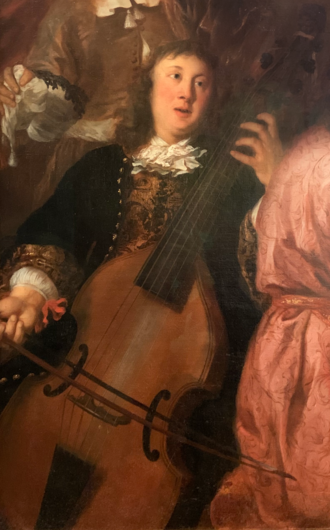
NAME: Buxtehude, Diederik
ACHIEVEMENT(S): Musician hero of Handel and JS Bach
NICKNAME/ALIAS: None
DATE AND PLACE OF BIRTH: c. 1637, either at Helsinborg, Denmark (now Halsingborg, Sweden), or Oldesloe (now Bad Oldesloe, Germany)
DATE/PLACE OF DEATH/AGE AT DEATH: May 9, 1707, Lubeck, Germany. Aged approx 70
DISCIPLINE: Composer
FIELD: Music
LANGUAGE: Danish, German
EDUCATION: Latin School, Helsingor,
MAJOR WORK: "Templum honoris"
LIFE AND TIMES:
Around the age of 21, Buxtehude became organist at his father's former church, St. Mary's at Helsingborg. Two years later, he moved back to Helsingor as organist of St. Mary's Church, also known as the "German Church", which served a German-speaking congregation.
One of the leading intellectuals of Europe, Marcus Meibom, who for four years held a high position in Helsingor as director of customs, was a member of St. Mary's Church. Meibom kept an extensive library, which he likely let Buxtehude use, and had a vast knowledge of musical theory, which he undoubtedly passed on to the young organist.
The death of Franz Tunder in late 1667, left vacant the post of organist at the Marienkirche at Lubeck. Buxtehude was chosen above several other applicants. It was one of the most important organist positions in north Germany. Buxtehude became a citizen of Lubeck in July, 1868, and in August, married Anna Margaretha Tunder, the younger daughter of his predecessor. Buxtehude's father joined him at Lubeck in 1673, and his brother Peiter, a barber, followed in 1677.
It was at this point that Buxtehude's talent for composition and fund-raising became widely known. Besides his regular duties as organist, Buxtehude reinstated the practise of giving special concerts in the church, called "Abendmusik" (evening music), which he scheduled for 4 pm on the five Sundays before Christmas. Since the concerts were on consecutive Sundays, he introduced a five-part oratorio form, each part performed at a
separate concert. The notion was used by German composer J.S. Bach* 30 years later when he divided his Christmas oratorio into eight parts. Bach had visited Buxtehude, but it is not certain he got the idea from him.
The concerts, open to the public and given free, gained a wide reputation and became the pride of Lubeck. Also remarkable about Buxtehude's Abendmusiken was his cultivation of the business community. He persuaded local merchants to provide funds to help make music available to a wider public.
Buxtehude's fame as a composer brought a host of musicians from northern Germany to Lubeck in the early 1700s. In 1703, the 18-year-old composerHandel*, traveled from Hamburg to attend the evening concerts and meet Buxtehude. In 1705, Bach walked more than 200 miles from Arnstadt to hear a performance.
The preservation and dissemination of Buxtehude's music owes much to Bach. He stayed in Lubeck three months, making numerous copies of Buxtehude's works, which he later made available to his circle of relatives, pupils and friends. Bach likely was present at what Buxtehude confidently called an "extraordinary" Abendmusik performance: on December 2 and 3, 1705, Buxtehude presented "Castrum doloris" ("Castle of Sorrow") and "Templum honoris" ("Temple of Honour"), on the death of Holy Roman Emperor Leopold I and the accession of Joseph I.
Buxtehude's instrumental music is simple but well constructed. His most important works are considered those for organ, which include toccatas, preludes, fugues, chaconnes, pieces based on chorales, and a passacaglia to which J. S. Bach's "Passacaglia in C Minor" is indebted.
After his death in May, 1707, Buxtehude was buried in the Marienkirche, at Lubeck, beside his father and four daughters.
ASSESSMENT: One of the most esteemed and influential composers of his time.
EXTRA CONNECTIONS: a model for the careers of later Baroque masters such as George Frideric Handel, Johann Mattheson, Georg Philipp Telemann and Johann Sebastian Bach
ONELINER: Dieterich Buxtehude, influential 18th-century composer
BIBLIOGRAPHY:
EB
Snyder, Kerala J., "Dieterich Buxtehude", in The New Grove North European Baroque Masters, London: Macmillan, 1985.
PARENTS: Johannes Buxtehude; Helle Jespers Daater
SIBLINGS: Anna; Catherine; Peiter
SPOUSE: Anna Margaretha Tunder
CHILDREN: 7 daughters, 4 surviving to adulthood: Magdalena (Helena)
Elisabeth; Anna Margreta; Anna Sophia; Dorothea Catrin