Algorithm
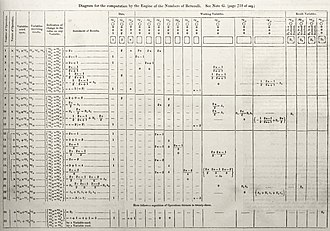
Ada Lovelace's diagram from "Note G", the first published computer algorithm
In mathematics and computer science, an algorithm (/ˈælɡərɪðəm/ ^ⓘ) is a finite sequence of rigorous instructions, typically used to solve a class of specific problems or to perform a computation.[1] Algorithms are used as specifications for performing calculations and data processing.
More advanced algorithms can use conditionals to divert the code execution through various routes (referred to as automated decision-making) and deduce valid inferences (referred to as automated reasoning), achieving automation eventually. Using human characteristics as descriptors of machines in metaphorical ways was already practiced by Alan **Turing with terms such as "memory", "search" and "stimulus".[2]
In contrast, a heuristic is an approach to problem solving that may not be fully specified or may not guarantee correct or optimal results, especially in problem domains where there is no well-defined correct or optimal result.[3]
As an effective method, an algorithm can be expressed within a finite amount of space and time[4] and in a well-defined formal language[5] for calculating a function.[6] Starting from an initial state and initial input (perhaps empty),[7] the instructions describe a computation that, when executed, proceeds through a finite[8] number of well-defined successive states, eventually producing "output"[9] and terminating at a final ending state. The transition from one state to the next is not necessarily deterministic; some algorithms, known as randomized algorithms, incorporate random input.[10]
History
Ancient algorithms
Since antiquity, step-by-step procedures for solving mathematical problems have been attested. This includes Babylonian mathematics (around 2500 BC),[11] Egyptian mathematics (around 1550 BC),[11] Indian mathematics (around 800 BC and later; e.g. Shulba Sutras, Kerala School, and Brāhmasphuṭasiddhānta),[12][13] The Ifa Oracle (around 500 BC), Greek mathematics (around 240 BC, e.g. sieve of Eratosthenes and Euclidean algorithm),[14] and Arabic mathematics (9th century, e.g. cryptographic algorithms for code-breaking based on frequency analysis).[15]
Al-Khwārizmī and the term algorithm
Around 825, Muḥammad ibn Mūsā al-Khwārizmī wrote kitāb al-ḥisāb al-hindī ("Book of Indian computation") and kitab al-jam' wa'l-tafriq al-ḥisāb al-hindī ("Addition and subtraction in Indian arithmetic"). Both of these texts are lost in the original Arabic at this time. (However, his other book on algebra remains.)[16]
In the early 12th century, Latin translations of said al-Khwarizmi texts involving the Hindu–Arabic numeral system and arithmetic appeared: Liber Alghoarismi de practica arismetrice (attributed to John of Seville) and Liber Algorismi de numero Indorum (attributed to Adelard of Bath).[17] Hereby, alghoarismi or algorismi is the Latinization of Al-Khwarizmi's name; the text starts with the phrase Dixit Algorismi ("Thus spoke Al-Khwarizmi").[18]
In 1240, Alexander of Villedieu writes a Latin text titled Carmen de Algorismo. It begins with:
Haec algorismus ars praesens dicitur, in qua / Talibus Indorum fruimur bis quinque figuris.
which translates to:
Algorism is the art by which at present we use those Indian figures, which number two times five.
The poem is a few hundred lines long and summarizes the art of calculating with the new styled Indian dice (Tali Indorum), or Hindu numerals.[19]
English evolution of the word
Around 1230, the English word algorism is attested and then by Chaucer in 1391. English adopted the French term.[20][21]
In the 15th century, under the influence of the Greek word ἀριθμός (arithmos, "number"; cf. "arithmetic"), the Latin word was altered to algorithmus.
In 1656, in the English dictionary Glossographia, it says:[22]
Algorism ([Latin] algorismus) the Art or use of Cyphers, or of numbering by Cyphers; skill in accounting.
Augrime ([Latin] algorithmus) skil in accounting or numbring.
...
Since at least 1811, the term algorithm is attested to mean a "step-by-step procedure" in English.[26][27]
In 1842, in the Dictionary of Science, Literature and Art, it says:
ALGORITHM, signifies the art of computing in reference to some particular subject, or in some particular way; as the algorithm of numbers; the algorithm of the differential calculus.[28]
Machine usage
In 1928, a partial formalization of the modern concept of algorithms began with attempts to solve the Entscheidungsproblem(decision problem) posed by David Hilbert. Later formalizations were framed as attempts to define "effective calculability"[29] or "effective method".[30] Those formalizations included the Gödel–Herbrand–Kleene recursive functions of 1930, 1934 and 1935, Alonzo Church's lambda calculus of 1936, Emil Post's Formulation 1 of 1936, and Alan Turing's Turing machines of 1936–37 and 1939.
Informal definition
For a detailed presentation of the various points of view on the definition of "algorithm", see Algorithm characterizations.
One informal definition is "a set of rules that precisely defines a sequence of operations",[31][need ^quotation ^to ^verify] which would include all computer programs (including programs that do not perform numeric calculations), and (for example) any prescribed bureaucratic procedure[32] or cook-book recipe.[33]
In general, a program is an algorithm only if it stops eventually[34]—even though infinite loops may sometimes prove desirable.
A prototypical example of an algorithm is the Euclidean algorithm, which is used to determine the maximum common divisor of two integers; an example (there are others) is described by the flowchart above and as an example in a later section.
Boolos, Jeffrey & 1974, 1999 offer an informal meaning of the word "algorithm" in the following quotation:
No human being can write fast enough, or long enough, or small enough† ( †"smaller and smaller without limit ... you'd be trying to write on molecules, on atoms, on electrons") to list all members of an enumerably infinite set by writing out their names, one after another, in some notation. But humans can do something equally useful, in the case of certain enumerably infinite sets: They can give explicit instructions for determining the nth member of the set, for arbitrary finite n. Such instructions are to be given quite explicitly, in a form in which they could be followed by a computing machine, or by a human who is capable of carrying out only very elementary operations on symbols.[35] ...
Legal issues
See also: Software patent
Algorithms, by themselves, are not usually patentable. In the United States, a claim consisting solely of simple manipulations of abstract concepts, numbers, or signals does not constitute "processes" (USPTO 2006), so algorithms are not patentable (as in Gottschalk v. Benson).
However practical applications of algorithms are sometimes patentable. For example, in Diamond v. Diehr, the application of a simple feedback algorithm to aid in the curing of synthetic rubber was deemed patentable. The patenting of software is controversial,[85] and there are criticized patents involving algorithms, especially data compression algorithms, such as Unisys's LZW patent.
Additionally, some cryptographic algorithms have export restrictions (see export of cryptography)....
Mechanical contrivances with discrete states
The clock: Bolter credits the invention of the weight-driven clock as "The key invention [of Europe in the Middle Ages]", in particular, the verge escapement[91] that provides us with the tick and tock of a mechanical clock. "The accurate automatic machine"[92] led immediately to "mechanical automata" beginning in the 13th century and finally to "computational machines"—the difference engine and analytical engines of Charles Babbage and Countess Ada Lovelace, mid-19th century.[93]
Lovelace is credited with the first creation of an algorithm intended for processing on a computer—Babbage's analytical engine, the first device considered a real Turing-complete computer instead of just a calculator—and is sometimes called "history's first programmer" as a result, though a full implementation of Babbage's second device would not be realized until decades after her lifetime.
Logical machines 1870 – Stanley Jevons' "logical abacus" and "logical machine": The technical problem was to reduce Boolean equations when presented in a form similar to what is now known as Karnaugh maps. Jevons (1880) describes first a simple "abacus" of "slips of wood furnished with pins, contrived so that any part or class of the [logical] combinations can be picked out mechanically ... More recently, however, I have reduced the system to a completely mechanical form, and have thus embodied the whole of the indirect process of inference in what may be called a Logical Machine" His machine came equipped with "certain moveable wooden rods" and "at the foot are 21 keys like those of a piano [etc.] ...". With this machine he could analyze a "syllogism or any other simple logical argument".[94]
This machine he displayed in 1870 before the Fellows of the Royal Society.[95] Another logician John Venn, however, in his 1881 Symbolic Logic, turned a jaundiced eye to this effort: "I have no high estimate myself of the interest or importance of what are sometimes called logical machines ... it does not seem to me that any contrivances at present known or likely to be discovered really deserve the name of logical machines"; see more at Algorithm characterizations.
But not to be outdone he too presented "a plan somewhat analogous, I apprehend, to Prof. Jevon's abacus ... [And] [a]gain, corresponding to Prof. Jevons's logical machine, the following contrivance may be described. I prefer to call it merely a logical-diagram machine ... but I suppose that it could do very completely all that can be rationally expected of any logical machine".[96]
Jacquard loom, Hollerith punch cards, telegraphy and telephony – the electromechanical relay: Bell and Newell (1971) indicate that the Jacquard loom (1801), precursor to Hollerith cards (punch cards, 1887), and "telephone switching technologies" were the roots of a tree leading to the development of the first computers.[97] By the mid-19th century the telegraph, the precursor of the telephone, was in use throughout the world, its discrete and distinguishable encoding of letters as "dots and dashes" a common sound. By the late 19th century the ticker tape (c. 1870s) was in use, as was the use of Hollerith cards in the 1890 U.S. census. Then came the teleprinter (c. 1910) with its punched-paper use of Baudot code on tape.
Telephone-switching networks of electromechanical relays (invented 1835) was behind the work of George Stibitz (1937), the inventor of the digital adding device. As he worked in Bell Laboratories, he observed the "burdensome' use of mechanical calculators with gears. "He went home one evening in 1937 intending to test his idea... When the tinkering was over, Stibitz had constructed a binary adding device".[98]
The mathematician Martin Davis observes the particular importance of the electromechanical relay (with its two "binary states" open and closed):
It was only with the development, beginning in the 1930s, of electromechanical calculators using electrical relays, that machines were built having the scope Babbage had envisioned."[99]
Mathematics during the 19th century up to the mid-20th century
Symbols and rules: In rapid succession, the mathematics of George Boole (1847, 1854), Gottlob Frege (1879), and Giuseppe Peano (1888–1889) reduced arithmetic to a sequence of symbols manipulated by rules. Peano's The principles of arithmetic, presented by a new method (1888) was "the first attempt at an axiomatization of mathematics in a symbolic language".[100]
But Heijenoort gives Frege (1879) this kudos: Frege's is "perhaps the most important single work ever written in logic. ... in which we see a "'formula language', that is a lingua characterica, a language written with special symbols, "for pure thought", that is, free from rhetorical embellishments ... constructed from specific symbols that are manipulated according to definite rules".[101] The work of Frege was further simplified and amplified by Alfred North Whitehead and Bertrand Russell in their Principia Mathematica (1910–1913)....
Emil Post (1936) and Alan Turing (1936–37, 1939)
Emil Post (1936) described the actions of a "computer" (human being) as follows:
"...two concepts are involved: that of a symbol space in which the work leading from problem to answer is to be carried out, and a fixed unalterable set of directions.
His symbol space would be
"a two-way infinite sequence of spaces or boxes ... The problem solver or worker is to move and work in this symbol space, being capable of being in, and operating in but one box at a time. ... a box is to admit of but two possible conditions, i.e., being empty or unmarked, and having a single mark in it, say a vertical stroke."One box is to be singled out and called the starting point. ... a specific problem is to be given in symbolic form by a finite number of boxes [i.e., INPUT] being marked with a stroke. Likewise, the answer [i.e., OUTPUT] is to be given in symbolic form by such a configuration of marked boxes..."A set of directions applicable to a general problem sets up a deterministic process when applied to each specific problem. This process terminates only when it comes to the direction of type (C ) [i.e., STOP]".[112] See more at Post–Turing machine Alan Turing's statue at Bletchley Park
Alan Turing's work[113] preceded that of Stibitz (1937); it is unknown whether Stibitz knew of the work of Turing. Turing's biographer believed that Turing's use of a typewriter-like model derived from a youthful interest: "Alan had dreamt of inventing typewriters as a boy; Mrs. Turing had a typewriter, and he could well have begun by asking himself what was meant by calling a typewriter 'mechanical'".[114] Given the prevalence at the time of Morse code, telegraphy, ticker tape machines, and teletypewriters, it is quite possible that all were influences on Turing during his youth.
Turing—his model of computation is now called a Turing machine—begins, as did Post, with an analysis of a human computer that he whittles down to a simple set of basic motions and "states of mind". But he continues a step further and creates a machine as a model of computation of numbers.[115]
"Computing is normally done by writing certain symbols on paper. We may suppose this paper is divided into squares like a child's arithmetic book...I assume then that the computation is carried out on one-dimensional paper, i.e., on a tape divided into squares. I shall also suppose that the number of symbols which may be printed is finite..."The behavior of the computer at any moment is determined by the symbols which he is observing, and his "state of mind" at that moment. We may suppose that there is a bound B to the number of symbols or squares that the computer can observe at one moment. If he wishes to observe more, he must use successive observations. We will also suppose that the number of states of mind which need be taken into account is finite..."Let us imagine that the operations performed by the computer to be split up into 'simple operations' which are so elementary that it is not easy to imagine them further divided."[116]
Turing's reduction yields the following:
"The simple operations must therefore include:"(a) Changes of the symbol on one of the observed squares"(b) Changes of one of the squares observed to another square within L squares of one of the previously observed squares.
"It may be that some of these change necessarily invoke a change of state of mind. The most general single operation must, therefore, be taken to be one of the following:
"(A) A possible change (a) of symbol together with a possible change of state of mind."(B) A possible change (b) of observed squares, together with a possible change of state of mind""We may now construct a machine to do the work of this computer."[116]
A few years later, Turing expanded his analysis (thesis, definition) with this forceful expression of it:
"A function is said to be "effectively calculable" if its values can be found by some purely mechanical process. Though it is fairly easy to get an intuitive grasp of this idea, it is nevertheless desirable to have some more definite, mathematical expressible definition ... [he discusses the history of the definition pretty much as presented above with respect to Gödel, Herbrand, Kleene, Church, Turing, and Post] ... We may take this statement literally, understanding by a purely mechanical process one which could be carried out by a machine. It is possible to give a mathematical description, in a certain normal form, of the structures of these machines. The development of these ideas leads to the author's definition of a computable function, and to an identification of computability † with effective calculability..."† We shall use the expression "computable function" to mean a function calculable by a machine, and we let "effectively calculable" refer to the intuitive idea without particular identification with any one of these definitions".[117]
...
History after 1950
A number of efforts have been directed toward further refinement of the definition of "algorithm", and activity is on-going because of issues surrounding, in particular, foundations of mathematics (especially the Church–Turing thesis) and philosophy of mind (especially arguments about artificial intelligence). For more, see Algorithm characterizations.
Algorithmic bias describes systematic and repeatable errors in a computer system that create "unfair" outcomes, such as "privileging" one category over another in ways different from the intended function of the algorithm.
Bias can emerge from many factors, including but not limited to the design of the algorithm or the unintended or unanticipated use or decisions relating to the way data is coded, collected, selected or used to train the algorithm. For example, algorithmic bias has been observed in search engine results and social media platforms. This bias can have impacts ranging from inadvertent privacy violations to reinforcing social biases of race, gender, sexuality, and ethnicity. The study of algorithmic bias is most concerned with algorithms that reflect "systematic and unfair" discrimination. This bias has only recently been addressed in legal frameworks, such as the European Union's General Data Protection Regulation (2018) and the proposed Artificial Intelligence Act (2021).
As algorithms expand their ability to organize society, politics, institutions, and behavior, sociologists have become concerned with the ways in which unanticipated output and manipulation of data can impact the physical world. Because algorithms are often considered to be neutral and unbiased, they can inaccurately project greater authority than human expertise (in part due to the psychological phenomenon of automation bias), and in some cases, reliance on algorithms can displace human responsibility for their outcomes. Bias can enter into algorithmic systems as a result of pre-existing cultural, social, or institutional expectations; by how features and labels are chosen; because of technical limitations of their design; or by being used in unanticipated contexts or by audiences who are not considered in the software's initial design.[2]
Algorithmic bias has been cited in cases ranging from election outcomes to the spread of online hate speech. It has also arisen in criminal justice, healthcare, and hiring, compounding existing racial, socioeconomic, and gender biases. The relative inability of facial recognition technology to accurately identify darker-skinned faces has been linked to multiple wrongful arrests of black men, an issue stemming from imbalanced datasets.
Problems in understanding, researching, and discovering algorithmic bias persist due to the proprietary nature of algorithms, which are typically treated as trade secrets. Even when full transparency is provided, the complexity of certain algorithms poses a barrier to understanding their functioning. Furthermore, algorithms may change, or respond to input or output in ways that cannot be anticipated or easily reproduced for analysis. In many cases, even within a single website or application, there is no single "algorithm" to examine, but a network of many interrelated programs and data inputs, even between users of the same service.
Definitions
A 1969 diagram for how a simple computer program makes decisions, illustrating a very simple algorithm.
Algorithms are difficult to define,[3] but may be generally understood as lists of instructions that determine how programs read, collect, process, and analyze data to generate output.[4]: 13 For a rigorous technical introduction, see Algorithms. Advances in computer hardware have led to an increased ability to process, store and transmit data. This has in turn boosted the design and adoption of technologies such as machine learning and artificial intelligence.[5]: 14–15 By analyzing and processing data, algorithms are the backbone of search engines,[6] social media websites,[7] recommendation engines,[8] online retail,[9] online advertising,[10] and more.[11]
Contemporary social scientists are concerned with algorithmic processes embedded into hardware and software applications because of their political and social impact, and question the underlying assumptions of an algorithm's neutrality.[12]: 2 [13]: 563 [14]: 294 [15] The term algorithmic bias describes systematic and repeatable errors that create unfair outcomes, such as privileging one arbitrary group of users over others. For example, a credit score algorithm may deny a loan without being unfair, if it is consistently weighing relevant financial criteria. If the algorithm recommends loans to one group of users, but denies loans to another set of nearly identical users based on unrelated criteria, and if this behavior can be repeated across multiple occurrences, an algorithm can be described as biased.[16]: 332 This bias may be intentional or unintentional (for example, it can come from biased data obtained from a worker that previously did the job the algorithm is going to do from now on).
Methods
Bias can be introduced to an algorithm in several ways. During the assemblage of a dataset, data may be collected, digitized, adapted, and entered into a database according to human-designed cataloging criteria.[17]: 3 Next, programmers assign priorities, or hierarchies, for how a program assesses and sorts that data. This requires human decisions about how data is categorized, and which data is included or discarded.[17]: 4 Some algorithms collect their own data based on human-selected criteria, which can also reflect the bias of human designers.[17]: 8 Other algorithms may reinforce stereotypes and preferences as they process and display "relevant" data for human users, for example, by selecting information based on previous choices of a similar user or group of users.[17]: 6
Beyond assembling and processing data, bias can emerge as a result of design.[18] For example, algorithms that determine the allocation of resources or scrutiny (such as determining school placements) may inadvertently discriminate against a category when determining risk based on similar users (as in credit scores).[19]: 36 Meanwhile, recommendation engines that work by associating users with similar users, or that make use of inferred marketing traits, might rely on inaccurate associations that reflect broad ethnic, gender, socio-economic, or racial stereotypes. Another example comes from determining criteria for what is included and excluded from results. This criteria could present unanticipated outcomes for search results, such as with flight-recommendation software that omits flights that do not follow the sponsoring airline's flight paths.[18] Algorithms may also display an uncertainty bias, offering more confident assessments when larger data sets are available. This can skew algorithmic processes toward results that more closely correspond with larger samples, which may disregard data from underrepresented populations.[20]: 4 ...
Impact
Commercial influences
Corporate algorithms could be skewed to invisibly favor financial arrangements or agreements between companies, without the knowledge of a user who may mistake the algorithm as being impartial. For example, American Airlines created a flight-finding algorithm in the 1980s. The software presented a range of flights from various airlines to customers, but weighed factors that boosted its own flights, regardless of price or convenience. In testimony to the United States Congress, the president of the airline stated outright that the system was created with the intention of gaining competitive advantage through preferential treatment.[51]: 2 [16]: 331
In a 1998 paper describing Google, the founders of the company had adopted a policy of transparency in search results regarding paid placement, arguing that "advertising-funded search engines will be inherently biased towards the advertisers and away from the needs of the consumers."[52] This bias would be an "invisible" manipulation of the user.[51]: 3
Voting behavior
A series of studies about undecided voters in the US and in India found that search engine results were able to shift voting outcomes by about 20%. The researchers concluded that candidates have "no means of competing" if an algorithm, with or without intent, boosted page listings for a rival candidate.[53] Facebook users who saw messages related to voting were more likely to vote. A 2010 randomized trial of Facebook users showed a 20% increase (340,000 votes) among users who saw messages encouraging voting, as well as images of their friends who had voted.[54] Legal scholar Jonathan Zittrain has warned that this could create a "digital gerrymandering" effect in elections, "the selective presentation of information by an intermediary to meet its agenda, rather than to serve its users", if intentionally manipulated.[55]: 335
Gender discrimination
In 2016, the professional networking site LinkedIn was discovered to recommend male variations of women's names in response to search queries. The site did not make similar recommendations in searches for male names. For example, "Andrea" would bring up a prompt asking if users meant "Andrew", but queries for "Andrew" did not ask if users meant to find "Andrea". The company said this was the result of an analysis of users' interactions with the site.[56]
In 2012, the department store franchise Target was cited for gathering data points to infer when women customers were pregnant, even if they had not announced it, and then sharing that information with marketing partners.[57]: 94 [58] Because the data had been predicted, rather than directly observed or reported, the company had no legal obligation to protect the privacy of those customers.[57]: 98
Web search algorithms have also been accused of bias. Google's results may prioritize pornographic content in search terms related to sexuality, for example, "lesbian". This bias extends to the search engine showing popular but sexualized content in neutral searches. For example, "Top 25 Sexiest Women Athletes" articles displayed as first-page results in searches for "women athletes".[59]: 31 In 2017, Google adjusted these results along with others that surfaced hate groups, racist views, child abuse and pornography, and other upsetting and offensive content.[60] Other examples include the display of higher-paying jobs to male applicants on job search websites.[61] Researchers have also identified that machine translation exhibits a strong tendency towards male defaults.[62] In particular, this is observed in fields linked to unbalanced gender distribution, including STEM occupations.[63] In fact, current machine translation systems fail to reproduce the real world distribution of female workers.[64]
In 2015, Amazon.com turned off an AI system it developed to screen job applications when they realized it was biased against women.[65] The recruitment tool excluded applicants who attended all-women's colleges and resumes that included the word "women's".[66] A similar problem emerged with music streaming services—In 2019, it was discovered that the recommender system algorithm used by Spotify was biased against women artists.[67] Spotify's song recommendations suggested more male artists over women artists.
Racial and ethnic discrimination
Algorithms have been criticized as a method for obscuring racial prejudices in decision-making.[68][69][70]: 158 Because of how certain races and ethnic groups were treated in the past, data can often contain hidden biases.[71] For example, black people are likely to receive longer sentences than white people who committed the same crime.[72][73] This could potentially mean that a system amplifies the original biases in the data.
In 2015, Google apologized when black users complained that an image-identification algorithm in its Photos application identified them as gorillas.[74] In 2010, Nikon cameras were criticized when image-recognition algorithms consistently asked Asian users if they were blinking.[75] Such examples are the product of bias in biometric data sets.[74] Biometric data is drawn from aspects of the body, including racial features either observed or inferred, which can then be transferred into data points.[70]: 154 Speech recognition technology can have different accuracies depending on the user's accent. This may be caused by the a lack of training data for speakers of that accent.[76]
Biometric data about race may also be inferred, rather than observed. For example, a 2012 study showed that names commonly associated with blacks were more likely to yield search results implying arrest records, regardless of whether there is any police record of that individual's name.[77] A 2015 study also found that Black and Asian people are assumed to have lesser functioning lungs due to racial and occupational exposure data not being incorporated into the prediction algorithm's model of lung function.[78][79]
In 2019, a research study revealed that a healthcare algorithm sold by Optum favored white patients over sicker black patients. The algorithm predicts how much patients would cost the health-care system in the future. However, cost is not race-neutral, as black patients incurred about $1,800 less in medical costs per year than white patients with the same number of chronic conditions, which led to the algorithm scoring white patients as equally at risk of future health problems as black patients who suffered from significantly more diseases.[80]
A study conducted by researchers at UC Berkeley in November 2019 revealed that mortgage algorithms have been discriminatory towards Latino and African Americans which discriminated against minorities based on "creditworthiness" which is rooted in the U.S. fair-lending law which allows lenders to use measures of identification to determine if an individual is worthy of receiving loans. These particular algorithms were present in FinTech companies and were shown to discriminate against minorities.[81][non-primary ^source ^needed]
Law enforcement and legal proceedings
Algorithms already have numerous applications in legal systems. An example of this is COMPAS, a commercial program widely used by U.S. courts to assess the likelihood of a defendant becoming a recidivist. ProPublica claims that the average COMPAS-assigned recidivism risk level of black defendants is significantly higher than the average COMPAS-assigned risk level of white defendants, and that black defendants are twice as likely to be erroneously assigned the label "high-risk" as white defendants.[82][83]
One example is the use of risk assessments in criminal sentencing in the United States and parole hearings, judges were presented with an algorithmically generated score intended to reflect the risk that a prisoner will repeat a crime.[84] For the time period starting in 1920 and ending in 1970, the nationality of a criminal's father was a consideration in those risk assessment scores.[85]: 4 Today, these scores are shared with judges in Arizona, Colorado, Delaware, Kentucky, Louisiana, Oklahoma, Virginia, Washington, and Wisconsin. An independent investigation by ProPublica found that the scores were inaccurate 80% of the time, and disproportionately skewed to suggest blacks to be at risk of relapse, 77% more often than whites.[84]
One study that set out to examine "Risk, Race, & Recidivism: Predictive Bias and Disparate Impact" alleges a two-fold (45 percent vs. 23 percent) adverse likelihood for black vs. Caucasian defendants to be misclassified as imposing a higher risk despite having objectively remained without any documented recidivism over a two-year period of observation.[86]
In the pretrial detention context, a law review article argues that algorithmic risk assessments violate 14th Amendment Equal Protection rights on the basis of race, since the algorithms are argued to be facially discriminatory, to result in disparate treatment, and to not be narrowly tailored.[87]
Online hate speech
In 2017 a Facebook algorithm designed to remove online hate speech was found to advantage white men over black children when assessing objectionable content, according to internal Facebook documents.[88] The algorithm, which is a combination of computer programs and human content reviewers, was created to protect broad categories rather than specific subsets of categories. For example, posts denouncing "Muslims" would be blocked, while posts denouncing "Radical Muslims" would be allowed. An unanticipated outcome of the algorithm is to allow hate speech against black children, because they denounce the "children" subset of blacks, rather than "all blacks", whereas "all white men" would trigger a block, because whites and males are not considered subsets.[88] Facebook was also found to allow ad purchasers to target "Jew haters" as a category of users, which the company said was an inadvertent outcome of algorithms used in assessing and categorizing data. The company's design also allowed ad buyers to block African-Americans from seeing housing ads.[89]
While algorithms are used to track and block hate speech, some were found to be 1.5 times more likely to flag information posted by Black users and 2.2 times likely to flag information as hate speech if written in African American English.[90] Without context for slurs and epithets, even when used by communities which have re-appropriated them, were flagged.[91]
Surveillance
Surveillance camera software may be considered inherently political because it requires algorithms to distinguish normal from abnormal behaviors, and to determine who belongs in certain locations at certain times.[13]: 572 The ability of such algorithms to recognize faces across a racial spectrum has been shown to be limited by the racial diversity of images in its training database; if the majority of photos belong to one race or gender, the software is better at recognizing other members of that race or gender.[92] However, even audits of these image-recognition systems are ethically fraught, and some scholars have suggested the technology's context will always have a disproportionate impact on communities whose actions are over-surveilled.[93] For example, a 2002 analysis of software used to identify individuals in CCTV images found several examples of bias when run against criminal databases. The software was assessed as identifying men more frequently than women, older people more frequently than the young, and identified Asians, African-Americans and other races more often than whites.[27]: 190 A 2018 study found that facial recognition software most likely accurately identified light-skinned (typically European) males, with slightly lower accuracy rates for light-skinned females. Dark-skinned males and females were significanfly less likely to be accurately identified by facial recognition software. These disparities are attributed to the under-representation of darker-skinned participants in data sets used to develop this software.[94][95]
Discrimination against the LGBTQ community....
History
Early critiques
[ ](https://en.wikipedia.org/wiki/File:Used_Punchcard_%285151286161%29.jpg)
This card was used to load software into an old mainframe computer. Each byte (the letter 'A', for example) is entered by punching holes. Though contemporary computers are more complex, they reflect this human decision-making process in collecting and processing data.[21]: 70 [22]: 16
The earliest computer programs were designed to mimic human reasoning and deductions, and were deemed to be functioning when they successfully and consistently reproduced that human logic. In his 1976 book Computer Power and Human Reason, artificial intelligence pioneer Joseph Weizenbaum suggested that bias could arise both from the data used in a program, but also from the way a program is coded.[21]: 149
See also

- Abstract machine
- ALGOL
- Algorithm engineering
- Algorithm characterizations
- Algorithmic bias
- Algorithmic composition
- Algorithmic entities
- Algorithmic synthesis
- Algorithmic technique
- Algorithmic topology
- Garbage in, garbage out
- Introduction to Algorithms (textbook)
- Government by algorithm
- List of algorithms
- List of algorithm general topics
- Regulation of algorithms
- Theory of computation
- Computational mathematics