Firmament
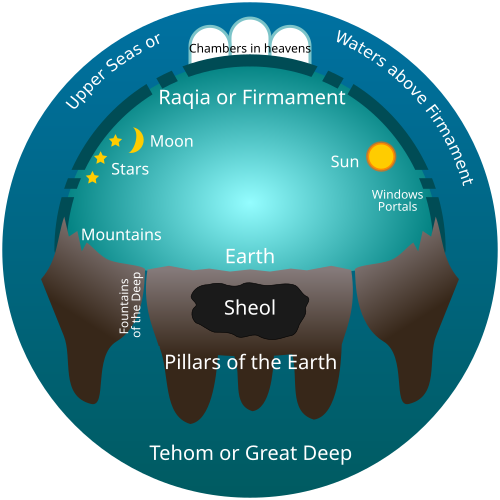
An artist's depiction of the early Hebrew conception of the cosmos. The firmament (raqia), Sheol, and Tehom are depicted.
In ancient near eastern cosmology, the firmament was a celestial barrier that separated the heavenly waters above from the Earth below.[1] In biblical cosmology, the firmament (Hebrew: רָקִ֫יעַ rāqīaʿ) was the vast solid dome created by God during the Genesis creation narrative to separate the primal sea into upper and lower portions so that the dry land could appear.[2][3]
The concept was adopted into the subsequent Classical and Medieval models of heavenly spheres, but was dropped with advances in astronomy in the 16th and 17th centuries. Today the word is sometimes used as a synonym for the sky or for heaven.
Etymology
Firmament
In English, the word "firmament" is recorded as early as 1250, in the Middle English Story of Genesis and Exodus. It later appeared in the King James Bible.[4] The same word is found in French and German Bible translations, all from the Latin firmamentum (a firm object), used in the Vulgate (4th century).[5] This in turn is a calque of the Greek στερέωμᾰ (steréōma), also meaning a solid or firm structure (Greek στερεός = rigid), which appears in the Septuagint, the Greek translation made by Jewish scholars around 200 BC.
Raqia
These words all translate the Biblical Hebrew word rāqīaʿ (רָקִ֫יעַ), used for example in Genesis 1.6, where it is contrasted with shamayim (שָׁמַיִם), translated as "heaven(s)" in Genesis 1.1. Rāqīaʿ derives from the root rqʿ (רָקַע), meaning "to beat or spread out thinly".[6][7] The Hebrew lexicographers Brown, Driver and Briggs gloss the noun with "extended surface, (solid) expanse (as if beaten out)" and distinguish two main uses: 1. "(flat) expanse (as if of ice), as base, support", and 2. "the vault of heaven, or 'firmament,' regarded by Hebrews as solid and supporting 'waters' above it."[8] A related noun, riqquaʿ (רִקּוּעַ), found in Numbers 16.38 (Hebrew numbering 17.3), refers to the process of hammering metal into sheets.[8] Gerhard von Rad explains:
Rāqīaʿ means that which is firmly hammered, stamped (a word of the same root in Phoenecian means "tin dish"!). The meaning of the verb rqʿ concerns the hammering of the vault of heaven into firmness (Isa. 42.5; Ps.136.6). The Vulgate translates rāqīaʿ with firmamentum, and that remains the best rendering.
— Gerhard von Rad[9]
See the PDF for the rest of the article, downloaded from Wikipedia on: Saturday, November 29, 2025 09:32AM
rk
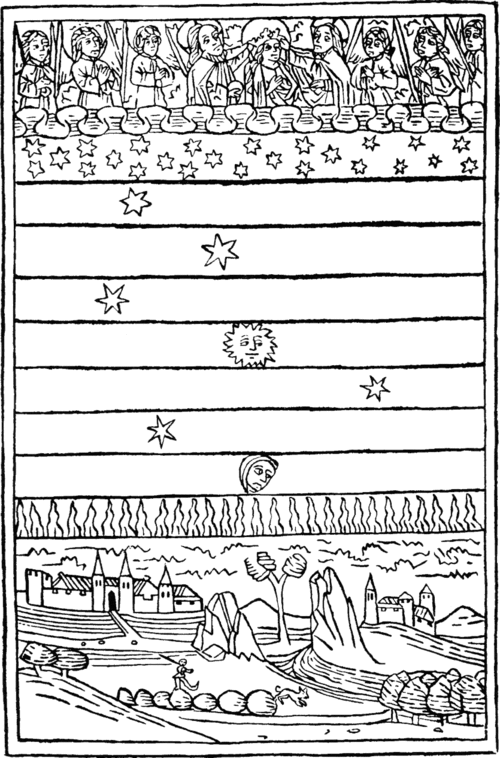
The sun, planets and angels and the firmament. Woodcut dated 1475.
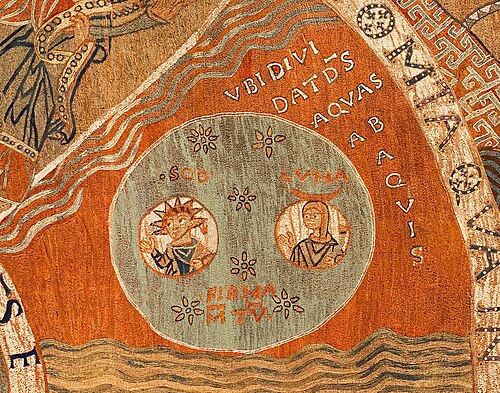
Panel from the Tapís de la Creació showing the firmamentum between the waters above and below, anthropomorphic depictions of Sol and Luna and the Latin inscription "Where God divides waters from the waters"
See Also:
- Abzu – Primeval sea in Mesopotamian mythology
- Chinese theology – Chinese theological conception of Heaven
- Cosmic ocean – Mythological motif
- Flood geology – Pseudoscientific attempt to reconcile geology with the Genesis flood narrative
- Heaven in Judaism – Dwelling place of God and other heavenly beings
- Nu – Ancient Egyptian personification of the primordial watery abyss
- Primum Mobile – Outermost moving sphere in the geocentric model of the universe
- Sky deity – Deity associated with the sky
- Wuji – The primordial in Chinese philosophy
DOWNLOADED FROM WIKIPEDIA
Saturday, November 29, 2025 09:37AM
rk