Dead_reckoning
In navigation, dead reckoning is the process of calculating the current position of a moving object by using a previously determined position, or fix, and incorporating estimates of speed, heading (or direction or course), and elapsed time. The corresponding term in biology, to describe the processes by which animals update their estimates of position or heading, is path integration.
Advances in navigational aids that give accurate information on position, in particular satellite navigation using the Global Positioning System, have made simple dead reckoning by humans obsolete for most purposes. However, inertial navigation systems, which provide very accurate directional information, use dead reckoning and are very widely applied.
Etymology
Contrary to myth, the term "dead reckoning" was not originally used to abbreviate "deduced reckoning", nor is it a misspelling of the term "ded reckoning". The use of "ded" or "deduced reckoning" is not known to have appeared earlier than 1931, much later in history than "dead reckoning", which appeared as early as 1613 according to the Oxford English Dictionary. The original intention of "dead" in the term is generally assumed to mean using a stationary object that is "dead in the water" as a basis for calculations. Additionally, at the time the first appearance of "dead reckoning", "ded" was considered a common spelling of "dead". This potentially led to later confusion of the origin of the term.[1]
By analogy with their navigational use, the words dead reckoning are also used to mean the process of estimating the value of any variable quantity by using an earlier value and adding whatever changes have occurred in the meantime. Often, this usage implies that the changes are not known accurately. The earlier value and the changes may be measured or calculated quantities.
Errors
While dead reckoning can give the best available information on the present position with little math or analysis, it is subject to significant errors of approximation. For precise positional information, both speed and direction must be accurately known at all times during travel. Most notably, dead reckoning does not account for directional drift during travel through a fluid medium. These errors tend to compound themselves over greater distances, making dead reckoning a difficult method of navigation for longer journeys.
For example, if displacement is measured by the number of rotations of a wheel, any discrepancy between the actual and assumed traveled distance per rotation, due perhaps to slippage or surface irregularities, will be a source of error. As each estimate of position is relative to the previous one, errors are cumulative, or compounding, over time.
The accuracy of dead reckoning can be increased significantly by using other, more reliable methods to get a new fix part way through the journey. For example, if one was navigating on land in poor visibility, then dead reckoning could be used to get close enough to the known position of a landmark to be able to see it, before walking to the landmark itself—giving a precisely known starting point—and then setting off again.
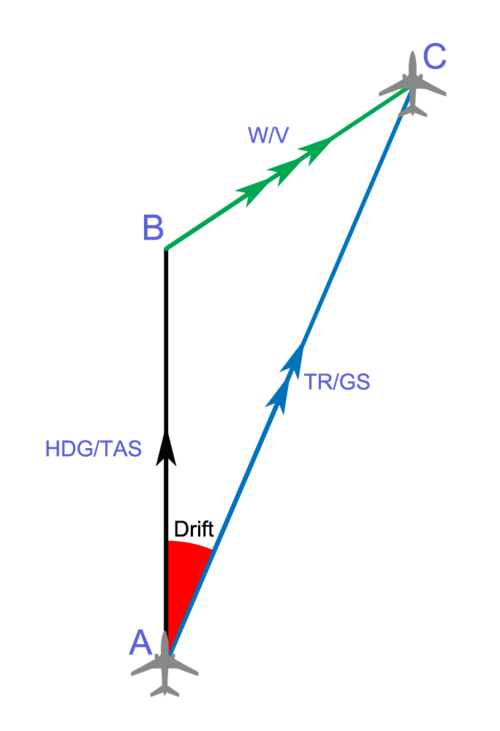
Drift is an error that can arise in dead reckoning when speed of a medium is not accounted for. A is the last known position (fix), B is the position calculated by dead reckoning, and C is the true position after the time interval. The vector from A to B is the expected path for plane based on the initial heading (HDG) and true airspeed (TAS). The vector from B to C is the wind velocity (W/V), and the third vector is the actual track (TR) and ground speed (GS). The drift angle is marked in red.
Animal navigation
Main article: Animal navigation
In studies of animal navigation, dead reckoning is more commonly (though not exclusively) known as path integration. Animals use it to estimate their current location based on their movements from their last known location. Animals such as ants, rodents, and geese have been shown to track their locations continuously relative to a starting point and to return to it, an important skill for foragers with a fixed home.[6][7]
downloaded from wikipedia on:
Saturday, November 29, 2025 08:37AM
rk