George B. McClellan
"George McClellan" redirects here. For other people with the same name, see George McClellan (disambiguation).
"Little Napoleon" redirects here. For the Confederate general, see P. G. T. Beauregard.
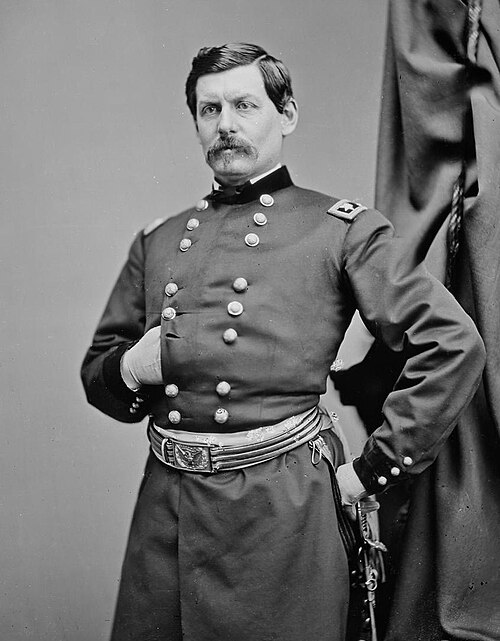
Portrait by Mathew Benjamin Brady, 1861
George Brinton McClellan (December 3, 1826 – October 29, 1885) was an American military officer, politician, and engineer who served as the 24th governor of New Jersey from 1878 to 1881, as Commanding General of the United States Army from November 1861 to March 1862, and the unsuccessful Democratic Party candidate in the 1864 presidential election. He was also chief engineer and vice president of the Illinois Central Railroad, and later president of the Ohio and Mississippi Railroad in 1860.
A West Point graduate, McClellan served with distinction during the Mexican-American War. He was a railway executive and engineer until the outbreak of the American Civil War in 1861. Early in the conflict, McClellan was appointed to the rank of major general and played an important role in raising the Army of the Potomac, which served in the Eastern Theater.
McClellan organized and led the Union Army in the Peninsula campaign in southeastern Virginia from March through July 1862. It was the first large-scale offensive in the Eastern Theater. Making an amphibious clockwise turning movement around the Confederate Army in northern Virginia, McClellan's forces turned west to move up the Virginia Peninsula, between the James River and York River, landing from Chesapeake Bay, with the Confederate capital, Richmond, as their objective. Initially, McClellan was somewhat successful against General Joseph E. Johnston, but the emergence of General Robert E. Lee to command the Army of Northern Virginia turned the subsequent Seven Days Battles into a Union defeat. However, historians note that Lee's victory was in many ways pyrrhic as he failed to destroy the Army of the Potomac and suffered a bloody repulse at Malvern Hill.
McClellan and President Abraham Lincoln developed a mutual distrust, and McClellan was privately derisive of Lincoln. He was removed from command in November, in the aftermath of the 1862 midterm elections. A major contributing factor in this decision was McClellan's failure to pursue Lee's army following the tactically inconclusive but strategic Union victory at the Battle of Antietam outside Sharpsburg, Maryland. He never received another field command and went on to become the unsuccessful Democratic Party nominee in the 1864 presidential election against the Republican Lincoln. The effectiveness of his campaign was damaged when McClellan repudiated his party's platform, which promised an end to the war and negotiations with the Confederacy. He served as the governor of New Jersey from 1878 to 1881; in McClellan's later writings, he vigorously defended his Civil War conduct.
Early life and education
[ ](https://en.wikipedia.org/wiki/File:Julian_Scott_-George_Brinton_McClellan_-NPG.65.35_-_National_Portrait_Gallery.jpg)The Julian Scott portrait of McClellan in the National Portrait Gallery in Washington, D.C.
George Brinton McClellan was born in Philadelphia on December 3, 1826. Born a son of George McClellan, a surgeon, who founded Jefferson Medical College.[2] His father's family was of Scottish and English heritage.[3] His mother was Elizabeth Sophia Steinmetz Brinton McClellan, a woman noted for her "considerable grace and refinement." Her father was of English origin, while her mother was Pennsylvania Dutch.[4] The couple had five children: Frederica, John, George, Arthur, and Mary. One of McClellan's great-grandfathers was Samuel McClellan, a brigadier general who served during the Revolutionary War.[5]
McClellan initially intended to follow his father into the medical profession, and attended a private academy, which was followed by enrollment in a private preparatory school for the University of Pennsylvania.[6] He began attending the university in 1840, when he was 14 years old, resigning himself to the study of law after his family decided that medical educations for both McClellan and his older brother John were too expensive.[6] After two years at the university, he changed his goal to military service. With the assistance of his father's letter to President John Tyler, McClellan was accepted at the United States Military Academy in 1842 at the age of 15, with the academy waiving its usual minimum age of 16.[7]
At West Point, he was an energetic and ambitious cadet, deeply interested in the teachings of Dennis Hart Mahan and the theoretical strategic principles of Antoine-Henri Jomini. His closest friends were aristocratic southerners including George Pickett, Dabney Maury, Cadmus Wilcox, and A. P. Hill. These associations gave McClellan what he considered to be an appreciation of the southern mind and an understanding of the political and military implications of the sectional differences in the United States that led to the Civil War.[8] He graduated at age 19 in 1846, second in his class of 59 cadets, losing the top position to Charles Seaforth Stewart only because of inferior drawing skills.[9] He was commissioned a brevet second lieutenant in the U.S. Army Corps of Engineers.[1]
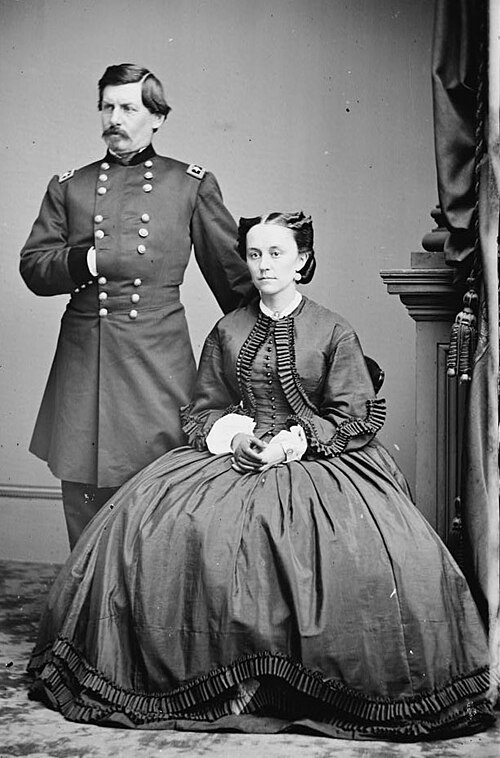
McClellan and Ellen Mary "Nelly" (Marcy) McClellan
McClellan resigned his commission January 16, 1857, and, capitalizing on his experience with railroad assessment, became chief engineer and vice president of the Illinois Central Railroad, and then president of the Ohio and Mississippi Railroad in 1860. He performed well in both jobs, expanding the Illinois Central toward New Orleans and helping the Ohio and Mississippi recover from the Panic of 1857. Despite his successes and lucrative salary ($10,000 per year), he was frustrated with civilian employment and continued to study classical military strategy assiduously. During the Utah War against the Mormons, he considered rejoining the Army. He also considered service as a filibuster in support of Benito Juárez in Mexico.[21]
Before the outbreak of the Civil War, McClellan became active in politics, supporting the presidential campaign of Democrat Stephen A. Douglas in the 1860 election. He claimed to have defeated an attempt at vote fraud by Republicans by ordering the delay of a train that was carrying men to vote illegally in another county, enabling Douglas to win the county.[22]
In October 1859, McClellan was able to resume his courtship of Ellen Mary. They were married in Calvary Church, New York City, on May 22, 1860.[23]
Civil War
On August 20, several military units in Virginia were consolidated into his department and he immediately formed the Army of the Potomac, with himself as its first commander.[33]
This Army became the primary force in the Union army in the Eastern Theatre that protected the Capital and the North. He reveled in his newly acquired power and influence:[31]
I find myself in a new and strange position here—Presdt, Cabinet, Genl Scott & all deferring to me—by some strange operation of magic I seem to have become the power of the land. ... I almost think that were I to win some small success now I could become Dictator or anything else that might please me—but nothing of that kind would please me—therefore I won't be Dictator. Admirable self-denial!
—George B. McClellan, letter to his wife Ellen, July 26, 1861
During the summer and fall, McClellan brought a high degree of organization to his new army, and greatly improved its morale with frequent trips to review and encourage his units. It was a remarkable achievement, in which he came to personify the Army of the Potomac and reaped the adulation of his men.[34] He created defenses for Washington that were almost impregnable, consisting of 48 forts and strong points, with 480 guns manned by 7,200 artillerists.[35] The Army of the Potomac grew in number from 50,000 in July to 168,000 in November, becoming the largest military force the United States had raised until that time.[32] But this was also a time of tension in the high command, as he continued to quarrel frequently with the government and the general-in-chief, Lt. Gen. Scott, on matters of strategy. McClellan rejected the tenets of Scott's Anaconda Plan, favoring instead an overwhelming grand battle, in the Napoleonic style. He proposed that his army should be expanded to 273,000 men and 600 guns and "crush the rebels in one campaign". He favored a war that would impose little impact on civilian populations and require no emancipation of slaves.
McClellan's antipathy to emancipation added to the pressure on him, as he received bitter criticism from Radical Republicans in the government.[36] He viewed slavery as an institution recognized in the Constitution, and entitled to federal protection wherever it existed (Lincoln held the same public position until August 1862).[37] McClellan's writings after the war were typical of many Northerners: "I confess to a prejudice in favor of my own race, & can't learn to like the odor of either Billy goats or niggers."[35] But in November 1861, he wrote to his wife, "I will, if successful, throw my sword onto the scale to force an improvement in the condition of those poor blacks." He later wrote that had it been his place to arrange the terms of peace, he would have insisted on gradual emancipation, guarding the rights of both slaves and masters, as part of any settlement. But he made no secret of his opposition to the Radical Republicans. He told Ellen, "I will not fight for the abolitionists." This put him in opposition with officials of the administration who believed he was attempting to implement the policies of the opposition party.[38]
The immediate problem with McClellan's war strategy was that he was convinced the Confederates were ready to attack him with overwhelming numbers. On August 8, believing that the Confederacy had over 100,000 troops facing him (in contrast to the 35,000 they had actually deployed at Bull Run a few weeks earlier), he declared a state of emergency in the capital. By August 19, he estimated 150,000 rebel soldiers on his front. In this, McClellan was perhaps influenced by his questioning of Confederate deserter Edward B. McMurdy, whose testimony was not accepted by Lincoln, Secretary of State Seward, or General-in-Chief Scott, but reaffirmed for McClellan the numbers he had convinced himself of. McClellan's feeling of facing overwhelming odds in subsequent campaigns throughout his tenure as General of the Army of the Potomac were strongly influenced by the overblown enemy strength estimates of his secret service chief, detective Allan Pinkerton, but in August 1861, these estimates were entirely McClellan's own.[39] The result was a level of extreme caution that sapped the initiative of McClellan's army and dismayed the government. Historian and biographer Stephen W. Sears observed that McClellan's actions would have been "essentially sound" for a commander who was as outnumbered as McClellan thought he was, but McClellan in fact rarely had less than a two-to-one advantage over the armies that opposed him in 1861 and 1862. That fall, for example, Confederate forces ranged from 35,000 to 60,000, whereas the Army of the Potomac in September numbered 122,000 men; in early December 170,000; by year end, 192,000.[40]
The dispute with Scott became increasingly personal. Scott (as well as many in the War Department) was outraged that McClellan refused to divulge any details about his strategic planning, or even such basic information as the strengths and dispositions of his units. McClellan claimed he could not trust anyone in the administration to keep his plans secret from the press, and thus the enemy. In the course of a disagreement about defensive forces on the Potomac River, McClellan wrote to his wife on August 10: "Genl Scott is the great obstacle—he will not comprehend the danger & is either a traitor, or an incompetent. I have to fight my way against him."[41] Scott became so disillusioned with the young general that he offered his resignation to President Lincoln, who initially refused to accept it. Rumors traveled through the capital that McClellan might resign, or instigate a military coup, if Scott were not removed. Lincoln's Cabinet met on October 18 and agreed to accept Scott's resignation for “reasons of health”.[42]
However, the subsequently formed Army of the Potomac had high morale and was extremely proud of their general, some even referring to McClellan as the savior of Washington. He prevented the army's morale from collapsing at least twice, in the aftermath of the First and Second Battles of Bull Run. Many historians argue that he was talented in this aspect.
On November 1, 1861, Winfield Scott retired and McClellan became general-in-chief of all the Union armies. The president expressed his concern about the "vast labor" involved in the dual role of army commander and general-in-chief, but McClellan responded, "I can do it all."[42]
Lincoln, as well as many other leaders and citizens of the northern states, became increasingly impatient with McClellan's slowness to attack the Confederate forces still massed near Washington. The Union defeat at the minor Battle of Ball's Bluff near Leesburg in October added to the frustration and indirectly damaged McClellan. In December, the Congress formed a Joint Committee on the Conduct of the War, which became a thorn in the side of many generals throughout the war, accusing them of incompetence and, in some cases, treason. McClellan was called as the first witness on December 23, but he contracted typhoid fever and could not attend. Instead, his subordinate officers testified, and their candid admissions that they had no knowledge of specific strategies for advancing against the Confederates raised many calls for McClellan's dismissal.[43]
McClellan further damaged his reputation by his insulting insubordination to his commander-in-chief. He privately referred to Lincoln, whom he had known before the war as a lawyer for the Illinois Central, as "nothing more than a well-meaning baboon", a "gorilla", and "ever unworthy of ... his high position".[44] On November 13, he snubbed the president, who had come to visit McClellan's house, by making him wait for 30 minutes, only to be told that the general had gone to bed and could not receive him.[45]
On January 10, 1862, Lincoln met with top generals (McClellan did not attend) and directed them to formulate a plan of attack, expressing his exasperation with General McClellan with the following remark: "If General McClellan does not want to use the army, I would like to borrow it for a time."[46] On January 12, 1862, McClellan was summoned to the White House, where the Cabinet demanded to hear his war plans. For the first time, he revealed his intentions to transport the Army of the Potomac by ship to Urbanna, Virginia, on the Rappahannock River, outflanking the Confederate forces near Washington, and proceeding 50 miles (80 km) overland to capture Richmond. He refused to give any specific details of the proposed campaign, even to his friend, newly appointed War Secretary Edwin M. Stanton. On January 27, Lincoln issued an order that required all of his armies to begin offensive operations by February 22, Washington's birthday. On January 31, he issued a supplementary order for the Army of the Potomac to move overland to attack the Confederates at Manassas Junction and Centreville. McClellan immediately replied with a 22-page letter objecting in detail to the president's plan and advocating instead his Urbanna plan, which was the first written instance of the plan's details being presented to the president. Although Lincoln believed his plan was superior, he was relieved that McClellan finally agreed to begin moving, and reluctantly approved. On March 8, doubting McClellan's resolve, Lincoln again interfered with the army commander's prerogatives. He called a council of war at the White House in which McClellan's subordinates were asked about their confidence in the Urbanna plan. They expressed their confidence to varying degrees. After the meeting, Lincoln issued another order, naming specific officers as corps commanders to report to McClellan (who had been reluctant to do so prior to assessing his division commanders' effectiveness in combat, even though this would have meant his direct supervision of twelve divisions in the field).[47]
Two more crises would confront McClellan before he could implement his plans. The Confederate forces under General Joseph E. Johnston withdrew from their positions before Washington, assuming new positions south of the Rappahannock, which completely nullified the Urbanna strategy. McClellan revised his plans to have his troops disembark at Fort Monroe, Virginia, and advance up the Virginia Peninsula to Richmond, an operation that would be known as the Peninsula Campaign. Then, however, McClellan came under extreme criticism in the press and Congress when it was learned that Johnston's forces had not only slipped away unnoticed, but had for months fooled the Union Army with logs painted black to appear as cannons, nicknamed Quaker Guns. Congress's joint committee visited the abandoned Confederate lines and radical Republicans introduced a resolution demanding the dismissal of McClellan, but it was narrowly defeated by a parliamentary maneuver.[48] The second crisis was the emergence of the Confederate ironclad CSS *Virginia*, which threw Washington into a panic and made naval support operations on the James River seem problematic.
On March 11, 1862, Lincoln removed McClellan as general-in-chief, leaving him in command of only the Army of the Potomac, ostensibly so that McClellan would be free to devote all his attention to the move on Richmond. Lincoln's order was ambiguous as to whether McClellan might be restored following a successful campaign. In fact, the general-in-chief position was left unfilled. Lincoln, Stanton, and a group of officers who formed the "War Board" directed the strategic actions of the Union armies that spring. Although McClellan was assuaged by supportive comments Lincoln made to him, in time he saw the change of command very differently, describing it as a part of an intrigue "to secure the failure of the approaching campaign".[49]
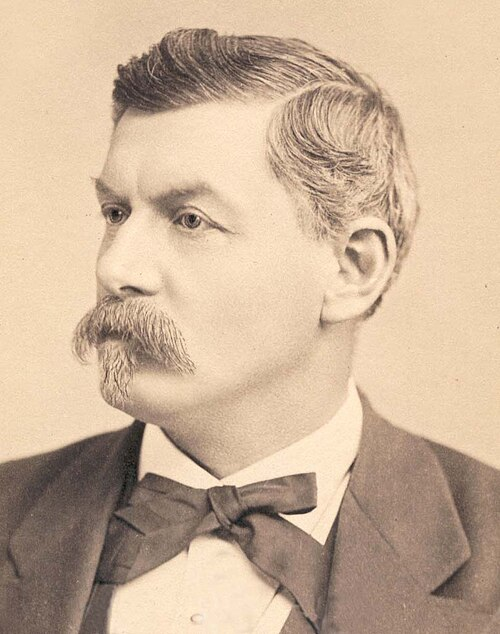
McClellan photographed by William S. Warren, circa 1880
See PDF for complete Wikipedia article downloaded
Thursday, July 30, 2026, 11:01 PM