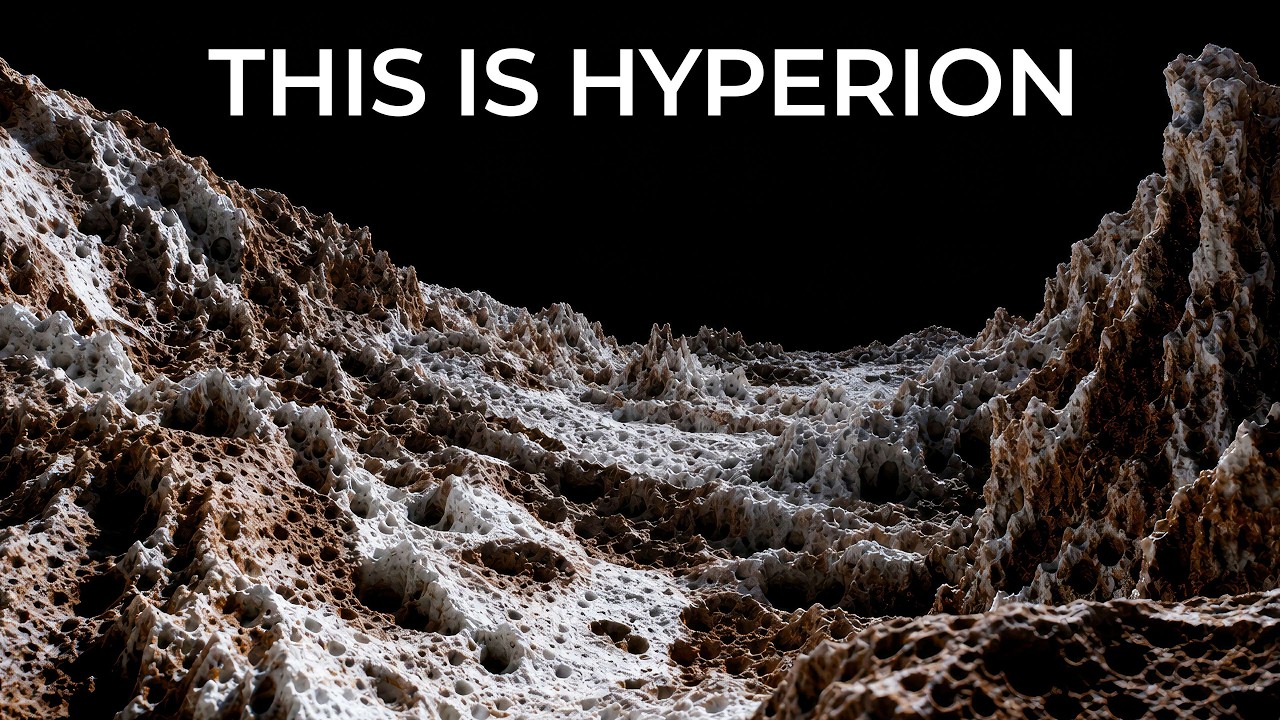
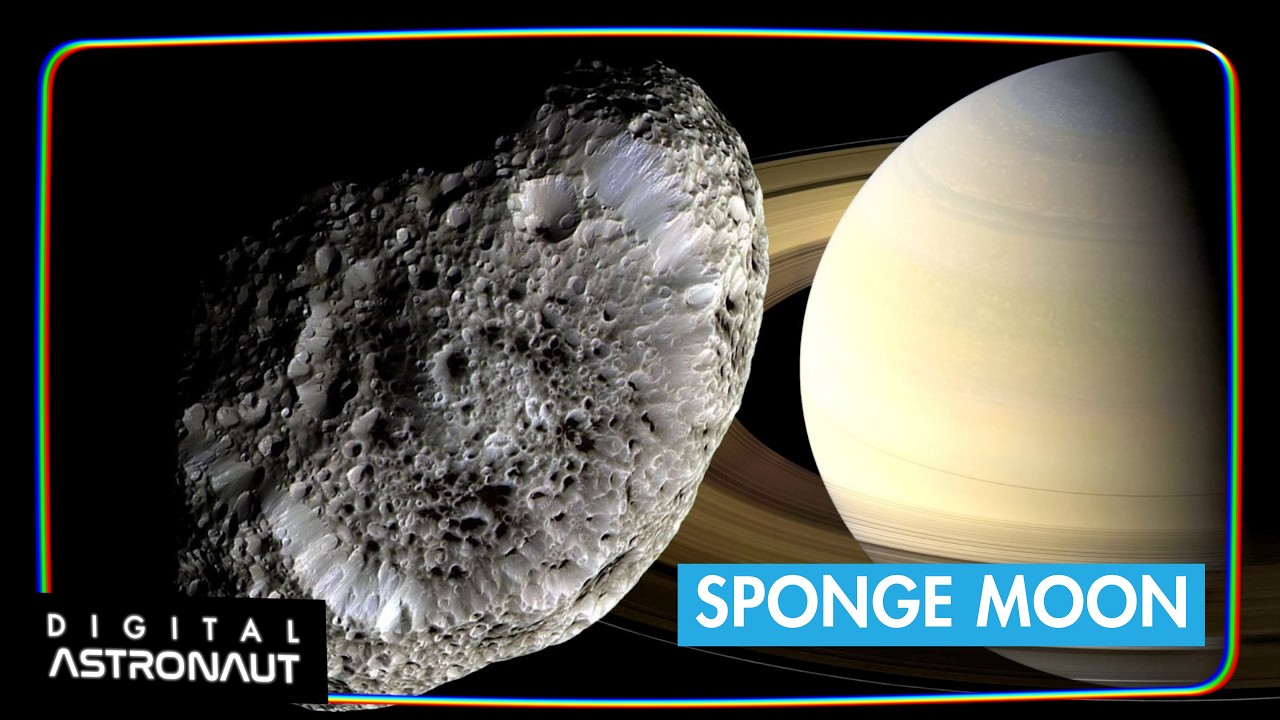
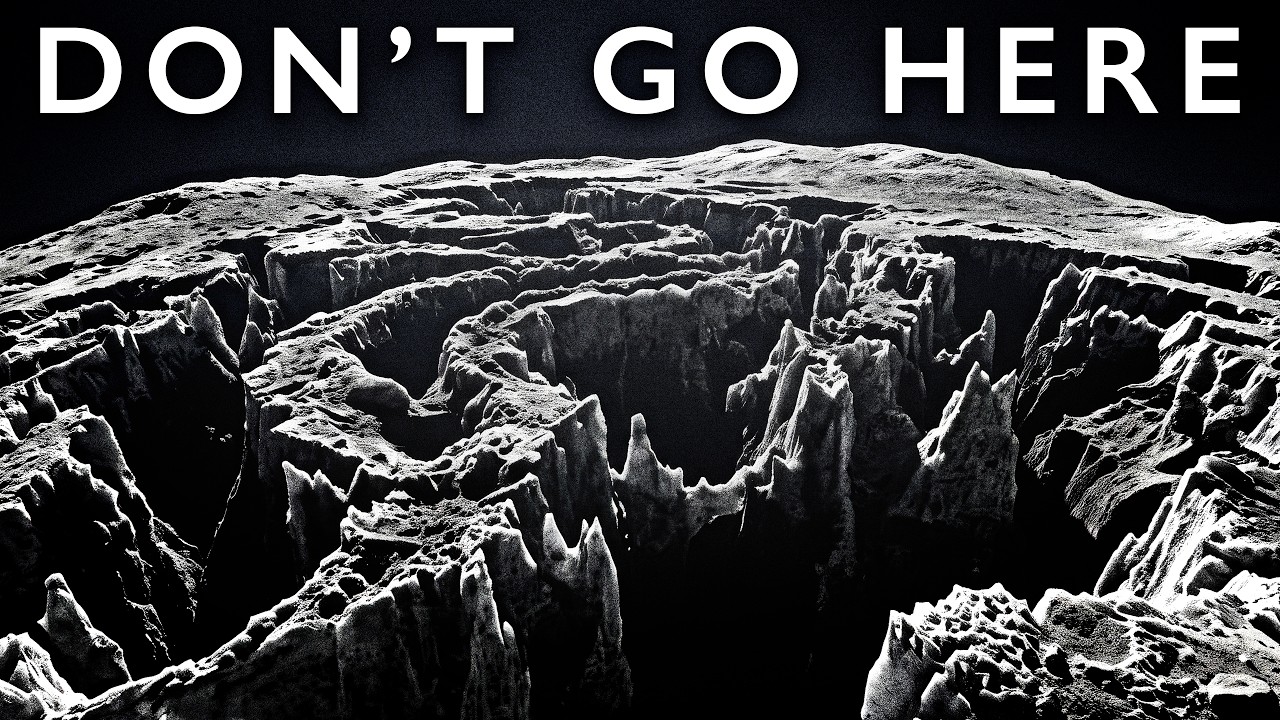
S008 Hyperion
Hyperion is not abandoned. It is reserved.
The distinction matters because, from a distance, the moon appears almost entirely unused. There are no cities, no major extraction pits, no permanent industrial belts, no orbital yards thick with traffic. Human presence is negligible. A handful of hardened monitoring stations cling to selected sites, accompanied by autonomous survey packages, navigation beacons, and the occasional maintenance craft. Most years, nobody lives there at all.
This emptiness is deliberate.
Hyperion is one of the more valuable concentrated water reserves in the Saturnian system: an enormous, porous block of ice, carbonaceous material, rock, and trace volatiles sitting inside an exceptionally shallow gravity well. In principle it can be mined. In practice, doing so prematurely would be wasteful. Hyperion tumbles chaotically, its surface is mechanically awkward, and large-scale operations require specialized anchoring, processing, containment, and mass-transfer infrastructure. None of these problems are insurmountable. They are simply expensive enough that present extraction would consume disproportionate capital while recovering the moon inefficiently.
There are easier sources of water.
That fact saved Hyperion.
The Reservation Act was written around a simple economic observation: a resource need not be exploited merely because it has become technically accessible. Hyperion was judged too valuable to consume badly. Smaller icy bodies, cometary captures, ring-derived material, secondary moons, and industrial recycling could satisfy current demand without dismantling a uniquely large strategic stockpile.
Accordingly, commercial extraction from Hyperion is prohibited. Even token concessions are rejected. The law is unusually hostile to pilot mines, prospecting claims, and proposals promising to remove only a “negligible” fraction of the moon. The concern is not that one mine would destroy Hyperion. It is that a century of exceptions would.
Its reservation status therefore protects something less romantic than wilderness: it protects recovery efficiency.
Hyperion is intended to be opened when industry can quarry it properly, on a scale commensurate with the object itself. That threshold is expected to coincide with the expansion of permanent human activity beyond the Saturnian system and into the deep Kuiper Belt. Such expansion will require staggering quantities of water, shielding, hydrogen, oxygen, carbon feedstock, structural mass, and reaction material. Transporting that mass outward from the inner Solar System would be absurd when Saturn already possesses reservoirs such as Hyperion.
When the reservation is eventually lifted, the change will be abrupt.
Hyperion will not become a picturesque mining colony. The plan assumes comprehensive industrial disassembly. Processing systems will surround the moon, stabilize working regions where necessary, carve the body into controlled masses, separate useful fractions, and route them directly into outbound infrastructure. Water that has remained untouched for centuries may become propellant, habitat shielding, agricultural stock, life-support reserve, or simply millions of tonnes of inert mass protecting colonists headed into darker space.
Until then, Hyperion remains almost silent.
Its emptiness is not neglect. It is inventory management on a planetary scale.
Humanity knows where the water is.
For once, it has decided not to spend it yet.
Wikipedia: Hyperion (moon) - Wikipedia
Orbitital Semi-major axis: 1,481,500 km
Orbital Period: 21.2 Days
Dimensions: 361.8 × 258.0 × 204.0 ± 0.2 km
Surface Temperature: Celsius -215 to -158
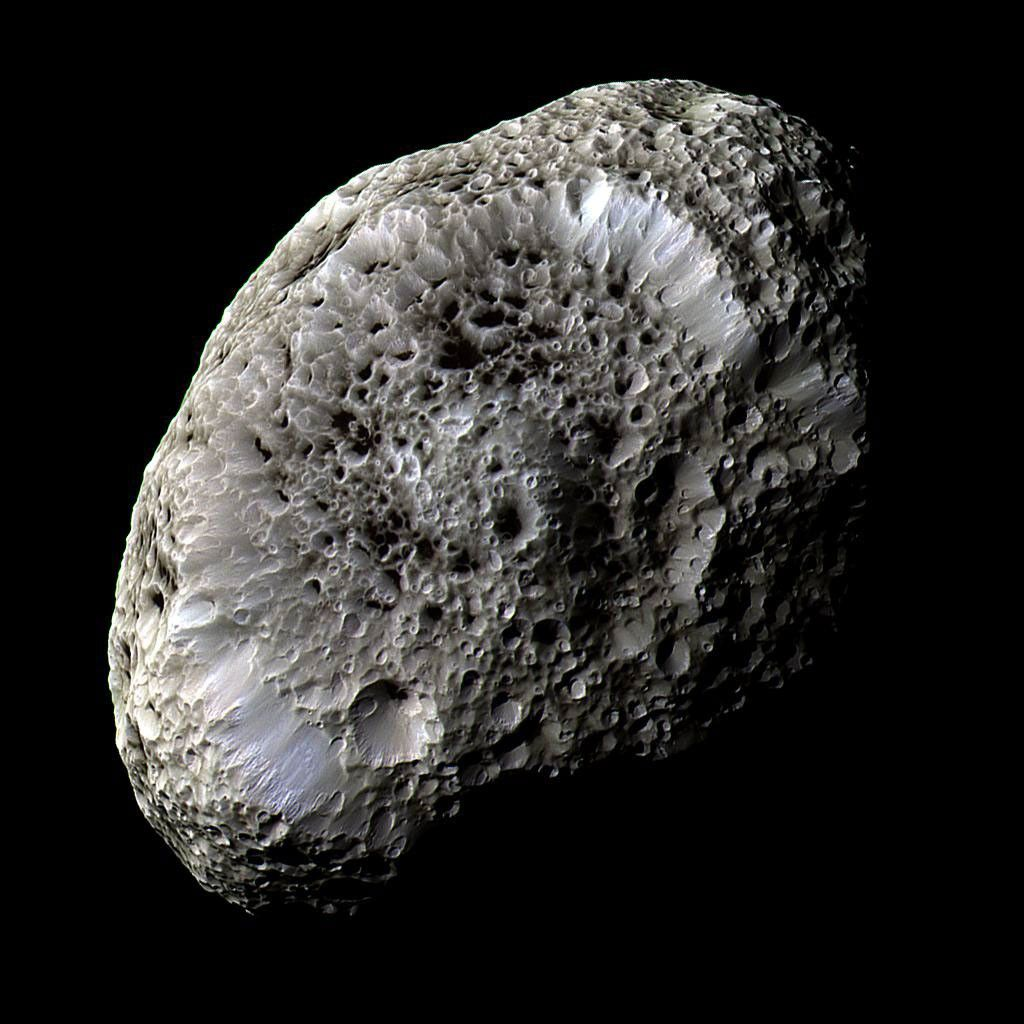
Hyperion is the eighth-largest moon of Saturn. It is distinguished by its highly irregular shape, chaotic tumblig motion, remarkably low density, and remarkable appearance. It was discovered in 1848.
Hyperion orbits Saturn at a distance of 1.48 million kilometers, between Titan and Iapetus. Unlike other regular moons, its orbit is moderately eccentric. It participates in a 3:4 orbital resonance with Titan; for every four orbits Titan makes, Hyperion makes 3. Conjunctions with Titan happen at the apocenter of Hyperion's orbit. The influence of Titan keeps Hyperion's orbit eccentric, preventing it from becoming more circular over time.
The Voyager 2 images and subsequent ground-based photometry indicated that Hyperion's rotation is chaotic, that is, its axis of rotation wobbles so much that its orientation in space is unpredictable. Its Lyapunov time is around 30 days. Though its rotation is predictable over short timescales, over longer timeframes it becomes impossible to predict. Hyperion, together with Pluto's moons Nix and Hydra, is among only a few moons in the Solar System known to rotate chaotically, although it is expected to be common in binary asteroids. It is also the only regular planetary natural satellite in the Solar System known to not be tidally locked. Hyperion is assumed to be ejecta from a Titan impact.
Hyperion is one of the largest bodies known to be highly irregularly shaped (non-ellipsoidal, and especially not in hydrostatic equilibrium) in the Solar System. The only larger planetary moons known to be irregular in shape are Neptune's moons Proteus and Nereid. Hyperion has about 15% of the mass of Mimas, the least massive known ellipsoidal body. Although Hyperion is the eighth-largest moon of Saturn, it is only the ninth-most massive. Phoebe has a smaller radius, but it is more massive than Hyperion and thus denser.
A possible explanation for the irregular shape is that Hyperion is a fragment of a larger body that was broken up by a large impact in the distant past. A proto-Hyperion could have been 350–1,000 km (220–620 mi) in diameter (which ranges from a little below the size of Mimas to a little below the size of Tethys) Over about 1,000 years, ejecta from a presumed Hyperion breakup would have impacted Titan at low speeds, building up volatiles in the atmosphere of Titan.