Sedna
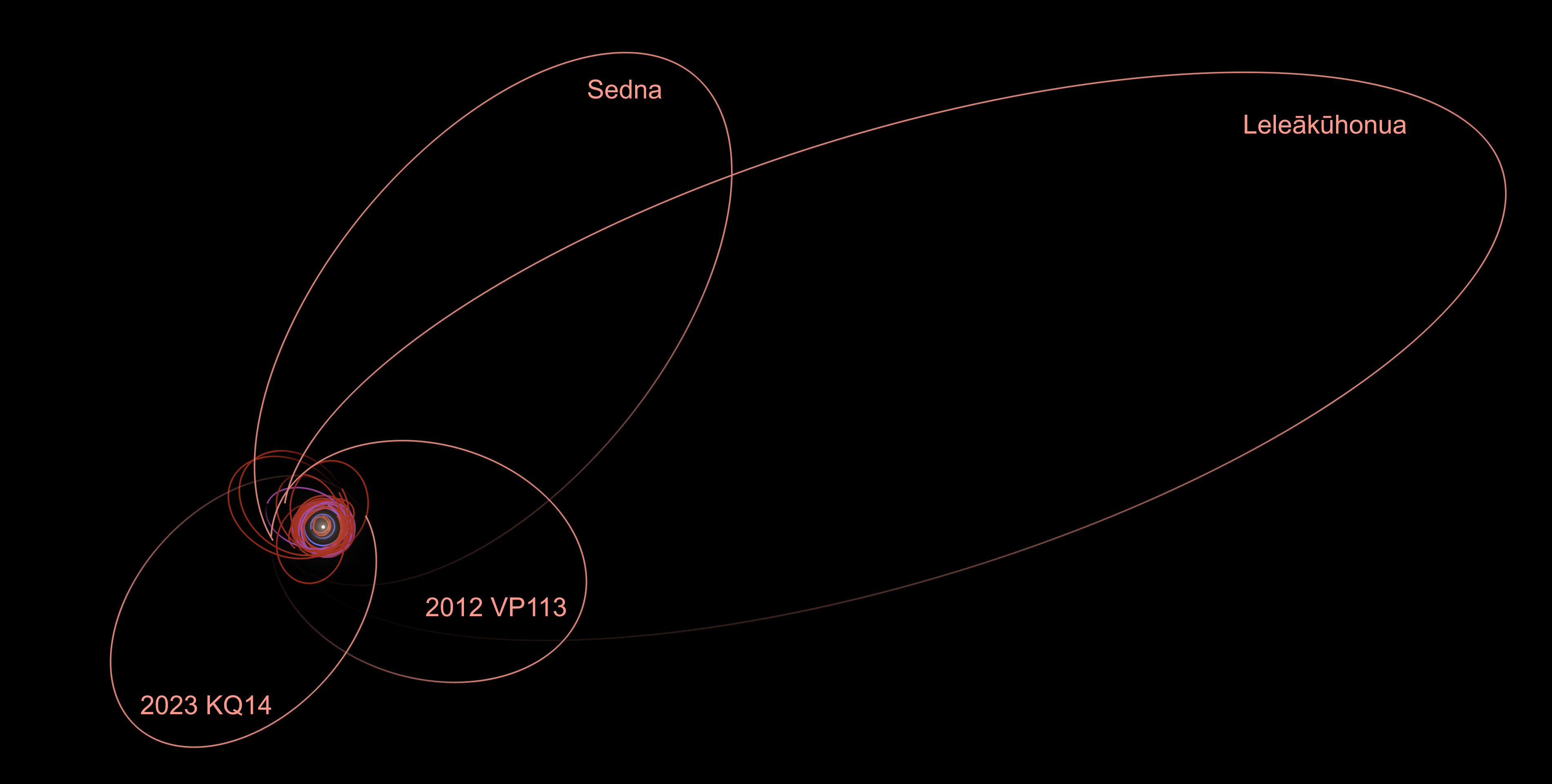
Sedna (minor-planet number 90377) is a dwarf planet in the outermost reaches of the Solar System, orbiting the Sun far beyond the orbit of Neptune. It was discovered in 2003, and is roughly 1,000 km in diameter. Spectroscopic analysis has revealed its surface to be a mixture of the solid ices of water, carbon dioxide, and ethane, along with sedimentary deposits of methane-derived, reddish-colored tholins, a chemical makeup similar to the surfaces of other trans-Neptunian objects.[15] Sedna is not expected to have a substantial atmosphere.[16] Within the range of uncertainty, it is tied with Ceres in the asteroid belt as the largest dwarf planet not known to have a moon. Owing to its lack of known moons, Sedna's mass and density remain unknown.[17]
Aphelion: 937 AU (140 billion kilometers)
Periphelion: 76.19 AU (11.4 billion kilometers)
Current distance in 2265: 139AU (ca. 20.8 Billion kilometers), i.e. 4.6x Neptune’s distance.
Year: 11408 Years.
In 2265, Sedna has received several hundred flyby probes. No orbiter have remained. No lander has touched down. No return mission have been scheduled or even projected. Sedna serves no function as interstellar stepping stone.