Level 3
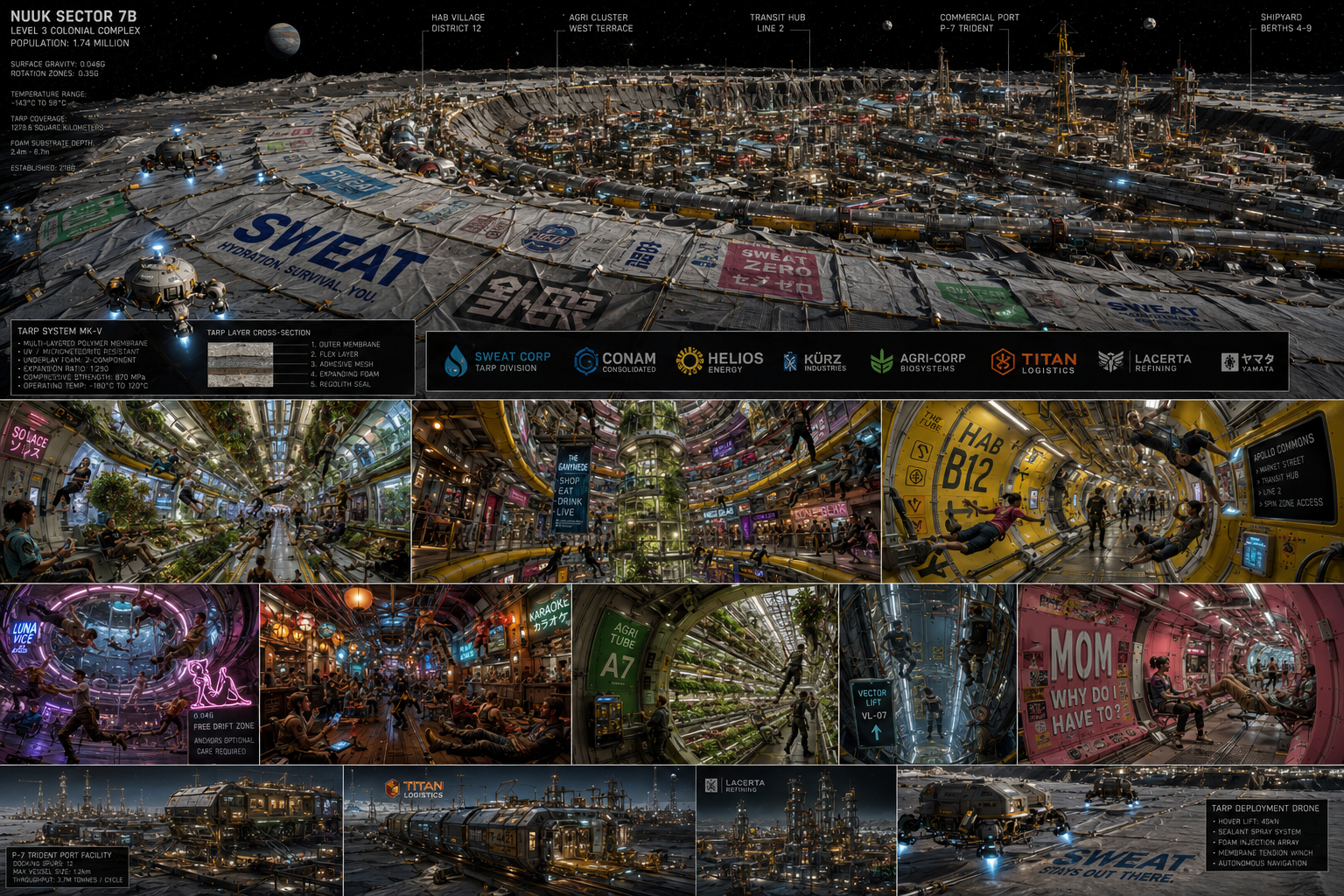
At Level 3 the colony no longer feels built on a world. It feels suspended inside a machine ecology. The old terrestrial assumptions survive mostly as nostalgia, legal standards, and ergonomic compromise. Gravity still exists, technically, but at 0.04G it has become socially negotiable. People do not stand because standing is natural; they stand because certain districts, schools, workplaces, and transit authorities insist upon it. Entire generations born in low gravity treat “up” and “down” as quaint historical conventions inherited from old Earth architecture, the same way modern people tolerate decorative columns that no longer hold anything up.
From outside, the settlement sprawls across the edge of a crater like an industrial fungus. The first thing visible is not regolith but containment. The ground has vanished beneath kilometers of tensioned membrane tarps pinned down with foam anchor ribs and expansion mesh. Automated drones laid them decades earlier, drifting in lazy swarms over the landscape, spraying two-component industrial substrate beneath enormous polymer sheets that hardened into semi-rigid crusts. The original reason was dust suppression and thermal regulation; later it simply became standard practice everywhere humans settled. Entire crater rims are now covered in branded industrial fabric faded by ultraviolet radiation and micrometeorite abrasion. Huge logos ghost across the terrain in kilometer-wide typography: hydration brands, agricultural combines, reactor consortiums, transit insurers. People navigating visually from orbit use them as landmarks.
The colony itself grows horizontally, vertically, radially, and internally at the same time. Tube networks branch like roots through crater walls and across open spans. Some are rigid cylinders, others inflated translucent corridors threaded with condensation lines and vine growth. Bright paint dominates everything because color has become psychological infrastructure. Entire habitation arteries are coded in saturated yellows, reds, aquas, pinks, and agricultural greens simply to prevent spatial depression. Without this, people report dissociation and “vacuum fatigue,” the low-level psychological erosion caused by endless metallic interiors and black sky.
The distinction between inside and outside becomes absolute. Exterior zones are dead industrial landscapes inhabited mostly by drones, crawlers, hoppers, cranes, refinery towers, and tether systems. Humans outside move slowly and deliberately in pressure rigs while kilometer-long cargo trains creep across tarp fields toward distant berthing structures. Port facilities sit kilometers from habitation clusters, half buried under shielding berms, surrounded by forests of cranes and docking spars extending into blackness. Ships arrive not elegantly but brutally: scarred fusion barges, migrant cylinders, fuel tenders, rotating habitat ferries. Entire sectors wake when convoy seasons begin.
Inside is where civilization compresses itself into density. Corridors no longer possess meaningful floors. Rails run along every surface because every surface is traversable. People hook ankles beneath restraint bars while talking. Teenagers drift through transit cylinders upside down relative to exhausted refinery workers magnetized to another surface. Elderly residents from spin habitats complain about “orientation decay” in the youth. In commercial districts, cylindrical malls spiral around vast hollow atriums filled with hanging gardens, advertisement membranes, floating seating clusters, and slow-moving maintenance drones. Escalators barely exist anymore; instead there are drift shafts, vector lifts, and soft-push transit currents guiding bodies through three-dimensional public space.
Agriculture becomes omnipresent. Plants are no longer confined to farms because vegetation itself has become a civic necessity. Hydroponic columns line corridors. Algae tubes glow inside restaurants. Root lattices hang from ceilings and walls. Small fruit vines creep across maintenance conduits. Rich districts cultivate ornamental humidity and dense vertical gardens while poorer districts rely on fungal protein vats and industrial nutrient towers. Entire neighborhoods smell faintly of wet plastic, fertilizer, machine oil, and basil.
Socially the colony becomes strange in ways no Earth city ever was. Because “ground” is optional, privacy erodes spatially. Apartments extend in all directions. Sleeping niches hide behind pipe clusters. Tiny improvised shrines cling to structural ribs. Workers lounge in netted alcoves suspended above transit flows. Bars stack themselves cylindrically around rotating commons drums where low gravity allows dancing styles impossible under Earth conditions. Tattoos spread everywhere because skin remains one of the few permanently personal surfaces in a world dominated by standardized industrial modules.
And beyond the transparent pressure walls sits the silent tarp-covered crater, immense and dim beneath stars, threaded with refinery lights and cargo beacons stretching off into darkness.