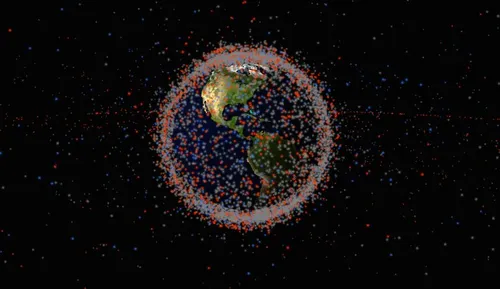
What is SPACE GARBAGE?
AI GENERATED RESPONSE FROM BRAVE SEARCH ENGINE:
Space garbage, formally known as orbital debris or space junk, consists of any non-functional, human-made objects left in orbit around Earth. This includes defunct satellites, spent rocket stages, fragments from collisions or explosions, and small items like paint flecks or tools lost by astronauts.
The primary dangers associated with space garbage include:
- High-Velocity Impact: Debris travels at speeds up to 17,500–18,000 miles per hour (approx. 28,000 km/h), meaning even a small object like a paint chip can cause catastrophic damage to active satellites or spacecraft.
- Kessler Syndrome: A theoretical chain reaction where collisions generate more debris, leading to further collisions, potentially rendering low Earth orbit unusable for future missions.
- Operational Risks: The clutter forces frequent avoidance maneuvers for the International Space Station and threatens critical infrastructure like GPS, communications, and weather monitoring.
Estimates suggest there are roughly 34,000 pieces larger than 10 centimeters, 900,000 pieces between 1 and 10 centimeters, and over 128 million pieces smaller than 1 centimeter orbiting the Earth. While most debris burns up in the atmosphere, larger pieces occasionally reach the ground, and the accumulation of waste highlights the lack of a circular economy for space technology.
AI-generated answer. Please verify critical facts.
Sunday, April 26, 2026 08:10PM
What is SPACE GARBAGE? - Brave Search
- How do we remove space junk from orbit?
Space junk is removed from orbit using a variety of active debris removal (ADR) technologies, which are currently in development or demonstration phases. The main methods include:
- Space Tugs and Robotic Capture: A specialized "chaser" spacecraft rendezvous with a piece of debris, captures it using robotic arms, nets, or harpoons, and then drags it into a lower orbit for atmospheric reentry. ESA's ClearSpace-1 mission, scheduled for 2026, is a pioneering example of this approach, aiming to capture and deorbit a defunct satellite.
Laser Nudging: High-powered lasers, either ground-based or in space, are used to target debris. The laser ablates the surface of the object, creating a small thrust that alters its orbit. This "nudge" can either deorbit the debris or move it to a safer "graveyard" orbit to prevent collisions.
Drag-Enhancement Devices: For large objects, a device like a large, ultra-thin balloon (GOLD system) or a sail can be attached to the debris. This significantly increases its atmospheric drag, accelerating its natural orbital decay and causing it to reenter the atmosphere and burn up within months instead of centuries.
- Tether and Ion Beam Systems: Other concepts include using long tethers to generate drag or applying a contactless force. An "ion beam shepherd" spacecraft could fire a beam of ions at a piece of debris, pushing it into a lower orbit without ever making physical contact.
The challenge is that these methods are complex, expensive, and must be tailored to the size, mass, and orbit of the debris. The focus is currently on removing large, high-risk objects to prevent catastrophic collisions that create thousands of new debris fragments.
- What are the main international laws governing space debris?
The main international laws governing space debris are not a single, dedicated treaty, but a framework derived primarily from several key United Nations space treaties, interpreted to address the debris issue:
- The Outer Space Treaty (1967): This foundational treaty provides the core legal principles.
- Article VI: Makes states internationally responsible for all national space activities, including those by private companies, and requires them to authorize and continually supervise such activities.
- Article VII: Establishes that states are internationally liable for damage caused by their space objects, including debris.
- Article IX: The most critical for debris mitigation. It requires states to conduct activities with "due regard" to the interests of other states and to avoid "harmful contamination" of space. It also mandates consultation if a state believes another's planned activity could cause "potentially harmful interference." This is interpreted as an obligation to mitigate debris creation and prevent collisions.
- The Liability Convention (1972): This treaty elaborates on Article VII of the Outer Space Treaty. It establishes that a launching state is absolutely liable for damage its space object (including debris) causes on the surface of the Earth or to aircraft in flight. For damage caused in space, liability is based on fault.
- The Registration Convention (1975): Requires all launching states to provide the United Nations with details about every space object they launch, including its orbital parameters and general function. This registry is crucial for identifying the origin of debris and assigning liability in case of collisions.
While these treaties do not explicitly mention "space debris," their principles—particularly the duty to avoid harmful interference and contamination—are the basis for international efforts to manage the problem. Complementary, non-binding guidelines like the UN Space Debris Mitigation Guidelines provide practical standards for reducing debris, but the legal obligation to follow them stems from the interpretation of the core treaties above.
- Which countries produce the most orbital debris?
The countries that have produced the most orbital debris are Russia (including the former USSR), the United States, and China.
According to data from 2023, the ranking by the number of debris objects is:
- 🇷🇺 Russia: 4,521 pieces
- 🇺🇸 United States: 4,317 pieces
- 🇨🇳 China: 4,137 pieces
Together, these three nations are responsible for nearly all cataloged space debris, with major contributions stemming from decades of space launches, spent rocket stages, and destructive anti-satellite (ASAT) weapons tests—such as those conducted by China in 2007 and Russia in 2021.
elaborate
Sources and Composition of Space Garbage
Space garbage, or orbital debris, originates from various human activities in space. The primary sources include:
- Spent Rocket Stages: Abandoned upper stages from launch vehicles, which can later explode due to residual fuel.
- Fragmentation Events: Over 560 recorded in-orbit breakups, mostly from explosions of old satellites and rocket bodies, have generated the majority of tracked debris. Only a small fraction were caused by collisions.
- Mission-Related Debris: Items like lens covers, payload adapters, and separation bolts released during satellite deployment.
- Anti-Satellite (ASAT) Tests: Events like China's 2007 FengYun-1C test created thousands of new trackable fragments, significantly increasing the debris population.
- Solid Rocket Motor Exhaust: Releases micrometer-sized aluminum oxide dust and centimeter-sized slag particles.
- Material Degradation: Paint flakes, metal fragments, and coolant droplets (like sodium-potassium alloy from old Russian satellites) shed due to the harsh space environment.
Tracking and Scale of the Problem
The scale of space garbage is immense and growing:
- Tracked Objects: Over 28,000 objects larger than a softball (10 cm) are regularly tracked by the U.S. Space Surveillance Network.
- Untacked Debris: It is estimated there are over 900,000 pieces between 1 and 10 cm, and more than 128 million pieces smaller than 1 cm, which are too small to track but still pose a significant threat.
- Concentration: Debris is most densely concentrated at altitudes of 800-1000 km and near 1400 km, which are popular for Earth observation and satellite constellations.
Mitigation and Removal Efforts
To combat the growing threat, international efforts focus on both preventing new debris and removing existing junk:
- Mitigation Policies: Agencies like ESA and the FCC now mandate that satellites in Low Earth Orbit (LEO) must deorbit within five years of mission completion, a significant reduction from the previous 25-year guideline.
- Active Debris Removal (ADR): Missions like ESA's ClearSpace-1 aim to use robotic arms to capture and deorbit defunct satellites. Companies like Astroscale have successfully demonstrated spacecraft (ADRAS-J) that can rendezvous with large debris, such as spent rocket stages.
- Novel Technologies: Concepts being explored include ground- or space-based lasers to nudge debris into lower orbits, drag sails to increase atmospheric drag, and recycling debris for in-space manufacturing.
The Kessler Syndrome: A Cascading Threat
The most severe risk posed by space garbage is the Kessler Syndrome, a theoretical cascade of collisions proposed by NASA scientist Donald Kessler.
- The Scenario: A single collision generates a cloud of debris, which then strikes other objects, creating even more debris. This chain reaction could exponentially increase the amount of junk, potentially rendering entire orbital regions unusable.
- Real-World Precedents: While a full cascade hasn't occurred, major events have brought us closer to the brink. The 2009 collision between the Iridium 33 and Kosmos-2251 satellites created over 2,300 large trackable fragments and countless smaller pieces. Similarly, Russia's 2021 ASAT test generated more than 1,500 trackable pieces.
- Current Risk: Experts debate if the syndrome has already started, but there is consensus that the risk is growing. The congestion in LEO, home to massive satellite constellations, makes a catastrophic cascade increasingly possible, with severe consequences for global communications, weather forecasting, and space exploration.

AND
AND

AND