XENOPHON
Tuesday, September 09, 2025 09:11AM
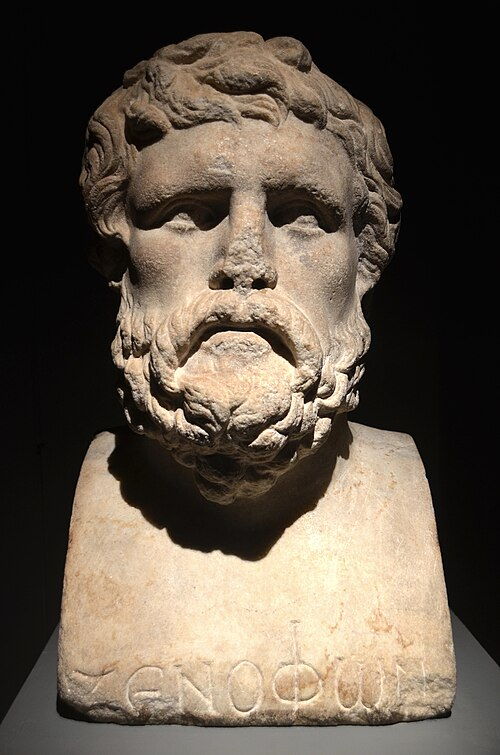
Xenophon took a keen interest in political philosophy[32] and his work often examines leadership.
Old Oligarch:
A short treatise on the Constitution of the Athenians exists that was once thought to be written by Xenophon was probably written when Xenophon was about five years old. The author, often called in English the "Old Oligarch" or Pseudo-Xenophon,[41] detests the democracy of Athens and the poorer classes, but he argues that the Periclean institutions are well designed for their deplorable purposes.
Socratic works and dialogues:
Xenophon's Agesilaus
Xenophon's works include a selection of Socratic_dialogues; these writings are preserved. Except for the dialogues of Plato and some pseudepigraphic/apocryphal dialogues, they are the only surviving representatives of the genre of Socratic dialogue. These works include Xenophon's Apology, Memorabilia, Symposium, and Oeconomicus.
The Symposium outlines the character of Socrates as he and his companions discuss what attributes they take pride in. One of the main plots of the Symposium is about the type of loving relationship (noble or base) a rich aristocrat will be able to establish with a young boy (present at the banquet alongside his own father).
In Oeconomicus, Socrates explains how to manage a household. Both the Apology and the Memorabilia defend Socrates' character and teachings. The former is set during the trial of Socrates, while the latter explains his moral principles and that he was not a corrupter of the youth.
Although Xenophon claims to have been present at the Symposium, he was only a young boy at the date on which he proposes. Xenophon was not present at the trial of Socrates, having been on campaign in Anatolia and Mesopotamia. It seems that Xenophon wrote his Apology and Memorabilia as defences of his former teacher and to further the philosophic project, not to present a literal transcript of Socrates' response to the historical charges incurred.[42]
Relationship with Socrates:
Xenophon was a student of Socrates. In his Lives of Eminent Philosophers, the Greek biographer Diogenes Laërtius (who writes many centuries later) reports how Xenophon met Socrates. "They say that Socrates met [Xenophon] in a narrow lane, and put his stick across it and prevented him from passing by, asking him where all kinds of necessary things were sold. And when he had answered him, he asked him again where men were made good and virtuous. And as he did not know, he said, 'Follow me, then, and learn.' And from this time forth, Xenophon became a follower of Socrates."[43] Diogenes Laërtius also relates an incident "when in the battle of Delium Xenophon had fallen from his horse" and Socrates reputedly "stepped in and saved his life."[44] During the conversations with Socrates in Xenophon's Symposium, scholarly calculations place Xenophon as an infant of only a few years old.[45]
Both Plato and Xenophon wrote Apology concerning the death of Socrates. Xenophon and Plato seem to be concerned with the failures of Socrates to defend himself. Xenophon asserts that Socrates dealt with his prosecution in an exceedingly arrogant manner, or at least was perceived to have spoken arrogantly. Conversely, while not omitting it completely, Plato worked to temper that arrogance in his own Apology. Xenophon framed Socrates' defense, which both men admit was not prepared at all, not as a failure to argue, but as striving for death even in the light of unconvincing charges. As Danzig interprets it, convincing the jury to condemn him even on unconvincing charges would be a rhetorical challenge worthy of the great persuader.[42] By contrast, Plato argued that Socrates was attempting to demonstrate a higher moral standard and teach a lesson.[42]
DOWNLOADED:
Tuesday, September 09, 2025 09:12AM