Peloponnesian War
Greeks fight with the Romans, and supported on both sides by the Thirty Tyrants
rk
See: Hegemony
Thursday, September 11, 2025 01:07PM
Tuesday, September 09, 2025 07:46AM
The Second Peloponnesian War (431–404 BC), often called simply the Peloponnesian War (Ancient Greek: Πόλεμος τῶν Πελοποννησίων, romanized: Pólemos tō̃n Peloponnēsíōn), was a war fought between Athens and Sparta and their respective allies for the hegemony of the ancient Greek world. The war remained undecided until the later intervention of the Persian Empire in support of Sparta. Led by Lysander, the Spartan fleet (built with Persian subsidies) finally defeated Athens, which began a period of Spartan hegemony over Greece.
Historians have traditionally divided the war into three phases.[2][3] The first phase (431–421 BC) was named the Ten Years War, or the Archidamian War, after the Spartan king Archidamus II, who invaded Attica several times with the full hoplite army of the Peloponnesian League, the alliance network dominated by Sparta (then known as Lacedaemon). The Long Walls of Athens rendered this strategy ineffective, while the superior navy of the Delian League (Athens' alliance) raided the Peloponnesian coast to trigger rebellions within Sparta. The precarious Peace of Nicias was signed in 421 BC and lasted until 413 BC. Several proxy battles took place during this period, notably the battle of Mantinea in 418 BC, won by Sparta against an ad-hoc alliance of Elis, Mantinea (both former Spartan allies), Argos, and Athens. The main event was the Sicilian Expedition, between 415 and 413 BC, during which Athens lost almost all its navy in the attempt to capture Syracuse, an ally of Sparta.
The Sicilian disaster prompted the third phase of the war (413–404 BC), named the Decelean War, or the Ionian War, when the Persian Empire supported Sparta to recover the suzerainty of the Greek cities of Asia Minor, incorporated into the Delian League at the end of the Persian Wars. With Persian money, Sparta built a massive fleet under the leadership of Lysander, who won a streak of decisive victories in the Aegean Sea, notably at Aegospotamos, in 405 BC. Athens capitulated the following year and lost all its empire. Lysander imposed puppet oligarchies on the former members of the Delian League, including Athens, where the new regime was known as the Thirty Tyrants. The Peloponnesian War was followed ten years later by the Corinthian War (394–386 BC), which, although it ended inconclusively, helped Athens regain its independence from Sparta.
The Peloponnesian War changed the ancient Greek world. Athens, the strongest city-state in Greece prior to the war, was reduced to a state of near-complete subjection, while Sparta became established as the leading power of Greece. The economic costs of the war were felt all across Greece, poverty became widespread in the Peloponnese, while Athens was devastated and never regained its pre-war prosperity.[4][5] The war also wrought subtler changes to Greek society. The conflict between democratic Athens and oligarchic Sparta, each of which supported friendly political factions within other states, made war a common occurrence in the Greek world. Ancient Greek warfare, originally a limited and formalized form of conflict, was transformed into an all-out struggle between city-states, complete with mass atrocities. Shattering religious and cultural taboos, devastating vast swathes of countryside, and destroying whole cities, the Peloponnesian War marked the dramatic end to the fifth century BC and the golden age of Greece.[4]
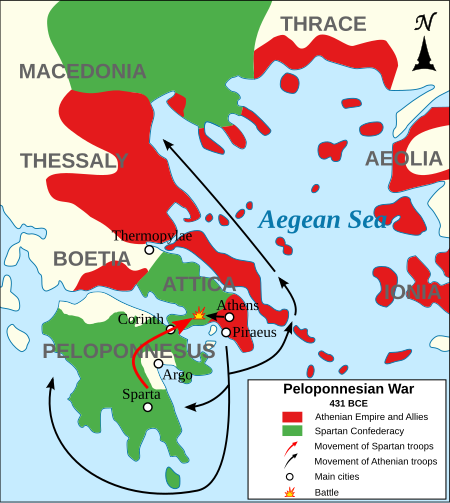
By Original: U.S. Army Cartographer Vector: Ruthven - http://www.dean.usma.edu/history/web03/atlases/, Public Domain, https://commons.wikimedia.org/w/index.php?curid=43369851
Historic sources:
"Eight books of the Peloponnesian Warre written by Thucydides the sonne of Olorus. Interpreted with faith and diligence immediately out of the Greeke by Thomas Hobbes secretary to ye late Earle of Deuonshire" (Houghton Library).
The main historical source for most of the war is the detailed account in The History of the Peloponnesian War by Thucydides. He states that he began writing his history as soon as the war broke out and took his information from first-hand accounts, including events he witnessed himself. An Athenian who fought in the early part of the war, Thucydides was exiled in 423 BC and settled in the Peloponnese, where he spent the rest of the war collecting sources and writing his history. Scholars regard Thucydides as reliable and neutral between the two sides.[5] A partial exception are the lengthy speeches he reports, which Thucydides admits are not accurate records of what was said, but his interpretation of the general arguments presented.[6] The narrative begins several years before the war, explaining why it began, then reports events year-by-year. The main limitation of Thucydides' work is that it is incomplete: the text ends abruptly in 411 BC, seven years before the conclusion of the war.
The account was continued by Xenophon, a younger contemporary, in the first book of his Hellenica. This directly follows Thucydides' final sentence and provides a similar record, on the topics of the war's conclusion and aftermath. Born in Athens, Xenophon spent his military career as a mercenary, fighting in the Persian Empire and for Sparta in Asia Minor, Thrace and Greece. Exiled from Athens for these actions, he retired to live in Sparta, where he wrote Hellenica around 40 years after the war had ended. His account is generally considered favourable to Sparta.[7]
A briefer account of the whole war is provided by the Sicilian historian Diodorus Siculus in books 12 and 13 of his Bibliotheca historica. Written in the first century BC, these books appear to be based heavily (possibly entirely) upon an earlier universal history by Ephorus, written in the century after the war, which is now lost.
The Roman-Greek historian Plutarch wrote biographies of four of the major commanders in the war (Pericles, Nicias, Alcibiades and Lysander) in his Parallel Lives. Plutarch's focus was on the character and morality of these men, but he does provide some details on the progress of the war that are not recorded elsewhere. Written in the first century AD, Plutarch based his work on earlier accounts which are now lost.
More limited information on the war is derived from epigraphy and archaeology, such as the walls of Amphipolis and grave of Brasidas, excavated in the 20th century. Some buildings and artworks produced during the war have survived, such as the Erechtheion temple and Grave Stele of Hegeso, both in Athens; these provide no information on military activity but do reflect civilian life during the war. Several plays by the Athenian Aristophanes were written and set during the war (particularly Peace and Lysistrata), but these are works of comedic fiction with little historical value.
Downloaded:
Tuesday, September 09, 2025 07:46AM