Lysander
Thursday, September 11, 2025 01:04PM
Historical background
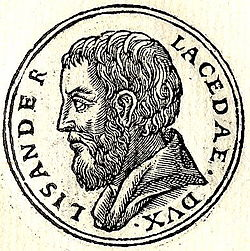
After the Athenian navy was destroyed at the battle of Aegospotami in 405 BCE, Lysander led the Spartan and Peloponnesian League naval force to Athens for the final destruction of the city.
The Athenians prepared for a siege, but without a navy to defend them or import food, many Athenian citizens starved.
After the Spartans began cutting them off by occupying Decelea, the Athenians decided to surrender in March 404 BCE.[3]
After initial negotiations of surrender failed, Athenian general Theramenes asked the Ecclesia for permission to speak with Lysander, believing that he could get the best possible conditions from the Spartans. His request was granted, and he met with Lysander at Samos, who then sent him to Sparta. Before the Spartan assembly and representatives of the Peloponnesian League, Theramenes negotiated a final surrender of Athens, ending the Peloponnesian War.[4]
While some members of the Peloponnesian League called for Athens to be completely destroyed, the Spartans refused to do so, arguing that Athens was one of the great cities of Greece. The terms agreed on called for Athens to destroy the long walls of Piraeus, allow exiles back into the city, and reduce their navy to only twelve vessels, surrendering all remaining ones to the Spartans. The Athenians were also to recraft their government on one dictated by the Spartans and to submit to Sparta in both "peace and war,” recalling their ambassadors from other city states.[4]
Formation of the Thirty
The reason the Thirty were elected was to draft new laws and reform the Athenian constitution.[5]
To reform their laws as the Spartans instructed, Athens appointed five ephors to organize all voting through the phylarchoi, the tribal council representing the eleven tribes of Athens.
The Ecclesia split into different factions on what the new government should be, with some favoring an oligarchic model while Theramenes became the de facto leader of those who wanted a democratic system.
The debate led to deadlock and the Spartans intervened and demanded that the Athenians appoint Thirty men to oversee the drafting of new laws and a new constitution.
It was determined that Theramenes would choose ten, the five Ephors would choose ten, and the Ecclesia would choose the final ten.
The final Thirty selected men were tasked with drawing up the laws under which they would govern.[6]
Members of the Thirty
The names of the Thirty are listed by Xenophon:[7]
- Aeschines of Athens, of the Kekropis tribe (not the famous orator)
- Anaetius
- Aresias
- Aristoteles (also a member of the Four Hundred and mentioned in Plato's Parmenides; not the philosopher, born twenty years later)
- Chaereleos
- Charicles, son of Apollodorus
- Chremo
- Cleomedes, son of Lycomedes
- Critias
- Diocles
- Dracontides
- Erasistratus of Acharnae
- Eratosthenes (not the well-known scholar)
- Eucleides
- Eumathes
- Hiero
- Hippolochus
- Hippomachus
- Melobius
- Mnesilochus
- Mnesitheides
- Onomacles
- Peison
- Phaedrias
- Pheido
- Polychares
- Sophocles (an Athenian orator, not the playwright)
- Theogenes
- Theognis
- Theramenes, son of Hagnon, of the tribe Pandionis, in the deme of Steiria
The rule of the Thirty
With Spartan support, the Thirty established an interim government in Athens. They reestablished the Boule, a council composed of 500 members. They appointed other officials, including 10 men who would rule the port town of Piraeus on behalf of the Thirty, and hired 300 mastigophoroi, whip bearers who would act as a police force.[8][9] The Thirty oversaw trials in the Boule against Athenian leaders who had opposed the peace with Sparta and sentenced them to death. They then tried and executed a number of "undesirables" within Athens. Around this time, Thirty members Aeschines and Aristoteles travelled to Sparta and met with Lysander, requesting that a Spartan garrison be stationed in Athens. Lysander dispatched a garrison to the city, with the Thirty stating that it was a temporary measure until they finished their trials against criminals, but members of the Thirty started using Spartan soldiers as personal bodyguards in the city.[10]
Legal reforms
The Thirty delayed revising the Athenian constitution, only enacting some legal reforms,[11] and ruled Athens themselves, similar to the Spartan Gerousia. They limited citizenship and the right "to share in the government" to only 3,000 selected Athenians.[12] These hand-selected individuals had the right to carry weapons, to have a jury trial, and to reside within city limits.[9] The list of the selected 3,000 was constantly revised.[9] Although little is known about these 3,000 men, for a complete record was never documented, Krentz believes that the Thirty appointed these select few as the only men the Thirty could find who were devotedly loyal to their regime.[13]
Led by Critias, the Thirty Tyrants presided over a reign of terror in which they executed, murdered, and exiled hundreds of Athenians, seizing their possessions afterward. Both Isocrates and Aristotle (the latter in the Athenian Constitution) have reported that the Thirty executed 1,500 people without trial.[14][8] Critias, a former pupil of Socrates, has been described as "the first Robespierre"[15] because of his cruelty and inhumanity; he evidently aimed to end democracy, regardless of the human cost.[16] The Thirty removed criminals as well as many ordinary citizens whom they considered "unfriendly" to the new regime for expressing support for democracy. One of their targets was one of their own, Theramenes, whom Xenophon depicts as revolted by Critias' excessive violence and injustice and trying to oppose him. Critias accused Theramenes of conspiracy and treason and then forced him to drink hemlock.[17] Many wealthy citizens were executed simply so the oligarchs could confiscate their assets, which were then distributed among the Thirty and their supporters.[18] They also hired 300 "lash-bearers,” or whip-bearing men to intimidate Athenian citizens.[8]