Network CSim
| Hardware | ||||
|---|---|---|---|---|
| Current | Implementation | Maintenance | Cost | Alternative |
| Backbone | BelDef | BelDef | ||
| Servers | BelDef | C&D | ||
| Workstations | BelDef | C&D | ||
| Routers /Switches | BelDef | C&D/BelDef | ||
| WAP | BelDef | BelDef | ||
| Printers | BelDef | C&D | ||
| Equipment | BelDef | C&D |
| Software | ||||
|---|---|---|---|---|
| Current | Implementation | Maintenance | Cost | Alternative |
| OS | BelDef | C&D | ||
| Simulators | C&D | C&D |
| Services | |||||
|---|---|---|---|---|---|
| Sort | Current | Implementation | Maintenance | Cost | Alternative |
| Asset Management | None (PDQ) | C&D | C&D | ||
| Image Management | FOG DS | C&D | C&D | Freeware | |
| Incident Management | Comb Google+Jotform | C&D | C&D | Freeware+ | |
| Licence Management OS | None | BelDef | BelDef | ||
| Licence Management Sim | Sim Dependant | C&D | C&D | Part | |
| Feedback System | Lime | C&D | C&D | Freeware | |
| Wiki | Bookstack | C&D | C&D | Freeware | |
| Mailserver | Exchange (CDN) | BelDef | BelDef |
The ORANGE color means that these parts work and in my opinion can be maintained.
Processen
- Development of Training Capability Development Services (TCDS)
- Design of training scenarios (scenario scripting, 3D modeling, exercise planning).
- Development of training products (virtual training scenarios, maps, incident lists, 2D/3D visualizations).
- Data collection and support for the After Action Review (AAR).
- Simulation Support Services
- Implementation of simulation systems for planned and unplanned training.
- Provision of simulation systems on short notice (1 to 3 days in advance).
- Management and first-line maintenance of software, hardware, and networks.
- Testing and implementing technological evolutions in simulated training.
- Network Solutions
- Implementation and management of a distributed simulation system with network connectivity across multiple locations.
- Management of LAN networks at various military locations.
- Integration of WAN solutions for distributed simulation and shared data.
- Hardware Management
- Supply and maintenance of ICT equipment for simulation systems.
- Support for the replacement and expansion of hardware components.
- Additional Services
- Printing services for geo-products within the virtual environment.
- Production of 2D/3D models.
- Representation and support at public and semi-public events.
- Development and maintenance of a standardized operational training environment.
- Feasibility & Risk Assessment
- Evaluation of the technical and commercial feasibility of the services.
- Assessment of risks in integrating different simulation systems into one contract.
- Flexibility and scalability of the services based on operational needs.
- Contract Management and Performance Measurement
- Structure of an open framework contract (2025-2040) with annual SLA obligations.
- Quality control of the services through KPIs.
- Flexibility for scaling up and down of contractual obligations.
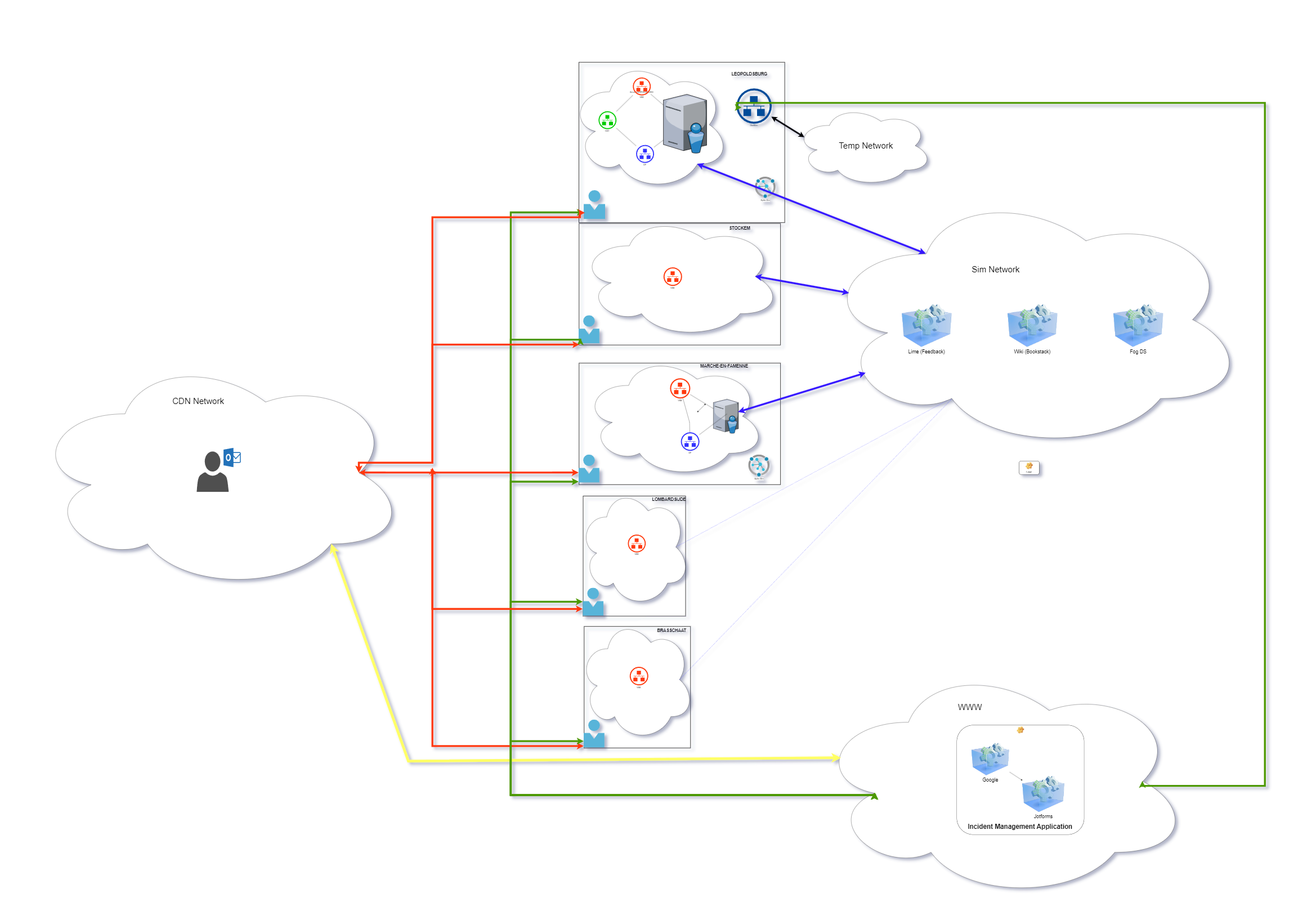
SimNet Network
SimNet acts as the overarching network and can be considered a Wide Area Network (WAN)2. Within this WAN, there are various Local Area Networks (LANs) at different locations.
Virtual LANs (VLANs)
Within SimNet, Virtual LANs (VLANs) are likely configured2. These VLANs allow computers at different physical locations to be logically grouped so they can communicate as if they are on the same local network24. This explains why some computers can connect with other computers at different locations that belong to the same "group."
Subnets
Each VLAN within SimNet is likely configured as a separate subnet. This allows for efficient IP address management and improves network performance by segmenting traffic.
CDN Network
The Content Delivery Network (CDN) acts as an intermediary layer between SimNet and the internet. The CDN network manages internet access for the devices in SimNet.
Network Isolation
There is no direct connection between SimNet and the CDN network, indicating a security measure. This can be realized through firewalls or by using a demilitarized zone (DMZ).
This network architecture offers several advantages:
- Enhanced security through segmentation and isolation of network traffic.
- Efficient management of network resources and IP addresses.
- Flexibility in grouping devices across different physical locations.
- Controlled internet access via the CDN network.
This setup utilizes both physical and logical network segmentation to create a complex, yet well-manageable and secure network.