Social Generations
DOWNLOADED: August 16, 2025, 9:30 AM
List of social generations
Western world
The Western world includes parts of Western Europe, North America, and Australasia. Many variations may exist within these regions, both geographically and culturally, which means that the list is broadly indicative, but very general. The contemporary characterization of these cohorts used in media and advertising borrows, in part, from the Strauss–Howe generational theory[18][35] and generally follows the logic of the pulse-rate hypothesis.[36]
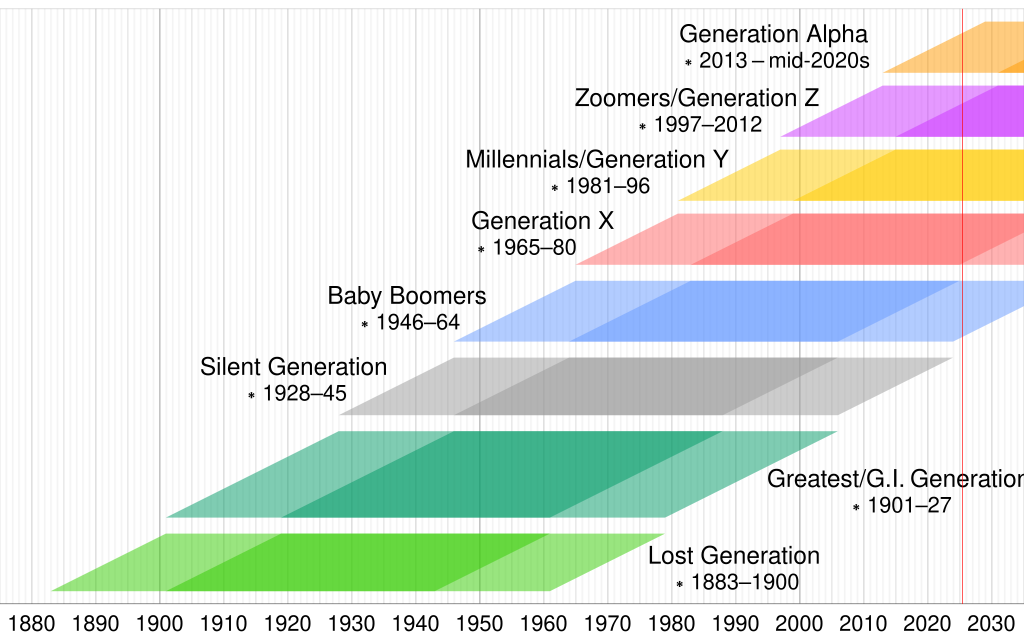
 Timeline of generations in the Western world according to the Pew Research Center – retirement age and life expectancy are approximate
- The Lost Generation, also known as the "Generation of 1914" in Europe,[37] is a term originating from Gertrude Stein to describe those who fought in World War I. The Lost Generation is defined as the cohort born from 1883 to 1900 who came of age during World War I and the Roaring Twenties.[38]
- The Greatest Generation, also known in American usage as the "G.I. Generation",[39] includes the veterans who fought in World War II. They were born from 1901 to 1927;[40] older G.I.s (or the Interbellum Generation) came of age during the Roaring Twenties, while younger G.I.s came of age during the Great Depression and World War II. Journalist Tom Brokaw wrote about American members of this cohort in his book The Greatest Generation, which popularized the term.[41]
- The Silent Generation, also known as the "Lucky Few", is the cohort who came of age in the post–World War II era. They were born from 1928 to 1945.[42][43] In the U.S., this group includes most of those who may have fought in the Korean War and many of those who may have fought during the Vietnam War.
- Baby boomers (often shortened to Boomers) are the people born following World War II from 1946 to 1964. Increased birth rates were observed during the post–World War II baby boom, making them a relatively large demographic cohort.[44][45] In the U.S., many older boomers may have fought in the Vietnam War or participated in the counterculture of the 1960s, while younger boomers (or Generation Jones) came of age in the "malaise" years of the 1970s.[46]
- Generation X (or Gen X for short) is the cohort following the baby boomers. The generation is generally defined as people born between 1965 and 1980.[47] The term has also been used in different times and places for several different subcultures or countercultures since the 1950s. In the U.S., some called Xers the "baby bust" generation because of a drop in birth rates following the baby boom.[48]
- Millennials, also known as Generation Y[49] (or Gen Y for short), are the generation following Generation X, who grew up around the turn of the 3rd millennium.[50] This cohort is generally defined as the people born from 1981 to 1996. The Pew Research Center defines this generation as those born from 1981 to 1996 and reports that in 2019, millennials outnumbered baby boomers in the United States, amounting to an estimated 71.6 million boomers and 72.1 million millennials.[51][52][53][54][55]
- Generation Z (or Gen Z for short and colloquially as "Zoomers") are the people succeeding the Millennials and are generally defined as being born from 1997 to the early 2010s. Pew Research Center describes Generation Z as spanning from 1997 to 2012.[56] The United States Library of Congress and Statistics Canada have cited Pew's definition of 1997–2012 for Generation Z.[51][52] In a 2022 report, the U.S. Census designates Generation Z as those born from 1997 to 2013.[54] Japan (though not a Western country) defines 1996–2012 as Generation Z.[57][58][59] Generation Zers experienced the onset and effects of the COVID-19 pandemic as children or young adults.[60]
- Generation Alpha (or Gen Alpha for short) is the generation succeeding Generation Z. Researchers and popular media typically 2013 as the starting birth year and the mid-2020s as the ending birth year. Generation Alpha is the first to be born entirely in the 21st century.[61] As of 2015, there were some two-and-a-half million people born every week around the globe, and Gen Alpha is expected to reach nearly two billion in size by 2025.[62]
- Generation Beta (or Gen Beta for short) is the proposed generation succeeding Generation Alpha. Futurist Mark McCrindle, who coined the term, defines the cohort as those born from 2025 to 2039.[63][64] As the successor to Generation Alpha, the most often proposed name for the generation comes from beta, the second letter in the Greek alphabet. Since no official body determines generational boundaries, the starting year and name of this generation may be subject to revision in the future, as both its name and year of commencement are largely based on an individual's opinion. Its adoption may be queried at a later date when instrumental global events are reassessed by either historians or sociologists. They could take an alternative view on the previous generation's duration and when that time period closed. Many generations typically span 15 years and are shaped by major societal shifts