thrown to the wind docu
---
factcheck by old org?!
No, Offshore Wind Will Not Drive Right… | The Breakthrough Institute
jan 2025
### Seaver Wang Seaver Wang is Director of the Climate and Energy team.
No, Offshore Wind Will Not Drive Right Whales Extinct
A Reminder That Common Environmentalist Tropes Often Boomerang
Jan 24, 2025
“If you’re into whales, you don’t want windmills,” Trump asserted in an Inauguration Day speech before supporters in Washington D.C.. The same day, Trump issued an executive order withdrawing all areas of the outer continental shelf from offshore wind leasing.
This dramatic reversal for the U.S. offshore wind sector marks a clear victory for offshore wind critics who have long warned that wind projects would devastate Atlantic whale populations. Such arguments have amassed surprising popularity. Earlier this month for example, controversial commentator and self-described journalist [past Breakthrough co-founder?] Michael Shellenberger published a tweet thread to viral acclaim claiming that offshore wind projects off the East Coast of the U.S. threaten the North Atlantic right whale with extinction and calling upon the new Trump administration to “end the slaughter.” In his post, Shellenberger shared, a September 2023 movie produced by his organization Environmental Progress that allegedly investigates the links between wind farm construction and whale deaths.
But upon cursory examination, Thrown to the Wind commits numerous factual errors on critical points, systematically omits contextualizing information, neglects to discuss the many other threats that whales currently face, and generally dresses up uncritical sensationalism with vigorous hand waving and worn appeals to science. In 29 minutes of runtime, Shellenberger’s “documentary” presents only tenuous circumstantial evidence that no credible researcher would deem sufficient to support his bombastic, confident claims that offshore wind projects are killing and will kill endangered whales en masse.
When placed in context of the total sum of human shipping, surveying, and construction activities and broader human impacts upon the sea, a conclusive assertion that wind projects represent the existential threat to right whales rightly appears ridiculous. Moreover, Shellenberger appears wholly uninterested in discussing any technical, operational, or policy solutions that could ameliorate or even eliminate any impacts that offshore wind might pose to whales.
Yet this forgettable cinema project actually highlights a broader long standing problem—the boomer environmental movement’s endemic reliance upon appeals to emotion and simplistic tropes to resist new technology and construction. Despite paying reverent lip service to science, old-school conservationists now routinely eschew evidence-based inquiry in favor of such run-of-the-mill indie documentaries. All of this video content borrows from the same playbook—suggestive tricks of cinematography, hamfisted appeals to emotion, grave sermons on the inviolability of the “precautionary principle”, vague claims about the “fragility of intertwined ecosystems” and the certainty of collapse should the objectionable project of the day move forward. Unfortunately, such misleading messaging is often as effective as it is ubiquitous, as evidenced by the social media splash made by Shellenberger’s posts—20,000 retweets, 48,000 likes, and over a million views.
What this all highlights is how commentators of all stripes readily invoke marine wildlife protection for their own purposes. Shellenberger and others attack the offshore wind sector by spinning a whale slaughter narrative while ignoring far more impactful threats whales face from fishing gear and boat strikes. Yet their tactics parallel those of ocean conservation groups catastrophizing about how seafloor minerals exploration will destroy the ocean carbon cycle—with an equal passion for flashy claims that contradict evidence-based reasoning. Meanwhile mainstream environmentalists lament the miniscule quantities of fish eggs and plankton ingested by a nuclear power plant’s cooling system while simultaneously calling for offshore wind development on the same patch of coast.
All of this agenda-driven messaging suffers from the same lack of holistic perspective. Human civilization already interacts profoundly with the ocean through ship traffic, dredging, transoceanic cables, fishing, naval activity, aquaculture, coastal construction, and countless other activities. All of this meanwhile takes place against a larger backdrop of human impacts from nutrient pollution, plastic waste, ocean acidification, noise, and ocean warming. We already have no choice but to balance new activities like wind farm development, now and forever, within this larger landscape of ubiquitous human activities at sea and human impacts on oceans. If we want to work seriously to advance infrastructure development with well-managed impacts on the ocean environment, then we simply must let go of the traditional environmentalist reliance on selective narratives.
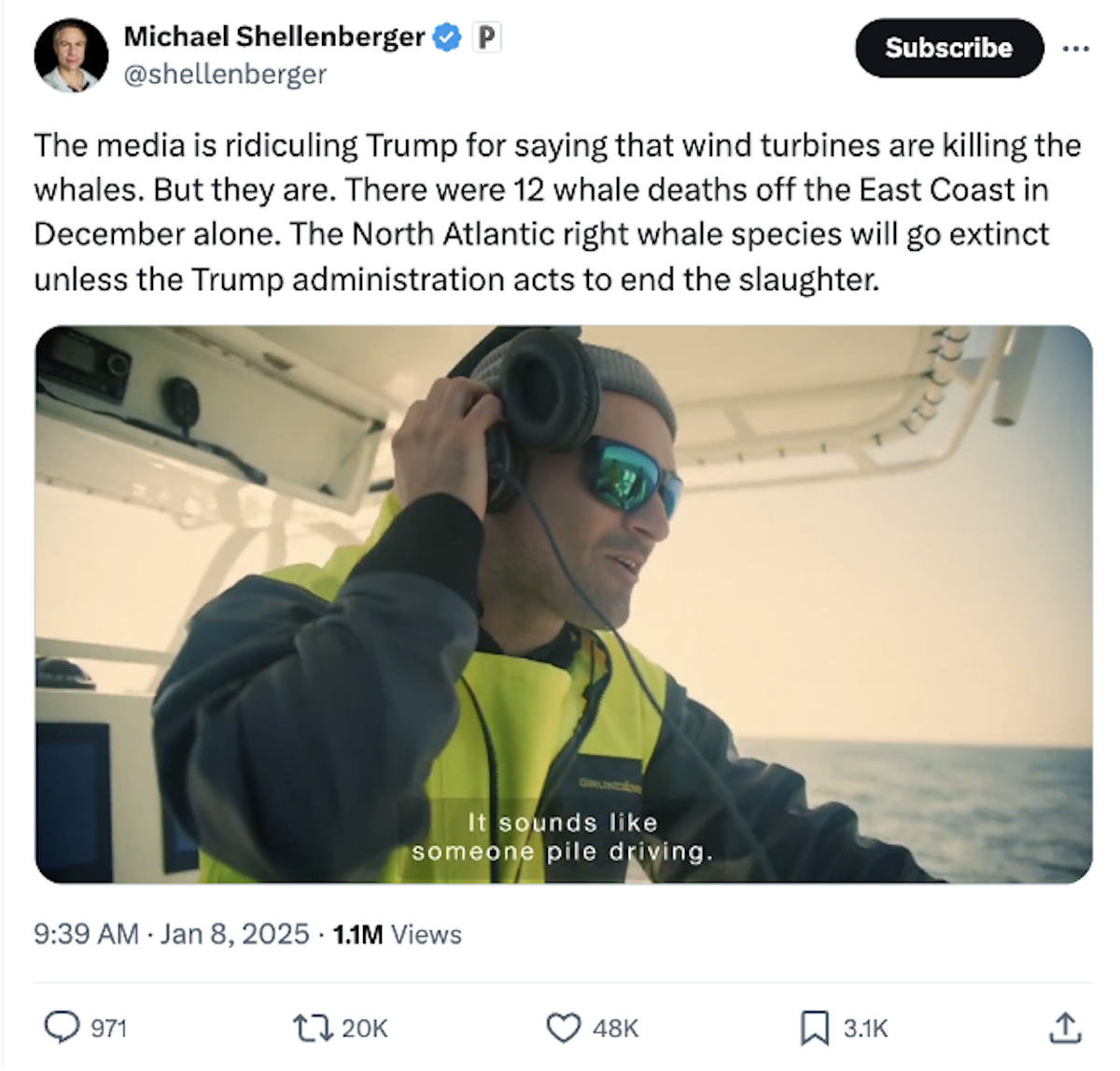 Link to tweet: https://x.com/shellenberger/status/1877002130776572270
What does Thrown to the Wind get wrong?
From the very start, Shellenberger’s brazen tweet makes a sweeping causal conflation. He claims that all 12 whale deaths off the U.S. East Coast throughout December 2024 occurred because of wind turbines, and that the North Atlantic right whale will go extinct unless Trump puts a stop to wind project development.
Having reviewed the film Thrown to the Wind in detail, such gyrating leaps of illogic accurately describe Shellenberger’s work on the subject.
Thrown to the Wind’s glaring sin is that it noticeably sidesteps discussion of any other possible causes of whale deaths, particularly the two consistent top known causes of death—entanglement in discarded fishing nets and gear, and collisions with boats of all kinds. These two factors accounted for 25 out of 41 known right whale deaths between 2017 and 2024. If a film were really centering whale welfare, one would expect it to touch at least briefly upon all the varied threats that whales face in practice.
It only gets worse from there. None of 12 East Coast whale deaths in December 2024 were right whales, contrary to what a casual reader might take Shellenberger’s tweet to imply. One of these dead whales washed ashore far away in North Carolina, where no wind construction is ongoing. Several of the dead whales appeared on beaches along the north side of Cape Cod, the side opposite from early-stage wind project development off Martha’s Vineyard south of Cape Cod’s southern coast. And while whale autopsy work on most of these dead whales is still in progress, initial findings so far have already ruled out offshore wind as the clear culprit in a couple cases—a Minke whale dead of disease, and a young humpback whale found on Cape Cod’s north side struck head-on by a boat.
Skating over such inconvenient details, Shellenberger and colleagues pin the blame for whale deaths squarely upon underwater noise pollution from offshore wind development. They claim to have shadowed ships performing preliminary work at the Vineyard Winds offshore wind site and to have taken damning measurements of noise emitted from such work.
A trailer clip Shellenberger shared prominently includes an off-the-cuff statement by a boat crew member recording noise from a survey vessel, who remarks “it sounds like somebody is pile driving.” This alludes to the process of pounding monopile structures into the offshore continental shelf, upon which developers later place the wind turbines themselves. Yet the fast-paced chirping sounds recorded from the small boat clearly do not originate from pile driving, which exhibits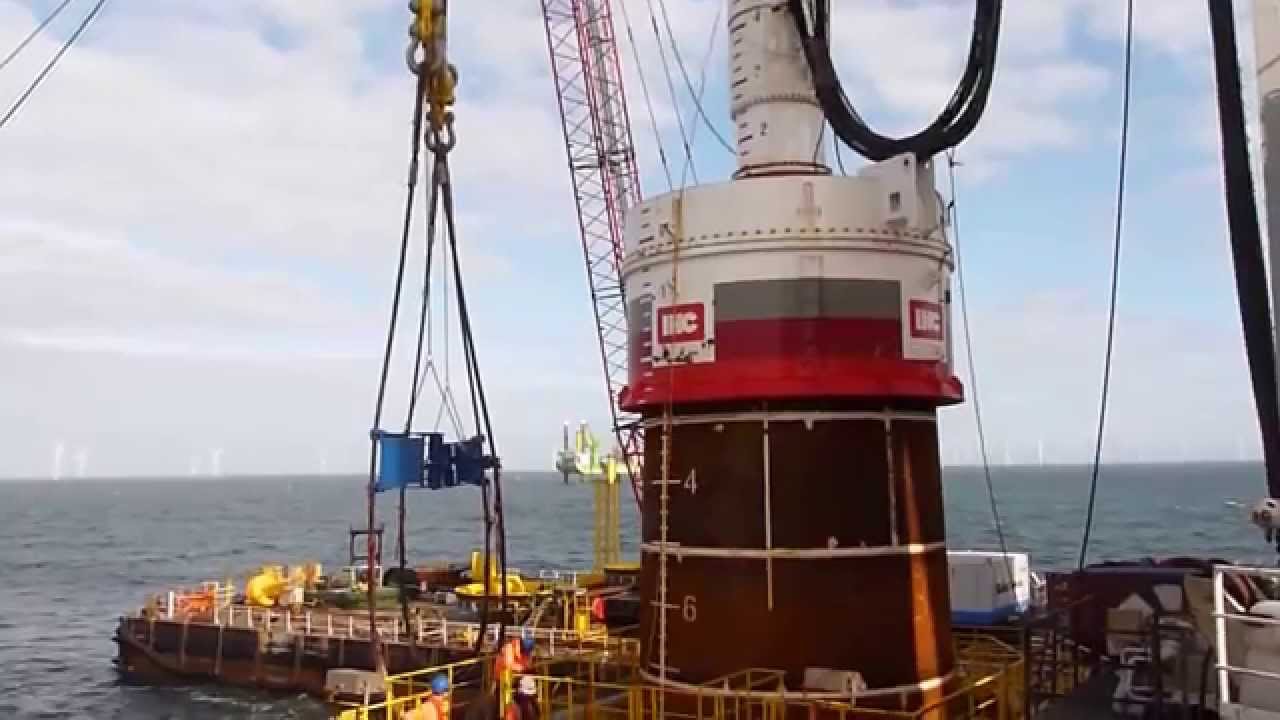 between strikes. Robert Rand, who the film credits as an acoustics expert, does correctly identify the noise as scanning sonar shortly thereafter in the film. This clarification is left out of the shorter promotional clip. Yet in any case, multibeam and sidescan sonar typically operate at frequencies above what humpback whales can hear and dissipate over short distances, and are used across oceanic industries like fishing, dredging, and scientific surveys. If sonar systems posed an existential threat to large whales, culpability would extend far beyond the offshore wind sector.
The film’s commentary on underwater sound levels also neglects context regarding the volume of the sounds measured. The film crew claims to have measured 150 decibels of sonar sound at a good distance from a specific seafloor surveying vessel in the Vineyard Wind development area, MISS EMMA MCCALL, then around 90 dB of sonar noise at a distance of 0.5 nautical miles in a separate instance. In comparison, the underwater noise from a moving cargo ship can be 190 dB at the source, while some research papers report that whale watching boats can produce 138-169 dB at the source (all decibel measurements are with respect to 1 μPa at 1 m). Coastal dredging to maintain harbor channels for ships and boats generates 180 dB.
How noisy does underwater sound have to be to bother marine life? Natural “ambient noise levels experienced in gentle weather conditions”, as it turns out, typically reach 94 dB. The U.S. National Marine Fisheries Service defines a continuous noise threshold of 120 dB beyond which there is a “possibility of behavioral impacts, generically, to marine mammals.” In other words, not all of the wind farm zone noise measured by the film crew was even particularly distinguishable from background ocean noise let alone harmful, while offshore wind operations are far from the only potentially loud noise sources in the coastal marine environment.
MISS EMMA MCCALL also uses exactly the same gear to survey across the U.S. East and Gulf coasts for offshore cables, underwater pipelines, offshore oil and gas drilling, dredging, government and scientific research, and other seafloor surface characterization activities. As of time of this writing, MISS EMMA MCCALL is docked in the Gulf of Mexico.
At another key point, the film shows charts comparing regional ship traffic in the mid-Atlantic and New England against the locations of reported whale deaths over different time frames. Predictably, the charts do show an increase in ship activity in the Martha’s Vineyard region in 2022 and 2023, while the number and location of whale deaths seems to fluctuate wildly between periods. Shellenberger quips in response to a colleague: “I appreciate your caveat about not suggesting causality, but it’s impossible not to look at these correlations and imagine there’s some connection.” His comment unintentionally reveals the skew characterizing the whole documentary project—a deliberate disinterest in alternative hypotheses, uncertainties, and sources of error.
The film, for example, does not seem particularly concerned with comparing its ship traffic and whale deaths narrative against the actual timeline of wind farm construction. Before 2022, the US built just 7offshore wind turbines. Five turbines near Block Island, Rhode Island constructed between 2015-2016, and two turbines off Virginia constructed in 2020. This calls into question the significance of the ship traffic imagery shown from December 2016 through the end of 2021.
The film team’s presentation of ship traffic in inconsistent time periods does not account for seasonal patterns of boat traffic around the Martha’s Vineyard, Nantucket, Cape Cod regions during the summer months. Nor do they consider the seasonal pattern of whale activity, in which whales are present year-round but concentrate off New England largely in the winter and spring months. In response, federal agencies and wind farm developers have also explicitly agreed that developers will concentrate onsite activity during summer months—another factor that the superficial commentary does not consider.
Meanwhile, dead whales washing ashore do not exactly offer the clear narrative that Shellenberger and company would like. Dead whales appearing on beaches are obviously decoupled in time and place from where and when they died, and researchers often require months of autopsy work to investigate the cause of death. Whale strandings, by nature, are a metric carrying considerable error—an inherently incomplete picture of whale mortality with a lot of chance thrown in that could create illusions of trends. The time needed to detect robust trends in whale deaths in response to a new stressor may be quite long. Simultaneously, one can easily imagine other explanations for increasing whale deaths on the U.S. East Coast since 2016, such as infectious disease, marine pollution, climate shifts, or significant shifts in boat traffic during and after the COVID-19 pandemic.
As the film’s final piece of evidence, activist Lisa Linowes claims that a letter to the Bureau of Ocean Energy Management by NOAA Chief of Protected Species Sean Hayes warns that wind turbine turbulence will destroy the plankton that whales feed on. This assertion utterly butchers the actual scientific concern the letter by NOAA scientists highlights—a far more mundane risk that turbines could change local patterns of water circulation and stratification, shifting where zooplankton occur. Many anti-wind activist groups regularly cite this NOAA letter, but few groups draw attention to the NOAA scientists’ proposed solution to protect whales from negative impacts—an incremental 20 kilometer shift of the wind farm development zone. This policy suggestion stands in sharp contrast to how Shellenberger’s film frames the threat to whales from offshore wind projects as a yes or no binary, as opposed to any interest in exploring solutions throughout the whole spectrum of impacts and countermeasures.
Make no mistake—this critique of Shellenberger’s film does not seek to dismiss the real concerns regarding possible negative impacts upon whales from offshore wind development. As evidenced by federal regulations, industry countermeasures, and academic research and oversight, such concerns do demand serious study and attention. But members of the public worried about whale welfare are far better off reading the actual NOAA letter and related scientific work themselves rather than wasting time on this “documentary.”
On the future of humans, the ocean, and the Earth
Overall society would benefit by drawing some much-needed lessons from this silly film. Likely, many clean energy advocates and climate hawks have nodded along so far with this critique of Thrown to the Wind.
Yet members of the broader environmental coalition should consider how this film is actually representative of the highly unscientific, typical documentary often celebrated by the environmental movement. Thrown to the Wind’s distorted narrative echoes that of films like the widely-panned Seaspiracy, which spun similarly superficial and unscientific narratives about fishing and ecological collapse. The ranks of junk food movies on nuclear power include examples like Meltdown: Three Mile Island, which earned a Netflix release despite wildly mischaracterizing numerous technical and historical facts and leaning heavily on appeals to emotion.
One could literally shoot the same kind of documentary speculating about how geothermal power will poison the flamingos, complete with an eerie musical score, camera angles lingering melancholically on a flamingo chick, and sermonizing over the sins of industrializing nature. This is a mirror image of classical environmentalist doco-dramas, just mobilized for different ideological purposes. Shellenberger, after proclaiming the “Death of Environmentalism” just two decades ago, has now essentially chosen to leap into the same grave.
Critics do not need to make up arguments against offshore wind. Shellenberger is likely grossly overstating the impacts of offshore wind development on Atlantic whale populations so far, but neither is it reasonable to argue that the old Biden administration goal of expanding offshore wind capacity from 42 megawatts to 30,000 megawatts by 2030 would have zero impacts upon whales. A more rational discussion of impacts management can appreciate the full spectrum of tradeoffs between building many wind farms speedily and cheaply versus slower, limited construction with obligations to implement a whole suite of high-cost mitigative measures.
From a big picture perspective, one can easily imagine that in a techno-economic future where nuclear power or advanced geothermal scale with great commercial success, the entire case for offshore wind could weaken to the point of non-viability. But the future technological breakthroughs are hard to predict and society needs more clean energy tools, not less.
Meanwhile, one thing is certain: the fate of Atlantic whales will depend upon a far richer set of factors—ranging from fishing to navy sonar to climate shifts—than just offshore wind turbines alone.
---
kusi
https://www.youtube.com/watch?v=RL51l4098KU
spiritual sep mo from calf; sonar mapping; govt did not do res or did and not give coverup thus congress investigate; end sp act extinct, marine mam prot law; the sci we did basic hydrophone polticiciztion of sci biden wants indistry off shore; env gps ent letter, then 180 overruled own sci no mamesspec/ NOAA; aid whales --> extinct, plowed ahaedm no justif agency corrupted by money and polictic 22 kia 62; stranding used to be rare; indisrial activity public substack .com $
https://www.mediamatters.org/fox-news/fox-news-touting-dubious-new-documentary-repeating-misleading-claims-about-offshore-wind
no lnx many
Fox News is touting a dubious new documentary repeating misleading claims about offshore wind link to whale deaths
Thrown to the Wind was produced by anti-renewable energy activist Michael Shellenberger
Special PROGRAMS
CLIMATE & ENERGY
WRITTEN BY ILANA BERGER
PUBLISHED 08/29/23
Fox News is uncritically promoting a new documentary that misleadingly blames offshore wind projects for a spike in whale deaths and strandings on the East Coast, which was produced by an anti-renewable energy activist and features fossil fuel-tied sources.
Since Thrown to the Wind debuted on August 14, producer Michael Shellenberger, who has a history of spreading misinformation about climate change, has appeared on the network 4 times to discuss the documentary that alleges a government cover-up of whale deaths and attacks environmental groups that support offshore wind projects.
Shellenberger’s film follows a fossil fuel-tied conservation group called Save Right Whales Coalition, which despite a lack of concrete evidence, claims that a New Jersey offshore wind project, and offshore wind farms in general, pose a threat to endangered right whales, a species of baleen whale found in the North Atlantic.
Fox’s promotion of the documentary is just the latest instance of the network elevating, as supposed experts, “conservationists” with ties to right-wing think tanks and lawmakers who oppose renewable energy — and sometimes receive fossil fuel money.
Shellenberger claims Thrown to the Wind proves offshore wind farms can be directly linked to whale deaths
Shellenberger wrote in his Substack that the film proves that “government officials have been lying” in claiming an increase in whale deaths is not due to the construction of wind turbines. He wrote that the film “shows that the wind industry’s increased boat traffic is correlated directly with specific whale deaths” and that despite government claims to the contrary, it “exposes the reality that the U.S. government agencies, and the scientists who work for them, either haven’t done the basic mapping and acoustic research to back up their claims, have done the research badly, found what we found, and are covering it up.” [Substack, Public, 8/15/23]
Shellenberger wrote that the documentary demonstrates that turbine-related boat traffic and high-decibel sonar mapping “are killing whales.” He said the film shows, through “acoustic research” and “correlating whale deaths with wind industry vessel traffic,” that “wind industry activities are killing whales.” [Substack, Public, 8/15/23]
Thrown to the Wind’s central claim that high-resolution geophysical surveying using sonar to map the ocean floor can be directly linked to the spike in whale deaths is misleading
Conservation ecologist Douglas Nowacek told FactCheck.org that there is “basically zero chance that those surveys have caused any mortality.” Nowacek, a professor of conservation technology at Duke University, said that much of the surveying is “way out of the range of hearing of baleen whales.” [Factcheck.org, 3/31/23]
Some types of sonar can harm marine life – but those technologies are not used for offshore wind surveying. While military sonar and seismic blasting used for oil and gas exploration harm whales, the National Oceanic and Atmospheric Administration has said that sound produced by high-resolution geophysical surveys used by offshore wind energy companies “produce much smaller impact zones because, in general, they have lower noise, higher frequency, and narrower beam-width.” [The Guardian, 7/16/16; Texas Tribune, 1/17/23; NOAA, accessed 8/28/23]
Scientists say that fishing gear entanglement, vessel collisions, and the changing migration patterns of whale prey could be contributing to an increase in whale deaths.“Scientists who study whale behavior in general say it is impossible to definitively link the deaths and strandings to a single cause given the complexity of the ocean, the dramatic changes the North Atlantic has experienced in recent decades, and how much is still unknown about how these changes might be affecting baleen whales,” reports Yale Environment 360. [Yale Environment 360, 3/8/23]
A New Jersey-based conservation group has also found stranded whale carcasses that show signs of ship strikes and fishing gear entanglement. Factcheck.org wrote:“According to data from NOAA and the Marine Mammal Stranding Center, a nonprofit that rescues and rehabilitates marine mammals in New Jersey, some recently stranded whales showed signs of strikes and entanglements, although those events could have occurred after death.” [Factcheck.org, 3/31/23]
International shipping is growing, especially in New York and New Jersey, which could lead to more vessels striking whales. In 2022, for the first time in history, the Port of New York and New Jersey broke the 9 million mark for containers shipped. “The New York port has increased the number of containers moved every year since 2017, and in 2022,” CNBC reported. [CNBC, 1/25/23]
Scientists know that climate change is harming whale populations. Scientists say that rapidly rising ocean temperatures are pushing whales’ prey, such as zooplankton and menhaden, closer to shore, putting whales in closer proximity to major shipping channels and pushing them into areas with fewer regulatory protections. [Politico, 7/19/23; The New York Times, 10/25/22]
Fox News is eagerly promoting Thrown to the Wind
Fox host Martha MacCallum said, “I recommend the documentary to everybody,” before interviewing Shellenberger. “I think one of the things that really stands out is that the government did not do adequate studies when it was rushing forward with these so-called green energy projects that are actually appearing to perhaps not be good for the planet,” MacCallum said. [Fox News, The Story with Martha MacCallum, 8/25/23]
Shellenberger touted the film on Jesse Watters Primetime, claiming it presents “very strong” evidence that high-decibel sounds emitted by surveying ships and construction of offshore wind farms are killing whales and that the government either has not conducted proper research on this topic or is engaged in a cover-up. “Thrown to the Wind looks at how destructive the green energy movement can be,” said Watters. “The government insists that they had done the science to show that that was not what was causing this huge increase in whale deaths,” Shellenberger said. [Fox News, Jesse Watters Primetime, 8/21/23]
Shellenberger also pushed the documentary on One Nation with Brian Kilmeade, claiming it uncovered “widespread corruption, including in the U.S. government.” Shellenberger argues that the government is killing whales by using “potentially illegal levels, high-decibel sounds” that separated “mothers from their calves, resulting in starvation.” Shellenberger also claimed that his team is “working with Congress to get hearings and an investigation on this, because we think there is widespread corruption, including in the U.S. government.” [Fox News, One Nation with Brian Kilmeade, 8/19/23]
During an interview with Shellenberger, Fox host John Roberts suggested that the Biden administration “could be precipitating an environmental catastrophe” by promoting offshore wind projects and that NOAA is ignoring strong evidence that such projects are killing whales. “So, if your reporting is correct, in its push to quote ‘save the environment by developing alternative forms of energy,’ the Biden administration could be precipitating an environmental catastrophe among this endangered species?” Roberts asked Shellenberger, who used the appearance to accuse Greenpeace and the “conservation movement” of “lying about the science” supposedly linking offshore wind projects to whale deaths. [Fox News, America Reports, 8/18/23]
Fox host Martha MacCallum claimed that offshore wind farms are causing “irreversible damage” to marine life. “So this just keeps happening,” MacCallum said. “Now there are reports that two more humpback whales turned up dead on East Coast beaches, as critics question whether a factor here is the offshore wind farms that are causing irreversible damage to marine life and to the bed of the ocean where they're drilling, mostly to prepare for putting up these windmills,” MacCallum said, before playing a clip from Thrown to the Wind. [Fox News, The Story with Martha MacCallum, 8/14/23]
Fox News has a history of spreading anti-wind energy narratives
During a recent interview on Fox & Friends, Craig Rucker, co-founder of the Committee for a Constructive Tomorrow blamed whale beachings and strikes on offshore wind construction. “Right now, the Biden administration wants to put up 30,000 megawatts of offshore wind between now and 2030,” Rucker, whose think tank has received funding from fossil fuel companies, claimed. He then added, “I guess they believe the world is going to end in six-and-a-half years, like AOC, from climate change.” Rucker also blamed “sonar blasting” and “pile driving” during the construction and operation of offshore wind turbines for “unprecedented numbers of whales” that “beach themselves along the shores.” Co-host Ainsley Earhardt suggested that environmental activists care about protecting wildlife only when it suits their agenda. “I feel like activists, they want to save the whales, they want to save lobsters, but it kind of depends on whatever their issue is. Sometimes they want to, and in this case, they don't?” Earhardt asked. [Fox News, Fox & Friends, 8/3/23]
Fox host Jesse Watters criticized New Jersey Gov. Phil Murphy for extending a tax credit to a Danish offshore wind developer because wind turbines “kill our whales and destroy our fishing industry.” “Murphy is using federal funds to give a billion-dollar tax break to a Danish company to build windmills off the Jersey coast,” Watters said. “The same windmills that kill our whales and destroy the fishing industry. And the view. All because he wants to go green.” [Fox News, Jesse Watters Primetime, 7/11/23; The Associated Press, 7/6/23]
Fox correspondent Madison Alsworth misleadingly reported that “conservationists” blame offshore wind energy for harming whales, but in reality, most conservation groups support new offshore wind projects. During a February 1 appearance on Special Report with Bret Baier, Fox correspondent Madison Alworth claimed that “conservationists say that offshore wind turbines are far from clean and may be doing more harm than good for the environment.” That same day, on Fox Business’ Varney & Co., Alworth claimed that in addition to the fiscal costs of offshore wind projects, “conservationists” said such projects were “costing our environment even more, and we're already seeing that expense.” Meanwhile, major conservation groups like the Sierra Club and Greenpeace support offshore wind and have singled out Fox for amplifying “baseless claims” about offshore wind farming. [Fox News, Special Report with Bret Baier, 2/1/23; Fox Business, Varney & Co, 2/1/23]
During an interview with Patrick Moore, who has falsely claimed to have co-founded Greenpeace, Watters said that wind turbines are “not good for the Jersey shore, for the Atlantic Ocean, and, as you said, it's not great for consumers either.” “As whales are being massacred by green tech, Greenpeace has nothing to say,” said Moore, who is a climate change denier. “... Why aren't they chaining themselves to windmills demanding they come down? They’re just sitting in their air-conditioned offices, feet up, as the whale population drops?” [Fox News, Jesse Watters Primetime, 2/1/23]
Former Fox host Tucker Carlson railed against offshore wind projects and whale deaths in three separate segments which featured chyrons like “The Biden whale extinction” and “Green New Deal wind farms are killing whales.” Carlson stated that “so-called green NGOs, supported of course by the people they give money to in the Biden administration, are backing the construction of massive offshore wind turbines that appear to be killing large numbers of whales.” [Fox News, Tucker Carlson Tonight, 1/13/23, 1/30/23, 1/31/23,]
The documentary relies on anti-renewable energy activists, some of whom are backed by fossil fuel money or appear to be climate change skeptics
Thrown to the Wind relies heavily on the work of “environment and energy activist” Lisa Linowes, who has longstanding ties to the fossil industry, including the Texas Public Policy Foundation. In 2018, Linowes was a senior fellow at TPPF, which for years has been “shaping laws, running influence campaigns and taking legal action in a bid to promote fossil fuels.” Linowes also has ties to the Institute for Energy Research, which has received funding from the Koch network, coal producer Peabody Energy, and the Edison Electric Institute. In 2017, the Energy and Policy Institute discovered that a letter asking Congress to end the wind production tax credit that had been attributed to Linowes was seemingly written by an IER employee. [Energy and Policy Institute, 12/11/17; Mastersource.org, 8/8/22; The New York Times, 12/4/22; Texas Public Policy Institute, 7/13/18;
Linowes is also a member of Save Right Whales Coalition, which was founded in part by Environmental Progress, Shellenberger’s pro-nuclear nonprofit. Save Right Whales Coalition is a group of East Coast-based organizations that oppose offshore wind projects in the area. Linowes also runs an anti-renewable energy nonprofit called the WindAction Group. [Environmental Progress, 8/13/23]
Linowes has appeared on Fox programs multiple times to attack wind energy in recent years. In 2021, before she joined the Save Right Whales Coalition, Linowes was an expert in a Carlson-produced anti-wind energy documentary in which she claimed that industrial-scale wind development “is not about getting us off fossil fuels.” In June 2022, on Martha MacCallum’s radio show, Linowes claimed that offshore wind turbines could drive right whales to extinction. “These turbines are almost certainly going to stress them and may wipe them off the face of the earth,” she said. However, later in the interview, seemingly contradicting her previous statement, Linowes admitted, “We do not know what the impacts will be on these species.” On Fox Business in March 2023, Linowes called the Bureau of Ocean Management’s attitude toward protecting endangered right whales “cavalier.” [Fox Nation, Tucker Carlson Originals, 10/21/21; Fox Business, The Big Money Show, 3/3/23; Fox Radio, The Untold Story with Martha MacCallum; 6/30/2022]
Another member group of the Save Right Whales Coalition has ties to conservative dark money groups via David Stevenson, a member of former President Donald Trump’s EPA transition team. Protect Our Coast New Jersey “belongs to the American Coalition for Ocean Protection (ACOP), which was founded by David Stevenson, who formerly served on Trump’s EPA transition team. Stevenson also heads the Center for Energy and Environment Policy at the Caesar Rodney Institute. Under Stevenson, Acop is fundraising to create a permanent wind energy exclusion zone along the east coast.” [The Guardian, 7/31/23]
Stevenson and the Caesar Rodney Institute have direct ties to the fossil fuel industry. Stevenson, who has publicly questioned the science of climate change, is a policy adviser for the Heartland Institute, a conservative think tank that recently sent thousands of climate-denying textbooks to teachers across the country. As Fast Company detailed, the Caesar Rodney Institute is a “nonprofit that has been backed by the conservative dark money groups Donors Capital Fund and DonorsTrust, along with the American Fuel and Petrochemical Manufacturers and the American Energy Alliance, a fossil industry group founded by a former Enron executive.” [Fast Company, 3/1/23] [Grist, 2/6/23]
The acoustics expert featured in the documentary has publicly shared debunked climate change theories. Robert W. Rand of the Ocean Mammal Institute publicly supported the false claim that heat from the Earth’s core is a dominant factor influencing how the climate is currently changing. [Twitter/X, 12/30/21, 4/27/23] [USA Today, 2/14/23]
Shellenberger has a track record of spreading misinformation about climate change
In 2020, Shellenberger wrote an article in which he claimed that “climate change is not making natural disasters worse.” Facebook labeled his article as “misleading.” [Climate Feedback, 6/28/20; Twitter/X, 6/14/23]
Shellenberger has downplayed the extent to which human activities are driving mass extinctions across the globe. Shellenberger has insisted that humans are “not causing a ‘sixth mass extinction.'” Climate Feedback called this a “categorical statement” that “misrepresents the discussion happening in the scientific community.” Professor Gerardo Ceballos of Universidad Nacional Autonoma de Mexico explained that in reality, “In the last century, we lost in one year the same number of species that would have been lost in 100 years!We and other scientific groups have also shown that the extinction crisis is more severe because hundreds of millions of populations of animals and plants have disappeared in the last 40 years.” [Climate Feedback, 6/28/20]
Facebook added a “missing context” label to a Shellenberger post about Thrown to the Wind. Shellenberger posted a link on Facebook to a piece in which he wrote that the government was “lying” in its claim that no evidence exists linking whale deaths to “the wind industry’s high-decibel pile driving.” Facebook’s “missing context” label links to a FactCheck.org article that says that there is “no link” between “offshore wind activities” and whale deaths, although scientists “continue to study the potential risks.” [Facebook, 8/13/23; Substack, Public News, 8/15/23; FactCheck.org, 3/31/23]
THE LATEST
Rumble promotes a video suggesting the Jacksonville shooting was a false flag among its selected “editor picks”
08/30/23 3:57 PM EDT
Jesse Watters hosts oil industry-funded scientist to buttress his climate denial and attack green energy
08/30/23 3:08 PM EDT
Pagination
Current page1
…
Next page
IN THIS ARTICLE
Fox News
Fox-News-MMFA-Tag.png
Climate deniers
climate deniers
Related
Misinformation about recent whale deaths dominated discussions of offshore wind energy on Facebook
03/23/23 10:39 AM EDT
Fox News is rapidly escalating its anti-offshore wind campaign
02/03/23 10:54 AM EST
Fox News' Jesse Watters fails to disguise oil-industry funded group as a grassroots “ocean advocate” organization
01/12/23
lnx
...
- ## ...shellenberger claims Thrown to the Wind proves offshore wind farms can be directly linked to whale deaths
- Shellenberger wrote in his Substack that the film proves that “government officials have been lying” in claiming an increase in whale deaths is not due to the construction of wind turbines. He wrote that the film “shows that the wind industry’s increased boat traffic is correlated directly with specific whale deaths” and that despite government claims to the contrary, it “exposes the reality that the U.S. government agencies, and the scientists who work for them, either haven’t done the basic mapping and acoustic research to back up their claims, have done the research badly, found what we found, and are covering it up.” Substack, *Public*, [8/15/23]
- Shellenberger wrote that the documentary demonstrates that turbine-related boat traffic and high-decibel sonar mapping “are killing whales.” He said the film shows, through “acoustic research” and “correlating whale deaths with wind industry vessel traffic,” that “wind industry activities are killing whales.” Substack, *Public*, [8/15/23]
- ## Thrown to the Wind’s central claim that high-resolution geophysical surveying using sonar to map the ocean floor can be directly linked to the spike in whale deaths is misleading
- Conservation ecologist Douglas Nowacek told FactCheck.org that there is “basically zero chance that those surveys have caused any mortality.” Nowacek, a professor of conservation technology at Duke University, said that much of the surveying is “way out of the range of hearing of baleen whales.” Factcheck.org, [3/31/23]
- Some types of sonar can harm marine life – but those technologies are not used for offshore wind surveying. While military sonar and seismic blasting used for oil and gas exploration harm whales, the National Oceanic and Atmospheric Administration has said that sound produced by high-resolution geophysical surveys used by offshore wind energy companies “produce much smaller impact zones because, in general, they have lower noise, higher frequency, and narrower beam-width.” The Guardian, [7/16/16; Texas Tribune, 1/17/23; NOAA, accessed 8/28/23]
- Scientists say that fishing gear entanglement, vessel collisions, and the changing migration patterns of whale prey could be contributing to an increase in whale deaths. “Scientists who study whale behavior in general say it is impossible to definitively link the deaths and strandings to a single cause given the complexity of the ocean, the dramatic changes the North Atlantic has experienced in recent decades, and how much is still unknown about how these changes might be affecting baleen whales,” reports Yale Environment 360. Yale Environment 360, [3/8/23]
- A New Jersey-based conservation group has also found stranded whale carcasses that show signs of ship strikes and fishing gear entanglement.Factcheck.org wrote: “According to data from NOAA and the Marine Mammal Stranding Center, a nonprofit that rescues and rehabilitates marine mammals in New Jersey, some recently stranded whales showed signs of strikes and entanglements, although those events could have occurred after death.” Factcheck.org, [3/31/23]
- International shipping is growing, especially in New York and New Jersey, which could lead to more vessels striking whales. In 2022, for the first time in history, the Port of New York and New Jersey broke the 9 million mark for containers shipped. “The New York port has increased the number of containers moved every year since 2017, and in 2022,” CNBC reported. CNBC, [1/25/23]
- Scientists know that climate change is harming whale populations.Scientists say that rapidly rising ocean temperatures are pushing whales’ prey, such as zooplankton and menhaden, closer to shore, putting whales in closer proximity to major shipping channels and pushing them into areas with fewer regulatory protections. Politico, [7/19/23; The New York Times, 10/25/22]
- ## Fox News is eagerly promoting Thrown to the Wind
- Fox host Martha MacCallum said, “I recommend the documentary to everybody,” before interviewing Shellenberger. “I think one of the things that really stands out is that the government did not do adequate studies when it was rushing forward with these so-called green energy projects that are actually appearing to perhaps not be good for the planet,” MacCallum said. Fox News,*The Story with Martha MacCallum*, [8/25/23]
- Shellenberger touted the film on Jesse Watters Primetime, claiming it presents “very strong” evidence that high-decibel sounds emitted by surveying ships and construction of offshore wind farms are killing whales and that the government either has not conducted proper research on this topic or is engaged in a cover-up.“Thrown to the Wind looks at how destructive the green energy movement can be,” said Watters. “The government insists that they had done the science to show that that was not what was causing this huge increase in whale deaths,” Shellenberger said. Fox News, *Jesse Watters Primetime*, [8/21/23]
- Shellenberger also pushed the documentary on One Nation with Brian Kilmeade, claiming it uncovered “widespread corruption, including in the U.S. government.”Shellenberger argues that the government is killing whales by using “potentially illegal levels, high-decibel sounds” that separated “mothers from their calves, resulting in starvation.” Shellenberger also claimed that his team is “working with Congress to get hearings and an investigation on this, because we think there is widespread corruption, including in the U.S. government.” Fox News, *One Nation with Brian Kilmeade*, [8/19/23]
- During an interview with Shellenberger, Fox host John Roberts suggested that the Biden administration “could be precipitating an environmental catastrophe” by promoting offshore wind projects and that NOAA is ignoring strong evidence that such projects are killing whales.“So, if your reporting is correct, in its push to quote ‘save the environment by developing alternative forms of energy,’ the Biden administration could be precipitating an environmental catastrophe among this endangered species?” Roberts asked Shellenberger, who used the appearance to accuse Greenpeace and the “conservation movement” of “lying about the science” supposedly linking offshore wind projects to whale deaths. Fox News, *America Reports*, [8/18/23]
- Fox host Martha MacCallum claimed that offshore wind farms are causing “irreversible damage” to marine life.“So this just keeps happening,” MacCallum said. “Now there are reports that two more humpback whales turned up dead on East Coast beaches, as critics question whether a factor here is the offshore wind farms that are causing irreversible damage to marine life and to the bed of the ocean where they're drilling, mostly to prepare for putting up these windmills,” MacCallum said, before playing a clip from Thrown to the Wind. Fox News, *The Story with Martha MacCallum*,[8/14/23]
- ## Fox News has a history of spreading anti-wind energy narratives
- During a recent interview on Fox & Friends, Craig Rucker, co-founder of the Committee for a Constructive Tomorrow blamed whale beachings and strikes on offshore wind construction. “Right now, the Biden administration wants to put up 30,000 megawatts of offshore wind between now and 2030,” Rucker, whose think tank has received funding from fossil fuel companies, claimed. He then added, “I guess they believe the world is going to end in six-and-a-half years, like AOC, from climate change.” Rucker also blamed “sonar blasting” and “pile driving” during the construction and operation of offshore wind turbines for “unprecedented numbers of whales” that “beach themselves along the shores.” Co-host Ainsley Earhardt suggested that environmental activists care about protecting wildlife only when it suits their agenda. “I feel like activists, they want to save the whales, they want to save lobsters, but it kind of depends on whatever their issue is. Sometimes they want to, and in this case, they don't?” Earhardt asked. Fox News, *Fox & Friends*, [8/3/23]
- Fox host Jesse Watters criticized New Jersey Gov. Phil Murphy for extending a tax credit to a Danish offshore wind developer because wind turbines “kill our whales and destroy our fishing industry.” “Murphy is using federal funds to give a billion-dollar tax break to a Danish company to build windmills off the Jersey coast,” Watters said. “The same windmills that kill our whales and destroy the fishing industry. And the view. All because he wants to go green.” Fox News, *Jesse Watters Primetime*, [7/11/23; The Associated Press, 7/6/23]
- Fox correspondent Madison Alsworth misleadingly reported that “conservationists” blame offshore wind energy for harming whales, but in reality, most conservation groups support new offshore wind projects. During a February 1 appearance on Special Report with Bret Baier, Fox correspondent Madison Alworth claimed that “conservationists say that offshore wind turbines are far from clean and may be doing more harm than good for the environment.” That same day, on Fox Business’ Varney & Co., Alworth claimed that in addition to the fiscal costs of offshore wind projects, “conservationists” said such projects were “costing our environment even more, and we're already seeing that expense.” Meanwhile, major conservation groups like the Sierra Club and Greenpeace support offshore wind and have singled out Fox for amplifying “baseless claims” about offshore wind farming. Fox News, *Special Report with Bret Baier*, [2/1/23; Fox Business,Varney & Co, 2/1/23]
- During an interview with Patrick Moore, who has falsely claimed to have co-founded Greenpeace, Watters said that wind turbines are “not good for the Jersey shore, for the Atlantic Ocean, and, as you said, it's not great for consumers either.” “As whales are being massacred by green tech, Greenpeace has nothing to say,” said Moore, who is a climate change denier. “... Why aren't they chaining themselves to windmills demanding they come down? They’re just sitting in their air-conditioned offices, feet up, as the whale population drops?” Fox News, *Jesse Watters Primetime,* [2/1/23]
- Former Fox host Tucker Carlson railed against offshore wind projects and whale deaths in three separate segments which featured chyrons like “The Biden whale extinction” and “Green New Deal wind farms are killing whales.”Carlson stated that “so-called green NGOs, supported of course by the people they give money to in the Biden administration, are backing the construction of massive offshore wind turbines that appear to be killing large numbers of whales.” Fox News, *Tucker Carlson Tonight*, [1/13/23, 1/30/23, 1/31/23,]
- ## The documentary relies on anti-renewable energy activists, some of whom are backed by fossil fuel money or appear to be climate change skeptics
- Thrown to the Windrelies heavily on the work of “environment and energy activist” Lisa Linowes, who has longstanding ties to the fossil industry, including the Texas Public Policy Foundation.In 2018, Linowes was a senior fellow at TPPF, which for years has been “shaping laws, running influence campaigns and taking legal action in a bid to promote fossil fuels.” Linowes also has ties to the Institute for Energy Research, which has received funding from the Koch network,coal producer Peabody Energy, andthe Edison Electric Institute. In 2017, the Energy and Policy Institute discovered that a letter asking Congress to end the wind production tax credit that had been attributed to Linowes was seemingly written by an IER employee. Energy and Policy Institute,[12/11/17; Mastersource.org, 8/8/22; The New York Times, 12/4/22; Texas Public Policy Institute, 7/13/18;
- Linowes is also a member of Save Right Whales Coalition, which was founded in part by Environmental Progress, Shellenberger’s pro-nuclear nonprofit. Save Right Whales Coalition is a group of East Coast-based organizations that oppose offshore wind projects in the area. Linowes also runs an anti-renewable energy nonprofit called the WindAction Group. Environmental Progress, [8/13/23]
- Linowes has appeared on Fox programs multiple times to attack wind energy in recent years. In 2021, before she joined the Save Right Whales Coalition, Linowes was an expert in a Carlson-produced anti-wind energy documentary in which she claimed that industrial-scale wind development “is not about getting us off fossil fuels.” In June 2022, on Martha MacCallum’s radio show, Linowes claimed that offshore wind turbines could drive right whales to extinction. “These turbines are almost certainly going to stress them and may wipe them off the face of the earth,” she said. However, later in the interview, seemingly contradicting her previous statement, Linowes admitted, “We do not know what the impacts will be on these species.” On Fox Business in March 2023, Linowes called the Bureau of Ocean Management’s attitude toward protecting endangered right whales “cavalier.” Fox Nation,*Tucker Carlson Originals*, [10/21/21; Fox Business, The Big Money Show, 3/3/23; Fox Radio, The Untold Story with Martha MacCallum;6/30/2022]
- Another member group of the Save Right Whales Coalition has ties to conservative dark money groups via David Stevenson, a member of former President Donald Trump’s EPA transition team.Protect Our Coast New Jersey “belongs to the American Coalition for Ocean Protection (ACOP), which was founded by David Stevenson, who formerly served on Trump’s EPA transition team. Stevenson also heads the Center for Energy and Environment Policy at the Caesar Rodney Institute. Under Stevenson, Acop is fundraising to create a permanent wind energy exclusion zone along the east coast.” The Guardian, [7/31/23]
- Stevenson and the Caesar Rodney Institute have direct ties to the fossil fuel industry.Stevenson, who has publicly questioned the science of climate change, is a policy adviser for the Heartland Institute, a conservative think tank that recently sent thousands of climate-denying textbooks to teachers across the country. As Fast Company detailed, the Caesar Rodney Institute is a “nonprofit that has been backed by the conservative dark money groups Donors Capital Fund and DonorsTrust, along with the American Fuel and Petrochemical Manufacturers and the American Energy Alliance, a fossil industry group founded by a former Enron executive.” Fast Company, [3/1/23] Grist, [2/6/23]
- The acoustics expert featured in the documentary has publicly shared debunked climate change theories.Robert W. Rand of the Ocean Mammal Institute publicly supported the false claim that heat from the Earth’s core is a dominant factor influencing how the climate is currently changing. Twitter/X, [12/30/21, 4/27/23] USA Today, [2/14/23]
- ## Shellenberger has a track record of spreading misinformation about climate change
- In 2020, Shellenberger wrote an article in which he claimed that “climate change is not making natural disasters worse.” Facebook labeled his article as “misleading.” Climate Feedback, [6/28/20; Twitter/X, 6/14/23]
- Shellenberger has downplayed the extent to which human activities are driving mass extinctions across the globe. Shellenberger has insisted that humans are “not causing a ‘sixth mass extinction.'” Climate Feedback called this a “categorical statement” that “misrepresents the discussion happening in the scientific community.” Professor Gerardo Ceballos of Universidad Nacional Autonoma de Mexico explained that in reality, “In the last century, we lost in one year the same number of species that would have been lost in 100 years! We and other scientific groups have also shown that the extinction crisis is more severe because hundreds of millions of populations of animals and plants have disappeared in the last 40 years.” Climate Feedback, [6/28/20]
- Facebook added a “missing context” label to a Shellenberger post about Thrown to the Wind.Shellenberger posted a link on Facebook to a piece in which he wrote that the government was “lying” in its claim that no evidence exists linking whale deaths to “the wind industry’s high-decibel pile driving.” Facebook’s “missing context” label links to a FactCheck.org article that says that there is “no link” between “offshore wind activities” and whale deaths, although scientists “continue to study the potential risks.” Facebook, [8/13/23; Substack, Public News, 8/15/23; FactCheck.org, 3/31/23]