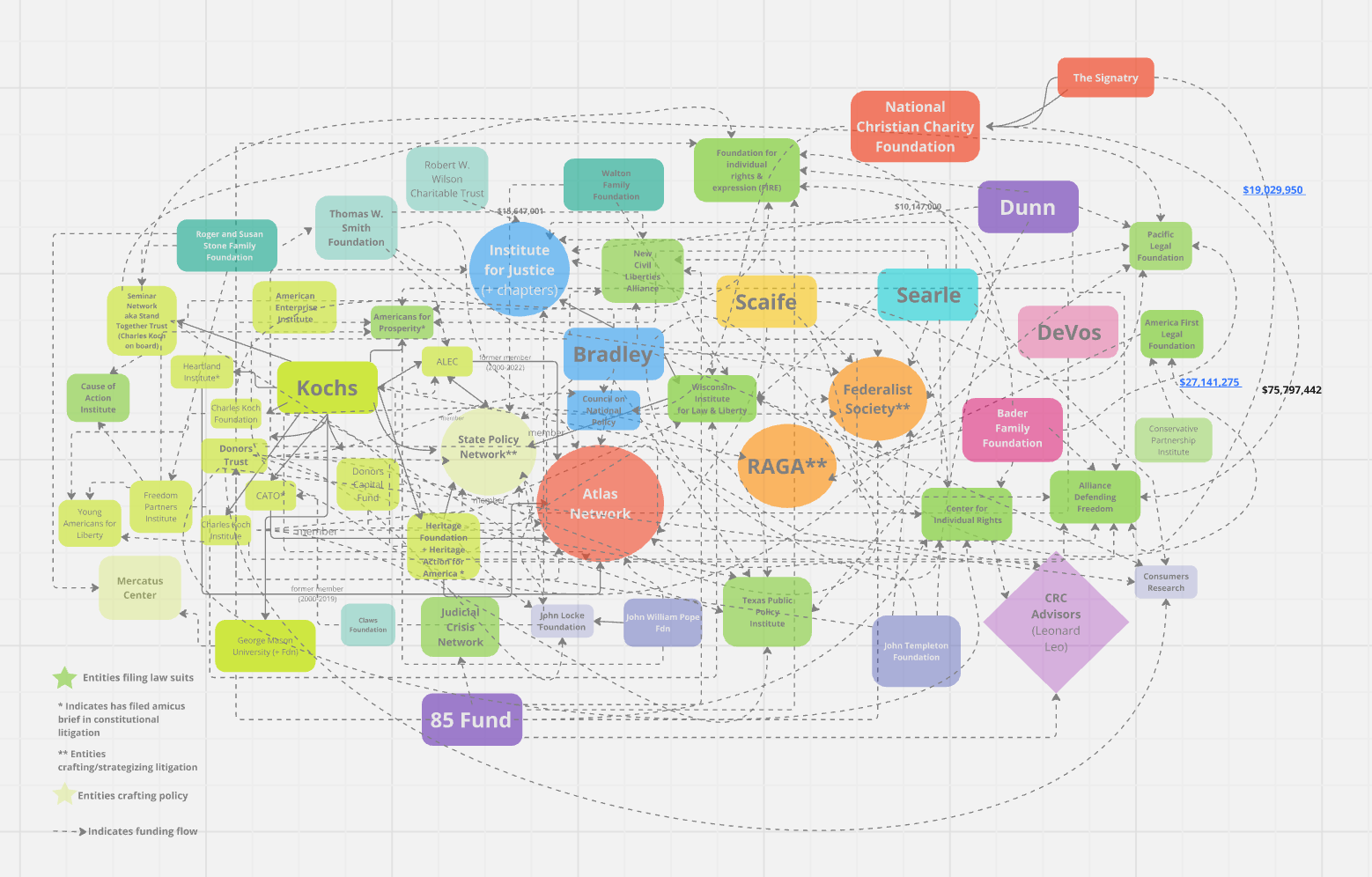
BRADLEY FDN 2
capt BRADLEY616
no merri
mjr funder , rival kochs?
CLETA VOTER SUPPRESSION ONLY CITIZENS VOTE
see pjt 2025
capt 519
see olin
see kochademia
SEE ALEC
SEE Afp koch
bradly tag new
===
SEE AMICUS
---
see pjt 2025 3
2 26
https://alimcforever.substack.com/
resources: Project 2025 - alimcforever
Contact: info@alimcforever.com
This is a personal newsletter by @alimcforever (Ailíe Nic an tSaoir).
yt


Had you seen this? #billionaires #media #tech #uspolitics #trump
17.7K subscribers
26,559 views Jan 30, 2026
Had you seen this? #billionaires #media #tech #uspolitics #trump
Notion
THE COMPLETE PROTECTION SYSTEM
Read together, Project 2025 creates a 10-layer protection architecture:
- Kill internal oversight (fire IGs)
- Terminate active investigations (FBI review authority)
- Fire investigators (Schedule F)
- Politicize FBI (remove independence)
- Control DOJ (presidential litigation control)
- Eliminate financial crime agencies (abolish CFPB, FTC)
- Redirect trafficking investigators (HSI to immigration)
- Remove police oversight (curtail consent decrees)
- Create fear (expand death penalty)
- Block campaign finance enforcement (defer to FEC)
Every single layer protects elite criminals from investigation.
---
---
---
e nad e
Meet the ‘dead industrialists’ funding climate denialism
:{By Scott Waldman | 06/26/2020
Some of the most prolific funders of today’s climate science denial groups died decades before the general public knew climate change was transforming the planet.

Sarah Mellon Scaife and Daniel C. Searle. University of Pittsburgh/Historic Pittsburgh (Scaife); Searle Freedom Trust
Some of the most prolific funders of today’s climate science denial groups died decades before the general public knew climate change was transforming the planet.
While much of the attention on opposition to mainstream climate science has focused in recent years on funding from fossil fuel companies, there’s growing support for foes of carbon regulation from conservative foundations that are not widely known.
Foundations formed by now-dead industrialists have been instrumental in promoting rollbacks of regulations that protect the public from deadly air pollution and spreading misinformation around climate science.
Fueled by hundreds of millions of dollars in assets, the foundations have supported groups that worked with the Trump White House to roll back vehicle emissions standards and to ease restrictions on power plant pollution and water protections, public tax filings show. They have quietly funded presidential advisers who worked to conduct a hostile White House review of climate science and to restrict EPA’s use of scientific research when crafting public health protections.
Among the foundations, which operate independently but bankroll many of the same groups, are the Lynde and Harry Bradley Foundation, the Searle Freedom Trust and the Sarah Scaife Foundation.
Robert Brulle, a Drexel University sociologist who studies and tracks climate denial funding, said such foundations have been quietly shaping public life for decades. They offer a way, he said, for "dead industrialists" to transfer economic power into cultural and political power that can last in perpetuity. The power of such foundations lies in their ability to operate for generations without any check on their power, he said.
"These foundations are totally unaccountable to anybody," he said. "A foundation can pretty much do whatever the hell it wants regardless of the consequences. Foundations have undemocratic and plutocratic power."
None of the foundations responded to requests for comment.
The foundations fuel more than just climate policy battles. They also support media organizations that promote misleading climate information and create confusion around climate science. That includes the conservative Daily Caller News Foundation as well as the Prager University Foundation.
The Daily Caller News Foundation provides articles for the Daily Caller, the conservative website founded by Fox News host Tucker Carlson. A Prager University video series has featured climate deniers saying that global warming concerns are overblown and that NASA, NOAA and the world’s major science agencies are wrong.
They have pumped millions of dollars into groups that have worked closely with the Trump administration and Congress to weaken climate policy and create confusion around climate science, including the Competitive Enterprise Institute (CEI), CO2 Coalition, Heritage Foundation, Heartland Institute, Cato Institute and Texas Public Policy Foundation.
And the foundations have been a source of "baseload" funding for organizations that have battled the government for the last 40 years, said Kert Davies, director of the nonprofit Climate Investigations Center.
Even before fossil fuel companies and the Koch brothers began pumping money into organizations that oppose climate regulations, the foundations were quietly supporting such work, he said. And as the fossil fuel industry faces increasing scrutiny over its role in climate misinformation and has backed away from some public funding, the foundations have continued their support, Davies noted.
"They don’t have any material interest in fossil fuels, but they are fundamentalists about hating the government, hating regulation and trying to stop any progress on things like climate change because they see it as almost a step toward communism, it’s almost that stark," he said.
To be sure, not all foundations linked to dead industrialists oppose climate science. The fortune of John D. Rockefeller of Standard Oil is now funding climate action. The Rockefeller Brothers Fund spends more than $10 million annually supporting climate causes and funding groups that promote regulation of fossil fuel.
3 big donors
One of the largest donors to anti-climate policy causes is the Lynde and Harry Bradley Foundation, which has spent millions of dollars annually on groups that try to sow doubt about climate change and that work to weaken climate regulations.
Public tax filings show that the Wisconsin-based foundation has assets of about $1 billion and was named for two brothers — Lynde, who died in 1942, and Harry, a member of the far-right John Birch Society, who died in 1965. The family made its fortune in electronic controls.
The foundation was expanded into a conservative powerhouse in 1985, when a sale of the family company expanded the foundation’s assets to $290 million.
In recent years, the foundation has pumped millions of dollars into groups that worked closely with the Trump White House to roll back most of the Obama administration’s climate policy; to increase the voice of industry researchers in order to diminish air pollution regulations; and to steer federal agencies such as the Interior Department, EPA and the Department of Energy toward the interests of fossil fuel companies.
Last year alone, the Bradley Foundation spent more than $2 million funding CEI, the Cato Institute, the CO2 Coalition, the Heritage Foundation, FreedomWorks, the Texas Public Policy Foundation and the American Legislative Exchange Council. Former employees of those groups have served in senior positions at the White House, Interior, DOE and EPA, and on President Trump’s transition teams for those agencies.
Millions of dollars to the same groups has also flowed from the Searle Freedom Trust, public tax filings show. The trust was founded by Daniel C. Searle, who died in 2007 and was a fourth-generation CEO of a family pharmaceutical company that was sold to Monsanto.
In 2018 alone, tax filings show, the Searle trust gave more than $2 million to groups that worked with the Trump administration to roll back environmental regulations, including the CO2 Coalition, CEI, Cato and the Heritage Foundation.
In addition to policy support, the foundation funds public outreach for climate denialism. In 2018 alone, it spent more than $300,000 on groups that publish and promote climate misinformation, including the Daily Caller News Foundation and the Prager University Foundation, tax filings show.
The work of the Bradley Foundation and Searle trust is complemented by funding from the Sarah Scaife Foundation, which is named after Sarah Mellon Scaife, an heiress to the fortune of her father, Richard Mellon, a banker and industrialist.
Scaife, who died in 1965, focused her support on funding for hospitals, disability and poverty issues, and environmental causes. Her money was even used to fund the University of Pittsburgh laboratory where the polio vaccine was developed by Dr. Jonas Salk in the early 1950s.
After Scaife’s death, her son, Richard Mellon Scaife, turned the foundation into a powerhouse for conservative issues, spending tens of millions of dollars on the Heritage Foundation alone before his death in 2014. Scaife steered the family’s fortune toward conservative causes so thoroughly that Hillary Clinton once pinpointed him as the figurehead of a "vast right-wing conspiracy."
The Sarah Scaife Foundation now funnels millions to groups that oppose environmental regulations and that attack climate science. That includes more than $3 million in its most recent filing, including to Cato, CEI, the CO2 Coalition, FreedomWorks, the Committee for a Constructive Tomorrow, and the Energy and Environmental Legal Institute, according to tax filings.
---
---
5 26 Billionaires’ Shocking Plan To Silence Working-Class Voters
May 18, 2026
50% of voters say being forced to show a passport would be a barrier to voting, according to a new poll we conducted. Billionaires like Elon Musk, the Uihleins, and Leonard Leo are funding Trump’s attempts to take over elections and nullify your vote.

...
4:59
4 minutes, 59 seconds
According to our poll, 66% of working-class voters said that the $130 fee for a new passport would be difficult for them to afford.
5:08
5 minutes, 8 seconds
And 47% of working class voters say that it would deter or prevent them from voting.
5:15
5 minutes, 15 seconds
It'd be tough on middle-class voters, too: 53% say it would be cost prohibitive, and 36% say they wouldn't be able to vote.
5:22
5 minutes, 22 seconds
And for what?
5:23
5 minutes, 23 seconds
The number of noncitizens voting in American elections is essentially zero, but since 2020, a subset of activists has become obsessed with the idea.
5:32
5 minutes, 32 seconds
All of the groups that had been built up into this election denial infrastructure started almost simultaneously talking about the myth of noncitizen voting.
5:41
5 minutes, 41 seconds
And it was very clearly a coordinated effort, very likely a funder-driven effort, to coordinate around this single line of messaging.
5:50
5 minutes, 50 seconds
[Cassie] Brendan Fischer of the Campaign Legal Center took us down the funder rabbit hole– because while the giant, gaping loopholes in campaign
5:57
5 minutes, 57 seconds
finance law make it intentionally difficult for people to follow the money, there are some big names that you really need to know.
6:05
6 minutes, 5 seconds
[Brendan] A lot of the national groups get their money from billionaires like Dick Uihlein or Elon Musk, or wealthy, powerful individuals who control a lot of money, like Leonard Leo.
6:16
6 minutes, 16 seconds
You might recognize Leonard Leo as the guy who picked Donald Trump’s Supreme Court justices.
6:21
6 minutes, 21 seconds
[Brendan] Leonard Leo, who controls over $1 billion, has groups like the Honest Elections Project and Save Our States, which have been playing an important role, at least in helping to advance messaging and policy development.
6:34
6 minutes, 34 seconds
This January, the Honest Elections Project released a big game plan that literally outlined each of the steps that Trump has pursued,
6:41
6 minutes, 41 seconds
including serious restrictions on mail-in voting– Tell me about mail-in ballots.
6:45
6 minutes, 45 seconds
–you know, the method that Trump both constantly rails against and uses himself. I used a mail-in ballot, you probably said. Yeah, I did. You know why? Because I'm President of the United States.
6:54
6 minutes, 54 seconds
There are also foundations like the Bradley Foundation, and all of these organizations collectively pour, tens and at this point, hundreds of millions of dollars into supporting these broad national groups.
7:05
7 minutes, 5 seconds
[Cassie] The Bradley Foundation is a Wisconsin-based organization that put more money than anybody into election denialism and voter suppression.
7:13
7 minutes, 13 seconds
They were a big sponsor of the Only Citizens Vote coalition, a who's who of billionair-funded, anti-voter organizations– over 80 in total, a lot of them involved in Project 2025.
7:24
7 minutes, 24 seconds
[Brendan] They help craft legislation, they provide testimony when legislation that would undermine the freedom to vote is moving in state legislatures or sometimes in Congress.
7:35
7 minutes, 35 seconds
They're more of the experts in the room.
7:37
7 minutes, 37 seconds
Back in 2024, Only Citizens Vote created model anti-voter legislation in partnership with the massive corporate lobby group ALEC.
7:45
7 minutes, 45 seconds
Leading the way on that legislation was Cleta Mitchell.
7:48
7 minutes, 48 seconds
She's a Federalist Society member, OG election denier, and most importantly, on the board of the Bradley Foundation.
7:54
7 minutes, 54 seconds
[President Trump] All we have to do, Cleta, is find 11,000 plus votes.
7:57
7 minutes, 57 seconds
Cleta Mitchell now has her own group called the Fair Elections Fund, which helps to coordinate many of these efforts, as well as seed money to state-based groups, some of which are themselves associated with the Election Integrity Network.
8:09
8 minutes, 9 seconds
[Cassie] Ok, here’s another big name: the Election Integrity Network, which brings us down another rabbit hole.
8:15
8 minutes, 15 seconds
The Election Integrity Network is fueled by just a few big players, including the Conservative Partnership Institute and Citizens for Renewing America.
8:24
8 minutes, 24 seconds
The Conservative Partnership Institute is funded by Trump donors.
8:28
8 minutes, 28 seconds
It's run by former Trump chief of staff Mark Meadows, and gets its money from big players like the Koch linked Donors Trust Fund,
8:35
8 minutes, 35 seconds
a group funded by the founder of Hobby Lobby, and, of course, the Bradley Impact Fund Foundation.
...
---
---
2025
https://ecollections.law.fiu.edu/cgi/viewcontent.cgi?article=1743&context=lawreview
Uncharitable Think Tanks 207
Institution—also led in the earlier one, with only slight shifts otherwise.229 • From 2010 on, the top funders were Donors Trust, Donors Capital Fund, and the Scaife, Bradley, and Koch family foundations. The Devos family foundations rose to join the ranks of the top ten. • Grants channeled through Donors Trust and Donors Capital Fund accounted for 13.7% of the total. • 74% of all contributions came from completely unidentified sources. • }:}:
After AEI, Heritage and Hoover, the largest recipients were Cato, the Manhattan Institute, the Hudson Institute, the Mercatus Center, the Acton Institute, the State Policy Network, the Reason Foundation, Heartland, and the Americans for Prosperity Foundation. From 2003 to 2018, Brulle and his co-authors tallied total gifts to this cohort of $9.77 billion 230—a sum that refutes the mistaken notion that charitable giving is small dollars, and influential only at the margin. Now for the thought experiment.
===
drilled 7 24 2025 epa
---
===
kickass yale law
...
B. Donors Funding Amici and Litigants in the Same Case
Thanks to the work of investigative reporters, in recent years we have been
able to observe the rise in high-profile, politically charged cases that are financed
directly by ideological foundations.113 Often the same foundations that fund the
litigation also exploit the courts’ lenient amicus-funding-disclosure rules to
anonymously fund flotillas of amicus briefs that support their preferred out-
comes.
:{
}:
For example, in the orchestrated challenge to union agency-shop fees first
initiated in Friedrichs v. California Teachers Association,:{:{114}::{ }::{one organization bank-}:
rolled not only the nonprofit law firm bringing the case, but also eleven different
organizations that filed amicus briefs supporting the plaintiffs.115}::{:{ }::{That organi-}:
}:zation was the Lynde and Harry Bradley Foundation—a conservative organiza-
tion that has long sought to weaken labor rights, including by financing impact
litigation.116 If the disclosure rule were operating to its intended effect, the Court
and parties would have been made aware of that funding. Yet none of those ami-
cus filers disclosed the Bradley Foundation as a source of its funding for the brief
under Rule 37.6, and none of those briefs were rejected by the Court for lack of
disclosure.
The Bradley Foundation’s coordinated and undisclosed funding of the liti-
gants and amici in Friedrichs was not a one-off. In Janus v. AFSCME, the follow-
up to Friedrichs, investigative reporters found that the Bradley Foundationagain
...
163
:{:{funded both of the two groups representing the plaintiffs, as well as a dozen}:
groups that filed amicus briefs.}:117:{:{ }::{Similarly, the two groups representing the}::{ }::{Ja-}:
nus plaintiffs, plus thirteen amicus filers, all received funding from Donors Trust,
}:mentioned above.118 :{
None of this common funding was disclosed to the Court.
:{:{Finally, in}::{ }::{Seila Law LLC v. Consumer Financial Protection Bureau}::{, eleven amici}:
aligned with the petitioner Seila Law received financial support from the sameentities, which also fund the Federalist Society.119 The Center for Media and De-
mocracy subsequently found that “16 right-wing foundations,” including the
Bradley Foundation and DonorsTrust, “have donated a total of nearly $69 mil-
lion to 11 groups that filed amicus briefs in favor of scrapping the CFPB.”120 None
of this information was disclosed to the Court under its current reading of the
Rule.}:
C. Donors Anonymously Orchestrating Amicus “Projects”
Recently released documents reveal how donors like the Bradley Foundation
use tax-exempt money to coordinate amicus “projects,” in which they influence
court results by funding an array of groups in the same legal network as the Fed-
eralist Society, as presumably occurred in Seila Law.121 :{
:{:{In 2015, a representative}:
of the Bradley Foundation emailed Leonard Leo, then Executive Vice President:{
of the Federalist Society, to ask if there was “a 501(c)(3) nonprofit to which Brad-
ley could direct any support of the two Supreme Court amicus projects other
}:}:than Donors Trust.”122 :{:{Leo replied, “Yes, Judicial Education Project}:could take
and allocate.”}:123:{:{ }::{In turn, Judicial Education Project (JEP), a 501(c)(3) tax-ex-}:
empt organization that does not disclose its donors, submitted a grant proposal
to Bradley seeking $200,000 to coordinate and develop amicus briefs in two po-
}:litically charged (but otherwise completely unrelated) cases: the aforementioned
...
164
Friedrichs and King v. Burwell,124 a challenge to the Affordable Care Act. The
Bradley Foundation estimated that “each of the two amicus-brief efforts costs
approximately $250,000, for a total of $500,000,” and the Bradleystaff recom-
mended a $150,000 grant be given to JEP to support this work.125 The Bradley
staffer explained the strategy behind this investment as follows:
At this highest of legal levels, it is often very important to orchestrate
high-caliber amicus efforts that showcase respected high-profile parties
who are represented by the very best lawyers with strong ties to the
Court. Such is the case here, with King and Friedrichs, even given Bradley’s
previous philanthropic investments in the actual, underlying legal actions.126
In King and Friedrichs, none of the amici supporting the Bradley-funded litigants
disclosed their Bradley Foundation funding under Rule 37.6—or any of their
funding sources for that matter. This nondisclosure resulted from interpreting
the Rule narrowly to require disclosure only of funds intended to cover the costs
of formatting, printing, and delivering the briefs.127
:{....
===
===
All nonprofits identified by CMD that gave $10,000 or more to the top climate misinformation groups from 2014–20 are listed in the table below.
:{
}:
tABLE 2
Top Nonprofit Climate Denial Funders, 2014-20
Numerous charities, private foundations, and trade associations have bankrolled the climate misinformation movement.
Page 1 of 4
Table with 9 columns and 53 rows. Currently displaying rows 1 to 15.
Donor 2014 2015 2016 2017 2018 2019 2020 TOTAL
1 DonorsTrust/Donors Capital Fund $3,293,850 $3,816,850 $3,676,750 $2,422,000 $3,830,200 $2,101,732 $1,416,500 20,557,882
2 Searle Freedom Trust $839,500 $589,500 $1,140,000 $940,000 $1,096,000 $754,000 $985,000 6,344,000
3 Sarah Scaife Foundation $350,000 $610,000 $842,000 $875,000 $960,000 $715,000 $1,245,000 5,597,000
4 Mercer Family Foundation $885,000 $100,000 $1,075,000 $970,000 3,030,000
5 Dunn Foundation $1,200,000 $250,000 $325,000 $200,000 $350,000 $350,000 $350,000 3,025,000
6 Bradley Foundations $344,376 $318,876 $458,500 $519,000 $280,000 $475,000 $110,000 2,505,752
7 American Fuel and Petrochemical Manufacturers $365,000 $275,000 $470,000 $400,000 1,510,000
8 Koch Foundations $100,128 $431,891 $333,028 $413,016 $84,000 $99,049 $18,749 1,479,861
9 Vanguard Charitable Endowment Program $38,500 $228,500 $265,000 $230,000 $235,000 997,000
10 Fidelity Charitable Gift Fund $35,525 $21,350 $27,867 $241,355 $212,310 $231,055 $201,952 971,414
11 National Philanthropic Trust $150,000 $175,000 $175,500 $176,000 $200,000 876,500
12 Bartley J. Madden Foundation $45,000 $270,000 $270,000 $250,000 $30,000 865,000
13 Thomas W. Smith Foundation $150,000 $175,000 $200,000 $200,000 725,000
14 The 85 Fund $700,000 700,000
15 Ed Uihlein Family Foundation $10,500 $129,000 $35,000 $115,000 $115,000 $140,000...
:{----==
an 4 24
as Donald Trump begins his first criminal trial this week, while facing three other indictments and 88 felony counts, several far-right groups are working tirelessly to ensure MAGA lives on no matter what comes of the ex-president's legal troubles, according to a Tuesday, April 16 report published by The Guardian.
Two of the MAGA hopeful's allies — America First Legal Foundation founder Stephen Miller, and Turning Point USA founder Charlie Kirk — were the beneficiaries of "six- and seven-figure checks" from the Lynde and Harry Bradley Foundation and the Bradley Impact Fund's in 2022, as well as "other Trump-friendly bastions such as the Heritage Foundation and Michael Flynn’s America’s Future," the news outlet reports
"The Lynde and Harry Bradley Foundation and Bradley Impact Fund have emerged as major forces in Maga circles," Michael Beckel, of the bipartisan political reform organization Issue One told the news outlet.
READ MORE:[Journalist exposes how 'mastermind' Trump adviser Stephen Miller was 'radicalized'
Furthermore, The Guardian reports the nonprofit pair "poured about $165m into dozens of groups including quite a few Trump-allied thinktanks, legal outfits and other advocacy outfits."
Beckel noted, however, "Donor-advised funds like the Bradley Impact Fund allow mega-donors to support organizations while keeping their names out of the spotlight."
The Issue One research director emphasized The Bradley Impact Fund, offers "wealthy mega-donors additional anonymity and help keep donors’ names out of the limelight, even as these individuals contribute large sums to influence elections and policy debates."
Referring to the Bradley Foundation, Lisa Graves, the executive director of the progressive watchdog group True North, said: “It has nearly $1bn in assets. Its board includes the multimillionaire Art Pope, whose personal ambition is to change the political landscape of North Carolina and more to suit his regressive agenda. Mitchell has been playing a significant role in efforts to make it harder for Americans to vote, and harder for Americans to have fair representation through fair maps.”
READ MORE:[Trump ally’s stunning request: 'If this election doesn’t go our way the next day we fight'
She emphasized, "These are substantial investments that are furthering extremists at the forefront of Trump’s agenda."
*The Guardian's full report is available here
guk
Two powerful conservative non-profits have donated millions of dollars to a number of pro-Trump groups led by the key far-right allies Stephen Miller, Charlie Kirk and others that have promoted election denialism, extremist anti-immigrant policies and legal challenges to bolster the Maga movement.
Based in Wisconsin, the Lynde and Harry Bradley Foundation and the Bradley Impact Fund in 2022 separately doled out six- and seven-figure checks to groups such as Miller’s America First Legal and Kirk’s Turning Point USA, and other Trump-friendly bastions such as the Heritage Foundation and Michael Flynn’s America’s Future.
Watchdog groups that track money in politics say the Bradley Foundation and the closely tied Bradley Impact Fund have become increasingly influential in funding the Maga ecosystem in recent years as Trump is all but certain to be the Republican 2024 presidential nominee.
“The Lynde and Harry Bradley Foundation and Bradley Impact Fund have emerged as major forces in Maga circles,” said Michael Beckel, the research director for Issue One, a bipartisan political reform group.
The biggest checks in 2022 were written to Trump-allied groups by the dark-money Bradley Impact Fund: America First Legal received about $27.1m, Turning Point USA roped in close to $8m, and the Conservative Partnership Institute pulled in $712,310. America’s Future also received $500,000.
Meanwhile, the Bradley Foundation ponied up $425,000 to the Heritage Foundation, which has worked with many other pro-Trump groups to assemble a 1,000-page plan for a new Trump presidency with an authoritarian agenda to expand executive-branch powers and curb key agencies such as the US justice department.
The Bradley Foundation in 2022 also doled out $750,000 to the pro-Maga FreedomWorks Foundation and $2.9m to the Bradley Impact Fund.
While the larger and older Bradley Foundation launched in 1942 and has almost $1bn in assets, the newer and smaller Bradley Impact Fund has grown fast and handed out especially large sums to far-right groups close to Trump.
The Impact Fund, which was started in 2012 and shares at least two board members with the foundation, has witnessed explosive growth in recent years, with revenues from undisclosed donors hitting $108m in 2022 versus just $7m in 2017, according to tax records.
By contrast, the Bradley Foundation doled out $56.6m in 2022.
The Bradley foundation’s board includes the well-known rightwinger Art Pope, a North Carolina multimillionaire who used to chair its board and is also a director of the Bradley Impact Fund. Pope has deep ties to other conservative bastions such as the Koch-backed Americans for Prosperity, where he has been a board member too.
The board of the Bradley Foundation also boasts the rightwing lawyer and Trump ally Cleta Mitchell, a senior legal fellow at the Conservative Partnership Institute.
Mitchell founded CPI’s self-styled “election integrity network” in 2021 after participating with Trump on his 2 January call to the Georgia secretary of state, Brad Raffensperger, who Trump beseeched to “find” 11,780 votes to help overturn Joe Biden’s win in the state.
Mitchell has been a driving force in mobilizing other Trump-allied election denialist groups to expand poll-watching and other measures to guard against potential voting fraud, while she has continued to promote bogus claims of election fraud in 2020.
Serendipitously, the rightwing Public Interest Legal Foundation that Mitchell chairs received $750,000 from the two Bradley non-profits combined, according to the liberal-leaning Center for Media and Democracy, which tracks money in politics.
Although not as well-known as the sprawling network of conservative groups funded by the oil and gas billionaire Charles Koch, experts say the two Bradley non-profits have become instrumental in funding major political players on the right.
“Through their extensive grant-making, the Lynde and Harry Bradley Foundation and Bradley Impact Fund are shaping politics and policymaking in ways that will be felt for years to come,” said Beckel.
Other experts who follow influential donors on the right, including the two Bradley non-profits, agree that their hefty donations are supporting major players and groups backing Trump.
“These are substantial investments that are furthering extremists at the forefront of Trump’s agenda,” said Lisa Graves, the executive director of the progressive watchdog group True North.
Speaking about the older Bradley Foundation, Graves said: “It has nearly $1bn in assets. Its board includes the multimillionaire Art Pope, whose personal ambition is to change the political landscape of North Carolina and more to suit his regressive agenda.”
She added: “Mitchell has been playing a significant role in efforts to make it harder for Americans to vote, and harder for Americans to have fair representation through fair maps.”
The Bradley Foundation board boasts other big-name conservative lawyers too, including Paul Clement, a former US solicitor general who has done substantial legal work for pro-gun interests, and Eugene Scalia, a secretary of labor during the Trump administration and the son of the late supreme court justice Antonin Scalia.
In total, the two Bradley non-profits in 2022 poured about $165m into dozens of groups including quite a few Trump-allied thinktanks, legal outfits and other advocacy outfits.
Other rightwing recipients who received checks from both Bradley non-profits include the Wisconsin Institute for Law and Liberty, which pulled in a total of $1.1m, and the National Center for Public Policy Research, which received just over $1m.
Similarly, the two Bradley non-profits gave a total of $700,000 to Flynn’s America’s Future, almost $530,000 to the Heritage Foundation, and $510,050 to the Manhattan Institute for Policy Research.
In the case of Flynn’s America’s Future, the Bradley non-profits were crucial to sustaining its operations in 2022, according to tax records. America’s Future only raised about $1.1m in 2022.
Flynn, who briefly served as Trump’s national security adviser and who Trump pardoned in late 2020 after he was convicted of lying to the FBI about contacts he had with the Russian ambassador in 2016, was a key pusher of false claims the 2020 election was rigged. He is now urging a “guard the vote” drive against potential fraud, a ploy Trump has touted too.
The rapid growth of the Bradley Impact Fund, which bills itself as a “donor-advised fund” and keeps donor names secret, underscores how many big conservative check-writers want to hide their identities, say experts.
“Donor-advised funds like the Bradley Impact Fund allow mega-donors to support organizations while keeping their names out of the spotlight,” said Beckel.
The Bradley Impact Fund, he said, gives “wealthy mega-donors additional anonymity and help keep donors’ names out of the limelight, even as these individuals contribute large sums to influence elections and policy debates”.
More broadly, Graves said: “Though the two Bradley non-profits are not as well known as Koch’s non-profit empire or Leonard Leo’s money operation to capture key levers of power, they have become increasingly important to the growth of the Maga ecosystem.”
===
wow how did i miss? lnx?
How Right-Wing Billionaires Infiltrated Higher Education
By Jane Mayer
FEBRUARY 12, 2016
https://www.chronicle.com/article/how-right-wing-billionaires-infiltrated-higher-education/
IF THERE WAS A SINGLE EVENT that galvanized conservative donors to try to wrest control of higher education in America, it might have been the uprising at Cornell University on April 20, 1969. That afternoon, during parents' weekend at the Ithaca, N.Y., campus, some 80 black students marched in formation out of the student union, which they had seized, with their clenched fists held high in black-power salutes. To the shock of the genteel Ivy League community, several were brandishing guns. At the head of the formation was a student who called himself the "Minister of Defense" for Cornell's Afro-American Society. Strapped across his chest, Pancho Villa-style, was a sashlike bandolier studded with bullet cartridges. Gripped nonchalantly in his right hand, with its butt resting on his hip, was a glistening rifle. Chin held high and sporting an Afro, goatee, and eyeglasses reminiscent of Malcolm X, he was the face of a drama so infamous it was regarded for years by conservatives such as David Horowitz as "the most disgraceful occurrence in the history of American higher education."
John M. Olin, a multimillionaire industrialist, wasn't there at Cornell, which was his alma mater, that weekend. He was traveling abroad. But as a former Cornell trustee, he could not have gone long without seeing the iconic photograph of the armed protesters. What came to be known as "the Picture" quickly ricocheted around the world, eventually going on to win that year's Pulitzer Prize.
Traveling almost as fast was the news that Cornell's administrators had quickly capitulated to the demands of the black militants, rather than risk a bloody confrontation. Under duress, the university's president had promised to accelerate plans to establish an independent black-studies program at Cornell, as well as to investigate the burning of a cross outside a building in which several black female students lived. And to the deep consternation of many conservative faculty members and students on campus, the president also agreed to grant full amnesty to the protesters, some of whom were facing previous disciplinary proceedings following an earlier uprising in which they had reportedly flung books from the shelves of Cornell's library, denouncing the works as "not relevant" to the black experience.
By all accounts, the confrontation was especially distressing to Olin. Cornell's library was one of four buildings on the Cornell campus bearing his family's name. Both he and his father had graduated from the university and had been proud and generous donors. Almost worse than the behavior of the protesters, from his standpoint, was the behavior of Cornell's president, James A. Perkins, a committed liberal who had gone out of his way to open the university's doors to inner-city minority students and now seemed to be bending the curriculum and lowering disciplinary standards to placate them.
"The catastrophe at Cornell inspired Olin to take his philanthropy in a bold, new direction," according to John J. Miller, whose authorized biography, A Gift of Freedom, provides a treasure trove of original research on Olin's life and legacy. Olin "saw very clearly that students at Cornell, like those at most major universities, were hostile to businessmen and to business enterprise, and indeed had begun to question the ideals of the nation itself," a memo from his foundation recounts.
As a result, according to Miller, instead of continuing to direct the bulk of his charitable contributions to hospitals, museums, and other standard patrician causes, as he had in the early years after he set up the John M. Olin Foundation in 1953, Olin embarked on a radical new course. He began to fund an ambitious offensive to reorient the political slant of American higher education to the right.
His foundation aimed at the country's most elite universities, the Ivy League and its peers, cognizant that these institutions were the incubators of those who would hold future power. If these young cadres could be trained to think more like him, then he and other donors could help secure the country's political future. It was an attempted takeover, but instead of waging it with bandoliers and rifles, he chose money as his weapon.
By the time the John M. Olin Foundation spent itself out of existence in 2005, as called for in its founder's will, it had spent about half of its total assets of $370 million bankrolling the promotion of free-market ideology and other conservative ideas on the country's campuses. In doing so, it molded and credentialed a whole new generation of conservative graduates and professors. "These efforts have been instrumental in challenging the campus left--or more specifically, the problem of radical activists' gaining control of America's colleges and universities," Miller concluded in a 2003 pamphlet published by the Philanthropy Roundtable, an organization run for conservative philanthropists.
"These guys, individually and collectively, created a new philanthropic form, which was movement philanthropy," said Rob Stein, a progressive political strategist, speaking of the Olin foundation and a handful of other private foundations that funded the creation of a conservative counter-intelligentsia during this period. "What they started is the most potent machinery ever assembled in a democracy to promote a set of beliefs and to control the reins of government."
Stein was so impressed that he went on to try to build a liberal version of the model. Each side would argue that the other had more money and more influence, depending on how broadly they defined the rival camp. But beginning in the 1970s, the left felt hard-pressed to match the far-ranging propagation of ideology pioneered by a few enterprising donors on the right.
There is little doubt that the Cornell uprising radicalized Olin's philanthropy, but the official account citing this as the key to his thinking is incomplete. The protest took place in 1969, and Olin didn't begin to transform his foundation into an ideological instrument aimed at "saving the free enterprise system," as his lawyer put it, until four years later, in the spring of 1973. On closer inspection, it appears that there were additional factors involved that shed less flattering light on his motivations.
Founded by Olin's father, Franklin, in 1892, the Olin Corporation had begun in East Alton, 111., as a manufacturer of blasting powder for coal miners but expanded into making small arms and ammunition. By 1973, the Olin Corporation was embroiled in multiple serious controversies over its environmental practices, undermining its reputation, threatening its revenues, and ensnarling the company in expensive litigation. It was against this backdrop of serious clashes with the increasingly robust regulatory state that John Olin directed his lawyer to enlist his fortune in the battle to defend corporate America. As he put it, "My greatest ambition now is to see free enterprise reestablished in this country. Business and the public must be awakened to the creeping stranglehold that socialism has gained here since World War II."
At first, the foundation funneled money into the same conservative think tanks that Richard Mellon Scaife and Joseph Coors, a scion of the archconservative Colorado-based Coors brewery family, were supporting: the Heritage Foundation, the American Enterprise Institute, and the Hoover Institution, the think tank located on Stanford University's campus.
But soon John Olin's focus diverged. Perhaps because of his upset over Cornell, his foundation became uniquely centered on transforming academe. As he wrote in a private letter to the president of Cornell, he regarded the campus as overrun by scholars "with definite left-wing attitudes and convictions." Olin noted, "It matters little to me whether the economic development is classified as Marxism, Keynesianism, or whatnot." He said he regarded "liberalism" and "socialism" as "synonymous." All of these academic trends, he asserted, needed "very serious study and correction."
To get his bearings, Olin's labor lawyer, Frank O'Connell, contacted a handful of other private conservative foundations. He sought advice from colleagues at the Koch and Scaife foundations, as well as a few others on the right such as the Earhart Foundation and the Smith Richardson Foundation, which was funded by the Vicks VapoRub fortune. George Pearson, who was running the Charles G. Koch Foundation at that point, guided O'Connell, assigning him a free-market reading list that included Hayek's essay "The Intellectuals and Socialism." Hayek's point was emphatic: To conquer politics, one must first conquer the intellectuals. O'Connell recalled, "It was like a home-study course."
The fledgling right-wing foundations were also studying their establishment counterparts during this period, particularly the giant Ford Foundation. By the late 1960s, Ford was pioneering what its head, McGeorge Bundy, a former dean at Harvard and national security adviser to the Kennedy and Johnson administrations, called "advocacy philanthropy." Ford was, for instance, pouring money into the environmental movement, funding the Environmental Defense Fund and the Natural Resources Defense Council. By supporting public-interest litigation, it showed conservatives how philanthropy could achieve large-scale change through the courts while bypassing the democratic electoral process, just as the early critics of private foundations had feared.
In 1977, Olin raised his foundation's stature by choosing William Simon as its president.Simon was a social acquaintance of Olin's from East Hampton, where they both had beach houses, and Olin described Simon's thinking as "almost identical with mine." While Olin kept a low profile, however, Simon loved the spotlight, the hotter the better. As William Voegeli, who was program officer at the Olin foundation from 1988 to 2003, recalled, Simon was like Alice Longworth's description of her father, Theodore Roosevelt. "He wanted to be the bride at every wedding, and the corpse at every funeral."
Simon had been energy czar and later Treasury secretary under Presidents Nixon and Ford and was a famously intemperate critic of those he considered "stupid." This large category included liberals, radicals, and moderate members of his own Republican Party. Like Olin, he was incensed by the expansion of the regulatory state. He especially detested environmentalists and other self-appointed guardians of the public interest, describing them as the "New Despots." In his 1978 manifesto, A Time for Truth, he wrote, "Since the 60s, the vast bulk of regulatory legislation passed by congress ... [has] been largely initiated by a powerful new lobby that goes by the name of the Public Interest movement."
Simon disparaged these "college-educated idealists" who claimed to be working for "the well being of 'consumers,' the 'environment,' 'minorities,'" and other nonmaterial causes, accusing them of wanting to "expand the police powers of the state over American producers." He challenged their purity. Noting that they claimed to care little for money, he accused them of being driven by another kind of self-interest. Quoting his colleague Irving Kristol, the neoconservative intellectual, he charged that these usurpers wanted "the power to shape our civilization." That power, he argued, should belong exclusively to "the free market."
Simon's hatred and suspicion of the liberal elite approached Nixonian levels in his 1980 sequel manifesto, A Time for Action. He claimed that a "secret system" of academics, media figures, bureaucrats, and public-interest advocates ran the country. Simon warned that unless businessmen fought back, "Our freedom is in dire peril."
Simon's foreboding, like that of Olin, is somewhat hard to fathom given that both men had reached pinnacles of American power and wealth. They were both millionaires many times over, with more properties, possessions, titles, honors, and accomplishments than they could easily count. Both men were born into privilege. Simon was chauffeured to grade school, and his family was so wealthy he likened his parents to the carefree and careless characters in F. Scott Fitzgerald's fiction.
Nonetheless, he regarded himself proudly as self-made. His father evidently lost his mother's fortune, motivating Simon to make his own. On Wall Street, he became a hugely successful partner at Salomon Brothers, where he was an early leader in the lucrative new craze for leveraged buyouts. But what neither Olin nor Simon had was influence over the next generation. "We are careening with frightening speed toward collectivism," Simon warned.
Only an ideological battle could save the country, in Simon's view. "What we need is a counter-intelligentsia. ... [It] can be organized to challenge our ruling 'new class'--opinion makers," Simon wrote. "Ideas are weapons--indeed the only weapons with which other ideas can be fought." He argued, "Capitalism has no duty to subsidize its enemies." Private and corporate foundations, he said, must cease "the mindless subsidizing of colleges and universities whose departments of politics, economics and history are hostile to capitalism." Instead, they "must take pains to funnel desperately needed funds to scholars, social scientists and writers who understand the relationship between political and economic liberty," as he put it. "They must be given grants, grants, and more grants in exchange for books, books, and more books."
Under Simon's guidance, the Olin foundation tried to fund the new "counter-intelligentsia." At first, it tried supporting little-known colleges where conservative ideas--and money--were welcome. But Simon and his associates soon realized that this was a losing strategy. If the Olin foundation wanted impact, it needed to infiltrate prestigious universities, especially the Ivy League.
The man who put his mark on the Olin foundation more than its namesake, or even Simon, was its executive director, Michael Joyce, a fierce former liberal who had become an acolyte of Kristol's.A friend of Joyce's said that he believed philanthropy was about power and that those with great fortunes needed political capos like him to tell them how to wield it. Joyce was a brawler who wanted to take on America's liberal establishment, not just supplement it in some milquetoast way. In the words of Ralph Benko, a libertarian blogger for Forbes, "Joyce was a true radical. He was inspired byAntonio Gramsci. He wanted to effect radical transformation."
In Miller's view, Joyce was "an intellectual among activists, and an activist among intellectuals. He understood how the world of ideas influenced the real world." Joyce was characteristically more blunt. "My style," he said, "was the style of the toddler and the adolescent: fight, fight, fight, rest, get up, fight, fight, fight. No one ever accused me of being pleasant. I made a difference. It was acknowledged by friend and foe."
Joining Joyce wasJames Piereson, a thoughtful, soft-spoken neoconservative whose path to the Olin foundation had also run through Irving Kristol. Piereson had befriended the Kristol family at the University of Pennsylvania, where he taught government and political theory alongside Irving's son, Bill. Both had felt marginalized by their more liberal peers. Having closely observed America's academic intelligentsia, Piereson concluded that the foundation needed to "penetrate" the most elite institutions "because they were emulated by other colleges and universities of lesser stature." As Hillel Fradkin, who also worked at the Olin foundation, put it, "The only way you're going to change the debate in this country is by looking to those schools. Giving money to conservative outposts won't get much done."
What emerged was a strategy they called the "beachhead" theory. The aim, as Piereson later described it in an essay offering advice to fellow conservative philanthropists, was to establish conservative cells, or "beachheads," at "the most influential schools in order to gain the greatest leverage." The formula required subtlety, indirection, and perhaps even some misdirection.
The key, Piereson explained, was to fund the conservative intelligentsia in such a way that it would not "raise questions about academic integrity." Instead of trying to earmark a chair or dictate a faculty appointment, both of which he noted were bound to "generate fierce controversy," he suggested that conservative donors look for like-minded faculty members whose influence could be enlarged by outside funding. In time, such a professor could administer an expanded program. But Piereson warned that it was "essential for the integrity and reputation of the programs that they be defined not by ideological points of view."
To overtly acknowledge "pre-ordained conclusions" would doom a program. Instead of saying the program was designed to "demonstrate the falsity of Marxism" or to promote "free enterprise," he advised that it was better to "define programs in terms of fields of study, [like the] John M. Olin Fellowships in Military History." He wrote, "Often a program can be given a philosophical or principled identity by giving it the name of an important historical figure, such as the James Madison Program on American Ideals and Institutions at Princeton University." (Indeed, after years of trial and error, the Olin foundation funded Princeton's Madison Program with $525,000 in start-up grants in 2000. Run by Robert George, an outspoken social and religious conservative, the program serves as the beau ideal of the "beachhead" theory. As a friend of George's described him to The Nation in 2006, he is "a savvy right-wing operative, boring from within the liberal infrastructure.")
Piereson warned conservative philanthropists that taking the liberal out of liberal-arts education would require patience and cunning. As a former academic himself, he knew how politically charged a frontal assault would be. Rather than openly trying to overhaul academe over night, he suggested, "perhaps we should think instead about challenging it by adding new voices." As he put it, "This may well be the best means of changing the college culture, for a few powerful voices of criticism may at some point bring the entire ideological house of cards crashing down upon itself."
IF THE OLIN FOUNDATION was less than transparent about its mission, it was not for the first time. Between 1958 and 1966, it secretly served as a bank for the Central Intelligence Agency. During these eight years, the CIA laundered $1.95 million through the foundation. Olin, according to Miller, regarded his undercover role as part of his patriotic duty. Many of the government funds went to anti-Communist intellectuals and publications. But in 1967, the press exposed the covert propaganda operation, triggering a political furor and causing the CIA to fold the program. The CIA money at the Olin foundation, which was not publicized at the time, disappeared as quietly as it had arrived. The idea of using the private foundation to fund ideologically aligned intellectuals, however, persisted.
The Olin foundation invested in William F. Buckley Jr., whose television show, Firing Line, the foundation supported. It also funded Allan Bloom, author of the best-selling slam from the right at American higher education, The Closing of the American Mind (in which Bloom also lashed out at rock music as a "nonstop, commercially prepackaged masturbation fantasy"). The foundation also supported Dinesh D'Souza, author of Illiberal Education, which blasted "political correctness," castigating rules requiring sensitivity to women and minorities as the overreaching of liberal thought police.
In addition, the Olin foundation funded professors at leading universities all over the country, including Harvard's Harvey C. Mansfield and Samuel P. Huntington. It donated $3.3 million to Mansfield's Program on Constitutional Government at Harvard, which emphasized a conservative interpretation of American government, and the foundation donated $8.4 million to Huntington's John M. Olin Institute for Strategic Studies, which inculcated a hawkish approach to foreign policy and national security.
Through these carefully curated programs, the foundation trained the next generation of conservatives, whom Joyce likened to "a wine collection" that would grow more valuable as its members aged, increasing in stature and power. The foundation kept track of those who passed through Huntington's Olin program, proudly noting that many went into public service and academe. Between 1990 and 2001, 56 of the 88 Olin fellows at the Harvard program continued on to teach at the University of Chicago, Cornell, Dartmouth, Georgetown, Harvard, MIT, Penn, and Yale. Many others became public figures in government, think tanks, and the media.
In all, by the time it closed its doors in 2005, the Olin foundation had supported 11 separate programs at Harvard,burnishing the foundation's name and ideas and proving that even the best-endowed American university would allow an outside ideological group to build "beachheads," so long as the project was properly packaged and funded.
On top of these programs, the foundation doled out $8 million to more than a hundred John M. Olin faculty fellows. These funds enabled scores of young academics to take the time needed to do research and write in order to further their careers. The roster of recipients includes John Yoo, the legal scholar who went on to become the author of the George W. Bush administration's controversial "torture memo" legalizing the American government's brutalization of terror suspects.
Without the rigorous peer-review standards required by prestigious academic publications, the Olin foundation was able to inject into the mainstream a number of works whose scholarship was debatable at best. For example, Olin-foundation funds enabled John R. Lott Jr., then an Olin fellow at the University of Chicago, to write his influential book More Guns, Less Crime. In the work, Lott argued that more guns actually reduce crime and that the legalization of concealed weapons would make citizens safer.
Politicians advocating weaker gun-control laws frequently cited Lott's findings. But according to Adam Winkler, the author of Gunfight, Lott's scholarship was suspect. Winkler wrote that "Lott's claimed source for this information was 'national surveys,"' which under questioning he revised to just one survey that he and research assistants had conducted. When asked to provide the data, Winkler recounts, Lott said he had lost it in a computer crash. Asked for any evidence of the survey, writes Winkler, "Lott said he had no such evidence." (Proving that the recipients of Olin funds weren't ideologically monolithic, Winkler, too, had received funds from the foundation.)
Another Olin-funded book that made headlines and ended in accusations of intellectual dishonesty was David Brock's The Real Anita Hill, to which the foundation gave a small research stipend. In the book, Brock defended the Supreme Court justice Clarence Thomas by accusing Hill of fabricating her sworn testimony against him during his Senate confirmation hearings. Later, though, Brock recanted, admitting that he had been wrong. He apologized for the book and said that he had been deceived by conservative sources who had misled him.
Still, the combined impact of the Olin grantees was "a triumph," according to Miller. Writing in 2003, he enthused that "a small handful of foundations have essentially provided the conservative movement with its venture capital." He noted that in contrast to the days when Lionel Trilling had declared conservatism over, "conservative ideas are in broad circulation, and many believe they are now ascendant." He added, "If the conservative intellectual movement were a Nascar race, and if the scholars and organizations who compose it were drivers zipping around a race track, virtually all of their vehicles would sport an Olin bumper sticker." In time, the Olin foundation's success in minting right-leaning thinkers drew the envy of the left. "On the right, they understood that books matter," says Steve Wasserman, executive editor at large for Yale University Press, who formerly tried but failed to get wealthy liberal donors to match the intellectual investments being made by conservatives. "I remember meeting at a restaurant in California with some of the major Democratic operatives and funders, Margery Tabankin, Stanley Sheinbaum and Gary David Goldberg. I was telling them that they needed to figure out a way to fund books on the left. But books aren't sexy. They weren't interested. They didn't think that in the political culture it mattered. The Democrats were hostage to star personalities and electoral politics."
THE OLIN FOUNDATION'S most significant beachheads, however, were established in America's law schools, where it bankrolled a new approach to jurisprudence known as Law and Economics. Lewis Powell, in an influential 1971 memo, had argued that "the judiciary may be the most important instrument for social, economic and political change." The Olin foundation agreed. As the courts expanded consumer, labor, and environmental rights and demanded racial and sexual equality and greater workplace safety, conservatives in business were desperate to find more legal leverage. Law and Economics became their tool.
As a discipline, Law and Economics was seen at first as a fringe theory embraced largely by libertarian mavericks until the Olin foundation spent $68 million underwriting its growth. Like an academic Johnny Appleseed, the Olin foundation underwrote 83 percent of the costs for all Law and Economics programs in American law schools between the years of 1985 and 1989. Over all, it scattered more than $10 million to Harvard, $7 million to Yale and Chicago, and over $2 million to Columbia, Cornell, Georgetown, and the University of Virginia. Miller writes, "John Olin, in fact, was prouder of Law and Economics than any other program he supported."
Following Piereson's cautious playbook, the program's title conveyed no ideology. Law and Economics stresses the need to analyze laws, including government regulations, not just for their fairness but also for their economic impact. Its proponents describe it in apolitical terms as bringing "efficiency" and "clarity" to the law, rather than relying on fuzzy, hard-to-quantify concepts like social justice.
Piereson, however, admitted that the beauty of the program was that it was a stealth political attack and that the country's best law schools didn't grasp this and therefore didn't block the ideological punch it packed. "I saw it as a way into the law schools--I probably shouldn't confess that," he told The New York Times in 2005. "Economic analysis tends to have conservatizing effects."
In a later interview with the Johns Hopkins University political scientist Steven M. Teles, Piereson added that he would have preferred to fund a conservative constitutional-law program, but had the foundation tried such a direct political challenge, it probably would have been barred entry to America's best law schools. "If you said to a dean that you wanted to fund conservative constitutional law, he would reject the idea out of hand. But if you said you wanted to support Law and Economics, he would be much more open to the idea," he confided. "Law and Economics is neutral, but it has a philosophical thrust in the direction of free markets and limited government. That is, like many disciplines, it seems neutral, but it isn't in fact."
The Olin foundation's route into the country's best law schools was circuitous. The foundation began by financially supporting an early leading figure in Law and Economics, the libertarian Henry Manne, an acolyte of the Chicago school of free-market economics. Brilliant, impolitic, and an ideological purist, Manne "was considered a marginal, even eccentric character in the legal academy," according to Teles, when the Olin foundation first started funding him in the early 1970s. To the frustration of the foundation, he didn't teach at high-prestige schools.
In 1985, however, the foundation seized a golden opportunity to establish a beachhead at the pinnacle of legal prestige. That year, Harvard Law School was riven by controversy. Leftist professors were urging students to "sabotage" corporate law firms from within. Conservative professors and alumni were scandalized. The ruckus attracted national press coverage in The New Yorker and elsewhere. Among the many outraged Harvard Law School alumni was one of the Olin foundation's trustees, George Gillespie. Sensing an opening, he contacted a conservative Harvard Law School professor, Phillip Areeda, whom he had been in school with, and offered the foundation's help.
The Olin foundation took the initiative, and Harvard took the cash. Out of this ideological pact came the John M. Olin Center for Law, Economics, and Business at Harvard Law School, on which the foundation ultimately spent $18 million. The donation was the biggest in Olin's history. Harvard's president at the time, Derek Bok, was reportedly delighted at the new source of funding and the opportunity to soothe the disgruntled alumni.
After Harvard approved Law and Economics, other schools soon followed. By 1990, nearly 80 law schools taught the subject. Olin fellows in Law and Economics, meanwhile, began to beat a path to the top of the legal profession, winning Supreme Court clerkships at a rate of approximately one each year, starting in 1985. Many of the adherents were outstanding lawyers and not all were conservative, but they were changing the prevailing legal culture.
By 1986, Bruce Ackerman, then a professor at Columbia Law School, called Law and Economics "the most important thing in legal education since the birth of Harvard Law School." Teles, in his 2008 book, The Rise of the Conservative Legal Movement, described Law and Economics as "the most successful intellectual movement in the law of the past 30 years, having rapidly moved from insurgency to hegemony."
As Law and Economics spread, underwritten at each step by the Olin foundation and other conservative backers including the Kochs and Scaife, liberal critics grew alarmed. The Alliance for Justice, a liberal nonprofit in Washington, published a critical report in 1993 warning that "a small wealthy group" was trying to "fundamentally alter the way that justice is dispensed in our society." It revealed that the Olin foundation was paying students thousands of dollars to take classes in Law and Economics at Georgetown Law School and to attend workshops on the subject at Columbia Law School.
Despite this ethically dubious situation, only one law school, at the University of California at Los Angeles, turned the Olin funds away, arguing that by plying students with grant money, the foundation was "taking advantage of students' financial need to indoctrinate them with a particular ideology."
More controversial still were Law and Economics seminars that the Olin foundation funded for judges. The seminars were initiated by Henry Manne, who had become dean of the George Mason University School of Law, which he was trying to transform into a hub of libertarian jurisprudence. The seminars treated judges to two-week-long, all-expenses-paid immersion training in Law and Economics, usually in luxurious settings like the Ocean Reef Club in Key Largo, Fla. They soon became popular free vacations for the judges, a cross between Maoist cultural re-education camps and Club Med. After a few hours of learning why environmental and labor laws were anathema, or why, as Manne argued, insider-trading laws did more harm than good, the judges broke for golf, swimming, and delightful dinners with their hosts. Within a few years, 660 judges had gone on these junkets, some, like the U.S. Court of Appeals judge and unconfirmed Supreme Court nominee Douglas Ginsburg, many times. By one count, 40 percent of the federal judiciary had participated, including the future Supreme Court justices Ruth Bader Ginsburg and Clarence Thomas.
A variety of major corporations eagerly joined Olin and other conservative foundations in footing the bills. A study by the nonpartisan Center for Public Integrity found that between 2008 and 2012 close to 185 federal judges attended judicial seminars sponsored by conservative interests, several of which had cases before the courts. The lead underwriters were the Charles Koch Foundation, the Searle Freedom Trust, ExxonMobil, Shell Oil, the pharmaceutical giant Pfizer, and State Farm, the insurance company. Topics ranged from "The Moral Foundations of Capitalism" to "Terrorism, Climate, and Central Planning: Challenges to Liberty and the Rule of Law."
Simultaneously, the Olin foundation provided crucial start-up funds for the Federalist Society, an organization for conservative law students founded in 1982. With $5.5 million from the Olin foundation, as well as large donations from foundations tied to Scaife, the Kochs, and other conservative legacies, the Federalist Society grew from a pipe dream shared by three ragtag law students into a powerful professional network of 42,000 right-leaning lawyers, with 150 law-school campus chapters and about 75 lawyers' groups nationally. All of the conservative justices on the Supreme Court are members, as are former vice president Dick Cheney, the former attorneys general Edwin Meese and John Ashcroft, and numerous members of the federal bench. Its president, Eugene B. Meyer, son of a founding editor of National Review, acknowledged that without Olin funding "it possibly wouldn't exist at all." Looking back, the Olin foundation's staff described it as "one of the best investments" the foundation ever made.
The Olin foundation also backed what came to be known as the Collegiate Network, privately financing a string of right-wing newspapers on America's college campuses. Among them was The Dartmouth Review, which infamously published an editorial in Ebonics proclaiming, "Now we be cornin' to Dartmut' and be up over our 'fros in studies, but we still be not graduatin' Phi Beta Kappa." The paper hosted a feast of lobster and champagne to mock a student fast against global hunger, sledge-hammered shantytowns erected by students protesting apartheid in South Africa, and published a transcript of a secretly taped meeting of students belonging to Dartmouth's gay student association. The Dartmouth Review became an incubator for right-wing media figures like D'Souza and the future conservative radio host Laura Ingraham. Its counterpart at Vassar, meanwhile, gave starts in journalism to the ABC correspondent Jonathan Karl and Marc Thiessen, an online columnist at The Washington Post best known for his defense of the Bush administration's use of torture.
JOHN M. Olin died in 1982 at the age of 89, but after his death his foundation became even more robust. He left it about $50 million in his estate and another $50 million in a trust for his widow, which came to the foundation in 1993 after she died. The funds were well invested, growing to some $370 million in all before the foundation spent it down and closed its doors in 2005. Olin had directed his foundation to shut down during the lifetime of the trustees for fear that it would fall into the hands of liberals, as he believed the Ford Foundation had tragically done.
As the Olin foundation spent itself out of existence, Michael Joyce jumped to a new and far more powerful private foundation, started by another conservative family. In 1985, a corporate merger in Milwaukee created a spectacular windfall, boosting a previously sleepy local charity, the Lynde and Harry Bradley Foundation, overnight into a nonprofit juggernaut. Its assets rocketed from $14 million to over $290 million, making it one of the 20 largest foundations in the country. Swimming in cash, the foundation's small, unpaid staff, which had mostly focused on conventional local do-gooding until then, sought out Joyce, telling him,
"We've got money, and we want to do what you did at Olin. We want to become Olin West."
Almost on the spot, Joyce moved to Milwaukee to run the Bradley foundation himself. At the Bradley foundation, Joyce had a freer hand. "He basically invented the field of modern conservative philanthropy," according to Piereson. During the next 15 years, the Bradley foundation would give away $280 million to his favorite conservative causes. It was small in comparison with older research foundations like the Ford Foundation, but unlike Ford, under Joyce's direction Bradley regarded itself as a righteous combatant in an ideological war, giving it a single-minded focus.
At least two-thirds of its grants, according to one analysis, financed conservative intellectual activity. It paid for some 600 graduate and postgraduate fellowships, right-wing think tanks, conservative journals, activists fighting Communism abroad, and its own publishing house, Encounter Books.
When Joyce took over the Bradley foundation, he funded many of the same academic organizations he had at Olin, including half of the same colleges and universities. (The Bradley foundation gave both Harvard and Yale $5.5 million during its first decade under Joyce's management.) "Typically, it was not just the same university but the same department, and in some cases, the same scholar," Bruce Murphy wrote in Milwaukee Magazine, charging that this led to a kind of "intellectual cronyism."
The anointed scholars were good ideological warriors but "rarely great scholars,"he wrote. For instance, Joyce stuck with Charles Murray in the face of growing controversy over his 1994 book, The Bell Curve, which correlated race and low IQ scores to argue that blacks were less likely than whites to join the "cognitive elite," and was loudly and convincingly discredited. The Manhattan Institute fired Murray over the controversial project. "They didn't want the grief," says Murray.But Joyce reportedly kept an estimated $1 million in grants flowing to Murray, who decamped to the American Enterprise Institute. "I knew from Mike Joyce my fellowship was portable," Murray says. But the controversy stirred by the book clouded the Bradley foundation's reputation. Joyce, who was accused of racism, said he had received death threats. He felt so threatened he demanded enhanced security. The book, he acknowledged, left "an indelible imprint on us."
When Joyce stepped down from Bradley in 2001 amid rumors of alcoholism and erratic and self-destructive behavior, his achievements transcended his personal problems. He was showered with accolades from the right. National Review described him as "the chief operating officer of the conservative movement." It added, "Wherever you looked in the battle of ideas, a light dusting would have turned up his fingerprints." The tribute concluded, "Over the period of his Bradley service, it's difficult to recall a single, serious thrust against incumbent liberalism that did not begin or end with Mike Joyce."
By 2012, the Bradley foundation's assets had reached more than $630 million, enabling it to dole out more than $32 million in grants during that year alone. The funds continued to finance welfare-reform initiatives that required the poor to find jobs, as well as attacks on public schools. The foundation also continued to support conservative beachheads in 35 different elite colleges and universities including Harvard, Princeton, and Stanford.
The foundation's annual Bradley Prizes had by then become the glittering Academy Awards ceremony for conservatives, a night at Washington's Kennedy Center on the banks of the Potomac filled with evening gowns, tuxedos, overlong acceptance speeches, live musical fanfares, and up to four annual $250,000 prizes given to a Who's Who of the movement.
Over the years, winners have included the columnist George Will, who subsequently became a trustee of the foundation. Also honored with the award were the founders of the Federalist Society as well as Princeton's Robert George; Bill Kristol, the editor of The Weekly Standard; the Harvard professor Harvey Mansfield; the Fox News president, Roger Ailes; and the Heritage Foundation's stalwarts Ed Meese and Ed Feulner. Almost all of the recipients had played major roles in tugging the American political debate to the right. And almost all had also been supported over the years by a tiny constellation of private foundations filled with tax-deductible gifts from a handful of wealthy reactionaries whose identities and stories very few Americans knew but whose "overarching purpose," as Joyce said, "was to use philanthropy to support a war of ideas."
Jane Mayer is a staff writer at The New Yorker. This article is adapted from her new book, Dark Money: The Hidden History of the Billionaires Behind the Rise of the Radical Right, just out from Doubleday.
Copyright: COPYRIGHT 2016 Chronicle of Higher Education, Inc.
http://chronicle.com.oca.ucsc.edu/section/About-the-Chronicle/83
===
math prof hit
off BS
milton friedman day at ball park
Jerry Stephenson renta
State Director at Black Alliance for Educational Options
http://68.77.48.18/RandD/Charter%20Schools/Packet/03%20Charter%20Advocacy%20Organizations.pdf
srcwatch
Bluegrass Institute for Public Policy Solutions (BIPPS) is a right-wing pressure group that promotes itself as "an independent research and educational institution offering free-market solutions to Kentucky's most pressing problems."[1] The institute was created and initially funded by Chris Derry, a businessman from Bowling Green, Kentucky. BIPPS is a member of the State Policy Network (SPN).
omg
no lnx
https://www.newyorker.com/magazine/2021/08/09/the-big-money-behind-the-big-lie
The New Yorker
A Reporter at Large
August 9, 2021 Issue
The Big Money Behind the Big Lie
Donald Trump’s attacks on democracy are being promoted by rich and powerful conservative groups that are determined to win at all costs.
By Jane Mayer
August 2, 2021
It was tempting to dismiss the show unfolding inside the Dream City Church in Phoenix, Arizona, as an unintended comedy. One night in June, a few hundred people gathered for the première of “The Deep Rig,” a film financed by the multimillionaire founder of Overstock.com, Patrick Byrne, who is a vocal supporter of former President Donald Trump. Styled as a documentary, the movie asserts that the 2020 Presidential election was stolen by supporters of Joe Biden, including by Antifa members who chatted about their sinister plot on a conference call. The evening’s program featured live appearances by Byrne and a local QAnon conspiracist, BabyQ, who claimed to be receiving messages from his future self. They were joined by the film’s director, who had previously made an exposé contending that the real perpetrators of 9/11 were space aliens.
But the event, for all its absurdities, had a dark surprise: “The Deep Rig” repeatedly quotes Doug Logan, the C.E.O. of Cyber Ninjas, a Florida-based company that consults with clients on software security. In a voice-over, Logan warns, “If we don’t fix our election integrity now, we may no longer have a democracy.” He also suggests, without evidence, that members of the “deep state,” such as C.I.A. agents, have intentionally spread disinformation about the election.Although it wasn’t the first time that Logan had promoted what has come to be known as the Big Lie about the 2020 election—he had tweeted unsubstantiated claims that Trump had been victimized by voter fraud—the film offered stark confirmation of Logan’s entanglement in fringe conspiracies. Nevertheless, the president of the Arizona State Senate, Karen Fann, has put Logan’s company in charge of a “forensic audit”—an ongoing review of the state’s 2020 Presidential vote. It’s an unprecedented undertaking, with potentially explosive consequences for American democracy.
Approximately 2.1 million Presidential votes were cast in Maricopa County, which includes Phoenix and accounts for most of the state’s population. In recent years, younger voters and people of color have turned the county’s electorate increasingly Democratic—a shift that helped Biden win the traditionally conservative state, by 10,457 votes. Since the election, the county has become a focus of ire for Trump and his supporters. By March, when Logan’s company was hired, the county had already undergone four election audits, all of which upheld the outcome. Governor Doug Ducey, a Republican and a former Trump ally, had certified Biden’s victory. But Trump’s core supporters were not assuaged.
As soon as the Fox News Decision Desk called the state for Biden, at 11:20 p.m. on November 3rd, Trump demanded that the network “reverse this!” When Fox held firm, he declared, “This is a major fraud.” By the time of the “Deep Rig” première, the standoff had dragged on for more than half a year. The Cyber Ninjas audit was supposed to conclude in May, but at the company’s request Fann has repeatedly extended it. On July 28th, the auditors completed a hand recount, but they are still demanding access to the computer routers used by Maricopa County and also want to scrutinize images of mail-in-ballot envelopes. The U.S. Department of Justice has warned that “private actors who have neither experience nor expertise in handling” ballots could face prosecution for failing to follow federal audit rules. Trump, meanwhile, has fixated on Arizona’s audit, describing it as a step toward his “reinstatement.” On July 24th, he appeared in Phoenix for a “Rally to Protect Our Elections,” and said, “I am not the one trying to undermine American democracy—I’m the one trying to save American democracy.” Predicting that the audit would vindicate him, he rambled angrily for nearly two hours about having been cheated, calling the election “a scam—the greatest crime in history.”
In June, I stood in the bleachers at the Veterans Memorial Coliseum in Phoenix, where the audit was taking place, and witnessed people examining carton after carton of paper ballots cast by Arizonans last fall. Some inspectors used microscopes to investigate surreal allegations: that some ballots had been filled out by machines or were Asian counterfeits withtelltale bamboo fibres. Other inspectors looked for creases in mail-in ballots, to determine whether they had been legitimately sent in envelopes or—as Trump has alleged—dumped in bulk.
As the audit has unfolded, various violations of professional norms have been observed, including inspectors caught with pens whose ink matched what was used on ballots. One auditor turned out to have been an unsuccessful Republican candidate during the election. As I watched the proceedings, black-vested paid supervisors monitored the process, but their role was cloaked in secrecy. The audit is almost entirely privately funded, and a county judge in Arizona recently ordered the State Senate to disclose who is paying for it. Last week, Cyber Ninjas acknowledged having received $5.7 million in private donations, most of it from nonprofit groups led by Trump allies who live outside Arizona, including Byrne.
I was joined in the bleachers by Ken Bennett, a former Arizona secretary of state and a Republican, whom the State Senate had designated its liaison to the audit. He acknowledged that, if the auditors end up claiming to have found large discrepancies, “that will of course be very inflammatory.” Indeed, a recent incendiary claim by the auditors—that the vote had tallied about seventy thousand more mail-in ballots than had been postmarked—prompted one Republican state senator to propose a recall of Arizona’s electoral votes for Biden. (In fact, the auditors misunderstood what they were counting.) Nevertheless, Bennett defended the audit process: “It’s important to prove to both sides that the election was done accurately and fairly. If we lurch from one election to another with almost half the electorate thinking the election was a fraud, it’s going to rip our country apart.”
Many experts on democratic governance, however, believe that efforts to upend long-settled election practices are what truly threaten to rip the country apart. Chad Campbell, a Democrat who was the minority leader in the Arizona House of Representatives until 2014, when he left to become a consultant in Phoenix, has been shocked by the state’s anti-democratic turn. For several years, he sat next to Karen Fann when she was a member of the House, and in his view she’s gone from being a traditional Republican lawmaker to being a member of “Trump’s cult of personality.” He said, “I don’t know if she believes it or not, or which would be worse.” Arizona, he added, is in the midst of a “nonviolent overthrow in some ways—it’s subtle, and not in people’s face because it’s not happening with weapons. But it’s still a complete overthrow of democracy. They’re trying to disenfranchise everyone who is not older white guys.”
Arizona is hardly the only place where attacks on the electoral process are under way: a well-funded national movement has been exploiting Trump’s claims of fraud in order to promote alterations to the way that ballots are cast and counted in forty-nine states, eighteen of which have passed new voting laws in the past six months. Republican-dominated legislatures have also stripped secretaries of state and other independent election officials of their power. The chair of Arizona’s Republican Party, Kelli Ward, has referred to the state’s audit as a “domino,” and has expressed hope that it will inspire similar challenges elsewhere.
Ralph Neas has been involved in voting-rights battles since the nineteen-eighties, when, as a Republican, he served as the executive director of the Leadership Conference on Civil Rights. He has overseen a study of the Arizona audit for the nonpartisan Century Foundation, and he told me that, though the audit is a “farce,” it may nonetheless have “extraordinary consequences.” He said, “The Maricopa County audit exposes exactly what the Big Lie is all about. If they come up with an analysis that discredits the 2020 election results in Arizona, it will be replicated in other states, furthering more chaos. That will enable new legislation. Millions of Americans could be disenfranchised, helping Donald Trump to be elected again in 2024. That’s the bottom line. Maricopa County is the prism through which to view everything. It’s not so much about 2020—it’s about 2022 and 2024. This is a coördinated national effort to distort not just what happened in 2020 but to regain the House of Representatives and the Presidency.”
Richard Hasen, a law professor at the University of California, Irvine, and one of the country’s foremost election-law experts, told me, “I’m scared shitless.” Referring to the array of new laws passed by Republican state legislatures since the 2020 election, he said, “It’s not just about voter suppression. What I’m really worried about is election subversion. Election officials are being put in place who will mess with the count.”
Arizona’s secretary of state, Katie Hobbs, whose office has authority over the administration of elections, told me that the conspiracy-driven audit “looks so comical you have to laugh at it sometimes.” But Hobbs, a Democrat, who is running for governor, warned, “It’s dangerous. It’s feeding the kind of misinformation that led to the January 6th insurrection.” QAnon followers have been celebrating the audit as the beginning of a “Great Awakening” that will eject Biden from the White House. She noted, “I’ve gotten death threats. I’ve had armed protestors outside my house. Every day, there is a total barrage of social media to our office. We’ve had to route our phones to voice mail so that no one has to listen to it. It can be really traumatizing. I feel beaten up.” She added, “But I’m not going to cave to their tactics—because I think they’re laying the groundwork to steal the 2024 elections.”
Although the Arizona audit may appear to be the product of local extremists, it has been fed by sophisticated, well-funded national organizations whose boards of directors include some of the country’s wealthiest and highest-profile conservatives. Dark-money organizations, sustained by undisclosed donors, have relentlessly promoted the myth that American elections are rife with fraud, and, according to leaked records of their internal deliberations, they have drafted, supported, and in some cases taken credit for state laws that make it harder to vote.
Senator Sheldon Whitehouse, a Democrat from Rhode Island who has tracked the flow of dark money in American politics, told me that a “flotilla of front groups” once focussed on advancing such conservative causes as capturing the courts and opposing abortion have now “more or less shifted to work on the voter-suppression thing.” These groups have cast their campaigns as high-minded attempts to maintain “election integrity,” but Whitehouse believes that they are in fact tampering with the guardrails of democracy.
One of the movement’s leaders is the Heritage Foundation, the prominent conservative think tank in Washington, D.C. It has been working with the American Legislative Exchange Council (alec)—a corporate-funded nonprofit that generates model laws for state legislators—on ways to impose new voting restrictions.
Among those deep in the fight is Leonard Leo, a chairman of the Federalist Society, the legal organization known for its decades-long campaign to fill the courts with conservative judges. In February, 2020, the Judicial Education Project, a group tied to Leo, quietly rebranded itself as the Honest Elections Project, which subsequently filed briefs at the Supreme Court, and in numerous states, opposing mail-in ballots and other reforms that have made it easier for people to vote.
Another newcomer to the cause is the Election Integrity Project California. And a group called FreedomWorks, which once concentrated on opposing government regulation, is now demanding expanded government regulation of voters, with a project called the National Election Protection Initiative.
These disparate nonprofits have one thing in common: they have all received funding from the Lynde and Harry Bradley Foundation. Based in Milwaukee, the private, tax-exempt organization has become an extraordinary force in persuading mainstream Republicans to support radical challenges to election rules—a tactic once relegated to the far right. With an endowment of some eight hundred and fifty million dollars, the foundation funds a network of groups that have been stoking fear about election fraud, in some cases for years. Public records show that, since 2012, the foundation has spent some eighteen million dollars supporting eleven conservative groups involved in election issues.
...LONG
===
sen kickass acb:
https://www.exposedbycmd.org/2020/10/13/senator-whitehouse-calls-out-dark-money-networks-behind-amy-coney-barretts-scotus-nomination
no lnx grafs
Senator Whitehouse Calls Out Dark-Money Networks Behind Amy Coney Barrett’s SCOTUS Nomination
By ExposedByCMD Editors | October 13th, 2020
Bradley Files, Democracy, Featured Investigations, Koch, News, RAGA, Trump7 Comments
Editor’s Note: The following is a transcript of remarks made by Sen. Sheldon Whitehouse (D-RI) in the October 13, 2020, Senate Judiciary Committee hearing on the nomination of Judge Amy Coney Barrett to the U.S. Supreme Court.
Thank you, Chairman, Judge Barrett. You can take a bit of a breather on your return to the committee, because what I want to do is go through with the people who are watching this now the conversation that you and I had when we spoke on the telephone. You were kind enough to hear out a presentation that I made, and I intend to ask some questions in that area, but it doesn’t make sense to ask questions if I haven’t laid the predicate, particularly for viewers who are watching this.
So, I guess the reason that I want to do this is because people who are watching this need to understand that this small hearing room and the little TV box that you are looking at, the little screen that you are looking at, are a little bit like the frame of a puppet theater, and if you only look at what’s going on in the puppet theater you’re not going to understand the whole story. You are not going to understand the real dynamic what is going on here, and you are certainly not going to understand forces outside of this room who are pulling strings and pushing sticks and causing the puppet theater to react.
So first, let me say, why do I think outside forces are here pulling strings?Well, part of it is behavior. We have colleagues here who supported you, this nominee, before there was a nominee. That’s a little unusual.
We have the political ram job that we have already complained of driving this process through at breakneck speed in the middle of a pandemic while the Senate is closed for safety reasons and while we are doing nothing about the COVID epidemic around us. We have some very awkward 180s from colleagues. Mr. Chairman, you figure in this. Our leader said back when it was Garland versus Gorsuch, that of course, of course, the American people should have a say in the Court’s direction. Of course, of course, said Mitch McConnell. That’s long gone.
Senator Grassley said the American people shouldn’t be denied a voice. That’s long gone. Senator Cruz said you don’t do this in an election year. That’s long gone. And our chairman made his famous hold-the-tape promise if an opening comes in the last year of President Trump’s term we’ll wait until the next election. That’s gone too.
So there is a lot of hard-to-explain hypocrisy and rush taking place right now, and my experience around politics is that when you find hypocrisy in the daylight, look for power in the shadows. Now people say well, what does all this matter? This is a political parlor game; it’s no big deal. Well, there are some pretty high stakes here that we have been talking about here on our side, and I will tell you three of them right here.
Roe v. Wade, Obergefell, and the Obamacare cases. Here’s the GOP platform, the Republican platform, the platform of my colleagues on the other side of this aisle say that a Republican president willappoint judges who will reverse Roe, Obergefell, and the Obamacare cases. So if you have a family member with an interest in some autonomy over their body under Roe v. Wade, the ability to have a marriage, have friends marry, have a niece or a daughter or a son marry someone of their same-sex they have – you’ve got a stake, and if you are one of the millions and millions of Americans who depend on the affordable care act you’ve got a stake.
It’s not just the platform. Over and over again, let’s start by talking about the Affordable Care Act. Here is the president talking about this litigation that we are gearing up this nominee for for November 10. In this litigation, he said we want to terminate healthcare under Obamacare.
That is the president’s statement, so when we react to that, don’t act as if we are making this stuff up. This is what President Trump said. This is what your party platform says: reverse the Obamacare cases. Senator after senator, including many in this committee, filed briefs saying that the Affordable Care Act should be thrown out by courts. Why is it surprising for us to be concerned that you want this nominee to do what you want nominees to do?
One quick stop on NFIB v. Sebelius, because a lot of this has to do with money. This is an interesting comparison. National Federation of Independent Businesses, until it filed the NFIB v. Sebelius case, had its biggest donation ever of $21,000. In the year that it went to work on the Affordable Care Act, ten wealthy donors gave $10 million. Somebody deserves a thank you.
So let’s go on to Roe v. Wade. Same thing. Same thing. The president has said that reversing Roe v. Wade will happen automatically because he is putting pro-life justices on the Court. Why would we not take him at his word? The Republican Party platform says it will reverse Roe. Why would we not comment on that and take you at your word?
Senators here, including Senator Hawley, have said I will vote only for nominees who acknowledge that Roe v. Wade is wrongly decided, and their pledge to vote for this nominee. Do the math. That’s a really simple equation to run.
The Republican brief in June Medical said Roe should be overruled, so don’t act surprised when we ask questions about whether that’s what you are up to here. And finally, out in the ad world that you have spared yourself wisely Judge Barrett, the Susan B Anthony Foundation is running advertisements right now saying that you are set, you are set to give our pro-life country a Court that it deserves.
Here is the ad with the voiceover. She said – she said. And then Roe, Obamacare cases and Obergefell, gay marriages. National Organization for Marriage, the big group that opposes same-sex marriage, says in this proceeding, all our issues are at stake. The Republican platform says it wants to reverse Obergefell. And the Republican brief filed in the case said same-sex relationships don’t fall within any constitutional protection, so when we say the stakes are high on this, it’s because you have said the stakes are high on this. You have said that is what you want to do. So how are people going about doing it? What is the scheme here?
Let me start with this one. In all cases, there’s big anonymous money behind various lanes of activity. One lane of activity is through the conduit of the Federalist Society. It is managed by a guy – was managed by – a guy named Leonard Leo, and it has taken over the selection of judicial nominees. How do we know that to be the case? Because Trump has said so over and over again. His White House counsel said so. So we have an anonymously funded group controlling judicial selection run by this guy Leonard Leo.
Then in another lane, we have again anonymous funders running through something called the Judicial Crisis Network, which is run by Carrie Severino, and it is doing PR and campaign ads for Republican judicial nominees. It got $17 million – a single $17 million donation in the Garland-Gorsuch contest. It got another single $17 million donation to support Kavanaugh. Somebody, perhaps the same person, spent $35 million to influence the United States Supreme Court. Tell me that’s good.
And then over here you have a whole array of legal groups, also funded by dark money, which have a different role. They bring cases to the Court. They don’t wind their way to the Court, your Honor, they get shoved to the Court to by these legal groups, many of which ask to lose below so they can get quickly to the Court to get their business done there. And then they turn up in a chorus, an orchestrated chorus of amici.
Now I’ve had a chance to have a look at this. And I was in a case, actually, as an amicus myself, the Consumer Financial Protection Board case. And in that case there were 1, 2, 3, 4, 5, 6, 7, 8, 9, 10, 11 amicus briefs filed, and every single one of them was a group funded by something called DonorsTrust.
DonorsTrust is a gigantic identity-scrubbing device for the right wing so that it says DonorsTrust is the donor without whoever the real donor is. It doesn’t have a business. It doesn’t have a business plan. It doesn’t do anything. It’s just an identity scrubber.
And this group here, the Bradley Foundation, funded eight out of the 11 briefs. That seems weird to me when you have amicus briefs coming in little flotillas that are funded by the same groups but nominally separate in the court.
So I actually attached this to my brief as an appendix. Center for Media and Democracy saw it, and they did better work. They went on to say which foundations funded the brief writers in that CFPB case. Here is the Bradley Foundation for $5.6 million to those groups. Here’s DonorsTrust, $23 million to those brief writing groups. The grand total across all the donor groups was $68 million to the groups that were filing amicus briefs, pretending that they were different groups.
Right-Wing Foundations Fund Anti-Consumer Protection Groups, 2014-present
Sixteen right-wing foundations gave nearly $69 million to groups urging the Supreme Court to abolish the Consumer Financial Protection Bureau since 2014.
Donor Amount
DonorsTrust $23,460,705
Charles Koch Foundation $12,986,462
Sarah Scaife Foundation $7,550,000
L&H Bradley Foundation $5,579,500
Searle Freedom Trust $4,550,000
Dunn Foundation $4,450,000
Donors Capital Fund $2,522,680
John William Pope Foundation $1,895,175
Bradley Impact Fund $1,363,000
Mercer Family Foundation $1,200,000
Adolph Coors Foundation $1,155,000
F.M. Kirby Foundation $672,500
Charles Koch Institute $517,134
Ed Uihlein Family Foundation $408,000
Pierre F. and Enid Goodrich Foundation $395,000
William H. Donner Foundation $167,000
TOTAL $68,872,156
And it’s not just in the Consumer Financial Protection Board case. You might say well that was just a one-off. Here’s Janus, the anti-labor case that had a long trail through the Court, through Friedrichs, and through Knox, and through other decisions.
And SourceWatch and ProPublica did some work about this. Here’s DonorsTrust and Donors Capital Fund. And here’s the Bradley Foundation. And they totaled giving $45 million to the 1, 2, 3, 4, 5, 6, 7, 8, 9, 10, 11, 12, 13, 14, 15 groups that filed amicus briefs, pretending to be different groups, and both of the lawyer groups in the case, funded by DonorsTrust, funded by Bradley Foundation in Janus.
This is happening over and over and over again, and it goes beyond just the briefs. It goes beyond just the amicus presentations.The Federalist Society– remember this group that is acting as the conduit and that Donald Trump has said is doing his judicial selection? They’re getting money from the same foundations, from DonorsTrust, $16.7 million and the Bradley Foundation, $1.37 million. From the same group of foundations total, $33 million.
Donors to the Federalist Society, 2014-present
The same 16 foundations that fund the amicus brief filers all give to the Federalist Society
donor Amount
DonorsTrust $16,733,100
Mercer Family Foundation $4,850,000
Donors Capital Fund $4,231,120
Charles Koch Foundation $2,419,264
Searle Freedom Trust $1,551,000
Lynde and Harry Bradley Foundation $1,375,000
Ed Uihlein Family Foundation $1,000,000
John William Pope Foundation $250,000
Adolph Coors Foundation $230,000
Pierre F. and Enid Goodrich Foundation $210,000
Dunn Foundation $150,000
F.M. Kirby Foundation $120,000
William H. Donner Foundation $45,000
Bradley Impact Fund $15,250
Charles Koch Institute $6,400
TOTAL $33,286,134
So you can start to look at these, and you can start to tie them together. The legal groups, all the same funders over and over again, bringing the cases and providing us orchestrated, orchestrated chorus of amici. Then the same group also funds the Federalist Society over here. The Washington Post wrote a big expose about this, and that made Leonard Leo a little hot, a little bit like a burned agent. So he had to jump out. And he went off to go do anonymously-funded voter suppression work. Guess who jumped in to take over the selection process in this case for Judge Barrett? Carrie Severino made the hop. So once again, ties right in together.
So, Center for Media and Democracy did a little bit more research. Here’s a Bradley Foundation memo that they’ve published. The Bradley Foundation is reviewing a grant application asking for money for this orchestrated amicus process, and what do they say in the staff recommendation? It is important to orchestrate – their word, not mine – important to orchestrate high-caliber amicus efforts before the Court.
Page 3 of 2015 Bradley Summary Judicial Education Project Proposal 150K
Contributed to DocumentCloud by Staff 18 of Documented • View document or read text
They also note that Bradley has done previous philanthropic investments in the actual underlying legal actions. So Bradley is funding – what do they call – philanthropically investing in, the underlying legal action and then giving money to groups to show up in the orchestrated chorus of amici. That can’t be good.
And it goes on, because they also found this email. This email comes from an individual at theBradley Foundation, and it asks our friend, Leonard Leo, who used to run the selection process, is there a 501(c)(3) nonprofit to which Bradleycould direct any support of the two Supreme Court amicus projects other than DonorsTrust? I don’t know why they wanted to avoid the reliable identity-scrubber DonorsTrust, but for some reason they did.
Page 6 of 2014 Bradley Leonard Leo Neil Corkery Carrie Severino Judicial+Education+Project
Contributed to DocumentCloud by Staff 18 of Documented • View document or read text]
So Leonard Leo writes back on Federalist Society address – so don’t tell me that it isn’t Federal Society business – on Federalist Society, on his address, he writes back, yes, send it to the Judicial Education Project, which could take and allocate the money. And guess who works for the Judicial Education Project? Carrie Severino,who also helped select this nominee, running the Trump Federalist Society selection process.
So the connections abound. In the Washington Post article, they point out that the Judicial Crisis Network’s office is on the same hallway in the same building as the Federalist Society, and when they sent their reporter to talk to somebody at the Judicial Crisis Network, somebody from the Federalist Society came down to let them up.
This more and more looks like it’s not three schemes, but it’s one scheme with the same funders selecting judges, funding campaigns for the judges, and then showing up in court in these orchestrated amicus flotillas to tell the judges what to do.
On the Judicial Crisis Network, you’ve got the Leonard Leo connection, obviously. She hopped in to take over for him with the Federalist Society. You’ve got the campaigns that I’ve talked about, where they take $17 million contributions. That’s a big check to write, $17 million, to campaign for Supreme Court nominees. No idea who that is or what they got for it. You’ve got briefs that she wrote. The Republican senators filed briefs in that NFIB case signed by Ms. Severino.
:{
}:
The woman who helped choose this nominee has written briefs for Republican senators attacking the ACA. Don’t say the ACA is not an issue here.And by the way, the Judicial Crisis Network funds the Republican attorneys general. It funds RAGA, the Republican Attorneys General Association, and it funds individual Republican attorneys general. And guess who the plaintiffs are in the Affordable Care Act case? Republican attorneys general.
Trump joined them because he didn’t want to defend, so he’s in with the Republican attorneys general. But here’s the Judicial Crisis Network campaigning for Supreme Court nominees, writing briefs for senators against the Affordable Care Act, supporting the Republicans who are bringing this case, and leading the selection process for this nominee.
Here is the page off the brief. Here is where they are. Mitch McConnell, and on through the list, Senator Collins, Senator Cornyn, Senator Hoeven, Senator — who’s still here? Marco Rubio. It’s a huge assortment of Republican senators who Carrie Severino wrote a brief for against the Affordable Care Act. So this is a, to me, pretty big deal. I’ve never seen this around any court that I’ve ever been involved with, where there’s this much dark money and this much influence being used.
Here’s how the Washington Post summed it up. This is “a conservative activist behind-the-scenes campaign to remake the nation’s courts,” and it’s a $250 million dark money operation. $250 million is a lot of money to spend if you’re not getting anything for it. So that raises the question, what are they getting for it?
Well, I showed the slide earlier on the Affordable Care Act. And on Obergefell and on Roe v. Wade, that’s where they lost. But with another judge, that could change. That’s where the contest is. That’s where The Republican Party platform tells us to look at how they want judges to rule, to reverse Roe, to reverse the Obamacare cases, and to reverse Obergefell and take away gay marriage. That is their stated objective and plan. Why not take them at their word?
But there is another piece of it, and that is not what’s ahead of us, but what’s behind us. What’s behind us is now 80 cases, Mr. Chairman, 80 cases under Chief Justice Roberts that have these characteristics. One, they were decided five to four by a bare majority. Two, the five-to-four majority was partisan in the sense that not one Democratic appointee joined the five. I refer to that group as the “Roberts Five.”
It changes a little bit as–with Justice Scalia’s death, for instance – but there’s been a steady “Roberts Five” that has delivered now 80 of these decisions.And the last characteristic of them is that there is an identifiable Republican donor interest in those cases, and in every single case, that donor interest won. It was an 80 to zero, 5 to 4 partisan rout, ransacking.
And it’s important to look at where those cases went, because they’re not about big, public issues like getting rid of the Affordable Care Act, undoing Roe v. Wade, and undoing same sex marriage.They’re about power. And if you look at those 80 decisions, they fall into four categories over and over and over again. One, unlimited and dark money and politics.Citizens United is the famous one, but it’s continued since with McCutcheon and we’ve got one coming up now. Always the five for unlimited money in politics. Never protecting against money dark money in politics, despite the fact that they said it was going to be transparent.
And who wins when you allow unlimited dark money in politics? A very small group. The ones who have unlimited money to spend and a motive to spend it in politics. They win. Everybody else loses. And if you’re looking at who might be behind this, let’s talk about people with unlimited money to spend and a motive to do it. We’ll see how that goes.
Next, knock the civil jury down. Whittle it down to a nub. The civil jury was in the Constitution, in the Bill of Rights, in our darn Declaration of Independence, but it’s annoying to big corporate powers because you can swagger your way as a big corporate power through Congress. You can go and tell the president you put money into to elect what to do. He will put your stooges at the EPA. It’s all great until you get to the civil jury, because they have an obligation, as you know, Judge Barrett, they have an obligation under the law to be fair to both parties irrespective of their size.
You can’t bribe them. You’re not allowed to. It’s a crime to tamper with the jury. It’s standard practice to tamper with Congress. And they make decisions based on the law. If you’re used to being the boss and swaggering your way around the political side, you don’t want to be answerable before a jury. And so one after another, these 80 5-to-4 decisions have knocked down, whittled away at, the civil jury, a great American institution.
Third – first was unlimited dark money, second was demean and diminish the civil jury – third is weaken regulatory agencies. A lot of this money, I’m convinced, is polluter money. The Koch Industries is a polluter, the fossil fuel industry is a polluter. Who else would be putting buckets of money into this and wanting to hide who they are behind DonorsTrust or other schemes?
And what are – if you’re a big polluter – what do you want? You want weak regulatory agencies. You want ones that you can box up and run over to Congress and get your friends to fix things for you in Congress. Over and over and over again, these decisions are targeted at regulatory agencies to weaken their independence and weaken their strength. And if you’re a big polluter, a weak regulatory agency is your idea of a good day.
And the last thing is in politics. In voting. Why on earth the Court made the decision, a factual decision – not something appellate courts are ordinarily supposed to make, as I understand it Judge Barrett – the factual decision that nobody needed to worry about minority voters in preclearance states being discriminated against, or that legislators would try to knock back their ability to vote. These five made that finding in Shelby County against bipartisan legislation from both houses of Congress, hugely passed, on no factual record.
They just decided that that was a problem that was over, on no record with no basis, because it got them to the result that we then saw. What followed? State after state after state passed voter suppression laws. One so badly targeting African Americans that two courts said it was surgically, surgically tailored to get after minority voters.
And gerrymandering, the other great control. Bulk gerrymandering where you go into a state, like the Red Map project did in Ohio and Pennsylvania, and you pack Democrats so tightly into a few districts that all the others become Republican majority districts. And in those states, you send a delegation to Congress that has a huge majority of Republican members, like 13 to 5, as I recall, in a state where the five, the party of the five actually won the popular vote.
You’ve sent a delegation to Congress that is out of step with the popular vote of that state and court after court figured out how to solve that, and the Supreme Court said nope. 5 to 4 again. Nope. We’re not going to take an interest in that question. In all these areas where it’s about political power for big special interests, and people who want to fund campaigns, and people who want to get their way through politics without actually showing up, doing it behind DonorsTrust and other groups, doing it through these schemes over and over and over again, you see the same thing.
80 decisions, Judge Barrett. 80 decisions. An 80-to-0 sweep. I don’t think you’ve tried cases, but some cases, the issue is bias and discrimination. And if you’re making a bias case as a trial lawyer – Lindsey Graham is a hell of a good trial lawyer. If he wanted to make a bias case – Dick Durbin is a hell of a good trial lawyer. If they wanted to make a bias case and they could show an 80-to-0 pattern, A, that’s admissible, and B, I’d love to make that argument to the jury. I’d be really hard pressed to be the lawyer saying no, 80-to-0 is just a bunch of flukes.
All five-four. all partisan, all this way.So something is not right around the Court. And dark money has a lot to do with it. Special interests have a lot to do with it. DonorsTrust and whoever is hiding behind DonorsTrust has a lot to do with it, and the Bradley Foundation orchestrating its amici over at the Court has a lot to do with it.
So I thank you, Judge Barrett, for listening to me now a second time and I think this gives you a chance for you and I to tee up an interesting conversation tomorrow. And I thank my colleagues for hearing me out.
===
720 cmd
bradley Foundation Bankrolled Right-Wing Reopen Effort Despite Rising Coronavirus Cases
by David Armiak | July 14th, 2020
The Milwaukee-based foundation funded many of the groups behind the right-wing campaign against coronavirus public safety measures and made specific grants to support rapid reopening efforts. Since then, COVID-19 cases have soared across the U.S. and in Wisc
---
==
https://www.prwatch.org/news/2020/07/13600/bradley-foundation-bankrolled-right-wing-reopen-effort-despite-rising-coronavirus
The Milwaukee-based Lynde and Harry**Bradley Foundation**, a major source of funding for right-wing groups with over $854 million in assets, gave grants to FreedomWorks Foundation and the Wisconsin Manufacturers and Commerce Foundation this year to specifically assist with their efforts to rapidly reopen the economy amidst the coronavirus pandemic.
The political pressure generated by the lobbying and litigation efforts of Bradley-funded groups and President Trump led many states to prematurely roll back stay-at-home safety measures and reopen businesses. As a result, the three-day average of COVID-19 cases has more than doubled over the past three months, from 20,316 on April 24 to 59,474 on July 14, leading a number of states to now shut down again.
"Save Our Country"
In a list of Quarter 2 grants posted to its website, Bradley staff lists $100,000 to the FreedomWorks Foundation to "support the Save Our Country initiative."
Save Our Country was launched in April by FreedomWorks Foundation, the American Legislative Exchange Council (ALEC), the Tea Party Patriots, the Committee to Unleash Prosperity, and other right-wingers to push for a "quick" reopening of the states after many had enacted stay-at-home orders as confirmed coronavirus cases rapidly increased. Bradley added another $275,000 to FreedomWorks Foundation for "general operations."
In June, The Guardianreported guk that Save Our Country had raised "just over $800,000 towards a $5m goal for projects including new ad efforts – online, radio and print – to rev up grassroots pressure to reopen states faster, plus curtail more federal spending and promote business-favored tax cuts." Bradley is the first Save Our Country donor identified.
One five-figure placed last month featured ALEC's favorite economist and Committee to Unleash Prosperity founder Stephen Moore claiming that New York "Governor Cuomo allowed thousands to die in nursing homes," and ended with the statement, "Tell your governor to reopen society & get America working again."
Save Our Country switched to using "reopen society" instead of "reopen the economy" after polling FreedomWorks commissioned in late April found that reopening the economy amidst the pandemic was unpopular, files obtained by the Center for Media and Democracy (CMD) detail.
Records examined by CMD show that Scott Rasmussen, editor-at-large of Ballotpedia, presented his polling to ALEC state legislative leaders stressing the message that, "We need to talk about reopening society and not the economy."
The poll of 1,000 registered voters conducted by Rasmussen found that "People do not necessarily care about going to businesses, but to be with each other," so, "When you introduce any action-emphasize social aspects and not the almighty dollar."
ALEC played a major role in the right-wing campaign to reopen the economy by organizing a sign-on letter urging Trump and state leaders to reopen and in hosting calls with Vice President Mike Pence, Labor Secretary Eugene Scalia, Education Secretary Betsy DeVos, and others from the Trump administration on the topic.
To date, ALEC has received $500,000 from Bradley in 2020 for "program activities."
Ballotpedia, which received $100,000 from Bradley in 2019, is a project of the right-wing Lucy Burns Institute. Leslie Graves, its founder, president, and CEO, is married to the Republican operative Eric O'Keefe, who serves as chairman of the board for Convention of State Action.
Convention of States Action launched openthestates.com to facilitate the planning and discussion of efforts to "reopen America for business," CMD reported.
In addition to FreedomWorks Foundation and ALEC, the following Save Our Country Coalition members received Bradley money in 2020:
- Council for National Policy: $75,000 to "support the Conservative Action Project and Key Influencers Program"
- First Liberty Institute: $50,000 "to support general operations"
- National Review Institute: $250,000 "to support the Buckley Legacy Project and the Thomas L. Rhodes Journalism Fellowship"
Wisconsin Manufacturers and Commerce Foundation
The Bradley Foundation also disclosed a grant of $50,000 to the WMC Foundation "to support efforts to reopen Wisconsin safely after COVID-19." WMC Foundation is the 501(c)(3) sister organization of Wisconsin Manufacturers and Commerce (WMC), the state chapter of the U.S. Chamber of Commerce.
WMC announced its "Back to Business" plan for the state on April 24, calling for Wisconsin to reopen businesses on May 4. In a press release for the plan, WMC's president and CEO Kurt Bauer said, "We need to protect lives, but we also need to protect livelihoods."
WMC's plan was based on a number of risk factors so that business owners would have an idea of when and how they could reopen.
Dr. Patrick Remington, a retired UW-Madison medical school professor, told the Wisconsin Examiner, "There's really no evidence to suggest that this risk model actually translates to true risk. It's a model based on assumptions, and it's not based on evidence."
A protest to reopen Wisconsin drew 1,500 to the state capital the same day, April 24, which was promoted in part by Convention of States-Wisconsin State Director Joanne Laufenberg on openthestates.com.
Wisconsin State Senator Kathy Bernier (R-Chippewa Falls), who delivered remarks at the protest, announced that she was working on a "Back to Business" plan at the rally and directed people to wmc.org to view it.
WMC is one of the largest dark money political spenders for Republican candidates in Wisconsin and was infamously investigated in bipartisan "John Doe" proceedings for illegal campaign coordination with former Governor Scott Walker's campaign and O'Keefe's Wisconsin Club for Growth.
Bradley also gave WMC Foundation $600,000 in 2011-2012. "WMC, the trade association, was one of the biggest spenders for Republicans in the 2011-2012 recall period. Bradley could not give the association or its campaign arm funds, but funneled funds to the 'charitable' arm," CMD reported as part of its Bradley Files investigation. "Bradley records indicate that WMC Foundation Inc. also received matching funds of $600,000 in 2011 from M&I Foundation (a foundation associated with M&I Bank, now BMO Harris)."
Lawsuit Against Wisconsin's "Safer at Home" Order
GOP legislative leaders filed a legal challenge to the state's April 16 "Safer at Home" order resulting in 4-3 State Supreme Court ruling on May 13 striking it down.
A number of Bradley-funded groups backed the GOP's legal maneuver, by filing amicus briefs, including WMC, the Wisconsin Institute for Law & Liberty (WILL), and Charles Koch's Americans for Prosperity-Wisconsin.
Bradley and its affiliated Bradley Impact Fund has granted WILL $7.7 million and Americans for Prosperity Foundation $1.4 million between 2011 and 2020, according to tax and grant records examined by CMD.
Following the Supreme Court decision, confusion ensued as people flocked to Wisconsin's bars and pubs, and counties and cities scrambled to set their own rules to replace the state's order.
Since then, the seven-day average number of coronavirus cases in Wisconsin has more than doubled, from 286 on May 13 to 755 on July 13.
==
==
https://www.exposedbycmd.org/featured-documents/bradley-impact-fund-2019-approved-grant-recipient-organizations/
long list no amt$
==
cmd 720
Bradley Spent Millions on Voter Suppression, Union Busters, Climate Deniers, and Right-Wing Media in 2019
by David Armiak | June 8th, 2020The Milwaukee-based foundation pumped more than $42 million in 2019 into a network of right-wing groups dedicated to attacking unions, blocking climate action, creating obstacles to voting, and promoting the GOP’s political power and policy agenda.
==
Many of the same social media influencers who attended Trump’s “Social Media Summit” on July 11 have rallied to defend his racist attacks against U.S. Representatives Alexandria Ocasio-Cortez (NY-D), Rashida Tlaib (MI-D), Ayanna Pressley (MA-D), and Ilhan Omar (MN-D). And a number of them are bankrolled by the Kochs, the Bradley Foundation, and other large right-wing foundations.
In a tweet July 14, Trump called for the minority freshman lawmakers, fierce critics of his policies, to “go back and help fix the totally broken and crime infested places from which they came.” All four are American citizens, and three of the four were born in the United States.
Since then, Trump has doubled down on the attacks, saying the lawmakers “hate our country,” and did nothing to abate chants of “Send her back!” at a recent campaign rally in North Carolina.
In the face of widespread outrage, Trump’s friends from the Summit have gone out of their way to justify his actions.
The Heritage Foundation condemned Trump’s comments, but also suggested that he made them out of love for the country and that the “destructive and divisive nature of the rhetoric of the members of Congress in question” was to blame.
The Media Research Center (MRC) used its “Newsbusters” site to criticize mainstream media coverage, writing that “Trump didn’t say anything violent” and publishing another piece titled, “The ‘Squad’ Won’t Condemn Antifa Terrorism….WHERE Are The Media?”
And Will Chamberlain’s Human Events published a piece arguing that there’s a double standard at play because Trump’s targets aren’t white, claiming that “Ilhan Omar…really is a danger to the U.S.,” and concluding that Trump’s chanting supporters can’t be blamed “for wanting to protect America.”
Although the mainstream media has done a good job of covering Trump’s inaugural Social Media Summit and his racist attacks, there has been very little reporting on who bankrolls this online echo chamber of right-wing, anti-immigration, and white nationalist pundits.
The Heritage Foundation
The Heritage Foundation has been one of the top supporters of Trump’s anti-immigration push on the right.
Those who attended the Trump summit from Heritage include Robert Bluey, vice president of communications and executive editor of the group’s news website, “The Daily Signal”; Bridgett Wagner, vice president of policy promotion; Maria Sousa, digital director; Lyndsey Fifield, social media manager; and Jessica Anderson, vice president of Heritage Action for America.
The Sarah Scaife Foundation is a major source of revenue for the Heritage Foundation, providing the group with at least $18 million since 1985. The foundation also funds a number of other anti-immigrant and anti-Muslim organizations, including the Center for Immigration Studies and the David Horowitz Freedom Center.
Billionaires Charles and David Koch and their partners in Stand Together (formerly known as the Seminar Network) have given over $5.7 million to Heritage since 1998 through their various family foundations, and the Koch network’s preferred donor conduit duo of DonorsTrust and Donors Capital Fund has chipped in another half million since 2010.
The Milwaukee-based Lynde and Harry Bradley Foundation has provided at least another $5.9 million to Heritage since 1998 and the Mercer Family Foundation, run by one of the “blow-it-all-up billionaires” behind Trump’s rise to power, Rebekah Mercer, has given at least another $1 million since 2015.
Heritage generally steers clear of the xenophobic language prevalent among other Trump influencers. Heritage researcher Jason Richwine, coauthor of a controversial report concluding that allowing illegal immigrants a pathway to citizenship would cost taxpayers trillions, resigned from Heritage when it became public that he had argued in his Harvard dissertation that, “The average IQ of immigrants in the United States is substantially lower than that of the white native population, and the difference is likely to persist over several generations.”
Media Research Center
Brent Bozell’s MRC operates “NewsBusters,” a site that claims to be “documenting, exposing and neutralizing liberal media bias.” It has a section entitled “Trump Coverage Studies” that attempts to refute mainstream media stories on Trump.
MRC has received at least $7 million from the Mercer Family Foundation since 2015; $2.4 million from the Bradley Foundation since 1998; and $1.4 million from the Sarah Scaife Foundation since 2012.
MRC claims to “not associate with known white nationalists,” and took down a piece it had promoted last year from a white nationalist website, which stated that Black people “are a threat to all who cross their path,” after it was reported by MediaMatters. It was not the first time, however, that NewsBusters had linked to or promoted white nationalist websites.
Bozell was a fierce critic of Trump prior to the 2016 election, but since repeatedly attacked the press for criticizing the president.
Project Veritas
Project Veritas, a 2015 grantee of the Trump Foundation, is run by James O’Keefe, a right-wing activist and provocateur who uses deception and manipulative editing in his “investigations.”
Due to O’Keefe’s methods, Project Veritas has been plagued by legal issues over the years, and the group is barred from seeking donations in Florida, Maine, Mississippi, Utah, and Wisconsin.
Project Veritas’s funders are difficult to identify as the group receives the majority of its funding through donor conduits. DonorsTrust and Donors Capital Fund have given the group over $4.8 million since 2011.
O’Keefe has been criticized for associating with radical white nationalists for years and has appeared on InfoWars — conspiracy theorist Alex Jones’ infamous radio show denounced by ex-staffers as a “den of racism and harassment” — multiple times. After InfoWars was removed from social media platforms for promoting violence and hate, O’Keefe tweeted, “InfoWars targeted, taken off social media. These tech companies’ practices are opaque and given their power must be made more transparent. We will expose the entire rotten tech machine.”
InfoWars has also hosted Patrick Casey, the leader of the white nationalist group Evropa, which helped plan the deadly Unite the Right Rally in Charlottesville, Virginia in 2017. Evropa has since rebranded itself as the American Identity Movement.
Most recently, O’Keefe has teamed up with Ginni Thomas, a former Heritage staffer and wife of Justice Clarence Thomas, and the American Legislative Exchange Council’s (ALEC) chief marketing officer, Bill Meierling, to launch a new dark money operation to “protect President Trump.”
Prager University
Prager University, a social media video project of Dennis Prager and an attendee at the Trump Summit, has been banned and/or restricted on YouTube, Facebook, Spotify, and Twitter for providing a platform for hate speech.
Anti-Semitic Owen Benjamin, anti-LGBT Steven Crowder, and former Turning Point USA Communications Director Candace Owens have all contributed to Prager University. Owens left Turning Point USA after many campus chapters called for her resignation following her statement that “Hitler was an ‘OK’ leader until he tried to take his message global.”
In studying Prager University, the sociologist Francesca Tripodi writes that Prager’s project creates “a dense network of extremist thinkers” that “allows for those who identify as mainline conservatives to gain easy access to white supremacist logic.”
Prager University has received at least a million dollars since 2010 from the Bradley Foundation. Bradley internal documents examined by CMD show that Bradley funds Prager for its strong reach across social media platforms and because it “distills (conservative/Judeo-Christian) principles into content-rich, entertaining five-minute video ‘courses’ taught by public intellectuals, many of whom are Bradley Prize winners.”
Turning Point USA
Charlie Kirk’s Turning Point USA has a history of racism that extends beyond former employee Candace Owens. The group’s former chapter president at University of Nevada, Las Vegas used racial epithets and exclaimed “white power” while hugging another individual who shouted “we’re going to rule the country” and “fuck the niggers” in a video that went viral earlier this year.
Kirk also named Kyle Kashuv, widely known for his racial slurs, to be Turning Point USA’s high school outreach director. Kashuv resigned from the post when he was outed by a former classmate who said he “used the N-word frequently,” ranked women’s attractiveness by race, and referenced his “Jewish slaves.”
Turning Point USA has received close to $300,000 since 2014 from GOP megadonor Richard Uihlein‘s Ed Uihlein Family Foundation.
===
https://www.exposedbycmd.org/2019/05/28/corporate-funded-groups-continue-campaign-cripple-public-sector-unions
don weiner
519
The same corporate-funded groups that bankrolled a successful ten-year campaign to cripple public employee unions by having the U.S. Supreme Court strike down “fair share” fees for nonmembers in Janus v. AFSCME last year are now suing to retroactively recover fees paid before the Court’s ruling.
This is the latest move in the right-wing’s quest to “defund and defang” public sector unions with a goal of delivering a “mortal blow” to progressive politics, and mirrors similar “clawback” suits filed across the country over the past year.
Two groups that spearheaded the Janus case, the Liberty Justice Center (LJC) and National Right to Work Legal Defense Foundation (NRTWLDF), have now filed a federal lawsuit in Illinois seeking repayment of $2 million in fair share fees paid by 2,700 Illinois public employees to the American Federation of State, County and Municipal Employees (AFSCME) between May 1, 2017 and June 27, 2018.
Public employee unions are required to represent all workers, whether they join the union or not, so unions have collected “fair share” fees, also known as agency fees, for many decades to cover the basic costs of bargaining for higher wages and benefits. That practice was upheld by the Supreme Court unanimously in Abood v. Detroit Board of Education in 1977, but the Court turned its back on that precedent in the *Janus* case and struck them down on First Amendment grounds.
A similar lawsuit by the two groups filed in a different federal district court was thrown out earlier this year when the judge ruled that AFSCME had collected the dues “in good faith.”
“That ruling echoes what more than a dozen other federal and state courts have decided in similar cases,” AFSCME spokesman Anders Lindall told the Chicago Tribune. “The anti-worker, corporate-funded front groups prolonging this failed litigation want to use the courts to further their political attack on working people and our union. Their repeated lawsuits are nothing but a greedy grab for more.”
In its Janus decision, the Court’s majority acknowledged that public sector unions would now have to represent nonunion members even without their agency fees, creating an entire class of free-riders.
With respect to both lawsuits and the earlier Janus case, public sector unions note that the plaintiffs never complained about receiving the wage increases, health insurance coverage, vacation time, and other benefits that the union negotiated for on their behalf.
In addition to the new lawsuit, LJC and NRTWLDF have appealed the original case to the U.S. Court of Appeals for the Seventh Circuit.
Lawsuits Bankrolled by Corporate Foundations and a Megadonor
Richard Uihlein, an Illinois businessman and GOP megadonor, the Koch brothers’ donor network, and the Milwaukee-based Bradley Foundation have bankrolled much of the groups’ legal war on public sector unions.
The LJC, part of the right-wing Illinois Policy Institute at the time of the Janus ruling, has received $1.7 million since 2010 from the Koch donor network’s funding vehicles, Donors Trust and Donors Capital Fund, and $320,000 since 2009 from the Bradley Foundation, which the Center for Media and Democracy (CMD) exposed in a series of articles in 2017.
Uihlein has given over $8.6 million to Illinois Policy Institute since 2009 and at least another $800,000 since 2014 to LJC. Uihlein is notoriously anti-union and spent millions to support the gubernatorial campaigns of the anti-worker governors Scott Walker and Bruce Rauner.
Uihlein has also given $300,000 since 2014 to NRTWLDF, which has received $1.3 million since 2003 from Bradley and $833,000 since 2010 from DonorsTrust and Donors Capital Fund, according to IRS filings.
LJC’s most recent IRS 990 filing shows that its revenue jumped from $494,000 in its fiscal year 2016 to $692,000 in 2017, a 40 percent increase, while it was working on the Janus case. LJC’s chair, John Tillman, was paid over $400,000 in 2017 from affiliated nonprofits, principally the Illinois Policy Institute.
LJC is a member of the State Policy Network (SPN). In the states, SPN groups peddle cookie-cutter “studies” to back the American Legislative Exchange Council’s (ALEC) agenda.
Bradley Foundation grants to SPN “affiliate” and “associate” members stretch back decades and amount to approximately $133 million, according to Bradley grant summary documents tallied by CMD.
A 2016 Bradley internal file on SPN notes that SPN’s focus in recent years has been on “catalyzing further efforts to curb public-sector unions’ excesses” and “mobilizing nonprofits, donors and citizens to uphold the principles of donor privacy and freedom of speech.” The right-wing effort is part of a concerted campaign to bankrupt unions in order to cripple the Democratic Party and, more broadly, the progressive movement.
The new wave of legal assaults on public employee unions as we head into the 2020 elections appears to be the latest stage of that campaign.
David Armiak contributed research to this report.
==
==
Franklin’s Right-Wing Watchdog.org Rebrands as The Center Square
By Scott Zimmerman — The Center Square purports to be a service to states without a partisan agenda, but it is actually a new coat of paint on the Bradley-backed Watchdog.org that was central to the infrastructure promoting conservative ideas often unbeknownst to its audiences.
==
blum ~ AA:
Big Donors, Elite Lawyers
For much of the year, Mr. Blum works out of a gray-shingle house in South Thomaston, Me., overlooking Penobscot Bay, in a stark landscape famously painted by Andrew Wyeth. He has a consulting business analyzing esoteric municipal bonds for a handful of wealthy families.
But hiring lawyers for his kind of litigation takes a lot of money, and Mr. Blum has found it.
The DonorsTrust, which distributes money from conservative and libertarian contributors to various causes, and nonprofits related to DonorsTrust gave almost $2.9 million to support Mr. Blum’s work from 2010 to 2015, said Lawson R. Bader, the trust’s president, citing the most recent publicly available figures.
Most of that money came from the Searle Freedom Trust, according to tax records and Kimberly O. Dennis, the president and chief executive of the trust, which was founded by Daniel C. Searle of the Searle pharmaceutical company.
The goals of the Searle trust, as stated on its website, are to create “an environment that promotes individual freedom and economic liberties, while encouraging personal responsibilities and a respect for traditional American values.” The Lynde and Harry Bradley Foundation, another small-government group, gave $100,000 to the DonorsTrust for Mr. Blum’s causes in 2014 and $50,000 in 2012, tax records show. For Mr. Blum’s first suit, the racial gerrymandering case in 1993, he hired a real estate lawyer who agreed to represent him for six months for $7,000, Mr. Blum recalled. But when the case went to the Supreme Court, he knew he needed a Washington lawyer, and found a rising young lawyer willing to take it for nothing at the prestigious Wiley Rein law firm.
Since then, Wiley Rein has been practically his house counsel. Fisher and Shelby were argued by Bert Rein, an antitrust and commercial litigator who was a State Department appointee in the Nixon administration. Mr. Rein described Mr. Blum as a client like any other, but one who believed in legal activism, and said his cases were not done pro bono but for a fee, which may be negotiable. “We are not a ‘cause’ law firm,” Mr. Rein said. (In some cases Mr. Blum has won, his side has been able to recoup legal fees from the losing side.)
The Harvard case is being argued by William Consovoy, a younger partner who recently split away. He clerked for Justice Clarence Thomas, whom he has called “my hero.”
Some civil rights activists think that in suing Harvard, Mr. Blum is picking the wrong fight. Armand Derfner, a civil rights lawyer and constitutional law scholar in residence at the Charleston School of Law in South Carolina, said that admission to the Ivy League was arbitrary for reasons that had little to do with race.
...
==
The Lynde and Harry Bradley Foundation The Lion House 1241 North Franklin Place Milwaukee, WI
:{
}:
SEE main 6/16
JOINED AT HIP WITH KOCH, cfg etc
===
https://www.exposedbycmd.org/2018/07/12/bradley-foundation-funds-web-climate-change-deniers/
Armiak
Bradley Foundation internal documents reviewed by the Center for Media and Democracy (CMD) reveal a concerted effort by the organization to delegitimize climate science, while promoting fossil fuel energy development in the United States.
An analysis of Bradley’s climate-related activities shows that the foundation has made significant grants to support energy policy think tanks, attack-dog groups that target environmentalists, and efforts to discredit climate science.
A 2013 internal foundation document details how Bradley “instructed staff to explore options…to make more energy-related grants.” The document also notes that the Board gave a “terminal grant” of $263,591 to the Sand County Foundation (SCF), which previously administered the Bradley Fund for the Environment.
The documents do not reveal Bradley’s motivation in splitting from SCF, but they do outline a serious effort to promote fossil fuel industry interests at the expense of the environment.
CENTERS FOR CLIMATE CHANGE DENIAL AND FOSSIL FUEL DEVELOPMENT
As part of its push to support studies and public relations to cast doubt on mounting scientific evidence on climate change, Bradley has focused its resources on “Energy Policy Centers,” many of which are housed in “Bradley-supported” State Policy Network (SPN) “think tanks.” SPN is a web of 156 right-wing groups in 49 states, Washington, D.C., Puerto Rico, Canada, and the UK that receives funding from the billionaire Koch brothers, the Bradley Foundation, and the Roe Foundation, as well as many multi-national corporations.
The examined documents show that the Center for Energy Policy and the Environment (CEPE) at the **Manhattan Institute**for Policy Research (MIPR), a member of SPN, received a total of $500,000 for its Center, with another $200,000 distributed in 2016. (Manhattan Institute for Policy Research GPR, February 23, 2016) CEPE works to promote fossil fuel development despite the devastating effects of climate change. A background document on CEPE states its goal clearly: “The Center’s research and public education activity aims at demonstrating that the United States is poised to reap substantial economic benefits in the form of job creation, lower gasoline and electricity prices, and increased productivity provided public policies allow companies to access valuable energy resources and distribute them at home and abroad.”
A recommendation by Bradley staff on the Manhattan Institute’s 2016 grant proposal specifically states that CEPE is worth funding because, “They have succeeded in identifying and publicizing so many of the falsehoods that surround energy and the environment.” (Manhattan Institute for Policy Research GPR, February 23, 2016) An example of this “success” can be found in the work of CEPE senior fellow Mark Mills, who is recognized as originating the idea that North America can surpass the Middle East as the largest energy supplier in the world. (Manhattan Institute for Policy Research GPR, November 12, 2013)
The Energy Policy Center (EPC) at another SPN “think tank”, the Independence Institute, received $195,000 from the Bradley Foundation between 2012 and 2016.
Bradley documents examined show that EPC’s purpose is to “consciously counter-balance former Colorado Gov. Bill Ritter’s environmental think tank” at Colorado State University, which promotes a “New Energy Economy.”
Bradley considers EPC to be highly successful in fighting local and federal environmental initiatives. The Bradley documents note that EPC was a “key coalition partner” in preempting local bans on fracking in Colorado, and that it “has developed a toolkit for policymakers, attorneys general, and other conservative state think tanks to help them push back against U.S. Environmental Protection Agency (EPA) regulations.” (Independence Institute GPR, June 2, 2015)
In addition to these two centers, Bradley has funded the Center for Energy and Environment (CEE) at the Competitive Enterprise Institute (CEI), an “associate member” of SPN, and the Center for Energy Innovation and Independence at Consumers’ Research.
CEE is led by the prominent climate change denier Myron Ebell, who steered Trump’s EPA transition team. Ebell also chairs the Cooler Heads Coalition, which brings together right-wing activists and scholars for monthly meetings. The coalition was established on May 6, 1997, “to dispel the myths of global warming by exposing flawed economic, scientific and risk analysis.”
CEI was long tied to tobacco disinformation campaigns, but is now a leading organization in the movement to discredit climate science.
Bradley does not mention how much of its funding to CEI was designated for CEE operations. Between 1986 and 2015, Bradley Foundation gave $2.2 million to CEI, the majority of which was “to support general operations.” (Competitive Enterprise Institute GPR, June 2, 2015).
The Center for Energy Innovation and Independence received $250,000 from Bradley in 2013 to get the new group off the ground. According to a background document, the group “will closely monitor federal environmental regulations and potentially lay the foundation for multi-state litigation against them, similar to those actions in the Obamacare and Dodd-Frank lawsuits, of which aggressive (Scott) Pruitt was and is a part.” Pruitt is the former AG of Oklahoma and recently resigned as the EPA Administrator under Trump.
SMEAR CAMPAIGNS AND FUNDING EFFORTS TO DISCREDIT CLIMATE SCIENCE
At the same time Bradley rolled out funding for “Energy Policy Centers,” it was doling out cash to discredit environmental organizations and climate change science.
A grant proposal record for the Center for Consumer Freedom (CCF), a front group created by the close Bradley ally Rick Berman, details an organized effort to weaken the credibility of well-respected, national environmental organizations such as the Sierra Club, the National Resources Defense Council, and Food and Water Watch. (The Center for Consumer Freedom GPR, November 12, 2013) Berman also founded Berman and Company, a notorious Washington, D.C.-based corporate lobbying and PR company known for creating numerous corporate “front groups” and astroturf propaganda campaigns.
Berman’s anti-environmental project at CCF was called Big Green Radicals and was seeded with a $150,000 “public education” grant from Bradley in 2013.
According to Bradley’s background document, the Big Green Radicals project would include the following components:
[N]ew, updated research profiles for NRDC, Food and Water Watch, and Sierra Club; standalone websites for all three organizations; a Facebook group seeded with several thousand fans to provide a base for the message; the production of two online videos to explain the real agenda of the environmental left; and Google keyword advertising for members of the media and the public searching for information about one of the targeted groups.
In addition to providing the start-up funding for Big Green Radicals, Bradley gave $85,000 to the Capital Research Center (CRC), a group led by former Berman and Company employee Scott Walter. The grant was designated for “general operations,” but it may have been used to support the publication Green Watch. A background document on CRC states that, “Green Watch tracks the money flow to environmental nonprofits and critiques their positions, and those of their allies, including their policymaking ones.” (Capital Research Center GPR, August 19, 2014)
Since 2014, the Bradley Foundation has distributed numerous grants to discredit the vast amount of scientific research demonstrating the harmful effects of climate change. In 2014, it gave $65,000 to the George C. Marshall Institute (GMI), a right-wing front group largely funded by oil and gas interests. Newsweek called GMI “a central cog in the denial machine” in 2007.
GMI folded in late 2015,so Bradley recommended $50,000 in “seed funding” the following year for its “successor organization,” the CO2 Coalition. The coalition is led by a Dr. William Happer, a well-known climate change denier. “We’re doing our best to try and counter this myth that CO2 is a dangerous pollutant. It’s not a pollutant at all,” Happer said at a Heritage Foundation event on energy and climate.
Another $10,000 Bradley grant in 2014 for the Center for the Study of Carbon Dioxide and Global Change (CSCDGC) went to support its Science & Public Policy Institute (SPPI). A staff recommendation notes that SPPI “has helped demonstrate that no real-world data confirms that floods, draughts [sic], or hurricanes are becoming more frequent or severe, as global-warming alarmists allege. Neither is there any real-world data that sea levels are about to rise precipitously, inundating the world’s coasted [sic] lowlands, as is also often alleged.” (Center for the Study of Carbon Dioxide and Global Change GPR, June 17, 2014)
ENERGY ROUNDTABLES
Documents show that, beginning in 2013, Bradley provided funding to the Thomas Jefferson Institute for Public Policy, also an SPN member, to host and organize two “energy roundtables” a year — one before the Heritage Foundation’s annual Resource Bank meeting, and the other before SPN’s annual fall meeting. (Thomas Jefferson Institute for Public Policy GPR, November 10, 2015)
The $50,000-per-year grant from Bradley for the meetings was matched “by staff arrangement” by the Consumer Energy Alliance (CEA), a front group for the energy industry that promotes fossil fuel development and opposes efforts to regulate its activities.
“Planned and put on in close cooperation with the Consumer Energy Alliance (CEA), the roundtables allow state think tanks to better promote free-market energy and environmental policies,” one document states. (Thomas Jefferson Institute for Public Policy GPR, November 12, 2013)
Attendance has been high at the roundtables, with as many as “67 SPN leaders” attending the event in Denver in September 2014. The agenda for that meeting details presentations from a number of fossil fuel lovers including: Artic Power, Consumer Energy Alliance, Vital for Colorado, Devon Energy, GOPAC (a political action committee that backs and trains Republican candidates), and Freedom Partners. Freedom Partners, a funding conduit for the billionaire Koch brothers, delivered a talk on “Messaging and State Action.” (Thomas Jefferson Institute for Public Policy GPR, November 11, 2014)
BRADLEY GRANTEES WORKED TOGETHER TO DEFEAT LOCAL REGULATIONS ON FRACKING IN COLORADO
In 2014, the Independence Institute and Berman’s Big Green Radicals worked in lockstep in Colorado to defeat local fracking bans, such as the one that passed by ballot measure in Longmont in November of 2013. A 2015 Bradley backgrounder on the Independence Institute praises the anti-fracking work of Independence Institute’s Energy Policy Center, saying, “It has also been a key coalition partner in the movement to stop local and statewide bans on hydraulic fracturing. Last year, current Colorado Gov. John Hickenlooper crafted a delicately balanced compromise on local control of oil and gas drilling that removed all initiatives on the issue from the state ballot.”
Berman’s Big Green Radicals rolled out an attack campaign to discredit anti-fracking efforts in the state in May of 2014. Big Green Radicals assertedthat “extreme groups, mostly based far from Colorado in San Francisco, New York, or Washington D.C., are spending millions and spreading their anti-science message to scare voters into approving ballot measures in November to send the oil and gas industry (and the jobs and affordable energy it provides) packing from the Centennial State.”
The efforts by these two groups were successful in overturning local fracking bans. Bradley agreed and decreased its funding recommendation for EPC to $25,000 in 2016, saying, “it is unlikely that there will be any significant developments for EPC in the upcoming months, and therefore staff believes this reduced award is important.”
It is uncertain where the next battleground for energy development will be for Bradley, but the documents demonstrate that they have the funds to bankroll infrastructure in place to discredit climate science and smear the opposition.
OTHER NOTABLE BRADLEY GRANTS
Other significant Bradley grants to support fossil fuel development or dispute climate science in recent years include:
- $150,000 to Opportunity Ohio for “program activities.” (2016)
- $100,000 to Energy and Environment Legal Institute for “transparency practice general.” (2016) HORNER SCHNARE
- $20,000 to Foundation for Research on Economics & the Environment for “general operations.” (2016)
- $200,000 to Competitive Enterprise Institute for “general operations” and “litigation.” (2013, 2015)
- $100,000 toThe Sand County Foundation for “energy resource development.” (2014)
- $100,000 to National Center for Policy Analysis for “general operations.” (2014)
- $20,000 to Foundation for Research on Economics & the Environment for “general operations.” (2014)
==
https://www.desmogblog.com/2018/01/25/trump-state-policy-network-summit-dominion-bradley-foundation-climate-denial
Last December groups promoting climate change denial sponsored a two-day conference which brought together energy executives and lobbyists with Trump administration officials.
According to the conference’s agenda, which DeSmog has obtained exclusively, the participating energy and utility companies included Dominion Energy, General Electric, and Georgia Power. Officials from the Departments of Energy and the Interior were among the panelists.
The event, billed as a “State Energy Policy Summit,” was organized by the Thomas Jefferson Institute,* a member of the State Policy Network (SPN), a powerful group of think tanks pushing states to adopt conservative policies. Both the SPN and its ally the American Legislative Exchange Council (ALEC) are funded by an array of corporations, right-wing groups, and wealthy conservative donors that include brothers Charles and David Koch.
The conference, which took place from December 7-8, 2017 in Washington, D.C., was also sponsored by the Thomas Jefferson Institute and The Lynde and Harry Bradley Foundation — two groups that promote climate change denial — and the Consumer Energy Alliance, an advocacy group working on behalf of the oil and gas industry.
..doc]
Lobbying Opportunities
The conference placed in one room energy interests and the government representatives and agencies which they are currently lobbying.
The first panel dealt with offshore energy development. It featured speakers from the National Ocean Industries Association, International Association of Geophysical Contractors, and National Ocean Policy Coalition — three trade groups advancing the interests of the offshore and energy exploration industries. A fourth member of the panel was Tim Williams, deputy director of the office of external affairs in the U.S. Department of the Interior. Williams, a former Republican operative who worked on the Trump campaign, was appointed to his position by Interior Secretary Ryan Zinke.
Keynote addresses by U.S. Representatives David Rouzer (R-NC) and Bruce Westerman (R-AR) followed the panel. Over his brief Congressional career, Westerman has received a total of $114,450 in campaign contributions from the oil and gas industry, one of the top industries throwing support behind him. Rouzer, between 2011 and 2018, has netted $91,490 from the industry
Congressional records indicate that the energy participants on the offshore panel are presently lobbying both the Interior Department and Congress. National Ocean Industries Association is lobbying the Interior Department on various matters concerning offshore energy, including the Outer Continental Shelf.
Similarly, the International Association of Geophysical Contractors is lobbying the Interior Department and the House of Representatives on “[I]ssues impacting offshore seismic activities.” It is also lobbying Congress on H.R. 3131, or the SEA Act (Streamlining Environmental Approvals Act), which Representative Rouzer has co-sponsored. The bill seeks to ease environmental approval processes for offshore exploration in ways that amend current protections for endangered marine mammal habitats.
HBW Resources, the lobbying firm behind the Consumer Energy Alliance, one of the conference’s sponsors, is currently lobbying the House of Representatives on behalf of the National Ocean Policy Coalition.
A second panel, on electric power, included representatives from Dominion Energy, Georgia Power, and the Nuclear Energy Institute, the nuclear industry’s main trade group. They were joined by Sean Kennedy from the State Government Leadership Foundation, a group which advances Republican candidates and various conservative causes. Though the group keeps its funding sources under wraps, ProPublica reported in 2013 that past donors included ExxonMobil and the Edison Electric Institute.
Dominion was represented on the panel by Bill Murray, a long-time Virginia lobbyist for the company. At the time of the panel, Murray, a Democrat, was serving on newly elected governor Ralph Northam’s transition team. Murray was unavailable for comment, but a spokesperson for Dominion told DeSmog:
“Bill attended the meeting because he was invited. He is a sought-after speaker on several energy policy topics as well as health care. He talked about emissions-free, carbon-free nuclear power and its role in meeting the country’s electricity needs. Again, Bill speaks to a myriad of organizations about various policy topics. He was invited, he accepted. Along with all the other presenters.”
Dominion is linked in other ways to the Thomas Jefferson Institute, one of the conference’s sponsors. Two of its lobbyists in Virginia, James Beamer and John Rust, serve on the institute’s board of directors.
Another conference panel featured Andrew Black, president of the Association of Oil Pipelines; Chrissy Borskey, a lobbyist for General Electric; and Doug Little, deputy assistant secretary for intergovernmental and external affairs at the U.S.Department of Energy. General Electric is currently lobbying the Department of Energy on a variety of issues, including energy infrastructure, energy appropriations, and renewable energy standards.
The Departments of Energy and the Interior did not respond to requests for comment. General Electric and Georgia Power also did not respond to similar requests.
Sponsoring Climate Denial
The Bradley Foundation, one of this conference’s sponsors, has for years been at the forefront of a sophisticated apparatus that funds climate denial, what Drexel University sociologist Robert Brulle calls the “climate change countermovement.”
Internal Bradley Foundation documents, hacked and released in the last 18 months, support this characterization, revealing that the group contributed millions of dollars to organizations that deny climate change or obfuscate the established science behind it.
In recent years this funding went to such groups as the Heartland Institute, the Competitive Enterprise Institute, and the Manhattan Institute for Policy Research,which a Bradley Foundation memo described as the three “best” organizations in the “energy and environment component.” The foundation also donated to the CO2 Coalition, the George C. Marshall Institute (which shut down in 2015 and transferred its climate research to the CO2 Coalition), and the Thomas Jefferson Institute — another of the conference’s sponsors.
Based in Springfield, Virginia, the Thomas Jefferson Institute promotes market-based policies that limit government intervention and instead focus on “personal responsibility.” Its Environmental Stewardship program is headed by David Schnare, former general counsel of the coal industry-supported Energy & Environment Legal Institute and a Trump transition team member, who was engaged in protracted legal pursuits of climate scientists.
Under Schnare, the Environmental Stewardship program at the institute sowed doubts about climate change and critiqued the U.S. Environmental Protection Agency and its renewable energy mandates.
The conference’s third sponsor, the Consumer Energy Alliance, has been in recent years actively promoting the gas and oil pipeline buildup throughout the country. The group is funded by various fossil fuel producers, pipeline companies, industrial energy users, and utility trade groups, including such major players as Dominion, General Electric, Spectra Energy (now Enbridge), and Edison Electric Institute.
At times, the alliance used controversial tactics, such as when it submitted letters of support for Spectra’s NEXUS pipeline in Ohio — letters signed by people who denied signing them. One of the letters was signed by a man who had been dead for 18 years.
TAGS:
American Legislative Exchange Council ALEC
Thomas Jefferson Institute for Public Policy
===
==
Documents examined by the Center for Media and Democracy (CMD) expose a national effort funded by the $835 million Milwaukee-based Bradley Foundation to assess and expand right-wing “infrastructure” nationwide, including in the area of media. (For more on Bradley funding for Watchdog.org and the Franklin Center, seedetails of CMD’s in-depth report here.)
Bradley has long bemoaned the “corrosive effects of leftist ideology and the popular culture to which it gave rise.” Bradley is critical of what it says is the left’s “domination” of the American educational system, Hollywood, and the mainstream media.
So for decades, Bradley has invested heavily in book and magazine publication, film production, and $250,000 awards to individuals in media to advance its right-wing agenda. In more recent years, it has worked to beef up the “communications infrastructure” of think tanks and other grantees, including funding opposition research and attack-dog media operations.
BRADLEY FUNDS PRINT MEDIA AND THE CULTURE WARS
As early as the 1990s, the Bradley Foundation decided to engage deeply in the culture wars with heavy investments in print media. The Bradley files document $19.47 million in grants to the media firm called “Encounter for Culture and Education” between 1992-2015 (Encounter for Culture and Education, Grant History Document, 2015). The firm publishes and houses Encounter Books, which Bradley helped found in 1998.
A report on Encounter Books in the Bradley documents from July 2015 by former Board Member and Bradley Prize recipient George Will details Bradley’s aim in investing millions in Encounter. The goal is “not only to provide an independent means to support books and authors whose work contributed to the educational mission of the Foundation,” but also “to foster an institution whose energies could help promote the values of democratic capitalism, ordered liberty, and individual responsibility” (Report on Encounter Books, July 2015).
“Bradley has been the central force in enabling Encounter to become America’s premier publisher of serious conservative non-fiction,” wrote Roger Kimball, current publisher of Encounter, in a letter to the Bradley Foundation in 2016.
Kimball publishes a host of right-wing authors in politics, history, religion, biography, education, public policy, and current affairs. Recently, Encounter published The War on Cops: How the New Attack on Law and Order Makes Everyone Less Safe, by the Manhattan Institute and Bradley Prize winner Heather MacDonald. “This book provides a vivid, meticulously researched account of how the Black Lives Matter movement has reignited racially-biased violence in cities across the country,” Kimball notes.
Kimball “long wanted to publish” an American history text that can be used in high schools as an alternative to Howard Zinn’s A People’s History of the United States. The right wing has long hated Zinn’s monumental text for its honest and frank description of U.S. history starting with the genocide of indigenous peoples in 1492.
University of Oklahoma Professor Bill McClay, author of Religion Returns to the Public Square: Faith and Policy in America, has been contracted to write the counternarrative with support from the Charles Koch Foundation, the letter reads. According to Kimball, he is “in discussion with Koch people about strategies to get the book adopted by school districts in Texas and Oklahoma.”
Kimball is a strong partner in Bradley’s effort to advance a new, right-wing version of American history and culture. Between 1986 and 2015, Bradley has also given over $5.1 million to the Foundation for Cultural Review specifically to support The New Criterionedited and published by Kimball (FCR, Grant Proposal Record, 7/20/16). The New Criterion touts itself as a monthly review of arts and intellectual life “on the front lines of the battle for culture.”
Other spin published by Kimball includes: The Campus Rape Frenzy: The Attack on Due Process at America’s Universities (2017), Campus Speech in Crisis:
What the Yale Experience Can Teach America (2016), Climate Confusion: How Global Warming Hysteria Leads to Bad Science (2008), and The Anti-Chomsky Reader (2004).
Bradley documents quote The Sunday Telegraph: “If they issued medals for the ‘culture wars,’ Roger Kimball’s chest would be covered with ribbons.”
BRADLEY FUNDS FILM AND VIDEO AGITPROP
The foundation has also invested heavily in film.
In the Bradley Foundation documents is a November 2015 document titled, “Overview: Selected Bradley Foundation film or film-related grantees or projects,” which indicates Bradley has invested some $37.5 million in film-related grants since as early as 1986.
Since 2006, Bradley has given annually to the Moving Picture Institute (MPI). In all, $550,000 was given to MPI because its films embrace themes “consonant with Bradley’s interests,” including “the failure of urban public school systems; public sector unions; eminent domain abuse; the heroism of American soldiers; the persecution of Christians abroad; and radical egalitarianism” (Moving Picture Institute, Grant Proposal Record, 11/10/15).
MPI is an associate member of the State Policy Network, a key network of think tanks and non-profit institutions across the country, also bankrolled by the Koch network and major U.S. corporations.
MPI produced The Cartel, which the American public school system as a monopolistic failure that has been “pimping our children for a very long time,” in 2010. Public school bashing is a long-established Bradley theme, as the foundation has made school privatization and taxpayer vouchers for private and religious schools a priority.
Bradley has also bankrolled the filmmaker Michael Pack at Manifold Productions. Manifold films they have funded include Capitalism and Its Enemies, Modern Warfare: Technology, Culture and Tactics, and Rediscovering Alexander Hamilton. The Bradley Foundation has contributed a total of $560,000 to Manifold since 2006.
In addition to funding specific film projects, Bradley contributes to the training of future filmmakers. A 2015 $50,000 grant to Taliesin Nexus was designated to support the Odysseus Fellowship for young screenwriters, directors, and producers (Taliesin Nexus,, Grant Proposal Record, 8/18/15).
A background document shows that Taliesin Nexus “also partners with the Atlas Network to run the Lights, Camera, Liberty! Program, which has introduced proven Hollywood techniques of persuasion to think tanks in 18 states, three Canadian provinces and 10 other countries around the world” (Taliesin Nexus, Grant Proposal Record, 8/18/15). The Atlas Network is a group of right-wing “think tanks” across the globe. It is comparable to the State Policy Network, of which it is also an associate member.
BRADLEY BEEFS UP COMMUNICATIONS INFRASTRUCTURE FOR SPN “THINK TANKS”
Bradley has long been interested in dragging right-wing “think tanks” and other Bradley grantees into the modern communications era.
 For example, Bradley provided $1.5 million over three years (2015-2017) to the Civitas Institute and the John Locke Foundation (JFL) in North Carolina. Both are affiliated with the State Policy Network and both are almost entirely underwritten by Art Pope, Bradley’s new board chairman and a long-time Koch ally.
Bradley wants the groups to “create a comprehensive communications infrastructure around four primary elements: radio, online content aggregation, mobile applications, and an AP-style news service for local newspapers” (The Barder Fund, 8/18/15).
Bradley also encourages its “think tanks” to engage in opposition research. It is funding a “Mapping the Left” website at Civitas to track the connections between progressive organizations in North Carolina. There is also a Mapping the Left app:
“The Mapping the Left (MTL) project combines data, research and news articles to show the magnitude of the radical Left’s infrastructure in North Carolina. For decades, the liberal/progressive movement has mostly been invisible to the general public. Hiding from the ‘liberal’ label, the well-organized progressive movement has built a network of groups that work together to push an extreme, liberal/progressive agenda that the media has failed to report upon.”
BRADLEY JOURNALISTS
Bradley has given support to major figures in the right-wing media through its $250,000 “Bradley Prizes” that it awards annually.
For instance, Bradley awarded Roger Ailes a prize for creating and founding the FOX News Network. Ailes resigned as chairman and CEO of FOX in July 2016 following a sexual harassment suit brought by former news anchor Gretchen Carlson. By taking a stand, Carlson’s lawsuit helped unleashed a flood of new complaints against Ailes and Bill O’Reilly. Ailes died on May 18, 2017.
Bradley also gave prizes to key players on the Wall Street Journal‘s editorial board–Paul Gigot andKim Strassel–and the editorial board focused on “breaking” news on scandals related to Governor Scott Walker in Wisconsin. Time after time, the editorial board wrote long articles on the Wisconsin “John Doe” investigation into allegations that the Walker campaign illegally coordinated his recall activities with “independent” big money groups, parroting the spin of the individuals under investigation and accusing prosecutors of wrongdoing. The editorial page repeatedly blasted the investigation as a partisan witch hunt and an infringement of the “free speech” rights of secret dark money groups. Notably, the news side of the operation apparently did not think these stories were worth reporting on.
The Bradley Foundation has also given $250,000 between 2011 and 2015 “to support the Thomas L. Rhodes Journalism Fellowship at the National Review” (National Review Institute, Grant Proposal Record, 8/16/16). Thomas “Dusty” Rhodes was a previous chairman of the Board of Directors at the Bradley Foundation. William F. Buckley’s National Review has been a flagship publication for the right since its founding in 1955.
The first Bradley fellow was Andrew Stiles, who works for the Washington Free Beacon after writing for the National Review Online. The next fellow was Jill Melchior. After writing for the National Review, she became a senior fellow at the Independent Women’s Forum, which pitches right-wing policies under the guise of moderate, pro-women reforms, and she is also the Tony Blankley Fellow for the Steamboat Institute. The current fellow is Ian Tuttle. Tuttle writes for the National Review and the National Review Online.
The Independent Women’s Forum, Steamboat Institute, and the National Review Institute (NRI) are all members of the State Policy Network.
BRADLEY FUNDS DISINFORMATION, “CRISIS COMMUNICATIONS,” CANDIDATE TRACKERS
Bradley has given $8,968,000 to the David Horowitz Freedom Center, which counters “the corrosive effects of leftist ideology” from its offices near Hollywood, California (David Horowitz Freedom Center, Grant Proposal Record, 11/10/15).
Horowitz has been described as a “Trotskyist radical turned far-right entrepreneur.” He maintains a number of propagandistic websites including Jihadwatch.org, an anti-Muslim site. He touts himself as a mentor to many on the Trump team and hails Trump aide Steve Bannon, author of Trump’s failed Muslim ban, as a “civil rights hero.”
Horowitz dedicates time and resources to tracking and tearing down prominent intellectuals, for instance publishing the book The Professors: The 101 Most Dangerous Academics in America. “On campus, [the Freedom Center] helps student organize educational events to combat indoctrination, anti-Americanism and anti-Semitism,” writes Bradley.
Bradley lauds Horowitz for his TruthRevolt.org site, which “names untruths disseminated by the left” and “uniquely exposes the politics of personal destruction, the signature practice of the left.”
Bradley has also been a major funder of public relations spin doctor Richard Berman. Berman, dubbed “Dr. Evil” by 60 minutes, has mastered the dark art of disseminating disinformation though front groups, websites, TV and print ads, and paid social media campaigns. While most of Berman’s front groups are no more than a website, a few of them have been incorporated as non-profit “charitable” organizations.
As CMD has documented, Berman is notorious for his shady attacks on unions, environmental groups, and progressives. Caught on tape, his own words about his tactics are damning.
According to the Bradley Files, Bradley has given the Berman groups at least $6.5 million, including grants for “crisis communication” and opposition research. This crisis communication work as described by Bradley relates directly to the successful, grassroots campaigning against ALEC that was sparked in 2011 after CMD published more than 800 ALEC “model bills” secretly voted on by corporate lobbyists and legislators when it launched ALECexposed.org in 2011.
Bradley also funds groups that perform functions most often performed by political parties.
Bradley has directed $1.8 million to a group called American Majority mostly for its “Media Trackers” project, which has now been spun off. As the 2014 election cycle approached, Bradley gave Media Trackers funds for Wisconsin “to hire two camera crews whose daily work will be to follow candidates in their travels around the state” (Greenhouse Solutions, Grant Proposal Record, 2/25/2014). The goal was to catch candidates in embarrassing moments that would, hopefully, go viral and impact the election. Predictably, Media Trackers produced a series of “hits” exclusively on Democratic candidates.
HARK! MILLENNIALS: BRADLEY BANKROLLS PODCASTS, SOCIAL MEDIA, AND MOBILE APPS
In an attempt to attract younger people to its message, Bradley also invests in new media including podcasts, short videos, and mobile apps.
Bradley is funding Think Freely Media at the Illinois Policy Institute “think tank,” an affiliate member of the State Policy Network. Bradley recommended $250,000 in 2016 to support Hark! Podcasts (Think Freely Media GPR, August 16, 2016).The backgrounder states, “TFM is asking for support of its podcasting because its usage is increasing, especially among millennials.” With the Bradley funds, TFM wants to not only produce “much more cultural and issue-oriented ‘storytelling’ content,” but also “teach others how to do so, too” (Think Freely Media, Grant Proposal Record, 8/16/16).
The Bradley Foundation has turned to funding projects utilizing Facebook, Twitter, and YouTube.
Bradley gave $100,000 to Prager University Foundation (PUF) to support the production of mini five minute videos to be shared on YouTube, and other social media. The file says, “PUF distills (conservative/Judeo-Christian) principles into content-rich, entertaining five-minute video ‘courses’ taught by public intellectuals, many of whom are Bradley Prize winners.” The document praises PUF for its reach, claiming that it reached 45 million viewers in 2015 and close to 80 million views in 2016. Bradley staff recommended an additional $175,000 to PUF in 2016.
Bradley explains its motivation for funding PUF again as an attempt to reach a millennial audience:
PUF is poised to penetrate new markets of younger conservatives and grassroots activists. These are audiences that comprise what is referred to as the conservative ‘base,’ yet they have not been effective in expressing compelling arguments on behalf of conservative ideas. Nor have they been effective in stemming the left’s domination of the American educational system, Hollywood and the media. This is particularly true of high school and college students who hold conservative values but are hard pressed to respond to the ideology of the left within which their schools are steeped. For them, PUF videos provide a source of intellectual support” (Prager University Foundation, Grant Proposal Record, 11/10/15).
In another attempt at spreading their right-wing views to millennials, Bradley has funded a number of efforts to create new mobile applications. The Bradley Foundation gave $100,000 for a “mobile app project” at the Mackinac Center for Public Policy (MCPP).
According to a MCPP backgrounder, the app VoteSpotter “provides a concise, neutral, ‘plain-English’ descriptions [sic] of specific legislative actions, in real-time. The app allows a user to provide immediate feedback to these policymakers, holding them accountable to those interested citizens about whom they should care… Furthermore, it allows Mackinac itself to gather user data for use in further helpful and timely public education in the future” (Mackinaw Center for Public Policy, Grant Proposal Record, 2/24/15). Part of the money asked for in 2015 will be used to expand the use of the app in other states. As of February 2017, the app is available in Arizona, Colorado, Florida, Iowa, Michigan, Missouri, Nevada, New Hampshire, North Carolina, Ohio, Pennsylvania, Tennessee, Virginia, West Virginia, and Wisconsin.
In another project in Wisconsin, Bradley gave $60,000 to True the Vote (TTV) in June 2015 and recommended $60,000 in 2016 to support the development of the mobile app VoteStand and in the training of “volunteers” to use it on election nights. A background report on True the Vote describes how it will be utilized: “volunteers will be equipped with TTV’s new online reporting app, VoteStand, accessible via smartphone. In conjunction with WILL (Wisconsin Institute for Law and Liberty), TTV will man an election night reporting center, able to address legal question as they arise – should they arise” (True the Vote, Grant Proposal Record, August 16, 2016).
The Bradley Foundation works to develop “friendly media” in the states as part of a larger project to develop right-wing “infrastructure” in the states. Read more about Bradley’s efforts to fund and build these institutions in CMD’s report Weaponized Philanthropy: Document Trove Details Bradley Foundation’s Efforts to Build Right-Wing “Infrastructure” Nationwide.
---
Mary Bottari, Evan James, Nick Surgey, and Lisa Graves contributed research to this series.
==
Newly revealed documents from the Milwaukee-based Lynde and Harry Bradley Foundation show that the foundation gave significant grants to a diverse array of media institutions, including media sites that pursued a highly partisan agenda.
The Bradley Foundation provided crucial funding to “Wisconsin Watchdog” as the Franklin Center for Government and Public Integrity, a right-wing media organization focused on building news bureaus in state capitals across the nation, slowly sank.
MYSTERY FUNDER
The Franklin Center was founded in 2009 with help from the Sam Adams Alliance, a now-defunct new media group founded in 2006 by Wisconsinite Eric O’Keefe. O’Keefe had long-standing ties to billionaire dark money activist David Koch and late Terry Kohler, a secret donor to O’Keefe’s various dark money groups. Franklin center staff were hired from both the Sam Adams Alliance and the Kochs’ Americans for Prosperity group.
Franklin Center flourished with a huge influx of funds from Donors Trust and Donors Capital, the preferred funding vehicles of the Koch Network of donors that masks the true identity of givers. The Franklin Center reported annual revenue between $7 and $12 million between 2011 and 2015.
In 2011, CMD reported that the Franklin Center claimed to have 43 state news websites with reporters in 40 state capitols. Some outlets, like Wisconsin Watchdog, had received official reporting credentials. In some states, the reporters and news sites were attached to State Policy Network “think tanks,” important institutions in the “infrastructure” Bradley was building nationwide.
Newly obtained documents from the Bradley Foundation show that in recent years the Franklin Center has foundered. The number of state offices dwindled to five in 2016 and employees fled the sinking ship when a single, mystery funder withdrew support.
It is a “text book case of imprudent funding,” wrote Bradley staff. “Unable to resist the offer of $10M annually from one source, the organization grew beyond its capacity to manage itself, and became too dependent on one funder, making it able to shrug off criticism from elsewhere (including Bradley). Last year, when that funder shifted priorities and the fecklessness of the administration became evident, the organization began to collapse” (Grant Proposal Record, August 16, 2016).The Bradley documents do not say who the mystery funder was, but they do indicate that the group was also funded by the right-wing Searle Foundation with smaller “matching grants” of $35,000.
The decline of the Franklin Center is a blow to efforts by right-wing funders to develop state capitol media sites to compliment right-wing news sites covering politics in Washington, D.C., such as Breitbart News.
A RELIABLE PARTISAN ATTACK DOG
One of last remaining Franklin state news was Wisconsin Watchdog, a site that Bradley deemed “so effective, and such a valuable partner in the state’s conservative infrastructure, staff believes it is worthwhile to support the local office…” Between 2010 and 2015, Bradley gave $545,500 to the Franklin Center to support this “valuable partner” as Governor Scott Walker launched an extreme right-wing agenda (Grant Proposal Record, August 16, 2016). (An additional $250,000 went through the Franklin Center to fund a fellowship at the National Review.)
At the time, the Bradley Foundation was run by Michael Grebe, the former general counsel to the Republican National Committee and the chair of Scott Walker’s campaign for governor 2010, 2012, and 2014 and for president in 2015.
Wisconsin Watchdog’s “editor,” “bureau chief,” and reporter was Matt Kittle. Under Kittle, Watchdog was a reliable attack dog of Democratic candidates and campaigns and a reliable booster of right-wing policies and politicians. When Bradley staff were unsure if Franklin CEO Nicolle Niely was “up to the job,” they still funded Wisconsin Watchdog because it was “so effective and such a valuable partner in the state’s conservative infrastructure.”
According to the Watchdog website, Kittle wrote over 385 articles on Wisconsin’s “John Doe” investigation into coordination between dark money groups like Eric O’Keefe’s Wisconsin Club for Growth and the Walker campaign during 2011-2012 Wisconsin recall races. Kittle portrayed a investigation, launched by a bipartisan group of district attorney’s and run by a Republican Special Prosecutor, as an untethered partisan witch hunt.
That spin pleased Bradley.
“Wisconsin Watchdog became the state’s leading reporter of the John Doe investigation, bringing to light a story of political persecution that is still ongoing,” say the Bradley documents. Bradley especially appreciated the fact that Watchdog had “close ties” to “insiders in the Doe” (Grant Proposal Record, November 10, 2015, August 19, 2014).
But for all the ink spilled by Kittle on the John Doe, those “close ties” were rarely discussed. Kittle neglected to discuss:
- that a key source of information on the John Doe, Wisconsin Club for Growth’s Eric O’Keefe, was a founder and early funder of the Franklin Center
- that Watchdog’s “Director of Special Operations,” John Connors, was helping Wisconsin Club for Growth funnel money to sham organizations like Citizens for a Strong America and United Sportsmen, the very subject of the John Doe
By financially supporting Wisconsin Watchdog, Scott Walker’s campaign chairman effectively secured a one-sided, 24-7 propaganda arm for the Walker campaign and the dark money groups under investigation. This agitprop was so successful, Kittle’s articles were cited as fact by the right-wing majority of the Wisconsin Supreme Court when they shut down the investigation in July of 2015 after failing to develop any fact record in the case.
This the type of “communications” infrastructure Bradley is interested in exporting to other states as CMD detailed in its report “Weaponized Philanthropy” on the Bradley Foundation’s infrastructure investments.
Although Wisconsin Watchdog reporter James Wigderson tweeted on April 14, 2017 that “The Franklin Center is shutting down,” it appears that Franklin fans are keeping it on life support. In a press release on April 17, Franklin announced that Chris Krug, former editor and manager of the Illinois News Network will be the new President. The Illinois News Network is a project of the Bradley-funded Illinois Policy Institute, a State Policy Network “think tank.”
Matt Kittle has landed at the Bradley-funded MacIver Institute, another State Policy Network “think tank” and he is already hard at work writing more articles about the John Doe.
In Bradley world, titles might be interchangeable, but the hard work of spinning disinformation on behalf of Republican politicians and policies must go on.
Click here for our full series on the Bradley Files.
==
omg 2x berman
==
http://www.exposedbycmd.org/2017/05/09/bradley-foundation-bankrolls-front-groups-richard-berman/
Documents examined by the Center for Media and Democracy (CMD) pull back the curtain on the highly politicized funding of the Lynde and Harry Bradley Foundation and its relationship with Richard Berman, the public relations spin doctor dubbed a “hired gun” for corporate America by 60 Minutes.
Bradley is bankrolling multiple Berman front groups along with groups across the nation that are working to “defund Big Labor” and to destroy unions, the most significant advocate for higher wages and better working conditions in America. Berman was caught on tape telling prospective funders: “I get up every morning and I try and figure out how to screw with the labor unions” and “marginalize the people on the other side,” as CMD helped reveal in 2014.
The highly political nature of Bradley’s efforts is underscored by Bradley grantees who boast in major newspapers and in Bradley-funded publications like the *Daily Signal* that the evisceration of public and private sector unions in states like Wisconsin and Michigan was successful in turning blue states red in the last presidential election cycle. Bradley even has a promotional video “Blue Lakes Red States,” boasting of the success of its numerous grantees.
Berman has mastered the dark art of dissemination disinformation though front groups, websites, TV and print ads and paid social media campaigns. While most of Berman’s front groups are no more than a website, a few of them have been incorporated as non-profit “charitable” organizations. They may even have an employee attached to them and a specific focus, but as the New York Times detailed in 2016, employees are generally housed at the PR firm Berman and Co. and report to the boss, Rick Berman.
These “charities” serve the function of allowing groups like Bradley to send tax-exempt funds, which are then funneled into Berman’s wholly-owned for-profit entity, Berman and Co., under the rubric of “management fees.” This scheme has promptedCharityNavigator, an independent authority on charitable giving, to issue donor warnings on Berman front groups. It has also prompted serious complaints against Berman and Co. for abusing the tax code and engaging in activities for private benefit.
The Bradley Files suggest that the foundation is quite comfortable with the Berman shell game. Bradley board documents characterize Berman’s confusing jumble of front groups and websites as a “collaborative cluster of nonprofit groups” and reveal for the first time that Bradley itself created a Berman project called the “Interstate Policy Alliance” within Berman’s Employment Policies Institute.
Citizens for Responsibility and Ethics in Washington (CREW), an ethics watchdog group, filed an IRS complaint against Berman some years ago and helps track the flack’s activities.
“When a company or a foundation gives money to Richard Berman or one of the groups set up and run by his consulting firm, they’re investing in his way of doing business, which includes exploiting ‘fear and anger’ to ‘shoot the messenger,’ usually in defense of issues his clients don’t want to be publicly identified with,” said Matt Corley, CREW Research Director.
One example is Berman’s “BigGreenRadicals.com” website, an attack on four environmental organizations, the National Resources Defense Council, Sierra Club, Greenpeace and Food and Water Watch. The website says it is a project of the “Environmental Policy Alliance” and does not disclose Berman’s involvement. The Bradley files reveal for the first time that the foundation gave $150,000 to a Berman front group to fund this website under the misnomer “public education” (Center for Consumer Freedom, Grant Proposal Record, 11/12/2013).
In recent years, the site has been trashing environmental activists in Colorado. There has been a multi-year throw down between anti-fracking community groups battling it out against the oil and gas industry, and the national environmental groups have been lending a hand.
“Richard Berman is a go-to hire for corporate bullies. If the Bradley Foundation is paying groups to focus more on political bullying, it makes sense they would support Berman’s attacks on environmental advocates,” said Connor Gibson of Greenpeace’s investigations team.
More recently, Bradley has funded another Berman front group to “expose Big Labor’s strategies and tactics, including in the policymaking arena.” Materials included in the Bradley files as examples of Berman’s work are a series of print ads accusing teachers of treating kids like garbage and ads that liken teachers’ unions to roach traps (Center for Union Facts, Grant Proposal Record, 1/10/2015).
 Bradley even has an enemies list.
In board meetings and committee meetings in 2014, Bradley Foundation staff distributed and discussed a chart of “Organizations that Attack Conservatives.” The chart lists 17 groups with information about their size, funders, and leadership. The groups are a mixture of good government groups, media groups, public relations firms, and funding organizations including, in alphabetical order:
Alliance for Justice; American Bridge, BerlinRosen; Center for American Progress/Think Progress Blog; Center for Media and Democracy; Change.org; Citizens for Ethics and Responsibility in Washington (CREW); Color of Change; Common Cause; Democracy Alliance; Fenton Communications; FitzGibbon Media; Media Matters for America; Mother Jones, One Wisconsin Now; Open Society Institute; and Progress Now.
A note with the chart says Bradley wanted to “survey the landscape of such groups for a more informed perspective about that which could perhaps be done to mitigate the damage they could do.” The note says the information about the groups came from two Berman websites “Activistfacts.com and CREWexposed.com, projects of the Bradley-supported Center for Consumer Freedom” (Meeting of the Implementation and Impact Committee, October 14, 2014).
Through Berman, the Bradley Foundation can engage in unseemly opposition research and disinformation campaigns, while still keeping the appearance of a staid, philanthropic institution.
According to the Bradley Files, Bradley has given Berman groups at least $6.5 million. Bradley gave Berman’s “Employment Policies Institute,” an organization that spreads misinformation about the effects of minimum wage increases and other workplace reforms, a total of $3,650,000 between 2009-2015; Berman’s “Center for Consumer Freedom,” a front group created to undermine public support for food-safety and animal welfare groups, $625,000 between 2009-2013; Berman’s “Center for Union Facts,” created to attack and undermine unions and collective bargaining, $2,240,000 between 2006-2015.
In addition, Bradley funds the “Capital Research Center” to work with Berman on projects. The Center is not part of the Berman operation, but is run by a former Berman employee, Scott Walter. It received $2.5 million from Bradley between 1998-2015.
But for all intents and purposes, the Bradley foundation is underwriting the activities of three people: Berman and Co. President Richard Berman, Vice President Sarah Longwell (who is often listed as the contact for Center for Consumer Freedom and many other Berman groups), and Vice President Michael Saltsman (who is also listed as the head of the Employment Policy Institute, which is located within Berman’s offices).
Bradley bankrolls Berman for at least three sets of activities:
- Disseminating studies via the Interstate Policy Alliance
- Recommending state infrastructure investments
- Coaching on “crisis communication” and opposition research
DISSEMINATION OF STUDIES
Berman’s Employment Policies Institute (EPI) was named to confuse the public with an actual think tank, the Economic Policy Institute (EPI), which employs a host of PhD-level economists and other support staff. Berman’s EPI has no economists on staff, but does employ “Research Director” Michael Saltsman, who has no advanced degree. MSNBC’s Chris Hayes pinned Saltsman down on that point in a remarkable interview.
In 2013, Bradley earmarked $300,000 for a new Berman project within EPI called the Interstate Policy Alliance (IPA). In 2014, the grant for the same work doubled to $600,000 and included “crisis communication” for Bradley-funded groups on the receiving end of bad publicity, and in 2015, Bradley provided $400,000. Click here for a full list of Berman IPA groups.
Bradley documents describe IPA as a “discrete channel” for “studies” that could be utilized by state-based groups “to achieve maximum credibility in local and social media outlets.”
“Created at Bradley’s behest in 2012 and with continuing Bradley support since then, IPA is a discreet channel for the better coordination and presentation of helpful, high-quality research on existing and proposed state-level, free-market policies around the country. It provides this research, too often out of reach for many small state think tanks, and customizes it for each state to achieve maximum credibility in local- and social-media outlets. The Searle Freedom Trust has joined Bradley in support of the project” (Barder Fund, August 18, 2015).
State think tanksparticipating in Berman’s IPA, which include Wisconsin’s Bradley-supported MacIver Institute, do not have to pay for the research or its packaging or dissemination. They are able to easily access data that has been uploaded to a password-protected website. As needed, Berman’s IPA also helps with report writing, graphic design, news release preparation, op-ed placement and the scheduling of interviews, (EPI, Grant Proposal Record, 11/10/2015 ).
In 2015, the Center for Media and Democracy and the Energy and Policy Institute revealed how IPA operated, when it reported that the Beacon Hill Institute was releasingmisleading studies attacking President Obama’s Clean Power Plan, an ambitious multi-year effort to cut carbon pollution and mitigate the harmful effects of climate change. The funding for the study came through the previously unknown group called the Interstate Policy Alliance.
In many of its sponsored research “studies,” IPA promotes fossil fuel development over renewables. This has been a long-term agenda item of the American Legislative Exchange Council (ALEC), the corporate funded bill mill and many State Policy Network “think tanks” and advocacy groups funded by Bradley. In addition, the Bradley documents examined by CMD show Bradley is funding numerous climate denial groups, includingMyron Ebell’s Center for Energy and Environment at the Competitive Enterprise Institute and the Heartland Institute.
- One IPA report, touts the tens of billions of revenue North Carolina, South Carolina, and Virginia might gain from offshore oil and gas development in the Atlantic Ocean.
- Another report argues that fossil fuel development of federal lands in seven Rocky Mountain states will grow the economies at a faster pace than renewables.
- Another promotes the transfer of federal lands to states,claiming that revenues from taxes and fees will rapidly flow to states.
- And yet another study criticizes the Renewable Portfolio Standardsin 29 states and D.C. as costly to consumers, while ignoring any benefits to jobs or the environment.
INFRASTRUCTURE INVESTMENTS
The Bradley files reveal that the foundation has a previously undisclosed stream of funding to build right-wing infrastructure nationwide and is using a metric to assess the strength and depth of the infrastructure in individual states a phenomenon that the Milwaukee Journal Sentinel has dubbed theBradley Blueprint.
In 2015, Bradley asked Berman’s IPA and the allied Capital Research Center (CRC) in Washington, D.C. to conduct an assessment of “second tier” states for consideration as “potential targets of opportunity” to enhance their infrastructure investments.
The Bradley files also laud Berman & Co.’s Vice President Saltsman, who is described variously in Bradley documents as the “executive director” of EPI and “executive director” of IPA. “The talented and energetic Saltsman’s IPA experience has exposed him to many of the strengths and weaknesses of the mid-sized state think tanks and conservative infrastructure around the country.”
The CRC/IPA evaluation of the quality and potential of states’ existing conservative infrastructure and recommended investments in eight states: Colorado, Missouri, Pennsylvania, Ohio, Maryland, Georgia, Maryland, Virginia, Georgia, and California in that order. The documents note “(Given IPA’s Bradley supported role in trying to help all state think tanks, they were quite keen on the report’s contents being kept confidential)” (Barder Fund, Nov. 10, 2015).
Bradley asked Saltsman “to discreetly consult with ALEC’s Lisa Nelson,ATRF’s Grover Norquist, and Ned Ryunof the also Bradley-supported American Majority” on what states should get funding (Barder Fund, 8/18/15).
The advisors named Colorado a top tier priority. Not only is Colorado an important swing state, but Coloradan Terry Considine is on the Bradley Board of Directors. Considine is a failed Colorado politician, but a dedicated right-winger who has long served on the Board of Directors of Club for Growth, the national dark money group.
The political nature of Bradley’s investment in this swing state is made clear in a report “Colorado state-infrastructure recommendations” included in the Bradley documents. “Colorado is an important swing state with a broad base of center-right organizations and donors,” writes Bradley. The report discusses “The Gang of Four” liberal funders in the state who were featured in an “attention-getting” book called “The Blueprint: How the Democrats Won Colorado (and Why Republicans Everywhere Should Care),” which details how a small group of Democratic donors helped turn the state blue. The book made a big impression on Bradley staff; a picture of the cover is included in the Bradley documents multiple times.
Now Bradley wants to fund institutions in Colorado in an effort to swing the pendulum back again. Bradley recommends five specific grants, including two that illustrate the political nature of the endeavor.
Bradley recommends $125,000 to American Majority for 2016. The grant asks for support for a new field office in the I-25 corridor, an executive director, field staffer and intern. “They would coordinate with Centennial [Institute] and Independence [Institute] to identify, train and nurture mentoring relationships with conservative Coloradans.” American Majority is an organization that trains candidates to run for office. It claims to be nonpartisan, but was founded by Republicans to train Republicans (Barder Fund, Nov. 10, 2015).
Bradley recommended $250,000 to the Independence Institute in 2016. The Independence Institute is a State Policy Network member heavily funded by Bradley for both its work on climate issues and its anti-union work. The Bradley documents say it is led by “the charmingly bombastic Jon Caldara” “who has lead the creation of one of the more-effective conservative state infrastructures.” But that infrastructure has a problem. “Colorado has 3,600 local governments.”
“Not only does the left exercise its power and coercion through these governments, he and [the Independence Institute] believe, but it uses them as farm teams to groom people for higher office.” Caldera wants to counter this problem and “build a better bench” for the right-wing by compiling a database of every appointed and elected position in Jefferson County and conducting outreach to these officials. The Institute would coordinate its activities with American Majority, the Centennial Institute and the Leadership Program of the Rockies. Staff recommended $75,000 for this later institution (Barder Fund, Nov. 10, 2015).
These two investments appear to be exactly the type of political spending that might run afoul of IRS rules for permissible non-profit activity.
Other Colorado grantees included Colorado Christian University for its Centennial Institute ($75,000), Leadership Program of the Rockies ($75,000) and the Steamboat Institute ($50,000).
“CRISIS COMMUNICATIONS” AND OPPOSITION RESEARCH
Bradley has also bankrolled the Berman team for a communications program for many years.
“Also at Bradley’s behest in 2012, CCF [Center for Consumer Freedom] created a related crisis-communications program for state infrastructures. It has been led by Berman vice presidentSarah Longwell, formerly director of public affairs at the Bradly-supported Intercollegiate Studies Institute… CCF has consistently exposed the agenda of the activist groups that seek to attack personal freedom and its allies” (EPI, Grant Proposal Record, 11/10/2015).
This crisis communication work as described by Bradley relates directly to the successful, grassroots campaigning against ALEC that was sparked in 2011 after CMD published more than 800 ALEC “model bills” secretly voted on by corporate lobbyists and legislators on its website ALECexposed.org in 2011.
To quote from the Bradley files:
“In the wake of the media firestorm that engulfed the American Legislative Exchange Council last year, it was clear that a new group of influential, media-savvy activist outfits have emerged—along with a new group of targets that includes state think tanks and other entities including foundations. The Gates Foundation, Coca-Cola, Pepsi, Kraft, Walmart, Johnson and Johnson, McDonalds and Wendy’s are just a few of the funders that cut ties to ALEC following the media onslaught generated by activists who successfully linked it to the shooting of Trayvon Martin.”
“ALEC never saw it coming. Neither really did the Heartland Institute or Chick-fil-A see what was coming when they subsequently have been on the receiving end of similar onslaughts. Caught flat footed as the media charged ahead with the ‘Stand Your Ground’ story, ALEC had no rapid-response strategy in place to combat this runaway narrative. Berman and Co.’s advice to ALEC to be more aggressive in its response was not followed. The ‘I stand with ALEC website’ came much too late and brought far too little to its defense” (EPI, Grant Proposal Record, 11/11/2014).
These are “case studies,” writes Bradley staff, and “cautionary tales” for any conservative organization. Now Bradley wants to fund CCF for an “off the shelf public relations strategy for use by any such conservative outfit caught in the media crosshairs.”
Already-prepared “well sourced opposition research” is key, says the Bradley grant document:
“Just as CMD was able build an online dossier on ALEC that provided activists and sympathetic journalists with a base of research, so too is CCF using its data and information to build a ‘bigger and better clearinghouse of research on groups within the wider left-wing network’ as part of a rapid response strategy.”
CCF boasts of training Bradley-supported “think tanks” across the nation that are members of the State Policy Network (SPN), such as North Carolina’s Civitas Institute, Michigan’s Mackinac Center, and Washington State’s Freedom Foundation. CCF asks Bradley for support to expand this type of opposition research and training to the rest of the SPN network and the Interstate Policy Alliance.
According to a grant proposal record, “Full Service Menu” of Berman Center for Consumer Freedom services would include, 1) support for two or three studies a year, 2) op-ed drafting and placement, 3) drafting and sending of news releases on the groups behalf, 4) compiling a media list of reporter contacts, 5) ad buying for television, radio, print and online, 6) crisis communication assistance and in-state infrastructure seminars (EPI, Grant Proposal Record, 11/11/2014).
In addition, Bradley is recommending a $200,000 grant in renewed support for ALEC in 2016 as it continues to build a “comprehensive communications infrastructure” in response to citizen campaigns targeting its funders. The grant summary reads: “ALEC has been under sustained, organized attack from the Left for several years, as well-documented in Bradley Prize recipient Kimberly Strassel’s new book The Intimidation Game: How the Left Silences Free Speech. Under Executive Director Lisa Nelson and at Bradley’s urging, ALEC is aggressively, but thoughtfully responding.” “The plan consciously mimics the Left’s Citizen Engagement Laboratory (CEL)…the parent organization of Forecast the Facts and Color of Change.”
ALEC also redesigned and beefed up its website, deployed more social media, and partnered with CrowdSkout a data analytics company to track, view and engage supporters (ALEC, Grant Proposal Record, 8/16/2016).
Bradley outlines the bigger game plan for ALEC:“The larger plan also has an important component for aggressive ‘opposition research,’ which has yielded many beneficial outcomes, including to Strassel for her helpful book, among others.” This last comment in the Bradley documents suggests that ALEC provided Wall Street Journal editorial writer Kim Strasselwith information for her book Intimidation Game. In it, Strassel portrayed the sustained citizen campaigning against ALEC as a well-funded, nefarious effort to crush the “free speech” rights of ALEC and its enormous funders, including Koch Industries, ExxonMobil, Pfizer, and ALTRIA/Phillip Morris (Strassel received a $250,000 Bradley Prize in 2014).
As part of its opposition research funding, Bradley recommended $115,000 in 2016 for the Capital Research Center run by Bradley-ally Scott Walter to develop “an online encyclopedia of the left” in conjunction with Berman that mimics the Center for Media and Democracy’s Sourcewatch.org wiki. CRC wants to focus on the anti-ALEC groups and the Democracy Alliance, a group of liberal funders.
“This will be a comprehensive, wiki-style resource that provides in-depth profiles of left-of-center individuals and organizations based on the model of the Center for Media and Democracy’s website Sourcewatch.org…CRC plans to take a page out of Sourcewatch’s playbook by ensuring that its new, wiki-style encyclopedia of the left is thorough, regularly updated and written in a manner that is accurate and measured in order to attract and retain a larger audience. The website will be constructed and in partnership with Berman and Company [where Walter worked briefly as director of development], and CRC is collaborating with ALEC and the Heartland Institute to make use of their data as it builds the new website’s profile list,” (Capital Research Center, Grant Proposal Record, 8/16/2016).
“Sourcewatch is a widely used resource that significantly influences public opinion regarding the activities of center-right groups and individuals. While there are a number of conservative resources that profile organizations and individuals on the Left (such as David Horowitz’s DiscoverTheNetworks.org, Heartland Institute’s LeftExposed.org, Berman and Company’s ActivistFacts.org and the Center for the Defense of Free Enterprise’s UndueInfluence.com) CDC will build upon and complement their efforts adding value through its more comprehensive coverage, superior search engine optimization, and wiki-style format,” (Capital Research Center, Grant Proposal Record, 8/16/2016).
Current members of the Bradley Foundation Board are Richard W. Graber (President), Art Pope (Chairman; Variety Wholesalers), Patrick J. English (Vice Chairman; Fiduciary Management, Inc.), Terry Considine (AIMCO), Curt S. Culver (MGIC), Robert P. George (Princeton University), Victor Davis Hanson (Hoover Institution), Diane Hendricks (ABC Supply Co. and Hendricks Holding Co.), Cleta Mitchell (Foley & Lardner), and James T. Barry III (The Barry Company).Former board members includeMichael W. Grebe and George F. Will.
===
http://www.exposedbycmd.org/bradley-files/
OTHER BRADLEY FILES LINKS
HACKED RECORDS SHOW BRADLEY FOUNDATION TAKING ITS CONSERVATIVE WISCONSIN MODEL NATIONAL
LYNDE AND HARRY BRADLEY FOUNDATION GRANTS 2011 - 2015
THE BRADLEY FOUNDATION 'ENEMY LIST'
DID RUSSIANS HACK BRADLEY FOUNDATION COMPUTERS?
BRADLEY FOUNDATION BANKROLLS FRONT GROUPS OF DISCREDITED PR SPIN DOCTOR RICHARD BERMAN
By Mary Bottari | May 9th, 2017 at 12:09 AM (CDT)
"Richard Berman is a go-to hire for corporate bullies."
BRADLEY FOUNDATION BANKROLLS ATTACKS ON UNIONS
By Mary Bottari | May 8th, 2017 at 7:17 AM (CDT)
Documents examined by CMD expose a national effort by the Milwaukee-based Lynde and Harry Bradley Foundation to defund and dismantle unions, the most significant force for higher wages and better working conditions in America.
WEAPONIZED PHILANTHROPY: DOCUMENT TROVE DETAILS BRADLEY FOUNDATION’S EFFORTS TO BUILD RIGHT-WING “INFRASTRUCTURE” NATIONWIDE
By Mary Bottari | May 5th, 2017 at 1:56 PM (CDT)
An $835 million "charitable foundation" stacks the deck in favor of the Republican Party.
===
http://www.alternet.org/right-wing/bradley-foundation-far-right-agenda
billionaire industrialists Charles and David Koch get a lot of press coverage about their vast, conservative political spending network that helps elect right-wing officials at the federal, state and local levels and advocates for policies that increase the profits of their fossil fuel and manufacturing conglomerate, Koch Industries. Earning far less publicity but perhaps equally powerful in driving rightward change in America is the Lynde and Harry Bradley Foundation, a private foundation based in Milwaukee, Wisconsin.
New investigations by Daniel Bice of the Milwaukee Journal Sentinel and Mary Bottari of the Center for Media and Democracy analyze hacked internal documents, which reveal that much like the Koch network, the Bradley Foundation has launched a national strategy to help conservatives control the branches of state governments and alter state policy to lower taxes, shrink government and attack labor unions.
The Bradley Foundation, which has historically supported taxpayer-funded “school choice” initiatives and work requirements for welfare recipients, is named after Lynde and Harry Bradley, two brothers who founded the profitable factory automation manufacturer Allen Bradley Co. After Lynde’s death in 1942, the Allen-Bradley Foundation was established. When Allen Bradley was sold to Rockwell International in 1985 for $1.7 billion, the foundation’s assets ballooned and it became the Lynde and Harry Bradley Foundation as it added a focus on promoting the brothers’ conservative ideology on a national scale.
Thirty gigabytes of Bradley Foundation internal documents hacked by a group named Anonymous Poland reveal that after a $200 million influx of cash in late 2012 from the trust of Caroline Bradley, Lynde’s wife, the Bradley Foundation geared up to fund networks of conservative think tanks, legal centers, candidate recruitment organizations, media outlets and advocacy groups in 13 states, based on the foundation’s successful efforts in Wisconsin. The foundation had already laid the groundwork for a welfare-to-work program and aprivate school voucher system and defended GOP Gov. Scott Walker in a campaign finance probe, helping him survive a recall election prompted by his dismantling of public-sector unions.
Now the foundation is focusing on five states it views as having a strong conservative infrastructure, thus making them ripe for rightward change. The foundation is working to expand conservative power in Colorado, North Carolina, Oregon, Washington and Wisconsin by funding established networks of right-wing organizations that promote conservatism and help far-right candidates win elections. It’s a long-term strategy that “can take decades,” according to the longtime CEO of the foundation, Rick Graber, who recently stepped down from his post.
The trove of hacked documents shows that Bradley Foundation has recently given large grants to groups in these states, including a $575,000 commitment to five organizations in Colorado, two of which aim to “defund teachers unions and achieve real education reform”; $1.5 million to two groups founded and mostly funded by the Koch brothers’ biggest ally in North Carolina, Art Pope, to create a “disruptive communications framework” to amplify conservative news; and another $1.5 million to a group in Washington and a field office in Oregon to “educate union workers themselves about their rights” and “defund Big Labor.”
The Bradley grantee, the Freedom Foundation, went to court to obtain the names of 34,000 union workers in order to urge them to ditch their union. Since the grant, 4,000 members of the Washington-based public sector union SEIU Local 925 have reportedly left the union. And adding to its already large investment in Wisconsin, the foundation gave $1.2 million to an organization to found the Center for Competitive Federalism, tasked with stopping the federal government from requiring certain state actions in exchange for federal funding.
With $845 million in assets at the end of 2015, the Bradley Foundation rivals the several Koch family foundations in size and in grants disbursed. That year, the Bradley Foundation gave out nearly $49 million in gifts and grants, while four Koch foundations and the nonprofit Charles Koch Institute donated close to $58 million. Both families give to many of the same national conservative organizations, including the corporate bill mill the American Legislative Exchange Council and right-wing think tanks the Heritage Foundation and the American Enterprise Institute, as well as to several additional think tanks that the Kochs founded such as the libertarian Cato Institute and the George Mason University-based Mercatus Center. From 2011 to 2015, the Bradley Foundation has given $550,000 to the Kochs’ Americans for Prosperity Foundation, the sister group of the brothers’ most well-known political nonprofit, Americans for Prosperity.
Both families also contribute huge amounts to higher education, often donating funds to support libertarian economics professors and academic centers devoted to free market economics. The Charles Koch Foundation is a profound donor to colleges and universities, having dished out hundreds of millions of dollars to higher ed programs that advance the Kochs’ laissez-faire economic ideology. Likewise, the Bradley Foundation has devoted well over $100 million toward like-minded professors, programs and graduate fellowships at universities, including $13.7 million to Marquette University and $9.2 million to Harvard University from 1986 to 2013, according to ConservativeTransparency.org.
Between the Kochs, the Bradleys and their deep-pocketed allies, the conservative political movement was already quite robust by the time the Bradley Foundation took in $200 million in late 2012. Now state-level politics are even more tilted toward the right, as Republicans hold 33 governorships and 69 state legislative chambers.
Some of the state-level goals of the Bradley Foundation are beginning to happen on a national scale. Right-wing media outlets such as Breitbart News and independent conspiracy theorists like Mike Cernovich are gaining steam. With Donald Trump in the White House, a union-crushing national “right-to-work” bill is possible. School choice champion Betsy DeVos now heads the Department of Education, and she and Trump want to spend $20 billion on charter school expansion and taxpayer-funded private school vouchers. Congress, with Trump’s blessing, has already passed a gigantic tax cut for the super-rich in the form of a disastrous health care bill and will try to further enrich the wealthy with an upcoming tax bill.
Still, the surefire way to pass far-right legislation is in the states, and the Bradley Foundation is accelerating on that front. Keep up with the latest on the Bradley Foundation at the Center for Media and Democracy’s Bradley Files page, which already includes several articles about the foundation.
Alex Kotch is an independent investigative journalist based in Brooklyn
==
http://conservativetransparency.org/donor/the-lynde-and-harry-bradley-foundation/
The Lynde and Harry Bradley Foundation is, alongside the Koch brothers’ network, one of the chief funders of the conservative nonprofit world. Although the organization focused in its early years on local anti-poverty projects in Milwaukee and anti-animal cruelty nonprofits, as journalist Jane Mayer notes in Dark Money, a 1985 acquisition of the Allen-Bradley company by Rockwell International boosted the Foundation’s assets from $14 million to more than $290 million, “making it one of the twenty largest foundations in the country.” The cash infusion shifted the foundation’s focus to anti-government ideology.
The shift to conservativism, though, was ironic, given that both the Rockwell International and Allen-Bradley fortunes were built on government defense contracts. Allen-Bradley teetered on the brink of insolvency until World War I and World War II more than tripled its production, with seventy and eighty percent of its business coming from government contracts, according to Mayer. And Rockwell International was, at the time of its acquisition of Allen-Bradley, the country’s largest defense contractor. In fact, Mayer notes, the purchase of Allen-Bradley was a result of demands by economic analysts that the company diversify its business away from solely defense contracts.
The newly ideological organization quickly hired Mike Joyce, a higher-up at the Olin Foundation, to run its grantmaking. At the time, Joyce was told that the Bradley Foundation wanted to be “Olin West” and duplicate the massive funding of conservative ideology. The National Review called Joyce “the chief operating officer of the conservative movement…. Over the period of his Bradley service, it’s difficult to recall a single, serious thrust against incumbent liberalism that did not begin or end with Mike Joyce.” From 1985 through 2000, the Bradley Foundation would give away more than $280 million to conservative causes, more than two-thirds of its total grantmaking, according to Dark Money.
Unlike the Olin Foundation, which was mandated to spend itself out of existence by 2005, the Bradley Foundation invested its assets, which ballooned from the initial $290 million in 1985 to more than $630 million in 2012, “enabling it to dole more than $32 million in grants during that year alone.”Mayer writes that the Bradley Foundation has “paid for some six hundred graduate and postgraduate fellowships, right-wing think tanks, conservative journals, activists fighting Communism abroad, and its own publishing house, Encounter Books.” Additionally, according to Dark Money, Bradley “virtually drove the early national ‘school choice’ movement, waging an all-out assault on teachers’ unions and traditional public schools.”
Besides the Olin Foundation’s mandated expiration, there was little daylight between the two foundations. Mayer writes that at the Bradley Foundation, Joyce “continued to fund many of the same academic organizations he had at Olin, including half of the same colleges and universities.” In fact, according to Bruce Murphy at Milwaukee Magazine, “Typically, it was not just the same university but the same department, and in some cases, the same scholar,” which led to “intellectual cronyism” and funding of academics who were strong ideologues but “rarely great scholars.”
One such example was the continued funding of Charles Murray at the Manhattan Institute, where he worked on anti-welfare research. Murray was fired from the Manhattan Institute after his book The Bell Curve, which suggested an inherent IQ difference between blacks and whites, was widely discredited. However, Joyce and the Bradley Foundation ensured Murray that his “fellowship was portable,” and Murray found a new home at the American Enterprise Institute.
The Bradley Foundation hands out Bradley Prizes annually at a gala that Mayer describes as the “Academy Awards ceremony for conservatives, a night at the Washington’s Kennedy Center on the banks of the Potomac filled with evening gowns, tuxedos, overlong acceptance speeches, live musical fanfares, and up to four annual $250,000 prizes given to a Who’s Who of the movement.” Past winners have included columnist George Will, the founders of the Federalist Society, Bill Kristol, Fox News’ Roger Ailes, and Heritage’s Ed Meese.
Notable Fact:
According to the Milwaukee Journal Sentinel, from 2001 to 2009 the Bradley Foundation “doled out nearly as much money as the seven Koch and Scaife foundations combined.”
--
==
6/16
==