gretchen watkins ceo SHELL
---
shell US?
SAWAN?
see EU van beurden
SEE FF CEO
---
opposed trump methane reg rollback (sunk costs?)
---
OCT 2021
Public reporting has shown that Shell knew about the dangers posed by its fossil fuel products for decades, but engaged in a widespread campaign of deception to protect its profits
Shell now faces lawsuits from 20 states and municipalities that are seeking to hold the corporation accountable for lying about its products’ role in the climate crisis.
Explore the #SlipperySix
The American people deserve answers, and as Shell’s President, Watkins must testify. Here is just some of the evidence that members of the House Oversight Committee should ask her to explain:
Shell Knew About the Dangers of Climate Change as Early as the 1980s
- In 1988, Shell prepared a confidential report on climate change, concluding that the impacts “may be the greatest in recorded history” and warning that waiting to act until warming is detectable could be “too late to take effective countermeasures to reduce the effects or even to stabilize the situation.”
- In 1998, Shell predicted a potential scenario around the year 2010 in which “a series of violent storms causes extensive damage to the eastern coast of the US” prompting environmental groups sue “fossil-fuel companies on the grounds of neglecting what scientists (including their own) have been saying for years: that something must be done.”
Shell Opposed Climate Action and Publicly Denied the Threat While Preparing Its Own Assets for a Warming Globe
- In 1984, Shell received a patent for equipment to drill in areas of the Arctic that would only become accessible as the region warmed.
- In 1989, the company spent more than $16 million to raise an offshore oil platform to account for rising seas and stronger storms from climate change.
- While Shell protected its own assets in the face of climate change, the company argued against public policies to curb emissions, calling them “premature.”
Shell Continues to Expand Drilling and Refining While Falsely Depicting Itself as Committed to Climate Solutions
- Shell pledged in 1999 to pursue renewable energy because “action needs to be taken now” to address climate change, but between 2010 and 2018, Shell invested just 1.3% of its capital expenditures in low-carbon projects. For comparison, Shell spent $1.7 billion on exploring for new fossil fuels in 2020, 24 times the $70 million it spent on carbon capture technology and 19 times the $90 million it spent on nature-based projects.
- In 2016, Shell released its first “net-zero” plan with a substantial marketing strategy, but buried in the footnotes was the disclaimer “we have no immediate plans to move to a net-zero emissions portfolio over our investment horizon of 10–20 years.”
- After Shell introduced its new net-zero target in 2020, they noted again, “It is important to note that as of February 11, 2021, Shell’s operating plans and budgets do not reflect Shell’s Net-Zero Emissions target… ”
- As of October 2021, the company’s Powering Progress strategy outline still includes the legal disclaimer, “Shell’s operating plans, outlooks, budgets and pricing assumptions do not reflect our net-zero emissions target.”

Shell Says Consumers Are Responsible For Lowering Emissions
- While Shell claims credit for being the first oil major to report and develop a plan to reduce so-called scope 3 emissions (from the burning of the fuels they produce and sell) to net-zero, a closer reading of the plan reveals that it requires that customers “themselves take action on the emissions created by their use of our energy products.” Legal disclaimers on their net-zero communications reinforce that end-use emissions from the products they sell are their customer’s responsibility, stating, “The use of the term Shell's "Net Carbon Footprint" is for convenience only and not intended to suggest these emissions are those of Shell or its subsidiaries.”
- After a Dutch court ordered Shell to reduce its emissions by 45% by 2030, including scope 3, Shell’s CEO
 the idea that the company should be responsible for its customers’ emissions and said the company will appeal the ruling.
Shell’s Net Zero Nature-Based Plans Are Astonishingly Unrealistic
- Shell’s latest net-zero plan requires the company to use nature-based solutions to offset 120 million tons of CO2 per year by 2030. Doing so will require “planting forests the size of Spain,” according to the company’s own estimates—or roughly one tenth of the land available for forest planting in the entire world. In the company’s most ambitious low carbon scenario, Sky, the company would need to plant a forest approaching the size of Brazil. To date the company has not described how it would accomplish such massive offsets or when they would start.
Explore the #SlipperySix
---
https://payupclimatepolluters.org/blog/shell-oil-gretchen-watkins
...Public reporting has shown that Shell knew about the dangers posed by its fossil fuel products for decades, but engaged in a widespread campaign of deception to protect its profits
Shell now faces lawsuits from 20 states and municipalities that are seeking to hold the corporation accountable for lying about its products’ role in the climate crisis.
The American people deserve answers, and as Shell’s President, Watkins must testify. Here is just some of the evidence that members of the House Oversight Committee should ask her to explain:
Shell Knew About the Dangers of Climate Change as Early as the 1980s
- In 1988, Shell prepared a confidential report on climate change, concluding that the impacts “may be the greatest in recorded history” and warning that waiting to act until warming is detectable could be “too late to take effective countermeasures to reduce the effects or even to stabilize the situation.”
- In 1998, Shell predicted a potential scenario around the year 2010 in which “a series of violent storms causes extensive damage to the eastern coast of the US” prompting environmental groups sue “fossil-fuel companies on the grounds of neglecting what scientists (including their own) have been saying for years: that something must be done.”
Shell Opposed Climate Action and Publicly Denied the Threat While Preparing Its Own Assets for a Warming Globe
- In 1984, Shell received a patent for equipment to drill in areas of the Arctic that would only become accessible as the region warmed.
- In 1989, the company spent more than $16 million to raise an offshore oil platform to account for rising seas and stronger storms from climate change.
- While Shell protected its own assets in the face of climate change, the company argued against public policies to curb emissions, calling them “premature.”
Shell Continues to Expand Drilling and Refining While Falsely Depicting Itself as Committed to Climate Solutions
- Shell pledged in 1999 to pursue renewable energy because “action needs to be taken now” to address climate change, but between 2010 and 2018, Shell invested just 1.3% of its capital expenditures in low-carbon projects. For comparison, Shellspent$1.7 billion on exploring for new fossil fuels in 2020, 24 times the $70 million it spent on carbon capture technology and 19 times the $90 million it spent on nature-based projects.
- In 2016, Shell released its first “net-zero” planwith a substantial marketing strategy, but buried in the footnotes was the disclaimer “we have no immediate plans to move to a net-zero emissions portfolio over our investment horizon of 10–20 years.”
- After Shell introduced its new net-zero target in 2020, they noted again, “It is important to note that as of February 11, 2021, Shell’s operating plans and budgets do not reflect Shell’s Net-Zero Emissions target… ”
- As of October 2021, the company’s Powering Progress strategy outline still includes the legal disclaimer, “Shell’s operating plans, outlooks, budgets and pricing assumptions do not reflect our net-zero emissions target.”
Shell Says Consumers Are Responsible For Lowering Emissions
- While Shell claims credit for being the first oil major to report and develop a plan to reduce so-called scope 3 emissions (from the burning of the fuels they produce and sell) to net-zero, a closer reading of the plan reveals that it requires that customers “themselves take action on the emissions created by their use of our energy products.” Legal disclaimers on their net-zero communications reinforce that end-use emissions from the products they sell are their customer’s responsibility, stating, “The use of the term Shell's "Net Carbon Footprint" is for convenience only and not intended to suggest these emissions are those of Shell or its subsidiaries.”
- :{:{After a Dutch court ordered Shell to reduce its emissions by 45% by 2030, including scope 3, Shell’s CEO }
 the idea that the company should be responsible for its customers’ emissions and said the company will appeal the ruling}::{.}:
Shell’s Net Zero Nature-Based Plans Are Astonishingly Unrealistic
- Shell’s latest net-zero plan requires the company to use nature-based solutions to offset 120 million tons of CO2 per year by 2030. Doing so will require “planting forests the size of Spain,” according to the company’s own estimates—or roughly one tenth of the land available for forest planting in the entire world. In the company’s most ambitious low carbon scenario, Sky, the company would need to plant a forest approaching the size of Brazil. To date the company has not described how it would accomplish such massive offsets or when they would start.
---
Shell-executive-balances-two-energy-worlds-13578861
BING
Shell executive balances two energy worlds
Marissa Luck
,
Staff Writer
Updated: Feb. 4, 2019
Comments
Shell has named Gretchen Watkins as the new president of its North American operations in Houston. Watkins is the former CEO of Maersk Oil. Friday, Jan. 4, 2019, in Houston.
Gretchen Watkins’ family was living an idyllic life in Copenhagen, where bicycles outnumber cars on many the city’s roadways. The oil industry veteran said it was the norm for her kids to take public transportation to commute.
That was less than a year ago. Now her family has moved from one of the most bicycle-friendly cities in the world to a city dominated by highways and traffic congestion. Watkins, 50, went from living in a country whose leaders are debating ambitious new climate laws to a city whose fate is tied to the proliferation of fossil fuels.
It’s been almost a year since Watkins relocated her family to Houston so she could prepare to take over in one of Shell Oil Co.’s most iconic positions: She officially started as Shell’s president of U.S. operations in January, the first female in a position typically filled internally by longtime male employees.
Watkins will have to win the hearts and minds of 20,000 employees as she oversees the oil major’s vast operations in the U.S. She also will serve as executive vice president of unconventional oil and gas production and exploration in in the U.S., Canada and Latin America.
The former Maersk Oil CEO knows her business is fossil fuels — but she doesn’t shy away from the existential crisis facing her industry.
“Climate change is real and is a problem that the society needs to engage in, and we want to engage in a leading way,” Watkins said, sweeping her hands forward in front of her new office mural, which features blown-up photos of wind turbines next to refineries.
Related: Texas leads nation in greenhouse gas emissions
As a top executive at one of the world’s biggest energy companies, Watkins is walking a tightrope. She’s expanding her company’s investment in fossil fuel production at same time it’s trying to plan for a post-peak oil world where electric vehicles dominate the roadways. It’s building offshore oil and offshore wind projects simultaneously.
Decades ago, Shell’s own scientists warned of the dangers its own products could have the climate in a now public 1988 internal report on the impact of fossil fuels on the environment. Yet it wasn’t until 10 years later that the company started seriously reporting its progress on sustainability. Last December, Shell became the first oil major to link progress on its climate change target to its executives’ pay — and earlier the company said it wants to halve its net carbon footprint by 2050. A key question remains, though, about whether Shell and other oil majors can cut greenhouse gas emissions without undercutting their own businesses.
For Watkins, the challenge is exactly what drove her into her position, picking this role over several other opportunities.
“We have so much yet to do as an industry. We are an industry that innovates quickly. We have attracted some of the great brains of the world, and I feel like we have now an opportunity, but also really an obligation, to be part of the future of energy,” Watkins said.
Related: Shell starts big new petrochemical project
Shell has named Gretchen Watkins as the new president of its North American operations in Houston. Watkins is the former CEO of Maersk Oil. Friday, Jan. 4, 2019, in Houston.
Shell has named Gretchen Watkins as the new president of its North American operations in Houston. Watkins is the former CEO of Maersk Oil. Friday, Jan. 4, 2019, in Houston.Marie D. De Jesús/Staff photographer
Watkins is now one of the most powerful oil executives in the country, but she stumbled into the energy industry almost accidentally. The Cincinnati native was a mechanical engineering student at Pennsylvania State University when a recruiter from Amoco cold-called her after spotting her résumé. Houston sounded interesting, she said, so she and another engineering friend piled into her Volvo and drove 1,500 miles to the Bayou City. The internship got her hooked on the industry, and a few months after graduation she accepted a job offer to be facilities engineer for Amoco, a part of BP, in New Orleans.
That launched a career traversing six countries and the corporate leadership roles of some of the biggest energy companies in the world, including BP, Marathon Oil Corp. and Maersk Oil.
At Amoco, she was encouraged to broaden her experience beyond engineering roles. In the early 2000s, she became the right-hand woman of the company’s marketing chief, Anna Catalano, in London in what was a considered a “launching pad” for high-potential individuals, Catalano said in an interview.
Catalano said the engineer learned quickly about communications.
“She was really good at doing the job that actually crossed a lot of business segments. … There was a lot of politics. That’s something that Gretchen has a keen sense for. She has a good antenna for understanding how an organization works — the unwritten and written rules,” recalled Catalano, who is retired from BP but now serves on several boards of directors. “She is someone who has a good instinct for people and how to get people who don’t report to one another to actually cooperate.”
The two each had young children and stay-at-home husbands, and they shared a similar sense of humor. Their friendship lasted long past Watkins’ time at Amoco, and today Watkins still considers Catalano her mentor. So it wasn’t surprising when Watkins called Catalano for advice when she got a job offer from Shell.
At the time, she was CEO of Maersk Oil, the oil arm of the huge international shipping business, which was about to be acquired by French oil major Total. Watkins had been promoted to CEO in 2016 after successfully overseeing the operations of the company as chief operating officer at a time low oil prices were roiling the industry. But the Total merger put her at a career crossroads she hadn’t anticipated facing earlier, she said.
Shell was impressed that Watkins had a breath of upstream experience in U.S. shale production from her time at Marathon Oil, but also had the perspective of an executive who had worked for major multinational corporations, noted Greg Guidry, who recently retired as Shell’s executive vice president of unconventional oil and gas production, the role Watkins will also assume in addition to running U.S. operations.
“You wouldn’t be able do all those things if you didn’t have the leadership qualities we were looking for,” Guidry said. The U.S. president role is akin to being a diplomat of sorts, working across public and private sector on high-level policy and industrywide challenges.
“You can’t just have commercial and technical command of the business; you have to be able to effectively deal with people both internally and externally in multiple cultures. It’s almost like an ambassador,“ Guidry said. “It takes a special kind of breed.”
On HoustonChronicle.com: Shell makes big Gulf of Mexico oil discovery
She had other worthy prospects, including staying at Total or entering private equity. But Watkins said she was drawn to what she called “three pillars” at Shell: a strong investment case, stewardship with the community and thriving through the energy transition.
“And I just thought, ‘Wow, … that sounds like a company that wants to be part of actually leading, creating the future of the industry,” Watkins said. After being in the industry for 29 years “being a part of creating the future is something that's really interesting to me and really motivating to me.”
Her position and the scale of the Shell’s U.S. operations means Watkins could help to shape the course of how the energy industry responds to one of its biggest challenges yet.
“You’re at a big enough company where what you do actually matters. That’s where I see her role as being critical because I think Shell is going to be one of the companies” to lead the conversation, Catalano said.
In this file photo, the hull of a massive deep-water platform owned by Royal Dutch Shell left South Korean shipyards as it set off for Texas. The hull will be attached to the topsides of the platform before its installation in the Gulf of Mexico.
In this file photo, the hull of a massive deep-water platform owned by Royal Dutch Shell left South Korean shipyards as it set off for Texas. The hull will be attached to the topsides of the platform before its installation in the Gulf of Mexico.Shell
Watkins and other executives face challenges it comes to halving their emissions. According to the company’s own reporting, overall greenhouse emissions at the company have changed little over the past decade, bouncing between 69 million metric tons to 75 million metric tons annually across the company’s global operations. That’s more carbon dioxide than some states produce in an entire year, according to Energy Department. In the next year, Watkins said she wants to develop a U.S.-focused plan for how the company will move forward in the energy transition and start putting it into action. That includes better linking and coordinating efforts already underway across the country.
Watkins also is looking ahead to 2030 - when many analysts expect demand for oil will peak thanks to a shift to more fuel-efficient cars and electric vehicles, plus stricter environmental laws.
“I believe fossil fuels are going to continue to be vitally important to the world beyond 2030. And so I believe Shell will continue to be leading in that arena,” she said. But the portfolio could look substantially different in the long run, with more of a focus on natural gas, petrochemicals and renewable energies.
Watkins, who has extensive experience in shale production, sees natural gas as key to the energy transition. Natural gas production has its own environmental consequences - research suggests U.S. producers are releasing more of the potent greenhouse gas methane than previously thought— but it is significantly less carbon intensive than coal, for example.
The company recently announced it was moving forward with a liquefied natural gas project on the Canadian west coast. Although Shell will likely focus on building that terminal for several years before moving on to any other LNG investments in North America, Watkins said liquefied natural gas will play in increasingly important role in generating cash flow after 2030.
“I see natural gas as playing a stronger role as the cleanest burning fossil fuel, the transition fuel that allows countries to bridge from fossils to renewables,” Watkins said.
Ben Van Beurden, Chief Executive Officer of Royal Dutch Shell, says oil companies didn’t force the world to use fossil fuels.
Ben Van Beurden, Chief Executive Officer of Royal Dutch Shell, says oil companies didn’t force the world to use fossil fuels.JUSTIN TALLIS, Stringer / AFP / Getty Images
The company aims to accelerate its pace of investment in new energies, putting $1 billion to $2 billion in new energy over the next decade, Shell’s CEO Ben Van Beurden said in a 2017 statement. In December, the company announced a new offshore wind project in New Jersey, adding to its portfolio of six operating wind projects and an offshore wind park in the Netherlands.
Yet many new energy projects aren’t as profitable or lucrative yet as the company would like, Watkins said, and the company will have to see profits rise before investing more heavily in renewables, she said.
“We want to invest in and actually really support and be part of creating technology that allows that to be profitable,” she said.
But by 2030, she added, “I think our new energies portfolio will be substantially bigger than it is today. And we'll be seeing rising profit streams coming out of those.”
Meanwhile, Shell is vastly expanding its capital investments in traditional fossil fossils in the U.S. with a major offshore drilling platform coming online soon in the Gulf of Mexico and big jumps in oil production from the Permian Basin.
Watkins is likely keenly aware that the bicycles she rode in Copenhagen wouldn’t exist with the fossil fuels needed to produce them.
For her and other Shell executives, the challenge will be how they can meet ambitious climate targets while still delivering value to shareholders.
“We need to make sure that both can exist,” Watkins said.
marissa.luck@chron.com
---
https://www.washingtonpost.com/climate-environment/2021/10/28/oil-executives-testimony-live-updates/
Climate & Environment
COP26
COP26 FAQ
Climate Solutions
Invisible project
2C project
Big Oil CEOs testify before House Oversight Committee
LATEST UPDATES
Members of ‘the Squad’ grill executives over harm to communities of color
4:11 p.m.
Rep. Katie Porter uses props to illustrate ‘green-washing’
2:50 p.m.
Democrats, Republicans spar over Big Oil’s First Amendment rights
1:43 p.m.
American Petroleum Institute comes under fire for lobbying
12:59 p.m.
Top Democrat says oil industry is ‘obviously lying like the tobacco executives were’
12:27 p.m.
Shell Oil president pressed on whether warming is ‘existential threat’
12:04 p.m.
Top Republicans question ‘legitimacy’ of Democrats’ hearing
11:18 a.m.
Oversight panel details Big Oil’s lobbying in new report
11:01 a.m.
Republicans to hammer Biden on energy, climate policy
10:54 a.m.
Top Democrat draws parallels between Big Oil and Big Tobacco
10:35 a.m.
Shell Oil president pressed on whether climate change is an ‘existential threat’
Gretchen Watkins, president of Shell Oil Co., on Oct. 28 said "climate change is one of the biggest challenges in the world today." (Video: The Washington Post,]
By Maxine Joselow and Dino Grandoni
October 28, 2021
Top executives from some of the world’s biggest oil companies are testified before Congress on Thursday about the fossil fuel industry’s alleged efforts to mislead the public about climate change.
Lawmakers on the House Committee on Oversight and Reform brought in executives from ExxonMobil, BP, Chevron and Royal Dutch Shellto grill them about what Democrats say is their decades-long history of sowing doubt about the effects their products are having on Earth’s temperature and the stability of its climate system.
More on climate change
Learn more: How we know global warming is real | Postcards from Earth’s climate futures | The undeniable link between weather disasters and climate change | How climate change is making parts of the world too hot and humid to survive
Tips: How to cope with your anxiety about climate change | Thinking of buying an electric vehicle? Read this first. | How to design a more eco-friendly yard. | How to start tackling your home’s water — and climate — footprint
Policy: Tracking Biden’s environmental actions | Here’s where Russian oil flows | The full text of the Glasgow climate agreement with annotations.
Solutions: These homes are off-grid and climate resilient. They’re also built out of trash. | A recipe for fighting climate change and feeding the world | Harnessing the energy of the ocean to power homes, planes and whisky distilleries | In Amsterdam, a community of floating homes shows the world how to live alongside nature
---
ltr
sep 16, 2021
:{:{}:
Press Release
:{:{}:
Chairs Maloney, Khanna Invite Top Fossil Fuel Executives to Testify at Hearing
Washington, D.C. (September 16, 2021)— Today, Rep. Carolyn B. Maloney, Chairwoman of the Oversight and Reform Committee, and Rep. Ro Khanna, Chairman of the Subcommittee on the Environment, sent letters to the top executives at ExxonMobil Corporation, BP America Inc., Chevron Corporation, Shell Oil Company, American Petroleum Institute, and the U.S. Chamber of Commerce, requesting documents on the reported role of the fossil fuel industry in a long-running, industry-wide campaign to spread disinformation about the role of fossil fuels in causing global warming. The Chairs also requested that the executives testify at a Committee hearing on October 28, 2021.
“We are deeply concerned that the fossil fuel industry has reaped massive profits for decades while contributing to climate change that is devastating American communities, costing taxpayers billions of dollars, and ravaging the natural world,” the Chairs wrote. “We are also concerned that to protect those profits, the industry has reportedly led a coordinated effort to spread disinformation to mislead the public and prevent crucial action to address climate change.”
Four fossil fuel companies—BP, Shell, Chevron, and ExxonMobil—reported nearly $2 trillion in profits between 1990 and 2019. During this same period, the global climate crisis became increasingly dire, and its deadly impact on Americans increased.
Public reporting indicates that these companies and their allies in the fossil fuel industry have worked to prevent serious action on global warming by generating doubt about the documented dangers of fossil fuels and misrepresenting the scale of their efforts to develop alternative energy technologies—similar tactics deployed by the tobacco industry to resist regulation while selling products that kill hundreds of thousands of Americans.
These strategies of obfuscation and distraction span decades and still continue today. Between 2015 and 2018, the five largest publicly traded oil and gas companies reportedly spent $1 billion to promote climate disinformation through “branding and lobbying.”
Fossil fuel companies increasingly outsource lobbying to trade groups, obscuring their own roles in disinformation efforts. Recently, an ExxonMobil lobbyist was caught on video discussing the tactics employed by ExxonMobil to obstruct climate change legislation, including using API and other industry groups as the “whipping boy” to advocate for policy positions that ExxonMobil did not want to be associated with publicly.
“As worsening natural disasters linked to global warming devastate communities in the United States and globally, one of Congress’s top legislative priorities is combating the increasingly urgent crisis of a changing climate,” the Chairs added. “To do this, Congress must address pollution caused by the fossil fuel industry and curb troubling business practices that lead to disinformation on these issues.”
The Committee requests that the recipients produce documents and communications by September 30, 2021, related to their organization’s role in supporting disinformation and misleading the public to prevent action on the climate crisis.
Click here to read today’s letter to ExxonMobil Corporation CEO Darren Woods.
Click here to read today’s letter to BP America Inc. CEO David Lawler.
Click here to read today’s letter toChevron CorporationCEO Michael K. Wirth.
Click here to read today’s letter to Shell Oil Company President Gretchen Watkins.
Click here to read today’s letter to the American Petroleum Institute President Mike Sommers.
Click here to read today’s letter to theU.S. Chamber of CommercePresident and CEO Suzanne Clark.
Issues:
Subcommittees:
117th Congress
}:}:
---
---
https://newrepublic.com/article/164208/exxon-shell-chevron-oversight-hearing
no lnx
aronoff/October 28, 2021
Big Oil Is Winning Big This Week
At the oversight committee hearing convened by Representative Ro Khanna, ExxonMobil, Chevron, and Shell executives all but admitted they have no plans to renounce climate misinformation.
ExxonMobil CEO Darren Woods
Oil and gas industry executives have a lot to be thankful for. On Thursday, hours before the execs were set to testify under oath before the House Oversight Committee, alongside the heads of the American Petroleum Institute, or API, and the Chamber of Commerce, the Biden administration announced its framework for a $1.75 trillion reconciliation budget.
That left climate reporters—including yours truly—with a lot on their plate. It meant fewer people, perhaps, might see oil executives decline to commit to leave the API, which has spent some $500,000 on Facebook ads in recent weeks against electric vehicles and campaigned to weaken proposed constraints on the methane emissionsin the gas industry. None of the CEOs who took the stand were even willing to criticize API for its continued efforts to block climate policy. After all, they fund those efforts to the tune of $10 million per year in API membership fees.
Environment Subcommittee Chair Ro Khanna—whose office convened the hearing—pressed the executives on this point several times, asking them to leave API if it continued to lobby against climate policies. “Could you commit, any of you?” Khanna asked. “Would you commit to saying you’re not going to fund any group that’s going to engage in climate disinformation, at least?”
“What I’ll commit to,” Shell U.S. Country Chair Gretchen Watkins said in response, “is continuing to be an active member of the API.”
In a less busy week, more people might have seen that exchange. They might have seen Darren Woods admitting to Representative Alexandria Ocasio-Cortez that he had personally lobbied members of Congress about the reconciliation package. They might have seen Ocasio-Cortez point out that API has spent $55.6 million lobbying Congress in the last 10 months of infrastructure battles.*
“We’re leaving everything on the field here, in terms of our opposition to anti-energy provisions,” API CEO Mike Sommers told CNN earlier this month. (Ocasio-Cortez repeated the quote.)
Representative Rashida Tlaib pointed out generous industry funding for front groups that have kneecapped national and state-level climate policy efforts. The industry spent $40 million, for instance, protecting the oil and gas industry’s ability to drill within 1,000 feet of playgrounds from a 2018 ballot initiative. Then there are all the documents, reported on at length by Inside Climate News, showing the disconnect between what Exxon told the public about climate change and what its own scientists knew to be true. Shell knew, too.
Watkins and her colleagues on the virtual stand—ExxonMobil CEO Darren Woods, Chevron CEO Mike Wirth, BP America CEO David Lawler, API CEO Mike Sommers, and Chamber of Commerce CEO Suzanne Clark—had plenty to be happy about elsewhere in the Capitol, too. Having already funneled $462,500 in political action committee money to Senator Joe Manchin, who killed the Clean Electricity Payment Program (the centerpiece of the Build Back Better Act’s climate provisions), they could now claim another win. The text of the Build Back Better Act bill released during Thursday’s hearing revealed that the last remaining provision directly targeting fossil fuel emissions—a fee on methane emissions—had been stuffed with a $775 million fossil fuel subsidy.
As several Democratic members of the Oversight Committee reiterated today, the hardly progressive International Energy Agency has stated that “no new oil and natural gas fields are needed in the net zero pathway.” The U.N.-backed Production Gap Report has found that fossil fuel production needs to decline 6 percent per year in order to keep warming below the 1.5 degrees Celsius (2.7 degrees Fahrenheit) target outlined in the Paris Agreement. The Intergovernmental Panel on Climate Change—the world’s gold-standard clearinghouse for climate science—has stated repeatedly that emissions from fossil fuels are the dominant cause of global warming. Yet directly going after fossil fuel production remains a third rail not only in Congress but around the world; fossil fuels don’t even make an appearance in the Paris Agreement.
That third rail is what fossil fuel companies and their trade associations have been working on for years. They built it with millions of dollars in advertising and astroturf campaigns, aggressive lobbying, and generous campaign contributions. Despite the fact that burning fossil fuels is the main driver of climate change, these companies maintain that some combination of new technologies will soon be able to eat up all the carbon dioxide oil and gas companies continue to pour into the atmosphere with abandon. “Can you commit to lowering production?” Khanna asked Woods in one telling exchange.“We’re committed to lowering emissions,” he replied. It’s the kind of nonsense that’ll find a receptive audience at the U.N. Climate Change Conference, COP26, in stall after stall advertising the wonders of net-zero pledges.
It’s refreshing, at long last, to see Democrats openly going after fossil fuel executives. At the end of the hearing, Representative Carolyn Maloney even announced that she’ll subpoena them, after they failed to provide documents the committee had requested. It’s thanks to these executives, however, that this spirit has yet to be translated into legislation.
* A previous version of this story misstated the amount that Ocasio-Cortez said API has spent in lobbying Congress.
---
lnx
Oil and gas industry executives have a lot to be thankful for. On Thursday, hours before the execs were set to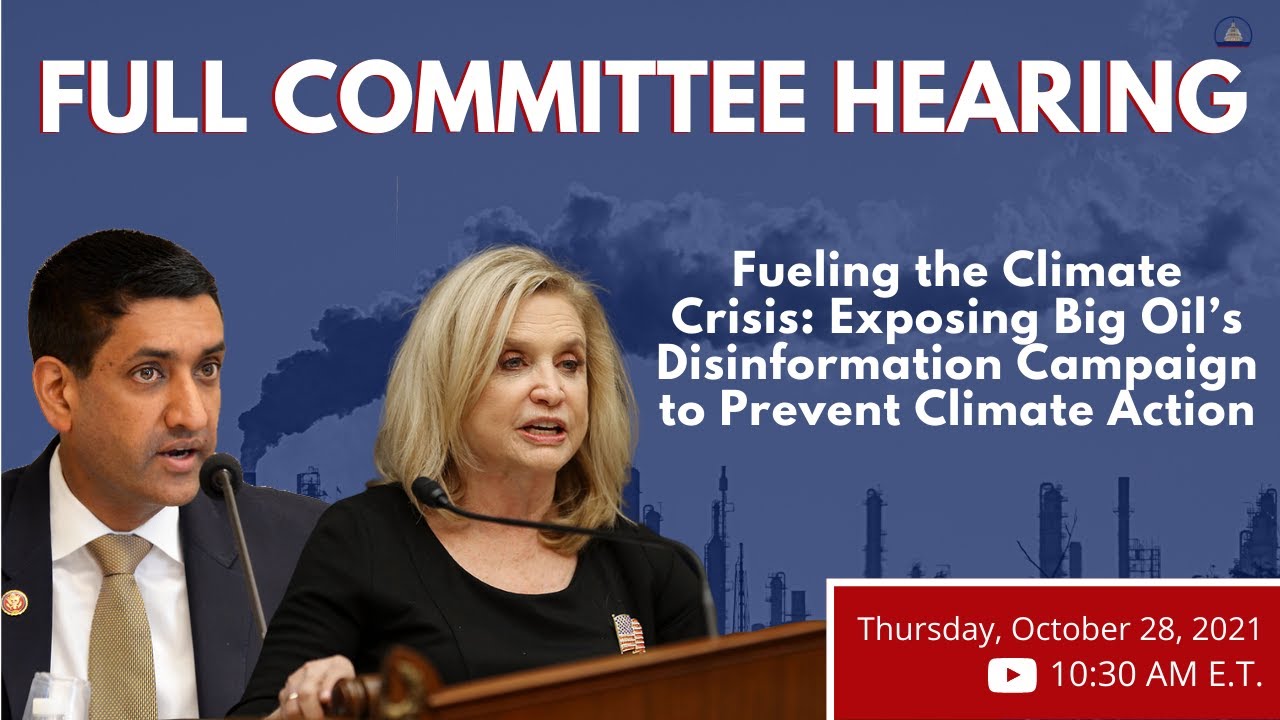 before the House Oversight Committee, alongside the heads of the American Petroleum Institute, or API, and the Chamber of Commerce, the Biden administration announced its framework for a $1.75 trillion reconciliation budget.
..."We’re leaving everything on the field here, in terms of our opposition to anti-energy provisions,” API CEO Mike Sommers told CNN earlier this month. (Ocasio-Cortez repeated the quote.) Representative Rashida Tlaib pointed out generous industry funding for front groups that have kneecapped national and state-level climate policy efforts. The industry spent $40 million, for instance, protecting the oil and gas industry’s ability to drill within 1,000 feet of playgrounds from a 2018 ballot initiative. Then there are all the documents, reported on at length by Inside Climate News, showing the disconnect between what Exxon told the public about climate change and what its own scientists knew to be true. Shell knew, too.
Watkins and her colleagues on the virtual stand—ExxonMobil CEO Darren Woods, Chevron CEO Mike Wirth, BP America CEO David Lawler, API CEO Mike Sommers, and Chamber of Commerce CEO Suzanne Clark—had plenty to be happy about elsewhere in the Capitol, too. Having already funneled $462,500 in political action committee money to Senator Joe Manchin, who killed the Clean Electricity Payment Program (the centerpiece of the Build Back Better Act’s climate provisions), they could now claim another win. The text of the Build Back Better Act bill released during Thursday’s hearing revealed that the last remaining provision directly targeting fossil fuel emissions—a fee on methane emissions—had been stuffed with a $775 million fossil fuel subsidy.
As several Democratic members of the Oversight Committee reiterated today, the hardly progressive International Energy Agency has stated that “no new oil and natural gas fields are needed in the net zero pathway.” The U.N.-backed Production Gap Report has found that fossil fuel production needs to decline 6 percent per year in order to keep warming below the 1.5 degrees Celsius (2.7 degrees Fahrenheit) target outlined in the Paris Agreement. The Intergovernmental Panel on Climate Change—the world’s gold-standard clearinghouse for climate science—has stated repeatedly that emissions from fossil fuels are the dominant cause of global warming. Yet directly going after fossil fuel production remains a third rail not only in Congress but around the world; fossil fuels don’t even make an appearance in the Paris Agreement...
---
https://www.linkedin.com/in/gretchen-watkins
no lnx
about
As one of the world’s foremost producers and consumers of energy, the USA is destined to play a central role in navigating the energy transition while meeting global energy demand. I am excited about tackling these challenges as President of Shell USA, Inc.
Before joining Shell in May 2018, I served as CEO of Maersk Oil. Across a nearly 30-year career in the energy industry, I have held senior executive roles at BP, Marathon Oil and Maersk Oil in North America, Europe and Asia.
I am currently the President and US Country Chair of Shell USA, Inc., as well as the Executive Vice President for Shell’s Upstream Unconventionals business, overseeing the exploration, development and production of onshore shale resources.
As President of Shell USA, Inc., I oversee the integration of Shell's businesses in the US along with ourEnergy Transition plan. We are the only country within Shell that has a presence in every aspect of the upstream and downstream business, from exploration and production to manufacturing and marketing and from branded fuel sales to wholesale power distribution.
I am looking forward to speaking with public and private leaders across a wide range of energy-related policy and societal challenges. For the sake of transparency, know that I receive help managing my LinkedIn account from colleagues at Shell.
Articles by Gretchen
Shell aiming for net-zero emissions by 2050, in step with society [// royal ceo]
By Gretchen Watkins
Dec 11, 2020
Methane rollback puts U.S. on wrong track
By Gretchen Watkins
Oct 2, 2020
Shell supports the direct regulation of methane – here’s why
By Gretchen Watkins
Mar 12, 2019
Activity
We are very proud to announce that Carsten Sonne-Schmidt has been appointed vice-chairman of the Floating Power Plant A/S board. Carsten's profile is…
Liked by Gretchen Watkins
With a $10 million commitment from Shell, the University of Houston has created the Energy Transition Institute to focus on the production and use of…
With a $10 million commitment from Shell, the University of Houston has created the Energy Transition Institute to focus on the production and use of…
Liked by Gretchen Watkins
Today, I was proud to join President Renu Khator and the University of Houston to celebrate the announcement of the UH Energy Transition…
Join now to see all activity
Experience
Shell
4 years
President, Shell USA, Inc.
Jan 2019 - Present3 years 4 months
Houston, Texas
Executive Vice President, Global Shales
May 2018 - Present4 years
Houston, Texas
Maersk Oil
4 years 3 months
Chief Executive Officer
Oct 2016 - Apr 20181 year 7 months
Copenhagen Area, Denmark
Chief Operating Officer
Feb 2014 - Apr 20184 years 3 months
Copenhagen Area, Denmark
Atkins
Non Executive Director
Atkins
Aug 2013 - Feb 20147 months
London, United Kingdom
Marathon Oil Corporation
Marathon Oil Corporation
5 years 3 months
Vice President North American Production Operations
Sep 2012 - Sep 20131 year 1 month
Houston, Texas
Vice President International Production Operations
Jul 2008 - Sep 20124 years 3 months
Houston, Texas
BP
4 years 4 months
General Director, BP Vietnam and China
Jun 2007 - Jul 2008 1 year 2 months
Ho Chi Minh City, Vietnam
Vice President Natural Gas Liquids Business Unit
Apr 2004 - Jul 20073 years 4 months
Calgary, Canada
BP
6 years
President BP Netherlands Energy
2002 - 20042 years
The Hague, Netherlands
Chief of Staff to Group Vice President of Marketing
2001 - 20021 year
London, United Kingdom
Supply and Trading Manager, Refined Products
1998 - 20013 years
Warrenville, IL
Amoco
Supervisor Projects and Planning
Amoco
1995 - 19983 years
Warrenville, IL
Education
Pennsylvania State University
Bachelor of Science (B.S.)
1986 - 1990
Stanford University
Stanford University
BP Executive Education Course
2003 - Present
University of Cambridge
BP Executive Education Course
2000 - Present
Ursuline Academy
Wyoming
-
More activity by Gretchen
The terrible events in Ukraine caused by the Russian invasion have sent shockwaves around the world. I’m as horrified by what is unfolding as…
Liked by Gretchen Watkins
It has been a privilege to be part of the reinvention of this unique company. The focus on the core business and the development of new capabilities…
It has been a privilege to be part of the reinvention of this unique company. The focus on the core business and the development of new capabilities…
Liked by Gretchen Watkins
I næsten ti år har det ligget i luften, at Robert Maersk Uggla som femte generation i imperiet skulle overtage roret i oldefarens livsværk, som han…
I'm excited that Shell Energy has signed a letter of intent to sponsorHouston’s very own professional soccer clubs, the Dynamo and Dash! It is an…
I'm excited that Shell Energy has signed a letter of intent to sponsor Houston’s very own professional soccer clubs, the Dynamo and Dash! It is an…
Shared by Gretchen Watkins
The energy world is an increasingly exciting and interesting place to be and we are so thrilled to be launching Veriten in the midst of it all. In…
The energy world is an increasingly exciting and interesting place to be and we are so thrilled to be launching Veriten in the midst of it all. In…
Liked by Gretchen Watkins
It’s so rewarding when we can bring personal passion into achieving our professional goals. That’s why I was excited this week to take a trip up to…
It’s so rewarding when we can bring personal passion into achieving our professional goals. That’s why I was excited this week to take a trip up to…
Shared by Gretchen Watkins
I am delighted to share that Shell has been confirmed by Kline & Company as the Number 1 Global Lubricants Supplier across cars, trucks and…
I am delighted to share that Shell has been confirmed by Kline & Company as the Number 1 Global Lubricants Supplier across cars, trucks and…
Liked by Gretchen Watkins
Shell not only has an ambitious #netzero target – we want to help the United States reach its own climate goals. I’m excited to share a step forward…
Shell not only has an ambitious #netzero target – we want to help the United States reach its own climate goals. I’m excited to share a step forward…
Shared by Gretchen Watkins
Ending 2021 on a terrific high note with the exciting news that Shell will acquire Savion, LLC, a major utility-scale #solar and energy storage…
Ending 2021 on a terrific high note with the exciting news that Shell will acquire Savion, LLC, a major utility-scale #solar and energy storage…
Liked by Gretchen Watkins
This is a historic moment. The #infrastructurebill signed into law this week shows leadership from the Biden Administration and collaboration within…
This is a historic moment. The #infrastructurebill signed into law this week shows leadership from the Biden Administration and collaboration within…
Shared by Gretchen Watkins
We have just publicly announced a #collaboration agreement with Baker Hughes. Shell and Baker Hughes will be working closely together to progress our…
We have just publicly announced a #collaboration agreement with Baker Hughes. Shell and Baker Hughes will be working closely together to progress our…
Liked by Gretchen Watkins
Vi har netop afleveret vores bud på Thor havvindmølleparken i den danske Nordsø – og afventer nu afgørelsen senere på året. I mellemtiden leder vi…
Vi har netop afleveret vores bud på Thor havvindmølleparken i den danske Nordsø – og afventer nu afgørelsen senere på året. I mellemtiden leder vi…
Liked by Gretchen Watkins
Natural gas helps meet demand for reliable energy and is an important transition fuel to help society address #climatechange. With this, strong…
Natural gas helps meet demand for reliable energy and is an important transition fuel to help society address #climatechange. With this, strong…
Shared by Gretchen Watkins
As the U.S. makes progress towards #netzero emissions, Shell wants to play its part. This acquisition brings us closer to our customers and, as their…
As the U.S. makes progress towards #netzero emissions, Shell wants to play its part. This acquisition brings us closer to our customers and, as their…
Shared by Gretchen Watkins
View Gretchen’s full profile
People also viewed
Geert van de Wouw
Managing Director Shell Ventures
Amsterdam
Aura Cuellar
Global Executive Leadership | Energy Transition | Low-Carbon Energy Solutions | Diversity Equity & Inclusion | ESG & Sustainability | Digital Evolution
Houston, TX
Katie Jackson
Executive Vice President, Acquisition & Divestment and New Business Development at Shell
London
Machteld De Haan
Executive Vice President for Global Lubricants at Shell
Houston, TX
Selda Gunsel
President, Shell Global Solutions US | Vice President, Global Lubricants and Fuels Technology
Houston, TX
David Bunch
UK Country Chair, Shell
London
Katy Conrad
Business Advisor to Gretchen Watkins, President Shell Oil Company and Executive Vice President Shales
Houston, TX
Carlos Maurer
Executive Vice President, Sectors & Decarbonisation at Shell
United Kingdom
Donny Ching
Legal Director at Shell plc
The Hague
Chris Angelides
Honorary Consul of The Republic of Cyprus to Texas - Energy Transition & Sustainability Expert
Houston, TX
Saskia Kapinga
Vice President External Relations
The Hague
Marjan van Loon
President-Directeur Shell Nederland
The Hague
Rhoman Hardy
Senior Vice President at Shell
Pearland, TX
Glenn Wright
Vice President of Renewables & Energy Solutions for Shell New Energies, US, LLC
Houston, TX
Vicki Hollub
President and Chief Executive Officer at Occidental Petroleum
Houston, TX
Sinead Lynch
VP Low Carbon Fuels at Shell
London
Colette Hirstius
Vice President at Shell
New Orleans, LA
Ronan Cassidy
Chief HR and Corporate Officer at Shell
Netherlands
Robin Mooldijk
Executive Vice President, Chemicals and Products at Shell
Rotterdam and The Hague
Wael Sawan
Integrated Gas, Renewables and Energy Solutions Director at Shell
The Hague
---
executives-due-at-gas-price-hearing-gave-1-million-to-parties-candidates
APR 2022
The six oil and gas executives scheduled to testify on price gouging before a House Energy and Commerce subcommittee on Wednesday morning have together given more than $1 million in personal contributions to candidates and political parties since the 1990s, skewing heavily toward Republican causes, federal records show.
A CQ Roll Call review of Federal Election Commission filings on the six executives found Scott Sheffield, who is CEO of Pioneer Natural Resources and a board member of the Williams Companies, a natural gas company, has given the most of the group: about $469,000 to political campaigns and committees since 1993.
Of that total, he gave approximately $346,000 to Republican candidates for offices or GOP-aligned committees, such as the National Republican Senatorial Committee or the National Republican Congressional Committee.
Chevron CEO Michael Wirth gave about $255,000 since 2003, while Exxon CEO Darren Woods donated roughly $197,000 since 2014 and Richard Muncrief, the president and CEO of Devon Energy, contributed approximately $115,000 to federal candidates and political campaigns since 2012.
Donations from the other two witnesses, BP America Inc. Chairman and President David Lawler (about $25,700 since 2017) and Shell USA President Gretchen Watkins ($6,700 since 2012), are far smaller than what the other four witnesses gave.
All six are witnesses in a hearing scheduled for 10:30 a.m. Wednesday on price gouging and gasoline prices, a subject that has drawn significant Capitol Hill attention following the Russian invasion of Ukraine and multiple planned sales of U.S.-held crude oil from the country’s national reserve of petroleum.
Four of the six executives — Woods of Exxon, Lawler of BP, Wirth of Chevron and Watkins of Shell — appeared in October before a House Oversight subcommittee to answer questions about the role of large oil companies in muddling the science of climate change.
President Joe Biden unveiled a series of steps Friday that he said would lower gasoline prices, including the release of 1 million barrels of oil a day on average for 180 days from the Strategic Petroleum Reserve.
Washington Rep. Cathy McMorris Rodgers, the top Republican on the full committee, said Monday afternoon that H.R. McMaster, the national security adviser to former President Donald Trump, will appear as a GOP witness at the Wednesday hearing.
Spokespeople for Democrats on the committee did not respond when asked what criteria were used to call these six witnesses.
Taken together, the executives have given about $1.10 million since the 1990s, CQ Roll Call found in its review, which used all available FEC data.
Personal contributions
CQ Roll Call reviewed only personal contributions and did not consider donations the executives’ companies made through political action committees, or PACs, in federal campaigns.
While none of the executives appear to have donated to members of the subcommittee, some have donated to several of the election campaigns of members of the full Energy and Commerce Committee.
Shell’s Watkins has given $5,700 to Rep. Lizzie Fletcher, D-Texas, since 2020, while Lawler gave $2,000 to committees associated with Rep. Steve Scalise, R-La., in 2018.
“Shell does not make political contributions,” said company spokesman Curtis Smith. “Any contributions made by Gretchen Watkins to an individual candidate would be considered personal in nature, as would her rationale for doing so.”
Josh Hicks, a BP spokesman, declined to comment. Lawler has given about $26,000 since 2017, but about $22,000 of that went to his parent company’s political action committee.
“Chevron employees at all levels of the company are free to participate in the political process, including through donations to candidates of both major U.S. parties,” Chevron spokesperson Braden Reddall said.
Representatives of the other three companies did not respond to emails and a voicemail seeking comment.
In 2015, Sheffield gave $10,800 to a joint fundraising committee established by Michigan Rep. Fred Upton, a high-ranking Republican on the full committee, and Sen. Lisa Murkowski, R-Alaska. Sheffield also gave $5,400 to Upton’s reelection in 2016.
In 2020, Sheffield gave $5,000 to Texas Reloaded, a joint fundraising effort for Rep. Daniel Crenshaw, R-Texas, and $833 to Crenshaw’s campaign. Crenshaw is a full committee member.
Sheffield also donated $12,700 to Trump’s 2016 presidential campaign.
Total donations from the oil and gas industry in the 2022 election cycle, including money from individuals, PACs and what’s known as “soft money,” are skewing sharply toward Republicans, drawing 76 percent of donations versus 24 percent for Democrats, according to campaign finance watchdog OpenSecrets.
That percentage is higher for Democrats than it was in the election cycles of 2014, 2016 and 2018, when Republicans drew 87 percent of the donations, and 2020, which saw GOP candidates and causes get 84 percent of cash from this industry.
Soft money is the term for contributions meant to support general political parties rather than a specific candidate.
While many of the group’s donations went to Republicans, oil-state Democratic senators and House members, including former Sens. Mary Landrieu of Louisiana, Mark Begich of Alaska and Heidi Heitkamp of North Dakota, were on the receiving end of some donations.
Sheffield donated to all three, as well as to Rep. Henry Cuellar, D-Texas, and Sen. Joe Manchin III, D-W.Va., who got $5,800 in donations in 2021 for his campaign.
Out of all of Woods’ donations, none went to Democrats and about $156,300 went to Republican campaigns or committees.
Since 2013, Woods has donated $42,500 to the National Republican Congressional Committee, which raises money for Republican House candidates and describes itself as “a political committee devoted to increasing the number of Republicans in the U.S. House of Representatives.”
---
[Shell Invests $27.5 Million in LSU to Establish Institute for Energy Innovation and Catalyze New Campus District ... A $27.5 million gift from Shell USA, Inc., will establish the LSU Institute for Energy Innovation and enable construction of the LSU Our...
.
Jun 23, 2022](https://www.lsu.edu/mediacenter/news/2022/06/23shellinvestment.php)
[
 Houston Chronicle](https://www.houstonchronicle.com/business/texas-inc/article/Shell-executive-balances-two-energy-worlds-13578861.php)
---
GGL 10 23
Gretchen Watkins - President, Shell USA, Inc.

https://www.linkedin.com › gretchen-watkins](https://www.linkedin.com/in/gretchen-watkins)
Greater Houston · President, Shell USA, Inc. · Shell
I am excited about tackling the challenges of providing more and cleaner energy as President of Shell USA, Inc. I oversee the integration of Shell's businesses ...
---