FRACK 3
frackII520
---
see local regulations
see propositions
see API
see methane
see perc propane
includes natural gas
capt 2/19 520 BAK 3 end denton
see bio-fuel
---
---
10/25/24 mma
===
MOORE PJT 2025
In His Own Words
“The only thing holding back our boundless natural gas future is government. We need permits for more liquified natural gas terminals, leases for drilling, and pipelines so we can transport our natural gas resources to every region of the country and export it across the world.
Former President Donald Trump is for all of this. Harris is on the record as being against fracking and wanting to ban it. Can you think of anything dumber?” Source: Stephen Moore, Northern Virginia Daily, August 15, 202436
Moore also claims in the above article that the U.S. gets less than 10% of its energy from green sources (According to the Department of Energy37, it’s 20% and climbing), and makes the erroneous point that water (using the example of bottled water in the grocery store) is cheaper than an equal amount of natural gas.
---
LEVER JACOBIN
The Gas Industry Is Redefining Methane as “Clean Energy”
...A Wave of bills in state legislatures across the country aim to classify climate-heating methane gas as a source of “green” or “clean” energy to prevent communities from transitioning away from fossil fuels — and secretive dark money groups connected to the gas industry are behind the effort.
The legislation could threaten the enforcement of climate policies across the country, allowing gas to stand in for clean energy in states’ renewable energy portfolios or otherwise thwarting local efforts to phase out reliance on fossil fuels. As methane emissions increasingly drive climate change, the bills would disguise the devastating environmental impacts of the powerful greenhouse gas — while the Trump administration caters to fossil fuel-backed donors on federal gas policy.
State officials say the bills are necessary to protect local economic development tied to a major local source of energy. But the legislators didn’t come up with the idea on their own: the rebrand originated from model legislation introduced by the American Legislative Exchange Council (ALEC), a conservative lobbying network funded by large corporations. And in at least one case, the effort is being pushed by the gas industry itself to further entrench states’ dependence on gas.
ALEC has a reputation for providing pro-corporate model legislation to legislators, including many bills designed to obstruct climate action. In recent years, the group has drafted bills to blacklist companies that boycott the fossil fuel industry and criminalize protests of fossil fuel infrastructure.
While the group’s donors have largely been hidden from the public, its second-largest known donor is fossil fuel mogul Charles Koch, an investigation by the Center for Media and Democracy found.
A version of the methane gas rebranding bill first passed in Ohio in 2023 after it was floated by the Empowerment Alliance, a dark money gas advocacy group helmed by Trump megadonor and former gas industry executive couple Tom Rastin and Karen Buchwald Wright. According to documents obtained by the watchdog Energy and Policy Institute and first reported by the Washington Post, the Empowerment Alliance worked with Ohio state legislators on the idea, while ALEC provided a model bill and talking points for officials.
ALEC denied its involvement in Ohio’s law after the Washington Post published its story. But last summer, ALEC posted a markedly similar model bill on its website.
The model bill, titled “The Affordable, Reliable, and Clean Energy Security Act,” states that “‘Green energy’ will be redefined as meaning any energy generated by using an energy resource in which the emissions are equivalent to the standard set by pipeline-quality natural gas, (e.g. those emitted by residential gas stoves).”
Since that model bill was published, a new swath of states — including Indiana, Tennessee, Mississippi, and Louisiana — have introduced similar legislation declaring gas a “clean” or “green” source of energy. Indiana and Tennessee’s bills passed into law in April. Mississippi’s bill died in committee in February. But Louisiana’s bill — whose first iteration included exact language from the ALEC model legislation — passed in the state’s House of Representatives on June 2 and is now being considered by its Senate.
The Empowerment Alliance promotes the proliferation of ALEC’s model bill on its website. “We define American natural gas as green and clean energy,” the site reads. “We encourage all 50 states to pass legislation using the ARC Energy Security model as a starting point to unleash energy prosperity for every household and business.” Other allied fossil fuel-funded think tanks, like the Heartland Institute and the Institute for Energy Research, have also backed the model legislation.
 Screenshot from the Empowerment Alliance website.
But clean energy advocates and experts say the bills are a clear attempt by the fossil fuel industry to preempt any local transition away from their products, which pose severe threats to local air quality and the climate.
“It’s simply a grand effort at greenwashing a dirty energy source,” said Gabe Filippelli, executive director of the Environmental Resilience Institute and professor of earth sciences at Indiana University.
Methane, the main component in “natural” gas, is more than twenty-eight times as potent as carbon dioxide at trapping heat in the atmosphere, and more than eighty times as potent over the first two decades of its release. Methane emissions are rising faster than ever, even as technologies for documenting and monitoring leaks have advanced.
Yet despite knowing the risks it poses to the climate, major fossil fuel producers have campaigned to promote gas as a cleaner alternative to other fossil fuels, according to internal documents made public by Congress last year.
The legislation moving through statehouses across the country would take those industry campaigns a step further, using the rebranding of gas to facilitate the continued buildout and use of fossil fuels, even if new climate and clean energy requirements are introduced.
Sabotage, State by State
Twenty-nine states and DC have passed renewable portfolio standards, which require a certain portion of the state’s electricity to be met with renewable energy sources like wind and solar. Some states have clean electricity standards that allow state utilities to include nuclear and other forms of energy not typically defined as renewable as “clean” energy sources. Even in states without such standards, some municipal governments have passed or considered clean energy standards at the local level.
The new bills could drastically weaken those standards by forcing state and municipal governments to include methane gas — a fossil fuel — as a source of “clean” or “renewable” energy.
Tennessee, for example, passed a law clarifying that “a political subdivision that imposes requirements or expectations related to the type of clean or green, or renewable, energy used by a public utility in an ordinance, resolution, or other regulation must include certain sources of energy” — including gas. Effectively, the law could prevent municipalities in the state with renewable energy requirements — like Nashville, which has committed to using 100 percent renewable energy by 2041 — from excluding gas in its efforts.
Tennessee initially passed a less specific law defining gas as “clean energy” in 2023, shortly after Ohio’s. According to a leaked presentation and audio, the Tennessee Gas Association — the state’s industry trade association and lobbying group — took credit for passing that bill.
“We were able to pass a bill that classified natural gas as a clean energy,” said Jim Spears, then a lobbyist for the Tennessee Gas Association at the group’s annual meeting in Orlando that summer, suggesting that he and major fossil fuel executives in the state “all worked on it together.”
The new bills could drastically weaken those standards by forcing state and municipal governments to include methane gas — a fossil fuel — as a source of ‘clean’ or ‘renewable’ energy.
“Fossil fuels are under attack,” Spears continued. “It’s a nationwide issue. . . . We have great relationships with the legislature. So that’s how we get bills passed that protect us.”
The Tennessee Valley Authority, the country’s largest public utility, is currently embarking on one of the largest gas expansions of any utility nationwide.
In Louisiana, the new bill redefining gas as green energy would go even further, declaring that the state’s Department of Energy and Natural Resources should work with the Public Service Commission to “use energy generated by hydrocarbons as a resource.” Hydrocarbons are strictly defined by Louisiana statute as being “oil and gas occurring naturally in the earth and any other valuable liquid or gaseous substance found and produced in association with them.”
According to Jackson Voss, the climate policy coordinator for the Louisiana advocacy group Alliance for Affordable Energy, the bill could be used to “preempt the development of renewables by giving political cover to our regulators” to allow the expansion of gas projects in the state.
Louisiana utilities are engaged in a public process to determine how they will meet the state’s energy demands. The state’s utilities will present their plans to the Louisiana Public Service Commission, where regulators take more campaign cash from power companies and fossil fuel interests than almost any other state.
A much narrower bill in Michigan, which is now before the state Senate, would designate two existing gas-fired power plants as clean energy. If enacted, the bill would allow the plants to continue running under the state’s energy laws, which set a standard for 100 percent clean energy by 2040 with some exceptions.
Indiana’s law — which also defines petroleum-based propane as a “clean energy,” a rebrand first promoted by the propane industry — opens gas and propane up to “any state or federal program that provides funds” originally intended for wind, solar, and other renewable energy projects.
The Empowerment Alliance celebrated Indiana’s bill in its “Common Sense” newsletter earlier this year, before it became law. “We encourage legislators in other states to examine what Ohio, Tennessee, and Indiana have done,” the newsletter reads. “Adopting a Natural Gas is Green law will lead to a clean, green, energy future.”
The Empowerment Alliance, ALEC, and the Tennessee Gas Association did not respond to requests for comment.
Kill Renewable, Unleash Gas
The methane gas rebranding appears to be one of many tactics in a yearslong industry backlash against local actions to address climate emissions from gas and calls for stricter environmental, social, and governance (ESG) practices.
At a 2019 executive committee meeting of the American Gas Association, the gas lobbying and utility trade group presented a strategy for gas companies, local trade associations, and pro-gas groups and campaigns — including the Empowerment Alliance — to block state-level public policy initiatives to ban new gas infrastructure and use in homes and buildings.
One of the lobbying group’s major 2020 priorities would be to “intensif[y] our efforts at the state and local levels on a variety of tracks in order to ensure consumers have energy choices that include clean, affordable natural gas,” according to minutes from the meeting obtained by the Energy and Policy Institute.
The move to codify gas as clean coincides with other state and federal efforts to undermine renewable energy projects while removing restrictions on the fossil fuel industry.
In Ohio, Tom Rastin, who leads the Empowerment Alliance and was until recently an executive of Ariel Corporation, one of the world’s biggest manufacturers of methane gas compressors, worked with Ohio legislators to pass its legislation labeling gas as “green.”
Rastin is also a powerful figure behind a local anti-renewable crusade in the state. According to reporting by ProPublica and Floodlight, Rastin is a major funder of Knox Smart Development — an anti-solar energy group that brands itself as a grassroots advocate — which helped provoke opposition to a large Ohio solar project. The group ran anti-solar ads in a pay-to-play “local newspaper” run by Metric Media, a Koch-linked network of partisan websites, which also featured a weekly column by the Empowerment Alliance promoting gas.
The move to codify gas as clean coincides with other state and federal efforts to undermine renewable energy projects while removing restrictions on the fossil fuel industry.
In Michigan, meanwhile, Rastin contributed $10,000 to Citizens for Local Choice, a ballot campaign that aimed to curb wind and solar projects.
The effort to block renewable development while unleashing fossil fuels is also coming from the Trump administration, which has made those policies a cornerstone of its agenda.
The federal government has rescinded nearly $4 billion in clean energy grants, attempted to “stop the enforcement” of state climate laws, and worked to kill pollution restrictions and long-standing emissions reporting requirements. The US Interior Department is planning to fast-track permitting for oil and gas projects to a maximum of twenty-fight days, and Trump has promised to revive “America’s beautiful clean coal industry.”
What’s more, Trump’s budget bill would repeal methane pollution limits under the Clean Air Act while allowing gas companies to purchase an expedited permitting process for a one-time $10 million fee, or pay $1 million to the Department of Energy to deem a gas import or export facility to be “in the public interest.”
The latest Yale Climate Opinion survey found that 66 percent of Americans support a transition from fossil fuels to clean energy by 2050. But advocates say state and federal debates over energy policy may reflect more about the fossil fuel industry’s influence than the desires of the public.
In Louisiana, Voss at the Alliance for Affordable Energy fears that industry is about to push through a gas greenwashing law that will not bode well for the state. Louisiana residents pay far higher electric bills than most of the country and have one of the least reliable grids.
More gas would “make our grid here in Louisiana even less reliable and certainly less affordable and more damaging to public health and the environment,” said Voss. “There really is no upside for anybody other than the corporate utilities, who are going to maximize profits to the extent that they can.”
This article was first published by the Lever, an award-winning independent investigative newsroom.
This piece was copublished with ExxonKnews, a reporting project covering the fossil fuel industry and climate accountability.
---
===
wrong 2x same day mma
Fox & Friends host pushes wildly inflated Pennsylvania fracking jobs estimate
BLS numbers put oil and gas production jobs in the state at 12,000 in 2023
Special ProgramsClimate & Energy
Written by Allison Fisher
Published 09/19/24 mma
During the September 19 edition of Fox News’ Fox & Friends, host Ainsley Earhardt falsely claimed that the fracking industry supports “423,000 jobs in the state of Pennsylvania.” There is no credible evidence to support this figure. According to the Bureau of Labor Statistics, direct oil and gas production jobs in Pennsylvania numbered about 12,000 in 2023.
Video
CitationFrom the September 19, 2024, edition of Fox & Friends
The number Earhardt cited is also more than three times larger than the figure a Trump campaign ad cites. The ad falsely claims 120,000 jobs would be lost if Harris were elected, even though presidents cannot ban fracking on state and private lands, where the vast majority of fracking occurs.
As a local journalist pointed out in a fact check aimed at Trump’s fracking ad, the 120,000 figure refers to an industry study by the Marcellus Shale Coalition that combines direct jobs in the industry and “estimates for jobs that the authors claim … would not exist if not for oil and gas production.”
In reality, the journalist goes on to explain:
The state of Pennsylvania reported about 26,000 direct jobs in the oil and gas industry in 2020, less than 1% of all jobs in the state. Four years later, that number is even smaller. Despite an increase in production post pandemic, jobs in the industry have not kept up, according to a recent report from E&E News, which cites the federal Bureau of Labor Statistics in which direct oil and gas production jobs in Pennsylvania was about 12,000 in 2023.
An early study on job creation from Penn State University, published in 2010 and paid for by the industry, said that by 2020, industry jobs would top 200,000 – it’s unclear if the study intended those to be direct or indirect. But six years later, another study from Penn State, with different authors, reported about 26,000 direct industry jobs, half of which were filled by out-of-state residents.
In fact, not only has the industry “shed thousands of workers in the state since 2019,” but it also has failed to deliver the wealth promised to many communities burdened with fracking wells. Meanwhile, “clean energy industries employ more than 8 times more PA workers than the state’s gas industry.”
Additionally, earlier in the program, host Lawrence Jones suggested that the oil and gas industry makes job cuts at “election time” based on “who is winning in the election” and “what the policies are,” but presidential policies have little impact on fracking that is done on state and private land, and evidence shows most energy-related job loss is due to automation in the industry.
The United States is pumping out more oil and gas than any country in history. But even as production soars, oil field employment keeps shrinking.
The decadelong decline isn’t driven by climate policy or the rise in clean energy. Instead, it’s the result of boom-and-bust cycles — and the fossil fuel industry’s relentless push for efficiency.
“You just need fewer workers to produce more oil,” said Greg Upton, executive director of Louisiana State University’s Center for Energy Studies.
---
vph had to go ctr tho she did not say we extract record amt of oil?
09/13/24 mma
---
---
mma 9 24
Fox News is helping Republicans spin fracking as a major election issue
The network mentioned fracking 544 times in the lead-up to Kamala Harris’ CNN interview
Special ProgramsClimate & Energy
Written by Allison Fisher
Research contributions from Ilana Berger
Published 09/05/24
Fox News is helping the right elevate fracking as a supposedly major election issue by continuing to litigate Kamala Harris’ position even after she and her campaign have stated that she no longer supports a ban on the natural gas extraction procedure. By keeping the focus on Harris’ position, Fox is distracting from important context about the controversial technique and its relevance to voters.
According to Axios, shortly after Harris announced her bid for the presidency, Republicans started “circulating Harris' endorsement of a fracking ban during her short-lived 2019 White House run — even though she walked it back after becoming President Biden's running mate.”
Then, during the August 29 joint CNN interview with Harris and running mate Tim Walz, one of the first questions from Dana Bash was about her position on fracking, with the CNN anchor describing it as “a pretty big issue, particularly in your must-win state of Pennsylvania.”
An analysis by Media Matters found that from July 27, when Kamala Harris’ campaign stated that she does not support a ban on fracking, to the August 29 interview, Fox News mentioned fracking 544 times, compared to CNN’s 201 mentions and MSNBC’s 30.
Because Fox is driving the discussion around fracking, it has often focused on whether Harris supports the practice and how her position would affect her electability in Pennsylvania.
News networks would better serve their audiences by explaining the climate impacts or local environmental threats associated with fossil fuel extraction, how local voters actually feel about fracking, how energy both clean and fossil fuel-based has fared under the Biden-Harris administration, and even whether a presidential candidate could actually ban fracking.
- ## Fox News shows no sign of stopping its attacks on Harris’ fracking position even as both she and her campaign have stated she doesn’t support a ban
- Fox News has suggested that Harris will be hostile to the oil and gas industry regardless of her stated position.
On the August 15 edition of Fox & Friends, co-host Ainsley Earhardt said, “She wanted to ban fracking, her entire career. Now all of a sudden she’s saying I’m not gonna ban fracking. … She wants to get into the White House on January 20 … and then not change anything. She wants to go so liberal. So just don’t get caught up in her flip-flops, because she does not believe this in her heart. She is — look at her voting record.”
On The Ingraham Angle, Fox host Jeanine Pirro suggested that Harris has not changed her fracking position from 2019, saying: “That was just five years ago. Kamala's agenda was clear as day. Radical and progressive. But suddenly she doesn't believe in any of that anymore,” listing positions including fracking. “Will the real Kamala Harris please stand up? … How can the Trump campaign ensure that voters see the real Harris?”
Pirro’s guest, former Speaker of the House Kevin McCarthy added: “So it doesn’t matter if she changes her words. We know what her actions are.”
After Fox & Friends aired a clip of Harris talking about fracking, guest Andre Beliveau of the Commonwealth Foundation said, “She can backtrack or flip-flop all she wants. The record of the Biden-Harris administration the last four years is quite clear and that record has included — I mean, it's been Green New Deal-ism. It has been a pause on LNG exports.”
After Harris’ CNN interview, some Fox News figures said her position on fracking can’t be trusted.
While the interview was still airing, Pirro and Fox contributor Joe Concha attacked the vice president’s response on Hannity, with Concha claiming that “she's lying” about her position on fracking. The following day,Fox & Friends co-host Lawrence Jones questioned whether she was just going along with Biden’s position and would ultimately revert back to her 2019 stance.
The network also helped spread misinformation aboutBiden’s position on fracking in 2020, and it dominated the conversation then too.
During the week leading up to that election, the network also pushed the false narrative that Pennsylvania would likely be won or lost depending on how voters interpreted the candidates’ stance on fracking. And during the 2022 midterms elections, Fox attacked Pennsylvania Democratic Senate candidate John Fetterman for his stance on fracking,conflating his previous support for a fracking moratorium — a temporary prohibition — with an outright, permanent ban.
Even though the playbook has been exposed, Fox News continues to use it to shape the national media coverage of the issue.
- ## Rather than obsessing about her position, networks could provide valuable context about fracking
* Presidents cannot ban fracking on private and state land, where the vast majority – 90% – of fracked-gas production is done. “While there are several ways Harris, if elected president, could halt fracking on federal lands using executive power, she wouldn’t be able to unilaterally ban it on private land,” Bloomberg explains. “Under a 2005 law, the Environmental Protection Agency has almost no regulatory power over fracking. Changing that would require an act of Congress.” Bloomberg, [7/27/24; PolitiFact, 9/1/20]
Under the Biden-Harris administration, U.S. oil and gas production is at an all-time high – including in Pennsylvania — and its policies are supporting major energy projects in the state. As reported by Axios, the state is “part of the multibillion-dollar hydrogen ‘hubs’ program under the 2021 bipartisan infrastructure law,” and the “EPA announced nearly $400 million in grants for climate projects there under the Inflation Reduction Act.” Reuters, [3/28/24; U.S. Energy Information Administration, accessed 8/2/24; Axios, 7/23/24]
Public support for fracking in Pennsylvania is not a given. After Harris’ recent CNN interview Pennsylvania-based journalist Nick Field wrote, “I can not emphasize enough that - unless they happen to work in the fracking industry - Pennsylvanians don't care about fracking.” A 2020 survey conducted by YouGov found support for fracking in the state was evenly split, though Pennsylvanians who live in rural areas or identify as Republican were more likely to back it. Twitter/X, [8/29/24; YouGov, 10/19/20]
Real issues with fracking are almost entirely ignored in election horse race coverage. In the final week of the 2020 election cycle, cable news coverage failed to meaningfully cover the well-documented environmental and climate issues associated with fracking. This cycle, the media can add to the list of issues the fact that the industry has not delivered the wealth promised to many communities burdened with fracking wells. Media Matters, [11/19/20; Environmental Health News, 2/12/21]
- ## Methodology...
---
1 24 heated gmail
lte124
no lnx pix grf?
Here’s how much Democrats get paid to shill for fossil fuels
Two former Democratic lawmakers made six-figure salaries for falsely promoting methane gas as a climate solution, tax documents seen by HEATED show.
ARIELLE SAMUELSON
JAN 18
In January 2022, only a few years after leaving the elected seat she held for six years, former Democratic Senator Heidi Heitkamp of North Dakota got a new job: convincing climate-concerned liberals to love the fossil fuel industry.
“It’s clear we have an existential threat to the planet,” said Heitkamp, in a December 2022 commercial for the methane gas lobbying group Natural Allies For a Clean Energy Future. “We should be doing everything that we can to help other countries do what we did, which is dramatically reduce our CO2 emissions by using natural gas.”
The ad—titled “Real Talk with Heidi Heitkamp”—was one of a handful of public relations jobs Heitkamp did that year for Natural Allies, some of which she did alongside former Democratic Senator Mary Landrieu of Louisiana. Together, the notoriously moderate Democrats wrote a sponsored article in Politico claiming that “natural gas is accelerating our clean-energy future,” and an op-ed in Newsweek declaring that methane gas can “actually achieve our shared global climate goals faster.” Landrieu also did her own “Real Talk” commercial in March 2022.
For these ads and op-eds, Heitkamp was paid $185,266 and Landrieu was paid $210,690 in 2022, according to IRS 990 tax documents obtained by the Energy and Policy Institute and seen by HEATED. The documents show payments made to Heidi Heitkamp Inc. and to Landrieu’s consulting firm VNF Solutions.
A screenshot of Natural Allies’ 990 tax form from FY2022, showing payments to Landrieu’s consulting firm and Heitkamp. They also show $1 million in payments to Mad Global, a public relations firm that specializes in politics and government, and more than $3.5 million to Omnicom Public Relations Group, a global public relations company.
It’s unclear if these positions represented full-time jobs; both Heitkamp and Landrieu were hired as members of Natural Allies’ “Leadership Council” in early 2022. According to a press release about the hires, the Leadership Council seeks “to bring greater awareness to the foundational role natural gas must play in transitioning to a clean energy future.” Neither Heitkamp nor Landrieu responded to HEATED’s request for comment.
Whatever the case, the numbers are a rare glimpse into the lucrative business of greenwashing the fossil fuel industry. Natural Allies is run and funded entirely by fossil fuel companies, including Williams, TC Energy, Kinder Morgan, National Fuel Gas, Southern Company Gas, and Cheniere Energy.
“It's not every day we get to see the price tag of a former U.S. senator’s advocacy,” said Charlie Spatz, a senior researcher at the Energy and Policy Institute.
Spatz said the numbers also highlight one of the reasons it may be so hard to pass truly effective climate policy in Congress.
“It's sending a message to current Senators that maybe you shouldn't be so harsh on the fossil fuel industry, if they're going to take care of you after you finish,” he said.
A six-figure salary to spread climate misinformation
With each passing year, the science on methane gas pollution and climate change becomes more damning. A recently revised analysis from Robert Warren Howarth, a professor of ecology and environmental biology at Cornell, found that greenhouse gas emissions from liquified methane gas “are larger than those from domestically produced coal, ranging from 18% to 185% greater for the average cruise distance of an [liquified methane gas] tanker.”
At the same time, with each passing year, more and more former Democratic lawmakers are lining up to tout methane gas as “climate-friendly” in exchange for a paycheck from Natural Allies, which is currently running a seven-figure campaign to target young, liberal, and Black and Latino voters “as effectively as we have messaged to the right.”
In addition to Heitkamp and Landrieu, former Philadelphia Mayor Michael Nutter, former Ohio Congressman Tim Ryan, and former Florida Congressman Kendrick Meek all accepted positions with Natural Allies in 2023.
Those former lawmakers’ salaries were not disclosed on Natural Allies’s 2022 tax forms, as they were not yet hired by the organization. And it’s unclear if they will be disclosed on future forms, as the IRS only requires that non-profits disclose the five contractors with the highest salaries over $100,000.
However much they are making, they are spreading messages about methane gas that climate scientists have roundly decried as misleading.
“Their claims are all either extremely vague or disproved with middle-school-level science,” said Kate Marvel, a climate scientist at Project Drawdown, who previously worked at NASA’s Goddard Institute for Space Studies.
“Using natural gas warms the climate. Period, full stop,” said Andrew Dessler, professor of atmospheric sciences at Texas A&M University. “There is no world in which natural gas is a long-term ‘solution’ to the climate problem.”
Natural Allies cites multiple “independent studies” to support its claim that methane gas is the best way to solve the climate crisis. But, as we reported last year, all of those studies were funded at least in part by fossil fuel interests, and none were published in a peer-reviewed journal.
Actual peer-reviewed science with no industry backing has shown the opposite of what Natural Allies claims. According to a 2021 systematic review of the scientific literature on methane gas, increasing investments in the fossil fuel carries a long-term risk of delaying the clean energy transition and worsening the climate crisis. That’s because investing in further natural gas development “could lock-out emerging renewable technologies for extended periods.”
Building new gas pipelines, LNG terminals, and gas-fired power plants “pose a particularly great risk for carbon lock-ins,” scientists wrote this year in the journal Nature Energy.
What Natural Allies is doing is called “solutions denial,” a common form of climate misinformation, as we previously reported:
“It's an absolute tried-and-tested argument within the disinformation playbook to constantly create more interim milestones before we achieve what a real necessary transition looks like,” said [Jennie] King, who works at the Institute for Strategic Dialogue. “So taxpayer money [goes] into creating new dependencies on [fossil fuels], which ultimately in the long term, make it much harder for us to achieve an actual clean energy transition.”
But former Democratic lawmakers and mainstream media are still more than willing to spread the misinformation coming from Natural Allies, so long as Natural Allies is willing to pay for it. Since 2020, Natural Allies has spent $10 million on a national PR campaign targeting Democratic voters, including more than $4 million to place ads in E&E News and Politico newsletters, Axios, Newsweek, Vox, the Wall Street Journal, and across cable news stations, according to reporting from the Guardian and Floodlight.
These campaigns are effective, in part, because it is very difficult to tell who is behind them. Readers of these news outlets may not recognize, as we uncovered last year, that Natural Allies’ ads are a form of fossil fuel industry climate disinformation. And that is the real price of Heitkamp and Landrieu’s sell out: a deception not measured in dollars, but in the degrees threatening our livable climate.
Further reading
Politico and Axios defend running misleading natural gas ads. HEATED, February 2023.
Key quote: “It is not up to us to decide what is factually accurate or what is not factually accurate,” Politico executive vice president Cally Stolbach Baute told HEATED. “We frankly respect our readers enough to be fully transparent with them on our advertising and encourage them to evaluate our journalism on its merit and its accuracy.”
How the gas industry aims to rebrand as ‘clean’ energy to appeal to Black and Latino voters. Floodlight and The Guardian, June 2022.
Key quote: “Success for the natural gas industry will be rooted in whether we can message to the left and the Democratic base of Black and Latino and age 18-34 voters as effectively as we have messaged to the right,” read one early strategy document.
The methane gas industry is trying to codify misinformation into law. HEATED, May 2023.
Key quote: “The phenomenon started in Europe [in 2022], when the European Parliament voted to label certain uses of natural gas as “green.” That meant billions of dollars that were intended to fund climate-friendly projects could legally be used for methane power plants and terminals. Now, industry climate misinformation has also started making its way into U.S. state law—albeit in slightly different ways.”
===
---
cbi 10 23
In the span of two weeks, ExxonMobil made its largest oil acquisition in two decades, Chevron increased its oil production capacityby 10%, and Shell cut 200 clean energy jobs. It’s clearer than ever that Big Oil companies are doubling down on the fossil fuels driving the climate crisis, while they continue to mislead the public about the harm they are causing. Communities around the nation are seeing the industry’s ongoing deception for what it is and taking Big Oil companies to court to make them pay for their climate lies.
In a $60 billion deal, Exxon acquired Pioneer Natural Resources, an oil producer in the Permian Basin. The massive merger — which more than doubles the company’s Permian production to 1.3 million barrels of oil per day — comes after Exxon spent years claiming to support taking action to limit global warming per the Paris Agreement. The oil giant, however, just made a $60 billion bet that it will be able to continue business as usual despite the urgent calls for energy transition.
The greenwashing and deception isn’t surprising; Exxon and other major oil companies are being sued by communities across the country for knowingly lying to the public about their product’s role in advancing climate change and launching a climate science denial campaign to avoid public scrutiny.
Chevron is also doubling down on its oil production, acquiring competitor Hess for $53 billion — a consolidation that will increase Chevron’s existing daily oil production of three million barrels by 10%. Meanwhile, Shell — after one of its most profitable years on record — is reducing its low-carbon workforce by 200 positions just one month after Shell employees penned an open letter to CEO Wael Sawan expressing their concern with the company’s movement away from renewable energy investments.
There is overwhelming scientific consensus that the world needs to urgently pivot to renewable fuels in order to avoid worsening impacts of the climate crisis. In 2021, the International Energy Agency declared that all oil and gas infrastructure development must stop immediately in order for the world to meet its goal of net zero emissions by 2050. Earlier this year, the United Nations report on climate change concluded the planet will be pushed past the point of catastrophic warming in the next 10 years without an immediate transition away from fossil fuels.
Despite those warnings, oil giants continue to put profit over public safety and double down on fossil fuel investments — just like they have done for decades. It’s clearer than ever that Big Oil will only continue to act in its own self interest; it’s time to hold these companies accountable for their climate destruction.
---
---
---
https://www.alternet.org/big-oil-outspent-green-groups/ no lnx grfx vid
Big oil spent 27 times more than green groups to keep fossil fuels flowing
Charles Downie , Robert Brulle and The Conversation February 13, 2023
You’ve probably seen ads promoting gas and oil companies as the solutions to climate change. They’re meant to be inspiring and hopeful, with scenes of a green, clean future.
But shiny ads are not all these companies do to protect their commercial interests in the face of a rapidly heating world. Most also provide financial support to industry groups that are spending hundreds of millions of dollars on political activities, often to thwart polices designed to slow climate change.
For example, The New York Times recently reported on the Propane Education and Research Council’s attempts to derail efforts to electrify homes and buildings in New York, in part by committing nearly US$900,000 to the New York Propane Gas Association, which flooded social media with misleading information about energy-efficient heat pumps.
The American Fuel and Petrochemical Manufacturers, which represents oil refiners and petrochemical firms, has spent millions on public relations campaigns, such as promoting a rollback of federal fuel efficiency standards.
These practices have been going on for decades, and evidence shows that industry groups have played key roles in blocking state and federal climate policies. This matters not just because of the enormous sums the groups are spending, but also because they often act as a command center for political campaigns to kill pro-climate policies.
We study the political activities of industry groups. In a recent research paper, we dug through tax filings to follow the money trail of trade associations engaged on climate change issues and track the billions they have spent to shape federal policy.
What we found
After NASA scientist James Hansen sounded the alarm on climate change in 1988, three trade associations – the National Association of Manufacturers, the Edison Electric Institute and the American Petroleum Institute – banded together with a couple of electrical utilities to form the Global Climate Coalition, or GCC.
The GCC systematically opposed any international regulation of climate-warming emissions, and successfully prevented the U.S. from ratifying the Kyoto Protocol, a 1997 international agreement to reduce greenhouse gas emissions.
This was the first example of trade associations working together to stall government action on climate change. Similar efforts continue today.
So, how much do trade associations spend on political activities, such as public relations? As not-for-profit organizations under the Internal Revenue Code, trade associations have to report their revenue and spending.
We found that trade associationshistorically opposed to climate policies spent $2 billion in the decade from 2008 to 2018 on political activities, such as advertising, lobbying and political contributions. Together, they outspent climate-supporting industry groups 27 to 1.
The oil and gas sector was the largest, spending $1.3 billion. Across the 89 trade associations we examined in nine different sectors of the U.S. economy between 2008 and 2018, no other group of trade associations came close.
No. 1 expense: Advertising and promotion
What came as more of a surprise as we were tallying up the data was how much trade associations are spending on advertising and promotion. This can include everything from mainstream media ads promoting the industry to hiring public relations firms to target particular issues before Congress.
For example, until they parted ways last year, Edelman, the world’s largest public relations firm, received close to $30 million from American Fuel and Petrochemical Manufacturers to promote fossil fuels, reporters at the online news site Heated found.
Our study found that trade associations engaged on climate change issues spent a total of $2.2 billion on advertising and promotion between 2008 and 2018, compared with $729 million on lobbying. As 2022 lobbying data shows, their spending continues. While not all of this spending is directly targeting climate policy, climate change is one of the top political issues for many industries in the energy sector.
Media buys are expensive, but these numbers also reflect the specific role trade associations play in protecting the reputation of the firms they represent.
[Oil: Power Past Impossible
youtu.be]
One reason that groups like the American Petroleum Institute have historically taken the lead running negative public relations campaigns is so that their members, such as BP and Shell, are not tarred [heh] with the same brush, as our interviews with industry insiders confirmed.
However, many firms are now coming under pressure to leave trade associations that oppose climate policies. In one example, the oil giant Total quit API in 2021, citing disagreements over climate positions.
Spending on social media in the weeks ahead of theU.S. midterm elections and during the U.N. Climate Conference in November 2022offers another window into these groups’ operations.
:{:{}:
}:
A review by the advocacy groupClimate Action Against Disinformationfound that 87 fossil-fuel-linked groups spent roughly $3 million to $4 million on more than 3,700 ads through Facebook’s parent company alone in the 12 weeks before and during the conference.
Revealed: Facebook received millions for ads promoting fossil fuel
youtu.be]
The largest share came from a public relations group representing the American Petroleum Institute and focused heavily on advocating for natural gas and oil and discussing energy security. America’s Plastic Makers spent about $1.1 million on climate-related advertising during the two weeks of the U.N. conference.
Funneling money to think tanks and local groups
:{:{}:
}:
Trade associations also spent $394 million on grants to other organizations during the decade we reviewed. For example, they gave money to think tanks, universities, charitable foundations and political organizations like associations of mayors and governors.
While some of these grants may be philanthropic in nature, among the trade associations we spoke to, most have a political purpose in mind. Grants channeled to local community groups, as one example, can help boost an industry’s reputation among key constituent groups, and as a result their social license to operate.
What this means for climate policy
Fossil fuel companies, which reported record profits in 2022, still spend more on political activities than their trade associations do.
But industry groups historically opposed to climate policies are also big spenders, as our research shows. They outspent those that support actions to slow climate change, such as the solar and wind industries, by a whopping $2 billion to $74.5 million over the 10 years we reviewed.
:{:{}:
}:
This likely helps to explain why it took Congress almost 35 years after Hansen first warned representatives about the dangers of climate change to pass a major climate bill, the 2022 Inflation Reduction Act.
---
---
https://www.desmog.com/2019/06/23/former-shale-gas-ceo-says-shale-revolution-has-been-disaster-drillers-investors/
---
https://www.desmog.com/2022/12/07/peak-us-oil-production-shale-boom-ends-bakken-permian/
no lnx graphs
Peak US Oil Production Looms as the Domestic Shale Boom Ends
After a decade of losing hundreds of billions of dollars, the shale oil industry is finally making money — and running out of oil.
ANALYSIS
By Justin MikulkaonDec 7, 2022
Series: FRACKING FINANCES
It appears that the U.S. fracking boom is ending far earlier than many industry experts and CEOs predicted. After an understandable dip in 2020 due to the pandemic, oil production still has not regained the record levels achieved in 2019, and predictions that the industry would set new records this year have not materialized, despite 2022’s high oil prices.
:{:{}:
}:
In late 2018, DeSmog first raised the alarm about the reality that the U.S. shale industry was likely to hit peak production much sooner than most experts expected.
:{:{}:
}:
At the time and since, the oil industry has continually promised big things for the future of U.S. shale oil production.
gfx
Credit: U.S. Energy Information Administration
In 2017, Inside Energy reported that the governor of North Dakota was aiming to have the Bakken shale play produce 2 million barrels per day. In that same article an analyst for S&P Global Platts predicted that even in 2027 the Bakken would be producing 1.5 million barrels per day.The Bakken peaked at 1.5 million barrels per day in 2019 but has yet to return to that level.
:{:{}:
}:
Similarly, a 2019 article in industry publication oilprice.com noted that “there is a consensus in the market that the Permian Basin will be the dominant part of 2040 US oil supply.” In that article, industry analysts Rystad predicted the Permian could be producing 7.5 million barrels per day in 2040.
And in 2020, Rystad made optimistic predictions for the future of U.S. shale oil at its Energy 2020 Americas Virtual Annual Summit.
“If supply is to keep up with demand, we need a lot of shale volumes going forward,” Leslie Wei, Rystad’s vice president of E&P research, said according to reporting from S&P Global. “We believe shale needs to deliver 6 million -11 million b/d [barrels per day] from wells not yet drilled.”
S&P Global reported that conference panelists agreed that U.S. shale oil production could reach new highs, but that would require oil prices around $60 a barrel.
But those new highs have not materialized, despite oil being well above $60 a barrel for all of 2021 and 2022.
So what happened?
The Rocks Don’t Lie
There’s a saying in the oil industry: “The rocks don’t lie.” It means that regardless of what is predicted, geology calls the shots on how much oil can be extracted.
Although rocks don’t lie, it is becoming increasingly evident that the shale oil industry greatly over-promised how much oil it could produce and knowingly relied on flawed models. These faulty models inflated the amount of oil production promised to investors by up to 30 percent.
Screenshot from the USEIA’s November 2022 Bakken Region Drilling Productivity Report. Credit: USEIA
This deception by shale executives led shareholders of bankrupt oil and gas companies to sue the companies for fraud. Alta Mesa, a bankrupt shale oil company that is the target of one of those lawsuits, attempted to have it thrown out only to have the judge deny the request, noting that there was evidence of “requisite severe recklessness.”
The industry also harmed oil production by placing wells too close together — a practice resulting in what are called “child wells.” With more wells trying to access a fixed amount of oil in a shale reservoir, each well ultimately produced less oil. The models ignored this, but it was a big part of the reason the shale industry lost approximately a half trillion dollars in the first decade of its boom.
Whether due to over-estimation of production, or child wells cannibalizing production, all U.S. shale plays outside the Permian — which just set a new record for production — are producing at levels well below their recorded peaks. However, a closer look at recent data hints that the Permian is likely to follow the other major shale plays into decline. Last month, Reuters reported that in December 2020, new oil wells in the Permian produced a record of 1,545 barrels per day. New Permian wells are now down to 1,049 barrels per day.
Reuters columnist John Kemp recently questioned “Is the U.S. shale oil revolution over?” while an oilprice.com article stated that “U.S. shale production is peaking due to declining inventory quality and the inability of the industry to substantially increase drilling.” This week, independent energy analysts Enersection stated that “the U.S. shale boondoggle of capital infused growth is over for good.”
It seems the Energy Information Administration (EIA) has come to the same conclusion. In November, the EIA cut its U.S. crude production forecast for 2023 by 21 percent, although it still predicted a new record of 12.31 million barrels per day. However, that would only surpass the current record, set in 2019, by just 0.02 million barrels per day — practically a tie.
Shale oil CEO John Hess recently predicted that U.S. oil production would eventually exceed 13 million barrels per day, but there is a long history of oil CEOs offering rosy forecasts that never materialize.
Despite his optimism, he also noted that many U.S. oil companies have “about a decade of life remaining” and that “a lot of companies have already hit the wall.” But if oil prices over $120 a barrel didn’t spur production growth in the U.S. shale industry, it is likely nothing will, making 13 million barrels per day an increasingly unrealistic goal.
Pulling Production Forward Means Steeper Future Declines
The U.S. shale industry is in a Catch-22 situation. Producing more oil in the short-term to hit aggressive barrels-per-day goals means it won’t be there in the future. This would ultimately result in a much more rapid decline of the domestic shale industry after it peaks. Just as child wells cannibalize other well production, increasing shale production in the near term means less of this finite resource in the future.
The industry likes to blame the Biden administration, inflation, supply chain issues, and ESG for its inability to produce more oil. However, the reality is that the industry knows that it faces limited remaining reserves.
“You just can’t keep growing 15% to 20% a year,” Scott Sheffield, CEO of shale company Pioneer Resources, told the Wall Street Journal in February. “You’ll drill up your inventories. Even the good companies.”
When an oil company has depleted its inventories, its next move is usually bankruptcy, which often saddles the public with cleanup liabilities.
This new approach of shale oil companies managing inventory that Sheffield described, was also noted in investment advisors Goehring & Rozencwajg’s third quarter 2022 market summary, “Why won’t energy companies drill?” The newsletter explains that with finite good resources (known as Tier 1 acreage) left, executives were choosing to limit short-term production growth in their remaining acreage as “inventory management becomes more critical.”
Another way to see inventory management: It’s the first step of a managed decline for the industry.
Despite Facing Peak Production, Industry Building More Export Capacity
In 2015, the lifting of the U.S. crude oil export ban unleashed a massive expansion of domestic fracked oil. However, as a result of being able to sell oil for export, many companies drilled their best acreage much faster than if the crude export ban had remained in place.
Credit: USEIA
Now facing a lack of good acreage, the industry’s inability to increase production is limited — and the growing acknowledgment among analysts, industry executives, and the EIA is that the U.S. oil industry is likely to peak soon. Despite this, the Biden administration approved a large, new crude oil export terminal in November.
The Sea Port Oil Terminal (SPOT) is planned to be built 30 miles off the coast of Texas, where it is deep enough to provide access to the largest crude oil carriers that can’t navigate most shallower ports.
The owners of SPOT justify the need for this new infrastructure — which will be able to export 2 million barrels per day — by saying they expect the U.S. will export 8 million barrels of oil per day by 2025.
But the math doesn’t add up.
U.S. crude oil exports averaged just under 3.5 million barrels per day in the first 11 months of 2022. With U.S. shale oil peaking, how are exports expected to more than double?
There are three options — all of them bad and unrealistic. The first would be simply to take the oil currently being supplied to U.S. refineries and export it. This would send domestic gasoline prices skyward and crash the economy.
The second would be to bring Canadian oil to the Gulf Coast for export. The United States imported an average of 3.8 million barrels per day of Canadian crude through the first 9 months of 2022, with most of that going to U.S. refineries. In 2021, the U.S. exported a record amount of Canadian crude from the Gulf Coast, but this amounted to a mere 180,000 barrels per day. To be exporting 8 million barrels of oil per day, the United States would need to vastly — unrealistically — scale up the amount of Canadian crude it imports and then exports.
:{:{}:
}:
The final non-starter option would be to produce another 4.5 million barrels per day of U.S. shale oil by 2025. That would require the industry to find another shale play comparable to the Permian, which is unlikely to happen since few people are currently spending the money to look for new shale oil “hot spots” in the United States, as the Wall Street Journal reported.
The SPOT export terminal perhaps made sense in 2019 when Rystad was predicting a big and bright future for U.S. shale. Now it is likely to be a stranded asset, and it is not the only crude oil export terminal in the works: three others are being planned, for a total of 6.5 million barrels per day of export capacity when combined with SPOT.
However, that the United States will ever have 6.5 million barrels of oil per day to export is highly unlikely as the oil simply isn’t there — remember, the rocks don’t lie. Finite resources are real constraints that no magical thinking or predicting by the industry can overcome.
ENERGY ANALYSIS
---
ff ceo memo, not just br fuel
In 2021, natural gas contributed to 34% of U.S. energy-related emissions and 22% of emissions globally. 62 Documents obtained by the Committee show fossil fuel companies and lobbying groups seek to publicly position natural gas as a clean source of energy and part of the transition to renewables, even as the industry is privately planning for expanded natural gas production over the long term. In November 2017, a group of major oil companies, including Exxon, Shell, and BP, announced “MethaneGuiding Principles.” The group acknowledged, “Since natural gas consists mainly of methane, a potent greenhouse gas, its part in the transition to a low-carbon future will be influenced by the extent to which the oil and gas industry reduces it methane emissions.” 63 Yet internal Shell documents suggest that the companies initially intended this document to serve as a defense of the long-term use of natural gas well beyond a mere “transition.”
In a September 29, 2017, email, Dick Francis, Manager of Regulatory Policy for Shell Exploration & Production Company, distributed the first draft of the Guiding Principles document to his Shell colleagues, writing: Also included in the document is an important preamble that clearly makes the case for natural gas and identifies the need to address methane emissions. Linking the natural gas preamble to the principles is an important element. Because supporting the principles will also signal acknowledgment of natural gas’s place in a low carbon future. Internal BP documents from 2017 and 2018 reveal that the company engaged a public relations firm—the Brunswick Group—to develop an advocacy campaign for gas and methane.64
A PowerPoint presentation prepared by Phil Drew, a Partner at the Brunswick Group, was presented to Robert Stout,BP’s Vice President & Head of Regulatory Affairs, and Mary Streett, BP’s Senior Vice President, U.S. Communications and External Affairs, describing the campaign that the Brunswick Group developed for BP. The overall goal of the campaign was to “Advance and protect the role of gas—and BP—in the future of energy conversation.”
62 Energy Information Administration, Where Greenhouse Gases Come From (online at www.eia.gov/energyexplained/energy-and-the-environment/where-greenhouse-gases-come-from.php) (accessed Nov. 9, 2022).
63 Climate and Clean Air Coalition, Reducing Methane Emissions Across the Natural Gas Value Chain – Guiding Principles (Nov. 2017) (online at www.ccacoalition.org/en/resources/reducing-methane-emissions-acrossnatural-gas-value-chain-guiding-principles). 64 BPA_HCOR_000246
---
---
https://www.mediamatters.org/fox-news/fox-friends-first-guest-wildly-inflates-frackings-economic-footprint-pennsylvania-lies-0
---
---
https://www.desmog.com/**2019**/10/16/**fact-checking-american-petroleum-institute-gas-ads/**
in 1998, the U.S.’s largest oil and gas industry lobbying group, the American Petroleum Institute (API), was involved with a communications plan whose goal was promoting “uncertainties in climate science” among the American public. Over 20 years later, their communications plan looks a little different but still needs fact-checking.
In September, API began runningTV, billboard, and social media ads promoting natural gas as a climate solution.  ,” the ads claim, and
 .” But is all of that true?
In fact, U.S. carbon dioxide emissions actually rose 3.4 percent in 2018. While API appears to be specifically referring to emissions from power generation — attributing those savings to the switch from coal power to natural gas — even the power sector saw emissions rise 1.9 percent last year[pix]
from an American Petroleum Institute advertisement. ]
It’s true that U.S. CO2 emissions are down from the peak of 2005, which was a period of booming economic growth, but it was followed by a major recession just a couple years later. It’s also true that replacing coal with natural gas for electricity has contributed in part to that reduction, but so has the rise of solar and wind power and battery storage.
However, emissions from transportation — the direct result of burning oil produced by the petroleum industry — also increased in 2018. With the Trump administration aiming to weaken fuel efficiency standards, that rise in transportation emissions is likely to continue.
While the oil and gas industry — or as API‘s new ads call it, “the natural gas and oil industry” — is touting natural gas as a way to decrease emissions, the U.S. Energy Information Administration predicts that natural gas will have the greatest increase in carbon dioxide emissions growth of any fuel source through 2050. That would make the U.S. a world leader in increasing CO2 emissions from natural gas.
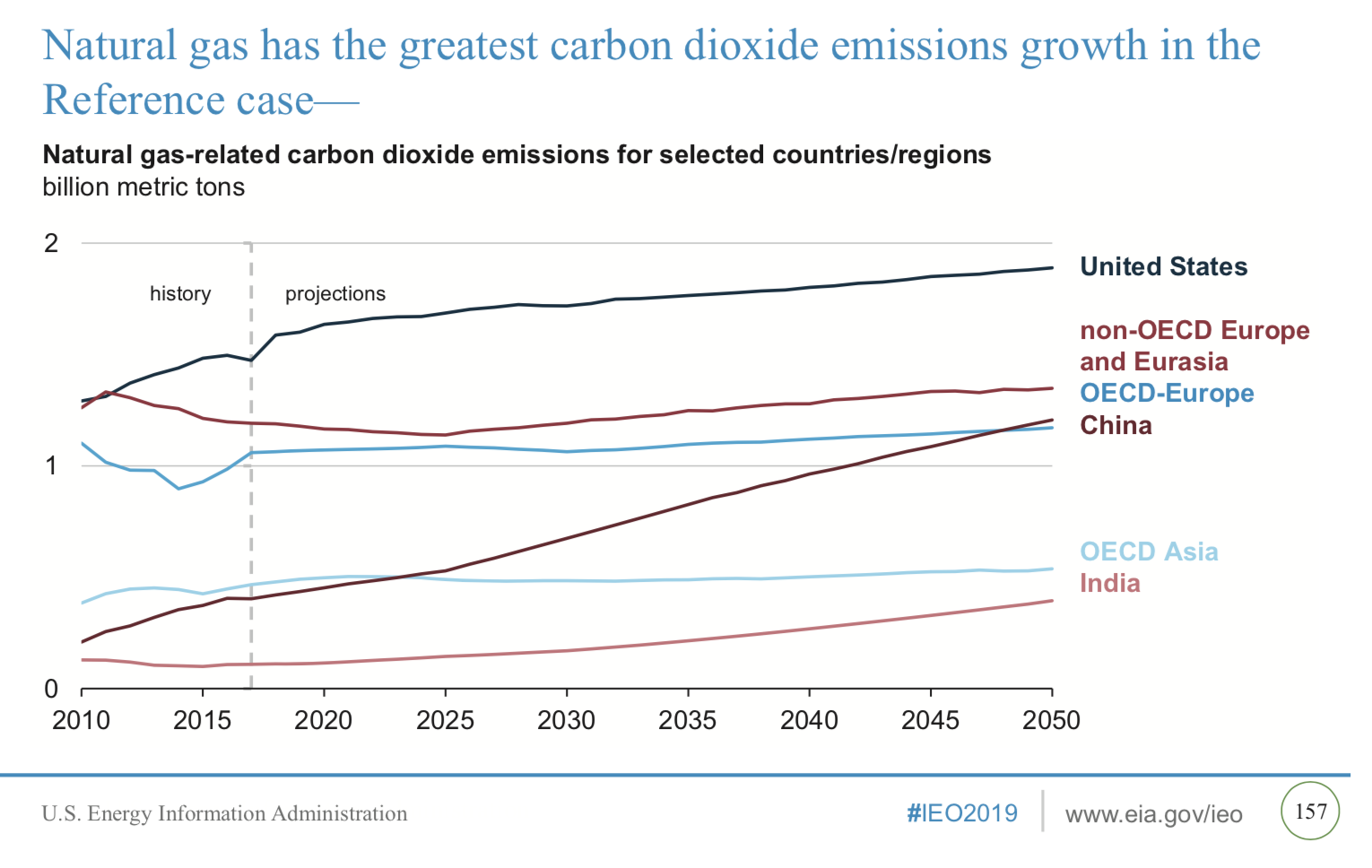
A reference case scenario in the 2019 Annual Energy Outlook forecasts considerable growth in carbon dioxide emissions in the U.S., and globally, from natural gas. Credit: U.S. Energy Information Administration
About That Methane…
All of this so far is only focused on carbon dioxide emissions, but when discussing emissions and natural gas, you can’t leave out methane, a potent but short-lived greenhouse gas that is the primary constituent of natural gas. (Methane is also emitted by other sources, such as wetlands, landfills, and livestock.)
In one of the new API ads, viewers are presented with the claim that the largest producing oil and gas regions have seen a “60 percent reduction in emissions,” a point prominently flashed across the screen[pix]
from an ]
At first glance, that seems like a great accomplishment, but a close listen to the video’s narrator (and a close reading of the API website) reveals the industry has reduced emission rates, not overall emissions, by 60 percent in the most productive oil and gas fields. That means greenhouse gas emissions are not increasing in these regions as fast as they once were, but that doesn’t mean they are going down.
However, methane emissions, both in the U.S. and globally, have surged in the past decade, and a 2019 Cornell University study points to fracked shale oil and gas production as a major culprit. Considering how much more powerful methane is at warming the climate compared to CO2 in the short term, these claims by API are misleading at best.
The Trump administration has proposed rolling back a regulation addressing methane leaks from oil and gas production, a move broadly opposed by large oil and gas companies like Exxon and BP but welcomed by API and the smaller firms it also represents.
Erik Milito, a vice president at API, voiced his support for replacing the methane rule with a looser one, telling the New York Times, “We think it’s a smarter way of targeting methane emissions.”
Meanwhile, global methane emissionscontinue to rise.
Flaring and Venting
As DeSmog has reported, the flaring and venting, or burning and direct release, of natural gas as part of the U.S. fracking industry is largely unregulated. These common oil and gas field activities are contributing to increasing carbon dioxide and methane emissions in states like North Dakota and Texas.
In Texas, the industry, while drilling for oil, is flaring enough natural gas to power the entire state, but because the gas is just being burned out in the oil fields, it’s not actually powering anything.
“It’s a black eye for the Permian basin,” Pioneer Natural Resources CEO Scott Sheffield said at an energy conference at Columbia University this spring. “The state, the pipeline companies, and the producers — we all need to come together to figure out a way to stop the flaring." [twt]
one way to stop flaring would be federal or state rules banning or limiting the practice, coupled with strong oversight from regulators. But in industry-friendly states like Texas and North Dakota, regulators have failed to enforce any real restrictions on flaring, and so the problem continues to grow.
The fracking industry has been losing money for more than a decade, which means shale oil firms are eager to keep costs low in an already expensive business. Flaring and venting natural gas, which is in oversupply and fetching low prices, saves these firms money when the alternative is building pricey pipelines and processing plants to otherwise deal with it. Ethan H. Bellamy, senior research analyst at Baird Equity Research, summed up the situation: “The business and regulatory question is what to waste, money or molecules?”
As always, the question comes back to profits. And the industry’s answer to that question is to “waste” molecules of natural gas by flaring or venting because this practice allows fracking firms to lose less money than they otherwise would, while still paying executive salaries and bonuses.
Even the International Energy Agency (IEA) realizes this problem with natural gas.
IEA executive director Fatih Birol recentlytold CNBC, “When you look at the future, the Achilles heel of the gas industry is the methane emissions.”
Despite the American Petroleum Institute’s new advertising claims, shifting power sources to natural gas won’t stave off the climate crisis.
But as viewers of API‘s new ad, “Together, We’re On It,” will note, the industry is starting to acknowledge public unrest over these issues. Framing it as “the energy debate,” the ad shows a young man sitting in a diner, watching a video of protesters on his laptop as a similar protest — perhaps the hoards of climate strikers who were slated to take the streets in September — marches by, reflected in the window.
Meanwhile, a sympathetic female narrator attempts to soothe this unrest, saying, “The energy debate, the pundits, the chatter, it’s constant. It can feel overwhelming,” before pivoting to a talking point about “the millions of problem solvers working in natural gas." [vid]
is the Gas Boom Already Over?
The oil and gas industry has been shifting its PR narrative in recent years, with some like API trying to convince the world that natural gas is a climate solution, as companies move to lock in future demand by rapidly building new gas pipelines, power plants, and other infrastructure.
That’s despite reports like those from the nonpartisan but pro-clean energy nonprofit the Rocky Mountain Institute, which recently forecast that up to 90 percent of natural gas power plants (and many pipelines) may be more expensive to run than renewables by 2035. Reports like these show natural gas is a bad investment for both economics and a livable climate.
Along those lines, a recent headline from oil and energy news site Oilprice.com should concern natural gas investors, asking, “Is The U.S. Gas Boom Already Over?”
The U.S. natural gas industry, whose growth largely has been driven by advances in fracking and drilling technology, has been plagued by losses, and investors are apparently getting tired of loaning money to companies that make it disappear.
Had an interesting lunch with @brucenilles today and heard about how the decline of natural gas, just like the decline of coal, is going to happen faster than people expect & catch industry flat-footed.
— David Roberts (@drvox) October 9, 2019
It isn’t hard to understand why API is now marketing natural gas using language about emissions reductions and energy demand. Rising pressure is coming from a public concerned about the climate crisis and from the increasingly cost-competitive renewables and storage industry.
An excellent example of this economic pressure came earlier this month. A northwest power company owned by billionaire Warren Buffet’s investment firm Berkshire Hathaway — which has no problem investing heavily in oil and gas — recently announced plans to shut down most of its coal plants serving Washington, Oregon, Wyoming, and Utah, and replace them with renewables and battery storage by 2038. That’s despite the abundance of very cheap natural gas in the U.S.
API knows the industry is feeling the heat, and it looks to be employing the same misinformation playbook that it used to sow doubt about the well-supported science of climate change and the resulting action the science demands.
---
---
https://www.mediamatters.org/fox-friends/myths-and-facts-about-natural-gas
2012
Natural gas can help the U.S. transition away from reliance on coal in the near-term if it is produced responsibly. But conservative media have dismissed the risks involved with the rapid spread of natural gas extraction to push for deregulation, attack the Obama administration, and ignore the need for a comprehensive energy policy to transition to renewable energy.
- Does the Obama Administration Support Natural Gas Extraction?
- Is The Gas Industry Over- Or Under-Regulated?
- Has Natural Gas Extraction Through Fracking Contaminated Water?
- Is The Industry Correct That Fracking Been Used Safely For Over 60 Years?
- Is Natural Gas A “Clean” Fuel Like Renewable Energy?
FACT: Obama Administration Has Embraced Natural Gas
MYTH: Obama Admin. Wants To Shut Down Natural Gas Development
- Rush Limbaugh: “New natural gas discoveries are taking place in the states in spite of Barack Obama. And yet he wants to learn from none of it. He wants to extrapolate none of it. So I have to conclude that Obama wants us to fail.” Premiere Radio Networks, *The Rush Limbaugh Show*, [6/29/11]
- MSNBC's Joe Scarborough suggested that Obama is not a “friend of natural gas” because he opposed the Keystone XL pipeline, which would carry tar sands oil, not gas. MSNBC, *Morning Joe*, [5/17/12]
- Robert Bradley of the Institute for Energy Research: The Obama administration “has been criticized for doing virtually everything in its power to hinder hydraulic fracturing.” *Washington Examiner*, [5/7/12]
Bloomberg News: Boosting Natural Gas Is “Front And Center” For Obama. Bloomberg News reported that “natural gas is now front and center” for the Obama administration, despite skepticism among environmental groups, and that the administration has “eased off” on regulations:
While Obama put his initial emphasis as president on boosting solar panels and wind turbines, natural gas is now front and center even as skepticism about hydraulic fracturing, or fracking, is rising among Obama's environmental allies such as the Sierra Club.
“They're more responsive, and they're listening more closely to our views,” Jack Gerard, the president of the American Petroleum Institute in Washington and one of the participants in that meeting, said in an interview. “The energy and economic reality is starting to sink in.”
At that April 13 meeting with trade groups representing companies including DuPont Co. (DD),Noble Energy Inc. (NBL) and Caterpillar Inc. (CAT), the Obama administration unveiled an interagency task force to coordinate the development of natural gas. And since then industry has won a series of small battles: officials downplayed reports of water pollution from fracking in Wyoming and Pennsylvania; they turned down a request by environmentalists to ban diesel in fracking; and they eased off on two gas-drilling regulations. Bloomberg, [5/9/12]
Politico: Industry Group Said They Are Getting Along Well With The Administration. Politico reported:
The administration has fallen short of environmentalists' desires that natural gas operators have to disclose the mix of fracking chemicals everywhere -- including on privately owned lands, where much gas extraction in places such as the Marcellus Shale takes place.
Environmentalists were also unhappy to learn in recent weeks that EPA had given Wyoming leaders a month's heads-up last year before announcing findings linking fracking in Pavillion, Wyo., to groundwater contamination. The delay essentially gave the state and industry time to prepare counterattacks, The Associated Press reported.
Amy Farrell, vice president of regulatory affairs at America's Natural Gas Alliance, said the industry is getting along well with the administration. Farrell participated in some of the OMB discussions, describing the meetings as “very cordial,” and saying much of the focus is on the technical aspects of the proposals and the industry. *Politico*, [5/16/12]
Industry Praised Obama Executive Order On Natural Gas. In April, Obama issued an executive order creating an inter-agency working group to coordinate actions on natural gas. The announcement was met with praise from major industry groups:
- The American Petroleum Institute was “pleased” by the action. API, [4/13/12]
- The American Gas Association was “encouraged.” AGA, [4/13/12]
- The America's Natural Gas Alliance “appreciated” the executive order. ANGA, [4/13/12]
- The Natural Gas Supply Association “welcomed today's executive order, which should create an improved regulatory environment.” NGSA, [4/13/12]
Obama Is Pushing For Natural Gas As Transportation Fuel. The Wall Street Journal reported on Obama's plan to boost the use of natural gas in trucks and buses:
President Barack Obama on Thursday announced a pair of new measures designed to advance the “all of the above” energy agenda that he laid out in Tuesday's State of the Union address, including an embrace of natural gas as a transportation fuel.
[...]
The White House plan, contingent on congressional support, would include tax credits to offset part of the cost of upgrading trucks to run on natural gas, and federal help to spur the creation of five additional natural-gas corridors on heavy trucking routes. Additionally, the Obama administration plans to double down on federal research to find new ways to use natural gas for transportation, as well as supporting the conversion of city bus and truck fleets to run on the cleaner fuel, administration officials said. *Wall Street Journal*, [1/26/12]
Obama Admin. Approved Major Natural Gas Project On Federal Lands. The Wall Street Journal reported:
U.S. officials on Tuesday approved a plan by Anadarko Petroleum Corp. to drill 3,700 natural-gas wells in eastern Utah, capping a yearslong review of a project that will be one of the largest in the region.
Approval for the Greater Natural Buttes project in the Uintah Basin, announced by Interior Secretary Ken Salazar, comes as the Obama administration is supporting natural-gas production as a way to create jobs with a cleaner-burning fuel than coal or oil.
Once Anadarko's wells are up and running, they would be expected to produce about one billion cubic feet of natural gas a day, according to Anadarko, enough to heat or cool about 5.5 million homes. *Wall Street Journal*, [5/8/12]
CFR's Levi: The “Best Hope” For Natural Gas Expansion Is Policies That “Obama Has Championed.” In an article titled “The Driller in Chief,” the Council on Foreign Relations' Michael Levi debunked claims that Obama is an enemy of the oil and gas industry. Levi noted that Obama put together an advisory panel “which included prominent shale enthusiasts,” and that climate policies favored by Obama are “the best hope for boosting gas demand”:
A spate of dumb and preventable accidents by poorly regulated shale developers would do far more to set back U.S. oil and gas development than some smart minimum standards set out at the federal level.
This White House has signaled that it prefers precisely such an approach, though precise details haven't yet been forthcoming. Undoubtedly, some in the administration would like to see a dominant role for the federal government and regulations that could hit the industry harder than is needed. So far, however, they appear to be losing. Last year, Obama had his energy secretary appoint a group of industry experts and environmental authorities to advise him on shale. The team, which included prominent shale enthusiasts like Daniel Yergin and John Deutch, produced a string of recommendations that were widely seen as constructive rather than adversarial. Fuel Fix, a news service run by the Houston Chronicle, described them as an "olive branch to industry."
The Obama administration has a particularly strong case to make when it comes to natural gas. Smart developers aren't crying because Obama has put too much gas out of reach -- they're terrified because production is so strong that collapsing prices have crushed their bottom lines. The best way out of this situation is to find new uses for natural gas. Although markets will play a critical role in this endeavor, the most powerful approach is to get government involved. For those who believe in the urgency of fighting climate change, the right step is obvious: Adopt policies that replace coal-fired power with natural gas, which would slash carbon emissions and clean up the air at the same time.
Indeed, the worst political news for the gas industry in the last few years should have been the collapse of a signature Obama initiative: cap and trade. A modest cap-and-trade program would have increased the price of coal relative to that of natural gas and encouraged utilities to switch to the cleaner-burning fuel, just as it has in Europe. The best hope for boosting gas demand going forward is some variation on that theme, be it Clean Air Act rules that favor gas over coal or a clean energy standard that creates preferences for cleaner fuels, including gas. Both are policies that Obama has championed -- and that his adversaries have opposed.Foreign Policy Magazine, [3/1/12]
EIA: Production Of Natural Gas Is At Highest In Nearly 40 Years. Contrary to claims that the Obama administration has quashed natural gas production, EIA data show that in 2011 natural gas production was the highest on record[graphc]
EIA, 4/30/12]
FACT: Natural Gas Drilling Has Been Exempted From Key Environmental Laws
MYTH: Fracking Is Overregulated
- Wash. Times' editorial: “Mr. Obama's call for drillers to disclose the chemicals they employ is largely superfluous because most companies already do so voluntarily.” *Washington Times*, [1/30/12]
- Fox's Monica Crowley: “Hydrofracking has been proven to be environmentally safe,” but the EPA is “going to try to kill this new-found industry.” [Fox Business, The Willis Report, 4/3/12, via Nexis]
- Fox News contributor Michael Goodwin: “Look, there's no question that the EPA has been looking for ways to stop fracking. The problem is they can't find any evidence of the contamination in the water supply that they keep suspecting is out there.” [Fox Business, Lou Dobbs Tonight, 4/26/12, via Nexis]
Gas Industry Has Been Exempted From Several Environmental Laws. NPR reported that fracking was exempted from the Safe Drinking Water Act under the Bush administration, and that the gas industry overall has been exempted from several key environmental laws:
It is true that some federal environmental statutes do not apply to gas drilling. Some of those exemptions date back long before Dick Cheney became Vice President in 2000. But the [“Halliburton Loophole”] refers to the Energy Policy Act of 2005, which exempts the hydraulic fracturing process, also known as fracking, from federal oversight under theSafe Drinking Water Act of 1974. Then Vice President Dick Cheney did have a hand in getting the exemption put into the Energy Policy Act. He chaired President Bush's Energy Policy Task Force, which recommended fracking be excluded. And Cheney is a former Halliburton executive. Halliburton, by the way, began fracking in the 1940's to extract for oil. But the use of fracking, combined with horizontal drilling, has only recently been used to mine shale gas.
The loophole does have an exception. If drilling companies use diesel fuel to frack a well, they do have to get a federal permit.
Also amended in the 2005 Energy Policy Act was the Clean Water Act. Congress enacted the CWA back in 1972 as a way to regulate discharges into the country's rivers and streams. The CWA was amended in 1987 to include storm water run-off. But oil and gas production are exempted from those regulations. And in the 2005 Energy Policy Act, those exemptions included oil and gas construction. Environmentalists worry about run-off from well pads, pipelines and construction sites.
[...]
The Clean Air Act, passed by Congress in 1970, exempts oil and gas wells from aggregation. That means, each well site is considered an individual source of pollutants, and does not take into account all of the well sites in a specific area.
When it comes to the handling of waste water, or frack water, that too is exempt from a federal statute called the Resource Conservation and Recovery Act. The RCRA tracks industrial wastes from “cradle to grave.” But when it comes to the oil and gas industry, as long as the waste water is on the drill site, or being transported, it is not considered hazardous. This also applies to drilling mud. That's why trucks carrying waste water, which contains high levels of salts, toxic chemicals, as well as radioactive material, may be labeled “residual waste.”
The National Environmental Policy Act, or NEPA, requires federal agencies to do environmental impact statements if major industrial projects would impact the environment. But the Energy Policy Act of 2005 relegated oil and gas operations to a less stringent process.
Finally, the Toxic Release Inventory requires industries to report toxic chemicals to the EPA. But the oil and gas industry are exempt from this reporting. NPR, [12/5/11]
Many States Have Loopholes In Chemical Disclosure Laws Due To ALEC Model Bill. A review by InsideClimateNews found that many states do not require companies to disclose the chemical concentrations or chemical names of fracking fluid components to regulators or the public. Inside Climate News, [2/15/12]
The New York Times reported that these loopholes were included in model legislation sponsored by ExxonMobil within ALEC (the American Legislative Exchange Council), a conservative organization that writes model legislation adopted by states across the country:
Last December, ALEC adopted model legislation, based on a Texas law, addressing the public disclosure of chemicals in drilling fluids used to extract natural gas through hydraulic fracturing, or fracking. The ALEC legislation, which has since provided the basis for similar bills submitted in five states, has been promoted as a victory for consumers' right to know about potential drinking water contaminants.
A close reading of the bill, however, reveals loopholes that would allow energy companies to withhold the names of certain fluid contents, for reasons including that they have been deemed trade secrets. Most telling, perhaps, the bill was sponsored within ALEC by ExxonMobil, one of the largest practitioners of fracking -- something not explained when ALEC lawmakers introduced their bills back home. *New York Times*, [4/21/12]
Lack Of Disclosure Of Fracking Chemicals Has Impeded Studies Of Water Safety. ProPublica reported:
The contamination in Sublette County is significant because it is the first to be documented by a federal agency, the U.S. Bureau of Land Management. But more than 1,000 other cases of contamination have been documented by courts and state and local governments in Colorado, New Mexico, Alabama, Ohio and Pennsylvania. In one case, a house exploded after hydraulic fracturing created underground passageways and methane seeped into the residential water supply. In other cases, the contamination occurred not from actual drilling below ground, but on the surface, where accidental spills and leaky tanks, trucks and waste pits allowed benzene and other chemicals to leach into streams, springs and water wells
It is difficult to pinpoint the exact cause of each contamination, or measure its spread across the environment accurately, because the precise nature and concentrations of the chemicals used by industry are considered trade secrets. Not even the EPA knows exactly what's in the drilling fluids. And that, EPA scientists say, makes it impossible to vouch for the safety of the drilling process or precisely track its effects. ProPublica, [11/13/08]
EPA Failed To Stop What Some EPA Lawyers Called A “Clear Violation” Of Pollution Laws. The New York Times reported:
Agency lawyers are heatedly debating whether to intervene in Pennsylvania, where drilling for gas has increased sharply, to stop what some of those lawyers say is a clear violation of federal pollution laws: drilling waste discharged into rivers and streams with minimal treatment. The outcome of that dispute has the potential to halt the breakneck growth of drilling in Pennsylvania.
The E.P.A. has taken strong stands in some places, like Texas, where in December it overrode state regulators and intervened after a local driller was suspected of water contamination. Elsewhere, the agency has pulled its punches, as in New York.
Asked why the letter about hydrofracking in the New York City watershed had been revised, an agency scientist involved in writing it offered a one-word explanation: “politics.”
[...]
Under federal law, certain basic rules govern sewage treatment plants. At their core, these rules say two things: operators have to know what is in the waste they receive, and they have to treat this waste to make it safe before discharging it into waterways.
But in Pennsylvania, these rules are being broken, according to some E.P.A. lawyers. “Treatment plants are not allowed under federal law to process mystery liquids, regardless of what the state tells them,” explained one E.P.A. lawyer in an internal draft memo obtained by The Times. “Mystery liquids is exactly what this drilling waste is, since its ingredient toxins aren't known.” *New York Times*, [3/3/11]
Bloomberg: Industry Lobbyists Recently Collected Victories Over Regulations. Bloomberg reported:
After weeks of these discussions, the White House called [American Petroleum Institute President Jack] Gerard, [American Gas Association President Dave] McCurdy, and officials from America's Natural Gas Alliance, the National Association of Manufacturers, the American Chemistry Council and the U.S. Chamber of Commerce into the White House meeting, held just steps from the Oval Office.
Not in attendance: environmental or health groups.
[...]
Over the weeks that followed, the EPA delayed requirements that drillers capture the gas emitted when a well is first tapped until 2015, a key demand of Gerard's group. The Bureau of Land Management eased off on requirements for disclosure of chemicals used in fracking. And the EPA disregarded a plea from environmentalists to outlaw the use of diesel in fracking. Bloomberg, [5/9/12]
Obama Administration Gave “Significant Concession” To The Industry In Disclosure Rule. From a May 4 New York Times article:
The Obama administration on Friday issued a proposed rule governing hydraulic fracturing for oil and gas on public lands that will for the first time require disclosure of the chemicals used in the process.
But in a significant concession to the oil industry, companies will have to reveal the composition of fluids only after they have completed drilling -- a sharp change from the government's original proposal, which would have required disclosure of the chemicals 30 days before a well could be started.
The pullback on the rule followed a series of meetings at the White House after the original regulation was proposed in February. Lobbyists representing oil industry trade associations and individual major producers like ExxonMobil, XTO Energy, Apache, Samson Resources and Anadarko Petroleum met with officials of the Office of Management and Budget, who reworked the rule to address industry concerns about overlapping state regulations and the cost of compliance. *New York Times*,[5/4/12]
Right-Wing WSJ Editorial Board Praised “Restraint” Of “First-Ever Federal Fracking Rule.” The EPA recently issued a regulation to reduce emissions of smog-forming air pollution from the oil and gas industry. The Wall Street Journal editorial board praised “first-ever federal fracking rule” for showing “restraint.” *Wall Street Journal*, [4/20/12]
The West Virginia State Journal reported that the industry did not oppose the rule either:
Although the industry is still evaluating the nearly 600-page rule, most agree with it, [Range Resources spokesman Matt Pitzarella] said.
“All signs indicate that it's going to be reasonable -- we don't anticipate that it will stifle new development,” he said.
[...]
“If your concern is purely safety, it addresses that -- there should not be fires. If your concern is public health, this addresses that. If your concern is environmental, it obviously has environmental benefits,” he said. “And although any new regulation clearly has some impact, this isn't going to bring anything to a screeching halt. The final part is, this is reasonable public policy.” *The State Journal*, [5/7/12]
Many States Do Not Sufficiently Regulate Well Construction And Wastewater Handling. ProPublica reported in December 2009:
A recent report by the Ground Water Protection Council, a research group that once had energy executives on its board but now consists mainly of state regulators, revealed that only four of the 31 drilling states it surveyed have regulations that directly address hydraulic fracturing and that no state requires companies to track the volume of chemicals left underground. One in five states don't require that the concrete casing used to contain wells be tested before hydraulic fracturing. And more than half the states allow waste pits that hold toxic fluids from fracturing to intersect with the water table, even though waste pits have been connected to hundreds of cases of water contamination.
[...]
ProPublica's recent analysis of 22 states that account for the vast majority of the country's drilling found that regulatory staffing has not kept up with the drilling boom, meaning that the nation's ability to enforce rules that provide environmental safeguards is systematically weakening. ProPublica, [12/31/09]
FACT: Natural Gas Extraction Has Contaminated Water
MYTH: Fracking Poses No Risk To Water Supplies
- Rush Limbaugh said “the left believes that fracking contaminates groundwater. There's no evidence. They looked at it for two years. There's no evidence whatsoever that fracking contaminates groundwater.” Premiere Radio Networks, *The Rush Limbaugh Show*, [4/26/12]
- Energy In Depth's Lee Fuller claimed that “a broad chorus of science-based information continues to come in about fracturing's long and clear record of environmental safety” and concerns about water contamination are “baseless.” *Washington Examiner*, [8/4/11]
- Fox's John Stossel: Methane in water “has nothing to do with fracking.” Fox News, *Fox & Friends,* [5/12/11]
Poorly Constructed Wells Have Contaminated Water
Energy Companies Acknowledge That Poorly Constructed Wells Have Contaminated Water. Industry officials contend that fracking per se has not contaminated water because fracking -- the process of injecting water, chemicals and sand at a high pressure to fracture shale rocks and release natural gas -- typically occurs far below aquifers. But conservative media and industry often claim that fracking has never contaminated water, without clarifying that bad well construction during drilling prior to fracking and other industry failures during the suite of activities associated with fracking have contaminated water. The Wall Street Journal reported that even industry officials acknowledge that shale gas extraction has contaminated water supplies:
Some energy companies, state regulators, academics and environmentalists are reaching consensus that natural-gas drilling has led to several incidents of water pollution--but not because of fracking.
The energy officials and some environmentalists agree that poorly built wells are to blame for some cases of water contamination. In those cases, they say, wells weren't properly sealed with subterranean cement, which allowed contaminants to travel up the well bore from deep underground into shallow aquifers that provide drinking water.
[...]
One of the largest documented instances of water contamination occurred in Bradford County, Pa.--after wells had been drilled but before any fracking took place. Chesapeake Energy Corp., the nation's second largest natural-gas company, has conceded that poor well construction may have played a role in high levels of natural gas found in local aquifers, according to letters to state regulators.
A state investigation concluded Chesapeake failed to cement its wells adequately, allowing gas to leak from pipes into the groundwater. *Wall Street Journal*, [3/25/12]
Duke Study Found Methane Linked To Gas Drilling Had Contaminated Water. The Christian Science Monitor reported:
Methane levels were 17 times higher in ground water near areas where shale-gas “fracking” wells had been drilled in Pennsylvania, compared with areas where no gas drilling had occurred, a new study has found.
Duke University researchers analyzed methane gas in 68 private ground-water wells across five counties in Pennsylvania and New York. The study cited “evidence for methane contamination of drinking water associated with shale-gas extraction.”
[...]
The peer-reviewed study, which is being published in the Proceedings of the National Academy of Sciences, is one of the first to conclude that hydraulic fracturing is polluting ground water. And it's likely to be used as ammunition in court by those opposing drilling in sensitive watersheds.
The hydraulic fracturing approach has dramatically increased available US reserves of natural gas by unlocking gas that was previously trapped in shale formations from the mid-Atlantic to Texas to Colorado. But environmentalists and local residents have long claimed that fracking pollutes ground water with methane as well as with chemicals in the injection fluids.
The Duke researchers said that the presence of methane likely was due to its escape from faulty drill casings.
While the study found high methane levels, it did not find any evidence that the chemicals injected at deep levels to fracture the shale had moved upward to pollute relatively shallow ground water. *Christian Science Monitor*, [5/9/11]
Poorly Handled Wastewater Can Contaminate Water Supplies
Radioactive Wastewater Is Discharged Into Rivers That Supply Drinking Water. The New York Times reported:
The [internal EPA] documents reveal that the wastewater, which is sometimes hauled to sewage plants not designed to treat it and then discharged into rivers that supply drinking water, contains radioactivity at levels higher than previously known, and far higher than the level that federal regulators say is safe for these treatment plants to handle.
Other documents and interviews show that many E.P.A. scientists are alarmed, warning that the drilling waste is a threat to drinking water in Pennsylvania. Their concern is based partly on a 2009 study, never made public, written by an E.P.A. consultant who concluded that some sewage treatment plants were incapable of removing certain drilling waste contaminants and were probably violating the law.
The Times also found never-reported studies by the E.P.A.and a confidential study by the drilling industry that all concluded that radioactivity in drilling waste cannot be fully diluted in rivers and other waterways.
But the E.P.A. has not intervened. In fact, federal and state regulators are allowing most sewage treatment plants that accept drilling waste not to test for radioactivity. And most drinking-water intake plants downstream from those sewage treatment plants in Pennsylvania, with the blessing of regulators, have not tested for radioactivity since before 2006, even though the drilling boom began in 2008.
In other words, there is no way of guaranteeing that the drinking water taken in by all these plants is safe.
That has experts worried. *New York Times*, [2/26/11]
Industry Admitted It Contaminated Drinking Water In PA. CBS' local station in Pittsburgh, Pennsylvania reported:
The president of the Marcellus Shale Coalition, which represents natural gas companies, said the group now believes the natural gas exploration industry is partly responsible for rising levels of contaminants found in area drinking water.
The group came to the conclusion after reviewing research from Carnegie Mellon University and the Pittsburgh Water and Sewer Authority.
One of the major factors that led to the conclusion was the discovery of bromide in the water. It's a salt that is also found in drilling wastewater.
Now, the DEP is calling on Marcellus Shale drillers to stop taking wastewater to 15 treatment plants in the state. CBS Pittsburgh, [4/19/11]
Industry Has Fought Efforts To Safely Dispose Of Wastewater. ProPublica reported:
One of the most challenging environmental problems associated with drilling is disposing of its wastewater, which is typically laced with heavy metals, chemicals and hydrocarbons. Usually the waste is collected in open, dirt-brimmed waste pits where it sits until it's hauled off to treatment facilities or injection wells. In the meantime, the fluids can evaporate or seep into the earth, or overflow if rain or snow overfills the pit.
A 1992 congressional report found that one of “the greatest opportunities” to prevent this type of pollution is something called a closed loop system, a series of pipes that gathers the waste as it comes out of a gas well, separates some of the water for reuse, and confines the concentrated leftovers in a steel tank.
[...]
Yet the industry continues to fight laws that would lead to increased use of closed loop systems. ProPublica, [12/14/09]
Fracking Itself Likely Contaminated Water In Wyoming
EPA Study: Chemicals Likely From Fracking Contaminated Wyoming Town's Water. The Associated Press reported:
The U.S. Environmental Protection Agency announced Thursday for the first time that fracking -- a controversial method of improving the productivity of oil and gas wells -- may be to blame for causing groundwater pollution.
[...]
The EPA's found that compounds likely associated with fracking chemicals had been detected in the groundwater beneath Pavillion, a small community in central Wyoming where residents say their well water reeks of chemicals. Health officials last year advised them not to drink their water after the EPA found low levels hydrocarbons in their wells.
The EPA announcement could add to the controversy over fracking, which has played a large role in opening up many gas reserves, including the Marcellus Shale in the eastern U.S. in recent years.
The industry has long contended that fracking is safe, but environmentalists and some residents who live near drilling sites say it has poisoned groundwater.
The EPA said its announcement is the first step in a process of opening up its findings for review by the public and other scientists.
“EPA's highest priority remains ensuring that Pavillion residents have access to safe drinking water,” said Jim Martin, EPA regional administrator in Denver. “We look forward to having these findings in the draft report informed by a transparent and public review process.”
The EPA also emphasized that the findings are specific to the Pavillion area. The agency said the fracking that occurred in Pavillion differed from fracking methods used elsewhere in regions with different geological characteristics.
The fracking occurred below the level of the drinking water aquifer and close to water wells, the EPA said. Elsewhere, drilling is more remote and fracking occurs much deeper than the level of groundwater that would normally be used. AP, [12/8/11, via USA Today]
FACT: Current Fracking Practice Is New And Rapidly Expanding
MYTH: Fracking Has Been Used Without Incident For Over 60 Years
- Some mainstream media outlets have uncritically repeated variants of the claim that “fracking has been used safely for more than 60 years.” New York Times*, [5/6/11] AP, [12/15/11, via *USA Today] Tulsa World*, [1/12/12] *Chicago Tribune*, [4/29/12, via *St. Louis Post-Dispatch]
- Robert Bryce wrote in an op-ed at the Wall Street Journal that “Although hydraulic fracturing has been used more than one million times in the U.S. over the past 60 years, environmental activists are hoping to ban the process or have it regulated by the Environmental Protection Agency.” *Wall Street Journal*, [6/13/11]
- Thomas Stewart, in an op-ed at The Columbus Dispatch, said: “there is absolutely nothing new about either of these technical processes -- more than 1 million wells in the U.S. have been safely stimulated using hydraulic fracturing in the past 60 years.” *The Columbus Dispatch*, [10/7/11]
- Fox's Tobin Smith: “The small group of environmental activists tells the impressionable administration that even though we have done one million of them all over the United States for 60 years that somehow we will contaminate our drinking water. When you talk to any geologist they tell you they are separated by him permeable rock for up to two miles, sometimes bigger.” [Fox Business, America's Nightly Scoreboard, 6/15/11, via Nexis]
Panel: Current Fracking Practice “Has Only Been Done For Something Less Than A Decade.” A panel commissioned by President Obama and headed by John Deutch, an MIT professor who serves on the board at natural gas company Cheniere Energy Inc., stated: “Advocates state that fracturing has been performed safety without significant incident for over 60 years, although modern shale gas fracturing of two mile long laterals has only been done for something less than a decade.” Shale Gas Subcommittee of the Secretary of Energy Advisory Board, [8/11/11] *Wall Street Journal*, [8/11/11]
Even Fracking Proponents Acknowledge That Current Fracking Is Different In Technique And Scale. In a flawed editorial downplaying the risks of fracking, even the Wall Street Journal editorial board acknowledged that current fracking practice is different both in technique and scale than prior hydraulic fracturing:
The U.S. is in the midst of an energy revolution, and we don't mean solar panels or wind turbines. A new gusher of natural gas from shale has the potential to transform U.S. energy production--that is, unless politicians, greens and the industry mess it up.
Only a decade ago Texas oil engineers hit upon the idea of combining two established technologies to release natural gas trapped in shale formations. Horizontal drilling--in which wells turn sideways after a certain depth--opens up big new production areas. Producers then use a 60-year-old technique called hydraulic fracturing--in which water, sand and chemicals are injected into the well at high pressure--to loosen the shale and release gas (and increasingly, oil). *Wall Street Journal*, [6/25/11] Media Matters, [6/28/11]
Fracking Fluid Contaminated Well In 1987. The New York Times reported:
“There have been over a million wells hydraulically fractured in the history of the industry, and there is not one, not one, reported case of a freshwater aquifer having ever been contaminated from hydraulic fracturing. Not one,” Rex W. Tillerson, the chief executive of ExxonMobil, said last year at a Congressional hearing on drilling.
It is a refrain that not only drilling proponents, but also state and federal lawmakers, even past and present Environmental Protection Agency directors, have repeated often.
But there is in fact a documented case, and the E.P.A. report that discussed it suggests there may be more.
[...]
The report is not recent -- it was published in 1987, and the contamination was discovered in 1984. Drilling technology and safeguards in well design have improved significantly since then. Nevertheless, the report does contradict what has emerged as a kind of mantra in the industry and in the government.
The report concluded that hydraulic fracturing fluids or gel used by the Kaiser Exploration and Mining Company contaminated a well roughly 600 feet away on the property of James Parsons in Jackson County, W.Va., referring to it as “Mr. Parson's water well.”
[...]
Dan Derkics, a 17-year veteran of the environmental agency who oversaw research for the report, said that hundreds of other cases of drinking water contamination were found, many of which looked from preliminary investigations to have been caused by hydraulic fracturing like the one from West Virginia. But they were unable to learn more about them. *New York Times*, [8/3/11]
FACT: Renewables Are Needed To Sufficiently Reduce Carbon Emissions
MYTH: Natural Gas Explosion Solves Our Energy Problem, Makes Renewables Irrelevant
- The Heartland Institute's James Taylor used natural gas production to claim that “There is no need for federal or state restrictions on carbon dioxide emissions.” Forbes, [1/25/12]
- CFACT's Paul Driessen wrote in an op-ed for The Washington Times: “cheap natural gas also makes it much harder to justify building redundant wind turbines and solar panels [...] Fracking could help provide a far more secure, affordable, dependable and clean future than ever would be possible with wind or solar power.” *The Washington Times*, [3/23/12]
- Fox's Eric Bolling said “we should make natural gas our clean fuel of the future.” [Fox News, America's Newsroom, 5/7/12]
Environmental Groups Recognize That Natural Gas Is More Environmentally-Friendly Than Coal. Several environmental groups have recognized that natural gas has lower carbon emissions than coal, as well as lower emissions of several other air pollutants that threaten human health. The president of the Natural Resources Defense Council, Frances Beinecke, wrote in July 2011 that “Natural gas clearly has a role to play in our energy future--especially if it is used to replace dirty coal power," while noting that safeguards must be put in place first. NRDC, [7/11/11]
Similarly, the Environmental Defense Fund's statement on natural gas policy states:
Natural gas is an important and growing part of our nation's energy portfolio. It emits less greenhouse gases than coal when combusted and avoids mercury and other dangerous air pollutants that come from coal. It could be a win-win if -- and this is a big if -- we do it the right way. EDF, accessed [5/14/12]
The following chart created by John Nelson with data from OECD/NEA shows that electricity generated from gas has significantly fewer greenhouse gas emissions than electricity generated from coal. However, renewable and nuclear energy have significantly fewer greenhouse gas emissions than gas: [grfx]Washington Post, 2/22/10]
But If Natural Gas Expansion Comes At The Expense Of Renewables, The Climate Is Imperiled.The Guardian reported:
Natural gas is not the “panacea” to solve climate change that fossil fuel industry lobbyists have been claiming, according to new research from the International Energy Agency (IEA).
Gas is likely to make up about one-quarter of the world's energy supply by 2035, according to the study, but that would lead the world to a 3.5C temperature rise. At such a level, global warming could run out of control, deserts would take over in southern Africa, Australia and the western US, and sea level rises could engulf small island states.
Nobuo Tanaka, executive director of the IEA, told a press conference in London: “While natural gas is the cleanest fossil fuel, it is still a fossil fuel. Its increased use could muscle out low-carbon fuels such as renewables and nuclear, particularly in the wake of Fukushima. An expansion of gas use alone is no panacea for climate change.”
Governments are likely to come under pressure to reduce support for low-carbon energy and opt for gas instead, as oil and gas companies have been urging, in a move that could imperil the fight against climate change, the IEA warned. *The Guardian*, [6/6/11]
Report: Without Climate Policy In Place, “More Abundant Natural Gas Does Not Reduce CO2 Emissions.”From an issue brief prepared by Resources for the Future and the National Energy Policy Institute:
We find that more abundant natural gas supplies result in greater natural gas use in most sectors of the economy. More importantly, we find that with appropriate carbon policies in place -- such as a cap-and-trade system or a carbon tax -- natural gas can play a role as a bridge fuel to a low-carbon future. Having low-carbon policies in place is crucial. Without such policies, more abundant natural gas does not reduce CO2 emissions. Although greater natural gas resources reduce the price of natural gas and displace the use of coal and oil, they also boost overall energy consumption and reduce the use of nuclear and renewable energy sources for electric power generation. As a result, projected CO2 emissions are almost one percent higher.
With a carbon cap-and trade system in place, however, we find that greater natural gas supplies contribute to achieving carbon-reduction goals. With more abundant natural gas, the use of natural gas in electricity generation increases significantly and overall natural gas consumption remains robust, which lessens slightly the burden on other measures to reduce CO2 emissions. In addition, the price of CO2 allowances falls slightly, which lessens the economic cost of reducing CO2 emissions. Thus, it is this ability to lower the costs of climate policy that makes natural gas an attractive bridge fuel to a low-carbon future. Resources for the Future and National Energy Policy Institute, [December 2009, emphasis added]
CFR's Levi: We Need To Support Zero Carbon Sources “Even If The Market Currently Prefers Natural Gas.” From a post by Michael Levi of the Council on Foreign Relations:
Low natural gas prices are apparently deterring deployment of renewable and nuclear energy, and hence learning and innovation in those sectors. This is a problem regardless of whether gas is scarce or abundant, since reasonably ambitious climate policies will require sequestration of carbon dioxide (including from gas use) or a strong shift to renewable and nuclear power within a couple decades or so. But it is an even bigger problem if natural gas supplies turn out to underwhelm, since in that case, the need to shift to zero-carbon sources would become even more pressing and sudden. This simply reinforces the case for ensuring that prudent deployment of and innovation in zero carbon energy receives solid public support even if the market currently prefers natural gas. Council on Foreign Relations, [2/7/12]
MIT Study: Natural Gas Development Should Not Stop “Investment In ... Renewables.” A recent MIT study stated that “Natural gas can make an important contribution to GHG [greenhouse gas] reduction in coming decades, but investment in low-emission technologies, such as nuclear, CCS [carbon capture and storage], and renewables, should be actively pursued to ensure that a mitigation regime can be sustained in the longer term.” The report further recommended that support for these technologies should be provided through “RD&D and targeted subsidies of limited duration.” MIT Energy Initiative, [2011]
---
https://www.ucsusa.org/sites/default/files/2021-10/Colorado-Targeted-by-Fossil-Fuel-Industry-Disinformation-Playbook.pdf
40 pp
Colorado Targeted by
Fossil Fuel Industry’s
Disinformation
Playbook
Climate Deception Harms Communities’ Health
and Safety
www.ucsusa.org/resources/colorado-fossil-fuel-industry-disinformation
https://doi.org/10.47923/2021.14291
CONTENTS
Chapter 1 Deceiving the Public: The Disinformation Playbook 4
The Disinformation Playbook and Colorado Oil and Gas Operations 5
Chapter 2 Disinformation Tactic: The Fix 7
Lobbying to Weaken Public Health and Safety Protections and Enhance Fossil Fuel Profits 8
Overwhelming Public Voices to Thwart Ballot Initiatives 9
Table 1. An Example of How Industry Spending Overwhelms Health and Safety 10
Pitting Local Leaders Against the Health and Safety of Their Constituents 11
Influencing Public Policy Positions from Inside and Out 11
Using Proxy Groups to Confuse the Public and Undermine Support for Climate
Accountability Lawsuits 12
Chapter 3 Disinformation Tactic: The Diversion 13
Elevating Industry Interests Above Community Voices 13
Fabricating the Appearance of Local Support 14
Figure 1. Colorado’s Climate Disinformation Complex 15
Greenwashing Your Screens 16
Chapter 4 Disinformation Tactic: The Screen 18
Building Credibility by Hiding Behind Trusted State Institutions 18
Burnishing Industry’s Reputation through Association with Respected Nonprofits 19
Chapter 5 Disinformation Tactic: The Fake 21
Chapter 6 A Litany of Harms: Health and Safety 23
Cancer-Causing and Other Dangerous Chemicals in the Air and Water 24
Poor Air Quality 24
New Research Identifies Even More Dangerous Ozone Problems 25
Figure 2. Fossil Fuel Industry Emissions are Higher in High Racial-Minority Census
Tracts 26
Dangerous Inactive Wells 26
Climate Change Impacts 27
Chapter 7 A Litany of Harms: Economic 28
Bogus Complaints about High Taxes 28
Inflated Jobs Claims 28
Union of Concerned Scientists | 3
Figure 3. Oil and Gas Extraction’s Boom-and-Bust Contribution to the Colorado
Economy 29
Other Harms, Some Difficult To Monetize 29
Chapter 8 Recommendations 31
Acknowledgments 32
...For more than a decade, Colorado oil and gas exploration and development have intensified, often putting dangerous and polluting industrial activities in close proximity to homes, schools, playgrounds, and other public spaces. This report exposes how the fossil fuel industry positions itself as the backbone of the state economy, often framing any community opposition to this industry’s dangerous operations as a fight against local interest in the form of tax revenue, school funding, and jobs. The industry largely glosses over evidence it causes health, economic, or environmental damage, and its clout enables oil and gas extraction and expansion to continue with little regard for those facing the adverse health and economic impacts. In Colorado, the oil and gas industry is comprised of powerful transnational corporations, including ExxonMobil and Chevron, along with companies such as Noble Energy (now owned by Chevron), Anadarko (now owned by Occidental Petroleum), and Suncor (a large Canadian tar-sands operation with close ties to ExxonMobil and Royal Dutch Shell).
The industry’s interests are represented by heavyweight national lobbying outfits like the American Petroleum Institute (API), as well as local trade associations, like the Colorado Oil and Gas Association (COGA). A proliferation of industry-created and backed front groups includes several with ties to the private multinational conglomerate Koch Industries.They often all work together to run the same Disinformation Playbook. Of course, the fossil fuel industry uses similar tactics and wields considerable political clout in other oil- and gas-producing states and at the federal level. Consider its success in stalling any meaningful climate action for more than two decades and its ability to despoil public and Native lands and waters with drilling and pipelines. Or consider the API’s nationwide TV and digital ad campaign, launched ahead of the 2020 elections and targeting not only Colorado, New Mexico, Pennsylvania, and other key oil- and gas-producing states but also Wisconsin, Michigan, and other political swing states (API 2020a; API 2020b)....
Lobbying to Weaken Public Health and Safety Protections and Enhance Fossil Fuel Profits
In the early years of fracking in Colorado, API and its local division, the Colorado Petroleum Council (CPC), pushed the state legislature to enact the little-known ad valorem tax credit, which allows oil and gas companies to deduct local property taxes from the severance tax that fossil fuel companies must pay to the state. As local property taxes have increased, particularly for oil and gas operations, the state’s pool of severance taxes, based on production and profits, has shrunk—even though severance-tax revenues are needed to remediate abandoned and orphaned wells. Such wells are often underground pathways through which toxic fluids and gases migrate upward into air, water, and homes. These wells are also a significant source of leaked methane, a heat-trapping pollutant that has 80 times the warming power of carbon dioxide during the first 20 years after it reaches the atmosphere (Bushkin-Bedient et al. 2020).
Thanks to the ad valorem tax credit, some oil and gas operations have paid nothing to the state in recent years, leaving old wells unremediated and dangerous to residents (Eason 2020; Legislative Council Staff, n.d.; Silbaugh 2020). In April 2017, a house in Firestone, Colorado blew up, killing two residents and seriously injuring a third. The explosion was traced to gas leaking from an old well that had not been disconnected from the wellhead or properly capped (Markus 2018; Osher 2017; Svaldi and Finley 2017).In direct response to the explosion, the legislature took up a science-based bill to require regulators to map oil and gas pipelines throughout the state; a filibuster in the Republican-controlled state Senate killed the proposal. Lobbying disclosure reports and campaign-finance records showed that Anadarko and Noble Energy, both of which opposed the bill, spent significantly in support of Senate Republican candidates in the 2016 election as well as to directly lobby against the bill (Osher 2017; Sirota 2017).
Also in April 2017, the legislature considered a bill mandating that new oil and gas facilities be set back a certain distance from school property. Such a policy is intended to reduce children’s exposure to toxic releases by keeping them a safer distance from potential explosions. By a one-vote margin along party lines, a Senate committee killed the bill to establish a buffer zone separating oil and gas wells and associated facilities from occupied buildings and property lines. COGA, CPC, and other industry representatives led the opposition, arguing that “energy is the cornerstone of [the state’s] prosperity” (Glick and Ray 2017)—overstating the industry’s economic importance while ignoring the value of keeping children safe. An investigative report put oil and gas industry clout into some perspective: “Most of the people who testified in favor of the school setback bill were residents. . . . Virtually all who opposed it were paid lobbyists, most from industry associations” (Glick and Ray 2017).
:{:{}:
}:
With the passage of Senate Bill 181 in 2019, the state got serious about tightening health and safety controls on the oil and gas industry. The industry, which aggressively opposed the bill, lobbied successfully for a late language change that weakened the ability of local governments to protect public health and safety. At the behest of industry lobbyists, the terms “necessary Union of Concerned Scientists | 9 and reasonable” were added as qualifiers to the bill’s text, potentially limiting the ability of cities and counties to require new protective measures (Bloom 2019)....
Overwhelming Public Voices to Thwart Ballot Initiatives
In 2016, aggressive campaigns by Protect Colorado and Coloradans for Responsible Energy Development (CRED)—front groups funded by API, CPC, Noble Energy, and Occidental Petroleum—prevented two grassroots-driven ballot measures from getting in front of voters (Dyer 2016a). One measure would have increased local control over oil and gas expansion, with the aim of putting science at the forefront of decision-making on siting, reporting, and safety requirements designed to protect the communities.
The other measure would have improved community health and safety by requiring fracking operations be set back 2,500 feet from any occupied structure (homes, schools, businesses) or “areas of concern” (drinking water sources, lakes, parks). The current scientific consensus is that a setback of 2,000 to 2,500 feet is needed to protect health and safety, especially that of children (Lewis, Greiner, and Union of Concerned Scientists | 10 Brown 2018; Milton et al. 2014; McKenzie et al. 2012). The setback would have reduced exposure to air and water pollution, lessened noise pollution, and kept children further from potential explosions. Opponents outraised proponents by a ratio of 24–1, with 99.9 percent of the opponents’ nearly $17 million total coming from energy industry companies or front groups; their campaign drowned out the public health and safety arguments at the heart of initiative (Table 1) (Blake 2016; Claypool 2016)....
,,,Protect Colorado repeated the play again two years later, in 2018, spending almost $40 million to oppose Proposition 112 (Sirota and Woodruff 2018b), which would have required new oil and gas development projects to be set back 2,500 feet from occupied buildings and other areas of concern. In addition to donating millions of dollars to Protect Colorado PAC to oppose Proposition 112, Noble Energy directly funded spots on at least 12 TV stations in the month before the election (Sirota and Woodruff 2018b). One ad explicitly told voters: “When you vote, we need your support to stop Proposition 112, so we can continue producing the natural gas and oil that power our daily lives.”
This ad ignored the initiative’s health and safety intent, instead advancing a bogus economic argument that stronger protective measures would put the industry out of business (Sirota and Woodruff 2018a). In 2020, the industry poured money into ad campaigns even with no initiatives on the ballot or legislation in the works. Protect Colorado spent hundreds of thousands of dollars on a statewide online and TV ad campaign aimed at Governor Polis and the COGCC, threatening to challenge any new regulations, particularly on siting setbacks, that the industry deemed unreasonable(Bunch 2020). The industry promoted 500-foot setbacks—about one-fourth the distance that scientists say is best to protect communities, especially vulnerable populations (Lewis, Greiner, and Brown 2018; Milton et al. 2014)....
[rev dr]
Using Proxy Groups to Confuse the Public and Undermine Support for Climate Accountability Lawsuits
In 2018, Boulder and San Miguel counties and the city of Boulder sued ExxonMobil and Suncor, arguing that the companies violated state law by deceiving the public about the dangers of their fossil fuel products. These local governments are demanding that the companies pay their fair share of remediating climate damages accruing in their communities (Boulder County, n.d.; City of Boulder, n.d.; EarthRights International, n.d.; San Miguel County, n.d.).
Almost immediately, ExxonMobil and Suncor launched a counteroffensive, using proxy groups to distort the public’s understanding of the case.The defendants, falsely suggesting that the local governments were seeking a back-door path to achieve legislative goals, attempted to redirect attention away from the on-the-ground reality that communities face budget-busting expenses due to climate change-related fires, flooding, bad air quality, and extreme heat.Industry PR companies, particularly Western Wire (an ExxonMobil executive serves on its board of directors) and Energy In Depth (a project of the Independent Petroleum Association of America), ramped up their substantial media buys to discredit the legal strategy (EarthRights International 2018).
Industry groups also attacked and attempted to discredit a public forum at the University of Colorado Law School on holding fossil fuel companies liable for climate change harms in the state (MAP 2019; University of Colorado Law School 2019). Further, their representatives posed as journalists to try to interview plaintiff’s attorneys outside of appropriate court channels (EarthRights International 2018; EarthRights International 2019). For more than three years, the defendants have used procedural tactics to keep this case—like other recent climate accountability complaints against fossil fuel companies—from being considered on its merits....
Chapter 3 Disinformation Tactic:
The Diversion Manufacture uncertainty about science (including economics) and facts where little or no uncertainty exists
In an infamous 1969 memorandum, a tobacco executive captured the Diversion tactic well: “Doubt is our product, since it is the best means of competing with the ‘body of fact’ that exists in the minds of the general public” (Mulvey and Shulman 2015).
To create doubt, undermine science, influence public opinion, and gain access to policymakers while maintaining the illusion of independence, fossil fuel companies in Colorado have deployed trade associations, front groups with innocuous-sounding names, and “greenwashing” advertising campaigns that paint oil and gas as sources of clean energy and central to climate solutions. Corporate interests even create, fund, and control so-called “astroturf” groups that falsely portray themselves as grassroots.
To rig the system in its favor, Colorado’s fossil fuel industry uses “The Diversion” to exert political power over crucial legislative, regulatory, and grassroots-led initiatives, commonly engaging in a variety of activities, including: • Elevating industry interests above community voices; • Fabricating the appearance of local support; and • Greenwashing your screens. Elevating Industry Interests Above Community Voices
At least three oil and gas industry trade associations operate aggressively in Colorado: the American Petroleum Institute, the Colorado Petroleum Council (the API’s local affiliate), and the Colorado Oil and Gas Association. Also active are the Colorado Petroleum Association, the Western Energy Alliance, the Independent Petroleum Association of America (IPAA), and the CO-WYO Petroleum Marketers Association.
Wielding its wealth and political power, the industry is able to supercharge its advocacy and drown out community voices. Sometimes visibly and sometimes behind the scenes, these trade associations engage in extensive Union of Concerned Scientists | 14 legislative and regulatory lobbying and pour hundreds of thousands of dollars into campaigns to sway public opinion, especially investing in large-scale TV, radio, and social-media advertising. Fossil fuel trade associations use their clout to spread disinformation. For example, their lobbyists routinely exaggerate the industry’s economic benefits while downplaying the health and safety risks to community members. In 2017 testimony to a state Senate committee hearing on the proposed legislation on setbacks from school properties, COGA’s president claimed that protective setback extensions would undermine oil and gas as “the cornerstone of prosperity” in the state (Glick and Ray 2017).
The industry has peddled that exaggeration for years, even though the oil and gas sector is a notoriously unstable, “boom and bust” enterprise that accounts for roughly 1 percent of Colorado jobs. At the same time, it offloads onto the state and its communities innumerable externalities, such as air pollution, fouled waters, and abandoned mines (PwC 2017; API 2017; BEA, n.d.b). The industry also downplays, even denies, the health risks from contaminants released during oil and gas exploration and extraction. During the 2017 setback hearing, CPC’s executive director told the press that the idea of protecting school children “was based on the presumption that being near oil and gas facilities is dangerous,” adding that CPC “absolutely rejects that notion” (Glick and Ray 2017).
Yet current oil and gas production releases a host of dangerous chemicals into the air and water—including those that cause cancer and disrupt the endocrine system—and it creates significant noise and light pollution. Science shows that children are particularly sensitive to those dangerous chemicals (Bushkin-Bedient et al. 2020, 60, 86; Glick and Ray 2017, McKenzie et al. 2017). An API TV ad opposing a 2019 package of oil and gas reforms in the legislature is another example of how industry advertising spreads falsehoods and misrepresentations. The ad claimed that the measures would “shut down energy production in Colorado”—a claim with no economic basis (API 2019). The ad suggested that lawmakers, acting in bad faith, had snuck the bill out of committee “in the middle of the night.”
In reality, the relevant committee voted at 2:00 a.m. only after hearing more than 12 hours of testimony from both supporters and opponents (Woodruff 2019).
Fabricating the Appearance of Local Support
A plethora of oil and gas industry front groups litters the political landscape in Colorado, often with ambiguous or purposely confusing names, sometimes using dirty-trick tactics, and rarely disclosing ties to the industry (Yowell 2018). To conceal its lobbying activities, the industry hides behind astroturf organizations, created to falsely appear as grassroots in their opposition to forward-looking climate and energy policy ( see Figure 1)....
In 2019, the industry ran an aggressive and misleading campaign in opposition to Senate Bill 181. In addition to TV and radio ads, it invested in social-media advertising. Using the Facebook Ad Library, an investigative reporter identified “dozens of sponsored posts from astroturf groups like ‘Energy Citizens’ and ‘Energy Nation’ opposing SB181,” paid for with tens of thousands of dollars from the API. The ads recorded millions of impressions (Woodruff 2019; Davies 2011).
Perhaps the most ubiquitous of the front groups is Coloradoans for Responsible Energy Development. Created and generously funded by Anadarko Petroleum and Noble Energy, CRED describes itself as an educational organization, yet it engages deeply in overt political activities. Mark Truax,in his presentation to the Interstate Oil and Gas Compact Commission in 2015, described these activities. As CRED’s director of operations and coalitions, he also boasted about the vast amount of money the organization invested in those activities (Dyer 2016a; Glick and Ray 2016).
The trade associations and front groups create astroturf groups that are industry-funded and led by industry representatives and political operatives. CRED created its political arm, Protect Colorado, for the purpose of defeating grassroots-led anti-fracking ballot initiatives Union of Concerned Scientists | 16 (Protect Colorado, n.d.). For example, to defeat the 2016 setback and local control initiatives, Protect Colorado initiated a “decline to sign” campaign, discouraging Coloradans from signing a petition to get the initiatives on the ballot; it used various grassroots organizing techniques funded with nearly $17 million by CRED, Anadarko Petroleum,Noble Energy, and several other oil and gas companies (Blake 2016; Claypool 2016).
As tracked byPublic Citizen,“The widest disparity between spending by corporate-backed groups and their mostly noncorporate opposition was found in the race for Colorado’s Mandatory Setback from Oil and Gas Development Amendment” (Claypool 2016). Also as part of 2016 efforts to keep setback and local-control initiatives off the statewide ballot, Protect Colorado hired people to carry signs saying “decline to sign #75 and #78” (Evans 2016; Glick and Ray 2016; KGNU 2016).
Protect Colorado was similarly behind efforts to harass signature gatherers and petition signers. Protesters followed a Denver mom out gathering signatures, screaming in her face, “You’re taking our jobs!” No one answered when she asked her harassers questions about the “jobs” they had in the industry (Glick and Ray 2016). These dirty tricks continued and even expanded in 2018. The industry again hired protesters who followed petition-signature gatherers, sometimes harassing and threatening them, in an effort to keep the setback initiative off the ballot(Yowell, 2018). An undisclosed pro-industry group paid a signature-gathering firm to stop its work on the initiative; the contractor admitted on tape to initiative organizers: “Nobody threatened me. You know what they’re doing. They’re going around and buying people” (Olabi 2018). The industry also created new astroturf organizations with names strikingly similar to those of initiative supporters, apparently attempting to confuse voters about who was behind the campaigns (Yowell 2018).
---
---
icn 1120
Oregon Allows a Controversial Fracked Gas Power Plant to Begin Construction
===
1120 icn
san Francisco Becomes the Latest City to Ban Natural Gas in New Buildings, Citing Climate Effects
---
---
motherfrackers: not only got covid bailout but changed rules to pay down their DEBT
https://stateimpact.npr.org/pennsylvania/2020/05/11/oil-and-gas-companies-asked-then-received-changes-to-fed-coronavirus-stimulus-program/
oil and gas companies asked, then received changes to Fed coronavirus stimulus program
Help with refinancing debt could help shale companies in PA
- Reid Frazier
- mAY 11, 2020
Oil and gas companies in Pennsylvania could benefit from a change to a Federal Reserve stimulus program aimed at helping businesses during the coronavirus pandemic.
Critics have attacked the changes, calling them a “stealth bailout” for heavily indebted oil and gas companies.
The changes were made in late April to the Fed’s Main Street Lending program, part of the $2 trillion coronavirus relief bill passed by Congress in March. The $600 billion loan program is intended to help small- and medium-sized businesses that were in good financial shape before the pandemic struck.
When the Fed rolled out the program, it prohibited companies from using the loans to pay off debts.
Oil and gas companies and their advocates asked the central bank to loosen up those guidelines. One of their biggest asks: They wanted to be allowed to use the loans to pay off other debts, too.
The Fed’s final guidelines gave those companies their wish — companies could use the loans to pay off some types of debt. And the maximum loan size increased from $150 million to $200 million.
Oil-state Sens. Ted Cruz of Texas and Kevin Cramer of North Dakota praised the changes.
“It’s another arrow in the quiver” to help the oil industry in his state, Cramer said in a video statement.
Environmentalists questioned whether the government should be throwing a lifeline to the fossil fuel industry — one of the country’s biggest sources of greenhouse gases. Emissions must be cut dramatically, scientists say, if the world is to avoid the worst effects of climate change.
Others saw the Federal Reserve — an independent institution that is supposed to stay outside politics — giving preferential treatment to a powerful industry with substantial ties to the Trump administration.
“This is an oil bailout for a specific set of companies,” said Graham Steele, the director of the Corporations and Society Initiative at Stanford Graduate School of Business.
Steele, a former aide to Democratic Senator Sherrod Brown of Ohio, said the program is risky because climate change risks making these companies’ assets — oil and gas reserves — “stranded assets” in the future, if governments tax carbon to avert runaway climate change.
He said the loans are also risky because many of the companies were doing poorly before the pandemic.
“(The Fed) had structured the program in a way so as not to lose taxpayers’ money. And now members of Congress and industry have lobbied them. And under that pressure, they have buckled. They have changed the program to help out a specific industry,” Steele said.
The Federal Reserve says changes to the program weren’t made with the oil industry in mind, and that other industries could benefit. Business groups like theU.S. Chamber of Commerce also lobbied for the changes.
But observers see the Fed’s revisions to its lending guidelines as a clear win for oil and gas companies.
David Livingston with Eurasia group, a risk management firm, said the changes are especially good for oil and gas companies because of the high amount of debt some have accumulated.
He said they’ve had to borrow because revenues from oil and gas alone have not been enough for them to cover their costs.
“They were sort of running on a treadmill and the entire shale enterprise was increasing its production month over month, year over year over year, in large part, thanks to the continued provision of relatively low cost capital,” Livingston said.
The idea behind the strategy was that prices for oil and gas would eventually rise and they’d be able to pay off their debts. But the opposite has happened, at least for oil. It plummeted into the negative range in April, though prices are recovering.
The loans could also help natural gas companies that operate in Pennsylvania.
A group of GOP senators from Pennsylvania and other Appalachian states wrote in favor of the changes in April.
“Many producers will have debts come due before this health crisis is expected to subside,” the letter stated. “These companies would have been able to pay their debt obligations out of normal cash flows if not for the virus.”
Jeffrey Ventura, CEO of gas driller Range Resources, also lobbied the Fed to loosen its guidelines. A company spokesman did not respond to requests for comment.
The CEO of the Independent Petroleum Assocation of America wrote Fed Chair Jerome Powell in April that loosening the loan guidelines would “limit the number of defaults” in the industry.
“Oil and natural gas producers are not looking for a government handout; they are seeking a bridge to help survive this economic disruption,” the letter stated.
It’s unclear which companies would take advantage of the program. Spokesmen for CNX Resources and Cabot, two of Pennsylvania’s leading drillers, both said their companies would not apply for the loans. EQT and Range Resources did not respond to requests for comment.
The crash in oil prices may have actually helped some of these companies by inflating the price of natural gas.
Since oil wells also produce natural gas, when oil production slows, less natural gas comes onto the market, and the price for natural gas goes up. Gas futures for January 2021 are trading above $3 per million British Thermal Units, well above the current $1.84 price.
Still, some of these companies are holding debts they accumulated from leasing millions of acres of land during the fracking boom that began around 2008.
“For years, shale was all about grabbing land,” said Bill Holland, who covers the natural gas industry for S&P Global Market Intelligence. “So these companies spent big to lease big, big tracts of land in western Pennsylvania, West Virginia, Ohio, in the Utica and Marcellus shales — the land grab. And that debt is still on their books.”
One company that could benefit from the Fed’s new loan program is Chesapeake Energy, which has a big debt payment coming due this year. The company did not respond to a request for comment.
But Holland said it’s unclear whether Chesapeake could qualify for the loan. News outlets are reporting the company, saddled with over $9 billion in debt, is getting ready to file for bankruptcy.
---
https://grist.org/energy/oil-and-gas-coloring-books-teach-kids-safety-fossil-fuel-dependence/
Oil and gas coloring books teach kids safety, fossil fuel dependence
By Kate Yoder on Jun 29, 2020
it’s finally summer: The time of year when your kids run through the sprinklers, munch on watermelon, and whip out their crayons to scribble in coloring book pages of fracking wells and gas pipes. Wait, what?
Last week, Puget Sound Energy, the Seattle-area utility, shared an odd activity on Twitter: “Color your way through Natural Gas Town and learn how natural gas provides energy to your neighborhood!” The tweet, later deleted, linked to an online coloring page showing a detailed map of how natural gas lines run underneath your yard and into your home. The image is from Energy Safe Kids, a national program that teaches children safety tips — like how to sniff out a gas leak and avoid pummeling natural gas meters with water balloons.

The Energy Safe Kids site includes an interactive coloring page for the friendly gas flame named “Don Fuego,” a video game called “Gas Dash” in which your character hurdles gas meters and fire extinguishers while riding a bike, and a word search that challenges you to find “butane,” “pilot light,” and “cogeneration.”
An interactive coloring page for “Don Fuego.” Energy Safe Kids / Book Widgets
Sure, nobody wants kids to burn the house down — common-sense safety tips are important. But Natural Gas Town follows a long line of oil and gas activity books, often used to introduce schoolchildren to the wonders of fossil fuels. In 2010, a coloring book from the drilling company Talisman Energy introduced Talisman Terry the Fracosaurus, a dinosaur teaching kids the wonders of fracking. And who could forget Chesapeake Charlie, Chesapeake Energy’s cartoon beagle with a soft spot for natural gas?
Energy Safe Kids is a program of the nonprofit National Energy Foundation, whose board includes officials from lobbying groups such as the American Public Gas Association and the American Gas Association. Many utilities across the country share resources from Energy Safe Kids on social media and with local schools.
the program uses its materials to teach students how to stay safe around outlets and furnaces and how to prevent disasters from happening. But it doesn’t stop at safety tips; the site calls natural gas a “very safe energy source” that “enriches our lives in countless ways that are increasing.” There’s no mention that natural gas is a fossil fuel that contributes to climate change, nor that gas-powered appliances can threaten public health — particularly children’s health.
Turning on a gas stove is a bit like pumping car exhaust into your kitchen. You breathe in many of the same pollutants at lower doses, including carbon monoxide, nitrogen oxides, particulate matter, and formaldehyde, which have been linked with breathing and heart problems. One study from 2013 found that using a gas stove increases the risk of children developing asthma symptoms by 42 percent and lifelong asthma by 24 percent.
Gary Swan, a vice president of the National Energy Foundation, said in an email that the Energy Safe Kids program will consider adding information about the risk of asthma to its site. As for climate change, he said, most of the company’s work is “focused around helping children and their families reduce their energy usage at home and, by extension, at school and in the community.” These programs address climate change “quite a bit,” he said, although the safety tips are more narrowly focused on helping kids avoid accidents.
Janet Kim, a spokesperson from Puget Sound Energy, said in an email that the tweet about Natural Gas Town was deleted because while the intent was to promote safety, the post “lacked context.”
The fossil fuel industry has a history of pumping its propaganda into classrooms. In 2013, a bunch of oil, gas, and coal mining companies (along with the same National Energy Foundation) sponsored an Earth Day poster contest for Utah elementary students asking them to illustrate the question “Where would you be without oil, gas, & mining?” In 2017, schools and libraries across Oklahoma received more than 9,000 free copies of the children’s book Petro Pete’s Big Bad Dream, where little Pete wakes up one morning to find that his toothbrush, bike tires, and other petroleum byproducts have gone missing. When the school bus doesn’t show, he’s forced to walk to school in PJs. That same year, tens of thousands of public school teachers all across the country received a copy of the book Why Scientists Disagree About Global Warming in their mailboxes.
Talisman Energy
“Educating” kids about fossil fuels is just one of many tactics the industry has used to get the public on its side. As Mother Jones reported this month, gas companies are now paying Instagram influencers to post photos of them looking stylish next to their gas stoves with the hashtag #cookingwithgas. The “now you’re cooking with gas” campaign has been going on since the 1930s, when the gas industry was trying to knock out its competition, wood and electric stoves.
Now the industry is under threat again, this time by the rise of renewable energy and the growing public concerns about climate change and the role fossil fuels play in causing it. In California, 30 cities have banned gas in new building construction in a growing movement to “electrify everything,” threatening to make gas stoves obsolete.
The fossil fuel industry has learned a lot of PR tricks in the past century: making up fake news, creating bogus studies, and bullying journalists into overcorrecting their articles. The practice of fabricating grassroots groups to create the illusion of community support for a cause has become so common it has a name, “astroturfing.”
Children are particularly susceptible to advertising, as any parent finds out when they reach the cereal aisle, and it seems like the fossil fuel industry is trying to hook them young. But as evidenced by the rise of the youth climate strikes sparked by Greta Thunberg, the 17-year-old Swedish activist, the industry’s attempts to persuade them aren’t working as well as it hoped.
==
---
oct 2014
http://environmentalintegrity.org/wp-content/uploads/FRACKINGS-TOXIC-LOOPHOLE.pdf
FRACKING’S TOXIC LOOPHOLE Thanks to the “Halliburton Loophole,” Hydraulic Fracturing Companies Are Injecting Chemicals More Toxic than Diesel
The U.S. Environmental Protection Agency requires drilling companies to obtain Safe Drinking Water Act permits before they are allowed to inject diesel products into the ground to hydrofracture (“frack”) for oil and gas. These permits act as safeguards for public health because they require drillers to take steps to reduce the risk that benzene and related pollutants found in diesel will contaminate groundwater.1The compounds found in diesel, called BTEX for Benzene, Toluene, Ethylbenzene, and Xylene, are highly toxic and subject to federal health-based standards for drinking water to reduce the risk of cancer and other diseases.2
An August 2014 report by the Environmental Integrity Project, “Fracking Beyond the Law,” documented the illegal use of diesel in fracking and described how this practice poses a risk to drinking water supplies. This follow-up report describes an even greater potential public health threat from a loophole in the law.
Because of a gap in the Safe Drinking Water Act, companies are allowed to inject other petroleum products (beyond diesel) without a permit, and many of these non-diesel drilling fluids contain even higher concentrations of the same toxins found in diesel. This report is based on a review of drilling company disclosures made to an industry-sponsored database of chemicals used in hydraulic fracturing, called “FracFocus,” as well as industry Material Data Safety Sheets. Exactly how often companies use these other highly toxic petroleum products in fracking is unclear, in part because not all firms disclose to FracFocus, and some of those that do withhold chemical ingredients as “proprietary” information.
But the Environmental Integrity Project’s research suggests the use of fluids containing one or more BTEX toxins is fairly common. At least six fracking fluid additives on the market today contain more benzene (a carcinogen) than diesel fuel (see table C on page 4). And at least 21 fluids sold by Halliburton and other companies contain much higher concentrations of ethylbenzene (a probable carcinogen), xylene or toluene (which can cause neurological problems and other health effects) than diesel (see table F on page 6). Even the limited data available on FracFocus shows at least 153 wells in 11 states were fracked with fluids containing ethylbenzene between January 2011 and September 2014 (see attachment 1). In some cases, the amount of toxic (but non-diesel) fracking fluids being injected into the ground is large. For example, in September 2014, a Texas-based oil and gas company called BlackBrush O&G, LLC, reported injecting a mix of crude oil, butane, and other fluids containing up to 48,000 gallons of benzene into a well in Dimmit County, Texas...
---
==
cf covid baillout bill that might help larger co's buy up smaller dead co's
ew 720
Fracking Giant Chesapeake Energy Files for Bankruptcy
==
---
icn 520
new York’s Use of Landmark Climate Law Could Resound in Other States
BY: KRISTOFFER TIGUE
:{:{}:
Experts say they think a decision by regulators marks the first time that a law setting emissions targets has been used to block a natural gas pipeline. Read More}:
==
==
desmog 5/20
gas industry union leader and chair of a group funded by California’s largest gas utilitythreatened to protest with “no social distancing” a vote last month on a city policy in San Luis Obispo that would support electrification in new buildings, according to emails obtained by Climate Investigations Center andfirst reported in the Los Angeles Times. That threat to bus in hundreds of protesters, “potentially adding to this pandemic,” apparently worked as San Luis Obispo city officials have postponed the April 7 vote on its Clean Energy Choice Program indefinitely.
And while the March 16 protest threat preceded right-wing reopen groups protesting stay-at-home orders across the country, both have something in common — an appearance of grassroots organizing with underlying ties to big funders including fossil fuel interests.
---
https://www.desmogblog.com/2020/05/03/keystone-xl-future-pipeline-permits
On April 15, Judge Brian Morris nullified water-crossing permits in Montana that were granted for the Keystone XL, a major setback for the long-embattled tar sands oil pipeline. The ruling came just days after Keystone XL owner TC Energy, formerly known as TransCanada, obtained billions of dollars in subsidies from the Alberta government as global oil prices plummeted.
The oil and gas industry has taken notice. Seemingly just a ruling on Keystone XL — the subject of opposition by the climate movement for the past decade — the ruling could have far broader implications for the future of building water-crossing pipelines and utility lines.
In his decision, Judge Morris cited a potential violation of the Endangered Species Act when he ordered the U.S. Army Corps of Engineers to do a deeper analysis of potential impacts to protected species. Morris required the Corps to demonstrate whether or not it could construct the pipeline without harming endangered species, such as the Pallid Sturgeon or the American burying beetle. Instead, the Army Corps “failed to consider relevant expert analysis and failed to articulate a rational connection between the facts it found and the choice it made,” Morris ruled, when the Corps gave Keystone XL the initial green light.
The original July 2019 complaint in that case — filed by Northern Plains Resource Council, Bold Alliance, Sierra Club, Natural Resources Defense Council, and Center for Biological Diversity — also argued that the Army Corps had violated the National Environmental Policy Act (NEPA) in using an obscure regulatory lever to fast-track the review process.
Known as Nationwide Permit 12, the permit only requires a short environmental analysis compared to the more robust environmental impact statement required under NEPA for other major infrastructure projects. But Morris also wrote that the decision applied not just to Keystone XL, but to all major federal projects aiming to utilize Nationwide Permit 12, calling for it to be “vacated pending completion of the consultation process and compliance with all environmental statutes and regulations.”
Just two days after this decision, Army Corps regulatory program Chief Jennifer Moyer wrote in an email obtained by the Associated Press that the agency should suspend the program indefinitely “out of an abundance of caution” until the issue is resolved legally.
The Trump administration has already requested a procedural halt on implementing Morris’ decision until its potential appeal weaves its way through the legal system.
“The Court has eliminated Nationwide Permit 12 for use by any utility line project anywhere in the country, which has extraordinary and immediate implications for numerous projects,” the U.S. Department of Justice attorneys wrote on behalf of the Army Corps.
The American Petroleum Institute (API), the lobbying and advocacy voice of the oil and gas industry, has also filed an affidavit in favor of putting a procedural halt to Morris’ ruling.
“The ability to provide reliable energy is even more important now during this sensitive and challenging time brought on by COVID-19,” Robin Rorick, Vice President of Midstream and Industry Operations for API, wrote in the affidavit. “The Court’s Order could threaten API’s members’ ability to continue numerous energy and infrastructure projects, affecting the health of numerous companies and job security in an already-strained economy.”
API also joined North America’s Building Trades Unions and Interstate Natural Gas Association of America in denouncing the ruling along similar lines.
'Single and Complete'
Nationwide Permit 12 historically was used for small “single and complete” projects crossing water parcels half an acre in size or smaller.
But in the aftermath of protests and civil disobedience actions taken against Keystone XL, the Obama administration began using that permitting process to split pipelines into hundreds or thousands of half-acre pieces. The process was a way around the more robust and democratic National Environmental Policy Act (NEPA) regulatory process, which involves both a public commenting and public hearing phase. Nationwide Permit 12 was also used to push through the Dakota Access pipeline, as well as the southern leg of the Keystone XL, both greenlighted by President Barack Obama.
During the Obama era, environmental groups decried this as a form of “segmentation” and a way out of complying with NEPA, which they routinely challeneged in court with some success—though not enough to undo the legal lever. The bedrock environmental law is now under further attack by President Donald Trump, with the administration trying to remove climate change contribution as a factor analyzed under the law for major projects and aiming to narrow the scope of and time it takes to complete these environmental impact reviews.
[vid]
Since March 2017, the Trump administration has utilized Nationwide Permit 12 over 37,000 times, the AP reported. As it stands today, the Army Corps’ decision to halt use of the Nationwide Permit 12 fast-track tool has put 360 permit applications on hold.
“The reason that matters is that the public and the communities and everybody that lives there has the chance to get involved in the process,” Eric Huber, Senior Managing Attorney with the Sierra Club's Environmental Law Program, told DeSmog. “Otherwise, these special permits just allow a pipeline company to go out and start construction without notice to anybody or to take private property and just proceed and blast this through regardless of how the local community thinks of it.”
External corporate attorneys, too, have taken notice and expressed their own concerns about the ruling.
“The decision puts in limbo thousands of infrastructure projects nationwide that rely on [Nationwide Permit] 12 for the construction, maintenance, or repair of utility lines and poses particularly acute problems for the oil and gas industry, which relies on the permit to facilitate projects ranging from large interstate pipelines to smaller gathering lines at exploration and production sites,” wrote attorneys from Brownstein Hyatt Farber Schreck, a firm with close ties to the Trump administration, in one such reaction to the ruling.
Brownstein Hyatt Farber Schreck’s fossil fuel industry lobbying clients include the American Petroleum Institute, American Public Power Association, Freeport LNG, Talos Energy, Jordan Cove LNG, WPX Energy, and the New Mexico Oil and Gas Association.
Another firm heavily involved in fossil fuel industry litigation and lobbying, Steptoe & Johnson, also weighed in on the ruling and wrote that it could have the impact of “extending permitting time frames for these types of projects” going forward. The firm’s fossil fuel industry lobbying clients include American Gas Association, Gas Technology Institute, and Peabody Energy.
Permian Highway Pipeline in Texas
The legal precedent set in the Keystone XL case is already playing out in federal courts.
On April 30, the Sierra Club filed a lawsuit in the U.S. District Court for the Western District of Texas against the Army Corps of Engineers over another controversial pipeline. The complaint says the Army Corps did not comply with NEPA in issuing a Nationwide Permit 12 to the 428-mile Permian Highway gas pipeline. It also argues the agency is not currently in compliance with the order in the Keystone XL case because it has continued to allow pipeline construction under the contested Nationwide Permit 12 program.
“It is outrageous that the Corps approved this project without public notice or opportunity to comment on their permits,” Rebecca McCreary, a Sierra Club attorney, said of the Permian Highway pipeline in a press release. “Nationwide Permit 12 allows for no public hearings or participation by the local communities before the Corps permits construction to start, nor is there public notice or comment on the U.S. Fish and Wildlife Service permits allowing harm to the endangered species along the route. The Corps should stop this project immediately.”
Owned by Kinder Morgan, Permian Highway is a pipeline slated to carry gas obtained via hydraulic fracturing (“fracking”) in Texas’ Permian Basin east across the state. Kinder Morgan told DeSmog it was aware of the lawsuit, but declined to comment on it and the broader Nationwide Permit 12 issue.
Permian Highway has already seen issues with spills into water systems, with one late March incident spilling 36,000 gallons of drilling slurry — including a carcinogenic additive — into groundwater.
[twt]
Responding, the Hays County Commissioners Court voted on April 22 to rescind road permits given by the Texas county to allow Kinder Morgan to drill underneath county roads as it builds the pipeline. And Kinder Morgan, too, has suspended construction on this portion of the pipeline as it “determines the best path forward” in the aftermath of the spill, the company told Houston Chronicle.
The City of Austin, City of San Marcos, Hays County, Travis County, and others also filed their own Endangered Species Act lawsuit in February, arguing that the pipeline could threaten protected Golden Cheeked Warblers, two salamander species, and their habitats.
Keystone XL Decision Looms
In the Keystone XL case in Montana, Morris recently denied the Army Corps a procedural stay in the case. TC Energy, for its part, wants the decision struck down as it applies both to its own pipeline and for the permitting program at large.
“If TC Energy does not receive authorization from the Army Corps by early July, its construction plans will be significantly impacted,” Gary Salsman, a TC Energy vice president for the Keystone XL project, wrote in his April 29 affidavit. “Currently, TC Energy is evaluating potential options that would be available to it in that circumstance, each of which have significant adverse consequences.”
Those “potential options,” Salsman wrote, include a potential construction delay across Montana, South Dakota, and Nebraska; a change in construction plans this year to avoid the waters it is currently slated to cross that are impacted by the vacating of Nationwide Permit 12; or ending construction all together. He added that if construction does not begin in 2020, it could cost the company $750 million to $1.3 billion.
Morris could make a decision on how broadly his Nationwide Permit 12 decision applies as soon as May 8. Regardless of the outcome, Morris' next move will likely face an appeal from either side.
TAGS:
Permian Highway PipelineBrownstein Hyatt Farber SchreckKinder MorganArmy Corps of EngineersAmerican Petroleum InstituteSierra ClubKeystone XLPermian Basinoil sandstar sandsNationwide Permit 12Brian MorrisTC EnergyTransCanadaTrump AdministrationObama administrationNational Environmental Policy ActClean Water Actendangered species act
---
==
oil policy frack bust mbz
https://www.alternet.org/2020/04/why-the-oil-and-gas-industry-will-never-be-the-same/
---
==
no brainer to stop subsidizing ?!
icn 420
super-Polluting Methane Emissions Twice Federal Estimates in Permian Basin, Study Finds
BY: PHIL MCKENNA
The methane is a byproduct of fracking for oil, often burned off at well heads or emitted into the atmosphere instead of being captured for use as fuel.
covid bail bill
cf antonia juhaz bakken bailout? oil -40$ bakken, 200b$ debt; in 2008 oil 150$, many poor cty could not afford, helped trigger Gt Recession?
==
---
NB DESMOG TRACKING IMPENDING BANKRUPTCY? KEPT AFLOAT BY BANKS?
aha ish // disaster cap'l, never waste a crisis to dustoff wishlist
Will an oil tycoon who donated $500,000 to support Trump’s re-election get bailed out by his administration?
https://www.alternet.org/2020/03/will-an-oil-tycoon-who-donated-500000-to-support-trumps-re-election-get-bailed-out-by-his-administration
no lnx
Will an oil tycoon who donated $500,000 to support Trump’s re-election get bailed out by his administration?
Written by Igor Derysh / Salon March 12, 2020
With oil prices plunging during the coronavirus outbreak, the Trump administration is weighing a federal bailout for oil and natural gas companies, according to a new report.
President Donald Trump has repeatedly touted a fracking boom under his administration, but oil and gas companies have seen profits drop amid an oil price war between Russia and Saudi Arabia.
“Alarmed” by the prospect that some of these companies, many of which are already in debt, [see desmog] could go out of business, White House officials have pushed for a federal bailout in the form of low-interest government loans, The Washington Post reported.
Among those pushing for the bailout is Harold Hamm, a billionaire Trump adviser who owns Continental Resources, an energy company which lost half of its market value Monday.
Hamm told The Post that although he had not made “direct” contact with the president, he advised the administration to consider “any action that the administration might take to protect and preserve American interests at this time from being unfairly disadvantaged.”
Hamm has given more than $500,000 to support Trump’s re-election effort since 2017, the government watchdog group Citizens for Ethics and Responsibility in Washington noted.
Some Trump advisers told The Post that the administration was eyeing “targeted assistance” for the companies. Though under consideration, another official warned that “political blowback over the idea may eventually lead campaign advisers and others in [the] administration to talk Trump out of it.”
Chris Rupkey, the chief economist at MUFG Union Bank, told the outlet that he expects significant political backlash.
“It’s difficult when governments selectively target individual industries,” he said. “And there’s going to be pushback on it, because it’s political and may be tied to the administration’s contacts and the people it knows.”
Cornell University professor Robert Hockett, who has advised Sen. Bernie Sanders, I-Vt., and Sen. Elizabeth Warren, D-Mass., on economic policy, added that it was ridiculous to look out for big fracking companies while millions need relief.
“We are in the midst of a crisis where people are literally having to skip work and may miss paychecks or face medical debt,” he said. “The idea you would look to help out shale companies now is like something out of a satire or a bad movie. It’s absurd.”
Trump also said that he was looking at bailing out airlines, cruise lines and the hospitality industry Tuesday, as they reel from the impact of COVID-19, the disease spread by the novel coronavirus. But the bailout proposals have received public pushback from Republicans.
“They can take care of themselves,” Sen. Mike Braun, R-Ind., told The Washington Examiner. “Why do you overreact just when there’s a little pain? That doesn’t make sense.”
Nick Loris, an economist at the right-wing Heritage Foundation, said such a bailout “would not sit well” with fiscal conservatives.
“Not only would it potentially put taxpayers on the hook for future potential losses and bankruptcies, it would distort the risk-taking process that is so critical in making these investments,” he told the outlet. “We’ve seen the resiliency in the industry before, and I believe we’ll see it again.”
However, Alex Doukas, the lead analyst for advocacy group Oil Change International, predicted that Trump’s big-money donors would heavily pressure the administration to ignore the criticism.
“With oil prices in free fall, expect oil companies to turn to their age-old tactic of bullying governments for even more subsidies on top of the hundreds of billions they benefit from annually,” Doukas said. “Instead of more handouts to polluters, governments should make big investments in high-quality green jobs that will put people to work and ultimately end our dependence on the volatile fossil fuels that create climate chaos.”
Journalist David Cay Johnson described the lobbying effort as “corporate socialists” seeking “welfare from the Trump administration.”
“Bailing out the oil industry won’t help the workers who have to choose between their health and their paychecks. It won’t help the people who could go into medical debt from COVID-19,” Rep. Ro Khanna, D-Calif., tweeted. “We need paid family leave and Medicare expanded to every American.”
“The American people are worried about missing paychecks, affording coronavirus tests, & being able to afford healthcare period. But [Trump] wants to bail out the oil industry?” Rep. Mark Pocan, D-Wis., added. “Leave it to Trump to prioritize his friends over the American people.”
Igor Derysh is a staff writer at Salon. His work has also appeared in the Los Angeles Times, Chicago Tribune, Boston Herald and Baltimore Sun.
==
---
https://www.desmogblog.com/2020/02/09/food-water-watch-attacks-natural-gas-climate-pr-problem
no lnx twt
Report Attacks Industry Campaign to Fix Natural Gas’s Climate PR Problem
By Dana Drugmand • Sunday, February 9, 2020 - 04:00
From the cover of Food and Water Watch's report, Fracking's Bridge to Climate Chaos.
A new report from advocacy group Food and Water Watch argues that fracking and continued reliance on natural gas is detrimental to addressing climate change. The report, which calls out the fossil fuel industry’s misleading narratives around natural gas, comes at a time when progressive members of Congress like Senator Bernie Sanders and Representative Alexandria Ocasio-Cortez are introducing a bill to ban fracking and when the industry is ramping up its public relations push around gas.
According to Food and Water Watch’s (FWW) report, greenhouse gas emissions reductions from the power sector over the past decade are not as great as the gas industry claims. FWW researchers found that combined emissions from coal and gas power plants declined 10.4 percent over the last decade. If emissions continue to decline at this roughly 10 percent pace, the report says, they will not reach zero until 2100.
The report examines data from the Energy Information Administration (EIA), an academic emissions inventory, and a recent Cornell University study. FWW developed a model that evaluates life-cycle emissions of power production, including methane emissions from coal and natural gas production, processing, transportation, and end use. The organization’s analysis is also based on a comprehensive synthesis of methane leak research.
The methane emissions from natural gas, the data shows, are significant and have a greater climate impact than the carbon dioxide emitted at gas power plants.While natural gas burns cleaner than coal in terms of carbon dioxide emissions, a key problem with gas is that it is composed almost entirely of methane, a greenhouse gas that is 86 times more potent than carbon dioxide over 20 years in the atmosphere.
And all too often before it’s ever burned, methane leaks out of oil and gas operations. According to the report, methane leaks are inevitable and occur throughout every stage of the supply chain. That finding has been backed up by research including a 2018 study in the journal Science that found oil and gas operations leaking 60 percent more methane than previously estimated by the EPA.
“Even if every coal plant was decommissioned by 2030 and replaced by gas-powered electricity, greenhouse gas emissions would still continue to rise,” Food and Water Watch states. “And if natural gas remains the dominant energy source through 2050, annual greenhouse gas emissions from the power sector will be higher in the coming decades than they are today.” Electricity generation accounts for only about one-third of natural gas consumption, according to the report, with the remaining 65 percent going into plastics production and providing heat in buildings. Methane emissions from these uses, Food and Water Watch says, are obscured by the industry’s touting of gas’s role in reducing power-sector emissions as coal declines.
The report also argues that replacing coal with gas plants locks in a system reliant on fossil fuels. “Supporting infrastructure like refineries and pipelines creates a fossil-oriented inertia that delays climate action,” the report states. This view that gas perpetuates fossil fuel dependence is contrary to the idea that gas is a “bridge” to a renewable energy future.
Origins of the Bridge Fuel Narrative
“The bridge fuel sales pitch was invented by the American Gas Association [AGA] in 1988 and has had a lasting impact on the gas narrative,” the Food and Water Watch report states. The report cites a 2017 paper by sociology scholar Dr. Anthony Ladd, who writes, “First crafted by the American Gas Association in 1988 to help ‘green’ the public image of the natural gas industry — just as the first scientific warnings about global warming were emerging — the clean energy bridge fuel discourse has been innovatively used to champion the use of natural gas, as well as nuclear power, based on their lower CO2 emissions than coal or oil.”
Ladd’s historical accounting of AGA originating the bridge fuel claim is confirmed by Washington Post archives from 1988: “Michael German, vice president of planning and analysis for the American Gas Association, refers to natural gas as a bridge fuel — the least harmful alternative while the world looks for other, longer-lasting solutions to the ‘greenhouse’ effect.”
A natural gas vehicle fueling station labeled "clean energy."]
In 1992, former Enron chairman and CEO Kenneth Lay wrote to President Bush, referencing gas’s role in reducing CO2 emissions: “Natural gas is our cleanest fossil fuel and through its increased use in electric power generation could play a major role in reducing CO2 emissions and delivering lower electricity prices to consumers.”
Stanford research and science historian Ben Franta, who studies the history of climate science denial and fossil fuel disinformation campaigns, told DeSmog that the industry’s promotion of gas as “clean” is rooted in efforts to avoid regulations restraining fossil fuel use.
“I do recall from my archival research that by the end of the 1980s and beginning of the 1990s, fossil fuel interests were discussing the promotion of natural gas as an industry-friendly alternative to reductions in fossil fuel use,” Franta said. “It was, in a sense, part of the industry's counterproposal to discussions of reducing fossil fuel production and use. That counterproposal basically said: instead of binding agreements to reduce emissions, let's switch to natural gas, focus on efficiency, and carry out more research. The industry was successful in promoting these terms, which in practice have yielded expanded fossil fuel production, increased emissions, and ever-worsening damages.”
Gas Is Not A Bridge Fuel
Despite the familiar framing of gas as a transition or bridge to a renewable energy future, both the fossil fuel industry and environmental activists say that framing is no longer relevant. Activists argue that renewables plus battery storage are already cost-competitive with gas, and say that increasing gas supply impedes rather than bridges the transition to carbon-free energy. “Increasing natural gas production simply continues a never-ending ‘bridge,’ displaces clean, renewable energy, and locks in dirty fossil fuel infrastructure for decades,” FWW argues in its report.
The industry, on the polar opposite end of the spectrum, now claims that gas is not a bridge but the “destination,” positioned to supply energy demand far into the future. A spokesman for the AGA said the industry does not view gas as a “bridge” and hasn’t for the past decade. Former AGA president Dave McCurdy and American Petroleum Institute’s Marty Durbin both referred to natural gas a “foundation fuel.”
In its recent “Energy and Carbon Summary” report, ExxonMobil cited “expanding the supply of cleaner-burning natural gas” as a “near-term action” it plans to undertake. Exxon’s report mentioned that although renewable energy sources are expected to grow, “natural gas is expected to grow the most of any energy type.”
The industry is clearly championing gas as the answer: to emissions reductions (which the FWW report challenges), to economic prosperity, and to energy security. A new organization, The Empowerment Alliance (TEA), emerged last year to promote exactly this message. TEA does not reveal its funding, though its talking points are basically the same ones used by groups like the American Petroleum Institute and the Independent Petroleum Association of America, both of which have been heavily promoting gas in social media and communications materials.
Momentum Builds for Fracking Bans, Leaving Gas Industry on Defensive
With the petroleum industry banking on gas playing a substantial role in the world’s energy mix, it has already come out against calls to ban fracking from some Democratic lawmakers. Current U.S. Senators and Democratic presidential candidates Bernie Sanders and Elizabeth Warren have both said they would ban fracking if they are elected.
Sanders, along with Senator Jeff Merkley (D-OR) and Reps. Alexandria Ocasio-Cortez (D-NY) and Darren Soto (D-FL), recently introduced legislation that would ban fracking and the infrastructure enabling it everywhere in America. The “Fracking Ban Act” cites numerous concerns with the processes that have enabled a huge boom in U.S. oil and gas, including that “fracked natural gas is not a bridge fuel, as previously understood.”
The oil and gas industry appears to be mounting a defense. Last November, the American Petroleum Institute (API) released a new video expressly opposing a fracking ban, part of a broader strategic campaign to dampen public support for a national ban and to brand the industry as the “natural gas and oil” industry, now putting gas front and center. API is also promoting an “energy for progress” campaign to counter the scientifically backed understanding that fossil fuels are the cause — not the solution — to the climate crisis.
This “energy for progress” branding, as climate reporter and HEATED publisher Emily Atkin recently pointed out, is curiously similar in wording to the names of liberal think tanks like Data for Progress and Center for American Progress. But the branding to resemble progressive groups or ideals doesn’t stop there. At an industry conference in Houston on February 5, the CEO of Parsley Energy acknowledged that petroleum producers have a “massive perception problem,” particularly among younger generations, and pitched the idea of a “shale new deal.”
“We need a shale new deal,” Parsley’s Matt Gallagher said. “We need to highlight the benefits of America producing oil and gas and we’re doing it with as little impact as possible.” This phrasing presumably plays off of the Green New Deal, a popular policy framework among the left and younger generations for comprehensively addressing the climate crisis along with other social and economic injustices.
And fracking has no place in the Green New Deal framework. Senator Sanders, one of the leading advocates of the Green New Deal, pointed to the dangers associated with fracking, which the industry always omits in its promotional communications. “Fracking is a danger to our water supply. It’s a danger to the air we breathe, it has resulted in more earthquakes, and it’s highly explosive. To top it all off, it’s contributing to climate change,” Sanders said in a statement responding to the Food and Water Watch report. “This should be a no-brainer. If we are serious about clean air and drinking water, if we are serious about combating climate change, the only safe and sane way to move forward is to ban fracking nationwide.”
Momentum is already building at local and state levels, with communities like Berkeley, California, and Brookline, Massachusetts, advancing with bans on gas in new buildings. New York Governor Andrew Cuomo has just announced that the state’s fracking ban, first imposed in 2014, will become permanent. New York City announced on February 6 that it plans to ban all new fossil fuel projects and infrastructure and end the use of fossil fuels in large buildings by 2040.
“The science is clear: fracking is a leading contributor to our climate emergency,” said Ocasio-Cortez. “We must do our job to protect our future from the harms caused by the fracking industry and its methane emissions.”
==
---
120 bernie gaining ground in Iowa? corp press ignores? nader et al see corp dem bias to ctr?
https://www.ecowatch.com/bernie-sanders-fracking-ban-2644992555.html
While Sen. Bernie Sanders (I-Vt.) has been in Washington this week for the impeachment trial, he has put forth two bills to help the environment.
On Tuesday, he pushed forward a bill to ban hydraulic fracturing, or fracking, as The Hill reported. The bill, titled "A bill to ban the practice of hydraulic fracturing, and for other purposes," will go to the Committee on Energy and Natural Resources for review.
While the text of the bill is not yet available, Sen. Jeff Merkley from Oregon is a co-sponsor of the bill. On Thursday, Sanders tweeted that he also worked on the bill with Reps. Alexandria Ocasio-Cortez (D-N.Y.) and Darren Soto (D-Fla.), as The Hill reported.
"I don't mind if @MarkRuffalo spoils his own movies. But please, don't ruin the surprise of our new legislation with Rep. @AOC, @SenJeffMerkley and @RepDarrenSoto. I don't want the dirty fracking industry CEOs to know what hit them," wrote Sanders in his tweet, which embedded a video of the actor and activist, Mark Ruffalo, touting a potential federal ban on fracking.
...
The bill drew support from several environmental activist organizations.
"Senator Sanders' bill names the problem and provides the only solution," Natalie Mebane, Associate Director of Policy at 350.org, said in a statement. "In order to avoid the worst of the climate crisis, we must rapidly transition off of fossil fuels, and end fracking and the dangerous pipelines that come with it."
The ban on fracking that Sanders and Sen. Elizabeth Warren advocate has democrats concerned that such a policy could push Pennsylvania, a crucial swing state, to President Donald Trump in November.
"In Pennsylvania, you're talking hundreds of thousands of related jobs that would be — they would be unemployed overnight," said John Fetterman, Pennsylvania's lieutenant governor, to The New York Times. "Pennsylvania is a margin play. And an outright ban on fracking isn't a margin play."
Sanders not only introduced a ban on fracking. On Wednesday, he, along with Sen. Jeff Merkley (D-Ore.) and Sen. Ed Markey (D-Ma), introduced The Preventing Future American Sickness (PFAS) Act, which takes aim at 'forever chemicals' polluting waterways, as The Hill reported.
As EcoWatch reported, a recent study from the Environmental Working Group found that toxic forever chemicals, or PFAS, are far more prevalent in drinking water than previously thought.
"As hundreds of communities across the country are dealing with toxic PFAS contamination in their drinking water," Sanders says in a statement put out by Food and Water Watch, "it is unconscionable that huge corporations like DuPont have, for decades, concealed evidence of how dangerous these compounds are in order to keep profiting at the expense of human health. Congress must pass this legislation to put an end to corporate stonewalling and criminal behavior and tackle this public health crisis. It is not a radical idea to demand that when people in the world's richest country turn on their taps, the water they drink is free of toxic chemicals."
The legislation would ban the chemicals from food packaging and ban the incineration of PFAS firefighting foam. It would also direct the Environmental Protection Agency to designate PFAS as hazardous under both the Clean Air and and the Comprehensive Environmental Response, Compensation, and Liability Act — commonly called CERCLA or Superfund, as Common Dreams reported.
Labeling the chemicals as hazardous substances would force manufacturers to foot the bill for cleaning them up, according to The Hill.
"Every American—regardless of the color of their skin, their zip code, or their income—has the right to be free from exposure to a slew of carcinogens and hazardous chemicals," said Merkley, as Common Dreams reported. "But millions of people are ingesting dangerous PFAS chemicals against their will through the air they breathe, the water they drink, and the food they eat. Congress needs to come together to put the health of our communities above the wish lists of American's biggest polluters, and that means establishing and enforcing chemical standards that protect Americans from PFAS substances."
Both bills face an uncertain future in a Republican-controlled senate. Even if they did get through the Senate, Trump has said he would veto them, as Common Dreams reported.
---
==
desmog
https://www.desmogblog.com/2019/12/17/us-fracking-shale-wood-mackenzie-child-wells
Energy Analysts Deliver More Bad News for US Fracking Industry's Business Model
---
LNG, Plastics and Other Gas Industry Plans Would Add Climate Pollution Equal to 50 New Coal Plants
desmog 1.20
https://www.desmogblog.com/2020/01/08/gas-oil-plastics-lng-refining-climate-emissions-50-new-coal-plants
==
==
https://www.ecowatch.com/fracking-cleanup-costs-2641678836.html
By Justin Mikulka
In over their heads with debt, U.S. shale oil and gas firms are now moving from a boom in fracking to a boom in bankruptcies. This trend of failing finances has the potential for the U.S. public, both at the state and federal levels, to be left on the hook for paying to properly shut down and clean up even more drilling sites.
Expect these companies to try reducing their debt through the process of bankruptcy and, like the coal industry, attempting to get out of environmental and employee-related financial obligations.
The Bankruptcy of EP Energy
In October, EP Energy — one of the largest oil producers in the Eagle Ford Shale region in Texas — filed for bankruptcy because the firm couldn't pay back almost $5 billion in debt, making it the largest oil and gas bankruptcy since 2016.
EP Energy hasn't produced a profit since 2014 and Bloomberg reported that the company would need oil to be at "a price closer to $70 per barrel" for EP to be profitable. Oil has not come close to averaging over $70 a barrel since 2014.
Despite its financial struggles at current low oil prices, the company plans to continue operating after restructuring and eliminating up to $3 billion in debt. However, EP has not identified any funds that it would be setting aside for well cleanup, which is not unusual for an oil and gas company.
In response, as part of the bankruptcy proceedings, the U.S. Department of the Interior filed a document arguing that EP Energy is still responsible for its obligations to assure the "decommissioning, plugging, and abandonment" of any of the EP Energy wells that are located on leased federal and tribal lands.
Ideally, that would mean EP Energy sets aside funds for the proper cleanup and end-of-life processes for its oil and gas wells, which number more than 800 in the Eagle Ford region.
However, the federal government hasn't even named a number yet for how much that should be. The Bureau of Land Management and Bureau of Indian Affairs "are currently still assessing the status of reclamation and plugging and abandonment obligations across the Debtors' onshore federal and Indian leases," writes the Interior Department.
Clark Williams-Derry
@ClarkWDerry
In EP Energy #bankruptcy, US Interior Department wants to make sure that enough money is set aside for cleanup. For financially struggling companies, cleanup is becoming the tail that's wagging the dog. https://www.reuters.com/article/bankruptcy-epenergy/us-wants-enviro-assurances-on-oil-well-leases-from-bankrupt-ep-energy-idUSL2N27W00Z …
U.S. wants enviro assurances on oil well leases from bankrupt EP...
The U.S. government on Friday objected to EP Energy Corp's motion for an order to obtain up to $314.7 million in financing to support its bankruptcy reorganization, saying terms for the loan need...
reuters.com
See Clark Williams-Derry's other Tweets
The federal government is only getting around to assessing EP Energy's potential liabilities once the firm is already in the bankruptcy process, revealing one of the flaws in the current system. Federal and state governments have not been holding fracking companies fully liable for the environmental damage and cleanup costs of their drilling activity.
Joshua Caleb Macey, a visiting assistant professor at Cornell law school who specializes in bankruptcy and energy law, told DeSmog that the situation with EP Energy was "frustrating and completely normal."
According to the Interior Department filing, "Regardless of its bankruptcy, the Debtor is required to comply with all applicable federal laws."
As I've reported before, oil and gas companies are legally required to hold a certain amount of funds to pay for well cleanup costs, a process known as bonding that varies by state and for public lands.
Because companies are rarely required to have those funds available before they start drilling (and thanks to industry-friendly regulators and politicians), in reality oil and gas companies can walk away from cleanup obligations with relative ease, which has become the pattern for bankrupt coal companies.
Including Cleanup Costs Would Make Extraction 'Uneconomic'
Federal and state regulators have been failing to require companies to fully fund expected cleanup liabilities, which helps mask the true cost of oil and gas production. Passing environmental cleanup costs on to the taxpayer amounts to a backdoor subsidy for the oil and gas industry.
Requiring oil and gas companies to pay for shutting down and cleaning up wells would greatly increase the cost of drilling for many oil and gas wells. The fracking industry already can't make money pumping fossil fuels out of shale in the U.S., and that's without these firms coming even close to fully funding their cleanup costs.
However, more state governments are realizing the scale of this problem and starting to look at increasing and enforcing bonding requirements for oil and gas well cleanup. However, in oil-rich places like Alberta, Canada, and Alaska, regulators are realizing that the money just isn't there.
Hey @jkenney @Alberta_UCP after your sustained attacks on the Liberal government, why are you now begging for taxpayer money to clean up Alberta's abandoned oil wells? Oil companies must pay for that. Not us. Hands off our tax dollars. The oil shareholders should pay. #cdnpoli
— Trish Palmer (@TrishPalmerYVR) December 1, 2019
In 2018, the natural gas driller Amaroq Resources acquired the Nicolai Creek assets in southwest Alaska from the bankrupt Aurora Gas. This transaction was delayed when the Alaska Oil and Gas Conservation Commission (AOGCC) announced $7 million in bonding required for the gas wells associated with the purchase. This is the point where the state government had the power to make Amaroq provide adequate bonding for well cleanup.
The AOGCC then agreed to reduce that amount to $200,000 and the deal went ahead.
Since that deal, the commission increased the minimum statewide bonding level to $400,000 per well for the first one to 10 wells. Amaroq would be required to abide by these new regulations and has appealed this decision. Company president Scott Pfoff explained that these new bonding requirements make the business "uneconomic."
And that is the reality. If oil and gas companies were required to pay for the full end-of-life cost of their wells, much of their inventory becomes uneconomic. This is where taxpayers come in.
Fracking Industry Wants to Dump Wastewater in Streams and Rivers to Save Money
Failure to require adequate bonding for oil and gas cleanup costs is just one of many backdoor government subsidies for the oil and gas industry. The failure to regulate flaring and venting of the potent greenhouse gas methane during oil drilling is another example.
Fracking firms, which spend a lot of borrowed money to pump out a lot of oil and gas for not much (or any) profit, are experiencing a collapse in financing. Thanks to the industry's failed business model, these companies are desperate for ways to cut costs.
One of the major costs associated with hydraulic fracturing, or fracking, is acquiring, pumping and disposing of water, which, after a driller is finished with it, typically contains corrosive levels of salts and contaminants including naturally occurring radioactive materials, chemicals and oil residues. This area has become a major target for the industry to save money....
==
https://www.ecowatch.com/fracking-cleanup-costs-2641678836.html
In over their heads with debt, U.S. shale oil and gas firms are now moving from a boom in fracking to a boom in bankruptcies. This trend of failing finances has the potential for the U.S. public, both at the state and federal levels, to be left on the hook for paying to properly shut down and clean up even more drilling sites.
Expect these companies to try reducing their debt through the process of bankruptcy and, like the coal industry, attempting to get out of environmental and employee-related financial obligations.
The Bankruptcy of EP Energy
In October, EP Energy — one of the largest oil producers in the Eagle Ford Shale region in Texas — filed for bankruptcy because the firm couldn't pay back almost $5 billion in debt, making it the largest oil and gas bankruptcy since 2016.
EP Energy hasn't produced a profit since 2014 and Bloomberg reported that the company would need oil to be at "a price closer to $70 per barrel" for EP to be profitable. Oil has not come close to averaging over $70 a barrel since 2014.
Despite its financial struggles at current low oil prices, the company plans to continue operating after restructuring and eliminating up to $3 billion in debt. However, EP has not identified any funds that it would be setting aside for well cleanup, which is not unusual for an oil and gas company.
In response, as part of the bankruptcy proceedings, the U.S. Department of the Interior filed a document arguing that EP Energy is still responsible for its obligations to assure the "decommissioning, plugging, and abandonment" of any of the EP Energy wells that are located on leased federal and tribal lands.
Ideally, that would mean EP Energy sets aside funds for the proper cleanup and end-of-life processes for its oil and gas wells, which number more than 800 in the Eagle Ford region.
However, the federal government hasn't even named a number yet for how much that should be. The Bureau of Land Management and Bureau of Indian Affairs "are currently still assessing the status of reclamation and plugging and abandonment obligations across the Debtors' onshore federal and Indian leases," writes the Interior Department.
...
==
desmog has been going on about this bubble ponzi scheme a while?
https://www.desmogblog.com/2019/11/06/debt-fracking-chesapeake-energy-stock-price-dollar
1219
Chesapeake Energy’s Stock Falls Below $1 But Driller Plans to Spend Over $1 Billion on More Fracking
---
desmog
over their heads with debt, U.S. shale oil and gas firms are now moving from a boom in fracking to a boom in bankruptcies. This trend of failing finances has the potential for the U.S. public, both at the state and federal levels, to be left on the hook for paying to properly shut down and clean up even more drilling sites.
Expect these companies to try reducing their debt through the process of bankruptcy and, like the coal industry, attempting to get out of environmental and employee-related financial obligations.
READ MORE
==
guk1219
The polluters
Argentina How fracking is taking its toll on indigenous people
In collaboration with Forensic Architecture, this video looks at the Mapuche community’s claim the oil and gas industry has irreversibly damaged their ancestral homeland
5:03
'Greed is killing the world'Indigenous Mapuche pay high price for fracking dream
Fossil fuelsTop asset managers oversee $300bn investments
State StreetFossil fuel bosses 'must change or be voted out'
==
---
https://insideclimatenews.org/news/13112019/biogas-climate-change-renewable-gas-marketing-socalgas-reject-electrification-california
In the small town of Duarte, California, early this year, the state's largest natural gas utility made what has become its standard pitch to city councils: If you care about climate change, stick with gas—because it, too, can be a renewable source of power.
Robert Cruz of the Southern California Gas Company urged the City Council to pass a resolution opposing any state regulation mandating "electrification" in buildings.
No such state rule has been proposed, but several cities have passed partial bans on gas-burning appliances in buildings, the company's core market. And state legislators have introduced zero-emission building policies that SoCalGas is worried might lead to this same prohibition all over California as the state works toward its zero-emissions goal.
Fearing an existential threat may be on the horizon as California races toward a future without fossil fuels, SoCalGas has been exerting its financial and political muscle on multiple fronts, including in at least 40 local governments and inside one of the nation's leading universities, to promote biogas—which the industry markets as "renewable gas"—as a better solution than renewable electricity.
"Natural gas doesn't have to come from the ground," Cruz told Duarte's city's leaders when he addressed them in February. "Just like electricity, it can be generated from renewable sources."
biogas is methane that can be captured from landfills, wastewater treatment plants, wasted food and cow manure and then transported and used as fuel, just like conventional natural gas.
It is theoretically "zero emissions"—better for the climate than regular fossil fuel gas—because it prevents methane from going into the atmosphere, offsetting the carbon dioxide it emits when burned. But it is expensive, the gas pipelines that transport it are prone to leaking methane, and even the most optimistic projections say its potential availability is limited.
According to SoCalGas, if the company were to mix a small amount of biogas into the company's vast network of natural gas pipelines, it could significantly reduce greenhouse gas emissions from buildings at a lot less cost and inconvenience than switching to electric heaters, hot water heaters, clothes dryers and ovens. It is a claim that has been disputed by environmental scientists.
"I think we have to be honest about what we are really talking about when we are talking about biomethane," James O'Dea, an analyst with the Union of Concerned Scientists, said. "It means a little bit of biomethane but a lot of natural gas."
[Biogas captured from cow manure and other sources can be transported and used as fuel, just like conventional natural gas. On this farm near Merced, water washes waste down a concrete alley. The farm uses a biogas digester system to capture methane gas for electricity. Credit: Bob Chamberlin/Los Angeles Times via Getty Images]
California has an executive order to get to net-zero emissions across its economy by 2045. To help reach that target, it passed legislation requiring the California Energy Commission to find ways to cut building emissions over the next decade.
"There is a growing consensus that building electrification is the most viable and predictable path to zero-emission buildings," the energy commission concluded in a report in February.
Berkeley's City Council outright banned natural gas in new low-rise buildings in July, and since then other cities including San Jose, Menlo Park, Palo Alto, Mountain View, Morgan Hill and Windsor have enacted, or are in the process of enacting, similar measures.
If appliances in more of California's buildings were to go all-electric, by government mandate or market forces, such a move would cut deep into the company's bottom line. Gas deliveries to houses, apartments and smaller businesses are the heart of SoCalGas's business—the vast majority of its revenue is tied to building and maintaining the expansive network of small distribution pipelines that feeds these customers.
Electrification would mean that the nation's largest gas utility could face billions of dollars in annual revenue shortfalls, while being saddled with stranded assets of more than 100,000 miles of underutilized pipes, according to a draft report released in October by the energy commission.
Chart: Gas Utilities' Revenue Declines Under Electrification
"We are not in opposition to electrification," Cruz of SoCalGas told the Duarte City Council. "What we are saying is we need the balance of all our energy choices in front of us, and natural gas is an important part of that prospect."
Over the past year, Cruz and his SoCalGas colleagues have circulated a model resolution to city officials across southern California about the benefits of biogas. More than 100 towns and counties, including Duarte, have passed non-binding resolutions opposing any future state rule that might require electrification. The resolutions wouldn't block state legislation, but they send a signal to legislators.
California Sides with Electrification
While biogas currently makes up less than 1 percent of all the natural gas it ships, SoCalGas sees it as key to its future.
In March, the company announced plans to replace one-fifth of its natural gas with biogas by 2030, in part through a voluntary tariff program for its customers that would allow them to pay a premium to get biogas instead of conventional gas. (It was already required to invest in biogas infrastructure under a settlement with the state over one of the largest natural gas leaks in U.S. history, at its Aliso Canyon storage facility in 2015.)
"If you want to address climate change, you need to make gas more renewable, you need to replace fossil gas with renewable sources of gas," George Minter, a SoCalGas executive, told InsideClimate News.
The climate benefit of capturing methane is well established. A recent report by the United Nations Intergovernmental Panel on Climate Change concluded that global warming cannot be limited to 1.5 degrees Celsius (2.7°F) without substantially reducing emissions of this potent short-lived greenhouse gas.
California officials support the use of biogas, but say the fuel would be better used in hard-to-electrify sectors of the economy—like aviation, heavy industry and long-haul trucking. Electrification is preferred for buildings, the energy commission concluded in its February report, because the grid is increasingly supplied by wind and solar electricity, and because super-efficient electric appliances are now readily available.
[chart]
Biogas "is likely to be constrained by limitations" on its "availability, cost and ongoing methane leakage concerns," the commission wrote.
Once the lowest-cost sources of biogas are tapped—from landfills, wastewater treatment facilities, food waste digesters and dairies close to natural gas infrastructure—the cost of additional biogas increases exponentially.
Gaslighting on Biogas?
At the heart of SoCalGas's argument for promoting gas over electrification is its claim that mixing even a small amount of biogas with conventional fossil gas would significantly reduce gas's overall emissions.
In his presentation to the Duarte City Council, Cruz stated that just 16 percent biogas in the company's mix would "achieve the same GHG [greenhouse gas] reductions as overhauling 100 percent of California's buildings to all electricity."
The 16 percent figure is one of several that comes from a 2018 Navigant Consulting report commissioned by SoCalGas, and is the one the company has highlighted in press releases and op-eds.
According to critics, the figure was derived by making assumptions and simplifications that overstate the climate benefit of biogas. One way it did that, they say, is by comparing the emissions gains of switching to biogas economy-wide to the benefit of electrification in buildings only. When it compared buildings to buildings, a much higher percentage of biogas—46 to 63 percent—was required to match the benefits of electrification, the Navigant report found.
"That is not the same thing as what they are claiming, that 16 percent is equivalent to electrifying everything," Pierre Delforge, a building decarbonization senior scientist with the Natural Resources Defense Council, said. "It's a much more nuanced comparison that is being simplified in the way it's reported."
...
---
==
After seven years of promoting fracking, Conservative ministers have withdrawn their support.
The UK government has issued an immediate moratorium in England because of the risk of earth tremors. Governments in Scotland, Wales and Northern Ireland have already issued measures that amount to moratoriums on fracking. Read more...
==
https://www.alternet.org/2019/10/wsj-nyt-celebrate-shale-revolution-for-investor-class-despite-its-leading-to-our-doom/
==
desmog 919
New Warnings on Plastic’s Health Risks as Fracking Industry Promotes New 'Plastics Belt' Build-Out
A new report traces the life cycle of plastic from the moment an oil and gas well is drilled to the time plastic trash breaks down in the environment, finding “distinct risks to human health” at...READ MORE
...Shale drilling industry officials have been busy organizing marketing efforts to encourage the production of more plastics and petrochemicals — not only along the Gulf Coast, where communities have long borne the brunt of toxic pollution from petrochemical manufacturing, but also in Pennsylvania, Ohio, and West Virginia.
Industry groups argue that a shale-fueled plastics boom is a positive thing for the world environment because plastic-makers in many other countries operate under less stringent environmental controls than American manufacturers. It’s better, in other words, to make plastic here than in places like China, with its infamous air pollution problems.
Plus, they add, constructing a new “plastics belt” in the Rust Belt will help diversify the industry and protect against the impacts of severe storms along the Gulf of Mexico, which are predicted to be strengthened by climate change.
New plastic manufacturing plants, however, are also being built in China, and on the Gulf Coast. All told, this new investment is driving the world’s cumulative production of new plastic up so far that analysts warn there may not be enough demand from consumers.
Meanwhile, a Chinese policy setting strict standards for importing used plastics there has shaken the world’s plastic recycling market. In some cases, newly made plastic has become cheaper than recycled — meaning that new cheap plastic manufacturing could wind up pushing recycled plastics further out of the market.
[very long]
==
EPA wants to let frackers dump chemical-laden water into rivers and streams
by Sarah Okeson June 12, 2019
The EPA identified 692 different ingredients used in fracking that can end up in produced water, including acids, gels and sand. The water can also be radioactive.
==
5/19
'We've Made History': Ireland Joins France, Germany and Bulgaria in Banning Fracking?
==
ct loss
1/19
https://www.ecowatch.com/colorado-youth-fracking-case-2626070704.html
==
https://www.desmogblog.com/2019/01/29/fracking-industry-gas-flaring-problem
In 2018, the oil and gas industry operating in North Dakota’s Bakken Shale burned off record amounts of natural gas, largely obtained via hydraulic fracturing (fracking). This process, known as flaring, costs the industry money — it literally burns one of the products being pumped out of the ground — but more importantly, the resulting release of globe-warming emissions of carbon dioxide and methane spells disaster for the climate.
And a new analysis of satellite evidence indicates the industry is likely underreporting how much gas it is actually flaring in the Permian Shale, with implications for other oil fields.
According to the Bismarck Tribune, the amount of gas flared in North Dakota in October was enough to heat 4.25 million homes in America. And while the fracking industry in North Dakota is flaring the most gas in the nation, it's not the only place this is a growing issue. Flaring reportedly also doubled in 2018 in the booming Permian Shale in Texas and New Mexico, with an estimated $1 million a day of gas burned off.
In addition, the Environmental Defense Fund (EDF) recently analyzed satellite data and concluded that the industry is likely underreporting the actual volumes of gas flared in the Permian. EDF says that the real numbers are closer to double what the industry reports.
Differences in reported versus unreported gas flaring in the Permian Basin in Texas. Credit: Environmental Defense Fund
This increase in flaring is just one more example of how the oil and gas industry has recklessly pushed forward with the so-called “shale revolution,” producing record amounts of oil while losing money and showing blatant disregard for the environment and climate along the way. It is also an excellent example of how federal and state regulators are allowing this to happen.
Fracking Oil in America Means Flaring Gas
Flaring has alway been a part of oil production, conventional or otherwise. Natural gas often is found with oil reservoirs and when adequate infrastructure doesn't exist to capture both the oil and gas, the gas is flared, or burned, while the oil is captured and sold. (Natural gas is primarily methane, a powerful greenhouse gas, and burning it transforms the methane to water and carbon dioxide, which is perhaps the best-known greenhouse gas.)
Flaring did not begin with fracking's modern introduction to oil and gas fields, but the rush to develop shale fields via fracking seems to have encouraged the practice in recent years. For comparison, let's look at Iraq.
In Iraq, where the oil industry has been rebuilding after the damages of the Iraq War, production currently falls between 4 and 5 million barrels of oil per day, using conventional drilling methods. Compare that with the approximately 4 million barrels per day of oil produced via fracking in the Permian Basin.
Iraq's industry has been flaring billions of dollars of gas because there is no infrastructure to capture it, a situation companies there are moving to remedy but one which will require large investments in gas processing facilities. Iraq is working with several foreign corporations to construct the infrastructure and aims to end flaring by 2021, a move projected to save over $5 billion in the next four years.
Original image: Gas flaring in southern Iraq in 2014. Credit: NASA Earth Observatory, public domain wow]
However, the companies fracking for oil in America’s major shale plays appear less interested in building adequate capacity, which hasn't been built in the first place, to capture the gas they currently flare. This isn't a technological problem.
A new report from the Energy and Environmental Research Center (EERC) at the University of North Dakota suggests that North Dakota should capture the gas and store it underground, a common method of storing gas. But as the Aliso Canyon disaster made clear when an uncontrolled leak spewed methane from a gas storage facility in southern California for several months, the approach is not without its risks. However, it is the cheapest option.
John Harju, vice president for strategic partnerships at the EERC, told the Associated Press that capturing the gas and using pipelines to move it to processing facilities is always the ideal way to handle it. However, the best option is often the most expensive option.
“The economics aren't great, but it is economic under the right circumstance,” Lynn Helms, the director of North Dakota's Department of Mineral Resources, said of the proposed underground gas storage plan, according to the trade publication Natural Gas Intel.
If the industry can make money capturing the gas, it will. If not, it will continue flaring.
North Dakota's Flaring Guidelines Do Little to Reduce Flaring
In April 2018, North Dakota updated its flaring regulations based on changes “submitted by an industry group” that were supposed to result in reduced flaring. The state's main oil and gas industry lobbying group is the North Dakota Petroleum Council (NDPC), which is supported by the American Petroleum Institute.
According to The Associated Press, Kari Cutting, NDPC vice president, reportedly told the newspaper that the “oil industry is committed to meeting the flaring targets, even if it means cutting back on crude production.”
“We’ll do what we have to do,” Cutting said.
However, the language in the new guidelines actually gave the oil companies more options to flare. For example, according to the guidelines: “The initial horizontal well drilled … should be allowed to produce at its maximum efficient rate, regardless if the well is connected to a gas gathering system.” [Emphasis added.]
Predictably, North Dakota set records for oil production and flaring in 2018, after the new flaring guidelines were announced. So much for the oil industry's commitment to reducing flaring even if it requires reducing oil production.
North Dakota oil production may decline in 2019 but that would be tied more to the drop in oil prices in late 2018.
[img]
And with an estimated $10 billion more in infrastructure needed to address the North Dakota flaring issues, the fracking industry, which continues to lose money, especially with current low oil prices, appears unlikely to address flaring on a significant scale any time soon.
Ron Ness, president of the NDPC, confirmed this in remarks to the Bismarck Tribune, saying the necessary investment wasn’t going to come “right away” because “[o]ur productivity has just outpaced the expectations on gas so much.”
And so flaring will continue on the Great Plains.
Federal Regulations on Flaring and Venting Natural Gas Repealed
At the end of the Obama administration in 2016, the Bureau of Land Management released new regulations “to reduce waste of natural gas from venting, flaring, and leaks during oil and natural gas production activities on onshore Federal and Indian leases.”
After Trump took over, however, the agency decided to review this new rule and in October 2018 released a revised, relaxed form of those regulations.
At the time of the release, David Bernhardt, now the acting Secretary of the Interior, explained the purpose of the changes: “We’re fulfilling a commitment to a policy vision the president established to promote clean development of our resources without regulation that encumbers business, restrains growth, and prevents job creation.”
Satellite image of U.S. flaring in 2018. Credit: SkyTruth wow]
The Midland Reporter-Telegram, a newspaper in the heart of the Permian, summarized the gutting of the Obama-era regulations, which included the removal of “requirements pertaining to waste minimization plans, gas-capture percentages, well drilling, well completion and related operations, pneumatic controllers, pneumatic diaphragm pumps, storage vessels, and leak detection and repair.”
Or as Matt Watson of the Environmental Defense Fund explained to The New York Times: “This is a complete dismantling of federal methane regulation in the United States.”
One of the main arguments for weakening these natural gas and methane regulations was that implementing them would have been cost prohibitive for some small oil and gas producers and would have caused them to stop operations.
Fracking's Many Climate Impacts
“Drilling Towards Disaster,” a new report by Oil Change International, outlines how fracking is driving oil and gas production in America (and being exported to the rest of the world) and the dangers this poses by driving future climate impacts at a time when rapid decarbonization of the global economy is required.
By essentially providing no real limitations on flaring, state and federal regulators are allowing the oil and gas industry to produce record amounts of oil, which accelerates climate change when the oil is burned. However, the situation also releases additional carbon dioxide when the gas is flared, without providing any economic benefit, such as powering millions of American homes.
Additionally, the methane that is leaked in the supply chain, and in some cases intentionally vented into the atmosphere, adds to global warming. Methane traps more heat than carbon dioxide in the short term.
And even with the Trump administration rolling back a number of environmental regulations like the rules for methane flaring and venting, the oil and gas industry is looking for still more deregulation from the federal government.
With the federal government now open after a 35-day-long shutdown, it's back to business as usual.
==
pruitt epa
5/5 see also main and tag frack
also methane
LNG export, pipelines
=-
see desmog on ponzi scheme:
==
---
12/18 predictably
https://www.ecowatch.com/greater-sage-grouse-2622600663.html
no lnx
Feds Move to Slash Sage Grouse Protections For More Oil & Gas Development
The Interior Department's Bureau of Land Management published proposals on Thursday designed to roll back critical measures that protect the imperiled greater sage grouse on public lands in order to boost fossil fuel development and mining in the American West.
The spectacular bird once numbered 16 million and roamed across 13 Western U.S. states and three Canadian provinces. But rampant oil and gas development and other factors have cut its habitat in half. Its population has significantly plunged to an estimated 200,000 to 500,000 individuals across 11 western states and southern Alberta.
In 2015, the charismatic bird saw a glimmer of hope with the Greater Sage Grouse Conservation Plan, which then-Interior Secretary Sally Jewell called a "truly historic moment—one that represents extraordinary collaboration across the American West." A remarkable coalition of scientists, ranchers, environmental groups, extractive industries, federal agencies and state and local governments worked together to create a management plan for the keystone species.
As the New York Times explained, that Obama-era effort to protect the sage grouse set out to ban or sharply reduce drilling in 10.7 million acres of its habitat.
But the Trump administration's plan would effectively limit the grouse's protected habitat to a mere 1.8 million acres, "essentially opening up nine million acres of land to drilling, mining and other development," the paper said.
Interior Secretary Ryan Zinke started the process last year when he signed a secretarial order to overhaul the Obama administration plan.
Deputy Interior Secretary David Bernhardt defended Thursday's move. "I completely believe that these plans are leaning forward on the conservation of sage grouse," Bernhardt told The Associated Press.
"Do they do it in exactly the same way? No. We made some change in the plans and got rid of some things that are simply not necessary," he added.
Conservation groups blasted the Trump administration's proposal. The Audubon Society pointed out that more than 40 thousand Americans have urged Secretary Zinke to honor the 2015 Greater Sage-Grouse conservation agreement.
"Out West we know a deal is a deal. To have plans that took years of work, backed by good science and strong public support, brought into question is disheartening, a waste of tax-payers money and will threaten our public lands," Brian Rutledge, director of Audubon's Sagebrush Ecosystem Initiative, said in a press release.
The Center for Biological Diversity said it's not just the sage grouse at risk, but also hundreds of other sagebrush-dependent wildlife species.
"These plans show that Zinke will stop at nothing to make it easier for polluting industries to mine and frack every last acre of the West," Michael Saul, a senior attorney at the Center for Biological Diversity, said in a press release emailed to EcoWatch. "This is a huge step backward for greater sage grouse and for hundreds of other species that depend on unspoiled public land."
Bobby McEnaney, senior director for the Western Renewable Energy Project at the Natural Resources Defense Council had similar sentiments.
"It's hard to pretend at this point that Zinke is a steward of America's public lands: he acts more like a pillager," McEnaney said in an online statement. "This rolls back a conservation plan that was carefully crafted by states, ranchers, conservationists and public officials to protect this iconic western bird and the unique sagebrush landscape it inhabits. Zinke's move to unravel it is his single largest land use decision to date. It has no basis in science—it's a bald-faced giveaway to the oil and gas industry."
RELATED ARTICLES AROUND THE WEB
Sage Grouse Initiative - Wildlife Conservation Through Sustainable ... ›
The Sage Grouse: an awkward bird symbolizes the fight over ... ›
Massive Fracking Plan Near Yellowstone National Park Threatens ... ›
Proposed Rule Change Would Be 'Death Sentence' for Nearly 300 ... ›
==
==
"We've Made History': Ireland Joins France, Germany and Bulgaria in Banning Fracking?
UK fight?
---
==
11/18 boosts OIL exports, key to plastic boom
---
==
The petrochemical industry anticipates spending a total of over $200 billion on factories, pipelines, and other infrastructure in the U.S. that will rely on shale gas, the American Chemistry Council announced in September. Construction is already underway at many sites.
This building spree would dramatically expand the Gulf Coast’s petrochemical corridor (known locally as “Cancer Alley”) — and establish a new plastics and petrochemical belt across states like Ohio, Pennsylvania, and West Virginia.
A Field Guide to the Petrochemical and Plastics Industry
Pipeline that Exploded in Pennsylvania Part of Push to Build Fracking-Reliant Petrochemical Network
As Industry Pushes Billion-Dollar Fracked Petrochemical Projects, State Regulators Struggle To Keep Up
If those projects are completed, analysts predict the U.S. would flip from one of the world’s highest-cost producers of plastics and chemicals to one of the cheapest, using raw materials and energy from fracked gas wells in states like Texas, West Virginia, and Pennsylvania.
Those petrochemical plans could have profound consequences for a planet already showing signs of dangerous warming and a cascade of other impacts from climate change.
The gathering wave of construction comes as the Trump administration works to deregulate American industry and roll back pollution controls, putting the U.S. at odds with the rest of the world's efforts to slow climate change.
Trump announced in June 2017 that the U.S. had halted all implementation of the 2015 Paris Agreement and intends to fully withdraw. America is now the world’s only state refusing participation in the global agreement to curb climate change (after Syria, the final holdout, signed in November 2017).
This petrochemical industry expansion — much of it funded by foreign investors — makes America’s refusal to participate in the Paris Agreement all the more significant, because much of this new U.S. infrastructure would be built outside of the greenhouse gas agreement affecting the rest of the globe.
If American policy makers approve this wave of new plastics and petrochemical plants with little regard to curbing climate change and reducing fossil fuel use, environmentalists warn, they’ll be greenlighting hundreds of billions of dollars of investment into projects at risk of becoming stranded assets.
From Rust Belt to Plastics Belt
Some of the largest and most expensive petrochemical projects in the U.S. are planned in the Rust Belt states of Ohio, West Virginia, Pennsylvania, and New York, a region that has suffered for decades from the collapse of the domestic steel industry but that has relatively little experience with the kind of petrochemical complexes that are now primarily found on the Gulf Coast.
In November 2017, the China Energy Investment Corp., signed a Memorandum of Understanding with West Virginia that would result in the construction of $83.7 billion in plastics and petrochemicals projects over the next 20 years in that state alone — a huge slice of the $202.4 billion U.S. total. Those plans have run into snags due to trade disputes between the U.S.and China and a corruption probe, though Chinese officials said in late August that investment was moving forward.
The petrochemical industry’s interest is spurred by the fact that the region’s Marcellus and Utica shales contain significant supplies of so-called “wet gas.” This wet gas often is treated as a footnote in discussions of fracking, which tend to focus on the methane gas, called “dry gas” by industry — and not the ethane, propane, butane, and other hydrocarbons that also come from those same wells.
Those “wet” fossil fuels and chemical feedstocks are commonly referred to as “natural gas liquids,” or NGLs, because they are delivered to customers condensed into a liquid form — like the liquid butane trapped in a Bic lighter, which expands into a stream of flammable gas when you flick that lighter on.
Ethane can represent a surprising amount of the fossil fuel from a fracked shale well, particularly in the Marcellus. For every 6,000 cubic feet of methane (the energy equivalent of the industry’s standard 42 gallon barrel of oil), Marcellus wet gas wells can produce up to roughly 35 gallons of ethane, based on data reported by the American Oil and Gas Reporter in 2011.
And U.S. ethane production is projected to grow dramatically. By 2022, the region will produce roughly 800,000 barrels of ethane per day, up from 470,000 barrels a day in 2017, according to energy consultant RBN Energy.
That supply glut is driving down ethane prices in the Rust Belt.
“The lowest price ethane on the planet is here in this region,” Brian Anderson, Director of the West Virginia University Energy Institute, told the NEP Northeast U.S. Petrochemical Construction conference in Pittsburgh in June.
Chemicals and the Climate
Image projected onto Houston petrochemical plant during the Houston Toxic Tour, 2017. Credit: Backbone Campaign, CC BY 2.0]
The petrochemical and plastics industries are notoriously polluting, not only when it comes to toxic air pollution and plastic waste, but also because of the industry’s significant greenhouse gas footprint — affecting not only the U.S., but the entire world.
“The chemical and petrochemical sector is by far the largest industrial energy user, accounting for roughly 10 percent of total worldwide final energy demand and 7 percent of global [greenhouse gas] emissions,” the International Energy Agency reported in 2013. Since then the numbers have crept up, with the IEA finding petrochemicals responsible for an additional percentage point of the world’s total energy consumption in 2017.
Carbon emissions from petrochemical and plastics manufacturing are expected to grow 20 percent by 2030 (in other words, in just over a decade), the IEA concluded in a report released October 5. A few days later, the United Nations Intergovernmental Panel on Climate Change warned that by 2030, the world needs to have reduced its greenhouse gas pollution 45 percent from 2010 levels, in order to achieve the goal of limiting global warming to a less-catastrophic 1.5 degrees Celsius (2.7 degrees Fahrenheit).
The petrochemicals industry has so far drawn relatively little attention from oil and gas analysts and policy makers. “Petrochemicals are one of the key blind spots in the global energy debate, especially given the influence they will exert on future energy trends,” Dr. Fatih Birol, the IEA’s Executive Director, said in a statement this month.
“In fact,” he added, “our analysis shows they will have a greater influence on the future of oil demand than cars, trucks and aviation.”
The new investments, which will rely on decades of continued fracking in the U.S, offer the oil and gas industry a serious hedge against competition from renewable energy, even in the event that climate policies push fossil fuel energy to the margins.
“Unlike refining, and ultimately unlike oil, which will see a moment when the growth will stop, we actually don’t anticipate that with petrochemicals,” Andrew Brown, upstream director for Royal Dutch Shell, told the San Antonio Express News in March.
The planned infrastructure could also help bail out the heavily indebted shale drilling industry financially by consuming vast amounts of fossil fuels, both for power and as a raw material.
The American Chemistry Council has linked 333 chemical industry projects, all announced since 2010, to shale gas — that is, gas that is produced using fracking. Forty-one percent of those projects are still in the planning phase as of September, according to the council, and 68 percent of the projects are linked to foreign investment.
State regulators in Texas and Louisiana have already issued permits that would allow a group of 74 petrochemical and liquefied natural gas (LNG) projects along the Gulf Coast to add 134 million tons of greenhouse gases a year to the atmosphere, an Environmental Integrity Project analysis found in September. The group said that was equal to the pollution from running 29 new coal power plants around the clock.
The expansion of plastics manufacturing in America also has environmentalists worried over a plastics pollution crisis. “We could be locking in decades of expanded plastics production at precisely the time the world is realizing we should use far less of it,” Carroll Muffett, president of the U.S. Center for International Environmental Law, told The Guardian in December 2017.
This story is part of Fracking for Plastics, a DeSmog investigation into the proposed petrochemical build-out in the Rust Belt and the major players involved, along with the environmental, health, and socio-economic implications.]
Petrochemical Paradox
The petrochemical industry transforms ethane and other raw material into a huge range of products, including not only plastic, but also vinyl, fertilizers, Styrofoam, beauty products, chemicals, and pesticides.
The petrochemicals industry itself straddles an uncomfortable fence when it comes to renewable energy and climate change. A significant portion of its revenue comes from “clean” technology sectors, as it provides materials used to make batteries and electric cars.
One report last year concluded that roughly 20 percent of the industry’s revenue comes from products designed to reduce greenhouse gas emissions. In fact, the American Chemistry Council cited the industry’s role supplying “materials and technologies that improve energy efficiency and reduce emissions,” as it opposed Trump’s decision to drop out of the Paris Agreement.
But petrochemical manufacturers are also heavily reliant on fossil fuels. They need them to power and supply a dreamed-of “manufacturing renaissance,” as the ExxonMobil-funded Competitive Enterprise Institute explained as it pushed for Trump to abandon the Paris Agreement.
Plans to use American shale gas would also link petrochemicals to the expansion of fracking, which carries its own environmental concerns. The U.S. Environmental Protection Agency’s landmark study on fracking and drinking water concluded in 2016 that fracking has led to water contamination and poses continued risks to American water supplies.
In addition, though conversations about climate change usually focus on carbon emissions, the gas industry has such a bad methane leak problem that using natural gas can be even worse for the climate than burning coal.
“We share IEA’s view that the production, use and disposal of petrochemical-derived products present a variety of environmental challenges that need to be addressed,” the American Chemistry Council said in a statement sent to DeSmog, which also cited the use of petrochemical products in the renewable energy industry and the manufacture of products that raise energy efficiency like home insulation and lighter auto parts. “We are committed to managing energy use in our companies and manufacturing facilities.”
Pittsburgh and Paris
Climate implications make a petrochemical build-out risky, not only from an environmental perspective, but also from a fiscal perspective, Mark Dixon, co-founder of NoPetroPA, which opposes fracking-based petrochemicals projects, told DeSmog.
One plant, Shell’s $6 billion ethane “cracker” plant currently under construction in Beaver County, Pennsylvania, has permits to pump 2.25 million tons of CO2 equivalent per year into the air near Pittsburgh, roughly equal to the annual carbon pollution from 430,000 cars.
Industry advocates say the region can produce enough ethane to support up to seven more ethane cracker plantslike Shell’s.
“We’re trying to drop our emissions 50 percent by 2030,” Dixon said, referring to Pittsburgh’s highly touted plans to comply with international climate targets despite the federal government’s withdrawal from the Paris Agreement. “The Shell cracker alone will decimate that.” [no cracker sign]
Stranding Assets
International negotiators met in Bangkok in September to hash out details on how the Paris Agreement will be implemented. The U.S., which participated in talks despite the Trump administration’s intention to withdraw from the accord, faced criticism over working to delay clarity over the agreement’s financing (nonetheless, a top UN negotiator praised “good progress” from the talks).
While the Paris Agreement is not directly binding, globally there has been discussion of using trade agreements and tariffs to pressure countries that fail to keep up with their carbon-cutting commitments.
In February, the European Union (EU) declared that it will not sign new trade agreements with any country that refuses to get on board with the Paris Agreement.
“One of our main demands is that any country who signs a trade agreement with EU should implement the Paris Agreement on the ground,” France’s foreign affairs minister Jean-Baptiste Lemoyne told the French Parliament. “No Paris Agreement, no trade agreement.”
“They’re already shooting across the bow, saying look, you’ve got to implement the Paris climate agreement,” Dixon told DeSmog. “We could very well spend 10 years building an infrastructure to support fracking all over the region, crackers, ethane, plastics, everything, then have Europe say, ‘sorry, you can’t do that. You have to shut it down.’”
In other words, whether or not the U.S. puts its signature on the climate pact’s dotted line, the pressure from trading partners to reduce greenhouse gas pollution — and the underlying concerns about the rapidly warming climate — could remain the same.
That said, while the U.S. is the only country to reject Paris on paper, it is far from the only country on track to miss its targets aimed at warding off catastrophic climate change. Only Morocco and The Gambia are projected to hit “Paris Agreement Compatible” targets, according to the Climate Action Tracker (whose rating tracker includes many major polluters but not all countries worldwide).
The EU itself currently earns a rating of “insufficient” from the group (China is ranked “highly insufficient,” while the U.S. and four other nations earned the worst “critically insufficient” grade).
Closing Windows
The next several years will determine the future of petrochemical production for decades to come, crucial years when it comes to the fate of the climate, if industry gets its timing right — particularly in the Rust Belt.
“The window to make this all work is not forever,” Charles Schliebs of Stone Pier Capital Advisors told the NEP Northeast U.S.Petrochemical Construction conference in June. “It’s maybe two to five years.”
That means key decisions may be made while Donald Trump remains in office — though state and local regulators will also face important calls over permits and construction planning.
For some living near the center of the planned petrochemical expansion, the problem is readily apparent.
“We’re not going to be able to double down on fossil fuels,” Dixon said, “and comply with the Paris climate agreement.”
Follow the DeSmog investigative series, Fracking for Plastics, and get your questions answered with our Field Guide to the Petrochemical and Plastics Industry
---
==
Bethany McLean, Saudi America
Vanity Fair's Bethany McLean took a critical look at the fracking industry…
booktv 1018
---
https://www.desmogblog.com/2018/10/18/congressman-clay-higgens-gas-industry-three-percenters
Congressman Clay Higgins of Louisiana arrived at this year's Expanding Global Gas Infrastructure seminar with a message.
“Welcome to the war for the future of our planet,” Higgins said to the gathered officials from liquefied natural gas (LNG) firms and other fossil fuel companies.
“My role as your representative is to be not just your ally,” Higgins added, “but your warrior. Please allow the service of my office to represent the point of the spear that you wield. We'll knock down every bureaucratic wall. We'll kick down every federal barrier. We'll work with you. We'll work for you.”
Higgins, who represents Louisiana’s Third District in the U.S. House of Representatives, offered up a very specific idea of where the LNG industry, which exports gas from wells drilled and fracked in the U.S. to other countries, should fit into that planetary war.
“Some of you know, some of you perhaps do not, that the Revolutionary soldiers that gave birth to this nation, represented only three percent of the populace, the colonists,” he said. “Some of us refer to ourselves as 'Three Percenters.'”
“You, ladies and gentlemen, are the Three Percenters of the modern era,” he continued, “where wars are fought with monies and strategies and energy.”
He asked the crowd to “harken back to the courage and the faith represented by the three percent that you now join.”
What Higgins didn’t mention during his talk is that the Three Percenter ideology (sometimes written as 3%er or III%er) has its roots in a loosely organized right-wing militia movement with a troubling history of violent attacks and attracting white supremacists to its ranks.
The Three Percenter Movement and Its Ties to White Supremacy and Violence
The Three Percenter movement was founded in 2008, according to the Southern Poverty Law Center, which notes that claim that three percent of American colonists took up arms is “disputed” by scholars and historians.
Because the network is loosely organized, Three Percenter groups represent a range of beliefs which are at times contradictory. Some Three Percenter organizations appear to focus heavily on gun rights. Some have said they are preparing for civil war while others describe themselves as “true patriots” or say they’re “very pro-government, so long as the government abides by the Constitution.”
Some Three Percenter groups have publicly disavowed racist ideology, while an Alberta-based chapter has been labeled Canada’s “most dangerous” extremist group and a Georgia-based branch is considered an “anti-Muslim hate group,” according to CBS News.
Nationwide, Three Percenter adherents have engaged in self-appointed, heavily armed “border patrols,” attempted to detonate a car bomb outside a bank in Oklahoma City last year, and bombed a mosque in Minnesota in March.
Three Percenters also provided self-appointed “security,” via an armed presence, during the deadly Unite the Right rally in Charlottesville, Virginia, in August 2017.
Parts of the Three Percenter network sought to distance themselves from white supremacists following the deaths in Charlottesville last year. The Three Percenters National Council issued a “stand down” order, writing that while their group would “support and defend everyone's right to free speech, we will not align ourselves with any type of racist group.”
It’s not clear whether Rep. Higgins counts himself as a member of any particular Three Percenter chapter or organization. A spokesperson for Higgins had not replied to questions from DeSmog as of publication time. But it’s not the first time Higgins has been connected to the Three Percenter movement.
In May, Higgins drew scrutiny over t-shirts with what appeared to be a Three Percenter logo on the back. The shirts were distributed to participants in the “Redemption Ride,” a motorcycle and jeep ride featuring Higgins and Dog the Bounty Hunter. Registration payments were processed online as individual donations to Higgins’ congressional campaign.
Three Percenter logos commonly feature the roman numeral three surrounded by a circle of thirteen stars.
Higgins, a former police officer, resigned from the Opelousas, Louisiana, police department in 2007 while facing disciplinary action for “unnecessary force on a subject” and making “false statements during an internal investigation.”
He went on to work for the St. Landry Parish Sheriff’s office, but, as the Washington Post reported, “resigned after he appeared in a viral video calling a group of predominantly black gang members ‘thugs,’ ‘heathens,’ and ‘animals.’”
Rep. Higgins referenced his role in law enforcement — but not the reasons he’d resigned — during his talk to the gas exporting industry, held in Washington, D.C. on March 22. “Before I became a Congressman, I was a street cop, for twelve years,” he said. “It was a hell of a demotion from Captain to Congressman, I would like you to know. But I have embraced this path because I love my country and I serve my fellow man.”
Despite his law enforcement background and current role as a lawmaker, Rep. Higgins — who still refers to himself online as “Captain” Higgins — seemed to ignore the distinction between being suspected of wrongdoing and being guilty, and to connect being Muslim to crimes meriting death, when he wrote in a June 2017 Facebook post:
“Not a single radicalized Islamic suspect should be granted any measure of quarter. Their intended entry to the American homeland should be summarily denied. Every conceivable measure should be engaged to hunt them down. Hunt them, identify them, and kill them. Kill them all. For the sake of all that is good and righteous. Kill them all.”
He later told the Washington Post that he didn’t expect those comments to be controversial and that he stood by what he wrote.
The following month, Higgins released a video in which he narrated his walk through the Auschwitz-Berkenau Memorial and Museum, including inside the Auschwitz gas chambers — despite signs at the entrance requesting that visitors maintain silence in that building. The video concludes with an image of Higgins above the logo for his congressional campaign website.
The video drew international condemnation, including from the Anne Frank Center for Mutual Respect, which called the video a “global disgrace.” Higgins subsequently issued an apology and retracted the video.
Fossil Fuel Industry Funds Higgins
Higgins’ record has not appeared to deter some companies in the gas industry from funding his political campaign.
Tellurian, Inc. plans to begin construction on the Driftwood LNG export terminal, sited in Higgins’ district, next year. The Driftwood terminal will have the capacity to export 3.4 billion cubic feet of natural gas a day from the Gulf Coast, fed by pipelines connecting the terminal to the Permian and Haynesvilles shales in Texas and Louisiana.
In 2018, Higgins was Tellurian’s second biggest recipient of political contributions in the House of Representatives, just after Jacky Rosen, a Nevada Democrat, according to The Center for Responsive Politics’ OpenSecrets.org.
In April, Higgins signed onto a letter to the Federal Energy Regulatory Commission (FERC), urging the commission to “review the [Driftwood LNG project’s] application as expeditiously as possible” and asserting that “the project enjoys substantial community and state support.”
“We're going to bring pressure at every opportunity,” Higgins said in a public statement accompanying that letter.
All told, Higgins received $51,850 from the oil and gas industry from 2017 to 2018, making the industry Higgins’ second largest source of campaign contributions after Leadership PACs, or political action committees run by politicians.
On his website, Higgins strikes a different tone than he did in his talk to the industry, when he pledged to be “not just your ally but your warrior” and to “kick down every federal barrier.”
“While unnecessary regulations will be removed,” his issues page says, “it is important that a balanced approach is taken that results in real economic benefits but also considers environmental impacts.”
Higgins has expressed doubts in climate science, telling PBS News Hour in August 2017: “Climate change has always happened, that's my argument, well before, you know, we had four-wheel drive trucks and boats and Suburbans rolling around or, you know, large industrial plants and whatnot.”
(NASA's website on the causes of climate change points out that “In its Fifth Assessment Report, the Intergovernmental Panel on Climate Change, a group of 1,300 independent scientific experts from countries all over the world under the auspices of the United Nations, concluded there's a more than 95 percent probability that human activities over the past 50 years have warmed our planet.”)
Paving the Path for LNG Exports
Last year, Higgins introduced a bill that would streamline the approval process for LNG export projects.
“While the United States has a strong and transparent regulatory process for the approval of LNG export terminals, there is no question that this process is expensive and time-consuming,” LNG Allies, the organization that sponsored the seminar where Higgins made his comments about the Three Percenters, said in a July 2017 statement commending Higgins and a Senate sponsor of the bill. “Thus, LNG Allies supports measures — such as the LNG Now Act — that would lessen the time and expense of securing LNG project authorizations.”
In September, when the Federal Energy Regulatory Commission moved the Driftwood project one step further along by releasing an Environmental Impact Statement for the project, Higgins praised the commission. “Under President Trump’s leadership, FERC has demonstrated that it is determined to work past the bureaucratic barriers that have delayed project approvals,” Higgins said in a press release.
During the industry seminar in March, Higgins made his stance on exports of American fossil fuels clear.
“LNG exports must grow,” Higgins said. “The sun should not set upon the expansion of LNG.”
And he again sought to connect the gas industry to the Three Percenters.
“Because together, as the Three Percenters, we represent everything that's right about this world,” he told the industry representatives, “and we stand against everything that's wrong.”
Some of his listeners appeared receptive to Higgins’ message.
“I think we're all Three Percenters now, aren't we?” a panel moderator said as the Congressman from Louisiana left the microphone, to a smattering of applause.
---
---
https://www.ecowatch.com/fracking-california-public-lands-2594203156.html
The Trump administration took the first steps on Wednesday towards opening up 1.6 million acres of public land in California to fracking and oil drilling, The Sacramento Bee reported.
In a notice of intent published on the Federal Register Wednesday, the Bureau of Land Management (BLM) said it would prepare an environmental impact statement on the use of fracking on 400,000 acres of public land and 1.2 million acres of mineral estate overseen by BLM in California counties including Fresno, San Luis Obispo and Santa Barbara, The Hill reported.
Concerned citizens have 30 days from Wednesday to comment on the proposal.
The move would lift a five-year moratorium on leasing federal land in California to oil companies, The Center for Biological Diversity (CBD) said in a statement.
It also comes less than a week after the Trump administration proposed revoking California's waiver to set its own vehicle emissions standards under the Clean Air Act and just days after Trump blamed the state's environmental policies for the record-breaking wildfires it is currently battling.
"It's a coordinated attack on California by the Trump administration," CBD senior attorney Clare Lakewood told The Hill.
No federal lands in the state have been leased to oil companies since 2013, when a federal judge found that the BLM had leased land in Monterey County without fully considering the environmental impact of fracking.
Environmentalists are concerned that fracking can increase the risk of earthquakes and contaminate groundwater, The Sacramento Bee reported.
The later risk is increased in California, a 2015 report from the California Council on Science and Technology found, because fracking in the state happens in areas with shallow depths close to groundwater and uses an especially high amount of toxic chemicals, The CBD reported.
Residents of San Luis Obispo are even considering a ballot measure this November that would ban new fracking operations and oil wells in parts of the county that are unincorporated, though it would have no impact on what happens on federal land, The Sacramento Bee reported.
One of the key movers behind that initiative, Charles Varni of the Coalition to Protect San Luis Obispo County, told The Sacramento Bee that he was angered by the BLM's decision.
"We don't want to see any expansion of oil and gas extraction in San Luis Obispo County," he said. "We want to protect our groundwater resources for higher uses."
Earthjustice attorney Greg Loarie said that, while he was glad that the BLM was investigating the impacts of fracking, he thought such an investigation was a little beside the point.
"[A]nalyzing the impacts of fracking is like analyzing the impacts of smoking cigarettes: there's really no question that more fracking would be terrible for California," he said in the CBD statement.
RELATED ARTICLES AROUND THE WEB
Newly Elected President of Mexico to Ban Fracking ›
Second Controversial Fracked Gas Pipeline Runs Into Legal Trouble ›
Trump officials open door to fracking in California ›
==
==
https://www.desmogblog.com/2018/05/06/us-tax-breaks-shale-oil-gas-master-limited-partnerships
no lnx
About a half decade ago, as the shale drilling rush was sweeping across the U.S., drillers needed upfront cash — and quick — to let them snap up acreage, drill and frack exploratory wells, and hone their skills at the horizontal drilling and hydraulic fracturing (fracking) that fueled an oil and gas boom.
Bankers and financiers began attending shale industry conferences, marketing a clever idea. By dusting off an obscure part of the tax code, drillers and pipeline builders could attract a different class of investor than would usually look at a boom-and-bust prone industry, an investor hunting for stability and predictability. Form a Master Limited Partnership, or MLP, shale drillers and pipeline builders were advised, and you'll be able to access that capital.
[series:
The Fracking Industry’s Water Nightmare
The Fracking Industry Is Cannibalizing Its Own Production, Increasing Spill Risks
Oil Industry Plans to Keep Workers Safe—by Firing Them and Having Robots Do Their Jobs
Rise of the Machines: Fracking Execs Plan Profits by Using Automation to Shrink Workforce
Why It Matters If Fracking Companies Are Overestimating Their ‘Proved’ Oil and Gas Reserves
Flip This Well: How Fracking Company CEOs Get Rich While Losing Billions
This Fed Policy Enabled the Fracking Industry’s $280 Billion Loss
How Wall Street Enabled the Fracking ‘Revolution’ That’s Losing Billions
GOP Tax Law Bails Out Fracking Companies Buried in Debt
Low Octane: The Surprising Reason Shale Oil Makes a Poor Fuel for High-Tech Cars and Trucks
Despite Disappointing Returns, Oil Driller Pushes Ahead with Fracking Near Rare Texas Wildlands]
The Secret of the Great American Fracking Bubble
The pitch for investors on MLPs was hard to resist: They “offer high yields and low taxes,” as the Financial Times described them in 2013. The tax benefits were a huge part of the draw, especially for wealthy investors (not just individuals, but also pension funds, which poured in billions).
The biggest benefit: a tax loophole that lets MLPs dodge so-called “double taxation,” paid by regular corporations and much-hated by investors, in which tax is paid both by the corporation on earning money and by investors as personal income. No corporate income tax, more money to go around for everyone but the government.
In 2000, MLPs had a total market value of less than $14 billion; by 2014, they had drawn over $500 billion in investments and some people were breathlessly predicting MLPs could wind up a trillion-dollar asset class.
And MLPs offer another quirk that investors found exciting. Holders not only stand to collect “distributions,” or a percentage of profits every three months, they can also trade MLP shares like stocks, meaning there were two ways to profit during the sector's rapid expansion.
Meanwhile, the tax benefits were substantial — from 2009 to 2012, MLPs shaved $13 billion dollars off their beneficiaries' tax bills, one 2013 report calculated.
Investment firms pushed MLPs hard. In 2014, Bloomberg reported that 109 out of 114 MLPs had favorable recommendations from the majority of Wall Street analysts covering them. “At the top, everybody’s a believer,” Timothy Gramatovich, Chief Investment Officer at California-based Peritus Asset Management, told Bloomberg.
Wall Street loved them for their own reasons: the $890.3 million that Bloomberg calculated MLPs earned banks in fees in 2013. “MLPs are Wall Street’s dream,” a Hedgeye Risk Management analyst observed. “They’re fee machines.”
MLPs helped to pour gasoline on the shale industry's fire, fueling the rapid expansion of fracking nationwide. In a perfect trifecta of poor public policy, the benefits from an energy MLP are exclusively available to producers of non-renewable fuels, set up a tax shelter benefitting these corporations, and create incentives for companies to go deeper into debt....
---
https://www.alternet.org/environment/rainforest-action-network-why-defending-indigenous-rights-integral-fighting-climate
...Since the fracking industry began on Casey Camp-Horinek’s reservation in Ponca, Oklahoma, tribal members have experienced a spike in cancer. She says that since fracking began there, her small community averages a death per week. The water wells on her reservation are now too toxic to drink. “They need to understand that what they call resources, we call life sources. We all know that water is life. The years of fish kills related to the fracking and injection wells amount to environmental genocide.”
Eriel Deranger leads a panel, “Belly of the Beast,” featuring Indigenous frontline land defenders fighting extractive industries. Casey Camp-Horinek consoles Cherri Foytlin as she expressed the corporate and governmental opposition she faces fighting the Bayou Bridge pipeline. (image: Rudi Tcruz)]
Eriel Deranger, Executive Director of Indigenous Climate Action, expressed during a press conference that the U.S. and Canada, by further investing in dirty energy projects that infringe on Indigenous rights of Free, Prior and Informed Consent (like Kinder Morgan’s Trans Mountain pipeline, Energy Transfer Partners’ Bayou Bridge pipeline, Enbridge’s Line 3 pipeline, and TransCanada’s Keystone XL pipeline, to name a few) are making decisions and policies that move society further away from a climate-stable future. “They aren’t adhering to international climate commitments,” said Deranger, who is a member of the Athabasca Chipewyan First Nation. “This is an indication that we the people, Indigenous peoples, must be prepared to take real action on climate change and be the leaders for the protection of Mother Earth.”...
==
---
Fracking Wastewater Spikes 1,440% in Half Decade
By Sharon Kelly
Between 2011 and 2016, fracked oil and gas wells in the U.S. pumped out record-breaking amounts of wastewater, which is laced with toxic and radioactive materials, a new Duke University study concludes. The amount of wastewater from fracking rose 1,440 percent during that period.
Over the same time, the total amount of water used for fracking rose roughly half as much, 770 percent, according to the paper published Wednesday in the journal Science Advances.
"Previous studies suggested hydraulic fracturing does not use significantly more water than other energy sources, but those findings were based only on aggregated data from the early years of fracking," Avner Vengosh, professor of geochemistry and water quality at Duke's Nicholas School of the Environment, said in a statement. "After more than a decade of fracking operation, we now have more years of data to draw upon from multiple verifiable sources."
The researchers predict that spike in water use will continue to climb.
And over the next dozen years, they say the amount of water used could grow up to 50 times higher when fracking for shale gas and 20 times higher when fracking for oil—should prices rise. The paper, titled "The Intensification of the Water Footprint of Hydraulic Fracturing," was based on a study conducted with funding from the National Science Foundation.
"Even if prices and drilling rates remain at current levels, our models still predict a large increase by 2030 in both water use and wastewater production," said Andrew J. Kondash, a PhD student in Vengosh's lab who was lead author of the paper.
More Water Than Oil
The shale industry has been heavily focused on amping up the amount of fossil fuels it can pump per well by drilling longer horizontal well bores and using more sand, water and chemicals when fracking (which raises the costs per well and, as DeSmog recently reported, raises risks of water pollution).
But the water use and wastewater production per well have been growing even faster than the per-well fossil fuel production, the researchers found, labeling the water demand and wastewater growth "much higher" than the oil or gas increases.
==
---
https://www.ecowatch.com/mexico-bans-fracking-2592125998.html
==
OMG local regs:
---
https://www.exposedbycmd.org/2018/07/12/bradley-foundation-funds-web-climate-change-deniers/
Armiak
Bradley Foundation internal documents reviewed by the Center for Media and Democracy (CMD) reveal a concerted effort by the organization to delegitimize climate science, while promoting fossil fuel energy development in the United States.
An analysis of Bradley’s climate-related activities shows that the foundation has made significant grants to support energy policy think tanks, attack-dog groups that target environmentalists, and efforts to discredit climate science.
A 2013 internal foundation document details how Bradley “instructed staff to explore options…to make more energy-related grants.” The document also notes that the Board gave a “terminal grant” of $263,591 to the Sand County Foundation (SCF), which previously administered the Bradley Fund for the Environment.
The documents do not reveal Bradley’s motivation in splitting from SCF, but they do outline a serious effort to promote fossil fuel industry interests at the expense of the environment.
CENTERS FOR CLIMATE CHANGE DENIAL AND FOSSIL FUEL DEVELOPMENT
As part of its push to support studies and public relations to cast doubt on mounting scientific evidence on climate change, Bradley has focused its resources on “Energy Policy Centers,” many of which are housed in “Bradley-supported” State Policy Network (SPN) “think tanks.” SPN is a web of 156 right-wing groups in 49 states, Washington, D.C., Puerto Rico, Canada, and the UK that receives funding from the billionaire Koch brothers, the Bradley Foundation, and the Roe Foundation, as well as many multi-national corporations.
The examined documents show that the Center for Energy Policy and the Environment (CEPE) at the Manhattan Institute for Policy Research (MIPR), a member of SPN, received a total of $500,000 for its Center, with another $200,000 distributed in 2016. (Manhattan Institute for Policy Research GPR, February 23, 2016) CEPE works to promote fossil fuel development despite the devastating effects of climate change. A background document on CEPE states its goal clearly: “The Center’s research and public education activity aims at demonstrating that the United States is poised to reap substantial economic benefits in the form of job creation, lower gasoline and electricity prices, and increased productivity provided public policies allow companies to access valuable energy resources and distribute them at home and abroad.”
A recommendation by Bradley staff on the Manhattan Institute’s 2016 grant proposal specifically states that CEPE is worth funding because, “They have succeeded in identifying and publicizing so many of the falsehoods that surround energy and the environment.” (Manhattan Institute for Policy Research GPR, February 23, 2016) Anexample of this “success” can be found in the work of CEPE senior fellow Mark Mills, who is recognized as originating the idea that North America can surpass the Middle East as the largest energy supplier in the world. (Manhattan Institute for Policy Research GPR, November 12, 2013)
The Energy Policy Center (EPC) at another SPN “think tank”, the Independence Institute, received $195,000 from the Bradley Foundation between 2012 and 2016.
Bradley documents examined show that EPC’s purpose is to “consciously counter-balance former Colorado Gov. Bill Ritter’s environmental think tank” at Colorado State University, which promotes a “New Energy Economy.”
Bradley considers EPC to be highly successful in fighting local and federal environmental initiatives. The Bradley documents note that EPC was a “key coalition partner” in preempting local bans on fracking in Colorado, and that it “has developed a toolkit for policymakers, attorneys general, and other conservative state think tanks to help them push back against U.S. Environmental Protection Agency (EPA) regulations.” (Independence Institute GPR, June 2, 2015)
In addition to these two centers, Bradley has funded the Center for Energy and Environment (CEE) at the Competitive Enterprise Institute (CEI), an “associate member” of SPN, and the Center for Energy Innovation and Independence at Consumers’ Research.
CEE is led by the prominent climate change denier Myron Ebell, who steered Trump’s EPA transition team. Ebell also chairs the Cooler Heads Coalition, which brings together right-wing activists and scholars for monthly meetings. The coalition was established on May 6, 1997, “to dispel the myths of global warming by exposing flawed economic, scientific and risk analysis.”
CEI was long tied to tobacco disinformation campaigns, but is now a leading organization in the movement to discredit climate science.
Bradley does not mention how much of its funding to CEI was designated for CEE operations. Between 1986 and 2015, Bradley Foundation gave $2.2 million to CEI, the majority of which was “to support general operations.” (Competitive Enterprise Institute GPR, June 2, 2015).
The Center for Energy Innovation and Independence received $250,000 from Bradley in 2013 to get the new group off the ground. According to a background document, the group “will closely monitor federal environmental regulations and potentially lay the foundation for multi-state litigation against them, similar to those actions in the Obamacare and Dodd-Frank lawsuits, of which aggressive (Scott) Pruitt was and is a part.” Pruitt is the former AG of Oklahoma and recently resigned as the EPA Administrator under Trump.
SMEAR CAMPAIGNS AND FUNDING EFFORTS TO DISCREDIT CLIMATE SCIENCE
At the same time Bradley rolled out funding for “Energy Policy Centers,” it was doling out cash to discredit environmental organizations and climate change science.
A grant proposal record for the Center for Consumer Freedom (CCF), a front group created by the close Bradley ally Rick Berman, details an organized effort to weaken the credibility of well-respected, national environmental organizations such as the Sierra Club, the National Resources Defense Council, and Food and Water Watch. (The Center for Consumer Freedom GPR, November 12, 2013) Berman also founded Berman and Company, a notorious Washington, D.C.-based corporate lobbying and PR company known for creating numerous corporate “front groups” and astroturf propaganda campaigns.
Berman’s anti-environmental project at CCF was called Big Green Radicals and was seeded with a $150,000 “public education” grant from Bradley in 2013.
According to Bradley’s background document, the Big Green Radicals project would include the following components:
[N]ew, updated research profiles for NRDC, Food and Water Watch, and Sierra Club; standalone websites for all three organizations; a Facebook group seeded with several thousand fans to provide a base for the message; the production of two online videos to explain the real agenda of the environmental left; and Google keyword advertising for members of the media and the public searching for information about one of the targeted groups.
In addition to providing the start-up funding for Big Green Radicals, Bradley gave $85,000 to the Capital Research Center (CRC), a group led by former Berman and Company employee Scott Walter. The grant was designated for “general operations,” but it may have been used to support the publication Green Watch. A background document on CRC states that, “Green Watch tracks the money flow to environmental nonprofits and critiques their positions, and those of their allies, including their policymaking ones.” (Capital Research Center GPR, August 19, 2014)
Since 2014, the Bradley Foundation has distributed numerous grants to discredit the vast amount of scientific research demonstrating the harmful effects of climate change. In 2014, it gave $65,000 to the George C. Marshall Institute (GMI), a right-wing front group largely funded by oil and gas interests. Newsweek called GMI “a central cog in the denial machine” in 2007.
GMI folded in late 2015, so Bradley recommended $50,000 in “seed funding” the following year for its “successor organization,” the CO2 Coalition. The coalition is led by a Dr. William Happer, a well-known climate change denier. “We’re doing our best to try and counter this myth that CO2 is a dangerous pollutant. It’s not a pollutant at all,” Happer said at a Heritage Foundation event on energy and climate.
Another $10,000 Bradley grant in 2014 for the Center for the Study of Carbon Dioxide and Global Change (CSCDGC) went to support its Science & Public Policy Institute (SPPI). A staff recommendation notes that SPPI “has helped demonstrate that no real-world data confirms that floods, draughts [sic], or hurricanes are becoming more frequent or severe, as global-warming alarmists allege. Neither is there any real-world data that sea levels are about to rise precipitously, inundating the world’s coasted [sic] lowlands, as is also often alleged.” (Center for the Study of Carbon Dioxide and Global Change GPR, June 17, 2014)
ENERGY ROUNDTABLES
Documents show that, beginning in 2013, Bradley provided funding to the Thomas Jefferson Institute for Public Policy, also an SPN member, to host and organize two “energy roundtables” a year — one before the Heritage Foundation’s annual Resource Bank meeting, and the other before SPN’s annual fall meeting. (Thomas Jefferson Institute for Public Policy GPR, November 10, 2015)
The $50,000-per-year grant from Bradley for the meetings was matched “by staff arrangement” by the Consumer Energy Alliance (CEA), a front group for the energy industry that promotes fossil fuel development and opposes efforts to regulate its activities.
“Planned and put on in close cooperation with the Consumer Energy Alliance (CEA), the roundtables allow state think tanks to better promote free-market energy and environmental policies,” one document states. (Thomas Jefferson Institute for Public Policy GPR, November 12, 2013)
Attendance has been high at the roundtables, with as many as “67 SPN leaders” attending the event in Denver in September 2014. The agenda for that meeting details presentations from a number of fossil fuel lovers including: Artic Power, Consumer Energy Alliance, Vital for Colorado, Devon Energy, GOPAC (a political action committee that backs and trains Republican candidates), and Freedom Partners. Freedom Partners, a funding conduit for the billionaire Koch brothers, delivered a talk on “Messaging and State Action.” (Thomas Jefferson Institute for Public Policy GPR, November 11, 2014)
BRADLEY GRANTEES WORKED TOGETHER TO DEFEAT LOCAL REGULATIONS ON FRACKING IN COLORADO
In 2014, the Independence Institute and Berman’s Big Green Radicals worked in lockstep in Colorado to defeat local fracking bans, such as the one that passed by ballot measure in Longmont in November of 2013. A 2015 Bradley backgrounder on the Independence Institute praises the anti-fracking work of Independence Institute’s Energy Policy Center, saying, “It has also been a key coalition partner in the movement to stop local and statewide bans on hydraulic fracturing. Last year, current Colorado Gov. John Hickenlooper crafted a delicately balanced compromise on local control of oil and gas drilling that removed all initiatives on the issue from the state ballot.”
Berman’s Big Green Radicals rolled out an attack campaign to discredit anti-fracking efforts in the state in May of 2014. Big Green Radicals assertedthat “extreme groups, mostly based far from Colorado in San Francisco, New York, or Washington D.C., are spending millions and spreading their anti-science message to scare voters into approving ballot measures in November to send the oil and gas industry (and the jobs and affordable energy it provides) packing from the Centennial State.”
The efforts by these two groups were successful in overturning local fracking bans. Bradley agreed and decreased its funding recommendation for EPC to $25,000 in 2016, saying, “it is unlikely that there will be any significant developments for EPC in the upcoming months, and therefore staff believes this reduced award is important.”
It is uncertain where the next battleground for energy development will be for Bradley, but the documents demonstrate that they have the funds to bankroll infrastructure in place to discredit climate science and smear the opposition.
OTHER NOTABLE BRADLEY GRANTS
Other significant Bradley grants to support fossil fuel development or dispute climate science in recent years include:
$150,000 to Opportunity Ohio for “program activities.” (2016)
$100,000 to Energy and Environment Legal Institute for “transparency practice general.” (2016) HORNER SCHNARE
$20,000 to Foundation for Research on Economics & the Environment for “general operations.” (2016)
$200,000 to Competitive Enterprise Institute for “general operations” and “litigation.” (2013, 2015)
$100,000 to The Sand County Foundation for “energy resource development.” (2014)
$100,000 to National Center for Policy Analysis for “general operations.” (2014)
$20,000 to Foundation for Research on Economics & the Environment for “general operations.” (2014)
==
---
Oil and Gas Fields Leak Far More Methane than EPA Reports, Study Finds
https://insideclimatenews.org/news/21062018/methane-leaks-oil-gas-climate-change-risks-natural-gas-slcp-global-warming-pollution-science-edf-study
==
---
https://theconversation.com/how-weakened-us-fossil-fuel-regulations-threaten-environmental-justice-in-colorado-87161
From the start, President Donald Trump’s administration has made dismantling regulations, especially for the oil, gas and coal industries, a top priority.
And though his claims of rolling back more regulations than any other administration are exaggerated, Trump’s team has tried hard to erase many environmental and energy-related rules.
Environmental Protection Agency Administrator Scott Pruitt, Interior Secretary Ryan Zinkeand Trump have teamed up with the Republican-led Congress to get federal agencies on the case, by streamlining environmental permitting and attempting other sweeping changes.
As an environmental sociologist who has spent hundreds of hours researching communities directly affected by oil and gas production, I find that many people living in these places feel that fossil fuel industries already had the upper hand before Trump took office.
Even among people who support drilling, many believe these industries need to be more regulated. The residents I have interviewed report feeling uncertain and vulnerable. They tell researchers like me they consider themselves powerless to control their surroundings or to protect the environment, their health or their property. Reducing regulations even more will only intensify these problems.
The fracking boom
...
---
https://www.ecowatch.com/epa-fracking-wastewater-2568743255.html
How
Trump’s EPA Is Moving to Undo Fracking Wastewater Protections
By Sharon Kelly
Back in 2008, residents of Pittsburgh, Pennsylvania, and surrounding areas received a notice in the mail advising them to drink bottled water instead of tap water—a move that U.S. Environmental Protection Agency (EPA) internal memos at the time described as "one of the largest failures in U.S. history to supply clean drinking water to the public."
The culprit: wastewater from oil and gas drilling and coal mines. This included fracking wastewater that state officials had allowed to be dumped at local sewer plants—facilities incapable of removing the complex mix of chemicals, corrosive salts and radioactive materials from that kind of industrial waste before they piped the "treated"water back into Pennsylvania's rivers.
The levels of corrosive salt in some of the oil and gas wastewater was so high that at some sewage plants, it was suspected of killing off the "good bacteria" that removes fecal coliform and other dangerous bacteria from raw sewage.
State and federal regulators responded with a mix of voluntary requests and, eventually, rules designed to stop drillers from bringing their wastewater to ill-equipped water treatment plants.
Eight years after the Pittsburgh incident, in 2016, the EPA finished writing the rules that would stop that kind of failure from reoccurring, specifically forbidding sewage treatment plans from accepting untreated wastewater from fracked wells.
A few months earlier, the EPA had announced its long-awaited national study of the risks that fracking-related pollution posed to American drinking water supplies. That study specifically examined the impacts of using sewage plants and commercial wastewater plants to handle fracking waste. It made special note of the dangers of toxic chemicals called trihalomethanes that were created during the treatment process, as well as the likelihood that "radium, metals, and organic compounds can also be discharged."
Changing the Rules Again?
Now, the Trump administration's EPA is announcing that it wants to study the industry's wastewater all over again. The Trump-era study will examine oil and gas wastewater, asking, in the administration's words, "whether any potential federal regulations that may allow for broader discharge of treated produced water to surface waters are supported."
In other words, Trump's EPA is questioning whether the rules should be changed, allowing wastewater from oil and gas wells, including fracked wells, to make its way into America's rivers, streams, lakes and reservoirs after some treatment....
==
World May Hit 2 Degrees of Warming in 10-15 Years Thanks to Fracking, Says Cornell Scientist
In 2011, a Cornell University research team first made the groundbreaking discovery that leaking methane from the shale gas fracking boom could make burning fracked gas worse for the climate than ...
---
https://www.ecowatch.com/wall-street-fracking-revolution-2566742237.html
How Wall Street Enabled the Fracking 'Revolution' That's Losing Billions
By Justin Mikulka
The U.S. shale oil industry hailed as a "revolution" has burned through a quarter trillion dollars more than it has brought in over the last decade. It has been a money-losing endeavor of epic proportions.
In September 2016, the financial ratings service Moody's released a report on U.S. oil companies, many of which were hurting from the massive drop in oil prices. Moody's found that "the financial toll from the oil bust can only be described as catastrophic," particularly for small companies that took on huge debt to finance fracking shale formations when oil prices were high.
And even though shale companies still aren't turning a profit, Wall Street continues to lend the industry more money while touting these companies as good investments. Why would investors do that?
David Einhorn, star hedge fund investor and the founder of Greenlight Capital, has referred to the shale industry as "a joke."
"A business that burns cash and doesn't grow isn't worth anything," said Einhorn, who often goes against the grain in the financial world.
Aren't investors supposed to be focused on putting money toward profitable companies? While, in theory, yes, the reality is quite different for industries like shale oil and housing.
If the U.S. financial crisis of 2008 has revealed anything, it is that Wall Street isn't concerned with making a "shitty deal" when it means profits and bonuses for its traders and executives, despite their roles in the crash.
Wall Street makes money by facilitating deals much like a Vegas bookie makes money by taking bets. As the saying about Las Vegas goes: "The house always wins." What's true about casinos and gambling also holds true for Wall Street.
Wall Street caused the 2008 financial crisis, with some of its architects personally benefiting. However, while a few executives profited, the result was a drop in employment of 8.8 million people, and according to Bloomberg News in 2010, "at one point last year [2009] the U.S. had lent, spent or guaranteed as much as $12.8 trillion to rescue the economy."
JP Morgan (along with much of Wall Street) required large sums of money in the form of bailouts to survive the fallout from all of the bad loans made, which brought about the housing crisis. Is JP Morgan steering clear of making loans to the shale industry? No. Quite the opposite.
As shown in this chart of which banks are loaning money to shale company EOGResources, while all of the big players in Wall Street are in on the action, JP Morgan has the biggest bet.
To understand why JP Morgan and the rest of these banks would loan money to shale companies that continue to lose it, it's important to understand the gambling concept of "the vigorish" or the vig. Merriam-Webster defines vigorish as "a charge taken (as by a bookie or a gambling house) on bets."
Wall Street makes money by taking a cut of other people's money. To a gambling house, it doesn't matter if everyone else is making money or losing it, as long as the house gets its cut (the vig)—or as it's known in the financial world—fees.
Understanding this concept gives insight into why investors have lent a quarter trillion dollars to the shale industry, which has burned through it. If you take the vig on a quarter trillion dollars, you have a big pile of cash. And while those oil companies may all go bankrupt, Wall Street never gives back the vig.
Trent Stedman of the investment firm Columbia Pacific Advisors LLC explained to The Wall Street Journal at the end of 2017 why shale producers would keep drilling more oil even when the companies are bleeding money on every barrel produced:
"Some would say, 'We know it's bad economics, but it's what The Street wants.'"
And "The Street" generally gets what it wants, even when it is clear that loaning money to shale companies that have been losing money for a decade and are already deep in debt is "bad economics." But Wall Street bonuses are based on how many "fees" an employee can bring to the bank. More fees mean a bigger bonus. And loans—even ones that are clearly bad economics—mean a lot more fees.
Shale Oil Companies Are "Creatures of the Capital Markets"
In 2017 "legendary" hedge fund manager Jim Chanos referred to shale oil companies as "creatures of the capital markets," meaning that without Wall Street money, they would not exist. Chanos is also on record as shorting the stock of heavily leveraged shale oil giant Continental Resources because the company can't even make enough money to pay the interest on its loans.
And he has a point. In 2017 Continental spent $294.5 million on interest expenses, which is approximately 155 percent of its 2017 adjusted net income generation. When you can't even pay the interest on your credit cards, you are broke.
And yet in 2017, investor capital was still flowing, with Continental Resources among those bellying up to the Wall Street trough for another billion in debt.
"In 2017, U.S. [exploration and production] firms raised more from bond sales than in any year since the price collapse started in 2014, with offerings coming in at around $60 billion — up nearly 30 percent from 2016, according to Dealogic. Large-cap players like Whiting Petroleum, Continental Resources, Southwestern, Noble, Concho and Endeavor Energy Resources each raised $1 billion or more in the second half of 2017."
How big of a problem is this business of loaning money to an industry burning through billions and burying itself in debt? So big that the CEO of shale company Anadarko Petroleum is blaming Wall Street and asking its companies to please stop loaning money to the shale oil industry. Yes, that's right.
In 2017, Anadarko CEO Al Walker told an investor conference that Wall Street investors were the problem:
"The biggest problem our industry faces today is you guys. You guys can help us help ourselves. It's kind of like going to AA. You know, we need a partner. We really need the investment community to show discipline."
The Wall Street Journal reported that Walker maintains: "Wall Street has become an enabler that pushes companies to grow production at any cost, while punishing those that try to live within their means."
Imagine begging banks to stop loaning you money. And being ignored.
Growing production at any cost is the story of the shale "revolution." The financial cost paid so far has been the more than $280 billion the industry has burned through—money that its companies have received from Wall Street and, despite the plea from Al Walker, continue to receive.
The Economist summarized the situation in 2017:
"It [the shale industry] has burned up cash whether the oil price was at $100, as in 2014, or at about $50, as it was during the past three months. The biggest 60 firms in aggregate have used up $9 billion per quarter on average for the past five years."
Higher oil prices are now being touted as the industry's savior but, as The Economist noted, the shale industry was losing money even when oil was $100 a barrel.
Still Wall Street keeps giving the shale industry money and the shale industry keeps losing it as it ramps up production. To be clear, this arrangement makes shale company CEOs and financial lenders very rich, which is why the trend is likely to continue. And why Continental Resources CEO Harold Hamm will continue to repeat the myth that his industry is making money, as he did at the end of 2017:
"For anybody to even put forth the suggestion we haven't had great expansion and wealth creation in this industry with horizontal drilling and all the technology that's come about the last 10 years, I mean, it's totally ridiculous."
No one will argue that Hamm and his partners on Wall Street are not extremely wealthy. That has happened despite Hamm's company and the rest of the fracking industry losing epic sums of money. The same year Hamm made that statement, his company couldn't even cover its interest expenses. To put that in perspective, Continental Resources couldn't even make the equivalent of the minimum payment on its credit card.
Watch What the Industry Does, Not What It Says
Higher oil prices are yielding more stories about how 2018 will be the year that the shale industry finally makes a profit. Harold Hamm refers to it as Continental Resources' "breakout year." Interesting how potentially not losing money for a year is considered a "breakout year" in the shale industry.
As reported on DeSmog, the industry certainly got a huge boost from the recent tax law, which will help its companies' short-term finances. Continental Resources alone took home $700 million in tax relief.
Recent reports in the financial press detail how the new approach in the shale industry will be to focus only on profitable oil production, not just producing more barrels at a loss. As The Wall Street Journal put it in a headline: Wall Street Tells Frackers to Stop Counting Barrels, Start Making Profits.
In that very article, Continental CEO Hamm assures that he is on board with this new approach, saying, "You are really preaching to the choir."
But has Continental actually embraced this new approach of fiscal responsibility and restraint?
Not so much.
The fracking firm appears to have done the opposite, increasing production to record levels along with the rest of the shale industry. Continental recently reported plans to drill 350 new wells at an estimated cost of $11.7 million per well, which adds up to over $4 billion in total costs on those wells. The company currently holds more than $6 billion in debt and less than $100 million cash.
How will Continental fund those new wells? Hamm has promised that going forward, there would be "absolutely no new debt." Perhaps Continental will fund it by selling assets because without more debt, Continental does not have the money to fund those new wells. However, if past is prelude, then Wall Street will happily lend Continental as much money as it wants.
Why would Hamm say one thing and do another? Well, he personally has accrued billions of dollars while his company has burned through billions.
Despite leading Continental to another money-losing year in 2017, Hamm took home a fat raise.
---
https://www.desmogblog.com/2018/04/18/finances-great-american-fracking-bubble
2008, Aubrey McClendon was the highest paid Fortune 500 CEO in America, a title he earned taking home $112 million for running Chesapeake Energy. Later dubbed “The Shale King,” he was at the forefront of the oil and gas industry's next boom, made possible by advances in fracking, which broke open fossil fuels from shale formations around the U.S.
What was McClendon’s secret? Instead of running a company that aimed to sell oil and gas, he was essentially flipping real estate: acquiring leases to drill on land and then reselling them for five to 10 times more, something McClendon explained was a lot more profitable than “trying to produce gas.” But his story may serve as a cautionary tale for an industry that keeps making big promises on borrowed dimes — while its investors begin losing patience, a trend DeSmog will be investigating in an in-depth series over the coming weeks.
From 2008 to 2009, Chesapeake Energy’s stock swung from $64 a share under McClendon to around $17. Today, it's worth just $3 a share — the same price it was in 2000. A visionary when it came to fracking, McClendon perfected the formula of borrowing money to drive the revolution that reshaped American energy markets.
An Industry Built on Debt
Roughly a decade after McClendon's rise, the Wall Street Journal reported that “energy companies [since 2007] have spent $280 billion more than they generated from operations on shale investments, according to advisory firm Evercore ISI.”
As a whole, the American fracking experiment has been a financial disaster for many of its investors, who have been plagued by the industry's heavy borrowing, low returns, and bankruptcies, and the path to becoming profitable is lined with significant potential hurdles. Up to this point, the industry has been drilling the “sweet spots” in the country's major shale formations, reaching the easiest and most valuable oil first.
But at the same time energy companies are borrowing more money to drill more wells, the sweet spots are drying up, creating a Catch-22 as more drilling drives more debt.
“You have to keep drilling,” David Hughes, a geoscientist and fellow specializing in shale gas and oil production at the Post Carbon Institute, told DeSmog. But he also noted that with most of the sweet spots already drilled, producers are forced to move to less productive areas.
The result? “Productivity goes down and the costs remain the same,” he explained.
While Hughes understands the industry's rationale for continuing to drill new wells at a loss, he doubts the sustainability of the practice.
“I don't think in the long-term they can drill their way out of this,” Hughes told DeSmog.
While politicians and the mainstream media tout an American energy “revolution,” it is becoming clear that — like the housing bubble just a few years earlier — the American oil and gas boom spurred by fracking innovations may be one of the largest money-losing endeavors in the nation's history. And it caught up with McClendon.
In 2016, the shale king was indicted for rigging bids at drilling lease auctions. He died the very next day in a single car crash, leading to speculation McClendon committed suicide, a rumor impossible to confirm. However, the police chief on the scene noted: “There was plenty of opportunity for him to correct and get back on the roadway and that didn't occur.”
The same could be said of the current shale industry. There is plenty of opportunity for these energy companies to correct their path — for example, by linking CEO pay to company profits rather than oil production volumes — but instead they are plowing full-speed ahead with a business model that seems poised for a crash.
But Hope Springs Eternal
Of course, business media and conservative think tanks are still selling the story that the fracking industry has produced an economic and technical revolution.
In 2017 Investors Business Daily ran an opinion piece with the title, “The Shale Revolution Is A Made-In-America Success Story.” It was authored by Mark Perry of the American Enterprise Institute — a free market-focused think tank funded in part by the oil and gas industry.
How does the author measure success? Not via profits. The metric Perry uses to argue the success of the fracking industry is production volume. And it is true that the volumes of oil produced by fracking shale are increasing and currently at record levels. But here is the catch — when you lose money on each barrel of oil you pump and sell — the more you pump, the more money you lose. While it is true that the industry has been successful at getting oil out of the ground, its companies have mostly lost money doing it.
However, much like with the U.S. housing boom, this false narrative persists that the fracking industry is a money-making, rather than money-losing, venture.
A Wall Street Journal headline published in early 2018 projected this eternal optimism about the fracking industry: “Frackers Could Make More Money Than Ever in 2018, If They Don’t Blow It.”
This headline manages to be, at the same time, both very misleading and true. Misleading because the industry has never made money. True because if oil and gas companies make any money fracking in 2018, it would be more “than ever.”
However, the nuance comes in the sub-headline: “U.S. shale companies are poised to make real money this year for the first time since the start of the fracking boom.”
Poised to make “real money” for “the first time.” Or to put it another way, the industry hopes to stop losing large amounts of real money for the first time this year.
In March 2017, The Economist wrote about the finances of the fracking industry, pointing out just how much money these businesses are burning through:
With the exception of airlines, Chinese state enterprises, and Silicon Valley unicorns — private firms valued at more than $1 billion — shale firms are on an unparalleled money-losing streak. About $11 billion was torched in the latest quarter, as capital expenditures exceeded cashflows. The cash-burn rate may well rise again this year.
Some historic money-losing has been going on, and is expected to continue, as reported by the Wall Street Journal: “Wood Mackenzie estimates that if oil prices hover around $50, shale companies won’t generate positive cash flow as a group until 2020.” However, Craig McMahon, senior vice president at Wood MacKenzie, notes, “Even then, only the most efficient operators will do well.”
U.S. oil produced via fracking is priced as West Texas Intermediate (WTI), which averaged $41 a barrel in 2016 and $51 in 2017. The consensus is that WTI should average over $50 a barrel in 2018, thus providing the industry another reason to keep pushing forward. However, even in 2017 with the average over $50 a barrel, the industry as a whole was not profitable.
Irrational Exuberance
In the introduction to The Big Short, Michael Lewis’ book-turned-movie about how the 2008 financial crash unfolded, he describes the finances of the housing bubble:
“All these subprime lending companies were growing so rapidly, and using such goofy accounting, that they could mask the fact that they had no real earnings, just illusory, accounting-driven, ones. They had the essential feature of a Ponzi scheme: To maintain the fiction that they were profitable enterprises, they needed more and more capital to create more and more subprime loans.”
If you substitute “shale oil and gas development companies” for “subprime lending companies,” it becomes an apt description of the current shale industry. These companies are losing more money than they make and can only sustain this scenario if lenders continue to bankroll their efforts, allowing the fracking industry to drill more wells as it points to production increases, rather than profits, as progress. Which — for now — Wall Street continues to do in a big way.
This article is the first in a series investigating the economics of fracking and where the vast sums of money being pumped into this industry are actually going. The series will look at how fracking companies are shifting these epic losses to the American taxpayers. It will review the huge challenges facing the industry even if oil and gas prices rise: the physical production limits of fracked wells, rising interest rates, rising water costs, competition from renewables, OPEC’s plans, and what happens if Wall Street stops loaning it money.
The oil industry has always been a boom or bust industry. And during each boom someone inevitably declares that “this time is different,” assuring everyone there won’t be a bust. The sentiment about the early 2000s housing bubble was much the same, with critics being drowned out by the players claiming that, this time it was different, arguing “Housing doesn’t go down in value.”
And what about for shale production? Is this time really different? Some in the industry apparently think so.
“Is this time going to be different? I think yes, a little bit,” energy asset manager Will Riley told the Wall Street Journal. “Companies will look to increase growth a little, but at a more moderate pace.” There is little evidence of restraint or moderation in the industry. Until analysts and investors start talking about profits instead of growth, however, this time is likely to end, at some point, in a completely familiar and predictable way: bust. A fate even Aubrey McClendon, the highest-paid CEO, the shale king, eventually met.
David Hughes summed up his take on the industry's financial outlook: “Ultimately, you hit the wall. It's just a question of time.”
---
interesting that frack was seen by me as part of triple whammy take out coal but now tip pt the other /bad way:
World May Hit 2 Degrees of Warming in 10-15 Years Thanks to Fracking, Says Cornell Scientist
In 2011, a Cornell University research team first made the groundbreaking discovery that leaking methane from the shale gas fracking boom could make burning fracked gas worse for the climate than ...
2011, a Cornell University research team first made the groundbreaking discovery that leaking methane from the shale gas fracking boom could make burning fracked gas worse for the climate than coal.
In a sobering lecture released this month, a member of that team, Dr. Anthony Ingraffea, Professor of Engineering Emeritus at Cornell University, outlined more precisely the role U.S. fracking is playing in changing the world's climate.
The most recent climate data suggests that the world is on track to cross the two degrees of warming threshold set in the Paris accord in just 10 to 15 years, says Ingraffea in a 13-minute lecture titled “Shale Gas: The Technological Gamble That Should Not Have Been Taken,” which was posted online on April 4.
That's if American energy policy follows the track predicted by the U.S. Energy Information Administration, which expects 1 million natural gas wells will be producing gas in the U.S. in 2050, up from roughly 100,000 today.
The Difference of a Half Degree
An average global temperature increase of 2° Celsius (3.6° Fahrenheit) will bring catastrophic changes — even as compared against a change of 1.5° C (2.7° F). “Heat waves would last around a third longer, rain storms would be about a third more intense, the increase in sea level would be approximately that much higher and the percentage of tropical coral reefs at risk of severe degradation would be roughly that much greater,” with just that half-degree difference, NASA's Jet Propulsion Laboratory explained in a 2016 post about climate change.
A draft report from the Intergovernmental Panel on Climate Change (IPCC), which was leaked this January, concludes that it's “extremely unlikely” that the world will keep to a 1.5° change, estimating that the world will cross that threshold in roughly 20 years, somewhat slower than Ingraffea's presentation concludes.
Earlier models, like an often-cited 2012 paper published in the peer-reviewed journal Science, dramatically underestimated the rise in temperatures, when its projections are compared against more than a half-decade of additional temperature recordings, Ingraffea says. “Every one of these scenarios under-predicted actual global warming,” he points out as he describes the models presented in that landmark 2012 study.
“Whereas the worst-case scenario brought us to 1.5 degrees Centigrade in 2040,” he adds, “we're almost there today.”
A Different Energy Future, if Not for Fracking?
So what happened?
Back in the late 1990s and early 2000s, U.S. natural gas production was flat or falling. If that trend had continued along the same track it was following from 2006-2008, then wind, solar, and other renewable energy sources might have had a chance to displace both natural gas and coal as major energy sources in America, according to Ingraffea.
Instead, the shale gas rush, propelled by hydraulic fracturing (fracking), swept across the U.S., with drillers snapping up land to drill for previously inaccessible fossil fuels locked in geologic formations of shale rock from coast to coast.
If the shale gas rush hadn't disrupted trends around that time, Ingraffea estimates that the wind energy sector alone could have produced roughly triple the amount of energy expected by the end of this coming decade, a difference of roughly 400 gigawatts.
“We can easily see there is a loss of potential — large amounts of wind energy — because of the injection of shale gas into our energy economy,” Ingraffea explains in the lecture.
While the shale gas industry promised benefits like jobs and American energy security, Ingraffea notes, those benefits would have been almost exclusively aimed at just 5 percent of the world's population, North Americans. But the harms will affect the remaining 95 percent of the world as well.
It's an alarming message — even though the shale rush has stumbled somewhat as gas prices collapsed and many drillers went bankrupt, the cumulative impact of American fracking appears to have set the entire world on a collision course with climate change's most extreme effects.
The climate is changing faster and more dramatically than it might have otherwise, and — far from serving as a bridge fuel — fracking huge amounts of natural gas has already played a significant role in pushing the world toward a vastly more difficult future.
Ingraffea's lecture, part of the Spring Creek Project's Bedrock Lectures on Human Rights and Climate Change series, can be viewed below:
...
=-
---
GOP Tax Law Bails Out Fracking Companies Buried in Debt
EOG Resources is one of the top companies in the fracking industry, and thanks to the new tax bill passed by Republicans and President Donald Trump at the end of last year, EOG had an exceptionally strong year compared to 2016.
In 2017, the company reported a net income of $2.6 billion. The previous year? A loss of $1.1 billion. That financial turnaround seems very impressive until you realize that $2.2 billion, or about 85 percent, of its 2017 income was the result of the new tax law. Without that gift from the GOP and Trump, EOG would have lost approximately $700 million between those two years. Instead they are $1.5 billion ahead of the game. Read more.
https://www.desmogblog.com/2018/04/26/gop-tax-law-bails-out-fracking-companies-debt-eog-hamm
EOG Resources is one of the top companies in the fracking industry, and thanks to the new tax bill passed by Republicans and President Donald Trump at the end of last year, EOG had an exceptionally strong year compared to 2016.
In 2017, the company reported a net income of $2.6 billion. The previous year? A loss of $1.1 billion. That financial turnaround seems very impressive until you realize that $2.2 billion, or about 85 percent, of its 2017 income was the result of the new tax law. Without that gift from the GOP and Trump, EOG would have lost approximately $700 million between those two years. Instead they are $1.5 billion ahead of the game.
Low Octane: The Surprising Reason Shale Oil Makes a Poor Fuel for High-Tech Cars and Trucks
Despite Disappointing Returns, Oil Driller Pushes Ahead with Fracking Near Rare Texas Wildlands
The Secret of the Great American Fracking Bubble
With numbers like these, it is easy to see how the Tax Cuts and Jobs Act of 2017 was a much-needed lifeline for the money-losing fracking industry. EOG is routinely touted as one of the best shale oil and gas companies. Yet the company still lost $700 million in the past two years. Or at least it would have if not for the tax bill.
This is the same company that an analyst at the investment advice website Seeking Alphasays is “generally considered one of the best unconventional upstream oil and gas players in the business, and its financials back it up.” If those are the best financials in your industry, your industry has a big problem.
An interesting side note is that EOG stands for Enron Oil and Gas, which was spun off as its own company from Enron — the company notorious for one of the great energy Ponzi schemes of the 20th century. Today, an Enron spinoff company is being held up as the most fiscally sound in the shale oil industry.
And Seeking Alpha is now pushing EOG as a good investment and wondering when “the equities market will wake up and smell this opportunity” despite EOG still being over $6 billion in debt. Without the tax overhaul it would be much harder to make this argument.
There is one prominent person in the shale industry warning against rosy forecasts for shale oil, and that is Mark Papa, head of independent oil company Centennial Resource Development. Papa’s last job? CEO of EOG Resources.
Continental Resources is another of the shale companies being heralded as a good investment in 2018. Continental is run by Harold Hamm who was an advisor to the Trump campaign and has taken the title of “Shale King” that once belonged to Aubrey McClendon. Hamm’s net worth is estimated at over $13 billion.
Thanks to the new tax law, Continental took home an extra $700 million because its effective tax rate for 2017 was negative 406 percent.
---
Finances of Fracking: Shale Industry Drills More Debt Than Profit
Since 2007, the oil and gas industry has lost $280 billion betting on the shale boom, which has been made possible by hydraulic fracturing (fracking) and Wall Street financing, and these companies are still borrowing heavily. But even as the industry struggles to recoup costs — much less profits — by continuing to borrow and drill, the great promise of the shale revolution is also threatened by another specter: declining production at each well.
In this series, DeSmog’s Justin Mikulka and Sharon Kelly investigate the finances of the fracking industry and how falling fossil fuel output and questionable lending practices reminiscent of the mid-2000s housing bubble may be setting up another bubble, one with a bill that may ultimately be paid by American taxpayers and the planet. Read more.
Low Octane: The Surprising Reason Shale Oil Makes a Poor Fuel for High-Tech Cars and Trucks
==
https://www.desmogblog.com/2018/04/11/climate-change-two-degree-warming-fracking-natural-gas-rush-ingraffea
In 2011, a Cornell University research team first made the groundbreaking discovery that leaking methane from the shale gas fracking boom could make burning fracked gas worse for the climate than coal.
In a sobering lecture released this month, a member of that team, Dr. Anthony Ingraffea, Professor of Engineering Emeritus at Cornell University, outlined more precisely the role U.S. fracking is playing in changing the world's climate.
The most recent climate data suggests that the world is on track to cross the two degrees of warming threshold set in the Paris accord in just 10 to 15 years, says Ingraffea in a 13-minute lecture titled “Shale Gas: The Technological Gamble That Should Not Have Been Taken,” which was posted online on April 4.
That's if American energy policy follows the track predicted by the U.S. Energy Information Administration, which expects 1 million natural gas wells will be producing gas in the U.S. in 2050, up from roughly 100,000 today.
The Difference of a Half Degree
An average global temperature increase of 2° Celsius (3.6° Fahrenheit) will bring catastrophic changes — even as compared against a change of 1.5° C (2.7° F). “Heat waves would last around a third longer, rain storms would be about a third more intense, the increase in sea level would be approximately that much higher and the percentage of tropical coral reefs at risk of severe degradation would be roughly that much greater,” with just that half-degree difference, NASA's Jet Propulsion Laboratory explained in a 2016 post about climate change.
A draft report from the Intergovernmental Panel on Climate Change (IPCC), which was leaked this January, concludes that it's “extremely unlikely” that the world will keep to a 1.5° change, estimating that the world will cross that threshold in roughly 20 years, somewhat slower than Ingraffea's presentation concludes.
Earlier models, like an often-cited 2012 paper published in the peer-reviewed journal Science, dramatically underestimated the rise in temperatures, when its projections are compared against more than a half-decade of additional temperature recordings, Ingraffea says. “Every one of these scenarios under-predicted actual global warming,” he points out as he describes the models presented in that landmark 2012 study.
“Whereas the worst-case scenario brought us to 1.5 degrees Centigrade in 2040,” he adds, “we're almost there today.”
A Different Energy Future, if Not for Fracking?
So what happened?
Back in the late 1990s and early 2000s, U.S. natural gas production was flat or falling. If that trend had continued along the same track it was following from 2006-2008, then wind, solar, and other renewable energy sources might have had a chance to displace both natural gas and coal as major energy sources in America, according to Ingraffea.
Instead, the shale gas rush, propelled by hydraulic fracturing (fracking), swept across the U.S., with drillers snapping up land to drill for previously inaccessible fossil fuels locked in geologic formations of shale rock from coast to coast.
If the shale gas rush hadn't disrupted trends around that time, Ingraffea estimates that the wind energy sector alone could have produced roughly triple the amount of energy expected by the end of this coming decade, a difference of roughly 400 gigawatts.
“We can easily see there is a loss of potential — large amounts of wind energy — because of the injection of shale gas into our energy economy,” Ingraffea explains in the lecture.
While the shale gas industry promised benefits like jobs and American energy security, Ingraffea notes, those benefits would have been almost exclusively aimed at just 5 percent of the world's population, North Americans. But the harms will affect the remaining 95 percent of the world as well.
It's an alarming message — even though the shale rush has stumbled somewhat as gas prices collapsed and many drillers went bankrupt, the cumulative impact of American fracking appears to have set the entire world on a collision course with climate change's most extreme effects.
The climate is changing faster and more dramatically than it might have otherwise, and — far from serving as a bridge fuel — fracking huge amounts of natural gas has already played a significant role in pushing the world toward a vastly more difficult future.
Ingraffea's lecture, part of the Spring Creek Project's Bedrock Lectures on Human Rights and Climate Change series, can be viewed below:
...
graphs
---
On Friday, February 9, Lissa Lucas — a Democratic Party candidate for West Virginia's House of Delegates — was forcibly removed from a Senate hearing for calling out how many thousands of dollars legislators backing a pro-oil and gas industry bill have received from that very industry.
The video of Lucas's public comment and removal has gone viral and served as a launching pad for her campaign, which has raised more than $46,000 since the incident. Previously, she had raised just over $4,000. Coincidentally, Lucas supportsa publicly funded campaign finance system.
The bill (HB 4268) she opposed, however, has passed in the West Virginia House of Delegates.
That law, “forced pooling” legislation which makes it easier for the oil and gas industry to obtain mineral rights from private landowners as a precursor to drilling, has the support of the West Virginia Oil and Natural Gas Association. It enables oil and gas companies to perform more hydraulic fracturing (“fracking”) on private land in the state by mandating that, rather than securing land lease contracts from all landowners, companies only need 75 percent of those living in an area to sign leases and are granted the remaining 25 percent by default.
Appalachian Storage Hub Advances
Beyond HB 4268, in the days surrounding Lucas's removal from the hearing, both the West Virginia legislature and congressional delegation took steps to advance a proposal that would create a petrochemical storage and refining hub in the state, which would be fueld by fracked oil and gas development in the region's Marcellus and Utica shale basins.
That hub is set to receive $83.7 billion in capital from China, an agreement finalized in a ceremony overseen by President Donald Trump and Chinese President Xi Jinping and which took place during a U.S. Department of Commerce trade mission to China in November.
On February 7, one day after DeSmog published an investigation on the proposed Appalachian Storage Hub, which would also cover Kentucky, Ohio, and Pennsylvania, the West Virginia House of Delegates introduced a resolution (H.R. 7) calling on Congress to pass various pieces of legislation which would create favorable regulatory conditions for the hub. This was also one day before Lucas was ousted from the hearing on the forced pooling bill.
The same day as the Lucas incident, U.S. Sen. Joe Manchin (D-WV), a major backer of the federal bills, co-wrote a letter asking the Senate Appropriations Committee to support and continue funding the Department of Energy's Title XVII loan guarantee program, which came under scrutiny after providing a $535 million loan to the ill-fated solar company, Solyndra. The Energy Department, as DeSmog previously reported, is considering offering a $1.9 billion loan guarantee to develop the petrochemical hub in West Virginia, a move lauded by Manchin, who is up for re-election in November.
In his office's press release about the letter supporting the loan guarantee program, Manchin explicitly linked the funding request with the prospective creation of the petrochemical hub in his state.
“The Title XVII Innovative Loan Guarantee has a successful track record of helping finance innovative American energy technologies,” reads the press release. “In 2017, Senator Manchin introduced the Capitalizing American Storage Potential (CASP) Act to ensure a regional storage hub, like the proposed Appalachian Storage Hub, is eligible for the Department of Energy’s successful Title XVII loan guarantee program.”
The proposed state bill, H.R. 7, requests that Congress “renew its support for and fully fund the Department of Energy’s highly successful Loan Programs Office.”
==
lil sis
Last year we released a frackademia report that uncovered the fossil fuel industry ties and conflicts of interest surrounding a University of Minnesota Duluth study on the Line 3 pipeline.
It turns out our report pressured a UMD professor who was tied to the industry-backed study to resign his board seat from the business group that commissioned it. He told Minnesota Native News that he didn’t want his department “to be involved in any organization that advocates for specific projects.”
This is our latest (though not our first) strike against frackademia - exposing the role it plays in packaging fossil fuel industry-backed “research” under the guise of neutral expertise.
---
https://www.alternet.org/environment/we-are-drowning-plastic-and-fracking-companies-are-profiting
guarduk links?
...less than a decade, tens of billions of dollars have been invested in creating new manufacturing sites around the world to turn fossil fuels into resin pellets used to manufacture plastic products. The companies profiting off this surge in plastics are contributing to a growing climate crisis while generating mountains of plastic garbage.
One company behind this plastics surge is the U.K.-based chemical company Ineos. While not a household name like Shell or Exxon, Ineos is at the center of this growing plastics industry—but the damage caused by the company extends beyond the mounds of discarded waste littering beaches and waterways. The company’s 75 manufacturing facilities across 22 countries are responsible for chemical leaks, fires, explosions, and air and climate pollution. This record includes a 2008 chemical fire in Germany and air pollution in Scotland, where the company’s Grangemouth facilities were the country’s single largest emitter of carbon dioxide in 2016.
And the Ineos business model also relies on polluting communities thousands of miles away in Pennsylvania and Ohio, where the fracking industry is scarring the landscape, polluting water, and threatening public health. The company uses the liquid gas found in the shale formations there to feed its chemical plants. To meet this demand, the company recently built a fleet of so-called “dragon ships” to carry volatile gas liquids across the Atlantic.
And Ineos wants to continue ramping up. After the first crossing of one of these liquid gas transport ships from the U.S. to the U.K., the chairman of Ineos called the event a “gamechanger” that could “spark a shale gas revolution,” according to a company news release.
Expanding this business will require new pipelines like the Mariner East 2, now under construction across Pennsylvania. The project belongs to Sunoco, a subsidiary of Energy Transfer Partners, the company behind the Dakota Access Pipeline that generated international opposition. There is a movement to stop the Mariner East, too, in places across the state where residents have lost their land to Sunoco through the companies use of eminent domain and are being told that they must allow the pipeline to be built near their schools, homes, and community centers.
Sunoco’s safety record was a concern before the drilling started; since 2010, the company has had a higher rate of oil pipeline spills than its competitors. And this record of spills continued once construction of the pipeline began. Dozens of drilling spills and accidents and several cases of tainted water supplies eventually forced the state government to shut down the construction at the beginning of this year. Pennsylvania environmental regulators deemed Sunoco’s “egregious and willful violations” of environmental laws serious enough to apply the brakes on a project that had been rushed through the regulatory process by drilling-friendly politicians of both major parties.
On February 8, the Pennsylvania Department of Environmental Protection allowed construction of the pipeline to resume, after issuing a $12.6 million civil penalty against Sunoco.
While plastic junk floating in the oceans gets the headlines, the truth is that the entire business model wreaks havoc on communities and the planet—from the fracking wells in Pennsylvania and the pipelines that carry the materials in the U.S., to the air pollution from petrochemical plants producing plastics in the U.K.
Pennsylvania was right to hit the pause button on this fracking-for-plastics pipeline, but if we’re to create a stable climate and a healthy planet for all, we need state legislators to stop construction altogether. And we need political leaders in Europe willing to stop fracking before it starts.
==
==
https://www.ecowatch.com/fracking-waste-laws-2526588629.html
Fracking Waste Lawsuit Highlights Dangerous Trend of Corporations Targeting Community Rights Defenders
By Simon Davis-Cohen
In early January, a federal judge ordered the nonprofit law firm Community Environmental Legal Defense Fund (CELDF) to pay $52,000 to an oil and gas exploration company for defending a rural Pennsylvania township's ban on underground injections of fracking waste.
This sanction comes at the request of Pennsylvania General Energy Company (PGE) and the Pennsylvania Independent Oil & Gas Association, but is part of a growing trend to prevent municipalities across the nation from pushing back against state and federal attempts to overrule them.
Starting in 2012, PGE proposed an injection well which, according to Grant Township's Board of Supervisors, "would receive 30,000 barrels [1.26 million gallons] of frack wastewater per month for 10 years." The board of supervisors for this small community near Pittsburgh warned that the injection well "threatens to subject every resident of Grant Township to a slow poisoning, and threatens thousands more who depend on Grant Township's watershed for clean water."
The community's law, they added, bans the injection well "as a violation of our basic civil rights." PGE operates multiple gas-extraction wells in the township.
Rights of Nature, Local Governance
CELDF, which has defended Grant's efforts to prevent waste injection wells for over three years, has worked with some 200 municipalities in the U.S. to defend local laws challenging similar corporate projects. The group aims to drive state constitutional change to bolster the rights of local residents and ecosystems against what it calls regressive state preemption and corporate personhood.
Grant Township, for example, is elevating a "right of self-government," rights "to clean air, water, and soil" and "ecosystem rights" above corporations' "rights" to inject waste from oil and gas extraction in the township.
These types of local laws often face substantial legal pushback from private corporations and states which claim authority over issues such as fossil fuel production. Along with the sanctions against CELDF, PGE is suing Grant Township itself, population 741, for damages that would likely be in the hundreds of thousands of dollars. Among its claims: The injection well ban violates the corporation's rights as a "person" under the First, Fourth, and Fifth Amendments; the Equal Protection Clause of the Fourteenth Amendment; and the Contract Clause and Supremacy Clause of the U.S. Constitution.
Grant Township is the fourth local government CELDF has defended in federal court.
'Frivolous' Legal Arguments
At the heart of the court's decision awarding PGE sanctions against the legal nonprofit (the company originally asked for $500,000) is an argument that the sanctions are justified because CELDF's legal arguments are contrary to "settled" law and therefore "frivolous." This reasoning asserts that corporate personhood and Pennsylvania's authority over municipalities on issues affecting drinking water and fossil fuel development is settled, and therefore CELDF's defense of Grant's claim to the contrary is "clearly unreasonable."
Grant Township, the court wrote, "seeks to disavow constitutional rights afforded corporations so as to prevent PGE from the lawful exercise of its right to pursue gas extraction related activities within its borders." On top of all this, Grant's law recognized legal rights for a local ecosystem. CELDF's attempt to represent that ecosystem in court, the judge ruled, violates the Federal Rules of Civil Procedure, a set of rules that govern how legal proceedings take place in U.S. district courts.
Local Governments Sanctioned Across U.S.
CELDF is not alone in facing sanctions for challenging so-called settled law on similar issues. Defend Local Solutions is a campaign led by Tallahassee's Mayor Andrew Gillum which is aimed at expanding the powers of municipalities in Florida. The campaign said at least seven states have "super preemption" bills on the books that sanction local officials who dare challenge specific state preemption bills that rescind powers from municipalities.
In Florida, for example, Gillum personally faced the threat of sanctions after he refused to repeal a local law that banned fire arms in public parks (even though the ordinance wasn't being enforced).
New bills, such as Texas's highly controversial "show me your papers" and sanctuary city preemption bill (SB4), also include punitive language for municipalities pushing back against state and federal authority.
Texas's bill would fine local officials and employees $25,000 per day or even remove them from office if they defy the law, according to the Mexican American Legal Defense and Education Fund. Parts of this section of the law, however, are hung up in court. However, the court ruled that local officials can be sanctioned if they outright ban police from asking for people's immigration papers, and other sections of the bill are in effect, including a section that threatens punishment for local jail officers. The concept of economic retribution for noncompliance is spreading.
Georgia's 2017 bill, HB37, removes funding from any private college that "prohibits or restricts officials or employees … from communicating or cooperating with federal officials or law enforcement officers with regard to reporting [immigration] status information." And in 2016 Arizona passed a bill which withholds state funds from localities that enact policy that challenges the state's claimed supremacy.
In CELDF's sanction case, the court acknowledges that sanctions can have the effect of "chilling novel legal or factual arguments."
Thomas Linzey, CELDF's director and one of the two attorneys being personally sanctioned, said "that's exactly the point. For years, the oil and gas corporations believed that they could stop the community rights movement by suing municipalities to overturn their local laws; but having failed to do so, they're now coming after the lawyers who are helping those communities to stop drilling. In many ways, the industry's filing for sanctions against us is just proof of how strong the community rights movement is becoming."
In court records, CELDF pointed to Brown v. Board of Education (which overturned "separate but equal" schools for Black and White students, 1954), courts striking down bans on gay marriage, and other novel legal arguments as evidence that sanctions against lawyers who challenge "settled" law could set a dangerous precedent.
"We understand that the real problem isn't the injection well, but the system of law that keeps trying to shut us down," the Grant Township Board of Supervisors said in a statement. "We're not going anywhere."
Reposted with permission from our media associate DeSmogBlog.
RELATED ARTICLES AROUND THE WEB
Massive Fracking on Nevada Public Lands Sought by Trump ... ›
Trump Re-Examines Regulations Regarding Fracking, Oil Drilling ... ›
==
https://www.ecowatch.com/fracking-waste-gulf-of-mexico-2515883905.html
Lawsuit Launched Against Trump EPA for Approving Fracking Waste Dumping Into Gulf of Mexico
The Center for Biological Diversity filed on Thursday a formal notice of intent to sue the Trump administration for allowing oil companies to dump waste from fracking and drilling into the Gulf of Mexico without evaluating the dangers to sea turtles, whales or other imperiled marine life.
In September the U.S. Environmental Protection Agency (EPA) finalized a Clean Water Act permit for new and existing offshore oil and gas platforms operating in federal waters off the coasts of Texas, Louisiana and Mississippi. The permit allows oil companies to dump unlimited amounts of waste fluid, including chemicals involved in fracking, into the Gulf of Mexico.
"The Trump administration is letting the oil industry turn our oceans into toxic-waste dumps. The EPA's supposed to protect water quality, not help pollute the Gulf," said Kristen Monsell, a senior attorney at the Center for Biological Diversity. "It's time for the courts to remind this agency that its mission is to safeguard the environment and public health."
Thursday's notice letter highlighted the fact that the agency's approval of the permit without studying risks to imperiled species in the Gulf of Mexico is a violation of the federal Endangered Species Act.
Fracking chemicals and other contaminants in produced water raise grave ecological concerns because the Gulf of Mexico provides important habitat for whales, sea turtles and fish—as well as being federally designated critical habitat for imperiled loggerhead sea turtles. Dolphins and other species in the Gulf are still suffering the lingering destructive effects of the 2010 Deepwater Horizon oil spill.
Federal waters off Texas, Louisiana and Mississippi host the largest concentration of offshore oil and gas drilling activities in the country. Previous records requests revealed that oil companies dumped more than 75 billion gallons of wastewater into these waters in 2014 alone. Records also show that fracking has been on the rise in the Gulf of Mexico, and the EPA has failed to conduct any meaningful review of the environmental impacts of dumping fracking waste into the water.
In October the Trump administration announced plans to auction off more than 76 million acres of Gulf of Mexico waters to oil companies. That lease sale, which is scheduled for March 2018, will be the largest oil sale in U.S. history. It includes federal waters off the coasts of Texas, Louisiana, Mississippi, Alabama and Florida and could vastly expand drilling and fracking in the Gulf.
"Only the courts can stop Trump's assault on our oceans," Monsell said. "Oil-industry pollution was already a problem in the Gulf, but this administration isn't even trying to protect wildlife from fracking chemicals. We need to fight back on behalf of marine wildlife."
At least 10 fracking chemicals routinely used in offshore fracking could kill or harm a broad variety of marine species, including marine mammals and fish, Center for Biological Diversity scientists have found. The California Council on Science and Technology has identified some common fracking chemicals to be among the most toxic in the world to marine animals.
Today's 60-day notice of intent to sue is required before a lawsuit can be filed to compel the federal government to comply with the Endangered Species Act.
==
https://insideclimatenews.org/news/16112017/fracking-chemicals-safety-epa-health-risks-water-bush-cheney
no link ing
...For Latkanich and all those who believe their water has been tainted by fracking, there are few remedies. Congress took away the most powerful one in 2005, prohibiting the Environmental Protection Agency from safeguarding drinking water that might be harmed by fracking and even denying the regulator the authority to find out what chemicals companies use. That provision of the Energy Policy Act was justified by an EPA study about fracking into coalbed methane reservoirs, completed under the George W. Bush administration, that concluded that fracking posed no risk to drinking water.
Concerns about the study emerged from the outset, including a 2004 whistleblower complaint that called it "scientifically unsound." Now, InsideClimate News has learned that the scientists who wrote the report disagreed with the conclusion imposed by the Bush EPA, saying there was not enough evidence to support it. The authors, who worked for a government contractor, went so far as to have their company's name and their own removed from the final document.
At EPA, "there was a preconceived conclusion that there's no risk associated with hydraulic fracturing into coalbed methane. That finding made its way into the Energy Policy Act, but with broader implications," said Chi Ho Sham, the group manager of a team of scientists and engineers for The Cadmus Group, the Massachusetts firm hired to do the report. "What we would have said in the conclusion is that there is some form of risk from hydraulic fracturing to groundwater. How you quantify it would require further analyses, but, in general, there is some risk."
The fracking provision, widely known as the Halliburton loophole, after the oilfield services company once run by Bush's vice president, Dick Cheney, is among a host of exemptions to federal pollution rules that Congress and successive administrations have given oil and gas companies over the last 40 years.
Pollution Exemptions for Oil and Gas
Winning these exemptions is at the heart of a successful strategy by the fossil fuel industry and its allies in Washington to limit environmental oversight of companies' operations. As a result, oil and gas drilling and production are exempt from laws regulating hazardous waste, chemical-laced runoff from well sites and toxic air pollution from well equipment. Some exemptions, such as the Halliburton loophole, were justified by EPA studies whose findings were ignored or bent to political ends, according to documents and interviews with scientists, lawmakers and former regulators who have worked on federal rulemaking since the late 1970s.
The Cadmus study was not the first EPA report to have its science thwarted, and under President Donald Trump, it likely won't be the last. Current EPA Administrator Scott Pruitt is a staunch ally of fossil fuels, and his agency is moving on several fronts to quash science that documents the oil industry's contributions to climate change and other forms of pollution, the first step to rolling back regulations, critics said.
"I've been caught off-guard by how fast and diverse the attacks are on scientists within the government and how science is used," said Gretchen Goldman, research director for the Center for Science and Democracy at the Union of Concerned Scientists.
Choke Hold Series
The EPA did not respond to multiple requests for comment made over two months. Former EPA officials from the Bush administration involved with the study would not comment on the record. Cadmus also would not comment and referred inquiries to the EPA.
The consequences of loopholes built on disputed science have rippled through the country during the latest energy boom. Domestic production of oil and gas has surged, creating thousands of jobs and boosting company profits—and leading to thousands of complaints in states such as Pennsylvania, Texas and North Dakota that drinking water is being contaminated. But, in the absence of federal protections, there is only a patchwork of often-lax state regulations. If it were not for the Halliburton loophole, the EPA could have developed standards for the entire country. State rules could have been tougher, but not weaker, than the national standards, and if states failed to regulate effectively, citizens could have petitioned the federal government to intervene.
"My dream was to build houses on this land for my sons and their families when they grew up, and to start a truck farm when I retired," Latkanich said. "Now I'm just fighting a battle by myself against a billion dollar company."
Chevron Comes Calling: 'This Was a Godsend'
Before four Chevron Appalachia employees came calling in 2011 with promises of riches, Latkanich's life had crumbled. In 1998, he had used an inheritance to buy land from a farmer in Deemston, 35 miles south of Pittsburgh. Latkanich was a counselor at the Washington County jail, often working with murderers. His wife was a nurse at a state penitentiary. They bought the rural tract as a haven from their tough jobs and built a dream house on a hill, with a wide front porch overlooking a two-acre pond.
Brian Latkanich stands in his yard with the fracking well behind him. Credit: Anna Belle Peevey
The two wells drilled on Bryan Latkanich’s property are among 1,655 that have been hydraulically fractured in Washington County since 2004. Credit: Anna Belle Peevey
But by 2010, the marriage had ended. His wife had left for a nearby town with his two older sons. Latkanich underwent an operation to remove a benign brain tumor, which, because of its size and location, threatened his life. While he was in a coma, his girlfriend gave birth to Ryan. She was addicted to cocaine and opioids, and the newborn spent three weeks going through withdrawal. The state placed Ryan in foster care.
When Chevron Appalachia showed up, Latkanich was on disability. He had spent the year in a hospital bed in his dining room with failing kidneys, back problems and $150,000 in bills from lawyers handling his divorce and efforts to regain custody of Ryan. Chevron offered him $400 for each of his 33 acres and estimated thousands more in royalties a month once the gas started to flow. He signed on. "In my situation, when it looked like I could lose everything, this was a godsend," he said.
To Regulate or Not: Industry Gets Boost From Cheney
The two wells on Latkanich's property are among 1,655 that have been hydraulically fractured in Washington County since 2004. Halliburton fracked the first commercial well in the United States in 1949. Technology has improved over time, getting a big boost from more than $135 million in federal grants beginning in the 1970s to spur development of oil and gas in shale formations. In the 1990s, fracking was used to extract coalbed methane, or natural gas, touted then as the next great investment for the industry.
Dick Cheney
The EPA and industry long maintained that fracking did not need federal oversight under the Safe Drinking Water Act (SDWA). The EPA used the law to protect groundwater from other industrial activities, such as disposal of oilfield wastewater as part its Underground Injection Control (UIC) program. But the agency contended that fracking did not fall under the UIC program and state oversight was adequate.
That assertion was successfully challenged in 1997 when the Legal Environmental Assistance Foundation (LEAF) won a case against the EPA on behalf of an Alabama couple who said their well water had been contaminated by nearby fracking for coalbed methane. The LEAF suit alleged that federal oversight of fracking under the SDWA was needed because the process was in fact a form of underground injection and state regulation was insufficient.
LEAF's success scared the industry and politicians allied with it, said Hannah Wiseman, a law professor at Florida State University. They didn't want federal rules that would have required a UIC permit for each frack job, potentially slowing energy extraction and choking revenues.
In 1999, Sens. James Inhofe (R-Okla.) and Jeff Sessions (R-Ala.), longtime allies of the oil industry, introduced a bill to exempt fracking from the Safe Drinking Water Act. A year later, the EPA announced a study to determine if fracking into coalbed methane reservoirs affected drinking water.
Industry got a huge boost when Cheney, the CEO of Halliburton, became vice president in 2001. At the time, fracking was unknown to the broader public. But an energy policy task force Cheney helmed in spring 2001 highlighted fracking's potential, and it recommended a comprehensive exemption to the SDWA for all types of fracking, not just for coalbed methane. The EPA cautioned against an overly broad approach.
EPA Administrator Christine Todd Whitman wrote to Cheney on May 4, 2001, "I strongly suggest limiting the recommendation to the problem we know about—hydraulic fracturing for coalbed methane. Otherwise, before the (coalbed methane) study is completed, we are potentially walking into a trap because we don't yet know the environmental consequences of the broader exemption, or why it is needed."
A draft version of the coalbed methane report was released in 2002 for public comment. Industry and environmental activists alike remarked on the disparity between the details of the study, which noted the possibility of threats to drinking water from fracking with toxic chemicals, and the overall conclusion, which stated that fracking was entirely safe. Industry wanted the details changed; activists wanted the conclusion amended to reflect the details.
EPA's Own Contractor Finds Fracking Poses Risks; EPA Dismisses It
Cadmus took over the report in late 2002 from the original contractor. The project faced obstacles from the outset, according to EPA documents and Cadmus staff. The oil and gas industry declined to provide information about the composition of fracking fluids, asserting that they were trade secrets. There wasn't enough time or money for Cadmus to begin monitoring groundwater before, during and after fracking jobs to see if the process affected water quality. With little insight into what was actually pumped into the earth during fracking, Cadmus researchers had to rely on existing literature and discussions with a limited number of experts familiar with the process.
Cadmus sent chapters of its working draft to the EPA starting in mid-2003. The agency immediately questioned the validity of the findings. Against common scientific practice, the EPA urged Cadmus to include an oil industry study that had not been peer-reviewed. When Cadmus staff resisted, the EPA manager asked a Cadmus scientist, "'Can't you say something positive about it?'" the scientist recalled.
The industry study fell by the wayside. But the EPA changed parts of the working draft that suggested fracking for coalbed methane could pose risks to drinking water, according to the documents and Cadmus scientists.
A March 3, 2004, EPA agenda entitled "Hydraulic Fracturing Project Status" listed among the tasks "Soften conclusions and ES [executive summary]."
EPA notes on the study.
In drafts of the executive summary, typically a report's most widely read section, the authors referred to potential threats to public health as the reason for the study. "The goal of this Phase I study was to determine if a threat to public health exists as a result of USDW [Underground Sources of Drinking Water] contamination from hydraulic fracturing fluid injection into CBM [coalbed methane] wells, and if it does, whether the threat is great enough to warrant further study," the authors wrote.
The final version of the report omits mention of public health except in the discussion of methodology and in paraphrasing public comments deep into the 463-page study.
EPA documents show Cadmus recommended revisions to reflect complaints by some Virginia residents about possible contamination of their water from fracking. The contractor raised the question of an investigation to see if the complaints were warranted. The final version did not include the changes Cadmus recommended, and EPA did not launch an inquiry into the complaints.
The Cadmus scientists said they realized over time that their findings about risks to underground drinking water diverged from what the EPA wanted. The scientists determined that fracking does pose some risk to drinking water. They concluded that monitoring of fracking activities and more information from industry would be needed to quantify the risk. The EPA decided the study's conclusion should be that fracking did not pose a threat to groundwater and therefore did not require further study or federal oversight.
The Cadmus scientists came to believe that abiding by the EPA's conclusion violated their standards of integrity. "If you say there is no risk associated with hydraulic fracturing, and we see risk, you either didn't do a good job or you're lying," Sham said. "The data and analyses tell us there is risk associated with it, and we were asked to report there is no risk, and we can't say that."
The EPA routinely hires contractors to conduct studies, and the firms' names are generally tucked away in appendices or acknowledgements. Contractors appreciate a mention because if the studies are well-regarded, they serve as a form of marketing. The 2004 coalbed methane study notes the use of a contractor but does not identify Cadmus.
"We had no power over the final report. The only power we had was to take our names off it," said a Cadmus team scientist who declined to be identified because of concerns about job security.
Hydraulic Fracturing at a Glance
Inside the EPA, some scientists were also troubled by the study. "What I found objectionable was that it was written to have a good P.R. effect on people," said Mario Salazar, an engineer who was an internal reviewer of the report and worked as a technical expert at the EPA's underground injection office. "So that people would read the report and say there was no problem with hydraulic fracturing and water."
After the EPA published the final coalbed methane report in June 2004, Weston Wilson, an environmental engineer in the EPA's Denver office, filed a formal whistleblower complaint about it. Wilson alleged in his complaint that the study's conclusions were "unsupportable" and based on "limited research."
The EPA's inspector general launched an investigation into Wilson's complaint. But the inquiry was closed after the Republican-controlled Congress passed the Energy Policy Act in 2005, codifying in law the conclusion of the coalbed methane study and exempting fracking from the Safe Drinking Water Act.
Back in Pennsylvania, A Boy's Health Problems Grow
In mid-2012, Chevron Appalachia hydraulically fractured two wells on a hill about 400 feet behind Latkanich's house. They produced gas by winter, and Latkanich got royalty checks that at first were as high as $11,000 a month. He paid off legal bills and his mortgage.
But problems soon cropped up that grew increasingly alarming.
The company carved out a two-acre well pad from the hillside for three large impoundments to hold water from other gas sites that was trucked in to frack the two Latkanich wells. During a hard rain or snow melt, runoff from the well pad flowed down the hill, over the site of Latkanich's well, and into his garage and basement.
Latkanich's drinking water developed a metallic taste over the course of the year. He started to get frequent diarrhea. In early 2013, Ryan, then 3, came out of the tub covered in open sores. Latkanich called the state Department of Environmental Protection (DEP) to test the water. Chevron Appalachia declined to hook up Latkanich's home to the nearby municipal water system and provided him with a large outdoor tank instead. The DEP tests did not show anything wrong with the drinking water, and the company took the tank away.
Still worried even after the 2013 tests, Latkanich began to have bottled water delivered. Because he's on a fixed income, Latkanich and Ryan use it only for drinking. They still cook, brush their teeth, bathe and wash dishes and clothes in well water. Ryan's mother left in August 2013.
In December 2016, Ryan started to soil himself almost daily. He was 6, a chubby precocious redhead with perpetually askew glasses. One day, he soiled himself at school. "Charlie was the smartest kid in the class. He was making fun of me in front of the whole class. He said I stink," Ryan recalled. He doesn't have many friends at school now. "I'll never forget that."
Medical tests found nothing wrong with Ryan. Peer-reviewed science has been mixed so far about the links between fracking and incontinence or gastrointestinal problems among residents who use nearby well water. Latkanich called the state DEP to test his water. He also contacted John Stolz, director of Duquesne University's Center for Environmental Research and Education.
Pennsylvania Fracking Sites
The results have been ambiguous. Unlike most people, Latkanich had an independent lab test his water in 2011 before fracking began, giving him a baseline. In its February 2017 test, the state found increased turbidity, or cloudiness, and the presence of coliform bacteria. DEP officials returned in early November to take more samples. Stolz's test found higher levels of iron, calcium and strontium. The amount of sodium had more than doubled to 510.38 milligrams per liter of water from 238.38 in 2011, before fracking began.
The elevated levels of sodium pose a high risk to Latkanich, who suffers from kidney disease. "The test results prove I can't drink this water," he said.
Well Water Not Very Well at All
The ambiguity is typical of water tested near fracking sites. If water quality has worsened, there is seldom a bright line to the fracking. That's partly because under the Halliburton loophole, companies do not reveal everything they inject underground, so labs do not know all the substances they should test for. And in many cases, homeowners enter into settlements with energy companies that prohibit them from revealing what happened.
Chevron Appalachia has not seen Latkanich's 2017 water test results, but a spokeswoman said that past water testing didn't support his claim that fracking affected his water. "Based on a review of the 2011 pre-drill and 2013 post-drill water samples, both Chevron and the DEP concluded that Chevron Appalachia's operations did not affect Mr. Latkanich's water," Veronica Flores-Paniagua said in an email. "We understand that Mr. Latkanich has recently raised the same concerns again regarding his well water. As always, Chevron Appalachia will continue to fully cooperate with the DEP in this matter."
The Legacy of the Now-Disputed EPA Study
When the Energy Policy Act passed, the industry celebrated the exemption of fracking from safe drinking water scrutiny and cited the now-disputed EPA study whenever complaints about pollution arose. In a September 2005 newsletter, the Interstate Oil and Gas Compact Commission said the study had found "no confirmed cases that drinking water wells had been contaminated by hydraulic fracturing fluid injection into coal bed methane wells."
"It was the one big study. You heard it quoted for a decade or more after: that fracking never harmed water," said Greg Dotson, a law professor at the University of Oregon and former lead energy policy staffer for Rep. Henry Waxman of California, the top Democrat on the House Energy and Commerce committee during the Bush era. For members of Congress, "if you wanted to do the right thing, you needed to have data on your side, and this study deprived you of an analytical basis. ... The oil and gas guys always used it. It was instrumental to their winning the debate."
The Trump EPA does not try to hide its intention to roll back rules to help oil and gas. Before taking the reins at EPA, Pruitt built a career based on deep ties to industry. He led a political non-profit funded in part by the petrochemical billionaires Charles and David Koch. He sued the EPA more than a dozen times as Oklahoma attorney general over new pollution standards. As EPA administrator, he has halted or slowed several rules affecting oil and gas.
He has moved to undermine the scientific underpinnings of major rules in part by removing independent academics from the agency's scientific advisory panels that review studies on issues such as fracking. In their place, the Pruitt team has put forth the names of corporate representatives, many drawn from the oil and gas industry, who deny prevailing science on public health hazards such as climate change and ozone.
EPA Issues New Report, but Change Is Unlikely
In December 2016, as the Obama administration was about to leave office, the EPA issued a new report, which stated for the first time that fracking in some cases had contaminated drinking water. It identified possible risks to groundwater unless certain safeguards are implemented. Cadmus was the government contractor who helped conduct the study, and this time, its name is repeatedly mentioned in it.
The new study won't change anything on the ground unless Congress acts to repeal the Halliburton loophole, which is unlikely for the present.
Latkanich expects no help from the government. It allowed all he sees around him to happen, he figures. He has a reputation with Chevron as a troublemaker because he monitors and criticizes its practices. Early on, he grew suspicious of the company when he learned from a neighbor that a Chevron contractor had dumped wastewater into a stream on the other side of his property. The company was cited by the state, but Chevron and state regulators did not tell Latkanich about the violation, he said.
Latkanich would like to stay in his house, which he poured thousands of dollars into because he thought he would grow old in it. Now, his fears about the well water nudge him to go, but he worries he can't find a buyer. "I can't sell the house now: It has foundation issues and pollution. The value of the house has dropped like a rock," he said.
The most likely buyer would be Chevron, and Latkanich is determined to wrest accountability for the damage he believes the company has done. But he can't afford a lawyer to help him negotiate a settlement. One non-profit told him his case was too big and complex for it to handle. He gets a disability check and about $550 monthly now in royalties for his two gas wells, so he doesn't have the money to hire private firms.
"This farm is ruined," he said.
"Forever," said Ryan, who had come into the kitchen from running around outside.
"Buy me out and I'll move somewhere where there isn't fracking," Latkanich said.
"Japan?" Ryan offered. "Because I don't think there's fracking there."
==
https://www.ecowatch.com/fracking-chemicals-secret-2511076831.html
==
https://www.ecowatch.com/african-americans-air-pollution-2509714660.html
African Americans Disproportionately Suffer Health Effects of Oil and Gas Facilities
African American communities face a disproportionate risk of health issues caused by gas and oil pollution, according to a report issued Tuesday by two advocacy groups.
The report from the National Association for the Advancement of Colored People and the Clean Air Task Force noted the importance of Obama-era U.S. Environmental Protection Agency (EPA) regulations that finalized standard for methane and ozone smog-forming volatile organic compound (VOCs). The report states that if the Trump administration's dismantling of environmental regulations continues, the situation for African Americans will worsen.
The study found oil and natural gas facilities were built or currently exist within a half-mile of more than one million African Americans, exposing these communities to higher risks of cancer due to toxic emissions. "African-Americans are exposed to 38 percent more polluted air than Caucasian Americans, and they are 75 percent more likely to live in fence-line communities than the average American," the report said, referring to neighborhoods near to gas and oil facilities.
Counties located in the Gulf Coast Basin are home to the most counties with oil refineries and higher percentages of African Americans. Michigan, Louisiana and Tennessee, the report found, have the highest percentage of African American residents living in oil refinery counties. Texas and Louisiana, both in the Gulf Coast Basin, were home to the largest African American individuals at risk for cancer, with nearly 900,000 living in areas above the EPA's level of concern.
"The effects of oil and gas pollution are disproportionately afflicting African Americans, particularly cancer and respiratory issues, and the trend is only increasing," said Dr. Doris Browne, the National Medical Association President.
The report also found that oil and natural gas industries violate the EPA's air quality standards from natural gas emissions-related ozone smog in numerous African communities, causing more than 130,000 asthma attacks among school children. This results in more than 100,000 missed school days each year.
Defending the environmental protections finalized during the Obama administration and advocating for additional protections against pollution from the oil and gas industry will help improve the health of many African American communities, the study noted.
But the Trump administration has already begun to dismantle Obama-era EPA steps taken in 2016 that aimed to clean up toxic air pollutants such as benzene, formaldehyde and sulfur dioxide. It is also taking aim at 2016 EPA actions that address the 1.2 million existing sources of methane pollution and other airborne pollution. The White House claims these regulations are unnecessary industry burdens. The Trump administration's moves are being challenged in courts around the country.
"What this administration is discovering as it attempts to undo vital health and environmental protections is that these sensible standards cannot simply be wished away, only to the benefit of the oil and gas industry," said Sarah Uhl, program director of short-lived climate pollutants for Clean Air Task Force.
...
---
==
CA
https://www.biologicaldiversity.org/news/press_releases/2015/fracking-02-11-2015.html
For Immediate Release, February 11, 2015
Contact: Hollin Kretzmann, (415) 436-9682 x 333, hkretzmann@biologicaldiversity.org
Cancer-causing Chemicals Found in Fracking Flowback From California Oil Wells
Analysis of State Documents Reveals High Levels of Benzene, Chromium-6
SAN FRANCISCO— Flowback fluid from fracked oil wells in California commonly contains dangerous levels of cancer-causing chemicals, a new analysis by the Center for Biological Diversity has found.
Flowback fluid is a key component of oil-industry wastewater from fracked wells, which is commonly disposed of in injection wells, which often feed into aquifers, including some that could be used for drinking water and irrigation. Oil wastewater is also dumped into open pits.
Benzene levels over 1,500 times the federal limits for drinking water were found in fracking flowback fluid tests dating back to April 2014 obtained and analyzed by the Center. Benzene in excess of federal limits was found in 320 tests, and chromium-6 was detected 118 times. Both chemicals can cause cancer.
“Cancer-causing chemicals are surfacing in fracking flowback fluid just as we learn that the California oil industry is disposing of wastewater in hundreds of illegal disposal wells and open pits,” said Hollin Kretzmann, the Center lawyer who conducted the analysis. “Gov. Brown needs to shut down all the illegal wells immediately and ban fracking to fight this devastating threat to California’s water supply.”
Hundreds of injection wells were recently revealed to be illegally dumping oil industry wastewater into scores of California aquifers, including some that supply water for drinking and farming irrigation. Central Valley water officials also recently revealed that at least 383 oil industry wastewater pits are operating without permits or oversight. Most wastewater pits are unlined and don’t have covers.
Among the concerns revealed by the Center’s analysis of fracking flowback testing:
High chromium-6 levels: Chromium-6 was found in fracking flowback at levels up to 2,700 times the recommended level set by the Office of Environmental Health Hazard Assessment.
Missing reports: At least 100 fracking flowback tests are missing from the reporting website managed by California’s Division of Oil, Gas and Geothermal Resources, in violation of state law.
Missing benzene data: Only 329 of the 479 fracking fluid chemical tests on the state oil agency’s website measured for benzene.
Benzene common: Of those 329 chemical tests that measured for benzene, 323 detected benzene while only six did not.
Dangerous toluene levels: Toluene, a toxin that can affect the central nervous system and harm developing fetuses, was found to exceed federal-mandated limits for drinking water 118 times.
The Center for Biological Diversity is a national, nonprofit conservation organization with more than 800,000 members and online activists dedicated to the protection of endangered species and wild places.
==
==
school twinkie
https://www.ecowatch.com/big-oil-propaganda-2471023637.html
==
http://www.alternet.org/environment/trump-administration-proposes-repeal-fracking-protections
Three days before oral arguments are scheduled in the 10th Circuit Court of Appeals on Bureau of Land Management safety measures to regulate fracking operations on public lands, the U.S. Department of Interior is moving ahead with its plan to rescind the 2015 rule.
The rule, which was the product of nearly five years of agency work, expert input, public comments and hearings, never went into effect after it was challenged immediately by oil and gas industry trade associations. After a district court judge set aside the rule in 2016, BLM and citizen groups appealed to the 10th Circuit in late 2016.
The Trump administration, however, reversed course in March 2017 and announced that it would propose repealing the rule. On Monday, the administration formalized that reversal with a proposal to be published Tuesday for public notice and comment.
“This is another cynical move by the Trump administration that sacrifices our public lands and public safety as a favor to the oil and gas industry,” said Michael Freeman, the attorney for Earthjustice who is representing environmental groups who support the safety rules in the legal action.
Despite a request by the administration to stay the appeal, the 10th Circuit scheduled oral argument for July 27.
“The timing of this proposal is obviously linked to this week’s oral argument. It is part of the administration’s effort to circumvent the law by asking to stay this appeal while leaving the lower court ruling in effect. We oppose that request, and we’ll see the agency in court Thursday morning,” Freeman said.
The rule calls for drillers to disclose what chemicals are used in fracking fluids and to perform tests on the integrity of the wells before drilling can begin. It was the first time the rules had been updated since the 1980s.
In its proposal to rescind the rule, the Interior Department said, “BLM believes that the 2015 final rule unnecessarily burdens industry with compliance costs and information requirements that are duplicative of regulatory programs of many states and some tribes.”
BLM staff members in New Mexico have reported, however, that they do not perform onsite inspections of hydraulic fracturing operations because “the work is too dangerous” under existing rules.
Earthjustice is representing Sierra Club, The Wilderness Society, Southern Utah Wilderness Alliance, Western Resource Advocates, Earthworks and Conservation Colorado Education Fund.
Read the proposal.
The hearing on the challenge is set for:
9 a.m. Thursday
Byron White U.S. Courthouse
1823 Stout Street, Denver, CO 80202
==
https://www.ecowatch.com/fracking-uk-2459312819.html
Fracking Companies to Government: We Are 'Suffering' as Financing Dries Up
By Richard Anderson
Fracking companies in Britain privately admit they are "suffering" and struggling to secure finance, according to government documents obtained via freedom of information.
In a meeting last May with then-business minister Anna Soubry, the Onshore Energy Services Group (OESG) said raising the money needed to develop a wide-scale fracking infrastructure was proving difficult....
==
http://www.alternet.org/environment/rex-tillerson-has-been-misleading-public-about-dangers-fracking-years
...
. It worked. With help from sympathetic (and largely conservative) media outlets and a barrage of propaganda from industry front groups like “Energy in Depth,” the industry was able to brand the victims as liars and charlatans. “Their water was always like that” became a meme—a “sciencey” explanation that let the industry off the hook and blamed the victims. Each new case got the same treatment, and with oil industry PR money behind it, much of the nation believed it.
Central to the oil industry’s branding of fracking as a clean source of energy is the claim that “there’s never been one case of water pollution from fracking.” Rex Tillerson, CEO of Exon (and now Secretary of State) looked straight into the camera and proclaimed in an interview with Charlie Rose in 2013 that after “a million data points,” there had “never been a verifiable case of fracking polluting drinking water.” The claim was patently false. At that point we knew aquifers had been polluted in Dimock Pa, Pavilion Wyoming and Parker Country Texas. Texas, Colorado, Wyoming resulting in dozens of water wells being polluted. Testing in all three cases pointed to gas extraction.
In fact, there are documented cases of fracking contaminating drinking water as early as the 1980s. An EPA report from 1987 showed that “fracturing the Kaiser gas well on Mr. James Parson’s property, fractures were created allowing migration of fracture fluid from the gas well to Mr. Parson’s water well.” Industry itself admitted that fracking polluted the well. During the 1990s when modern fracking technologies were being pioneered in Texas, widespread instances of pollution were acknowledged by Texas regulators.
But with enough people in positions of power and influence repeating it, the claim that there had never been a single case of fracking polluting drinking water became a “fact.” Media figures, oil industry officials, politicians, state regulators and gas and oil PR teams repeated the same story line: Fracking has been around for seventy years and there’s never been one documented case of pollution.
There were numerous problems with this story. First, modern slick-water fracking combined with horizontal drilling is a relatively new technology. Comparing the “stimulation” of old vertical wells to modern fracks with pressures up to 15,000 PSI and hundreds of chemicals is like comparing a 1960s rotary phone to today's iPhone.
Also left out of the not-one-case story is a clever sleight of hand with the definition of fracking. The oil industry defines “fracking” as only what happens in the horizontal section of pipe thousands of feet underground. According to this reasoning, the only way fracking can pollute drinking water is by migrating through thousands of feet of solid rock. Pollution from the vertical part of the well—where most leaks occur—or surface activity is not in this technical definition pollution from fracking.
Of course, most people understand fracking as the whole process of transporting equipment and chemicals to the site, drilling the well, extracting the gas and transporting it to market. Oil industry PR people are perfectly willing to use this confusion to their advantage. They can cite scientific papers claiming that “there has never been a case of fracking polluting drinking water,” and let the public believe they are referring to the common-sense definition of fracking as the entire industrial process.
Industry leaders like Tillerson know all this, of course. But they just keep repeating the same misleading claim. If enough “experts,” authority figures and media personalities keep repeating it, the big lie becomes a fact in people’s minds. And once it’s embedded, these everyone-knows-it facts are very difficult to dislodge.
An important part of the oil industry drive to control perceptions of fracking is demonizing its critics. Victims are portrayed as greedy fraudsters. Environmentalists are portrayed as hysterical, hypocritical busy bodies inventing scandals about a clean energy technology they should be celebrating. Filmmakers like Josh Fox, whose film “Gasland” shined a spotlight on cases of pollution associated with fracking, were subjected to withering character assassination campaigns.
The IPAA, the oldest petroleum industry association in the nation, funded a film a film to discredit “Gasland” called “Truthland.” It was a shiny spin piece that painted any case of water contamination as naturally occurring. The best known of these fracking-denial films is “FrackNation” by Phelim McAleer. McAleer has made a career out of making films depicting environments as hypocritical elitists and pollution victims as frauds and liars. A darling of conservative news outlets, McAleer has been one of the most effective proponents of fracking-has-never-contaminated-drinking-water meme. Other media figures like Alex Epstein and Ezra Levant have cashed in by writing Ann Coulter-style books popularizing oil industry talking points. Levant is famous in Canada for his shouting-head attacks on oil industry critics.
IPAA also fired up their own PR “news” outlet, Energy In Depth. In a memo announcing the new media group, IPAA stated the group’s goal; “EnergyInDepth.org: a state of the art online resource center to combat new environmental regulations,”. The venture was funded by major gas and oil interests including; BP, Anadarko, Marathon, EnCana, Chevron, Talisman, Shell, Halliburton and Schlumberger and Energy in Depth remains one of the main purveyors of the gas industry’s talking points regarding water, fracking and pollution.
When a reporter or member of the public asks if fracking pollutes drinking water, they’re likely asking if any part of the entire process contaminates drinking water. That’s logical since the entire process will be used as the nation moves forward with the planned fracked gas revolution. When the question is answered with a resounding, seemingly convincing ‘NO’, the reporter or citizen thinks no water has ever been contaminated by any part of the fracking process.
While industry has gotten away with this ruse for a decade, hundreds of cases of water contamination have become known. After a long fight, The Scranton Times got Pennsylvania’s Department of Environmental Protection to count the number of letters it sent to residents confirming incidence of water contamination during their fracked gas boom. That number was 243. The Associated Press found at least four states had recorded water contamination also. One troubling fact keeps us from knowing how many cases have actually occurred. When a homeowner settles their case with the operator, they are required to sign a silence agreement that disallows them from sharing any facts about their case. Not only do we know hundreds of cases of water contamination related to the fracking boom have occurred, as it is today, we can never know how many cases there really have been.
---
==
trump XO methane BO rule gone plus other horrors
==
http://www.ecowatch.com/maryland-bans-fracking-2333222930.html
==
frack kid leukemia
http://www.ecowatch.com/leukemia-oil-gas-wells-2280665249.html
no link
With the rise of new technologies like fracking and horizontal drilling, oil and gas development in the U.S. has exploded over the last 15 years. As development expands, it's also pushing ever closer into areas where people live. It's been estimated that today more than 15 million Americans live within one mile of oil and gas development.
The drilling process, of course, has the potential to emit toxic substances, including the carcinogen benzene, polycyclic aromatic hydrocarbons and diesel exhaust, into the surrounding air and waterways. But researchers have long been trying to determine to what extent oil and gas drilling operations may threaten public health, particularly around cancer risk.
However, new research suggests that children living in areas of high-density oil and gas development may face increased risk of health impacts, namely a certain type of leukemia, as a result of their exposure to pollutants associated with this activity.
In some parts of Colorado where oil and gas development is especially concentrated, hundreds of oil and gas wells reportedly lie within one mile of residential areas. And according to a recent study, children and young adults who were diagnosed with acute lymphocytic leukemia were 4.3 times more likely to live within 10 miles of an active oil and gas well than kids with other types of cancer.
This finding, published in the scientific journal PLOS One, applied to youth between 5 and 24 years old. The study did not find a connection between other types of cancer, such as non-Hodgkin lymphoma and proximity to oil and gas wells.
"Over 378,000 Coloradans and millions of Americans currently live within a mile of at least one oil and gas well and petroleum development continues to expand into residential areas," Dr. Lisa McKenzie, professor with the Colorado School of Public Health at the University of Colorado Anschutz and the lead author of the study, said in a statement.
"The findings from our registry-based case control study indicate that young Coloradans diagnosed with one type of childhood leukemia are more likely to live in the densest areas of oil and gas sites. More comprehensive research that can address our study's limitations is needed to understand and explain these results."
While oil and gas development can and does happen in urban areas (see: Los Angeles), McKenzie's team limited their research to Colorado's small towns and rural areas with populations under 50,000 people. They used data collected by the Colorado Central Cancer Registry to find more than 740 young Coloradans under 24 years old who were diagnosed with cancer between 2001 and 2013.
In order to analyze these children's proximity to oil and gas development at diagnosis, the researchers then employed information from the Colorado Oil and Gas Information System to determine both the coordinates of all oil and gas wells in rural Colorado and timing when each well was active.
The study team notes in the PLOS One paper that environmental factors such as pollution from oil and gas wells are unlikely to fully explain incidence of cancer on their own, but that they are a significant influence:
A number of factors, including genetic predisposition and susceptibility, as well as environmental factors, come together in the development of childhood cancers through a two step process, the first of which likely occurs in utero. Environmental factors that may be associated with [acute lymphocytic leukemia] include in-utero and postnatal exposures to vehicle exhaust fumes, polycyclic aromatic hydrocarbons and chemicals including benzene and other hydrocarbons.
McKenzie and her co-authors called for more research to confirm their findings, recommending that those studies take into account nuances such the type and level of oil and gas development and production, the amounts of benzene and other pollutants and pollutant levels at locations such as schools and childcare facilities.
But a key takeaway of the study seems to be that fracking and horizontal drilling have enabled oil and gas development to encroach more and more into places where people live (something the city of Greeley, Colorado, is grappling with firsthand) and as the researchers noted, "This has the potential to expose a large population to oil and gas development related pollutants."
Reposted with permission from our media associate DeSmogBlog.
==
---
intercept
Text Describing Federal Fracking Rule Disappears From Interior Department Website
https://theintercept.com/2017/02/15/text-describing-federal-fracking-rule-disappears-from-interior-department-website/
Alleen Brown — Feb. 15
Text describing two rules regulating the oil and gas industry was removed from the Interior Department website.
---
==
trump roll back methane
---
http://www.prwatch.org/news/2016/11/13178/frackers-knew-fossil-fuel-industry-has-known-1967-injection-wells-cause
On August 9, 1967, a 5.5 magnitude earthquake struck Northglenn, a northern suburb of Denver, Colorado.
The Associated Press wrote that it was "the severest earthquake ever recorded" in the city's history. Building foundations cracked, windows broke, bricks flew off of downtown rooftops.
A year later in the prominent academic journal "Science," geophysicist J.H. Healy and his associates proposed that humans, not nature, were responsible for the quake.
"We attempt here to present the statistical evidence for correlating the two events -- fluid injection and earthquakes -- and to develop a hypothesis relating the two as cause and effect," Healy wrote.
The "fluid injection" Healy was referencing had been taking place two miles from Northglenn at the U.S. Army's Rocky Mountain Arsenal manufacturing plant. In 1961, the army drilled a "disposal waste well" through 2.2 miles of sedimentary rock, and had begun injecting it with contaminated industrial wastewater.
Seismic activity increased immediately, and then slowed after the army enacted an injection hiatus between October 1963 and August 1964. When the army started the injections back up again, the earthquakes followed.
Healy presented the following chart as evidence:...
==
epa sci advis bd did right?
https://www.washingtonpost.com/news/energy-environment/wp/2016/12/13/fracking-can-harm-drinking-water-in-some-circumstances-epa-says
---
http://www.desmogblog.com/2016/09/23/trump-touts-drilling-potential-botches-facts-shale-industry-conference
....
...
Rally, Protest Outside Shale Insight 2016
Outside the convention center, about 150 protesters gathered for a rally and march.
“It's not really about jobs, it's about money,” said Erin Kramer, a protester and organizer with OnePittsburgh. “Trump illustrates that to a T — with the package of that mass capitalism you also get a whole bunch of hate, a whole bunch of racial unrest and human rights violations.”
Conference organizers indicated that Hillary Clinton was invited to attend, but told the Pittsburgh Post-Gazette that she declined, citing scheduling conflicts.
While Trump repeatedly called on the shale gas industry to help him get out the vote in November, before the event, it seemed he still had work to do to gain their enthusiastic support.
Within the Republican party, Trump has been an extraordinarily divisive figure, with many prominent Republicans refusing to endorse him. And when it comes to contributions from oilfield workers, Trump's reception from them has been notably muted.
“As of last week, Republican nominee Donald Trump raised a paltry $245,000 from individuals working in the oil and gas industry, according to figures provided by the nonpartisan Center for Responsive Politics,” NPR's State Impact recently reported. (By contrast, Mitt Romney raised $5.9 million from the oil and gas industry in 2012.)
In Pittsburgh, Trump arrived for his speech late, then kept the executives, who included top officials at major oil and gas companies, waiting as conference organizers informed the crowd that Trump was pausing to spend another several minutes giving an interview, rather than speaking to the hundreds of businesspeople and journalists there to hear him speak.
But once he arrived on stage, Trump tried hard to make his own support for the fossil fuel industry quite clear.
“Producing more American energy is a central part of my plan to make America wealthy again, especially for the poorest Americans,” he said. “I knew I'd have to make that statement in order to get you guys a little bit enlivened. Oh well, you'll like the rest of what I've got to say even more.”
Trump also used a significant portion of his time at the podium to comment on protests over the police killings of black Americans, and it was those remarks that drew the most attention from the national media. He decried recent protests in Charlotte, North Carolina, which were sparked by the police killing of Keith Lamont Scott, father of seven, who neighbors say was waiting for his son to arrive on a school bus.
Even before the police released video of that death, whose circumstances they've disputed, Trump had made up his mind about who he was behind. “The men and women in blue need your support,” Trump told the crowd. “They need your thanks and they need your gratitude.”
He seemed to suggest that Black Lives Matter protests were fueled not by anger over the police killings of black Americans, but by drugs. “And if you're not aware, drugs are a very, very big factor in what you're watching on television at night,” Trump told the crowd.
Clinton supporters quickly seized on Trump's remarks, especially his comments disparaging the protests over police violence.
“Today, in a room full of oil executives, Trump blamed the Charlotte protests on 'drugs' and insinuated that his administration would have no 'compassion' when it comes to criminal justice,” Brad Woodhouse, president of Correct The Record, which describes itself as “a pro-Hillary Clinton Super PAC,” said in a statement. “Despite weeks of so-called outreach to communities of color, Trump today showed us who he really stands with: wealthy fossil fuel special interests.”
To be sure, Trump was in Pittsburgh primarily to discuss another conflict — the fight over the fate of the fossil fuel industry.
“It's war,” Trump said. “And you people know it's war.”
The stakes are indeed high. Climate scientists warn that if the world's remaining oil, gas, and coal are burned, the climate consequences would be extraordinarily catastrophic.
In an open letter this week, 375 members of the National Academy of Scientists, including Steven Hawking, issued a grave warning. “It is of great concern that the Republican nominee for President has advocated U.S. withdrawal from the Paris Accord,” the scientists wrote. “The consequences of opting out of the global community would be severe and long-lasting — for our planet's climate and for the international credibility of the United States.”
Trump made it clear that if he was elected, his administration would go further, repealing several measures aimed at curbing climate change. “We will eliminate the highly invasive 'waters of the U.S.' [Clean Water Act] rule and scrap the $5 trillion Obama-Clinton climate action plan and the Clean Power Plan,” he told the crowd.
Then he left the room to a standing ovation.
---
==
A California judge struck down a bid Tuesday by the U.S. Bureau of Land Management (BLM) to expropriate more than 1 million acres in central California for oil drilling.
Judge Michael Fitzgerald found that the BLM failed to consider the dangers of fracking, which is part of the formal application process. Two environmental groups, the Center for Biological Diversity and Los Padres ForestWatch, brought the lawsuit against the BLM.[EIS]...The bureau's 1,073-page impact statement only mentioned fracking three times, SFGate reported. BLM had commissioned a report from the California Council on Science and Technology two years ago, the judge noted. However, commissioning the study does not absolve the BLM from further analyzing the impact of fracking on the area for its current permit, Fitzgerald added.
The area in question involves the following counties: Fresno, Kern, Kings, Madera, San Luis Obispo, Santa Barbara, Tulare and Ventura.
The agency has until Sept. 21 to present arguments as to why the judge should not issue an injunction to stop the plan.
The contested land area provides shelter to more than one-third of the federally listed threatened and endangered species, as well as groundwater systems that provide water for agricultural and residential purposes, according to the Center for Biological Diversity.
Environmentalists lauded the ruling.
"The Obama administration must get the message and end this reckless rush to auction off our public land to oil companies," Brendan Cummings, Center for Biological Diversity's conservation director, said. "As California struggles against drought and climate change, we've got to end fracking and leave this dirty oil in the ground."
ForestWatch executive director Jeff Kuyper also praised the ruling: "This ruling will protect public lands from the crest of the Sierra Nevada to the Central Coast from an influx of oil development and fracking. These treasured landscapes provide many benefits to our local communities and are too valuable to sacrifice for a few days' supply of oil."
But, the petroleum industry wasn't as happy with the ruling.
"Hydraulic fracturing and other well stimulation treatments in California have undergone rigorous analysis and review, culminating in the most stringent environmental standards nationwide," Catherine Reheis-Boyd, president of the Western States Petroleum Association, said. "Countless independent, state and federal science-based studies all agree. Hydraulic fracturing, when regulated, remains a safe technology that provides enormous benefits to American businesses and customers."
This latest ruling is not the first time a federal judge has blocked BLM from developing California land because of its failure to consider the environmental implications of fracking.
In 2013, a different judge ruled that the BLM violated the National Environmental Policy Act by issuing oil leases on Monterey County land without doing necessary studies on the impact of fracking. BLM is still completing an environmental review on fracking, and has not been able to issue any leases in that area.
California has been a battleground state between companies eager to frack for oil and gas, and anti-fracking campaigns. So far, five California counties have banned the industrial practice, with Alameda County becoming the latest to do so.
==
http://www.ecowatch.com/health-dangers-fracking-1986527671.html
---
http://www.desmogblog.com/2016/08/12/scathing-review-epa-s-science-advisors-tell-agency-not-downplay-fracking-related-water-contamination
On Thursday, the Environmental Protection Agency's scientific advisors finished their review of EPA's national study on fracking and sternly rebuked the EPA for claiming that its draft study had found no evidence of “widespread, systemic” impacts to drinking water.
The EPA had not provided the evidence to support that claim, the Science Advisory Board (SAB) peer review panel found. The phrase was widely quoted in the press, but appeared only in a press release and the Executive Summary of EPA's draft study of the impacts of fracking on drinking water.
Environmentalists challenged EPA's summary of the data, arguing that the agency's conclusion wrongly ignored the thousands of spills, leaks, and other problems described in the body of the draft report.
The science advisory panel, in a letter signed by 26 of the 30 panelists, agreed. “The SAB is concerned that these major findings as presented within the Executive Summary are ambiguous and appear inconsistent with the observations, data, and levels of uncertainty presented and discussed in the body of the draft Assessment Report,” the SAB wrote.
“The SAB finds that the EPA did not support quantitatively its conclusion about lack of evidence for widespread, systemic impacts of hydraulic fracturing on drinking water resources,” the SAB wrote, “and did not clearly describe the system(s) of interest (e.g., groundwater, surface water), the scale of impacts (i.e., local or regional), nor the definitions of 'systemic' and 'widespread.'”
The SAB's 180-page letter makes clear that if the Obama administration claims that fracking has not led to “widespread, systemic impacts” to water, it bears the burden of proving that their assessment is actually supported by evidence.
“The SAB concludes that if the EPA retains this conclusion, the EPA should provide quantitative analysis that supports its conclusion that hydraulic fracturing has not led to widespread, systemic impacts on drinking water resources,” the reviewers wrote.
Environmental advocates welcomed the science panel's findings as vindication.
“EPA didn’t provide/have a scientific basis for its controversial line, and today EPA SAB is calling them out for that,” Dr. Hugh MacMillan, a senior researcher for Food and Water Watch, told DeSmog in an email.
The controversial language from EPA's 998-page draft fracking study's Executive Summary had said: “We did not find evidence that these mechanisms [which included wastewater spills or treatment problems as well as underground water contamination] have led to widespread, systemic impacts on drinking water resources in the United States.”
The EPA was asked by Congress to investigate fracking's impacts on drinking water back in 2009.
....
---
http://ecowatch.com/2016/06/24/pa-oil-gas-regulations/
Thanks to a bill passed this June by the state legislature, Pennsylvania now has the dubious distinction of being the only state in the nation to abandon oil and gas regulations after they’ve been fully developed and publicly reviewed. While other states have modernized oil and gas oversight in the wake of the shale boom, no other state has exempted a major part of the oil and gas industry in the process.
map:
The Oil and Gas Threat Map shows where all areas across the country within 1/2 mile of an active oil and gas well, and counties with elevated cancer risk due to oil and gas air toxics.
But that’s exactly what SB 279 does. Called the Penn Grade Crude Development Advisory Council bill, it wipes out updated environmental protection requirements for conventional oil and gas operations (known as Chapter 78). In effect, 178 state representatives and senators just overturned what it took five years, 12 public hearings, 30,000 public comments and affirmative votes by public regulatory commissions and the legislature to accomplish.
Unfortunately,DEM Gov. Wolf just signed SB 279 into law, sounding the death knell for Chapter 78 in the process. Equally unfortunate, official statements from his administration have completely ignored the negative impact SB 279 will have on Pennsylvanians—even as the Governor declares victory for new rules that will go into effect only for unconventional oil and gas operations.
Such political spin may be Harrisburg’s status quo, but in this case it’s a dangerous affront to Pennsylvanians whose air, water and health is damaged by oil and gas development..
On the same day as the SB 279 vote, the Clean Air Task Force (CATF), Earthworks and the FracTracker Alliance released OilandGasThreatMap.com. Using state well location data and U.S. Census Bureau data, it shows that nearly 25 percent of Pennsylvania’s population lives within a half-mile of oil and gas wells and facilities—a distance at which serious health impacts are most clearly linked, according to the majority of peer-reviewed science.
Threatened residents include large proportions of several Pennsylvania counties including Warren (86 percent); McKean (72 percent); Venango (58 percent); and Forest (30 percent). Data from the Department of Environmental Protection (DEP) show that in 2014, those four counties comprised more than 90 percent of all the conventional oil and gas wells drilled statewide.
According to the accompanying report, Fossil Fumes (by CATF with support from the Alliance of Nurses for a Healthy Environment and Earthworks), eight Pennsylvania counties have an elevated cancer risk directly attributable to toxic emissions from oil and gas operations (Armstrong, Clarion, Fayette, Forest, Greene, Indiana, Jefferson and Washington). DEP data indicate that 60-99 percent of all active oil and gas wells in these counties are conventional ones.
Throughout the long debate over Chapter 78, the oil and gas industry and its legislative champions propagated the fantasy that conventional operations have limited, if any, environmental and health impacts. Yet just like their shale-drilling cousins, modern-day conventional activities rely on hydraulic fracturing and chemicals, generate toxic waste, and cause hazardous spills and air pollution.
In fact, between 2008-2014, conventional operators were responsible for 60 percent of the cases in which oil and gas activities contaminated the private water supplies of Pennsylvanians. In 2014, conventional drillers were responsible for three-quarters of regulatory violations issued by DEP. Conventional operations are clearly a big problem with which a vastly understaffed DEP will have to continue to contend, though now without the benefit of stronger regulations
==
http://ecowatch.com/2016/06/07/wenonah-hauter-frackopoly/
==
http://ecowatch.com/2016/06/10/epa-fracking-methane-emissions/
whistleblower
...
An environmental watchdog alleges that the answer may be a years-long, systematic cover-up of the true data surrounding these toxic emissions. That cover-up, the group says, was at the hands of at least one EPA researcher who accepted payments from the oil and gas industry.
In an incendiary federal complaint filed on Wednesday with the EPA’s Inspector General, the 28-year-old North Carolina-based group NC WARN wrote that “there has been a persistent and deliberate cover-up that has prevented the agency from requiring the natural gas industry to make widespread, urgently needed and achievable reductions in methane venting and leakage (’emissions’) across the nation’s expanding natural gas infrastructure.”
“Studies relied upon by EPA to develop policy and regulations were scientifically invalid,” the organization charged.
Specifically, wrote NC WARN in a press statement, “Dr. David Allen, then-head of EPA’s Science Advisory Board, has led an ongoing, three-year effort to cover up underreporting of the primary device, the Bacharach Hi-Flow Sampler and a second device used to measure gas releases from equipment across the natural gas industry. Allen is also on the faculty of the University of Texas at Austin, where he has been funded by the oil and gas industries for years.”
“The EPA’s failure to order feasible reductions of methane leaks and venting has robbed humanity of crucial years to slow the climate crisis,” said Jim Warren, director of NC WARN. “The cover-up by Allen’s team has allowed the industry to dig in for years of delay in cutting emissions—at the worst possible time.”
The cover-up was discovered by NC WARN, the group wrote in its complaint, when it became aware that the very inventor of the Bacharach Hi-Flow Sampler, an engineer named Touché Howard, had been attempting to blow the whistle for years on the crucial instrument’s malfunctioning. The critical failure causes the instrument to under-report methane emissions “up to 100-fold,” the organization wrote.
Studies have shown the EPA underestimating methane leaks from fracked gas production for years and Howard’s own research found that the agency has been “hugely underestimating” methane emissions specifically as a result of the faulty instrument, asCommon Dreams reported.
“In the extreme, that kind of failure could lead to catastrophic explosions,” Howard told the Los Angeles Times.
The complaint describes Howard’s repeated attempts to warn the EPA and Allen about the instrument and the silence he received in response.
“It appears that the goal of the [University of Texas] team was not to critically examine the problems but to convince [Environmental Defense Fund, who co-authored the study] and its production committee members that no problems existed,” NC WARN added.
“We believe Mr. Howard was specifically prevented from providing input because the [University of Texas] team knew that he would be able to show that their counterarguments were faulty and the resulting studies scientifically invalid,” the group concluded.
Howard’s concerns and the specific mechanical problems of the measurement instrument he has repeatedly pointed out have to this date never been addressed, “resulting in the failure of the EPA to accurately report methane emissions for more than two years, much less require reductions,” the complaint noted. “Meanwhile, the faulty data and measuring equipment are still being used extensively throughout the natural gas industry worldwide.”
Indeed, a graphic included in the complaint demonstrates that the malfunctioning Bacharach Hi-Flow Sampler is relied upon to measure methane emissions at nearly every point in the fracked gas production process:
==
http://ecowatch.com/2016/06/02/offshore-fracking-pacific/
==
...Under a Hillary Clinton presidency, California and the rest of the country would get even more fracking and fracked gas infrastructure. Her campaign took nearly $7 million from oil and gas lobbyists. Her State Department created the Global Shale Gas Initiative to promote fracking in 30 countries. Newly unearthed State Department emails show how aggressive that initiative was, working closely with oil and gas companies and enlisting help from 13 federal agencies to expand fracking into Europe, even where governments opposed it.
As president Bernie Sanders would support state fracking bans, ban fossil fuel extraction on federal lands, end government subsidies for oil and gas companies and bar their lobbyists from the White House. He’d change the Environmental Protection Agency’s Clean Power Plan, so it would require reducing methane as well as CO2 emissions and favor building renewables instead of more gas plants.
The choice between these two futures is an existential one. Here’s why:
Fracked oil and gas operations leak natural gas, which is mostly methane, a warming agent 86 times more potent than CO2 over 20 years. Industry statistics indicate onshore operations annually emit over four times more natural gas than the massive blowout at the Aliso Canyon storage facility. Just weeks after it was capped, Gov. Brown signed a bill allowing SoCalGas to resume operating there, provided the wells pass safety tests. But they aren’t “safe;” they leak. SoCal’s Aliso Canyon facility was only the best known leak; CPUC found hundreds of others last year, including a different Aliso Canyon operator caught deliberately venting natural gas in January, in the middle of the blowout.
Meanwhile the industry is pushing more fracked gas pipelines, gas plants and injection wells, which means more leaks. California is green-lighting and enabling the expansion. Over the past year the state even approved fracking wastewater injection wells near fault lines, raising earthquake risks.
If it stays on this path, it will lock in fracked oil and gas for the next 40 years. Then we can forget about California’s environmental leader image or meeting Paris climate agreement goals of keeping warming under 2 degrees centigrade (we’ve already locked in 1.5 degrees, at 2 degrees sea levels rise 5 to 9 meters).
Even as it struggles with Biblical droughts and wildfires, California continues to frack oil wells and expand fracked gas infrastructure, further damaging the climate. This sets a hypocritical example for the rest of the world. As the world’s eighth largest economy, California’s choices influence others’. As the world’s third largest consumer of gasoline and diesel, with the fourth highest per capita GHG emissions, it should make better ones.
California could set a very different example by choosing the only candidate who opposes fracking. Clinton and Brown both worked against concerned citizens trying to ban fracking; Sanders invited us into his office to talk policy. He and we understand we need nothing less than a political revolution to say “no” to big oil and gas and start scaling up renewables now.
So there’s more at stake in Tuesday’s primary than California’s 475 delegates. Whether or not the outcome clinches the nomination, it will send an influential global signal about what Californians are prepared to do about climate change. And as California goes, so goes the planet.
Josh Fox’s final film in his GASLAND trilogy How to Let Go of the World and Love All the Things Climate Can’t Change opens in the Los Angeles area on June 3 and airs on HBO June 27.
==
CF Correction: epa blew frack call b/c bound by superfund regs? nb desmog role
Back in 2012, the U.S. Environmental Protection Agency (EPA) made a startling announcement, shaking up the battle over fracking in one of the nation’s highest-profile cases where drillers were suspected to have caused water contamination.
Water testing results were in for homeowners along Carter Road in Dimock, Pennsylvania, where for years, homeowners reported their water had turned brown, became flammable or started clogging their well with “black greasy feeling sediment” after Cabot Oil and Gas began drilling in the area. The EPA seemed to conclude the water wasn’t so bad after all.
“The sampling and an evaluation of the particular circumstances at each home did not indicate levels of contaminants that would give EPA reason to take further action,” EPA Regional Administrator Shawn M. Garvin said in a press release.
The drilling industry crowed. “The data released today once again confirms the EPA’s and DEP’s [Department of Environmental Protection] findings that levels of contaminants found do not possess a threat to human health and the environment,” Cabot said in a statement.
“It’s obviously very good news for the folks who actually live there and pretty squarely in line with what we’ve known up there for a while now,” Energy in Depth told POLITICOPro. “It’s not very good news for the out-of-state folks who have sought to use Dimock as a talking point in their efforts to prevent development elsewhere, but I’m sure they’ll be working hard over the weekend to spin it differently, notwithstanding the pretty clear statement made by EPA today.”
Now, a newly published report by the Agency for Toxic Substances and Disease Registry(ATSDR), part of the Centers for Disease Control (CDC), puts EPA’s testing results into an entirely new light.
The water was not safe to drink after all, the ATSDR concluded, after a lengthy review of the same water testing results that EPA used back in 2012.
“ATSDR found some of the chemicals in the private water wells at this site at levels high enough to affect health (27 private water wells), pose a physical hazard (17 private water wells) or affect general water quality so that it may be unsuitable for drinking,” the ATSDR’s health consultation—launched in 2011 and published May 24—concludes.
The new report lists 10 contaminants, including arsenic, lithium and 4-chlorophenyl phenyl ether, that are “chemicals of health concern,” at the levels found in Carter Road wells, found that five homes were at “immediate risk of fire or explosion” because of methane in their water and another dozen showed lower, but still worrisome, levels of methane and found that the water was laced with elevated levels of metals, salts and total dissolved solids.
The underlying data isn’t new to the residents of Carter Road. The EPA provided it to them individually back in 2012, which is why the EPA’s announcement that the water was safe was so baffling at the time.
“I’m sitting here looking at the values I have on my sheet—I’m over the thresholds—and yet they are telling me my water is drinkable,” Nolan Scott Ely, one of the Carter Road homeowners, told ProPublica when EPA made its announcement. “I’m confused about the whole thing … I’m flabbergasted.”
Opposite Conclusions?
So how could two different agencies look at the exact same data and come to opposite conclusions?
“Although the same data set was used, the EPA as a regulatory agency specifically looked at whether or not it was required to take action under the Comprehensive Environmental Response, Compensation, and Liability Act, more commonly known as Superfund, which governs responses to environmental emergencies,” StateImpact, a National Public Radio project, explained. “The ‘health consultation’ looked at the entire data set from a public health standpoint, assessing whether or not it was safe to drink the water.”
In other words, EPA’s findings, which seemed to show that the water was “safe” and which were promoted by drillers as proof that nothing was wrong in Dimock, instead represented a very carefully parsed legal finding that the water did not reach Superfund levels of contamination for the specific substances EPA focused on.
And the EPA’s 2012 findings had left out some of the very contaminants that had caused locals the most concern—including the natural gas or methane, itself. “EPA’s investigation does not include an evaluation of the risk posed by elevated levels of methane—which continue to exist in some homes in Dimock—and which, at extreme levels and if unaddressed, can lead to explosions,” Natural Resources Defense Council Senior Attorney Kate Sinding wrote in a blog post at the time.
The EPA’s strained official interpretation of the data perhaps shows why EPA staff remained concerned even after the agency dropped its Dimock investigation in July 2012, just months after its testing results had been announced in March and April.
In 2013, a Los Angeles Times investigation revealed that EPA’s own staff had disagreed with the agency’s public statements that the water shouldn’t be considered hazardous. An internal EPA Powerpoint presentation, later obtained and published by DeSmog, showed that agency scientists had concluded that the drilling and fracking process “apparently cause significant damage to the water quality.”
The ATSDR’s new report very specifically notes that it does not look at whether the water hazards stem from drilling or pre-date Cabot’s arrival in the area. In part, that’s because of a lack of pre-drilling testing for gas and other common fracking-related chemicals in the water. “It is important to note that methane was not assessed in residential water wells prior to the initiation of natural gas drilling activities in the Dimock area,” the ATSDR wrote.
Cabot Oil and Gas emphasized their belief that methane in the water was “naturally occurring” and pre-dated their arrival in a statement provided to StateImpact. “This data is consistent with thousands of pages of water data collected by both Cabot and the Pennsylvania DEP and does not indicate that those contaminants detected have any relationship to oil and gas development in Dimock,” Cabot said.
The ATSDR report does often note when substances discovered in the Carter Road water are known to be associated with hydraulic fracturing or drilling industry activities, but does not reach any conclusions about whether the chemicals came from Cabot’s operations.
“It’s not their job to look at who caused whatever contamination there is,” Bryce Payne, a Pennsylvania environmental scientist, told E&E News. “It’s their job to see if there are health implications. They did that and concluded there are health implications.”
The new report is also limited to data from four years ago—and conditions have changed, the ATSDR noted, in part because a state moratorium on fracking along Carter Road was briefly lifted after the EPA dropped its investigation and locals quickly reported more changes to their water, including higher levels of methane.
Cabot Oil Settles
In August 2012—right around the time that EPA abandoned its investigation—Cabot Oil and Gas announced it had settled the vast majority of lawsuits against it by Carter Road residents for an undisclosed amount of money and under terms that barred the plaintiffs from speaking negatively about their experiences with the company.
This March, a federal jury handed down a $4.24 million verdict to the remaining two Carter Road families, concluding that the water was in fact contaminated because of the negligence of the drilling company. Cabot has begun the process of appealing that verdict.
But while the legal filings and agency reports continue to stack up, the problem on Carter Road remains the same as it has for many years now.
While those who settled with Cabot had water treatment systems installed by the company, locals familiar with those systems say that even the treated water seems too contaminated to drink and the water treatment systems break down frequently.
The ATSDR’s report provides recommendations that water should have been treated to address dangerous contamination levels—but those recommendations are not binding and the agency noted that while the state government collected samples more recently, the ATSDR did not have access to the newer data.
Community organizers are still calling for the federal government to resume an active role, arguing that the groundwater remains undrinkable.
“We’re demanding that they reopen the investigation,” Craig Stevens, a local organizer, toldDeSmog after the March verdict was announced, “and also get water to these people.”
http://ecowatch.com/2016/06/03/dimock-water-unsafe-fracking/
---
http://www.desmogblog.com/2016/05/11/california-regulators-are-approving-fracking-permits-near-fault-lines
==
Since April 2014, 10 fracking infrastructure projects have been canceled or delayed.
Here’s the list:
April 2014: The Bluegrass Pipeline in Kentucky was stopped by a court decision upholding landowners’ rights against the use of eminent domain to take their land for private profit.
November 2015: The Port Ambrose liquified natural gas (LNG) project was vetoed by New York Governor Andrew Cuomo. The project was proposed by Liberty Natural Gas off the shores of New York and New Jersey.
BREAKING: @NYGovCuomo Vetoes Port Ambrose LNG Project https://t.co/MVIn17Km9C #NoLNG @MarkRuffalo @riverkeeper @350
?https://t.co/GSzm3ADeA9
— EcoWatch (@EcoWatch) November 12, 2015
March 2016: The Jordan Cove LNG export terminal and 223-mile Pacific Connector pipeline in Oregon were rejected by the Federal Energy Regulatory Commission (FERC), signifying FERC’s first gas infrastructure rejection in 30 years.
HUGE VICTORY! #FERC Denies #JordanCove #LNG Export Terminal & Pacific Connector https://t.co/g0DH8JY3Zm @sierraclub pic.twitter.com/XYsPkartYZ
— EcoWatch (@EcoWatch) March 12, 2016
March 2016: The Republican-dominated Georgia legislature voted overwhelming for a one-year moratorium on any new gas pipelines, setting back efforts to build the Palmetto Pipeline.
March 2016: FERC announced a seven month delay on making a decision about the Penn East pipeline in Pennsylvania and New Jersey and a 10 month delay for the Atlantic Sunrise pipeline in Pennsylvania and Maryland.
April 2016: The Oregon LNG company announced that it’s ending its years-long effort to build an export terminal and pipeline.
April 2016: Kinder Morgan announced it is suspending its efforts to build the Northeast Energy Direct pipeline, which would have run from Pennsylvania through New York into Massachusetts and New Hampshire.
April 2016: Dominion Resources announces that the start time for beginning construction on the Atlantic Coast pipeline, going from West Virginia through Virginia into North Carolina, is being moved back from this fall to summer 2017.
April 2016: New York Governor Andrew Cuomo announced that the New York Department of Environmental Conservation rejected the application of the Constitution Pipeline company for a water quality permit, a permit it must have in order to begin construction.
Gov. Cuomo Rejects the Constitution Pipeline, Huge Win for the Anti-Fracking Movement https://t.co/kArrW17d0h via @ecowatch
— Mark Ruffalo (@MarkRuffalo) April 23, 2016
“We are actually experiencing the clean energy revolution, it’s really happening right now,” I said to my wife when I heard the news about the Constitution Pipeline.
It’s very significant that the movement against fracking and fracking infrastructure projects is winning these victories, but it does not mean we can take a break. As of March 24, FERC’s lists 58 interstate gas pipelines on their website.
New #pipelines in a decarbonizing world: like new buggy whip factories to celebrate the car. https://t.co/e4RvBCX0Ww pic.twitter.com/VvtxUUMUhi
— Environment Hamilton (@EnvHamilton) April 15, 2016
We need to gain strength from these victories and, with the wind shifting from a headwind to being more at our back, step up our pressure on FERC, and the gas and pipeline industry. Join Beyond Extreme Energy from May 15 to May 22 in Washington, DC for the Rubber Stamp Rebellion.
Ted Glick is a co-founder of Beyond Extreme Energy and a climate activist since 2003. Past writings and other information can be found here, and you can follow him on Twitter.
==
Stanford Scientists Show Fracking Linked to Groundwater Contamination in Pavillion, Wyoming
A new study by scientists from Stanford University has found that fracking operations near Pavillion, Wyoming “have had...
==
4 mill
Jury Awards Two Dimock Couples $4.2 Million After Finding Cabot Oil & Gas Negligent in Fracking Contamination Case
http://ecowatch.com/2016/03/10/cabot-dimock-fracking-case/
==
http://ecowatch.com/2016/01/07/people-win-over-shell/
steingraber NY
==
http://www.desmogblog.com/2015/12/06/heat-epa-environmentalists-homeowners-challenge-fracking-study
---
---
Lauren Kuby, Councilmember from the City of Tempe, Arizona
Much like plastic debris makes its way into the innocent stomachs of our wildlife, I recently found myself in the belly of the proverbial beast—the American Legislative Exchange Council (ALEC). ALEC held its annual meeting in Scottsdale, Arizona, the first week in December. And, as a recently elected Councilmember from Tempe, Arizona, I attended on my own dime.
In a new twist of the ALEC playbook, policymakers and lobbyists have formed a mini-ALEC called "ACCE," the American City and County Exchange. Its director, John Russell, has proclaimed that ACCE will do for cities what ALEC has done for states—which he described as serving as a "nonpartisan free market forum" for local elected officials to learn from "industry experts and policy analysts." Translation: while Congress is gridlocked, cities are driving progressive change, so let's use our fossil-fueled cash to put an end to such change.
The ACCE meeting was tiny (25 participants) compared to its behemoth brother (nearly 700 attendees) and—surprise—diversity was lacking. Three women and no minorities in the group of 25 mostly older city and county officials.
I had run for Tempe City Council as a sustainability champion, eager to make a difference in my community. Early in my term, I gained Council approval to study the efficacy of a single-use plastic bag ban (PBB) for our university town. The State of Arizona glanced at our meeting agenda and banned bag bans outright, choking back hypocrisy as they claimed that the State trumps local decision-making on waste management and recycling.
Not happy about state interference in local concerns, I signed on as plaintiff in a lawsuit brought by attorney Tim Hogan of the Arizona Center for Law in the Public Interest. Our case argues that the ban on bag bans takes away local control and thus violates the home-rule provision of the Arizona Constitution.
I was curious to tiptoe into the den of corporate influence and quietly observe the right-wing's righteous anger towards cities who were innovating and saving taxpayer money.
ALEC/ACCE Pay-to-Play Example: the Plastic Bag Industry
First up, Philip Rozenski, director of "sustainability" and marketing for Novolex, the leading manufacturer of grocery bags that went by the name of Helix Poly until recently.
Arguably the most-traveled plastic-bag advocate in the country, Rozenski lives to deride advocates who are taking local action against the environmental, social, and economic impacts of plastic pollution to our waterways, public health, and supply chain.
Rozenski washed the room green with his claim that Novolex bags are good for the environment, as they use 30% recycled content. He failed to mention that, according to the U.S. Environmental Protection Agency, only 13% of plastic bags are recycled properly and that bags improperly recycled pollute marine environments, clog recycling sorters, litter roadways, and saddle cities with cleanup costs.
Another elephant in the room? Novolex was the single largest contributor to a campaign sponsored by the "American Progressive Bag Alliance"—the trade group for plastic bag manufacturers—to sidetrack California's Plastic Bag Ban. The Alliance spent over $3.2 million to repeal California's recently enacted law.
Rozenski warned the room's elected officials of the growing trend of city PBBs, which he described as "feel-good legislation" that serves as "stepping stones to the regulation of all packaging." He argued that, just as environmentalists play on emotion with visuals of bags littering the landscape, his alliance should likewise dramatize the "dangers of E. coli contamination" in reusable bags to win over the public. (Never mind that the study he references found that 99.99% of said bacteria is eliminated simply upon washing reusable bags.) With scant evidence, he also claimed that 5–10% of consumers living in cities with bag bans "flee" their cities' grocery stores to shop elsewhere.
He also was hoisted with his own petard when he argued that bag bans increase a retailer's costs. In reality, a five-fold cost increase for a grocer—from a penny per plastic bag to a nickel per paper bag—actually equates to a six-cent profit given that grocers can charge 10 cents for a paper bag should a consumer forget their reusable bag. Under this business-friendly equation, a penny saved from not buying plastic and a nickel earned from charging for paper equals a six-cent profit!
Under Rozenski's conjuring, cities considering PBBs go to untold lengths to avoid public discussion and offer only a three-day notice for the vote. In another of Rozenski's imagined scenarios, PBB advocates employ "crowd shaming" tactics to twist the arms of councilmembers to force their pro-bag-ban vote. I'm not sure what universe he comes from (where do paid shills originate?) but, in my city of Tempe, staff, business associations, and the public vet every policy proposal thoroughly—a sometimes a long and difficult process.
Fracking: "Preemption" or Bust
The next topic at ACCE's "Trending Regulations in Local Government Hurting Economic Growth" session was the supposed "epidemic" of "draconian" local restrictions against fracking.
The presenter Jacki Pick is the Vice-President of an operation called the "National Center for Policy Analysis," another "free-market" think tank funded by foundations established by right-wing business families and billionaires including—you guessed it—the Koch brothers. She is also a talk show host from Glen Beck's The Blaze Radio Network.
She offered up the case study of a fracking ban passed deep in the heart of Texas and compared the process to a "frog gradually boiling in the pot and not realizing what is going on."
She claimed that in Denton, Texas, like other cities, activists come to town and "attach" themselves to a professor who, in turn, pressures "unemployed college kids with lots of time on their hands" to take on the fracking fight. She suggested that professors were violating the law and that the process "needs to be shut down." She decried the influence of the 6,000 college kids who voted for the fracking ban: "They don't live there, don't pay taxes there. Yet they're deciding these issues."
I barely restrained myself from jumping to the microphone and educating the slack-jawed audience that: 1) the college kids I mentor hold multiple jobs to afford the high cost of tuition; 2) the U.S. Census counts college students where they attend school, not where their parents live, and democracy allows American adults to vote where they live; and 3) the Denton Fracking Ban passed by an overwhelming margin. The students' votes were merely the frosting on the cake.
This Cassandra of the Right continued to warn that "the oil and gas industry will be destroyed unless conservatives act." She complained that anti-fracking activists were turning conservatives' talking points—such as those that argue for decentralizing power and local rule—against them: "Get out in front of these activists who are ginning up discontent. That is how they make money...science is on our side."
While municipal plastic bag and fracking bans are on the rise, so is state interference with our local decision-making and corporate worries over the impacts of local action.
After three hours in the belly of the ALEC/ACCE beast, I felt sullied by their deceitful claims and defeated.
What could be a better antidote than a meeting of councilmembers on the front line of the preemption fight?
I boarded a plane to Washington, DC, to cleanse my spirit and refresh my belief that local actions make a difference and that the progress of cities is unstoppable--despite the efforts of ALEC and ACCE.
- See more at: http://www.prwatch.org/news/2015/12/12998/alec-and-acce-pay-play-meeting-belly-beast-scottsdale#sthash.JGxKMwtV.dpuf
http://www.prwatch.org/news/2015/12/12998/alec-and-acce-pay-play-meeting-belly-beast-scottsdale
---
==
RAGA
---
...And the input poured forth. The states worked to detail major federal environmental action, like efforts to curb fish kills, reduce ozone pollution, slow climate change and tighten regulation of coal ash. Then they identified which attorney general’s office was best positioned to try to monitor it and, if necessary, attempt to block it.
Follow-up by Mr. Pruitt’s federalism office often came after coordination with industry representatives, especially from Devon Energy. The company, one of the most important financial supporters for the Republican Attorneys General Association, is guarded about its public profile. But it readily turned to Mr. Pruitt and his staff for help, setting up meetings for the attorney general with its chief executive, its chief lobbyist and other important players.
“We have a clear obligation to our shareholders and others to be involved in these discussions,” John Porretto, a Devon spokesman, said in a statement.
Advertisement
Continue reading the main story
While some of the exchanges were general in character, others were quite explicit, especially the communication about the E.P.A.’s methane regulations that had prompted Mr. Whitsitt, the Devon official, to propose that Mr. Pruitt send a letter to the agency.
“Just a note to pass along the electronic version of the draft letter to Lisa Jackson at E.P.A.,” said one September 2011 letter to Mr. Pruitt’s chief of staff from Mr. Whitsitt. “We have no pride of authorship, so whatever you do on this is fine.”
Mr. Pruitt took the letter and, after changing just 37 words in the 1,016-word draft, copied it onto his state government letterhead and sent it to Ms. Jackson, the E.P.A. administrator.
That was just one of his challenges to Washington. Devon officials also turned to Mr. Pruitt to enlist other Republican attorneys general and Republican governors to oppose a rule proposed by the Bureau of Land Management that would regulate hydraulic fracturing, or fracking, on federal land.
“As promised, we are sending you the attached draft of the R.G.A./RAGA follow-up letter to President Obama opposing B.L.M.’s proposed rule,” Brent Rockwood, Devon’s director of government affairs, wrote to Mr. Pruitt’s staff in late 2012, in an email marked “confidential.”
Weeks later, that letter was sent to Mr. Obama without only a few word changes, signed by Mr. Pruitt and Gov. Bobby Jindal of Louisiana, who was the head of the Republican Governors Association at the time.
Photo
ANDREW P. MILLER A version of the lobbyist’s bill was approved by the West Virginia Legislature. Credit Stephen Crowley/The New York Times
Company officials again expressed their pleasure to Mr. Pruitt.
“I’ve learned that we’re having an effect — and may be able to have more, perhaps even to having the rule withdrawn or shifted to almost a reporting-only one,” Mr. Whitsitt wrote, in another email marked “confidential.”
Continue reading the main story
RECENT COMMENTS
David Nice December 8, 2014
I am not very surprised by this article. Disappointed but not surprised.
mannyv December 8, 2014
Don't environmental groups and other liberal causes get into secretive alliances with government officials and the press all the time?What...
Armando December 8, 2014
This is because we are in the list of corrupted countries. But the voters are not informed, the media do not educate the people and it is...
SEE ALL COMMENTS
The rule — which the industry claims would cost $346 million a year to comply with — has still not been issued.
Coordination between the corporations and teams of attorneys general involved in the Rule of Law effort also involves actual litigation to try to clear roadblocks to energy projects, documents show.
Energy producers, for instance, wanted to sue the Interior Department as it considered adding animals such as the sage grouse — which nests near sites of oil and gas drilling — to a list of endangered species, a move that could put tens of thousands of acres off limits to new drilling.
The energy companies could have sued on their own, but their executives believed that the case would be more potent by bringing in Mr. Pruitt and the weight of the State of Oklahoma.
“We just came to the conclusion he would be the best person to be the lead attorney on this,” said Mike McDonald, an owner of Triad Energy, a small oil and gas exploration company, and the president of a group that calls itself the Domestic Energy Producers Alliance. “He has exceeded our expectations.”
For the industry, the state is an extremely valued partner because states are granted “special solicitude” from the federal courts, a critical advantage to private companies that helps confer legal standing and means that a matter is less likely to be dismissed.
Continue reading the main story
Mr. Pruitt’s office, in a statement to The Times, rejected any suggestion that the attorney general has been wrong to send to Washington comment letters written by industry lobbyists, or to take up their side in litigation.
“The A.G.’s office seeks input from the energy industry to determine real-life harm stemming from proposed federal regulations or actions,” the statement said. “It is the content of the request not the source of the request that is relevant.”
Photo
HAROLD G. HAMM The oil drilling executive was the chairman of Mr. Pruitt’s re-election campaign.
Persuading lawmakers to offer legislation has been another effective lobbying tool. In West Virginia, Mr. Miller handed Attorney General Patrick Morrisey a draft of legislation that he argued would put West Virginia in a better position to sue the Obama administration over proposed regulations to tighten pollution controls on power plants, emails show.
“I trust you will find the legislation acceptable in its present form,” Mr. Miller wrote to Mr. Morrisey in February, referring to a private meeting the two had had in the law library of Mr. Morrisey’s office in Charleston. “If so, I would appreciate your having it introduced by your friends in both the Senate and the House.”
A version of the bill was introduced and passed by the West Virginia Legislature in March. Delegate Rupert Phillips Jr., the chief sponsor of a second bill that also contained language identical to what Mr. Miller had requested, said in an interview that he had acted with Mr. Morrisey’s support, an account supported by William B. Raney, the president of the West Virginia Coal Association.
“It is nice to have everybody singing from the same sheet of music,” Mr. Raney said.
A spokesman for Mr. Morrisey disputed this account, saying that while he supported the effort to challenge the rule, he did not play a role in promoting the legislation.
Blurred Lines
The work in Mr. Pruitt’s office has sometimes seemed to blur the distinction between his official duties and the advancement of his political career.
Mr. Pruitt’s chief of staff, Crystal Drwenski, served as gatekeeper to his office, arranging meetings and helping companies get Mr. Pruitt and his staff to intervene with the federal authorities. But Ms. Drwenski also played an important supplemental role for the attorney general: fund-raising aide.
“A.G. Pruitt is working with the Republican Attorneys General Association on their national meeting in Washington,” Ms. Drwenski wrote to Mr. Whitsitt. “The benefit of membership and participation is having 25 Republican A.G.s in a room to discuss policy issues.”
Ms. Drwenski wanted Devon Energy’s help in enlisting the American Petroleum Institute, and Mr. Whitsitt agreed.
...
==
This DeSmog UK epic history post reveals the identity of the man behind Lord Monckton’s eccentric climate denial.
Lord Monckton [3] hoisted himself into centre stage of the denier circus in November 2006 with a double-page feature in the then respectable Sunday Telegraph, in which he claimed climate science was “a Sci-Fi panic”[4].
The eccentric Scottish peer would boast [5]: “In the climate change debate, one figure is real. The Sunday Telegraph’s website registered more than 127,000 hits [5] in response to last week’s article revealing that the UNhad minimised the sun’s role in changing past and present climate, persisted in proven errors and used unsound data, questionable graphs and meretricious maths to exaggerate future warming.”
The newspaper article represented a remarkable return after illness to the media spotlight for a man apparently addicted to publicity and the adoration of the crowd. As the satirical magazine Private Eye reported at the time, the article was “largely incomprehensible” [6].
Untidy Factoids
Tim Lambert, of the Deltoid science blog, was even more dismissive. “The main problem with his article is that he doesn’t know what he’s writing about it. He offers up an untidy pile of factoids [7], some of which are true but out of context, some of which are not at all true, and some of which he seems to have conjured up out of thin air.”
Prior to this news splash, the Viscount had appeared in the press in 2000 as the inventor of the Eternity puzzle [8] and the man who promised £1m to the first person to find its solution. Two Cambridge mathematicians were quick to claim the prize. Monckton at first claimed the payout forced him to sell his 67-room mansion [8] - and then later that he had lied to get more publicity for the puzzle [9].
Many years earlier, Monckton had worked as a junior advisor in Margaret Thatcher’s highly politicised Number 10 Policy Unit, although he failed to get a mention in her autobiography years later. He claimed to have introduced the first computer to government.
And, he also claimed to have been the first to persuade the PM to take the issue of climate change seriously. It may have been this remarkable and totally unsubstantiated claim [10] that persuaded Patience Wheatcroft, the then editor of the Sunday Telegraph [11], to take his rambling feature seriously.
As it would happen, Monckton’s sister Rose is married to Lord Lawson’s eldest son Dominic [12]. But both men deny that it was Lawson who had persuaded his in-law to adopt the well-worn and tragic claims that scientists had conspired to construct an international conspiracy [13] in order to support the case for a Communist global government.
Monckton’s Denial
So how exactly did it come to be that Lord Monckton should become the spokesperson for the more eclectic climate deniers – flown around the world by ExxonMobil-funded think tanks like the ominous soundingCommittee for a Constructive Tomorrow [14] (CFACT) – to attack scientists?
This is how Monckton himself takes up the story: “Well, I didn’t decide. It was all accidentally; I was rung up by the chief executive of a boutique finance house.”
According to Monckton, the mystery chief executive said: “Look, all our investors want to pile in on this green investment stuff but I want to know: is there a problem with the climate?”
Monckton replied: “Oh yes, I advised Margaret Thatcher on it 25 years ago and it was quite clear then that the scientists were worried and I recommended to find out more.”
CEO: “[We] would like you to find out more.”
Monckton “spent a month on his dime” investigating the science and sent the investor a 40-page report. It concluded that climate change did not represent a serious threat.
The man called a few days later and demanded: “Why should I pay any attention to this?”
Monckton: “Well, you asked me to do this, I gave it my best shot, you’ve got all my evidence there.”
CEO: “I’ve consulted a dozen people, all of them more eminent than you…”
Monckton: “Well, thank you very much.”
CEO: “And they all tell me that this is a real problem, this is the worst problem humanity has ever faced and we have to do everything we can to stop this and you’ve said: ‘no problem at all’.”
Monckton: ‘Well I don’t say there is no problem at all, I say it’s not likely that there is much of a problem and even if it were it would be cheaper to let it happen.”
CEO: “Well, we are going to go with you and not the other 11.”
Monckton: “Why is that?”
CEO: “You’re the only one who provided any evidence, and you’ve provided 40 pages of it. The others all told me that I had to believe: I didn’t get where I am today by believing stuff.”
Generous Financier
Monckton has always refused to give up the name of the financier who paid him generously to investigate climate science who and set him on the path of attacking scientists in talks in the United States and Australia ever since.
However, an investigation by DeSmog UK has established that the mystery man is Edgar Miller, a right-wing American who claims to have significant influence in the Conservative Party and who boasts of having made a fortune from early investments in shale gas development [15].
Miller was born in Bailey County, Texas [16], but moved to Britain almost 40 years ago. He is a serial investor and entrepreneur, having directed companies with names like Palladian Software Limited, Maxwell Espinosa and UK Israel Business.
The climate denier is a political animal, claiming to have met Margaret Thatcher “on several occasions.” He is also close to Peter Lilley MP and Andrew Tyrie – the unsung hero of Tory climate denial.
“I used to be more connected to the Conservative Party. I used to work up in there with policy but I quickly learnt that it’s a mug’s game because most politicians are not interested in anyone’s help,” he told a female journalist over dinner.
Moderately Wealthy
“When you are talking to these people, they are either so ignorant that they didn’t understand what you were saying or they were just so ego driven, or both, that they figured they know all the answers.”
Miller is moderately wealthy, having bought a London townhouse in Notting Hill for £725,000 in 2000. He used to drive an E-Type Jag until he had an accident, apparently attempting to impress a female passenger.
Miller will become significant again in our history of climate denial – supporting Lord Lawson at the Global Warming Policy Foundation and speaking candidly about his falling out with the new Conservative leadership.
Up next in the DeSmog UK epic history series, we detail how a Channel 4 programme on climate change was edited to promote climate denial.
READ THE EXTENDED EXTRACTS FROM MONCKTON’S INTERVIEW
So, both then you wrote an article in 2006 – in November, you say? So, when did you decide to get really involved in the debate?
Well, I didn’t decide. It was all accidentally; I was rung up by the chief executive of a boutique finance house, who said: ‘Look, all our investors want to pile in on this green investment stuff, but I want to know: is there a problem with the climate?’
And I said, ‘Oh yes, I advised Margaret Thatcher on it 25 years ago and it was quite clear then that the scientists were worried, and I recommended to find out more.’ And he said, ‘I would like you to find out more.’
And I spent a month on his dime and had a look, and sent him a 40-page report, and he rang up a few days later and said, ‘Why should I pay any attention to this?’ I said, ‘Well, you asked me to do this: I gave it my best shot; you’ve got all my evidence there.’
And he said, ‘I’ve consulted a dozen people, all of them more eminent than you’ – and I said, ‘Well thank you very much.’ He said, ‘And they all tell me that this is a real problem, this is the worst problem humanity has ever faced and we have to do everything we can to stop this, and you’ve said: “no problem at all”.’
I said, ‘Well, I don’t say there is no problem at all; I say it’s not likely that there is much of a problem and, even if it were, it would be cheaper to let it happen.’ And he said, ‘Well, we are going to go with you and not the other 11.’ I said, ‘Why is that?’ He said, ‘You’re the only one who provided any evidence, and you’ve provided 40 pages of it,’ he said, ‘the others all told me that I had to believe,’ he said, ‘I didn’t get where I am today by believing stuff.’
So, do you remember the name of this guy who contacted you?
Ah, I think I ought not tell you that because it was confidential. Although, he did at the end say, ‘Can I send this paper to the editor of the Sunday Times?’ She then rang up and rather tested it and said, ‘How can I print 40 pages of equations in a paper?’ And I said, ‘I don’t think that was the idea; I think he wanted to suggest to your mind that there might be another side to this story and suggested I might write it for her (sic). I can do plain English as well; I don’t just write in equations.’ ‘Oh!’ she said, ‘Well, could you send me over 1,000 words?’ So, I sent her a 1,000 words sample…
Tags:
lord Monckton [17]
CFACT [18]
Edgar Miller [19]
[20]
EMAIL [21] PRINT [22] SUBSCRIBE [23]
Source URL: http://www.desmog.uk/2015/08/06/mystery-man-behind-monckton-s-conversion-climate-denial
Links:
[1] http://www.desmog.uk/2015/08/06/mystery-man-behind-monckton-s-conversion-climate-denial
[2] http://www.desmog.uk/user/25731
[3] http://www.desmogblog.com/christopher-monckton
[4] http://www.carbonbrief.org/profiles/christopher-monckton
[5] http://www.telegraph.co.uk/news/uknews/1533912/Wrong-problem-wrong-solution.html
[6] https://www.documentcloud.org/documents/611859-monckton-peye.html
[7] http://scienceblogs.com/deltoid/2006/11/05/chinese-navy-disproves-global/
[8] http://news.bbc.co.uk/1/hi/uk/953316.stm
[9] http://www.scotsman.com/news/scotland/top-stories/aristocrat-admits-tale-of-lost-home-was-stunt-to-boost-puzzle-sales-1-679237
[10] https://s3.amazonaws.com/s3.documentcloud.org/documents/835827/monckton-foia-release.pdf?AWSAccessKeyId=AKIAI5WMXH27O6KH3ALA&Expires=1436881118&Signature=vyllUu%2FfzjEpCrCZmoPyLwLNv34%3D
[11] http://www.theguardian.com/media/2009/nov/16/patience-wheatcroft-interview
[12] http://www.theguardian.com/society/2013/may/07/rosa-monckton-unlikely-disability-activist
[13] http://adju.st/2006/11/christopher_monckton_in_the_te.html
[14] http://www.cfact.org
[15] http://www.desmog.uk/2014/09/30/lawson-climate-denial-backer-boasts-shale-gas-investment
[16] https://www.documentcloud.org/documents/759755-texas-record-edgar-miller-birth.html
[17] http://www.desmog.uk/directory/vocabulary/8474
[18] http://www.desmog.uk/directory/vocabulary/700
[19] http://www.desmog.uk/directory/vocabulary/17814
[20] http://twitter.com/share
[21] http://www.desmog.uk/printmail/9682
[22] http://www.desmog.uk/print/9682
[23] http://www.desmog.uk/subscribe-newsletter
==
Drillers Fracking at Much Shallower Depths Than Widely Believed
The nation's first survey of fracking well depths shows shallow fracking is more widespread than previously thought, occurring at 16 percent of publicly recorded sites in 27 states, posing a potential threat to underground sources of drinking water.
Read more.
Study Gets a Handle on Gas Leaks: 80 Billion Cubic Feet
About 80 billion cubic feet of the potent greenhouse gas methane escapes into the air each year from the complex U.S. system for carrying natural gas to power stations and other consumers, according to new research published this week.
Read more.
--
related to rw bs attack?
http://www.alternet.org/environment/fracking-linked-increased-infant-mortality-alarming-new-study
==
For protestors and activists unhappy with a particular company or industry, driving up the cost of doing business is a tried and true way to apply pressure. Think about the grape boycott in the late '60s for farmworkers rights. Or more recently, protests over worker wages at fast food restaurants.
But now some corporations are fighting back by putting financial pressure on activists.
Duncan Tarr is a 20-year-old junior at Michigan State University. He is also an activist.
One of the things he cares deeply about is a pipeline, called line 6B. It moves tar sands oil from Canada through Michigan and has an imperfect safety record.
Last summer, while the pipeline was being replaced, Tarr was part of a group determined to get some attention.
"We were picketing in front of where they parked all their construction vehicles, and then my co-defendant and I stopped a truck and we locked our necks to the truck with U-locks that you use like for a bicycle," he says.
Firefighters came and cut the locks. Both the protest and the detaching took about 90 minutes. Tarr and one other young man were arrested and charged with trespass — they expected that.
What they didn't expect was that the company, Precision Pipeline, would use Michigan's crime victim restitution laws to assess charges to make up for the value of equipment and workers idled during their protest.
Tarr now owes more than $39,000. That's twice as much in restitution as he owes in student loans.
Bankruptcy won't get rid of a restitution order in Michigan. Precision Pipeline repeatedly declined to comment for this story.
Rashad Robinson heads up Color of Change, a civil rights group that successfully pressured the Mall of America to drop a restitution claim against a group of protesters that disrupted business with an action tied to the Black Lives Matter movement.
He says he's seen restitution used this way in California, Minnesota and Michigan.
"It's a tactic that we're seeing especially as corporations continue to gain more and more power in our democracy," Robinson says.
In some ways, what's going on between activists and their targets is a steady escalation on both sides.
Roger Pilon, vice president of legal affairs at the Cato Institute thinks it's only fair that protestors begin to bear some financial costs as well, particularly when they trespass to try to make a point.
"We've established rules for protest. If you violate them, you can't expect to get away scot-free," Pilon says. "After all, you can't impose the cost of your moral virtue on the backs of people who are just trying to run their own business."
---
http://www.democracynow.org/2015/6/3/fracking_protests_continue_in_texas_as
AMY GOODMAN: It was just this past November that nearly 60 percent of Denton, Texas, residents supported the ban at the ballot box. But they were immediately threatened with lawsuits by the Texas Oil and Gas Association and the Texas General Land Office. Those same interests worked with lawmakers and the American Legislative Exchange Council, known as ALEC, to pass this new ban on fracking bans known as House Bill 40. Now residents could consider their own legal tactics. They are represented by the same lawyer who successfully defended a constitutional challenge to a fracking ban in Dryden, New York. All of this comes as Oklahoma became the second state to ban fracking bans on Friday. Meanwhile, Maryland became the second state, after New York, to ban fracking.
==
energy transfer sleaze
==
6/15
The movement by states to block local citizen input into fracking operations in their backyards has spread from Texas to Oklahoma. With concerns rising after a dramatic increase in earthquakes tied to fracking injection wells, Gov. Mary Fallin signed into law Monday a bill that would block cities and counties from enacting any restrictions on drilling, fracking, pipeline construction or the disposal of the wastewater byproduct of drilling—the injection wells that have been linked to the Oklahoma earthquakes.
==
ecowatch.comhttp://ecowatch.com/2015/05/19/texas-prohibits-local-fracking-bans/?utm_source=EcoWatch+List&utm_campaign=4f7022ec41-Top_News_5_19_2015&utm_medium=email&utm_term=0_49c7d43dc9-4f7022ec41-85920373
It’s Official: Texas Prohibits Local Fracking Bans
Earthworks, Denton Drilling Awareness Group, Earthjustice and Natural Resources Defense Council
Yesterday Texas Gov. Abbott signed HB 40 into law. Written by former ExxonMobil lawyer Shannon Ratliff, the statute forces every Texas municipality wanting common sense limits on oil and gas development to demonstrate its rules are “commercially reasonable.” It effectively overturns a Denton ballot initiative banning fracking that passed last November.
“HB 40 was written by the oil and gas industry, for the oil and gas industry, to prevent voters from holding the oil and gas industry accountable for its impacts,” said Earthworks’ Texas organizer Sharon Wilson. Wilson, who played a key role in the Denton ballot initiative, continued, “It was the oil and gas industry’s contempt for impacted residents that pushed Dentonvoters to ban fracking in the first place. And now the oil and gas industry, through state lawmakers, has doubled down by showing every city in Texas that same contempt.”
By a 59-41 percent vote, including 70 percent of straight ticket Republican voters, the residents of Denton banned hydraulic fracturing within city limits. The ban was a last resort after more than five years of fruitlessly petitioning oil and gas companies, the city and the state for help. “By signing HB40 into law, Governor Abbott just declared that industry profits are more important than our health, our homes and our kids,” said Adam Briggle, president of the Denton Drilling Awareness Group and a leader in the Frack Free Denton effort. He continued, “The letter of Texas law now says no city can ‘effectively prevent an oil and gas operation from occurring,’ no matter the threat to families’ health and safety or damage to private property.”
The City of Denton is fighting a lawsuit brought against it by the oil and gas industry over its ordinance. Until HB40, attorneys for the city felt fairly confident their ordinance would stand. The Denton Drilling Awareness Group and Earthworks have intervened in the case in support of the city. They are represented by Earthjustice, attorneys from the Natural Resources Defense Counsel and the Texas law firm Brown & Hofmeister, LLP.
“The Texas courts have upheld a long tradition of local control, so the Governor and the Legislature took matters into their own hands. Now, they have capitulated to the greedy but powerful oil and gas industry at the expense of their own constituents’ health, well-being, and property rights,” said Earthjustice attorney Deborah Goldberg, who is co-counsel for the citizen groups and successfully defended the town of Dryden, New York, in a similar court case. “We have been proud to represent the proponents of Denton’s ban, and we know they will regroup and fight back against this legislative over-reach.”
“The people of Denton exercised their democratic right to keep a nasty industrial process out of their community–and now big oil and their friends in high places are steamrolling them, along with everyone else in Texas,” said NRDC attorney Dan Raichel, co-counsel for the citizen’s groups. “The interests of a powerful industry should never take priority over the health and safety of American families. Texans should be able to keep dangerous activities and chemicals away from their homes, schools, and hospitals—just as hundreds of other communities across the country have already done.”
YOU MIGHT ALSO LIKE
Could Fracking Ruin Your Vacation?
Texas Passes Ban on Fracking Bans (Yes, You Read that Right)
Fracking Chemicals Found in Drinking Water, New Study Says
==
==
princeton finds well contamination
http://ecowatch.com/2015/05/05/fracking-chemicals-drinking-water/
---
http://ecowatch.com/2015/05/05/texas-ban-on-fracking-bans/
TX outlaws local frack regs
Texas state legislature voted yesterday to ban fracking bans. Ever since the people of Denton, Texas voted to ban fracking last November, state lawmakers in cahoots with the oil and gas industry and the American Legislative Exchange Council, or ALEC, have attempted to strip municipalities like Denton of home rule authority to override the city’s ban.
---
==