Ayn Rand Institute
SEE LIBERTARIAN
TOXIC EMPATHY MUSK BS EVANGE
===
http://www.desmogblog.com/ayn-rand-institute
==-
-=-=
THOM CONTEXT
REALLY GOOD SUM AYN RAND AN 9 26
Ka$h Patel’s (his preferred spelling) pathetic performance before Congress last week has left many Americans wondering what’s going on with our federal government. We now have, as a result of Trump’s choices and the endorsement of every or virtually every Republican in the US Senate:
— An alcoholic B-list weekend TV star in charge of our military,
— A formerly heroin- and sex-addicted brainworm-infected lawyer in charge of our public health,
— A wrestling promoter in charge of our Education Department,
— The president’s personal criminal defense lawyer in charge of the Justice Department,
— A C-list reality TV star in charge of our air traffic control system,
— A plumber in charge of Homeland Security,
— A “miracle weight-loss pill” TV hawker in charge of Medicare and Medicaid,
— A social media hustler and children’s book author in charge of the FBI,
— A predatory hedge fund guy in charge of the Treasury,
— A fracking CEO who denies the climate crisis in charge of the Energy Department,
— Jeffrey Epstein’s former next-door neighbor and Epstein Island visitor in charge of the Commerce Department,
— A politician who built his career on a phony story about his parents fleeing Castro in charge of telling America's story to the world,
— The mentee of an anti-democracy billionaire as our VP,
— A Project 2025 architect who was excited to put federal workers “in trauma” in charge of America’s federal budget,
— A racist whose own uncle publicly denounced him as an immigration hypocrite, and whose leaked emails pushed white nationalist material to Breitbart, in charge of immigration policy,
— A former NFL player in charge of public housing,
— A real estate developer and golf buddy with no diplomatic experience whatsoever negotiating with and sucking up to Vladimir Putin,
— The world’s richest man firing people investigating him and his companies while gutting the federal government and killing millions by “feeding USAID into the wood chipper,”
— And a self-described “proud Islamophobe” with no government job vetting the National Security Council staff.
The model here is straightforward: government is something to be exploited for personal gain not public service, because government is essentially an evil thing. So, load it up with incompetents, suck up as much money as you can, and leave the mess to the Democrats:
— Three Republican presidents borrowed over $35 trillion, put it all on the national credit card, just to hand all that money to the billionaires who fund their campaigns and sustain their lavish lifestyles.
— Republicans in Congress have thrown millions off of food stamps (SNAP) and Medicaid and refuse to fix Social Security or Medicare.
— Trump just discarded many of our pollution rules, a move that will lead to more cancers and asthma among our children.
— Bob Kennedy saluted putting cancer-causing chemicals on our food supply.
— Anything Putin wants from Trump he gets.
— They’re selling off public lands and destroying our park system like there’s no tomorrow, while rewriting America’s history into a white supremacist fantasy.
— Miller’s ICE goons are murdering Americans and getting away with it while imprisoning brown-skinned people without due process.
— Trump has made billions since becoming president through crypto scams and bets on his own war proclamations.
And that’s just the beginning. Which is causing millions of Americans, scratching their heads in wonder, to ask:
“Where did this anti-American-government insanity come from, and how did it come to seize control of the entire Republican Party?”
Reporter Mark Ames documents how, back in the 1940s, a real estate lobbying group came up with the idea of creating a new political party to justify deregulating the real estate and finance industries so they could make more money.
This new Libertarian Party would give an ideological and political cover to their goal of becoming government-free, and they developed an elaborate pretense of governing philosophy around it.
Their principal argument was that if everybody acted separately and independently, in all cases with maximum selfishness, such behavior would actually benefit society. There would be no government needed beyond an army, a police force, and a court system to defend the rights of property owners. It was a bizarre twisting of Adam Smith’s reference to the “invisible hand” that regulated trade among nations.
In 1980, billionaire David Koch ran for vice president on the newly formed Libertarian Party ticket. His platform included calls to privatize the Post Office, close public schools, give Medicare and Medicaid to big insurance companies, end food and housing support and all other forms of “welfare,” deregulate all corporate oversight while shutting down the EPA and FDA, and selling off much of the federal government’s land and other assets to billionaires and big corporations.
Reagan, who won that 1980 election, embraced this view in his inaugural address, saying, “[G]overnment is not the solution to our problem; government is the problem.”
He then doubled down on the idea by beginning the systematic process of gutting and crippling governmental institutions that historically had supported working people and the middle class.
Reagan wasn’t just echoing the Libertarian vision; he was also endorsing Ayn Rand’s “Objectivist” view of the world, which traces its roots to a murderous psychopath in 1927.
Back in 2015, Donald Trump told *USA Today*’s Kirsten Powers that his favorite book was Ayn Rand’s raped-girl-decides-she-likes-it novel, “The Fountainhead.”
“It relates to business, beauty, life and inner emotions,” he told Powers. “That book relates to … everything.”
Ayn Rand’s novels have animated libertarian Republicans like former Speaker of the House of Representatives and current Fox News board member Paul Ryan, who required interns to read her books when they joined his staff.
Powers added, “He [Trump],” told her that he “identified with Howard Roark, the novel’s idealistic protagonist who designs skyscrapers and rages against the establishment.”
Rand’s hero Roark, in fact, “raged” so much in her novel that he blew up a public housing project with dynamite just to get what he wanted. Sort of like tearing down the East Wing of the White House and threatening to level the Kennedy Center.
Rand, in her Journals, explained where she got her inspiration for Howard Roark and so many of her other novels. She writes that the theme of The Fountainhead, for example, is:
“One puts oneself above all and crushes everything in one’s way to get the best for oneself.”
On Trump’s hero Howard Roark, she wrote words that Trump must have loved, saying that he:
“[H]as learned long ago, with his first consciousness, two things which dominate his entire attitude toward life: his own superiority and the utter worthlessness of the world. He knows what he wants and what he thinks. He needs no other reasons, standards or considerations. His complete selfishness is as natural to him as breathing.”
It turns out that Roark and many of her other characters were based on a real person. The man who so inspired Ayn Rand’s fictional heroes was named William Edward Hickman, and he lived in Los Angeles during the Roaring Twenties.
Ten days before Christmas in 1927, Hickman, a teenager with slicked dark hair and tiny, muted eyes, drove up to Mount Vernon Junior High School in Los Angeles and kidnapped Marion Parker — the daughter of a wealthy banker in town.
Hickman held the girl ransom, demanding $1,500 from her father — back then about a year’s salary. Supremely confident that he would elude capture, Hickman signed his name on the ransom notes, “The Fox.”
After two days, Marion’s father agreed to hand over the ransom in exchange for the safety of his daughter. What Perry Parker didn’t know is that Hickman never intended to live up to his end of the bargain.
The Pittsburgh Press detailed what Hickman, in his own words, did next.
“It was while I was fixing the blindfold that the urge to murder came upon me,” he said. “I just couldn’t help myself. I got a towel and stepped up behind Marion. Then, before she could move, I put it around her neck and twisted it tightly.”
Hickman didn’t hold back on any of these details: he was proud of his cold-bloodedness.
“I held on and she made no outcry except to gurgle. I held on for about two minutes, I guess, and then I let go. When I cut loose the fastenings, she fell to the floor. I knew she was dead.”
“After she was dead I carried her body into the bathroom and undressed her, all but the underwear, and cut a hole in her throat with a pocket knife to let the blood out.”
Hickman then dismembered the child piece-by-piece, putting her limbs in a cabinet in his apartment, and then wrapped up the carved-up torso, powdered the lifeless face of Marion Parker, set what was left of her stump torso with the head sitting atop it in the passenger seat of his car, and drove to meet her father to collect the ransom money.
He even sewed open her eyelids to make it look like she was alive.
On the way, Hickman dumped body parts out of his car window, before rendezvousing with Marion Parker’s father.
Armed with a shotgun so her father wouldn’t come close enough to Hickman’s car to see that Marion was dead, Hickman collected his $1,500, then kicked open the door and tossed the rest of Marion Parker onto the road. As he sped off, her father fell to his knees, screaming.
Days later, the police caught up with a defiant and unrepentant Hickman in Oregon. His lawyers pleaded insanity, but the jury gave him the gallows.
To nearly everyone, Hickman was a monster. The year of the murder, the Los Angeles Times called it “the most horrible crime of the 1920s.” Hickman was America’s most despicable villain at the time.
But to Alissa Zinovievna Rosenbaum, a 21-year-old Russian political science student who’d arrived in America just two years earlier, Hickman was a hero.
Alissa was a squat five-foot-two with a flapper hairdo and wide, sunken dark eyes that gave her a haunting stare. Etched into those brooding eyes was burned the memory of a childhood backlit by the Russian Revolution.
She had just departed Leninist Russia where, almost a decade earlier, there was a harsh backlash against the Russian property owners by the Bolsheviks. Alissa’s own family was targeted, and at the age of 12 she watched as Bolshevik soldiers burst into her father’s pharmacy, looted the store, and plastered on her Dad’s doors the red emblem of the state, indicating that his private business now belonged to “the people.”
That incident left such a deep and burning wound in young Alissa’s mind that she went to college to study political science and vowed one day she’d become a famous writer to warn the world of the dangers of Bolshevism.
Starting afresh in Hollywood, she anglicized her name to Ayn Rand, and moved from prop-girl to screenwriter/novelist, basing the heroes of several of her stories on a man she was reading about in the newspapers at the time. A man she wrote effusively about in her diaries. A man she hero-worshipped.
William Edward Hickman was the most notorious man in American in 1928, having achieved the level of national fame that she craved.
Young Ayn Rand saw in Hickman the “ideal man” she based The Fountainhead on, and used to ground her philosophy and her life’s work. His greatest quality, she believed, was his unfeeling, pitiless selfishness.
Hickman’s words were carefully recounted by Rand in her Journals. His statement that, “I am like the state: what is good for me is right,” resonated deeply with her. It was the perfect articulation of her belief that if people pursued their own interests above all else — even above friends, family, or nation — the result would be utopian.
She wrote in her diary that those words of Hickman’s were:
“[T]he best and strongest expression of a real man’s psychology I ever heard.”
Hickman — the monster who boasted about how he had hacked up a 12-year-old girl — had Rand’s ear, as well as her heart. She saw a strongman archetype in him, the way that people wearing red MAGA hats see a strongman savior in Donald Trump.
As Hickman’s murder trial unfolded, Rand grew increasingly enraged at how the “mediocre” American masses had rushed to condemn her Superman.
“The first thing that impresses me about the case,” Rand wrote in reference to the Hickman trial in early notes for a book she was working on titled The Little Street, “is the ferocious rage of the whole society against one man.”
Astounded that Americans didn’t recognize the heroism Hickman showed when he proudly rose above simply conforming to society’s rules, Rand wrote:
“It is not the crime alone that has raised the fury of public hatred. It is the case of a daring challenge to society. … It is the amazing picture of a man with no regard whatever for all that society holds sacred, with a consciousness all his own.”
Rand explained that when the masses are confronted with such a bold actor, they neither understood nor empathized with him. Thus, she wrote,
“[A] brilliant, unusual, exceptional boy [was] turned [by the media] into a purposeless monster.”
The protagonist of the book that Rand was writing around that time was a boy named Danny Renahan. In her notes for the book, she wrote, “The model for the boy [Renahan] is Hickman.” He would be her ideal man, and the archetype for a philosophical movement that would transform a nation.
“He is born with the spirit of Argon and the nature of a medieval feudal lord,” Rand wrote in her notes describing Renahan. “Imperious. Impatient. Uncompromising. Untamable. Intolerant. Unadaptable. Passionate. Intensely proud. Superior to the mob… an extreme ‘extremist.’ … No respect for anything or anyone.”
Rand wanted capitalism in its most raw form, uncheck by any government that could control the rules of the market or promote the benefits of society. Such good intentions had, after all, caused the hell she’d experienced in the Bolshevik Revolution.
Ayn Rand, like Hickman, found peace and justification in the extremes of her economic, political, and moral philosophy. Forget about democratic institutions, forget about regulating markets, and forget about pursuing any policies that benefit the majority at the expense of the very rich — the petty political rule-makers and rule-enforcers could never, ever do anything well or good.
Only billionaires should rule the world, Trump has suggested.
And he tried to put it into place, installing a billionaire advocate of destroying public schools in charge of public schools, a coal lobbyist representing billionaires in charge of the EPA, a billionaire-funded oil lobbyist in charge of our public lands, and a billionaire described by Forbes as a “grifter” in charge of the Commerce Department. Trump’s former chief of staff said that putting children in cages and billionaire-owned privatized concentration camps (where 25 so far have died) would actually be a public good.
As Ayn Rand might say, “Don’t just ignore the rules; destroy them.”
Welfare and other social safety net programs were, as Rand saw it, “the glorification of mediocrity” in society. Providing a social safety net for the poor, disabled, or unemployed, she believed, were part of a way of thinking that promoted, “satisfaction instead of joy, contentment instead of happiness… a glow-worm instead of a fire.”
Rand, like Trump, lived a largely joyless life. She mercilessly manipulated people, particularly her husband and Alan Greenspan (who brought a dollar-sign-shaped floral arrangement to her funeral), and, like Trump, surrounded herself with cult-like followers who were only on the inside so long as they gave her total, unhesitating loyalty.
Like Trump, Patel, Musk, Vance, Kennedy, and their billionaire backers, Rand believed that a government working to help out working-class “looters,” instead of solely looking out for rich capitalist “producers,” was throwing its “best people” under the bus.
In Rand’s universe, the producers had no obligations to the looters. Providing welfare or sacrificing one nickel of your own money to help a “looter” on welfare, unemployment, or Social Security — particularly if it was “taken at the barrel of a gun” (taxes) — was morally reprehensible.
Like Trump saying, “My whole life I’ve been greedy,” for Rand looking out for numero uno was the singular name of the game — selfishness was next to godliness.
Rand’s philosophy, though popular in high school and on college campuses, never did — in her lifetime — achieve the sort of mass appeal she had hoped. But today Ayn Rand’s philosophy is a central tenet of today’s Republican Party and grounds the moral code proudly cited and followed by high-profile billionaires and three former presidents of the United States.
Ironically, when she was finally beginning to be taken seriously, Ayn Rand became ill with lung cancer and went on Social Security and Medicare to make it through her last days. She died a “looter” in 1982, unaware that her her promotion of William Edward Hickman’s sociopathic worldview would one day validate an entire political party’s embrace of a similarly psychopathic president.
The result so far is over a half-million Americans unnecessarily dead from Covid, an economy laid waste, another unending war, the destruction of America’s standing around the world, and the collapse of this nation’s working class.
While the ideas and policies promoted by the libertarian wing of the Republican Party have made CEOs and billionaire investors very, very rich in recent decades, it’s killing the rest of us.
In the 1930s through the 1960s, Franklin Delano Roosevelt, Harry Truman, Dwight Eisenhower and JFK/LBJ put America back together after the First Republican Great Depression and built the largest and wealthiest middle class in the history of the world at the time.
Today, 45 years of Ayn Rand’s ideas being put into practice by libertarian Republicans from Reagan to Bush to Trump have gutted the middle class, made a handful of oligarchs wealthier than any kings or Pharaohs in the history of the world, and brought a whole new generation of predators, hustlers, and grifters into the GOP.
And then there’s Trump’s war against Iran, his theft of Venezuela’s oil and gold, his attacks on NATO and threats against Greenland, his cutting off weapons to Ukraine, his cashing in on the presidency in ways that clearly violate the Constitution, and his and the GOP’s multiple efforts to rig our elections.
There’s a popular meme going around the internet these days that says:
“If a monkey hoarded more bananas than it could eat while most of the other monkeys starved, scientists would study that monkey to find out what the heck was wrong with it. When humans do it, we put them on the cover of Forbes.”
If America is to survive as a functioning democratic republic, we must repudiate the “greed is good” ideology of Ayn Rand and libertarianism, get billionaires and their money out of politics, stop Trump and his lickspittles, and rebuild our civil institutions.
That starts with waking Americans up to the incredible damage that 45 years of Rand’s writings and libertarian “Reagan Republicans” have done to this country and giving Congress to Democrats who’ll actually investigate and prosecute these crimes against both democracy and our nation itself.
And that starts with checking your voter registration at vote.org and making a plan today to be sure your vote is both cast and counted.
-=-=
-=-=
SLATE
NO LNX TWT
MONEYBOX
Grover Norquist’s Anti-Tax Group Took Money From the Paycheck Protection Program
BY JORDAN WEISSMANN
JULY 06, 2020
Grover Norquist loves him some big government when it’s convenient, apparently.
Anti-tax crusader Grover Norquist, a loud opponent of government spending, notoriously once said: “I don’t want to abolish government. I simply want to reduce it to the size where I can drag it into the bathroom and drown it in the bathtub.” But his libertarian ideological commitments don’t seem to have stopped the group he leads from accepting government aid to weather the coronavirus crisis.
On Monday, the Feds released a giant trove of data on borrowers who received money through the Paycheck Protection Program, the rescue effort for small and midsize businesses that offered forgivable loans to employers in return for avoiding layoffs. Along with restaurants, dentists’ offices, manufacturers, and such, the PPP was also available to nonprofits, like Norquist’s outfit. Lo and behold, the Americans for Tax Reform Foundation—the “educational” affiliate of the lobbying group Americans for Tax Reform— appears to have taken between $150,000 and $350,000 in aid.
[RECENTLY IN MONEYBOX
Sorry, Inflation Isn’t Going Back to Normal This Year
The Giant Loophole In Biden’s Sanctions Against Russia
Wait, Is California Really Waging a “War on Breakfast”?
The Real Reason the Pandemic Killed Small Restaurants]
Now, some journalists have spent a lot of energy attempting to shame each and every company that accepted a PPP loan that didn’t strictly need the money to survive. I am not one of those reporters; on the whole, I think it is better that the government decided to hand out money quickly and generously, rather than trying to pinch every penny, even if it means that some cash ended up wasted on, say, Yeezy. And for all we know, it is entirely possible that the Americans for Tax Reform Foundation has found itself in financial trouble these past couple months. (I emailed the organization asking whether its contributions or revenues had dropped, but I have not received a response.) However, some might argue that it’s a tad hypocritical for an organization dedicated to drowning the federal government in a tub to turn to it for help the moment the economy starts swirling down the drain.
Norquist isn’t the only right-wing operator who decided to lean on government help when it was convenient, either. The Daily Caller is listed as having received a PPP loan, as is right-wing Youtube factory PragerU. Turning Point USA, the youth organization run by Charlie Kirk, applied for the aid, but eventually decided to reject it. “Accepting any form of government assistance would be in violation of our beliefs at Turning Point USA,” Kirk bragged at the time. Apparently, not all of his compatriots on the right shared even that minimal courage of their convictions.
UPDATE, July 6, 2020,
I mean:
As my colleague Ben Mathis-Lilley jokes, even John Galt is now a taker.
UPDATE, July 6, 2020: 5:36 PM:
Americans for Tax Reform has released a statement trying to justify itself:
Americans for Tax Reform (ATR) did not apply for or receive any grant or loan from the Paycheck Protection Program, designed to keep people employed during the pandemic. ATR never opposed enactment of the program however, viewing it as compensation for a government taking during the shutdown.
Americans for Tax Reform Foundation (ATRF)—a legally and financially separate research and educational 501(c)3—was badly hurt by the government shutdown. It applied for and received a loan and has as a consequence been able to maintain its employees without laying anyone off. ATRF does not engage in lobbying.
This statement is a little bit weaselley. While Americans for Tax Reform and the Americans for Tax Reform Foundation are technically separate nonprofits, they are run by the same leadership, according to their 2018 990 forms . Grover Norquist is the president of both groups. As of those filings, they also shared the same executive director, director of state affairs, director of international programs, and director of strategic initiatives. I asked communications director John Kartch precisely how ATRF was “badly hurt” by the shutdown, but have not yet received a response. He, by the way, works for both groups too.
ayn rand inst!
no lnx twt
longtime anti-tax advocate Grover Norquist famously has said that the government should be small enough to drown in a bathtub. But turns out he’s not above benefitting from tax money to help keep his small-government advocacy efforts afloat.
On Monday, documents released by the Treasury Department disclosed that an ancillary arm of Norquist’s organization Americans for Tax Reform was among the millions of recipients of loans under the Paycheck Protection Program. The massive relief scheme provided loans to small businesses and enterprises that could eventually turn into grants if they keep their workers on payrolls during the coronavirus crisis.
For decades, Grover Norquist has crusaded against "big government." But in the hard times created by the coronavirus pandemic, a group that's an offshoot of his Americans for Tax Reform organization benefited from a massive government relief program.
The Americans for Tax ReformFoundation― whosemission is to “educate taxpayerson the true cost of government ... and costly government programs” ― received between $150,000 and $350,000 in aid, according to Treasury.
The parent group ― the Americans for Tax Reform ― sought to draw a legal distinction between its advocacy work and that of the foundation. The parent group also noted that it never directly opposed the PPP program.
“Americans for Tax Reform Foundation (ATRF) — a legally and financially separate research and educational 501(c)3—was badly hurt by the government shutdown,[NO ONE TO BRIBE?]” the group said in a statement. “It applied for and received a loan and has as a consequence been able to maintain its employees without laying anyone off. ATRF does not engage in lobbying.”
Norquist’s group wasn’t the only Washington advocacy organization that received federal aid under the program. Others associated with liberal causes did as well. And there’s nothing necessarily wrong about keeping people employed during a pandemic ― that was the whole point of PPP. But complaining about government spending on the one hand while directly benefiting from it on the other is just a little too rich.
Even more rich? The aid funneled to the California-based think tank dedicated to advancing the philosophy of Ayn Rand, the libertarian hero and author of “Atlas Shrugged”:
Heartland Institute as the Red Team
But before all this, one of America’s most notorious groups pushing climate science denial — the Heartland Institute — was touting the “red team” concept.
IPCC
NIPCC
In Heartland’s first NIPCC report in 2009, the group framed their critique as an innocent and disinterested “Team B.”
“It is a time-honored tradition in science to set up a ‘Team B’ which examines the same original evidence but may reach a different conclusion,” the preface mused.
In a follow-up 2011 “interim report,” Heartland again touted its credentials as a “Team B,” explaining its formative roots at a meeting in Milan in 2003 organized by Fred Singer and his Science and Environmental Policy Project (SEPP).
But in the following 2013 report — Climate Change Reconsidered II — the language had been tweaked. What was “Team B” was now a “Red Team.”

Heartland's 2013 NIPCC report used the term “red team.”
Long-serving Heartland scientist and NIPCC coordinator, the late Australian Dr. Bob Carter, wrote about the “red team” in a September 2013 column for the Rupert Murdoch–owned tabloid, the Daily Telegraph, based in Sydney.
Carter wrote: “In classic Green Team: Red Team tactical management style, the NIPCC has the role of providing an alternative Red Team view of the science of global warming, acting as a sort of 'defense counsel' to verify and counter the arguments mounted for climate alarm by the IPCC's Green Team prosecution.”
China Crisis
NIPCC
Bast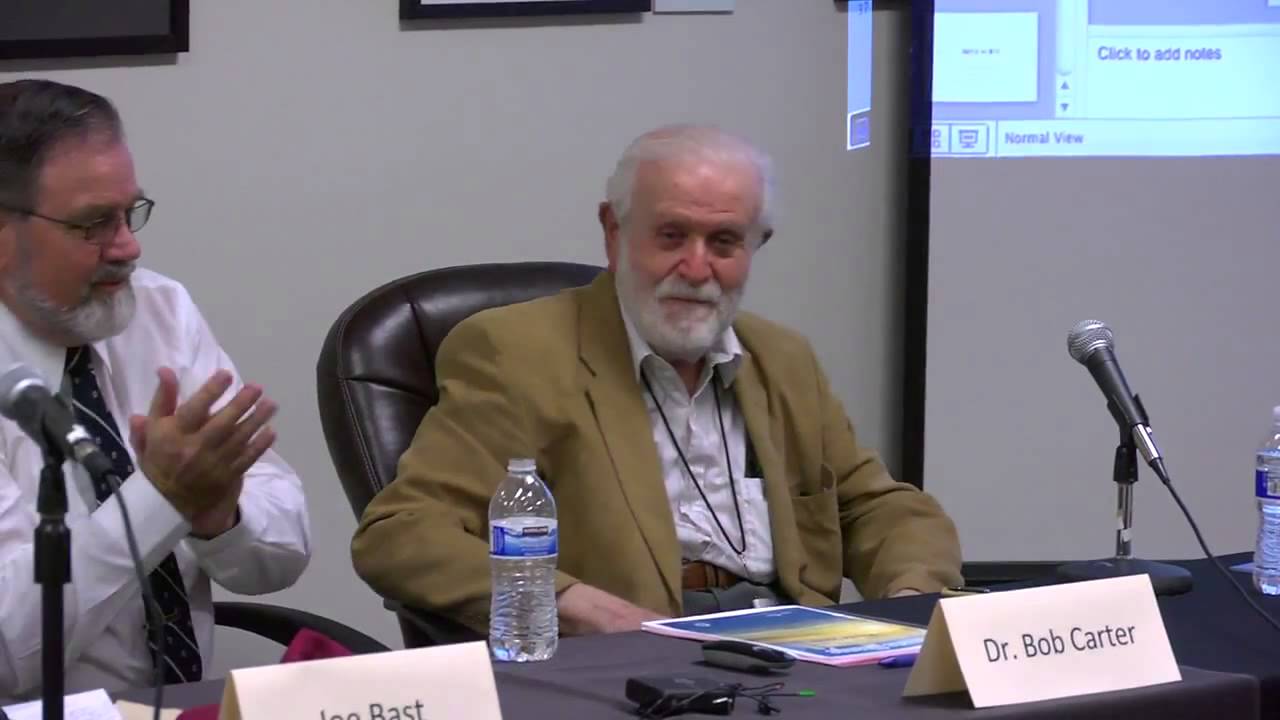 as “the mother of all environmental scare stories” but then suggested the science was actually a sinister cover for something else entirely.
“Groups on the left understand if we can control energy, you can control human beings, and that’s what it was all about,” claimed Bast.
Environmentalists were trying to “shut down the engines of the world,” Bast said, without saying why they might want to do any of those things.
“
“
NIPCC
NIPCC
After a round of applause, Bast said he hoped “other academies of science,” including Australia, would follow suit, implying the Chinese Academy of Sciences had somehow endorsed the report.
At the time of the Chinese version being released, Bast had issued a press release claiming a “historic moment” for global warming science. He sent Heartland staff, including Carter, to Beijing for a press opportunity.
But as DeSmog reported, the CAS issued a statement saying: “The claim of the Heartland Institute about CAS’ endorsement of its report is completely false.”
Bast was forced to apologize and had to pull the publication from his website and withdraw the original press release. But once Carter was out of China, Bast re-issued the press release and rejected the criticisms of the CAS.
Oddly, none of this detail made its way into Bast’s opening remarks.
Fake Discussion
==
August 2, 2009
Give BB&T Liberty, but Not a Bailout
:{OVER much of the last four decades, John A. Allison IV built BB&T from a local bank in North Carolina into a regional powerhouse that has weathered the economic crisis far better than many of its troubled rivals — largely by avoiding financial gimmickry.
And in his spare time, Mr. Allison travels the country making speeches about his bank’s distinctive philosophy.
Speaking at a recent convention in Boston to a group of like-minded business people and students, Mr. Allison tells a story: A boy is playing in a sandbox, only to have his truck taken by another child. A fight ensues, and the boy’s mother tells him to stop being selfish and to share.
“You learned in that sandbox at some really deep level that it’s bad to be selfish,” says Mr. Allison, adding that the mother has taught a horrible lesson. “To say man is bad because he is selfish is to say it’s bad because he’s alive.”
If Mr. Allison’s speech sounds vaguely familiar, it’s because it’s based on the philosophy of Ayn Rand, who celebrated the virtues of reason, self-interest and laissez-faire capitalism while maintaining that altruism is a destructive force. In Ms. Rand’s world, nothing is more heroic — and sexy — than a hard-working businessman free to pursue his wealth. And nothing is worse than a pesky bureaucrat trying to restrict business and redistribute wealth.
Or, as Mr. Allison explained, “put balls and chains on good people, and bad things happen.”
Ms. Rand, who died in 1982, has all sorts of admirers on Wall Street, in corporate boardrooms and in the entertainment industry, including the hedge fund manager Clifford Asness, the former baseball great Cal Ripken Jr.and the Whole Foods chief executive, John Mackey.
But Mr. Allison, who remains BB&T’s chairman after retiring as chief executive in December, has emerged as perhaps the most vocal proponent of Ms. Rand’s ideas and of the dangers of government meddling in the markets. For a dedicated Randian like him, the government’s headlong rush to try to rescue and fix the economy is a horrifying realization of his worst fears.
Indeed, so many bad things are happening that many followers of Ms. Rand, known as objectivists, believe that the ugly scenario in her 1957 novel “Atlas Shrugged” — in which the government takes over industry as the economy progressively collapses — is playing out in real life.
New regulations are being enacted by the day. The rich may be forced to pay for health care for the poor. The auto industry is a ward of the state. An activist administration occupies the White House. And, of course, the federal government has inserted itself into the nation’s banks, including BB&T, which accepted $3.1 billion in bailout money under the Troubled Asset Relief Program.
“Rand predicted what would happen 50 years ago,” says Mr. Allison, who notes that his bank was forced to take the money, which he labels “a rip-off.” “It’s a nightmare for anyone who supports individual rights.”
But as cringe-inducing as the government’s actions may be for objectivists like him, there is a silver lining: sales of “Atlas Shrugged,” which Ms. Rand considered her definitive work, are better than ever.
In the first six months of 2009, Penguin Books shipped more than 300,000 copies of the book, which opens with the famous question, “Who is John Galt?” That’s 25 percent more than in all of 2008.
“It’s just gone through the roof,” said Kara Welsh, publisher for the New American Library, a division of Penguin. There’s even a renewed effort to make a miniseries out of the book. The studio Lionsgate, along with the producers Howard and Karen Baldwin, hope to begin shooting as early as next spring.
“It is incredibly timely,” said Michael Burns, vice chairman of Lionsgate.
While book sales haven’t translated into a flood of new converts to objectivism, Yaron Brook, president of the Ayn Rand Institute, said attendance at this year’s Objectivist Summer Conference in Boston — where Mr. Allison delivered his speech — was the best yet for an East Coast event. (Attendance at conferences on the West Coast, where the institute is based, tends to be 25 percent higher, he says.)
Among the participants was Dr. Shira Miller, who became interested in Ms. Rand’s writing in college. She says objectivism continues to provide her with “a moral philosophy for how to live a good and happy life.”
Dr. Miller, who practices age-management medicine in Los Angeles, doesn’t accept Medicare or health insurance so there can be no third-party interference with her individual rights or those of her patients, she says. “Medicine is a product just like any other,” says Dr. Miller, likening it to toasters, computers or legal advice. “I should have the right to sell or trade it on my own terms, just like any other business owner.”
For his part, Mr. Brook is encouraged by the new interest in Ms. Rand’s work, but feels that it has yet to have much impact on the political debate. He’s also struggling to change a popular perception that the financial crisiswas caused by deregulation and the fiscal policies of a top Rand disciple: Alan Greenspan, the former Federal Reserve chairman.
Mr. Brook argues that the problem wasn’t deregulation, but “misregulation.” He also says it’s unfortunate that Mr. Greenspan continues to be associated with Ms. Rand. While the two were close in the 1960s and ’70s, Mr. Greenspan abandoned objectivism decades ago, he says. Through a spokesman, Mr. Greenspan declined to comment.
“If you look at every aspect of the political world, things are going against us, from health care to cap-and-trade,” Mr. Brook says. “And it’s accepted wisdom that the financial crisis was caused by capitalism.”
“In the narrow sense of objectivism, things have never been so good,” he adds. “When you look at the larger world, it’s pretty depressing.”
THE enduring popularity of Ms. Rand bewilders her many detractors, who complain that her writing is melodramatic, heavy-handed and intellectually bereft.
“To describe her as a minor figure in the history of philosophical thinking about knowledge and reality would be a wild overstatement,” says Brian Leiter, director of the Center for Law, Philosophy and Human Values at theUniversity of Chicago. “She’s irrelevant.”
Professor Leiter conducted an informal poll in March on his philosophy blog, asking, “Which person do you most wish the media would stop referring to as a ‘philosopher’?” The choices were Jacques Derrida, Ms. Rand and Leo Strauss. Ms. Rand won by a landslide, with 75 percent of the roughly 1,500 votes cast.
Professor Leiter says Ms. Rand’s views on moral philosophy and objective reality are “simple-minded in the extreme.”
“She doesn’t understand the historical positions of thinkers on these issues, such as Hume and Kant,” he says. “Even the minority of philosophers with some sympathy for her celebration of the virtues of selfishness usually find her general philosophical system embarrassing.”
Others contend that a lack of constraints on self-interested and greedy business people set the financial crisis in motion — a view that tends to undermine Ms. Rand’s theories on the value and social benefits of unfettered ambition and limited government.
“It takes a great leap of ideological blindness to look at the past few years and think that the main problem was too much government involvement,” said Robert B. Reich, a public policy professor at the University of California, Berkeley, who was a labor secretary in the Clinton administration.
Mark A. Thoma, an economist at the University of Oregon, says the financial crisis would have been worse if the government hadn’t rapidly intervened.
“I completely disagree with the idea that letting the markets heal themselves is the best idea,” he says. “We tried that in the ’30s, and it didn’t work out so well.”
Fiscal conservatives take an opposite tack, arguing that the government has intervened in overly aggressive and risky ways. They find much to praise in Ms. Rand’s economic views. Yet even for that crowd, her social views are a tougher sell.
Ms. Rand was an ardent atheist who considered the cross a symbol of how “a man of perfect virtue” sacrificed himself for a bunch of losers. “It is in the name of that symbol that men are asked to sacrifice themselves for their inferiors,” she said.
She had little time for women who stay home to raise children. Ms. Rand wrote sex scenes that one critic recently described as “dark, kinky and weird, but not in a good way,” in which normally tough businesswomen melt under the steely gaze and rough hand of übercapitalists.
Even so, Ms. Rand’s books have sold briskly without the sanction of academics and book critics since they were published.
Her black-and-white views were shaped by her upbringing in Russia, where her father’s pharmacy was taken over by Communists, who also suppressed free thought at her university. In 1926, she came to the United States, which she had idealized as a free nation that valued human achievement.
A short, chain-smoking woman with a severe haircut and heavy Russian accent, she once worked as a screenwriter in Hollywood and fashioned herself as “a radical for capitalism.” As her reputation grew, she was interviewed by Johnny Carson, Phil Donahue and Playboy magazine.
A member of her New York salon was the young economist Mr. Greenspan. Ms. Rand called him “the Undertaker” for his dark clothing and dour manner.
Mr. Greenspan, who wrote an article for one of Ms. Rand’s nonfiction books advocating a gold standard, was among those who listened to and praised early drafts of “Atlas Shrugged,” which Ms. Rand started writing in 1946.
It tells the story of Dagny Taggart, a brilliant and leggy railroad executive who steamrolls the “looters” and “moochers” who populate a deteriorating America to keep her trains running on time.
She is part of a loose collection of can-do industrialists who struggle against a rising tide of government intervention that seeks to lessen competition and redistribute wealth “for the common good.”
As conditions worsen, the most talented people flee society to an idyllic mountain retreat overseen by an ingenious inventor, John Galt, who wants to deprive a corrupt nation of its greatest minds and to facilitate its demise. He warns that the best thing the bureaucrats could do is “get the hell out of my way.”
Mr. Brook, of the Ayn Rand Institute, says Ms. Rand understood then, in 1957, an emerging trend toward more government influence, where “somebody’s need is a claim against our wealth.”
The problem with this, he says, is all too real.
“The last 50 years have been an orgy of placing need above wealth creation, above personal pursuit of happiness,” Mr. Brook says. “I think we are seeing the consequences of that today.”
MR. ALLISON of BB&T has the tall, lean frame, copper-colored hair and confident demeanor of many of Ms. Rand’s fictional heroes, including John Galt — a look “which would not seek forgiveness or grant it.”
He also has a résumé befitting a Rand prophet. He started at BB&T, once known as the Branch Banking and Trust Company, in 1971 and became chief executive in 1989, when the bank had $4.7 billion in assets.
By the time he retired as C.E.O. in December, he had overseen 60 bank and savings-institution acquisitions and turned BB&T into the 11th-largest bank in the nation, with $152 billion in assets, according to the bank.
A 60-year-old who speaks in a rapid-fire Southern accent, Mr. Allison says the current financial crisis is primarily the government’s fault. He criticizes the Fed as trying to manipulate normal business cycles and Fannie Mae and Freddie Mac as facilitating mortgages to people who couldn’t afford them.
The government’s remedies have made matters only worse, he says: “Almost everything that has been done since this crisis started is going to reduce our long-term standard of living.”
Mr. Allison says the government forced BB&T and some other healthy banks to accept TARP money to obscure that they were simply trying to save several large banks like Citigroup.
“Everyone thinks we got some kind of subsidy,” he says, noting that his company paid the money back in June, with interest. “It’s going to cost us about $250 million for money we didn’t want.”
He suggests that government get out of the way and let businesses start making money again. An example of how to make money? Look no further than BB&T, which, he says, has a proven formula for success that centers on “an uncompromising commitment to reason.”
Under Mr. Allison, new executives were handed a copy of “Atlas Shrugged.” All employees get a 30-page pamphlet describing BB&T’s philosophy and values: reason, independent thinking and decisions based on facts.
“Wishing something is so does not make it so,” Mr. Allison says. “I guarantee that long before the rest of us knew, those geniuses at Lehman Brothers knew that something was wrong, but they evaded it.”
Mr. Allison was introduced to Ms. Rand’s work in college, when he read her book “Capitalism: The Unknown Ideal.” He describes egalitarianism as the “most destructive principle in our society” and believes that the best employees should receive the most rewards.
“It’s not true that everybody is equal,” he says. “A lot of business people don’t want to deal with nonperformance.”
Mr. Allison cites two examples in which the bank’s philosophy guided its real-world decisions.
After the Supreme Court upheld the right of local governments in 2005 to condemn private property and hand it to someone else for commercial development, he says, BB&T refused to make loans to developers who obtained property that way.
He also says BB&T decided not to offer the controversial “pick a payment” mortgages that got so many of its competitors into trouble. Such loans, also known as “option A.R.M.’s” or “negative amortization loans,” allow borrowers to make payments that don’t even cover the interest on the loans, which causes the amount they owe to grow.
“While we did not foresee the decline in the real estate market, we knew home prices would not continue to appreciate at 15 percent per year forever,” he says, adding that his bank knew that pick-a-payment loans would be trouble for many homeowners.
“We believe Rand’s concept of the ‘trader principle,’ where life is about trading value for value, where both parties benefit from the transaction,” he says.
MR. ALLISON says that only a small fraction of the bank’s employees are objectivists. Among the many who are not is his successor as chief executive, Kelly S. King.
Bob Denham, a bank spokesman, says that “most employees don’t equate our values as being tied to John’s objectivist philosophy,” adding that “they just think of them as practical values, which they are.”
Christopher Marinac, an analyst at the research firm Fig Partners, says the culture at BB&T is definitely different from that of most other banks, attracting employees who “have their heart and soul in their job.”
He recalled attending his first analysts’ meeting at the bank a decade ago and being surprised when Mr. Allison launched into an hour-and-a-half lecture on philosophy.
“I think those of us who are a little more open-minded got something out of it,” Mr. Marinac says. “Their employees drink the Kool-Aid. If they don’t drink the Kool-Aid, they don’t work at the bank.”
Although BB&T has had problems during the financial crisis, it has outperformed its peers and remained profitable. After the government stress-tested major banks’ balance sheets in May, BB&T wasn’t required to raise additional capital.
“The philosophy has clearly been a competitive advantage,” Mr. Allison says.
Besides making speeches, Mr. Allison is also trying to spread Ms. Rand’s ideas to the nation’s colleges and universities. BB&T spends about $5 million a year to finance teaching positions and research on “the moral foundations of capitalism.”
Mr. Allison, who is now teaching at Wake Forest University, says the money isn’t specifically slated for objectivism but rather to support the work of “free-market professors, especially those that have a serious interest in Rand’s philosophy.”
Despite the current bleak state of capitalism, he’s also optimistic about the future.
“In some ways, Ayn Rand filled in the ideas of Aristotle. It’s a whopping competitive advantage,” he says. “I personally believe objectivism will be the dominant philosophy in this country in 25 years.”}:
==
omg; http://www.aynrand.org/site/PageServer?pagename=media_topic_science
eg
CO2 Restrictions Threaten Human Life
Washington, D.C., April 30, 2009--The Environmental Protection
Agency’s “finding” that carbon dioxide emissions endanger “the health
and welfare of current and future generations” is absurd, said Alex
Epstein, analyst at the Ayn Rand Center for Individual Rights. According
to Mr. Epstein, the real danger to Americans’ “health and welfare” is
policies designed to fight global warming by throttling energy sources
that emit CO2.
“Carbon energy has been and remains vital to the industrial society
that has doubled human life-expectancies, and, among a million other
benefits, enables us to cope with all manner of changes in climate.
“Right now,” Mr. Epstein pointed out, “carbon-based sources of energy
produce the most, cheapest energy, period—while sunshine and wind
gusts, despite decades of subsidies and propaganda, produce an expensive
1 percent of our energy.
“If scientists and entrepreneurs can discover and implement superior
sources that happen not to emit CO2, at better prices than today’s
energy sources, great. But whether that happens or not, we need to
recognize that our ‘health and welfare’ depend on free markets producing
industrial-scale energy above all else—and that anyone who tries to
shut down life-giving coal plants and oil rigs, in the name of avoiding
bad weather, is an enemy of humanity.”
Alex Epstein was a writer and a fellow on staff
at ARI between 2004 and 2011.
==
Background
The Ayn Rand Institute (ARI) is a 501(c)(3) nonprofit organization headquartered in Irvine, California. According to ARI's website,
it "works to introduce young people to Ayn Rand’s novels, to support
scholarship and research based on her ideas, and to promote the
principles of reason, rational self-interest, individual rights and
laissez-faire capitalism to the widest possible audience."[1]
As part of its strategy, ARI implements education programs and
distributes free Ayn Rand books to high schools. Since 2002, the Ayn
Rand Institute hasgiven out more than 1.4 million free copies of Ayn Rand novels to teachers in North America. [2]
The following is taken from Greenpeace's 2011 report (PDF) on Koch Industries' funding of the climate change debate: [3]
Based in Irvine, California, the Ayn Rand Institute (ARI) is
dedicated to laissez faire capitalism and the pursuit of self-interest
as developed by Russian-American author Ayn Rand. ARI's writers have
referred to a climate science report published by the National Academy
of Sciences (NAS) as"a lie," and have cited the fabricated "Oregon Petition." [4], [5]
ARI Senior Fellow Keith Lockitch, who spoke at the Heartland
Institute’s 2009 International Conference on Climate Change, authored a
paper denouncing the viability of clean energy and simultaneously
denying the scientific consensus of climate change despite arguing that
"development under capitalism has actually made us safer from
climate-related risks than ever before in human history." [6]
Acton's media director, Jay W. Richards, states, "climate is changing all the time, the real question is if humans are causing it." [7]
Richards also has ties to the Cato Institute and sits on the Board of
Advisors for the Committee For A Constructive Tomorrow (CFACT), one of
the most vocal anti-environmental fronts for the petrochemical and
biotechnology industries. Acton's governing boards reveals other Koch
connections through Dr. Alejandro A. Chafuen of the Atlas Economic
Research Foundation and Michael Novak of the American Enterprise
Institute, as well as affiliates of Amoco (BP) and Wolverine Gas and
Oil. [8]
Stance on Climate Change
"[...] vulnerability to the climate has been a feature of human
existence for all of human history; there have always been droughts and
floods and hurricanes and heat waves—and there always will be,
regardless of what happens to atmospheric greenhouse gas concentrations.
Moreover, the history of industrial development has been one of an
ever-increasing ability to cope with natural disasters—an ever
increasing resilience against them.
"A broader perspective on climate vulnerability suggests that
industrial development under capitalism is not merely one factor among
others influencing susceptibility to climate-related risks. Rather, it
is the dominant factor, reducing climate vulnerability to a degree that
makes all other factors irrelevant.
"But the life-saving value of industrial capitalism is profoundly
unappreciated in today’s culture. This is not merely because people have
forgotten or ignored its history, but because its opponents have
actively sought to bury and distort that history.
"[...] Fundamentally, this is a debate about how society should be
organized. The advocates of statism have made their position clear and
are actively working to advance their cause. It is time for those who
value freedom to do the same." [9]
"Regardless of one’s views on global warming--and there is ample
scientific evidence to reject the claim that manmade carbon emissions
are causing catastrophe--the fact is that kneecapping the fossil fuel
industry while diverting tax dollars into expensive, impractical forms
of energy will not be an economic boon, but an economic disaster."[10]
Funding
According to Media Matters, the ARI has received $88,000 from the Rodney Fund. [11]
Greenpeace's Polluter Watch project reports that the Institute received $50,000 from Koch foundations between 2005 and 2010. [3]
Key People
Board of Directors
As of May, 2012, the ARIlisted the following directors on their website: [12]
- Michael S. Berliner — Board Co-Chair.
- Arline Mann — Board Co-Chair.
- Yaron Brook — President and Executive Director.
- John Allison
- Carl Barney
- Harry Binswanger
- Peter LePort
- Tara Smith
Staff & Fellows
- **Alex Epstein**— Former Fellow.
- Onkar Ghate — Senior Fellow and Vice President of Intellectual Leadership (as of Sept 2012). [16]
- Elan Journo — Fellow and Director of Policy Research (as of Sept 2012).
- **Keith Lockitch** — Instructor and OAC Program Officer, Fellow (as of Sept 2012).
- Don Watkins — Fellow (as of Sept 2012).
Actions
Ongoing
Greenpeace's PolluterWatch reports that Alex Epstein of ARI's Center for Individual Rights regularly publishes opinion pieces in outlets like Fox News, the American Thinker and the Daily Caller "promoting fossil fuel use and attacking environmental safeguards." Such articles include: [3]
- "6 Questions for Environmentalists on Earth Day," Fox Forum, 4/22/2010
- "The 6 Myths About Oil," Fox News opinion, 12/29/2010
- "Greens vs. Energy," American Thinker, 4/22/2011
- "Four Dirty Secrets about Clean Energy," Fox News opinion, 6/3/2011
- "We're Running out of Freedom, Not Oil," Daily Caller, 8/10/2011
May 21 - 23, 2012
The ARI is listed as a co-sponsor of theHeartland Institute's Seventh International Conference on Climate Change (ICCC7). [13]
March 8 - 10, 2009
The ARI was a co-sponsor (PDF) of the Heartland Institute's 2009 International Conference on Climate Change. [14]
DeSmogBlog researched the funding behind Heartland's Second International Conference on Climate Change
and found that sponsor organizations had received over $47 million in
funding from energy companies and right-wing foundations, with 78% of
that total coming from Scaife Family foundations.
December 30, 2004
The ARI sent out a press release stating that the "U.S. Should Not Help Tsunami Victims" days after the South Asian tsunamiwhich killed over 230,000 people in fourteen countries.
"That's certainly one way to keep alive the spirit of the author of
'The Fountainhead' and 'Atlas Shrugged,' for whom altruism was a dirty
word and the productive, heroic pursuit of one's own happiness the
highest ideal. After widespread ridicule, the Institute removed the
statement from its website, offering the clarification that it was
opposed to all government-sponsored charitable giving (since the money
isn't the government's to give), and that singling out this instance,
just now, was 'inappropriate'." [15]
Related Organizations
Resources
- "Overview," Ayn Rand Institute. Accessed May 12, 2012.
- "Free Books to Teachers Campaign," Ayn Rand Institute. Accessed May, 2012.
- "Koch Industries: Still Fuelling Climate Denial 2011 Update"(PDF), Greenpeace, April, 2011.
- Tracinski, Robert, "Global Warming Fraud," Ayn Rand Institute, June 21, 2009.
- Ghate, Onkar, "Global Warming – Just the Facts, Ma'am," Ayn Rand Institute. Accessed Jan. 26, 2011.
- "Speakers," Heartland Institute, March 5, 2009. Archived June 10, 2011.
- Richards, Jay W., "An Earth Day Review of Global Warming," Acton Media/Acton Institute. Accessed Jan. 26, 2011.
- Bandow, Doug. "10. Book: Money, Greed and God," Cornwall Alliance, September 4, 2009. Accessed Jan. 26, 2011.
- Keith H. Lockitch. "CLIMATE VULNERABILITY AND THE INDISPENSABLE VALUE OF INDUSTRIAL CAPITALISM,"(PDF), Energy & Environment, Volume 20, No. 5 (2009).
- Keith Lockitch. "The Green Energy Fantasy," Ayn Rand Center for Individual Rights. Accessed May, 2012.
- "Ayn Rand Institute," Media Matters. Accessed May 12, 2012.
- "Board of Directors," Ayn Rand Institute. Accessed May 12, 2012.
- "Cosponsors," 7th International Conference on Climate Change. Accessed May 12, 2012.
- "International Conference on Climate Change Sponsored by the Heartland Institute" (Conference Program - PDF), The Heartland Institute. Archived March 7, 2010.
- Christopher Shea. "Ayn Rand's campus radicals," The Boston Globe, February 13, 2005.
- "ARI Staff," Ayn Rand Institute. Accessed September 30, 2012.
- "Ayn Rand Institute," SourceWatch.
- "Ayn Rand Institute," Wikipedia.
Tags:
Heartland Institute Seventh International Conference on Climate Change
Koch Industries climate denial
https://www.facebook.com/keith.lockitch
Specialties: Environmentalism, Animal "Rights," Philosophy of Science, Philosophy of Physics, Religion, Reason vs Faith, Intelligent Design

Dr. Keith Lockitch has a PhD in physics from the University of
Wisconsin at Milwaukee and is a fellow at the Ayn Rand Center for
Individual Rights, and teaches at the Institute’s Objectivist Academic
Center. His writings have appeared in publications such as the Washington Times, Orange County Register and the San Francisco Chronicle.
Essays
Lectures
- Creationism in Camouflage
- Darwin and the Discovery of Evolution
- The Real Goal of the Green Climate Crusade
Op-Eds
Will FDA choke off promising adult stem cell research? [The Daily Caller] Friday, August 10, 2012 |
|---|
The Real Meaning of Earth Hour Monday, March 23, 2009 |
|
Wednesday, February 25, 2009 |
|
Friday, January 9, 2009 |
The Real Meaning of Earth Hour Monday, April 14, 2008 |
|
Saturday, March 22, 2008 |
|
Tuesday, October 16, 2007 |
|
Wednesday, May 23, 2007 |
Reject Environmentalism, Not DDT Tuesday, September 19, 2006 |
The Conservatives' War on Birth Control Monday, September 18, 2006 |
Why We Are Losing Hearts and Minds Wednesday, September 6, 2006 |
"Intelligent Design" Is about Religion versus Reason Sunday, December 11, 2005 |
The Bait and Switch of "Intelligent Design" Thursday, August 4, 2005 |
|
Tuesday, June 3, 2003 |
Press Releases
Letters to the Editor
Environmentalist Ideologues to Blame for Malaria Deaths (Herald Community Newspapers) Thursday, December 20, 2007 |
|---|
Environmentalist Ideologues to Blame for Malaria Deaths Thursday, December 20, 2007 |
Embryonic Stem Cell Research Is Ethical Friday, June 22, 2007 |
|
Friday, June 1, 2007 |