Epstein, Alex CIP
SEE TWO
NTBCW RICHARD HOOVER LIBTARD
see Healey MA lawsuit (with UK sp?)
http://dailycaller.com/2016/06/15/global-warming-skeptic-responds-to-massachusetts-ags-subpoena-fk-off-fascist/
FEDSOC
FRED SINGER LINDZEN BRYCE
HOOVER HEARTLAND
LOMBORG
LIBTARD FREEDUMB STOSSEL
INCUBATOR
KOCH IER YAF
SCHNare
THIEL
TPPF
Epstein had a terse response to a subpoena sent by Massachusetts Attorney General Maura Healey Wednesday.
2 disambig this main
// deniers and covid
===
TWO HEADERS
SEE KIRK
mises inst CATO FISHER ATN RAND YAF STats CMPA
WESTERM CIV LEW ROCKWELL
SHILLENBERGER
THIEL
WATTERS
BARI WEISS
---
:{:{cspan booktv steamboat?}:
:{:{===}:
}:
:{:{}:
}:
the industry-backed climate deniers at the Heartland Institute held their big climate disinfo conference last week, with hours and hours of mostly old, almost exclusively white, and predominantly male free market fundamentalists talking to each other. While Heartland's weekly climate newsletter claimed:{ to have gotten over 100,000 views on the stream, the YouTube videos from the 2-day denialfest struggle to }

Even more pitiful is that they brag about getting coverage, but all they can point to are three stories, two of which are very critical of Heartland's conference. Scott Waldman at E&E described it as "who’s who of climate deniers," and focused on Trump election denial lawyer (detained pantless) Jeffrey Clark, who "held up a piece of cardboard on which he had written 'meta control'" to illustrate his discussion of the "communistic purposes" and the "self-interested… dark forces" behind climate change.

the second story Heartland had to promote (because there was nothing kinder) was from Inside Climate News, where Kristoffer Tigue covered the conference in the context of how it disproves the propaganda about the GOP's supposed climate conversion. He described Heartland as having "a long history of spreading misleading and false claims about global warming" and being "widely viewed by climate advocates as a disinformation machine." (Fact check: true, but it's not just climate advocates! Journalists like Emily Atkin have referenced Heartland as being part of the disinformation machine, author Shawn Laurence Otto called it back in 2012, as have professors and scientists like Michael Mann, and Duke historian Nancy MacLean even listed Heartland in an Orion Mag piece headlined "The Disinformation Machine.")
Somewhat disappointingly, by comparison, the third link Heartland had to show for its work was from fringe right-wing blog Ace of Spades HQ, which is only worth mentioning for the sake of acknowledging the disinfo conference’s third media hit. We'll just mention that this post praising Heartland's conference ends with an old song about spring being a little late this year, which is funny, because it was in the 80s in February when Heartland held the conference in Orlando, a cool 20°F above average.
But those articles actually weren't the only coverage that Heartland got! It received a second favorable write-up from Cowboy State Daily, another right-wing blog. There's little worth saying about it, except that itfocused on comments by Alex Epstein, theBig Oil whipping boy who was Heartland's keynote speaker.
It was interesting to see the Cowboy State's reporting that Epstein, in addition to his standard spiel, also said that conservatives need to reframe the climate and energy issue. Specifically, Epstein turned to none other than "Martin Luther King" to support his case, because the Reverend/Dr./Nobel laureate — supposedly — just reframed "the issue of civil rights around the idea that people should be judged by the content of the character and not their skin color" and found success by linking policies "to a goal people agreed with."
While white people have exploited, appropriated and bastardized King's advocacy for years, this is a particularly egregious example when you know about Alex. Not only is Epstein invoking Martin Luther King Jr. to sell a product that disproportionately hurts Black communities, in a way that shamelessly invokes King's "Dream" as though it were merely a marketing gimmick or crisis communications trick, but also it's not even an intellectually honest speech by Epstein, because Alex has a history of trashing the very legacy that he now co-opts for his fossil fuel propaganda.
Epstein's racist history was covered by The Washington Post last year, and his reaction didn't exactly clear him of the allegations. Back in college, Epstein argued against recognition of Martin Luther King Jr.'s birthday as a federal holiday. He noted that "Black crime has increased steadily since King’s time," and then wrote, and published, on purpose, in a college newspaper, that "because of the bad ideas he promoted, Dr. King is responsible for a great part of the destruction that has occurred in America today, especially among black Americans."
Yes, demonstrating his early adeptness at disinformation, a young Epstein blamed Martin Luther King Jr.'s "bad ideas" for causing the Black struggle, as though campaigning against about structural racism is what actually somehow caused the symptoms of that structural racism decades later.
Alex Epstein is on the record, in writing, of disapproving of Martin Luther King Jr's "bad ideas" about race. So why is Epstein invoking those very ideas now, to sell fossil fuels?
Because that's how propaganda works, and this is as hamfisted as it gets.
Epstein’s hypocritical past might just be why Heartland chose to promote two stories embarrassing them, instead of the one that let Epstein embarrass himself.
===
omfg
https://www.youtube.com/watch?v=s6b7K1hjZk4
The Moral Case for Fossil Fuels | Alex Epstein | Talks at Google
114,699 views Aug 16, 2017
origin story?
2.9K like no dislike?! comments overwh favorable
1.89M subscribers
Energy philosopher Alex Epstein, author of The Moral Case for Fossil Fuels, challenges conventional wisdom about the fossil fuel industry and argues that if we look carefully at the positives and negatives of all our energy alternatives, we have a moral obligation to use more fossil fuels, not less.
Get the book here: https://goo.gl/nejqGy
utube
fox biz gorsuch scotus epa lawless inst
https://www.youtube.com/watch?v=Q5W4m5s4Gwo
spiked, candace, reasontv improve the planet 3x debate mcK, sierra club
===
2022 desmog
Don’t Worry, Just Adapt!
Another narrative emerging from the denial anddelayer camp is that “adapting” to climate change will be our lifeline: Those perpetuating it end up downplaying the impacts of the climate crisis because they say we will be able to adapt to it.
In a May 31 Slate article about Alex Epstein’s new book Fossil Future, which advocates for fossil fuels, Nitish Pahwa writes: “The new style of climate denial is here: It’s not that carbon emissions aren’t increasing, or aren’t warming the world, but look, you’re doing fine right now, right? So, we’ll be just fine!”
On May 20, Stuart Kirk, the head of responsible investing for HSBC’s asset management division, “Who cares if Miami is six meters underwater in 100 years? Amsterdam has been six meters underwater for ages, and that’s a really nice place. We will cope with it.” Kirk was later suspended for his comments.
[vid]
stuart Kirk, head of responsible investing for HSBC’s asset management division, was suspended for his comments to investors in which he downplayed the risks of climate change.
This argument implies that working to slow climate change is futile and offers adaptation as “the only possible response” to the climate crisis, according to Roberts and his colleagues in their “Discourses of delay” analysis.
---
no lnx many
If you are concerned about our warming world, you should know who Alex Epstein is. The libertarian intellectual, who’s presented himself as the “next generation in energy thought,” has long hammered at a thesis that’s the next big thing in climate denial: Fossil fuels are not leading to an uninhabitable Earth, but have actually improved Earth’s natural and built habitats and contributed to “human flourishing.”
Because of this, the unfettered development of oil and gas and coal is a “moral” imperative; if you oppose this “irrefutable” fact, you’re a genocidal, racist, anti-human, and anti-science fool who would rather have billions of people slip into poverty and/or die for the benefit of “nature,” which, Epstein argues, kills more humans on its own than any climate effects do. It’s a set of ideas he’s boosted for the past two decades through work with the Ayn Rand Institute, the Cato Institute, and his own “for-profit” think tank, the Center for Industrial Progress.
Epstein, a master at having it both ways, realizes that you, the average Slate reader, probably consider his mission to achieve unlimited fossil fuel production to be at odds with global concerns over human-influenced impacts on climate and nature. And trust him, he shares your concerns and would not like to be described as a “denier.” But he’s also really worried about how our “knowledge system”—big newspapers, prominent scientists, the United Nations—distorts scientific findings and exaggerates climate-related warnings and predictions, which is why he pals around with conspiracy theorists like Lauren Boebert, Dennis Prager, Scott Adams, and Candace Owens.
By the way, as much as Epstein respects the Koch brothers, his ideology would never be influenced by their dark money network, even though he’s worked for decades at multiple institutions financially supported by the oil and policy magnates. Plus, he wants to debate opponents in good faith and is opposed to “ad hominem” attacks, which is why he refers to climate-concerned politicians as “fascists” and “monsters” while mobilizing his supporters to demand the termination of journalists who perform factual analyses of his oeuvre.
Epstein has of course been criticized by several climate-focused journalists, scholars, activists, and scientists, and has made a big show of holding debates with thinkers like Bill McKibben. These critiques have not stopped his ideas from gaining currency within U.S. politics, especially following the publication of his first bestseller,The Moral Case for Fossil Fuels, in 2014. His concepts have been embraced and regurgitated by publications like the Wall Street Journal, companies like Chevron, Koch-backed PACs like the Club for Growth, politicians like Texas Rep. Dan Crenshaw, and organizations like Young America’s Foundation. Epstein has testified to Congress multiple times on the need for fossil fuels—invited by Sen. Jim “Snowball” Inhofe—and enjoyed the support of the far-right, explicitly anti-democratic political operative Peter Thiel.And now, Epstein’s used his elevated profile to release another tract building upon his moral worldview, titled Fossil Future: Why Global Human Flourishing Requires More Oil, Coal, and Natural Gas—Not Less.
With the blessing of Penguin Random House’s Portfolio imprint, which bills itself as providing nonfiction for “ambitious people” and also published Epstein’s previous book, Fossil Future offers a newer, more reassuring flavor of doubt regarding the consequences of human-influenced climate effects. Oil and gas and coal aren’t actually ruining Earth’s habitats for all forms of life, and they’re also not neutral—in fact, fossil fuels are making things better for all of us, thanks to their natural density and economic efficiency. But even if they do lead to rising carbon levels and emissions, it actually won’t be that bad, at least not as horrific as the economic fallout of transitioning away from fossil fuels would be. Epstein argues that fossil fuels will actually protect us from their own adverse side effects, that phenomena like mass human displacement and ocean acidification won’t really be issues, and that all government standards meant to stem greenhouse gas emissions must be done away with. To retain the standard of living billions of Earthlings enjoy, and to bring this “flourishing” to the billions more Earthlings who don’t yet enjoy it thanks to influence by “anti-human” climate activists, unlimited fossil fuel production is the only way forward.
Epstein presents himself as a young naïf who, before 2007, was led astray by climate “catastrophizers” into believing there are no benefits to fossil fuels. That’s an unlikely story, considering he’d been publishing pro-oil and anti-environmentalism pieces as far back as 2004, but it makes for a good morality tale and fashions him into a handy audience surrogate. He claims to have written Fossil Future “primarily for the countless honest, good people who expect to strongly disagree with me.” The book is marketed as an “honest, pro-human, pro-science analysis” praised by such supposedly credible figures as Scott Pruitt and Mark Mills. With Fossil Future, Epstein earnestly writes, he wishes only to present one side of a “debate,” and to convince skeptical readers that his thesis is “definitive.”
In the interest of fairness, I’ll start with the rare moments Epstein makes valid points. Much of the setup for Fossil Future’s thesis rests on historic predictions of climate change–fueled disasters that didn’t end up panning out, such as ’70s-era projections of “global cooling,” as well as past environmentalists’ warnings of “peak oil” depletion and a “population bomb.” As Fossil Future makes sure to emphasize, there were projections from prominent studies that overshot the amount of temperature warming we’d see by certain years—though it’s worth noting that even when you factor in such overshoots, the vast majority of historical climate change projections were found to have been accurate. (The idea that the reason certain past models missed specific benchmarks could be that environment- and climate-friendly measures were adopted in the years following such studies never seems to cross this author’s mind.)
Epstein also fairly notes that the classification of who counts as a “climate scientist” can be somewhat broad and unspecific, and that it hasn’t helped the case of climate activists that some of these scientists opposed the buildout of nuclear fission, a viable (and relatively safe) clean energy source, while perhaps championing biomass, which is neither.* He also lays out the hypocrisy of companies like Apple claiming to be “renewable” through employing dubious “carbon offset” accounting, which—yeah? That’s not good. That’s about all the book gets right, however, and a lot of these arguments are ones that climate advocates themselves have advanced.
It’s important to define the philosophical place from which Epstein approaches his evaluation of human-caused climate effects: by seeing human-industrial impacts as not only a net good, but as the only just way of the world. He mentions his support of animal testing for medicine and science, a stance he claims to share with “most people” (not really), because our “primary moral goal” should be seen to “advance human flourishing,” not “prevent animal suffering and death.” If you’re not on board with this, Epstein writes, you are thinking from an “anti-human” stance and are totally fine with people dying.
If you perceive this line of argument as reductive and generalizing, well, let me tell you it’s exactly that kind of reasoning that underpins the rest of the book. Per Epstein, banning DDT was wrong, mass die-offs of fish in the oceans would be fine because the only actual loss would be to the fishing industry, and humans were mere patsies who existed mainly to be killed en masse by natural disasters before they learned to “master” nature using fossil fuel–powered industrial machines and tools. (He later makes the case that it actually could be fine for the planet to reach blazing temperatures, because in past eras, when global temperatures were far hotter than now, primates were still able to thrive. OK, so which one is it?)
Epstein reduces millennia of human history to the preindustrial age and everything after, making some convenient elisions in the process. He claims that systems like mass agriculture, fire management, and storm resistance assumed their full and best form only after the first oil wells were dug. The incredible accomplishments and advances in all these fields made by ancient civilizations and Indigenous peoples get zero mention, which checks out for a man with a lifelong belief in the “superiority” of “Western culture.” He makes straw men out of climate activists’ critiques of human impact on nature, claiming that they’re actually opposed to all human effects on natural environments and would rather have “people in Africa” die than get access to energy. Literally a simple Google search would make anyone realize this is poppycock, considering how cautious many international energy-transition partnerships have been, keeping in mind current resources and economics while gradually installing green energy sources. But that’s the level of rigorous study exhibited within this screed.
Near the beginning, Fossil Future includes two graphs showing how, as fossil fuel production increased, so did the human population. If fossil fuels actually worsen our habitats, how come there are so many humans? Checkmate! Epstein tries to build off such data to prove that fossil fuels are responsible for human “flourishing,” even though he admits that the large majority of the world currently lives in poverty. But to him, the reason that many other countries are poorer and lack energy access is clearly because they don’t have enough fossil fuels. Naturally, the continuing exploitation of formerly colonized nations is never mentioned. He points to India as a paragon of fossil fuel development, which has resulted in the well-being of its massive population—an interesting section to read, as millions of Indians’ power lines have been knocked out recently by climate change–strengthened heat waves.
The author downplays the growth of renewables over the decades, purporting to show that solar and wind just inherently don’t have the same “cost-effectiveness” of fossil fuels, which is why they depend on government subsidies, lead to environmental damage when they are built, and don’t dominate the power grid.This is, of course, a way to sidestep the massive environmental degradation fossil fuel companies have inflicted over centuries (with the support of government subsidies all the while), and continue to inflict with the support of current subsidies and federal land auctions. Epstein is not wrong that electricity-powered plants have helped to clean up water supplies for mass consumption, although he undercuts himself here when he claims there is basically nothing wrong with fracking—sorry to you if your groundwater was polluted by its effects.
:{I could go on regarding the myriad ways Epstein misrepresents history and science and activism, whether by stating that “net zero” means total fossil fuel elimination (which is definitionally not the case), or claiming that increased carbon dioxide will just be more “plant food” (which is incredibly misleading), or spewing the pseudoscientific claim that only certain parts of the world will become warmer, which is good because humans like warmth. (They also love frequent, long-lasting droughts and heat waves, naturally.) But I’ll wind down by looking at another stat Epstein hitches his train to: the idea that “climate deaths” have dropped over time.
It’s difficult to count deaths that can be directly blamed on climate change, to be sure, as attribution science has been careful not to overstate such assumptions, while surveys of such deaths have bafflingly excluded causes of death like pollution. And it’s not untrue that weather warning and resilience systems powered by technology have saved lives, even as high-impact storms have increased in amount and severity. But if you look at the entire scope of climate-affected natural processes—everything from pollution to large hurricanes to pathogens to crop die-offs to farmers’ livelihoods to infrastructure collapse to power loss from frozen gas lines and still more—the relatively low numbers we point to as “climate deaths” seem a little more deceptive.}:
At the end of the day, it still feels somewhat futile to counter all these individual points of argument. Alex Epstein’s lengthy, tedious, repetitive tome returns to one idea, over and over again: We live in a society powered by fossil fuels, and no matter the problems we have now, the “flourishing” of modern society dictates that we only need more, more, more. In effect, Fossil Future reads like an earnest, book-length version of Matt Bors’ “You Participate in Society” comic-turned-meme: If you hate fossil fuels, you hate the humans (like you and me) who’ve benefited from them as a power source, and therefore, you are only to be mocked.
The most troubling thing about Epstein, though, may be that he’s basically already won. The United States is set to keep drilling more oil and natural gas to try to stem current price instabilities, even under a “climate president.” The same major newspapers Epstein derides as catastrophizing about the issue still regularly publish op-eds that downplay the severity of global warming. Others not of Epstein’s intellectual bent have either implicitly or explicitly considered climate effects to be “manageable.” The new style of climate denial is here: It’s not that carbon emissions aren’t increasing, or aren’t warming the world, but look, you’re doing fine right now, right? So, we’ll be just fine! So, congrats to Alex Epstein, congrats to Penguin Random House, congrats to all the backward poors in non-Western civilizations, and congrats to all of us who will surely live lives ever more empowered and thriving, even as ecological collapse kills more of us year after year.
Correction, June 3, 2022: This piece originally misstated that nuclear fusion is a viable power source. Nuclear fission provides a viable power source; fusion reactors are still in a research and development stage.
---
---
lots of youtube
ayn rand inst objectivist philos
https://www.youtube.com/watch?v=_xJbJDEVOyM
143K subscribers
When it comes to energy and the environment, Americans not only get the wrong facts, arguments, and narratives—they get the wrong philosophy. Alex Epstein, who recently published perhaps the most important book of our time, joins Jeff and Bob to explain. Get Alex's new book Fossil Future: https://Mises.org/Fossil
---
http://www.forbes.com › sites › alexepstein › 2015 › 01 › 06 › 97-of-climate-scientists-agree-is-100-wrong
'97% Of Climate Scientists Agree' Is 100% Wrong -:(style="background-color:#ffffffff"):}: :{Forbes
Jan 6, 2015 If you look at the literature, the specific meaning of the 97% claim is: 97 percent of climate scientists agree that there is a global warming trend and that human beings are the main cause--that...
---
===
https://documented.net/investigations/alex-epstein-fossil-future
Alex Epstein is a self-styled “philosopher and energy expert” closely affiliated with the fossil fuel industry. The author of “The Moral Case for Fossil Fuels” and the upcoming “Fossil Future” (to be released May 24th), Epstein uses his platform to attack climate science and those concerned with impacts of climate change. He advocates using “energy poverty” as a talking point in favor of fossil fuels, and accuses environmentalists of racism. Coal and oil corporations have increasingly taken up Epstein's messaging in recent years.
However, a series of articles Epstein authored in college as publisher of the Duke Review reveal that Epstein considered non-Western cultures, specifically African cultures, “inferior,” and homeless people "worse than useless." Epstein also wrote multiple articles advocating for the cancellation of Martin Luther King Jr holiday. Last week, after being asked for comment on his writings by the Washington Post, Epstein defended his past work, saying "I do think western culture is overall superior."
The writings, obtained by Documented and featured in a recent Washington Post article, raise new questions about the authenticity of Epstein's concern for “energy poverty,” which he often with references to African nations. These new revelations also raise questions about the degree to which Epstein's views on western culture's supremacy undergird the fossil fuel industry's instrumentalization of poverty as a talking point.
Locke, Aristotle, and Newton have had no equivalents in Africa or Asia, and the advancements in those areas have been almost exclusively due to Western influence. To see the results, just compare New York to Chad. No benefit can be gained by focusing an education on anti-reason cultures, their only academic merit lies in contrasting them to Western civilization as models of inferiority.Alex Epstein, "Curriculum 2000," Duke Review, March 1999
The African and African American studies department has 23 classes. In many of these classes, African culture is presented, not as inferior to Western culture, but on equal footing with it. The same is done with Latin American, Indian, and American Indian culture.Alex Epstein, "The Real Cause of Binge Drinking," Duke Review, April 2000
In another piece, Epstein said, "It is often said that America was 'built on the backs of slaves.' This is simply false."
While blacks in the pre-Civil War period were shackled by slavery, blacks today are not. Nor are they forcibly held back by legal segregation or Jim Crow laws. They are free to work hard, earn money, and succeed, as many do.Alex Epstein, "The Racism of Reparations," Duke Review, March 2001
During that same period, Epstein published a 2000 article titled, “Martin Luther King: Is he Worthy of a Day Off Over Jefferson, Columbus, and Lincoln?” where he stated:
Black crime has increased steadily since King's time, and seven out of ten black children born today have parents that are not married. Could it be that there is a reason behind all these problems, a reason having to do with ideas? Since a culture is just the dominant ideas accepted by a certain group of people, a culture yielding bad results is based on bad ideas. I submit that because of the bad ideas he promoted, Dr. King is responsible for a great part of the destruction that has occurred in America today,especially among black Americans, the group he supposedly saved. Alex Epstein, "Martin Luther King: is he worthy of a day off over Jefferson, Columbus, and Lincoln?" Duke Review, February 2000
He also criticized the idea of corporations giving back to the community, writing that "the homeless, those on welfare, medicare recipients...are worse than useless to businesses."
Not all "others" benefit a business. Certain others - the homeless, those on welfare, Medicare recipients - are worse than useless to businesses. A business benefits only by dealing with an individual or company that creates value. Alex Epstein, "Giving Back to the Community," Duke Review, November 2000
Documented is publishing a selection of articles authored by Alex Epstein in the Duke Review, which you can find below. The full collection of Duke Review issues from 1999-2001 are available upon request.
...[more docs eg]
spreading Pro Fossil Fuel Disinformation
Epstein, founder of the for-profit company Center for Industrial Progress, is an aggressive supporter of the fossil fuel industry. He sometimes sports an  ” t-shirt, denies climate science, and attacks critics of the fossil fuel industry as
 . This has made him popular with Republican politicians, and he has appeared in three Congressional hearings as an expert witness. He also influences oil policy directly as a
 of the Interstate Oil and Gas Compact Commission (IOGCC), a powerful quasi-regulatory body that lobbies for oil and gas interests.
Through his Energy Talking Points project, he provides message guidance to oil industry leaders and elected officials, often at high levels. Email correspondence obtained by Documented revealed that Texas Gov. Greg Abbott’s office circulated talking points authored by Epstein during the deadly 2021 winter storm Uri. The messaging document sought to falsely lay the blame for the mass power outages on wind and solar energy projects. Similar messaging documents advocate blaming “energy poverty” on renewable energy use.
Funding
While Epstein’s for-profit hides its funding sources, he’s admitted receiving funding from coal companies and utilities like SoCalGas. The Prometheus Foundation (headed by for-profit school magnate Carl Barney) has alsocontributed.
A sizable portion of Epstein’s income seems to be derived from paid speeches to corporations, trade associations, and political groups. For instance, Epstein has been known tosolicit large fees to debate prominent climate advocates, and he has used his past debates with Bill McKibben, Robert F. Kennedy, Jr., and others to attempt to reach other audiences. Epstein recently debated climate scientist Andrew Dessler at a March 11-12 event hosted by the Steamboat Institute and sponsored by Liberty Oilfield Services.
Many of his clients are the predictable oil corporations and oil lobbying groups, but he has also spoken at and the

The Wilks Brothers and PragerU
Dan and Farris Wilks aretwo of the largest funders of PragerU (AKA “Prager University”). Farris’ Thirteen Foundation gave $1 million to the foundation in 2015, while Wilks has given at least $120,000 through the Heavenly Fathers Foundation, according to publicly available 990 forms reviewed by DeSmog. [13]
PragerU, which is not an accredited academic institution, was created by conservative radio talk show host Dennis Pragerwho has “historically fought against what he describes as ‘liberal’ evils—marriage equality, feminism, and multiculturalism.” According to its 2014 annual report, PragerU was advancing with the specific goal of targeting middle school and high school children. [13]
The group’s “Environmental Science” course is dominated by climate change deniers such as Alex Epstein,Bjorn Lomborg,Patrick Moore, and Richard Lindzen.[14]
Dennis Prager has called campus rape a “gargantuan lie to get votes” and “nonsense” promoted by the “feminist left.”[15]
Stance on Climate Change
July 2013
“If [God] wants the polar caps to remain in place, then he will leave them there,” Wilks said, according to sermons reviewed by *Reuters*. [11]
---
June 5, 2013
The Statistical Assessment Service's Jon Entine (STATS Senior fellow and Executive Director of the Genetic Literacy Project) is a signatory toCenter for Industrial Progress' letter titled, “Don’t Divest, Educate—An Open Letter to American Universities.” [22]
In the letter, Alex Epstein and several other notable climate change deniers, including Peter Ferrara, J. Scott Armstrong, Steve Goreham, S. Fred Singer, David Schnare, Richard Lindzen, and Matt Ridley, proclaim that they are “proud to stand in favor of fossil fuels.” [22]
The “undersigned scientists, philosophers, energy experts, and economists” of the letter ask for a “more rigorous education on energy and environmental issues,” and “are willing to debate anytime, anywhere to defend what [they] believe is right.” [22]
April, 2008
==
Some of right-wing media’s most prolific climate deniers are using the disastrous effects of the coronavirus to promote their anti-climate agenda across multiple platforms.
These figures have reframed their usual climate attacks around the pandemic. Some have compared the (alleged) outcomes of the Green New Deal to the (real) impacts of the coronavirus, while others have claimed that both the coronavirus and climate change are being used by leftists to push a radical agenda.
Green New Deal
Perhaps the most shameful connection made between coronavirus and the Green New Deal came from Daniel Turner, a fossil fuel industry shill whose recent career has been bankrolled by Koch Industries. Making his debut in The Federalist**:{on March 13, with an article titled “How The Wuhan Virus Is Accomplishing The Green New Deal’s Goals,” Turner concluded that “coronavirus is a glimpse of the long-term pain a Green New Deal and environmental radicalism would inflict on America.”}:
Turner attempted to support this conclusion with false claims about the Green New Deal, claiming that, like the coronavirus, it would crush capitalism, put the “oil and gas industry into panic,” end travel, and control the population.
To add insult to blatant misinformation, he also stated that supporters of the Green New Deal should be “pleased” at what the coronavirus is accomplishing because “green activists don’t fret these casualties” and that “greens will rejoice” over the coronavirus’s disastrous effects.
Turner had previously pushed this narrative on March 11, again connecting the coronavirus and the Green New Deal to “more government control.”
Over the past year, Turner has made a habit of appearing in right-wing outlets to lie and fearmonger about the Green New Deal, and to promote climate denial in general. This is also not the first time he’s claimed that the Green New Deal is just a front for socialism. Since January 2019, he’s appeared on Fox News at least 12 times and on Fox Business at least 21 times, and written at least 40 op-eds for Fox News’ website.
The same day that Turner published his abhorrent piece in The Federalist, well-known climate denier Rush Limbaugh made a similar connection between the climate resolution and coronavirus on his radio show, stating that “If you want to know what the Green New Deal would look like, you're starting to see it”:
[vid? aud?]
rush is no stranger to lying about the Green New Deal; in August, he said that “the premise behind it is bogus,” and also said that “there is no man-made climate change.” He’s been echoing the same sort of misinformation during the coronavirus outbreak, even claiming that it’s been “exaggerated and ... lied about.”
Alex Epstein, author of the book The Moral Case for Fossil Fuels, which argues that the “overall impact of using fossil fuels is to make the world a far better place,” picked up on the egregious connection between the Green New Deal and coronavirus in a March 16 tweet. He told his followers:
Epstein has produced five videos featuring climate denial with Prager U--a right-wing, propagandist online video resource -- including one in which he lies about the Green New Deal. Perhaps more dangerously, his controversial (and flat out wrong) ideas are being promoted by Chevron to push back on climate activism against the oil industry.:{ In the past, he’s appeared on } :{, }:Fox Business:{, }
 :{, and the }

These climate deniers love to fantasize about the supposed bad outcomes of the Green New Deal, despite the fact that it will have positive climate impacts -- it will help fight climate change and inequality, while reducing the reliance of harmful fossil fuels that are contributing to these very issues in the U.S.
Leftist policies and government control
Claims that climate action, especially as embodied by the Green New Deal, is just a front for more government control over our lives are popular among right-wing media figures, and they’ve also been invoked when talking about the coronavirus.
On March 16, The Daily Wire’s Michael Knowlesdid just this, calling the responses to both climate change and coronavirus a “panic” and arguing that these issues are “simply being used to push through all the leftist policies that the left really, really wants.” He specifically referred to efforts “to pump up the Wuhan virus panic,” and he misrepresented climate science multiple times.
[vid]
Knowles is perhaps best known for being too unhinged even for Fox News; after he shamefully called Greta Thunberg a “mentally ill” child on a September appearance on The Story with Martha MacCallum, the network apologized for his “disgraceful” comment and stated that it had no further plans to book him. But he apparently still fits in perfectly at the cesspool of hatred and bigotry that is The Daily Wire.
Not to be outdone by Knowles, National Review’s Kevin Williamson invoked fascism when discussing climate change.Although he didn’t claim that the coronavirus is a false crisis, like some of his other right-wing colleagues, Williamson insinuated that both the left and the right are using the pandemic to push their respective “agendas.”
The great American longing for a generation-defining crisis — Pearl Harbor envy — is strange and enduring, and it shapes thinking on both sides of the great sociopolitical divide: On the left, global warming is the Third Reich, the so-called Green New Deal is the moonshot, and whatever unnecessary immiseration and chaos is unleashed by the fantasies of progressives are only sadly inevitable casualties on the beaches of this new Normandy. On the right, it’s an Islamic caliphate, the coming civil war (there’s always one), the nation’s being overrun by hordes of Spanish-speaking people, or — it is almost a relief to consider it — Armageddon itself. With everything from right-wing survivalist novels to ironic hipster zombie shows, we have been preparing ourselves, in our low-impact way, for just such an eventuality.
And in the plague, we see whatever we want to see: the need for a universal health-care system and paid leave, the need for a wall and for severing our relations with the Chinese.
An op-ed in RT (the state-run outlet formerly known as Russia Today) also made the government control point-- and also included a reprehensible attack on children concerned about climate change. Titled “What do the coronavirus & Greta Thunberg have in common? They’re both great for the planet,” the author writes:
Airplanes are grounded. Roads, deserted. The skies are clear and fish swim once again in Venice’s canals. Covid-19 has achieved in three short months what Greta Thunberg and her ilk could only dream of.
…
But climate hysteria has been relegated to the back pages by coverage of Covid-19. Thunberg and her devotees can find some silver linings though: not only does she not have to return to school (nice timing, G), but the virus has helped Mother Earth recover in ways that screaming, crying, and gluing themselves to trains never could.
…
But once things are back to normal, the environmental debate will likely start anew. This time, the Greta Thunbergs of the world can point to the current, virus-induced environmental uptick as proof that we can – when push comes to shove – give up our carbon addiction. However, remember that if your leaders are serious about meeting the climate goals they promise to, the lifestyle changes they ask of you will need to be enforced with the machinery of the state.
The author insinuates that “extreme measures” being taken to stop the spread of coronavirus are what “environmental crusaders” really want in pursuing their climate change goals.
The Russian government-backed RT has posted misleading climate videos on YouTube and has generally sown misinformation through its platform.
The government control idea has also been espoused by fringe, far-right YouTubers. One YouTuber, who has over 360,000 subscribers, produced a saying that coronavirus and climate change are both propaganda and that both of these “scaremonger” stories are being pushed by “globalist-backed” agendas that allow “governments to crack down on the public in various ways.” YouTube, which has a huge problem with climate change misinformation on its platform, has not tagged the video as pushing a climate falsehood.
Right wing-outlets, especially Fox News, have used a lot of misinformation when talking about the coronavirus. It’s no surprise that they’re also using favorite climate denier arguments within the discussions.
==
---
https://www.alternet.org/2019/11/conservative-evangelical-becomes-aoc-loving-vegan-after-flabbergasting-encounter-with-turning-point-usa/
anecdote but
no lnx
reed / Raw StoryNovember 6, 2019
A young Michigan native recently transformed from a right-wing evangelical Christian into a vegan fan of Rep. Alexandria Ocasio-Cortez (D-NY) after he had a jarring encounter with Turning Point USA, the Trump-loving organization for young conservatives.
The Boston Globe reports that 21-year-old Giani DiTrapani had a shocking experience recently when he attending a Turning Point event that was held at Michigan State University.
Although DiTrapani had for years been a conservative Trump supporter, he nonetheless believed that man-made climate change was a major problem that needed to be addressed. Because of this, reports the Globe, he found himself “flabbergasted” when a speaker at the Turning Point event extolled the virtues of pumping more carbon dioxide into the atmosphere.
As speaker Alex Epstein said that increased CO2 emissions were a positive sign of economic development and passed out pins that said, “I Love Fossil Fuels,” DiTrapani found himself disturbed that so many of his fellow conservatives were cheering on rhetoric that was completely contradicted by basic science.
“Is this what conservatives really think?” he tells the Globe that he recalls asking himself. “The climate really changed my mind.”
---
desmog update 9 22
...“In praising this piece I must disclose, proudly, that the author is one of my clients. As is the allied website, ‘The Coal Truth,’ that has a more in-depth expose of “100% renewable,” Epstein wrote.
According to WHOIS records, thecoaltruth.com was registered by Aaron Bond,12 who appears to work for Alliance Coal,13 and the administrator is listed as Health Lovell. Lovell is Vice President for Public Affairs at Alliance Coal, and also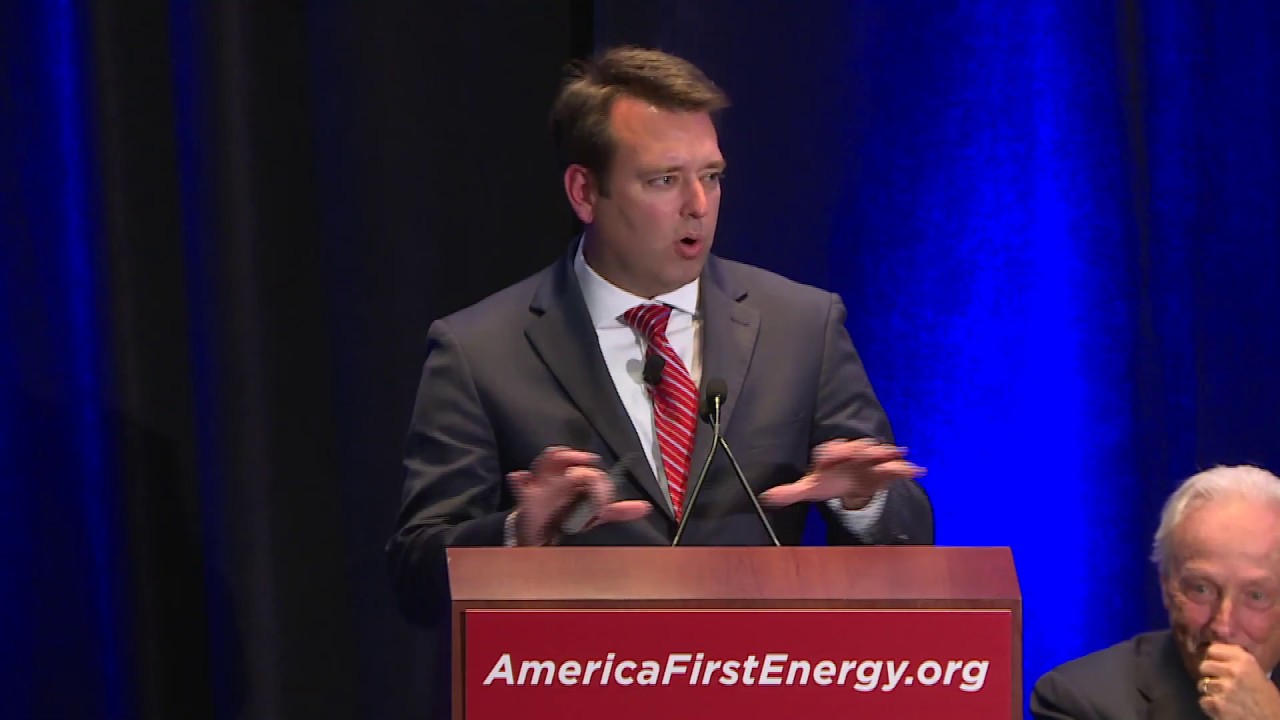 at the Heartland Institute‘s America First Energy Conference in 2017.14 Lovell has praised the pro-coal stance of the Trump Administration.15
Stance on Climate Change
November 2021
The following is from an interview with GB News, which Epstein posted on Facebook, he argued “why COP 26 is not a progressive scientific conference but an anti-human, primitive-religious attempt to commit mass genocide,” according to his video description.16
“If you don’t admit that today’s world is amazing because of fossil fuels, you are totally unqualified to make any predictions about the future because either you are anti-human or ignorant.”
Epstein added:
“The fact that we have an impact doesn’t even mean that it’s net negative. I think the jury is out because there’s a lot of beneficial warming and then greening is good.”
May 22, 2019
An article published by *The Oregonian* notes that “Epstein’s views put him in the position of denying scientific findings about the forces reshaping a planet now regularly experiencing its warmest years on record.”17
Taking offense to this statement, Alex Epstein made the following response in the Center for Industrial Progress newsletter:18
“I am actually an outspoken global warming affirmer. The real point of contention is not whether there is some global warming and whether human beings have some climate impact, but a) whether warming is a problem and b) whether fossil fuel energy should be restricted.
“When catastrophists label me and others ‘climate deniers,’ they aren’t trying to accurately characterize our views–they’re trying eliminate opposition to their political policies.”
April 2016
“If we look at what has been scientifically demonstrated vs. what has been speculated, the climate impact of CO2 is real — but mild and manageable.”
[…] while fossil-fuel use has only a mild warming impact, it has an enormous protecting impact. Nature doesn’t give us a stable, safe climate that we make dangerous. It gives us an ever-changing, dangerous climate that we need to make safe. And the driver behind sturdy buildings, affordable heating and air-conditioning, drought relief and everything else that keeps us safe from climate is cheap, plentiful, reliable energy, overwhelmingly from fossil fuels.”19
March 2016
In an interview on The Aaron Harborshow during IHS CERA Week, Epstein responded to a number of questions on his views about climate change.29
[vid]
aaron Harber: “Do you agree with the vast majority of climate scientists that climate change is happening?”[[
](https://youtu.be/_2_PlEBNms4?t=71)
Alex Epstein: “Loaded question. I agree that mild climate change, but not catastrophic climate change, is happening.”
Harber: “All right. What are the implications of climate change, in your opinion?” [[
](https://youtu.be/_2_PlEBNms4?t=82)
Epstein: “The main implication is we have to protect ourselves from the inherently dangerous and volatile climate using lots of energy and lots of industry.”
Harber: “Can mankind affect climate change, do you think? What kind of impact…” [[
](https://youtu.be/_2_PlEBNms4?t=92)
Epstein: “Theoretically, yes. In practice, very mildly.”
Harber: “So you don’t think that a significant portion of climate change that’s occurring is due to mankind, is anthropogenic?” [[
](https://youtu.be/_2_PlEBNms4?t=99)
Epstein: “Well, the overall is not that much. So you could have a significant portion of not very much, and it wouldn’t be that much.”
Harber: “So, when you say ‘not very much’, give me a sense of what, what you mean.” [[
](https://youtu.be/_2_PlEBNms4?t=111)
Epstein: “Well, you have one, you know one-point four degrees in 150 years, and a little over half of that is since major CO2 emissions began. So you have a small amount of natural warming and a slightly less small amount of possibly man-made influenced warming.”
Harber: “All right. Som the goal to prevent us from warming two more degrees, do you think that that’s an easy goal to reach? Or is that goal, does that goal even make sense?” [[
](https://youtu.be/_2_PlEBNms4?t=127)
Epstein: “The whole premise is based on climate-related, climate predication models that can’t predict climate. So I reject that as a goal. … so in two degrees is probably better off anyway. But there’s no evidence that we’re getting there.”
Harber: “So two degrees would be a good thing?” [[
](https://youtu.be/_2_PlEBNms4?t=149)
Epstein: “I don’t think, technologically, we know how to get there if we wanted to. Two degrees celsius.”
Harber: “In terms of prevention?” [[
](https://youtu.be/_2_PlEBNms4?t=154)
Epstein: “No. We couldn’t warm the Earth that much.”
Harber: “So you don’t think we’re headed to two degrees on our current path?” [[
](https://youtu.be/_2_PlEBNms4?t=159)
Epstein: “No. It’s all climate prediction models that can’t predict climate. Anyone can make stuff up. Most predictions are wrong, including these have been wrong for 35 years. There’s nor Eason to assume there’s anything different.”
2016
“[B]urning fossil fuels has improved the lives of millions in the developed world by helping solve their biggest environmental challenges, purified their water and air, made their cities and homes more sanitary and kept them safe from potential catastrophic climate change.”21
2013
Writing at *Forbes*, Epstein compared mainstream climate change science to Scientology:22
“[T]oday’s vaunted “climate science consensus”—that it’s been scientifically proven that we need to dismantle the fossil fuel industry, the economic engine of the world—is more Scientology than science,” he wrote.
2011
“In my opinion, the time for debate is certainly not over because the vast majority of us don’t even know what the debate is about — let alone what has been proven and what hasn’t, let alone what action implications all of this has.”23
Key Quotes
September 16, 2020
“You know, one thing I’ve been saying lately is I think it’s just really important that people associate the California blackouts with green energy and the California wildfires with green forestry,” Epstein said in an interview withPatrick Mooreon*Power Hour.*24
July 22, 2020
The following quotes are from an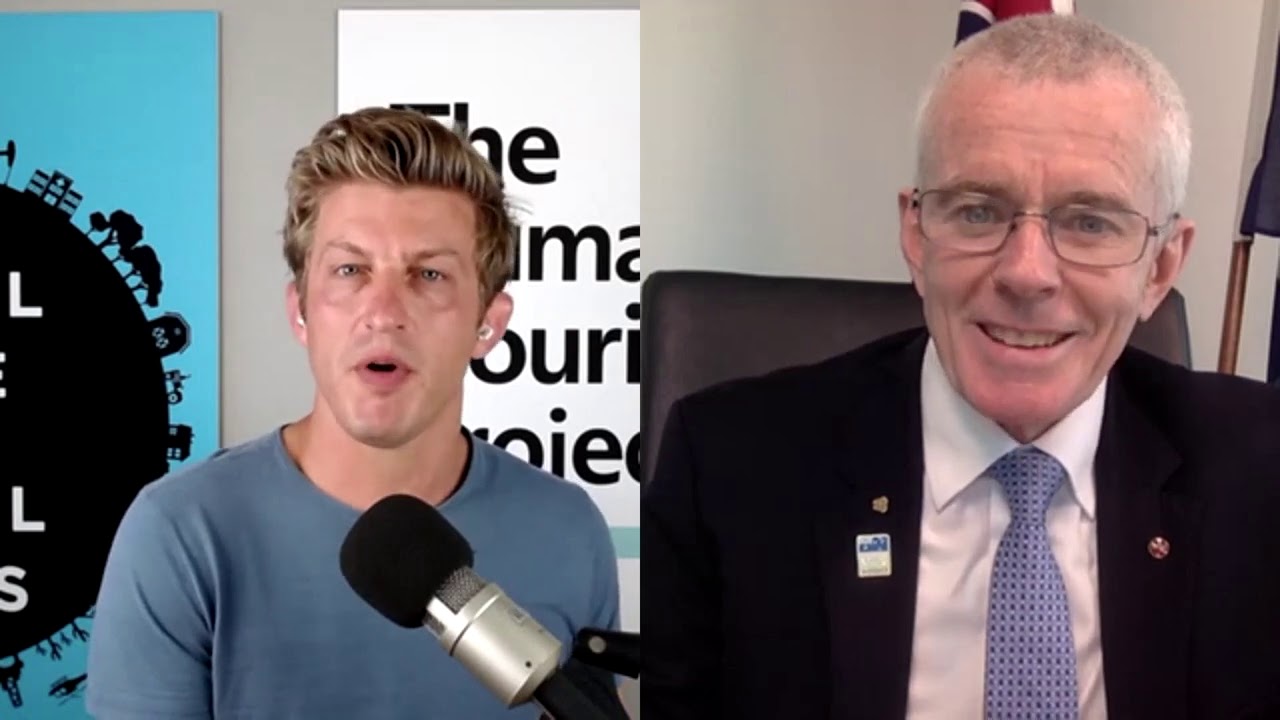 where Malcolm Roberts interviewed Epstein:25
Alex Epstein: [00:37:10] We’re all taught that climate is bad and getting worse. And yet climate from a human perspective is safer than ever by far. So anyone I have a line that I like to use, which is I don’t trust anyone to predict the future, who can’t predict the present. So if somebody says climate is going to be a disaster in the future and they think climate is a disaster today, they are ignorant or worse. And I think they are worse. [00:37:35]
[00:37:48] Because if you have a human perspective on climate livability, you have to admit it’s gotten much better. But if you think that it’s wrong for human beings to have any impact on the climate. And if we have any impact, that means it’s a bad climate, then you think the climate is worse. And that’s the only explanation of climate that the climate catastrophe movement thinking today’s climate is bad because they think it’s bad because they think we’ve changed it some. And so it’s really a religion. It’s really a religion that says that to be good is to not change nature. [00:38:18]
[00:38:19] That’s their standard. That’s their goal is unchanged nature. And my goal is human flourishing.I want humans to live to their highest potential. So if we make the Earth amazing with machine power and it leads to a little warming, which, by the way, is generally desirable for people, and by the way, it also leads to greening of plants. [00:38:35]
[00:38:36] If we change the Earth in that way, along with all the positive ways that our machines change the Earth using fossil fuels, I think that’s a better earth because I care about humans. But if you think it’s bad for human beings to change anything, you’re gonna think it’s what we’ve done is bad. Even though a billion people can live better lives than ever, that’s the only explanation of our whole establishment. Acting like climate is bad and the world is bad is they are antihuman. [00:39:02]
[00:39:19] But once you know the facts about the world, you have to know that there’s something antihuman about the people who are telling you that it’s bad and getting worse. [00:39:27]
[00:50:07] If you recognize there is no optimal state of the planet, the planet is naturally dynamic. It’s naturally dangerous. It’s naturally deficient. It’s a very imperfect planet. It’s got a lot of potential. But that potential needs to be actualized. [00:50:21]
[00:53:46] Property rights are just so unappreciated in terms of how they enable individuals to coexist in harmony with one another and to have a proper pro human relationship to nature. [00:53:58]
[00:54:13] But we unfortunately have almost and I mean this technically like a fascist system when it comes to the relationship to nature, where basically a government like the EPA or some other entity can just say, you know what, the muskrat on your property. We think that’s important. So you’ve got to leave or you can’t do what you want. And and there’s this real tyranny that happens. I think it’s an anti human view. I think if you care about the muskrat, you go be productive and figure out a way to predict that muskrat yourself, because otherwise people don’t care about the muskrat. [00:54:46]
[00:55:05] And if you just talk to business people in the U.S. about how they say theEndangered Species Act persecutes them, it is unbelievable. Or we had this, um, it was like some waters act in the US that the president, Donald Trump, did a good job of repealing or delimiting. And it was just like if you had a puddle on your property, basically some eco fascistcould say, yeah, you know what? That’s a really important puddle. I guess you can’t use it. And that’s that’s not how America became a beautiful place. You know, it became a beautiful place, I think, where there’s more property rights. [00:55:38]
[00:55:46] I think that if we had property rights, we could have a true enjoyment of nature that was actually pro human. [00:55:53]
[00:59:52] I think what’s going on in terms of the climate catastrophism, I don’t think it’s actually really a disagreement about science or certainly any fact. I think it’s a very deep antihuman orientation. [01:00:05]
[01:00:05] And it’s this idea I keep coming back to the view that changing nature is bad or human impact is is bad. Because if you look at the situation and you think about let’s say you learn two facts about CO2 that at least in that. So it’s a it’s a plant growing gas and it’s a fertilizing gas. You know that. And let’s say in isolation at least it’s a warming gas, at least I. I certainly believe that. So it’s a warming gass. So it has those two attributes. So you might think, let’s say fossil fuels, instead of adding CO2 to the atmosphere, they subtracted CO2 from the atmosphere. So if you just knew,OK, it’s a fertilizing gas and a warming gas and you heard fossil fuels as a side effect or a byproduct, they’re sucking CO2 out of the atmosphere. [01:00:49]
[01:00:50] What would be your reaction? I think you’d be pretty afraid. [01:00:54]
[01:02:18] Leaving aside anything you knew about the details of climate science, if it was taking CO2 out of the atmosphere, you would be worried.
[01:02:25] But then if you’re oh, it’s just from these basic facts, it’s adding CO2 to the atmosphere. You’d think, oh, well, that’s probably gonna be pretty good for the plants. And we use a lot of plants because we either eat them directly or the animals we eat eat plants. So that’s going to increase our agricultural productivity. And it’s also going to just increase the amount of biomass around the world which is going to mean that all species have more stuff to feed on. [01:02:46]
[01:03:00] So what’s really interesting is that people, before they even hear about the different views on climate science, their expectation is that the world is going to get worse if we add CO2. Why is that? It’s not because of the nature of CO2. It’s because of the religious dogma that impacting nature is bad. It’s impacting nature is viewed as immoral. It’s just wrong for us to impact things and it’s viewed as inevitably self-destructive. [01:03:26]
[01:03:59] So it warms place in the coldest places in the world that we want to be more warm. And it warms more at night when we want it to be more warm and it warms more in the winter. So if you learn that the world is becoming a more tropical place, you would think that’s a desirable thing. Most people will like that. The only thing you could possibly be concerned about is is there some way that the warmth is so much or that there’s some trajectory of CO2 that so much that it’s just going to become way warmer than our tropical ancestors had? But then if you look at the nature of it, the effect I mean, if you just look at the history of the planet, CO2 levels used to be fifteen times higher than they are today in Fahrenheit, which I use.
Temperatures twenty five degrees warmer. And life was incredibly productive at those times, the planet didn’t burn up. So if you know that we have no way, even if we wanted to. Of even getting one third of the way to what CO2 levels used to. Like we have no way of doing that. And then you think so? How could it be that they CO2 could warm things that much? And then you look at how CO2 works in isolation.
You see, it’s what’s called a logarithmic has a logarithmic effect,which is you can think of it as a decelerating effect, which basically means each new molecule of CO2 adds less warmth than the last one. So you keep adding. So somebody uses the analogy of like, you know, you paint a barn and you’re painting it red. And like the first coat of paint is like, you know, you make it. It’s like a little red and then you can make it redder. But after a while, it stops.
It doesn’t become much redder because it’s already pretty red. And that’s basically how CO2 works. It’s like every new coat of it or every new amount of it. It warms some, but it warms less than the last. How could a decel… a warming gas with a decelerating affect that has been 15 times higher in the future and life has thrived at twenty five degrees warmer temperature? How could that possibly be a catastrophe for a species that is by far the most adaptable in history?
Because billions of people have machine power that they can thrive in any climate. How could that possibly be a catastrophe? The only way you can think that is if you do not recognize how good human beings make the planet. The planet is naturally dynamic, deficient, dangerous and deficient, and that human productivity using machine power makes it it better. You can only believe this if you have this dogma that the planet is perfect, that any change to it is immoral and disastrous. But that’s a religion that is not science at all. And it is the most irrational, I’m not… any religion…But that is the most irrational religion I have ever heard of. [01:06:43]
[01:10:05] Yes. So I just want to sort of situate my own position here. So, I mean, my my main position is that the climate catastrophe movement is a religious and unscientific movement. But what I just want to emphasize that the morality of using fossil fuels, of using more and more fossil fuels going forward, does not depend on them having zero impact on climate. I think it’s very hard to know, certainly if you’re a layman, what’s going on. Because there’s so much distortion and there’s so much of an assumption that, of course, CO2 must have a big impact. After all, it’s on we’re putting an unnatural amount. But even if we are causing significant warming, particularly because, you know, it’s a decelerating function, that is no reason at all to stop using fossil fuels and empowering human rights. So I just want to. Sometimes people get into the climate issue and they act like the case for fossil fuels depends on zero or little impact of fossil fuels on climate. [01:11:00]
[01:11:01] And it it does not because we can use the fossil fuels to make any climate safer as long as we we’re free to use fossil fuels and get machine power. And if we’re not free, then any climate, including the supposedly perfect natural climate, is dangerous and unlivable.[01:11:17]
[01:14:43] my view is certainly that the utility of knowing that CO2 levels used to be a lot higher. It has a lot of utility because it it would be different if we had never we were at a threshold of CO2 that had never been exceeded, versus if you know. Oh, it’s been 15 times higher than it was today. And there are other variables that are different. But clearly, it is not something where the planet burns up. The oceans. Nothing like nothing like that happens in general. Life flourishes. The only thing. So the only thing I think you could be legitimately concerned about, but it has to be a pretty small concern in the scheme of things is will warming cause sea level rise that will be inconveniently fast? And I don’t think there’s evidence that it is at all. But you could at least hypothetically be concerned about that with warming. [01:15:31]
[01:17:42] If they actually cared about protecting people from floods, they would be all for using more fossil fuels so that you could actually produce flood protection like levees and dams. [01:17:51]
[01:27:11] Michael Shellenberger, one of my favorite energy commentators, the author of the new book Apocalypse Never, which is a very valuable book, like he has a good article, says, If solar and wind are so cheap, basically, why is electricity so expensive? [01:27:23]
[01:28:30] The idea when people talk about a hundred percent renewable, mostly solar and wind, even for electricity, and they talk about it for all energy, that is a policy that is equal parts ignorant and genocidal. And so that means you, Joe Biden, like you talking about that is like you are basically saying, I want to kill a whole bunch of Americans. [01:28:51]
[01:31:40] So we if we want to live, we want billions of people to live and to be empowered with machine power. Then we need more fossil fuels, not less. That’s the moral case for fossil fuels. And fortunately, I’m not. Fortunately, the CO2 is probably a net benefit, but it’s certainly nothing resembling a catastrophe. So that’s that’s even better. [01:32:02]
[01:57:21] There’s this idea that if calling the green movement the watermelon movement because it’s green on the outside and red on the inside, red as incommunistic. And there’s a lot of truth to that. But if you think about it, the whole idea that we’re destroying the planet is the ultimate pretext for restricting freedom because it basically says anything we do productively is bad. [01:57:43]
[01:57:44] And so the government gets to control us. And to the people who hate achievement or productivity, that checks a box for them because it it it says it’s basically anti-doing anything. And for the people who want control. Wow. What could be a greater thing to control than human impact and for that matter, what could be a greater thing to control than the byproduct of basically, every machine in the world, CO2. Like that is the ultimate control. So it’s it’s it’s very important. [01:58:13]
[01:58:13] It’s an anti freedom movement. And when we say we’re pro fossil fuels, we’re we’re really pro is the freedom to use fossil fuels. [01:58:21]
[01:58:58] So fundamentally, it’s about freedom. And fossil fuels are a product of freedom. And we only want to use them as long as they’re the best choice under freedom. [01:59:06]
August 26, 2019
Upon learning of the death of David Koch, Epstein told the Wall Street Journal:26
“When we hear that David Koch was a profit-seeking oil refiner we should feel not contempt and blame but admiration and gratitude.”
April 3, 2019
On his ,Epstein attacked Sen. Bernie Sanders for tweeting that he would ban fracking nationwide if elected president. Epstein said:27
“…These freeloaders like Bernie Sanders… There’s a chance that this guy is only alive, or he is alive I should say, because of fracking. That’s the kind of thing that has extended a lot of people’s lives.”
April 6, 2018
Alex Epstein praised Scott Pruit on Twitter, voicing support during a time that the EPA Administrator wasfacing a range of criticism and controversies:
...
---
2015
https://www.thecrimson.com/article/2015/11/17/hls-debate-fossil-fuels/
harvard
Federalist Society Hosts Fossil Fuel Debate
By Hannah Natanson, Contributing Writer
November 17, 2015
Alex Epstein, president and founder of the for-profit think-tank Center for Industrial Progress and author of “The Moral Case for Fossil Fuels,” argued for the use of fossil fuels on Monday in Harvard Law School’s Wasserstein Hall.
Aladdine Joroff, a clinical instructor and staff attorney in the EmmettEnvironmental Law and Policy Clinicat the Law School, spoke after Epstein and gave a rebuttal. The event was hosted by the Harvard Federalist Society, a student-run organization for conservatives, moderates, and libertarians.
During his speech, Epstein critiqued the “methodology” of the prevailing energy discussion.
According to Epstein, the fossil fuel debate today places too much trust in “experts.” In addition, Epstein said much of the debate focuses on fossil fuels’ negative effects on the environment, leaving out their positive effects on human beings.
“If we were not free to use fossil fuels...billions of people suffer and die unnecessarily,” Epstein said. “This really calls into question what is the methodology of the people who oppose [fossil fuels]. My contention is, whether implicitly or explicitly, their focus is not human life.”
Epstein also differentiated his arguments in favor of fossil fuels from mainstream political discourse.
“I want to distinguish myself both from the view that you hear from what we can call the left and the right,” he said. “So I don’t think fossil fuels are an unnecessary evil or a necessary evil, I think they are a superior good.”
In her rebuttal, Joroff asserted that opponents of fossil fuel usage want to transition to a cleaner energy supply, not remove the existing energy supply.
“From a moral perspective, I’d argue that we have an obligation to pursue feasible alternatives now,” she said.
Trenton Van Oss, vice president of speakers for the Federalist Society and one of the hosts of the event, said he was pleased with the proceedings.
“[T]hat’s part of our mission at the school, to provide students with points of view that they might not get in the classroom or at other events,” he said. “Alex did that, and Professor Joroff offered a great response.”
Aqil Sajjad, a graduate student in high energy theory physics, said that he thought Epstein was not “nuanced” enough and made strong assertions in a field that “can’t be totally precise.”
“I think that, in the climate debate, demanding precision is not how we should [proceed],” Sajjad said. “If you want precision you should go into physics or chemistry.”
==
==
http://www.alternet.org/environment/rex-tillerson-has-been-misleading-public-about-dangers-fracking-years
...
. It worked. With help from sympathetic (and largely conservative) media outlets and a barrage of propaganda from industry front groups like “Energy in Depth,” the industry was able to brand the victims as liars and charlatans. “Their water was always like that” became a meme—a “sciencey” explanation that let the industry off the hook and blamed the victims. Each new case got the same treatment, and with oil industry PR money behind it, much of the nation believed it.
Central to the oil industry’s branding of fracking as a clean source of energy is the claim that “there’s never been one case of water pollution from fracking.”Rex Tillerson, CEO of Exon (and now Secretary of State) looked straight into the camera and proclaimed in an interview with Charlie Rose in 2013 that after “a million data points,” there had “never been a verifiable case of fracking polluting drinking water.” The claim was patently false. At that point we knew aquifers had been polluted in Dimock Pa, Pavilion Wyoming and Parker Country Texas. Texas, Colorado, Wyoming resulting in dozens of water wells being polluted. Testing in all three cases pointed to gas extraction.
In fact, there are documented cases of fracking contaminating drinking water as early as the 1980s. An EPA report from 1987 showed that “fracturing the Kaiser gas well on Mr. James Parson’s property, fractures were created allowing migration of fracture fluid from the gas well to Mr. Parson’s water well.” Industry itself admitted that fracking polluted the well. During the 1990s when modern fracking technologies were being pioneered in Texas, widespread instances of pollution were acknowledged by Texas regulators.
But with enough people in positions of power and influence repeating it, the claim that there had never been a single case of fracking polluting drinking water became a “fact.” Media figures, oil industry officials, politicians, state regulators and gas and oil PR teams repeated the same story line: Fracking has been around for seventy years and there’s never been one documented case of pollution.
There were numerous problems with this story. First, modern slick-water fracking combined with horizontal drilling is a relatively new technology. Comparing the “stimulation” of old vertical wells to modern fracks with pressures up to 15,000 PSI and hundreds of chemicals is like comparing a 1960s rotary phone to today's iPhone.
Also left out of the not-one-case story is a clever sleight of hand with the definition of fracking. The oil industry defines “fracking” as only what happens in the horizontal section of pipe thousands of feet underground. According to this reasoning, the only way fracking can pollute drinking water is by migrating through thousands of feet of solid rock. Pollution from the vertical part of the well—where most leaks occur—or surface activity is not in this technical definition pollution from fracking.
Of course, most people understand fracking as the whole process of transporting equipment and chemicals to the site, drilling the well, extracting the gas and transporting it to market. Oil industry PR people are perfectly willing to use this confusion to their advantage. They can cite scientific papers claiming that “there has never been a case of fracking polluting drinking water,” and let the public believe they are referring to the common-sense definition of fracking as the entire industrial process.
Industry leaders like Tillerson know all this, of course. But they just keep repeating the same misleading claim. If enough “experts,” authority figures and media personalities keep repeating it, the big lie becomes a fact in people’s minds. And once it’s embedded, these everyone-knows-it facts are very difficult to dislodge.
An important part of the oil industry drive to control perceptions of fracking is demonizing its critics. Victims are portrayed as greedy fraudsters. Environmentalists are portrayed as hysterical, hypocritical busy bodies inventing scandals about a clean energy technology they should be celebrating. Filmmakers like Josh Fox, whose film “Gasland” shined a spotlight on cases of pollution associated with fracking, were subjected to withering character assassination campaigns.
The IPAA, the oldest petroleum industry association in the nation, funded a film a film to discredit “Gasland” called “Truthland.” It was a shiny spin piece that painted any case of water contamination as naturally occurring. The best known of these fracking-denial films is “FrackNation” by Phelim McAleer. McAleer has made a career out of making films depicting environments as hypocritical elitists and pollution victims as frauds and liars. A darling of conservative news outlets, McAleer has been one of the most effective proponents of fracking-has-never-contaminated-drinking-water meme. Other media figures like Alex Epstein and Ezra Levant have cashed in by writing Ann Coulter-style books popularizing oil industry talking points. Levant is famous in Canada for his shouting-head attacks on oil industry critics.
IPAA also fired up their own PR “news” outlet, Energy In Depth. In a memo announcing the new media group, IPAA stated the group’s goal; “EnergyInDepth.org: a state of the art online resource center to combat new environmental regulations,”. The venture was funded by major gas and oil interests including; BP, Anadarko, Marathon, EnCana, Chevron, Talisman, Shell, Halliburton and Schlumberger and Energy in Depth remains one of the main purveyors of the gas industry’s talking points regarding water, fracking and pollution.
When a reporter or member of the public asks if fracking pollutes drinking water, they’re likely asking if any part of the entire process contaminates drinking water. That’s logical since the entire process will be used as the nation moves forward with the planned fracked gas revolution. When the question is answered with a resounding, seemingly convincing ‘NO’, the reporter or citizen thinks no water has ever been contaminated by any part of the fracking process.
While industry has gotten away with this ruse for a decade, hundreds of cases of water contamination have become known. After a long fight, The Scranton Times got Pennsylvania’s Department of Environmental Protection to count the number of letters it sent to residents confirming incidence of water contamination during their fracked gas boom. That number was 243. The Associated Press found at least four states had recorded water contamination also. One troubling fact keeps us from knowing how many cases have actually occurred. When a homeowner settles their case with the operator, they are required to sign a silence agreement that disallows them from sharing any facts about their case. Not only do we know hundreds of cases of water contamination related to the fracking boom have occurred, as it is today, we can never know how many cases there really have been.
---
---
http://dailycaller.com/2016/06/15/global-warming-skeptic-responds-to-massachusetts-ags-subpoena-fk-off-fascist/
Epstein had a terse response to a subpoena sent by Massachusetts Attorney General Maura Healey Wednesday.
Healey demanded the oil giant ExxonMobil hand over 40 years of documents, including information pertaining to the company’s dealings with about a dozen think tanks and trade associations, which have been targeted by environmental groups for opposing left-wing global warming policies.
Healey’s subpoena targeted the Center for Industrial Progress (CIP), a for-profit think tank founded by Epstein. Epstein wasn’t exactly happy about being targeted for disagreeing with Healey on global warming, so he sent the AG’s office the following response:
Read more: http://dailycaller.com/2016/06/15/global-warming-skeptic-responds-to-massachusetts-ags-subpoena-fk-off-fascist/#ixzz4Bs3xP7np
==
bs
Center for Industrial Progress (CIP) is a for-profit think-tank seeking to bring about a new industrial revolution. We believe that human beings have the untapped potential to radically improve our lives by using technology [rowe bs] to improve the planet across a multitude of industries: mining, manufacturing, agriculture, chemistry, and energy. Every individual has the potential for a longer, happier, healthier, safer, more comfortable, more meaningful, more opportunity-filled life.
The keys to a new industrial revolution are a new industrial philosophy, a new industrial policy, and a new approach to communication.
Leadership
Alex Epstein, President and Founder

Alex Epstein is a philosopher who applies big-picture, humanistic thinking to industrial and environmental controversies. He founded Center for Industrial Progress (CIP), a for-profit think tank and communications consulting firm focused on energy and environmental issues, in 2011 to offer a positive, pro-human alternative to the Green movement.
Epstein is the author of The Moral Case for Fossil Fuels (Penguin,2014), which has been widely praised as the most persuasive argument ever made for our use of coal, oil, and natural gas. Epstein has publicly debated leading environmentalist organizations such as 350.org, Greenpeace, and the Sierra Club. Arguing that industry needs to become a confident champion for energy and freedom, Epstein helps companies use his moral arguments to neutralize attackers, turn non-supporters into supporters, and turn supporters into champions.
He was named “most original thinker of 2014” by The McLaughlin Group for his New York Times bestseller The Moral Case for Fossil Fuels.[appears to be BS, no ref but to self; tho they had awards at year's end]
Epstein has guest-lectured at dozens of universities including Harvard,[fed soc] Yale, Stanford, and Duke–as well as dozens of Fortune 500 companies. He has publicly debated representatives from many of the world’s leading environmentalist groups, such as 350.org, Greenpeace, and the Sierra Club.
Steffen Henne, Head of Research
Steffen Henne is the head of research at the Center for Industrial Progress. An autodidact on a wide range of energy, industrial, and environmental issues, Henne is often “the man behind the scenes” of CIP’s published work. Alex Epstein wrote of Steffen in The Moral Case for Fossil Fuels, “Steffen Henne, our lead researcher at the Center for Industrial Progress, helped me find the high-quality and wide-ranging data I was looking for. Steffen’s breadth of knowledge about practically every topic in this book is incredible, as is his ability to catch errors.”
He is a native of Germany, where he currently resides.
Eric Dennis, PhD, Senior Fellow
Eric Dennis, Ph.D., Physics, studied at Caltech, Princeton, and University of California Santa Barbara. His graduate work involved the theory of quantum computers and simulating quantum systems. Transitioning to quantitative finance, he has built derivatives models on trading desks at Goldman Sachs, Morgan Stanley, and Swiss Reinsurance, where he pioneered a unified, state-of-the-art modeling framework for portfolio credit derivatives. He currently works in asset management at a major insurance company. His experience in finance, complemented by independent study of monetary economics, provides a unique combination of hands-on knowledge and theoretical insight to assess current macroeconomic issues. His interests include questions of central planning, free banking, the use and abuse of mathematical models, and the scientific fundamentals of energy.
Pierre Desrochers, PhD, Senior Fellow
Pierre Desrochers is a Senior Fellow at the Center for Industrial Progress andAssociate Professor of geography at the University of Toronto.His main research interests are economic development, technical innovation, business-environment interactions, and energy policy and food polic...
==
st free press ass:
CLIMATE CHANGE
Professor debunks claim fossil fuels damage planet
AAYUSHI MADANI - UNIVERSITY OF MICHIGAN •MARCH 26, 2016
The truth about oil and coal ...
There’s more trees and animals on the planet today than ever before thanks to fossil fuels, a professor told a room full of University of Michigan students Wednesday.
Many assign blame for deforestation and animal extinction on fossil fuels, when in reality most of it occurred well before the widespread introduction of oil and coal use, said Dr. Pierre Desrochers, associate professor of geography at the University of Toronto and senior fellow at the Center for Industrial Progress.
The guest lecturer came as some students demand the public university divest from companies that profit from fossil fuels, calling such divestment a moral choice and way to fight climate change.
But Desrochers — invited to campus to argue the “Moral Case For Fossil Fuels” — said divestment would cause more problems and solve few, if any.
He told the 125 or so students in the audience that before the development of fossil fuel use, animals were slaughtered on a massive scale for food, clothing and many other uses, and forests were razed for wood. In fact, possibly as much as 90 percent of animal extinction and deforestation appeared before the introduction of fossil fuels, he said.
But the use of coal and oil reversed that trend, he added, noting coal helped replace firewood and charcoal in many instances. Moreover, tractors were invented, producing food faster and more efficiently. Forest cover, which had been decreasing until then to make way for farmland and for wood to supply fuel, started increasing from 12 percent to 24 percent, he said.
“We produced a lot more food on a lot less land after carbon fuels,” Desrochers said.
RELATED: Professor warns students: Planet on verge of global apocalypse due to human activity
The talk went largely without incident despite the fact that campus flyers touting the guest lecture were vandalized repeatedly leading up to the event.
But the only outburst during the talk came from a student who shouted out that Desrochers was attempting to commodify black lives. The comment was made as Desrochers discussed a problem in Africa in which its residents largely rely on a domestic food supply, leading to a chronic state of undernourishment and ultimately deaths in the poverty-stricken continent.
Ultimately, the expert said, fossil fuel divestment proponents are willing to sacrifice companies’ dividends that support their universities and the financial aid they supply to low-income students. Yet, he said, these same protesters are rarely willing to live the change they wish to see in the world.
It’s consumers who actually burn the most fuels. The process of extraction, processing and transportation represents only 20 to 30 percent percent of emissions, whereas consumers shoulder 70 to 80 percent of emissions, he said.
“We abolished slavery; apartheid was abolished,” he said. “So if fossil fuels are so bad, why don’t we boycott them? We realize that boycotting fossil fuels might involve some real sacrifices. Now I have not heard of any fossil fuel activist make any real sacrifices, so how can they tell us to?”
Yet the divestment movement has seen a success at several colleges, such as Georgetown, Stanford and University of Washington. To what end?
The divestment movement only targets publicly traded companies, which produce a tiny amount of carbon fuels. The larger global players are privately traded companies, and thus the divestment movement has no effect on these as they are not traded on the stock market, he said.
Fossil fuels aren’t the hideous monsters they are presented to be, he argued. In fact, the increasing use of fossil fuels since the 1850s is in tandem with an increase in life expectancy of people in both developed and developing nations, increasing from 28 years in 1820 to 71 years in 2000, on average. This is also paralleled with an increase in body size and standard of living over the years, he added.
Fossil fuels also help deliver foods faster and farther than ever before, fighting poverty and hunger and helping economies thrive, he said.
Carbon fuels led to railroads, which can carry enormous loads of food over long distances. Now each region, instead of trying to feed itself, specializes in creating what its best at, making food affordable and increasing prosperity and development, he said.
In the past, “backyard chickens were not a lifestyle statement; it was a necessity,” Desrochers said.
He also dismissed the notion that fossil fuels lead to global warming.
“Climate changes all the time,” he said.
Meanwhile, even University of Michigan President Mark Schlissel has dismissed students’ pleas to divest from fossil fuels, telling protesters in a statement that while he appreciates their “commitment and passion,” their request is not “linked to immoral and unethical actions and ideologies.”
“Fossil fuels enable us to operate the university, to conduct research and to provide patient care,” he said. “At this moment, there is no viable alternative to fossil fuels at the necessary scale. In addition, most of the same companies that extract or use fossil fuels are also investing heavily in a transition to natural gas or renewables, in response to market forces and regulatory activity.”
RELATED: More ‘cli-fi’ in the college classroom: Great (and not-so-great) climate doomsday stories
---
==
11/13
Craig Idso, the former president and current chairman of the board of the Center for the Study of Carbon Dioxide and Global Change, and lead author of the reports of the Nongovernmental International Panel on Climate Change (NIPCC) talked with Alex Epstein on his show,Power Hour.
Idso and Epstein discuss the benefits of CO2, something that Idso grew up studying, and still studies to this day. The issue of CO2 has been going on for decades, but society’s sentiments have changed. It used to be (back in the 1970’s) that excess CO2 was a good thing, but throughout the decades, it has come to be seen as a negative thing.
People now consider CO2 as a pollutant, in fact they call excess CO2 “carbon pollution”. But, Epstein and Idso are wondering why people believe this to be true. CO2 is considered the “elixir of life”, and throughout all of scientific history, excesses in CO2 has caused spurts of growth for the earth.
Idso battles the climate change alarmists, and seeks to present the world with scientific-based information about climate change.
Listen to the full interview in the player above.
===
Credentials
B.A., Philosophy, Duke University (2002). [1], [2]
Background
Alex Epstein is the director of the Center for Industrial Progress, an organization he founded in 2011. Its mission is to "inspire Americans to embrace industrial progress as a cultural ideal." He is also a blogger at Master Resource, a "Free Market Energy Blog," and a past fellow of the Ayn Rand Institute, an organization that has received funding from the Koch Foundations including at least $50,000 between 2005 and 2010. [3]
"As the Founder and the Director of the Center for Industrial Progress, I make it my job to educate the public about the incredibly positive role energy and industry, particularly the oil industry, play in their lives," Epstein wrote. [4]
Epstein's focus is on energy and industrial policy, and he has written articles in this area in theWall Street Journal, Forbes, Investor’s Business Daily, The Objective Standardand numerous other publications. Epstein hosts a monthly podcast titled "Power Hour" that features "leading energy thinkers" including climate change skeptics like Richard Lindzen.
He maintains a website, alexepstein.com, where he advertises his range of consulting services "from PR consulting to editorial consulting," in which he reframes the debate to fit the view that aggressive industrial progress will always better the environment.
According to his website, Alex Epstein has done corporate speaking and consulting for the oil, gas, and coal industries. [5]
Stance on Climate Change
"In my opinion, the time for debate is certainly not over because the vast majority of us don't even know what the debate is about — let alone what has been proven and what hasn't, let alone what action implications all of this has."[6]
Key Quotes
"...so much of what has gone right in American industrial history is that this country used to have a philosophy that embraced the transformation of nature through energy and industry—that is, embraced industrial progress. The more I read and talked to experts in the field, the more I saw an opportunity to use my knowledge of philosophy, and in particular Ayn Rand’s philosophy, to change the way people think about energy, industry, and environment." [7]
"The difference between a healthy environment and an unhealthy environment can be summed up in one word, and it's not 'CO2' or 'climate' or 'temperature.' It's 'development.' [...] Whether you're drinking clean drinking water, listening to a thunderstorm with pleasure instead of fear, or going to the Grand Canyon, you should be thanking Big Coal, Big Oil, and Big Gas." [8]
"One point I like to stress is that we should think of coal, oil, natural gas, and nuclear, as clean energy." [9]
"The natural environment is not particularly hospitable to human life . . . the key to having a good environment is improving it through work. . . . Energy is fundamentally an environmental improver and if we classify it that way it makes sense out of a lot of these controversies. . . . It's our obligation and our right to make [our environment] as good for human beings as possible. With that view, it's very easy for people to understand precisely the reason it's good to alter it — because it doesn't naturally come the way we need it to be." [10]
"To attribute rights to animals is to ignore the purpose and justification of rights—to protect the interests of man." [11]
"...Americans are not 'addicted' to oil. 'Addiction' implies an intense desire for something harmful. But we do not desire oil irrationally; we consume it because it is a wonderful, life-sustaining product." [12]
"Our lives depend on recognizing that human cloning, like all forms of 'playing God,' is a moral, life-promoting endeavor."[13]
“Thestory of oil at its core is one of human aspirations, human challenges, and human triumphs. It’s a story of the aspiration to produce the best energy in the world—particularly the best portable energy to power the mobile machines that allow us to grow enough food to feed seven billion people, to whisk us away on amazing vacations, to have cars that allow us to work and play where we choose. Not to mention, the energy that improves our environment: by things like building water purification systems, sewer systems, and climate resistant buildings. Your story is a story of the challenge of figuring out how to produce this caliber of energy, which nature doesn’t automatically give us.” [25]
“Themost important thing to having a healthy environment to live in is development. Which, ironically, is considered bad for the environment. This is exactly why undeveloped countries have the worst environments. It’s not some coincidence; it’s exactly because they are undeveloped. They breathe smoky air from wood fires because they lack centralized power plants—built by oil. They drink naturally contaminated water because they lack irrigation and water purification plants. They live with filth because they lack industrial scale sanitation. They are vulnerable to climate because they lack sturdy climate controlled homes. And they don’t get to enjoy nature very much for that matter, which is supposedly what you get when you take away industry because they lack modern transportation—no one’s going to the Grand Canyon with a five mile travel radius.” [25]
Key Deeds
Ongoing
Epstein regularly appears in conservative talk radio and television programs to promote the idea that industrial development is the best way to improve the environment.
He has made appearances on FOX, PJTV, and Thom Hartmann. He has also published his opinion in a wide variety of publications including The Wall Street Journal, Forbes, Investor’s Business Daily, and Fox News.
According to his website, he also makes speaking rounds in colleges and communities including Stanford, Duke, Berkeley, Federalist Society,NAACP, and College Republicans.
Notably he has also provided corporate speaking and consulting services to the Oil, Gas, and Coal industries. [5]
April 12, 2013
Alex Epstein speaks to the Canadian Association of Petroleum Producers (CAPP) in an effort to help Canadian fossil fuel companies reframe climate-related communications tactics to the public. [25] Epstein, in his talk, repeats his stance that "fossil fuels improve the planet" and protect society at large from the climate. [8] [25]
Epstein encourages fossil fuel companies to switch the conversation (from the "environmentalists' argument")--and embrace their product as a communications tactic--as highlighted by the creation of his Facebook page entitled "I love Fossil Fuels." [//api rowe] [:(style="background-color:#ffff66ff"):}::{25] Noticeably and intentionally throughout his discussion, Epstein speaks to the incredible environment we live in, which he believes possible only because of fossil fuels. He then motivates CAPP communications audience members to spread this type of dialogue throughout the public sphere. [25]
November 5, 2012
Alex Epstein debates leading environmentalist Bill McKibben on the issue of global warming. Epstein argues that "fossil fuels improve the planet" while McKibben presents the majority scientific view that the continued burning of fossil fuels will have a strongly negative impact on the environment.[8]
The debate was urged on by MasterResource's Robert Bradley who showed Epstein an article published by McKibben titled "Global Warming's Terrifying New Math" which Epstein now claims received "not nearly enough criticism."
Epstein has launched a website, fossilfueldebate.com where he presents his case on the issue — that "McKibben is dead wrong about fossil fuels and our environment." Epstein purports to take an "objective, scientific look" at why he believes fossil fuels have given us "the greatest environment in human history." [14]
May 21 - 23, 2012
Epstein's Center for Industrial Progress was listed as a co-sponsor of the Heartland Institute's Seventh International Conference on Climate Change (ICCC7). [15]
April 2 - 5, 2012
On April 2, 2012 Epstein spoke at the University of North Carolina. His speech was titled "The Green Blackout" and suggested that green energy policies are "harming both America's economy and environment." It was sponsored by TheCarolina Review, a conservative student publicationassociated with CampusReform.org.
On April 3 he spoke at Furman University on "Why the Green Movement is Ruining America."
On April 5th he made a final speech at Pennsylvania State University titled "Fracking Amazing" which focused on the supposed benefits of hydraulic fracturing. According to Epstein, the media is "completely overblowing the risks of fracking... while completely undervaluing the benefits." [16]
June 12 - June 13, 2011
Attended an international conference titled "Big Footprint: Is Green the New Tyranny?" hosted by the American Freedom Alliance, a group that has been described by some sources as anti-climate science, anti-evolution and Islamo phobic in its outlook. [17]
Speakers included numerous conservative commentators and climate change skeptics such as Christopher Monckton, James Delingpole, Christopher Horner, Steve Milloy, Benny Peiser, andBrian Sussman. [18]
The American Freedom Alliance describes the event as "A Conference on Radical Environmentalism," and suggests that "the contemporary Green Movement, represented by a variety of national and international institutions, may have far exceeded its original mandate to protect the Earth." Topics debated included "The Assault on Human Exceptionalism"; "Agenda 21 and the UN Mandate for Social Revolution"; and "Transhumanism, Deep Ecology and Ecocide: How Are Shifting Social Attitudes Re-shaping Our Appreciation of Human Uniqueness?"
Affiliations
- Center for Industrial Progress (CIP)—President, founder and director. [19]
- MasterResource — "Principal." [20]
- Ayn Rand Institute — Former Junior Fellow specializing in "business issues." [2], [21]
- The Heartland Institute — Director of sponsor organization.
- American Freedom Alliance — Speaker at American Freedom Alliance sponsored event.
- The Duke Review — Past editor and publisher. [2]
Publications
Epstein has published articles in newspapers such as the San Francisco Chronicle, Philadelphia Inquirer, National Post, Washington Times, Detroit Free Press, Houston Chronicle, Chicago Sun-Times, Atlanta Journal and Constitution, Arizona Republic, Indianapolis Star, Orange County Register, and Tampa Tribune. He has also written in quarterly journals (of "culture and politics") including The Objective Standard.
According toGoogle Scholar, Epstein has never published an article in a peer-reviewed journal on any subject.
Resources
- "Alex Epstein," 'The Ayn rand Institute. Archived August 25, 2007.
- "Speakers and Writers: Alex Epstein," Ayn Rand Center for Individual Rights. Accessed September 30, 2012.
- "Koch Industries: Still Fuelling Climate Denial 2011 Update"(PDF), Greenpeace, April, 2011.
- Alex Epstein. "Why We Should Love the Oil Companies (Straight talk from an industry outsider)," MasterResource, June 15, 2012.
- "About," Alexepstein.com. Accessed September 30, 2012.
- Alex Epstein. "Power Hour Episode 5: Climate Change with Richard Lindzen," Ayn Rand Center, June 1, 2011.
- "Interview with Alex Epstein, Founder of Center for Industrial Progress," The Objective Standard, November 17, 2011.
- Alex Epstein."Challenging Bill McKibben and the Green Establishment: The Environmental Case for Fossil Fuels," MasterResource, September 28, 2012.
- Alex Epstein. "COAL IS CLEAN," Center for Industrial Progress, March 12, 2012.
- "Alex Epstein on How Coal and Oil Improve Our Lives," Philosophy In Action Talk Radio: Wednesday, September 12, 2012.
- Alex Epstein and Yaron Brook."The Evil of Animal 'Rights'," Tulsa World, May 19, 2001. Reproduced by the Ayn Rand Center for Individual Rights.
- Alex Epstein. "Keep Our "Addiction" to Oil, End Our Allergy to Self-Assertion," The Record, NJ, July 10, 2006. Reproduced by the Ayn Rand Institute.
- Alex Epstein. "The Virtue of 'Playing God'," Philadelphia Inquirer, June 18, 2002. Reproduced by the Ayn Rand Center.
- "McKibben vs Epstein: the ultimate environmental debate," indiegogo (fundraising campaign). Accessed September 30, 2012.
- "Cosponsors," 7th International Conference on Climate Change. Accessed May, 2012.
- Michael Armstrong. "Alex Epstein Speaks at UNC, Furman and Penn State," Campus Reform.org, April 18, 2012.
- Leo Hickman. "Climate sceptics flirt with intelligent design and Islamophobic group," The Guardian, June 10, 2011.
- "Speakers," americanfreedomalliance.org. Accessed September 30, 2012.
- "About," Center for Industrial Progress. Accessed September 30, 2012.
- "About," MasterResource. Accessed September 30, 2012.
- "Faculty," Objectivistconferences.com. Accessed September 30, 2012.
- Alex Epstein. "A Victory for Big Tobacco--and the Rule of Law," The Courier-Journal, July 11, 2006. Reproduced by the Ayn Rand Institute.
- "An Interview with Alex Epstein: Nuclear Power – How Safe is it and what have we learned from Japan?", Education News, August 7, 2011.
- "POWER HOUR: THE DANGERS OF NOT FRACKING," Center For Industrial Progress, July 10, 2012.
- Alex Epstein. "CAPP Speaker Series." April 12, 2013.
Tags:
Center for Industrial Progress
---
rebut mckibben RS http://www.youtube.com/watch?v=qCK11ZssUI4 "deeply corrupt"
---
blog links to agenda 21
http://www.masterresource.org/category/green-energy-failures-2/
promotes BS studies on green economy and trashes wins:
---
bs;
Alex Epstein is the director of the Center for Industrial Progress,an organization he founded in 2011 to advocate the restoration of industrial progress as a cultural ideal. His personal area of specialization lies in the intersection of energy and industrial policy, with an emphasis on the underlying philosophical ideas that shape the economic debate. His writings on energy history and public policy have been published in the Wall Street Journal, Forbes, Investor’s Business Daily, and dozens of other prominent publications.
Epstein’s monthly podcast, Power Hour, features discussions with leading energy thinkers, including author Robert Bryce (Power Hungry), climate scientist Dr. Richard Lindzen (MIT), and energy economist Michael Lynch (EnergySEER, New York Times). Epstein’s writings on philosophy, business, and energy have been featured in 10 books, including, most recently, Why Businessmen Need Philosophy.
Epstein is an alumnus of Duke University, where he studied philosophy and computer science. Prior to founding the Center for Industrial Progress, he was a Fellow at the Ayn Rand Institute specializing in energy issues.
---
Koch Industries Climate Denial Front Group
Ayn Rand Institute (ARI)
On this page
$50,000 received from Koch foundations 2005-2010 [Total Koch foundation grants 1997-2010: $50,000]
Based in Irvine, California, the Ayn Rand Institute (ARI) is dedicated to laissez faire capitalism and the pursuit of self-interest as developed by Russian-American author Ayn Rand. ARI’s writers have referred to a climate science report published by the National Academy of Science (NAS) as “a lie,” and have cited the notoriously fabricated “Oregon Petition.” The Oregon Petition was created by the Oregon Institute of Science and Medicine in cooperation with the George C. Marshall Institute, a notable recipient of Koch and Exxon money, to look like official NAS material. Some scientists signed the petition assuming it was indeed created by NAS, others signed with the backing of the oil industry, and some names were simply fictional characters lifted from the show M*A*S*H* and elsewhere.
ARI Senior Fellow Keith Lockitch, who spoke at the Heartland Institute’s 2009 International Conference on Climate Change, authored a paper denouncing the viability of clean energy and simultaneously denying the scientific consensus of climate change. Despite mischaracterizing the science, Lockitch argued that “development under capitalism has actually made us safer from climate-related risks than ever before in human history.”
Alex Epstein of ARI's Center for Individual Rights frequently publishes opinion pieces in outlets like Fox News, the American Thinker and the Daily Caller promoting fossil fuel use and attacking environmental safeguards. Such articles include:
- "6 Questions for Environmentalists on Earth Day," Fox Forum, 4/22/2010
- "The 6 Myths About Oil," Fox News opinion, 12/29/2010
- "Greens vs. Energy," American Thinker, 4/22/2011
- "Four Dirty Secrets about Clean Energy," Fox News opinion, 6/3/2011
- "We're Running out of Freedom, Not Oil," Daily Caller, 8/10/2011
Epstein is a frequent collaborator with C:{ollegians For A Constructive Tomorrow (CFACT Campus), a recipient of Koch funding and project of the Exxon-supported Committee For A Constructive Tomorrow (CFACT).}:
Read more about the Ayn Rand Institute (ARI)
Ayn Rand Institute (ARI) on SourceWatch.org
Find more recipients of Koch foundation money
View "Koch's Web of Dirty Money and Influence"
Topics
Tags
- ayn rand institute,
- global warming,
- climate change,
- koch industries,
- denial,
- science,
- fossil fuel,
- funding,
- oil,
- billionaires,
- brothers,
- foundation,
- charles koch,
- david koch,
- claude r lambe,
- greenpeace,
- polluterwatch,
- ari
---
desmog
Alex Epstein
Credentials
B.A., Philosophy, Duke University (2002). [1], [2]
Background
Alex Epstein is the director of the Center for Industrial Progress, an organization he founded in 2011. Its mission is to "inspire Americans to embrace industrial progress as a cultural ideal." He is also a blogger at Master Resource, a "Free Market Energy Blog," and a past fellow of the Ayn Rand Institute, an organization that has received funding from the Koch Foundations including at least $50,000 between 2005 and 2010. [3]
"As the Founder and the Director of the Center for Industrial Progress, I make it my job to educate the public about the incredibly positive role energy and industry, particularly the oil industry, play in their lives," Epstein wrote. [4]
Epstein's focus is on energy and industrial policy, and he has written articles in this area in the Wall Street Journal, Forbes, Investor’s Business Daily, The Objective Standard and numerous other publications. Epstein hosts a monthly podcast titled "Power Hour" that features "leading energy thinkers" including climate change skeptics like Richard Lindzen.
He maintains a website, alexepstein.com, where he advertises his range of consulting services "from PR consulting to editorial consulting," in which he reframes the debate to fit the view that aggressive industrial progress will always better the environment.
According to his website, Alex Epstein has done corporate speaking and consulting for the oil, gas, and coal industries. [5]
Stance on Climate Change
"In my opinion, the time for debate is certainly not over because the vast majority of us don't even know what the debate is about — let alone what has been proven and what hasn't, let alone what action implications all of this has."[6]
Key Quotes
"...so much of what has gone right in American industrial history is that this country used to have a philosophy that embraced the transformation of nature through energy and industry—that is, embraced industrial progress. The more I read and talked to experts in the field, the more I saw an opportunity to use my knowledge of philosophy, and in particular Ayn Rand’s philosophy, to change the way people think about energy, industry, and environment." [7]
"The difference between a healthy environment and an unhealthy environment can be summed up in one word, and it's not 'CO2' or 'climate' or 'temperature.' It's 'development.' [...] Whether you're drinking clean drinking water, listening to a thunderstorm with pleasure instead of fear, or going to the Grand Canyon, you should be thanking Big Coal, Big Oil, and Big Gas." [8]
"One point I like to stress is that we should think of coal, oil, natural gas, and nuclear, as clean energy." [9]
"The natural environment is not particularly hospitable to human life . . . the key to having a good environment is improving it through work. . . . Energy is fundamentally an environmental improver and if we classify it that way it makes sense out of a lot of these controversies. . . . It's our obligation and our right to make [our environment] as good for human beings as possible. With that view, it's very easy for people to understand precisely the reason it's good to alter it — because it doesn't naturally come the way we need it to be." [10]
 Desmogblog (http://s.tt/1oL5l)
---
Center for Industrial Progress (CIP)
Background
The Central for Industrial Progress was founded by Alex Epstein, also a blogger at Master Resource the "Free Market Energy Blog," and a past fellow of the Ayn Rand Institute.
The CIP's mission is to "inspire Americans to embrace industrial progress as a cultural ideal." CIP summarizes their philosophyon their website: [1]
"At the Center for Industrial Progress (CIP), we celebrate man’s impact on nature, just as our ancestors celebrated Americans' ability to 'tame a continent.' We celebrate the never-ending project of the industrial revolution: to harness more and more energy to feed machines that do more and more work to make our lives better and better."
". . . As for pollution, so long as we embrace policies that protect property rights, including air and water rights, we protect industrial development and protect individuals from pollution. By contrast, 'green' policies do not improve the human environment, but sacrifice it to the non-human–just ask anyone trying to build an industrial project today."
The CIP regularly publishes articles "debunking" environmentalism, and promoting the oil and coal industries, as well as some of their common talking points. For example, Alex Epstein has said that "we should think of coal, oil, natural gas, and nuclear, as clean energy." [2]
Stance on Climate Change
"The movement to convince the public of catastrophic global warming is fundamentally unscientific. Its leaders do not, as true scientists would, objectively study and relay the full evidence about what drives the climate, they fixate obsessively on CO2. They do not share how poorly understood climate drivers are; they act as if they can predict the climate with certainty. Through manipulation of government agencies, a credulous media, and many of their cloistered colleagues in academia, they have managed to take over much of the field of climatology and the vast majority of its public relations." [3]
Funding [hence for-profit monker]
According to their webiste, the CIP is not a 501c-3 organization, because "with 501c-3 status comes an enormous amount of government invasiveness, including limitations on involvement in policy debates we want to participate in." (emphasis added)
CIP contends that "we and our supporters are best-served by a model in which we maintain the flexibility, agility, and lack of red tape to make maximum use of donors' gifts." [4]
[[According to an archived version of their website, the CIP is not a 501c-3 organization, because “with 501c-3 status comes an enormous amount of government invasiveness, including limitations on involvement in policy debates we want to participate in.”* (emphasis added). They no longer share this information on their donations page.
CIP also contendes that “we and our supporters are best-served by a model in which we maintain the flexibility, agility, and lack of red tape to make maximum use of donors’ gifts.”* [4]
*The Center for Industrial Progress has since removed their website from the Internet Archive.
Kentucky Coal Association & ‘The Coal Truth’
In a September 11, 2018 piece at the CIP website, Epstein disclosed “proudly” that one of his industry clients was Tyler White, president of the Kentucky Coal Association. [22]
“In praising this piece I must disclose, proudly, that the author is one of my clients. As is the allied website, ‘The Coal Truth,’ that has a more in-depth expose of “100% renewable,” Epstein wrote. [22]
According to WHOIS records, thecoaltruth.com was registered by Aaron Bond who appears to work for:(style="background-color:#ffffffff"):}::{Alliance Coal, and the administrator is listed as Health Lovell:{. Lovell is Vice President for Public Affairs at Alliance Coal, and also }:{at the }:Heartland Institute:{‘s America First Energy Conference in 2017. Lovell has praised the pro-coal stance of the Trump Administration. }:[23]:{, }:[24]:{, }:[25]:{, }:[26]
Location
As of 2018, CIP listed the following mailing addres: [21]
Mailing Address for CIP and/or Alex Epstein
Center for Industrial Progress
302 Washington St.
#150-9385
San Diego, CA 92103
(Note: This address is for paper mail only – no packages.)
According to Google, the above address is listed for The UPS Store at this location.]]
Key People
Updated, as of August 2012:[7]
- Alex Epstein — President and Founder.
- Eric Dennis— Senior Fellow.
- Derick Bellamy— Contributing Editor.
- David Biederman— Researcher.
- Amy Chou— Lead Designer.
- Thomas Eiden — Researcher.
- Steffen Henne— Researcher.
- Alexander Hrin — Researcher.
- Daniel Rathbone— Software Developer.
- Michele Reilly — Development Specialist.
- Brittney Rivera — Speaking Coordinator.
- Deborah Sloan — Researcher.
- Mary Anne Weninger— Executive Assistant.
As of May 2012: [5]
- Alex Epstein — Founder and Director.
- Eric Dennis — Senior Fellow.
- Daniel Rathbone — Software Developer.
Actions
May 21 - 23, 2012
CIP is listed as a co-sponsor of the Heartland Institute's Seventh International Conference on Climate Change (ICCC7). [6]
Related Organizations
[[June 2016
Alex Epstein’s Center for Industrial Progress was listed among organizations named in a Massachusetts subpoena looking for communications between ExxonMobil and organizations denying climate change, reports The Washington Times. [18]
Epstein’s response, writes The Washington Times,was “Buzz off, fascist. […] Only he didn’t say ‘buzz.’” Organizations named in the Massachusetts subpoena included the following: [18]
- The Centre for Industrial Progress
- The Acton Institute for the Study of Religion and Liberty
- The American Enterprise Institute
- Americans for Prosperity
- The American Legislative Exchange Council
- The American Petroleum Institute
- The Beacon Hill Institute at Suffolk University
- The George C. Marshall Institute
- The Heartland Institute
- Mercatus Center at George Mason University
This latest inquiry by Massachusetts Attorney General Maura Healey is one in a series of investigations into what ExxonMobil knew about climate change and when, started by a coalition of attorneys general in the US. [19]
October 5, 2015
Alexander Epstein planned to release his “Energy Liberation Plan” for consideration by 2016 political candidates. According to an article by Epstein in *Forbes*, the Energy Liberation Plan seeks to combat “backwards energy and environmental policies that are anti-development, not anti-pollution.” He contends that we are “squandering the opportunity of a generation, through blind opposition to our three most potent sources of power: hydrocarbon energy (coal, oil, and gas), nuclear energy, and hydroelectric energy.” [15]
Epstein concludes that “The Energy Liberation Plan is based on the timeless wisdom of our Founding Fathers, who believed that everyone has the right to produce and consume as they judge best so long as they do not violate the rights of others” (emphasis added).
Originally slated for release on October 5, 2015, the date was postponed and it is unclear when it will actually be released.
September 17, 2015
The Center for Industrial Progress’s Alex Epstein wrote an article inForbestitled “Jerry Brownout,” where he criticizes California governor Jerry Brown for his opposition of fossil fuel use. According to Epstein, “it’s crucial to understand just how destructive his anti-oil agenda is.”
“Energy abundance is essential to climate livability—since the natural climate is inherently variable, volatile, and vicious. And oil and other fossil fuels do infinitely more to make it safer than make it more dangerous. This has been proven and documented—there has been a 98% decline in the rate of climate-related deaths since significant global CO2 emissions began. For 40 years doomsayers have hidden our ever-safer climate by conflating mild, manageable global warming, which is real, with catastrophic global warming, which is not,” Epstein writes. [17]
September 1, 2015
Alex Epstein hosted Steve Milloy, publisher of Junkscience.com, on the Center for Industrial Progress’s podcast titled “Power Hour” in an episode titled “Steve Milloy on the Science and Policy of Emissions.” [14]
Milloy says that “Virtually every environmental policy I’ve seen since the early 1990s has been basically politics and not science,” and discusses his believe that the EPA‘s attempts to clean the air are unnecessary, especially with regards to fine particulate matter (PM2.5) produced largely by automobiles and coal-fired power plants.
November 13, 2014
Alex Epstein released The Moral Case for Fossil Fuels, published by Penguin Random House. Epstein asks if everything we know about fossil fuels could be wrong, and suggests readers should “look at the big picture of fossil fuels.” The CIP released the following promotional film, made by Simplifilm, as a book trailer: [20]
[vid]
Compared with the alternatives, the overall impact of using fossil fuels is to make the world a far better place. We are morally obligated to use more fossil fuels for the sake of our economy and our environment.” [9]
As of July, 2015, the Centre for Industrial Progress is promoting the book on the main page of their website. Epstein has also promoted the book on his facebook page, titled “I Love Fossil Fuels.”
June 5, 2013
Alex Epstein wrote a letter published on the Center for Industrial Progress’ website titled, “Don’t Divest, Educate—An Open Letter to American Universities.”
In the letter, Epstein and several other notable climate change deniers, including Peter Ferrara, J. Scott Armstrong, Steve Goreham, S. Fred Singer, David Schnare, Richard Lindzen, and Matt Ridley, proclaim that they are “proud to stand in favor of fossil fuels.”[8]
The “undersigned scientists, philosophers, energy experts, and economists” of the letter ask for a “more rigorous education on energy and environmental issues,” and “are willing to debate anytime, anywhere to defend what [they] believe is right.” [8]
May 21–23, 2012
CIP is listed as a co-sponsor of the Heartland Institute‘s Seventh International Conference on Climate Change (ICCC7). [5]
November 5, 2012
Alex Epstein debated leading environmentalist Bill McKibben on the issue of global warming. Epstein argues that “fossil fuels improve the planet” while McKibben presents the majority scientific view that the continued burning of fossil fuels will have a strongly negative impact on the environment. [10]
The debate was urged on by MasterResource‘s Robert Bradley who showed Epstein an article published by McKibben titled “Global Warming’s Terrifying New Math” which Epstein now claims received “not nearly enough criticism.”
Epstein has launched a website, fossilfueldebate.com where he presents his case on the issue — that “McKibben is dead wrong about fossil fuels and our environment.” Epstein purports to take an “objective, scientific look” at why he believes fossil fuels have given us “the greatest environment in human history.” [11]]]
Resources
- "Our Philosphy," Center for Industrial Progress. Accessed May, 2012.
- Alex Epstein. "Coal is Clean," Center for Industrial Progress, March 12, 2012.
- Eric Dennis. "The Global Warming Campaign Takes a Blow," Center for Industrial Progress, April 27, 2012.
- "Donate" Center for Industrial Progress. Accessed May, 2012.
- "About," Center for Industrial Progress. Accessed May 18, 2012.
- "Cosponsors," 7th International Conference on Climate Change. Accessed May, 2012.
- "About," Center for Industrial Progress. Accessed August 25, 2012.
Tags:
Heartland Institute Seventh International Conference on Climate Change
Center for Industrial Progress
 Desmogblog (http://s.tt/1mn6j)
---
CO2 Restrictions Threaten Human Life
Washington, D.C., April 30, 2009--The Environmental Protection Agency’s “finding” that carbon dioxide emissions endanger “the health and welfare of current and future generations” is absurd, said Alex Epstein, analyst at the Ayn Rand Center for Individual Rights. According to Mr. Epstein, the real danger to Americans’ “health and welfare” is policies designed to fight global warming by throttling energy sources that emit CO2.
“Carbon energy has been and remains vital to the industrial society that has doubled human life-expectancies, and, among a million other benefits, enables us to cope with all manner of changes in climate.
“Right now,” Mr. Epstein pointed out, “carbon-based sources of energy produce the most, cheapest energy, period—while sunshine and wind gusts, despite decades of subsidies and propaganda, produce an expensive 1 percent of our energy.
“If scientists and entrepreneurs can discover and implement superior sources that happen not to emit CO2, at better prices than today’s energy sources, great. But whether that happens or not, we need to recognize that our ‘health and welfare’ depend on free markets producing industrial-scale energy above all else—and that anyone who tries to shut down life-giving coal plants and oil rigs, in the name of avoiding bad weather, is an enemy of humanity.”
Alex Epstein was a writer and a fellow on staff at ARI between 2004 and 2011.
===
centre for industrial progress
ggl 1021
Center for Industrial Progresshttps://industrialprogress.com
Center for Industrial Progress (CIP) is a for-profit think-tank seeking to bring about a new industrial revolution. We believe that human beings have the ...
?Blog · ?Media · ?Contact
Alex Epstein, President and Founder - Center for Industrial ...https://industrialprogress.com › about
Center for Industrial Progress (CIP) is a for-profit think-tank seeking to bring about a new industrial revolution. We believe that human beings have the ...
Center for Industrial Progress (CIP) - DeSmoghttps://www.desmog.com › Database Entries
The Center for Industrial Progress is a “for profit” think tank founded by Alex Epstein, a philospher with no science background who is also a blogger at ...
People also ask
What is the center for industrial progress?
Is Alex Epstein a scientist?
Why fossil fuels are good for the environment?
Alex Epstein (American writer) - Wikipedia https://en.wikipedia.org › wiki › Alex_Epstein_(Americ...
In 2011 Epstein founded the Center for Industrial Progress (CIP), which he calls a "for-profit think tank". In 2012, Epstein debated American environmentalist ...
?Early life and education · ?Career · ?Center for Industrial Progress
Center for Industrial Progress | LinkedInhttps://www.linkedin.com › company › center-for-indu...
Center for Industrial Progress | 398 followers on LinkedIn. Center for Industrial Progress (CIP) is a for-profit think-tank seeking to bring about a new ...
Center for Industrial Progress - Home | Facebookhttps://www.facebook.com › ... › Businesses › Education
At CIP, our goal is not simply to stop bad policies and preserve the status quo. It is to champion great policies, policies that fully respect property rights ...
Center for Industrial Progress - Home - x Facebookhttps://x.facebook.com › ... › Center for Industrial Progress
Center for Industrial Progress, Laguna Beach, California. 5529 likes · 2 talking about this. Center for Industrial Progress is a for-profit think-tank...
Koch-Sponsored Climate Denier Alex Epstein To Testify On ...https://act.myngp.com › ...PDF
May 7, 2021 — The Center For Industrial Progress Also Received A Covid-19 Bailout—over $47,000 through the Paycheck Protection Program. Alex Epstein ...
Center for Industrial Progress | C-SPAN.org https://www.c-span.org › organization › Center-Industri...
Center for Industrial Progress ... On the C-SPAN Networks: Alex Epstein is an American author, energy theorist and industrial policy expert. He is the founder and ...
Review: "The Moral Case for Fossil Fuels" — Really? - Our ...https://ourworld.unu.edu › review-the-moral-case-for-f...
Epstein recently started something called the 'Center for Industrial Progress' and lectures on the need to keep fossil fuels as a key driver for the economy ...
Related searches
Image of The Moral Case for fossil fuels
The Moral Case for fossil fuels
Feedback
who funds the center for industrial progress
center for industrial progress funding
industrial progress in economic development
alex epstein wife
is alex epstein related to jeffrey
alex epstein net worth
alex epstein father