locke inst Va
MERRI OK
---
---
ggl 6 26
AI Overview
The Locke Institute (often known as the John Locke Institute) is a libertarian-oriented educational and scholarly 501(c)(3) nonprofit headquartered in Fairfax, Virginia. It is part of a broader network of free-market organizations connected to the Charles Koch Foundation. [1, 2, 4, 5]
The Locke Institute in Fairfax
- Mission: Dedicated to educational programming focused on classical liberalism, limited government, and free-market economics.
- Programs: The institute runs competitive summer schools, gap-year courses, and a highly prestigious global essay competition for ambitious high school students.
- Location: The organization is based at 5188 Dungannon Rd, Fairfax, VA. [1, 2, 3, 4, 5, 6, 7]
The Koch Connection
- Network Ties: The Locke Institute is frequently categorized alongside other free-market institutions—such as the Institute for Humane Studies—that operate in the Fairfax and Arlington areas. [1, 2]
- Stand Together: The Koch network operates under the umbrella of Stand Together Fellowship (formerly the Charles Koch Institute), which provides fellowships and internships for students and professionals in the Washington, D.C. area. [1, 2]
---
desmog 626
Background
The Locke Institute is a nonprofit 501(c)3 organization headquartered in Fairfax, Virginia. The Institute endorses the propositions of John Locke, the Enlightenment philosopher, that individuals are possessed of inalienable rights to life, liberty, and property; and that it is the principal function of the state to uphold these rights, since free individuals otherwise would not enter into political society.1
The Locke Institute, according to its original website, was founded in 1989 as an ”independent, non-partisan educational and research organization. Named for the philosopher and political theorist John Locke (1632-1704), the Institute ascribes to his theory that society is based on the law of nature and that the individual is the ultimate source of political sovereignty.2
An earlier domain name used by the Locke Foundation — thelockeinstitute.org — went on sale some time in 2015. The group now uses the domain name the-locke-institute.org.3
According to a 2007 Locke Institute publication titled “The Political Economy of Welfare Reform in the United States,” by Mary Reintsma, the Locke Foundation “commissions books, monographs and shorter studies involving substantive scholarship written for a wide audience, organizes major conferences on fundamental topics in political economy, and supports independent research.”4
Stance on Climate Change
The Locke Institute does not appear to have taken an official position on climate change.
Gordon Tullock, who was a member of the Locke Institute’s board of directors as well as its academic advisory council,5 signed the 1997 “Economists’ Statement on Climate Change,”6 whichstated, “We believe that global climate change carries with it significant environmental, economic, social and geopolitical risks, and that preventive steps are justified.”7 ^8
Funding
A 2007 Locke Institute publication titled The Political Economy of Welfare Reform in the United States, included the following statement regarding funding:
“In order to maintain independence, The Lock [sic] Institute accepts no government funding. Funding for the Institute is solicited from private foundations, corporations and individuals. In addition, the Institute raises funds from the sale of publications and from conference fees.”9
IRS Form 990 Filings
Key People
The following information is based on the Locke Institute’s website via the Internet Archive, as well as publicly available IRS Form 990 filings.
View the attached spreadsheet for additional information on the Locke Institute’s key people by year (.xlsx).
Made with Flourish • Create a table
Actions
October 19, 2010
Charles Rowley blogged about a new Locke Institute book titled “Never Let A Good Crisis Go To Waste,” which he edited. The book included a section titled “Hot Air Creates Global Warming.”10
2010
James T. Bennett, program director of the Locke Institute, authored a book titled “The Doomsday Lobby: Hype and Panic from Sputniks, Martians, and Marauding Meteors.”11
According to the book’s description, “From the race-to-space in the 1950s to the current furor over global warming, James Bennett traces the subtle and not-so-subtle ways in which government has co-opted scientific research and reinforced a culture in which challengers to proscribed wisdom are frozen out.”12
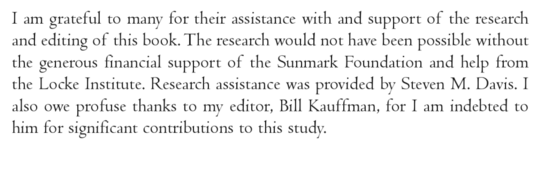
In the acknowledgements (see below), Bennett wrote that his “research would not have been possible without the generous financial support of the Sunmark Foundation and help from the Locke Institute.”
Publications
The Locke Institute listed the following publications on its website as of June 2013:
John Locke Series13
- Charles K. Rowley (1992). The Right to Justice: The Political Economy of Legal Services in the United States. Edward Elgar Publishing.
- Charles K. Rowley (1993). Property Rights and the Limits of Democracy. Edward Elgar Publishing.
- Fred Foldvary (1994). Public Goods and Private Communities. Edward Elgar Publishing.
- William A. Niskanen (1994). Bureaucracy and Public Economics. Edward Elgar Publishing.
- Charles K. Rowley, Willem Thorbecke, & Richard E. Wagner (1995). Trade Protection in the United States. Edward Elgar Publishing.
- Charles K. Rowley (1997). The Political Economy of the Minimal State. Edward Elgar Publishing.
- Charles K. Rowley, ed. (1998). Classical Liberalism and Civil Society. Edward Elgar Publishing.
- Gordon Tullock (1998). On Voting. Edward Elgar Publishing.
- Jim F. Couch and William F. Shughart (1998). The Political Economy of the New Deal. Edward Elgar Publishing.
- Norman Barry, ed. (1998). Limited Government, Individual Liberty and the Rule of Law: The Selected Papers of Arthur Shenfield.
- William A. Niskanen, Jr. (1998). Policy Analysis and Public Choice. Edward Elgar Publishing.
- Wolfgang Kasper & Manfred Streit (1999). Institutional Economics: Social Order and Public Policy. Edward Elgar Publishing.
- Peter Moser (2000). The Political Economy of Democratic Institutions. Edward Elgar Publishing.
- Boudewijn Bouckaert and Annette Godart-van der Kroon (2000). Hayek Revisited. Edward Elgar Publishing.
- Ian Runge (2001). Capital and Uncertainty: The Capital Investment Process in a Market Economy. Edward Elgar Publishing.
- Pietro Navarra and Giuseppe Sobbrio (2001). Rules, Choice and Strategy: The Political Economy of Italian Electoral Reform by Ram Mudambi. Edward Elgar Publishing.
- Jennifer C. Martin-Das (2002). The European Monetary Union in a Public Choice Perspective. Edward Elgar Publishing.
- Ram Mudambi, Pietro Navarra and Giuseppe Sobbrio, eds. (2003). Economic Welfare, International Business and Global Institutional Change. Edward Elgar Publishing.
- William A. Niskanen (2003). Autocratic, Democratic, and Optimal Government: Fiscal Choices and Economic Outcomes. Edward Elgar Publishing.
- Gordon Tullock (2005). Public Goods, Redistribution and Rent Seeking. Edward Elgar Publishing.
- Francisco Parisi and Charles K. Rowley, eds. (2005).The Origins of Law and Economics: Essays by the Founding Fathers. Edward Elgar Publishing.
- Mary Reintsma (2007). The Political Economy of Welfare Reform in the United States. Edward Elgar Publishing.
- Ekaterina Brancato (2009). Markets versus Hierarchies: A Political Economy of Russia from the 10th Century to 2008. Edward Elgar Publishing.
Churchill Series14
- Bernard H. Siegan (1992). Drafting a Constitution for a Nation or Republic Emerging into Freedom. The Locke Institute in co-operation with the Institute for Humane Studies.
- James T. Bennett and Thomas J. Lorenzo (1994). Unhealthy Charities: Hazardous to your Health and Wealth. Basic Books.
- Christopher Lingle (1995). Singapore’s Authoritarian Capitalism: Asian Values, Free Market Illusions, & Political Dependency. Locke Institute.
- James T. Bennett and Thomas J. Lorenzo (1997). CancerScam: The Diversion of Federal Cancer Funds to Politics. Routledge.
- James T. Bennett and Thomas J. DiLorenzo (2000). From Pathology to Politics: Public Health in America. Routledge.
- Amanda J. Owens (2002). The Crisis of the United States Common Law System.
Contact & Address
In December 2023, the Locke Institute’s website listed its email contact address as: lockeinstitute@gmail.com.15
In June 2009, the Locke Institute listed the following contact information:16
5188 Dungannon Road
Fairfax, Virginia 22030
USA
703-934-6934
Fax: 703-352-6927
locke@thelockeinstitute.org
Based on a Google Street View for this location at the time, it appeared to be a residential neighborhood. A property bearing this address was listed for sale as of February 2016, with an assessed value of $650,100.17
The Locke Institute’s address, as of August 2007, was:18
4084 University Drive, Suite 103
Fairfax, Virginia 22030-6812 USA
(1) 703-934-6934
Fax: (1) 703-352-9747
info@TheLockeInstitute.org
Related Organizations
- Edward Elgar Publishing —“The Institute maintains a publishing relationship with Edward Elgar Publishing.”19
Other Resources
- “Locke Institute,” SourceWatch.
- “Factsheet: The Locke Institute,” ExxonSecrets.
Resources
- 1
“Board of Directors,” Locke Institute. Archived July 30, 2013. Archived .pdf on file at DeSmog. Archive URL: https://archive.ph/PEhz2
- 2
“Board of Directors,” Locke Institute. Archived July 30, 2013. Archived .pdf on file at DeSmog. Archive URL: https://archive.ph/PEhz2
- 3
“Thelockeinstitute.org,” Sedo’s Domain Parking. Archived September 1, 2014.
- 4
Mary Reinstma. The Political Economy of Welfare Reform in the United States, The Locke Institute. Edward Elgar Publishing, 2007. ISBN 978 1 84376 1134. Accessed at Google Books.
- 5
Locke Institute,” SourceWatch, July 19, 2004
- 6
Peter Passell. “Yawn. A global-warming alert. But this one has solutions,” New York Times, February 13, 1997. Archived .pdf on file at DeSmog. Archive URL: https://archive.ph/Eo6tm
- 7
(Press Release). “2,500 ECONOMISTS AGREE THAT COMBATING GLOBAL WARMING NEED NOT NECESSARILY HARM THE U.S. ECONOMY NOR LIVING STANDARDS,” Redefining Progress, March 29, 2011. Archived February 29, 2016. Archive URL: https://archive.ph/8MLA6
- 8
“THE ECONOMISTS’ STATEMENT ON CLIMATE CHANGE,” Redefining Progress. Archived February 29, 2016. Archive URL: https://archive.ph/GsE1E
- 9
Mary Reinstma. The Political Economy of Welfare Reform in the United States, The Locke Institute, p. ii. Edward Elgar Publishing, 2007. ISBN 978 1 84376 1134. Accessed at Google Books.
- 10
Charles Rowley. “Never Let A Good Crisis Go To Waste,” Charles Rowley’s Blog, October 19, 2010. Archived December 14, 2011. Archived .pdf on file at DeSmog. Archive URL: https://archive.ph/NHrmh
- 11
James T. Bennett. “The Doomsday Lobby: Hype and Panic from Sputniks, Martians, and Marauding Meteors,” Springer Science + Business Media, 2010. Archived February 29, 2016. Archive URL: https://archive.ph/389df
- 12
James T. Bennett. “The Doomsday Lobby: Hype and Panic from Sputniks, Martians, and Marauding Meteors ,” Copernicus, 2010. Accessed at Google Books.
- 13
“The John Locke Series,” The Locke Institute. Archived June 19, 2013. Archive URL: https://archive.ph/RR5o3
- 14
“The Churchill Series,” The Locke Institute. Archived June 19, 2013. Archive URL: https://archive.ph/lF3Rb
- 15
“Contact Us,” The Locke Institute. Archived December 18, 2023. Archive URL: https://web.archive.org/web/20231218174213/https://the-locke-institute.org/contact-us/
- 16
“Contact,” The Locke Institute. Archived June 24, 2009. Archive URL: https://archive.ph/Zxiiu
- 17
“5188 Dungannon Road, Fairfax, VA 22030,” Homesnap. Archived February 28, 2016. Archive URL: https://archive.ph/hzgyD
- 18
“Contact,” The Locke Institute. Archived August 28, 2007. Archive URL: https://archive.ph/3lmwG
- 19
Mary Reinstma. The Political Economy of Welfare Reform in the United States, The Locke Institute. Edward Elgar Publishing, 2007. ISBN 978 1 84376 1134. Accessed at Google Books.
---
sourcewatch
According to its website The Locke Institute was founded in 1989 "as an independent, non-partisan educational and research organization. Named for the philosopher and political theorist John Locke (1632-1704), the Institute ascribes to his theory that society is based on the law of nature and that the individual is the ultimate source of political sovereignty".
"The Institute endorses Locke's proposition that individuals are possessed of inalienable rights to life, liberty, and property. It is the principal function of the state to uphold these rights since free individuals otherwise would not enter into political society," its website states. [1]
Board Members:
- Charles K. Rowley, General Director
- Arthur Seldon, Editorial Director
- Robert S. Elgin, Financial Director
- Amanda J. Owens, Legal Studies Director
- James T. Bennett, Program Director
- Gordon Tullock, Education Director
Academic Advisory Council:
- Richard A. Epstein (Council President), Professor of Law, University of Chicago
- Armen Alchian, Emeritus Professor of Economics, University of California, Los Angeles
- Norman Barry, Professor of Political Science, University of Buckingham
- Michael A. Crew, Professor of Economics, Rutgers University
- Antony de Jasay, Janville Paluel, France
- Harold Demsetz, Emeritus Professor of Economics, University of California, Los Angeles
- William M. Landes, Professor of Economics, University of Chicago
- Sir Alan Peacock, The David Hume Institute, Edinburgh, Scotland
- Judge Richard A. Posner, Chief Judge U. S. Court of Appeals for the Seventh Circuit and Senior Lecturer University of Chicago
- Robert D. Tollison, Professor of Economics George Mason University
- Gordon Tullock, Professor of Economics and Political Science, University of Arizona
- Karen Vaughn, Professor of Economics, George Mason University
- Edwin G. West, Emeritus Professor of Economics, Carleton University (died on October 6, 2001 [2] [3])
Contact information
The Locke Institute
4084 University Drive, Suite 103
Fairfax, Virginia 22030-6812 USA
Tel: 703-934-6934
Fax: 703-352-9747
web site: www.thelockeinstitute.org