DEC digital equip co
===
belotti
=
Digital Equipment Corporation - Wikipedia
Digital Equipment Corporation (DEC /dɛk/ ^ⓘ), using the trademark Digital, was a major American company in the computer industry from the 1960s to the 1990s. The company was co-founded by Ken Olsen and Harlan Anderson in 1957. Olsen was president until he was forced to resign in 1992, after the company had gone into precipitous decline.
The company produced many different product lines over its history. It is best known for the work in the minicomputer market starting in the early 1960s. The company produced a series of machines known as the PDP line, with the PDP-8 and PDP-11 being among the most successful minis in history. Their success was only surpassed by another DEC product, the late-1970s VAX "supermini" systems that were designed to replace the PDP-11. Although a number of competitors had successfully competed with Digital through the 1970s, the VAX cemented the company's place as a leading vendor in the computer space. As microcomputers improved in the late 1980s, especially with the introduction of RISC-based workstation machines, the performance niche of the minicomputer was rapidly eroded.
By the early 1990s, the company was in turmoil as their mini sales collapsed and their attempts to address this by entering the high-end market with machines like the VAX 9000 were market failures. After several attempts to enter the workstation and file server market, the DEC Alpha product line began to make successful inroads in the mid-1990s, but was too late to save the company. DEC was acquired in June 1998 by Compaq in what was at that time the largest merger in the history of the computer industry. During the purchase, some parts of DEC were sold to other companies; the compiler business and the Hudson Fab were sold to Intel. At the time, Compaq was focused on the enterprise market and had recently purchased several other large vendors. DEC was a major player overseas where Compaq had less presence. However, Compaq had little idea what to do with its acquisitions,[1][2] and soon found itself in financial difficulty of its own. Compaq subsequently merged with Hewlett-Packard (HP) in May 2002.
History
Origins (1944–1958)
 Original Digital Equipment Corporation logo designed by Elliot Hendrickson in 1957,[3] used from 1957 to 1993
 Alternate logo, briefly used concurrently
 DEC was headquartered at a former wool mill in Maynard, Massachusetts, from 1957 until 1992.
Ken Olsen and Harlan Anderson were two engineers who had been working at MIT Lincoln Laboratory[4] on the lab's various computer projects. The Lab is best known for their work on what would today be known as "interactivity", and their machines were among the first where operators had direct control over programs running in real-time. These had started in 1944 with the famed Whirlwind, which was originally developed to make a flight simulator for the US Navy, although this was never completed.[5] Instead, this effort evolved into the SAGE system for the US Air Force, which used large screens and light guns to allow operators to interact with radar data stored in the computer.[6]
When the Air Force project wound down, the Lab turned their attention to an effort to build a version of the Whirlwind using transistors in place of vacuum tubes. In order to test their new circuitry, they first built a small 18-bit machine known as TX-0, which first ran in 1956.[7] When the TX-0 successfully proved the basic concepts, attention turned to a much larger system, the 36-bit TX-2 with a then-enormous 64 kWords of core memory. Core was so expensive that parts of TX-0's memory were stripped for the TX-2, and what remained of the TX-0 was then given to MIT on permanent loan.[8]
At MIT, Ken Olsen and Harlan Anderson noticed something odd: students would line up for hours to get a turn to use the stripped-down TX-0, while largely ignoring a faster IBM machine that was also available. The two decided that the draw of interactive computing was so strong that they felt there was a market for a small machine dedicated to this role, essentially a commercialized TX-0. They could sell this to users where the graphical output or real-time operation would be more important than outright performance. Additionally, as the machine would cost much less than the larger systems then available, it would also be able to serve users that needed a lower-cost solution dedicated to a specific task, where a larger 36-bit machine would not be needed.[9][dead link][better ^source needed]
In 1957, when the pair and Ken's brother Stan sought capital, they found that the American business community was hostile to investing in computer companies. Many smaller computer companies had come and gone in the 1950s, wiped out when new technical developments rendered their platforms obsolete, and even large companies like RCA and General Electric were failing to make a profit in the market. The only serious expression of interest came from Georges Doriot and his American Research and Development Corporation (AR&D). Worried that a new computer company would find it difficult to arrange further financing, Doriot suggested the fledgling company change its business plan to focus less on computers, and even change their name from "Digital Computer Corporation".[9][dead link][better ^source needed]
The pair returned with an updated business plan that outlined two phases for the company's development. They would start by selling computer modules as stand-alone devices that could be purchased separately and wired together to produce a number of different digital systems for lab use. Then, if these "digital modules" were able to build a self-sustaining business, the company would be free to use them to develop a complete computer in their Phase II.[10] The newly christened "Digital Equipment Corporation" received $70,000 from AR&D for a 70% share of the company,[9][dead link][better ^source needed] and began operations in a Civil War-era textile mill in Maynard, Massachusetts, where plenty of inexpensive manufacturing space was available.
Digital modules (1958)
 System Building Blocks (System Module) 1103 hex-inverter card (both sides)
 (https://en.wikipedia.org/wiki/File:PDP-1_System_Building_Block_No._4106.jpg)PDP-1 System Building Block #4106, circa 1963 - note that one transistor (yellow) has been replaced.
In early 1958, DEC shipped its first products, the "Digital Laboratory Module" line. The Modules consisted of a number of individual electronic components and germanium transistors mounted to a circuit board, the actual circuits being based on those from the TX-2.[11]
The Laboratory Modules were packaged in an extruded aluminum housing,[12] intended to sit on an engineer's workbench, although a rack-mount bay was sold that held nine laboratory modules.[13] They were then connected together using banana plug patch cords inserted at the front of the modules. Three versions were offered, running at 5 MHz (1957), 500 kHz (1959), or 10 MHz (1960).[11] The Modules proved to be in high demand by other computer companies, who used them to build equipment to test their own systems. Despite the recession of the late 1950s, the company sold $94,000 worth of these modules during 1958 alone (equivalent to $992,700 in 2023), turning a profit at the end of its first year.[9][dead link][better ^source needed]
The original Laboratory Modules were soon supplemented with the "Digital System Module" line, which were identical internally but packaged differently. The Systems Modules were designed with all of the connections at the back of the module using 22-pin Amphenol connectors, and were attached to each other by plugging them into a backplane that could be mounted in a 19-inch rack. The backplanes allowed 25 modules in a single 5-1/4 inch section of rack, and allowed the high densities needed to build a computer.[11]
The original laboratory and system module lines were offered in 500 kilocycle, 5 megacycle and 10 megacycle versions. In all cases, the supply voltages were -15 and +10 volts, with logic levels of -3 volts (passive pull-down) and 0 volts (active pull-up).[13]
DEC used the System Modules to build their "Memory Test" machine for testing core memory systems, selling about 50 of these pre-packaged units over the next eight years.[14] The PDP-1 and LINC computers were also built using System Modules (see below).
Modules were part of DEC's product line into the 1970s, although they went through several evolutions during this time as technology changed. The same circuits were then packaged as the first "R" (red) series "Flip-Chip" modules. Later, other Flip-Chip module series provided additional speed, much higher logic density, and industrial I/O capabilities.[15] DEC published extensive data about the modules in free catalogs that became very popular.
PDP-1 family (1960)
Main article: PDP-1
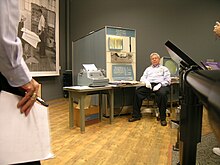 (https://en.wikipedia.org/wiki/File:Steve_Russell_and_PDP-1_-_Vintage_Computer_Fair_2006.jpg)A PDP-1 system, with Steve Russell, developer of Spacewar! at the console. This is a canonical example of the PDP-1, with the console typewriter on the left, CPU and main control panel in the center, the Type 30 display on the right.
With the company established and a successful product on the market, DEC turned its attention to the computer market once again as part of its planned "Phase II".[10] In August 1959, Ben Gurley started design of the company's first computer, the PDP-1. In keeping with Doriot's instructions, the name was an initialism for "Programmable Data Processor", leaving off the term "computer". As Gurley put it, "We aren't building computers, we're building 'Programmable Data Processors'." The prototype was first shown publicly at the Joint Computer Conference in Boston in December 1959.[16] The first PDP-1 was delivered to Bolt, Beranek and Newman in November 1960,[17] and formally accepted the next April.[18] The PDP-1 sold in basic form for $120,000 (equivalent to $9,269,291 in 2023).[19] By the time production ended in 1969, 53 PDP-1s had been delivered.[14][20]
The PDP-1 was supplied standard with 4096 words of core memory, 18-bits per word, and ran at a basic speed of 100,000 operations per second. It was constructed using many System Building Blocks that were packaged into several 19-inch racks. The racks were themselves packaged into a single large mainframe case, with a hexagonal control panel containing switches and lights mounted to lie at table-top height at one end of the mainframe. Above the control panel was the system's standard input/output solution, a punched tape reader and writer. Most systems were purchased with two peripherals, the Type 30 vector graphics display, and a Soroban Engineering modified IBM Model B Electric typewriter that was used as a printer. The Soroban system was notoriously unreliable, and often replaced with a modified Friden Flexowriter, which also contained its own punched tape system. A variety of more-expensive add-ons followed, including magnetic tape systems, punched card readers and punches, and faster punched tape and printer systems.
When DEC introduced the PDP-1, they also mentioned larger machines at 24, 30 and 36 bits, based on the same design.[21] During construction of the prototype PDP-1, some design work was carried out on a 24-bit PDP-2, and the 36-bit PDP-3. Although the PDP-2 never proceeded beyond the initial design, the PDP-3 found some interest and was designed in full.[22] Only one PDP-3 appears to have been built, in 1960, by the CIA's Scientific Engineering Institute (SEI) in Waltham, Massachusetts. According to the limited information available, they used it to process radar cross section data for the Lockheed A-12 reconnaissance aircraft. Gordon Bell remembered that it was being used in Oregon some time later, but could not recall who was using it.[23]
....
VAX (1977)
[ ](https://en.wikipedia.org/wiki/File:LCM_-DEC_VAX_11-780-5_-01.jpg)DEC VAX 11/780-5 at Living Computers: Museum + Labs
Main article: VAX
The introduction of semiconductor memory in the early 1970s, and especially dynamic RAM shortly thereafter, led to dramatic reductions in the price of memory as the effects of Moore's Law were felt. Within years, it was common to equip a machine with all the memory it could address, typically 64 KB on 16-bit machines. This led vendors to introduce new designs with the ability to address more memory, often by extending the address format to 18 or 24-bits in machines were otherwise similar to their earlier 16-bit designs.[b]
In contrast, DEC decided to make a more radical departure. In 1976, they began the design of a machine whose entire architecture was expanded from the 16-bit PDP-11 to a new 32-bit basis. This would allow the addressing of very large memories, which were to be controlled by a new virtual memory system, and would also improve performance by processing twice as much data at a time. The system would, however, maintain compatibility with the PDP-11, by operating in a second mode that sent its 16-bit words into the 32-bit internals, while mapping the PDP-11's 16-bit memory space into the larger virtual 32-bit space.[47]
The result was the VAX architecture, where VAX stands for Virtual Address eXtension (from 16 to 32 bits). The first computer to use a VAX CPU was the VAX-11/780, announced in October 1977, which DEC referred to as a superminicomputer. Although it was not the first 32-bit minicomputer, the VAX-11/780's combination of features, price, and marketing almost immediately propelled it to a leadership position in the market after it was released in 1978. VAX systems were so successful that in 1983, DEC canceled its Jupiter project, which had been intended to build a successor to the PDP-10 mainframe, and instead focused on promoting the VAX as the single computer architecture for the company.[47]
Supporting the VAX's success was the VT52, one of the most successful smart terminals. Building on earlier less successful models, the VT05 and VT50, the VT52 was the first terminal that did everything one might want in a single inexpensive chassis. The VT52 was followed by the even more successful VT100 and its follow-ons, making DEC one of the largest terminal vendors in the industry. This was supported by a line of inexpensive computer printers, the DECwriter line. With the VT and DECwriter series, DEC could now offer a complete top-to-bottom system from computer to all peripherals, which formerly required collecting the required devices from different suppliers.
The VAX processor architecture and family of systems evolved and expanded through several generations during the 1980s, culminating in the NVAX microprocessor implementation and VAX 7000/10000 series in the early 1990s.[48]
Early microcomputers (1982–1986)
When a DEC research group demonstrated two prototype microcomputers in 1974—before the debut of the MITS Altair—Olsen chose to not proceed with the project. The company similarly rejected another personal computer proposal in 1977.[49] At the time these systems were of limited utility, and Olsen famously derided them in 1977, stating "There is no reason for any individual to have a computer in his home."[c] Unsurprisingly, DEC did not put much effort into the microcomputer area in the early days of the market. In 1977, the Heathkit H11 was announced; a PDP-11 in kit form. At the beginning of the 1980s, DEC built the VT180 (codenamed "Robin"), which was a VT100 terminal with an added Z80-based microcomputer running CP/M, but this product was initially available only to DEC employees.[50]
It was only after IBM had successfully launched the IBM PC in 1981 that DEC responded with their own systems. In 1982, DEC introduced not one, but three incompatible machines which were each tied to different proprietary architectures. The first, the DEC Professional, was based on the PDP-11/23 (and later, the 11/73) running the RSX-11M+ derived, but menu-driven, P/OS ("Professional Operating System"). This DEC machine easily outperformed the PC, but was more expensive than, and completely incompatible with IBM PC hardware and software, offering far fewer options for customizing a system.
Unlike CP/M and DOS microcomputers, every copy of every program for the Professional had to be provided with a unique key for the particular machine and CPU for which it was bought. At that time this was mainstream policy, because most computer software was either bought from the company that built the computer or custom-constructed for one client. However, the emerging third-party software industry disregarded the PDP-11/Professional line and concentrated on other microcomputers where distribution was easier.
At DEC itself, creating better programs for the Professional was not a priority, perhaps from fear of cannibalizing the PDP-11 line. As a result, the Professional was a superior machine, running inferior software.[51] In addition, a new user would have to learn an awkward, slow, and inflexible menu-based user interface which appeared to be radically different from PC DOS or CP/M, which were more commonly used on the 8080- and 8088-based microcomputers of the time. A second offering, the DECmate II was the latest version of the PDP-8-based word processors, but not really suited to general computing, nor competitive with Wang Laboratories' popular word processing equipment.
 DEC Rainbow 100, floor-mounted
The most popular early DEC microcomputer was the dual-processor (Z80 and 8088) Rainbow 100,[49] which ran the 8-bit CP/M operating system on the Z80 and the 16-bit CP/M-86 operating system on the Intel 8088 processor. It could also run a UNIX System III implementation called VENIX. Applications from standard CP/M could be re-compiled for the Rainbow, but by this time users were expecting custom-built (pre-compiled binary) applications such as Lotus 1-2-3, which was eventually ported along with MS-DOS 2.0 and introduced in late 1983. Although the Rainbow generated some press, it was unsuccessful due to its high price and lack of marketing and sales support.[52] By late 1983 IBM was outselling DEC's personal computers by more than ten to one.[49]
A further system was introduced in 1986 as the VAXmate, which included Microsoft Windows 1.0 and used VAX/VMS-based file and print servers along with integration into DEC's own DECnet-family, providing LAN/WAN connection from PC to mainframe or supermini. The VAXmate replaced the Rainbow, and in its standard form was the first widely marketed diskless workstation.
Networking and clusters (1984)
In 1984, DEC launched its first 10 Mbit/s Ethernet. Ethernet allowed scalable networking, and VAXcluster allowed scalable computing. Combined with DECnet and Ethernet-based terminal servers (LAT), DEC had produced a networked storage architecture which allowed them to compete directly with IBM. Ethernet replaced Token Ring, and went on to become the dominant networking model in use today.
In September 1985, DEC became the fifth company to register a .com domain name (dec.com)....