INST OF PEACE USIP
---
INCL 1 26 davos bs bd
---
---
---
RWW
02/09/2026
by
- Miles Klee @ Wired: Turning Point USA’s Halftime Show Was Exactly What You’d Expect
“The All-American Halftime Show," born out of outrage over Bad Bunny’s Super Bowl performance, fell short of the hype. From Kid Rock’s poor lip synching to Erika Kirk being MIA, it was simply dull.
- Ellen Ioanes @ The American Prospect: Board of Peace Is a Board of Profits
Corporate interests dominate the organization planning the reconstruction of Gaza.
- Oriana González @ NOTUS: Republicans Want Nothing to Do With Conservative Efforts to Ban Gay Marriage
Trump has moved the Republican Party away from its decades-old opposition to same-sex marriage, and public support remains high.
- Bryan Kaylor @ Public Witness: At National Prayer Breakfast, Hegseth Says US Soldiers Gain Salvation by Dying for ‘Christian Nation’
Pete Hegseth, who likes to call himself the “Secretary of War,” spoke after Trump to baptize the U.S. and especially its military. He did so by highlighting the worship services he’s been leading at the Pentagon. And he even suggested that soldiers can gain salvation by fighting for the United States.
- Hafiz Rashid @ The New Republic: March for Life Attendees Are Getting Measles
It turns out the anti-abortion March for Life demonstration was a measles superspreader event.
- Josh Kovensky @ Talking Points Memo: Trump DOJ Files 9/11-Era Charges Against Leftists Across the Country
Under Trump, the DOJ has changed how it brings terrorism cases, and is training them on the opposition.
As details about President Donald Trump’s Board of Peace and its plans for the reconstruction of Gaza trickle out, two things become increasingly clear: Palestinians have barely, if at all, been consulted in these plans; and the people in Trump’s orbit stand to benefit from the project the most.
The U.N. Security Council approved the Board of Peace as a mechanism for implementing Trump’s 20-point peace plan for Israel and Gaza back in November, though its mandate now appears much broader. The BoP itself consists of high-level representatives from Gulf nations, Israel, Serbia, Albania, and Argentina, among others, with Trump himself as the chair and ultimate decision-maker. Absent from the Board of Peace are representatives from almost every EU country except Bulgaria and Hungary, and anyone representing Palestine.
The BoP’s executive board—tasked with putting the BoP’s vision into practice—is composed of billionaire businessmen like Marc Rowan, CEO of private equity firm Apollo Global Management; Trump’s son-in-law Jared Kushner; and Steve Witkoff, the real estate mogul turned Trump donor turned special envoy to the Middle East. There’s Ajay Banga, the World Bank president who prioritizes private-sector investment in global development, as well as U.S. Secretary of State and national security adviser Marco Rubio, deputy national security adviser Robert Gabriel, and former U.K. Prime Minister Tony Blair.
The special Gaza Executive Board adds Israeli-Cypriot real estate mogul Yakir Gabay, who enjoys a close friendship with Kushner, as well as representatives from the UAE, Qatar, Egypt, and Turkey. Sigrid Kaag, the Dutch U.N. coordinator for humanitarian aid into Gaza and the lone humanitarian-sector representative, and former U.N. special coordinator for the Middle East peace process Nickolay Mladenov lend the group a dash of gravitas—but just a dash.
The Palestinian role is reduced to a 15-member technocratic and “apolitical” governance body, led by engineer and former Palestinian Authority official Ali Shaath.
Details about how exactly Trump’s group plans to carry out Gaza’s reconstruction are limited thus far, but the number of real estate and finance bigwigs on the executive board indicates that it will likely be a highly privatized endeavor.
“When you look at the executive committee, I think it is absolutely unprecedented in multilateral organizations, which I guess the Board of Peace is supposed to be, even if it’s not really [multilateral] because of Trump’s dominance over it,” said Hugh Lovatt, senior policy fellow at the European Council on Foreign Relations. “I think it is nonetheless pretty much unprecedented to have such explicit power exerted by private individuals who are there by virtue of their business interests.” The Prospect reached out to two members of the Gaza Executive Board with questions about how board members would keep their business interests separate from their political role, but did not receive a response by press time.
Multilateral institutions like the U.N. are supposed to operate under cooperative and humanitarian principles; representatives to such bodies are supposed to represent the interests of their nations or regions, not their private businesses.
“President Trump does not seem to do anything unless it benefits the U.S., but more specifically, unless it seems to benefit himself,” Lovatt said. “And this is not something that is exclusive to Gaza or the Board of Peace, and I think is very much interwoven into his presidency.”
Among those private individuals, Kushner’s business activities have raised significant concern. He is now the owner and principal of Affinity Partners, an investment firm that doesn’t seem to be doing that much investing, according to findings from an investigation by the Senate Finance Committee. But Kushner still profits, with Affinity pocketing a 2 percent annual management fee from almost all his investors. “He’s able to get such enormous fees, as an investor with a pretty crummy record who’s just raking in money from sovereign wealth funds in the Gulf, regardless of how well he is shepherding those investments,” said Ryan Carey, chief communications adviser and deputy policy director at the U.S. Senate Committee on Finance.
The fund’s assets under management come almost exclusively from “the very Arab petrostates critical to the agreement and potential reconstruction—Saudi Arabia, Qatar and the United Arab Emirates,” journalist Mohamad Bazzi wrote in*The Guardian*. These nations have already begun investing in Syria and could be involved in rebuilding efforts in Lebanon, in a bid to exercise more influence in the region.
---
---
MMA
January 22, 2026, edition of Fox News' Fox & Friends
:{:{BRIAN KILMEADE (CO-HOST): You have some, about 20 who showed up, they all signed, some of which spoke. Jared Kushner, as well as Steve Witkoff, are going to end up going to Russia to talk peace with Vladimir Putin, who is not into peace. I don't know how many visits we need to get that clear. But you have a Zelenskyy meeting with the president right now, at which time they are talking peace and he is saying this is the framework I can deal with, so you cannot blame Ukraine for not coming to the table. }:
But I think it's interesting, if you are talking about Middle East peace, these are the countries that need to get involved if you are ever going to have Gaza be a place that can inhabit human beings who want to have a good life, as opposed to Hamas who still controls about 70% of Gaza and has yet to put down their weapons. If they're going to put down their weapons, many of the countries on this board will be the ones to make them.}:
...
KILMEADE: It's crazy to invite Vladimir Putin. I don't know why — he has nothing to do with peace. He's created most of the violence over the last 20 years. But Vladimir Putin has been invited, so has President Zelenskyy. He said, ‘I received the invitation,' he said, ‘but how can I go on a board of peace with Russia, and Belarus, who does whatever Russia wants, they are a vassal state?' Canada says, ‘yeah, I'm interested in doing it, but I want to make sure humanitarian aid gets to Gaza,' and they say, ‘we don't want to spend a billion dollars.' So we'll see what kind of pushback they get. I think the billion dollars is due after three years if you want to be a permanent member. I don't think it is due right away. I'm not really sure what that goes to, by the way. What do you need a billion dollars for her to get on this?
---
AN 1 26 bibi?
Early Thursday morning, January 22 during the 2026 World Economic Forum (WEF) in Davos, Switzerland, U.S. President Donald Trump held a launching ceremony for his Board of Peace. Trump invited a long list of countries, from the European Union (EU) to Latin America, to join. But according to Daily Beast reporter Will Neal, his invitation is being rejected by a long list of European countries and western democracies.
"Some of the United States' longest standing allies have scorned en masse a signing ceremony for Donald Trump's new 'Board of Peace' initiative," Neal reports. "Not a single representative from a Western European country was present at the launch Thursday morning at the World Economic Forum in Davos. Fewer than 20 nations made an appearance, among them Gulf States like Saudi Arabia, Qatar and the UAE, along with Argentina and Paraguay. The number stands well below the 35 anticipated by senior White House officials."
The lack of enthusiasm for Trump's Board of Peace is fueling a lot of comments on X, formerly Twitter — many of them scathing.
Progressive Marlene Robertson tweeted, "Trump invited 60 countries to join his board of peace. Below is listed the s--- hole countries who have joined."
The countries Robertson listed ranged from Israel to Belarus to Turkey to Hungary.
Mike Nellis, an ex-senior adviser to former Vice President Kamala Harris, posted, "Donald Trump says it's okay he invited well-documented mass murderer Vladimir Putin to his b------- 'Board of Peace' because he 'gets the job done.' Maybe tell that to the people of Ukraine, j------."
Finnish author Joni Askola wrote, "Trump's board of peace is pathetic to watch. It doesn't include anyone who is serious about peace."
---
rww
12/04/2025
by
- Dan Diamond, Alec Dent and Katharine Houreld @ The Washington Post: The renamed ‘Donald J. Trump Institute of Peace’ hosts first event
Trump joined leaders from Rwanda and the Democratic Republic of Congo to sign an accord — and to marvel at the new name his administration gave the building.
- Edith Olmstead @ The New Republic: Did Pete Hegseth Even Read the Signalgate Report?
The Pentagon spokesman insisted the report completely exonerated Hegseth.
- Charlie Nash @ Mediaite: Fox Host Tells Women They’ll Get ‘Hotter’ if They Join GOP: ‘All Republican Women Are Hot’
Fox Business host Katrina Campins advised women that they would get “hotter” if they joined the Republican Party on Wednesday, declaring, “All Republican women are hot.”
- Moria Donegan @ The Guardian: Rightwingers are trying to destroy women’s right to vote
Calls for disenfranchisement rest on a single assumption: that women’s citizenship is partial and conditional.
- Adam Lynch @ AlterNet: Conservative professor warns GOP to stop 'playing footsie' with extremist bigots
Conservative Princeton University professor Robert P. George is warning the Republican Party and the modern conservative movement to jettison its growing bigot wing quickly before they destroy the party.
- Coleman Hughes: Nick Fuentes Knows Exactly What He’s Doing
---
pbs
institute of Peace reclaims its headquarters after court win over DOGE
:{Politics May 22, 2025
WASHINGTON (AP) — The U.S. Institute of Peace retook control of its headquarters Wednesday, two days after a federal judge said the firing of its board and employees by Elon Musk’s Department of Government Efficiency was illegal.
READ MORE: Judge blocks Trump administration from shutting peace institute that sought to end violent conflicts
The institute’s acting president, George Moose, entered the organization’s headquarters with private security and the institute’s outside attorney for the first time since being escorted off the premises during the DOGE takeover. Moose and most of the institute’s board were fired in March, part of the mass slashing of the federal workforce spearheaded by Musk.
The institute and many of its board members filed a lawsuit against the Trump administration soon after, seeking to prevent their removal and stop DOGE from taking over its operations. U.S. District Court Judge Beryl A. Howell’s opinion on Monday reversed DOGE’s actions.
Speaking after a short examination of the headquarters, Moose said all appeared to be in order.
“We just did a quick walk-through — externally, visibly, things look to be in pretty good shape,” he said. “I didn’t see anything, any destruction, if you will, no damage that I can see that is visible.”
Moose, a former ambassador and career member of the U.S. Foreign Service, said a team of employees from human resources, technology and finance would be in the building Thursday getting the nonprofit ready to welcome back its workforce. He expected to bring back all the staff who want to return.
In an email Wednesday, White House spokeswoman Anna Kelly did not comment on workers returning to the building, but signaled that the administration may challenge the decision.
“President Trump is right to reduce failed, useless entities like USIP to their statutory minimum, and the rogue judge’s attempt to impede on the separation of powers will not be the last say on the matter,” she said.
The administration filed a motion of appeal Wednesday evening and requested a stay of the judge’s ruling while that appeal is considered, arguing in part that Howell “erred” in concluding that the institution’s functions were not executive functions.
Agencies across the federal government have been slashed or dismantled by Musk’s DOGE team. Wednesday’s low-key scene at the institute’s headquarters marked a rare moment when a DOGE-targeted agency or organization has been able to begin reestablishing itself.
The judge’s ruling said the Trump administration did not have authority to unilaterally dismantle the institute, which was established by Congress in 1984 as an independent organization that would promote peace and seek to end conflicts around the world. It was operating in more than two dozen conflict zones at the time Musk’s team took it over and shut it down.
The saga began when Trump issued an executive order in February that targeted the institute and three other agencies for closure in an effort to deliver on campaign promises to shrink the size of the government. The first attempt by DOGE to take over the headquarters led to a standoff. Members of Musk’s DOGE group returned days later with the FBI and District of Columbia Metropolitan Police to help them gain entry.
DOGE installed new leadership, ordered a mass firing of nearly all the staff through their private emails, and handed over the institute’s headquarters to the General Services Administration.
The institute, concerned about liability and security of the building in the aftermath of the judge’s ruling, reached out to the government attorneys earlier this week and again on Wednesday. George Foote, the institute’s outside attorney, said the exchange was very smooth and orderly.
Moose said the goal now is to get back to the work the institute was created to do 40 years ago and “projects, ideas that are, we believe, of interest to the American people.”
---
NPR
Judge declines to immediately reverse Trump moves at U.S. Institute of Peace
Updated March 19, 2025
By
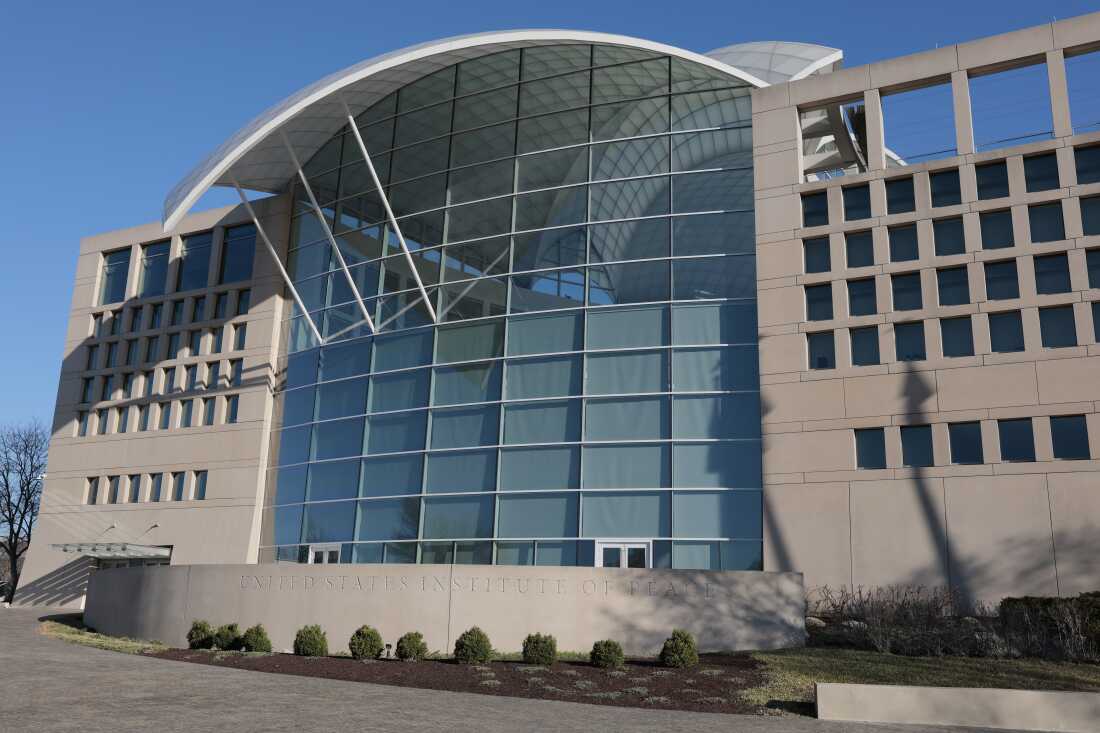
A view of the United States Institute of Peace (USIP) building headquarters on March 18 in Washington, D.C. Trump administration employees entered the building on Monday with the help of law enforcement officials after President Trump ordered the dismantling of the congressionally funded independent nonprofit.
Anna Moneymaker/Getty Images
A federal judge on Wednesday denied a request to block the Department of Government Efficiency's takeover of the U.S. Institute of Peace despite being "offended" at how it had transpired.
The Trump administration's attempt to gut USIP, which is a congressionally funded think tank, prompted a standoff between the police and the think tank's members on Monday.
Five of the institution's board members filed suit on Tuesday, alleging they were unlawfully fired from their positions. They called for their reinstatement, as well as a stop to the Trump administration's efforts to dismantle the institute.
U.S. District Judge Beryl Howell said Wednesday that there is "confusion" in the lawsuit. She expressed concern about its likelihood of success, and whether the USIP board members had suffered irreparable harm. Such conditions are necessary to meet the bar for a temporary restraining order — or an immediate halt and reversal of the Trump administration's actions.
She also said that fundamental questions remained about the nature of USIP: whether it is an independent agency or whether it falls under the executive branch. Lawyers for the Trump administration gave examples as to why it falls under the executive branch, including that it provides reports to Congress and administers grants. The agency's fired president has argued it's an independent non-executive branch agency.
Yet Howell also said that she was "very offended" by how DOGE officials had acted at the institute, and their treatment of employees in attempting to gain access to USIP's building in D.C. During the hearing, she also noted that the government's efforts were "probably terrorizing employees."
DOGE staff entered the U.S. Institute of Peace with D.C. police help
USIP was created through an act of Congress in 1984, shortly after a nuclear standoff with the-then Soviet Union, in order to study peaceful resolutions to conflict around the world.
Over the last four decades, USIP became an influential repository for studying international affairs and bringing together global experts on conflict resolution. It's one of the many platforms the U.S. cultivated to spread its soft power globally — until the White House ordered it dismantled last month.
Why was USIP created?
USIP is part of an ecosystem of organizations created by Congress during the Cold War to protect and project American values globally.
The think tank was designed to support research and advise policymaking that avoided violent conflict and to project American influence through programs like training peacekeepers and researching communication channels with geopolitical competitors, such as China.
"It was built as a symbol of the aspiration of the American people to be peace builders in the world," said George Moose, a former diplomat who says he is USIP's acting president and contests the Trump administration's efforts to replace the nonprofit's leadership.
China sees an opportunity as the U.S. cuts aid to groups around the world
This ecosystem also includes the National Endowment for Democracy (NED), a foundation which annually granted nearly $300 million in funding to pro-democracy work in over 100 countries, and the Wilson Center, a nonpartisan think tank which supported foreign policy research, particularly on Russia and Central Asia. The U.S. also grew its humanitarian aid programs through agencies like USAID, started in the 1960s in part to combat the influence of Communism, and through the State Department.
Goats and Soda
The Trump administration kills nearly all USAID programs
In the last two months however, the Trump administration effectively closed down USAID; frozen NED funding; cancelled some State Department grants; and ordered the Wilson Center to dramatically downsize.
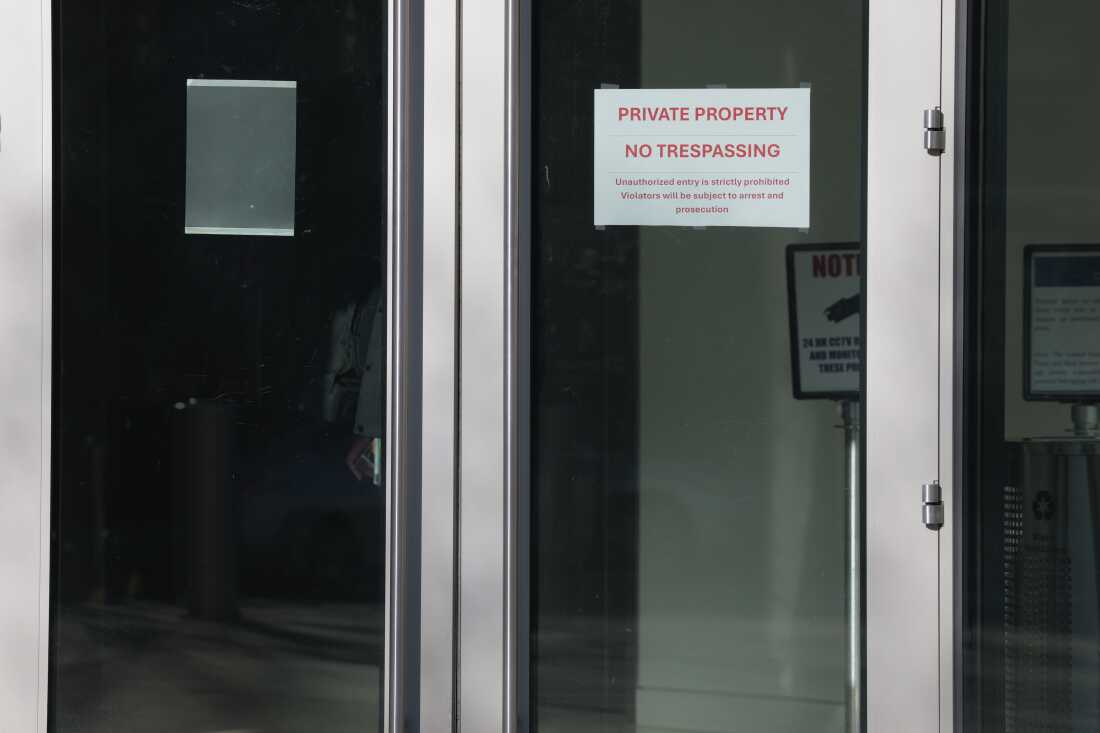
A sign says "No Trespassing" on doorway to the United States Institute of Peace (USIP) building headquarters on March 18, 2025 in Washington, D.C., after Trump administration officials ejected the think tank's staff.
Anna Moneymaker/Getty Images
Why is the Trump administration trying to close USIP down?
The Heritage Foundation, a conservative think tank in Washington that helped shape the current overhaul of the federal government, criticized USIP last year for being opaque in its operations and for favoring Democratic-leaning appointments.
National
Trump funding freeze halts decades of U.S. democracy work around the world
In February, President Trump ordered USIP be effectively shuttered, citing a "reduction in elements" of the federal government he deemed "unnecessary."
Since then, Trump has fired 11 of the USIP's 15 board members, citing noncompliance with his executive order.
Can the White House dismantle USIP?
USIP staff argue the executive branch has no authority to shut them down or freeze their funding, as the think tank is not a federal agency and is directly funded by Congress.
"We have been talking to them for many weeks now in anticipation of just this possibility and also to remind them that we are a private, nonprofit corporation in the District of Columbia and therefore not a federal agency, and therefore, the federal government has no entitlement to come in and take over our building," Moose told reporters on Monday.
Moose had refused to vacate his office even after the Trump administration fired him and most other board members. USIP staff are planning to file a lawsuit challenging the Trump administration's appointment of a new USIP president, because they argue the hirings and firings sidestepped the think tank's procedures for choosing leadership.
"We do not recognize the illegitimate president," George Foote, USIP's lawyer, told NPR.
According to USIP's own rules, the president of the United States is allowed to appoint and remove board members, but must do so with the consent of a majority of the board or with approval from several Senate subcommittees.
However, lawyers from the U.S. attorney's office for the District of Columbia quoted a signing statement accompanying the creation of USIP from former President Ronald Reagan. The statement notes that the statute should not be taken to restrict the president's "constitutional power" to remove board members.
Judge Howell on Wednesday appeared skeptical about how much weight to give the signing statement.
*Michele Kelemen contributed reporting.
---
WIKI 5 25
The United States Institute of Peace (USIP) is an American independent, nonprofit, national institute funded by the U.S. Congress and tasked with promoting conflict resolution and prevention worldwide.[3] It provides research, analysis, and training to individuals in diplomacy, mediation, and other peace-building measures.
Following years of proposals for a national peace academy, USIP was established in 1984 by congressional legislation signed into law by President Ronald Reagan. It is officially nonpartisan and independent, receiving funding only through a congressional appropriation to prevent outside influence. The institute is governed by a bipartisan board of directors with 15 members, which must include the secretary of defense, the secretary of state, and the president of the National Defense University. The remaining 12 members are appointed by the president and confirmed by the Senate.
The institute's headquarters is in the Foggy Bottom neighborhood of Washington, D.C., at the northwest corner of the National Mall near the Lincoln Memorial and Vietnam Veterans Memorial.[4][5] It employed around 300 personnel and trained more than 65,000 professionals since its inception.[citation ^needed]
In February 2025, President Donald Trump signed an executive order with an intention to dismantle the USIP.[6] In March, Trump ordered most of USIP's board of directors to be fired. Under statute, the president may remove board members with the approval of the majority of the board or several congressional committees.[7][8] The Department of Government Efficiency subsequently entered the USIP building to replace its leadership, fire its staff, and assume building ownership. Some of USIP's former leadership is contesting the legality of these moves in court, citing the agency's independent structure.[1][9]
Mission
The United States Institute of Peace Act, passed in 1984 and codified at 22 U.S.C. ch. 56, calls for the institute to "serve the people and the government through the widest possible range of education and training, basic and applied research opportunities, and peace information services on the means to promote international peace and the resolution of conflicts among the nations and peoples of the world without recourse to violence."[3]
The institute carries out this mission by operating programs in conflict zones, conducting research and analysis, operating a training academy[10] and public education center,[11] providing grants for research and fieldwork, convening conferences and workshops,[12] and building the academic and policy fields of international conflict management and peacebuilding.[13] On many of its projects, the institute works in partnership with non-governmental organizations, higher and secondary educational institutions, international organizations, local organizations, and U.S. government agencies, including the State Department and the Department of Defense.[14]
History
[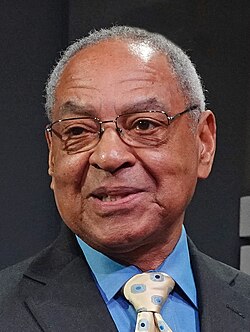 ](https://en.wikipedia.org/wiki/File:George_Moose_%282024%29_%28cropped%29.jpg)Ambassador George Moose, a president and CEO of the U.S. Institute of Peace
President Ronald Reagan signed the United States Institute of Peace Act in 1984.[3]
Spurred by a grassroots movement in the 1970s and 1980s,[citation ^needed] Senator Jennings Randolph joined senators Mark Hatfield and Spark Matsunaga and Representative Dan Glickman in an effort to form a national peace academy akin to the national military academies.[15] The 1984 act creating USIP followed from a 1981 recommendation of a commission formed to examine the peace academy issue appointed by President Jimmy Carter and chaired by Matsunaga.
Robert F. Turner was the institute's first president and CEO, holding that position from 1986 to 1987. He was followed by Ambassador Samuel W. Lewis (1987–1992), Ambassador Richard H. Solomon (1992–2012), and former congressman Jim Marshall (2012–2013). Kristin Lord served as acting president (2013–2014). Nancy Lindborg was sworn in as president on February 2, 2015 and served until 2020. Lise Grande was named the new president in October, 2020.[16] She continued in that role until April 24, 2024.[17] George Moose became the acting president and CEO.[18]
In its early years, the institute sought to strengthen international conflict management and peacebuilding. In a 2011 letter of support for USIP, the Association of Professional Schools of International Affairs stated that this analytical work has "helped to build the conflict management and resolution field, both as an area of study and as an applied science".[13]
Under Solomon's leadership, the institute expanded its operations in conflict zones and its training programs, initially in the Balkans and, after September 11, 2001, in Afghanistan and Iraq.[19] It also became the home of several congressionally mandated blue-ribbon commissions, including the Iraq Study Group, the Congressional Commission on the Strategic Posture of the United States, and the Quadrennial Defense Review Independent Panel. Today, the institute conducts active programs in Afghanistan, Iraq, Libya, Pakistan, Sudan, South Sudan, and elsewhere.[12]
In 1996, Congress authorized the Navy to transfer jurisdiction of the federal land—a portion of its Potomac Annex facility on what has been known as Navy Hill—to become the site of the permanent USIP headquarters, across the street from the National Mall at 23rd Street and Constitution Avenue NW, in Washington, D.C.[20] Prior to its construction, the institute leased office space in downtown Washington. Construction of the headquarters building concluded in 2011.
Second Trump administration
President Donald Trump signed an executive order on February 19, 2025, stating that "the non-statutory components and functions" of a handful of governmental entities, including the U.S. Institute of Peace, "shall be eliminated to the maximum extent consistent with applicable law"; instructing them to "reduce the performance of their statutory functions and associated personnel to the minimum presence and function required by law"; and to "submit a report to the director of the Office of Management and Budget (OMB director) confirming compliance with this order and stating whether the governmental entity, or any components or functions thereof, are statutorily required and to what extent."[6]
While some have interpreted the executive order as a move to terminate the institute, the United States Institute of Peace Act established the institute as an independent nonprofit institute, and 22 U.S.C. § 4601(b) provides a broad statutory mandate.[3] 22 U.S.C. § 4608 limits the authority of the Office of Management and Budget to reviewing and submitting comments on the institute’s Congressional budget request.[3] Under 22 U.S.C. § 4605(f), the president may remove USIP board members with the approval of the majority of the board or several congressional committees.[8]
In March 2025, Trump said he was firing all USIP board members, except the three ex officio members. Trump also said he was firing institute president Moose and appointing Kenneth Jackson as acting president. The Department of Government Efficiency (DOGE) gained access to the USIP building to install Jackson as president. USIP contested the firings and DOGE's access as illegal.[21][22][1][7] USIP leadership filed a lawsuit to stop the Trump administration's actions.[9][23][24]
While the legal dispute between USIP and the Trump administration is pending, Judge Beryl Howell has declined to issue a temporary restraining order to stop the Trump administration from proceeding with a takeover of USIP.[25] On March 28, the Trump administration fired over 200 USIP staffers, most of the remaining employees.[26] The Trump administration appointed DOGE staffer Nate Cavanaugh as USIP president. Cavanaugh transferred ownership of the headquarters building to the General Services Administration.[25]...
IU
Nate Cavanaugh dropped out of IU in 2015.
Now, he’s in charge of a federally funded institution meant to promote peace. And on top of that, he’s a staffer in billionaire Elon Musk’s so-called Department of Government Efficiency, an initiative of President Donald Trump’s second administration that's slashed federal agencies and thousands of jobs.
Lawyers representing the U.S. Institute of Peace, a Congress-funded nonpartisan organization intended to prevent violence abroad, asked a U.S. district court judge Monday to halt the transfer of its property to the General Services Administration. That judge, Beryl Howell, denied the motion Tuesday.
Documents show Cavanaugh was installed by top cabinet officials as president of USIP, as of March 25.
According to reports, Cavanaugh is 28 years old. He was featured in Forbes’ 2021 “30 Under 30” for enterprise technology. Cavanaugh’s profile on that list states he founded the company Brainbase from his IU dormitory before dropping out. He wrote on LinkedIn he attended IU from 2014-15.
A 2017 Medium article from Cavanaugh describes Brainbase as an intellectual property and trademark licensing management tool. The 2021 Forbes profile claimed the company had raised $12 million. Now, the original Brainbase website has gone dark, and the company seems to have been bought out. A different site, usebrainbase.com, promotes artificial intelligence workers for companies.
According to his LinkedIn, Cavanaugh left Brainbase in November 2022, but he is also the co-founder of FlowFi, which connects businesses with financial experts, according to its website. But photos of what it claims are experts appear to be AI-generated images. These images have a “glossy” look characteristic of AI photos, and reverse image searches for several yielded no results online. One reverse image search found one photo is an Adobe stock AI image.
Cavanaugh joined DOGE at some point following Trump’s executive order establishing it in January. WIRED reported last month he’d taken a role interviewing U.S. General Service Administration employees and earning a salary of $120,500 per year. That’s just shy of what DOGE says is the average annual salary of workers at GSA, $128,000.
The motion filed Monday includes a photo that shows an undated resolution signed by U.S. Secretaries of Defense and State Pete Hegseth and Marco Rubio removing the U.S. Institute for Peace’s acting president Kenneth Jackson and replacing him with Cavanaugh. Jackson himself is part of DOGE. Last month, he and other DOGE members were part of a standoff with USIP staff outside the building, ultimately gaining entry with the help of police.
Hegseth and Rubio are both on USIP’s board of directors. It also directed Cavanaugh to transfer all of the institute’s assets, including its building, to GSA. Cavanaugh wrote in a letter to the GSA administrator, also attached to the motion, that the building has an estimated fair market value of $500 million.
Russell Vought, U.S. Office of Management and Budget director and Project 2025 co-author, approved the building transfer at no cost in a March 29 letter.
The move comes amid DOGE firing nearly all of USIP’s staff in recent days. The institute promotes research, policy analysis and education on conflict resolution, according to the Federal Register.
---
DOGEBAG 5 25
Newsweek
https://www.newsweek.com › doge-list-staff-revealed-2029965
Who Is Helping DOGE? List of Staff Revealed - Newsweek
Feb 12, 2025Nate Cavanaugh, 28 Cavanaugh is an entrepreneur who interviewed staffers at the General Services Administration as part of the DOGE team, according to ProPublica. Akash Bobba, 21
- idsnews.com
Only include results for this siteHide site from these results
Share feedback about this site
Indiana Daily Student
https://www.idsnews.com › article › 2025 › 04 › iu-dropout-doge-leads-federal-institute
IU dropout, DOGE worker now leads federally funded institute
Apr 2, 2025Nate Cavanaugh, a 28-year-old entrepreneur and DOGE staffer, was installed as president of the U.S. Institute of Peace by top cabinet officials. He dropped out of IU in 2015 and founded Brainbase and FlowFi, two companies with questionable claims and images.
- yahoo.com