Hoff Sommers, C
==
used to see her name often?
===
==
origin of IWF [trump, kavanaugh?]
Confirmation Bias
:{
How “Women for Judge Thomas” turned into a conservative powerhouse.}:
By Barbara Spindel
clarence thomas anita hill.
Anita Hill’s televised testimony that Clarence Thomas sexually harassed her is credited for ushering in the Year of the Woman. But it also has another, less visible legacy.
Right on the heels of FX’s The People v. O.J. Simpson, the HBO film Confirmation offers another opportunity to relive a depressing ’90s spectacle—in this case, Clarence Thomas’ Supreme Court hearings. Anita Hill’s televised testimony that Thomas sexually harassed her, and her poor treatment at the hands of the all-male Senate Judiciary Committee, are often credited with raising awareness of the issue of workplace sexual harassment and ushering in the so-called Year of the Woman, the 1992 election of four women to the Senate. (Confirmation premieres April 16 and stars Scandal’s Kerry Washington as Hill and The Wire’s Wendell Pierce as Thomas.)
But the Thomas hearings have another, less visible legacy. A small group of prominent Washington women rallied around the nominee; they were headed by the late Ricky Silberman, a friend of Thomas’ who, like Hill, had worked with him at the Equal Employment Opportunity Commission. Calling themselves Women for Judge Thomas, they pointedly demonstrated that not all women, simply by virtue of their sex, were ready to don an “I Believe Anita Hill” pin.This ad-hoc bunch—which included Anita Blair, Barbara Ledeen, and the late Barbara Olson—went on to form the Independent Women’s Forum, a D.C. nonprofit devoted to waging war on mainstream feminism.
[Stills of Kerry Washington and Wendell Pierce in Confirmation.
Kerry Washington as Anita Hill and Wendell Pierce as Clarence Thomas in Confirmation.]
Back in the 1970s, Phyllis Schlafly and her allies had whipped up fears of unisex public bathrooms and female military conscription in order to help kill the Equal Rights Amendment. After that, groups such as Schlafly’s Eagle Forum and Beverly LaHaye’s Concerned Women for America railed against reproductive rights and gay rights and championed traditional gender roles. But among conservative women’s groups, the IWF was something new. If you squinted, its members—enterprising, educated professionals—looked like they could belong to the National Organization for Women. Instead, they had an extreme loathing for the feminist movement.
The IWF argued that second-wave feminism had solved the problem of sex discrimination. In a 1997 interview with now-defunct conservative magazine Insight, Blair, who was by then IWF president, said that current feminists were “playing out their own Freudian drama on the policy stage, saying, ‘Well, my first husband walked out on me, or I never had dates in high school, so all men are bad.’ ” A 1997 IWF press release called National Pay Inequity Awareness Day “a cruel hoax … designed to brainwash girls and young women into believing that they are victims.”
The IWF’s Elizabeth Larson, in the organization’s Women’s Quarterly magazine, called sexual harassment an issue drummed up by “a growing number of women, many spurred on by Anita Hill’s example … [who] find it more profitable to litigate than to work.”After the 1994 passage of the Violence Against Women Act—spearheaded by then-Sen. Joe Biden in what was widely seen as atonement for his mishandling of the Thomas hearings—the IWF argued that the legislation should be repealed or receive zero funding; IWF spokeswoman (and ’90s right-wing It Girl) Laura Ingraham referred to VAWA as feminist “pork” with a “tear-jerker” title. The group also took on affirmative action, headlining a Women’s Quarterly article on the topic “That’s No White Male, That’s My Husband”—a phrase that revealed a lot about IWF constituents’ racial identities and loyalties. (“You can’t have white guys saying you don’t need affirmative action,” Ledeen told the Washington Post when asked why the anti-feminist IWF had organized as women in the first place.)
Get Slate in your inbox.
[Laura Ingraham appears with Sen. George Allen at a fundraiser on Oct. 7, 2006, in Maidens, Virginia.
In 1995, NOW President Patricia Ireland, in a considerable understatement, called it “a little startling” that the new and tiny conservative upstart IWF, with fewer than 2,000 members, was garnering media coverage to rival that of Ireland’s mass-membership organization. It surely helped that stalwart right-wing donors including Richard Scaife and the Koch brothers were funding the IWF, and that its well-connected roster included former National Endowment for the Humanities chairwoman (and wife of Dick Cheney) Lynne Cheney,Who Stole Feminism? authorChristina Hoff Sommers, neoconservative writer (and wife of Norman Podhoretz) Midge Decter, and Wendy Lee Gramm and Mary Ellen Bork, married, respectively, to Texas Sen. Phil Gramm and rejected Supreme Court nominee Robert Bork.
Hill was often dismissed as overreacting to a joke about a pubic hair on a Coke can.
While much of the IWF’s campaign against feminism was waged in the media, the group also took the fight to Capitol Hill; the IWF testified before Congress against the Violence Against Women Act and affirmative action, and filed amicus briefs opposing the enforcement of Title IX and the coeducation of the Virginia Military Institute.
After the election of George W. Bush, the IWF’s clout grew as its members received posts within the new administration, among them Elaine Chao as labor secretary, Diana Furchtgott-Roth as chief of staff of the White House Council of Economic Advisers, and Blair as deputy assistant secretary of the Navy. Most absurdly, twoIWF members, then-president Nancy Pfotenhauerand board member Margot Hill, were appointed to the administration’s National Advisory Committee on Violence Against Women.
Despite engaging in serious business, the IWF’s spokeswomen never appeared to take themselves too seriously; they loved to bait feminists but always with a smile. Blair said, “There’s a telltale way to find a liberal feminist: It’s the nasty wrinkles around her mouth that she gets from frowning. You’ll probably find my side with laugh lines.” “We have no angry agenda,” Grace Paine Terzian, then publisher of Women’s Quarterly, told a journalist in 1995. When Wendy Kaminer wrote on right-wing challenges to feminism in the American Prospect the following year, the IWF’s Elizabeth Lurie responded in a letter to the editor that she had found the piece “howlingly funny.” All of this forced cheer was intended to highlight the contrast between the IWF’s anti-feminism and its caricatured version of feminism, which, according toHoff Sommers in a 1996 60 Minutes profile of the IWF, had come to mean “that you’re chronically offended, that you’re looking for oppression and bias under every tree.”
Plenty of people still see Hill as fitting this description, even 25 years after the Thomas hearings. Although she accused Thomas of repeated graphic descriptions of pornographic films, including scenes of rape and bestiality, and of detailed boasts about his own sexual prowess, Hill was and is often dismissed as overreacting to a joke about a pubic hair on a Coke can. Indeed, IWF managing director Carrie Lukas recently described Hill’s allegations against Thomas as “rather PG-rated.”
Of course, the IWF exists not because its founders thought Hill was overreacting but because, as friends of Thomas, they thought she was lying. In the years since—when downplaying the existence and impact of sex discrimination and of gender-based crimes such as harassment, rape, and domestic violence—the IWF doesn’t suggest that all women are lying. The group has frequently suggested, however, that women who speak out about these issues are whining, and should stop playing the victim, and ought to pull themselves up by their bootstraps. In that sense the IWF, whose current mission is to “improve the lives of Americans byincreasing the number of women who value free markets and personal liberty,” has ties to Thomas that are not merely personal but philosophical as well.
The women of the IWF continue to stand by Clarence Thomas, and he by them. After Silberman’s 2007 death, Thomas sat down with the group’s Michelle Bernard and Charlotte Hays to talk about his friend for the IWF newsletter. “Sometimes at IWF we are accused of being anti-women and anti-feminist, because our mantra is that all issues are women’s issues,” his interviewers noted. “I wouldn’t worry about that too much,” Thomas responded, proceeding to describe his own experiences being called “traitor” and “Uncle Tom.” “When I am criticized, I take it as a compliment,” he said. “If I weren’t relevant, they wouldn’t talk about me. Don’t worry about it. You just wish them good health and do it with a smile.”
==
===
NYT bari IDW:
closest thing to a phone book for the I.D.W. is a sleek website that lists the dramatis personae of the network, including Mr. Harris; Mr. Weinstein and his brother and sister-in-law, the evolutionary biologists Bret Weinstein and Heather Heying; Jordan Peterson, the psychologist and best-selling author; the conservative commentators Ben Shapiroand Douglas Murray; Maajid Nawaz, the former Islamist turned anti-extremist activist; and the feminists Ayaan Hirsi Ali and Christina Hoff Sommers. But in typical dark web fashion, no one knows who put the website up.
...
But they all share three distinct qualities. First, they are willing to disagree ferociously, but talk civilly, about nearly every meaningful subject: religion, abortion, immigration, the nature of consciousness. Second, in an age in which popular feelings about the way things ought to be often override facts about the way things actually are, each is determined to resist parroting what’s politically convenient. And third, some have paid for this commitment by being purged from institutions that have become increasingly hostile to unorthodox thought — and have found receptive audiences elsewhere.
“People are starved for controversial opinions,” said Joe Rogan, an MMA color commentator and comedian who hosts one of the most popular podcasts in the country. “And they are starved for an actual conversation.
...
no lnx
Ben Shapiro’s podcast, which airs five days a week, gets 15 million downloads a month. Sam Harris estimates that his “Waking Up” podcast gets one million listeners an episode. Dave Rubin’s YouTube show has more than 700,000 subscribers.
Offline and in the real world, members of the I.D.W. are often found speaking to one another in packed venues around the globe. In July, for example, Jordan Peterson, Douglas Murray and Mr. Harris will appear together at the O2 Arena in London.
But as the members of the Intellectual Dark Web become genuinely popular, they are also coming under more scrutiny. On April 21, Kanye West crystallized this problem when he tweeted seven words that set Twitter on fire: “I love the way Candace Owens thinks.”
Candace Owens, the communications director for Turning Point USA, is a sharp, young, black conservative — a telegenic speaker with killer instincts who makes videos with titles like “How to Escape the Democrat Plantation” and “The Left Thinks Black People Are Stupid.” Mr. West’s praise for her was sandwiched inside a longer thread that referenced many of the markers of the Intellectual Dark Web, like the tyranny of thought policing and the importance of independent thinking. He was photographed watching a Jordan Peterson video.
All of a sudden, it seemed, the I.D.W. had broken through to the culture-making class, and a few in the group flirted with embracing Ms. Owens as their own.
Yet Ms. Owens is a passionate Trump supporter who has dismissed racism as a threat to black people while arguing, despite evidence to the contrary, that immigrants steal their jobs. She has also compared Jay-Z and Beyoncé to slaves for supporting the Democratic Party.
Many others in the I.D.W. were made nervous by her sudden ascendance to the limelight, seeing Ms. Owens not as a sincere intellectual but as a provocateur in the mold of Milo Yiannopoulos. For the I.D.W. to succeed, they argue, it needs to eschew those interested in violating taboo for its own sake.
“I’m really only interested in building this intellectual movement,” Eric Weinstein said. “The I.D.W. has bigger goals than anyone’s buzz or celebrity.”...
===
lot of people assume the term "female misogynist" is an oxymoron. How can a woman be opposed to the fight to help women achieve equality? The sad fact of the matter is, as long as there has been feminism, there have been women who find it personally advantageous to reject feminism and instead argue for continuing social systems that perpetuate women’s inequality, male dominance, and even violence against women. (There were even plenty of women who were willing to argue against women’s suffrage back in the day.) Here is a list of nine women who have made a career out of opposing women’s struggle for social, political and economic equality.
1. Christina Hoff Sommers. Sommers is a pioneer in the art of arguing that it’s men who are actually the oppressed class in modern society.Her 2000 book The War Against Boystried to argue, falsely, that feminists are ruining young men’s lives by oppressing them through the educational system. (Somehow those distressed young men continue to graduate and go on to have better job opportunities and make more money than their female peers.) She was most recently spotted offering her support to an organized online campaign to harass a young video game developer over her sex life.
===
wiki
Christina Marie Hoff Sommers (born September 28, 1950) is an American author and philosopher. She is a resident scholar at the American Enterprise Institute (AEI), a conservative think tank. Sommers is known for her critique of contemporary feminism.[1][2][3] Her work includes the books Who Stole Feminism? (1994) and The War Against Boys (2000), and her writing has been featured in a variety of different media outlets, including The New York Times, *Time* magazine, and The Atlantic. She also hosts a video blog called The Factual Feminist.
Sommers' positions and writing have been characterized by the Stanford Encyclopedia of Philosophy as equity feminism, a classical-liberal or libertarian feminist perspective which suggests that the main political role of feminism is to ensure the right against coercive interference is not infringed.[4] Sommers has contrasted equity feminism with victim feminism[5] and gender feminism,[5][6]arguing that modern feminist thought often contains an "irrational hostility to men" and possesses an "inability to take seriously the possibility that the sexes are equal but different".[5]
- :{1:(style="display:table-cell;padding-left:0px;padding-right:0.5em"):}::{Early life and career:(style="display:table-cell"):}:
- :{2:(style="display:table-cell;padding-left:0px;padding-right:0.5em"):}::{Ideas and views:(style="display:table-cell"):}:
- :{3:(style="display:table-cell;padding-left:0px;padding-right:0.5em"):}::{Early works:(style="display:table-cell"):}:
- :{4:(style="display:table-cell;padding-left:0px;padding-right:0.5em"):}::{*Who Stole Feminism*:(style="display:table-cell"):}:
- :{5:(style="display:table-cell;padding-left:0px;padding-right:0.5em"):}::{*The War Against Boys*:(style="display:table-cell"):}:
- :{6:(style="display:table-cell;padding-left:0px;padding-right:0.5em"):}::{Awards:(style="display:table-cell"):}:
- :{7:(style="display:table-cell;padding-left:0px;padding-right:0.5em"):}::{See also:(style="display:table-cell"):}:
- :{8:(style="display:table-cell;padding-left:0px;padding-right:0.5em"):}::{Selected works:(style="display:table-cell"):}:
- :{8.1:(style="display:table-cell;padding-left:0px;padding-right:0.5em"):}::{Books:(style="display:table-cell"):}:
- :{8.2:(style="display:table-cell;padding-left:0px;padding-right:0.5em"):}::{Articles:(style="display:table-cell"):}:
- :{8.3:(style="display:table-cell;padding-left:0px;padding-right:0.5em"):}::{Edited works:(style="display:table-cell"):}:
- :{9:(style="display:table-cell;padding-left:0px;padding-right:0.5em"):}::{References:(style="display:table-cell"):}:
- :{10:(style="display:table-cell;padding-left:0px;padding-right:0.5em"):}::{External links:(style="display:table-cell"):}:
Early life and career
Sommers was born in Petaluma, California,[7] to Dolores (White) and Kenneth Hoff.[8] She is Jewish.[9] She earned a BA at New York University in 1971, and a PhD in philosophy from Brandeis University in 1979.[8] From 1978 to 1980, Sommers was an instructor at the University of Massachusetts at Boston. In 1980, she became an assistant professor of philosophy at Clark University, and was promoted to associate professor in 1986. Sommers remained at Clark until 1997, when she became the W.H Brady fellow at the American Enterprise Institute.[8]
Sommers married the Harry A. Wolfson Chair in Philosophy at Brandeis University, Fred Sommers, in 1981,[8][10]and was widowed in 2014.[11] She has two sons.[8][12]
Sommers is a member of the Board of Advisors of the Foundation for Individual Rights in Education.[13] She has appeared on numerous television programs including Nightline, 60 Minutes, The Oprah Winfrey Show, and Comedy Central's The Daily Show, and has lectured and taken part in debates on more than 100 college campuses.[5] and served on the national advisory board of the Independent Women's Forum[14] and the Center of the American Experiment.[15] Sommers has written articles for Time magazine,[16] The Huffington Post,[17] The Atlantic,[18] Slate,[19] and The New York Times.[20] At the AEI she currently makes the weekly "Factual Feminist" video blog.[21][22] Sommers has created several short videos for the educational website Prager University. Her videos focus on feminism and gender equality.[23]
Ideas and views
Sommers said in 2014 that she is a registered Democrat "with libertarian leanings".[24] She describes equity feminism as the struggle based upon Enlightenment principles of individual justice[25] for equal legal and civil rights and many of the original goals of the early feminists, as in the first wave of the women's movement. The Stanford Encyclopedia of Philosophy categorizes equity feminism as libertarian or classically liberal.[4] She characterizes gender feminism as having transcended the liberalism of early feminists so that instead of focusing on rights for all, gender feminists view society through the sex/gender prism and focus on recruiting women to join the struggle against patriarchy.[26] Reason reviewed Who Stole Feminism?: How Women Have Betrayed Women and characterized gender feminism as the action of accenting the differences of genders in order to create what Sommers believes is privilege for women in academia, government, industry, or the advancement of personal agendas.[27][28]
Sommers is a longtime critic of Women's Studies departments, and of university curricula in general.[citation needed] In an interview with freelance journalist Scott London, Sommers said, "The perspective now, from my point of view, is that the better things get for women, the angrier the women's studies professors seem to be, the more depressed Gloria Steinem seems to get."[29] While some authors have called her works and positions anti-feminist,[30][31][32] Sommers rejects such claims.[33]
According to The Nation, Sommers explains to her students that statistically challenged feminists in women's studies departments engage in "bad scholarship to advance their liberal agenda" and are peddling a skewed and incendiary message: "Women are from Venus, men are from Hell."[34]
Sommers has written about Title IX and the shortage of women in STEM fields. She opposes recent efforts to apply Title IX to the sciences[35] because "Science is not a sport. In science, men and women play on the same teams. ... There are many brilliant women in the top ranks of every field of science and technology, and no one doubts their ability to compete on equal terms."[36] Sommers writes that Title IX programs in the sciences could stigmatize women and cheapen their hard-earned achievements. She adds that personal preference, not sexist discrimination, plays a role in women's career choices.[37] Sommers believes that not only do women favor fields like biology, psychology, and veterinary medicine over physics and mathematics, but they also seek out more family-friendly careers. She has written that "the real problem most women scientists confront is the challenge of combining motherhood with a high-powered science career."[36]
Sommers supports legally recognizing same-sex marriages.[38]
Early works
During the mid-1980s, Sommers edited two philosophy textbooks on the subject of ethics:Vice & Virtue in Everyday Life: Introductory Readings in Ethics (1984) and Right and Wrong: Basic Readings in Ethics (1986). Reviewing Vice and Virtue for Teaching Philosophy in 1990, Nicholas Dixon wrote that the book was "extremely well edited" and "particularly strong on the motivation for studying virtue and ethics in the first place, and on theoretical discussions of virtue and vice in general."[39]
Beginning in the late 1980s, Sommers published a series of articles in which she strongly criticized feminist philosophers and American feminism in general[40][41] In a 1988 Public Affairs Quarterly article titled "Should the Academy Support Academic Feminism?", Sommers wrote that "the intellectual and moral credentials of academic feminism badly want scrutiny," and asserted that "the tactics used by academic feminists have all been employed at one time or another to further other forms of academic imperialism."[42] In articles titled "The Feminist Revelation" and "Philosophers against the Family," which she published during the early 1990s, Sommers argued that many academic feminists were "radical philosophers" who sought dramatic social and cultural change - such as the abolition of the nuclear family - and thus revealed their contempt for the actual wishes of the "average woman."[43][44][45] These articles would form the basis for Who Stole Feminism.[45]
Who Stole Feminism
Main article: Who Stole Feminism?
In Who Stole Feminism, Sommers outlines her distinction between "gender feminism", which she regards as being the dominant contemporary approach to feminism, and "equity feminism", which she presents as more akin to first-wave feminism. She uses the work to argue that contemporary feminism is too radical and disconnected from the lives of typical American women, presenting her equity feminism alternative as a better match for their needs.[46] In criticizing contemporary feminism, Sommers writes that an often-mentioned March of Dimes study which says that "domestic violence is the leading cause of birth defects", does not exist, and that violence against women does not peak during the Super Bowl, which she describes as an urban legend, arguing that such statements about domestic violence helped shape the Violence Against Women Act, which initially allocated $1.6 billion a year in federal funds for ending domestic violence against women. Similarly, she argues[47] that feminists assert that approximately 150,000 women die each year from anorexia, an apparent distortion of the American Anorexia and Bulimia Association's figure that 150,000 females have some degree of anorexia.[48][49]
Melanie Kirkpatrick of the Hudson Institute, writing in The Wall Street Journal, praised the book for its "lack of a political agenda. ... Ms. Sommers simply lines up her facts and shoots one bullseye after another."[50] In contrast, Laura Flanders of the progressive Fairness and Accuracy in Reporting (FAIR), panned Sommers's book as being "filled with the same kind of errors, unsubstantiated charges and citations of 'advocacy research' that she claims to find in the work of the feminists she takes to task ..."[48] Sommers responded to FAIR's criticisms in a letter to the editor of FAIR's monthly magazine, EXTRA![51]
The War Against Boys
 | The neutrality of this section is disputed. Relevant discussion may be found on the talk page. Please do not remove this message until conditions to do so are met. (April 2017) (Learn how and when to remove this template message) |
In 2000, Sommers published The War Against Boys: How Misguided Feminism Is Harming Our Young Men. In the book, Sommers challenged what she called the "myth of shortchanged girls" and the "new and equally corrosive fiction" that "boys as a group are disturbed."[52] Criticizing programs which had been set up in the 1980s to encourage girls and young women - largely in response to studies which had suggested that girls "suffering through neglect in the classroom and the indifference of male-dominated society"[53] - Sommers argued in The War Against Boys that such programs were based on flawed research, arguing that it was just the other way around: boys were a year and a half behind girls in reading and writing and less likely to go to college.
She blamed Carol Gilligan as well as organizations such as the National Organization for Women (NOW)[53] for creating a situation in which "boys are resented, both as the unfairly privileged sex and as obstacles on the path to gender justice for girls." According to Sommers, "a review of the facts shows boys, not girls, on the weak side of an education gender gap."[8][54]
Sommers asks society not to pathologize boys but to understand them, asserting:
We are turning against boys and forgetting a simple truth: that the energy, competitiveness, and corporal daring of normal, decent males is responsible for much of what is right in the world.[55]
The book received mixed reviews. In conservative publications such as the National Review and *Commentary*, The War Against Boys was praised as "an indispensable book," which exposed "the ballyhooed 'crisis of young girls' as the creation of feminists armed with dubious studies and savvy PR skills,"[8][56] and "identified a problem in urgent need of redress."[57] Writing in The New York Times, opinion columnist Richard Bernstein called it a "thoughtful, provocative book," and suggested that Sommers had made her arguments "persuasively and unflinchingly, and with plenty of data to support them."[58] Publishers Weekly suggested that Sommers' conclusions were "compelling" and "deserve an unbiased hearing," while also noting that Sommers "descends into pettiness when she indulges in mudslinging at her opponents."[52] Similarly, a review in Booklist suggested that while Sommers "argues cogently that boys are having major problems in school," the book was unlikely to convince all readers "that these problems are caused by the American Association of University Women, Carol Gilligan, Mary Pipher, and William S. Pollack," all of whom were strongly criticized in the book. Ultimately, the review suggested, "Sommers is as much of a crisismonger as those she critiques."[59]
In a review of The War Against Boys for The New York Times, child psychiatrist Robert Coles wrote that Sommers "speaks of our children, yet hasn't sought them out; instead she attends those who have, in fact, worked with boys and girls--and in so doing is quick to look askance at Carol Gilligan's ideas about girls, [William] Pollack's about boys." Much of the book, according to Coles, "comes across as Sommers's strongly felt war against those two prominent psychologists, who have spent years trying to learn how young men and women grow to adulthood in the United States."[8][60] Reviewing the book for The New Yorker, Nicholas Lemann wrote that Sommers "sets the research bar considerably higher for the people she is attacking than she does for herself," using an "odd, ambushing style of refutation, in which she demands that data be provided to her and questions answered, and then, when the flummoxed person on the other end of the line stammers helplessly, triumphantly reports that she got 'em." Lemann faulted Sommers for accusing Gilligan of using anecdotal argument when her own book "rests on an anecdotal base," and for making numerous assertions that were not supported by the footnotes in her book.[61]
Writing in The Washington Post, E. Anthony Rotundo stated that "in the end, Sommers ... does not show that there is a 'war against boys.' All she can show is that feminists are attacking her 'boys-will-be-boys' concept of boyhood, just as she attacks their more flexible notion." Sommers's title, according to Rotundo, "is not just wrong but inexcusably misleading... a work of neither dispassionate social science nor reflective scholarship; it is a conservative polemic."[62]
Awards
The National Women's Political Caucus (NWPC) awarded Sommers with one of its twelve 2013 Exceptional Merit in Media Awards[63] for her New York Times article, "The Boys at the Back".[64] In their description of the winners, NWPC states, "Author Christina Sommers asks whether we should allow girls to reap the advantages of a new knowledge based service economy and take the mantle from boys, or should we acknowledge the roots of feminism and strive for equal education for all?"[63]
See also
Selected works
Books
- 1994, Who Stole Feminism?: How Women Have Betrayed Women ISBN 978-0-684-80156-8.
- 2000, The War Against Boys. ISBN 0-684-84956-9.
- 2006 (with Sally Satel, M.D.), One Nation Under Therapy. ISBN 978-0-312-30444-7.
- 2009 The Science on Women in Science. ISBN 978-0-8447-4281-6.
- 2013 Freedom Feminism: Its Surprising History and Why It Matters Today (Values and Capitalism).ISBN 978-0-844-77262-2.
Articles
- 1988, "Should the Academy Support Academic Feminism?" Public Affairs Quarterly 2 (1988): 97-120.
- 1990, "The Feminist Revelation" Social Philosophy and Policy 8, no. 1 (1990): 152-57.
- 1990, "Do These feminists Like Women?," Journal of Social Philosophy 21, 2 (Fall 1990): 66-74
Edited works
- 1984, Vice & Virtue in Everyday Life: Introductory Readings in Ethics. Co-edited with Robert J. Fogelin for the 2nd and 3rd editions, and with Fred Sommers for the 4th and subsequent editions. ISBN 0155948903.
- 1986, Right and Wrong: Basic Readings in Ethics. Co-edited with Robert J. Fogelin. ISBN 0-15-577110-8.
References
- :{Jump up:(style="user-select:none;top:-99999px;clip:rect(1px 1px 1px 1px);overflow:hidden;position:absolute !important;padding:0px !important;border:0px !important;height:1px !important;width:1px !important"):}:^ Kester-Shelton, Pamela; Shelton, Ashley A.; Mazurkiewicz, Margaret, eds. (17 September 1996). "Christina Hoff Sommers". *Feminist Writers*. Detroit: St. James Press. pp. 444–446. Philosopher and educator Christina Hoff Sommers's principal work, Who Stole Feminism?, is an edgy invective against contemporary feminism as the author perceives it.
- :{Jump up:(style="user-select:none;top:-99999px;clip:rect(1px 1px 1px 1px);overflow:hidden;position:absolute !important;padding:0px !important;border:0px !important;height:1px !important;width:1px !important"):}:^ "Biography in Context". Contemporary Authors Online. Detroit: Gale. 2005. (Subscription required (help)). Christina Hoff Sommers attracted wide attention for her controversial 1994 book, Who Stole Feminism?: How Women Have Betrayed Women, an indictment of the contemporary feminist movement.
- :{Jump up:(style="user-select:none;top:-99999px;clip:rect(1px 1px 1px 1px);overflow:hidden;position:absolute !important;padding:0px !important;border:0px !important;height:1px !important;width:1px !important"):}:^ Taylor Malmsheimer (June 27, 2014). "Independent Women's Forum Challenges One In Five Statistic - New Republic". New Republic. ...Christina Hoff Sommers, a former philosophy professor best known for her critiques of late-twentieth-century feminism.
- ^ :{Jump up to::(style="user-select:none;top:-99999px;clip:rect(1px 1px 1px 1px);overflow:hidden;position:absolute !important;padding:0px !important;border:0px !important;height:1px !important;width:1px !important"):}:^a b(https://en.wikipedia.org/wiki/Christina_Hoff_Sommers#cite_ref-stan1_4-1) "Liberal Feminism". Stanford Encyclopedia of Philosophy.
- ^ :{Jump up to::(style="user-select:none;top:-99999px;clip:rect(1px 1px 1px 1px);overflow:hidden;position:absolute !important;padding:0px !important;border:0px !important;height:1px !important;width:1px !important"):}:^a b(https://en.wikipedia.org/wiki/Christina_Hoff_Sommers#cite_ref-speech_5-1) c(https://en.wikipedia.org/wiki/Christina_Hoff_Sommers#cite_ref-speech_5-2) d(https://en.wikipedia.org/wiki/Christina_Hoff_Sommers#cite_ref-speech_5-3) Christina Hoff Sommers. "What's Wrong and What's Right with Contemporary Feminism?" (PDF). AEI.org. Archived from the original (PDF) on January 17, 2009. Retrieved 16 November 2014. The dominant philosophy of today’s women’s movement is not equity feminism--but “victim feminism.” Hamilton College speech, 19 November 2008.
- :{Jump up:(style="user-select:none;top:-99999px;clip:rect(1px 1px 1px 1px);overflow:hidden;position:absolute !important;padding:0px !important;border:0px !important;height:1px !important;width:1px !important"):}:^ Marshal, Barbara L. "35: Feminism and Constructionism (in Part VI: Continuing Challenges)". In Holstein, James A.; Gubrium, Jaber F. *Handbook of Construtionist Research*. p. 693. Christina Hoff Sommers (1994) coined the term gender feminism in opposition to equity feminism.
- :{Jump up:(style="user-select:none;top:-99999px;clip:rect(1px 1px 1px 1px);overflow:hidden;position:absolute !important;padding:0px !important;border:0px !important;height:1px !important;width:1px !important"):}:^ "Christina Marie Hoff was born on September 28, 1950 in Sonoma County, California". California Birth Index. Retrieved July 6, 2016.
- ^ :{Jump up to::(style="user-select:none;top:-99999px;clip:rect(1px 1px 1px 1px);overflow:hidden;position:absolute !important;padding:0px !important;border:0px !important;height:1px !important;width:1px !important"):}:^a b(https://en.wikipedia.org/wiki/Christina_Hoff_Sommers#cite_ref-Gale1_8-1) c(https://en.wikipedia.org/wiki/Christina_Hoff_Sommers#cite_ref-Gale1_8-2) d(https://en.wikipedia.org/wiki/Christina_Hoff_Sommers#cite_ref-Gale1_8-3) e(https://en.wikipedia.org/wiki/Christina_Hoff_Sommers#cite_ref-Gale1_8-4) f(https://en.wikipedia.org/wiki/Christina_Hoff_Sommers#cite_ref-Gale1_8-5) g(https://en.wikipedia.org/wiki/Christina_Hoff_Sommers#cite_ref-Gale1_8-6) h(https://en.wikipedia.org/wiki/Christina_Hoff_Sommers#cite_ref-Gale1_8-7) "Christina Hoff Sommers." Contemporary Authors Online. Detroit: Gale, 2005. Biography in Context. Web. 29 Feb. 2016.
- :{Jump up:(style="user-select:none;top:-99999px;clip:rect(1px 1px 1px 1px);overflow:hidden;position:absolute !important;padding:0px !important;border:0px !important;height:1px !important;width:1px !important"):}:^ Christina Hoff Sommers (4 October 2016).
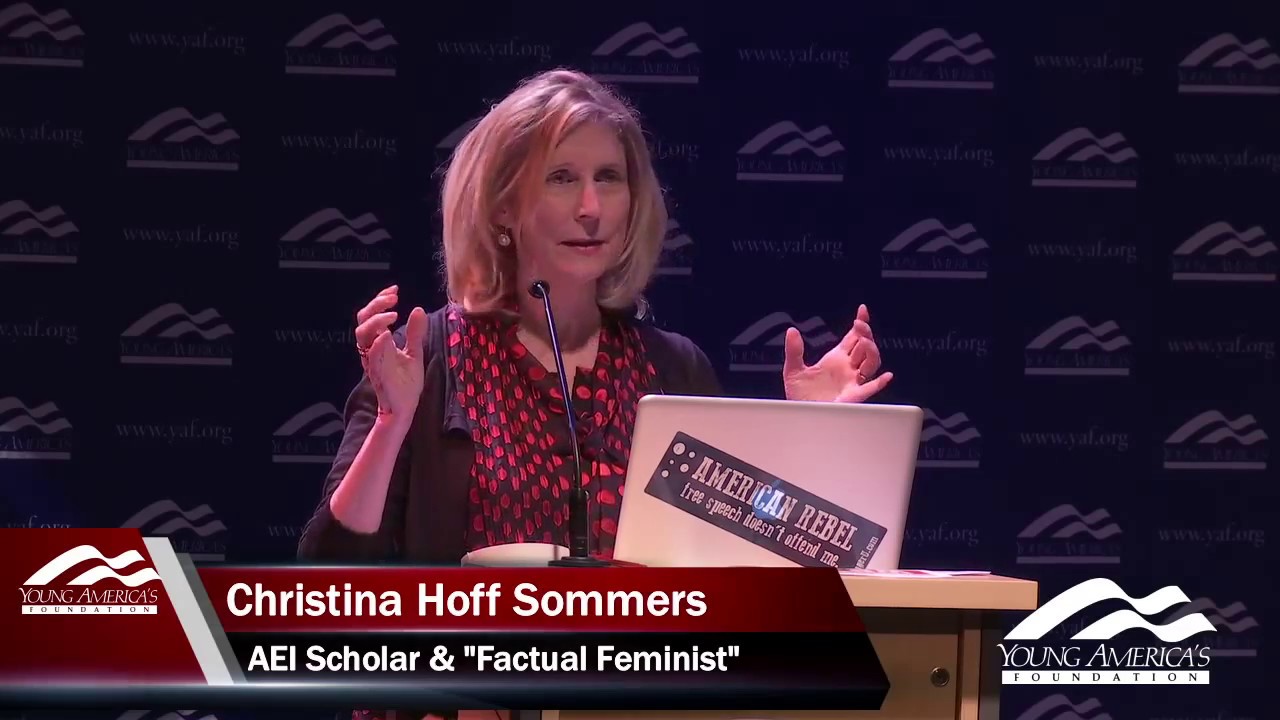 (Video). Los Angeles: YAFTV. Retrieved 5 October 2016. I am a white Jewish, cisgendered, hetero-normative, age-enhanced, middle-class female.
- :{Jump up:(style="user-select:none;top:-99999px;clip:rect(1px 1px 1px 1px);overflow:hidden;position:absolute !important;padding:0px !important;border:0px !important;height:1px !important;width:1px !important"):}:^ Kester-Shelton, Pamela; Shelton, Ashley A.; Mazurkiewicz, Margaret, eds. (17 September 1996). "Christina Hoff Sommers". *Feminist Writers*. Detroit: St. James Press. pp. 444–446.
- :{Jump up:(style="user-select:none;top:-99999px;clip:rect(1px 1px 1px 1px);overflow:hidden;position:absolute !important;padding:0px !important;border:0px !important;height:1px !important;width:1px !important"):}:^ Andreas Teuber, Fred Sommers — A Tribute, October 23rd 2014.
- :{Jump up:(style="user-select:none;top:-99999px;clip:rect(1px 1px 1px 1px);overflow:hidden;position:absolute !important;padding:0px !important;border:0px !important;height:1px !important;width:1px !important"):}:^ "77 North Washington Street". The Atlantic. May 1, 2000.
- :{Jump up:(style="user-select:none;top:-99999px;clip:rect(1px 1px 1px 1px);overflow:hidden;position:absolute !important;padding:0px !important;border:0px !important;height:1px !important;width:1px !important"):}:^ "Advisors". Foundation for Individual Rights in Education. Archived from the original on February 1, 2012. Retrieved December 2, 2009.
- :{Jump up:(style="user-select:none;top:-99999px;clip:rect(1px 1px 1px 1px);overflow:hidden;position:absolute !important;padding:0px !important;border:0px !important;height:1px !important;width:1px !important"):}:^ Schreiber, Ronnee (2008). Righting Feminism. Oxford University Press. p. 25. ISBN 978-0-19-533181-3.
- :{Jump up:(style="user-select:none;top:-99999px;clip:rect(1px 1px 1px 1px);overflow:hidden;position:absolute !important;padding:0px !important;border:0px !important;height:1px !important;width:1px !important"):}:^ "Christina Hoff Sommers." The Writers Directory. Detroit: St. James Press, 2015. Biography in Context. Web. Accessed 3 Mar. 2016.
- :{Jump up:(style="user-select:none;top:-99999px;clip:rect(1px 1px 1px 1px);overflow:hidden;position:absolute !important;padding:0px !important;border:0px !important;height:1px !important;width:1px !important"):}:^ Christina Hoff Sommers profile, time.com; accessed August 30, 2015.
- :{Jump up:(style="user-select:none;top:-99999px;clip:rect(1px 1px 1px 1px);overflow:hidden;position:absolute !important;padding:0px !important;border:0px !important;height:1px !important;width:1px !important"):}:^ Christina Hoff Sommers profile, huffingtonpost.com; accessed August 30, 2015.
- :{Jump up:(style="user-select:none;top:-99999px;clip:rect(1px 1px 1px 1px);overflow:hidden;position:absolute !important;padding:0px !important;border:0px !important;height:1px !important;width:1px !important"):}:^ Christina Hoff Sommers profile, theatlantic.com; accessed August 30, 2015.
- :{Jump up:(style="user-select:none;top:-99999px;clip:rect(1px 1px 1px 1px);overflow:hidden;position:absolute !important;padding:0px !important;border:0px !important;height:1px !important;width:1px !important"):}:^ Christina Hoff Sommers profile, slate.com; accessed August 30, 2015.
- :{Jump up:(style="user-select:none;top:-99999px;clip:rect(1px 1px 1px 1px);overflow:hidden;position:absolute !important;padding:0px !important;border:0px !important;height:1px !important;width:1px !important"):}:^ Christina Hoff Sommers profile, opinionator.blogs.nytimes.com; accessed August 30, 2015.
- :{Jump up:(style="user-select:none;top:-99999px;clip:rect(1px 1px 1px 1px);overflow:hidden;position:absolute !important;padding:0px !important;border:0px !important;height:1px !important;width:1px !important"):}:^ "Factual Feminist". AEI.
- :{Jump up:(style="user-select:none;top:-99999px;clip:rect(1px 1px 1px 1px);overflow:hidden;position:absolute !important;padding:0px !important;border:0px !important;height:1px !important;width:1px !important"):}:^ "Factual Feminist". YouTube.
- :{Jump up:(style="user-select:none;top:-99999px;clip:rect(1px 1px 1px 1px);overflow:hidden;position:absolute !important;padding:0px !important;border:0px !important;height:1px !important;width:1px !important"):}:^ https://www.prageru.com/courses/political-science/there-no-gender-wage-gap
- :{Jump up:(style="user-select:none;top:-99999px;clip:rect(1px 1px 1px 1px);overflow:hidden;position:absolute !important;padding:0px !important;border:0px !important;height:1px !important;width:1px !important"):}:^ Christina Sommers [@CHSommers] (17 September 2014). "Some critics denounce me as "right-winger."Fact:Former Sixties flower-child/socialist.Now (registered) Democrat--with libertarian leanings" (Tweet) – via Twitter.
- :{Jump up:(style="user-select:none;top:-99999px;clip:rect(1px 1px 1px 1px);overflow:hidden;position:absolute !important;padding:0px !important;border:0px !important;height:1px !important;width:1px !important"):}:^ Who Stole Feminism?, p. 22.
- :{Jump up:(style="user-select:none;top:-99999px;clip:rect(1px 1px 1px 1px);overflow:hidden;position:absolute !important;padding:0px !important;border:0px !important;height:1px !important;width:1px !important"):}:^ Who Stole Feminism?, p. 23.
- :{Jump up:(style="user-select:none;top:-99999px;clip:rect(1px 1px 1px 1px);overflow:hidden;position:absolute !important;padding:0px !important;border:0px !important;height:1px !important;width:1px !important"):}:^ Tama Starr, "Reactionary Feminism", Review of Christina Hoff Sommers' Who Stole Feminism?: How Women Have Betrayed Women, *Reason* magazine, October 1994.
- :{Jump up:(style="user-select:none;top:-99999px;clip:rect(1px 1px 1px 1px);overflow:hidden;position:absolute !important;padding:0px !important;border:0px !important;height:1px !important;width:1px !important"):}:^ Mary Lefkowitz, "Review of Christina Hoff Sommers *Who Stole Feminism?: How Women Have Betrayed Women*", National Review, July 11, 1994.
- :{Jump up:(style="user-select:none;top:-99999px;clip:rect(1px 1px 1px 1px);overflow:hidden;position:absolute !important;padding:0px !important;border:0px !important;height:1px !important;width:1px !important"):}:^ "The Future of Feminism: An Interview with Christina Hoff Sommers". scottlondon.com.
- :{Jump up:(style="user-select:none;top:-99999px;clip:rect(1px 1px 1px 1px);overflow:hidden;position:absolute !important;padding:0px !important;border:0px !important;height:1px !important;width:1px !important"):}:^ Vint, Sherryl (March 1, 2010). "6: Joanna Russ's The Two of Them in an Age of Third-wave Feminism". In Mendlesohn, Farah. *on Joanna Russ*. Wesleyan University Press. pp. 142–. ISBN 9780819569684. Retrieved June 1, 2015. some third-wave concerns can be translated into a distinctly antifeminist agenda such as that put forward by Roiphe or by Hoff Sommers
- :{Jump up:(style="user-select:none;top:-99999px;clip:rect(1px 1px 1px 1px);overflow:hidden;position:absolute !important;padding:0px !important;border:0px !important;height:1px !important;width:1px !important"):}:^ Projansky, Sarah (1 August 2001). "2: The Postfeminist Context: Popular Redefinitions of Feminism, 1980-Present". *Watching Rape: Film and Television in Postfeminist Culture*. NYU Press. pp. 71–. ISBN 9780814766903. Retrieved June 1, 2015. antifeminist (self-defined) feminists such as Shahrazad Ali, Sylvia Ann Hewlett, Wendy Kaminer, Daphne Patai and Noretta Koertge, Katie Roiphe, Christina Hoff Sommers, and Naomi Wolf
- :{Jump up:(style="user-select:none;top:-99999px;clip:rect(1px 1px 1px 1px);overflow:hidden;position:absolute !important;padding:0px !important;border:0px !important;height:1px !important;width:1px !important"):}:^ Anderson, Kristin J. (September 23, 2014). "4: The End of Men and the Boy Crisis". *Modern Misogyny: Anti-Feminism in a Post-Feminist Era*. Oxford University Press. pp. 74–. ISBN 9780199328178. Retrieved June 1, 2015. Anti-feminist boy-crisis trailblazer Christina Hoff Sommers
- :{Jump up:(style="user-select:none;top:-99999px;clip:rect(1px 1px 1px 1px);overflow:hidden;position:absolute !important;padding:0px !important;border:0px !important;height:1px !important;width:1px !important"):}:^ Christina H. Sommers [@CHSommers] (November 26, 2014). "My Wikipedia profile now calls me an "opponent" of feminism. Not so. Strong proponent of equality feminism--always" (Tweet). Archived from the original on December 22, 2014. Retrieved November 30, 2014 – via Twitter.
- :{Jump up:(style="user-select:none;top:-99999px;clip:rect(1px 1px 1px 1px);overflow:hidden;position:absolute !important;padding:0px !important;border:0px !important;height:1px !important;width:1px !important"):}:^ Houppert, Karen (November 7, 2002). "Wanted: a Few Good Girls". The Nation. Archived from the original on February 1, 2012. Retrieved February 1, 2012.
- :{Jump up:(style="user-select:none;top:-99999px;clip:rect(1px 1px 1px 1px);overflow:hidden;position:absolute !important;padding:0px !important;border:0px !important;height:1px !important;width:1px !important"):}:^ "AAUW Celebrates 38th Anniversary of Title IX With Calls for Grater Enforcement Archived September 27, 2011, at the Wayback Machine.", American Association of University Women, June 2010
- ^ :{Jump up to::(style="user-select:none;top:-99999px;clip:rect(1px 1px 1px 1px);overflow:hidden;position:absolute !important;padding:0px !important;border:0px !important;height:1px !important;width:1px !important"):}:^a b(https://en.wikipedia.org/wiki/Christina_Hoff_Sommers#cite_ref-aei_36-1) Christina Hoff Sommers, "The Case against Title-Nining the Sciences", September 2008.
- :{Jump up:(style="user-select:none;top:-99999px;clip:rect(1px 1px 1px 1px);overflow:hidden;position:absolute !important;padding:0px !important;border:0px !important;height:1px !important;width:1px !important"):}:^ Christina Hoff Sommers, "Is Science Saturated with Sexism?", February 2011.
- :{Jump up:(style="user-select:none;top:-99999px;clip:rect(1px 1px 1px 1px);overflow:hidden;position:absolute !important;padding:0px !important;border:0px !important;height:1px !important;width:1px !important"):}:^ "Freedom to Marry, Freedom to Dissent: Why We Must Have Both". April 22, 2014.
- :{Jump up:(style="user-select:none;top:-99999px;clip:rect(1px 1px 1px 1px);overflow:hidden;position:absolute !important;padding:0px !important;border:0px !important;height:1px !important;width:1px !important"):}:^ Nicholas Dixon, Book Review, Teaching Philosophy 13 No. 1 (March 1990): 47.
- :{Jump up:(style="user-select:none;top:-99999px;clip:rect(1px 1px 1px 1px);overflow:hidden;position:absolute !important;padding:0px !important;border:0px !important;height:1px !important;width:1px !important"):}:^ Tom Digby, "Political Correctness and the Fear of Feminism." The Humanist 52, no. 2 (March 1992), 7.
- Digby describes Sommers as "quite notorious among philosophers" as "the author of several articles... attacking feminism generally and certain feminist philosophers in particular."
- :{Jump up:(style="user-select:none;top:-99999px;clip:rect(1px 1px 1px 1px);overflow:hidden;position:absolute !important;padding:0px !important;border:0px !important;height:1px !important;width:1px !important"):}:^ Marilyn Friedman "The Lived Happily Ever After: Sommers on Women and Marriage." Journal of Social Philosophy21, Issue 2-3 (September 1990): 57–58.
- "In a series of papers... Christina Sommers mounts a campaign against feminist philosopher and 'American feminism' in general."
- :{Jump up:(style="user-select:none;top:-99999px;clip:rect(1px 1px 1px 1px);overflow:hidden;position:absolute !important;padding:0px !important;border:0px !important;height:1px !important;width:1px !important"):}:^ Sommers, Christina. “Should the Academy Support Academic Feminism?”. Public Affairs Quarterly2.3 (1988): 97–120.
- :{Jump up:(style="user-select:none;top:-99999px;clip:rect(1px 1px 1px 1px);overflow:hidden;position:absolute !important;padding:0px !important;border:0px !important;height:1px !important;width:1px !important"):}:^ Christina Sommers, "The Feminist Revelation," Social Philosophy and Policy, 8, 1 (Autumn 1990): 141-58.
- :{Jump up:(style="user-select:none;top:-99999px;clip:rect(1px 1px 1px 1px);overflow:hidden;position:absolute !important;padding:0px !important;border:0px !important;height:1px !important;width:1px !important"):}:^ Christina Sommers, "Philosophers against the Family," in Virtue and Vice in Everyday Life, edited by Christina Sommers and Fred Sommers, 3rd ed. (Fort Worth, TX: Harcourt Brace).
- ^ :{Jump up to::(style="user-select:none;top:-99999px;clip:rect(1px 1px 1px 1px);overflow:hidden;position:absolute !important;padding:0px !important;border:0px !important;height:1px !important;width:1px !important"):}:^a b(https://en.wikipedia.org/wiki/Christina_Hoff_Sommers#cite_ref-Dwyer_45-1) Dwyer, Susan. "Who's Afraid of Feminism?" Dialogue 35.2 (Spring 1996): 327-342.
- :{Jump up:(style="user-select:none;top:-99999px;clip:rect(1px 1px 1px 1px);overflow:hidden;position:absolute !important;padding:0px !important;border:0px !important;height:1px !important;width:1px !important"):}:^ Kinahan, Anne-Marie. (2001). "Women Who Run from the Wolves: Feminist Critique as Post-Feminism", Canadian Review of American Studies 32:2. p. 33.
- :{Jump up:(style="user-select:none;top:-99999px;clip:rect(1px 1px 1px 1px);overflow:hidden;position:absolute !important;padding:0px !important;border:0px !important;height:1px !important;width:1px !important"):}:^ Christina Hoff Sommers (May 1, 1995). *Who Stole Feminism?: How Women Have Betrayed Women*. Simon and Schuster. pp. 12–13. ISBN 978-0-684-80156-8.
- ^ :{Jump up to::(style="user-select:none;top:-99999px;clip:rect(1px 1px 1px 1px);overflow:hidden;position:absolute !important;padding:0px !important;border:0px !important;height:1px !important;width:1px !important"):}:^a b(https://en.wikipedia.org/wiki/Christina_Hoff_Sommers#cite_ref-Flanders_48-1) Flanders, Laura (Autumn 1994). "The 'Stolen Feminism' Hoax: Anti-Feminist Attack Based on Error-Filled Anecdotes". fair.org. Archived from the original on February 5, 2005. September/October 1994
"The 'Stolen Feminism' Hoax". September 1, 1994. Archived from the original on February 21, 2013. Sep 01 1994
- :{Jump up:(style="user-select:none;top:-99999px;clip:rect(1px 1px 1px 1px);overflow:hidden;position:absolute !important;padding:0px !important;border:0px !important;height:1px !important;width:1px !important"):}:^ McElroy, Wendy. "Prostitution: Reconsidering Research". originally printed in SpinTech magazine, reprinted at WendyMcElroy.com on 12 November 1999.
- :{Jump up:(style="user-select:none;top:-99999px;clip:rect(1px 1px 1px 1px);overflow:hidden;position:absolute !important;padding:0px !important;border:0px !important;height:1px !important;width:1px !important"):}:^ Kirkpatrick, Melanie (1 July 1994). Wall Street Journal. Missing or empty
|title=(help) - :{Jump up:(style="user-select:none;top:-99999px;clip:rect(1px 1px 1px 1px);overflow:hidden;position:absolute !important;padding:0px !important;border:0px !important;height:1px !important;width:1px !important"):}:^ Christina Hoff Sommers (15 March 1995). "Reply to FAIR". Debunker.com. Archived from the original on March 5, 2001. Christina Hoff Sommers' reply to charges disseminated by the left wing media watchdog group FAIR letter to Mr. Jim Naureckas, Editor, EXTRA!, FAIR Editorial Office
- ^ :{Jump up to::(style="user-select:none;top:-99999px;clip:rect(1px 1px 1px 1px);overflow:hidden;position:absolute !important;padding:0px !important;border:0px !important;height:1px !important;width:1px !important"):}:^a b(https://en.wikipedia.org/wiki/Christina_Hoff_Sommers#cite_ref-publishers1_52-1) "The War Against Boys: How Misguided Feminism Is Harming Our Young Men." Publishers Weekly, 26 June 2000: 59.
- ^ :{Jump up to::(style="user-select:none;top:-99999px;clip:rect(1px 1px 1px 1px);overflow:hidden;position:absolute !important;padding:0px !important;border:0px !important;height:1px !important;width:1px !important"):}:^a b(https://en.wikipedia.org/wiki/Christina_Hoff_Sommers#cite_ref-libj_53-1) Bell-Russel, D. (2000). The war against boys: How misguided feminism is harming our young men. Library Journal, 125(11), 102.
- :{Jump up:(style="user-select:none;top:-99999px;clip:rect(1px 1px 1px 1px);overflow:hidden;position:absolute !important;padding:0px !important;border:0px !important;height:1px !important;width:1px !important"):}:^ Christina Hoff Sommers (May 2000). "The War Against Boys". TheAtlantic.Com. Archived from the original on August 19, 2012. Retrieved 30 August 2015. How did we come to believe in a picture of American boys and girls that is the opposite of the truth? .. The answer has much to do with one of the American academy's most celebrated women—Carol Gilligan
- :{Jump up:(style="user-select:none;top:-99999px;clip:rect(1px 1px 1px 1px);overflow:hidden;position:absolute !important;padding:0px !important;border:0px !important;height:1px !important;width:1px !important"):}:^ Brainy Quote
- :{Jump up:(style="user-select:none;top:-99999px;clip:rect(1px 1px 1px 1px);overflow:hidden;position:absolute !important;padding:0px !important;border:0px !important;height:1px !important;width:1px !important"):}:^ Richard Lowry, "The Male Eunuch," National Review, July 3, 2000
- :{Jump up:(style="user-select:none;top:-99999px;clip:rect(1px 1px 1px 1px);overflow:hidden;position:absolute !important;padding:0px !important;border:0px !important;height:1px !important;width:1px !important"):}:^ Finn, Chester E.,, Jr. (2000, 09). Puppy-dogs' tails. Commentary, 110, 68-71.
- :{Jump up:(style="user-select:none;top:-99999px;clip:rect(1px 1px 1px 1px);overflow:hidden;position:absolute !important;padding:0px !important;border:0px !important;height:1px !important;width:1px !important"):}:^ Richard Bernstein, Books of the Times: Boys, Not Girls, as Society's Victims, nytimes.com, July 31, 2000.
- :{Jump up:(style="user-select:none;top:-99999px;clip:rect(1px 1px 1px 1px);overflow:hidden;position:absolute !important;padding:0px !important;border:0px !important;height:1px !important;width:1px !important"):}:^ Carroll, Mary. "The War against Boys: How Misguided Feminism Is Harming Our Young Men." Booklist 1 May 2000: 1587.
- :{Jump up:(style="user-select:none;top:-99999px;clip:rect(1px 1px 1px 1px);overflow:hidden;position:absolute !important;padding:0px !important;border:0px !important;height:1px !important;width:1px !important"):}:^ Robert Coles, Boys to Men, Two views of what it's like to be young and male in the United States today, New York Times, June 25, 2000.
- :{Jump up:(style="user-select:none;top:-99999px;clip:rect(1px 1px 1px 1px);overflow:hidden;position:absolute !important;padding:0px !important;border:0px !important;height:1px !important;width:1px !important"):}:^ Nicholas Lemann, "The Battle Over Boys," The New Yorker Vol 76 Issue 18 (July 10, 2000), 79.
- :{Jump up:(style="user-select:none;top:-99999px;clip:rect(1px 1px 1px 1px);overflow:hidden;position:absolute !important;padding:0px !important;border:0px !important;height:1px !important;width:1px !important"):}:^ Rotundo, E. Anthony (July 2, 2000). "Review of *The War Against Boys: How Misguided Feminism Is Harming Our Young Men*". Washingtonpost.com.
- ^ :{Jump up to::(style="user-select:none;top:-99999px;clip:rect(1px 1px 1px 1px);overflow:hidden;position:absolute !important;padding:0px !important;border:0px !important;height:1px !important;width:1px !important"):}:^a b(https://en.wikipedia.org/wiki/Christina_Hoff_Sommers#cite_ref-NWPC_63-1) 2013 Exceptional Merit in Media Awards (EMMAs) Winners, National Women's Political Caucus ArchivedDecember 4, 2014, at the Wayback Machine.
- :{Jump up:(style="user-select:none;top:-99999px;clip:rect(1px 1px 1px 1px);overflow:hidden;position:absolute !important;padding:0px !important;border:0px !important;height:1px !important;width:1px !important"):}:^ Christina Hoff Sommers, "The Boys at the Back", nytimes.com, February 2, 2013.
External links
- Christina Hoff Sommers on Twitter

- Is the future of feminism conservative? – a discussion of Sommers in the Harvard Law Record
- Appearances on C-SPAN
- on YouTube
| Authority control |
|
<ul style="margin: 0px; padding: 0px; list-style-image: url(" data:image="data:image" svg="svg" xml="xml" c="C" fxml="Fxml" version="%221.0%22" encoding="%22UTF-8%22%3F%3E%0A%3Csvg" width="%225%22" height="%2213%22%3E%0A%09%3Ccircle" cx="%222.5%22" cy="%229.5%22" r="%222.5%22" fill="%22%2300528c%22/%3E%0A%3C/svg%3E%0A" display="display" inline="inline" white-space="white-space" nowrap="nowrap" line-height="line-height" inherit="inherit" xmlns="%22http://www.w3.org/2000/svg%22" xmlns:data="data"><font size="4" face="Times New Roman"></font><li class="nv-view" style="margin: 0px; display: inline; word-spacing: -0.125em;"><font size="4" face="Times New Roman"><font size="4" face="Times New Roman"><font size="4" face="Times New Roman"><font size="4" face="Times New Roman"><font size="4" face="Times New Roman"><font size="4" face="Times New Roman"><font size="4" face="Times New Roman"><font size="4" face="Times New Roman"><font size="4" face="Times New Roman"><font size="4" face="Times New Roman"><font size="4" face="Times New Roman"><font size="4" face="Times New Roman"><font size="4" face="Times New Roman"><a href="https://en.wikipedia.org/wiki/Template:Feminism" title="Template:Feminism" style="text-decoration-line: none; background: none;"><abbr title="View this template" style="border: none; cursor: inherit; text-decoration-line: none; text-decoration-style: initial; font-variant-numeric: normal; font-variant-east-asian: normal; font-variant-caps: small-caps; background: none transparent; box-shadow: none;">v</abbr></a></font></font></font></font></font></font></font></font></font></font></font></font></font></li><li class="nv-talk" style="margin: 0px; display: inline; word-spacing: -0.125em;"><a href="https://en.wikipedia.org/wiki/Template_talk:Feminism" title="Template talk:Feminism" style="text-decoration-line: none; background: none;"><abbr title="Discuss this template" style="border: none; cursor: inherit; text-decoration-line: none; text-decoration-style: initial; font-variant-numeric: normal; font-variant-east-asian: normal; font-variant-caps: small-caps; background: none transparent; box-shadow: none;">t</abbr></a></li><li class="nv-edit" style="margin: 0px; display: inline; word-spacing: -0.125em;"><a class="external text" href="https://en.wikipedia.org/w/index.php?title=Template:Feminism&action=edit" style="text-decoration-line: none; background: none !important; padding: 0px !important;"><abbr title="Edit this template" style="border: none; cursor: inherit; text-decoration-line: none; text-decoration-style: initial; font-variant-numeric: normal; font-variant-east-asian: normal; font-variant-caps: small-caps; background: none transparent; box-shadow: none;">e</abbr></a></li></ul> |
|
<ul style="margin: 0px; padding: 0px; list-style-image: url(" data:image="data:image" svg="svg" xml="xml" c="C" fxml="Fxml" version="%221.0%22" encoding="%22UTF-8%22%3F%3E%0A%3Csvg" width="%225%22" height="%2213%22%3E%0A%09%3Ccircle" cx="%222.5%22" cy="%229.5%22" r="%222.5%22" fill="%22%2300528c%22/%3E%0A%3C/svg%3E%0A" display="display" inline="inline" white-space="white-space" nowrap="nowrap" line-height="line-height" inherit="inherit" xmlns="%22http://www.w3.org/2000/svg%22" xmlns:data="data"><font size="4" face="Times New Roman"></font><li class="nv-view" style="margin: 0px; display: inline; word-spacing: -0.125em;"><font size="4" face="Times New Roman"><font size="4" face="Times New Roman"><font size="4" face="Times New Roman"><font size="4" face="Times New Roman"><font size="4" face="Times New Roman"><font size="4" face="Times New Roman"><font size="4" face="Times New Roman"><font size="4" face="Times New Roman"><font size="4" face="Times New Roman"><font size="4" face="Times New Roman"><font size="4" face="Times New Roman"><font size="4" face="Times New Roman"><font size="4" face="Times New Roman"><a href="https://en.wikipedia.org/wiki/Template:Feminist_philosophy" title="Template:Feminist philosophy" style="text-decoration-line: none; background: none;"><abbr title="View this template" style="border: none; cursor: inherit; text-decoration-line: none; text-decoration-style: initial; font-variant-numeric: normal; font-variant-east-asian: normal; font-variant-caps: small-caps; background: none transparent; box-shadow: none;">v</abbr></a></font></font></font></font></font></font></font></font></font></font></font></font></font></li><li class="nv-talk" style="margin: 0px; display: inline; word-spacing: -0.125em;"><a href="https://en.wikipedia.org/wiki/Template_talk:Feminist_philosophy" title="Template talk:Feminist philosophy" style="text-decoration-line: none; background: none;"><abbr title="Discuss this template" style="border: none; cursor: inherit; text-decoration-line: none; text-decoration-style: initial; font-variant-numeric: normal; font-variant-east-asian: normal; font-variant-caps: small-caps; background: none transparent; box-shadow: none;">t</abbr></a></li><li class="nv-edit" style="margin: 0px; display: inline; word-spacing: -0.125em;"><a class="external text" href="https://en.wikipedia.org/w/index.php?title=Template:Feminist_philosophy&action=edit" style="text-decoration-line: none; background: none !important; padding: 0px !important;"><abbr title="Edit this template" style="border: none; cursor: inherit; text-decoration-line: none; text-decoration-style: initial; font-variant-numeric: normal; font-variant-east-asian: normal; font-variant-caps: small-caps; background: none transparent; box-shadow: none;">e</abbr></a></li></ul> |
- 1950 births
- Living people
- 21st-century American non-fiction writers
- 21st-century American philosophers
- 21st-century American writers
- 21st-century women writers
- American Enterprise Institute
- American ethicists
- American libertarians
- American non-fiction writers
- American women writers
- Brandeis University alumni
- Clark University faculty
- Critics of postmodernism
- Female critics of feminism
- Individualist feminists
- Jewish American writers
- Jewish feminists
- Jewish philosophers
- Jewish women writers
- New York University alumni
- People from Petaluma, California
- Philosophy teachers
- University of Massachusetts Boston faculty
- Writers from California
==
Christina Hoff Sommers "is the W.H. Brady Fellow at the American Enterprise Institute. She has been a professor of philosophy at Clark University since 1980. She specializes in ethics and contemporary moral theory and has published many scholarly articles in such journals as the Journal of Philosophy and The New England Journal of Medicine. Sommers became known to the wider public as the author of The War Against Boys and Who Stole Feminism? How Women Have Betrayed Women.
Her articles have appeared in such places as the Wall Street Journal, New York Times, Washington Post, USA Today, New Republic, Chicago Tribune, and Times Literary Supplement. Sommers has appeared on The McLaughlin Group, Nightline, The CBS Evening News, Crossfire, Eye to Eye, 20/20, Inside Politics, Equal Time, Politically Incorrect, and The Oprah Winfrey Show to discuss such issues as the future of feminism and gender bias in the schools. Sommers earned her B.A. at New York University where she graduated Phi Beta Kappa in 1971. She received her Ph.D. in philosophy at Brandeis University in 1979." [1]