Georgia2 bak
estb 1 25
===
GA2 bak 220
see KEMP
see voter suppression cleta
see Fani Willis
see Hice pow
see MTG
bak 1 25
===
sorta neglected
---
===
// NC state scotus?
an 1 215
Georgia's state legislature is about to gavel into session next week, and there are already several proposed new voting restrictions on the docket for lawmakers to consider.
The Atlanta Journal-Constitution reported Tuesday that Republican lawmakers emboldened by Trump's 2024 election victory in the Peach State are now hoping to have several GOP wish-list items signed into law that would make the voting process even more cumbersome in the critical swing state. Some of the bills include language mandating hand-counting of ballots and eliminating no-excuse absentee voting.
Some conservative activists are also reportedly advocating for legislation that makes it easier to challenge voters' eligibility, and for new rules to be put in place regarding county-level certification of election results. The renewed push for election changes comes after a fraught election cycle in which Georgia's Republican-controlled State Election Board attempted to ram through several last-minute changes that would have significantly delayed the counting of ballots.
READ MORE:**'Ripe for abuse': GA elections chief now allowing anyone to cancel a voter's registration**
“It was total nonsense what they were doing. It was a show unlike anything we’ve ever seen as election officials." Heard County election supervisor Tonnie Adams told the Journal-Constitution. "We’d like to see the entire rulemaking process changed.”
Democratic state representative Saira Draper is also pushing for an election-related law. Her legislation would make it illegal for the State Election Board to make changes to election laws during election years, arguing that election workers need time to be trained on how to follow and implement existing laws. She also wants to allow for parents with small children to be moved to the front of voting lines.
“The problem we’ve seen over and over again in election policy is responding to fears or made-up stories as opposed to actual facts,” Draper told the paper. “By playing to concerns of voter confidence, you’re basically changing policy for problems that don’t exist. I would like to see policies that are tethered to real issues as opposed to made-up issues for political purposes.”
Georgia Republicans have been pushing for sweeping changes to election laws ever since 2021, when President Joe Biden flipped the state blue after nearly 30 years. In 2022, Sen. Raphael Warnock (D-Ga.) was elected to a full six-year term, making it the first time since the 1990s that Georgia has been represented by two Democrats in the U.S. Senate.
READ MORE:**'Inappropriate and unprofessional': Georgia election board chair turns on GOP colleagues**
Click here to read the Journal-Constitution's report in its entirety (subscription required).
===
2024 MOST EXP IN WORLD
ATLANTA (AP) — The second of two new nuclear reactors in Georgia has entered commercial operation, capping a project that cost billions more and took years longer than originally projected.
Georgia Power Co. and fellow owners announced the milestone Monday for Plant Vogtle’s Unit 4, which joins an earlier new reactor southeast of Augusta in splitting atoms to make carbon-free electricity.
Unit 3 began commercial operation last summer, joining two older reactors that have stood on the site for decades. They’re the first two nuclear reactors built in the United States in decades.
The new Vogtle reactors are currently projected to cost Georgia Power and three other owners $31 billion, according to calculations by The Associated Press. Add in $3.7 billion that original contractor Westinghouse paid Vogtle owners to walk away from construction, and the total nears $35 billion.
Electric customers in Georgia already have paid billions for what may be the most expensive power plant ever. The reactors were originally projected to cost $14 billion and be completed by 2017.
Utilities and their political supporters on Monday hailed the plant’s completion. Georgia Gov Brian Kemp proclaimed he was “thankful for this historic achievement by Georgia Power and its partners.” Chris Womack, CEO of Atlanta-based Southern Co., which owns Georgia Power, argues Vogtle will make the state’s electrical grid more reliable and resilient and help the utility meet its goal of zeroing out carbon emissions by 2050.
---
yikes an 12 24
'Totally unfounded': Legal experts blast GA appeals court’s disqualification of Fani Willis
fulton County, Georgia District Attorney Fani Willis is now officially disqualified from prosecuting President-elect Donald Trump in his Georgia election interference criminal case, following a Thursday decision by the Georgia Court of Appeals (COA).
As NPR reported, the three-judge panel — all of whom were appointed by Republican governors — ruled that Willis' relationship with special prosecutor Nathan Wade amounted to a conflict of interest that required her being removed from the case. Assuming she doesn't accept the court's decision, the matter will now go to the Prosecuting Attorneys' Council of Georgia (PACGA), according to Georgia criminal defense attorney Andrew Fleischman. However, Fleischman said this likely means' Willis case is "100% dead," as the PACGA "declined to prosecute the one recused case it already got."
In a subsequent skeet (the term used for Bluesky posts), Fleischman opined that there was a "total lack of analysis" in the COA's decision, saying there was "no rule or explanation here that any other criminal defendant could possibly use in their own case" and that "in such an important case, the court should explain itself."
READ MORE:**Legal expert explains the one thing Fani Willis has to do to save her Trump investigation**
Rolling Stone reporter Nikki McCann Ramirez posted excerpts of **the dissent authored by Judge Ben Land (appointed by Governor Brian Kemp). He argued that attorneys representing Trump "failed to show that the district attorney had an actual conflict of interest, failed to show that she received any material financial benefit as a result of her relationship with Nathan Wade, failed to show that she had a personal stake in the conviction of any defendant, failed to show that her relationship with Wade involved any impropriety on her part, and failed to show that their relationship, including their financial arrangements, had any actual impact on the case."
"Because there was some evidence presented to the trial court that supported these findings, we are bound to accept them," Land continued. "The majority does not dispute these findings. Rather, it holds, with the citation of no supporting authority and apparently for the first time in the history of our state, that the mere existence of an appearance of impropriety, in and of itself, is sufficient to reverse the trial court's refusal to disqualify the district attorney and her entire office."
Brookings Institution senior fellow Norm Eisen wrote that the COA's ruling was "totally unfounded," and noted that "bipartisan experts agree" that Willis' relationship with Wade wasn't disqualifying on its own. But he added that despite Willis' removal from the case, "the indictment stands" and should be pursued "vigorously." Eisen reminded his followers that —just as in the New York hush money cover-up case — the Georgia indictment is not subject to the Supreme Court's immunity protections for official presidential acts.
Former U.S. Attorney Joyce Vance pointed out that the decision means "a new DA will be selected to take over the case," adding that this would likely amount to "a slow death knell if not an outright death for the case." In his own response to the ruling, Federation of American Scientists director of global risk Jon B. Wolfsthal lamented: "The entire American system of justice is broken." Attorney Bradley P. Moss, however, wrote that Willis "has no one to blame but herself" for her disqualification.
READ MORE:[Fani Willis in testy exchange: I'm not the one 'on trial for trying to steal an election'
---
===
an 10 24
An interview between CNN host Jim Acosta and Georgia Republican Party Chairman Josh McKoon became unusually confrontational when the latter refused to admit the 2020 election was conducted fairly.
On Thursday, Acosta... to talk about early voting in the Southern battleground state with Election Day looming in less than two weeks. But their conversation grew testy when McKoon asserted that the prominence of ballot drop boxes led to "irregularities" in the Peach State during the 2020 election, which former President Donald Trump narrowly lost.
"I can't let you go on too long because you're saying there are voting irregularities," Acosta interjected. "The Republican secretary of state Brad Raffensberger said that the election in 2020 was fair and square and that Joe Biden won. You dispute that still?"
READ MORE:**CNN host laughs out loud at guest who said Trump had permission from Biden to call Putin**
McKoon pushed back and said that while he appreciated Raffensberger's position, he disagreed, once again pointing to a 2020 decision by the state's election board that allowed for more ballot drop boxes given the dangers of the Covid-19 pandemic. He noted that there had been "tremendous steps" taken by Georgia's Republican-dominated legislature and Republican Governor Brian Kemp to make sure Georgia's 2024 election was secure.
He added that it would be an "orderly election" in contrast to 2020, which Acosta again pushed back on. The CNN host asked McKoon to react to the , asking him to "find 11,780 votes, which is one more than we have, because we won the state." McKoon characterized it as Trump simply asking Raffensberger to conduct an investigation into reports of convicted felons voting, which Acosta immediately challenged.
"Yeah, Josh, no. That's not what happened," Acosta said, as McKoon continued to attempt to talk over him. "Let's play it one more time just in case, maybe the Zoom is off or something. If we can, control room, let's play the sound one more time. Josh, let's listen to it one more time."
Acosta played the audio again despite McKoon's protests. He reminded his guest that in the full call, Trump talked about "shredding ballots" and "removing machinery." McKoon insisted that the former president was "talking about voters who should not have been allowed to vote in the election." He then pivoted into accusing Acosta of setting him up, saying he was "asked on this program to speak about early voting in Georgia in the 2024 election and President Trump visiting the state yesterday."
READ MORE:**'Ripe for abuse': GA elections chief now allowing anyone to cancel a voter's registration**
"This has been an entirely dishonest move to talk entirely about something that was not even discussed before I came on this program!" He said. "I know that y'all want to talk about 2020 because you know Trump's gonna win this election."
Acosta pointed out that the network was "well within our rights" to ask the Republican Party chair about whether he would accept the election result if Trump lost. He then asked again if he would accept the result of the Georgia election in November if it was unfavorable for Republicans.
"Look, I think this is a much more secure election than 2020. We don't have ballot drop boxes scattered randomly all over the state," McKoon said. Acosta then cut him off, reminding him that the state's Republican secretary of state "said that that was not the case and that it was a free and fair election and that it was secure."
"I'm just saying, Josh, what you're saying is horse crap," he said. "It's just horse crap."
READ MORE:[GOP voter fraud prosecutions only yielded 47 convictions out of tens of millions of ballots: report
Watch the exchange between Acosta and McKoon below, or by clicking this link.
===
---
Georgia judge blocks 'chaotic' rule mandating hand count of votes - Alternet.org
//
The acolytes of former President Donald Trump sitting on the Georgia State Election Board just suffered a stinging defeat at the hands of Fulton County Superior Court Judge Robert McBurney.
ABC News reported Tuesday that McBurney's decision still requires all county election officials to certify election results by the statutory deadline even if they feel the need to investigate the conduct of elections. The decision slams the door on a previous ruling by the state election board aimed at making it easier for members of county election boards to refuse certification if they suspect fraud.
"No election superintendent (or member of a board of elections and registration) may refuse to certify or abstain from certifying election results under any circumstance," McBurney wrote in the decision.
READ MORE:'Ripe for abuse': GA elections chief now allowing anyone to cancel a voter's registration
McBurney's ruling was celebrated by various legal experts on X (formerly Twitter) after Democratic election lawyer Marc Elias announced McBurney's decision on his website, Democracy Docket. Elias, who helped Democrats argue the case in court, called it "a big defeat for election deniers in Georgia."
"Huge victory for democracy," tweeted Tristan Snell, a former prosecutor with the New York Attorney General's Office. "Huge defeat for Trump's attempts to scuttle the election."
TV producer Morgan J. Freeman (not the actor) praised the ruling as "HUGE" and celebrated that "Georgia is NOT allowing Donald Trump to CHEAT." Bestselling author Nicole Perlroth observed that while it was "absurd this had to be fought in court," McBurney's decision was a "victory for democracy nonetheless."
Former U.S. Attorney Joyce Vance also noted the significance of McBurney's decision, mentioning that Trump has for years attempted to throw a wrench into the gears of the certification process. She noted that the January 6, 2021 insurrection was, at its core, an attempt to interrupt certification of an election whose result was unfavorable for Trump.
:{READ MORE:Dems take GA's MAGA election board to court over rule that could 'create chaos and aid Trump'
"Trump tried to get his VP to interfere with certifying the vote on Jan 6 2021," she wrote. "Since that didn't work, there's now a move to interfere with certification at the state/county level. A Fulton County judge just ruled that can't be done. Certifying vote counts is purely ministerial."
On the social media platform Bluesky, Darin Self — an assistant political science professor at Brigham Young University — took a different tone. He lamented that American democracy was in such a perilous state that "a judge has to tell officials, yes, you do actually have to count the votes."
The decision was notably handed down on the same day that early voting began in the Peach State. Former New York Daily News and Boston Herald journalist Helen Kennedy reminded her Bluesky followers that former President Jimmy Carter — who recently turned 100 years old — achieved his goal of hanging on long enough to cast his Georgia ballot for Vice President Kamala Harris.
:{:{READ MORE:GOP voter fraud prosecutions only yielded 47 convictions out of tens of millions of ballots: report}:
---
an 10 24
head of elect comm ~ pitbulls
//
'Huge defeat for Trump': Experts celebrate ruling requiring GA officials to certify election
---}:
an 9 24
Even though voters aren't going to the polls for several weeks, there are already a slew of conservative groups organizing to sow doubt about the result in one particular battleground state if Republicans suffer a loss.
The Guardian recently reported on a trove of emails it obtained detailing efforts by a collection of MAGA-aligned organizations aiming to undermine election results in Georgia should Vice President Kamala Harris defeat former President Donald Trump in the critically important swing state. Several far-right groups — including Tea Party Patriots and the Election Integrity Network — are working with election officials in several Georgia counties who are sympathetic to their cause in an effort dubbed the "Georgia Election Integrity Coalition."
The emails, which were obtained via public records request from watchdog group Citizens for Responsibility and Ethics in Washington (CREW) and shared with the Guardian, show how election deniers in positions of power throughout Georgia are hoping to disrupt efforts to certify the 2024 election if Harris prevails. One of those election deniers is David Hancock, who is a member of the Gwinnett County Board of Registrations and Elections.
READ MORE:Election officials fear 'conspiracy pushers' may disrupt vote certification in swing states
The effort appears to date back to January, when an unnamed website "admin" sent an email to members linking to an article by the United Tea Party of Georgia (UTPG) entitled "Georgia Democratic Party Threatens Elections Officials." That article described how an attorney with the Democratic Party of Georgia sent a letter to election officials in several counties reminding them that certifying an election wasn't discretionary and that failing to do so could result in legal action.
What likely prompted that letter was election officials in Cobb, DeKalb and Spalding Counties refusing to certify the 2020 election in Georgia, which President Joe Biden narrowly won by less than 12,000 votes. UTPG called it "Orwellian to demand that election officials certify an election even if they have unanswered questions about the vote."
CREW discovered that the unnamed admin who wrote that UTPG article was indeed Hancock, who the Guardian described as an "outspoken election denier." On the same day the article was published, Hancock wrote: "All right – I finished the article and posted it."
Several of the email's recipients include election officials who tried to decertify election results in Georgia, like Republicans Michael Heekin and Julie Adams of the Fulton County Board of Elections, Debbie Fisher in Cobb County, Nancy Jester in DeKalb County and Roy McClain in Spalding County. Hancock urged them all to share the article in a February email, writing: "I think the message needs to get out, so share as you feel led."
READ MORE:'Ripe for abuse': GA elections chief now allowing anyone to cancel a voter's registration
Adams, using her TeaPartyPatriots.org email address, sought to coordinate voter fraud messaging with the group in a separate email. The group has hosted election deniers at their meetings, including Cobb County Republican Party co-chair Salleigh Grubbs, who successfully got the Georgia State Board of Elections to adopt a rule making it easier for counties to refuse to certify election results. Another featured speaker was state election board member Dr. Janice Johnston, whom Trump mentioned by name during an August rally in which he praised Republican election board members as "pit bulls" who were "fighting for victory."
The core argument of election deniers is that "widespread voter fraud" tarnishes the legitimacy of election results, requiring a delay in certification to conduct an investigation. However, as the Washington Post reported, there is no such thing as widespread voter fraud. Loyola Law School-Los Angeles professor Justin Leavitt found that out of more than one billion ballots cast between 2000 and 2014, there were just 31 instances of provable voter fraud. And in several Republican-controlled states including Arkansas, Florida, Georgia, Ohio, Texas and Virginia, voter fraud investigations dating back to the 2020 election only yielded 47 convictions.
According to the Guardian, Democrats have pointed to court cases in Georgia dating back to the 19th century showing that county election boards' certification duties are "ministerial," and not discretionary. Even Georgia Secretary of State Brad Raffensberger — a Republican — reportedly instructed a member of his office to remind county election officials that refusing to certify election results could subject them to legal proceedings.
Click here to read the Guardian's report in full.
READ MORE:GOP voter fraud prosecutions only yielded 47 convictions out of tens of millions of ballots: report
---
9 10 24
Experts fear 'chaos' in GA as MAGA election board threatens to 'jeopardize election certification'
===
January 6 supporters champion Georgia State Election Board rule changes
The same crowd of right-wing pundits who attempted to overturn the 2020 election results are now meddling with Georgia’s certification procedures to potentially deny Democrats a win in 2024
Written by John Knefel
Research contributions from Payton Armstrong
Published 09/05/24 mma
Several right-wing media figures tied to former President Donald Trump’s attempts to overturn the 2020 election have supported changes to Georgia’s election certification process that could be used to question or deny the state’s vote totals this November.
These figures include Tea Party Patriots co-founder Jenny Beth Martin; Catherine Engelbrecht of True the Vote, an election denialist group; mother-daughter “Stop the Steal” activists Amy and Kylie Jane Kremer (the former is also a co-founder of Tea Party Patriots); and former Trump adviser and attorney Cleta Mitchell, founder of the Election Integrity Network.
Notably, Mitchell is also a senior legal fellow at the Conservative Partnership Institute, which — along with Tea Party Patriots — is one of the more than 100 organizations on the advisory board of Project 2025, a sprawling effort to provide a second Trump administration with policy and staffing proposals. Project 2025 is also run through with election deniers.
Several of the outside groups pushing the changes appear to hold at least some real power in Georgia as well. In May, Fulton County election board member Julie Adams — who is reportedly affiliated with the Tea Party Patriots and the Election Integrity Network — refused to certify the primary election results. ProPublica further reported that a former board member brought one of the new rule changes forward at the “behest” of Adams, a “regional leader” in the Election Integrity Network who joined the Fulton County election board in February.
Adams isn’t the only new, hard-right election official. In May, the Georgia House speaker appointed Janelle King, a right-wing media personality, to the State Election Board, where she has supported the August rule changes. King has a history of spreading election denial conspiracy theories; in March 2021, she wrote on Facebook that “Republicans produce real proof of voter irregularities and fraud in some cases; stuff like, voting twice, voting from another state, stuff like that to name a few.”
The Georgia State Election Board’s hard-right turn
In early August, the Georgia State Election Board made changes to its certification process that would “require county election officials to make a ‘reasonable inquiry’ before certifying election results to the state,” as reported by The Associated Press. Voting rights advocates worry that the vagueness of the new rule will provide a pretext to delay or deny potential Democratic wins in November.
Later that month, the board made an additional change providing county election officials with the authority to access “all election-related documentation” and resolve any discrepancies prior to certification — another potential avenue to sow doubt and confusion about vote totals. State Democrats have since brought a lawsuit challenging the board’s new rules.
At a rally in Atlanta on August 3, Trump praised the Republican members of the State Election Board by name, including King, calling them “three pitbulls fighting for honesty, transparency, and victory.” Trump’s comments appear to signal that the board’s changes could be a crucial part of his strategy to undermine confidence in the vote totals if the Republican nominee loses the state in November.
Jenny Beth Martin and Tea Party Patriots
Martin is a significant figure in the election denial movement. Her organization, Tea Party Patriots, sponsored a Trump rally in D.C. ahead of the attempted insurrection on January 6, 2021, and Martin herself was outside the Capitol that day. According to Talking Points Memo, Martin “helped connect the political, legal, and activist elements of the push to keep Trump in power” and even communicated with Mark Meadows, Trump’s chief of staff and an instrumental figure in the former president’s efforts to overturn the 2020 election results. Meadows faces charges in Arizona and Georgia for his role in Trump's scheme, and he is also a senior partner at the Conservative Partnership Institute.
On August 10, Martin appeared on former Trump adviser Steve Bannon's War Room podcast to celebrate the Georgia State Election Board’s rule changes.
“They are clarifying what certification means, which is very important, especially if you are on an election board and you have questions and don’t quite know that — don’t think what you’re certifying is actually the final vote,” Martin said. “They need to get it right before certification.”
Video
CitationFrom the August 10, 2024, edition of Real America's Voice's War Room
Martin returned to War Room on August 27 to further praise the state board’s new policies and baselessly sow doubt about recent election results.
“These are not strange, draconian, hard things to enact,” Martin said. “Why doesn’t the left want these common sense changes to happen? That’s the real question.”
She later added: “We need to have elections we can have faith and trust in, and that’s what these board members are trying to accomplish.”
Video
CitationFrom the August 27, 2024, edition of Real America's Voice's War Room
Martin also hosts a podcast, The Jenny Beth Show, where she recently interviewed Salleigh Grubbs, the head of the Cobb County Republican Party. Grubbs gained some notoriety in right-wing media circles in 2020 after “following a truck she suspected of being used in a plot to shred evidence,” according to ProPublica. She later attended Trump’s January 6 event, and would continue to spread conspiracy theories about “irregularities in the election,” as reported in The Washington Post.
During the September 4 interview, Martin and Grubbs discussed the new Georgia rules. State and county election officials “are there to be a check and balance,” Martin said.
“That’s right,” Grubbs responded.
Martin added, “This is just another place to make sure that you’ve got another set of eyes and that you’re checking that everything really is what the report says it is.”
Catherine Engelbrecht and True the Vote
Martin was joined on War Room’s August 27 episode by Catherine Engelbrecht, founder of True the Vote and another prominent election denialist. Engelbrecht and her business partner, Gregg Phillips, served as primary sources for 2000 Mules, a discredited conspiracy theory film from Dinesh D’Souza that falsely claimed there had been mass voter fraud in the 2020 election. In addition to participating in the film, True the Vote challenged Georgia’s 2020 election results, claiming it had obtained evidence of a mass ballot stuffing operation. When a judge later asked for the evidence, the group admitted it had none.
Like Martin, Engelbrecht praised the Georgia State Election Board, and she was even more explicit in her baseless accusations that Democrats were attempting to rig the election system.
“The Democrats are going to fight tooth and nail to make sure that the fraud we’ve seen coming out of Georgia over these last few years, that that remains institutionalized,” Engelbrecht said. “I applaud the State Election Board, and even more than that I applaud the people of Georgia who have fought tirelessly to try to bring elections back to some semblance of common sense in their state, and they’re doing a great job.”
“The Democrat Party is opposed for all of the obvious reasons, but I’ll state the obvious, and that is that they intend to manipulate and exploit the weaknesses wherever they can,” she added.
### Cleta Mitchell and the Election Integrity Network
Prior to founding the Election Integrity Network, Mitchell served as a campaign adviser to then-President Trump while he was attempting to overturn the 2020 election. She participated in a call during which Trump told Georgia Secretary of State Brad Raffensperger to “find” more than 11,000 votes, enough to throw the election to him. A grand jury later recommended indicting Mitchell for her role in Trump’s efforts to stay in power, though prosecutors in Fulton County declined to charge her.
Mitchell’s Election Integrity Network has issued at least two formal press releases in favor of the Georgia election changes.
On August 13, EIN issued a statement urging the passage of new rules that would “demand accurate counts before certifying elections.” Following adoption of the new policy, EIN said the State Election Board had “stood up to left-wing pressure groups and voted to ensure vote-tallies reconcile before certification.”
Mitchell has been a vocal supporter of the Georgia election board meddling. On August 3, she celebrated Trump’s speech singling out the three State Election Board members who later voted in favor of the new rules.
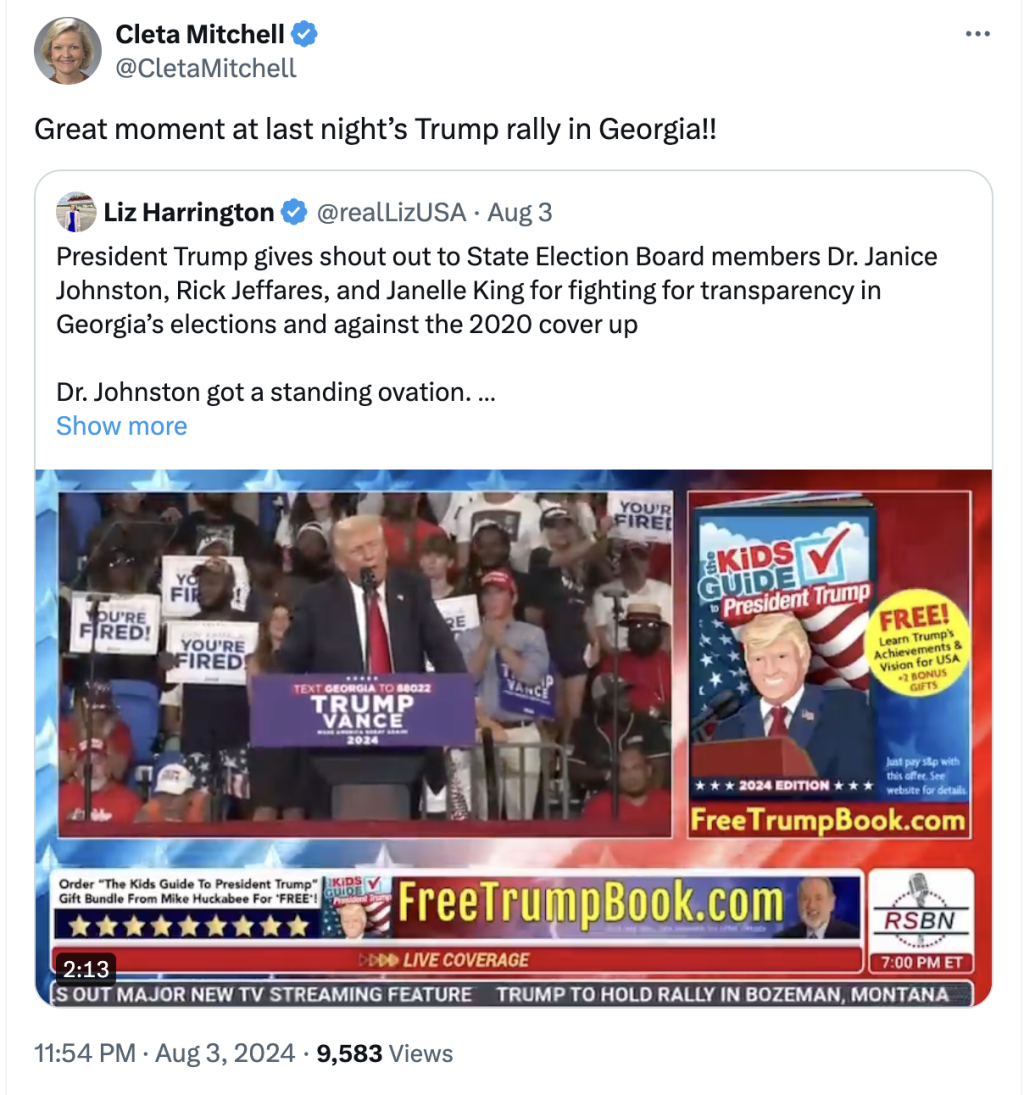
CitationFrom Cleta Mitchell's account on X/Twitter, accessed August 30, 2024
Since then, Mitchell has written at least five other posts in favor of the changes or criticizing opponents of the moves — including praising Trump-aligned board member Janelle King.
“GA State Election Board Member Janelle King is smart, tough, and conservative,” Mitchell wrote. “She stands for the rule of law and election integrity - leftists hate that. We are with you Janelle!”
Amy and Kylie Jane Kremer
Longtime tea party activist Amy Kremer helped organize the January 6, 2021, rally where Trump instructed the crowd to “fight like hell” and march to the U.S. Capitol. Her daughter, Kylie Jane, created a “Stop the Steal” Facebook group following the 2020 election that ballooned to 350,000 members over the course of a day. The duo previously founded the pro-Trump group Women for America First in 2019.
Following Joe Biden’s inauguration, Amy Kremer pushed for an “audit” of the Georgia vote totals, similar to a sham audit Trump allies pursued in Arizona. More recently, she successfully ran for a seat on the Republican National Committee in a campaign that was supported by Steve Bannon.
Both Amy and Kylie Jane Kremer have repeatedly supported the Georgia State Election Board rule changes. On August 19, Amy Kremer accused Georgia Secretary of State Brad Raffensperger, Attorney General Chris Carr, and Gov. Brian Kemp — all Republicans — of “standing in the way &/or running interference to stop the GA State Election Board from securing GA’s elections & investigating election fraud.”
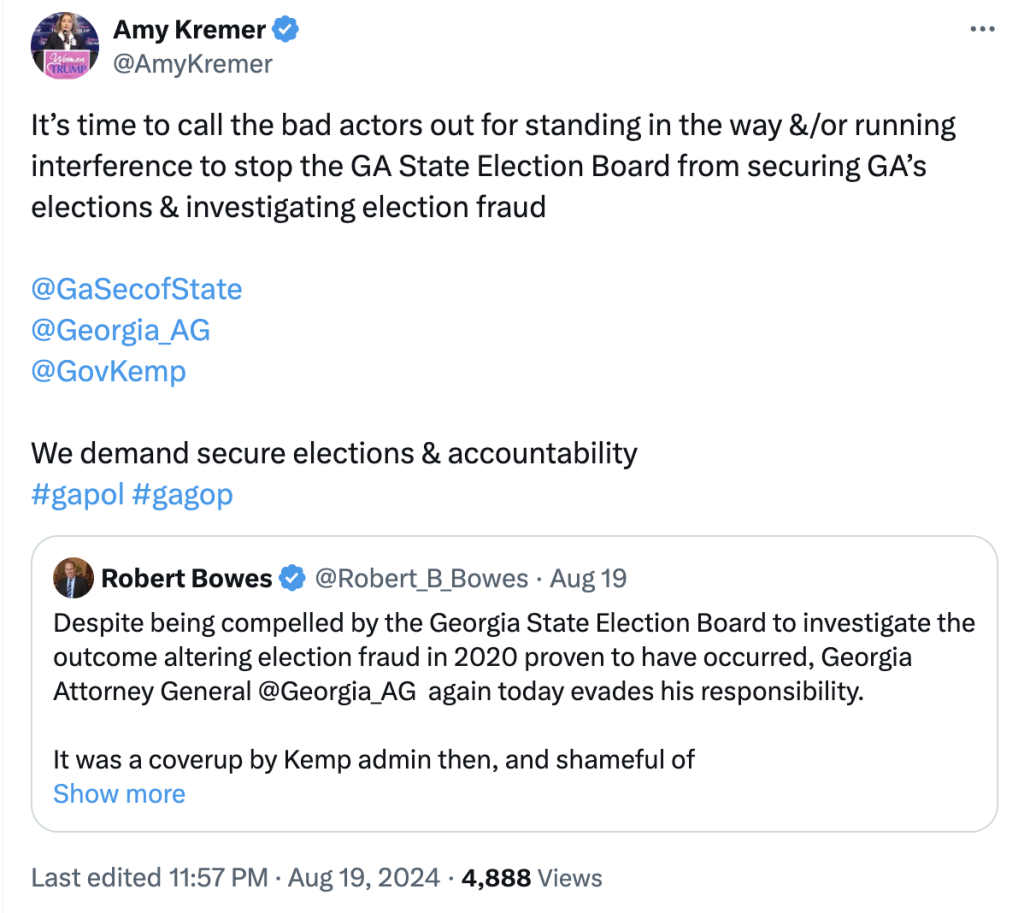
CitationFrom Amy Kremer's account on X/Twitter, accessed September 3, 2024
Amy Kremer has repeatedly cast doubt on Georgia’s election systems throughout August, and responded to the Democrats’ lawsuit challenging the changes by asking Carr, “What are you going to do about this?”
Kylie Jane Kremer has similarly criticized Kemp, Raffensperger, and Carr, writing on August 3 that they’re “like the three amigos who steal elections.” On August 26, she praised Trump-aligned State Election Board member Janelle King. One day later, she urged her followers to show the board “the support they deserve as they stand strong for Georgians against attacks from Governor Kemp, SOS Brad Raffensperger, AG Chris Carr and Democrats!”
Raffensperger, who famously declined Trump’s request to “find” enough votes to overturn Georgia’s election results in 2020, has now spoken out against the State Election Board rule changes. As of late August, Kemp hadn’t publicly commented on the changes, though his office referred an ethics complaint against the pro-Trump board members to the attorney general’s office. Carr released an official opinion stating that the State Election Board can’t force him to reopen an investigation into the vote totals in Fulton County in 2020, as requested by Trump’s allies on the board.
August 23, 2024 rww
- Josh Fiallo @ The Daily Beast: RFK Jr. Suspends Failing Campaign to Throw His Support to Donald Trump
The independent never made it on a debate stage and had his polling numbers drop significantly after Kamala Harris became Democrats’ presumptive nominee.
- Media Matters: Roger Stone and Alex Jones endorse RFK Jr. as CIA director in a second Trump administration
“He could get to the bottom who killed his uncle and his father, and he can get to the bottom who really tried to kill Donald Trump.”
- Angry White Men: Joel Webbon Insists It’s Not Racist To Prefer A White Doctor Over A Black Doctor
During a recent livestream, radical Christian nationalist pastor Joel Webbon justified his decision to see a white doctor instead of a Black doctor. Webbon claimed that there is a greater likelihood that the Black doctor was unqualified, and said this “prejudgment” was neither racist nor sinful.
- Khaya Himmelman @ Talking Points Memo: Georgia Election Board, Beloved By Trump, Keeps Cranking Out Rules That May Sow Chaos
Election truthers in Georgia got their latest win this week when the Republican-controlled Georgia State Election Board approved another rule that gives county election officials a new way to potentially delay certification. It’s the second time this month that the Trump-friendly board has passed a rule of this type, a particularly worrying development given how close we are to the upcoming presidential election.
- Isaac Schorr @ Mediaite: Neo-Nazi Nick Fuentes Goes to War With Candace Owens for Anti-Semitic Crown: ‘She Was Coming For Our Thing’
Neo-Nazi Nick Fuentes is not happy with former Daily Wire personality Candace Owens for coming for infringing on his turf and appealing to his anti-Semitic audience.
---
an 8 24
GA attorney general delivers massive blow to Trump backers on state election board
===
New rule to 'threaten' possibility of 'secure election results' in Georgia: report
an 8 24
===
an 8 24
In the critical battleground state of Georgia, voting rights advocates are warning that a new website launched by the state's top elections official will be exploited by bad-faith groups seeking to disenfranchise voters.
USA TODAY recently reported that Georgia Secretary of State Brad Raffensberger (R) is rolling out a web portal that will allow anyone to request a voter's registration be purged from the state's rolls. The Georgia Voter Registration Cancellation Portal was meant to be a tool for former residents of the Peach State to take themselves off of Georgia's list of registered voters in the event they move, or for family members to remove a deceased relative's name from the database.
Raffensberger said the site will "help keep Georgia’s voter registration database up-to-date without having to rely on postcards being sent and returned by an increasingly inefficient postal system." In order to request the removal of a voter's registration, the portal requires a user put in a voter's first initial, last name, county, date of birth and either the last four digits of the voter's Social Security number or their driver's license number.
However, the site's security was compromised due to a software update that temporarily made voters' personal information like date of birth, drivers license number and the last four digits of their Social Security numbers publicly available. The Georgia Secretary of State's office attributed the issue to a "glitch" caused by a URL routing error, which they said was corrected within an hour.
But now, voting rights advocates say that the site can be used by malicious actors to purge legally registered voters from the system ahead of the November election.
"This portal is ripe for abuse,” Tolulope Kevin Olasanoye — the executive director of the Democratic Party of Georgia — said in a statement. “[T]his page is yet another move in Georgia Republicans’ playbook to empower anti-democracy activists, and the Secretary of State must take it down immediately.”
The Georgia Voter Cancellation Portal was created on the heels of the Peach State's Republican-dominated legislature passing Senate Bill 189 this year, which effectively streamlined the process for a voter's registration to be challenged. USA TODAY referred to Senate Bill 189 as a "counterpart" to the controversial Senate Bill 202, which passed in 2021 and allowed for one person to challenge an unlimited number of voter registrations. That bill was notably passed after President Joe Biden became the first Democrat to win Georgia's electoral votes in roughly 30 years, and after Georgia voters elected two Democrats to the U.S. Senate.
READ MORE:['No evidence': Fox host shreds Trump and Mike Johnson's 'null and void' voter fraud claims
Raffensberger claimed the website was necessary in order to prevent "voter fraud," though numerous investigations have found that actual voter fraud happens very rarely and never at a scale that could change the result of an election.
In 2023, the Washington Post analyzed voter fraud investigations in Republican-controlled states, like Arkansas, Florida, Georgia, Ohio, Texas and Virginia and found that out of tens of millions of ballots cast since 2020, prosecutors only secured 47 convictions for voter fraud. And between 2000 and 2014, Loyola University Law School-Los Angeles professor Justin Leavitt found only 31 credible instances of voter fraud out of more than one billion ballots cast.
Click here to read USA TODAY's report in full.
===
https://boingboing.net/2023/05/24/georgia-gop-chair-is-a-flat-earther-and-says-we-are-being-brainwashed-by-globes-everywhere.html
===
Georgia Republican running for Congress openly 'embracing' his role in Jan. 6 riot - Alternet.org
===
3 23
https://www.alternet.org/brian-kemp-republicans/
---
GA legis law to remove DA's ?! spkr? sponsor fake elector scheme??!
===
===
1/6 comm give GA AG basis for crim intent?
===
an 2 23 badash
after the forewoman heading the Fulton County, Georgia special grand jury investigating Donald Trump and his allies gave multiple interviews this week about the group’s recommendation to indict more than a dozen people, attorneys for some who might be facing possible indictment are moving to kill any legal or law enforcement action against them.
"CBS News has learned that lawyers close to several GOP witnesses in Fulton Co. investigation are preparing to move to quash any possible indictments by DA based on the public statements by the forewoman of the special grand jury, per two people familiar with the discussions," CBS News' Robert Costa reports.
The forewoman, Emily Kohrs, gave the press increasingly suggestive interviews, including saying Americans will not be surprised if and when District Attorney Fani Willis hands down the indictments the group recommended.
The special grand jury investigated Donald Trump and his allies and their alleged efforts to overturn the 2020 election. The investigation was sparked by the release of Trump's phone call with Secretary of State Brad Raffensperger. Trump infamously pressured Raffensperger to find him 11,780 votes so he could "win" that state's election.
"It is not a short list," forewoman Emily Kohrs said, The New York Times reported Tuesday, noting multiple indictments were recommended.
Calling her remarks "cryptic," The Times says it asked her if Donald Trump was among those recommended for indictment. "You're not going to be shocked. It's not rocket science," she said, adding, "you won’t be too surprised."
"I will tell you that if the judge releases the recommendations, it is not going to be some giant plot twist," Kohrs said. "You probably have a fair idea of what may be on there. I'm trying very hard to say that delicately."
Some experts overnight expressed concern at Kohrs' very public remarks, and some have noted that the special grand jury has no power to indict. Any indictment would be made by a separate grand jury and District Attorney Fani Willis and thus not subject to her public remarks.
In response, noted national security attorney Brad Moss tweeted, "the little media tour the Georgia special grand jury foreperson did yesterday was obscenely stupid, ill-advised and inappropriate," but added, "it is highly unlikely the public remarks she made will undermine any actual indictments."
This is a breaking news and developing story.
===
9 22 an
Georgia Gov. Brian Kemp and former Vice President Mike Pence are among the Republicans who former President Donald Trump has been lambasting for refusing to join him in promoting the Big Lie and claiming that the 2020 presidential election was stolen. But unlike Kemp and Pence, Burt Jones — the GOP nominee for lieutenant governor in Georgia — has been a vocal Big Lie promoter. And Pence is campaigning for him in Georgia.
In a tweet posted on September 26, Never Trump conservative Amanda Carpenter points out that Jones was “a January 6 fraudulent elector.”
After the 2020 election, MAGA Republicans in various swing states that now-President Joe Biden won pretended to represent the Electoral College and even presented fake election documents to election officials. In Georgia, Carpenter notes, Trump loyalist Jones was an example of a fake elector.
READ MORE: 'Make nice with MAGA': A 2020 'false elector' is Georgia GOP Governor Brian Kemp’s running mate
According to Atlanta Journal-Constitution reporter Greg Bluestein, Pence “will return to Georgia next month for a pair of fundraisers to boost GOP candidates, marking his first return to the state since a May rally with Gov. Brian Kemp that punctuated a deepening divide with Donald Trump. Pence will hold an October 13 fundraiser in Atlanta with State Sen. Burt Jones, the GOP nominee for lieutenant governor, and State Sen. Tyler Harper, the Republican contender for agriculture commissioner. He’ll head to Thomasville later the same day to raise cash for U.S. Rep. Drew Ferguson of West Point and Chris West, the GOP nominee running against veteran Democratic Rep. Sanford Bishop.”
Carpenter cited Pence’s support of Jones as an example of the fact that even some “normal” Republicans are supporting Big Lie promoters.
Carpenter posted, “What’s interesting is that MAGA folks are excited about GOP ‘unity’ events…. because the so-called Team Normal folks are coming around election-denialism and other nutty ideas. Not the other way around.”
Twitter user Janet Byrd, @gajbyrd, commented, “So Pence is raising cash for Burt Jones who is a fake elector? Guess Pence forgot the fake elector scheme almost got him killed on Jan 6!”
READ MORE:**'A sad state of affairs': How 'mainstream' Republicans are enabling Trump’s extreme agenda**
===
tpm 9 22
one of the sham Trump electors brought tech operatives hired by MAGA lawyer Sidney Powell to a Georgia county’s elections office on the day there was a breach in the office’s voting system, surveillance video footage reported by CNN, the Washington Post and the Atlanta Journal-Constitution shows.
The footage reportedly shows the fake elector, then-Coffee County GOP chair Cathy Latham, escorting four technicians for SullivanStrickler — a data forensics company Powell hired in her bid to overturn the 2020 election for Donald Trump — to the elections office on Jan. 7 last year.
That was the day the office’s elections system was breached. Two of the technicians seen in the video with Latham, Scott Hall and Paul Maggio, have admitted to accessing a voting machine in Coffee County, per CNN. The Washington Post reported last month on how SullivanStrickler operatives copied data from a Dominion voting machine in Coffee County on Jan. 7.
The Georgia Bureau of Investigation is looking into the breach. Latham herself is a target in the Fulton County district attorney’s criminal investigation into Trump’s efforts to steal the 2020 election in Georgia.
One of Latham’s attorneys told CNN on Tuesday that his client “would not and has not knowingly been involved in any impropriety in any election” and “did not authorize or participate in any ballot scanning efforts, computer imaging, or any similar activity in Coffee County in January 2021.”
Surveillance video also reportedly reveals that infamous Cyber Ninjas CEO Doug Logan and fellow election-denying tech consultant Jeffrey Lenberg visited the Coffee County elections office several times after the breach. Both operatives are being investigated in Michigan over alleged attempted breaches of voting equipment in that state.
===
===
https://www.alternet.org/2022/06/this-christian-nationalist-won-3-4-of-the-vote-in-georgias-gop-gubernatorial-primary-but-claims-otherwise/
no lnx twt
This Christian nationalist won 3.4 percent of the vote in Georgia’s GOP gubernatorial primary — and refused to concede
Kandiss Taylor in 2022, from Facebook]
Alex Henderson June 09, 2022
In Georgia’s 2022 GOP gubernatorial primary, one of the candidates was even more extreme than former Sen. David Perdue:Christian nationalist and far-right conspiracy theorist Kandiss Taylor, whose campaign theme was “Jesus, guns and babies.” Taylor campaigned on ridding Georgia’s government of Satanic influence, winning only 3.4 percent of the vote when the primary was held on May 24. But Taylor, in true MAGA fashion, is claiming that the election results are false — and in order to prove it, she is asking Georgia residents to sign notarized affidavits saying that they voted for her.
The primary was a humiliation for former President Donald Trump and a colossal victory for incumbent Georgia Gov. Brian Kemp, who defeated Perdue by 52 percent. Perdue, endorsed by Trump, campaigned on the Big Lie, falsely claiming that the 2020 election was stolen from Trump and slamming Kemp for acknowledging that now-President Joe Biden legitimately won in Georgia.
But after his loss, Perdue wasted no time congratulating Kemp — and he is now urging Georgia Republicans to vote for the conservative Georgia governor, who is competing with Democratic nominee Stacey Abrams in the general election. Kemp narrowly defeated Abrams in Georgia’s gubernatorial election of 2018.
At least Perdue won 21 percent of the vote compared to only 3.4 percent for Taylor. Regardless, Taylor has refused to concede and is claiming that she really won a lot more votes.In a video, Taylor tells her supporters, “I need you to do an affidavit and say that you voted for her, because she’s standing up to the establishment — and we’re going to prove that she got hundreds of thousands of votes because we know she did.”
According to the Associated Press, Kemp had received at least 885,551 votes in the primary after 99 percent of the vote had been counted — compared to 261,706 for Perdue and41,109 for Taylor, who is insisting that those numbers are false and that she is a victim of election fraud.
“They actually were trying to make me look stupid,” Taylor says in the video. “And it’s going to come back to bite them because we’re going to have way more than that in affidavits to show that we have more votes than that…. (God) will outsmart crooks every single time. This is His idea.”
In another post-election video, Taylor declared, “I do not concede. I do not. And if the people who did this and cheated are watching, I do not concede. And the people of Georgia will not allow me to…. I want you to feel, inside of your gut, a righteous anger for justice. I want you to pray specifically for dark to be brought to light, for justice for the state of Georgia. And anyone who has helped contribute to thiscrime,to this travesty…. I want you to pray that they feel so guilty, they come forward.”
Taylor’s campaign was endorsed by MAGA conspiracy theorists who include MyPillow CEO Mike Lindell and QAnon supporter Lauren Witzke, the Delaware Republican who suffered a landslide defeat when she ran against Democratic Sen. Chris Coons in 2020.
===
penn wacko mastriano dominionist but
https://www.alternet.org/2022/05/brian-kemp-2657387890/
raffensberger win
===
==
- ario Murillo declares that Christians “must rebuke the Republican Party. The Body of Christ must not be their cheap date. We must hold their feet to the fire. The Republican Party must fear us. They must feel our rage.”
- Jackson Lahmeyer announced that he’ll be handing out flash drives containing the contents of Hunter Biden’s “laptop from Hell” at upcoming campaign events.
- A new documentary series called “Marvel and DC’s War on God” aims to expose the fact that “popular comics and the movies that they have spawned are riddled with anti-Christ themes that glorify gratuitous violence, sexual perversion, blasphemy, and the occult.”
- Elijah Schaffer has a message for Native Americans: “Get the fuck out of America!”
- Generally, the only people we ever hear talking about the Georgia Guidestones are those who have gone deep down the QAnon rabbit hole, so the fact that Kandiss Taylor is promising to tear them down as part of her campaign for governor is pretty telling. witze stew peters
- Finally, Donald Trump Jr. is urging people to hurry up and sign up for (i.e., buy) a “Trump Gold Card” because doing so will “drive the libs crazy.”
===
Ruby and dtr election worker target kasnya [won big lawsuit 5 22?
===
https://www.mediamatters.org/one-america-news-network/year-after-january-6-one-america-news-has-found-its-insurrectionist
no lnx vid
A year after January 6, One America News has found its insurrectionist footing
OAN spent the last year promoting GOP voter suppression efforts, selling airtime to a demented pillow maven, and priming its audience for political violence -- perhaps even civil war
WRITTEN BY BOBBY LEWIS
RESEARCH CONTRIBUTIONS FROM BEATRICE MOUNT
PUBLISHED 01/06/22
The January 6, 2021, attack on the U.S. Capitol by supporters of former President Donald Trump was a watershed moment for conservative media. The “peaceful transition of power” that has long been a force in the mythologization of American democracy broke down that day, and rather than owning up to the gravity of a violent attack on that tradition, One America News Network stuck to its familiar playbook of lies and deceit – this time in service of increasing voter suppression.
A survey performed inSeptember 2021 found that 68% of Republicans wrongly believed that the 2020 election was stolen from Trump. Among Republicans who primarily trust far-right outlets like OAN, 97% believed the election was stolen. This correlation is no coincidence, and right-wing media’s continued lies about the 2020 election have provided fuel for nationwide voter suppression efforts by the GOP. In the wake of the Capitol attack, OAN became an important part of the conservative media campaign pushing a whopping 440 bills in state legislatures in 2021 that attempted to restrict voting access.
Voter suppression is nothing new for the conservative movement, but OAN used the aftermath of January 6 to double down on election lies and promote efforts to make voting more difficult for its fellow Americans – while priming its right-wing audience for a potential civil war.
OAN helped drive a frenzy for fraudulent election audits
OAN correspondent Christina Bobb disputed the 2020 election results before a winner was even declared, a moment which was a harbinger for her coverage in 2021. Fueled by a passionate embrace of the Big Lie that the election had been stolen, Bobb essentially became a salesperson for election audits in any state that would entertain the idea.
Bobb provided documents and testimony to get the Arizona audit in motion, and founded a nonprofit to raise money for the audit. Her group Voices & Votes raised $605,000 for the Arizona audit, or about 10% of its cost, undoubtedly in part because of Bobb’s frequent fundraising during her audit coverage on OAN.
The amateurish operation in Arizona appears to be the playbook for other so-called “audits” going forward, even though it confirmed both President Joe Biden’s victory in the state and the oft-asserted fact that there was no significant fraud. But that didn’t stop Bobb or other audit extremists.
Bobb has been concentrating her efforts to spread audits to Pennsylvania, Georgia, Wisconsin, and Michigan, counting on friendly GOP legislatures to indulge in the Big Lie. Some states, like Pennsylvania and Wisconsin, are making moves toward their own audits. In Texas, which Trump won handily, preliminary results of an audit have once again confirmed earlier counts.
Besides its own correspondent, OAN has helped create a second star of the right-wing election fraud movement. MyPillow CEO Mike Lindell was already known before the 2020 election to be a prolific, unhinged Trump supporter, but Lindell’s delusions turned into an erratic fusillade of election lies, and -- unprecedented in television news -- the wealthy pillow CEO acquired vast swaths of OAN airtime in 2021 to zealously push his own false claims and conspiracy theories.
:{
}:
OAN repeatedly aired at least three different Lindell “documentaries” alleging to unravel the conspiratorial web behind the 2020 election.Additionally, OAN ran ads for Lindell’s three-day “cyber symposium” over 150 times in a single week, before devoting more than 30 hours of live coverage to his erratic event. Just before Lindell's symposium began, OAN was sued by Dominion Voting Systems for defamation over spreading other election lies; later the network was hit with another defamation suit from voting technology company Smartmatic.
OAN followed the symposium and defamation suit by letting Lindell take over its evening programming on at least three occasions. In his “The Lindell Report” the businessman aired even more potentially defamatory election lies.
:{
}:
OAN backed voter suppression attempts nationwide
Pursuant to its whole-of-network embrace of the Big Lie, OAN gave friendly coverage to or expressed outright support of several voter suppression efforts in states all over the country.
OAN’s prime-time shows became important stops for Texas state legislators to promote Senate Bill 7, which “includes provisions to limit early voting hours, curtail local voting options and further tighten voting by mail.” On June 1, OAN’s Natalie Harp hosted GOP state Rep. Kyle Biedermann to raise concerns about “a lot of things going on against the laws” in 2020, like “drive-thru voting” and “ballots that were mailed out that shouldn’t have been mailed out.”OAN’s Dan Ball hosted state Sen. Bob Hall, who claimed that SB 7 would guard against what he called “soft fraud” by “election officials taking advantage of rules to bend them as much as they could in their favor.” According to Media Matters’ data, since December 2020, eight Texas state legislators have made at least 23 appearances on OAN prime time, many of them clustered around the SB 7 debate.
The Georgia omnibus election bill was another focal point of OAN programming, particularly since the network is also interested in fomenting an election audit in Georgia. In ostensible news segments, OAN reports called Senate Bill 202 a “voting rights bill” that is “securing integrity for future elections,” and literally laughed at the notion that anyone would take issue with these “common-sense changes.” The Justice Department filed suit against Georgia over a long list of “racially discriminatory” provisions in the law, including “the prohibition on efforts by churches and civic groups to provide food or water to persons waiting in long lines to vote.”
OAN frequently turns to one guest in particular forGeorgia political commentary: former state representative and current gubernatorial candidate Vernon Jones. According to Media Matters' data, Jones has made at least 26 appearances on OAN prime time since December 2020 -- often dedicated to promoting his campaign for governor while pushing election lies and audit attempts.
Video file
CitationFrom the October 5, 2021, edition of OAN's Real America with Dan Ball
OAN primed its audience for more political violence
On June 23, correspondent Pearson Sharp drew widespread condemnation for an OAN segment suggesting mass executions of Democrats for supposedly stealing the election from Trump.
:{
}:
Declaring the 2020 election was actually “overthrown,” Sharp told his audience: “Any American involved in these efforts, from those who ran the voting machines to the very highest government officials, is guilty of treason under U.S. Code. 2381, which carries with it the penalty of death.”
:{
}:
Despite the unmistakable clarity of Sharp’s words, he told Talking Points Memo, “Neither I, nor OAN, are suggesting anyone should be executed,” but added, “That is for the appropriate law enforcement agencies to determine.”
:{
}:
Sharp’s midsummer bloodlust wasn’t much of an aberration for One America News Network. OAN guests have casually gamed out civil war scenarios on-air, and the network has aired reports accusing “retired Democrat generals” of spreading civil war allegations against Republicans, while falsely claiming “evidence indicates that it is actually the left that is at war.”
Though she did not directly suggest violence, Bobb brought in the new year by strongly denouncing the Biden administration as “fascist” and “illegitimate,” in part for having “faked an insurrection on the Capitol” and stealing the 2020 election. For a conservative steeped in Second Amendment mythology about “the tree of liberty” and “the blood of tyrants,” the dots don’t need to be connected.
Wayne Allyn Root, a radio host and far-right conspiracy theorist, appeared on OAN in December and denounced Biden’s “communist dictatorship” for stealing both the 2020 election and Georgia’s two U.S. Senate seats, giving Democrats their current tie-breaking Senate majority “destroying this country.” Root accused Democrats of “looking for a civil war,” which he claimed conservatives like him do not want -- but later in the same rant, Root said that the oppression of conservatives by the Democratic Party “is a lot worse” than the conditions that merited the American Revolution.
:{
}:
“The worst is yet to come,” Root warned.
Video file
CitationFrom the December 29, 2021, edition of OAN's The Real Story with Natalie Harp
OAN is headed into 2022 with more of the same lies, and little care for any negative consequences
From OAN’s perspective, 2021 was a good year for “election integrity.” OAN’s Bobb fought for and secured an Arizona election audit, and successfully spun the mundane results into enough fuel to keep pushing for more audits. OAN collected viewers and money from airing MyPillow’s Lindell, even if it did help get the network sued for defamation. Several of the voter suppression initiatives OAN supported became law. OAN’s suggestions of political violence have retained a veneer of plausible deniability while priming the audience with fury and fear to keep pushing for more voter suppression.
Reckless, false commentary about stolen elections and calls for punishing enemies are how we got Trump supporters invading the Capitol, menacing members of Congress, and chanting to execute Trump’s vice president one year ago. But it’s all just good business for OAN.
===
==
key to big lie
https://www.alternet.org/2021/10/internet-explodes-with-reactions-to-bombshell-senate-judiciary-report-on-trumps-efforts-to-pressure-doj-into-helping-him-overturn-the-election/
ME
The U.S. Senate Judiciary Committee has released a sweeping report detailing how former President Donald Trump and a former high-ranking lawyer for the U.S. Department of Justice (DOJ) attempted to overturn the 2020 presidential election.
The Democratic-led committee's 394-page document contains intricate details about the former president's actions in the days after the presidential election was called for President Joe Biden. A number of bombshell claims were revealed in the report and — here aresix key takeaways from it.
1. "President Trump repeatedly asked DOJ leadership to endorse his false claims that the election was stolen and to assist his efforts to overturn the election results."
The report reveals Trump asked the Justice Department for assistance in overturning the election a total of nine times. The call history includes details about who Trump spoke with along with dates those calls took place.
- December 15, 2020 – Oval Office meeting including incoming Acting Attorney General Jeffrey Rosen and Acting Deputy Attorney General Richard Donoghue (both men assumed office when William Barr left on Dec. 23)
- December 23, 2020 – Trump-Rosen Call
- December 24, 2020 – Trump-Rosen Call
- December 27, 2020 – Trump-Rosen-Donoghue Call
- December 28, 2020 – Trump-Donoghue Call
- December 30, 2020 – Trump-Rosen Call
- December 31, 2020 – Oval Office meeting including Rosen and Donoghue
- January 3, 2021 – Oval Office meeting including Rosen and Donoghue
- January 3, 2021 – Trump-Donoghue Call
2. "White House Chief of Staff Mark Meadows asked Acting Attorney General Rosen to initiate election fraud investigations on multiple occasions, violating longstanding restrictions on White House-DOJ communications about specific law enforcement matters."
Between December 29 and January 1, Meadows pushed for Rosen to open an investigation into "at least four categories of false election fraud claims" being circulated by Trump, his campaign team, legal team and other allies. At the time, no substantial evidence of election fraud had been produced to support any of the claims. The report also breaks down the four key categories Meadows pressed Rosen about:
- "Investigate various discredited claims of election fraud in Georgia that the Trump campaign was simultaneously advancing in a lawsuit that the Georgia Supreme Court had refused to hear on an expedited basis;
- Investigate false claims of 'signature match anomalies' in Fulton County, Georgia, even though Republican state elections officials had made clear "there has been no evidence presented of any issues with the signature matching process."
- Investigate a theory known as 'Italygate,' which was promoted by an ally of the President's personal attorney, Rudy Giuliani, and which held that the Central Intelligence Agency (CIA) and an Italian IT contractor used military satellites to manipulate voting machines and change Trump votes to Biden votes. Meadows also asked DOJ to meet with Giuliani on Italygate and other election fraud claims.
- Investigate a series of claims of election fraud in New Mexico that had been widely refuted and in some cases rejected by the courts, including a claim that Dominion Voting Systems machines caused late-night 'vote dumps' for Democratic candidates."
The report also notes that Meadows' actions are in violation of policies that place limitations on communication between White House and DOJ officials in regards to certain law enforcement matters. This policy was put in place after the Watergate scandal.
3. "After personally meeting with Trump, Jeffrey Bossert Clark [former Assistant Attorney General for the Environment and Natural Resources Division] pushed Rosen and Donoghue to assist Trump's election subversion scheme — and told Rosen he would decline Trump's potential offer to install him as Acting Attorney General if Rosen agreed to aid that scheme."
After having private conversations with Trump, Clark pressed Rosen and Donoghue to announce an investigation into election fraud and have legislatures in key swing states appoint alternate election officials. The report highlights a draft letter Clark sent to Rosen and Donoghue on December 28. The letter, which was addressed to Georgia Gov. Brian Kemp (R), the General Assembly Speaker, and Senate President Pro Tempore, included a number of recommended directives, many of which violated election laws.
In fact, Clark's proposed action, which would have had the DOJ override an already-certified popular vote, was described as "a stunning distortion of DOJ's authority," according to the report:
"The letter was titled "Georgia Proof of Concept"and Clark suggested replicating it in "each relevant state." The letter would have informed state officials that DOJ had "taken notice" of election irregularities in their state and recommended calling a special legislative session to evaluate these irregularities, determine who "won the most legal votes," and consider appointing a new slate of Electors. Clark's proposal to wield DOJ's power to override the already-certified popular vote reflected a stunning distortion of DOJ's authority: DOJ protects ballot access and ballot integrity, but has no role in determining which candidate won a particular election."
4. "Trump allies with links to the 'Stop the Steal' movement and the January 6 insurrection participated in the pressure campaign against DOJ."
The report included a brief list of the Trump allies who have been accused of pressuring DOJ officials to do the former president's bidding. Those individuals also had ties to the former president's "Stop the Steal" movement and the insurrection on the U.S. Capitol that followed Trump's rally on January 6.
They are:
- Rep. Scott Perry (R-Pa.): The report indicates that the Republican lawmaker spoke directly to Donoghue about baseless claims of election fraud in his state.
- Pennsylvania State Senator Doug Mastriano (R): As an avid Trump ally, Mastriano reportedly "spent thousands of dollars from his campaign account to provide transportation for Trump supporters to attend the 'Save America Rally' on January 6." The report also indicates that he "was present on the Capitol grounds as the insurrection unfolded." Like Perry, Mastriano also spoke with Donoghue in reference to unfounded claims of election fraud in Pennsylvania.
- Trump campaign legal advisor Cleta Mitchell: Described as one of the earliest advocates for Trump's baseless claims of widespread voter fraud, the Senate report also notes Mitchell was a "participant in the January 2, 2021 call where Trump 5 pressured Georgia Secretary of State Brad Raffensperger to 'find 11,780 votes.'"
5. "Trump forced the resignation of U.S. Attorney Byung Jin ('BJay') Pak, whom he believed was not doing enough to address false claims of election fraud in Georgia. Trump then went outside the line of succession when naming an Acting U.S. Attorney, bypassing First Assistant U.S. Attorney Kurt Erskine and instead, appointing Bobby Christine because he believed Christine would 'do something' about his election fraud claims."
When former U.S. Attorney General Pak's investigative results did not align with the outcome Trump was hoping for, the outraged former president publicly berated him and described him as "a "Never Trumper." The former president also bulldozed over protocol and the proper line of succession to appoint someone he believed would produce favorable results to help him overturn the presidential election.
6. "By pursuing false claims of election fraud before votes were certified, DOJ deviated from longstanding practice meant to avoid inserting DOJ itself as an issue in the election."
On November 9, 2020 the former U.S. Attorney General Bill Barr released a memo that "directed prosecutors not to wait until after certification to investigate allegations of voting irregularities that 'could potentially impact the outcome of a federal election in an individual State.'"
In doing this, the report emphasizes Barr "weakened" the DOJ's policy to "avoid taking overt steps in election fraud investigations until after votes were certified, in order to avoid inserting DOJ itself as an issue in the election." His actions before and after the election disregarded the DOJ's longstanding practice.
===
===
https://www.alternet.org/2021/07/trump-election-claims/
ME
Since the 2020 presidential election, conservative news outlets have been popping up in droves to continue circulating former President Donald Trump's big lie about the election.
So how are outlets continuing to do this? According to NPR, it is more of a trick of the eye. The publication https://www.npr.org/2021/07/02/1011916687/how-pro-trump-local-news-sites-keep-pushing-2020-election-misinformation.
While the publication appears to be just a local news outlet, NPR reports that it is actually flagship of a news syndicate, known as The Star News Network, which consists of several pro-Trump sites. Like The Georgia Star News, the network has created similar sites for states like Arizona, Ohio, and Florida.
Per NPR:
"Its part of the Star News Network - an expanding network of pro-Trump sites seeking to influence local politics with conservative opinion by mimicking the look and feel of local newspaper sites. The group operates eight state-focused news sites, including in key Electoral College states such as Michigan, Arizona, Ohio and Florida."
By focusing on states where Trump is still heavily favored among voters, the network can continue to circulate misinformation since the audience is still focused on what transpired during and after the election.
During a rally in Ohio Las weekend, Trump also added more fuel to the fire with more dangerous claims of voter fraud.
"The biggest tragedy of all is millions of Americans have lost confidence in their vote," Trump said." We can't let that happen. And that's why I say you have to know what took place in 2020 before you can vote in 2022 or 2024."
To name mafter worse, conservative publisher John Fredericksdefended defended sites and the information they share.
"We work very hard to fund our operation through legitimate advertising of all kinds, people that want to reach our expanding audience," he said. "And if somebody needs to reach informed, motivated readers that want the truth, advertising is a great opportunity for them, is a great [return on investment] potential."
FROM YOUR SITE ARTICLES
- Ivanka Trump distances self from dad's election fraud claims as her ... ›
- Trump rants about 2020 election as MAGA cultist claims the former ... ›
- Revealed: Mitch McConnell begged Bill Barr to 'inject some reality ... ›
RELATED ARTICLES AROUND THE WEB
- AP FACT CHECK: Yes, Trump lost election despite what he says ›
- Giuliani's law license suspended over false Trump election claims ... ›
- Trump Pressed Rosen to Wield Justice Dept. to Back 2020 Election ... ›
--
AHA: correction is a journalistic norm, not a law thus no real penalty for lying or just sloppiness (recall jrnl biz values the scoop 1st, thus speed vs accuracy, and clickbait values hype/eyeballs/ fear hate algo boost]
no lnx
How Pro-Trump Local News Sites Keep Pushing 2020 Election Misinformation
July 2, 20215:00 AM ET
STEPHEN FOWLER
FROM
Georgia Public Broadcasting
Georgia election workers begin their recount of ballots after the November election. Despite three recounts of the tally, former President Donald Trump and his allies falsely claim electoral fraud cost him the state.
If you don't follow politics in Georgia closely — or even if you do — you might be forgiven for not knowing much about The Georgia Star News.
Founded just after the November election when President Biden narrowly flipped the state by about 12,000 votes, it looks like a regular news website with a lifestyle section, a widget for the weather and stories about local and national goings-on.
But the site is more than just a local news outlet. It's part of the Star News Network — an expanding network of pro-Trump sites seeking to influence local politics with conservative opinion by mimicking the look and feel of local newspaper sites. The group operates eight state-focused news sites, including in key Electoral College states such as Michigan, Arizona, Ohio and Florida.
Steve Bannon, a former strategist for former President Donald Trump, described The Georgia Star News in a radio interview as content "you can't get anywhere else."
"We're not Conservative Inc.," he said. "It's very populist, it's very nationalist, it's very MAGA, it's very American First."
Pro-Trump media ecosystem
The Star News sites are part of a larger pro-Trump media ecosystem that emerged over the course of his four years in office. Since last year's election, some of those sites have spent months churning out false content suggesting Trump won the election and claiming that massive electoral fraud will be uncovered.
Many of the Star News sites have been around for a while, but the 2020 election — and an intense focus on swing states like Georgia — has helped the sites' stories reach a much a larger audience.
Georgia's fledgling website gets a boost from publisher John Fredericks' talk radio show that has featured numerous figures from Trump's orbit, including Bannon and former campaign manager Corey Lewandowski. His show also regularly features Georgia Republican politicians who have pushed false claims of election fraud or are challenging those who did not work to overturn the election.
Fredericks, who most recently hosted his talk show from Virginia, came to Georgia ahead of last January's dual Senate runoffs as part of an effort by conservatives (and conservative media) to support then-Sens.Kelly Loeffler and David Perdue's reelection campaign. He alsohosts a TV show on the Real America's Voice networkthat also features Bannon's "War Room: Pandemic" podcast popular with many election skeptics.
So there was a ready-made audience when the Georgia Star published a misleading story mid-June questioning the legitimacy of nearly 20,000 absentee ballots placed in Georgia drop boxes — slightly more than the margin of Biden's victory there.
The story said that Fulton County, which includes Atlanta, could not produce crucial chain of custody documentation for ballots returned in drop boxes, suggesting that the ballots may not have been legitimate.
Days later, county officials were able to find all but eight of those forms, said all the ballots were accounted for — and noted that Georgia's votes were counted three different times in November.
"The most explosive thing" ESCA ECHO
But in the conservative alternate media sphere, the story began to pick up steam. On Fredericks' radio show, Bannon called it "the most explosive thing that I think has happened in the entire process."
From there it ricocheted across the pro-Trump mediasphere to TV networks like One America News and conspiracy sites such as The Gateway Pundit.
But the story was not limited to the fringe of Republican politics: several pro-Trump lawmakers and primary challengers in Georgia demanded an investigation. Republican Secretary of State Brad Raffensperger — himself a frequent target of misinformation, attacks and death threats because of these sites — did too. That led mainstream outlets to run with Raffensperger's response, pushing the story further into the spotlight.
Just a few days after the original Georgia Star story, Trump issued several statements linking to a One America News segment about the misleading story and praising the Georgia Star writer by name for "the incredible reporting you have done."
The Georgia Star hasn't updated its original story, or several follow-up pieces, with Fulton County's release of the data.
In an interview, the story's author, Laura Baigert, blamed the county for providing incomplete documents and information.
"Not our problem to solve" ~ CORRECTION
"If they can't tell us how many forms they have and how many ballots they have, that's an issue for people who are administering an election," she said. "That's not our problem to solve that for them."
At the time, a Fulton County spokeswoman said that the county followed proper procedures in collecting the drop box ballots and the county was continuing to research the few remaining missing chain of custody forms. The county elections director said that staff spent more than 200 hours that week locating the "missing" forms before they were provided to Georgia Public Broadcasting.
But the story breathed new life into Trump's false claims, which he repeated at length during a rally last Saturday in Ohio.
"The biggest tragedy of all is millions of Americans have lost confidence in their vote," he said. "We can't let that happen. And that's why I say you have to know what took place in 2020 before you can vote in 2022 or 2024."
After the rally, Baigert snagged an exclusive half-hour interview with the former president as he rode back to the airport. The next day, an all-caps headline appeared on The Ohio Star, Georgia Star and sister sites in battlegrounds like Michigan and Arizona, touting the conversation and its key takeaway.
"There's no more important issue than the 2020 election," Trump said.
Fredericks defended the outlet's coverage in an interview and said that the Georgia Star is a credible news service for Georgians that acts as an alternative to "fake news" mainstream media."Our goal is to speak truth to power in the world of fake news, and that's really what we're dealing with, that's why we're here," he said. "That's why we have an audience."
Less than seven months into existence, Fredericks said that the website was profitable, thanks to a crush of advertising from local Republican candidates and conservative groups.
"We work very hard to fund our operation through legitimate advertising of all kinds, people that want to reach our expanding audience," he said. "And if somebody needs to reach informed, motivated readers that want the truth, advertising is a great opportunity for them, is a great [return on investment] potential."
More Stories From NPR
HEALTH
Anti-Vaccine Activists Use A Federal Database To Spread Fear About COVID Vaccines
HEALTH
An Anti-Vaccine Film Targeted To Black Americans Spreads False Information
POLITICS
Experts Call It A 'Clown Show' But Arizona 'Audit' Is A Disinformation Blueprint
MEDIA
There's More News Than Ever, But That Doesn't Mean The Truth Is Breaking Through
NATIONAL
Black Lives Matter Fights Disinformation To Keep The Movement Strong
TECHNOLOGY
Facebook Calls Links To Depression Inconclusive. These Researchers Disagree
===
trump ousts SoS and lt gpv b/c not loyal/stop steal? by back opponent
===
https://www.alternet.org/2021/05/photo-shows-far-right-georgia-congressman-barricading-door-to-protect-himself-from-the-violent-capitol-insurrectionists-he-likened-to-normal-tourists/
===
https://www.alternet.org/2021/04/georgia-voting-law/
Georgia's so-called Election Integrity Act of 2021, the voter suppression bill that Republican Gov. Brian Kemp signed into law on March 25, has drawn vehement criticism from Delta Airlines, Coca-Cola and other Georgia-based companies — and Major League Baseball voiced its opposition by moving its 2021 All-Star Game from Atlanta to Denver. The right-wing Heritage Action for America, however, is defending the law with a million-dollar ad buy aimed at businesses, according to Axios reporter Hans Nichols.
President Joe Biden has slammed the law as "Jim Crow in the 21:{st:(style="position:relative;vertical-align:baseline;top:-0.5em"):}: Century." And Nichols reports that in Heritage Action's ad, which will air on outlets that include CNBC and local Georgia television, the right-wing group declares, "President Biden is lying about Georgia's new election reform. This new ethics law doubles early voting on weekends."
Heritage Action Executive Director Jessica Anderson told Axios, "After weeks of media spin and corporate posturing around Georgia's new voting law, we thought it was time someone told the truth. The truth is that the new law makes it easier to vote and harder to cheat. Heritage Action is standing behind Gov. Kemp, state legislators and the Georgians who made this happen."
What the ad doesn'tmention is the many ways in which the Election Integrity Act of 2021 makes voting more difficult in Georgia, from limiting absentee voting to making it a crime to give food or water to someone waiting in line to vote.
Nichols notes, "Critics of the law say its measures are intended to target heavily Democratic jurisdictions and will hurt Black and Latino voters the most."
Heritage Action is a sister organization of the Heritage Foundation, a right-wing think tank.
FROM YOUR SITE ARTICLES
- This election expert pinpoints 'the most sinister' part of Georgia's ... ›
- Here's how the Supreme Court laid the foundation for Georgia's ... ›
- Georgia Republicans push a draconian bill to criminalize giving food ... ›
RELATED ARTICLES AROUND THE WEB
- Fact check: What the new Georgia elections law actually does ... ›
- Biden: Georgia voting restriction law is 'atrocity' - BBC News ›
- 'Emancipation' Moving Production Out Of Georgia Due To New ... ›
===
some sob runs for sos?
===
AA Dem woman jailed for dr knock presser; 2 pp bill --> 100 signed next day?
https://www.alternet.org/2021/03/georgia-voter-id-law
Georgia, State Rep. Donna McLeod was among the Democrats who fought hard against the voter suppression bill that Gov. Brian Kemp signed into law on Thursday, March 25 — and the next morning, McLeod did not mince words when she slammed the law as "White supremacy" and "Jim Crow 2.0" during an appearance on CNN's "New Day."
McLeod, who was first elected to the Georgia House of Representatives in 2016, told CNN hosts Alisyn Camerota and John Berman, "I live in Gwinnett County. We have endured lines every single election. This is just going to create more lines because you're not giving people more options to vote. And with longer lines, that means you're going to have people that will probably not want to vote anymore."
Georgia's new law goes out of its way to make voting more difficult in the Peach State, from limiting early voting to making absentee voting more complicated to reducing the number of ballot drop boxes. And the law is so draconian that it even makes it a crime to give food or water to someone who is waiting in line to vote.
"To actually say to people you can't give food or water, that's just cruel," McLeod told Camerota and Berman.
“Jim Crow 2.0 is represented in that picture,” Georgia state Rep. Donna McLeod says about the group of white men su… https://t.co/L68IvIar2q
— New Day (@New Day)1616758431.0
The 53-year-old McLeod is originally from Kingston, Jamaica, and she told the "New Day" hosts that as someone who worked hard to become a United States citizen, she is appalled that Georgia Republicans are going out of their way to make voting more difficult in her state — especially in heavily Black areas.
McLeod urged Democrats at the federal level to do away with the filibuster in the U.S. Senate and pass House Resolution 1, a.k.a. the For the People Act — a comprehensive voting rights bill that she said would, if passed, protect voters from the type of abuses in Georgia's "disgusting" new voter suppression law.
From Your Site Articles
- Here's how the midterms lay out the path for a New Reconstruction ›
- Georgia Gov. Brian Kemp signs law decried as 'a massive and ... ›
- Georgia Gov. Brian Kemp signs law decried as 'a massive and ... ›
Related Articles Around the Web
- Judge Rules Against Georgia Election Law, Calling It A 'Severe ... ›
- Georgia House passes GOP bill rolling back voting access ›
- Georgia's GOP-led Senate passes bill requiring ID for absentee ... ›
===
March 04, 2021
On Monday, the GOP-controlled Georgia House passed, by a 97-72 margin, a voter suppression bill that would greatly restrict absentee voting, early voting, weekend voting and ballot drop boxes in that state.
afa? b/c of bad elections they had to upgrade systems and so actually had paper ballots to ct in 2020 BS and did so quickly and well, and so gop Sos and gov had no choice but to stand by them, but now this:
https://www.alternet.org/2021/02/voter-suppression
comm dr
since former President Donald Trump failed to reverse the outcome of the 2020 presidential election, Republicans in more than two dozen states have introduced over 100 bills to restrict voting access, an alarming development that voting rights advocates have pointed to as yet another reason for Democrats to abolish the filibuster, an anti-democratic tool currently allowing the GOP minority to block the enactment of a suite of popular pro-democracy reforms.
Mother Jones journalist Ari Berman on Thursdayreported on the GOP's ongoing nationwide push to make voting more difficult—particularly for communities of color and other Democratic-leaning constituencies—and in some cases to empower state legislatures to overturn election results. He called state-level Republicans' efforts "a huge scandal that should be getting as much attention as Trump's plot to overturn the election."
Republicans across the country, Berman said, are "weaponizing Trump's lies" about fraud in an attempt to roll back voting rights after last year's historic turnout and expansion of mail-in ballots.
"Democrats have a clear choice," Berman continued. "They can get rid of the filibuster to pass the John Lewis Voting Rights Act and the For the People Act to stop GOP voter suppression, or they can allow the GOP to undermine democracy for the next decade."
"The stakes," Berman added, "couldn't be higher." That's because, according to an analysis conducted by the Brennan Center for Justice in late January, Republicans at the state level have introduced three times as many bills to chip away at voting rights compared to the same point last year.
Already this year, 106 bills have been introduced in 28 states—including 17 under complete GOP control, where passage is more likely—to undermine access to the franchise. According to the Brennan Center's report, "These proposals primarily seek to: (1) limit mail voting access; (2) impose stricter voter ID requirements; (3) limit successful pro-voter registration policies; and (4) enable more aggressive voter roll purges."
"These bills," the report argues, "are an unmistakable response to the unfounded and dangerous lies about fraud that followed the 2020 election."
106 bills introduced in 28 states already this year to restrict voting access finds @BrennanCenter That's 3x as h… https://t.co/o69lHRGgsd
— Ari Berman (@Ari Berman)1612459832.0
And this week, as CNN reported on Friday, "lawmakers in the Republican-controlled Georgia Senate added more. They include proposals that would eliminate no-excuse absentee voting for many state residents and end automatic voter registration when obtaining a driver's license."
According to Berman, the nine bills that Georgia Republicans introduced on February 1 would amount to "one of the worst voter suppression laws ever passed."
On first day of Black History Month Georgia Republicans introduced NINE bills to make it harder to vote, including… https://t.co/qwLmKWq6o7
— Ari Berman (@Ari Berman)1612458849.0
Not to be outdone, Arizona Republicans have since the start of 2021 introduced 34 bills to make voting harder, including reducing the number of polling places in Maricopa County from 100 to 15.
Arizona Republicans have introduced 34 BILLS to make it harder to vote, including ending mail voting, purging list… https://t.co/4kXh0wNIMT
— Ari Berman (@Ari Berman)1612459235.0
Georgia and Arizona are not alone; similar reactionary proposals are being pushed by Republicans in more than two dozen additional states.
The spike in anti-democracy bills represents an intensification of an existingtrend rather than a new development. As Common Dreamsreported last November, Trump ally Sen. Lindsey Graham (R-S.C.) admitted shortly after the election that making voting more accessible hurts the GOP's electoral prospects.
"If we don't do something about voting by mail, we're going to lose the ability to elect a Republican in this country," Graham told Fox News host Sean Hannity.
The GOP has been trying to undercut efforts to expand voting access for years. "A decade ago," Bermanwrote, "Republicans passed new voter ID laws and other efforts to curtail voting rights when they took power in the states following [former President] Barack Obama's election."
But now, he added, "Republicans are taking their assault on voting rights to the next level." Like the Brennan Center, Berman attributed the surge in anti-democracy legislation to Trump's failed bid to subvert the will of the people in last year's election.
According toBerman, the GOP is "trying to accomplish through legislation what Trump couldn't with litigation. All in all, these efforts amount to the most concerted attempts to roll back voting rights since the passage of the Voting Rights Act in 1965."...
---
===
georgia GOP state senators stripped of duties after backing Trump's coup to overturn the election
January 14, 2021
Three state Republican lawmakers in Georgia have been stripped of their committee assignments following their decision to support President Donald Trump's coup to overturn the outcome of the presidential election
===
an 121
Trump bypassed Department of Justice guidelines to install his own U.S. Attorney in Georgia -- where he's pressuring state officials to overturn his election loss.
Byung Jin "BJay" Pak, the U.S. attorney in Atlanta, abruptly resigned Monday -- after a recording leaked of Trump leaning heavily on Georgia secretary of state Brad Raffensperger -- and was replaced early Tuesday morning by Trump appointee Bobby Christinerather than the Northern District of Georgia's first assistant, reported Talking Points Memo.
Christine, who had been appointed by the president as the U.S. Attorney for the Southern District of Georgia, will serve in both roles for now.
The change was announced by Kurt Erskine, a career prosecutor and Pak's top deputy, after the Trump administration passed over him to hand the job to Christine.
The decision to bypass Erskine was made "by written order of the president" according to the Department of Justice.
The president was heard in the audio recording calling Pak -- whom he also appointed -- a "never-Trumper."
FROM YOUR SITE ARTICLES
- The phantom fears of Trump supporters haunt the Georgia ... ›
- 'Call off election!' In untethered rant, Trump falsely claims Georgia's ... ›
- Georgia made more competitive by 1 million new voters since 2016 ... ›
RELATED ARTICLES AROUND THE WEB
- Trump Interference Draws Rebuke in Georgia on Eve of Election ... ›
- Georgia runoff election: Which voters will determine the fate of the ... ›
- Fact-Checking Trump's Debunked Election Claims in Georgia Call ... ›
===
===
https://www.alternet.org/2020/12/georgia-super-pac/
with just two weeks left until the Georgia Senate runoff, a new Republican super politician action committee (PAC) has emerged with a massive financial contribution to help boost Republicans' chances of retaining control of the Senate. However, there are mounting questions about the donors who contributed the funds to this political group.
According to the Associated Press, Peachtree PAC — reportedly spearheaded by an organization known as Senate Leadership Fund (SLF)— will kick off a $43 million-dollar television campaign on behalf of Georgia Republican Sens. Kelly Loeffler and David Perdue.
While the television ad is only a percentage of the projected $245 million the Republican National Committee (RNC) plans to spend on television and radio advertisements according to ad-tracking statistics from the firm Kantar/CMAG, the problem centers on Peachtree PAC's efforts to conceal the identities of its contributors.
The lack of transparency raises more concerns about secret groups' ability to manipulate elections by circumventing rules and protocols to achieve political goals.
Brendan Fischer, director of federal reform at the Washington, D.C.-based Campaign Legal Center, weighed in with his concerns about voters' inability to know the people who are tailoring ads to influence their political opinions.
"Voters have a right to know who is trying to influence their vote," said Fischer. "Disclosure of donors tells voters who is trying to influence them, and also who potentially stands to benefit from the election of a particular candidate."
However, SLF President Steven Law also released a statement as he defended Peachtree PAC. He also stressed the importance of the upcoming Georgia Senate runoff and how it could ultimately impact the country's direction.
"The fate of our country hangs in the balance in Georgia. This new activity through Peachtree PAC will articulate the stakes couldn't be higher as the future of freedom is on the ballot," Law said in a statement.
FROM YOUR SITE ARTICLES
- Fed-up GOP donors may withhold money from Georgia senate races ... ›
- GOP Sen. Kelly Loeffler's attempt to win over Black voters is ... ›
- Roger Stone-allied super PAC threatens to torpedo Senate GOP in ... ›
RELATED ARTICLES AROUND THE WEB
- Democratic super PAC starts a multimillion-dollar ad blitz for Georgia ›
- Source of money behind GOP's new Georgia super PAC a mystery ›
- Pop-up super PACs flood Georgia Senate runoff: 'It's about the big ... ›
===
ref2
no lnx
cnn
Pop-up super PACs flood Georgia runoff: 'It's about the big message'
By Kim Berryman and Kyung Lah, CNN
Updated 7:40 AM ET, Mon December 21, 2020
PAC money pours into Georgia Senate runoff races
Atlanta (CNN)The message on the two trucks with the blue electronic billboards was hardly subtle and impossible to miss as they rolled through the busy streets of Atlanta.
Drivers paused at lights, pulled out their cell phones to take pictures and watched the bright lights pass by. The backs and sides of each truck were outfitted with flashing LED lit political ads measuring roughly 10-feet wide by 6-feet tall. Their message, "Vote Democrat, Get $1200," was very big indeed.
"This story isn't so much about the big money, it's about the big message" said Jon Jones as he tailed his two electronic billboard trucks.
Why Georgia's Senate runoffs are too close to call
Why Georgia's Senate runoffs are too close to call
Jones is the man behind "Relation PAC" a new and relatively small super PAC, or political action committee, entering the fray ahead of Georgia's Senate runoff races on January 5. While personal donations to political campaigns are capped at $2,800, PACs can receive unlimited funding from individuals, corporations, unions and other groups. In other words, they're a good way to get lots of money without naming names.
With control of the US Senate at stake, Georgia's two senate races are seeing a deluge of money, both campaign and outside money, flood in. Republican Sens. David Perdue and Kelly Loeffler are defending their seats against their respective Democratic challengers, Jon Ossoff and Rev. Raphael Warnock.
More money, more PAC ads
Since November 10, super PACs have put upwards of $226 million into Peach state politics, mostly in the form of omnipresent advertising.
The Peachtree PAC, a committee affiliated with Senate Majority Leader Mitch McConnell is due to deliver $43 million in TV and radio marketing ahead of election day. Despite the name suggesting homegrown roots, Peachtree PAC is an arm of the Senate Leadership Fund, a super PAC affiliated with McConnell, a Kentucky Republican.
Obama appears in three digital campaign ads for Georgia's Raphael Warnock
Obama appears in three digital campaign ads for Georgia's Raphael Warnock
"The most concerning (PACs) are those that pop up, just before a hotly contested election, like the ones we're seeing in Georgia," explained Brendan Fischer, federal reform director at the Campaign Legal Center. Those PACs "create the appearance of having local roots, but in reality, are financed by or affiliated with national party interests."
Jones followed his rolling billboard campaign around Georgia from the seat of a rental car. He lives primarily in New York.
"I would prefer for the super PAC to not exist," he said of his own group. "Personally, I don't think PAC money should exist this way. I wish they would reform these campaign finance laws. It's kind of a shame that people can do this and that there can be so much money and dark money in our politics."
But, he added, "These are the rules that we were given. This is the playing field that we're on." So he kept following his large, flickering and fully financed advertisements.
As for who financed them?
"We'll be disclosing that at the end of the month like we're required to do," he said. "But honestly, if we wanted to hide who our donors were, we could. Just put a corporation in between your donor and the FEC and you can do that. It's a shame that that's possible to do. It's very easy. It's a couple of hours of paperwork from your lawyer, and you're good to go."
Breaking through to voters
Jones' Relation PAC opted for "guerilla marketing" by rolling hard-to-miss billboards through neighborhoods and congested traffic. The extra-large lettering reads "Don't let David Perdue Steal Your Check. Vote Democrat. Get $1200." The slogan refers to the Covid-19 stimulus checks that the Democratic candidates are pushing for.
Others, such as the Republican-backed Club for Growth Action Committee is using television ads to promote the unfounded belief that Democrats rigged the presidential election. "They can't steal this election if we all show up!" the PAC's television commercial chimes.
Fact check: Breaking down attack ads in the Perdue vs. Ossoff Georgia Senate race
Fact check: Breaking down attack ads in the Perdue vs. Ossoff Georgia Senate race
Humor is the chosen route for Democrat-backed Meidas Touch. Their television ads show Perdue and Loeffler with green faces and Grinch-like features. A nursery rhyme narration includes the verse, "Their stockings were stuffed from the stocks that were sold, when they heard Covid was coming, before we were told."
Attack ads from the right include the GOP group American Crossroads PAC,which produced a commercial falsely claiming that Warnock is "in bed with defund the police radicals."
False, inflammatory or funny, the idea is the same: the more ads, the more likely the victory.
"Money matters because the candidate with the most money usually wins," says Fischer. "Money matters because the wealthy donors who can afford to write six figure super PAC checks have their voices heard louder than anybody else."
Sick of it
"Enough is enough!" said Georgian Mark Giuliani (no relation to the President's lawyer), who recently spoke with CNN at a local sports bar filled with TVs. "I get tired of seeing people bashing people. We're supposed to be getting along and we just can't."
Giuliani felt similarly to many other Georgians and is sick of being inundated with political ads.
In a state with more than 10 million people, nearly $500 million has been spent in political advertising since early November. That's equivalent to around $50 per person statewide, and the money keeps coming.
"Part of the problem is our campaign finance rules and laws are a bit out of whack," Jones explained. "It's kind of a shame that you can have all this money come into a race like this and not even know where its coming from, just to push special interests. The truth is, most special interests aren't pushing for every day Americans. They're pushing for corporate interests and it shows."
===
ref
wASHINGTON (AP) — A new Republican super political action committee, Peachtree PAC, is starting a$43 million TV ad campaign in Georgiaon Wednesday, adding to the surge of money being poured into two Senate runoff elections that will determine control of the chamber and the trajectory of President-elect Joe Biden’s agenda.
But the funding behind the group will likely remain a mystery until well after ballots are cast in the Jan. 5 election.
The millions of dollars that the group plans to spend represents just a small portion of more than $245 million in TV and radio advertising the GOP already plans to unleash, according to data from the ad tracking firm Kantar/CMAG.
Yet unlike other similar outside groups operating in the state, Peachtree PAC has taken steps to mask who its donors are until Jan. 31, according to Federal Election Commission records. It’s just the latest example of how secretive groups can spend millions trying to influence an election with little disclosure before ballots are cast.
“Voters have a right to know who is trying to influence their vote,” said Brendan Fischer, the director of federal reform at the nonpartisan Campaign Legal Center in Washington. “Disclosure of donors tells voters who is trying to influence them, and also who potentially stands to benefit from the election of a particular candidate.”
Peachtree PAC will be operated by Senate Leadership Fund, a group affiliated with Senate Majority Leader Mitch McConnell, said SLF spokesman Jack Pandol. He declined to say who was funding the group.
Groups like Peachtree PAC are often referred to as “pop up ” PACs, which have been embraced by Republicans and Democrats alike. They typically are formed by national party committees, or affiliated groups, in the middle of a fiercely contested election. Often they are given local sounding names that belie their Washington origins.
“The fate of our country hangs in the balance in Georgia. This new activity through Peachtree PAC will articulate the stakes couldn’t be higher as the future of freedom is on the ballot,” SLF President Steven Law said in a statement.
Georgia’s two runoff races kicked off in November after Republican Sens. David Perdue and Kelly Loeffler failed to get more than 50 percent of the vote on Election Day. They are now locked in tight contests, with Perdue facing Democratic challenger Jon Ossoff, while Loeffler, who was appointed to her seat, is battling Raphael Warnock to complete the remainder of Republican Sen. Johnny Isakson’s term.
If Republicans win one race, they will maintain a narrow majority, and the chamber will serve as a bulwark against Democratic ambitions. But if Democrats carry both, the balance will be 50-50 —with Vice President-elect Kamala Harris delivering tie-breaking votes. That will enable Biden to enact a more ambitious agenda, assuming he can keep fellow Democrats on board.
CNN was first to report that Senate Leadership Fund was operating Peachtree PAC.
---
===
cj pearson aa
Reiterating that despite some claims from Trump camp, there are not "dueling" slates of electors. The mock ceremonies by Republican electors in a AZ, GA, NV, PA, WI and MI have no legal force or relevance.
https://www.alternet.org/2020/12/georgia-electors
vote suppr runoff early voting
https://www.alternet.org/2020/12/georgia-runoff/
===
===
https://www.alternet.org/2020/11/georgia-senate-race-2648973246/
If the Georgia Senate runoffs are Republicans' to lose, they are certainly advancing forcefully in that direction. The two critical Senate races that will ultimately decide who controls the upper chamber have quickly devolved into a spectacle of feuding GOP factions in a party that fully surrendered itself to a man who was never invested in its fate.
Donald Trump, an insufferable sociopathic narcissist, is miserable and, therefore, everyone within his reach will be, too. And so the same Senate Republicans who spent four years selling out the country for their own malign purposes are now paying the price for that abdication of duty. The entire episode is also a joyous window into the next few years of hell for a party now controlled by a man who will torture it like a cat tinkering with a wounded mouse.
The latest in the saga includes reports of South Carolina Sen. Lindsey Graham evidentlytrying to engineer voter fraud and ongoing rounds of barbs being traded between Trump and Georgia Secretary of State Brad Raffensperger.
On Wednesday morning, Trump fired off a tweet calling the Georgia recount—which he insisted on—"a joke." Trump baselessly claimed widespread fraud once again, pointing to mismatched signatures as the real problem. "Governor must open up the unconstitutional Consent Decree and call in the Legislature!" he added, in a bid to drag Gov. Brian Kemp and the entire state party into his ongoing war of words with Raffensperger.
But the pressure campaign by Trump and his allies isn't exactly new to Raffensperger. Earlier this year, the Trump campaign sought Raffensperger's endorsement for Trump's reelection, asking him to serve as an honorary campaign co-chair in the state, according to new reporting by ProPublica. Raffensperger ultimately declined the offer and refused to endorse Trump publicly, viewing it as a conflict of interest since he would be overseeing the election.
Raffensperger's early unwillingness to bow to Trump's wishes ensured he would become the target of Trump's ire after losing a state the campaign clearly considered "a layup shot." And since Trump's defeat became clear, Raffensperger—who also appears to be singularly situated as the last known elected Republican with a moral compass—has continued to thoroughly rebuff Trump's claims of fraud despite receiving death threats in the process. "Truth matters, integrity matters," he wrote on his official Facebook page Sunday in a series of posts correcting disinformation and defending the work of state election officials and volunteers.
On Tuesday, Raffensperger also attributed Trump's apparent loss in the state to his own failures as a candidate, explaining that 24,000 Republicans who voted by absentee ballot in the primary didn't vote at all in the general election due to Trump's sustained attack on mail balloting. "He would have won by 10 thousand votes," Raffensperger said, since Joe Biden is currently winning the state by some 14,000 votes. "He actually suppressed, depressed his own voting base," he added.
But perhaps most importantly, the reelection bids of GOP Sens. Kelly Loeffler and David Perdue have been almost completely subsumed by the ongoing internecine warfare. Early on in the battle, both senators bowed to Trump's wishes, decrying the outcome in Georgia and calling for Raffensperger's resignation. It was sheer cowardice fueled by political expedience—their integrity was clearly a small price to pay for getting Trump's voters to polls in January to help save their seats.
But now they are stuck with a worst-case scenario: The guy they sold their souls to has taken zero interest in their races as he sucks up all the oxygen with his petty crusade against being declared the loser. Along the way, Trump is sowing distrust in a system that both Loeffler and Perdue are currently asking GOP voters to invest their time and energy in once again.
The two GOP senators have also been forced to double down on aligning themselves with Trump's wackadoodle effort when a critical voting bloc in their winning formula—suburban voters—has grown increasingly distressed by Trump's antics. Those suburban voters notably turned away from Trump in the election. Perdue, for instance, outperformed Trump in the Atlanta suburbs, while his Democratic rival, Jon Ossoff, slightly underperformed Joe Biden.
"In Atlanta's Fulton County and the five abutting metropolitan counties, Biden received about 50,000 more total votes than Democratic Senate candidate Jon Ossoff in the November election," writesDavid Catanese for the Tribune News Service. The disparity meant that Biden eked out a win in Georgia while Ossoff lost to Perdue by a couple percentage points—a margin that nonetheless left both Senate candidates shy of the 50% threshold needed to win the race outright.
Both Perdue and Loeffler are now attempting to thread the needle of being Trumpy enough to excite his delusional base voters while also asking suburban voters to believe in their even-tempered sanity amid the backdrop of their participation in an absolute goat rodeo.
Senate Republicans had another choice. They could have begun curbing Trump's influence over the party by refusing to endorse his absurd claims of widespread voter fraud, particularly in a state that is almost entirely controlled by their own party. But instead, they supercharged Trump by caving to him for about the gazillionth time since he won the Republican nomination in 2016. In the process, Republicans have also anointed Trump GOP kingmaker for the foreseeable future—giving him the juice to pick and choose which Republicans are Trumpy enough to earn his endorsement while complicating Republican chances in the general election. Perfect.
FROM YOUR SITE ARTICLES
- New GOP poll finds both of Georgia's Republican senators are in ... ›
- Republicans are nervous about Georgia runoffs — and that's a very ... ›
- 'Epidemic of delusion' plagues Republicans desperate to win ... ›
RELATED ARTICLES AROUND THE WEB
- Schumer 'not on the ballot' in Georgia Senate race, Democratic ... ›
- Georgia Senate election results 2020: Live results and polls ›
- 2020 Senate Election Forecast | FiveThirtyEight ›
===
i will slap the taste out of your mouth"
ga both armed, crossed rifles blk? patch
https://www.alternet.org/2020/10/armed-biden-and-trump-supporters-involved-in-violent-clash-outside-democratic-rally-in-georgia/
https://www.mediamatters.org/john-fredericks/pop-disinformation-pro-trump-radio-host-launch-hyperpartisan-news-site-georgia
In case Americans need any more evidence that Georgia is quickly becoming one of the nation’s preeminent political battlegrounds, a talk radio host with close ties to President Donald Trump has announced that he’s launching a hyperpartisan news site to flood the Peach State with right-wing talking points -- just in time for its upcoming runoff elections to decide control of the Senate.
John Fredericks, who is also the editor-in-chief of the Virginia Star and owner of three conservative talk radio stations, announced on Monday that he’s launching the Georgia Star as the newest addition to Star News Digital Media, a network of websites that launder right-wing media content and talking points through pages designed to look like local news sites. The announcement comes ahead of runoff elections for the state’s two Senate seats that will determine control of the chamber in 2021 and beyond. (The site, which Fredericks said aims to unseat TheAtlanta Journal-Constitution, also appears to be co-opting the name of one of the South’s oldest Black newspapers.)
“We're launching that so we can combat the fake-news,corporate AJC and the other crap here in Georgia you have to deal with, all of the corporate media,” Fredericks told his audience from Atlanta, where he claimed to be recruiting local writers to help launch his site and partner with a local radio station. “This is ground zero.”
In addition to discussing on his own show, Fredericks also announced the news during Steve Bannon’s War Room podcast -- which was recently deplatformed after the former Trump adviser called for the beheading of two public officials.
Fredericks launched the Virginia Star in the summer, ahead of the 2020 general election. The site’s umbrella company, Star News Digital Media, was founded in 2017 by “three Tea Party-connected conservative activists: Michael Patrick Leahy, Steve Gill, and Christina Botteri.” The company runs similar pages in Tennessee, Michigan, Ohio, and Minnesota.
If the Georgia Star turns out to be anything like its Star Network peers, the publication will rely on recycled content from pro-Trump media outlets likeThe Daily Caller and American Greatness, float fictive conspiracy theories from dubious "local news" sources, and criticize local politicians for attempting to remove Confederate monuments from public spaces.
===
1020 truthout
Georgia Does Not Have Enough Backup Paper Ballots Ready if Voting Machines Fail
==
1020 an
nononwhite Georgia voters have to wait in line for hours. Here are 2 critical reasons why
===
https://www.alternet.org/2020/10/william-barrs-bogus-voter-fraud-claims-are-part-of-a-long-history-of-republican-voter-suppression-reporter
alex h
With one national poll after another showing President Donald Trump losing to former Vice President Joe Biden in November, the president and Attorney General William Barr continue to obsess over "voter fraud." They baselessly claim the crime is promoted by mail-in voting, despite its history as a reliable practice. Journalist Pema Levy pointed out that Barr's actions are part of a long a seedy history in an article published in Mother Jones this week, describing them as thinly veiled attempts at voter suppression.
"A pattern has emerged in recent years that's easy to spot," Levy explains. "Right before an election, Republican officials in battleground states announce voter fraud investigations. The goal is obvious: suppressing turnout. But what's new this year is that this underhanded tactic is being employed by the president and the Justice Department."
Levy cites Georgia Gov. Brian Kemp as an example of a Republican who has used bogus voter fraud claims to suppress turnout, recalling that only two days before the 2018 midterms, Kemp — who was Georgia's secretary of state before becoming governor — "came out with an explosive announcement: he was investigating the state Democratic Party for attempting to hack into the state's voter registration system."
"At the time, Kemp was both the state's top election official and the Republican nominee for governor in a dead-heat race against Democrat Stacey Abrams," Levy notes. "Kemp had a history of bogus voter fraud allegations against his political opponents, and many recognized the brazen tactic this time. Election law expert Rick Hasen called it 'perhaps the most outrageous example of election administration partisanship in the modern era' and 'banana republic stuff.'"
But in May 2020, Levy adds, Georgia's Republican attorney general "confirmed what was suspected all along: there was no evidence of any crime." Republicans, Levy stresses, "have a long history of making false allegations of voter fraud, only to see their accusations fall apart once scrutinized. But airing such charges right before an election threatens to destabilize and delegitimize it."
This year, according to Levy, one is seeing "an increase in fraud allegations from the Justice Department itself — and it appears to be part of Barr's ongoing effort to transform the (DOJ) into an arm of the Trump campaign, ready to engage in a longstanding GOP voter suppression tactic."
Barr, Levy warns, is showing that he is ready to "possibly aid the Trump campaign's legal efforts to get ballots tossed during the vote-counting process."
When the U.S. Senate confirmed Barr as U.S. attorney general in 2019, Levy recalls, he was hailed as "by-the-book institutionalist" — only to show how much of a Trump loyalist he was when he "misrepresented" the findings of former Special Counsel Robert Mueller's Russia investigation and "interfered" in the DOJ's investigation of long-time Trump ally Roger Stone. And during this year's presidential election, Levy predicts, Barr will to do whatever he can to help Trump win reelection.
"Since Barr has torched his credibility," Levy writes, "any allegations of fraud emanating from the Justice Department in the coming weeks should be viewed skeptically. Barr is using an old playbook. You've been warned."
===
aha note GA stacy abrams screwed by sos Kemp, this pol ops gop passantio in charge of ethics? jason boles
Breaking News
NY TIMES: TRUMP PAID $750 IN US INCOME TAXES IN 2016, 2017; LAWYER DENIES NEWS
AJC logo
Former top staffer on Georgia ethics commission appointed to panel
Georgia State Capitol
GEORGIA POLITICS
| July 23, 2019
By James Salzer, The Atlanta Journal-Constitution
Rick Thompson, a onetime top Georgia ethics commission staffer, was appointed Tuesday to be one of the five people who rule on complaints filed against campaigns and lobbyists.
Thompson was appointed to the Georgia Government Transparency & Campaign Finance Commission — better known as the ethics commission — by Lt. Gov. Geoff Duncan.
Duncan, who paid Thompson’s company — RTA Strategy — to file his campaign disclosures during his race last year, had a spot to fill on the commission after appointing ethics panel memberAllen Yee to the State Road and Tollway Authority.
“Open government is an essential element in fostering confidence in a free, democratic society,” Duncan said in a statement. “Rick Thompson’s expertise and decades of experience will be integral to ensuring Georgians can have faith in our government and its leaders.”
Gov. Nathan Deal tapped Thompson for a spot on the commission in 2016. Thompson had also done work for Deal’s campaign. He eventually turned down the appointment after questions were raised about his eligibility, since he had registered to lobby for his company, which provides disclosure services to candidates, elected officials and others regulated by the commission.
The commission oversees compliance with campaign finance laws as well as lobbyist registrations and expenditures.
Thompson has not registered to lobby at the Capitol since 2016.
RTA has handled campaign finance reports and consulting for dozens of candidates and other entities. RTA has been paid about $325,000 over the past two years by state candidates and funds, including $57,000 by Duncan’s campaign.
===
===
new poll finds a tight special election contest for Georgia Senate seat
Jeff Singer / Daily Kos September 25, 2020
Monmouth’s newest poll of Georgia’s special election for U.S. Senate finds a very tight race to advance to the all-but-certain January runoff, a result that’s very similar to what several other firms have…
onmouth’s newest poll of Georgia’s special election for U.S. Senate finds a very tight race to advance to the all-but-certain January runoff, a result that’s very similar to what several other firms have found in recent weeks.
Appointed Republican Sen. Kelly Loeffler takes first place in the all-party primary with 23%, while Republican Rep. Doug Collins has a narrow 22-21 edge over pastor Raphael Warnock, the favorite of national Democrats, for the crucial second place spot. Two other Democrats, businessman Matt Lieberman and former U.S. Attorney Ed Tarver, are at 11% and 4%, respectively, while Libertarian Brian Slowinski takes 3%. The sample also gives Donald Trump a 47-46 lead in the state.
While the poll finds that there’s still a very real chance that Democrats could get shut out of the runoff, it does show Team Blue in a better position to avoid this nightmare scenario than when Monmouth surveyed Georgia in late July. That poll showed Loeffler at 26%, while Collins held a 20-14 lead over Lieberman for second as Warnock was in fourth with just 9%. Warnock, though, began advertising weeks later, which may have helped him pull ahead of his intra-party rival.
However, if you were hoping that polls like this would entice Lieberman to exit the race and help his party avoid a lockout, think again. On Tuesday night, before this survey was released, Lieberman tweeted, “As to the concern that I could be a spoiler, the political math says otherwise.”
...
===
https://www.alternet.org/2020/09/cover-up-house-democrats-subpoena-documents-nlrb-refused-to-share-in-ethics-investigation-propublica/
Starting in early spring, as the coronavirus took hold, a conservative lawyer at the forefront of raising alarms about voting by mail held multiple private briefings exclusively for Republican state election officials, according to previously unreported public records.
The lawyer, the Heritage Foundation’s Hans von Spakovsky, is a leading purveyor of the notion that voter fraud is rampant, claims that have been largely discredited.
Among the participants in these meetings has been an official from the office of Georgia’s secretary of state; the secretary, Brad Raffensperger, recently elevated concerns about voter fraud by contending that 1,000 Georgians had voted twice in elections this year.
gOP congressional staffers and a Trump administration appointee have also joined in these meetings, which were open to officials from states across the country, including Missouri and Nevada, the records show. No Democratic state election officials appear to have been invited.
The “goal” of the meetings, held remotely, is to “gather the chief state election officials together to strategize on advancing their shared goal of ensuring the integrity of the elections they administer in their home states,” an invitation to an early August event reads.
Most of the states declined to comment on the meetings, and it’s not clear what specifically was discussed. Von Spakovsky is highly influential in conservative circles. He has sent invitees copies of his published essays pushing for in-person voting and culling voter rolls as absentee balloting expands amid the pandemic, a situation that von Spakovsky argued will “make fraud far easier.”
The meetings come as voting access has become one of the central flashpoints of the upcoming presidential election. More Americans are expected to vote by mail this year than ever before because of the health risks posed by COVID-19. President Donald Trump has repeatedly and baselessly asserted that mail-in voting is rife with problems.Echoing von Spakovsky, he asserted on Twitter in July that the upcoming presidential vote will be the “most INACCURATE & FRAUDULENT Election in history.”
Experts have said voting by mail carries little risk of fraud. Since it is widely believed that more Democractic voters will vote by mail than Republicans, von Spakovsky’s proposals, if adopted, could suppress Democratic turnout in one of the most consequential presidential elections in a generation.
Secretaries of state, who oversee statewide voting and work with county election officials, have broad leeway to act in ways that can limit or expand the franchise. While most are partisan elected officials, they are expected to carry out policies that benefit everyone.
The Heritage Foundation did not make von Spakovsky available for an interviewand didn’t address detailed questions about the meetings. In a statement, the nonprofit’s media director, Greg Scott, said election security was “crucial to our country’s future.”
“The Heritage Foundation is committed to making sure elections are free and fair,” he said. “Every eligible voter’s vote should be counted and not canceled out by fraudulent acts.”
The remote gatherings are an outgrowth of private, in-person meetings von Spakovsky has held with Republican election authorities each year since Trump took office, the records show. Participants have hailed from at least a dozen states, including battlegrounds like Ohio and Georgia. They typically dovetail with the national conference of secretaries of state in Washington, D.C., and take place at Heritage’s headquarters. Those pre-pandemic meetings did not primarily address voting by mail.
Jonathan Diaz, a lawyer for the Campaign Legal Center, a nonpartisan voting rights group, said it’s one thing for von Spakovsky to make dubious claims of voter fraud in public but “another thing entirely for him to be circumventing official channels and making these presentations in private, where they’re not subject to public scrutiny.”
Diaz added that election authorities need to be “transparent about the information they’re relying on to make decisions about the ballot.”
Von Spakovsky has hosted at least two of these remote meetings in recent months. In April, there was an hourlong “Election Administration Forum Conference Call” that covered, in part, the expansion of mail-in voting and “ways to message these concerns to your constituents,” according to the invitation. The event included the ranking member of the U.S. House of Representatives committee that oversees elections and five staffers, one of whom went on to work for the Trump campaign two months later. An August meeting, conducted through a secure, virtual video conferencing platform, was scheduled to last for two hours, according to an invitation.
A staffer from the Georgia secretary of state’s office participated in the April call. Before that, the secretary himself, Raffensperger, met with von Spakovsky in the summer of 2019 at Raffensperger’s request. At the Georgian Club in Atlanta, the two discussed a new law that involved replacing the state’s voting machines, according to Raffensperger’s deputy, Jordan Fuchs. That statute contributed to problems during what was widely viewed as a troubled June primary.
This month, around the time Raffensperger went public about double voting concerns in his state, he also appealed a federal judge’s ruling that the state must count absentee ballots postmarked by Election Day, the kind of policy change von Spakovsky has argued Democrats are using to “game the system” ahead of November.
“Hans, to our office, is the ultimate voter integrity activist,” Fuchs told ProPublica. While von Spakovsky “hasn’t driven any policy decisions” that have taken place under the secretary, Fuchs said that she briefed von Spakovsky on her office’s actions regarding double voting and absentee ballots.
There are indications that von Spakovsky has been influential within the Trump administration as well. During the August virtual briefing, state election administrators were told that Cameron Quinn, a Department of Homeland Security official, would now be their “liaison to the election community,” according to emails that a participant from Washington state sent to his colleagues.
Quinn has worked as an elections official in Virginia with von Spakovsky and has co-taught a law school course with him. During the meeting, she provided her cellphone number to the attendees.
The announcement of her role apparently came as a surprise to Washington officials, including the state’s director of elections, the emails show. The director, a member of a five-person committee that regularly interacts with DHS over election security matters, told her colleagues that there is a point of contact within the agency — and it’s not Quinn.
It turned out Quinn participated in the meeting without notifying her new boss beforehand, according to people familiar with the matter. Her appointment to the Cybersecurity and Infrastructure Security Agency, a division within DHS that monitors election systems for foreign hacking attempts and communicates with state officials about them, had only been announced within the agency a day earlier, they said.
It’s not clear whether Quinn is still in contact with state elections officials. A division spokeswoman confirmed Quinn was not yet an employee in the division at the time she participated in the meeting but declined to answer additional questions.
Beyond Quinn, it’s not clear whether any executive branch officials have participated in von Spakovsky’s remote briefings. But in 2019, during his annual in-person gathering, the then-head of the Department of Justice’s Civil Rights Division, John Gore, and its chief of staff and counsel, Omeed Assefi, attended in their official capacities, according to an attendee list.
The division is responsible for protecting the rights of voters. An agenda from the event shows that Gore and von Spakovsky led an hourlong discussion on “election reforms in the states and messaging and update on civil rights division, U.S. Department of Justice.”
“This is highly inappropriate,” Vanita Gupta, who ran the division under President Barack Obama, told ProPublica. “That kind of closed-door session, where a head of the Civil Rights Division is secretly speaking about enforcement with partisan state officials, is unprecedented. The DOJ isn’t accountable to just one party.”
Gore declined to commenton what took place at the event or if he’d attended other von Spakovsky meetings in the past as head of the Civil Rights Division. The Justice Department didn’t respond to questions about the Civil Rights Division’s involvement in the meeting or Gore’s presentation at the 2019 event.
At the Heritage Foundation, von Spakovsky maintains a database of voter fraud cases and, emails show, regularly urges secretaries of state to contribute to it. At the moment, the database encompasses some 1,300 cases, stretching over a period that begins in 1982. As Reuters recently noted, billions of ballots were cast during that time.
Von Spakovksy’s writings on voter fraud carry the veneer of academic research. But when he was questioned about his work in a trial two years ago, he testified that none of it has undergone the stringent vetting process of peer review. The judge in that case dismissed his testimony, saying it was “premised on several misleading and unsupported examples” and included “false assertions.”
Before coming to the Heritage Foundation, von Spakovsky served on both the Federal Election Commission and in the Department of Justice’s Civil Rights Division, where he drew scrutiny after approving a voter ID law in Georgia that a federal judge likened to a Jim Crow-style poll tax. In May 2017, Trump appointed von Spakovsky to a voter fraud commission that disbanded less than a year later without producing any evidence of voter fraud.
Do you have access to information about efforts by outside groups seeking to influence how election officials will administer the vote on Nov. 3 that should be public? Email Mike Spies at mike.spies@propublica.org, Jake Pearson at jake.pearson@propublica.org or Jessica Huseman at jessica.huseman@propublica.org. Here’s how to send tips and documents to ProPublica securely.
==
===
https://theintercept.com/2020/09/12/georgia-district-14-qanon/
gEORGIA DEMOCRAT DROPS OUT, PAVING THE WAY FOR QANON CANDIDATE TO ENTER CONGRESS
George Chidi
The question now is whether Georgia’s secretary of state will allow Democrats to replace Kevin Van Ausdal on the ballot.
==
https://www.alternet.org/2020/08/tuesday-primary-preview-qanon-ally-could-secure-ticket-to-congress-in-safely-red-georgia-seat/
Primaries are taking place on Tuesday in Connecticut, Minnesota, Vermont, and Wisconsin for congressional and state offices. Georgia is also holding runoffs in races where no candidate cleared 50% of the vote in the state’s June primary.
As we always caution, we may not know all the winners on election night. With the coronavirus pandemic fueling a surge in mail voting, election watchers everywhere should expect that we might not learn the results in every race for some time—perhaps days or even weeks.
Our live coverage will begin at 7 PM ET Tuesday night atDaily Kos Elections when the polls close in Georgia and Vermont. You can alsofollow us on Twitter for blow-by-blow updates. And you’ll want to bookmark ourprimary calendar, which includes the dates of the presidential and down-ballot primaries in all 50 states—many of which have been changed—as well as our separate calendartracking key contests further down the ballot taking place nationwide this year.
CONNECTICUT
AD REMOVED FOR SUBSCRIBED USER
GEORGIA
Polls close at 7 PM ET.
● GA-09 (R) (78-19 Trump, 78-20 Romney): State Rep. Matt Gurtler narrowly led gun store owner Andrew Clyde 21-18 in the first round of the Republican primary for this extremely red open seat in the northeastern part of the state. Both men have spent comparable sums during the runoff. Gurtler, though, has benefited from $1.3 million in outside spending from two groups, the well-known Club for Growth and the completely unknown Concerned American Voters.
Both men are running as ardent conservatives, though there are some differences between the two. Gurtler has long had a hostile relationship with the state party establishment, which has made him all the more attractive to groups like the Club. Gurtler’s alliesalso weren’t troubled in May after a picture emerged of him at an event hosted by a local white supremacist. Clyde, by contrast, is a first-time candidate who has emphasized his military career and his successful battle against the IRS after it seized close to $1 million from him in 2013.
● GA-14 (R) (75-22 Trump, 73-25 Romney): Wealthy businesswoman Marjorie Greene, a defender of the notorious pro-Trump conspiracy theory QAnon, outpaced neurosurgeon John Cowan 40-21 back in June in this safely red seat in the northwest part of the state. Days later, state and national Republican leaders distanced themselves from Greene after Politico reported on her litany of racist and anti-Semitic rantings. The group included House Minority Leader Kevin McCarthy, whose spokesperson called Greene’s words “appalling.”
However, national Republicans haven’t done much to actually stop Greene. No major super PACs have run ads against her, and not only has McCarthy remained neutral over the following two months, his team said just before the election that he has “a good and productive relationship with both” candidates. Greene also maintains the backing of White House Chief of Staff Mark Meadows.
Cowan, who has been endorsed by five of his former rivals, has said of Greene: “She is the antithesis of the Republican Party. And she is not conservative—she’s crazy.” Cowan, though, notably has focused his ads not on the crazy but instead on allegations that Greene’s construction company didn’t take part in a federal program meant to screen out undocumented immigrants. Greene, for her part, has argued that her opponent is backed by a corrupt party establishment that’s tried to undermine both her and Donald Trump.
Politico reports that Cowan has a small $50,000 advertising advantage. The only poll we’ve seen in the last month was a late July survey for Cowan from Guidant Polling and Strategy that showed the race deadlocked 38-38.
Other Georgia Races to Watch
● Fulton County District Attorney (D)
MINNESOTA
● MN-05 (D) (74-18 Clinton, 74-24 Obama): Freshman Democratic Rep. Ilhan Omar, who is one of the most prominent members of Congress, faces a well-funded primary challenge from attorney Antone Melton-Meaux in this safely blue Minneapolis seat.
Melton-Meaux has received an influx of money from contributors across the country who dislike Omar, and he’s argued that she hasn’t been a presence in her district. Melton-Meaux has also received over $2 million in outside support from Americans for Tomorrow’s Future, a group that says it backs candidates across the political spectrum who seek to “advance America’s positive role in the world, including through support for our strategic alliance with Israel.”
Omar, though, has the backing of several prominent Minnesota Democrats, including Gov. Tim Walz and Attorney General Keith Ellison, who held this seat for six terms prior to Omar’s victory in 2018. Omar’s team has also run ads charging that Melton-Meaux’s law firm is “one of the worst union-busting law firms in the country.” The only poll we’ve seen was an early July Omar internal from Change Research that showed her with a wide 66-29 lead over Melton-Meaux, though it was taken largely before both sides had the chance to spend much on TV advertising.
VERMONT
Polls close at 7 PM ET.
● VT-Gov (D) (57-30 Clinton, 67-31 Obama): Three candidates are competing for the Democratic nomination to take on Republican Gov. Phil Scott, who is seeking a third two-year term this fall. (Vermont and New Hampshire are the only states that elect governors to two-year terms.)
Lt. Gov. David Zuckerman is the only Democratic contender who has been elected statewide, and he has the backing of Sen. Bernie Sanders. Former state Secretary of Education Rebecca Holcombe, though, has outspent Zuckerman heading into the primary. Holcombe has run ads attacking Zuckerman’s 2015 vote when he served in the legislature against a bill to eliminate the state’s so-called “philosophical” exemption to the state’s mandatory vaccination laws. The third candidate, attorney Patrick Winburn, has been decisively outspent by both his opponents despite self-funding his campaign.
==
https://www.alternet.org/2020/07/guess-which-two-states-have-the-most-newly-unemployed-hint-its-the-two-worst-governors/
no lnx
Daily Kos July 26, 2020
152
There are a lot of awful Republican governors in this country, with only a handful (in Maryland and Massachusetts) taking the coronavirus pandemic seriously from the start. But most have been forced to reverse course in the face of this new wave of infections, even in places like Arizona and Texas, with the Trumpiest governors. Yet two states stand out in their continued refusal to acknowledge the dangers of the pandemic.
Guess which two states just reported the worst job numbers?
In Florida, Republican Gov. Ron DeSantis refuses to shut Florida down despite leading the nation in new cases and deaths. “We’re not rolling back,” DeSantis said. “The negative effects of that would far exceed any gains you’re getting. You have to have society function.” This is what’s happening in Florida:
Bar graph of daily deaths from coronavirus in Florida.
But, DeSantis says, “society has to function.”
Much the same is happening in Georgia, where Gov. Brian Kemp isn’t just refusing to close the state down, but is suing municipalities (like Atlanta) that have done so locally. “It was never to keep our economy shut down until the virus is gone,” he said. “And if the virus comes back, I don’t see us shutting down our economy anymore. We’ve got to figure out how to live with the virus.”
Meanwhile, a lot of people aren’t living anymore because of the virus:
...
==
==
vote-opalypse 6/20 3-5 hr wait blk voters, none for wh
AG now gov over stacey a; new AG lobbyist for machine mfg got huge contract , fail
==
djt threat dem SC? gov?
georgia Gov. Kemp offers to ‘safely host’ GOP convention after COVID-19 cases spike in his stateIgor Derysh / Salon an 520
==
4.5/20
an reopens beaches?!
https://www.alternet.org/2020/04/georgia-gop-governor-orders-several-ga-beaches-to-reopen-days-after-acknowledging-hes-woefully-uneducated-on-coronavirus-spread/
http://click1.e.alternet.org/zdzdlgfvftzkzlqqkbpffkfqqbkqvswcdtfzprgsrmmp_amlkmlslnmhspblpltp.html?a=&b=4213&c=21989&d=2
==
an 4.2.20
Deadly ignorance’: Georgia GOP governor slammed for falsely claiming ‘we didn’t know’ asymptomatic people can transmit coronavirus
Alex Henderson
Republican Gov. Brian Kemp asserted that the realization one can spread coronavirus despite being asymptomatic was a “game-changer” for him.
==
https://www.alternet.org/2020/02/something-really-rotten-heres-the-evidence-of-extensive-voter-suppression-in-georgias-notorious-2018-election/
no lnx
‘Something really rotten’: Here’s the evidence of extensive voter suppression in Georgia’s notorious 2018 election
Written by Common Dreams February 28, 2020
As the 2020 presidential campaign cycle grinds on, there’s renewed concern about the 21st century’s newest form of warfare: cyber-sabotage of government systems, including elections and online disinformation intended to incite unrest. But as Suppressed: The Fight to Vote, a documentary from Brave New Films, makes clear, partisan voter suppression tactics with 20th-century roots remain and can thwart multitudes of voters from changing their state’s political leaders.
Suppressed: The Fight to Vote revisits the most visibly unfair election of 2018: the race for Georgia’s governor between Republican Brian Kemp—then Georgia secretary of state and supervisor of its election apparatus—and Democrat Stacey Abrams, an ex-state legislative leader and voting rights activist who led one of the most vibrant grassroots campaigns seen in Georgia in many years.
The election, which put Kemp in the governor’s seat and which Abrams did not concede, is a showcase of how legal technicalities and opaque bureaucracy ended up discouraging, disqualifying, and disenfranchising purple-state voters who sought a regime change.
“Pull back that veneer [of legal but opaque rules and officials who didn’t help voters], and you see something really rotten happening,” Carol Anderson, chair of African American Studies at Emory University in Atlanta, says as the film opens. “It’s almost like termites coming in. They’re in the wood. They’re eating the wood away. And you don’t even realize your house is getting ready to collapse until it’s almost too late.”
Suppressed’s storyline starts earlier in the decade. In 2013, a GOP-appointed majority on the Supreme Court gutted the core enforcement provision in the federal Voting Rights Act of 1965. Its opinion said that racism in American society had passed. Thus, states and counties that had histories of racial discrimination in elections no longer needed to have any change in election laws and procedures vetted by the U.S. Department of Justice.
As Suppressed and many voting rights groups have noted, numerous red-run states that play outsized roles in national elections quickly implemented mundane-sounding, overly bureaucratic—but, as Anderson says, “lethal”—rules to suppress Democratic voting blocs. (The documentary cites Alabama, Arkansas, North Carolina, Ohio, Kansas, North Dakota, Michigan, Wisconsin and Georgia as targets of suppression.)
This history has been told before, but there is an undeniable power with seeing the faces and hearing the words of people who personally bore the brunt of a menu of suppressive tactics—people who are predominantly non-white. One cannot help but note that race and party are almost always synonymous in Georgia, as they are across much of America.
The documentary follows a chronology that peels back layers of GOP-led suppressive tactics, starting with those that laid a foundation for disqualifying Democratic voters. These include efforts to close longtime polling places in predominantly black and lower-income neighborhoods in locales such as Randolph County, Georgia, which, in a rare glimmer of hope, saw the local populace reverse those poll closures. “The incident that we experienced threw the spotlight on everything else that had been going on,” Bobby Jenkins, a retired superintendent of schools, said. As the film notes, since 2012, Georgia has closed 214 polling places, with 75 percent of closed polls in African American communities.
The “everything else” that Jenkins refers to begins with the starting line of the voting process for individuals: voter registration. The voices of people who were infrequent voters but who received postcards saying that they could be taken off of county rolls followed. That little-understood process of purging rolls is legal, but not mandatory, under the 1993 National Voter Registration Act. Nonetheless, the intended recipients were confused, including seniors who started voting in the 1950s civil rights and the 1960s voting rights movements.
When these Georgians and others submitted more than 53,000 paper registration forms to county officials working under Kemp—instead of going online to register or to update their voter file information—they later found out that there was no state law requiring their applications be processed before the election that they wanted to vote in—2018’s governor’s race. That fall, crowds of otherwise eligible voters did not get a ballot.
There were other disqualifying moves that were legal but unethical. Thousands of infrequent voters were removed from official rolls because they hadn’t voted recently. Other voters were delisted because there were discrepancies in the spelling of their names in the state’s databases—notably driver’s license records did not match voter registration files. Other people were delisted if their mailing address and the address on their voter registration (their domicile for voting purposes) wasn’t the same—including soldiers in overseas war zones.
Again and again, the vast majority of those affected were from communities of color, not Georgia’s better-off white communities. One can argue, as Republicans have, that it is a voter’s responsibility to know the fine print of the process and to satisfy it. But the film makes clear that county election boards following Kemp’s directives were not offering customer service to voters—or, later, helping voters to cast ballots that got counted.
Similar barriers were seen with people seeking to vote by mail, but who never received an absentee ballot. The film notes that more than 280,000 people wanted to vote by mail, but “tens of thousands did not receive them.” The documentary has people recounting their phone calls to local election officials, who, in turn, replied that their request for an absentee ballot had been received, but they didn’t know where their ballot was.
The hurdles kept coming. When it came to voting in precincts on Election Day, many precincts in communities of color did not have enough voting machines compared to precincts in white communities. That shortage, atop delays caused when people learned that they weren’t listed on voter rolls—and protested—caused long lines to form. Many voters had to wait for hours. In some cases, people had to leave to take care of their family members or go to work.
When voters who were not on the rolls insisted on voting, they were given provisional ballots. These are ballots that combine registration information with a regular ballot. But the state requires those voters to return to county election offices within a few days with other ID before those votes are counted. For some people, doing that means lost wages, which is akin to a modern poll tax—the 19th-century practice of forcing black people to pay to vote.
These microaggressions kept coming and cascading. The film shows the grassroots energy of Abrams’ campaign, which was history-making when compared to past Georgia elections. Never before was the state poised to elect an African American woman as governor. But come election night, the results reported Kemp leading by more than 50,000 votes.
Abrams would not concede the race. (Afterward, her advocacy group, Fair Fight, filed one of the most comprehensive voting rights lawsuits in recent years to redress a catalog of suppressive tactics.) The film closes with Abrams’ defiant press conference that came after post-election challenges did not find enough votes for her. Recovering 50,000 votes is unheard of in post-election challenges.
“I acknowledge that former Secretary of State Brian Kemp will be certified as the victor in the 2018 gubernatorial election,” she said. “But to watch an elected official baldly pin his hopes for election on the suppression of the people’s democratic right to vote has been appalling. This is not a speech of concession, because concession means to acknowledge an action is right, true or proper. As a woman of conscience and faith, I cannot concede that.”
Suppressed: The Fight to Vote briefly continues to make the point that these partisan suppressive tactics are not unique to Georgia. The documentary is more than a cautionary tale about voter suppression in one state that, had elections been fairer, would be politically purple as its populace has become more multiracial. The film is a reminder that in 2020 there are many ways to tilt the playing field to game election results.
Many of those suppressive tactics have been around for decades and endure because they are effective. These tactics have nothing to do with Russians or cyber-sabotage. They are as old as America itself—but the victims, as Brave New Films has shown so vividly, are ordinary Americans who believe in democracy’s promise but typically are non-whites.
Steven Rosenfeld is the editor and chief correspondent of Voting Booth, a project of the Independent Media Institute. He has reported for National Public Radio, Marketplace, and Christian Science Monitor Radio, as well as a wide range of progressive publications including Salon, AlterNet, the American Prospect, and many others.
===
Republicans are starting to worry that the ongoing fight between…
===
swing b/c of organizing of AA?
https://www.rightwingwatch.org/post/christian-nationalist-david-lane-seeks-22-million-to-win-2020-battleground-states-and-eradicate-secularism
Christian nationalist political operative David Lane is seeking $22 million for a campaign to boost conservative Christian turnout in 10 battleground states—Florida, Ohio, Pennsylvania, Missouri, North Carolina, Wisconsin, Michigan, Georgia, Arizona, and Iowa—this year. In a column published by Charisma, Lane claims that his American Renewal Project increased “Christian turnout” by 5 to 7 percent in half a dozen key states in 2016.
Lane has a much bigger vision than just helping put President Donald Trump back in the White House. Lane views politics as spiritual warfare necessary to defeat secularists and pagans and make America the Christian nation he says it was founded to be. He teaches that the U.S. has a national mandate to promote the Christian faith and calls the separation of church and state a lie.
In recent years, Lane has recruitedconservative pastors to run for office and mobilize their congregations as election volunteers. In his new column in Charisma, he imagines hundreds of conservative evangelical pastors running for office in the next few election cycles, “triggering a third great awakening” and “bringing about a full-impact collision between the two rival religions in America of Christianity and secularism.”
“Since each worldview is expansive and evangelistic, there will be no reconciliation of opposites with God; one will ultimately end in the eradication of the other,” Lane adds.
As Right Wing Watch has noted repeatedly over the years, Lane’s divisive Christian nationalist extremism hasn’t prevented Republican officials at all levels from embracing him and supporting his work. They don’t seem to be bothered by his anti-LGBTQ extremism either; he once urged conservative Christians to prepare for martyrdom in their fight to “save the nation from the pagan onslaught” of marriage equality and legal abortion. As a presidential candidate in 2016, Donald Trump attended one of Lane’s organizing events in Florida.
Here’s some more background on Lane from Right Wing Watch reporting in 2018, when Lane teamed up with California-based dominionists to try to “turn California around”:
==
https://www.alternet.org/2019/11/georgias-gop-governor-to-defy-trump-pick-for-us-senate-seat-after-tense-white-house-meeting/
in an attempt to win back women who’ve abandoned the GOP in recent years, Georgia Governor Brian Kemp plans to appoint financial executive Kelly Loeffler to a US Senate seat next week, The Atlanta Journal-Constitution reports.
The move contradicts the wishes of President Trump and others in the GOP, who pushed for the appointment of Trump loyalist U.S. Rep. Doug Collins. The appointment is intended to fill the seat of Republican Johnny Isakson, who is stepping down due to health issues....
==
https://www.alternet.org/2019/10/students-burn-a-latina-authors-books-that-addresses-white-privilege-report/
==
rATGERGATE? fedsoc
Republican appointee to the Fulton County Board of Registration and Elections. GA
1/13 https://www.ajc.com/news/state--regional-govt--politics/state-investigators-fulton-election-documents-were-altered/RsJBGBIVU8yDVkrC0L3SXI/
...Secretary of State Brian Kemp, who is investigating more than 100 voter complaints against the county from last year, said the evidence points to possible document tampering and calls into question the vote totals Fulton reported. His chief investigator, Chris Harvey, revealed the suspect records during the fact-gathering hearing.
The scope of the problem with altered documents, and the significance, remain to be seen, but it’s another troubling aspect of the county’s failure to accommodate all its voters during a major election.
Previously, most of the complaints already aired against the county focused on what appeared to be mismanagement that inconvenienced voters, causing some to give up on their opportunity to vote after lengthy waits in line....
---
POLITICS Nov 15, 2018
By Arielle Kass, The Atlanta Journal-Constitution
Republican members of Fulton County’s legislative delegation tried unsuccessfully Thursday to appoint Mary Norwood, the twice-failed Atlanta mayoral candidate, as chair of the county elections board.
After the Senate delegation voted in the morning to put Norwood’s name forward, the House delegation canceled its meeting. Both bodies must approve the nomination and it is supposed to happen in a joint session of the delegation.
Frustrated Democrats said the proper process wasn’t followed.
=
Terms: Each board member's term is two years (odd number) July 1, 2019 – June 30, 2021
Number of Board Seats: 5
Membership:
The chairperson shall be appointed by the governing authority, the Fulton County Board of Commissioners.
Two members shall be appointed by the governing authority by the Republican chairperson of the county executive committee.
Two members shall be appointed by the governing authority by the Democratic chairperson of the county executive committee.
Current Members:
Ms. Mary Carole Cooney, Chairperson
Email: mccooney@mindspring.com
Ms. Vernetta Nuriddin (Democrat)
Email: vernettanuriddin@live.com
Dr. Kathleen D. Ruth (Republican)
Email: drkayruth@icloud.com
Mr. Aaron Johnson (Democrat)
Email: aaronvjohnson@yahoo.com
Mr. Mark Wingate (Republican)
Email: wingate01md@gmail.com
---
===
https://www.alternet.org/2019/08/probe-of-missing-georgia-votes-finds-extreme-irregularities-in-black-districts/
no lnx
Probe of missing Georgia votes finds ‘extreme’ irregularities in black districts
Written by Andrew O'Hehir / Raw Story August 30, 2019
A trove of documents turned over in a congressional probe of missing votes in Georgia’s lieutenant governor race — along with other voting issues — revealed serious irregularities.
The House Oversight and Reform Committee is investigating whether voting machine errors caused a large drop-off in votes in the lieutenant governor race between Democrat Sarah Riggs Amico and Republican Geoff Duncan, who won the election by about 123,000 votes. The probe is looking at why so many fewer votes were recorded in the race compared to other statewide races, as well as the voter suppression issues that plagued the 2018 state elections.
There were 159,000 fewer votes cast in the lieutenant governor race than in the gubernatorial race between Democrat Stacey Abrams and Republican Brian Kemp. While it is common for down-ballot races to see fewer votes, the lieutenant governor race had twice as much drop-off as other statewide races, even though it was the second race on the ballot, The Atlanta Journal-Constitution reported.
There were 80,000 fewer votes cast for lieutenant governor than in other down-ballot races, which represents a 4 percent drop-off from the gubernatorial race, compared to a 2 percent drop-off among even less charismatic down-ballot races. For various reasons, this appears illogical. Historically, the lieutenant governor race has had a much lower drop-off rate than other statewide races in previous elections.
More than 15,500 pages of documents turned over the to Oversight Committee and obtained by the Journal-Constitution shows that the election was plagued by widespread irregularities.
:{
}:
In one case, a voting machine in Kemp’s home precinct recorded that Republicans won every race, while the other six machines in that same precinct showed that Democrats won every race. The machine showed Republicans winning by roughly the same margin by which Democrats won on the other machines. A statistician’s analysis cited in court documents said “odds of an anomaly that large are less than 1 in 1 million,” the Journal-Constitution reported.
But the problems were far more widespread. The documents show a decline in votes on electronic voting machines in 101 of the state’s 159 counties, even though paper absentee ballots in the same districts did not show a significant decline.
An analysis by the Democratic data-tracking firm TargetSmart found that the drop-off “grew even more extreme in precincts with large African American populations,” according to the report.
“I’ve never seen a drop-off pattern like this, ever,” TargetSmart data analyst Chris Brill told the Journal-Constitution.
The Georgia election as a whole was marred by Republican voter suppression efforts and aging, vulnerable voting machines. The Coalition for Good Governance, an election security group that sued to contest the lieutenant governor race, issued a report alleging that the extreme drop-off in black districts suggests the undervote could not be explained by voters simply skipping that race on their ballots.
“The rates of touchscreen machine–reported undervotes in such precincts in the Lt. Governor contest are far greater than the undervote rates in non–African American neighborhoods regardless of whether those neighborhoods lean Democratic or Republican,” the report said. “The undervote problem did not happen at the same exaggerated levels in many primarily White neighborhoods that overwhelmingly voted for Stacey Abrams and other Democrats, rebutting the argument that the difference can be explained by party-driven voter behavior.”
The group’s analysis found that the drop-off rate in some African-American areas was as high as 13 percent, much higher than the 4 percent statewide figure, The Root reported.
Brill told The Root that TargetSmart’s analysis showed that “as the percentage of the African-American vote would get higher, the undervote would also get higher.”
Brill said in an affidavit filed in court that the results are “extremely suspect and irregular and cast a serious doubt over the accuracy of the final vote and the certified outcome of the lieutenant governor’s contest,” adding that he “finds no reasonable, plausible explanation other than machine malfunction.”
Phillip Stark, a statistician at the University of California, Berkeley, said in a court filing that the undervote rate “strongly suggests that malfunction, misconfiguration, bugs, hacking, or other error or malfeasance caused some DREs [direct recording electronic voting machines] not to record votes in the lieutenant governor’s contest.”
Georgia is one of five states that exclusively uses electronic machines, with no paper backup. Most of the machines in the state are outdated touchscreen devices that are considered vulnerable to hacking. In a ruling earlier this month, federal Judge Amy Totenberg called the state’s machines “unsecure, unreliable and grossly outdated.” Totenberg ordered the state to start using machines with paper backups by next year.
Although there is no clear explanation for what happened to the votes in the lieutenant governor’s race, the Georgia Supreme Court is considering a lawsuit filed to challenge Duncan’s election.
Republican state officials, meanwhile, have been opposed to any sort of review. Secretary of State Brad Raffensperger has refused to open an investigation into the matter and state officials claimed that the undervote may have been caused by “low interest,” the Journal-Constitution reported, even though other races did not see anywhere near the same drop-off. The secretary of state’s office previously denied Amico’s request for a recount, arguing that it was common for voters to skip down-ballot races without addressing the much higher vote total in other races nor the racial disparity.
Eddie Perez of the Open Source Election Technology Institute, which has pushed for Georgia to adopt hand-marked paper ballots, questioned why officials were so resistant to investigating an election with an inexplicable vote total.
“I don’t know why the state of Georgia appears to be resisting an examination,” Perez told the Journal-Constitution. “They’re not getting any closer to the truth. This really is unusual, and it begs explanation.”
The Coalition for Good Governance is asking the Georgia Supreme Court to consider their lawsuit challenging Duncan’s election after a county judge dismissed the case, even while conceding that there were issues with the entire voting system.
“There is a real wall up and real obstacles to prevent sunshine from coming in and having any kind of election transparency,” Marilyn Marks, the executive director for the Coalition for Good Governance, told the Journal-Constitution. “Let’s find some facts. It’s crazy to think that the paper-ballot voters felt one way about the candidates and the machine voters felt another way.”
Stark, the Berkeley statistician, said in a court filing in the lawsuit that the irregularities are too large to ignore.
“Based on my analysis, described above, and my knowledge of Georgia’s DRE voting system used in the November 6, 2018 election,” he said in an affidavit, “it is my opinion that the certified results of the lieutenant governor’s race are in substantial doubt.”
===
https://www.alternet.org/2019/08/probe-of-missing-georgia-votes-finds-extreme-irregularities-in-black-districts/
===
Georgia GOP senator will resign at end of year, setting off a crucial 2020 special election
In huge news for the battle for the Senate , Georgia Republican Johnny Isakson announced Wednesday that he would resign from the chamber at the end of 2019 because of health reasons.
===
==
gov signs, criminalize women (ga has record maternal death rate, esp aa
Georgia legislature sends 6-week abortion ban to governor to sign into law
AMANDA MICHELLE GOMEZMAR 29, 2019
bunch of movie co's boycott
||Netflix vows to work with ACLU in fight against draconian Georgia anti-abortion law
On May 7, Georgia Gov. Brian Kemp signed into law…|
==
solar big
==
kemp bigly
==
privatized probation
http://www.allgov.com/news/controversies/outsourcing-probation-a-lucrative-and-growing-industry-140129?news=852293
Privatization of the criminal justice system has extended beyond prisons that are run for profit and now includes probation operators making a buck off Americans who have violated the law.
Quietly over the past four decades, private probation companies have gone into business in 40% of U.S. states, most of them in the South. Georgiaalone has 34 businesses providing probation services.
These entrepreneurs have replaced county offices that used to oversee individuals given probation instead of jail time for their offenses.
But the switch from public to private probation has resulted in excessive financial costs levied on probationers, some of whom have been threatened with incarceration for not paying these companies on time.
Circuit Judge Hub Harrington called the private probation system in Harpersville, Alabama, a “judicially sanctioned extortion racket.”
Take for example Sentinel Offender Services, a $30 million enterprise operating in four states. An investigation by NBC News found that Sentinel demanded payments for fees from low-income probationers and resorted to arrest warrants to force the issue, regardless of the individuals’ financial status.
All of this despite a 1983 federal ruling that said that people on probation cannot be imprisoned for being indigent.
In Florida, private firms can add as much as 40% in surcharges on top of the debt owed by probationers. In Illinois, the add-on fees can amount to 30% of the standing debt.
TheBrennan Center for Justice says that at least nine states allow companies to charge probationers excessive fees.
Former law enforcement officials control this industry—at least in Georgia—having leveraged their connections into profitable contracts. “This is completely dominated by retired state probation people and wardens of state prisons,” Putnam County Sheriff Howard Sills told the Atlanta Journal-Constitution. “They created this industry for themselves.”
Theydid so after Georgia passed a law in 2000 that transferred state probation services to the counties, thereby allowing local courts to outsource those services to private companies. They are allowed to handle all probation cases other than those involving felons.
Bobby Whitworth, the former head of the Georgia Board of Pardons and Paroles, accepted payoffs in return for helping to pass that law. He was eventually imprisoned on public corruption charges for having done so.
“My problem [with private probation services] is with…the fact that people are getting rich off the poorest people in society,” Steve Bright, senior counsel for the Southern Center for Human Rights, told the Journal-Constitution. “Many private probation companies don't do anything but collect checks from people. Perhaps someone who has run a loan company would be better qualified.” by -Noel Brinkerhoff, Danny Biederman
To Learn More:
How Private Probation Companies Make Money From the Those They Trap in the Justice System (by Aaron Cantú, AlterNet)
Connections Matter in Ga. Private Probation Industry (by Rhonda Cook, Atlanta Journal-Constitution)
'Cash Register Justice': Private Probation Services Face Legal Counterattack (by Hannah Rappleye and Lisa Riordan-Seville, NBC
compiled a bit of info in my petition to End For Profit Probation: http://www.change.org/petitions/end-for-profit-private-probation-of-misdemeanor-cases-in-the-united-states
===
ref
https://www.alternet.org/civil-liberties/how-private-probation-companies-make-money-americans-they-trap-criminal-justice
Marietta Conner watched the judge expectantly. The 63-year-old assistant ministerhad just pled guilty to “fail[ing] to yield to a pedestrian”—a criminal misdemeanor in Georgia—and did not have enough money to pay her $140 fine. The judge ordered that she be put on probation. But instead of county probation, Conner was assigned a private probation company supposed to mimic normal court probabation: meet with her once a month through a probation officer, collect payments and confirm her work and address. In the end, the company sapped Conner of well over the original amount of the fine, andeven dangled an arrest warrant over her head when it erroneously claimed she had missed a payment.
Conner was lucky. She knew someone at the Southern Center for Human Rights who helped her escape the trap the correctional corporation tried to put her in. Yet for hundreds of thousands of others on probation through a private company, the experience routinely entails prolonged harassment, indebtedness and even imprisonment—and sometimes all with the blessing of a judge.
To be ensnared in America’s system of mass incarceration is to be in prison, on parole, or on probation. In 2012 1 in every 35 American adults was trapped in the criminal justice system. The surging number of people whose lives necessitate constant surveillance and management has exploded the coffers of state and federal budgets, and rather than reform heavy-handed laws to ease this burden on public funds, elected leaders have contracted incarceration services out to companies with a moneyed interest in jailing more Americans.
The private prison industry has stoked the outrage of progressives and civil libertarians for years, as has the practice of prosecutors pushing plea bargains with heavy parole, but an equally dangerous phenomenon is the rise of private probation businesses across the country. Since the 1970s, the private probation industry has expanded into at least 20 states—most concentrated in the South—and nearly all of its companies are entirely supported by the fees paid to them by the probationers they “serve.” In the last few years, many of these businesses have been given more power to pursue and imprison probationers, playing a starring role in what one federal judge called a “judicially sanctioned extortion racket.”
When someone is convicted of a misdemeanor crime, he or she is often placed on probation by a judge either in lieu of minor prison time or as part of a payment plan to pay off court fines levied for his charge. Traditionally, the purpose of probation has been to facilitate the rehabilitation of the probationer through constant contact with a representative of the court (a probation officer), although this concept may be farcical in an age when an adult can be placed under “community supervision” for jaywalking. With privatized supervision, the offenders are required to report monthly to a contractor acting in the same capacity as a probation officer, and they must also pay a monthly fee to the company on top of the fines they owe the court.
The distinction between fee and fine is important because, as noted by the Economist, it is through fees that private probation companies can afford to pay the salaries of their staff. A report from the Criminal Justice Review explained that “Private agencies…rely on the probationer’s paying a supervision fee to remain solvent.” Solvency, however, is hardly a concern for many of these corporations, some of which have amassed tens of millions of dollars annually off the fees they charge probationers.
One such company is Sentinel Offender Services, whose combined operations in four different states brought in $30 million in 2009, according to an investigation by NBC. The company has faced many legal challenges on the grounds that its employees demand payment for fees from poor probationers and then issue arrest warrants when they cannot pay, without consideration for their financial situation. Marietta Conner, the impoverished pastor, was under the supervision of Sentinel.
Although a 1983 federal ruling said that probationers cannot be jailed for being indigent, Sentinel has regularly issued arrest warrants for probationers delinquent on their payments, and has even extended the probationary sentences of thousands—illegally—in order to wrest more money from them. Sentinel has terrorized so many lives a Georgia court recently ruled that the company might have to refund thousands of payments to former probationers who had the unfortunate luck to be supervised by a company that “links its probation officers’ performance evaluations to the amount of money collected from probationers,” according to a 2010 ACLU report.
Sentinel is just one in a vanguard of 34 probation corporations in Georgia pushing to have more power to hunt down delinquent probationers. A new bill up for a vote in theGeorgia’s House of Representatives, greased for quick passage by funds from industry lobbyists would give private probation officers increased “immunity from liability” and grant them more discretion to extend a person’s probation—and by extension, prolong a probationer’s “payment period.”
Some courts have actually been complicit in the racket. A circuit court in Alabama ruled in 2012 that the local municipal judiciary in Harpersville, Alabamahad operated “debtor’s prisons” together with the private probation firm Judicial Correctional Services by turning over poor misdemeanor defendants to JCS and then allowing the company to fleece them for every cent they had.
In the event that the probationers couldn’t pay their monthly fees to the company—as was the case for many probationers in the nation’s fourth poorest state—they were thrown in jail without a trial at the behest of JCS and under the blessing of the Harpersville court, who would then doom already-indigent defendants to an inescapable pit of debt by piling even more fines and fees. The presiding judge who ruled against Harpersville was scandalized so deeply by the JCS-judiciary collusion that he accused the local court of “violating almost every safeguard afforded by the United States Constitution [and] the laws of the state of Alabama.” Meanwhile, JCS continues to operatein 69 cities throughout four different states.
Perhaps the most pernicious feature of these businesses is how they enable local municipalities to perpetuate debtor’s prisons across the country. In Florida, birthplace of modern privatized probation, courts permit correctional firms to tack on a 40% surcharge on top of the debt a delinquent probationer already owes, as detailed in an investigation by the Brennan Center for Justice. The investigation also found that courts in Missouri regularly condemn people to prison when they cannot pay off the fees imposed by probation companies, and in Illinois, corporations shakedown impoverished probationers for 30% more of their standing debt if they miss payments. In total, the report found that nine states charged probationers excessive fees “payable to private debt collection firms”—in other words, private probation companies.
Efforts to resist the abuses of the private probation system have been scattered and slow building. In addition to the class-action lawsuits filed against Sentinel in Georgia and JCS in Alabama, an Idaho-based probation company was sued in 2011 for perpetually increasing probationer’s sentencesby manipulating the results of drug tests (testing positive for drugs is usually a violation of probation and can mean further penalties). That same year in Tennessee, a group of former probationer’s filed a successful lawsuit against the owner of a company called Providence Community Corrections for having “forced them to overpay” and holding them on probation “longer than necessary.”
Yet despite a proliferation of lawsuits across the country, municipalities seem to show no less willingness to contract out probation services. In addition to the 20 or so states that now allow some form of privatized probation, a state senator in at least one other place—Nebraska—has inquired with policy experts about implementing the correctional model in his home state.
It does not take a legal expert to discern how for-profit correctional services threaten the freedom of Americans. Private probationary companies exist only as long as there is a steady supply of probationers from whom to extract payment, and these companies grow only if the number of people on probation grows. As evidenced further by the case of prison contractors, some of which have compelled state governors to keep prisons 90% full, a privatized correctional model maintains the American system of mass incarceration by further building it into an industry.
--
also ref
https://www.correctionsone.com/probation-and-parole/articles/6754523-Connections-matter-in-Ga-private-probation-industry/
2014
Rhonda Cook
The Atlanta Journal-Constitution
ATLANTA —Many private probation companies in Georgia are controlled by former law enforcement officials, and they're leveraging their connections into lucrative contracts.
"This is big business," said state Rep. Gerald Greene, R-Cuthburt, a key player in the passage of the 2000 law that gave the industry a kick start.
"There are many individuals out there seeking to own these private probation companies," Greene said
The idea of allowing private probation companies to take some of the load off overburdened state probation officers was first proposed in 1992, but the best backers could do then was push through a law that would at least relieve state probation officers from supervising misdemeanor traffic offenders.
Then in 2000, with support coming from powerful politicians, the Georgia Legislature agreed that only felons should be supervised by state probation officers. The others would be watched by local governments, which could hire private companies to do the work.
"This is completely dominated by retired state probation people and wardens of state prisons," said Putnam County Sheriff Howard Sills, who was recently appointed to the council that hears complaints related to the public and private probation supervision. "They created this industry for themselves."
Steve Bright, the senior counsel for theSouthern Center for Human Rights, said he doesn't necessarily have a problem former law enforcement officers dominating the industry.
"My problem is with the companies themselves and the fact that people are getting rich off the poorest people in society," he said. "Many private probation companies don't do anything but collect checks from people. Perhaps someone who has run a loan company would be better qualified."
Tony Moreland, a co-owner of Georgia Probation Services, said the job of supervising probationers requires "someone with experience."
"We saw an opportunity ... and we wanted to have a positive impact," said John Prescott, vice president of operations with Southeast Corrections and a former probation officer in the Department of Corrections.
The industry will have a presence during this year's legislative session.
The president of the Private Probation Association of Georgia, Danna Philmon, said the industry trade group was still working on its legislative plans. They most likely will include a measure concerning the practice of tolling, essentially stopping the clock when a probationer absconds and extending the term of his probation. A Richmond County judge has found tolling to be unconstitutional, but that question is being appealed to the Georgia Supreme Court.
Private probation companies would have no power without tolling, Prescott said.
"If we don't have the ability to do that [toll], that person can hide out for 12 months," he said.
Politics have figured in the private probation movement from the beginning.
Two of the most powerful allies of the idea were Board of Pardons and Paroles Chairman Walter Ray and board member Bobby Whitworth, also once the commissioner of the Department of Corrections.
Whitworth and Ray were accused of taking money from a company founded by two former Department of Corrections officials. Whitworth said the $75,000 that Detention Management Services paid him was for consulting and not lobbying, but he was still convicted and sentenced to six months in prison, but he was sentenced as a first offender so he has been cleared of the conviction. Ray was forced to resign.
DMS, headed by two former prison officials, Lanson Newsome and Bud Black, was thensold to Sentinel Offender Services for $8.2 million just a few months after the law took effect.
Another official who left his government job to start a private probation business was former Deputy Corrections Commissioner Walter Zant, who died in 2009. He secured contracts for ZSI Probation Services with several small towns just south Atlanta -- Barnesville, Hampton, Jackson, Locust Grove and Molena to name a few.
The chief executive officer of Judicial Corrections Services is Robert McMichael, who was Fulton County's sheriff and the U.S. marshal for the Northern District of Georgia.
In Gwinnett County, two companies with politically connected leaders have contracts with the various courts.Former state Rep. Clay Cox, a Lilburn Republican, is the CEO of Professional Probation Services. Developer and former County Commissioner Wayne Mason has ties to Southeast Corrections in that a family trust owns shares in the company.
The other co-owner of Georgia Probation Services Inc. is the brother of the district attorney in the four-county Lookout Mountain Judicial Circuit in northwest Georgia, Herbert "Buzz" Franklin. Franklin, who prosecutes misdemeanors in two counties that do not have state courts or a solicitor, was one of the company's founders. But before he took office, he sold his share to his brother, a former municipal court judge and another of the company's co-founders.
"The primary benefit is it costs local governments less money," said Franklin, who was in private practice when he went into the private probation business in 1994. "The cost is borne by the probationers. To the extent I'm familiar with them, they provide pretty good service. We haven't had any issues."
==
https://www.ecowatch.com/coal-ash-oklahoma-pruitt-2579396022.html
Pruitt Grants Oklahoma Leniency to Dispose of Toxic Coal Ash Without Federal Oversight
On Monday, Oklahoma became the first state to be granted a permit from the Environmental Protection Agency (EPA) to dispose of its own coal ash, The Associated Press reported.
The move displaces the federal government as the body responsible for coal ash disposal in EPA head Scott Pruitt's home state. Coal ash is the residue left over from burning coal for power that often contaminates groundwater. It is a change that industry has lobbied for and environmental groups have opposed.
States have demonstrated that "they don't care about the health and safety of communities near coal ash dumps," Earthjustice attorney Lisa Evans told The Associated Press.
About 100 million tons of coal ash is produced by U.S. plants every year, often left in disposal ponds that leak into groundwater, contaminating it with pollutants like arsenic and radium. Tests ordered by the EPA this spring of groundwater around plants in various states found elevated pollution levels, according to The Associated Press.
Despite this, "industry has asked for leniency, less stringency. That's the direction they're going," Evans said.
According to documents obtained under the Freedom of Information Act, switching coal ash oversight to states was part of an "action plan" proposed by coal industry executive Robert Murray this spring to Pruitt and other officials in the Trump administration.
Pruitt defended the decision, saying in a statement that the move empowered "those who are best positioned to oversee coal ash management—the officials who have intimate knowledge of the facilities and the environment in their state."
Pruitt also moved to weaken Obama-era coal ash disposal regulations in March, but the rule change allowing states to control coal ash disposal was actually passed by Congress and signed by former President Barack Obama in 2016, according to NPR. The law said that state rules had to be "as protective as" federal guidelines.
"I am pleased that Oklahoma is the first state in the nation to receive approval of its Coal Combustion Residuals permit program. We actually incorporated the federal rule into our state permitting rules program over a year ago," Oklahoma Department of Environmental Quality (DEQ) Executive Director Scott Thompson said in an EPA press release about the decision.
But at a hearing in February, Oklahoma environmental groups said the DEQ was not prepared to adequately regulate coal ash.
"The DEQ rules are weaker than the EPA rules," Oklahoma Grand Riverkeeper and activist Earl Hatley told NPR in February. "This is just a boon for industry to do what they want."
Waterkeeper Alliance senior attorney Kelly Foster further expressed concerns that the DEQ plan did not provide enough information on how companies would be made to comply with regulations and how the DEQ would take on new responsibilities with existing resources.
Georgia and Texas are following Oklahoma in taking steps to control coal ash disposal, The Associated Press reported.
...
==
===
https://insideclimatenews.org/news/14062018/georgia-solar-power-renewable-utility-scale-clean-energy-investments-2018-election
Over the past five years, Georgia has become one of the nation's leading states for solar power, but it didn't get there in the usual way.
It doesn't offer tax credits, and the legislature has never created a state renewable portfolio standard requiring utilities to sell renewable energy. There is no net-metering law to let solar homes sell excess energy back to the grid at retail prices.
Instead, an early Trump supporter who leads the state's Public Service Commission has been pushing Georgia Power, the state's largest utility, to invest in clean energy by ensuring that solar is included in the utility's long-term power plans, updated every three years. Lauren "Bubba" McDonald, Jr., saw other states moving toward solar, looked at Germany's record-setting solar investments, and concluded that Georgia was being left behind with its focus on nuclear and coal. He wasn't going to let it stay there.
McDonald could have more solar support joining him on the regulatory commission soon. Solar advocates expect a voter backlash this fall against the all-Republican, elected commission over a costly nuclear power plant expansion.
If voters boot one or both of the PSC members on the ballot and replace them with pro-solar Democrats, that would solidify a solar-friendly block on the commission—likely leading to more utility-scale solar, and, as Georgia Tea Party activist Debbie Dooley argues, potentially influencing the General Assembly to take a fresh look at giving rooftop solar a boost.
"The cost overruns have become an issue," said University of Georgia political science professor Trey Hood. While it's hard for any Democrat to win statewide office Georgia, he said, "people can directly connect the dots" between the PSC and their power bills.
Solar advocates from both parties see potential for ramping up clean energy in the state even more.
"Georgia is at a clean energy crossroads," said Jennette Gayer, state director of the group Environment Georgia. "We have the potential to continue to grow our clean-energy footprint. The question is do we flatline or continue that upward trajectory."
Falling Prices, Low Interest Rates, Lots of Sun
Georgia's solar capacity has increased dramatically in the past five years, ever since the PSC required Georgia Power—an investor-owned utility with 2.5 million customers—to install hundreds of megawatts of solar farms starting in 2013.
With Georgia lawmakers avoiding policies that could be viewed by conservatives as subsidies, the state achieved much of its solar growth through an energy planning process with Georgia Power that is overseen by the PSC.
The commission doesn't view its solar requirements as a type of mandate. "It's an agreement between Georgia Power and the PSC," said commission spokesman Bill Edge.
...
==
==
https://www.alternet.org/election-03918/trumps-vote-suppression-team-doing-gops-dirty-work
Anyone who favors expanding voting rights should be relieved by Wednesday’s demise of President Trump’s so-called Election Integrity Commission.But the panel’s right-wing agenda to rig the voting process to benefit the GOP will continue.
There’s plenty to cheer about when white nationalists like Kansas Secretary of State Kris Kobach, the vice-chair, and voter suppressors like the Heritage Foundation’s Hans von Spakovsky were discredited by a panel run in a secretive, conspiratorial and clownish manner. But these Republicans are not giving up on their plan to create new barriers to eligible voters.
“Amid many challenges for the institutions of American democracy, this was a rousing win,” said Michael Waldman, president of the Brennan Center for Justice. “No doubt, there is fallout to come… The commission has vanished, but its pernicious objectives persist. The White House has asked the Department of Homeland Security to take up the commission’s work—a dangerous and appalling idea. Earlier this morning, the president took to Twitter to renew calls for voting restrictions.”
Indeed, Kobach signaled his next move to Politico, which noted, “The Kansas official said he expects officials from Immigration and Customs Enforcement and political appointees overseeing that agency to take over the commission’s work and begin efforts to match state voter rolls to federal databases of noncitizens. He insisted he was not disappointed with the president’s decision.”
“It’s the right move,” Kobach said. “It’s a shifting in tactics from having the investigation be done by a federal commission to having it be done by a federal agency. The agency has a greater ability to move quickly to get the investigation done.”
The GOP Strategy Unmasked
Kobach’s is referring to a strategy employed by the most fervent partisan Republicans to position red-run states to keep new registrants from voting and do mass purges of infrequent but otherwise legal voters from their rolls. In short, it draws on intentionally sloppy data-mining to creates thousands of false positives that are then used to stymie voters. That porous data has been used in recent cycles in Georgia to delay approving new registrations and to accelerate mass purges of voter rolls. But it's not just Georgia.
In 2014, Florida’s top election official proposed using DHS’s problematic citizenship data to purge voter rolls. In response, county election supervisors rebelled and blocked it—because they still felt the sting of the 2000 election, when Secretary of State Katherine Harris used sloppy data-mining (seeking former felons who could not vote under that state's laws) to purge tens of thousands of eligible voters before that year's presidential election.
If Kobach has his way, the contours of that sordid history will repeat itself, including using a DHS database that was never designed to be an authoritative list of every U.S. citizen. But in the years since Harris’ Florida purge, the right-wing strategy has become clear.
Republicans like Kobach strategically target weak points in the voting process. They pinpoint areas in the process that are ambiguous, or where there’s no authoritative national data to counter their claims of purported illegal activity.
For example, there is no federal agency that tracks so-called voter fraud, which these right-wingers define as someone impersonating someone else at the polls to vote more than once, and has become the go-to justificatiom for red-run states to erect new barriers to voting century. Since there’s no single federal agency that tracks so-called voter fraud, it becomes a useful propaganda tool for Republicans because it's left to acacdemics and the media to debunk it, which these partisans routinely ignore.
The latest high-profile example of this narrative is Trump's thoroughly debunked claim that millions of Democrats illegally voted more than once to deprive him of 2016’s popular vote majority.But that lie, recited again by Trump’s press office when announcing the commission’s demise, resonates among supporters who want to believe all Democrats are crooks despite vast documentation by academics and the press that voter fraud barely exists. In the absence of an authoritative federal accounting, it becomes an easy pretext for red states to pass laws to, as they purport, police the process’ integrity. In reality, they thwart Democratic voters.
Not surprisingly, on Thursday, Kobach spewed that same line to—where else?—Steve Bannon’s Breitbart News. “They [Democrats] have absolutely no interest in stopping voter fraud,” Kobach told Breitbart. “It’s truly extraordinary that one party in our system has made clear that they don’t care… Some people on the Left were getting uncomfortable about how much we were finding out.”
What's wrong with these figures? Beyond the fact that some of these numbers, like his Kansas statistics, have been debunked, what’s missing is the context or the larger number, the denominator if you will: that is, how many people voted legally in all the years cited? In other words, how pervasive is this problem? What is its real magnitude in the real world of voting?Kobach, pretending to be authoritative, then cited figures that also have been pedaled by the Heritage Foundation's von Spakovsky. “The voter fraud commission has revealed: 938 convictions for voter fraud since the year 2000,” he said. “Fewer than 1 in 100 cases ends in a conviction. In Kansas, alone, there are 127 known cases of non-citizen aliens registering to vote. In 21 states, there were 8,471 cases of double voting discovered.”
The answer is it is a trifle. That's because that well over half a billion people have voted in federal elections alone since 2000, which means the 938 figure is close to a once-in-a-million occurrence. Nonetheless, the absence of an authoritative federal agency tracking this activity and issuing authoritative reports that are respected by legislatures and the courts, perpetuates Kobach’s propaganda. Its absence continues to serve as a red-state pretext to overly police voting—as seen in Trump’s Thursday tweets.
Kobach Wants ICE to Vet New Voters?
That fabricated backdrop for imposing new restrictions on voting takes us to what’s new and potentially insidious about Kobach’s latest gambit. He wants the Department of Homeland Security to take responsibility for preventing “non-citizen aliens” from voting. Just like voter fraud, there is no authoritative federal database—even at DHS—listing every American citizen. Their database is designed to ensure welfare recipients are entitles to their benefits; but it is not a list of every U.S. citizen.
That deficiency creates an opening which right-wingers like Kobach, Georgia Secretary of State Brian Kemp and Florida Secretary of State Ken Detzner have sought to exploit—and have exploited—to game the process of voting to up the GOP’s chances of winning. Because DHS’s citizenship database is incomplete, it cannot confirm the citizenship of every new person registering to vote. That omission was exploited by Kemp to delay processing tens of thousands of new voter registrations in 2014. After that November, almost all of those registrations were approved; but not for the election those Georgians wanted to vote in.
When Detzner tried to force Florida county election offices to use DHS’s citizenship data to purge voter rolls—initially claiming, like Kobach, that there were hundreds of thousands of illegally registered voters—local officials balked and forced him to back down. Later, it was revealed that there were fewer than 100 questionable registrants among Florida's 10 million-plus registered voters.
Why would Republicans focus on proof of citizenship in order to vote? Because, as the Brennan Center reported in 2006 and updated in a report last summer, an estimated 7 percent of eligible voters don’t have such documentation, typically a birth certificate or passport. In other words, adding proof of citizenship to register will reduce participation in elections. (Think of it as a barrier at the starting line of the process, just as stricter state voter ID requirements is a barrier at the finish line.)
“A nationwide survey by the Brennan Center in November 2006 found that 7 percent of the citizen voting age population, or 13 million people, did not possess documents that would prove their citizenship,” the Center’s July 2017 reportsaid. “The rate is twice as high among citizens earning less than $25,000 per year. Women who changed their name upon getting married are especially likely to lack the relevant documents: A third of voting-age women don’t have proof of citizenship that reflects their current name.”
In other words, making proof of citizenship a new requirement before getting a ballot will mostly hurt likely Democrats.
Bad Data as a Partisan Tool
Republicans also know that the use of incomplete citizenship data can be used to stymie voters on Election Day. That's because it is a tool to do pre-emptive voter roll purges, in which inactive voters, especially in blue epicenters, can be disproportionately purged or removed from voting in the next election without reregistering.
That’s not a paranoid scenario. The Supreme Court will later this month hear a case over that very issue from Ohio, where GOP Secretary of State Jon Husted took advantage of two contradictory sentences in the National Voter Registration Act of 1993 to purge tens of thousands of mostly Democratic voters from his state’s three biggest cities. Reuters' reporters analyzed the purge and found it was mostly aimed at Democrats. Here again, the GOP saw and seized on a legal ambiguity and used data to tilt the process.
The reason Kobach and Trump’s commission was so bent on adding a new proof of citizenship standard is it benefits the GOP in many ways. First, as the Brennan Center noted, 7 percent of otherwise eligible voters don’t have the paper documentation.(Today people sign their name on registration forms as an oath under penalty of perjury; these Republicans say that's not good enough.) Beyond that, knowingly turning to sloppy data-mining to additionally delay new registrants further helps the GOP by thwarting grassroots registration drives. And using bad data to imprecisely target infrequent voters for selective purges also helps them.
The Voting Wars Continue
It’s a good thing that media scrutiny and public criticism of Trump’s election commission shut down that sham panel. But it was only one means to an end that is still in the GOP’s sights. Indeed, just this week it was revealed thst the Justice Department asked the U.S. Census to include a question on citizenship, citing a need to use that information to better enforce the Voting Rights Act.
Kobach and his ilk will do anything to subvert the process of voting for Democrats and non-whites. They’ve burrowed into the nooks and crannies of the law and process to exploit ambiguities and contradictions. Just watch what they will try to do in the months ahead—not just with baseless voter fraud accusation, but with screening for citizenship. As they wrap themselves in the flag, look at their data-mining. They know it’s shoddy and going to yield huge numbers of false positives, and that’s just what they want.
Steven Rosenfeld
==
===
https://www.ecowatch.com/vogtle-nuclear-plant-2519385301.html
Betraying Ratepayers and Clean Energy Future, Georgia Panel Approves Vogtle Nuclear Reactors
By Jessica Corbett
Georgia's public utility commission voted 5-0 on Thursday to continue construction on two half-finished nuclear reactors that will cost an estimated $25 billion, even though the project is now "more than $10 billion over budget and five years late."
Opponents of nuclear power were disappointed by the unanimous decision, which the Wall Street Journal noted was considered "a victory for Southern Co., whose subsidiary Georgia Power is the primary owner of the Alvin W. Vogtle Electric Generating Plant, which has two existing reactors." The project has faced opposition from local residents as well as national groups that emphasize the long-term risks of nuclear power.
"Georgia Power should scrap this disaster immediately and instead transition away from dangerous nuclear and fossil fuel-based electric generation and toward a 100 percent clean energy economy that creates good jobs, protects our environment, and shields our communities from the gross financial risks associated with bad bets like Vogtle," said Ted Terry, director of the Sierra Club's Georgia Chapter, after the vote.
"Georgia Power's profits have soared because they've been allowed to pick the pockets of families, schools and churches for a boondoggle that even the [public utility commission's] staff has called too uneconomic to continue—yet today commissioners chose not to stop it," Terry added. "The commission has failed Georgia's hard-working families and businesses today by choosing to be lapdogs for Georgia Power instead of watchdogs for the people of Georgia."
Construction on the reactors "has been plagued by delays and spiraling costs, compounded when the main contractor filed for bankruptcy" in March, the Associated Press reported.
"Most people have to pay for their mistakes, but Georgia Power is still profiting from theirs," said Kurt Ebersbach, senior attorney for the Southern Environmental Law Center. "There's something wrong with a system that rewards this kind of failure."
The decision will likely "shape the future of the nation's nuclear industry, partly because the reactors at Plant Vogtle were the first new ones to be licensed and to begin construction in the U.S. since 1978," the AP noted—all while consumers of power in Georgia pay the price.
"Under state law, Georgia Power's 2.4 million customers will ultimately reimburse the state-regulated monopoly for the flagship plant as they pay their monthly electricity bills," the AP explained. "That law allows Georgia Power to charge its customers now for the interest it pays on the borrowed money needed for the project. Under an older law, the utility had to wait until the plant was operating to collect those interest charges from its customers, a practice that meant the interest owed grew during the construction period."
"Even though customers had no control over Georgia Power's mistakes, they're going to be the ones footing the bill," said Nathaniel Smith, chief equity officer at the Atlanta-based nonprofit Partnership for Southern Equity. "These impacts will be especially difficult on the most vulnerable Georgians who are already struggling to put food on the table."
However, there may still be hope for cancelling the project. The Atlanta Journal-Constitution reported that Georgia utility regulators "conditioned their approval of the Vogtle nuclear project on no small caveat: that Congress approves roughly $800 million worth of tax credits"—meaning that if federal lawmakers don't approve the tax credits, the state regulators may reconsider their decision.
Reposted with permission from our media associate Common Dreams.
RELATED ARTICLES AROUND THE WEB
===
===
https://www.alternet.org/activism/georgia-6th-house-district-special-election-case-gets-weirder-state-election-officials
fallout following a lawsuit filed in Georgia after its U.S. House Special Election last June get curiouser and curiouser, as we learned this week that the state attorney general's office has now quit its defense of the Secretary of State and the state's other top election official defendants in the case.
We've been covering this mess for months now (years, really), but particularly since the lawsuit [PDF] was filed in July, after the somewhat surprising results from June's U.S. House Special Election in Georgia's 6th Congressional District, where GA's former Republican Sec. of State Karen Handel reportedly defeated Democratic candidate Jon Ossoff, but only on the state's 100% unverifiable Diebold touch-screen voting systems. (He defeated her nearly 2 to 1 on the only verifiable ballots in the race, the mail-in paper votes. Everything else regarding the results is unverifiable speculation.)
Late last week, we learned via Frank Bajak at the Associated Press, that technicians at Kennesaw State University's Center for Elections, which has been contracted to program all of Georgia's computer voting and tabulation systems systems for some 15 years, "wiped clean" the election server that was used to program the elections, ballots and tabulators, just days after the suit was filed in July. Its two backup servers were also subsequently wiped and "degaussed three times" in August, the day after the suit was moved from state to federal court.
GA's chief election official, Republican Sec. of State Brian Kemp, who is running for governor in 2018, claims he knew nothing of the server deletions until AP's report last week. Previously, a huge fan of the Center for Elections at Kennesaw, Kemp cited the "gross incompetence" and "undeniable ineptitude" of the folks at KSU for whatever happened. Nobody has yet to take credit, however, for giving the instructions to delete the servers which held critical evidence that plaintiffs had hoped to have forensically investigated as part of the lawsuit. And then yesterday, in another flip-flop, Kemp called the entire matter "#fakenews."
All of that is disturbing on its own, but even more so in light of revelations earlier this year that the election server in question—which stored personal data for all of GA's 6.7 million voters and the electronic ballot programming and administrative passwords for the state's voting and tabulation systems—was left completely accessible online, no password necessary, for at least six months. Kennesaw was notified about the vulnerability by a data security researcher in August of 2016 (months before last year's Presidential election), but they failed to secure the server until after Politico's Kim Zetter revealed the vulnerability just prior to the GA-06 U.S. House race this year. (Samantha Bee's "Full Frontal" covered much of the story up to this point on her show last night.)
Then, on Wednesday evening, AP's Bajak offered another bombshell in reporting that the Republican state attorney general's office, which had been defending Kemp, Kennesaw and the state Elections Board in the matter, has now pulled out from defending them. The reasons offered by the state AG and Kemp's campaign for Governor (he's running in 2018) have conflicted with each other or with known evidence obtained during the multi-partisan lawsuit, which a Kemp campaign spokesperson describes to AP yesterday as "a tasteless nothingburger cooked up by liberal activists who know their lawsuit is nothing short of stupid."
One of those "liberal activist" plaintiffs, Republican Marilyn Mark, a longtime election integrity advocate and executive director of the Coalition for Good Governance, confirms that nobody still knows who ordered the server deletion, nor why the state AG has dropped out of the case. "It's an enormous mystery, and the mysteries continue to increase every day," she says.
"I think that Brian Kemp is, and rightfully so, getting a black eye here," Marks tells me. "What he has done is shameful. There's no way to explain it. So I'm sure his defenders and campaign managers are doing everything they can to go on the offensive and try to make other people look like they are to blame, and that their candidate is innocent. But I think when people step back and say, wait a minute, if they erased the servers—and they did it twice—they did it for some reason. And it wasn't because our lawsuit was stupid."
She goes on to explain the "number of conflicting stories that Brian Kemp's people are telling" about when and why the compromised servers were deleted and why the AG's office is no longer willing to defend the case. She also details whether any of the information plaintiffs had hoped to examine from the servers might still be available in what is believed to be a partial copy of the servers obtained by the FBI when they came in to examine the reported data breach that occurred earlier this year, when the servers were discovered to have been left vulnerable online.
Georgia voters head to the polls for municipal elections being held next Tuesday, which will also be overseen by Kemp, programmed by Kennesaw, and run on the same wildly hackable, 100% unverifiable touch-screen voting and tabulation systems that lead to this entire mess in the first place.
She recently wrote [PDF] to Kemp and other election officials to ask them to make paper ballots available to voters since, as she tells me today, if the system was contaminated during the months it had been left vulnerable on the Internet, "They wouldn't have had time, even within the last year, to have cleaned up everything. Because, as you know, that malware can travel down to the memory cards, the voting machines, the optical scanners, and the jump servers down in the counties. Things could have traveled there in the last six months, year, two years—there's been no effort to try to disinfect all of the various components. I mean, there are 27,000 of these touch-screen voting machines in Georgia. There's no way that they should be in use when we know that this system was subject to a high degree of risk."
===
https://www.alternet.org/news-amp-politics/georgia-election-server-wiped
computer server that was used to store key elections data in the state of Georgia was completely wiped earlier this year after voting rights advocates filed a suit against Republican Secretary of State Brian Kemp.
The *Associated Press* reports that the server’s data was destroyed this past July by unnamed technicians at the Center for Elections Systems at Kennesaw State University, which is responsible for running Georgia’s entire elections system. What’s more, two backup servers were also wiped completely clean in August, which was right around the time when a lawsuit against Kemp moved to federal court.
The lawsuit, which the AP says was filed shortly before the data server was wiped, was filed to end the state’s current voting infrastructure, which the plaintiffs claim is far too vulnerable to fraud and tampering. Among other things, the lawsuit notes that the state’s 27,000 AccuVote touchscreen voting machines do not offer paper receipts and are vulnerable to hacking.
“The server data could have revealed whether Georgia’s most recent elections were compromised by malicious hackers,”the AP notes. “The plaintiffs contend that the results of both last November’s election and a special June 20 congressional runoff— won by Kemp’s predecessor, Karen Handel — cannot be trusted.”
Kemp’s office claims that it had nothing to do with the center’s decision to wipe the server, despite the fact that center answers directly to Kemp. However, at this point it is not clear who ordered both the primary server and the backup servers wiped clean of data.
But Richard DeMillo, a Georgia Tech computer scientist, tells the AP that this should raise suspicions of some kind of foul play going on behind the scenes.
“People who have nothing to hide don’t behave this way,” he said.
===
===
http://www.alternet.org/republican-congressman-warns-black-attorney-she-may-go-missing-if-she-attempts-remove-confederate
==
http://www.alternet.org/gender/georgia-women-arrested-protesting-bill-would-let-employers-fire-women-whove-had-abortion
==
That film was mocked and dismissed by climate deniers. For instance, an editorial in the *Wall Street Journal*, written by Massachusetts Institute of Technology professor of atmospheric science Richard Lindzen, argued that Gore falsely claimed there was scientific consensus around the reality of climate change. We’re currently observing the spectacle of Republicans in Congress fighting tooth and nail to sink President Obama’s Clean Power Plant proposal, even going so far as to suggest to governors that their states break the law to defy the federal government and the U.S. Environmental Protection Agency.
So when you find Democrat Al Gore on the same side of an environmental issue as a far-right Tea Party leader, it’s eye-opening. But left and right are coming together over the issue of distributed solar power and the right of homeowners and businesses to install rooftop photovoltaic solar panels.
That shared interest was highlighted this week when Gore spoke at the Bloomberg New Energy Finance conference in New York this week back-to-back with Debbie Dooley, a national Tea Party activist, chairman of the Atlanta Tea Party and founder of Conservatives for Energy Freedom.
But while Gore has focused on the climate impacts of dirty energy and the need to switch to clean energy sources to prevent global catastrophe, Dooley ignores climate change altogether to focus on individual freedom and the “free market.”
“She is an activist for solar energy and decentralizing the grid, working with conservatives across the country who believe expanding renewable energy markets and customer choice are consistent with free-market principles,” says her bio. “She believes our nation is in the midst of a clean-energy revolution that unites grassroots activists from the left and right.”
An article in Bloomberg News called Gore and Dooley a “political odd couple” and noted that Dooley never mentioned climate change in her presentation, focusing rather on consumer choice.
“Solar equals independence—solar equals freedom,” she said, using a favorite Tea Party word. “Tea Party activists don’t like strong centralized units. There’s nothing more centralized than a utility, than the government telling you what power to buy. This is a battle that we will win. I am literally floored with the response I have been getting from conservatives with the right message.”
Gore had a startlingly similar message.
“People want their own opportunity to shape their own future, and renewable energy is part of that,” he said. “There is a war on solar with these legacy utilities, and coal companies using their historic political power, campaign contributions and lobbying to pass the most ridiculous laws and tax the people who want to put solar panels on their roof.”
Dooley’s activism began when she joined forces with the Sierra Club to prevent Georgia Power from billing customers in advance for two nuclear plants projected to have huge cost overruns. She also helped fight off an effort by Georgia utilities to charge owners of rooftop solar an extra fee on their monthly bill, something utilities, backed by conservative groups like Americans for Prosperity, are pushing around the country. Currently, Dooley is one of the leaders of a battle in Florida to protect and expand the ability of homeowners and businesses to generate their own rooftop solar and sell it to their neighbors, bypassing big utility companies. The effort isengaging both conservative and liberal environmentalists.
“They have a lot of policies in Florida that actually effectively block the sun,” Dooley told Yale Environment 360. “So you have the Sunshine State that has policies put in place by these powerful utilities to stifle competition, and I just felt like something needed to be done.”
“We’re going to work together to accomplish something,” she said. “Those on the left believe in climate change and coal’s bad. Those on the right don’t like government-created monopolies— we believe in free-market choice and national security. It doesn’t matter what your reasons are, as long as we work together to accomplish a common goal. That’s all that matters, and we’re much more successful when we’re able to do that.”
YOU MIGHT ALSO LIKE
Al Gore at SXSW: We Need to ‘Punish Climate-Change Deniers’ and ‘Put a Price on Carbon’
Tea Party Members and Environmentalists Join Forces in Support of Solar Energy
4 States Where Solar is Under Attack by Koch-Funded Front Groups
==
nat gas ad on trms ga pwr?)
nat rev
Congratulations to Keith Blackwell on his appointment to the Georgia Supreme Court. Blackwell, currently a judge on the Georgia Court of Appeals, graduated summa cum laude from Franklin College, served as senior editor of the law review at the University of Georgia School of Law, and clerked for Judge Edmondson on the U.S. Court of Appeals for the 11th Circuit. After clerking, Judge Blackwell distinguished himself in private practice and in several government roles, including service as deputy special attorney general representing Georgia in the Obamacare litigation. He is a longtime member of the theFederalist Society, and has served as president of the Atlanta Lawyers Chapter of the society. He has been a judge on the Court of Appeals since late 2010, when he was appointed by Governor Perdue along with another conservative standout, Steve Dillard, perhaps better known to court-watchers as “Feddie” from the now-defunct legal blog Southern Appeal.
Read more at: http://www.nationalreview.com/bench-memos/303924/governor-deal-appoints-keith-blackwell-georgia-supreme-court-carrie-severino=
=
A growing predatory industry
Judicial Correction Services and Sentinel Offender Services are the two companies most often cited in the report and are, according to Human Rights Watch, "arguably the most significant industry players, and ...the two firms that have been most widely implicated in alleged abuses."
The Georgia-headquartered Judicial Correction Services (JCS) is, relatively speaking, "an industry giant." In 2011, it was acquired by Correctional Healthcare Companies, a "privately held corporation that also focuses on the provision of healthcare services to prisons and bills itself as a provider of 'integrated healthcare solutions' to the criminal justice system 'including inmate healthcare, outpatient treatment, mental health, behavioral programming and treatment case management services." In 2012, the private equity group GTCR acquired CHC.
By late last year, JCS was "operat[ing] in some 480 courts ... [in] Georgia, Alabama, Florida and Mississippi. ...At any given point in time JCS employees are supervising approximately 38,000 probationers."
Sentinel Offender Services "is a privately held California corporation whose physical presence is largely based in Georgia, [and] is largely controlled by its founder Bob Contestabile and his son Mark Contestabile, who heads up the company's east coast operations." According to the report, "Sentinel claims to operate in 48 US states, mostly providing GPS monitoring and other services for government clients. The company's offender-funded probation supervision business operates exclusively in Georgia. There, the company works with 80 courts and supervises between 23,000 and 35,000 offenders at any given point in time. Sentinel boasts that it has supervised more than 500,000 probationers since 1992.
"Sentinel also provides electronic monitoring and other services to government clients in California and elsewhere. It operates a monitoring center in Irvine, California that tracks offenders on various forms of electronic monitoring for Sentinel's government clients as well as its own probation business."
Over the past few years, any civil liberties organizations have been working to make debtors prisons truly a thing of the past. It is now time to shine the spotlight on predatory probation privateers that are preying on the poor.
---
Elsewhere, many affluent Americans prefer to live in exclusive neighborhoods. It's common for wealthy residents of Southern Californiaand Silicon Valley to live in gated communities, which often employ private security rather than relying on public police officers. And the security may be for a good reason. In the non-gated Lindenwood neighborhood, near Silicon Valley, average home prices exceed $7 million. Vandals recently spray-painted black graffiti on the 1 percent's walls, garages and white picket fences.
In the last decade, several cities in Georgia **have broken off** from the state and become largely autonomous, with many locals citing a poorly run state government. The first city to do so was the affluent Sandy Springs, where almost all public services have since been privatized. Without needing to provide to poverty-stricken surrounding communities, Sandy Springs, where the average family income is $169,815, **can now reportedly** keep taxes lower and stay out of debt.
==
Kaveh Kamooneh Arrested For Charging Electric Car At Chamblee, Georgia Middle School
==
The GOP's self-made woes just keep on growing. They gave the keys to the crazies and can't even begin to do that, you know, legislating thing. They let Erick son of Erickson matter, and now he has basically declared war on the Republican establishment. They're facing one more election where they should be able to regain the Senate, and they're probably going to screw it up again. Case in point, the clown show that is the Georgia Senate primary.
Recent polling shows the two candidates Republicans are most anxious about—Reps. Phil Gingrey (R-Ga.) and Paul Broun (R-Ga.)—leading the pack. Whoever emerges from the clown-car primary, with seven candidates and counting, will face a candidate Democrats are high on in a state where shifting demographics benefit their party. [...]
The scenario that panics Republicans is Broun winning the nomination. The Tea Party-affiliated congressman has generated controversy by calling evolution and the big bang theory “lies straight from the pit of hell” and routinely referring to President Obama as a socialist.
He has some strong support in the GOP base and sports a perfect rating with the deep-pocketed, fiscally conservative Club for Growth, which could give him a big financial boost if they decide to get involved in the race. Many think they might, especially if Rep. Jack Kingston (R-Ga.), a longtime appropriator with a more centrist record, makes the two-candidate runoff.
Meanwhile, Democrats are likely to nominate a woman, Michelle Nunn, the daughter of former Sen. Sam Nunn. So not only do you have the possibility of Broun and Gingrey being themselves about hell and socialism, but you've got them running around doing things like defending Todd Akin and voting against the Violence Against Women Act. In other words, running against a a woman and acting like typical Republicans.
Establishment Republicans have been more than happy to have Gingrey and Broun in the House, without giving a damn what crazy shit comes out of their mouths. As usual, it's only a problem for them when it's happening on the national stage and people are paying attention. It's only a problem when the real Republican party is revealed.
==
12/12 huffpo
A Republican state senator in Oklahoma has introduced legislation seeking to block the implementation of United Nations Agenda 21, the international organization's non-binding sustainability program.
State Sen. Patrick Anderson (R-Enid) is introducing legislation for next year that would block local Oklahoma governments from entering into agreements with the International Council for Local Environmental Initiatives, a European sustainability group, Tulsa World reports. Anderson's legislation comes after Tulsa officials held a two-year membership in ICLEI in order to use the group's energy software.
As a farmer, Anderson said he is concerned about the federal government -- pushed by the U.N.'s agenda of sustainability -- forcing rules on a wide variety of things, including the creation of dust and how land can be used.
"There's a place for all that, but we also need to make sure we're not infringing on the property owners' rights to use their own land," Anderson said.
The first and best steward of how land should be used is the private owner, he said.
Anderson is the latest Republican state lawmaker to introduce anti-Agenda 21 legislation, which has become a favorite issue for the Tea Party. Agenda 21 was created during a 1991 U.N. environmental summit in Brazil and signed by President George H.W. Bush. Presidents Bill Clinton, George W. Bush and Barack Obama have all endorsed the compact, which does not hold the force of law in the United States. Among the issues promoted by Agenda 21 are walkable communities and land use planning.
Agenda 21 opponents have said that the program would seize private land and force Americans to live in cities. New Hampshire state Rep. Lenette Peterson (R-Merrimack) told HuffPost that Agenda 21 was "dangerous" and that "citizens would lose their rights." Peterson is promoting a similar Agenda 21 ban in her state next year. Peterson said that while Agenda 21 is not law in the United States, research from the John Birch Society, a conservative political action society, shows it is being implemented in the U.S.
In October, formerGeorgiastate Senate Majority Leader Chip Rogers (R-Woodstock) hosted a four-hour lecture for Georgia Republican senators onAgenda 21. Rogers unsuccessfully tried to ban Agenda 21 in the state. During the lecture, Field Searcy, a birther activist expelled by the Tea Party, told senators that Obama and the U.N. are using**"mind control"**to implement Agenda 21 and**said the alleged plot was similar to**genocide programs promoted by Soviet leader Joseph Stalin and Chinese leader Mao Zedong. Rogers,**who distanced himself**from the lecture, later resigned from the Senate**to accept a job**with Georgia Public Broadcasting.
Alabama lawmakers adopted a ban on Agenda 21 earlier this year, while Kansas legislators adopted a resolution opposing the issue.
Democratic lawmakers nationally have condemned the anti-Agenda 21 crowd, with former New Hampshire state Rep. Christopher Serlin (D-Portsmouth) calling the issue "real tin-foil hat material." Kansas state Rep. Mike Slattery (D-Mission) denounced his colleagues' discussion on the issue as "stupid is as stupid does" during his state's debate on Agenda 21.
==
With partisan politics trumping science-based solutions all too often these days, it's especially heartening when people overcome political differences to let solid data point the way toward practical solutions. That's what happened in Georgia last month when state regulators voted to require Georgia Power -- the state's sole investor-owned electricity provider -- to expand the use of solar power in its energy mix.
Regulators on the all-Republican commission voted 3-2 in favor of a plan that requires Atlanta-based Georgia Power Co. to increase its solar power capacity by 525 megawatts by the end of 2016. The decision comes on the heels of the announcement that Georgia Power, a subsidiary of Southern Co., is planning to retire more than 2,000 megawatts worth of coal-fired generating capacity.
The vote in Georgia is notable not just for the commonsense outcome of adding more cost-effective renewable energy in a state ranked fifth in the nation for solar potential but just 21st for installed solar capacity. The real surprise here, after more than a year of often acrimonious debate, is the nearly unprecedented coalition that made the decision possible -- a mixture of not just environmentalists and solar advocates but also conservative lawmakers and Tea Party members.
Koch-Sponsored Misinformation
The latter groups in particular had to face down a barrage of misinformation from Americans for Prosperity (AFP), an organization founded and underwritten by the billionaire Koch brothers, whose predecessor organization, Citizens for a Sound Economy,virtually founded the Tea Partyitself. AFP's Georgia chapter mounted a scare campaign against solar power in Georgia that, as usual, supported the Koch's bottom line as fossil fuel magnates even as it played fast and loose with the facts.
Virginia Galloway, director of AFP's Georgia chapter, for instance, warnedthe group's 50,000 members that the solar proposal would "reduce the reliability of every appliance and electronics gadget in your home" and could increase Georgia electricity rates by up to 40 percent. As the Associated Press pointed out, neither of these claims bore much resemblance to the truth. In fact, at the hearing before the vote, Kevin Greene, Georgia Power's attorney, said that the utility didn't believe the solar requirement would cause any increase in electricity prices for ratepayers.
All of which underscores the really surprising part: even the Tea Party faithful didn't seem to be buying the AFP line this time around. Despite the mass emails, handouts, and phone calls put out by AFP's Georgia chapter, when the group held a protest during the Public Service Commission deliberations, hardly anyone showed up.
What's more, a separate branch of the Tea Party in Georgia, known as the Tea Party Patriots, came out strongly in favor of more solar power in the state. Debbie Dooley, national coordinator of the Tea Party Patriots told the press: "AFP Georgia is putting out absolutely false data," that doesn't take into account the fact that "solar prices have plummeted" in recent years. Dooley quipped that her group was forming "a Green Tea Coalition" because it saw the proposed solar expansion as a free market issue that "gives consumers more choice."
Solar Power is Growing for Good Reason
Michael Jacobs, a senior energy analyst at the Union of Concerned Scientists, says the facts in the energy sector speak for themselves. As Georgia regulators wisely recognized, he says, the price of coal has risen, while prices for solar panels have dropped some 60 percent since 2011.
The fact is, solar has been one of the nation's fastest growing industries for the past several years, now supporting more than 100,000 jobs at 5,600 companies operating in every state in the nation. With the rate of utility solar installations more than doubling since 2012, the United States is now on track to add another 4,400 megawatts of photovoltaic power in 2013.
All of which has been noted with considerable alarm by some electric utilities. A recentreport distributed by the Edison Electric Institute, the industry's main trade group, for instance, calls the growth of small-scale solar systems the "largest near-term threat" to the industry and warns of a disruption to the industry similar to the one wrought by cell phones on the landline telephone industry.
Next up: Arizona
In a number of states recently, utilities have sought to fight back by charging extra fees to customers with rooftop solar panels. Moves to change so-called net metering arrangements were notably beaten back this spring in both Louisiana and Idaho -- hardly states known for liberal politics or environmental activism.
The latest battleground is Arizona, where the state's largest electric utility -- Arizona Public Service Company -- has similarly asked regulators to raise electric rates for residential customers who install solar photovoltaic systems at their homes. And, as in Georgia, the battle lines are forging some surprising alliances. In this case, Barry Goldwater, Jr. the son of the late politician who served five terms in the U.S. Senate and whose name is practically synonymous with conservatism in America, is among those leading the fight for solar power in his state, heading a recently formed organization called TUSK -- "Tell Utilities Solar Won't Be Killed."
Jacobs notes that the populist nature of rooftop solar power seems to be causing a paradigm shift in many people's political perspective. "Instead of being forced to buy power from a monopoly, people now have a real option to go buy rooftop solar panels as they would a television or a refrigerator. There's no question," he says, "that this aspect is particularly appealing to a segment of the population that prefers the free market and doesn't want utilities or government to mandate what they do."
While Koch-funded groups like AFP are unlikely to heed the message anytime soon, there is every indication in the solar energy field that the political terrain is starting to shift dramatically.
Seth Shulman, Senior Staff Writer at the Union of Concerned Scientists, is a veteran science journalist and author of six books whose work has appeared in The Atlantic, Discover, Nature, Technology Review, Parade and many other publications. You can sign up to receive his monthly Got Science? column via email at the Union of Concerned Scientists website: www.ucsusa.org.
==
http://grist.org/news/tea-partiers-fight-over-solar-power-in-georgia-and-the-solar-fans-win/
Tea Partiers fight over solar power in Georgia, and the solar fans win
In Georgia on Thursday, the Tea Party scored a victory against the Tea Party by helping push through a plan requiring the state’s largest electric utility to increase its capacity for solar power.
Never a dull day in Southern politics, is there? A proposal by Public Service Commissioner Lauren “Bubba” McDonald to more than double the amount of solar energy produced by Georgia Power pitted the Tea Party Patriots against the local chapter of Koch-funded group Americans for Prosperity (of the notorious “No Climate Tax Pledge”). Virginia Galloway, director of AFP for the state, warned the group’s 50,000 Georgia members that the proposal could increase electricity rates by up to 40 percent, and that this “mandate” — as she called it — would “reduce the reliability of every appliance and electronics gadget in your home.” But the Patriots see an increase in the availability of solar as an expansion of the free market and the ratepayers’ right to choose their energy sources.
Those on the left might have a hard time distinguishing between brands of Tea Party, but there are real differences. From the *Athens Banner-Herald*:
Disagreement between the two groups isn’t unusual. [Debbie Dooley, national coordinator of the Patriots,] says Galloway is using outdated figures since solar-panel prices have dropped by more than half in the last three years. She also accuses Galloway of being swayed by the fossil-fuel interests that contribute to AFP nationally.
And, to hear Dooley tell it, AFP’s opposition to solar may not reflect the will of the people (or at least the people comprising its target audience).
Dooley tells Climate Progress that despite AFP’s misinformation campaign, which “was based on misleading data and was not accurate,” most of the Tea Party activists she works with support the proposed solar plan because they see it as a “way to help protect the environment, give consumers choice and in the long-term help lower their rates.”
Help protect the environment? Tea Party, are you feeling OK?
The Patriots advocate an all-of-the-above energy strategy, saying in an email to supporters that they “just don’t believe it is responsible to be completely reliant on one or two energy sources to generate needed electricity.” Bubba, for his part, sees the writing on the wall when it comes to the traditional forms of energy on which Georgia Power has long relied. The Associated Press:
McDonald called for expanding the renewable energy source as a hedge against environmental rules that might force coal plants offline or future increases in the price of natural gas. …
“We don’t know what tomorrow is going to be with coal. We don’t know what tomorrow is going to be with natural gas,” McDonald said after the vote. “But we know the sun will be shining.”
The *Atlanta Business Chronicle* has the deets on the new plan:
Commissioners voted 4-1 in favor of a broader long-term electrical generation plan that requires Atlanta-based Georgia Power Co. to increase its solar power capacity by 525 megawatts by the end of 2016.
Of that amount, 425 megawatts would come from large “utility-scale” solar projects and 100 would come from projects small enough to be installed by individual residential or commercial property owners.
Georgia Power already is working to develop 260 megawatts of solar energy through two projects previously approved by the PSC.
But supporters of a motion by Commissioner Lauren “Bubba” McDonald to up the ante argued that recent technological advancements have brought down the costs of solar power enough to justify additional investment.
“We’ve got to approach this in a businesslike fashion and try to stay ahead of the curve,” McDonald said after the vote.
Solar will still make up just a small fraction of the utility’s overall energy mix. Solar providers will engage in a competitive bidding process, with oversight from the Public Service Commission, to ensure that rates don’t go up.
No Republican wants to get on the Tea Party’s bad side. Maybe if solar boosters joined forces with grassroots Tea Party groups across the nation, we could give AFP a run for its money. (Well, probably not literally.)
Claire Thompson is an editorial assistant at Grist.
===
State Climatologist of Georgia Ousting: Was It Justified? (‘Skepticism’, not only alarmism, can get political)
by Chip Knappenberger
September 19, 2011
The political battle to control the flavor of scientific discourse claims another victim. This time it was Dr. David Stooksbury, the 12-year veteran State Climatologist of Georgia whose middle-of-the-road opinions about climate change apparently ran afoul of Georgia Governor Nathan Deal’s more conservative views.
In an executive order issued last week, Governor Deal stripped Dr. Stooksbury of his title and conferred it to a current employee of the state’s Environmental Protection Division—a position under direct government control, unlike Stooksbury’s rather independent office at the University of Georgia.
Certainly, the Governor can do as he chooses. And the newly tapped Georgia State Climatologist, Bill Murphey is seemingly qualified for the job. But, the move has all the signs of haste, and none of an orderly, well-thought out and coordinated transition. Which hints of something fishy going on.
It is worth bearing in mind that politics should consider scientific opinion, not shape it.
Stooksbury’s ouster is just the latest in a string of State Climatologists have been “replaced” in recent years for what seem like political reasons.
Patrick Michaels in Virginia. David Legates in Delaware. George Taylor in Oregon. Those three now-former state climatologists were on the rather cautious (and outspoken) side when it came to the possibility for alarming climate changes to occur as a result of human changes to the large-scale composition of the atmosphere. All three were ushered out by governors who had a different take on the issue. Michaels, Legates, and Taylor were victims of their title of “state” climatologist, even though, in this case, “state” referred primarily to geographical location more so than “government.” I guess the governors wanted to alleviate any confusion associated with the name and put someone in that position whose view better reflected that of the “State” (with a capital ‘S’).
What Is a “State Climatoligist”
===
prayer --> denial http://grist.org/news/georgia-assures-you-theres-no-drought-also-please-send-water-so-thirsty/**
===
, "Both senators from eight states of the 'Toxic 20' states -- Kentucky, Indiana, Georgia, Texas, Virginia, South Carolina, Alabama and Mississippi -- supported a resolution by Sen. James Inhofe, R-Okla., to repeal the health-protective mercury and air toxics standard."
===
small words
2. Rob Woodall, R-GA: Woodall once advised a constituent on Medicare that she should reject the government-provided plan and secure her health insurance on the private market. However, when asked why he refused to reject the health plan provided to him by Congress he said simply, “Because it’s free.” Then, to cement the impression that he is focused solely on his own welfare and special privileges for congressmen, he was one of only two votes against the STOCK Act that prohibited members of Congress from engaging in insider trading.
Doctor of Demonization
Paul Broun, 64
 A medical doctor who makes house calls only to avoid "bureaucratic encumbrances," far-right U.S. Rep. Paul Broun took over Georgia's 10th Congressional District after the death of Charlie Norwood in 2007. Since then, Broun has become a pal of the antigovernment Patriot movement, warning in apocalyptic terms of a coming socialist takeover by Barack Obama and his allies.
This April 19, 15 years to the day after the Oklahoma City bombing, Broun is scheduled to join several Patriot leaders at the Second Amendment March in Washington, D.C. On the agenda that day with Broun are Stewart Rhodes of the Oath Keepers, a group that suspects the government has plans to round up Americans and put them in concentration camps, and Gun Owners of America's Larry Pratt, a fan of militias who has been criticized for ties to white supremacists.
Broun says gun rights are necessary to "prevent treason in America."
Saying Broun is a fierce critic of the president would be an understatement. Broun has alleged that a civilian reserve corps that Obama proposed, and the Bush administration endorsed, might be used to establish a dictatorship. "We can't be lulled into complacency. You have to remember that Adolf Hitler was elected in a democratic Germany," Broun said in 2008.
A "birther," Broun has openly questioned Barack Obama's citizenship. When asked by a radio host whether Barack Obama was a U.S. citizen or a Christian, both established facts, Broun responded, "I don't know." Broun also calls Cuba's former dictator Fidel Castro Obama's "good buddy."
Last year, Broun told his constituents that the health care bill was the work of a "socialistic elite" — referring to Obama, House Speaker Nancy Pelosi and Senate Majority Leader Harry Reid — who might use a pandemic disease or natural disaster as an excuse to declare martial law. "They're trying to develop an environment where they can take over," he said. "We've seen that historically." At a 2009 town hall, he called Pelosi "a domestic enemy of the Constitution."
So far, Broun's legislative work has been scant. In 2009, Broun voted against a climate-change bill, calling the concept of manmade global warming a "hoax" perpetrated by the scientific community. In 2009, he proposed legislation proclaiming 2010 "The Year of the Bible." Earlier, he introduced the "Military Honor and Decency Act" that would ban sales of pornography on military installations. The bill has gone nowhere.