gov chris sununu
see dad john fork on AGW?
==
---
an 10 24
'Really disturbing': Blitzer clashes with GOP gov who downplayed Trump’s praise of Hitler
CNN primetime host Wolf Blitzer recently had a testy exchange with New Hampshire Republican Governor Chris Sununu over former President Donald Trump's praise of Nazi dictator Adolf Hitler.
On Wednesday night, Blitzer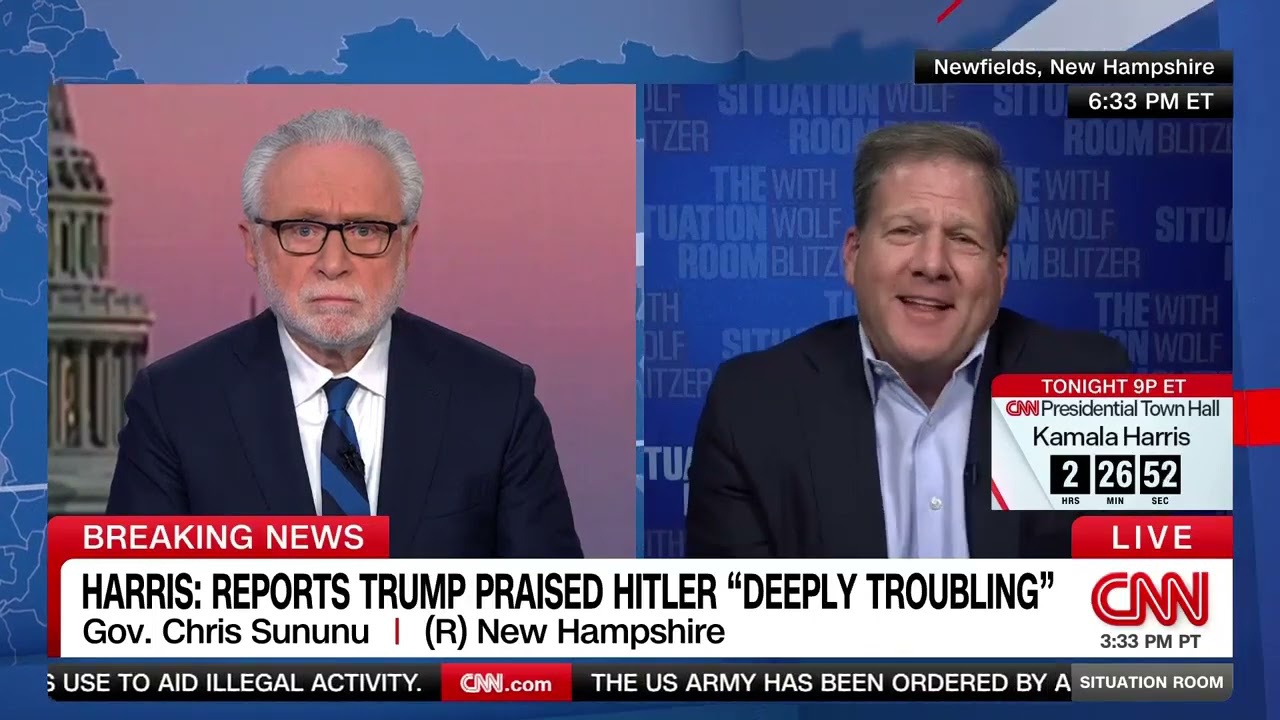 to ask him directly what he thought of the 45th president of the United States saying complimentary things about Hitler to Marine General John Kelly when he served as Trump's White House chief of staff. The Atlantic's Jeffrey Goldberg wrote an article Tuesday describing conversations with Kelly, in which he confided that Trump longed to have the same kind of "totally loyal" generals "that Hitler had." He also said that Hitler "did some good things" with Germany's economy with Kelly reminding him that he can't "ever" say anything complimentary about the architect of the Holocaust.
Throughout their exchange, Sununu downplayed and equivocated and attempted to pivot to criticism of Vice President Kamala Harris and the Democratic Party. Blitzer, however, directly confronted Sununu on multiple occasions over whether he thought it was anti-Semitic for Trump to both compliment Hitler and to dine with white supremacist Nick Fuentes at Mar-a-Lago in 2022.
:{:{READ MORE:CNN host laughs out loud at guest who said Trump had permission from Biden to call Putin}:
"Why do you want to vote for someone who thinks, quote, 'Hitler did some good things?'" Blitzer asked Sununu, after introducing him to viewers as someone who is supporting Trump in November.
"So let's be clear, those comments are not helpful, especially with these last couple of weeks. They're extreme," Sununu said. "I mean, this is a time when folks are going to say extreme things. I have all the respect in the world for John Kelly. Half the country doesn't think they're voting for a fascist. That's not where the American voter is."
After Sununu wrote off Kelly's comments as "white noise" and opined that they wouldn't move the needle in swaying undecided voters, Blitzer pushed back.
"Governor, do you actually think that having positive things to say about Hitler, or dining with Holocaust deniers, is anti-semitic?" Blitzer asked.
:{:{READ MORE:Trump told top aides he wanted the same kind of 'totally loyal' generals 'that Hitler had'}:
At first, Sununu misinterpreted the question as Blitzer equating Trump with a dictator "who murdered six million Jews." But the CNN anchor clarified his question.
"I didn't compare Trump to Hitler," Blitzer said. "I asked you if you think having positive things to say about Hitler, like Trump reportedly has said, according to several retired four-star generals who worked closely with him, or dining with Holocaust deniers at Mar-a-Lago, for that matter, is anti-Semitic."
Sununu again admitted that Trump's praise of Adolf Hitler was "not helpful," but then switched gears to ask the CNN host what he thought about the nationwide college campus protests of Israel's bombing of Gaza, which he characterized as "constant anti-Semitism" (many participants in those protests were Jewish). But Blitzer then countered that it wasn't just Kelly speaking out about Trump, but multiple senior members of the Trump administration, including former Vice President Mike Pence, former Defense Secretary Mark Esper and former National Security Advisor John. Bolton, among others.
"What's really disturbing, governor, is that virtually all of Trump's hand-picked to national security officials who worked closely with him for years are now warning about the threat he poses," Blitzer said. "How disturbing is that to you? Are they all wrong?"
:{READ MORE:This Trump trait makes him 'even more dangerous' than Hitler and Mussolini: ex-Dem senator
:{Watch the full segment below, or byclicking this link.
---
RSS gov cuomo endorse an 4 24 180?
mma mainstream media gushed over “vocal Trump critic” NH Gov. Chris Sununu, who has now endorsed Trump](https://www.mediamatters.org/new-york-times/mainstream-media-gushed-over-vocal-trump-critic-nh-gov-chris-sununu-who-has-now)
04/16/24
ref
new rep
The Soapbox Homepage
Politics
Health Care
Law
Media
Timothy Noah/October 26, 2021
How Four-Year Colleges Helped Kill Free Community College Tuition
One of the best ideas in Build Back Better is dead, and the higher-ed lobby deserves some blame.
Do you know anybody who doesn’t love community colleges? Me neither. They furnish job training that businesses no longer bother to provide. They provide skills that K-12 education is supposed to teach but often doesn’t, and they’re a bridge to a four-year college degree. Democrats love them. Republicans, though mostly hostile to higher education, make an exception for community colleges. “Community colleges,” says Peter Granville, senior policy associate at the Century Foundation, “are some of the most appreciated and widely approved institutions remaining in the United States.”
During the 2020 campaign, candidate Joe Biden promised two years’ free tuition and fees at community college or at a public four-year university. After the election, that was whittled down to funding tuition and fees only at community college, where you can get an associate degree in two years. Over 10 years, the federal government would pay 75 percent of the average national cost (currently that’s $3,700); states would pay the rest. Then that got whittled down to a five-year program in which the feds would pay 100 percent of the average national cost and then ratchet their contribution down gradually to 80 percent by 2028.
Last week, that got whittled down to nothing. The program is out of the Build Back Better reconciliation package. And one of the reasons, it turns out, is that four-year colleges lobbied against it.
That isn’t the only reason free community college tuition got bounced from the bill. It isn’t even the primary reason. But it’s the most shocking reason. Which may explain why I couldn’t get anybody to confirm precisely which four-year colleges lobbied on this. One source very reluctantly told me of hearing secondhand that it was a public university that resides in a state I won’t name. My telephone and email queries to relevant parties at this university went unanswered, which certainly raises suspicions. But that’s as far as this cloak-and-dagger caper took me.
The main reason the free community college tuition proposal got bounced from the bill, President Biden told a CNN town hall last week, was that West Virginia Senator Joe Manchin “and one other person [have] indicated that they will not support free community college.” Manchin was the main obstacle; the “other person” presumably was the reclusive Senator Kyrsten Sinema of Arizona, though at least some supporters of the bill thought Sinema was still gettable. Manchin, who last summer stated in a memo, “No additional handouts … or transfer payments” unrelated to families and health, and none of the latter unless they were means tested, hardened his opposition to the tuition proposal in the last few weeks. According to the Century Foundation’s Granville, the proposal Manchin was instrumental in killing would have furnished West Virginia with $40 million annually in tuition benefits extended to 22,000 students. (Sorry, kids!) Sinema’s opposition was perhaps less firm because Arizona would, according to Granville, get $400 million annually in tuition benefits extended to 237,000 students.
No Republican was ever going to vote for the reconciliation bill, with free community college tuition and fees or without it, because Republicans hate Democrats much more than they love community colleges. Some Republicans opposed the free tuition program on principle. New Hampshire’s GOP Governor Chris Sununu told The Wall Street Journal that if students didn’t pay part of their tuition, they wouldn’t hit the books. Never mind that if they didn’t get to go to community college, it’s a certainty they wouldn’t hit the books.
Or maybe Sununu’s opposition wasn’t principled at all. The proposal favored states where tuition charges for community college are lower than the national average. Those states would end up with a surplus that they could spend on four-year public colleges. In New Hampshire, by contrast, tuition charges are nearly twice the national average. Under the proposal, states where tuition charges are above the national median would get no surplus and would have to dedicate more state funds to making up the difference. (Sinema’s Arizona—again, per Granville’s calculations—would get $227 million in surplus funds; Manchin’s West Virginia, where community college tuition and fees are a whisker below the national average, would get a tiny surplus of about $1 million.)
The final community college proposal wasn’t exactly cheap, but neither was it intimidatingly high: $83 billion over five years. That’s less than one-quarter the cost of the provision in the reconciliation bill that provides free preschool, according to The New York Times.
But that’s not what’s eating me. What’s eating me is that private four-year colleges lobbied against the plan. Why on earth would they do that?
“They want paying customers,” explains Max Lubin, chief executive officer of RISE, a group that organizes student-led campaigns to reduce or eliminate the cost of attending college. If community college were free, some students would choose community college over a four-year college. The competition would be especially bothersome to for-profit colleges, which compete most directly for this population.
What about four-year colleges that effectively double as community colleges by offering associate degrees? “They would rather get Pell money,” Lubin said. “That’s free money. Then they can hike tuition anyway.” (Community colleges that participated in the free tuition program would be restricted in how much they could raise tuition.) “Pell money” is Pell grant money, which is given to lower-income students. Biden’s Build Back Better plan was supposed to increase the maximum Pell grant, currently $6,495, by $1,400, but that got whittled down to $500. Biden has hinted the final bill may bump that up a bit to make up partly for the loss of free community college.
The National Association of Independent Colleges and Universities didn’t lobby against free community college tuition, according to its president, Barbara K. Mistick. But it didn’t lobby for it, either. “Our efforts have been squarely focused on advocating for increasing the Pell Grant,” she told me by email. Mistick isn’t exactly enthusiastic about free community college. She told The Wall Street Journal last week that it was an untested program that would require building a new bureaucracy. “If you want to have the greatest impact, if you want to touch students in every single sector, the Pell program would do that,” she told the Journal. “You don’t want to do something that is going to take years.”
For four-year colleges, opposing free community college may be penny-wise and pound foolish. Several people pointed out to me that some of the students who acquire a free associate degree will transfer to four-year institutions; many in this group might never have attended college at all. Also, tuition and fees at four-year colleges are so much higher than at community colleges that unless a four-year college gives the student in question a free ride (thereby, in Sununu’s eyes, tempting said student to goof off), it’s a stretch to say it’s competing with community colleges at all. (Average tuition at a public four-year college is $10,560 for in-state students and $27,020 for out-of-state students, and at a private four-year college, it’s $37,650.) And don’t forget that states that don’t charge an arm and a leg for community college stood to receive surpluses that they could then have spent on their public colleges.
Yet four-year colleges and universities lobbied against free community college. It speaks volumes that the specific organizations that did so have gone into hiding. So does the silence we’re mostly hearing from four-year colleges on the demise of this very good idea. To me it sounds like a dowager’s murmur: “Not our class, dear.”
Timothy Noah @TimothyNoah1
Timothy Noah is a New Republic staff writer and author of The Great Divergence: America’s Growing Inequality Crisis and What We Can Do About It.
Sign up for TNR’s The Soapbox weekly newsletter.
Read More: Politics, The Soapbox, Education, Higher Education, Community College, Build Back Better, Reconciliation, Joe Biden, Joe Manchin, Lobbying
Editor’s Picks
Joe Manchin Is Bad for West Virginians
Jason Linkins
Why Are Democrats Fighting Over Free College?
Graham Vyse
A modest, practically harmless October Surprise. But it’s typically down ballot where the average Project Veritas video tends to have its most pernicious effects. Less well known than O’Keefe’s blunders on the national stage are the numerous documented instances in which his stings have been cited to justify new and more onerous voter I.D. laws or other election integrity legislation in state legislatures across the country.
In April 2012, Chris McDaniel, then Mississippi’s Senate elections committee chairman, cited a Project Veritas voter fraud video as evidence justifying the passage of the state’s “photo identification requirement” bill, which the state’s Republican Governor Phil Bryant signed that May. Despite legal challenges, this law is still on the books today.
Also that year, a Republican Minnesota state representative, Steve Drazkowski, praised a locally shot O’Keefe video—in which Project Veritas undercover operatives requested ballot applications for their friends “Timothy Tebow and Thomas Brady”—during a floor debate for his party’s own draconian voter I.D. bill. While Minnesota’s Democratic Governor Mark Dayton vetoed a strict version of that voter I.D. legislation, and Minnesota voters backed his decision in a ballot initiative later that year, the state’s Republican Party still plans to revisit the issue again this year. (“We have had a number of studies that have been completed, there’s a lot of new data on this topic, and there are court cases that have been decided,” as Minnesota GOP State Senator Scott Newman ominously put it, “none of which we had in 2012.”)
:{O’Keefe’s “Primary of the Living Dead” stunts during the } :{ and }
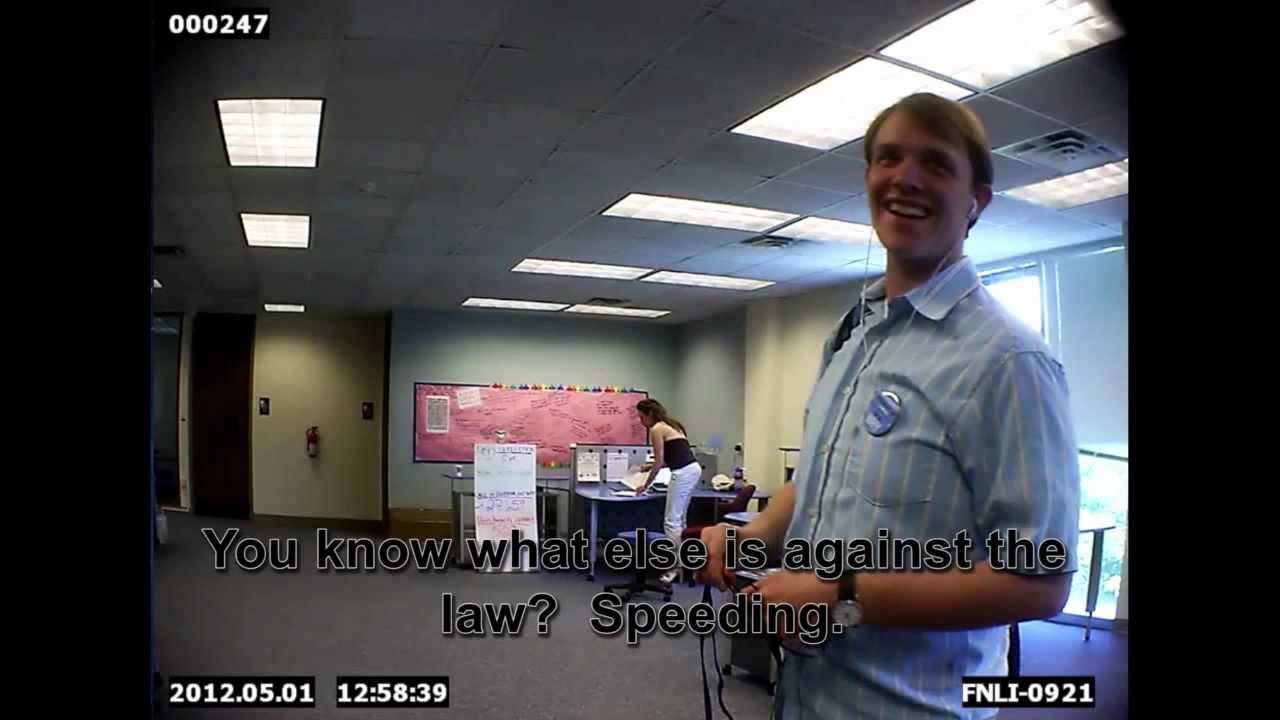 :{ primaries in 2012—in which his operatives requested but crucially did not actually attempt to use, the ballots of deceased primary voters—aided }:the passage of stringent voter I.D. laws:{ in those states. }::{After New Hampshire enacted a law in 2018 tightening the state’s voting statutes, partly in response to a new series of Project Veritas videos, Democratic legislators made repeated attempts to repeal them, only to be thwarted by Republican Governor Chris Sununu’s veto.}:
==
==
anomaly NE? v trend?
month New Hampshire Governor Chris Sununu announced the state would not be participating in the Transportation and Climate Initiative (TCI), a regional cap-and-trade program aimed at reducing carbon emissions from vehicles. The program is still in early stages of development, but groups tied to petroleum interests and conservative networks funded by the Koch empire are already fighting it with opposition campaigns.
==
ke the seasoned reality TV star that he is, President Trump is again creating a spectacle that distracts the masses from the nearly unbearable triple threats posed by a deadly pandemic, a downward-spiraling economy and emboldened agents of the state terrorizing the nation. Every single day, Trump claims he’s done something he hasn’t and will do something he cannot. Every few weeks he signs a nonsensical or illegal executive order so he can have a ceremony and pretend he’s governing. Meanwhile, 156,000 Americans have died dead while he claims things are getting better every day. Republican recalcitrance — despite what the Trump administration claims — stands to materially harm millions, with the aim of benefiting the party electorally.
By now it is evident to all who are paying attention that Trump’s re-election plan hinges on sabotaging the U.S. Postal Service, appointing a crony who can jam up the system and prevent mail-in ballots from arriving on time, then declaring victory based on the Election Day results, knowing that many swing states don’t count mail-in ballots that arrive late. While that appears to be the main line of attack, as years of concerted GOP efforts across the nation have illustrated, voter suppression is a complex scheme that includes several separate tactics.
With the expiration of federal protections — and the $600 supplemental unemployment benefit — millions of people across the country are suddenly unable to pay rent and are at imminent risk of eviction. Setting aside the sheer human misery mass eviction will entail, it is also an unexamined new avenue for voter suppression.
“A lot of people are going to be evicted, but I’m going to stop it because I’ll do it myself if I have to,” Trump told reporters at the White House on Monday. “I have a lot of powers with respect to executive orders, and we’re looking at that very seriously right now.” It’s not clear what authority he has to do so.
AD REMOVED FOR SUBSCRIBED USER
Trump has said that he and the Republicans support reinstating eviction protection for renters who live in buildings with federally backed mortgages, but Senate Republicans’ belated opening bid in negotiations, after the moratorium on evicting renters ended last Friday, included no such protections. Despite Trump’s promises, the Washington Post reported on Tuesday evening:
Even though [Treasury Secretary Steve] Mnuchin offered an eviction moratorium until the end of the year, the White House offer did not include other homeowner and rental assistance that Democrats have demanded, so the housing portion of the talks remains unresolved, a Democratic aide said, speaking on the condition of anonymity to describe the talks.
At the behest of Democrats, the CARES Act included a 120-day moratorium on evictions for tenants living in rental housing covered under the Violence Against Women Act, which includes Section 8 public housing, the rural housing voucher program, and anyone renting in buildings with federally backed mortgages. Some states and cities also issued their own individual eviction moratoriums, but around 30 of those moratoriums have expired since May, according to The Eviction Lab at Princeton University. Renters now have as little as 30 days after the expiration of the resolution to repay back rent or face eviction. The CARES Act protections for renters specifically ended on July 25 and now renters in areas with no local protections are poised to be booted from their homes in the middle of a pandemic and ahead of the largest vote-by-mail effort in U.S. history. Successful voting by mail, after all, depends on voters with known mailing addresses who are registered well in advance of the election.
This potential wave of mass voter disenfranchisement comes as new voter registration has already dropped dramatically amid the coronavirus pandemic, largely because most state DMV offices shut their doors and voter contact programs paused. The number of new voters registered across 11 states in April 2020 decreased by 70% compared with April 2016, according to a report from the nonpartisan Center for Election Innovation & Research. Swing states like Florida, Virginia, North Carolina and Arizona have seen at least a 50% voter registration reduction, compared to four years ago.
By withholding eviction protection from their proposed package, Republicans in Congress appear to be attempting to use the next round of pandemic relief as their latest voter suppression vehicle, adding disenfranchisement to the host of life-altering problems faced by thousands of newly-houseless Americans.
Comparatively, homeowners have received more assistance just as home sales are booming. The CARES Act allows any homeowner with a federally-backed mortgage to get a forbearance, meaning they can skip up to 12 months’ worth of mortgage payments. Meanwhile, mortgage rates are currently the cheapest on record and new mortgage applications just hit a level not seen since 2008. As Trump indicated back in March, he and the Republicans have successfully taken advantage of the pandemic to pick winners and losers in the economy. Next up: the elections.
Mass evictions help Republicans electorally, even if not politically. Obviously the optics aren’t great — and Trump, with his so-far-empty promises to protect renters, is keenly aware of that — but there is evidence that suggests it is still a good bet for the GOP.
Data show a disparity in voter participation between renters and homeowners. In 2016, 67% of homeowners voted versus just 49% of renters. Another analysis of 2016 data shows that neighborhoods in Reading, Pennsylvania, with more evictions often had lower rates of voter turnout. Trump won Pennsylvania’s 20 Electoral College votes after edging Hillary Clinton by just 44,000 votes — out of more than 6 million cast.
“All else being equal, if you live in a neighborhood with high eviction rates, the voting rate is significantly depressed,” Princeton sociologist and eviction scholar Matthew Desmond explained.
Perhaps that’s why the Republican governor of New Hampshire, John Sununu, recently vetoed a bill giving tenants who owe back rent at least six months to pay it back in installments.
Assuming that we have a COVID-19 resurgence in the fall as predicted, we may also have closures of county clerks’ offices, courthouses, notaries and other departments required in some states to either register to vote or to vote absentee by mail. Meanwhile, some cities, like New Orleans, have already opened their housing courts to begin eviction proceedings.
==
https://www.desmogblog.com/2020/01/26/state-policy-network-oil-transportation-climate-initiative-northeast
no lnx many
Last month New Hampshire Governor Chris Sununu announced the state would not be participating in the Transportation and Climate Initiative (TCI), a regional cap-and-trade program aimed at reducing carbon emissions from vehicles. The program is still in early stages of development, but groups tied to petroleum interests and conservative networks funded by the Koch empire are already fighting it with opposition campaigns.
These campaigns are active in multiple states throughout the Northeast, featuring public events to sway legislators, public letters co-signed by various free market groups, and at least one study produced by a Koch- and oil-industry funded think tank based in Texas.
Public Health and Sustainability Benefits
Supporters of the program describe TCI as an important step towards cleaning up the transportation sector and say it will improve public health and community sustainability. A draft Memorandum of Understanding (MOU) was released in December, along with initial projections of potential economic and public health benefits.
According to the TCI website, “Preliminary modeling estimates that by 2032, the proposed program could yield monetized annual public health benefits of as much as $10 billion, including over 1,000 fewer premature deaths, and over 1,300 fewer asthma symptoms annually region-wide, among other safety and health benefits.”
In his comments announcing New Hampshire’s withdrawal from the 12-state coalition, Governor Sununu cited an estimate for fuel price increase.“New Hampshire is already taking substantial steps to curb our carbon emissions, and this initiative, if enacted, would institute a new gas tax by up to 17 cents per gallon while only achieving minimal results,” Sununu said.
Around the same time as Sununu's announcement, a coalition of 18 conservative think tanks released an open letter in opposition to TCI. The groups claim the initiative is “a carbon dioxide tax being implemented through a gas tax.” According to the letter, “Citizens in TCI states can expect to be hit with higher personal costs, higher costs for goods and services, and higher taxes.” The language in the letter appears similar to Sununu’s description of TCI as a “gas tax” and a “financial boondoggle.”
The Republican governor of New Hampshire is the brother of James Sununu, board chairman of the Josiah Bartlett Center for Public Policy — one of the groups behind that open letter.
The Bartlett Center is a member of the State Policy Network, a Koch-funded network of think tanks based in states across the country that advocate against climate and clean energy policies and other initiatives deemed in opposition to “economic freedom.” This New Hampshire think tank also lists former Governor John H. Sununu — Chris Sununu’s father — as an emeritus board member. The organization has led the opposition to TCI in the Granite State.
With New Hampshire now backing out, pressure is mounting in other states to follow suit, as conservative think tanks continue to raise alarm at the proposal to rein in transportation-sector emissions.
'Biased' Surveys and Oil-Funded Studies Deployed in Connecticut and Virginia
When asked about the TCI in a recent radio interview, Connecticut Governor Ned Lamont did not give a definitive position, but he did say that a “gas tax” is “probably not the way to go.” Several newspapers picked up on this remark, including the conservative Boston Herald in Massachusetts and the Middletown Press in Connecticut.
The Yankee Institute for Public Policy,one of the think tanks that signed the opposition letter to TCI, posted a link to the Middletown Press article on its Facebook page with the caption, “good.” The Yankee Institute is Connecticut’s prominent conservative, free market think tank and another member of the State Policy Network. In December last year, the group posted on its blog in response to the TCI’s draft MOU release. The blog post labels the TCI as a “regional gasoline tax” and quotes from the oppositional open letter that the Yankee Institute signed.
More recently, the Yankee Institute attacked TCI in a blog post by claiming that modeling shows the program would have no effect on climate change.
“But the overall effect on the climate is too small to be measurable, according to climate modeling conducted by Brent Bennett, PhD, of Life: Powered — the energy policy division of the Texas Public Policy Foundation,” the blog post states. That climate modeling is meant to measure the impact of policy changes on global temperature, and is often used by conservative groups opposed to climate action — like the Texas Public Policy Foundation (TPPF) — to claim that a single policy will do nothing to alleviate global warming on a global scale.
“This modeling is flawed in that it’s an effort of focus on local costs and then change the scope of impact to global impacts. Demanding that any specific reductions making a difference on total pollution levels has been a polluter mantra for decades,” David Littell, senior advisor at the Regulatory Assistance Project, told DeSmog. “If we require any specific reduction in greenhouse gases to reduce global warming noticeably we will never do anything. No single reduction will move the dial, we need to transform our energy and transportation systems as a whole to address global warming and climate change.”
In Virginia, the Thomas Jefferson Institute for Public Policy is ramping up criticism of TCI though an opposition campaign that includes questionable polling and research. The Jefferson Institute is another conservative think tank, a member of the State Policy Network, and signatory of the TCI opposition letter.
The Jefferson Institute is promoting a new report, conducted by one of its own staff members, filled with misleading information about the expected impacts of TCI.
For example, the report claims that TCI will have no health benefits, will prevent no deaths, and will have no environmental benefits, citing dubious sources including the Koch-funded Texas Public Policy Foundation and notorious climate science denier Steve Milloy. The report points to the same TPPF climate modeling cited by the Yankee Institute, examining the impact that TCI would have on global temperature.
Jefferson Institute for Public Policy's report on the Transportation and Climate Initiative
Jefferson Institute for Public Policy's report on the Transportation and Climate Initiative posted on its website.
The author of the report, titled “The Transportation and Climate Initiative — All Pain and No Gain,” is David Schnare, an attorney who was embroiled in a legal dispute over finances with his business partner and who has sued universities to obtain climate scientists’ emails. Schnare is now the director of the Jefferson Institute’s Center for Environmental Stewardship.
The Jefferson Institute is also touting results of a poll indicating a majority of Virginians would oppose TCI if it meant a tax increase of at least 18 cents per gallon of gas. The same poll found that 61 percent would support TCI given benefits like reducing carbon emissions and developing the clean energy economy. The two questions yielding these results were added at the request of the Jefferson Institute to a more general poll on political and legislative topics.
According to one expert in polling and strategic communication, the way in which the two questions were posed was intended to generate these results.
“The approach used in this survey strikes me as biased in a more subtle way,” Ed Maibach, of the Center for Climate Change Communication at George Mason University, told DeSmog. “The first question specifies the benefits only — which are benefits that most people value — and then assesses support for the [TCI] proposal. The second question states the costs only, and then assesses support for the proposal, but participants in the survey may or may not remember the benefits stated in the prior question,” Maibach explained. “A better (i.e., fairer) way to assess support for the proposal would be to present the benefits and costs — in a fair and balanced manner — in the same question.”
TCI Opponents Gather in Boston
The Massachusetts Fiscal Alliance, a free market conservative think tank, is leading the opposition to TCI in the Bay State. The group is lobbying the state legislature and pushing for a bill that would prohibit participation in TCI without legislative approval.
Last week the alliance and other conservative think tanks convened a press conference in Boston voicing their opposition to TCI.
Massachusetts Fiscal Alliance spokesman Paul Craney told reporters that multiple governors have expressed concerns about the initiative and that momentum to squash it was on their side. “Things are going in our direction for the taxpayers and consumers,” Craney said.
“What we once saw as maybe a regional approach seems to be falling apart,” added Chris Carlozzi, state director of the National Federation of Independent Business for Massachusetts and Rhode Island. Groups represented at the press conference, according to MassLive, included Massachusetts Fiscal Alliance, the Vermont chapter of Americans for Prosperity, Maine Heritage Policy Center, Rhode Island Center for Freedom & Prosperity, and Connecticut’s Yankee Institute for Public Policy. Most of these groups are members of the Koch-funded State Policy Network.
TCI Moves Forward
Mass. Gov. Charlie Baker
Governor Charlie Baker, Lt. Governor Karyn Polito, MassDOT Secretary and CEO Stephanie Pollack and Secretary of Energy and Environmental Affairs Kathleen Theoharides at the Massachusetts Transportation and Climate Initiative Business Summit in December 2019. Credit: Gov. Charlie Baker, CC BY-NC-SA 2.0
Despite the criticisms and opposition campaigns, the initiative to introduce a regional cap on transportation sector emissions is moving ahead. The program is accepting public comments on the draft MOU through the end of February. A final MOU is expected later this spring, and the program could become operational by 2022.
Massachusetts Governor Charlie Bakerlet TCI critics down when defending the program in his State of the Commonwealth address this week.
“Greenhouse gas emissions from transportation have been on the rise for decades and now represent 40 percent of this state’s total emissions. Unless we take on transportation, we won’t meet our objectives,” Baker said. “RGGI, the Regional Greenhouse Gas Initiative that our proposal is based on, has worked for 10 years. Power plants have adopted clean energy solutions and funded energy efficiency programs, investing 3.3 billion dollars across the region. Greenhouse gas emissions in the power sector have dropped by nearly 50 percent. Applied to the transportation sector, the same market mechanisms can encourage automakers and fuel suppliers to find efficiencies and deploy cleaner fuels. In addition, the Transportation Climate Initiative will deliver millions of dollars in needed investments in our transportation infrastructure. It’s a critical part in expanding public transportation, transforming our highways and reducing congestion.”
==
==