Christine Arena Clean Creatives
overwrite by edelman?
===
gmail 3 26 heated
Fossil fuel propaganda is evolving
A new analysis of nearly 2,000 fossil fuel ads finds Big Oil has moved from green promises to insisting oil and gas are inevitable. (They're not).
A side effect of the war in Iran is that fossil fuels are falling out of favor. People are starting to realize that sunlight can’t get stuck in the Strait of Hormuz; that EVs can’t have their fuel supply held hostage on a tanker; and that there’s no such thing as a barrel of wind.
It’s probably no coincidence, then, that Big Oil is working overtime to polish its reputation as prices surge and black clouds of poison fill Tehran’s skies. Take this ad from the American Petroleum Institute that aired last week on The New York Times podcast The Daily, during an interview with climate writer and activist Rebecca Solnit.
[
Dr. Ayana Elizabeth Johnson on Instagram: "A++ greenwashing for…
“Today, America’s natural gas and oil keeps the country moving, growing and building, and makes every day a little easier,” the ad’s narrator says. “But energy demand is growing, and the infrastructure built today will help secure a more affordable, reliable future, with enough energy to go around.”
It’s strange, given the current geopolitical situation, hearing the oil industry tell us that the only way we’re going to have an affordable, safe, and consistent future is to continue to invest in fossil fuels (reminder: even “American” oil is still priced on a volatile global market).
But this type of messaging is not just limited to this political moment, or toThe Daily.A new report from the advocacy group Clean Creatives reveals that the oil industry has systematically reshaped its advertising over the past four years to portray fossil fuels as permanent, indispensable, and necessary for economic stability and national security.
Put another way, fossil fuel companies are no longer trying to convince us they are good-faith partners in the fight to preserve a safe and stable climate.
Now, they are focused on convincing us that the world is only safe and stable if they are in charge.
===
4 24
three-quarters of prizes at the UK’s top sustainable advertising awards went to agencies who work for the fossil fuel industry, a DeSmog analysis has revealed.
The second annualAd Net Zero awards wer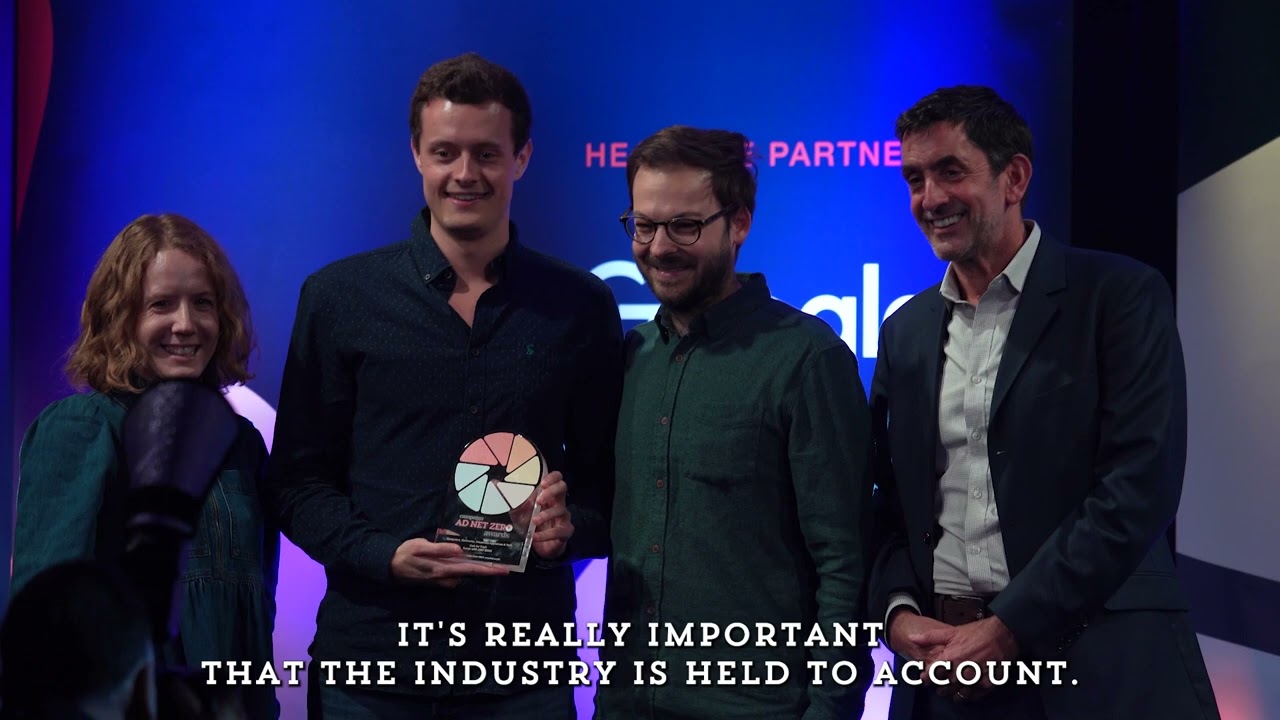 in partnership
vid]
with industry magazine Campaign in London in November to recognise internal agency sustainability practices and green campaigns on behalf of clients including Heineken, Vodafone, and Sky.
By cross-referencing winners with research from advocacy group Clean Creatives, DeSmog found that 17 of the 23 awards for agencies (or 74 percent) went to companies who represent oil and gas producers or utilities. Those agencies included M&C Saatchi, Wunderman Thompson (now part of VML), Iris Worldwide, and the media group Dentsu.
“Grand Prix” awards went to Grey, which has worked for BP and Indian Oil in the last two years, and EssenceMediacom, which has represented Shell since at least 1995, according to Clean Creatives. Both agencies are owned by the London-based global media group WPP.
In total, nine of the 15 agencies who won awards at the November 2 gala (or 60 percent) hold or have recently held contracts with a combined 21 fossil fuel and utility companies, including ExxonMobil, Chevron, Saudi Aramco, and TotalEnergies.
Climate advocates said that giving green accolades to companies who continue to produce adverts and public relations campaigns for major polluters undermines the credibility of Ad Net Zero, an advertising industry body formed in 2020 amid a broader push by the business world to show it was serious about tackling the climate crisis. The group’s members include six of the major advertising networks that dominate the industry —WPP, Omnicom Group, Interpublic Group (IPG), Publicis, Dentsu, and Havas.
“For Ad Net Zero to reward agencies for environmentally friendly work, when those same agencies are managing campaigns to promote the long-term future of fossil fuels, is disingenuous and removes any credibility from their corporate positions,” said Dominic Lyle, director of communications at financial think tank Planet Tracker.
In response to DeSmog’s findings, Ad Net Zero said its award entry forms ask for specific evidence of real-world impact from sustainability campaigns in areas such as food waste or greenhouse gas emissions, and that promoting such work could inspire change in the industry.
“It is possible — and probable — at this stage of the industry’s climate journey that the best work is produced by an agency that is also connected in some way to the types of companies you [DeSmog] highlight,” said an Ad Net Zero spokesperson. “But will it help anyone if that work is considered to be invalid or of no value as a learning opportunity for fellow advertising professionals?”
Co-host Campaign said it was aligned with Ad Net Zero’s responses.
 Credit: Sam Whitham.
Mixed Messages
Some agencies’ winning campaigns at the Ad Net Zero awards, which were sponsored by Google, pushed sustainability messaging that appeared to be in direct conflict with some of their other clients’ less than planet-friendly business models.
Independent agency M&C Saatchi won an award for its plastic pollution awareness campaign The Plastic Forecast, made for Australian philanthropic organisation the Minderoo Foundation, which visualises the weight of microplastics falling from the sky in raindrops on a given day.
M&C Saatchi’s website says it has a 16-year relationship with Coca-Cola, the world’s worst plastic polluter according to research by environmental group Break Free From Plastic. Coca-Cola also has a record of actively fighting against plastic pollution legislation, according to a report by U.S.-based investigative newsroom The Intercept.
Clean Creatives research shows M&C Saatchi also represents Origin Energy, which operates Australia’s largest coal-fired power station, and South African fuel brand Astron Energy.
M&C Saatchi told DeSmog that less than two percent of its revenue came from fossil fuel clients in 2022, and that it has three environmental commitments relating specifically to client work: building “climate literate teams”; growing revenue from “planet-positive campaigns”, and reviewing the environmental approaches of potential new clients.
Agencies have, however, been criticised for only applying environmental reviews to prospective clients — allowing them to continue doing business with existing polluting clients. In November, DeSmog reported that this loophole had enabled McCann, part of the IPG network, to begin pitching to retain their client Saudi Aramco, the largest oil company in the world.
Supporting Shell
Wunderman Thompson, part of the WPP network, won an award for its Vodafone e-waste campaign, with the entry noting that smartphones will contribute to approximately 10 percent of global carbon emissions by 2040.
According to Clean Creatives, Wunderman Thompson has made adverts for Shell, one of the biggest corporate contributors to global carbon emissions in history, since at least 1929.
Wunderman Thompson, Dentsu and WPP did not respond to requests for comment.
Ad Net Zero judges also praised Iris Worldwide for its “actions not ambitions” campaign to promote Scottish energy company SSE’s £12.5 billion investment in the UK’s green energy transition.
Clean Creatives’ records show Iris Worldwide also works for Shell, which announced in June that it was “stepping back from renewable power investments that don’t fit our strategy or do not generate enough returns.” In September, Reuters reported that several employees had written an open letter to Shell CEO Wael Sawan, protesting the renewable energy cutbacks.
The following month, climate protesters staged a “die-in” at the London headquarters of agency network Havas after the company won a bidding war for a portion of Shell’s advertising account.
Web archives show Iris Worldwide, part of the Cheil Worldwide network owned by Samsung, has recently worked on brand awareness and social strategy for the oil major.
Iris said in response to DeSmog’s findings that it was “vital” that case studies for promoting green action through advertising were shared — whoever created them.
“Inclusivity is a core pillar of the awards and to that end we don’t think any companies should be excluded from sharing the work they do for their clients,” said an Iris spokesperson.
 Credit: Sam Whitham.
‘Advertised Emissions’
The extent of fossil fuel ties among the Ad Net Zero award winners underscore the challenges of transitioning an industry facing growing scrutiny over its work for climate-damaging companies.
Ad Net Zero members pledge to follow a five-step action plan to reduce emissions from business operations and supply chains, advertising production, advertising placement, and events, as well as promote sustainability through campaigns. Members must also report on their progress towards implementing net zero goals set in line with the 2015 Paris climate agreement.
“You may say compared to the scale of an energy company it [the industry’s operational and supply chain emissions] is small, but it is millions of tonnes of carbon, and we have to take care of that,” Stephen Woodford, CEO of the Advertising Association, one of Ad Net Zero’s founder organisations, told a panel at the Cannes Lions Festival of Creativity in June.
Critics say, however, that Ad Net Zero’s focus on operational emissions obscures a much bigger problem: The role of advertising in exacerbating the climate crisis by driving demand for damaging products, from flights to SUVs — a phenomenon defined by advocacy group Purpose Disruptors as “advertised emissions.” The concept was adopted by the UN’s corporate decarbonisation campaign Race to Zero in 2022, but is not recognised by Ad Net Zero.
Dentsu — which won the Ad Net Zero award for best internal sustainability practices at a large agency — published an estimate of its “advertised emissions” in July, which found they were 32 times higher than its operational emissions.
Other major advertising companies have yet to follow suit, and Ad Net Zero’s industry backers have questioned the methodology behind the concept. ” In June, the Advertising Association and two other trade associations that established Ad Net Zero published a joint article in Campaign arguing that calculating “advertised emissions” would lead to “a significant overstating of emissions attributable to an advertising campaign by ignoring advertising’s displacement effects — the sale of one product or service means the lost sale of another in most markets.”
However, the latest Advertising Pays report, published by the Advertising Association and Deloitte, says that “advertising encouraging market growth is one of the reasons why £1 spent on advertising generates £6 to the UK economy” — a claim that critics say undermines the “displacement effects” theory.
‘Denial and Delay’
Climate advocates argue that advertising and public relations companies also play an often overlooked role in hindering climate action by working on behalf of oil and gas companies to influence both government policy and public opinion. Advertising campaigns have created exaggerated impressions of the fossil fuel industry’s investments in renewable energy or other climate solutions, helping todeflect pressure to slash emissions by fostering the false impression that the industry has the crisis in hand.
In September 2022, UN Secretary-General Antonio Guterres told the UN General Assembly: “We need to hold fossil fuel companies and their enablers to account. [This] includes the massive public relations machine raking in billions to shield the fossil fuel industry from scrutiny.”
None of the major advertising networks in Ad Net Zero have published targets to address “advertised emissions” by winding down campaigns promoting polluting products, or stopping work to portray fossil fuel companies in a climate-friendly light — and Ad Net Zero does not require them to do so.
Experts fear that, as a result, the vast majority of the industry is working towards a definition of net zero that represents only a fraction of the advertising and public relations industry’s overall contribution to the climate crisis.
“The Ad Net Zero awards do credit to the creatives involved and enable some positive societal behaviour shifts, but they are dwarfed by the overarching issue of denialism in the industry,” said Victoria Harvey, a PhD researcher in advertising and climate at the University of East Anglia. “If we ignore the issue of oil and gas clients, at a time when other industries are disengaging with them, then the UK advertising industry is complicit in the denial and delay of real climate action.”
With concern growing around the role of advertising in the climate crisis, more than 900 agencies around the world have signed a Clean Creatives pledge to refuse contracts from fossil fuel companies, including large agencies such as GALE and Forsman & Bodenfors.
Ad Net Zero says it cannot mandate which companies its members can work with since this could breach competition law governing trade associations.
“Who member companies choose to work with depends on their own internal policies and we encourage — and campaign for — all our supporters to take steps to accelerate the transition to net zero both in their own businesses, in their supply chains and with their customers,” the Ad Net Zero spokesperson said.
‘Neon-lit Conflict’
In a
vid
https://youtu.be/-1bjlI9tB6g) filmed on the night of the awards, Ad Net Zero Chair Sebastian Munden underlined the organisation’s ambitions to grow advertising campaigns designed to promote sustainability.
“I think these awards really add something, which is showing what can be done,” he said. “What I’m hoping is that every year as we look back, this year’s awards will dwarf last year’s achievements because the whole industry is learning and really striding forward.”
Nevertheless, a series of rulings by UK watchdog the Advertising Standards Authority (ASA) have underscored the reputational risks facing agencies who continue to work with polluting clients. In June, the regulator banned adverts by Shell, Repsol and Petronas for misleading consumers about renewable energy commitments.
The ASA took similar action against ads for Toyota SUVs in November, ruling that the imagery condoned a style of off-road driving that “disregarded” the impact on nature. In December, the ASA banned Norwegian oil company Equinor from repeating claims that wind, oil and gas, and carbon capture play a balanced role in its energy mix, since most of the company’s revenues still come from oil and gas, the Financial Times reported.
“If you greenwash for Big Oil you can’t soak the climate stain away by carrying a couple of eco clients,” said Andrew Simms, co-founder of the Badvertising campaign. “Agencies playing both sides leave themselves open not just to reputational and regulatory risk, but also ridicule, because people will see it for the neon-lit conflict of interest that it is.”
edelman122
---
promoted to primary: walmart greenwash, Berman
Krempasky (rather)
attacked hodai
much bad code
see also tag no e
evil pending
html arena --> coordinating efforts”
---
---
busted on cop 27 egypt
https://www.opendemocracy.net/en/un-climate-champions-pr-brunswick-saudi-aramco/
UN climate campaign leaders are taking advice from a PR firm that works extensively for fossil fuel giants – including the world’s biggest oil company, Saudi Aramco.
The international public relations firm Brunswick has helped the UN’s “high-level climate champions” – a small but influential team led by the UK and Egypt, the hosts of COP26 and COP27 – to develop five UN-backed climate policies and campaigns.
One of these campaigns is Race to Zero, which encourages companies to rapidly reduce emissions, with its flagship initiative, Business Ambition for 1.5°C, calling on corporations to help limit global warming to that level.
But while advising the climate champions, and having signed up as a member of Race to Zero, Brunswick also spins for fossil fuel companies developing dozens of new oil and gas prospects.
these developments will make the 1.5°C goal – which requires a complete stop to new oil and gas projects – much harder to attain.
Duncan Meisel, executive director of Clean Creatives, a campaign calling for PR and advertising agencies to boycott fossil fuel companies, told openDemocracy: “Working for oil drillers and fossil fuel power companies makes Brunswick an opponent of the action that UN high-level climate champions are trying to promote.”
PR companies’ role in the climate crisis has been under renewed scrutiny in recent months, after Antonio Guterres, the UN secretary general, condemned the “massive public relations machine raking in billions to shield the fossil fuel industry from scrutiny”...
Last month, more than 400 scientists called on the PR firm Hill+Knowlton Strategies to drop its fossil fuel clients after openDemocracyrevealed it was also working for the Egyptian presidency of COP27.
Some 636 fossil fuel industry representatives registered to attend COP27, according to research by Global Witness, leading to claims that the conference had been hijacked.
---
---
https://www.desmog.com/2022/09/14/house-committee-pr-climate-disinformation/
On September 14, a congressional committee probed the history that PR firms have played in creating and spreading climate disinformation in order to block climate policy and promote fossil fuel interests.
The hearing, held by the U.S. House Natural Resources Committee, Subcommittee Oversight & Investigations, invited several firms, including Singer Associates, Story Partners, and Pac/West Communications. None of them showed up.
Instead, the hearing heard from several witnesses, including experts in the PR industry. One of them was Christine Arena, a former VP at Edelman who now researches and exposes greenwashing and industry obfuscation. Arena laid out three overarching campaign strategies that PR firms use on behalf of their fossil fuel clients, citing a study from Brown University researchers Robert Brulle and Carter Werthman. Those strategies are corporate image promotion, third-party mobilization (astroturf groups), and delegitimization of the opposition.
“The U.S. oil and gas sector has always pushed for policies that allow for new fossil fuel expansion, and against policies that would reduce demand,” Arena said in a prepared testimony. “But what has changed recently is the intensity of the industry’s pursuits, and the vast resources it deploys through public relations and lobbying efforts meant to crush potential regulatory obstacles in its path.”
The oil industry and its hired PR hands continue to deploy these strategies. A recent example Arena cited was the oil industry’s effort to opportunistically seize on Russia’s war in Ukraine to promote long-standing policy wishes, while misleading the public by blaming climate policy for causing higher energy prices.
These tactics are especially aggressive at the state and local level, where “brute financial force” is used to kill off climate initiatives, Arena added.
That power imbalance was on vivid display in Colorado in 2018 when grassroots activists succeeded in getting a ballot initiative put to voters that would have imposed greater setback distances on fracking operations, limiting how close to homes and schools new oil and gas wells could be drilled. A year earlier, two deadly oil and gas infrastructure explosions had rocked Firestone, Colorado.
The industry poured money into that election, outspending community and environmental groups by a factor of more than thirty to one. Noble Energy,a large fracking company (now owned by Chevron), hired DC-based PR firm Story Partners, to help defeat the measure. Story Partners created two astroturf campaigns, based on the firm’s research that showed that support for setback distances declined when voters heard about the “devastating consequences” that it would have on the state’s economy. The campaign ran ads to promote “clean” natural gas, warn of damage to Colorado’s economy, and positioned Noble Energy as a responsible partner. Story Partners still displays its campaign to defeat the ballot initiative on its website as a successful “case study” of how it protected its client’s assets.
The House committee also heard from Anne Lee Foster, who held an unpaid position in 2018 for Colorado Rising, a grassroots group supporting the ballot measure to establish drilling setback distances. She spoke about the multiple instances in which people would harass her and her colleagues as they tried to gather signatures.
Around that time, Colorado Public Radio reported that an internal Anadarko Petroleum document, leaked to Colorado Rising, asked employees to report the locations of signature gatherers via a phone texting system. Once the location was identified, counter-protesters appeared at a moment’s notice, shouting and harassing the signature gatherers and passersby who considered signing on to the ballot initiative effort.
According to a report produced by the House committee, oil companies including Anadarko Petroleum, Noble Energy, and Chevron, had set up two front groups, “Protecting Colorado’s Environment, Economy and Energy Independence” (Protect Colorado), and “Coloradans for Responsible Energy Development” (CRED). Those two groups then funneled most of their proceeds to an Oregon-based PR firm called PAC/West. The two front groups offered a “buffer” between the oil drillers and the PR campaign, the committee report said.
Although it was later deleted from its website, PAC/Westdescribed how it was paid by Anadarko Petroleum and Noble Energy to “lead a statewide education campaign” to defeat the ballot measure. Ultimately, the ballot measure was narrowly defeated at the polls in 2018.
“I personally suffered from what I feel is stalking or harassment in a number of other circumstances throughout this campaign,” Anne Lee Foster told the committee on Wednesday in her prepared testimony.
That was one small example of a web of influence between a handful of PR firms and the oil and gas industry. “Let me be clear: There is nothing standard or ethical about these practices. They are deceptive communications practices that mislead our citizenry and undermine our democracy,” Arena said.
The work that PR firms do goes far beyond simply promoting the image of their clients, according to Melissa Aronczyk, an associate professor at Rutgers University’s School of Communications & Information, another witness at the congressional hearing.
“Public relations firms often present themselves and their work in terms of facilitating or amplifying ideas or information. In fact, public relations is not only communicating ideas and information but coming up with those ideas and creating that information,” Aronczyk said in her testimony. PR firms provide long-term strategic planning, set up front groups, manufacture the illusion of support, and monitor and target opponents. She said the work goes back many decades.
PR firms also operate a broad network of influence out of public view, sharing information among multiple clients and trade groups, which allows companies to “minimize the reputational and financial risk of speaking out against climate action,” Aronczyk said.
“Because this coordinated infrastructure of anti-environmental action is operating behind the scenes, members of the public and lawmakers have no way of knowing if the campaigns operating on behalf of fossil fuels are real or manufactured,” she added.
But the growing pressure on the PR industry is having an effect. Clean Creatives, a climate campaign targeting the advertising industry, says that nearly 400 PR firms have signed a pledge to not work with coal, oil, and gas companies.
“We’re seeing the beginning of a transformation of the PR and Advertising industry when it comes to climate,” Duncan Meisel, executive director of the Clean Creatives campaign, said in a statement. “Oil and gas companies used to be seen as prestige clients, now agencies are embarrassed to admit that they work for them. But this dirty work is still going on in the shadows, making the spotlight of this House hearing and investigation all the more important. The future of creativity is clean and it’s time for agencies to step into the light.”
One PR firm was not at Wednesday’s hearing: FTI Consulting. The House committee is investigating FTI, which has refused to turn over documents requested by the congressional investigators.
“We initiated the subpoena process for FTI Consulting, which has one of the worst reputations in the business. The negotiations are ongoing. The trajectory is sadly not good,” Rep. Katie Porter said in her closing comments on Wednesday. “What are they trying to hide? Is it their creation of fake grassroots groups for their clients to hide behind? Was it the creation of fake social media profiles to track plans of activist groups? Or is there something worse? The harder FTI Consulting fights, the more it appears that they have a lot to lose by having their tactics exposed through oversight.”
She added: “We are just getting started.”
ref
2018 npr no pix
Published 7.26.2018 | Updated 7.27.2018
Here’s how heated the battle over oil and gas development has become in Colorado: Protesters follow people collecting signatures for a potential ballot measure to limit drilling. They carry banners with counter-messages and urge people not to sign petitions
Some people call it harassment. Others say it’s fair game under the First Amendment.
Anti-fracking coalition Colorado Rising for Health and Safety began gathering signatures for Initiative 97 in April. If it reaches the ballot and wins approval with voters, the buffer between homes and new drilling would increase to 2,500 feet — five times the current limit.
There’s little wonder why the oil and gas industry opposes the measure. A recent study from state regulators found it would make 85 percent of non-federal land in Colorado off-limits to drilling.
- Oil And Gas Advocates: Taxpayers Could Pay Up Later For Voting Against Drilling
The group first raised complaints about protesters dogging its circulators over a month ago. Just recently, Colorado Rising believes it learned how the protesters might be finding them.
Colorado Rising volunteer Anne Lee Foster said an anonymous employee at Anadarko Petroleum shared an internal document. It appears to ask employees to report when they see Initiative 97 canvassers. The letter includes an email address and a text message hotline.
Brian Loma, who helps run the signature campaign for Colorado Rising, showed CPR News what can happen when someone — in this case him — reports the location of a signature gatherer. As he stood nearby Denver’s Civic Center Park, he gave away the gatherer's location.
“So, now we are going to say ‘food trucks by the Capitol,’” he said as he punched away at a text on his phone.
Kimmy Fry, a petite 19-year-old with pixie haircut and a fanny pack with a built-in speaker system, was one of the paid signature gatherers working that day. She said the chosen location was good territory. It had no shortage of people she could approach as they got lunch from food trucks during the annual Civic Center Eats showcase.
Sam Brasch/CPR NewsThe protestors that arrived to trail signature gatherers in Civic Center Park were not bashful about keeping a close proximity to interactions with the public.
With a goal of 10 signatures in a half hour, Fry was soon approached by a group of young men. They opened their bags and pulled out signs.
“This Petitioner Wants To Ban Fracking In Colorado. So does Vladimir Putin,” read one. Another sign proclaimed “Save CO Jobs.” The four protesters surrounded Fry on all sides. Two others eventually arrived before splitting off to follow other petitioners.
One of the newly arrived protestors gave his name as Cole Rose. He said his interest in oil and gas issues started during debates in high school. Another protester initially gave his name as Tyson but later recanted and said his actual name is Tyler James.
“If fracking is banned from Colorado, the amount of jobs we would lose is so detrimental to our economy,” Rose said. He added that he was not being paid to stop Fry from collecting signatures and was just expressing an opinion.
“We’re not physically not allowing them to do it. We’re just saying our mind. If people really want to do it, they can still sign if they want to.”
Fry pointed out that she had already met some of the same protestors while canvassing. In a more lighthearted moment, the entire group paused together for a break in the shade. Fry asked what they thought of her new sunglasses, which she worried were too large for her face. They approved of the new look.
Still, the protestors stuck close behind Fry for hours. Whenever she approached someone, they shouted “Don’t sign! Don’t sign!”
Many people enjoying the food trucks ignored the shouting and signed the petition anyway. But the protesters did appear to have deterred Ben Hammond. He declined to sign the drilling setback petition, saying he needed more information.
“I’m curious if I would have signed the fracking thing if they hadn’t been here,” he mused. “In the past, I’ve been quicker to put my signature on ballot initiatives and stuff. So maybe they were effective. I don’t know.”
CPR News reached out to Anadarko to inquire about their connection to the protestors. Instead, Protect Colorado responded. The industry-backed group opposes the setback initiative as a “bad business measure.” Anadarko Petroleum is the largest funder of Protect Colorado — to the tune of almost $2.5 million as of June.
A spokesperson relayed a statement that did not confirm nor deny any relation to the protesters, but said:
“We are exercising our First Amendment rights, which includes asking people to think about and read what they are signing. We have also asked the public and oil and gas employees to let us know when they see individuals gathering signatures on the 2,500-foot setback measure. This is standard practice in modern campaigns. We get asked about the activities in the field and want to understand what is going on. Monitoring opposition is important. The proponents of these bad measures monitor us as well.”
Protect Colorado’s statement said they felt that proponents were not presenting the impacts of anti-oil and gas measures accurately to the public. Their statement concluded that “ensuring people know the facts about the petition they are signing and what it would do to Colorado’s economy is responsible advocacy.”
Rick Reiter, a Democratic political consultant who works on ballot issues, said he’s heard of paid petition protests on statewide issues going back to 2014. He doesn’t think much of the tactic.
“You have to literally hire people to go find people who are hired to collect signatures to create noise around them that scares away potential signers,” he said. “It rarely, if ever, works.”
Yet, even small setbacks could be a big problem for Colorado Rising at this point. They have less than two weeks to collect the rest of their signatures. The group said it hopes the dispute it had with the company it hired to collect signatures, Direct Action Partners, doesn't impact their ability to get on the ballot.
On Thursday, they accused company owner Mike Selvaggio of holding seven boxes of completed petitions hostage in a payment dispute. By midday Friday, the missing petitions were recovered.
Colorado Rising has until Aug. 6 to gather 98,000 valid signatures to qualify for the statewide ballot.
---
ref
Corporate Tax Policy Organized Labor Labor/Management Health Care Energy & Natural Resources Brochure Video
ENERGY & NATURAL RESOURCES
Pac/West recognizes the importance of science-based resource management, including domestic energy production, and we are proud to work on behalf of leading corporations and associations in the energy and natural resource industries.
From solar power to fracking, and spotted owls to predator control, Pac/West has the expertise to help you achieve success. Whether you are seeking to pass new legislation, defeat a ballot measure, execute a large-scale public relations campaign or promote your position to a targeted audience, our team has the experience to deliver a favorable outcome.
One example of our success in the energy and natural resources arena is our award-winning work for Anadarko Petroleum Corporation and Noble Energy Inc.
COLORADANS FOR RESPONSIBLE ENERGY DEVELOPMENT
In recent years, Colorado has become ground zero for the debate over domestic energy production—in particular, hydraulic fracturing, or fracking. To push back against misinformation and shift public opinion in favor of energy development, Anadarko Petroleum Corporation and Noble Energy Inc. hired Pac/West to lead a statewide education campaign in concert with a political advocacy campaign.
Coloradans for Responsible Energy Development (CRED) was formed in September 2013 to directly engage the public and respond to industry challenges in an aggressive yet strategic manner. CRED is driven by research, including public opinion analysis, message testing and analytics.
2013
CRED is an educational effort that informs Coloradans about the economic, social and environmental benefits of safe and responsible energy development.
CRED.org / StudyFracking.com
We launched English and Spanish websites—CRED.org and StudyFracking.com—to spread information, advance our policy positions and engage our audiences. The two sites received more than 1 million page views within 13 months.
We created ads tailored to Denver Broncos football fansand used geo-fencing technology to ensure that every cell phone at the game received the ad.
We led a robust earned media campaign to secure coverage in outlets such as the Coloradoan and the National Journal.
Pac/West won a 2014 Gold Pollie Award from the American Association of Political Consultants for our work on CRED.
Aggressively leveraging digital platforms, we attained more than 21,987 Facebook likes and 3,205 Twitter followers in 13 months.
Pac/West sent 600,000 pieces of direct mail with messages tailored to our target audiences.
View the Brochure
==
---
https://cleancreatives.org/learn no lnx
The F-List 2021: 90 Ad and PR Companies Working for the Fossil Fuel Industry
The list below documents relationships between public relations and advertising agencies, and their clients in the fossil fuel industry, with a focus on three major regions: North America, Europe, and Australia.
Fossil fuel industry clients include the full range of corporations involved in the business of extracting, transporting, refining, and selling fossil fuels, their trade associations, and front groups representing their interests.
These relationships have been documented through a number of sources, including industry publications, public disclosures by agencies or their contractors, and verified reporting, and are collected here to paint a global picture of this kind of work.
CURRENT AND RECENT FOSSIL FUEL CONTRACTS:
WPP [sjr]
BARTON DEAKIN
BCW (BURSON COHN & WOLFE)
BCW / DIRECT IMPACT (Subsidiary)
CANNINGS PURPLE
GEOMETRY GLOBAL
HAWKER BRITTON
HILL + KNOWLTON STRATEGIES
HILL + KNOWLTON STRATEGIES / SJR (Subsidiary)
LANDOR
MEDIACOM
MINDSHARE
MIRUM
OGILVY
OGILVY PR (OPR)
SHOLZ & FRIENDS
SUPERUNION
VMLY&R
WAVEMAKER
WUNDERMAN THOMPSON
OMNICOM
ADAM&EVE DDB
BBDO
CHE PROXIMITY
DDC
GRA COSWAY
FLEISHMAN HILLARD
GSD&M
KETCHUM
MARKETFORCE/MARKETFORCE NORTH
PORTER NOVELLI
TRIBAL WORLDWIDE
DENTSU
iPROSPECT
MCGARRY BOWEN
INTERPUBLIC
CARMICHAEL LYNCH
MCCANN WORLDGROUP
MCCANN WORLDGROUP ESPANA
UM
WEBER SHANDWICK
HAVAS
HAVAS GLOBAL
HAVAS NORTH AMERICA
HAVAS PEOPLE
HAVAS SPORTS
PUBLICIS
SAATCHI & SAATCHI
CARRE NOIR
PUBLICIS CONSEIL
INDEPENDENT
ADVOC8
ALEGRO 234
ANACTA STRATEGIES
BASTION BANJO
BIG RED
BRUNSWICK
CROSBY TEXTOR (CT)
DCI GROUP
DEMNER, MERLICEK & BERGMANN
DEZENHALL RESOURCES
DIGITALWAVE
EDELMAN
EDELMAN / BLUE (Subsidiary)
FLAVOR TV
FTI CONSULTING
FTI CONSULTING / COMPASS LEXECON (Subsidiary)
FORSMAN&BODENFORS (Sweden)
GOVSTRAT
GREENROOM FILMS
HOUSTON GROUP
INTARGET
IRIS WORLDWIDE
JWS RESEARCH
KEMPNER COMMUNICATIONS
KIVVIT
KOJO
LEFTLOFT
LOCUST STREET GROUP
M&C SAATCHI
NEXT LEVEL STRATEGIC SERVICES
NEWGATE COMMUNICATIONS
NUNN MEDIA
POOLHOUSE
PURPLE STRATEGIES
QUIGLEY-SIMPSON
REPUBLIC PR
RPA
SINGER ASSOCIATES
SOMETHING ELSE STRATEGIES
STATECRAFT
STRATEGIC POLITICAL COUNSEL
STRICK AND COMPANY
T STUDIOS
TLA WORLDWIDE
VAYNERMEDIA
VCCP
THE VISUAL AGENCY
XY 01
WASHINGTON POST CREATIVE GROUP
WILLARD PUBLIC AFFAIRS
Holding company sustainability policies vs. fossil fuel clients:
Major advertising and PR holding companies have announced sustainability policies aimed at reducing the carbon impact of their offices, travel, and production. Disclosed pledges from across the industry so far amount to reductions of less than 7 megatons of carbon per year - an amount that equals approximately one month of the carbon impact of a single fossil fuel client, Exxon, under their current business plans.
Sustainability pledges by holding companies will fall short in addressing climate change and questions of employee engagement as long as they do not clearly rule out working with the most polluting clients.
WPP:
On Earth Day 2021, holding company giant WPP pledged to reach net zero across all of its operations, going so far as to account for the energy used to run banner ads across the internet and develop plans to power them with renewable energy, or offset the carbon impact. This extensive, detailed plan will account for reductions of 5.4 mt of carbon annually by 2025 across the entire group of agencies.
WPP maintains a long list of fossil fuel aligned clients, most prominently BP in Ogilvy, Shell at WundermanThompson, and Exxon in bothHill + Knowlton and Burson Cohn and Wolfe. These fossil fuel majors account for 423 times the carbon impact of WPP’s operations. This gap in WPP’s pledge means that generating sales increases of .2% across these clients would immediately wipe out the impact of WPP’s net zero plan.
Interpublic:
In June 2021, the holding company Interpublic released a Net Zero plan that included powering their work with 100% renewable energy by 2030, and reaching net zero emissions by 2040. This plan, which includes expanded reporting and disclosure on their operations, would account for reductions of 211 tonnes of CO2 equivalent annually.
IPG’s operations represent a tiny fraction of emissions compared to their work for major polluting clients. Just one agency, Carmichael Lynch, bragged to the public that their campaign for oil giant Conoco Phillips resulted in 40,000,000 gallons of gasoline sold, representing a carbon impact greater than the entire global holding company.
Additionally, their extensive work for Exxon at both Weber-Shandwick and UM Media contributes directly to Exxon’s longstanding - and confessed - strategy to obstruct climate action by governments, and extend their highly-polluting business model past the window of climate safety.
In comparison with IPG’s goal to use 100% renewable energy by 2030, their client Exxon plans to increase oil production by 52%, and gas production by 27% by 2030.
Dentsu:
Dentsu has made a public commitment to achieve Net Zero on a timeline which, on its face, matches well to the Paris Climate Agreement goals, and more ambitious timelines for climate action. However, none of its clients in polluting industries have targets to match Dentsu’s ambition, and the company’s failure to account for the impact of their work for those clients undermines the credibility of their pledge.
On its website, Dentsu lays out five planks to its net zero agenda: Technology, Flights, Research and Advertising, Professional fees, and Buildings and Fleet. None of these five areas would account for, or mitigate, the impact of working for clients such as Chevron (mcgarrybowen), or Ampol (iProspect), both of which are major sources of climate pollution at a scale that outstrips any of Dentsu’s current commitments.
Publicis:
Since 2007, holding company Publicis has adopted climate disclosure and planning into its business plans. Their current plans include carbon neutrality in their operations by 2030, and regular reporting on annual emissions. Their climate plan focuses first on reducing travel, and then the most concrete parts of its carbon and waste footprint by reducing raw material consumption and using renewable energy in its offices.
These commitments stand in sharp contrast to their work with fossil fuel companies such as Ampol and Total. While Publicis will reduce their carbon footprint to zero by 2030, Total plans to expand their oil production and leave their gas production virtually unchanged. The work Publicis agencies do for these companies allows them to extend their polluting business models far beyond where Publicis itself believes it is appropriate to continue contributing to carbon pollution.
Omnicom:
Holding company Omnicom has taken a fragmented, piecemeal approach to sustainability within its business. Several agencies have joined initiatives like the UK Advertising Association’s Ad Net Zero project, but none which would commit them to addressing the impact of their work for major polluting clients.
Their current holding-company wide goals include only minor targets such as using 20% renewable energy by 2023. But by comparison, their fossil fuel clients are even lower-performing. In 2020, Ketchum’s major oil industry client ExxonMobil invests less than 1% of their annual capital expenditures into developing renewable or carbon-capture programs.
Case studies of misleading campaigns:
United States: Exxon Exxchange
Under the Biden Administration, the United States federal government has undertaken a number of climate policies that affect the business of major polluters, such as limiting fossil fuel extraction permits from public lands, re-instituting a ‘social cost of carbon’ for the purposes of environmental permitting, and rejecting the Keystone XL pipeline. In addition, they’ve backed major legislation that could transform the energy system to better address climate change.
In response, energy giant ExxonMobil has aggressively targeted the Biden Administration through its “Exxchange” platform, which uses digital ads on Facebook to encourage Americans to oppose these measures. Throughout 2021, Exxon has regularly been the top spender on climate issues across Facebook, and their total ad spending on the Exxchange likely extends into the millions of dollars.
Previously, Harris Media, a Texas-based PR firm that often works for far-right politicians in the United States and elsewhere has taken responsibility for managing the Exxchange project.
However, a coding error preserved on archive.org also reveals that PR giant Edelman has played a role in managing the site, and likely other aspects of the campaign as well. A link on the preserved site includes a Microsoft SafeLinks URL containing the email address with an edelman.com domain. This SafeLinks URL could have only been generated by an Edelman employee and appears to have been mistakenly embedded in the site. It demonstrates that Edelman has had direct control over the site and its content, at least up until May of 2021.
Edelman has not previously disclosed their work on this project.
---
---
gaslit series
https://www.desmog.com/**2022/06/**16/climate-deniers-fossil-fuel-language-obstruction/
stella l
On a recent episode of the Fox Business show “Mornings with Maria,” American Petroleum Institute CEO and President, Mike Sommers, said that “the most important environmental movement in the world is the American oil and gas industry.”
“A super absurd example of oil and gas companies appropriating and weaponizing the language of climate advocates for their own greenwashing,” commented author and climate activist Genevieve Guenther on Twitter.
Sommers’ statement may be, in fact, one of the most literal examples of how fossil fuel companies are using language to perpetuate their climate denial and fend off action. And because public perception and awareness of the climate crisis are, at least in part, driven by how we talk about it, the fossil fuel industry has used language “to create smoke and mirrors and false impressions around what they’re really doing,” said Christine Arena, author, expert on climate disinformation, and former Executive Vice President at the PR firm Edelman. Arena was one of six employees to resign in 2015 following revelations of the firm’s greenwashing work with fossil fuel lobbies and associations.
PR firms — or “the enablers,” as Arena calls them — have played a key role in exploiting communication and manipulating language to their advantage, all while working on behalf of the fossil fuel industry and using a tobacco industry playbook. Ultimately, they’ve been using it to obstruct climate action, a longtime goal of the oil, gas, and coal industries. “If we take a step back and ask ourselves, why has meaningful action to avert the climate crisis proven to be so difficult? It is at least in part because of communications and because of the language coming from the fossil fuel industry,” said Arena.
Today, the fossil fuel industry and its allies are “appropriating and weaponizing” language from climate advocates, usually in ways that are much less obvious than Sommers’ recent comment.
“The industry is repeating the same phrases it’s hearing from the climate movement to use for their own advertising purposes. They are commandeering the language of sustainability and of the climate movement,” Arena said of fossil fuel companies, adding that they are doing so “to create a false perception that they’re on our side.”
Fossil Fuel Solutionism
Language around climate solutions is particularly susceptible to this treatment, especially as polluting companies invest in strategies and tactics to present themselves as part of the solution to climate change when, clearly —as they continue to prioritize drilling for globe-warming fuels — they are not. That’s ExxonMobil touting its “lower-emission solutions” and staff working to “develop our global strategy for creating sustainable energy” while planning a $10 billion investment in new oil and gas reserves in South America. Some researchers have called this “fossil fuel solutionism."
exxon twit]
This sort of inevitability of fossil fuels — I think that’s a place where language is really important,” said Timmons Roberts, social scientist and executive director of the Climate Social Science Network at Brown University. He says the fossil fuel industry encourages this perception that everyone is complicit in climate change by using its products and is therefore too reliant on them to ever transition away
The strategy is part of a broader communications shift among polluters and their advocates. No longer are oil and gas executives straight-up “denying” that the climate is changing; instead the message becomes one that ultimately slow-walks real climate action — saying, it’s too expensive to address, it’s too late to do anything. “We call these ‘climate delay’ discourses, since they often lead to deadlock or a sense that there are intractable obstacles to taking action,” write Roberts and his colleagues in their “Discourses of climate delay**” analysis.
Fossil fuel companies and their allies may use delay arguments and tactics across a range of platforms: in promotional campaigns, public declarations, online ads, social media, or political lobbying. Nowadays, the messaging may contain “a blend” of factual omissions and rhetorical distortions, according to Arena, that can be more confusing to people and, therefore, more dangerous than outright lies.
“If you say ‘clean coal’ a lot of people are going to know that there’s no such thing, so that’s easier for the audience to identify,” said Arena. “But then when you look at ExxonMobil’s language around carbon capture, for example, they’ll say things like ‘it’s going to take an all-of-the-above approach,’ and when the oil and gas industry says ‘all of the above,’ they mean oil and gas first.”
Arena considers this type of wording to be a form of greenwashing, where a company uses “selective micro truths,” she explained, in order to create a misleading impression. This type of language is more insidious because it’s creating the perception that oil and gas companies really are “part of the solution” and don’t need regulatory intervention — which they are often lobbying against elsewhere.
“Cleaner burning.” “Lower emissions fuels.” “Lower carbon future.” These phrases are all examples of this, Arena said.
Many of these terms appear on fossil fuel companies’ social media accounts or websites. ExxonMobil uses the phrase “advancing climate solutions” and “lower emission energy future.” Shell is “working…to accelerate the transition to net-zero emissions.” Chevron is “advancing a lower carbon future.”
By participating in the public discourse in this way, fossil fuel companies can manipulate public perceptions by making “support” seem like action. “‘Supporting the Paris agreement’ is also deceptive because it makes it look like they are in line with Paris,” said Arena. “They’re not.”
A new report from more than 40 groups, published by Oil Change International, has found that major U.S. and European oil and gas companies “still fail to meet the bare minimum for alignment with the Paris Agreement.” These companies’ pledges and commitments are far from credible, the report concludes, when they are planning more than 200 fossil fuel expansion projects between now and 2025.
[oil ch intl twt]
the History of Junk Science, Alarmists, and Climate Prophets
Denier and delayer communication strategies aren’t new; in fact they have always been central to the fossil fuel industry and its allies’ climate obstruction.
In the 1990s, for example, “sound science” was an expression used by climate deniers to attack and counter climate science — or “junk science,” as some deniers, such as former Fox News columnist and founder of the website JunkScience.com Steve Milloy, referred to the work of climate scientists like Michael E.Mann.
In another past strategy, that’s now regaining steam, climate deniers and delayers have been employing the terms “realists” and “alarmists.” In 2020, Cambridge University researcher Giulio Corsi and I analyzedthe use of these terms on Twitter, finding a 900 percent increase in their use over the previous four years. As the climate movement was gaining international attention with massive protests between 2018 and 2019, we saw that spikes in tweets about “alarmism” and “realism” often corresponded to high-profile speeches by activist Greta Thunberg. The trend also coincided with the Heartland Institute, a U.S. think tank and notorious promoter of climate disinformation, enlisting young German YouTuber Naomi Seibt as a counter-figure to Thunberg to denounce her and climate scientists’ “alarmism.”
[greta pix w/ indig]
This framing exploits the negative connotation of the term “alarmist” in order to discredit a legitimate scientific warning, while trying to associate backers of fringe theories about, say, sunspots causing global warming, with rationality and realism.
Milloy employed a combination of these terms when he wrote in 2002: “When the Clean Air Act was enacted in 1970, air pollution in the U.S. was more of an aesthetic than a public health problem. […] Few people realize this after 30 years of non-stopjunk science-fueled alarmism from environmental activists.” [Emphasis added.]
For decades, deniers have used rhetoric likening those who warn about the catastrophic impacts of the climate emergency to someone who is “out of touch with reality.” You can find it in the 1998 American Petroleum Institute “action plan,” born just a few months after the Kyoto Protocol and developed by Exxon, Chevron, Southern Company, and representatives from conservative organizations, including Milloy. The memo clearly stated that: “Victory will be achieved when those promoting the treaty on the basis of extant science appear to be out of touch with reality.” [Emphasis added.]
Both uses of language – “sound science” versus “junk science” and “alarmists” versus “realists” – create an “us versus them” dynamic. The result is two polarizing, and utterly fabricated, positions on climate science.
We can see the fossil fuel industry using language in a similar way in its public-facing propaganda, projecting political meaning on its opponents.
“Propaganda is about manipulating public opinions, stoking fears, and sewing divisions,” said Arena. “When they talk about ‘the woke’ or the ‘climate industrial complex’ or ‘activist extremists,’ that is all propaganda. The industry is blaming rising gas prices on ‘woke liberals’ or on renewables or on climate activism. Those are false narratives and they are propaganda-based."
According to John Cook, founder of Skeptical Science and research fellow at Monash Climate Change Communication Research Hub in Australia, fossil fuel industry propaganda has been intensifying the “othering” of climate scientists and advocates for climate action for some time.
“There’s a lot of terminology that has become more powerful in sending that signal that climate advocates are different,” said Cook. “Labels to say, ‘these people who care about climate change are trying to change society.’” Climate denial is intimately connected to values like individual freedom and free market fundamentalism,he explained. That’s why those labels are often extended in meaning to accuse climate advocates of a “radical liberal agenda,” said Arena.
The “othering” of climate advocates isn’t only by fossil fuel companies. In September 2021, the Italian Minister of the Ecological Transition called climate activists “radical chic” and said that the “extremist and ideological ones” are “worse than the climate catastrophe.”
Over time, the language of climate deniers and delayers has evolved from “basic climate denial” to “culture wars,” said Arena.
Culture wars are strictly linked to political ideology: that’s why some words are chosen by deniers and delayers over others, because they “tap into broader values” and “activate” their supports, added Cook. For example, deniers might pose the argument that “[climate action] is going to impinge on their freedom,” he said.
The Supposed Church of Climate Change
Another linguistic tactic used to denigrate those who support climate action is to cast an issue with roots in science — climate change — as one of religion. In Italy, for example, the daily newspaper Il Foglio uses pseudo-religious terms when referencing climate change: ecology becomes “a religion to replace canceled Christianity” where “you kiss trees and worship whales;” switching to an electric car is “fanatical;” climate change is referred toas “dogma.” And Friday, the Italian paper writes, has becomethe day of “forced conversion to sustainability” when youth climate activists go on strike from school, as part of Greta’s “children’s crusade.”
Associating climate change with religion reinforces the denier message that the build-up of greenhouse gases and its far-reaching global impacts is actually a matter of faith and has nothing to do with a factual, physical reality in the form of heatwaves and hurricanes. In this scenario, climate advocates seem unreasonable, disconnected from reality and unable to see things clearly. The effect is to relegate those supporting climate science to one end of the spectrum, one where we don’t need to address the intensifying impacts of heating the globe.
But this zealous religious framing happens beyond the pages of Il Foglio. According to Cook, deniers also use words like “cult” and “high priests” to describe climate advocates, while emphasizing that they themselves are “treated like heretics.”
“They are framing themselves as the rational scientific person and the scientists or advocates as the hysterical, biased, faith-based and not evidence-based,” said Cook of climate deniers. “They’re trying to flip reality because ideology is driving their denial.” [heartland reverse engr]
Don’t Worry, Just Adapt!
Another narrative emerging from the denial anddelayer camp is that “adapting” to climate change will be our lifeline: Those perpetuating it end up downplaying the impacts of the climate crisis because they say we will be able to adapt to it.
In a May 31 Slate article about Alex Epstein’s new book Fossil Future, which advocates for fossil fuels, Nitish Pahwa writes: “The new style of climate denial is here: It’s not that carbon emissions aren’t increasing, or aren’t warming the world, but look, you’re doing fine right now, right? So, we’ll be just fine!”
On May 20, Stuart Kirk, the head of responsible investing for HSBC’s asset management division, “Who cares if Miami is six meters underwater in 100 years? Amsterdam has been six meters underwater for ages, and that’s a really nice place. We will cope with it.” Kirk was later suspended for his comments.
[vid]
stuart Kirk, head of responsible investing for HSBC’s asset management division, was suspended for his comments to investors in which he downplayed the risks of climate change.
This argument implies that working to slow climate change is futile and offers adaptation as “the only possible response” to the climate crisis, according to Roberts and his colleagues in their “Discourses of delay” analysis.
“Every day there’s new discourses being invented either by the actors in these industries that don’t want to make the energy transition or by their public relations firms with tremendous capacity in terms of developing new language discourses,” said Roberts.
Effective PR is a key element to designing a convincing greenwashing campaign. “The PR and ad industry plays a central role in enabling climate obstruction,” said Arena. And the American Petroleum Institute’s is the perfect example of this. “They’re not on it. The only thing that they’re on is architecting and spreading more disinformation, which they are the quarterbacks of doing,” she added.
From fossil fuel solutionism to adaptation-only narratives, these climate obstruction tactics commandeer language in an attempt to undermine one of the most urgent and far-reaching challenges of our day. And the momentum behind such deceptive language is only building.
“We are on a dangerous trajectory,” Arena said. “I would say broadly that climate disinformation and greenwashing are getting much worse, and today we have many more examples to point to than we even did back when the industry was trying to deny climate change altogether.”
Understanding how opponents of climate action employ these discourses of delay is essential to recognizing climate disinformation and misinformation, Arena said, and ultimately to disrupting it. “We have to redouble our efforts to hold these companies and their enablers accountable.”
---
---
https://theintercept.com/2022/05/25/fossil-fuels-disaster-capitalism-russia-ukraine/
BACK IN LATE 2021, as Russian President Vladimir Putin began mobilizing troops at the Ukraine border, the fossil fuel industry got its foot soldiers ready too. With the threat of Russian aggression and subsequent sanctions looming, gas prices were on the rise, and the fossil fuel industry wanted the public to know that there was only one culprit: climate policy.
“There are a lot of factors at play as to why energy prices are surging,” Mike Sommers, president of the American Petroleum Institute, or API, told CNBC at the time. “But certainly one of the key factors is that the Biden administration has made an effort to reduce production in the United States. One of their first acts, for example, was cutting off the Keystone XL pipeline. One of their second acts was cutting up leasing and permitting on federal lands, and then they cut off access to ANWR,” referring to the Arctic National Wildlife Refuge in Alaska.
He gave roughly the same interview every week for months. On March 7, two weeks after the invasion of Ukraine, he repeated it again, telling a CBS reporter, “You know, first they cut off the Keystone XL pipeline. Then they put a moratorium on leasing and permitting on federal lands and on offshore waters. And then they cut off supply from the Alaska natural national wildlife refuge.”
[no lnx]
that’s some consistent messaging! For the record, about 25 percent of fossil fuel drilling happens on public lands; the rest is entirely controlled by private companies. The fossil fuel industry is sitting on at least a decade’s worth of unused leases, so it’s unlikely that a lack of new leases has impacted current production or supply.
:{:{}:
}:
The Keystone XL pipeline was intended to transport tar sands oil from Canada to export terminals in the Gulf of Mexico, where two-thirds of it was earmarked for non-U.S. customers. It was nowhere near functional when it was canceled: About 8 percent of the pipeline had been built, and TC Energy, the company behind the project, still needed to find $6.9 billion of the $8 billion construction cost to finish it.
As for the Arctic National Wildlife Refuge, the holy grail for U.S. oil companies, it has been off-limits to oil drilling since 1977. For a brief moment in 2017, the Trump administration reversed that, but no major oil companies — no API members — even bid on leases.These are the only pieces of climate policy Sommers continuously referred to because they’re the only ones the Biden administration has actually managed to pass, but none of them have had any impact on the current supply of domestic oil and gas in the United States or the price at the pump.
But the facts don’t matter if you’re the first one to frame a story and you repeat it often enough.A new report out this week shows that consistent messaging, coordinated messengers, and a massive advertising blitz combined to deliver major policy wins to the fossil fuel industry as early as two weeks from the start of Russia’s invasion of Ukraine.
“On February 24, within hours of Putin’s invasion, I was just watching these serious patterns emerge,” said Christina Arena, a public relations and climate disinformation expert. Arena worked for the PR firm Edelman when it handled the API account, so she knows a campaign when she sees one. “API and other trade associations were echoing similar talking points immediately, anti-Biden talking points, anti-renewable energy talking points.” That kind of consistency and media training takes months, not days, to prep, she said.
That prompted Arena to reach out to InfluenceMap, a think tank that tracks the influence of corporate lobbying on climate policy. InfluenceMap teamed up with Media Matters for America and Triplecheck to look into what various fossil fuel interests were saying about Russia-Ukraine and how those messages were being amplified. The organizations’ resulting report pinpoints the top messages and messengers, and how they map to big policy wins.
Some of the findings are to be expected. API went big, as did Chevron, ConocoPhillips, and the U.S. Chamber of Commerce. The usual suspects amplified the industry’s messaging: Breitbart News, Fox News, conservative commentator Ben Shapiro, Texas Sen. Ted Cruz, Texas Gov. Greg Abbott, and Tennessee Sen. Marsha Blackburn. All told, API placed 651 Facebook ads from the end of January to April 1, reaching more than 19 million people.On February 24, the day of the invasion, API and its network got busy. “There’s a huge peak where we get to 100 fossil fuel misinformation posts that yielded over 5 million likes, comments, and shares,” Arena noted.
[“I think you could call it a disinformation-driven heist of public policy.”
But there are some less expected findings too. After battling gas bans for two years, the gas side of the industry seems to have fully embraced the fact that the climate movement doesn’t see it as its friend anymore. Gas entities that joined the party include the American Gas Association (a trade group for gas utilities), Hess Corp., and Sempra Infrastructure.
The types of messages were also a surprise. After a decade or so of greenwashing, the fossil fuel industry is going full culture war. The report finds three key messages across hundreds of social media posts and media appearances: American fossil fuel production ensures freedom and national security; high gas prices are caused by climate policy, and the solution is more drilling; and climate change is something only liberal “woke” elites care about.
There’s also a push to convince people that some kind of Green New Deal-adjacent policy is in place and that is what’s driving up gas prices. “I think you could call it a disinformation-driven heist of public policy,” Arena said.
And there’s the timeline, and the dividends this campaign has paid to the industry. By mid-March, the Energy Department was starting to grant permits to increase the volume at some liquid natural gas export terminals. “So that’s two weeks maybe from the start of the crisis,” said Faye Holder, the lead author of the InfluenceMap report. “We’ve seen a heavy, heavy use of social media, both in advertising and organic content. And then they’re feeding off of media too. A lot of the things that are retweeted by API, for instance, are Mike Sommers on Fox News.”
By March 25, Biden was announcing a U.S.-European Union liquefied natural gas deal that the Trump administration had tried and failed to get done: 15 billion cubic meters in 2022, with a standing order for 50 billion cubic meters a year until 2030. “That’s just a little over four weeks. That’s a very short interval,” Arena said. “And I feel that interval should alarm lawmakers. It should alarm people in the climate community. That’s disaster capitalism.”
---
some lnx
...but there are some less expected findings too. After battling gas bans for two years, the gas side of the industry seems to have fully embraced the fact that the climate movement doesn’t see it as its friend anymore. Gas entities that joined the party include the American Gas Association (a trade group for gas utilities), Hess Corp., and Sempra Infrastructure.
The types of messages were also a surprise. After a decade or so of greenwashing, the fossil fuel industry is going full culture war. The report finds three key messages across hundreds of social media posts and media appearances: American fossil fuel production ensures freedom and national security; high gas prices are caused by climate policy, and the solution is more drilling; and climate change is something only liberal “woke” elites care about.
There’s also a push to convince people that some kind of Green New Deal-adjacent policy is in place and that is what’s driving up gas prices. “I think you could call it a disinformation-driven heist of public policy,” Arena said.
And there’s the timeline, and the dividends this campaign has paid to the industry. By mid-March, the Energy Department was starting to grant permits to increase the volume at some liquid natural gas export terminals. “So that’s two weeks maybe from the start of the crisis,” said Faye Holder, the lead author of the InfluenceMap report. “We’ve seen a heavy, heavy use of social media, both in advertising and organic content. And then they’re feeding off of media too. A lot of the things that are retweeted by API, for instance, are Mike Sommers on Fox News.”
By March 25, Biden was announcing a U.S.-European Union liquefied natural gas deal that the Trump administration had tried and failed to get done: 15 billion cubic meters in 2022, with a standing order for 50 billion cubic meters a year until 2030. “That’s just a little over four weeks. That’s a very short interval,” Arena said. “And I feel that interval should alarm lawmakers. It should alarm people in the climate community. That’s disaster capitalism.”
---
ref
https://influencemap.org/report/US-Oil-and-Gas-and-the-War-in-Ukraine-19009
How the US oil/gas sector is using the war in Ukraine to undermine Paris-aligned climate policy
See coverage in Agence France-Presse, Forbes Middle East, DeSmog, and The Intercept
This research details an active effort from the US oil and gas industry use the war in Ukraine to advocate for long-standing policy asks relating to the continued expansion of oil and gas. The research looks at the month following the invasion of Ukraine on the 24th February 2022. This has happened across social media, traditional media, public presentations, investor calls, and direct interactions with America’s policymakers. This lobbying behavior mirrors that seen from the oil and gas industry following the COVID-19 crisis.
The industry appears to be using a number of key narratives to push its pro-fossil fuel agenda, many of which appear to include misleading claims or misinformation. These narratives include blaming the Biden Administration's climate policies for the increase in gas prices, calling for the development of more US oil and gas to lower gas prices and increase energy security, promoting LNG as a clean solution to the US's 'allies'.
These narratives are being used to push for a long-term role for oil and fossil gas in the energy mix and appear to be targeted towards specific policy demands. These include advocating for policies which encourage new and/or increased oil and gas production, and rolling back previous climate policy decisions that limited the production of oil and gas or required climate considerations in new projects.
While calling for policies to increase the production of oil and gas, the oil and gas industry continues to actively oppose a number of state level policies designed to reduce the need for fossil fuels. These include opposing fossil gas bans in new buildings and electric vehicle mandates.
---
report
executive Summary :
This research details an active effort from the US oil and gas industry to use the war in Ukraine to advocate for long-standing policy asks relating to the continued expansion of oil and gas. This has happened across social media, traditional media, public presentations, investor calls, and direct interactions with America’s policymakers. This research focuses on the month following the invasion of Ukraine on February 24th, 2022.
The main actors identified in this briefing are the American Petroleum Institute, American Gas Association, National Association of Manufacturers, US Chamber of Commerce, and Consumer Energy Alliance. The lobbying evidence collected covers letters to policymakers, large social media advertising campaigns, and public statements by CEOs. The latter of which also includes speeches and media comments from company CEOs and presidents such as Mike Wirth from Chevron and Ryan Lance from ConocoPhillips.
The research identifies several key narratives used by the industry to push a pro-fossil fuel agenda during this period. Some of these narratives, particularly those about the causes of the current crises appear to include misleading claims or elements of misinformation. These narratives include: o That the Biden Administration's climate policies have caused a decrease in the supply of oil and gas, leading to high gas prices. A similar narrative used is that the Biden Administration's policies have undermined US energy independence, making America reliant on foreign oil. Both narratives have been found to be misleading by AFP fact-checker.
o That the way to fix gas prices and increase energy security/independence is to increase the supply of US oil and gas, which can be achieved through favorable government policies.
o That LNG is a clean, low-carbon source of energy that can help transition the energy mix and achieve emissions reduction goals. This claim has previously been regulated against by advertising authorities in the UK for containing misleading claims. Moreover, increasing the production of oil and gas is at odds with the advice of the Intergovernmental Panel on Climate Change in its latest report "Mitigation of Climate Change".
InfluenceMap has seen these narratives used by CEOs of major oil and gas companies in the US, particularly during CERAWeek, a major energy conference. For example, Ryan Lance, CEO...
conocoPhillips, stated that “poor energy policy, poor regulatory policy […] rapid push to renewable
energy and a maligning of the of fossil fuel industry" has led to the increase in gas prices.
These narratives have also been heavily pushed on social media. For example, between February
4th and March 31st, 2022, the American Petroleum Institute created and ran an ad campaign
through its astroturf group, Energy Citizens, which consisted of 233 individual ads that were seen
roughly 19.6 million times, equivalent to around 10% of all US users of Facebook (Q1 2022). All of
these ads promoted 'American-made energy' or 'energy independence'.
These narratives are being used to push for a long-term role for oil and fossil gas in the energy mix.
The companies and industry associations identified in the research appear to have targeted the
following policy issues:
o Introducing measures that encourage new and/or increased oil and gas production.
o Rolling back previous policy decisions that limit the production of oil and gas or introduce
considerations for climate change in approval processes for oil and gas production.
o Opposing current state-level policies that would reduce the need for oil and gas and
alleviate pressures stemming from demand for oil and gas.
Recent wins for the US oil and gas industry resulting from this lobbying include the rollback of the
FERC's proposal to consider climate change when permitting new gas projects on March 24th
2022, and the approval of two new LNG export terminals on March 16th 2022.
---
---
https://www.climateone.org/audio/enablers-firms-behind-fossil-fuel-falsehoods
february 11th, 2022
Public perception is important to any company, and fossil fuel companies are no different. Every year, they spend large amounts of money to make sure that the public is abundantly aware of all of the work fossil fuel companies are doing to help with the transition to clean energy. The problem is, the money spent on the messaging outpaces the money spent on the decarbonization.
PR firms, ad agencies, and law firms work behind the scenes to protect the fossil fuel industry and slow down the clean energy transition. Despite the industry having knowledge of the climate crisis as early as 1959, they continue to resist any change.
For example, many large oil and gas companies say they support a price on carbon pollution. Yet large oil companies invest a small fraction of their profits promoting carbon pricing policies and low carbon energy. The House oversight committee reports that less than half of 1% of their lobbying effort over the past decade focused on carbon pricing. The committee also reports that from 2010 to 2018, BP spent about 2% of its capital expenditures on low carbon investments. Exxon spent less than a quarter of 1% on cleaner energy. Jamie Henn, founder and director ofClean Creatives, gives some insight into these expenditures:
“I think it tells a story that big oil’s supposed commitment to climate action is little more than greenwashing. ExxonMobil just made record profits because of high gas prices. And what are they doing with it? They are telling their shareholders that they are going to increase oil and gas production, and they're doing a $10 billion stock buyback to reward their shareholders. In comparison ExxonMobil spent maybe upwards of about $300 million on algae research, which over the last 10 years, so that's about 30 million a year maybe. Yet that's the focus of all their advertising.”
Despite how much money these companies have to spend, they are still losing the battle of public perception. 60% of Americans say that fossil fuel companies are to blame for the climate crisis and about 50% of them want them to pay damages.Christina Arena, former VP at the global PR firm Edelman, argues that proponents of clean energy can use this reality to help deal with the climate crisis.
“This industry is kind of losing control of the narrative, even though it is trying so hard to direct it. And so, I think that opens the door for clean tech marketers and clean energy marketers to come in with a more compelling narrative. Tell your story better be more creative. Capture America's hearts and minds.”
Law firms also help fossil fuel companies' limit their legal liabilities. Michaela Anang, a research coordinator for Law Students for Climate Accountability and a law student at UC Davis, says the group grew out of a desire by law students to bring more scrutiny to their future employers.
“The top 100 law firms which we called the Vault 100 firms or Big Law are significantly contributing to furthering issues within our climate as opposed to mitigating those issues which we as students and as future legal professionals hope that they would be moving towards. ”
Related Links:
Law Firm Climate Change Scorecard
Scientists’ Letter to Ad Agencies
---
---
https://www.desmog.com/2022/02/07/fti-consulting-fossil-fuels-pr-energy-in-depth/
no lnx many docs grafx
An FTI Consulting Presentation Pulls Back the Veil on Fossil Fuel PR
The 2015 slides describe “discrediting” science, “debunking” documentaries, and positioning its fracking industry project Energy In Depth “at the center of the shale boom’s biggest moments.”
By Sharon Kelly onFeb 7, 2022
Facebook post by Energy In Depth sharing a video with four Earths and arrows pointing up or down to show countries' carbon emissions
A screenshot of a 2016 Earth Day message from Energy In Depth, a fracking industry project of FTI Consulting and the Independent Petroleum Association of America.
“We understand how the oil and gas sector works — we’ve worked in it, studied it, defended it and impacted the policy that regulates it,” a 2015 presentation delivered to the Tennessee Oil and Gas Association begins. “We have been instrumental players in the industry’s highest profile business issues, regulatory hearings, legal disputes and arbitration.”
Those bona fides came not from an oil and gas company or investor, but from FTI Consulting, a sprawling consulting firm that markets its strategic communications services to a wide range of industries — including coal, oil, and gas producers.
FTI’s 2015 presentation, obtained by DeSmog, offers a rare glimpse at what PR firms offer to fossil fuel companies and how they work their messaging and strategies into news articles and headlines. It comes at a time when the PR industry has been wrestling with its role in the climate crisis. In January, the Clean Creatives campaign, which represents PR professionals concerned about their industry’s role in promoting fossil fuels, released a letter signed by 450 scientists. It calls on PR firms to drop fossil fuel clients and stop spreading what the letter described as “advertising and PR efforts by fossil fuel companies that seek to obfuscate or downplay our data and the risks posed by the climate crisis.”
FTI’s claim in the 2015 presentation to have been instrumental for the oil industry isn’t bluster. In November 2020, a New York Times investigation found that “FTI has been involved in the operations of at least 15 current and past influence campaigns promoting fossil-fuel interests in addition to its direct work for oil and gas clients.”
This is reflected in the 2015 presentation, in which FTI touted its connections to dozens of fossil fuel and chemical companies, including Shell, Halliburton, and Range Resources, and lists groups like the Marcellus Shale Coalition, the Shale Resource Centre Canada, and the Center for Liquified Natural Gas under the heading “redefining communications support.” The presentation focuses on what is perhaps FTI’s best-known project for the fossil fuel industry: Energy In Depth, a project that’s served as a “rapid response platform” for the shale industry.
Outside experts called the presentation revealing.
“PR firms — I guess FTI Consulting is also strategic management — they don’t want to ever be seen officially to be very overtly trying to control the conversation,” Melissa Aronczyk, a professor of journalism and media studies at Rutgers University, told DeSmog. “They want to be able to say, ‘no, no, we’re just producing our facts, we’re just producing our evidence and using the statistics that are out there.’”
“And so this is pretty damning,” she added.
Entering FTI’s World
A major focus of FTI’s 2015 presentation, mentioned on more than 20 of its 45 slides, is Energy In Depth, which calls itself a “research, education and public outreach campaign” that was“launched jointly by FTI and Independent Petroleum Assn. of America (IPAA) in 2009” and is “specifically focused on” shale and fracking. In 2011, DeSmog obtained a leaked memo crediting fossil fuel companies including BP, Anadarko, Shell, Halliburton, and others, as well as trade associations, including IPAA and the American Petroleum Institute, with “early financial commitments” without which “the ‘Energy In Depth’ project would not be possible.”
FTI’s 2015 presentation tallies more than 1,100 Energy In Depth “rebuttals” and 600,000-plus Google hits for Energy In Depth, and claims the initiative was “at the center of the shale boom’s biggest moments.”
To enter the world of Energy In Depth’s messaging, as seen in FTI’s 2015 presentation, is to enter a world where “the facts about methane emissions” show that the greenhouse gas pollution from “some of the most prolific” U.S. oil and gas fields had dropped “considerably.” Graphs show carbon dioxide and methane emissions plunging as shale gas production takes off. “Happy Earth Day! From Energy In Depth,” an accompanying video still reads.
A screenshot from FTI Consulting’s May 2015 presentation.
“It sounds like a happy story because it looks like CO2 emissions are going down,” said Ben Franta, an attorney and director of accountability research for the Climate Social Science Network, when asked about FTI’s slides on methane. “But, of course, what matters is the entire global warming effect from all greenhouse gases.”
Today, we know that methane levels in the atmosphere were on the rise in 2015 — and they’ve continued to climb since then, in no small part due to the oil and gas industry’s leaks and routine “venting” of unburned methane. “After a plateau which began in 1999, concentrations of the gas in the atmosphere started rising again in 2007, a trend that continues to this day,” the Economist reported last year. “Both ground-based and aerial studies show that leaky natural-gas pipes are one culprit.”
Methane matters enormously because it’s a powerful and fast-acting greenhouse gas that’s partly responsible for the climate crisis shifting into high gear. In recent years, natural gas–fired power plants have increasingly displaced coal-fired plants.
Franta pointed to the broader PR industry’s involvement in fossil fuel climate messaging for decades. “The idea of promoting natural gas as a climate solution goes back to at least the late ’80s as well,” he said. “In some of the fossil fuel industry’s internal documents, they identify various strategies they can use to look like they’re addressing climate change while actually keeping fossil fuels dominant in the market — and one of those strategies is, promote more natural gas.”
But that, as an August 2021 editorial in the scientific journal Nature explains, has come at “a cost to the climate,” since methane has contributed as much as 0.9 degrees Fahrenheit of today’s global warming, compounding the problems caused by the most closely tracked greenhouse gas, carbon dioxide.
“PR professionals have been helping the industry craft its messages and those messages have been designed to create delay,” Franta said. “Looking at the presentation, it seems pretty clear that Energy In Depth — and FTI who’s behind that — is playing a role in not telling the whole story about fossil gas.”
Debunk and Discredit
FTI’s understanding of its own work in 2015 appears to have included, in the presentation’s words, “debunking” prominent documentaries and “discrediting” scientific research.
The presentation includes slides about FTI’s work “Debunking Gasland,” referring to an award-winning 2010 documentary that explores the environmental consequences of fracking and its 2013 sequel. Energy In Depth claims credit for launching a 35-minute video dubbed “Truthland,” “to combat Gasland,” adding that they “executed a 60-stop screening tour in 20 states.”
One subsequent slide is devoted to “discrediting the Duke Methane Studies,” a collection of scientific research from Duke University into the shale industry’s environmental impacts. On the slide’s left, a news headline reads “Pennsylvania fracking called peril to water,” while on the right, a bolded passage from a different article suggests water problems were “unrelated to nearby fracking wells.” An arrow bearing Energy in Depth’s logo draws the eye from the left side of the slide to the right.
A screenshot from FTI Consulting’s 2015 presentation highlight its efforts to cast doubt on scientific studies.
In the years since, Duke’s early research has in fact held up well within the scientific community, with the Proceedings of the National Academy of Sciences listing hundreds of citations of the paper pictured, including 72 within the past two years.
“Our research, it’s meant to be criticized and it’s meant to be talked about,” said Nathaniel Warner, a Penn State University professor and lead author of the 2012 study pictured on FTI’s slideshow. “And if somebody comes up with a way in which to disprove it by doing a scientific study then that’s great and that’s okay. But most of these are more — I don’t know — they’re more just trying to suggest things that could be wrong and not necessarily go about demonstrating that they are wrong.”
“I thought I was going to be kind of a champ for industry here,” Warner added, explaining that some, though not all, of the paper’s findings on water contamination had actually proved favorable for industry.
The FTI presentation is by Katie Brown, then an Energy In Depth spokesperson according to the slides, which add that she previously worked for “an education campaign” for the Keystone XL pipeline.Brown also authored numerous Energy In Depth posts, such as this July 2015 piece on methane leaks whose description of a set of scientific studies published by a number of universities and the Environmental Defense Fund (EDF) was so flawed that EDF, which coordinated the series, put out a response calling Energy In Depth’s work “flat wrong” and a “willful misrepresentation of the findings.”
Seeding a Response
FTI’s 2015 presentation is also noteworthy because it doesn’t just look backwards at Energy In Depth’s work to date. It also looks forward, identifying a handful of what FTI called “priority issues” — that is, potential crises that might hit the industry.
That look forward illustrates an area where Aronczyk, co-author of the new book A Strategic Nature: Public Relations and the Politics of American Environmentalism, said polluting industries have historically tended to outperform environmentalists.
PR firms, she explained, developed the practice of “issue management,” strategically tackling long-term liabilities and simmering problems that could one day boil over. That strategy involves laying the groundwork so their clients — in this case, oil and gas companies — will have an early entry into debates that could impact regulation. More generally, the strategy is meant to burnish an industry’s or company’s credibility in areas where their operations are likely to cause bigger headaches down the road.
“Wherever you see Energy In Depth as part of the conversation, that’s where the problem is.”
Melissa Aronczyk
FTI’s first “priority issue” slide focuses on earthquakes — a problem that is indeed still plaguing the oil and gas industry.
In 2015, there was still debate over whether fracking directly caused earthquakes, and regulators were just starting to scrutinize the role played by the oil and gas industry’s wastewater disposal practices. In April 2015, a month before FTI’s presentation, the state of Oklahoma had acknowledged for the first time that the oil and gas industry was likely responsible for a massive surge in earthquakes that had begun rattling the state.
“They see that it’s a problem waiting to explode because the more earthquakes that happen, the more people are going to panic and cause some sort of reckoning,” Aronczyk told DeSmog. She pointed to a CBS News interview highlighted in FTI’s presentation, explaining that “they’re showing how their Energy In Depth spokesperson is already talking about it and saying, ‘we’re sharing science, we’re cooperating, we’re part of this conversation, we’re in the mix’.… They’re seeding, essentially, their future response so that when the crisis hits, they’ve already got everything in place to respond.”
FTI tagging earthquakes as a “priority issue” proved prescient. The temblors have indeed continued in Oklahoma — and the United States Geological Survey has even noted that they are “known to be induced by hydraulic fracturing” — though their numbers dropped after state regulators placed curbs on the oil and gas industry’s wastewater disposal practices. More importantly, that strategic approach suggests that Energy In Depth’s “priority issues” — which in 2015 also included local efforts to ban fracking and the Environmental Protection Agency’s closely watched research into fracking and water contamination — may offer clues to where bigger problems for oil and gas may be about to emerge.
“Wherever you see Energy In Depth as part of the conversation,” said Aronczyk, “that’s where the problem is.”
The Climate Threat
It’s worth bearing in mind that FTI is not simply a PR firm and that many of its clients are not fossil fuel companies. A May 2015 FTI investor presentation shows that a mere 10 percent of FTI’s first quarter 2015 revenues came from its “strategic communications” work. According to this presentation, a majority of the firm’s revenue came from other activities like consulting on economics and litigation or working on bankruptcies and corporate finance.
But this sliver of work might pose a potential risk to FTI’s overall operations. The company’s public climate-related policies show the firm’s management is aware of the risks it faces from climate change, including potential damage to its reputation. “FTI Consulting recognizes that climate change is a global threat,” an Environmental Responsibility and Climate Change Disclosure Policy released by FTI in March 2021 says, “and one of the most significant environmental challenges of our time.”
Towards the end of 2021, the firm also acknowledged climate change directly in its first-ever corporate sustainability report. The report referred to the “ongoing climate crisis” and observed that FTI itself “may be indirectly affected from a reputational standpoint based on work we do for our clients in high emissions industries.”
“Reputational risk is critically important to our firm and brand because our ability to attract and retain leading experts, as well as our retention by global clientele including on their own reputational risks, is driven by our own reputation,” FTI’s report adds. In other words, the firm is aware that its reputation is key to hiring experts and retaining clients who are conscious of their own reputations.
Climate campaigners were quick to point out the disconnect between FTI’s climate messaging and FTI’s public relations work for fossil fuel firms.
“If climate change is a global threat,” Duncan Meisel, director of the Clean Creatives campaign, said in an email to DeSmog, “fossil fuel companies are a global threat.”
“They are primarily responsible for the growth of global carbon pollution, and it’s irresponsible for FTI to retain them as clients, particularly in this capacity,” Meisel continued. “Simply put, we cannot stop the climate emergency in a world where these companies continue to grow, and that is what they hire FTI to help them do.”
FTI declined to say whether it would heed Clean Creatives’ call.“As a matter of policy, we do not comment on client engagements,” Matthew Bashalany, head of FTI’s global media relations, said in an email.
FTI did however provide a response to our inquiry regarding the Duke methane studies. “Just for background information and factual context regarding the slide you referenced below, I thought it would be helpful to include a sample of what third-party, independent researchers and government agencies said about the conclusions of the paper you cited following its release back in 2011,” FTI’s spokesperson wrote.
He offered links to two news articles and three scientific publications that cast doubt on the broader series of Duke methane studies. “The slide covered the series,” he clarified in an email.
The scientific publications, however, included a study that carries a correction because its lead author had failed to disclose that he was “funded privately by Chesapeake [Energy] for this work” and omitted information about the other two authors’ ties to fossil fuel companies.
FTI’s work through Energy In Depth has drawn congressional attention in recent years. “Here in Congress, we can’t keep dancing to the tune of this crowd,” Sen. Sheldon Whitehouse (D-RI) said in a December 2020 speech discussing FTI’s work for fossil fuel clients. “It is on us whether this web of denial will hold us back or whether we will break free at last of its corrupting influence and do, for once — for once — our duty instead of its bidding.”
ENERGY SCIENCE DENIAL
---
---
see heated podcast
substack: Edelman, the largest PR firm on earth, has faced increased scrutiny for helping fossil fuel clients — including Exxon, Shell, the American Petroleum Institute, and others — mislead the public about climate change.
It’s a dangerous game that the company has played for years. As documented in investigative journalist Amy Westervelt’s podcasts, Drilled and Rigged, Edelman’s work for tobacco clients in the 1970s pioneered dangerously deceptive marketing practices — from creating fake grassroots groups that refute environmental and public health concerns to helping companies manufacture the illusion of scientific doubt. Its work for Exxon has even been cited in Massachusetts Attorney General Maura Healey’s lawsuit against the oil giant over its “tobacco industry-style campaign to sow doubt and confusion among the public.”
In 2015, Edelman announced that it would no longer “accept client assignments that aim to deny climate change.” But the PR giant’s current list of clients includes some of the same fossil fuel polluters and interest groups subpoenaed as part of an ongoing Congressional investigation into climate disinformation.
Now Edelman is the target of mounting activist pressure to drop its polluting clients, led by Clean Creatives, a group of communications professionals who want the industry to rethink what its work means for the climate.
On Friday, Edelman concluded a piece of its response to that pressure: a 60-day internal climate review of its client roster. Instead of dropping its “emissions intensive” clientele, the company is now promising to evaluate those relationships and “formalize clear criteria for climate communications.” As of yet, the company hasn’t provided any specifics.
I spoke with Christine Arena, a founding member of Clean Creatives and a former executive vice president at Edelman, who was one of several employees to leave the company in 2015 over its stance on climate change. Our conversation about Edelman’s latest statements, and the PR industry’s predicament as a whole, edited for length and clarity, is below.
EK: You have a great thread on Twitter explaining the difference between climate disinformation and greenwashing. How do you distinguish these practices from just exaggerating in order to sell a product?
CA: The key thing is that you're giving the audience a false indication of what's going on in reality, and that gap between what’s communicated and reality is actually potentially harmful. Fossil fuel products are some of the most dangerous products in the world. Nine million people die just from pollution each year. Climate change causes 150,000 or more deaths per year, according to the World Health Organization. Those products are more dangerous than tobacco and opioids combined, but fossil fuel marketers face none of the same restrictions that tobacco and opioid marketers do. They don't have to put a warning label on their products. They can do massive media buys so that you can't avoid their messages if you log on to Twitter or Facebook. And then a majority of the industry’s messaging that's environmentally focused contains, according to peer reviewed research, factual omissions, distortions, or greenwashing, creating a false impression of what the industry is really doing.
These ads minimize risks that consumers face, and play up efforts that are de minimis compared to where the majority of the industry's investments are really going. There's that famous IEA statistic that shows that less than 1% of the industry's investments are actually funneled to green or low carbon activities. A majority are invested in fossil fuel exploitation. When most of the industry's messaging sends an opposite message, that's an egregious gap.
And that is the argument, by the way, behind the state attorney general lawsuits that are all filed on the basis of false and deceptive advertising and messaging. These state AGs feel that they have enough evidence to suggest that this is fraudulent, potentially, and dangerous to people. I think that's really important for everyone to understand — that it's not just some activists that are saying this. There's really substance behind this argument and it's why there's a congressional investigation into this whole situation as well.
How does it work when a fossil fuel client hires a PR company? Who is coming up with the concepts and language to greenwash the industry’s operations?
I can tell you that generally, the client comes to an agency with a request for proposal, which will say, here are the challenges we face, here are the objectives, and here's what we want to do. So, say it’s Exxon and blue-green algae — they'll want to create impressions that are positive for Exxon and let the world know of their green investments. In the RFP, the client will often not willingly reveal what's really going on underneath the hood. The agency's job is to take that RFP and say, okay, well, let's create a campaign that shows that biofuels are the future — that ExxonMobil is all about biofuels. There is not a culture within agencies that encourages questioning the client.
But when we see Exxon spending more money promoting algae than actually investing in it, that's a factual omission, but it's a potentially egregious omission that gives the world a false impression, which allows Exxon to continue doing what it does without regulatory intervention or interference.
And that's really the game here. They’re trying to drive public opinion and maintain their social license to operate. Their job is to achieve the client's objective. But we've really reached the point where we have to look at this through a different lens. I feel for agencies because that hasn't been part of our culture. But at this point we need more self policing from within the industry itself. And currently the industry actually seems to be unwilling to do that.
Despite all of the activity now, none of the big CEOs have come forward to say, yes, we acknowledge this problem of greenwashing and climate disinformation, or yes, we believe we played a role in perpetuating that problem. We need leadership inside agencies to step forward, acknowledge it, and then implement strategies to contain it.
Speaking of which, what’s your take on Edelman’s 60-day review process and the statements they put out about its conclusion last week?
I am less concerned about whether or not Edelman develops criteria to decide which clients it works and doesn't work with. What I'm more concerned with is how they're servicing these clients. Richard Edelman is on record. He did a Financial Times interview, and he said, “we found zero examples of us erring on facts.” But that is of course a dismissive comment — the entire point of climate disinformation and greenwashing really is that no sentence is 100 percent false, but together it creates this misleading impression of a company or an industry and its climate efforts.
This is an opportunity for Edelman and for all agencies representing these clients to really look at this issue. I know that they've hired sustainability experts, but that's not the issue. We need people that are seasoned at evaluating environmental messaging, figuring out, you know, has this claim failed to disclose negative information? It might be truthful, but does it distract consumers from the organization's greater environmental impact as a whole? Is the overall marketing budget larger than the investment in the environmental initiative? Those sorts of questions.
As someone who worked on the inside, what can be done to put real pressure on Edelman and other PR firms to stop promoting the oil industry’s spin? What is most motivating to them?
I think a higher level, industry-wide conversation might be really motivating. Like folks, what do we stand for? What standards are we going to uphold? What does climate leadership mean? The industry is greenwashing itself, and becoming very comfortable using sustainability rhetoric and language, which they think connotes some sort of expertise. But again, looking at the data, looking at all of the campaigns, looking at all the peer reviewed research that shows that many of these environmental messages contain some sort of distorted perspective. Climate disinformation is considered such a problem that we have all of this legal activity and lawmaker intervention around it. What does it say about us that we haven't come together as an industry to acknowledge this crisis?
This sort of change needs to start at the top. I think already for so many employees, especially younger employees, climate is a paramount concern, but their management is old guard. I think just continuing to question leadership and ask good questions is the next step.
The action that agencies can take now is to include the fine print and proactively correct those factual omissions, distortions and greenwash before lawmakers force you to do so. There's a lot that agencies can do today to make headway on this issue. I think it's just a matter of them being motivated enough to do so.
---
https://www.desmog.com/2021/11/30/pr-industry-major-overlooked-influence-climate-politics-brulle/
from coining “clean coal” to “carbon footprint,” public relations firms have been instrumental in shaping the public discourse around climate and energy policy, and as a new study underlines, their powerful efforts have flown under the radar for too long.
PR firms have played a key role in obstructing action on climate change over the past 30 years, engaging in PR campaigns on behalf of the fossil fuel industry to not only downplay the seriousness of climate change, but also to position industry-favored solutions as the preferred course of action.
A new peer-reviewed study, published in Climatic Change on November 30 by Robert J. Brulle and Carter Werthman of Brown University, analyzes the role that PR firms have played in the climate misinformation ecosystem between 1988 and 2020. The study looked at 214 organizations across five major sectors — coal/steel/rail, oil & gas, utilities, renewable energy, and the environmental movement — and found that electric utilities hired and used PR firms the most out of any other sector analyzed, followed by oil and gas.
At the same time, those organizations used a very small number of big names in the PR world, including Edelman, Glover Park Group, Cerrell, and Ogilvy. Of more than 600 PR firms analyzed, the top 25 accounted for nearly a third of the engagement on climate work with companies and nonprofits.
“The fossil fuel industry’s obstruction of climate action goes beyond misinformation and climate denial. A major part of the effort to obstruct climate action involves enhancing the positive public reputation for the fossil fuel companies and emphasizing the benefits of continued fossil fuel use,” said Robert Brulle, visiting professor at Brown University and co-author on the article. “From the severity of climate impacts to policies to address the problem, PR firms are a big part of the corporate propaganda machinery that guides the way Americans think about the issue.”
The authors wrote that while much has been written about the role of right-wing think tanks, dark money, and corporate power in misleading the public on climate change, very little is understood about how PR firms fit into the story. They are often viewed as passive players in climate obfuscation, rather than active agents, which ignores the influential role they play in “conceptualization, design, and execution of communications and political campaigns,” the study said. PR firms intentionally try to remain invisible.
The study aims to shine a light on some of the most prominent companies, the role of which the authors say is “on par with conservative think tanks or environmental groups” in terms of influence over public climate discussions. The PR firms “remain unexamined, and not held to account for their activities.”
“This study adds a new cast of characters to our understanding of the key actors in climate change politics,” the study states. “Along with ExxonMobil, Koch Enterprises, Greenpeace, the Heartland Institute, and the Competitive Enterprise Institute, we need to add in PR firms such as Edelman, Glover Park, Cerrell, and Ogilvy.”
Edelman stood out with the most PR “engagements,” and also accounted for most of the PR work from the oil and gas industry. The researchers found that Edelman was the only PR firm that worked across all five sectors identified in the study. It is relatively rare for PR companies to do work for both the oil industry and an environmental group, for example. Edelman could not be reached for comment in time for publication....While most sectors that encompass the fossil fuel industry and its affiliates long-ago eschewed outright climate denial as an overarching strategy to derail climate action, corporate entities have deployed a range of...other strategies to slow or block threatening policies. The most common PR tactic is “corporate image promotion,” or greenwashing, while explicit climate denial itself was rarely used, according to the analysis.
This study finds that PR firms are responsible for phrases that have become commonplace, such as “clean coal,” “renewable natural gas,” “coal country,” and “carbon footprint.” These concepts have become “taken-for-granted discourse regarding climate change, and subsequently shaped the public debate about the issue,” the authors note....Once such phrases catch on, they become a conventional way of framing the topic. For instance, U.S. Presidents from others in climate journalism have long been working to expose how corporate interests employ these PR industry techniques to manipulate public opinion on climate and energy, from Edelman’s 2014 work on behalf of a TransCanada tar sands pipeline to FTI Consulting’s recent efforts to sell hydrogen and natural gas as climate solutions.
In particular, the use of PR by the oil and gas industry spiked a few times over the last three decades, the study found, most notably in 1989 and 1996. Those years coincide with two notable events: the Congressional testimony of climate scientist James Hansen in 1989 about the threat of climate change and the mid- to late-1990s push for the Kyoto Protocol, an international agreement aimed at curbing greenhouse gas emissions. However, the authors cautioned that they cannot empirically draw a causal link between those events and the use of PR on climate change.
Brulle and Werthman noted that the study is not comprehensive; they only looked at national PR campaigns, not state or local engagement on climate and energy. The research also does not...https://www.desmog.com/2021/07/02/footage-of-exxonmobil-lobbyists-sparks-calls-for-action-by-congress/... include in-house PR created by companies themselves, only those done by external PR firms. And, importantly, many relationships between corporate entities and PR firms are private and not publicly disclosed, so this study likely underestimates the role of the PR industry....The advocacy group Clean Creatives, https://cleancreatives.org/news/clean-creatives-campaign-calls-on-pr-and-ad-agencies-to-stop-working-with-fossil-fuel-clients" ...launched last year, has been pushing for the PR and advertising industries to break ties with fossil fuel companies. Duncan Meisel, director of Clean Creatives, welcomed this study’s efforts to highlight those ties.
“Agencies like Edelman, Ogilvy, and WeberShandwick named in this report need to recognize that work for fossil fuel companies is doing significant damage to their reputation and legacy. The hard truth is that advertising and public relations agencies are essential to the fossil fuel industry’s propaganda machine, and work for fossil clients has stopped the world from adequately responding to the climate emergency,” Meisel told DeSmog in an email. “The best time to stop working for fossil fuel clients was 20 years ago, when we had much more time to stop the climate emergency, the second best time is now.”
---
---
https://link-springer-com.oca.ucsc.edu/content/pdf/10.1007/s10584-021-03244-4.pdf
Table 5 PR frm engagements by sector, 1989–2020
sectors: Oil/Gas Coal/Steel...===
---
https://www.opensecrets.org/news/2017/03/russia-hired-edelman/
FLYNN former national security adviser was paid more than $500,000 last fall by a group linked with the Turkish government to discredit exiled preacher Fethullah Gülen, an enemy of the Turkish president. An Egyptian intelligence agency hired public relations firms Weber Shandwick and Cassidy & Associates to improve its image. Iraq sent letters to top Trump officials such as Secretary of State Rex Tillerson and Secretary of Defense James Mattis requesting meetings in the wake of the new president’s first travel ban, which included Iraq. The second iteration of the ban took Iraq off the list.
These stories could not have been told without the help of filings required by FARA, or the Foreign Agents Registration Act. Passed in 1938 in response to secret Nazi propaganda efforts in the U.S., the law requires anyone representing a foreign government or quasi-governmental agency (as well as individual citizens of other countries and sometimes foreign companies) to file extensive reports with the Justice Department. The filings must disclose who they’re representing, how much they’re being paid, what they’ve been hired to do, the meetings and other contacts they’re having, the content of materials they’re distributing and more. But the data is normally locked in PDFs with limited search functions.
In the spirit of Sunshine Week, the Center for Responsive Politics today releases a tool that makes looking through FARA filings a whole lot easier: Foreign Lobby Watch. We standardized registrants, foreign principals and locations, and parsed the PDF text to allow for full-text searching. (We inherited this project from the Sunlight Foundation, which previously hosted a tool called Foreign Influence Explorer.)
For example, a quick search of “Russia” in our database found 77 firms represented 170 governmental or pseudo-governmental entities, pulling up 274 records since 1950. The last Russian lobbying registration shows that a group created by the Russian Federation hired the PR firm Edelman last year to help influence U.S. opinion on a massive court verdict involving the oil giant Yukos.
That ruling was the latest twist in a complicated set of events that started in the early 2000s, when the Russian government dismantled and sold off Yukos, Russia’s largest fully privatized oil company after the fall of the Soviet Union. The Kremlin jailed two high-ranking Yukos executives, including its head, Mikhail Khodorkovsky, an act that was seen as retribution for Khodorkovsky’s political opposition to Vladimir Putin. (Khodorkovsky was freed and pardoned in 2013 and lives in exile.)
Yukos went bankrupt after the Russian government charged it with tax evasion, embezzlement and money laundering. Its former stakeholders sued the government, winning a $50 million verdict in 2014 at The Hague, the largest arbitration penalty ever. But a higher court overturned the award two years later.
Yukos stakeholders are appealing the ruling and have pending enforcement lawsuits in a half-dozen countries, including the U.S., in efforts to collect Russian assets. The D.C. case in the district court of appeals has been put on pause until 2019, as the Netherlands case will impact what happens in the U.S. proceedings.
Amid the wrangling, the Russian Federation created a task force, the International Centre for Legal Protection, headed by a former director in the Russian Ministry of Foreign Affairs, Andrey Kondakov, to help coordinate the various ministries involved in the case. And the task force hired Edelman to help turn the tide of public opinion — often suspicious of anything Russia — in their favor. Kondakov did not respond to a request for comment by time of publication.
Signing the contract on Edelman’s side was Randall Corley, the firm’s global compliance officer.
Filings can fall short
FARA filings are only as good as the filer, of course. We see Edelman was hired for public relations work, including drafting press releases, media outreach, helping build a website and “strategic counsel.” However, it’s not clear from the reports alone how much Edelman did. According to the FARA file, ICLP issued just one press release, on Aug. 8, which also appeared on PR Newswire: “Key Yukos Insider Reveals Billion-Dollar Bribery Scheme.”
ICLPThe release describes a filing in the D.C. case from a Yukos insider, Dmitry Gololobov, who “learned firsthand how the Oligarchs rigged the Russian government’s ‘loans-for-shares’ auctions in 1995 and 1996 to illegally acquire ownership of Yukos.”
“Mr. Gololobov’s testimony represents another step forward,” said Kondakov in the press release. “It confirms the corruption, fraud and bribery perpetrated by the Oligarchs at the expense of the Russian people and it validates the position that the Russian Federation has maintained throughout the Yukos case – that the Oligarchs’ arguments are just lies about lies.”
As for media outreach, Kondakov is quoted in a New York Times piece reporting the overturning of the arbitration fine, but that was published before ICLP hired Edelman in June 2016. Filings and the press release show at least nine people at Edelman were affiliated with the project, and the agreement was terminated on September 30, 2016.
An Edelman representative said that they do not comment on clients, and that they filed all the necessary paperwork with FARA.
The original filing said “Work for client has begun and the contract is still being negotiated. This filing will be amended to included the contract once a signed copy is executed.” Yet OpenSecrets Blog found no amendment or contract in the filings that followed. And an August filing that lists receipts and disbursements for other clients showed no line items for ICLP from Feb. 1 through July 31, 2016. It’s unclear, without the inclusion of the required contract, how much Edelman was paid.
“If you comply with FARA, the information is very extensive and does tell the public and the press most of what they would want to know,” said Joseph Sandler, Democratic attorney and FARA expert. “But there could be holes with what they actually include, or could include filings from nonprofit front groups and think tanks that are hard to immediately understand who is backing them.”
A history of Russian lobbying
There are plenty of other Russia-related nuggets in the FARA files. For instance, billionaire Oleg V. Deripaska paid Endeavor Group a $40,000 monthly retainer in 2009 and 2010 to provide “general legal advice involving his U.S. visa, as well as commercial transactions.” The State Department had revoked Deripaska’s visa in 2006 due to concerns about his possible links to organized crime ties, which Deripaska has denied.
“Endeavor Group expects to engage with the U.S. government regarding the status of the foreign principal’s visa application; interact with the United States Trade Representative office to encourage U.S. participation in the intra-governmental global aluminum discussions; and engage with the Department of Treasury’s Auto Task Force regarding the prospective acquisition of General Motor’s European operations,” the FARA filing says.
Russia’s foreign minister, Sergey Lavrov, also wrote a letter to Adam Waldman, the founder of Endeavor Group, asking for updates on the case and saying he appreciates the work the firm is doing.
“[O]ver the past several years, there has been certain ambiguity upon his visa status in the United States,” Lavrov wrote. “A persistent state of limbo regarding Mr. Deripaska’s ability to travel freely between our two countries has become an impediment to the promotion of mutually advantageous contacts between the business communities of the two countries.”
State-owned banks also hired up in an effort to ease sanctions levied in 2014 after Russia annexed Crimea. One of them, VTB Group, a financial services firm owned by the Russian government, brought on board Emaunuel Manatos (a lobbyist who bundled almost $40,000 for Hillary Clinton this election) in May 2016 for $17,500 a month to “lobby Congress and Executive that affect imposition of US sanctions on Russian-affiliated banks.”
And the name that crops up again and again is that of the PR firm Ketchum Inc., which has earned more than $60 million working for Russia over the past decade or so, according to a POLITICO analysis of FARA filings.
The Russians first enlisted Ketchum’s help for “communications support” when it hosted the G8 summit in St. Petersburg in 2006, paying the company $2 million. (The country was in need of a media revamp after Russia’s energy company Gazprom cut off natural gas to Ukraine.)
Ketchum also works with subcontractors such as Alston & Bird to monitor foreign policy legislation, and Clark & Weinstock and Venable LLP to lobby on behalf of Gazprom and keep an eye on energy policy.
ProPublica reported in 2012 that the Huffington Post and CNBC published pro-Russia op-eds linked to Ketchum without noting the connection to the Russian government in the pieces. A year later, Ketchum placed an op-ed by Putin in the New York Times.
Categories: Influence & Lobbying
==
innoc/ speculation on trump education?
http://www.edelman.com/post/trump-and-education-in-america/
==
http://www.desmog.uk/2015/07/31/edelman-pr-s-ties-fracking-and-climate-denial-still-cause-concern-new-petitions-show
UK frack task force bs
Tobacco Tactics
Talk Fracking fears that “with Edelman behind the Task Force on Shale Gas, PR tactics developed in the sixties to dismiss smoking health concerns are now being used in relation to fracking.”
The PR firm has a long history of working with the tobacco industry. In the 1970s, it proposed an “aggressive” public relations campaign to help tobacco company RJ Reynolds undermine perceptions of smoking’s health hazards.
While Edelman now refuses to represent tobacco companies, it continues to work with fossil fuel companies and apply the same PR tactics.
Broken Promises
In August 2014, some of the world’s biggest PR firms issued a declaration stating that they would not represent clients who deny manmade climate change or take campaigns seeking to block regulations limiting carbon pollution. Edelman eventually responded, confirming that “we do not accept client assignments that aim to deny climate change.”
However, in November last year, Greenpeace Canada obtained details of an aggressive plan to recruit 35,000 online ‘activists’ to sway public opinion in favour of the TransCanada tar sands pipeline.
In February this year, it was thought that Edelman was making progress. It was unveiled in February that Edelman hadgradually cut its ties with America’s powerful oil lobbyist, the API, after it was reported that the subsidiary company (Blue Advertising) that handled the bulk of its advertising contracts with API – worth $327.4 million – is, eventually, to cut itself off from Edelman’s central operations.
But, fresh doubts have been cast on the credibility of its supposed change in attitude after four high-level executives have resigned from Edelman in the last two months because of the company’s refusal to stop working for the fossil fuel industry....
http://www.desmog.uk/2015/07/31/edelman-pr-s-ties-fracking-and-climate-denial-still-cause-concern-new-petitions-show
In light of this news, campaigners have launched a separate petition to tell Edelman to stop “promoting” climate change. The petition was launched on CREDO Action – a social change organisation funded by CREDO Mobile – which has over 27,000 signatories. It says: “The fact is, in the face of the overwhelming evidence on climate change, any attempt to continue promoting fossil fuels and fossil fuel expansion is outright denial.”
---
In contemporary reports on the 2010 Ukrainian election, Manafort declined to discuss the specifics of his work for Yanukovych. Consultants who worked with him on the race described him as a “hands-on” manager with a sharp sense of how to communicate the Yanukovych message. He brought on other American politicos, including Democratic ad man Tad Devine and the public relations giant Edelman, to bolster his efforts both in Ukraine and internationally.”
A 2008 disclosure form filed by Edelman under the Foreign Agents Registration Act described the Yanukovych team’s determination to “share [Yanukovych’s] vision for Ukraine, his reform slated for 2008, his accomplishments in economic development as well as Ukraine’s business development.” The PR firm earned $35,000 a month for its services.
==
Greenpeace yes man'd them
Edelman’s Make-Or-Break Moment
Fast forward to last fall, 2014: Edelman suffered a months-long PR crisis—the last thing a PR firm wants—over its representation of API and other climate science denial organizations. Edelman’s chairman, Richard Edelman, hastily put out a statement affirming his company’s commitment to climate change.
Mr. Edelman was personally urging the press that he cared about the issue, and fired a top executive who was uncooperative with the Climate Investigations Center, which was surveying PR firms on their climate change policies. It was awkward.
The mess was intensified by another round of documents showing Edelman was helping TransCanada—the operator of the proposed Keystone XL tar sands pipeline—with campaign planning to subvert local activism in Canada against TransCanada’s Energy East pipeline. After the plan was leaked, TransCanada dumped Edelman.
---
Last month, Mike Stark from FossilAgenda.com attended Platt's 36th Annual Coal Marketing Days and caught an interesting glimpse into the minds of coal industry operatives pushing to build coal export terminals in the Northwest.
Audio recordings released by Fossil Agenda show Lauri Hennessey, a Vice President atEdelman and the spokeswoman for Alliance for Northwest Jobs & Exports (ANJE), laughing with coal company executives on a number of topics including climate change and international development in the "far east."
The transcript of the conversation exemplifies the extent to which some in the public relations industry will go to push additional fossil fuel development. Edelman is one of many companies working to distort the facts and spin the energy debate on behalf of their fossil fuel industry clients.
Stark writes "[Hennessey] told me that the Alliance for Northwest Jobs & Exports is making the case that thermal coal from the Powder River Basin will displace coal with lower thermal content from Asia, thus reducing GHG emissions." But, ANJE is also "countering the decision to evaluate the ultimate emissions footprint of the coal that would move through the proposed export terminals" in an attempt to undermine the environmental review of the proposed export terminals.
Instead of upholding the free flow of accurate and truthful information about coal exports, Edelman and the ANJE are spinning the facts and claiming that exporting U.S. coal would "reduce emissions." David Roberts at Grist made it very clear -- "digging up and burning that Powder River Basin coal will put enough carbon in the atmosphere toundo all of Obama's other climate work."
This distortion goes against the Public Relations Society of America's (PRSA) Code of Ethics, which asserts "ethical practice is the most important obligation of a PRSA member" and "professionals should be honest and accurate in all communications." PRSA's Board of Ethics goes on to say [PDF] that "protecting and advancing the free flow of accurate and truthful information is essential to serving the public interest and contributing to informed decision making in a democratic society."
==
ALEC n May 2012, PRWeek reported that ALEC had hired the notorious global PR firm Edelman. Edelman is the firm of choice for big tobacco, big oil, and big pharma, all key sponsors of ALEC. ALEC also held a special meeting asking right-wing bloggers, such as the Breitbart operation,for help in "a very aggressive campaign to really spread the word about what we actually do," as CMD has reported.
An "aggressive campaign" is clearly underway.
ALEC's note to legislators claims that CMD's "top investigative reporter" has a "lengthy criminal background." It links to a attack-piece published by a newly created entity called The Washington Free Beacon (WFB), the online publication of the self-proclaimed "conservative advocacy group" the Center for American Freedom.
In that piece, recent college grad CJ Ciaramella focuses on Beau Hodai, a freelance reporter who has written for the Center for Media and Democracy, In These Times, Prison Legal News, Extra! (a publication of Fairness and Accuracy in Reporting), and the investigative news publication he founded, DBA Press.
Beau has been researching and reporting on ALEC since late 2009. His reporting has detailed the relationship between ALEC and private prison contractors in the dissemination of bills based on Arizona's SB 1070, and has identified ALEC as one of the key forces behind attempts to destroy public employee unions and privatize public services.
Notably, the WFB attack job does not find any material errors in any of Beau's extensively documented reports on ALEC, but focuses on misdemeanor court records. It dwells on the fact that his legal first name is Mohamad. Beau has been nicknamed "Beau" since birth. (It is worth noting that "CJ" is not Ciaramella's legal first name but the nickname he uses instead of "Carl.")
Beau recently stirred the pot with a special report detailing corruption in the Ohio General Assembly based on public records that raise questions as to whether the state's elected officials in ALEC are complying with Ohio's ethics laws regarding gifts.
Interestingly enough, Beau learned that exactly one week following the publication of the Ohio ALEC corruption story, a private investigation firm requested court records concerning a past arrest. Allegations from those same court records emerged as the centerpiece of the WFB attack article.
http://www.prwatch.org/node/11717
---
Center for Am Freedom
n May 2012, PRWeek reported that ALEC had hired the notorious global PR firm Edelman. Edelman is the firm of choice for big tobacco, big oil, and big pharma, all key sponsors of ALEC. ALEC also held a special meeting asking right-wing bloggers, such as the Breitbart operation,for help in "a very aggressive campaign to really spread the word about what we actually do," as CMD has reported.
An "aggressive campaign" is clearly underway.
ALEC's note to legislators claims that CMD's "top investigative reporter" has a "lengthy criminal background." It links to a attack-piece published by a newly created entity called The Washington Free Beacon (WFB), the online publication of the self-proclaimed "conservative advocacy group" the Center for American Freedom.
---
NB crisis mgmt
Wilhelm Meierling Senior Director, Public Affairs at American Legislative Exchange Council
Washington D.C. Metro Area
Public Relations and Communications
As a LinkedIn member, you'll join 200 million other professionals who are sharing connections, ideas, and opportunities.
See who you and Wilhelm Meierling know in common
Get introduced to Wilhelm Meierling
Contact Wilhelm Meierling directly
View Wilhelm's full profile
Wilhelm Meierling's Overview
Current
Senior Director, Public Affairs at American Legislative Exchange Council
Director of Media and Public Relations at United Way Worldwide
Adjunct Professor of Multicultural Marketing and Engagement at George Washington University
Past
Communications Director, International Network at United Way Worldwide
Senior Account Supervisor at Edelman
Partner at OpinionMakers International
see all
Education
The George Washington University
Hampden-Sydney College
Recommendations
5 people have recommended Wilhelm
Connections
500+ connections
Wilhelm Meierling's Experience
Senior Director, Public Affairs
American Legislative Exchange Council
Nonprofit; 11-50 employees; Construction industry
January 2013 – Present (4 months) Washnigton, DC
Public affairs and communications lead for the American Legislative Exchange Council--the largest nonpartisan membership organization of state elected officials.
Director of Media and Public Relations
United Way Worldwide
Nonprofit; 201-500 employees; Nonprofit Organization Management industry
January 2012 – Present (1 year 4 months)
Adjunct Professor of Multicultural Marketing and Engagement
George Washington University
Educational Institution; 5001-10,000 employees; Higher Education industry
March 2010 – Present (3 years 2 months) Washington D.C. Metro Area
Adjunct professor of multicultural engagement focusing on Latino and African America political advocacy and public relations.
Communications Director, International Network
United Way Worldwide
Nonprofit; 51-200 employees; Nonprofit Organization Management industry
August 2010 – January 2012 (1 year 6 months)
Plan, implement and oversee United Way's international communications strategy among 500+ member organizations in 40+ countries.
Senior Account Supervisor
Edelman
Privately Held; 1001-5000 employees; Public Relations and Communications industry
September 2008 – August 2010 (2 years)
Multicultural Practice Senior Account Supervisor; Direct outreach and provide communications counsel to clients seeking inroads with multicultural communities.
Partner
OpinionMakers International
January 2007 – January 2010 (3 years 1 month)
OpinionMakers International is a public/government relations firm that specializes in foreign relations with the United States and European Union. Specific expertise on African development, Central and South America.
Advocacy Account Executive
The Washington Times
Privately Held; 501-1000 employees; Newspapers industry
April 2006 – February 2007 (11 months)
While at the Washington Times, I assisted clients in delivering targeted, strategic messages to legislators and other opinion leaders.
Grassroots Coordinator
The Leadership Institute
Nonprofit; 51-200 employees; Political Organization industry
June 2005 – May 2006 (1 year)
As a Grassroots Coordinator, I traveled the country to train state and federal candidates, campaign staffs, and volunteers on effective methods of voter turnout, coalition development, and outreach.
---
NW coal fronts:
edelman PR
http://daily.sightline.org/2012/12/13/look-whos-taking-coal-money/?utm_source=Sightline+Newsletters&utm_campaign=8434eb1aa7-SightlineWeekly&utm_medium=email
Look Who’s Taking Coal Money
The face of the coal industry in the Northwest.
Eric de Place and Nick Abraham on December 13, 2012 at 1:00 am
This post is part of the research project: Northwest Coal Exports
This is great: the redoubtable Joel Connelly, over at the Seattle P-I, is on the case. Take a look at his story: Seattle PR firms are doing “coal’s dirty work.”
If ever an industry needed good PR, it’s coal.
The industry can’t hope to promote its own coal export schemes in the Northwest so instead it buys support from local consulting and PR firms willing to do coal’s dirty work. By taking money from Big Coal, these firms—many of which have carefully groomed reputations for sustainability and public-interest work—have themselves become a part of the coal industry.
Most of these firms might rather not have the public know about the work they do, with the blinds pulled down, on behalf of out-of-state coal giants. After all, their livelihoods depend on appealing to green-minded governments, nonprofits, and businesses in the Northwest. So as an exercise in letting in the sunlight—and as a sort of caveat emptor for clients—here is a look at the Northwest’s homegrown coal industry.
Edelman
The world’s largest independent PR firm, Edelman operates with a dizzying hypocrisy that is on bold display in its Seattle office. Although CEO Richard Edelman says publicly: “I do not subscribe to the use of front groups to cover up the true intent of a client,” the firm is in fact the shadowy force behind the newly constituted front group Alliance for Northwest Jobs & Exports (ANJE). The Seattlepi.com calls ANJE an “astroturf” group for its work supporting the proposal to ship 48 million tons of coal each year from Cherry Point.
Edelman has a well-documented history of astroturf activities and although its name is mentioned nowhere on ANJE’s glossy website, multiple news agencies (here and here) report that the firm manages the group. In fact, Edelman vice-president Lauri Hennessey identifies herself in public—and is routinely cited in the media—as a spokesperson for ANJE (here, here, here, and here). (Hennessey also runs her own PR firm—Hennessey Communications—where she touts her environmental values.)
Berk Consulting
Seattle-based Berk Consulting takes coal money. The firm produced a economic analysis for Millennium Bulk Terminals, the company that wants to ship 44 million tons of coal annually from a site on the Columbia River. Opponents have disputed the Berk study, arguing that it fails to consider traffic impacts and economic costs, both public and private.
Nyhus Communications
With offices in Seattle and Washington, DC, Nyhus Communications features a website with rotating photos of renewable energy projects and green hero Van Jones. Yet Nyhus also carries water for coal interests, working with Arch Coal (p73) to promote coal shipments from Longview. Nyhus is also actively involved with Move Forward Washington, a newly minted group that emphasizes coal among other exports. (One founding member of the group is Millennium Bulk Terminals.)
Gallatin Public Affairs
Gallatin is a natural fit with the coal industry. The firm has a history of pushing through controversial projects, including Monsanto’s Blackfoot Bridge phosphate mine and Formation Metals’ Cobalt Mine proposal. So it’s no surprise that Gallatin has gone to work for Millenium Bulk Terminals’ coal project in Longview, Washington.
The most troubling dimension to Gallatin’s role may be partner Bruce Gryniewiski. He’s the former head of Washington Conservation Voters and a current board member of the Mountains to Sound Greenway. He says that he joined Gallatin to “win support for even the most controversial projects.”
He’s trying to do just that. Gryniewiski is the prime mover in Gallatin’s efforts to put 44 million tons of coal on the Columbia River each year to be burned at power plants in Asia. He is listed as lobbyist and also as a spokesperson for the coal company.
ECONorthwest
A Portland-based economic consulting firm, ECONorthwest has a long history of work supporting conservation, so many were surprised to learn the firm took money from Ambre Energy to produce an economic impact analysis. ECONorthwest’s analysis has become a key piece of support for the Morrow Pacific Project, a complicated scheme to move as much as 8 million tons of coal annually in barges on the Columbia River for onward shipment to coal plants in Asia.
Gard Communications
Headquartered in Portland, Gard Communications is the public face for Ambre Energy’s Morrow Pacific Project. The firm produces a range of publicity materials and president Brian Gard himself appears to be acting as Ambre’s press flak for the project. Gard has the distinction of being the only Northwest consulting firm so far to attract attention for its coal work when several Portland groups protested it.
Strategies 360
Headquartered in Seattle, the Strategies 360 consulting group has done some worthy environmental work in the past, even sponsoring Ecotrust‘s annual leadership award in 2011. Less well known is the firm’s work in the coal industry. Matt Steuerwalt, former climate and energy adviser to Gov. Gregoire, was the lead lobbyist for RailAmerica’s plan to ship 5 million tons of coal from Gray’s Harbor to Asian power plants. After months of delay and confusion, the plan collapsed.
Drawing a line in the sky.
Climate activist Bill McKibben makes a forceful case for divestment—removing fossil fuel companies from big institutional portfolios, helping to starve them of the cash they require to continue damaging the global climate.
Yet divestment need not be all about multinational fossil fuel corporations. It could take the form of withholding support from the consultants and publicists who act as the Northwest front for coal exports. What if Portland State University stopped working with Gard Communications? What if Forterra backed away from Nyhus? What if the Seattle Parks Department severed ties with Berk, and King County fired ECONorthwest?
Imagine a Northwest where local governments, nonprofits, and farsighted corporations drew a sort of line in the sky, refusing to do business with the coal industry—including its local agents. Losing even a client or two might be enough to induce more local firms to refuse coal money. Denied Northwest connections and credible local advocates, the hugely destructive export plans would have more difficulty gaining traction in a region that has long prided itself on its growing clean-energy economy. Perhaps this form of divestment could speed the day when all of Cascadia says “no” to a dirty, climate-wrecking fuel whose highest and best use is to hold up the ground in Wyoming’s Powder River Basin.
---
Daniel J. Edelman Public Relations, also known as "Edelman," is the largest independently owned PR company, with 46 offices and 50 affiliates around the world.[1] It was founded by Daniel J. Edelman, current chairman, in 1952.
According to a marketing executive, an Edelman executive providing media training to his firm said:[2]
"Sometimes, you just have to stand up there and lie. Make the audience or the reporter believe that everything is ok. How many times have you heard a CEO stand up and say, 'No, I'm not leaving the company,' and then -- days later -- he's gone. Reporters understand that you 'had' to do it and they won't hold it against you in your next job when you deal with them again."
Ties to the American Legislative Exchange Council
In May 2012, PRWeek reported that the American Legislative Exchange Council (ALEC) hired Edelman to "help it deal with recent corporate fallout and opposition to its legislative positions."[3]
History
The company was founded in 1952.
According to O'Dwyer's PR Services listings, the largest contributors to Edelman's 2002 earnings were from its healthcare practice ($56.71 million), high technology ($44.1 million), financial and investor relations ($33.1 million) and food ($21.46 million).[4]
Edelman tops O'Dwyer's rankings of all PR companies, earning $604.7 million in 2011.[5] (However, it is worth noting that a number of the largest PR companies do not participate O'Dwyer's rankings.)
UK climate activists target Edelman
On July 16, 2008, activists with Oxford Climate Action blockaded Edelman's headquarters. Several protestors gained access to the firm's offices while others climbed onto the roof to unfurl a banner reading "Edelman: Spinning The Climate Out Of Control".[6] Edelman PR was hired by E.ON, the world’s largest investor-owned energy service provider.[7] E.ON is proposing to upgrade its coal-fired Kingsnorth power station to use supercritical coal technology. Kingsnorth is currently considered to be a conventional coal plant but under the European Union Large Combustion Plant Directive, the plant would eventually have to be closed without the upgrade.[8] According to activists, Edelman PR is engaging in a campaign to 'greenwash' E.ON's continued investment in burning coal.[9]
Edelman extols the benefits of working with NGOs
Edelman has been one of the leaders in the PR industry in advocating the benefits of corporations "engaging" with non-government organisations. "We recognized before anyone that NGOs, such as Greenpeace and Amnesty International, were influencing corporate social responsibility by highlighting environmental and labor practices," Edelman used to claim on its website. [10]
Edelman PR tells clients that activists are winning because "they play offense all the time; they take their message to the consumer; they are ingenious at building coalitions; they always have a clear agenda; they move at Internet speed; they speak in the media's tone."
The solution, it argues, are partnerships between NGO's and business. "Our experience to date is positive," they say, citing examples such as "Chiquita-Rainforest Alliance" and "Home Depot-Forest Stewardship Council." [2] (Download a copy of the February 2001 Edelman presentation 347k pdf file).
A media release issued by Edelman touting for business described their advocacy of "partnerships" between business and environmental groups more bluntly. "You've got an environmental disaster on your hands. Have you consulted with Greenpeace in developing your crisis response plan? Co-opting your would-be attackers may seem counter-intuitive, but it makes sense when you consider that NGOs (non-governmental organizations) are trusted by the public nearly two-to-one to 'do what's right' compared with government bodies, media organizations and corporations." [3]
In 2001 they launched a short-lived series of "Edelman NGO Seminars" to "discuss the ramifications of the NGO phenomenon." [4]
U.S. Government PR contracts
According to the U.S. House Committee on Government Reform Minority Office, Edelman received the following amounts per year, for federal PR contracts: [5]
$50,200 in 2002
$35,588 in 2004
Campaigns
Edelman works for the Mormon Church (The Church of Jesus Christ of Latter-day Saints). While details of their work on the account are scarce, in 1997 Edelman did the PR for re-enactment of thousands of Mormons travelling from Illinois to Utah in covered wagons. [6]
Boosting PepsiCo's reputation
In July 2009, PepsiCo announced it was retaining Edelman, for a "multimillion-dollar corporate reputation campaign." According to Pepsi's vice-president of strategic communications, P.J. Sinopoli, the contract includes "rais[ing] awareness among PepsiCo stakeholders about the totality of the PepsiCo brand," along with "showcasing the company's healthier snacking options and its CSR (corporate social responsibility) work." Also working on the contract are the firm Luntz, Maslansky Strategic Research, on "message management," along with Edelman's research arm, StrategyOne. [11]
Hustling for Microsoft
In April 1998 the Los Angeles Times revealed that Edelman had drafted a campaign plan to ensure that a dozen state attorney-generals did not join anti-trust legal actions against Microsoft. Documents obtained by the LA Times revealed that the plan included generating supportive letters to the editor, opinion pieces and articles by freelance writers.
According to the doucments a goal of the campaign was to counter “negative, reactive coverage that is driven by state attorneys general”. According to the documents the press clippings that would be generated were described as “leveragable tools for the company's state-based lobbyists" for use by state-based political consultants in their lobbying. The supportive clippings were intended to complement other materials – such as consumer surveys and economic studies – supporting Microsoft’s contributions to regional economies.
According to the documents, Edelman – which boasts on its website that it was the PR company that pioneered litigation PR – planned to time one phase of stories to “will coincide with April 21 oral arguments before U.S. Circuit Court of Appeals on Microsoft motion to disqualify Lawrence Lessig as special master in Microsoft antitrust case.”
The internal documents identified Rory Davenport, Edelman's director of "grass-roots and political programs" in Washington and Neal Flieger as having been involved in the preparation of the strategy and scheduled to appear at a meeting to co-ordinate the implementation of the plan. When contacted by the LA Times, Davenport stated only that “there is no agreement for a campaign like that” while Fleiger said “I'm not prepared to amplify on that at all.”
Boosting the dot coms
In May 2001, Richard Edelman, the President & Chief Executive Officer of Edelman, said that PR companies had to accept part of the blame for the over-hyping of the tech-sector that led to its eventual melt-down. “We willingly canonized CEOs, created buzz and relied on hype”, Edelman told the Reputation.com conference in London. According to O’Dwyers PR Services, Edelman said PR companies conducted "whoopee-cushion PR."
Edelman said “We must have transparency, disclosing sources of information and revealing our presence in chat rooms. … We must also offer fact-based information, not hype or spin … We need to encourage dialog and inform all stakeholders simultaneously as information becomes available”. [7]
In an on-line response to the article, Jim Monahan, from PR IMPACT in Illinois, challenged Edelman’s speech as blame-shifting. “Richard Edelman would like to put a blanket of guilt over the entire public relations industry because his agency and others over-hyped the dot.com businesses that are failing faster than physical flatulence. Keep the blame yourself, Richard. And, for all the guilt you feel and admission you took client money and then let them down --- hey, start up a foundation with the forum topic being How PR Practitioners Should Point Guilty Fingers at Themselves First and Foremost---and Return Fees to Clients Upon Admission of Major Failure”, he wrote.
Edelman and the tobacco industry
In 1987, Daniel Edelman produced a plan for INFOTAB, the international tobacco industry group made up of the major worldwide tobacco companies and their associated trade organizations.
Perceiving a major threat from the secondhand smoke issue, the global tobacco companies realized that they lacked coordination among themselves, and that they would need to coordinate to uniformly fight public health efforts which were increasing around the world. Thus they formed INFOTAB. According to industry documents, the goals of INFOTAB were to establish an "early warning" system for anti-smoking initiatives worldwide, to "track activities of pressure groups and international consumer unions" and "to take industry programs to the grass roots and municipal levels" to help the industry to prevail over public health. Edelman prepared a presentation for INFOTAB on how the tobacco industry could mount a coordinated, international campaign to fight the secondhand smoke issue around the world. The document is titled INFOTAB ETS Project: The Overall Plan
A 1978 R.J. Reynolds document produced by Edelman Public Relations company, proposes Reynolds begin a comprehensive public relations effort to "slow or reverse the growing negative trends in public opinion regarding smoking." Edelman proposes a number of tactics including a "press event on the passive smoking issue," "a whimsical feature [publication] which seeks to bring out the humor of the smoker vs. non-smoker conflict," "excerpts from some leading civil libertarians and editorialists on the 'freedom' issue," a courteous-smoking appeal to smokers, a "Traveling Etiquette Spokesperson," production of a film on "Smoker and the Non-smoker" that would address "issues that divide them other than the primary health issue," and a Smokers' News Bureau based in New York that would "generate news stories...showing that smoking is not as annoying to the nonsmoker as is widely perceived." Edelman also proposes commissioning a survey by a "nationally famous research organization" that would poll people on the "degree of annoyance of a whole range of obnoxious habits--i.e., body odor, bad breath, whiskey breath, loud talkers, foul language, sneezing, uncurbed dogs, etc. " Edelman says, "The survey would include smoking, but our sense it that it will show that smoking is relatively insignificant as an annoyance compared with scores of other personal practices, against which there are no organized efforts."
Edelman notes that surveys done by both companies (RJR and Edelman) showed that "the smoker himself has no pride, feels guilty, ashamed, is not willing to defend or describe the pleasure he gets from smoking." Edelman seeks to correct this by undertaking a campaign to associate smokers with "elegance, style, class, and intellectual responsibility -- personality traits that can give him pride."
This document, titled Taking the Initiative on Smoking: A Total Program shows how the tobacco industry sought to minimize the health dangers associated with primary and secondhand smoke exposure, and reinforce the social acceptability of smoking, even as public health efforts were ongoing to discourage smoking.
Other campaigns
In November 2001 Edelman was called on to advise the Red Cross is America after it decided to set aside $264 million of the $564 million it raised for its Liberty Fund in the wake of the September 11 terrorist attacks for victims of any future terrorist attacks. It was a decision that angered the families of victims and legislators. [8]
Edelman was hired in February 2002 by financial services companies to organise Americans for Sensible Estate Tax Solutions, a front group to reduce estate tax. The campaign argued that the reduction of the tax would reduce the need for the rich to resort to tax shelters and increase donations to charities. [9]
Edelman was called on to assist Wampler Foods after a US federal investigation into products from the poultry packing company were identified as likely to have caused a fatal outbreak of listeria. According to a report in O'Dwyer's PR Services Report, the Centers for Disease Control, the US Department of Agriculture and local authorities identified that precooked turkey deli meat was the likely suspect of the outbreak which infected 46 people, killing seven, since July. The agencies said one food product and 25 environmental samples taken at a Pilgrim's Pride plant in Pennsylvania tested positive for listeria.
Wampler had claimed in a media release that "no illnesses associated with the listeria strain in the Northeastern U.S. outbreak have been linked to any Wampler products" and argued that listeria often occurs naturally in the environment. [10]
The American Council for Fitness and Nutrition (ACFN) -- a coalition of food and beverage companies -- in November 2002 selected Edelman and Dittus Communications to counter calls for regulatory action to deal with the obesity epidemic in the US. ACFN funders include American Frozen Food Institute, Kraft Foods, Chocolate Manufactuers Assn., Sugar Assn., Grocery Manufacturers of America, National Restaurant Assn., National Council of Chain Restaurants, and the Assn. of National Advertisers. [11]
In October 2002, Edelman signed a pledge that it would not work for tobacco companies when it won the account with the non-profit group, the National Dialogue on Cancer. However, the specialist publication, The Cancer Letter (TCL), revealed in July 2003 that Edelman had undertaken work for British American Tobacco’s Malaysian subsidiary in promoting its social reporting project. Edelman’s Vice Chairman, Leslie Dach, told TCL that the contract with BAT Malaysia had “slipped through the cracks” and had been cancelled when it was drawn to their attention. [12]
Edelman was called on by the French-owned Sodexho Alliance to defeat proposals by a Republican congressman to strip the company of its $880 million food service contract with the Marines and award it to a US owned company. [13]
As the leader in pharmaceutical PR, Edelman is a leader in managing crises for clients and development partnerships between drug companies and patient groups. “So what does PR stand for?” asked Nancy Turett, the president and global director of Edelman Health. “It stands for powerful relationships. The heart of PR is third-party credibility,” Turett wrote in Pharmaceutical Executive in September 2002. “Third-party messages are an essential means of communication for validating scientific credibility, for legitimizing products, for building brand and disease awareness, and for building defenses against crises,” Turett wrote. “As advocates develop louder voices, pharma companies must forge alliances and win allies.” [14]
In February 2004 the Chicago Sun-Times reported that Edelman's Chicago office had contributed $32,600 to Illinois Democratic Party Governor Rod Blagojevich. The story also reported that Edelman's contract with the Illinois Department of Commerce and Economic Development (DCED) to promote tourism had been renewed despite competition from rival PR companies Ketchum and Ruder Finn. The three-year contract was reported to be worth $6.2 million with $12.2 million having been paid to the company since 2000.
While the Chicago Sun-Times reported that Edelman was not the lowest bidder, the director of communications for the department, Laura Hunter, told PR week the contract renewal was "entirely based on their qualifications." [15]
Edelman Chicago's general manager of consumer practice and tourism practice leader within the agency told PR Week defended making political contributions as a part of a strategy to win contracts. "It's really a part of doing business ... We have made contributions throughout the history of the company really because we're a part of the community," she said. [16]
In March 2004 the U.S. Department of Commerce hired Edelman and M&C Saatchi was hired by to manage a advertising and PR campaign to boost the numbers of visitors from Britain. According to PR Week, the campaign is aimed at overcoming America's 'brash' image and opposition to America's foreign policy. Edelman's UK joint chief executive Nigel Breakwell told PR Week that at least 10% of the $US6m would be for PR. [17]
In April 2005 the PR trade publication PR Week revealed that Andrew Merrill, the global managing director of Edelman's financial communications practice, was heading up a team campaigning on behalf of eight former Morgan Stanley executives to topple the chairman CEO Philip Purcell. According to the report Merrill and five other staff in Edelman's New York office were working on the campaign.[18]
In October 2005, Reuters reported that Edelman is to mount an aggressive campaign against Robert Greenwald's new documentary Wal-Mart: The High Cost of a Low Price. In what is reported to be a movie industry first, Edelman's representatives emailed reporters press kits containing a point-by-point rebuttal of the film's trailer, which Wal-Mart is demanding be altered or removed from the walmartmovie.com website. (The trailer is under fire because the documentary itself will not be released until November 1, 2005.) "The press kit includes snippets from negative reviews of Greenwald's earlier works - one dating as far back as 1980 - and three examples of what the retailer calls factual errors in the latest documentary." [19]
Edelman "is working with the American Petroleum Institute (API), the oil industry's primary lobbying group, on a public issues campaign aimed at convincing Americans that the industry is facing severe challenges, even as its members pull in record quarterly profits," PR Week reported in November 2005. [20] Print ads designed by Edelman's advertising unit, Blue Worldwide, "have run in major daily newspapers across the nation, as well as in Roll Call and The Hill." The print ads urge "consumers to adopt conservation measures this winter" and push for the removal of "barriers on the production of natural gas on federal lands." Blue Worldwide also launched "a new TV campaign that will run during news and public affairs programming, which started with NBC Nightly News" on November 10.
Health and nutrition panel
In June 2008, Edelman announced the formation of the "Edelman Food & Nutrition Advisory Panel," staffed by "globally known food and nutrition experts" who will "provide strategic counsel to the firm’s food and nutrition staff in the areas of obesity, food ethics, food policy, functional foods, health claims, and nutrition communications," according to the Holmes Report. Panel members include Arthur Caplan from the University of Pennsylvania, Johanna Dwyer from the New England Medical Center, Gary Foster from Temple University, and Jeanne Goldberg from Tufts University. [12]
Edelman Studios
In May 2008, Edelman launched "Edelman Studios," a "virtual studio designed to pair emerging talent and established storytellers with brands and companies looking to connect with consumers in new ways." The effort will develop "television shows, short and feature films, and 'webisodes' from screenwriters, producers, and directors who will have the opportunity to compete for assignments from marketers," according to the Holmes Report. Initial clients included Burger King, Butterball, Expedia, and Kraft's Philadelphia Cream Cheese. [13]
Blog watchers
In April 2005, Edelman and the "marketing intelligence" firm Intelliseek released a directory of the most influential bloggers and a white paper detailing the importance of blogs to marketing and PR. The directory "profiles bloggers in business, consumer packaged goods, consumer technology, healthcare, and marketing and public relations," and also "gives advice on blogger behavior and jargon."
"Clients are calling us with increasing regularity, asking what's going on [with blogs] and how is this affecting the business," said Edelman executive vice-president and GM of diversified services Rick Murray. Murray also warned that companies face risks when "attempting to communicate with the blogosphere -- you will do yourself harm." [21]
Edelman's white paper on blogs [22], called "Trust MEdia?: How Real People Are Finally Being Heard," was a little less ominous. "For companies, bloggers represent an immediate source of information and feedback, but also an opportunity to engage a rapidly expanding global network of influential, credible, passionate and involved group of real people who communicate constantly," said Pam Talbot, the head of Edelman U.S. The paper also notes that Edelman was the first major PR firm to launch a corporate blog, that of CEO Richard Edelman.
International partners
"Edelman has agreed a strategic business partnership with Indo Pacific Public Relations (IPPR), one of Indonesia’s largest independent public relations firms," wrote the Holmes Report ("Edelman Forms Alliance with Indonesian PR Firm," March 19, 2007). The partnership, to be known as Indo Pacific Edelman, will be launched in April 2007.
"Senior technical advisor to IPPR Chadd McLisky, will continue to lead a team of 114 staff and will work closely with Bob Grove, Edelman’s managing director for Southeast Asia, to support clients, particularly in the healthcare, technology, FMCG and oil and gas sectors," according to the Holmes Report.
Case Studies
Edelman lends E.ON UK a hand on the company's global warming woes
Edelman's Campaign for INFOTAB on Environmental Tobacco Smoke
Personnel
Richard Edelman
Pam Tabot CEO & President, US
Michael Morley, is Deputy Chairman of Edelman Public Relations Worldwide and author of “How to manage your global reputation: a guide to the Dynamics of international public relations”, New York University Press, NY 2002.
Nancy Turett, President and Global Director, Health.
Kenneth Adelman, a senior counselor to Edelman, is a member of the Defense Policy Board Advisory Committee, a government-appointed group that advises the Pentagon, a national editor for The Washingtonian magazine, and former deputy U.S. representative to the United Nations. [23].
Michael Deaver, Vice-Chairman.
Leslie A. Dach, Vice-Chairman (Public Affairs specialist)
Michael Burrell, European Chairman
Mike Seymour, Global Leader, Crisis and Issues Management
Katie Levinson, senior vice president and political director in Edelman's New York public affairs shop. Levinson previously served as communications director for Rudy Giuliani's presidential campaign, press secretary to California Governor Arnold Schwarzenegger, director of television at the Bush / Cheney White House, and senior spokeswoman and director of broadcast media for the Republican National Committee in 2004. [14]
Nicholas Burns, chair of Edelman's global public affairs advisory board; Burns previously worked at the U.S. State Department as under secretary of state for political affairs and as a spokesperson, and before that at the National Security Council [15]
Mark Grundy, Corporate Social Responsibility
Mary Young, executive vice president of food and nutrition communications (formerly vice president of nutrition at the National Cattlemen's Beef Association) [16]
Jane Madden, previously with the World Bank, was named Edelman's Senior vice-president of corporate social responsibility and sustainability in April 2009; she provides "strategic counsel and support to clients on environmental and social issues, developing CSR programs domestically and in emerging global markets, engaging with multilateral organizations, and developing stakeholder communication strategies." [17]
Income and employee totals
O'Dwyer's PR lists Edelman as earning $324,488,483 in net fees in 2006, up 23.9% on the previous year. It notes the firm has 2,259 employees. This makes it by far the largest independent PR firm since in second place is Ruder Finn Group with $99,303,000 in net fees and 593 employees. [18]
PR Week ranked Edelman as the number one PR agency in the United States in 2008, with 2007 revenue of $262,885,026, a 22% increase from the previous year's total revenue of $216,145,972. These totals are more than double the second largest PR firm, Waggener Edstrom Worldwide. The ranking also notes its staff total of 1,711, with $153,644 in revenue per employee.[19]
Clients
Compiled from the O'Dwyer's firm listings and additional sources as noted.
Current
Main source O'Dwyer's listing for Edelman (accessed April 2008): [20]
Abbott Laboratories
Adobe, Inc
Advanced Medical Optics, Inc.
Alston & Bird
American Egg Board
American Heart Association
American Petroleum Institute (API)
Arla Foods UK plc
AstraZeneca
AT&T Corporation
Attorneys' Title Insurance Fund
Autodesk Inc
Avanade, Inc.
Avaya Inc.
Barilla
Bayer
Boy Scouts of America
Burger King
Bush Brothers & Co.
Business Roundtable
Canine Corporation Plc
Canon
Cara Operations Limited
Career Education Corporation
Charles Schwab & Co, Inc.
Chiquita Brands, Inc
Church & Dwight
Citrix Systems, Inc
ConAgra Foods, Inc
Dairy Management, Inc.
Danone
David Suzuki Foundation[21]
Deutsche Telekom
Diageo
Duke University
Dupont
Esmark
European Commission
France Telecom
General Electric
General Services Administration
GlaxoSmithKline
H.J. Heinz
Hanesbrands Inc.
IAC/InterActiveCorp
Illinois Dept of Commerce & Econ Opportunity
Inbev
InFocus
Johnson & Johnson
Kaiser Permanente
Kraft
Mars Incorporated
MedImmune Inc
Merck
MetroPCS Inc.
Microsoft
Mobile Top Level Domain, Ltd (mTLD)
Motorola
MTD Products Inc.
Mushroom Council
National Cattlemen's Beef Association
News International[22]
Nissan
Northern Star Natural Holdings, LTD
Novartis
Oregon Bridge Delivery Partners
Palm, Inc.
Panama Canal Authority
Pfizer
PhRMA
PricewaterhouseCoopers
Pro Team Golf
Procter & Gamble
Project Management Institute (PMI)
Prom Peru
Puerto Rico Dept. of Economic Dev
Qwest Communications International Inc.
Roche Holding Ltd
Royal Dutch Shell plc.
Royal Numico N.V.
Samsung
Sanofi-Aventis
Schering Plough
Scotts
Shui On Holdings Ltd.
SICPA Holding SA
Solvay
Sony
Starbucks Coffee Company
Sun Hung Kai Properties Limited
Symbol Technologies
Teva Pharmaceutical Industries, LTD.
The Boeing Company
Time Warner, Inc.
Toy Industries of Europe
Unilever
United Parcel Service
Wal-Mart Stores, Inc.
Whirlpool Corporation
Wm. Wrigley Jr. Company
Wyeth
In February 2009, the major military contractor ITT Corporation hired Edelman, to promote the company "in the defense in the defense and commercial markets, as well as raise awareness of its ongoing CSR," or corporate social responsibility, efforts. [23]
Past
Main source O'Dwyer's October 2003 firm profile: [24]
Adidas
American Health Care Association
American Petroleum Institute
Apple Computer
Association of American Railroads
Baxter
Berlex Laboratories
Boeing
Bunge
Butterball Turkey Co.
Campanha Serra
Chiron Corporation
The Church of Jesus Christ of Latter-day Saints
Citibank
Cranium
Diebold Inc. [25]
Eli Lilly & Co.
European Society of Intensive Care Medicine
Expedia
First Pacific Co. Ltd.
Fuji Photo Film
Gap Inc.
General Motors
Georgia-Pacific Corp.
Gilead Sciences
Henry Schein Inc.
Hershey Foods Corp.
Home Depot
Household International
IDA Singapore
Kimberly-Clark
Kinko's Inc.
MasterCard International
Michelin
Motion Picture Association of America
Mutual of Omaha
National Association of Broadcasters
National Bedding Co.
Natuzzi
Netflix
New York City Economic Development Corporation
New York Life
Orange
Patton Boggs LLP
Philip Morris (Chris Merrit, "Spin Doctor has some free advice for law firm", Australian Financial Review, May 10 1996)
Progress Energy
Raytheon
Rockwell Collins
Shell [26]
Synopsys
Taiwan Semiconductor
Teva Pharmaceutical Industries Ltd.
Thaksin Shinawatra
Together Rx LLC
Unilever
VTech Industries LLC
Valvoline Co. Wm.
Wyndham International
YUM! Brands
In 2002 Edelman won a $400,000 tourism promotion contract from the Cancun Convention & Visitors Bureau. The firm has also done travel PR campaigns for the Governments of Mexico, Egypt, Scotland, and Texas, Wyndham Hotels and Resorts, and the Bitter End Yacht Club in the British Virgin Islands. [27]
In July 2002 Edelman won a $1 million issues management and government affairs account with the Puerto Rico Tourism Co. According to O'Dwyer's PR Services Report, the contract likely included addressing the controversy over the U.S. Navy's use of one of the islands for target practice. [28]
In May 2001 O'Dwyer's reported that Edelman were working for the government of Jordan to promote trade and economic development. [29]
Contact information
1500 Broadway
New York NY 10036
Phone: 212 768-0550
Fax 212/704-0128
Email: ny AT edelman.com
Web: http://www.edelman.com
SourceWatch resources
Blogging
Citizens' Health Care Working Group
Public relations firms
Shell
Wal-Mart Stores
Richard Sambrook - vice chair
External links
StrategyOne
Articles and other resources
See Edelman: External links
References
? Edelman Public Relations, About Us:Welcome, organizational Web site, accessed November 23, 2010
? Hamilton Nolan, "'Sometimes, you just have to stand up there and lie'," Gawker, February 13, 2008.
? Virgil Dickson, Under-fire advocacy group ALEC works with Edelman, PRWeek, May 10, 2012
? Edelman, O'Dwyer PR, online public relations firm database, accessed August 2012
? PR Firm Rankings: Independents, O'Dwyer PR, online public relations firm database, accessed August 2012
? Activists target Edelman in climate change protest, PR Week UK, 7/17/2008
? E.On Corporate Website, accessed 7/18/2008
? Carbon capture at E.ON’s Kingsnorth coal plant, Carbon Commentary, January 14, 2008
? Oxford Climate Action Spin The Spinners!, UK Indymedia, July 16, 2008
? "Edelman: Our approach - the relationship imperative," archived page of the Edelman website from August 2004, accessed via the Internet Archive.
? Aarti Shah, "PepsiCo taps Edelman to lead multimillion-dollar campaign," PR Week, July 7, 2009.
? "Edelman Forms Food and Nutrition Advisory Panel," Holmes Report (sub req'd), June 29, 2008.
? "Edelman Launches Virtual Studio, Invites Talent to Pitch Clients," Holmes Report, May 4, 2008.
? Elizabeth Benjamin, "Giuliani Campaign Aide Joins Edelman PR," New York Daily News blog, March 25, 2008.
? "Edelman Lands State Veteran Burns," O'Dwyer's PR Daily (sub req'd), September 17, 2008.
? "Edelman Ropes Young," O'Dwyer's PR Daily (sub req'd), January 22, 2009.
? "Edelman Names Madden to Lead CSR and Sustainability Unit," The Holmes Report, April 12, 2009.
? "2006 Worldwide Fees of independent Firms With Major U.S. Operations", accessed May 2007.
? "2008 Agency Rankings," PR Week, 28 April 2008.
? "Edelman," PR Firms Database, O'Dwyer's PR, accessed April 9, 2008.
? Edelman, "Edelman Retained by David Suzuki Foundation to Provide Strategic Counsel in Quebec", Media Release, June 11, 2008.
? "[1]"
? Tonya Garcia, "ITT awards Edelman with account," PR Week, February 3, 2009.
---
http://www.sourcewatch.org/index.php?title=Richard_Edelman
Richard Edelman is the President & Chief Executive Officer of the Edelman public relations company, a position he has held since September 1996.
Commissioner, Latin Media & Entertainment Commission
Advisory Trustee, International Business Leaders Forum [1]
US Board of the Jerusalem Foundation [2]
Contents
[hide]
1 Background
2 Edelman & Journalism
3 Der Spiegel Hits a Nerve
4 Contact details
5 Resources and articles
5.1 Related Sourcewatch articles
5.2 References
6 External links
6.1 Articles by Edelman
6.2 Articles About Edelman
Background
According to his biographical note, prior to taking up his current position he was "president of Edelman's U.S. operations, regional manager of Europe and manager of the firm's New York office".
He currently has "assignments for Schering-Plough, Swiss Re and Gap. "He has counseled several countries on economic development programs, including Egypt, Israel and Mexico".
Edelman boasts that he "has special understanding of the non-governmental organization (NGO) movement. He has spoken on this topic at several conferences including The Institute of Social & Ethical AccountAbility, The Conference Board and the World Economic Forum".
"He has worked on several political campaigns including "Jim Thompson for Governor" and "Ed Koch for Mayor", according to his biographical note.
Edelman told Esquire magazine "in this era of exploding media technologies there is no truth except the truth you create for yourself." [1]
Following the Federal Communications Commission warning that broadcasters should disclose the origin of at least some video news releases Edelman pragmatically conceded that disclosing government VNR’s "in some way" was reasonable. However, Edelman drew the line at labeling corporate VNR’s, which comprises the bulk of those produced. "I do not believe in the need for government to put a black box on any VNR that's produced for a company," he told PR Week. [2]
Edelman & Journalism
"How serious is it for PR that the man who runs the foremost center for press and public policy in the US is fundamentally skeptical about our profession?" wrote in a blog posting following a speech by Alex Jones of Harvard University's Shorenstein Center at a recent gathering of the PR Seminar, a rather secretive annual gathering of top public relations executives. [3]
Jones told PR executives that news is moving away from objectivity, as "subjectivity, finding underserved markets, ideologically targeted, is a viable business strategy." The result is that we are "fast approaching a time of relative truths, resulting in an even more toxic partisan environment." Jones also lamented the cheapening of news and says that "media with reduced staff is looking for packaged content. The temptation will be high for PR people to do in print what has been done in video news releases."
Edelman called Jones' remarks a "very important speech" and called on PR pros to "to recognize that with our enhanced opportunity comes a very real responsibility" to "be more credible" and adopt a policy of "total transparency."
Der Spiegel Hits a Nerve
In response to an article in Der Spiegel reviewing the work of the PR industry, including examples of the work of Burson-Marsteller, Edelman and other major companies, Edelamn let fly. [4] "This article is basically a conflation of cinema-induced fantasy, anti-Americanism, anti President Bush, anti-capitalism, and fear of propaganda stemming from World War II," he claimed. [5]
Contact details
Web: Richard Edelman's Blog
Resources and articles
Related Sourcewatch articles
References
? Board of Trustees, International Business Leaders Forum, accessed October 7, 2007.
? The Jerusalem Foundation, Inc. (USA), Jerusalem Foundation, accessed May 13, 2010.
External links
Articles by Edelman
Richard Edelman, "An Open Letter to Karen Hughes--A Search for Dialogue and Support", Speak Up, October 17, 2005.
Richard Edelman, "Are NGOs Returning to Activist Roots, or are they Maturing? How does Business Respond?", Speak Up blog, May 15, 2006, accessed November 30, 2006.
"The Fork in the Road", Speak Up, May 30, 2006.
Richard Edelman, "Why Bother?", Speak Up, June 05, 2006.
Richard Edelman, "Hit Me with Your Best Shot, Again and Again", Speak Up, August 07, 2006; This post was in response to "Masters of deception", Der Spiegel, August 2006. (This is a rough translation of the article, in Word format, originating from the Hamburg office of the PR firm Edelman and posted to the blog of Richard Edelman).
Articles About Edelman
"Richard Edelman President & CEO Edelman", undated, accessed October 2004.
John Stauber and Sheldon Rampton, "Flack Attack", PR Watch, Fourth Quarter 1996.
Erica Iacono, "DoE report cites a lack of ROI, not ethics", PR Week, April 25, 2005. (Sub req'd).
Categories:
Public relations professionals
United States
---
In May 2012, PRWeek reported that ALEC had hired the notorious global PR firm Edelman. Edelman is the firm of choice for big tobacco, big oil, and big pharma, all key sponsors of ALEC. ALEC also held a special meeting asking right-wing bloggers, such as the Breitbart operation,for help in "a very aggressive campaign to really spread the word about what we actually do," as CMD has reported.
An "aggressive campaign" is clearly underway.
ALEC's note to legislators claims that CMD's "top investigative reporter" has a "lengthy criminal background." It links to a attack-piece published by a newly created entity called The Washington Free Beacon (WFB), the online publication of the self-proclaimed "conservative advocacy group" the Center for American Freedom.
In that piece, recent college grad CJ Ciaramella focuses on Beau Hodai, a freelance reporter who has written for the Center for Media and Democracy, In These Times, Prison Legal News, Extra! (a publication of Fairness and Accuracy in Reporting), and the investigative news publication he founded, DBA Press.
Beau has been researching and reporting on ALEC since late 2009. His reporting has detailed the relationship between ALEC and private prison contractors in the dissemination of bills based on Arizona's SB 1070, and has identified ALEC as one of the key forces behind attempts to destroy public employee unions and privatize public services.
Notably, the WFB attack job does not find any material errors in any of Beau's extensively documented reports on ALEC, but focuses on misdemeanor court records. It dwells on the fact that his legal first name is Mohamad. Beau has been nicknamed "Beau" since birth. (It is worth noting that "CJ" is not Ciaramella's legal first name but the nickname he uses instead of "Carl.")
Beau recently stirred the pot with a special report detailing corruption in the Ohio General Assembly based on public records that raise questions as to whether the state's elected officials in ALEC are complying with Ohio's ethics laws regarding gifts.
Interestingly enough, Beau learned that exactly one week following the publication of the Ohio ALEC corruption story, a private investigation firm requested court records concerning a past arrest. Allegations from those same court records emerged as the centerpiece of the WFB attack article.
http://www.prwatch.org/node/11717
---
fang; At CPAC — which was sponsored in part by API — ThinkProgress spoke to API representative André Carter at his organization’s booth at the convention. Carter is an account executive at Edelman, the K Street public relations firm that manages API. Carter told ThinkProgress that API has been “sharing resources, coordinating efforts” with Gingrich’s ASWF group for some time. When contacted for comment, API spokesman Bill Bush disputed that API was “working in any way” with Gingrich.
---
==
Mar 12, 2021 — Research by the Brown sociologist Brulle found that five big oil companies combined have “spent nearly $3.6 billion in advertising purposes for ...
PR Giant Edelman Breaks Pledge Not To Work For Dirty ...https://www.dailykos.com › story ›
Mar 16, 2021 — Between 2017 and 2019, AFPM paid Edelman some $12 million for public relations work. While disclosures don't show what work they did together, ...
PR giant Edelman breaks pledge to not work for dirty energy ...http://redgreenandblue.org › 2021/03/17 › pr-giant-ede...
Mar 17, 2021 — PR giant Edelman breaks pledge to not work for dirty energy climate deniers by taking AFPM money · Top Climate and Clean Energy Stories: · Share ...
Drilled S3Ep3: Psychological Warfare, Astroturfing ... - DeSmoghttps://www.desmog.com › ...
Apr 26, 2020 — Featuring: Bob Brulle, environmental sociology researcher at Brown University; Christine Arena, former Edelman PR executive; and clips from ...
The PR Industry Has Been a 'Major' But 'Overlooked' Influence ...https://www.desmog.com › 2021/11/30 › pr-industry-m...
Nov 30, 2021 — Edelman stood out with the most PR “engagements,” and also accounted for ... Brulle and Werthman noted that the study is not comprehensive; ...
---