heated pod
===
who laid off 1 employee?
mebbe neglected gmail
no merri ?
bad- ish code
===
-=-=
-=-=
HEATED GMAIL 11 26
 |
An activist dressed as a fossil fuel executive pours fake gas over fake money outside Shell’s headquarters in May 2026. During the 2026 midterm elections, the U.S. fossil fuel industry lit actual money on fire trying to elect Republicans. Photo by James Willoughby/SOPA Images/LightRocket via Getty Images.
The U.S. oil and gas industry spent at least $182 million trying to elect Republicans in last night’s midterm elections¹.
It didn’t buy them very much.
Voters rejected fossil fuel allies and priorities across the country, not only stripping Republicans of control of both the House and Senate, but delivering stunning defeats in fossil-fueled governors’ races, state legislatures, regulatory commissions, and ballot measures.
Here are some notable examples.
- Republicans lost control of the House and Senate despite large oil industry donations. Chevron gave $8.2 million, Koch Inc. gave $6.8 million, and Energy Transfer gave $2 million to the Senate Leadership Fund and Congressional Leadership Fund, according to a Public Citizen analysis. The American Petroleum Institute gave at least another $8 million to the two super PACs, which work to elect Republican majorities in Congress. Republicans still lost both chambers.
- A Texas oil billionaire’s attempt to buy Michigan’s Senate race failed. Texas oil billionaire Tim Dunn gave $5 million to a super PAC backing Republican Mike Rogers in Michigan’s Senate race. It didn’t matter. Voters still elected Democrat Abdul El-Sayed, whose platform includes shutting down the Line 5 pipeline and transitioning to 100 percent renewable energy.
- In fact, pretty much everything Tim Dunn tried to do failed. The ultra-Christian oil billionaire gave more than $11 million to Texas Republican PACs, with almost all of it going to Texans United for a Conservative Majority. And what happened in Texas was the polar opposite of a conservative majority. Speaking of which:
- Chevron and fracking money couldn’t make Texans like Ken Paxton. Lone Star Liberty PAC, the group backing Republican Ken Paxton’s bid for U.S. Senate, received at least $2 million from oil and gas interests, including $200,000 from the Chevron Employees PAC and $250,000 from oil executive Russell Gordy. Fracking billionaire Farris Wilks gave another $250,000 to Paxton Victory. Voters still elected James Talarico, who campaigned on restoring federal support for renewable energy and strengthening clean air and water protections.
- Chevron couldn’t save Susan Collins, either. The oil company gave $200,000 to Pine Tree Results PAC, the super PAC backing Maine’s Republican senator. Voters still elected Democrat Troy Jackson, ending Collins’s nearly three decades in the Senate.
HEATED
- Two oil executives poured ~$6 million down the drain trying to save Greg Abbott. Midland Energy founder Javaid Anwar contributed about $4.37 million to the Texas Republican governor’s re-election campaign, and Energy Transfer’s Kelcy Warren also gave at least $1.5 million. Texans still elected Democrat Gina Hinojosa, who campaigned on making the energy industry pay its fair share and accused Abbott of letting gas companies profit at Texans’ expense during the deadly 2021 blackouts.
- Fossil fuel money couldn’t even save Texas’s fossil fuel regulator. In perhaps the most stunning blue flip in Texas, Democrat Jon Rosenthal won the race to oversee the Texas Railroad Commission, the agency that oversees the state’s massive oil and gas industry—and his did it despite his Republican opponent receiving $1.8 million from oil-linked donors. While Rosenthal hardly portrays himself as a climate champion, he’s campaigned on ending routine flaring and venting, requiring modern leak detection, and enforcing pollution rules.
- An oil heir wasted $18 million trying to buy the Texas attorney general’s office. Republican Mayes Middleton, president of his family’s Middleton Oil Company, contributed $18 million to his own campaign, but ultimately wound up losing to Nathan Johnson, who will become the first elected Democrat attorney general in Texas since 1994. This could have major implications for climate accountability, as state attorneys general have the power to investigate corporate deception and sue fossil fuel companies for misleading the public about climate change. (Middleton also received $100,000 donations from Energy Transfer vice chairman Kelcy Warren and Double Eagle co-founder Cody Campbell, to no avail.)
- Utility and coal money couldn’t keep Georgia’s energy regulators in Republican hands. For the first time in decades, Democrats gained control of Georgia Public Service Commission, which helps decide how much people pay for electricity and which power plants Georgia Power builds. They did this despite fossil fuel money flowing into the race: Republican candidate Fitz Johnson received nearly $200,000 from donors connected to companies the commission regulates, while Republican candidate Josh Tolbert received $63,200 from trusts linked to Alabama’s coal-rich Drummond family.
- Colorado voters will likely reject a Constitutional amendment establishing the right to buy methane gas. Amendment 82’s financial backers were largely unknown, but the ballot measure’s express purpose was to undermine state and local efforts to move buildings to electric appliances—so I’m just assuming it was a fossil fuel-backed measure. Nevertheless, it looks destined for defeat: With counting continuing, Amendment 82 had only about 46 percent support, well short of the 55 percent needed to pass.
- Bonus: Elon Musk flushed $445 million down the toilet. “But Elon Musk isn’t a fossil fuel billionaire,” you say. And sure, perhaps that’s technically true—but it’s getting less true by the day. Earlier this year, his company SpaceX acquired a literal fossil fuel company called APR Energy, in a deal valued at roughly $1 billion. APR operates mobile gas and diesel turbines to power AI data centers. Speaking of which, by June, Musk’s AI company xAI had installed at least 57 methane gas turbines at its Mississippi power plant, according to the NAACP and environmental groups—with enough generating capacity to power an estimated 738,000 to 950,000 homes. If that’s not a man in the fossil fuel business, please tell me what is.
Now, none of this is to say that oil money was entirely defeated in the 2026 midterms. Many fossil fuel-backed Republicans, including Texas Senator August Pfluger and U.S House Majority Leader Steve Scalise, handily won reelection.
Nor is it to say that the oil industry’s priorities will suddenly disappear from U.S. politics. Donald Trump is still the president, and *many* elected Democrats are out and proud champions of methane gas, one of the most climate-polluting fuels on the planet. (Perhaps now this is a good time to remind everyone that James Talarico championed ExxonMobil on the campaign trail).
But last night demonstrated something worth remembering, particularly for people who care about climate change but often doubt whether meaningful progress is possible, and as we head into two more difficult years of trying to achieve some kind of climate action under Donald Trump.
Fossil fuel money is one of the most powerful forces in American politics. It is the biggest obstacle we face in preserving a livable climate for everyone on Earth.
But it is not invincible.
Not even close.
-=-=
-=-=
no lnx pix
-=-=
gmail 10 26 heated amy
if you read, watched, or listened to any news in 2018 and 2019, you almost certainly came across Exxon’s ads for algae biofuel.
They were everywhere: in TV commercials, in print ads and digital banners, and in a New York Times paid post about “The Future of Energy.” They all promoted the idea that Exxon was helping to solve climate change by turning green algae into a renewable, sustainable fuel source that could one day replace petroleum.
Between 2017 and 2019, the company spent $60 million airing just three algae commercials, including during the World Series and NBA championships. So we can only imagine how much they spent on all the algae ads cumulatively across platforms.
These ads have already faced a ton of scrutiny and accusations of greenwashing. And by 2023, Exxon had pulled its funding for algae research entirely, acknowledging that they could not hit the targets they had promised.
But now, newly reported testimony shows that Exxon always knew its algae biofuel ads were complete bullshit—at least, well before they aired most of these ads.
HEATED is a reader-supported publication.
The testimony comes from documents disclosed in Massachusetts’ ongoing climate deception lawsuit against Exxon, which Inside Climate News reporter Nicholas Kusnetz examined for a story published last week.
During a deposition, attorneys for Massachusetts asked an Exxon scientist who worked on the algae biofuels program about the company’s claim that it could produce 10,000 barrels of algae biofuel a day by 2025. The attorneys asked: Was that claim misleading?
”Yes,” the scientist said, pointing to a 2018 press release that advertised the claim. “All the clauses in there are patently false. And I told them so, of course.”
Attorneys also asked the Exxon scientist if he had any concerns about the company publicly advertising that it could produce 10,000 barrels of algae biofuel a day.
The scientist replied: “I thought it was something that was irresponsible to say.”
“Because you didn’t think it was possible?” the attorneys asked.
“Right,” the scientist replied. He added that the target “was completely impossible to achieve.”
Excerpts from an Exxon scientist’s deposition in Massachusetts’ climate-deception lawsuit. Asked about the company’s algae biofuel claims, he called them “patently false,” adding: “And I told them so, of course.”
And this new deposition is just the latest piece of evidence that Exxon knew it was promising more than its algae research could deliver. In March, The Wall Street Journal reported that Exxon kept promoting algae to investors after its scientists warned senior leadership in 2020 that the program was falling far short of its goals.
The reason this testimony is so important is that it shows how Exxon used advertising as a tool to mislead consumers about the risks of its business model. As we’ve covered before in HEATED, convincing people you’re already solving climate change is a powerful way to undermine public support for regulation. Indeed, the IPCC has identified corporate PR as a major obstacle to climate action.
But this testimony also offers a glimpse of what climate lawsuits can uncover if they are allowed to proceed. Indeed, it is exactly the kind of evidence that Exxon and other Big Oil companies are trying desperately to make sure never comes to light.
Last week, Exxon and Suncor asked the Supreme Court to block Boulder, Colorado’s climate lawsuit, seeking a ruling that could stop other climate damages cases across the country.
Meanwhile, the industry is pushing Congress and state legislatures to grant it legal immunity, while attacking the climate science and judicial education efforts that help inform these cases. It’s an effort to shut down accountability from every direction.
I think Big Oil’s multi-tiered campaign to shut down climate lawsuits is one of the most important, most under-covered stories of the year. That’s why last month at Climate Week in New York, I moderated an extensive panel discussion about these efforts with former Washington Governor Jay Inslee, former New Jersey Executive Assistant Attorney General Angela Cai, Tennessee Representative Justin Jones, and Dr. Pallavi Phartiyal of the Union of Concerned Scientists.
Together, we examined the different pieces of this campaign, and what can be done to fight back. You can watch the full discussion here.
===
-=-=
gmail 9 24 26
For season one of the HEATED podcast, Tracy and I threw a lot of ideas and formats at the wall. Over 20 episodes in five months, we covered everything from fracking waste to fossil fuel ads to fashion greenwashing to attacks on weather science. We were figuring it all out as we went.
But in the end, one episode outperformed all the others: our myth-busting episode about electric vehicles. As of today, it’s gotten more than 90,000 downloads, whereas the rest of our free episodes averaged about 6,400 downloads. Pretty crazy, right?
Fortunately, we really liked doing that episode! So for season two, Tracy and I decided to just do a lot more of that—and way less of everything else. Instead of 20 episodes about anything we can think of, we’ll be doing just 6 episodes, audio-only, each taking on a bad climate idea that’s becoming harder to escape.
First up: the idea that “forest management” can solve the wildfire crisis. We hear this one all the time, particularly from Republican politicians amid devastating fires.
I’ll be honest: I thought this one would be pretty straightforward. I’ve talked to enough scientists over the years to know that, while taking better care of forests can help reduce wildfire risk, it can’t solve the problem by itself. We also have to tackle climate change—and the reason Republican politicians never mention that is because they’re self-muzzled by fossil fuel industry money. I figured I’d explain that and be done.
But then I started talking to a scientist who challenged the first part of that assumption; the idea that forest management is even part of the solution to wildfires. He argued that most of the work politicians call “forest management” is just industrial logging, and that this practice is not just ineffective, but actively making wildfires worse. I’d never really heard that argument before. And the more I tried to figure out whether he and scientists like him were right, the deeper I got into a fierce scientific debate I hadn’t even known existed.
Fortunately, as I was deep in this rabbit hole thinking I’d never get out, I got a call from Miranda Green, the host of the *Los Angeles Times*’ *Boiling Point* podcast, asking if I might like to collaborate on an episode. I told her about the predicament I was in, and a reporting partnership was born.
For the first episode of season two, Miranda and I dive into a debate you almost never hear in the political conversation about wildfires. We don’t come close to settling it, or even covering every part of it. But we do learn that the myth of “forest management” is bigger than I thought: It’s the idea that this vague phrase describes one reliable fix for every forest—and that any amount of work in the woods can make up for a warming climate.
I’m sure this episode will ruffle some feathers. Listen to it above, or on your favorite podcast app by searching “HEATED.”
-=-=
gmail 9 26
i read the new UN climate report so you don’t have to.
TL;DR they are calling for radical transformation of our society ae johnson
I got an email from NPR asking to interview me about the UN
Environment Programme’s new report, Limiting Overshoot: Navigating exceedance of 1.5°C and pathways toward return. I hadn’t yet read it! But I cleared my calendar, appreciating the push to actually dig into the PDF instead of just reading the news articles about it. The report is compelling (highly recommend, actually) and my key takeaways were different from what the press focused on.

Here’s what I said in my interview with NPR’s *All Things Considered*, but there was a lot that got left on the cutting room floor, and I had zero plans for this holiday weekend except to read books and eat berries, so you’re getting a newsletter. My takeaways from the new UN report:
We will soon pass 1.5°C of planetary heating.
Many people have been holding on to hope that we would not exceed the UN-negotiated goal of limiting global temperature rise to 1.5°C (2.7°F). This new report is the UN officially giving up on that and saying, we’re gonna overshoot, but here’s how we can bring it back down.
Starkly, it opens with, “there are no benign scenarios with global temperature rise above 1.5°C.” They elaborate:
“Even an optimistic scenario of current government pledges (full implementation of all national climate plans plus meeting additional net-zero targets) puts expected peak temperature rise at 1.8°C [3.2°F].”
They also make clear that “national climate pledges are nowhere near sufficient” and that “implementation of existing pledges is weak.” Translation: We are heading for 2.0°C+ of warming barring radical changes. Extremely unsafe, unstable. Meanwhile, “many existing planning assumptions no longer hold. Policies, institutions, finance and planning systems were designed around assumptions of gradual change,relative climatic stability,” etc.
Carbon Dioxide Removal (CDR) won’t save us.
CDR (planting trees + some much higher tech stuff that’s not yet proven at scale) is a big focus of this report, but UNEP is very clear that it’s not a silver bullet. And it’s certainly not a get out of jail free card for continuing to burn fossil fuels. In their words:
“Overall, even optimistic CDR scaling is unlikely to deliver a temperature reversal beyond a few tenths of a degree this century. This emphasizes the importance of focusing on reducing greenhouse gas emissions now.”
The report is firm in its stance that CDR is a needed component, but it is certainly not “Ra ra, yay CDR!” as technologists might be tempted to interpolate. Rather, the report says it might help a little, but we need to be very cautious. There’s a lot of emphasis on the need for “careful” and “long-term” governance, which we definitely do not have in place right now.
Fossil fuels have got to go.
Historically, UN documents have tiptoed around the need to phase out fossil fuels, unable to get all member nations to agree to that language. So I was worried this report would be weak on that point. But while I would have used more aggressive language, it is strong and unequivocal: “Transitioning away from fossil fuels is thus a key investment in resilience and public welfare.” They dig in on this point:
“Avoiding carbon lock-in in infrastructure is central to this effort. Investments in long-lived, high-emission infrastructure, such as fossil-based power plants, transport systems and industrial facilities, can constrain future emissions reductions and lock countries into high-carbon trajectories (Seto et al. 2016; Smith et al. 2019a). Existing and planned fossil fuel infrastructure alone could exceed the CO2 emissions consistent with 1.5°C in 2030 by 120%.”
AKA, no more fossil fuel pipelines, no more fossil fuel power plants. They mention that “reducing demand is an important piece of the puzzle,” and that “reducing methane and other super potent, short-lived GHG pollutants is key.” Indeed.
And then... they call for a revolution.
Accelerating the renewable energy revolution is crucial. On the supply side, limited-overshoot scenarios suggest scaling renewables to 60–70% of global electricity generation by 2030, supported by grid expansion, storage and demand flexibility.
These are BIG WORDS from the United Nation.
We need to fix agriculture.
Agriculture is impacted by climate change while also being a major driver of it. This report is dainty in it’s handling of agriculture, focusing on the importance of “reducing ‘hard-to-abate’ methane emissions, particularly from agriculture.” They are soft about the need to shift to plant-based diets (“Dietary shifts could significantly cut emissions and free land for carbon sequestration”) and oddly don’t mention the sector’s fossil fuel use or the impact of animal agriculture on deforestation. So, allow me to supplement with a few key facts:
- Agriculture is responsible for at least 90% of tropical deforestation.
- The industrial food system is responsible for 33% of global greenhouse gas pollution, with roughly half of that from meat and dairy production, which uses more than one-third of habitable land globally.
- Industrial agriculture has led to more than 133 billion metric tons of carbon in soil being released. Much of U.S. topsoil has lost 30 to 50% of its organic matter in the last 100 years.
- Synthetic nitrogen fertilizer alone (112 million tons of it annually) is responsible for 2.1% of global greenhouse gas emissions.
This deserves much more attention.
We need to majorly invest in adaptation.
The cat is out of the bag. The extreme weather is here. The tipping elements are in danger of tipping.
“Triggering tipping elements could lead to irreversible changes. The potential to reduce long-term risks in slow-responding Earth system components through global warming reversal is especially relevant for tipping elements — large-scale systems that may undergo irreversible change once critical thresholds are crossed (Ritchie et al. 2026). These include the West Antarctic and the Greenland ice sheets, the AMOC and the climate-biosphere system of the Amazon rainforest.”
So we can’t focus only on reducing emissions (although we really need to do that too), we also need to invest deeply in building a world that can navigate our new and evolving climate reality. They call for “transformational adaptation,” which requires,
“Adaptation that changes the fundamental attributes of a socio-ecological system in anticipation of climate change and its impacts (Möller et al. 2022) — a fundamental, system-wide reorganization that reaches beyond technology and economic structures to paradigms, goals and values (IPBES 2024b), and that addresses the underlying drivers of climate risk in inclusive ways, enhances the capacity to cope with and recover from future impacts, and guards against maladaptive outcomes now and in the future (Biesbroek et al. 2026).”
In other words, “Rather than relying on incremental adjustments, adaptation must address the underlying drivers of vulnerability and support transformational change.” This may sound bland to you, but it may be the most radical thing I’ve ever read out of the UN.
In sum,
In many ways, this report doesn’t offer much that is new for those who have been following global climate science and policy. There has long been a near certainty of exceeding 1.5°C, and it has long been the goal to minimize the global temperature increase and the related destabilization of ecosystems and proliferation of extreme weather. The UN has also long been clear about the justice and responsibility implications of this: “Countries with greater historical responsibility for climate change and capability to address it should act the hardest and fastest.”
This report is so stark and so clear. (It’s truly very readable, go for it.) Not only have scientists warned us, repeatedly, in detail, but they have also continually offered roadmaps to avert catastrophe. This report is yet another one of those roadmaps. Credit where it’s due.
And some blame where it’s due.
Fossil fuel companies, obviously. (Truly, no clue how those executives sleep at night.) And I gave you my two cents on big ag.
Also:
Big banks: Since the Paris Agreement was signed in 2015, 60 banks have provided $7.9 trillion in financing to fossil fuel companies, with the top four banks alone—JPMorgan Chase, Citi, Wells Fargo, and Bank of America—providing more than $1.64 trillion.
Big tech: AI data centers are just guzzling energy, and the frothing building frenzy refuses to wait for them to be powered by clean energy. In his newsletter, Bill McKibben pointed to analysis by Bloomberg that:
- “The planned data center buildout will increase greenhouse gas emissions from the electricity sector by at least twenty percent, and perhaps as much as a third.”
And as Emily Atkin reported in HEATED, “AI’s climate problem is worse than we thought” because:
“The emissions enabled by the fossil fuel industry’s use of AI are likely far greater than the emissions of powering AI as a whole. Specifically, they found that Big Oil’s use of AI to produce more oil and gas could create 3.3 to 13.3 times more climate pollution than powering AI’s data centers.”
Meanwhile, Elon Musk is suddenly concerned about climate change again, but also absurdly says we don’t have to worry about it for 50 years, and (you will be shocked) says he will solve it with satellites... catapulted off the moon. Another disingenuous money grab.
|  | Elon Musk | @elonmusk | Extremely severe extinction events happen every 100M years or so and just switching to sustainable energy will not be enough to stop them. Space satellites to control temperature and massive geo-engineering will be needed or it will be game over. grok.com/share/bGVnYWN5… |  | Elon Musk @elonmusk |  | @xenocosmography And that is, of course, how it will be done. Sentient satellites, launched into Earth-Sun Lagrange points by mass drivers on the Moon, can solve global warming for ~1B years. |  | Elon Musk @elonmusk |  | @xenocosmography And that is, of course, how it will be done. Sentient satellites, launched into Earth-Sun Lagrange points by mass drivers on the Moon, can solve global warming for ~1B years. |  | Elon Musk @elonmusk | |||||||||||||||||||||||||||||||||||
|---|---|---|---|---|---|---|---|---|---|---|---|---|---|---|---|---|---|---|---|---|---|---|---|---|---|---|---|---|---|---|---|---|---|---|---|---|---|---|---|---|---|---|---|---|---|---|---|---|---|
| | | | | | | | | | | | | | | | | | | | | | | | | | | | | | | | | | | | | | | | | | | | | | | | | |
 | | | | | | | | | | | | | | | | | | | | | | | | | | | | | | | | | | | | | | | | | | | | | | | | | |
| Elon Musk | Elon Musk | Elon Musk | Elon Musk | Elon Musk | Elon Musk | Elon Musk | Elon Musk | Elon Musk | Elon Musk | Elon Musk | Elon Musk | Elon Musk | Elon Musk | Elon Musk | Elon Musk | Elon Musk | Elon Musk | Elon Musk | Elon Musk | Elon Musk | Elon Musk | Elon Musk | Elon Musk | Elon Musk | Elon Musk | Elon Musk | Elon Musk | Elon Musk | Elon Musk | Elon Musk | Elon Musk | Elon Musk | Elon Musk | Elon Musk | Elon Musk | Elon Musk | Elon Musk | Elon Musk | Elon Musk | Elon Musk | Elon Musk | Elon Musk | Elon Musk | Elon Musk | Elon Musk | Elon Musk | Elon Musk | Elon Musk | Elon Musk |
| @elonmusk | @elonmusk | @elonmusk | @elonmusk | @elonmusk | @elonmusk | @elonmusk | @elonmusk | @elonmusk | @elonmusk | @elonmusk | @elonmusk | @elonmusk | @elonmusk | @elonmusk | @elonmusk | @elonmusk | @elonmusk | @elonmusk | @elonmusk | @elonmusk | @elonmusk | @elonmusk | @elonmusk | @elonmusk | @elonmusk | @elonmusk | @elonmusk | @elonmusk | @elonmusk | @elonmusk | @elonmusk | @elonmusk | @elonmusk | @elonmusk | @elonmusk | @elonmusk | @elonmusk | @elonmusk | @elonmusk | @elonmusk | @elonmusk | @elonmusk | @elonmusk | @elonmusk | @elonmusk | @elonmusk | @elonmusk | @elonmusk | @elonmusk |
 | | | | | | | | | | | | | | | | | | | | | | | | | | | | | | | | | | | | | | | | | | | | | | | | | |
| Elon Musk | Elon Musk | Elon Musk | Elon Musk | Elon Musk | Elon Musk | Elon Musk | Elon Musk | Elon Musk | Elon Musk | Elon Musk | Elon Musk | Elon Musk | Elon Musk | Elon Musk | Elon Musk | Elon Musk | Elon Musk | Elon Musk | Elon Musk | Elon Musk | Elon Musk | Elon Musk | Elon Musk | Elon Musk | Elon Musk | Elon Musk | Elon Musk | Elon Musk | Elon Musk | Elon Musk | Elon Musk | Elon Musk | Elon Musk | Elon Musk | Elon Musk | Elon Musk | Elon Musk | Elon Musk | Elon Musk | Elon Musk | Elon Musk | Elon Musk | Elon Musk | Elon Musk | Elon Musk | Elon Musk | Elon Musk | Elon Musk | Elon Musk |
| @elonmusk | @elonmusk | @elonmusk | @elonmusk | @elonmusk | @elonmusk | @elonmusk | @elonmusk | @elonmusk | @elonmusk | @elonmusk | @elonmusk | @elonmusk | @elonmusk | @elonmusk | @elonmusk | @elonmusk | @elonmusk | @elonmusk | @elonmusk | @elonmusk | @elonmusk | @elonmusk | @elonmusk | @elonmusk | @elonmusk | @elonmusk | @elonmusk | @elonmusk | @elonmusk | @elonmusk | @elonmusk | @elonmusk | @elonmusk | @elonmusk | @elonmusk | @elonmusk | @elonmusk | @elonmusk | @elonmusk | @elonmusk | @elonmusk | @elonmusk | @elonmusk | @elonmusk | @elonmusk | @elonmusk | @elonmusk | @elonmusk | @elonmusk |
| Extremely severe extinction events happen every 100M years or so and just switching to sustainable energy will not be enough to stop them. Space satellites to control temperature and massive geo-engineering will be needed or it will be game over. grok.com/share/bGVnYWN5… | Extremely severe extinction events happen every 100M years or so and just switching to sustainable energy will not be enough to stop them. Space satellites to control temperature and massive geo-engineering will be needed or it will be game over. grok.com/share/bGVnYWN5… | Extremely severe extinction events happen every 100M years or so and just switching to sustainable energy will not be enough to stop them. Space satellites to control temperature and massive geo-engineering will be needed or it will be game over. grok.com/share/bGVnYWN5… | Extremely severe extinction events happen every 100M years or so and just switching to sustainable energy will not be enough to stop them. Space satellites to control temperature and massive geo-engineering will be needed or it will be game over. grok.com/share/bGVnYWN5… | Extremely severe extinction events happen every 100M years or so and just switching to sustainable energy will not be enough to stop them. Space satellites to control temperature and massive geo-engineering will be needed or it will be game over. grok.com/share/bGVnYWN5… | Extremely severe extinction events happen every 100M years or so and just switching to sustainable energy will not be enough to stop them. Space satellites to control temperature and massive geo-engineering will be needed or it will be game over. grok.com/share/bGVnYWN5… | Extremely severe extinction events happen every 100M years or so and just switching to sustainable energy will not be enough to stop them. Space satellites to control temperature and massive geo-engineering will be needed or it will be game over. grok.com/share/bGVnYWN5… | Extremely severe extinction events happen every 100M years or so and just switching to sustainable energy will not be enough to stop them. Space satellites to control temperature and massive geo-engineering will be needed or it will be game over. grok.com/share/bGVnYWN5… | Extremely severe extinction events happen every 100M years or so and just switching to sustainable energy will not be enough to stop them. Space satellites to control temperature and massive geo-engineering will be needed or it will be game over. grok.com/share/bGVnYWN5… | Extremely severe extinction events happen every 100M years or so and just switching to sustainable energy will not be enough to stop them. Space satellites to control temperature and massive geo-engineering will be needed or it will be game over. grok.com/share/bGVnYWN5… | Extremely severe extinction events happen every 100M years or so and just switching to sustainable energy will not be enough to stop them. Space satellites to control temperature and massive geo-engineering will be needed or it will be game over. grok.com/share/bGVnYWN5… | Extremely severe extinction events happen every 100M years or so and just switching to sustainable energy will not be enough to stop them. Space satellites to control temperature and massive geo-engineering will be needed or it will be game over. grok.com/share/bGVnYWN5… | Extremely severe extinction events happen every 100M years or so and just switching to sustainable energy will not be enough to stop them. Space satellites to control temperature and massive geo-engineering will be needed or it will be game over. grok.com/share/bGVnYWN5… | Extremely severe extinction events happen every 100M years or so and just switching to sustainable energy will not be enough to stop them. Space satellites to control temperature and massive geo-engineering will be needed or it will be game over. grok.com/share/bGVnYWN5… | Extremely severe extinction events happen every 100M years or so and just switching to sustainable energy will not be enough to stop them. Space satellites to control temperature and massive geo-engineering will be needed or it will be game over. grok.com/share/bGVnYWN5… | Extremely severe extinction events happen every 100M years or so and just switching to sustainable energy will not be enough to stop them. Space satellites to control temperature and massive geo-engineering will be needed or it will be game over. grok.com/share/bGVnYWN5… | Extremely severe extinction events happen every 100M years or so and just switching to sustainable energy will not be enough to stop them. Space satellites to control temperature and massive geo-engineering will be needed or it will be game over. grok.com/share/bGVnYWN5… | Extremely severe extinction events happen every 100M years or so and just switching to sustainable energy will not be enough to stop them. Space satellites to control temperature and massive geo-engineering will be needed or it will be game over. grok.com/share/bGVnYWN5… | Extremely severe extinction events happen every 100M years or so and just switching to sustainable energy will not be enough to stop them. Space satellites to control temperature and massive geo-engineering will be needed or it will be game over. grok.com/share/bGVnYWN5… | Extremely severe extinction events happen every 100M years or so and just switching to sustainable energy will not be enough to stop them. Space satellites to control temperature and massive geo-engineering will be needed or it will be game over. grok.com/share/bGVnYWN5… | Extremely severe extinction events happen every 100M years or so and just switching to sustainable energy will not be enough to stop them. Space satellites to control temperature and massive geo-engineering will be needed or it will be game over. grok.com/share/bGVnYWN5… | Extremely severe extinction events happen every 100M years or so and just switching to sustainable energy will not be enough to stop them. Space satellites to control temperature and massive geo-engineering will be needed or it will be game over. grok.com/share/bGVnYWN5… | Extremely severe extinction events happen every 100M years or so and just switching to sustainable energy will not be enough to stop them. Space satellites to control temperature and massive geo-engineering will be needed or it will be game over. grok.com/share/bGVnYWN5… | Extremely severe extinction events happen every 100M years or so and just switching to sustainable energy will not be enough to stop them. Space satellites to control temperature and massive geo-engineering will be needed or it will be game over. grok.com/share/bGVnYWN5… | Extremely severe extinction events happen every 100M years or so and just switching to sustainable energy will not be enough to stop them. Space satellites to control temperature and massive geo-engineering will be needed or it will be game over. grok.com/share/bGVnYWN5… | Extremely severe extinction events happen every 100M years or so and just switching to sustainable energy will not be enough to stop them. Space satellites to control temperature and massive geo-engineering will be needed or it will be game over. grok.com/share/bGVnYWN5… | Extremely severe extinction events happen every 100M years or so and just switching to sustainable energy will not be enough to stop them. Space satellites to control temperature and massive geo-engineering will be needed or it will be game over. grok.com/share/bGVnYWN5… | Extremely severe extinction events happen every 100M years or so and just switching to sustainable energy will not be enough to stop them. Space satellites to control temperature and massive geo-engineering will be needed or it will be game over. grok.com/share/bGVnYWN5… | Extremely severe extinction events happen every 100M years or so and just switching to sustainable energy will not be enough to stop them. Space satellites to control temperature and massive geo-engineering will be needed or it will be game over. grok.com/share/bGVnYWN5… | Extremely severe extinction events happen every 100M years or so and just switching to sustainable energy will not be enough to stop them. Space satellites to control temperature and massive geo-engineering will be needed or it will be game over. grok.com/share/bGVnYWN5… | Extremely severe extinction events happen every 100M years or so and just switching to sustainable energy will not be enough to stop them. Space satellites to control temperature and massive geo-engineering will be needed or it will be game over. grok.com/share/bGVnYWN5… | Extremely severe extinction events happen every 100M years or so and just switching to sustainable energy will not be enough to stop them. Space satellites to control temperature and massive geo-engineering will be needed or it will be game over. grok.com/share/bGVnYWN5… | Extremely severe extinction events happen every 100M years or so and just switching to sustainable energy will not be enough to stop them. Space satellites to control temperature and massive geo-engineering will be needed or it will be game over. grok.com/share/bGVnYWN5… | Extremely severe extinction events happen every 100M years or so and just switching to sustainable energy will not be enough to stop them. Space satellites to control temperature and massive geo-engineering will be needed or it will be game over. grok.com/share/bGVnYWN5… | Extremely severe extinction events happen every 100M years or so and just switching to sustainable energy will not be enough to stop them. Space satellites to control temperature and massive geo-engineering will be needed or it will be game over. grok.com/share/bGVnYWN5… | Extremely severe extinction events happen every 100M years or so and just switching to sustainable energy will not be enough to stop them. Space satellites to control temperature and massive geo-engineering will be needed or it will be game over. grok.com/share/bGVnYWN5… | Extremely severe extinction events happen every 100M years or so and just switching to sustainable energy will not be enough to stop them. Space satellites to control temperature and massive geo-engineering will be needed or it will be game over. grok.com/share/bGVnYWN5… | Extremely severe extinction events happen every 100M years or so and just switching to sustainable energy will not be enough to stop them. Space satellites to control temperature and massive geo-engineering will be needed or it will be game over. grok.com/share/bGVnYWN5… | Extremely severe extinction events happen every 100M years or so and just switching to sustainable energy will not be enough to stop them. Space satellites to control temperature and massive geo-engineering will be needed or it will be game over. grok.com/share/bGVnYWN5… | Extremely severe extinction events happen every 100M years or so and just switching to sustainable energy will not be enough to stop them. Space satellites to control temperature and massive geo-engineering will be needed or it will be game over. grok.com/share/bGVnYWN5… | Extremely severe extinction events happen every 100M years or so and just switching to sustainable energy will not be enough to stop them. Space satellites to control temperature and massive geo-engineering will be needed or it will be game over. grok.com/share/bGVnYWN5… | Extremely severe extinction events happen every 100M years or so and just switching to sustainable energy will not be enough to stop them. Space satellites to control temperature and massive geo-engineering will be needed or it will be game over. grok.com/share/bGVnYWN5… | Extremely severe extinction events happen every 100M years or so and just switching to sustainable energy will not be enough to stop them. Space satellites to control temperature and massive geo-engineering will be needed or it will be game over. grok.com/share/bGVnYWN5… | Extremely severe extinction events happen every 100M years or so and just switching to sustainable energy will not be enough to stop them. Space satellites to control temperature and massive geo-engineering will be needed or it will be game over. grok.com/share/bGVnYWN5… | Extremely severe extinction events happen every 100M years or so and just switching to sustainable energy will not be enough to stop them. Space satellites to control temperature and massive geo-engineering will be needed or it will be game over. grok.com/share/bGVnYWN5… | Extremely severe extinction events happen every 100M years or so and just switching to sustainable energy will not be enough to stop them. Space satellites to control temperature and massive geo-engineering will be needed or it will be game over. grok.com/share/bGVnYWN5… | Extremely severe extinction events happen every 100M years or so and just switching to sustainable energy will not be enough to stop them. Space satellites to control temperature and massive geo-engineering will be needed or it will be game over. grok.com/share/bGVnYWN5… | Extremely severe extinction events happen every 100M years or so and just switching to sustainable energy will not be enough to stop them. Space satellites to control temperature and massive geo-engineering will be needed or it will be game over. grok.com/share/bGVnYWN5… | Extremely severe extinction events happen every 100M years or so and just switching to sustainable energy will not be enough to stop them. Space satellites to control temperature and massive geo-engineering will be needed or it will be game over. grok.com/share/bGVnYWN5… | Extremely severe extinction events happen every 100M years or so and just switching to sustainable energy will not be enough to stop them. Space satellites to control temperature and massive geo-engineering will be needed or it will be game over. grok.com/share/bGVnYWN5… |
 | Elon Musk @elonmusk |  |  | @xenocosmography And that is, of course, how it will be done. Sentient satellites, launched into Earth-Sun Lagrange points by mass drivers on the Moon, can solve global warming for ~1B years. |  | Elon Musk @elonmusk |  |  | @xenocosmography And that is, of course, how it will be done. Sentient satellites, launched into Earth-Sun Lagrange points by mass drivers on the Moon, can solve global warming for ~1B years. |  | Elon Musk @elonmusk |  |  | @xenocosmography And that is, of course, how it will be done. Sentient satellites, launched into Earth-Sun Lagrange points by mass drivers on the Moon, can solve global warming for ~1B years. | |||||||||||||||||||||||||||||||||||
 | Elon Musk @elonmusk |  |  | @xenocosmography And that is, of course, how it will be done. Sentient satellites, launched into Earth-Sun Lagrange points by mass drivers on the Moon, can solve global warming for ~1B years. | |||||||||||||||||||||||||||||||||||||||||||||
 | Elon Musk @elonmusk | ||||||||||||||||||||||||||||||||||||||||||||||||
 | | | | | | | | | | | | | | | | | | | | | | | | | | | | | | | | | | | | | | | | | | | | | | | | | |
 | | | | | | | | | | | | | | | | | | | | | | | | | | | | | | | | | | | | | | | | | | | | | | | | | |
| @xenocosmography And that is, of course, how it will be done. Sentient satellites, launched into Earth-Sun Lagrange points by mass drivers on the Moon, can solve global warming for ~1B years. | @xenocosmography And that is, of course, how it will be done. Sentient satellites, launched into Earth-Sun Lagrange points by mass drivers on the Moon, can solve global warming for ~1B years. | @xenocosmography And that is, of course, how it will be done. Sentient satellites, launched into Earth-Sun Lagrange points by mass drivers on the Moon, can solve global warming for ~1B years. | @xenocosmography And that is, of course, how it will be done. Sentient satellites, launched into Earth-Sun Lagrange points by mass drivers on the Moon, can solve global warming for ~1B years. | @xenocosmography And that is, of course, how it will be done. Sentient satellites, launched into Earth-Sun Lagrange points by mass drivers on the Moon, can solve global warming for ~1B years. | @xenocosmography And that is, of course, how it will be done. Sentient satellites, launched into Earth-Sun Lagrange points by mass drivers on the Moon, can solve global warming for ~1B years. | @xenocosmography And that is, of course, how it will be done. Sentient satellites, launched into Earth-Sun Lagrange points by mass drivers on the Moon, can solve global warming for ~1B years. | @xenocosmography And that is, of course, how it will be done. Sentient satellites, launched into Earth-Sun Lagrange points by mass drivers on the Moon, can solve global warming for ~1B years. | @xenocosmography And that is, of course, how it will be done. Sentient satellites, launched into Earth-Sun Lagrange points by mass drivers on the Moon, can solve global warming for ~1B years. | @xenocosmography And that is, of course, how it will be done. Sentient satellites, launched into Earth-Sun Lagrange points by mass drivers on the Moon, can solve global warming for ~1B years. | @xenocosmography And that is, of course, how it will be done. Sentient satellites, launched into Earth-Sun Lagrange points by mass drivers on the Moon, can solve global warming for ~1B years. | @xenocosmography And that is, of course, how it will be done. Sentient satellites, launched into Earth-Sun Lagrange points by mass drivers on the Moon, can solve global warming for ~1B years. | @xenocosmography And that is, of course, how it will be done. Sentient satellites, launched into Earth-Sun Lagrange points by mass drivers on the Moon, can solve global warming for ~1B years. | @xenocosmography And that is, of course, how it will be done. Sentient satellites, launched into Earth-Sun Lagrange points by mass drivers on the Moon, can solve global warming for ~1B years. | @xenocosmography And that is, of course, how it will be done. Sentient satellites, launched into Earth-Sun Lagrange points by mass drivers on the Moon, can solve global warming for ~1B years. | @xenocosmography And that is, of course, how it will be done. Sentient satellites, launched into Earth-Sun Lagrange points by mass drivers on the Moon, can solve global warming for ~1B years. | @xenocosmography And that is, of course, how it will be done. Sentient satellites, launched into Earth-Sun Lagrange points by mass drivers on the Moon, can solve global warming for ~1B years. | @xenocosmography And that is, of course, how it will be done. Sentient satellites, launched into Earth-Sun Lagrange points by mass drivers on the Moon, can solve global warming for ~1B years. | @xenocosmography And that is, of course, how it will be done. Sentient satellites, launched into Earth-Sun Lagrange points by mass drivers on the Moon, can solve global warming for ~1B years. | @xenocosmography And that is, of course, how it will be done. Sentient satellites, launched into Earth-Sun Lagrange points by mass drivers on the Moon, can solve global warming for ~1B years. | @xenocosmography And that is, of course, how it will be done. Sentient satellites, launched into Earth-Sun Lagrange points by mass drivers on the Moon, can solve global warming for ~1B years. | @xenocosmography And that is, of course, how it will be done. Sentient satellites, launched into Earth-Sun Lagrange points by mass drivers on the Moon, can solve global warming for ~1B years. | @xenocosmography And that is, of course, how it will be done. Sentient satellites, launched into Earth-Sun Lagrange points by mass drivers on the Moon, can solve global warming for ~1B years. | @xenocosmography And that is, of course, how it will be done. Sentient satellites, launched into Earth-Sun Lagrange points by mass drivers on the Moon, can solve global warming for ~1B years. | @xenocosmography And that is, of course, how it will be done. Sentient satellites, launched into Earth-Sun Lagrange points by mass drivers on the Moon, can solve global warming for ~1B years. | @xenocosmography And that is, of course, how it will be done. Sentient satellites, launched into Earth-Sun Lagrange points by mass drivers on the Moon, can solve global warming for ~1B years. | @xenocosmography And that is, of course, how it will be done. Sentient satellites, launched into Earth-Sun Lagrange points by mass drivers on the Moon, can solve global warming for ~1B years. | @xenocosmography And that is, of course, how it will be done. Sentient satellites, launched into Earth-Sun Lagrange points by mass drivers on the Moon, can solve global warming for ~1B years. | @xenocosmography And that is, of course, how it will be done. Sentient satellites, launched into Earth-Sun Lagrange points by mass drivers on the Moon, can solve global warming for ~1B years. | @xenocosmography And that is, of course, how it will be done. Sentient satellites, launched into Earth-Sun Lagrange points by mass drivers on the Moon, can solve global warming for ~1B years. | @xenocosmography And that is, of course, how it will be done. Sentient satellites, launched into Earth-Sun Lagrange points by mass drivers on the Moon, can solve global warming for ~1B years. | @xenocosmography And that is, of course, how it will be done. Sentient satellites, launched into Earth-Sun Lagrange points by mass drivers on the Moon, can solve global warming for ~1B years. | @xenocosmography And that is, of course, how it will be done. Sentient satellites, launched into Earth-Sun Lagrange points by mass drivers on the Moon, can solve global warming for ~1B years. | @xenocosmography And that is, of course, how it will be done. Sentient satellites, launched into Earth-Sun Lagrange points by mass drivers on the Moon, can solve global warming for ~1B years. | @xenocosmography And that is, of course, how it will be done. Sentient satellites, launched into Earth-Sun Lagrange points by mass drivers on the Moon, can solve global warming for ~1B years. | @xenocosmography And that is, of course, how it will be done. Sentient satellites, launched into Earth-Sun Lagrange points by mass drivers on the Moon, can solve global warming for ~1B years. | @xenocosmography And that is, of course, how it will be done. Sentient satellites, launched into Earth-Sun Lagrange points by mass drivers on the Moon, can solve global warming for ~1B years. | @xenocosmography And that is, of course, how it will be done. Sentient satellites, launched into Earth-Sun Lagrange points by mass drivers on the Moon, can solve global warming for ~1B years. | @xenocosmography And that is, of course, how it will be done. Sentient satellites, launched into Earth-Sun Lagrange points by mass drivers on the Moon, can solve global warming for ~1B years. | @xenocosmography And that is, of course, how it will be done. Sentient satellites, launched into Earth-Sun Lagrange points by mass drivers on the Moon, can solve global warming for ~1B years. | @xenocosmography And that is, of course, how it will be done. Sentient satellites, launched into Earth-Sun Lagrange points by mass drivers on the Moon, can solve global warming for ~1B years. | @xenocosmography And that is, of course, how it will be done. Sentient satellites, launched into Earth-Sun Lagrange points by mass drivers on the Moon, can solve global warming for ~1B years. | @xenocosmography And that is, of course, how it will be done. Sentient satellites, launched into Earth-Sun Lagrange points by mass drivers on the Moon, can solve global warming for ~1B years. | @xenocosmography And that is, of course, how it will be done. Sentient satellites, launched into Earth-Sun Lagrange points by mass drivers on the Moon, can solve global warming for ~1B years. | @xenocosmography And that is, of course, how it will be done. Sentient satellites, launched into Earth-Sun Lagrange points by mass drivers on the Moon, can solve global warming for ~1B years. | @xenocosmography And that is, of course, how it will be done. Sentient satellites, launched into Earth-Sun Lagrange points by mass drivers on the Moon, can solve global warming for ~1B years. | @xenocosmography And that is, of course, how it will be done. Sentient satellites, launched into Earth-Sun Lagrange points by mass drivers on the Moon, can solve global warming for ~1B years. | @xenocosmography And that is, of course, how it will be done. Sentient satellites, launched into Earth-Sun Lagrange points by mass drivers on the Moon, can solve global warming for ~1B years. | @xenocosmography And that is, of course, how it will be done. Sentient satellites, launched into Earth-Sun Lagrange points by mass drivers on the Moon, can solve global warming for ~1B years. | @xenocosmography And that is, of course, how it will be done. Sentient satellites, launched into Earth-Sun Lagrange points by mass drivers on the Moon, can solve global warming for ~1B years. |
 | Elon Musk @elonmusk | ||||||||||||||||||||||||||||||||||||||||||||||||
 | | | | | | | | | | | | | | | | | | | | | | | | | | | | | | | | | | | | | | | | | | | | | | | | | |
 | | | | | | | | | | | | | | | | | | | | | | | | | | | | | | | | | | | | | | | | | | | | | | | | | |
| @xenocosmography And that is, of course, how it will be done. Sentient satellites, launched into Earth-Sun Lagrange points by mass drivers on the Moon, can solve global warming for ~1B years. | @xenocosmography And that is, of course, how it will be done. Sentient satellites, launched into Earth-Sun Lagrange points by mass drivers on the Moon, can solve global warming for ~1B years. | @xenocosmography And that is, of course, how it will be done. Sentient satellites, launched into Earth-Sun Lagrange points by mass drivers on the Moon, can solve global warming for ~1B years. | @xenocosmography And that is, of course, how it will be done. Sentient satellites, launched into Earth-Sun Lagrange points by mass drivers on the Moon, can solve global warming for ~1B years. | @xenocosmography And that is, of course, how it will be done. Sentient satellites, launched into Earth-Sun Lagrange points by mass drivers on the Moon, can solve global warming for ~1B years. | @xenocosmography And that is, of course, how it will be done. Sentient satellites, launched into Earth-Sun Lagrange points by mass drivers on the Moon, can solve global warming for ~1B years. | @xenocosmography And that is, of course, how it will be done. Sentient satellites, launched into Earth-Sun Lagrange points by mass drivers on the Moon, can solve global warming for ~1B years. | @xenocosmography And that is, of course, how it will be done. Sentient satellites, launched into Earth-Sun Lagrange points by mass drivers on the Moon, can solve global warming for ~1B years. | @xenocosmography And that is, of course, how it will be done. Sentient satellites, launched into Earth-Sun Lagrange points by mass drivers on the Moon, can solve global warming for ~1B years. | @xenocosmography And that is, of course, how it will be done. Sentient satellites, launched into Earth-Sun Lagrange points by mass drivers on the Moon, can solve global warming for ~1B years. | @xenocosmography And that is, of course, how it will be done. Sentient satellites, launched into Earth-Sun Lagrange points by mass drivers on the Moon, can solve global warming for ~1B years. | @xenocosmography And that is, of course, how it will be done. Sentient satellites, launched into Earth-Sun Lagrange points by mass drivers on the Moon, can solve global warming for ~1B years. | @xenocosmography And that is, of course, how it will be done. Sentient satellites, launched into Earth-Sun Lagrange points by mass drivers on the Moon, can solve global warming for ~1B years. | @xenocosmography And that is, of course, how it will be done. Sentient satellites, launched into Earth-Sun Lagrange points by mass drivers on the Moon, can solve global warming for ~1B years. | @xenocosmography And that is, of course, how it will be done. Sentient satellites, launched into Earth-Sun Lagrange points by mass drivers on the Moon, can solve global warming for ~1B years. | @xenocosmography And that is, of course, how it will be done. Sentient satellites, launched into Earth-Sun Lagrange points by mass drivers on the Moon, can solve global warming for ~1B years. | @xenocosmography And that is, of course, how it will be done. Sentient satellites, launched into Earth-Sun Lagrange points by mass drivers on the Moon, can solve global warming for ~1B years. | @xenocosmography And that is, of course, how it will be done. Sentient satellites, launched into Earth-Sun Lagrange points by mass drivers on the Moon, can solve global warming for ~1B years. | @xenocosmography And that is, of course, how it will be done. Sentient satellites, launched into Earth-Sun Lagrange points by mass drivers on the Moon, can solve global warming for ~1B years. | @xenocosmography And that is, of course, how it will be done. Sentient satellites, launched into Earth-Sun Lagrange points by mass drivers on the Moon, can solve global warming for ~1B years. | @xenocosmography And that is, of course, how it will be done. Sentient satellites, launched into Earth-Sun Lagrange points by mass drivers on the Moon, can solve global warming for ~1B years. | @xenocosmography And that is, of course, how it will be done. Sentient satellites, launched into Earth-Sun Lagrange points by mass drivers on the Moon, can solve global warming for ~1B years. | @xenocosmography And that is, of course, how it will be done. Sentient satellites, launched into Earth-Sun Lagrange points by mass drivers on the Moon, can solve global warming for ~1B years. | @xenocosmography And that is, of course, how it will be done. Sentient satellites, launched into Earth-Sun Lagrange points by mass drivers on the Moon, can solve global warming for ~1B years. | @xenocosmography And that is, of course, how it will be done. Sentient satellites, launched into Earth-Sun Lagrange points by mass drivers on the Moon, can solve global warming for ~1B years. | @xenocosmography And that is, of course, how it will be done. Sentient satellites, launched into Earth-Sun Lagrange points by mass drivers on the Moon, can solve global warming for ~1B years. | @xenocosmography And that is, of course, how it will be done. Sentient satellites, launched into Earth-Sun Lagrange points by mass drivers on the Moon, can solve global warming for ~1B years. | @xenocosmography And that is, of course, how it will be done. Sentient satellites, launched into Earth-Sun Lagrange points by mass drivers on the Moon, can solve global warming for ~1B years. | @xenocosmography And that is, of course, how it will be done. Sentient satellites, launched into Earth-Sun Lagrange points by mass drivers on the Moon, can solve global warming for ~1B years. | @xenocosmography And that is, of course, how it will be done. Sentient satellites, launched into Earth-Sun Lagrange points by mass drivers on the Moon, can solve global warming for ~1B years. | @xenocosmography And that is, of course, how it will be done. Sentient satellites, launched into Earth-Sun Lagrange points by mass drivers on the Moon, can solve global warming for ~1B years. | @xenocosmography And that is, of course, how it will be done. Sentient satellites, launched into Earth-Sun Lagrange points by mass drivers on the Moon, can solve global warming for ~1B years. | @xenocosmography And that is, of course, how it will be done. Sentient satellites, launched into Earth-Sun Lagrange points by mass drivers on the Moon, can solve global warming for ~1B years. | @xenocosmography And that is, of course, how it will be done. Sentient satellites, launched into Earth-Sun Lagrange points by mass drivers on the Moon, can solve global warming for ~1B years. | @xenocosmography And that is, of course, how it will be done. Sentient satellites, launched into Earth-Sun Lagrange points by mass drivers on the Moon, can solve global warming for ~1B years. | @xenocosmography And that is, of course, how it will be done. Sentient satellites, launched into Earth-Sun Lagrange points by mass drivers on the Moon, can solve global warming for ~1B years. | @xenocosmography And that is, of course, how it will be done. Sentient satellites, launched into Earth-Sun Lagrange points by mass drivers on the Moon, can solve global warming for ~1B years. | @xenocosmography And that is, of course, how it will be done. Sentient satellites, launched into Earth-Sun Lagrange points by mass drivers on the Moon, can solve global warming for ~1B years. | @xenocosmography And that is, of course, how it will be done. Sentient satellites, launched into Earth-Sun Lagrange points by mass drivers on the Moon, can solve global warming for ~1B years. | @xenocosmography And that is, of course, how it will be done. Sentient satellites, launched into Earth-Sun Lagrange points by mass drivers on the Moon, can solve global warming for ~1B years. | @xenocosmography And that is, of course, how it will be done. Sentient satellites, launched into Earth-Sun Lagrange points by mass drivers on the Moon, can solve global warming for ~1B years. | @xenocosmography And that is, of course, how it will be done. Sentient satellites, launched into Earth-Sun Lagrange points by mass drivers on the Moon, can solve global warming for ~1B years. | @xenocosmography And that is, of course, how it will be done. Sentient satellites, launched into Earth-Sun Lagrange points by mass drivers on the Moon, can solve global warming for ~1B years. | @xenocosmography And that is, of course, how it will be done. Sentient satellites, launched into Earth-Sun Lagrange points by mass drivers on the Moon, can solve global warming for ~1B years. | @xenocosmography And that is, of course, how it will be done. Sentient satellites, launched into Earth-Sun Lagrange points by mass drivers on the Moon, can solve global warming for ~1B years. | @xenocosmography And that is, of course, how it will be done. Sentient satellites, launched into Earth-Sun Lagrange points by mass drivers on the Moon, can solve global warming for ~1B years. | @xenocosmography And that is, of course, how it will be done. Sentient satellites, launched into Earth-Sun Lagrange points by mass drivers on the Moon, can solve global warming for ~1B years. | @xenocosmography And that is, of course, how it will be done. Sentient satellites, launched into Earth-Sun Lagrange points by mass drivers on the Moon, can solve global warming for ~1B years. | @xenocosmography And that is, of course, how it will be done. Sentient satellites, launched into Earth-Sun Lagrange points by mass drivers on the Moon, can solve global warming for ~1B years. | @xenocosmography And that is, of course, how it will be done. Sentient satellites, launched into Earth-Sun Lagrange points by mass drivers on the Moon, can solve global warming for ~1B years. |
 | Elon Musk @elonmusk |  |  | @xenocosmography And that is, of course, how it will be done. Sentient satellites, launched into Earth-Sun Lagrange points by mass drivers on the Moon, can solve global warming for ~1B years. | |||||||||||||||||||||||||||||||||||||||||||||
 | Elon Musk @elonmusk | ||||||||||||||||||||||||||||||||||||||||||||||||
 | | | | | | | | | | | | | | | | | | | | | | | | | | | | | | | | | | | | | | | | | | | | | | | | | |
 | | | | | | | | | | | | | | | | | | | | | | | | | | | | | | | | | | | | | | | | | | | | | | | | | |
| @xenocosmography And that is, of course, how it will be done. Sentient satellites, launched into Earth-Sun Lagrange points by mass drivers on the Moon, can solve global warming for ~1B years. | @xenocosmography And that is, of course, how it will be done. Sentient satellites, launched into Earth-Sun Lagrange points by mass drivers on the Moon, can solve global warming for ~1B years. | @xenocosmography And that is, of course, how it will be done. Sentient satellites, launched into Earth-Sun Lagrange points by mass drivers on the Moon, can solve global warming for ~1B years. | @xenocosmography And that is, of course, how it will be done. Sentient satellites, launched into Earth-Sun Lagrange points by mass drivers on the Moon, can solve global warming for ~1B years. | @xenocosmography And that is, of course, how it will be done. Sentient satellites, launched into Earth-Sun Lagrange points by mass drivers on the Moon, can solve global warming for ~1B years. | @xenocosmography And that is, of course, how it will be done. Sentient satellites, launched into Earth-Sun Lagrange points by mass drivers on the Moon, can solve global warming for ~1B years. | @xenocosmography And that is, of course, how it will be done. Sentient satellites, launched into Earth-Sun Lagrange points by mass drivers on the Moon, can solve global warming for ~1B years. | @xenocosmography And that is, of course, how it will be done. Sentient satellites, launched into Earth-Sun Lagrange points by mass drivers on the Moon, can solve global warming for ~1B years. | @xenocosmography And that is, of course, how it will be done. Sentient satellites, launched into Earth-Sun Lagrange points by mass drivers on the Moon, can solve global warming for ~1B years. | @xenocosmography And that is, of course, how it will be done. Sentient satellites, launched into Earth-Sun Lagrange points by mass drivers on the Moon, can solve global warming for ~1B years. | @xenocosmography And that is, of course, how it will be done. Sentient satellites, launched into Earth-Sun Lagrange points by mass drivers on the Moon, can solve global warming for ~1B years. | @xenocosmography And that is, of course, how it will be done. Sentient satellites, launched into Earth-Sun Lagrange points by mass drivers on the Moon, can solve global warming for ~1B years. | @xenocosmography And that is, of course, how it will be done. Sentient satellites, launched into Earth-Sun Lagrange points by mass drivers on the Moon, can solve global warming for ~1B years. | @xenocosmography And that is, of course, how it will be done. Sentient satellites, launched into Earth-Sun Lagrange points by mass drivers on the Moon, can solve global warming for ~1B years. | @xenocosmography And that is, of course, how it will be done. Sentient satellites, launched into Earth-Sun Lagrange points by mass drivers on the Moon, can solve global warming for ~1B years. | @xenocosmography And that is, of course, how it will be done. Sentient satellites, launched into Earth-Sun Lagrange points by mass drivers on the Moon, can solve global warming for ~1B years. | @xenocosmography And that is, of course, how it will be done. Sentient satellites, launched into Earth-Sun Lagrange points by mass drivers on the Moon, can solve global warming for ~1B years. | @xenocosmography And that is, of course, how it will be done. Sentient satellites, launched into Earth-Sun Lagrange points by mass drivers on the Moon, can solve global warming for ~1B years. | @xenocosmography And that is, of course, how it will be done. Sentient satellites, launched into Earth-Sun Lagrange points by mass drivers on the Moon, can solve global warming for ~1B years. | @xenocosmography And that is, of course, how it will be done. Sentient satellites, launched into Earth-Sun Lagrange points by mass drivers on the Moon, can solve global warming for ~1B years. | @xenocosmography And that is, of course, how it will be done. Sentient satellites, launched into Earth-Sun Lagrange points by mass drivers on the Moon, can solve global warming for ~1B years. | @xenocosmography And that is, of course, how it will be done. Sentient satellites, launched into Earth-Sun Lagrange points by mass drivers on the Moon, can solve global warming for ~1B years. | @xenocosmography And that is, of course, how it will be done. Sentient satellites, launched into Earth-Sun Lagrange points by mass drivers on the Moon, can solve global warming for ~1B years. | @xenocosmography And that is, of course, how it will be done. Sentient satellites, launched into Earth-Sun Lagrange points by mass drivers on the Moon, can solve global warming for ~1B years. | @xenocosmography And that is, of course, how it will be done. Sentient satellites, launched into Earth-Sun Lagrange points by mass drivers on the Moon, can solve global warming for ~1B years. | @xenocosmography And that is, of course, how it will be done. Sentient satellites, launched into Earth-Sun Lagrange points by mass drivers on the Moon, can solve global warming for ~1B years. | @xenocosmography And that is, of course, how it will be done. Sentient satellites, launched into Earth-Sun Lagrange points by mass drivers on the Moon, can solve global warming for ~1B years. | @xenocosmography And that is, of course, how it will be done. Sentient satellites, launched into Earth-Sun Lagrange points by mass drivers on the Moon, can solve global warming for ~1B years. | @xenocosmography And that is, of course, how it will be done. Sentient satellites, launched into Earth-Sun Lagrange points by mass drivers on the Moon, can solve global warming for ~1B years. | @xenocosmography And that is, of course, how it will be done. Sentient satellites, launched into Earth-Sun Lagrange points by mass drivers on the Moon, can solve global warming for ~1B years. | @xenocosmography And that is, of course, how it will be done. Sentient satellites, launched into Earth-Sun Lagrange points by mass drivers on the Moon, can solve global warming for ~1B years. | @xenocosmography And that is, of course, how it will be done. Sentient satellites, launched into Earth-Sun Lagrange points by mass drivers on the Moon, can solve global warming for ~1B years. | @xenocosmography And that is, of course, how it will be done. Sentient satellites, launched into Earth-Sun Lagrange points by mass drivers on the Moon, can solve global warming for ~1B years. | @xenocosmography And that is, of course, how it will be done. Sentient satellites, launched into Earth-Sun Lagrange points by mass drivers on the Moon, can solve global warming for ~1B years. | @xenocosmography And that is, of course, how it will be done. Sentient satellites, launched into Earth-Sun Lagrange points by mass drivers on the Moon, can solve global warming for ~1B years. | @xenocosmography And that is, of course, how it will be done. Sentient satellites, launched into Earth-Sun Lagrange points by mass drivers on the Moon, can solve global warming for ~1B years. | @xenocosmography And that is, of course, how it will be done. Sentient satellites, launched into Earth-Sun Lagrange points by mass drivers on the Moon, can solve global warming for ~1B years. | @xenocosmography And that is, of course, how it will be done. Sentient satellites, launched into Earth-Sun Lagrange points by mass drivers on the Moon, can solve global warming for ~1B years. | @xenocosmography And that is, of course, how it will be done. Sentient satellites, launched into Earth-Sun Lagrange points by mass drivers on the Moon, can solve global warming for ~1B years. | @xenocosmography And that is, of course, how it will be done. Sentient satellites, launched into Earth-Sun Lagrange points by mass drivers on the Moon, can solve global warming for ~1B years. | @xenocosmography And that is, of course, how it will be done. Sentient satellites, launched into Earth-Sun Lagrange points by mass drivers on the Moon, can solve global warming for ~1B years. | @xenocosmography And that is, of course, how it will be done. Sentient satellites, launched into Earth-Sun Lagrange points by mass drivers on the Moon, can solve global warming for ~1B years. | @xenocosmography And that is, of course, how it will be done. Sentient satellites, launched into Earth-Sun Lagrange points by mass drivers on the Moon, can solve global warming for ~1B years. | @xenocosmography And that is, of course, how it will be done. Sentient satellites, launched into Earth-Sun Lagrange points by mass drivers on the Moon, can solve global warming for ~1B years. | @xenocosmography And that is, of course, how it will be done. Sentient satellites, launched into Earth-Sun Lagrange points by mass drivers on the Moon, can solve global warming for ~1B years. | @xenocosmography And that is, of course, how it will be done. Sentient satellites, launched into Earth-Sun Lagrange points by mass drivers on the Moon, can solve global warming for ~1B years. | @xenocosmography And that is, of course, how it will be done. Sentient satellites, launched into Earth-Sun Lagrange points by mass drivers on the Moon, can solve global warming for ~1B years. | @xenocosmography And that is, of course, how it will be done. Sentient satellites, launched into Earth-Sun Lagrange points by mass drivers on the Moon, can solve global warming for ~1B years. | @xenocosmography And that is, of course, how it will be done. Sentient satellites, launched into Earth-Sun Lagrange points by mass drivers on the Moon, can solve global warming for ~1B years. | @xenocosmography And that is, of course, how it will be done. Sentient satellites, launched into Earth-Sun Lagrange points by mass drivers on the Moon, can solve global warming for ~1B years. |
 | Elon Musk @elonmusk | ||||||||||||||||||||||||||||||||||||||||||||||||
 | | | | | | | | | | | | | | | | | | | | | | | | | | | | | | | | | | | | | | | | | | | | | | | | | |
 | | | | | | | | | | | | | | | | | | | | | | | | | | | | | | | | | | | | | | | | | | | | | | | | | |
| @xenocosmography And that is, of course, how it will be done. Sentient satellites, launched into Earth-Sun Lagrange points by mass drivers on the Moon, can solve global warming for ~1B years. | @xenocosmography And that is, of course, how it will be done. Sentient satellites, launched into Earth-Sun Lagrange points by mass drivers on the Moon, can solve global warming for ~1B years. | @xenocosmography And that is, of course, how it will be done. Sentient satellites, launched into Earth-Sun Lagrange points by mass drivers on the Moon, can solve global warming for ~1B years. | @xenocosmography And that is, of course, how it will be done. Sentient satellites, launched into Earth-Sun Lagrange points by mass drivers on the Moon, can solve global warming for ~1B years. | @xenocosmography And that is, of course, how it will be done. Sentient satellites, launched into Earth-Sun Lagrange points by mass drivers on the Moon, can solve global warming for ~1B years. | @xenocosmography And that is, of course, how it will be done. Sentient satellites, launched into Earth-Sun Lagrange points by mass drivers on the Moon, can solve global warming for ~1B years. | @xenocosmography And that is, of course, how it will be done. Sentient satellites, launched into Earth-Sun Lagrange points by mass drivers on the Moon, can solve global warming for ~1B years. | @xenocosmography And that is, of course, how it will be done. Sentient satellites, launched into Earth-Sun Lagrange points by mass drivers on the Moon, can solve global warming for ~1B years. | @xenocosmography And that is, of course, how it will be done. Sentient satellites, launched into Earth-Sun Lagrange points by mass drivers on the Moon, can solve global warming for ~1B years. | @xenocosmography And that is, of course, how it will be done. Sentient satellites, launched into Earth-Sun Lagrange points by mass drivers on the Moon, can solve global warming for ~1B years. | @xenocosmography And that is, of course, how it will be done. Sentient satellites, launched into Earth-Sun Lagrange points by mass drivers on the Moon, can solve global warming for ~1B years. | @xenocosmography And that is, of course, how it will be done. Sentient satellites, launched into Earth-Sun Lagrange points by mass drivers on the Moon, can solve global warming for ~1B years. | @xenocosmography And that is, of course, how it will be done. Sentient satellites, launched into Earth-Sun Lagrange points by mass drivers on the Moon, can solve global warming for ~1B years. | @xenocosmography And that is, of course, how it will be done. Sentient satellites, launched into Earth-Sun Lagrange points by mass drivers on the Moon, can solve global warming for ~1B years. | @xenocosmography And that is, of course, how it will be done. Sentient satellites, launched into Earth-Sun Lagrange points by mass drivers on the Moon, can solve global warming for ~1B years. | @xenocosmography And that is, of course, how it will be done. Sentient satellites, launched into Earth-Sun Lagrange points by mass drivers on the Moon, can solve global warming for ~1B years. | @xenocosmography And that is, of course, how it will be done. Sentient satellites, launched into Earth-Sun Lagrange points by mass drivers on the Moon, can solve global warming for ~1B years. | @xenocosmography And that is, of course, how it will be done. Sentient satellites, launched into Earth-Sun Lagrange points by mass drivers on the Moon, can solve global warming for ~1B years. | @xenocosmography And that is, of course, how it will be done. Sentient satellites, launched into Earth-Sun Lagrange points by mass drivers on the Moon, can solve global warming for ~1B years. | @xenocosmography And that is, of course, how it will be done. Sentient satellites, launched into Earth-Sun Lagrange points by mass drivers on the Moon, can solve global warming for ~1B years. | @xenocosmography And that is, of course, how it will be done. Sentient satellites, launched into Earth-Sun Lagrange points by mass drivers on the Moon, can solve global warming for ~1B years. | @xenocosmography And that is, of course, how it will be done. Sentient satellites, launched into Earth-Sun Lagrange points by mass drivers on the Moon, can solve global warming for ~1B years. | @xenocosmography And that is, of course, how it will be done. Sentient satellites, launched into Earth-Sun Lagrange points by mass drivers on the Moon, can solve global warming for ~1B years. | @xenocosmography And that is, of course, how it will be done. Sentient satellites, launched into Earth-Sun Lagrange points by mass drivers on the Moon, can solve global warming for ~1B years. | @xenocosmography And that is, of course, how it will be done. Sentient satellites, launched into Earth-Sun Lagrange points by mass drivers on the Moon, can solve global warming for ~1B years. | @xenocosmography And that is, of course, how it will be done. Sentient satellites, launched into Earth-Sun Lagrange points by mass drivers on the Moon, can solve global warming for ~1B years. | @xenocosmography And that is, of course, how it will be done. Sentient satellites, launched into Earth-Sun Lagrange points by mass drivers on the Moon, can solve global warming for ~1B years. | @xenocosmography And that is, of course, how it will be done. Sentient satellites, launched into Earth-Sun Lagrange points by mass drivers on the Moon, can solve global warming for ~1B years. | @xenocosmography And that is, of course, how it will be done. Sentient satellites, launched into Earth-Sun Lagrange points by mass drivers on the Moon, can solve global warming for ~1B years. | @xenocosmography And that is, of course, how it will be done. Sentient satellites, launched into Earth-Sun Lagrange points by mass drivers on the Moon, can solve global warming for ~1B years. | @xenocosmography And that is, of course, how it will be done. Sentient satellites, launched into Earth-Sun Lagrange points by mass drivers on the Moon, can solve global warming for ~1B years. | @xenocosmography And that is, of course, how it will be done. Sentient satellites, launched into Earth-Sun Lagrange points by mass drivers on the Moon, can solve global warming for ~1B years. | @xenocosmography And that is, of course, how it will be done. Sentient satellites, launched into Earth-Sun Lagrange points by mass drivers on the Moon, can solve global warming for ~1B years. | @xenocosmography And that is, of course, how it will be done. Sentient satellites, launched into Earth-Sun Lagrange points by mass drivers on the Moon, can solve global warming for ~1B years. | @xenocosmography And that is, of course, how it will be done. Sentient satellites, launched into Earth-Sun Lagrange points by mass drivers on the Moon, can solve global warming for ~1B years. | @xenocosmography And that is, of course, how it will be done. Sentient satellites, launched into Earth-Sun Lagrange points by mass drivers on the Moon, can solve global warming for ~1B years. | @xenocosmography And that is, of course, how it will be done. Sentient satellites, launched into Earth-Sun Lagrange points by mass drivers on the Moon, can solve global warming for ~1B years. | @xenocosmography And that is, of course, how it will be done. Sentient satellites, launched into Earth-Sun Lagrange points by mass drivers on the Moon, can solve global warming for ~1B years. | @xenocosmography And that is, of course, how it will be done. Sentient satellites, launched into Earth-Sun Lagrange points by mass drivers on the Moon, can solve global warming for ~1B years. | @xenocosmography And that is, of course, how it will be done. Sentient satellites, launched into Earth-Sun Lagrange points by mass drivers on the Moon, can solve global warming for ~1B years. | @xenocosmography And that is, of course, how it will be done. Sentient satellites, launched into Earth-Sun Lagrange points by mass drivers on the Moon, can solve global warming for ~1B years. | @xenocosmography And that is, of course, how it will be done. Sentient satellites, launched into Earth-Sun Lagrange points by mass drivers on the Moon, can solve global warming for ~1B years. | @xenocosmography And that is, of course, how it will be done. Sentient satellites, launched into Earth-Sun Lagrange points by mass drivers on the Moon, can solve global warming for ~1B years. | @xenocosmography And that is, of course, how it will be done. Sentient satellites, launched into Earth-Sun Lagrange points by mass drivers on the Moon, can solve global warming for ~1B years. | @xenocosmography And that is, of course, how it will be done. Sentient satellites, launched into Earth-Sun Lagrange points by mass drivers on the Moon, can solve global warming for ~1B years. | @xenocosmography And that is, of course, how it will be done. Sentient satellites, launched into Earth-Sun Lagrange points by mass drivers on the Moon, can solve global warming for ~1B years. | @xenocosmography And that is, of course, how it will be done. Sentient satellites, launched into Earth-Sun Lagrange points by mass drivers on the Moon, can solve global warming for ~1B years. | @xenocosmography And that is, of course, how it will be done. Sentient satellites, launched into Earth-Sun Lagrange points by mass drivers on the Moon, can solve global warming for ~1B years. | @xenocosmography And that is, of course, how it will be done. Sentient satellites, launched into Earth-Sun Lagrange points by mass drivers on the Moon, can solve global warming for ~1B years. | @xenocosmography And that is, of course, how it will be done. Sentient satellites, launched into Earth-Sun Lagrange points by mass drivers on the Moon, can solve global warming for ~1B years. |
3:00 PM · Aug 30, 2026 · 30.6M Views 7.3K Replies · 7.03K Reposts · 58.8K Likes | |||||||||||||||||||||||||||||||||||||||||||||||||
3:00 PM · Aug 30, 2026 · 30.6M Views 7.3K Replies · 7.03K Reposts · 58.8K Likes | 3:00 PM · Aug 30, 2026 · 30.6M Views 7.3K Replies · 7.03K Reposts · 58.8K Likes | 3:00 PM · Aug 30, 2026 · 30.6M Views 7.3K Replies · 7.03K Reposts · 58.8K Likes | 3:00 PM · Aug 30, 2026 · 30.6M Views 7.3K Replies · 7.03K Reposts · 58.8K Likes | 3:00 PM · Aug 30, 2026 · 30.6M Views 7.3K Replies · 7.03K Reposts · 58.8K Likes | 3:00 PM · Aug 30, 2026 · 30.6M Views 7.3K Replies · 7.03K Reposts · 58.8K Likes | 3:00 PM · Aug 30, 2026 · 30.6M Views 7.3K Replies · 7.03K Reposts · 58.8K Likes | 3:00 PM · Aug 30, 2026 · 30.6M Views 7.3K Replies · 7.03K Reposts · 58.8K Likes | 3:00 PM · Aug 30, 2026 · 30.6M Views 7.3K Replies · 7.03K Reposts · 58.8K Likes | 3:00 PM · Aug 30, 2026 · 30.6M Views 7.3K Replies · 7.03K Reposts · 58.8K Likes | 3:00 PM · Aug 30, 2026 · 30.6M Views 7.3K Replies · 7.03K Reposts · 58.8K Likes | 3:00 PM · Aug 30, 2026 · 30.6M Views 7.3K Replies · 7.03K Reposts · 58.8K Likes | 3:00 PM · Aug 30, 2026 · 30.6M Views 7.3K Replies · 7.03K Reposts · 58.8K Likes | 3:00 PM · Aug 30, 2026 · 30.6M Views 7.3K Replies · 7.03K Reposts · 58.8K Likes | 3:00 PM · Aug 30, 2026 · 30.6M Views 7.3K Replies · 7.03K Reposts · 58.8K Likes | 3:00 PM · Aug 30, 2026 · 30.6M Views 7.3K Replies · 7.03K Reposts · 58.8K Likes | 3:00 PM · Aug 30, 2026 · 30.6M Views 7.3K Replies · 7.03K Reposts · 58.8K Likes | 3:00 PM · Aug 30, 2026 · 30.6M Views 7.3K Replies · 7.03K Reposts · 58.8K Likes | 3:00 PM · Aug 30, 2026 · 30.6M Views 7.3K Replies · 7.03K Reposts · 58.8K Likes | 3:00 PM · Aug 30, 2026 · 30.6M Views 7.3K Replies · 7.03K Reposts · 58.8K Likes | 3:00 PM · Aug 30, 2026 · 30.6M Views 7.3K Replies · 7.03K Reposts · 58.8K Likes | 3:00 PM · Aug 30, 2026 · 30.6M Views 7.3K Replies · 7.03K Reposts · 58.8K Likes | 3:00 PM · Aug 30, 2026 · 30.6M Views 7.3K Replies · 7.03K Reposts · 58.8K Likes | 3:00 PM · Aug 30, 2026 · 30.6M Views 7.3K Replies · 7.03K Reposts · 58.8K Likes | 3:00 PM · Aug 30, 2026 · 30.6M Views 7.3K Replies · 7.03K Reposts · 58.8K Likes | 3:00 PM · Aug 30, 2026 · 30.6M Views 7.3K Replies · 7.03K Reposts · 58.8K Likes | 3:00 PM · Aug 30, 2026 · 30.6M Views 7.3K Replies · 7.03K Reposts · 58.8K Likes | 3:00 PM · Aug 30, 2026 · 30.6M Views 7.3K Replies · 7.03K Reposts · 58.8K Likes | 3:00 PM · Aug 30, 2026 · 30.6M Views 7.3K Replies · 7.03K Reposts · 58.8K Likes | 3:00 PM · Aug 30, 2026 · 30.6M Views 7.3K Replies · 7.03K Reposts · 58.8K Likes | 3:00 PM · Aug 30, 2026 · 30.6M Views 7.3K Replies · 7.03K Reposts · 58.8K Likes | 3:00 PM · Aug 30, 2026 · 30.6M Views 7.3K Replies · 7.03K Reposts · 58.8K Likes | 3:00 PM · Aug 30, 2026 · 30.6M Views 7.3K Replies · 7.03K Reposts · 58.8K Likes | 3:00 PM · Aug 30, 2026 · 30.6M Views 7.3K Replies · 7.03K Reposts · 58.8K Likes | 3:00 PM · Aug 30, 2026 · 30.6M Views 7.3K Replies · 7.03K Reposts · 58.8K Likes | 3:00 PM · Aug 30, 2026 · 30.6M Views 7.3K Replies · 7.03K Reposts · 58.8K Likes | 3:00 PM · Aug 30, 2026 · 30.6M Views 7.3K Replies · 7.03K Reposts · 58.8K Likes | 3:00 PM · Aug 30, 2026 · 30.6M Views 7.3K Replies · 7.03K Reposts · 58.8K Likes | 3:00 PM · Aug 30, 2026 · 30.6M Views 7.3K Replies · 7.03K Reposts · 58.8K Likes | 3:00 PM · Aug 30, 2026 · 30.6M Views 7.3K Replies · 7.03K Reposts · 58.8K Likes | 3:00 PM · Aug 30, 2026 · 30.6M Views 7.3K Replies · 7.03K Reposts · 58.8K Likes | 3:00 PM · Aug 30, 2026 · 30.6M Views 7.3K Replies · 7.03K Reposts · 58.8K Likes | 3:00 PM · Aug 30, 2026 · 30.6M Views 7.3K Replies · 7.03K Reposts · 58.8K Likes | 3:00 PM · Aug 30, 2026 · 30.6M Views 7.3K Replies · 7.03K Reposts · 58.8K Likes | 3:00 PM · Aug 30, 2026 · 30.6M Views 7.3K Replies · 7.03K Reposts · 58.8K Likes | 3:00 PM · Aug 30, 2026 · 30.6M Views 7.3K Replies · 7.03K Reposts · 58.8K Likes | 3:00 PM · Aug 30, 2026 · 30.6M Views 7.3K Replies · 7.03K Reposts · 58.8K Likes | 3:00 PM · Aug 30, 2026 · 30.6M Views 7.3K Replies · 7.03K Reposts · 58.8K Likes | 3:00 PM · Aug 30, 2026 · 30.6M Views 7.3K Replies · 7.03K Reposts · 58.8K Likes | 3:00 PM · Aug 30, 2026 · 30.6M Views 7.3K Replies · 7.03K Reposts · 58.8K Likes |
3:00 PM · Aug 30, 2026 · 30.6M Views 7.3K Replies · 7.03K Reposts · 58.8K Likes | 3:00 PM · Aug 30, 2026 · 30.6M Views 7.3K Replies · 7.03K Reposts · 58.8K Likes | 3:00 PM · Aug 30, 2026 · 30.6M Views 7.3K Replies · 7.03K Reposts · 58.8K Likes | 3:00 PM · Aug 30, 2026 · 30.6M Views 7.3K Replies · 7.03K Reposts · 58.8K Likes | 3:00 PM · Aug 30, 2026 · 30.6M Views 7.3K Replies · 7.03K Reposts · 58.8K Likes | 3:00 PM · Aug 30, 2026 · 30.6M Views 7.3K Replies · 7.03K Reposts · 58.8K Likes | 3:00 PM · Aug 30, 2026 · 30.6M Views 7.3K Replies · 7.03K Reposts · 58.8K Likes | 3:00 PM · Aug 30, 2026 · 30.6M Views 7.3K Replies · 7.03K Reposts · 58.8K Likes | 3:00 PM · Aug 30, 2026 · 30.6M Views 7.3K Replies · 7.03K Reposts · 58.8K Likes | 3:00 PM · Aug 30, 2026 · 30.6M Views 7.3K Replies · 7.03K Reposts · 58.8K Likes | 3:00 PM · Aug 30, 2026 · 30.6M Views 7.3K Replies · 7.03K Reposts · 58.8K Likes | 3:00 PM · Aug 30, 2026 · 30.6M Views 7.3K Replies · 7.03K Reposts · 58.8K Likes | 3:00 PM · Aug 30, 2026 · 30.6M Views 7.3K Replies · 7.03K Reposts · 58.8K Likes | 3:00 PM · Aug 30, 2026 · 30.6M Views 7.3K Replies · 7.03K Reposts · 58.8K Likes | 3:00 PM · Aug 30, 2026 · 30.6M Views 7.3K Replies · 7.03K Reposts · 58.8K Likes | 3:00 PM · Aug 30, 2026 · 30.6M Views 7.3K Replies · 7.03K Reposts · 58.8K Likes | 3:00 PM · Aug 30, 2026 · 30.6M Views 7.3K Replies · 7.03K Reposts · 58.8K Likes | 3:00 PM · Aug 30, 2026 · 30.6M Views 7.3K Replies · 7.03K Reposts · 58.8K Likes | 3:00 PM · Aug 30, 2026 · 30.6M Views 7.3K Replies · 7.03K Reposts · 58.8K Likes | 3:00 PM · Aug 30, 2026 · 30.6M Views 7.3K Replies · 7.03K Reposts · 58.8K Likes | 3:00 PM · Aug 30, 2026 · 30.6M Views 7.3K Replies · 7.03K Reposts · 58.8K Likes | 3:00 PM · Aug 30, 2026 · 30.6M Views 7.3K Replies · 7.03K Reposts · 58.8K Likes | 3:00 PM · Aug 30, 2026 · 30.6M Views 7.3K Replies · 7.03K Reposts · 58.8K Likes | 3:00 PM · Aug 30, 2026 · 30.6M Views 7.3K Replies · 7.03K Reposts · 58.8K Likes | 3:00 PM · Aug 30, 2026 · 30.6M Views 7.3K Replies · 7.03K Reposts · 58.8K Likes | 3:00 PM · Aug 30, 2026 · 30.6M Views 7.3K Replies · 7.03K Reposts · 58.8K Likes | 3:00 PM · Aug 30, 2026 · 30.6M Views 7.3K Replies · 7.03K Reposts · 58.8K Likes | 3:00 PM · Aug 30, 2026 · 30.6M Views 7.3K Replies · 7.03K Reposts · 58.8K Likes | 3:00 PM · Aug 30, 2026 · 30.6M Views 7.3K Replies · 7.03K Reposts · 58.8K Likes | 3:00 PM · Aug 30, 2026 · 30.6M Views 7.3K Replies · 7.03K Reposts · 58.8K Likes | 3:00 PM · Aug 30, 2026 · 30.6M Views 7.3K Replies · 7.03K Reposts · 58.8K Likes | 3:00 PM · Aug 30, 2026 · 30.6M Views 7.3K Replies · 7.03K Reposts · 58.8K Likes | 3:00 PM · Aug 30, 2026 · 30.6M Views 7.3K Replies · 7.03K Reposts · 58.8K Likes | 3:00 PM · Aug 30, 2026 · 30.6M Views 7.3K Replies · 7.03K Reposts · 58.8K Likes | 3:00 PM · Aug 30, 2026 · 30.6M Views 7.3K Replies · 7.03K Reposts · 58.8K Likes | 3:00 PM · Aug 30, 2026 · 30.6M Views 7.3K Replies · 7.03K Reposts · 58.8K Likes | 3:00 PM · Aug 30, 2026 · 30.6M Views 7.3K Replies · 7.03K Reposts · 58.8K Likes | 3:00 PM · Aug 30, 2026 · 30.6M Views 7.3K Replies · 7.03K Reposts · 58.8K Likes | 3:00 PM · Aug 30, 2026 · 30.6M Views 7.3K Replies · 7.03K Reposts · 58.8K Likes | 3:00 PM · Aug 30, 2026 · 30.6M Views 7.3K Replies · 7.03K Reposts · 58.8K Likes | 3:00 PM · Aug 30, 2026 · 30.6M Views 7.3K Replies · 7.03K Reposts · 58.8K Likes | 3:00 PM · Aug 30, 2026 · 30.6M Views 7.3K Replies · 7.03K Reposts · 58.8K Likes | 3:00 PM · Aug 30, 2026 · 30.6M Views 7.3K Replies · 7.03K Reposts · 58.8K Likes | 3:00 PM · Aug 30, 2026 · 30.6M Views 7.3K Replies · 7.03K Reposts · 58.8K Likes | 3:00 PM · Aug 30, 2026 · 30.6M Views 7.3K Replies · 7.03K Reposts · 58.8K Likes | 3:00 PM · Aug 30, 2026 · 30.6M Views 7.3K Replies · 7.03K Reposts · 58.8K Likes | 3:00 PM · Aug 30, 2026 · 30.6M Views 7.3K Replies · 7.03K Reposts · 58.8K Likes | 3:00 PM · Aug 30, 2026 · 30.6M Views 7.3K Replies · 7.03K Reposts · 58.8K Likes | 3:00 PM · Aug 30, 2026 · 30.6M Views 7.3K Replies · 7.03K Reposts · 58.8K Likes | 3:00 PM · Aug 30, 2026 · 30.6M Views 7.3K Replies · 7.03K Reposts · 58.8K Likes |
| | | | | | | | | | | | | | | | | | | | | | | | | | | | | | | | | | | | | | | | | | | | | | | | | |
 | | | | | | | | | | | | | | | | | | | | | | | | | | | | | | | | | | | | | | | | | | | | | | | | | |
| Elon Musk | Elon Musk | Elon Musk | Elon Musk | Elon Musk | Elon Musk | Elon Musk | Elon Musk | Elon Musk | Elon Musk | Elon Musk | Elon Musk | Elon Musk | Elon Musk | Elon Musk | Elon Musk | Elon Musk | Elon Musk | Elon Musk | Elon Musk | Elon Musk | Elon Musk | Elon Musk | Elon Musk | Elon Musk | Elon Musk | Elon Musk | Elon Musk | Elon Musk | Elon Musk | Elon Musk | Elon Musk | Elon Musk | Elon Musk | Elon Musk | Elon Musk | Elon Musk | Elon Musk | Elon Musk | Elon Musk | Elon Musk | Elon Musk | Elon Musk | Elon Musk | Elon Musk | Elon Musk | Elon Musk | Elon Musk | Elon Musk | Elon Musk |
| @elonmusk | @elonmusk | @elonmusk | @elonmusk | @elonmusk | @elonmusk | @elonmusk | @elonmusk | @elonmusk | @elonmusk | @elonmusk | @elonmusk | @elonmusk | @elonmusk | @elonmusk | @elonmusk | @elonmusk | @elonmusk | @elonmusk | @elonmusk | @elonmusk | @elonmusk | @elonmusk | @elonmusk | @elonmusk | @elonmusk | @elonmusk | @elonmusk | @elonmusk | @elonmusk | @elonmusk | @elonmusk | @elonmusk | @elonmusk | @elonmusk | @elonmusk | @elonmusk | @elonmusk | @elonmusk | @elonmusk | @elonmusk | @elonmusk | @elonmusk | @elonmusk | @elonmusk | @elonmusk | @elonmusk | @elonmusk | @elonmusk | @elonmusk |
 | | | | | | | | | | | | | | | | | | | | | | | | | | | | | | | | | | | | | | | | | | | | | | | | | |
| Elon Musk | Elon Musk | Elon Musk | Elon Musk | Elon Musk | Elon Musk | Elon Musk | Elon Musk | Elon Musk | Elon Musk | Elon Musk | Elon Musk | Elon Musk | Elon Musk | Elon Musk | Elon Musk | Elon Musk | Elon Musk | Elon Musk | Elon Musk | Elon Musk | Elon Musk | Elon Musk | Elon Musk | Elon Musk | Elon Musk | Elon Musk | Elon Musk | Elon Musk | Elon Musk | Elon Musk | Elon Musk | Elon Musk | Elon Musk | Elon Musk | Elon Musk | Elon Musk | Elon Musk | Elon Musk | Elon Musk | Elon Musk | Elon Musk | Elon Musk | Elon Musk | Elon Musk | Elon Musk | Elon Musk | Elon Musk | Elon Musk | Elon Musk |
| @elonmusk | @elonmusk | @elonmusk | @elonmusk | @elonmusk | @elonmusk | @elonmusk | @elonmusk | @elonmusk | @elonmusk | @elonmusk | @elonmusk | @elonmusk | @elonmusk | @elonmusk | @elonmusk | @elonmusk | @elonmusk | @elonmusk | @elonmusk | @elonmusk | @elonmusk | @elonmusk | @elonmusk | @elonmusk | @elonmusk | @elonmusk | @elonmusk | @elonmusk | @elonmusk | @elonmusk | @elonmusk | @elonmusk | @elonmusk | @elonmusk | @elonmusk | @elonmusk | @elonmusk | @elonmusk | @elonmusk | @elonmusk | @elonmusk | @elonmusk | @elonmusk | @elonmusk | @elonmusk | @elonmusk | @elonmusk | @elonmusk | @elonmusk |
| Extremely severe extinction events happen every 100M years or so and just switching to sustainable energy will not be enough to stop them. Space satellites to control temperature and massive geo-engineering will be needed or it will be game over. grok.com/share/bGVnYWN5… | Extremely severe extinction events happen every 100M years or so and just switching to sustainable energy will not be enough to stop them. Space satellites to control temperature and massive geo-engineering will be needed or it will be game over. grok.com/share/bGVnYWN5… | Extremely severe extinction events happen every 100M years or so and just switching to sustainable energy will not be enough to stop them. Space satellites to control temperature and massive geo-engineering will be needed or it will be game over. grok.com/share/bGVnYWN5… | Extremely severe extinction events happen every 100M years or so and just switching to sustainable energy will not be enough to stop them. Space satellites to control temperature and massive geo-engineering will be needed or it will be game over. grok.com/share/bGVnYWN5… | Extremely severe extinction events happen every 100M years or so and just switching to sustainable energy will not be enough to stop them. Space satellites to control temperature and massive geo-engineering will be needed or it will be game over. grok.com/share/bGVnYWN5… | Extremely severe extinction events happen every 100M years or so and just switching to sustainable energy will not be enough to stop them. Space satellites to control temperature and massive geo-engineering will be needed or it will be game over. grok.com/share/bGVnYWN5… | Extremely severe extinction events happen every 100M years or so and just switching to sustainable energy will not be enough to stop them. Space satellites to control temperature and massive geo-engineering will be needed or it will be game over. grok.com/share/bGVnYWN5… | Extremely severe extinction events happen every 100M years or so and just switching to sustainable energy will not be enough to stop them. Space satellites to control temperature and massive geo-engineering will be needed or it will be game over. grok.com/share/bGVnYWN5… | Extremely severe extinction events happen every 100M years or so and just switching to sustainable energy will not be enough to stop them. Space satellites to control temperature and massive geo-engineering will be needed or it will be game over. grok.com/share/bGVnYWN5… | Extremely severe extinction events happen every 100M years or so and just switching to sustainable energy will not be enough to stop them. Space satellites to control temperature and massive geo-engineering will be needed or it will be game over. grok.com/share/bGVnYWN5… | Extremely severe extinction events happen every 100M years or so and just switching to sustainable energy will not be enough to stop them. Space satellites to control temperature and massive geo-engineering will be needed or it will be game over. grok.com/share/bGVnYWN5… | Extremely severe extinction events happen every 100M years or so and just switching to sustainable energy will not be enough to stop them. Space satellites to control temperature and massive geo-engineering will be needed or it will be game over. grok.com/share/bGVnYWN5… | Extremely severe extinction events happen every 100M years or so and just switching to sustainable energy will not be enough to stop them. Space satellites to control temperature and massive geo-engineering will be needed or it will be game over. grok.com/share/bGVnYWN5… | Extremely severe extinction events happen every 100M years or so and just switching to sustainable energy will not be enough to stop them. Space satellites to control temperature and massive geo-engineering will be needed or it will be game over. grok.com/share/bGVnYWN5… | Extremely severe extinction events happen every 100M years or so and just switching to sustainable energy will not be enough to stop them. Space satellites to control temperature and massive geo-engineering will be needed or it will be game over. grok.com/share/bGVnYWN5… | Extremely severe extinction events happen every 100M years or so and just switching to sustainable energy will not be enough to stop them. Space satellites to control temperature and massive geo-engineering will be needed or it will be game over. grok.com/share/bGVnYWN5… | Extremely severe extinction events happen every 100M years or so and just switching to sustainable energy will not be enough to stop them. Space satellites to control temperature and massive geo-engineering will be needed or it will be game over. grok.com/share/bGVnYWN5… | Extremely severe extinction events happen every 100M years or so and just switching to sustainable energy will not be enough to stop them. Space satellites to control temperature and massive geo-engineering will be needed or it will be game over. grok.com/share/bGVnYWN5… | Extremely severe extinction events happen every 100M years or so and just switching to sustainable energy will not be enough to stop them. Space satellites to control temperature and massive geo-engineering will be needed or it will be game over. grok.com/share/bGVnYWN5… | Extremely severe extinction events happen every 100M years or so and just switching to sustainable energy will not be enough to stop them. Space satellites to control temperature and massive geo-engineering will be needed or it will be game over. grok.com/share/bGVnYWN5… | Extremely severe extinction events happen every 100M years or so and just switching to sustainable energy will not be enough to stop them. Space satellites to control temperature and massive geo-engineering will be needed or it will be game over. grok.com/share/bGVnYWN5… | Extremely severe extinction events happen every 100M years or so and just switching to sustainable energy will not be enough to stop them. Space satellites to control temperature and massive geo-engineering will be needed or it will be game over. grok.com/share/bGVnYWN5… | Extremely severe extinction events happen every 100M years or so and just switching to sustainable energy will not be enough to stop them. Space satellites to control temperature and massive geo-engineering will be needed or it will be game over. grok.com/share/bGVnYWN5… | Extremely severe extinction events happen every 100M years or so and just switching to sustainable energy will not be enough to stop them. Space satellites to control temperature and massive geo-engineering will be needed or it will be game over. grok.com/share/bGVnYWN5… | Extremely severe extinction events happen every 100M years or so and just switching to sustainable energy will not be enough to stop them. Space satellites to control temperature and massive geo-engineering will be needed or it will be game over. grok.com/share/bGVnYWN5… | Extremely severe extinction events happen every 100M years or so and just switching to sustainable energy will not be enough to stop them. Space satellites to control temperature and massive geo-engineering will be needed or it will be game over. grok.com/share/bGVnYWN5… | Extremely severe extinction events happen every 100M years or so and just switching to sustainable energy will not be enough to stop them. Space satellites to control temperature and massive geo-engineering will be needed or it will be game over. grok.com/share/bGVnYWN5… | Extremely severe extinction events happen every 100M years or so and just switching to sustainable energy will not be enough to stop them. Space satellites to control temperature and massive geo-engineering will be needed or it will be game over. grok.com/share/bGVnYWN5… | Extremely severe extinction events happen every 100M years or so and just switching to sustainable energy will not be enough to stop them. Space satellites to control temperature and massive geo-engineering will be needed or it will be game over. grok.com/share/bGVnYWN5… | Extremely severe extinction events happen every 100M years or so and just switching to sustainable energy will not be enough to stop them. Space satellites to control temperature and massive geo-engineering will be needed or it will be game over. grok.com/share/bGVnYWN5… | Extremely severe extinction events happen every 100M years or so and just switching to sustainable energy will not be enough to stop them. Space satellites to control temperature and massive geo-engineering will be needed or it will be game over. grok.com/share/bGVnYWN5… | Extremely severe extinction events happen every 100M years or so and just switching to sustainable energy will not be enough to stop them. Space satellites to control temperature and massive geo-engineering will be needed or it will be game over. grok.com/share/bGVnYWN5… | Extremely severe extinction events happen every 100M years or so and just switching to sustainable energy will not be enough to stop them. Space satellites to control temperature and massive geo-engineering will be needed or it will be game over. grok.com/share/bGVnYWN5… | Extremely severe extinction events happen every 100M years or so and just switching to sustainable energy will not be enough to stop them. Space satellites to control temperature and massive geo-engineering will be needed or it will be game over. grok.com/share/bGVnYWN5… | Extremely severe extinction events happen every 100M years or so and just switching to sustainable energy will not be enough to stop them. Space satellites to control temperature and massive geo-engineering will be needed or it will be game over. grok.com/share/bGVnYWN5… | Extremely severe extinction events happen every 100M years or so and just switching to sustainable energy will not be enough to stop them. Space satellites to control temperature and massive geo-engineering will be needed or it will be game over. grok.com/share/bGVnYWN5… | Extremely severe extinction events happen every 100M years or so and just switching to sustainable energy will not be enough to stop them. Space satellites to control temperature and massive geo-engineering will be needed or it will be game over. grok.com/share/bGVnYWN5… | Extremely severe extinction events happen every 100M years or so and just switching to sustainable energy will not be enough to stop them. Space satellites to control temperature and massive geo-engineering will be needed or it will be game over. grok.com/share/bGVnYWN5… | Extremely severe extinction events happen every 100M years or so and just switching to sustainable energy will not be enough to stop them. Space satellites to control temperature and massive geo-engineering will be needed or it will be game over. grok.com/share/bGVnYWN5… | Extremely severe extinction events happen every 100M years or so and just switching to sustainable energy will not be enough to stop them. Space satellites to control temperature and massive geo-engineering will be needed or it will be game over. grok.com/share/bGVnYWN5… | Extremely severe extinction events happen every 100M years or so and just switching to sustainable energy will not be enough to stop them. Space satellites to control temperature and massive geo-engineering will be needed or it will be game over. grok.com/share/bGVnYWN5… | Extremely severe extinction events happen every 100M years or so and just switching to sustainable energy will not be enough to stop them. Space satellites to control temperature and massive geo-engineering will be needed or it will be game over. grok.com/share/bGVnYWN5… | Extremely severe extinction events happen every 100M years or so and just switching to sustainable energy will not be enough to stop them. Space satellites to control temperature and massive geo-engineering will be needed or it will be game over. grok.com/share/bGVnYWN5… | Extremely severe extinction events happen every 100M years or so and just switching to sustainable energy will not be enough to stop them. Space satellites to control temperature and massive geo-engineering will be needed or it will be game over. grok.com/share/bGVnYWN5… | Extremely severe extinction events happen every 100M years or so and just switching to sustainable energy will not be enough to stop them. Space satellites to control temperature and massive geo-engineering will be needed or it will be game over. grok.com/share/bGVnYWN5… | Extremely severe extinction events happen every 100M years or so and just switching to sustainable energy will not be enough to stop them. Space satellites to control temperature and massive geo-engineering will be needed or it will be game over. grok.com/share/bGVnYWN5… | Extremely severe extinction events happen every 100M years or so and just switching to sustainable energy will not be enough to stop them. Space satellites to control temperature and massive geo-engineering will be needed or it will be game over. grok.com/share/bGVnYWN5… | Extremely severe extinction events happen every 100M years or so and just switching to sustainable energy will not be enough to stop them. Space satellites to control temperature and massive geo-engineering will be needed or it will be game over. grok.com/share/bGVnYWN5… | Extremely severe extinction events happen every 100M years or so and just switching to sustainable energy will not be enough to stop them. Space satellites to control temperature and massive geo-engineering will be needed or it will be game over. grok.com/share/bGVnYWN5… | Extremely severe extinction events happen every 100M years or so and just switching to sustainable energy will not be enough to stop them. Space satellites to control temperature and massive geo-engineering will be needed or it will be game over. grok.com/share/bGVnYWN5… |
 | Elon Musk @elonmusk |  | @xenocosmography And that is, of course, how it will be done. Sentient satellites, launched into Earth-Sun Lagrange points by mass drivers on the Moon, can solve global warming for ~1B years. |  | Elon Musk @elonmusk |  | @xenocosmography And that is, of course, how it will be done. Sentient satellites, launched into Earth-Sun Lagrange points by mass drivers on the Moon, can solve global warming for ~1B years. | ||||||||||||||||||||||||||||||||||||||||||
 | Elon Musk @elonmusk |  |  | @xenocosmography And that is, of course, how it will be done. Sentient satellites, launched into Earth-Sun Lagrange points by mass drivers on the Moon, can solve global warming for ~1B years. | |||||||||||||||||||||||||||||||||||||||||||||
 | Elon Musk @elonmusk | ||||||||||||||||||||||||||||||||||||||||||||||||
 | | | | | | | | | | | | | | | | | | | | | | | | | | | | | | | | | | | | | | | | | | | | | | | | | |
 | | | | | | | | | | | | | | | | | | | | | | | | | | | | | | | | | | | | | | | | | | | | | | | | | |
| @xenocosmography And that is, of course, how it will be done. Sentient satellites, launched into Earth-Sun Lagrange points by mass drivers on the Moon, can solve global warming for ~1B years. | @xenocosmography And that is, of course, how it will be done. Sentient satellites, launched into Earth-Sun Lagrange points by mass drivers on the Moon, can solve global warming for ~1B years. | @xenocosmography And that is, of course, how it will be done. Sentient satellites, launched into Earth-Sun Lagrange points by mass drivers on the Moon, can solve global warming for ~1B years. | @xenocosmography And that is, of course, how it will be done. Sentient satellites, launched into Earth-Sun Lagrange points by mass drivers on the Moon, can solve global warming for ~1B years. | @xenocosmography And that is, of course, how it will be done. Sentient satellites, launched into Earth-Sun Lagrange points by mass drivers on the Moon, can solve global warming for ~1B years. | @xenocosmography And that is, of course, how it will be done. Sentient satellites, launched into Earth-Sun Lagrange points by mass drivers on the Moon, can solve global warming for ~1B years. | @xenocosmography And that is, of course, how it will be done. Sentient satellites, launched into Earth-Sun Lagrange points by mass drivers on the Moon, can solve global warming for ~1B years. | @xenocosmography And that is, of course, how it will be done. Sentient satellites, launched into Earth-Sun Lagrange points by mass drivers on the Moon, can solve global warming for ~1B years. | @xenocosmography And that is, of course, how it will be done. Sentient satellites, launched into Earth-Sun Lagrange points by mass drivers on the Moon, can solve global warming for ~1B years. | @xenocosmography And that is, of course, how it will be done. Sentient satellites, launched into Earth-Sun Lagrange points by mass drivers on the Moon, can solve global warming for ~1B years. | @xenocosmography And that is, of course, how it will be done. Sentient satellites, launched into Earth-Sun Lagrange points by mass drivers on the Moon, can solve global warming for ~1B years. | @xenocosmography And that is, of course, how it will be done. Sentient satellites, launched into Earth-Sun Lagrange points by mass drivers on the Moon, can solve global warming for ~1B years. | @xenocosmography And that is, of course, how it will be done. Sentient satellites, launched into Earth-Sun Lagrange points by mass drivers on the Moon, can solve global warming for ~1B years. | @xenocosmography And that is, of course, how it will be done. Sentient satellites, launched into Earth-Sun Lagrange points by mass drivers on the Moon, can solve global warming for ~1B years. | @xenocosmography And that is, of course, how it will be done. Sentient satellites, launched into Earth-Sun Lagrange points by mass drivers on the Moon, can solve global warming for ~1B years. | @xenocosmography And that is, of course, how it will be done. Sentient satellites, launched into Earth-Sun Lagrange points by mass drivers on the Moon, can solve global warming for ~1B years. | @xenocosmography And that is, of course, how it will be done. Sentient satellites, launched into Earth-Sun Lagrange points by mass drivers on the Moon, can solve global warming for ~1B years. | @xenocosmography And that is, of course, how it will be done. Sentient satellites, launched into Earth-Sun Lagrange points by mass drivers on the Moon, can solve global warming for ~1B years. | @xenocosmography And that is, of course, how it will be done. Sentient satellites, launched into Earth-Sun Lagrange points by mass drivers on the Moon, can solve global warming for ~1B years. | @xenocosmography And that is, of course, how it will be done. Sentient satellites, launched into Earth-Sun Lagrange points by mass drivers on the Moon, can solve global warming for ~1B years. | @xenocosmography And that is, of course, how it will be done. Sentient satellites, launched into Earth-Sun Lagrange points by mass drivers on the Moon, can solve global warming for ~1B years. | @xenocosmography And that is, of course, how it will be done. Sentient satellites, launched into Earth-Sun Lagrange points by mass drivers on the Moon, can solve global warming for ~1B years. | @xenocosmography And that is, of course, how it will be done. Sentient satellites, launched into Earth-Sun Lagrange points by mass drivers on the Moon, can solve global warming for ~1B years. | @xenocosmography And that is, of course, how it will be done. Sentient satellites, launched into Earth-Sun Lagrange points by mass drivers on the Moon, can solve global warming for ~1B years. | @xenocosmography And that is, of course, how it will be done. Sentient satellites, launched into Earth-Sun Lagrange points by mass drivers on the Moon, can solve global warming for ~1B years. | @xenocosmography And that is, of course, how it will be done. Sentient satellites, launched into Earth-Sun Lagrange points by mass drivers on the Moon, can solve global warming for ~1B years. | @xenocosmography And that is, of course, how it will be done. Sentient satellites, launched into Earth-Sun Lagrange points by mass drivers on the Moon, can solve global warming for ~1B years. | @xenocosmography And that is, of course, how it will be done. Sentient satellites, launched into Earth-Sun Lagrange points by mass drivers on the Moon, can solve global warming for ~1B years. | @xenocosmography And that is, of course, how it will be done. Sentient satellites, launched into Earth-Sun Lagrange points by mass drivers on the Moon, can solve global warming for ~1B years. | @xenocosmography And that is, of course, how it will be done. Sentient satellites, launched into Earth-Sun Lagrange points by mass drivers on the Moon, can solve global warming for ~1B years. | @xenocosmography And that is, of course, how it will be done. Sentient satellites, launched into Earth-Sun Lagrange points by mass drivers on the Moon, can solve global warming for ~1B years. | @xenocosmography And that is, of course, how it will be done. Sentient satellites, launched into Earth-Sun Lagrange points by mass drivers on the Moon, can solve global warming for ~1B years. | @xenocosmography And that is, of course, how it will be done. Sentient satellites, launched into Earth-Sun Lagrange points by mass drivers on the Moon, can solve global warming for ~1B years. | @xenocosmography And that is, of course, how it will be done. Sentient satellites, launched into Earth-Sun Lagrange points by mass drivers on the Moon, can solve global warming for ~1B years. | @xenocosmography And that is, of course, how it will be done. Sentient satellites, launched into Earth-Sun Lagrange points by mass drivers on the Moon, can solve global warming for ~1B years. | @xenocosmography And that is, of course, how it will be done. Sentient satellites, launched into Earth-Sun Lagrange points by mass drivers on the Moon, can solve global warming for ~1B years. | @xenocosmography And that is, of course, how it will be done. Sentient satellites, launched into Earth-Sun Lagrange points by mass drivers on the Moon, can solve global warming for ~1B years. | @xenocosmography And that is, of course, how it will be done. Sentient satellites, launched into Earth-Sun Lagrange points by mass drivers on the Moon, can solve global warming for ~1B years. | @xenocosmography And that is, of course, how it will be done. Sentient satellites, launched into Earth-Sun Lagrange points by mass drivers on the Moon, can solve global warming for ~1B years. | @xenocosmography And that is, of course, how it will be done. Sentient satellites, launched into Earth-Sun Lagrange points by mass drivers on the Moon, can solve global warming for ~1B years. | @xenocosmography And that is, of course, how it will be done. Sentient satellites, launched into Earth-Sun Lagrange points by mass drivers on the Moon, can solve global warming for ~1B years. | @xenocosmography And that is, of course, how it will be done. Sentient satellites, launched into Earth-Sun Lagrange points by mass drivers on the Moon, can solve global warming for ~1B years. | @xenocosmography And that is, of course, how it will be done. Sentient satellites, launched into Earth-Sun Lagrange points by mass drivers on the Moon, can solve global warming for ~1B years. | @xenocosmography And that is, of course, how it will be done. Sentient satellites, launched into Earth-Sun Lagrange points by mass drivers on the Moon, can solve global warming for ~1B years. | @xenocosmography And that is, of course, how it will be done. Sentient satellites, launched into Earth-Sun Lagrange points by mass drivers on the Moon, can solve global warming for ~1B years. | @xenocosmography And that is, of course, how it will be done. Sentient satellites, launched into Earth-Sun Lagrange points by mass drivers on the Moon, can solve global warming for ~1B years. | @xenocosmography And that is, of course, how it will be done. Sentient satellites, launched into Earth-Sun Lagrange points by mass drivers on the Moon, can solve global warming for ~1B years. | @xenocosmography And that is, of course, how it will be done. Sentient satellites, launched into Earth-Sun Lagrange points by mass drivers on the Moon, can solve global warming for ~1B years. | @xenocosmography And that is, of course, how it will be done. Sentient satellites, launched into Earth-Sun Lagrange points by mass drivers on the Moon, can solve global warming for ~1B years. | @xenocosmography And that is, of course, how it will be done. Sentient satellites, launched into Earth-Sun Lagrange points by mass drivers on the Moon, can solve global warming for ~1B years. |
 | Elon Musk @elonmusk | ||||||||||||||||||||||||||||||||||||||||||||||||
 | | | | | | | | | | | | | | | | | | | | | | | | | | | | | | | | | | | | | | | | | | | | | | | | | |
 | | | | | | | | | | | | | | | | | | | | | | | | | | | | | | | | | | | | | | | | | | | | | | | | | |
| @xenocosmography And that is, of course, how it will be done. Sentient satellites, launched into Earth-Sun Lagrange points by mass drivers on the Moon, can solve global warming for ~1B years. | @xenocosmography And that is, of course, how it will be done. Sentient satellites, launched into Earth-Sun Lagrange points by mass drivers on the Moon, can solve global warming for ~1B years. | @xenocosmography And that is, of course, how it will be done. Sentient satellites, launched into Earth-Sun Lagrange points by mass drivers on the Moon, can solve global warming for ~1B years. | @xenocosmography And that is, of course, how it will be done. Sentient satellites, launched into Earth-Sun Lagrange points by mass drivers on the Moon, can solve global warming for ~1B years. | @xenocosmography And that is, of course, how it will be done. Sentient satellites, launched into Earth-Sun Lagrange points by mass drivers on the Moon, can solve global warming for ~1B years. | @xenocosmography And that is, of course, how it will be done. Sentient satellites, launched into Earth-Sun Lagrange points by mass drivers on the Moon, can solve global warming for ~1B years. | @xenocosmography And that is, of course, how it will be done. Sentient satellites, launched into Earth-Sun Lagrange points by mass drivers on the Moon, can solve global warming for ~1B years. | @xenocosmography And that is, of course, how it will be done. Sentient satellites, launched into Earth-Sun Lagrange points by mass drivers on the Moon, can solve global warming for ~1B years. | @xenocosmography And that is, of course, how it will be done. Sentient satellites, launched into Earth-Sun Lagrange points by mass drivers on the Moon, can solve global warming for ~1B years. | @xenocosmography And that is, of course, how it will be done. Sentient satellites, launched into Earth-Sun Lagrange points by mass drivers on the Moon, can solve global warming for ~1B years. | @xenocosmography And that is, of course, how it will be done. Sentient satellites, launched into Earth-Sun Lagrange points by mass drivers on the Moon, can solve global warming for ~1B years. | @xenocosmography And that is, of course, how it will be done. Sentient satellites, launched into Earth-Sun Lagrange points by mass drivers on the Moon, can solve global warming for ~1B years. | @xenocosmography And that is, of course, how it will be done. Sentient satellites, launched into Earth-Sun Lagrange points by mass drivers on the Moon, can solve global warming for ~1B years. | @xenocosmography And that is, of course, how it will be done. Sentient satellites, launched into Earth-Sun Lagrange points by mass drivers on the Moon, can solve global warming for ~1B years. | @xenocosmography And that is, of course, how it will be done. Sentient satellites, launched into Earth-Sun Lagrange points by mass drivers on the Moon, can solve global warming for ~1B years. | @xenocosmography And that is, of course, how it will be done. Sentient satellites, launched into Earth-Sun Lagrange points by mass drivers on the Moon, can solve global warming for ~1B years. | @xenocosmography And that is, of course, how it will be done. Sentient satellites, launched into Earth-Sun Lagrange points by mass drivers on the Moon, can solve global warming for ~1B years. | @xenocosmography And that is, of course, how it will be done. Sentient satellites, launched into Earth-Sun Lagrange points by mass drivers on the Moon, can solve global warming for ~1B years. | @xenocosmography And that is, of course, how it will be done. Sentient satellites, launched into Earth-Sun Lagrange points by mass drivers on the Moon, can solve global warming for ~1B years. | @xenocosmography And that is, of course, how it will be done. Sentient satellites, launched into Earth-Sun Lagrange points by mass drivers on the Moon, can solve global warming for ~1B years. | @xenocosmography And that is, of course, how it will be done. Sentient satellites, launched into Earth-Sun Lagrange points by mass drivers on the Moon, can solve global warming for ~1B years. | @xenocosmography And that is, of course, how it will be done. Sentient satellites, launched into Earth-Sun Lagrange points by mass drivers on the Moon, can solve global warming for ~1B years. | @xenocosmography And that is, of course, how it will be done. Sentient satellites, launched into Earth-Sun Lagrange points by mass drivers on the Moon, can solve global warming for ~1B years. | @xenocosmography And that is, of course, how it will be done. Sentient satellites, launched into Earth-Sun Lagrange points by mass drivers on the Moon, can solve global warming for ~1B years. | @xenocosmography And that is, of course, how it will be done. Sentient satellites, launched into Earth-Sun Lagrange points by mass drivers on the Moon, can solve global warming for ~1B years. | @xenocosmography And that is, of course, how it will be done. Sentient satellites, launched into Earth-Sun Lagrange points by mass drivers on the Moon, can solve global warming for ~1B years. | @xenocosmography And that is, of course, how it will be done. Sentient satellites, launched into Earth-Sun Lagrange points by mass drivers on the Moon, can solve global warming for ~1B years. | @xenocosmography And that is, of course, how it will be done. Sentient satellites, launched into Earth-Sun Lagrange points by mass drivers on the Moon, can solve global warming for ~1B years. | @xenocosmography And that is, of course, how it will be done. Sentient satellites, launched into Earth-Sun Lagrange points by mass drivers on the Moon, can solve global warming for ~1B years. | @xenocosmography And that is, of course, how it will be done. Sentient satellites, launched into Earth-Sun Lagrange points by mass drivers on the Moon, can solve global warming for ~1B years. | @xenocosmography And that is, of course, how it will be done. Sentient satellites, launched into Earth-Sun Lagrange points by mass drivers on the Moon, can solve global warming for ~1B years. | @xenocosmography And that is, of course, how it will be done. Sentient satellites, launched into Earth-Sun Lagrange points by mass drivers on the Moon, can solve global warming for ~1B years. | @xenocosmography And that is, of course, how it will be done. Sentient satellites, launched into Earth-Sun Lagrange points by mass drivers on the Moon, can solve global warming for ~1B years. | @xenocosmography And that is, of course, how it will be done. Sentient satellites, launched into Earth-Sun Lagrange points by mass drivers on the Moon, can solve global warming for ~1B years. | @xenocosmography And that is, of course, how it will be done. Sentient satellites, launched into Earth-Sun Lagrange points by mass drivers on the Moon, can solve global warming for ~1B years. | @xenocosmography And that is, of course, how it will be done. Sentient satellites, launched into Earth-Sun Lagrange points by mass drivers on the Moon, can solve global warming for ~1B years. | @xenocosmography And that is, of course, how it will be done. Sentient satellites, launched into Earth-Sun Lagrange points by mass drivers on the Moon, can solve global warming for ~1B years. | @xenocosmography And that is, of course, how it will be done. Sentient satellites, launched into Earth-Sun Lagrange points by mass drivers on the Moon, can solve global warming for ~1B years. | @xenocosmography And that is, of course, how it will be done. Sentient satellites, launched into Earth-Sun Lagrange points by mass drivers on the Moon, can solve global warming for ~1B years. | @xenocosmography And that is, of course, how it will be done. Sentient satellites, launched into Earth-Sun Lagrange points by mass drivers on the Moon, can solve global warming for ~1B years. | @xenocosmography And that is, of course, how it will be done. Sentient satellites, launched into Earth-Sun Lagrange points by mass drivers on the Moon, can solve global warming for ~1B years. | @xenocosmography And that is, of course, how it will be done. Sentient satellites, launched into Earth-Sun Lagrange points by mass drivers on the Moon, can solve global warming for ~1B years. | @xenocosmography And that is, of course, how it will be done. Sentient satellites, launched into Earth-Sun Lagrange points by mass drivers on the Moon, can solve global warming for ~1B years. | @xenocosmography And that is, of course, how it will be done. Sentient satellites, launched into Earth-Sun Lagrange points by mass drivers on the Moon, can solve global warming for ~1B years. | @xenocosmography And that is, of course, how it will be done. Sentient satellites, launched into Earth-Sun Lagrange points by mass drivers on the Moon, can solve global warming for ~1B years. | @xenocosmography And that is, of course, how it will be done. Sentient satellites, launched into Earth-Sun Lagrange points by mass drivers on the Moon, can solve global warming for ~1B years. | @xenocosmography And that is, of course, how it will be done. Sentient satellites, launched into Earth-Sun Lagrange points by mass drivers on the Moon, can solve global warming for ~1B years. | @xenocosmography And that is, of course, how it will be done. Sentient satellites, launched into Earth-Sun Lagrange points by mass drivers on the Moon, can solve global warming for ~1B years. | @xenocosmography And that is, of course, how it will be done. Sentient satellites, launched into Earth-Sun Lagrange points by mass drivers on the Moon, can solve global warming for ~1B years. | @xenocosmography And that is, of course, how it will be done. Sentient satellites, launched into Earth-Sun Lagrange points by mass drivers on the Moon, can solve global warming for ~1B years. |
 | Elon Musk @elonmusk |  | @xenocosmography And that is, of course, how it will be done. Sentient satellites, launched into Earth-Sun Lagrange points by mass drivers on the Moon, can solve global warming for ~1B years. | ||||||||||||||||||||||||||||||||||||||||||||||
 | Elon Musk @elonmusk | ||||||||||||||||||||||||||||||||||||||||||||||||
 | | | | | | | | | | | | | | | | | | | | | | | | | | | | | | | | | | | | | | | | | | | | | | | | | |
 | | | | | | | | | | | | | | | | | | | | | | | | | | | | | | | | | | | | | | | | | | | | | | | | | |
| @xenocosmography And that is, of course, how it will be done. Sentient satellites, launched into Earth-Sun Lagrange points by mass drivers on the Moon, can solve global warming for ~1B years. | @xenocosmography And that is, of course, how it will be done. Sentient satellites, launched into Earth-Sun Lagrange points by mass drivers on the Moon, can solve global warming for ~1B years. | @xenocosmography And that is, of course, how it will be done. Sentient satellites, launched into Earth-Sun Lagrange points by mass drivers on the Moon, can solve global warming for ~1B years. | @xenocosmography And that is, of course, how it will be done. Sentient satellites, launched into Earth-Sun Lagrange points by mass drivers on the Moon, can solve global warming for ~1B years. | @xenocosmography And that is, of course, how it will be done. Sentient satellites, launched into Earth-Sun Lagrange points by mass drivers on the Moon, can solve global warming for ~1B years. | @xenocosmography And that is, of course, how it will be done. Sentient satellites, launched into Earth-Sun Lagrange points by mass drivers on the Moon, can solve global warming for ~1B years. | @xenocosmography And that is, of course, how it will be done. Sentient satellites, launched into Earth-Sun Lagrange points by mass drivers on the Moon, can solve global warming for ~1B years. | @xenocosmography And that is, of course, how it will be done. Sentient satellites, launched into Earth-Sun Lagrange points by mass drivers on the Moon, can solve global warming for ~1B years. | @xenocosmography And that is, of course, how it will be done. Sentient satellites, launched into Earth-Sun Lagrange points by mass drivers on the Moon, can solve global warming for ~1B years. | @xenocosmography And that is, of course, how it will be done. Sentient satellites, launched into Earth-Sun Lagrange points by mass drivers on the Moon, can solve global warming for ~1B years. | @xenocosmography And that is, of course, how it will be done. Sentient satellites, launched into Earth-Sun Lagrange points by mass drivers on the Moon, can solve global warming for ~1B years. | @xenocosmography And that is, of course, how it will be done. Sentient satellites, launched into Earth-Sun Lagrange points by mass drivers on the Moon, can solve global warming for ~1B years. | @xenocosmography And that is, of course, how it will be done. Sentient satellites, launched into Earth-Sun Lagrange points by mass drivers on the Moon, can solve global warming for ~1B years. | @xenocosmography And that is, of course, how it will be done. Sentient satellites, launched into Earth-Sun Lagrange points by mass drivers on the Moon, can solve global warming for ~1B years. | @xenocosmography And that is, of course, how it will be done. Sentient satellites, launched into Earth-Sun Lagrange points by mass drivers on the Moon, can solve global warming for ~1B years. | @xenocosmography And that is, of course, how it will be done. Sentient satellites, launched into Earth-Sun Lagrange points by mass drivers on the Moon, can solve global warming for ~1B years. | @xenocosmography And that is, of course, how it will be done. Sentient satellites, launched into Earth-Sun Lagrange points by mass drivers on the Moon, can solve global warming for ~1B years. | @xenocosmography And that is, of course, how it will be done. Sentient satellites, launched into Earth-Sun Lagrange points by mass drivers on the Moon, can solve global warming for ~1B years. | @xenocosmography And that is, of course, how it will be done. Sentient satellites, launched into Earth-Sun Lagrange points by mass drivers on the Moon, can solve global warming for ~1B years. | @xenocosmography And that is, of course, how it will be done. Sentient satellites, launched into Earth-Sun Lagrange points by mass drivers on the Moon, can solve global warming for ~1B years. | @xenocosmography And that is, of course, how it will be done. Sentient satellites, launched into Earth-Sun Lagrange points by mass drivers on the Moon, can solve global warming for ~1B years. | @xenocosmography And that is, of course, how it will be done. Sentient satellites, launched into Earth-Sun Lagrange points by mass drivers on the Moon, can solve global warming for ~1B years. | @xenocosmography And that is, of course, how it will be done. Sentient satellites, launched into Earth-Sun Lagrange points by mass drivers on the Moon, can solve global warming for ~1B years. | @xenocosmography And that is, of course, how it will be done. Sentient satellites, launched into Earth-Sun Lagrange points by mass drivers on the Moon, can solve global warming for ~1B years. | @xenocosmography And that is, of course, how it will be done. Sentient satellites, launched into Earth-Sun Lagrange points by mass drivers on the Moon, can solve global warming for ~1B years. | @xenocosmography And that is, of course, how it will be done. Sentient satellites, launched into Earth-Sun Lagrange points by mass drivers on the Moon, can solve global warming for ~1B years. | @xenocosmography And that is, of course, how it will be done. Sentient satellites, launched into Earth-Sun Lagrange points by mass drivers on the Moon, can solve global warming for ~1B years. | @xenocosmography And that is, of course, how it will be done. Sentient satellites, launched into Earth-Sun Lagrange points by mass drivers on the Moon, can solve global warming for ~1B years. | @xenocosmography And that is, of course, how it will be done. Sentient satellites, launched into Earth-Sun Lagrange points by mass drivers on the Moon, can solve global warming for ~1B years. | @xenocosmography And that is, of course, how it will be done. Sentient satellites, launched into Earth-Sun Lagrange points by mass drivers on the Moon, can solve global warming for ~1B years. | @xenocosmography And that is, of course, how it will be done. Sentient satellites, launched into Earth-Sun Lagrange points by mass drivers on the Moon, can solve global warming for ~1B years. | @xenocosmography And that is, of course, how it will be done. Sentient satellites, launched into Earth-Sun Lagrange points by mass drivers on the Moon, can solve global warming for ~1B years. | @xenocosmography And that is, of course, how it will be done. Sentient satellites, launched into Earth-Sun Lagrange points by mass drivers on the Moon, can solve global warming for ~1B years. | @xenocosmography And that is, of course, how it will be done. Sentient satellites, launched into Earth-Sun Lagrange points by mass drivers on the Moon, can solve global warming for ~1B years. | @xenocosmography And that is, of course, how it will be done. Sentient satellites, launched into Earth-Sun Lagrange points by mass drivers on the Moon, can solve global warming for ~1B years. | @xenocosmography And that is, of course, how it will be done. Sentient satellites, launched into Earth-Sun Lagrange points by mass drivers on the Moon, can solve global warming for ~1B years. | @xenocosmography And that is, of course, how it will be done. Sentient satellites, launched into Earth-Sun Lagrange points by mass drivers on the Moon, can solve global warming for ~1B years. | @xenocosmography And that is, of course, how it will be done. Sentient satellites, launched into Earth-Sun Lagrange points by mass drivers on the Moon, can solve global warming for ~1B years. | @xenocosmography And that is, of course, how it will be done. Sentient satellites, launched into Earth-Sun Lagrange points by mass drivers on the Moon, can solve global warming for ~1B years. | @xenocosmography And that is, of course, how it will be done. Sentient satellites, launched into Earth-Sun Lagrange points by mass drivers on the Moon, can solve global warming for ~1B years. | @xenocosmography And that is, of course, how it will be done. Sentient satellites, launched into Earth-Sun Lagrange points by mass drivers on the Moon, can solve global warming for ~1B years. | @xenocosmography And that is, of course, how it will be done. Sentient satellites, launched into Earth-Sun Lagrange points by mass drivers on the Moon, can solve global warming for ~1B years. | @xenocosmography And that is, of course, how it will be done. Sentient satellites, launched into Earth-Sun Lagrange points by mass drivers on the Moon, can solve global warming for ~1B years. | @xenocosmography And that is, of course, how it will be done. Sentient satellites, launched into Earth-Sun Lagrange points by mass drivers on the Moon, can solve global warming for ~1B years. | @xenocosmography And that is, of course, how it will be done. Sentient satellites, launched into Earth-Sun Lagrange points by mass drivers on the Moon, can solve global warming for ~1B years. | @xenocosmography And that is, of course, how it will be done. Sentient satellites, launched into Earth-Sun Lagrange points by mass drivers on the Moon, can solve global warming for ~1B years. | @xenocosmography And that is, of course, how it will be done. Sentient satellites, launched into Earth-Sun Lagrange points by mass drivers on the Moon, can solve global warming for ~1B years. | @xenocosmography And that is, of course, how it will be done. Sentient satellites, launched into Earth-Sun Lagrange points by mass drivers on the Moon, can solve global warming for ~1B years. | @xenocosmography And that is, of course, how it will be done. Sentient satellites, launched into Earth-Sun Lagrange points by mass drivers on the Moon, can solve global warming for ~1B years. | @xenocosmography And that is, of course, how it will be done. Sentient satellites, launched into Earth-Sun Lagrange points by mass drivers on the Moon, can solve global warming for ~1B years. |
 | Elon Musk @elonmusk | ||||||||||||||||||||||||||||||||||||||||||||||||
 | | | | | | | | | | | | | | | | | | | | | | | | | | | | | | | | | | | | | | | | | | | | | | | | | |
 | | | | | | | | | | | | | | | | | | | | | | | | | | | | | | | | | | | | | | | | | | | | | | | | | |
| @xenocosmography And that is, of course, how it will be done. Sentient satellites, launched into Earth-Sun Lagrange points by mass drivers on the Moon, can solve global warming for ~1B years. | @xenocosmography And that is, of course, how it will be done. Sentient satellites, launched into Earth-Sun Lagrange points by mass drivers on the Moon, can solve global warming for ~1B years. | @xenocosmography And that is, of course, how it will be done. Sentient satellites, launched into Earth-Sun Lagrange points by mass drivers on the Moon, can solve global warming for ~1B years. | @xenocosmography And that is, of course, how it will be done. Sentient satellites, launched into Earth-Sun Lagrange points by mass drivers on the Moon, can solve global warming for ~1B years. | @xenocosmography And that is, of course, how it will be done. Sentient satellites, launched into Earth-Sun Lagrange points by mass drivers on the Moon, can solve global warming for ~1B years. | @xenocosmography And that is, of course, how it will be done. Sentient satellites, launched into Earth-Sun Lagrange points by mass drivers on the Moon, can solve global warming for ~1B years. | @xenocosmography And that is, of course, how it will be done. Sentient satellites, launched into Earth-Sun Lagrange points by mass drivers on the Moon, can solve global warming for ~1B years. | @xenocosmography And that is, of course, how it will be done. Sentient satellites, launched into Earth-Sun Lagrange points by mass drivers on the Moon, can solve global warming for ~1B years. | @xenocosmography And that is, of course, how it will be done. Sentient satellites, launched into Earth-Sun Lagrange points by mass drivers on the Moon, can solve global warming for ~1B years. | @xenocosmography And that is, of course, how it will be done. Sentient satellites, launched into Earth-Sun Lagrange points by mass drivers on the Moon, can solve global warming for ~1B years. | @xenocosmography And that is, of course, how it will be done. Sentient satellites, launched into Earth-Sun Lagrange points by mass drivers on the Moon, can solve global warming for ~1B years. | @xenocosmography And that is, of course, how it will be done. Sentient satellites, launched into Earth-Sun Lagrange points by mass drivers on the Moon, can solve global warming for ~1B years. | @xenocosmography And that is, of course, how it will be done. Sentient satellites, launched into Earth-Sun Lagrange points by mass drivers on the Moon, can solve global warming for ~1B years. | @xenocosmography And that is, of course, how it will be done. Sentient satellites, launched into Earth-Sun Lagrange points by mass drivers on the Moon, can solve global warming for ~1B years. | @xenocosmography And that is, of course, how it will be done. Sentient satellites, launched into Earth-Sun Lagrange points by mass drivers on the Moon, can solve global warming for ~1B years. | @xenocosmography And that is, of course, how it will be done. Sentient satellites, launched into Earth-Sun Lagrange points by mass drivers on the Moon, can solve global warming for ~1B years. | @xenocosmography And that is, of course, how it will be done. Sentient satellites, launched into Earth-Sun Lagrange points by mass drivers on the Moon, can solve global warming for ~1B years. | @xenocosmography And that is, of course, how it will be done. Sentient satellites, launched into Earth-Sun Lagrange points by mass drivers on the Moon, can solve global warming for ~1B years. | @xenocosmography And that is, of course, how it will be done. Sentient satellites, launched into Earth-Sun Lagrange points by mass drivers on the Moon, can solve global warming for ~1B years. | @xenocosmography And that is, of course, how it will be done. Sentient satellites, launched into Earth-Sun Lagrange points by mass drivers on the Moon, can solve global warming for ~1B years. | @xenocosmography And that is, of course, how it will be done. Sentient satellites, launched into Earth-Sun Lagrange points by mass drivers on the Moon, can solve global warming for ~1B years. | @xenocosmography And that is, of course, how it will be done. Sentient satellites, launched into Earth-Sun Lagrange points by mass drivers on the Moon, can solve global warming for ~1B years. | @xenocosmography And that is, of course, how it will be done. Sentient satellites, launched into Earth-Sun Lagrange points by mass drivers on the Moon, can solve global warming for ~1B years. | @xenocosmography And that is, of course, how it will be done. Sentient satellites, launched into Earth-Sun Lagrange points by mass drivers on the Moon, can solve global warming for ~1B years. | @xenocosmography And that is, of course, how it will be done. Sentient satellites, launched into Earth-Sun Lagrange points by mass drivers on the Moon, can solve global warming for ~1B years. | @xenocosmography And that is, of course, how it will be done. Sentient satellites, launched into Earth-Sun Lagrange points by mass drivers on the Moon, can solve global warming for ~1B years. | @xenocosmography And that is, of course, how it will be done. Sentient satellites, launched into Earth-Sun Lagrange points by mass drivers on the Moon, can solve global warming for ~1B years. | @xenocosmography And that is, of course, how it will be done. Sentient satellites, launched into Earth-Sun Lagrange points by mass drivers on the Moon, can solve global warming for ~1B years. | @xenocosmography And that is, of course, how it will be done. Sentient satellites, launched into Earth-Sun Lagrange points by mass drivers on the Moon, can solve global warming for ~1B years. | @xenocosmography And that is, of course, how it will be done. Sentient satellites, launched into Earth-Sun Lagrange points by mass drivers on the Moon, can solve global warming for ~1B years. | @xenocosmography And that is, of course, how it will be done. Sentient satellites, launched into Earth-Sun Lagrange points by mass drivers on the Moon, can solve global warming for ~1B years. | @xenocosmography And that is, of course, how it will be done. Sentient satellites, launched into Earth-Sun Lagrange points by mass drivers on the Moon, can solve global warming for ~1B years. | @xenocosmography And that is, of course, how it will be done. Sentient satellites, launched into Earth-Sun Lagrange points by mass drivers on the Moon, can solve global warming for ~1B years. | @xenocosmography And that is, of course, how it will be done. Sentient satellites, launched into Earth-Sun Lagrange points by mass drivers on the Moon, can solve global warming for ~1B years. | @xenocosmography And that is, of course, how it will be done. Sentient satellites, launched into Earth-Sun Lagrange points by mass drivers on the Moon, can solve global warming for ~1B years. | @xenocosmography And that is, of course, how it will be done. Sentient satellites, launched into Earth-Sun Lagrange points by mass drivers on the Moon, can solve global warming for ~1B years. | @xenocosmography And that is, of course, how it will be done. Sentient satellites, launched into Earth-Sun Lagrange points by mass drivers on the Moon, can solve global warming for ~1B years. | @xenocosmography And that is, of course, how it will be done. Sentient satellites, launched into Earth-Sun Lagrange points by mass drivers on the Moon, can solve global warming for ~1B years. | @xenocosmography And that is, of course, how it will be done. Sentient satellites, launched into Earth-Sun Lagrange points by mass drivers on the Moon, can solve global warming for ~1B years. | @xenocosmography And that is, of course, how it will be done. Sentient satellites, launched into Earth-Sun Lagrange points by mass drivers on the Moon, can solve global warming for ~1B years. | @xenocosmography And that is, of course, how it will be done. Sentient satellites, launched into Earth-Sun Lagrange points by mass drivers on the Moon, can solve global warming for ~1B years. | @xenocosmography And that is, of course, how it will be done. Sentient satellites, launched into Earth-Sun Lagrange points by mass drivers on the Moon, can solve global warming for ~1B years. | @xenocosmography And that is, of course, how it will be done. Sentient satellites, launched into Earth-Sun Lagrange points by mass drivers on the Moon, can solve global warming for ~1B years. | @xenocosmography And that is, of course, how it will be done. Sentient satellites, launched into Earth-Sun Lagrange points by mass drivers on the Moon, can solve global warming for ~1B years. | @xenocosmography And that is, of course, how it will be done. Sentient satellites, launched into Earth-Sun Lagrange points by mass drivers on the Moon, can solve global warming for ~1B years. | @xenocosmography And that is, of course, how it will be done. Sentient satellites, launched into Earth-Sun Lagrange points by mass drivers on the Moon, can solve global warming for ~1B years. | @xenocosmography And that is, of course, how it will be done. Sentient satellites, launched into Earth-Sun Lagrange points by mass drivers on the Moon, can solve global warming for ~1B years. | @xenocosmography And that is, of course, how it will be done. Sentient satellites, launched into Earth-Sun Lagrange points by mass drivers on the Moon, can solve global warming for ~1B years. | @xenocosmography And that is, of course, how it will be done. Sentient satellites, launched into Earth-Sun Lagrange points by mass drivers on the Moon, can solve global warming for ~1B years. | @xenocosmography And that is, of course, how it will be done. Sentient satellites, launched into Earth-Sun Lagrange points by mass drivers on the Moon, can solve global warming for ~1B years. |
3:00 PM · Aug 30, 2026 · 30.6M Views 7.3K Replies · 7.03K Reposts · 58.8K Likes | |||||||||||||||||||||||||||||||||||||||||||||||||
3:00 PM · Aug 30, 2026 · 30.6M Views 7.3K Replies · 7.03K Reposts · 58.8K Likes | 3:00 PM · Aug 30, 2026 · 30.6M Views 7.3K Replies · 7.03K Reposts · 58.8K Likes | 3:00 PM · Aug 30, 2026 · 30.6M Views 7.3K Replies · 7.03K Reposts · 58.8K Likes | 3:00 PM · Aug 30, 2026 · 30.6M Views 7.3K Replies · 7.03K Reposts · 58.8K Likes | 3:00 PM · Aug 30, 2026 · 30.6M Views 7.3K Replies · 7.03K Reposts · 58.8K Likes | 3:00 PM · Aug 30, 2026 · 30.6M Views 7.3K Replies · 7.03K Reposts · 58.8K Likes | 3:00 PM · Aug 30, 2026 · 30.6M Views 7.3K Replies · 7.03K Reposts · 58.8K Likes | 3:00 PM · Aug 30, 2026 · 30.6M Views 7.3K Replies · 7.03K Reposts · 58.8K Likes | 3:00 PM · Aug 30, 2026 · 30.6M Views 7.3K Replies · 7.03K Reposts · 58.8K Likes | 3:00 PM · Aug 30, 2026 · 30.6M Views 7.3K Replies · 7.03K Reposts · 58.8K Likes | 3:00 PM · Aug 30, 2026 · 30.6M Views 7.3K Replies · 7.03K Reposts · 58.8K Likes | 3:00 PM · Aug 30, 2026 · 30.6M Views 7.3K Replies · 7.03K Reposts · 58.8K Likes | 3:00 PM · Aug 30, 2026 · 30.6M Views 7.3K Replies · 7.03K Reposts · 58.8K Likes | 3:00 PM · Aug 30, 2026 · 30.6M Views 7.3K Replies · 7.03K Reposts · 58.8K Likes | 3:00 PM · Aug 30, 2026 · 30.6M Views 7.3K Replies · 7.03K Reposts · 58.8K Likes | 3:00 PM · Aug 30, 2026 · 30.6M Views 7.3K Replies · 7.03K Reposts · 58.8K Likes | 3:00 PM · Aug 30, 2026 · 30.6M Views 7.3K Replies · 7.03K Reposts · 58.8K Likes | 3:00 PM · Aug 30, 2026 · 30.6M Views 7.3K Replies · 7.03K Reposts · 58.8K Likes | 3:00 PM · Aug 30, 2026 · 30.6M Views 7.3K Replies · 7.03K Reposts · 58.8K Likes | 3:00 PM · Aug 30, 2026 · 30.6M Views 7.3K Replies · 7.03K Reposts · 58.8K Likes | 3:00 PM · Aug 30, 2026 · 30.6M Views 7.3K Replies · 7.03K Reposts · 58.8K Likes | 3:00 PM · Aug 30, 2026 · 30.6M Views 7.3K Replies · 7.03K Reposts · 58.8K Likes | 3:00 PM · Aug 30, 2026 · 30.6M Views 7.3K Replies · 7.03K Reposts · 58.8K Likes | 3:00 PM · Aug 30, 2026 · 30.6M Views 7.3K Replies · 7.03K Reposts · 58.8K Likes | 3:00 PM · Aug 30, 2026 · 30.6M Views 7.3K Replies · 7.03K Reposts · 58.8K Likes | 3:00 PM · Aug 30, 2026 · 30.6M Views 7.3K Replies · 7.03K Reposts · 58.8K Likes | 3:00 PM · Aug 30, 2026 · 30.6M Views 7.3K Replies · 7.03K Reposts · 58.8K Likes | 3:00 PM · Aug 30, 2026 · 30.6M Views 7.3K Replies · 7.03K Reposts · 58.8K Likes | 3:00 PM · Aug 30, 2026 · 30.6M Views 7.3K Replies · 7.03K Reposts · 58.8K Likes | 3:00 PM · Aug 30, 2026 · 30.6M Views 7.3K Replies · 7.03K Reposts · 58.8K Likes | 3:00 PM · Aug 30, 2026 · 30.6M Views 7.3K Replies · 7.03K Reposts · 58.8K Likes | 3:00 PM · Aug 30, 2026 · 30.6M Views 7.3K Replies · 7.03K Reposts · 58.8K Likes | 3:00 PM · Aug 30, 2026 · 30.6M Views 7.3K Replies · 7.03K Reposts · 58.8K Likes | 3:00 PM · Aug 30, 2026 · 30.6M Views 7.3K Replies · 7.03K Reposts · 58.8K Likes | 3:00 PM · Aug 30, 2026 · 30.6M Views 7.3K Replies · 7.03K Reposts · 58.8K Likes | 3:00 PM · Aug 30, 2026 · 30.6M Views 7.3K Replies · 7.03K Reposts · 58.8K Likes | 3:00 PM · Aug 30, 2026 · 30.6M Views 7.3K Replies · 7.03K Reposts · 58.8K Likes | 3:00 PM · Aug 30, 2026 · 30.6M Views 7.3K Replies · 7.03K Reposts · 58.8K Likes | 3:00 PM · Aug 30, 2026 · 30.6M Views 7.3K Replies · 7.03K Reposts · 58.8K Likes | 3:00 PM · Aug 30, 2026 · 30.6M Views 7.3K Replies · 7.03K Reposts · 58.8K Likes | 3:00 PM · Aug 30, 2026 · 30.6M Views 7.3K Replies · 7.03K Reposts · 58.8K Likes | 3:00 PM · Aug 30, 2026 · 30.6M Views 7.3K Replies · 7.03K Reposts · 58.8K Likes | 3:00 PM · Aug 30, 2026 · 30.6M Views 7.3K Replies · 7.03K Reposts · 58.8K Likes | 3:00 PM · Aug 30, 2026 · 30.6M Views 7.3K Replies · 7.03K Reposts · 58.8K Likes | 3:00 PM · Aug 30, 2026 · 30.6M Views 7.3K Replies · 7.03K Reposts · 58.8K Likes | 3:00 PM · Aug 30, 2026 · 30.6M Views 7.3K Replies · 7.03K Reposts · 58.8K Likes | 3:00 PM · Aug 30, 2026 · 30.6M Views 7.3K Replies · 7.03K Reposts · 58.8K Likes | 3:00 PM · Aug 30, 2026 · 30.6M Views 7.3K Replies · 7.03K Reposts · 58.8K Likes | 3:00 PM · Aug 30, 2026 · 30.6M Views 7.3K Replies · 7.03K Reposts · 58.8K Likes | 3:00 PM · Aug 30, 2026 · 30.6M Views 7.3K Replies · 7.03K Reposts · 58.8K Likes |
3:00 PM · Aug 30, 2026 · 30.6M Views 7.3K Replies · 7.03K Reposts · 58.8K Likes | 3:00 PM · Aug 30, 2026 · 30.6M Views 7.3K Replies · 7.03K Reposts · 58.8K Likes | 3:00 PM · Aug 30, 2026 · 30.6M Views 7.3K Replies · 7.03K Reposts · 58.8K Likes | 3:00 PM · Aug 30, 2026 · 30.6M Views 7.3K Replies · 7.03K Reposts · 58.8K Likes | 3:00 PM · Aug 30, 2026 · 30.6M Views 7.3K Replies · 7.03K Reposts · 58.8K Likes | 3:00 PM · Aug 30, 2026 · 30.6M Views 7.3K Replies · 7.03K Reposts · 58.8K Likes | 3:00 PM · Aug 30, 2026 · 30.6M Views 7.3K Replies · 7.03K Reposts · 58.8K Likes | 3:00 PM · Aug 30, 2026 · 30.6M Views 7.3K Replies · 7.03K Reposts · 58.8K Likes | 3:00 PM · Aug 30, 2026 · 30.6M Views 7.3K Replies · 7.03K Reposts · 58.8K Likes | 3:00 PM · Aug 30, 2026 · 30.6M Views 7.3K Replies · 7.03K Reposts · 58.8K Likes | 3:00 PM · Aug 30, 2026 · 30.6M Views 7.3K Replies · 7.03K Reposts · 58.8K Likes | 3:00 PM · Aug 30, 2026 · 30.6M Views 7.3K Replies · 7.03K Reposts · 58.8K Likes | 3:00 PM · Aug 30, 2026 · 30.6M Views 7.3K Replies · 7.03K Reposts · 58.8K Likes | 3:00 PM · Aug 30, 2026 · 30.6M Views 7.3K Replies · 7.03K Reposts · 58.8K Likes | 3:00 PM · Aug 30, 2026 · 30.6M Views 7.3K Replies · 7.03K Reposts · 58.8K Likes | 3:00 PM · Aug 30, 2026 · 30.6M Views 7.3K Replies · 7.03K Reposts · 58.8K Likes | 3:00 PM · Aug 30, 2026 · 30.6M Views 7.3K Replies · 7.03K Reposts · 58.8K Likes | 3:00 PM · Aug 30, 2026 · 30.6M Views 7.3K Replies · 7.03K Reposts · 58.8K Likes | 3:00 PM · Aug 30, 2026 · 30.6M Views 7.3K Replies · 7.03K Reposts · 58.8K Likes | 3:00 PM · Aug 30, 2026 · 30.6M Views 7.3K Replies · 7.03K Reposts · 58.8K Likes | 3:00 PM · Aug 30, 2026 · 30.6M Views 7.3K Replies · 7.03K Reposts · 58.8K Likes | 3:00 PM · Aug 30, 2026 · 30.6M Views 7.3K Replies · 7.03K Reposts · 58.8K Likes | 3:00 PM · Aug 30, 2026 · 30.6M Views 7.3K Replies · 7.03K Reposts · 58.8K Likes | 3:00 PM · Aug 30, 2026 · 30.6M Views 7.3K Replies · 7.03K Reposts · 58.8K Likes | 3:00 PM · Aug 30, 2026 · 30.6M Views 7.3K Replies · 7.03K Reposts · 58.8K Likes | 3:00 PM · Aug 30, 2026 · 30.6M Views 7.3K Replies · 7.03K Reposts · 58.8K Likes | 3:00 PM · Aug 30, 2026 · 30.6M Views 7.3K Replies · 7.03K Reposts · 58.8K Likes | 3:00 PM · Aug 30, 2026 · 30.6M Views 7.3K Replies · 7.03K Reposts · 58.8K Likes | 3:00 PM · Aug 30, 2026 · 30.6M Views 7.3K Replies · 7.03K Reposts · 58.8K Likes | 3:00 PM · Aug 30, 2026 · 30.6M Views 7.3K Replies · 7.03K Reposts · 58.8K Likes | 3:00 PM · Aug 30, 2026 · 30.6M Views 7.3K Replies · 7.03K Reposts · 58.8K Likes | 3:00 PM · Aug 30, 2026 · 30.6M Views 7.3K Replies · 7.03K Reposts · 58.8K Likes | 3:00 PM · Aug 30, 2026 · 30.6M Views 7.3K Replies · 7.03K Reposts · 58.8K Likes | 3:00 PM · Aug 30, 2026 · 30.6M Views 7.3K Replies · 7.03K Reposts · 58.8K Likes | 3:00 PM · Aug 30, 2026 · 30.6M Views 7.3K Replies · 7.03K Reposts · 58.8K Likes | 3:00 PM · Aug 30, 2026 · 30.6M Views 7.3K Replies · 7.03K Reposts · 58.8K Likes | 3:00 PM · Aug 30, 2026 · 30.6M Views 7.3K Replies · 7.03K Reposts · 58.8K Likes | 3:00 PM · Aug 30, 2026 · 30.6M Views 7.3K Replies · 7.03K Reposts · 58.8K Likes | 3:00 PM · Aug 30, 2026 · 30.6M Views 7.3K Replies · 7.03K Reposts · 58.8K Likes | 3:00 PM · Aug 30, 2026 · 30.6M Views 7.3K Replies · 7.03K Reposts · 58.8K Likes | 3:00 PM · Aug 30, 2026 · 30.6M Views 7.3K Replies · 7.03K Reposts · 58.8K Likes | 3:00 PM · Aug 30, 2026 · 30.6M Views 7.3K Replies · 7.03K Reposts · 58.8K Likes | 3:00 PM · Aug 30, 2026 · 30.6M Views 7.3K Replies · 7.03K Reposts · 58.8K Likes | 3:00 PM · Aug 30, 2026 · 30.6M Views 7.3K Replies · 7.03K Reposts · 58.8K Likes | 3:00 PM · Aug 30, 2026 · 30.6M Views 7.3K Replies · 7.03K Reposts · 58.8K Likes | 3:00 PM · Aug 30, 2026 · 30.6M Views 7.3K Replies · 7.03K Reposts · 58.8K Likes | 3:00 PM · Aug 30, 2026 · 30.6M Views 7.3K Replies · 7.03K Reposts · 58.8K Likes | 3:00 PM · Aug 30, 2026 · 30.6M Views 7.3K Replies · 7.03K Reposts · 58.8K Likes | 3:00 PM · Aug 30, 2026 · 30.6M Views 7.3K Replies · 7.03K Reposts · 58.8K Likes | 3:00 PM · Aug 30, 2026 · 30.6M Views 7.3K Replies · 7.03K Reposts · 58.8K Likes |
These tweets were written in the same week that our heating planet melted the permafrost that held a glacier in place in Nepal and Tibet. The collapse has led to so much death and devastation. A climate injustice if ever there was one. (Speaking of the UN, UNICEF is a good place to donate.)
Which brings me to.. .
Big Billionaires: There is enough money in the world to address this crisis. It requires government investment, of course. It requires electing politicians who are committed to climate solutions, and not afraid to hold corporations accountable. (Also, end Citizens United!) It requires an end to the wild speculative investments in AI. (Your data center resistance is working, don’t stop!). It requires the mega rich to stop hoarding and buying mega yachts. Right now, globally, only 2% of philanthropic funding goes to climate — in the U.S, only 0.5%. (Tax the rich!) We can fund the revolution and the transformation.
All is not lost. Far from it.
It remains as true as ever that we have solutions. So many solutions! The UN is very clear in this report about what a trajectory to a safer, cooler world looks like. And no one better elucidates the 100s of solutions at our fingertips than Project Drawdown.
While I’m fully on board with the UNEP in calling for transformation, I also know that with a crisis this all-encompassing, the increments do really matter. The difference between getting this 40% right and 80% right is hundreds of millions of lives. Food security (crop failures, fisheries collapses) and safety (storms, floods) for billions of people, for all of us, hang in the balance.
So start somewhere. Join something. Grow it. Keep showing up. Winning some midterm elections is a very good place to start. (Phone bank with me and Environmental Voter Project? Sign up here.)
Each of us must find our role, and play it sparklingly.
_____
Addendum: I’m revisiting this piece below as I recalibrate. Maybe it will help you too.
-=-=
626
the gas giants behind Switch
 |
Switch repeatedly describes itself as “objective” throughout its website. Source: Switchon.org
Switch is not a household name. But it is not marginal, either.
According to the group, more than 16,000 teachersand 85,000 students across the U.S. and Canada use Switch Classroom, its free online platform of energy and environmental science lesson plans, videos, labs, and quizzes. The group says more than 1.7 million activities have been completed on Switch Classroom.
Switch is also part of Clever Library, one of the largest K-12 education technology platforms where teachers can find vetted digital learning tools. Its lessons cover methane gas, coal, oil, environmental impacts, wind, solar, and AP Environmental Science. They are designed for students from grades 4 through 12, and are created with the help of a teacher advisory council—a network of science teachers in the U.S. who help create content, advise the curriculum, and attend teacher conferences to promote Switch’s materials.
Tax filings reviewed by HEATED show that Switch in 2023 received a $200,000 grant from The Ovintiv Foundation—the non-profit arm of one of North America’s largest oil and gas producers. It also received a $3,000 grant from Shell USA’s grant-making organization.
Switch is also listed as a grantee of Energy Corps, a non-profit financed by some of the country’s largest gas companies, including Boardwalk, Alegacy, Next Decade, and Spotlight Energy Company.
Switch’s board also has deep ties to the oil and gas industry, including former executives and geologists from BP, BHP Billiton Petroleum, Cobalt, Howard Energy Partners, and other fossil fuel companies.
But the group’s backbone is founder Scott Tinker, a geologist and PBS television personality who worked for oil companies before becoming the Texas State Geologist in 2000. Since then, Tinker has remained embedded in the oil and gas world, leading Texas’s Bureau of Economic Geology, serving in petroleum geology organizations, and joining the board of Howard Energy Partners.
His public brand is not climate denial, but a reasonable-sounding argument that fossil fuels are simply too necessary and too embedded in modern life to move away from quickly. That argument is also embedded in Switch’s lesson plans.
We reached out to Switch Energy Alliance to ask about the group’s funders and why they’re kept private; the contents of their lesson plans; and Helen’s exchange with the group’s representatives. The group did not respond. Energy Corps also did not respond to HEATED’s request for comment.
*Smell something fishy (or oily) you’d like HEATED to look into? Contact Emily securely via Signal at emorwee.06
Teaching kids to accept oil as inevitable
Across Switch’s curriculum, the pattern is consistent. Fossil fuels are introduced as the practical backbone of modern life. Their harms are acknowledged briefly, often in softened or incomplete terms. Then students are steered back toward the same conclusion: oil and gas are necessary; renewables may be cleaner, but they are limited; and the climate crisis itself is never clearly named.
In the “Oil” lesson plan, Tinker gushes about the fuel....
gmail 3 26
Fossil fuel propaganda is evolving
A new analysis of nearly 2,000 fossil fuel ads finds Big Oil has moved from green promises to insisting oil and gas are inevitable. (They're not).
 |
This is a Pokemon joke. Disregard if not millennial.
A side effect of the war in Iran is that fossil fuels are falling out of favor. People are starting to realize that sunlight can’t get stuck in the Strait of Hormuz; that EVs can’t have their fuel supply held hostage on a tanker; and that there’s no such thing as a barrel of wind.
It’s probably no coincidence, then, that Big Oil is working overtime to polish its reputation as prices surge and black clouds of poison fill Tehran’s skies. Take this ad from the American Petroleum Institute that aired last week on The New York Times podcast The Daily, during an interview with climate writer and activist Rebecca Solnit.

Dr. Ayana Elizabeth Johnson on Instagram: "A++ greenwashing for…
“Today, America’s natural gas and oil keeps the country moving, growing and building, and makes every day a little easier,” the ad’s narrator says. “But energy demand is growing, and the infrastructure built today will help secure a more affordable, reliable future, with enough energy to go around.”
It’s strange, given the current geopolitical situation, hearing the oil industry tell us that the only way we’re going to have an affordable, safe, and consistent future is to continue to invest in fossil fuels (reminder: even “American” oil is still priced on a volatile global market).
But this type of messaging is not just limited to this political moment, or toThe Daily.A new report from the advocacy group Clean Creatives reveals that the oil industry has systematically reshaped its advertising over the past four years to portray fossil fuels as permanent, indispensable, and necessary for economic stability and national security.
Put another way, fossil fuel companies are no longer trying to convince us they are good-faith partners in the fight to preserve a safe and stable climate.
Now, they are focused on convincing us that the world is only safe and stable if they are in charge.
GMAIL 3 26
Can a billionaire fix California?
Tom Steyer argues he's not a regular billionaire. He's a cool billionaire.
EM ATK
Many people would say it’s unwise to trust a billionaire to overhaul the system that made them rich. Tom Steyer says he gets that.
“The skepticism and the anger at these people who have been so arrogant, so selfish, so full of themselves and so obnoxious—do I share that? Heck yes,” the billionaire climate activist said in an interview with HEATED last week. “Do I understand why people feel that way? How could you not?”
But Steyer, who is running a self-funded campaign for governor of California, argues that he is the billionaire to break the mold. He points to his early divestment from fossil fuels, his pledge to give away most of his fortune, and the hundreds of millions of dollars he’s spent trying to push climate policy and take on corporate power.
Our interview touches on a lot of topics: whether billionaires should exist at all, Steyer’s past investments in fossil fuels, the carbon footprint of billionaire investment portfolios, his proposal to break up California’s electric utility monopolies and lower electricity prices, the dark money campaigns already targeting him, and how he’d use the California governorship to push climate action nationwide. We also talk about our shared trip to the Athabasca tar sands in 2014.
You can watch our conversation at the top of this newsletter or on YouTube, or listen on all your podcast apps. If you’d prefer to read rather than listen, just scroll down for text and PDF transcripts.
HEATED podcast producer Tracy Wholf and I also recorded a short segment right after the interview reacting to what we heard. If you’d like to hear our off-the-cuff thoughts, I’ll be sending them out shortly in a subscribers-only newsletter. Make sure you’re a paid subscriber to get it!
- tracyjwholf.com
https://tracyjwholf.com › contact
Tracy J Wholf • Producer | Contact
Tracy J. Wholf is a New York City-based reporter and producer, who can belt show tunes and tap dance...if necessary.
BuzzSumo
https://buzzsumo.com › journalist › tracy-wholf-14254951
Tracy Wholf's Journalist Profile - buzzsumo.com
Sr. Coordinating producer of the climate unit at CBS News. Formerly of ABC, ESPN, NatGeo, PBS NewsHour Weekend, and Dan Rather. **tracy**.wholf@paramount.com Topics Recent articles
...
Key moments from today’s show:
If you're short for time, and can’t read or listen to the full conversation, here are some key takeaways.
- On welcoming billionaires to California:“If you come here and you want to [start/grow a business], I think that’s great. But you should be prepared to understand that you are not leaving everyone else behind. You did not create this on your own.”
- On his previous fossil fuel investments: “The idea that, 25 years ago, we invested in fossil fuels—absolutely true. But I really had a conversion… I went from being somebody who was blithely investing in everything in the economy to, no, no, no, no, that’s not okay. And I need to leave billions of dollars on the table to make sure that I’m actually doing the right thing.”
- On the Oxfam study showing billionaires have wildly carbon-intensive stock portfolios: “I don’t think that’s true of my portfolio, because my portfolio is focused actually on the technologies of moving us away from fossil fuels, and away from emissions and to a net zero world.” (More on Steyer’s investment business, Galvanize).
- On whether he’d commit to an independent climate audit of his entire stock portfolio:“Well, I think that—look, if this is the bulk of my portfolio, this has to be dramatically negative.”
- On his proposal to break up electric utility monopolies in the state:(This part you just have to listen to because it’s not succinctly quotable. You can also read about his plan, and its critics, here.)
- On accepting campaign money from electric utilities (like Gavin Newsom): “I would never do that. I’m not taking corporate PAC money. I’m not taking money from people who want something for me to not tell the truth. … To a very large extent, I’m saying to Californians, I can’t be bought.”
- On why his campaign launch video didn’t mention climate change: “Because when I talk about electricity, I’m talking about climate. When I talk about wildfires and insurance, I’m talking about climate. When I’m talking about technology growth and inventing the future in California and building the companies about it, I’m talking about climate. I’m trying to talk about climate in terms of the way that people experience it, which is either costs or health and job creation. …
I’m always talking about climate. I’m never describing it as climate. I’m trying to put it in human terms because people are experiencing the world as human beings and they can understand this is cheaper and it’s a better deal for us and we can drop electricity prices. Those are the things that people can hear. And once you get too scientific, too disconnected from their day to day, people are so pressed and so stressed that it’s very hard for most people to hear that, honestly.”
- On why he’s running himself, not just funding another candidate:“This is not an ego trip. I don’t think I’m doing this all by myself. I think I want to be part of a group of people, which clearly include you and your listeners, making changes that are necessary to actually get the outcomes that are necessary.”
HEATED’s previous coverage of billionaires:
In case you’re wondering where my skepticism comes from.
- Bill Gates is no friend to the climate. November 2019
- Why I’m skeptical of Jeff Bezos’s $10 billion climate pledge. February 2020
- Bezos breaks his climate pledge. September 2020
- The stealth climate villains of 2020 (all billionaires). December 2020
- Climate billionaires are our modern-day Columbuses. October 2021, repub October 2023
- The climate case against Elon Musk. November 2022
- Elon Musk’s climate censorship. April 2023
- Surprise! Billionaires aren’t solving climate change. November 2023
- Nobel Prize-winning economist calls for climate tax on billionaires. April 2024
- Behind the billionaire climate tax. April 2024
- Elon Musk’s PAC is powered by coal. November 2024
- You already know Elon Musk. You need to know Harold Hamm. February 2025
- The Senate is about to destroy clean energy to give tax cuts to billionaires. June 2025
Text transcript
Emily Atkin:
Today I’m interviewing Tom Steyer, the climate activist billionaire who’s running to be the next governor of California.
Before we get into it, here’s a quick summary of Tom’s platform: populism and affordability, single-payer health care, abolishing ICE, building a million affordable homes in four years, and holding a special election to raise corporate taxes.
Despite being a billionaire himself, Politico has called Tom “the most vocal candidate in the race about the need to raise taxes on the ultra-wealthy.” He’s also been endorsed by key unions, including the California Nurses Association, United Domestic Workers Union, and school employees.
Now, I’m going to be honest with you: I don’t have a problem with Tom’s platform. But one of the reasons I wanted to interview him is that I am deeply skeptical of the idea that a billionaire can be trusted to solve structural problems like wealth inequality and climate chaos.
That skepticism comes from my entire lived experience as a reporter. I can’t tell you how many times I’ve covered billionaires promising to be climate champions, only to watch those promises fall apart. And there’s a simple reason for that: billionaires generally do not want to change the system that made them rich.
To expect a billionaire to dismantle the system that concentrates wealth and power in their hands — the one that lets corporations buy politicians, and externalize the costs of pollution onto workers and communities — is a little like asking someone sitting at the top of the world’s tallest tree to saw off the branch they’re sitting on.
But I want to be fair. Tom has probably done more than any other billionaire to break that mold. He’s spent decades and hundreds of millions of dollars not just on climate causes, but specifically on trying to beat back the corporate influence that makes climate action so hard to achieve in the first place. So I think we can hear him out.
There’s also something happening in this election that I don’t think I’ve ever seen before: fossil fuel interests are actively going after a billionaire — Tom — for his proposal to break up electric utilities in the state in order to lower Californians’ electric bills. So I wanted to give him a chance to talk about that too. After I grilled him on his own structural power first, of course.
I also wanted to talk with Tom about how he plans to use the California governorship for climate action nationally, and why his campaign launch video didn’t mention climate change at all.
His answers are the kind of things listeners could probably argue about for hours, and I hope you do in the comments.
So here’s our conversation....
---
NO TBL ANNO SEE MERCURY
---
gmail 10 25
The Environmental Protection Agency’s work protecting clean air and water is grinding to a halt.
As the government shutdown enters its fourth week, thousands of EPA workers (https://substack.com/redirect/563558e5-6d97-4cee-8973-7a77a7d1470b?j=eyJ1IjoiMW42ZTYifQ.vyvZ_z0oLghKX6Zag1WJ71bIfqAlxqUD_SD6A_ZPsUM) are receiving notice they’ll be sent home. Furlough notices are “widespread” across the EPA, E&E News reported on Monday (https://substack.com/redirect/4b92c259-7aee-45fb-99b4-0e607c20f64b?j=eyJ1IjoiMW42ZTYifQ.vyvZ_z0oLghKX6Zag1WJ71bIfqAlxqUD_SD6A_ZPsUM), “including a large percentage of staffers in EPA’s air and water offices.”
The exact number of furloughed EPA employees is about 4,000 (https://substack.com/redirect/563558e5-6d97-4cee-8973-7a77a7d1470b?j=eyJ1IjoiMW42ZTYifQ.vyvZ_z0oLghKX6Zag1WJ71bIfqAlxqUD_SD6A_ZPsUM), or about 27 percent of the agency’s workforce, Politico reported. The agency would not confirm or deny that number. (Asked for details about which EPA employees have been sent home, the EPA’s press secretary refused (https://substack.com/redirect/200e8af3-688d-45c8-b514-7c34ecea0a2a?j=eyJ1IjoiMW42ZTYifQ.vyvZ_z0oLghKX6Zag1WJ71bIfqAlxqUD_SD6A_ZPsUM), telling Inside Climate News it was “a ridiculous question to ask.”)
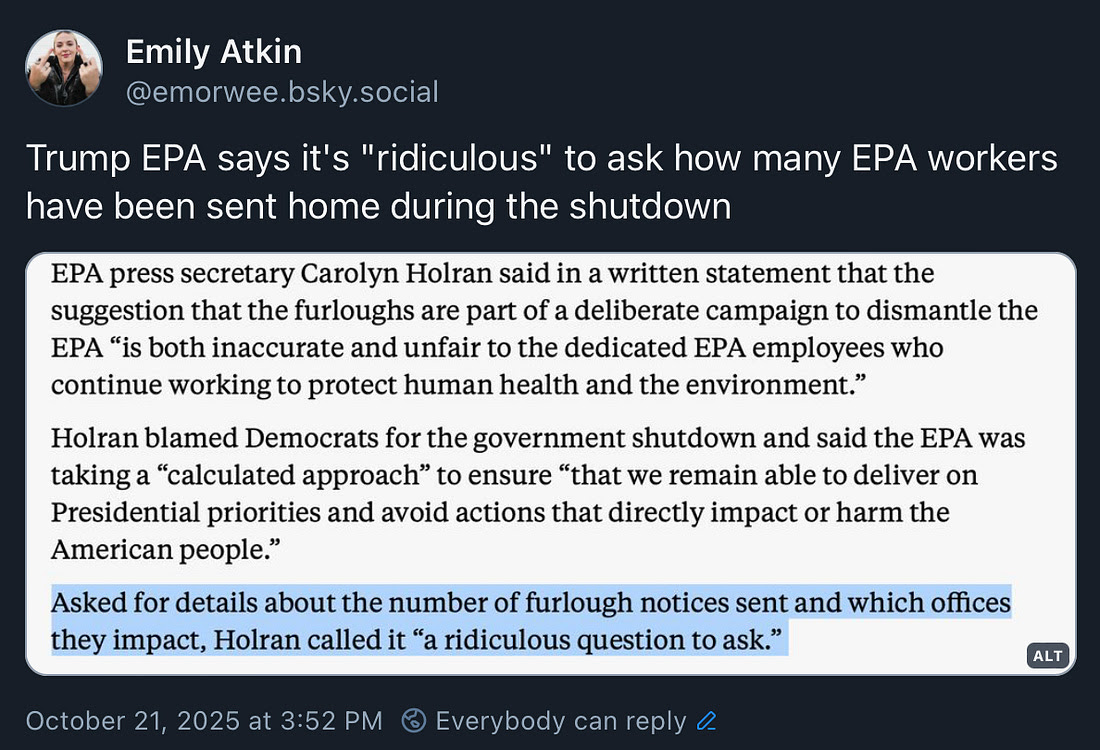 (https://substack.com/redirect/f71f61d9-ecd8-426d-9278-3870b439daa1?j=eyJ1IjoiMW42ZTYifQ.vyvZ_z0oLghKX6Zag1WJ71bIfqAlxqUD_SD6A_ZPsUM)
More employees are likely to be sent home as the shutdown continues. The Trump administration’s latest shutdown contingency plan considers nearly 90 percent of the EPA’s workforce (https://substack.com/redirect/3c94e865-e3d2-4401-a91a-9fad29052bc7?j=eyJ1IjoiMW42ZTYifQ.vyvZ_z0oLghKX6Zag1WJ71bIfqAlxqUD_SD6A_ZPsUM) to be “non-essential” or “partially essential,” and therefore eligible for furlough. “Many activities will halt, including research and the publication of research results, and the issuance of new grants, contracts and permits,” theLos Angeles Timesreported (https://substack.com/redirect/3c94e865-e3d2-4401-a91a-9fad29052bc7?j=eyJ1IjoiMW42ZTYifQ.vyvZ_z0oLghKX6Zag1WJ71bIfqAlxqUD_SD6A_ZPsUM). “Critically, civil enforcement inspections—on-site visits to facilities to check their compliance with environmental regulations—will also cease.”
Furloughs are also just the latest blow to the EPA’s workforce. Before the shutdown, 4,000 EPA employees had already been fired or had taken a buyout (https://substack.com/redirect/b92e7773-3533-4d74-85e4-02fcd4c8b4cc?j=eyJ1IjoiMW42ZTYifQ.vyvZ_z0oLghKX6Zag1WJ71bIfqAlxqUD_SD6A_ZPsUM). The agency’s climate offices and its scientific research arm (https://substack.com/redirect/ca431d5c-d714-4622-9205-7d2f9437a775?j=eyJ1IjoiMW42ZTYifQ.vyvZ_z0oLghKX6Zag1WJ71bIfqAlxqUD_SD6A_ZPsUM) are also in the process of being disbanded (https://substack.com/redirect/91db77d3-cd06-4e44-bc83-63b75b9cfeb2?j=eyJ1IjoiMW42ZTYifQ.vyvZ_z0oLghKX6Zag1WJ71bIfqAlxqUD_SD6A_ZPsUM). And the bleeding is expected to continue if and when the government reopens; The Trump administration has proposed a 55 percent cut to EPA funding in its 2026 budget request.
But there is at least one group of EPA employees who the Trump administration considers “essential,” and are still on the job: the people making it legal for coal plants to release more mercury into the environment.
Upgrade to paid (https://substack.com/redirect/2/eyJlIjoiaHR0cHM6Ly9oZWF0ZWQud29ybGQvc3Vic2NyaWJlP3V0bV9zb3VyY2U9cG9zdCZ1dG1fY2FtcGFpZ249ZW1haWwtY2hlY2tvdXQmbmV4dD1odHRwcyUzQSUyRiUyRmhlYXRlZC53b3JsZCUyRnAlMkZ3aGF0cy1lc3NlbnRpYWwtdG8tdHJ1bXBzLWVwYS1tb3JlJnI9MW42ZTYmdG9rZW49ZXlKMWMyVnlYMmxrSWpveU56WXdPVGt3TENKcFlYUWlPakUzTmpFeE5UUTVOVFVzSW1WNGNDSTZNVGMyTXpjME5qazFOU3dpYVhOeklqb2ljSFZpTFRJME56TWlMQ0p6ZFdJaU9pSmphR1ZqYTI5MWRDSjkuNDl2c3F1R0VDV09ZazJHYWNXOW5RcnV3c2dsMlo3SVZ1ZTNtRGJKWU1NcyIsInAiOjE3NjY3NDEzOSwicyI6MjQ3MywiZiI6dHJ1ZSwidSI6Mjc2MDk5MCwiaWF0IjoxNzYxMTU0OTU1LCJleHAiOjIwNzY3MzA5NTUsImlzcyI6InB1Yi0wIiwic3ViIjoibGluay1yZWRpcmVjdCJ9.gB95fkPWNpAJP1M2pG4CGlMezB2Nc6eX21PuG8EAj3E?&utm_medium=email&utm_source=subscribe-widget&utm_content=176674139)
The detail was first reported Friday by Lisa Friedman at theNew York Times (https://substack.com/redirect/5dc6868c-f1c8-4a3b-be7c-3092648549a5?j=eyJ1IjoiMW42ZTYifQ.vyvZ_z0oLghKX6Zag1WJ71bIfqAlxqUD_SD6A_ZPsUM).Despite the widespread stoppage of climate, environmental and public health work during the shutdown, she reported, “the workers responsible for carrying out the president’s plans for more fossil fuels and less wind and solar power are still hard at work.”
Specifically, at the EPA, Friedman reported that “employees are finalizing a plan to allow more mercury emissions from coal plants, according to two people familiar with the work underway.”
Friedman is referring to Trump’s plan torepeal the 2024 Mercury and Air Toxics Standards (MATS) (https://substack.com/redirect/32de8db6-f940-4222-bf09-cf587cf9d121?j=eyJ1IjoiMW42ZTYifQ.vyvZ_z0oLghKX6Zag1WJ71bIfqAlxqUD_SD6A_ZPsUM) rule. The 2024 MATS rule, implemented by the Biden administration, strengthened older pollution regulations (https://substack.com/redirect/3747b588-6910-4437-ba49-98a6cdecff0a?j=eyJ1IjoiMW42ZTYifQ.vyvZ_z0oLghKX6Zag1WJ71bIfqAlxqUD_SD6A_ZPsUM) on coal- and oil-fired power plants. In addition to placing stricter limits on mercury pollution, the 2024 rule required coal companies to install systems that continually monitor emissions. It also eliminated a loophole that allowed coal plants to exceed pollution limits when starting up.
In June, Trump’s EPA Administrator Lee Zeldin announced plans to repeal the strengthened mercury regulations (https://substack.com/redirect/e288410b-de38-4d57-ac3f-777ae35e4b28?j=eyJ1IjoiMW42ZTYifQ.vyvZ_z0oLghKX6Zag1WJ71bIfqAlxqUD_SD6A_ZPsUM), arguing they were created only to kill the coal industry. “The primary purpose of these Biden-Harris administration regulations was to destroy industries that didn’t align with their narrow-minded climate change zealotry,” Zeldin said in a statement (https://substack.com/redirect/135d9c80-6ae7-4d0d-b7e1-46845de4b224?j=eyJ1IjoiMW42ZTYifQ.vyvZ_z0oLghKX6Zag1WJ71bIfqAlxqUD_SD6A_ZPsUM).
In reality, the regulations were designed to protect kids from being poisoned. Mercury is a highly dangerous neurotoxin that causes developmental problems in infants and damages children’s brains. No amount of exposure is safe (https://substack.com/redirect/d05c0dbe-e743-4bb6-b0d4-4b0079373698?j=eyJ1IjoiMW42ZTYifQ.vyvZ_z0oLghKX6Zag1WJ71bIfqAlxqUD_SD6A_ZPsUM).
Once emitted by coal plants into the air, mercury then settles into waterways, contaminates fish, and lingers in ecosystems for decades. Mercury pollution from coal plants is the primary reason why tuna and swordfish are considered unsafe for pregnant and other vulnerable people to consume.
One recent study estimated (https://substack.com/redirect/afe55720-b29e-40d7-8e09-c15c58466243?j=eyJ1IjoiMW42ZTYifQ.vyvZ_z0oLghKX6Zag1WJ71bIfqAlxqUD_SD6A_ZPsUM) that emissions from coal are costing Americans $13 billion to $26 billion per year in additional ER visits, strokes and cardiac events, and a greater prevalence and severity of childhood asthma events. That’s why the EPA has spent decades reducing mercury pollution.
But now, even with the government closed, Trump and Zeldin are racing to let coal plants release more mercury into the air. And they’re doing it for one reason: Because the coal industry asked them to.
Trump loves to talk about how he’s bringing back “clean” coal. As he infamously said in his speech to the U.N. last month (https://substack.com/redirect/7568a703-4b40-4ea8-8722-d9ba7a65828c?j=eyJ1IjoiMW42ZTYifQ.vyvZ_z0oLghKX6Zag1WJ71bIfqAlxqUD_SD6A_ZPsUM), ”I have a little standing order in the White House: Never use the word coal. Only use the words: Clean, beautiful coal. Sounds much better, doesn’t it?”
But “clean” coal doesn’t exist (https://substack.com/redirect/c4d25665-48cc-4f08-a042-d3b91e62da0f?j=eyJ1IjoiMW42ZTYifQ.vyvZ_z0oLghKX6Zag1WJ71bIfqAlxqUD_SD6A_ZPsUM). And even if it did, it wouldn’t describe what Trump and Zeldin are bringing back.
For the last year, coal companies have been explicitly asking Trump to make coal dirtier—and Trump has been complying. Back in March, Trump’s EPA sent a blast notification to coal companies, telling them if they wanted to be exempted from pollution requirements like the mercury standard, all they had to do was ask (https://substack.com/redirect/bc2774fe-e266-4702-88d2-eb03505dd20e?j=eyJ1IjoiMW42ZTYifQ.vyvZ_z0oLghKX6Zag1WJ71bIfqAlxqUD_SD6A_ZPsUM).
The EPA even provided an email template that coal companies could use to make their request.
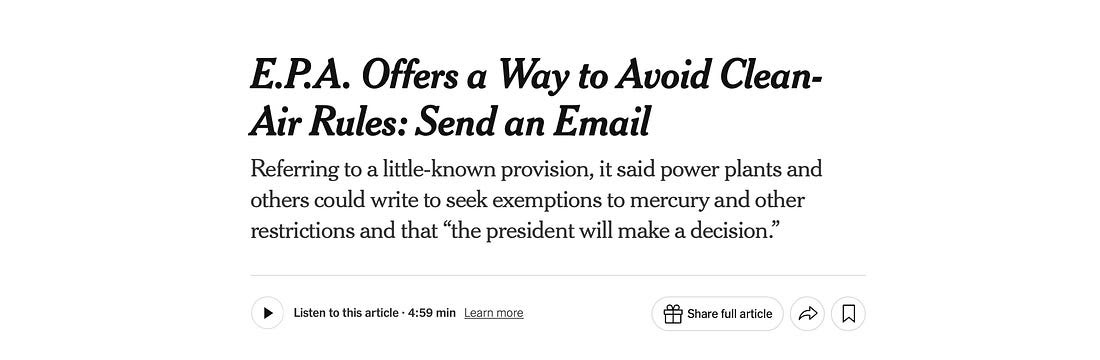 (https://substack.com/redirect/541a8aec-c239-4cba-97c4-26c4e359cd8b?j=eyJ1IjoiMW42ZTYifQ.vyvZ_z0oLghKX6Zag1WJ71bIfqAlxqUD_SD6A_ZPsUM)
A New York Times article (https://substack.com/redirect/bc2774fe-e266-4702-88d2-eb03505dd20e?j=eyJ1IjoiMW42ZTYifQ.vyvZ_z0oLghKX6Zag1WJ71bIfqAlxqUD_SD6A_ZPsUM) describes the process by which the Trump administration is allowing coal companies to request exemptions from pollution regulations.
Since then, Trump has personally granted temporary exemptions from the 2024 Mercury Air Toxic Standards for 68 coal plants—representing more than a third of U.S. coal-fired capacity, according to Utility Dive (https://substack.com/redirect/1dda1a0f-a35d-4945-9494-b35bb585fb61?j=eyJ1IjoiMW42ZTYifQ.vyvZ_z0oLghKX6Zag1WJ71bIfqAlxqUD_SD6A_ZPsUM).
These temporary exemptions likely explain why the EPA is rushing to permanently repeal the 2024 mercury standards, even during a government shutdown. Because if those temporary exemptions are allowed to expire, coal companies will be forced to comply with strong pollution laws.
This is what it looks like when the fossil fuel industry doesn’t just lobby the government, but becomes the government. The agency designed to protect people from pollution gets turned into a customer service department for coal—even when the entire government is shut down. The shutdown itself has many moving parts, and it’s easy for stories like this to get lost in the shuffle. But the quiet dismantling of protections for children’s health is one that will leave a lasting mark.
Share (https://substack.com/app-link/post?publication_id=2473&post_id=176674139&utm_source=substack&utm_medium=email&utm_content=share&utm_campaign=email-share&action=share&triggerShare=true&isFreemail=true&r=1n6e6&token=eyJ1c2VyX2lkIjoyNzYwOTkwLCJwb3N0X2lkIjoxNzY2NzQxMzksImlhdCI6MTc2MTE1NDk1NSwiZXhwIjoxNzYzNzQ2OTU1LCJpc3MiOiJwdWItMjQ3MyIsInN1YiI6InBvc3QtcmVhY3Rpb24ifQ.S8GH3MgWEpPXIzINbbEDclNSIqIvoERI5fUIIgzTJh4)
*Have a news tip? Contact me securely via Signal at emorwee.06
REF SPOX NO LNX
TBL
The Trump administration moved Monday to slash federal jobs across two key environmental and conservation agencies, targeting employees who work on scientific research and the enforcement of anti-pollution laws.
At the Environmental Protection Agency, staff received a new round of furlough notices as funding dwindles amid the government shutdown. The Department of the Interior disclosed plans to permanently cut more than 2,000 positions, according to a court filing by its chief personnel officer.
The Interior Department layoffs, also known as a Reduction in Force, are at the center of ongoing litigation over President Donald Trump and his administration’s efforts to further gut the federal workforce.
Monday’s filing came in response to a judge’s order requiring the Interior Department to disclose its layoff plans for unionized employees. The administration said it intends to eliminate 2,050 Interior Department positions, a decision made before the government shutdown began.
That timing contradicts Trump’s recent claim that government layoffs stemmed from the shutdown.
Most of the planned cuts would hit the U.S. Geological Survey, the Bureau of Land Management, the National Park Service’s regional offices and Interior’s main headquarters, according to the filing.
The Interior Department manages national parks, wildlife refuges and other public lands. It oversees environmental and wildlife conservation, fulfills trust obligations to Alaska Natives and Native American tribes and conducts scientific research on endangered species, water resources and natural hazards like flooding and wildfires so officials can better respond to them.
Those research positions would be especially hard hit by the planned layoffs, including projects focused on the Great Lakes ecosystems and the USGS Columbia Environmental Research Center in Missouri, where scientists study toxic contaminants such as PFAS, a class of chemicals Trump’s health and human services secretary, Robert F. Kennedy Jr., has pledged to address.
Asked for comment, the White House referred questions to the Interior Department, which did not respond.
Environmental groups described the move as part of a broader campaign by Trump and his administration to eliminate research and data collection on environmental contamination after carrying out what EPA Administrator Lee Zeldin called the largest rollback of environmental protections in U.S. history.
“This plan would eviscerate the core science that every American depends on,” said Jennifer Rokala, executive director of the conservation group the Center for Western Priorities, in a statement about the new Interior Department cuts revealed Monday.
Rokala said the planned cuts “would devastate scientific research across the Rocky Mountains, Great Plains, and Great Lakes,” while harming workers who “make our parks and public lands the envy of the world.”
Rokala also said that Monday’s filing revealed only the planned layoffs for unionized employees: “We don’t know how many non-union offices and positions are also on the chopping block.”
At the EPA, the new furlough notices arrived as the agency’s funding dries up. Last week, Trump said the shutdown was an opportunity to dismantle “Democrat programs that we want to close up or we never wanted to happen.” He has repeatedly cast environmental protection, conservation and related public health issues as “woke” and left-wing.
Some of the country’s key environmental protections, and in fact the EPA itself, date back to the Republican Nixon administration.
“Only Trump’s EPA would lay off the people who protect our kids from breathing polluted air and drinking contaminated water but keep the pesticide office open to greenlight more poisons,” said J.W. Glass, EPA policy specialist at the conservation organization Center for Biological Diversity.
Glass, in a written statement, accused the administration of using the shutdown to dismantle the EPA, leaving “our communities paying the price.”
EPA press secretary Carolyn Holran said in a written statement that the suggestion that the furloughs are part of a deliberate campaign to dismantle the EPA “is both inaccurate and unfair to the dedicated EPA employees who continue working to protect human health and the environment.”
Holran blamed Democrats for the government shutdown and said the EPA was taking a “calculated approach” to ensure “that we remain able to deliver on Presidential priorities and avoid actions that directly impact or harm the American people.”
Asked for details about the number of furlough notices sent and which offices they impact, Holran called it “a ridiculous question to ask.”
In a written statement, Peter Murchie, senior director at the nonprofit Environmental Protection Network and a former EPA official, called on Congress to intervene and stop the “systematic dismantling.”
“The health harms facing American families—cancer, childhood asthma, infertility, organ failure—don’t pause for politics,” Murchie said. “When EPA’s expert staff are sent home, large parts of the agency’s work simply stop.” END INSERT
Further reading:
2 scientists call on RFK Jr. to stop coal mercury rule rollback (https://substack.com/redirect/ab804842-6401-44c0-afd0-b8641c14befe?j=eyJ1IjoiMW42ZTYifQ.vyvZ_z0oLghKX6Zag1WJ71bIfqAlxqUD_SD6A_ZPsUM). (E&E News, October 17).
RFK Jr., once poisoned by mercury, is silent as EPA weakens rules against it (https://substack.com/redirect/e02d2702-73c7-40b7-9c88-5885a93e7b94?j=eyJ1IjoiMW42ZTYifQ.vyvZ_z0oLghKX6Zag1WJ71bIfqAlxqUD_SD6A_ZPsUM). (E&E News, March 18).
Trump officials offer $625 million bailout to rescue coal (https://substack.com/redirect/a8e7cd51-3126-4f08-998e-2689de79adb9?j=eyJ1IjoiMW42ZTYifQ.vyvZ_z0oLghKX6Zag1WJ71bIfqAlxqUD_SD6A_ZPsUM). (New York Times, September 29).
These companies avoided clean air rules. It took a single email (https://substack.com/redirect/ba87e401-076e-4947-abfd-4a2ecc677c31?j=eyJ1IjoiMW42ZTYifQ.vyvZ_z0oLghKX6Zag1WJ71bIfqAlxqUD_SD6A_ZPsUM). (New York Times,July 29).
Other stories I’m following:
The government is shut down. But not for fossil fuels (https://substack.com/redirect/5dc6868c-f1c8-4a3b-be7c-3092648549a5?j=eyJ1IjoiMW42ZTYifQ.vyvZ_z0oLghKX6Zag1WJ71bIfqAlxqUD_SD6A_ZPsUM). (New York Times, October 17).
More than 700,000 federal employees have been sidelined and thousands more are at risk of being fired as the government shutdown (https://substack.com/redirect/276f2f4a-1f63-4e02-9711-5ab0b3152011?j=eyJ1IjoiMW42ZTYifQ.vyvZ_z0oLghKX6Zag1WJ71bIfqAlxqUD_SD6A_ZPsUM) drags on. But the workers responsible for carrying out the president’s plans for more fossil fuels and less wind and solar power are still hard at work. Some are approving permits for companies that want to extract metals, coal, oil and gas from public lands and federal waters. Others are rolling back limits on the greenhouse gas emissions that are driving climate change.
email 9 25
kirk ai FF ripoff of
https://heated.world/p/charlie-kirks-extremism-was-fossil
no lnx
Charlie Kirk was a fossil fuel industry plant
Big Oil's money gave Kirk a larger platform to spread baseless climate conspiracy theories—as well as other extremist views.
Emily Atkin
Sep 18, 2025
The term “plant” is often used to describe someone whose success was not solely the result of a grassroots movement, but instead bolstered by powerful corporate interests who secretly poured massive amounts of money into ensuring their fame.
For example: Charlie Kirk was a fossil fuel industry plant. The right-wing activist murdered last week built his massive platform for racism, sexism, transphobia and climate denial in part by using anonymous funding from Big Oil.
Turning Point USA, the group Kirk founded to ignite a culture war on college campuses, has managed to hide much of its funding sources. Roughly half of the group’s $40 million in income in 2020 came from 10 anonymous donors, NBC News reported.
But in 2017, Kirk admitted that some of the group’s anonymous donors “are in the fossil fuel space.” Speaking to The New Yorker’s Jane Mayer, Kirk disclosed that he’d fundraised for TPUSA at the annual meeting of the Independent Petroleum Association of America (IPAA), as well as the 2017 board meeting of the National Mining Association.
In those meetings, Kirk promised oil and gas companies he’d fight “the myth that fossil fuels are dirty,” and target the “leftist professors” on college campuses who “perpetuated” the “myth.”
The meetings “went great,” Kirk told Mayer. The IPAA’s president, Barry Russell, wound up joining TPUSA’s advisory council, where he remains today. (Kirk had said that most advisory council members are also TPUSA donors).
How Kirk tried to re-popularize climate denial
Over the next nine years, Kirk worked to chip away at young Americans’ rising concerns about climate change. He did this by claiming climate science is still debated—and then peddling the conspiracy theory that all climate policies are a Democratic bid for government control.
“A tyrant’s fantasy is to have a massive green economy transition,” he said in 2023. “You can get rid of private property, you can control people’s movements. It’s fundamentally the abolition of civilization as we know it.”
To justify his claim that climate science is unsettled, Kirk would often cite “experts” who downplay the seriousness of planetary heating. For example, in 2023, Kirk claimed climate science is “debated” because “a Nobel prize winning scientist recently came out and said there is no real climate crisis.” Kirk also cited the opinions of John Coleman, the now-deceased founder of the Weather Channel, as evidence that climate change is a hoax.
But the experts Kirk cited were almost always unqualified. For example, Coleman was a meteorologist, not a climate scientist, and his claims were frequently debunked by publishing climate scientists. The Nobel-Prize-winning scientist Kirk referenced, John Clauser, is not a climate scientist, and won the Nobel for physics in the 1970s. No other Nobel Prize-winning physicist denies mainstream climate science; in fact, some of them are climate scientists themselves.
Coincidentally, Kirk never considered the opinions of publishing climate scientists to be credible. Instead, he reflexively dismissed their warnings as "garbage … designed for one thing: power and control.”
A YouTube caption for one of Kirk’s videos calls climate change “nonsense” and “boulder dash” [sic]
Kirk’s final climate segment
Kirk’s continued to frame climate change as a conspiracy in an interview with Trump’s Secretary of Energy Chris Wright three weeks before his death.
In the interview, Kirk and Wright spoke about the Department of Energy’s recently-released 151-page report claiming climate change is not a serious problem. That report was put together by five contrarian scientists personally recruited by Wright, a former fracking executive.
Kirk praised the report, and dismissed all criticism against it as politically motivated. “We think this is all politicized,” Kirk said. “This is driven towards a environmentalist agenda that is trying to weaken American energy dominance.”
Wright agreed, and said all the critics of his climate report only took issue with who wrote it—not the data within it. “They want to impugn the writers or impugn the way we reference people,” Wright said. “They want to find little things. What we want to talk about is the data.”
This, however, was objectively false. The data within Wright’s report was meticulously criticized by 85 publishing climate scientists, who issued a 439-page rebuttal pointing out various misrepresentations, messy citations, cherry-picking, and factual errors. In addition, many of the scientists cited in Wright’s report complained that their data was misrepresented, and explained their complaints in detail.
Perhaps the most mind-boggling part of Kirk’s final climate interview, however, was the argument he used to claim there can be no such thing as a scientific consensus about climate change.
”Science does not have consensus,” he said. “This is a very important thing. Right? Science says nothing. Scientists say things. Okay? Science never talks. Science is silent. This is a good thing that could apply to everything.”
Kirk was certainly correct that scientists say things. But over the course of his life, Kirk was set on ignoring most of them. For example, the vast majority of publishing climate scientists have been saying the same thing over and over for decades: That heat-trapping pollution from fossil fuels, industrial agriculture, and deforestation is steadily raising the average temperature of the planet—and that the warming poses an existential threat to human, animal and plant life.
Kirk ignored those scientists for a simple reason: Because listening to them would mean accepting that fossil fuels harm people. Neither Kirk nor his donors could accept that reality.
The inseparable connection between climate denial and right-wing extremism
The point of this newsletter is not to claim that Kirk was paid by the fossil fuel industry to say things he didn’t believe about climate change. I think most online political commentators genuinely believe what they’re saying, no matter who they’re funded by.
The point is to reinforce what has been true for decades: the fossil fuel industry is behind most of the climate disinformation you see and hear today.
Big Oil has spent billions sowing doubt about the reality and severity of climate change. They’ve done this for one reason: Solving climate change would require using less of their product, and using less of their product would hurt their bottom line.
Pretty much everyone with a massive following who spreads climate denial derives money or power from fossil fuels. The sooner everyone understands that, the better.
The other point here is to remind everyone about the inseparable connection between climate denial and other types of right-wing extremism. Often, you’ll hear climate activists debate whether it’s a good idea to get involved in larger movements for justice, or whether it’s better to just “stay in their lane” of climate policy.
The opposition to climate action is not having that debate. Instead, they are funding right-wing extremists who say things like the Civil Rights Act was "huge mistake;” that Supreme Court Justice Ketanji Brown Jackson was "a diversity hire;" that trans people are responsible for inflation; and that Taylor Swift should "submit to [her] husband." As long as “climate change is fake” is part of that rhetoric, they don’t care what the rest of it looks like.
Racism, sexism, and transphobia is being used to build the climate denier base. If you want climate action, you can’t pick and choose which you fight back against.
---
HEated 9 25
...president Donald Trump has implemented a new rule in the White House: No one is allowed to say “coal.”
”I have a little standing order in the White House: Never use the word coal,” Trump said Tuesday in a speech to the United Nationals General Assembly. “Only use the words: Clean, beautiful coal. Sounds much better, doesn't it?”
“Clean, beautiful coal” does sound much better than “coal.” Just like “healthy, patriotic smog” sounds much better than “smog.” And “safe, glistening pools of American abundance” sounds much better than “oil spills.”
But oil spills aren’t safe, smog isn’t healthy, and coal isn’t clean, no matter what Trump would like the world to believe. Fortunately, in his 10-minute tirade on Tuesday about how climate change is the “greatest con job ever perpetrated on the world,” Trump didn’t say anything all that novel, intelligent, or convincing. VID]

Mostly, Trump just regurgitated the same, tired, easily-debunked talking points he and the oil industry have been repeating for twenty years. It was so unoriginal it was actually kind of funny—in a sad, pathetic way.
:{HEATED
Some highlights, and responses:
“We're getting rid of the falsely named renewables. By the way, they're a joke. They don't work. They're too expensive.”
Compared to what? Most renewable energy is cheaper than fossil fuels. On average, solar is currently 41 percent cheaper than the lowest-cost fossil fuels for electricity generation. Offshore wind is 53 percent cheaper.
“You lose money, the governments have to subsidize [renewable energy]. You can't put them out without massive subsidies."
Again—compared to what? Because fossil fuels currently receive nine times as much government consumption subsidies as renewables. Global fossil fuel subsidies amounted to $620 billion in 2023, compared to $70 billion for renewables, according to the International Energy Agency.
“The executive director of the United Nations Environmental Program predicted that by the year 2000, climate change would cause a global catastrophe. He said that it will be irreversible as any nuclear holocaust would be. This is what they said at the United Nations. What happened?”
He was mostly right. Climate change is causing a global catastrophe and many of the impacts are irreversible. Mostafa K. Tolba’s prediction was not correct on timing, but he made it literally 43 years ago. Since then, the field of climate science has only gotten more advanced, with tens of thousands of papers published, leading to more accurate predictions over time. Amazing, right?
“Another U.N. official stated in 1989 that within a decade, entire nations could be wiped off the map by global warming. Not happening!”
Yeah, it is happening. Low-lying island nations like Tuvalu, Kiribati, and Fiji are literally being swallowed by the rising ocean, and populations are being forced to evacuate. Because of this, Australia has had to create a new type of visa for climate refugees.
(Also, the official Trump is talking about—Noel Brown, the director of the U.N. Environment Program’s New York office—did not actually predict these nations would sink “within a decade.” He said we needed to reverse the trend of increasing emissions by the end of the decade, or else the world would eventually see catastrophic, irreversible impacts. Reading is hard, I know!)
“You know, it used to be global cooling. If you look back years ago, in the 1920s and the 1930s, they said, ‘Global cooling will kill the world. We have to do something.’”
Not true. While there may have been some individual researchers expressing concern about potential cooling in the 1920s, it was not a widespread scientific prediction. In fact, more scientists at this time were sounding the alarm about rising temperatures due to burning coal.
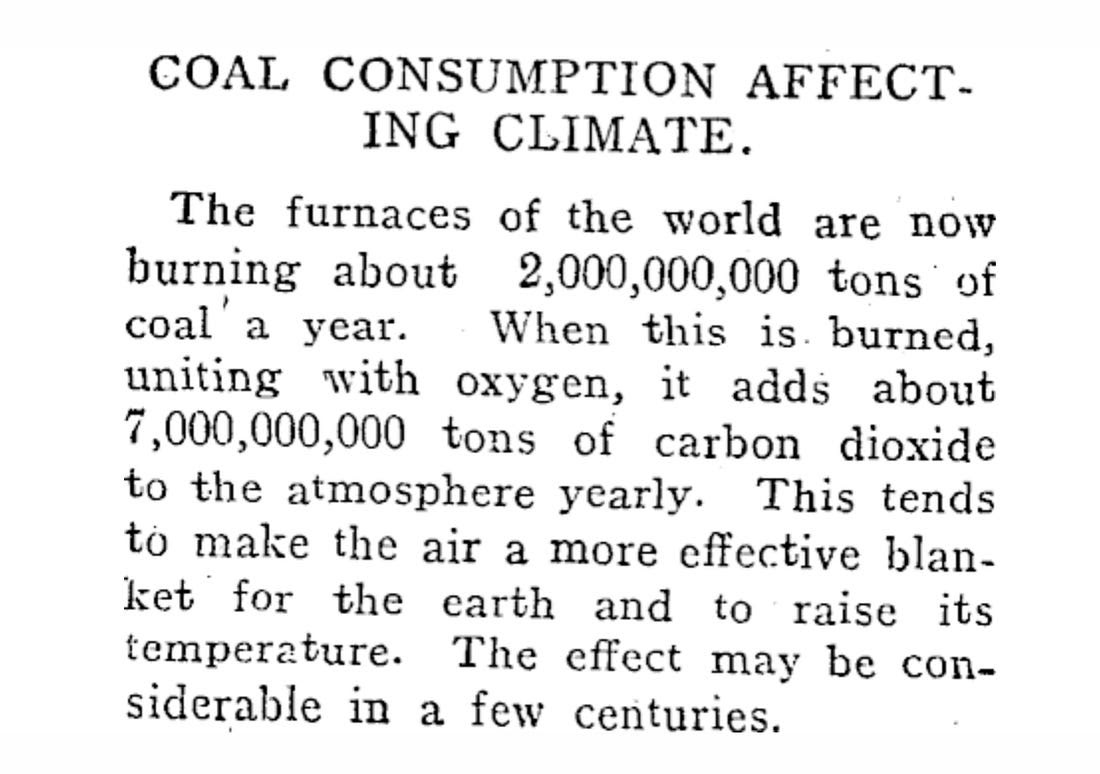 |
A clip from the Rodney and Otamatea Times, Waitemata and Kaipara Gazette from 14 August 1912.
“Then they said global warming will kill the world, but then it started getting cooler. So now they could just call it climate change, because that way they can’t miss. Climate change, if it goes higher or lower, whatever the hell happens, it’s climate change. It’s the greatest con job ever perpetrated on the world, in my opinion.”
Look, I understand the urge to call things a scam when they’re slightly complicated and hard to understand. But when you’re the president, you have to do hard things. So I’ll spell it out as simply as I can: When you raise the average temperature across the entire planet, sometimes weather patterns in certain areas do wacky, unexpected things that aren’t just getting hotter! For example: A warming Arctic produces a weaker jet stream, which then can bring Arctic air further south, causing more cold snaps in certain places. That’s not a scam; it’s science!
“I’m really good at predicting things. I don’t say that in a braggadocios way, but it’s true. I’ve been right about everything. And I am telling you that if you don’t get away from the green energy scam, your country is going to fail.”
Well, that’s enough evidence for me. Wrap it up, everyone!
---
EMAIL 6 25
Across the U.S., a dangerous movement is brewing, one that seeks to silence trans folks and push them into the shadows. One of its leaders is the Alliance Defending Freedom.
On May 20, the right-wing organization ADF sued Minnesota over its advocacy for trans rights. ADF argues that allowing trans girls and women in women’s sports discriminates against cis girls and women. ADF, a Project 2025 adviser, has been at the helm of several anti-trans initiatives, its lawyers authoring model bathroom bills that would force trans people into the bathrooms of their assigned sex at birth. In 2025, lawmakers have already passed more than 100 anti-trans bills across the U.S., including 13 bathroom bills.
But where is ADF getting money for its anti-trans advocacy? These days, it's almost impossible to tell due to regulations that allow nonprofits to hide their donors, but one verifiable source is the fossil fuel industry. Between 2013 and 2022, Shell USA Company Foundation donated $58,002 to ADF, per an investigation by the Guardian. Phil Anschutz, a billionaire who built his wealth on fossil fuels and now owns Anschutz Entertainment Group, Inc., which puts on live entertainment events like Coachella, also donated $110,000 to ADF between 2011 and 2013.
ADF isn’t the only anti-trans organization with financial ties to the fossil fuel sector. An independent analysis of 45 right-wing groups advocating against trans rights found that 80% have received donations from fossil fuel companies or billionaires. The analysis, conducted by two independent researchers in 2023 and not peer-reviewed, was shared exclusively with Atmos and HEATED. Through a qualitative search, the researchers identified 45 groups advancing anti-trans lobbying, events, and publications and checked reports about their donor disclosures for fossil fuel funding.
...
---
heated
no lnx GRX
big b bill
5 25
if you need to show what it means to have a government bought and paid for by Big Oil, look no further than President Donald Trump’s "one big, beautiful bill (https://substack.com/redirect/05bb94b9-b421-4f30-ab5c-9635d2dfa4db?j=eyJ1IjoiMW42ZTYifQ.vyvZ_z0oLghKX6Zag1WJ71bIfqAlxqUD_SD6A_ZPsUM)."
The giant tax and spending legislation Republicans are advancing through Congressis basically a copy-paste of a secret oil industry wish-list HEATED reported on five months ago (https://substack.com/redirect/09cc63e0-b969-45f8-8cb4-c4dd8294c3bb?j=eyJ1IjoiMW42ZTYifQ.vyvZ_z0oLghKX6Zag1WJ71bIfqAlxqUD_SD6A_ZPsUM) with the investigative outlet Field Notes (https://substack.com/redirect/b4dbc73b-7bad-4206-9788-c7677dc1a04e?j=eyJ1IjoiMW42ZTYifQ.vyvZ_z0oLghKX6Zag1WJ71bIfqAlxqUD_SD6A_ZPsUM).
In that wish-list, the American Exploration & Production Council (AXPC)—a large oil industry trade group—asked the Trump administration for two major things:
To stop taxing excess emissions of methane (https://substack.com/redirect/9a439e0a-b566-4ba7-9f89-29454f2cbc9c?j=eyJ1IjoiMW42ZTYifQ.vyvZ_z0oLghKX6Zag1WJ71bIfqAlxqUD_SD6A_ZPsUM), a powerful pollutant responsible for nearly a third of climate change.
To limit environmental reviews for new fossil fuel projects to endure their speedy approval.
Those wishes—and many others—would be granted by the One Big Beautiful Bill Act (https://substack.com/redirect/f1f4cf03-cde5-4ccb-be77-75ff6f8cdbaa?j=eyJ1IjoiMW42ZTYifQ.vyvZ_z0oLghKX6Zag1WJ71bIfqAlxqUD_SD6A_ZPsUM), which advanced out of the House Budget Committee in an unusual late-night vote Sunday. Trump is now urging Republicans in Congress to unite and pass it (https://substack.com/redirect/70be2a5e-22ec-45fd-a911-fc2d3493017e?j=eyJ1IjoiMW42ZTYifQ.vyvZ_z0oLghKX6Zag1WJ71bIfqAlxqUD_SD6A_ZPsUM).
HEATED is a reader-supported publication. To receive new posts and support my work, consider becoming a free or paid subscriber.
Upgrade to paid (https://substack.com/redirect/2/eyJlIjoiaHR0cHM6Ly9oZWF0ZWQud29ybGQvc3Vic2NyaWJlP3V0bV9zb3VyY2U9cG9zdCZ1dG1fY2FtcGFpZ249ZW1haWwtY2hlY2tvdXQmbmV4dD1odHRwcyUzQSUyRiUyRmhlYXRlZC53b3JsZCUyRnAlMkZ0cnVtcHMtYmlnLW9pbHktYmlsbCZyPTFuNmU2JnRva2VuPWV5SjFjMlZ5WDJsa0lqb3lOell3T1Rrd0xDSnBZWFFpT2pFM05EYzNOemMxTURRc0ltVjRjQ0k2TVRjMU1ETTJPVFV3TkN3aWFYTnpJam9pY0hWaUxUSTBOek1pTENKemRXSWlPaUpqYUdWamEyOTFkQ0o5LmlfVGxydW8tOGdBcnZWRThRSDdyd2pxSU1kNEZvSnRCUzFtbkpraklNWWMiLCJwIjoxNjM5NjE1MTcsInMiOjI0NzMsImYiOnRydWUsInUiOjI3NjA5OTAsImlhdCI6MTc0Nzc3NzUwNCwiZXhwIjoxNzUwMzY5NTA0LCJpc3MiOiJwdWItMCIsInN1YiI6ImxpbmstcmVkaXJlY3QifQ.dExBUgJiG2G7jcaHEFLJRXAzQj5yxVwkRRS0h8YXaSY?&utm_medium=email&utm_source=subscribe-widget-preamble&utm_content=163961517)
If passed, the bill (https://substack.com/redirect/8b597e45-4905-4d5f-bb04-115d585d4e09?j=eyJ1IjoiMW42ZTYifQ.vyvZ_z0oLghKX6Zag1WJ71bIfqAlxqUD_SD6A_ZPsUM) would repeal a portion of the Clean Air Act which sets methane pollution limits for oil and gas facilities. Currently, that section states (https://substack.com/redirect/6ea67d34-baa5-45dd-9375-0ab3fbee1aae?j=eyJ1IjoiMW42ZTYifQ.vyvZ_z0oLghKX6Zag1WJ71bIfqAlxqUD_SD6A_ZPsUM) that oil and gas facilities must pay the EPA a fee on methane pollution that exceeds certain amounts.
Under Trump’s budget reconciliation bill, the methane fee would technically be retained, but altered so that the fee is not collected until ten years from now.
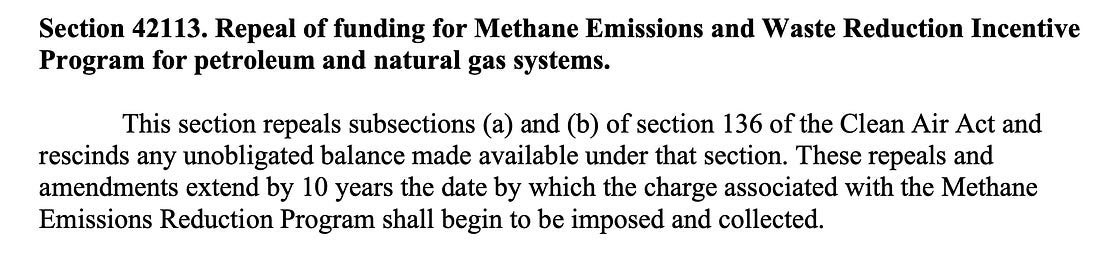 (https://substack.com/redirect/3d16e45b-ef72-4a23-9c4c-93177779ea9e?j=eyJ1IjoiMW42ZTYifQ.vyvZ_z0oLghKX6Zag1WJ71bIfqAlxqUD_SD6A_ZPsUM)
Source: bill text (https://substack.com/redirect/8b597e45-4905-4d5f-bb04-115d585d4e09?j=eyJ1IjoiMW42ZTYifQ.vyvZ_z0oLghKX6Zag1WJ71bIfqAlxqUD_SD6A_ZPsUM).
In addition, the bill (https://substack.com/redirect/6d9197d4-a22e-4d7e-a3e8-2ddfd2f3342d?j=eyJ1IjoiMW42ZTYifQ.vyvZ_z0oLghKX6Zag1WJ71bIfqAlxqUD_SD6A_ZPsUM) would allow gas pipeline developers to pay a $10 million fee to bypass the normal permitting process. It would also allow fossil fuels companies to pay the Department of Energy a $1 million free to determine that a proposed methane gas export facility is in the “public interest.”
“This makes a farce of our permitting process and essentially legalizes corruption with a pay-to-play privilege for gas pipelines,” writes the climate group Evergreen Action (https://substack.com/redirect/4d47730f-efce-4e88-b8e6-fe57d2a90f4c?j=eyJ1IjoiMW42ZTYifQ.vyvZ_z0oLghKX6Zag1WJ71bIfqAlxqUD_SD6A_ZPsUM). “Americans will be severely impacted by gas pipelines built through their communities.”
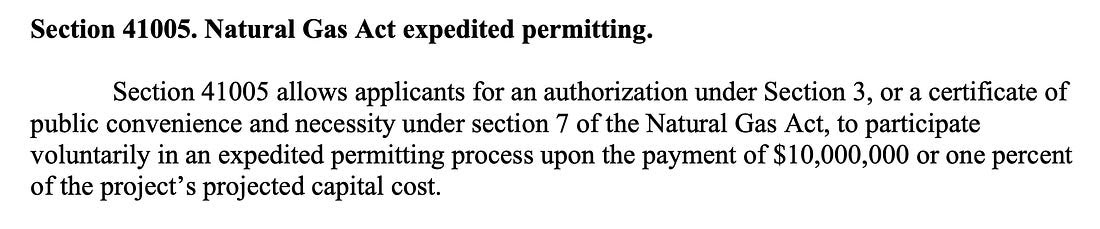 (https://substack.com/redirect/880381a7-fa49-4d00-8a7a-d20bddfd3da1?j=eyJ1IjoiMW42ZTYifQ.vyvZ_z0oLghKX6Zag1WJ71bIfqAlxqUD_SD6A_ZPsUM)
Source: bill text (https://substack.com/redirect/8b597e45-4905-4d5f-bb04-115d585d4e09?j=eyJ1IjoiMW42ZTYifQ.vyvZ_z0oLghKX6Zag1WJ71bIfqAlxqUD_SD6A_ZPsUM)
Killing the clean energy competition
The White House isn’t trying to hide its close relationship with Big Oil, which directly donated $96 million (https://substack.com/redirect/5f0fa7bc-4be2-45e5-8147-06a3baa6e033?j=eyJ1IjoiMW42ZTYifQ.vyvZ_z0oLghKX6Zag1WJ71bIfqAlxqUD_SD6A_ZPsUM) directly to Trump’s campaign and spent $80 million on political advertising (https://substack.com/redirect/5f0fa7bc-4be2-45e5-8147-06a3baa6e033?j=eyJ1IjoiMW42ZTYifQ.vyvZ_z0oLghKX6Zag1WJ71bIfqAlxqUD_SD6A_ZPsUM). On Monday, the White House released a list of organizations applauding the bill, and the very first statement was from AXPC (https://substack.com/redirect/7cb0b937-520d-46b2-a93c-1bfa43688bcb?j=eyJ1IjoiMW42ZTYifQ.vyvZ_z0oLghKX6Zag1WJ71bIfqAlxqUD_SD6A_ZPsUM).
But the White House, oil industry, and Congressional Republicans are trying to confuse Americans about the purpose of their partnership with Big Oil. They claim their intent is to “improve our nation’s energy landscape.” In reality, their intent is to improve the nation’s fossil fuellandscape. These are two very different things.
While Trump’s “big, beautiful bill” aims to speed up the development of fossil fuels in America, it aims to actively harm every other competing form of energy, including nuclear.
For example, the bill would “effectively eliminate \tax] credits for new nuclear — in particular, the clean electricity investment and production tax credits, known as the ‘technology-neutral’ credits,” the [Washington Post (https://substack.com/redirect/e3150ebd-0bcc-47ea-aa4d-59482b17a002?j=eyJ1IjoiMW42ZTYifQ.vyvZ_z0oLghKX6Zag1WJ71bIfqAlxqUD_SD6A_ZPsUM) reported on Thursday.
The bill would also phase out tax credits for production and investments in solar, wind, and batter storage products; end tax credits for home energy efficiency and heat pumps; and end tax credits for rooftop solar and batteries, among many other things (https://substack.com/redirect/28abebf3-5b8b-403f-bad2-31c213493317?j=eyJ1IjoiMW42ZTYifQ.vyvZ_z0oLghKX6Zag1WJ71bIfqAlxqUD_SD6A_ZPsUM).
The changes would have “far-reaching implications across the clean energy sector,” according to a Thursday release from energy analytics firm Wood Mackenzie (https://substack.com/redirect/e5a4b5eb-97d6-447f-ae55-44cb99b5d71c?j=eyJ1IjoiMW42ZTYifQ.vyvZ_z0oLghKX6Zag1WJ71bIfqAlxqUD_SD6A_ZPsUM). “The overall outlook for the industry appears challenging.”
Upgrade to paid (https://substack.com/redirect/2/eyJlIjoiaHR0cHM6Ly9oZWF0ZWQud29ybGQvc3Vic2NyaWJlP3V0bV9zb3VyY2U9cG9zdCZ1dG1fY2FtcGFpZ249ZW1haWwtY2hlY2tvdXQmbmV4dD1odHRwcyUzQSUyRiUyRmhlYXRlZC53b3JsZCUyRnAlMkZ0cnVtcHMtYmlnLW9pbHktYmlsbCZyPTFuNmU2JnRva2VuPWV5SjFjMlZ5WDJsa0lqb3lOell3T1Rrd0xDSnBZWFFpT2pFM05EYzNOemMxTURRc0ltVjRjQ0k2TVRjMU1ETTJPVFV3TkN3aWFYTnpJam9pY0hWaUxUSTBOek1pTENKemRXSWlPaUpqYUdWamEyOTFkQ0o5LmlfVGxydW8tOGdBcnZWRThRSDdyd2pxSU1kNEZvSnRCUzFtbkpraklNWWMiLCJwIjoxNjM5NjE1MTcsInMiOjI0NzMsImYiOnRydWUsInUiOjI3NjA5OTAsImlhdCI6MTc0Nzc3NzUwNCwiZXhwIjoxNzUwMzY5NTA0LCJpc3MiOiJwdWItMCIsInN1YiI6ImxpbmstcmVkaXJlY3QifQ.dExBUgJiG2G7jcaHEFLJRXAzQj5yxVwkRRS0h8YXaSY?&utm_medium=email&utm_source=subscribe-widget&utm_content=163961517)
Harming clean energy = harming the economy
Contrary to what the Trump administration’s narrative, fossil fuel jobs are not the only energy jobs in the United States. Renewable energy jobs comprise more than 40 percent (https://substack.com/redirect/b863ff4f-6e3c-4063-ac3b-bc40c45b0fe1?j=eyJ1IjoiMW42ZTYifQ.vyvZ_z0oLghKX6Zag1WJ71bIfqAlxqUD_SD6A_ZPsUM) of the country’s 8.35 million energy positions. Worldwide, clean energy workers outnumber fossil fuel workers (https://substack.com/redirect/772d74e8-a04e-459c-bba5-edcec9be3936?j=eyJ1IjoiMW42ZTYifQ.vyvZ_z0oLghKX6Zag1WJ71bIfqAlxqUD_SD6A_ZPsUM).
Many of those jobs are in the solar and battery storage industries—and both would be catastrophically harmed if the budget reconciliation bill passes. In an analysis (https://substack.com/redirect/60ec87d5-c841-4d9d-bc65-f217e117fa67?j=eyJ1IjoiMW42ZTYifQ.vyvZ_z0oLghKX6Zag1WJ71bIfqAlxqUD_SD6A_ZPsUM) released Tuesday, the Solar Energy Industries Association warned that if enacted, Trump’s budget bill “could result in nearly 300,000 current and future American jobs to be lost, including 86,000 in solar manufacturing.”
“If this proposal becomes law, nearly 300 U.S. factories—mostly in red states—could close or never open, and we simply won’t have the energy we need to power American innovation in AI and data centers,” SEIA president and CEO Abigail Ross Hopper said in a statement (https://substack.com/redirect/60ec87d5-c841-4d9d-bc65-f217e117fa67?j=eyJ1IjoiMW42ZTYifQ.vyvZ_z0oLghKX6Zag1WJ71bIfqAlxqUD_SD6A_ZPsUM).
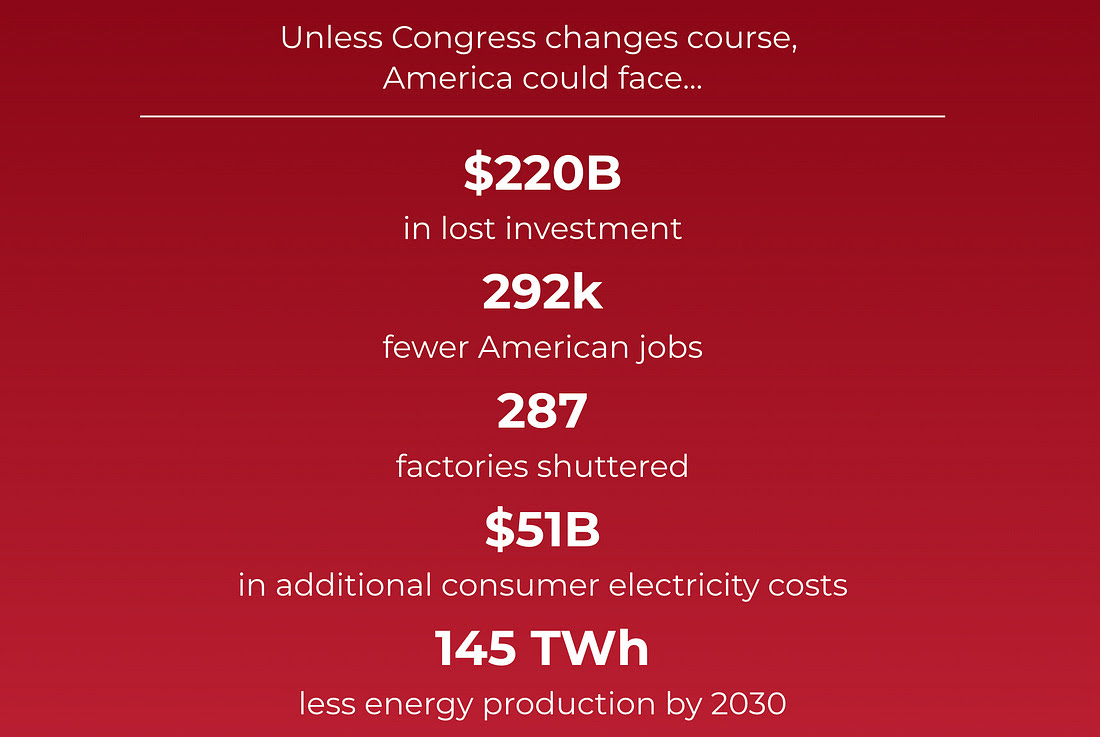 (https://substack.com/redirect/97856401-705d-4f47-8fdc-6864ac3ee37a?j=eyJ1IjoiMW42ZTYifQ.vyvZ_z0oLghKX6Zag1WJ71bIfqAlxqUD_SD6A_ZPsUM)
A screenshot from the SEIA’s analysis of the One Big Beautiful Bill Act (https://substack.com/redirect/79de8ca0-6695-4177-b2ae-269597cd811c?j=eyJ1IjoiMW42ZTYifQ.vyvZ_z0oLghKX6Zag1WJ71bIfqAlxqUD_SD6A_ZPsUM)
Indeed, several groups have warned that hampering the renewable energy sector’s growth will result in higher electricity bills for the average American consumer. ConservAmerica, a conservative environmental group, has estimated (https://substack.com/redirect/0b2f48f3-9697-4fc2-ac79-73501e53378a?j=eyJ1IjoiMW42ZTYifQ.vyvZ_z0oLghKX6Zag1WJ71bIfqAlxqUD_SD6A_ZPsUM) that repealing renewable energy tax credits could cause U.S. electricity costs to rise by $51 billion per year by 2035.
According to a preliminary analysis from Rhodium Group (https://substack.com/redirect/f6544257-a8b1-41f5-ba38-46d808d09b64?j=eyJ1IjoiMW42ZTYifQ.vyvZ_z0oLghKX6Zag1WJ71bIfqAlxqUD_SD6A_ZPsUM), the anti-clean energy provisions in the One Big Beautiful Bill Act would“raise energy costs for American households by as much as 7 percent in 2035, stifle energy technology innovation, increase pollution, and could put a meaningful portion of half a trillion dollars of new manufacturing, industrial, and clean electricity investments across the country at risk.”
And the Clean Energy Buyers Association, which represents big tech companies that use a ton of energy for data centers and AI, also warned in a recent report (https://substack.com/redirect/37c4c12d-61c4-4aa2-93e6-ec622c32c4a6?j=eyJ1IjoiMW42ZTYifQ.vyvZ_z0oLghKX6Zag1WJ71bIfqAlxqUD_SD6A_ZPsUM) that repealing clean energy tax credits would raise the cost of energy for consumers.
“Let’s not mince words: Republicans are trying to raise your energy bills and destroy thousands of American jobs—simply to pad the pockets of billionaires, fossil fuel executives, and their top corporate backers with massive tax cuts,” Evergreen Action said in a statement (https://substack.com/redirect/4d47730f-efce-4e88-b8e6-fe57d2a90f4c?j=eyJ1IjoiMW42ZTYifQ.vyvZ_z0oLghKX6Zag1WJ71bIfqAlxqUD_SD6A_ZPsUM).
*Have a news tip? Contact me securely via Signal at emorwee.06
big b bill
5 25
if you need to show what it means to have a government bought and paid for by Big Oil, look no further than President Donald Trump’s "one big, beautiful bill."
The giant tax and spending legislation Republicans are advancing through Congressis basically a copy-paste of a secret oil industry wish-list HEATED reported on five months ago with the investigative outlet Field Notes.
In that wish-list, the American Exploration & Production Council (AXPC)—a large oil industry trade group—asked the Trump administration for two major things:
- To stop taxing excess emissions of methane, a powerful pollutant responsible for nearly a third of climate change.
- To limit environmental reviews for new fossil fuel projects to endure their speedy approval.
Those wishes—and many others—would be granted by the One Big Beautiful Bill Act, which advanced out of the House Budget Committee in an unusual late-night vote Sunday. Trump is now urging Republicans in Congress to unite and pass it.
HEATED is a reader-supported publication. To receive new posts and support my work, consider becoming a free or paid subscriber.
If passed, the bill would repeal a portion of the Clean Air Act which sets methane pollution limits for oil and gas facilities. Currently, that section states that oil and gas facilities must pay the EPA a fee on methane pollution that exceeds certain amounts.
Under Trump’s budget reconciliation bill, the methane fee would technically be retained, but altered so that the fee is not collected until ten years from now.
|
Source: bill text.
In addition, the bill would allow gas pipeline developers to pay a $10 million fee to bypass the normal permitting process. It would also allow fossil fuels companies to pay the Department of Energy a $1 million free to determine that a proposed methane gas export facility is in the “public interest.”
“This makes a farce of our permitting process and essentially legalizes corruption with a pay-to-play privilege for gas pipelines,” writes the climate group Evergreen Action. “Americans will be severely impacted by gas pipelines built through their communities.”
|
Source: bill text
Killing the clean energy competition
The White House isn’t trying to hide its close relationship with Big Oil, which directly donated $96 million directly to Trump’s campaign and spent $80 million on political advertising. On Monday, the White House released a list of organizations applauding the bill, and the very first statement was from AXPC.
But the White House, oil industry, and Congressional Republicans are trying to confuse Americans about the purpose of their partnership with Big Oil. They claim their intent is to “improve our nation’s energy landscape.” In reality, their intent is to improve the nation’s fossil fuellandscape. These are two very different things.
While Trump’s “big, beautiful bill” aims to speed up the development of fossil fuels in America, it aims to actively harm every other competing form of energy, including nuclear.
For example, the bill would “effectively eliminate [tax] credits for new nuclear — in particular, the clean electricity investment and production tax credits, known as the ‘technology-neutral’ credits,” the Washington Post reported on Thursday.
The bill would also phase out tax credits for production and investments in solar, wind, and batter storage products; end tax credits for home energy efficiency and heat pumps; and end tax credits for rooftop solar and batteries, among many other things.
The changes would have “far-reaching implications across the clean energy sector,” according to a Thursday release from energy analytics firm Wood Mackenzie. “The overall outlook for the industry appears challenging.”
Harming clean energy = harming the economy
Contrary to what the Trump administration’s narrative, fossil fuel jobs are not the only energy jobs in the United States. Renewable energy jobs comprise more than 40 percent of the country’s 8.35 million energy positions. Worldwide, clean energy workers outnumber fossil fuel workers.
Many of those jobs are in the solar and battery storage industries—and both would be catastrophically harmed if the budget reconciliation bill passes. In an analysis released Tuesday, the Solar Energy Industries Association warned that if enacted, Trump’s budget bill “could result in nearly 300,000 current and future American jobs to be lost, including 86,000 in solar manufacturing.”
“If this proposal becomes law, nearly 300 U.S. factories—mostly in red states—could close or never open, and we simply won’t have the energy we need to power American innovation in AI and data centers,” SEIA president and CEO Abigail Ross Hopper said in a statement.
|
A screenshot from the SEIA’s analysis of the One Big Beautiful Bill Act
Indeed, several groups have warned that hampering the renewable energy sector’s growth will result in higher electricity bills for the average American consumer. ConservAmerica, a conservative environmental group, has estimated that repealing renewable energy tax credits could cause U.S. electricity costs to rise by $51 billion per year by 2035.
According to a preliminary analysis from Rhodium Group, the anti-clean energy provisions in the One Big Beautiful Bill Act would“raise energy costs for American households by as much as 7 percent in 2035, stifle energy technology innovation, increase pollution, and could put a meaningful portion of half a trillion dollars of new manufacturing, industrial, and clean electricity investments across the country at risk.”
And the Clean Energy Buyers Association, which represents big tech companies that use a ton of energy for data centers and AI, also warned in a recent report that repealing clean energy tax credits would raise the cost of energy for consumers.
“Let’s not mince words: Republicans are trying to raise your energy bills and destroy thousands of American jobs—simply to pad the pockets of billionaires, fossil fuel executives, and their top corporate backers with massive tax cuts,” Evergreen Action said in a statement.
*Have a news tip? Contact me securely via Signal at emorwee.06
Other stories I’m following:
Today, a federal judge announced his intent to order the Trump administration to reinstate federal funding for critical community programs across the country. The permanent injunction will restore the majority of the grants represented by the Southern Environmental Law Center’s lawsuit challenging the federal funding freeze and is one of the first final judgments in a case challenging the administration’s actions.
First Street, a research firm that studies the impact of climate change, projects in an analysis released Monday that foreclosures across the U.S. caused by flooding, wind and other weather-related incidents could soar 380% over the next 10 years. By 2035, climate-driven events could account for up to 30% of all foreclosures by 2035, up from roughly 7% this year.
While extreme heat can be dangerous for anybody, pregnant women are particularly at risk — and according to a report released last week, climate change is making things worse. The analysis, from the nonprofit Climate Central, found that climate change nearly doubled the average number of "pregnancy heat-risk days" — extremely hot days linked to an increased risk of preterm birth — in the U.S. from 2020 to 2024.
In order to power Meta’s massive AI data center being built in northeastern Louisiana, the local utility company has proposed building three new natural gas power plants. It’s a move that “flies in the face of Meta’s climate commitments,” Senator Sheldon Whitehouse, ranking member of the Senate Committee on Environment and Public Works, wrote in a letter sent to Meta on Wednesday and shared exclusively with Fast Company.
Over the weekend and through Monday, devastating tornadoes, storms and hail slammed parts of the Midwestern and Southern United States, killing more than 25 people and razing dozens of homes. As survivors take stock of their tattered property, they’re also prepping for more severe weather today and throughout the week. Meanwhile, the storm front is expected to expand farther eastward.
The storm system poses the first major spring weather stress test for the National Weather Service, which has faced widespread layoffs and program cuts under the Trump administration.
2 25
during his Senate confirmation hearing last month, Chris Wright put on a moderate face.
To secure his bid to lead the Department of Energy, Wright—the CEO of fracking company Liberty Energy—assured senators that he understands fossil fuels are the primary cause of climate change. He also said he takes the problem seriously. “Climate change is a global challenge that we need to solve,” he said.
The statements were apparently enough to earn Wright the votes of seven Democrats who campaigned on climate action: Maggie Hassan, Jeanne Shaheen, John Hickenlooper, Michael Bennett, Ben Ray Luján, Martin Heinrich, and Ruben Gallego. “He believes in science,” Hickenlooper said in a statement explaining his vote.
But now that Wright’s secured the job, the mask is quickly slipping off.
”There’s pluses to global warming”
In an interview on Fox Business on Wednesday, the new Energy Secretary said there are upsides to raising the Earth’s temperature to levels not witnessed since before the last ice age.
“Everything in life has trade-offs,” he began:
A warmer planet with more CO2 is better for growing plants. The world has been getting greener for decades—[there’s] 14 percent more greenery around the planet today than there was 40 years ago. And we have far more people die of the cold than die of the heat.
So everything has a trade-off, but yeah. There’s pluses to global warming as well as negatives.

It was almost like listening to Richard Sackler tell the world there are pluses to opioid withdrawal as well as minuses. (To make matters worse, The Department of Energy posted the video on its official YouTube channel).
But in addition to being morally repugnant, Wright’s statements were just wrong. Let’s take each point one by one.
- “A warmer planet with more CO2 is better for growing plants.”Setting aside the complex dynamics of plant growth, in general, higher concentrations of CO2 are only better for plants if you maintain all other environmental factors, like soil nutrients, weather stability, and water availability. And guess what climate change is screwing up? Soil nutrients, weather stability, andwater availability. (Read more here and here)
- “The world has been getting greener for decades—[there’s] 14 percent more greenery around the planet today than there was 40 years ago.”Yes, but “greener” in this definition does not mean “more biodiverse” or “more healthy” or even necessarily “better.” It literally just means the world has more of the color green, both on land and in the ocean. This can be good, but it can also be bad, depending on where the green is and why it’s there. Scientists think some greening might be because of CO2, but they’re not sure how much. They do know at least a third is because of intense tree-planting and agricultural policy in China and India. (Read more here).
- “We have far more people die of the cold than die of the heat.”That’s currently true, but climate change doesn’t just cause death by heat. It causes death by wildfire, floods, tropical storms, vector-borne disease, infectious disease, water-related illness, rising sea levels, malnutrition, and conflict. Also, peer-reviewed researchpublished last month showed that without extreme mitigation and adaptation efforts, the rise in heat deaths will substantially outweigh the decrease in cold deaths over time. (Read more here)
Climate scientists I spoke to also agreed that Wright’s statements were misleading. “This is just a regurgitation of disinformative talking points,” said Michael Mann, a climate scientist at the University of Pennsylvania. “It’s total antiscientific nonsense in service of a fossil fuel industry-driven administrative agenda.”
But for Wright, these three made-up “plus sides” were enough to dismiss the threat of climate change completely. “The bottom line is, it’s just nowhere near the world’s biggest problem today,” Wright said. “Not even close.”
Perhaps he’s right. Sure, there are downsides to the climate track we’re currently on: Nearly all the world’s coral reefs dying; widespread population displacement from extreme weather and rising seas; worldwide food production dropping by as much as half; and hundreds of thousands of animal and plant speciesfacing extinction, to name just a few.
But hey, at least the ocean will look greener from space, and Chris Wright will be rich. Everything in life has trade-offs!
HEATED has been publishing ad-free, unbossed climate accountability journalism since 2019. Keep our work alive—become a subscriber today.
Other stories I’m following:
- Earlier this week, Chris Wright suggested that climate action is just a ploy to “grow government power.”Speaking at a conference full of oil executives and well-known climate deniers, the new Department of Energy secretary this week vowed to “get out of the way” of coal, oil and gas development; called the UK’s 2050 net zero target “a sinister goal” that would “impoverish” people; and downplayed the threat from extreme weather, DeSmog reports.
- Did I mention that seven Democratic Senators voted for this man?I’m particularly surprised by New Mexico’s Martin Heinrich, who literally brags in his X profile about being “one-third of the Three Climateers.”
- Earthjustice has filed “the first environmental lawsuit against the Trump administration.”The environmental law firm sued “to stop the Trump administration from opening up vast new areas to offshore oil and gas drilling,” the New York Times reports. “The suit is an opening shot in what is likely to be a series of cases aimed at thwarting the White House’s push for what it calls “energy dominance” by pivoting toward fossil fuels and away from cleaner energy sources like solar and wind.
- Minnesota’s lawsuit seeking to hold Big Oil financially responsible for climate change is moving forward. A state judge denied a motion seeking to dismiss Minnesota’s 2020 lawsuit accusing Exxon, the American Petroleum Institute, and Koch Industries of running a “campaign of deception” to mislead consumers about climate change.
- “Sustainable” investors are moving away from talking about climate change.“I’ve given up on anyone ever caring about that,” said Jabusch, investment chief of Green Alpha Investments, which manages about $300 million.
2 25 heated
the fossil fuel industry has been working to deny and downplay the reality of catastrophic climate change and air pollution for decades.
Now, after spending$445 million to sway the 2024 elections, Big Oil has achieved unprecedented influence over the federal government. Just weeks into the new administration, the Senate has confirmedthree fossil fuel industry allies and representatives to lead some of the nation’s largest environmental, energy, and research agencies.
Industry capture of the federal bureaucracy has chilling implications for environmental quality, public health, and long-term climate stability across the world. Journalists have already started to report on some of the potential effects of this influence, thanks to courageous federal workers and scientists who have come forward as anonymous sources.
We believe these reports are only the tip of the iceberg—and that there are many attacks on science to come.That’s why HEATED and SciLight are opening a tipline for federal government employees to securely report industry and political interference in science and science-based decisionmaking processes.
What kind of tips are you looking for?
We’re looking to hear from federal scientists and employees who believe they are witnessing the suppression, manipulation, or sidelining of science intended to protect public health and the planet.
Scientific integrity violations can come in many forms. They can come via direct order, like: Defunding programs, altering grant-making processes, censoring scientists, dismantling advisory committees, manipulating research that informs policy or regulatory decisions, overlooking peer-review processes, or removing data from public government websites.
But scientific suppression can also take more passive forms, like creating a hostile work environment for federal scientists. This can lead to self-censorship, reductions in workforce, or staff burnout.,...
---
11 24
Over the weekend, HEATED reported on one of the stranger bedfellowships of the 2024 election: Elon Musk, clean tech billionaire, and Joe Craft, coal billionaire.
ICYMI: Craft is one of the largest donors to Elon Musk’s America PAC. The coal baron made a one-time $1 million donation in June, marking his single-largest-ever campaign contribution.
That Craft would fork over $1 million to a pro-Trump effort is not surprising. What’s surprising is that the money would go to Musk, who once helped South Australia quit coal, and whose business plan for Tesla literally proposes to “eliminate fossil fuels.”
So why would Craft throw his weight behind Musk, of all people? My theory is that it has less to do with Musk’s vision for the future of energy, and more so his vision for the future of cryptocurrency.
Because Craft, like Musk, is a certified crypto bro.And if cryptocurrency soars in the near-term future, then Craft is betting that coal will, too.
The coal company mining Bitcoin
Cryptocurrency mining requires an enormous amount of electricity—so much that in 2020, a coal plant slated for retirement was revived because of Bitcoin mining. This has been great news for Craft’s coal company, Alliance Resource Partners.
In an April earnings call, Craft said that cryptocurrency and artificial intelligence is “driving significant growth in anticipated electricity demand over the next several years.” This increase in demand has “given us some more optimism that our coal operations will continue longer than when we started looking at some of this diversification,” Craft said.
And Craft isn’t just waiting for Bitcoin miners to create demand for coal. He’s creating the demand himself. Over the last four years, Alliance Resource Partners has mined a whopping $30 million worth of Bitcoin, Alliance CFO Cary Marshall said on the April earnings call. “We're not actually out there buying Bitcoin or anything of that nature,” Marshall said. “We're mining the Bitcoin associated with these miners that we have.
Craft went on to explain that Alliance has "effectively built” a data center for Bitcoin mining, and is using the excess electricity from its coal facilities to power the energy-intensive Bitcoin mining process.
In addition, Craft said Alliance is renting its excess data processing capacity to other Bitcoin miners, “to take advantage of the low energy costs we have.”
The extra income from Alliance’s Bitcoin mining operations are helping the coal company remain financially stable, Marshall added. “We're mining the Bitcoin, and we're selling generally on a monthly basis to cover our operating costs,” he said. He added that the company currently owns about 425 Bitcoin and expects to mine between 175 to 190 more this year.
Meanwhile, Forbes has called Musk “one of the biggest Bitcoin and crypto price influencers”—which could extend to the government level if Trump is re-elected. If re-elected, Trump has promised to appoint Musk the head of a new department to oversee and mitigate government spending: The Department of Government Efficiency, or DOGE—a reference to Musk’s favorite cryptocurrency, Dogecoin. (Trump has also pledged to create a bitcoin strategic reserve if elected, as well as form a crypto advisory council).
Musk, for what it’s worth, used to be concerned about the potential negative impacts of cryptocurrency on climate change, particularly with regard to coal. In 2021, just weeks after Tesla announced it hadinvested $1.5 billion in Bitcoin, Musk announced that Tesla would no longer accept car purchases via Bitcoin. "We are concerned about rapidly increasing use of fossil fuels for Bitcoin mining and transactions, especially coal, which has the worst emissions of any fuel," he said. "Cryptocurrency is a good idea... but this cannot come at great cost to the environment."
But like all things related to climate change, Musk seems to have abandoned that concern. Today, Tesla is the third-largest Bitcoin holder among public companies, Yahoo reported, and SpaceX “is said to be holding around 8,285 coins.”
Anyway, just thought that was interesting. What do y’all think?
---
8 24
Donald Trump told some wild lies about climate change in his two-hour live-streamed conversation with Elon Musk last night.
He falsely said that sea levels would only rise “one-eighth of an inch over the next 400 years.” In reality, sea levels are currently rising at more than a one-eighth of an inch*every year.*
He also falsely said that sea level rise would bring “more oceanfront property” to the country—an almost stunningly ignorant claim, as sea level rise makes land masses smaller. It’s basic geometry, as The Washington Post points out.

But even more interesting than Trump’s asinine climate claims were the climate falsehoods spewed by Musk, a man who's been lauded as a climate hero by many in the press and even some readers of this newsletter.
So today, I’m going to fact-check the entire climate portion of Musk’s conversation with Trump,which went on a surprisingly long time and covered a range of topics from Arctic drilling to electric cars.
Instead of summarizing their claims, I’m going to present the climate portion of the transcript to you in full, with my reactions and fact-checks scattered throughout. Musk and Trump’s conversation will be in bold; my reactions and fact-checks will be non-bold. I’ve also cleaned up the transcript a little to eliminate unnecessary filler words, to make it easier to read/understand.
---
MUSK: I want to say something about my views on climate change and oil and gas, because I think it’s probably different from what most people would assume. My views are actually pretty moderate in this regard, which is that I don’t think we should vilify the oil and gas industry and the people that have worked very hard in those industries to provide the necessary energy to support the economy.
It’s funny: When politicians and activists rail against Big Pharma for lying to the public about opioid safety, everyone seems to understand that they’re attacking executives, not pharmacists. But when politicians and activists rail against Big Oil for lying to the public about climate change, everyone seems to believe they’re attacking fossil fuel workers.
This isn’t an accident. It’s a savvy misdirection tactic Republicans use to derail substantive conversations about oil industry deception and climate policy delay. Here, Musk is trying to position himself as “moderate” and “different” because he opposes the demonization of fossil fuel workers. But this is a view shared wholeheartedly by the climate left, which demonizes the actions of the ruling class, not the working class.
In reality, Democrats and climate activists have been very careful to direct their criticisms not at fossil fuel workers, but at fossil fuel executives who spent decades lying about the climate harms of their products and spending billions to prevent ecosystem-saving policies.
But Musk doesn’t want to talk about that. So he pulls out a straw man argument and moves on.
MUSK: And if we were to stop using oil and gas right now, we would all be starving and the economy would collapse.This is another straw man argument and misdirection tactic—no Democratic politician or climate activist is arguing to “stop using oil and gas right now.” They argue for a “phase-out” and/or “transition away from” fossil fuels to reach net zero emissions by 2050, which is in line with what climate scientists say is necessary to preserve a livable climate.
It’s telling that the only way Musk can talk about climate change is by mischaracterizing climate activists’ positions.
MUSK: So it’s you know, I don’t think it’s right to sort of vilify the oil and gas industry. And the world has a certain demand for oil and gas, and it’s probably better if the United States provides that than some other countries. And it would help with prosperity in the U.S.....
===
5 24
Drilled team has been busy this week! We've put out six major stories across as many days:
- Research or Lobbying? New Documents Reveal What Fossil Fuel Companies Are Really Paying for at Top Universities - Molly Taft's deep dive into what a new tranche of documents from the bicameral investigation into fossil fuel disinformation tells about how and why Big Oil invests in university research.
- Information Pollution: A Primer- An explanatory piece we first published a few years back, but updated in light of this week's hearing on fossil fuel disinformation. Because of course every time fossil fuel disinfo is in the media, the idea that "Big Oil is copying Big Tobacco's playbook," gets trotted out and I get annoyed.
- Senate Democrats Step Up Pressure on Big Oil- The first (and hopefully not last!) Drilled piece from the great Rebecca Leber, who covered this week's hearing for us.
- On LNG, the Opportunity for an “Exxon Knew” Do-Over - A deep dive into what these new documents tell us about what oil companies know about LNG and how it contradicts what they're saying publicly and what they're lobbying for.
- In Backlash to Campus Pro-Palestine Protests, Echoes of Standing Rock and the Global Crackdown on Climate Protest - A genius feature from Alleen Brown, connecting the dots between the global crackdown on climate protest and the violent response to campus protests across the U.S. this week, making her case with stunning new Standing Rock documents (co-published with the Center for Media and Democracy)
- How the Oil and Gas Industry Smuggles Corporate Propaganda into Schools - The culmination of a couple years' worth of digging into Discovery Education, one of the fossil fuel industry's favorite partners on educational curricula, a terrific Molly Taft piece co-published with Rolling Stone.
Our reporting even got a mention in the video Senate Dems and House Oversight Dems made to walk the public through the investigation, right around the 3-minute mark when they're talking about the amount of money Exxon invested in advertising its algae-based fuels program versus actually researching how to make algae biofuels a reality.
[vid sen]
I list it all out here not just because I'm so proud of the breadth and depth it showcases from our small but mighty team, but also because it's a great illustration of exactly what we're talking about when we talk about climate disinformation, or as we've taken to calling it "information pollution." Why information pollution? Because we're not just talking about particular misleading myths, we're talking about how the industry shapes information from jump, warping everything from data to university research, elementary school curricula to whose protest is considered a terrorist threat.
There's one document I keep thinking about, a 2017 strategythat the global PR firm Brunswick came up with for BP. It was actually published back in 2022 with the first round of documents from the House Oversight Dems/Senate Budget Committee investigation into fossil fuel disinformation, but removed from public as soon as Republicans took over the House. We've [preserved those documentshere, for the record.] It starts with the goal: "Advance and protect the role of gas — and BP — in the future of energy conversation."
Then it lays out a plan for, in effect, creating the facts and, beyond that, the illusion of facts, that can be used to shape the impression key stakeholders have of gas.
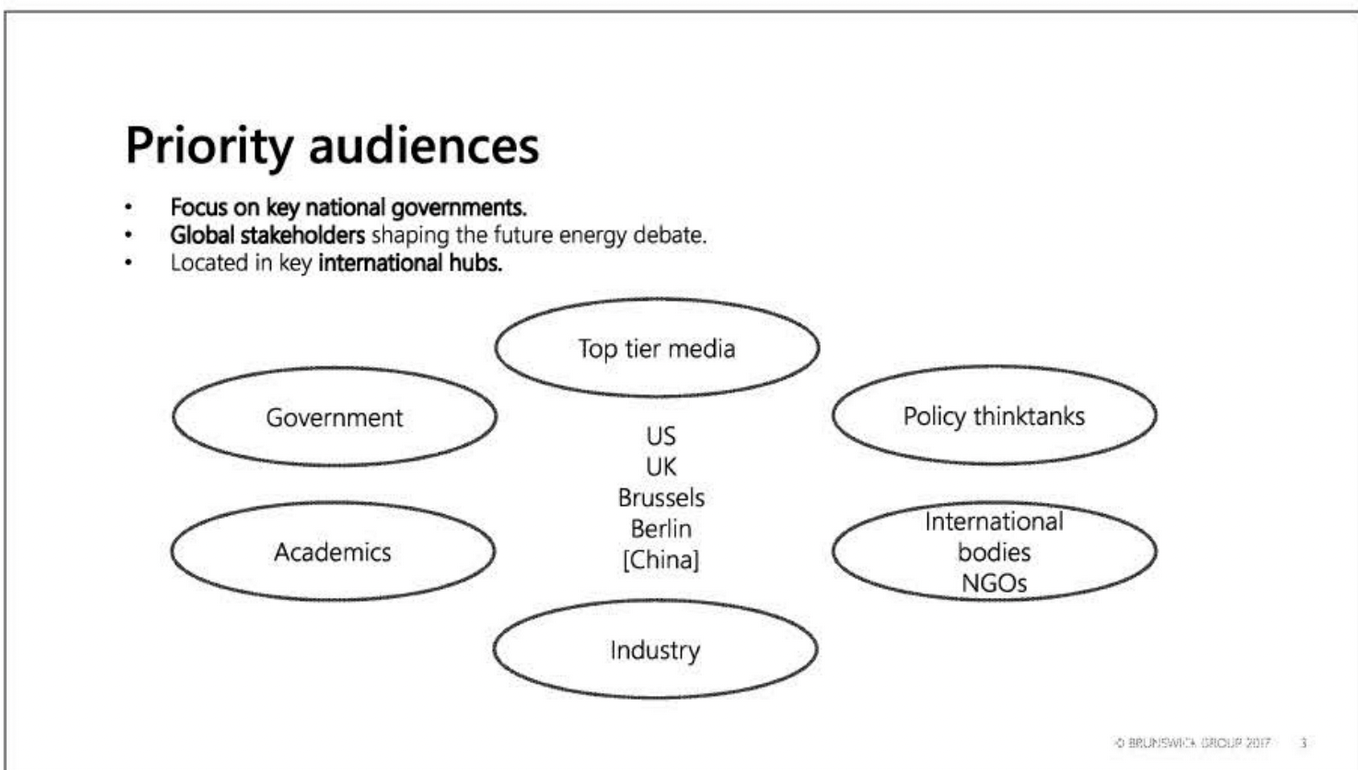
The plan notes key challenges that this campaign will have to overcome as well. And by "challenges" they mean reality. What are the actual facts of gas that they will need to change--or change the perception of--in order to accomplish their goal of securing a future for both gas and BP? First, gas generates fewer carbon emissions than coal, but Brunswick points out, it isstill a fossil fuel. Then there's the fact that renewables have dominated the conversation around energy transition. And finally, there's the methane problem. Or as Brunswick puts it, "emergence of methane as a flash point for gas." A lobbyist for BP put it more bluntly in an email around the same time, describing methane emissions as "a problem that is not going away" for gas.
Finally, Brunswick gets to the solution, its strategy for warping information and perspectives on gas in BP's favor. First, continue to emphasize the carbon benefits of gas by talking about the transition from coal to gas (never mind that, increasingly, gas is replacing...other gas, not coal). Then, position gas as a partner, not a competitor, to renewables (although from an infrastructure perspective they are almost always in competition).
And finally, take a leading role on reducing methane emissions (but, crucially, do so while continuing to focus attention on carbon--because of course if methane is your problem, you want everyone focused on CO2). But how will BP accomplish these goals? Brunswick suggests the company "contribute to the debate," and key to that endeavor is the need for "new data into public domain with partner." Which partner(s), pray tell? Well, Princeton University of course, where BP has long funded the Carbon Mitigation Initiative and where, as Molly pointed out in her piece this week, the company has a "synergistic" relationship with researchers.}:
But contributing to the debate doesn't end with funding new university research that backs up their opinion, Brunswick suggests that BP also consider partnering up with Environmental Defense Fund or science and tech organizations on a "high tech story" focused on satellites gathering data on methane emissions and on "action on the ground" messaging about how the industry is managing methane emissions. It's hard to avoid thinking about that slide amidst discussions of the U.S. EPA's new methane rule and how satellite monitoring will or won't help to enforce it. The underlying message here is that if you can make it look like you're doing something about the problem—by studying it and monitoring it—that's generally enough to convince people that you're actually doing something about the problem, which has historically been enough to keep regulation at bay.

Once you've got new information to share, the next step is to get it out to the masses, and here again Brunswick suggests that BP lean on its relationship with Princeton, recommending round tables and events with Princeton alone and with Princeton alongside a preferred media partner, like the Financial Times. It also recommends a circuit of conference and speaking engagements for top executives, with corresponding top-tier media hits, for example a Washington Post op-ed, CNBC Power Lunch, and Facebook Live Q&A that all coincide with an exec speaking at a major energy conference.

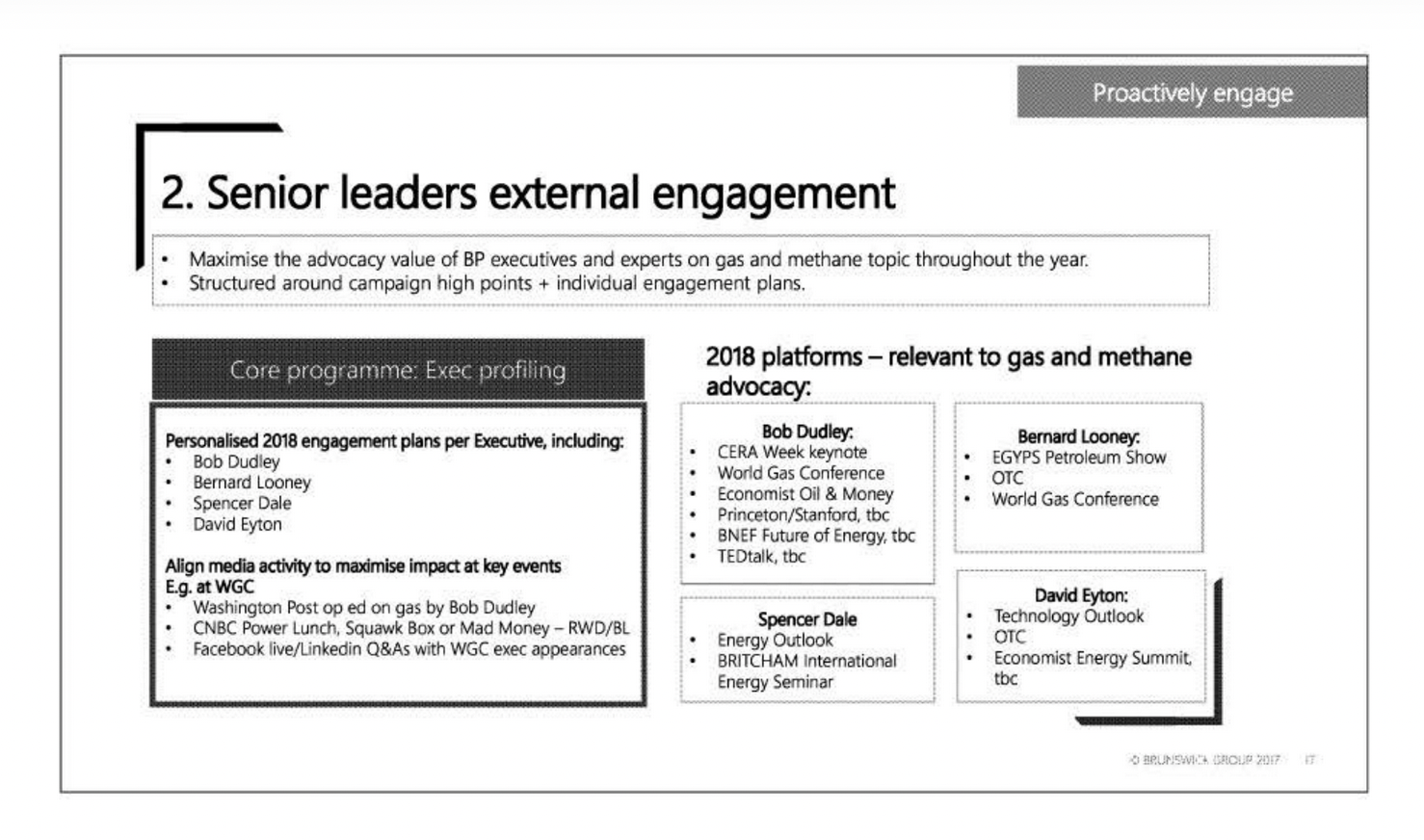
Underpinning all of this, of course, is also a robust corporate surveillance strategy that helps both the the oil company's execs and those at its PR firm keep on top of what activists, journalists, and others are saying about gas and respond instantly. We know this from the recent documents, too. In a September 2021 alert sent to the American Petroleum Institute, the largest U.S. trade group for the fossil fuel industry, a surveillance company called Command CG notes: "there is a demonstration scheduled to occur at the U.S. Capitol at 4 pm today by the group Peoples Watch in support of the Green New Deal. Both the Sunrise Movement and ShutDown DC are involved in the demonstration and have been in the area of the Capitol for most of the day."
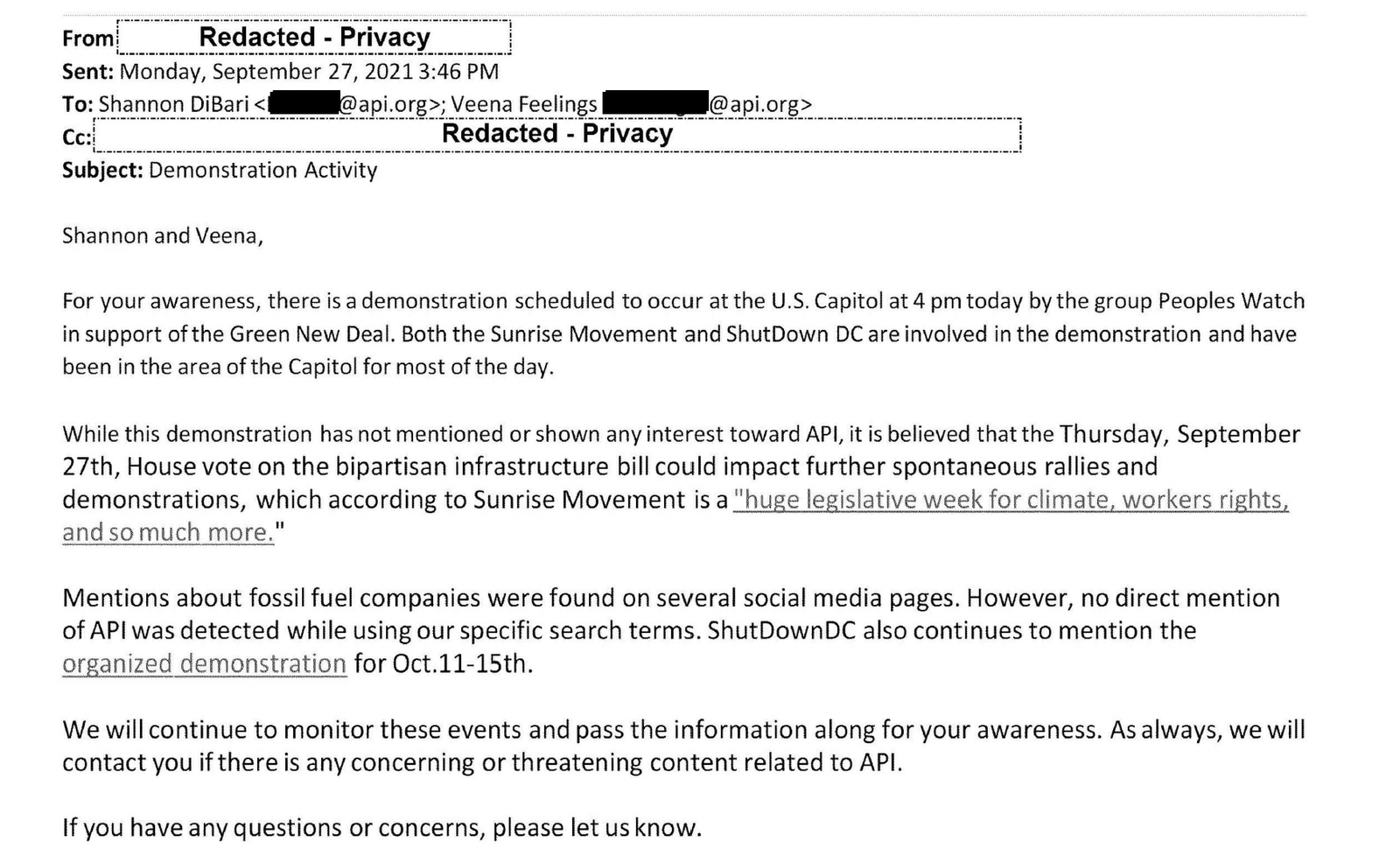
What it all shows is something we talk about a lot here at Drilled, that it's not just climate denial or science misinformation, but the wholesale hijacking of how we think of these issues, from really basic perceptions of the environment and the economy to specifics on how best to deal with methane emissions.
ref 1
molly taft
in July of 2020, Robert Stout, then the head of US policy at BP, wrote an email to his colleague laying out a few updates to the oil company’s relationships with Harvard, Tufts, and Princeton Universities, where BP funded various programs. Stout wrote that Princeton was becoming “increasingly synergistic” with the oil company—“as of course we had planned.”
“If Presidential elections go the way it looks now, I would not be surprised to see some of our friends in senior government policymaking roles as well!” Stout wrote of BP’s counterparts at Princeton.
The “synergistic” nature between Princeton and BP, which has funded the university’s Carbon Mitigation Initiative (CMI) for more than 20 years, is no accident. Big Oil and U.S. universities have long enjoyed a mutually beneficial relationship, as fossil fuel money has flowed to academic centers for decades in exchange for research that advances their objectives, access to policymakers, and civic goodwill. Yet this relationship has for years gone mostly unquestioned by mainstream media and regulators.
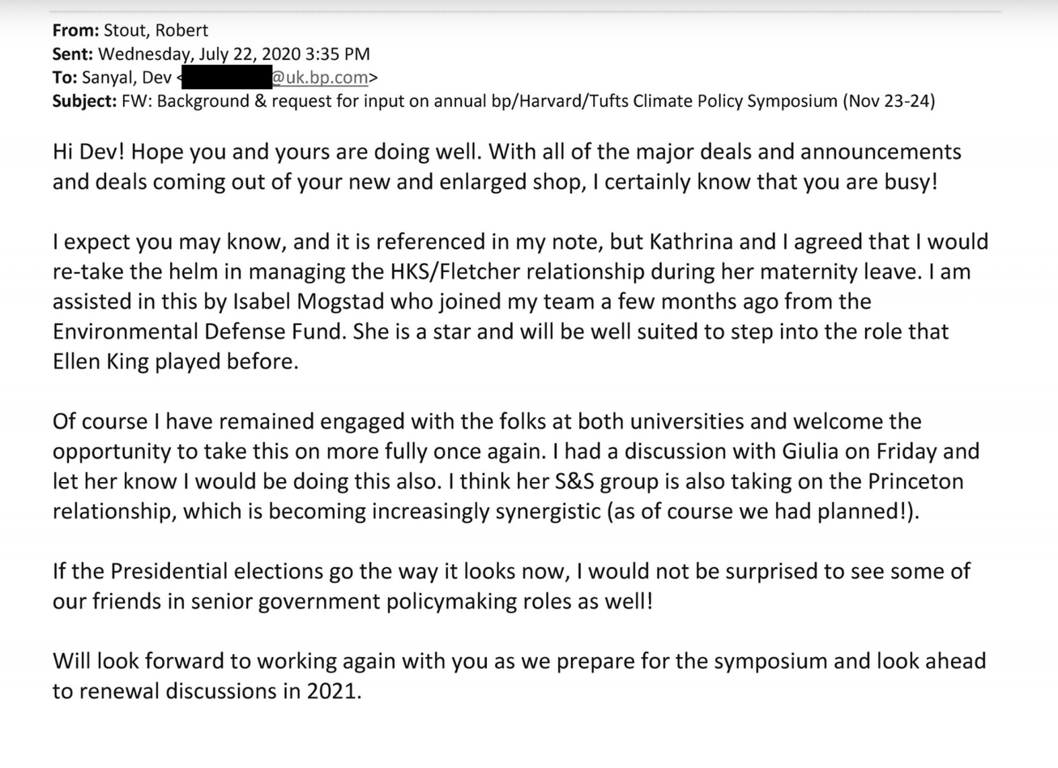
Tomorrow’s Senate Budget Committee hearing—and the wealth of subpoenaed documents and bicameral reportreleased in advance of the hearings—mark the first time the U.S. government is calling out the relationship between academia and Big Oil. As students on campuses across the country revolt against their universities’ financial relationships with companies profiting off the war in Gaza, the hearing comes at a time when U.S. academic powerhouses are already in an uncomfortable spotlight.
What, exactly, is in these documents that illustrate how Big Oil works with academic institutions to launder its image and lay the groundwork for industry-friendly policy? Here are some key takeaways.
New Numbers
In 2023,research from Data for Progress estimated that fossil fuel companies have donated at least $700 millionto 27 US universities over the past decade. Calculating the exact breakdown of these numbers can be an inexact science. Funding streams and financial ties on campus can become complex, and the vast majority of university research centers do not disclose their donors publicly. Even when asked directly to disclose their fossil fuel-backed research donations, only a handful have done so.
Previously, only the University of California at Berkeley has provided a complete accounting of its fossil fuel-funded research ($108 million from 2010 to 2020). The new documents put some real numbers on BP’s relationships with Princeton, Tufts, and Harvard. According to the Senate report, BP funneled between $2.1 and $2.6 million to the Princeton CMI program between 2012 and 2017. BP also paid $416k to Harvard and $250k to Tufts each year between 2019 and 2021 for partnerships with programs at Tufts’s Fletcher School and Harvard’s Kennedy School. The focus of these grants is worth noting, too: Harvard’s Kennedy School and Tufts’s Fletcher School are both focused explicitly on policy; at Tufts, BP funds the Climate Policy Lab. These donations don’t just give BP a window into what some of the country’s top public policy schools are researching, it also gives them influence and access to future policy makers.On a spreadsheet detailing the value of these grants, for example, it’s noted that “Harvard is a revolving door for U.S. government officials.”
“BP is committed to transitioning from an international oil company to an integrated energy company,” the company told Drilled in response to a request for comment. “To do this, we are investing in today’s energy system while helping to build out tomorrow’s.”
While the new documents contain the most information on the relationship between BP and US universities, BP wasn’t alone. Exxon planned between 2016 and 2017 to donate hundreds of thousands of dollars to schools across the country, per the Senate report: “$600,000 to MIT; $325,000 to George Washington University’s Regulatory Studies Center; $175,000 to Indiana University’s School of Public and Environmental Affairs; $140,000 to Stanford University; and $50,000 to the University of Massachusetts Amherst.”
In 2017, Shell announced it would spend $25 million over 5 years on funding Berkeley’s Energy Biosciences Institute. In an email uncovered by the subpoena, Shell wrote it had “plans to ‘embed’ Shell scientists at UCB and likewise invite faculty to spend time at Shell’s research hub to further foster deep collaboration.” (EBI was originally created with a $500 million commitment from BP to develop “a sole focus on biofuels”; Shell acknowledged in the email that it was “taking advantage of the huge sunk costs already borne by BP” in funding the program.)
In late 2020, academics at Princeton gave BP a heads-up on a major study it issued modeling pathways for the U.S. to reach net zero by 2050. In emails revealed by the Senate investigation, one BP staffer noted that BP contributed “just under” $2 million of the study’s funding through its partnership with Princeton. (Whether or not this was an additional expense on top of the regular institutional gift was not made clear.)
“BP supports the High Meadows Environmental Institute’s Carbon Mitigation Initiative with an annual contribution that is completely controlled by Princeton academics,” Princeton told Drilled in an email. “The funder has no involvement in the selection of specific research projects for support, in the execution of the research projects, nor in the presentation of final results. All HMEI research is submitted for peer review by independent, external academic experts.”
Not all oil companies’ relationships with universities were accounted for in the new documents. The Senate report documented that despite public partnerships with universities across the country, Chevron did not “[produce] relevant documents on this subject, even though the scope of the House Oversight Committee’s subpoena covered these documents.”
What Oil Companies Pay For
Importantly, the documents also lay out in clear detail what, exactly, fossil fuel companies expected their university money will be going towards: research that supports their objectives, access to academics and policymakers, and positive public associations with climate solutions.
“Our policy programs at Harvard and Tufts provide BP access to unparalleled expertise at the forefront of research in the areas of climate change science, technology, and policy,” one undated document from Dev Sandyal, then an executive VP at BP, explained to staff. The document sought feedback on the programs within these two universities, which, the note says, has “been an opportunity for [BP] to provide a business perspective to help shape international policy thinking in low carbon energy discussions.”
The 2020 Princeton net zero report is a key example of the company leveraging university research for positive PR. In an email discussing press strategy ahead of the report’s release, Omayma Khan, a BP communications official, wrote to other executives that the study “plays to our aims of helping the world get to net zero.”
“The team that worked on [this report] are already advising Biden’s transition team,” Khan added. In a separate email, Stout wrote that BP would make “a continuing effort to leverage the study with the USG [U.S. government].”
:{:{Access to staff at these programs—and their relationship to policymakers—was a clear focus for BP in keeping up these relationships as well. Representatives from universities across the country routinely pop up in industry invite lists; BP’s invite list for a private reception at CERAWeek in 2018 included Jason Bordoff, the head of Columbia’s Center on Global Energy Policy, as well as staffers from the Kennedy School, Stanford’s Natural Gas Initiative, and Georgetown University.}:
The same BP document that references Harvard as a “revolving door for U.S. government officials” notes that “Kelly”—referencing Kelly Sims-Gallagher, the Dean of Fletcher School of Law and Diplomacy—is “active in the COP process,” calls her “flexible and accommodating” in her relationships with businesses, and notes that Tufts is “influential in many circles,” including COP and the Clean Energy Ministerial.}:
In a 2020 email to high-level BP staff describing the Harvard and Tufts partnerships, Stout writes about how many former Obama administration officials are involved in both programs, calling out their “deep insight, credibility, and influence with US and global policymakers.”
Regardless of the independence of Princeton’s research, BP often discussed leveraging its relationship with Princeton to advance its own priorities. In 2020, a BP VP emailed notes from a call with Stephen Pacala, a researcher at Princeton, where they noted their recommendation of developing an infrastructure program “with an emphasis on CCUS [carbon capture, usage and storage]—building ‘backbone’ of pipelines to transport carbon.” In a 2017 email, Stout called Pacala “a big advocate” for BP making its case for natural gas. BP also used its relationship with Princeton as part of a 2020 presentation to the Rocky Mountain Institute, a nonprofit influential with renewable energy circles, noting how it intended to “advance methane science” through its partnerships.
In one 2018 document, BP also discussed a plan to “advance and protect the role of gas—and BP—in the energy transition” following negative press around methane emissions from natural gas. The plan included proposals to fund whitepapers from researchers at Princeton and Imperial College in London “highlighting [the] role of gas as a friend to renewables.”
Not All Programs Created Equal
Simply buying an association with a top-level university is just the first step in the Big Oil PR playbook. The documents reveal that some oil companies are also constantly reevaluating their relationships with universities to maximize their rates of return.
One spreadsheet included in the tranche of released documents lists meticulous details of each of BP’s partnerships with Tufts, Harvard, and Princeton. The spreadsheet includes ranking the universities’ research programs as aligned with BP’s “strategic priorities”—like the “shift to gas,” “advantaged oil” (an industry term used to describe the most desirable oil to be extracted during the energy transition). The spreadsheet also includes details like the number of graduates hired from each school by BP, the number of visit days or meetings for BP executives, and scoring each academic institution on its “Industrial Relations Strategy Maturity” (all schools scored a “Medium” ranking.)
In notes from a 2016 meeting, BP executives mention that the Harvard “relationship began as the climate policy adjunct to the Princeton CMI technical work;” BP executives discussed how to reduce contributions to a program that had, in their eyes, grown beyond its scope in order to “avoid damaging the Harvard/BP relationship.”
“The CMI discussions are directly relevant to BP, whereas the Harvard/Tufts discussions are directed by the Universities and much less relevant to BP,” the notes read.
“The Fletcher School's Climate Policy Lab received a general support grant from BP which concluded at the end of 2021 and has not been extended,” a spokesperson from Tufts told Drilled in an email. “Throughout the duration of that collaboration, Fletcher's research was conducted autonomously and without any influence from the funding source. We remain committed to conducting rigorous, unbiased research that serves the public interest.”
How Academics “Sharpen Corporate Perspective”
The new documents also show how academic centers helped oil companies refine public messages on climate change. A 2016 presentation to BP by Pacala and Robert Socolow, the co-director of the Carbon Mitigation Initiative at Princeton, included a slide titled “Risks of climate change to BP.”
:{:{“Effective climate policies can emerge that discourage fossil fuel consumption, that impose environmental performance standards on production processes, and that subsidize or otherwise promote efficiency and low carbon energy,” the slide reads. In the next slide, Pacala and Socolow point out that “BP benefits when CMI disseminates sound information that supports effective public policy discussions.”}:
The center’s research, the researchers point out, also helps “[sharpen] BP’s corporate perspective on climate change.” Later in the presentation, Pacala and Socolow make a series of recommendations to BP, including to “engage policymaking proactively.”}:
“Identify yourselves with carbon efficiency,” the slide says.
{
In July of 2019, staffers from Columbia’s Center on Global Energy Policy, including Jason Bordoff, emailed executives at BP a draft of a chapter on carbon capture, utilization, and storage (CCUS) that would be included in an upcoming report from the National Petroleum Council. Gardiner Hill, then the company’s VP of carbon, emailed back several thoughts.
Hill recommended that the chapter “be clearer and bolder on the role of the USA in the emerging energy transition … Low cost oil and gas create a substantial advantage domestically and internationally for the USA. CCUS extends this considerably as the world transitions to a low carbon energy economy.”
“I’m very conscious of the fact that many will read this report as the oil and gas industry saying let’s do CCUS so we can keep on doing oil and gas as usual,” Bordoff responded. “Need to avoid that perception. We heard that from all the independent academics and think tank types involved with putting this chapter together. …I think the credibility of the report will be enhanced if we err on the side of staying away from claims that sound self-serving for the industry.”
“I understand your point about the perception that the remarks regarding low cost oil and gas may look self serving,” Hill responded. “This was genuinely not my intent. It is good to be reminded how others may perceive this—thank you.”
The National Petroleum Council’s page on the final CCUS reportnotes that of the 300 people tasked with writing the study, “less than 33% are from the oil and natural gas industry.”
What’s Next
The subpoenaed documents, which range from 2015 to 2021, cover an unusual time for oil companies: directly during or after the Exxon Knew investigation, through the Trump years and the early start of the pandemic. As the documents show, oil companies were eager to let the public know that they were working towards climate solutions, moving away from outright denial—while privately pulling the cultural, economic, and political levers of power available to them, including their relationships with universities, to ensure their voices were heard to keep fossil fuels on the table.
Now, many of these companies have reported some of their most profitable earnings to date for the past two years, as the global energy crisis kicked off by Russia’s invasion of Ukraine has jacked up oil prices once more. Many oil majors, including BP, have since walked back on their climate commitments. The Biden administration, meanwhile, proved to be more of an ally to oil and gas companies than a foe, keeping up production levels and carving out advantages for favorite solutions like CCUS and hydrogen. Another potential Trump administration—with its heavy emphasis on American energy independence—would only benefit the industry.
Universities are, similarly, in a much different position than they were during the time of this subpoena. Many have faced divestment campaigns from their student bodies in recent years, with some success for activists. In 2022, Princeton agreed to a partial divestment from fossil fuels—but did not agree to divest funding from programs like CMI. Now, an unexpected new wave of student activism around Palestine is gripping college campuses—and forcing the nation’s attention on where universities’ financial allegiances lie. Perhaps it’s time for these universities’ relationships with Big Oil to help focus that spotlight.
This is the first of several deep dives into the new documents we’ll be doing here at Drilled, along with coverage of the May 1st hearing. Come back for more throughout the week!
---
ymail 4 24
In 2021, Congressional Democrats subpoenaed Big Oil for internal documents detailing the industry’s role in worsening the climate crisis.
Some of the documents have already been released. But today, we got some more.
The internal materials are from Exxon, Chevron, Shell, BP, the American Petroleum Institute, and the Chamber of Commerce. They’re being released today as part of the Senate Budget Committee’s upcoming hearing on Wednesday morning, titled “Denial, Disinformation, and Doublespeak: Big Oil’s Evolving Efforts to Avoid Accountability for Climate Change.”
 Source: X
Both the hearing and the documents mark the revival of the House Oversight Committee’s two-year investigation into the fossil fuel industry, and its role in misleading Americans about climate change. That investigation was put on ice when Republicans won back control of the chamber in late 2022.
Democrats say their new findings provide “a rare glimpse into the extensive efforts undertaken by fossil fuel companies to deceive the public and investors about their knowledge of the effects of their products on climate change and to undermine efforts to curb greenhouse gas emissions.”
HEATED got a chance to review the new documents prior to their publication today. And while we don’t think the revelations are necessarily all that “rare,” here are five things we found notable.
1. BP really, really loves Princeton
To influence academia, fossil fuel companies have spent at least $700 million on partnerships with U.S. universities. The longest-running of these partnerships is between BP and Princeton.
The new documents provide some insight into why: because Princeton gives BP unprecedented access to discussions about research. In 2016 emails, BP officials discussed cutting funding to Harvard and Tufts and boosting it for Princeton, because research discussions at Harvard and Tufts “are directed by the universities and much less relevant to BP.” They said “personality and structural issues” at Harvard and Tufts made it “difficult to achieve the same BP focus.”
Achieving a “BP focus” meant two things: pushing research about the benefits of carbon capture and methane gas. And that’s what Princeton’s Carbon Mitigation Initiative did.
In 2018, an internal BP presentation marked “confidential” recommended Princeton CMI director Stephen Pacala as a preferred expert in defending methane gas as a climate solution. And in a 2020 email, BP officials discussed an upcoming call with Pacala, in which BP would recommend developing a net zero plan “with emphasis on CCUS [carbon capture utilization and storage] — building ‘backbone’ of pipelines to transport carbon from emitters to the Permian and Gulf Coast sites.”
CMI did eventually develop a net zero study with an emphasis on carbon capture. BP officials celebrated, writing, “Princeton’s net zero study is expected to be a guide for the Biden Administration.”
Today, sure enough, the Biden Administration is making massive investments in carbon capture—just as BP’s vice president of U.S. policy and regulatory affairs predicted. In a 2020 email, he said BP’s relationship with Princeton was “becoming increasingly synergistic.” If Biden won, the VP said, “I would not be surprised to see some of our friends in senior government policymaking roles, as well!”
2. Oil companies know they can’t meet their public climate goals
While they publicly tout their efforts to fight climate change, oil companies privately say they don’t believe the world could ever reach a safe, livable climate.
For example: Exxon first publicly supported the Paris Agreement in 2015, but internally the company revealed that it did not believe the climate treaty’s goals were realistic. “We don’t yet see the world even approaching a 2°C pathway … let alone a 1.5°C pathway,” Exxon’s former manager of environmental policy and planning Peter Trelenberg wrote in a 2018 email. “Both 2°C and 1.5°C would require unprecedented changes to the global energy system and economy, at a rate and scale never before demonstrated, and with technologies not yet available and affordable.”...
===
ymail 4 24
our best attempt at visually depicting a shadowy pollution-laden effort to influence U.S. courts. Look, we’re not illustrators, OK? Source: Getty Images.
At the Society of Environmental Journalists conference this year, we heard about a promising legal case that experts believe actually has a real shot at holding the fossil fuel industry accountable for climate change.
City & County of Honolulu v. Sunoco LPis the first climate liability lawsuit against fossil fuel companies to be greenlit for trial, expected later this year. In it, Honolulu accuses several oil and gas giants of misleading its citizens about the environmental consequences of fossil fuels for decades, and seeks financial compensation for past, present, and future damages to the region.
As a trial comes closer, however, we learned that the lawsuit is facing more and more serious obstacles. Most notably, last week, a plethora of fossil fuel-funded groups–including the American Petroleum Institute–filed petitions asking the U.S. Supreme Court to step in and stop the trial from moving forward.
In addition, a whopping 20 Republican state attorneys generalalso filed a petition asking the Supreme Court to do the same. So it’s not just industry groups: nearly half of the country’s chief legal officers are asking the nation’s top court to intervene in a local government’s climate lawsuit.
How did this happen? If you only read Fox, or other conservative news, you’d likely believe that these state attorneys general were acting on behalf of their citizens, out of deep legal concern they all just so happened to share.
But this is not the whole story. In reality, the state AG petition is part of the organized effort by the fossil fuel industry to kill all formal efforts to hold corporations accountable for the climate crisis—both in the litigation space, and beyond.
RAGA: A legal group fueled by oil and gas
To understand how these 20 state attorneys general are connected to the fossil fuel industry, you first must understand The Republican Attorneys General Association, known as RAGA.
“RAGA is a pay to play group,” says Lisa Graves, the executive director of the watchdog group True North Research. “It was created to allow industries to wash money into RAGA, which RAGA then uses to fuel the election campaigns and ambitions of AGs.”
RAGA’s name is not on the Hawaii brief, and beyond its official X account posting a news story about it, it has not publicly admitted its involvement. But the self-described group of “conservative fighters,” which includes 28 Republican attorneys general among its members, has endorsed every single attorney general involved.
 |
A screenshot of RAGA’s post about the Hawaii case brief. Source: X
According to research by HEATED and the Center for Media and Democracy, all 20 state attorneys general that signed the amicus brief are not only featured on RAGA’s website, but many were elected with RAGA’s help. The lead counsel for the amicus brief, Alabama attorney general Steve Marshall, was the organization’s chair in 2023. Three attorneys general have served on RAGA’s executive committee (Indiana, Mississippi, and Utah), and five have been chairs or vice chairs (Alabama, Georgia, Montana, South Carolina, and Utah).
At least six AGs won their elections with the support and funding of RAGA, including the attorneys general from Oklahoma, Missouri, Kentucky, Louisiana, Iowa, and Idaho. In a statement last year, RAGA celebrated “a 100 percent success rate for RAGA in the 2023 election cycle.” This included the election of Louisiana AG Liz Murrill, which the organization supported with “a substantial, statewide paid advertising campaign.”
“These AGs, their political futures are underwritten by RAGA,” Graves said. “And who underwrites RAGA? The fossil fuel industry, along with Leonard Leo.”
RAGA did not respond to our requests for comment; when HEATED called executive director Pete Bisbee, he said he doesn’t speak to journalists, referred us to a spokesperson, and hung up. (Bisbee has previously been under fire leading the organization that paid for robocalls encouraging former President Trump supporters to protest the election results at the Capitol on Jan 6.)
But public statements, donations, and recordings of private meetings reveal RAGA’s deep ties to the fossil fuel industry. In 2023 alone, RAGA received more than $15 million in donations, and more than $1 million of those contributions came from the fossil fuel industry, according to HEATED’s analysis of IRS tax forms. Over the last decade, RAGA has accepted more than $10 million from fossil fuel companies, electric utilities, and industry trade groups.
Among RAGA’s donors are Koch Industries, Exxon, Chevron, ConocoPhillips, the American Petroleum Institute, and American Fuel and Petrochemical Manufacturers (AFPM)—and these donors have pushed AGs to adopt an aggressive anti-climate strategy.
How RAGA connects fossil fuel companies to AGs
To connect AGs with the priorities of donors, RAGA offers different tiers of access for different amounts of donations. “It’s not technically money laundering, but it has that appearance,” Graves said.
RAGA members who pay annual fees of $25,000 can help shape the organization’s legal strategy via “online RAGA briefing rooms,” for example. And members who pay more than $125,000 are given access to private meetings with attorney generals and invitations to in-person events with them, according to documents obtained by*The New York Times* in 2014.
In 2016, the Center for Media and Democracy obtained audio from one of those events. Titled “Climate Change Debate: How Speech is Being Stifled,” the session included former Alabama attorney general Luther Strange; AFPM president Chet Thompson;and noted fossil-funded climate denier Myron Ebell.
Together, they talked about the importance of protecting ExxonMobil from lawsuits like Honolulu’s. “We’re facing a coordinated campaign to demonize, weaken and try to destroy the industry,” Thompson said.
But Thompson also said stopping climate liability lawsuits would not be enough to protect the fossil fuel industry. What the industry really needed, he said, was protection from nearly all federal environmental regulation.
What followed was years of litigation led by Republican attorneys general against every environmental regulation worrying Thompson, and more.
RAGA’s goal: industry capture of the U.S. legal system
In 2021, 20 AGs sued the EPA to block its power plant emissions rules, which Thompson specifically called out in the panel. West Virginia v. EPAultimately went to the Supreme Court, whose ruling significantly decreased the EPA’s authority to regulate emissions.
In 2023, 25 Republican AGs sued the Department of Labor over retirement funds that considered ESG factors, including fossil fuel divestment. Thompson had called out divestment in the panel, too.
In 2024, 10 Republican attorneys general, all members of RAGA, sued the SEC over its climate disclosure rules, which Thompson also called out in the session.
RAGA members have also brought lawsuits fighting the Clean Water Act, limits on vehicle emissions, and the LNG exports pause—all while being paid by the industries that profit from pollution.
But the suits brought by RAGA members aren’t limited to the federal government. They’re also trying to stop localities like Honolulu from trying climate liability cases in state courts. RAGA, and the corporations it defends, want these cases tried in federal courts, where Republican-appointed federal judges are more likely to rule in the fossil fuel industry’s favor.
In fact, the same funders who helped appoint ultra-conservative judges to federal courts also donate to RAGA. Among RAGA’s top donors is the dark money group The Concord Fund, which is affiliated with the Federalist Society’s co-chairman Leonard Leo. Leo is credited with playing moving the federal court system to the right, and was instrumental in appointing multiple conservative justices to the U.S. Supreme Court, including Justices Alito, Roberts, Gorsuch, Kavanaugh, and Coney Barrett.
That network of industry influence has purchased the current anti-regulatory legal environment—and RAGA plays an essential role. "These AGs are willing to let the planet burn as they continue to take funding through RAGA from this industry," Graves said.
Former Hawaii Supreme Court Justice Michael Wilson went one step further in describing the effect of RAGA in fighting climate change.
“The AGs are violating their public duty to protect the future of their citizenry,” he said. “This partisan political use of the rule of law is what has caused the judicial branch of government to descend to its lowest level of public approval in recorded history.”
Further reading:
- The Low-Key Republican Officials Quietly Dismantling All of Our Rights. Slate, April 2024
Key quote: ”This agenda to use the Supreme Court to strip us of our rights, to use the court to make it harder for us to deal with climate change, to use the court to roll back reproductive rights, gay marriage, and more. These are all part and parcel of Leo’s agenda and these attorneys general are on that agenda.”
- These Attorneys General Are Defending the Fossil Fuel Industry, Not Their States. The Equation, March 2023
Key quote: “According to the nonpartisan National Association of Attorneys General, a state attorney general’s job is to represent the public interest—not private, special interests—by, among other things, ‘enforcing federal and state environmental laws.’ Attorneys general in the five states most vulnerable to climate change, however, are doing the exact opposite: Instead of defending their constituents, they are defending the fossil fuel industry.”
- Lobbyists, Bearing Gifts, Pursue Attorneys General. The New York Times, October 2014
Key quote: “But success did not come in court or at a negotiating table. Instead, it came at the opulent Loews Santa Monica Beach Hotel in California, with its panoramic ocean views, where more than a dozen state attorneys general had gathered last year for cocktails, dinners and fund-raisers organized by the Democratic Attorneys General Association.”
---
1 24 heated gmail
no lnx pix grf?
Here’s how much Democrats get paid to shill for fossil fuels
Two former Democratic lawmakers made six-figure salaries for falsely promoting methane gas as a climate solution, tax documents seen by HEATED show.
ARIELLE SAMUELSON
JAN 18
In January 2022, only a few years after leaving the elected seat she held for six years, former Democratic Senator Heidi Heitkamp of North Dakota got a new job: convincing climate-concerned liberals to love the fossil fuel industry.
“It’s clear we have an existential threat to the planet,” said Heitkamp, in a December 2022 commercial for the methane gas lobbying group Natural Allies For a Clean Energy Future. “We should be doing everything that we can to help other countries do what we did, which is dramatically reduce our CO2 emissions by using natural gas.”
The ad—titled “Real Talk with Heidi Heitkamp”—was one of a handful of public relations jobs Heitkamp did that year for Natural Allies, some of which she did alongside former Democratic Senator Mary Landrieu of Louisiana. Together, the notoriously moderate Democrats wrote a sponsored article in Politico claiming that “natural gas is accelerating our clean-energy future,” and an op-ed in Newsweek declaring that methane gas can “actually achieve our shared global climate goals faster.” Landrieu also did her own “Real Talk” commercial in March 2022.
For these ads and op-eds, Heitkamp was paid $185,266 and Landrieu was paid $210,690 in 2022, according to IRS 990 tax documents obtained by the Energy and Policy Institute and seen by HEATED. The documents show payments made to Heidi Heitkamp Inc. and to Landrieu’s consulting firm VNF Solutions.
A screenshot of Natural Allies’ 990 tax form from FY2022, showing payments to Landrieu’s consulting firm and Heitkamp. They also show $1 million in payments to Mad Global, a public relations firm that specializes in politics and government, and more than $3.5 million to Omnicom Public Relations Group, a global public relations company.
It’s unclear if these positions represented full-time jobs; both Heitkamp and Landrieu were hired as members of Natural Allies’ “Leadership Council” in early 2022. According to a press release about the hires, the Leadership Council seeks “to bring greater awareness to the foundational role natural gas must play in transitioning to a clean energy future.” Neither Heitkamp nor Landrieu responded to HEATED’s request for comment.
Whatever the case, the numbers are a rare glimpse into the lucrative business of greenwashing the fossil fuel industry. Natural Allies is run and funded entirely by fossil fuel companies, including Williams, TC Energy, Kinder Morgan, National Fuel Gas, Southern Company Gas, and Cheniere Energy.
“It's not every day we get to see the price tag of a former U.S. senator’s advocacy,” said Charlie Spatz, a senior researcher at the Energy and Policy Institute.
Spatz said the numbers also highlight one of the reasons it may be so hard to pass truly effective climate policy in Congress.
“It's sending a message to current Senators that maybe you shouldn't be so harsh on the fossil fuel industry, if they're going to take care of you after you finish,” he said.
A six-figure salary to spread climate misinformation
With each passing year, the science on methane gas pollution and climate change becomes more damning. A recently revised analysis from Robert Warren Howarth, a professor of ecology and environmental biology at Cornell, found that greenhouse gas emissions from liquified methane gas “are larger than those from domestically produced coal, ranging from 18% to 185% greater for the average cruise distance of an [liquified methane gas] tanker.”
At the same time, with each passing year, more and more former Democratic lawmakers are lining up to tout methane gas as “climate-friendly” in exchange for a paycheck from Natural Allies, which is currently running a seven-figure campaign to target young, liberal, and Black and Latino voters “as effectively as we have messaged to the right.”
In addition to Heitkamp and Landrieu, former Philadelphia Mayor Michael Nutter, former Ohio Congressman Tim Ryan, and former Florida Congressman Kendrick Meek all accepted positions with Natural Allies in 2023.
Those former lawmakers’ salaries were not disclosed on Natural Allies’s 2022 tax forms, as they were not yet hired by the organization. And it’s unclear if they will be disclosed on future forms, as the IRS only requires that non-profits disclose the five contractors with the highest salaries over $100,000.
However much they are making, they are spreading messages about methane gas that climate scientists have roundly decried as misleading.
“Their claims are all either extremely vague or disproved with middle-school-level science,” said Kate Marvel, a climate scientist at Project Drawdown, who previously worked at NASA’s Goddard Institute for Space Studies.
“Using natural gas warms the climate. Period, full stop,” said Andrew Dessler, professor of atmospheric sciences at Texas A&M University. “There is no world in which natural gas is a long-term ‘solution’ to the climate problem.”
Natural Allies cites multiple “independent studies” to support its claim that methane gas is the best way to solve the climate crisis. But, as we reported last year, all of those studies were funded at least in part by fossil fuel interests, and none were published in a peer-reviewed journal.
Actual peer-reviewed science with no industry backing has shown the opposite of what Natural Allies claims. According to a 2021 systematic review of the scientific literature on methane gas, increasing investments in the fossil fuel carries a long-term risk of delaying the clean energy transition and worsening the climate crisis. That’s because investing in further natural gas development “could lock-out emerging renewable technologies for extended periods.”
Building new gas pipelines, LNG terminals, and gas-fired power plants “pose a particularly great risk for carbon lock-ins,” scientists wrote this year in the journal Nature Energy.
What Natural Allies is doing is called “solutions denial,” a common form of climate misinformation, as we previously reported:
“It's an absolute tried-and-tested argument within the disinformation playbook to constantly create more interim milestones before we achieve what a real necessary transition looks like,” said [Jennie] King, who works at the Institute for Strategic Dialogue. “So taxpayer money [goes] into creating new dependencies on [fossil fuels], which ultimately in the long term, make it much harder for us to achieve an actual clean energy transition.”
But former Democratic lawmakers and mainstream media are still more than willing to spread the misinformation coming from Natural Allies, so long as Natural Allies is willing to pay for it. Since 2020, Natural Allies has spent $10 million on a national PR campaign targeting Democratic voters, including more than $4 million to place ads in E&E News and Politico newsletters, Axios, Newsweek, Vox, the Wall Street Journal, and across cable news stations, according to reporting from the Guardian and Floodlight.
These campaigns are effective, in part, because it is very difficult to tell who is behind them. Readers of these news outlets may not recognize, as we uncovered last year, that Natural Allies’ ads are a form of fossil fuel industry climate disinformation. And that is the real price of Heitkamp and Landrieu’s sell out: a deception not measured in dollars, but in the degrees threatening our livable climate.
Further reading
Politico and Axios defend running misleading natural gas ads. HEATED, February 2023.
Key quote: “It is not up to us to decide what is factually accurate or what is not factually accurate,” Politico executive vice president Cally Stolbach Baute told HEATED. “We frankly respect our readers enough to be fully transparent with them on our advertising and encourage them to evaluate our journalism on its merit and its accuracy.”
How the gas industry aims to rebrand as ‘clean’ energy to appeal to Black and Latino voters. Floodlight and The Guardian, June 2022.
Key quote: “Success for the natural gas industry will be rooted in whether we can message to the left and the Democratic base of Black and Latino and age 18-34 voters as effectively as we have messaged to the right,” read one early strategy document.
The methane gas industry is trying to codify misinformation into law. HEATED, May 2023.
Key quote: “The phenomenon started in Europe [in 2022], when the European Parliament voted to label certain uses of natural gas as “green.” That meant billions of dollars that were intended to fund climate-friendly projects could legally be used for methane power plants and terminals. Now, industry climate misinformation has also started making its way into U.S. state law—albeit in slightly different ways.”
===
---
OCT 14, 2022
https://heated.world/p/the-dirty-origins-of-the-anti-esg
no twt [elon]
A new trend is sweeping conservative America. It’s called the anti-ESG movement, or anti-”woke capitalism” movement, and it’s one of the biggest emerging barriers to corporate action on climate change.
Anti-ESG proponents want to stop corporations from following environmentally and socially conscious investing principles, commonly referred to as Environment, Social and Governance (ESG) principles. They say companies are prioritizing “left-wing” goals over the financial interests of businesses and their employees, and should be prevented by law from doing so.
This movement has gained a massive following in the last six months. Elon Musk supports it, as do billionaire investors Peter Thiel and Bill Ackman, who are are backing a new financial firm dedicated to anti-ESG investing. Banning “woke investing” is also one of the biggest recent priorities of Leonard A. Leo, the prominent conservative legal activist who runs one of the “best-funded and most sophisticated operations in American politics,” according to a New York Times investigation published Wednesday. In the past year, 17 states have proposed or adopted legislation seeking to bar state investments in “woke” companies
:{:{}:
}:
[twt FT]
the anti-ESG movement frames itself as a strictly financial enterprise. Its proponents insist it’s not a political movement. They’re simply trying to get politics out of the financial system so people can make the most money as possible.
But the anti-ESG movement is, at its core, a lobbying effort created by climate deniers to make money for fossil fuel companies. It did not originate with financial experts or economists, but with two prominent industry operatives who’ve spent decades spreading disinformation about the human health risks of fossil fuels and cigarettes.
These former coal and tobacco operatives first started their movement to ban socially conscious investing in 2004. Only now, nearly two decades later, have they been able to get mainstream conservative America on board.
The anti-ESG movement is the climate denial movement
Before the anti-ESG movement was the anti-ESG movement, it was the anti-CSR movement, the acronym standing for Corporate Social Responsibility. The two leaders of the anti-CSR movement were Steve Milloy and Tom Borelli.
Milloy is a former coal company executive and paid advocate for Phillip Morris and ExxonMobil. His career focus is developing communication strategies to deny or downplay the risks of tobacco and fossil fuel pollution. He is among the most prominent people “clouding the climate change debate,” according to the*The Washington Post*.
Borelli is “one of the best-known of the science corrupters who worked for the tobacco industry,” according to The Center for Media and Democracy. In the 90s, while working for Phillip Morris, he led the tobacco industry’s efforts to team up with other polluting industries—like coal and chemicals—to promote anti-science rhetoric. “The climate denial movement is a direct result of these coalitions,” according to CMD. (He now promotes climate denial).
in 2004, Milloy and Borelli formed a non-profit called the Free Enterprise Education Institute. The non-profit’s purpose, according to its tax forms, was to “educate the public about the American system of free enterprise” by “maintaining a website about its research.”
The website they launched was called CSRwatch.com, and was marketed as a news destination for anyone opposed to “corporate social responsibility.” CSRwatch primarily aggregated news articles attacking corporations that had climate change and other socially conscious policies, like refusing to invest in child labor
[pix screenshot]
:{:{}:
}:
one article posted to CSRwatch in 2006, for example, slammed corporations that refuse to invest in overseas sweatshops, saying they deprive children in developing countries of good paying jobs. "They try to shut down so-called sweatshops as though no jobs [are] better than what they consider to be low quality jobs, as though working as a 12-year-old beggar, thief or prostitute is better than working in a garment or shoe factory,” it read.
The article also slammed pro-indigenous corporate policies. "I would love to meet just one corporate social responsibility activist … who's willing to go native for even one month and live in a state-of-the-art mud hut in malaria-infested rural Africa under the indigenous conditions they extol and perpetuate,"it read.
CSRWatch was directly funded by the fossil fuel industry. From 2004 to 2005, ExxonMobil gave the Free Enterprise Education Institute $80,000. The non-profit also received grants from a Koch family charity foundation, DonorsTrust, and The Randolph Foundation, all conservative groups with ties to fossil fuels.
The original anti-ESG investing movement was not so great at investing
CSRWatch was not Borelli and Milloy’s only effort to push back against ESG investing in the mid-2000s. They also set up a mutual fund called the The Free Enterprise Action Fund, designed to show that being anti-woke was also good business.
The fund sought to achieve long-term investment returns “while aggressively challenging CEOs who use shareholder assets to advance the liberal political agenda.” But, perhaps because neither Borelli nor Milloy had any experience managing money professionally, the fund didn’t do very well, according to a 2006 Slate piece:
Judging by the early returns, these free-marketers are failing the test of the marketplace. The fund has attracted a paltry $5.2 million in assets as of March 31. Returns have lagged the S&P 500 badly. In its first 10 months in business, the fund returned 2.32 percent while the S&P 500 rose 4.72 percent.
Of course, the fund’s poor performance could also simply have been explained by the fact that it’s bad business to ignore environmental and social risk factors. Indeed, this is why the bulk of the financial and corporate worlds don’t agree with the anti-ESG movement. They know that ESG investing, particularly investing with climate change risk in mind, is not ideological. It’s merely the smartest long-term financial decision.
The anti-ESG movement doesn’t agree with this assessment for one reason, and one reason only: They’re climate deniers. And the fact that they’re climate deniers is not a coincidence. That is what the fossil fuel industry intended.
The new anti-ESG movement: same folks, different face
The original anti-ESG movement eventually appeared to fizzle. CSRwatch.com stopped being updated in late 2007 and the domain expired in 2008. Shortly after, The Free Enterprise Action Fund was merged into a separate mutual fund that had nothing to do with anti-ESG advocacy.
The Free Enterprise Education Institute was then acquired by the National Center for Public Policy Research, a much larger right-wing think tank funded by some of the similar players, including ExxonMobil. The NCPPR announced that Milloy and Borelli would remain at the head of the project, which would from then on be called the Free Enterprise Project.
At the time, Borelli said the merger would “significantly enhance our ability to educate the public on emerging threats to our free enterprise system.” And though it took about 14 years, it appears Borelli was correct.
:{:{}:
}:
The new anti-ESG financial firm backed by Peter Thiel and Bill Ackman, Strive Asset Management, is being led byJustin Danhof, the former executive Vice President of the NCPPR. In a recent interview with the Capitol Account newsletter, Danhof explained his qualifications: “I ran a program called the Free Enterprise Project,” he said. “We were really at the beginning of what you would call any sort of pushback against ESG, woke capital — before it was even a term.”
It may be more sophisticated today, but the anti-ESG movement is the same as it ever was: a political effort to delay climate action led by fossil fuel industry propagandists. It follows the classic playbook of climate disinformation by trying to “both sides” the idea of climate risk. But Witold Henisz, the director of the Wharton School’s ESG program, put it best: “Climate risk is investment risk. There is no credible other side, only an ideological opposition cynically seeking a wedge issue for upcoming political campaigns.”
“Proponents of climate science and more sustainable investing need to plan and execute their counterattack,” he added. “Silence in the face of such an attack is complicity. Which side are you on?”
Further reading
- How to Confront the Anti-ESG Campaign. Wharton School of the University of Pennsylvania, August 2022.
- Banks and Business Leaders Who Use ESG Aren’t ‘Woke.’ They’re Protecting Their Bottom Lines. Fortune, September 2022.
- The Republican War on “Woke Capitalism” Is Really Just a War on Capitalism. Slate, June 2022.
===
5 23 kinsgston ff plant with a natural gas plant by one of the most powerful utilities in the U.S. At the same time, Tennessee lawmakers are defining gas as “clean energy.” Source: Paul Harris/Getty Images
It was a big deal when Ohio Governor Mike DeWine signed a law designating methane gas as “green energy” in January. The bill’s passage was covered by local news, national news, industry publications and glossy magazines.
So when we recently learned that Tennessee Governor Bill Lee signed a similar law last month—HB 0946, which legally defines methane gas as “clean energy”—we were a bit surprised. Aside from Caroline Eggers at Nashville’s WPLN News, who has done two great stories on the bill, we couldn’t find any coverage of the legislation.
It’s possible that most local and national media were distracted. The bill, which states that public utilities must count “natural gas” as a “permissible source” of clean energy, was signed into law on April 12, 2023—the same day state lawmaker Justin J. Pearson was reinstated to the Tennessee Legislature after being infamously expelled for protesting on the chamber floor. (Heck, that’s what we were covering at the time).
Whatever the reason, Tennessee’s new law deserves the same level of scrutiny as Ohio’s, as it’s a key part of a growing industry-funded strategy to delay climate action by codifying misinformation about natural gas into law. Like gas, the strategy is most harmful when people don’t notice it seeping in. So today, we’re belatedly...>When deceptive marketing becomes the law zzz...the industry brands as “natural gas,” is not a “clean” or “green” source of energy. It is a fossil fuel primarily made of methane, a powerful greenhouse gas. Methane gas has “contributed to the largest increase in global fossil CO2 emissions in recent years,”&...That’s why many scientists say Despite all this, the fossil fuel industry has been marketing gas as a climate solutionfor decades. This marketing has only intensified as the public has gotten more serious about tackling climate change.
But industry-created climate misinformation is no longer just infiltrating podcasts and social media feeds. It’s also infiltrating the law. The phenomenon started in Europe last year, when the European Parliament voted to label certain uses of natural gas as “green.” That meant billions of dollars that were intended to fund climate-friendly projects could legally be used for methane power plants and terminals.
Now, industry climate misinformation has also started making its way into U.S. state law—albeit in slightly different ways.
Ohio’s bill labeling gas as “green,” for one, appears to be more of a public relations stunt than anything. Ohio Governor DeWine’s press secretary told Natural Gas Intelligence that “the legislative language did not affect any funding or regulations,” adding that it was “more of an opinion statement.” The Ohio bill’s own sponsor doesn’t even seem to know what it does; he told Energy News Network he hoped the law would help companies in the gas business meet Environment, Social and Governance (ESG) investing standards. But he added: “I don’t know if it will work.”
Tennessee’s new law, on the other hand, has a specific, anti-climate policy intent.It doesn’t just vaguely say that “gas is clean energy;” it says that local governments attempting to set “clean energy” standards must include gas in that definition. “That makes it a kindred spirit with the now over 20 states who have passed ‘preemption bills’ attempting to prohibit cities fromlimiting the use of gas in buildings,” said David Pomerantz, the executive director of the Energy and Policy Institute.
The common thread: industry influence
What unites these new state laws is their connection to fossil fuel interests. Ohio’s green energy law was funded by a dark money group with ties to the gas industry, the **Washington Post**reported in January. The conservative American Legislative Exchange Council (ALEC) shared with Ohio lawmakers a “model bill” with talking points about how methane gas is clean energy, according to emails obtained by the Energy and Policy Institute. Those emails explicitly spell out how the industry creates laws to keep itself in business.
We don’t have the same smoking gun private emails linking the gas industry and dark money groups to Tennessee’s bill. But there are a few very public connections between the lawmakers who supported the Tennessee bill and fossil fuel interests, including some of the same fossil fuel groups that created Ohio’s bill.
Three of the Tennessee bill’s co-sponsors are ALEC members: Rep. Chris Todd, who is an ALEC “state chair”, Rep. Susan Lynn, who is on ALEC’s board of directors, and Sen. Ed Jackson, also an ALEC state chair. Tennessee lawmakers have also publicly aligned themselves with the same dark money group that funded Ohio’s law, by signing The Empowerment Alliance’s “**Declaration of Energy Independence**.” Signers of the declaration, which calls methane gas the “environmentally responsible bridge to our energy future”, include Governor Bill Lee and multiple state senators—including bill co-sponsor Sen. Walley.
Representative Clark Boyd, who first sponsored HB 0946, has received $10,000 in donations from the oil and gas industry and $13,500 from electric utilities from 2018 to 2023. But his largest industry donation—$8,000 between 2018 to 2023—comes from the Tennessee Electric Cooperative Association (TECA), which has also donated to every state senator who sponsored the bill.
TECA is a trade association representing the state’s utility companies, all of which get their power from the Tennessee Valley Authority (TVA). TECA thus advocates for the interests of TVA—and TVA has big plans to expand its methane gas production in Tennessee. Specifically, TVA is currently working on $3.5 billion worth of gas projects that, if completed, will constitute thesecond-largest utility gas expansion in the country by 2030, according to the Sierra Club.
TVA has received significant pushpack to its planned gas expansion. In January, 112 organizations signed a letter to the EPA calling for a stop to the projects. In the letter, the groups cited the need for actual clean energy. "The EPA can either use its legal power to advance the clean energy economy, or…can needlessly sign off on dangerous fossil fuel expansion,” they wrote.
The fact that methane gas is now legally “clean energy” in Tennessee is a benefit for TVA and its planned methane gas expansion. And it’s not the only recent bill that benefits TVA. Last month, Rep. Clark Boyd sponsored a bill that makes it a Class C felony to interrupt or interfere with “critical infrastructure” like pipelines. In February, Boyd also sponsored a bill to block any future bans of gas stoves. Last year, Tennessee lawmakers passed the Tennessee Natural Gas Innovation Act, which legally categorized methane gas as a source of “clean energy” for utilities. They also passed laws preventing local governments from blocking fossil fuel infrastructure and the state from working with banks that divest from fossil fuel companies.
Clearly, state governments have become the battleground for America’s energy transition—and fossil fuel interests are fighting hard. So we’ll continue to follow this story in Tennessee, and the fossil fuel industry’s fight to codify misinformation into law. If you see anything similar happening with clean energy laws in your state, let us know—especially if you have proof of industry influence. Because to avoid the dangers of gas, you first have to be able to detect it.
===
https://heated.world/p/tucker-carlsons-toxic-environmental?ref=drilledpodcast.com
no lnx many vids
Tucker Carlson's toxic environmental legacy
Carlson's show helped popularize a greenwashed form of white nationalism that falsely blames environmental problems on immigrants.
EMILY ATKIN
APR 27, 2023
A screenshot of one of many of Tucker Carlson’s “environmental” segments. Source: Fox News
Over the six years he hosted his eponymous prime-time show on Fox News, Tucker Carlson periodically insisted he was an environmentalist.
Before getting unceremoniously canned this week, Carlson regularly told his 3 million nightly viewers about his concern for the “natural environment” and the “natural landscape,” and praised “the good-hearted people who really love the mountains.” “I care about the planet,” he said in 2018, even going so far as to tell viewers that he used to donate to the Sierra Club. “I think John Muir is really cool,” he once said.
And yet, when Carlson talked about the “environment” on his show, the discussion almost never centered on how to actually improve the overall quality of U.S. water or air. It certainly never centered on climate change, which Carlson decried as a liberal distraction from “actual” environmental issues. “Climate is not part of the environment, in my opinion,” he once said.
Instead, Carlson’s segments on the environment usually centered on the same thesis most of his non-environmental segments promoted: That Democrats are trying to control you, and replace you with immigrants. And by “you,” he means his audience—which is 92 percent white.
The biggest difference between Carlson’s non-environmental segments and environmental segments was that, instead of blaming immigrants for crime and taxpayer plundering, he blamed them for littering and dirtying the country.
Watch the segment where Tucker Carlson’s guest blames trash in AOC’s district on immigrants here.
Here are some examples I found of Carlson using his Fox News show to blame environmental problems on immigration:
“How is it good for the environment of this country to import millions of poor people from the Third World?” June 29, 2018
“The truth is unregulated mass immigration has badly hurt this country's natural landscape.” December 17, 2018
“If you are pushing to increase the size of our population—and they are—what's your plan for keeping our natural environment pristine?” April 4, 2019
“Unregulated waves of people coming in destroy the land and contribute to massive amounts of pollution.” April 25, 2021
“I'm not against immigrants or anything, but too many people is bad for the environment.” July 17, 2021
“Environmental organizations [are] promoting crowding and illegal immigration, which hurts the environment.” July 30, 2021
Here are some examples I found of Carlson saying immigrants make the country polluted, dirty, and crowded:
“As I got older, I realized, you don't want to live in crowded places. Everyone's unhappy, it's horrible, and it's dirty.” November 16, 2018
“Spend a week in a crowded, dirty country, and you'll find that you don't want to live in a place like that, I think.” December 6, 2018
“Crowded countries are polluted. Every single one of them. Tell us why we should want that here?” April 4, 2019
“That's the main problem with crowded countries. They're hard to live in. They're loud and dirty and chaotic.” January 4, 2022.
“This is becoming a crowded country and crowded countries are ugly, unhappy countries.” March 17, 2021
“Crowded countries are dirty, all of them. It's obvious if you travel.” July 17, 2021
One problem with this rhetoric is that it’s flat-out wrong. “There is little actual science to bolster immigration control for ecological purposes,” Susie Cagle wrote in a 2019 piece in The Guardian. “While there is evidence that population and economic growth in total increases global emissions, recent studies show no correlation between U.S. immigrant communities and pollution.”
On the contrary, a qualitative study of immigrant populations in the U.S. found that immigrants actually use less energy, drive less, and generate less waste than native-born Americans. “The vast majority of behavioral studies demonstrate that immigrants live more environmentally sustainable lifestyles than native-born Americans, so much so that immigrant density is associated with lower carbon emissions,” reports the liberal Center for American Progress. The libertarian Cato Institute also agrees with this point. (See CAP’s full report on debunking population-based anti-immigrant “environmentalism” here).
But the bigger, far more concerning problem is that these falsehoods frequently promoted by Carlson are key tenets of eco-fascism, the racist environmental ideology that multiple mass shooters have claimed since 2019. We wrote about the rise of eco-fascist rhetoric among U.S. conservatives last week.
In that newsletter, we described two tenets of eco-fascism that are gaining popularity among Republicans: One is that that the ruling class is trying to control and “replace” white people using immigration, which was what motivated the self-proclaimed eco-fascist who killed 10 people in a Buffalo supermarket last year. Another is that immigration is a form of “environmental warfare” that harms the natural landscape, which was what motivated the self-proclaimed eco-fascist who killed 23 people in an El Paso, Texas Walmart in 2019.
Carlson clearly used his Fox News show to promote that second point, as we’ve already demonstrated. But Carlson promoted the first point even more frequently. According to a New York Times analysis of 1,150 Tucker Carlson Tonight episodes, more than 400 segments championed the idea that elites are trying to force demographic replacement through immigration.
Before Carlson’s show, greenwashed white nationalist rhetoric like this was still considered widely taboo—and for good reason. In the past, early American environmentalists used similar rhetoric to justify racist policies and advocate for eugenics.
“[The eugenicist Madison Grant], along with the influential naturalist John Muir and other early Anglo-Saxon conservationists, was critical in preserving the country’s wildlands for white enjoyment,” Cagle wrote. “Muir, who founded the Sierra Club environmental group in 1892, was disturbed by the “uncleanliness” of the Native Americans, whom he wanted removed from Yosemite.” (It’s no wonder, then, why Carlson cited his love for John Muir—and said he hates what the Sierra Club has become.)
Now, racist and xenophobic environmentalism is on the rise in the U.S. again, inspiring Fox News viewers and mass murderers alike. That’s not all thanks to Tucker Carlson, but his role will forever be a part of his legacy—one much more toxic than any piece of litter.
Environmental policy can be very complicated. You know what is not complicated? Littering. Anyone who is for littering is against the environment. Period. No littering. You are not allowed to litter here. That's my view, anyway.
- Tucker Carlson speaking on Tucker Carlson Tonight, April 25, 2021.
===
4 23 email drilled
on Monday this week the Supreme Court finally weighed in on whether it would take up the jurisdictional argument that oil companies are making in multiple climate liability suits. The companies have been arguing for the past five years that these cases, brought on behalf of municipalities and states, are asking state courts for judgements that would impact federal policy and thus belong in state court. Attorneys representing state and local arguments have argued that their cases—which claim that oil companies' delay tactics on climate increased the cost of adaptation and thus the companies are liable for a portion of those costs—were appropriately filed in state court. Every circuit court has agreed, as has the Department of Justice, and now the Supreme Court as well.
"The companies' history of climate, deception, and misinformation, coupled with their unchecked fossil fuel production promotion, and so on, it makes them liable for at least some of the costs that these communities face, so that these costs don't fall entirely on the taxpayers." — Marco Simons, EarthRights International, attorney representing Boulder and other Colorado municipalities against oil companies.
 | Marco Simons, EarthRights International | 0:16 • Click to play audio |
Suncor, a Canadian company whose U.S. subsidiary is headquartered in Colorado, is a defendant in the Boulder climate case.
It's big news, but what will it mean for these cases? Some of them, including Boulder, which was the case invoked in the initial petition to the Supreme Court, will go back to arguing against other motion-to-dismiss arguments in state court. But others, starting with Hawaii, will move towards trial and that's a really big deal because it means some of these cases will get into the phase of litigation oil companies have been trying their hardest to avoid: discovery. In civil cases, the discovery phase is when companies will be asked to hand over documents and make their executives available for depositions. The evidence gathered during discovery in these cases could spell trouble for the oil company defendants in multiple other cases, including ongoing fraud suits in Massachusetts and Minnesota, a RICO, or racketeering, case filed on behalf of Puerto Rican municipalities, and even international cases given that the majority of these companies operate globally.
"At this point, we're optimistic about moving forward and securing justice for our clients, who have been facing significant harms and costs due to the climate crisis while the oil companies, of course, continue to profit from their deception and misinformation." —Marco Simons, EarthRights International
 | Marco Simons, EarthRights International | 0:15 • Click to play audio |
But of course, oil majors have not put all their eggs in the jurisdictional basket. As I've been writing about for years now, one of the key arguments they're making in these cases is a First Amendment argument. In broad strokes, the argument goes like this: anything they've ever said about climate was in the interest of shaping policy, which makes it political speech (or "petitioning speech" in legalese), and therefore protected. It was clear this was going to be the driving force of these cases when the oil company defendants appointed Chevron's attorney, Ted Boutrous with Gibson Dunn, as their spokesperson across the board. Boutrous is a renowned First Amendment attorney, and Gibson Dunn is the firm that brought and won the most famous corporate free speech in the country's history: Citizens United. And now, even as the broader jurisdictional argument seems to be dead in the water, oil companies have formulated another one: the First Amendment question in these cases is foundational, and is not something that state courts should be weighing in on.
That argument has already been briefed in multiple cases, and it's only a matter of time before it makes its way to the most pro-corporate Supreme Court this country has had in decades...maybe ever. In the meantime, cases will move forward, and it's possible that so many cases moving into discovery will prompt discussion of a tobacco-style settlement. But I wouldn't go counting those chickens just yet.
This week's Climate Must-Reads
- [study] :{The Climate Burnout Report :(style="font-weight:700"):}:- compiled by the nonprofit Climate Critical Earth, this is the first report of its kind attempting to quantify burnout in the climate space.
- Last Earth Day, Wynn Bruce Set Himself on Fire Outside the Supreme Court. I Tried to Understand Why (by Michael Kodas, for Inside Climate News) - A beautiful, sad, and insightful piece from Bruce's former teacher.
- A common talking point about climate change gets it all wrong, new study says(by Kate Yoder, for Grist) - Localizing climate problems doesn't activate people anymore than keeping it global, according to new research.
- Tucker Carlson's toxic environmental legacy (by Emily Atkin, for Heated) - A look at how Carlson helped to seed eco-fascism on the right.
- [study]:{ Global research reveals countries where record-breaking heat waves are likely to cause most harm :(style="font-weight:700"):}:(research by University of Bristol, published in Nature Communications) - As Asia and Spain boil in yet another record-breaking heat wave, new research highlights the regions most likely to become uninhabitable due to extreme heat in the coming years.
===
4 23 email
no lnx many vid?
Welcome back to HEATED! Emily here. Arielle and I are in Boise, Idaho today and tomorrow for the Society for Environmental Journalists annual conference, where we’ll be learning about things like how to better use the Freedom of Information Act; how to ethically cover tribal issues; and how to better understand next-gen “clean energy” technologies, among many other things.
This morning, I’m actually attending a panel about the subject of today’s newsletter: Eco-fascism. Unfortunately, it’s a subject that—as you’ll learn today—is only getting more relevant. But I’m eager to gain more perspective to inform my future reporting.
Arielle and I are only able to attend events like these because of our paid subscriber community, which funds 100 percent of everything we do. When you become part of it, you get the piece of mind of knowing you’re not only making our journalism possible, but actually helping us become better, more well-rounded reporters.
If you want to follow along and hear more about what we’re learning in Boise, give Arielle and I a follow over at Substack Notes.
Why U.S. conservatives are flirting with eco-fascism
As we approach Earth Day, it’s worth remembering that not everyone shares the same view of what "environmentalism" means.
EMILY ATKIN
APR 21
Thanos, noted eco-fascist. Source: Marvel Studios
For the last couple weeks, I’ve been trying to get back into a regular practice of monitoring conservative news sites for climate content. So far, I’ve mostly just come across your garden-variety climate denial and fossil fuel talking points.
I recently came across one article, however, that was both alarming and unlike anything I’d ever read. And though I don’t normally like to amplify batshit stuff like this, a prominent researcher on the topic convinced me it was worthy of discussion.
It was an op-ed considering the potential upsides of eco-fascism.
A screenshot of a PJ Media article headlined “‘Eco-Fascism’: Ideological Scourge or Salvation?”
Eco-fascism, for the uninitiated, is best known as the ideology embraced by the mass shooter who killed 10 people in a Buffalo supermarket last year. The shooter, as E&E News reported at the time, was motivated by “the racist conspiracy theory that the ruling class is using immigration to politically and culturally ‘replace’ white people.”
The Buffalo shooter called on others “to view immigration as ‘environmental warfare,’” and to “reclaim environmentalism in the name of white nationalism.” His calls echoed those of the mass shooter who killed 23 people in an El Paso, Texas Walmart in 2019, who was also a self-proclaimed eco-fascist.
In the aforementioned April 9 op-ed for PJ Media, conservative journalist Ben Bartee condemned these murders. But he also questioned whether the ideology that motivated them “might inject some new, much-needed perspective on the merits of ecological conservation into the zeitgeist.”
HEATED is accountability journalism for people who are pissed off about the climate crisis. To receive new posts and support our work, consider becoming a free or paid subscriber.
Bartee said conservatives need to embrace environmentalism—but not the climate-focused, social justice-motivated environmentalism of the Left. Liberal environmentalism, he argued, contains no “sincere environmental concern” and is merely a “pretext to shut down industrialized Western economies.”
Eco-fascists, on the other hand, “take their mandate to conserve the natural world from the ravages of humanity’s industrial machinations in a more militant and sincere, if misguided, direction,” Bartee wrote. And while eco-fascism does have some problems, he said, it’s a “smear” to label it racist or white supremacist.
“Some racist mass shooters might nominally be eco-fascists, but not all eco-fascists need necessarily be racist mass shooters,” he said. (Congratulations to anyone who had “Eco-fascists getting the #NotAllMen treatment” on their 2023 bingo card.)
Bartee ended his piece by lamenting that eco-fascism has become “tainted by association” with mass murderers and white supremacists. For that reason, he concluded, the ideology will “forever likely remain on the margins of politics, unembraced by any mainstream movement.”
But that couldn’t be further from the truth.
The rise of eco-fascist rhetoric at home
Tucker Carlson says his racism shows he really, truly cares about the environment.
Peter Staudenmaier, a professor of history at Marquette University, has written two books on the history of eco-fascism. He believes Bartee’s op-ed is more than just a fringe news site’s flirtation with eco-fascism, but emblematic of a broader struggle happening within conservative U.S. environmental politics.
“It read to me like a person who's sort of struggling within himself to define his environmental message,” he said. “He does not want to be directly associated with [eco-fascists], because they're terrorists and bombers. But he is drawn to some of those ideas, to some of those forms of environmental thinking.”
This struggle, Staudenmaier argues, is born from U.S. conservatives realizing they need to do more than simply deny and/or ignore climate change. To solve this problem, some U.S. conservatives are going the way of market-based solutions. But others are going the way of nationalist ones.
They’re not all just small op-ed writers like Bartee, either. Here are some examples from the last few months of prominent conservative individuals and organizations spouting fascist-inspired environmental thinking:
Fox News’ Tucker Carlson said the government and media don't care about the environmental disaster in East Palestine, Ohio because the residents are "overwhelmingly white and politically conservative.” He added: “In both cases, had it affected the rich or the favored poor, it would be the lead of every news channel in the world.” (February 2023).
Popular right-wing pundit Charlie Kirk said President Biden does not care about the environmental disaster in East Palestine, Ohio, because it happened primarily to white people. "It's because the war on white people continues,” he said. “Why would you care for the white working class voters in eastern Ohio?" (February 2023).
The House Judiciary Committee tweeted a clip from a hearing, claiming "Illegal immigration damages our ENVIRONMENT every single day." (February 2023).
The Federation for American Immigrant Reform (FAIR) published a blog claiming Biden’s family planning and immigration policies would harm the environment because they would lead to population growth in ecologically sensitive areas. (February 2023).
The conservative Center for Immigration Studies published an article claiming immigration harms the U.S. environment. "One of the problems with bringing in new people is that while their negative impact on the environment is minimal in their home countries, after they arrive they start acting like Americans, driving cars, using fossil fuels, and thus damaging the environment just like Americans do." (December 2022).
The rise of rhetoric like this is why Staudenmaier thinks Republicans may only be a few years behind other countries’ conservative parties that have more openly embraced eco-fascist ideals.
“I can't say for sure, but that's where I think things are trending right now,” he said. “And that's a big deal.”
The rise of eco-fascist rhetoric abroad
A primary example is Germany’s anti-immigrant far-right party, Alternative for Germany. For many years, its environmental politics were similar to the American right-wing: based mostly on climate denial and support for coal.
But after the 2019 elections saw the country’s Green Party surge, the youth wing of AfD recommended moving away from climate denial, noting that climate issues move “more people than we thought.” Instead, they recommended using concerns about the climate and environment to further promote their anti-immigrant rhetoric. This includes instilling more fear about non-white outsiders; linking the preservation of the environment to the preservation of “culture;” and building border walls around their country to keep their environment clean.
Since then, the AfD youth wing’s position “has slowly won out within the party as a whole,” Staudenmaier said. “I think for the next set of elections, it may become the official stance.”
Germany isn’t the only country greenwashing its racist and xenophobic rhetoric in a bid to sway voters. Writing for Dissent, Kate Aronoff noted it happening in France’s far-right National Rally, under Marine Le Pen’s leadership. “Le Pen herself has argued that concern for the climate is inherently nationalist. Those who are ‘nomadic,’ she said, ‘do not care about the environment; they have no homeland.’”
While this global rise in eco-fascist rhetoric is deeply concerning, it’s not inevitable. But the only way to prevent it is to understand its potential power.
“For those of us who are committed environmentalists, we can't get complacent. We can’t simply assume that environmental ideals automatically go hand in hand with a commitment to social justice or equality,” Staudenmaier said. “If we want to see those things go together, then we need to work to make them go together, because it's never going to happen naturally.”
Arielle Samuelson contributed reporting.
===
...As of today, the unthinkably wealthy owner of Twitter has blocked Twitter users from liking, sharing, and commenting on Substack posts. This means that literally hundreds of independent climate publications like HEATED can no longer effectively share their work on Twitter because of Musk—who seemingly only did this out of retribution after Substack launched a Twitter-like feature of its own.
| [pix] |
I am adding a picture of a tweet about the implications of Musk’s new policy because—guess what?—Musk also disabled Twitter embeds for Substack. That means I can no longer embed tweets directly into my articles.
It’s hard to describe how devastating this new policy could be for independent climate writers on Substack. Twitter has historically been one of the most effective platforms for getting climate publications off the ground. HEATED is a shining example of that: When I launched this newsletter in 2019, I almost exclusively used Twitter to grow its audience. I did that because Twitter’s algorithm made it easy for climate-concerned users to find and share my climate-focused articles.
Now, not only has Musk made it almost impossible for climate-concerned Twitter users to find climate articles from Substack, he’s made it hard for them to find climate articles at all. Last week, Musk posted part of the source code for Twitter’s algorithm, which revealed that Twitter de-prioritizes tweets that include links to other websites. So even if you don’t have a Substack, Twitter has become a less effective place to share articles.
musk’s new policy will, of course, harm more than just climate-focused publications and readers. But its stifling effect on climate information is worth highlighting on its own, given the media’s love of portraying Musk as a climate champion. We tried to throw some cold water on that portrayal back in the early days of Musk’s Twitter takeover, noting that his public advocacy for a Republican government would undo any climate gains made by his electric vehicle and clean energy company, Tesla.
In the months since then, the climate case against Musk has only gotten stronger, as he’s continued to dismantle the site that researchers have demonstrated is an essential tool for studying, fighting, and responding in real time to climate change. For what it’s worth, Musk also recently mocked the Biden administration for daring to tweet about climate change during the Silicon Valley Bank meltdown. Multitasking: the horror!...
===
11 22 gmail
conservative New York Times columnist Bret Stephens has spent years writing columns questioning climate change. So it was a surprise when, earlier this week, he announced that a recent trip to Greenland changed his mind [nyt op vid]
in a 6,000-word feature essay, Stephens said he’s now convinced that the ice sheets are melting due to human-caused warming. After speaking with scientists, risk assessors, and policy experts, he said he believes climate change, like cancer, is “manageable or curable in its earlier stages, disastrous in its later ones.” He wrote: “Global warming is a fact. So is the human contribution to it. So are observed increases in temperature and sea levels.”
It was a remarkable transition for someone who previously described climate change as a “mass hysteria phenomenon” and falsely claimed that “much of the science has been discredited.” But Stephens did not apologize for spreading those falsehoods, or for any of his previous misleading remarks about the crisis.
Instead, Stephens tried to convince his readers that, following his come-to-Jesus moment on climate change, he now knows how to solve the problem. (Typical first-time climate dude behavior). His approach to climate, however, is virtually indistinguishable from fossil fuel companies.
Stephens said climate change should be solved by the market, not the government. He chastised activists for “alarmist” rhetoric, arguing humanity will be able to adapt. He criticized the “limitations” of clean energy, and emphasized the benefits of fracking and natural gas to lower emissions. He suggested that many people who want to address climate change do not "accept economic growth as a benefit.”
To come to these conclusions, Stephens ignored many of his own sources who told him climate change would be catastrophic. For example, oceanographer Josh Willis of NASA’s Jet Propulsion Laboratory told him that scientists could not predict the “upper end” of sea level rise by 2100. Willis said it “hopefully less than seven or eight feet" but cautioned that we don't know "just how fast the ice sheets can melt."
Stephens took this to mean that the upper limit of sea level rise is, in fact, 8 feet. This would literally annihilate the world’s coastal cities, home to hundreds of millions of people. Still, Stephens wrote:
On the face of it, that sounds manageable. Even if sea levels rise by eight feet, won’t the world have nearly 80 years to come to grips with the problem, during which technologies that help us mitigate the effects of climate change while adapting to its consequences are likely to make dramatic advances?
Even the man who invited Stephens to Greenland is not convinced. In an interview, Oceanographer and author John Englander said that while he was “very pleased” that Stephens “acknowledged the ways he might have been shortsighted” about the climate crisis, “I would like him to acknowledge the probabilities and the devastation a little more.”
“Usually, when I’m giving a presentation, most people come to understand that it’s a certainty that the ice sheets will melt to the point where global sea level is 5 to 10 feet higher,” he said in an interview. “[Stephens] accepts this, but it’s still a worst-case scenario in his mind … I wish he had been a lot stronger.”
The Timesmarketed Stephens’ piece as if it were a fresh and important new approach to tackling climate change. In reality, it is a collection of discredited talking points from the fossil fuel industry, and a prime example of delay discourse.
Delay discourse, as defined by scientists, are talking points that “accept the existence of climate change, but justify inaction or inadequate efforts.” It has been branded “the new denial” by, ironically, The New York Times – and it is the fossil fuel industry’s favorite way to pretend they care about climate change while continuing to pollute as long as possible.
Here are a few ways Stephens’ rhetoric mimics the fossil fuel industry’s delay discourse
the market will solve everything
Stephens’ core thesis is that his trip to Greenland "changed my mind about climate change while reinforcing my belief that markets, not government, provide the cure."
This is a core argument made by the oil and gas industry, through their primary lobbying group, the American Petroleum Institute (API). In a 2016 tweet, API asserted that "[m]arket forces can achieve our nation’s energy, climate & econ[omic] goals better than gov[ernment] mandates."
In a Facebook ad last year, API asserted: "America’s energy leadership has delivered economic growth and environmental progress. But burdensome regulations and anti-industry legislation threatens U.S. national security and global competitiveness."
Stephens makes the exact same argument in his column. The only difference is that the fossil fuel industry didn't have to pay for it.
As "proof" that market forces can address climate change, Stephens cites the history of water use. "In the United States, the difference between total water consumption in 1965 and 2015 is less than 4 percent," Stephens says. "In the same span of time, population grew by more than 60 percent." Stephens attributes that success to farmers who "gradually adopted sprinkler and drip irrigation systems, rather than more wasteful flood irrigation, not to conserve water but because the technology provided higher crop yields and larger profit margins."
What Stephens does not address is that farmers generally source their own water or buy it from the government. So changes that result in less water usage save farmers money, and there is no industry lobbying for excessive water use. The fossil fuel market is completely different. There is a powerful industry that wants to produce and burn as much oil and gas as possible. In the absence of government action, that is exactly what they will do.
Climate activists want to take away everything you love
Stephens writes that any policies related to climate change need to "align with human nature." He argues that phasing out fossil fuels is impossible because you can't have "modern life without plastics, made mainly from the hydrocarbons ethylene and propylene, or steel, made with coking coal and natural gas, or cement or asphalt." Giving up fossil fuels would require millions of people to return to "farming, while accepting a world that can feed far fewer people," Stephens writes.
Stephens says humanity has an "overwhelming and, for now, inescapable dependence on fossil fuels."
The fossil fuel industry is also eager to argue that modern life would be destroyed without oil and gas. Earlier this week, API tweeted that the "natural gas & oil industry helps bring Halloween traditions to life." The group emphasized that "costumes and decorations are made possible through natural gas and oil."[twt api and --]ut just as there are renewable alternatives to oil and gas for transportation and electricity, there are alternatives to plastics, including reusable and biodegradeable materials. Many communities, most recently New South Wales, are banning single use plastics. A Halloween without plastic is possible and would not require kids to stop trick-or-treating. (Here is a step-by-step guide.) But Stephens, like the fossil fuel industry, pretends that the choice is between continuing to use fossil fuels and abandoning modern life.
The solution to the fossil fuel problem is more fossil fuels
Stephens argues that if the world wants to get serious about climate change, it should ignore "environmental activists" and produce more natural gas:
[T]he biggest single driver in emissions reductions from 2005 to 2017 was the switch from coal to natural gas for power generation, since gas produces roughly half the carbon dioxide as coal. This, in turn, was the result of a fracking revolution in the past decade, fiercely resisted by many environmental activists, that made the United States the world’s largest gas producer.
Stephens' view on natural gas is virtually identical to the oil and gas industry:
API supports policies that expand the use of U.S. natural gas in both domestic and global markets – and for good reason. U.S. CO2 levels are at generational lows, due in large part to coal-to-natural gas switching in the power sector.
While it's true that natural gas emits less carbon dioxide than coal, presenting natural gas as a solution to climate change ignores the science. According to the latest report from the Intergovernmental Panel on Climate Change (IPCC), between 1850 and 2019, approximately 2,390 gigatons of carbon dioxide were emitted worldwide. That warmed the planet by about 1.1 degrees Celsius. To have a chance to cap total warming at around 2 degrees Celsius, which is necessary to avoid many of the very worst impacts, the IPCC estimates that the world can emit about 1,150 more gigatons.
The point that the IPCC makes clear is that there is no "sustainable" rate of CO2 emissions. Switching from a fossil fuel that emits somewhat less carbon will not cut it. It will still drive us toward the most catastrophic impacts of climate change. Emissions need to go to net zero sooner rather than later.
===
no lnx gfx gmail 10 22
welcome back to HEATED, a newsletter for people who are pissed off about the climate crisis—written by me, Emily Atkin.
Today we have a follow-up on Wednesday’s article about Semafor, the global news company that is allowing the world’s second-largest polluting company to sponsor and spread misinformation in its climate change newsletter. (Apologies for the delay on this; it was supposed to be sent yesterday, but I had to drive 7 hours, and I was just too tired).
This was also supposed to be for paid subscribers only, but then I figured, we’re writing about press transparency here. It doesn’t exactly do folks much of a service to have it behind a paywall.
The questions Semafor ignored
Judging from the news company's canned response to other outlets, it's easy to see why HEATED's inquiry about Chevron's misleading ad went unanswered.
EMILY ATKIN OCT 28
Screenshots from Thursday’s edition of Semafor.
The second-largest polluting corporation in the world is still sponsoring and spreading misinformation in the climate change newsletter of Semafor, the new global news company founded by ex-Buzzfeed editor-in-chief Ben Smith and ex-Bloomberg Media CEO Justin Smith.
Semafor released its second climate newsletter sponsored by Chevron on Thursday. Titled “World’s climate fail,” the newsletter contained details of a new U.N. report showing that the world is failing to meet its climate goals. It also contained the samepaltering Chevron ad as last week, which misleads its readers about the oil giant’s efforts to fight climate change.
Semafor refused to defend the Chevron ad to HEATED when we called it out on Wednesday. Ben Smith, the editor-in-chief, affirmatively declined to answer questions about it. Instead, he directed HEATED to a spokesperson who he said could answer questions related to advertising. That spokesperson then ignored HEATED’s questions.
The Semafor spokesperson did not, however, ignore everyone’s inquiries about the Chevron sponsorship. They provided identical statements to Molly Taft at Earther, and to Isobel Cockerell at Coda. The statements read:
Advertisers have no bearing on our editorial coverage and we maintain a strict separation between news and third-party advertisement. Semafor adheres to robust ad acceptability guidelines that are industry standard. Any ads that are featured across our products are transparently positioned to the reader and clearly contextualized as advertising.
Judging from that response, it becomes easy to see why Semafor chose to ignore HEATED’s questions. In our inquiry, we specifically told Semafor we weren’t looking for answers related to their editorial independence. We said we were only asking about one specific thing: whether Semafor is selling advertisers on opportunities to spread misinformation on its platform.
Semafor couldn’t answer that. So they didn’t.
Read HEATED’s full inquiry to Semafor
To be sure, it’s completely possible (and perhaps probable!) that Semafor ignored HEATED because it thinks we’re small potatoes; that nothing this tiny reader-funded outlet will say could affect their$25 million corporate-funded operation.
But I personally like to believe it’s because of our detailed inquiry, which specifically said we were not looking for unrelated answers about Semafor’s editorial independence, which news outlets commonly use to deflect questions about their misleading fossil fuel ads.
As we said on Wednesday, “It’s an incredibly disingenuous response, and frankly an insult to the reason we ask the question. … We just don’t want to see your readers misled. Why don’t you?”
Here’s our full, unanswered inquiry to Semafor’s advertising team:
This is Emily Atkin, I write a popular climate newsletter called HEATED. Ben Smith gave me your contact info and said you'd be able to provide context on a recent Chevron ad that ran in Semafor climate, which I'm writing about for my newsletter tomorrow.
I'm writing about the ad because it is misleading your readers about Chevron's massive impact on the climate crisis. It is a textbook example of greenwashing, a misinformation tactic sometimes used by high-polluting corporations to falsely paint their operations as environmentally-friendly.
Specifically, the claim that Chevron is "working toward a lower carbon future" by investing in renewable natural gas is paltering, the practice of saying things that on their own are literally true, but create a misleading overall impression of the company. Sure, renewable natural gas is technically a "lower carbon" technology, but it is also not renewable, not natural, and not a large-scale climate solution. In addition, scientists say a zero carbon or carbon neutral future is necessary to avoid climate catastrophe—not a “lower carbon” future, which is purposefully vague.
Climate misinformation such as this plays a huge role in placating the public, falsely soothing them into believing polluters are taking meaningful action to solve this horrible crisis, when they are not. So I hope Semafor takes it seriously.
My questions for you are:
What are Semafor's policies on misleading and deceptive advertising, including greenwashing?
Does this Chevron advertisement meet Semafor's requirements for truthful advertising?
The Guardian and other news outlets have banned fossil fuel advertisements specifically because they so often mislead people into thinking the companies are climate-friendly. What was the process of creating Semafor's advertising guidelines, and were the ethics of fossil fuel advertising ever considered?
I also want to emphasize that I am not asking about the firewall between Semafor's editorial and advertising teams. I am asking about whether Semafor is selling advertisers on opportunities to spread misinformation on its platform.
My deadline is COB today, and I can be reached here by e-mail or at [phone number]. I appreciate the attention.
Also, here’s a separate inquiry I sent to Ben Smith after he had already declined to be interviewed over text:
Hi Ben, I tried to send this over text, but it is not going through. I have a couple editorial questions unrelated to advertising that I figured I'd try you on.
My questions are:
-How does Semafor plan to cover climate misinformation and greenwashing? How seriously will Semafor take these topics?
-Will Semafor's climate coverage include fact-checking the paltering and greenwashing commonly found in oil industry climate ads, including the ones it runs?
My deadline is COB today. Thanks
It also went unanswered.
no lnx twt
Welcome back to HEATED, a newsletter for people who are pissed off about the climate crisis—written by me, Emily Atkin.
A new anti-climate leader
Dan Bongino, a climate denier who spread the Texas wind energy lie, is gearing up to take Rush Limbaugh's place today.
Emily Atkin May 24
Dan Bongino at Fox News Channel Studios on June 18, 2019 in New York City. Photo by Roy Rochlin/Getty Images.
Rush Limbaugh’s death in February left a deep hole where some of America’s most influential climate disinformation used to be. That hole will start being filled today, as far-right Fox News pundit Dan Bongino steps in to take Limbaugh’s place.
Twitter avatar for @TPPatriots
Tea Party Patriots
@TPPatriots]
Donald Trump to Be First Guest on Bongino's Show, Expect a Powerful Debut Episode in Limbaugh's Old Time Slot
Dan Bongino will begin a new chapter of conservative talk radio Monday with former President Donald Trump as his first guest.
patriotproject.com May 23rd 2021 204 Retweets1,127 Likes
Bongino, who in 2018 declared his life mission as “owning the libs,” is already an popular purveyor of general disinformation.His Facebook page, The Bongino Report, regularly boosts false claims of election fraud, among other things.
Though the page only has about 135,000 followers, these posts “consistently land among the site’s top posts and outperform mainstream news outlets like The New York Times, CNN and Fox News,” reports Forbes. That’s in part because Facebook’s algorithim rewards misleading content from conservative creators, as Wired reported in March:
According to researchers at the Cybersecurity for Democracy project at New York University, far-right purveyors of misinformation have by far the highest levels of engagement per follower compared to any other category of news source. Indeed, the researchers found that while left-leaning and centrist publications get much less engagement if they publish misinformation, the relationship is reversed on the far right, where news organizations that regularly publish false material get up to 65 percent more engagement than ones that don’t.
Bongino is about to be rewarded even further with his new radio show. Though it’s yet unclear exactly how many of the 600 stations that once ran Limbaugh’s show will pick up Bongino’s, the opportunity to pick up some of Limbaugh’s 15 million regular listeners is large. In addition, earlier this month, Fox News also announced that it would start airing a new show on Saturday nights lead by Bongino, called “The Big Saturday Show.”
Bongino is thus well-positioned to soon become one of the most influential sources of right-wing disinformation in America. Here’s what we can expect on climate front.
Less flagrant denial, more insulting liberals
Bongino is a straight-up climate denier, and for the most part, is not particularly shy about it. “These climate change alarmists have been wrong about just about everything. All their charts have been debunked,” he said on Fox in 2019. “The climate’s been relatively stable. There’s not any evidence that storms are out of control. All this stuff is made up.”
But just like the fossil fuel industry, Bongino’s anti-climate policy talking points lately have moved further away from flagrant denial. Instead, they promote more insidious falsehoods— like that wind energy was a significant contributor to deadly blackouts in Texas following February’s deep freeze, and that liberals were trying to cover it up.
Bongino delved into that subject specifically for a February episode of his podcast, which he began by strongly defending the quality of his own information regarding “What really happened with Texas and the energy system failures there.” “I never want to be first if I don’t have the facts,” he said. “I’m tired of the lies.”
Bongino went on to disparage “These filthy people on the left who can never ever tell the truth,” like MSNBC’s Chris Hayes, who he called a “sick little turd” for debunking Texas Republican officials’ prolific claims that wind energy was the culprit of Texas’s woes. Bongino did admit that natural gas and nuclear energy failed as well. But he said wind turbines had failed, too, and the only reason liberals were mad that Republicans were pointing it out was because they had to “protect their golden calf.”
He said liberals were taking “advantage of an ongoing tragedy to score cheap political points,” and added: “The hacks at Facebook and soviet fact-checkers will ding this segment because the facts trouble them.”
In reality, the blackouts in Texas were caused not by any particular power source, but by Texas’s failure to prepare for climate change-fueled extreme weather. In order to protect their “golden calf”—fossil fuels—Republican officials publicly sought to place the majority of the blame for Texas’s blackouts on wind reliability. Practically every major news outlet in the country debunked that lie, an attempt to use a tragedy to score political points.
Still, Bongino adopted wholesale the argument made by the Wall Street Journal’s editorial board, which was that the only reason nuclear and gas failed during the deep freeze was because it was trying to make up for the gaps in wind power. Ironically, that editorial was debunked by the journal’s own news section.
[Twitter avatar for @EricKleefeld Eric Kleefeld @EricKleefeld
Texas’ utter failure to winterize — despite a freeze and rolling blackouts 10 years ago — makes the choice of particular energy sources irrelevant. Their whole system is going down across the board!
This happens when you only pursue short-term cost cuts, don’t invest in safety.
February 18th 2021 44 Retweets213 Likes]
Green New Deal-bashing, arguments for human dominion
Here are some other trademark Bongino climate claims that we can expect to proliferate on conservative talk radio and Fox News as his profile continues to rise:
People who compare the challenge of climate change to World War II are participating in the “Moron Olympics.”
The Green New Deal is “outrageous,” “ridiculous,” and “expensive.” It looks “like it was conceived by a high schooler” and “proofread by a bartender.” It’s also not actually about climate change at all. It’s a “bad joke.”
“The climate changes all the time. Temperatures have been flat for 18 years.”
“We should care about the environment. It’s the right thing to do, if you’re really a God-loving person. But God gave us the world, not the other way around.”
“The Left is the one destroying their own credibility. Because ironically there are a lot of Republicans, me included, who are absolutely open to a conversation about a cleaner, better future, just not with a bunch of lunatics telling me the world is going to blow up.”
Moving forward, it’ll be interesting to see which advertisers are willing to sponsor claims like these. Bongino’s interview with Trump airs at noon EST. So, you know. Right now.
Bonus: Gina McCarthy on HBO]
---