STOCK act trade
---
PRIMARY 9 26 TRUMP > MOC
NO MERRI
see insider trading
SEE CORRUPT 3
---
MTG 4 25?
---
-=-=
10 27 26 DJT MADE $ FF; RECD PROFITS? BOT AFTER IRAN WAR ?
-=-=-
AN 10 26
Blistering NYT editorial indicts Congress' greed and ‘culture of corruption’
-=-=
an 9 26
Morning Joe aghast Trump is trading more stocks than all of Congress
-=-=
---
an 5 26
Rarely does President Donald Trump evoke bipartisan applause while delivering a State of the Union address, but he inspired just such a moment last February — when he called out former House Speaker Nancy Pelosi over her husband's history of stock trading.
"As we ensure that all Americans can profit from a rising stock market, let's also make sure that members of Congress cannot corruptly profit from using insider information," said Trump as members of both parties stood to applaud.
While Republicans and Democrats in both houses have long invested in markets, with some banking huge profits from such dubious trades, it is Pelosi who has endured the most flak. Republican members named a bill to restrict congressional stock trades after her: the Preventing Elected Leaders from Owning Securities and Investments, or PELOSI, Act. During that speech, a smirking Trump urged the former speaker to stand up and demanded that Congress "pass the Stop Insider Trading Act without delay."
Yet neither that bill nor any other reform legislation would have stopped the eye-popping orgy of recent stock trades by none other than Trump himself, with thousands of individual market transactions on his account revealed this week in disclosure documents. A new filing with the Office of Government Ethics, released on May 14, showed more than 3,500 specific trades in Trump's name during the first quarter of 2026, with a value between $220 million and $750 million. This represents by far the largest series of securities transactions by a sitting president in American history.
As one observer noted on X, it adds up to 60 trades per day, while he issues executive orders, talks with foreign leaders, shifts tariffs, and gives policy directives that directly affect the value of his holdings.
Former White House ethics counsel Richard Painter told Forbes magazine that he had researched the financial history of every preceding chief executive. "I don't think we've had any president trade in the stock market," he said. Previous presidents had blind trusts with index funds, if they owned any stocks at all.
What outraged ethics experts was not just the volume of Trump's market activity but the obvious overlaps between his actions and policies and the equities that he bought and sold. Although it is impossible to determine exactly how much he may have profited from what looks suspiciously like insider trading — exactly the crime he accused the Pelosis of perpetrating — there can be little doubt that he has made millions.
The Dell Deal
Not long before he delivered that State of the Union slap at Pelosi, Trump bought somewhere between $1 million and $5 million in Dell Computers stock. Then on May 8, less than three months later, he gave a public speech at the White House where he urged "everyone" to "go out and buy Dell," driving the company's stock to an all-time high. Since he bought Dell stock in February, it has gone up a whopping 96%.
Nvidia and Defense Deals
Around the same time, Trump bought a big chunk of Nvidia stock, just before that firm announced a big chip agreement with Meta, and then he purchased still more Nvidia a week before the Commerce Department permitted the sale of the company's chips to Saudi Arabia. Ironically, Nvidia was among the stocks whose purchase by Paul Pelosi provoked Republican outrage; he later sold it before its value rose astronomically.
Trump praising such companies as Palantir and Intel on his social media platform has similarly inflated their stocks after he bought chunks for his account.
The Palantir Pattern
Trump increased his Palantir holdings just as the Pentagon and the Department of Homeland Security were awarding billion-dollar contracts to the company, whose principal shareholder is the fascist-curious, Trump-backing billionaire Peter Thiel. So now the president too can profit from the company's Orwellian surveillance technologies.
Robinhood and Federal Programs
During the same period, Trump invested hundreds of thousands of dollars in Robinhood, the financial technology firm. News reports indicate that those purchases occurred as the Treasury Department named Robinhood as the brokerage and trustee for the federally funded "Trump Accounts" to be set up for American kids. Those children don't stand to earn much, but never mind — Trump will do very well.
The list of sleazy transactions goes on and on, with many more examples no doubt to be unearthed in months to come. The response from the White House and the Trump family echoes their usual "move along, nothing to see here" refrain. Don Jr. recently complained that charges of rampant corruption against his father were "getting old." And it is true that the crooked misconduct dates back to the first Trump administration; it is simply more widespread, more encompassing and more brazen now.
Contradictory Explanations
At least it would be better if the family and the administration flacks could get their stories straight. Eric Trump says his family's stock holdings are exclusively in broad market indexes like the Schwab 1000, a claim belied by Donald Trump's own filings, which show thousands of individual trades. Meanwhile, a White House spokesman told Fortune that all of Trump's assets are in a trust "managed by his children" with no conflicts of interest, another obvious contradiction.
A Pattern of Deception
The Trumps — and the Kushners, and many others associated with the first family — have gaslighted the American public with such bogus "explanations" of their grift-gorging for many years. Everyone in the Trump circle, including Cabinet officers such as Secretary of State Marco Rubio, has long known that the president is a crook. Out of cowardice and personal ambition, and sometimes greed, they have turned away from challenging his self-enrichment. The public, too, has largely ignored Trump's corruption, believing that "both parties do it," and there is plainly some basis for that cynicism.
But the scale of Trump's exploitation of public resources, his incessant stealing with both hands, is exponentially worse than any theft previously perpetrated by Democrats or Republicans. At a time when voters expected this president to look out for their pocketbooks, he does nothing but stuff his own, plundering them and profiting hugely. Polls suggest that they have at last begun to notice — and don't like what they see.
---
AN 11 25
A meeting about a proposed ban on stock trading for members of Congress got heated on Wednesday, as some are accusing the bill of being watered down by changes.
The meeting of House members was to focus on new developments for a stock trading ban first introduced in September, according to a report from NOTUS. Ahead of time, Rep. Tim Burchett, a Tennessee Republican, said that the bill would receive a markup, a process in which bills are debated and amended before being brought forward for a vote.
News of the changes that emerged out of this meeting, however, have not gone down well with everyone. Rep. Anna Paulina Luna, a Florida Republican who did not attend the meeting in-person, attacked the markup on social media and claimed that the proposal was now too watered down.
“We got news that they are marking up and bring to the floor a [watered] down version with no teeth,” Luna wrote in a post on X. “Unacceptable.”
However the proposal proceeds, Luna has previously pledged to file a discharge petition to force a vote on the ban if House Speaker Mike Johnson does not bring it forward soon himself.
Despite Luna’s objections, other lawmakers remain committed to getting the proposal through.
“In this moment, confidence in our government is abysmally low,” Rep. Joe Morelle, a New York Democrat, said. “Fostering public trust in our institutions is the absolute bedrock of the American experiment. It is what gives our government legitimacy. But that trust must be earned and kept, by holding ourselves to the highest standard of conduct possible.”
Members of Congress are currently required to file financial disclosure relating to their stock trading activity, to ensure that they are not engaged in illegal insider trading based on information they become privy too thanks to their position in government.
Even with that requirement in place, public trust that lawmakers are not just doing it anyway is low. This perception is not helped by the comparatively minor penalties for lawmakers caught engaging in insider trading.
Many have called for an outright ban on stock trading for elected officials and their families. Some lawmakers have pushed back on a complete ban, noting that the salaries for members of Congress have been frozen at around $174,000 since 2009 and stocks are a method left for them to bolster their income.
---
an 8 25
Axios reports "a schism is emerging between members of Congress who want to ban their colleagues from trading stocks over how best to accomplish their shared goal."
Congressional stock trading is the topic that Congress has long stalled as representatives grow wealthy from what looks to critics like insider trading.
U.S. Rep. Marjorie Taylor Greene (R-Ga.) admitted in April that she purchased between $21,000 and $315,000 in stocks the day President Donald Trump sent stocks soaring by pausing his sweeping tariffs. Numbers also showed she dumped between $50,000 and $100,0000 in Treasury bills the day the bond market selloff badly rattled investors.
READ MORE: 'Reckless': Lifelong diplomats are 'stunned' by Trump's 'obnoxious' new appointee
U.S. Rep. Rob Bresnahan (R-Penn.), meanwhile, sold up to $50,000 in Alibaba stock on March 4, the same day Trump doubled the tariff on Chinese imports. In fact, there are trading companies that buy and sell based upon the reliability of U.S. politicians’ market transactions.
Axios reports House Speaker Mike Johnson (R-La.) and Minority Leader Hakeem Jeffries (D-N.Y.) have expressed support for a ban, but talk appeared to stall until Rep. Anna Paulina Luna (R-Fla.) announced last month that she plans to introduce a discharge petition on a bill to ban lawmakers, spouses and dependents from trading or owning stocks.
“Luna's going to force it, and I think we need to do that, because I'm sick of messing around," Tim Burchett (R-Tenn.) told Axios, adding that he was certain "some" Democrats would sign on to a discharge petition that bypasses House leadership and forces a floor vote.
Axios reports Burchett is part of a bipartisan group that includes Reps. Seth Magaziner (D-R.I.), Chip Roy (R-Texas), Joe Morelle (D-N.Y.), Alexandria Ocasio-Cortez (D-N.Y.), Pramila Jayapal (D-Wash.) and Brian Fitzpatrick (R-Pa.).
READ MORE: The plot thickens: A new chapter in the Ghislaine Maxwell saga
Luna tells Axios she is suspicious of the bipartisan group, however, claiming members don’t actually want to bring forward a bill because they don't "want to hurt their friends.”
A senior House Democrat told Axios the bill “is causing problems and being sorted."
Read the full Axios report at this link.
---
BONDI AND BUSTED: Sean Duffy sold stocks 2 days before Trump announced tariff plan
AN 5 25
---
an 7 25
In May, lawmakers in the U.S. Senate examined the future of artificial intelligence (AI) regulation in the United States. And according to Citizens United for Ethics in Washington (CREW), four of them or members of their family purchased stock "in major AI-related companies: Google, Nvidia, Meta and Amazon" during that period.
The senators, CREW's Linnaea Honl-Stuenkel reports in an article published on July 8, were Shelly Moore Capito (R-West Virginia), Jerry Moran (R-Kansas), John Boozman (R-Arkansas) and John Fetterman (D-Pennsylvania).
Three of them, Honl-Stuenkel notes, are members of the Commerce, Science and Transportation Committee.
READ MORE: 'Sign of sickness and dysfunction': Why GOP 'defaults' to 'fealty' in wake of disaster
"Senators Capito, Moran, Fetterman and Boozman all reported purchases, either personally or by their spouse or dependent child, of Google stock in May," according to the CREW reporter. "Boozman also reported purchasing Nvidia, Meta and Amazon stock."
Honl-Stuenkel adds, "During that time, the Senate was considering the future of AI regulation across the country, including passing a 10-year moratorium on AI regulations that would ban any state laws on the technology. Big Tech companies with AI ventures, including Amazon, Google, Microsoft and Meta, reportedly lobbied for the moratorium."
Although the senators' purchases "were not huge," according to Honl-Stuenkel, the "timing raises questions, especially for those senators who purchased stock the same day their committee heard from industry leaders."
"Only a comprehensive ban on congressional stock trading could fully put these types of concerns to rest," Honl-Stuenkel observes.
READ MORE:Supremes v. Democracy: How 7 of the Court's decisions brought fascism to America
*Read the full CREW report at this link.
---
an 4 25
'Could be an enormous scam': Insider trading suspicions grow after Trump tariff pause
---
---
AN 2 25
Newly released financial disclosures from Rep. Marjorie Taylor Greene (R-Ga.) show that she bought numerous blue chip tech industry stocks, including Alphabet, Amazon, Meta (parent company of Facebook and Instagram) and Tesla.
Greene's purchase of Tesla stock is particularly noteworthy, as she was recently named chair of the House Department of Government Efficiency (DOGE) subcommittee. Forbes investigative reporter Zach Everson combed through Greene's disclosure forms and found that she purchased between $4,000 and $60,000 of Tesla stock on January 8 (financial disclosure forms only require ranges, rather than exact amounts).
On Bluesky, Democratic strategist and ad maker Greg Pinelo referred to Greene's stock purchase as "corruption in plain sight," given that she chairs the subcommittee that pertains to Tesla CEO Elon Musk's crusade to drastically slash federal spending. The Hill reported that Greene has strongly defended Musk's actions, and called a federal judge's ruling blocking DOGE representatives from accessing the Treasury Department's payment systems "absurd."
READ MORE:'Now the harder test': Experts cautiously celebrate as Musk locked out of Treasury systems
"I've been reading federal ethics laws recently, and this is a VERY CLEAR VIOLATION," Mother Jones senior editor Michael Mechanic wrote on Bluesky.
Others noted that Greene has likely lost money on her investment, given Tesla's middling performance in the markets over the last month. Former Hill staffer Josh Zembik observed that while Tesla traded as high as $402.50 per share on the day of her purchase, it has since dropped to less than $356 per share, meaning her investment was "down anywhere from 8% to 12%." CNBC's Carl Quintanilla narrowed it down, finding that if Greene bought Tesla stock on January 8, her investment has currently lost approximately 11% of its value already.
"Tell her to go all in," wrote Alexandrea Townsend, who is the assistant director of federal government affairs for the American Federation of State, County and Municipal Employees (AFSCME) union. "She's even dumber than I previously thought."
Investor Tom Hearden of Skylands Capital sarcastically praised Greene's Tesla stock purchase on Bluesky. He wrote "hot damn, finally some good news," before reminding his followers that Greene is "the same moron who paid $94/share for $DJT," referring to President Donald Trump's media company that owns his Truth Social platform. NBC reported last year that the Georgia Republican bought shares of Digital World Acquisition Corp. (the Special Purpose Acquisition Company, or SPAC, that facilitated $DJT going public) on the day it opened for trading at more than $118 per share. Greene has not said whether she sold the stock or held onto it.
READ MORE:'Could do anything': 25 year-old Musk employee has admin access to $6 trillion payment system
Click here to read Forbes' full report about Greene's financial disclosures.
===
---
These lawmakers made a fortune in the stock market last year
Jan 16 •
and
---
biden mention in farewell speech 1 25
federal government employees who own stock in a company are prohibited by law from being involved in any matter that may impact the financial interests of the company — whether or not the matter can plausibly impact the stock price. The restriction also applies to any stock owned by a spouse or minor child of the federal employee. Each violation of the law carries a maximum penalty of five years in jail and a fine of $50,000.
Members of Congress are constantly involved in matters that directly impact the financial performance of all publicly traded companies — casting votes that determine tax rates, regulations, funds available for government contracts, and a myriad of other issues. Yet, under the law, members of Congress are not considered employees of the federal government. They are free to actively trade any stock with few restrictions.
The only prohibition that applies to members of Congress is a ban on stock trading based on "insider information." It is very difficult, however, to prove why any person traded a stock. No member of Congress has ever been prosecuted for insider trading.
In 2024, more than 100 members of Congress actively traded individual stocks. Many of them cleaned up, with gains that far outpaced the broader market. According to a new report by Unusual Whales, a data platform for retail traders, 13 members of Congress who own at least five stocks — 8 Republicans and 5 Democrats — saw their portfolios gain 60% or more for the year.
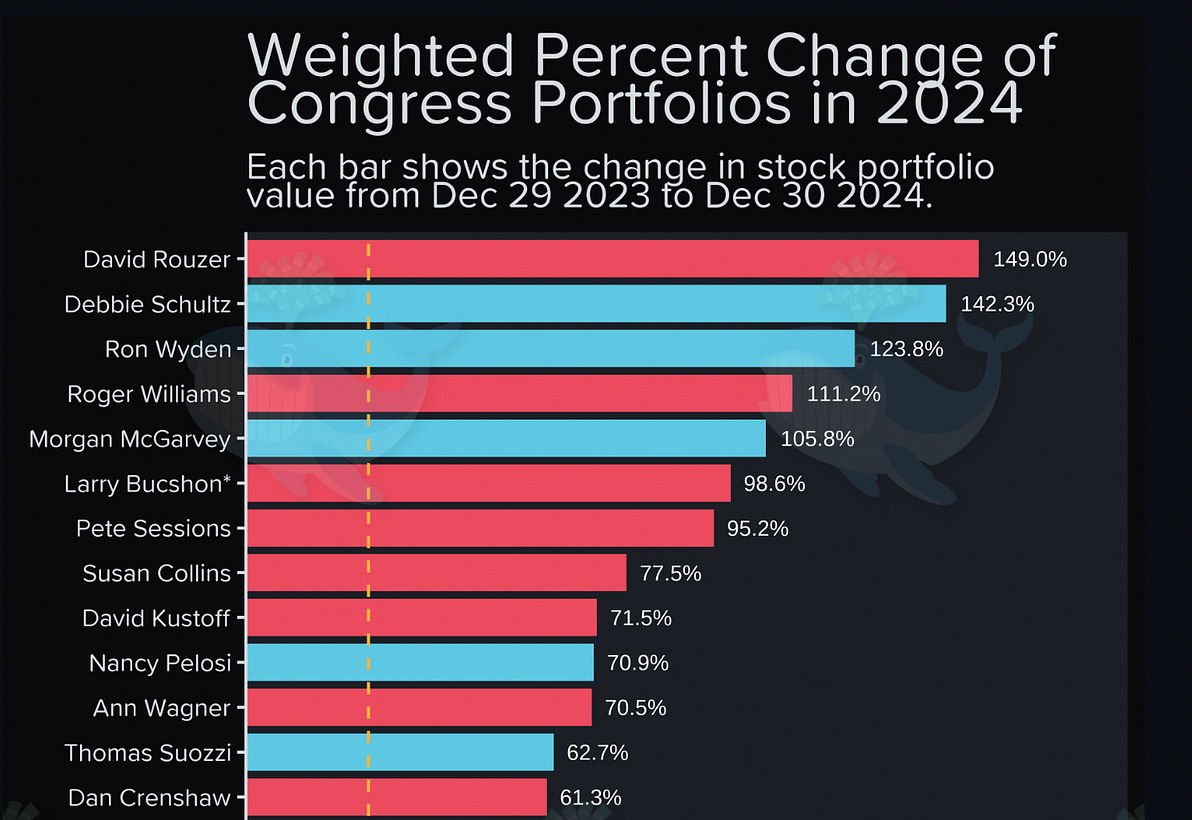 |
Not all the biggest winners trade actively. Congressman David Rouzer (R-NC) saw the largest increase (149%), but most of the gain was due to Nvidia, Mastercard, and Visa stock he bought years earlier. But others who saw significant gains, including Senator Ron Wyden (D-OR), Congresswoman Nancy Pelosi (D-CA), and Congressman Dan Crenshaw (R-TX) trade frequently.
Overall, both Democrats and Republicans saw gains that exceeded the return of the S&P 500 in 2024. On average, Democratic portfolios increased 31% and Republican portfolios increased 26.1%, while the S&P 500 increased 24.9%.
The members of Congress with the best stock performance generally invested in major tech stocks, which saw a sharp price increase in 2024. Throughout the year, Congress approved several bills, including a ban on TikTok and the CHIPs Act, that enhanced the value of those stocks. Congressman Michael McCaul (R-TX), the author of the bill to ban TikTok, owns hundreds of thousands of dollars of stock in Meta, one of TikTok's chief rivals. Senator Markwayne Mullin (R-OK) bought up to $50,000 worth of Meta stock last January before voting to ban TikTok in April.
Members of Congress are required to report only broad ranges for their stock purchases or sales (e.g., $1,000 to $15,000, $50,001 to $100,000). The law requires these reports to be filed within 45 days of a trade, although many members take much longer and pay a nominal fine or receive no punishment at all.
In August, Congresswoman Debbie Wasserman Schultz (D-FL) bought shares in Hecla Mining. The Unusual Whales report notes that Wasserman Schultz "sits on the Environment, Manufacturing, and Critical Minerals Sub Committee." Hecla Mining made appeals directly to the subcommittee and was mentioned in the subcommittee's minutes.
The situation is likely to get worse in the new Congress. Congress will consider a host of legislation that will directly impact stock prices, including a massive tax bill, tariffs, immigration restrictions, and budget cuts. Further, the House and Senate are closely divided, and, in most cases, one or two members will have the power to sink any bill. Members of Congress will not only have advance insight into the fate of legislative provisions that could give them an edge in the stock market but, in many cases, the power to demand the inclusion or exclusion of provisions that would benefit their existing holdings.
When pressed, members of Congress insist that their stock trades are unconnected to their day job. Pressed on his purchase of Meta stock during an appearance on CNBC last year, Mullin claimed that he did not know what stock he owned because it was handled by "third-party people." (It is unclear what this means, as Mullin has not placed his stock in a qualified blind trust, which would cede control of his stock holdings to a third party.)
There may be innocent explanations for many conveniently timed Congressional stock trades. But most trades are never explained. And relying on members of Congress to explain why a particular trade is not inappropriate misses the point of conflict of interest laws. The purpose is to avoid not just actual corruption but the perception of corruption.
To address both of these issues, there is renewed bipartisan interest in legislation banning members of Congress from trading individual stocks.
The push for reform
On January 9, a group of lawmakers introduced the Bipartisan Restoring Faith in Government Act, which would ban members of Congress, as well as their spouses and dependents, from owning or trading individual stocks. The legislation was introduced by Representatives Brian Fitzpatrick (R-PA), Alexandria Ocasio-Cortez (D-NY), Cory Mills (R-FL), and Raja Krishnamoorthi (D-IL).
The bill gives legislators 90 days after the law is passed to divest their investments. Lawmakers would also be required to get approval before placing investments into a qualified blind trust. The penalty for failing to comply with the law includes a fine of up to $50,000. Other similar bills have also been introduced in the House.
Last July, Senators Jeff Merkley (D-OR), Gary Peters (D-MI), Jon Ossoff (D-GA), and Josh Hawley (R-MO) also announced a new version of a bill, the Ending Trading and Holdings In Congressional Stocks (ETHICS) Act, that would ban Members of Congress, their spouses, dependent children, the president, and the vice president from trading and owning individual stocks and other investments.
The legislation would immediately prohibit lawmakers from buying individual stocks, and ban selling stocks after 90 days. Starting in 2027, lawmakers, spouses, and dependents would also be required to divest from individual assets. The legislation includes a penalty of a lawmakers’ monthly salary or “10 percent of the value of each covered investment that was not divested,” whichever is greater. The legislation was passed by the U.S. Senate Homeland Security and Governmental Affairs Committee last July, becoming the first legislation aimed at banning stock trading for members of Congress to pass a Senate committee.
But passing legislation banning lawmakers from participating in stock trading is still an uphill battle. According to Roll Call, “[a]t least a dozen” similar proposals have been introduced in the past few years, but have failed to gain the necessary traction.
Some members of Congress have openly opposed similar legislation. In November, Congressman Crenshaw was asked on a podcast with The Free Press if he supported a ban on members of Congress trading stocks. Crenshaw said it was “number 1,000 on my priority list of things to care about.” Crenshaw continued on to say, “So sure, why not? Don’t let us trade stocks. We’ll just keep whipping ourselves. How about we don’t make any money either? Let’s just cut our paycheck. We haven’t got a pay raise since 2008.” Crenshaw claimed he had “about $20,000” in the stock market, and denied having any meaningful non-public information, saying that people would be “more surprised by how little information we have.”
Other members of Congress, including Senator Tommy Tuberville (R-AL), opposed similar legislation banning lawmakers from trading stocks in 2022. At the time, Tuberville called it “ridiculous.” In a December 2024 interview with Alabama Daily News, Tuberville said he doesn’t “understand what’s the big deal” about members of Congress participating in stock trading, arguing that he doesn’t “get anything up here that gives me an opportunity to make money on stocks any more than anybody.”
Popular Information
---
an 12 23
in a September 2020 report, the House Transportation Committee found that Boeing and the Federal Aviation Administration (FAA) "played instrumental and causative roles" in two deadly plane crashes that, combined, killed 346 people altogether.
Before that, according to Daily Beast reporters Roger Sollenberger and Riley Rogerson, Rep. Mike Garcia (R-California) "sold up to $50,000 in" Boeing shares. That August 2020 sale, the journalists report in an article published on December 13, came "weeks before" the "damning results of" a congressional probe "into deadly crashes involving the company's 737 Max airliner" became public.
"But while other incumbent campaigns were dogged by blockbuster stock scandals that year," Sollenberger and Rogerson report, "the Garcia campaign never had to answer for this trade. That's because Garcia blew the mandated deadline to report the transaction, only filing the paperwork on November 23 — more than two months after the 45-day reporting window had closed."
The Beast reporters continue, "When he finally did disclose the sale, it was two weeks after the 2020 general election votes were cast, and three days after Garcia declared victory. He won by 333 votes."
In a once-red state that has become increasingly Democratic in recent decades, Garcia has defeated Democrat Christy Smith (who formerly served in the California State Assembly) three times — first in a special election in May 2020, then in the general elections of 2020 and 2022.
The Daily Beast interviewed some legal experts, who, according to Sollenberger and Rogerson, described the delay as an "egregious" ethics violation.
The Campaign Legal Center's Delaney Marsco told the Beast, "When members file late, this is the cost: It deprives voters of the information to assess it themselves."
READ MORE:Dems hit swing district House Republicans for supporting Mike Johnson’s far-right wish list
Citizens for Responsibility and Ethics in Washington (CREW) Communications Director Jordan Libowitz told the Beast that Garcia failed to report the trade "at a time when people would have been asking questions about it" — adding, "There’s a chance he's in Congress today because he hid this. And it raises the question of whether he's looking out for his constituents or is he just trying to enrich himself."
READ MORE:House Freedom Caucus blasts Mike Johnson’s spending plan: 'Not a single meaningful win'
*Read The Daily Beast's full report at this link (subscription required).
---
5 23
at least six more members of Congress have violated the STOCK Act by failing to disclose transactions — up to $376,280 collectively — within a 45-day federal deadline, according to Raw Story analysis of congressional financial documents.
The majority of the late disclosure dollars came from Rep. Jonathan Jackson (D-IL) who was late in disclosing up to $300,000 in stock transactions from a joint trust.
He is joined by five other lawmakers who were late in disclosing transactions in the $1,000-to-$15,000 range: Rep. Debbie Dingell (D-MI), Rep. Russ Fulcher (R-ID), Rep. Marcy Kaptur (D-OH), Rep. Deborah Ross (D-NC) and Rep. John Sarbanes (D-MD).
The lawmakers aren’t alone in violating the Stop Trading on Congressional Knowledge (STOCK) Act this week.
Rep. Zoe Lofgren (D-CA), who last year led Democratic House leadership’s self-aborted effort to ban congressional stock trading, violated the STOCK Act with up to $265,000 in late financial disclosures, Raw Story reported on Wednesday.
Raw Story also broke the news last week that Rep. Dan Bishop (R-NC) was late in disclosing up to $5 million in U.S. Treasury note purchases.
The ongoing violations come at a time when a bipartisan group of lawmakers have introduced several similar bills aimed at banning congressional stock trading.
4 22 no twt
He wants to strip the right to vote from residents of Washington, D.C. and thinks the undocumented should have no path to citizenship. He wants a constitutional amendment requiring the federal government to balance the budget every year but opposes taxing the rich more. He thinks Americans should have an absolute right to gun ownership, the Equal Rights Amendment should not be ratified, there should be no federal requirements to hire women or minorities, women should never be able to have an abortion, and child adoption agencies should be allowed to discriminate against LGBTQ people.
CRT? That’s short for “Communist Race Theory Rep. Pat Fallon is a**freshman Republican from Texas, and already he’s**under investigation by the House Ethics Committee< why?
Unreported stock trading.
And not just a few stock trades.
“Between January and April 2021, Fallon made more than 90 stock trades, which were worth a total of at least $7 million,” Forbes reported Wednesday. “The Stop Trading on Congressional Knowledge Act, or STOCK Act, requires representatives to report their securities transactions to the House Clerk’s office within 45 days. Fallon reported his 90-plus transactions in mid-June, meaning some trades were not disclosed until five months after they occurred.”[bloom raskin?]
A spokesperson for Fallon says he didn’t know he had to report the $7 million worth of trades.
He has, his office says, since filed all the paperwork and paid all the fines he owes,
Rep. Fallon is just the latest Republican this month to be under investigation by the House Ethics Committee.
Former Trump White House Physician, Rep. Ronny Jackson, also of Texas, and Rep. John Rutherford of Florida – who serves on the House Ethics Committee – are also under investigation, as is Democratic Rep. Thomas Suozzi of New York. Also in April, theCommittee announced it was closing its investigation into now-former Rep. Jeff Fortenberry, a Republican of Nebraska who resigned from Congress after being convicted of three felonies.
Rep. Fallon’s political positions via BillTrack50 and OnTheIssues.