tariff trade war
SEE TWO 8 26
primary 2 25
maybe belated, art'l of faith free mkt gop}:
SEE INFLATION
see navarro spinning madly 6 25
SEE BRIBE CORRUPT 3 COOK APPLE SWISS
SEE SCOTUS 2 26
SEE FAIL
SEE MFG
INGRAHAM
SEE CORRUPT 3 MUSK STARLINK
see kudlow NAVARRO FOX BS moore bad trinity ben stein award
see voodoo three
see outsourcing
see biz man great negotiator BS
see homeless cda lumber tax 7 25 mass deport labor
see reductionism, transaction, retaliation, sinophobe earth2
see family farm rural
BAK 11 25
---
-=-=
TRUMP SAID EXXON AND CHEVRON IN VENEZ?
9 26
President Donald Trump's ongoing trade war with Canada just took a major turn — and it was not in the president's interests.
"In Texas and New York, big oil and big money are placing their bets on the future of the energy industry," reported The Globe and Mail's Andrew Willis on Monday. "Major American oil companies and asset managers are lining up to invest in Canadian infrastructure. They seem to have missed U.S. President Donald Trump’s weekend Truth Social post declaring 'I don’t want Canadian anything.'"
Describing the companies in question as ExxonMobil Holdings Corp., ConocoPhillips, KKR & Co. Inc. and Apollo Global Management Inc., The Globe and Mail added that they are also steering clear of Venezuela, which Trump set his sights on earlier this year.
"The American economy runs on Canadian energy," Willis pointed out. "Last year, the U.S. imported $160-billion of oil, gas and electricity from its northern neighbour. Mr. Trump’s attempt to position Venezuela as a counter to Canada’s strongest suits is a bad bluff."
He continued, "The President’s anti-Canada policies are undermined by the actions of the largest U.S. oil companies and biggest asset managers. They are all investing in a robust long-term Canadian relationship. The larger lesson from Mr. Trump’s recent Truth Social postings on Venezuela and Canada is what they say about the President’s declining relevance."
This is not the first report to indicate that Trump's attempt to bully Canada into winning a trade war against the United States has spectacularly failed.
“As Carney prepared to walk away — a rare example of a foreign leader telling the president ‘enough’ — Trump was retreating on another trade front,” reported The Washington Post's David J. Lynch earlier in August. “On Friday, after insisting for more than a year that tariffs do not affect consumer prices, he lifted tariffs on beef imports, saying the move would lead to lower grocery prices.”
Lynch added, “The two developments, coupled with legal challenges to Trump’s tariffs, leave the president’s signature economic policy in a state of flux.”
Wendy Cutler, a former U.S. trade negotiator and currently senior vice president at the Asia Society Policy Institute, also told the Post that Trump's Canada trade war has reached “a juncture where other countries may be very closely watching how this plays out as they also are becoming increasingly frustrated with the demands the U.S. is placing on them in these largely one-sided trade agreements.”
Trump is also failing on the PR front in his trade war against Canada, most recently in trying to retaliate against Canada by renaming Lake Ontario as Lake America.
"Throughout his political career, Trump’s signature skill has been to drive the conversation where he wanted it to go. He declares victory when things have not been won," wrote Slate's Ben Jacobs on Monday. "He ducks attribution with the rhetorical tic 'many people are saying,' frequently followed by things that people are decidedly not saying. He posts outrageous graphics on social media. And, of course, he renames things: Political opponents get nicknames, buildings get Trump’s name, and bodies of water get America’s name."
Yet that has not worked with the Lake Ontario gambit, indicating that Trump's "superpower" with PR may be waning.
-=-=
-=-=
AN 8 26
TARIFF MIZZOU
At a time when the Republican Party is fighting for life under an unpopular president, an economic analysis reveals the red state of Missouri is looking at serious problems as President Donald Trump escalates his prolonged trade war between the U.S. and Canada, according to the Kansas City Star.
Trump may have tried to change the name of Lake Ontario to “Lake America” in his latest sleight to Canada, but there’s nothing symbolic about the impact of the 50 percent tariffs the Trump administration levied on $20 billion worth of Canadian goods. There’s also nothing symbolic about the pain of the retaliatory tariffs Canada plans to impose on roughly 700 American products beginning Sept. 8.
“The Kansas City metro area exports about $4 billion in goods to Canada annually, including vehicles, plastics, chemicals and agricultural products," according to a 2025 study by the Canadian Chamber of Commerce.
“Any variation in tariffs may be sensitive,” said Ariel Dvoskin, who studies trade theory and teaches economics at the University of Missouri Kansas City, “and the [50 percent] variation that we are talking about right now … would substantially affect the exports from KC.”
Dvoskin pointed out that a whopping 37 percent of Kansas City’s exported goods go to Canada, which puts this Trump-voting state in a nasty bullseye. “When you increase tariffs, of course, those who suffer first are workers because prices go up and their real wages go down," Dvoskin said.
The Canadian Chamber of Commerce study identified Kansas City as one of the U.S. cities that would take the hardest hit in a trade war between the North American allies, with Kansas City the third-most vulnerable city in a prolonged trade dispute because of its dependence on Canadian demand.
The info was based on 2023 data, but Andrew DiCapua, the chamber’s principal economist and the study’s author, told the Star that the results still apply today.
“Kansas City really is at the center of this trade war,” DiCapua said. “ … It raises costs for businesses. I mean, someone needs to pay for this. Even if it’s not passed on to consumers right away, someone still needs to pay for the tariffs. So smaller businesses that rely on these supply chains are going to have to eat those costs.”
Frank Lenk, director of economic research at the Mid-America Regional Council, told the Star that Kansas City’s auto industry is among the clearest targets because vehicles are one of the region’s largest exports and much of that trade is tied to Canada. Lenk added that Trump’s trade war can also hike manufacturing costs for companies like Ford and General Motors because parts and materials move back and forth across the border before final assembly.
They can either absorb those costs and threaten their financial integrity and workers or pass the costs down to customers in a colossal wallop.
-=-=
-=-=
AN 8 26
President Donald Trump's latest tariff "scams" are once again confirming his "disdain for his own voters," the Nobel Prize-winning economist Paul Krugman told The New Republic, showing how little regard he has for their intelligence.
Krugman appeared as a guest on the latest edition of the outlet's "Daily Blast" podcast, where host Greg Sargent pressed him about Trump's latest moves regarding tariffs, including the announcement that 300,000 metric tons of imported beef would be allowed into the U.S. without a tariff rate in order to combat soaring prices. He also claimed to have reached an agreement to sell the beef at 25 percent below the market rate to theoretically lower prices even more.
Krugman noted several issues with this plan, which he called "really weird" and "incoherent," including the fact that the White House would not confirm where the beef is being imported from. It is also unclear who the market rate discount has been negotiated with and how supermarkets are supposed to know which beef is the discounted import product.
Beyond those issues, Sargent also noted that the move seemed to be another tacit admission by Trump that his tariffs raise prices for U.S. consumers, despite his past insistence that the exporting countries pay the price for them. Krugman agreed, arguing that the move showed both the president's "contempt" for his supporters, as well as his own fundamental misunderstandings about tariffs.
"I mean, every bit of the policy from the beginning has been contempt—belief that people will not understand what I’m doing, which is helped by the fact that he himself doesn’t understand what he’s doing," Krugman said. "How can you say, 'foreigners pay the tariffs, and, by the way, I will help you by making them not pay the tariffs?' This does not sound to me like any kind of thought-out policy. This is thrashing. And I would ask, by the way — even if I don’t see how this actually helps consumers — but, you know, what is it, nine weeks till the midterms? The idea that this is going to change people’s views about Trump economic policy, aside from the fact that you’re going to have a few thousand really pissed-off beef producers — how does this even work politically?"
He continued: "He’s trying to claim that he’s doing something for consumers. And there’s a lot of hamburger-eating MAGA voters, who he hopes won’t remember that he’s talking out of two sides of his mouth on what tariffs do to prices. And then there’s also—he’s, I guess, taking for granted — I mean, this is not good for the farm sector, which is very, very Trumpy, or was — and he’s basically saying, 'you’ll vote for my people regardless.' And, you know, he might be right, but at this point I’m starting to wonder about that."
-=-=
an 8 26
A Connecticut manufacturing company that has operated for more than a century is finally closing its doors after being sent over the edge by President Donald Trump’s economic policies.
Its longtime owner cites “soaring business expenses and tariffs as key reasons for the decision,” reports NBC Connecticut.
“Leed-Himmel Industries, a custom aluminum manufacturing company based in Hamden, has been winding down operations after decades of serving customers,” NBC CT reports. “The closure did not come as a surprise to owner Howard Goldfarb.”
When NBC Connecticut visited the plant in 2024, Goldfarb was already warning reporters that rising expenses were biting an expanding hunk out of his business and putting pressure on it.
"It could get to the point where I just say, 'It's not worth doing anymore. All we're doing is working to pay the electrical bill,'" he told NBC Connecticut at the time.
Two years later, that prediction became reality, with Goldfarb declaring that costs had climbed too high as he walked through a largely empty factory floor.
"If our costs were where they were, say, eight years ago, I wouldn't have shut it down," Goldfarb told reporters.
Goldfarb’s factory was not only a stable source of jobs but also a considerable spring of revenue. The business paid about $160,000 annually in local property taxes. But Goldfarb said health insurance for workers kept rising, as did insurance for buildings, vehicles, and workers' compensation. The company's power bill topped $500,000 despite reduced operations
.
But Goldfarb said the final blow came from the White House.
"Tariffs was the final nail in the coffin, if you will," he said, adding that tariffs increased the cost of aluminum and other materials while forcing him to tie up more cash in inventory purchases before customers paid their invoices.
The Supreme Court has already rejected Trump’s tariffs, calling them illegal because they lacked congressional authorization. But the president has continued to levy them despite not receiving legislative approval.
“President Trump’s repeated attempts to impose tariffs have become an encapsulation of his second term,” wrote the Times Editorial Board. “They have hurt the American economy and his own popularity. They also range from legally dubious to blatantly illegal.”
Goldfarb had almost managed to salvage some jobs by selling the company to a European buyer, but he said the buyer backed out after Trump unilaterally declared war on Iran. He said he is still trying to find a buyer for the Hamden facility and hopes it will remain a manufacturing site rather than being converted to storage space.
-=-=-=
Trump’s manufacturing promise backfires: Data shows 75,000 lost jobs
AN
-=-=-=
MMA
Fox News barely covered latest waves of Trump tariffs
07/24/26
---
AN 5 26
Trump’s 'Golden Age' killed another American company's factory in a red state - Alternet.org
...
Costs from Trump's tariffs, Iran war fallout, and benefit cuts amount to much more than the roughly $350 average Americans reportedly receive from his signature legislation
Written by Zachary Pleat
Published 04/16/26 mma
Fox News and Fox Business personalities were hyping the supposed benefits of President Donald Trump's signature 2025 legislation known as the One Big Beautiful Bill Act on Tax Day, in part by pointing to Americans’ higher average tax refunds compared to the previous year. But the average tax refund increased by roughly $350, according to the most recent IRS data, a sum dwarfed by the additional costs imposed on Americans from Trump’s tariffs, increased gasoline prices stemming from his unauthorized Iran war, and cuts in government benefits that were also included in the OBBBA.
Fox celebrated Trump’s tax cut legislation on Tax Day
- Fox News senior national correspondent Kevin Corke on the Trump administration’s Tax Day messaging: “Show me the money.” Fox News, *Fox News @ Night*, [4/15/26]
- Fox Business host Larry Kudlow: “Today is April 15, Tax Day, and it should be a day of celebration. Nearly all taxpayers, because of President Trump’s One Big Beautiful Bill … are going to get a direct cut.” Kudlow claimed the tax legislation is “going to boost take-home pay probably about $1,400 per person” — roughly four times what the IRS says is the average increase in tax refunds so far. Fox Business, *Kudlow*, [4/15/26]
- Kudlow: “Look, the Republicans have cut taxes in the One Big Beautiful Bill. The numbers are stark on this, particularly for middle income, working folks, you know, overtime, and tips, and seniors. It's all good.” Fox Business, *The Big Money Show*, [4/15/26]
- Fox senior White House correspondent Peter Doocy: The Trump administration is going to send out people “to let everybody know that it is the Trump administration's support of the One Big Beautiful Bill that has these no tax on tips, no tax on overtimes provisions that have put more money into people's pockets.” Fox News, *America Reports*, [4/15/26]
- Fox anchor Bill Hemmer cited a Treasury Department release to rattle off statistics from this year’s tax deductions, concluding: “This is real money now, especially for middle-class Americans.” Fox Business host Stuart Varney added: “Thousands of dollars have been put into their bank accounts. That means real money.” Fox Business, *Varney & Co.*, [4/15/26]
- Fox anchor Dana Perino: “It’s a happier Tax Day than last year for many people, and that’s because the Big Beautiful Bill is giving people … on average about $350 more in a return than you got the year before.” Fox News, *America’s Newsroom*, [4/15/26]
- Fox & Friendsco-host Brian Kilmeade: “It is Tax Day, and there are some new signs about how Americans are doing this year. The IRS says refunds are trending much higher, with the White House and Republicans crediting the One Big Beautiful Bill.” During the segment, a displayed graphic pointed to an 11% increase in the average tax refund. Fox News, *Fox & Friends*, [4/15/26]
- Fox & Friends Firstco-host Todd Piro: “We went into this tax season thinking because of the One Big Beautiful Bill, that tax refunds this year were going to be enormous.” Fox News, *Fox & Friends First*, [4/15/26]
- ## But Trump’s policies cost Americans far more than any extra refunds they may receive from his tax cuts
- Reuters: “What the Trump tax breaks giveth, the gasoline pump taketh away.” Reuters reported that increased prices at the gasoline pump are “eat[ing] most of the larger tax refunds that people are seeing from new tax breaks on tips, Social Security retirement payments, overtime pay, car loan interest and state and local tax bills that were part of last year's Republican-backed tax-cut legislation.” Reuters further reported: “Economists at the Stanford Institute for Economic Policy Research estimate that war-driven price spikes have pushed up Americans' average annual gasoline costs for this year by $857.” Reuters reported that multiple independent estimates of tax refund increases are higher than the roughly $350 average reported so far, ranging from $560 to $646, but the projected increase in Americans’ gasoline costs alone exceeds all but the Trump administration’s own comparably generous estimate of $1,000 in increased tax savings. Reuters, [4/10/26]
- According to Democrats on the Joint Economic Committee, by the time the Supreme Court struck down Trump’s global tariffs, Americans had paid “an average of roughly $1,745 per family” in tariff-related costs. Joint Economic Committee, [2/20/26]
- Yale’s Budget Lab: Trump’s newly imposed Section 122 tariffs will cost “between about $650 and $780 for the average household” if temporary, or “if they are instead made permanent … the household loss figures would be between $1,130 and $1,340.” Yale’s Budget Lab, [4/2/26]
- An Institute on Taxation and Economic Policy analysis shows that even before Trump’s Iran war spiked fuel prices, “taking all the policies of President Trump and the Republican majority in Congress into account, all but the richest Americans are paying higher taxes on average in 2026 than they did last year.” These policies include “dramatically increased tariffs,” “the termination of the Enhanced Premium Tax Credit” for enrollees in the Affordable Care Act marketplace, and “the so-called One Big Beautiful Bill Act (OBBBA), which overwhelmingly benefits the rich and corporations” and includes drastic cuts to Medicaid. ITEP summarized: “The combined impact of these policies in 2026 is a tax increase for the average American in all income groups except the richest 5 percent.” Institute on Taxation and Economic Policy, [2/23/26]
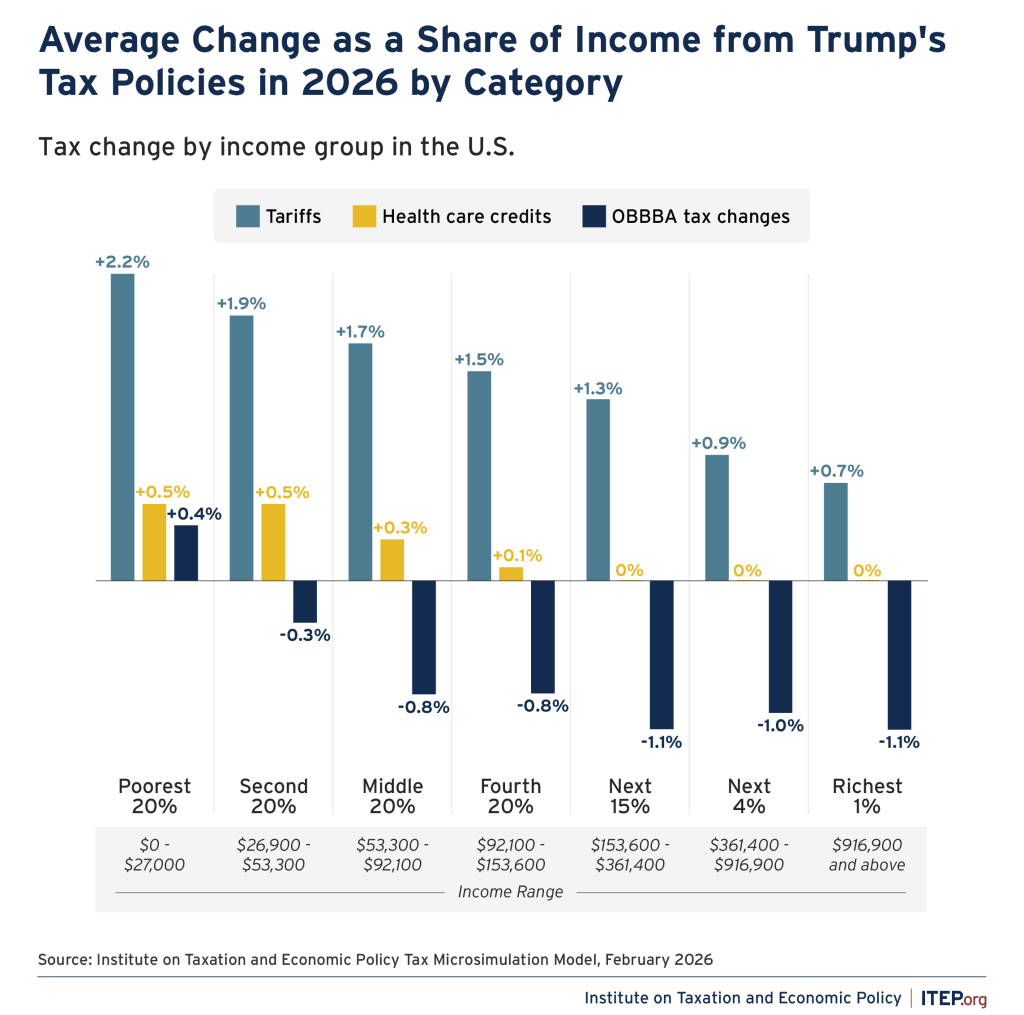
- ITEP: “President Trump and Republicans describe OBBBA’s tax breaks for tips, overtime, car loan interest, and seniors as boons for the middle-class but these parts of OBBBA combined only make up about a tenth of its net tax cuts in 2026.” Institute on Taxation and Economic Policy, [2/23/26]
// mma
:{04/08/26
:{03/06/26
05/21/25
---
MMA
03/06/26
CANTOR FITZGERALD LUTNICK SEEK TO PROFIT ON REFUNDS, BET? 2 26/26
---
MMA
Fox & Friends really does not want viewers to understand that Trump’s tariffs are taxes paid by Americans
Donald Trump illegally raised your taxes. Fox would rather not talk about it.
Written by Craig Harrington
Published 02/25/26
For the second time in a week, a Fox News personality went to bat to protect President Donald Trump from the fallout of the Supreme Court overturning his unpopular tariff policies, falsely reassuring viewers that they are not paying for Trump’s import tax scheme.
During two February 25 segments of Fox & Friends, co-host Lawrence Jones responded to criticism of Trump’s tariff policies by repeatedly (and falsely) telling viewers that the president’s critics were lying when saying his tariffs had cost American families money over the past year. His comments followed a segment last week wherein Fox host Harris Faulkner had wondered aloud whether foreign countries would seek refunds for tariffs they paid to the U.S. — before she was informed that tariffs are taxes paid by American consumers, not foreign exporters.
During today’s Fox & Friends segment, the hosts aired a portion of newly inaugurated Virginia Gov. Abigail Spanberger’s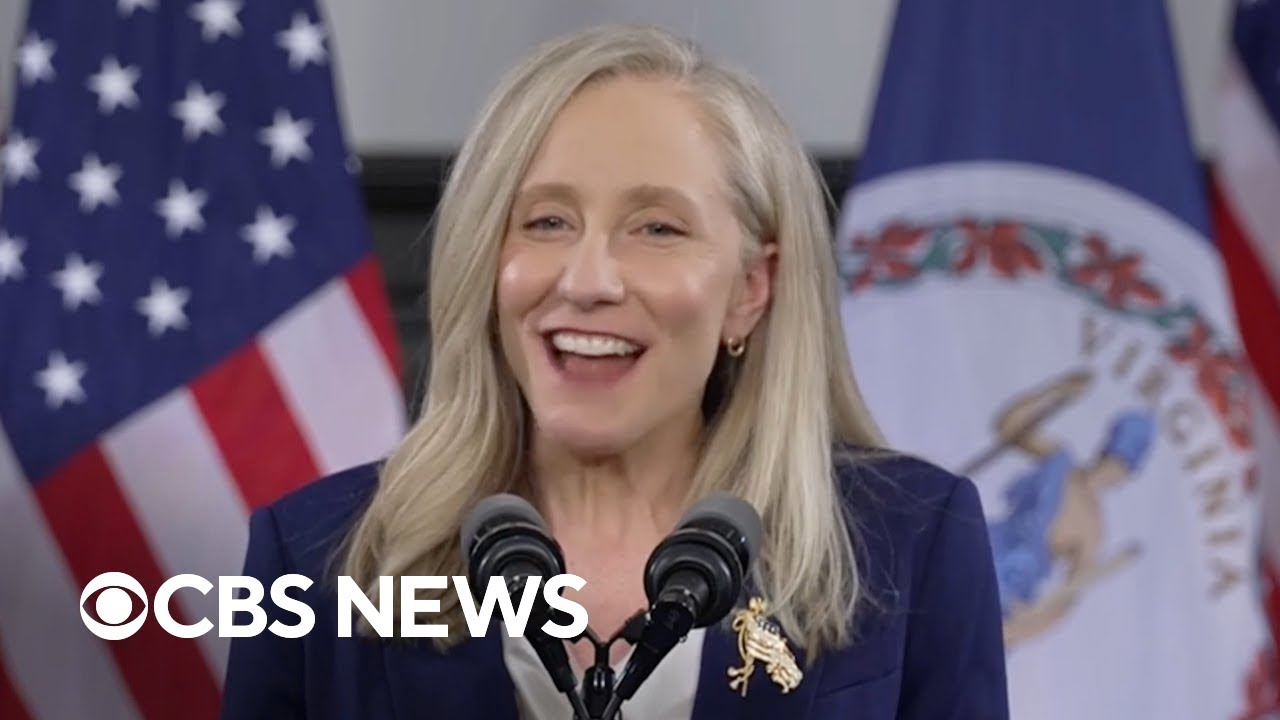 to Trump’s State of the Union speech where she said that “everyday Americans are paying the price” of Trump’s tariffs and described his latest tariff proposal “another massive tax hike on you and your family.” Jones scolded Spanberger: “Just to be clear, what she said is 100% false,” claiming that “there has been zero inflation based on the tariffs” and that “you cannot say that it caused inflation on the American people.”
Video
Citation
From the February 25, 2026, edition of Fox News' Fox & Friends
Later, Jones returned to the topic during a segment with pollsters Kellyanne Conway and Mark Penn, discussing a portion of Spanberger’s rebuttal when the governor noted that Trump’s “reckless trade policies have forced American families to pay more than $1,700 each in tariff costs.” Jones responded that Spanberger's statement was “not true” and again added that tariffs had not been inflationary. Conway was even more direct, simply claiming, “Those are lies.”
Jones wrapped up his performative outrage by acting aghast that Spanberger would claim tariffs cost American families money. “To say it was inflationary, that it's costing you more money, the data doesn't support that, yet she told the people that,” he said.
Video
Citation
From the February 25, 2026, edition of Fox NewsFox & Friends
Americans are absolutely paying the cost of Trump’s tariffs.
As economists and experts have repeatedly explained, foreign countries do not pay tariffs. Tariffs are import taxes paid by American consumers.
Trump massively increased tariff receipts compared to 2024, raising a record-breaking amount of tariff revenue in his first year in office. The money had to come from somewhere.
And last November, The Budget Lab at Yale estimated that Trump's tariff policies had at that point cost the average American family roughly $1,700. An analysis by the Joint Economic Committee's minority staff released just last week estimated that “American consumers overall paid more than $231 billion in tariff costs between February 2025 and January 2026, an average of roughly $1,745 per family.”
Far from misleading viewers with her speech, Spanberger actually did Trump a favor by rounding the cost of his tariffs down.
And this isn’t just a question about whether or not tariffs are generally inflationary (they are) or whether Trump’s tariffs have shown up in consumer prices (they have). This is about real costs that have been passed along to actual Americans as a result of Donald Trump illegally raising their taxes.
//
02/20/26 4:46 PM EST
10/17/25 3:58 PM EDT
07/15/25 2:19 PM EDT
11/14/25 12:02 PM EST
10/07/25 10:04 AM EDT
08/12/25
---
Some Trump apologists struggle to comprehend that Americans are the ones paying Trump’s tariffs
Tariffs are import taxes. The Supreme Court just ruled that Trump does not have the power to levy taxes without approval from Congress.
Written by Craig Harrington
Published 02/20/26
After the Supreme Court announced February 20 it was striking down President Donald Trump’s sweeping global tariff regime, audiences could see in real-time as some right-wing personalities struggled with the basic fact that tariffs are import taxes paid by Americans. Trump himself has also repeatedly and falsely claimed that tariffs are paid by foreign countries and companies for the privilege of entering the U.S. market.
On Friday, the Supreme Court issued a 6-3 decision nullifying a large part of Trump’s tariff policy agenda, finding that he had exceeded his authority by imposing tariffs on dozens of countries around the world. In its ruling, the Supreme Court made clear that “the power to impose tariffs is ‘very clear[ly] ... a branch of the taxing power’” and that Trump had far overstepped his legal authority under the International Emergency Economic Powers Act by imposing these taxes without prior authorization from Congress.
The fact that tariffs are taxes has been clear to most observers since Trump unveiled his full agenda during a so-called "Liberation Day" celebration last April, with at least one scholar describing his plan at the time as “the largest peacetime tax increase in American history.” Nonetheless, some of Trump’s fiercest sycophants just learned the lesson today.
When discussing the Supreme Court’s decision on Megyn Kelly’s podcast, the Federalist Society's Will Chamberlain noted that per the ruling, “everybody who paid a tariff is probably entitled to a refund.”
Kelly asked in response, “So are we going to get sued by other countries? Is that who's going to sue us, saying, ‘I want a refund of all the tariffs I paid to the United States’?”
Chamberlain simply responded, “No. It's going to be the actual people who paid the tariffs, and, remember, that’s United States citizens and importers.”
Megyn Kelly on Supreme Court decision: "So are we going to get sued by other countries?"
February 20, 2026
Audio
Citation
From the February 20, 2026, edition of SiriusXM's The Megyn Kelly Show
On her midday program, Fox's Harris Faulkner was met with a similar realization while attempting to dissect the Supreme Court decision with Fox News legal editor Kerri Urbahn and entrepreneur Marcus Lemonis.
Faulkner attempted to wrap up the segment by asking, “If some of these countries want money back, what does that look like?”
Lemonis responded, “It’s not even some of these countries — it’s some of our own companies in our own country that are going to want some money back. And so you have importers and retailers here in this country, they’re going to be looking for money back.”
Video file
Video
Citation
From the February 20, 2026, edition of Fox News' The Faulkner Focus
Harris Faulkner and Megyn Kelly might have learned these basics about what tariffs are and who pays them sooner if they'd listened to one of the many experts explaining how tariffs work — or even Ben Shapiro.
---
AN 2 26
President Donald Trump is crossing “a dangerous line” by attacking the Supreme Court for overturning his controversial tariffs, according to America’s most distinguished organization of lawyers.
“The recent remarks by the president of the United States, leveling personal criticisms against members of the U.S. Supreme Court, are not acceptable and cross a dangerous line that threatens the safety of the judiciary and our judicial process,” declared American Bar Association (ABA) President Michelle A. Behnke in a statement.
“Vigorous debate over policy is a strength of our democracy, but attacks that demean the judiciary are not,” Behnke added. “Incendiary rhetoric has helped contribute to the alarming increase in attacks on and threats to our judges. It must stop.”
The ABA head is referring to Trump’s criticism of the six Supreme Court justices who ruled against his emergency tariff authority, including two jurists — Justices Neil Gorsuch and Amy Coney Barrett — that Trump himself appointed. Deriding them as “fools and lapdogs for the RINOs and the radical left Democrats,” Trump said Gorsuch and Barrett are “an embarrassment to their families. You want to know the truth, the two of them.” He also said the liberal justices were loyal to the Democrats, which he admired, but added that he believes they are a “disgrace to our nation.” The president also claimed those judges were motivated by foreign powers, although did not provide evidence for this assertion.
“Personal attacks against individual justices, particularly allegations that they are influenced by ‘foreign interests,’ are wholly inappropriate,” Behnke criticized Trump in that statement. “Such statements risk undermining the rule of law and the public’s faith in an impartial judiciary, foundational pillars of our democracy that have guided our nation since its founding.”
She added, “The men and women of the Supreme Court, regardless of who appointed them, deserve respect for exercising their duty to interpret the Constitution faithfully and independently. The health of our constitutional system depends on maintaining that independence, free from political intimidation or retribution.”
Perhaps anticipating Trump’s lashing out, Gorsuch explained in his opinion that the president’s seeming desire to bypass the legislature to more effectively achieve his policy goals is dangerous to the American system of government.
“Yes, legislating can be hard and take time,” Gorsuch said. “And yes, it can be tempting to bypass Congress when some pressing problem arises. But the deliberative nature of the legislative process was the whole point of its design. Through that process, the nation can tap the combined wisdom of the people’s elected representatives, not just that of one faction or man.”
In addition to the ABA, one of the most prominent Republicans currently holding elected office also criticized Trump for his words about the Supreme Court. Former Sen. Majority Leader Mitch McConnell (R-Kentucky), who told Trump in a statement that "Congress is not an inconvenience to avoid." The conservative publication The Wall Street Journal similarly argued that Trump’s language was “ugly,” adding that “this is the same Court that ruled Mr. Trump’s way on presidential immunity, which was more personally consequential for this President.”
---
---
RWW
02/20/2026
- After the Supreme Court struck down the tariffs imposed by President Donald Trump, MAGA cultist Shane Vaughn
desperately tried to frame the decision as a win for Trump.}:
by
- Lawrence Hurley @ NBC News: Supreme Court strikes down most of Trump's tariffs in a major blow to the president
The decision does not affect all of Trump's tariffs but invalidates those implemented using an emergency law.
- Kathryn Wilkens @ Mediaite: ‘Absolutely Ashamed!’ Trump Comes Out Guns Blazing After SCOTUS Tariff Decision
On Friday, during an appearance before the press at the White House, President Donald Trump spoke on the Supreme Court’s decision to strike down his sweeping tariffs, saying that he was “absolutely ashamed” of the justices responsible for it.
- Tyler Pager and Tony Romm @ The New York Times: Trump Plans to Impose Tariffs a Different Way After Supreme Court Loss
The administration has been preparing for months for the possibility that the court would rule against the president and developed contingency plans.
- Tamilore Oshikanlu @ The Daily Beast: MAGA Architects Hire Gay Porn Star for Education Role
Heritage Foundation leaders praised Corey DeAngelis’ hiring despite a public past in the porn industry.
- Nikki McCann Ramírez @ Rolling Stone: Trump Is Hijacking Billions in Taxpayer Money for His Made-Up ‘Peace’ Group
The president banged a golden gavel to “Y.M.C.A.” at the coalition's first official meeting.
- Tad DeHaven @ Vox: Trump’s dream is a giant slush fund Congress can’t touch
From Venezuelan oil to the Board of Peace, Trump is constantly looking for new sources of cash he can control.
- Steve Benen @ The Maddow Blog: Chavez-DeRemer faces back-to-back scandals, putting her future at Labor Dept. in doubt
The secretary was already facing calls for her resignation. Recent allegations likely make her political standing even shakier.
---
MMA
02/20/26
02/20/26
---
---
2 26 KRUGMAN HASSET
thug shd be disciplined
acad econ suppress?! hasset
---
---
an 2 26
Trump’s trade official doesn’t believe the poor are paying the costs of his policies - Alternet.org greer
Jamieson Greer appears to have convinced President Donald Trump that trade deficits were evil and that the U.S. was somehow losing money to countries like Indonesia and China because they don't buy enough American goods.
Just six days into the new administration, Trump wanted to blow up U.S. trade policy and make Greer his U.S. trade representative.
A New York Times profile on him quotes the trade rep. gushing over Trump and the way in which he's "restructured global trade."
After a year of making "deals" with countries, it's unclear how exactly they're supposed to work. Some countries have simply given up shipping to the U.S. because they can't figure out how to navigate a system that hasn't been put in place, only celebrated in press releases.
"Manufacturing employs less than 10 percent of Americans, and the number of factory workers has been dwindling. While some manufacturers support protectionism, others say it raises their costs and makes U.S. industry less competitive. Consumers are also concerned about tariffs increasing prices, and polls show Mr. Trump losing support for his handling of the economy," the Times said.
Trade deficits occur when the U.S. exports goods to a country like China, but China exports more to the U.S. People in China don't have the same level of income as those in the U.S., so U.S. goods that tend to be more expensive aren't as desirable. Whereas China makes incredibly cheap goods, paying manufacturing employees pennies in salary, while U.S. consumers relish in the cheap items they can buy.
The chaos of the U.S., the trade war and ongoing internet battles with foreign leaders have destroyed international trade relationships between U.S. farmers and ranchers and other countries. Soybean farmers, for example, had strong trade relationships with China until Trump imposed massive tariffs, prompting China to retaliate with its own. They stopped importing soy beans from the U.S., costing about $12 billion. Trump promised a bailout, but farmers said they haven't seen a dimeof it. Now Brazil and Argentina are getting all of the profits that American farmers once had.
It came at the same time that Trump decided to send China a $40 billion bailout to Argentina. Trump also announced last week that the U.S. would quadruple its purchases of beef from Argentina. It will drive down beef costs for ranchers in the U.S.
As one farmer complained, Trump messed up the soybean trade for U.S. Farmers and then handed a bailout to their new competitors.
With trade at times based on the erratic whims of Trump's mood, Greer is somehow seen as the "source of stability," said the Times. The U.S. Supreme Court may be stepping in to stop all of it, however, when it rules on whether the president has the authority to make trade laws unilaterally without Congressional approval.
TheTimesprofile goes through Greer's time in the Air Force, his Mormon mission in Belgium and graduation from Brigham Young University.
The profile closed by saying that Greer's latest task is trying "to mitigate what he views as unnecessary pain from tariffs." Indeed, goods and food have significantly increased since the trade war began, and industries are struggling because they too must suffer the high costs created by the White House.
Greer is considering possible "exemptions," and Trump has championed bailouts. However, both maintain that the tariffs are helping the limping economy.
"Mr. Trump, too, seems as insistent about tariffs as ever, and as impulsive in their use. Last month, he threatened tariffs against European nations unless Denmark gave him Greenland. The Europeans responded by angrily pausing work on their trade deal, which Mr. Greer and his deputies had spent many months negotiating. Mr. Greer urged them to 'compartmentalize' the issue," said the Times.
Greer dismisses any implication that poorer Americans are being burdened by the trade war. He thinks that the foreign supply chains are paying the costs. Economists disagree.
---
AN 1 26
Kicking off what is expected to be a weekly campaign-style tour of the nation to promote his agenda ahead of the November midterms, President Donald Trump engaged in what CNN fact-checker Daniel Dale described as an “alternative reality” of “piling lie upon lie” for his Iowa audience.
“You know, inflation we’ve solved; it’s done,” Trump told Fox News during the trip to Iowa. “We have it good where prices are coming way down. They were just saying, in Iowa the fuel is $1.95. Did you hear that? Somebody said $1.85. But it was $3.50, $4.50 just a year ago, a year and a half ago. You look at eggs, you look at groceries, it’s all down. Everything’s come down. Do you notice they don’t mention affordability anymore?”
According to Dale, it’s “true” that egg prices have fallen significantly, but the “rest of his narrative was thoroughly inaccurate.”
He continued his fact check: “Inflation is not over; prices continue to rise. Overall prices have gone up, not down. Overall grocery prices have gone up, not down. Iowa’s average gas price is much higher than $1.95. And Democrats have certainly not stopped mentioning affordability; in fact, it remains a key focus of their public remarks.”
Dale apparently wasn’t the only one fact-checking gas prices.
“In an unusual moment,” he writes, “Trump was fact-checked on this subject by an attendee at his Iowa speech on Tuesday. When he of gas in Iowa being $1.95 or $1.85 per gallon, someone in the crowd shouted, ‘No, $2.63,’ according to CNN’s Steve Contorno, who was on scene.”
According to Dale, “Overall consumer prices have increased during this presidential term; in December 2025, seasonally adjusted overall prices were 2.2% higher than they were in January 2025, and, again, 2.7% higher than they were in December 2024.”
He also noted that “It’s not true that ‘you look at groceries, it’s all down.’ In fact, the 0.7% increase in the Consumer Price Index for groceries between November 2025 and December 2025 was the biggest month-to-month jump reported in more than three years.”
And he added, “Iowa gas prices are generally much higher than Trump said.”
---
---
AN 1 26
Trump blames welfare fraud investigation for 'violent' protests in Minnesota
---
2X SAME DAY ADMIN WORDS BITE ASS
AN 1 26
This week, the U.S. Supreme Court is expected to respond to President Donald Trump's claimthat a national emergency justified his drastic tariff moves. However, the Constitution allocates tariff-regulation power to Congress, not the presidency.
The New Republic's Greg Sargent spoke with MS NOW's Steve Benen on Monday morning, noting that Trump’s own words may be the strongest case against his tariff powers. The two analysts argued that Trump has repeatedly blown up the legal and political rationale for his trade war in public statements.
During a morning podcast "The Daily Blast,"Sargent and Benen dissected Trump’s recent threats to increase tariffs on parts of Europe not because of some economic reason but because the countries sent military to aid in the defense of Greenland from the U.S.
Trump keeps publicly admitting that his “emergencies” are more whims and leverage plays. Trump threatened tariffs on Brazil for multiple reasons and also claimed that France rejected his Gaza 'Board of Peace.'
Trump boasted that he raised tariffs from 30 to 39 percent after a call with Swiss President Karin Keller-Sutter “rubbed [him] the wrong way,” then lowered them after being courted by industry executives who brought him a Rolex and a personalized gold bar.
The two incidents make it clear that there isn't an "emergency" necessitating a tariff, but that Trump is using them for his own personal gain, the men agreed.
Benen argued that these anecdotes from the president undermine the administration’s legal claim that Trump is using emergency powers under the 1977 law to address a genuine economic emergency, namely trade deficits.
He continued, saying that Trump is "so far gone, is so wrapped up in his own delusion that he forgets he’s supposed to maintain the emergency pretense." Trump then ends up “confessing in public that the entire rationale for his policy is a sham.”
The trade deficits that Trump claimed are an emergency, Benen said, are not inherently harmful.
He explained, “You and I have trade deficits with our grocery store,” and they have been shrinking, not exploding into crisis. The Constitution vests tariff power in Congress, through Article I, not to the presidency. It's the main reason most legal scholars and experts think Trump is likely to lose at the Supreme Court if the justices follow the statute and the Constitution. In fact, one of Trump's own officials thinks the policy might fall at the high court.
The two men go on to skewer House Speaker Mike Johnson, who praised Trump’s supposed “Article II” tariff power, which simply doesn’t exist. Tariff authority sits in Article I, Benen told Sargent, making Johnson’s hands-off posture “completely antithetical” to the system he claims to revere.
Meanwhile, Republicans who privately dislike tariffs are allowing Trump to proceed unilaterally, even though it is "pushing prices up and that it’s becoming a drag on the economy."
Sargent agreed, saying, "It’s very, very clear that affordability is an enormous issue in these elections." Those high costs are hammering voters and it could cost the GOP the House, and possibly the Senate, in 2026.
If the Supreme Court upholds Trump’s approach despite his public admissions, Benen said, it would mark “a breakdown of American governance at crisis levels,” normalizing an enormous abuse of power with no institutional check.
---
rww 1 26
- Zachary Leeman @ Mediaite: Trump Threatens Tariffs Against Countries That Don’t Support Greenland Takeover
President Donald Trump threatened to use tariffs to force support for the annexation of Greenland, which he maintains is critical for the United States’ “national security.”
---
AN 12 26
ANOTHER BIG BAILOUT? 12 25
Trump plots $12 billion farmer bailout following 'fallout' from 'far-reaching tariffs'
Calls to mental health hotlines rise as farmers buckle under stress
---
12/04/25 3:24 PM EST
:{12/04/25
mma
Fox falsely credits Trump tariffs for creating factory jobs first announced during the Biden administration
Written by Zachary Pleat
Published 12/04/25
A Fox News segment celebrated a Trump administration tariff on imported kitchen cabinets and credited it for creating 400 jobs at a factory in Alabama, even though the plant’s construction was actually announced in 2022 during the Biden administration. The segment also downplayed the tariff’s likelihood of increasing housing costs, which the network recently bemoaned, as inflation for kitchen furnishings is already nearly twice as high as the overall inflation rate.
Video
Citation
From the December 4, 2025, edition of Fox News' America's Newsroom
The new factory, which a Fox graphic showed is owned by Wellborn Cabinet, was first announced — along with its estimate of creating 415 jobs — in August 2022 during the Biden administration. Fox crediting Trump’s tariff policies for a supposedly new plant that was announced well before his second term began echoes a pattern from the first Trump administration of media outlets erroneously granting Trump credit for business decisions that he had little or nothing to do with.
Fox also downplayed the effect of Trump’s tariff on imported kitchen cabinets on increased housing costs, even though just weeks ago Fox was expressing concern over the high cost of housing and embracing dubious Trump policies to address those costs. Some of those policies, experts said, were likely to make housing even more expensive. Fox had also recently praised Trump for lowering his own tariffs in an effort to address the higher prices that they contributed to.
The most recent Consumer Price Index report shows that the inflation rate for living room, kitchen, and dining room furniture for the past year stood at 5.9%, nearly double the overall inflation rate of 3% for the past year.
And as Fox is celebrating the addition of 400 jobs making kitchen cabinets — which, again, were announced more than three years ago and were not created due to Trump’s tariff — other companies that install cabinets into homes said that the price hike from the tariff may cost them business. This was a major consequence experienced during the first Trump administration, during which Trump’s 25% tariff on steel imports led to a job gain of 1,000 in the steel production industry, but a 75,000 job loss in the overall manufacturing industry that consumed steel.
---
MMA
Fox Business guest calls for tariffs of 10 to 12%: “Everyone sort of pays a little bit more”
12/02/25
AN TD 11 25
My fellow Americans, this is Liberation Day … April 2, 2025, will forever be remembered as the day American industry was reborn.*
— President Donald John Trump
*This story originally appeared at TruthDig.
Donald Trump’s “Liberation Day” tariffs offer the Supreme Court a chance to turn the tables on an authoritarian president and claim a liberation day of its own. To strike down the tariffs, however, the court will have to use its favorite analytical tools — the conservative legal doctrines of originalism and textualism — to produce a liberal decision.
[
:{](https://youtu.be/9GVnXh4QG1k) in a televised Rose Garden ceremony before the iconic outdoor space was hideously remodeled as a concrete courtyard.
On Nov. 5, the Supreme Court heard oral arguments on the legality of the levies by way of a pair of consolidated lawsuits (Learning Resources Inc. v. Trump and Trump v. V.O.S. Selections) initiated by two groups of small businesses that claimed the tariffs placed crippling new taxes on them. In a hearing that lasted 2 hours and 40 minutes, the justices showed little deference to the administration’s defenses, whether originalist or textual, signaling they may finally be ready to regain a small but much-needed measure of judicial independence.}:
Since the appointment of John Roberts as chief justice in 2005, the court has deployed originalism and textualism to move aggressively rightward. When necessary to shield Trump from legal accountability, the court’s Republican supermajority has been willing to twist the doctrines almost beyond recognition, most notably in its July 2024 decision on presidential immunity, which had no basis in either the text or history of the Constitution. The court has also dramatically expanded its emergency “shadow docket” to greenlight significant parts of Trump’s political and economic agenda, lifting lower-court injunctions that had placed temporary holds on the mass firings of civil servants, the defunding of scientific research and racial profiling in immigration sweeps, to cite just a few examples.
But the Liberation Day tariffs may prove a bridge too far, even for the Roberts court. Styled as “reciprocal” measures designed to redress long-standing international trade imbalances, the tariffs imposed duties on imports from virtually every country in the world, ranging from a baseline of 10% to as high as 50% for Lesotho. Yes, Lesotho. Other nations receiving rates in the upper tiers included China, Vietnam, Taiwan, Thailand and Madagascar.
The Liberation Day tariffs may prove a bridge too far, even for the Roberts court.
In the aggregate, according to many economists, the new tariff rates exceeded those imposed by the disastrous Smoot-Hawley Act of 1930, which helped trigger and prolong the Great Depression. Since April, the rates have fluctuated wildly, depending on Trump’s mood swings and which countries have curried his favor with obsequious flattery and/or outright gifts (here’s looking at you, Switzerland and South Korea).
Trump has long been fixated on tariffs, touting them as magical cures for the nation’s budgetary woes. In his first term, he placed tariffs on steel, aluminum, solar panels and washing machine imports, and a host of other products made in China. Although the tariffs did little good for the economy and precipitated a trade war with China, they were authorized by a series of statutes passed by Congress since 1917 that delegated tariff-setting powers to the president, but which came with strict procedural, substantive and time limits on how those powers could be exercised.
During the 2024 presidential campaign, Trump repeatedly extolled the virtues of Gilded Age President William McKinley for his use of tariffs as a key driver of federal revenue before the ratification of the income tax with the 16th Amendment. If reelected, Trump promised to follow McKinley’s example. On April 2, he made good on the pledge.
In a sharp departure from the first-term levies, the April 2 tariffs were based on a complex and lengthy federal statute enacted in 1977 — the International Emergency Economic Powers Act (IEEPA), which permits the president to regulate international commerce after declaring an emergency under the National Emergencies Act. Trump had threatened to use IEEPA for tariffs in his first term, but wound up using it, as former presidents had, to impose sanctions on foreign countries and dignitaries who had incurred his displeasure, such as the leaders of the International Criminal Court, whose U.S. visas Trump suspended in September 2020.
It’s easy to understand IEEPA’s appeal for Trump and his advisers. Unlike other tariff-related statutes, IEEPA sanctions have no time limits. They can also be unlimited in scope, and require only a presidential emergency proclamation to trigger.
In keeping with IEEPA, Trump in the Rose Garden declared the country’s trade imbalances to be a national emergency and a threat to U.S. economic sovereignty, exclaiming, “For decades, our country has been looted, pillaged, raped and plundered by nations near and far, both friend and foe alike. But it’s not going to happen anymore.”
The new tariffs were off and running, except for two problems: First, Article I, Section 8 of the Constitution vests the power to tax in Congress, not the president. And second, while IEEPA gives the president the power to “investigate, block … regulate … nullify, void, prevent or prohibit” imports or exports concerning designated countries in a declared emergency, the words “tariff” and “tax” nowhere appear in the law.
These problems were front and center in the Nov. 5 oral arguments. From the outset, it was clear that Trump’s motor-mouthed solicitor general, D. John Sauer, was in deep trouble.
Sauer’s first task was to convince the court that the IEEPA tariffs were regulations, not taxes, and that any revenues they raised were incidental to the president’s powers under Article II of the Constitution to direct foreign policy. The contention seemingly convinced no one.
Justice Sonia Sotomayor was quick to point out the obvious. “This [Trump’s tariff regime] is a tax,” she remarked. “I just don’t understand your argument. You want to say tariffs are not taxes, but that’s exactly what they are. They’re generating money from American citizens, revenue.”
“Tariffs are taxes. They take dollars from Americans’ pockets and deposit them in the U.S. Treasury.”
Even the usually cards-to-the-vest chief justice joined in, observing that the tariffs constitute “the imposition of taxes on Americans, and that has always been the core power of Congress,” implying that allowing the administration to use IEEPA would violate the separation of powers, the very essence of the founder’s constitutional design.
Sauer did his best to parry the court’s skepticism, stammering and talking over the justices, “It [the tariff package] is a — it is a — if I may, it’s a foreign-facing regulation of foreign commerce.” He also argued unpersuasively that the tariffs did not run afoul of either the “major questions” or “nondelegation” doctrines that the Roberts court had used to scuttle Biden administration initiatives on student loans, environmental protection and COVID vaccine mandates in the absence of highly specific congressional delegations of authority.
By the time Georgetown University Law Center professor Neil Katyaltook his place at the lectern representing one group of plaintiffs, the case was all but over. “Tariffs are taxes,” Katyal told the court. “They take dollars from Americans’ pockets and deposit them in the U.S. Treasury. Our founders gave that taxing power to Congress alone. Yet, here, the president bypassed Congress and imposed one of the largest tax increases in our lifetimes.”
Katyal had originalism, textualism and the facts on his side. Tariffs are, in fact, taxes paid directly by importers or on their behalf by businesses operating as their agents directly to Customs and Border Patrol, which in turn passes the collected funds to the Treasury. Importers can either absorb the tariffs or raise domestic prices, adding to inflation.
In posts on Truth Social, Trump has boasted his tariffs will bring in “trillions of dollars” to the Treasury. He has also claimed the country will face economic disaster if the Supreme Court rules against him.
Despite the direction of the oral arguments on Nov. 5, it is possible that the Roberts court will find a way to rescue the president and uphold the sweeping IEEPA tariffs, or preserve at least some of them under other statutory authorities. This is, after all, a deeply compromised court that has shown in the past it is more committed to sustaining Republican power than it is to its own declared principles. In the meantime, we can hope, at least this one time, for liberation.
---
---
AN 11 25
When Sen. Bob Menendez (D-N.J.) had his home raided over an alleged bribery scheme, investigators found gold bars. Now, a gold bar has been handed to President Donald Trump by Swiss billionaires visiting the White House. Not long after, tariffs on Switzerland were cut.
The engraved gold bar, coupled with a $130,000 Rolex desk clock, may not be the reason Trump “decided to slash 39 percent tariffs on Swiss imports to 15 percent,” but it is raising questions.
The Guardian reported Friday that Pasquale Tridico, an Italian MEP, was “disgusted” by the move.
“This is really awful,” he said. It seems to be a case of “making foreign policy the policy of individuals."
Swiss Green Party president, Lisa Mazzone, called out "the Swiss elite" for being "poisoned" by Trump's "corrupt logic."
“It is unacceptable that the federal council is relying on the help of an economic elite that represents private interests and lacks democratic legitimacy in its negotiations with the US president,” she added.
None of the items were reported until “internet sleuths” began tracing the origins of the new clock on Trump’s Oval Office desk, the report said. They pored over photos and ultimately found the one showing seven Swiss billionaires.
The billionaires called it “a modest, refined expression of traditional Swiss watchmaking," said The Guardian.
“Trump loves being fawned over by billionaires. It’s terrible that one has to shower the US president with gold to get Switzerland back on his agenda," deputy editor-in-chief of CH Media, Doris Kleck, told radio station "bz Basel."
The White House claimed that the gold bar and Rolex had nothing to do with the tariff cuts. Instead, Trump's staff said that the deal came about after the Swiss pledged “$200 billion to make and hire in America."
Under U.S. rules, such gifts become the property of the government and are placed in the National Archives unless the president buys them or has them displayed in a museum or presidential library.
---
trump tariffs CDA bc gipper rr comml in baseball game
I ASSUME
AN 11 25
Trump cut US 'expansion by a third or more' in quagmire even the 'Supreme Court can’t undo'
CONTEXT
3X JOB WHAMMY, DOGE CUTS, SHUTDN, TECH CUTS AI 11 25
AN 11 25
'Really hurting': US job cuts surge to decades-high level amid Trump recession fears
//
AN 11 25 LAT
Los Angeles Times Pulitzer Prize-winning business journalist Michael Hiltzik writes that President Donald Trump has reversed the trend of President Joe Biden's booming economy and it's only getting worse.
Tuesday night's election boon for The Democrats, Hiltzik writes, only proves his point.
"The lesson delivered by the results is that Americans sense that the economy is reeling," he writes. "Most economic indicators are flashing yellow or even red."
Polls also point to Trump's abysmal economy, he notes, adding, "the indicators of economic pain are all around us. Every one of the leading opinion polls taken since Oct. 1 has shown Donald Trump’s approval rating on the economy to be deeply underwater, with the average calculated by RealClearPolling at negative 13.4 points."
Inflation, he writes, is "unmistakably on the rise again," as the consumer price index rose to 3.0 percent in September from a low of 2.3 percent in April, according to the Bureau of Labor Statistics.
An increase in food prices — up from 2.1 percent in May to 3.1 percent — "has potent political implications, since food is an expense experienced by consumers on almost a daily basis," Hiltzik says.
Job growth has also ebbed, he says, with monthly job creation "fading since Trump took office, with the figures turning negative in June, August and September," he writes.
Farm bankruptcies are rising, too. "Prices of such key crops as corn, wheat and soybeans have been falling as Trump’s trade war shrinks foreign demand for American produce," Hiltzik says.
Consumer spending is also down in "a serious slowdown from the 3.7 percent and 4.0 percent growth rates in the third and fourth quarter of last year, before Trump took office, Fitch Ratings calculated in September," he explains.
As the historic government shutdown continues, "headwinds threaten to keep building" against the economy, one which was thriving under Biden, he says.
"It’s proper to note that the economy Trump inherited from Biden was strong and getting stronger," Hilzik says.
”In truth, Biden inherited an unemployment rate of 6.8 percent from Trump’s first term, and bequeathed second-term Trump a rate of 4.1 percent, the lowest rate since the election of George W. Bush. Annual job growth fell to negative 6 percent during Trump’s first term, and Biden brought it up to an average of 1.4 percent."
Under Biden, "real gross domestic product growth per capita had fallen to an annualized rate of negative 1.8 percent under Trump 1.0; Biden brought it up to positive 2.1 percent," he notes.
Trump 2.0 also inherited an excellent employment to population ratio for workers 24 to 54 years old.
"When Biden took over, it was 76.2 percent, rising to to 80.5 percent when he ceded the White House to Trump — the highest handover value since 2000, according to the labor-affiliated Economic Policy Institute."
Conservatives "viewed Trump’s impending second term with a certain level of trepidation," Hilzik notes, saying some expected “the actual policies [would have been] less severe than suggested by Trump’s blustery campaign platform.”
They were more severe, he writes.
"The strongest headwind against growth is the uncertainty that Trump has imposed on the economy," he says.
About 71 percent of CEOs polled by Yale said that Trump's tariffs"were harming their business, 62 percent said the tariffs weren’t prompting them to invest more domestically and 59 percent said they expected no results from domestic investment as a result of the tariffs."
Despite the White House insisting the economy is strong, Hilzik says "the signs are that the near future, at least, will be economically bleaker than the present," and that "the one unmistakable positive sign in the economic landscape —a stock market reaching record highs — may be less encouraging than it appears on the surface."
Those highs, he says, are gains concentrated "among seven stocks associated with spending on artificial intelligence, and whether they can be sustained is an open question."
Trump's economic future looks bleak, Hilzik says, with no economic development "visible on the horizon that might relieve consumers of the feeling that they’re paying more for necessities and that their very livelihoods are under threat."
Tuesday's election sounded the alarm bells, Hilzik writes, but he's not sure the White House is listening.
"What Tuesday’s election results show is that consumers are voters. A rational administration would take that as a warning siren and reconsider its policies. This administration? Who knows?" he says.
---
SCOTUS
AN 11 25
SAUER FLAILS?
Wednesday, November 5 was an important day for the U.S. Supreme Court, whose justices listened to oral arguments in Learning Resources v. Trump.The nine justices are examining President Donald Trump's ability to unilaterally impose, by executive order, steep new tariffs invoking a Jimmy Carter-era law: the International Emergency Economic Powers Act of 1977 (IEEPA).
The legal analyst Lisa Rubin weighed in on the hearing — and she thought that conservative Justice Amy Coney Barrett was especially tough when questioning Trump's allies.
Conservative host Joe Scarborough noted that when Solicitor General John Sauer gave evasive answers to Barrett's questions, liberal Justice Sonia Sotomayor jumped in and chastised him for it.
Scarborough told Rubin and "Morning Joe" co-host Mika Brzezinski, "I got to say, Lisa, that the most remarkable part of that hearing was when Amy Coney Barrett had the solicitor general on the line, and he kept trying to pull away — and she kept reeling him in, and he kept trying to pull away. He kept pulling away. She just — she was tenacious. And finally, Justice Sotomayor, I think, in an act of mercy, said: Just answer her question. You're not answering her question. We all know you can't answer her question. Just admit it, basically, is what Justice Sotomayor was saying."
Rubin agreed with Scarborough's analysis, emphasizing that Barrett was tenacious in her questioning of Sauer.
"Pity the person who comes on the other side of Amy Coney Barrett, who is precise, pragmatic and the mother of seven children," Rubin told Scarborough and Brzezinski. "So, if anybody is well prepared for that kind of questioning, I would venture a guess, it's Amy Coney Barrett. And you're right to say that she was completely fixated on the plain text of the statute. The argument that the (Trump) administration is relying upon is that the words 'regulate importation' somehow include the power to impose tariffs."
Rubin continued, "But of course, not only is the word tariff not present ... there is nothing in the string of verbs there, as Justice (Elena) Kagan mentioned, that gets to where John Sauer, the solicitor general, wants to see the argument go. There's nothing in all of the things that the president can do under this Emergency Powers Act that has anything to do with raising revenue, much less imposing taxes or duties. And that's where you get to the question of the larger constitutional issues about whose responsibilities really are these?"
---
AN 11 25
Wednesday's Supreme Court "showdown" over President Donald Trump's tarriffs is putting America's highest court in a major bind, Politico reports.
Trump is asking the justices to overturn lower-court decisions that declared many of his tariffs "an illegal overreach" as they found that a 1977 law, the International Emergency Economic Powers Act, did not authorize the president to impose such broad tariffs.
“Nowhere does it say tariffs, taxes, duties,” noted Elizabeth Goitein, who studies emergency powers at New York University’s Brennan Center.
This showdown, Politico says, is an "epic clash between two of the most deeply ingrained tenets of the conservative legal movement."
One of those tenets, Politico explains, "is that presidents need and are entitled to extreme deference on matters of national security and foreign policy," suggesting that "the six conservative justices may be willing to uphold Trump’s unprecedented move to bypass Congress and unilaterally impose sweeping global tariffs."
Chief Justice Roberts, however, has made a name for himself opposing "government meddling in the free market," they explain, which "could prompt the court’s conservatives to view Trump’s tariffs more skeptically than they view many of his other, non-economic policies."
Jonathan Adler, a professor at William and Mary Law School, says that the justices are going to be conflicted.
“I think that some of the justices that matter are going to feel a bit torn,” he said. “What’s interesting here is that this case requires some of the conservative justices to confront a conflict between different strands of their own jurisprudence.”
The court, Politico explains, must differentiate between whether the tariffs are just part of the president's economic policy or a "core part" of his management of national security and international relations.
“How this case comes out will depend in large part on what the frame or the lens on it is,” said Vikram Amar, a law professor at the University of California at Davis. “Is this a case about unbridled, unauthorized — at least not explicitly authorized — broad executive authority, or is this a case about presidential ability to discharge foreign affairs and national security responsibilities?”
These questions, Politico says, is "most acute" for Justice Brett Kavanaugh, who is "the high court’s most outspoken voice for the president’s need for flexibility and dexterity in response to international challenges. But he is also highly skeptical of government power in the economic realm."
"If an agency wants to exercise expansive regulatory authority over some major social or economic activity … an ambiguous grant of statutory authority is not enough,” Kavanaugh wrote in a nod to his "fealty" to the conservative theory known as the “major questions doctrine."
That doctrine says that "courts should block executive branch actions of widespread impact when their legal basis is ambiguous," Politico explains.
“Congress must clearly authorize an agency to take such a major regulatory action," Kavanaugh added.
Experts see Kavanaugh "likely to lean towards blessing the tariffs," Politico says, while "Justices Clarence Thomas, Samuel Alito and Neil Gorsuch are thought by court watchers to be even more likely to uphold the tariffs."
Roberts and Justice Amy Coney Barrett are the ones to watch, they say.
“The center of the court is going to be especially interesting to watch,” Roman Martinez, a former law clerk to Kavanaugh and Roberts, said about them during a discussion at Georgetown Law.
“I think this case will probably split the conservatives,” said Cary Coglianese, a University of Pennsylvania law school professor who specializes in administrative law and regulatory processes.
Whatever they rule, Politico writes, the conservative justices will likely emerge unscathed.
"While a ruling against the tariffs would surely infuriate Trump, it wouldn’t do much if anything to hurt the conservative justices’ standing in their legal, political and social circles," they note.
Goitein disagrees, saying, "This will be a true test of the Supreme Court in many, many ways."
---
===
an 10 25
The New York Times highlighted the stories of Iowan farmers who are hit hard by the administration's economic agenda.
Larry Ory, an 86-year-old farmer from Earlham, Iowa, expressed disbelief upon hearing of a $20 billion U.S. bailout to Argentina, especially as Argentine soybeans began shipping to China — a market that had been vital for Iowa's soybean exports.
China halted U.S. soybean purchases following Trump's trade war, leaving American farmers without their largest customer.
The report noted that the economic strain is evident across Iowa. The state's GDP fell by 6.1 percent in the first quarter of 2025, the steepest decline after neighboring Nebraska.
Manufacturers face rising production costs due to tariffs on aluminum and steel, while meatpacking plants, which rely heavily on foreign-born workers, have been affected by changes in immigration policies. The wind energy industry, which supplies over half of Iowa's electricity, is under threat due to federal policies.
Summer Ory, who works on the family farm, likened the situation to "death by a thousand paper cuts," highlighting the cumulative impact of various economic challenges. Despite these hardships, some farmers remain hopeful.
Doug Keller, a 63-year-old farmer near Waterloo, expressed optimism that a new trade deal with China could eventually benefit farmers.
However, the growing discontent is palpable.
Josh Turek, a Democratic state representative running for the U.S. Senate seat held by retiring Rep. Joni Ernst (R-Iowa), noted, "People are hurting everywhere in Iowa, and they’re looking for something different."
With key elections approaching, the impact of federal policies on Iowa's economy is expected to be a central issue.
---
---
AN AH 10 25
In the United States' last three presidential elections, Donald Trump had a clear advantage in rural areas. But Trump's steep new tariffs are creating a great deal of hardship for many of the farmers who voted for him, and farmers are hoping that a bailout will enable them to make ends meet.
The New York Times' Michael Grunwald, in an op-ed published on October 21, points to the difficulties farmers are facing as an example of a pattern with Trump — who, according to Grunwald, creates a crisis, then proposes a solution at taxpayers' expense.
"Once again, President Trump says he's preparing an emergency bailout for struggling farmers," Grunwald explains. "And once again, it's because of an emergency he created. China has stopped buying U.S. soybeans to protest Mr. Trump's tariffs on imports. In response, Mr. Trump plans to send billions of dollars of tariff revenue to U.S. soybean farmers who no longer have buyers for their crops. At the same time, Argentina has taken advantage of Mr. Trump's tariffs to sell more of its own soybeans to China — yet Mr. Trump is planning to bail out Argentina, too."
Grunwald continues, "This may seem nonsensical, especially since Mr. Trump already shoveled at least $28 billion to farmers hurt by his first trade war in 2018. But it actually makes perfect sense. It's what happens when Mr. Trump's zero-sum philosophy of trade — which is that there are always winners and losers, and he should get to choose the winners — collides with Washington's sycophantic approach to agriculture, which ensures that farmers always win and taxpayers always lose. In the end, Mr. Trump's allies, including President Javier Milei of Argentina and the politically influential agricultural community, will get paid — and you will pay. I didn't say it was good. I just said it makes sense."
Trump's view of economics, Grunwald notes, is outlined in his 1987 book "The Art of the Deal."
"The most important thing to know about the former real estate developer and casino operator in the White House is that he doesn't believe in mutually beneficial transactions," the Times journalist observes. "The central theme of his book, 'The Art of the Deal,' is that every deal has a winner and a sucker. On trade, Mr. Trump sees America as a perennial sucker, and he vows to make it win so much that you'll get tired of winning."
Trump's protectionist approach to trade, according to Grunwald, is "lousy policy for America" but "works nicely for Mr. Trump, because it gives him enormous power to reward or punish specific companies or industries."
"We do not live in a zero-sum world," Grunwald argues. "The nice thing about free markets and free trade is that voluntary transactions between individuals or nations really can make both sides better off. Or we can keep paying farmers to farm soybeans, pay them more to convert some of those soybeans into wildly inefficient fuels, pay them even more when they can't sell their soybeans because we're in a trade war with their customers — and then pay extra to bail out one of the countries replacing them in the marketplace. That only makes sense in Mr. Trump's Washington."
---
an 10 25
New research from investment bank Goldman Sachs affirms, as progressive advocates and economists warned, that US consumers are bearing the brunt of President Donald Trump’s trade wars.
As reported by Bloombergon Monday, economists at Goldman released an analysis this week estimating that US consumers are shouldering up to 55% of the costs stemming from Trump’s tariffs, even though the president has repeatedly made false claims that the tariffs on imports exclusively tax foreigners.
Goldman’s research also found that US businesses will pay 22% of the cost of the tariffs, while foreign exporters will pay just 18% of the cost. Additionally, Goldman economists estimate that Trump’s tariffs “have raised core personal consumption expenditure prices by 0.44% so far this year, and will push up the closely watched inflation reading to 3% by December,” according to Bloomberg.
Despite all evidence that US consumers are shouldering the costs of the tariffs, the Trump administration has continued to insist that they are exclusively being paid by foreign countries.
During a segment on NBC‘s “Meet the Press” last month, host Kristen Welker cited an earlier Goldman estimate that 86% of the president’s tariffs were being paid by US businesses and consumers, and then asked US Treasury Secretary Scott Bessent if he accepted that the tariffs were taxes on Americans.
“No, I don’t,” Bessent replied.
As Common Dreams reported in August, executives such as Walmart CEO Doug McMillon have explicitly told shareholders that while they are able to absorb the cost of tariffs, Trump’s policy would still “result in higher prices” for customers.
Goldman’s report comes as Trump is piling up even more tariffs on imported goods that will ultimately be paid by US consumers as companies raise prices.
According to The New York Times, tariffs on a wide range of products including lumber, furniture, and kitchen cabinets went into effect on Tuesday, and the Trump administration has also “started imposing fees on Chinese-owned ships docking in American ports.”
The administration has claimed that the tariffs on lumber are necessary for national security purposes, although some experts are scoffing at this rationale.
Scott Lincicome, vice president of general economics at libertarian think tank the Cato Institute, told the Times that the administration’s justification for the lumber tariffs are “absurd.”
“If war broke out tomorrow, there would be zero concern about American ’dependence’ on foreign lumber or furniture, and domestic sources would be quickly and easily acquired,” he said.
---
AN 10 25
Conservative economist and Independent Institute senior fellow Phillip W. Magness slammed the irony of President Donald Trump promising a Great Depression while advocating for one of the Great Depression’s chief causes.
If the courts neuter Trump’s unilateral tariffs on U.S. trading partners, the president is already considering an alternative method to keep the tariffs underway.
“One alternative the administration apparently is considering turning to is the discredited and effectively repealed Smoot-Hawley Tariff Act, which turned an economic downturn into a decade-long catastrophe,” said Magness.
Magness said Treasury Secretary Scott Bessent admitted Trump’s ‘Plan B’ involves resurrecting his tariff agenda with an obscure clause of this 95-year-old law known as Section 338.
“Section 338 did not work as intended, as Smoot-Hawley triggered a catastrophic global trade war that brought international commerce to a halt, destroyed the U.S. export market, and thrust us deeper into the Great Depression,” said Magness.”
The stock market collapsed in 1929, heralding the beginning of the depression. But Magness said it became “Great” thanks to three “interventionist” blunders, one of which included the protectionist Smoot-Hawley Tariff Act of 1930, designed as a relief measure intended to “insulate American producers from turmoil on international markets and ‘stimulate’ them with the benefit of tariff protection.”
Instead, the Act triggered what Magness called a “lobbyist-driven free-for-all” as industries “clamored for favorable rates and special interest groups bribed their way onto the tariff schedule.”
“Our major trading partners retaliated by targeting American exports, which included the already beleaguered agricultural sector. U.S. exports dropped by 61 percent between 1930 and 1933, showing what economists had long predicted: attempts to insulate the country from foreign import competition affect the entire economy and ultimately hurt domestic industries as well,” Magness said.
Congress soon realized its error and passed the Reciprocal Trade Agreements Act, which authorized the panicking president to lower tariff rates by up to 50 percent by negotiating reciprocal concessions from other countries.
“The American economy is already slowing, warned Magness, “and our allies are deepening their commercial relationships with our enemies.”
“Until the Trump administration’s novel legal theories came along, Section 338 was long considered a dead letter — buried in shame with the rest of Smoot-Hawley’s economic legacy,” said Magness. “… One might have hoped that Smoot-Hawley’s inauspicious history would preclude the White House from turning to it, but apparently that’s not the case.”
---
an 9 25 random rg
US President Donald Trump is on a losing streak this week. Just look at the latest judicial decisions challenging his policies, from mass deportations to tariffs to his troop deployments to US cities.
The courts are proving to be a significant check on Trump’s thirst for absolute power.
These cases illustrate the point:
Immigration
Over Labor Day weekend, Immigration and Customs Enforcement attempted to begin deporting up to 700 unaccompanied Guatemalan children. In the dead of night, the first children were loaded onto planes in south Texas. “These are unaccompanied children who do not have a parent or a guardian with them,” Efrén Olivares, an attorney representing the minors, said on the *Democracy Now!*news hour.
At 1:00 am on Sunday morning, Olivares and his colleagues filed an emergency complaint with the federal court in Washington, DC. Judge Sparkle Sooknanam was woken after 2:00 am, and by 4:00 am she issued a temporary restraining order blocking the deportations until the children had the immigration hearings to which they have a legal right.
Meanwhile in Texas, the 5th Circuit Court of Appeals, considered the nation’s most conservative, ruled that Trump’s use of the 1798 Alien Enemies Act to deport people was illegal.
Tariffs
The Appeals Court in Washington DC ruled that Trump’s so-called “Liberation Day” tariffs were illegal and unconstitutional, noting that only Congress has the power to impose tariffs. The ruling was “a sweeping decision that unequivocally rebukes President Trump’s idea that he can impose tariffs on American consumers on his own,” Neal Katyal, the attorney who argued the case, said on *Democracy Now!*
Domestic Deployment of the Military
Trump says, “We’re going in,” threatening to invade Chicago using, among other forces, the Texas National Guard.
But in California, a federal judge, invoking the 1878 Posse Comitatus Act that bars the use of military in domestic law enforcement, ruled in favor of Gov. Gavin Newsom, finding Trump’s deployment of the California National Guard to the streets of Los Angeles, along with several hundred US Marines, was illegal. Judge Charles Breyer, the brother of retired US Supreme Court Justice Stephen Breyer, issued an injunction barring the Trump administration from “deploying, ordering, instructing, training, or using the National Guard currently deployed in California, and any military troops [from] engaging in arrests, apprehensions, searches, seizures, security patrols, traffic control, crowd control, riot control, evidence collection, interrogation, or acting as informants.”
These are just a few of the recent court cases that have rebuked Trump as he attempts to subvert the US Constitution.
We recently got a personal glimpse into what judicial wins over Trump look like. In the high mountain air of Telluride, Colorado, we had a chance to spend time with E. Jean Carroll, the renowned advice columnist and journalist. She was at the Telluride Film Festival for the premier of the new documentary, Ask E. Jean.
Carroll had a long and storied career as the advice columnist forElle Magazine, and has published several books. In recent years she became known as one of the most prominent women to accuse Donald Trump of sexual abuse, saying he raped her in the dressing room of the Bergdorf Goodman department store in the mid-1990s, in Manhattan.
The courts are playing a central role in opposing the lawless Trump administration, but the core of the resistance are people.
Carroll sued Trump in civil court, and a jury found him guilty of sexually abusing her. Judge Lewis Kaplan wrote, “Trump did in fact ‘rape’ Ms. Carroll as that term commonly is used and understood.” She was awarded a $5 million settlement from Trump. After the verdict, he called her a liar. She then sued for defamation, and won an additional jury award of $83.3 million.
Carroll cut an elegant figure, walking along Telluride’s main avenue with the sweeping Continental Divide as a backdrop. Her film premiered to rave reviews, and, should there remain a film distributor in this country not cowed by threats of lawsuits from Trump, it should be available for viewing by a wide audience. The film highlights the story of one courageous woman refusing to be defined as a victim of Donald Trump, providing inspiration, no doubt, to the hundreds of survivors of Trump’s old friend, the now-dead sexual predator Jeffrey Epstein. Many of them spoke this week outside the US Capitol, demanding the full release of the Epstein files. The Trump administration, which controls the files, is resisting.
Behind each lawsuit are impacted people, whether immigrant children pulled from their beds in the middle of the night and thrown on planes, or people standing up in the streets of LA confronting illegally deployed troops, whether sexual abuse survivors banding together, or federal workers fired en masse.
The courts are playing a central role in opposing the lawless Trump administration, but the core of the resistance are people–people at every level organized in opposition, defending democracy.
NOW READ:Trump's horrific cult contains the seeds of its own destruction
---
---
TARIFFS --> MOODY RATING
AN 5 25
'A lot of uncertainty': How Trump is aggravating a troubled housing market
---
AN 8? 25
Disappointing and devastating': Steel manufacturer fires workers and blames Trump tariffs
mma
09/18/25
MMA
On Squawk Box, CBO director discusses how tariffs are “slowing down the economy”
09/15/25
an 8 25
New Republic reporter Timothy Noah said seven out of the ten top donors to the presidential race last year gave to Trump — and now their favored president is turning on them
“… The White House keep[ing] scorecards measuring the loyalty of 553 corporations to President Donald Trump’s Big Beautiful reconciliation bill demonstrates that the relationship between private wealth and this presidential administration isn’t as happy as you might think,” said Noah.
Trump is certainly making corporations happy by “chucking health care for the poor so it can cut taxes for the rich,” said Noah, and he’s also “dismantling regulatory agencies created to check corporate power.” Trump lowering taxes and deregulation “are what oligarchs desire more than anything else,” Noah adds, which is why “people like Elon Musk, Timothy Mellon, and Miriam Adelson supported Trump in 2024.”
READ MORE: 'Complete 180' and 'hot mic moment': Brutal CNN supercut reveals how Trump got played by Putin
However, “Trump’s pathological attachment to high tariffs, his never-ending threats to destabilize the Federal Reserve, and, increasingly, his demands that corporations bend the knee are all more than these plutocrats likely bargained for,” Noah said.
Even as Trump dismantles regulatory agencies legitimately created by Congress, he is introducing a new, “more chaotic regulatory regime dictated by his own whims,” said Noah. “Trump appears intent on ripping up business regulations" and “replacing them with himself.”
Consider the president allowing chip-maker Nvidia to sell AI chips to China. Trump had previously blocked those sales on national security grounds, but Noah said Trump changed his mind and allowed sales, providing Nvidia turned over 15 percent of the resultant revenues to the United States Treasury.
The Constitution does not grant a president the right to demand Invidia surrender a portion of its revenues from Chinese sales to the U.S. Treasury, said Noah, “Nor does the Constitution encourage a president to tell Goldman Sachs to fire its chief economistor Intel to fire its chief executive."
READ MORE: buckle up: Former Trump attorney Alina Habba may be in office for awhile
And then there’s the issue of Trump approving the merger of Nippon and U.S. Steel — provided the federal government retain a “golden share” that allows it to veto certain future actions affecting workers. Language in that agreement refers unnecessarily to Trump by name,which strikes Noah as “unsettlingly authoritarian.”
And now comes the news that Trump has loyalty “scorecards” on corporations that rank their support as “strong, moderate, or low” based on whether and how they supported passage of the Big Beautiful Bill through “social media posts, press releases, video testimonials, ads, [or] attendance at White House events.” The most obedient companies, said Noah, appear to be AT&T, Airlines for America, Cisco, Delta, DoorDash, the Steel Manufacturers Association, Uber and United.
“[I]f history is any guide, businesses don’t fight fascist corporatism; they just grope their way toward accommodating it,” writes Noah. “That’s certainly what we’re seeing thus far. Even when Trump bullies American oligarchs, they can’t see their way to judging him anything other than their guy.”
Read the full New Republic report at this link.
---
an 8 25
Peter Navarro, President Donald Trump’s top trade official and the architect of his massively unpopular trade war and sweeping tariff plans, admits that the majority of economists do not agree with the administration’s stance that tariffs are actually “tax cuts.”
Tariffs are taxes paid by importers on goods and services as they enter the country, and those costs often make their way to consumers through higher prices. While some businesses initially absorbed the added expense when President Trump’s tariffs began, July’s wholesale prices jumped 0.9% — more than four times the 0.2% economists expected and the largest monthly increase in over three years — signaling that consumers will be bearing more of the burden.
Not according to Navarro, the Senior Counselor to the President for Trade and Manufacturing who was sentenced to prison for contempt of Congress after the first Trump administration.
“No tariffs, no tax cuts,” Navarro told CNBC on Thursday (video below), referring to the massive tax cut package— central to President Trump’s so-called “One Big Beautiful Bill”—that the administration claims will be partly offset by collected tariff revenue.
READ MORE: Inflation ‘Starting to Boil’: Dire Economic News for Trump — Worst in Three Years
“Are tariffs price hikes or tax cuts?” Navarro posed. “I say they’re tax cuts.”
“I mean, many, many economists would say that they’re tax hikes,” the CNBC host replied, “because ultimately, a consumer will pay for some of those increased prices.”
“Look,” a frustrated Navarro responded, “that debate has been going on since the first [Trump] term, and most economists just don’t agree with us.”
“The problem with most economists is they got it wrong the first time around, just, spectacularly wrong. So, who has credibility here? The Trump administration, or the economists?”
The CNBC host continued, saying, “we’re hearing from retail companies about passing on higher prices to the consumer. Who do you see is paying for all of these tariffs that are coming in? I mean, it’s either the people who buy the stuff, the people who make the stuff, or the people who sell the stuff.”
Navarro was quick to respond.
READ MORE: Trump Melts Down Over Elizabeth Warren’s Accusations
“It’s the foreigners, the exporters who are heavily dependent on this market, and we see this clearly in the data,” he claimed, contrary to multiple reports that show importers and retailers are increasingly passing on the tariff costs to consumers.
“We’ve collected over $100 billion in tariffs already,” he continued. “We’ve had zero inflation from that.”
Experts disagree.
The nonpartisan Congressional Budget Office has said Trump’s tariffs will add about four-tenths of a point onto inflation, according to Reuters. Wholesale prices in July spiked 0.9%, far higher than expected.
Watch the video below or at this link.
---
---
an 8 25
John Boyd Jr., founder and president of the National Black Farmers Association warns farmers are going to lose their land under the policies of President Donald Trump, even the one’s who voted for him.
“We're hearing from farmers all around the country that bankruptcies are on the rise and farmers are asking, ‘how am I going to be able to stay in my home or keep my home if they file bankruptcy.’ Farm suicides are up and the president's tariffs have put this country in complete turmoil,” Boyd told CNN anchor John Berman.
Boyd described a “state of emergency” for America's farmers because of the historically low sales prices of corn, wheat and soybeans thanks to tariffs troubles.
READ MORE: 'Very jealous': Trump ally says White House secretly 'can't stand' this MAGA congresswoman
“The president is negotiating on this because he knows [farm produce] is the only thing that America produces, and he's gambling with American farmers' lives,” said Boyd. “
Boyd also slammed the president “herding up migrant workers … riding through their fields and chasing [them] … like livestock.”
“These persons have been doing this type of work for a very, very long time on these farms, harvesting tobacco and other commodities around the country with no problem,” Boyd said. “These weren't criminals or all the things the president says they are. These are hardworking people that are doing the work that many of us in our own country don't want.”
The combination of labor shortages leaving food rotting in the fields and plummeting produce prices were not just hitting Black farmers, Boyd said.
READ MORE: 'Cold reality for GOP' as Trump signs 'political death warrants' for blue state Republicans
“White farmers in those red states … who overwhelmingly voted for this president are going to be on the auction block come this fall because they won't be able to sell and keep their farm at at [current] grain prices,” Boyd said. “… You will not be able to make it with the highest input cost per acre that we face in my whole 40 years of farming. This is the worst period I’ve seen since I’ve been farming since 1983.”
Berman asked if Trump’s proposed tariffs on foreign goods would help farmers, but Boyd replied the tariffs didn’t help the last time Trump tried it.
“When he imposed those tariffs on China [in his first administration] they started buying soybeans from Brazil and the market never did come back to us,” Boyd said. “The first time the president came into office, John, I was selling soybeans for $16.80 a bushel. It plummeted all the way down to $8 a bushel, and the market never came back.”
READ MORE: 'What if he is arrested?' GOP lawmakers worried new allegations may sink rep's reelection
Watch the video below, or by clicking here.
---
---
AN 7 25
President Donald Trump’s policies and Congress’ de facto rubber stamping of his administration threaten the livelihoods of citizens in two major U.S. cities, those cities’ mayors said Sunday,
Arlington, TX Mayor Jim Ross and Lansing, MI Mayor Andy Schor spoke with MSNBC about rising costs facing their constituents, as well as the impact of the president’s immigration policies on crucial industries in their communities.
Schor told MSNBC his city is dealing with rising costs from Trump’s tariffs.
READ MORE: 'Here it comes': Outrage as leaked Trump admin memo suggests 'the worst we've been waiting for'
“We have tariffs — we have 25 percent, 35 percent with Canada,” Schor said. "Canada is our biggest trading partner. And now they’re looking at the potential of cars to be more expensive.”
Asked about a poll that revealed voters think Trump is negatively impacting the cost of living, Arlington's Mayor Ross said his city is “absolutely” feeling the impact of those policies.
“We feel the hit everywhere,” Ross said. “We're already feeling it in Texas. I'll give you a for instance. I’m a restaurateur, and the cost of our products that we’re buying for the restaurants are increasing already.”
“Unfortunately, that cost is passed down to the consumer,” Ross added.
READ MORE: 'Never seen this before': Prison consultant shocked by Maxwell receiving BOP waiver for transfer
The Arlington, TX mayor further analyzed Trump’s impact “from an immigration perspective.”
“50 percent of our workforce in construction in Texas are immigrants, and now what we're experiencing are a lot of those workers in construction fearful of going to the job sites and working and not showing up,” he explained.
“Well, when you don't have your workforce showing up to do the work that is needed you delay the project,” Ross said. “When you delay the project, you increase the cost of the project. And when you increase the cost of the project, it's again the end user that suffers the consequences.”
“There are smart people in Congress, and they need to start acting smart,” Ross later added. “I think we're all sick and tired of the bickering, the fighting, the following people blindly because they're fearful of what's going on. People need to stand up and do what's right for this country, do what's right for the communities.”
Watch the full video below or at this link.
---
---
mma
August 1, 2025, edition of Fox Business' Mornings with Maria
MARIA BARTIROMO (FOX BUSINESS ANCHOR): 73,000 jobs, 73,000 jobs, created in the month of July, the number just coming out.
...
CHARLES PAYNE (FOX BUSINESS HOST): And that's total.
BARTIROMO: Four point two percent is the unemployment rate, right in line with expectations. Here are the numbers: For the month July, jobs came in 73,000 that was lower than the expectation, which called for 110,000 jobs. The unemployment rate right in step with expectations at 4.2%. Steve Moore, your reaction.
STEPHEN MOORE (GUEST): Look. I think this is all a result of — this disappointing number — is a result of all the turmoil over tariffs and and the trade wars. And that's sort of good news and bad news because guess what? In just the last few weeks, Trump has racked off a lot of victories here. As he gets more victories with the Europeans, with Japan, with the UK, I think that's gonna settle things. And then, that kind of turmoil will over. So I think, I think that — this is kind of a blip, and, and so I'm kinda I'm still very bullish on the US economy, but this is a disappointing number. I'd love to see, what the number was for private sector, as John was saying, is it private sector, or government? I want to see the government employment number down because remember, under Biden —
PAYNE: 83,000
MOORE: So much of the job creation was in the government sector.
...
PAYNE: I want to push back on it, I think this is more about the Federal Reserve.
BARTIROMO: Yeah.
PAYNE: Again, we've got a bifurcated economy. The Fed is — is they have a regressive approach here, right? They're still trying to clamp down on this economy, but it's not working, it's hurting 70% of the folks out there. Look at delinquencies, look at all the things that are hurting average household, I think — and also small businesses. They're coming into this year, the biggest question was how they even refinance. We're talking about financing government, then how do we help the small businesses out there? There are two economies, the Fed's looking at the wealthiest folks out there and thinking it means everyone. I think that's hurting jobs market more than anything else.
BARTIROMO: Mmhmm, yeah, it's a great point. I agree that this report is so critical for the Federal Reserve's next move. Stephanie, how do you read things?
STEPHANIE POMBOY (MACROMAVENS PRESIDENT): Well, I'm just stunned at another number in this report, and that is the downward revisions to the June figure, from 147,000 to just 14,000. So, looking over the last three months, we've got 73,000 in July, 14,000 in June, and 19,000 in May. Those are incredibly weak headline numbers, and that's the total, not just private jobs, so this is a very soft report. And I guess what I'm really blown away by July generally is a report where the seasonals are such that you can surprise on the upside very easily. Because a million people, roughly, drop out of the labor force with the school year, you know the school vacations. So that sets a very low seasonal bar for the data to clear, and clearly we tripped over the bar. So this is a very weak report.
...
POMBOY: And I guess it, you know, certainly strengthens the argument materially for the Fed to cut rates. It's interesting, because one presumes they've had at least some of the preliminary components of this report when they were in their meeting on Wednesday and made the decision, they probably had an early look at this. So, that probably is one of the reasons why you had the two dissents, but amazing that Powell stood firm despite that in the face of this data.
BARTIROMO: Well it's a great point you make, because these downward revisions show a lot more about this economy in the last couple of months. And if we're learning now in, you know, the first day of August, for the month of July, and the month in June that things were weakening, Jay Powell had access to that. How is it possible that he went forward and did not cut interest rates, even as he saw all of this data, Stephanie? Yes, that's why we had two dissenters, Miki Bowman and Christopher Waller.
POMBOY: I think that Trump kind of put him in a position where he had to stand firm, otherwise he would look like a total pushover. So ironically, by putting all that pressure on him, the president may have actually reinforced Powell's determination to stand firm in the face of data that clearly indicate that he should have been moving in the other direction. But as you said, Powell's always too late. That's not just a slight against Jay Powell. The Fed is always too late. They always overstay accommodation and create some kind of massive bubble. And then when that bubble bursts, they act like they're shocked that anything adverse happened, and they run in, and they put way too much stimulus there. And the next think you know, we've got another correction — recession on our hands. And so it's either too tight or two easy, they just can't seem to get it right. And I think it is definitely time to do a deep review of the Federal Reserve, and look at really, as Charles has talked about, the incredible damage that Federal Reserve's policy has done to the middle class of this country. I mean, it is responsible, in my view, for this yawning gap between the high end and the low end, and with each serial monetary bailout, they create, you know, they expand that wedge even wider.
---
an 7 25
White House Pushes for Trump to Be Awarded Nobel Peace Prize—and One for Economics
---
---
AN 7? 25
Auto Association president says plants 'will close within a week' thanks to Trump tariffs
---
mma
Newspapers are — correctly — flagging the inflationary effect of Trump's tariff policies
07/18/25
---
MMA
---
MMA
Fox scrambles as Trump tariffs start to show up in prices and inflation accelerates
Written by Zachary Pleat
Published 07/15/25
Fox News is continuing its previous celebrations and defenses of President Donald Trump's destructive tariff impulses as evidence shows that prices are accelerating and a key inflation indicator jumped to its highest level in four months. Trump’s sycophants on Fox deny the tariffs have anything to do with the acceleration as his massive country-by-country tariffs are set to resume in just two weeks.
The June Consumer Price Index report, released July 15, showed that inflation increased at a monthly rate of 0.3% — well above the previous monthly rate of 0.1% in May — and increased at a 2.7% annual rate. According to CNBC, “the annual rate is the highest since February and still above the Federal Reserve’s 2% target.”
The report also noted that furniture and clothing prices increased last month, data points that economists have pointed out were likely impacted by Trump’s tariffs.
Ernie Tedeschi, the director of economics for Yale’s Budget Lab, explained: “The impact of tariffs is becoming more salient. Apparel, which had seen cool inflation the last 2 months, grew 0.4% in June. Household furnishings grew 1%. Video & audio electronics grew 1.1%.”
Center for Economic and Policy Research senior economist Dean Baker wrote, “Trump's Big Beautiful tariffs are showing up in the data. The index for household furnishing and supplies (appliances and other household goods) rose 1.0 percent in June.”
Bloomberg’s chief U.S. economist Anna Wong stated, “Clear signs that tariffs pass through to CPI has picked up in June.”
Harvard University professor and former Council of Economic Advisers Chair Jason Furman wrote: “You can see signs of tariffs in these numbers and that is only likely to grow.”
Meanwhile, Fox Business is denying that Trump’s tariffs are having any impact on price increases in its coverage of the inflation report. On Mornings with Maria, anchor Maria Bartiromo said, “You’ve got to look at this report as another victory for President Trump, who has focused on reigning in inflation, and that’s what we’re seeing from this report.” Former Trump CEA acting Chair Tomas Philipson responded, “What’s happening in this CPI has very little to do with tariffed markets, tariffed goods.”
Video
Citation
From the July 15, 2025, edition of Fox Business' Mornings with Maria
On Varney & Co., right-wing economist Art Laffer said tariffs are having “almost zero” impact on prices, and insisted that tariffs cause prices to decline rather than increase, citing the impact of the Smoot-Hawley tariffs enacted during the Great Depression. Laffer also argued that news reports explaining that Trump’s tariffs are contributing to accelerating inflation are wrong.
Fox’s praise for Trump amid an acceleration in the inflation rate stands in stark contrast to how the MAGA network covered inflation under former President Joe Biden, having specifically attacked the president over inflation even as it declined or remained flat.
Experts have long predicted that Trump’s agenda of universal tariffs and mass deportation would be inflationary, with 16 Nobel Prize-winning economists previously signing a letter warning that Trump would “reignite” inflation if he won the 2024 election. Indeed, the inflationary effect of Trump's tariffs may worsen as he continues threatening massive tariff increases on products from dozens of countries beginning August 1.
06/04/25 4:35 PM EDT
04/17/25 3:54 PM EDT
04/14/25
---
an 7 25
in 2024, the United States enjoyed a $7.4 billion trade surplus with Brazil, meaning the U.S. is importing a lot more goods to Brazil than Brazil is importing to the U.S. But U.S. President Donald Trump is threatening Brazil with a 50 percent tariff — not for economic reasons, but because he claims that far-right former Brazilian President Jair Bolsonaro is being treated unfairly.
Bolsonaro is on trial for what Brazilian prosecutors are describing as a coup attempt. In 2022, Bolsonaro was voted out of office and lost to left-wing now-President Luiz Inácio Lula da Silva, but he tried to stay in office nonetheless — not unlike Trump after he lost the United States' 2020 presidential election to Democrat Joe Biden and made false, repeatedly debunked claims of widespread voter fraud.
If Trump follows through with his 50 percent tariff on Brazilian goods, all the coffee that Brazil imports to the U.S. could become a lot more expensive (as Frank Sinatra famously sang, "they've got an awful lot of coffee in Brazil"). But according to The Guardian's Tom Phillips, Trump's threat is only making things worse — not better — for Bolsonaro.
READ MORE:'I'm done with this': Retiring GOP senator uses profanity in veiled threat to Trump
"Bolsonaro could face up to 43 years in prison if found guilty of masterminding a botched coup attempt after losing the 2022 presidential election," Phillips reports from Rio de Janeiro, Brazil in an article published on July 16. "He is expected to be convicted and sentenced by the (Brazilian) Supreme Court in the coming weeks…. The U.S. president apparently expected his intervention to improve the outlook for Bolsonaro, 70, who is already banned from running in next year's election. Bolsonaro's senator son, Flávio, urged Lula's administration to immediately cave in to Trump's ultimatum by offering his father an amnesty from prosecution…. But a week after Trump's tariff announcement, the ploy seems to be backfiring badly."
Phillips continues, "The move has reinvigorated Bolsonaro's left-wing rivals, given Lula a bounce in the polls and prompted a wave of public anger, largely focused on the Bolsonaro clan who have spent years portraying themselves as flag-loving nationalists."
On Tuesday, July 15, Brazil's Estado de São Paulo — a conservative publication — slammed Bolsonaro as an opportunist, saying, "Jair Bolsonaro couldn't care less about Brazil. He's a phony patriot."
Lula is standing up to Trump. The photo published with Phillips' article shows him wearing a hat that reads, in all caps, "O BRASIL E DOS BRASILEIROS" — which, in Portuguese, means "Brazil is for Brazilians."
READ MORE:'Good evidence': New data shows the 'surest sign' Trump policies are making inflation rise
Silvana Marques, a Brazilian teacher and activist who is vehemently critical of Trump and Bolsonaro, is urging Brazilian officials not to cave in to "crazy" Trump and considers the Bolsonaros "a family of traitors."
Marques told The Guardian, "We cannot allow this to happen…. And the Americans must be thinking: Are we really going to have to pay 50 percent more for the things we import from Brazil just to defend this worn-out old horse?"
READ MORE:'Disgusting': Fox hosts pilloried for 'super racist' segment 'calling themselves Nazis'
*Read Tom Phillips' full article for The Guardian at this link.
---
---
AN 7 25
We all know and expect that a president’s top appointees are picked in large part because of their willingness to carry out a president’s agenda. But usually these are people with some experience in the areas that they are overseeing. Insofar as this is not the case, they can generally rely on the high-level career officials in the departments or agencies under their control to make sure that necessary tasks get accomplished.
Unfortunately, this is not the case now. The main and possibly only qualification for Trump’s top appointees is the ability to tell blatant lies with a straight face. He has picked people who not only have no background in the areas they oversee, they don’t even have the most basic understanding of their responsibilities. And in many cases they have fired or marginalized the career people with expertise.
Starting at the top, Trump picked a former Fox talk show host with a drinking problem, Pete Hegseth, to be his Secretary of Defense. Secretary Hegseth apparently didn’t know that he shouldn’t be making war plans on unsecured channels and without knowing who was included in the conversations. He apparently also didn’t know that his wife should not be included in the discussions.
Hundreds of people just died in Texas because of this failure, and we are virtually certain to see far worse in the future.
Trump has a Treasury Secretary, Scott Bessent, who claims he doesn’t know that tariffs (import taxes) are taxes. Since tariffs are among the oldest form of taxes, long predating the income tax, this is a pretty elementary point that a Treasury Secretary would be expected to know.
Kristi Noem, Trump’s Homeland Security Secretary, didn’t know what habeas corpus is. Since that is basic right guaranteed by the Constitution, it would be rather important for the person controlling the largest federal police force to be familiar with the concept.
While knowledge of their areas may not be a strong point for top Trump officials, lying in front of TV cameras is an area of real expertise. We see this constantly.
We just saw Attorney General Pam Bondi tell us that there is no Jeffrey Epstein client list. This was after telling us back in February that the list was sitting on her desk and promising that it was soon to be released.
After Trump released his “Liberation Day” tariffs, which included a steep tariff on the uninhabited Heard and McDonald Islands, Commerce Secretary Howard Lutnick insisted this was not a mistake and an indication of a rushed job. Instead, he said the tariffs were necessary to prevent transshipment from other countries to escape the taxes Trump was imposing.
This is obviously an absurd claim since there were many uninhabited islands that escaped taxation. In addition, while the problem of transshipment to avoid tariffs is real, it is not one that can be solved by putting a tariff on imports from islands inhabited by penguins and seals.
China and other countries whose exports are subject to high tariffs can and will ship them through countries that face much lower import taxes. If our customs agents can’t recognize that we are not actually importing cars and television sets from uninhabited islands, they surely will not be able to detect that the goods coming from Thailand or Indonesia were actually manufactured in China.
Trump appointees do have a remarkable ability to lie. RFK Jr. can tell us that discouraging people from getting the measles vaccines has nothing to do with the largest measles outbreak in decades. They all tell us that we can reduce Medicaid spending by $800 billion over the decade (roughly 10 percent), without throwing anyone off the program. And former DOGE boss Elon Musk told us 20 million dead people were getting Social Security benefits.
But it seems that none of them can do their jobs, and since they have fired or sidelined most of the high- level civil servants with expertise, these jobs are not getting done. Hundreds of people just died in Texas because of this failure, and we are virtually certain to see far worse in the future. As much as Trump might insist otherwise, incompetence is not a virtue.
NOW READ:A cult leader shows how Trump is taking America to a very dark place
---
---}:
MMA
Laura Ingraham: “Tariffs work. Always have, always will.”
07/10/25
---
AN 12 25
Top Fortune 500 company takes Trump to court — and may get billions in refunds
---
an 6 25
An editorial published Sunday by Omaha World Herald, a Nebraska-based newspaper, argued that President Donald Trump's tariffs hurt the state's economy, saying that Nebraska’s entrepreneurs and shoppers thrive without trade obstacles imposed by the government.
It maintained that they need minimal restrictions on trade — whether within the country or across borders — as well as a steady and predictable economic environment, which encourages businesses to plan ahead and expand.
The newspaper noted that when governments, whether foreign or domestic, impose trade obstacles, they tend to cause more problems than they solve.
READ MORE:Outrage grows over a single paragraph buried deep in Republicans' 'Big Beautiful Bill'
The editorial endorsed Rep. Don Bacon's (R-N.E.) comments in a recent interview to the newspaper in which he said, "Free trade gives you the best products at the best prices in the most efficient manner."
"The U.S. government, in the wake of President Donald Trump's so-called Liberation Day tariffs, has put up new trade barriers andcreated a chaotic, impossible-to-predict economic landscape where high-stakes national policies change by the day and sometimes by the hour, keeping businesses guessing and stifling innovation," the newspaper said.
"The government's approach to tariffs has been a good deal more onthe rails in recent weeks, thanks to the Trump administration's decisions to roll back some of its most extreme tariffs, and to exempt a host of products from many of the tariffs still in place," the editorial argues.
"Still, the level of tariffs in place — including a baseline 10% tariff on goods imported from virtually every country on Earth — is a weight on the shoulders of Nebraska businesses and consumers."
READ MORE:The 'new word' Trump just invented is 400-years-old
The editorial further suggested that, overall, the international trade court's decision against the tariffs is likely a positive development for Nebraska’s businesses, farmers, and consumers.
While the ruling doesn’t prevent the U.S. government from imposing tariffs, the newspaper noted, it does block the use of a weak emergency justification to introduce drastic and abrupt policy shifts.
"Here's to hoping that the ruling, coupled with pressure from financial markets and at least somepressure from Congress, helps put U.S. trade policy on a stable path that benefits Nebraskans," the editorial said.
READ MORE:This swing state's elections just took another risky turn
---
mma
The U.S. Court of International Trade ruled on May 28 that all of President Donald Trump’s so-called “reciprocal” and supposedly fentanyl-related global tariffs are illegal and “exceed any authority granted” by the International Emergency Economic Powers Act that he cited to impose them. The White House promptly promised to fight the ruling on appeal and pursue work arounds to continue implementing Trump’s disruptive import tax schemes, and on May 29 the U.S. Court of Appeals for the Federal Circuit temporarily paused the ruling.
After Trump’s tariff agenda was at least temporarily put on hold by a federal court, Fox News and Fox Business personalities and guests responded by decrying the ruling as “judicial overreach” and smearing the judges (one of whom was appointed by Trump) as part of the “legal deep state” opposed to the MAGA agenda. Fox's reactions to the tariff ruling are in keeping with the way the outlet's roster of enablers has effusively celebrated Trump's tariff policies.
- On Fox Business, Trump campaign adviser Jason Miller ranted against the ruling, claiming that it shows “the global deep state is real, this legal deep state.” Miller continued, “This is their last line of defense, you have unelected judges who are trying to force their own will when it comes to tax policy, trade policy, and all matters of the economy. In fact, all you have to do is look at the Financial Times this morning, saying this should embolden, this should empower foreign trading partners to stand up to President Trump.” He added, “The global elites don't mind that American industries are being wiped out, that American workers are being wiped out, and also directly undermines the will of the American people.” Miller concluded, “Really, this shows the battle, Maria, that we're in between American sovereignty and having a globalist takeover.” Anchor Maria Bartiromo agreed. Fox Business, *Mornings with Maria*, [_{5/29/25}_]
- Fox Business guest Mehek Cooke: “Every time President Trump has tried to defend America, we've had judicial overreach.” She added: “People need to hold their purses and actually understand that President Trump has the authority to do this. … What I’m seeing today is judicial overreach of presidential authority. This is exactly what the president is in charge to do, he's the commander in chief. He should be setting trade policy.” Fox Business, *Mornings with Maria*, [_{5/29/25}_]
- Fox contributor Hugh Hewitt: “I think it was reckless in the extreme for three district court judges to mess up all these international trade issues.” Hewitt added, “I do not understand why they did not stay their injunction, because they are messing up a lot of ongoing negotiations.” Hewitt continued berating the judges, saying, “So whatever the opinion of these three judges, they’re just district judges. They’re not very self-aware.” Fox News, *America’s Newsroom*, [_{5/29/25}_]
- Fox anchor Bill Hemmer: “Who would have ever heard of” this court? During his interview with Hewitt, Hemmer said: “This is like the court in the corner, right? Who would have ever heard of it? Most of us have not, and 95% of the people watching, same.” Fox News, *America’s Newsroom*, [_{5/29/25}_]
- Fox Business host Stuart Varney: “Is it just another example of a court holding up Trump’s program?” Varney’s guest, Fox contributor Marc Thiessen, replied, “Absolutely.” Thiessen added: “These injunctions are becoming ridiculous. Nobody put the judge who made this decision in charge, made them commander in chief. They’re not elected by anybody. The president is the commander in chief, he’s got the authority to decide this.” Fox Business, *Varney & Co.*, [_{5/29/25}_]
- Fox & Friendsco-host Brian Kilmeade on ruling blocking the tariffs: “Here we go with the courts again.” Kilmeade later added: “That’s certainly a setback, but they’re just going to appeal it up the ladder.” Fox News, *Fox & Friends*, [_{5/29/25}_]
//
05/29/25 2:14 PM EDT
05/29/25 1:01 PM EDT
- ### Fox contributor berates the US Court of International Trade for ruling most Trump tariffs illegal
05/29/2
---
AN 5 25
MAGA is outraged today after a three-judge panel struck down the brunt of President Donald Trump’s "Liberation Day" tariffs. The panel ruled that the tariffs Trump imposed under the International Economic Emergency Powers Act (IEEPA) were "unlawful” and that the power to impose tariffs lies with Congress. The three-judge panel also ruled that the president cannot usurp the power of Congress in this matter by invoking an emergency.
The panel from the Court of International Trade consists of judges appointed by Ronald Reagan, Barack Obama and Donald Trump.
Nevertheless, right-wing influencer Charlie Kirk called the people behind the ruling “activist judges.”
“What is even the point of having a president?!” Kirk posted. “FACT CHECK: While the Constitution grants Congress the power to impose tariffs, Congress delegated much of that power to the Executive Branch in the Trade Expansion Act of 1962, which allows for adjustments to tariff rates without needing Congressional action. Courts have given the executive branch broad authority to negotiate trade, that is until now.”
READ MORE: 'Everyone is afraid to tell him': Trump brutally mocked following 'meltdown' with reporter
“Judicial activism strikes again,” posted another X user, who was quick to point out that the three judge panel ruled from a “New York-based Court.” “Three unelected judges apparently wield more power than the President of the United States.”
Most of the negative reactions decried the corruption of “activist” or “unelected” judges.
“The federal court’s decision to block Trump’s tariffs exposes judicial overreach at its worst,” wrote X user Jesse Cohen. “Unelected judges overriding executive authority to protect globalist interests? Classic D.C. swamp behavior.”
“OMG, THE JUDICIAL TAKEOVER IS ALMOST COMPLETE!” wrote right-wing podcaster Mark Levin.
READ MORE: Donald Trump finally faces his reckoning
But while reaction from MAGA accounts burned with anger, other business-minded conservative accounts said either nothing or accepted the ruling with composure.
The X account of best-selling author Dave Ramsey, who built a prolific career on offering financial advice had nothing to say about the judicial panel decision.
Other pro-business accounts, including ruby-red Republican strategist Russ Latino, asked audiences to see the upside of the ruling.
“A few positives: 1. Your daughter can have more than 2 dolls. 2. Small businesses in your community that rely on imports, with tight margins, may not have to declare bankruptcy. 3. One day, when someone you don’t like is in the Oval Office, their power will be limited,” Latino posted.
---
---
MMA
May 29, 2025, edition of Fox News' America's Newsroom
HUGH HEWITT (FOX NEWS CONTRIBUTOR): I read the opinion this morning by Judges Katzmann, Reif, and Restani. The trade court is just another district court, it just has three district court judges hearing this. They're very good at trade matters, not so good at con law. It will be appealed to the federal circuit, it will eventually end up at the Supreme Court. I understand their ruling on the International Emergency Economic Powers Act but they don't do a lot of con law, and I do not understand why they did not stay their injunction, because they are messing up a lot of ongoing negotiation.
So, I think it was reckless in the extreme for three district court judges to mess up all these international trade issues. And I do understand the China trade tariffs as being national security. I can even understand the 10% international, the global 10% tariff as being related to a sort of tax on our defense budget that we do for the rest of the world. So, whatever the opinion of these three judges, they're just district judges. They're not very self-aware.
It's got to get up to the federal circuit. I hope it's stayed immediately. It's got to eventually go to the Supreme Court, because the IEEP has -- it's a case of first impression for this kind of question, the IEEPA of '77. So, it will eventually get to the Supreme Court. So, I just wish they had stayed it. And I hope the federal circuit stays it today.
---
---
an 5 25 n wallace deadline wh
..."MAGA went from being, you know, perhaps a surprisingly effective political slogan on a hat to being like the biggest sort of subversive punchline of irony that I've ever seen in politics: Making China look good and like the better, more responsible actor. Making Europe the magnet for science and research," she said. "These are the real consequences of Trump's second term."
...
---
AN 9 25
Tariffs 'exacerbate the problem': Whitmer rips Trump for damage to Michigan economy
---
an 5 25
Over the years, Citadel CEO Ken C. Griffin has donated millions of dollars to Republican candidates and conservative causes — and he considers himself a supporter of President Donald Trump, not a Never Trumper. But the billionaire hedge fund manager, now 56, is being openly critical of Trump's steep new tariffs.
At the Milken Institute's Global Conference, Griffin told Politico, "Tariffs open the doors to crony capitalism. The government starts to pick winners and losers. I thought that would play out over the course of years. It's terrifying to watch this play out over the course of weeks."
Griffin added that Trump's handling of tariffs "very clear that we have roughly already — regretfully — unleashed an era of crony capitalism."
READ MORE: 'Farm bankruptcies' could 'surge' during Trump’s second term: study
In an article published by Politico on May 8, reporters Sam Sutton and Katy O'Donnell explain, "Griffin's frustration with Trump's policies reflected broader concerns at the conference over how the trade war could derail the U.S. economy. For Wall Street and industry elites at Milken, Trump's dismantling of global trade is forcing them to adjust — uncomfortably — to policies that they believe will disrupt the flow of capital into U.S. businesses and harm consumers. The lack of buy-in from Wall Street poses a major problem for the president because these are the people he needs to make his agenda work."
Griffin is warning that Trump's tariffs will lead to a weakening of the U.S. dollar.
The Citadel CEO told Politico, "Whether it’s a flat-screen TV or a new laptop, your dollar is just not going to go as far. This starts unfolding in the next couple weeks…. We all want to see the president succeed, whether you're in business and you're Republican, or you're a business and you're a Democrat. We need the president to succeed."
Griffin added, "There’s that fine line between constructive criticism and just being toxic."
READ MORE:Trump economy: Two things are going up and everything else is going down
*Read the full Politico article at this link.
---
---
AN 5 25
Trump administration officials have reportedly been pressuring countries facing U.S. tariffs to approve satellite internet services offered by Elon Musk's Starlink to help grease trade negotiations, further underscoring the conflicts of interest stemming from the mega-billionaire's proximity to the White House.
The Washington Postreported Wednesday that it obtained "a series of internal government messages" that "reveal how U.S. embassies and the State Department have pushed nations to clear hurdles for U.S. satellite companies, often mentioning Starlink by name."
"The documents do not show that the Trump team has explicitly demanded favors for Starlink in exchange for lower tariffs," the newspaper added. "But they do indicate that Secretary of State Marco Rubio has increasingly instructed officials to push for regulatory approvals for Musk's satellite firm at a moment when the White House is calling for wide-ranging talks on trade."
The Post points specifically to ongoing bilateral trade negotiations between the U.S. and India, where "government officials have sped through approvals of Starlink with the understanding that doing so could help them cement trade deals with the administration."
The Times of Indiareported Wednesday that Starlink, a subsidiary of Musk's SpaceX, "has been issued a Letter of Intent by the Indian government for satcom services."
Lisa Gilbert, co-president of the U.S.-based consumer advocacy group Public Citizen, said in response to the Post's reporting that "the glaring conflict of interest inherent in this pressure to preference a Musk-owned company is disgusting."
"The bottom line here is that tools of trade and government should be utilized for the benefit of the American public, not abused for personal tech bro profiteering," Gilbert added.
Rep. Greg Casar (D-Texas.), chair of the Congressional Progressive Caucus, called the revelations "a huge new scandal."
"Trump and Musk are using tariffs as leverage to get other countries to buy from Musk's companies. Working families pay $4,000+ more a year so Musk gets new deals," Casar wrote on social media. "They get richer. Everyone else gets screwed."
Last month, U.S. President Donald Trumppartially paused the more aggressive tariffs he sought to impose on countries around the world while leaving in place 10% across-the-board import duties, which are already raising costs for American families.
The Post reported Wednesday that "at least two countries have explicitly discussed or moved toward adopting Musk's Starlink as a means of avoiding Trump’s tariffs and negotiating a better trade deal with the United States."
Cambodia, which is facing a potential 49% tariff rate, appears to be one of those countries. The Post obtained a U.S. embassy cable indicating that Cambodian officials have signaled a "desire to help balance our trade relationship by promoting the market entry of leading U.S. companies such as Boeing and Starlink."
"Another cable from April 17 reported that Starlink was pushing for a license to operate in Djibouti," the newspaper reported. "Embassy staffers wrote they would help Starlink as much as they could: 'Post will continue to follow up with Starlink in identifying government officials and facilitating discussions.'"
U.S. Sen. Chris Van Hollen (D-Md.) said the internal cables show "gross corruption." Congressional Democrats are already probing the White House's use of Starlink services.
"Surprise, surprise: another Trump move that directly benefits Elon Musk—the guy who spent $260 million to elect Donald Trump and has been given the keys to the federal government," said Van Hollen. "They are rigging the government for themselves."
---
---
AN 525
NO LNX
Trump’s clown car cabinet is driving off a cliff
White House Press Secretary Karoline Leavitt reacts as she walks towards the White House, in Washington, D.C., U.S., April 10, 2025. REUTERS/Evelyn Hockstein
Sabrina Haake, Raw Story May 03, 2025
UPS, the United Parcel Service, just announced that it is laying off 20,000 employees and closing 73 of its buildings by the end of June. It attributes the downturn to reduced shipping volume from its largest customer, Amazon, due to Trump’s tariffs.
When a division of Amazon considered telling consumers the truth, by posting the costs tariffs added to the price of each imported product, the mere possibility set the White House on attack mode. Trump immediately called Amazon owner Jeff Bezos, who reassured him Amazon would never do such a thing, while Karoline Leavitt accused Bezos of a “political and hostile” act just for thinking about it.
When a presidential team of incompetent egoists calls truth-telling a “hostile act,” we’re in trouble.
Ruinous economic indicators prompt ruinous deflection
Trump’s first quarter report from the Bureau of Economic Analysis reflects a sharp contraction in the economy, showing an annual decrease in the GDP of 0.3 percent. Compared to Biden’s last quarter, when “real GDP increased 2.4 percent,” the data suggest that perhaps Trump isn’t the economic genius he claims to be.
These are not partisan data; that the Bureau falls under the US Department of Commerce suggests Trump may soon hobble its reporting capacity. For now, the data show economic contraction, reflecting a colossal reversal from Biden’s expansion. Wall Street sums up Trump’s first 100 days in office as the “worst for the stock market in half a century.”
On brand, when faced with these data, Trump lied, deflected, and blamed his predecessor, posting,“This is Biden’s Stock Market, not Trump’s. I didn’t take over until January 20th. This… has NOTHING TO DO WITH TARIFFS, only that (Biden) left us with bad numbers, but when the boom begins, it will be like no other. BE PATIENT!!!”
Trump continues to manufacture Biden’s “bad numbers”
Trump can’t stop parroting his own campaign lies about Biden’s economy. During the 2024 presidential campaign, when he wasn’t manufacturing a border invasion to enrage people, Trump repeatedly attacked Biden’s economy. It worked. While remaining mum on how his own COVID-19 mismanagement worsened the economy, he convinced 49% of voters that they were impoverished, despite economic indicators to the contrary.
After commerce reports came out this week, Trump doubled down. During an embarrassing televised cabinet meeting orchestrated to praise himself, Trump confirmed that he sought to undo everything Biden did to improve the economy, stating, “We came in and I was very against everything that Biden was doing in terms of the economy. … We took over his mess in so many different ways.”
Trump and his cabinet may drink their own economic Kool-Aid, but Wall Street is abstaining. Multiple indicators confirmed that Biden delivered the strongest post-COVID economic recovery in the world, including: growth and job creation that exceeded G7 and other advanced economies' growth in 2024; inflation control despite global inflationary pressures; avoidance of the post-COVID recession predicted by many; wage gains; strong market performance with record S&P 500 highs; and stellarinfrastructure investment that Trump, in a toddler-esque pique of jealousy, is scrambling to unravel.
During Biden’s term, the U.S. added 16 million jobs, low earners were experiencing wage growth, inflation levels approached the Federal Reserve’s target, and unemployment hit a 54-year low. By these metrics, Biden performed economic jujitsu, delivering an economy that The Economist called “the envy of the world.”
Teaching Trump media how to lie better
After Trump officially blamed Biden this week for economic contractions caused by his own ill-conceived tariffs, he went further, instructing right-wing media how to spin bad economic news of the future. During his televised “Praise Dear Leader” cabinet meeting, Trump told his preferred outlets (Fox, Newsmax, OAN) that they should also blame any economic downturns in the second quarter on Biden.
Trump showed similar intransigence during an interview with Terry Moran of ABC News about Kilmar Abrego Garcia, the man Trump is keeping in an El Salvador prison despite a Supreme Court order to facilitate his return. Trump insisted during the interview that an obviously photoshopped picture showed Garcia with “MS13” tattooed on his knuckles. When Moran told Trump that the image was clearly photoshopped, Trump acted like a tyrant. He first suggested Moran owed him something – it was thanks to Trump that Moran got the interview at all. Frustrated by Moran’s continuing refusal to lie, Trump told him, “you’re not being very nice,” before pivoting to attacking media as a whole, saying this “is why people no longer believe the news … It’s such a disservice…”
Discussing the Supreme Court order to facilitate Garcia’s return, Moran stated the obvious — that Trump could simply pick up the phone, call El Salvador’s President Nayib Bukele, and get him back. Trump confirmed that he is, indeed, flouting the Supreme Court’s authority, stating, “I could…. And if he were the gentleman that you say he is, I would do that.”
In one interview, Trump vacillated between being the all powerful Oz, and the cheap salesman behind the curtain. When Moran reminded him that the high court ordered him to return Garcia, Trump deflected, incredibly: “I'm not the one making this decision. We have lawyers who don't want to do this.”
Trump’s clown car cabinet is driving off a cliff
After the Supreme Court slapped the administration and ordered Garcia’s return with a 9-0 decision, White House adviser Stephen Miller simply lied about it. Miller claimed on Fox News that the administration had “won” the case, “clearly,” prompting a conservative columnist to retort, “Nope, you lost. Unanimously.” Fox viewers, of course, won’t hear that rejoinder as Fox anchors continue to throw falsehoods at the wall to see what sticks.
As Team Trump continues governing the country like a made-for-Fox-TV reality show, real-life consequences are piling up. China just canceled orders for American pork, soybeans, and lumber, putting US farmers in “full-blown crisis” mode.
Maybe, like dolls for Christmas, farmers can make do with selling one or two hogs instead of 30. As Trump put it during a town hall Wednesday night, he plans to defeat public skepticism over his tariffs through deception. “I just think that I’ll be able to convince people how good this is.”
NOW READ: Trump's rampage is out of control — but there's one way to stop it
Sabrina Haake is a 25+ year federal trial attorney specializing in 1st and 14th A defense. Her columns are or have been published in Alternet, Chicago Tribune, MSN, Out South Florida, Raw Story, Salon, Smart News, State Affairs, and Windy City Times. Her Substack, The Haake Take, is free.
---
cruz and foghorn jump ship? 4 gop defect on bill 1 cda, 2? budget cut his pwr
---
an 525
Nearly every Senate Republican on Wednesday voted against a resolution aimed at terminating the national emergency that U.S. President Donald Trumpdeclared last month to impose his sweeping tariffs, which are wreaking economic havoc across the globe.
Just three Republicans—Sens. Lisa Murkowski (R-Alaska), Susan Collins (R-Maine), and Rand Paul (R-Ky.)—joined every voting Democrat in supporting the resolution led by Sen. Ron Wyden (D-Ore.). The measure deadlocked at 49 in favor and 49 against, and U.S. Vice President JD Vance subsequently cast a tie-breaking vote to table the resolution—which Trump had threatened to veto....
---
{{ ---
mma
04/30/25 12:49 PM EDT
04/30/25 12:37 PM EDT
04/30/25 12:28 PM EDT
04/30/25 9:05 AM EDT
04/29/25 7:04 PM EDT
04/29/25 7:01 PM EDT
04/29/25 6:17 PM EDT
04/29/25 2:30 PM EDT
04/29/25 1:28 PM EDT
04/29/25 1:23 PM EDT
Five ways MAGA media are spinning Trump’s poll collapse
Written by Matt Gertz
Published 04/29/25
President Donald Trump’s zealous propagandists have been unable to come to terms with his increasing unpopularity, instead offering a range of pathetic excuses for his cratering poll numbers.
Surveys conducted for The New York Times, CNN, Fox News, and other news organizations in preparation for the 100th day of Trump’s administration show his support in freefall. The president’s overall job approval numbers are dropping into the low 40s and even high 30s, levels several pollsters found to be historic lows for presidents at this point in their administration.
Trump is underwater with the public on nearly every issue, with particular warning signs on the economy — ABC’s poll found a majority said Trump had made the economy worse and nearly three-quarters of Americans say his policies are likely to cause a recession.
But the audience of MAGA media outlets largely consists of Trump’s most loyal supporters — the ones who would be the last to abandon him, if at all.
That gives the right-wing stars at Fox News and similar outlets every incentive to deny the reality that the American public has quickly become disenchanted with Trump’s actions and behavior and come up with alternate explanations for his slide.
The polls are fake
Trump himself responded to the collapse in support by denouncing what he termed “FAKE POLLS FROM FAKE NEWS ORGANIZATIONS.”
“The New York Times has only 37% Trump 2024 voters, and the ABC/Washington Post Poll has only 34% Trump Voters, unheard of numbers unless looking for a negative result, which they are,” he wrote, citing his pollster John McLaughlin in a Monday morning Truth Social post. “These people should be investigated for ELECTION FRAUD, and add in the FoxNews Pollster while you’re at it.”
Partner Jim McLaughlin reiterated the point in a Monday night appearance on Newsmax.
“These are propaganda polls,” he said. “That's what they are. They're trying to lie to the American people. They're trying to sway public opinion.”
Host Rob Finnerty responded by suggesting it was a “coordinated takedown” of the president with “all five of these ridiculous polls coming out in the same day as the media continue to cheerlead against Trump.”
Pollster Matt Towery offered a similar analysis that night on Fox’s The Ingraham Angle.
“Now, last time I checked, Donald Trump got almost 50% of the vote,” Towery said. “So how in the world can that poll be correct? There’s no possible way.”
“He’s not in free fall,” Towery added. “He’s had a little bit of slippage because he’s doing a lot. He’s breaking a lot of eggs to make an omelet, but he is not dropping in any significant way. I can guarantee you, and I’m just not paying any attention to this nonsense.”
The polls are a “psyop”
Steve Bannon turned to Rasmussen Reports pollster Mark Mitchell to explain Trump’s polls on Monday.
“All day, Mitchell, they’re going to be bombarding us on the hundredth day that Trump is the most unpopular president in 100 years,” Bannon prompted him.
Mitchell responded by claiming that “there is a psychological operation going on.” According to him, numerous recent polls showing Trump’s polling swoon “all look the same” and large numbers of Google searches for “Trump approval” are “how I know it's a psyop. People are getting these stories shoved down their throats.”
The polls are only bad for now because Trump’s “agenda is not built for 100 days”
On Fox & Friends, Brian Kilmeade rejected the premise of looking at Trump’s poll numbers at this point in his administration.
“When you look at the hundred days of Trump, the problem with the hundred days and looking at the polls, this format and his agenda is not built for 100 days,” he said on Monday’s show. “He's redoing the base. He is framing out the house. A lot of it was rotted, and now he is replacing it. There’s not a lot of glory in framing out a house.”
Kilmeade added that Trump “is rebuilding and he has got a plan,” urging viewers to look ahead to potential trade deals and passage of Trump’s tax agenda.
Actually, the polls are “not bad”
Fox contributor Ari Fleischer highlighted Trump’s continued support from his political base and downplayed his low job approval numbers from the overall public.
“The base will not crack,” he told Ingraham on Monday. “The base is solid for Donald Trump, and they understand that he's got a lot of high hurdles because he's put high hurdles in front of himself because he's taking on consequential big issues that have been neglected for so long.”
Fleischer went on to claim that “the average of all the polls … shows that Trump has a 45% job approval. That is not bad. In our modern polarized era, a 45% job approval is middling, but it is not the stuff of doom, gloom, negativity, or decline. It's just the way modern politics is.”
It’s impossible to not see this administration is a “huge success”
Asked Tuesday about Trump’s “soft numbers” on Fox’s America’s Newsroom, Fox Business host and Trumpist shill Maria Bartiromo responded, “There's no other way to look at this first 100 days other than a huge success.”
The majority of Americans who disagree in Fox’s own poll are apparently just delusional.
04/29/25 10:13 AM EDT
04/29/25 9:27 AM EDT
04/29/25 9:19 AM EDT
04/28/25 10:33 PM EDT
04/28/25 7:10 PM EDT
04/28/25 2:26 PM EDT
04/28/25 1:25 PM EDT
04/28/25 1:22 PM EDT
04/28/25 8:46 AM EDT
- ### Sean Hannity on Kilmar Abrego Garcia: “It is so obvious to me that this guy deserves what he got”
04/25/25
---}}:
---
an 4 25
'Sold out the US': MAGA rages against Amazon after report it would display Trump tariff cost
---
---
an 525
Many Republican members of Congress are now backing President Donald Trump’s reversal of his 2024 campaign promise to lower consumer prices “on day one,” embracing instead a new era of “shared sacrifice” as his global tariff war drives up costs and threatens the availability—and affordability—of goods.
U.S. Rep. David Joyce (R-OH) is facing criticism for going all-in on promoting Trump’s tariffs and the administration’s claim that “shared sacrifice” is necessary to move the U.S. economy to one centered on manufacturing.
“The president who had promised in his inaugural address that ‘the Golden Age of America begins right now’ was all of a sudden suggesting that ‘there will be a little disturbance, but we’re OK with that,'” wrote Politico magazine‘s Jeff Greenfield last month. “Trump’s economic team also chimed in; his Treasury secretary said the economy might need a ‘detox’ period, while his billionaire Commerce secretary said a recession would be ‘worth it’ (and also that his mother-in-law would not mind missing her Social Security check).”
On Monday, Congressman Joyce told CNN (video below), “you know, look, anybody who’s ever chased the one of these dolls, the American Girl doll or the chubby ones that were a big one, in my —”
READ MORE: ‘Maoist’ ‘Soviet’ ‘Communist’: As Trumpism 2.0 Takes Shape, Experts Endeavor to Define It
“Cabbage Patch Kids,” Dana Bash offered.
“Yes, yes, thank you, Cabbage Patch—when my kids were little—know what an important Christmas event that is,” Joyce explained. “But obviously, you know, this doesn’t stop and start overnight. And so the idea that the Christmas trade is already starting to slow down the progress, and there might be less around, I get it. I think American people will understand that, because American people understand shared sacrifice.”
“But what needs to be explained to them is that China has been eating our lunch.”
“If you ever go back and look after World War II, they’ve slowly but surely stolen all of our steel industry by undercutting us. Spring wire, everything they’ve done, they’ve stolen our technology that’s gone over.”
He described China as “the enemy.”
Critics are blasting Ohio Republican.
“Shared sacrifice?” asked investment banker Evaristus Odinikaeze. “Trump hoards luxury golf clubs while telling kids they don’t need dolls. This isn’t wartime rationing, it’s economic mismanagement and manufactured austerity dressed up as discipline. Don’t gaslight families struggling to afford basic joys. This is unconscionable!”
“WE AREN’T AT WAR!” declared veteran activist and podcaster Fred Wellman. “This is all self inflicted.”
READ MORE: ‘What Drunk on Power Looks Like’: Trump Goes on Attack in Wild Rants
Entrepreneur and community activist Ann Yarko Orner wrote: “I was told for years that the government telling us what we could and could not have was tyranny by the Republican Party. One of the reasons, I joined the party. Now Republicans sound like Communists. Reagan would be appalled.”
Dawn Smart, CEO of Doré Designs, wrote: “When the bread lines start (Russia during 70’s and 80’s) they will be telling us it’s shared sacrifice again. Never let MAGA call the Dems communists again because what we have happening right now is communism. Unless we act soon, our lives will be very different.”
Watch the video below or at this link.
---
meme coin spIke up to 2/7b on annouNCement? 25 to dinner at t resort; IT IS NOT EVEN CRYPTO, NO UNDERLYING VALUE MSNBC RUHLE 4 25 25
NOTE ACCESS KEY IN TARIFF BS
---
---
MMA
04/23/25
---
---
no charts
mma
Study: Most Pro-Trump podcasters support Trump's tariffs but some fractures emerge
Written by Kayla Gogarty, Courtney Hagle & John Whitehouse
Research contributions from Payton Armstrong, Jack Wheatley, Jack Winstanley, Chloe Simon, Pete Tsipis, Gideon Taaffe, Ben Van Bloem, Reed McMaster & Sage Hodil
:{:{Published 04/16/25 mma}:
In a new study of top pro-Trump online shows in the days after President Donald Trump launched his formal tariff plan, Media Matters has found some dissension as his economic policy disrupts the global economy — even as this ecosystem still overwhelmingly supports him.
Between April 2 (so-called “Liberation Day”), when tariffs were first announced, and April 8, when Trump first announced an alleged “pause” on some of the tariffs, we found that a majority of top right-leaning online shows that self-categorize as related to news and politics had mostly positive coverage of tariffs.
Among right-leaning online shows that self-categorize as nonpolitical, a full quarter of discussions also embraced the president’sdeeply unpopulartariff policy.
There was some dissent, notably from Ben Shapiro and Joe Rogan, who provided mostly negative coverage of tariffs during this time frame. But none of the shows — including those with critical tariff coverage — have abandoned Trump over his economic malfeasance.
The amount of discussion on the topic of tariffs varied greatly from show to show overall (Rogan, for example, covered the tariffs sparingly in comparison to other top right-leaning shows). Many shows did not discuss the tariffs at all, and some did not upload any episodes in the studied time frame.
A Media Matters study of online shows published in March 2025 found that the most popular content in online and streaming shows is overwhelmingly right-leaning. In this new study, we examined those right-leaning podcasts -- and not the neutral or left-leaning shows -- from that prior assessment.
- The majority of top right-leaning online shows/figures that self-categorize as related to news and politics — 63% — had mostly positive coverage of tariffs.
- 21% had mixed positive and negative coverage of tariffs.
- 11% completely ignored tariffs.
- 5% had mostly negative coverage of tariffs.
- A plurality of top right-leaning online shows/figures that self-categorize asunrelatedto news and politics — 30% — completely ignored tariffs. (These shows categorize themselves with labels such as business, comedy, education, and entertainment.)
- 25% had mostly positive coverage of the tariffs.
- 20% had mixed positive and negative coverage of tariffs.
- 5% had mostly negative coverage of tariffs.
- 17 right-leaning online shows/figures — or 44% of the top right-leaning online shows/figures overall — had mostly positive coverage of tariffs.That tally consisted of 12 news and politics shows and 5 supposedly nonpolitical shows.
- 8 right-leaning online shows/figures — or 21% of the top right-leaning online shows/figures overall — had mixed positive and negative coverage of tariffs.That tally included 4 news and politics shows and 4 supposedly nonpolitical shows.
- 2 right-leaning online shows/figures — or 5% of the top right-leaning online shows/figures overall — had mostly negative coverage of tariffs.That tally included 1 news and politics show and 1 supposedly nonpolitical show.
- ## Tariff discussion
- A Media Matters study of online shows published in March 2025 found that the most popular of this content (as evidenced by subscribers and followers) is overwhelmingly right-leaning. Zeroing in on the most popular of the pro-Trump right-leaning shows in that study, we have found meaningful but limited dissension on tariffs.
---
an 4 25
'Unconstitutional usurpation of power': Small businesses sue Trump over 'devastating' tariffs
---
MMA
MAGA media knives are out for Trump’s tariff advisers
Trump supporters are blaming some of Trump’s economic appointees — instead of Trump — for confusion and general turmoil over his tariffs
Written by Zachary Pleat
Published 04/14/25
Numerous right-wing media figures are placing blame for the chaos and confusion over Trump’s “reciprocal” tariffs on two of his top economic appointees — senior trade adviser Peter Navarro and Commerce Secretary Howard Lutnick — rather than on Trump himself.
When announced, Donald Trump’s April 2 “Liberation Day” tariffs amounted to one of the largest tax hikes in American history, and despite being labeled “reciprocal,” they had absolutely nothing to do with foreign tariff rates. These new rates, the highest in more than 100 years, caused widespread market volatility and are projected to raise costs for the average American family by thousands of dollars while also increasing the risks of a recession — if they go into effect.
A week after announcing the various tariff rates on dozens of countries, Trump announced a 90-day “pause” — after his press secretary previously called reports of such a pause “fake news” — aside from a universal 10% rate on every country except China, which now has a 145% tariff rate. The Trump administration then amended the tariff rate for Chinese-exported consumer electronics to 20%. This followed comments from Lutnick about a *different* tariff for electronics, specifically a sectoral tariff on semiconductors.
Pro-Trump media figures on Fox and elsewhere have been blaming Lutnick and Navarro for tariff-related confusion over the past week:
- Fox reporter Jacqui Heinrich: “Some confusion was spurred from the mixed messaging” from Commerce Secretary Howard Lutnick.Henrich aired a clip of Lutnick saying on ABC’s This Week that consumer electronics will be “exempt from the reciprocal tariffs” but will soon receive their own sectoral tariff. Earlier in the segment, Heinrich reported that Trump “said they are still subject to that 20% charge he imposed over fentanyl.” Fox News, *Fox & Friends*, [_{4/14/25}_]
- Fox Business anchor Maria Bartiromo blamed confusion on Lutnick and Navarro saying different things on different news programs. In an interview with Trump National Economic Council Director Kevin Hassett, Bartiromo said: “You had some of your colleagues out — Howard Lutnick was on one show, Peter Navarro was on the other show — and, you know, with some of them saying, well, there are no exemptions. And then somebody else saying, well, they’re going to be in a different bucket. It created some confusion.” Fox Business, *Mornings with Maria*, [_{4/14/25}_]
- Fox Business anchor Cheryl Casone: “I'm so glad he made that clarification on Air Force One. That's why it’s so good to have the president himself come out, because they’ve had some messaging missteps — not him, people underneath him.” Host Maria Bartiromo agreed with a guest who said, “I think this back-and-forth, this confusion that I feel after reading about this all weekend long is definitely part of the strategy in keeping the other side guessing what’s going on.” Fox Business, *Mornings with Maria*, [_{4/14/25}_]
- Former Trump adviser Steve Bannon: “Let me be blunt. Lutnick, who was Elon’s pick for secretary treasury, I think he’s close to being an unmitigated disaster. We should see a lot less of Lutnick on TV.” Real America’s Voice, *War Room*, [_{4/14/25}_]
- Fox Business host Charles Payne: “Mixed and confusing messaging” from Navarro and Lutnick “has the same gut-wrenching impact as an unnecessary holding penalty that negates a touchdown.” Payne also wrote: “Some people said I was too hard on my old friend Peter Navarro on Wednesday, but I was hard on messaging from him and Lutnick.” Twitter/X, [_{4/13/25}_]
- Fox Business senior correspondent Charles Gasparino quoted an anonymous “senior Wall Street executive w ties to the Trump White House,” saying: “Susie (Wiles) needs to get control of Lutnick. He is a wrecking ball.” Gasparino added that his source “described @howardlutnick’s comments about the temporary nature of the tariff exemptions as ‘off message.’” Gasparino’s quote continued: “Now the market will open way down again since it appears the administration is totally confused.” Twitter/X, [_{4/13/25}_]
- The Daily Wire’s Ben Shapiro: “If you wanna see a real bull market, the president should fire Peter Navarro today.” Shapiro added: “It would be stupid to continue running full speed into a wall in the name of Peter Navarro's benighted idiocy with regard to trade.” The Daily Wire, *The Ben Shapiro Show*, [_{4/10/25}_]
- Shapiro: Navarro “should be nowhere near trade policy.” Shapiro also said: “Peter Navarro, who is the architect of much of this trade policy, a man who used to be a zero-growther, actually, in his early career, and then called himself Ron Vara in his own writings to create a fake name under which to attribute many of his writings. It was like Voldemort. His last name is Navarro. Get it? Ron Vara? Get it? You don't? It's dumb.” The Daily Wire, *The Ben Shapiro Show*, [_{4/9/25}_]
- MAGA personality Ian Miles Cheong: “Navarro is out. He f’d everything up.” In an earlier post, Cheong wrote: “Navarro needs to go. Thank God Bessent was there.” Twitter/X, [_{4/10/25}_, 4/9/25]
- Trump operative Roger Stone: “The economy? More Bessent, less Lutnick.” Twitter/X, [_{4/9/25}_]
- Washington Examiner senior writer David Harsanyi: “Navarro is the Fauci of finance. I hope he's done.” Twitter/X, [_{4/9/25}_]
- Fox Business host Dagen McDowell ridiculed Navarro for “his reciprocal trade-girl math that's kneecapping the United States.” McDowell added: “The quicker that they get him off of TV and away from numbers, the better.” Co-host Jackie DeAngelis agreed, adding: “I actually think they realize that. I think they realize Bessent should be the point person on this, and they're putting him out there. I think they're gonna pull back on Lutnick, I think they're gonna pull back on Navarro a little bit too. They need to get clear on their messaging and make sure there's no nuance in there.” Fox Business, *The Bottom Line*, [_{4/7/25}_]
---
mma
Here are 90 people across Fox News and Fox Business who cheered Trump’s destructive tariffs}:
04/11/25
Here are 90 people across Fox News and Fox Business who cheered Trump’s destructive tariffs
Written by Alicia Sadowski, Helena Hind, Isabella Corrao, Jane Lee & Torri Lonergan
Research contributions from Noah Dowe, Sage Hodil, Reed McMaster & Casey Wexler
Published 04/11/25
On April 2, President Donald Trump announced various tariffs on nearly every country. A week later, he announced what he called a “pause” of some country-specific tariffs, while implementing a universal 10% import tax rate for 90 days on most goods, significantly raising import taxes on Chinese goods, and keeping new tariffs on Canada and Mexico for goods not covered by the United States-Mexico-Canada Agreement.
In the week between Trump’s April 2 announcement and the so-called pause, at least 90 people across Fox News and Fox Business, including 8 guests from the Trump administration and 16 Republicans in Congress, praised his tariff plan.
Hosts, contributors, and guests on Fox News}:
- Fox News guest and OutKick host Charly Arnolt noted that “we are already seeing countries figuring it out” when it comes to negotiating on tariffs with the Trump administration. She said, “People are going to have discussions amongst themselves, find ways — ‘OK, maybe we should reel back tariffs on our end so that we don't get hit with the tariffs by the Americans.’” Fox News, *Gutfeld!*, [4/4/25]
- Fox Business anchor David Asman said he loves reciprocal tariffs. “I love reciprocal — it’s very simple. … But here’s the problem: Americans used to live a lot better with a lot less than they do. … We have lost the value that used to make the American dream real for American families, and Donald Trump wants to get it back and he sees trade as a way of doing that.” Fox News, *The Will Cain Show*, [4/7/25]
- Fox Business guest Sen. Jim Banks (R-IN) said, “These tariffs work, and they will continue to work to bring these good-paying jobs back to places like my state.” Fox Business, *The Bottom Line*, [4/2/25]
- Fox News guest Evan Barker said under Trump, tariffs will “bring back jobs to communities like mine in the Midwest that have been left behind and hollowed out by policies that have been perpetuated by the Democrats." Fox News *Fox News @ Night* [4/4/25]
- Sen. John Barrasso (R-WY) said on Fox that he supported the tariffs, adding that “President Trump is fully within his authority.”He continued, “I appreciate what the president is doing on tariffs, specifically in our home state of Wyoming. I mean, in terms of beef, the cattle producers, they’re saying, it is about time.” Fox News *America’s Newsroom* [4/7/25]
- Fox Business anchor and global markets editor Maria Bartiromo called Trump's tariffs “brilliant” and said, “I would be buying this market with both hands.”Fox News, *The Ingraham Angle* [4/2/25]
- Fox Business guest autoworker James Benson Jr. voiced his support for tariffs, arguing that in Trump’s first term, “we saw those jobs come back and we're going to see them come back in even bigger numbers this time.” Benson predicted that thanks to Trump and tariffs, the United States will “finally actually have growth in the biggest middle class that we ever saw in our country, which is in the industry and manufacturing.” Fox Business *The Evening Edit* [4/2/25]
- Secretary of the Treasury Scott Bessent claimed Trump was using the tariff plan to give himself “maximum leverage.” Bessent said, “President Trump, as you know, is better than anyone at giving himself maximum leverage.” Fox Business *Kudlow* [4/7/25]
- Fox News guest and YouTuber Patrick Bet-David dismissed the idea of panicking due to the market crash and said Trump’s tariff strategy is “doing it the right way.” He added, “It’s going to be nasty, it’s going to be ugly, it’s going to be painful. But if we can get through this season, everything in the way deals have been done with other countries, it's going to be a whole new standard which is good for the American people.” Fox News *Jesse Watters Primetime* [4/7/25]
- Fox Business guest Rep. Sheri Biggs (R-SC) said that the economy and tariffs “will all work out in the end.”Biggs: “I feel really confident that the president is going to make good decisions to put U.S. first, and I think he is promoting businesses and to promote the economy in the United States and we're moving forward. I think this will — it will all work out in the end. I really do.” Fox Business *Mornings with Maria Bartiromo* [4/4/25]
- Fox News contributor Brian Brenberg claimed tariffs are Trump’s way of “putting an invitation out there” for other countries to lower tariffs on the U.S.Brenberg added, “It makes sense to a lot of people, right. It’s the ultimate fairness tariff." Fox News *The Will Cain Show,* [_{4/2/25}_]
- Fox News host Will Cain called Trump's tariffs “a potential restructuring of the American spirit, the purpose of America.”Fox News *The Will Cain Show* [4/3/25]
- Fox News political analyst Gianno Caldwell said, “There needs to be a change, and this is something. I will give him a little time to see what happens.”Caldwell noted, “Back when President Trump passed tax reform in his last administration, many of the economists said that the economy was going to tank when in fact we saw record GDP growth. And I think we’ll witness something very similar with this particular effort that he's making.” Fox News *Fox News @ Night* [4/3/25]
- Fox News host Rachel Campos-Duffy claimed that “the working class are going to benefit from both” Trump’s border security and tariff policies. She explained, “The tariffs are about cheap labor overseas, and the open border was about cheap labor coming here domestically. … Closing the border means wages that were — the illegals who were coming over were competing for the lower end jobs with Americans. That's going to raise the wage and so is bringing the manufacturing here.” A chyron during the segment read, “Trump rolls out sweeping tariffs to protect U.S.” Fox News *Fox & Friends Weekend* [4/5/25]
- Fox Business guest Breitbart’s John Carney said, “I'm a big supporter of these tariffs, Larry, as you know, but we need to couple them with pro-growth economic policies.” In a Fox appearance the next day, Carney said,, “Sometimes you have to take measures and adopt policies that will hurt the stock market.” Fox Business *Kudlow*[4/2/25; Fox News The Ingraham Angle 4/3/25]
- Fox Business host Cheryl Casone said that “iPhones are going to be $2,300” but argued that “the fight against China that Donald Trump has brought to the table has been successful and needed to happen.”Fox News *Outnumbered* [4/4/25]
- Fox News contributor Jason Chaffetz said Trump’s tariffs will be “a little painful” but will “pay off in a big way.”Chaffetz: “He's taking a long-term view of this. I think he's trying to correct some wrongs. … He's doing it in the best interests, I think, of the United States of America, and I think it'll pay off in a big way. It takes a little bit of time, it's a little painful today and yesterday, but I -- he is negotiating. And I think these will eventually come down in a big way once we get the reciprocity that we deserve in these other countries.” Fox Business *Varney & Co.* [4/4/25]
- Fox Business guest Gordon Chang: “We have all of the leverage. ... If we don't back down, Liz, we will win this trade war." Fox Business *The Evening Edit,* [4/7/25]
- Fox News co-host Emily Compagno defended Trump’s tariff strategy as “a short-term pain that we are going through, but we are already seeing results.” She continued, “The reality is that the impact for us will be positive if we just give it a minute.” Fox News *Outnumbered* [4/7/25]
- Fox News contributor Joe Concha said homeland security adviser Stephen Miller made “a great point” while defending Trump’s tariffs.“He said, ‘Look we protect and defend Japan and Canada and Europe, and what do they do? They tariff our goods not remotely to the same extent that we tariff theirs and the word ‘reciprocal’ is something that people can generally agree with. You don't have to be an economist, just, oh, eye for an eye, tariff for a tariff.’” Fox News *The Big Weekend Show* [4/5/25]
- Fox News contributor Kellyanne Conway claimed Trump’s tariffs are “going to make America wealthier” and “give us more opportunities in the long term.” Fox Business *Kudlow* [4/2/25]
- Fox guest American Frontier Strategies CEO Mehek Cooke argued that tariffs will “help American-made products and American pockets before illegal immigrants and other countries that are benefiting off the backs.”Cooke predicted that the markets will “catch up eventually. There's going to be short-term pain for long-term gain.” Fox Business *Mornings with Maria* [4/8/25]
- Fox News correspondent Kevin Corke responded to a map of reciprocal tariff rates: “It’s interesting because I think sometimes, people wonder — maybe those of us who aren’t business experts — what's wrong with making it fair?”He then asked the former national deputy director of the U.S. Department of Commerce Chris Garcia to “help me understand why that doesn't make sense to some people on Wall Street.” Garcia said, “If we stick with the president's plan, we’re going to see some robust growth in the very near future.” Fox News *Fox Report with Jon Scott* [4/5/25]
- Fox Business host Jackie DeAngelis defended Trump’s tariffs as stocks crashed: “If you're at retirement age and you were fully invested in the market, why?” Fox Business *The Big Money Show* [4/7/25]
- Fox Business guest Rep. Byron Donalds (R-FL) claimed that Trump’s tariff plan “is going to work for the American people.” Donalds claimed, “These nations have become not just developing nations, they are now strong economies. And so we have to have fair trade if you're going to have free trade. And so that's why the president's plan, I think, is going to work for the American people, and it's going to work for high paying jobs for the Americans over the long term.” Fox Business *Varney & Co,* [4/3/25]
- Fox News co-host Ainsley Earhardt argued, “We can continue what we’re doing, continue to go down this road of paying, and paying, and paying more than any other country, or we can put our foot down like Donald Trump’s doing.”Earhardt added, “He’s drawing a line in the sand, saying, ‘We're not going to be taken advantage of anymore.’" Fox News *Fox & Friends* [4/7/25]
- Fox News anchor and co-host Harris Faulkner said, “This is really, really a critical time for the world to take a peek and see who really we are. And he’s showing them, and he's not going to show every card until they’re at the table.” Fox News *Outnumbered* [4/7/25]
- Fox News anchor Trace Gallagher said Trump’s tariff “plan may already be working,” as evidenced by Ontario Premier Doug Ford saying he would remove tariffs if Trump did.Fox News *Fox News @ Night* [4/2/25]
- Fox guest Nile Gardiner applauded Trump for “standing up strongly for the American people after the E.U. has treated the United States with a fundamental lack of respect, I think, for far too long.” Fox News *America Reports* [4/3/25]
- Rep. Carlos Gimenez (R-FL) expressed support for the tariffs because he said they will help America “decouple from China.”Gimenez said: “I'm glad that the president is taking such a tough stance, especially against China. You've heard me many times saying, we need to decouple from China. We need to decouple from China, because every dollar we spend over there, send over, they’re going to be using it against us.” Fox Business *The Evening Edit* [4/8/25]
- Fox News contributor Newt Gingrich said the tariffs would “actually [return] us to a very successful American model that created the biggest industrial society in the world.” Fox News *Hannity* [4/2/25]
- Fox News host Trey Gowdy urged patience, saying, “Resetting the trade playing field will not happen overnight.”Gowdy argued, “If this were easy, someone else would've already done it. There will be short-term pain. And during COVID, people complained that more things weren’t made here. Fixing that doesn’t come without lamentation.” Fox News *Sunday Night in America with Trey Gowdy*[_{4/6/25}_]
- Fox News guest and Marlin Steel CEO Drew Greenblatt argued, “If you want to create more middle-class jobs, if you want to pull people up from poverty and give them an opportunity with this great American economy, you have to give them a fair opportunity. And right now it’s not fair.” Greenblatt explained, “We’re having a big challenge. Right now we’re up against a number of countries where it’s wildly against the American worker. … We have a wildly unfair playing field. … We’re competing with China, where they have — they despoil the environment, they subsidize the renminbi, they use slave labour against us. It is wildly unfair for the American worker.” Fox News *The Will Cain Show* [_{4/3/25}_]
- Fox News host Greg Gutfeld claimed Trump's tariffs are “already a win” and that “we are already getting results.” Fox News *The Five*[_{4/4/25}_]
- Fox News host Sean Hannity said Trump’s tariffs will be the start of “a new golden age of American wealth and exceptionalism.”He explained, “Let me sum it up, America first. That is exactly why today is Liberation Day. It's a day that will be remembered as a turning point and the start, I hope for every American, of a new golden age of American wealth and exceptionalism.” Fox News *Hannity*[_{4/2/25}_]
- Fox guest and Hoover Institution senior fellow Victor Davis Hanson said Trump “should say, ‘We didn't start this. These are reciprocal reactions for 50 years. So we don't want to have a trade war. They have been waging the trade war and reciprocity is the goal.’” Hanson continued, “I don't understand Wall Street. I mean, if you look at the DOW and Wall Street's still up about 15, 16% than it was on January 1 of 2023. So, it hasn't just collapsed, it just hasn't maintained these exorbitant prices.” Fox News *Fox & Friends Weekend*[_{4/5/25}_]
- National Economic Council Director Kevin Hassett claimed, “We’re finally stopping the trade war.”Hassett said, “It's absolutely an incredible day in the history of American economic history, because we're finally stopping the trade war. We’ve actually — it's not, we’re starting a trade war, we’re stopping the trade war, because we are going to once again build everything here in the U.S.” Fox News *The Ingraham Angle*[_{4/2/25}_]
- Fox News host Charlie Hurt defended the tariffs: “The big thing to remember, though, is that this is precisely what Donald Trump said he was going to do, which is always a shock when a politician does that. But — and it's what he has been saying for literally decades. That this is what needs to be done to save the American economy." Fox News *Fox & Friends* [_{4/7/25}_]
- Fox News host Laura Ingraham celebrated Trump's tariffs as “kind of ingenious.” She denied that the tariffs would be a tax and told her audience to “consider the broader picture” before playing a clip of Trump insisting the tariffs would lead to increased jobs and manufacturing in the country. Fox News *The Ingraham Angle* [_{4/2/25}_]
- Fox News correspondent Griff Jenkins argued, “The purpose of these tariffs is to realign the global trade that has been so unfair and imbalanced, with America getting taken advantage of, while bringing American manufacturing jobs — thousands, tens of thousands of them — back to the U.S." Jenkins also dismissed concerns about tariffs, complaining about “people white knuckling as we speak because Nintendo … isn't going to release the Switch 2.” Fox News *Fox & Friends Weekend*[_{4/5/25}_; Fox News Outnumbered4/4/25]
- House Speaker Mike Johnson (R-LA) said the tariffs are “going to do a level-set for American workers and job creators and innovators and entrepreneurs.” According to Johnson, “It’s going to work better I think.”Fox Business *Kudlow*[_{4/2/25}_]
- Fox News co-host Lawrence Jones suggested the Trump administration should continue to push the “messaging” that tariffs are the “patriotic thing to do.”Tariffs, he suggested, would help America “to build here, to have jobs here, to be reliant on our people, not on foreign governments.” Fox News *Fox & Friends* [_{4/3/25}_]
- Fox Business guest Rep. Jim Jordan (R-OH) suggested that the tariffs would bring manufacturing jobs back.Jordan said “My dad was a union worker, 30 years he worked for General Motors in Dayton, Ohio. I remember when there were multiple plants in Dayton, Ohio. That is not the case today. President Trump wants to bring that back to our country. Manufacturing, those jobs that he talked about that that union leader talked about. I think that's a good thing and I think most Americans think that's a good thing.” Fox Business *The Evening Edit*[_{4/2/25}_]
- Fox guest Sen. John Kennedy (R-LA) called the president’s goal with the tariffs “laudable” and “not complicated.”Kennedy said, “We're in the economic unknown. The president's long-term goal is laudable. I support it. It’s not complicated. America is rich. We buy a lot of stuff. Every business in the world wants to sell to us. The president is saying to those businesses in other countries, if you want to sell to us and take our money, then you need to move your business to America and hire our people. Now who can be against that?” Fox News *The Faulkner Focus* [_{4/4/25}_]
- Fox Business host Larry Kudlow argued the tariff plan “makes a lot of sense,” arguing that the U.S. “has been on the short end of the stick, tariffs, nontariff barriers, currency depreciation, you name it.” He added, “Mr. Trump is placing significant tariffs, baseline tariffs and reciprocal tariffs, on nations who are most offensive to us, and if you make their goods more expensive at home, then hopefully Americans will buy America, produce America, build factories in America. That's the plan.” Fox Business *Kudlow* [_{4/2/25}_]
- Fox contributor Tomi Lahren argued, “This needed to be done. We could not just continue this way in perpetuity. Somebody needed to do it.” Lahren continued, “This president is bold and he’s standing in the fact that he's going to trust this process.” Fox News *Outnumbered*[_{4/4/25}_]
- Fox host Mark Levin called Trump’s tariff strategy “the most aggressive effort at pro- American growth in American history.” Levin justified Trump’s increase on tariffs “because other countries have been increasing tariffs against us without any response.” Fox News *Life, Liberty & Levin*[_{4/5/25}_]
- Administrator of the Small Business Administration Kelly Loeffler claimed that Trump was fighting for America and “as soon as the tariffs were announced, 900 jobs were saved in one factory alone in Indiana.”According to Loeffler, “What President Trump is doing is standing up for the American worker, for small businesses, for farmers and saying, ‘Enough.’ This is an unsustainable trade policy.” Fox News *Fox News Live*[_{4/5/24}_]
- Secretary of Commerce Howard Lutnick said the tariffs were Trump standing up for “our farmers, our ranchers and our manufacturers to let the world understand either they are buying our products or don't bother coming here unless you are paying for the right to come.” Fox News *Hannity*[4/2/25]
- Fox News anchor Martha MacCallum said the tariffs are the “global reset,” noting, “We've heard many presidents talk about the unfair trade practices.” Fox News,*The Story with Martha MacCallum* [4/4/25]
- Fox News guest and comedian Joe Machi said free trade doesn’t benefit American workers, adding, “I understand that free trade is a good thing in theory, but so is having a rock band that plays funk music and party music, but then when you hear it, it’s the Red Hot Chili Peppers and it’s terrible.” Fox News *Gutfeld!* [4/3/25]
- Fox Business host Elizabeth MacDonald claimed Trump is trying to “reignite a manufacturing golden age” and end “a disastrous post-Cold War era.” MacDonald: “History shows President Trump's first term, higher tariffs did not trigger inflation; the stock market boomed due to his pro-growth strategies.” Fox Business,*The Evening Edit* [4/2/25]
- Fox columnist David Marcus said “I sure hope” people are “ignoring” the mainstream media’s warnings about the potential negative economic consequences of tariffs.Marcus continued, “I'm pretty confident that they are because they're not stupid and they've seen the mainstream media lie to them over and over again.” Fox News *Fox Report with Jon Scott*[4/6/25]
- Sen. Dave McCormick (R-PA) claimed that the tariffs were supposed to “fix a financial unfairness” and that the global economy was not giving American businesses a “fair deal.” McCormick said, “Second thing we know is that these tariffs are designed to fix a financial unfairness in the global trading system. What’s happened over decades is that American workers and American businesses have not been getting a fair deal because of tariffs from our trading partners, because of nontariff barriers, because of currency, and that’s hurt our manufacturing base.” Fox News *One Nation with Brian Kilmeade,* [4/6/25]
- Fox Business co-host Dagen McDowell celebrated Trump’s tariffs: “America shafted no more by our trading partners. Today, ta-da, tariffs galore.” Fox Business,*The Bottom Line* [4/2/25]
- Fox News co-host Kayleigh McEnany on Trump’s tariffs: “These are enormous, they're historic, they're going to reset the American economy.” She added, “I would not be surprised if the great negotiator has an endgame in mind here.” Fox News *Outnumbered*[4/3/25]
- Former White House chief of staff Mark Meadows complained, “We've had three decades or longer of continued trade which has been unfair to the American worker.” Meadows claimed, “The American worker is at the very top of [Trump’s] priority.” Fox News *The Faulkner Focus,* [4/8/25]
- Fox News guest and former Trump campaign communications adviser Jason Miller said, “What President Trump did was the first step in how we turn this economy around.” Miller said Trump made “a big move in the Rose Garden at the White House and I loved it.” Fox News *The Ingraham Angle* [4/2/25]
- Fox News guest Stephen Miller claimed the tariffs are going to bring back all the wealth “ripped apart by our elites” and that the tariffs are already working.According to Miller, “All of that wealth, all of that manufacturing, all of that industry was ripped apart by our elites, shipped to foreign countries, and then they sent us the bill. … This is about saying that the American steel industry, which once built and sustained the modern world and is now a former husk of itself, coming back now thanks to Trump's tariffs, has to be completely revitalized.” Fox News *The Ingraham Angle* [4/3/25]
- Council of Economic Advisers Chair Stephen Miran asked, “What could be better than tariff revenue paid for by foreigners that's used to cut taxes on American families and American companies and American firms?”Miran continued: “What could possibly be a better combination than that? That, to me, is an idea that can help usher in the golden age.” Fox Business *Kudlow* [4/2/25]
- Fox Business guest Rep. Riley Moore (R-WV) claimed the tariffs will liberate the American industrial base and celebrated the end of “economic surrender” to other nations.Moore said, “This marks the liberation of our industrial base here in the country, the liberation of communities that have been crushed by globalization for decades and the liberation of the American worker and the family. The era of economic surrender is finally over.” Fox Business *The Bottom Line,* [4/2/25]
- Sen. Markwayne Mullin (R-OK) said that “what the president is saying here is, he’s not wanting to start a trade war, he’s simply wanting to even the playing field. Reciprocal tariffs isn't just about the tariffs but it’s also access to our economy.”Fox News *Fox News Sunday* [4/6/25]
- Fox contributor George “Tyrus” Murdoch cautioned against panic: “We need to respect the process. This is what we voted for.”Tyrus continued,“We voted for an aggressive businessman who’s going to change stuff up, he’s going to challenge, he’s going to scare the other guys who have been taking advantage of us. So, at first it may seem like, ‘Oh, no, I don't know what's going to happen,’ but I have all the confidence in the world that this is going to play out the way he plans.” Fox News *Gutfeld!,* [4/2/25]
- Fox guest and former Home Depot CEO Bob Nardelli argued, “These decisions he’s making on tariffs are the right decisions.” Nardelli continued, “We’ve got to get away from Wall Street really determining the strategy for our country. I'm very encouraged on where we are, disappointed the markets responding the way that they are, but I think we're on the right track for sure.” Fox Business *Maria Bartiromo’s Wall Street* [4/5/25]
- On Fox Business, director of the Office of Trade and Manufacturing Peter Navarro said tariffs would “help pay for the tax cuts.”Navarro: “These tariff revenues, by the way Jackie, $600, 700 billion they're going to raise a year, $6-7 trillion over the 10-year period. They're going to help pay for the tax cuts.” Fox Business *Sunday Morning Futures,* [4/6/25]
- Fox Business guest steelworker Matt Novak said he is “very excited” about the tariffs.Novak said steelworkers support the tariffs “because we saw what it did back in 2018. It definitely made a difference in the market. It held back all the influx of all the stuff coming over from everywhere else. Saved a lot of jobs. Did a lot of good for us, as an American, just as a country, it did a lot but for the steel industry it definitely helped us.” Fox Business *The Evening Edit* [4/2/25]
- Fox guest Auto Workers for Trump founder Brian Pannebecker claimed that the tariffs will be beneficial to the auto industry. Pannebecker said, “We've been living with pain in Detroit for 30 or 40 years. We know we're going to have to go through some changes here over the next six or eight months, but a year or two from now I think a lot of the analysts, the so-called experts, are going to be singing the praises of Donald Trump's tariff strategy.” Fox Business *Varney & Co.* [4/4/25]
- Fox contributor Katie Pavlich acknowledged tariffs would cause “some discomfort” but said they are part of “a fundamental transformation” of the economy.Fox News *Special Report with Bret Baier* [4/3/25]
- Fox Business host Charles Payne praised “the draconianness” of Trump’s tariff strategy.“Tariffs haven't really hit anything yet. These are all assumptions, and it seems like the most negative case assumption,” he said. “The draconianness of this to me is the best part of it, because I think the more draconian, the quicker we get to whatever the resolution is.” Fox Business *Making Money with Charles Payne* [4/3/25]
- Fox News co-host Todd Piro said he’s “all on board with, generally, the approach of this administration.” Piro went on to say, “This goes beyond tariffs. … This is also about correcting those trade imbalances that have existed with too many nations for too long.” Fox News *Fox & Friends First,* [4/8/25]
- Fox News co-host Jeanine Pirro said Trump’s tariffs are “literally a transition to the golden age.”She warned, “If you want to retaliate, good luck to you because Donald Trump is not panicked and neither should we be because he's bringing us to the golden age … and that's the end of it.” Fox News,*The Five,* [4/8/25]
- Agriculture Secretary Brooke Rollins claimed, “These tariffs are designed to completely realign the American economy, around putting America first.” Fox News *Special Report with Bret Baier* [4/8/25]
- Fox News anchor John Roberts accused Wall Street of acting “like a petulant child that is concerned that they’re not going to get their peanut butter sandwich and their gummy bears.”Roberts continued, “I’m a lot more sanguine about this than many people are. I don't think that Trump is going to drive the economy off of a cliff. I think he's just trying to put pressure on a lot of these countries who have had historically high tariffs against the United States.” Fox News *America Reports* [4/4/25]
- Fox News guest and former Rep. George Santos said he was “skeptical” of tariffs but trusts Trump and thinks “we’re going to have a good time with this and I’m excited.”Santos also dismissed the stock market downturn, saying the market is “run by a bunch of hysterical little bitches.” Fox News *Gutfeld!* [4/3/25]
- Fox News guest Sen. Eric Schmitt (R-MO) claimed Trump was “actually putting America first” by imposing tariffs.According to Schmitt “What you are seeing now is sort of the — at the Rose Garden with the announcement of actually putting America first. These policies, you’re seeing the last dying gasp of permanent Washington pushing back and resisting an agenda the American people want.” Fox News *The Ingraham Angle,* [4/2/25]
- Sen. Rick Scott (R-FL) said he is “proud of what the president is doing” in regards to tariffs.Scott: “I'm proud of what the president is doing. I’m glad at what he's doing because what’s going to happen is we’re going to get more American manufacturing jobs and rebuild this country instead of building more jobs in Vietnam or China or other places.” Fox Business *Maria Bartiromo’s Wall Street* [4/5/25]
- Sen. Tim Scott (R-SC) claimed the tariffs would bring in $7 trillion and reset “America as the economically dominant nation on the planet for a generation.”According to Scott, “The $7 trillion that’s on the table, that would be a fantastic blue-collar comeback. But more importantly, it resets America as the economically dominant nation on the planet for a generation.” Fox News *Hannity* [4/8/25]
- Fox News guest andGood Day New Yorkhost Rosanna Scotto said, “Don't we want to even the playing field a little bit? We got to give it a little time." Scotto argued, “We’re only two or three days into this. … He said this is like medicine: It takes a little time to work.” Fox News, *Outnumbered* [4/7/25]
- Fox News anchor Sandra Smith said Trump’s tariff policy “falls under the America first thing,” and that “voters made it very clear that they wanted to put America first and that was the promise from this president.”Fox News *America Reports* [4/3/25]
- On Fox News, Rep. Bryan Steil (R-WI) claimed that the tariffs will hold China “accountable” for “abusing trade agreements.”Steil said, “Making sure that we're holding China accountable is a big piece of this. Working with our allies to address the fact that China has been abusing trade agreements to the detriment of American workers and American farmers now for decades needs to be addressed.” Fox News *Fox Report with Jon Scott*[4/5/25]
- Fox guest and Miami Mayor Francis Suarez said, “If you think about it, the president is doing the opposite of what the former president did. He’s taking away inflation. He is, you know, bringing in external revenue.” He continued, “It may be painful in the short run like it was for us in Miami, but it led us to 10 years of growth.” Fox News *Fox & Friends* [4/4/25]
- Fox News guest and Trump 2024 deputy communications director Caroline Sunshine compared the tariff strategy to Trump righting a “rigged football game.”Sunshine said, “It’s kind of as if for the last 30 years we've been playing a rigged football game. … It’s like the United States versus China, but every time the United States scores, China is going to score two touchdowns.” Fox News,*Fox News @ Night* [4/4/25]
- Fox News host Lara Trump, Trump’s daughter-in-law, lavished praise on him and the tariffs. Trump said. “Thank you, President Trump, for actually making it free, fair, and reciprocal trade. You talked about Cambodia. You talked about Vietnam. People are actually coming to the table, and I think my husband said it best. He put out something on X the other day, a post, and he said, ‘I have seen this man, Donald Trump, my whole life. You don't want to test him in this. He will win. And believe me, the countries are coming to the table right now and it will be to the benefit of the United States of America.’” Fox News *Hannity* [4/4/25]
- Sen. Tommy Tuberville (R-AL) claimed tariffs are important, because otherwise the United States was funding China’s military and “we're going to have to end up fighting them.”According to Tuberville, “We have to get manufacturing back in this country, and we have to stop China. We're funding China's military, and we're going to end up having to fighting them if we continue to do that. … It is going to work. There's going to be some short-term pain. But at the end of the day, this will be something that's really going to save the American taxpayers and our country.” Fox Business *Sunday Morning Futures,* [4/6/25]
- Fox News guest and deputy opinion editor of Newsweek Batya Ungar-Sargon called the tariffs “incredible” and said, “They do so much for this country.”She asked, “How can you be a sovereign nation if you are relying on your greatest enemy for pharmaceuticals, for steel, for aluminum, for lumber, for the very ships that you will need to fight them?” Fox News *Fox News @ Night* [4/2/25]
- Fox guest guest Rep. Jeff Van Drew (R-NJ) said the country will be “stronger and better” after tariffs.Van Drew said, “This is also about making things in America. This is about American companies and American manufacturers and the American people. At the end of the day, we will be stronger and better for it. Just hang in there a little bit.” Fox Business *Mornings with Maria* [4/3/25]
- Fox Business host Stuart Varney said Trump “is engaged in a revolution” and that tariffs are “going to work for America.”Varney also stated, “There is no going back. We cannot go back to the old system, which did not work for America.” Fox News *The Will Cain Show* [4/8/25]
- Fox News host Jesse Watters said that Trump was enacting tariffs “for the children.”He explained, “The vision: turn the country into a place with thriving main streets and hometowns where American workers make American products sold to the American public. Doesn't that give you a nice, warm, fuzzy feeling inside? And he wants to make it easier for people to start families, afford homes, and go to college. These tariffs are for the children.” Fox News *Jesse Watters Primetime* [4/4/25]
- Fox contributor David Webb said,“You posture, you negotiate, but also, part of this is to reset because you have to have a fairer field of play.”Webb argued, “Being hostage to other nations is not a long-term strategy.” Fox News *Outnumbered* [4/3/25]
- On Fox News, Rep. Roger Williams (R-TX) said the tariffs “will take care of themselves.”Williams said, “Main Street America, I will tell you this more than tariffs, they're looking for tax cuts and 100% expensing, less regulations, and that's what everybody wants right now and as we move forward, the tariffs, I think, will take care of themselves and level out.” Fox News *Fox News Live* [4/5/25]
---
- ### Newsmax host: “People don't like the word revenge. Why not? It's time for that if it's warranted.”
04/11/25 9:44 AM EDT
04/11/25 9:12 AM EDT
04/10/25 6:28 PM EDT
04/10/25 3:53 PM EDT
04/10/25 2:52 PM EDT
- ### Ben Shapiro: “If you wanna see a real bull market, the president should fire Peter Navarro today”
04/10/25 12:32 PM EDT
04/10/25 11:51 AM EDT
04/10/25 11:41 AM EDT
04/10/25
---
mma
04/10/25 2:52 PM EDT
- ### Ben Shapiro: “If you wanna see a real bull market, the president should fire Peter Navarro today”
04/10/25 12:32 PM EDT
04/10/25 11:51 AM EDT
“Art of the Deal”: Fox propagandists spin wildly for Trump’s “huge” tariff “win”
Written by Matt Gertz
:{:{Published 04/10/25}:
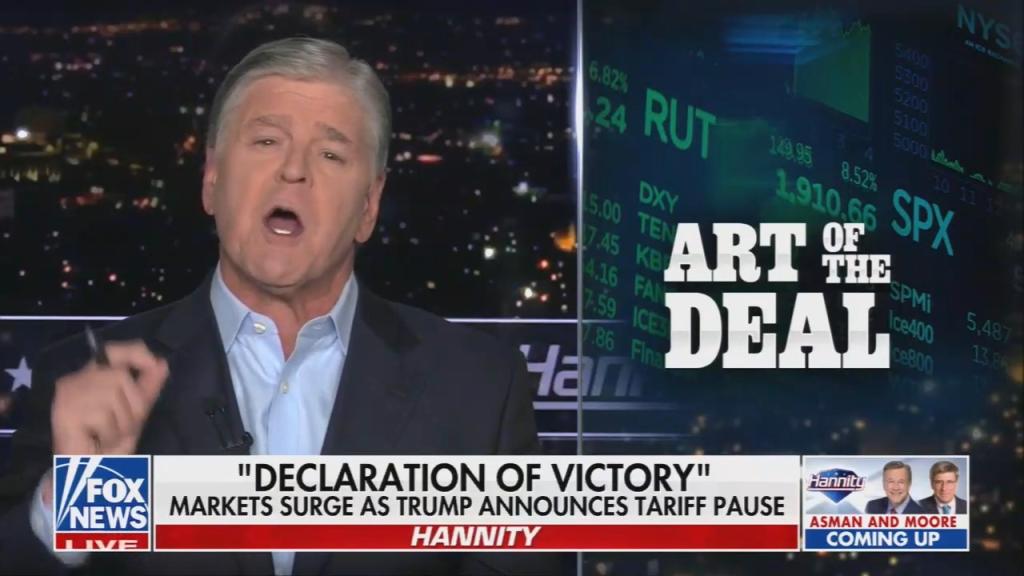
Fox News’ propagandists cheered President Donald Trump’s tariff climbdown as a “huge win” that shows he was playing “3D chess” and executing the “Art of the Deal.” Meanwhile, reporters at outlets including Fox pointed out that Trump had “capitulated” out of fear that his unilateral imposition of massive taxes on all of our trading partners was triggering a collapse in the bond market.
Trump announced on Wednesday a 90-day pause on the massive tariffs he had proposed the previous week on dozens of countries and farcically described as “reciprocal,” with the countries instead subject to a still-high 10% tariff during bilateral trade negotiations. At the same time, he increased tariffs on China, the largest U.S. trading partner, to a total of a whopping 145%, and left unchanged sectoral tariffs he has proposed or implemented on steel, aluminum, and cars (he also proposed this week additional tariffs on lumber and pharmaceuticals).
The president and his top advisers had repeatedly said that no pause was being contemplated, and the abrupt reversal reportedly took even some close aides by surprise. U.S. Trade Representative Jamieson Greer, who had been defending the planned tariffs in a House hearing when Trump announced the pause, said he had not been informed of the policy change beforehand.
North Korean state TV anchors would blush at the fervor with which Fox’s hosts announced their support for the move on their programs that night.
“We begin with the art of the deal -- told you this was going to happen,” Fox host and Trump political operative Sean Hannity crowed at the top of his show. “It was inevitable. Donald Trump's in a perpetual state of negotiation. A huge win for the president. A huge win for the country. His biggest accomplishment of the second term and there have been many.”
:{:{Video}:
Citation
From the April 9, 2025, edition of Fox News' Hannity
Laura Ingraham trumpeted the tariff shift as “Trump’s 3D chess move,” claiming that the president was “on a roll” and “thinking three steps ahead” while his “naysayers” were left “grasping at straws.”
“Trump created maximum leverage for himself, and now his team’s sitting pretty, taking meetings and doing deals that put America first. And if we don't like how the negotiation is going, our partners have seen the kind of pain we can cause, and they're motivated to do what we want, or else we'll make them feel the same pain,” offered Jesse Watters.
Their narrative that Trump is cooly executing a deliberate plan is total nonsense — he was responding to “a mass sale of bonds” the night before which indicated that “people are losing confidence in the U.S. economy” and could have triggered a financial crisis, as Fox Business’ own senior correspondent Charlie Gasparino reported earlier that day.
“I want to tell you right now that Donald Trump outsmarted the world,” Gasparino said on Fox after Trump’s announcement. “Trust me. I'm an American, I support my president. But that's not really what happened here from what I understand.”
“It's the bond market and the sort of lending markets that's the plumbing of the economy. And those markets were imploding last night and that's why we have a 90-day freeze,” he explained.
“It is the White House who capitulated, based on everything I hear, and all of my sources,” Gasparino reported in a second segment. “And the reason why is because of the bond market and what happened last night.”
Gasparino’s reporting is consistent with that from outlets including The New York Times, The Wall Street Journal, and CNN.
Indeed, Trump himself publicly acknowledged on Wednesday afternoon that his reversal came because people “were getting a little bit yippy, a little bit afraid,” and in particular were “queasy” over the bond market.
That reality is apparently toxic for Fox’s Trump shills.
When Watters’ Democratic co-host Jessica Tarlov pointed to the bond market gyrations on Wednesday’s edition of The Five, he told her, “You don’t even know what you’re talking about. You don’t even know what a bond is.”
Likewise, Hannity mocked the “stupid people” who deny that “this was the [Trump’s] plan all along,” which he claimed to have “pretty much understood because I know the guy so well.”
Rather than a brilliant plan carefully executed, we are left with a trade agenda that has unclear goals, will cripple small businesses, and will raise prices for American consumers on everything from coffee to cars — and could change at any time based on the whims of one mercurial man.
But that man is the focus of Fox’s cult, and so its high priests are genuflecting and offering sacrifices.
:{:{many vids?]}:
---
04/10/25 11:41 AM EDT
04/10/25 11:36 AM EDT
04/10/25 11:04 AM EDT
04/10/25 9:33 AM EDT
04/10/25 9:26 AM EDT
04/09/25 6:28 PM EDT
04/09/25 5:57 PM EDT
04/09/25 5:01 PM EDT
04/09/25 4:39 PM EDT
---
an 4 25
'Could be an enormous scam': Insider trading suspicions grow after Trump tariff pause
---
an 4 25
MAGA media outlets like Newsmax TV, One America News (OAN) and Breitbart News are full of relentless cheerleading for President Donald Trump's second term. On those outlets, Trump is often praised for, MAGA pundits claim, getting a lot done at breakneck speed.
But Trump's policies are by no means universally loved on the right. Liberal-leaning MSNBC features plenty of Never Trump conservatives, The Bulwark is a bastion of right-wing Trump-bashing, and The Lincoln Project continues to crank out anti-Trump videos.
The conservative website The Dispatch offers in-depth analysis of Trump's second term in an editorial published on April 10, attacking Trump on everything from the economy to foreign policy.
READ MORE: GOP’s defense of 'Dear Leader' Trump’s 'idiocy' resembles famous suicide cult: analysis
"Donald Trump has literally made America — and Americans — poorer, bringing the United States to the brink of a recession in recent weeks by threatening to unilaterally impose one of the most regressive tax hikes in U.S. history," The Dispatch laments. "He's momentarily been talked into standing down, but an economic environment in which the whims of one famously mercurial man can upend the international trade system and wipe out trillions of dollars in stock market value is not one conducive to sustained growth."
The Dispatch continues, "For the next 90 days — and really, for the remainder of Trump's term — decision-makers at businesses across the country and the world will be forced to speculate: Are the president's tariffs merely a negotiating tool, or an effort to fundamentally remake the global economy? Even key White House officials seem not to know."
The Dispatch stresses, however, that the "financial volatility of recent days is just one symptom of a broader, more deliberate descent."
"Decline doesn't solely mean impoverishment; it means degeneration, to sink backward and down," The Dispatch argues. "And that is what the United States' current leadership class is choosing for this country by willfully dismantling the free-market system, abandoning America's role as a global leader, and degrading the separation of powers and rule of law."
READ MORE:Donald Trump has an addiction: WSJ
The Dispatch adds, "Even worse, it is doing so based on a suite of false assumptions: that Americans are weak, unable to compete in an open market, and incapable of responding to any incentives or exhortations more high-minded than rank self-interest or partisan contempt."
The editorial, headlined "Slouching Towards Tyranny," also lambasts Trump for failing to respect "the rule of law."
"Nowhere is the evidence of the new right's willful decline more obvious than in its rejection of fidelity to the rule of law and the Constitution," The Dispatch warns. "As the Trump Administration ignores due process, encroaches upon press freedom, and subverts the independence of the judiciary — all central pillars of self-government — top executive branch officials and Republican members of Congress turn a blind eye, or cheer it on."
READ MORE:'Compete mess': Trump slammed as Wall St. CEO says policies will 'probably' cause recession
---
jpm? predict recession, now others
'Uncharted territory': Deutsche Bank strategists warn of 'simultaneous collapse' in 'all US assets'
4 9 25
---
---
narvarro made up ron anagram, tossed under bus in 48 min recd?
beef elon car assembler bag of bricks
Tech billionaire and Department of Government Efficiency (DOGE) head Elon Musk's brother, Kimbal Musk, also a businessman, said Tuesday President Donald Trump's top trade advisor Peter Navarro is "truly a moron."
"What he says here is demonstrably false,” Musk said in a post on the social platform X while reacting to a video in which Navarro claimed Tesla is seen as a “car manufacturer” but is actually just a “car assembler.”
“@realDonaldTrump Mr President, if Peter Navarro has lied to you about Ron Vara, what else has he lied to you about?” Kimbal Musk wrote. “Put America first and fire him!”
ALSO READ:'Car assembler': Top Trump aide hits back at Elon Musk’s criticism
“Navarro is dumber than a sack of bricks,” Musk added.
On Monday, Navarro called Elon Musk a "car assembler," saying that people consider him a car manufacturer — which he is not.
“When it comes to tariffs and trade, we all understand in the White House and the American people understand that Elon’s a car manufacturer, but he’s not a car manufacturer. He’s a car assembler in many cases,” Navarro, who is an architect of Trump's controversial policy on tariffs, said on CNBC.
Navarro was trying to clear the air after the DOGE head called him out over Trump's tariff policy over the weekend. Navarro referred to Musk as a "car person," while insisting that he does not have major disagreements with the DOGE head.
ALSO READ:'Warning to the GOP': WSJ sounds alarm over 'MAGA backlash'
This clash between Navarro and the Musk brothers came as Trump has imposed a series of sweeping global tariffs, including a 25 percent tariff on imported vehicles.
Kimbal is the DOGE head's younger brother who operates a restaurant chain named The Kitchen, serves on Tesla's board, and has previously held positions as a director at SpaceX and Chipotle. He has also co-founded and invested in various food and tech startups, such as Square Roots, an indoor agriculture company, and Nova Sky Stories, a producer of drone light displays that he acquired from Intel.
ALSO READ:'Basic betrayal': CEOs terrified of Trump retaliation won’t speak out against policies
---
---
MMA
Newsmax host says US elections are “a huge liability. It weakens our country in a lot of ways because we're always thinking about the next election”
Rob Schmitt: “XI Jinping doesn't have to worry about elections. That's a huge benefit. Trump talks about that a lot. He's jealous of that.”
Written by Media Matters Staff
:{:{Published 04/09/25}:
Video
Citation
From the April 8, 2025, edition of Newsmax's Rob Schmitt Tonight
ROB SCHMITT: Two billion a day, he says. Two billion a day in tariff revenue. That's about 700 billion a year. More than 700 billion a year. Just to give you a reference, that's a third of what our government brings in from all income taxes, everything we all pay in income taxes — that would be about a third of that number. That's quick to get to those kind of numbers. And by the way, that number, 700 billion is going to increase sharply at midnight because China has a lot of that. Likely forcing China with its very weak economy to the table to cut a deal that will benefit our country, our workers, to some unknown extent. Based on our tremendous deficit, which you can see here behind me, just how much more China sends us than they accept from us, China's retaliatory tariffs just don't hit as hard as they need them to. That's the problem when there's this huge disparity. China exports far more to us than they import from us. The White House has the winning hand in many different ways here.
China's only upside is, of course, political. XI Jinping doesn't have to worry about elections. That's a huge benefit. Trump talks about that a lot. He's jealous of that because imagine what you could do if you could not have to worry about every two years, you got to get everybody reelected. I mean, that's a huge liability. It weakens our country in a lot of ways because we're always thinking about the next election. It's hard to ever do the right thing like they're doing right now. This is why most politicians never do the right thing. They just always think about the next election. But for the next year, Trump and Republicans don't really need to worry about this election either. And again, China's situation is pretty bad. And if they pull this off, if the White House pulls this off and these deals all do come together and they get China and have some kind of a win with China, and our market goes soaring again and our industrial base improves in a way that Americans can feel over the next couple years, look out.
---
---
mma
04/09/25 12:51 PM EDT
04/09/25 12:31 PM EDT
04/09/25 12:19 PM EDT
04/09/25 11:59 AM EDT
04/09/25 9:26 AM EDT
04/08/25 5:52 PM EDT
04/08/25
---
Benny Johnson calls Amy Coney Barrett a “repulsive lizard” and a “sick witch”
:{:{04/08/25}:
:{:{04/08/25}:
Fox Business host ridicules “Peter Navarro and his reciprocal trade–girl math that's kneecapping the United States”
Dagen McDowell: “The quicker that they get him off of TV and away from numbers, the better”
Written by Media Matters Staff
:{:{Published 04/08/25}:
Video
Citation
From the April 7, 2025, edition of Fox Business' The Bottom Line
DAGEN MCDOWELL (CO-HOST): To be clear, I am all-in on a fair, level trading field. I am all-in on level tariffs with all nations. But I am not all-in on Peter Navarro and his reciprocal trade–girl math that's kneecapping the United States, because the trade deficit is not a hallmark of all the cheating that goes on. And I go back to something he said last week, that "we have calculated the tariff rate required to eliminate the trade deficit."
The United States issues the world's reserve currency. You can't eliminate the trade deficit. The quicker that they get him off of TV and away from numbers, the better. And I'm not going to call it girl math anymore, I'm going to call it Navarro math.
JACKIE DEANGELIS (CO-HOST): I actually think they realize that. I think they realize Bessent should be the point person on this, and they're putting him out there. I think they're gonna pull back on Lutnick, I think they're gonna pull back on Navarro a little bit too. They need to get clear on their messaging and make sure there's no nuance in there.
//
04/03/25 1:45 PM EDT
- ### Fox Business host says firing thousands of career civil servants will be “a renaissance in America”
11/21/24 4:35 PM EST
03/21/25
04/08/25 12:21 PM EDT
04/08/25 12:09 PM EDT
04/07/25 7:22 PM EDT
04/07/25 6:31 PM EDT
04/07/25 5:34 PM EDT
04/07/25 5:30 PM EDT
04/07/25 5:10 PM EDT
04/07/25 4:56 PM EDT
04/07/25 4:49 PM EDT
04/07/25
---
---
---
MMA
Trump promotes video in defense of economic and tariff policies that seems to echo 4chan claim that he is purposely crashing the market
The video, which contains claims and language seemingly from a 4chan post that gained traction on the far right, suggested that Trump “is purposely crashing the market” to bring down prices
Written by Alex Kaplan, Payton Armstrong & Craig Harrington
Published 04/04/25
On Truth Social, President Donald Trump attempted to defend his tariff policy — which economic experts agree will raise prices for consumers and increase the risk of a recession — by amplifying a TikTok video arguing that he “is purposely crashing the market.” The video echoes claims from a post on 4chan that gained traction on the far right.
On April 4, as international financial markets continued roiling in response to the launch of his global trade war on April 2, Trump amplified a video on his social media platform Truth Social from a right-wing account that contended that “Trump is crashing the stock market by 20% this month, but he’s doing it on purpose” as part of a grand strategy to lower interest rates, weaken the dollar, and bring down prices.
The TikTok video — which was uploaded on March 15, a few days after a post on 4chan’s far-right “/pol/” message board — claimed that Trump's current tariff and economic policies were part of a “secret game” to “make you rich” and “lower the cost of everything” by “trying to crash the stock market.” The 4chan post gained traction throughout the far right on multiple platforms, and the TikTok video has since earned at least 2.3 million views.
The video amplified by Trump — the thumbnail of which shows language similar to the start of the 4chan post — echoes both claims and language of the 4chan post, including that Trump is trying to “push cash into Treasuries,” forcing the Federal Reserve to “slash interest rates” and “finance trillions of debt inexpensively.” Like the 4chan post, the video also claims tariffs would cause companies to “build here to dodge them” and farmers will “sell more of their products here in the U.S. to bring grocery prices way down.” It then invokes a claim that “94% of all stocks are owned only by 8% of Americans,” and that Trump is “taking from the rich short-term and handing it to the middle class through lower prices” — language very nearly matching that of the 4chan post.
The video also contains the false claim that billionaire investor Warren Buffet said that “Trump is making the best economic moves he’s seen in over 50 years.”
In reality, economic experts are “ringing alarm bells as they digest the impact of the wide-ranging tariffs, which they forecast will accelerate inflation and dampen U.S. economic growth,” and raise the risk of launching the American economy into a recession.
Additionally, even if the claims in the video were to be taken at face value, not all of the things the video claims Trump is doing would necessarily indicate a healthy American economy, including a weaker U.S. dollar, lower Federal Reserve interest rates, and lower mortgage rates.
//
04/04/25 3:56 PM EDT
04/01/25 4:43 PM EDT
04/04/25
---
MMA
MAGA media distort decades-old clips of Democrats to distract from Trump's tariff chaos
The president’s apologists are trying to excuse Trump's global trade war by highlighting clips of Democrats criticizing Chinese trade practices dating back to the '90s
Written by Zachary Pleat
Published 04/04/25
Following global stock market turmoil from Trump’s April 2 announcement of bogus tariff rates that amount to one of the biggest tax hikes in U.S. history, right-wing media are attempting to distract from Trump’s ruinous trade policy by re-airing decades-old clips of Democratic politicians criticizing China. Trump's right-wing apologists are distorting the context of these nearly 30-year-old arguments to pretend that they apply to the current international economic order or have anything to do with Trump’s haphazard lurch into a global trade war.
In reality, Trump’s trade war isn’t even against China; it’s being waged against the entire world in a purported effort to revive jobs that simply no longer exist in the United States. Regardless of the arguments that were made in the 1990s, “you can’t put the genie back in the bottle” in 2025.
- Conservative influencer account “MAZE”: “Incredible clip from 1996. Nancy Pelosi on tariffs and the trade deficit with China.”Twitter/X, [4/3/25]
- Fox News anchor Martha MacCallum played a 1996 clip of Pelosi on tariffs, and added: “Good point, Nancy.” MacCallum continued: “That is an interesting contrast to the Democratic criticism of today for President Trump's global tariffs which have only been in effect for not even 24 hours. But they have decided that it's an idea that should be dead on arrival, but Nancy Pelosi thought it made a lot of sense back in the 1990s.” Fox News, *The Story*, [4/3/25]
- Fox anchor Bret Baier also aired a nearly 30-year-old clip of Pelosi talking about tariffs: “That's former House Speaker Nancy Pelosi June 27, 1996, talking about tariffs and how it's unfair, especially when it comes to China.” Fox News, *Special Report*, [4/3/25]
- Breitbart: “Watch: Nancy Pelosi in 1996 Assails U.S. Free Trade with China: ‘Is This Reciprocal?’” Breitbart, [4/3/25]
- Fox host Jesse Watters: “Here's Nancy from ‘96 — she sounded like Trump in a pantsuit.” Watters added: “Nancy used to be a patriot, but then all of her pillow talk with Paulie P made her $200 million, and now all she cares about is her portfolio, not the American people.” Watters also aired a clip of Sanders talking about China in 2008. Fox News, *Jesse Watters Primetime*, [4/3/25]
- Fox host Sean Hannity: “Even Nancy Pelosi promoted tariffs as a critical tool to protect American industry against unfair practices of foreign countries — sounds like Trump.” “The only difference is Pelosi changed, Trump did not,” Hannity concluded. Fox News, *Hannity*, [4/3/25]
- Turning Point USA’s Charlie Kirk: “Nancy Pelosi endorses reciprocal tariffs on China in 1996.” Twitter/X, [4/3/25]
- The Federalist’s Eddie Scarry: “Here is Pres Trump giving a very similar speech to the one he gave on tariffs yesterday except he looks a little like Nancy Pelosi for some reason. It was the 90s, I guess.” Twitter/X, [4/3/25]
- Right-wing influencer Alexander Muse, known online as “Amuse”: “TARIFFS: In 1988, Donald Trump declared that foreign nations should be made to pay tariffs. In 1996, Nancy Pelosi urged Congress to support reciprocal tariffs, a sentiment echoed by Bernie Sanders in 2008 and Barack Obama in 2018.”Twitter/X, [4/4/25]
- Fox & Friendsco-host Brian Kilmeade: “What’s amazing to me, guys, is that Nancy Pelosi sounds like Donald Trump today. Our great staff got this fantastic clip from 1996.” Co-host Ainsley Earhardt concluded: “She sounds like Donald Trump now — that's how far their party has gone. It's either that or they just hate Donald Trump so much, they're melting down.” Fox News, *Fox & Friends*, [4/4/25]
- Fox senior White House correspondent Jacqui Heinrich: “House Dems [are] planning to force a vote to undo the national emergency that underpins the president’s tariff authority, but former Speaker Nancy Pelosi had a different tune back in 1996.”Fox Business, *Varney & Co.*, [4/4/25]
- Fox News: “FLASHBACK: 30 years ago, Nancy Pelosi demanded Congress confront Chinese tariffs on American goods.” The Fox article’s subheadline stated: “Despite opposing Trump's current tariff policy, Sen. Bernie Sanders, I-Vt., questioned free trade in a 2008 Senate speech.” FoxNews.com, [4/4/25]
- Fox’sOutnumberedaired clips of Pelosi, Sanders, and Barack Obama criticizing China on trade decades ago. Co-host and former Trump White House press secretary Kayleigh McEnany said: “Oh, how interesting how you just have this riveting change in heart when the guy’s named Donald Trump.” Fox News, *Outnumbered*, [4/4/25]
//
04/01/25 4:43 PM EDT
04/04/25 3:56 PM EDT
04/04/25
---
an 4 25
Analysts puzzling over the bizarre formula the Trump administration used to calculate its country-by-country tariff rates are wasting their time, U.S. Sen. Chris Murphy said in a response to the American president that has gone viral in recent days as global markets continue to nosedive.
"It's not economic policy, it's not trade policy," Murphy (D-Conn.) said in remarks recorded after Trump announced the sweeping tariffs last week. "It's a political weapon designed to collapse our democracy."
While President Donald Trump's universal tariffs on imports make no sense as an effort to rectify the failures of the status quo trade regime and bring back offshored U.S. jobs, they are comprehensible when viewed as "a tool to try to compel pledges of loyalty, this time from companies and industries in the United States," Murphy argued.
"You have to understand that everything Donald Trump is doing is in service of staying in power forever—either him or his family or his handpicked successors," the Democratic senator continued. "He's trying to destroy our democracy."
Murphy contended that the president designed the tariffs to be so widespread that corporations across private industry would have to come to the White House and "make an agreement with Trump in which he gives them tariff relief in exchange for a pledge of political loyalty."
"What could that pledge look like?" Murphy continued. "Well, maybe they agree to champion his economic policy publicly. Maybe they agree to make contributions to his political campaign. Maybe they agree to police their employees to make sure that nobody that works for that company works for the political opposition."
Politicoreported late last week that businesses across corporate America "fear Trump's wrath" and are thus declining to criticize the president's tariff policies even as they wreak havoc worldwide and threaten to spark a devastating recession.
"There is zero incentive for any company or brand to be remotely critical of this administration," one unnamed public affairs operative told Politico. "It destroys your ability to work with the White House and advance your policies, period."
"While the United States has plenty of real problems to deal with, Trump is ignoring them to manufacture the fake emergencies he needs to further enlarge and centralize his power."
Murphy is hardly alone in seeing Trump's tariffs as an instrument of power consolidation.
Robert Reich, the former U.S. labor secretary, wrote Monday that "we're turning into a dictatorship" as Trump conjures "fake national emergencies" to jack up tariffs, deport people en masse without due process, gut efforts to combat the climate crisis, and dismantle large swaths of the federal government.
"As Trump declares emergency after emergency to justify his reign of terror, he's simultaneously eliminating America's capacity to respond to realemergencies," Reich wrote. "Make no mistake about what’s really going on here. While the United States has plenty of real problems to deal with, Trump is ignoring them to manufacture the fake emergencies he needs to further enlarge and centralize his power."
One analyst, Zack Beauchamp of Vox, argued the tariffs are more a symptom of the decline of U.S. democracy rather than a cause of it.
"Trump's tariffs will, if fully implemented, be remembered as their own cautionary tale. While he campaigned on them, he wouldn't have been able to implement the entire tariff package had he gone through the normal constitutionally prescribed procedure for raising taxes," Beauchamp wrote. "The fact that America isn't functioning like a normal democracy, with public deliberation and multiple checks on executive authority, is what allowed Trump to act on his idiosyncratic ideas in the manner of a Mao or Putin."
"It's still possible that Trump steps back from the brink," he added. "But even if he does, and the worst outcome is avoided, the lesson should be clear: The long decay of America's democratic system means that we are all living under an axe. And if this isn't the moment it falls, there will surely be another."
---
---
rww
“Let Him Cook': Glenn Beck And Kevin Roberts Flack For Trump's Tariff Policy
04/07/2025
by
Over the weekend, Glenn Beck posted a podcast with Heritage Foundation president Kevin Roberts, focused on the global tariffs that have been unilaterally imposed by President Donald Trump.
With those tariffs rattling the international economy and tanking the stock market, Beck and Roberts agreed that they support Trump simply because they want to "let him cook" even as they admitted that they are fielding panicked calls from friends and acquaintances who are actively seeing their businesses destroyed by Trump's policy.
Beck, who spent the entire 2016 presidential campaign warning that Trump is a psychopath, a narcissist, and a "the biggest flaming ass that you could possibly imagine" only to become a MAGA cultist the moment Trump took office, said that while he has always opposed tariffs, he is now willing to support them because Trump "loves America as much as me."
"On election day, we all walked out of the office going, 'OK. You're the boss,'" Beck said. "He's the best negotiator I've ever seen. He's a businessman, and he's one of the first presidents—in fact, I think the first president since Reagan—that I actually trust loves America as much as me, [who's] not in it for himself [but] in it for the country."
"I'm not going to give him a pass forever," Beck continued. "I mean, a year from now, if we are really struggling because of this, I'm not going to be saying the same thing. But I think we have to let the chef cook the meal. We came into the restaurant; we came because we knew he was the chef. Let him cook the meal."
Roberts, who turned the Heritage Foundation into a MAGA think tank that was the source of the infamous Project 2025 which Trump disingenuously disavowed on the campaign trail only to immediately implement upon taking office, agreed with Beck.
"You just summarized exactly where we are," Roberts said. "The larger thing is what you explained, which is Donald Trump's great love for this country [and] a cabinet that I think is the best assembled in modern history."
"I think maybe since [Abraham] Lincoln," Beck replied. "The first time I saw the cabinet altogether, I said, 'Look at the brains. I haven't seen this since the founding era.'"
"I think you're right," Roberts responded. "I think only [George] Washington's and Lincoln's rival them."
---
### Tim Barton Attempts To Make The Biblical Case For Trump's Tariffs
rww 4 25
more xian
rww
04/07/2025
by
- As President Donald Trump's tariff policy crashes the stock market, Rick Joyner cheers him on, claiming Trump's policy will ... prevent a stock market crash.
- Mark Meckler doesn't like Trump's tariff policy, but he's not going to criticize him for it because "Trump has sure proven [himself] to be right on an awful lot of things."
- Ali Alexander declares that "If Congress tries and takes Trump's TARIFF POWER, Congress should be disbanded!"
- MAGA pastor Jackson Lahmeyer warns Christians not to criticize Trump for putting Paula White in charge of the White House Faith Office, saying they must not "grumble against God" or "grumble against the person God has selected to lead them."
- Finally, anti-Muslim zealot John Guandolo claims that the anti-Trump protests that took place all over the nation last weekend were "coordinated violent joint communist & jihadi operations."
---
---
an 4 7? 25
'Considerable turbulence': Jamie Dimon 'backtracks' on Trump plan and issues red flag warning
===
---
mma
MAGA “prophet” says God warned markets would crash “to make our president look bad”
Julie Green: “God told us when we start seeing a shaking in the economy that we are not to fear because this is not going to affect us. This is going to affect our enemy.”
Written by Media Matters Staff
Published 04/07/25
As Media Matters has previously explained:
“Prophet” Julie Green — who
that God regularly sends her prophecies that she posts online through sites such as Rumble — is connected to Trump’s inner circle and has been endorsed by Eric Trump. The president’s son told Green that she’s “so incredible,” stated that he’s saved one of her messages, called her a “warrior,” and thanked her for her “friendship.”
Video
Citation
From the April 5, 2025, edition of Julie Green Ministries' Mornings with Julie, streamed on Rumble
JULIE GREEN (HOST): Well, yesterday, I got the news that the DOW plummeted like 1600 and some points, and apparently people are overwhelmingly freaking out. First of all, this was a strategy to the enemy — from the enemy, God said would happen to make our president look bad, to make the tariffs look bad when actually the tariffs are very bad for that dark financial system that the enemies have in place.
God told us when we start seeing a shaking in the economy that we are not to fear because this is not going to affect us. This is going to affect our enemy.
The enemy is trying to keep a hold of the economy. They're the ones who are bringing it down. They're the ones who bring it up. They manipulate it all the time. So, I don't want you to fear when you start hearing these things. Whether it keeps going down today or whether it starts rebounding today. I have no idea.
All I know is that God is judging that system. So if we start seeing more and more of a decline, God is saying, remember the land of Goshen, also remember the promises of God in John 17 that we are in this world but we are not of this world.
Remember all the things that are going on in the economy, all the things that are going on in Wall Street, how God is depleting the enemy's resources. They were doing that yesterday on purpose in order to make those tariffs again.
I'm gonna say this again. In order to make those tariffs look bad when actually they are the best for our country. But the globalist and the elitists are terrified because they know these tariffs are gonna work, and they know that people believe it, then their entire dark financial system will utterly collapse before their very eyes, and that's what they're trying to stop. So don't give into the fear.
//
:{:{03/26/25}:
:{:{10/04/24}:
08/17/22
---
---
AN 4 25
Treasury Secretary Scott Bessent is allegedly leaping for a window after dashing his “credibility” against the rocks of Trump’s disastrous tariffs, claimed MSNBC host Stephanie Ruhle on Friday.
“Some [sources] have said to me, he’s looking for an exit door to try to get himself to the Fed, because in the last few days he’s really hurting his own credibility and history in the markets,” Ruhle told MSNBC’s Morning Joe,according to Daily Beast.
Bessent, who built a $500 million fortune as a hedge fund manager before working for Trump and entangling his name in Trump’s “Liberation Day” tariff, was not a full-throated supporter of earlier tariff proposals. After Trump announced his new trade duties this week and went to play golf, Bessent found himself not to retaliate.
READ MORE: 'Mistake': Experts say Trump's 'lying about business deals' is a 'national security risk'
“I would advise none of the countries to panic. I wouldn’t try to retaliate because as long as you don’t retaliate this is the high end of the numbers and I think the market could have certainty that this is the number, barring retaliation,” Bessent told Bloomberg. “We got a ceiling, and we can see if there’s a different floor.”
Many international trading partners refused to let Trump trample them, however. China launched reciprocal tariffs, accelerating a trade war with US goods and sending the Dow Jones down more than 2,200 points by the Friday bell ring. Canada — once a staunch U.S. ally — also will match US tariffs, according to Prime Minister Mark Carney.
Ruhle said her sources claim Trump is “not listening” to his own treasury secretary, dangerously alienating one of the more serious voices familiar with market trends in the administration.
“[Bessent] actually understands how the markets work and, what’s happening right now, is only going to hurt markets," she said.
READ MORE:'Step down': Marjorie Taylor Greene blows up at GOP rep over help for new moms in Congress
As president-elect, Trump claimed in November that Bessent “will help me usher in a new Golden Age for the United States.”
“Together we will Make America Rich Again, Prosperous Again, Affordable Again, and, most importantly, Great Again,” Trump said.
---
---
AN 4 25
It’s hard to decide what’s funnier: the well supported theory flying around the internet that Trump used ChatGPT to generate his simpleton’s “world tariff chart,” OR how Fox News is bending itself into a pretzel trying to put lipstick on our dipshit president’s “Liberation Day” pig.
Under Trump’s new global tariffs, American consumers will pay an additional $6 trillion in taxes-- tariffs imposed on imported goods they buy every day like shoes and avocados-- over a ten year period. This amount, along with alleged savings from DOGE’s chainsaw excision of half the government, will be used to pay for Trump’s second round of $4.5 trillion tax cuts for the rich.
It is a massive redistribution of wealth, taking from the poor to line the pockets of the wealthy donors who put Trump back in office for that express purpose. When you consider that the people who can least afford it will suffer and pay the most under Trump’s moronic tariffs, none of it is really funny.
Trump used his idiot sharpie and drew himself a tariff chart with Chatbot AI.
Trump has been teasing tariffs for months. on our best friends and neighbors last month, he almost kind of had the start of a concept of a tariff policy last week. To launch it, true to his reality TV roots, Trump set the announcement to great fanfare, calling
 He branded the whole thing, and spent more time marketing “Liberation Day” than he spent developing any underlying substance.
It shows. The simplistic tariff chart prop he foisted on the media looked like an after thought, likely because it was. I started getting text messages from colleagues when the clownshow started. “He generated that table with ChatBot!” one guy texted. “Good one,” I reponded. “No, I’m serious,” he said. “NFW,” I wrote. Then another colleague sent me basically the same thing.
The theory flying around the internet, supported by convincing evidence, is that Trump threw his simplistic chart together using basic AI from ChatGPT. When pundits commanded the program to “make easy tariff policy,” they got the same answers spit out on Trump’s tariff chart: 03 high, Gemini 2.5 pro, Claude 3.7, and Grok all gave the same answers to the question, “how to impose tariffs easily.” Political writer Steve Bonnell said about the ChatGPT chart, on X, “I think they asked ChatGPT to calculate the tariffs from other countries, which is why the tariffs make absolutely no f----ing sense. They're simply dividing the trade deficit we have with a country with our imports from that country, or using 10 percent, whichever is greater.” Writer James Surowiecki posted that he was able to reverse-engineer Trump’s exact method using a simple AI formula, describing it as “extraordinary nonsense” that offered a dangerously simplistic view of global trade economics.
Trump officials lied, claiming they calculated complexities they didn’t
Trump officials repeatedly lied about the method used to calculate Trump’s tariff rates, claiming that for every targeted economy, “tariff and non tariff barriers” and policies were analyzed, assessed and quantified individually. What BS. As ChatGPT makes clear, market nuances were not quantified, and nothing was considered over than the macro-simplistic dollar amounts.
Decidedly NOT considered in Trump’s tariffs: currency fluctuations, currency manipulation, labor variables, VAT taxes, reciprocal licensing, subsidies, pre-existing and negotiated product-specific tariffs, geopolitical sanctions, and transportation costs. There’s no strategy here folks, it’s an across the board, moronic attack on the world economy.
Trump’s First grade-level tariff plan overlooks the services sector
Worse than these foundational flaws, Trump’s tariff plan completely ignores the service sector, where American firms enjoy a huge surplus, now in jeopardy.
Google AI, when asked the question, “what is the US service sector trade imbalance?” reports, “The U.S. has a trade surplus in services, meaning it exports more services than it imports,” offering a more detailed breakdown:
·Services Trade Surplus: The U.S. consistently runs a surplus in its services trade, meaning it exports more services than it imports.
·2023 Performance: In 2023, the U.S. exported $1.02 trillion in services, up 8% from the previous year, and imported $748.2 billion, resulting in a service sector surplus of $278 billion.
·In 2024, the service sector surplus increased to $293.3 billion.
Its as if Trump and his clowncar cabinet of advisors don’t understand the role the US service sector plays in US and global economies, in legal, accounting, consulting, R&D, architecture, engineering, lending, insurance, technology networks, cloud computing, data storage, and software licenses.
Fox News has to figure out how to praise the falling stock market or blame it on Biden
Global markets expressed their outrage by delivering a crash that eliminated over $3 trillion in market value. World leaders continue to express their outrage over Trump’s economic suicide, sounding the alarm over tarrifs so stupid they look like intentional sabotage.
International scorn and derision were swift and unapologetic. China imposed a retaliatory 34% tariff on the US, stating, “There are no winners in trade wars, and there is no way out for protectionism.” EU’s commissioner said, “President Trump's announcement of universal tariffs on the whole world, including the EU, is a major blow to the world economy… Uncertainty will spiral… consequences will be dire for millions of people around the globe.” Germany's Chancellor Olaf Scholz said, “Trump’s tariffs are fundamentally wrong and an attack on a trade system that has created prosperity all round the world — itself an American achievement.” Australia’s Prime Minister said Trump’s tariffs were “not the act of a friend,” noting hat Trump’s tariffs singled out tiny, far-flung territories, including islands full of penguins but no people.
Fox viewers won’t hear, read, or see any of that. As world markets crashed and global leaders predicted catastrophic consequences, the folks over at Fox News focused on what’s in everyone else’s underpants, and how strong Trump, the “New Sheriff in town” looked when he “warned” governors who “defy his orders.” Not covering the actual news, Fox on Friday delivered these disinformation gems:
Enough with the gaslighting
Fox propaganda aside, JP Morgan is now predicting a 60 percent chance of a recession by year’s end, reporting that “This year's 22-percentage tariff increase amounts to the largest tax hike since 1968.” The report continues, “The effect of this tax hike is likely to be magnified, through retaliation, a slide in U.S. business sentiment, and supply chain disruptions... We emphasize that these policies, if sustained, would likely push the U.S. and possibly global economy into recession this year.”
They also warn that, “recessions are inherently unpredictable… sustained restrictive trade policies and reduced immigration flows may impose lasting supply costs that will lower U.S. growth over the long run.” The Wall Street Journal reports that Thursday’s loss of more than $3 trillion in market value will likely continue to worsen.
Financial markets, predictably, have the jitters. Despite Trump’s messaging that, “tariffs are tax cuts,” everyone else knows tariffs are a regressive tax, paid by consumers.
By all indicators, Trump still doesn’t grasp the complexities needed to drive a strategic tariffs and trade package. He still thinks tariffs are worth the economic damage because he doesn’t understand either end of the formula: the tariffs or the resulting economic costs, and says he “couldn’t care less” about the price of cars.
Like a toddler with a singular focus on his neighbor’s toy, Trump has been so fixated on 19^th century tariffs he has silenced rational economic discussion. What we’re left with is a child’s tariff chart Alexis could have spit out, leaving economists with their heads spinning.
:Sabrina Haake is a 25+ year federal trial attorney specializing in 1st and 14th A defense. Her columns are published in Alternet, Chicago Tribune, MSN, Out South Florida, Raw Story, Salon, Smart News and Windy City Times. Her Substack, The Haake Take, is free.}:
---
mma
MAGA media distort decades-old clips of Democrats to distract from Trump's tariff chaos
The president’s apologists are trying to excuse Trump's global trade war by highlighting clips of Democrats criticizing Chinese trade practices dating back to the '90s
Written by Zachary Pleat
Published 04/04/25
Following global stock market turmoil from Trump’s April 2 announcement of bogus tariff rates that amount to one of the biggest tax hikes in U.S. history, right-wing media are attempting to distract from Trump’s ruinous trade policy by re-airing decades-old clips of Democratic politicians criticizing China. Trump's right-wing apologists are distorting the context of these nearly 30-year-old arguments to pretend that they apply to the current international economic order or have anything to do with Trump’s haphazard lurch into a global trade war.
In reality, Trump’s trade war isn’t even against China; it’s being waged against the entire world in a purported effort to revive jobs that simply no longer exist in the United States. Regardless of the arguments that were made in the 1990s, “you can’t put the genie back in the bottle” in 2025.
- Conservative influencer account “MAZE”: “Incredible clip from 1996. Nancy Pelosi on tariffs and the trade deficit with China.”Twitter/X, [_{4/3/25}_]
- Fox News anchor Martha MacCallum played a 1996 clip of Pelosi on tariffs, and added: “Good point, Nancy.” MacCallum continued: “That is an interesting contrast to the Democratic criticism of today for President Trump's global tariffs which have only been in effect for not even 24 hours. But they have decided that it's an idea that should be dead on arrival, but Nancy Pelosi thought it made a lot of sense back in the 1990s.” Fox News, *The Story*, [_{4/3/25}_]
- Fox anchor Bret Baier also aired a nearly 30-year-old clip of Pelosi talking about tariffs: “That's former House Speaker Nancy Pelosi June 27, 1996, talking about tariffs and how it's unfair, especially when it comes to China.” Fox News, *Special Report*, [_{4/3/25}_]
- Breitbart: “Watch: Nancy Pelosi in 1996 Assails U.S. Free Trade with China: ‘Is This Reciprocal?’” Breitbart, [_{4/3/25}_]
- Fox host Jesse Watters: “Here's Nancy from ‘96 — she sounded like Trump in a pantsuit.” Watters added: “Nancy used to be a patriot, but then all of her pillow talk with Paulie P made her $200 million, and now all she cares about is her portfolio, not the American people.” Watters also aired a clip of Sanders talking about China in 2008. Fox News, *Jesse Watters Primetime*, [_{4/3/25}_]
- Fox host Sean Hannity: “Even Nancy Pelosi promoted tariffs as a critical tool to protect American industry against unfair practices of foreign countries — sounds like Trump.” “The only difference is Pelosi changed, Trump did not,” Hannity concluded. Fox News, *Hannity*, [_{4/3/25}_]
- Turning Point USA’s Charlie Kirk: “Nancy Pelosi endorses reciprocal tariffs on China in 1996.” Twitter/X, [_{4/3/25}_]
- The Federalist’s Eddie Scarry: “Here is Pres Trump giving a very similar speech to the one he gave on tariffs yesterday except he looks a little like Nancy Pelosi for some reason. It was the 90s, I guess.” Twitter/X, [_{4/3/25}_]
- Right-wing influencer Alexander Muse, known online as “Amuse”: “TARIFFS: In 1988, Donald Trump declared that foreign nations should be made to pay tariffs. In 1996, Nancy Pelosi urged Congress to support reciprocal tariffs, a sentiment echoed by Bernie Sanders in 2008 and Barack Obama in 2018.”Twitter/X, [_{4/4/25}_]
- Fox & Friendsco-host Brian Kilmeade: “What’s amazing to me, guys, is that Nancy Pelosi sounds like Donald Trump today. Our great staff got this fantastic clip from 1996.” Co-host Ainsley Earhardt concluded: “She sounds like Donald Trump now — that's how far their party has gone. It's either that or they just hate Donald Trump so much, they're melting down.” Fox News, *Fox & Friends*, [_{4/4/25}_]
- Fox senior White House correspondent Jacqui Heinrich: “House Dems [are] planning to force a vote to undo the national emergency that underpins the president’s tariff authority, but former Speaker Nancy Pelosi had a different tune back in 1996.”Fox Business, *Varney & Co.*, [_{4/4/25}_]
- Fox News: “FLASHBACK: 30 years ago, Nancy Pelosi demanded Congress confront Chinese tariffs on American goods.” The Fox article’s subheadline stated: “Despite opposing Trump's current tariff policy, Sen. Bernie Sanders, I-Vt., questioned free trade in a 2008 Senate speech.” FoxNews.com, [_{4/4/25}_]
- Fox’sOutnumberedaired clips of Pelosi, Sanders, and Barack Obama criticizing China on trade decades ago. Co-host and former Trump White House press secretary Kayleigh McEnany said: “Oh, how interesting how you just have this riveting change in heart when the guy’s named Donald Trump.” Fox News, *Outnumbered*, [_{4/4/25}_]
---
mma random
04/04/25 5:32 PM EDT
04/04/25 5:19 PM EDT
04/04/25 4:57 PM EDT
04/04/25 4:53 PM EDT
04/04/25 4:28 PM EDT
04/04/25 4:01 PM EDT
04/04/25 3:56 PM EDT
04/04/25 3:46 PM EDT
04/04/25 2:20 PM EDT
04/04/25 1:31 PM EDT
04/04/25 12:23 PM EDT
04/04/25
---
AN 4 25
Trump's deputy chief of staff Stephen Miller reportedly disrupted a lunch gathering Thursday for GOP Senate chiefs of staff to defend Trump's controversial tariff policy with a confusing and "arrogant" presentation.
Politico reported that the arguments made by Miller, who is also Trump's homeland security adviser, alluded to the British Empire and left the aides asking one another, “What on Earth was that?".
However, members of the GOP have warned the decision to impose tariffs would be bad not just for the economy but for their chances in future elections.
READ MORE: 'Ulterior motive': 'Frequent filer' Trump has long history of FOIA requests — here’s why
Senator Thom Tillis (R-N.C.), who benefited from the backlash against former President Barack Obama during the 2010 and 2014 midterms, cautioned that Republicans could face a similar outcome in 2026, the year he is due for re-election.
In aninterview with Politico published Thursday, Tillis said the GOP may be up against a "storm" next year due to President Donald Trump's decision to impose sweeping tariffs on United States imports.
“What we don’t want to do is overreach,” he said.
“We’ve got to be careful not to do the same thing. And I think that these elections are going to be proxies, or almost like weather devices for figuring out what kind of storm we’re going to be up against next year," Tillis added.
READ MORE: 'This. Will. Not. End. Well': George Will slams Trump’s 'fanciful assumptions' on economy
Some of Tillis' fellow Republicans are drawing comparisons to even earlier historical events, expressing concern that voters, who are already unsettled by Trump's reductions in essential government services, may hold the GOP accountable for the consequences of the tariffs.
Miller was sent to encourage Republican aides to have faith in the president and maintain their position, per Axios.
He recognized that their superiors were facing criticism over tariffs but claimed that these taxes would generate $6 trillion in revenue over the next decade.
Trump has strongly reacted to this criticism from Tillis and three other Republican senators, saying that they are suffering from "Trump Derangement Syndrome."
Still, the four senators held firm in their resistance to the tariffs, and Sen. Rand Paul (R-K.Y) aligned with the Democrats to support a bill aimed at overturning Trump's emergency declaration that authorized the imposition of tariffs on Canada.
READ MORE: 'My policies will never change': Trump says 'it’s going very well' after market meltdown
===
---
see fox 9 anno
mma
Trump's tariffs drive a wedge inside of Fox News
Many Fox personalities have supported Trump’s tariff agenda, while others warn his policies will harm American consumers
Written by Zachary Pleat (https://www.mediamatters.org/author/zachary-pleat)
Research contributions from Chloe Simon (https://www.mediamatters.org/author/chloe-simon) & Jack Wheatley (https://www.mediamatters.org/author/jack-wheatley)
:{:{Published 03/14/25}:
Fox News and Fox Business personalities have been broadly supportive of President Donald Trump's haphazard and often contradictory tariff policies, but a divide is emerging on air between the hosts and guests backing the president's ever-changing agenda and those acknowledging the economic disruptions these policies are already unleashing.
The art of the deal”: Fox personalities repeatedly celebrated Trump’s erratic tariff rollout as expert negotiation
In just the first two months of Trump’s presidency, he has made numerous announcements imposing, canceling, delaying, and carving out exemptions for his tariffs.
On Inauguration Day, Trump promised (https://www.cnn.com/2025/01/20/economy/tariffs-trump-executive-order/index.html) to impose 25% tariffs across-the-board on Canadian and Mexican imports beginning February 1. Those tariffs were then delayed (https://www.whitehouse.gov/presidential-actions/2025/02/imposing-duties-to-address-the-flow-of-illicit-drugs-across-our-national-border/) until February 4, and then again until March 4 (https://apnews.com/article/trump-tariffs-canada-mexico-china-sheinbaum-trudeau-017efa8c3343b8d2a9444f7e65356ae9). On March 5, Trump gave automakers a temporary carveout (https://abcnews.go.com/Business/timeline-trump-tariffs-canada-mexico-china/story?id=119506883) from the tariffs, and a day after that (https://www.axios.com/2025/03/06/trump-tariffs-mexico-pause-sheinbaum), temporarily exempted goods covered under his first-term United States-Mexico-Canada Agreement and delayed the tariffs (again) entirely until April 2. On January 26, Trump also threatened tariffs on Colombian imports after Colombia refused to accept military deportation flights, only to later back off (https://www.washingtonpost.com/immigration/2025/01/26/trump-colombia-deportation-flights-migrants-tariffs/) and declare victory. And on March 12, Trump’s proposed 25% tariffs on steel and aluminum imports went into effect, triggering (https://www.reuters.com/markets/commodities/trumps-steel-aluminum-tariffs-take-effect-us-canada-trade-war-intensifies-2025-03-12/) retaliatory actions from major American trading partners.
All along, many on Fox have praised Trump’s increasingly contradictory tariff announcements as a masterful negotiation tactic and “the art of the deal (https://www.newsweek.com/donald-trump-lost-mentally-tony-schwartz-art-deal-book-1956809),” much like they did during the 2024 presidential campaign (https://www.mediamatters.org/cnbc/conservative-economic-commentators-have-been-sanewashing-trumps-incoherent-tariff-proposals).
Following Trump’s threats to Colombia, Fox anchor Martha MacCallum called Trump’s tariff threats “foreign policy 101,” and noted “how quickly the turn around happens when there is a financial axe sort of held above your head.” Fox News, America’s Newsroom,[1/28/25 (https://www.mediamatters.org/media/4028261)]
Before Trump announced a pause, Fox host Steve Doocy called Trump a “master negotiator,” and added that “there is a lot of time between now and midnight. He can make a deal with Mexico and Canada and say, ‘OK, I was threatening 25% … what am I going to get for that?’” Fox News, Fox & Friends, [2/3/25 (https://www.mediamatters.org/media/4028264)]
Fox host Will Cain pushed back on former Canadian foreign minister John Baird’s reasoning that tariffs are bad, saying, “I think if there is any lesson for us to take it is: Analyze it through the prism of the art of the deal." Fox News, The Will Cain Show, [2/3/25 (https://www.mediamatters.org/media/4028265)]
Fox host Laura Ingraham praised Trump’s inconsistent trade war policy with a graphic reading, “The Art of the Tariff." She said that “all it took was a few hours, and three phone calls, and lo and behold, President Trump has Canada and Mexico ready to make concessions.” Fox News, The Ingraham Angle, [2/3/25 (https://www.mediamatters.org/media/4028266)]
After Canadian Prime Minister Justin Trudeau said Canada would appoint a “fentanyl czar” and implement a border plan, Fox host Dana Perino called it “the art of the trade war.” Fox News, The Five,[2/3/25 (https://www.mediamatters.org/media/4028268)]
OnFox & Friends, co-host Lawrence Jones complained that “the media is essentially freaking out, you see people in Congress freaking out,” about looming tariffs, but called the chaos “the results of the art of the deal.” Fox News, Fox & Friends, [2/4/25 (https://www.mediamatters.org/media/4028269)]
Heritage Foundation economist Stephen Moore argued on Fox that he believes “Trump will prevail” on tariffs because he is a “master negotiator.” Moore said: “I think Trump is going to prevail here. You know, as he said, this might be some short-term pain for much longer-term structural gain in the American economy. … I would never bet against Donald Trump, he's a master negotiator, I think, with countries like Canada, Mexico, China, Europe.” Fox News, Fox & Friends, [3/12/25 (https://www.mediamatters.org/media/4028270)]
Fox & Friendsco-host Ainsley Earhardt reassured her audience that “this is all part of the art of the deal. And Trump knows what he's doing.”Earhardt continued: “He's saying just trust me, it’s going to be painful in the beginning, you’re going to have to pay more for some items. But, in the end, it's going to be worth it.” Fox News, Fox & Friends, [3/12/25 (https://www.mediamatters.org/media/4028271)]
Fox encourages viewers to embrace the economic pain of Trump’s tariffs
Economists broadly agree (https://www.mediamatters.org/broadcast-networks/broadcast-nightly-news-largely-failed-cover-looming-trump-tariffs#paragraph--section-heading--3469017) that Trump’s tariffs will be devastating (https://www.brookings.edu/articles/trumps-25-tariffs-on-canada-and-mexico-will-be-a-blow-to-all-3-economies/?b=1) for the U.S. economy. And even though most of the tariffs are not in effect yet, their mere threat is creating economic havoc. According to economists (https://x.com/econJaredB/status/1895469819107090756), consumers’ fears (https://www.wsj.com/economy/u-s-consumer-confidence-falls-back-on-fears-of-tariff-induced-price-increases-3ba5693d) of the tariffs caused them to reduce spending (https://x.com/byHeatherLong/status/1895475037286658091), triggering fears of an economic slowdown (https://x.com/DeanBaker13/status/1895468423167213712). The stock market has also lost trillions of dollars in value since Trump took office, due in part (https://www.wsj.com/livecoverage/stock-market-today-inflation-dow-nasdaq-sp500-03-13-2025) to the repeated contradictory tariff announcements (https://www.bloomberg.com/news/articles/2025-03-12/stock-market-today-dow-s-p-live-updates?sref=Qjo1tp0z). And the latest University of Michigan consumer sentiment survey came in well below expectations (https://x.com/LizAnnSonders/status/1900548970646053093) due to worries about his tariffs (https://www.reuters.com/markets/us/us-consumer-sentiment-deteriorates-sharply-march-2025-03-14/). University of Michigan economist Justin Wolfers also suggested that some of the January rise in inflation (https://bsky.app/profile/justinwolfers.bsky.social/post/3ljavxyxwg226) could be attributed to extra purchases (https://bsky.app/profile/justinwolfers.bsky.social/post/3ljavyagzbd2e) made before tariffs take effect.
But many Fox personalities are embracing the mayhem (https://www.mediamatters.org/fox-news/maga-media-admitted-trumps-agenda-could-cause-economic-mayhem-indicators-suggest-it-may-be#paragraph--section-heading--3469730) caused by Trump’s incoherent tariff policies (https://www.mediamatters.org/donald-trump/right-wing-media-admit-trumps-drug-war-really-trade-war), suggesting that the damage is necessary for various broader goals.
OnThe Five, co-host Jeanine Pirro pointed to JPMorgan Chase CEO Jamie Dimon’s praise of tariffs, saying, “Jamie Dimon now saying, well, even if it is a little bit inflationary, if it’s good for national security — everybody’s coming around.” Fox News, The Five,[1/23/25 (https://www.mediamatters.org/media/4028272)]
Fox Business host Jackie DeAngelis: “If we see a little inflation because we’re going to bring business back home here, and because we’re going to grow the American economy? As Jamie Dimon earlier said, so be it.” Fox News, The Faulkner Focus, [1/23/25 (https://www.mediamatters.org/media/4026889)]
On Fox Business, guest Jacob Sonenshine of Barron’s said an additional percentage point of inflation from Trump’s tariffs “doesn’t really matter” because “the market’s going to power right through it.” Fox Business, Mornings with Maria Bartiromo, [2/13/25 (https://www.mediamatters.org/media/4027535)]
Fox’s Steve Doocy downplayed the potential negative impacts of Trump’s tariffs on the U.S. economy, noting that “there might be some pain in the beginning, but ultimately this is to help all of us.” Media Matters, [3/4/25 (https://www.mediamatters.org/fox-news/fox-host-trumps-tariffs-there-might-be-some-pain-beginning-ultimately-help-all-us)]
Fox Business guest Mario Veneroso claimed that “at the end of the day, we're going to have a little short term pain for long term gain. We will be fine.” [Fox Business, Mornings with Maria Bartiromo, 3/6/25]
While referring to Trump as “the CEO of our country,” DeAngelis admitted that the president’s economy “might be a little painful” but that he’s “actually doing something that is really courageous.” She added that “what I think Donald Trump is doing here — we have to bear with him while it could be a little painful — is to ride through that time that we bring manufacturing home and we incentivize companies to manufacture here.” Fox News, The Faulkner Focus, [3/10/25 (https://www.mediamatters.org/fox-news/fox-business-co-host-admits-trumps-economy-might-be-little-painful)]
On Fox, Canadian entrepreneur and TV personality Kevin O’Leary celebrated the stock market falling, claiming that “it's very healthy to have a significant correction like this and reset the entire stage.” He added, “I hate to say it — I'm glad this is happening.” Fox News, The Story, [3/10/25 (https://www.mediamatters.org/media/4028274)]
Fox Business host Taylor Riggs said the equity markets were “on life support – government, public-spending life support — and we’re slowly trying to take the ventilator off the patient,” which causes “moments of transition.” Fox News, The Story, [3/10/25 (https://www.mediamatters.org/media/4028275)]
On Fox, CEO of Strategic Wealth Partners Mark Tepper claimed, “If there is a 25% universal tariff on every single good we import, that equates to a 3% tax on taxpayers. Not fun, but not the end of the world.” Tepper continued, “Also recognize the fact that if we do extend the Trump tax cuts, that would essentially offset that 3%.” Fox News, America’s Newsroom, [3/12/25 (https://www.mediamatters.org/fox-news/fox-guest-even-if-trumps-tariffs-create-3-tax-americans-its-not-end-world)]
Others on Fox pointed out the downsides of Trump’s tariffs
Not everyone on Fox is embracing the harm from Trump’s tariffs; some are following the example (https://www.mediamatters.org/wall-street-journal/trump-warned-bloodbath-auto-industry-if-he-wasnt-elected-wall-street-journal) of the conservative Wall Street Journal, calling them out as stupid (https://www.mediamatters.org/fox-news/murdoch-media-are-split-their-coverage-trumps-tariffs) and counterproductive.
Fox Business guest Kurt Volker: “To put tariffs on everything, that's going to have a lot of unintended consequences that the American consumers are going to pay for.” Volker added: “To actually go ahead and impose” tariffs “on everything, I think that is overkill.” Fox Business, Mornings with Maria Bartiromo, [2/3/25 (https://www.mediamatters.org/media/4028254)]
Fox contributor Bill McGurn onFox & Friends: “Let me be clear: I think tariffs are a bad idea all the time.” McGurn added: “They work until they don't work and then they can be catastrophic.” Fox News, Fox & Friends, [2/4/25 (https://www.mediamatters.org/media/4028253)]
Fox chief political analyst Brit Hume: “There is no doubt that tariffs in the short run, and perhaps very much so in the long as well, raise prices.” Hume added: “And this is a president who has committed to bringing them down, so I think there is a real challenge there.” Fox News, Special Report, [2/10/25 (https://www.mediamatters.org/fox-news/fox-news-brit-hume-there-no-doubt-tariffs-short-run-and-perhaps-very-much-so-long-well)]
Economists Jared Bernstein and Douglas Holtz-Eakin agreed during a Fox appearance that Trump’s tariffs are bad for consumers. Bernstein, former Biden administration chair of the Council of Economic Advisers, said: “I'm worried about the extent to which the tariff agenda is going to hurt American consumers.” Conservative economist Holtz-Eakin agreed that costs will rise for consumers, and added: “I don't like giving up control of economic policy, and I don't like this aspect of the administration's portfolio.” Fox News, America Reports, [2/14/25 (https://www.mediamatters.org/fox-news/fox-news-economist-panel-agrees-trump-tariffs-are-bad-consumers)]
Fox Business guest Chris McMahon: “These tariffs are really scary. ... It has a real possibility of bringing on a recession.” Fox Business, Mornings with Maria Bartiromo, [3/4/25 (https://www.mediamatters.org/fox-business/fox-business-guest-these-tariffs-are-really-scary-it-has-real-possibility-bringing)]
A car dealer interviewed by Fox said about Trump’s tariffs: “We're afraid. It's going to have a gigantic impact on our business.” Fox News, Fox & Friends, [3/4/25 (https://www.mediamatters.org/fox-news/fox-interviews-car-dealer-about-trump-tariffs-were-afraid-its-going-have-gigantic-impact)]
McGurn on Fox Business: “I can't really say anything nice about tariffs. I think they're anti-growth and a bad thing to play around with, ‘cause they can get out of hand.” Fox Business, Mornings with Maria Bartiromo, [3/5/25 (https://www.mediamatters.org/wall-street-journal/wsjs-bill-mcgurn-trumps-tariffs-i-cant-really-say-anything-nice-about-tariffs-i)]
...[more]
---
11 24 bro podcast? trump sez replace income tax w/ tariff // grover cleveland?
===
3 25
chaotic flipflops, ceo’s beg carveout for their co? donors?
---
an 3 25
Donald Trump stood in the White House driveway with Elon Musk this week, both of them using our taxpayer dollars to have the president try to sell cars for his number one benefactor, a billionaire who put $300 million toward electing him.
Musk, seeing Tesla sales plummeting as protests against him escalate, turned to Trump, a natural car salesman, who let Musk showcase various models while Trump discussed the pricing before the television cameras, and then claimed he was going to buy one. (There’s no evidence that Trump, who’s actually expressed revulsion about electric vehicles—saying “no one’s buying them”—actually bought the car.).
When asked by Fox News’ Peter Doocy about the fact that Trump is “buying a new car” while “there are folks who will see this clip at home who are struggling with their retirement accounts down at moment”—yes, when you’ve lost Doocy it’s pretty bad—Trump completely brushed it off.
*I think we’re going to do great. Our country had to do this. We had to go and do this. Other countries have taken away our business, they’ve taken away our jobs. I did it, initially, very strongly, against China, as you know, and some others, and it was a very successful term. We had no inflation and we had the greatest economy in the history of our country.
We’ll get to the lies in a minute, but I want to again briefly address Trump’s confusing and meandering justifications for tariffs.
He all’s over the place, contradicting himself, diminishing his arguments, which are at odds with one another—tariffs are a negotiating tactic, or they’re a way to raise revenue or they’re about bringing manufacturing back to the U.S. (If they’re about revenue, for example, why are they on again, off again? Just implement them and bring in the supposed windfall.)
His statement about China and his Commerce Secretary Howard Lutnick’s claims this week on CNBC that companies should make t-shirts, sneakers, towels and TVs in the U.S. rather than buying those that are made overseas, gets to the latter reason: wanting to bring all manufacturing back to the U.S. (By the way, when Lutnick said that, it got laughs from the CNBC hosts.)
As the great economist Paul Krugman notes in a piece titled, “Make Sweatshops Great Again”:
*No serious person mourns the offshoring of apparel employment. Clothing production is a low-tech industry that even in its heyday mostly employed immigrants who, despite being represented by a powerful union, were paid low wages and often faced harsh working conditions. For a poor nation like Bangladesh, apparel jobs are a big step up from the alternatives. But American workers have better, and better-paying, things to do.
In The New York Times, long-time foreign policy, economics and politics reporter David Sanger similarly writes:
Of course, as much as Mr. Trump would like to see all products made in the United States, there is a reason nations trade with one another.*
*Some have a comparative advantage to make certain products. Others are at a different stage of development. And sometimes nations do not want to get stuck producing low-tech products when they could move up the ladder.
*The towns north of Boston dominated the country’s shoe industry throughout the 1800s; today they are better known for software startups, law firms and some of the nation’s most expensive real estate.
*But in Mr. Trump’s worldview, as he himself acknowledged in a 2016 interview, it is traditional manufacturing that matters. The 1950s, he said, were his ideal, when American manufacturing and power reigned supreme.
Trump wants to go back to a past that wasn’t great for the vast majority of American workers. They now have much better options for employment, while other countries can help develop their own economies, beginning with producing the lower-tech products we used to produce.
So now on to Trump’s claims about about tariffs he imposed in 2018 on China for a broad array of goods, and on Canada and Mexico for steel. Too much of our media doesn’t challenge his claims about the tariffs as helping the economy, just letting it slide. And they often say that Joe Biden kept the tariffs on China in place—or sometimes just that Biden kept Trump tariffs in place, implying there were more, on other countries, that Biden kept in place, which isn’t true—and this is another bit of “boths sides” distortion.
Far from being “successful,” Trump’s tariffs—most of which he lifted during the pandemic—were the canary in the coal mine for what’s happening today as Trump has launched massive trade wars with Mexico, Canada, China, and all the countries of Europe as part of the European Union, with tariffs on far more products,. And all those countries have retaliated. Trump is hellbent on putting tariffs on products from every country around the globe.
The Greenberg Center of Geoeconomic Studies published a deep analysis of the likely impact of Trump’s current tariffs on aluminum and steel. While there might be some short-term gain, there’s actually a loss of jobs in the long-run, the opposite of Trump’s claimed objective of bringing back manufacturing. And the study looks back at what happened in 2018 when Trump put tariffs on aluminum and steel from Canada and Mexico, and broader tariffs on China:
The tariffs would likely boost steel prices, benefiting U.S. producers and potentially adding to the industry’s 140,000 jobs. Indeed, when Trump first imposed tariffs on steel and aluminum in 2018, prices for both metals rose some 2 percent, and imports fell by about a quarter.
However, any job gains will likely be offset by losses in manufacturing and other industries that rely on steel.
In 2018, steel-using sectors of the economy employed more than twelve million Americans. Nearly two million of those worked in steel-intensive industries—where steel inputs make up at least 5 percent of total input requirements—including auto parts, farming machinery, and household appliance manufacturing. Research estimates that Trump’s 2018 tariffs led to the direct loss of seventy-five thousand manufacturing jobs [PDF], with additional losses from retaliatory tariffs imposed by other countries, often on non-steel products.
The impact now would be felt even more greatly:
Higher steel and aluminum costs would hit construction, auto, packaging, appliances, machinery, oil and gas, and electrical industries the hardest.Aluminum makes up around 80 percent of an airframe’s weight and—along with steel—a quarter of Coca-Cola packaging, meaning tariffs could make American planes and drinks pricier on the global market. Building a car, similarly, takes about half a ton of steel, so a 25 percent tariff could add over $1,000 in production costs per vehicle.
Manufacturers could then pass those costs onto consumers. Indeed, in 2018, U.S.-based Caterpillar—the world’s largest manufacturer of construction equipment—bumped up pricesto make up for more than $100 million in extra costs, blaming Trump’s metal tariffs. The Peterson Institute for International Economics estimates that, in the end, Trump’s steel tariffs cost taxpayers more than $900,000 each year for every job they saved or created.
Far from bringing down prices and being a “success,” as Trump has claimed over and over about the 2018 tariffs, they caused the stock market to dive and caused prices to rise. AsEconofact explains in a fact check:
The tariffs required U.S. companies to pay an additional fee to import many foreign goods. Some companies passed on these fees to consumers by raising retail prices. Domestic producers responded by raising the prices of their own goods, which became artificially more competitive.
Trump ended up lifting the tariffs on Mexico and Canada both just before and during the pandemic, and reduced the rate of some tariffs on China, an acknowledgement that they had hurt the economy.
Joe Biden kept the then-reduced tariffs on China in place, as China didn’t keep to its commitments, and he even added new ones on electric vehicles. But this is the strategic use of tariffs that all presidents have engaged in to protect certain American industries, chastise countries not operating in good faith, and keep adversaries on their toes. Biden certainly didn’t put tariffs on any allies or close neighbors.
The scale of Trump’s tariffs of 2018 pale compared to what he’s doing now. And the impact is going to be far worse as well.
---
an 3 25
Auto Association president says plants 'will close within a week' thanks to Trump tariffs
---
mma
03/13/25 12:45 PM EDT
03/13/25 12:25 PM EDT
03/13/25 10:52 AM EDT
03/13/25 10:51 AM EDT
- ### Fox News turns a blind eye as cancer research funding gets decimated by the Trump administration
03/13/25 10:35 AM EDT
03/13/25 10:31 AM EDT
03/13/25 8:28 AM EDT
03/12/25 7:44 PM EDT
03/12/25 7:15 PM EDT
03/12/25
---
an 3 25
The Republican-controlled House of Representatives is now hoping to sneak through language in a must-pass government funding bill that could kneecap Congress' ability to check a president's ability to impose tariffs.
According to a Tuesday article in Politico, Republicans are now aiming to prevent Democrats from forcing an up-or-down vote on President Donald Trump's controversial tariffs. The threat of double-digit tariffs on imported goods from Canada, China and Mexico has already spooked investors worried about a dip in consumer spending. This has resulted in a sharp slide in financial markets, with the Dow Jones Industrial Average, the Nasdaq Composite and the S&P 500 all recently posting some of their worst performances in years.
Trump has imposed the tariffs based on a national state of emergency he declared shortly after taking office relating to fentanyl and undocumented immigrants coming across the U.S. border. Politico is reporting that Democrats have already filed bills aiming to end that national emergency, which could force Republicans to go on the record defending the tariffs ahead of what's likely to be a close midterm election year.
READ MORE:After stocks plunge, CNN supercut exposes Trump predicting 'economic crash' unless he won
Reps. Suzan DelBene (D-Wash.) and Gregory Meeks (R-N.Y.) observed that the National Emergencies Act "allows Congress to introduce a privileged resolution to terminate the authority, which must be brought to the House for a floor vote within 15 days." In order to circumvent Democrats, Republicans have since inserted language into a bill that has to pass in order to keep the government funded that prevents a vote to end the national emergency.
Politico reported that Republicans aim to declare that the remaining days in the first session of the 119th Congress "no not qualify as calendar days" in order to prevent DelBene's and Meeks' privileged resolutions from moving forward. This would serve as a loophole around the National Emergencies Act that makes it so Democrats can't force their opponents to go on the record defending the costly tariffs.
"Guess what [Republicans] tucked into this rule, hoping that nobody would notice?” House Rules Committee ranking member Jim McGovern (D-Mass.) said. "They slipped in a little clause letting them escape ever having to debate or vote on Trump’s tariffs. Isn’t that clever?"
Republicans have defended the measure by saying it "simply prevents the Democrats from limiting the president’s authority." But Democrats say passing the bill with that rule included would make it virtually impossible for Congress to have a say in tariff policy. Congress aims to vote on the rule Tuesday evening.
READ MORE:Lindsey Graham pitches major change to Social Security benefits — without specifics
Click here to read Politico's report in full.
---
---
an 3 25
The waiting is almost over, Donald Trump is about to hit America’s workers with the largest tax increase they have ever seen. Trump’s taxes on imports (tariffs) from Canada, Mexico, and China will cost people in the United States somewhere around $260 billion a year or around $2,000 a household.
This is far larger than any tax increase we’ve seen in the last half-century, and unlike tax increases put in place by Clinton and Obama, it will primarily hit low and middle-income households. Their tax increases primarily hit the top 1% percent, which is probably why they got so much more attention from the media.
It is not clear what our reality TV show president hopes to accomplish with these tax hikes. His stated reasons don’t make much sense. Canada, Mexico, and China are already cooperating with the U.S. on the issues he is complaining about. There is a minimal flow of fentanyl and undocumented immigrants from Canada.
If Trump can’t find major savings in the budget, then he will have to raise other taxes if he doesn’t want to hugely increase the deficit with his tax cuts for the Elon Musk crowd. This is the most obvious explanation for Trump hitting us with his huge import taxes.
Mexico sharply curtailed the flow of undocumented immigrants following a deal with Biden last summer. We can look to reduce the flow further, but that could probably be accomplished by negotiations rather than imposing a big tax on U.S. households.
China has also cooperated in reducing the flow of precursor substances for making fentanyl. Here also there were probably better prospects for further reductions through a path of negotiations rather than Donald Trump’s big tax increases.
Also, unlike Canada and Mexico, China’s economy is not that dependent on its trade with the U.S. China’s exports to the U.S. come to less than 2.5 percent of its GDP. If Donald Trump’s taxes reduce that by half, it could look to export to other countries (like Canada or Mexico) or increase domestic demand.
It seems implausible that Donald Trump’s stated reasons for his tax increase are his actual reasons. In principle, taxes on imports can be used as part of an industrial strategy to build up key industries, as was explicitly the case under Biden. His tariffs were intended to promote the advanced semi-conductor industry, as well as solar and wind energy and electric cars.
However, it would be difficult to find any evidence of an industrial strategy in Trump’s plans. He actually is deliberately sabotaging the industries Biden sought to foster.
There is an old saying in Washington that if you want to understand politicians, look at what they do, not what they say. On that front there is no ambiguity. Donald Trump is imposing big new taxes, and he is doing it in a way that does not require congressional approval.
He has made no secret of his intention to cut taxes on the wealthy. While Elon Musk and DOGE boys have put on a good show with the chain saw and breaking into various government agencies, the savings they can actually identify don’t amount to much.
If Trump can’t find major savings in the budget, then he will have to raise other taxes if he doesn’t want to hugely increase the deficit with his tax cuts for the Elon Musk crowd. This is the most obvious explanation for Trump hitting us with his huge import taxes. It sounds much better to pretend he’s cracking down on fentanyl and illegal immigration than to say he’s whacking ordinary workers with a big tax increase. But that is what Donald Trump is doing.
===
EARTH2 BEN STEIN WINNERS:
MMA
As Trump wrecks the economy, Fox News pivots to blaming Biden
Fox personalities are blaming worsening economic indicators on the previous administration to absolve Trump of responsibility
Written by Zachary Pleat & Craig Harrington
Research contributions from Lis Power
Published 03/04/25
Even though President Donald Trump’s administration has taken multiple actions that have effectively weakened the economy, Fox News is helping Trump prepare to place the blame for worsening economic indicators on former President Joe Biden, who handed off a strong and stable economy to Trump less than two months ago.
Trump reportedly plans to blame Biden for his own economic turmoil
- Time: “A White House official tells TIME to expect more of” Trump blaming Biden for the Trump “administration’s woes” during his March 4 address to Congress. Time further quoted the Trump official as saying: “He’s going to speak directly to the American people about the challenges he inherited from the previous administration.” Time, [3/3/25]
- On Fox, White House press secretary Karoline Leavitt previewed that Trump will highlight some of his “accomplishments” and “talk about his plans to fix the economic mess that was created and left for him by Joe Biden and his administration.”Fox News, *Fox & Friends*, [3/4/25]
- :{:{Trump trade adviser Peter Navarro told Fox that “the economy is in good shape right now because the Trump cavalry is riding to the rescue,” but that “ Biden inflation” remains a problem.Fox News, *America’s Newsroom*,:(style="background-color:#ffff00ff"):}: [3/4/25]}:
- On Fox, counselor to the president Alina Habba said of economic concerns: “I think honestly the biggest challenge we have is that these are Biden's economic numbers — we’re in the first quarter, so we’re dealing with the repercussions of what was — and we're trying to fix it as quickly as humanly possible.”Fox News, *America’s Newsroom*, [3/4/25]
- ## Fox joins in blaming Biden for Trump’s self-inflicted damage to the economy
- Fox contributor Newt Gingrich: “Just as Reagan inherited Carter's bad economy, President Trump inherited Biden's bad economy.” Gingrich added, “We are sliding towards a recession.” Fox Business, *Mornings with Maria Bartiromo*, [3/3/25]
- Fox Business host Larry Kudlow: “Right now the economy is doing poorly. This is still the Biden economy.” Co-host and Fox Business anchor Cheryl Casone added that Trump has to “remind Americans what” he “was just handed by Joe Biden.” Kudlow concluded: “The Biden economy is sinking rapidly.” Fox News, *Outnumbered*, [3/3/25]
- Fox anchor Sandra Smith on Federal Reserve data indicating an economic slowdown: “This is still the hangover from the Biden administration.” Fox Business host Brian Brenberg added: “The Trump administration is trying to unravel an economy that was absolutely tied up in government spending and government hiring — which is totally unsustainable because it is nobody's money but the taxpayers’ money.” Fox News, *America Reports*, [3/3/25]
- Fox host Laura Ingraham: “Trump is trying mightily” to turn around a “weak” economy. Ingraham said the economy is “weighed down with $36 trillion and counting in debt,” calling it “weakness.” Fox News, *The Ingraham Angle*, [3/3/25]
- Fox guest Stephen Moore: “These numbers that have come in so far are really the Biden numbers. ... This is a bit of the Biden hangover.” After Democratic strategist Robert Wolf listed a number of economic indicators that have quickly soured in Trump's first few weeks in office, anchor Sandra Smith and Heritage Foundation economist Stephen Moore pivoted to blaming the sudden economic malaise on the Biden administration. However, Moore concluded the segment by agreeing that Trump's tariffs “are not a good thing for the economy right now,” adding that businesses and investors disliked the uncertainty Trump's policies had created. Fox News, *America Reports*, [3/4/25]
- ## The labor market was strong before Trump took office
- Washington Post economic columnist Heather Long: “JUST IN: A strong December jobs report. The US economy added 256,000 jobs (well above expectations).” Long concluded, “Bottom line: No recession in site. Hiring did slow, but that's what the Fed wanted.” Twitter/X, [1/10/25]
- KPMG U.S. chief economist Diane Swonk: “We generated 2.2M jobs in 2024, the slowest pace since 2020, but still above the 1.99M of 2019.” Swonk further noted the jobs report is “well outperforming expectations.” Twitter/X, [1/10/25]
- Harvard University economist Jason Furman: “Bottom line: The really economy remains very robust. A variety of indicators show the labor market has stabilized.” Furman also noted that “overall jobs and employment are way above pre-COVID projections. Most of that is the unexpected surge of immigration.” Twitter/X, [1/10/25, 1/10/25]
- RSM US chief economist Joseph Brusuelas: “2024 represented one of the best years in memory for American workers that saw their wages rise above inflation during the entire year while that 4% unemployment rate is pitch perfect definition of full employment.” Brusuelas elaborated: “Over the past year the economy generated 186,000 jobs per month on average and the unemployment rate averaged 4% during 2024. During the entire year wages increased 0.3% on average per month and were up 4% overall.” Twitter/X, [1/10/25]
- ## Trump's mass layoffs and disruptive tariffs are driving economic turmoil, consumer price increases
- Numerous economic indicators have already flipped negative in response to Trump's policy agenda.For months, MAGA sycophants and right-wing media personalities warned that Trump’s agenda to gut the federal government and institute widespread tariffs could devastate the economy, which they attempted to spin as an important step to restoring the balance supposedly missing from the strong economy Trump inherited from the Biden administration. With many of Trump’s policies now being implemented, economists, analysts, and news organizations are pointing to numerous indicators of a pullback in consumer spending, weak consumer confidence, worsening inflation expectations, and higher than expected weekly jobless claims as evidence that the promised economic mayhem has already begun. Media Matters, [3/3/25]
- Bloomberg: U.S. stock markets slumped the day Trump’s tariffs went into effect, erasing all post-election gains. On March 4, Bloomberg reported that “the bet that Trump wouldn’t do anything to disturb the stock market rally has, for now, been lost” as the financial industry recoiled at the imposition of new tariffs. At the time of publication, the S&P 500 index had lost nearly $3.6 trillion in value since peaking last month, a downturn investors attributed directly to Trump’s policies. Bloomberg, [3/4/25]
- University of Michigan economist Justin Wolfers to MSNBC: “What's coming out of the White House is, frankly, unmitigated nonsense, and there's not an economist alive who would defend what they're doing.” Wolfers pointed to stock market declines after Trump’s tariff announcements, saying: “This is the stock market telling you, ‘We think this is absolutely terrible for American business.’” MSNBC, *Ana Cabrera Reports*, [3/4/25]
- Heather Long: “Trump is steering the economy toward a recession with these massive tariffs and swift gov't cuts.” After listing the dropoff in stocks, the reduction in consumer spending, and the Canadian tariffs in particular, Long added: “This is a recipe for much slower growth, fewer jobs and higher prices.” Twitter/X, [3/4/25]
- Jason Furman: 10-year interest rates are declining “because the uncertainty Trump has unleashed is reducing demand.” Twitter/X, [3/3/25]
- Stony Brook University economist Stephanie Kelton on GDP growth for G7 nations: “We had the fastest 🏇 in the race--by far--and Trump decided to take it out back and shoot it.” Twitter/X, [3/4/25]
- Ontario to mark up electricity prices by 25% in three U.S. states in retaliation for Trump’s tariffs.In response to Trump's imposition of a 25% tariff on imported Canadian goods, The Wall Street Journal reported that the province of Ontario “will slap a 25% export tax on electricity it sends to 1.5 million homes in Minnesota, Michigan and New York.” Ontario's conservative premier, Doug Ford, also announced the province was prepared to escalate further retaliatory measures if the Trump administration initiated any additional tariff burdens on Canada. The Wall Street Journal, [3/4/15]
- GasBuddy.com: Prices for gasoline, fuel oil, and other petroleum products will increase across the United States due to Trump’s tariffs. In a March 4 blog post, oil and gasoline industry analyst Patrick De Haan explained how Trump’s imposition of 10% tariffs on petroleum products from Canada would result in fuel price changes across the U.S. De Haan predicted that the Northeast would “see the most significant increase” for gasoline prices “at around 20-40 cents per gallon by mid-March,” while other regions of the country would see a delay in price increases “of 1-3 weeks.” De Haan noted that “U.S. refineries can’t simply switch from processing Canadian to American crude oil due to specialized equipment, infrastructure, and pipeline configuration that has been built up over the last 50 years. Long-term, the tariff will add costs throughout the entire supply and refining system, ultimately passing costs to consumers in the form of higher fuel prices.” GasBuddy.com, [3/4/25]
---
MMA
03/05/25 2:56 PM EST
03/05/25 2:56 PM EST
03/05/25 1:31 PM EST
03/05/25 12:59 PM EST
03/05/25 12:56 PM EST
03/05/25 12:24 PM EST
03/05/25 11:40 AM EST
---
stock drop // crypto 3 35
---
mma
Ben Shapiro says Trump's pause of military aid to Ukraine “is not a particularly good move”
03/04/25 1:47 PM EST
Ben Shapiro: “The tariffs are in fact a tax on American consumers. They drive up the prices.”
03/04/25
Right-wing media lay foundations for Republican cuts to Medicaid
03/04/25 12:33 PM EST
War Room correspondent: “It's the reality of this world” that Trump's tariffs may cause “temporary pains for the consumer lives”
03/04/25 11:44 AM EST
Fox interviews car dealer about Trump tariffs: “We're afraid. It's going to have a gigantic impact on our business.”
03/04/25 11:39 AM EST
CNBC's Joe Kernen mocks media “hyperventilating” about turmoil caused by Trump's policies
03/04/25 11:15 AM EST
Fox Business guest: “These tariffs are really scary ... it has a real possibility of bringing on a recession”
03/04/25 11:03 AM EST
Fox host on Trump's tariffs: “There might be some pain in the beginning, but ultimately this is to help all of us”
03/04/25 10:45 AM EST
Fox host Brian Kilmeade shocked by co-hosts' suggestion that Starlink could be shut off for Ukraine: “You are saying Zelensky is worse than Putin”
03/04/25 10:01 AM EST
Fox's Greg Gutfeld: Zelensky “had it coming, he’s a criminal and he deserved it”
03/03/25
---
---
trump 3x dn short term pain long term gain
tariff max hypoc bad faith common sense BS all caps?
what? cruel strict fr? trolling?
Greg Gutfeld: Tariffs create higher food prices that “disincentivizes” eating}:
02/13/25 MMA
February 13, 2025, edition of Fox News' The Five
GREG GUTFELD (CO-HOST): Harold, let me try to break this down for you, because I know that some of these concepts are a little complicated. We know that high taxes disincentivizes work -- why work more if the government takes more? Whereas a tariff disincentivizes consumption, so -- "I have to pay for this, maybe I won't eat as much." So, isn't the international tariff an international consumption tax? And why are you against it, commie?
---
---
mma
Fox News economist panel agrees Trump tariffs are bad for consumers 02/14/25
February 14, 2025, edition of Fox News' America Reports
SANDRA SMITH (ANCHOR): President Trump's looking to reshape trade with the signing yesterday of reciprocal tariffs. It comes just days after a hotter-than-expected CPI report showing that pressure is not letting up. For more on this let's bring in Doug Holtz-Eakin, former Congressional Budget Office director and American Action Forum president, and Jared Bernstein, former chair of the council of economic advisors. Thanks to both of you. Jared, it's nice to have you back on the program. So what do you think, by the way, so far of this administration's economic policies, having worked in the last administration?
JARED BERNSTEIN (FORMER CHAIR, U.S. COUNCIL OF ECONOMIC ADVISERS): I'm worried about the extent to which the tariff agenda is going to hurt American consumers. There is no question in my mind, and economist broadly agree on this, that tariffs work like a sales tax for the consumers of the country that's putting those tariffs on those imports. And to the extent that we have, already, a problem getting inflation back down to where we want it to be and especially given that the price level, what things actually cost — and trust me, I'm a veteran of this, I've have been through this for a bunch of years now — consumers really don't like that. Trump will not be able to keep the promises you just heard about getting prices down, and tariffs push the wrong way.
SMITH: Well, with all due respect, many say inflation is the ultimate tax on the American consumer. And most of that did happen under your watch during the administration.
Austan Goolsbee, who I don't consider a right-leaning economist by any stretch, formerly with the University of Chicago, now with the Chicago Federal Reserve, he was on this program this week and he said this about inflation ticking up in that latest number. Watch.
.....
SMITH: I was interested in that moment, Douglas. Your thoughts.
DOUGLAS HOLTZ-EAKIN (PRESIDENT, AMERICAN ACTION FORUM): I think you'd have to agree with Austan, you should be for growth, you should be for productivity and any supply side improvements that ease pressure on inflation and the price level.
But I'd have to concur with Jared that the tariffs is not the answer to that — those challenges. There is nearly universal agreement that those tariffs will be upward pressure on costs and consumers will ultimately pay them. The president's tariff agenda is very ambitious; it's not just a modest increase like his first presidency. This is every country, in a very complicated fashion, setting tariffs and essentially letting the other country dictate how high they go. Because if they raise taxes, we raise our tariffs. And so, I don't like giving up control of economic policy, and I don't like this aspect of the administration's portfolio.
---
MMA
Fox News' Brit Hume: “There is no doubt that tariffs in the short run, and perhaps very much so in the long as well, raise prices” 02/10/25
02/11/25
---
---
an 2 25
'Not economically viable': Florida citrus industry rocked by Trump tariff tiff
=-=-=
an 2 25
'Not economically viable': Florida citrus industry rocked by Trump tariff tiff
---
rww 2 25
Christian nationalist Sean Feucht says that citizens of Canada and Mexico should pray about the tariffs imposed by Trump because they are part of God's plan to save their nations from "Marxist demonic leaders."]
---
---
mma
Broadcast nightly news largely failed to cover looming Trump tariffs
Economists predict price spikes and job losses from proposed tariffs on Canada, Mexico, and China
Written by Zachary Pleat
Published 01/31/25
Weeknight broadcast news programs from ABC, CBS, NBC, and PBS have largely failed to cover President Donald Trump’s expected 25% tariffs on imports from Canada and Mexico and 10% tariffs on imports from China since he announced them the day he took office for a second time on January 20. Economists are predicting that the tariffs, which the White House has confirmed are scheduled to take effect February 1, will function as an import tax paid by U.S. customers, leading to price spikes, higher inflation, and the loss of hundreds of thousands of American jobs.
Economists have predicted significant job losses and increases in the inflation rate from Trump’s upcoming tariffs
- The Peterson Institute for International Economics estimates that the recently announced tariffs on Canada, China, and Mexico alone would raise inflation by half a percentage point in 2025 and cost the U.S. more than $250 billion in lost economic growth during Trump’s term. These figures include similar retaliatory measures from China. Peterson Institute for International Economics, [1/17/25]
- The Tax Foundation estimates that Trump’s tariffs will lead to 344,000 lost jobs, increase taxes on Americans by $1.2 trillion over the next decade, and reduce gross domestic product by 0.4%.Tax Foundation, updated [1/31/25]
- Nobel Prize-winning economist Joseph Stiglitz: The higher inflation rate from Trump’s tariffs means “central banks will raise interest rates,” possibly “leading to the worst of possible outcomes – interest rates going up with stagflation, interest rates going up in the face of a weak economy.” The Guardian, [1/31/25]
- Moody’s Analytics chief economist Mark Zandi: Trump’s tariffs “will result in higher prices for the things that we import. … It will add to inflationary pressures.” CNN, [1/31/25]
- Nomura chief economist for developed markets David Seif: Because of Trump’s tariffs, “there is likely to be higher inflation this year than there otherwise would be, and that might limit the Federal Reserve to a single rate cut this year.” The Guardian, [1/31/25]
- The Cato Institute explained that because of the integration of Canada and Mexico in the U.S.’s car market, the tariffs “will harm US automotive operations and workers, as well as American car consumers.” Cato Institute, [1/29/25]
- GasBuddy’s head of petroleum analysis Patrick De Haan: “There could also be an economic slowdown if these tariffs are implemented. … It could send our economy into a recession simply because it's a massive increase in cost that consumers would essentially pay.” Milwaukee Journal Sentinel, [1/31/25]
- ## Broadcast evening news programs mostly failed to inform their viewers about Trump’s devastating tariffs
- Media Matters reviewed news coverage from January 20 to January 30 from ABC’s World News Tonight, CBS’ Evening News, NBC’s Nightly News, and PBS’ News Hour and found:
- CBS’Evening Newsdiscussed Trump’s upcoming tariffs in 2 segments for a total of 3 minutes and 23 seconds.
- PBS’News Hourdiscussed Trump’s upcoming tariffs in 1 segment for a total of 53 seconds.
- ABC’sWorld News Tonightand NBC’sNightly Newsfailed to cover Trump’s upcoming tariffs at all.
Both of the CBS segments and the lone PBS segment did mention that the tariffs were likely to increase prices and/or inflation. The failure of ABC and NBC to inform their nightly viewers at all about the issue is even more glaring in light of their significant digital coverage of the tariffs.
- ## Methodology...
---
mma
Fox News scrambles to justify Trump’s tariff war with Mexico and Canada
Written by Lis Power & Courtney Hagle
Published 02/02/25
- President Donald Trump formally announced tariffs on Canada and Mexico, a move that was met with retaliatory tariffs from the United States’ neighbors. (Trump also announced tariffs on China as part of his order.)
Economic analysts warn that the tariffs will lead to higher consumer prices, could potentially “sabotage economic growth,” and could cost the average American household “the equivalent of $1,170 in income.” Trump himself even acknowledged that Americans might feel “some pain” from his tariff decision.
Yet Fox News figures are jumping in to defend Trump’s trade war. They are also accusing America's allies and neighbors of taking advantage of the country.
While some Fox figures attempted to justify Trump’s tariff moves by claiming Trump was acting in the name of balancing trade and stopping the flow of drugs into the country, Trump went onto Truth Social to threaten Canada, saying once again that our northern ally should become “our Cherished 51st State.”
- ## Fox News figures defend Trump’s trade war: “Our neighbors are not playing nice with us”
- Fox & Friends Weekendhost Rachel Campos-Duffy: “Our neighbors are not playing nice with us.” Fox host Rachel Campos-Duffy, who is the wife of Secretary of Transportation Sean Duffy, argued that while we might not want to “have antagonistic relationships with our neighbors,” Canada will get hurt more in this game of “chicken,” and argued “we do have, still have, the economic upper hand in this, and Donald Trump knows it, and he’s wielding it.” Fox News, *Fox & Friends Sunday*, [2/2/25]
- Fox & Friendshost Brian Kilmeade justified Trump’s tariffs by saying Trump is “rebalancing trade to get the deficit down and get our economy rolling in the long term.” After Trump denied tariffs were as a negotiation tactic, Kilmeade said, “I personally think that's part of the negotiation.” Fox News, *Fox & Friends Weekend*, [2/1/25]
- Former Trump economic adviser Steve Moore, appearing onFox News Live, supported Trump’s tariffs “even as a free trade guy,” arguing they’d save lives in America. Moore claimed that the tariffs would make Mexico “start being more cooperative in taking on the drug cartels and saving potentially thousands of lives.” Fox News,*Fox News Live*, [2/1/25]
- Fox News contributor Mike Pompeo: “Tariffs make sense when you have an objective.” Former CIA director and former Secretary of State Mike Pompeo said “the tariffs are legitimate means of meeting an end,” and claimed that Trump was just demanding “fair, even, reciprocal trade.” Pompeo also suggested that “some of the risk of inflation that people talk about is likely overstated." Fox News, *Fox News Live*, [2/1/25]
---
02/03/25
02/03/25
===
---
an 2 25
Opponents of President Donald Trump's tariff proposals were hoping that he would change his mind. But on Saturday, February 1, Trump, via executive order, imposed across-the-board tariffs of 25 percent on all goods entering the United States from Canada and Mexico. And for goods coming from Mainland China, Trump imposed a ten percent tariff.
Canadian and Mexican officials responded with a combination of anger and disappointment, saying that they felt like a close ally had just slapped them in the face. Canada, in response, is promising a 25 percent tariff on U.S. goods, although Mexican President Claudia Sheinbaun tweeted that Trump is agreeing to a one-month pause on the tariff for Mexican goods coming into the U.S.
The stock market also had a quick response to the tariffs, and futures declined.
READ MORE:Donald Trump’s tariff wallop demonstrates the brute power of an imperial presidency
On X, formerly Twitter, Reuters observed, "Investors sold stocks and bought dollars as Trump imposed new tariffs on Mexico, Canada, and China, affecting $1.3 trillion in trade. Markets tumbled, with Japan's Nikkei down 3% and European car stocks plunging. Retaliatory tariffs loom.
X is full of reactions from the financial world. Christopher M. Brigati of SWBC Investment Services tweeted, "The market reacted sharply to Trump’s weekend trade tariff imposition and resulting reactions from both Canada and Mexico and resulting threats in-kind from their respective governments. Furthermore, he warned European Union counterparts that tariffs 'will definitely happen…. Concerns about negative implications to US economic growth pushed stocks lower.'"
Conservatives have a lot to say about the tariffs and their effect on the stock market, from ultra-MAGA defenders to scathing critics.
The conservative Republicans Against Trump noted, "Pierre Poilievre, leader of Canada’s Conservative Party, condemns Trump's tariffs and declares."
READ MORE:'Congratulations, America!' Trump mocked over his response to WSJ’s scathing tariff rebuke
Former Arkansas Gov. Asa Hutchinson, a Republican, complained, "Trump wants to put a ring around America. A …. tariff on Canada, Great Britain… that hurts our consumers. That's not conservative. His spending is not conservative."
Chris Vance, a former GOP lawmaker, posted, "Trump is slapping massive new tariffs on our major trading partners, which will spike inflation and start a global trade war. Trump is not a conservative; he is a big government populist demagogue. He is the anti-Reagan."
Former Rep. Joe Walsh (R-Illinois) posted, "If Republicans now think tariffs (tax increases on Americans) are such a good thing, why are they all begging Trump to exempt certain industries & companies from his wonderful tariffs?"
Politico's Meredith Lee Hill noted Farm Bureau's negative reaction to the tariffs, also pointing out, "Some Trump officials said Sunday there still may be a resolution before tariffs hit Tuesday. Senate Majority Leader John Thune and farm state Republicans know what a trade war will do to their home states. Farmers there are still reeling from 2018."
But Trump defender Mark Wlosinski argued that Trump's critics were overreacting to the tariffs.
Wlosinski, posting a chart, tweeted, "I remember when Trump put tariffs on China in 2018 and started the first trade war. Everyone said that it would cause the stock market to crash and bring on a nasty recession. See that tiny dip circled in red? That was the 'devastating crash' everyone was worried about."
Another Trump defender, John Delano, was angry with the conservative Wall Street Journal's editorial board for criticizing the tariffs.
Delano tweeted, "@WSJ has chosen to ignore the hundreds of thousands of Americans killed and trafficked by Democrats open borders and Mexico and Canada’s refusal to work with President Trump to ensure America’s safety. Despicable."
The ultra-MAGA Austin Conservative defended the tariffs as well, posting, "Justin Trudeau crying to his libtard friends about Trump’s tariffs. First it was Colombia and now it’s Canada about to FAFO!"
Rik Schneider, a blogger for The New Democrat, noted what right-wing Fox Business host Charles Payne has to say about tariffs. Schneider posted, " Hearing FOX Business anchor Charles Payne talk about Donald Trump's tariffs, you would think he was reading off some script that was written for him by Robert Reich, or some other left-wing economist."
READ MORE:Donald Trump’s tariff wallop demonstrates the brute power of an imperial presidency
AN 2 25
NO LNX
On Monday afternoon, February 3 — two weeks after President Donald Trump started his nonconsecutive second term — he spoke to reporters inside the White House. And Trump forcefully defended his new tariffs, which include 25 percent across-the-board tariffs on any goods coming into the United States from Canada or Mexico. For goods coming from Mainland China, Trump imposed a 10 percent tariff.
Following the press conference, CNN's Daniel Dale gave Trump a comprehensive fact-check — pointing out Trump's ability to build on his own exaggerations and false claims.
Dale told CNN hosts Brianna Keilar and Boris Sanchez, "There's a concept I think of as Trumpflation, where he makes a false claim — and then, it keeps getting falser and falser over time. The numbers keep rising."
READ MORE: 'Congratulations, America!' Trump mocked over his response to WSJ’s scathing tariff rebuke
Sanchez noted that Trump previously claimed that the United States, under former President Joe Biden, was sending $50 million to Gaza to buy condoms for members of Hamas — a number Trump increased to $100 million during the presser.
Sanchez told Dale and Keilar, "Trump actually exaggerated his own made-up, exaggerated claim during this. He doubled it." And Keilar added that the $100 million figure "is doubly incorrect."
Dale, during the fact-check, pushed back against Trump's claim that Canada and the European Union (EU) aren't buying as many U.S. exports as they should be buying.
Dale told his CNN colleagues, "He said, when talking about Canada: They don't take our agricultural products, for the most part. In fact, Canada is the third largest export market for U.S. agriculture: about $28 billion in purchases in 2023. There is a dispute about milk exports that he referred to, but in terms of agriculture as a whole, it's not true."
READ MORE: Donald Trump’s tariff wallop demonstrates the brute power of an imperial presidency
Dale continued, "He said that the European Union doesn't take our farm products. The European Union is the fourth largest export market, about 12 billion per year. He said we have about a $350 billion trade deficit with the EU — another gross exaggeration. It's about 125 billion. And he repeated this claim about aid to Ukraine that he repeatedly makes: He said that the EU provides way less aid to Ukraine than the U.S. does — they need to catch up and so on. In fact, according to the latest numbers we have, the EU has committed about double the aid to Ukraine during this war than the U.S. has."
READ MORE: 'Big government populist demagogue': Right-wingers slam Trump tariffs as markets plummet
---
---
mma 1 25
January 31, 2025, edition of Fox News' America's Newsroom
LYDIA HU (FOX BUSINESS CORRESPONDENT): Excluding oil and energy products from these 25% tariffs that are possibly starting tomorrow would be really significant. Even though the United States is a leading producer of oil for the world, we also consume a lot, too. We produce roughly 13 million barrels of oil a day, but we consume closer to 19 to 20 million barrels. So that means we have to import oil, and where are we getting a lot of that? We're getting it from Canada, we're bringing in roughly bringing in 6 1/2 million barrels of oil, roughly 3.9 million barrels come from Canada. So if those 25% tariffs apply to that Canadian crude oil, we're getting the warnings that the consumer could bear the burden. Analysts with TD economics say it could lead to an immediate jump in U.S. gas prices by as much as 30-70 cents per gallon.
...
These tariffs are really wide reaching, they could include lumber, they could include agriculture, they could also include steel and auto parts. And auto parts is also an interesting point because the auto parts are so integrated in trade, they trade across the border seven to eight times before they're actually installed in a car. And there are economists that warn these tariffs could also raise the price of a car by maybe $3,000. So that's something else we're keeping an eye on.
---
1 25 columbia caves, mex does not; now trump’s fav for pol cudgel?
---
MMA
Charlie Kirk praises Trump's tariff threats against Colombia as “masculine”
01/27/25
===
===
mma
Fox follows Jamie Dimon in endorsing higher inflation from Trump’s planned tariffs: “So be it”
01/24/25
===
---
AN 1 25
The top Democrat on the Senate Finance Committee said Tuesday that President-elect Donald Trump's proposed creation of an "External Revenue Service" to collect tariff proceeds can't conceal his plans for a massive tax giveaway to the wealthy and large corporations.
"No amount of silly rebranding will hide the fact that Trump is planning a multitrillion-dollar tax hike on American families and small businesses to pay for another round of tax handouts to the rich," Sen. Ron Wyden (D-Ore.) said in a brief statement after Trump announced his proposal in a social media post.
The president-elect wrote that on the first day of his new term, he intends to create "the EXTERNAL REVENUE SERVICE to collect our Tariffs, Duties, and all Revenue that come from Foreign sources."
"We will begin charging those that make money off of us with Trade, and they will start paying, FINALLY, their fair share," Trump added. "January 20, 2025, will be the birth date of the External Revenue Service."
Only Congress can establish new executive branch agencies, so it's unclear how Trump's proposed External Revenue Service would be established. Currently, U.S. Customs and Border Protection collects tariff revenue.
Outside advisers to Trump anonymously toldThe Washington Post that the president-elect's plan "could involve renaming an existing office within the Treasury Department."
Trump and Republican lawmakers have pointed to tariff revenue—along with deep cuts to Medicaid, federal nutrition assistance, and other key programs—as a potential way to help offset the huge projected cost of their proposed extension of the 2017 tax cuts, parts of which are set to expire at the end of the year.
But the Institute on Taxation and Economic Policy (ITEP) noted in an analysis conducted shortly before the November election that the sweeping tariffs Trump has floated "would largely be passed onto consumers as increased prices." Those price increases "would more than offset" Trump's proposed tax cuts "for all income groups outside the richest 5%."
"If these proposals were in effect in 2026, the richest 1% would receive an average tax cut of about $36,300 and the next richest 4% would receive an average tax cut of about $7,200," ITEP found. "All other groups would see a tax increase, with the hike on the middle 20% at about $1,500 and the increase on the lowest-income 20% of Americans at about $800."
Trump's call for the creation of an "External Revenue Service" comes days after CNNreported that the president-elect is "considering declaring a national economic emergency to provide legal justification for a large swath of universal tariffs on allies and adversaries."
"The declaration would allow Trump to construct a new tariff program by using the International Economic Emergency Powers Act, known as 'IEEPA,' which unilaterally authorizes a president to manage imports during a national emergency," the outlet continued, citing unnamed sources. "Trump, one of the sources noted, has a fondness for the law, since it grants wide-ranging jurisdiction over how tariffs are implemented without strict requirements to prove the tariffs are needed on national security grounds."
The emergency declaration could come as soon as Inauguration Day, according to*Axios.
---
---
an 1 25
Trump called for the creation of a new federal agency dedicated to collecting the tariffs he's threatening to impose on U.S. trading partners — but he was quickly taught there's already a government entity that does that.
While the president-elect and his allies Elon Musk and Vivek Ramaswamy have called for the elimination of millions of government jobs and even some federal departments, Trump sketched out a proposal for a new one that suggests his tariff threats are more than just a negotiating tactic.
"For far too long, we have relied on taxing our Great People using the Internal Revenue Service (IRS)," Trump posted. "Through soft and pathetically weak Trade agreements, the American Economy has delivered growth and prosperity to the World, while taxing ourselves."
"It is time for that to change," Trump added. "I am today announcing that I will create the EXTERNAL REVENUE SERVICE to collect our Tariffs, Duties, and all Revenue that come from Foreign sources. We will begin charging those that make money off of us with Trade, and they will start paying, FINALLY, their fair share. January 20, 2025, will be the birth date of the External Revenue Service. MAKE AMERICA GREAT AGAIN!"
ALSO READ:Fox News has blood on its hands as Trump twists the knife
But it seems his newly announced External Revenue Service is redundant because an agency has been collecting external revenue for almost as long as the U.S. has been a sovereign nation.
"The president-elect appears ignorant of the fact that there’s been an 'external revenue service' since July 31, 1789," posted Andrew Feinberg, White House correspondent for The Independent. "That’s when George Washington signed legislation creating the US Customs Service, the forerunner of what is now [the U.S. Customs and Border Protection Agency]."
aha dark side inverse of transaction is retaliation
tariffs are reductionism; also punishment of enemy ppl we do not like/fear POC foreigner xeno; now also apparently way to extort/extract bribes; bonus explains why am mfger rust belt gutted b/c they cheated [like they are sending fentanyl that we have no interest in]; trumpista fine with being collateral damage as long as their fighter is seen to be hurting enemy more.// empty pool syndrome; plays into trump BS on bring great dealmaker
===
---
kamala calls sales tax in debate
---
---
After defeating Vice President Kamala Harris in the 2024 presidential race, President-elect Donald Trump didn't back down from his promise to impose stiff new tariffs. Trump, in fact, doubled down, vowing to charge 25 percent across-the-board tariffs on all goods coming into the United States from Canada and Mexico.
Many Trump critics have been warning that those tariffs, if implemented, will make inflation much worse. Some companies are already raising their prices.
According to The Guardian's Callum Jones, however, some companies that donated to Trump's 2016 campaign dodged tariffs during his first term as president.
READ MORE:Faced with Trump's tariffs, Mexico is weighing retaliatory options
"With Donald Trump threatening to impose steep tariffs upon his return to office this month," Jones explains in an article published on January 6. "U.S. firms are bracing for impact. But an analysis of Trump's last presidency identified one way to boost their chances of avoiding the levies: donating to the Republican Party."
Jones continues, "While the initial stage of the president-elect's tariff agenda is designed to hit America's largest trading partners — Canada, Mexico and China — it is U.S. firms that pick up the bill, paying duties imposed on the goods they buy from these markets. Such additional costs can prove devastating."
The Guardian reporter cites a study published on July 29, 2024. The study names some of the companies that dodged tariffs during Trump's first term.
"The federal government typically allows a carefully selected group of businesses from paying such levies," Jones notes. "Thousands of companies applied for exemptions, and permission to import items without paying a new tariff, during Trump's first presidency."
READ MORE:Trump's tariffs on Mexico could devastate border region: TX economists
Jesus Salas, an associate finance professor at Lehigh University in Bethlehem, Pennsylvania, anticipates that the same thing will happen during Trump's second term and finds it "shocking" that companies that supported Democrats in 2016 were, according to the study, less likely to avoid tariffs.
Jones quotes Salas as saying, "(There are) many reasons to think some of this behavior is going to continue…. It's going to be the same staff, probably the same ideas, so we'd assume it's going to be the same behavior."
READ MORE:['Sickening!' Trump slammed over comments at mysterious Mar-a-Lago party
*Read The Guardian's full article at this link.
==---
---
mex pres fem says will retaliate
===
what happened w stell tarifs in 1st trump term?
an 12 24
Pennsylvania showed how much of a swing state it is when — after favoring Joe Biden in the 2020 election — it chose Republican Donald Trump over Democrat Kamala Harris four years later, but only by roughly 1.7 percent. And the state's 2024 U.S. Senate race was another nailbiter, with incumbent Democratic three-term Sen. Bob Casey Jr. narrowly losing to Republican Dave McCormick.
Now, President-elect Trump is engaged in a major debate in Pennsylvania, where he is vowing to block the $14.9 billion sale of U.S. Steel to a Japanese company: Nippon Steele.
In a Monday, December 2 post on his Truth Social outlet, Trump wrote, "Through a series of Tax Incentives and Tariffs, we will make U.S. Steel Strong and Great Again, and it will happen FAST! As President, I will block this deal from happening. Buyer Beware!!!"
READ MORE:[Alarm raised over Trump plot to install nominees without Senate approval
But according to Newsweek reporter Sophie Clark, many steelworkers in Pennsylvania want the sale to go through.
"In the Pittsburgh area, where U.S. Steel employs about 3500 people, the company's sale to Nippon has proved popular," Clark reports in an article published on December 4. "Following Trump's statement, Jason Zugai, the vice president of the United Steelworkers Local 2227 branch in West Mifflin, southeast of Pittsburgh, said: 'For me, yeah, very frustrated with the news that came out last night. I didn't expect that to come out, so that was like a gut punch.'"
Clark continues, "Those pushing for the deal point to Nippon's pledge to, per The Guardian, 'invest no less than $2.7 billion into its unionized facilities, introduce our world-class technological innovation, and secure union jobs so that American steelworkers at U.S. Steel can manufacture the most advanced steel products for American customers.'"
Some Pennsylvania steelworkers, however, share Trump's opposition to the sale.
READ MORE: '[Nothing at all historic': Mehdi Hasan debunks false claim that Trump won by a 'landslide'
Interviewed by WTAE-TV Channel 4 (an ABC affiliate in Pittsburgh), United Steelworkers President David McCall said of Nippon Steel, "I don't trust them. And more than that, the fact that they're spending billions — or millions and millions of dollars in PR campaigns, as opposed to answering the needs of our members, concerns us a lot."
McCall added, "I think U.S. Steel in the Pittsburgh area, I think it's an economic engine. Everybody understands that — certainly, good-paying, family-supportive jobs, thousands of them. And so, it's important that we maintain steel, steelmaking here in the Mon Valley."
===
---
mma
Conservative economic commentators have been “sanewashing” Trump’s incoherent tariff proposals
After economists explained Trump’s tariff ideas would raise inflation and cost families thousands annually, Trump’s allies began claiming it has always been a bluff
Written by Zachary Pleat
Published 09/12/24
Following the example of mainstream news organizations covering for Republican presidential nominee Donald Trump’s incoherent policy proposals, conservative economic commentators have spent the past week “sanewashing” Trump’s calls to drastically raise tariffs — potentially up to 100% in some cases — to do everything from replacing income taxes and combating China to reviving American jobs, funding universal child care programs, and even financing a sovereign wealth fund.
All of this follows months of economists warning that Trump’s tariff proposals (which functionally amount to tax and price increases) would hike inflation and costs for American families by thousands of dollars a year.
- ## Trump has offered multiple delusional tariff proposals, including using them to replace income taxes and pay for child care
- In August 2023, Trump called for a 10% universal tariff on all imports. Tax Foundation, [8/25/23]
- In January 2024, Trump proposed 60% tariffs on all Chinese imports. Tax Foundation, [1/29/24]
- In March, Trump called for a “100 percent tariff on every single car” from Chinese companies imported into the United States from Mexico. Tax Policy Center, [3/28/24]
- During a June meeting with Republican lawmakers, Trump reportedly floated a proposal to replace income taxes with tariffs. GOP attendees later confirmed that Trump had proposed using tariffs to cut or even replace income taxes. Tax and economic policy experts from across the political spectrum criticized Trump's proposal, which could severely disrupt international commerce and the domestic economy while supplanting the United States' existing system of progressive income taxation with regressive consumption taxes. Media Matters, [6/17/24]
- In August 2024, Trump increased his proposed 10% tariff to a 20% universal tariff. USA Today, [8/15/24]
- Days before the September presidential debate, Trump called for a 100% tariff on any country that is “leaving the dollar.” During a Wisconsin rally, Trump said: “Many countries are leaving the dollar. They not going to leave the dollar with me. I’ll say, you leave the dollar, you’re not doing business with the United States because we’re going to put 100% tariff on your goods.” CNBC, [9/9/24]
- Trump also variously claimed in recent weeks that his tariffs “will help pay for child care, combat inflation, [and] finance a U.S. sovereign wealth fund.” The New York Times, [9/10/24]
- ## Economists have said Trump’s tariff proposals are inflationary and would raise costs for middle-class families by thousands every year
- Per reporting from The Washington Post, former chief economist for the Trump administration's Council of Economic Advisers Casey B. Mulligan “estimated in an interview that Trump’s 10 percent import tariff proposal would add an extra percentage point to inflation, or a quarter percent a year if spread out over four years.” The Washington Post, [1/7/24]
- Center for Economic and Policy Research senior economist Dean Baker: “Trump is promising massive tax increases in the form of tariffs, which will send inflation soaring if he carries through with them.” Twitter/X, [3/2/24]
- A Peterson Institute for International Economics study “calculated that Trump’s tariffs would raise prices for consumers on the goods they purchase by at least $500 billion a year, or about $1,700 annually for a middle-income family.” In an interview with The Atlantic, one of the study’s co-authors, UCLA Law School tax policy professor Kimberly Clausing said that “Trump is promising a no-holds-barred, all-out protectionist spree that will affect every single thing that people buy that is either an import or in competition with imports.” The Atlantic, [6/2/24]
- Bloomberg Economics: New tariffs pledged by Trump, including a 60% tariff on all imports from China, would nearly double the projected inflation rate in 2025. Bloomberg reported that “the Bloomberg Economics model shows the proposal sending the core personal consumption expenditures price index, the Fed’s preferred gauge of prices, up to 3.7% by the end of next year, well above policymakers’ 2% target. Economists surveyed by Bloomberg, on average, expect 2.1% inflation in 2025.” Bloomberg, [4/2/24]
- The Center for American Progress estimated that Trump’s universal tariff increase to 20% would constitute “an up to $3,900 tax increase for a typical family.” Center for American Progress, [8/15/24]
- ## Multiple conservative economic commentators have “sanewashed” Trump’s extremist tariff proposals as merely a negotiating ploy
- CNBC’s Rick Santelli: “You know how I feel about [Trump’s] tariffs? It’s a bargaining chip.” Santelli then defended the reality that Trump’s extreme tariffs would increase prices, shouting: “Prices are going up no matter what.” CNBC, *Squawk Box*, [9/11/24]
- Fox Business senior correspondent Charles Gasparino: “I'm actually shocked by the tariffs in the @realDonaldTrump economic plan--10% across the board, 60% on Chinese goods,” but “with Trump, its also likely to be a negotiating point.” Twitter/X, [9/4/24]
- Gasparino, just prior to a Trump speech at The Economic Club of New York: “I bet you he’ll say” his tariffs proposal “is a negotiating position.” Fox Business, *Cavuto: Coast to Coast*, [9/5/24]
- Gasparino: “Tariffs are, essentially, in Trumponomics, in MAGA economics, a sort of negotiating ploy to get better trade deals. So the tariffs could come off.” Gasparino also stated, “If you really listen to Trump, he’s not like, I’m just going to keep the tariffs on.” Fox Business, *The Claman Countdown*, [9/6/24]
Former Trump Secretary of Commerce Wilbur Ross on CNBC’s Squawk Box: “You have to remember, Donald Trump occasionally speaks in metaphors.” Ross elaborated on his claim that Trump is bluffing about his extremist tariff proposals: “When he talks about gigantic tariffs, which he did before the first administration as well, what he really means is, ‘I’m going to be very tough on the foreign companies. I’m going to be very tough on their subsidized exports.’ You shouldn’t take it all that literally because he likes to use slogans, as do all politicians, that convey a message. And talking about gigantic tariffs on everything sends a message.” CNBC, *Squawk Box*, [9/10/24]|}:
Fox business host and former Trump economic adviser Larry Kudlow on Trump’s tariff policies: “He’s a consummate negotiator.” Kudlow continued: “I’m sitting there listening to this speech thinking to myself, he's negotiating right now. He's starting his negotiations right now. I don't know if he's going to win. I think he's going to win. I mean, I think his polls are the best polls he's ever had at this stage of the game. He's already negotiating. That's the way I read this.” Fox Business, *Kudlow*, [9/5/24]
- Fox Business host Taylor Riggs: Trump says “smart tariffs don’t create inflation. Smart tariffs can be used to negotiate.” Fox Business, *The Big Money Show*, [9/5/24]
===
---
https://www.alternet.org/2020/10/trumps-trade-rep-joined-the-administration-with-one-mission-endless-trade-wars-alienated-allies-and-a-manufacturing-recession/
pro pub very long
On a spring day in 2017, Robert Lighthizer walked through the doors of the office of the United States Trade Representative to introduce himself to the career staff who had shepherded American trade policy for a generation. After a chaotic few months awaiting Lighthizer's confirmation, officials were eager for stability; Lighthizer offered deep expertise in a cabinet full of government neophytes. As a Washington operative with years of experience in international trade, he seemed like the best appointment they were likely to get under the circumstances.
There was, nonetheless, considerable apprehension among the few hundred USTR staff gathered in the auditorium. President Donald Trump had built his campaign on scathing criticism of the treaties the people in the room had forged over years of hard work. “Free trade can be wonderful if you have smart people," Trump had said, the very first time he rode down the escalator in Trump Tower to announce his candidacy. “But we have people that are stupid."
Lighthizer offered a conciliatory tone at that first meeting — acknowledging, one official said, “that he would have a different approach that some of us might disagree with, but that he would be open to hearing our views.'' Remembered another: “He set out the broad goals of righting the wrongs that had been visited upon us but also tried to be reassuring and respectful of staff capabilities."
Over the next 3½ years, Lighthizer did listen to the staff he inherited. But this child of the Rust Belt, whose views were honed through years of fighting unfair practices by America's trading partners, made it clear he shared Trump's critique of U.S. trade policy in substance, if not tone.
Lighthizer set out on an audacious plan to rebalance American trade relationships around the world, levying sweeping tariffs, hamstringing international institutions, pulling out of agreements and threatening to ditch even more. His boss, a self-styled dealmaker, loved the tactics. Lighthizer delivered what Trump demanded and did it without claiming credit — preserving his post while other White House personnel came and went.
With the election just a few weeks away, it's worth taking stock of how this signature element of the Trump agenda has worked out. This story is based on interviews with dozens of current and former career staff at USTR, their counterparts in other countries, and interest groups — most of whom spoke on the condition of anonymity to preserve relationships with the Trump administration. Lighthhizer himself declined to be interviewed, as did most of his former top deputies.
The picture that emerges is complex. Even critics of the administration said that Lighthizer had a point when he argued that the gentler tactics of his predecessors had not been effective. And they acknowledge that the once-obscure USTR is more powerful than it's ever been, its mission reoriented from easing corporate investment barriers overseas to erecting hurdles that might force those companies to keep jobs in America after decades of manufacturing decline.
Along the way, Lighthizer has bent the rules of the international trading system and thrown businesses into turmoil as they race to comply with changes to import costs. He's ruptured international relationships, maintained tariffs on $350 billion worth of imports, and constructed a series of piecemeal and delicate agreements with trading partners that are as good as the next president's dedication to enforcing them.
So far, the promised benefits of this upheaval are hard to see. The gap between American imports and exports of goods is as big as it's ever been, while manufacturing output and job growth flatlined in 2019. To the extent that manufacturers have pulled out of China, they've shifted to countries like Vietnam and Mexico, rather than set up factories in the U.S. And Lighthizer has failed to achieve his most ambitious goals, as a tempestuous president's abrupt twists and turns sabotaged the patient, insistent approach on which his trade representative had built his reputation.
In their defense, turning the ship of global trade may take more than one four-year term. Lighthizer's stated goal is to return to a world in which everyone plays by the same rules, without the need for punitive barriers, and it's possible he could get there with time.
But it doesn't look likely. Lori Wallach, who runs the Global Trade Watch arm of the liberal watchdog group Public Citizen gives Lighthizer credit for trying to break down the mainstream bipartisan consensus that freer trade is always better. Still, she thinks that Trump's tactics have undermined his goal of reviving America's industrial might.
“Lighthizer has changed a lot of thinking in dramatic ways, which is terrific," Wallach said. At the same time, she acknowledged, “he has not been able to reverse decades of boneheaded, job-killing trade policies, such that we still see a trade deficit today that's bigger than when Trump took office, and ongoing outsourcing of jobs, despite good efforts to try and turn around a mess."
The Petitioners Bar
Despite spending his entire career in Washington, for the last few decades, Lighthizer's skeptical views of trade set him apart from the consensus that saw the North American Free Trade Agreement and other treaties passed with the enthusiastic support of both parties.
A native of Ashtabula, Ohio, on the shores of Lake Erie, he grew up in relative affluence, insulated from the struggles of a region in the throes of a massive steel industry contraction. A product of Catholic schools, Lighthizer headed to college at Georgetown, and stayed there for law school. He then worked at the prestigious firm Covington & Burling until 1978, when Republican Senator Bob Dole of Kansas asked a partner there for any smart conservative lawyers who might join his Finance Committee staff. He became Capitol Hill's youngest staff director, and positioned himself squarely in the middle of the conservative mainstream, paring budgets and shepherding Ronald Reagan's massive tax cut package through Congress.
In 1983, he joined Reagan's White House as deputy trade representative, which required tackling everything from a grain treaty with the Soviet Union to textile imports from China. But he focused in particular on protecting industrial giants, some in his home state, from Japanese competition. Access to the U.S. market, he recognized, was a big enough carrot to extract concessions from trading partners.
''I try to be friendly in negotiations,'' he told The New York Times in 1984. ''I'm not the theatrical type. The art of persuasion is knowing where the leverage is.''
Ultimately, import quotas on Japanese steel and cars didn't save the Rust Belt — Japanese automakers simply set up shop in the union-free American South, while robots thinned the ranks of workers needed on factory floors.
Lighthizer's divergence from conservative orthodoxy began in the 1990s, when the Republican Party left him, and embraced the orthodoxy that globalization and national specialization were all to the good.
After leaving government, Lighthizer joined Skadden Arps Meagher & Flom, becoming a heavy-hitting tax lobbyist known for his deep expertise and quick wit. As the tax revision wars wound down, he refocused on trade, representing a coalition of American steel companies charging foreign competitors with benefitting from unfair practices like government subsidies. Lighthizer became known as the unofficial king of “the petitioners bar," lawyers who argued cases before the government entities that enforce trade rules. It was hardly a glamorous field. Moving plants to cheaper locales all over the world was rapidly becoming the default setting for American companies, and plenty of attorneys were making good money helping them do it.
“The message Bob had was not one that the big business groups were supportive of," said Terry Stewart, a longtime trade lawyer who worked with Lighthizer. “That led to a failure of the mainstream business community and economists and politicians to recognize the challenges that led to the disenfranchisement of blue collar workers."
Members of the petitioners bar are often true believers, since they've been up close and personal with the crippling wage pressure, intellectual property theft and illegal subsidies that left American factories so vulnerable to imports. Lighthizer fought ferociously before the International Trade Commission, once arguing that suffering anything more than a “spiritual injury" at the hands of foreign steelmakers should entitle his clients to protection. (The Commission didn't buy it.)
Lighthizer became increasingly outspoken after China joined the World Trade Organization in 2000, heralding a steep decline in U.S. manufacturing jobs as companies rushed to the factory boomtowns of Guangzhou and Shenzhen. Testifying before the U.S.-China Commission in 2010, Lighthizer scolded policymakers for “years of passivity and drift" toward China and urged a more aggressive approach. In 2008 and again in 2011, he wrote op-eds making the point that Reagan had been more than willing to throw up trade barriers to defend domestic producers.
For Lighthizer, the issue of the WTO is personal. The multilateral body ruled against the U.S. — and Skadden's clients — in numerous cases involving subsidy calculations. For the petitioners bar, it made the WTO's highest appellate court untenable.
“The fact that the Appellate Body had ruled against the U.S. repeatedly was the primary reason Lighthizer was determined to bring down the WTO," said a former USTR official.
Despite Lighthizer's tangles with chamber of commerce types, he breezed through Senate confirmation hearings in March 2017 by promising vigorous enforcement of existing trade agreements, drawing praise from both arch free-trader Orrin Hatch and fellow Ohioan Sherrod Brown.
The honeymoon would end quickly.
“It Was Like Someone Had Died"
Created by the Trade Expansion Act of 1962, the USTR has a clear if dated mission: To develop “open and non-discriminatory trading in the free world; and to prevent communist economic penetration."
The law reflected a broad consensus in favor of expanded trade. From the staunchly conservative Wall Street Journal editorial pages to top Democratic advisers, most believed that the benefits of open markets far outweighed the costs. Those who disagreed were dismissed as xenophobic and unsophisticated. Decades later, Donald Trump blamed NAFTA for a host of ills — from the rise of automation to the decline of unions — and it helped him win traditionally Democratic states like Michigan and Pennsylvania.
To be fair, conventional wisdom had begun to shift under President Barack Obama, as it became increasingly clear even to free-trade advocates that U.S. efforts to prevent China from flouting international rules and norms weren't working.
Obama spent much of his second term negotiating a trade pact with 12 other Pacific Rim countries, with the idea of creating a U.S.-centered economic bloc to counter China's influence, and tried to sell it to Congress. The Trans Pacific Partnership marked a rare point of agreement with Republican leadership, but an alliance of labor-oriented progressives and tea party conservatives opposed it. As trade emerged as a potent issue in the 2016 campaign, even the Democratric candidate Hillary Clinton — Obama's former secretary of state — was forced to turn against it as well.
Trump's surprise triumph in the election sent shock waves through the trade establishment. The day after the vote, a collection jar appeared on a countertop of the Geneva office, with a sign saying “Save America," recalled a former USTR employee. “That really was a moment in time when I knew that something was going to be different about this change," she said.
Obama's trade representative, Michael Froman, held a pep talk soon after the election, recalled Mark Linscott, the former assistant trade representative for Central and South Asian affairs, who left at the end of 2018. Trump will bring on some good people, Froman said, asking staff to give them a chance. Trump had promised to use tariffs as a cudgel, and Linscott thought that the tool, long out of favor among mainstream economists, might actually break some long-standing logjams.
“It did appear that this administration might be offering new approaches to leverage," Linscott said.
Many staffers harbored hopes that Trump would put his own stamp on the TPP agreement and move ahead with it. Instead, Trump pulled out of the deal on the first business day of his administration, stunning USTR officials who had devoted years to hammering out its intricately balanced details.
“It was like someone died," said one former staff member, describing the mood at headquarters on that rainy January Monday.
Negotiations on two other deals — the trade in services agreement and a broad European Union pact — were put on ice. Staff recall a briefing from Stephen Vaughn, a former Lighthizer law firm colleague who came on as acting USTR and then became general counsel, in which he told the legal team that there would be a dramatically scaled back focus on dispute settlement cases before the WTO — a key way in which USTR typically defends its interests.
“People left the room in tears," remembers a former USTR lawyer. “It felt like a bomb-dropping moment."
(Speaking for USTR, Deputy U.S. Trade Representative C.J. Mahoney denied this happened. “We have never turned down a case that the professional staff wanted us to file at the WTO," he said. In response to an inquiry, Vaughn said that was his recollection as well.)
Despite his popularity on Capitol Hill, Lighthizer's nomination had been held up in the Senate as Democrats bartered on another issue. Commerce Secretary Wilbur Ross managed trade policy in Lighthizer's absence, along with the virulently anti-China trade advisor Peter Navarro.
Using a national security trade provision, Ross tried to slow China's steel exports with broad steel and aluminum tariffs. His move antagonized allies like Canada and the European Union, which would make USTR staff's jobs harder for the rest of Trump's term.
Soon after confirmation in May, Lighthizer consolidated control and hired three of his Skadden deputies — Jamieson Greer as chief of staff, Jeff Gerrish as his deputy, and Pam Marcus as the deputy chief of staff. The Lighthizer loyalists formed a tight-knit decision making unit.
“Lighthizer and his team came in not as free traders," said one USTR staff member who served through the transition. “And they intuited, or just knew, that most of the civil service at USTR work there because they believe in free trade. So there was real suspicion of the civil service, that we were not making the kinds of recommendations that Lighthizer would want to hear."
Mahoney said that Lighthizer values career staff, frequently praising them in building-wide emails when deals are concluded. “The career staff has always been welcome in Bob's office," he said.
Nevertheless, in the first year and a half, USTR lost more than 20% of its personnel, with 64 departures and retirements. (Churn continues, but the Office of Personnel Management has not provided updated numbers.) Many who remained felt that Lighthizer represented an old guard, with regressive views of how the economy should work.
He made some efforts to promote women: Three of the six assistant trade representatives he has hired are women. But the organization's top leadership is all male, and some female staff expressed that he is dismissive toward women, which current USTR chief of staff Kevin Garvey strongly denied.
“There's a cadre of 75-year-old white men in the trade realm who just want to turn back the hands of time," said another staffer. “They don't understand that the world has changed."
“Like Asking a Vegan to Sell Meat"
To Trump, relationships with other countries usually come down to who's “winning." In trade, that usually refers to the trade deficit — that is, America's exports to a country minus its imports. Like his boss, Lighthizer focused on the goods deficit, since the U.S. imports far more stuff than it exports, which he sees as a problem. That leaves out services, including everything from the many billions in financial expertise the U.S. provides, to tourists and foreign students who attend college here. On that front, the U.S. actually sells more to the rest of the world than it buys.
The new administration gave trade negotiators new marching orders: Minimize imports and maximize exports. One former negotiator remembers her conversations with India, with which the U.S. services deficit was smaller than its goods deficit.
“'What's going to help shape our relationship is going to be things that you can do to help mitigate the deficit that we have,'" she recalled telling her counterparts, with whom the U.S. has a thorny relationship. “I had to be honest about it. 'This is what matters to them, so let's find ways to work together to make a dent in that.'"
For a while, some USTR staff hoped that the zero-sum, economic winners-and-losers approach might solve intractable problems, even though they'd been used to considering the broader implications of trading relationships alongside the scorecard of imports and exports.
“I quickly realized that it wasn't going to be effective," said another recently departed official. Relationships between countries are multilayered, this official said, and can involve many kinds of mutual support. “When you see an allyship boiled down to a trade deficit, you know it's not going to work."
USTR personnel faced a strange duality: Their agency had more authority than ever, but to do things that they often didn't agree with.
“It definitely feels like USTR under Lighthizer got its swagger back on some of these things," said a corporate trade lobbyist, “even though it was a swagger gained by any number of lifelong civil servants who'd spent their careers negotiating trade agreements having to go in and un-negotiate them."
USTR's foreign counterparts also felt the whiplash.
“We negotiated TPP with a big brother, and all of a sudden big brother stepped down," said Salvador Behar, a top TPP negotiator for Mexico. (The pact has since been carried forward by the rest of the parties, leaving the U.S. without the deal's preferential access to their markets.)
Some of the same USTR negotiators who handled the TPP also worked on the NAFTA update, but singing a different tune. “It's kind of like asking a vegan person to sell meat," Behar said. “How come the U.S., which has been the promoter of free trade, is asking me to close markets and call it free trade?"
For some USTR employees, the work pace slowed. While Froman had wanted detailed briefing materials, Lighthizer only asked for two-page memos. While Froman traveled tirelessly, sleeping on red-eye flights, Lighthizer conducted many negotiations in Washington, while staying at his Georgetown townhouse or commuting to his Palm Beach oceanside condo.
But the staff never knew what to expect. Trump often gave no notice of his tariff pronouncements, blindsiding careful USTR employees. “When you're getting calls from the private sector asking what's going on, and you have to somewhat jokingly say, 'I haven't checked Twitter,' That can be a challenge," said one former staffer.
The uncertainty hurt negotiations. As Trump pursued a deregulatory agenda on everything from financial services to the environment, trade officials trying to uphold parallel regulations in international trade agreements had domestic policy thrown in their faces.
“Our counterparts felt more free to say, 'you're rolling back things in the U.S., and we're supposed to keep raising our standards?'" said one former staffer.
Not having the backing of the higher-ups decreases a trade negotiator's leverage, explained Wendy Cutler, who worked at USTR for nearly 30 years before leaving in 2015.
“There are times when cabinet officers can't even give an answer to their counterparts, because the president is personally making so many decisions," said Cutler, now vice president at the Asia Society. “It affects your ability to solve problems, if your counterpart doesn't think you can live up to your word."
One example: In 2018, Mahoney, the deputy trade representative, was negotiating with two important trading partners. A career staffer in the room told ProPublica that in the middle of what Mahoney was handling as a give-and-take conversation, the White House sent orders that no, in fact, the deal on the table was final. Mahoney dutifully conveyed the take-it-or-leave-it message to his foreign counterparts, then hung up the phone, distraught, and asked, “How are these people ever going to believe anything I say ever again?" said the witness, who has since departed the agency.
Mahoney said this account was “not accurate," and called the call a “constructive negotiation."
Over time, staff gained respect for Lighthizer's management of his single most important constituent: the president. While USTR's profile heightened, Lighthizer largely avoided the limelight, knowing that upstaging his boss could hasten his exit. He also coped with Trump's more extreme trade impulses, like hiking tariffs without warning and threatening to end various alliances and agreements.
“Bob's calling card as a negotiator is consistency," said one longtime steel lawyer who'd worked with Lighthizer since the 1980s. “Here you have a guy whose calling card is consistency working for a guy whose calling card is inconsistency."
The China Gambit
Lighthizer, 73, could have retired in 2017 with the upwards of $15 million that ethics disclosures show he made over his Washington career. But Trump offered him a shot at a lifelong dream: curing what he saw as America's unhealthy reliance on China.
Previous trade chiefs had unsuccessfully wrestled with the problem. The world's second-biggest economy had become a market system that was fundamentally different from the capitalist model upon which most international trade laws and norms are predicated.
The U.S. had hoped China would converge with the free-market mainstream when it joined the World Trade Organization in 2000, setting low tariffs and allowing foreign corporations equal access to its consumers. But the Chinese executed an about-face around the time of the great financial crisis, when capitalist systems neared collapse. Returning to a managed economy, they subsidized exports, required outside companies to enter joint ventures with Chinese ones, and encouraged widespread piracy of intellectual property.
China's WTO entry should have prevented backsliding, but that required someone to take complaints to the institution's dispute settlement mechanism. As time passed, smaller countries didn't want to go up against the regional hegemon and American companies had become too globalized to care, so China was never held to account.
“I'm faulting the whole world for not trying to hold China's feet to the fire," said Jennifer Hillman, a former WTO appellate body judge.
In the TPP, the Obama administration negotiated a trade agreement with Pacific Rim nations that would theoretically be so attractive to China, it would meet the pact's requirements for fair competition so that it could join. Meanwhile, talks continued on long-standing issues like access to the Chinese market for American financial services companies.
“There was a recognition that we had to get tougher on China," said Jeff Moon, an independent consultant who was USTR's top China official just before Trump took office. “That was going to happen under Hillary. But the huge difference was, that Trump wants to do it with America alone."
The Trump administration's thinking: Assembling a coalition of nations to pressure China would never have worked. “If our standard for doing something is to wait for all the allies to be on board, we're going to waste a lot of time and suffer a lot in the interim," Mahoney said.
Instead of picking up where Obama left off, Lighthizer ordered up a report on China's intellectual property infringement that could be used to justify unilateral tariffs under Section 301 of the 1974 Trade Act, which previous administrations had threatened but never imposed.
“The 301 is a blunt instrument that can be used to achieve what in this instance likely could not have been achieved through the WTO — significant and quick impact," said Kathleen Claussen, a former USTR lawyer who worked on China's intellectual property issues.
The strategy kicked off the month before Trump and Lighthizer visited Chinese President Xi Jinping in November 2017.
James Green, then a senior USTR officer in Beijing and one of the few China experts on staff, advised sealing the deal on previously negotiated issues before Trump's arrival, allowing Xi to claim a domestic victory. The Trump administration wanted China to “feel the pain," Green said.
“What I tried to argue internally was that the best opportunity we have to get concessions is before a presidential visit," said Green, now a senior research fellow at Georgetown University. “That was completely dismissed."
In June 2018, Lighthizer announced tariffs on about $50 billion worth of Chinese exports. China retaliated with steep duties on American agricultural goods. USTR hurled an even bigger tariff volley — and so it went until the end of 2019, when the administration delayed a new round of consumer goods tariffs set to go into effect right before Christmas.
Farmers, an important Trump political constituency, were compensated for the lost Chinese market with tens of billions of dollars in subsidies — more than the auto companies received during the last recession — and no obligation to repay them. But manufacturers, faced with higher prices for imported parts, got nothing. That helped drive the sector into a recession — a December 2019 study estimated that the tariffs depressed manufacturing employment in sectors on which they fell most heavily.
Meanwhile, talks proceeded. In January, China agreed to respect intellectual property, open its market to agricultural goods, and license American financial services providers, while committing to purchase $200 billion worth of U.S. goods. Although China had been pledging some of those commitments for years, Mahoney argued that the deal wouldn't have happened without applying tariffs.
“There were 10 rounds of negotiations with the Chinese on these issues before this administration," he said. “The strategy of talking to these people had been tried across two administrations and basically led to nothing."
Companies were relieved that the “Phase 1 Agreement" might herald a cessation of hostilities. But only 19% of companies surveyed by the American Chamber of Commerce in China thought the deal was worth years of tariff-driven disruption.
The pain has continued on both sides. Agricultural exports to China started rebounding in 2020, but are nowhere near their pre-trade war highs, as China has fallen short of its purchase commitments. Neither side dropped its tariffs significantly, while introducing complicated exemption processes. The tougher issues, regarding the tight control China's government exerts over its economy, were deferred to a second phase of talks.
Derek Scissors, a China scholar at the conservative American Enterprise Institute, advised Lighthizer, Treasury Secretary Steven Mnuchin, and the rest of Trump's economic team to use financial sanctions and bans on specific bad actors — state-owned enterprises and those that violate intellectual property protections — to attack China's practices directly. That would work better than bargaining for specific concessions like requiring China to buy large amounts of soybeans.
“I think that's his view," Scissors said of Lighthizer. “It's not the president's view. So he's got to negotiate with the Chinese, he's got to negotiate with the president, and to add to all that, he's got Steve Mnuchin going 'everything's fine, settled, sign here, deal's done.'"
In July, as Trump sought to refocus blame for the coronavirus on China, he acknowledged that a Phase 2 deal was unlikely.
Now, by Lighthizer's own metrics, the U.S. isn't winning the trade war. The trade deficit with China has barely budged, and it's widened with other countries like Vietnam as American companies responded to tariffs by moving operations elsewhere in the region.
Another factor undermining Lighthizer's approach is currency markets, which Treasury influences, not USTR. Asian countries have been holding their currencies artificially low relative to the dollar, which makes the goods the U.S. tries to sell overseas more expensive and decreases the potency of tariffs.
In September, a WTO panel ruled that the tariffs imposed under the 1974 Trade Act were illegal. Because Lighthizer's efforts to hobble the WTO included blocking the appointment of new judges, the high court that could overturn the decision on appeal no longer functions. The ruling stands, which would mean the WTO could authorize China to retaliate. China had already done so without authorization, another sign that the once-strict rules of international trade are being supplanted by a free-for-all in which each country does what it wants.
Business Flummoxed
Lighthizer brought another abrupt change to USTR: Making it clear that American business wasn't his only client.
The divergence came to a head quickly, during the overhaul of NAFTA, which Lighthizer conducted at warp speed for a trade agreement. In order to win over Democrats, he'd proposed getting rid of investor-state dispute settlement, which allows companies to sue governments in special courts over laws they perceive as discriminatory.
That and other issues had outraged trade groups, which complained that they needed a provision for settling disputes to protect their overseas investments from abroad. In early October 2017, heading into the fourth round of negotiations, National Association of Manufacturers vice president for government affairs Linda Dempsey requested an “urgent" meeting to discuss “increasing concerns throughout all the major US economic sectors," according to emails obtained under the Freedom of Information Act by the watchdog group American Oversight.
USTR's chief of staff Jamieson Greer declined, suggesting that companies engage through already-scheduled staff briefings and the Industrial Trade Advisory Committees, a formal channel for stakeholders to weigh in on trade policies. (Under Lighthizer, some committee members say, that input has been ignored.)
At the conclusion of that round of talks, Lighthizer held a press conference at the stately white Winder Building, in a conference room packed with reporters. One asked about the business groups' objections, prompting an exasperated reply. Corporations purport to love free markets, Lighthizer snapped, waving his arms for emphasis. But instead of incorporating political risk into their international business decisions, now they want trade rules to protect them from anything that might go wrong?
“Why is it a good policy of the U.S. government to encourage investment in Mexico?" Lighthizer asked. In the end, he got what he wanted; the dispute settlement provision was mostly scrapped.
NAFTA wasn't the only matter on which business lobbies felt they had lost control. An ad hoc business group coalition held sometimes daily conference calls around Trump edicts, including his tweeted order that all U.S. companies move supply chains out of China. The coalition prepared a lawsuit should Trump actually invoke the 1977 law on which it was ostensibly based.
Trump didn't follow through. But the larger problem for businesses was that, even when USTR did want to act on their behalf, it didn't always ask their opinion. In the China negotiations, for example, nobody lobbied for specific purchase targets, which became the deal's largest selling point.
Although they're not usually cast as such, tariffs aren't so much a weapon against other countries as they are a signal to domestic business: Lighthizer was telling American companies that investing overseas wouldn't be the obvious choice it had been in the past.
“If that's your goal, I think that tariffs have worked their magic," said James Green, the former USTR staff member in Beijing. “He's made corporate America think about whether they want to invest their next dollar in China."
The biggest beneficiary of USTR's actions so far, on the other hand, may be tech companies: Google, Amazon and Facebook have hired at least a dozen USTR staffers since early in the administration, including high-level intellectual property specialists, and secured broad legal immunity concerning third-party content posted on internet platforms. Lighthizer's calendar shows 15 phone calls and meetings with Apple CEO Tim Cook in 2018 and 2019, more than any other corporate executive, as the iPhone maker lobbied for tariff exemptions. Some meetings were scheduled on less than a day's notice, correspondence shows.
On NAFTA, Lighthizer's willingness to tell business groups to pound sand was made possible by his skillful navigation of Congress, which has to sign off on comprehensive trade deals. The kumbaya moment, however, hasn't extended to the rest of Trump's narrower bilateral agreements, for which Lighthizer skipped lawmakers entirely.
“We need to be able to have Congress being full participants if we're going to make meaningful progress," said Rep. Earl Blumenauer, an Oregon Democrat who chairs the House Ways and Means trade subcommittee, voicing irritation about the mini-deals and tariff measures for which Lighthizer hasn't sought congressional approval.
Yet for all their grumbling, lawmakers have balked at reining in Trump's authority. The Senate Finance Committee has floated legislation that would constrain using national security to justify tariffs, but the bill hasn't moved forward — in part because lawmakers recognize that Trump likely wouldn't sign it.
Of course, Lighthizer knows that.
“With a lot of what he's done, there's a pretty brutally practical calculus," said a House aide on trade. “If I don't exactly jump through these hoops, is the U.S. Congress going to stand up and prevent us from doing this?"
A Fight to the Finish
The pandemic thwarted some of Lighthizer's plans for 2020, but he hasn't stopped fighting for higher tariffs.
In early March, it became apparent that many China-made supplies and equipment needed to control and treat infections were subject to tariffs, giving rise to attacks on protectionism as a public health threat. USTR exempted some of those goods, but Lighthizer has since opposed broader relief for medical products. At a June Senate Finance Committee hearing, he said he would consider pulling out of a pharmaceutical agreement that committed the U.S. to zero tariffs.
“I would be far more in favor of increasing tariffs on the things that we need as a part of an overall plan to make sure that the next time we have domestic manufacturing capability in these areas," Lighthizer said.
Lighthizer also announced that he would pursue a broad WTO tariff “reset." Over many years of negotiation, WTO members have varying maximum tariff rates, with less-developed nations usually imposing higher duties to protect growing industries. The average U.S. tariff is among the lowest in the world, and the plan proposes raising the U.S. tariff ceiling much higher, giving USTR negotiators more leverage as they ask other countries to lower their barriers. If they refuse, as expected, the Trump administration could then jack up America's tariffs to match the world's most protectionist countries.
The reset proposal sent ripples of alarm through Geneva and trade-war-weary Washington. “The business community's concern is that an effort to reset tariffs risks ending up with higher tariffs everywhere," said John Murphy, U.S. Chamber of Commerce vice president for international policy.
Meanwhile, Lighthizer's agency has started to destabilize. Stephen Vaughn, who was seen as a steadying influence, returned to his law firm last year. He had Lighthizer's trust and was seen as a conduit to the front office, making career staffers believe their advice was at least presented, if not heeded.
Lighthizer's original Skadden team returned to private practice earlier this year. In July, Lighthizer faced a staff revolt as he attempted to bring employees working at home during the pandemic back to the office. (Mahoney said this was optional.) Lighthizer then ordered that vacancies could no longer be filled from outside the agency, which Mahoney attributed to difficulties in interviewing candidates during the pandemic, and a rethinking of staffing levels.
If Joe Biden succeeds Trump, most experts expect a return to a less confrontational trade policy. But they recognize that Lighthizer's legacy can't be unwound quickly or neatly.
“I think Biden would come into office with a bank of goodwill," said Sam duPont, who worked at the agency's digital trade office until joining the German Marshall Fund earlier this year. “But the trade relationship with Europe, for example, is really strained. And a lot of things have been put in place that would have to be undone for that good will to be maintained."
Craig Allen, president of the U.S. China Business Council, served as Obama's ambassador to Brunei, a founding member of the TPP back in 2003. He keeps a framed replica of its Treaty of Peace, Friendship, Commerce and Navigation — a document that dates back to 1850 — in his office near Washington's Dupont Circle.
He remembered having to tell his diplomatic counterparts that the U.S. was withdrawing from the TPP, and worries that the relationship will never fully heal.
“It was painful, that we withdrew with nothing so much as a 'thank you very much." Allen continued. “All of our negotiating partners worked hard to meet our demands. It was very difficult for them to do so, and we walk away. But we are a democracy, and an ambassador must follow instructions."
---
https://thehill.com/opinion/national-security/497093-republicans-blasting-china-forget-that-the-gop-enabled-beijings
---
https://www.alternet.org/2020/09/trump-is-a-fraud-trade-deficit-soars-to-12-year-high-despite-the-presidents-promises/
==
https://www.propublica.org/article/trump-vowed-to-punish-companies-that-moved-jobs-overseas-is-congress-rewarding-them
two weeks before the presidential election, Donald Trump flew into a faded textile town in North Carolina and riled up the crowd over one of his campaign’s signature promises: bringing back the jobs that businesses had shipped overseas.
“They wouldn’t be doing it if I was president,” Trump said to cheers. “Believe me, when they say, ‘We want to send our product’ — whatever the hell they make — ‘We want to send our product back into the United States,’ I’d say, ‘We’d love to have your product — 35 percent tax. Let’s see if you move.’”
He ticked off a list of companies that had closed factories in the state, calling attention to Leviton Manufacturing, a maker of light switches and electrical outlets found in homes and offices around the world, including Trump’s real-estate properties.
“I buy a lot of Leviton switches,” Trump said. “I’m not buying ’em anymore.”
Fast-forward 18 months. Leviton now stands to benefit from a bill that would eliminate the taxes the company pays to import an outlet it makes in China — not, as Trump vowed, raise them.
The bill’s supporters say it will get rid of punishing tariffs on raw materials and components that are critical to American manufacturing. But that’s not all it does. Tucked into the legislation are tariff waivers like the one Leviton requested, which exempt hundreds of finished consumer products — from microwaves to pillows to fishing rods — that used to be made in America.
Leviton qualified through a little-known provision that allows for waivers on finished products so long as there are no competing U.S. manufacturers. But Leviton wasn’t required to disclose that one of the reasons the outlets are no longer made in America is that the company shut down four U.S. factories between 2005 and 2013, laying off more than 1,000 workers and shifting the work to Mexico and China.
“The whole thing kind of stinks,” said Tom Kiefer, a toolmaker who lost his job of 21 years when the company’s Warwick, Rhode Island, factory closed. “It’s not made here because they sent it to China.”
The legislation, known as the Miscellaneous Tariff Bill Act, is emblematic of the contradiction at the heart of the country’s trade policy: Congressional Republicans and many Democrats who support the bill want to ease the tariff burden on corporations — no matter where they make their products — even as the Republican president promises to punish companies that don’t manufacture in the U.S.
The Trump administration has not commented publicly on the bill, which passed the House in January and is awaiting approval by the Senate. His aides have so far sent mixed signals, sending a letter to congressional staff expressing concerns only to later withdraw it. Their reticence runs contrary to the president’s very vocal opinions about trade. Trump resurrected the issue from a policy backwater and has shaken the global economic order this year with new tariffs on solar panels, washing machines, steel and aluminum. Taking aim at China, he recently threatened to slap tariffs on hundreds of its exports in retaliation for the country’s technology policies.
For now, the policy split in Washington means that later this spring, around the same time that Trump could impose tariffs on hundreds of products from China, Congress is expected to hand him a bill asking him to do the exact opposite — reduce or eliminate import taxes on finished products, including more than 400 from China.
Here’s just one bewildering example: The current bill would lower tariffs on electric delivery vans from China just nine years after the Obama administration spent billions of dollars to try to build an electric-vehicle industry in the United States. Meanwhile, Trump’s top trade representative has specifically — and publicly — vowed to raise import fees on China’s electric vehicles.
Many companies, including Leviton, are effectively asking for tax breaks on the same products that they used to make domestically, but that are now made overseas. Granting companies such waivers amounts to a reward for shifting jobs to other countries, some workers and U.S. manufacturers say, and only encourages others to follow.
To find companies seeking tax breaks after closing U.S. factories, ProPublica compared the 1,662 waiver requests in the bill to Labor Department data on workers who’ve lost their jobs due to international trade. The analysis found that the companies requesting waivers on finished goods have eliminated an estimated 175,000 jobs due to outsourcing and competition from foreign imports since 1975, when the Labor Department began keeping track. Measuring it a different way, the industries impacted by the bill have especially seen manufacturing leave the U.S. — with more than 150,000 jobs lost in the last decade alone.
Among those pressing the government to lower the tariffs on their foreign-produced goods are a slate of corporations many consumers view as quintessentially American. Whirlpool, Caterpillar [swiss scam?] , PetSmart and the Gap all submitted petitions to the U.S. International Trade Commission, saying the import taxes on certain kitchen appliances, clothing, pet supplies and equipment are unnecessary, even if they used to be made domestically.
The fitness-equipment company Nautilus, for example, is seeking waivers for its Bowflex TreadClimber and other cardio machines, which it now imports from China. In 2008, Nautilus closed the Tulsa, Oklahoma, factory where it used to make these machines, laid off 150 people and moved production to China and Taiwan.
The cosmetics manufacturer Revlon closed its tweezer and nail-clipper factory in Irvington, New Jersey, in 2007 after 50 years. Now, it’s asking Congress to drop the duties it pays to import tweezers, nail clippers and manicure/pedicure sets from China and South Korea.
In 2012, Rubbermaid left Wooster, Ohio, the town where it was founded 90 years before and formerly manufactured many products. Now, the company wants tariffs lifted on plastic lids for food containers made in China and Malaysia. (A Revlon representative said the “majority of functions” performed in New Jersey moved to North Carolina and that its application for tariff relief complied with the law. Neither Nautilus nor Rubbermaid responded to calls or emails about their waiver applications.)
“The whole idea of miscellaneous tariff bills is the bill should be for U.S. manufacturing — not retailers and importers,” said Democratic Senator Sherrod Brown of Ohio. “The exemptions here have really undermined the intent of Congress. Congress needs to look at this again.”
Wayne County Rubber now occupies the original Rubbermaid building in Wooster, Ohio. In 2012, Rubbermaid left the town where it was founded nearly 100 years ago and once manufactured many products. (Ty Wright for ProPublica)
Supporters of the consumer-product waivers in the bill say it helps U.S. companies stay in business, even if they’ve moved parts of their operations to another country. “Everybody wants to make trade the boogeyman,” said Nicole Bivens Collinson, a lobbyist and former trade negotiator whose firm handled several requests. “Many times, it’s only because companies have been able to source some goods overseas that they’ve been able to maintain U.S. manufacturing.”
The National Association of Manufacturers, which has been the biggest proponent of the bill, declined to comment. But in a blog post, it defended the inclusion of finished products, saying that eliminating the tariffs would lower prices for American consumers. Other supporters note that the waivers last only three years and the rules cap the government’s financial loss on any one item.
Kadee Sprinkle sits in the parking lot of the Everything Rubbermaid store in downtown Wooster, Ohio. The store is the one of the last local remnants of the company, which started as the Wooster Rubber Company in 1920. (Ty Wright for ProPublica)
While those claims are true, lifting those tariffs can still mean big tax breaks for some companies. For example, Bayer, the German pharmaceutical and agricultural company, requested suspensions on more than 100 products in the bill, including aspirin. That means that it and other importers of those products would see $100 million in savings over three years — more than a third of it on items Bayer described as finished products, a ProPublica analysis found. Amazon didn’t request any waivers itself, but is listed as a likely beneficiary on $50 million worth of tariff reductions because it also imports the items.
Some small manufacturers have objected to their competitors’ waiver requests, saying they still make the products in the United States. Others, like the trade association for U.S. textile manufacturers, have argued that including finished products weakens the U.S. negotiating position by lowering trade barriers with other countries without concessions, such as requiring countries to open up their markets or raise their labor and environmental standards.
For Leviton, moving production overseas was perhaps an inevitable transition for a 112-year-old company whose timeline intertwines with America’s industrial history. The company took off by manufacturing a lamp holder for Thomas Edison’s light bulb and later made beaded chains for the dog tags soldiers wore in World War II.
Leviton declined to make executives available for interviews or to answer specific questions. In a statement, it said, “We are committed to doing all we can to keep jobs here in the U.S. and only operate elsewhere to remain competitive, protect our overall business and serve the best interest of our customers.”
[A vacant lot lined with an old barbed wire fence marks the spot of the old Leviton factory in Warwick, Rhode Island. Leviton is asking Congress to eliminate the tariffs on a type of electrical outlet it now makes in China. (Steven G. Smith for ProPublica)
When Leviton shut down its factory in Warwick, it left a hole — which turned into a literal one. A few years after the company left town, a developer demolished the iconic 19th century redbrick mill that housed Leviton’s main building. The company had been there since 1939 and many workers could count several generations of relatives who had passed through.
“You had whole families working there,” Kiefer said. His father worked as a mechanic for nearly 50 years until the warehouse closed in 2010. When his father was out with a back injury, his mother took his place, working “mother hours” so she could see the kids off to school and be home when they returned. Kiefer’s sister worked there. So did his brother-in-law, an aunt and two uncles.
Before Trump turned tariffs into a cudgel, they served various purposes, first generating revenue for the federal government before the income-tax system and later protecting domestic industries from foreign competition. Generally, unless a country is part of a separate free-trade agreement like the North American Free Trade Agreement, importers must pay a tax on products and materials they bring into the United States.
The current fees were set through various international negotiations over the past few decades that left U.S. tariffs relatively low compared with those of other countries. In exchange, American companies are able to sell their products overseas, even if they have to pay a higher tariff to do so. As a side benefit, leaders often hope that war is less likely among countries that do business together.
Many Americans blame low trade barriers for the loss of blue-collar jobs, but there is competing evidence. Light trucks, which have far higher tariffs than cars, are mostly made in North America. But high import taxes on sneakers have done little to prevent footwear companies from manufacturing in Asia.
Miscellaneous tariff bills were designed decades ago to help American manufacturers compete against foreign companies by dropping fees on imported chemicals, minerals and other necessary components that weren’t available domestically. But as global trade grew in the late 1990s and 2000s, the bills began to include finished consumer products that had no U.S. competitors.
About 750 of the 1,662 products included in the current bill are identified as finished goods, a ProPublica analysis found. (The National Association of Manufacturers says that only about 400 are finished products but declined to explain its numbers.) As recently as 2004, similar tariff bills contained only a few dozen.
[Haisam Hussein, special to ProPublica
Past bills granted waivers more informally. Companies and industry groups simply submitted requests to members of Congress, who reviewed them with government experts and inserted them into trade bills. But after House Republicans adopted a ban on earmarks in 2010, some lawmakers worried that the process could be seen as doling out special favors. As a result, a renewal of past tariff suspensions languished and no new ones were granted, costing businesses $750 million a year, according to the manufacturers’ association.
In 2016, Congress created a more transparent system, requiring companies to file petitions with the International Trade Commission, an independent federal agency that provides expertise on trade to legislators and policymakers. The commission reviews the requests and makes recommendations to Congress, based in part on whether there is any relevant domestic manufacturing.
Many companies fit the original legislative intent of easing taxes on foreign components that are critical to manufacturing final products in the U.S. Lasko Products of Pennsylvania, for example, is the last remaining U.S. manufacturer of electric pedestal and desktop fans, but it imports the fans’ motors from China.
At a congressional hearing last fall, the company’s chief operating officer, Ed McAssey, said Lasko employs 638 workers who assemble the fans at its factories in Tennessee and Texas, earning an average of $16 an hour. The company used to make the motors domestically but couldn’t compete with cheaper foreign manufacturers. The tariff relief, McAssey said, “enables us to compete with suppliers in China who do not incur the costs of livable wages, health insurance and retirement contributions that we provide our employees.”
The bill’s supporters often trot out such textbook examples of small to midsize U.S. manufacturers that waivers help to compete. But they rarely mention the multinational corporations like Mattel — or retailers, such as the Home Shopping Network — that are also seeking tariff breaks on products that require no American manufacturing.
Inside the 500-page bill are tariff reductions for hundreds of such items: baby strollers, hiking boots, pimiento-stuffed olives, boxing gloves, coffee makers, toasters, plastic spoons and forks, sparklers and party poppers, nicotine gum, pet toys, pajamas, reusable grocery bags, leather belts, sweaters, glass vases, basketballs, unicycles, yoga mats and vertical waffle makers.
“This is not what I ever thought the miscellaneous tariff bills were intended to do,” said Jennifer Hillman, a Georgetown University professor who worked on past bills as a Democratic congressional aide and served on the trade commission. “It’s supposed to benefit domestic companies that are manufacturing in the United States.”
Dan Ikenson of the libertarian Cato Institute, however, said that there’s good reason to get rid of tariffs on finished products as well as component parts.
“You see an old textile mill in South Carolina with a rusty gate and a rusty chain around it and you see the blight in the town, you think this is the cost of trade liberalization,” Ikenson said. But what’s not seen, he said, are the jobs created by the extra money people have to spend because they pay less for imported clothes.
Indeed, in supporting the waiver requests, companies made little attempt to justify them as creating American manufacturing jobs. For its request to eliminate import fees on microwaves, Whirlpool wrote, “This product supports U.S. marketing and distribution jobs and complements U.S.-assembled cooking products.” When the owner of Ann Taylor stores requested a tariff suspension for women’s hats, the headwear company Dorfman Pacific submitted a public comment in support, noting that “hats offer an extra layer of protection against skin cancer and premature aging.”
The International Trade Commission did reject hundreds of requests from companies to include products in the bill after finding that doing so would harm U.S. manufacturers. And Congress culled the list further, removing items such as air conditioners, which would have been controversial after Trump made a big deal of stopping Carrier Corporation from moving a factory to Mexico.
But whether the companies’ decisions to close their own factories helped them qualify for the waivers was not part of the review — or perhaps even known to lawmakers.
ProPublica analyzed the trade commission’s database of approved requests against data from the Labor Department’s Trade Adjustment Assistance program, which provides financial help and job training to workers who lose their jobs due to increased foreign imports and outsourcing. In calculating job losses, ProPublica excluded companies seeking waivers for components and focused solely on finished products. Because the trade database identifies products while the labor data uses industries, it’s not clear in every case if workers were making the exact same products or only similar products. But through additional reporting, several companies stood out.
Nautilus’ factory in Tulsa got its start churning out StairMasters during the fitness craze of the 1980s. The company had bought StairMaster out of bankruptcy, and by 2007, it appeared stable. The local press reported that business was so good that Nautilus was adding an assembly line and even bringing back jobs from overseas.
But just over a year later, Nautilus announced it was closing the factory. According to Labor Department records, 178 workers were affected as the company shifted some production to China and Taiwan. At the time, many companies still made fitness equipment in the U.S. But the trade-assistance data shows a cascade of layoffs followed Nautilus’ decision, as other companies like Core Industries and Icon Health & Fitness also closed their factories, affecting an additional 2,000 workers.
Rick Haselton, who helped design the TreadClimber, on which Nautilus is now seeking lower tariffs, said companies should face a penalty for moving manufacturing outside the U.S. “It helps them do their job a little cheaper,” he said. “But all these jobs like I was in — that was what I depended on. That was my bread and butter, my livelihood.”
Rick Haselton was on the team that helped design the TreadClimber for the Nautilus fitness company before it closed its Tulsa, Oklahoma, factory in 2008. Now, Nautilus is seeking to lower the tariffs it pays to import the TreadClimber from China. (Brandi Simons for ProPublica)
The bill also seems to sacrifice high-tech manufacturing like electric vehicles. In 2010, Smith Electric Vehicles received a $30 million federal stimulus grant to build battery-powered trucks in Kansas City, Missouri. At the time, then-President Barack Obama toured the factory, telling workers they were “building the economy of America’s future.” But Smith suspended production at the end of 2013 and, in 2015, formed a joint venture with Chinese investors called Nohm.
The company has asked Congress to eliminate the 25 percent tariff on electric commercial vehicles like the ones it makes in China. The trade commission approved the petition but balked at a full waiver, agreeing to only slightly reduce the duties. (No one at the company, which is now called Chanje, returned calls or emails seeking comment.)
Lawmakers asked almost no questions about the finished products included in the bill at a sparsely attended congressional hearing last fall. Representative Ron Kind, a Democrat from Wisconsin, summed up the mood in the room when he said, “This is kind of a boring hearing because it’s not that controversial.”
The bill passed the full House 402-0. It was widely expected to be attached to the omnibus spending bill that passed Congress in March, but was left out as the Trump administration expressed concern about the number of imports from China.
Republican and Democratic congressional aides said the bill is still moving forward, as senators work through some of the line items.
Brown, for example, said in an interview that he managed to remove electric vehicles from the Senate version of the bill, but the amendments have not yet been made public.
When Tom Kiefer walked into the Leviton factory shortly after graduating high school in 1984, the plant hummed with 1,800 workers, many of them with little advanced education, assembling electrical outlets, light switches and lamp holders largely by hand.
He joined an apprenticeship program training new hires as toolmakers to help design the machines that would eventually automate most of the lines. At the time, the business manager of the union local had a slogan: “Automation is our salvation.”
But in the late 1980s, a few years before NAFTA was signed, Leviton opened a factory in Tijuana, Mexico.
“That’s when they started sending stuff to Mexico,” said Kiefer, 51, as he sat near the carousel in the Warwick Mall food court with his father, Tom Kiefer Sr., and another former toolmaker, Nick Izzi, at the end of March.
“When we were building the automated machines, they were sending them out one at a time,” said Izzi, 55, “making us think that they were just sending them to the other plants.”
---
---
an 220
new government report finds Trump’s trade war is hurting American families’ incomes
President Donald Trump’s trade war is projected to reduce the average family’s real income by $1,277, according to a new report from the Congressional Budget Office (CBO). The CBO, a nonpartisan congressional…
==
https://www.alternet.org/2020/01/how-trumps-trade-war-is-making-lobbyists-rich-and-devastating-small-businesses
no lnx
How Trump’s trade war is making lobbyists rich — and devastating small businesses
Written by Lydia DePillis / Pro Publica January 6, 2020
Mike Elrod voted for Donald Trump in 2016, hoping for a break from tight government oversight that his business had endured for years, which he often found unreasonable.
“There was a time when every day I dreaded opening the mail,” said Elrod, who founded a small firm in South Carolina called Eccotemp that makes energy-efficient, tankless water heaters. “The Department of Energy would put in an arbitrary rule and then come back the next day and say, ‘You’re not in compliance.’ We had no input into what was changing and when the change was taking place.”
Elrod also thought that big businesses had long been able to buy their way out of problems, either by spending lots of money on compliance or on lobbyists to look for loopholes and apply political pressure. Trump, of course, had promised to address that — to “drain the swamp.”
Elrod is in his mid-60s, tall with a white beard and deliberative drawl. He trusted the president even as Trump started a trade war with China, where Elrod manufactures his heaters. The administration said U.S. companies that could prove they had no other source for their imports and whose business would be gravely injured could be spared the punishing tariffs that Trump was imposing. They would simply have to file for an exemption.
“I had every reason to believe they were talking about us,” Elrod said. Eccotemp had spent 15 years developing different models of tankless heaters with manufacturers in China. Simply finding new factories in other countries seemed impossible.
So in the summer of 2018, Elrod settled in at his desk, strewn with brass valves, a pressure tester and a smiling jade Buddha from a Chinese supplier, and began typing. He and his dozen U.S. employees — designers, engineers, salespeople and customer service representatives — operate out of a squat cinder block building in a woodsy suburb of Charleston that used to be a film studio and now doubles as a distribution warehouse.
In letters to the Office of the U.S. Trade Representative, Elrod asked that gas-powered water heaters be exempted from the administration’s 25% tariffs, writing that the cost would be “devastating” for the company’s balance sheet. “We had all the boxes checked,” Elrod said. “Or so I thought.”
The process didn’t go as he expected. It’s the stuff that libertarians like Elrod dread: Low-level staffers with limited industry knowledge issuing seemingly arbitrary decisions that can save or smash a company’s bottom line.
Every few weeks, a list comes out with a new batch of lucky winners, and losers. “Non-electrical wall candelabras, of wood, each with 3 wrought iron candle holders” received a pass, for example, but none with one or two candles.
There is no mechanism for appeals.
Overall, Trump’s tariffs have not had the effect that the self-described “Tariff Man” promised. Companies have moved manufacturing out of China — and it has mostly gone to Vietnam, Taiwan and Mexico. Tariffs are chiefly behind a months-long decline in domestic manufacturing, Federal Reserve researchers have found. The total loss of jobs across the economy may be as high as 300,000.
But constantly up-in-the-air trade agreements and the byzantine, opaque exclusion process has been a blessing for one set of players: Washington’s influence industry, including the firms of former Trump officials and allies like inauguration committee chief Brian Ballard, former White House chief of staff Reince Priebus and Trump fundraiser Marc Lampkin.
Ballard was once Trump’s lobbyist in Florida. He’s since been dubbed “the most powerful lobbyist in Trump’s Washington.” A cancer therapy firm, Varian Medical Systems, paid Ballard and a colleague $540,000 to lobby the White House, the trade office and Vice President Mike Pence on trade issues, filings show. The outreach included a meeting with Trump’s director of trade and manufacturing policy, Peter Navarro.
Since then, four of Varian’s five exclusion requests have been approved — which, the company said in an SEC filing, boosted revenues by $23 million. (Navarro said he doesn’t intervene in the exclusion process.)
Priebus’ firm, Michael Best Strategies, was hired by a Wisconsin company, Primex, to handle exemptions for its timekeeping and temperature measurement devices. “You’re not gonna do it on your own,” Primex CEO Paul Shekoski said in an interview. “It’s suicide actually.”
Shekoski said he wanted help understanding the process and making sure all the requests were filed correctly. With Michael Best’s guidance, he personally wrote letters to and met with his representatives in Washington.
The collective effort may have made it all the way to the Oval Office. Shekoski said in an email last fall that he heard from his lobbyist at Michael Best, Denise Bode, that Sen. Ron Johnson, R-Wis. cited Primex as an example of a Wisconsin company suffering from tariffs when the senator took the issue to the president. “He not only called USTR, he was able to bring our specific case up to Trump directly,” Shekoski said. Bode did not respond to a request for comment, and a Johnson spokesman did not respond to questions about the Trump contact, saying only that Johnson had advocated for many Wisconsin companies.
Days before this story was published, Shekoski denied knowing whether Johnson brought up the issue with Trump. He said he was just trying to give his elected representatives concrete stories about small businesses struggling with tariffs that they could use to advocate for tariff relief.
Lobbying records show that Primex paid Priebus’ firm, Michael Best Strategies, $85,000 in 2018 and 2019 for its services. “I’m not selling access,” Priebus once told Politico. “I’m merely providing strategic advice and helping them handle their problems.” (Neither Priebus nor the White House responded to requests for comment.)
Primex got mixed results, with about half of its 205 exclusion requests granted and half denied.
Disclosure rules don’t require companies to say how much money they’ve spent lobbying on exclusions specifically. But records compiled by the Center for Responsive Politics show that the number of clients lobbying on tariffs and other trade issues are higher than any year on record. In 2018, the number jumped by 28% to 1,372, and 2019 will significantly exceed that once final figures are in.
There is also no comprehensive picture yet of how companies that have hired lobbyists have fared compared with those that haven’t. But there is evidence that agencies have bent the rules. In October, a government watchdog found that Commerce Department officials had secretly changed the rules for one exclusion category after “off-the-record” discussions with a favored company, creating a “perception of undue influence.”
Companies with enough resources and savvy can not only push their own cases, they can work to undermine those of competitors. Elrod began to understand that in early August. He had been on the trade office’s website, waiting to see if he would get his exclusion and watching for requests from competitors, when he noticed that an industry giant had formally objected to his application.
Rheem Manufacturing Company is a Japanese-owned conglomerate and one of the world’s largest producers of water heaters, including in the United States. It challenged Elrod and a handful of other companies that had claimed they couldn’t find alternative sources for their products outside of China, arguing that Elrod could find suppliers in Japan, Germany and South Korea — or buy from Rheem itself.
Elrod quickly fired back with another letter, laying out how difficult and expensive it would be in practice to move production to another country. Amid a rush out of China, factories in Vietnam are holding out for enormous orders and shunning the relatively small quantities that Eccotemp imports. Plus, after developing his heaters over more than a decade with a handful of suppliers, finding one that could meet his exacting standards would require months of tests and new certifications.
That did not sway the government’s trade office, the USTR, which in late September posted a one-page form letter saying that Elrod had failed to demonstrate his products weren’t available outside of China. Thinking that his original ask for exclusions might have been too broad, Elrod then filed individual requests for several of his models, hoping the government might exempt at least a few of them.
But Rheem had reinforcements. New comments in opposition arrived on the letterhead of King & Spalding, a law firm with sleek offices across the street from the White House and a complement of former government officials. Stephen Vaughn had left the firm in 2017 to serve on the administration’s “beachhead team” at USTR, served as the agency’s general counsel — where he oversaw the exclusion process — and then rejoined the firm in 2019.
Fees paid for legal services aren’t public, but records show that Rheem spent $610,000 on lobbying on all federal issues in 2018. Neither Rheem nor Vaughn responded to requests for comment.
“I don’t have anyone on Pennsylvania Avenue,” Elrod said. “That letter probably cost them more than we’ve spent on legal expenses in the last five years.”
His concern growing, Elrod met a staffer in the district office of Sen. Lindsey Graham, R-S.C., and asked for a letter of support. He inquired with USTR about testifying at one of the agency’s multiday hearings on its sweeping tariff action.
Nothing worked. He didn’t make the witness list for USTR’s hearings, but the head of Rheem’s air conditioning division did. South Carolina’s Department of Commerce wrote letters on behalf of large employers like the fiberglass manufacturer China Jushi, but for the first few rounds of tariffs, no letters for small companies appear in the public record. (A spokeswoman said the state had written letters for “companies of various sizes and with varying numbers of employees.”)
Graham, who had filed seven letters supporting companies with a presence in South Carolina — several of them multinational or foreign-owned — also didn’t help.
“Lindsey Graham really did kick it to the curb,” Elrod said. (A spokesman for Graham did not respond to a request for further explanation.)
Finally, in November, the trade office rejected all of Elrod’s requests for relief in the same terse fashion it had the first. “After careful consideration, your request was denied because the request failed to show that this particular product is available only from China,” the letter read.
As a result, Eccotemp would get back none of the hundreds of thousands of dollars in duties that it had already paid out, and the bleeding would continue. Its profit margins vaporized and its employee head count sank by about 30%, as the company opted not to replace departing staff.
For a while after receiving the denials, Elrod carefully watched the steady stream of response letters posted on the federal regulations portal, in case another company received an exclusion that would also cover his products. But no relevant approvals appeared.
Elrod has appreciated how under Trump, other regulators have been more business friendly. The government pesters him much less these days about energy and environmental rules. “Then you’ve got the USTR and the whole tariff thing that’s just a crusher,” he said.
“People our size, that don’t have K Street lawyers,” said Elrod, referring to the center of Washington’s lobbying industry. “We’re the ones that bear the brunt, we’re the ones that have the least tools in the box to work with.”
It’s not often that K Street gets handed the type of business development opportunity that Trump’s volatile trade policy offers.
With new tariffs being announced and lifted on a few days notice and trade agreements constantly being renegotiated, companies have scrambled to protect themselves. Tariff exclusions are highly sought after because they offer a huge competitive advantage — especially if a rival still has to pay. The review of exclusions is happening on a compressed time schedule, with little warning before tariffs and a complex set of rules that few people understand go into effect. And there are no second chances.
“When you’re running a process that has no appellate review, there’s a lot of room for questionable behavior because there’s no one really checking the process,” said one former USTR official who spoke on the condition of anonymity. “It’s common knowledge in town that the best way to get a leg up on an exclusion request is to get a Republican House or Senate member to call the White House.”
Members of Congress frequently work the bureaucracy on their constituents’ behalf, but there’s a particularly large pile of money on the line with trade. So far, Trump’s new tariffs amount to an $88 billion annual tax increase for U.S. companies, according to the Tax Foundation.
Just understanding the complexities of the process can require a specialized trade lawyer. Often, multiple importers will request exclusions for similar products. A reviewer at USTR’s Washington office might grant one company’s request and reject another’s, but anyone may take advantage of the resulting exclusion and request a refund of all the duties it paid on that product, which means keeping a close eye on the Federal Register. (The Commerce Department runs the exclusion process for steel and aluminum tariffs, and under its rules, exclusions are company-specific.)
Companies that can’t afford their own lobbyists often go through their trade associations, which can help open doors on the Hill on behalf of an industry’s interests. Still, even the trade groups are often baffled at why decisions come down the way they do. The National Marine Manufacturers Association has seen confoundingly mixed results — a fish finder is excluded while a depth finder isn’t, for example.
“We can’t make heads or tails out of why that happens,” said John-Michael Donahue, the association’s communications director. “I don’t think there’s a lack of help from Congress being loud about this issue, it’s more getting through to the administration and figuring out what the next step is in their mind.”
Some companies don’t need members of Congress or trade associations to make their case. Apple, for example, got 10 out of the 15 exclusions it asked for on items like computer chargers and mice, with 11 yet to be decided. The company spends more than $6 million on lobbying overall each year. Its CEO, Tim Cook, has met with Trump several times and the president cited Apple’s exclusion approvals during a public event at its Texas production facility.
“It’s difficult for me to see how this is a fair and transparent process,” said Nicole Bivens Collinson, head of the international trade and government relations practice for Sandler, Travis & Rosenberg. “When you’ve got Tim Cook who’s able to go in and meet with the president and get an exclusion, and someone who’s a very small company trying to submit through the regular process, and this is going to have a huge impact on their business.”
The federal government last set up an exclusion process in 2001, when George W. Bush imposed tariffs of up to 30% on $15 billion worth of steel imports in an attempt to bolster flagging mills. About half of the goods originally covered by the measure were exempted, which was one reason why the tariffs ultimately didn’t arrest the steel industry’s decline.
Trump’s tariffs are much less discriminate. Hefty new duties now cover about $364 billion worth of imports, or 12% of the overseas products Americans buy in a year. The tariffs don’t just fall on finished goods, like toasters or water heaters. They also cover many of product components, from motherboards to heat exchangers.
Because they’re so sweeping, the Commerce Department and USTR have been flooded with clemency pleas. As of mid-December, steel and aluminum users had requested exclusions on about 152,000 specific products. With two-thirds of the requests decided, about 79% had been approved. Importers of goods from China had requested about 44,000 exclusions, of which 43% had been decided and 35% approved, with a final round of exclusions under way.
For the first two rounds of China tariffs, which are worth about $50 billion in imports, the Peterson Institute for International Economics estimated that USTR had excluded products worth about $12.8 billion, in what it called “a substantial off-budget concession to lucky firms.”
Many of those affected simply submitted no requests, figuring they had slim chances of success. A handful of businesses submitted thousands, especially industrial suppliers that globally source tools and parts and distribute them to U.S. manufacturers, since a separate application was needed for every possible product variation. A single company — AEP Holdings, a private equity-owned supplier of aftermarket car parts — filed more than 10,000 exclusion requests. So far, about 2,600 have been denied and only a handful approved.
Adjudicating each request is an enormous undertaking, and the federal government was ill-prepared.
The Commerce Department at first had projected that it would see only about 4,500 applications — a threshold that was passed almost instantly. According to a regulatory filing, USTR estimated that each exclusion request would take applicants two hours to prepare, at a cost of $200 each, and two and a half hours for USTR to process. For the China tariffs, adjudicating cases is expected to take 175,000 staff hours over the course of a year, at a cost of $9.7 million.
To keep up, agencies have had to borrow staff from other departments and brought on dozens of contractors, giving them a crash course in tariff codes. (“The internet is useful to research the product,” reads one set of instructions for reviewers obtained by ProPublica.) There is no hard completion deadline, and companies can only track their applications’ progress via an online portal.
Very often, at least with the steel and aluminum process run by the Commerce Department, it was hard to believe that parties were being considered equally.
Christine McDaniel, an economist and a senior fellow at the Mercatus Center at George Mason University, has found that requests are rarely granted if objections are filed. A handful of steel producers have objected to thousands of applications, claiming that the importers should get no relief because U.S. manufacturers could make the necessary items. But McDaniel poked a hole in their argument: Added together, the producers’ claims far exceed what they’re realistically able to produce.
“It’s nearly costless for these guys to file objections, but the objection can prevent a company from getting its steel,” McDaniel said.
Capitol Hill has noticed. In early 2018, after receiving complaints from steel importers, Rep. Jackie Walorski, R-Ind., sent letters to the Commerce Department detailing problems with evaluations. The process had been a “masterclass in government inefficiency and plagued by maddening inconsistency,” she wrote in April. After receiving no formal responses, on Oct. 17 she wrote in exasperation, “It is difficult not to believe that there is a finger on the scale favoring objectors.”
In one letter, Walorski cited the case of National Tool & Manufacturing Company, a 45-person firm based in East Dundee, Illinois, that found itself in a fight with a multinational metals titan.
National Tool requested an exemption on a specialty grade of steel it buys in Italy and distributes to companies that make injection molds. EDRO Specialty Steels, which is owned by the Austrian conglomerate Voestalpine AG, objected on the grounds that it could produce the steel National Tool needed in the U.S. National Tool’s request was denied, so it had to keep eating the 25% tariff.
Then, EDRO itself requested exclusions for the raw material it imports from Slovenia to produce its proposed substitute — showing that the product it said it could supply wasn’t entirely American-made after all. (EDRO said this summary was “incomplete,” but declined to comment further.)
National Tool President Eric Sandberg suspects his exclusion request never had a chance.
“It truly is one of these big vs. small battles,” Sandberg said. “Because one of those big three companies wrote a letter, done. Without investigation, it was just done. It really feels like the government is working against you.”
In late October, the Commerce Department wrote back to Rep. Walorski, tersely rejecting her complaint. But Walorski’s concern was merited. On Oct. 28, the agency’s inspector general issued an alert finding that steel producers had back channel communications with Commerce Department staff that swayed their decisions. For example, the inspector general found that criteria for evaluating exclusions had been changed at an objector’s request, before decisions were posted publicly.
That apparent bias has percolated out to some Washington insiders, who see the steel and aluminum exclusion process as so slanted toward U.S. producers that it’s not worth the trouble. “I wouldn’t take anybody’s money against the U.S. steel industry,” said one prominent D.C. lobbyist who spoke on the condition of anonymity. “We say no a lot.”
Throughout his career, Mike Elrod has tried to follow the incentives that American trade policy has created for U.S. businesses.
In the 1990s, he owned a factory that made industrial rainwear. After China’s entry into the World Trade Organization in 2001, which locked in low tariff rates, Elrod’s biggest client decided to relocate production there. “It killed the company,” Elrod said. “There was nowhere else to go.”
After that, Elrod decided to start importing from China himself, setting up a business that manufactured precision metal components before finding a type of water heater that he thought would sell well in the U.S.. Founded in 2006, Eccotemp grew steadily, adding people, new models and distribution centers overseas, to the point where Elrod started thinking about setting up assembly operations in the U.S. Even if labor is more expensive, not having to wait four months for new orders to ship across the world would allow him to more closely control inventory levels and turn around design changes faster.
Instead of accelerating that plan, however, Trump’s tariffs on Chinese imports took it off the drawing board. If the only place to get components is China, the duties would make bringing them into the U.S. for final assembly cost-prohibitive.
As the trade war began, Elrod had been looking forward to retirement. As soon as the tariffs were announced, Elrod and his successor as CEO, Joe Bolognue, had to formulate a new business strategy based on a 25% hike in the cost of goods: More higher-margin products, more non-U.S. sales, leaner operations.
They don’t want to walk away from the brand they’ve built, or put their employees out of work. “We don’t have the luxury to say, ‘We’re going out of business,’” Bolognue said. “We just don’t make as much money as we used to.”
The tariffs have also created other problems, like Chinese manufacturers selling directly into the U.S. on Amazon or Alibaba rather than going through companies like Eccotemp. They still have to pay tariffs, but they can undercut prices by avoiding one layer of markups.
Since the tariff decisions came down, Elrod has moved to Georgia and isn’t as involved in day-to-day operations. But he’s still heavily invested in the company, financially and emotionally. That’s why it was particularly devastating when the tariffs killed a potential deal to sell Eccotemp to a private equity firm, which would have allowed it to keep growing while ensuring his retirement.
“That’s usually what people see as the pot of gold at the end of the rainbow,” Elrod said. “My net worth, you’re sitting in it. I don’t have a 401(k). Everything that I’ve ever done has flown back into this business. I don’t have enough runway to do it again.”
Elrod says that despite it all, he still plans to vote for Trump in November, citing the administration’s friendlier stance to his company on regulations. As for draining the swamp, Elrod doesn’t blame the president.
“Maybe if Trump moved the capital to Dallas and put everyone with a DC address on the Do Not Fly List, maybe,” Elrod said. “You get all the justice you can afford.”
==
an 1/20
..Farm bailouts benefit richest owners
Trump’s war on American soybeans has helped spur increases in Midwest farm bankruptcies, according to the American Farm Bureau.
Of course, Trump claims the opposite. He gives credit to using your tax dollars to subsidize farmers who cannot sell their products in China, but without mentioning you or the taxes you pay.
“Our great Farmers will recieve [sic] another major round of ‘cash,’ compliments of China Tariffs, prior to Thanksgiving,” Trump tweeted on Nov. 17. “The smaller farms and farmers will be big beneficiaries.”
What Trump calls China tariffs are in reality a tax increase because the costs are born by Americans through either higher prices or, for business owners, reduced profits.
But big corporate farms, not yeoman farmers, benefit most from Trump’s taxpayer bailout, an analysis of government records by the Environmental Working Group found.
The bottom 80 percent of affected farms will get on average just $5,136. Some may collect only $1.
The EWG pointed out that the top 10 percent of recipients—the biggest and most profitable industrial-scale farms in the country—have received half of the $6 billion in aid given since August. Their average: $177,000 each.
EWG found that “the richest of the rich” farmers—the top 1 percent—received 13 percent of the federal payments. Three were given more than $1 million each and 45 got more than $500,000.
And the payments have been slow. Taxpayers have had to pay more than $1 million just in interest for late payments to farmers.
...
---
aha: fail b/c simplistic linear short term transaction model applied to a complex system
https://www.alternet.org/2019/12/how-trumps-trade-war-hurt-the-very-individuals-it-was-supposed-to-help/
no lnx
How Trump’s trade war hurt the very individuals it was supposed to help
Written by Sarah Toce / Salon December 30, 2019
President Donald Trump’s trade war raised prices for consumers and hurt the manufacturing industry, according to a report from economists on the Federal Reserve Board.
“The first comprehensive estimates” of the trade war’s effect on American manufacturers show that the tariffs have hurt the industry more than they helped, wrote Aaron Flaaen and Justin Pierce, two senior economists at the Federal Reserve’s Industrial Output Section.
“We find that U.S. manufacturing industries more exposed to tariff increases experience relative reductions in employment as a positive effect from import protection is offset by larger negative effects from rising input costs and retaliatory tariffs,” the report said.
In short, the economists concluded that the tariffs gave a “small boost” to manufacturers, which was “offset by larger drags from the effects” of rising costs and retaliatory tariffs.
Mother Jones summarized the main findings in a handy chart:
The report looked at a wide range of effects on the impacted sectors. In some cases, the tariffs were simply contradictory. While import tariffs may have helped protect some manufacturers from foreign competitors, tariffs on imported materials have increased costs for those same companies. Retaliatory tariffs imposed by China and other countries in response to the U.S. tariffs further “put U.S. firms at a disadvantage in those markets,” Flaaen and Pierce wrote.
As a result, manufacturing employment fell, and consumer prices increased. The economists acknowledged that their analysis only examined short-term trends, while long-term trends could show different effects. Trump has argued that the tariffs provide leverage for ongoing trade negotiations, but extensive data thus far shows that his trade war has devastated manufacturers, farmers and other industries.
The economists cited extensive existing research showing that “the majority of U.S. tariff increases are absorbed by U.S. retailers” and are almost entirely passed on to consumers in price increases. Some studies have found that American companies which engaged in trade with China saw “lower stock returns and higher default risk.” The report also acknowledged the political implications of the trade war, citing a study which concluded that it could “explain a shift in voting away from Republican House candidates in the 2018 election.”
The report follows months of extensive reporting on the ongoing manufacturing recession. It confirms what thousands of manufacturing firms have been saying for months: Tariffs are having the opposite effect of what the president claimed.
“There’s been a lot of anecdotal evidence about how tariffs are behind the manufacturing slump. Now the Federal Reserve proves it, finding that the trade war is hurting the sector it was ostensibly supposed to help,” ProPublica reporter Lydia DePillis tweeted. “The [White House] would say that it takes a while for supply chains to adjust, and manufacturers will recover as they find alternative input sources. Also theoretically, mounting pressure will eventually force the Chinese to knuckle under in a way that will rebalance global trade. Given that we haven’t yet seen the text of the Phase One trade deal with China that’s supposed to be signed imminently, that promise remains … theoretical.”
But the economists did not only find that the trade war is failing to help manufacturers. Their research suggests that tariffs simply do not work in any economy that relies on global supply chains.
“Our results suggest that the traditional use of trade policy as a tool for the protection and promotion of domestic manufacturing is complicated by the presence of globally interconnnected supply chains,” Flaaen and Pierce wrote. “While the potential for both tit-for-tat retaliation on import protection and input-output effects on the domestic economy have long been recognized by trade economists, empirical evidence documenting these channels in the context of an advanced economy has been limited.”
Igor Derysh is a New York-based political writer whose work has appeared in the Los Angeles Times, Chicago Tribune, Boston Herald and Baltimore Sun.
==
==
https://www.alternet.org/2019/12/senate-republicans-have-sold-their-souls-to-corporations-and-the-1-percent-and-failed-the-american-people-in-the-process-united-steelworkers-union-president/
no lnx
US Steel to shutter Detroit plant and lay off 1,545 workers after Trump brags he ‘saved’ industry
[pix President Donald J. Trump signs the Section 232 Proclamations on Steel and Aluminum Imports (Official White House Photo by Joyce N. Boghosian)
Written by Igor Derysh December 22, 2019
U.S. Steel Corp. plans to permanently idle a giant plant in the Detroit area and lay off up to 1,545 workers as steelmakers face large financial losses despite President Donald Trump’s boasts that he “saved” the steel industry.
U.S. Steel CEO David Burritt praised Trump’s tariffs on imported steel after the company announced it would rehire workers and restart two blast furnaces last year. Earlier this year, Trump bragged that he “not only saved this important industry, but created many jobs” with his steel tariffs.
Just months later, U.S. Steel announced that it would idle a plant outside of Detroit and lay off as many as 1,545 employees, Bloomberg News reported on Friday. The company already laid off 200 Michigan workers earlier this year.
The announcement comes amid a drop in demand, the company’s struggles to match rivals’ efficiency, and a third consecutive year of stock losses. Shares of the company’s stock saw their biggest decline in months after Friday’s news and fell to their lowest level since before Trump’s election.
Though the company’s shares grew in the first quarter after the tariffs were announced, their share prices fell by more than 70 percent since, according to The Detroit News. The company now plans to invest in new smaller mills that remelt and refine scrap steel instead of making steel from iron ore.
Alan Deardorff, an economics professor at the University of Michigan, told the outlet that Trump’s tariffs never stood a chance to save the industry.
“By and large, the U.S. steel industry has been in trouble for years. They have sought protection for as long as I can remember by various means,” he said. “They have in a sense been one of the most protected industries in the country, because they just don’t do very well.”
But U.S. Steel spokeswoman Amanda Malkowski said that the closure does not mean the tariffs are not helping. She told The Detroit News that Trump’s tariffs and trade policies “continue to support the long-term recovery and strengthening of the domestic steel industry, including the many investments being made in the future of American steelmaking, some of which involve U.S. Steel.”
Commerce Secretary Wilbur Ross also disputed that the tariffs are not working and told Bloomberg Television that the plant was just too expensive to operate.
“What is happening is they are rationalizing a bit their production so that they will be more competitive in the future as we continue to go forward,” he told the outlet.
Trump himself has continued to push his tariffs as a success. “If I didn’t get elected, you wouldn’t have a steel industry, because, ultimately, every steel mill was closing,” he said earlier this month.
But analysts predict that the industry’s problems will only continue to worsen.
“As steel prices decline, U.S. Steel will likely shut down capacity and focus on a shrinking product portfolio where blast furnaces still have a competitive advantage over electric arcs,” according to analysts at the financial giant UBS.
“Ultimately the steel tariffs did not do what they were designed to do,” Longbow Research analyst Chris Olin told The Detroit Free Press. “It feels like now we are entering what would be almost like a recession in terms of industrial market demand. That is really forcing (steel) companies that are high-cost producers to make decisions.”
Trump’s other economic policies similarly failed to save the industries he vowed to save.
The administration’s China tariffs have largely been passed on to American consumers while the US manufacturing sector fell into a deep recession.
China’s retaliatory tariffs have also hit US farmers hard, leading to a historic increase in farm bankruptcies while Trump uses billions in taxpayer dollars to bail out the farmers whose businesses may be irreparably damaged by his trade war.
Trump has also pushed for coal deregulation in hopes of reviving a dying industry that employs fewer people than the Arby’s fast-food chain. Instead, more than 50 coal plants and eight coal companies have closed entirely since his election.
As a result, many local governments have had to scramble to provide resources for the thousands of families affected by the layoffs and closures. Michigan state Sen. Stephanie Chang said in a statement to the Detroit Metro Times on Friday that the state and city of Detroit will work to ensure that families “have access to the necessary programs and support systems they might need.”
“It is unfortunate that our hardworking men and women are again paying the price for Washington’s detrimental policies,” she said, “that have led to the market conditions US Steel and so many others have been facing.”
---
---
https://www.alternet.org/2019/12/increasingly-scandalous-paul-krugman-reveals-how-trumps-economic-policy-is-worse-than-predicted/
no lnx
‘Increasingly scandalous’: Paul Krugman reveals how Trump’s economic policy is worse than predicted
Image via Screengrab.
Written by Tom Boggioni / Raw Story December 6, 2019
In a column celebrating the first anniversary of Donald Trump declaring himself “Tariff Man,” New York Times columnist and Nobel Prize-winning economist Paul Krugman attempted to explain the president’s love of tariffs and noted that the negative economic impact in the past year has surpassed even the worst expectations.
Wryly noting Trump self-identification as “Tariff Man” was a rare occasion of the president telling the truth, Krugman wrote, “At this point I’ve lost count of how many times markets have rallied in the belief that Trump was winding down his trade war, only to face announcements that a much-anticipated deal wasn’t happening or that tariffs were being slapped on a new set of products or countries.”
Before getting into Trump’s motivation for seemingly arbitrary economic meddling, Krugman took a look at the damaging economic impact.
“A peculiar aspect of the Trump economy is that while overall growth has been solid, the areas of weakness have come precisely in those things Trump tried to stimulate,” he wrote. “Remember, Trump’s only major legislative accomplishment was a huge tax cut for corporations that was supposed to lead to a surge in investment. Instead, corporations pocketed the money, and business investment has been falling.”
Pointing out that U.S. manufacturing is collapsing at the same time that the trade deficit is growing, the economist stated that the president’s critics’ worst fears have come true far beyond what they predicted.
“The truth is that even economists who opposed Trump’s tax cuts and tariffs are surprised by how badly they’re working out,” Krugman explained. “The most commonly given explanation for these bad results is that Trumpian tariff policy is creating a lot of uncertainty, which is giving businesses a strong incentive to postpone any plans they might have for building new factories and adding jobs.”
“So Trump’s trade war is losing, not gaining, support,” he continued, before asking, “Nevertheless, Trump persists. Why?”
Pointing out that Trump has never been one to let facts get in the way of his beliefs, the economist suggests the president is less interested in trade policy and more interested in flexing his muscles in an effort to not only show off how powerful he is but also to reward his friends.
“This system worked well for many years. It turned out, however, to be extremely vulnerable to someone like Trump, for whom everything is partisan and expertise is a four-letter word,” he wrote. “Trump’s tariff justifications have often been self-evidently absurd — seriously, who imagines that imports of Canadian steel threaten U.S. national security? But there’s no obvious way to stop him from imposing tariffs whenever he feels like it.”
“Tariff policy isn’t the only arena in which Trump can practice crony capitalism — federal contracting is looking increasingly scandalous — but tariffs are especially ripe for exploitation. So that’s why Trump is a Tariff Man: Tariffs let him exercise unconstrained power, rewarding his friends and punishing his enemies,” he concluded.
You can read more here.
---
---
https://www.alternet.org/2019/11/the-monopolization-of-milk/
no lnx
The monopolization of milk
Written by Claire Kelloway / Washington Monthly November 21, 2019
Earlier this year, both The New York Times and National Public Radio reported that Chinese retaliatory tariffs in Trump’s trade war were accelerating the loss of U.S. dairy farms. In the first half of 2019, dairy exports to China were down 54 percent from the previous year, at a time when dairy farmers rely on exports to market a surplus of milk that’s driven milk prices below most farmers’ break-even point for nearly four years.
Meanwhile, Trump’s Secretary of Agriculture has told dairy farmers that the only way to stay afloat in these tough times is to get big, or get out, while promising new markets for U.S. dairy products in the yet-to-be-ratified U.S.-Mexico-Canada agreement.
These declarations reflect a powerful conventional wisdom about the plight of America’s farmers, namely, that agricultural consolidation is inevitable, and that American farmers must export their way to profitability. But that conventional wisdom, which is shared even by some leading voices in the Democratic Party, is seriously out of focus. Although trariffs and technology play a role, they are hardly the main factors in the dairy crisis.
One critical reason dairy farms feel pressure to consolidate is because milk retailers, buyers, and, processors have spent years consolidating around them—and neither the Trump nor previous administrations have done much to stop it. Now, a merger between major milk monopolists threatens to deal another blow to ailing dairy farmers, and its not clear if federal enforcers will do anything to stop it.
Last week, America’s largest dairy processor, Dean Foods, filed for Chapter 11 bankruptcy and announced that it was in advanced talks to sell to America’s largest cooperative, Dairy Farmers of America (DFA). These two goliaths are a case study in how unchecked mergers beget abusive monopolies that harm both farmers and consumers. But because Dean has filed for bankruptcy, this otherwise questionable union could avoid antitrust scrutiny under the failing firm defense, which allows for mergers when one firm would otherwise go out of business. In other words, two monopolists may soon join forces to create an even bigger monopoly.
DFA is the amalgamate of a three-way cooperative merger in late 1997 and Dean Foods rose to prominence by buying up regional milk brands since the 1980s. Today, DFA has a near monopoly in many regional markets, and controls roughly 30 percent of all raw milk in the U.S., handling more than two and a half times as much milk as the next largest co-op. At the same time, Dean sells 12 percent of all fluid milk and claimed to be five times larger than its next competitor in 2013.
As detailed by Leah Douglas in the Washington Monthly last year, these giants have been accused of colluding against the interest of dairy farmers and consumers for years. Two groups of farmers have settled multi-million-dollar antitrust claims with DFA, and another has spun-off a case to seek more damages in court. On the consumer end, Dean Foods reached an antitrust settlement with grocery chain Food Lion in 2017 over allegations thatthe firm avoided competing with DFA-owned National Dairy Holdings to raise retail milk prices.
A Dean Foods-DFA merger would make this otherwise illegal collusion perfectly legal, since our antitrust laws permit collusion once it occurs within a single corporation. “The more DFA expands downstream into fluid milk processing the greater the leverage it’s going to have in a variety of ways,” Peter Carstensen, a Professor Emeritus at the University of Wisconsin Law School and former Department of Justice antitrust attorney, told me. So-called “‘tacit’coordination becomes much more possible because … that will be an internal corporate [decision].”
The merger means that dairy farmers have even fewer processors competing to buy their milk. “As a producer, I’m concerned about DFA making this large a purchase,” said Charles Untz, a farmer and former DFA board member. “It puts a lot of the control of the fluid market in the hands of one co-op. That sends a little fear as far as the milk price goes, because they can literally dictate what they pay for milk.”...
---
Trump’s favorite tough-guy theme with his China tariffs is how he’s making “Pennsylvania and USA more prosperous/secure by bringing Steel and Aluminum industries BACK.”
Back in January, he claimed “Tariffs on the ‘dumping’ of Steel in the United States have totally revived our Steel Industry. New and expanded plants are happening all over the U.S. We have not only saved this important industry, but created many jobs. Also, billions paid to our treasury. A BIG WIN FOR U.S.” Then in April, “The forgotten voters of the 2016 Election are now doing great,” he crowed in April. The Steel Industry is rebuilding and expanding at a pace that it hasn’t seen in decades.”
Totally revived! Many jobs! Billions paid! So much for that. The price of steel peaked in the summer of 2018 and has been in decline since. Prices for steel are now lower than they were before the initial tariffs were imposed. Car-making and construction is down, so demand is down and “three of the largest steel companies in the country—U.S. Steel, Fort Wayne-based Steel Dynamics and Nucor—all warned their financial results would be worse than projected in the third quarter.”
“U.S. Steel’s got some real problems,” New York City-based steel industry analyst Charles Bradford said. That’s an understatement. Wall Street analysts predicted it would lose 6 cents a share this quarter. U.S. Steel says it’s going to be 35 cents. “ArcelorMittal’s not doing so well either,” Bradford continued. “The steel industry’s got some real problems.”...
==
==
https://www.alternet.org/2019/09/companies-are-using-this-depression-era-law-to-escape-trumps-tariffs-and-its-costing-them/
==
i'm mostly ignoring AN wishful trump slump but
Big-time capital is losing its faith in Trump as CEO confidence saw its biggest quarterly drop in seven years
Igor Derysh / SalonSeptember 19, 2019
Big-time capital is losing its faith in Trump, as CEO confidence saw its biggest quarterly drop in seven years.
..."This quarter’s survey shows American businesses now have their foot poised above the brake, and they’re tapping the brake periodically,” saidBusiness Roundtable President Joshua Bolten. “Uncertainty is preventing the full potential of the economy from being unleashed, limiting growth and investment here in the U.S.”
The survey was conducted between Aug. 23 and Sept. 9, sampling 138 CEOs. On the first day of the survey, China announced new tariffs on $75 billion of U.S. products. Trump responded by announcing he would raise existing and forthcoming tariffs on China by 5 percent across the board. The escalation prompted the Dow Jones to plummet by more than 600 points in a single day.
Another survey of the nation’s top 225 chief financial officers also showed a stark drop in economic optimism, with many predicting a recession to hit in the near future.
The Duke University/CFO Global Business Outlook survey showed that 55 percent of CFOs are more pessimistic about the economy compared to the previous quarter. Fifty-three percent of the CFOs predicted a recession would hit by the third quarter of next year and 67 percent predicted a recession would begin by the end of 2020....
==
==
919 an
Trump’s new tariff proposal targeting Europe could hit your grocery bill — and help his own family
---
919 AN
White House officials are balking at the ballooning cost of Trump’s botched farm bailout: report
Donald Trump’s trade war with China has so devastated American farmers that the administration’s bailout to try ease their pain has ballooned to an epic $28 billion, and now even some…
---
==
819 stock bump trump sez no more tariffs till after xmas, then 800 drop day after on inverted curve
---
RENEWABLE ENERGY
Vestas' profits plunge as tariffs hit wind industry
By Carlos Anchondo in Energywire 7:04 AM EDT
Vestas Wind Systems A/S said yesterday that tariffs and the ongoing trade war between the United States and China contributed to a sharp drop in its second-quarter profits.
==
no lnx
Wall Street Journal torches top Trump adviser for being the architect behind US economic chaos
Written by Tom Boggioni / Raw Story August 15, 2019
In a blunt and uncharacteristically sarcastic broadside aimed at Donald Trump’s administration, an obviously furious editorial board of the conservative Wall Street Journal trashed adviser Peter Navarro for being the driving force behind policies that appear to be driving the entire world’s economy into recession.
:{:{}:
}:
With the market plummeting and the president trying to blame the Fed for the crashing economy, the editors of the Journal said the source of the economic chaos can be found in the White House.
“After we warned last week that U.S. trade policy was courting recession, White House aide Peter Navarro took to Fox Business to denounce us for sounding like The People’s Daily, the Chinese Communist propaganda arm,” the editorial began before snarling, “That was novel as criticisms of these columns go, but perhaps Mr. Navarro would care to comment again after Wednesday’s recession warning from the bond and equity markets? Are they Commies too?”
Noting the economic chaos worldwide with “bad economic news [coming] out of Germany, China and the bond markets,” the Journal took a hard look at what Navarro has done in the service of the president.
“Mr. Navarro and President Trump spent Wednesday blaming the Federal Reserve for the market meltdown, and we suppose any scapegoat will do in a storm. The Fed isn’t blameless, and we argued it shouldn’t have raised rates last December,” they wrote before adding, “We’ve been warning for two years that trade wars have economic consequences, but the wizards of protectionism told Mr. Trump not to worry. The economy was fine and the trade worrywarts were wrong.”
“But we never said tariffs would produce an immediate recession. We said they—and the climate of uncertainty they were creating for business—would chill global trade and undermine the surge in capital investment spurred by tax reform and deregulation,” they added. ” The growth momentum from tax cuts and a strong labor market were able to mask the impact of helter-skelter trade policy for a time. But that old economic disciplinarian, Adam Smith, sooner or later exacts a price for policy blunders.”
The editors then offered a stern talking to to President Trump.
“Stop the trade threats by tweet. Call a tariff truce with China, Europe and the rest of the world while negotiations resume with a goal of reaching a deal by the meeting of Pacific nations in November. Someone should tell Mr. Trump that incumbent Presidents who preside over recessions within two years of an election rarely get a second term,” the editorial concluded.
You can read it here — subscription required.
AN 819
---
==
no lnx
Trump’s big farmer grift: He’s giving millions to the rich while starving the poor
https://www.alternet.org/2019/08/trumps-big-farmer-grift-hes-giving-millions-to-the-rich-while-starving-the-poor
Written by Jim Hightower / Creators Syndicate August 15, 2019
Donald Trump loooooves farmers. We know this because he says so. “Farmers, I LOVE YOU!” he declared in December. And we’ve learned that whenever The Donald says something, it’s true — even when it’s not.
These days, he’s loving farmers to death. Trump has ignored the obvious need to get monopolistic price-fixing bankers, suppliers and commodity buyers off their backs. And he’s ineptly playing tariff games with China and other buyers of U.S. farm products, causing exports and farm prices to tumble. The result is that our ag economy is tumbling into a deep ditch, slamming farm families and rural America with a rising tsunami of bankruptcies.
Adding crude insult to economic injury, Trump’s doofus of an ag secretary, Sonny Perdue, laughed at farmers, branding them “whiners” for opposing his majesty’s disastrous policies.
So, needing a political “I love you” gesture, Trump has been sending big bouquets of money to some of his beloved farmers. Our money. Lots of it — $28 billion so far, in what he cynically (and comically) calls the Market Facilitation Program, otherwise known as a taxpayer bailout.
But TrumpLove turns out to be highly selective, with more than half of the government payments going to the biggest farm owners. The Department of Agriculture initially announced a $125,000 limit on the amount any one farm could get, but every Trump deal seems to have a gimmick in it to give a special break to the slickest operators. The slickum in this deal is that assorted members of a family can claim to be owners of the same farm and be eligible for bailout money, even if they do no actual farming and live in New York City! Thus, one Missouri farm family got $2.8 million worth of subsidy love from Trump, and more than 80 families topped half a million in payments.
Meanwhile, the great majority of farmers — 80% of eligible grain farmers — got zilch from Donald the Dealmaker. The smaller producers who are most endangered by his export collapse got less than $5,000. So Trump’s “Market Facilitation” is squeezing the many who are most in need while helping a few of the largest get even bigger.
While the Trumpistas are presently trying to plow a multibillion-dollar subsidy into big grain farms, they’re shockingly stingy when it comes to our society’s moral responsibility to make sure the least-wealthy among us get an adequate level of food. Their latest effort in the practice of mass minginess is to try literally taking food off poor children’s plates. Using a tangle of federal red tape, Trump ideologues and bureaucratic minions are intervening to prevent states from providing food stamp assistance to millions of their people.
According to federal rules, to qualify for food aid, a family of three should have an income under $27,000 a year. But with rents, utilities, health care and even food prices constantly rising, millions of Americans can’t make ends meet on such a low income. Thus, 40 states have stepped in to loosen that income restriction so families at least get the minimum nutrition humans need. Far from being welfare moochers (as far-right-wing extremists screech), these recipients overwhelmingly are working families, children, the elderly and Americans with disabilities. The benefit is hardly lavish; it averages only $127 a month, but even this modest outlay has proven enormously successful in mitigating poverty.
Congress actually authorized states to make such pragmatic income adjustments in a 1996 revamp of the law. But look out! Here comes Sonny Perdue again, rising up on his hind legs to proclaim that naughty state officials are using that authority as a “loophole” to circumvent Trump’s federal authority. So Sonny and Donnie are demanding that a whole new bureaucracy of food stamp “eligibility police” be set up to monitor the assets of hard-hit people who’re just trying to get adequate food on their tables. This nonsense will cost tens of millions of our dollars to harass the poor in an autocratic hope of nabbing a couple of hungry families who have a dime more in assets than miserly Trumpistas claim they should have.
What we have here is government by plutocratic authoritarians who’ll gleefully dole out millions to a wealthy family and then just as gleefully go out of their way to deny food to millions of poor families.
Populist author, public speaker and radio commentator Jim Hightower writes “The Hightower Lowdown,” a monthly newsletter chronicling the ongoing fights by America’s ordinary people against rule by plutocratic elites. Sign up at HightowerLowdown.org. COPYRIGHT 2019 CREATORS.COM
==
==
2008, San Diego-based Sempra Energy opened a liquefied natural gas (LNG) import terminal called Costa Azul on a picturesque stretch of beach in Baja California, Mexico, over the protests of environmentalists, residents, and surfers.
Costa Azul was built on the claim that the U.S. was running out of natural gas, but now Sempra is arguing the opposite: It wants to put another facility there to export the U.S.’s glut of gas as LNG to Asian markets. And with Trump’s ongoing trade war with China prompting the Asian powerhouse to slap a 25 percent tariff on LNG imports from the U.S., shipping that gas from Mexico out of Costa Azul may provide a safe haven for U.S. companies with access to the Pacific Coast.
Steve Horn and Martha Pskowski document the history, legal battles, and environmental costs associated with the Costa Azul LNG terminal and its role in the fracked gas rush sweeping the U.S.
And Sempra has been busy lately. It spearheaded the recent launch of the “Global Natural Gas Coalition” to promote exporting fracked gas, with the support of Trump administration officials and a labor union.
==
https://www.alternet.org/news-amp-politics/tariffs-feed-swamp-wall-street-journal-issues-scathing-editorial-against-trumps
...
NEWS & POLITICS
'Tariffs Feed the Swamp': Wall Street Journal Issues Scathing Editorial Against Trump's Latest Recipe for 'Crony Capitalism and Corruption'
Trump has somehow given the Wall Street Journal editorial board and Paul Krugman something to agree about.
By Cody Fenwick / AlterNet August 6, 2018, 3:49 PM GMT
President Donald Trump's tariff policy continues to infuriate the usually GOP-friendly writers on the Wall Street Journal editorial board, and the way the scheme is playing out had the board spitting fire Monday in a scathing new denunciation of the administration.
"Tariffs are taxes, which distort investment and limit growth," the editorial said in the piece. "And like taxes, when tariffs are high they create a political incentive for exemptions and favoritism. Behold the Commerce Department’s new and tortuous process for reviewing exemptions to steel and aluminum tariffs. This is everything Republicans typically claim to hate."
The new review process allows for companies to file for exemptions to the tariffs — which many experts believe is an even worse outcome applying blanket tariffs.
"This is the worst thing about Trump trade policy I've read yet," tweeted liberal economist Paul Krugman, in rare agreement with the Journal's editorial board. "Tariffs are one thing; tariffs that are enforced selectively, at the discretion of political appointees, are much worse -- an open invitation to corruption."
In the editorial, the board details the onerous process companies must undergo to qualify for exemptions. The applications include mountains of paperwork and require extreme levels of detail. They also include statement sections where companies can make blatantly political — rather than economic — appeals on their own behalf.
And of course, the result is that tens of thousands of applications have been filed with the Commerce Department, to be reviewed by non-experts in the relevant fields. And while the applications are supposed to be settled within three months, companies have already seen that deadline come and go with no response.
"This Commerce mess illustrates that in addition to the harm tariffs do economically, they also create new opportunities for crony capitalism and corruption. Far from draining the swamp, tariffs feed the swamp," the board writes.
---
editors of the very conservative and very business-oriented Wall Street Journal have taken President Donald Trump's trade adviser Peter Navarro to the woodshed for pushing the president's tariffs that is having a devastating effect on U.S. manufacturers.
Under an ominous headline that reads "The Trade Casualties Mount," the editorial board laid out the case on the toll the Trump tariffs are taking on U.S. economic growth.
"President Trump is escalating his trade rhetoric, threatening China and Europe with more tariffs on more goods if they don’t agree to his terms. Mr. Trump says winning these trade wars is 'easy,' so let's take a look at the early returns on his steel and aluminum tariffs and the retaliation they’ve inspired," the editorial began. "Consider Alcoa , the top U.S. aluminum manufacturer whose shares plunged 13% Thursday and another 3% Friday after the company reported that tariffs are crimping earnings," the piece explained. "The tariffs could wipe out $100 million of income this year, equal to about 18% of profits last year. 'Tariffs will not solve the challenges facing the aluminum industry,' Alcoa CEO Roy Harvey said on an earnings call."
Noting, "...many businesses are delaying investments in the U.S. because of the uncertainty caused by the tariffs," with one pipeline manufacturer announce this past week that they have "frozen [their] plans to invest $75 million in expanding production" in a Texas town, the Journal then called attention to Navarro's dismissive wave at U.S. economic chaos.
"Meanwhile, White House trade adviser Peter Navarro told CNBC on Thursday that the damage from the trade war so far is no big deal," the WSJ reported, quoting him as saying, "We got two economies that add up to around $30 trillion in annual GDP. The amount of trade we’re affecting with the tariffs is a rounding error compared to that."
"All of this and more are examples of the real and growing damage that Mr. Trump’s arbitrary and punitive trade policy is doing to U.S. companies and workers," the editors scolded. "Businesses have been relatively quiet so far because they are happy with the tax reform and deregulation."
The editors then issued a dark warning, "If Mr. Trump escalates his protectionism, the pain will increase and so will the political backlash before November."
==
https://www.alternet.org/first-casualties-trade-war-are-trump-supporters
For President Trump, all questions have simple answers: US “immigration laws are the weakest and worst anywhere in the world”, the Mueller investigation is a “Rigged Witch Hunt”, and “trade wars are good, and easy to win”. While many of Trump’s presidential actions will have negative consequences over time, for his burgeoning trade wars, the bills are already beginning to come due. They are high, they are primarily hurting states that voted for him, and they are harming business people who want to succeed as he did.
International trade is central to the US economy. In 2014 (the latest data available), trade represented an estimated 30 percent of US GDP and supported 41 million US jobs, up 300 percent from 1992. In 2016, US exports alone supported an estimated 10.7 million U.S. jobs. Small entrepreneurs play an outsized role in US trade, exactly the people businessman Donald Trump says he respects. In 2014 (the most recent available figures), small- and medium-sized US firms (SMEs) made up 98 percent of US exporters, 97 percent of US importers, and concluded one-third of all US merchandise trade. In fact, in 2014 US companies with0-9 employees exported $190 billion, 161 percent more than its closest G-7 competitor’s companies of the same size.
READ MORE: What Neoliberals dont get about Trump
Donald Trump disrupted global trade for three reasons. First, he made a key campaign promise to bring jobs back home by renegotiating America’s trade deals. Second, because he could: unlike immigration, taxation, and health care, President Trump has full control over US trade policy without requiring Congressional approval. Third, gleefully unconstrained, he offered a confrontational and catastrophically simplistic solution to a complex issue.
He stated that the US was “losing” in trade because it had large bilateral trade deficits, particularly a $375 billion goods deficit with China. Trade deficits occur for many reasons and economists generally can’t agree on any of them, but for Donald Trump, trade deficits were bad, he could fix them by himself, and he was spoiling for a fight.
On June 1, Trump first imposed steel and aluminum tariffs affecting countries including Canada, Mexico, and Germany, alienating America’s NAFTA and EU partners over less than two percent of America’s total imports. They responded with their own tariffs. Then, on July 6th, Trump installed $34 billion in tariffs on Chinese goods, China retaliated with $34 billion of its own tariffs, whereupon Trump threatened a further $200 billion. Approximately $75 billion of US goods are now subject to retaliatory, and completely unnecessary, tariffs, which fall heavily on the Rust Belt and the Farm Belt, both areas of strong Trump support.
The economic damage from these decisions is considerable. Estimates project that Trump’s tariffs will reduce US economic growth by between 0.3 to 1.3 percent — economists expect 2.4 percent growth next year. The US Chamber of Commerce,America’s business voice, states that these actions threaten 2.6 million U.S. jobs. 468,790 US jobs are estimated to be lost from the steel and aluminum tariffs alone. Over 41 percent of clothes, 72 percent of shoes, and 54 percent of non-leather handbags sold in the US are made in China and will likely now be more expensive. As a result of the EU’s retaliatory tariffs, Harley Davidson is moving some production of its iconic American motorcycle out of the US to the EU, which it says “is not the company’s preference”.
Trump’s trade wars promise both immediate and longer-term economic effects. BlackRock’s CEO Larry Fink stated that intensifying trade tensions could reduce stock prices by 10 to 15 percent, spur a broad market downturn and slow down the U.S. economy. In June, investors withdrew $12.4 billion from global stocks, the fastest withdrawal since the 2008 financial crisis. That same month, the market values of US corn, soybeans, and wheat crops dropped $13 billion, about 10 percent. Reflecting a 25 percent Chinese tariff, US soybean prices fell by 16 percent to their lowest level in ten years, after having exported some $12 billion to China last year (56 percent of all US soybean exports).
In the US, who will be most affected? The emerging conclusion is Republican states, Trump voters, and small business people. Moody’s Analytics projects that China’s tariffs will significantly affect 20 percent of the counties that voted for Trump (with a total population of eight million Americans), as opposed to only three percent of the countiesthat voted for Hillary Clinton (1.1 million total population). Soybean farmers in the Great Plains, car manufacturers in the Midwest, and oil producers in the Dakotas and Texas have all been hit by China’s tariffs, and they are predominantly from red states.According to Mr. Rusty Smith, a corn and soybean farmer in Cotton Plant, Arkansas, this price drop is “like $100,000 that has disappeared into thin air. We were already in the red, and now it’s even worse.” Bloomberg Economics estimates that all these tariffs could cost the global economy $470 billion, reduce global trade by 3.7 percent, and shrink the US economy by 0.9 percent by 2020.
Finally, 59 percent of small- and medium-sized firms export to only a single market, compared to 75 percent of large firms that export to multiple countries, leaving smaller firms exceptionally vulnerable to international trade turmoil. They are the most exposed to the costs of Trump’s frenzied policies and often live in red states.
This Red State ruination is not accidental. Donald Trump brought his belligerent brand of politics to trade, insisting that he could force US trading partners to submit. With their responses, the EU and other countries have made a different point — that in an interdependent global economy, economic aggression affects everyone, even the perpetrator, so that reasonable compromise is manifestly preferable to conflict.
To drive this home, these countries intend to punish Trump’s supporters in the US. Many of these retaliatory tariffs have been targeted with malice aforethought, to send a message to Donald Trump and to those who put him in office. Several countries have aimed their fire at both Kentucky and Wisconsin, homes of Senate Majority Leader Mitch McConnell and House Speaker Paul Ryan, levying tariffs on specific local products such as whiskey, cheese, and Harley Davidson motorcycles.
Trump’s tariffs have created a coalition of conservatives who would never normally oppose a Republican President. The CEO of the U.S. Chamber of Commerce said, “Tariffs are simply taxes that raise prices for everyone… that will cost American jobs and economic growth.” Republican farmers and agribusiness groups have implored Congress to restrain Trump’s trade policies. Even members of Trump’s own party are rebelling. Republican Senator Bob Corker (R-Tenn) said “I believe the president is abusing his authorities. I believe it is a massive abuse of his authorities.” Republican Speaker of the House Paul Ryan said, “We risk having American products locked out of new markets, jobs moved overseas, and a decline in American influence.”
In his lust for simplicity and confrontation, Donald Trump has created anarchy in the global trading order. In trade, he suffers no restraints, no dearth of targets, and apparently no interest in shielding those who raised him to power. Einstein’s definition of genius was to take the complex and make it simple. Donald Trump’s trade policy has demonstrated his anti-genius, as he has taken something complex and made it chaotic.
---
https://www.alternet.org/news-amp-politics/tax-cut-utterly-failing-deliver-paul-krugman-warns-trumps-economic-policy-could
---
==
china got a pass?!
==
https://www.alternet.org/news-amp-politics/administration-has-no-idea-what-its-doing-paul-krugman-issues-dire-warning-about
==
https://www.alternet.org/news-amp-politics/cnn-host-ridicules-trump-economist-attacking-harley-davidson-should-they-just-eat
==
https://www.alternet.org/wall-street-journal-slams-trump-driving-harley-davidson-jobs-europe-kiss-midterm-elections-goodbye
...Wall Street Journaltook a battering ram to President Donald Trump's tariffs -- and threat of more -- saying he is killing the jobs of the very workers he had vowed to protect and warning Republicans are going to take a beating at the polls in November because of him.
In a terse editorial by the editors, the staid business-oriented paper held up the announcement that stalwart American manufacturer Harley-Davidson would be moving jobs to Europe -- saying American workers are the "biggest losers" under Trump's policies.
"Donald Trump’s trade war has been an abstraction for most Americans so far, but the retaliation has now begun in earnest and the casualties are starting to mount," the editorial begins. "President’s beloved stock market took another header Monday on news of more restrictions on investment into the U.S., and the Dow Jones Industrial Average is now down for 2018. But the biggest losers Monday were the American workers who make Harley-Davidson motorcycles whose jobs will soon be headed overseas thanks to the Trump tariffs.
"Noting that last year commended Harley-Davidson for “building things in America,” and called the company “a true American icon, one of the greats," the Journal said Trump has fallen flat when it comes to helping to create more jobs at the company -- and is driving them away instead.
"Harley has opted not to raise prices, instead bearing the $90 million to $100 million annual cost of the tariffs in the short term," the Journal explained. "To avoid those trade penalties in the long term, Harley will scale back U.S. operations over the next 18 months, making more bikes overseas."
"Harley hasn’t provided details about how its American workforce will be affected. But Harley employs more than a thousand unionized U.S. steelworkers—the very folks the President claims he’s protecting," they continued. "Harley’s main manufacturing facilities are in Wisconsin and Pennsylvania, and Mr. Trump has said the 'big league' support of Harley employees helped him win the swing states in 2016."
"The only response White House press secretary Sarah Sanders could muster on Monday to the Harley news is that 'the European Union is trying to punish U.S. workers by engaging in unfair trade practices.'" the editorial stated before accusing, "But the Harley harm is made in America—that is, the White House."
Adding to job woes directly related to Trump's tariffs, the Journal noted, "The protectionist pain isn’t limited to Harley. Mid-Continent Nail of Poplar Bluff, Missouri, makes about half of the nails produced in America. But Mexican steel wire is the company’s main input, and it’s now subject to a 25% tariff... The company has already cut 60 employees from its workforce of 500, and it will likely soon lay off 200 more."
"The damage is likely to have political consequences, as the retaliatory tariffs target industries in swing states. Wisconsin produces more than 90% of America’s ginseng, and 95% of that comes from Marathon County. The county went for Mr. Trump in 2016, but it’s now wrestling with the consequences of China’s new 15% retaliatory tariff. Mr. Trump is also going to have some explaining to do to Wisconsin cranberry farmers, Florida orange-juice producers, and Iowa soy and corn growers. "Piling on, the Journal added that more jobs are on the line because of the president's economic polices and those jobs are in states that Trump -- and the GOP -- needs.
Then came the waning: "Good luck to Republicans running on the Trump tariffs in November."
==
---