climate coverage jrnl
12 22 belated? redumb?
SEE MAIN? MEDIA COVERAGE CLIMATE AGW
see jrnl fail
---
-=-=
MMA
Federal disaster reports under the Trump administration leave journalists to source climate explanations elsewhere
NASA and NOAA analyses still provide detailed meteorology, trends, and preparedness information while omitting explanations of human-caused warming that earlier federal accounts included
*Special* ProgramsClimate & Energy
Written by Evlondo Cooper
Published 09/16/26
On September 9, the National Oceanic and Atmospheric Administration announced that the contiguous United States had experienced its hottest summer in 132 years of records. Its public summary provided readers, including journalists, with detailed information about record temperatures and expanding drought, but it did not explain how human-caused warming contributed to the conditions it described.
The same pattern appears in NASA’s report on July’s western heat wave and NOAA’s analysis of the July 2025 Texas floods. Across these examples, federal agencies continued to provide detailed information about the meteorology, broken records, damage, and in some cases worsening long-term trends without explaining how climate change had increased those risks.
These omissions are not isolated. The Trump administration has also disrupted other federal sources of information the public relies on to understand climate risk. In April 2025, it terminated the contract supporting the coordinating office of the U.S. Global Change Research Program, which produces the National Climate Assessment. NOAA also stopped updating its billion-dollar disaster database, and Climate.gov stopped publishing after its entire staff was laid off.
Journalists have used that research to explain extreme weather. In October 2024, MSNOW’s (then-MSNBC’s) All In with Chris Hayes referenced NOAA’s billion-dollar disaster data during an interview with agency climatologist Adam Smith. Smith explained that billion-dollar disasters had become much more frequent since the 1980s. He described how climate change adds heat to the ocean and atmosphere, contributing to extreme weather — including heavier rainfall — and noted that communities’ exposure and vulnerability compound the damage.
The billion-dollar database, Climate.gov, and the assessment program are gone. The analyses that remain are as detailed as ever — what the reports examined here no longer explain is why.
Federal climate analyses can shape reporting even when they do not appear in a published story or on-air segment. Journalists may consult them to understand an event, prepare for interviews, identify relevant questions, or check their own understanding before writing or going on air. When those accounts do not explain how climate change is contributing to the extreme weather they describe, reporters have to find that explanation elsewhere, and it may never make it into the published story.
NASA’s 2026 heat-wave analysis omitted the climate explanation previously included in its 2024 analysis
The western heat wave described in NASA’s July 15 report struck when a heat dome settled over the northern Rockies. NASA reported all-time temperature records at sites in Montana, Wyoming, and Utah, along with a tenfold increase in the rate of heat-related emergency department visits across the Mountain states during the July heat.
NASA explained how the high-pressure system trapped hot air and suppressed clouds and precipitation. Its account also placed the event within a longer-term trend, noting that “heat waves like this one have become more frequent in the United States in recent decades” and that summer heat waves “roughly doubled in number between 1980 and 2023, increasing from an average of two to four per month.”
NASA omitted the climate explanation despite contemporaneous analyses linking the same mid-July 2026 heat wave to human-caused warming. Climate Central found that human-caused climate change made the extreme heat “at least three times more likely” across large parts of the western and northern United States from July 13 through July 15, affecting more than 118 million people west of the Mississippi.
Climate Central later found that nearly half of the contiguous United States experienced temperatures “made at least five times more likely by climate change” during the mid-July heat wave.
The omission was not limited to 2026. In its June 26, 2025, account of a heat wave across the Midwest and Northeast, NASA likewise described the heat dome, broken temperature records, dangerous humidity, and widespread heat warnings, but it did not explain how global warming contributed to the extreme heat.
During a comparable eastern heat wave in June 2024, NASA combined descriptions of the meteorology, broken records, health effects, and long-term heat trends with a direct climate explanation. The agency noted at the time that the “frequency and intensity of heatwaves have increased in recent decades because of the rising concentrations of greenhouse gases in the atmosphere. They expect these increases to continue in the future.”
NOAA’s 2025 Texas flood analysis did not address how warming is changing extreme rainfall
In July 2025, catastrophic flash floods swept through the Texas Hill Country, including communities along the Guadalupe River. By July 23, the reported death toll from the floods was at least 137 people.
NOAA’s analysis, first published on August 11, 2025, described the conditions that set the stage for the flooding, including prolonged drought and an influx of tropical moisture, before detailing the intense rainfall and damage that followed. The report did not connect the extreme rainfall to human-caused climate change.
But that climate connection was well established when the Texas floods struck in 2025. In a July 9, 2025, article about the floods published by The Texas Tribune, University of South Carolina climate scientist Claudia Benitez-Nelson explained that warmer air holds more moisture, enabling heavier rainfall. “Climate change is turning ordinary weather into these disasters,” she said. Climate Central also explained how global warming contributes heavier rainfall.
Earlier federal accounts of extreme flooding did make that connection, though. In an August 3, 2022, report on catastrophic flooding in St. Louis and eastern Kentucky, NASA explained that “once-rare events are becoming more likely as Earth’s atmosphere warms and can hold more moisture.”
Journalists are left to supply the climate context federal accounts omit
From June 29 through July 26, 2026, ABC, CBS, and NBC aired 194 segments about three major heat events without mentioning climate change, according to a Media Matters analysis. These events included the mid-July heat dome described by NASA. Viewers received forecasts, warnings, public health information, and reports of broken records without an explanation of how human-caused warming was intensifying heat.
Federal climate information has previously helped journalists provide that missing context.
During the July 12, 2023, episode of CNN’s Early Start, a correspondent report used the National Climate Assessment to explain how extreme flooding events are becoming more frequent and devastating. A few months later, a November 14 CBS Evening News segment about the National Climate Assessment discussed why the effects of climate change in the United States were “far-reaching and worsening,” highlighted the growing frequency of billion-dollar weather disasters, and connected U.S. greenhouse gas emissions primarily to the burning of fossil fuels.
Journalists can obtain climate explanations from other sources, including attribution researchers who provide rapid, event-specific analysis about how global warming is driving extreme weather. But that work does not replace climate context in federal accounts that reporters may already be consulting as authoritative background. When those accounts leave the connection out, more of the explanatory work shifts to newsrooms, where journalists must first recognize the gap before seeking out additional research and integrating it into their reporting.
If that additional reporting does not happen, audiences can receive detailed coverage of worsening heat, floods, and other disasters without understanding why those risks are increasing. The event, the damage, and even the worsening trend can remain visible while the human cause disappears.
//
08/06/26
08/28/26
06/29/26
-=-=
-=-=
MMA 3 26
How broadcast TV networks covered climate change in 2025 | Media Matters for America
---
mma
How broadcast TV networks covered climate change in 2024
Special ProgramsClimate & Energy
Written by Evlondo Cooper
Published 03/06/25
2024 was another year of unprecedented or significant climate impacts, including 27 billion-dollar weather disasters, the second-highest number of billion-dollar weather disasters on record in the U.S. And the Inflation Reduction Act, which passed in 2022 and allocated a historic $369 billion in climate and energy provisions, continued to help transform the clean energy landscape.
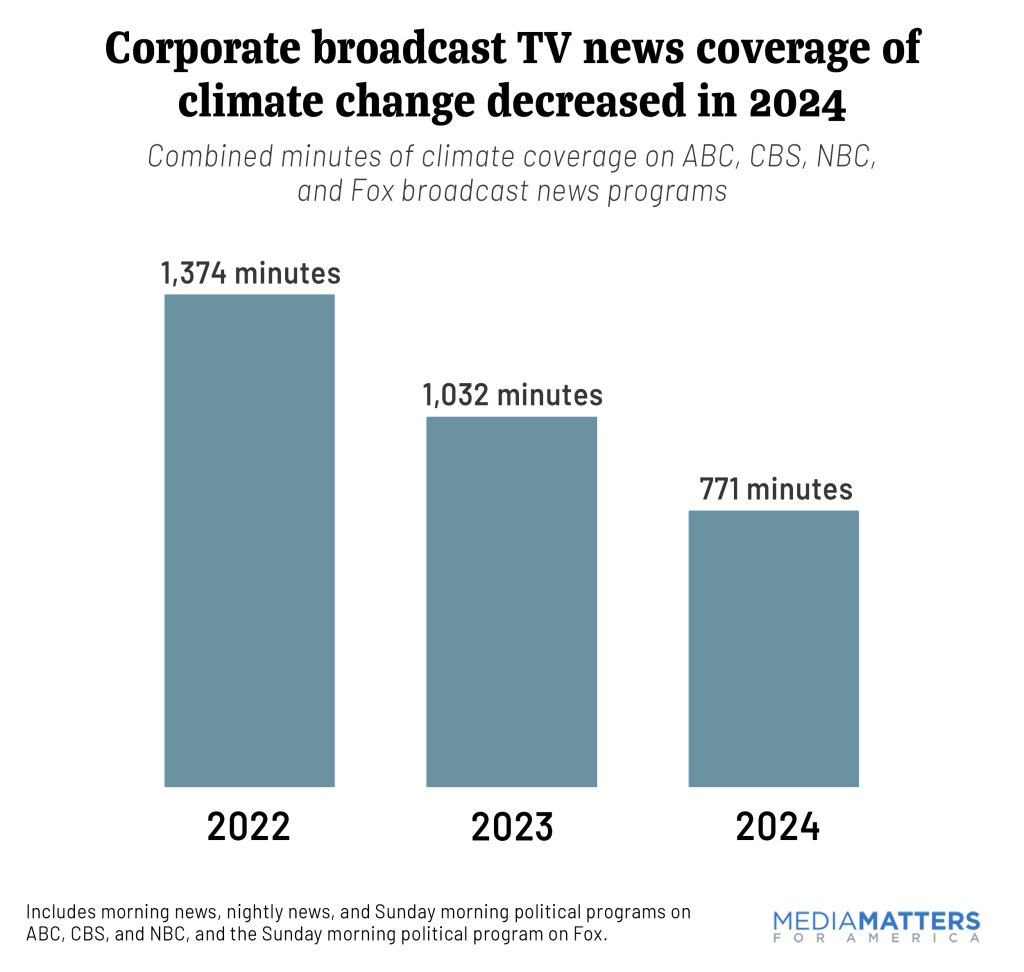
Despite these sweeping investments and the growing urgency of the climate crisis, a Media Matters analysis found that corporate broadcast networks aired 12 hours and 51 minutes of climate coverage in 2024 — a 25% decline in volume of coverage from 2023.
This reduction in climate coverage from ABC, CBS, NBC, and Fox Broadcast Co. (for its Sunday morning political show only) occurred amid significant political events, economic shifts, and global conflicts, which may have diverted attention from climate issues, despite their escalating severity. But it’s still deeply concerning, especially coming just ahead of Donald Trump’s return to the presidency.
As the Trump administration rolls back climate initiatives and expands fossil fuel production, robust news coverage has become more critical than ever. Corporate TV networks must prioritize consistent, substantive climate journalism that amplifies diverse voices, highlights systemic inequities in climate impacts, demands accountability, and clearly communicates both the dangers of an escalating climate crisis and potential solutions.
Key findings
- The volume of climate change coverage on corporate broadcast morning and nightly news programs, as well as Sunday morning political shows, decreased 25% from 2023 to 2024, from 17 hours and 12 minutes (1,032 minutes) to 12 hours and 51 minutes (771 minutes) across 324 segments.
- Only 9% of climate segments on corporate broadcast news – 28 out of 324 segments – mentioned “fossil fuels.” This is a decrease from 2023, when “fossil fuels” were mentioned in 12% of climate segments.
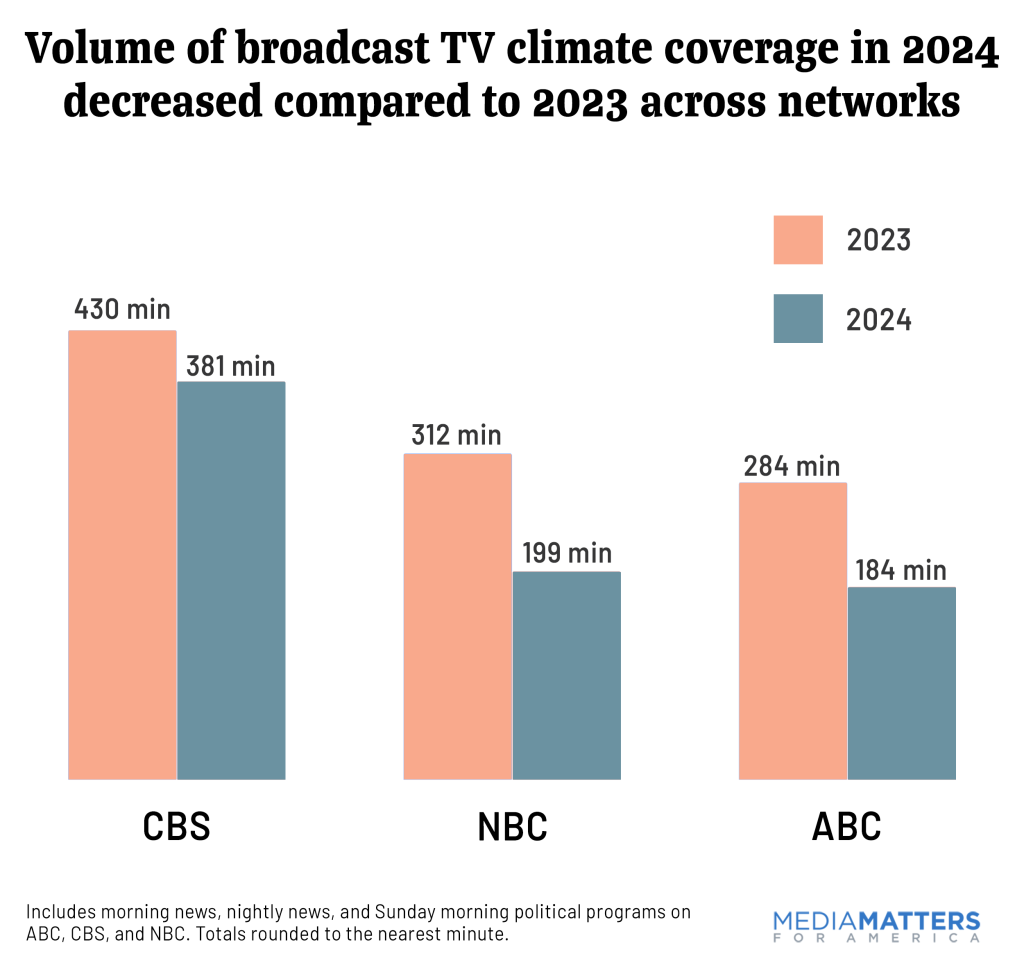
- For the fourth consecutive year, CBS led network climate coverage, accounting for 50% of total broadcast time, airing 381 minutes across 129 segments. Despite ranking third in broadcast minutes with 184, ABC aired the second-highest number of segments (103), while NBC aired 199 minutes across 88 segments.
- On the nightly news programs specifically, the volume of coverage decreased by only 5% from 2023. In 2024, these programs aired 246 minutes across 115 segments. CBS led with 118 minutes across 48 segments, followed by NBC with 92 minutes across 42 segments, and ABC with 36 minutes across 25 segments.
- PBS’ NewsHour aired 88 climate segments in 2024 compared to 122 segments aired in 2023. NewsHour, however, is not included in the full data set, as it is publicly funded and the format of the program is different from that of its corporate network counterparts.
- Climate coverage on corporate broadcast morning news programs decreased by 27% compared to 2023.
- For at least the eighth consecutive year, white men were the largest demographic of guests featured in climate segments. On morning news, nightly news, and Sunday morning political programs, 64% of guests — 190 out of 295 — were white men. Women remained underrepresented, making up 27% of guests. Only 7% of guests — 21 in total — were women of color.
- In 2024, extreme weather events drove a significant portion of broadcast climate coverage, coming up in 31% of total segments (102 of 324). This represents a decrease from 2023, when extreme weather was discussed in 37% of segments (160 out of 435).
- Coverage peaked during the months of June through September, a period marked by record-breaking temperatures and severe weather events. The networks aired 46% of their total climate segments during this period, with June leading with 50 segments.
- Solutions or actions to address climate change were mentioned in 23% of segments (75 of 324), compared to 22% in 2023.
- Coverage of climate justice and disproportionate climate impacts appeared in 3% of segments (11 of 324) in 2024, down from 5% in 2023.
- ## Corporate broadcast news climate coverage continued to decline in 2024
- The 25% decrease in corporate broadcast news coverage from 2023 to 2024 (1,032 minutes to 771) is striking, especially during a year marked by the second-highest number of billion-dollar weather disasters on record. The decline underscores the persistent challenges of maintaining consistent climate coverage amid competing news priorities, from political events to global conflicts.
- ### 2024 climate coverage overview
- For the fourth year, CBS led in volume of climate coverage with 381 minutes across 129 segments, an 11% decrease from 2023, the smallest decline among networks.
- NBC aired 199 minutes of climate coverage across 88 segments, a 36% decrease from the 312 minutes aired in 2023. This was the largest decrease among the broadcast networks.
- ABC aired 184 minutes of climate coverage, a 35% decrease from the 284 minutes aired in 2023. However, ABC produced 103 climate segments, nearly matching CBS' total number of climate stories. This reflects a consistent effort to incorporate climate coverage across news programming, despite shorter average segment lengths.
- Like in 2023, corporate broadcast news coverage fluctuated significantly throughout 2024, with strong coverage during the summer months. Monthly coverage in 2024 ranged from a peak of 123 minutes in June to a low of 23 minutes in December, reflecting the challenges of maintaining consistent climate reporting.
Morning news programs reduced coverage by 27% from 2023
Morning news programs aired 489 minutes of coverage across 195 segments in 2024, a 27% decrease from the 673 minutes aired in 2023.
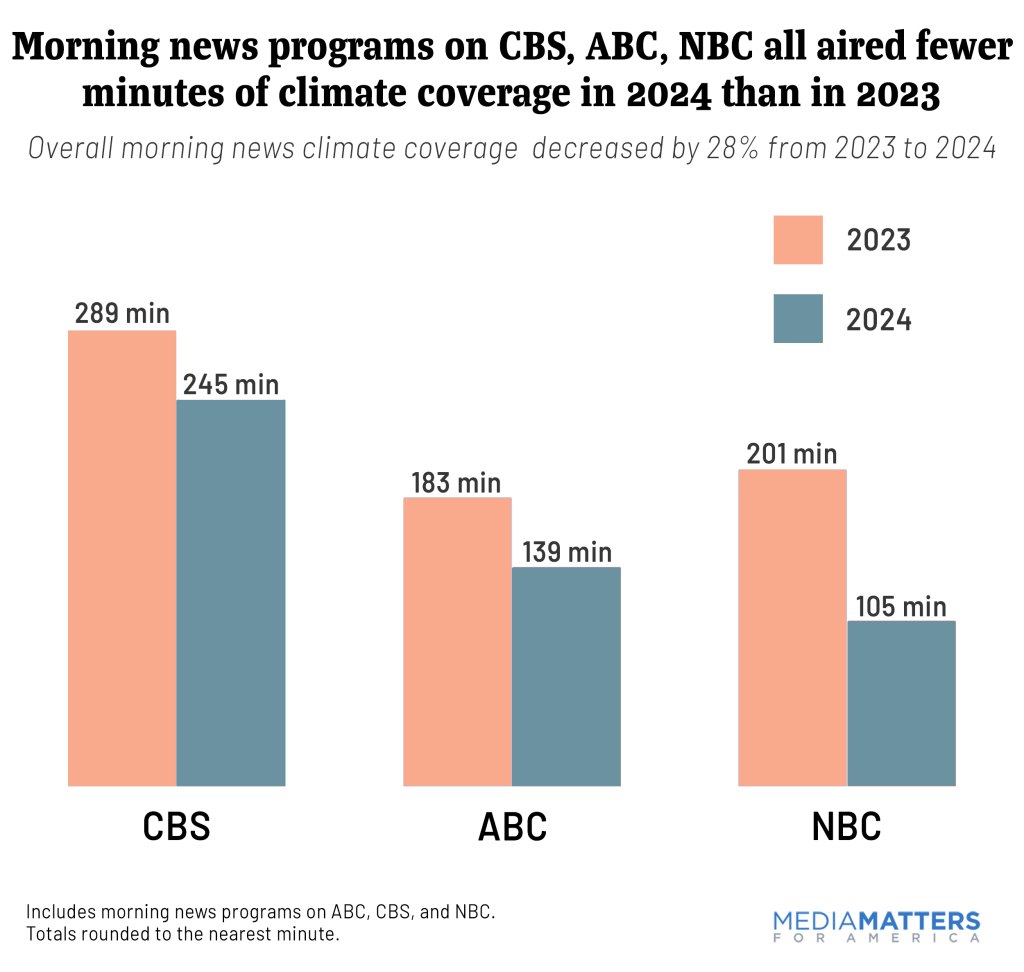
- CBS maintained its lead in morning coverage, airing 245 minutes across 74 segments, a 15% decrease from the 289 minutes aired in 2023.
- ABC's morning news programs aired 139 minutes of climate coverage in 2024, a 24% decrease from the 183 minutes of 2023. However, ABC produced 76 segments, more than both CBS and NBC.
- NBC aired 105 minutes across 45 segments during its morning news programs, a 48% decrease from the 201 minutes of coverage aired in 2023.
For the first time, our study includes ABC's GMA3, which airs for one hour on weekdays. Although it airs during the afternoon, we are categorizing it as a morning show because it follows the same format and branding as ABC's Good Morning America, which airs for two hours Monday through Saturday and for one hour on Sunday.
CBS Mornings airs Monday through Friday for two hours, as does CBS Saturday Morning. CBS News Sunday Morning airs for 90.
NBC's Today airs for four hours on weekdays, but our monitoring includes only the first three hours – the main program (7-9 a.m.) and the third hour (9-10 AM) – because the final hour, Today with Hoda and Jenna, is a lifestyle and entertainment show.
Sunday morning political shows were assessed separately and not included within our categorization of morning news programs.
Nightly news programs' climate coverage decreased slightly in 2024
Corporate broadcast nightly news programs aired 246 minutes of climate coverage across 115 segments in 2024, a 5% decrease from the 259 minutes aired in 2023.
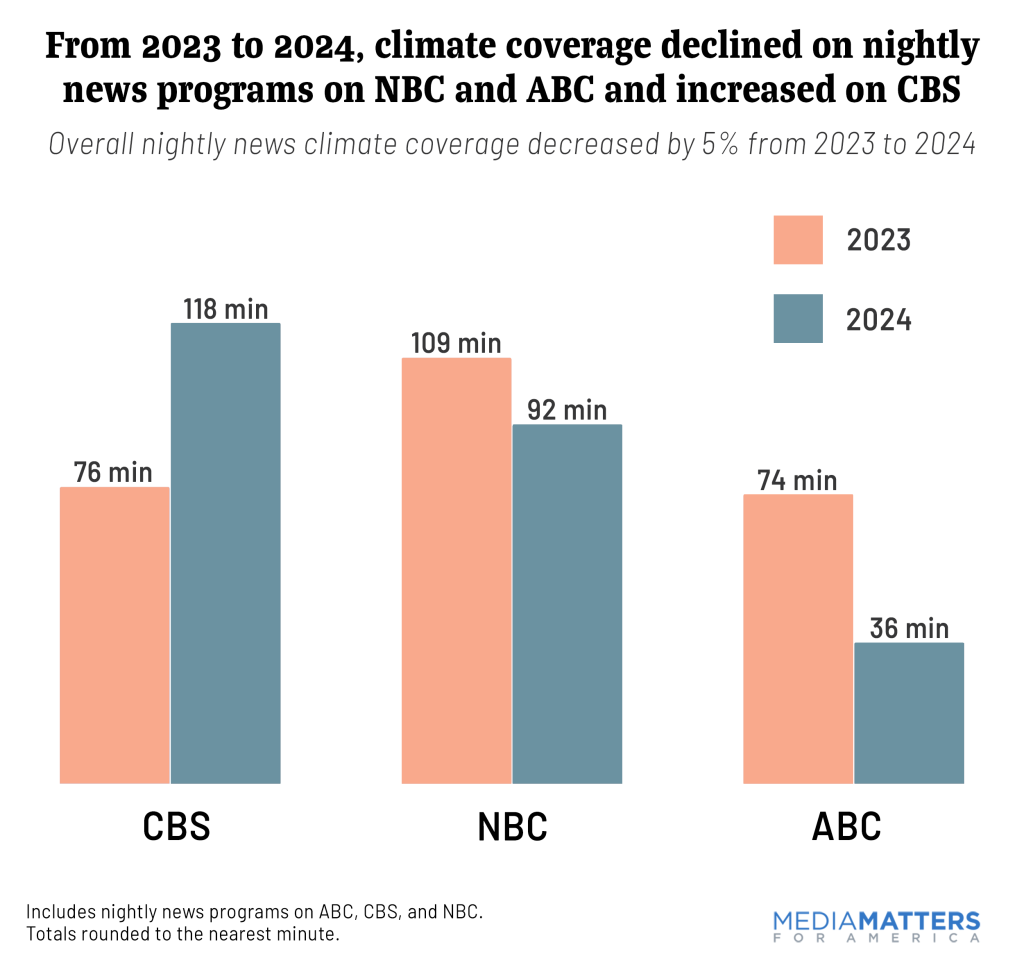
- CBS led evening coverage, airing 118 minutes across 48 segments — a 55% increase from the 76 minutes aired in 2023. CBS was the sole network to increase its evening climate coverage, likely due to its broad team of correspondents, led by Ben Tracy and Jonathan Vigliotti, who covered extreme weather, climate solutions, and recovery efforts, including segments on post-wildfire rebuilding in Palisades and Lahaina.
- NBC aired 92 minutes across 42 segments, a 16% decrease from the 109 minutes aired in 2023.
- ABC aired 36 minutes across 25 segments, a 51% decrease from the 74 minutes aired in 2023.
- For comparison, PBS NewsHour aired 88 segments in 2024, a 27% decrease from its 122 segments aired in 2023.
Sunday morning political shows maintained limited climate coverage
In 2024, Sunday morning political shows on ABC, CBS, NBC, and Fox aired 36 minutes of climate coverage across 14 segments, a 65% decrease from the 102 minutes aired in 2023.
- CBS'Face the Nationled Sunday coverage with 18 minutes across 7 segments, a 73% decrease from the 66 minutes aired in 2023.
- ABC'sThis Weekaired 9 minutes across 2 segments, a 68% decrease from the 28 minutes aired in 2023.
- Fox News Sundayaired 7 minutes across 4 segments in 2024, compared to 6 minutes in 2023.
- NBC'sMeet the Pressaired 2 minutes in a single segment, matching its 2023 coverage level.
Climate coverage peaked in June
In 2024, climate coverage peaked in June, when corporate broadcast networks aired 123 minutes of climate reporting. This peak was driven by extensive coverage of the summer heat wave affecting millions of Americans.
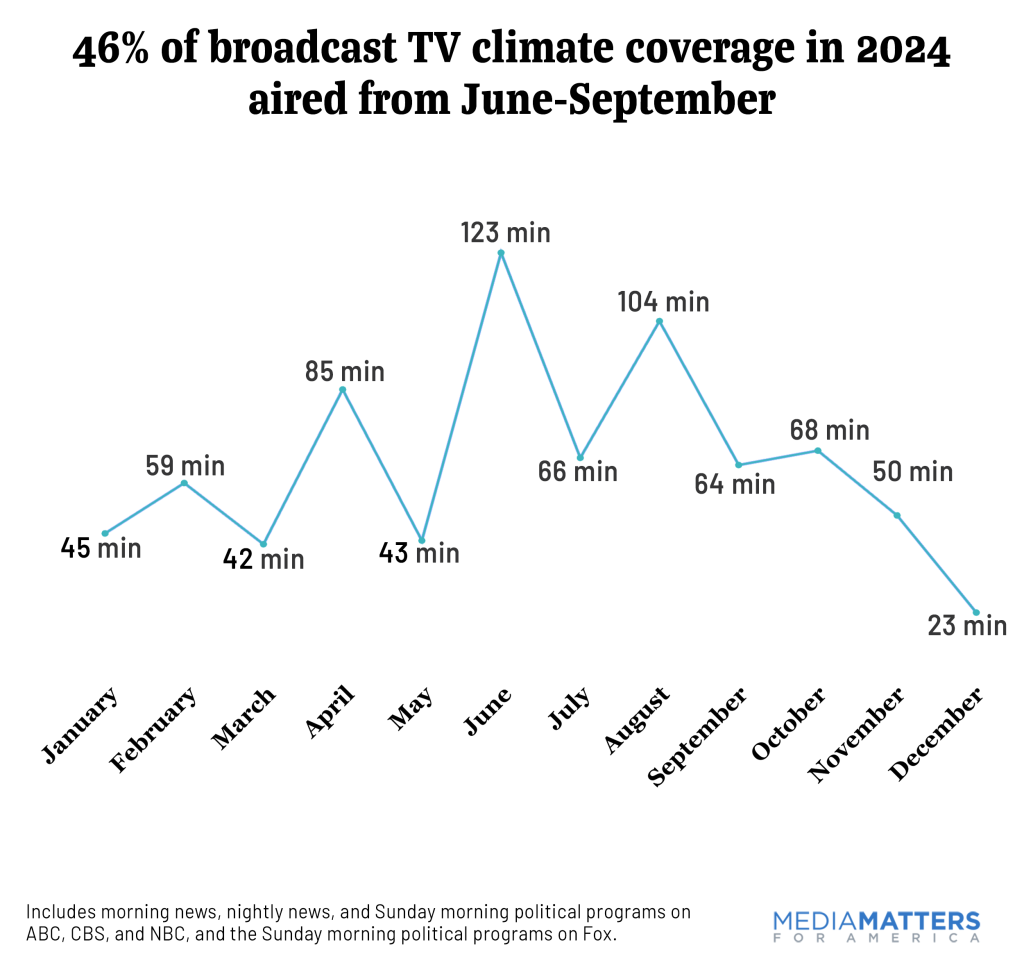
- Morning news programs aired 70 minutes of climate coverage in June, while nightly news programs aired 42 minutes, and Sunday morning political programs aired 10 minutes.
- CBS aired 67 minutes of climate coverage in June, its peak month.
- NBC aired 37 minutes of climate coverage in June, its peak month.
- ABC aired 19 minutes of climate coverage in June, though its peak occurred in April with 26 minutes.
- Morning news programs aired 70 minutes of climate coverage in June, while nightly news programs aired 42 minutes, and Sunday morning political programs aired 10 minutes.
Corporate broadcast networks concentrated their climate coverage in peak extreme weather months (June through September), airing 357 minutes or 46% of the year's total during that period. Coverage peaked in June (123 minutes), followed by August (104 minutes), and July (66 minutes). Although broadcast climate coverage naturally peaks during extreme weather events, networks should strive to maintain sustained coverage that reflects the growing impact of global warming on the economy, public health, agriculture, and even human migration.
- ## Climate coverage reveals ongoing demographic disparities
- In 2024, climate coverage continued to have significant disparities in guest demographics.
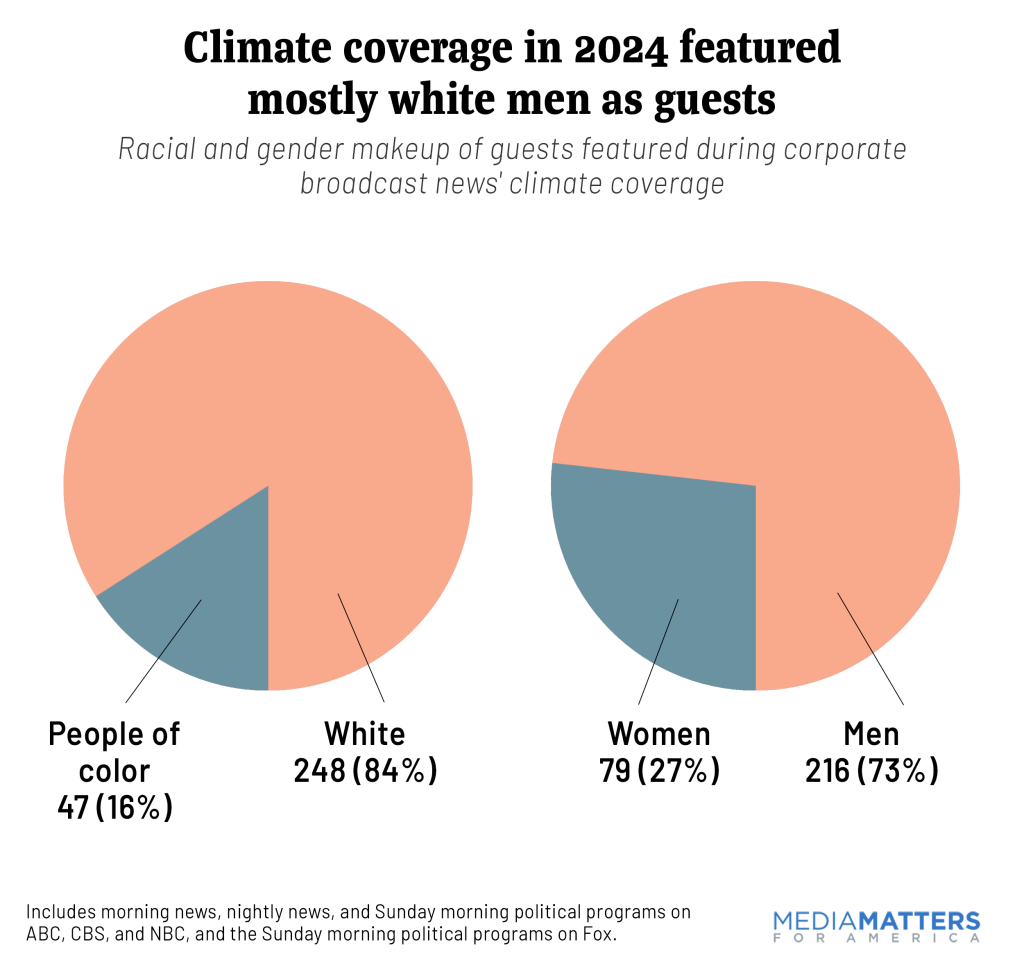
- Among 295 guests, 73% were men (216) and 27% were women (79). White guests made up 84% (248), while people of color accounted for 16% (47), including 16 Black guests, 13 Hispanic guests, and 2 Indigenous guests.
- PBS NewsHour featured 139 named guests in 2024, of whom 90 were men (65%) and 49 were women (35%). 111 guests were white (80%) and 28 were people of color (20%), including 8 Black guests, 13 Hispanic guests, and 1 Indigenous guest.
The underrepresentation of diverse voices in climate coverage — which comes despite the increasing racial/ethnic diversity of the United States — is especially concerning, as climate change disproportionately harms marginalized communities, both domestically and globally. The demographic imbalance also poses a major barrier to fostering inclusive climate discourse that accurately reflects the experiences and perspectives of affected communities.
- ## Frontline and impacted community representation remained limited in 2024
- Media Matters has identified three key groups most affected by climate change: frontline communities, impacted communities, and first responders. Broadcast coverage in 2024 continued to underrepresent these critical voices.
- Of all guests, 25% (75 appearances) across morning, evening, and Sunday news programs were coded as members of frontline communities, impacted communities, or first responders.
- Impacted community members accounted for 52 appearances, defined as those affected by specific climate events or ongoing impacts on their livelihood, homes, infrastructure, and/or local economy.
- First responders accounted for 19 appearances in climate coverage.
- There were only 4 appearances made by frontline community members, defined as those living near fossil fuel infrastructure or uniquely affected by global warming's ongoing impacts on health, livelihood, and/or local economy.
- ## Expert representation remained stable even as climate scientist and advocate appearances decline in 2024
- Climate coverage in 2024 revealed shifts from the previous year. Although overall expert representation remained stable, appearances by climate scientists and advocates decreased.
- In 2024, 24% of guests (70 out of 295) were experts with climate-related knowledge, including researchers, public health professionals, and technical specialists such as atmospheric scientists and engineers, comparable to 24% (100 out of 411) in 2023.
- Climate scientist appearances decreased from 10% (41 out of 411) in 2023 to 5% (14 out of 295) in 2024.
- CBS featured 8 climate scientists.
- NBC featured 6 climate scientists.
- ABC featured no climate scientists.
- Climate advocate appearances decreased from 22 in 2023 to 15 in 2024.
- ## Key drivers of corporate broadcast climate coverage in 2024
- ### Extreme weather
2024 marked a historic year of climate extremes, becoming the first calendar year on record to exceed pre-industrial temperatures by 1.5°C. The United States also experienced 27 separate billion-dollar weather and climate disasters, resulting in 568 fatalities and $182.7 billion in damages — the fourth-costliest year on record. These devastating impacts, from Hurricane Helene's unprecedented North Carolina floods to Hurricane Milton's rapid intensification, provided the backdrop for broadcast climate coverage throughout the year.
The global scope of extreme weather in 2024 was equally severe. Record-breaking floods in Spain claimed more than 200 lives when Valencia received a year's worth of rain in only eight hours. Asia endured multiple devastating typhoons, with Typhoon Yagi causing more than 500 deaths. Brazil experienced severe droughts, with the Paraguay River reaching record lows, while the Sahara witnessed unprecedented floods for the first time in perhaps half a century. These international disasters highlighted the widespread devastation of climate-driven weather events.
Coverage Highlights
- Extreme weather was mentioned in 31% of all climate segments (102 out of 324), a decrease from 2023, when extreme weather was mentioned in 37% of segments (160 out of 435).
- The top 5 most-covered extreme weather events were Hurricane Helene (17 segments), an extreme heat event affecting large swaths of the continental United States in June (17 segments), Hurricane Beryl (8 segments), Hurricane Milton (6 segments), and the July Western U.S. wildfires (4 segments).
- Morning news programs mentioned extreme weather in 46 climate segments.
- CBS led with 18 segments.
- ABC aired 16 segments.
- NBC aired 12 segments.
- Nightly news programs mentioned extreme weather in 53 climate segments.
- NBC led with 24 segments.
- CBS aired 20 segments.
- ABC aired 9 segments.
- Sunday morning political programs provided limited coverage that linked extreme weather to climate change, with 3 total climate segments.
- CBS aired 2 segments.
- ABC aired 1 segment.
- Extreme weather was mentioned in 31% of all climate segments (102 out of 324), a decrease from 2023, when extreme weather was mentioned in 37% of segments (160 out of 435).
Despite extreme weather being a driver of broadcast climate coverage, climate change was only mentioned in a small percent of overall extreme weather reporting in 2024, which suggests a clear opportunity for broadcast networks to increase climate coverage by more consistently connecting the ways our warming planet is influencing extreme weather events.
Only 5% of corporate broadcast segments about Hurricane Milton connected the storm to global warming, while climate was mentioned in 2% of broadcast segments about the July wildfires in the Western U.S. and Canada. Hurricane Beryl saw a similar trend, with 6% of broadcast segments connecting the storm to climate change. The June extreme heat event, which affected large swaths of the continental United States, had the highest climate connection, with 16% of broadcast segments linking the heat wave to climate change.
Trends in extreme weather coverage
Record-breaking climate patterns drive coverage
In 2024, broadcast networks covered unprecedented climate milestones as global temperatures exceeded pre-industrial levels by 1.5°C for the first time. Some coverage emphasized mounting evidence of accelerating climate impacts, from temperature records to extreme weather events, while incorporating scientific analysis to contextualize these developments.
Coverage highlights
- Broadcast networks aired 31 segments on climate trends in 2024, a notable decrease from 2023's 102 segments. Climate trends refer to long-term changes in global temperatures, weather patterns, and extreme weather events driven by climate change.
- ABC led with 12 segments.
- CBS aired 9 segments.
- NBC aired 8 segments.
- During the July 23 episode of ABC's *World News Tonight*, host David Muir reported July 21 as the hottest day on record.
- During the September 23 episode of *CBS Mornings*, meteorologist Stephanie Abrams highlighted how Summer 2024 was the warmest on record globally and projected 2024 to surpass 2023 as the hottest year on record.
- Broadcast networks aired 31 segments on climate trends in 2024, a notable decrease from 2023's 102 segments. Climate trends refer to long-term changes in global temperatures, weather patterns, and extreme weather events driven by climate change.
Integration of scientific research and climate attribution
Climate attribution studies analyze how global warming influences the likelihood and intensity of specific weather events, providing essential scientific evidence that helps audiences understand climate impacts in their daily lives. These studies appeared less frequently in broadcast coverage in 2024 compared to 2023.
- Climate attribution appeared in 7 segments in 2024, compared to 10 segments in 2023.
- CBS featured climate attribution in 4 attribution segments, followed by ABC with 2, and NBC with 1 segment.
- During the October 6 episode of NBC’s *Sunday Today*, correspondent Jesse Kirsch reported on climate attribution and how global warming is driving increasingly dangerous extreme weather events.
- CBS featured climate attribution in 4 attribution segments, followed by ABC with 2, and NBC with 1 segment.
- Climate attribution appeared in 7 segments in 2024, compared to 10 segments in 2023.
Beyond attribution studies, corporate broadcast networks incorporated a range of scientific research into their climate coverage.
- Of the 10 segments featuring scientific reports or studies corporate broadcast networks aired:
- CBS led with 6 segments featuring research from Climate Central, the National Oceanic and Atmospheric Administration, UN environmental reports, and climate impact studies.
- ABC included climate research in 4 segments, drawing on Climate Central data, NOAA forecasts, and National Climate Assessment findings.
- During the March 27 episode of *CBS Evening News*, climate scientist William Anderegg presented Climate Central's findings on climate change's impacts on allergies and season length.
- During the May 23 episode of ABC’s *World News Tonight*, host David Muir reported on NOAA’s forecast of 17 to 25 named storms for the 2024 hurricane season.
- Of the 10 segments featuring scientific reports or studies corporate broadcast networks aired:
Trends in climate impacts coverage
Economic and health impacts led nonweather coverage
Climate impact coverage in 2024 paid particular attention to systemic disruptions, with networks emphasizing long-term challenges to economic systems, public health, and ecosystems. Although insurance market disruption may be statistically underrepresented in the coverage data, it emerged as one of the year's most significant narratives, powerfully illustrating the mounting economic urgency of the climate crisis.
Coverage highlights
- The six most frequently mentioned climate impacts, excluding weather-related coverage, in 2024 were:
- Economic and insurance disruption (35 mentions)
- Public health impacts (31 mentions)
- Natural environment effects (30 mentions)
- Fatalities (19 mentions)
- Infrastructure (14 mentions)
- The six most frequently mentioned climate impacts, excluding weather-related coverage, in 2024 were:
Coverage of climate impacts across major networks included a segment aired during the August 26 episode of ABC's *Good Morning America, where medical correspondent Dr. Darien Sutton linked rising West Nile virus cases to climate change, highlighting how warming temperatures are expanding mosquito populations into new regions. During the September 1 episode of *CBS News Sunday Morning, reporting examined the threat climate change poses to California’s Highway 1, particularly in and around Big Sur. NBC's *Sunday Today* aired a segment on October 13 that featured experts from the Columbia Climate School discussing how climate-driven extreme weather events, including hurricanes Helene and Milton, are reshaping housing and insurance markets.
Solutions
Corporate broadcast networks reduced their climate solutions coverage in 2024, airing 75 segments compared to 95 in 2023. Although solutions coverage maintained a similar proportion of total climate segments (23% in 2024 versus 22% in 2023), it remained well below the 2022 level of 35%.
Coverage Highlights
- Climate solutions were mentioned in 75 segments across corporate broadcast networks in 2024.
- CBS led coverage with 40 segments, followed by ABC with 21 segments, and NBC with 14 segments.
- Morning news programs mentioned solutions in 52 segments.
- CBS led with 26 segments.
- ABC aired 18 segments.
- NBC aired 8 segments.
- Nightly news programs mentioned solutions in 21 segments.
- CBS led with 13 segments.
- NBC aired 6 segments.
- ABC aired 2 segments.
- Sunday morning political programs mentioned solutions in 2 segments, one each from ABC and CBS.
Trends in climate solutions coverage
Adaptation measures led 2024 coverage
Like in 2023, adaptation-focused segments continued to lead climate solutions coverage in 2024, reflecting the ongoing need for communities to build resilience against climate impacts affecting infrastructure, agriculture, and public health.
Coverage highlights
- Adaptation strategies were mentioned in 30 segments, leading all solution categories.
- Transportation solutions were mentioned in 14 segments, an increase from 3 segments in 2023.
- Clean electricity production was mentioned in 10 segments.
Examples of specific adaptation initiatives showcased included architectural innovations for hurricane-resistant buildings on , [vid]experimental technology for protecting workers dealing with extreme heat on NBC Nightly News, and advanced air-quality alert systems on CBS Saturday Morning. The segments featured expert perspectives from architects, researchers, and a meteorologist on how these solutions can help communities adapt to intensifying climate impacts.
2024 Election
Corporate broadcast networks' election coverage touched on climate change, primarily candidate statements and potential administration appointments, with a particular focus on cabinet nominees in late 2024.
Coverage highlights
- Broadcast networks aired 24 segments connecting climate issues to election coverage.
- CBS led with 11 segments, followed by ABC with 9 segments, and NBC with 4 segments.
- Broadcast news shows mentioned Trump administration nominees' anti-climate stances and fossil fuel industry ties in 10 segments.
Broadcast networks focused on Trump administration nominees' climate and environmental positions in November. Coverage centered on then-potential Energy secretary nominee Chris Wright, a fracking executive, examining his climate science skepticism and fossil fuel industry background. Networks also reported on former Rep. Lee Zeldin's then-potential EPA nomination and anticipated environmental policy shifts. The November post-election period marked the year's most sustained attention to climate policy positions in election coverage.
- ## Climate stories that were undercovered in 2024
- ### Biden administration climate actions
During a significant period of climate policy implementation, broadcast networks reduced coverage of the Biden administration's climate actions, focusing primarily on major regulatory actions like vehicle emissions standards and natural gas export decisions. Overall coverage decreased in 2024, with 19 segments compared to 29 in 2023. Despite climate and energy emerging as key campaign issues, networks rarely connected these policy decisions to their election coverage.
Even though the Inflation Reduction Act was the administration’s most significant climate policy, networks rarely framed the solutions from this law as IRA-driven. The lack of coverage and contextualization may have limited public awareness of the law’s climate impact, including its role in expanding clean energy, manufacturing, and community development.
Coverage highlights
- Corporate broadcast networks mentioned Biden administration climate initiatives in 6% of segments in 2024.
- CBS led coverage with 11 segments, while NBC and Fox aired 3 segments each, and ABC aired 2 segments.
- Vehicle emissions standards led coverage with mentions in 9 segments.
- Natural gas export policy decisions were mentioned in 5 segments.
- The Inflation Reduction Act was mentioned in 2 climate segments.
COP29
Corporate broadcast networks mentioned the United Nations climate conference, COP29, in 4 segments in 2024 — a decrease from the 14 segments aired about COP28 in 2023. The Conference of the Parties (COP) is an annual UN climate summit where global leaders, scientists, and activists gather to negotiate climate policy. COP29 focused on advancing climate finance mechanisms and carbon credit frameworks, aiming to help developing nations transition to sustainable energy and adapt to climate impacts. Despite the conference’s critical role in tackling the climate crisis, media coverage was limited, leaving the global negotiations largely out of the public spotlight.
Coverage highlights
- In 2024, corporate broadcast networks mentioned COP29 in 4 segments.
- ABC, CBS, NBC, and Fox each aired a single segment about the climate conference.
- In 2024, corporate broadcast networks mentioned COP29 in 4 segments.
- ## How corporate broadcast covered climate justice and fossil fuel accountability in 2024
- ### Climate justice
Coverage of climate justice decreased in 2024, with networks airing 11 segments, compared to 21 in 2023. Climate justice focuses on the disproportionate effects of climate change on socially marginalized communities and the need for equitable solutions in addressing global warming. Corporate broadcast networks' coverage of these issues could play a vital role in highlighting disparities and informing public understanding of inclusive climate policies.
Coverage highlights
- Corporate broadcast networks mentioned climate justice in 11 segments in 2024.
- ABC mentioned climate justice in 6 segments.
- CBS mentioned climate justice in 4 segments.
- NBC mentioned climate justice in 1 segment.
- Corporate broadcast networks mentioned climate justice in 11 segments in 2024.
Climate justice coverage in 2024 included an ABC *World News Tonight* segment aired on April 22, where Ginger Zee interviewed Brett Isaac, founder and executive chairman of Navajo Power, and Eleanor Paddock, a Navajo Nation resident, about efforts to bring electricity to Navajo communities for the first time. On June 8, a *CBS Saturday Morning*segment examined heat-related disparities, with David Schechter interviewing Ken Rye, who had been personally affected by the lack of air conditioning in marginalized neighborhoods.
Fossil fuel accountability
With an audience of millions, corporate broadcast networks are well-positioned to examine how the fossil fuel industry is driving global warming, helping viewers understand its role in climate disasters, environmental degradation, and public health risks and providing crucial context for climate policy discussions.
Coverage highlights
- In 2024, corporate broadcast networks mentioned “fossil fuels” in the context of climate change in 9% of climate segments, or 28 out of 324. This represents a decrease from 2023, when fossil fuels were mentioned in 12% of climate segments (52 out of 435).
- CBS mentioned fossil fuels in 18 segments.
- ABC mentioned fossil fuels in 8 segments.
- NBC mentioned fossil fuels in 2 segments.
- In 2024, corporate broadcast networks mentioned “fossil fuels” in the context of climate change in 9% of climate segments, or 28 out of 324. This represents a decrease from 2023, when fossil fuels were mentioned in 12% of climate segments (52 out of 435).
Fossil fuel accountability coverage in 2024 included a segment that aired during the March 16 episode of ABC's *Good Morning America, where Will Ganss followed photographers using visual activism to document climate impacts and expose the risks of oil drilling in the Bahamas. Another segment aired during the July 2 episode of *CBS Evening News, with Ben Tracy reporting on the conflict between Louisiana fishermen, environmentalists, and liquefied natural gas producers over the environmental and economic consequences of expanding LNG export terminals.
- ## The road ahead for broadcast climate coverage
- With Trump's return to office in 2025, broadcast networks face a critical moment to strengthen their climate coverage. While networks have made progress connecting climate science to extreme weather events, they must move beyond treating these as seasonal, isolated incidents. The challenge now is reporting on the year-round, globally interconnected patterns that define our new climate normal.
Moving forward, broadcast coverage must thoroughly investigate how both government and industry actions shape climate solutions. Networks must systematically scrutinize fossil fuel industry influence while spotlighting successful climate initiatives and their institutional challenges. This dual focus on accountability and solutions can provide viewers a comprehensive picture of America's climate response.
Networks must also resist the temptation to focus narrowly on Trump's provocative statements instead of on their policy implications and deliver substantive reporting that helps audiences grasp the tangible effects of climate policy decisions. This requires sustained attention on how federal, state, and corporate decisions shape community outcomes across regions.
Through reporting that connects extreme weather to climate change, investigates corporate influence on climate policies, amplifies voices from frontline communities, and holds policymakers accountable for their actions – not just their words – broadcast news can galvanize public demand for bold climate action and ensure accountability at every level of leadership.
- ## Methodology
---
mma
https://www.mediamatters.org/cable-news/how-2022s-best-extreme-weather-segments-point-way-forward-national-tv-news-extreme
Much of 2022’s extreme weather coverage from national TV news outlets failed to connect the consequences of climate-driven events such as wildfires, hurricanes, heat waves, and megadroughts to their primary cause: global warming induced primarily by the burning of fossil fuels. Corporate broadcast and cable TV news reporting on extreme weather events in 2022 too often neglected to connect these disasters to the climate crisis, allowed systemic failures that are exposed by extreme climate events to go unchallenged, and failed to demand accountability for those exacerbating climate change, as well as its impacts and injustices.
A roundup of this year’s extreme weather coverage found that national TV news shows mentioned climate change in only 17% of segments about mid-June’s multiple concurrent extreme weather events, while broadcast and cable coverage of Yosemite National Park’s Washburn Fire from July 9-11 mentioned climate change in just 37% of segments. Similarly, only 32% of national TV news segments about the global extreme heat waves from July 16-18 mentioned climate change.
During broadcast and cable news coverage of a record-breaking heat dome that afflicted the American West from late-August through early-September, climate change was mentioned in only 12% of segments. And, from August 25 through September 15, national TV news coverage of Pakistan’s catastrophic floods mentioned climate change in 35 of 78 segments.
Moving into hurricane season, broadcast and cable news coverage of Hurricane Fiona from September 14-20 mentioned climate change in only 7 out of 233 segments, while national TV news coverage of Hurricane Ian mentioned climate only 46 times across 1,020 segments.
There were some notable positive examples among 2022’s extreme weather segments, however,which contextualized the role of climate change, amplified voices from vulnerable communities, and demanded accountability for the polluting industries driving the climate crisis. As such, they should serve as a model for how broadcast and cable news shows should approach their coverage of extreme weather in 2023 and going forward.
Here are a few of the best extreme weather segments aired in 2022
Broadcast
One of broadcast news’ better segments aired during the July 18 episode of CBS Mornings, which demonstrated how extreme weather coverage benefits from experts who can credibly communicate climate science and the urgency of climate action to viewers. The segment, which was about the extreme heat gripping multiple places on Earth, featured an interview with Kirsty McCabe of the U.K.’s Royal Meteorological Society, who stated that “climate change has everything to do with the extreme weather that we're seeing at the moment — and it's human-induced climate change, it’s not a natural variation.” She also noted that “if we don't do something now and take drastic action, we will continue to see these things happening."[vid]
one of the strongest extreme weather segments on either broadcast or cable news aired during the September 20 episode of CBS Mornings. Correspondent David Begnaud, who also did exceptional reporting during and after 2017’s Hurricane Maria, used a nearly eight-minute segment about Hurricane Fiona to demand accountability from the utility company currently tasked with rebuilding and improving Puerto Rico’s grid, and to amplify the voices of vulnerable people who face immediate risk when critical infrastructure fails.
no lnx
no vids
The October 4 episode of NBC Nightly News aired a strong segment during its coverage of Hurricane Ian that highlighted how poor communities and communities of color in southwest Florida were excluded from rescue and relief efforts.
Video
CitationFrom the October 4, 2022, episode of NBC Nightly News
Cable
One of the stronger cable news extreme weather segments aired during the July 10 episode of CNN Newsroom with Jim Acosta, during which correspondent René Marsh discussed the Washburn Fire’s threat to Yosemite’s sequoia trees and explained how wildfires, hotter temperatures, and sea-level rise threaten national parks more broadly. She noted, “It is not just Yosemite. This issue of climate change and the impact of climate change at these national parks is an issue across the United States.”
Video file
Video
CitationFrom the July 10, 2022, edition of CNN Newsroom With Jim Acosta
Another of the year’s strongest extreme weather segments aired during the September 5 episode of MSNBC’s Jose Diaz-Balart Reports and featured an excellent interview with climate scientist Katharine Hayhoe about the Western U.S. heat wave. Hayhoe noted, “We need to be cutting out heat-trapping gas emissions as much as possible, as soon as possible,” and ended the interview by stating, “It’s not about saving the planet. It’s about saving us.
Video
CitationFrom the September 5, 2022, edition of MSNBC's Jose Diaz-Balart Reports
A segment about Pakistan’s devastating flooding during the September 2 episode of CNN Tonight detailed how extreme heat and precipitation around the world are linked by climate change and explained why Pakistan’s unique geography makes the country extremely vulnerable to harmful climate impacts.
Video
CitationFrom the September 2, 2022, episode of CNN Tonight
During the September 19 episode of MSNBC’s Alex Wagner Tonight, in a segment focused on how Puerto Rico was recovering in the aftermath of Hurricane Fiona, host Alex Wagner provided viewers with a detailed breakdown of the corruption, scandal, and federal neglect hindering the island’s grid improvement since Hurricane Maria five years earlier.
Video
CitationFrom the September 19, 2022, episode of MSNBC's Alex Wagner Tonight
In a strong segment about Hurricane Ian, the October 2 episode of MSNBC’s American Voices with Alicia Menendez featured climate scientist Suzana J. Camargo explaining the science behind the rapid intensification of storms like Ian and the need to build climate resiliency by reducing fossil fuels use and improving infrastructure.
Video
CitationFrom the October 2, 2022, episode of MSNBC's American Voices with Alicia Menendez
The October 7 episode of CNN's New Day featured another one of the year’s best segments. CNN chief climate correspondent Bill Weir highlighted one Florida community that runs on 100% solar power and was largely spared from Ian’s wrath even though it is only 15 miles from Fort Myers, which was “ground zero for storm surge” during the hurricane. The solutions-focused segment demonstrated the potential resiliency benefits of renewable energy and protected wetlands.
Video CitationFrom the October 7, 2022, episode of CNN's New Day
In 2023, national TV news must commit to sustained and substantive extreme weather coverage
Extreme climate events are becoming more frequent and devastating, and national TV news outlets must commit to immediately improving their extreme weather coverage. Unfortunately, so much of extreme weather coverage is now characterized by shallow coverage that prioritizes disaster imagery over substantive reporting — broadcast and cable news shows are adept at showing the carnage of extreme weather events, the hollowed out faces of those who have lost everything, and the hand-wringing and expressions of empathy from concerned hosts and public officials.
To begin improving their extreme weather coverage, broadcast and cable news networks must follow the example set by the better extreme weather segments featured above. This includes consistently connecting extreme weather events to climate change and informing viewers that the climate crisis is being primarily driven by the burning of fossil fuels and the reluctance of rich countries to immediately transition away from fossil fuels. Media must also connect extreme weather events to policies and practices made by local, state, and federal officials that exacerbate climate impacts and hamper recovery, while building awareness and support for public policies that could mitigate the worst consequences of global warming. Finally, national TV news shows must continue telling the story of the people and communities who are recovering after an extreme weather event has upended their lives, focusing on the plight of victims while promoting resiliency and pushing for solutions to the climate crisis.
THE LATEST
Fox has shamelessly spent 2022 bootlicking the fossil fuel industry
12/30/22 10:49 AM EST
Dissatisfied with Republican midterm losses, Spanish right-wing media cry fraud, crime, and communism
12/28/22 8:49 AM EST
How 2022's best extreme weather segments point the way forward for national TV news' extreme weather coverage
12/26/22 11:52 AM EST
Angelo Carusone: Even if there is a new CEO at Twitter, Elon Musk will still be the “ultimate decision-maker”
12/24/22 5:51 PM EST
Tucker Carlson offers to fund a militia at the southern border
12/21/22
IN THIS ARTICLE
Cable news
Broadcast Networks
Related
Several mainstream news organizations took the bait in reporting on GOP's planned Hunter Biden investigation
11/21/22 3:57 PM EST
Climate conversations missing from 2022 Senate debates
11/07/22 3:32 PM EST
There is no truth to the right-wing myth of a catastrophic diesel shortage
11/04/22