Justin Sun Tron Wlf
AN 7 26
An eccentric billionaire is accusing President Donald Trump of fraud relating to his family's biggest recent grift scheme, and in an interview with The Intelligencer magazine, further accused the president of "threatening" him to keep quiet.
Intelligencer called Chinese billionaire Justin Sun "one of the richest people in the world, having made his fortune in the no-rules early phase of the crypto industry" in its Monday profile, further detailing how he invested $30 million in the Trump family's crypto firm World Liberty Financial and joined it as an advisor in late 2024. The firm has emerged as the epicenter of the Trump family's cryptocurrency dealings, and, in the wake of numerous shady deals, is now considered its biggest overall financial venture.
As he moved forward with World Liberty Financial, however, Sun came to see the investment as a "colossal mistake," as the firm's promised products never materialized and its various tokens crashed in value, costing investors massive sums of money. In April of this year, he sued the company, "alleging fraud and breach of contract."
"Today, the thing I regret the most is not only that my money got stuck but that my name is on the project,” Sun told the outlet. “I believe many other people also got harmed... I never expected this to happen to me. This is the worst-case scenario."
He added further: “I thought surely these people would not do what they did with such a public profile attached. Looking back, I was wrong about that. Unfortunately, as alleged in the complaint, certain operators leveraged the Trump brand to profit through fraud.”
Sun's suit against World Liberty notably does not name either Trump or his sons, Donald Trump Jr. and Eric Trump, and he claims to remain an "ardent supporter" of the president. He insisted to one source who spoke with the Intelligencer that the suit is not a "political issue," and accused the company of acting "like young punk criminals" and giving the crypto a industry a bad name.
The company, meanwhile, did not sit back in response to Sun's suit.
"On May 4, a couple of weeks after Sun filed his suit, World Liberty sued him for defamation," the report detailed. "Represented by the law firm Clare Locke, which successfully sued Fox News over its 'big lie' coverage following the 2020 election, World Liberty tells a different version of events. Though sections of its accusations are redacted, World Liberty claims in the suit that it froze Sun’s coins to 'protect' itself and its investors from prohibited conduct by Sun. Just before the $WLFI tokens started trading, the company alleges, Sun placed a large bet against them, transferring $300 million 'to fund an aggressive short position.' It also claims Sun made 'straw purchases' on behalf of other investors. Notably, though, World Liberty did not sue Sun for breach of contract or fraud."
Sun dismissed this suit as an effort to silence him.
“I believe that World Liberty is trying to threaten me into silence, but that will not work,” he said. “I stand by the decision to speak out about conduct that I believe was improper and harmful to token holders... I believe the evidence will prove our allegations to be true.”
---
PSW 4 26 CORRUPT STATS $ TRUMP KIDS BARRON
ARAB JUSTIN SUN SUE LIBERTY, DRONE PLUS GOLF MERGER
Apr 22, 2026 Pod Save the World
Tommy and Ben break down another chaotic and consequential week in global affairs. Trump blinks and extends the ceasefire with Iran, but the Strait of Hormuz remains closed as US-Iran negotiations stall. Meanwhile, an internal power struggle between Iran's elected leaders and military is complicating talks, and the human cost for ordinary Iranians continues to mount. In Lebanon, Trump stunned Israeli Prime Minister Bibi Netanyahu by publicly ordering Israel to stop bombing, but the IDF continues to occupy southern Lebanon, and an explosive image of an IDF soldier desecrating a statue of Jesus Christ threatens to erode evangelical support for Israel.
The guys also dig into the sprawling conflicts of interest and corruption plaguing Trump's foreign policy team: Jared Kushner's billion-dollar Gulf slush fund, Don Jr. and Eric Trump’s drone grift, and the Trump family’s foray into the crypto and fusion energy business. Finally, they talk about the historic election results in Hungary and Bulgaria,
Trump’s slow-rolling regime change efforts in Cuba, and reports that FBI Director Kash Patel is such a sloppy drunk that he’s become a threat to national security. Then Tommy is joined by former USAID official Nicholas Enrich to talk about his new book, Into the Wood Chipper: A Whistleblower’s Account of How the Trump Administration Shredded USAID. Preorder Ben’s book All We Say: The Battle for American Identity: A History in 15 Speeches and subscribe to his Substack here.
---
---}:
the hill
wASHINGTON (AP) — President Donald Trump took office in January pledging to “make America the crypto capital of the world.” He has since harnessed wide swaths of the federal government to bolster the industry — all while raking in huge sums of money for his family’s business.
By some estimates, crypto ventures now account for nearly 40% of the Trump Organization’s $2.9 billion net worth. But the Republican president’s championing of the industry has been just as big a boon for many of the industry’s top names.
Many have seen their profits and political standing soar, while investigations of potential wrongdoing and other legal entanglements led by the administration of Trump’s predecessor, Democratic President Joe Biden, have largely fallen away.
Here’s a look at some of the crypto industry’s top leaders and their ties to Trump:
Justin Sun
A Chinese-born crypto entrepreneur and founder of the cryptocurrency platform Tron, Sun is best known for buying a piece of conceptual art consisting of a banana duct-taped to a wall for $6.2 million and subsequently eating the banana.
Ties to Trump: Sun was the top investor in Trump’s meme coin, $Trump, and secured the top spot at the president’s recent crypto dinner, which was held at Trump’s golf course just outside Washington. Sun posted a professionally produced video of himself receiving a $100,000 gold watch that Trump’s meme coin awarded to the top four investors. Sun also recently bragged about his close ties to the White House, posting in Chinese on X “It’s all true” over a series of posts listing his links to the president and his meme coin. Sun was sued by the Securities and Exchange Commission under Biden for working to artificially inflate the price of crypto, an investigation that has been paused since Trump took office. Sun was an early and important investor in World Liberty Financial, a crypto venture Trump and his sons Eric and Donald Jr. launched in September. The president’s most recent financial disclosure report reveals he made more than $57 million last year from World Liberty Financial, which has launched USD1, a stablecoin pegged at a 1-to-1 ratio to the U.S. dollar.
Michael Saylor
The co-founder and chair of Strategy, formerly known as MicroStrategy, Saylor is one of bitcoin’s most prominent and outspoken evangelists. He owns a yacht once featured on “Entourage,” and his is the most high-profile bitcoin treasury company, which is a type of firm primarily focused on buying and holding bitcoin as its business model. Strategy currently holds more than 2% of all outstanding bitcoins in circulation and is constantly buying more.
Ties to Trump: Trump Media, the parent company of the president’s social media platform, Truth Social, has announced it will raise $2.5 billion from institutional investors to buy bitcoin in an attempt to build up a cryptocurrency reserve, similar to what Saylor’s company is best known for. Saylor met in January with Eric Trump at the president’s Mar-a-Lago resort in Palm Beach, Florida, and the president’s son has spoken publicly about how he and Saylor were friends who knew each other in New York two decades ago. Saylor also attended the president’s first crypto summit at the White House in March. “All of us owe him a tremendous debt of gratitude,” Eric Trump said of Saylor, praising him at the recent annual bitcoin conference in Las Vegas as an effective spokesperson for the crypto community.
Changpeng Zhao
Known universally as CZ, Zhao is founder and former CEO of Binance, the world’s largest cryptocurrency exchange. He was sentenced last year to four months in prison for failing to stop criminals from using the platform to move money connected to child sex abuse, drug trafficking and terrorism. Zhao was released in September.
Ties to Trump: World Liberty Financial recently announced that an investment fund in the United Arab Emirates would be using $2 billion worth of USD1 to purchase a stake in Binance. Zhao also has publicly said that he’s asked Trump for a pardon that could nullify his conviction.
Brian Armstrong
Co-founder and CEO of Coinbase, a major cryptocurrency exchange, Armstrong has been a key figure in the crypto industry’s push into politics.
Ties to Trump: Armstrong and Coinbase were major donors to a political action committee that helped Trump and other pro-crypto candidates. He met with Trump weeks after Election Day and attended the White House crypto summit. Coinbase hired Trump’s former campaign manager, Chris LaCivita, to its Global Advisory Council. Trump also addressed, via prerecorded video message, Coinbase’s State of Crypto Summit this month.
The Winklevoss Twins
Tyler and Cameron Winklevoss founded the Gemini cryptocurrency exchange and are most famous to the general public for suing Mark Zuckerberg over the creation of Facebook, an important plot point in the movie “The Social Network.” In 2023, Biden’s SEC sued Gemini for selling unregistered securities, another case that’s been paused since Trump took office.
Ties to Trump: The twins each pledged $1 million donations to the Trump campaign, as well as lavish donations to Elon Musk’s political group – though some of the donations to Trump’s campaign were returned because the Winklevoss brothers had violated federal limits. They were invited to Trump’s crypto summit and praised the president’s approach to the sector then. Addressing the crypto conference in Las Vegas, Vice President JD Vance said the brothers “really helped break the dam” and persuade tech sector leaders to support Trump’s campaign. “I think they were some of the first big names in Silicon Valley to take that step, and a whole host of people followed them,” Vance said.
David Bailey
Bailey is the CEO of BTC Inc., an influential holding company with ventures throughout the crypto industry including Bitcoin Magazine. He recently raised $300 million to launch Nakamoto, a publicly traded bitcoin investment company.
Ties to Trump: Baily served as a crypto adviser to Trump’s campaign. Vance also saluted Bailey at the Las Vegas conference, saying he was “grateful for everything you’ve done for the bitcoin community.”
Associated Press writer Alan Suderman contributed to this report.
---
---
AN 9 25
In the midst of the Trump regime’s shameful attempt to attack any and all organizations and institutions that oppose it, we must not and will not back down from holding Trump accountable for his corruption and lawlessness.
Yesterday, the New York Times — which Trump just sued for $15 billion for allegedly defaming him —reported that Steve Witkoff, Trump’s envoy to the Middle East, apparently made a multi-billion dollar deal with Sheikh Tahnoon bin Zayed Al Nahyan, a member of the ultrarich ruling family of the United Arab Emirates who controls $1.5 trillion of the Emiratis’ sovereign wealth.
In return for Sheikh Tahnoon’s investment firm depositing $2 billion into World Liberty Financial, a cryptocurrency start-up founded by the Witkoffs and Trumps, the White House agreed to give the U.A.E. — in particular, a sprawling technology firm controlled by Sheikh Tahnoon —access to hundreds of thousands of the world’s most advanced and scarce computer chips, despite national security concerns that the chips could be shared with China.
This is just the top of the iceberg of Trump’s crypto corruption.
To understand the full extent of it, you need to go back to four days before early voting started in 2024. That’s when Trump and his sons launched the crypto firm, World Liberty Financial.
As soon as Trump won, money started pouring in.
Then, just days before returning to office, Trump launched a separate crypto scheme, selling TRUMP and MELANIA memecoins. Memecoins are a type of cryptocurrency based on an image or online joke.
Within his first six weeks in office, Trump called for a “Crypto Strategic Reserve”— a government backed stockpile of crypto assets, sort of like our oil reserve, but completely pointless. That announcement made crypto prices soar.
So far, the Trump family has made about $3 billion from crypto — with many purchases by foreign buyers. Forbes now estimates that over halfof Trump’s entire net worth is crypto-based.
With Trump acting as both the President of the United States and as his own crypto brand ambassador, it’s hard to tell which job he’s doing at any given moment.
One US company said it explicitly purchased $2 millionof Trump’s meme coins to influence trade policy.
The corruption goes further.
Trump’s pro-crypto SEC chair, Paul Atkins is heavily invested in crypto himself. He’s been lifting financial guardrails in ways that will make it easier for crypto firms (like the Trumps’) to spread into new markets, and going easy on crypto fraud.
Chinese billionaire Justin Sun had been charged with crypto-related fraud before Trump was elected. After Trump’s election, Sun invested more than $115 million into various Trump crypto products. What happened next? Trump’s SEC suddenly stopped prosecuting Sun.
Trump’s SEC also abandoned a lawsuit against Binance, a crypto exchange that had previously pled guilty to money laundering.
This happened just days after Binance started listing a Trump cryptocurrency on its marketplace.
The corruption goes even further.
Trump’s Justice Department even scrapped the National Cryptocurrency Enforcement Team, giving a green-light to all kinds of crypto crime, even though Americans lost $9.3 billion in crypto scams in 2024.
The crypto industry spent big on House and Senate races, on both Republicans and Democrats. Why? So the Senate would pass the so-called GENIUS Act — a regulatory bill that the crypto industry lobbied for. Eighteen Democrats joined with nearly all Republicans to vote yes.
The bill gives a stamp of legitimacy to so-called “stablecoins,” a type of currency that Trump’s World Liberty Financial makes and sells.
Stablecoins claim to be more stable because they’re supposedly tied to the value of other assets that are held as collateral — like the dollar or Treasury securities. But we already saw one collapse just a couple years ago, wiping out some investors’ life savings.
While the bill appropriately bans members of Congress and their families from profiting off stablecoins,it places no such restrictions on the president.
The most dangerous part of the GENIUS Act is how it allows crypto to reach into mainstream financial systems.
All this corruption is bad enough. Worse, it could tank the economy.
The GENIUS Act opens the door to institutions investing more heavily in crypto. It would even let banks and big corporations, like Walmart, Amazon, or Facebook, launch their own digital currencies — potentially thousands of them — all with little oversight.
Trump has also opened the door to letting retirement plan administrators invest 401(k) funds in crypto. That could put your savings at risk even if you never buy any cryptocurrencies.
As we saw during the 2008 financial meltdown, the more the economy becomes entwined with volatile and speculative investments, like crypto, the greater the risk to all of us. The failure of risky bets can have a domino effect.
If a single cryptocurrency began to tank — as crypto has done in the past — investors would likely rush to sell off crypto to get their real money back. This could lead to massive bank runs.
Treasury Secretary Scott Bessent has predicted that under the GENIUS Act, crypto firms could end up holding more than $2 trillion in U.S. treasury bills as collateral. If they had to suddenly liquidate those assets to cover a bank run, the value of U.S. securities could plummet, triggering a global financial crisis.
Crypto has shown no redeeming social value and it poses huge dangers to our economy. Yet Trump is enabling it to worm into the economy because he’s taken huge crypto payoffs that have made him and his family billions of dollars.
NOW READ:'Lucky Loser': Trump's 'psychotic' NYT lawsuit ridiculed by legal experts
*Robert Reich is a professor of public policy at Berkeley and former secretary of labor. His writings can be found at https://robertreich.substack.com/.
---
an 8 25
---
AN 525
Protesters are planning to gather outside U.S. President Donald Trump's Virginia golf club Thursday night as the Republican leader dines inside with the top 220 investors in his meme coin, an event that watchdogs and ethics experts have described as astonishingly corrupt.
The investors, including Chinese crypto billionaire Justin Sun and other moguls, spent nearly $400 million combined to obtain access to the president, who has openly solicited purchases of the crypto token $TRUMP. The top 25 investors in Trump's meme coin, most of whom are anonymous, are slated to receive a VIP White House tour on Friday.
Bitcoin, which Trump once derided as a "scam," surged to a new all-time high ahead of the dinner.
"This dinner is corruption embodied," progressive organizers said ahead of the protests. "Offering special access to the president in exchange for a scheme that enriches the president borders on bribery. America is not for sale!"
"Never has there been a more shameless case of a U.S. president using their power and influence to line their own pockets."
Crypto journalist Eleanor Terrett reported Thursday that there will be no livestream of the dinner, and video gear will not be allowed.
In a social media post earlier this week, Sun—who was facing a Securities and Exchange Commission fraud case before the Trump administration halted it in February—wrote that he is "grateful for the invitation" to the dinner and "excited to connect with everyone, talk crypto, and discuss the future of our industry."
Norm Eisen, co-founder of Citizens for Responsibility and Ethics in Washington, said Thursday that Trump "might as well put up a for sale sign on the White House lawn"—a sentiment that others echoed ahead of the dinner.
"We already know an accused Chinese billionaire fraudster is the #1 holder of $TRUMP coin," said Tony Carrk, executive director of Accountable.US. "If the Trump family refuses to be transparent about who all these top $TRUMP holders are, it raises serious questions about the hidden agendas at play that could cost the American people or threaten our national security."
"Never has there been a more shameless case of a U.S. president using their power and influence to line their own pockets," Carrk added. "While the president wines and dines wealthy insiders from around the world, American working people are pushed further back in line, bracing for higher costs under Trump's regressive tariffs and budget plan."
NOW READ:'Trump's tactics are in fact communist': Former Tea Party congressman busts MAGA for what it is
---
---
an 3 25
I remain optimistic about the longer term, but I still awaken each morning with a sense of dread. I’m sure some of you do, too.
Start with Elon Musk’s bonkers comment that Social Security is “the biggest Ponzi scheme of all time.”
In a Ponzi scheme, a con artist lures investors into a fake investment project, pockets the cash, and then gets new “investors” to funnel their cash to the earlier investors — until there are no new recruits and the whole thing collapses. The last ones in are suckers left holding worthless bags.
Social Security is not a Ponzi scheme. It’s a high-functioning, universal, and exceptionally efficient part of the American social safety net — the opposite of a Ponzi scheme. Which is why the overwhelming majority of Americans oppose cutting it.
Social Security is a simple “pay as you go” program. Current workers, via the payroll tax, fund payouts for retirees and disabled people. In 2024, about 1 in 5 U.S. residents received Social Security.
I used to be a trustee of the Social Security trust fund. I know what I’m talking about.
As the Social Security Administration explains, “In 2025, when you work, about 85 cents of every Social Security tax dollar you pay goes to a trust fund. This fund pays monthly benefits to current retirees and their families and to surviving spouses and children of workers who have died. About 15 cents goes to a trust fund that pays benefits to people with disabilities and their families.”
The only reason that the Social Security trust fund is slowly running out of money is the trustees never anticipated that so much of the nation’s total income would be in the hands of so few people (such as Elon Musk).
The simple way to fix this is to lift the cap on income subject to Social Security payroll taxes, which is now $176,100.
Elon Musk, Jeff Bezos, and Mark Zuckerberg fulfilled their 2025 Social Security payroll tax obligations a few minutes past midnight on January 1. Most Americans continue paying payroll taxes all year.
If you want to see a real Ponzi scheme, look no further than the crypto investments Musk and Trump have hyped.
Trump’s new cryptocurrency, “$Trump,” soared and then crashed, just like every other Ponzi scheme. It generated enormous profits for insiders like Trump, but a cumulative $2 billion in losses for more than 800,000 other investors.
Trump claims ignorance. “I don’t know if it benefited” me, he said. “I don’t know much about it.” (The Trump family and its business partners earned nearly $100 million in trading fees alone on the coin.)
Musk has been promoting “dogecoin” since 2019. In the days following Trump’s announcement of the launch of Musk’s so-called Department of Government Efficiency (DOGE), the value of dogecoin soared over 70 percent. Since then, it’s dropped like a rock. Another classic Ponzi scheme.
With Trump now in office, crypto is back to its Ponzi ways. It’s emerging from a four-year federal crackdown on crypto fraud, market manipulation, and other scams following the collapse of Sam Bankman-Fried’s crypto exchange FTX in 2022 — one of the biggest Ponzi schemes in recent memory.
Tomorrow, Trump is even holding a “crypto summit” at which he’ll promote the idea of a federal crypto reserve that will give crypto schemes a temporary boost by increasing demand for them.
But why should American taxpayers foot the bill for a crypto reserve? The most obvious winner will be Trump, whose own crypto venture carries millions of dollars in tokens that are to be included in the reserve.
Other winners will be crypto executives, many of whom donated extensively to Trump’s reelection effort. One example: Ripple, whose XRP token is one of the five that Trump said would be included in the reserve — and which donated $45 million to an industrywide PAC that sought to help elect Trump and other Republicans.
Trump’s crypto efforts are ways to curry his favor by paying him off.
Consider Justin Sun, a Chinese cryptocurrency entrepreneur whom the Securities and Exchange Commission charged with securities fraud in March 2023.
After Trump was elected in 2024, Sun bought $30 million worth of Trump’s World Liberty Financial crypto tokens, putting $18 million directly into Trump’s pockets. Since then, Sun has invested another $45 million in WLF. Altogether, Sun’s investments have netted Trump more than $50 million.
Trump’s Securities and Exchange Commission just dropped its prosecution of Sun.
The SEC also dropped its case against the crypto trading platform Coinbase after the platform donated $75 million to a political action committee associated with Trump and $1 million to Trump’s inauguration.
To top it off, the SEC just ruled that “memecoins” aren’t securities, meaning that Trump’s novelty crypto tokens won’t be subject to any regulatory oversight. An open invitation to more Trump Ponzi schemes.
My real dread has to do with the much bigger Ponzi scheme that Trump and Musk are peddling.
They’re promising huge “savings” from destroying the federal government — including programs like Social Security and Medicaid — savings that will go to America’s wealthy and big corporations in the form of tax cuts.
At Musk’s urging, the Social Security Administration recently announced it will consolidate the current 10 regional offices it maintains into four and cut at least 7,000 jobs from an agency already at a 50-year staffing low.
The Republican budget recently pushed through the House cuts over $880 billion out of Medicaid.
Who will get left holding the bag? Most Americans.
Zoom out and you’ll see the biggest Ponzi scheme of them all — the entire Trump 2 regime.
Trump is promising to “make America great again” by raising tariffs, deporting more than 11 million people, taking a wrecking ball to the federal government, pulverizing democracy, and joining Putin and other global dictators.
Trump is the con artist behind this giant Ponzi scheme. He lured voters into this fake MAGA project, pocketed some of the cash and rewarded his billionaire backers and friends (including Musk) with more, and will leave most Americans with a corrupt and decimated society.
I’m still optimistic about our power to overcome this and our resilience in bouncing back from it. But the dread I feel when I open my eyes in the morning concerns the sheer magnitude of the largest and most cynical Ponzi scheme in history.
---
===
judd pop info 12 24 ymail
On Monday, Popular Information reported that Justin Sun, a Chinese national currently being prosecuted for fraud by the Securities and Exchange Commission, sent President-elect Donald Trump $18 million in cash. Sun did so by purchasing $30 million in tokens from World Liberty Financial, a crypto company backed by Trump.
World Liberty Financial planned to sell $300 million of its crypto tokens, known as WLF, which valued the company at $1.5 billion. Before Sun's purchase, the offering looked like a bust. Only $22 million in tokens had been sold. Per the terms of his deal with World Liberty Financial, Trump is entitled to 75% of proceeds from the token sale, but only after the first $30 million in tokens are sold.
So before Sun's purchase, Trump was entitled to nothing. Sun conveniently purchased enough tokens to meet the entire reserve, allowing Trump to collect 75% of the revenue of all other tokens sold. As a direct result of Sun's purchase, Trump netted over $18 million.
Trump's relationship with World Liberty Financial is a vehicle for any person or entity seeking to curry favor with Trump — foreign or domestic — to send him millions of dollars. This can be done in secret. Justin Sun decided to make his purchase public, but he was not required to do so. The next foreign national seeking to send Trump cash through World Liberty Financial could do so anonymously.
And yet, Sun's purchase of $30 million in WLF tokens has been ignored by several major media outlets. The New York Times has not mentioned Sun's purchase of the tokens, even in passing. Other major outlets, like the Associated Press and the Wall Street Journal, have briefly mentioned Sun's purchase in the context of other coverage.
For some reason, the direct transfer of $18 million by a foreign national being prosecuted by the SEC to the president-elect has not been deemed worthy of meaningful coverage. This is a dramatic change from how the same outlets handled the potential influence of foreign money on other politicians.
In the leadup to the 2016 election, there was extensive coverage from every major media outlet concerning how foreign donations to the Clinton Foundation created conflicts of interest for Democratic candidate Hillary Clinton. This was a legitimate subject of journalistic inquiry but differed in several respects from Sun's enrichment of Trump:
- Nearly all of the payments to the Clinton Foundation at issue occurred when Clinton was not in public office. Most of the coverage centered around donations made after Clinton left the State Department and before she launched her presidential campaign.
- The foreign money was donated to benefit the Clinton Foundation, a charity, and not Clinton personally. The money did not go into Clinton's bank account, but to the foundation's charitable activities.
- The Clinton Foundation disclosed its donors, even though it was not required.
- Clinton had not been elected president.
An analysis by Popular Information reveals that between January 1, 2015, and November 8, 2016 (Election Day), the New York Times published 79 pieces that were about or referenced foreign donations to the Clinton Foundation. That is nearly one story a week for 22 months.
In a February 20, 2015, column by the New York Times Editorial Board — before Clinton had formally announced her candidacy — the paper emphasized why even an indirect connection between a presidential candidate and foreign dollars was deeply problematic:
Foreign nationals are banned by law from contributing to American politicians’ campaign coffers. This ban does not apply to private foundations, but the idea behind it — that influence should not be bought — is relevant to a political campaign, where appearances can count for much.
…Substantial overlap was found between foundation contributors and familiar Clinton campaign donors and money bundlers. Considering the Clintons’ popularity and influence in their party, this is no surprise. But it does make it important that Mrs. Clinton, in defending the family’s efforts on behalf of the world’s needy, reassure the public that the foundation will not become a vehicle for insiders’ favoritism, should she run for and win the White House.
After Clinton declared her candidacy in April 2015, the Clinton Foundation reimposed restrictions on foreign donations, increased the frequency of its voluntary disclosures, and announced it would stop holding events overseas. The New York Times noted that "questions about the donations have created weeks of negative headlines for Mrs. Clinton leading up to her campaign rollout."
At the same time, the New York Times, the Washington Post, and Fox News struck a deal with Peter Schweizer, a right-wing operative and frequent collaborator with Steve Bannon. Schweizer had rebranded himself as a journalist and was publishing a book called "Clinton Cash." The book alleged "that foreign entities who made payments to the Clinton Foundation and to Mr. Clinton through high speaking fees received favors from Mrs. Clinton’s State Department in return." Schweizer later admitted that he had no actual evidence to back up the central premise of his book. Nevertheless, the extensive coverage continued in the New York Times based on Schweizer's work.
On April 23, 2015, the New York Times Editorial Board dedicated another column devoted to foreign donations to the Clinton Foundation:
The increasing scrutiny of the foundation has raised several points that need to be addressed by Mrs. Clinton and the former president. These relate most importantly to the flow of multimillions in donations from foreigners and others to the foundation, how Mrs. Clinton dealt with potential conflicts as secretary of state and how she intends to guard against such conflicts should she win the White House.
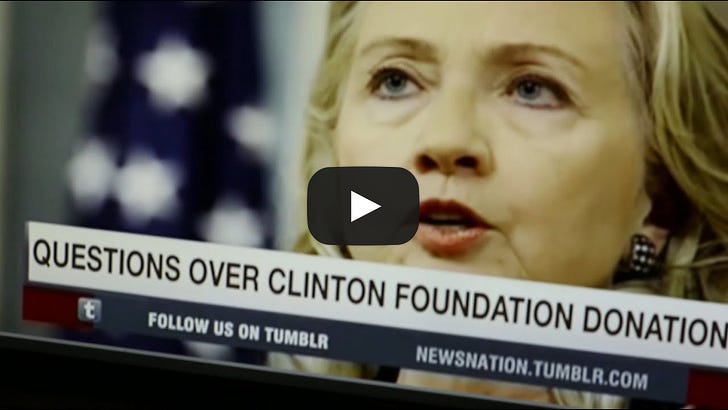
The coverage, while not revealing any evidence of impropriety, continued month after month. The Republican Party even created an attack ad based on the flood of media attention:
On August 18, 2016, Clinton announced that, if she won the presidency, the Clinton Foundation would stop taking money from corporations or foreign sources. But even that was not enough to put the issue to bed.
"The foundation’s ties to foreign governments and financiers have long been fodder for Mrs. Clinton’s critics — chief among them Donald J. Trump — who contend that foreigners used donations to the foundation to curry favor with the Clintons while Mrs. Clinton was the country’s top diplomat," the New York Times reported on October 15, 2016. That story was about a hacked email revealing that the Qatari government, who donated to the Clinton Foundation, requested to meet with Clinton. The email was treated as a potential scandal even though there was no evidence such a meeting ever occurred.
The New York Times' approach to foreign donations to the Clinton Foundation was not unique. A review of Washington Post coverage over the same time period reveals dozens of similar articles. The Washington Post, for example, highlighted the pledge to stop accepting foreign donations if Clinton won the election meant "donors could race to give money before the deadline — but in time to curry favor with a Democratic nominee who is leading in the polls."
The Washington Post finally filed a story on Sun's purchase of tokens on Tuesday afternoon. The New York Times and other outlets, however, still appear uninterested in a foreign donor personally enriching Trump after he won the presidency.
===
---
pop info judd ymail 12 24
chinese Crypto entrepreneur Justin Sun paid $6.2 million for a banana — sold by Sotheby's as conceptual art — and then ate it last Friday.
The banana is not Sun's most notable recent purchase.
On November 25, Sun purchased $30 million in crypto tokens from World Liberty Financial, a new crypto venture backed by President-elect Donald Trump. Sun said his company, TRON, was committed to "making America great again."
[twt]
World Liberty Financial planned to sell $300 million worth of crypto tokens, known as WLF, which would value the new company at $1.5 billion. But, before Sun's $30 million purchase, it appeared to be a bust, with only $22 million in tokens sold. Sun now owns more than 55% of purchased tokens.
Sun's decision to buy $30 million in WLF tokens has direct and immediate financial benefits for Trump. A filing by the company in October revealed that "$30 million of initial net protocol revenues" will be "held in a reserve… to cover operating expenses, indemnities, and obligations." After the reserve is met, a company owned by Donald Trump, DT Marks DEFI LLC, will receive "75% of the net protocol revenues."
So before Sun's purchase, Trump was entitled to nothing because the reserve had not been met. But Sun's purchase covered the entire reserve, so now Trump is entitled to 75% of the revenues from all other tokens purchased. As of December 1, there have been $24 million WLF tokens sold, netting Trump $18 million.
Sun is also joining World Liberty Financial as an advisor, making Sun and the incoming president business partners.
While Trump has the cash, Sun's tokens are effectively worthless. To comply with U.S. securities law, WLF tokens are "non-transferable and locked indefinitely in a wallet or smart contract until such time, if ever, [WLF tokens] are unlocked through protocol governance procedures in a fashion that does not contravene applicable law." The only thing that Sun can do with his tokens is participate in the "governance" of World Liberty Financial. Right now, the only thing World Liberty Financial does is sell tokens.
Any foreign national paying an incoming president $18 million weeks before entering the White House should raise red flags. Sun's purchase is even more alarming because the Securities and Exchange Commission (SEC) is currently prosecuting him for fraud.
The SEC's ongoing prosecution of Sun
On March 22, 2023, the SEC charged Sun and three companies he owns. The SEC accused Sun of marketing unregistered securities and "fraudulently manipulating the secondary market" for a crypto token "through extensive wash trading." Wash trading involves "the simultaneous or near-simultaneous purchase and sale of a security to make it appear actively traded without an actual change in beneficial ownership." In other words, according to the SEC, Sun made it seem like there was a lot of interest in crypto tokens he issued when much of the trading was fraudulent and manufactured by Sun.
The SEC also charged Sun with "orchestrating a scheme to pay celebrities to tout" his crypto tokens "without disclosing their compensation." Federal law requires people who endorse securities to "disclose whether they received compensation for the promotion, and to specify the amount." The celebrities involved included Lindsay Lohan, jake Paul, and Soulja Boy.
[twt]
Lohan paid $40,000, and Paul paid about $100,000 to settle the charges against them without admitting liability. Soulja Boy did not respond to the lawsuit, and a default judgment was issued against him.
Sun posted on X that he believes the SEC "complaint lacks merit" and complained that "the SEC's regulatory framework for digital assets is still in its infancy and is in need of further development."
The litigation against Sun is ongoing, with a federal judge considering a motion by Sun's attorneys to dismiss the charges. The current SEC Chairman, Gary Gensler, who announced the charges against Sun, will step down when Trump takes office in January. A new SEC commissioner appointed by Trump could settle or dismiss the charges against Sun.
How Trump can use the power of the presidency to unlock hundreds of millions in profits for himself
Through World Liberty Financial, Trump can reap massive personal profits from creating a more permissive regulatory environment for crypto ventures.
In addition to his 75% share of revenues over $30 million, Trump's company was also awarded 22.5 billion WLF tokens. At the current sale price, these tokens are worth more than $300 million. That is more than 20 billion tokens being offered for sale publicly. (This makes the "governance" value of WLF tokens, which was already questionable, effectively worthless. No matter how many tokens you own, Trump will always be able to outvote other token holders.)
Right now, Trump's tokens — like those purchased by Sun — are worthless because they cannot be transferred. But Trump could appoint a new SEC chairman who is friendly to the crypto industry and who would create new rules allowing the WLF tokens and similar crypto assets to be legally traded. If the price of the tokens increases when they hit the open market, which is a possibility for a crypto token backed by the President of the United States, the value of Trump's tokens could be in the billions.
That appears to be exactly the path Trump is taking. WIRED reports that Trump is "asking the crypto industry to weigh in on potential picks." Among the leading contenders is Paul Atkins, a former SEC Commissioner, who, since leaving the agency in 2008, has run a consulting firm that works with crypto companies. Atkins is also co-chair of the Token Alliance, an initiative of the Chamber of Digital Commerce, the lobbying group for the crypto industry. He is also a member of the Chamber of Digital Commerce's Board of Directors.
Another top contender, former SEC General Counsel Robert Stebbins, has said that the SEC should "pause most of its crypto lawsuits while clearing a path for the firms to do business without the overhang of litigation." But Stebbins' candidacy underscores the need for Sun to forge a favorable relationship with Trump. Stebbins acknowledged that, even if it takes a more permissive view toward the crypto industry, it may want to consider continuing to pursue litigation involving fraud.
Major media outlets obsessed with banana, ignore Sun's payment to Trump
A foreign national under federal fraud prosecution making a purchase that results in $18 million cash payment to the president-elect has all the makings of a major scandal. But it has been virtually ignored by several major media outlets.
The New York Times, for example, has published five articles about Sun's purchase of the banana but none about Sun's $30 million purchase of WLF tokens and his business partnership with Trump. The Washington Post has published three articles about the banana, but its coverage of Sun's purchase of WLF tokens was limited to one short paragraph in a larger editorial about the crypto industry. (The paragraph does not explain how Trump personally profits from Sun's token purchase.) The Wall Street Journal did publish a short piece about Sun's token purchase on its "Live Update" blog, but the piece was not viewed as significant enough to be included in the print edition. The paper published two articles, plus a video, focused on the banana. One of the Wall Street Journal articles about the banana was published on the front page of the paper.