robt reich 2
SEE ROBERT REICH THREE 4 26
merri ok
temp zombied by eip
zombie by NODE?! Economic Policy Inst
:SEE FASCISM{ }:
some neglected
say RYE-SH
SEE VIDS BELOW see ineq prods
bak fail 4 26 some capt from 1
---
PROP 4 VID
-=-=
---
3 26 // prequel
Brilliance of Berkeley Lecture - Robert Reich - "The Roots of Trump"

UC Berkeley Undergraduate Education
12,555 views Mar 23, 2026
In this lecture for the Spring 2025 Brilliance of Berkeley course, Robert Reich discusses how Donald Trump is not so much the cause of the current threat to democracy and our governing institutions, as he is the culmination. He gives a first-person account of how we arrived where we are, and suggests what must be done.
---
-=-=
AN 11 26 RR
Rather than regurgitate the particular wins and losses that occurred Tuesday, I thought it more useful, at this point, to look at the big picture and identify the largest overall winners and losers for the nation as a whole.
Biggest winner: A diverse, equitable, and inclusive America. It’s Trump’s DEI nightmare. Georgia voters elected Keisha Lance Bottoms, the first Black female governor in the nation. Texas chose Gina Hinojosa, the state’s first Latina governor and first Democratic governor in more than 30 years. California elected Xavier Becerra, the state’s first Latino governor. New Mexico chose Deb Haaland, the nation’s first female Native American governor. Florida elected Byron Donalds, the first Black governor in Florida’s history (a Republican).
For the U.S. Senate, New Hampshire chose Chris Pappas, that chamber’s first openly gay member. Minnesotans picked Peggy Flanagan, the first Native American woman elected to the Senate. Michiganders chose Abdul El-Sayed, the first Muslim elected to the Senate.
These are remarkable wins. Some are attributable to a surge in voting by Black people, many of whom were understandably incensed at efforts to push Black representatives out of Congress through overt racial gerrymandering. And by Latinos, enraged at ICE’s wanton arrests and detentions. Women upset by Republican efforts to outlaw abortion in their states. And LGBTQ+ people, angry about the blatant bigotry of Trump and his Republican enablers.
But many straight white men and women also disagree with Trump’s narrow definition of America. It turns out that the nation is far more diverse, equitable, and inclusive than Trump or his Republican enablers want (or believe) it to be. Trump and his enablers tried to make us fear and hate one another over our many differences. They indubitably failed.
Another winner: The new South. For as long as anyone can remember, the states that comprised the Old Confederacy have been regressive, conservative, intolerant, and, at least since the Civil Rights Act of 1964, Republican.
No longer. On Tuesday, three of the four most populous Southern states (Texas, North Carolina, and Georgia) voted for Democrats up and down their tickets. Texas Democrats carried every statewide office from governor through lieutenant governor, attorney general, and even railroad commissioner. North Carolina and Georgia Democrats also scored stunning victories.
The biggest surprise was Annie Andrews’s win over Darline Graham in South Carolina’s Senate contest. As I write this, another possible gobsmacker: Black Democrat Scott Colom may actually win the Mississippi Senate seat held by Cindy Hyde-Smith.
Even Democratic losers in the South came remarkably close to winning: Democratic Senate candidate Jamie Davis was within a hair’s breadth of victory in Louisiana. Florida’s Angie Nixon almost snatched the Senate seat there.
What accounts for this new South? Partly a large and growing professional class (in metro Atlanta, North Carolina’s “research triangle,” and Houston, Dallas, Fort Worth, and Austin) combined with an increasing flow of young workers and their families from other states, seeking more affordable housing. Add to this, an abundance of Latino and Asian immigrants. All told, the new South is more tolerant than the old. Much of it is also more sophisticated and more educated.
A third winner: Decency. During the run-up to the 2026 midterms, American voters were inundated with Republican attack ads, inflamed rhetoric, and personal smears against Democratic rivals. Those efforts backfired. Americans soundly rejected the politics of hate and fear, and embraced common decency.
Trump, JD Vance, and RFK Jr. did their worst to fuel Islamophobia against Michigan’s Dr. El-Sayed. Trump claimed if El-Sayed won, he’d “invite hordes of jihadis to our shores.” RFK Jr. baselessly linked El-Sayed to the Muslim Brotherhood. Their fear-mongering obviously didn’t work.
Vance suggested that Texas Democratic Senatorial candidate James Talarico is gay. Another backfire.
Ohioans were so turned off by Trump-endorsed billionaire Vivek Ramaswamy’s attack ad against his Democratic opponent Dr. Amy Acton — using Acton’s mother whom Acton hadn’t seen since she was 12, when her father was accused of raping her — that the ad may have helped fuel Acton’s win, the first Democrat to win Ohio’s governorship since 2006. (Trump thought the ad just fine, and Vance even blasted fellow Republicans who spoke out against the ad, calling their criticism “disgusting” and telling them to “stop whining” because “politics is a tough business.”)
Since Trump came on the scene, many Republicans have eagerly imitated Trump’s scurrilous character assaults. Such smears have become so common that we tend to forget that most Americans don’t particularly like this form of politics. They prefer Barack Obama’s tempered rhetoric and the late John McCain’s dignified and respectful way of disagreeing. Now, after the 2026 midterms, perhaps decency is back.
So who were the biggest losers? Besides Trump and his Republican sycophants, the biggest losers are the mega donors and super PACs that poured record amounts of money into failed Republican candidacies.
Top awards for strategic stupidity go to the crypto industry (which tried unsuccessfully to derail Democrat Sherrod Brown in Ohio); AIPAC (which did everything it could to block El-Sayed and prevent any mention of Israel’s genocide in Gaza); the AI industry, which spent loads of cash trying but failing to allay voter’s concerns about data centers; and Elon Musk, who sought, single-handedly, to save Ken Paxton’s doomed Senate campaign in Texas.
Musk deserves his own special place in the loser’s circle. The richest person in the world became the poster child in the 2026 midterms for billionaire greed, legalized bribery, and corporate welfare. He sunk almost a half billion dollars into failed Republican campaigns, the most that any single human being has ever spent on elections — and for naught. After Tuesday’s blowout, shares in Musk’s SpaceX and Tesla dropped off a cliff.
Once they’re in control of Congress, Democrats will want to know what personal data and information Musk ran off with when he ran his ill-fated Department of Government Efficiency (DOGE), under whose authority he throttled Ukraine’s access to his Starlink satellites, and why the U.S. government should continue to grant him an effective monopoly on satellites anyway rather than nationalize Starlink. To say Musk will be on the hot seat understates the temperature where he’ll be sitting.
In sum, considering the overall winners and losers from the 2026 midterms, I’d say America came out way ahead.
Robert Reich is a professor of public policy at Berkeley and former secretary of labor. His writings can be found at https://robertreich.substack.com/.
-=-=
-=-=
AN 11 26
President Donald Trump and his administration have engaged in so much corruption, Democrats are going to have to engage in blunt force tactics in order to hold them accountable, at least according to one expert.
"I don’t think voters are just going to want hearings for hearings’ sake," reported Slate's Dahlia Lithwick on Monday. "They don’t want subpoenas and “lawyer up” for subpoenas’ and lawyer up’s sake. The purpose of oversight generally is to expose corrupt behavior so that voters can then respond to it. The corrupt behavior is known, the voters responded to it. So now, what those oversight committees need to do is go get the money back. Because what we’ve witnessed over the last two years is just a splurge of corruption and a splurge of the president and his family and his allies enriching themselves at the expense of American taxpayers unlike anything we’ve seen in U.S. history, and the American taxpayers are entitled to get that money back."
Lithwick added, "The misguided Supreme Court decision in Trump v. U.S. basically shielded the president with this bizarre form of immunity that exists nowhere in the Constitution—meaning it’s very unlikely you’re going to see something like a Jack Smith–type criminal prosecution in the future. The president’s already said he’s going to pardon everybody on the way out the door. So let’s set criminal accountability aside for a minute. What pardons and criminal immunity cannot do is they cannot protect those ill-gotten gains from unjust enrichment claims brought by a future attorney general. They cannot protect ill-gotten gains from civil asset forfeiture claims brought by a future attorney general."
The respected journalist is not alone in calling for tough tactics by the newly-empowered congressional Democrats. Robert Reich, a liberal commentator who served as former President Bill Clinton's Secretary of Labor, argued something similar for AlterNet in October.
"If Democrats regain control of Congress, they will need to focus not only on alleviating high prices but also on eliminating the causes of those high prices. It will be impossible to do the former without attacking the latter," Reich wrote.
He continued, "In addition to ending Trump’s war and his arbitrary tariffs, they must reform campaign financing, and help reduce the influence of big money in politics. One method would be to match public financing with small-dollar donations. They’ll also need to resurrect the systems of accountability Trump has dismantled —the independent civil service, independent inspectors general, the Office of Government Ethics, and the Federal Election Commission."
Reich went on, "Under Trump and his Republican enablers, the richest Americans and biggest corporations have made out like bandits. Average working Americans are paying dearly for what the bandits have stolen. The grift and the graft must end."
-=-=
-=-=
AN 10 26
On Saturday’s “Coffee Klatch” podcast, I said:
Democrats ought to “defund Musk” and lay “the groundwork for nationalizing” Starlink and SpaceX.
(My full Coffee Klatch argument is here.)
This seems to have set Elon Musk off. He posted to his 241,700,000 followers:
“Stealing companies is a serious crime. Prison for Reich.”
I’m not particularly worried about being imprisoned — although Musk does have influence over Trump, and Trump has criminally charged Americans who have done no more than express opinions he dislikes (see: Ilhan Omar, Reid Hoffman, Brad Lander, et al.).
I assure you I’m not going to be intimidated by a tweet by Musk.
I’ll continue to criticize him for making decisions — such as squelching his Starlink satellite service to Ukraine — that should be made by people who are responsible for U.S. foreign policy rather than by an unaccountable tycoon.
I’ll continue to campaign like crazy for Democrats in the upcoming midterms, and urge voters to throw the Republican bums out.
I’ll continue to highlight the connections between great wealth and grotesque power during our Second Gilded Age — of which Musk has become Exhibit A.
Elon: You may be the richest and most powerful man in the world, but I’m tough as nails. I’ve stood up to bullies my whole life, starting with playground bullies who went after me because I was so short. You think I won’t stand up to you?
Okay, I’m aware of my privilege. I come with a platform. I’ve held high-level jobs in our government. And I’m an old person with little to lose, anyway.
I worry about what Musk’s impulsive bullying is doing and has done to others more vulnerable than I am — people who work or have worked for him, women he’s allegedly coerced into signing nondisclosure agreements, people he’s done business with, people he’s threatened and racially denigrated and pushed around his whole life, voters he’s deluging with TV ads for Republican candidates.
I also worry about the federal workers who have been hurt by his so-called Department of Government Efficiency, Americans who have been harmed by his wanton destruction of public services, and people around the globe who are worse off because of cuts to USAID pushed by Elon’s DOGE.
We now have a bully-in-chief in the Oval Office and the world’s wealthiest bully dictating American foreign policy — both of whom are now pumping hundreds of millions of dollars into our elections in order to avoid accountability.
Will people speak out against these two consummate bullies, or remain intimidated into silence?
One week to go until the midterms. Maybe then we can begin to defund Musk.
REF
-=-=
AN 10 26
Behind this election’s dominant issue of affordability lies the record concentration of wealth at the top of America. The richest 0.001 percent of Americans — a handful of extraordinarily wealthy men — now control more of the nation’s wealth than at any time in modern history.
To be sure, wealth is not a zero-sum game in which the riches of those at the top necessarily come at the expense of everyone else. But power is a zero-sum game, because the more of it that is held by some people, the less of it is held by others.
Wealth cannot be separated from power. Great wealth becomes great power through campaign contributions, media ownership, the ability to buy off opposition, the capacity to wage public relations campaigns, and the resources to deploy armies of lawyers who litigate on your behalf. Recent years provide abundant illustration of all this.
In these ways, great power also becomes great wealth. It buys changes in laws, regulations, and court decisions that bestow even more wealth on those with the power to alter the system to their benefit — and to siphon off resources from everyone else.
This power shift has also become clearly evident in recent years. In the Trump era it has taken the form of blatant corruption. But the political bribes, billionaire media ownership, PR campaigns, and well-financed litigation predated Trump.
For many years (with the notable exception of the Biden administration), antitrust enforcement has been defanged to make it easier for big firms to monopolize. Among the most widely discussed findings about the U.S. economy is the rise of corporate concentration since the 1980s. The biggest firms, their top executives, and their major shareholders have all done wonderfully well. Consumers and employees, however, have faced higher prices, lower paychecks, and fewer choices.
At the same time, labor laws have been altered to make it more difficult to organize unions. In the 1950s, more than a third of private-sector workers were unionized. Now, fewer than 6 percent are.
Tax laws have been changed to reduce the rates and amounts paid by the super-wealthy, to the point where many pay no taxes at all — even though they have more wealth than ever.
This massive power shift is even more starkly illustrated by the billionaires, financial mavens, and tech bros who put Trump in power, who refuse to slow climate change, and who are now deciding on the future of AI and therefore humanity.
The question I keep coming back to is whether this can be reversed.
There is historic precedent. After the first Gilded Age — which ran from the 1890s to the start of World War I, and which featured wide inequalities of income, wealth, and political power — America reacted in what came to be known as the Progressive Era.
Starting under Theodore Roosevelt, monopolies were busted up, corporations were regulated, a progressive income tax was enacted, and corporate political donations (bribes) were barred. Then, starting in 1933, under Teddy Roosevelt’s fifth cousin, power continued to be shifted to what became the largest middle class in world history.
Then came the 1970s and 1980s, when the process began to go in reverse.
The challenge is arguably much greater today because wealth and power are more concentrated than in the first Gilded Age, creating a chicken-and-egg paradox: How can government enact and enforce the necessary reforms if it’s under the control of a power elite that won’t permit them?
Now, just four weeks from what could be a major political victory for the Democrats in taking back at least one chamber of Congress, this paradox should soon be the center of our national debate.
-=-=
RR AN 9 26
Yesterday (September 14) — just two days after Dario Amodei, the chief executive officer of leading AI firm Anthropic, called for “slowing down” the pace of AI development so guardrails could be put in place that would “greatly reduce the risk that something goes seriously wrong” — Trump threw a tantrum:
“The only control or ‘guardrails’ that AI needs is a STRONG AND SMART (High IQ!) PRESIDENT, and the U.S.A. has that, in spades!
In the same post, Trump even hinted that the government might pursue criminal or regulatory penalties against AI companies, such as Amodei’s Anthropic.
“The Trump Administration has stopped AI ‘people’ from doing bad, or potentially bad, ‘things,’ like Dario (Anthropic!), who is now pretending to be a ‘perfect little angel’ — and we will continue to do so!”
Then Trump interrupted a speech being given by Jensen Huang, Nvidia’s chief executive, at a conference in Los Angeles to say — over a speaker — that worries about AI were “a hoax …. Robots are not going to be taking over the world. That’s not going to happen.”
Trump has called AI data centers “the oil of the next 50 years” and says they are delivering wealth and investment to communities in the U.S. In July he insisted that data centers are “Cash Cows,” creating taxes and jobs that “amount to LIQUID GOLD!”
Trump’s rejection of any regulation of AI or its data centers contrasts with the views of many voters. A March Gallup poll showed that nearly half of those surveyed “strongly oppose” the construction of local AI data centers, including almost 40 percent of Republicans.
Yet Trump remains adamant that nothing should be done. “We can put up guardrails, and we can do this and that, but I think you have a lot of negative forces that are bringing it up,” Trump told reporters Sunday while traveling in Ireland. “And they’re bringing up things that won’t happen.”
Why would Trump be so opposed to regulating AI — even in the face of growing public concern, even with midterm elections just around the corner?
It can’t be that he knows very much about AI.
And it can’t be that Trump loves AI because of what it can do. Yes, he’s used it to make fake photos and videos of himself, but that doesn’t explain his adamant refusal to regulate it.
It can’t be that he’s worried about China catching up to or surpassing the U.S. in AI. China has a small fraction of the data centers America has, and China isn’t poised to leapfrog our technological advantage. Besides, even China is considering imposing guardrails on its AI.
So what explains Trump’s absolute refusal to regulate AI? Could it possibly be that he and his family have personal financial stakes in it?
Indeed, Donald Jr. and Eric Trump have invested substantially in American Data Centers, a firm created to support AI cloud computing and AI infrastructure.
They made these investments soon after their father announced a $40 billion investment pledge in U.S.-based data centers from his business partner Hussain Sajwani, unveiled another $500 billion in planned investments in private-sector AI infrastructure, and signed an executive order rolling back Biden-era policies that took a more cautious approach to AI and directed “the development of an AI Action Plan to sustain and enhance America’s AI dominance.”
The Trump sons also hold advisory roles and ownership stakes tied to Dominari Holdings’s American Ventures fund, which targets AI infrastructure, data centers, and cryptocurrency. American Ventures has reportedly raised more than $1 billion across 21 investment vehicles backing companies tied to AI, crypto, drones, nuclear energy, and data centers.
Donald Jr.’s own investment firm, 1789 Capital, is backing emerging technology companies working in AI and defense. The firm has bought shares in some of the most coveted private companies before many went public, including SpaceX, Anduril, Cerebras, and Reflection AI, often by leveraging their political and business connections to secure a stake or help boost the companies’ sales.
The growth of Donald Jr.’s investment firm has been astonishing. Two years ago it managed a few hundred million dollars. It now oversees more than $3 billion. As of June 30, its main investment fund generated returns of roughly 200 percent, according to a person familiar with the firm’s performance. While still early in its investment cycle, those returns eclipse the average returns of about 21 percent from venture capital firms started in 2023, according to PitchBook, a provider of financial data.
Donald Jr. and Eric’s father seems to be turning his attention away from being president — “I’m getting a little bit tired of politics now,” he said a few days ago — toward things that excite him more, such as his ballroom and triumphant arch, as well as making even more money for his family off his presidency.
But as he focuses on making himself and his family wealthier, he’s leaving the rest of us more vulnerable to AI.
One of the first responsibilities of a new Congress, come January, will be to establish guardrails around AI — assuming that by then Trump can no longer control what Congress does, and that January isn’t too late.
Robert Reich is a professor of public policy at Berkeley and former secretary of labor. His writings can be found at https://robertreich.substack.com/.
=-=-=
AM 8 26
Most discussions about the Democratic Party in this election cycle focus on the remarkable rise of progressive Democrats (such as Florida state Rep. Angie Nixon, a democratic socialist who yesterday scored an upset win in the Democratic contest for the Florida Senate).
An equally big story is the remarkable decline of corporate Democrats.
Some Democrats worry about this. My old friend Democratic strategist James Carville compares the current wave of progressive primary wins to progressive campaigns in 2016 — especially that of Bernie Sanders — that he believes fractured the Democratic coalition.
“Bernie Sanders is the reason that Donald Trump is president,” Carville said recently, claiming that Bernie’s primary challenge to Hillary Clinton convinced voters in battleground states that establishment Democrats were no different from establishment Republicans, thereby weakening her prospects in the general election.
Even if James is right about 2016 (and I don’t believe he is) his assessment is irrelevant now because we’re at a radically different point in American politics than we were 10 years ago.
The silver lining on the dark storm cloud of Trump and his detestable regime is that it has exposed the greed, venality, cupidity, and corruption of America’s corporate elite.
Trump has allowed the CEOs of giant corporations and the titans of Wall Street to do whatever they want as long as they suck up to him. And he’s providing all sorts of corporate welfare to those who generously bribe him — no-bid government contracts, exclusive licenses, tax loopholes, tariff exemptions, use of public lands, and permission to become even bigger monopolies.
Trump has thereby unveiled a truth about corporate America that for many years has been hidden behind a soothing blanket of corporate PR bullsh*t about social responsibility, corporate charity, and “trickle-down” economics.
That truth is the captains of corporate America are so rapacious that they’re willing to throw average working Americans under the bus to make billions more.
Corporate avarice under Trump has become so blatant and corporate America’s contempt for the needs of average Americans so flagrant that most Americans are now catching on.
They’re voting for progressive Democrats not because they want socialism, support the Democratic Socialists of America, or reject candidates called “moderate.”
They’re voting for candidates whom they believe will fight to make housing, food, healthcare, and childcare affordable to average working families. And who’ll take on Trump’s billionaire backers, CEOs, and Wall Street titans who are rigging the economy against them.
Much of the corporate media won’t tell this story. When Dr. Abdul El-Sayed won Michigan’s Democratic primary over Haley Stevens, the media overflowed with accounts of how much smaller El-Sayed’s margin of victory was than polls had predicted.
Yet the most remarkable thing about El-Sayed’s victory was that he won despite being dramatically outspent by super PACs arrayed against him.
Stevens benefited from tens of millions of dollars in outside spending, including the largest investment in a senatorial race ever made by the American Israel Public Affairs Committee, which traditionally supports pro-Israel candidates but in recent election cycles has supported candidates most favored by corporate America. AIPAC’s ads in favor of Stevens and against El-Sayed never even mentioned Israel.
Outside super PACs poured an estimated $54 million to $60 million into backing Stevens and opposing El-Sayed, compared to only about $5 million for El-Sayed. Pro-Stevens groups outspent El-Sayed on TV advertising alone by more than 12 to 1 ($26.9 million to $2.1 million) in the closing weeks. An average of $95 was spent for every vote against El-Sayed versus just $9 per vote for him.
The race between Stevens and El-Sayed was a proxy fight over the future of the Democratic Party. Senate Minority Leader Chuck Schumer backed Stevens and encouraged donors to back her campaign, as did other corporate-aligned politicians such as Michigan senator Gary Peters. On the other hand, Sen. Bernie Sanders and U.S. Rep. Alexandria Ocasio-Cortez supported El-Sayed, as did progressives such as Sens. Chris Van Hollen and Elizabeth Warren.
El-Sayed justifiably made a campaign issue out of how much corporate money was backing his rival. He argued that Democrats should reject corporate influence and embrace an agenda that helps average Americans. His campaign centered on providing Medicare for All, lowering prescription drug costs, and banning corporate PAC money. “We’re in a situation right now where the rich keep getting hyper-rich on the backs of figuring out how to monetize everyday people,” El-Sayed told AP during a Sunday afternoon march, as his supporters chanted behind him, “Money out of politics! Money in your pockets!”
El-Sayed’s victory marked a turning point for the corporate wing of the Democratic Party.
I saw the start of the corporate Democrats in the early 1980s, when Democrats in congress began drinking from the same campaign funding trough as the Republicans, mostly from big corporations.
“Business has to deal with us whether they want to or not” crowed Democratic Rep. Tony Coelho, who then headed the Democratic Congressional Campaign Committee. Democrats had controlled Congress since 1955, and assumed they’d continue to run the House for years. They thought they could take advantage of their seemingly permanent power to raise cash for their campaigns.
Coelho’s Democrats soon achieved a rough parity with Republicans in contributions from corporate and Wall Street campaign coffers, but it proved a Faustian bargain as big corporations and Wall Street gained increasing influence in the party. It is a truism in politics as in nature: One dares not bite the hands that feed.
Corporate Democrats thereafter stopped the Democratic Party from pursuing an agenda that would have dramatically helped America’s working class.
To be sure, over the last three decades Democrats have scored some important victories for working families — the Affordable Care Act, an expanded Earned Income Tax Credit, and the Family and Medical Leave Act, for example.
Yet they’ve done little to alter the widening economic inequalities that have taken a huge toll on working-class families.
Both Clinton and Barack Obama ardently pushed for free-trade agreements, for example, but didn’t provide the millions of blue-collar workers who thereby lost their jobs means of getting new ones that paid at least as well.
They also stood by as corporations hammered trade unions, the backbone of the white working class. Clinton and Obama failed to reform labor laws to impose meaningful penalties on companies that violated them, or to enable workers to form unions with a simple up-or-down vote.
In his 1992 campaign, Clinton promised such reform but once elected didn’t want to buck corporate Democrats by spending political capital on it. In his 2008 campaign, Obama made the same promise but never acted on it.
Partly as a result, union membership sank from 22 percent of all workers when Clinton was elected president to fewer than 10 percent today, and the working class lost bargaining leverage to get a share of the economy’s gains.
The Obama administration also protected Wall Street from the consequences of its gambling addiction through a giant taxpayer-funded bailout but left millions of underwater homeowners to drown.
Both Clinton and Obama allowed antitrust enforcement to ossify — with the result that large corporations have grown far larger and major industries far more concentrated.
And they turned their backs on campaign finance reform. In 2008, Obama was the first presidential nominee since Richard Nixon to reject public financing in his primary and general election campaigns. And he never followed up on his reelection campaign promise to pursue a constitutional amendment overturning Citizens United v. FEC, the 2010 Supreme Court decision that opened the floodgates to big money in politics.
What happens when you combine free trade, shrinking unions, Wall Street bailouts, growing corporate monopoly power, and the abandonment of campaign finance reform? You get an economy favoring the wealthy and a political system favoring the powerful, while workers without college degrees suffer declining real wages and dwindling job security.
John F. Kennedy was the last Democratic president to depend on the votes of working-class Americans while losing the votes of white, college-educated Americans by 2 to 1. Sixty years later, Joe Biden depended on the votes of college-educated Americans while losing the votes of the white working class by 2 to 1. Kamala Harris lost the working class by an even larger margin.
Trump has exposed the venality and cupidity of corporate America, while large swaths of the working middle class struggle to make ends meet. As a result, Republicans appear likely to face some major defeats in the midterm elections. Corporate Democrats are on the defensive because their campaign cash isn’t working the way it used to.
Now, finally, the Democratic Party has an opportunity to once again become the party of working Americans, as it was under Franklin D. Roosevelt, rather than the party of corporate America. It is more urgent than at any time since the Great Depression that Democrats act on this opportunity.
-=-=
With just 97 days until the midterm elections of 2026, Democrats are fired up, while Republicans are in the doldrums. That means Democrats have a good chance of retaking control of the House. It’s even possible (although less likely) that Dems will retake the Senate.
One of the biggest uncertainties is what (if any) tactics Trump and his lapdogs will use to reduce the odds of a Democratic victory, especially in the House, where 435 seats are up for reelection.
I’ve spent the last several days talking with election experts and political advisers. When I spoke with them last year, they were most worried about gerrymandering, restrictions on mail-in voting, voter IDs, and the demise of what’s left of the Voting Rights Act.
They’re still worried about many of these things (Trump just filed with the Supreme Court an emergency request to allow his executive order that restricts voting by mail, after a federal appeals court blocked key parts of it over the weekend).
But now, with 97 days to go, they’re most worried about the elections process. I’ve summarized their concerns below.
It’s possible that Trump will do nothing to interfere in the elections, of course. It’s also possible that he’ll do everything the experts fear he might do. Please weigh in with your thoughts about what he’s most likely to do.
1. He’ll do nothing other than claim the elections are rigged.
By this view, Trump will continue to sow doubts about the reliability and security of elections, especially in predominantly Democratic cities and states, but he won’t do more. Experts who hold this view tell me Trump doesn’t really care all that much about the midterm elections. His real goal is to continue to generate doubts about the 2020 election, so that when the history of that election is written, questions arise about whether Biden legitimately won.
2. He’ll deploy federal agents at voting places.
Some experts I talked with believe Trump will try to suppress voting by deploying federal immigration agents or federalized National Guard in or around polling places in predominantly Democratic communities during early voting or on Election Day. Or he’ll deploy federal agents in official attire to hover near voters, questioning them about their citizenship and asking about voter fraud.
It’s a federal crime for anyone — including federal, state, and local officials — to “intimidate, threaten, [or] coerce … any other person for the purpose of interfering with the right of [that] other person to vote or to vote as he may choose.” Most states also prohibit voter intimidation. Additionally, federal law explicitly prohibits the presence of armed federal agents at the polls.
But proving intimidation is difficult. Besides, by the time any lawsuit alleging intimidation were filed, voting would be long over.
3. He’ll try to stop state certifications.
Alternatively, election experts tell me that Trump will stop states with predominantly Democratic voters or large Democratic cities from certifying the results in House races. (Election rules about certification vary by state, but most require election officials to certify by late November or early December.)
In recent years, Trump has persuaded some local officials to use false claims of fraud or of noncitizens voting as justification to decline to certify election results. Since 2020, more than 30 local officials in Arizona, Colorado, Georgia, Michigan, New Mexico, North Carolina, and Pennsylvania have refused to certify election results, usually in hopes of forestalling Democratic victories.
Experts tell me that if there are similar delays and refusals after November 3, Democrats will go to court to force local officials to certify results. They’ll probably win these cases, as they have in the past. But such litigation is inevitably accompanied by delays and uncertainty that could give Trump and Republicans time to whip up public support for recounts, audits, or similar tactics we saw after the 2020 election.
4. He’ll try to prevent the House clerk from assembling the roll of new members to be sworn in January 3, 2027.
A final scenario that’s been described to me is that Trump will prevent the House clerk from assembling the roll of new members to be sworn in. Normally, on January 3, the clerk simply goes to the House chamber with the roll of newly elected representatives. Although the people on that roll are not yet official members of Congress, they elect a new speaker of the House. The winner of the race for speaker then swears in the rest of the members of the House, and they then begin conducting legislative business.
But some experts predict that Trump will declare that the election is full of fraud and demand that Speaker Mike Johnson fire the current nonpartisan House clerk. Johnson could substitute a toady who produces a roll of new House members — one that includes Republicans in races that Democrats believe they won.
What can Democrats then do? They’ll contest Trump’s move in the federal courts, but the courts are reluctant to get involved in matters of internal legislative governance, regarding them as “political questions” that the judiciary should leave to Congress.
Hence, today’s Office Hours question: What’s Trump’s most likely move on the midterms?
Robert Reich is a professor of public policy at Berkeley and former secretary of labor. His writings can be found at https://robertreich.substack.com/.
AN 7 26
As Trump’s tariffs and his war with Iran drive up prices of everything from oil to steel, you’d think big American corporations would be screaming bloody hell. Presumably, Trump’s tariffs and war are squeezing their profits just as they’re squeezing the wallets of average Americans.
To the contrary, corporate America is quietly encouraging both Trump’s war and Trump’s tariffs. Why?
One possibility is they’re raking in money off the war as defense contractors and suppliers.
Some surely are, but this can’t account for the acquiescence if not outright support by most big American corporations that have nothing to do with the defense-industrial complex.
Another possibility is they don’t want to p--- off Trump, fearing his retaliation.
But if they were really concerned about the negative effects of Trump’s war and his tariffs on their bottom lines, surely they’d be using their armies of lobbyists and piles of campaign contributions to stop his war and his tariffs. After all, that’s what the armies and piles are for.
There’s a much simpler explanation for corporate America’s silence if not encouragement. In point of fact, both Trump’s war and Trump’s tariffs are helping their bottom lines.
Trump’s war and his tariffs are allowing domestic U.S. producers to raise their prices to match the elevated prices of imports. And those who aren’t directly affected are using the higher import costs as excuses to raise their prices, too.
Presto! — corporate profits have exploded, and their stock prices have soared.
But American consumers are getting shafted. Both Trump’s war and his tariffs are pushing up prices for a vast range of goods and services. The result is a massive redistribution of income and wealth from American consumers to big American corporations.
This is the story of the American political economy under Trump that’s rarely if ever told, but it’s critical to understanding why Trump has been getting away with his war in Iran and his tariffs without much political opposition.
Start with oil.
Brent crude is now selling for $90.05 a barrel. If the war drags on it could push crude prices much higher, especially if it further depletes oil inventories, and spreads to Houthi militants starting a naval blockade in the Red Sea and to other Gulf states.
Oil prices are set globally. As global supplies dwindle, oil prices rise across the board — including prices charged by domestic U.S. producers. They’re enjoying a huge windfall.
With crude oil prices averaging $95 a barrel between March and June — up from about $66 before the war — ExxonMobil, Chevron, ConocoPhillips, and Occidental Petroleum have collectively raked in some $31 billion in earnings for the second quarter of this year, according to FactSet estimates.
That’s up from about $12 billion for the same period last year.
GP OXFAM REPT SAYS Q1 23B Q2 2X?
These windfall profits have helped boost Big Oil’s stock prices. Big Oil’s investors and executives (who are paid partly in shares of stock) have done wonderfully well.
But American consumers are bearing the burden, as gas prices once again soar past $4 a gallon, a dollar more than they were before Trump started his war on February 28.
So is it any wonder that Big Oil isn’t criticizing Trump’s war, and is quietly rooting it on?
Or consider steel. Trump imposed steel tariffs of 50 percent in March and June 2025. These tariffs have driven up steel prices in the United States.
The tariffs have been a boon to American steelmakers, who have raised the prices they charge their American customers to match the higher prices now charged for steel from abroad.
As a result, leading American steel producers like Nucor and Steel Dynamics report significant year-over-year earnings increases.
Nucor’s profits in the second quarter of 2026 were $1.16 billion, up from $603 million a year earlier. Steel Dynamics has reported a second-quarter income of $534.1 million, nearly double its net income compared to the same period last year. A third U.S. producer, Cleveland-Cliffs, earned $97 million in the second quarter of this year (before interest, taxes, depreciation, and amortization), compared to a loss of $213 million last year, and the firm anticipates doubling earnings next quarter.
Who’s bearing these higher costs? American consumers of steel — in the prices of everything we buy that contains steel (such as cars and appliances).
The Producer Price Index (a widely used proxy for input costs) for steel mill products is now sitting at its highest point since May 2023.
American-based producers that utilize oil and steel have been able to pass those costs on to their customers without harming their profit margins. Some corporations that don’t depend on oil or steel have used the higher import costs as excuses to raise their prices, too.
Hence, Trump’s war and Trump’s tariffs are wins for corporate America. Profit margins are up, the value of shares on the stock market are up. Shareholders are happy.
Big corporations aren’t raising a fuss about the war or tariffs because they like what’s happening.
But American consumers are getting shafted. Their wages aren’t keeping up with the price increases. Yet they have no alternative but to pay the higher costs for energy and steel and everything else — which is the whole point.
As the inflationary effects of Trump’s war and his tariffs (taxes) on imports spread throughout the economy, they’re hiding what’s really occurring: an upward redistribution from consumers to big American corporations.
American consumers need to know the truth: Two of the major reasons why everything is less affordable are Trump’s war and his tariffs.
Consumers may not have armies of lobbyists and piles of campaign contributions to do their bidding, but they do have a way to express their disapproval. They can vote out Trump Republicans on November 3.
*Robert Reich is a professor of public policy at Berkeley and former secretary of labor. His writings can be found at https://robertreich.substack.com/.*
AN 7 26 RR
In one of the most notable upsets of the Democratic primaries so far, Democratic Socialist Melat Kiros, 29, yesterday won the nomination over incumbent Rep. Diana DeGette to represent Colorado’s hotly-contested First Congressional District.
I expect to see more stories about how the Democratic Socialists of America are taking over the Democratic Party. In New York last week, nine of 10 candidates endorsed by the DSA won primaries for the state Legislature and Congress. All three Democratic Socialist insurgents Mayor Zohran Mamdani backed for Congress prevailed. Two of them defeated incumbents.
Democratic Socialist elected officials now include U.S. representatives Alexandria Ocasio-Cortez and Rashida Tlaib (both elected in 2018), New York City mayor Zohran Mamdani and Seattle mayor Katie Wilson (both elected in 2025). Democratic Socialist Janeese Lewis George is set to follow as mayor of Washington, D.C.
In 2025, over 250 DSA members held elected public office across 40 states, with 90 percent of them elected after 2019.
Pundits eager to declare a new movement or sound the alarm about socialism are having a field day.
But they’re wrong.
Voters who have supported these candidates haven’t done so because they’ve been particularly attracted to the idea of Democratic Socialism. Most don’t even know what Democratic Socialism is.
In reality, voters have been attracted to vigorous young people who are committed to getting stuff done. Voters have had it with incumbents who have been in their jobs for decades. And they want fighters — who will get big corporate money out of our politics and go to the mat for average working people.
Colorado’s DeGette has held her seat for nearly 30 years. Kiros was born the same year DeGette was first elected to Congress.
Kiros is poised to become the first Gen Z woman elected to Congress. Her win in the solidly blue district that makes up most of Denver means Kiros is likely headed to Washington next year.
Kiros is a fighter who understands what’s worth fighting for, and expresses it clearly. “The thing is, fighting Trump is just one piece of the problem. Trump is not the cause,” Kiros said during a debate earlier this month. “He’s a symptom of a system that is broken and has been broken for a really long time because our party has failed to understand the role that they need to take in getting money out of our politics.”
A former lawyer and Ph.D. candidate, Kiros easily presents herself as a politician for the working class. Her family immigrated to Denver from Ethiopia when she was a baby.
Kiros has never before run for elected office, but she won support from a range of voters with a message of fundamental reform of the American system.
Or consider Manny Rutinel, 31, a progressive Colorado state representative who on Tuesday defeated a moderate Democrat to win the primary election in Colorado’s most competitive swing district.
A Dominican American activist and lawyer with a significant social media following and a knack for fund-raising, Rutinel isn’t a Democratic Socialist. He appealed to voters with his youth, energy, and multicultural biography in a suburban area north of Denver that’s nearly 40 percent Latino. He prevailed over Shannon Bird, a white moderate Democrat who had argued that she had broader appeal in the general election.
The district is one of Colorado’s ranching and agricultural hubs. It narrowly voted for Joseph R. Biden Jr. in 2020 and for President Trump in 2024. It is one of just a handful of battleground House districts with a substantial Latino population.
Besides their youth and multicultural backgrounds, these young Democratic politicians are committed to making people’s lives better. New York’s Mamdani focused his mayoral campaign on what New Yorkers needed — affordable housing, childcare, and basic services like clearing sidewalks after a snowstorm.
Seattle’s Wilson, a self-described Democratic Socialist who won election without the endorsement of the DSA, rose to prominence for advocating affordable housing, increased taxes on large corporations, and workers’ rights.
In Washington, D.C., Lewis George, a city council member, ran on a platform of expanding childcare, education and housing, and revoking the district’s cooperation with federal immigration enforcement.
“From the start of this campaign, we championed the principle that DC residents deserve a government that works,” she said in her victory speech. “Over time, failing public services eroded people’s faith in government as a force of good in their lives. As mayor, I will be relentlessly focused on delivering reliable public services to every DC neighborhood. These are not trivial issues. They are core government functions and we need them to work.”
These new young Democrats have also won because they inspired armies of young activists to knock on doors and work the phones for them. They didn’t rely on big money; they relied on big excitement.
Two final things about them. Most are the children of immigrants; and they’re disproportionately female. They’re living illustrations of the diversity, equity, and inclusion America can foster, at its best. They’re the opposite of the white, male, Christian, nationalism that has overtaken the Republican Party.
At a time when Trump and his regime have cast a dark pall over America, a new generation of Democratic politicians is shining a bright light. The source of the energy and excitement they’re generating isn’t Democratic Socialism. It’s the emergence of the next America.
---
AN 5 26
President Donald Trump’s economic policies have created so much uncertainty abroad, a new report reveals that major companies are divesting themselves of US treasuries.
In response to the war in Iran and persistent inflation, foreign governments have been getting rid of US Treasury bonds in order to stabilize their own currencies, according to a report by Semafor. Of the top 10 foreign holders of US government debt, seven of them reduced their holdings as of March including China, Japan, Saudi Arabia and the United Arab Emirates. Overall the US Treasury yields could fall to the lowest levels seen since 2007, which was before the 2007-2008 subprime mortgage crisis caused the Great Recession.
Before the report specifically indicating that foreign governments are divesting of US Treasuries at a historic rate, Sen. Ruben Gallego (D-Ariz.) drew attention to the fact that for the first time since 2007 the US Treasury hit 5.2 percent. The investor education platform Wiseman Alpha argued on Tuesday that this puts America in the same economically vulnerable position that it was in before the economy crashed nearly two decades ago.
"Same setup we saw in '07, six to nine months before everything cracked. The bond market runs the show now. The Fed just reacts," Wiseman warned.
They added, "Early next year is when the blowup events start happening. A fund or a bank explodes. Dollar spikes hard. Everything pulls back. Gold, Bitcoin, silver, all of it. That's your mega entry. Q2 to Q3 2027. A COVID-xtem dlike moment.”
Gallego framed the issue in the context of Trump’s recent decision to award $1.8 billion to individuals he claimed were targeted by the federal government, including possibly himself.
"We are borrowing money to pay the January 6th slush fund at highest interest rate that this country has seen in quite awhile," Gallego argued.
Multifamily Owner's Blueprint national chair Reid Bennett warned that Americans "may want to sit down" as they contemplate this news.
"It’s about what your property is worth, what your refinance looks like, and whether your business plan still works," Bennett wrote on X. "Debt gets more expensive — agency debt, banks, life companies, [commercial mortgage-backed security] … all price off Treasury benchmarks. That means higher coupons, lower proceeds, and a whole lot of owners writing checks at refinance."
Former Labor Secretary Robert Reich argued earlier this month that he believes the ongoing debt crisis is in large part caused by the wealthy not paying their fair share in taxes.
“America’s wealthy have never been wealthier,” Reich said. “If they paid their fair share of taxes, we wouldn’t have such a huge federal debt. And we wouldn’t be paying them so much interest on that debt.”
He added, “Know what’s happened, and pass it on.”
---
---
26 4 GUESS NEXT 4 CAB FIRE
At least 4 more Trump aides face the chopping block: DC insider - Alternet.org
---
4 26 robt reich 3 min montana plan
---
---
AN 5 26
I’m not going to dwell on this week’s outrages by Trump and his regime — his Supreme Court appointees gutting the Voting Rights Act, his bizarre claim that his war doesn’t require congressional approval because it’s “terminated,” his murders of additional sailors he suspects of smuggling drugs, his ongoing ICE raids, his continuing efforts to use the Justice Department to punish perceived enemies, his renewed attempts to silence comedians such as Jimmy Kimmel, his giant self-aggrandizing triumphal arch (what triumph?) and grotesque ballroom, his never-ending corruption and lies.
Yet in the midst of this cataclysm, the backlash against Trump is growing. Your work has been critical — your demonstrations and No Kings marches, your letters and phone calls to Congress, your boycotts and your local activism. Trump’s approval ratings are in the cellar. Two-thirds oppose his war. Many are demanding an end to his reign. Even some MAGA faithful are turning on him.
But it’s more than resisting Trump.
A new progressivism is being born.
Many of you are leading this. You are the activists in Montana and Hawaii pushing a new vision for reining in corporate power. You’re the activists in California and New York devising new ways to tax the super-wealthy to pay for what most people need.
You’re the activists in Massachusetts taking the lead on reproductive rights and access to health care. In Washington state, pushing new and more aggressive environmental regulations and renewable energy. In San Diego, Oakland, and San Francisco, devising new ways to address homelessness. Organizations like Voz in Portland, Oregon, empowering immigrant day laborers.
You are the activists in red states refusing to let warehouses be turned into migrant detention centers or let their towns host giant AI data centers.
You’re raising the minimum wage across America. Since the start of this year, 22 states have raised it, bringing the total number of jurisdictions raising the minimum — including cities and counties — to almost 90, with 18 states and the District of Columbia now mandating $15 an hour or more.
You’re supporting a new generation of young progressives in Congress: Maxwell Frost, Summer Lee, Greg Casar, Delia Ramirez, and the just-elected Analilia Mejia. And new progressive local leaders like New York’s mayor Zohran Mamdani.
You’re encouraging a new cohort of progressive rising stars, including Minneapolis’s Omar Fateh, Tennessee’s Aftyn Behn, Wisconsin’s Francesca Hong, Illinois’s Kat Abughazaleh, Texas’s James Talarico, San Francisco’s Saikat Chakrabarti, Maine’s Graham Platner, Tennessee’s Justin Pearson, Michigan’s Abdul El-Sayed, Florida’s Elijah Manley, and many others.
In my six decades in and around American politics, I’ve never seen anything close to the progressive talent and energy that’s now emerging.
Make no mistake. These are terrible times — the worst I’ve lived through, and I’ve lived through some bad ones. (Remember 1968? Nixon’s enemies list? Anyone old enough to recall Joe McCarthy’s communist witch hunts?) Trump and his goons are doing everything they can to destroy America and much of the world.
But out of the embers and rubble that Trump and his despicable regime have wrought, a new America is being born. We are making it happen.
As long as we are alive and as long as we are resolved, as long as we are taking action to stop the worst of this catastrophe and also trying to make America and the world better, have no doubt: We will prevail.
Be safe. Hug your loved ones. Never, ever give up.
---
4 26 alito and clar under pressure to bail; clar crazy speech // d’souza fake history
an 4 26
I’ve long assumed that Samuel Alito was the worst.
Alito — who authored the majority opinion in Dobbs v. Jackson Women's Health Organization (2022), the case that ended constitutional abortion rights by merely asserting that the high court’s prior opinion inRoe v. Wade (1973) was wrongly decided; who accepted a 2008 luxury fishing trip to Alaska, including private jet travel, from hedge fund billionaire and GOP donor Paul Singer yet failed to disclose it on Alito's financial forms and didn’t even recuse himself from decisions involving Singer’s subsequent business before the Supreme Court; who hoisted an inverted American flag outside his Virginia home shortly after the January 6 Capitol riot, a symbol of support for Trump's false claims of a stolen 2020 election — has the moral and intellectual stature of a poisonous toad.
But I’ve come to revise my view of the court’s worst Justice.
Clarence Thomas is 77 years old. He has now served on the Supreme Court for over 34 years, making him the longest-serving member of the Court. He is a bitter, angry, severe hard-right, intellectually dishonest, ideologue. After reading his latest thoughts on America, I’ve concluded Thomas is even worse than Alito.
Last Wednesday, Thomas gave a rare public address at the University of Texas in Austin that began as a banal tribute to the Declaration of Independence before degenerating into a misleading screed against progressivism.
“At the beginning of the twentieth century, a new set of first principles of government was introduced into the American mainstream,” Thomas intoned. “The proponents of this new set of first principles, most prominently among them the twenty-eighth president, Woodrow Wilson, called it progressivism.”
Thomas went on to blame progressives for the worst crimes of the 20th century, insisting that “Stalin, Hitler, Mussolini, and Mao” were all “intertwined with the rise of progressivism,” as was “racial segregation,” “eugenics,” and other evils.
This is pure rubbish.
In reality, America’s Progressive era emerged at the start of the 20th century from the corruption and excesses of America’s first Gilded Age (we’re now in the second, if you hadn’t noticed) — its record inequalities of income and wealth, its “robber barons” who monopolized industries and handed out sacks of money to pliant legislators, it’s dangerous factories and unsafe working conditions, its violent attacks on workers who tried to form unions, its corporate control over all facets of government, its widespread poverty and disease, and its corrupt party machines.
In many ways, the Progressive Era — whose most prominent leader was Republican president Theodore Roosevelt, not Woodrow Wilson, by the way — saved capitalism from its own excesses by instituting a progressive income tax, an estate tax, pure food and drug laws, and America’s first laws against corporate influence in politics.
Then, under Teddy Roosevelt’s fifth cousin (Franklin D.), came Social Security, the 40-hour workweek (with time-and-a-half for overtime), the right to form unions, and laws and regulations that limited Wall Street’s ability to gamble with other people’s money.
Clarence Thomas got it exactly backwards. Had we not had the Progressive Era and its reforms extending through the 1930s, America might well have succumbed to fascism — as did Germany under Hitler, and Italy under Mussolini, or to communist fascism, as did Russia under Stalin. Progressive and New Deal reforms acted as bulwarks against the rise of fascism in America.
In fact, it’s been the demise of such reforms since Ronald Reagan that have opened the way to Trumpian neo-fascism.
Over a third of American workers in the private sector were unionized in the 1950s, giving them bargaining leverage to get higher wages and better working conditions. Now, fewer than 6 percent are unionized, which has contributed to the flattening of wages, a contracting middle class, inequalities of income and wealth rivaling the first Gilded Age, and an angry and suspicious working class that’s become easy prey for demagogues.
Wall Street has been deregulated — allowing it to go on gambling sprees such as the one that produced the financial crisis of 2008, which claimed millions of working peoples’ homes, savings, and jobs.
America’s social safety nets have become so frayed that almost a fifth of the nation’s children are now in poverty. Yet Reagan, George W. Bush, and Trump have slashed taxes on the rich and on big corporations and have allowed giant corporations to merge into giant monopolies rivaling the trusts of the first Gilded Age. And Trump has ushered in an era of corruption the likes of which America hasn’t seen since that earlier disgraceful era.
Thomas claims that “The century of progressivism did not go well.” Baloney. It helped America create the largest middle class the world had ever seen, while also extending prosperity to millions of Black and brown people.
The tragedy is that America turned its back on progressivism and on social progress, in part because of the Supreme Court and Justice Clarence Thomas.
Flashback: I was in law school in 1973 when the Supreme Court decided Roe, protecting a pregnant person’s right to privacy under the 14th amendment to the Constitution.
Clarence Thomas was in my law school class at the time, as was Hillary Rodham (later Hillary Clinton) and Bill Clinton.
The professors used the “Socratic method” – asking hard questions about the cases they were discussing and waiting for students to raise their hands in response, and then criticizing the responses. It was a hair-raising but effective way to learn the law.
One of the principles guiding those discussions is called stare decisis — Latin for “to stand by things decided.” It’s the doctrine of judicial precedent. If a court has already ruled on an issue (say, on reproductive rights), future courts should decide similar cases the same way. Supreme Courts can change their minds and rule differently than they did before, but they need good reasons to do so, and it helps if their opinion is unanimous or nearly so. Otherwise, their rulings appear (and are) arbitrary — even, shall we say? — partisan.
In those classroom discussions almost fifty years ago, Hillary’s hand was always first in the air. When she was called upon, she gave perfect answers – whole paragraphs, precisely phrased. She distinguished one case from another, using precedents and stare decisis to guide her thinking. I was awed.
My hand was in the air about half the time, and when called on, my answers were meh.
Clarence’s hand was never in the air. I don’t recall him saying anything, ever.
Bill was never in class.
Only one of us now sits on the Supreme Court. And he has shown no respect for stare decisis.
Nor has he respected judicial ethics.
A federal law — 28 U.S. Code § 455 — requires that “any justice, judge, or magistrate judge of the United States shall disqualify himself in any proceeding in which his impartiality might reasonably be questioned.”
In the aftermath of the 2020 election, Thomas’s wife, Ginni, actively strategized with White House chief of staff Mark Meadows on overturning the election results. Between Election Day 2020 and the days following the January 6th attack on the Capitol, she exchanged 29 text messages with Meadows, in which she spread false theories about the election, urged Meadows to overturn the election results, and called for specific actions from the White House to help overturn the election. She also served as one of nine board members of a group that helped lead the “Stop the Steal” movement and called for the punishment of House Republicans who participated in the U.S. House Select Committee investigating the January 6th attack.
Yet Clarence Thomas has repeatedly participated in cases that have come to the high court directly or indirectly involving the 2020 election results, refusing to disqualify himself.
In addition, he failed to disclose his wife’s income from her work at the Heritage Foundation, in violation of the Ethics in Government Act.
Finally, there’s his speech last week in Austin. How can Americans be expected to believe in the impartiality of the Supreme Court in general and Clarence Thomas in particular when he condemns an entire philosophy of government — progressivism — and all the people who continue to call themselves progressives, in effect labeling them neo-fascists?
At the start of his speech last week in Austin, Clarence Thomas noted that “My wife Virginia and I have many wonderful friends and acquaintances here, and it is so special to have our dear friends Harlan and Kathy Crow join us today.”
He was, of course, referring to the Republican mega-donor who has spent the last twenty years lavishing Thomas with personal gifts, luxury yacht trips, fancy vacations, and funding for Ginni Thomas’s political organization.
Small wonder that Clarence Thomas prefers the Gilded Age over the Progressive Era. He’s the living embodiment of The Gilded Age’s public-be-damned excesses.
Hence, he’s my nominee for the worst justice in modern Supreme Court history.
*Robert Reich
---
:{---
SAME DAY AS ~ IMMUNITY 4 1 26
Yesterday, U.S. district judge Richard Leon blocked Trump from proceeding with construction of his $400 million ballroom on the site of the White House’s demolished East Wing. This has halted, at least for now, one of Trump’s most visible efforts to reshape the symbolic center of the federal government’s executive branch.
In a 35-page opinion, Judge Leon — an appointee of Republican President George W. Bush — wrote that Trump likely did not have the authority to make changes to the White House that could endure for generations, without consulting Congress.
This marks, by my calculation, the 89th time since the start of Trump’s second term that a federal judge has ruled that he cannot simply do whatever he wants; his actions must be authorized by Congress.
Focus for a moment on the word authorized.It’s from the Latin auctoritas and auctor — to originate, the originator.
In our system of government, a president is notthe originator of power. Power comes from the people. And among the three branches of government, the people are most clearly represented by Congress. This was the founders’ design in the Constitution, which is why the very first article enumerates Congress’s powers.
The decision by Judge Leon puts the ballroom project on hold while the lawsuit continues. When a federal judge grants a preliminary injunction, it means that the judge views it likely that plaintiffs (in this case, the National Trust for Historic Preservation) will prevail on the merits of the case, and that allowing whatever is going on to continue (in this case, construction of Trump’s enormous 90,000-square-foot ballroom) will cause the plaintiffs irreparable harm.
In December, the National Trust sued Trump after he razed the East Wing (originally constructed in 1902 and expanded during Franklin Roosevelt’s presidency) to make way for what Trump says will be the “finest” ballroom in the country.
As designed, that ballroom is larger than the Executive Residence and the West Wing combined. If constructed, it would be the dominant edifice of the White House — symbolically shifting its focus from where the president works and lives to where a president might lavishly entertain, as in a king’s throne room.
Trump has repeatedly emphasized that his ballroom is funded entirely by private donors, so its cost won’t be borne by taxpayers and it doesn’t need a congressional appropriation. He says he’s raised more than $350 million from personal backers and around two dozen tech, cryptocurrency, and defense corporations to fund the structure without government support.
Translated: He’s extorted $350 million from monied interests eager to suck up to him.
But Judge Leon insists this doesn’t give Trump authorityto destroy part of the White House and erect a giant ballroom in its place: “No statute comes close to giving the President the authority he claims to have.”
Judge Leon adds: “The President of the United States is the steward of the White House for future generations of First Families. He is not, however, the owner!” [exclamation included]
The idea that Trump is the steward of anythingfor future generations rather than an owner must seem odd to Trump. I doubt that the former real-estate developer has ever once thought of the presidency as a stewardship.
Which is why the notion that he’s not authorizedto do whatever he wants — raze the White House for a grand ballroom, deploy ICE and Border Patrol agents to terrorize immigrants and murder Americans trying to protect them, attack Iran — is inconceivable to him.
In his first public reaction to the court order, Trump called the National Trust “a Radical Left Group of Lunatics” that’s suing him for a “ballroom that is under budget, ahead of schedule, being built at no cost to the Taxpayer, and will be the finest Building of its kind anywhere in the World.”
To real-estate developer Trump, all that matters is being under budget, ahead of schedule, and at no cost to taxpayers. Even if he demolishes the entire White House and erects a Trump Tower in its place. Even if he extorts every CEO in America to pay for it. Even if he erects a giant arch across the Potomac with his name emblazoned on it.
But the peoplehave not authorized him to do any of this. Which means — as long as we have an independent federal judiciary, and any hope for a Congress that will stand up to him — he cannot.
Robert Reich is a professor of public policy at Berkeley and former secretary of labor. His writings can be found at https://robertreich.substack.com/.*
---
---
AN 3 26
The Wall Street Journal*— hardly an outpost of left-wing propaganda — reported yesterday on the results of an investigation conducted by the Journal’s Hannah Critchfield and her team.}:
I’m summarizing it below because it deserves your attention.
Critchfield and her team found that 279 people have been accused online by the Trump administration of assaulting federal ICE and Border Patrol agents, and more than half of these people — 64 percent — are American citizens.
Of the 181 American citizens that the Trump administration has accused of attacking federal ICE and Border Patrol officers, close to half have never been charged, and none have been convicted at trial. But the public charges alone have caused them significant harm.
The investigation
The Journal’s team analyzed more than 200 videos associated with allegations of assault against ICE and Border Patrol agents, using both police body camera footage and bystander recordings from social media. Many of the videos cast doubt on the federal government’s claims that agents were assaulted.
The Journal also reviewed more than 100,000 posts on X, posts made in the last year by accounts linked to government agencies and senior government officials.
Each time the government identified a person on a post, theJournal tracked that case through the legal system to see what charges were brought, under what statute, whether the charges were later modified, and what happened to the person in the case.
One of the cases they investigated was that of Sydney Lori Reid, a 44-year-old veterinary assistant in D.C. and a U.S. citizen.
In July, Reid went to a jail to witness an immigration enforcement action. Federal officers had gone there to arrest two migrant men, and Reid said she felt a duty to document it.
As Reid began videotaping, an agent grabbed her and pinned her to a wall. Reid was then surrounded by several federal law enforcement officials. One of them was an FBI agent wearing a face covering and an FBI vest. Two others were ICE officers, dressed in plain clothes, plaid shirts, and khaki pants.
Reid was handcuffed and told she was being arrested for interfering with their operation. Videos reviewed by Critchfield and her team cast doubt on the agents’ claims.
Reid was then placed in a government vehicle and transferred to federal custody. Like many American citizens who wind up in the crosshairs of DHS, she was accused of assault.
The government alleges she assaulted an FBI agent on the basis of scrapes on the agent’s hands, but the scrapes occurred in the process of putting handcuffs on Reid.
The government later charged Reid with felony assault of a federal official, a charge punishable with up to 20 years in prison — a serious federal charge that’s being applied far more broadly now than at any time in recent history.
When Reid was being arrested, she dropped her phone, but the phone was still recording. An agent picked up the phone and put it into the same vehicle that she was riding in on her way to detention.
One officer says: “We’re at the D.C. jail. We’re at the D.C. jail. We have an agitator in custody for ...”
Reid was handcuffed in the backseat. You can hear agents going back and forth about exactly how Reid had assaulted them. First, it was a raised knee, then an elbow.
Another officer: “Yeah, it appeared that there was an elbow that was ... When she was resisting, but she definitely interfered. So we have interfering and I’m going to get ...”
One of the ICE agents called her a stupid female as he was talking to a colleague: “Hey brother, are you good? I have to return to 1D and process this stupid female now that I f------ don’t want to process her.”
Reid was held by federal authorities for roughly two days. She wasn’t allowed to make a phone call during that time.
In the aftermath of her arrest, prosecutors tried to indict her, but that needed to be done through a grand jury, and the grand jury declined to indict her. They tried again before another grand jury, which also declined to indict her. Then they went back to a third grand jury, which declined to indict her.
This is almost unheard of. It showed both the resistance from the public to charge her based on the evidence and the government’s determination to bring charges in this case.
Prosecutors ultimately charged Reid with misdemeanor assault of an officer, a lesser offense that doesn’t require going through a grand jury. Reid was acquitted of that misdemeanor charge at trial.
The Trump Administration’s Strategy
Critchfield and her Journal team found that the push to charge more people for assaulting federal officers — as happened to Reid — is an administration-wide strategy.
Attorney General Pam Bondi and her Department of Justice have pledged to prosecute these cases aggressively. From the very beginning of Bondi’s tenure, starting on her first day in office, she issued a flurry of memos, including one that encouraged prosecutors to aggressively investigate any instances of violence against law enforcement or obstruction of law enforcement.
Gregory Bovino, then the head of Border Patrol, directed his agents to arrest anyone who touched them. “Arrest as many people that touch you as you want to. Those are the general orders all the way to the top, everybody f------ gets it if they touch you. You hear what I’m saying?”
In addition to an increasing number of prosecutions, the Department of Homeland Security has been using social media to exaggerate these alleged attacks, often with a warning to the public: “Don’t be like this person. If you behave in this way, we will come for you.” And they have posted people’s pictures and their full names, seeking to make an example out of these people even before they’re convicted of a crime.
This happened to Reid. A week after she was arrested, her mug shot and name went up on the official ICE account on X, along with the fact that she’s based in Washington, D.C., and a post that said, “Assault an officer or agent get arrested. It’s not rocket science.”
ICE also publicly alleged that Reid assaulted federal agents on behalf of two alleged international gang members.
The Purpose of This Strategy
The Journal’s investigation makes clear that the purpose of this strategy has been to intimidate and silence Americans who might otherwise protest what ICE and Border Patrol are doing.
ICE publicly describes many of these protesters as rioters, agitators, thugs, and terrorists.
Here’s Vice President JD Vance speaking of Renee Good’s death:
“I can believe that her death is a tragedy while also recognizing that it’s a tragedy of her own making and a tragedy of the far left who has marshaled an entire movement, a lunatic fringe against our law enforcement officers.”
And here’s then-DHS Secretary Kristi Noem on the death of Alex Pretti:
“This individual who came with weapons and ammunition to stop a law enforcement operation of federal law enforcement officers committed an act of domestic terrorism, that’s the facts.”
Renee Good was in her car when she was killed. Critchfield and her team found that federal government officials have accused 32 U.S. citizens of intentionally using their vehicles as weapons. DHS considers a vehicle to be a deadly weapon, justifying the use of force. Of those 32 drivers, only one pleaded guilty to an assault charge. Three had their cases dismissed; the rest were never charged.
TheJournal investigation found that in most cases where citizens were accused by the government, the outcome was similar to Reid’s.
181 citizens were accused by the government on X of attacking federal officers, but close to half of them were never even charged at all. When people werecharged, more often than not, the cases fell apart. Either they were acquitted or found not guilty at trial.
Fifteen people mentioned in government posts pleaded guilty before going to trial. Ten of whom pleaded guilty for lesser offenses than what the government initially charged them with.
Videos have often played major roles in contradicting the government’s case. Critchfield and her team viewed videos that repeatedly cast doubt on the government’s allegations. Protesters were often called violent rioters or professional agitators and accused of making physical contact in some way with agents, but video footage often showed immigration agents being the first to lay their hands on demonstrators.
TheJournal found that most of the government’s assault allegations against American protesters posted on X were unsubstantiated. Even federal prosecutors themselves acknowledged that in some cases, the evidence to back up these charges wasn’t there.
Federal prosecutors across the nation told Critchfield and her team that they are facing intense pressure to charge demonstrators and bystanders with crimes even when video evidence contradicts what officers initially claimed about what occurred, or in situations where they wouldn’t normally pursue federal charges.
The costs to those who are arrested are substantial. Even in cases where the person is exonerated, they must still deal with posting bail, securing defense attorneys, and taking days off from work to appear in court. In more extreme cases, people are doxed online and face death threats.
Reid says she’s been more hesitant about engaging in political speech, even though, as she put it, “Those are our rights as U.S. citizens and they’re being stifled.”
Conclusions
The Journal’sinvestigation concluded that:
“U.S. citizens are caught in the crosshairs of an aggressive government campaign to detain and demonize detractors, including by calling them terrorists, rioters, and agitators. The Department of Homeland Security, which was created in 2002 to protect Americans, has turned its force against U.S. citizens.”
By putting a public bull’s-eye on Americans whom the government accuses of assault, the Journal also found that the Trump administration is chilling First Amendment expression:
“People who had been accused publicly by the federal government of assaulting federal officers … are less likely to participate in protests and less likely to put themselves in situations where their name might be tracked…. There is a real pressure to crack down and send a message to people who the government views as perceived dissenters, even if video contradicts what agents have initially claimed happened.”
Again, let me remind you that this comes from The Wall Street Journal.
Robert Reich is a professor of public policy at Berkeley and former secretary of labor. His writings can be found at https://robertreich.substack.com/.}:
---
AN 3 26
Many of you are justifiably worried that Trump will interfere in the midterm elections. He’s worried he’ll lose Congress: His polls continue to plummet. The economy is worse than ever. Prices are rising. Few new jobs are being created. And his war in Iran is going badly.
We also know he has no qualms about trying to overturn elections. He’s tried before. In February, he stated he would only respect the results of the 2026 midterms “if the elections are honest” — echoing his dangerous threat from 2020. He’s also kicked off a redistricting war and called forelections to be “nationalized.”
He continues to make the baseless claim that noncitizens are voting in our elections, but multiple investigations and fact-checks by election officials from both parties have repeatedly confirmed it is exceedingly rare.
Hence, it’s important now — eight months before the midterms — to “harden” our election systems and be vigilant against what he’s likely to do.
So today I’d like your thoughts on what he’smost likelyto do and where the biggest threats lie.
I’m most concerned about Trump interfering in one of these ways:
1. Enacting a federal law requiring proof of citizenship (birth certificate or passport) and an exactly matching current photo ID, in person, to vote.
These requirements are in the SAVE America Act, which the House passed last month and is now under consideration in the Senate. It would disqualify an estimated 21 million people from voting, most of them Democrats, because they can’t afford the cost or hassle of finding their birth certificates — including married women who have changed their names.
The act also threatens election officials with imprisonment if they fail to uphold the bill’s strict voter documentation requirements, and it makes it harder to cast mail-in ballots (throwing into chaos eight states where vote-by-mail is currently the primary method of voting).
The act is a risk, to be sure, but Trump can’t get this measure through the Senate, because Democrats are sure to filibuster it. The only way it has a prayer is if almost every Senate Republican voted to abolish the filibuster. But this is doubtful because some Senate Republicans fear that without the filibuster, Democrats would be able to pass laws that Republicans abhor when Dems are next in the majority.
2. Stationing ICE and Border Patrol agents at polling places.
Some worry that Immigration and Customs Enforcement and Border Patrol agents will be deployed at polling locations during the midterm elections. The intent would obviously be to intimidate voters, especially in immigrant communities and communities of color, and create fear at the ballot box.
This is also a risk, but (for what it’s worth) the Department of Homeland Security says it won’t happen. Heather Honey, who serves as deputy assistant secretary for election integrity at DHS, told a group of secretaries of state that “any suggestion that ICE will be present at any polling location is simply not true.”
Meanwhile, measures to restrict federal agents from operating at or near election-related locations have been introduced in more than half a dozen states. Plus, a federal law dating to the end of the Civil War already bans sending the military or other “armed men” to polling places, except to repel armed enemies of the United States. Finally, the U.S. Constitution also gives states — not the president or federal government — the responsibility for running elections.
3. Seizing ballots and voting machines.
Tulsi Gabbard, director of national intelligence, has been working for months on an investigation into foreign election interference in U.S. voting machines, which could become a pretext for the regime’s seizing them to protect “national security.” Gabbard and the FBI induced Puerto Rico to turn over some of its voting machines and software images for analysis last year.
Gabbard was also on hand on January 28 in Fulton County, Georgia, when the FBI — acting on a search warrant that relied on debunked claims about the 2020 race — seized hundreds of boxes of ballots from a government warehouse. And the Department of Justice has issued lawsuits against dozens of states for copies of their voter rolls that include sensitive personal information.
It’s not hard to imagine the FBI or Justice Department trying to seize ballots while the 2026 midterm votes are being counted. Trump demanded as much in 2020, although his then attorney general rejected that as unlawful. Pam Bondi, the current attorney general, has shown herself willing to do whatever Trump asks, regardless of what the law says.
But the federal courts are unlikely to allow this. A president doesn’t have the authority to regulate elections, which the Constitution assigns to the states.
4. Getting pro-Trump forces to take over state and local voting systems.
Pro-Trump forces in swing states are trying to change election rules and take over local voting systems.
In recent months, Republicans in Michigan, Arizona, and North Carolina have sought changes in election rules that would hobble likely Democratic voters. They want to alter the places and times of voting to disadvantage Democrats, require high levels of proof of citizenship, and challenge the certifications of Democratic winners. Republicans in more than half of state legislatures have introduced legislation to restrict mail-in ballots.
But many of these initiatives have already been struck down by state and federal courts, and voting rights lawyers tell me that others will be challenged on First and 14th Amendment grounds.
Few state proposals to restrict mail-in ballots are under active consideration, presumably because Republicans worry that the restriction may hurt them as much if not more than Democrats. (Ditto for a bill now before Congress to ban mail-in ballots.)
---
an gone a bit? 2 26
Producer Alicia Hastey departed CBS News Wednesday, saying the work she came to do was “increasingly becoming impossible,” as stories were now evaluated “not just on their journalistic merit but on whether they conform to a shifting set of ideological expectations.”
Whoseideological expectations was Hastey referring to? Would it be impertinent for me to suggest it’s the sociopath in the Oval Office?
Hastey’s criticism came a little over two weeks after Bari Weiss, the anti-“woke” opinion journalist who became editor-in-chief at CBS News, unveiled her “21st century” vision at a town hall meeting.
Weiss told producers and staff they were free to leave if they didn’t like it. Since then, at least six out of 20 “CBS Evening News” producers have accepted buyouts.
At that town hall meeting Weiss also named a bunch of new contributors — including the anti-aging influencer Peter Attia. In the latest tranche of Epstein files, Attia appears over 1,700 times, including in an email in which he tells Epstein that “p----- is, indeed, low carb.”
In a missive to the newsroom, Weiss declared that “We love America” should be a guiding principle for the relaunch of the “CBS Evening News.”
Meanwhile, Weiss has replaced “Evening News” anchors John Dickerson and Maurice DuBois with Tony Dokoupil — who was best known for hassling the writer Ta-Nehisi Coates for his “extremist” belief that apartheid is morally wrong.
In one of his first broadcasts, Dokoupil accepted without question Israel’s justification for violating the terms of the ceasefire when it killed three journalists in Gaza, reporting only that “Israel said it was targeting a group operating a drone affiliated with Hamas.”
Weiss faced blowback in December when she shelved a “60 Minutes” report about Venezuelans being deported by the Trump administration to El Salvador’s notorious CECOT prison hours before it was set to air.
Sharyn Alfonsi, a long-standing “60 Minutes” correspondent who reported the segment, had accused CBS News of pulling it for “political” reasons. “Our story was screened five times and cleared by both CBS attorneys and Standards and Practices,” she wrote in a note to the CBS News Team. “It is factually correct. In my view, pulling it now, after every rigorous internal check has been met, is not an editorial decision, it is a political one.”
The segment later aired on January 18, drawing over 5 million viewers.
The story CBS posted about Renee Good’s killing in Minneapolis reported that “the Immigration and Customs Enforcement agent who fatally shot Renee Good last week in Minneapolis, Jonathan Ross, suffered internal bleeding to the torso following the incident, according to two U.S. officials briefed on his medical condition.”
No identifiable source was given for CBS’s assertion of “internal bleeding.” A CBS News staffer reported “huge internal concern” that the source was an anonymous leak by the Trump administration meant for an outlet they could trust to run it, no questions asked.
Weiss doesn’t exactly report to Donald Trump, of course. Trump runs CBS News the way he runs Venezuela — with a widely understood threat that he’ll wreak havoc if it doesn’t do what he wants.
As Trump told Dokoupil recently in a rambling nearly 13-minute interview, if Kamala Harris had won the presidential election in 2024, “you probably wouldn’t have a job right now.” HUH?
Perhaps CBS News didn’t edit Dokoupil’s rambling interview with Trump because, moments after it ended, White House press secretary Karoline Leavitt conveyed Trump’s threat that “if it’s not out in full, we’ll sue your a-- off.”
You see the way Trump now controls CBS News. Dokoupil is Bari Weiss’s newly minted anchor. Bari Weiss is David Ellison’s newly minted head of CBS News. David Ellison is his father’s (Larry Ellison) newly minted head of Paramount, which is the new owner of CBS. Larry Ellison is a pal of Trump’s who contributes to Trump’s super PAC. And Trump? He allowed Ellison to buy CBS and now has the power to take the prized Warner Bros Discovery out of the clutches of Netflix and deliver it to Ellison as well.
Among David Ellison’s first moves at CBS was to gut DEI policies, appoint right-wing hack Kenneth R. Weinstein to a new “ombudsman” role, and appoint Weiss.
I’m old enough to remember when CBS News would never have surrendered to a demagogic president. But that was when CBS News — the home of Edward R. Murrow (who also revealed to America the danger of Joe McCarthy) and Walter Cronkite — was independent of the rest of CBS. And when the top management of CBS felt they had responsibilities to the American public that transcended making money for CBS’s investors.
America can survive without a “60 Minutes” it can trust, just as we can survive without trustworthy editorial pages of The Washington Post — whose owner, Jeff Bezos, has demanded it reflect right-wing capitalism and whose newsroom he just gutted.
But at some point, as Trump continues to repress criticism of him and his regime, American democracy is compromised beyond repair.
Here, in contrast to the Trump suck-up CBS News has become, is , from April 13, 1954.
:{:{*Robert Reich is a professor of public policy at Berkeley and former secretary of labor. His writings can be found at https://robertreich.substack.com/.}:
---
AN 1 26
Today, as more than 3,000 ICE and Border Patrol agents — possibly joined by 1,500 active duty military, as Trump threatened yesterday — patrol Minneapolis, hundreds of global CEOs and titans of finance and more than 60 prime ministers and presidents are gathering in Davos, Switzerland, for the annual confab of the world’s powerful and wealthy, called the World Economic Forum.
This year’s Davos meeting occurs at a time when Trump is not just unleashing his brown shirts on Minneapolis but also dismantling the international order that’s largely been in place since the end of World War II — threatening NATO, withdrawing from international organizations including the UN climate treaty, violating the United Nations Charter by invading Venezuela and abducting Nicolas Maduro, upending established trade rules, and demanding that the U.S. annex Greenland.
He’s even hiked tariffs on Denmark, Norway, Sweden, France, Germany, the United Kingdom, the Netherlands, and Finland — fellow NATO members that have expressed solidarity with Denmark in its refusal to yield to Trump’s demand to annex Greenland.
I hope the leaders now assembling at Davos speak out against Trump’s tyrannous assault on international laws and rules. Their collective repudiation of Trump would give other CEOs and world leaders cover to express their opposition as well. It could be a tipping point.
Will they? Trump is trying to stop them from doing so.
For example, he announced Saturday that he’s suing JPMorgan Chase, the largest bank in the United States, headed by one of the most prominent CEOs in the world — Jamie Dimon — who is now in Davos.
Trump said he’s suing JPMorgan “for incorrectly and inappropriately DEBANKING me after the January 6th Protest, a protest that turned out to be correct for those doing the protesting – The Election was RIGGED!”
Rubbish. There’s no evidence that Chase “debanked” Trump. (And obviously no evidence that the 2020 election was “rigged.”) Besides, if Trump thought the bank acted improperly, why would he be suing it now, five years later?
In reality, Trump’s lawsuit has nothing to do with any so-called “debanking.” Trump is suing JPMorgan Chase because last week Dimon came out publicly against Trump’s criminal probe of Fed Chair Jerome Powell, and apparently Trump worries about what Dimon might say at Davos.
Dimon’s opposition to the criminal investigation was couched in the mildest of terms: “Anything that chips away at [the Fed’s independence] is not a good idea. And in my view, will have the reverse consequences. It’ll increase inflation expectations and probably increase rates over time.”
Yet Dimon’s comment infuriated Trump.
Presumably, the reason Trump says he’ll sue JPMorgan “over the next two weeks” rather than immediately is because Trump wants to maximize the pressure on Dimon.
Dimon has a major speaking role at Davos. If Dimon uses it as an opportunity to blast Trump for taking a wrecking ball to the world economy as well as democracy, he gives cover to every other CEO and many heads of state to criticize Trump, too.
But if Trump can intimidate Dimon into silence, it’s unlikely any other CEO will risk it.
Hence, Trump’s shot across JPMorgan’s bow — aimed not so much at winning a lawsuit against the bank as silencing Dimon and others.
Does Dimon have enough integrity to put the bank’s profits and his own compensation ($770 million for 2025) at risk by speaking the truth — that Trump must be opposed by anyone still possessing power and integrity?
We will see, but I’m not betting on it. Dimon has shown time and again that he has more loyalty to JPMorgan than to the United States. His mild criticism of Trump for undermining the independence of the Fed could reflect no more than concern for his bank’s bottom line.
But who knows? Dimon will soon be retiring. This is his opportunity to be on the right side of history.
To ensure that the assembled CEOs and heads of state are cowed, Trump is traveling to Davos himself and taking with him the largest U.S. delegation ever to attend the meeting, including five Cabinet secretaries and other senior officials.
Will any prime minister or other head of state attending Davos dare repudiate Trump, when Trump is showing no qualms about raising tariffs on, or otherwise punishing, countries that oppose him?
Perhaps, but at most meekly and indirectly. Who wants to taunt the bear?
Yet Dimon and others at Davos must speak out against what is occurring. If there were ever a time for world leadership, it is now.
Davos’s excuse for existing is supposed to be world leadership — although its attendees have not exactly distinguished themselves in the past by their fealty to democracy, social justice, or the rules of international law. Some are directly benefiting from Trump’s tax cuts and regulatory rollbacks. Many occupy their positions precisely because of their reluctance to rock any big boats or cause any trouble.
Yet if there were ever a time for them to speak out, it is now. This is their opportunity. It is also their duty. The world needs to hear from world leaders a clear and firm denunciation of the havoc Trump is wreaking.
---
---
AN 126
At the same time agents from Immigration and Customs Enforcement and Customs and Border Patrol are swarming into Minnesota and other states and cities, Trump is planning bombing raids on other countries.
Domestically and internationally, he is putting America on a war footing.
ICE is reportedly investing $100 million on what it calls “wartime recruitment” of 10,000 new agents, in addition to the 20,000 already employed. Its recruitment is targeting gun and military enthusiasts, people who listen to right-wing radio, who have gone to Ultimate Fighting Championship fights or shopped for guns and tactical gear, live near military bases, and attend NASCAR races. It’s calling for recruits willing to perform their “sacred duty” and “defend the homeland” by repelling “foreign invaders.”
Meanwhile, Trump has announced that he’ll ask Congress for a $1.5 trillion defense budget for the next fiscal year — a 66 percent increase over the 2026 defense budget Congress just authorized.
There’s coming to be no difference between Trump’s foreign and domestic policies.
Both are based on the same eight maniacal ideas: (1) Might makes right. (2) Law is irrelevant. (3) America is at war with the world’s “radical left,” who are defined chiefly by their opposition to Trump. (4) Fear and force are better weapons in this war than hope and compromise. (5) The U.S. stock market is the best measure of Trump’s success. (6) Personal enrichment by Trump and other officials is justified in pursuit of victory. (7) So are lies, cover-ups, and the illegal use of force. (8) Trump is invincible and omnipotent.
These ideas are at such fundamental odds with the norms most of us share about what America is all about and how a president should think and behave that it’s difficult to accept that Trump believes them or that his White House thugs eagerly endorse them. But he does, and they do.
Rather than some “doctrine” or set of principles, they’re more like guttural discharges. Trump is not rational, and the people around him trying to give him a patina of rationality — his White House assistants and spokespeople — surely know it.
The media tries to confer on Trump a coherence that evaporates almost as soon as it’s stated. The New York Times’s breathless coverage of its recent Oval Office interview with Trump — describing his “many faces” — is a model of such a vapidity.
According to the Times, Trump “took unpredictable turns” during the interview. But instead of seeing this unpredictability as a symptom of Trump’s diminishing capacities and ever-shorter attention span, the Timesreported it as “a tactic he embraces as president, particularly on the world stage. If no one knows what you might do, they often do what you want them to do.”
Attempts to show inconsistencies or hypocrisies in Trump’s domestic or foreign policies are fruitless because they have no consistency or truthfulness to begin with.
Nor is it possible for the media to describe a “big picture” of America and the world under Trump because there is nothing to picture other than his malignant, impulsive, unbridled grandiosity all the way up and all the way down.
Trump has unleashed violence on America’s streets for much the same reason he has unleashed violence on Latin America and is planning to unleash it elsewhere: to display his own strength. His motive is to gain more power and, along the way, more wealth. (On Sunday, he even posted an image referring to himself as the “Acting President of Venezuela.”)
“Policy” implies thought. But under Trump, there is no domestic or foreign policy because it is all thoughtless. It is not even improvised. It is just Trump’s ego — as interpreted by the toadies around him (Miller, Vought, Vance, Kennedy, Rubio, Noem) trying to guess what his ego craves or detests, or fulfilling their own fanatical goals by manipulating it.
We must stop trying to make rational sense out of what Trump is doing. He is a ruthless dictator, plan and simple.
All analyses of what is happening — all reporting, all efforts to understand, all attempts at strategizing — are doomed. The only reality is that an increasingly dangerous and irrational sociopath is now exercising brutal and unconstrained power over America and, hence, the world.
Trump is putting America on a war footing because war is good for him as it is for all dictators. War confers emergency powers. It justifies ignoring the niceties of elections. It allows dictators to imprison and intimidate opponents and enemies. It enables them to create their own personal slush funds. It distracts the public from other things (remember Jeffrey Epstein?).
War gives dictators like Trump more power and more wealth. Period.
---
AN 1 26
As we bid goodbye to 2025 — and all the thuggery, corruption, squalor, and cruelty it spewed — I want to thank you for standing up to it.
Thank you for your activism and your tenacity.
Thank you for not giving up hope, despite the daily horrors.
Thank you also for receiving my posts, sharing them, commenting on them, and becoming a member of this community.
My purpose in sending you at least one post a day (and sometimes more, with apologies to your inbox) has been, first, to assure you that you’re not alone and you’re not crazy.
You’ve received that assurance and run with it.
I’ve also wanted to fortify your resolve and strengthen your arguments.
You’ve excelled beyond my wildest imaginings.
My third goal has been to help you get through this nightmare without drowning in denial or despair.
You haven’t drowned. You’ve swum — sometimes against raging currents in your community and state — and you set an example for other swimmers.
One of the most important lessons of this horrendous year is that it’s been up to us— up to you and me and everyone we can reach — to stop this scourge.
Not with violence, but with good trouble.
Not just in rage at politicians who have been too willing to allow Trump to tyrannize the country, but with the steadiness, stamina, and organization necessary to force them to respond to the peoplerather than to the tyrant or the billionaires behind him.
Not with anger at those of our fellow citizens who fell for Trump’s lies, but with an understanding that the reason those lies were seductive was because so many of our fellow citizens have been shafted by the system.
So, it has been up to us to contain this menace.
It will continue to be our responsibility.
Most of the people who in previous decades sought to justify their power by claiming they were the “leaders” of America — CEOs, Wall Street bankers, presidents of our major universities, heads of our giant media corporations, managers of the nation’s giant law firms, directors of our largest and most prestigious nonprofits — have lacked the courage to stand up to Trump and his tyranny.
Some have shamelessly sucked up to him — flattering him, presenting him gifts, enabling him, making excuses for him.
Their behavior should be a lasting reminder that weare the real leaders of America, weare the voices of democracy, weare the leaders we’ve been waiting for — not them.
Your leadership this year has included:
Organizing and mobilizing for Zohran Mamdani’s mayoral win in New York City, Katie Wilson’s victory in Seattle, and gubernatorial and special election wins across America.
Participating in the largest demonstrations in American history.
Bombarding your members of Congress with telephone calls and letters. Attending their town halls and demanding answers.
Boycotting big corporations that are enabling this tyranny (Palantir, Tesla, Home Depot, Amazon) and shafting their workers (Starbucks, Walmart, Amazon).
Protecting the vulnerable in our communities. Letting them know when ICE is in their neighborhoods. Demanding that local officials not cooperate with tyranny. Organizing food banks and pantries.
And sharing these posts with your friends and colleagues so they have the facts, arguments, and analyses they need to effectively resist.
Despite this squalid year, our resistance is growing. Despite the loathsome person occupying the Oval Office, we will prevail.
In 2026 — if we work hard — we will take back Congress and restore some decency to our government.
I write and post every day because I believe in your values. In your thoughtfulness. In your determination to leave this nation and this world a better place than they were before Trump.
Thank you for helping preserve what’s good in America.
*Robert Reich is a professor of public policy at Berkeley and former secretary of labor. His writings can be found at https://robertreich.substack.com/.
---
AN 12 25
One of the most notable characteristics of 2025 has been the shamelessness of the billionaire class and the conspicuousness of its corruption.
For many years, whenever I’ve warned that an increasing portion of the nation’s wealth is falling into the hands of an ever-smaller number of people, the moneyed interests have responded: “But that’s just the free market,” or “the free market has decided they deserve it.”
Rubbish. There’s no such thing as a “free market” to begin with. Today’s so-called “free market” is the outcome of political decisions over monopolization, labor organization, private property, finance, trade, taxes, and much more.
Who’s behind these political decisions? Increasingly, the same small number of ultra-rich who have gained disproportionate influence over our politics. They’ve created five ways for themselves to accumulate a billion dollars or more.
1. First, exploit a monopoly.
Does Jeff Bezos deserve his billions because he founded and built Amazon?
No. Amazon is a monopolist with nearly 40 percent of all e-commerce retail sales in America. In addition, Amazon is protected by a slew of patents granted by the U.S. government.
In 2023, the U.S. government — through the Federal Trade Commission and 17 states— charged Amazon with illegally maintaining a monopoly by crushing competition, inflating prices, and harming consumers through anticompetitive practices like punishing sellers who offer lower prices elsewhere. (The trial is currently scheduled to begin in 2027.)
If the government fully enforced anti-monopoly (antitrust) laws and didn’t give Amazon such broad patents, Bezos would be worth far less.
If anti-monopoly laws were enforced, other titans of high tech would be worth far less, too — among them, Elon Musk, Meta’s Mark Zuckerberg, Apple’s Tim Cook, and Oracle’s Larry Ellison.
2. A second way to make more than a billion is to get insider information that’s unavailable to other investors.
Billionaire Steven A. Cohen headed up a hedge fund firm in which, according to a criminal complaint filed by the Justice Department, insider trading was “substantial, pervasive, and on a scale without known precedent in the hedge fund industry.” Nine of Cohen’s present or former employees pleaded guilty or were convicted. Cohen got off with a fine, changed the name of his firm, and apparently is back at the game.
Former billionaire investor Bill Hwang was convicted in late 2024 and sentenced to 18 years for fraud related to the collapse of his Archegos Capital Management. The charges focused on his trading on insider information, market manipulation, and fraud.
The crypto market often experiences sharp volatility linked to policy announcements by the Trump regime. Moments after Trump announced new tariffs on China, one inside trader became $150 million richer from a leveraged short position.
Insider trading is endemic in C-suites. SEC researchers have found that corporate executives are twice as likely to sell their stock on the days following their own stock buyback announcements, when their stock prices soar, as they are in the days leading up to the announcements.
If government cracked down on insider trading, hedge fund mavens and top corporate executives wouldn’t be raking in nearly as much money.
3. A third way to make more than a billion is to buy off politicians who will change the rules of the “free market” in your favor.
The first Trump tax cut has saved Charles Koch and Koch Industries an estimated $1 to $1.4 billion a year, not even counting tax savings on profits stored offshore and a shrunken estate tax. The second Trump tax cut saved the Kochs even more. They and their affiliated groups spent some $20 million lobbying for the Trump tax cut and $550 million seeking to get Trump elected in 2024. Not a bad return on investment.
Elon Musk, the richest person in the world, sank a quarter of a billion dollars into getting Trump elected in 2024 and is on the way to spending as much if not more trying to keep the House and Senate under Republican control. What does Musk get out of it? Lower taxes on himself and his businesses, rollbacks of regulations that limit his profits, and federal contracts that make him even richer.
Trump and his own family have also reaped big rewards by changing the economy’s rules in their favor. By the end of 2025, they had cleared at least $1.2 billion through their crypto investments — whose value has ballooned in large part because of Trump’s decisions to deregulate crypto and encourage its use.
The value of their crypto investments also rose with Trump’s pardon of Changpeng “CZ” Zhao — the billionaire co-founder of the Binance crypto exchange who pleaded guilty to money laundering charges. Binance was closely tied to World Liberty Financial, actively managed by Eric Trump and Donald Trump Jr.
Earlier this year, a state-controlled United Arab Emirates firm bought $100 million of cryptocurrency issued by World Liberty Financial — essentially a huge deposit for World Liberty, which could then generate returns in the tens of millions of dollars each year.
Trump’s wealth soared again in mid-December on news that Trump Media & Technology Group, the publicly traded company whose biggest shareholder is Trump, is merging with TAE Technologies, a privately held fusion technology company. The additional wealth was the consequence of more self-dealing by Trump: His Department of Energy had created an Office of Fusion to support the commercialization of fusion.
The family company of billionaire Commerce Secretary Howard Lutnick has also been making a bundle off political influence. Lutnick’s company helped raise capital for Toby Neugebauer, a billionaire who’s building one of the giant data centers that will power the next generation of AI, banking millions in fees in the process. Lutnick has also been twisting the arms of American allies and dangling policy favors in exchange for investments in U.S. industrial projects that have given his family’s clients access to foreign capital.
If we had tough anti-corruption laws preventing such political payoffs and self-dealing, the Kochs, Musks, Trumps, Lutnicks, and other high-rollers wouldn’t get the spoils of their political influence: tax breaks, regulatory rollbacks, and government subsidies that have enlarged their fortunes.
4. The fourth way to make more than a billion is to extort big investors.
Adam Neumann conned J.P.Morgan, SoftBank, and other investors to sink hundreds of millions into WeWork, an office-sharing startup. Neumann used some of the money to buy buildings he leased back to WeWork and to enjoy a lifestyle that included a $60 million private jet. WeWork never made a nickel of profit.
After Neumann was forced to disclose his personal conflicts of interest, WeWork’s initial public offering fell apart, and the company’s estimated value plummeted. To salvage what they could, investors paid him over $1 billion to exit the board and give up his voting rights. Most other WeWork employees were left holding near-worthless stock options. Thousands were set to be laid off.
A few wealthy fraudsters have been found guilty and forced to disgorge their ill-gotten gains (in 2024, Sam Bankman-Fried, founder of the FTX cryptocurrency exchange, whose net worth reached an estimated $26 billion, was sentenced to 25 years in prison for defrauding customers and investors of nearly $10 billion).
But many have not. If we had tougher anti-fraud laws and better enforcement, Neumann and others like him wouldn’t be billionaires.
5. The fifth way to make more than a billion is to get the money from rich parents or relatives.
A new UBS report finds that a record number — 91 people — became billionaires in 2025 through inheritance. Their total bounty was almost $300 billion.
It’s the beginning of what’s expected to be the largest inter-generational wealth transfer in history, during which heirs will inherit at least $5.9 trillion over the next 15 years.
An estimated 45 percent of all wealth in America is inherited. That’s because, under U.S. tax law — which is itself largely a product of lobbying by the wealthy — the capital gains of one generation are wiped out when those assets are transferred to the next.
As Mitt Romney (remember him?) recently pointed out, had Elon Musk purchased his Tesla stock for, say, $1 billion and held it until his death, and if it were then worth $500 billion, he would never pay the 24 percent federal capital gains tax on the $499 billion profit. Under the current tax code, when Musk’s heirs inherit his stock, the assets will be treated as if the heirs purchased it for $500 billion. So no one will ever pay taxes on the $499 billion capital gain.
If unearned income were treated the same as earned income under the tax code, America’s non-working rich wouldn’t be billionaires. And if capital gains weren’t eliminated at death, many heirs wouldn’t be, either.
The good news is that Americans are becoming increasingly alarmed about the harms billionaires are inflicting on our system. A Harris poll released last month finds that over half of Americans (53 percent) believe that billionaires are threatening democracy.
In addition, a significant 71 percent of Americans believe there should be a wealth tax. And a majority believe there should be a cap on how much wealth a person can accumulate.
These schemes also threaten capitalism itself. The system doesn’t work when monopolies, insider trading, political payoffs, fraud, and large amounts of inherited wealth are rigging it. As the system loses public trust, it begins to unravel.
When and if sane and honest people ever again control the U.S. government, one of the first things they should do is enact a tax on large accumulations of wealth.
Also an end to the current rule that allows all capital gains to be erased when the owners of the capital die, thereby enabling heirs to inherit all the accumulated wealth tax-free.
Not the least, we must get big money out of politics — to end the bribes and corruption that have distorted capitalism for the benefit of a handful of people at the top. (Here’s a way to do it.)
*Robert Reich is a professor of public policy at Berkeley and former secretary of labor. His writings can be found at https://robertreich.substack.com/.*
REF NOV
Several of you responded to my “Sunday thought” yesterday by saying that the first step out of the mess we’re in is to get rid of the Supreme Court’s bonkers Citizens United v. Federal Election Commissiondecision of 2010, which held that corporations are people — entitled to the same First Amendment protection as the rest of us.
Corporate political spending was growing before Citizens United, but the decision opened the floodgates to the unlimited super PAC spending and undisclosed dark money we suffer from today.
Between 2008 and 2024, reported “independent” expenditures by outside groups exploded by more than 28-fold — from $144 million to $4.21 billion. Unreported money also skyrocketed, with dark money groups spending millions influencing the 2024 election.
Most people I talk with assume that the only way to stop corporate and dark money in American politics is either to wait for the Supreme Court to undo Citizens United(we could wait a very long time) or amend the U.S. Constitution (this is extraordinarily difficult).
But there’s another way! I want to tell you about it because there’s a good chance it will work.
It will be on the ballot next November in Montana. Maybe you can get it on the ballot in your state, too.
Here’s the thing: Individual states — either through their legislators or their citizens wielding ballot initiatives — have the authority to limit corporate political activity and dark money spending, because they determine what powers corporations have.
[](https://substackcdn.com/image/fetch/$s_!GaC4!,f_auto,q_auto:good,fl_progressive:steep/https%3A%2F%2Fsubstack-post-media.s3.amazonaws.com%2Fpublic%2Fimages%2F234b7ec1-65cb-470e-822f-132996d71577_3500x2567.jpeg)
In American law, corporations are creatures of state laws. For more than two centuries, the power to define their form, limits, and privilege has belonged only to the states.
In fact, corporations have no powers at all until a state government grants them some. In the 1819 Supreme Court case Trustees of Dartmouth College v. Woodward,Chief Justice John Marshall established that:
“A corporation is an artificial being, invisible, intangible, and existing only in contemplation of law. Being the mere creature of law, it possesses only those properties which the charter of its creation confers upon it, either expressly, or as incidental to its very existence….The objects for which a corporation is created are universally such as the government wishes to promote. They are deemed beneficial to the country; and this benefit constitutes the consideration, and, in most cases, the sole consideration of the grant.”
States don’thaveto grant corporations the power to spend in politics. In fact, they could decidenotto give corporations that power.
This isn’t about corporate rights, as the Supreme Court determined in Citizens United. It’s about corporate powers.
When a state exercises its authority to define corporations as entities without the power to spend in politics, it will no longer be relevant whether corporations have a right to spend in politics — because without the power to do so, the right to do so has no meaning.
Delaware’s corporation code already declines to grant private foundations the power to spend in elections.
Importantly, a state that no longer grants its corporations the power to spend in elections also denies that power to corporations chartered in the other 49 states, if they wish to do business in that state.
All a state would need to do is enact a law with a provision something like this:
“Every corporation operating under the laws of this state has all the corporate powers it held previously,exceptthat nothing in this statute grants or recognizes any power to engage in election activity or ballot-issue activity.”
Sound farfetched? Not at all.
In Montana, local organizers have drafted and submitted a constitutional initiative for voters to consider in 2026 — the first step in a movement built to spread nationwide. It would decline to grant to all corporations the power to spend in elections.
Called the Transparent Election Initiative, it wouldn’t overturn Citizens United — it would negate the consequences of Citizens United. (Click on the link and you’ll get the details.)
The argument is laid out in a paper that the Center for American Progress published several weeks ago. (Kudos to CAP and the paper’s author, Tom Moore, a senior fellow at CAP who previously served as counsel and chief of staff to a longtime member of the Federal Election Commission.)
Note to governors and state legislators: The Citizens United decision is enormously unpopular. Some 75 percent of Americans disapprove of it. But most of your governors and state legislators haven’t realized that you have the authority to make Citizens United irrelevant. My recommendation to you: Use that authority to rid the nation of Citizens United.
Hopefully, Montanans will lead the way.
---
an 12 25
Once you begin surrendering to Trump, he always wants more. You can’t appease a tyrant.
David Ellison’s CBS — after gutting DEI policies there, appointing right-wing hack Kenneth R. Weinstein to a new “ombudsman” role, and making anti-“woke” opinion journalist Bari Weiss editor-in-chief of CBS News (despite her lack of experience in either broadcasting or newsrooms) — yesterday removed a segment from “60 Minutes” featuring stories of Venezuelan men deported by the Trump administration to what the program called a “brutal” prison in El Salvador. Bari Weiss had demanded changes to the segment.
The Ellisons — fils et père — have been seeking Trump’s support for their hostile bid to acquire Warner Bros Discovery, but Trump has been unhappy with recent episodes of “60 Minutes,” even under its new management. Hence, the segment’s removal.
Sharyn Alfonsi, a long-standing “60 Minutes” correspondent who reported the segment that was removed, accused CBS News of pulling it for “political” reasons. “Our story was screened five times and cleared by both CBS attorneys and Standards and Practices,” she wrote in a note to the CBS News Team. “It is factually correct. In my view, pulling it now, after every rigorous internal check has been met, is not an editorial decision, it is a political one.”
Here’s Alfonsi’s note in full:
News Team,
Thank you for the notes and texts. I apologize for not reaching out earlier.
I learned on Saturday that Bari Weiss spiked our story, INSIDE CECOT, which was supposed to air tonight. We (Ori and I) asked for a call to discuss her decision. She did not afford us that courtesy/opportunity.
Our story was screened five times and cleared by both CBS attorneys and Standards and Practices. It is factually correct. In my view, pulling it now-after every rigorous internal check has been met is not an editorial decision, it is a political one.
We requested responses to questions and/or interviews with DHS, the White House, and the State Department. Government silence is a statement, not a VETO. Their refusal to be interviewed is a tactical maneuver designed to kill the story.
If the administration’s refusal to participate becomes a valid reason to spike a story, we have effectively handed them a “kill switch” for any reporting they find inconvenient.
If the standard for airing a story becomes “the government must agree to be interviewed,” then the government effectively gains control over the 60 Minutes broadcast. We go from an investigative powerhouse to a stenographer for the state.
These men risked their lives to speak with us. We have a moral and professional obligation to the sources who entrusted us with their stories. Abandoning them now is a betrayal of the most basic tenet of journalism: giving voice to the voiceless.
CBS spiked the Jeffrey Wigand interview due to legal concerns, nearly destroying the credibility of this broadcast. It took years to recover from that “low point.” By pulling this story to shield an administration, we are repeating that history, but for political optics rather than legal ones.
We have been promoting this story on social media for days. Our viewers are expecting it. When it fails to air without a credible explanation, the public will correctly identify this as corporate censorship. We are trading 50 years of “Gold Standard” reputation for a single week of political quiet.
I care too much about this broadcast to watch it be dismantled without a fight.
Sharyn
Sharyn Alfonsi wins this week’s Joseph N. Welch Award for courage in the face of tyranny (named for the chief counsel for the U.S. Army who confronted Senator Joe McCarthy with the iconic question, "Have you no sense of decency, sir, at long last?" which led to McCarthy’s demise).
I’m old enough to remember when CBS News would never have surrendered to a demagogic president. But that was when CBS News — the home of Edward R. Murrow (who also revealed to America the danger of Joe McCarthy) and Walter Cronkite — was independent of the rest of CBS. And when the top management of CBS felt they had independent responsibilities to the American public.
America can survive without a “60 Minutes” it can trust, just as we can survive without trustworthy editorial pages of the Washington Post.But at some point, as Trump continues to repress criticism of him and his regime, American democracy is compromised beyond repair.
We are coming to the end of only the first year of Trump II. He and the lapdogs and sycophants around him have done more damage to this nation in less than a year than I thought possible.
They have not been them alone in their destruction. They’ve had enablers in the form of billionaires such as Larry and David Ellison, along with quisling managers such as Bari Weiss, who confuse having money and power with possessing integrity and fostering the common good.
Here, in sharp contrast to today’s cowardly suck-up CBS News under Bari Weiss and David Ellison, is , from April 13, 1954.
*Robert Reich is a professor of public policy at Berkeley and former secretary of labor. His writings can be found at https://robertreich.substack.com/.
---
AN 12 25
Today’s Office Hours discussion question is particularly difficult to answer. After more than 10 months of this catastrophic Trump regime, who has emerged as the worst person in it, other than Trump himself?
There are so many candidates for this distinction that’s it been hard to narrow down the finalists, but I’ve done the best I can to identify the most dangerous. All have caused extensive damage. This isn’t to excuse Trump, of course. He appointed them and continues to support them. His rantings and ravings have encouraged them.
Which of them in your view is the worst of the worst?
Pete Hegseth. Trump’s secretary of defense (or of “war” as Trump and Hegseth want to call it) has created more chaos, infighting, and likely war crimes than any defense secretary in living memory. The former Fox News host reportedly gave a verbal order to kill everyone aboard vessels suspected of smuggling drugs, which led a military commander to carry out a second strike to kill those who had initially survived an attack in early September.
Senator Mark Kelly this week called Hegseth “unqualified” for his job. “He runs around on a stage like he’s a 12-year-old playing army. And it is ridiculous, it is embarrassing, and I can’t imagine what our allies think of looking at that guy in this job, one of the most important jobs in our country…. He is in the national command authority for nuclear weapons. This is the secretary of defense. This is not a serious person. He should have been fired after Signalgate. And then every single day after that.”
Pam Bondi. Bondi has turned the Justice Department into Trump’s private law firm — going after his enemies and pardoning his friends. When Trump demanded that she prosecute former FBI director James Comey and New York Attorney General Letitia James, Bondi didn’t hesitate. She has purged many lawyers for being inadequately loyal to Trump. DOJ has lost thousands of experienced attorneys. Even the elite Solicitor General’s Office has lost half of its staff.
Last week a federal judge found that Bondi’s appointment of Lindsey Halligan to the post of U.S. attorney for the Eastern District of Virginia was illegal and threw out the cases she had brought against Comey and James. Federal judges have also ruled illegal the appointments of U.S. attorneys for the Central District of California and the District of Nevada. This week a federal appeals court rejected Alina Habba as U.S. attorney for the district of New Jersey and instead selected Desiree Leigh Grace, an experienced prosecutor, to lead the office. Bondi then fired Grace and maneuvered Habba back into control of the office.
Robert F. Kennedy Jr.RFK Jr. has almost single-handedly destroyed public health in the United States. His war on vaccines poses a clear and present danger. He has decimated the Food and Drug Administration, the Centers for Disease Control and Prevention, and the National Institutes of Health — substituting anti-science fanatics for health experts. He has caused the U.S. to be less prepared for the next pandemic.
On Tucker Carlson’s podcast in June, Kennedy falsely claimed that the hepatitis B birth dose is a “likely culprit” of autism and said the hepatitis B virus is not “casually contagious.” Wrong on both counts. A Centers for Disease Control and Prevention vaccine advisory panel appointed by Kennedy is scheduled to discuss and vote on the hepatitis B birth dose recommendation during its two-day meeting starting December 4, likely no longer recommending it for newborns.
Stephen Miller. Miller is the most powerful force behind the regime’s cruel and unconstitutional expurgation of immigrants from the United States. It began with a promise that it would target only undocumented immigrants who had committed terrible crimes here; then spread to all undocumented immigrants; then to many green-card holders and others here legally; and has now encompassed almost everyone who has immigrated to the United States.
Miller has turned the Department of Homeland Security into a domestic police force and the State Department’s visa and refugee operations into a personal fiefdom. He is overseeing efforts to separate families in which one parent is here legally, to detain people suspected of being in the U.S. illegally, and is sending others to prisons in foreign countries, all without due process of law. He and Trump are turning America into a nativist den of bigotry and hate.
---
AN 12 25
It’s called Palantir Technologies, a Silicon Valley tech company that may put your most basic freedoms at risk.
Palantir gets its name from a device used in Tolkien’s The Lord of the Rings,in which a “palantir” is a seeing stone — something like a crystal ball — that can be used to spy on people and distort the truth. During the War of the Ring, a palantir falls under the control of the evil Sauron, who uses it to manipulate and deceive.
Palantir — co-founded by far-right billionaire Peter Thiel and its current CEO Alex Karp — bears a striking similarity.
It sells AI-based data platforms that let their clients, including governments, militaries, and law enforcement agencies, quickly process and analyze massive amounts of your personal data.
Whether it’s social media profiles, bank account records, tax history, medical history, or driving records, the tools that Palantir sells are used to help clients identify and monitor individuals — like you.
Why should this matter to you? Billions of your tax dollars are going to Palantir, and what Palantir is working on could be used against you.
As Palantir’s Karp says: “Palantir is here to disrupt and make the institutions we partner with the very best in the world and, when it’s necessary, to scare enemies and on occasion kill them.”
Early in his current term, Trump signed an executive order requiring government agencies to consolidate all of their information about you into one giant database — something that has never been done before. To help process this massive amount of information, Trump chose Palantir.
Trump claims this is about “efficiency.” But as one Silicon Valley investor described it, Palantir is “building the infrastructure of the police state.”
Data privacy experts warn that when government data is pooled together, it can be used by a tyrant to intimidate or silence opposition. The possibilities for abuse are huge. One of Palantir’s major projects is a new immigrant surveillance system for ICE’s deportations.
We’ve already seen Trump target people or organizations he considers enemies. Imagine if he could punish or deny services to individual Americans based on their political affiliation, whether they’ve attended a protest, or even posted an unflattering picture of him online.
Palantir could be giving Trump the power to do just this.
Palantir co-founder and Trump ally Peter Thiel has made no secret of his disdain for democracy, writing “I no longer believe that freedom and democracy are compatible.”
But when he speaks of “freedom,” he isn’t thinking about you. To Thiel, “freedom” means that he and his fellow tech oligarchs get to do what they want, without consequences, while the rest of us live in an authoritarian police state.
It’s a match made in Mordor — Trump gets the infrastructure to go after his enemies. Thiel gets to end American democracy.
The danger of Palantir’s AI-powered super database on all Americans is amplified by the vast wealth and power of those associated with it, and their apparent disdain for democratic institutions.
To protect democracy and our individual freedoms, we need to elect leaders who will defend the public from corporations like Palantir — not partner with them.
Tolkien’s palantir fell under the control of Sauron. Thiel’s Palantir is falling under the control of Trump.
How this story ends is up to all of us. Please, help spread the word
---
11 25
Are We Witnessing Fascism?
Robert Reich and Inequality Media Civic Action
89,556 views Nov 29, 2025
We’ve all heard the F word quite a bit these days. I’m talking, of course, about fascism. But what is its exact definition? What forms has it taken in the past? And is it happening here, under Donald Trump?
2023 5 ELEM OF FASC VS AUTHORIT
...The term fascism is often used loosely, but you can generally identify fascists
1:19
by their hate of the “other,” vengeful nationalism, and repression of dissent.
1:26
To fight these ideas, we need to be aware of what they are and how they fit together.
1:31
Let's examine the five elements that define fascism and what makes it distinct from and more dangerous
1:39
than authoritarianism. First, the rejection of democracy in favor of a strongman.
1:46
Authoritarians believe strong leaders are needed to maintain stability. So they empower strongmen,
1:52
dictators, or absolute monarchs to maintain social order through the use of force.
1:58
But fascists view strong leaders as the means of discovering what society needs.
2:05
They regard the leader as the embodiment of society. The voice of the people.
2:11
“I am your voice.” “I alone can fix it.”
2:20
Second, stoking rage against cultural elites.
2:25
Authoritarian movements cannot succeed without at least some buy-in from establishment elites.
2:33
While fascist movements often seek to co-opt the establishment, they largely depend on fueling
2:39
resentment and anger against presumed cultural elites for supposedly displacing regular people.
...
2 VIOLENCE
“I’d like to punch him in the face, I’ll tell you.” “Knock the crap out of ‘em, would you?” “We fight. We fight like hell.”
3:24
Third, nationalism based on “superior” race and historic bloodlines.
3:31
Authoritarians see nationalism as a means of asserting the power of the state. For fascists, the state embodies what is considered a “superior”
3:41
group — based on race, religion and historic bloodlines. To fascists,
3:46
the state is a means of asserting that superiority. “When Mexico sends its people, they're not sending their best.
3:55
They're not sending you. They're not sending you.” Fascists worry about disloyalty and replacement
4:01
by groups that don't share the same race or bloodlines. “And I think any Jewish people that vote for a Democrat,
4:11
I think it shows either a total lack of knowledge or great disloyalty.” Fascists encourage their followers to scapegoat, expel
4:18
and sometimes even kill such “others.” Fourth, extolling brute strength and heroic warriors.
4:27
The goal of authoritarianism is to gain and maintain state power at any cost. For authoritarians, strength comes in the form of large
4:35
standing armies that can enforce their rule. They seek power to wield power. Fascists seek state power to achieve their ostensible goal,
4:45
achieving their vision of society. Fascism accomplishes this by rewarding those who win
4:53
economically and physically and denigrating or even exterminating those who lose.
5:00
Fascism depends on organized bullying — a form of Social Darwinism.
5:05
“Our people are tougher and stronger and meaner and smarter.” For the fascist,
5:11
war and violence are means of strengthening society by culling the weak and glorifying heroic warriors.
5:20
“I am your warrior. I am your justice. I am your retribution. I am your retribution.”
5:27
Fifth and finally, disdain of women and LGBTQ+ people.
5:33
Authoritarianism imposes hierarchies. It's about order. Fascism's idea of order is organized around
5:41
a particular hierarchy of male dominance. The fascist “heroic warrior” is male.
5:48
Women are relegated to subservient roles. In fascism, anything that
5:54
challenges the traditional heroic male roles of protector, provider, and controller of the family
6:01
is considered a threat to the social order. Fascism seeks to eliminate homosexuals,
6:08
nonbinary, transgender, and queer people because they are thought to challenge or weaken
6:15
the heroic male warrior. “I will ask Congress to pass a bill establishing
6:20
that the only genders recognized by the United States government are male and female,
6:26
and they are assigned at birth.” These five elements of fascism fit together
6:32
and reinforce each other. Rejection of democracy in favor of a strongman
6:37
depends on galvanizing popular rage. Popular rage draws on a nationalism
6:44
based on a supposed superior race or ethnicity. That superior race or ethnicity is justified
6:52
by a Social Darwinist idea of strength and violence, as exemplified by heroic warriors.
7:00
Strength, violence, and the heroic warrior are centered on male power.
7:05
These five elements find exact expression in Donald Trump.
7:11
His uniquely American version of fascism is rooted largely in white Christian nationalism.
7:18
It is the direction that most of the Republican Party is now heading in. It's not enough to call Trump and those promoting his ideas
7:27
authoritarians when what they are really advocating is something far worse:
7:35
fascism. A few months later, my team and I released a second video
7:40
warning of five specific steps Trump could take to implement fascism.
7:45
Since returning to office, Trump has followed the dictator's playbook to a tee.
7:53
Watch. Fascism, backed by big money, is one of the most dangerous of all political alliances.
8:00
We saw it in 1930s Germany, when industrial giants bailed out a cash strapped Nazi party right before Hitler's election, thinking
8:08
that Hitler would protect their money and power. We're seeing something similar now. Earlier this year,
8:13
the GOP was running out of money, so Trump turned to his wealthy backers for help.
8:18
Many super rich donors who once criticized Trump for stoking the violence of January 6th
8:24
have since had a change of heart — deciding their profits are worth more than our democracy.
8:30
Trump has promised them that, if elected, he'll extend his 2017 tax cuts, that went mainly to the wealthy, beyond 2025,
8:38
when they're scheduled to expire. And he's hinted at even more. You’re rich as hell. We’re going to give you tax cuts.
8:44
He promised oil executives he would scrap regulations favoring electric vehicles and wind energy if they would give his campaign $1 billion.
8:53
The Trump White House is for sale and the wealthy are buying. 50 billionaire families gave at least $600 million
9:02
in political donations as of May, with over two-thirds going to support
9:07
GOP candidates and conservative causes. Elon Musk, one of the world's richest men,
9:12
who also controls and manipulates one of the world's largest communications platforms, has committed
9:18
to spending millions of dollars a month to elect Trump. And Trump has promised to make it worth Musk's while.
9:26
We have to make life good for our smart people and he's as smart as you get. In previous videos, I've highlighted
9:32
alarming similarities between fascist regimes of the past and Trumpism. The alignment of American billionaires
9:39
with Trump's anti-democracy movement is one of the most dangerous parallels.
9:45
The billionaires want the rest of us to fight each other so we don't look up and see where all the wealth and power have gone,
9:51
so we don't join together and raise taxes on the super rich to finance child care,
9:56
better schools, our health care system, everything else we need. They fear democracy because there are
far more of us than there are of them. We need to see through their fear tactics
10:07
and vote in overwhelming numbers this November. We can learn from history and spot the danger.
10:13
We are not doomed to repeat it. Let's see how Trump's actions match the steps in that video.
10:21
First, consolidate power. With uncanny similarity to the 1933 purge of Germany's civil service,
Trump has driven out public workers. His goal is to replace civil servants
who are loyal to the Constitution with henchmen who are instead loyal to him.
10:41
Next, establish a police state. I'm speaking to you from California, where Trump deployed the U.S.
military against the will of the governor. Across America, masked ICE agents have been terrorizing people
and abducting them off the streets, caging them in makeshift detention camps,
or deporting them to foreign torture prisons with no due process.
11:08
This will get worse, as the $170 billion for immigration enforcement in the Big Ugly billturns ICE into the largest federal law enforcement agency in the country.}:}:
11:21
What does he plan to do with that funding? He's already started to jail the opposition.
11:28
So far we’ve seen a Democratic mayor, a Democratic senator, and a Democratic city comptroller
violently detained for questioning this regime. Meanwhile, a Democratic congresswoman was indicted after visiting an ICE facility.
11:46
How about his attempts to “Undermine the Free Press”? With frivolous lawsuits meant to intimidate news organizations.
11:53
And funding cuts from public broadcasting. His strategy plays into a bigger, more sinister attack,
not just on the media, but on our minds.
12:05
Why is Trump trying to fire you? Well, Elmo thinks it could maybe be because
Mr. Trump is mad at Sesame Street for making fun of him. I'm Donald Grump, and I have more trash than all of you, so
nyah, nyah, nyah-nyah, nyah! But trying to cancel Sesame Street,
which has helped children learn to read and count for over half a century, is part of a larger plan.
12:36
Throughout history, tyrants have understood that their major enemy is an educated public.
Slaveholders prohibited enslaved people from learning to read.
The Third Reich burned books. The Khmer Rouge banned music.
Stalin and Pinochet censored the media. And Trump, like past authoritarians,
wants to control not just what we do, but also how we think.
13:05
He has embraced one of the mottos from George Orwell's 1984:
He knows that an uninformed public is easier to divide and conquer. I love the poorly educated!
13:21
There are five facets to the authoritarian attack on our minds.
The protagonist of 1984 works in the so-called Ministry of Truth
13:35
where he's made to literally rewrite history because Big Brother knows that he “who controls the past controls the future.”
13:44
That's chilling in a dystopian novel. It's even scarier in real life, where Trump and his MAGA cronies
are making schools whitewash slavery and segregation, cover up the genocide of Native Americans,
and erase the LGBTQ rights movement. Authoritarians know that if they can convince us
our country has never been wrong, they can make us believe our ruler is always right.
If they can make us forget how brave activists fought for change in the past,
they can stop us from seeking change in the future. Rewriting history goes hand in hand
14:23
with the next facet of the attack on our minds. GUT EDUC
As Trump tries to abolish the Department of Education, he's also proposing to cut funding for K-12 public schools
and to force universities to give him influence over student admissions, faculty hiring, and what's taught.
14:45
As a professor, I know firsthand how education empowers young people's minds.
We can't have a functioning democracy if people cannot deliberate critically about it.
That's why authoritarians replace education with indocrination.
15:01
Children will be taught to love America. Children will be taught to be patriots. Instead of teaching students to think for themselves,
authoritarians seek to instill blind allegiance and to suppress dissent.
15:16
That's why the Italian and German fascists of the 20th century immediately turned their country's
educational systems into instruments of the Party. Placing a chokehold on universities
15:29
also relates to the next facet of the attack.SCIENCE
By freezing university research grants and attacking the National Institutes of Health, the National Science Foundation, and USAID,
Trump is stifling medical and scientific research. And his cuts to the Centers for Disease Control
and the Food and Drug Administration put all of us at risk. He's also abducting scientists
who disagree with his administration. Can you imagine a crueler way to rob America
of the global intellectual capital that has helped us become the world leader in scientific research?
16:10
All of this moves us further from cures for cancer, Alzheimer's, and HIV.
16:16
This could seem baffling if you don't recognize it as part of a larger strategy. We all get sick,
so how can medical research and disease prevention be political? Because science acknowledges objective facts.
Authoritarians insist that the ruler is more powerful than the facts.
16:35
As Orwell wrote,...”
16:44
Another way to attack facts?SUPPRESS MEDIA
16:49
As I call it, the fake news media. From suing ABC and CBS over their news coverage
to threatening to strip network broadcast licenses to defunding PBS and NPR,
17:01
Trump is trying to silence major news sources. He wants control over what information
17:07
Americans can or cannot get. A free press exists to question authority
and help the public question it as well. But authoritarians insist they must never be questioned.
17:21
Don’t ever say what you said, that’s a nasty question. Authoritarians want to consolidate state power
over what the public can know. The final facet of the authoritarian attack on our minds also attacks our spirit.
17:36
Which brings us to... 5 ARTS The arts exists to provoke us, challenge our thinking,
17:44
and help us see beyond ourselves. They're an important and independent aspect
of an educated society, which is why authoritarians have historically attacked the arts.
17:55
So it's no surprise that Trump is canceling grants from the National Endowment for the Arts, dictating what's
displayed at the Smithsonian, and has installed himself as the chair of the Kennedy Center for the Performing Arts.
18:09
To limit art is to limit free speech and expression. It's a crucial step that authoritarians use to silence
anyone who dissents through creativity. Added up, these five facets of Trump's attack on the American mind
18:24
render us less informed, less inspired, and easier to control.
They empower him to divide us with hatred and fear. And they prevent us from discovering that we have
more in common with one another than with the authoritarians who try to rule us.
18:42
This attack on our minds reduces our capacity for self-government, because ignorance is the handmaiden of tyranny.
Please – help spread the truth by sharing this video.
18:56 PT 3
Fascism comes in different forms. With their version of it, Trump and his supporters dangerously merge fascism with religion.
19:06
Here's how. Donald Trump is portraying himself as a religious savior.
19:11
He says election day will be Christian visibility day. Trump has repeatedly compared
19:17
his criminal trials to the crucifixion of Jesus, promoted videos calling his reelection, “the most important
19:25
moment in human history”, and that describe him as a divinely appointed ruler.
19:30
A shepherd to mankind who will never leave nor forsake them. So God made Trump.
19:37
He claims to be a holy warrior against an imaginary attack on Christianity.
They want to tear down crosses. But no one will be touching the cross of Christ
under the Trump administration. I swear to you. He's even selling his own version of the Bible.
19:54
We must make America pray again. Trump is playing to a rising white Christian nationalist
20:01
movement within the Republican Party. I say it proudly, we should be Christian nationalists. Christian nationalists believe that the law of the land
20:09
is not the Constitution, but instead the law of God as they interpret it.
20:14
Trump supporters are increasingly overt in their calls to replace democracy with a MAGA theocracy.
The church is supposed to direct the government. And I’m tired of the separation of church and state junk.
We’re meant to be a Christian nation. We should be a Christian nation. Welcome to the end of democracy.
We are here to overthrow it completely. We didn't get all the way there on January 6th, but we will — we will endeavor to get rid of it and replace it with
20:42
this right here. That was a cross he was holding. The idea that the will of voters is irrelevant
because God has anointed Trump was a recurring message in the efforts to overturn the 2020 election.
20:55
It is not Joe Biden that rules this country. Jesus Christ is the king of everything in this world.
21:03
[Crowd chanting] Christ is King. In previous videos, I've highlighted
21:08
how MAGA Republicans have embraced core elements of fascism. The combination of fascism and
21:15
Christian nationalism is called Christofascism, a term first used half a century ago
21:21
by the theologian Dorothee Sölle. Fascists rise to power by characterizing
21:26
their opponents as subhuman. Christofascists take it a step further
21:32
by casting opponents as not just subhuman, but actually demonic.
21:37
FLYNN People like Nancy Pelosi, she's a demon. Framing opponents as enemies of God
21:43
makes violence against them not only seem justifiable, but divinely sanctioned and almost inevitable.
21:50
We are going to put on the armor of God. KARI
21:58
And maybe strap on a Glock on the side of us just in case.
22:03 FUENTES
When we take power, they need to be given the death penalty. And these people that are suppressing the name Christ
and suppressing Christianity, they must be absolutely annihilated when we take power.
22:15
Christofascists want to strip away a wide range of rights Americans take for granted.
22:21
Former Trump staffers involved in developing plans for a second Trump term have called for imposing biblical tests on immigration,
overturning marriage equality, and restricting contraception. And MAGA aligned judges are already setting their
22:38
dogma ahead of the Constitution. In his concurring opinion on the case that declared frozen embryos are people,
Alabama Supreme Court Chief Justice Tom Parker cited God more than 40 times
and quoted the Book of Genesis and other religious texts. Nothing could be more un-American
than the Christian nationalist vision. So many of America's founders came here
as refugees seeking religious freedom. The framers of the Constitution were adamant
that religion had no role in our government. The words ‘God’, ‘Jesus’, and ‘Christ’
don't appear anywhere in the Constitution, and the very first words of the Bill of Rights
are a promise that....
23:30
Christofascism, or any religion based form of government, is a rejection of everything
America has aspired to be. A secular, multiracial society
whose inhabitants have come from everywhere, bound together by a faith in equal opportunity,democracy,
and the rule of law. Beware. In case you missed it,
23:56
the man in the video who said: We're meant to be a Christian nation. We should be a Christian nation.
That's Russell Vought. As budget director, he now has one of the top White House positions.
He was also one of the leaders of Project 2025, which created a playbook for transforming
the presidency into a dictatorship. To understand how the Trump regime is implementing fascism
24:21
and to fight back, it's crucial to understand Project 2025.
24:27
A second Trump term would be more dangerous than the first. in part because of something called Project 2025,
24:33
a plan to extend Trump's grip into every part of your life. Trump's gross incompetence
24:39
in his first term wasn't all bad. It kept some of his most extreme goals out of reach. That's why his inner circle,
24:45
including more than 20 officials from his first term, have written a step-by-step playbook to make a second term
24:51
brutally efficient. At nearly a thousand pages, It's longer than most Stephen King novels,
and a lot scarier. The Associated Press wasn't kidding when they called it
25:06
Project 2025 is a roadmap to ban abortion, give greedy corporate oligarchs
everything they want, and strip Americans of our most basic freedoms — all without needing
25:16
any support from Congress. There’s more to it than I can possibly get into, but here are three things
I want you to know. Every nonpartisan government agency
would be turned into an arm of the MAGA agenda. Some of the worst things Trump reportedly tried to do as president —
25:34
like have the military shoot protesters or seize voting machines to overturn the election — were only stopped
because sensible leaders in the military, or the professional civil service, refused to go along with it.
25:45
In a second term, there would be no sensible leaders in the military or professional civil service
because Trump would fire anyone more loyal to the Constitution than to him.
25:57
You’re fired. Trump started the process in October 2020 with an executive order that would have let him fire
26:04
tens of thousands of civil servants and replace them with MAGA henchmen. I’m talking about
traditionally non-political positions, like scientists at scientific agencies and accountants at the IRS.
26:16
Trump could not act on the executive order then because he lost the election. If he wins now,
26:22
he’s pledged to pick up where he left off and go further… …making every executive branch employee
fireable by the president…
26:38
Restricting abortion is such a central part of Project 2025 that the word “abortion”
26:44
appears 198 times in the plan. Trump largely made good on his campaign promise
26:50
to ban abortion. You have to ban it. Thanks to Trump’s Supreme Court justices, 1 in 3 American women of childbearing age
26:57
now lives in states with abortion bans. Project 2025 would make that even worse,
27:03
without needing new laws from Congress. Page 458 of the playbook calls for a MAGA-controlled FDA
27:10
to reject medical science and reverse approval of the medications
27:17
Page 455 plans “abortion surveillance” and the creation of a registry
27:23
that could put people who cross state lines to get an abortion at risk of prosecution. Another way around Congress
27:29
is to enforce arcane laws that are still technically on the books. Page 562 plans for a
27:35
MAGA-controlled Justice Department to enforce the Comstock Act of 1873,
27:42
which bans the mailing of “anything designed, adapted, or intended for producing an abortion.”
This could be used to block the shipment of any medications or medical instruments needed for abortions.
control of American families goes even further. It plans for government agencies
28:01
to define life as beginning at conception — a position at odds with the process
28:06
used for in vitro fertilization. Page 451 declares that
28:21
thereby stigmatizing single parents, same-sex couples, unmarried coparents,
and childless couples. Project 2025 even takes a stand against adoption,
POLICE STATE
28:46
Now, maybe you live in a blue city or blue state, where you think plans like arresting teachers and librarians
over banning books (which is on page 5) could never happen. Well, guess again.
Trump has said one of the big things he’d do differently in a second term is override mayors and governors
to take over local law enforcement. You're supposed to not be involved in that. You just have to be asked by the governor
or the mayor to come in. The next time, I'm not waiting. Page 553 lays out how to do this,
and even plans for Trump's Justice Department to prosecute district attorneys he disagrees with.
29:23
Immigration enforcement is to be conducted like a war with the military deployed within the U.S.,
and millions of undocumented immigrants rounded up and placed into newly constructed
holding camps. This is outlined starting on page 139.
29:40
Members of the Project 2025 team also reportedly told The Washington Post
about plans to invoke the Insurrection Act to deploy the military against anti-Trump protests.
29:52
There is much more to Project 2025. There are more than a hundred pages of anti-environmental policies
that would help Trump make good on what he reportedly promised to do for oil executives if they contribute a billion dollars
to his reelection. It would make drilling and mining a top national priority while killing clean energy projects,
barring the EPA from regulating carbon emissions, and replacing government climate scientists
with climate deniers. There are even cartoonishly cruel plans like slaughtering wild horses.
30:22
Yes, that’s really there on page 528. I thought I understood the stakes of this election,
30:28
but reading this plan… Well, it gives me chills. If Trump gets the chance
to put this plan into place, he will. The country it would turn America into would be hard for any of us
to recognize. There's one more element of fascism we need to discuss.
30:46
That's the role that the super rich have historically played in propping up fascists. PART ----
30:52
This video from right before the election can shed some light on that. You've heard Trump's promise:
“I'm going to be a dictator for one day.” History shows there are no “one-day” dictatorships.
31:06
When democracies fall, they typically fall completely. In a previous video, I laid out the defining traits
of fascism and how MAGA Republicans embody them. But how could Trump — or someone like him —
31:19
actually turn America into a fascist state?
31:24
Here's how in five steps. Step number one: use threats of violence to gain power.
Hitler and Mussolini relied on their vigilante militias to intimidate voters and local officials.
We watched Trump try to do the same in 2020. “Proud boys, stand back and stand by.”
Republican election officials testified to the threats they faced when they refused Trump's demands
to falsify the election results. “My email, my cell phone was doxxed.”
“They have had video panel trucks with videos of me proclaiming me to be a pedophile.”
32:03
“A 20-something tech in Gwinnett County today has death threats and a noose put out saying he should be hung for treason.”
32:09
If the election is close, threats to voters and election officials could be enough to sabotage it.
32:16
Step number two: consolidate power. After taking office, a would-be fascist must turn
every arm of government into a tool of the party. One of Hitler's first steps was to take over the civil service,
purging it of non-Nazis. In October of 2020, Trump issued his own executive order
that would have enabled him to fire tens of thousands of civil servants and replace them with MAGA loyalists.
He never got to act on it, but he's now promising to apply it to the entire civil service.
“We will pass critical reforms making every executive branch employee fireable.”
That's become the centerpiece of something called Project 2025, a presidential agenda
assembled by MAGA Republicans that would, as the AP puts it, “dismantle the US government
and replace it with Trump's vision.” Step three: establish a police state.
33:19
Hitler used the imaginary threat of the “poison of foreign races” to justify taking control of the military and police,
placing both under his top general and granting law enforcement powers to his civilian militias.
Now Trump is using the same language. “It's poisoning the blood of our country.” Trump plans to deploy troops within the U.S.
to conduct immigration raids and round up what he estimates to be 18 million people who would be
placed in mass detention camps while their fate is decided. And even though crime is actually down across
the nation, Trump is citing an imaginary crime wave to justify sending troops into blue cities and states
against the will of governors and mayors. “...you're supposed to not be involved in that, you have to be
asked by the governor or the mayor to come in — the next time, I'm not waiting.”
Trump insiders say he plans to invoke the Insurrection Act to have the military crush civilian protests.
We saw a glimpse of that in 2020, when Trump deployed the National Guard against peaceful protesters
outside the White House. And with promises to pardon January 6 criminals
34:36
and stop prosecutions of right-wing domestic terrorists, Trump would empower groups like the Proud Boys
to act as MAGA enforcers. Step four: jail the opposition.
In classic dictatorial fashion, Trump is now openly threatening to prosecute his opponents.
“If I happen to be president and I see somebody who's doing well and beating me very badly, I say, ‘Go down and indict them.’
They'd be out of the election.” And he's looking to remake the Justice Department into a tool for his personal vendettas.
35:11
“As we completely overhaul the federal Department of Justice and FBI, we will also launch sweeping civil rights
investigations into Marxist local district attorneys.” In the model of Hitler and Mussolini, Trump describes
his opponents as subhuman. “The radical left thugs that live like vermin within the confines
of our country.” Step number five: undermine the free press. As Hitler well understood, a fascist needs to control
the flow of information. Trump has been attacking the press for years. “They are truly the enemy of the people.”
35:48
And he's threatening to punish news outlets whose coverage he dislikes.
35:55
He has helped to reduce trust in the media to such a historic low that his supporters now view him
as their most trusted source of information. Within a democracy, we may often have leaders we don’t like
36:10
but we have the power to change them at the ballot box and through public pressure.
36:16
Once fascism takes hold, those freedoms are gone and cannot easily be won back.
36:24
We must recognize the threat of fascism when it appears and do everything in our power to stop it. PART ===
36:34
So far, Trump and his billionaire backers have largely gotten what they wanted out of the bargain.
36:39
The Big Ugly Budget Bill delivered on both the tax cuts for the rich and major giveaways to Big Oil
36:45
in exchange for devastating cuts to the social safety net. And his biggest billionaire backer, Elon Musk,
got a whole lot of what he wanted thanks to DOGE. Despite their falling out.
When extreme consolidation of wealth intersects with extreme consolidation of power in a fascist regime,
that's a vicious combination. But we're not powerless.
37:11
Giving into Trump's tyranny only invites more of it. I want to share a few things you can do right now in your communities
to stand up to Trump's fascism. People are constantly asking me, “What can I do?”
37:27
Millions have hit the streets in protest. America continues to show that Trump's authoritarianism won’t
go unchallenged. But marching isn't enough on its own. Between now and the 2026 midterm elections,
there's a lot more we can do. Here are five practical next steps
you can take to make a difference. Number one. Call your representatives in Congress.
We are in a national emergency. You may think that calling your member of Congress doesn't have much effect,
but it does. Your representatives need to know where you stand as the Trump regime attacks our democracy — and they need to hear
from you every day if that's what it takes. 5calls.org makes it easy by providing guides
and scripts you can use when getting in touch with your reps. It's their job to listen to you, and if they don't,
38:19
replace them with somebody who does when they're up for reelection. Number two. Attend town halls.
Why did you cut SNAP and health care research?
We do not have unlimited money in the United States. Booooooo!
Tax the rich! Tax the rich! If you haven't been to one, start now.
It’s easy. You can find upcoming meetings held by your representatives near you at Indivisible.org.
And when you're there, ask questions, speak up, and bring friends. A big part of standing up is showing up.
38:56
Number three. Join local resistance groups or organize one yourself.
Start with groups related to issues that have motivated you to protest and follow up with organizers after the events
to see how you can continue to support the efforts. This helps build solidarity.
It also helps build a political organization for the future. Use online resources and attend virtual trainings from organizations
like the ACLU and 50501 to learn about the basics of organizing.
39:28
Because remember — we are the leaders we've been waiting for. Number four.
Boycott corporations and organizations that are caving to Trump. Your dollar is a source of power.
39:41
Use that power by boycotting corporations and organizations that either support Trump or fail to denounce his authoritarianism.
39:48
The Tesla boycott has proven effective. How does it feel to lose $800 billion dollars? Law firms that caved to Trump have lost business
to those that have stood up to him. They’re losing clients like McDonald’s, Oracle, Morgan Stanley, a major airline...
40:03
Target's profits are tanking after rolling back their DEI initiatives. Black economic power is real.
Companies rely on your spending. So vote with your dollars.
40:15
Number five. Protect the most vulnerable in your community. No quiero! Please please please!
No! The Trump regime is not only targeting undocumented people and anyone it suspects is undocumented,
but it's going after judges. It's stoking violence toward elected officials.
40:36
It's trying to take away the rights of LGBTQ people. Join with others in your community
to stand up to these attacks. Document what you see happening. Report it.
40:48
Speak out. You need to stop kidnapping people off the f****** street! If you hear people making malicious or bigoted statements —
refute them! The Charlottesville marchers... I respect their views — You really shouldn’t. Support local politicians who are standing up to the Trump regime
41:03
Support mutual aid groups that are serving people in your community — thousands of local projects
and community groups you can connect with to learn more. Friends — democracy is not a spectator sport.
It's not something we can just pick up and put down, especially when the stakes are as high as they are now.
I know things seem dire — and they are. But you are not alone.
And I believe in you. All of you. Together we will stand up for democracy.
And together we will win. Thank you for watching.
41:49
:{:{Please help spread the word by sharing this video.}:
==OOPS
...“I’d like to punch him in the face, I’ll tell you.” “Knock the crap out of ‘em, would you?” “We fight. We fight like hell.”}:
3:24
Third, nationalism based on “superior” race and historic bloodlines.
3:31
Authoritarians see nationalism as a means of asserting the power of the state. For fascists, the state embodies what is considered a “superior”
3:41
group — based on race, religion and historic bloodlines. To fascists,
3:46
the state is a means of asserting that superiority. “When Mexico sends its people, they're not sending their best.
3:55
They're not sending you. They're not sending you.” Fascists worry about disloyalty and replacement
4:01
by groups that don't share the same race or bloodlines. “And I think any Jewish people that vote for a Democrat,
4:11
I think it shows either a total lack of knowledge or great disloyalty.” Fascists encourage their followers to scapegoat, expel
4:18
and sometimes even kill such “others.” Fourth, extolling brute strength and heroic warriors.
4:27
The goal of authoritarianism is to gain and maintain state power at any cost. For authoritarians, strength comes in the form of large
4:35
standing armies that can enforce their rule. They seek power to wield power. Fascists seek state power to achieve their ostensible goal,
4:45
achieving their vision of society. Fascism accomplishes this by rewarding those who win
...
---
VID
10 25 SHUTDOWN KATIE CURIC
8 25
:{:{Friends,}:
Today marks the start of the slide that ended in the catastrophe of Trump.{}_{}_
On August 23, 1971, fewer than two months before he was nominated to serve as an Associate Justice of the Supreme Court of the United States, Lewis F. Powell, Jr. wrote a memo to the U.S. Chamber of Commerce.
It was titled “Attack On American Free Enterprise System” and it outlined ways in which corporate America should defend and counter attack against "disquieting voices” — environmentalists, consumer advocates, and labor unions. Powell warned that their voices were growing louder and their influence was gaining in the halls of Congress.{}_{}_
I remember the time very well. The nation was witnessing a flowering of reform. Just as the “muckrakers” of the first years of the twentieth century had spawned the Progressive Era in response to the wide inequalities and corruption of the first Gilded Age and its “robber barons,” the reformers of the 1960s were on the verge of spawning another progressive era that would rebalance the American economy in favor of all its stakeholders.{}_{}_
Louis Powell thought so, too, but he was deeply alarmed by it. He told corporate America that businesses must pour money into political campaigns, public relations campaigns, and litigation all aimed at putting an end to this wave of reform.{}_{}_
Corporate America duly followed Powell’s’ advice. An entire corporate-political complex was born, including tens of thousands of lobbyists, lawyers, political operatives, and public relations flacks.{}_{}_
Within a few decades, big corporations became the largest political force in Washington and in most state capitals. The number of corporate political action committees (PACs) mushroomed from under 300 in 1976 to over 1,200 four years later. Between the late 1970s and the late 1980s, corporate PACs increased their expenditures on congressional races nearly fivefold.Labor union PAC spending rose only about half as fast.{}_{}_
I saw Washington change. When I arrived there in 1974 to work in the Ford administration, it was a rather seedy town. By the time I returned as secretary of labor in 1993, it had been transformed into a glittering center of corporate America — replete with elegant office buildings, fancy restaurants, pricy bistros, five-star hotels, major conference centers, beautiful town houses, and a booming real estate market that pushed Washington’s poor, most of whom were Black, out of the increasingly upscale Northwest portion of the city and made two of Washington’s adjoining counties among the wealthiest in the nation.{}_{}_
By that time, corporations employed some 61,000 people to lobby for them, including registered lobbyists and lawyers. That came to more than a hundred lobbyists for each member of Congress.{}_{}_
That tsunami of big money from giant corporations, their CEOs, top executives, and major investors, was engulfing American politics. It not only sunk reform; it began to rig the entire system in favor of the moneyed interests and against average working people.{}_{}_
In subsequent years, the Supreme Court opened the floodgates, ruling absurdly that money was speech under the First Amendment and corporations were people.{}_{}_
And America is in a second Gilded Age of near-record inequality and corruption, featuring robber barons like Musk, Bezos, Zuckerberg, and the biggest robber of them all — Trump.{}_{}_
What’s the answer? No easy one, of course, but we have to get big money out of politics. Start with campaign finance reform — public funds matching small-donor contributions to candidates that agree to limit their campaign spending.{}_{}_
Here’s a video I and my talented team did about all this.
5 min pwl memo
15 WAYS BETTER FUTURE}:
---
an 11 25
Trump has ordered the U.S. Treasury to draft a $1 coin featuring him on both sides, for the purpose of “honoring America’s 250th Birthday and @POTUS,” according to Treasury officials.
Meanwhile, Trump wants the Washington Commanders to name their planned $3.7 billion stadium after him. A senior White House source told ESPN: “It’s what the president wants, and it will probably happen.” Presumably, Trump’s name will be carved into a granite facade at the stadium’s entrance.
The giant $300 million ballroom that Trump is adding to the White House is called “the President Donald J. Trump Ballroom” on the list of donors to the project, and senior administration officials say the name is likely to stick.
Trump is moving to immortalize himself with his name etched into coins, carved into pediments, and inscribed into White House marble. He wants to glorify himself in the most permanent ways possible.
This is what fascist dictators do when in power. Stalin, Hitler, and Mussolini built monuments to glorify themselves so they’d be exalted in history.
Democracies don’t do this. They memorialize their heroes only after they’ve died, and only if the public wants them commemorated.
Trump deserves to be remembered — but not as a hero. To the contrary: It is our solemn duty to ensure he is remembered for all that he has done and may still do to destroy American democracy.
He must be remembered as the president who claimed without evidence that an election was “stolen” from him. Who then instigated a coup that included false electors, threats to state officials, and an assault on the U.S. Capitol that resulted in five deaths and injuries to 174 police officers.
He should be remembered as the president who, after being reelected, tried to erase the nation’s memory of what he had done by pardoning 1,600 rioters who had been criminally convicted for participating in the Capitol attack and 77 people who had conspired with him to carry out the attempted coup. He called them all “patriots.”
He must be remembered as the president who then usurped the powers of Congress. Who denied people due process of law. Who prosecuted his political opponents. Who violated international law by killing people he labeled enemy combatants. Who sent the military into American cities over the objections of their mayors and governors. And who openly and brazenly took bribes.
We must not allow Trump to erase this history with false tributes to himself, etched into silver, marble, or granite.
Instead, after he is gone, a monument should be erected to remind future generations of Trump’s treachery and the treachery of officials who supported him.
It would be a simple building constructed of iron and cement, containing the records of his attacks on democracy and the names of everyone who aided him.
Over its doorway would be the words “Trump’s Treason.”
It would be situated on the White House lawn where the Trump ballroom (since demolished) once stood. It would face Pennsylvania Avenue so that families visiting the nation’s capital — including those commemorating America’s 500th anniversary — have easy access, and will long remember this catastrophe.
---
---
AN 11 25
We’ve endured 10 months of Trump’s mayhem so far. A question I’ve been asking various people is how long they believe it will take for America to recoverfrom Trump — if the nation ever will recover?
It’s impossible to answer with any definitiveness. It depends on how long you believe he’ll remain in office, whether you think Democrats will prevail in the 2026 midterms, what role you believe the Supreme Court will play in constraining Trump, whether you think American voters will boot him (or his successor) out of office in 2028, and if you believe we’ll ever have free and fair elections again.
Here’s the range of responses I’ve been getting. I’d be very interested in yours.
1. We’ll recover quickly; all we need is one good president and a competent Congress.Americans are resilient. We’ve recovered from depression, war, economic calamities (such as the near meltdown of Wall Street), and political strife (think of 1968). We’re polarized at the moment, but we’ve been polarized before (think of the Civil Rights Movement, or the fight for marriage equality). The biggest underlying problems we face are economic — affordability and widening economic inequalities — which a good president and competent Congress can help rectify. I’m optimistic. We’re a practical people. Time and again, when we have to make changes, we roll up our collective sleeves and do so.
2. It will take at least a decade.Although we’re practical and resilient, Trump and his sycophants have done so much damage to the institutional and moral fabric of the nation that I don’t think we can expect to be back — even back to where we were before Trump first came to power — for at least a decade. We will recover, but that will require several terms of a good president and majorities in Congress who understand the importance of both rebuilding and reforming democratic institutions and making the economy work for all instead of a few at the top. This is doable; we’ve achieved these sorts of positive changes and reforms before. But we need to be steadfast and patient.
3. We won’t recover for at least a generation.The damage has been so profound — undermining not only our legal and political systems but also our economic system and even our culture — that I believe it will take several generations before we recover from this. We can do it: giving real hope to the non-college working class, overcoming the racial and ethnic divides that Trump has exacerbated, ensuring equal opportunity, ending the bullying and coarsening that Trump and his lapdogs have encouraged, and opening America back up to the rest of the world — all are possible, but all will require diligent and determined efforts that may not pay off until the end of the century.
4. Never.America will never recover from this. Trump has destroyed what was left of the nation’s capacity for self-government. His two terms — especially the last 10 months and what I expect to be the remainder of his term — have brought us so far from where we should be that we will never be able to get back on track. Trump himself is the consequence and culmination of decades of decay of our democratic institutions, decades of widening inequality, of inadequate responses to climate change, and of irresponsible world leadership. Much as I don’t want to be defeatist or pessimistic, the terrible reality is that there is no longer hope for America.
So, today’s Office Hours discussion question: How long will it take America to recover from Trump, if it ever will?
---
an 11 25
Trump is incapable of allowing tensions and stresses to ease without creating new ones.
Case in point: After meeting with China’s president Xi Jinping this past week, he announces that China and the United States — the largest and second-largest economies in the world — will de-escalate the trade war.
Sounds good, I suppose (until you realize that the two nations are now back to where they were before Trump created the trade war in the first place).
Not content to calm any waters, Trump also announces that the United States will immediately restart nuclear weapons testing, after not doing so for more than 30 years. Why? He doesn’t explain except to say “other nations” are doing so. (None of the world’s three major military powers has conducted a nuclear weapons test since 1996, but they will if the U.S. resumes.)
The mad would-be king cannot abide even a moment of calm. He thrives on crises, emergencies, chaos, disarray — all of which give him more power, ifwe let them.
He refuses to fund SNAP (food stamps) during this government shutdown, although Congress set aside funds to do just that. He won’t extend Obamacare subsidies. His tariffs are killing farmers and small businesses. To say nothing of his violent ICE raids, his criminal prosecutions of political foes, his “war” on Venezuela.
In every sphere of our lives, he is ramping up the stress.
How should we cope with this Trump chaos?
Not by ignoring the news. This only plays into Trump’s playbook: He figures he can cause even more mayhem if we’re not paying attention.
Not by pretending that none of this matters. It does matter. Denial only weakens our resolve.
Certainly not by falling into despair or hopelessness. That’s what Trump and his ilk want more than anything. Hopelessness is a self-fulfilling prophesy. Then he wins it all.
We cope by becoming stronger.
We demonstrate, as we did October 18 in record numbers — and as we’ll do again in even larger numbers.
We call our members of Congress. Appear at their town halls. Protect vulnerable people in our community. Organize for the midterms.
We also pace ourselves. Stay abreast of the news but don’t try to read everything that’s coming at us. Take a break from time to time.
We keep ourselves and others apprised of positive things that are happening: the likelihood that California’s Proposition 50 will pass on Tuesday, that Zohran Mamdani will become mayor of New York, that Virginia and New Jersey will elect Democrats.
We’re grateful for the courage and resolve of our nation’s judges (including some who were appointed by Trump) in stopping his vicious and illegal rampages.
We note the downward lurch in Trump’s poll numbers, largely as a result of his insane economic policies. Even Trump voters are turning on him.
We keep the faith in America’s ideals. We stay as close as we can to our loved ones and dearest friends. And we celebrate small and noble acts of decency, wherever they occur.
---
an 10 25
u know Trump Republicans are worried when they slam a planned protest — more than a week before it occurs.
Last Friday, Speaker Mike Johnson described this coming Saturday’s No Kings rally as the “hate-America” rally that would draw “the pro-Hamas wing” and “the antifa people.”
I’m sure these phrases have been distributed to senior Republicans by the White House. They’re all delivering the same lines.
Rep. Tom Emmer (R-Minn.) claims Democrats are refusing to vote to fund the government “to score political points with the terrorist wing of their party, which is set to hold ... a hate-America rally” on Saturday.
So what is the White House worried about? Why are they trying to discredit the rally before it’s even occurred?
Because it’s likely to be even larger than the first No Kings rally — which was the largest demonstration against Trump since his return to the Oval Office.
And it will happen all over America, so it’s likely to generate a huge number of news clips on local television.
Trump’s power depends on maintaining the illusion that he’s all-powerful, and that most Americans (apart from those he and his lapdogs label “pro-Hamas,” “terrorists,” and “antifa”) adore him.
But that illusion is harder to maintain if a significant part of the population of every town and city is on the streets decrying him. The Emperor has no clothes.
Rather than it being a “hate-America” rally, Saturday’s rally is an opportunity for all of us who love America to express our determination that our nation’s ideals not be crushed by the Trump regime.
It’s a chance for us to publicly rededicate ourselves to democracy, the rule of law, equal protection under the law, and our rights to believe what we want, say what we want, and choose our leaders without fear of recrimination.
I urge you to participate. (Here’s where.)
And when you do, please help make it:
- Peaceful.
The first No Kings rally was overwhelmingly peaceful, which made it hugely effective. This one must be, too.
If you see or hear of any potential violence, please do whatever you can to discourage it. We don’t want to give the regime any excuse to characterize it as violent or to call out the National Guard or active military troops or invoke the Insurrection Act.
Over the weekend, JD Vance said Trump “has not felt he needed to” invoke the Insurrection Act right now,” but he has “not ruled it out.” Vance claimed that crime is “out of control” in major American cities.
- Fun.
The underlying issue — the usurpation of American democracy by a tyrant — is dead serious. But it’s important that we also use satire, mockery, ridicule, parody, and humor to make our points.
Not only do these drive Trump nuts, but they show that we’re able to stand up to his hatefulness and fear with cheerfulness and wit. And they can make the event fun.
- Clear.
This is about saving our democracy. It’s not about other issues that we may feel strongly about such as climate change, immigrants’ rights, LGBTQ+ rights, universal health care, Israel’s war in Gaza, or Putin’s war in Ukraine.
All these are important, of course, but the purpose of this demonstration is to show America and the world the extent of our determination to wrest back control of our democracy from an authoritarian regime. Please don’t give Republicans any fuel to characterize it as about anything else.
- Relevant to the 2026 midterms.
If they’re to have a real-world effect, demonstrations need to be linked to real-world politics. The highest political priority right now is to regain control of Congress.
Saturday presents an opportunity to remind our communities about the importance of the midterm elections of 2026.
We must do what we can to stop Republican states from super-gerrymandering to eke out more Republican seats in the House. And help Democratic states offset any such gerrymanders with additional Democratic seats (hence the importance of voting Yes on California’s Proposition 50).
We have a constitutional right to demonstrate. Trump and his lapdogs haven’t yet been able to take that right away from us. Let’s use it.
Happy Columbus (Indigenous Peoples’) Day.
---
AN 9 25
It’s too easy to accept the conventional view that the widening polarization of our society, and the decline of democracy, are due to the demagogue in the Oval Office.
That conventional view is way too simple. Follow the money. The underlying cause is the tsunami of legal bribes flowing from huge, wealthy corporations (and their oligarchic CEOs and major investors) into American politics.
That tsunami has grown dramatically over the last forty years. It underlies the crisis of democracy. It is fueling polarization. Democracy and social cohesion are impossible to sustain when big money is dictating political outcomes.
Over the last four decades, corporate political spending has more than quadrupled, adjusted for inflation.
Labor unions no longer provide a counterweight. Forty years ago, union PACs contributed about as much as corporate PACs. In the 2024 election, corporations outspent labor by more than 3 to 1.
According to a landmark study published in 2014 by Princeton professor Martin Gilens and Northwestern professor Benjamin Page, the preferences of the typical American have no influence at allon legislation emerging from Congress.
Gilens and Page analyzed 1,799 policy issues in detail, determining the relative influence of economic elites, business groups, mass-based interest groups, and average citizens. Their conclusion:
“The preferences of the average American appear to have only a minuscule, near-zero, statistically non-significant impact upon public policy.”
Gilens and Page found that lawmakers listen mainly to the policy demands of big business and wealthy individuals — those with the most lobbying prowess and deepest pockets to bankroll campaigns and promote their views.
It’s far worse now. Gilens and Page’s data came from the period 1981 to 2002 —before the Supreme Court opened the floodgates to big money in the Citizens United case, before Super PACs, before “dark money,” and before the Wall Street bailout.
Decades before Trump, corporations were already getting a high return on the money they invested in politics. I know. I was there. I had a front-row seat.
Over the last 40 years, corporate tax rates have plunged. Regulatory protections for consumers, workers, small investors, and the environment have been defanged. Antitrust has become so ineffectual that many big corporations face little or no competition.
Corporations have fought off safety nets and public investments that are common in other advanced nations, such as universal health care and paid family leave. They’ve attacked labor laws — reducing the portion of private-sector workers belonging to a union from a 35 percent forty years ago to just over 6 percent now.
They’ve collected hundreds of billions in federal subsidies, bailouts, loan guarantees and sole-source contracts. Corporate welfare for Big Pharma, Big Oil, Big Tech, Big Ag, Wall Street, and the largest military contractors now dwarfs welfare for people.
The profits of big corporations have reached record highs, and the ratio of CEO pay in large companies to average workers has ballooned from 20-to-1 in the 1960s, to nearly 300-to-1 now.
Most Americans, however, are going nowhere. The typical worker’s wage is only a bit higher today than it was forty years ago when adjusted for inflation.
The biggest casualty has been public trust in democracy.
In 1964, only 29 percent of voters thought government was “run by a few big interests looking out for themselves.” By 2013, 79 percent of Americans thought so.
A large portion of the American public has become so frustrated and cynical about democracy that they believe the blatant lies of a self-described strongman and support a political party that no longer stands for democracy.
Capitalism is compatible with democracy only if democracy is in the driver’s seat. But the absence of democracy doesn’t strengthen capitalism. It fuels despotism.
Ironically, the CEOs of many large American corporations are now finally confronting this reality. Despotism is bad for capitalism. Despots don’t respect property rights. They don’t honor the rule of law. They are arbitrary and unpredictable. All of this harms the owners of capital. Despotism also invites civil strife and conflict, which destabilize a society and an economy.
My message to every CEO in America: You need democracy but you’re actively undermining it by polluting it with big money and throwing much of your support behind a tyrant whose arbitrary and capricious decisions are threatening your businesses. It’s time for you to join the pro-democracy movement.
This is not only about economics. Widening inequality and a weakening democracy take a toll on the moral wellbeing of the nation, on the implicit social contract that binds us together, on the trust and cohesion we need to accomplish anything worthwhile.
In one of his first interviews, on September 14, Pope Leo XIV — history’s first U.S.-born pope — talked about the causes of the deep polarization he sees in America and elsewhere:
“Very significant is the continuously wider gap between the income levels of the working class and the money that the wealthiest receive. …Yesterday the news that Elon Musk is going to be the first trillionaire in the world. What does that mean and what’s that about? If that is the only thing that has value anymore, then we’re in big trouble.”
Trump is not the cause of the growing cynicism about democracy and the deepening polarization of our society. He’s the consequence and culmination of decades of neglect. We could not have remained on the road we were on toward ever-widening inequality and ever-greater political corruption.
If there’s a silver lining to this darkening cloud, it is that Trump may finally force us to confront this long-term crisis.
---
AN 9 25
In the midst of the Trump regime’s shameful attempt to attack any and all organizations and institutions that oppose it, we must not and will not back down from holding Trump accountable for his corruption and lawlessness.
Yesterday, the New York Times — which Trump just sued for $15 billion for allegedly defaming him —reported that Steve Witkoff, Trump’s envoy to the Middle East, apparently made a multi-billion dollar deal with Sheikh Tahnoon bin Zayed Al Nahyan, a member of the ultrarich ruling family of the United Arab Emirates who controls $1.5 trillion of the Emiratis’ sovereign wealth.
In return for Sheikh Tahnoon’s investment firm depositing $2 billion into World Liberty Financial, a cryptocurrency start-up founded by the Witkoffs and Trumps, the White House agreed to give the U.A.E. — in particular, a sprawling technology firm controlled by Sheikh Tahnoon —access to hundreds of thousands of the world’s most advanced and scarce computer chips, despite national security concerns that the chips could be shared with China.
This is just the top of the iceberg of Trump’s crypto corruption.
To understand the full extent of it, you need to go back to four days before early voting started in 2024. That’s when Trump and his sons launched the crypto firm, World Liberty Financial.
As soon as Trump won, money started pouring in.
Then, just days before returning to office, Trump launched a separate crypto scheme, selling TRUMP and MELANIA memecoins. Memecoins are a type of cryptocurrency based on an image or online joke.
Within his first six weeks in office, Trump called for a “Crypto Strategic Reserve”— a government backed stockpile of crypto assets, sort of like our oil reserve, but completely pointless. That announcement made crypto prices soar.
So far, the Trump family has made about $3 billion from crypto — with many purchases by foreign buyers. Forbes now estimates that over halfof Trump’s entire net worth is crypto-based.
With Trump acting as both the President of the United States and as his own crypto brand ambassador, it’s hard to tell which job he’s doing at any given moment.
One US company said it explicitly purchased $2 millionof Trump’s meme coins to influence trade policy.
The corruption goes further.
Trump’s pro-crypto SEC chair, Paul Atkins is heavily invested in crypto himself. He’s been lifting financial guardrails in ways that will make it easier for crypto firms (like the Trumps’) to spread into new markets, and going easy on crypto fraud.
Chinese billionaire Justin Sun had been charged with crypto-related fraud before Trump was elected. After Trump’s election, Sun invested more than $115 million into various Trump crypto products. What happened next? Trump’s SEC suddenly stopped prosecuting Sun.
Trump’s SEC also abandoned a lawsuit against Binance, a crypto exchange that had previously pled guilty to money laundering.
This happened just days after Binance started listing a Trump cryptocurrency on its marketplace.
The corruption goes even further.
Trump’s Justice Department even scrapped the National Cryptocurrency Enforcement Team, giving a green-light to all kinds of crypto crime, even though Americans lost $9.3 billion in crypto scams in 2024.
The crypto industry spent big on House and Senate races, on both Republicans and Democrats. Why? So the Senate would pass the so-called GENIUS Act — a regulatory bill that the crypto industry lobbied for. Eighteen Democrats joined with nearly all Republicans to vote yes.
The bill gives a stamp of legitimacy to so-called “stablecoins,” a type of currency that Trump’s World Liberty Financial makes and sells.
Stablecoins claim to be more stable because they’re supposedly tied to the value of other assets that are held as collateral — like the dollar or Treasury securities. But we already saw one collapse just a couple years ago, wiping out some investors’ life savings.
While the bill appropriately bans members of Congress and their families from profiting off stablecoins,it places no such restrictions on the president.
The most dangerous part of the GENIUS Act is how it allows crypto to reach into mainstream financial systems.
All this corruption is bad enough. Worse, it could tank the economy.
The GENIUS Act opens the door to institutions investing more heavily in crypto. It would even let banks and big corporations, like Walmart, Amazon, or Facebook, launch their own digital currencies — potentially thousands of them — all with little oversight.
Trump has also opened the door to letting retirement plan administrators invest 401(k) funds in crypto. That could put your savings at risk even if you never buy any cryptocurrencies.
As we saw during the 2008 financial meltdown, the more the economy becomes entwined with volatile and speculative investments, like crypto, the greater the risk to all of us. The failure of risky bets can have a domino effect.
If a single cryptocurrency began to tank — as crypto has done in the past — investors would likely rush to sell off crypto to get their real money back. This could lead to massive bank runs.
Treasury Secretary Scott Bessent has predicted that under the GENIUS Act, crypto firms could end up holding more than $2 trillion in U.S. treasury bills as collateral. If they had to suddenly liquidate those assets to cover a bank run, the value of U.S. securities could plummet, triggering a global financial crisis.
Crypto has shown no redeeming social value and it poses huge dangers to our economy. Yet Trump is enabling it to worm into the economy because he’s taken huge crypto payoffs that have made him and his family billions of dollars.
NOW READ:'Lucky Loser': Trump's 'psychotic' NYT lawsuit ridiculed by legal experts
*Robert Reich is a professor of public policy at Berkeley and former secretary of labor. His writings can be found at https://robertreich.substack.com/.
---
an 8 25 rr
The latest casualty of Trump’s efforts to silence media criticism is Eduardo Porter, one of the most thoughtful and intelligent critics of this heinous regime.
On Tuesday, Porter wrote his last column for The Washington Post. In a widely-circulated email, he explained why he was leaving the Post:
“Jeff Bezos and his new head of Opinion are taking the paper down a path I cannot follow, directed toward the relentless promotion of free markets and personal liberties…. I have no idea to what extent this is driven by Mr. Bezos’ fear of what Donald Trump could do to his various business interests, most of which are more valuable to him than The Post.”
Well, I do have an idea. Bezos stopped the Post from endorsing Kamala Harris. He made a huge contribution to Trump’s inauguration. And he stood directly in front of Trump at Trump’s swearing in.
Why? Because Bezos owns a bunch of mega-corporations, including Amazon, that depend on Trump’s goodwill and could be in deep trouble if Trump decided to retaliate against Bezos.
It’s much the same story with Stephen Colbert, longtime host of CBS’s “The Late Show” and the top-rated late-night talk show host in the United States.
On July 14, Colbert openly criticized CBS’s parent company, Paramount, for its $16 million settlement with Trump of his frivolous lawsuit over the routine editing of a “60 Minutes” interview with Kamala Harris that Trump claimed gave her an unfair advantage in the 2024 election.
Said Colbert in his opening monologue:
“As someone who has always been a proud employee of this network, I am offended. And I don’t know if anything will ever repair my trust in this company…. I believe this kind of complicated financial settlement with a sitting government official has a technical name in legal circles. It’s big fat bribe. Because this all comes as Paramount's owners are trying to get the Trump administration to approve the sale of our network to a new owner, Skydance.”
Three days later, on July 17, Paramount pulled the plug on Colbert’s show, eliciting from Trump a celebratory, “I absolutely love that Colbert was fired.”
(A few days later, Colbert came out swinging, telling Trump to “go f--- yourself,” and joking that it had always been his dream to have a sitting president celebrate the end of his career.)
Yesterday, one week after Colbert’s show was cancelled, Trump’s Federal Communications Commission approved Paramount’s sale to Skydance.
To cinch the deal, Skydance CEO David Ellison promised that he’d eliminate all U.S.-based DEI programs at Paramount and CBS and create a new ombudsman to field complaints of ideological bias in news coverage.
Trump says CBS also agreed to run $20 million worth of public service announcements consistent with his ideological beliefs.
Let’s be clear. Jeff Bezos has silenced any criticism of Trump on the editorial pages of The Washington Post because Bezos fears Trump’s wrath.
CBS and its parent corporation, Paramount, has silenced criticism of Trump on Colbert’s hugely popular “Late Show” because its top corporate brass fears Trump’s wrath.
The new owner of CBS has agreed to some federal interference in the content of what it produces because he fears Trump’s wrath.
The silencing is happening across American media because Trump cannot stand criticism, because he’s vindictive as hell, and because he’s willing and able to use every department and agency of the federal government to punish any media corporations that allow its writers or hosts to criticize him.
It’s the same with American universities, whose professors have often criticized Trump’s illegal and unconstitutional actions and whose research has often yielded conclusions that contradict Trump’s lies (such as that climate change is a “hoax”).
Columbia University, Dartmouth College, and a handful of others have gone out of their way to “cooperate” with the Trump regime in order to avoid Trump’s wrath.
What does “cooperation” entail? Silencing Trump’s potential critics.
Columbia has just agreed to allow the regime to review its admissions and hiring practices in order to receive the federal research grants that the regime had held back.
Friends, this is how democracy dies.
Shame on any media outlet or university that allows Trump to silence it.
Trump is a dangerous despot. America needs its Eduardo Porters, Stephen Colberts, and all others in the media and in academia who have helped the nation understand just how truly dangerous Trump is.
NOW READ:'It is a reckoning': DC insider blasts Baby Boomers — and blames them for Trump
---
AN 8 25
Federal employees at the Department of the Interior are reportedly raising alarms over a weekly video series titled “Inside Interior,” which they describe as "propaganda" — a slick, over‑the‑top portrayal of President Donald Trump and agency leadership, complete with staged scenes and breathless narration.
The Daily Beast reportedWednesday that Interior Secretary Doug Burgum, once tagged “Diva Doug” for requesting political appointees to bake chocolate chip cookies and summoning a U.S. Park Police helicopter for his own personal use, now finds himself at the center of growing backlash within his own department.
Staffers deride the Environment and Natural Resources Agency as “The Department of Propaganda,” a moniker born from their mounting frustration with weekly “Inside Interior” videos, widely criticized for their slick, "Dear Leader"-style presentation and unabashed praise of Trump and Burgum to a lesser extent.
READ MORE:'Let me just stop you there': Wallace cuts off guest who calls for 'nuance' on Trump move
The latest installment, according to the report, touts that “Interior made major moves to strengthen America’s energy future, protect taxpayer interests, and keep our nation’s capital city safe.”
But the true inflection point came with a July 4 special that left many shaken. The clip opens with Trump dancing to the Village People’s YMCA, then cuts to him exiting Air Force One, greeted by cheering construction workers, before returning to more footage of Trump, much to the chagrin of those compelled to watch.
The report further noted that the narration heralds the day with a patriotic fervor likened to authoritarian regimes: “Happy Birthday America!” “Today we celebrate 249 years of American liberty, freedom and strength and we’re doing it under the fearless leadership of President Donald J. Trump, who reminds us every day what true patriotism looks like as he works tirelessly to make America great again.”
Critics among the staff have dubbed the presentation “North Korea‑worthy," according to the report.
READ MORE:(Opinion) Trump's reckoning may be right around the corner — here's why
Meanwhile, many already felt demoralized by deep cuts tied to tech billionaire Elon Musk’s Department of Government Efficiency initiative and a policy shift prioritizing fossil fuel development over conservation.
A National Park Service employee told The Beast: “I have never seen a more blatant and deplorable display of propaganda on behalf of the Trump administration.”
Adding insult to injury, they note, “They even called for the USA to celebrate the 4th ‘the MAGA way!’”
Click here to read the Daily Beast's report in full (subscription required).
READ MORE:'It's a real gut punch': Rural voters 'stunned' by Trump's damage
---
---
an 8 25
Monica Crowley, a former Fox News personality who is now Trump’s chief of protocol, apparently left behind in a public area of an Alaskan hotel documents describing confidential planned movements of Trump and Putin during their Friday meeting in Alaska.
That’s nothing compared to Emil Bove, Trump’s new nominee for the U.S. Court of Appeals for the Third Circuit, who reputedly told subordinates at the Department of Justice that they should tell the courts “f--- you” and ignore any court order blocking the deportations of Venezuelan migrants declared to be gang members.
Then there’s Billy Long, a former auctioneer and Republican congressman who Trump nominated less than two months ago to head the Internal Revenue Service, with little background in tax policy beyond promoting a fraud-riddled tax credit. Long has already been fired after clashing with Treasury Secretary Scott Bessent. Long was the seventh person to head the IRS this year.
Let’s not forget E.J. Antoni, whom Trump just nominated to lead the Bureau of Labor Statistics after firing former BLS chief Erika McEntarfer for presiding over a disappointing jobs report earlier this month.
Antoni is that rarity who has drawn harsh criticism from economists on the right as well as the mainstream for being ignorant, unprincipled, and incompetent. He recently called it “good news” that “all of the net job growth over the last 12 months has gone to native-born Americans.”
I haven’t even mentioned the towering ineptitude of Trump’s Cabinet picks, such as Pete Hegseth, Pam Bondi, Kash Patel, Robert F. Kennedy Jr., and Kristi Noem. Or the flagrant cruelty and wild negligence of Trump assistants Russell Vought and Stephen Miller.
How to explain the rise of so many inept and unprincipled people?
Easy. They could never succeed on their own merits. As soon as their brainless incompetence became apparent — likely as soon as they took the first job that required some degree of intelligence and integrity — they were fired.
So they learned that the if they wanted to be rewarded with promotions, money, and power, they could not rely on the normal processes and systems of recognition for jobs well done. If they were to make anything of themselves, they must instead become a---lickers, lapdogs, and sycophants.
They must latch onto someone who values loyalty above integrity or competence, someone for whom fawning obsequiousness is the most important criterion for being hired and promoted, ideally someone who cannot tell the difference between a groveling toady and a knowledgeable adviser.
Enter Trump.
History is strewn with the wreckage of dictatorships that have attracted and promoted incompetent lapdogs lacking talent or integrity. As Hannah Arendt explained in her classic The Origins of Totalitarianism:
Totalitarianism in power invariably replaces all first-rate talents, regardless of their sympathies, with those crackpots and fools whose lack of intelligence and creativity is still the best guarantee of their loyalty.
Early in his career, Trump apprenticed himself to Roy Cohn, an unprincipled lawyer who taught the young Donald how to gain wealth and influence through ruthless bullying, profane braggadocio, opportunistic bigotry, baseless lawsuits, lying, and more lying.
Yet as Trump’s “fixer” with politicians, judges, and mob bosses, Cohn remained utterly loyal to Trump and his father, Fred.
Years later, in his first and bestselling book, The Art of the Deal,Trump drew a distinction between integrity and loyalty. He preferred the latter, and for him, Roy Cohn exemplified it. Trump contrasted Cohn with
all the hundreds of ‘respectable’ guys who made careers out of boasting about their uncompromising integrity but have absolutely no loyalty …. What I liked most about Roy Cohn was that he would do just the opposite.
Cohn died a disgrace, disbarred by the New York State Bar for unethical conduct after attempting to defraud a dying client by forcing him to sign a will amendment leaving Cohn his fortune.
People who climb upward by sacrificing their integrity to slavish subservience almost always fall on their faces eventually. Blind ambition trips them up. They cannot explain or defend their behavior by relying on principled competence because, like Roy Cohn, they are unprincipled and incompetent to their cores.
The people they latch onto meet similar fates but for a different reason.
Leaders who value loyalty above all else find themselves surrounded by sycophantic crackpots and fools who will not provide leaders objective or useful feedback about their actions — no warnings beforehand and no criticism afterward. All they get are a---licking commendations —“Wonderful idea, sir!” “Brilliant execution, sir!”
These cocoons of flattery seal off such leaders from the real-world consequences of what they do — which inevitably leads them to make grave mistakes. Some of those mistakes eventually cause their downfalls.
This perverse symmetry — the certain demise of grovelers because they’re incompetent and unprincipled, and the inevitable downfall of those to whom they grovel because they never receive useful and accurate feedback — marks the endpoint of all totalitarian systems. It’s the path on which Trump now treads.
This is not necessarily cause for hope. If history is any guide, many innocent people will suffer before the incompetent grovelers and the vain objects of their groveling meet their inevitable fates. America and the world are already suffering.
---
8? 25
Dear Rob,
Elon Musk recently bragged that he “won” the 2024 election, not by earning votes, but by flooding the swing states with money – including, of course, his million-dollar giveaways (aka bribes) to supposedly random Trump voters:
“Without me, Trump would have lost the election, Dems would control the House and the Republicans would be 51-49 in the Senate.”
Let’s take a moment to let that sink in. One billionaire claims credit for tipping the balance of national power. And even after Musk publicly sparred with Trump, GOP leaders are crawling back to get in his good graces – because they want his money for 2026.
This isn’t democracy. It’s the richest of all the rich guys buying an election. And it’s exactly what the Supreme Court’s disastrous 2010 Citizens United ruling unleashed: a political system where wealth buys power and billionaires flood elections with unlimited, undisclosed money.
Send Congress a direct message to pass a constitutional amendment to overturn Citizens United and get dark money out of our elections!
SIGN AND SEND Take Action!
- You may receive email updates from Blue Future, Americans for Tax Fairness Action Fund, Civic Shout, Defeat Republicans, Democracy for America Advocacy Fund, Democratic Values PAC, HollywoodDemocrats.com, Inequality Media Civic Action, Left Click, Patriotic Millionaires, People Power United, Progress America, Progressive Reform Network, Solidarity Action, TakeItBack.Org, The Juggernaut Project, The Labor Force, United for Democracy, and Social Security Works,* the sponsors of this letter campaign.
- You may receive email updates from Inequality Media Civic Action, who shared this letter campaign with you
Musk’s political influence is so enormous that even some Democrats are trying to win him over – despite his flirtations with “master race” eugenics and dangerous rhetoric. That’s how extreme inequality works: it shields the rich from accountability and multiplies their power, while silencing millions of ordinary Americans.
Enough!
When one billionaire can outspend entire communities, and corporate PACs literally write the legislation meant to regulate them – while voters are left without a say – we simply do not live in a functioning democracy.
With this extreme concentration of political influence, wealth inequality and political inequality have become inseparable – best buddies capable of withstanding any petty squabbles. It’s time to overturn Citizens United, even if it takes a constitutional amendment.
Tell Congress to reverse Citizens United and limit the influence of Musk and his fellow billionaires to preserve our democracy.
Thank you for helping to rebalance the scales of democracy in America.
Robert Reich
Inequality Media Civic Action
Elon Musk has claimed that he won the 2024 presidential election – not with votes, but with money:
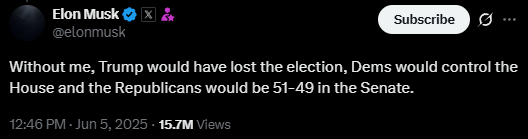
Even after Musk publicly accused Trump of pedophelia, Republicans are working to bring him back into the fold because they want his money for the 2026 midterms.
This isn’t democracy. This is oligarchy. And it’s exactly the outcome the disastrous Citizens United ruling enabled—unlimited, undisclosed, and unaccountable political spending by billionaires and special interests to drown out the voices of everyday Americans.
Musk’s money is so powerful that it has even some Democrats looking past the Hitler salute and eugenicist leanings to try to bring Elon Musk over to this side. This is how the ultra-wealthy escape the consequences of their actions.
Enough is enough. When individual billionaires can outspend entire communities, when corporate PACs write the rules while voters are left in the dark, our democracy is in crisis. Elon Musk may be proud of the system that let him buy influence, but we’re not.
Sign Your Name to Tell Congress: Stop the disastrous Citizens United precedent and pass legislation to get dark money out of our political system!
---
https://robertreich.substack.com/p/office-hours-whos-trump-really-working
---
an 7 25
The public conversation has become so distorted by the moral squalor of Trump and his lackeys that I fear we’re confusing what’s exciting with what’s important.
“Epsteingate” isexciting. The story excites because Trump seems unable to stop it from growing — and it therefore offers a bit of hope that it will undermine his support or even topple him.
Yet I worry that it’s crowding out other stories that Americans need to know and respond to, such as:
1. Hunger in Gaza has reached new and astonishing levels of desperation, with a third of the population not eating for multiple days in a row, according to the World Food Program.
The number of children dying of malnutrition has risen sharply in recent days. Many are literally starving.
According to Philippe Lazzarini, the commissioner-general of the United Nations Relief and Works Agency:
“People in Gaza are neither dead nor alive, they are walking corpses…. One in every five children is malnourished in Gaza City as cases increase every day. When child malnutrition surges, coping mechanisms fail, access to food & care disappears, famine silently begins to unfold. Most children our teams are seeing are emaciated, weak & at high risk of dying if they don’t get the treatment they urgently need…. Parents are too hungry to care for their children. Those who reach UNRWA clinics don’t have the energy, food, or means to follow medical advice. Families are no longer coping, they are breaking down, unable to survive. Their existence is threatened.”
America is directly implicated in this humanitarian crisis.
Netanyahu is a war criminal. More than 1,000 Palestinians have been killed by Israeli forces since May while trying to get food in the Gaza Strip, mostly near aid sites run by an American contractor.
The United States must stop all military assistance to Israel unless Netanyahu and the Israeli government allow relief organizations to bring immediate humanitarian assistance to Gaza.
2. Federal judges accuse the Trump regime of deliberately defying court orders by being slow to respond, misrepresenting facts in filings, and refusing to take action as ordered by the courts.
In an analysis of 165 court orders filed against the Trump regime, the *The Washington Post*found that federal judges accused it of resisting court orders in at least 57 of those cases — approximately 34 percent.
This story needs far more attention. It’s the clearest evidence yet of the regime’s disregard for the U.S. Constitution.
It should form the basis for impeachment of Trump and his lackeys, and for criminal action against them once they’re out of office.
3. 56,816 people are now being detained by ICE, both in the United States and in El Salvador and other countries where there’s little or no control over the conditions in which they’re being detained.
Over 70 percent have not been convicted of any crime.
Many were abducted by ICE agents in plain clothes and wearing masks to prevent identification, from their places of work, courthouses, or their homes and apartments. Families have been broken up and family members “disappeared.”
We have no way of ensuring that they are being held in humane conditions. Venezuela’s attorney general has announced that Venezuelan migrants held in El Salvador who recently returned to Venezuela suffered torture and abuse while imprisoned in CECOT.
Because there’s been no due process — no independent verification of who these people are or even that they have been in the United States illegally — it is entirely possible that some detainees are American citizens.
This story continues to worsen. And it, too,hasn’t received the attention it deserves.

The question of whether Trump had sex with one or more of Jeffrey Epstein’s underage sex-trafficked girls is not unimportant, but I worry that its sensationalism is burying some of these other stories that deserve our attention and action.
We have little or no chance of rectifying the most serious wrongs if we’re captivated by the most exciting.
NOW READ:One Trump court case will determine whether America will still have a democracy
---
AN 7 25
When Secretary of Homeland Security Kristi Noem unleashed her ICE shock troops on Los Angeles last month, she said: “We are not going away. We are staying here to liberate this city from the socialist” leaders.
Minutes later, California Senator Alex Padilla was forcibly removed from the press conference and put in handcuffs.
The specter of socialism is being used by Trump and his goons to make America even more authoritarian.
Trump even threatens to “run” New York City if its voters choose Zohran Mamdani — a Muslim of Indian descent and avowed democratic socialist — as their next mayor. “We have tremendous power at the White House to run places when we have to,” says Trump, warning that he might step in and take control if New Yorkers elect Mamdani.
Trump is using the word “socialism” to slam everything the public needs and to justify cruel cuts in the nation’s safety net.
Trump’s just-enacted Big Ugly Bill will push more than 11 million Americans off Medicaid. Another 2 million Americans will lose food stamps. The savings will help finance a big tax cut for the wealthiest Americans.
But the next time they’re up for election, Republican lawmakers may be shocked to discover how many Americans prefer the “socialism” of Medicaid and food stamps to the socialism-for-the-rich tax cuts in the Big Ugly.
Medicaid alone has 83 percent favorability. Among Republicans, it’s a remarkable 74 percent.
Trump and his lackeys are living in another century if they think they can use “socialism” as a cudgel.
As early as 2011, the Pew Research Center found that almost as many voters under the age of 30 held a positive view of socialism as of capitalism.
During the 2016 Democratic primaries and then again in 2020, young people all over America wore buttons reading “feel the Bern” in honor of democratic socialist Bernie Sanders.
Whether it’s called socialism, democratic socialism, or enlightened capitalism, societies need to pool resources for the common good.
As it is, America spends very little on social insurance compared to other rich nations.
More than 26 million Americans still lack health insurance — and, as noted, at least 11 million more will lose it as a result of the Medicaid cuts in Trump’s Big Ugly.
We’re the only industrialized nation without paid family leave. We’re also the only one without minimal assistance for people in need.
Most other rich nations subsidize college for their young people, yet a large percentage of American households cannot afford to give their kids a four-year college education without going deeply into debt.
Most other rich nations also provide more comprehensive unemployment insurance, cheaper access to child care, and far more help with elder care.
These other nations aren’t “socialist.” They’re capitalist. But they take better care of their people.
American capitalism is the harshest in the world. Inequality here is worse than in any other rich nation. And our politics is far more polluted with big money.
These features are connected. Vast and growing inequalities of income and wealth have spawned big money into politics — with which the rich have gained tax cuts and corporate subsidies while limiting or reducing social spending.
Which is why America has lower tax rates on the super-rich than any other rich nation, one of the lowest life spans of all rich countries, and a higher percentage of homeless people. Trump’s new Big Ugly will make all this worse.
I don’t believe Americans will continue to tolerate this growing socialism for the rich and worsening social squalor for everyone else. Whether or not Zohran Mamdani is elected mayor of New York, we’re going to see a tidal wave of reform.
Most Americans need stronger safety nets and deserve a bigger piece of the economic pie, and they know it.
If you want to call this socialism, fine. I call it fair.
---
AN 7 25
The Trump regime’s battle with Harvard University will be aired in court today when a federal judge hears arguments in Harvard’s lawsuit challenging Trump’s attack on it.
At stake is not just $2.2 billion in grants for scientific research, but the larger question of whether Trump can impose his agenda on independent universities in America — forcing them to bring their admissions, disciplinary procedures, academic hiring, and curricula in line with his priorities.
With the Trump regime ramping up its attacks on colleges and universities across America — using the pretexts of “DEI,” antisemitism, and transgender athletes to undermine academic freedom — it would seem more important than ever for universities to join together to stop him.
There is strength in solidarity. If each college and university seeks only to protect itself, the dictator-in-chief can pick off one after another — as he’s trying to do with law firms, the media, judges, and every other institution of civil society.
Which brings me to Dartmouth College.
I graduated from Dartmouth in 1968. It gave me a wonderful education. I was also a Dartmouth trustee in the 1980s when its president, James O. Freedman, who was Jewish, endured the antisemitic barbs of an ascendant right-wing student group that included such people as Laura Ingraham, Dinesh D’Souza, and Harmeet Dhillon.
Now, Dartmouth is headed by Sian Beilock, who has turned Dartmouth into a Trumpy academic outpost.
Beilock declined to join more than 600 other academic institutions —including all of Dartmouth’s Ivy League peers — in signing a letter in defense of Harvard, which proclaimed “one voice against the unprecedented government overreach and political interference now endangering American higher education.”
This March, as Trump escalated his threats against universities, Beilock hired the former top lawyer at the Republican National Committee, Matt Raymer, as the college’s general counsel. (Raymer is a Dartmouth alumnus who, as recently as January, argued in a conservative online publication called The Federalist that Trump was right about birthright citizenship.)
Around the time Beilock declined to sign the letter defending Harvard, Beilock met with Harmeet Dhillon, Trump’s recently confirmed assistant attorney general for civil rights, who posted on X after their meeting: “I was so impressed to learn how Dartmouth (my alma mater) is getting it right, after all these years. Kudos to Dartmouth!”
In 1988, as editor of The Dartmouth Review, Dhillon became momentarily notorious for publishing a column depicting Dartmouth’s then president Freedman as Adolf Hitler under the headline “Ein Reich, Ein Volk, Ein Freedmann” — a play on a Nazi slogan, “One Empire, One People, One Leader,” but substituting and misspelling Freedman’s name for “Fuhrer.”
Using the analogy of Nazi Germany and the Holocaust, the column satirically described how “Der Freedmann” and his associates rid the campus of conservatives. The column referred to the “‘Final Solution’ of the Conservative Problem” and to “survivors” of the Dartmouth “holocaust” and described Dartmouth conservatives being “deported in cattle cars in the night.”
A drawing on the cover of the following issue, on October 26, also depicted Freedman, who had been critical of The Review, as Hitler.
As I said, I was a trustee of Dartmouth at the time. I saw up close how much Dhillon’s publication hurt Freedman. The student newspaper The Dartmouthtook The Reviewto task: “The column is anti-Semitic; its impact rings through this community today and will remain long after its publishers have completed their stints in Hanover.”
Several faculty members wrote to outside advisers of The Review, asking them to reconsider allowing their names to be associated with the publication. The regional office of the Anti-Defamation League of B’nai B’rith, in Boston, condemned the column.
Now, twenty-seven years later, as assistant attorney general for civil rights, Dhillon is investigating most of the Ivy League for antisemitism. Notably, she is not investigating Dartmouth.
Dartmouth has so far avoided the sort of threats Trump has leveled against Harvard, which are being litigated today. In fact, Dartmouth is the only Ivy aside from Yale to escape targeted attacks to its funding.
Presumably that’s because Beilock has appeased Trump, at least for now.
This week’s New Yorker contains a piece by Rob Wolfe titled “How Dartmouth Became the Ivy League’s Switzerland.” I don’t think the analogy holds. Dartmouth isn’t like Switzerland, which stayed neutral in World War II. It’s more like Neville Chamberlain’s Great Britain just before the war, which sought to appease the tyrant.
As the world painfully learned, tyrants can’t be appeased. Tyrants view appeasement as weakness, and always want more.
Were it not for FDR’s United States and Winston Churchill’s Britain, Hitler might have won, and both Dartmouth and Harvard might now be teaching Nazi versions of history, science, and everything else.
Which is why Sian Beilock gets this week’s Neville Chamberlain award.
---
an 7 25
Anyone wanting to understand the brouhaha over Pam Bondi’s refusal to turnover (or even acknowledge) the Epstein files need look no further than what the Supreme Court just did.
In McMahon v. New York the Supremes gave Trump a simple way to revoke federal spending authorized by Congress: just fire everyone responsible for implementing that spending.
The high court is allowing Trump and Education Secretary Linda McMahon to fire over half the people who work for the Department of Education until there’s a full hearing on the constitutionality of their action. But by then it will be too late to save much of the department.
Note that the Supreme Court made this astounding decision on its so-called “shadow docket” where it doesn’t even have to explain itself (the only record we have is Justice Sotomayor’s dissent).
No matter that Congress created the Department of Education; apparently, Trump can effectively end it. No matter that Congress in the 1974 Impoundment Control Act prohibits a president from unilaterally refusing to spend money that has been authorized by Congress; apparently, Trump can disregard the Act.
Trump now has unbridled power to repeal federal laws by the simple expedient of firing federal employees who implement them.
Why? How? On what basis? Who’s behind this? We don’t know. We may never know.
Which gets us to the brouhaha over Jeffrey Epstein.
For years, Trump has talked darkly of a “deep state” — a secret cabal intent on destroying America by harming the nation’s children.
Such as, perhaps, six justices who let him shut down the Education Department without even setting out their reasons?
Recall “Pizzagate,” the QAnon conspiracy theory that in 2016 allegedly linked Democrats to a ring of child sex-traffickers. It’s still around but has morphed into a less partisan conspiracy theory involving an alleged worldwide elite of child sex-traffickers.
Jeffrey Epstein and his death fit perfectly. Many right-wing media personalities have posited that the billionaire convict was murdered in prison as part of a cover-up of a sprawling sex-trafficking conspiracy.
Senior Trump administration officials built up great fanfare around the release of the supposed Epstein “client list.”
Even JD Vance accused the government of hiding the list. “If you’re a journalist and you’re not asking questions about this case,” Vance said, “you should be ashamed of yourself.”
But that was back in 2021, before Vance became part of the, um, conspiracy.
In February of this year, Attorney General Pam Bondi acknowledged the existence of Epstein’s client list. She said the client list is “sitting on my desk right now.”
Now the Trump-Vance administration says Epstein’s client list doesn’t exist.
The Epstein case illustrates Trump’s “deep state” no less than does an unsigned “shadow docket” Supreme Court decision allowing Trump to wipe out the Department of Education.
The phrase “Epstein didn’t kill himself” — a rebuttal to the official explanation of Epstein’s death — has taken on a cultural meaning way beyond the facts of the case. It means an unaccountable elite doing evil things in secret.
Trump built his political base on that premise. Once in office, he said time and again, he would expose that unaccountable, secret, evil elite.
No wonder 70 percent of voters believe “law enforcement is withholding information about powerful people connected to Epstein,” including 61 percent of Trump voters. And 58 percent of voters said Trump “maybe was or definitely was” involved in a cover-up.
Conspiracy theories thrive when elites act in secret. I have no idea whether Epstein killed himself or was murdered. But Wired Magazine’s metadata — showing that the FBI’s “raw” surveillance video from the night Epstein killed himself is seemingly missing 2 minutes and 53 seconds — got my attention.
As did the Supreme’s bonkers secret decision in McMahon.
And I’m no conspiracy theorist.
After hyping the promised release, a joint FBI and Department of Justice report last week said they had found no evidence of a list — or that Epstein, who died by suicide in his prison cell in 2019, had been murdered — prompting outcry from within MAGA circles.
As Bondi faces heightened scrutiny for her repeated attempts to dodge questions about the Epstein files, Loomer also teased that “there are people in the White House who agree with me that Pam [Bondi] spent too much time on Fox News and her statements were inconsistent and undermined what messaging is today about the Epstein files.”
Other prominent MAGA-aligned supporters of the president have also warned that Trump could see significant damage to his standing among his base if he does not change course.
Sixty-three percent of voters in a Quinnipiac University national poll released Wednesday said that they disapproved of Trump’s handling of the files. Republicans were also nearly split. Just 40 percent said they support how he’s handled the files, with 36 percent disapproving and another 20 percent not offering an opinion.
Mike Flynn — who briefly served as Trump’s national security adviser in his first term — wrote in a lengthy X post on Wednesday that Trump needed to “gather your team and figure out a way to move past this.”
“The roll out of this was terrible, no way around that,” Flynn wrote. “Americans want America to be successful, therefore, WE NEED YOU TO BE SUCCESSFUL.”
Elon Musk — with whom Trump had a blowup fight last month in which Musk accused Trump of being named in the Epstein files — criticized his former boss for trying to paint the whole situation as a hoax.
“He should just release the files and point out which part is the hoax,” Musk wrote on X Wednesday.
The MAGA meltdown over Epstein “could be his Afghanistan going into the fall,” Mark Mitchell, head of polling and operations at Rasmussen Reports, told Steve Bannon Tuesday on his “War Room” podcast.
“People are trying to say this isn’t a big deal,” Mitchell said. “People are trying to say nobody wants this Epstein information out. It’s an absolute misdirection. This is horrifying. And if it isn’t corrected, it threatens derailing Trump’s agenda, getting rid of his political capital.”
“This is not about a guy who died in 2019, this is about a representation of two-tier justice and about unaccountable government,” Mitchell told Bannon.
On Wednesday, conservative political commentator John Solomon told Bannon that he had interviewed the president, and that Trump supported the appointment of a special prosecutor to investigate elements of the Epstein case as part of a broader look into a supposed deep state conspiracy to punish the Republican Party.
“I think he’s frustrated by all the social media chatter by people who don’t really know what’s in the Epstein files,” Solomon said. “He was very pointed about that, let’s stay focused on the things that matter to the American people. ‘I want the answers to Epstein like everyone’, he said, so let the prosecutor do that.”
The Epstein fiasco also prompted Speaker Mike Johnson to split with Trump on Tuesday, calling for the Department of Justice to release all the information it has on the sex offender in the name of “transparency.”
“It’s a very delicate subject, but you should put everything out there, let the people decide it,” Johnson told conservative commentator Benny Johnson, adding that Bondi should explain her previous claims of having the elusive Epstein “client list.”
Just a day prior, the Louisiana Republican had defended Bondi, choosing to defer to the Trump administration instead of criticizing the attorney general.
But Trump appears to remain unmoved despite growing rebellion within his MAGA cohort.
In the Oval Office on Wednesday, Trump repeated his claims that the whole ordeal was a “hoax” peddled by Democrats and once again defended Bondi’s handling of the case.
“She’s done very good. She says ‘I gave you all the credible information,’ and if she finds any more credible information, she’ll give that too. What more can she do than that?” Trump said, adding that he had “lost a lot of faith in certain people” over their outcry on the administration’s approach to the issue.
---
AN 7 25
I keep asking myself when Trump’s authoritarian fascism will become so intolerable to the vast majority of Americans that they rise up against it — not only massively protest but put enough pressure on Republicans in Congress that they join with Democrats in impeaching and convicting him.
In other words, what’s the tipping point for ridding us of this menace?
I thought we’d reached that tipping point when he went to war with Iran without congressional approval. Or when he sent active military troops into Los Angeles. Or when he imposed tariffs on all products imported to the United States, essentially raising taxes on Americans. Or when he forced out the president of the University of Virginia for insufficiently rooting out DEI. Or when he attacked major law firms for employing lawyers who once tried to hold him legally accountable.
Obviously, we haven’t reached the tipping point yet. So what will it take? Several possibilities come to mind:
1. He raises tariffs 25 percent on almost all products imported into the United States, resulting in substantial price increases across the economy.Americans who pay no attention to politics now find they’re struggling to pay the bills.
2. He stations active military troops in every major American city to “protect” ICE agents who are going house to house, apartment to apartment, demanding proof of citizenship.Americans who haven’t before been affected by Trump’s police state are now aware of it, as many of their relatives or friends get caught up in the dragnet.
3. He builds a gulag of detention centers across America into which he sends Americans who criticize him, prior to revoking their citizenship and expelling them to prisons in foreign nations.Americans who haven’t been concerned about his actions against immigrants now find that he is silencing all criticism about him or his regime.
4. He announces that the Supreme Court is intruding on presidential powers and he is therefore not bound by the court.Americans who haven’t paid attention to his lawlessness are now forced to confront his constitutional coup.
Hence today’s Office Hours question: What actions by Trump and his lackeys do you believe will trigger such a massive upheaval in America that even Republican lawmakers who have supported him will join with Democrats to impeach and convict him? Where’s the tipping point?
---
Trump’s Big Ugly Bill delivers $170 billion for border and immigration enforcement.
This is on the scale of supplemental budgets passed by the United States when we enter war.
ICE will add 10,000 agents to the 20,000 already on the streets.
Its annual budget for detentions will skyrocket from $3.4 billion in the current fiscal year to $45 billion until the end of the 2029 fiscal year. That’s a 365 percent increase.
Funding for ICE detentions will exceed funding for the entire federal prison system.
When government capacity is built out this way, there’s always political and bureaucratic pressure to utilizesuch capacity. Supply creates its own demand.
“They pass that bill, we’re gonna have more money than we ever had to do immigration enforcement,” Trump’s border czar, Tom Homan, said recently, adding, “You think we’re arresting people now? You wait till we get the funding to do what we got to do.”
Which means that the number of people detained in ICE facilities — numbering 56,397 as of June 15 — will likely grow dramatically. A four-fold increase in the detention budget could mean a quarter of a million people locked up.
Don’t fall for the Trump regime’s lie that these people are criminals. As of now, 71.7 percent of ICE detainees have nocriminal record. Some have been hardworking members of their communities for decades.
Even before the huge increase in funding, Trump aide Stephen Miller and Homeland Security Secretary Kristi Noem demanded that immigration agents arrest 3,000 people a day.
That’s triple the number of daily arrests that agents were making between February and April.
Given that border-crossing numbers have plummeted, just meeting this 3,000-per-day target will require far more aggressive enforcement in non-border communities nationwide.
Big Democratic cities will be hit hardest. In a recent social media post, Trump called on ICE officials to “expand efforts to detain and deport Illegal Aliens in America’s largest Cities, such as Los Angeles, Chicago, and New York, where Millions upon Millions of Illegal Aliens reside.”
How will ICE agents know whom to round up and detain? The crude reality is that they’ll focus on anyone looking Latino or with surnames ending in “z.”
There are 65.2 million Latinos in the United States, the vast majority of whom are citizens. Inevitably, some American citizens will be swept up, arrested, and detained.
As the number of raids on workers and families escalates, ICE agents will engage in more warrantless knocks on doors, searches, and arrests.
And more of these agents will mask themselves to avoid being held responsible for their actions — an abuse of power commonly associated with Eastern Bloc police states.
This giant federal police effort will be supported by a supercharged surveillance system, also financed by Trump’s Big Ugly Bill. The Department of Homeland Security is joining with the Department of Government Efficiency to create the federal government’s first national citizenship data bank.
According to The New York Times, Palantir corporation’s software will be used to combine data gleaned from the Department of Homeland Security, the Department of Defense, the Department of Health and Human Services, the Social Security Administration, and the Internal Revenue Service. Meanwhile, the administration wants access to citizens’ and others’ bank account numbers and medical claims.
The regime will not limit the purpose of its growing internal police apparatus to deporting undocumented people.
Trump is already attacking the citizenship of people born in the United States to parents who may or may not have been citizens at the time of their birth — so-called “birthright citizenship.”
The regime is also going after naturalized citizens (born outside the United States), using a McCarthy-era law that the Justice Department then used to sniff out former Nazis who lied their way into becoming American citizens — a law that allows the Department to “denaturalize,” or strip, someone’s citizenship.
According to a memo issued to Department lawyers last month by Attorney General Pam Bondi, denaturalization should be aimed at anyone who may “pose a potential danger to national security” — a standard so vague as to allow the Department to expel people from the country based on unsubstantiated claims or even on their negative opinions about Trump.
Trump has already publicly called for deporting “bad people … many of them [who] were born in our country.”
Last week, Andy Ogles, a Republican congressman, asked Bondi to investigate whether New York City mayoral candidate Zohran Mamdani — who was born in Uganda and naturalized in 2018 — should be subject to denaturalization proceedings because he “publicly glorifies” people connected to Hamas in a rap song.
Bondi has not publicly responded to the letter.
The coming expansion of Trump’s police state under the Big Ugly Bill — featuring total surveillance, 10,000 ICE agents, and a network of detention facilities — will mark an escalation of Trump’s authoritarianism — using the pretext of an immigrant crime wave that does not exist.
What you can do:
- Protect the vulnerable.If anyone in your community is confronted by ICE agents demanding proof of citizenship, make sure they know they have a right to remain silent and to refuse consent to searches of their cars, homes, or persons.
Red cards with this and other pertinent information are available in various languages. You can download and print them for free here.
- Make sure you know your own rights. If stopped, you are not required to answer questions. You can refuse a search of your person, car, or belongings. If the agents proceed with a search despite your refusal, make it clear you do not consent. If you’re not under arrest, you can ask if you are free to go. If the answer is yes, leave.
If you or someone in your community believes rights have been violated, document everything you can of the encounter with ICE agents.
- Finally, know that the purpose of Trump’s police state is to silence not just immigrants but the rest of us.Do not be intimidated or discouraged from speaking out, writing, demonstrating, boycotting, or undertaking any other nonviolent action in opposition to what the regime is doing.
To the contrary, become even more active. Share any abuses you witness (and, ideally, have recorded on your phone) as widely as possible, so that more people are apprised of what’s happening and are ready to join the resistance.
Be safe. Be careful. Have courage. Hug your loved ones.
NOW READ:The Supreme Court's timing couldn't be worse
---
an
During a three-hour interview with the podcaster Joe Rogan some months ago, Elon Musk revealed the core of the ideology animating the richest person in the world.
“The fundamental weakness of Western civilization is ,” Musk said, adding that liberals and progressives are “exploiting a bug in Western civilization, which is the empathy response.”
Musk pointed to California’s move to provide medical insurance even to undocumented people who qualify for its low-income Medi-Cal program.
“We’ve got civilizational suicidal empathy going on,” Musk continued. Empathy has been “weaponized.”
Musk is now officially out of Trump world but his DOGE lives on. It has already destroyed almost every empathic part of the U.S. government.
Musk disdains social insurance such as Social Security, which he calls a “Ponzi scheme.”
Musk’s former buddy Donald Trump presumably agrees with him. As do many Republicans, including Joni (“Well, we all are going to die”) Ernst and Mitch (“They’ll get over it”) McConnell.
Trump’s Republicans are now raiding Medicaid and food stamps to make way for a giant tax cut mostly for the rich. No empathy bug there.
Trump’s Department of Homeland Security is grabbing people off the streets and from courthouses without warrants and putting them in detention centers.
The number of immigrants detained in Immigration and Customs Enforcement facilities across the country has reached a record high of more than 56,000. The result is overcrowding, unsanitary conditions, and enormous pain for affected families and communities.
It’s the opposite of empathy — treating people as if they aren’t human, as if they’re the “other.”
Both Musk and Trump are experts in taking selfish advantage of everything, anything, and anybody. Both have altered government programs and regulations to reap personal financial gain. Both have been quick to fire people. Both demand loyalty to themselves but have no loyalty to anything or anyone besides themselves.
They’ve got it all wrong. Empathy is a necessary precondition for a society.
Without empathy, we’d be living in a social Darwinist jungle animated only by selfish individuals pursuing selfish needs, like Musk and Trump.
If everyone behaved like Musk and Trump, we’d have to assume everyone else was out to exploit us if they could. Much of our time and attention would be devoted to outwitting or protecting ourselves from other Musks and Trumps.
Without a shared sense of empathy and responsibility, we would have to assume that everyone — including legislators, judges, regulators, and police — was acting selfishly, making and enforcing laws for their own benefit.
In a world populated by people like Musk and Trump, we couldn’t trust anyone to be truthful if they could do better for themselves by lying. We couldn’t count on any claim by sellers of any product or service. Internet-based “reputational ratings” would be of little value because raters would be easily bribed.
Journalists would shade their reports for their own selfish advantage, taking bribes from advertisers or currying favor with politicians. Teachers would offer lessons to satisfy wealthy or powerful patrons. Historians would alter history if by doing so they gained wealth or power. Scientists would doctor evidence for similar selfish motives. The truth would degenerate into a cacophony of competing factual claims, as, in part, it has.
We couldn’t trust doctors or pharmacists to give us the right medications. We couldn’t trust bankers and accountants not to fleece us, restaurants not to feed us tainted food, lawyers not to hoodwink us.
A society depends on people trusting that most others in society will have a modicum of empathy for others rather than take advantage of them. In this way, civic trust is self-enforcing and self-perpetuating, while civic distrust can corrode the very foundations of a society.
Polls tell us that many of today’s Americans worry that the nation is losing its national identity. Yet the core of that identity has never been the whiteness of our skin, the uniformity of our ethnicity, or the commonality of our birthplace.
Our core identity as Americans — the most precious legacy we have been given by the generations who came before us — consists of the ideals we share and the obligations we hold in common. We are tied together by these empathic meanings and duties. Our loyalties and attachments, guided by empathy, define who we are.
If we are losing our national identity, it is not because we are becoming blacker or browner or speak in more languages than we once did. It is because we are losing the ties that bind us together, our collective empathy.
Musk and Trump typify what has gone wrong. Their most damaging legacies may be the erosion of the trust and empathy on which our society — any society — depends.
===
---
New York City's 2025 Democratic mayoral primary experienced a major upset when, on Tuesday night, June 24, progressive New York State Assemblyman Zohran Mamdani — a self-described "democratic socialist" endorsed by Sen. Bernie Sanders (D-Vermont) and Rep. Alexandria Ocasio-Cortez (D-New York) — defeated former Gov. Andrew Cuomo and other candidates.
Now the official Democratic nominee, Mamdani enters the general election, where the current mayor, Eric Adams, is seeking reelection as an independent.
During an appearance on Democracy Now posted on June 26, liberal economic Robert Reich as well as the economic policies of President Donald Trump.
Reich emphasized that Mamdani aggressively ran on a message of economic populism, telling host Amy Goodman, "Shockwaves is a good way of putting it, Amy. The Democratic Party really needs to learn this lesson…. The lesson is very simple: There is a huge anti-establishment wave in America that is the strongest wave in American politics. And a lot of it has to do with the fact that the bottom 60 to 80 percent of Americans have not seen a real wage increase in 45 years…. The people at the top are doing wonderfully well."
During the interview, Reich noted that Trump, in 2024, ran on a message of economic populism.
"Trump fooled the majority of Americans, or at least the plurality, into thinking that he would be their savior," Reich told Goodman.
But Mamdani, Reich argues, is the real deal — unlike Trump.
READ MORE:*
"This is the one thing that I agree with Donald Trump about: The economy is rigged — but it's rigged against working-class people," Reich told Goodman. "And I think Mamdani understood that. He understood that people have got to want a change, but also, they want affordability. They want an economy that is working for them. And they want new faces. They want younger people. They want a new generation of Democratic leaders.
READ MORE:'Completely reckless' Trump judicial pick may still be confirmed despite scandal: expert
*Watch the full video below or at this link.
---
an 6 25
The Supreme Court recent unanimous ruling in Ames v. Ohio Department of Youth Services hasn’t got nearly the attention it deserves.
On the surface, the ruling seems innocent enough. The Court merely decided that white and straight employees who allege they’ve been discriminated against don't need to meet a higher standard of proof than do Black or LGBTQ+ employees who sue for discrimination under Title VII of the Civil Rights Act.
(Prior to this ruling, some courts had required that white or straight employees demonstrate not only that they were discriminated against but they also worked in a discriminatory environment.)
The Court’s decision in Ames appears a logical extension of the 2023 ruling by its six conservative justices ending race-conscious admission programs at colleges and universities across the country.
But seen against Trump’s bigoted agenda and the widening discrepancies between the political power of Black or LGBTQ+ people relative to the power of white straight people, the Ames case should trouble everyone.
Trump and his lackeys have argued that discrimination against white and straight Americans occurs under the coverof diversity, equity and inclusion. And Trump has gone to great lengths to undo what it calls “illegal D.E.I.” — ousting diversity officials from federal agencies and removing D.E.I. references from government websites.
The Ames ruling could be the death knell for D.E.I. because it makes it easier for white and straight people to argue that a D.E.I. policy at the workplace caused an employer to discriminate against them.
The Supreme Court I got to know in the 1970s when I worked in the Solicitor General’s office understood its responsibility to balance the scales of justice in favor of the powerless — including Black people, women, and gay people.
That Court understood that as majoritarian institutions, Congress and the executive branch could not always be counted on to reflect the needs of people with far less political power than straight white men.
Hence, they assumed that one of the Court’s essential roles in our system of self government — indeed, the core of its moral authority — was to give extra weight to the challenges or aspirations of such minorities.
Even Nixon’s appointees—Harry Blackmun, Lewis Powell, and Warren Burger—seemed to understand this important counter-balancing role. Blackmun wrote the Court’s decision in Roe v. Wade, and Powell and Burger joined him (as did four Democratic appointees to the Court—William O. Douglas, Thurgood Marshall, William Brennan, and Potter Stewart).
Douglas, Marshall, and Blackmun were the intellectual leaders of that Supreme Court. Their opinions gave the Court its moral heft. They drew not only from the Constitution as written but also from their understanding of how the nation had evolved, and of the distribution of power.
Like an earlier Supreme Court that unanimously decided in Brown vs. Board of Education of Topekathat separate schooling for Black and white children was inherently unequal and therefore unconstitutional, the Supreme Court I argued before understood that America must rely on the Court to protect the rights of the voiceless and the powerless.
Today’s Supreme Court majority doesn’t have a clue about the court’s moral authority or its essential role in counter-balancing a distribution of power disadvantaging Black or LGBTQ+ people.
The Republican appointees to today’s Supreme Court are political hacks intent on entrenching the power of the already powerful.
Five were nominated by presidents who lost the popular vote; three were nominated by a president who instigated a coup against the United States and were confirmed because a rogue Republican Party mounted scorched-earth campaigns to put them on the Court.
The current Supreme Court has no interest in counter-balancing the majoritarian tendencies of Congress and the President. To the contrary, as demonstrated by theAmesdecision, today’s Court is at best the third majoritarian branch of government.
On Juneteenth — the day we commemorate the end of slavery in the United States — it is well to ponder that there is no longer any branch of government dedicated to protecting the life chances of those with less political power due to their race, ethnicity, gender, sexual preference, or sexual orientation.
This is deeply unfortunate.
NOW READ:Trump now faces the same terrible choice
*Robert Reich is a professor of public policy at Berkeley and former secretary of labor. His writings can be found at https://robertreich.substack.com/.
---
AN 6 25
Last week, I mentioned conservative columnist David Brooks’s call for a “comprehensive national civic uprising” against Trump, which Brooks described as “one coordinated mass movement.”
I wondered what shape that mass movement could take and asked whether, for example, it might be a general strike.
One person who got back to me was my old friend Sam Brown.
Sam knows something about mass movements. He was one of the chief organizers of the Moratorium to End the Vietnam War, on October 15, 1969.
When Richard Nixon took office on January 20, 1969, about 34,000 Americans had already been killed fighting in Vietnam — and an untold number of Vietnamese. During Nixon’s first year in office, from January 1969 to January 1970, roughly 10,000 additional Americans were killed there.
Sam reminds me that the idea for the moratorium started out as a call for a general strike. Sam (who previously had worked on Eugene McCarthy’s 1968 presidential campaign) changed the concept from general strike to a “moratorium.”
The moratorium was a huge success. Millions participated throughout the world. (Bill Clinton and I, then graduate students at Oxford, joined in the demonstration in London — which later became an issue when Clinton ran for president.)
The moratorium was followed a month later, on November 15, 1969, by a large Moratorium March in Washington, D.C.
It was the first time the anti-Vietnam War movement reached the level of a full-fledged mass movement. Many credit it with hastening the end of that horrendous war. (Interestingly, research shows that nonviolent protests “have never failed to bring about change” when they involve at least 3.5 percent of the public.)
Why did Sam change it from a general strike to a moratorium? He says he wanted protests to take place in communities rather than on university campuses so that “the heartland folks felt it belonged to them.”
Sam also thought that the best way to pressure Nixon was to ensure the movement had a “respectable” face in order to win the support of the largest number of Americans, many of whom did not much like either the hippie counterculture or the New Left movement. At the time, Nixon’s opponents were easily dismissed as “nattering nabobs of negativism,” or, in Trump-speak, as “whiners and losers.”
Sam’s view is that those of us who oppose Trump will similarly be dismissed until clearly identifiable Trump voters join with us. And, as then, the people who agree with us but don’t express themselves or participate need an easy on-ramp to do so.
In Sam’s view, “strike” has an overtone of militancy, which isn’t an easy place for people in the middle to go. Furthermore, “strike” doesn’t resonate with a small business person or a farmer or most of rural America. (Sam’s favorite visual for the demonstration would be Lincoln and Des Moines immobilized by tractor-driving farmers.)
Sam thinks we need an action that can grow and morph with time into a national movement — and one with which people newly opposed to Trump can identify.
So what’s the best word to describe this? Sam doesn’t think “moratorium” is right this time around, but we still need a neutral, mainstream descriptor that can incite a huge demonstration involving millions of people, that leads to an even larger one.
Ideas, anyone?
What would be the overall strategy? Sam believes it should be locally based, with a range of entry points and a broad set of supporters. (Sam and the Vietnam Moratorium Committee sought the support of groups like the Civil Rights Movement, churches, university faculties, unions, business leaders, and politicians.)
He points out that modern means of communication makes something like this radically easier to organize. The additional good news is that Trump has pissed off nearly everyone, even those who won’t yet admit it.
But Sam believes we need to find a way to gain the support of conservative opinion leaders like David Brooks. This takes some time and a great deal of thoughtful networking.
What do you think?
NOW READ:Breathing is now a political act — thanks to the GOP
---
see prev trump never was successful bizman
12 b if inherit in std mkt
===
VIDEOS
INEQ MEDIA: 
6:57
Now playing](https://www.youtube.com/watch?v=9XTJNy_OrjE&t=19s&pp=0gcJCa0JAYcqIYzv)
Is Donald Trump a Fascist? | Robert Reich
2.1M views 2 years ago
---
DUE PROCESS
---
vids}youtube channel: }:
Inequality Media with Robert Reich
pwl memo 
---
corp person bk unequal justice dartmouth artif persons so cd pay tax and be sued ? and...sjf riding the circuit, jay gould back for prez 7 cases a penny a mile but 2c santa clara santa ana, ct ruled ~ at least 34 cases refer bk to headnote, but never official decided; 1st refer to headnote --> precendent 13? yrs later; congress or sup ct can fix MTA
thom: 6 min 
---
robt r
https://www.youtube.com/watch?v=Xo0nFZVRs24
How Legalized Bribery Works in America I 10 Economic Myths Debunked #4
63K views 11 months ago
“Corporate political donations are free speech.”
---
“We renew our resolve that America will never be a socialist country.”
4:30
Socialism for the Rich, Harsh Capitalism for the Rest | Robert Reich
---
~
BUNK! Why Most of Robert Reich’s Ideas Are Just Wrong John Stossel
587K views 8 months ago
https://www.youtube.com/watch?v=FoACN6M7YvU)
---
2022
OCCUPY 1OTH ANNIV UCB 2011 ROBT SPCH KARA SEGAL IN NY
NOT INSTITUTIONALIZED; SUNRISE, MUTUAL AID BERNIE AOC
:{:{---}:
---
---
AN 6 25
The man who launched an attempted coup on the United States in 2020 and instigated an insurrection at the Capitol that resulted in five deaths now claims that people in Los Angeles are launching an insurrection. They’re not.
Yesterday, the Pentagon activated 700 Marines out of the Marine Corps Air Ground Combat Center in Twentynine Palms, California, to join the 4,000 federalized National Guard’s military occupation of parts of Los Angeles.
Trump doesn’t give a damn whether the troops are necessary. Nor does he care how many people are injured or even killed in his raid on Los Angeles. The show of military force is the point. It gives him the appearance of power.
Like any bully, Trump is fundamentally a coward. Humiliated by China, Harvard, the Supreme Court, Elon Musk, and the federal courts, Trump has launched a war inside America on vulnerable people inside America, in a place — California — most of whose inhabitants loathe him.
All of this was manufactured by Trump. It was and is his creation. The frightful specter of federally controlled troops in American streets has historically signaled a social crisis — forcing integration in Arkansas, protecting civil rights marchers in Alabama. But Trump is sending the military to Los Angeles at a time when state and local officials say there is no need.
Let’s be clear: Trump and his lackeys want blood in the streets. They have been planning for it. “Looking really bad in L.A.,” Trump wrote on Truth Social shortly after midnight Sunday night. “BRING IN THE TROOPS!!!”
The bully-in-chief has appointed a bunch of tin-pot bullies to every position of lethal force in the federal government — and is now activating them.
Secretary of Homeland Security Kristy Noam is a Trump stooge seemingly without understanding of the U.S. Constitution. Secretary of State Marco Rubio appears willing to go along with whatever Trump wants. Deputy Chief of Staff Stephen Miller is a maniacal xenophobe. Secretary of Defense Pete Hegseth is a brain-dead Trump sycophant. Border czar Tom Homan is a toady who has not ruled out arrestingCalifornia’s leaders if they obstruct federal law enforcement.
The central struggle of civilization has always been to stop brutality. Unless we prevent the stronger from attacking or exploiting the weaker, none of us is safe.
A civil society is the opposite of what Trump seeks. A civil society doesn’t allow the strong to brutalize the weak. It moves as far as possible away from brutality.
Every time the stronger brutalize the weaker — whether it’s Trump and his flunkies bullying immigrants and the state of California, white supremacists bullying Black and Latino people, giant corporations bullying customers with high prices, the wealthy bullying the public to get giant tax cuts, Elon Musk bullying poor people by cutting programs they depend on, police bullying poor Black people, powerful men bullying women through sexual harassment, politicians building their power by bullying racial or ethnic minorities, Netanyahu wiping out Palestinians in Gaza, Putin trying to take over Ukraine — it’s fundamentally the same playbook: Stoke fear. Exploit desperation. Suspend the rule of law. Fan brutality.
Unless the bullies are stopped, an entire society — even the world — can descend into chaos.
Our duty is to stop brutality. Our responsibility is to hold the powerful accountable. Our challenge is to stand up to abuses of power. Our moral obligation is to protect the vulnerable.
This week and through Saturday, protest but please do it peacefully. Do not be provoked into violence. Take videos of any brutality Trump’s agents are wreaking, to show the rest of America and the world. Be smart. Be careful.
NOW READ:Democrats' secret weapon against Trump
---
AN 6 25
When it comes to non-Americans, Trump and his regime are clear: Foreigners — especially if they’re Chinese — are no longer wanted here. Nor are their products. Nor are we prepared to sell them our advanced technologies.
But foreign bribes? Hell, they’re welcome at the highest levels, even if they result in some critical technologies reaching China.
First, consider all the front doors now closing to China.
The State Department is revoking the visas of Chinese students who are “studying in critical fields.” This could be a big deal. Some 277,000 students from China attended school in the United States last year, second only to the number of students from India.
In addition to raising tariffs on Chinese products entering the United States, Trump is considering prohibiting major Chinese chipmakers — as well as units of Chinese technology giants like Alibaba, Tencent, and Baidu — from trading with the United States.
Meanwhile, the United States has ordered a broad swath of American companies to stop shipping high-tech goods to China without a license and revoked licenses already granted to certain suppliers.
Last week, the United States suspended some sales to China of components and software used in jet engines and semiconductors, including chemicals and electronic design automation software for semiconductors.
In late March, the Trump administration added 80 companies and organizations to a list of companies that are barred from buying American technology and other exports because of national security concerns. The move, which targets primarily Chinese firms, cracks down on companies that have been big buyers of American chips from Nvidia, Intel, and AMD.
The rules are aimed at restricting China’s access to artificial intelligence and advanced computing needed to augment its military.
But as these front doors to China close, back doors are opening.
A technology trail now leads from the United States to oil-producing nations and then to China.
Saudi Arabia, Qatar, and United Arab Emirates have been granting Trump personal favors. Their presumed goal is to get access to American technology.
Qatar has given Trump a luxury jet, a “palace in the sky.” (It’s to him personally. No subsequent president will be able to use it.)
Saudi Arabia’s Public Investment Fund (PIF) has invested $2 billion in Jared Kushner’s private equity firm. And Dar Global, a Saudi luxury developer, is partnering with the Trump Organization on at least three projects across the Middle East, including a Trump Tower Jeddah, another in Riyadh, and a Trump International Hotel and luxury golf development in Oman.
Trump’s family crypto firm, World Liberty Financial, recently announced that its so-called “stablecoin” — with Trump’s likeness all over it — will be used by the United Arab Emirates to make a $2 billion business deal with Binance, the largest crypto exchange in the world. The deal will generate hundreds of millions of dollars more for the Trump family.
What do Saudi Arabia, Qatar, and the UAE get from all these deals? All are seeking to diversify their economies away from oil by boosting their technology sectors.
Trump is granting them greater access to advanced technologies from the United States, including advanced semiconductors from companies like Nvidia and AMD.
Yet at the same time, these nations are strengthening their strategic partnerships with China in artificial intelligence, advanced computing, and quantum information technology.
They’ve entered into joint ventures with Chinese counterparts for producing unmanned aerial vehicles (UAVs) and AI-related projects, including the development of smart cities and AI-powered infrastructure.
Here’s another back door to China: Chinese crypto billionaire Justin Sun, who’s based in Hong Kong.
Sun is the largest holder of Trump’s $TRUMP memecoin. His $23-million investment has put him into the exclusive circle of investors who were invited to a private VIP dinner with Trump on May 22.
Until Trump’s election win, the 34-year-old entrepreneur was in the sights of U.S. authorities and persona non grata in much of the U.S. crypto industry. His company. Tron, which operates a blockchain network with the same name, has been a popular channel for crypto’s criminal fraternity to move funds.
The U.S. Treasury Department’s Financial Crimes Enforcement Network wrote in a private 2023 report that Tron was “growing in popularity among illicit actors.” By last year, more than half of all illegal crypto activity — some $26 billion — took place on the network.
Sun faced charges from the Securities and Exchange Commission, which in 2023 accused him of fraudulently manipulating the market for Tron’s TRX token. The Justice Department had been investigating Sun for suspected financial crimes, people familiar with the case said. The U.S. attorney’s office in Manhattan requested information from Sun in 2021 and continued gathering evidence through at least 2023, some of the people said, causing him to avoid travel to the U.S. over concerns about a possible arrest warrant.
But now? The SEC asked a court in February to pause its lawsuit, and most of the other investigations are on the way to being closed.
Is it possible that Sun’s Tron network will become a means for China to move funds in pursuit of advanced technology from the United States? Of course.
While America’s front doors are closing to China, back doors are opening in the form of personal payoffs to Trump that result in alternative routes for America’s advanced technology to reach China.
Officially, Trump is closing America’s front doors so China doesn’t get our critical technologies. Unofficially, he’s opening back doors to China that give it access to these technologies and make him and his family even richer.
What’s being sold? Who’s being sold out?
---
an 6 25
One of our highest priorities in this darkness must be to protect the people who are doing the most right now to push back against Trump’s tyranny: our judiciary.
In some 180 judicial rulings so far, federal judges have at least temporarily stopped Trump from (1) deporting and/or imprisoning people without due process, (2) firing federal workers and closing agencies and departments without congressional approval, (3) forcing law firms to not represent people or causes Trump dislikes, (4) forcing universities, their faculties, and their students not to say or write things Trump dislikes, and (5) imposing worldwide tariffs without congressional authority.
Most of these court rulings have been temporary until the merits of the cases are fully heard, but increasingly they’re final decisions.
The Trump regime is appealing many of them. A few will almost certainly end up in the Supreme Court.
Our laws and the Constitution allow a president to contest such rulings in these ways.
But Trump and his lackeys are also using a second tactic: trying to undermine public confidence in the judiciary — even inviting threats to the safety of judges and seeking to intimidate them.
Last week, Trump on social media rebuked what he called “USA HATING JUDGES WHO SUFFER FROM AN IDEOLOGY THAT IS SICK.”
On Thursday, Stephen Miller, Trump’s deputy chief of staff, wrote on social media that the decision by a three-judge panel of the U.S. trade court striking down Trump’s tariffs as exceeding his authority was a “judicial coup.”
Miller added: “We are living under a judicial tyranny.”
Miller then reposted photos of the three trade court judges. (Two of the judges, incidentally, were Republican appointees, one named to the bench by Trump.)
Karoline Leavitt, the White House press secretary, told reporters that the judges had “brazenly abused their judicial power,” seeking to “usurp the authority of President Trump to stop him from carrying out the mandate that the American people gave him.”
This is dangerous nonsense. As J. Michael Luttig, a conservative retired federal appeals court judge, says:
“This was a planned war that [Trump] had been planning since he lost the last election. From Day 1, the president, the vice president and then eventually his entire Cabinet have been attacking the courts and the judiciary because they knew to a certainty that the courts would strike down his initiatives.”
It should be no surprise that personal threats against the safety of federal judges have risen dramatically since Trump took office.
Data compiled by the U.S. Marshals Service shows that in the five-month period leading up to March 1 of this year, 80 individual judges had received threats.
Then, over the next six weeks, an additional 162 judges received threats.
That spike coincides with increasingly harsh rhetoric — often from Trump himself — against judges who have ruled against the regime.
What should be done to protect our judges?
1. The simplest solution would be for Trump and his White House lackeys to avoid such vitriol in the first place.The problem is, they won’t. So:
2. Chief Justice John Roberts must strongly rebuke Trump, Miller, Leavitt, and any other members of the Trump regime who use inflammatory language against federal judges. Roberts should say that there is no place in our constitutional system of government for accusations by an administration of “USA hating judges,” “judicial tyranny,” or “usurping” presidential authority.
He should explain why administrations must respect checks and balances built into the Constitution, why judges must be fearless and independent in their roles, and why such accusations by an administration against the judicial branch are dangerous. He should also signal that he will continuously speak out whenever the president or his White House violates these norms.
3. The Judicial Conference of the United States — the national policymaking body for the federal courts — must also speak out strongly against such provocations.
4. Congress must increase the number of marshals assigned to protect judges, boost funding for courthouse security, and strengthen legislation to shield judges’ home addresses from public view. Roberts and the Judicial Conference should demand these, and the speaker of the House and majority leader of the Senate must agree to seek them.
5. What canyoudo?
— Call the Supreme Court and leave a message for Chief Justice John Roberts that he must speak up against Trump’s attacks on judges. Here’s how you can reach the Supreme Court: Call the general information phone 202-479-3000, or public information office 202-479-3211 (press 1 when calling this number), or write: Chambers of Justice John Roberts, Chief Justice of the Supreme Court, 1 First Street NE, Washington, D.C., 20543.
— Call the Federal Judicial Center and leave a message saying that the chief justice must speak out against the Trump regime’s efforts to intimidate the courts with threats and that judges need more protection. The phone number is 202-502-4000. Address is Federal Judicial Center, Thurgood Marshall Federal Judiciary Building, One Columbus Circle NE, Washington, D.C., 20002-8003.
— Tell your members of Congress they must protect our judges by increasing the number of marshals assigned to protect them, boosting funding for courthouse security, and shielding judges’ home addresses from public view. Congressional switchboard: 202-224-3121.
— Whenever you hear anyone criticize the federal courts, explain their critical role in our system of government.
— You can also express your gratitude for our judges. More than 30 retired judges have formed a group known as “Keep Our Republic’s Article III Coalition” to defend the independence of the court system and advocate for sitting judges. You can donate to them here.
Never underestimate the power of the people, especially at a time like this. We must make our voices heard.
NOW READ:'Unhinged elephant in the room': Jim Acosta warns Trump is 'spiraling further into incoherency'
---
AN 5 25
I’ve had the privilege of working in and around four White Houses, and I can tell you they’re nothing like “The West Wing” television series, where everyone loves everyone else. In the White Houses I have known, everyone competes for power and influence.
The Trump White House is even more of a snake pit. And it’s at an especially interesting point right now. Ever since his spectacular flame-out in the Wisconsin Supreme Court race, Elon Musk has been on the way out. Meanwhile, Trump seems to be losing interest in the job — other than getting revenge and making money.
So who is emerging as Trump’s most powerful ringleader — the person who’s plotting and enforcing overall strategy? (I’m not including Cabinet officers because, as I’ve learned — having served in a president’s Cabinet and carefully watched the workings of many administrations — real power is found inside the White House.)
Here are my major candidates and why I’ve chosen them. I’d be interested in your views.
1. Stephen Miller, deputy chief of staff, has been architect of the mass deportations, refusals to grant asylum, and continuing fearmongering of immigrants. He has also been the force behind the regime’s war against “woke” and DEI, its positive treatment of white “refugees” from South Africa in contrast to its rejection of people of color fleeing real violence around the world, and its “civil rights” lawsuits reflecting the bonkers view that the worst forms of discrimination are against white people. Along with Peter Navarro, Miller is also the force behind Trump’s trade wars.
2. Russell Vought,now director of the Office of Management and Budget, is rumored to be about to take over Musk’s “DOGE.” Vought was chief architect of Project 2025 and is now directing the congressional strategy for the “big beautiful bill.” He is also a libertarian who has vowed to “crush the deep state,” urged that civil servants and independent agencies be brought under the control of the White House, and argued that the president rather than Congress has control over federal spending. Vought’s influence appears to be growing, too.
3. JD Vance,vice president and presumed Republican presidential candidate in 2028, seems to be everywhere. He’s apparently the central force behind the regime’s push for patriarchy (recall his claim that the Democratic Party is run by “childless cat ladies”) to put men in charge of their families and communities, restrict women’s reproductive freedoms, and bar transgender women from competing in women’s sports or using their bathrooms. He’s also a major force behind Trump’s strategy with the federal courts, and his influence is growing.
- Ed Martin, officially associate attorney general, is not widely known but has a growing role as the regime’s top pardon attorney and the head of the Justice Department’s “weaponization” working group. He’s able to target Trump “enemies” and reverse previous convictions of people who have been held accountable for their attacks on democracy. It’s reported that his target list includes propagators of Russiagate, prosecutors in Capitol riot cases, and people who helped cover up Covid-19 origins. By many accounts, his influence in the White House is growing.
Hence today’s Office Hours discussion question: Who’s emerging as the most powerful ringleader within the Trump White House?
NOW READ:Struggles to 'even finish a sentence': Behind the obvious signs of Trump's growing dementia
---
an 5 25
I was struck by something J. Michael Luttig, a former federal appeals court judge appointed by President George H.W. Bush, wrote recently to columnist Thomas Edsall.
Referring to Trump, Luttig said there has never
“been a U.S. president who I consider even to have been destructive, let alone a president who has intentionally and deliberately set out to destroy literally every institution in America, up to and including American democracy and the rule of law. I even believe he is destroying the American presidency, though I would not say that is intentional and deliberate.”
I’m not questioning Luttig’s conclusion. There’s far too much evidence for it. But the deeper question remains: Why do Trump and his regime — and Republicans in Congress who are complicit with them — want to destroy every institution in America?
Let me list several possibilities:
1. Personal demons are driving this. Trump is a pathological narcissist who doesn’t give a damn about anyone else. His only goals are money and power. Around him are a collection of people who are crazed in different ways. JD Vance, Russell Vought, Elon Musk, Stephen Miller, Peter Navarro, David Sacks et al. are filled with rage at the American system. I’m no psychoanalyst, so I’m not sure where the rage comes from, but there’s evidence that many of them (including Trump) were abused or neglected by their parents. They want to tear everything down.
2. Trump and his inner circle believe it’s necessary. A second possibility is that they genuinely believe that the nation is so corrupt, ossified, stagnant, and incapable of being reformed that every major American institution must be destroyed in order to make way for a wholly new and superior system. They think of it as a giant disruption, similar to technological disruptions that generate entirely new waves of invention — but on a far vaster scale.
3. Russia and/or other foreign powers are behind this. Vladimir Putin must be jubilant about the destruction of America. Xi Jinping is likely to be no less pleased. Add in Kim Jong Un, Ali Khamenei, and other global thugs and you have a plethora of forces that could be behind this. Whether they’re directly bribing Trump and his cronies to destroy the nation or are building popular support for what the Trump regime is doing through social media and other payoffs, they could well be the real forces seeking to destroy America.
4. The oligarchic titans of corporate America and the super-wealthy are behind this.As wealth and power have moved to the top of America, the corporate titans and super wealthy who have been aggregating them don’t want to lose them to a majority of Americans who could — if given the chance — take them away. No longer dependent on the rest of America because they’ve insulated themselves physically and economically, they have everything to gain and little to lose by destroying the institutions of the nation.
So, today’s Office Hours discussion question: Assuming that Judge Luttig is correct, and that Trump and his accomplices are intentionally and deliberately seeking to destroy every institution in America, why are they trying to do so?
NOW READ:A dangerous new lie is being peddled by Trump's toadies
---
AN 5 25
I wrote an earlier version of this piece shortly after the start of this horrific regime. The regime has become far more horrific since then — worse than I’d feared.
I mentioned then that a woman I didn’t know was about to pass me on the sidewalk and then stopped, turned toward me, and almost shouted, “It’s a f------ nightmare!”
Well, it has been a “f------ nightmare.”
But a “f------ nightmare” is not all bad if it awakens America.
America is like a sleeping giant whose passion for democracy and social justice is fearless, once awakened.
The giant doesn’t awaken easily, but a nightmare can do it.
Remember how Martin Luther King Jr. mobilized the nation against racial injustice? He let everyone see its horrors. Night after night on television, America saw peaceful Black people getting clubbed and arrested for exercising their rights.
A true nightmare.
Yet were it not for that painful national exposure to racist brutality, we wouldn’t have gotten the Civil Rights Act or the Voting Rights Act.
Something similar happened in the first years of the 20th century, when muckraking journalists revealed the giant monopolies, corruption, and public harms of the robber barons.
Were it not for that painful national exposure, we wouldn’t have gotten the reforms of the Progressive Era.
I believe a similar dynamic will play out as Americans live through the nightmare of Trump’s neofascism.
As we see and absorb its horrors — Trump’s insatiable greed and cruel vindictiveness, the excesses of Elon Musk, the vicious nativism and libertarian fanaticism of the regime — we will mobilize against it.
Not all of us will mobilize, of course, but the great majority will. And we will make sure this never happens again. The mobilization has already begun.
We had to come to this point. We couldn’t go on as we were, even under Democratic presidents. For 40 years, a narrow economic elite has been siphoning ever more wealth and power for themselves.
I’m old enough to remember when CEOs took home 20 times the pay of their workers, not 300 times. When members of Congress acted in the interests of their constituents rather than be bribed by campaign donations to do the bidding of big corporations and the super-wealthy.
When our biggest domestic challenges were civil rights, women’s rights, and gay rights — not the very survival of democracy and the rule of law.
But starting with Reagan, America went off the rails. Deregulation, privatization, free trade, wild gambling by Wall Street, union-busting, record levels of inequality, near-stagnant wages for most, staggering wealth for a few, big money taking over our politics.
Stock buybacks and the well-being of investors became more important than good jobs with good wages. Corporate profits more important than the common good.
Democratic presidents were better than Republican, to be sure, but the underlying rot continued to worsen. It was undermining the foundations of America.
We couldn’t go on as we were.
The Trump regime has harmed many innocent people. Its lawless cruelty is sickening — as is the cowardice of so many CEOs, Wall Street bankers, law firms, university presidents, publishers, social media titans, Republican politicians, some Democratic politicians, and other so-called “leaders” who are staying mum or obeying in advance or sucking up to Trump.
There will be a reckoning.
As bad as this “f------ nightmare” gets, it will awaken the sleeping giant of America to what has happened to this country — and what we must do to get it back on the track toward social justice, democracy, and widespread prosperity.
That’s what I believe. That’s my faith, even as we slide into deepening darkness.
Be well. Be safe. We will prevail.
---
AN 5 25
People keep asking: How can Trumpdo this?
It’s not just a legal question about how Congress and the courts can allow his outright corruption, open use of the Justice Department to target perceived enemies, explicit threats to universities and law firms if they don’t cede their independence to the regime, direct attacks on media that criticize him, and defiant trampling on constitutional rights.
It’s also a question about how a president of the United States can be so utterly and uninhibitedly greedy, vindictive, and desirous of monarchic power at the expense of America’s democratic institutions.
A common explanation is that the “guardrails” are now gone. In his second term, Trump has installed people around him who are more loyal to him than they are to the United States, such as Attorney General Pam Bondi and Secretary of State Marco Rubio, who therefore approve everything he wants (such as a $400 million luxury aircraft from Qatar that clearly violates the Constitution’s emoluments clause).
Another explanation I hear, especially from historians, is that crazy rulers — mad kings, ruthless power-hungry strongmen, malignant narcissists who take over nations — tend to attract fanatics who are even crazier than they are. And those fanatics (think Elon Musk, Stephen Miller, RFK Jr., Russell Vought) incite and excite each other and goad the crazy ruler into ever more extreme measures.
I’m sure both go some way to explaining what’s happening to America under Trump 2. But I think they miss the biggest reason for Trump’s utter lack of inhibition this time around.
He believes nothing can stop him from doing whatever the hell he wants because nothing has.
He’s been impeached twice, indicted for trying to overthrow the results of the 2020 election, even convicted of criminal fraud. Not only has he gotten away scot-free, but the Supreme Court has given him presumptive immunity for whatever he does in office.
Anda plurality of voters even reelected him president, with more votes than Kamala Harris.
He’s 78 years old, soon to be 79, and figures he won’t ever have to face voters again — either because the 22nd Amendment to the Constitution prohibits it or because by 2028 he’ll have turned the nation into a full dictatorship and can count on being reelected.
Hell, he’s survived an attempted assassination.
So, he truly believes nothing can stop him no matter what he does. This is the core reason that he’s utterly, shamelessly, blatantly uninhibited — feeling totally unconstrained in seeking money and power.
The only potential obstacles are forces that he can’t easily push around because they’re are too rich or powerful — Xi’s China, Vladimir Putin, global bond traders, possibly Harvard University and the U.S. Supreme Court.
So with them he issues stern warnings and big threats. But if they don’t do what he wants he ultimately caves and claims victory nonetheless (as he has with China and Harvard).
There’s one constraining force that in the long run will be the most important of all: the American public.
Like a huge sleeping giant, the American public is not easily stirred to action. Right now, some of the public is loudly opposing Trump — among them, many of you. (Thank you!) His net approval ratings have fallen by nearly 20 points since he took office.
But we’re still too few to credibly threaten congressional Republicans with electoral defeat unless they turn on Trump.
I assure you that the giantwill awaken — especially if Trump openly defies the Supreme Court, or arrests American citizens for saying or writing things he dislikes, ortakes foreign bribes that clearly compromise America’s national security (such as getting the Saudi’s to invest in his crypto exchange and coins, in exchange for which he gives them America’s most advanced AI chips, which they then give to China). We’re inches away from one or more of these scenarios.
And when the giant awakens, Trump and his regime will be toast.
:{:{NOW READ:'A bumpy ride': Republican extremists and moderates unite to defy Trump}:
---
AN 5 25
Some people would like to believe that Elon Musk is no longer a danger to democracy because his polls are in the basement and he’s apparently on his way out of Trump’s White House.
They’re wrong. Musk still has Trump’s ear, and even after he leaves he’ll be back in the White House at least once a week. More troubling, Musk continues to expand his power in ways that pose growing threats to democracy in America and around the world.
Today I’d like to discuss these major dangers and get your input about which you believe is the most dangerous and requires most constraint.
1. His fleet of satellites.More than 7,000 of them now surround Earth like a cloud of gnats, providing space-based internet service to the ground. No other private corporation or nation comes close. And almost every week, Musk is adding to his fleet — flinging dozens more satellites into the sky. This gives him not only a near monopoly on space satellites and internet communication, but also unrivaled geopolitical power over every nation and military in the world, including the United States.
2. His data about every American.Musk and his DOGE team have gained sweeping access to databases that store personal information about tens of millions of Americans — not just your name, home address, and Social Security number, but also medical diagnoses and treatment, notes from therapy sessions, financial history, and detailed income information. And Musk is gaining more data almost every day, along with increasing capacity to analyze it. Armed with this, he could potentially control just about anyone by threatening their jobs, families, and reputations.
3. His capacity to bankroll elections.With his virtually unlimited bank account, Musk can potentially get anyone elected (or prevent the election of anyone he opposes). Although his donations didn’t help — and probably hurt — Brad Schimel in the recent Wisconsin Supreme Court race, Republican lawmakers are reportedly terrified over the prospect of facing primary challengers funded by Musk if they oppose Trump’s agenda. Musk has also been rewarding members of Congress supporting the impeachment of judges who have ruled against parts of Trump’s agenda. And, of course, his money will be a major force in the 2026 midterms.
4. His use of X to support right-wing causes and to harass and intimidate.Because he owns the platform and can manipulate its algorithm, Musk’s posts are now received by over 215 million followers around the world. Through them, he’s supporting right-wing movements, encouraging harassment of people he opposes, and even contributing to threats of violence toward judges who have ruled against Trump. Posts targeting judges’ family members have been viewed more than 200 million times. Pizzas are being sent anonymously to the homes of judges and their relatives, which authorities view as a we-know-where-you-live warning.
So, today’s Office Hours question: What’s the single most dangerous aspect of Musk’s power that must be constrained (when there’s the political will and muscle to do it)?
---
an 525
Yesterday’s May Day demonstrations across America showed that the opposition to Trump continues to grow.
Hundreds of thousands of people swelled in resistance to his dictatorial agenda. Not just in New York, Los Angeles, Philadelphia, and Washington, D.C., but also in small communities that voted overwhelmingly for Trump.
The size and breadth of these demonstrations will almost certainly lead to larger national mobilizations. On Sunday, Illinois Governor JB Pritzker said, “It’s time to fight everywhere and all at once. Never before in my life have I called for mass protests, for mobilization, for disruption. But I am now.”
Republican town halls are becoming so combative that many Republican lawmakers have stopped holding them altogether (in many cases, Democratic lawmakers have appeared in their places).
Trump is not only pulling Americans together but also pulling American institutions together in ways no one could have predicted just months ago.
The federal courts are more united in opposition to Trump’s edicts than they have been on almost any other set of issues in recent memory. Even the Supreme Court has issued one unanimous and another nearly unanimous (7 to 2) order against aspects of Trump’s immigration policies. Yesterday, a Trump appointee struck down Trump’s reliance on the Alien Enemies Act of 1798.
More than 150 presidents of American colleges and universities have released a statement denouncing the Trump regime’s “unprecedented government overreach and political interference” with higher education — the strongest sign yet that higher education in America is forming a unified front against the regime’s extraordinary attack on their independence.
Asserting that they are speaking with “one voice,” the university presidents say they “oppose undue government intrusion in the lives of those who learn, live, and work on our campuses.”
Over 500 law firms across the country have joined in a friend-of-the-court brief in support of the Perkins Coie law firm that’s appealing Trump’s attempt to punish it for its past work on voting rights lawsuits and representation of Trump’s prior political opponents.
More than 800 firms have filed friend-of-the-court briefs in support of law firms WilmerHale and Jenner & Block in similar fights against improper executive orders.
Law firms that didn’t surrender to Trump are attracting clients from firms that caved. One example: Microsoft ditched Simpson Thacher lawyers, who agreed to $125 million in pro bono work for Trump-approved causes, and replaced them with Jenner & Block attorneys currently fighting Trump’s order targeting them in court.
Even among nations, Trump is creating stronger partnerships — against him. His xenophobia is leading to a more united European Union and a more determined NATO.
Trump has even managed to unite Canada, whose provinces and multicultural roots have often pulled in different directions.
Canadians just renounced their Conservative Party and made Mark Carney their prime minister largely on the strength of Carney’s assertion that he is the “right leader to take on Trump.”
Just after his victory, Carney said, “Our old relationship with the United States, a relationship based on steadily increasing integration, is over.”
Carney said he plans to pursue closer integration with the European Union, perhaps with a deal similar to those Norway and Iceland have as members of the European Economic Area. “Canada is ready to take a leadership role in building a coalition of like-minded countries who share our values,” he said earlier this month. “If the United States no longer wants to lead, Canada will.”
A Great Pushback seems to be happening. And apparently there is nothing Trump and his regime can do to stop it because it is in direct reaction to his bullying.
This doesn’t spell the end of that bullying, of course. If anything, it is likely to fuel more of it. But what we’re beginning to witness is an upsurge in a broad, countervailing response to it — people, institution, and nations joining together to give them the strength they need to resist Trump’s demands.
---
4 25
friends,
Many of you might know me as a former Secretary of Labor. Or maybe from my books about politics and the economy. But my true passion has always been teaching.
I’ve spent most of my professional life in the classroom, surrounded by brilliant students whom I’ve had the privilege of educating, and learning from. I’ve witnessed firsthand the power of education and how it’s an essential driver of upward mobility in America. Two years ago, I made the decision to retire from teaching. It wasn’t easy for me. I wanted to do it quietly.
One of the people I told was my former student and longtime collaborator who runs Inequality Media Civic Action, Heather Lofthouse. You may also know her as my co-host on the Coffee Klatch podcast. She wanted to capture an example of public education in action for a video or two. “Maybe we can put it up on YouTube,” she said.
Instead, she partnered with filmmaker Elliot Kirschner, and they ended up making a feature-length documentary. Their goal with ‘The Last Class’ is to show how education can triumph over cynicism.
I believe in the power of education — especially public education. I believe in teaching and learning — whether in a classroom or a movie theater. And I believe in my students. Their capacities. Their commitment.
I’m excited to see what Elliot and Heather have put together. I’m thrilled and humbled that it will be in theaters this summer. I hope you will have a chance to see it.
Learn more here: https://www.thelastclassfilm.com/
---
AN 4 25
The most important constraints on the Trump regime during its heinous first hundred days have been (1) federal courts, (2) stock and bond markets, (3) China and its response to Trump’s tariff madness, (4) some state and local governments (in ways I’ll get to in a moment), and (5) we the people (as I’ll also describe).
Trump has temporarily backed down from the tariffs that shook stock and bond markets. He has also backed away from a trade war with China.
Increasingly, though, the Trump regime has ignored federal court orders (see: Abrego Garcia), but has not yet overtly thumbed its nose at the Supreme Court.
What about state and local governments? What about we the people?
Yesterday, Trump signed an executive order targeting local jurisdictions that are not cooperating with its aggressive crackdown on immigration.
The order directs Attorney General Pam Bondi and Secretary of Homeland Security Kristi Noem to publish a list of “sanctuary cities” — places that limit or refuse to cooperate with federal efforts to arrest undocumented immigrants — and pursue “all necessary legal remedies and enforcement measures” against them.
The Trump regime has already sued the city of Rochester, N.Y., accusing its officials of illegally impeding immigration enforcement.
It could sue individuals who obstruct immigration agents. The Justice Department is already prosecuting a Milwaukee judge on charges of obstructing immigration agents.
You may find yourself in the midst of this, particularly if you do as I suggested Sunday — help ensure that undocumented residents of your community know their rights (getting them red cards in their own languages), and seek to prevent local law enforcement from cooperating with ICE — especially with regard to access to schools, hospitals, courts, and other necessary facilities.
Are you willing to be arrested for obstructing the regime’s pursuit of undocumented immigrants?
This is not just a humanitarian issue. All the residents of our communities — regardless of legal status — need to feel safe when seeking medical attention, when reporting a crime, and when getting their children to and from school and meeting with teachers and counselors.
If they do not feel safe and do not seek these services, our communities can suffer the consequences. Diseases can spread. Crimes can go unreported. Children may not get the education they need.
Besides, legally and constitutionally we live in a system in which cities, counties, and states possess their own powers and authorities. We do not live in a dictatorship in which a ruler can dictate how people live in their localities, and whether they can have access to doctors, hospitals, police, or judges — at least not yet.
Which is why some courts are protecting sanctuary cities.
Last Thursday, a federal judge in San Francisco temporarily blocked the Trump regime from enforcing part of a previous executive order directing federal agencies to withhold funds from cities and counties that do not cooperate with federal immigration enforcement.
Judge William H. Orrick of the Federal District Court for the Northern District of California found that freezing federal funds for jurisdictions that don’t cooperate with federal immigration enforcement threatens local governance — causing budget uncertainty, deprivation of constitutional rights, and undermining trust between the cities and counties and the communities they serve.
When it comes to Trump’s latest executive order, Judge Orrick and other federal judges are likely to rule similarly.
This means that in coming months three of the bulwarks against Trump’s tyranny that I mentioned at the start — the federal courts, state and local governments, and many of us as individual citizens — are likely to be attacked by the Trump regime for much the same reason: for protecting vulnerable people in our communities.
Be warned and be ready.
---
an 4 25
Some Democrats fear they’re playing into Trump’s hands by fighting his mass deportations rather than focusing on his failures on bread-and-butter issues like the cost of living.
But it’s not either-or. The theme that unites Trump’s inept handling of deportations, his trampling on human and civil rights, his rejection of the rule of law, his dictatorial centralization of power, and his utterly inept handling of the economy is the ineptness itself.
In his first term, not only did his advisers and Cabinet officials put guardrails around his crazier tendencies, but they also provided his first administration a degree of stability and focus. Now, it’s mayhem.
A sampling from recent weeks:
1. The Secretary of Defense Pete Hegseth disaster.Hegseth didn’t just mistakenly share the military’s plans with the editor of The Atlantic; we now know he shared them with a secondSignal group, including his wife, brother, and personal lawyer.
He’s a walking disaster. John Ullyot, who resigned last week as Pentagon spokesman, penned an op-ed in Politico that began: “It’s been a month of total chaos at the Pentagon.” Last Friday, Hegseth fired three of his senior staffers. His chief of staff is leaving. As Ullyot wrote, it’s “very likely” that “even bigger bombshell stories” will come soon. The Defense Department “is in disarray under Hegseth’s leadership.”
It’s not just the Defense Department. The entire federal government is in disarray.
2. The Harvard debacle.Trump is now claiming that the demand letter sent to Harvard University on April 11 was “unauthorized.” Hello? What does this even mean?
As Harvard pointed out, the letter “was signed by three federal officials, placed on official letterhead, was sent from the email inbox of a senior federal official and was sent on April 11 as promised. Recipients of such correspondence from the U.S. government—even when it contains sweeping demands that are astonishing in their overreach—do not question its authenticity or seriousness.”
Even though it was “unauthorized,” the Trump regime is standing by the letter, which has now prompted Harvard to sue.
3. The tariff travesty. No sooner had Trump imposed “retaliatory” tariffs on almost all of our trading partners — based on a formula that has made no sense to anyone — than the U.S. stock and bond markets began crashing.
To stop the selloff, Trump declared a 90-day pause on the retaliatory tariffs but raised his tariffs on China to 145 percent — causing markets to plummet once again.
To stem the impending economic crisis, he declared an exemption to the China tariffs for smartphones and computer equipment. By doing so, Trump essentially admitted what he had before denied: that importers and consumers bear the cost of tariffs.
Now, Trump is saying that even his China tariffs aren’t really real. Following warnings from Walmart, Target, and Home Depot that the tariffs would spike prices, Trump termed the tariffs he imposed on China “very high” and promised they “will come down substantially. But it won’t be zero. It used to be zero.” Markets soared on the news.
4. The attack on the Fed chair fiasco.When Trump renewed his attacks on Jerome H. Powell, the chair of the Federal Reserve — calling him “a major loser” and demanding that the Fed cut interest rates — Trump unnerved already-anxious investors who understand the importance of the Fed’s independence and feared that a politicized Fed wouldn’t be able to credibly fight inflation.
Then, in another about-face, Trump said Wednesday he had “no intention” of firing Powell, which also helped lift markets.
Bottom line: An economy needs predictability. Investors won’t invest, consumers won’t buy, and producers won’t produce if everything continues to change. But Trump doesn’t think ahead. He responds only to immediate threats and problems.
Who’s profiting on all this tumult? Anyone with inside knowledge of what Trump is about to do: most likely, Trump and his family.
5. The Kilmar Abrego Garcia calamity.After the Trump regime admitted an “administrative error” in sending Abrego Garcia to a brutal Salvadoran torture prison, in violation of a federal court order, Trump then virtually ignored a 9-0 Supreme Court order to facilitate his return.
To the contrary, with cameras rolling in the Oval Office, Trump embraced Nayib Bukele — who governs El Salvador in a permanent state of emergency and has himself imprisoned 83,000 people in brutal dungeons with no due process. Trump then speculated about using Bukele’s prisons for “homegrown” (i.e., American-born) criminals or dissidents.
Meanwhile, after the Trump regime deported another group of migrants to the Salvadoran prison under a rarely invoked 18th-century wartime law, the Supreme Court blocked it from deporting any more migrants.
6. ICE’s blunderbuss.Further illustrating the chaos of the Trump regime, ICE has been arresting American citizens. One American was detained by ICE in Arizona for 10 days until his relatives produced papers proving his citizenship, because ICE didn’t believehe was American. Meanwhile, ICE handcuffed and deported a group of German teenagers vacationing in Hawaii because they turned up without a hotel pre-booked, which ICE found “suspicious.”
Bottom line: Freedom depends on the rule of law. The rule of law depends on predictability. Just like Trump’s wildly inconsistent economic policies, his policies on immigrants are threatening everyone.
7. Musk’s DOGE disaster.Where to begin on his? Musk’s claims of government savings have been shown to be ludicrously exaggerated. Remember the claim that $50 million taxpayer dollars funded condoms in Gaza? This was supposed to be the first big “gotcha” from DOGE, but as we know now, it was a lie. The U.S. government buys condoms for about 5 cents apiece, which means $50 million would buy a billion condoms or roughly 467 for every resident of Gaza. Besides, according to a federal 2024 report, the U.S. Agency for International Development (USAID) didn’t provide or fund anycondoms in the entire Middle Eastin the 2021, 2022, or 2023 fiscal years.
Then there have been the frantic callbacks of fired federal workers, such as up to 350 employees at the National Nuclear Security Administration who work on sensitive jobs such as reassembling warheads. Four days after DOGE fired them, the agency’s acting director rescinded the firings and asked them back. A similar callback has ensued at the Social Security Administration, after fired workers left the agency so denuded that telephone calls weren’t being answered and its website malfunctioned.
Bottom line: Trump and Musk are threatening the safety and security of Americans — for almost no real savings.
8. Measles mayhem.As measles breaks out across the country, sickening hundreds and killing at least two children so far, Trump’s secretary for health and human services, Robert F. Kennedy Jr., continues to claim that the measles vaccine “causes deaths every year … and all the illnesses that measles itself causes, encephalitis and blindness, et cetera.”
In fact, the measles vaccine is safe, and its risks are lower than the risks of complications from measles. Most people who get the measles vaccine have no serious problems from it, the CDC says. There have been no documented deaths from the vaccine in healthy, non-immunocompromised people, according to the Infectious Diseases Society of America.
Kennedy Jr. also says, “We’re always going to have measles, no matter what happens, as the [measles] vaccine wanes very quickly.” In fact, the measles vaccine is highly protective and lasts a lifetime for most people. Two doses of the vaccine are 97% effective against the virus, according to the CDC and medical experts worldwide. Before the vaccine was introduced in 1963, the U.S. saw some 3 million to 4 million cases per year. Now, it’s usually fewer than 200 in a normal year.
9. Student debt snafu.After a five-year pause on penalizing borrowers for not making student loan payments, the Trump regime is now requiring households to resume payments. This has caused the credit scores of millions of borrowers to plunge and a record number to risk defaulting on their loans.
Many of the households required to resume paying on their student loans are also struggling with credit card debt at near-record interest rates and high-rate mortgages they thought they would be able to refinance into a lower rate but haven’t. Instead of increasing Education Department staffing to handle a work surge and clarifying the often-shifting rules of its myriad repayment programs, the Trump regime has done the opposite and cut staff.
- Who’s in charge?In the span of a single week, the IRS has had three different leaders. Three days after Gary Shapley was named acting commissioner, it was announced that Deputy Treasury Secretary Michael Faulkender would replace Shapley. That was the same day, not incidentally, that the IRS ended DOGE access to the agency.
What happened? Treasury Secretary Scott Bessent complained to Trump that Musk did an end run around him to install Shapley (who had been lauded by conservatives after publicly arguing that the Justice Department had slow-walked its investigation into Hunter Biden’s taxes).
Meanwhile, the Trump regime is cutting the IRS in half — starting with 6,700 layoffs and gutting the division that audits people with excessive wealth. These are acts of sabotage against the very agency meant to keep billionaires accountable.
At the same time, trade adviser Peter Navarro has entered into a public spat with Musk, accusing him of not being a “car manufacturer” but a “car assembler” because Tesla relies on parts from around the world. This prompted Musk to call Navarro a “moron” and “dumber than a sack of bricks” in a post on X, later posting that he wanted to “apologize to bricks” and referring to Navarro as “Peter Retarrdo.”
The State Department has been torn apart by Secretary of State Marco Rubio’s firing of Peter Marocco, the official who was dismantling USAID. Career officials charged that Marocco, a MAGA loyalist, was destroying the agency; Trump’s MAGA followers view Marocco’s firing as a sign that Rubio is part of the establishment they want to destroy.
Worse yet, Trump has fired more than a half-dozen national security officials on the advice of the far-right agitator Laura Loomer, who was granted access to the Oval Office and gave Trump a list of officials she deemed disloyal.
Bottom line: No one is in charge. Trump is holding court but has the attention span of a fruit fly. This is causing chaos across the federal government, as rival sycophants compete for his limited attention.
All this ineptitude in just the last few weeks reveals that the Trump regime is coming apart. Incompetence is everywhere. The regime can’t keep military secrets. It can’t maintain financial stability. It can’t protect children from measles. It cannot protect America.
While we need to continue to resist Trump’s authoritarianism, we also need to highlight his utter inability to govern America.
NOW READ:Wall Street seems to have decided that Trump is mentally unstable
---
an 4 25
Last week, I mentioned conservative columnist David Brooks’s call for a “comprehensive national civic uprising” against Trump, which Brooks described as “one coordinated mass movement.”
I wondered what shape that mass movement could take and asked whether, for example, it might be a general strike.
One person who got back to me was my old friend Sam Brown.
Sam knows something about mass movements. He was one of the chief organizers of the Moratorium to End the Vietnam War, on October 15, 1969.
When Richard Nixon took office on January 20, 1969, about 34,000 Americans had already been killed fighting in Vietnam — and an untold number of Vietnamese. During Nixon’s first year in office, from January 1969 to January 1970, roughly 10,000 additional Americans were killed there.
Sam reminds me that the idea for the moratorium started out as a call for a general strike. Sam (who previously had worked on Eugene McCarthy’s 1968 presidential campaign) changed the concept from general strike to a “moratorium.”
The moratorium was a huge success. Millions participated throughout the world. (Bill Clinton and I, then graduate students at Oxford, joined in the demonstration in London — which later became an issue when Clinton ran for president.)
The moratorium was followed a month later, on November 15, 1969, by a large Moratorium March in Washington, D.C.
It was the first time the anti-Vietnam War movement reached the level of a full-fledged mass movement. Many credit it with hastening the end of that horrendous war. (Interestingly, research shows that nonviolent protests “have never failed to bring about change” when they involve at least 3.5 percent of the public.)
Why did Sam change it from a general strike to a moratorium? He says he wanted protests to take place in communities rather than on university campuses so that “the heartland folks felt it belonged to them.”
Sam also thought that the best way to pressure Nixon was to ensure the movement had a “respectable” face in order to win the support of the largest number of Americans, many of whom did not much like either the hippie counterculture or the New Left movement. At the time, Nixon’s opponents were easily dismissed as “nattering nabobs of negativism,” or, in Trump-speak, as “whiners and losers.”
Sam’s view is that those of us who oppose Trump will similarly be dismissed until clearly identifiable Trump voters join with us. And, as then, the people who agree with us but don’t express themselves or participate need an easy on-ramp to do so.
In Sam’s view, “strike” has an overtone of militancy, which isn’t an easy place for people in the middle to go. Furthermore, “strike” doesn’t resonate with a small business person or a farmer or most of rural America. (Sam’s favorite visual for the demonstration would be Lincoln and Des Moines immobilized by tractor-driving farmers.)
Sam thinks we need an action that can grow and morph with time into a national movement — and one with which people newly opposed to Trump can identify.
So what’s the best word to describe this? Sam doesn’t think “moratorium” is right this time around, but we still need a neutral, mainstream descriptor that can incite a huge demonstration involving millions of people, that leads to an even larger one.
Ideas, anyone?
What would be the overall strategy? Sam believes it should be locally based, with a range of entry points and a broad set of supporters. (Sam and the Vietnam Moratorium Committee sought the support of groups like the Civil Rights Movement, churches, university faculties, unions, business leaders, and politicians.)
He points out that modern means of communication makes something like this radically easier to organize. The additional good news is that Trump has pissed off nearly everyone, even those who won’t yet admit it.
But Sam believes we need to find a way to gain the support of conservative opinion leaders like David Brooks. This takes some time and a great deal of thoughtful networking.
What do you think?
NOW READ:Breathing is now a political act — thanks to the GOP
---
INK CHAT 4 23/25
---
AN 4 25
Billionaire Treasury Secretary Scott Bessent says the drop in the stock market is nothing to be concerned about because Americans aren’t looking at the “day-to-day fluctuations” in their retirement savings.
Billionaire Secretary of Commerce Howard Lutnick says we shouldn’t be concerned that mass layoffs in the Social Security Administration have caused delays because his mother-in-law wouldn’t be worried if she didn’t get her monthly Social Security check.
The richest person in the world, Elon Musk, whose minions are busily slashing the Social Security Administration, calls Social Security a “Ponzi scheme.”
Billionaire Trump says he “couldn’t care less” if automakers raise their prices because of his tariffs.
On what planet do these people live? Surely not this one.
To be fabulously wealthy today means not having to come across anyone who isn’t. It therefore means having not a clue about how average working people live or what they worry about it.
The billionaire class doesn’t care if producers raise their prices, because prices mean almost nothing to them. They aren’t concerned about retirement savings, because they don’t have to prepare for retirement.
If they’re preparing for anything, it’s the “event,” as they call it — the thing that will cause them to secede even further from the rest of the world into isolated, sanitized survival chambers. The “event” could be massive social unrest, an unstoppable virus, a malicious computer hack that takes everything down, or environmental collapse.
Taking their cue from Musk, they’re considering ever more elaborate escape routes — colonies on Mars, solar-powered SeaPods, anti-aging health-span extenders, and uploading their minds into supercomputers.
For America’s billionaires, the future of technology has less to do with making the world a better place than escaping from the rest of us.
As Naomi Klein and Astra Taylor put it, the billionaire bros are basing their secessionist plans on:
“the principle that those with means have the right to walk away from the obligations of citizenship, especially taxes and burdensome regulation. Retooling and rebranding the old ambitions and privileges of empires, they dream of splintering governments and carving up the world into hyper-capitalist, democracy-free havens under the sole control of the supremely wealthy, protected by private mercenaries, serviced by AI robots and financed by cryptocurrencies.”
A bevy of billionaires in Washington is now attacking Social Security and Medicaid, obliterating health and safety regulations, destroying much of public education, and deciding who in America should be abducted and sent to a brutal prison in another country.
Even before Trump, America’s extreme wealth and privilege combined with the most unequal distribution of income and wealth in more than a century had rigged the economy for the benefit of those at the top.
Their tax rates had plummeted. Their profits had exploded. Their fortunes had soared. When they took excessive risks with the economy and faced ruin, they were bailed out while banks foreclosed on millions of homeowners.
The reaction among America’s working middle class has been fury. Trump exploited that fury by telling them he was on their side.
But he’s not. He never was. He and his billionaire appointees feel no connection to the rest of America. They want only to dismantle government and insulate themselves from the ensuing chaos.
As Klein and Taylor say, the most powerful people in the world are preparing for the end of the world, an end they themselves are frenetically accelerating.
---
//retaliATION?
AN 4 265
White House columnist Brian Karem wrote in an article published in Salon Thursday that not even former President Donald Trump's closest supporters think he is doing a satisfactory job as president.
"Many believe that Trump is one of his biggest fans, and while Trump fancies himself 'cool,' not even his closest supporters say that of him. The best I’ve heard regarding Trump is he says what he thinks," he wrote.
The author quoted a former member of Congress from the Republican Party, whose name he did not disclose, as saying that Trump was as dangerous as “a monster."
ALSO READ:['Groceries are already outrageous': What Trump voters in South Dakota think of his economic policy
"I was literally sick to my stomach when he said ‘we’ may put homegrown Americans in El Salvadoran jails. Because that statement on top of his refusal to bring back Kilmar Abrego Garcia has me truly scared of what he and his toadies will do," the lawmaker reportedly said.
The article further said, "Does it matter if he is a crazy person in the White House trying to convince you he is not, or is a sane person trying to convince you he is crazy? What matters are the results. Look around. Donald Trump has thumbed his nose at the judiciary, owns Congress, rules by Executive Order, employs DOGE and Elon Musk as hatchet men to destroy the government while ignoring due process and openly, bald-faced lying about what he is doing. Bill Maher said he wouldn’t back off from future criticism of the president, but to those in Trump’s inner circle, it doesn’t matter."
Some other Republicans have expressed similar remarks. Earlier this week, veteran GOP Sen. Lisa Murkowski (R-Alaska) delivered candid responsesto leaders of nonprofit groups in her state, expressing concern over the cuts to federal agencies, programs, and the federal workforce.
“We are all afraid,” she said.
ALSO READ:'They will not cower': Robert Reich cites 3 institutions defying Trump’s 'threats and demands'
“It’s quite a statement. But we are in a time and a place where I certainly have not been here before. And I’ll tell ya, I’m oftentimes very anxious myself about using my voice, because retaliation is real. And that’s not right. But that’s what you’ve asked me to do. And so, I’m going to use my voice to the best of my ability," the Alaska lawmaker said.
ALSO READ:'Bullied into submission': Trump’s 'naked economic incompetence' is now GOP’s greatest liability
---
SORTA REF AN 4 25
As some of President Donald Trump's more outspoken critics see it, way too many people are going out of their way to placate him — from law firms to universities to tech CEOs to non-MAGA Republicans. Those people are often accused of going along to get along in the hope that Trump won't target them for retribution.
But liberal economist Robert Reich, in an April 17 opinion column for The Guardian, cites three recent examples of people standing up to Trump: the U.S. Supreme Court, Harvard University and the government of Mainland China.
The High Court upheld a lower court ruling ordering the Trump Administration to "facilitate" the return of Kilmar Abrego Garcia (a Maryland man deported to a prison in El Salvador) to the United States. Harvard University is speaking out against Trump despite his threats to cut off their funding or remove their tax-exempt status. And the Chinese government is pushing back against Trump's steep new tariffs.
READ MORE:['Bullied into submission': Trump’s 'naked economic incompetence' is now GOP’s greatest liability
"It was bound to happen," Reich writes. "Encouraged by the ease with which many big U.S. institutions caved in to their demands, the Trump regime — that is, the small cadre of bottom-feeding fanatics around Donald Trump: JD Vance, Elon Musk, Russell Vought, Stephen Miller and RFK Jr., along with the child king himself — have overreached. They’ve dared China, Harvard and the Supreme Court to blink. But guess what? They’ve met their matches. None of them has blinked, and they won't."
Reich adds, "China not only refused to back down when the Trump regime threatened it with huge tariffs, but also, retaliated with huge tariffs of its own, plus a freeze on the export of rare-earth elements that the U.S.' high-tech and defense industries depend on. Harvard also pointedly defied the regime, issuing a clear rebuke to its attempt to interfere with academic freedom."
Reich predicts that "these three institutions will not back down" or "cower to Trump."
"I suspect the testosterone-poisoned lackeys around King Trump are urging him to hit back even harder, escalating their confrontations with China, Harvard and the Supreme Court," Reich argues. "They view these showdowns as ultimate tests of the regime's strength…. If they defeat China, they have brought the world's other economic powerhouse to its knees! If they defeat Harvard University, they have been victorious over the world's intellectual powerhouse! If they defeat the Supreme Court, they have conquered the entire U.S. government!"
READ MORE:'That's enough to kill something, right?' House Dems target vulnerable Republicans
Reich continues, "Win these battles, and no one will ever again doubt the power and resolve of the Trump regime!... They cannot and will not cower. If Trump escalates his wars against them, they’ll become even stronger in the eyes of their supporters and constituents, and much of the world. The American people will see that Trump is actually a blowhard with no real power at all. So if he's smart, Trump will try to de-escalate these three conflicts."
READ MORE:'You're lying': MSNBC’s Brzezinski debunks right-wing 'Trump TV’s' bogus claims
*Robert Reich's full column for The Guardian is available at this link.
---
---
AN? --> 4 25
Trump’s recent escalating rhetoric and actions across multiple fronts have alarmed political experts, who are now warning that the United States is not just drifting but accelerating toward fascism—and may have already crossed the threshold.
“He’s threatening media companies who are critical of him,” warned Republican Sarah Longwell, a political strategist and publisher of The Bulwark. “He’s talking about sending Americans to foreign prisons. He’s signing executive orders to investigate former staff members who spoke out against him. Don’t you see what’s happening here?”
Trump on Sunday night attacked CBS and its “60 Minutes” newsmagazine, a top-rated and esteemed broadcast for more than five decades. The President, apparently angered by its reporting, called for CBS’s broadcast license to be revoked. He also called on his hand-picked head of the Federal Communications Commission (FCC) to “impose the maximum fines and punishment, which is substantial, for their unlawful and illegal behavior,” namely, reporting facts he did not like.
On Monday, Trump told reporters he has asked Attorney General Pam Bondi to investigate sending U.S. citizens to foreign gulags, as The New Republic reported, without due process, something he floated last week, which experts say is illegal.
READ MORE: Trump Rages Against Critics, All But Silent on Alleged Terror Attack on Dem Governor
“Trump is denying due process to foreign nationals here legally — ripping them from their families and deporting them. Do we really believe this regime will follow any sort of due process for American citizens before he tries to deport them? Call it what it is: fascism,” declared U.C. Berkeley Professor of Public Policy and former Cabinet secretary Robert Reich.
“If Trump can claim a ‘national emergency’ to disappear legal residents without due process, what’s to stop him from doing the same to U.S. citizens who oppose him?” asked Professor Reich. He warned: “No one is safe — not even people legally in the country, possibly not even American citizens. Fascism is here.”
Reich pointed to a conversation (video below) between Trump and Bukele, caught on camera, where the U.S. president says, “Home-growns are next. The home-growns. You gotta build about five more places.”
Also sounding the alarm, The Atlantic’s Adam Serwer on Monday warned: “The Constitutional Crisis Is Here.”
“Between the path of outright defiance of the Supreme Court and following its order to ‘facilitate’ the return of Kilmar Abrego Garcia from El Salvador’s infamous Centro de Confinamiento del Terrorismo (CECOT), the Trump administration has chosen a third way: pretending it is complying while refusing to do so.”
Abrego Garcia is the legal U.S. resident the Trump administration admits it wrongly “deported” to the notorious El Salvador mega-prison. Trump officials have made clear, through word and deed, they have no desire to right that wrong.
“That’s up to El Salvador if they want to return him. That’s not up to us,” Attorney General Bondi told reporters. “That’s not up to us. If they want to return him, we would facilitate it, meaning provide a plane.”
RELATED: ‘Dystopian’: Miller Makes ‘Outrageous’ Claim as El Salvador Refuses to Return US Resident
El Salvador’s president, Nayib Bukele, backing up the Trump administration, declared on Monday he has no intention of returning the 38-year old Abrego Garcia to the United States.
“This morning, however,” Serwer wrote, “Trump’s adviser Stephen Miller claimed on Fox News that the acknowledgement that Abrego Garcia was wrongly deported had been made by a ‘saboteur,’ in the Department of Justice and that ‘he was not mistakenly sent to El Salvador’; he added that ‘this was the right person sent to the right place.’ This is a lie—the admission of error was made by an ICE official in a court filing.”
The Atlantic’s Dr. Norman Ornstein, a well-known political scientist, warned: “Defying the Supreme Court, planning to spirit American citizens to El Salvador and saying that the courts have no role since it is a foreign country and the president has all foreign policy powers. We have entered the realm of fullblown fascism.”
Pennsylvania state Rep. Malcolm Kenyatta, a Vice Chair of the Democratic National Committee, wrote: “Disappearing people without any due process is fascism — full stop. I’m sick to my stomach and we all should be.”
Thomas Kennedy, who works with the Florida Immigrant Coalition, responded to the video of Trump and Bukele.
“Referring to citizens as ‘home-growns’ while asking a foreign country known for prisons that operate like black sites to build more of those prisons so he can send those ‘home-growns’ is fascist stuff and it needs to be called as such.”
Watch the video below or at this link. RUPAR
---
---
an 4 25
It’s been another grueling week.
Several of you have asked me how to live in a nation whose leader has embraced cruelty as public policy. How do we inhabit Trump’s America without becoming complicit in this cruelty?
Molly watched Trump sign the executive order initiating criminal investigations of Miles Taylor (who wrote an anonymous 2018 New York Times op-ed describing internal resistance to Trump in his first term) and Christopher Krebs (who played a major role in undercutting Trump’s false claims about 2020 election fraud).
Molly asks: Is this America?
No, Molly, it is not — at least not the America we have known and loved.
Others of you are thunderstruck by Trump’s cruelty toward refugees who fled violence and have been living in the United States legally but are now being forced to return to their home countries and face more violence.
And the Trump regime’s cruelty toward people here on temporary visas who are deported arbitrarily, without a hearing — some sent to a gruesome prison in El Salvador even after the regime has admitted error in sending them.
And children in poor countries who are in desperate need of vaccines but are now doing without them because Trump has ended USAID.
The cruelty toward vulnerable people in Gaza, in Ukraine, and in Yemen who are being bombed, wounded, or killed because the Trump regime is doing nothing to stop these bloodbaths or is contributing to them.
Cruelty toward tens of thousands of public servants who are suddenly and without warning fired — some just months away from retirement and a pension.
Revoking security protection for Biden’s son and daughter. And for General Mark Milley and Dr. Anthony Fauci.
Revoking security protection for other former members of his first administration despite warnings of ongoing threats from Iran because of actions they took on Trump’s behalf.
Firing more than a dozen prosecutors who worked for the special counsel Jack Smith on criminal investigations of Trump.
Revoking security clearances of 51 people who merely signed a letter suggesting that the contents of Hunter Biden’s laptop could be Russian disinformation.
Targeting law firms that employ or have employed lawyers who worked on investigations into Trump or on causes Trump objects to.
Targeting universities that have allowed international students freedom of speech.
And on it goes, day after day — the Trump regime’s abject cruelty, viciousness, heartlessness, brutality.
How does a moral person live with this? How do we not become complicit?
The answer, I think, is to do whatever we can to protect those who are vulnerable to this cruelty.
We speak out against Trump’s use of criminal investigations to punish public servants who helped expose his venality.
We make our communities into sanctuaries that limit local law enforcement’s cooperation with federal immigration authorities.
We urge our universities to protect free speech and expression of everyone, at whatever the cost.
To the extent we can, we fund groups that are helping poor families around the world get the medical assistance they need.
We call our senators and members of Congress to tell them to retrieve their constitutional authority over government spending.
We tell them to stop the brutality in Gaza, Ukraine, Yemen, and everywhere else America is either encouraging it or failing to discourage it.
We tell them to stop Trump’s criminal investigations of opponents.
We protest. We organize. We mobilize. We do what we can to put good people into office and keep them there, and we help regain control of Congress in next year’s midterm elections.
In other words, we become organized activists againstTrump’s organized cruelty.
We try to make this country an America we can love again.
Years from now, when our children and grandchildren ask what we did during Trump’s reign of terror, we can tell them that we worked tirelessly to curb his cruelty — and we did it with our compassion.
---
an 4 25
Analysts puzzling over the bizarre formula the Trump administration used to calculate its country-by-country tariff rates are wasting their time, U.S. Sen. Chris Murphy said in a response to the American president that has gone viral in recent days as global markets continue to nosedive.
"It's not economic policy, it's not trade policy," Murphy (D-Conn.) said in remarks recorded after Trump announced the sweeping tariffs last week. "It's a political weapon designed to collapse our democracy."
While President Donald Trump's universal tariffs on imports make no sense as an effort to rectify the failures of the status quo trade regime and bring back offshored U.S. jobs, they are comprehensible when viewed as "a tool to try to compel pledges of loyalty, this time from companies and industries in the United States," Murphy argued.
"You have to understand that everything Donald Trump is doing is in service of staying in power forever—either him or his family or his handpicked successors," the Democratic senator continued. "He's trying to destroy our democracy."
Murphy contended that the president designed the tariffs to be so widespread that corporations across private industry would have to come to the White House and "make an agreement with Trump in which he gives them tariff relief in exchange for a pledge of political loyalty."
"What could that pledge look like?" Murphy continued. "Well, maybe they agree to champion his economic policy publicly. Maybe they agree to make contributions to his political campaign. Maybe they agree to police their employees to make sure that nobody that works for that company works for the political opposition."
*Politico reported late last week that businesses across corporate America "fear Trump's wrath" and are thus declining to criticize the president's tariff policies even as they wreak havoc worldwide and threaten to spark a devastating recession.
"There is zero incentive for any company or brand to be remotely critical of this administration," one unnamed public affairs operative told Politico. "It destroys your ability to work with the White House and advance your policies, period."
"While the United States has plenty of real problems to deal with, Trump is ignoring them to manufacture the fake emergencies he needs to further enlarge and centralize his power."
Murphy is hardly alone in seeing Trump's tariffs as an instrument of power consolidation.
Robert Reich, the former U.S. labor secretary, wrote Monday that "we're turning into a dictatorship" as Trump conjures "fake national emergencies" to jack up tariffs, deport people en masse without due process, gut efforts to combat the climate crisis, and dismantle large swaths of the federal government.
"As Trump declares emergency after emergency to justify his reign of terror, he's simultaneously eliminating America's capacity to respond to realemergencies," Reich wrote. "Make no mistake about what’s really going on here. While the United States has plenty of real problems to deal with, Trump is ignoring them to manufacture the fake emergencies he needs to further enlarge and centralize his power."
One analyst, Zack Beauchamp of Vox, argued the tariffs are more a symptom of the decline of U.S. democracy rather than a cause of it.
"Trump's tariffs will, if fully implemented, be remembered as their own cautionary tale. While he campaigned on them, he wouldn't have been able to implement the entire tariff package had he gone through the normal constitutionally prescribed procedure for raising taxes," Beauchamp wrote. "The fact that America isn't functioning like a normal democracy, with public deliberation and multiple checks on executive authority, is what allowed Trump to act on his idiosyncratic ideas in the manner of a Mao or Putin."
"It's still possible that Trump steps back from the brink," he added. "But even if he does, and the worst outcome is avoided, the lesson should be clear: The long decay of America's democratic system means that we are all living under an axe. And if this isn't the moment it falls, there will surely be another."
---
---
2 NAT SEC PROBLEMS
AN 3 25
The first is whether Elon Musk is working, at least in part, for China’s Xi Jinping. Consider:
(1) China is the location of Musk’s largest Tesla factory in the world in which China invested $2.8 billion. The state-of-the-art facility was built in Shanghai with special permission from the Chinese government, and now accounts for more than half of Tesla’s global deliveries.
(2) China is the world’s biggest market for Teslas and is the only electronic vehicle market where Tesla sales are continuing to grow.
(3) Chinese investors have been funneling money into Musk’s other businesses.
(4) China is a hotbed of other technologies that Musk would like to get his hands on.
(5) In 2022, Musk told The Financial Times that China should be given some control over Taiwan by making a “special administrative zone for Taiwan that is reasonably palatable.”
(6) In 2023, at , he called Taiwan “an integral part of China that is arbitrarily not part of China,” and compared the Taiwan-China situation to Hawaii and the United States.
(7) On X, the social platform he owns, Musk has long used his account to praise China, encouraging more people to visit the country.
(8) One of the Pentagon’s biggest worries is that China has developed a suite of weapons capable of attacking U.S. military and non-military satellites.
(9) The Pentagon now relies heavily on Musk’s SpaceX Starlink satellite communications network for military personnel to transmit data worldwide.
(10) SpaceX launches most of the Pentagon’s military satellites on its Falcon 9 rockets, which take off from launchpads SpaceX has set up at military bases in Florida and California.
(11) SpaceX has become so valuable to the Pentagon that the Chinese government has said it considers SpaceX to be an extension of the U.S. military.
(12) The Pentagon has hired Musk’s Space X to build it a new constellation of low-earth orbit satellites to spy on China, Russia and other threats.
(13) Perceived missile threats from China — nuclear weapons or hypersonic missiles or cruise missiles — have led Trump to sign an executive order instructing the Pentagon to start work on “Golden Dome,” a space-based missile defense system, in which Musk’s Space X would almost surely be involved for rocket launches, satellite structures, and space-based data communications systems.
(14) Musk and his SpaceX have repeatedly failed to comply with federal reporting protocols aimed at protecting U.S. secrets, including by not providing some details of his meetings with foreign leaders — leading to at least three federal reviews, including one by the Defense Department’s Office of Inspector General and another by the Air Force and the Pentagon’s Office of the Under Secretary of Defense for Intelligence and Security.
So … is Musk working for Trump, for the United States, for China, or for himself — or for all of the above?
The question of Musk’s allegiance becomes more weighty by the day.
This morning, for example, he met with Defense Secretary Pete Hegseth and other Pentagon brass. According to the New York Times and the Wall Street Journal, the meeting had been arranged at Musk’s request to give Musk details about America’s preparations for war with China — the most sensitive and secret information anyone can receive.
It appears that after the scheduled meeting and its subject matter were reported yesterday, the meeting mysteriously morphed into something more innocent. Apparently, Trump decided Musk shouldn’t be briefed on war preparations with China.
Musk arrived shortly before 9 a.m. and left about 90 minutes later. When a reporter asked what Hegseth and Musk discussed, Musk shot back: “Why should I tell you?” Trump and Hegseth deny China was even mentioned.
The underlying question is whether Musk can be trusted.
Not even his position in the Trump regime is clear. Congress has not confirmed him for any role. He hasn’t been “vetted” by the FBI, as are all senior appointments. His finances haven’t been reviewed by anyone; they certainly haven’t been made public. He hasn’t even taken the oath of office, pledging his allegiance to the United States and the Constitution.
I would be remiss if I didn’t also mention Musk’s connection to Putin. According to the Wall Street Journal, Musk has been in regular contact with the Russian President —a close partner of China, which has supported Moscow’s invasion of Ukraine.
Which raises the second huge national security concern at the heart of the Trump regime: Is Trump working for Putin? I don’t have to list all the evidence that prompts the question. That evidence also keeps mounting by the day.
Trump and Musk: Manchurian heads of the United States?
NOW READ:Dark Enlightenment: How a radical ideology is fueling the movement to gut our government
---
an 3 25
One of the purposes of “flooding the zone,” as the Trump regime is trying to do — shocking and awing us with its blitzkrieg of bonkers orders — is to make it almost impossible to sort out what we should be incredibly freaked out about from what we should merely freak out about.
I’m incredibly freaked out about the regime grabbing people from their homes who are legally in the United States, with permanent status — not just visas permitting them to work or study here but green cards —and then whisking them away to prison because they’ve engaged in constitutionally protected speech that the regime doesn’t like.
You think I’m exaggerating? This is exactly what happened to Mahmoud Khalil on Saturday night. Khalil, who graduated from Columbia’s School of International and Public Affairs in December, has a green card. His wife, who is eight months pregnant, is an American citizen.
Immigration agents appeared at his apartment building and told him he was being detained. He now appears to be in a detention facility in Louisiana.
Khalil did nothing illegal. He has not been charged with a crime. He expressed his political point of view — peacefully, non-violently, non-threateningly. That’s supposed to be permitted — dare I say even encouraged? — in a democracy.
So why is he in jail?
Khalil was one of the leaders of last year’s peaceful pro-Palestinian protests at Columbia University.
In a post on Truth Social, Trump conceded Khalil was snatched up and sent off because of his politics. “This is the first arrest of many to come,” wrote Trump. “We know there are more students at Columbia and other Universities across the Country who have engaged in pro-terrorist, anti-Semitic, anti-American activity, and the Trump Administration will not tolerate it.”
Where, may I ask, are the “First Amendment absolutists” such as Trump First Buddy Elon Trump when it comes to protecting speech that the Trump regime finds objectionable?
Where are all the Republicans who for years have accused liberals of “cancelling” their views?
Where are the conservatives who have claimed for even longer they only want to conserve traditional American values?
Nearly 13 million people in the United States hold green cards. Tens of thousands more are here temporarily as foreign students and professors. Apparently all are now in danger of being arrested if they speak their minds.
If this assault on civil liberties stands, Trump could just as well arrest and expel permanent residents who voice support for, say, transgender people or DEI or “woke” or Ukraine, or anything else the regime finds “anti-American” and offensive.
If it stands, what’s to stop the Trump regime from arresting American citizens who support any cause the regime doesn’t like — such as, say, replacing Republicans in Congress in 2026 and putting a Democrat in the White House in 2028?
Does anyone remember Senator Joe McCarthy’s communist witch hunts? I do. They weren’t pretty. Careers were ruined; reputations, destroyed. They remain a stain on American democracy.
American democracy. That’s what’s at stake. The Trump regime is out to trash it. The regime doesn’t believe in the First or any other amendments. It doesn’t believe in the Constitution.
Let’s commit to ending Republican control of Congress in 2026 and sending this regime packing in 2028 — if there’s still a democracy that enables us to do so.
---
AN 3 25
Trump is following Putin’s, Xi’s, and Orban’s playbook. First, take over military and intelligence operations by purging career officers and substituting ones personally loyal to you.
Next, subdue the courts by ignoring or threatening to ignore court rulings you disagree with.
Intimidate legislators by warning that if they don’t bend to your wishes, you’ll run loyalists against them. (Make sure they also worry about what your violent supporters could do to them and their families.)
Then focus on independent sources of information: the media and the universities. Sue media that publish critical stories and block their access to news conferences and interviews.
Then go after the universities.
Last week, Trump threatened in a social media post to punish any university that permits “illegal” protests. On Friday he cancelled hundreds of millions in grants and contracts with Columbia University.
This is an extension of Republican tactics before Trump’s second term. Prior to Trump appointing her ambassador to the United Nations, former Representative Elise Stefanik (Harvard class of 2006) browbeat presidents of elite universities over their responses to student protests against Israel’s bombardment of Gaza, leading to several presidents being fired.
Senator Josh Hawley (Stanford class of 2002 and Yale Law class of 2006) called the student demonstrations signs of “moral rot” at the universities.
But antisemitism was just a pretext.
JD Vance (Yale Law 2013) has termed university professors “the enemy” and suggested using Victor Orban’s method for ending “left-wing domination of universities.”
I think his way has to be the model for us: not to eliminate universities, but to give them a choice between survival or taking a much less biased approach to teaching. [The government should be] aggressively reforming institutions … in a way to where they’re much more open to conservative ideas.”
Trump is also targeting diversity, equity, and inclusion programs on university campuses.
But of all Trump’s and Republicans’ moves against higher education, the most destructive is the cancelation of research grants and contracts. The destruction is hardly confined to Columbia and other suspected left-wing bastions.
Research universities depend on funding from the National Science Foundation and the National Institutes of Health.
Trump reportedly aims to slash the budget of the National Science Foundation by up to two-thirds. And he’s instructed the National Institutes of Health to no longer honor negotiated rates for “indirect costs” on grants that it administers — money that universities use for laboratory space and research equipment.
In defiance of court orders, Trump has largely maintained a freeze on NIH funding.
As a result, many of America’s great research universities have stopped hiring and are cutting Ph.D. programs — in some cases rescinding offers to accepted students.
Trump’s moves are consistent with the tyrant’s playbook, but they’re also jeopardizing America’s national security and competitiveness.
Trump speaks of putting America First, but his attack on the nation’s great research universities is ensuring that the U.S. comes in second — to China.
Although America has long been the global leader in scientific output, China is now surging ahead. Even before Trump’s cuts in research funding, China was projected to match U.S. research spending within five years.
China has already surpassed the U.S. as the top producer of highly cited papers and international patent applications. It now awards more science and engineering Ph.D.s than the U.S.
Tyrants close universities. Fascists burn books. Trump is destroying America’s most important asset — its innovative mind.
---
an 3 25
I remain optimistic about the longer term, but I still awaken each morning with a sense of dread. I’m sure some of you do, too.
Start with Elon Musk’s bonkers comment that Social Security is “the biggest Ponzi scheme of all time.”
In a Ponzi scheme, a con artist lures investors into a fake investment project, pockets the cash, and then gets new “investors” to funnel their cash to the earlier investors — until there are no new recruits and the whole thing collapses. The last ones in are suckers left holding worthless bags.
Social Security is not a Ponzi scheme. It’s a high-functioning, universal, and exceptionally efficient part of the American social safety net — the opposite of a Ponzi scheme. Which is why the overwhelming majority of Americans oppose cutting it.
Social Security is a simple “pay as you go” program. Current workers, via the payroll tax, fund payouts for retirees and disabled people. In 2024, about 1 in 5 U.S. residents received Social Security.
I used to be a trustee of the Social Security trust fund. I know what I’m talking about.
As the Social Security Administration explains, “In 2025, when you work, about 85 cents of every Social Security tax dollar you pay goes to a trust fund. This fund pays monthly benefits to current retirees and their families and to surviving spouses and children of workers who have died. About 15 cents goes to a trust fund that pays benefits to people with disabilities and their families.”
The only reason that the Social Security trust fund is slowly running out of money is the trustees never anticipated that so much of the nation’s total income would be in the hands of so few people (such as Elon Musk).
The simple way to fix this is to lift the cap on income subject to Social Security payroll taxes, which is now $176,100.
Elon Musk, Jeff Bezos, and Mark Zuckerberg fulfilled their 2025 Social Security payroll tax obligations a few minutes past midnight on January 1. Most Americans continue paying payroll taxes all year.
If you want to see a real Ponzi scheme, look no further than the crypto investments Musk and Trump have hyped.
Trump’s new cryptocurrency, “$Trump,” soared and then crashed, just like every other Ponzi scheme. It generated enormous profits for insiders like Trump, but a cumulative $2 billion in losses for more than 800,000 other investors.
Trump claims ignorance. “I don’t know if it benefited” me, he said. “I don’t know much about it.” (The Trump family and its business partners earned nearly $100 million in trading fees alone on the coin.)
Musk has been promoting “dogecoin” since 2019. In the days following Trump’s announcement of the launch of Musk’s so-called Department of Government Efficiency (DOGE), the value of dogecoin soared over 70 percent. Since then, it’s dropped like a rock. Another classic Ponzi scheme.
With Trump now in office, crypto is back to its Ponzi ways. It’s emerging from a four-year federal crackdown on crypto fraud, market manipulation, and other scams following the collapse of Sam Bankman-Fried’s crypto exchange FTX in 2022 — one of the biggest Ponzi schemes in recent memory.
Tomorrow, Trump is even holding a “crypto summit” at which he’ll promote the idea of a federal crypto reserve that will give crypto schemes a temporary boost by increasing demand for them.
But why should American taxpayers foot the bill for a crypto reserve? The most obvious winner will be Trump, whose own crypto venture carries millions of dollars in tokens that are to be included in the reserve.
Other winners will be crypto executives, many of whom donated extensively to Trump’s reelection effort. One example: Ripple, whose XRP token is one of the five that Trump said would be included in the reserve — and which donated $45 million to an industrywide PAC that sought to help elect Trump and other Republicans.
Trump’s crypto efforts are ways to curry his favor by paying him off.
Consider Justin Sun, a Chinese cryptocurrency entrepreneur whom the Securities and Exchange Commission charged with securities fraud in March 2023.
After Trump was elected in 2024, Sun bought $30 million worth of Trump’s World Liberty Financial crypto tokens, putting $18 million directly into Trump’s pockets. Since then, Sun has invested another $45 million in WLF. Altogether, Sun’s investments have netted Trump more than $50 million.
Trump’s Securities and Exchange Commission just dropped its prosecution of Sun.
The SEC also dropped its case against the crypto trading platform Coinbase after the platform donated $75 million to a political action committee associated with Trump and $1 million to Trump’s inauguration.
To top it off, the SEC just ruled that “memecoins” aren’t securities, meaning that Trump’s novelty crypto tokens won’t be subject to any regulatory oversight. An open invitation to more Trump Ponzi schemes.
My real dread has to do with the much bigger Ponzi scheme that Trump and Musk are peddling.
They’re promising huge “savings” from destroying the federal government — including programs like Social Security and Medicaid — savings that will go to America’s wealthy and big corporations in the form of tax cuts.
At Musk’s urging, the Social Security Administration recently announced it will consolidate the current 10 regional offices it maintains into four and cut at least 7,000 jobs from an agency already at a 50-year staffing low.
The Republican budget recently pushed through the House cuts over $880 billion out of Medicaid.
Who will get left holding the bag? Most Americans.
Zoom out and you’ll see the biggest Ponzi scheme of them all — the entire Trump 2 regime.
Trump is promising to “make America great again” by raising tariffs, deporting more than 11 million people, taking a wrecking ball to the federal government, pulverizing democracy, and joining Putin and other global dictators.
Trump is the con artist behind this giant Ponzi scheme. He lured voters into this fake MAGA project, pocketed some of the cash and rewarded his billionaire backers and friends (including Musk) with more, and will leave most Americans with a corrupt and decimated society.
I’m still optimistic about our power to overcome this and our resilience in bouncing back from it. But the dread I feel when I open my eyes in the morning concerns the sheer magnitude of the largest and most cynical Ponzi scheme in history.
---
an 2 25
Since I offered you 10 reasons for modest optimism last week, discontent with the Trump-Musk regime has surged even further. America appears to be waking up. Here’s the latest evidence — 10 more reasons for modest optimism.
1. Trump’s approval ratings continue to plummet.
The chief reason Trump was elected was to reduce the high costs of living — especially food, housing, health care, and gas.
A new Pew poll shows these costs remain uppermost in Americans’ minds. Sixty-three percent identify inflation as an overriding problem, and 67 percent say the same about the affordability of health care.
That same poll shows the public turning on Trump. The percent of those disapproving of Trump’s handling of the economy has risen to 53 percent (versus 45 percent who approve). Disapproval of his actions as president has risen to the same 53 percent versus 45 percent approval, which shows how essential economic performance is to the public’s assessment of presidents these days.
The Pew poll also shows 57 percent of the public believes that Trump “has exceeded his presidential authority.” By making the world’s richest person his hatchet man, Trump has made more vivid the role of money in politics. Hence, a record-high 72 percent now say a major problem is “the role of money in politics.”
Other polls show similar results. In the Post-Ipsos poll, significantly more Americans strongly disapprove of Trump (39 percent) than strongly approve of him (27 percent). Reuters, Quinnipiac University, CNN, and Gallup polls show Trump’s approval ratings plummeting (ranging from 44 percent to 47 percent).
In all of these polls, more Americans now disapprove of Trump than approve of him.
2. DOGE is running amusk.
DOGE looks more and more like a giant hoax. This week, reporters found that nearly 40 percent of the contracts DOGE claims to have canceled aren’t expected to save the government any money, according to the administration’s own data.
As a result, on Tuesday DOGE deleted all of the five biggest “savings” on its so-called “wall of receipts.” The scale of its errors — and the misunderstandings and poor quality control that appear to underlie them — has raised questions about the effort’s broader work, which has led to mass firings and cutbacks across the federal government.
DOGE has also had to reverse its firings. On Tuesday, Secretary of Veterans Affairs Douglas A. Collins celebrated cuts to 875 contracts that he claimed would save nearly $2 billion. But when veterans learned that those contracts covered medical services, recruited doctors, and funded cancer programs as well as burial services for veterans, the outcry was so loud that on Wednesday the VA rescinded the ordered cuts.
After hundreds of nuclear weapons workers were abruptly fired, the Trump administration is scrambling to rehire them.
After hundreds of scientists at the Food and Drug Administration were fired, they’re being asked to return.
On Wednesday, Musk acknowledged that DOGE “accidentally canceled” efforts by the U.S. Agency for International Development to prevent the spread of Ebola. But Musk insisted the initiative was quickly restored.
Wrong. Current and former USAID officials say Ebola prevention efforts have been largely halted since Musk and his DOGE allies moved last month to gut the global-assistance agency and freeze its outgoing payments. The teams and contractors that would be deployed to fight an Ebola outbreak have been dismantled, they added.
DOGE staff are resigning. On Tuesday, 21 federal civil service tech workers resigned from DOGE, writing in a joint resignation letter that they were quitting rather than help Musk “dismantle critical public services.”
The staffers all worked for what was known as the U.S. Digital Service before it was absorbed by DOGE. Their ranks include data scientists, product managers, and engineers. According to the Associated Press, “all previously held senior roles at such tech companies as Google and Amazon and wrote in their resignation letter that they joined the government out of a sense of duty to public service.”
Finally, Musk’s conflicts of interest are bursting into the open, and it isn’t a pretty sight. The FAA is close to canceling a $2.4 billion contract with Verizon to overhaul a communications system integral to its air traffic control system — and awarding the contract to Musk’s Starlink instead.
Why? A team of employees from SpaceX, Starlink’s parent company, has been working inside the FAA in recent days. And Musk himself has been criticizing Verizon’s platform on his social media company, X.
Senior FAA officials have refused to sign paperwork authorizing the switch to Starlink, so Musk’s team is now seeking help to secure the deal from Transportation Secretary Sean Duffy and acting FAA Administrator Chris Rocheleau. Could Musk’s financial motive be any clearer?
3. Tesla is in deep s---.
Americans outraged by Musk’s outsized role in the Trump regime are targeting Musk’s Tesla.
Many Tesla owners are feeling buyer’s remorse — their cars are vandalized or they become publicly shamed by strangers upset with the car company’s CEO. Others are putting anti-Musk bumper stickers on their cars.
A video from musician Sheryl Crow that received over 20 million views on Instagram, TikTok, and Facebook features the singer waving goodbye to her Tesla Model S, as Andrea Bocelli’s “Time to Say Goodbye” plays in the background. “There comes a time when you have to decide who you are willing to align with,” Crow wrote in the caption. “So long Tesla.”
Last weekend, thousands demonstrated outside of Tesla dealerships from Philadelphia to Seattle to register their outrage with Musk’s political power.
The #TeslaTakedown campaign page on Action Network has listed 46 upcoming events at Tesla dealerships and charging stations around the country over the next week. Another organizing platform, Mobilize, includes another 32 events.
Union pension funds are getting involved. Randi Weingarten, president of the giant American Federation of Teachers, has called on the CEOs of the nation’s six largest asset management firms to review Tesla’s current valuation. “This is about safeguarding workers’ retirements,” she said in a statement. “Just this week we saw Tesla stock continue to sink faster than a Cybertruck in quicksand as European sales fell off a cliff. So, we knew we needed to act.”
4. The oligarchy has never been more exposed.
An important aspect of the era we’re in is that a record share of the nation’s wealth is in the hands of a small group of people who are now revealing themselves to be remarkably selfish, shameless, and insensitive to the needs of America.
This is a further reason for modest optimism because as the oligarchy exposes itself for what it is, the dangers it poses to average people become more apparent — and the odds increase of a fierce public backlash to it.
On Wednesday, at the same time Elon Musk (the world’s richest person) was lecturing Trump’s Cabinet about the importance of decimating the federal workforce, Jeff Bezos (America’s second-richest) was telling staffers at The Washington Postthat henceforth the Post’sopinions would focus on defending “personal liberties and free markets” and opposing viewpoints would not be published.
The Post’s opinion editor, David Shipley, promptly resigned, as he should.
When oligarchs talk of “personal liberties and free markets” they mean their own liberties to become even richer and more powerful, as the rest of America slides into worsening economic insecurity and fear. When the oligarchs speak of “freedom,” what they actually seek is freedom from accountability.
All this is becoming more apparent than ever.
5. People are rising against corporate power.
For all these reasons, a backlash is beginning. Popular rage that this country is now run by an oligarchy, a small group of billionaires and corporate elites, is surging.
Today’s “economic blackout” has enlisted millions of Americans who have stopped buying and thereby demonstrated our power.
Meanwhile, protests are breaking out against big predatory corporations. On the eastern shore of Maryland, a bright red Republican area, 20,000 have signed a petition demanding an investigation of Delmarva Power, a subsidiary of utility giant Exelon, for overcharging them. That’s almost 5 percent of Delmarva’s entire customer base.
The same anger is mounting in New York City at Con Edison. And in St. Joseph, Missouri, at Evergy.
When House Republicans were in their home districts last week, they were deluged with angry questions about corporate power, Elon Musk, and big money.
A few Senate Republicans even explained to their constituents that they voted to confirm Robert Kennedy Jr. as secretary of Health and Human Services because he’s “hated” by Big Pharma.
Meanwhile, Bernie is back. While not running for president again, 83-year-old Bernie Sanders this week launched his “National Tour to Fight Oligarchy” — to overflow crowds in deep-red Nebraska and Iowa. Bernie is showing that even in red America, opposition to oligarchy and Trump is becoming the dominant view of a large swath of the public.
Record-breaking crowds are also appearing for other notable progressives. A record-sized group showed up to Representative Jim McGovern’s town hall. The same thing happened in Massachusetts with Senator Elizabeth Warren.
6. As Trump and Musk trade Social Security and Medicaid for big tax cuts for the rich, Americans will go ballistic.
The budget plan passed by the House this week — at Trump’s urging — gives billionaire oligarchs and giant corporations the lion’s share of $4.5 trillion in tax cuts.
To offset the $4.5 trillion, the plan includes severe spending cuts to Medicaid, food stamps, and Social Security.
Seventy-two million Americans rely on Medicaid, half of them children. Forty-two million Americans receive food stamps — many who aren’t paid enough to put food on the table.
Federal workers at the Social Security Administration learned Wednesday that a plan was already underway to cut 50 percent of staff, as well as 1,200 field office locations.
The move is likely to affect tens of thousands of employees across the country and millions who rely on the agency for monthly checks that keep them afloat. Such deep cuts to SSA, already at historically low staffing, will cause significant degradation of services, very likely including checks missed and individuals dying before their claims can be processed.
Why do I include this outrage in my list of reasons for modest optimism? Because if nothing else awakens the slumbering giant of the American people, the Trump-Musk attacks on Medicaid and Social Security to pay for another giant tax cut for the rich will.
Polls show unequivocally that Americans across party lines reject tax cuts that disproportionately benefit the rich. In fact, more than two-thirds — 67 percent — of Americans support higher taxes on billionaires.
7. Democracies are joining together, minus Trump’s America.
Since it’s become clear that America has begun allying itself with Russia, the movement of the world’s other major democracies to join forces has been gaining momentum.
On February 17, eight European leaders and the heads of the North Atlantic Treaty Organization (NATO) and European Union met. On Wednesday, France’s Emmanuel Macron spoke with the leaders of 19 countries, including Canada, either in person or over videoconferencing. Leaders from Belgium, Bulgaria, Croatia, Cyprus, the Czech Republic, Estonia, Finland, Greece, Iceland, Ireland, Latvia, Lithuania, Luxembourg, Norway, Portugal, Romania, Slovenia, and Sweden also joined the conversation.
Britain’s PM Keir Starmer is shifting the center of UK foreign policy from the United States to Europe.
All of this bodes well for a united front of democracies against authoritarian dictatorships — even though, tragically, Trump’s America is on the wrong side.
8. Negative economic consequences of the Trump-Musk blunderbuss are beginning to appear.
The economy is starting to show signs of strain as the Trump-Musk moves to shrink federal spending, lay off government workers, and impose tariffs on America’s largest trading partners shake businesses and ricochet across states and cities.
Trump’s moves to halt foreign aid and freeze some federal funding have already taken a toll on domestic farmers who export billions of dollars of products as part of American foreign aid programs.
Billions of dollars of climate and infrastructure investments that were underway during the Biden administration are now in limbo.
Apollo Global Management, an investment firm, estimates that DOGE job cuts could rise to 300,000. When government contractors are included, total layoffs could be closer to 1 million.
Economic indicators are showing signs of mounting stress, with much of the anxiety focused on Trump’s tariffs. On Thursday, he said tariffs on Canada and Mexico would go into effect on March 4 and he would impose an additional 10 percent tariff on China.
A survey of consumer sentiment published by the Conference Board on Tuesday recorded its largest monthly decline in confidence since 2021 in February. The drop was attributed to growing pessimism about employment prospects and future business conditions, with concerns about trade and tariffs reaching levels last seen during the 2019 trade wars in Mr. Trump’s first term.
This week’s University of Michigan survey of American consumers shows that they expect prices will rise at a 3.5 percent yearly rate over the next decade — the highest rate of consumers’ inflation fears since 1995.
A measure of corporate activity from S&P Global published last week showed business expansion slowing in the United States in February as a result of “uncertainty and instability surrounding new government policies” such as federal spending cuts and tariff-related developments.
The National Association of Homebuilders said in its latest report that builder confidence had fallen to a five-month low because of concerns about tariffs, elevated mortgage rates, and high housing costs.
Morgan Stanley economists estimate that tariffs will raise inflation, as measured by the Personal Consumption Expenditures index, by as much as 0.6 percentage points and depress real consumer spending by as much as 2 percentage points. The overall hit to inflation-adjusted economic growth could be as high as 1.1 percentage points.
I include these gloomy economic statistics as a modest reason for optimism because they, too, signal the looming end of public support for Musk and Trump.
9. Elections are looking brighter.
Add up all of this and elections are looking brighter — and we don’t have to wait until 2026. This is a major election year. If you count all the seats up for election this year at the local, state, and federal levels, there are 100,000 seats open across 45 states.
Governors, mayors, city councils, state representatives, judges, school boards — these positions up and down the entire ballot in 2025 — are a vital line of defense against the Trump-Vance-Musk regime.
Wisconsin voters will fill the deciding seat on their state’s Supreme Court. This election will have huge implications for the labor rights and voting rights of everyday Wisconsinites. Musk is filling the coffers of the Republican candidate right now, but Wisconsinites won’t let Musk’s big money determine their future.
If you live in New York City and don’t like the Trump administration meddling in the federal corruption charges against current Mayor Eric Adams, you have the power to choose a new mayor.
The great states of New Jersey and Virginia will elect their next governors — and control of their state houses.
On the federal level, Florida will hold two special elections for the U.S. House of Representatives, and New York will hold another later this year. These could affect the balance of power in the House.
The sea change is already beginning.
On Wednesday, Democrat Eugene Vindman won his House race against the Republican and former army Green Beret Derrick Anderson in Virginia’s 7th Congressional District — a key victory for Democrats as they seek to regain a majority in the lower chamber.
In his first term, Trump fired Vindman and his brother, Alexander, who both held senior roles on Trump’s National Security Council, after they raised concerns about Trump’s efforts to pressure Ukraine into investigating Joe Biden and his son Hunter.
As a member of Congress, Vindman will now help fellow Democratic lawmakers serve as a check on the power of Trump.
10. Adding it all up.
Connect the dots: Trump’s ratings continue to plummet. Musk’s DOGE is off the rails and becoming a late-night joke. Consumers are taking out their anger on Tesla. America’s oligarchs are openly defiant and behaving shamelessly. Bernie and other progressive voices are attracting record-breaking crowds. Trump and Musk are attacking Medicaid and Social Security to pay for a giant tax cut for the wealthy. The world’s leading democracies are joining together against dictatorial regimes, including Trump’s America. Economic indicators are trending downward. And elections look brighter.
What does this add up to? America is waking up, and it doesn’t like what it’s seeing in Trump and Musk.
I don’t want to sound overly optimistic. We have a huge amount of work to do. My purpose in giving you these additional reasons for modest optimism is for you to have a sense of possibility.
All is not lost. We are not doomed. The Trump-Vance-Musk regime is filled with incompetence and riddled with treachery.
If all of us maintain our courage and resolve, and do what’s necessary, we will prevail.
NOW READ:[Liberals need to stop letting Trump voters off the hook
---
an 2 25
What is occurring now in the United States has very little to do with making the government more “efficient,” or rooting out “incompetence," or “depoliticizing” parts of government that should be nonpartisan.
Nor is it motivated chiefly by Trump’s desire get rid of “D.E.I.” and “woke,” or “weaponize” law enforcement, or establish white Christian nationalism, or wreak vengeance on his enemies.
The real story is this.
In every part of the government that involves the use of force — the military, the investigation and prosecution of crimes, the authority to arrest, the capacity to hold individuals in jail — Trump is putting into power people who are more loyal to him than they are to the United States.
He has purged (or is in the process of purging) at the highest levels of the Department of Defense, the Justice Department, the Department of Homeland Security, the Inspectors General, and the FBI, anyone who is not personally loyal to him.
Trump is rapidly gaining a personal monopoly on the use of force. This is his most fundamental goal. This is the essence of tyranny.
On Friday, he fired Air Force General CQ Brown Jr. as chairman of the Joint Chiefs of Staff — the nation’s highest-ranking military officer, as well as the principal military adviser to the president, secretary of defense, and National Security Council.
This was followed by the firings of Chief of Naval Operations Admiral Lisa Franchetti and Vice Chief of Staff of the Air Force General Jim Slife.
The media sees the firings as “part of a campaign to rid the military of leaders who support diversity and equity in the ranks.” This may be part of Trump’s motivation, but it is not the major driver. The firings are part of a campaign to purge the Defense Department of leaders who are not totally loyal to Trump.
For Brown’s replacement, Trump has nominated retired Air Force Lt. General John Dan “Razin” Caine — a career fighter jet pilot.
Caine has not served in any of the positions — Joint Chiefs vice chairman, chief of staff for one of the branches of the armed service, or head of a combatant command — that nominees are legally required to have held in order to be nominated. By law, a president may waive those requirements if he “determines such action is necessary in the national interest.”
Trump isn’t putting Caine in this pivotal position because of the national interest. He’s putting Caine there because of Caine’s unequivocal personal loyalty to Trump. Trump boasted to an audience at last year’s Conservative Political Action Conference that Caine had told him, “I love you, sir. I think you’re great, sir. I’ll kill for you, sir.”
The same is occurring at the Justice Department, where Emil Bove, Trump’s former criminal lawyer who’s now the chief enforcer there, is imposing a Trump loyalty test on prosecutors — demanding they comply with Trump’s demands, however unacceptable and incompatible with norms, or leave.
It’s no accident that Bove has targeted the Justice Department’s most powerful officials and divisions — shaking up the national security division, insisting that the FBI’s acting leadership turn over a list of agents who worked on the Capitol riot investigations, and targeting the U.S. attorney for the Southern District of New York (the most prestigious U.S. attorney’s office in the country, known for guarding its independence).
Trump says he’s “depoliticizing” law enforcement in response to Biden’s supposed bow to partisan politics. But Biden’s actions had nothing to do with partisan politics. And, ironically, neither are Trump’s: His are about personal loyalty.
On Sunday night, Trump announced that MAGA podcaster Dan Bongino will be deputy director of the FBI, alongside newly installed chief Kash Patel. Bongino is a former cop, Secret Service agent, conspiracy theorist, and Fox News commentator who joined Trump’s MAGA world in the 2010s and now hosts a popular podcast.
The media sees this as another example of Trump embracing Fox News (Bongino is the 20th ex-Fox News host, journalist, or commentator to bag a senior job in the new Trump administration).
But that’s not it. Bongino’s most important attribute is the same as Patel’s — unswerving personal loyalty to Trump. As elsewhere, Trump is turning the FBI into an extension of his personal will.
Every tyrant throughout history has gained a personal monopoly on the use of force so he can impose his will on anyone, for any purpose. Tyrants achieve this by delegating power only to people personally loyal to them.
---
an 2 25
He is the most lawless president in American history.
He’s allowed Musk’s rats unfettered access to the Treasury’s payments system. Banned birthright citizenship. Refused to spend money appropriated by Congress. Closed independent agencies without Congress’s approval. Substituted political loyalists for civil servants. Unleashed the military on civilians. And on it goes.
Republican lawmakers won’t restrain him. In one of the most shameful apologia for dictatorship I’ve ever heard coming from a public official, Senator Thom Tillis of North Carolina admits that much of what Trump is doing “runs afoul of the Constitution in the strictest sense.” But, Tillis adds, “nobody should bellyache about that.”
We shouldn’t bellyache about Trump’s torching the Constitution?
As Trump’s marauding continues, America's last defense is the federal courts. But the big story here (which hasn’t received nearly the attention it deserves) is that the Trump-Vance-Musk regime is ignoring the courts.
On Sunday, Vice President JD Vance declared that “judges aren’t allowed to control the executive’s legitimate power.”
This is bonkers. In our system of government, it’s up to the courts to determine whether the president is using his power “legitimately,” not the president.
Consider Trump’s freeze on all federal spending. Article I, Section 8 of the Constitution gives Congress the power to appropriate money, not the president.
So far, two federal judges have stopped Trump’s freeze, pending full hearings on the lawsuits. But Trump is ignoring these court decisions and continues to freeze funds Congress has appropriated, notwithstanding.
The White House press secretary, Karoline Leavitt, says the freeze will continue even though Trump's Office of Management and Budget (OMB) has withdrawn the memo implementing it -- an Orwellian move that last week prompted U.S. District Judge AliKhan to reprimand the OMB.
“It appears that OMB sought to overcome a judicially imposed obstacle without actually ceasing the challenged conduct. The court can think of few things more disingenuous.”
On Saturday, federal district court Judge Paul A. Engelmayer temporarily denied Musk’s young recruits access to the Treasury’s payment and data systems, finding a risk of “irreparable harm.” The judge ordered anyone who had been granted access to the systems since January 20 to “destroy any and all copies of material downloaded” from it.
Well, good luck with that. How will Engelmayer know all copies have been destroyed in an administration that denies judges have the power to control what the president does?
Worse yet, Musk’s gang have access to the computer code. How will the judge prevent them from changing that code?
Another federal judge, John Coughenour, has blocked Trump’s executive order altering birthright citizenship, calling it “clearly unconstitutional.” The judge didn’t pull any punches:
“It has become ever more apparent that, to our president, the rule of law is but an impediment to his policy goals. The rule of law is, according to him, something to navigate around or simply ignore, whether that be for political or personal gain.”
Exactly. But how can Judge Coughenour guarantee that the Trump regime will grant citizenship to all children born in the United States to undocumented parents? Trump and Musk have tunneled into the entire federal government, even including the passport office. (When transgender people try to renew, new passports list their sex at birth.)
Federal judges considering the legality of Trump’s mass deportations are bound by Supreme Court rulings that noncitizens have a right to due process before being deported — including the right to be informed of the charges against them, the right to an attorney, and the right to present evidence in their defense.
Here, too, Trump’s regime has ignored these rulings.
Meanwhile, in a lawsuit filed Friday, several “sanctuary” cities and counties are challenging both Trump’s executive order withdrawing federal funds from places that refuse to help carry out his immigration agenda and his Justice Department's threat to prosecute any jurisdiction that refuses to comply.
Plaintiffs are seeking to “check this abuse of power” by asking the courts to declare the Trump regime’s actions unlawful and prevent their enforcement.
The law is clearly on the plaintiff’s side. The Supreme Court has repeatedly held that the federal government cannot force cities and states to adopt laws or to enforce federal mandates.
But Trump isn’t budging.
Over the next months, these and dozens of other federal cases will be appealed to the Supreme Court — either by the plaintiffs arguing that Trump is ignoring lower-court decisions, or by Trump’s Justice Department appealing those decisions.
Then what?
You have every reason to be cynical about the current majority on the Supreme Court. But the cases I’ve just cited, along with many others, are based on the Supreme Court’s own precedents that say that Trump cannot legally do what he’s doing.
Yes, the Roberts court has shown itself willing to reverse its prior opinions (see: Roe v. Wade), but my betting is that at least on some of these issues the high court will rule against Trump.
All of which raises a final, perilous question: What if the Trump regime ignores the Supreme Court just as it has ignored lower courts?
In his 2024 year-end report on the federal judiciary, Chief Justice John Roberts anticipated this possibility, noting that judicial independence “is undermined unless the other branches [of government] are firm in their responsibility to enforce the court’s decrees.”
Roberts mentioned defiance by southern governors of the Supreme Court’s 1954 ruling in Brown v. Board of Education. Their defiance required that federal troops enforce the Supreme Court’s decision.
Roberts then commented on more recent defiance:
“Within the past few years … elected officials from across the political spectrum have raised the specter of open disregard for federal court rulings. These dangerous suggestions, however sporadic, must be soundly rejected.
There’s no secret whom Roberts was referring to. His first initials are JD and he ought to know better. Vance graduated Yale Law School Class of 2013, and his wife, Usha, clerked for Roberts from 2017 to 2018.
Yet Vance said on a 2021 podcast, “When the courts stop you, stand before the country like Andrew Jackson did and say: ‘The chief justice has made his ruling. Now let him enforce it.’”
Here’s Vance in a February 2024 interview with ABC’s George Stephanopoulos:
Vance: “The president has to be able to run the government as he thinks he should. That’s the way the Constitution works. It has been thwarted too much by the way our bureaucracy has worked over the past 15 years.”
Stephanopoulos: “The Constitution also says the president must abide by legitimate Supreme Court rulings, doesn’t it?”
Vance: “The Constitution says that the Supreme Court can make rulings, but if the Supreme Court — and, look, I hope that they would not do this — but if the Supreme Court said the president of the United States can’t fire a general, that would be an illegitimate ruling, and the president has to have Article II prerogative under the Constitution to actually run the military as he sees fit.”
In other words, if the Supreme Court rules against Trump on an important issue, there’s a fair chance the Trump-Vance-Musk regime will thumb their nose at it.
What then? Impeachment isn’t a possibility because Republicans run both chambers of Congress and haven’t exactly distinguished themselves with integrity or independence.
If Trump simply ignores the high court, is that the end of law?
Now Read:[The 'more sinister' reason behind Musk's attack on consumer protection
---
an 2 25
It’s a coup.
As Trump talks about taking over Gaza (“beautiful shoreline”), Greenland (“great minerals”), Panama (“very strategic”), and making Canada the 51st state, the media has gone ape-shite wild.
Meanwhile, Trump’s goons are taking over the federal government without congressional authority and very little public awareness.
They’re using two techniques.
The first is to physically take over an agency or department.
Consider USAID. Elon Musk (now a “special government employee”) calls it a “criminal organization” that needs to “die” and brags about feeding it “into the wood chipper.”
Which is what he and his tech goons have done — dismantling the work of the 10,000-person, $40 billion foreign-assistance agency, along with the thousands of people in nonprofits and other groups that work with it.
The irony of the richest man in the world almost single-handedly destroying an agency designed to help the world’s poor, so that the U.S. federal budget has more room for another giant tax cut for the richest man in the world and his pals, should not be lost on anyone.
Yesterday, all of USAID’s Washington facilities were closed. Nearly all USAID’s 10,000 employees have been put on administrative as of Saturday. Staff working around the world have been ordered to return home within 30 days.
“Thank you for your service,” is the last message on USAID’s website, which for days was offline.
Make no mistake: The takeover and dismantling of USAID is a test case for whether Musk and the Trump regime can destroy a part of government without legal or political resistance.
So far, the answer seems to be yes.
Republican Senate Majority Leader John Thune says he “doesn’t believe” the Trump administration is closing an agency without congressional approval, but that it is rather reviewing how the agency is spending money.
Thune is either a fool or a knave.
The second technique being used by Musk and his tech goons is to gain access to the Treasury Department’s payments system, responsible for nearly all payments made by the U.S. government, and alter it — writing new code for programs that control more than 20 percent of the U.S. economy, including Social Security benefits and veterans’ pay.
Musk says he’ll be shutting down some Treasury payments in an effort to root out “corruption and waste.” That is, whatever Musk considers corruption and waste.
What’s next? Will Trump, Musk, and Musk’s tech goons take over, or stop funding, the Labor Department? (My sources there tell me Department of Labor workers have been ordered to give Musk’s DOGE access to anything they want — or risk termination.)
I don’t know, but I do know that nothing right now seems to be stopping them.
The Republican-controlled Congress has essentially surrendered Congress’s powers, including the power of the purse (it has already surrendered its powers over tariffs and foreign policy). There’s not much of a role for Congress left.
:{:{This afternoon, Democrats on the House Oversight Committee tried to subpoena Musk, but Republicans called a procedural vote without notice so the Dems wouldn’t get there on time. Here’s Congressman Ro Khanna’s account, followed by Musk’s response}:
i wd have voted for it v dont be a dick
My friends, this is no longer about Democrats versus Republicans, left versus right, liberals versus conservatives.
The choice right now is democracy or dictatorship (or if you’d rather use the term fascism, go right ahead). And we are sliding faster than I ever thought possible into the latter.
Everyone must choose which side they’re on. Now.
More on this to come.
NOW READ:Don’t count on the Supreme Court to stop Trump’s new order — or uphold the Constitution
---
---
an 2 25
Asked yesterday whether there was anything Prime Minister Justin Trudeau of Canada could offer to avoid tariffs, Trump said, from the Oval Office, “I’d like to see Canada become our 51st state.”
That, my friends, sums up where we are.
Canada and Mexico have avoided tariffs for the next 30 days, but they haven’t really done anything differently than they were doing before Trump threatened them.
Canada’s border plan was already underway, including the deployment of additional technology and personnel to the border. Mexico had already ramped up border enforcement before Trump’s threats.
Yet Trump is declaring victory over Canada and Mexico, and when asked whether he’ll follow through on raising tariffs on our neighbors next month, says, “We’ll see.”
Every time Trump says, “We’ll see,” what he’s really saying is, “I’ll wait and see how much subservience I get.” Because, as I’ve noted, this is all performative. It’s about showingstrength — not just displaying it to Canada and Mexico, but also to the rest of the world — and, in return, getting shows of submissiveness.
The oldest bullying technique is to threaten little guys who don’t have nearly the power you have — say, Canada, Mexico, Colombia, and Greenland (Greenland!) — and then, when they appear to cave, announce that your bullying has worked. And then move on to larger targets.
Trump is now talking about imposing tariffs on the European Union. What does Europe need to do to avoid them? Trump hasn’t said. If they asked him, he’d say, “We’ll see.”
Meanwhile, the world trading system is quietly reorienting itself. Businesses in Canada, Mexico, and Europe are eyeing each another as potentially larger partners for trade and direct investment — the hell with the United States.
China is sending out invitations to them all. The United States is a huge economy, but China’s is bigger. Its market is enormous. And it can produce wonders. Why kiss Trump’s derriere? Why take a chance with even more of his bullying?
This is China’s moment.
Trade is a small part of Trump’s bullying, of course. He wants signs of submission — performances of respect — from everyone, including power centers inside the United States.
Total submission will wreck American democracy, which was designed to prevent a monarch from taking over. But total submission will not get America back on track.
Yesterday, a politically diverse group of scholars released a report card on American well-being. As Trump hurls threats and insults at Canada, Mexico, and Europe, the report presents a sobering comparison of the United States relative to other rich countries.
It finds that the United States has the lowest life expectancy of any rich country. (This was not true for most of the 20th century.)
America also has the highest murder rate of any rich country — not because undocumented people are plundering and pillaging their way across the land (the rate of violent crime by people in the United States illegally is lower than the rate of violent crime by people here legally) — but because of our remarkably high rates of poverty and homelessness, and our extraordinarily easy access to guns.
America has the world’s highest rate of fatal drug overdoses — not because drugs are pouring in from over the border but because we have among the highest rates of youth depression and hopelessness, especially among young people who won’t be graduating from college.
And we have one of the lowest rates of trust in the federal government. Why? My guess is it’s because most Americans see American politics in the pockets of big money from giant corporations and the super-wealthy (like the Muskrat, who sank more than a quarter billion into getting Trump elected, and the 13 other billionaires now working for Trump).
Americans don’t hate government. They just want a government that works for them — providing Social Security and Medicare, and help when they need it (say, emergency relief from FEMA) — not one that bails out big banks and doles out corporate welfare. (Hands up if you think the Muskrat is going to end corporate welfare.)
Overall, when Americans are asked how satisfied we are with our lives, we rank lower than we did three decades ago. Our economy is much larger than it was then, but we’re more miserable. Is it any wonder?
Instead of dealing with these real problems, Trump is telling Canada and Mexico to do what they’ve already been doing. He also wants Canada to become the 51st state.
NOW READ:We built America by vanquishing a monarch — but the kings are back
===
an 1 25
President Donald Trump's freezing of federal government funds didn't last long.
Trump ordered the freeze on Monday night, January 27. But the following day, federal Judge Loren AliKhan temporarily blocked the freeze — which the Trump Administration rescinded on Wednesday, January 29, according to a memo from Matthew J. Vaeth (acting director of the U.S. Office of Management and Budget).
Nonetheless, the freeze lasted long enough to create what liberal economist Robert Reich describes as "chaos on a huge scale" in a January 30 column for The Guardian.
READ MORE: 'Puts us in limbo': All air traffic controllers resign at 'hugely important' airport
Reich, formerly secretary of labor in the Clinton Administration, explains, "That Monday-night order had caused wild confusion across America. Hospitals, schools, nonprofits, research organizations, pre-school programs and police departments wondered if they lost federal financial support. The Medicaid system that provides healthcare to millions of low-income Americans was interrupted."
Trump's nominee for a permanent director for the U.S. Office of Management and Budget (OMB) is Russell Vought, one of the architects of Project 2025 — the Heritage Foundation's blueprint for a second Trump Administration.
"Chaos," Reich argues, is exactly what Trump wanted to create with the funding freeze and an e-mail offering millions of federal government a buyout if they resign.
"My betting is we’ll see another version of Monday night's order emerge once Vought is installed," Reich warns. "It will be somewhat more detailed to avoid the confusion of the first attempt. But the Trump White House views the order as essential. It's part of a much larger plan…. These new initiatives are not about shrinking the size of the federal government. They're about centralizing control of the federal government in Trump's hands."
READ MORE:['Heinous personality': Internet unleashes on 'psychopath' Trump after he jokes about crash
Reich continues, "Trump aims to put people into these jobs who are more loyal to him than they are to the United States. Trump's attempted takeover of the U.S. government is itself part of a larger strategy to replace American democracy with an oligarchy. Concentrated power promotes concentrated wealth, just as concentrated wealth promotes concentrated power. The two are symbiotic."
READ MORE:['Grievance and animus': CEO explains how 'status anxiety' motivates Trump’s base
*Robert Reich's full column for The Guardian is available at this link.
an 1 25
It can be overwhelming. Trump is trying to “flood the zone” so we focus on a few outrages that we find most offensive and lose sight of the big picture — the larger strategy he and Musk and their cronies are pursuing.
Their major goal is not only or even mainly to impose white Christian nationalism on America, nor to downsize the federal government, nor to wreak vengeance on Trump’s enemies.
It is to concentrate ever more power in Trump’s hands, so he can concentrate ever more wealth in the oligarchy’s hands.
The overall strategy boils down to five tactics.
1. Replace federal civil servants with Trump loyalists.
It’s like the communist witch hunts of late 1940s and early 1950s, only not with loyalty oaths to the United States but loyalty oaths to Trump.
Under one of Trump’sfirst executive orders, known as “Schedule F,” job protections shielding tens of thousands of senior career federal workers will be eliminated, making it easier to replace them with loyalists.
This week, Trump (via Musk) issued to all 2.3 million federal workers an offer to quit and get 8 months pay or face possibility of being furloughed without pay or fired. This, too, is aimed at getting rid of the professional civil service and installing people more loyal to Trump than to the United States.
Dozens of career officials at the National Security Council have been sent home while their loyalty is being reviewed. Dozens of other career officials, at the U.S. Agency for International Development, have been put on leave for suspicion of resisting an order by Trump.
Trump has conducted a mass purge of more than a dozen Inspectors General (in direct violation of a law requiring written notice to Congress with a “substantive rationale, including detailed and case-specific reasons” at least 30 days in advance). The only Inspector General who remains is a Trump loyalist.
2. Take over independent decision making across government.
Last Monday night, Trump froze up to $3 trillion in federal grants and loans to determine whether they “meet his priorities,” even though they had been passed by Congress — in direct violation of the Impoundment Act of 1974. (Later in the week, the freeze was rescinded but it is expected to be reimposed in a form less vulnerable to legal challenges.)
He fired Democratic members of independent agencies — the National Labor Relations Board and the Equal Employment Opportunity Commission — leaving each without enough members to legally act.
This action is also unlawful. Thelaw creating the labor board makes it independent of the White House in part by limiting a president’s ability to fire its members at will, stating: “Any member of the board may be removed by the president, upon notice and hearing, for neglect of duty or malfeasance in office, but for no other cause.”
3. Put current officials on notice that defiance will be punished.
The media calls this Trump’s retribution for past perceived wrongs, but as a practical matter it’s Trump warning to current officials that he will punish any disloyalty or defiance.
Trump has fired more than a dozen prosecutors from the Justice Department who worked for the special counsel Jack Smith on investigations into Trump.
A memo to the fired prosecutors from the acting attorney general, James McHenry, says a major factor in firing them was disloyalty to Trump: “Given your significant role in prosecuting the president, I do not believe that the leadership of the department can trust you to assist in implementing the president’s agenda faithfully,” he wrote.
Trump’s Justice Department has also opened an investigation into the actions of career prosecutors who criminally charged the Trump supporters who attacked the U.S. Capitol on January 6, 2021.
Trump has withdrawn security details from former public officials who have criticized him, although the threats on their lives continue — Anthony Fauci, John Bolton, and General Mark Milley. Trump has also rescinded additional protections for certain senior civil servants whose lives have been threatened.
4. Eliminate or intimidate sources of news and facts that have criticized Trump.
Trump hasthreatened to throw journalists in jail and revoke broadcast licenses of television networks he perceives as unduly critical of him. He is also threatening universities, scientists, and government research agencies whose findings he dislikes. Trump’s education department plans to control classroom curricula.
The threats are escalating. Days ago, Elon Musk lashed out at the nonprofit Wikipedia, after his page was updated with a description of his controversial Nazi-like salute during Trump’s Inauguration Day celebrations.
5. Divide and conquer.
Trump wants Americans to get so riled up against one another that we don’t look upward and see where all the wealth and power have gone. This, too, is a tactic for consolidating ;power.
Yesterday, for example, Trump blamed the tragic air crash on Biden and Obama initiatives to make the federal workforce more diverse, claiming they “came out with a directive — ‘too white’”, but that “we want the people that are competent.”
It’s important to see Trump’s strategy as a whole. It is designed to consolidate his power. If we see it as a whole, the rest of us are better able to counter it — by demanding and fortifying our members of Congress, organizing for the midterm elections in 2026 to take back both chambers, conducting boycotts, and supporting and defending those who are vulnerable to Trump.
Americans don’t want a dictator. We don’t want an oligarchy. We were founded in rebellion against a king and his aristocracy.
Trump’s consolidation of power comes at a time when huge wealth has been consolidated in hands of 640 billionaires, including many who are in Trump’s White House — including the richest person in the world, who is now giving out orders as if he were Trump.
This concentration of power increases opportunities for oligarchic transactions — more power for more wealth, and more wealth for more power — that siphon off wealth and power from everyone else and undermine democracy.
This is the central reality of what has happened during the first ten days of the Trump regime.
===
an 1 25
I’m addressing this post to America’s 2.3 million federal employees.
My message: Don’t accept Elon’s offer.
Yesterday, Musk — via people he’s planted in the Office of Personnel Management — sent an email to all 2.3 million of you, offering to pay you for eight months of work, through September 30, if you’ll resign from the government before February 6. Otherwise, you risk being furloughed (that is, not paid) or fired.
You know what this is about. Not slimming the federal workforce, but substituting Trump loyalists for people like you, who are working for the American public.
Stephen Miller, the White House deputy chief of staff for policy, said it out loud Tuesday on CNN: "The 2 million employees in the federal government are overwhelmingly left of center.” And now that Trump is elected, "it is essential for him to get control of government.”
But the fact is, neither Musk nor even Trump has legal authority to offer you eight months of pay if you’ll resign by February 6.
Your salaries are funded by the federal agencies and departments you work for, not by the Office of Personnel Management, not by Musk, and not by Trump.
None of them is authorized by Congress to move money from one agency or department to another without Congress’s approval. I know. I used to be a cabinet secretary.
Besides, the funding for your agency or department is guaranteed only through March 14, when the government is expected to shut down unless the debt ceiling is lifted. If not, any commitment for additional pay is worthless.
In fact, Musk (and Trump) are violating the law by agreeing to spend money that the administration doesn’t have. Congress could declare the entire offer illegal — which it is. Then where would you be?
May I also add that you shouldn’t trust Trump or Musk.
Trump has a long history of stiffing workers and contractors.
So, for that matter, does Musk. During the pandemic, Musk gave Tesla employees permission to remain at home if they didn’t feel comfortable reporting to the factory. Then he sent them termination notices alleging “failure to return to work.”
When he bought Twitter in 2022, Musk denied he wanted to lay off 75 percent of its staff (“No way I’m laying off 75 percent of them”) but then fired 80 percent of them (maybe that’s what he meant when he pledged not to fire 75 percent?)
In short, it’s a bum offer. Reject it.
By the way, thank you for your service.
Yours sincerely,
Robert Reich, former secretary of labor
===
an 1 25
The World Economic Forum begins its 54th annual confab of CEOs and billionaires this week in Davos, Switzerland. Among its attendees are some who attended Trump’s inauguration yesterday to kiss his derriere, and then promptly private-jetted to the Swiss Alps.
Since its inception, the Davos confab has justified itself — and thereby sought to justify global corporate capitalism — by embracing “corporate social responsibility.”
The basic idea is that big global corporations can — and should — be good for everyone. Sure, they may make a few CEOs and big shareholders fabulously wealthy. But they can and should also protect the planet and spread their financial gains.
Hence, Davos attendees’ annual commitments, in myriad sessions and presentations, to “ESG” (environmental, social, and governance — that is, sustainability), “DEI” (diversity, equity, and inclusion), and global and social responsibility in general.
In recent years, Davos has become a choice venue for splashy corporate announcements of such commitments.
In 2020, Marc Benioff of Salesforce issued a goal to plant a trillion trees. The same year, Larry Fink of BlackRock (which manages more than $10 trillion in investments) announced a series of initiatives to invest in ways that better protect the environment. The CEOs of JPMorganChase and Goldman Sachs trumpeted their Net-Zero Banking Alliance.
Other corporate poobahs have used the venue to make grand promises to share profits with their workers, their communities, and the less fortunate around the world. Jamie Dimon, then head of the Business Roundtable, touted his and the Roundtable’s pledges to their workers, their neighborhoods, and the nation as a whole.
But wait. These are exactly the goals Trump and MAGA have railed against, calling them “woke” capitalism.
Now that CEOs of the largest corporations in the world are demonstrating cringe-worthy cowardice when it comes to all things Trump, what’s to become of corporate social responsibility?
Presto! Davos has gone through an ideological cleansing. This time, few if any sessions will be devoted to ESG or DEI. The perennial theme of “corporate social responsibility” has almost vanished.
The CEOs who used to trumpet their corporate social responsibility won’t be doing so this year. (BlackRock’s Fink has already expressed regret over becoming the face of ESG). JPMorganChase and Goldman Sachs have departed their Net-Zero Banking Alliance.
Instead, after years of calling for “responsible” global corporate capitalism, the CEOs gathering in Davos are now openly focusing on their bottom lines.
In other words, the jig is up. The pretense is over. The blather about corporate social responsibility is revealed for what it really is and always has been — PR designed to make the public believe that big global corporations care about anything other than making as much money as possible, as soon as possible.
I, for one, think this is a good thing.
All the artifice about corporate responsibility, echoed year after year at Davos and by the Business Roundtable and in business schools, gave lawmakers who wanted one an excuse to sit on their hands, because, they’d say, big global corporations can be trusted to do what’s right.
The truth is, they can’t. They never could. They won’t sacrifice shareholder returns to tackling climate change or social injustice.
Anyway, these are jobs for governments responsible to the people, not for corporations responsible to shareholders.
The Trump regime won’t do a damned thing about these problems, of course. If anything, it will take us and much of the world backward. (Trump is expected to appear at Davos via videoconference, and god knows what he’ll say.)
But at least we will know where the blame lies. And we will have the chance in future years — I fervently hope — to elect governments that tackle them head-on.
---
an 1 20 25
So many people I know — including, I suspect, many of you — are despairing over Trump’s second regime, which starts today.
I share your fears about what’s to come.
Yet I remain hopeful about the future of America. Here’s why.
Trump hoodwinked average working Americans into believing he’s on theirside and convinced enough voters that Kamala Harris and Democrats were on the side of cultural elites (the “deep state,” “woke”ism, “coastal elites,” and so on).
But Trump’s hoax will not work for long, given the oligarchy’s conspicuous takeover of America under Trump II.
Even before Trump’s regime begins, it’s already exposing a reality that has been hidden from most Americans for decades: the oligarchy’s obscene wealth and its use of that wealth to gain power over America.
Seated prominently where Trump is giving his inaugural address today will be the three richest people in America — Elon Musk, Jeff Bezos, and Mark Zuckerberg — each of whom owns powerful media that have either boosted Trump’s lies or refrained from telling the truth about him.
Musk sank a quarter of a billion dollars into getting Trump elected, in return for which Trump has authorized him, along with billionaire Vivek Ramaswamy, to target for elimination programs Americans depend on — thereby making way for another giant tax cut for the wealthy.
The oligarchy’s conflicts of interest will be just as conspicuous.
Musk’s SpaceX is a major federal contractor through its rocket launches and its internet service, Starlink. Bezos’s Amazon is a major federal contractor through its cloud computing business. Zuckerberg is pouring billions into artificial intelligence, as is Musk, in hopes of huge federal contracts.
Ramaswamy, whose biotech company is valued at nearly $600 million, wants the Food and Drug Administration to speed up drug approvals. His investment firm has an oil and gas fund. His new Bitcoin business would benefit if the federal government kept its hands off crypto.
Trump himself has already begun to cash in on his second presidency even more blatantly than he did the first time. He just began selling a cryptocurrency token featuring an image of himself — even though cryptocurrency is regulated by the Securities and Exchange Commission, to which Trump has already said he’ll name a crypto advocate as chair.
Not to mention the billionaires Trump is putting in charge of key departments to decide on taxes and expenditures, tariffs and trade, even what young Americans learn — all of whom have brazen conflicts of interest.
They’ll all be on display today with Trump. Then, many will take their private jets to Davos, Switzerland, for the annual confab of the world’s most powerful CEOs and billionaires.
Not since the Gilded Age of the late 19th century has such vast wealth turned itself into such conspicuous displays of political power. Unapologetically, unashamedly, defiantly.
This flagrancy makes me hopeful. Why? Because Americans don’t abide aristocracy. We were founded in revolt against unaccountable power and wealth. We will not tolerate this barefaced takeover.
The backlash will be stunning.
I cannot tell you precisely how or when it will occur, but it will start in our communities when we protect the most vulnerable from the cruelties of the Trump regime, ensure that hardworking families aren’t torn apart, protect transgender and LGBTQ+ people, and help guard the safety of Trump’s political enemies.
We will see the backlash in the 2026 midterms and the 2028 presidential election, when Americans elect true leaders who care about working people and the common good.
And just as we did at the end of the first Gilded Age of the late 19th century when the oligarchy revealed its hubris and grandiosity, Americans will demand fundamental reforms: getting big money out of politics, taxing huge wealth, busting up or regulating giant corporations, making huge social media platforms accountable to the public rather than to a handful of multibillionaires.
Friends, we could not remain on the path we were on. The sludge had been thickening even under Democratic administrations. Systematic flaws have remained unaddressed. Inequalities have continued to widen. Corruption and bribery have worsened.
It’s tragic that America had to come to this point. A few years of another Trump regime, even worse than the first, will be hard on many people.
But as the oligarchy is conspicuously exposed, Americans will see as clearly as we did at the end of the first Gilded Age that we have no option but to take back power.
Only then can we continue the essential work of America: the pursuit of equality and prosperity for the many, not the few. The preservation and strengthening of a government of, by, and for the people.
---
AN 1 25
In what was billed as his “farewell address,” President Biden yesterday warned America that the nation is succumbing to an “oligarchy” of the ultra-wealthy, and the “dangerous concentration of power” they pose to democratic ideals:
“Today, an oligarchy is taking shape in America of extreme wealth, power and influence that literally threatens our entire democracy, our basic rights and freedoms and a fair shot for everyone to get ahead.”
He’s right, of course.
Fascism startswith the Trump derriere-kissing we’re now witnessing by the wealthiest people in America, who own the biggest megaphones and thereby determine what information Americans get. What they get back from Trump is raw power to do whatever they want.
Elon Musk — the richest person in the world— controls X, which under his leadership has become a cesspool of lies and bigotry.
Musk has posted or replied to more than 80 posts about the Los Angeles fires, many of which downplayed the role of climate change — placing blame instead on individual female firefighters of color and lesbian firefighters, including posting their names and faces.
He boosted an hour-long propaganda video by right-wing conspiracy theorist Alex Jones that claimed the fires were “part of a larger globalist plot” to cause the collapse of the United States; Musk replied simply, “True.”
He repeatedly amplified claims that the Los Angeles Fire Department’s investments in diversity, equity, and inclusion (DEI) programs cost lives by wasting money that could have been spent on disaster response, suggesting that the destruction could have been mitigated if more white men had been retained.
Musk has made it clear that his platform’s main role during the upcoming Trump regime will be to back whatever Trump chooses to do and criticize Trump’s critics with more lies and bigotry.
Jeff Bezos — the second-richest person in America — owns Amazon. His Prime Video just announced it will spend a whopping $40 million for a documentary about Melania Trump, for which she is an executive producer, and stream it on Amazon Prime.
What else will Amazon promote or censor, to curry favor with Trump?
Bezos also owns The Washington Post. Just before the election, he killed a Post endorsement of Kamala Harris. Earlier this month, a Postcartoonist quit after the newspaper spiked a cartoon showing Bezos and Facebook’s Mark Zuckerberg kneeling before Trump.
Mark Zuckerberg — the third-richest person in America —owns Facebook, Instagram, and Threads. He’s sucking up to Trump by ridding his platforms of content moderation so that they, too, can amplify Trump’s lies and bigotry.
Announcing the end of fact-checking on his platforms, Zuckerberg says he thinks it will “take another ten years” of fact-free operation before Meta is “back to the place that it maybe could have been if I hadn’t messed that up in the first place.”
Zuckerberg says the deciding factor was the “cultural tipping point” of Trump’s election.
Not only will Zuckerberg fire most of the 40,000 fact-checkers who have screened his platforms’ posts for accuracy, but he will be moving the few who remain from California to Texas, “where there’s less concern about the bias of our teams.”
So Texas workers will be less “biased” than California workers? As Dan Evon of the nonprofit News Literacy Project notes, the move “provides an air of legitimacy to a popular disinformation narrative: that fact-checking is politically biased.”
Training materials for Meta’s remaining trust and safety workers include examples of speech that Zuckerberg now wants permitted:
“Immigrants are grubby, filthy pieces of shit.”
“Gays are freaks.”
“Look at that tranny (beneath photo of 17 year old girl).”
Trump praised the move, saying “I think they’ve come a long way.”
A reporter asked Trump if his threats to put Zuckerberg in prison caused the change in policy. “Probably,” Trump responded. Perhaps the Federal Trade Commission’s lawsuit against Meta played a role as well?
Zuckerberg has also promoted prominent Republican Joel Kaplan to be Meta’s chief global affairs officer and put Dana White, CEO of Ultimate Fighting Championship and a close friend of Trump, on its board.
My friends, none of this has anything to do with freedom of speech. It has everything to do with the power of money.
The three richest Americans want to decide what the rest of us will know about the coming Trump regime.
Concentrated wealth is the enemy of democracy. As the great jurist Louis Brandeis is reputed to have said, “America has a choice. We can either have great wealth in the hands of a few, or we can have a democracy. But we cannot have both.”
As we slouch into the darkness of Trump II, America needs people and institutions that speak truth to power, not align themselves with it.
When we the people regain power, three reforms are critically necessary to begin to tame the oligarchy:
- X, Amazon, Meta, and other giant tech media platforms must either be busted up or treated as public utilities, responsible to the public.
- Hugely wealthy individuals must not be permitted to own critical media.
- Large accumulations of individual wealth must be taxed.
My friends, we will prevail.
an 1 25
Yesterday, Mark Zuckerberg, CEO of Meta (Facebook, Instagram, and Threads), announced he was effectively ending efforts to curtail lies on his platforms. Here’s what you need to know and what it means. Today’s Office Hours question is the significance of this change.
Zuckerberg said the new protocol, soon to begin in the United States, is similar to the one used by X, called Community Notes. But Community Notes has proven to be no protocol at all. Musk put out vicious lies targeting Kamala Harris and obsequious lies favoring Trump during the recent presidential campaign, without any Community Notes warning readers they were lies.
Meta’s trust and safety and content moderation teams will be relocated to Texas from California, in order to “help remove the concern that biased employees are overly censoring content,” Zuckerberg added — thereby endorsing the rightwing view that Californians are somehow less trustworthy than Texans.
Make no mistake. This is all about currying favor with Trump before he takes over on January 20. Trump has long railed against Zuckerberg, claiming Meta’s fact-checking is unfair to conservatives.
It’s also about dealing with Elon Musk, who’s busily positioning X to be a right-wing megaphone. Zuckerberg doesn’t want to be outflanked on the right.
Meta executives told Trump officials about the change before they announced it to the public. Meta’s announcement coincided with an appearance by Joel Kaplan, Meta’s newly installed global policy chief, on “Fox & Friends” — a favorite show of Trump that’s popular with conservatives. Kaplan told the hosts that there had been “too much political bias” in the fact-checking program, again confirming rightwing talking points.
Kaplan, not incidentally, is a former Republican lobbyist with close ties in the Trump administration. His recent promotion is viewed as another attempt to curry favor with Trump.
Meta also added Dana White to its board. White is the C.E.O. of Ultimate Fighting Championship and a staunch Trump ally.
}:
an 1 25
As we come to the end of a difficult year, it’s important to establish a baseline for seeing how much worse Trump will make the American system starting January 20. Here are 20 current realities for where we are now — some brought on by Trump’s first term:
1. First, forget politics as you’ve come to see it as electoral contests between Democrats and Republicans.Think power. The underlying contest is between a small minority who have gained power over the system — really, an oligarchy of extraordinarily wealthy and powerful white men — and the vast majority who have little or none. Starting January 20, the oligarchy will be far more powerful.
2. Forget what you may have learned about the choice between the “free market” and government.A market cannot exist without a government to organize and enforce it. The important question is whom the market has been organized to serve. Starting January 20, it will serve the oligarchy even more than it already does.
3. Forget the standard economic goals of higher growth and greater efficiency. The issues are who benefitsfrom more growth and efficiency, and how we definegrowth and efficiency. Starting January 20, the major beneficiaries will be Trump, Musk, and other oligarchs. Growth will be defined to exclude climate change and wars over ever-decreasing arable land and fresh water. Efficiency will be defined as eliminating anything Musk and Ramaswamy define as wasteful, potentially including social spending that many Americans depend on.
4. Don’t be fooled by claims of “corporate social responsibility.” Most of it is public relations.The oligarchy is opposed to what it calls “woke”ism, or efforts to make corporations more diverse, equitable, and inclusive. But much of so-called “corporate social responsibility” is a sham anyway. Corporations won’t voluntarily sacrifice shareholder returns unless laws require them to.
5. Even then, be skeptical of laws unless they’re enforced and backed by big penalties.Large corporations and the super-rich ignore laws when the penalties for violating them are small relative to the gains for breaking them. Fines are then simply costs of doing business. Musk and Trump are Exhibits A and B.
6. Don’t assume that we’re locked in a battle between capitalism and socialism.We already have socialism — for the very rich. CEOs today earn more than 300 times what their typical employee earns (up from 60 times in the 1970s). CEOs who are fired by their boards nonetheless get golden parachutes worth large multiples of their giant yearly compensation. Meanwhile, 60 percent of the wealth of the nation is in the hands of heirs who never earned it. Most Americans are subject to the harshest capitalism of any advanced nation.
7. Don’t define “national competitiveness” as the profitability of large American corporations.“American” corporations are now global, with no allegiance to America. This includes Musk’s SpaceX and Tesla, which have major factories in, and sales to, China.
8. Real national competitiveness lies in the productivity of the American people. This depends on their education and health and the infrastructure linking them together. But we spend relatively little on the education of poor kids. We spend more per person than any other advanced nation on health care but with the worst results of any advanced nation; our infrastructure still lags way behind that of China.
9. Look at the structure of the economy, not the ups and downs of the business cycle.Economic reporting focuses almost exclusively on the business cycle: the dangers of inflation and recession. The focus should be on systemic, structural changes that have caused the wealth and power of a few to dramatically increase over the last 40 years at the expense of the many — such as labor laws and antitrust laws. Starting January 20, labor laws will discourage workers from organizing, and antitrust laws will allow monopolies to flourish.
10. Forget the old idea that corporations succeed by becoming better, cheaper, or faster than their competitors. They now succeed mainly by increasing their monopoly power, leaving consumers and workers with fewer alternatives. Expect far more mergers, acquisitions, and monopolistic practices after January 20.
11. Forget any traditional definition of finance.Think instead of a giant gambling casino in which bets are made on large flows of money, and bets are made on those bets (called derivatives). Trump and Musk can be expected to further deregulate finance. Keep your eyes especially on crypto and private credit. Both are likely to endure major crashes under Trump.
12. Don’t assume that the billionaire financial titans who run hedge funds and private equity funds have better means of predicting market movements than anyone else.They have better access to inside information than anyone else. The Securities and Exchange Commission has steadily allowed them to benefit from access to inside information. Expect the SEC to allow even more of this under Trump.
13. Don’t confuse attractive policy proposals with systemic changes.Even if enacted, attractive policies at most mitigate systemic problems. Solving those systemic problems requires altering the allocation of power. Starting January 20, the biggest systemic challenges — climate change, nuclear proliferation, and artificial intelligence — are likely to become far more threatening.
14. Don’t assume the system is stable. It moves through vicious spirals and virtuous cycles. We are already in a vicious spiral in which great wealth has morphed into political power to change the rules of the game — taxes, labor, antitrust, bankruptcy, and finance — in ways that make the wealthy even wealthier and often harm those who are not wealthy. Expect far worse after January 20.
15. Don’t believe the system is a meritocracy in which ability and hard work are necessarily rewarded.Today the most important predictor of someone’s future income and wealth is the income and wealth of the family they’re born into. Over the next 15 years, as wealthy boomers die off and leave their fortunes to their millennial children, America will witness the largest intergenerational transfer of wealth in its history. Trump’s pending tax cuts will make all this worse; the oligarchy will become an aristocracy.
16. Don’t separate race from class.Racial discrimination is aggravating class divides, and wider inequality is worsening racial divides. But class is critical, and most Americans are in the working class — with no job security and wages only slightly higher than they were 40 years ago, adjusted for inflation. Starting January 20, the divide will widen. The middle class will shrink even further. The oligarchy will get even richer.
17. Forget the old distinctions between “blue-collar” and “white-collar” jobs.A four-year college degree, especially from a prestigious college or university, is now the most important marker of real opportunity. Don’t expect this to change under Trump, despite his populist rhetoric.
18. Thinksystemically.As noted, the incomes of most people are stagnant, and their jobs are becoming less secure. Combine these realities with climate change that’s intensifying competition for arable land and potable water around the world, generating larger flows of refugees and immigrants. This is allowing demagogues like Trump to fuel bigotry by blaming immigrants for the stagnant incomes and economic insecurity. After January 20, Trump has promised to deport at least 11 million people in the United States who are undocumented.
19. Understand the nature of power – who possesses it and why, how it is wielded, and for what purposes.Power means not being accountable for actions that hurt others but that increase your own power and wealth. Today’s most powerful include Trump, Elon Musk, Peter Thiel, David Sachs, Rupert Murdoch, Jeff Bezos, Stephen A. Schwarzman, Jamie Dimon, Samuel Alito, and Clarence Thomas.
20. Don’t treat power and wealth as separable.Great wealth flows from great power; great power depends on great wealth. Wealth and power are intimately connected to one another. After January 20, they will become one and the same.
***
I don’t intend for these 20 realities to make you more cynical about the system or resigned to its intransigence.
To the contrary, the first step toward changing the system is to understand it. We need to see where the system is today in order to have a baseline for measuring how much worse it will become under Trump and his lackeys in Congress and the Supreme Court.
Seeing the system for what it is and what it will be under a second term of Trump will empower you to join with others to resist Trump, and eventually change the system for the better.
===
an 12 24
Donald Trump isn’t the cause of what ails America. He’s the consequence. The real causes go back four decades.
Let me start with a bit of family history. During the 1950s and 1960s, my father, Ed Reich, owned a shop on the main street from which he sold women’s clothing to the wives of factory workers.
This time of year reminds me of his anxious dependence on holiday sales (and in the days after Christmas, the frantic returns). Between Thanksgiving and Christmas, he needed to earn enough to pay the bills and have a sufficient sum to carry us through the first part of the following year.
We weren’t rich but never felt poor, and our standard of living rose steadily through the 1950s and 1960s — as factory workers and their spouses did better and better.
This was an era when the income of a single factory worker or schoolteacher or baker or salesman or mechanic was enough to buy a home, have two cars, and raise a family.
FOR THREE DECADES after World War II, America created the largest middle class the world had ever seen. During those years, the earnings of the typical American worker doubled, just as the size of the American economy doubled.
Over the last 40 years, by contrast, the size of the economy has more than doubled again, but the earnings of the typical American have barely budged (adjusted for inflation). Most of the gains have gone to the top.
In the 1950s and 1960s, the CEOs of large corporations earned an average of about 20 times the pay of their typical worker. Now they rake in over 300 times the pay of an average worker.
In the 1950s and 1960s, the richest 1 percent of Americans took home about 10 percent of the nation’s total income. Today they take home more than the bottom 90 percent put together.
Then, the economy generated hope. Hard work paid off. The living standards of most people improved through their working lives. Their children enjoyed better lives than they had. Most felt that the rules of the economic game were basically fair.
Although many women, Black people, and Latinos were still blocked from getting a fair share of the economy’s gains, the nation committed itself to changing this. New laws guaranteed equal opportunity, barred discrimination, promoted affirmative action, and expanded educational opportunity for all.
Today, confidence in the economic system has sharply declined. Its apparent arbitrariness and unfairness have undermined the public’s faith in it. Cynicism abounds. Equal opportunity is no longer high on the nation’s agenda.
As you’ll see in “The Big Picture” video on this page, recent American history can be divided into five periods:
- 1946-1979, we grew together. Almost everyone gained ground.
- 1980-2008, the great U-turn. Most economic gains began going to the top.
- 2008-2010, the financial crisis.The banks were bailed out but millions of Americans lost their jobs, homes, and savings. The experience revealed the gross inequalities of wealth and power that underlay the new economy. This caused widespread disillusionment with the system.
- 2010-2016, anger at the establishment.Both Bernie Sanders and Donald Trump emerged as anti-establishment candidates — although Trump’s anti-establishment persona was fake (and still is).
- 2016-2050, the choice between oligarchy and democracy.The 2024 election represented a lurch toward oligarchy, but I believe Trump and his oligarchy will overreach, and we’ll choose a more robust democracy.
WHEN MOST PEOPLE STOP BELIEVING that they and their children have a fair chance to make it, the tacit social contract begins to unravel. And a nation becomes susceptible to demagogues such as Donald Trump peddling the politics of hate.
Many of the most vocal proponents of the “free market” — including Elon Musk, executives of large corporations and their ubiquitous lawyers and lobbyists, denizens of Wall Street and their political lackeys, and numerous multimillionaires and billionaires — have been actively reorganizing the market for their own benefit.
The consequence has been a market created by those with great wealth for the purpose of further increasing their wealth.
This has resulted in ever-larger upward distributions insidethe market, from the middle class, working class, and poor to a wealthy minority at the top.
Because these distributions occur inside the market, they have largely escaped notice. We tend to debate only downward “redistributions” that occur outside the market, through taxing the rich and transferring some benefits to the poor and working class.
Musk and Trump want to reduce such redistributions.
But the hidden upward redistributionsinside the market are arguably larger.
This is why it’s so important that those of us who care about social justice speak out and explain what has happened. And why it’s crucial that Democrats focus on reversing the staggering inequalities of this era and getting big money out of politics.
Otherwise, the only explanationmost Americans receive for what has happened comes from Trump authoritarians who falsely blame immigrants, “socialists,” the “deep state,” “woke”ism, Democrats, Black people, women, and other countries.
And the only agendamost Americans receive for remedying what has occurred is by backing Trump and Musk and their lurch toward fascism.
My friends, the underlying issue is not the size of government. It’s whom the government is for.The fundamental choice is democracy or oligarchy.
6:21
The Big Picture: How We Got Into This Mess, And How We Get Out of It | Robert Reich
88,156 views Jan 1, 2022
I’ve been in or around politics for over a half-century now. I’ve watched as corporations ransacked our system. In 1952, the corporate share of federal tax revenue was 32%. In 2020, it was down to 7%. Here’s how we break the corporate oligarchy and return power to the people. Watch More: What's the Real American Story? ►►  • What's the Real American Story? | Rob...
6 min

NOW READ:[Greed is immoral — but health care greed is worse
===
an 12 24
in the wake of Kamala Harris’s loss to Trump, House Minority Leader Hakeem Jeffries says he isn’t going to criticize Trump’s nominees “because that’s all a distraction.”
A distraction from what? Governing?
Had 35-year-old Alexandria Ocasio-Cortez succeeded in her recent bid to become the lead Democrat on the House Oversight Committee, she would have represented a generational shift for the party and given it an energetic communicator with anti-establishment views.
But the party wouldn’t have it. The position went instead to 74-year-old Gerry Connolly, a longtime representative from Virginia who was next in line.
Some Democrats are now even calling for Biden to pardon Trump.
South Carolina Rep. Jim Clyburn says a pardon for Trump would be a way of “cleaning the slate” for the country. Pennsylvania’s John Fetterman posted (on Trump’s Truth Social, no less) that the “Trump hush money and Hunter Biden cases were both bullshit, and pardons are appropriate.”
Now, that’s bulls---.
I’ve been around long enough to remember how Democrats reacted to Adlai Stevenson’s two defeats to Republican Dwight Eisenhower: They said it was time for Democrats to move to the center.
When Humbert Humphrey lost to Richard Nixon, Democrats said it was time for Democrats to move to the center. When Jimmy Carter lost to Ronald Reagan? Move to the center! When Walter Mondale lost to Reagan? The center! When Mike Dukakis lost to George H. W. Bush? When Al Gore … When John Kerry … When Hillary Clinton … And on it goes: center, center, center.
What has this refrain bought Democrats apart from campaign contributions from big corporations and the wealthy? A loss of purpose.
Some Democrats warned along the way that a move to the so-called “center” would erode the party’s noblest goals. Ted Kennedy admonished Democrats at the 1980 national convention not to forget the fight for “the cause of the common man and the common woman.”
Historian Arthur Schlesinger Jr. wrote in The New York Times that “me-too Reaganism” would be disastrous for Democrats because “if American voters are in a conservative mood, they will surely choose the real thing and not a Democratic imitation.”
But Democrats didn’t listen. In the late 1980s they became “New Democrats,” almost indistinguishable from “Reagan Democrats.” In 1996, Bill Clinton said “the era of big government is over” — ending welfare, enacting a vicious crime bill, and deregulating Wall Street.
Twenty years later, when Bernie Sanders tried to return the Democratic Party to giving voice to working people being shafted by CEOs and Wall Street, he was knee-capped by the Democratic National Committee to make way for Hillary Clinton — who lost to Trump.
Democrats have been moving to the so-called “center” so long they’ve pushed the “center” toward authoritarianism.
It’s more important than ever for Democrats to hold Trump accountable, even if doing so takes years. Democrats must also oppose any Trump move to prosecute those who have tried to hold him accountable.
Democrats must commit to opposing Trump’s agenda of deporting millions of people who, although undocumented, have been longstanding members of their communities; substituting Trump loyalists for dedicated civil servants; and appointing dangerous wackos like Robert F. Kennedy Jr., Kash Patel, Tulsi Gabbard, and Peter Hegseth, who shouldn’t be allowed to get anywhere near our government.
Now more than ever, Democrats should call out the multimillionaires and multibillionaires who are taking over our system by making gigantic campaign contributions and then seeking tax cuts, regulatory rollbacks, and exemptions to tariffs for their own businesses. Yes, I’m talking about you, Elon Musk.
It’s time for Democrats to commit to getting big money out of American politics.
Now is the time for Democrats to do what they usedto do before the Democratic Party tried to move to the so-called “center.” Comfort the afflicted and afflict the comfortable. Strengthen safety nets. Increase public investments. Pay for all this by raising taxes on the super-wealthy.
This is no time for retreat. No time for compromise.
There can be no center between decency and indecency, no center between democracy and authoritarianism, no center between a government of billionaires and a government of the people.
---
an 12 24
the holidays provide an apt time to pause and assess where we are.
You have every reason to be worried about what happens after January 20. Many people could be harmed.
Yet I continue to have an abiding faith in the common sense and good-heartedness of most Americans, despite the outcome of the election.
Many traditional Democratic voters did not vote — either because they were upset about the Biden administration’s support for Benjamin Netanyahu or they were unmoved by Kamala Harris. Others chose Trump because their incomes have gone nowhere for years and they thought the system needed to be “shaken up.”
An explanation is not a justification.
There have been times when I doubted America. I think the worst was 1968, with the assassinations of Martin Luther King Jr. and then Bobby Kennedy, the riots and fires that consumed our cities, the horrific Democratic convention in Chicago along with protests and violent police response, the election of the dreadful Nixon, and the escalating carnage of Vietnam.
It seemed to me then that we had utterly lost our moral compass and purpose.
But the Watergate hearings demonstrated to me that we had not lost it. Democrats and Republicans worked together to discover what Nixon had done.
I had much the same feeling about the brilliant work done by the House’s special committee to investigate January 6, 2021 including the work of chair Bennie Thompson and vice chair Liz Cheney.
I think it important not to overlook the many good things that happened under the Biden-Harris administration — the most aggressive use of antitrust and most pro-union labor board I remember, along with extraordinary legislative accomplishments.
When I think about what’s good about America, I also think about the jurors, prosecutors, and the judge in Trump’s trial in Manhattan, who took extraordinary abuse. Their lives and the lives of their families were threatened. But they didn’t flinch. They did their duty.
I think about our armed services men and women. Our firefighters and police officers. Our teachers and social workers. Our nurses who acted with such courage and dedication during the pandemic. I think about all the other people who are putting in countless hours in our cities and towns and states to make our lives better.
A few days ago, I ran into an old friend who’s spending the holidays running a food kitchen for the unhoused.
“How areyou?” she asked, with a big smile.
“Been better,” I said.
“Oh, you’re still in a funk over the election,” she said. “Don’t worry! We’ll do fine. There’s so muchwork to do.”
“Yes, but Trump is …”
She stopped me, her face turning into a frown. “Nothing we can do about him now, except get ready for his regime. Protect the people who’ll be hurt.”
“You’re right.”
After a pause she said, “we hadto come to this point, you know.”
“What do you mean?”
“Biden couldn’t get done nearly enough. The reactionary forces have been building for years. They’re like the puss in an ugly boil.”
“That’s the worst metaphor I’ve heard!” I laughed.
“The boil is on our collective a--,” she continued, laughing along with me. “And the only way we get up enough courage to lance the boil it is for it to get so big and so ugly and so mean that no one can sit down!”
“I don’t know whether you’re an optimist or a pessimist,” I said, still laughing.
“Neither,” she explained, turning serious. “A realist. I’ve had it with wishy-washy Democratic ‘centrists.’ A few years of the miserable Trump administration and we can get back to the real work of the country.”
“I hope you’re right.”
“And now Ihave to get back to work. Lots of people to feed! Merry Christmas, Happy Hanukah, Happy New Year!”
With that, she was gone.
NOW READ:Gaslighting and the steep price good people pay for confronting the latest American tragedy
===
rr AN 12 24
Today we don’t know if the United States government will shut down tomorrow because, first, Elon Musk followed by his co-president Donald Trump, persuaded House Republicans to vote against a compromise bill, and then, last night, Republicans couldn’t summon enough votes for a stripped-down continuing resolution because Trump insisted that it contain a measure lifting the debt ceiling.
This is not governing. Trump and the Republicans are not a governing party.
What’s the back story to all this? It’s the oligarchy that put Trump into the presidency.
A half-century ago, when America had a large and growing middle class, those on the “left” wanted stronger social safety nets and more public investment in schools, roads, and research. Those on the “right” sought greater reliance on the free market.
But as power and wealth have moved to the top, everyone else — whether on the old right or the old left — has become disempowered and less secure.
Today the great divide is not between left and right. It’s between democracy and oligarchy.
The word “oligarchy” comes from the Greek words meaning rule (arche) by the few (oligos). It refers to a government of and by a few exceedingly rich people or families who control the major institutions of society — and therefore have most power over other peoples’ lives.
So far, Trump has picked 13 billionaires for his administration. It’s the wealthiest in history, including the richest person in the world. They and Trump are part of the American oligarchy, even though Trump campaigned on being the “voice” of the working class.
America has experienced oligarchy twice before. Many of the men who founded America were slaveholding white oligarchs. At that time, the new nation did not have much of a middle class. Most white people were farmers, indentured servants, farm hands, traders, day laborers, and artisans. A fifth of the American population was Black, almost all of them enslaved.
A century later a new American oligarchy emerged comprised of men who amassed fortunes through their railroad, steel, oil, and financial empires — men such as J. Pierpont Morgan, John D. Rockefeller, Andrew Carnegie, Cornelius Vanderbilt, and Andrew Mellon. It was called the Gilded Age.
They ushered the nation into an industrial revolution that vastly expanded economic output. But they also corrupted government, brutally suppressed wages, generated unprecedented levels of inequality and urban poverty, pillaged rivals, shut down competitors, and made out like bandits — which is why they earned the sobriquet “robber barons.”
World War I and the Great Depression of the 1930s eroded most of the robber barons’ wealth, and much of their power was eliminated with the elections of Franklin D. Roosevelt in 1932 and Democratic majorities in the House and Senate.
America demanded fundamental reforms — a progressive income tax, corporate taxes, estate taxes, limits on the political power of large corporations, antitrust laws, laws enabling workers to form unions and requiring that employers negotiate with them, Social Security, the forty-hour workweek, unemployment insurance, civil rights and voting rights, and Medicare.
For the next half-century, the gains from growth were more widely shared and democracy became more responsive to the needs and aspirations of average Americans. During these years America created the largest middle class the world had ever seen.
There was still much to do: wider economic opportunities for Black people, Latinos, and women, protection of the environment. Yet by almost every measure the nation was making progress.
Starting around 1980, a third American oligarchy emerged.
Since then, the median wage of the bottom 90 percent has stagnated. The share of the nation’s wealth owned by the richest 400 Americans has quadrupled (from less than 1 percent to 3.5 percent) while the share owned by the entire bottom half of America has dropped to 1.3 percent, according to an analysis by my Berkeley colleagues Emmanuel Saez and Gabriel Zucman.
The richest 1 percent of Americans now has more wealth than the bottom 90 percent combined.
The only other country with similarly high levels of wealth concentration is Russia, another oligarchy.
All this has been accompanied by a dramatic increase in the political power of the super-wealthy and an equally dramatic decline in the political influence of everyone else.
While the Biden administration sought to realign America with its ideals, it did not and could not accomplish nearly enough. Trump’s lies and demagoguery exploited the anger and frustration of much of America — creating the false impression he was a tribune of the working class and an anti-establishment hero — thereby allowing the oligarchy to triumph.
In 2022, Elon Musk spent $44 billion to buy Twitter and turn it into his own personal political megaphone. Then, in 2024, he spent $277 million to get Trump elected, also using Twitter (now X) to amplify pro-Trump, anti-Harris messages.
These were good investments for Musk. Since Election Day, Musk’s fortune has increased by $170 billion. That’s because investors in Tesla and SpaceX have pushed their value into the stratosphere.
Trump has put Musk (and another billionaire, Vivek Ramaswamy) in charge of gutting government services in the name of “efficiency.” Musk’s investors assume that Musk will eliminate the health, safety, labor, and environmental regulations that have limited the profits of Musk-owned corporations, and that Trump will put more government money into SpaceX and xAI (Musk’s artificial intelligence company).
Unlike income or wealth, power is a zero-sum game. The more of it at the top, the less of it anywhere else.
The power shift across America is related to a tsunami of big money into politics. Corporate lobbying has soared. The voices of average people have been drowned out.
The American oligarchy is back, with a vengeance.
Not all wealthy people are culpable, of course. The abuse is occurring at the nexus of wealth and power, where those with great wealth use it to gain power and then utilize that power to accumulate more wealth. Today’s robber barons include Elon Musk, Jeff Bezos, Peter Thiel, David Sacks, Charles Koch, Jeff Yass, Ken Griffin, and Rupert Murdoch.
This is how oligarchy destroys democracy. As oligarchs fill the coffers of political candidates and deploy platoons of lobbyists and public relations flaks, they buy off democracy. Oligarchs know that politicians won’t bite the hands that feed them.
As long as they control the purse strings, there will be no meaningful response to the failure of most people’s paychecks to rise, nor to climate change, nor racism, nor the soaring costs of health insurance, pharmaceuticals, college, and housing, because those are not the main concerns of the oligarchy.
The oligarchs want lower taxes, which is what Trump, Musk, and other oligarchs are planning — an extension of the 2017 Trump tax cut, with an estimated price tag of at least $5 trillion.
They want no antitrust enforcement to puncture the power of their giant corporations. Instead, their corporations will grow larger, able to charge consumers even more. Trump is replacing Lina Khan, the trustbusting chair of the Federal Trade Commission, with a Trump crony.
There will be no meaningful constraint on Wall Street’s dangerous gambling addiction. The gambling will only increase.
Wall Street is already celebrating Trump’s victory. The stock market has reached new heights. But the stock market is inconsequential for most people, because the richest 1 percent own over half of all shares of stock owned by Americans while the richest 10 percent own over 90 percent.
There will be no limits to CEO pay. Wall Street hedge fund and private equity managers will also rake in billions more. Government will dole out even more corporate subsidies, bailouts, and loan guarantees while eliminating protections for consumers, workers, and the environment.
It will become a government for, of, and by the oligarchy.
The biggest divide in America today is not between “right” and “left,” or between Republicans and Democrats. It’s between democracy and oligarchy. The old labels — “right” and “left” — prevent most people from noticing they’re being shafted.
The propagandists and demagogues who protect the oligarchy stoke racial and ethnic resentments — describing human beings as illegal aliens, fueling hatred of immigrants, and spreading fears of communists and socialists.
This strategy gives the oligarchy freer rein: It distracts Americans from how the oligarchy is looting the nation, buying off politicians, and silencing critics. It causes Americans to hate each other so we don’t look upward and see where the wealth and power have really gone.
The way to overcome oligarchy is for the rest of us to join together and win America back, as we did in response to the oligarchy that dominated America’s last Gilded Age.
This will require a multiracial, multiethnic coalition of working-class, poor, and middle-class Americans fightingfordemocracy and againstconcentrated power and privilege.
It will require that the Democratic Party, or a new third party, tell the truth to the American people: that the major reason most peoples’ wages have gone nowhere and their jobs are less secure, why most families have to live paycheck to paycheck, why CEO pay has soared to 300 times the pay of the typical worker, and why billionaires are about to run our government, is because the market has been rigged against average working people by the oligarchy.
The agenda ahead is simply stated but it will not be easy to implement: We must get big money out of our politics. End corporate welfare and crony capitalism. Bust up monopolies. Stop voter suppression.
We must strengthen labor unions, give workers a stronger voice in their workplaces, create more employee-owned corporations, encourage worker cooperatives, fund and grow more state and local public banks, and develop other institutions of economic democracy.
This agenda is neither “right” nor “left.” It is the bedrock for everything else America must do.
It may seem an odd time in our history to suggest such reforms, but this is the best time. Trump and his oligarchy will inevitably overreach. The lesson from the last Gilded Age is that when the corruption and ensuing hardship become so blatant that they offend the values of the majority of Americans, the majority will rise up and demand real, systemic change.
It’s only a matter of time. A government shutdown that hurts average people, engineered by the richest person in the world, might just hasten it.
NOW READ:Elon Musk shows Mike Johnson who's boss
---
:{:{:{an 12 24}:
At a Monday press conference, Trump referred to recent visits he’d had at Mar-a-Lago from Tim Cook, CEO of Apple; Sergey Brin, a co-founder of Google; and other tech CEOs. “In the first term, everyone was fighting me,” Trump said. “In this term, everyone wants to be my friend.”
Since Trump won reelection, some of the most influential people in America seem to have lost any will to stand up to him as he goes about transforming America into the sort of authoritarian oligarchy he admires.
America’s CEOs are standing in line to kiss his tush. So are the titans of Wall Street. Even some influential Trump critics from the first term, like Joe Scarborough (whose “Morning Joe” program I was on yesterday) have made pilgrimages to Mar-a-Lago to make amends.
So, where will the opposition to Trump come from? From what sorts of institutions can we expect to hear forceful criticism and defiance? Four possibilities come to mind, although Trump is gunning for each of them.
1. Universities?
University faculties are dedicated to finding and exposing the truth — which has often meant calling out Trump’s lies — but Trump has warned that he’ll change the criteria for university accrediting in order to force university faculties into line.
In a campaign video, he said, “Our secret weapon will be the college accreditation system … When I return to the White House, I will fire the radical left accreditors that have allowed our colleges to become dominated by Marxist Maniacs.”
Authorized by the federal government, these accreditors are essential to college operations. If a college isn’t accredited, it can’t get federal funds.
Trump’s Project 2025 calls for replacing the current system of independent, nonpartisan accreditors with more politically pliable state accreditors. This would have disastrous effects. Many of the worst educational gag orders at the state level, along with DEI bans and faculty tenure bans, have been voted down or toned down because state legislators realized they were putting their schools’ accreditation status in jeopardy. If Project 2025’s recommendations are adopted, that guardrail disappears.
Trump has also threatened to increase taxes on university endowments. Republicans in Congress believe they were instrumental in getting the presidents of Columbia, University of Pennsylvania, and Harvard to resign over their alleged failures to stop protests against Israel’s bloodbath in Gaza. Some are eager to resume their attacks on major universities.
2. Nonprofits?
For many decades, America’s nonprofits have been at the forefront of efforts to protect the environment, voting rights, and immigrants’ rights.
Trump and his allies are seeking to stop nonprofit activism. The U.S. House of Representatives has already passed a bill that would empower the Treasury Department to eliminate the tax-exempt status of any nonprofit it deems to be supporting terrorism. An identical or similar bill could come across Trump’s desk after being reintroduced in the next Congress.
The legislation does not distinguish between foreign and domestic terrorism — whether real or imagined — thereby making it easier for federal authorities to intimidate nonprofit personnel and donors.
We’ve already seen something like this at the state level. In Texas, state authorities have attempted to shut down charities that assist immigrants. Indiana Attorney General Todd Rokita has launched a probe of nonprofits, including the God Is Good Foundation, that have allegedly conspired to bring noncitizens to the state.
3. The media?
I’ve been a critic of the mainstream media’s tendency to give “both sides” credence even when one side is clearly in the wrong and to “sane wash” some of Trump’s and his enablers’ rants. But journalists are an important bulwark against tyranny — which is why Trump and his allies are seeking to intimidate news outlets that have criticized or questioned Trump.
The flurry of defamation lawsuits — such as Trump launched against ABC previously (and ABC caved to) and against the Des Moines Registerthis week — are the latest signs that the incoming Trump administration is poised to crack down on unfavorable media coverage. Trump and his allies have also discussed revoking networks’ broadcast licenses and eliminating funding for public radio and television.
4. Organized labor?
In the 1950s and 1960s, labor unions were viewed as a source of countervailing power because of their activism on behalf of the working class and their significant political clout.
In those days, a third of workers in the private sector were union members. But today, only 6 percent of private-sector workers are union members, and it’s far from clear that organized labor will be an active source of resistance to Trump. (If government workers are included, the percentage of American workers who are members of unions is around 10 percent.)
Trump has warned organized labor that he will oppose their efforts to organize. The president of the Teamsters Union even appeared at the National Republican Convention in support of Trump.
Each of the possible centers of resistance to Trump has been targeted by Trump and his allies. But this hardly means no resistance.
Hence, this week’s Office Hours question: Where will the resistance to Trump come from?
---
an 12 24
NOTE DID NOT RETRACT, SAID REGRET THE STATEMENT
ABC shouldn’t have agreed to settle the defamation case Trump brought against it — handing him $15 million for his presidential “library” (whatever monument that turns out to be) and another million for his legal fees, along with an apology.
It shouldn’t have, first, because the standard for defamation of a public figure requires that a plaintiff prove that the defendant acted with “actual malice” — that is, knew their statement was false or acted with reckless disregard for the truth.
But when on March 10, ABC News anchor George Stephanopoulos asserted that Trump had been found civilly liable for raping writer E. Jean Carroll, there’s zero evidence that Stephanopoulos knew it to be false or was acting with reckless disregard for the truth.
At Trump’s civil trial for defaming Carroll, she testified that he pushed her against a dressing room wall, forced his mouth onto hers, yanked down her tights, and shoved his hand and then his penis inside her while she struggled against him. She said she finally kneed him off her and fled.
In upholding the civil judgment for Carroll and against Trump, U.S. District Judge Lewis Kaplan wrote that the unanimous jury verdict was almost entirely in favor of Carroll, except that the jury concluded she had failed to prove that Trump raped her “within the narrow, technical meaning of a particular section of the New York Penal Law,” which requires vaginal penetration by a penis.
The judge said that jury verdict did notmean that Carroll “failed to prove that Mr. Trump ‘raped’ her as many people commonly understand the word ‘rape.’ Indeed ... the jury found that Mr. Trump in fact did exactly that.”
After a federal judge says that the jury under his purview found that Trump “exactly” raped her, as rape is commonly understood, isn’t it understandable that Stephanopoulos concluded that Trump had been found civilly liable for raping her?
By caving into Trump with this $15 million settlement, ABC didn’t just signal that Trump was correct and Stephanopoulos wrong about whether Trump had in fact raped Carroll.
ABC also signaled that Trump might be correct about a lot of other things he has accused ABC and the rest of the mainstream media of reporting falsely about him — that he lied when he said the 2020 election was stolen from him, for example, or that he lied when he claimed he did not provoke the rioters on January 6, 2021, or when he characterized it as a “peaceful” protest, or said President Biden was behind his prosecutions for trying to reverse the outcome of the 2020 election and making off with classified documents.
ABC’s cave to Trump has even larger implications.
Trump has already used legal threats to intimidate the media and anyone brazen enough to criticize or question him — saying he’ll prosecute journalists and their sources, eliminate funding for public radio and television, subpoena news organizations, revoke networks’ broadcast licenses, and use libel lawsuits.
In the wake of ABC’s surrender, Trump is alreadyexpandinghis threats of legal action against the news media, stating he wants to “straighten out the press.”
On Monday, Trump said that “today or tomorrow” he would sue the Des-Moines Registernewspaper over its final poll of Iowa voters that showed him losing the November election to Vice President Kamala Harris, because he believed the poll “was fraud and it was election interference.”
The Register’sfinal poll before Election Day, conducted by legendary pollster J. Ann Selzer, showed Harris leading Trump 47-44 percent among likely voters in the state. The poll was a bombshell that suggested Harris might pull an upset in a state Trump won in 2016 and 2020.
Trump went on to win the state by a 13-point margin.
“She’s a very good pollster,” Trump said of Selzer. “She knows what she was doing.”
Selzer said she was “mystified” by allegations she was politically motivated or had engaged in election interference. “To suggest without a single shred of evidence that I was in cahoots with somebody, that I was being paid by somebody, it’s hard to pay too much attention to it except that they are accusing me of a crime.”
Trump’s comments about the Registerwere in response to a reporter’s question about whether Trump planned to file more lawsuits following the settlement with ABC, including against social media influencers and other independent figures. Trump responded, “I think you have to do it because they’re very dishonest. We need a great media. We need a fair media.”
Some news organizations are already warning their reporters to prepare: Axios recently told its staff to expect an increased number of lawsuits from the Trump administration, Semafor reported.
At one point, Trump suggested that the U.S. government should be taking up these lawsuits against the news media. “I feel I have to do this. I shouldn’t really be the one to do it. It should have been the Justice Department or somebody else. But I have to do it. It costs a lot of money to do it, but we have to straighten out the press.”
So, why didn’t ABC stand by Stephanopoulos and stand up to Trump?
Media lawyers say it’s rare to see a settlement at this stage of a legal dispute.
After Trump filed the lawsuit accusing Stephanopoulos of “actual malice,” ABC filed a motion to dismiss the case, claiming Trump could not prove actual malice. In July, the judge assigned to the case rejected ABC’s motion and allowed the case to move forward. This subjected the network to the pretrial discovery process, meaning that Stephanopoulos would have his emails and other work materials scrutinized.
The curious thing here is that when media defendants are unsuccessful at the dismissal stage of a trial, they typically move on to preparing for summary judgment and challenge the legal sufficiency of a plaintiff’s claim. Four media lawyers I checked with told me they didn’t understand why ABC would settle before trying for summary judgment, especially when it had such a strong case.
Conservative radio host Erick Erickson, who used to practice law, says ABC and Stephanopoulos wanted to avoid discovery. The “$15 million settlement is not the cost of doing business. It is avoiding discovery.”
I don’t think it’s a cover-up. I know George Stephanopoulos well (we worked together in the Clinton administration), and I have utter confidence in his integrity.
But I don’t have nearly as much confidence in the Walt Disney Company — which, along with its ownership of ABC, owns the Disney Channel, ESPN Wide World of Sports, Freeform, FX, Hulu, Hotstar, and National Geographic. It also owns the properties Disneyland Resort, Walt Disney World Resort, and Disneyland Paris. It owns the studios Pixar Animation, Marvel Studios, Lucasfilm, and 20th Century Studios. It owns the brands Star Wars, The Muppets, Disney Princesses, Pirates of the Caribbean, and Winnie the Pooh. It owns a publishing company, a cruise line, a venture capital firm, and a host of international media networks.
In other words: A very big corporation with its hands in all sorts of places. A very big corporation that worries about all the ways the upcoming Trump administration might hurt its bottom line.
No large American corporation wants to be actively litigating against a sitting president, especially one as vindictive as Trump. A $15 million settlement is chickenfeed compared to the myriad ways Trump could penalize Disney, a $205.25 billion corporation.
We are beginning to see this all over the American political-economic system — giant corporations and hugely wealthy people going out of their way to appease King Trump even in advance of his coronation. They are paying him off to maintain or enlarge their profits.
Which is why Disney’s control over ABC — like Jeff Bezos’s control over The Washington Post, Elon Musk’s control over what we used to call Twitter, and Patrick Soon-Shiong’s control over the Los Angeles Times— and every other wealthy individual’s or big corporation’s control over the news we get, poses such a challenge to American democracy in the age of Trump.
---
an 12 24
i’ve shared with you the plans of Trump’s unelected multi-billionaires, Elon Musk and Vivek Ramaswamy, to undermine Social Security — the most popular and successful program in the federal government, into which you’ve paid your entire working life.
Today I want to share their plan to gut Medicaid.
Medicaid is less politically popular than Social Security or Medicare, because it mainly supports poor children and families who have little or no political voice.
But Medicaid covers far more Americans.
Medicaid insures nearly half of all children in the United States. It covers 1 in 5 women of childbearing age. It also pays for a large portion of the nation’s nursing home care and mental health treatment. States and the federal government share its costs, which totaled $880 billion last year.
How are the DOGE billionaires planning to gut it?
First, by turning Medicaid into “block grants,” in which states get lump sums regardless of how many people sign up for the program. Republican senator and founding DOGE caucus member John Cornyn has already publicly stated that he favors this approach.
As more poor children and needy families sign up, block grants will force states to increase their own spending on Medicaid or restrict who gets it. Given the strain on state budgets and the negligible political voice of Medicaid recipients, it will almost surely be the latter.
A second method for gutting Medicaid favored by Musk, Ramaswamy, Cornyn, and other DOGE caucus members is to impose work requirements on Medicaid recipients. They claim this would save the federal government at least $100 billion over the next decade.
But the reason for the saving is that work requirements would cause an estimated 600,000 people — most of them unable to work — to lose coverage (according to estimates from the Congressional Budget Office).
The third idea DOGE is considering is to cut back on the expansion of Medicaid that came with the Affordable Care Act. That expansion enabled adults in families earning up to $43,000 a year to get health care coverage. (Under it, the federal government pays 90 percent of the costs.)
Step back for a moment and consider what’s being proposed.
If the Affordable Care Act’s expanded Medicaid is cut back, hundreds of thousands of Americans in families earning up to $43,000 a year will lose their health care.
If Medicaid is turned into block grants or if work is required of people unable to work, many hundreds of thousands more will lose their only access to health care, including large numbers of children.
The presumed goal of the DOGE exercise is to reduce the federal budget deficit.
Yet Trump and his billionaires are planning to extend the 2017 Trump tax cuts, which disproportionately have benefited large corporations and wealthy people like themselves, along with additional tax cuts and loopholes for the wealthy.
The estimated cost of extending the Trump tax cuts is at least $5 trillion — more than twice the amount Musk has stated DOGE will cut in “wasteful” government spending.
The richest man in the world and his billionaire colleagues are seeking to reduce money spent for the health care of the poorest and most vulnerable Americans, at the same time they’re seeking to reduce taxes on themselves and others who are the richest and most privileged.
Anything wrong with this picture?
Many of the Americans who will be shafted by all this voted for Trump in 2024.
They may never discover that Trump is behind this because Trump won’t have his fingerprints on the Medicaid cuts. He’ll hide behind Musk and Ramaswamy’s DOGE and the newly formed DOGE caucus in Congress.
Not even their fingerprints will be obvious because block grants to the states, work requirements, and elimination of the Affordable Care Act’s Medicaid expansion will all do the dirty deed quietly.
Nor will working Americans discover that big corporations and the wealthy are reaping most of the savings from the gutting of Medicaid in the form of lower taxes. Most working Americans haven’t yet discovered how skewed the 2017 Trump tax cut has been to the wealthy and big corporations, so why should they discover it in future years?
One more thing.
Employer-sponsored health insurance — available to most salaried workers in large corporations but rarely to hourly workers or contract workers — remains untaxed.
This is one of the largest tax expenditures in the federal government.
As I said, Medicaid costs about $880 billion a year. The exclusion from taxes of employer-provided health insurance costs the federal government a very large fraction of that — the Joint Committee on Taxation estimated $299 billion in 2022; the Congressional Budget Office projects $641 billion by 2032.
It’s another well-disguised benefit for the privileged that’s underwritten by the non-privileged. Yet I’d be astonished if DOGE touched it.
Why go after the costs of Medicaid and not the costs of employer-provided health insurance? For the same reason Trump’s billionaires will happily cut taxes on themselves even as they gut health care for millions of poor kids and working-class families.
What’s considered “waste and fraud” often depends on whether one is looking downward or upward, and the billionaire DOGEs look only downward. But the biggest waste and fraud is found at the high rungs — in tax loopholes and tax expenditures used by wealthy individuals and big corporations. (Did I hear anyone say “carried interest?”)
When Trump chose Dr. Mehmet Oz, the multimillion-dollar celebrity doctor (who infamously promoted hydroxychloroquine while holding over $615,000 in shares of the drug’s distributor) to lead the Centers for Medicare and Medicaid Services, Trump said Oz will “cut waste and fraud within our country’s most expensive government agency.”
Believe that, and you should believe in hydroxychloroquine.
Robert Reich is a professor of public policy at Berkeley and former secretary of labor. His writings can be found at https://robertreich.substack.com/.
---
an 12 24
So many of you have asked me how one of the most loathsome people in America was just reelected president that I thought you might find it helpful if I shared with you some personal history. This may also suggest how to root out Trumpism.
In the fall of 2015, I visited Michigan, Wisconsin, Ohio, Pennsylvania, Kentucky, Missouri, and North Carolina while doing research on the changing nature of work in America.
I spoke with many of the people I had first met when I was secretary of labor in the 1990s. Several brought their friends and grown children to my informal meetings, which became a kind of free-floating focus group spread across states that had once been economic powerhouses but were now economic basket cases.
With the 2016 political primaries looming, I asked my “focus groups” which candidates they found most attractive. At that time, Hillary Clinton and Jeb Bush were the likely Democratic and Republican candidates, respectively.
Yet almost no one I spoke with mentioned either Clinton or Bush. They talked about Bernie Sanders and Donald Trump, oftentimesboth,as candidates they’d support for president.
When I asked why, they said Sanders or Trump would “shake things up,” “make the system work again,” “stop the corruption,” or “end the rigging.”
In the 1990s, many of these people (or their parents) had expressed frustration that they weren’t doing better. By 2015, that frustration had morphed into raw anger.
The people I met were furious with their employers, the federal government, and Wall Street. They were irate that they hadn’t been able to save for their retirements, upset that they had no job security, indignant that their children weren’t doing any better than they had at their children’s age, and outraged that houses were unaffordable, schools second-rate, and everything far more expensive.
Several people I talked with had lost jobs, savings, or homes in the financial crisis of 2008 or the Great Recession that followed it. Now most were back in jobs, but the jobs paid no more than they had two decades before in terms of purchasing power.
I heard the term “rigged system” so often that I began asking people what they meant by it. They spoke about the bailout of Wall Street, political payoffs, insider deals, CEO pay, and “crony capitalism.”
These complaints came from people who identified themselves as Republicans, Democrats, and independents. A few had joined the Tea Party; some had briefly been involved in the Occupy movement. Yet most of them didn’t consider themselves political.
They were white, Black, and Latino, from union households and non-union. The only characteristic they had in common was their position on the income ladder: middle class or below. All were struggling.
Many of the conservative Republicans and Tea Partiers I met condemned big corporations getting sweetheart deals from the government because of lobbying and campaign contributions.
A group of farmers in Missouri were livid about the emergence of “factory farms” — owned and run by big corporations — that abused land and cattle, damaged the environment, and ultimately harmed consumers. They claimed that giant food processors were using their monopoly power to squeeze the farmers dry, and the government was doing squat about it because of Big Agriculture’s money and influence.
In Cincinnati, I met with Republican small-business owners who were still hurting from the bursting of the housing bubble and the bailout of Wall Street. “Why didn’t underwater homeowners get any help?” one of them asked rhetorically. She answered her own question: “Because Wall Street has all the power.” Others nodded in agreement.
Whenever I suggested in a public appearance that big Wall Street banks be busted up — “any bank that’s too big to fail is too big, period” — I got loud applause.
In Kansas City, I met with Tea Partiers who were angry that hedge-fund and private-equity managers had wangled their own special “carried interest” tax deal. “No reason for it,” said one. “They’re not investing a dime of their own money. But they’ve paid off the politicians.”
In Raleigh, I heard from local bankers who thought Bill Clinton should never have repealed the Glass-Steagall Act that separated investment banking from commercial banking. “Clinton was in the pockets of Wall Street just like George W. Bush was,” said one.
Most of the people I met in America’s heartland wanted big money out of politics and thought the Supreme Court’s Citizens United decision was shameful.
Most were also opposed to trade agreements, including NAFTA, that they believed had made it easier for corporations to outsource American jobs and destroy their communities.
Regardless of political party, most thought the economic system was biased in favor of the rich.
The more conversations I had, the more I understood the connection between people’s view of “crony capitalism” and their dislike of government. They didn’t oppose government per se. In fact, most favored additional spending on Social Security, Medicare, education, and infrastructure.
Rather, they saw government as the vehicle for big corporations and Wall Street to exert their power in ways that hurt them.
They called themselves Republicans, but many of the inhabitants of America’s heartland were economic populists. Heartland Republicans and progressive Democrats remained wide apart on cultural issues, such as immigration or abortion or LGBTQ+ rights. But wherever I went, the economic populist upsurge was real.
In 2016, Sanders — a 74-year-old Jew from Vermont who described himself as a democratic socialist and wasn’t a Democrat until the 2016 presidential primary — came within a whisker of beating Hillary in the Iowa caucus, routed her in the New Hampshire primary, garnered over 47 percent of the caucus-goers in Nevada, and ended up with 46 percent of the pledged delegates to the Democratic National Convention from primaries and caucuses.
Had the Democratic National Committee not tipped the scales against him by deriding his campaign and rigging campaign financing in favor of Hillary Clinton, I believe Sanders would have been the party’s nominee in 2016.
Trump, a 69-year-old egomaniacal billionaire reality TV star who had never held elective office or had anything to do with the Republican Party and who lied compulsively about almost everything, of course won the Republican primaries and went on to beat Clinton, one of the most experienced and well-connected politicians in modern America.
Something very big was happening: a rebellion against the establishment.
Hillary and Jeb Bush had deep bases of funders, well-established networks of political insiders, experienced political advisers, all the name recognition you could want — but neither of them could convince voters they weren’t part of the system, and therefore part of the problem.
When I did my interviews, the overall economy was doing well in terms of the standard measures of employment and growth. But those indicators didn’t reflect the economic insecurity most Americans felt and continue to feel, nor did they show the seeming unfairness most people experienced.
The indicators didn’t reveal the linkages many Americans saw, and still see, between wealth and power, crony capitalism and stagnant real wages, soaring CEO pay and their own loss of status, the emergence of a billionaire class and the undermining of democracy, and globalization and the loss of their communities.
The standard measures didn’t show the frustration of American workers without college degrees, who for decades have had to work harder with very little to show for it, and whose lifespans have shrunk.
Fast forward to today. Much of the political establishment denies what has just occurred. They prefer to attribute Trump’s reelection to political paranoia, xenophobia, white Christian nationalism, and the weaponization of the internet with racism, misogyny, or nativism.
Wrong. Trump has been able to channel the intensifying anger of the white working class away from the real causes of working-class distress — away from the big corporations, wealthy individuals, and denizens of Wall Street whose money has rigged the game against average working people.
It was not the first time in history that a demagogue has used scapegoats to deflect public attention from the real causes of their distress, and it won’t be the last.
In 2016 and then again in 2024, Trump galvanized millions of blue-collar voters living in communities that have never recovered from the tidal wave of factory closings and loss of good jobs.
Big money in politics has been the root of the problem. Campaign donations from wealthy individuals and big corporations have turned the economy over to large corporations, CEOs, and billionaires.
Large corporations, CEOs, and billionaires have embraced global trade without giving blue-collar workers any means of coping with it.
They have turned Wall Street into a gambling casino without insuring the rest of America against the risk that those bets would turn bad.
They have allowed giant corporations to monopolize without giving workers the countervailing power to unionize.
This was the premise of Bernie Sanders’s 2016 campaign. It was also central to Trump’s appeal (“I’m so rich I can’t be bought off”) — although once elected he delivered everything big money wanted. And, of course, his promises were empty ones.
In the 2016 primaries, Bernie Sanders did far better than Hillary Clinton with blue-collar voters. He did this by attacking trade agreements, Wall Street greed, income inequality, and big money in politics. Sanders sought to remedy the disease of the Democratic Party — its abandonment of economic populism and of the American dream.
Now that Trump has been reelected and his Republican lapdogs are in control of the Senate and likely to be in control of the House, it’s critically important for Democrats, progressives, and everyone concerned about social justice to see where the anger in America’s heartland has come from, to channel it toward its real causes, and to commit to taking power back from the big corporations, CEOs, and billionaires.
Robert Reich is a professor of public policy at Berkeley and former secretary of labor. His writings can be found at https://robertreich.substack.com/.
===
an 12 24
no lnx
https://www.alternet.org/americas-story/
alternet
Trump has offered extreme versions of America's four basic stories
Robert Reich December 12, 2024
Democrats are finally waking up to the fact that Trump Republicans have succeeded in framing issues to their advantage. While it’s true that Kamala Harris lost by a small margin, the overriding reality is that through many elections, Democrats have failed to speak to America in ways that most Americans understand.
The challenge facing Democrats is deeper than simply finding the right words and phrases. To win back the heart and soul of America, Democrats must retell the four basic stories that have defined and animated the United States since its founding.
For most of the 20th century, Democrats did this instinctively. But in this century, they have tended to speak in technocratic terms, giving Republicans — culminating in Trump — the dominant political narrative.
I want to tell you about how the four basic American stories have been told and explain why it’s urgent that the real story of our era be told: that wealth and power concentrated at the top are corrupting American democracy and shafting most working people.
There are four essential American stories. The first two are about hope; the second two are about fear.
The Triumphant Individual. This is the tale of the little guy who works hard, takes risks, believes in himself, and eventually gains wealth, fame, and honor.
It’s the story of self-made people who buck the odds, spurn the naysayers, and show what can be done with enough gumption and guts. They’re plainspoken, self-reliant, and uncompromising in their ideals — underdogs who make it through hard work and faith in themselves.
Benjamin Franklin’s autobiography is the first in a long line of U.S. self-help manuals about how to make it through self-sacrifice and diligence. The same story is epitomized in the life of Abe Lincoln, born in a log cabin, who believed that “the value of life is to improve one’s condition.”
The identical theme was captured in Horatio Alger’s hundred or so novellas, whose heroes all rise promptly and predictably from rags to riches. It’s celebrated in the tales of immigrant peddlers who become millionaire tycoons. And it’s found in the manifold stories of downtrodden fighters who undertake dangerous quests and find money and glory. Think Rocky Balboa, Norma Rae, and Erin Brockovich. The moral: With enough effort and courage, anyone can make it in the United States.
Trump wants Americans to think of him as the Triumphant Individual, and he has extolled others, such as JD Vance and Elon Musk, as similarly triumphant.
The Benevolent Community. This is the story of neighbors and friends who roll up their sleeves and pitch in for the common good.
Its earliest formulation was John Winthrop’s “A Model of Christian Charity,” delivered on board a ship in Salem Harbor just before the Puritans landed in 1630 — a version of Matthew’s Sermon on the Mount, in which the new settlers would be “as a City upon a Hill,” “delight in each other,” and be “of the same body.”
Similar communitarian and religious images were used by the abolitionists, suffragettes, and civil rights activists of the 1950s and 1960s. “I have a dream that every valley shall be exalted, every hill and mountain shall be made low,” said Martin Luther King Jr., extolling the ideal of the national community.
The story is captured in the iconic New England town meeting, in frontier settlers erecting one another’s barns, in neighbors volunteering as firefighters and librarians, and in small towns sending their high school achievers to college and their boys off to fight foreign wars. It suffuses Norman Rockwell’s paintings and Frank Capra’s movies. Consider the last scene in “It’s a Wonderful Life,” when George learns he can count on his neighbors’ generosity and goodness, just as they had always counted on him.
Trump Republicans have distorted the story of the Benevolent Community to show what America would be without “woke”ism, Critical Race Theory, transgender kids using bathrooms or being on high school sports teams inconsistent with their sex assigned at birth, “cat ladies” who choose not to have children, and other cultural bogeymen.
The Mob at the Gates. In this story, the United States is a beacon light of virtue in a world of darkness, uniquely blessed but continuously endangered by foreign menaces. Hence our endless efforts to contain the barbarism and tyranny beyond our borders.
Daniel Boone fought Native Americans — white America’s first evil empire. Davy Crockett battled Mexicans. The same story is found in the Whigs’ anti-English and pro-tariff histories of the United States, in the anti-immigration harangues of the late 19th century, and in World War II accounts of Nazi and Japanese barbarism.
It animates modern epics about space explorers (often sporting the stars and stripes) battling alien creatures bent on destroying the world. The narrative gave special force to Cold War tales during the 1950s of an international communist plot to undermine U.S. democracy, and subsequently of “evil” empires and axes.
The underlying lesson: We must maintain vigilance, lest diabolical forces overwhelm us.
Trump and his Republican enablers have emphasized this story to scare Americans into believing we’re being overridden by undocumented immigrants and taken advantage of by foreign nations who are allied with us and major trading partners.
The Rot at the Top. The last story concerns the malevolence of powerful elites. It’s a tale of corruption, decadence, and irresponsibility in high places — of conspiracy against the common citizen.
It started with King George III, and, to this day, it shapes the way we view government — mostly with distrust.
The great bullies of American fiction have often symbolized Rot at the Top: William Faulkner’s Flem Snopes, Willie Stark as the Huey Long-like character in All the King’s Men, Lionel Barrymore’s demonic Mr. Potter in “It’s a Wonderful Life,” and the antagonists who hound the Joad family in The Grapes of Wrath.
Suspicions about Rot at the Top have inspired what historian Richard Hofstadter called the paranoid style in U.S. politics — from the pre-Civil War Know-Nothings and Anti-Masonic movements through the Ku Klux Klan and Senator Joseph McCarthy’s witch hunts.
The myth has also given force to the great populist movements of U.S. history, from Andrew Jackson’s attack on the Bank of the United States in the 1830s through William Jennings Bryan’s prairie populism of the 1890s.
Trump and his Republicans have used this story against government workers, civil servants, independent agencies, the FBI, and other examples of a so-called “deep state.”
Speak to these four stories and you resonate with the tales Americans have been telling each other since our founding — the two hopeful stories rendered more vivid by contrast to the two fearful ones.
These four mental boxes are always going to be filled somehow, because people don’t think in terms of isolated policies or issues. If they’re to be understandable, policies and issues must fit into these larger stories about where we have been as a nation, what we are up against, and where we should be going.
Major shifts in governance — in party alignments and political views — have been precipitated by one party or the other becoming better at telling these four stories.
In the early decades of the 20th century, progressives and Democrats filled all four boxes.
They accused leaders of big business of being the Rot at the Top. They argued that the large industrial concentrations of the era, the trusts, were stifling the upward mobility of millions of potential Triumphant Individuals and poisoning democracy.
During his 1912 campaign, Woodrow Wilson (who also promoted racism) promised to wage
“a crusade against powers that have governed us ... that have limited our development, that have determined our lives, that have set us in a straitjacket to do as they please.”
The struggle to break up the trusts would be nothing less than “a second struggle for emancipation,” by a national Benevolent Community intent on restoring freedom and democracy.
Wilson’s Mob at the Gates was composed of the large, bellicose states of prewar Europe who posed similar challenges to democratic freedoms. Wilson grimly rallied Americans to “defeat once and for all ... the sinister forces” that rendered peace impossible.
Theodore Roosevelt shared Wilson’s antipathy toward trusts, but by the 1920s, Republicans were mostly apologists for big business and Wall Street. That was okay with Americans as long as the economy roared, but it left the Grand Old Party vulnerable in harder times, which soon came.
Like today’s Trump Republicans, the GOP’s approach to foreign policy through most of the 20th century was mainly to avoid the Mob at the Gates — close the doors to immigrants, erect tariff walls, and isolate the nation.
They celebrated the wealth of Triumphant Individuals but didn’t champion upward mobility or equal opportunity, and they offered no particular view of the United States as a Benevolent Community. As such, they stayed firmly in the minority most of the first half of the 20th century.
The Great Depression and World War II presented the United States with palpable illustrations of the Democratic stories.
By the 1930s, the Rot at the Top included Wall Street as well as big business. In the 1936 presidential campaign, Franklin D. Roosevelt warned against “economic royalists” who had impressed the whole of society into service. “The hours men and women worked, the wages they received, the conditions of their labor ... these had passed beyond the control of the people, and were imposed by this new industrial dictatorship,” he warned. What was at stake, he concluded, was nothing less than the “survival of democracy.”
To cope with the Depression, Americans needed a national Benevolent Community. “I see one third of our nation ill-housed, ill-clad, ill-nourished,” FDR told a nation whose citizens clearly understood they were all in this together. He described the purpose of the New Deal as “extending to our national life the old principle of the local community.” “We are determined,” Roosevelt said, “to make every American citizen the subject of his country’s interest and concern.”
The Social Security Act was not just a social insurance scheme but the very symbol of national solidarity. Henceforth, all American families would share the risk of becoming unemployed or losing the family’s breadwinner or retiring without adequate savings.
Then came Adolf Hitler’s war, which cemented this national unity as FDR led the country — over the objections of Republican isolationists — into battle with the most fearsome Mob at the Gates it had ever encountered.
Democrats managed the transition from Depression and world war to postwar prosperity and the Cold War with only slight alterations in story line. The Benevolent Community remained at the core of Harry S Truman’s Fair Deal, John F. Kennedy’s New Frontier, and Lyndon Johnson’s Great Society.
The upwardly mobile Triumphant Individual depended on federal provisions — the GI Bill, government-backed mortgages, a guarantee of equal civil rights.
Meanwhile, the Democrats continued their assault on the Mob at the Gates, but now the Mob was the dangerous and expansive Soviet Union. Truman stopped the communists in Korea. Kennedy stopped them in Berlin and during the Cuban missile crisis. And he tried to stop them in Vietnam, which he saw as “the finger in the dike” holding back the Soviets.
Johnson, of course, tragically tried and failed to erect a dam against the North Vietnamese and their patrons.
While Republicans continued to wrestle with the isolationists and nervous Nellies — such as Senator Robert Taft of Ohio — Democrats spoke of paying any price and bearing any burden to protect the United States.
In the 1960s, the Rot at the Top gradually dropped out of the Democratic message. Gone were tales of greedy businessmen and unscrupulous financiers.
This was partly because the economy had changed profoundly. Postwar prosperity allowed the middle class to explode in size and the gap between rich and poor to shrink. White-collar workers were now abundant, and blue-collar workers got generous wage increases that could be absorbed by the huge postwar market.
Rot at the Top rhetoric was also a casualty of the Vietnam War, which spawned an anti-establishment and anti-authoritarian New Left and split Democrats down the middle.
For many liberals, the Rot came to be personified by Johnson, Defense Secretary Robert McNamara, and even the federal government itself. (Ironically, Richard Nixon’s White House and the Watergate scandal would hurt the Democrats, too, by confirming that the Rot at the Top was to be found in government rather than among business elites.)
The Vietnam War also undermined Democrats’ confidence about the Mob at the Gates. Soviet communism remained dangerous, to be sure, but the McGovern wing of the party had no clear plan of action. Indeed, its approach seemed redolent of the Republican isolationists of the earlier part of the century, who wanted the United States simply to turn its back on the Mob.
After President Carter and the hostage crisis, even when Democrats did try to tell this story, they seemed uncertain of themselves.
In short, Democrats and progressives came off as confused and conflicted about the dangers the United States faced. They stopped talking about both the Rot at the Top and the Mob at the Gates and thus ceased giving Americans convincing stories about what the nation was up against.
Tomorrow, in Part 2, I discuss why the Democrats left Trump to tell his fake version of the Rot at the Top, not the real one.
NOW READ: A reckoning is coming for the people who didn't care about their country
Robert Reich is a professor of public policy at Berkeley and former secretary of labor. His writings can be found at https://robertreich.substack.com/
part 2
today I continue with the four stories of America and bring us to the present. The underlying question is why Democrats have allowed Trump to tell his own fakeversion of the Rot at the Top while Democrats have been reluctant to tell the real one.
Enter Ronald Reagan, master storyteller, who jumped into the conceptual breach that Democrats had left open in the late 1960s and 1970s.
For Reagan, the Mob at the Gates was not merely a Soviet Union that needed to be contained, but an Evil Empire that had to be destroyed.
The Rot at the Top was big government — Washington insiders and arrogant bureaucrats who stifled Triumphant Individuals.
The Benevolent Community’s foundation was not New Deal-style programs but small, traditional neighborhoods in which people voluntarily helped one another, free from government interference. (Social spending could be cut, therefore, without threatening the mythology of benevolence.)
The Triumphant Individual, meanwhile, was no longer the little guy in need of a helping hand, but the business entrepreneur who would spawn new companies and industries if unencumbered by government regulations and taxes.
Through the alchemy of supply-side (“trickle-down”) economics, the Triumphant Individual’s self-enriching triumphs would, Reagan said, help us all.
Reagan’s overall message was as hopeful and upbeat as FDR’s: “America is back and standing tall,” Reagan said in 1984. “We’ve begun to restore the great American values — the dignity of work, the warmth of family, the strength of neighborhood, and the nourishment of human freedom."
Reagan’s versions of the four stories formed a long shadow over subsequent Democratic administrations.
The Soviet Union imploded, removing the most provocative Mob at the Gates.
The Rot at the Top remained big government.
To be sure, Bill Clinton won the presidency in 1992 promising to “fight for the forgotten middle class” against the forces of “greed,” but Clinton inherited such a huge budget deficit from George H.W. Bush that he couldn’t put up much of a fight. And after losing his bid for universal health care, Clinton himself announced that “the era of big government is over” — and he proved it by ending welfare.
Clinton’s Benevolent Community remained, as it was under his Republican predecessors, a nation of volunteers; Clinton appointed a commission on volunteerism and encouraged the private sector to offer jobs to former welfare recipients.
Clinton urged would-be Triumphant Individuals (who were working harder than ever with no appreciable increase in pay and benefits) to embrace a new covenant of personal “opportunity and responsibility.”Under George W. Bush, the stories continued to reflect Reagan’s versions. The September 11 terrorist attacks powerfully revived the Mob at the Gates, giving the Bush presidency a seemingly compelling mission.
Bush’s Triumphant Individual, meanwhile, was a property owner who achieved the “dignity and security of economic independence” by getting rich off his assets, as Bush put it in his second inaugural. The “ownership society” was intended, as Bush explained, to make “every citizen an agent of his or her own destiny.”
In this universe, there was no more need for national benevolence. In fact, Social Security — which had been the very symbol of FDR’s Benevolent Community — was to be turned into private accounts that Triumphant Individuals could use to gain personal wealth.
In Bush’s retelling, the Benevolent Community was found in religious congregations — in “faith-based” organizations that “rally the armies of compassion in our communities to fight a very different war against poverty and hopelessness, a daily battle waged house to house and heart to heart.”
As Bush explained when he appointed his father and Clinton to head a relief commission for nations harmed by the tsunami in the Indian Ocean, “The greatest source of America’s generosity is not our government. It’s the good heart of the American people.”
It was in the retelling of the story about the Rot at the Top that George W. Bush departed most from preceding Republican versions and laid the narrative foundation for Trump.
Rather than big government, Bush told America that the Rot was lodged in America’s “cultural elites” —depicted as influential liberals in prestigious coastal universities, the upper strata of New York and Hollywood, and the media.
This Rot disdained ordinary working Americans, rejected religion and patriotism, celebrated Hollywood’s licentiousness, and sought to impose sexual permissiveness — including abortion and gay marriage — on good, God-fearing Americans.
A TV advertisement aired in 2003 by a conservative group during the Democratic primary campaign described this new Rot as a “tax-hiking, government-spending, latte-drinking, sushi-eating, Volvo-driving, New York Times-reading, body-piercing, Hollywood-loving, left-wing freak show.”
In the general election campaign of 2004, Republicans repeatedly attacked John Kerry as a “Massachusetts liberal” who was part of the “Chardonnay-and-brie set.”
Bush mocked Kerry for finding a “new nuance” each day on Iraq, drawing out the word “nuance” to emphasize Kerry’s French cultural elitism. “In Texas, we don’t do nuance,” he said, to laughter and applause. House Republican leader Tom DeLay opened his campaign speeches by saying, “Good morning, or, as John Kerry would say, ‘Bonjour.’”
Barack Obama came close to offering new versions of the four American stories.
At the Democratic National Convention of 2004, Obama wedded the Benevolent Community to the Triumphant Individual. In Obama’s retelling, individual Americans could triumph because the nation as a whole supported and invested in them.
“My parents shared not only an improbable love; they shared an abiding faith in the possibilities of this nation. They would give me an African name, Barack, or ‘blessed,’ believing that in a tolerant America your name is no barrier to success. They imagined me going to the best schools in the land, even though they weren’t rich, because in a generous America you don’t have to be rich to achieve your potential. …”}:
“… it’s not enough for just some of us to prosper. For alongside our famous individualism, there’s another ingredient in the American saga.”
For Obama, the link between the Triumphant Individual and Benevolent Community was a belief in the common good:
“… A belief that we are connected as one people. If there’s a child on the South Side of Chicago who can’t read, that matters to me, even if it’s not my child. If there’s a senior citizen somewhere who can’t pay for her prescription and has to choose between medicine and the rent, that makes my life poorer, even if it’s not my grandmother. If there’s an Arab American family being rounded up without benefit of an attorney or due process, that threatens my civil liberties.
It’s that fundamental belief — I am my brother’s keeper, I am my sister’s keeper — that makes this country work. It’s what allows us to pursue our individual dreams, yet still come together as a single American family. ‘E pluribus unum.’ Out of many, one.”
Obama’s Benevolent Community and Triumphant Individual were premised on equal opportunity.
“Tonight, we gather to affirm the greatness of our nation, not because of the height of our skyscrapers, or the power of our military, or the size of our economy. Our pride is based on a very simple premise, summed up in a declaration made over 200 years ago, ‘We hold these truths to be self-evident, that all men are created equal. That they are endowed by their Creator with certain inalienable rights. That among these are life, liberty and the pursuit of happiness.’”}:
“People don’t expect government to solve all their problems. But they sense, deep in their bones, that with just a change in priorities, we can make sure that every child in America has a decent shot at life, and that the doors of opportunity remain open to all. They know we can do better. And they want that choice.”
The Benevolent Community and Triumphant Individual in turn depended on resisting the Rot at the Top:
“That we can tuck in our children at night and know they are fed and clothed and safe from harm. That we can say what we think, write what we think, without hearing a sudden knock on the door. That we can have an idea and start our own business without paying a bribe or hiring somebody’s son. That we can participate in the political process without fear of retribution, and that our votes will be counted — or at least, most of the time.”
… So instead of offering tax breaks to companies shipping jobs overseas … offer them to companies creating jobs here at home…. [Make it so] all Americans can afford the same health coverage our politicians in Washington have for themselves. … [Fight for] energy independence, so we aren’t held hostage to the profits of oil companies or the sabotage of foreign oil fields. …”
And on resisting the Mob at the Gates:
“A while back, I met a young man named Shamus at the VFW Hall in East Moline, Illinois. He was a good-looking kid, 6’2” or 6’3”, clear-eyed, with an easy smile. He told me he’d joined the Marines and was heading to Iraq the following week. As I listened to him explain why he’d enlisted, his absolute faith in our country and its leaders, his devotion to duty and service, I thought this young man was all any of us might hope for in a child. But then I asked myself: Are we serving Shamus as well as he was serving us?}:
I thought of more than 900 service men and women, sons and daughters, husbands and wives, friends and neighbors, who will not be returning to their hometowns. I thought of families I had met who were struggling to get by without a loved one’s full income, or whose loved ones had returned with a limb missing or with nerves shattered, but who still lacked long-term health benefits because they were reservists. When we send our young men and women into harm’s way, we have a solemn obligation not to fudge the numbers or shade the truth about why they’re going, to care for their families while they’re gone, to tend to the soldiers upon their return, and to never ever go to war without enough troops to win the war, secure the peace, and earn the respect of the world.”
For Obama, the real villains at the top were those trying to divide us:
“Yet even as we speak, there are those who are preparing to divide us, the spin masters and negative ad peddlers who embrace the politics of anything goes. Well, I say to them tonight, there’s not a liberal America and a conservative America — there’s the United States of America. There’s not a Black America and white America and Latino America and Asian America; there’s the United States of America.}:
The pundits like to slice-and-dice our country into Red States and Blue States; Red States for Republicans, Blue States for Democrats. But I’ve got news for them, too. We worship an awesome God in the Blue States, and we don’t like federal agents poking around our libraries in the Red States. We coach Little League in the Blue States and have gay friends in the Red States. There are patriots who opposed the war in Iraq and patriots who supported it. We are one people, all of us pledging allegiance to the stars and stripes, all of us defending the United States of America.”
The Democrats’ weakest story has been the Rot at the Top. Democrats have been reluctant to condemn economic elites who have grown richer than ever and who have used their affluence to corrupt the political system.
This should not be surprising. Since the 1980s, Democrats have been drinking at the same funding troughs as Republicans — big corporations, Wall Street, and wealthy individuals. And as the Supreme Court opened the spigots of big money into politics, those troughs have become far larger, for both parties.
Soon after he was installed in the White House, Obama branded Wall Street bankers “shameful” for giving themselves nearly $20 billion in bonuses as the economy was deteriorating and the government was spending billions to bail out their banks.
In a private meeting, the CEOs of the biggest banks reportedly sought to explain to him why they and their top executives deserved the bonuses. Obama stopped the conversation short. “Be careful how you make those statements, gentlemen. The public isn’t buying that. My administration is the only thing between you and the pitchforks.”
Ultimately, some 10 million homeowners lost their homes to foreclosure. This was not an inevitable result of the financial crisis. It was a policy choice.
Other policy choices over the last 40 years have also tilted the playing field against average working people.
Between 1972 and Trump’s election in 2016, the pay of the typical American worker dropped 2 percent, adjusted for inflation, although the American economy more than doubled in size. At the same time, the richest one-tenth of 1 percent owned more wealth than the bottom 90 percent put together.
Americans born in the early 1940s had a 92 percent chance of obtaining a higher household income than their parents, once they became adults. They would live out the American dream. But those chances steadily declined. Americans born in the 1980s had only a 50-50 shot at doing better than their parents.
This is the real story of the Rot at the Top — rigging the economy against average workers, cutting taxes on the top and raising them on everyone else, making it harder to form labor unions, and creating vast monopolies.
At the same time, the monied interests have prevented workers from getting better wages and more secure jobs.
Bernie Sanders told this story about the real Rot at the Top, but other leading Democrats have been reluctant to tell it.
The Democrats’ failure to tell this story has enabled Republican cultural populism to fill the void, offering Americans who were growing distrustful of the system an explanation for what had gone wrong and a set of villains to blame — immigrants, “coastal elites,” "woke”ism, the “deep state,” transgendered people, “communists,” “socialists,” the “Left,” Critical Race Theory, “cat ladies,” and other bogeymen.
But none of these is the real explanation. The real explanation, the real Rot at the Top, has been a new record concentration of wealth and power at the top — enough to corrupt our system of self-government.
As Democratic pollster Stanley Greenberg concluded after the 2016 election, “Democrats don’t have a ‘whiteworking-class’ problem. They have a ‘working class problem’ which progressives have been reluctant to address honestly or boldly. The fact is that Democrats have lost support with allworking-class voters across the electorate.”
Democrats have scored some important victories for working families, including the Affordable Care Act, an expanded Earned Income Tax Credit, and the Family and Medical Leave Act. I’m proud to have been part of a Democratic administration.
Yet Clinton and Obama were reluctant to criticize the monied interests, or target their corrupting influence on democracy.
Both Clinton and Obama depended on big money from corporations and the wealthy. Both turned their backs on campaign finance reform. In 2008, Obama was the first presidential nominee since Richard Nixon to reject public financing in his primary and general election campaigns, yet he never followed up on his reelection promise to pursue a constitutional amendment to overturn the Citizens United v. FECdecision.
Because Democrats (with the notable exceptions of Sanders and Elizabeth Warren) have not told the real story of the Rot at the Top, the only version available to voters without college degrees has been the Republican cultural version.
By the 2020s, Republicans saw the culture wars as the central struggle of American public life.
Donald Trump blamed America’s problems on immigrants, Democrats, socialists, and so on.
Florida’s Governor Ron DeSantis shipped undocumented immigrants out of Florida, barred teaching about sex or America’s history of racism, blocked abortions after 12 weeks, and required trans young people to use bathrooms according to their sex assigned at birth.
JD Vance, Trump’s choice for vice president, called women who chose not to have children “childless cat ladies” and lied that Haitian immigrants were eating people’s pets in Springfield, Ohio.
Republican cultural populism is entirely bogus. The biggest change over the previous four decades, the change lurking behind the insecurities and resentments of the working middle class, has had nothing to do with identity politics, “woke”ism, or any other Republican cultural target.
The biggest change has been a giant upward shift in the distribution of income and wealth; in the power that has accompanied that shift; and in the injuries to the pride, status, and self-esteem of those who have been left behind.
What’s holding us back from remedying this? Concentrated wealth and power to a degree we haven’t witnessed in this nation since the late 19th century.
Mammoth corporations and hugely rich individuals have abused their power and wealth to corrupt our democracy, take over much of our media, give executives stratospheric pay packages while firing workers, and pad their nests with special tax breaks and corporate welfare.
In this, they have been helped by a Republican Congress and White House whose guiding ideology seems less capitalism than cronyism, as shown time and again by Trump and his lackeys.
Donald Trump has already named more billionaires to his pending administration than any administration in history, starting with giving the wealthiest person in the world responsibility for identifying and cutting out so-called government “inefficiencies.”
As Al Gore said in 2000, in a remarkably prescient speech, the GOP has been bankrolled by “a new generation of special interest power brokers who would like nothing better than a pliant president who would bend public policy to suit their purposes and profits.”
Gore came in for a lot of criticism after his defeat from Democrats who felt uncomfortable with his description of a nation divided between “the people” and “the powerful.” But Al Gore was on to something in 2000. After all, he got the most votes.
Unless or until Democratic candidates tell the real story of our time — the corruption of our system of self-government that has been the direct consequence of record inequality — and vow to take it on as their central mission, they will have failed the nation.
NOW READ:The only way Trump will succeed
*Robert Reich is a professor of public policy at Berkeley and former secretary of labor. His writings can be found athttps://robertreich.substack.com/
===
why t won
184,144 views Dec 3, 2024
Should Democrats move to the right? Absolutely not. That's morally wrong and bad politics. The real lesson of 2024 is that Democrats must become an anti-establishment party ready to shake up the system on behalf of working people.
Transcript
I'm hearing a lot of theories, and most of them
are wrong.
We need to take stock
of why we are being held hostage to the far left.
It's certainly not that Democrats need to move to the right.
Oh, please.
That's both morally wrong and bad politics.
And it's not that Harris ran a bad campaign.
I think she ran a good one given that she only had three months to do it in.
And while, yes,
misogyny and racism absolutely played a role,
I don't believe they were the biggest factors either.
A top issue for most Americans was
While the economy has improved over the last four years,
according to standard economic measures,
most Americans without college degrees
— that's the majority —
have not felt it.
These Americans overwhelmingly voted for Trump.
In fact, most Americans without college degrees
have not felt much economic improvement for four decades,
and their jobs have become less secure.
Adjusted for inflation,
the typical income of the bottom 90%
is stuck nearly where it was in the early 1990s,
even though the economy is more than twice as large.
Most of the gains have gone to the top,
leaving many Americans frustrated and angry.
Trump gave voice to that anger.
Harris did not.
The real lesson of 2024
is that Democrats must not
just give voice to the anger, but also
explain how record inequality
has corrupted our system
and commit to limiting the political power
of big corporations and the super rich.
The basic bargain used to be
that if you worked hard and
played by the rules, you’d do better,
and your children would do even better than you.
But over the past few decades,
that bargain has become a sham.
The middle class has shrunk.
Why?
While Republicans
steadily cut taxes on the rich,
allowing inequality to skyrocket,
many Democrats abandoned the working class.
Democrats and Republicans alike embraced
free trade deals that hurt American workers.
They deregulated finance
and allowed Wall Street to become
a high-stakes gambling casino.
Both parties let big corporations gain enough market power
to keep prices and profit margins high.
They let corporations
bust unions and slash payrolls.
They bailed out Wall Street when its gambling addiction
threatened to blow up the entire economy,
but never bailed out homeowners who lost everything.
They welcomed Big Money into their campaigns
quid pro quos that rigged the market in favor of
big corporations and the wealthy.
Now, Joe Biden redirected the Democratic Party
back toward its working class roots,
with vigorous antitrust enforcement,
stronger enforcement of labor laws,
and major investments
in manufacturing,
infrastructure,
semiconductors,
and clean energy.
But we’re only just
beginning to reap the benefits of those policies.
And now many are likely to be reversed.
The Republican Party says
it’s on the side of working people,
but its policies have and will hurt workers even more.
Trump's tariffs will drive up prices.
His expected retreat from antitrust enforcement
will allow giant corporations to get even bigger
and drive up prices even higher.
Republicans will extend and expand
Trump’s tax cuts for the rich.
This will blow up the national debt
and give them an excuse to cut
Social Security and Medicare.
Democrats must stand firm against all of this.
They should demand
They should also demand that corporations
share their profits with their workers.
They should call for limits on CEO pay,
eliminate stock buybacks (which used to be illegal),
and reject corporate welfare.
Democrats need to tell Americans why their pay
has been lousy for decades and their jobs less secure,
and who is to blame.
It's not because of immigrants,
the LGBTQ community, people of color,
the deep state, or any other MAGA scapegoat.
It's because of the power of large corporations and the rich
to rig the market and siphon off
most of the economy's gains.
The Democratic Party
should use this inflection point to become an
ready to shake up the system
on behalf of the vast majority of Americans.
This is, and must be,
the lesson of the 2024 election.
----
How the Corporate Takeover of American Politics Began | Robert Reich
389,295 views Dec 13, 2022 5 min
The corporate takeover of American politics was rapid and ruthless. In 1976, I watched as thousands of corporate lobbyists descended on Washington. Fast forward to today, and lobbying has become a $3.7 billion dollar industry. It all began with the Powell Memo.
---
Why Corporations Have More Rights Than People | Robert Reich
92,306 views Jun 4, 2024 6 min
How on earth did corporations come to have more rights than you? Watch this.
---
The Tax Loophole Billionaires Die For | Robert Reich ~cap gains
Immigrants Are Good for the Economy
11 24
how to unrig
Top 10 Ways to Unrig the System | Robert Reich

===
[
How Citizens United Got Us Trump | Robert Reich
5 min , trump symptom not cause; unions not ctr vail 16 to 1
20m kich money, save much more every year; corp profits all alltime high, buybk and dividends
trump 2016 accept sp said hillary rigged economy; when they call i give, broken system
for the ppl act
https://youtu.be/EHD2Ul1pajU)
---
Harris latest data we have show that she
got 74.6 million votes
Trump got 7. 7 77 million
85 m did not vote
min wage, paid sick leave [corps lobby ~ vs eu], alaska ~ union busting;
nlrb bezos musk; dems have to stop being dep on corps/olig;
trump admin will overreach bc no constraints; tax cuts for rich, tariffs;
higher deficit mean more money to bonds [rich US not china];
GM layoff --> stock buyback; richest 52% own most stocks?
ran choice alaska; vouchers colo kty ~ neb etc
long game eg wisc scotus ~ gerry; dems have none, never have
2015 cranky uncle at end
https://www.youtube.com/watch?v=aKMwCEqNEFw
---
an 11 24
i keep asking myself how the hell more than 70 million of our compatriots could vote for that jerk. For the purpose of thinking through what happened and what Democrats should do in the future, I’ve organized Trump voters into four groups.
- The fanatic MAGA base: racists, misogynists, homophobes, nativists, xenophobes, and know-nothings. They’ve always been part of America, but they’re more visible now because they wear MAGA hats and attend MAGA rallies. (They also don’t always admit to pollsters they’re voting for Trump because they don’t want to admit their bigotry even to themselves. Democrats shouldn’t try to court them.)
- Those who haven’t yet felt the beneficial effects of Biden’s policies. These voters work hard and play by the rules. They are not ideological, are not wedded to one party or the other, and are pragmatic. They’ll listen to reason if and when they perceive Democrats to be genuinely on their side.
- Angry voters who have been shafted for decades.They don’t have college degrees and live in areas of America that have been abandoned by industry. They want to flick their middle fingers at college-educated elites — successful, affluent, healthier, seemingly happier people with wonderful futures. Democrats should listen to their legitimate grievances and stop acting as if Democrats are superior and enlightened.
- Men — white, Black, and Latino — who have been losing ground, status, and power.They want to return to an America when their fathers or grandfathers were the major breadwinners in their families and ruled the roost. They wouldn’t describe themselves as misogynistic, but they feel bewildered and lost in a society that no longer values or rewards physical strength, endurance, stamina, tenacity, toughness, and other traditional “male” virtues. Dems should open paths to them toward good jobs.
Admittedly, these four groups overlap, and there were others who helped Trump win, such as the religious right and people outraged by Biden’s cooperation with Netanyahu. But for this week’s Office Hours question, please identify which of these groups you believe weremostresponsible for Trump’s win of the popular vote.
Now read:[People expecting Trump voters to turn on him are fooling themselves]
===
press suppress
an 11 24
Today I’d like to raise a less peaceful question that many of you are asking me: As we enter the darkness of the Trump regime, where can we find trusted sources of information? What and whom can we count on to give us the truth?
I will give you the sources I rely on in a moment, but first let me explain why reliable and independent sources of news are threatened by a growing alliance of oligarchs and authoritarians.
The mainstream media doesn’t use the term “oligarchy” to describe the billionaires who are using their wealth to monopolize information and turn it into propaganda — but it’s the most accurate term, because that’s exactly what’s happening: from Elon Musk’s X to Jeff Bezos’s The Washington Post to Rupert Murdoch’s Fox News to Vladimir Putin’s worldwide disinformation campaign to Donald Trump’s continuing stream of lies on Truth Social and X.
Even legacy mainstream media — which mostly answer to corporate or billionaire ownership — refrained during the 2024 campaign from reporting how incoherent and bizarre Trump was becoming, normalizing and “sanewashing” his increasingly wild utterances even as it reported every minor slip by Joe Biden.
The New York Times headlined its coverage of the September 2024 presidential debate between Trump and Kamala Harris — in which Trump bellowed conspiracy theories about stolen elections and Haitian immigrants eating pet cats and dogs — as: “Harris and Trump bet on their own sharply contrasting views of America.”
Trump has called the free press “scum” and the “enemy within.” He has threatened to revoke the licenses of television networks and jail journalists who don’t reveal their anonymous sources. Last month, Trump sued CBS, based on conspiratorial claims that “60 Minutes” made “edits” favorable to Harris for the final cut of its interview with her.
Come January 20, Trump and his billionaire toadies — including Elon Musk, Vivek Ramaswamy, Howard Lutnick, Scott Bessent, Doug Burgum, and Linda McMahon — will control the executive branch of the United States government, and Trump’s MAGA Republicans will be in charge of both chambers of Congress.
Members of the Supreme Court (some of whom, like Clarence Thomas, have been beneficiaries of billionaire gifts) have already signaled their willingness to consolidate even more power in Trump’s hands, immunize him from criminal liability for what he does, and further open the floodgates of big money into American politics.
All of this is sending a message from the United States that liberalism’s core tenets, including the rule of law and freedom of the press, are up for grabs.
Elsewhere around the world, alliances of economic elites and authoritarians similarly threaten public access to the truth, without which democracy cannot thrive.
It’s a vicious cycle: Citizens have grown cynical about democracy because decision-making has become dominated by economic elites, and that cynicism has ushered in authoritarians who are even more solicitous of such elites.
Trump and his lapdogs lionize Viktor Orbán and Hungary’s Fidesz party, which transformed a once-vibrant democracy into a one-party state, muzzling the media and rewarding the wealthy.
Trump’s success is already encouraging Marine Le Pen and her National Rally party in France; Alternative in Germany, or AfD; Italy’s far-right Giorgia Meloni; and radical right-wing parties in the Netherlands and Austria.
Trump’s triumph will surely embolden Russia’s Vladimir Putin — the world’s most dangerous authoritarian oligarch — not only in Ukraine and potentially eastern Europe but also in his worldwide campaign of disinformation to undermine democracies.
According to The Wall Street Journal, Musk — the world’s richest person, self-described “First Buddy” of Trump, and a linchpin of U.S. space efforts — has been in regular contact with Putin since late 2022.
Evidence is mounting that Russia and other foreign agents used Musk’s X platform to disrupt the 2024 U.S. presidential campaign in favor of Trump. Musk did little to stop them.
During the campaign, Musk himself reposted to his 200 million followers a faked version of Harris’s first campaign video with an altered voice track sounding like the vice president and saying she “does not know the first thing about running the country” and is the “ultimate diversity hire.” Musk tagged the video “amazing.” It received hundreds of millions of views.
According to a report from the Center for Countering Digital Hate, Musk posted at least 50 false election claims on X, which garnered a total of at least 1.2 billion views. None had a “community note” from X’s supposed fact-checking system.
Murdoch, another oligarchic champion of authoritarianism, has turned his Fox News, Wall Street Journal, and New York Post into ever-louder outlets of right-wing propaganda, further amplifying Trump’s lies.
Artificial intelligence may make it even easier for oligarchs and demagogues to manipulate the public. Trump has nominated right-wing FCC commissioner and Musk bro Brendan Carr to chair the agency. Don’t expect him to do anything about weaponized disinformation. Carr ranted publicly about NBC featuring Kamala Harris on “Saturday Night Live” during the election.
Bezos barred The Washington Post from endorsing Kamala Harris. Evidently, he didn’t want to raise Trump’s ire because Bezos’s other businesses depend on government contracts. The mere possibility of a Trump presidency forced what had been one of the most courageous newspapers in the U.S. to censor itself. Marty Baron, former editor of the Post, called the move “cowardice, with democracy as its casualty.”
The billionaire owner of theLos Angeles Times, Patrick Soon-Shiong, blocked his newspaper’s planned endorsement of Harris as well, prompting the head of the paper’s editorial board to resign. Mariel Garza said she was “not OK with us being silent,” adding: “In dangerous times, honest people need to stand up.”
Honest people standing up is precisely what resisting authoritarianism and protecting democracy require — monitoring those in power, acting as watchdogs against abuses of power, challenging those abuses, and sounding the alarm about wrongdoing and wrongful policies.
But how to “stand up” without reliable sources of the truth?
So, as we enter the darkness of the Trump regime, please make sure you and others you know have access to accurate information about what’s occurring.
Here are the sources I currently rely on for the truth: The Guardian, Democracy Now, Business Insider,The New Yorker,The American Prospect,Americans for Tax Fairness, The Economic Policy Institute, The Center on Budget and Policy Priorities, ProPublica, Labor Notes, The Lever, Popular Information, Heather Cox Richardson, and, of course,thisSubstack.
Please add in the comments any additional sources you rely on.
*Robert Reich is a professor of public policy at Berkeley and former secretary of labor. His writings can be found at https://robertreich.substack.com/.
---
reich an 11 24
trump is giving his middle finger to America.
Nominating the alleged sexual trafficker Matt Gaetz to be Attorney General, Fox News host Pete Hegseth to be Secretary of Defense, and bizarro Tulsi Gabbard to be Director of National Intelligence are acts of nihilistic disruption.
Now, nominating conspiracist and fabulist Robert F. Kennedy Jr. to the nation’s leading health job — overseeing the Food and Drug Administration, the Centers for Disease Control, and the National Institutes of Health, among other sensitive positions — is an act of utter hubris.
At a time when the truth is a precious common good, and the public’s health is already precarious, RFK Junior has made a name for himself spreading dangerous health lies.
He claimed that COVID-19 was “targeted to attack Caucasians and Black people” and that “the people who are most immune are Ashkenazi Jews and Chinese.” And that “the Chinese are spending hundreds of millions of dollars developing ethnic bioweapons and we are developing ethnic bioweapons. They’re collecting Russian DNA. They’re collecting Chinese DNA so we can target people by race.”
He has promoted the baseless claim linking vaccines to autism. He’s been a leading proponent of COVID-19 vaccine misinformation, erroneously suggesting the vaccine has killed more people than it has saved.
In his 2021 book, The Real Anthony Fauci: Bill Gates, Big Pharma, and the Global War on Democracy and Public Health, he alleged, without plausible evidence, that Dr. Fauci performed “genocidal experiments, sabotaged treatments for AIDS, and conspired with Bill Gates to suppress information about COVID-19.”
All nonsense.
Friends, I knew Robert F. Kennedy, and Robert F. Kennedy Junior is no Robert F. Kennedy. If not for his lustrous name, RFK Junior would be just another crackpot in the ever-growing pool of bottom-feeding fringe characters encircling Trump like ravenous slugs.
So why nominate this collection of bozos?
If Trump wants to smoke out the Senate Republicans who aren’t fully behind him, he has easier ways of doing so than putting an entire Star Wars cantina of idiots up for Senate confirmation.
I can see why Trump might want total loyalists in key positions that would enable him to turn America into a police state — more on this tomorrow — but why nominate a nut job to run America’s health system?
What possible point is there to subjecting Americans to poisonous food or drugs? Why undermine the Centers for Disease Control when Americans and their children need the protections vaccines provide?
Or is all this just another manifestation of Trump becoming deranged?
If Americans suffer buyer’s remorse for electing him, the next time we’ll have a chance to do anything about it will be the midterm elections of November 2026. But how much damage can Trump and his cantina do between next January and then?
NOW READ:Trump finds a new lawman is who even more lawless than he is
*Robert Reich is a professor of public policy at Berkeley and former secretary of labor. His writings can be found at https://robertreich.substack.com/.
an 11 24
the most powerful levers of control in the United States government are found in the six positions where intelligence-gathering and brute force overlap — the Secretary of Defense, Joint Chiefs of Staff, Secretary of Homeland Security, Attorney General, Director of the CIA, and Director of National Intelligence.
These six constitute the raw muscle of the federal government, where information about the nation’s security is gathered and force is wielded.
Trump could turn America into a police state by putting people into these positions who are more loyal to him than they are to America and the U.S. Constitution.
Trump has repeatedly warned of a so-called “enemy within.” If he is serious about this putative threat — and we must assume he is — he, and the people around him now planning all of this, must be ready to wield the power of the nation to spy on and use military force against such so-called internal enemies.
Consider Trump’s nominations this week, and he seems well on his way.
:{:{ALSO READ:It's time for Democrats to declare class warfare}:
Trump has chosen Pete Hegseth, a Fox News TV host, for Defense Secretary; Matt Gaetz, a firebrand right-wing congressman, for Attorney General; Kristi Noem, governor of South Dakota, for Secretary of Homeland Security; Tulsi Gabbard, a former Democratic member of Congress turned fierce Trumper, for Director of National Intelligence; and John Ratcliffe, a former Republican member of Congress, to be director of the CIA.
What do these people have in common?
For one thing, none of them has any experience or expertise that would make them a natural fit in any of these roles, if experience or expertise mattered to Trump.
Their most important “qualification” is that they have demonstrated fierce and unblinking loyalty to Trump.
Pete Hegseth showed on Fox News that he was a dedicated Trump loyalist during his first term, defending Trump’s “America First” agenda and espousing far-right views about rolling back “woke” policies in the armed forces and rooting out military leaders who implemented them.
Hegseth has already promised to purge the Pentagon of top brass harboring questionable loyalty to Trump. “Well, first of all, you got to fire … the chairman of the Joint Chiefs,” Hegseth said on the  ” podcast last week, when talking about how to take control.
Trump’s transition team is drawing up a list of military officers to be fired. Trump is also considering a draft executive order to create a “warrior board” of retired senior military officials to review three- and four-star officers for dismissal, allowing a fast-track to reshape the military command structure, according to*The Wall Street Journal*.
Surely anyone who was elevated or appointed by General Mark Milley, Trump’s former chairman of the Joint Chiefs of Staff — who was quoted in Bob Woodward’s book War as calling Trump “fascist to the core” — will be gone.
Kristi Noem — whom Trump has nominated to run the Department of Homeland Security — was an early backer of Trump’s reelection campaign and echoed Trump’s harsh rhetoric on illegal immigration — calling the situation at the southern border an “invasion.”
Since becoming governor of South Dakota, Noem has deployed her state’s National Guard troops to the southwest border at least five times.
The Department of Homeland Security is an enforcement powerhouse with a $60 billion budget and more than 230,000 employees, most of whom are involved in enforcement. Only the Defense Department is larger.
Homeland Security contains the Federal Emergency Management Agency, Transportation Security Administration, Immigration and Customs Enforcement, Customs and Border Protection, and U.S. Citizenship and Immigration Services.
DHS also has the capacity to spy on Americans. It is tasked with cybersecurity and election security, has an in-house intelligence office, and includes the Secret Service.
Policies for cracking down on the U.S.-Mexico border and rounding up and deporting undocumented immigrants will be run out of the White House by Stephen Miller and incoming border czar Tom Homan, but Noem would enforce the policies.
Matt Gaetz, Trump’s pick for Attorney General, has zero qualifications for the job but has been one of the most outspoken Trump loyalists in Congress.
As I said yesterday, ever since Trump was indicted for seeking to overturn the 2020 election, Gaetz has defended him — alleging that the prosecutions of Trump were politically motivated, that Biden was behind them, charging the Biden administration with vindictiveness toward Trump and asserting that Trump would have every right to engage in similar vengeance toward Trump’s political enemies.
In making these bogus charges, Gaetz has often used identical language to Trump’s wildly partisan and incendiary claims.
Tulsi Gabbard, a former Democratic congresswoman whom Trump has picked for Director of National Intelligence, has advanced many of the same conspiracy theories that Trump has floated — which defy the conclusions reached by the U.S. intelligence agencies she would oversee.
She has also espoused narratives peddled by Russia. Soon after Russia invaded Ukraine in February, 2022, Gabbard tweeted that the “war and suffering” could have been avoided if the Biden administration had acknowledged “Russia’s legitimate security concerns regarding Ukraine’s becoming a member of NATO.”
The following month, she called for a cease-fire in a video message, citing the alleged presence of twenty-five or more U.S.-funded “biolabs in Ukraine” which could release and spread deadly pathogens — the same claims Russian officials had made and U.S. officials had denied.
The Director of National Intelligence has charge over all sources of information coming into the U.S. government about potential threats, foreign and domestic.
Gabbard’s portfolio would include the CIA, Defense Intelligence Agency, National Security Agency, National Security Council, and Homeland Security Council for intelligence matters. In effect, she’d be the nation’s chief spymaster.
John Ratcliffe, Trump’s pick for the CIA, was an aggressive Trump defender as a member of Congress. Ratcliffe was skeptical about former special counsel Robert Mueller’s investigation into Russian interference in the 2016 election, forcefully questioning the prosecutor and blasting his report.
Ratcliffe called the House vote to impeach Trump over the phone call he had with Ukrainian President Volodymyr Zelensky, “the thinnest, fastest and weakest impeachment our country has ever seen.”
As Trump’s Director of National Intelligence during Trump’s first term, Ratcliffe rejected claims by a dozen former intelligence officials that disclosure of emails from a laptop dropped off by Hunter Biden at a Delaware computer repair shop bore the hallmarks of a Russian disinformation campaign.
Keep your eyes on these people and these positions. They are the places where information about potential threats to the nation is assembled and where America’s power and force are exercised.
If — and I emphasize if — Trump is aiming to replace our system of self-government with an authoritarian or fascist one, he would begin by gaining control over these centers of intelligence-gathering and enforcement — staffing them with unquestioning loyalists — and aiming them at so-called “enemies within” the nation.
I don’t want to be unduly alarmist, but within just 10 days after the election, Trump appears to be well on his way.
NOW READ:Trump is giving his middle finger to America
:{:{*Robert Reich is a professor of public policy at Berkeley and former secretary of labor. His writings can be found at https://robertreich.substack.com/.}:
---
---
---
via jon f bunch of substack attach 11 11 24 his corp anno lost
A political disaster such as what occurred Tuesday gains significance not simply by virtue of who won or lost, but through how the election is interpreted.
This is known as The Lesson of the election.
The Lesson explains what happened and why. It deciphers the public’s mood, values, and thoughts. It attributes credit and blame.
And therein lies its power. When The Lesson of the election becomes accepted wisdom — when most of the politicians, pundits, and politicians come to believe it — it shapes the future. It determines how parties, candidates, political operatives, and journalists approach future elections.
There are many reasons for what occurred on Tuesday and for what the outcome should teach America — about where the nation is, and about what Democrats should do in the future.
Yet inevitably, one Lesson predominates.
Today, I want to share with you six conventional “lessons” you will hear for Tuesday’s outcome. None is, and none should be considered, The Lesson of the 2024 election.
Then I’ll give you what I consider the real Lesson of the election.
None of these are The Lesson of the 2024 election:
- It was a total repudiation of the Democratic Party, a major realignment.
Rubbish. Harris would have won had there been a small, less than 1 percentvote shift in the three main battleground states. The biggest shift from 2020 and 2016 was among Latino men. We don’t know yet whether Latino men will return to the Democrats; if they don’t, they will contribute to a small realignment.
But the fact is America elected Trump in 2016, almost re-elected him in 2020, and elected him again in 2024. We haven't changed much, at least in terms of whom we vote for.
- If the Dems want to win in the future, they have to move to the right. They should stop talking about “democracy,” forget “multiculturalism,” and end their focus on women’s rights, transgender rights, immigrant’s rights, voting rights, civil rights, and America’s shameful history of racism and genocide. Instead, push to strengthen families, cut taxes, allow school choice and prayer in public schools, reduce immigration, minimize our obligations abroad, and put America and Americans first.
Wrong. Democrats shouldn’t move to the right if that means giving up on democracy, social justice, civil rights, and equal voting rights. While Democrats might reconsider their use of “identity” politics (in which people are viewed primarily through the lenses of race, ethnicity, or gender), Democrats must not lose the moral ideals at the heart of the Party and at the core of America.
- *Republicans won because of misinformation and right-wing propaganda.They won over young men because of a vicious alliance between Trump and a vast network of online influencers and podcasts appealing to them. The answer is for Democrats to cultivate an equivalent media ecosystem that rivals what the right has built.
Partly true. Misinformation and right-wing propaganda did play a role, particularly in reaching young men. But this hardly means progressives and Democrats should fill the information eco-system with misinformation or left-wing propaganda. Better messaging, yes. Lies and bigotry, no.
We should use our power as consumers to boycott X and all advertisers on X and on Fox News, mount defamation and other lawsuits against platforms that foment hate, and push for regulations (at least at the state level for now) requiring that all platforms achieve minimum standards of moderation and decency.
- Republicans cheated. Trump, Putin, and election deniers at county and precinct levels engaged in a vast conspiracy to suppress votes.
I doubt it. Putin tried, but so far there’s no sign that the Kremlin affected any voting process. There is little or no evidence of widespread cheating by Republicans. Dems should not feed further conspiracy theories about fraudulent voting or tallying. For the most part, the system worked smoothly, and we owe a huge debt of gratitude to election workers and state officials in charge of the process.
- Harris ran a lousy campaign. She wasn’t a good communicator. She fudged and shifted her positions on issues. She was weighed down by Biden and didn’t sufficiently separate herself from him.
Untrue. Harris ran an excellent campaign but she only had a little over three months to do it in. She had to introduce herself to the nation (typically a vice president is almost invisible within an administration) at the same time Trump’s antics sucked most of the oxygen out of the political air. She could have been clearer about her proposals and policies but her debate with Trump was the best debate performance I’ve ever witnessed, and her speeches were pitch perfect. Biden may have weighed her down a bit but his decision to step down was gracious and selfless.
- *Racism and misogyny. Voters were simply not prepared to elect a Black female president.
Partly true. Surely racism and misogyny played a role, but bigotry can’t offer a full explanation.
Here’s the real Lesson of the 2024 election:
On Tuesday, according to exit polls, Americans voted mainly on the economy — and their votes reflected their class and level of education.
While the economy has improved over the last two years according to standard economic measures, most Americans without college degrees — that’s the majority — have not felt it.
In fact, most Americans without college degrees have not felt much economic improvement for four decades, and their jobs have grown less secure. The real median wage of the bottom 90 percent is stuck nearly where it was in the early 1990s, even though the economy is more than twice as large.
Most of the economy’s gains have gone to the top.
This has caused many Americans to feel frustrated and angry. Trump gave voice to that anger. Harris did not.
The basic bargain used to be that if you worked hard and played by the rules you’d do better and your children would do even better than you. But since 1980, that bargain has become a sham. The middle class has shrunk.
Why? While Republicans steadily cut taxes on the wealthy, Democrats abandoned the working class.
Democrats embraced NAFTA and lowered tariffs on Chinese goods. They deregulated finance and allowed Wall Street to become a high-stakes gambling casino. They let big corporations become huge, with enough market power to keep prices (and profit margins) high.
They let corporations bust unions (with negligible penalties) and slash payrolls. They bailed out Wall Street when its gambling addiction threatened to blow up the entire economy but never bailed out homeowners who lost everything.
They welcomed big money into their campaigns — and delivered quid pro quosthat rigged the market in favor of big corporations and the wealthy.
The Republican Party is worse. It saysit’s on the side of the working class but its policies will hurt ordinary workers even more. Trump’s tariffs will drive up prices. His expected retreat from vigorous antitrust enforcement will allow giant corporations to drive up prices further.
If Republicans gain control over the House as well as the Senate, as looks likely, they will extend Trump’s 2017 tax law and add additional tax cuts. As in 2017, these lower taxes will mainly benefit the wealthy and enlarge the national debt, which will give Republicans an excuse to cut Social Security, Medicare, and Medicaid — their objectives for decades.
Democrats must no longer do the bidding of big corporations and the wealthy. They must instead focus on winning back the working class. They should demand paid family leave, Medicare for all, free public higher education, stronger unions, higher taxes on great wealth, and housing credits that will generate the biggest boom in residential home construction since World War II.
They should also demand that corporations share their profits with their workers. They should call for limits on CEO pay, eliminate all stock buybacks (as was the SEC rule before 1982), and reject corporate welfare (subsidies and tax credit to particular companies and industries unrelated to the common good).
Democrats need to tell Americans why their pay has been lousy for decades and their jobs less secure: not because of immigrants, liberals, people of color, the “deep state,” or any other Trump Republican bogeyman, but because of the power of large corporations and the rich to rig the market and siphon off most of economy’s gains.
In doing this, Democrats need not turn their backs on democracy. Democracy goes hand-in-hand with a fair economy. Only by reducing the power of big money in our politics can America grow the middle class, reward hard work, and reaffirm the basic bargain at the heart of our system.
If the Trump Republicans gain control of the House, as seems likely, they will have complete control of the federal government. That means they will own whatever happens to the economy and will be responsible for whatever happens to America. Notwithstanding all their anti-establishment populist rhetoric, they will become the establishment.
The Democratic Party should use this inflection point to shift ground — from being the party of well-off college graduates, big corporations, “never-Tumpers” like Dick Cheney, and vacuous “centrism” — to an anti-establishment party ready to shake up the system on behalf of the vast majority of Americans.
This is, and should be The Lesson of the 2024 election.
What do you think?
===
an 10 254 RR
Elon Musk (worth $271 billion) and Jeff Bezos (worth $262 billion) — the richest and second-richest people on the planet — are now showing America why it’s dangerous to have great wealth concentrated in so few hands.
In August 2013, Bezos purchased The Washington Postfor $250 million. On Friday, just as the Postwas preparing to endorse Vice President Kamala Harris for president, Bezos stopped the paper from doing so.
Partly as a result, the Post has already lost 250,000 subscribers, or 10 percent of its subscriber base.
In October 2022, Elon Musk purchased Twitter for $44 billon, turned it into X, and became its biggest user, with 202 million followers.
Musk has endorsed Trump — and weaponized the platform into a supporter of Trump, smeared Harris, and amplified rumors and conspiracy theories.
ALSO READ:[Experts sound alarm over Trump's promise to let RFK Jr. 'control' health agencies
Independent analysts such as Edison Research said in March that X’s usage in the United States dropped 30 percent since last year. Fidelity this month estimated that X’s value has plunged by about 80 percent since Musk’s takeover.
Why have these two oligarchs been willing to take actions that cause so many of their customers to jump ship? What’s the connection between Bezos’s preventing thePostfrom endorsing Harris and Musk’s weaponizing X for Trump?
Here’s a hint:
Just hours after Bezos stopped the Post from endorsing Harris, executives of Blue Origin, Bezos’s private rocket company, met with Trump in Austin.
Although Blue Origin is running far behind Musk’s SpaceX, Bezos is the most likely serious challenger to Musk’s dominance in space because of his personal fortune and his billions of dollars in government contracts with NASA and the Department of Defense.
For years, Bezos has focused on beating Musk for the multibillion-dollar contracts to launch payloads and rockets. “Elon’s real superpower is getting government money,” Bezos said in 2016, according to the Post. “From now on, we go after everything that SpaceX bids on.”
Musk’s company appears so far ahead in the competition that it won a contract to rescue astronauts stuck at the International Space Station.
But that could change. Boeing and Lockheed Martin have been looking to unload their own joint-venture rocket company, United Launch Alliance (ULA), which has billions of dollars in government contracts, extensive infrastructure, and an experienced team.
Bezos’s Blue Origin is reportedly the favorite to take over ULA. Even the head of the U.S. Space Force’s purchases seems to be pushing for the two rocket companies to merge, telling an industry audience that “they need to scale” in order to meet an aggressive launch schedule.
ULA is still a major force in the space industry, competing for dozens of launches over the next four years, which can bring in billions more revenue. Combining with Blue Origin would make a lot of sense. The Wall Street Journal reports that Blue Origin has already submitted a bid to buy ULA.
If that’s the goal, Bezos’s biggest obstacle would be Trump, should Trump get back in the White House.
Trump has been out to get Bezos since 2017, when Trump first started blaming Bezos for poor coverage in The Washington Post — a grievance that has hurt Blue Origin.
In April 2019, then-Vice President Mike Pence’s chief of staff alerted Blue Origin officials to Bezos’s poor reputation in the White House, telling them that they have a “Washington Post problem.”
Trump also said he wanted to “screw Amazon” out of a $10 billion deal to provide cloud computing to the Pentagon, according to a memoir by his Defense Secretary James Mattis. (It’s since been reported that Oracle, led by Larry Ellison — Trump donor, Musk mentor, and Oracle founder, who ranks just behind Musk and Bezos as the third-richest person in America with an estimated $211.2 billion in wealth — had sought to sabotage the deal.)
So Bezos has been courting Trump. After Trump’s ear was grazed by a bullet during an attempted assassination at a July campaign rally, prompting a Musk endorsement of the former president, Bezos called Trump to say how impressed he was that the candidate had raised his fist after coming under fire, according to a person familiar with that conversation.
Soon after Trump formally secured the Republican nomination, Amazon CEO Andy Jassy phoned Trump, introducing himself and outlining the company’s plans for the future. The call concluded with Trump suggesting that the company cut a large check for his presidential efforts, according to two people familiar with the conversation who spoke on the condition of anonymity to recount the private discussion. Trump told Jassy that he was going to win the election and that Amazon should help him because it would be in the company’s best interests.
In this sense, then, both Bezos’s refusal to allowThe Washington Postto endorse Harris and Musk’s weaponizing X for Trump can be seen as moves in a proxy war for dominance in government contracting of spaceflight, where the ultimate prize will be hundreds of billions if not trillions of dollars — thereby distending the fortunes of either Bezos or Musk.
But the casualty in this war is American democracy, for which neither Bezos nor Musk apparently has a scintilla of concern.
America is now in its second Gilded Age, in which a handful of supremely wealthy men are determining the nation’s future. We must not let them. Bezos should never have been able to purchase The Washington Post in the first place; his conflicting business interests should have prevented it.
Nor should Musk have been able to buy Twitter. Antitrust laws should have been used to break Twitter up, or the platform should be deemed a public utility.
Both Bezos and Musk are poster boys for the importance of a wealth tax, which must be enacted to prevent the grotesque accumulations of wealth that have allowed them to wield such extraordinary power.
When the smoke clears from this rancorous presidential campaign and Kamala Harris is president, she must rescue democracy from these and other oligarchs.
As the eminent jurist Louis Brandeis is reputed to have said near the end of America’s first Gilded Age, “America has a choice. We can have great wealth in the hands of a few, or we can have a democracy. But we cannot have both.”
NOW READ:[Legal expert predicts the 'little secret' between Donald Trump and Mike Johnson
*Robert Reich is a professor of public policy at Berkeley and former secretary of labor. His writings can be found at https://robertreich.substack.com/.
===
==
Why would the world’s richest man be “f-----” if Trump loses?
Because under a Harris administration, Musk may be held accountable for his many abuses of power — for busting unions and mistreating workers, for using SpaceX and Starlink to monopolize America’s satellite and space infrastructure, and for using his social media platform to knowingly spread dangerous lies.
When I say “may be held accountable,” I don’t mean Musk would be punished for supporting Trump, as Trump has promised to punish his opponents. Instead, Musk’s many possible violations of the law, including some that are quite recent, may finally catch up with him under a Harris administration.
Musk’s daily million-dollar sweepstakes giveaways to people who have registered to vote in battleground states appear to be clear violations of campaign finance law, which makes it illegal to pay money to people to register to vote.
Campaign finance law also makes it illegal for superPACs to coordinate with candidates. As the person in charge of one of the largest superPACs supporting Trump, Musk’s frequent conversations with Trump would appear to run afoul of these provisions, as well.
In addition, Pennsylvania — the state where Musk began his million-dollar sweepstakes — prohibits illegal lotteries and deceiving consumers by not providing a complete set of contest rules including odds of winning and details on how winners are selected. The district attorney of Philadelphia filed a lawsuit Monday to halt Musk’s giveaway.
Musk may also be held accountable for conflicts of interest between his being in “regular contact” with Russian president Vladimir Putin, as reported byTheWall Street Journallast Friday, and his status as one of the most important national security contractors to the U.S. government through his SpaceX and Starlink enterprises.
The Journalreports that Musk’s regular discussions with Putin — confirmed by several current and former U.S., European, and Russian officials — have involved business and geopolitical tensions.
Musk’s SpaceX, which operates the Starlink satellite system, has a $1.8 billion contract with U.S. military and intelligence agencies. It’s the primary rocket launcher for NASA and the Pentagon. It launches vital national security satellites into orbit and is the company NASA relies on to transport astronauts to and from the International Space Station.
To effectuate these contracts, Musk says he has top-secret security clearance.
How can someone who runs two of America’s most important military and intelligence agencies, and who has top-secret security clearance, be secretly meeting with Putin?
At one point, Putin reportedly asked Musk to avoid activating his Starlink satellite internet service over Taiwan as a favor to Chinese leader Xi Jinping, according to two people briefed on the request.
NASA Administrator Bill Nelson said The Wall Street Journal’s report should prompt an investigation.
Musk's conversations with Putin would clearly violate Musk’s security clearance if he failed to properly report them to the U.S. government. If classified information was leaked, Musk could be required to give up control of SpaceX, which holds the majority of his companies’ government contracts.
Musk has also been in contact with other high-ranking Russian officials, according toTheWall Street Journal,including Sergei Kiriyenko, Putin’s first deputy chief of staff. Last month, the U.S. Justice Department accused Kiriyenko of creating some 30 internet domains to spread Russian disinformation, including on Musk’s X, where it was meant to erode support for Ukraine and manipulate American voters ahead of the presidential election.
If Musk has been a witting conduit for Russian election disinformation, he could lose control of X. He could even go to jail.
Musk’s and Russia’s interests have increasingly overlapped. Russian forces occupying the country’s eastern and southern swaths have started using Starlink to enable secure communications and extend the range of their drones. Russian troops also began using Starlink terminals, brought in through third countries, undermining one of Ukraine’s few battlefield advantages.
Earlier this year, Musk gave airtime to Putin and his views on the U.S. and Ukraine when X carried Tucker Carlson’s two-hour interview with Putin inside the Kremlin. In that interview, Putin said Musk was “a smart person” and “you need to find some common ground with him, you need to search for some ways to persuade him.”
But what may get Musk really “f-----” is his leading role in the emerging anti-democracy movement.
Since Musk was born in South Africa, he’s ineligible to become president of the United States. But that doesn’t seem to be stopping him. He’s planning to become CEO of the United States of America, Inc.
The anti-democracy movement includes Musk, along with Peter Thiel (the self-styled libertarian who once wrote: “I no longer believe that freedom and democracy are compatible” and who invested $15 million in JD Vance’s bid for the Senate), JD Vance, Blake Masters (in whose Senate bid Thiel invested $10 million), tech entrepreneur David Sacks, and blogger Curtis Yarvin.
Yarvin, who comes as close as anyone to being the intellectual godfather of the anti-democracy movement, has written that real political power in the United States is held by a liberal amalgam of universities and the mainstream press, whose commitment to equality and justice is eroding the social order.
Yarvin believes democratic governments should be replaced with sovereign joint-stock corporations whose major “shareholders” select an executive with total power, who serves at their pleasure. Yarvin refers to the city-state of Singapore as an example of a successful authoritarian regime.
How to achieve Yarvin’s vision? The first step, as Vance offered in a 2021 podcast, is to replace “every single midlevel bureaucrat, every civil servant in the administrative state … with our people.”
The second step? We can only guess, but Trump has offered Musk a position in his administration to head up “government efficiency.”
In early October, Musk registered with the Texas secretary of state’s office a new corporation called United States of America, Inc.
If Trump becomes president, will Musk’s United States of America, Inc. replace the administrative state?
Robert Reich is a professor of public policy at Berkeley and former secretary of labor. His writings can be found at*
https://robertreich.substack.com/
===
an 10 24
This is the time for political courage.
Instead, America’s highest-profile business leaders — Jamie Dimon of JPMorgan Chase; Bill Gates, the co-founder of Microsoft; and Warren Buffett of Berkshire Hathaway — are displaying political cowardice. They are afraid to publicly support Kamala Harris and speak openly of the dangers posed by Donald Trump.
According to The New York Times, Dimon has privately told associates he backs Harris. But in public he’s praising Donald Trump and leaving the door open to endorsing Trump.
Gates gave $50 million to the main outside fundraising group supporting Harris, but he won’t come out publicly for her.
Buffett, a longtime Democrat, wrote on Berkshire Hathaway’s website that he wouldn’t “endorse and support political candidates.”
Why are these business leaders so reluctant to come out for Harris?
Dimon has never been known for pulling his punches. He has held forth in public on everything from Ukraine to banking regulations. His widely read annual letter in April covers public issues in detail. “I’ve always been an American patriot, and my country is more important to me than my company,” he told analysts on a call this month.
Buffett, too, has in the past been open about his political views; he endorsed Barack Obama and Hillary Clinton and has publicly criticized Trump in previous election cycles.
Gates relishes his role as a public figure.
So why the timidity now?
It’s not as if we’re approaching a typical election in which it doesn’t much matter which side wins. This isn’t John McCain versus Barack Obama.
It’s fascism versus democracy. Trump has promised to take over the civil service, wreak vengeance on his enemies, and unleash the military on political opponents and on immigrants, even those here legally.
Even John F. Kelly, the former Marine general who was Trump’s longest-serving chief of staff, says Trump meets the definition of a fascist.
Last time he occupied the Oval Office, Trump brought America closer to a civil war than we’ve been since the actual Civil War. When he lost the 2020 election, he attempted a coup against the United States government. He was stopped only because several people around him were more loyal to America than to him.
But Trump has learned his lesson. If he gets another chance to sit in the Oval Office, he will surround himself with people who will do his bidding.
So why won’t Dimon, Gates, and Buffett speak out now?
Dimon has told associates he’s worried about Trump retaliating against perceived enemies.
That’s a real cause for worry. Trump has increasingly spoken of retribution. He says he’ll punish companies for taking actions he doesn’t like. (He threatened tariffs on John Deere, the farm equipment maker, if it went ahead with plans to move some jobs to Mexico.)
But doesn’t Trump’s thirst for vengeance and his attempt to intimidate critics even before he has the formal power to do so demand that America’s top business leaders summon the courage nowto let their voices be heard against him?
Shouldn’t they use their status to sound the alarm about Trump?
What’s the meaning of leadership if not having the courage to tell the public the truth, even at the cost of possible retribution?
The silence of Dimon, Gates, and Buffett cannot be justified by any notion of fiduciary duty to protect the value of the shares of investors in JPMorgan, Microsoft, or Berkshire Hathaway, respectively.
Quite the opposite. If American democracy is seriously jeopardized because Donald Trump is in the White House — as seems likely — the shareholders of these and every other American corporation will take it on the chin.
Political instability and uncertainty, attacks on the Constitution and Bill of Rights, and rejection of the rule of law will impose huge costs on the American economy. As David Firestone, deputy editor of theTimes editorial board, says, Dimon would be doing his shareholders “a better service by doing everything possible to prevent Trump’s election.”
Elon Musk has no qualms about endorsing Trump, creating a pro-Trump superPAC to which he donates hundreds of millions of dollars, turning his X platform into a cesspool of disinformation in favor of Trump and against Harris, and giving away a million dollars a day in raffles in battleground states on Trump’s behalf. So why on earth should Dimon, Gates, and Buffett feel that their hands are tied?
The silence of Dimon, Gates, and Buffett is indefensible. By remaining silent, they relinquish whatever claim they ever had to leadership in America. By saying nothing about the catastrophe that could befall us if Trump is elected, they can no longer pretend to speak for the common good.
Robert Reich is a professor of public policy at Berkeley and former secretary of labor. His writings can be found at[https://robertreich.substack.com/
an 10 24
robt r
We’ve learned from a forthcoming book by journalist Bob Woodward that in 2020, while he was president, Trump secretly shipped Covid-19 testing equipment to Russian president Vladimir Putin for his own personal use at a time when Americans could not get it.
The author of The Art of the Dealdid not demand in return that Putin forego attacking Ukraine or release Paul Whelan and Trevor Reed, two Americans being held by Russia at the time and later released under the Biden administration.
The Trump campaign denies this story, but on Wednesday the Kremlin confirmed it.
Woodward also reported that Trump and Putin have had “as many as seven” personal conversations since Trump left office in 2021.
Let’s be clear about the implications of all this: If Trump wins the election, he’ll likely do whatever Putin wants, including allowing Putin to take much, if not all, of Ukraine.
Trump has repeatedly avoided criticizing Putin, even going so far as to praise him as a “genius” and “very savvy” for his unprovoked invasion. At the same time, Trump has been critical of the Biden administration’s aid to Ukraine in the wake of Russia’s invasion.
During the presidential debate against Vice President Kamala Harris last month, vid] Trump he wanted to see Ukraine win the war against Russia.
Earlier this year, Trump suggested he’d encourage Russia to do “whatever the hell they want” if a NATO ally wasn’t paying their fair share to the alliance.
I used to believe seven things about the 21st century that Putin’s invasion of Ukraine and Trump’s presidency and current neck-and-neck race with Kamala Harris have shown me to be false. I assumed:
- Nationalism is disappearing. I was wrong.
I expected globalization would blur borders, create economic interdependence among nations and regions, and extend a modern consumer and artistic culture worldwide.
But both Putin and Trump have exploited xenophobic nationalism to build their power. (Putin’s aggression has also ignited an inspiring patriotism in Ukraine.)
- Nations can no longer control what their citizens know. I was wrong.
I assumed that emerging digital technologies, including the internet, would make it impossible to control worldwide flows of information and knowledge. Tyrants could no longer keep their people in the dark or hoodwink them with propaganda.
But Trump and Putin have filled the media with lies. Putin has also cut off Russian citizens from the truth about what’s occurring in Ukraine. Putin filled American social media with lies in favor of Trump and against his opponent in the 2016 election and apparently is doing so again.
- Advanced nations will no longer war over geographic territory. I was only partly right.
I thought that in the “new economy,” land was becoming less valuable than technological knowhow and innovation. Competition among nations would therefore be over the development of cutting-edge inventions.
I was only partly right. While skills and innovation are critical, land still provides access to critical raw materials and buffers against potential foreign aggressors.
- Major nuclear powers will never risk war against each other because of the certainty of “mutually assured destruction.” I was wrong.
I bought the conventional wisdom that nuclear war was unthinkable.
I fear I was wrong. Putin is now resorting to dangerous nuclear brinksmanship in Ukraine.
- Civilization will never again be held hostage by crazy isolated “strongmen” with the power to wreak havoc. Wrong.
I assumed this was a phenomenon of the 20th century and that 21st century governments, even totalitarian ones, would constrain tyrants.
Trump and Putin have convinced me I was mistaken.
- Advances in warfare, such as cyber-warfare and precision weapons, will minimize civilian casualties. I was wrong.
I was persuaded by specialists in defense strategy that it no longer made sense for sophisticated powers to target civilians.
Utterly wrong. Civilian casualties in Ukraine are huge. Meanwhile, since October 7, 2023, Benjamin Netanyahu has created a bloodbath in Gaza as well — another arena where xenophobia and a “strongman” unconstrained by democratic norms have wrought havoc.
- Democracy is inevitable. I was wrong about this, too.
I formed this belief in the late 1990s, after the Soviet Union had imploded and China was still poor. It seemed to me that totalitarian regimes didn’t stand a chance in the new technologically driven, globalized world. Sure, petty dictatorships would remain in some retrograde regions of the world. But modernity came with democracy, and democracy with modernity.
Both Trump and Putin have shown how wrong I was on this, too.
Meanwhile, Ukrainians have demonstrated that Trump’s and Putin’s efforts to turn back the clock on the 21st century can be addressed only with a democracy powerful enough to counteract autocrats like them.
They have also displayed with inspiring clarity that democracy cannot be taken for granted. Democracy is not a spectator sport. It’s notwhat governments do. Democracy is what people do.
The resistance to Putin in Ukraine should remind us that democracy survives only if people are willing to sacrifice for it.
Some sacrifices are smaller than others. You may have to stand in line for hours to vote, as did tens of thousands of Black people in America’s 2020 and 2022 elections. You may have to march and protest and even risk your life so others may vote, as did iconic civil rights leaders like the late John Lewis and Martin Luther King Jr.
You may have to knock on hundreds of doors to get out the vote. Or organize thousands to make your voices heard. And stand up against the powerful who don’t want your voices heard.
You may have to fight a war to protect democracy from those who would destroy it.
The people of Ukraine have also reminded us that democracy is the single most important legacy we have been bequeathed by previous generations who strengthened it and risked their lives to preserve it. It will be the most significant legacy we leave to future generations — unless we allow it to be destroyed.
Putin and Trump have convinced me I was wrong about how far we had come in the 21st century. Technology, globalization, and modern systems of governance haven’t altered the ways of tyranny.
In a few weeks, we will see how much the people of the United States value democracy — for ourselves, for Ukrainians, and for others around the world.
an 10 24
Mark Robinson, the GOP gubernatorial candidate in North Carolina and current lieutenant governor, is in trouble again.
Not just because Robinson has referred to himself as a “black NAZI” and a “perv,” expressed support for reinstating slavery, said he watched transgender pornography, called homosexuality “filth” and the Holocaust “hogwash,” and has asserted that “some folks need killing.”
He’s in trouble now because he blew off a vote on a declaration that would have granted Governor Roy Cooper key emergency powers ahead of Hurricane Helene’s landfall. Robinson was the only member on the Council of State — a board of nine — who didn’t vote in favor of the declaration. Cooper got the power he needed, but Robinson is now criticizing him for not doing more in the wake of the storm.
Yet Robinson still commands the support of 63 percent of Republicans in North Carolina, according to an East Carolina University poll released Wednesday.
Something seriously troubling has happened to the Republican Party. It’s become filled with wacko candidates for office who are being supported by large percentages of Republican voters.
The trend started in the 1980s with Rush Limbaugh’s radio program, which attracted a wide audience with a toxic mixture of lies, conspiracy theories, fear-mongering, and thinly veiled racism.
It accelerated in 1996 when Rupert Murdoch hired Roger Ailes to emulate Limbaugh with a new TV channel, Fox News. Additional media imitators followed.
The growing supply of this poison offered the (predominantly) white working-class an easy explanation for why the wages and status of many blue-collar men had hit the skids: They could blame immigrants, Black people, Latinos, “coastal elites,” government bureaucrats, pedophiles, women, secularists, Muslims, liberals, Democrats, and Satan.
In the 1990s, Newt Gingrich saw an opportunity to build the Republican Party around similar lies and conspiracy theories. Gingrich’s efforts attracted the first group of modern crackpot candidates into the GOP.
Starting in 2016, Trump attracted another group, even wackier than the previous one.
It’s become a doom loop. As both the demand and the supply of these lies, conspiracy theories, fear-mongering, and racism have grown, the Republican Party’s base has ventured farther from reality. Meanwhile, sane Republicans have left, reasonable people have drifted away, and normal Republican officials have been purged or voted out.
If Trump loses the 2024 election, the Republican Party won’t change, because its base is filled with this poison. So it will continue to attract more crackpot candidates loaded with even more venom; it will nominate them, and some of them will win.
In the current election cycle, the poison doesn’t begin or end with Trump. It includes a Republican vice presidential candidate who calls women who choose not to have children “childless cat ladies,” claims Haitian immigrants are eating people’s pets, won’t concede that Trump lost the 2020 election, and won’t commit to be bound by the outcome of the 2024 election.
It’s produced a slew of Republican candidates for Congress saying similar things. In Ohio, Senator Sherrod Brown’s Republican opponent, Bernie Moreno, is parroting the same racist lies about Haitian immigrants.
In Arizona, the Republican candidate for Senate, Kari Lake, has denied the outcome of the 2020 election, tried to overturn the governor’s race she lost in 2022, appeared at QAnon and white nationalist-tied events, and has a history of violent rhetoric.
Republican Rep. Jen Kiggans of Virginia has called abortion “elective surgery” and compared it to a “Hollywood nose job.”
Wisconsin Republican Rep. Derrick Van Orden, who was at Trump’s January 6 rally and appears to have been among the insurrectionists who breached police barricades at the Capitol, calls abortion “genocide.”
Arizona Republican Rep. Eli Crane is promoting conspiracy theories about the assassination attempts on Trump — blaming a mole within Trump’s Secret Service detail and saying that the FBI can’t be trusted to “give us the truth”; that the shooter in Butler, Pennsylvania, didn’t act alone; and that the gunman behind the second attempt is an “asset” of a foreign adversary — despite evidence contradicting all these theories.
Back in North Carolina, Michele Morrow, the current Republican candidate for superintendent of public instruction, has been warning voters about a network of child traffickers and pedophiles that, she says, torture and kill children to harvest their blood for an anti-aging elixir known as adrenochrome.
Morrow says the plus sign in LGBTQ+ “includes PEDOPH*L*A!!” She claims that transgender therapy is “a disgusting plan of Big Pharma to make our children unable to reproduce” and that the World Health Organization has been using vaccines to sterilize people and kill children. She says Satan is “in cahoots” with Democrats, globalists, the “one world order,” the United Nations, China, and Russia “to take down the United States of America.”
Morrow discourages parents from sending their kids to public schools, which she refers to as “indoctrination centers” and “socialism centers.” She was on the Capitol grounds on January 6, 2021, and proposed then that Trump invoke the Insurrection Act, which, she said, “completely puts the Constitution to the side and says, ‘Now the military rules all.’”
Despite all this, Morrow has an even chance to become the state’s top educator. A poll by Raleigh-based WRAL last month found that she is in a statistical tie with her Democratic opponent.
You see the problem. When the base of one of our two political parties both fuels and is fueled by crackpots, some of those crackpots get elected.
The only way forward is with an entirely new Republican Party that rejects and detoxifies the old one and puts an end to this doom loop. Will Liz Cheney, Mitt Romney, and some as yet unknown young politicians lead the way?
===
an 9 24
thanks for joining me again as we explore the common good — what it is, where it went, how it can be revived and strengthened.
The idea of “the common good” was once widely understood and accepted in America. After all, the U.S. Constitution was designed for “We the people” seeking to “promote the general welfare” —notfor “me the selfish jerk seeking as much wealth and power as possible.”
What happened? One clue is found in the writings of writer-philosopher Ayn Rand, who argued that the common good was bunk.
Donald Trump has called Rand his favorite writer and said he identifies with Howard Roark, the protagonist of The Fountainhead— an architect who dynamites a housing project he designed because the builders did not precisely follow his blueprints. (I doubt Trump has ever read Rand, but for the sake of this essay, let’s assume he has.)
Rex Tillerson, secretary of state under Trump, called Rand’s Atlas Shrugged his favorite book. Former Trump CIA chief Mike Pompeo cited Rand as a major inspiration. Before he withdrew his nomination to be Trump’s secretary of labor, Andrew Puzder said he devoted much of his free time to reading Rand. Paul Ryan, former Republican leader of the House of Representatives, required his staff to read Rand.
Rand fans are also found at some of the high reaches of American business. Uber’s founder and former CEO, Travis Kalanick, has described himself as a Rand follower. He applied many of her ideas to Uber’s code of values. Kalanick even used The Fountainhead’soriginal cover art as his Twitter avatar.
Ronald Reagan professed to being a follower of Rand. His policies — and those of his contemporary conservative leader, Margaret Thatcher of Great Britain — appeared to draw inspiration from her thoughts and writing.
In order to understand what happened to the common good, we need to examine Ayn Rand and her arguments against it.
Rand was a Russian émigré to the United States whose father’s business had been confiscated during the Russian Revolution. Her most influential writing occurred in the 1940s and 1950s, in the shadow of European fascism and Soviet communism.
She was best known for two highly popular novels that are still widely read today — The Fountainhead (1943) and Atlas Shrugged (1957) — and for other writings and interviews in which she expounded her views about what she called the “virtue of selfishness.”
“The common good is an undefined and undefinable concept,” she wrote, a “moral blank check for those who attempt to embody it.”
When the common good of a society is regarded as something apart from and superior to the individual desires of its members, “it means that the good of some men takes precedence over the good of others, with those others consigned to the status of sacrificial animals.”
Rand saw government actions that require people to give their money and resources to other people under the pretext of a “common good” as steps toward tyranny. It was far better, in Rand’s view, to base society on autonomous, self-seeking, and self-absorbed individuals. To her, the only community that any of us has in common are family and friends, maintained voluntarily.
If we want to be generous, she thought, that’s fine, but no one should have the power to coerce us into generosity. And nothing beyond our circle of voluntary associations merits our trust.
No institutions or organizations should be able to demand commitments from us. All that can be expected or justified from anyone is selfish behavior, she thought. That behavior is expressed most clearly through the acts of selling what we have to sell and buying what we want to buy in a free market. For her, the common good does not exist.
Rand’s philosophy was updated and formalized in 1974 by Harvard philosopher Robert Nozick in his bestselling book Anarchy, State, and Utopia. Nozick argued that individual rights are the only justifiable foundation for a society. Instead of a common good, he wrote, “there are only individual people, different individual people, with their own individual lives.”
When Rand and Nozick propounded these ideas, they seemed quaint if not far-fetched. Anyone who lived through the prior half-century had witnessed our interdependence during the Great Depression and World War II.
After the war, we had pooled our resources to finance all sorts of public goods — schools and universities, a national highway system, and health care for the aged and poor (Medicare and Medicaid). We rebuilt war-torn Europe. We sought to guarantee the civil rights and voting rights of African Americans. We opened doors of opportunity to women.
Of course there was a common good. We were living it.
But starting in the late 1970s, Rand became the intellectual godmother of modern-day American conservatism, especially its libertarian strand.
I BELIEVE RAND, NOZICK, AND THEIR MORE MODERN INCARNATIONS are dangerously wrong. Not only does the common good exist, but it is essential for a society to function.
Without voluntary adherence to a set of common notions about right and wrong, daily life would be insufferable. We would be living in a jungle where only the strongest, cleverest, and most wary could hope to survive. This would not be a society. It wouldn’t even be a civilization, because there would be no civility at its core.
Americans sharply disagree about exactly what we want for America or for the world. But we must agree on basic principles — such as how we deal with our disagreements, the importance of our democratic institutions, our obligations toward the law, and our respect for the truth — if we’re to participate in the same society.
It’s our agreement to these principles that connects us.
To take the most basic example, we depend on people’s widespread and voluntary willingness to abide by laws — not just the literal letter of laws but also the spirit and intent behind them.
Consider what would happen if no one voluntarily obeyed the law without first calculating what they could gain by violating it, as compared with the odds of the violation’s being discovered multiplied by the size of the likely penalty.
We’d be living in bedlam.
If everyone behaved like Donald Trump, much of our time and attention would have to be devoted to outwitting or protecting ourselves from other Trumps. We would have to assume everyone else was out to exploit us, if they could.
Every interaction would need to be carefully hedged. Penalties would need to rise and police enforcement to increase, in order to prevent the Trumps among us from calculating they might have more to gain by violating the law and risking the penalty than by abiding by it. And because laws can’t possibly predict and prevent every potential wrong, laws would have to become ever more detailed and exacting in order to prevent the Trumps from circumventing them.
Even then we’d be in trouble. We couldn’t rely on legislators to block or close legal loopholes, because Trump lobbyists would bribe legislators to keep them open, and Trump legislators would be open to taking such bribes. Even if we managed to close the loopholes, we couldn’t rely on police to enforce the laws, because Trumps would bribe the police not to, and Trump police would also accept the bribes.
Without a shared sense of responsibility to the common good, we would have to assume that everybody — including legislators, judges, regulators, and police — was acting selfishly, making and enforcing laws for their own benefit.
The followers of Ayn Rand who glorify the “free market” and denigrate “government” are fooling themselves if they think the “free market” gets them off this Trump hook.
The market is itself a human creation — a set of laws and rules that define what can be owned and traded and how. Government doesn’t “intrude” on the “free market.” It creates the market. Government officials — legislators, administrators, regulators, judges, and heads of state — must decide on and enforce such laws and rules in order for a market to exist. Without norms for the common good, officials have no way to make these decisions other than their own selfish interests.
HOPEFULLY, government officials base these sorts of decisions on their notions about the common good. But if Trumps were making and enforcing such rules, the rules would be based on whatever it took for these Trump officials to gain personal wealth and power. The “free market” would be a sham, and most people would lose out in it. (As we will see in the pages to come, something close to this has in fact occurred.)
Truth itself is a common good. Through history, one of the first things tyrants do is attack independent truth-tellers — philosophers (Plato), scientists (Galileo), and the free and independent press — thereby confusing the public and substituting their own “facts.”
Without a shared truth, democratic deliberation is hobbled. As poet and philosopher Václav Havel put it, “If the main pillar of the system is living a lie, then it is not surprising that the fundamental threat to it is living in truth.”
Yet in a world populated by people like Trump, we could not trust anyone to be truthful if they could do better for themselves by lying. We couldn’t count on any claim by sellers of any product or service. Internet-based “reputational ratings” would be of little value, because Trump raters would be easily bribed.
Journalists would shade their reports for their own selfish advantage, taking bribes from advertisers or currying favor with politicians. Teachers would offer lessons to satisfy wealthy or powerful patrons. Historians would alter history if by doing so they gained wealth or power. Scientists would doctor evidence for similar selfish motives. The truth would degenerate into a cacophony of competing factual claims.
We couldn’t trust doctors or pharmacists to give us the right medications. We couldn’t trust bankers and accountants not to fleece us, restaurants not to poison us, lawyers not to hoodwink us. Professional ethics would be meaningless.
The common good is especially imperiled when a president of the United States alleges that an election was stolen from him, with no evidence that it was. Such baseless claims erode trust. They fuel conspiracy theories. They can lead to violence.
MOST BASICALLY, THE COMMON GOOD DEPENDS ON PEOPLE TRUSTING that most others in society will also adhere to the common good, rather than lie or otherwise take advantage of them. In this way, civic trust is self-enforcing and self-perpetuating.
Polls tell us that a majority of today’s Americans worry that the nation is losing its national identity. The core of that identity has never been “we’re better than anyone else” nationalism. Nor has it been the whiteness of our skin or the uniformity of our ethnicity.
Our core identity — the most precious legacy we have been given by the generations who came before us — is the ideals we share, the good we hold in common. If we are losing our national identity, it is not because we are becoming blacker or browner or speak in more languages than we once did. It is because we are losing our sense of common good.
THE GENIUS OF A SYSTEM BASED ON POLITICAL EQUALITY is that it doesn’t require us to agree on every issue, but only to agree to be bound by decisions that emerge from the system.
Some of us may want to prohibit abortions because we believe life begins at conception; others of us believe women should have the right to determine what happens to their bodies; some of us want stricter environmental protections; others, more lenient. We are free to take any particular position on these and any other issues. But as political equals, we are bound to accept the outcomes even if we dislike them. This requires enough social trust for us to regard the views and interests of those with whom we disagree as equally worthy of consideration to our own.
Ayn Rand had it completely wrong. Moral choices logically involve duties to others, not just calculations about what’s best for ourselves.
When members of a society ask, “What is the right or decent thing to do?” they necessarily draw upon understandings of these mutual obligations. Our contemporary culture of self-promotion, iPhones, selfies, and personal branding churns out cynics and narcissists, to be sure. But our loyalties and attachments define who we are.
Thanks for joining me on this journey.
These weekly essays are based on chapters from my book THE COMMON GOOD, in which I apply the framework of the book to recent events and to the upcoming election. (Should you wish to read the book, here’s a link).
Subscribers to this newsletter are keeping it going. If you are able, please consider a paid or gift subscription. And we always appreciate your sharing our content with others and leaving your thoughts in the comments.
*Robert Reich is a professor of public policy at Berkeley and former secretary of labor. His writings can be found athttps://robertreich.substack.com
===
an 8 24
lies on Elon Musk’s X have instigated some of the worst racial riots in Britain’s history. Musk recently posted a comment to his hundreds of millions of followers claiming “Civil war is inevitable” in the U.K., and asserted that the British criminal justice system treats Muslims more leniently than far-right activists.
European Union commissioner Thierry Breton sent Musk an open letter reminding him of EU laws against amplifying harmful content “that promotes hatred, disorder, incitement to violence, or certain instances of disinformation” and warning that the EU “will be extremely vigilant” about protecting “EU citizens from serious harm.”
Musk’s response was a meme that said: “TAKE A BIG STEP BACK AND LITERALLY, F--- YOUR OWN FACE!”
As I noted last week, Americans, too, are being subject to lies and bigotry on Musk’s X — and not just because Musk fired the entire staff that had been keeping such filth off the platform; Musk is also reposting and encouraging some of it.
Musk recently released an AI chatbot that falsely told tens of millions of Americans that “the ballot deadline has passed” in several swing states, including the battlegrounds of Michigan, Minnesota, and Pennsylvania, among others.
Secretaries of state in five states urged Musk to “immediately implement changes” to his chatbot, but Musk hasn’t done so.
Evidence is mounting that Russia and other foreign agents are using X to disrupt this year’s presidential race, presumably in favor of Trump. Musk refuses to take any action.
What to do about Musk? I’ve suggested that advertisers boycott X. Now Musk is suing advertisers for doing this, arguing that they’re violating antitrust laws.
It’s time to get tough with Musk. Here are some suggestions.
First, the Federal Trade Commission should demand that Musk take down lies that are likely to endanger individuals or threaten our democracy, and if he does not, sue him under Section 5 of the FTC Act.
Musk’s free-speech rights under the First Amendment don’t take precedence over the public interest. Seven weeks ago, the Supreme Court said federal agencies may pressure social media platforms to take down misinformation — a technical win for the public good (technical because the court based its ruling on the plaintiff’s lack of standing to sue).
The U.S. government — and we taxpayers — have additional power over Musk, if we’re willing to use it: The U.S. should terminate its contracts with him, starting with Musk’s SpaceX.
In 2021, the United States entered into a $1.8 billion classified contract with SpaceX that includes blasting off classified and military satellites, according toThe Wall Street Journal. The funds are now an important part of SpaceX’s revenue.
The Pentagon has also contracted with SpaceX’s Starlink broadband service to pay for internet links, despite Musk’s refusal in September 2022 to allow Ukraine to use Starlink to launch an attack on Russian forces in Crimea.
Last August, the Pentagon gave SpaceX’s Starshield unit $70 million to provide communications services to dozens of Pentagon partners.
Meanwhile, SpaceX is cornering the rocket launch market. Its rockets were responsible for two-thirds of flights from American launch sites in 2022 and handled 88 percent in the first six months of this year. SpaceX is also the only entity ferrying NASA astronauts to and from the International Space Station.
In deciding upon which private-sector entities to contract with, the U.S. government considers the contractor’s reliability. Musk’s mercurial, impulsive temperament makes him and the companies he heads unreliable. The government also considers whether it is contributing to a monopoly. Musk’s SpaceX is fast becoming one.
Why is the U.S. government allowing Musk’s satellites and rocket launchers to become crucial to the nation’s security when he’s shown utter disregard for the public interest? Why give Musk more economic power when he repeatedly abuses it and demonstrates contempt for the public good?
There is no good reason. American taxpayers should stop subsidizing Elon Musk. Stop. Him. Now.
Robert Reich is a professor of public policy at Berkeley and former secretary of labor. His writings can be found at[https://robertreich.substack.com/
The GOP pretends it's pro-union
Robert Reich
The Republican Party began its national convention last night, with a bow to … (wait for it) … organized labor. You read that correctly.
A few days ago, the Republican National Committee sent out an email with this remarkably ironic headline:
“RNC STATEMENT ON FAILED BIDEN’S ANTI-UNION, PRO-CHINA POLICIES”
This was followed by an even more absurd RNC statement:
Joe Biden is not pro-union, he is pro-CCP—forcing EV mandates to please Communist China while making gas prices soar and killing auto industry jobs. If Biden really cared about working class Americans, he would stop caving to China, unleash our energy, and make life affordable again for working families. President Trump put hard-working Americans first once, and he will do it again when he’s back in the White House.
As my friend Harold Meyerson, writing for The American Prospect, notes, the RNC statement didn’t address the Republicans’ enduring and ongoing opposition to unions, or the officials Trump appointed when president (Labor Secretary Eugene Scalia, NLRB General Counsel Peter Robb, et al.) who devoted themselves to crippling unions in every way they could.
It ignored the assessments of dispassionate historians that Biden is either the most pro-union president since FDR or the most pro-union president ever.
Harold went on to explain that the RNC email was intended as something of a tease, laying a bit of groundwork for the opening night of the Republican convention last night, when the prime-time 10 p.m. speaking slot was awarded to Sean O’Brien, president of the Teamsters.
Despite the misgivings and stunned disbelief of numerous Teamster officials, O’Brien has been playing footsie with Trump for a number of months, donating $45,000 of the members’ money to help fund the Republican convention (he gave an equal amount to the Democrats), inviting Trump in to speak to his executive board, and now, effectively kicking off the televised portion of the Republican convention.
O’Brien’s openness to Trump overlooks a Biden record that includes bailing out the union’s multi-employer pension fund and jump-starting a manufacturing and infrastructure renaissance with hiring stipulations favoring union workers, Teamsters very much included. For which reason, among many others, a number of Teamster officers have taken issue with O’Brien’s Trumpian tilt.
As Jonathan Weisman has reported in The New York Times, the Teamsters national office has come down hard on those critics, including filing suit against a member discussion website for using the word “Teamster” in its title.
Why didn’t O’Brien use his allotted speaking time to ask the Republicans to adopt the pro-union initiatives that Democrats support and that Republican members of Congress have to a person opposed — like the PRO Act, which would enable workers to unionize without fear of being fired, or raising the national minimum wage from its current $7.25?
Why didn’t O’Brien ask them to endorse the recent ruling from Biden’s OSHA that requires employers to provide heat breaks to workers in weather like the kind the nation is currently experiencing?
Or ask that Republicans on the NLRB not continue to work to destroy unions, or that Republicans, should Trump win, not scuttle the antitrust suit that Biden’s FTC has brought against Amazon, which the union is seeking to organize?
If O’Brien really wanted to do the nation a service, he would have spoken forcefully against Trump’s commitment to deporting undocumented immigrants.
Harold notes, in his years covering labor, he’s met a number of Teamsters who are themselves undocumented — the very workers and their families whom Trump has continually vowed to arrest, lock up, and deport. It’s atop Trump’s to-do list. It’s hard to see how this would be good for the Teamsters.
***
A breakdown of the 2020 presidential election exit poll showed that working-class (i.e., with no college degree) union members actually favored Trump over Biden by 6 percentage points (those with college degrees favored Biden over Trump by 48 percentage points).
Trump’s rants at enemies, real and imagined, can stir some of the same fuck-’em-all sensibilities that the legendary Jimmy Hoffa’s rants once stirred, though Hoffa put his rants in the service of building a powerful union that genuinely bettered members’ lives, while Trump puts his rants in the service of solely benefiting Donald Trump.
*Robert Reich is a professor of public policy at Berkeley and former secretary of labor. His writings can be found athttps://robertreich.substack.com/
---
//
Labor reporter disputes Trump 'unity' push as GOP runs 'voter suppression campaign that dwarfs' 2020
'Moment of shame': Teamsters president ripped for GOP convention speech
recall fake union rally ~ UAW picket line (also jdv?) ~ Scranton Joe
'A corporate CEO’s dream': Labor unions blast Trump-Vance ticket
---
===
---
an ah 6 24
veteran economist Robert Reich, now 77, has long been sounding the alarm about income inequality in the United States — a problem that, according to Reich, has only grown worse over the years.
Economic populism has also been a recurring theme among MAGA Republicans, many of whom often rail against "woke elites" on college campuses. But Reich, in a biting opinion column published on June 11, blasts Rep. Elise Stefanik (R-New York), Sen. Josh Hawley (R-Missouri) and other Donald Trump supporters as examples of fake "populists" who don't really call out "inequality" as the major economic problem that it is.
"Trump and much of his Republican Party are deploying criticisms of the educated class to pose as populists on the side of the people," Reich observes. "Consider Elise Stefanik, Harvard class of '06 and chair of the House Republican Conference, who doesn't miss an opportunity to attack elite universities and their presidents. Or Sen. Josh Hawley, Stanford class of '02 and Yale Law '06, who calls the recent student demonstrations signs of 'moral rot.'"
READ MORE: Trump's proposals could 'send inflation skyrocketing': economists
Reich continues, "It's all a thinly veiled cover for their efforts to help the wealthy make even bigger bags while keeping everyone else — especially average workers — down. At this moment, Republicans are promising the moneyed class that in return for financial backing in the upcoming election, they'll get an extension of Trump's 2017 tax cuts — which disproportionately boosted the wealth of big corporations and the rich — plus additional tax cuts and regulatory rollbacks."
According to Reich, Republicans like Stefanik and Hawley failed to acknowledge that the "money class" rather than "the educated class" is "holding back the rest of America."
Reich, who served as secretary of labor under President Bill Clinton during the 1990s, laments that "inequality" in the U.S. in 2024 is much worse than it was during the 1960s.
"When I graduated Dartmouth College in 1968," Reich recalls, "almost no one I knew went into finance or consulting. In those days, inequalities were minuscule compared with now. The bags at that time could have fit into a glove compartment."
READ MORE: Paul Krugman: Trump’s 'crank economic doctrines' would make inflation much worse
Reich continues, "One of the least-discussed but most profound consequences of America's surging inequality is the number of talented young people now devoting themselves to making bags. Remarkably, though, most talented young people are not yet in the bag."
READ MORE: GOP confirms 2025 tax plan If Trump wins
*Robert Reich's full column for The Guardian is available at this link.
===
bully = macho dictator
an 6 24
elon Musk and convicted felon Donald Trump have been in contact several times a month since their private meeting in March at the home of billionaire investor Nelson Peltz, according to The Wall Street Journal.They’re discussing an advisory role for Musk if Trump wins back the White House in November — potentially giving Musk influence over economic policy.
Musk has already briefed Trump about his plans to invest in a data-driven project to prevent voter fraud (which, as I noted yesterday, is almost nonexistent).
And Musk has committed his social media platform, X, to host live video town halls with Trump ahead of the election.
Musk is also using X to spread conspiracy theories that Democrats are intentionally “importing” millions of undocumented immigrants to vote in elections.
READ:Buckle up for Trump's 'October Surprise'
Musk has accused Biden of “treason” and claimed that if Democrats win control of the White House and Congress in November, America “will become a permanent one-party deep socialist state.”
What’s Musk’s motive? Not simply more money. Hell, he’s the second-richest man on the planet. He wants more power. Unaccountablepower.One route to unaccountable power is to hitch his fortune to convicted felon Trump.
Musk has been emulating Trump for years.
Consider Trump’s MO of treating underlings like dung. In 2022, Musk fired half of Twitter’s 7,500 employees, including teams devoted to combating election misinformation — and did it so haphazardly and arbitrarily that most had no idea they were fired until their email accounts were shut off.
This was after Musk fired Twitter’s executives “with cause” to avoid paying them the golden parachutes they were owed. And after he taunted Twitter and the law firm it worked with in its lawsuit against him, suggesting he would sue all of them.
Musk’s concern about the dwindling number of people seeing his tweets prompted him to convene a group of engineers to discover why his engagement numbers were tanking. When one of the company’s two remaining principal engineers explained it was likely due to waning public interest in Musk’s antics, Musk fired the engineer.
A few weeks ago, Musk laid off 14,000 Tesla workers. They discovered they no longer had jobs only when their keys to the parking lot no longer worked. In order to receive severance, they had to agree not to participate in any lawsuit or mass arbitration against the company or publicly defame Tesla.
Musk has also been copying Trump’s bombastic ridicule of anyone who gets in his way. When the British diver Vernon Unsworth rejected his help rescuing youth football players trapped in a cave in Thailand, Musk described him as “pedo guy.”
When the Securities and Exchange Commission went after Musk, he tweeted that the “E” in the SEC stands for “Elon’s.” (You can guess what the “S” and “C” stand for.)
Musk has copied Trump’s disregard for the law. During the pandemic, when public health authorities refused Musk permission to reopen his Tesla factory, he did it anyway.
Musk has been just as shameless as Trump when it comes to padding his pockets. In 2018, Musk got the richest pay package in U.S. corporate history, then worth around $56 billion. Earlier this year, a Delaware court voided that pay package, finding that the process to decide on it was “deeply flawed” because Tesla’s board hadn’t properly disclosed it to investors and had “barely” negotiated it with Musk.
In response to the Delaware court’s finding, Tesla’s board (that is, Musk) said it would ask shareholders to vote again on that same pay package at its annual meeting on June 13. In a letter to shareholders, Robyn Denholm, Tesla’s chair, wrote that the Delaware Court’s decision was “fundamentally unfair, and inconsistent with the will of stockholders who voted for it.”
Fundamentally unfair that Musk hadn’t been paid the exorbitant pay package that a court found to be illegal?
In effect, Musk got the giant multibillion-dollar package by extorting Tesla — implying that if the board refused to sign off on it, he’d devote even more of his time to his other businesses, like SpaceX or his xAI startup. The Delaware judge cited a meeting at which the board planned to ask Musk to commit a minimum level of time to Tesla but chickened out because, according to one participant, “‘that would have been like saying goodbye to Elon.’”
Treating employees like dung. Taunting and ridiculing opponents. Refusing to be held accountable or be bound by norms or even laws. Bullying adversaries. Demeaning critics. Craving attention. Self-promoting. Making gobs of money. Impetuous. Unpredictable. Autocratic. Vindictive. Utterly lacking in empathy.
Musk and Trump are different generations, of course. They possess different skills and occupy different roles in the bizarre firmament of America’s billionaire class. But both represent the emergence of a particularly ruthless and dangerous American power monger: the wildly disruptive narcissist.
Their singular goal is to imprint their giant egos on everyone else — to exercise raw power over people. To make others grovel.
They disdain democracy. Their politics might be called, instead, thugocracy.
They demean America with their brazen assertions of untrammeled power to dominate and force others to submit.
We used to call such behavior shameless. Now it’s just what Trump, Musk, and a few other super-rich (Peter Thiel, Bill Ackman, Stephen A. Schwarzman) do. It’s the new norm of the brazenly wealthy.
Shame once reenforced the common good. Through most of human history, survival depended on extended families, clans, and tribes. To be ostracized often meant death.
Charles Darwin, in his book The Expression of the Emotions in Man and Animals, thought shame may have evolved as a way to maintain social trust necessary for the survival of a group and, therefore, of its members.
In a 2012 paper, psychologists Matthew Feinberg and Dacher Keltner and sociologist Robb Willer found evidence that shame and embarrassment function as a kind of “nonverbal apology” for having done something that violates social norms. A display of embarrassment shows others that the embarrassed person is still aware of the group’s expectations and is still committed to the group’s well-being.
“Ignominy is universally acknowledged to be a worse punishment than death,” wrote Benjamin Rush, a signer of the Declaration of Independence who also sought to put an end to public stocks and whipping posts.
But shamelessness has gained a certain elan. Audacity, insolence, and impudence are welcomed. Irreverence is celebrated. Many Americans love Musk’s and Trump’s loutishness.
***
Why are so many Americans enthralled with Musk and Trump? What’s attractive about their thugocracy? Why are billionaires who violate the common good treated like Wild West outlaw heroes?
The answer, I believe, has a lot to do with America’s shameful degree of inequality.
A large portion of the American public projects its needs and fantasies on these billionaire thugs. People who have been bullied their whole lives wantsuperbullies capable of bullying everyone who’s been bullying them.
Read:[Buckle up for Trump's 'October Surprise'
*Robert Reich is a professor at Berkeley and was secretary of labor under Bill Clinton. You can find his writing at https://robertreich.substack.com/.
===
an 5 24
rr despite the popularity of the recent movie “Civil War,” we’re not on the verge of a second one. But we areseparating into so-called “red” and “blue.” And if Trump is reelected president, he’ll hasten the separation.
Since the Supreme Court’s decision to reverseRoe v. Wadeleft the issue of abortion to the states, one out of three women of childbearing age now lives in a state that makes it nearly impossible to get an abortion.
And while red states are making it harder than ever to get abortions, they’re making it easier than ever to buy guns.
Red states are also banning diversity, equity, and inclusion (DEI) initiatives in education. Florida’s Board of Education recently prohibited public colleges from using state and federal funds for DEI. Texas Governor Greg Abbott has signed a law to require that all state-funded colleges and universities close their DEI offices.
Red states are suppressing votes. In Florida and Texas, teams of “election police” have been created to crack down on the rare crime of voter fraud, another fallout from Trump’s big lie.
They’re banning the teaching of America’s history of racism. They’re requiring transgender students to use bathrooms and join sports teams that reflect their sex at birth.
They’re making it harder to protest. More difficult to qualify for unemployment benefits and other forms of public assistance. Harder than ever to form labor unions.
They’re even passing “bounty” laws — enforced not by governments but by rewards to private citizens for filing lawsuits — on issues ranging from classroom speech to abortion to vaccination.
Blue states are moving in the opposite direction. Several, including Colorado and Vermont, are codifying a right to abortion. Some are helping cover abortion expenses for out-of-staters.
When Idaho proposed a ban on abortion that empowers relatives to sue anyone who helps terminate a pregnancy after six weeks, nearby Oregon approved $15 million to help cover the abortion expenses of patients from other states.
Maryland and Washington have expanded access and legal protections to out-of-state abortion patients. California has expanded access to abortion and protected abortion providers from out-of-state legal action.
After the governor of Texas ordered state agencies to investigate parents for child abuse if they provide certain medical treatments to their transgender children, California enacted a law making the state a refuge for transgender youths and their families.
Blue states are also coordinating more of their policies. During the pandemic, blue states joined together on policies that red states rejected — such as purchasing agreements for personal protective equipment, strategies for reopening businesses as Covid subsided, even on travel from other states with high levels of Covid.
But as blue and red states separate, what will happen to the poor in red states, disproportionately people of color?
“States’ rights” has always been a cover for racial discrimination and segregation. The poor — both white and people of color — are already especially burdened by anti-abortion legislation because they can’t afford travel to a blue state to get an abortion.
They’re also hurt by the failure of red states to expand Medicaid eligibility under the Affordable Care Act, by red state de factosegregation in public schools, and by red state measures to suppress votes.
One answer is for Democratic administrations and congresses in Washington to prioritize the needs of the red state poor and make extra efforts to protect the civil and political rights of people of color in red states. Yet the failure of the Senate to muster enough votes to pass the Freedom to Vote Act, let alone revive the Voting Rights Act, suggests how difficult this will be.
Blue states could spend additional resources on the needs of red state residents, such as Oregon is now doing for people from outside Oregon who seek abortions. And prohibit state funds from being spent in any state that bans abortions or discriminates on the basis of race, ethnicity, or gender.
California already bars anyone on a state payroll (including yours truly, who teaches at Berkeley) from getting reimbursed for travel to states that discriminate against LGBTQ+ people.
Where will all this end?
If Trump is elected this November, the separation will become even sharper. When he was president last time, Trump acted as if he was president only of the people who vote for him — overwhelmingly from red states — and not as the president of all of America.
Recall that during his presidency, he supported legislation that hurt voters in blue states — such as his tax law that stopped deductions of state and local taxes from federal income taxes.
More than 4 in 10 voters believe that a second civil war is likely within the next five years, according to a Rasmussen Reports poll conducted April 21-23.
Red zip codes are getting redder and blue zip codes, bluer. Of the nation’s total 3,143 counties, the number of super landslide counties — where a presidential candidate won at least 80 percent of the vote — jumped from 6 percent in 2004 to 22 percent in 2020.
Surveys show Americans find it increasingly important to live around people who share their political values. Animosity toward those in the opposing party is higher than at any time in living memory. Forty-two percent of registered voters believe Americans in the other party are “downright evil.”
Almost 40 percent would be upset at the prospect of their child marrying someone from the opposite party. Even before the 2020 election, when asked if violence would be justified if the other party won the election, 18.3 percent of Democrats and 13.8 percent of Republicans responded in the affirmative.
We are becoming two Americas — one largely urban, racially and ethnically diverse, and young. The other, largely rural or exurban, white and older.
But rather than civil war, I see a gradual, continuous separation — analogous to unhappily married people who don’t want to go through the trauma of a formal divorce.
America will still be America. But it is fast becoming two versions of America. The open question is the same as faced by couples who separate: Will the two remain civil toward each other?
*Robert Reich is a professor at Berkeley and was secretary of labor under Bill Clinton. You can find his writing at https://robertreich.substack.com/.
===
an 4 24
the culture wars now ripping through American politics — especially noticeable in before the last midterm elections, when Trump was trying to lay the groundwork for an authoritarian takeover — arguably began on May 8, 1970 in New York City.
That day happened to be the 25th anniversary of the Allied victory over Germany in World War II. It was also weeks after Richard Nixon expanded the Vietnam War into Cambodia. And it was just four days after Ohio National Guardsmen shot dead four students during antiwar protests at Kent State University.
I recall it vividly.
On May 8, 1970, a riot broke out in New York City.
READ:[From 'really rich' to begging: Inside Trump's U-turn on one of his first campaign lies
Around noon, near the intersection of Wall Street and Broad Street in Lower Manhattan, more than 400 construction workers — steamfitters, ironworkers, plumbers, and other laborers from nearby construction sites like the emerging World Trade Center — attacked around 1,000 student demonstrators (including two of my friends) protesting the Vietnam War and the May 4 Kent State shootings.
The workers carried U.S. flags and chanted “USA, All the way” and “America, love it or leave it.” They chased the students through the streets — attacking those who looked like hippies with hard hats and weapons, including tools and steel-toe boots.
I heard about it when several friends from New York who were active in the anti-Vietnam War movement phoned me later that day. To characterize them as upset understates their emotions.
As David Paul Kuhn reports in The Hardhat Riot, the police did little to stop the mayhem. Some even egged on the thuggery. When a group of hardhats moved menacingly toward a Wall Street plaza, a patrolman shouted: “Give ’em hell, boys. Give ’em one for me!”
The workers then stormed a barely-protected City Hall where the mayor’s staff, to the hardhats’ rage, had lowered the flag in honor of the Kent State dead. They pushed their way to the top of the steps and attempted to gain entrance, chanting “Hey, hey, whatcha say? We support the USA!”
Fearing the mob would break in, a person from the mayor’s staff raised the flag.
It was a small precursor to the attack on the U.S. Capitol more than a half-century later.
The workers ripped down the Red Cross flag that was hanging at nearby Trinity Church because they associated the flag with the anti-war protests. They stormed the newly built main Pace University building, smashing lobby windows and beating students and professors with their tools.
More than 100 people were wounded. The typical victim was a 22-year-old white male college student, though one in four was female. Seven police officers were also hurt. Most of the injured required hospital treatment. Six people were arrested, but only one construction worker.
My friends escaped injury but they were traumatized. I remember them describing the rioting construction workers as a “pack of animals.”
The hardhat riot had immediate political consequences. Richard Nixon exploited it for political advantage. It was the first salvo in America’s culture wars.
Nixon’s chief of staff H.R. Haldeman wrote in his diary: “The college demonstrators have overplayed their hands, evidence is the blue-collar group rising up against them, and [the] president can mobilize them.”
Patrick Buchanan, then a Nixon aide, wrote in a memo to his boss, saying “blue-collar Americans” are “our people now.”
Peter Brennan, then president of the Building and Construction Trades Council of Greater New York, claimed “the unions had nothing to do with” it — although just before the riot, Brennan had held a rally of construction workers to show support for Nixon’s Vietnam policies.
Brennan explained that workers were “fed up” with violence and flag desecration by anti-war demonstrators.
At Nixon’s invitation, Brennan then led a delegation of 22 union leaders, representing more than 300,000 tradesmen, to the White House. They presented Nixon with several hard hats and a flag pin, after which Nixon praised the “labor leaders and people from Middle America who still have character and guts and a bit of patriotism”.
After the 1972 election, Nixon appointed Brennan labor secretary. Brennan did not distinguish himself in that position. He strongly opposed affirmative action. He also prevented Labor Department officials from investigating allegations of corruption in the Teamsters Union and of its president, Frank Fitzsimmons, who had helped secure labor support for Nixon’s election.
The hardhat riot revealed a deep split in America’s left — in the coalition of workers and progressives that Franklin D. Roosevelt had knitted together in the 1930s, and the wished-for alliance of Blacks, liberals and blue-collar whites in the aftermath of Lyndon Johnson’s landslide 1964 re-election.
The riot’s class-based and race-based tensions would worsen over the next half century, as America’s upper-middle class and wealthy began pulling away from white Americans without college degrees.
The construction workers who attacked the demonstrators on May 8, 1970, and the police who egged them on, were more likely to have family and friends in Vietnam than the college students who demonstrated. Many were veterans of World War II and Korea. They also lived in the same working-class neighborhoods.
They despised the protesters as a bunch of pampered, longhaired, draft-dodging, flag-desecrating snots.
They felt abandoned by the middle class and the college-educated, stiffed by the clever kids with draft deferments, forced to bus their kids to Black neighborhoods they didn’t trust and accept Black kids into their schools, and burdened by an economy no longer delivering the possibility of upward mobility.
As the journalist Pete Hamill observed at the time, the workingman “feels trapped and, even worse, in a society that purports to be democratic, ignored.”
The former Nixon aide Pat Buchanan, writing in 1988 about the future of the GOP, arguedthat it should have embraced these growing working-class resentments.
The Republican moment slipped by, I believe, when the GOP refused to take up the challenge from the left on its chosen battleground: the politics of class, culture, religion, and race.”
Three years later, Buchanan openly questioned whether democracy was the best form of government. “The American press is infatuated to the point of intoxication with democracy,” he wrote, comparing the Marine Corps and corporations like IBM to the federal government. “Only the last is run on democratic, not autocratic principles. Yet who would choose the last as the superior institution?”
Buchanan sought the Republican presidential nomination in 1992, 1996, and 2000. He lost, of course. But over the course of the 1990s, his ideas began taking root in the GOP.
When I was secretary of labor, I spent much of my time in the Midwest and elsewhere around the country where workers felt abandoned in an economy taken over by Wall Street. I witnessed their anger and resentment. I heard their frustrations.
The nation could have responded, but did not.
NOW READ:[Busted: Paul Gosar campaign consultant linked to antisemitism and white nationalism
===
yahoo 424
Need more evidence that RFK Junior is working for Trump?
Here it is
ROBERT REICH
APR 9
Friends,
No one should doubt that Trump and Trump donors are behind RFK Junior’s campaign — with the goal of siphoning off enough votes from Biden to ensure a Trump victory.
- The latest evidence
The latest evidence comes from Rita Palma, Robert F. Kennedy Junior’s state director in New York. A few days ago, Palma told New York Republicans that putting Kennedy on the ballot there will help “get rid of Biden,” which she calls her “No. 1 priority,” and make it easier for Trump to win the historically Democratic state.
In a video of her meeting with New York Republicans, Palma says:
“The only way that Trump can even, remote possibility of taking New York is if Bobby is on the ballot. If it’s Trump vs. Biden, Biden wins. Biden wins six days, seven days a week. With Bobby in the mix, anything can happen. The only way for him, for Bobby, to shake it up and to get rid of Biden is if he’s on the ballot in every state, including New York.”
Palma includes a list of action items Republicans can use “to block Biden from winning the presidency.” Among them: “Collect signatures for Robert F. Kennedy Jr.,” “Go to Pennsylvania to help Trump,” and “Vote RFK Jr. for President!!”
Have a watch:
- Other evidence
Follow the money behind Kennedy Junior’s campaign, and you’ll find major Trump donors.
Timothy Mellon — grandson of Andrew Mellon and an heir to the Mellon banking fortune — has contributed $20 million to Kennedy Junior’s super PAC so far.
Mellon is also one of Trump’s top donors.
RFK Junior’s candidacy is backed by a PAC that also funds Marjorie Taylor Greene.
Meanwhile, Kennedy Junior’s attacks on Biden are mounting. RFK Junior recently argued that Biden is a greater threat to democracy than Trump, citing as evidence Kennedy’s own suspension from some social media platforms during the Biden administration.
RFK Junior also says that the prosecutions of rioters who violently attacked the U.S. Capitol on January 6, 2021, might be politically motivated. (His statement came a day after RFK Junior came under fire for a fundraising email that painted a sympathetic portrait of the rioters as “activists” who had been “stripped of their constitutional liberties,” which the Kennedy campaign then disavowed.)
- RFK Junior’s other dangerous lies
At a time when the truth is a precious common good, RFK Junior has been spreading dangerous lies — not unlike Trump.
He claims that COVID-19 was “targeted to attack Caucasians and Black people” and that “the people who are most immune are Ashkenazi Jews and Chinese.”
And that “the Chinese are spending hundreds of millions of dollars developing ethnic bioweapons and we are developing ethnic bioweapons. They’re collecting Russian DNA. They’re collecting Chinese DNA so we can target people by race.”
RFK Junior has also promoted the baseless claim linking vaccines to autism. He’s been a leading proponent of COVID-19 vaccine misinformation, erroneously suggesting the vaccine has killed more people than it has saved.
In his 2021 book, The Real Anthony Fauci: Bill Gates, Big Pharma, and the Global War on Democracy and Public Health, he alleged, without plausible evidence, that Dr. Fauci performed “genocidal experiments, sabotaged treatments for AIDS, and conspired with Bill Gates to suppress information about COVID-19.” This is libelous nonsense.
RFK Junior’s misinformation about vaccines continues to endanger public health.
- A personal note about Robert F. Kennedy Senior
I knew Robert F. Kennedy Senior, and Robert F. Kennedy Junior is no Robert F. Kennedy Senior. I worked in Bobby Kennedy’s Senate office in 1967. It wasn’t a glamorous job. I ran the signature machine. But I did have a chance to get to see Bobby Kennedy close up.
I watched him stand up for economic and social justice. I witnessed him bringing together people of every race and ethnicity — to demand equal rights and an end to the Vietnam War.
Robert F. Kennedy Senior would never have suggested that a deadly virus was targeted at certain races. He wouldn’t have repeated the trope, dating to at least the Middle Ages, that Jews unleashed a plague on non-Jews.
He would not increase the odds that a person like Donald Trump would get another term in the White House.
And RFK Senior would be in favor of vaccinations. In 1962, President John F. Kennedy signed the Vaccination Assistance Act in order to, in the words of a CDC report, “achieve as quickly as possible the protection of the population, especially of all preschool children ... through intensive immunization activity.”
The Kennedy clan is overwhelmingly for Biden and against RFK Junior’s presidential bid. Around 50 Kennedys gathered with Biden at the White House for St. Patrick's Day. Many have made pro-Biden videos and posted them on social media.
In what he called his first-ever social media message, Stephen Kennedy Smith, a nephew to JFK, warns that RFK Jr. is “promoting false information, conspiracy theories, and social mistrust.”
- The math: Why RFK Junior’s candidacy helps Trump
Any anti-Trump votes RFK Junior pulls away from Biden will only help Trump.
Democracy won by a whisker in 2020. Just 44,000 votes out of more than 10 million cast in Arizona, Georgia, and Wisconsin — less than half of 1 percent — made the difference between the Biden presidency and a tie in the Electoral College that would have thrown the election to the House of Representatives, and hence to Trump.
If not for his lustrous name, RFK Junior would be just another crackpot in the growing pool of bottom-feeding right-wing fringe politicians seeking to help Trump.
But the Kennedy brand is political gold, and it could pull away just enough unwitting Democratic voters to tip the race to Trump.
RFK Junior is urging people to “vote your conscience” and “not settle for the lesser of two evils.” But in the upcoming election, the larger of two evils is truly evil.
If this were an ordinary election — pitting a conservative Republican against a liberal Democrat — I’d say the more, the merrier. If people want to vote for Junior or any third-party candidate, no problem.
But the upcoming election isn’t an ordinary one. We’ve already witnessed what Trump has tried to do to remain in power. He’s an authoritarian sociopath. If he’s reelected, 2024 could mark the last democratic (small “d”) election in America.
That the good name of the Robert F. Kennedy I worked for 57 years ago is being used to increase the risk of a Trump victory is beyond shameful.
If RFK Junior had any respect for the principles his father and uncle fought and ultimately died for, he would withdraw his candidacy immediately.
I believe that all Americans who believe in democracy must unite behind Joe Biden to ensure that Trump, in as then Representative Liz Cheney warned, “never again gets anywhere near the Oval Office.”
===
---
substack
https://robertreich.substack.com/
THE ROOTS OF TRUMPISM
Part 1: The rootsPart 2: The myth of the "free market"Part 3: The Democrats' diseasePart 4: GingrichPart 5: McCarthyPart 6: Talk radio in 1994Part 7: Wisconsin before the '94 midtermsPart 8: The riot that started the culture wars
WEALTH & POVERTY
Announcing the last course!Class 1: What has happened to income and wealth inequality over the last 40 years?Class 2: The investor's viewClass 3: Globalization, technological change, and youClass 4: Widening inequalities of placeClass 5: Why corporations have power, and workers don'tClass 6: The vicious cycle of wealth and political powerClass 7: Taxing, redistributing and predistributingClass 8: Inequality and the marcoeconomic messClass 9: Systemic racism and inequalityClass 10: Who should get public assistance?Class 11: The most expensive, least effective health care systemClass 12: How climate change worsens inequalityClass 13: Inequalities in educationClass 14: The future of inequality (and you?)
THE COMMON GOOD
Introduction1. Rudy Guiliani and Broken Windows2. Donald Trump and Ayn Rand3. Samuel Bankman-Fried and the Perversion of Civic Virtue4. From Nixon to Trump: The Decline of the Common Good in American Politics5. Jack Welch and the End of Stakeholder Capitalism6. Why Have So Many Americans Succumbed to Trumpism?7. Resurrecting the Common Good: A New (and Very Old) Conception of Leadership8. Resurrecting the Common Good: Honor and Shame9. A Civic Education for All10. Truth as a Common GoodSummary: The Truth about the Common Good
WHY AMERICAN CAPITALISM IS SO ROTTEN
0. Why is American capitalism so rotten?1. Beyond Trump2. What really happened to the American dream?3. The Myth of the Market4. Freedom and Power5. The Pernicious Myth of Meritocracy6. Why the hell is Trump rising in the polls?7. How America’s oligarchy has paved the road to fascism8. How the oligarchy shrank America’s middle class9. Resurrecting Countervailing Power10. The Final Battle
Robert Reich
:{:{---}:
The recent ruling by the Alabama Supreme Court that frozen embryos are “children” reveals the growing importance of state supreme courts in the wake of the U.S. Supreme Court’s Dobbs decision, overruling Roe v. Wade.
So far this year, at least 14 states have introduced fetal personhood legislation — extending not only to fetuses, but also embryos and eggs. Two-thirds of pregnancy criminalization arrests are now coming from Alabama, Oklahoma, and South Carolina — whose highest courts have defined “children” to include fetuses, fertilized eggs, and embryos. If you suffer a miscarriage, you could potentially be arrested for homicide or manslaughter. State courts have become the scenes of a growing number of reproduction criminalization trials.
Contraceptives and abortion pills may be the next targets. This month, the two largest pharmacy chains in the United States will start dispensing the abortion pill mifepristone.
The Alabama ruling also reveals the growing political influence at the state level of Christian fundamentalists who believe that human life, as Alabama Chief Justice Tom Parker wrote in a concurring opinion, “cannot be wrongfully destroyed without incurring the wrath of a holy God, who views the destruction of His image as an affront to Himself.”
And the ruling epitomizes the Christian right’s ever-more vehement attacks on science.
We’ve been here before. In the early twentieth century, some state legislatures relied on the Bible to dictate what their citizens could and couldn’t do — resulting in notorious trials such as Tennessee v. John Thomas Scopes, which began July 10, 1925 in Dayton, Tennessee.
John Scopes was a high school biology teacher. He was charged with violating Tennessee’s Butler Act — passed at the behest of Tennessee Representative John Washington Butler, head of the World Christian Fundamentalist Association — which made it illegal to teach human evolution in Tennessee schools.
William Jennings Bryan, the populist three-time presidential candidate and former secretary of state, argued for the prosecution; Clarence Darrow, for the defense.
The presiding Tennessee judge, John T. Raulston, quoted Genesis at the outset of the trial — just as did Alabama Chief Justice Tom Parker in the recent Alabama case.
Bryan opened for the prosecution by criticizing the theory of evolution and the notion that human beings were descended "not even from American monkeys, but from old world monkeys.”
Darrow argued that the Bible should be limited to the realm of theology and morality and had no place in high school science courses.
After six days of trial, Judge Raulston declared that all the defense testimony that Darrow had presented on the Bible, much of it from Biblical scholars, was irrelevant and could not be presented to the jury (which had been excluded from the courtroom during the defense).
Darrow then thought he might be able to use Bryan to make his points in a way that could command the nation’s attention. Bryan was eager to oblige.
In shirtsleeves and his trademark suspenders, Darrow began his interrogation of Bryan with a quiet question: "You have given considerable study to the Bible, haven't you, Mr. Bryan?"
Bryan replied, "Yes, I have. I have studied the Bible for about fifty years.” Bryan then claimed "everything in the Bible should be accepted as it is given there.”
Darrow asked Bryan whether he believed that a whale swallowed Jonah, that Joshua made the sun stand still, that Noah survived the great flood by putting the males and females of every species into his arc, that Eve had been created from Adam's rib, that Eve had tempted Adam in the garden of Eden, and the six days of creation according to Genesis.
Bryan finally conceded that the words of the Bible should not always be taken literally, and explained that "I do not think about things I don't think about.” Darrow then asked: "Do you think about the things you do think about?" To the derisive laughter of spectators, Bryan responded, "Well, sometimes.”
Bryan charged that the purpose of Darrow's questioning was "to cast ridicule on everybody who believes in the Bible.” Darrow responded that his purpose was to prevent “bigots and ignoramuses from controlling the education of the United States.”
Bryan then accused Darrow of attempting to "slur at the Bible,” and agreed to answer Darrow's further questions because "I want the world to know that this man, who does not believe in God, is trying to use a court in Tennessee …" Darrow interrupted, saying, "I object to your statement" and to "your fool ideas that no intelligent Christian on earth believes."
Raulston promptly ordered the court adjourned, and the next day ruled that Darrow could not put Bryan back on the stand and that Bryan’s testimony from the previous day must be stricken from the record.
Darrow did not summarize his defense. Bryan's summation, which was distributed to reporters but not read in court, provides an insight into the beliefs of the religious right even today:
Science is a magnificent force, but it is not a teacher of morals. It can perfect machinery, but it adds no moral restraints to protect society from the misuse of the machine. It can also build gigantic intellectual ships, but it constructs no moral rudders for the control of storm-tossed human vessel…. Sience has made war so hellish that civilization was about to commit suicide; and now we are told that newly discovered instruments of destruction will make the cruelties of the late war seem trivial in comparison with the cruelties of wars that may come in the future. If civilization is to be saved from the wreckage threatened by intelligence not consecrated by love, it must be saved by the moral code of the meek and lowly Nazarene. His teachings, and His teachings alone, can solve the problems that vex the heart and perplex the world.
After eight days of trial, it took the jury nine minutes to find Scopes guilty. He was ordered by Judge Raulston to pay a $100 fine (the equivalent of about $1,900 today). The Tennessee Supreme invalidated the decision on a technicality.
Bryan died suddenly five days after the trial's conclusion.
In his autobiography, The Story of My Life, published in 1932, Darrow predicted that “it will be only a few years before the senseless [Butler] statute will be wiped from her books either by repeal or the decision of a final court.” The Butler Act was not repealed in Tennessee until 1967.
Darrow also wrote that “there is now reason for feeling confident that no more states will permit their fanatics to place them in the position of Tennessee.” Darrow’s biographer Irving Stone went so far as to declare in Clarence Darrow for the Defense that Darrow had “dealt a deathblow to fundamentalism.”
In 1968, the U.S. Supreme Court ruled in Epperson v. Arkansasthat bans on teaching evolution contravene the Establishment Clause of the First Amendment because their primary purpose is religious.
Those were the days when the U.S. Supreme Court was a bulwark against the fundamentalist right and could be counted on to buttress the wall between church and state.
But there seems little chance that the current Supreme Court will deem unconstitutional the pregnancy criminalization prosecutions coming from states whose highest courts have defined “children” to include fetuses, fertilized eggs, and embryos.
*Robert Reich is a professor at Berkeley and was secretary of labor under Bill Clinton. You can find his writing at https://robertreich.substack.com/.*
==}:
AN 324
from time to time, I offer some personal history, because you may have an interest in where my values and perspectives come from and how what I’ve experienced sheds light on what we’re dealing with now.}:
So today I want to talk to you about what was known as the New Left, which I discovered (and embraced) as a teenager in the 1960s.
By then, the labor union movement — the heart of the Old Left — was viewed as history. Although my mother’s stepfather (whom I never knew) had been a union lawyer, and my mother’s mother — my grandma Frances — was an activist firebrand, no one spoke of the labor movement as a contemporary phenomenon.
READ:The most corrupt Supreme Court in the world and the Trump coup
The Old Left had faded as a result of Joe McCarthy’s red scare, labor leaders’ concerns about being seen as communist or socialist, and the effects of the anti-union Taft-Hartley Act of 1947. It also faded because soaring prosperity and the remarkable growth of the middle class seemed to make the Old Left irrelevant.
The Old Left had focused on material concerns such as employment, wages, pensions, and job security. It had sought to give the working class a larger slice of the economic pie.
The New Left focused on the needs of people fortunate enough to take material comfort for granted — mostly college students, college graduates, and professionals. It sought to protect consumers from unsafe products, reduce pollution, win new rights for women and people of color, reduce dire poverty, and spread participatory democracy.My introduction to the New Left was the “Port Huron Statement,” issued by a group of mostly white, middle-class college students from the University of Michigan. Its main author was a young activist named Tom Hayden, a recent graduate of the University of Michigan and editor of the Michigan Daily, who was then just 21 years old. Hayden went on to become president of Students for a Democratic Society.
A friend had lent me a copy. I read it in the summer of 1963 on the front porch of my grandma Frances’s cottage in the Adirondack Mountains.
From its very first line, I was transfixed. “We are people of this generation,” it read, “bred in at least modest comfort, housed now in universities, looking uncomfortably to the world we inherit.”
It seemed to be talking directly to me. I wasn’t yet in college but was planning to choose one that fall. And although reared in modest comfort, I felt increasingly uncomfortable with the direction America was taking.
Segregationists and white supremacists seemed to be on the rise in reaction to the Civil Rights Movement. Martin Luther King Jr. was then leading a March on Washington for social and economic justice. The previous fall’s Cuban missile crisis had brought the world perilously close to a nuclear holocaust. Vietnam was already becoming a quagmire. Rachel Carson’s Silent Spring warned that pesticides and other toxins put into the environment were having devastating effects. My mother saw herself in Betty Friedan’s The Feminine Mystique, which described suburban housewives trapped in “dependent, passive, childlike” roles.
The Port Huron Statement criticized America’s foreign policy, centered on a nuclear arms race that heightened the risk of nuclear war. It challenged the nation’s faith in technology, affluence, and materialism — an American Dream that encouraged consumerism and conformity. “The goal of man and society should be human independence: a concern not with … popularity but with finding a meaning in life that is personally authentic …. This kind of independence does not mean egotistic individualism — the object is not to have one’s way so much as it is to have a way that is one’s own.”
And it took on university education, asserting that:
“…our experience in the universities [has not] brought us moral enlightenment. Our professors and administrators sacrifice controversy to public relations; their curriculums change more slowly than the living events of the world; their skills and silence are purchased by investors in the arms race; passion is called unscholastic …. The questions we might want raised — what is really important? can we live in a different and better way? if we wanted to change society, how would we do it? — are not thought to be questions of a ‘fruitful, empirical nature,’ and thus are brushed aside.”
In response to all these failings, the Statement called for participatory democracy — across college campuses, in the South, and in inner cities. Seeing the effectiveness of the young civil rights protestors of the Student Nonviolent Coordinating Committee, the authors believed that ordinary citizens — particularly students — could create change through nonviolent means.
It was the most specific and ambitious manifesto I had ever read (with the possible exception of Karl Marx and Friedrich Engels’s Communist one) — proposing an “agenda for a generation.” At just over 25,000 words, it was also the longest.
It was eloquent — combining existential longings inspired by Albert Camus, a quote from an encyclical by Pope John XXIII, urgent descriptions of the most serious issues facing humankind (then known as “mankind”), and far-reaching, detailed proposals for how to go about the prodigious task of democratizing the nation and the world.
I adopted it as my manifesto.
I came to believe that university students and intellectuals were the vanguard of progressive change in America and the world. And that students such as those who drafted the Port Huron Statement would lead such changes.
In subsequent years I saw college students such as Mickey Schwerner, Andrew Goodman, and James Chaney as the ground troops of the Civil Rights Movement. I believed students like Mario Savio and others at Berkeley were responsible for guarding freedom of speech. And that other students, such as those I would recruit for Gene McCarthy’s presidential campaign, would end the Vietnam War.
But I had left out a big portion of America — the non-college working class.
By the mid-1960s, fewer than 10 percent of Americans had graduated from a four-year university.
Even now, more than 50 years later, only 40 percent of adult Americans have a four-year college degree.
I wasn’t the only one overlooking the vast majority of Americans lacking college degrees. The New Left had relegated the depredations and indignities of class — and the need for strong labor unions to lift workers’ wages, protect jobs, provide pensions, and give workers some modicum of job security — to the backwater of activism.
By the late 1960s, the American middle class had expanded beyond anyone’s imaginings. It seemed as if almost all Americans, apart from the very poor, were on the way to enjoying the comforts of modern life. Many working-class people were satisfied with their rising standard of living.
As my future mentor and friend John Kenneth Galbraith wrote in The Affluent Society, published in 1958, America had become a society of abundance.
As I saw it then, the problem was drab conformity, crass materialism, and the hypocrisy of American ideals — as illustrated in the 1967 film “The Graduate,” where Dustin Hoffman, playing Benjamin Braddock, a newly minted college graduate, is told that the future is in “plastics” and is seduced by the mother of the girl he loves.
Like Tom Hayden and the students who produced the Port Huron Statement, the trail-blazing progressive authors of the 1960s barely mentioned the working class.
Betty Friedan’s 1963 classic, The Feminine Mystique, grew out of a 15th reunion survey at Smith College, and its message that women should join the workforce was of little relevance to working-class women already there.
Rachel Carson’s Silent Spring spurred the environmental movement. Ralph Nader’s 1965 bestseller, Unsafe at Any Speed, gave birth to the consumer movement. Michael Harrington’s 1962 eye-opener, The Other America, exposed American poverty and inspired Lyndon Johnson’s War on Poverty.
But the labor movement was all but forgotten.
Not even Lyndon Johnson’s Great Society aimed to strengthen and expand the rights of workers. (Initially Johnson intended to repeal part of the Taft-Hartley Act of 1947 that allowed so-called open shops, but Johnson backed off when corporate lobbyists attacked the proposed repeal.)
By the time I became secretary of labor, the Democratic Party was focusing its efforts on what were then called “suburban swing” voters — mostly college-educated professionals who tended to be liberal on social issues and more conservative on economic ones.
Labor unions were still part of the Democratic Party but of diminishing importance; the percentage of unionized workers in the private sector had fallen precipitously from over a third in the 1950s to around 10 percent in the 1990s. Most union presidents were more interested in protecting the jobs of their existing members than expanding membership.
By the 1990s, America no longer had a mass movement centered on lifting most Americans’ living standards. It had what remained of the Civil Rights Movement, the women’s rights movement, the consumer movement, and the environmental movement, but no working-class movement.
Democratic presidents took organized labor for granted, if they thought about unions at all. When Jimmy Carter had to choose between a bill to strengthen labor unions or a treaty to hand over control of the Panama Canal to Panama, he chose the treaty, and the labor bill died. Bill Clinton didn’t push for labor law reform in his first two years of office, when Democrats held a majority in both houses of Congress. Nor did Barack Obama, under similar circumstances.
The consequence of all this was that by 2016, millions of American workers — the vast majority of them with no college education and no union to support them — had been left behind. Their wages were stagnant. They could be fired at will. Their lifespans were shrinking.
The economy no longer offered them the means of doing better. Politics no longer offered them a voice.
Into this void came Donald Trump, who as president gave large tax cuts to the wealthy and large corporations but somehow made the working class — especially the white working class — feel he was speaking to and for them.
He channeled their cumulative anxieties and frustrations into bigotry, nativism, and hate toward Muslims, Mexicans, Democrats, bureaucrats, and “coastal elites.” He took a wrecking ball to democracy. He is now running for president again.
NOW READ:This is what happens when pro-life Republicans play God
---
an 2 24
:{i:{never believed Jeff Bezos, the second-richest person in America (worth an estimated $114 billion), and Elon Musk, the richest (at $180 billion), would brazenly use their wealth and power to try to eliminate labor unions and thereby suppress the wages of American workers even further.}:
In my naivete, I assumed they wouldn’t reveal themselves as no better (and in many ways worse) than the robber barons of the first Gilded Age, whose riches were unrivaled and who fought with all their might against labor unions.
It’s not that Bezos’s Amazon has exactly hidden its objective. The company has fought off every attempt to organize its workers — holding anti-union meetings, targeting union supporters, challenging union elections, and firing workers who tried to organize.
But in a legal filing last Thursday, Amazon went even further. It argued that the National Labor Relations Board, which supervises and enforces labor law, is unconstitutional because it mixes judicial and executive functions.
Jeff Bezos’s view (I’m assuming Amazon’s filing reflects his view) is the same as that of retrograde Elon Musk, whose SpaceX made an almost identical argument in a lawsuit last month.
The NLRB is the agency that enforces the National Labor Relations Act — the 1935 Act that legitimized labor unions.
Bezos and Musk’s argument was rejected by the Supreme Court 86 years ago in NLRB v. Jones & Laughlin Steel Corp.
In that case, the NLRB found that the giant steel corporation Jones & Laughlin had violated the National Labor Relations Act by firing workers for trying to organize a union. The board ordered the corporation to reinstate them, pay them back wages, and refrain from any further actions to discourage workers from exercising their rights under the Act.
In an opinion by Chief Justice Charles Evans Hughes, the Supreme Court upheld the NLRB’s order, holding that Congress acted within its constitutional authority to pass the National Labor Relations Act of 1935, including the National Labor Relations Board to enforce it.
But modern-day robber barons Jeff Bezos and Elon Musk want the Supreme Court to reverse its 1937 ruling and return America to a time before workers had the right to form unions.
Both of these tycoons hate unions. Both have illegally fired workers for trying to organize them. Bezos’s Amazon — having had one of its warehouses vote to unionize — is actively patrolling its workplaces against any signs of unionizing activity. Musk’s Tesla is the target of organizing efforts by the UAW and a number of European unions.
Evidently, it’s not enough for Bezos and Musk to amass more wealth than any two people on the planet. Not enough for them to monopolize their respective industries (Amazon is now being sued by the Federal Trade Commission, Musk’s SpaceX and his X platform are also monopolies). Not enough for them to fight their workers who want better pay and safer working conditions. Not enough for them to wage a war on the freedom of workers to join labor unions.
No, they want even more wealth and covet even more of the power — and don’t want to share any of it with their workers, or any other American workers.
Evidently, they believe that today’s Supreme Court — packed with right-wing justices who have few scruples about reversing long-held judicial precedents or even taking money from wealthy people with a financial interest in how they rule — will find their argument compelling.
I hope they’re wrong.
*Robert Reich is a professor at Berkeley and was secretary of labor under Bill Clinton. You can find his writing at https://robertreich.substack.com/.*
===
an 2 24
i apologize for beginning this letter to you with a graph. But this is a very important one. It shows corporate profits after taxes, from 1946 through the third quarter of 2023 (the most recent data available).
Notice something?
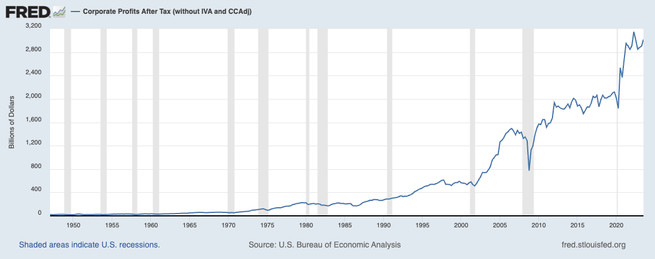

Corporate profits are near a record high.
Inflation is dropping, but prices aren’t coming down because corporations have enough monopoly power to keep prices high. (Or they’re shrinking the sizeof the products you’re buying without lowering their prices — a variant of the same thing.)
This is one of the biggest reasons the American public is not crediting Biden with a great economy. Most people aren’t feeling it.
Here’s just one example that will make you fizz: Pepsi.
In 2021, PepsiCo, which makes all sorts of drinks and snacks, announced it was “forced” to raise prices due to “higher costs.” Forced? Really? The company reported $11 billion in profit that year.
In 2023 PepsiCo’s chief financial officer said that even though inflation was dropping, its prices would not. Pepsi hiked its prices by double digits and announced plans to keep them high in 2024.
How can they get away with this?
Well, if Pepsi were challenged by tougher competition, consumers would just buy something cheaper. But PepsiCo’s only major soda competitor is Coca-Cola, which — surprise, surprise — announced similar price hikes at about the same time as Pepsi, and also kept its prices high in 2023.
The CEO of Coca-Cola claimed that the company had “earned the right” to push price hikes because its sodas are popular. Popular? The only thing that’s popular these days seems to be corporate price gouging.
We’re seeing this pattern across much of the economy — especially with groceries.
The rate of inflation is down. The rate of inflation measures how quickly prices are rising: Prices are now rising far more slowly than in the past couple of years.
And while supply chain disruptions really did make it more expensive to produce a lot of goods, the cost to produce them now is rising even more slowly than prices.
But consumer prices are still elevated — allowing most corporations to keep their profit margins near a record high.
They can get away with overcharging you because they have monopoly power — or they have so few competitors that they can easily coordinate price increases with them and avoid price decreases.
If Pepsi and Coca-Cola had lots of competitors, they wouldn’t be able to raise prices so high because someone would make cheaper substitutes, and consumers would buy those instead. But Pepsi and Coke own most of the substitutes!
This isn’t happening just with Coke and Pepsi.
Take meat products. At the end of 2023, Americans were paying at least 30 percent more for beef, pork, and poultry products than they were in 2020.
Why? Near-monopoly power!
Just four companies now control processing of 80 percent of beef, nearly 70 percent of pork, and almost 60 percent of poultry. So of course it’s easy for them to coordinate price increases.
And this goes well beyond the grocery store. In 75 percent of U.S. industries, fewer companies now control more of their markets than they did 20 years ago.
So what should be done?
First, antitrust laws must be enforced.
Kudos to the Biden administration for using antitrust more aggressively than any administration in the last 40 years. It’s taken action against alleged price fixing in the meat industry — which has been a problem for decades.
It’s suing Amazon for using its dominance to artificially jack up prices — one of the biggest anti-monopoly lawsuits in a generation.
It successfully sued to block the merger of JetBlue and Spirit Airlines, which would have made consolidation in the airline industry even worse.
But given how concentrated American industry has become, there’s still a long way to go.
Secondly, big corporations must not be allowed to use their power to gouge consumers.
Senator Elizabeth Warren and others recently unveiled the latest version of their Price Gouging Prevention Act.
“Giant corporations are using supply chain shocks as a cover to excessively raise prices and sometimes charging the same price but shrinking how much consumers actually get,” Warren charges.
The bill would empower the FTC (which would also get $1 billion in additional funding) and state attorneys general to stop companies from charging “grossly excessive” prices, regardless of where alleged price gouging took place in a supply chain.
(The legislation would also protect small businesses — those earning less than $100 million — from litigation if they had to raise prices in good faith during crises.)
The bill would also require public companies to disclose more about their costs and pricing strategies.
I don’t have any illusions that this bill will find its way into law soon. Democrats hold a slim majority in the Senate, and not all Democrats support it. Meanwhile, Republicans and their business backers are dead set against it — and are eager to blame continued high prices on Biden, not on corporations.
But this bill is just as necessary as aggressive antitrust enforcement — and an example of what could and will be done if Democrats sweep the 2024 elections.
The near-record profits of large corporations are coming, in part, out of the paychecks of average Americans — who are still struggling to get by.
Biden and the Democrats must say this loudly and clearly, and tell the public what they are doing — and will do — to stop it.
*Robert Reich is a professor at Berkeley and was secretary of labor under Bill Clinton. You can find his writing at https://robertreich.substack.com/.*
===
an 2 24
The growing disgrace and danger of Robert F. Kennedy Junior - Alternet.org
---
1 24 an
when I was a boy, my father sold dresses and blouses to the wives of factory workers. As the wages of those workers rose through the 1950s, my father earned enough to expand his business to a second shop in another factory town not far away. We were by no means rich, but he earned enough to put us in the middle class.
For three decades after World War II, the average hourly compensation of American workers rose in lockstep with the nation’s productivity gains. In other words, as workers produced more value, they got more pay.
It was a virtuous cycle, from which our family and tens of millions of others benefited: The economy grew, and the middle class expanded. Its purchasing power rose, causing the economy to grow faster. This fueled new investments and innovations that further enriched and enlarged the middle class.
But then, beginning in the late 1970s, the virtuous cycle came to a halt.
While productivity gains continued much as before and the economy continued to grow, wages began to flatten. Starting in the early 1980s, the median household’s income stopped growing altogether, when adjusted for inflation.
Today, the median household is earning just a bit more than it did in 1979, 45 years ago (adjusted for inflation).
If you’re a non-supervisory worker who relies on an hourly wage — still the vast majority of workers — you’re earning no more than you earned in 1969. Job security also declined.
So, despite an economy that’s far larger and more productive than it was 40 or 50 years ago, the typical American worker has gone nowhere.
The standard explanation attributes this to neutral “market forces,” especially globalization and technological innovations that have made many working Americans less competitive.
While surely important, the standard explanation can’t account for much of what’s happened. It doesn’t explain why the transformation occurred so suddenly, over a relatively small number of years. Nor why other advanced economies facing similar forces didn’t succumb to them. Nor why so much of the nation’s income and wealth have gone to the top.
America’s middle class has shrunk because of its declining bargaining power — orchestrated and directed by America’s oligarchy. The economic gains that would otherwise have gone to the middle class went instead to the moneyed interests at the top. Let me explain.
1. The financialization of the economy
Before the 1980s (as I noted in our discussion about the decline of the common good), large corporations were in effect owned by all their stakeholders, who were assumed to have legitimate claims on them.
As early as 1914, the popular columnist and public philosopher Walter Lippmann called on America’s corporate executives to be stewards of America. “The men connected with [the large corporation] cannot escape the fact that they are expected to act increasingly like public officials …. Big businessmen who are at all intelligent recognize this. They are talking more and more about their ‘responsibilities,’ and their ‘stewardship.’”
This vision of corporate governance came to be widely accepted by the end of World War II. Frank Abrams, chairman of Standard Oil of New Jersey, declared in a 1951 address that typified what other chief executives were saying at the time:
*“The job of management is to maintain an equitable and working balance among the claims of the various directly affected interest groups … stockholders, employees, customers, and the public at large. Business managers are gaining professional status partly because they see in their work the basic responsibilities [to the public] that other professional men have long recognized as theirs.”
Pulp and paper executive J.D. Zellerbach told Timemagazine that “[t]he majority of Americans support private enterprise, not as a God-given right but as the best practical means of conducting business in a free society … . They regard business management as a stewardship, and they expect it to operate the economy as a public trust for the benefit of all the people.”
But a radically different vision of corporate ownership emerged in the late 1970s and early 1980s. It came from corporate “raiders” who mounted hostile takeovers with high-yield junk bonds.
The raiders used leveraged buyouts and undertook proxy fights against the “industrial statesmen” who, in their view, were depriving shareholders of the wealth that properly belonged to them.
The raiders assumed shareholders were the only legitimate owners of the corporation and that the only valid purpose of the corporation was to maximize shareholder returns.
This transformation did not happen by accident. It was a product of changes in laws governing corporations and of financial markets — changes that were promoted by the monied interests, America’s oligarchs.
In 1974, at the urging of pension funds, insurance companies, and Wall Street, Congress enacted the Employee Retirement Income Security Act. Before then, the giant portfolios of pension funds and insurance companies could be invested in only high-grade corporate and government bonds. Legally, it was their fiduciary obligation.
The 1974 Act changed that, allowing pension funds and insurance companies to invest in the stock market — thereby making a huge pool of capital available to Wall Street.
In 1982, another large pool of capital became available when Congress allowed savings and loan banks — the bedrocks of local home mortgage markets — to invest their deposits in a wide range of financial products, including junk bonds and other risky ventures promising high returns.
The convenient fact that the government insured savings and loan deposits against losses made these investments all the more tempting (and ultimately cost taxpayers some $124 billion when many of the banks went bust).
Meanwhile, the Reagan administration loosened other banking and financial regulations and simultaneously cut the enforcement staff at the Securities and Exchange Commission.
All this made it possible for corporate raiders to get the capital and the regulatory approvals they needed to mount unfriendly takeovers.
During the whole of the 1970s, there had been only 13 hostile takeovers LBO of companies valued at $1 billion or more. During the 1980s, there were 150.
Even where raids did not occur, CEOs felt pressured to maximize shareholder returns for fear their firms might otherwise be targeted. Hence, they began to see their primary role as driving up share prices.
The easiest and most direct way for CEOs to accomplish this feat was to cut costs — especially payrolls, which constitute most firms’ largest single expense.
Accordingly, the corporate statesmen of the 1950s and 1960s were replaced by the corporate butchers of the 1980s and 1990s, whose nearly exclusive focus was to “cut out the fat” and “cut to the bone.”
When Jack Welch took the helm of GE in 1981, the company was valued by the stock market at less than $14 billion. When he retired in 2001, it was worth about $400 billion. Welch accomplished this largely by cutting payrolls.
Before his tenure, most GE employees had spent their entire careers with the company. But between 1981 and 1985, a quarter of them — 100,000 in all — lost their jobs, earning Welsh the moniker “neutron Jack.” Even when times were good, Welch encouraged his senior managers to replace 10 percent of their subordinates every year in order to keep GE competitive.
Other CEOs tried to outdo even Welch. As CEO of Scott Paper, “Chainsaw” Al Dunlap laid off 11,000 workers, including 71 percent of headquarters staff. Wall Street was impressed, and the company’s stock soared.
When Dunlap moved to Sunbeam in 1997, he promptly laid off half of Sunbeam’s 12,000 employees. (Unfortunately for Chainsaw Al, he was caught cooking Sunbeam’s books; the SEC sued him for fraud, and he settled for $500,000, agreeing never again to serve as an officer or director of any publicly held company.)
In consequence of this change in the purpose of the American corporation, share prices soared, as did the compensation packages of CEOs. The results have been touted as “efficient” because resources theoretically have been shifted to “higher and better uses.”
But the human costs of this transformation have been huge. Millions of workers have lost jobs and wages. Many communities have been abandoned.
Nor have the efficiency benefits been widely shared.
As corporations have steadily weakened their workers’ bargaining power, the link between productivity and workers’ income has been severed.
Almost all the gains from growth have gone to the top. As noted, the average worker today is no better off than his or her equivalent 40 years ago, adjusted for inflation. Most are less economically secure.
Not incidentally, few own any shares of stock.
The richest 1 percent of Americans now own 52 percent of all the shares of stock owned by Americans. The richest 10 percent, 93 percent. The nation’s economic gains, once distributed broadly to the working and middle class — have been siphoned to the top.
2. Globaloney
Wages have also been suppressed because workers who are worried about keeping their jobs have accepted lower pay, relative to the economy’s productivity gains, than they did 40 years ago.
Here again, political decisions steered by the nation’s oligarchy have played a significant role. Some of the prevailing job insecurity is the result of trade agreements that invited American companies to outsource jobs abroad.
The conventional view equating “free trade” with the “free market” — in contrast to government “protectionism” — is wrong.
Just as all nations’ markets reflect political decisions about how they should be organized, so-called “free trade” agreements entail complex negotiations about how different market systems are integrated.
Within these negotiations, the interests of large corporations and Wall Street, to fully protect the value of their intellectual property and financial assets, have repeatedly trumped the interests of average working Americans to protect the value of their labor.
3. The Fed and inflation
When the Federal Reserve raises interest rates and Congress opts for austerity to reduce federal budget deficits — two policies favored by the oligarchy — the resulting unemployment also undermines the bargaining power of average workers.
Higher unemployment keeps wages low. This means higher corporate profits, leading to higher returns for shareholders.
The high inflation after the pandemic was driven in part by supply shortages and a major government stimulus. But it was also driven by monopolistic corporations using the excuse of inflation to raise their prices.
The Fed, however, believed that a root cause of inflation was wage growth, and it set out to slow the economy and loosen the labor market by raising interest rates. Here, too, the strategy was consistent with the views of the moneyed interests and was pushed by them.
4. The risk-shift to workers
Public policies that emerged during the New Deal and World War II placed most of the risks of economic change on large corporations rather than workers — through Social Security, worker’s compensation, 40-hour workweeks with time-and-a-half for overtime, and employer-provided health benefits (wartime price controls encouraged such tax-free benefits as substitutes for wage increases).
By the 1950s and 1960s, a majority of the employees of large companies remained with the companies for life. Their paychecks rose steadily with seniority, productivity, the cost of living, and corporate profits. When they retired, they received generous corporate pensions.
But after the junk-bond and takeover mania of the 1980s, that relationship broke down.
Even full-time workers who have put in decades with a company can now find themselves without a job overnight — with no severance pay, no help finding another job, no health insurance, and little or no pension.
Nearly one out of every five working Americans is now in a part-time job. Many are temporary workers, freelancers, independent contractors, or consultants, whose incomes and work schedules vary from week to week or even day to day. Two-thirds of American workers are living paycheck to paycheck.
The risk of getting old without a pension is rising.
In 1980, more than 80 percent of large and medium-sized firms gave their workers “defined-benefit” pensions that guaranteed them a fixed amount of money every month after they retired.
Now, fewer than 10 percent of companies provide their workers defined-benefit pensions. Instead, they offer “defined contribution” plans whose risks have been shifted to the workers. When the stock market tanks, as it did in 2008 and then again in 2020, their 401(k) plans tank along with it.
A quarter of all workers with so-called “matching” defined-benefit plans get no match because they don’t earn enough to contribute to them.
Meanwhile, the risk of a sudden loss of income continues to rise. Even before the crash of 2008, the Panel Study of Income Dynamics at the University of Michigan found that over any given two-yearstretch, about halfof all families experienced some decline in income.
Those downturns have become progressively larger. In the 1970s, the typical drop was about 25 percent. By late 1990s, it was 40 percent. By the mid-2000s, family incomes rose and fell twice as much as they did in the mid-1970s, on average.
Workers who are economically insecure are not in a position to demand higher wages. They are driven more by fear than by opportunity.
This is another central reality of American capitalism as organized by those with the political power to make it so.
5. The demise of labor unions
Fifty years ago, when General Motors was the largest employer in America, the typical GM worker earned $35 an hour in today’s dollars.
Today, America’s largest employer is Walmart, and the typical entry-level Walmart worker earns about $11 an hour.
This doesn’t mean the typical GM employee a half-century ago was “worth” four times what the typical Walmart employee today is worth. The GM worker was not better educated or motivated than today’s Walmart worker.
The real difference is that GM workers a half-century ago had a strong union behind them that summoned the collective bargaining power of all autoworkers to get a substantial share of company revenues for its members.
Because more than a third of workers across America then belonged to a labor union, the bargains those unions struck with employers raised the wages and benefits of non-unionized workers as well. Non-union firms knew they would be unionized if they did not come close to matching the union contracts.
Today’s Walmart workers do not have a union to negotiate a better deal. They are on their own. Because only 6 percent of today’s private-sector workers are unionized, most employers across America have no incentive to match union contracts. This puts unionizedfirms at a competitive disadvantage.
The result has been a race to the bottom.
Some argue that the decline of American unions is simply the result of “market forces.” But other nations have been subject to many of the same “market forces” and continue to have strong unions. In Sweden, 90 percent of workers in the private sector are unionized. These unions continue to provide their middle classes sufficient bargaining power to command a significant share of economic growth — a much larger share than that received by the middle class in the United States.
Why the difference? Look to politics and the allocation of power.
***
The National Labor Relations Act of 1935 guaranteed American workers the right to organize into unions and imposed on employers the legal responsibility to bargain with them.
As unions gained economic power in the late 1930s and 1940s, they gained greater. political power and wielded it to further enlarge the bargaining clout of American workers. After the legendary Treaty of Detroit in 1950, when Big Business and Big Labor agreed to share productivity gains in exchange for labor peace, the rate of unionization increased dramatically, as did wages and benefits.
Which is why, by the mid-1950s, almost a third of all American employees in the private sector of the economy belonged to a union, and why the median wage increased in tandem with productivity growth.
But starting in the late 1970s, the process went into reverse. Union membership began to decline, as did the economic and political power of unions, along with the bargaining clout of most workers.
The reasons for the decline involved the changes I’ve already noted — globalization, labor-replacing technologies, and a shift in the purpose of the corporation to maximizing shareholder returns.
But the decline of labor unions was also the consequence of political and legal decisions demanded by the monied interests.
When the Taft-Hartley Act of 1947 allowed states to enact “right-to-work” laws, workers who did not pay dues got a free ride off of those who did, thereby undermining the incentive for anyone to join a union in the first place.
Until the 1980s, such laws had minimal effect because they were enacted in southern and western states. Most industries remained in the north.
But as corporations came under increasing pressure to show high returns and cut labor costs, many CEOs found “right-to-work” states more alluring. Even the old heartland industrial states of Indiana and Michigan have enacted “right-to-work” laws.
CEOs whose corporations had high percentages of unionized workers moved, or threatened to move, to “right-to-work” states.
Additionally, Reagan’s notorious firing of the nation’s air traffic controllers for going on strike (which he had a right to do because they had no right to strike) signaled to the nation’s large employers that America had embarked on a different era of labor relations.
Workers who inhabited the local service economy — retail, restaurants, custodial, hotels, elder and child care, hospitals, transportation — faced a different challenge. Their jobs were in less danger of disappearing, because they couldn’t be outsourced abroad and most would not be automated. In fact, the number of local service jobs in America has continued to grow.
But because so many workers expelled from the older industrialized economy had no choice but to seek local service jobs, service-sector employers easily found people willing to work for low wages, few benefits, and little chance of advancement.
Walmart and major fast-food chains, such as Starbucks, have been aggressively anti-union. They’ve blocked union votes, fired workers who tried to organize, refused to enter into contract negotiations, and intimidated others into rejecting the union — all in violation of the National Labor Relations Act.
A succession of Democratic presidents have promised legislation streamlining the process for forming unions and increasing penalties on employers who violate the law, but nothing has come of these promises. (President Biden has been the first to strengthen the National Labor Relations Board and encourage it to enforce the law.)
The result of all this has been a steady decline in the percentage of private-sector workers who are unionized. Despite the jolt of labor activism in 2023, that percentage continues to drop.
The decline parallels the declining share of total income going to the middle class.
Take a look:

6. Summary
The underlying problem is that average working Americans have steadily lost the bargaining power to receive as large a portion of the economy’s gains as they received in the first three decades after World War II. As a result, instead of the middle class growing, it has shrunk.
To attribute this to the impersonal workings of the “free market” is to ignore how the market has been reorganized since the 1980s. America’s oligarchs — the moneyed interests — have spearheaded this reorganization in order to receive a steadily larger share of the nation’s economic gains. As those gains have risen, so has the oligarchy’s power to accumulate even more.
But it doesn’t have to be this way. Next week we’ll look at whether — and how — countervailingpower can be restored so that more of America’s poor and working class can ascend into the middle class once again.
*Robert Reich is a professor at Berkeley and was secretary of labor under Bill Clinton. You can find his writing at https://robertreich.substack.com/.*
---
No Labels is a front group for Donald Trump - Alternet.org
---
AN 1 24 BUT REBOOT
Editor's note: *On the day after Trump's suprising victory over Hillary Clinton, we've resurfaced Robert Reich's killer essay explaining why the working class doesn't vote for Democrats anymore.
Why did the white working class abandon the Democrats?
The conventional answer is Republicans skillfully played the race card.
In the wake of the Civil Rights Act, segregationists like Alabama Governor George C. Wallace led southern whites out of the Democratic Party.
Later, Republicans charged Democrats with coddling black “welfare queens,“ being soft on black crime (“Willie Horton”), and trying to give jobs to less-qualified blacks over more-qualified whites (the battle over affirmative action).
The bigotry now spewing forth from Donald Trump and several of his Republican rivals is an extension of this old race card, now applied to Mexicans and Muslims – with much the same effect on the white working class voters, who don’t trust Democrats to be as “tough.”
All true, but this isn't the whole story. Democrats also abandoned the white working class.
Democrats have occupied the White House for sixteen of the last 24 years, and in that time scored some important victories for working families – the Affordable Care Act, an expanded Earned Income Tax Credit, and the Family and Medical Leave Act, for example.
But they’ve done nothing to change the vicious cycle of wealth and power that has rigged the economy for the benefit of those at the top, and undermined the working class. In some respects, Democrats have been complicit in it.
Both Bill Clinton and Barack Obama ardently pushed for free trade agreements, for example, without providing the millions of blue-collar workers who thereby lost their jobs any means of getting new ones that paid at least as well.
They also stood by as corporations hammered trade unions, the backbone of the white working class. Clinton and Obama failed to reform labor laws to impose meaningful penalties on companies that violated them, or enable workers to form unions with a simple up-or-down votes.
I was there. In 1992, Bill Clinton promised such reform but once elected didn’t want to spend political capital on it. In 2008, Barack Obama made the same promise (remember the Employee Free Choice Act?) but never acted on it.
Partly as a result, union membership sank from 22 percent of all workers when Bill Clinton was elected president to fewer than 12 percent today, and the working class lost bargaining leverage to get a share of the economy’s gains.
In addition, the Obama administration protected Wall Street from the consequences of the Street’s gambling addiction through a giant taxpayer-funded bailout, but let millions of underwater homeowners drown.
Both Clinton and Obama also allowed antitrust enforcement to ossify – with the result that large corporations have grown farlarger, and major industries more concentrated.
Finally, they turned their backs on campaign finance reform. In 2008, Obama was the first presidential nominee since Richard Nixon to reject public financing in his primary and general-election campaigns. And he never followed up on his reelection campaign promise to pursue a constitutional amendment overturning “Citizens United v. FEC,” the 2010 Supreme Court opinion opening the floodgates to big money in politics.
What happens when you combine freer trade, shrinking unions, Wall Street bailouts, growing corporate market power, and the abandonment of campaign finance reform?
You shift political and economic power to the wealthy, and you shaft the working class.
Why haven’t Democrats sought to reverse this power shift? True, they faced increasingly hostile Republican congresses. But they controlled both houses of Congress in the first two years of both Clinton’s and Obama’s administrations.
In part, it’s because Democrats bought the snake oil of the “suburban swing voter” – so-called “soccer moms” in the 1990s and affluent politically-independent professionals in the 2000s – who supposedly determine electoral outcomes.
Meanwhile, as early as the 1980s they began drinking from the same campaign funding trough as the Republicans – big corporations, Wall Street, and the very wealthy.
“Business has to deal with us whether they like it or not, because we’re the majority,” crowed Democratic representative Tony Coelho, head of the Democratic Congressional Campaign Committee in the 1980s when Democrats assumed they’d continue to run the House for years.
Coelho’s Democrats soon achieved a rough parity with Republicans in contributions from corporate and Wall Street campaign coffers, but the deal proved a Faustian bargain as Democrats become financially dependent on big corporations and the Street.
Nothing in politics is ever final. Democrats could still win back the white working class – putting together a huge coalition of the working class and poor, of whites, blacks, and Latinos, of everyone who has been shafted by the shift in wealth and power to the top.
This would give Democrats the political clout to restructure the economy – rather than merely enact palliatives that papered over the increasing concentration of wealth and power in America.
But to do this Democrats would have to stop obsessing over upper-income suburban swing voters, and end their financial dependence on big corporations, Wall Street, and the wealthy.
Will they? That’s one of the biggest political unknowns in 2016 and beyond.
---
12 23 an
america’s prestigious universities play a big role in determining who gets into America’s wealthy elite.
A degree from Harvard, Penn, or M.I.T., to take three examples, is a meal ticket to a lucrative job on Wall Street or a corporate law firm and to the richest and most influential people in the land.
But as America becomes increasingly stratified by wealth, those tickets are easily abused.
Universities that give preference in admissions to the children or grandchildren of major donors serve to widen inequality even further.
Universities that allow major donors to influence what is taught or expressed on campus could be seen to suppress ideas that threaten the wealthy — which could chill freedom of expression and fuel social resentment.

Which brings us to the latest imbroglio.
Last Tuesday, the presidents of the University of Pennsylvania, Harvard, and M.I.T. tried to give precise answers to questions from members of Congress about whether their university cultures had encouraged hostility towards Jews — hostility that has surged since Hamas’s October 7 attack on Israel and Israel’s attack on Gaza in response.
In their opening remarks, all three denied it, and repeatedly condemned antisemitism.
Then Elise Stefanik, a Republican representative from New York (and herself a Harvard graduate) asked a yes or no question: would calls for genocide of Jews on campus violate their codes of conduct or harassment policies?
The presidents hedged. “If the speech turns into conduct, yes, it can be harassment,” Penn’s president, M. Elizabeth Magill, a former dean of Stanford Law School, replied in lawyer-like fashion.
“I’m asking if specifically calling for the genocide of Jews — does that constitute bullying or harassment?” Stefanik pressed her point.
“If it is directed and severe or pervasive, it is harassment,” said Magill.
“So the answer is yes?”
“It is a context-dependent decision, congresswoman,” Magill said.
Faced with the same question, Harvard’s president, Claudine Gay, also temporized. “It can be,” she said, “depending on the context.”
The university presidents should have answered unambiguously and unequivocally that calls for genocide of any group are intolerable.
Their failure to do so has fueled a firestorm.
Ross Stevens, a hedge fund manager, said he would withdraw a $100 million gift to Penn. Other wealthy Penn donors called for Magill to resign.
Even prior to the hearing, a campaign had been launched by some of Wall Street’s most powerful figures to oust all three university presidents for failing to adequately condemn Hamas’s October 7 attack on Israel.
The influential board of advisers of Penn’s Wharton School’s, chaired by Marc Rowan of Apollo Global Management, one of the world’s largest private equity firms, called on alumni to withhold donations to Penn.
The billionaire investor Bill Ackman, Harvard alumnus and head of New York hedge fund Pershing Square Capital Management, called for the three university presidents to be fired.
The day after their testimony, Magill and Gay issued statements in efforts to contain the damage.
But on Saturday evening, after an emergency meeting of Penn’s board of trustees, Magill resigned under pressure.
Over the weekend, calls from donors for Harvard’s Claudine Gay to resign grew louder, as prominent donors demanded her ouster, too.
I can well understand the anger and frustration of these donors. In their congressional testimony, the university presidents should have been clearer that their institutions do not tolerate calls for genocide. Period.
But to use their power as major donors to force or seek the ouster of these presidents is almost as repugnant as the failures of these presidents to unambiguously condemn calls for genocide. It endangers the autonomy of America’s universities.
Who’s kidding whom? Those of us who have spent our lifetimes teaching in prestigious universities are well aware of the influence of big donors. The major job of today’s university presidents is to solicit money, and their largest targets are typically denizens of Wall Street.
For the same reason, boards of trustees are packed with wealthy alumni, often from the Street, who routinely veto candidates for university presidentships harboring views they find offensive.
But not until now have major donors so brazenly used their financial influence to hound presidents out of office for failing to come out as clearly as the donors would like on an issue of campus speech or expression.
As a Jew, I cannot help but worry, too, that the actions of these donors will fuel the very antisemitism they claim to oppose — based on the perilous stereotype of wealthy Jewish bankers controlling the world.
*Robert Reich is a professor at Berkeley and was secretary of labor under Bill Clinton. You can find his writing at https://robertreich.substack.com/.*
---
rr an 11 23
as an ever-greater portion of the nation’s total wealth goes to the top, it’s hardly surprising that ever more of that wealth is corrupting American politics.
In the 2020 presidential election cycle, more than $14 billion went to federal candidates, party committees, and Super PACs — double the $7 billion doled out in the 2016 cycle.
Total giving in 2024 is bound to be much higher.
Most of that money is not supporting American democracy. Increasingly, it is supporting Donald Trump and his anti-democracy allies.
There is a certain logic to this.
As more and more wealth accumulates at the top, the moneyed interests fear that democratic majorities will take it away through higher taxes, stricter regulations (on everything from trade to climate change), enforcement of anti-monopoly laws, pro-union initiatives, and price controls.
So they’re sinking ever more of their wealth into anti-democracy candidates.
Donald Trump is going full fascist these days, and gaining the backing of prominent billionaires.
On Veterans Day, Trump pledged to “root out the communists, Marxists, fascists and the radical left thugs that live like vermin within the confines of our country,” whom he accused of doing anything “to destroy America and to destroy the American dream.” (Notably, he read these words from a teleprompter, meaning that they were intentional rather than part of another impromptu Trump rant.)
Days before, Trump claimed that undocumented immigrants were “poisoning the blood of our country.” The New York Times reports that he’s planning to round up millions of undocumented immigrants and detain them in sprawling camps while they wait to be expelled.
Trump has publicly vowed to appoint a special prosecutor to “ go after” President Joe Biden and his family, and has told advisers and friends that he wants the Justice Department to investigate officials who have criticized his time in office.
This is, quite simply, full-throated neofascism.
Who’s bankrolling all this? While Trump’s base is making small contributions, the big money is coming from some of the richest people in America.
During the first half of the year, multiple billionaires donated to the Trump-aligned Make America Great Again Inc. Super PAC.
Phil Ruffin (net worth $3.4 billion), the 88-year-old casino and hotel mogul, has given multiple $1 million donations.
Charles Kushner (family net worth $1.8 billion), the real estate mogul and father of Jared, who received a late-term pardon from Trump in December 2020, contributed $1 million in June.
Robert “Woody” Johnson (net worth $3.7 billion), Trump’s former ambassador to the United Kingdom and co-owner of the New York Jets, donated $1 million to the MAGA PAC in April.
And so on.
But Trump is not the only extremist pulling in big dollars. Nikki Haley — who appears moderate only relative to Trump’s blatant neofascism — proclaimed in her campaign launch that President Biden is promoting a “socialist” agenda.
During her two years as U.N. ambassador under Trump, Haley was a strong proponent of his so-called “zero tolerance” policy, under which thousands of migrant children were separated from their parents and guardians. She supported Trump’s decision to pull out of the U.N. Human Rights Council and to withdraw from the Iran nuclear deal.
Though she briefly criticized Trump for inciting the mob that attacked the U.S. Capitol on January 6, 2021, Haley soon defended Trump and called on Democratic lawmakers to “give the man a break” when they impeached him for a second time.
Haley recently told Kristen Welker of NBC’s “Meet the Press” that while Trump’s floating the idea of executing retired General Mark Milley might be “ irresponsible,” it does not disqualify him from running for the White House again.
Haley’s billionaire supporters include Stanley Druckenmiller, Eric Levine, and Republican megadonor Ken Griffin.
Notably, Haley has also gained the support of JPMorgan Chase’s chief executive, Jamie Dimon, who’s about as close as anyone in America comes to being a spokesperson for the business establishment. Dimon admires Haley’s recognition of the role that “business and government can play in driving growth by working together.”
The moneyed interests have been placing big bets on other Trumpist Republicans.
Peter Thiel, the multibillionaire tech financier who once wrote that “I no longer believe that freedom and democracy are compatible,” contributed more than $35 million to 16 federal-level Republican candidates in the 2022 campaign cycle, making him the 10th largest individual donor to either party.
Twelve of Thiel’s candidates won, including Ohio’s now Senator J.D. Vance, who alleged that the 2020 election was stolen and that Biden’s immigration policy has meant “ more Democrat voters pouring into this country.”
Republican House Majority Leader Steve Scalise is creating a new fundraising committee that will be soliciting contributions of up to $586,200 a pop.
Elon Musk is not a major financial contributor to Trump nor other anti-democracy candidates, but his power over one of the most influential megaphones in America gives him inordinate clout — which he is using to further the neofascist cause.
Witness Musk’s solicitude of Trump, his endorsement of antisemitic posts, his embrace of Tucker Carlson and white replacement theory, and his avowed skepticism toward democracy.
Democracy is compatible with capitalism only if democracy is in the driver’s seat, so it can rein in capitalism’s excesses.
But if capitalism and its moneyed interests are in charge, those excesses grow to the point where they are able to extinguish democracy and ride roughshod over the common good.
Hence the reason Trump’s neofascism, and the complicity of today’s Republican Party with it, are attracting the backing of some of the richest people in America.
What’s the alternative? A loud pro-democracy movement that fights against concentrated wealth at the top, enormous CEO pay packages, a politically powerful financial sector, and tax cuts for the wealthy and large corporations.
And fights for higher taxes on the top (including a wealth tax) to finance Medicare for all, affordable housing, and accessible child care and elder care.
The willingness to make this a fight — to name the moneyed interests backing neofascism, explain why they’re doing this, and mobilize and energize America against their agenda and in favor of democracy — is critical to winning the 2024 election and preserving and rebuilding American democracy.
Biden and the Democrats must take this on, loudly and clearly. (Incidentally, Biden’s age — Happy 81st, Joe! — would be far less of an issue if he showed the grit and guts to do this.)
==
---
an 10 23
last night, United Auto Workers officials alerted local union leaders that the UAW has a tentative deal with Ford to end the strike against the automaker.
The UAW’s battle against the Big Three carmakers has centered on wages and the widening gap between the compensation of the automaker’s top executives and the wages of their average workers. Hopefully, the strike is about to lift the wages of autoworkers significantly.
But Shawn Fain, UAW president, has an even larger vision for where America should be heading. “Billionaires in my opinion don’t have a right to exist,” he says.
What Fain is getting at is that if American capitalism was working as it should, it wouldn’t be producing billionaires — especially when the typical worker’s wages have been nearly stagnant for three decades when adjusted for inflation.
He’s correct.

There are basically only five ways to accumulate a billion dollars and none of them has a legitimate role in free market capitalism.
The first is to exploit a monopoly.
Jamie Dimon is worth $1.6 billion. That’s not because he succeeded in the free market. In 2008, the government bailed out JPMorgan and other giant Wall Street banks because it considered them “too big to fail.”
That bailout created a hidden, government-provided insurance policy for the biggest banks, still in effect, with an estimated value to the banks of $34.1 billion a year. If JPMorgan weren’t so big and hadn’t received that hidden insurance, Dimon would be worth far less than $1.6 billion.
What about America’s much-vaunted entrepreneurs, such as Jeff Bezos, now worth $114 billion? You might say Bezos deserves this because he founded and built Amazon.
But Amazon is a monopolist. The federal government and 17 states have charged it with abusing its position in the marketplace to inflate prices, overcharge sellers, and stifle competition. To be sure, the case hasn’t yet been decided by the courts, but evidence of Amazon’s monopoly power is significant.
In addition, Amazon’s business is protected by a slew of patents granted by the U.S. government. They are very broad and have contributed to Amazon’s market power.
If the government enforced anti-monopoly laws, and didn’t give Amazon such broad patents, Bezos would be worth far less than $114 billion.
A second way to make a billion is to get insider information unavailable to other investors.
Hedge-fund maven Steven A. Cohen, worth $17.5 billion, headed up a hedge fund in which, according to a criminal complaint filed by the Justice Department, insider trading was “substantial, pervasive, and on a scale without known precedent in the hedge fund industry.” Nine of Cohen’s present or former employees pleaded guilty or were convicted. Cohen got off with a fine, changed the name of his firm, and apparently is back at the game.
Insider trading is endemic in C-suites, too. SEC researchers have found that corporate executives are twice as likely to sell their stock on the days following their own stock buyback announcements — the timing of which they determine — as they are in the days leading up to the announcements.
If government cracked down on insider trading, hedge-fund mavens and top corporate executives wouldn’t be raking in nearly as much.
A third way to make a billion is to buy off politicians.
The Trump tax cut was estimated to save Charles and the late David Koch and their Koch Industries an estimated $850 million to $1.4 billion a year, not even counting their tax savings on profits stored offshore and a shrunken estate tax. The Kochs and their affiliated groups spent some $20 million lobbying for the Trump tax cut, including political donations.
Not a bad return on their investment.If we had tough anti-corruption laws preventing political payoffs like this, the Kochs and other major political donors wouldn’t get the special tax breaks and other government subsidies that have enlarged their fortunes.
The fourth way to make a billion is to defraud investors.
Adam Neumann conned JPMorgan, SoftBank, and other investors to sink hundreds of millions into WeWork, an office-sharing startup. Neumann used some of the money to buy buildings he leased back to WeWork and to enjoy a lifestyle that included a $60 million private jet. WeWork never made a nickel of profit.
Elizabeth Holmes was convicted of fraud in connection with her blood-testing company, Theranos. Sam Bankman-Fried, former CEO of crypto-exchange FTX, is now facing federal fraud charges. Oh, and remember a guy named Donald Trump? He’s also now charged with fraud.
At least they were caught. Presumably, if we had tougher anti-fraud laws, more would be caught and we’d have fewer billionaires.
The fifth way to be a billionaire is to get the money from rich parents or relatives.
About 60 percent of all the wealth in America today is inherited, according to estimates by economist Thomas Piketty and his colleagues.
That’s because, under U.S. tax law — which is itself largely a product of lobbying by the wealthy — the capital gains of one generation are wiped out when those assets are transferred to the next, and the estate tax is so tiny that fewer than 0.2 percent of estates were subject to it last year.If unearned income were treated the same as earned income under the tax code, America’s non-working rich wouldn’t be billionaires. And if capital gains weren’t eliminated at death, many heirs wouldn’t be, either.
Now, don’t get me wrong. I’m not arguing against big rewards for entrepreneurs and inventors. The possibility of making a bundle has elicited innovations that benefit us all.
The question is one of scale. Do entrepreneurs and inventors need the incentive of billionsof dollars? Wouldn’t, say, a hundred million do?
The social costs of billionaires is substantial. Billionaires have purchased right-wing extremists on the Supreme Court, bought and either destroyed or subverted news organizations (such as the former Twitter), and turned their relationships with politicians into patronage troughs.
All of this has undermined the common good.
If capitalism were working as it should, billionaires wouldn’t exist. Shawn Fain is correct.
What do you think?
---
https://www.alternet.org/is-trump-a-fascist-2663496110/
---
oct
The disaster that is Jim Jordan - Alternet.org
---
an 10 23
ultra-wealthy elites…Political corruption…Vast inequality…
These problems aren’t new — in the late 1800s they dominated the country during America’s first Gilded Age.
We overcame these abuses back then, and we can do it again.
Mark Twain coined the moniker “The Gilded Age”in his 1873 novel to describe the era in American history characterized by corruption and inequality that was masked by a thin layer of prosperity for a select few.
The end of the 19th century and start of the 20th marked a time of great invention — bustling railroads, telephones, motion pictures, electricity, automobiles — which changed American life forever.

But it was also an era of giant monopolies — oil, railroad, steel, finance — run by a small group of men who had grown rich beyond anything America had ever seen.
 From Robber Barons to Bezos: Is History Repeating Itself? | Robert Reic

They were known as “robber barons” because they ran competitors out of business, exploited workers, charged customers exorbitant prices, and lived like royalty as a result.
Money consumed politics. Robber barons and their lackeys donated bundles of cash to any lawmaker willing to do bidding on their behalf. And when lobbying wasn’t enough, the powerful turned to bribery — resulting in some of the mostinfamous political scandals in American history.
Thegap between the rich and poor in America reached astronomical levels. Large numbers of Americanslived in squalor.
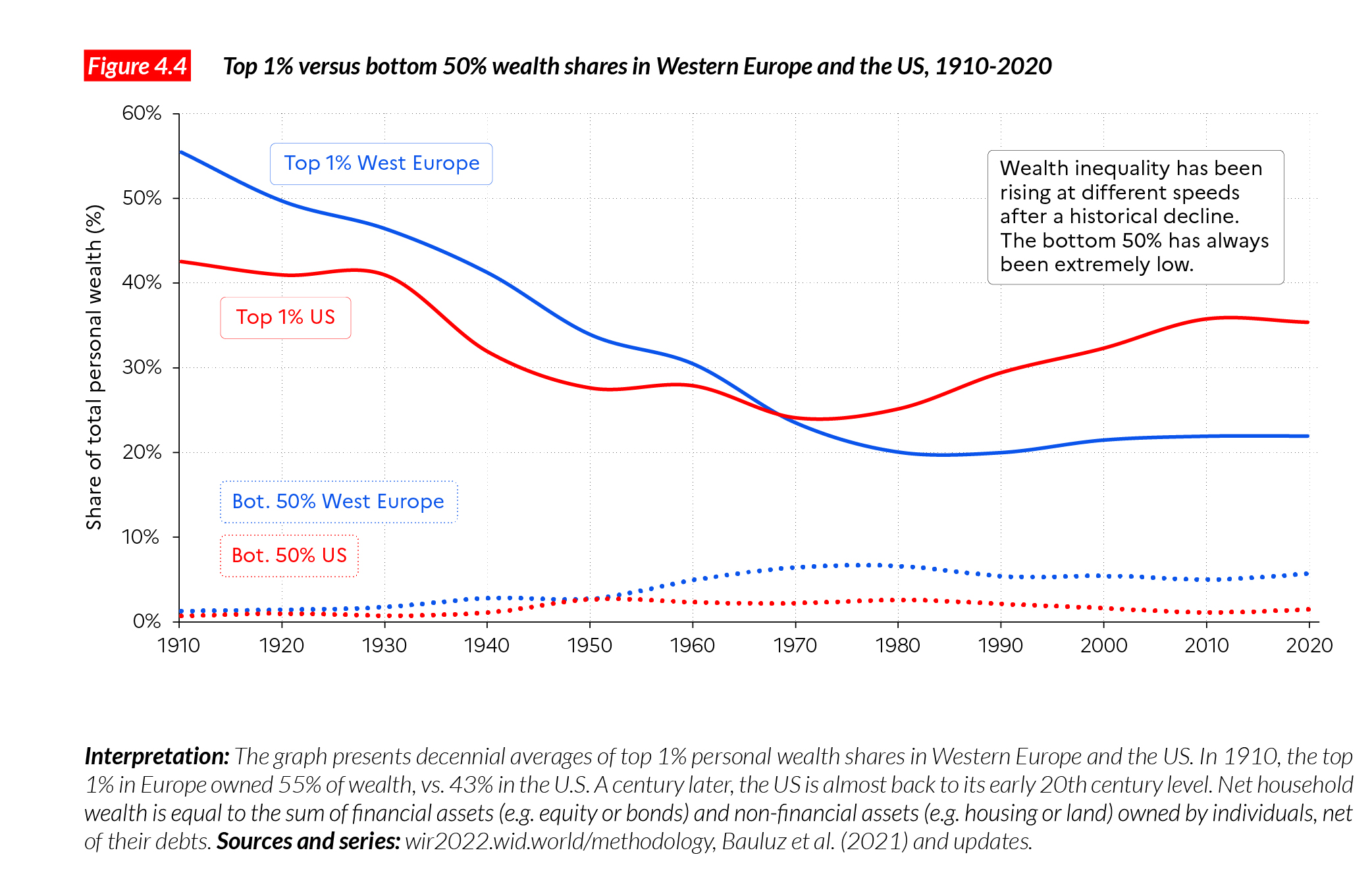
Anti-immigrant sentiment raged, leading to the enactment of racist laws to restrict immigration. And voter suppression, largely aimed at Black men who had recently won the right to vote, was rampant.
The era was also marked by dangerous working conditions. Children often as young as 10, but sometimes younger, worked brutal hours in sweatshops. Workers trying to organizelabor unions were attacked and killed.
It seemed as if American capitalism was out of control, and American democracy couldn’t do anything about it because it was bought and paid for by the rich.
But Americans were fed up, and they demanded reform. Many took to the streets in protest.
Investigative journalists, often called “muckrakers” then, helped amplify their cries by exposing what was occurring throughout the country.
And a new generation of political leaders rose to end the abuses.
Politicians like Teddy Roosevelt, who warned that, “a small class of enormously wealthy and economically powerful men, whose chief object is to hold and increase their power,” could destroy American democracy.
After becoming president in 1901, Roosevelt used the Sherman Antitrust Actto break up dozens of powerful corporations, including the giant Northern Securities Company which had come to dominate railroad transportation through a series of mergers.
Seeking to limit the vast fortunes that were creating a new American aristocracy, Congress enacted a progressive income tax through the 16th Amendment, as well as two wealth taxes.
The first wealth tax, in 1916, was the estate tax — a tax on the wealth someone accumulated during their lifetime, paid by the heirs who inherited it. The second tax on wealth, enacted in 1922, was a capital gains tax — a tax on the increased value of assets, paid when those assets were sold.
The reformers of the Gilded Age also stopped corporations from directly giving money to politicians or political candidates.
And then Teddy Roosevelt’s fifth cousin — you may have heard of him — continued the work through his New Deal programs — creating Social Security,unemployment insurance, a 40-hour workweek, and requiring that employers bargain in good faith with labor unions.
But following the death of FDR and the end of World War II, when America was building the largest middle class the world had ever seen — we seemed to forget about the abuses of the Gilded Age.
Now, more than a century later, America has entered a second Gilded Age.
It is also a time of extraordinary invention.
And a time when monopolies aretaking over vast swathes of the economy, so we must renew antitrust enforcement to bust up powerful companies.
Now, another generation of robber barons is accumulating unprecedented money and power. So once again, we must tax these exorbitant fortunes.
Wealthy individuals and big corporations are once again paying off lawmakers,sending them billions to conduct their political campaigns, even giving luxurious gifts to Supreme Court justices. So we need to protect our democracy from Big Money, just as we did before.
Voter suppression runs rampant in the states as during the first Gilded Age, making it harder for people of color to participate in what’s left of our democracy. So it’s once again critical to defend and expand voting rights.
Working people are once again being exploited and abused, child labor is returning, unions are busted, the poor are againliving in unhealthy conditions, homelessness is on the rise, and the gap between the ultra-rich and everyone else is nearly as large as in the first Gilded Age. So once again we need to protect the rights of workers to organize, invest in social safety nets, and revive guardrails to protect against the abuses of great wealth and power.
The question now is the same as it was at the start of the 20th century: Will we fight for an economy and a democracy that works for all rather than the few?
We’ve done it before. We can — and must — do it again.
---
https://www.alternet.org/corporate-bullying/
an 8 23
no vid
...Starbucks is a multibillion dollar company. Its new CEO will start with a pay packageestimated to be worth over $28 million dollars. That’s roughly 800x the pay of the workers who actually brew and serve the coffee the business is built on — and who barely earn a living wage.
That’s why those workers have begun to unionize.
Since December 2021, Starbucks Workers United has won union elections in more than 300 Starbucks stores, covering more than 8,000 workers and counting.
And most of the union campaigns in individual stores won by overwhelming margins,gaining more than 70% of the total votes — and in parts of the country where private sector unions rarely win.
The Starbucks union campaign has inspired young workers across the country and breathed life into a U.S. labor movement that has been stagnantfor decades.
It’s been so successful that Starbucks briefly brought its former CEO, billionaire Howard Schultz, out of retirement to bust the union, and still refusesto even sit down at the bargaining table.
That’s why I’ve been boycotting Starbucks.
As part of its campaign to tamp down further unionization, Starbucks corporate has fired scores of pro-union workers, closed stores that have unionized, threatened to withhold wage and benefit improvements from stores considering unionizing, and packed stores with outside managers to undermine organizing efforts.
The National Labor Relations Board, which oversees all union elections in the U.S., has issued more than 93 complaints covering 328 unfair labor practice charges against Starbucks — and ordered reinstatement of at least 23 fired workers so far.
Yet Starbucks is unwilling to change its anti-union ways — even though Schultz was grilled in front of Congress
Starbucks claims to be a “progressive” company.
But based on the way it’sbroken labor law and put unionized workers in the percolator, that couldn’t be further from the truth.
Now is an opportunity for all of us to make our voices heard and to tell Starbucks to stop UNION BUSTING and bargain in good faith with Starbucks Workers United.
And it’s time for Joe Biden, who calls himself the “most pro-union president in American history,” to send a powerful message: we won’t tolerate union-busting by Starbucks or any other corporation — including Elon Musk’s Tesla and Jeff Bezos’s Amazon.
Otherwise, my boycott will continue — and perhaps you’ll consider joining me.
If we want to brew a future where workers have power and dignity, then we need to show solidarity with unions…
And stand up to corporate bullying.
---
an 8 23 no lnx
The fascist who doesn’t want America to think
'A harasser and an abuser': Donald Trump seethes at special counsel Jack Smith
Robert ReichAugust 27, 2023
I want to talk about symbols, images, and fascism.
Here is Trump’s mug shot from his arraignment yesterday in Georgia. It’s a look of defiance — which I’m sure he practiced repeatedly beforehand — intended to make his supporters and his Republican base feel defiant, too.
If a picture is worth a thousand words, this is Trump’s thousand-word response to Wednesday night’s Republican debate, which he declined to attend.
He timed his arraignment in Georgia for yesterday so that it — and this photo — would dominate Thursday’s and Friday’s news, rather than anything or anyone emerging from the debate.
:{:{}:
}:
But a defiant photograph isn’t “news.” It’s a symbol, an image. Which is exactly what Donald Trump is. He has no political platform, no specific policy agenda, no new ideas,and no plan for what he’ll do if he gets a second term.
:{:{}:
}:
He exists as a symbol for the anger, discontent, bigotry, and vindictiveness he has unleashed in America.
:{:{}:
}:
He is as close as America has come to a fascist leader, who doesn’t want his followers to think or analyze. He wants them only to feel.
:{:{}:
}:
Trump’s lackeys fell in line, expressing the defiance Trump projected in his mug shot.
On Newsmax, Sarah Palin called for civil war.
Fox’s Laura Ingraham told viewers that Trump’s arrest was proof that government officials are trying to “take them out.”
Fox’s Sean Hannity said the Department of Justice will target Republicans “until there’s nothing left of the party.”
All brainless bile.
Last Thursday, Trump complained that Fox News “purposely show the absolutely worst pictures of me, especially the big ‘orange’ one with my chin pulled way back. They think they are getting away with something, they’re not. Just like 2016 all over again … And then they want me to debate!”
Of course he’s angry. For the man who’s all symbol and image and without substance, a photo like the following conveys a brainless buffoon. It must drive him crazy.
But Trump is not a brainless buffoon. He’s a cunning marketer, a diabolic manipulator of the public, a sly producer of his own daily reality show. His lead in the GOP’s presidential sweepstakes has grown. He will almost certainly be the Republican candidate for president next year — even if he’s in jail.
How to debate a symbol? How to take on an image? How should Biden and the Democrats, and everyone who cares deeply about this country, respond to a demagogue who obsesses over what he projects rather than what he stands for? How to deal with a fascist who doesn’t want followers to think but only to feel rage?
Expose him for who he is.
---
---
an 8 23
no lnx
Robert Reich: Donald Trump and Ayn Rand
Ayn Rand by Talbot
August 11, 2023
Friends,
:{:{}:
}:
Thanks for joining me again as we explore the common good — what it is, where it went, how it can be revived and strengthened.
:{:{}:
}:
The idea of “the common good” was once widely understood and accepted in America. After all, the U.S. Constitution was designed for “We the people” seeking to “promote the general welfare” — not for “me the selfish jerk seeking as much wealth and power as possible.”
:{:{}:
}:
What happened? One clue is found in the writings of writer-philosopher Ayn Rand, who argued that the common good was bunk.
:{:{}:
}:
Donald Trump has called Rand his favorite writer and said he identifies with Howard Roark, the protagonist of The Fountainhead — an architect who dynamites a housing project he designed because the builders did not precisely follow his blueprints. (I doubt Trump has ever read Rand, but for the sake of this essay, let’s assume he has.)
Rex Tillerson, secretary of state under Trump, called Rand’s Atlas Shrugged his favorite book. Former Trump CIA chief Mike Pompeo cited Rand as a major inspiration. Before he withdrew his nomination to be Trump’s secretary of labor, Andrew Puzder said he devoted much of his free time to reading Rand. Paul Ryan, former Republican leader of the House of Representatives, required his staff to read Rand.
Rand fans are also found at some of the high reaches of American business. Uber’s founder and former CEO, Travis Kalanick, has described himself as a Rand follower. He applied many of her ideas to Uber’s code of values. Kalanick even used The Fountainhead’s original cover art as his Twitter avatar.
Ronald Reagan professed to being a follower of Rand. His policies — and those of his contemporary conservative leader, Margaret Thatcher of Great Britain — appeared to draw inspiration from her thoughts and writing.
In order to understand what happened to the common good, we need to examine Ayn Rand and her arguments against it.
Rand was a Russian émigré to the United States whose father’s business had been confiscated during the Russian Revolution. Her most influential writing occurred in the 1940s and 1950s, in the shadow of European fascism and Soviet communism.
She was best known for two highly popular novels that are still widely read today — The Fountainhead (1943) and Atlas Shrugged (1957) — and for other writings and interviews in which she expounded her views about what she called the “virtue of selfishness.”
“The common good is an undefined and undefinable concept,” she wrote, a “moral blank check for those who attempt to embody it.”
When the common good of a society is regarded as something apart from and superior to the individual desires of its members, “it means that the good of some men takes precedence over the good of others, with those others consigned to the status of sacrificial animals.”
:{:{}:
}:
Rand saw government actions that require people to give their money and resources to other people under the pretext of a “common good” as steps toward tyranny. It was far better, in Rand’s view, to base society on autonomous, self-seeking, and self-absorbed individuals. To her, the only community that any of us has in common are family and friends, maintained voluntarily.
If we want to be generous, she thought, that’s fine, but no one should have the power to coerce us into generosity. And nothing beyond our circle of voluntary associations merits our trust.
No institutions or organizations should be able to demand commitments from us. All that can be expected or justified from anyone is selfish behavior, she thought.That behavior is expressed most clearly through the acts of selling what we have to sell and buying what we want to buy in a free market. For her, the common good does not exist.
Rand’s philosophy was updated and formalized in 1974 by Harvard philosopher Robert Nozick in his bestselling book Anarchy, State, and Utopia. Nozick argued that individual rights are the only justifiable foundation for a society. Instead of a common good, he wrote, “there are only individual people, different individual people, with their own individual lives.”
:{:{}:
}:
When Rand and Nozick propounded these ideas, they seemed quaint if not far-fetched. Anyone who lived through the prior half-century had witnessed our interdependence during the Great Depression and World War II.
:{:{}:
}:
After the war, we had pooled our resources to finance all sorts of public goods — schools and universities, a national highway system, and health care for the aged and poor (Medicare and Medicaid). We rebuilt war-torn Europe. We sought to guarantee the civil rights and voting rights of African Americans. We opened doors of opportunity to women.
:{:{}:
}:
Of course there was a common good. We were living it.
:{:{}:
}:
But starting in the late 1970s, Rand became the intellectual godmother of modern-day American conservatism, especially its libertarian strand.
I BELIEVE RAND, NOZICK, AND THEIR MORE MODERN INCARNATIONS are dangerously wrong. Not only does the common good exist, but it is essential for a society to function.
Without voluntary adherence to a set of common notions about right and wrong, daily life would be insufferable. We would be living in a jungle where only the strongest, cleverest, and most wary could hope to survive. This would not be a society. It wouldn’t even be a civilization, because there would be no civility at its core.
Americans sharply disagree about exactly what we want for America or for the world. But we must agree on basic principles — such as how we deal with our disagreements, the importance of our democratic institutions, our obligations toward the law, and our respect for the truth — if we’re to participate in the same society.
It’s our agreement to these principles that connects us.
To take the most basic example, we depend on people’s widespread and voluntary willingness to abide by laws — not just the literal letter of laws but also the spirit and intent behind them.
Consider what would happen if no one voluntarily obeyed the law without first calculating what they could gain by violating it, as compared with the odds of the violation’s being discovered multiplied by the size of the likely penalty.
We’d be living in bedlam.
If everyone behaved like Donald Trump, much of our time and attention would have to be devoted to outwitting or protecting ourselves from other Trumps. We would have to assume everyone else was out to exploit us, if they could.
Every interaction would need to be carefully hedged. Penalties would need to rise and police enforcement to increase, in order to prevent the Trumps among us from calculating they might have more to gain by violating the law and risking the penalty than by abiding by it. And because laws can’t possibly predict and prevent every potential wrong, laws would have to become ever more detailed and exacting in order to prevent the Trumps from circumventing them.
Even then we’d be in trouble. We couldn’t rely on legislators to block or close legal loopholes, because Trump lobbyists would bribe legislators to keep them open, and Trump legislators would be open to taking such bribes. Even if we managed to close the loopholes, we couldn’t rely on police to enforce the laws, because Trumps would bribe the police not to, and Trump police would also accept the bribes.
Without a shared sense of responsibility to the common good, we would have to assume that everybody — including legislators, judges, regulators, and police — was acting selfishly, making and enforcing laws for their own benefit.
The followers of Ayn Rand who glorify the “free market” and denigrate “government” are fooling themselves if they think the “free market” gets them off this Trump hook.
:{:{}:
}:
The market is itself a human creation — a set of laws and rules that define what can be owned and traded and how. Government doesn’t “intrude” on the “free market.” It creates the market. Government officials — legislators, administrators, regulators, judges, and heads of state — must decide on and enforce such laws and rules in order for a market to exist. Without norms for the common good, officials have no way to make these decisions other than their own selfish interests.
HOPEFULLY, government officials base these sorts of decisions on their notions about the common good. But if Trumps were making and enforcing such rules, the rules would be based on whatever it took for these Trump officials to gain personal wealth and power. The “free market” would be a sham, and most people would lose out in it. (As we will see in the pages to come, something close to this has in fact occurred.)
Truth itself is a common good. Through history, one of the first things tyrants do is attack independent truth-tellers — philosophers (Plato), scientists (Galileo), and the free and independent press — thereby confusing the public and substituting their own “facts.”
Without a shared truth, democratic deliberation is hobbled. As poet and philosopher Václav Havel put it, “If the main pillar of the system is living a lie, then it is not surprising that the fundamental threat to it is living in truth.”
Yet in a world populated by people like Trump, we could not trust anyone to be truthful if they could do better for themselves by lying. We couldn’t count on any claim by sellers of any product or service. Internet-based “reputational ratings” would be of little value, because Trump raters would be easily bribed.
Journalists would shade their reports for their own selfish advantage, taking bribes from advertisers or currying favor with politicians. Teachers would offer lessons to satisfy wealthy or powerful patrons. Historians would alter history if by doing so they gained wealth or power. Scientists would doctor evidence for similar selfish motives. The truth would degenerate into a cacophony of competing factual claims.
We couldn’t trust doctors or pharmacists to give us the right medications. We couldn’t trust bankers and accountants not to fleece us, restaurants not to poison us, lawyers not to hoodwink us. Professional ethics would be meaningless.
The common good is especially imperiled when a president of the United States alleges that an election was stolen from him, with no evidence that it was. Such baseless claims erode trust. They fuel conspiracy theories. They can lead to violence.
MOST BASICALLY, THE COMMON GOOD DEPENDS ON PEOPLE TRUSTING that most others in society will also adhere to the common good, rather than lie or otherwise take advantage of them. In this way, civic trust is self-enforcing and self-perpetuating.
Polls tell us that a majority of today’s Americans worry that the nation is losing its national identity. The core of that identity has never been “we’re better than anyone else” nationalism. Nor has it been the whiteness of our skin or the uniformity of our ethnicity.
Our core identity — the most precious legacy we have been given by the generations who came before us — is the ideals we share, the good we hold in common. If we are losing our national identity, it is not because we are becoming blacker or browner or speak in more languages than we once did. It is because we are losing our sense of common good.
THE GENIUS OF A SYSTEM BASED ON POLITICAL EQUALITY is that it doesn’t require us to agree on every issue, but only to agree to be bound by decisions that emerge from the system.
Some of us may want to prohibit abortions because we believe life begins at conception; others of us believe women should have the right to determine what happens to their bodies; some of us want stricter environmental protections; others, more lenient. We are free to take any particular position on these and any other issues. But as political equals, we are bound to accept the outcomes even if we dislike them. This requires enough social trust for us to regard the views and interests of those with whom we disagree as equally worthy of consideration to our own.
Ayn Rand had it completely wrong. Moral choices logically involve duties to others, not just calculations about what’s best for ourselves.
When members of a society ask, “What is the right or decent thing to do?” they necessarily draw upon understandings of these mutual obligations. Our contemporary culture of self-promotion, iPhones, selfies, and personal branding churns out cynics and narcissists, to be sure. But our loyalties and attachments define who we are.
***
These weekly essays are based on chapters from my book THE COMMON GOOD, in which I apply the framework of the book to recent events and to the upcoming election. (Should you wish to read the book, here’s a link).
---
an 6 23
no lnx
former United States Secretary of Labor Robert Reich on Saturday identified five factors that underscore how far down the right-wing rabbit hole twice-indicted ex-President Donald Trump and the Republican Party have dragged American politics.
"'Authoritarianism' isn't adequate" to "describe what Trump wants for America," Reich wrote in a Guardian opinion column. "It is fascism. Fascism stands for a coherent set of ideas different from – and more dangerous than – authoritarianism."
Reich noted what he believes differentiates fascism from mere authoritarianism.
READ MORE: What's the endgame for the party of violence?
According to Reich, Trump and the GOP have embraced the following:
:{:{}:
}:
Rejection of democracy in favor of a strongman depends on galvanizing popular rage.
:{:{}:
}:
Popular rage draws on a nationalism based on a supposed superior race or ethnicity.
:{:{}:
}:
That superior race or ethnicity is justified by social Darwinist strength and violence, as exemplified by heroic warriors.
:{:{}:
}:
Strength, violence and the heroic warrior are centered on male power.
Those tenets, Reich concluded, "are not the elements of authoritarianism. They are the essential elements of fascism."
READ MORE: Robert Reich: 'Corporate price-gouging' can be a strong issue for Democrats in 2024
Reich's full editorial continues here.
FROM YOUR SITE ARTICLES
Fascism expert explains why Ron DeSantis is one of the most dangerous men in the GOP ›
'Fascism': Critics rebuke Trump’s claim that America’s 'biggest problem' is its own 'sick radical people' ›
'Full-blown fascism': Donald Trump envisions a 'civil service test' for 'every federal employee' ›
RELATED ARTICLES AROUND THE WEB
I've Hesitated to Call Donald Trump a Fascist. Until Now | Opinion ›
America needs to confront its 'Mussolini moment' | Will Bunch ... ›
Biden calls Trump's philosophy 'semi-fascism' - POLITICO ›
---
12 22 an sadly no 28th
The corporate takeover of American politics started with a man and a memo you’ve probably never heard of.
In 1971, the U.S. Chamber of Commerce asked Lewis Powell, a corporate attorney who would go on to become a Supreme Court justice, to draft a memo on the state of the country.
Powell’s memo argued that the American economic system was “under broad attack” from consumer, labor, and environmental groups.
In reality, these groups were doing nothing more than enforcing the implicit social contract that had emerged at the end of the Second World War. They wanted to ensure corporations were responsive to all their stakeholders — workers, consumers, and the environment — not just their shareholders.
But Powell and the Chamber saw it differently. In his memo, Powell urged businesses to mobilize for political combat, and stressed that the critical ingredients for success were joint organizing and funding.
The Chamber distributed the memo to leading CEOs, large businesses, and trade associations — hoping to persuade them that Big Business could dominate American politics in ways not seen since the Gilded Age.
It worked.
The Chamber’s call for a business crusade birthed a new corporate-political industry practically overnight. Tens of thousands of corporate lobbyists and political operatives descended on Washington and state capitals across the country.
I should know — I saw it happen with my own eyes.
In 1976, I worked at the Federal Trade Commission. Jimmy Carter had appointed consumer advocates to battle big corporations that for years had been deluding or injuring consumers.
Yet almost everything we initiated at the FTC was met by unexpectedly fierce political resistance from Congress. At one point, when we began examining advertising directed at children, Congress stopped funding the agency altogether, shutting it down for weeks.
I was dumbfounded. What had happened?
In three words, The Powell Memo.
Lobbyists and their allies in Congress, and eventually the Reagan administration, worked to defang agencies like the FTC — and to staff them with officials who would overlook corporate misbehavior.
Their influence led the FTC to stop seriously enforcing antitrust laws — among other things — allowing massive corporations to merge and concentrate their power even further.
Washington was transformed from a sleepy government town into a glittering center of corporate America — replete with elegant office buildings, fancy restaurants, and five-star hotels.
Meanwhile, Justice Lewis Powell used the Court to chip away at restrictions on corporate power in politics. His opinions in the 1970s and 80s laid the foundation for corporations to claim free speech rights in the form of financial contributions to political campaigns.
Put another way — without Lewis Powell, there would probably be no Citizens United — the case that threw out limits on corporate campaign spending as a violation of the “free speech” of corporations.
These actions have transformed our political system. Corporate money supports platoons of lawyers, often outgunning any state or federal attorneys who dare to stand in their way. Lobbying has become a $3.7 billion dollar industry.
Corporations regularly outspend labor unions and public interest groups during election years. And too many politicians in Washington represent the interests of corporations — not their constituents. As a result, corporate taxes have been cut, loopholes widened, and regulations gutted.
Corporate consolidation has also given companies unprecedented market power, allowing them to raise prices on everything from baby formula to gasoline. Their profits have jumped into the stratosphere — the highest in 70 years.
But despite the success of the Powell Memo, Big Business has not yet won. The people are beginning to fight back.
First, antitrust is making a comeback. Both at the Federal Trade Commission and the Justice Department, we're seeing a new willingness to take on corporate power.
Second, working people are standing up. Across the country workers are unionizing at a faster rate than we’ve seen in decades — including at some of the biggest corporations in the world — and they’re winning.
Third, campaign finance reform is within reach. Millions of Americans are intent on limiting corporate money in politics – and politicians are starting to listen.
All of these tell me that now is our best opportunity in decades to take on corporate power — at the ballot box, in the workplace, and in Washington.
Let’s get it done.
---
an comm dr 12 22
If this past week presents any single lesson, it’s the social costs of greed. Capitalism is premised on greed but also on guardrails—laws and norms—that prevent greed from becoming so excessive that it threatens the system as a whole.
Yet the guardrails can’t hold when avarice becomes the defining trait of an era, as it is now. Laws and norms are no match for the possibility of raking in billions if you’re sufficiently ruthless and unprincipled.
Donald Trump’s tax returns, just made public, reveal that he took bogus deductions to reduce his tax liability all the way to zero in 2020. All told, he reported $60 million in losses during his presidency while continuing to pull in big money.
Every other president since Nixon has released his tax returns. Trump told America he couldn’t because he was in the middle of an IRS audit. But we now learn that the IRS never got around to auditing Trump during his first two years in office, despite being required to do so by a law dating back to Watergate, stating that “individual tax returns for the president and the vice president are subject to mandatory review.”
Of course, Trump is already synonymous with greed and the aggressive violation of laws and norms in pursuit of money and power. Worse yet, when a president of the United States exemplifies—even celebrates—these traits, they leach out into society like underground poison.
Meanwhile, this past week the S.E.C. accused Sam Bankman-Fried of illicitly using customer money from FTX from the beginning to fund his crypto empire.
From the start, contrary to what FTX investors and trading customers were told, Bankman-Fried, actively supported by Defendants, continually diverted FTX customer funds … and then used those funds to continue to grow his empire, using billions of dollars to make undisclosed private venture investments, political contributions, and real estate purchases.
If the charge sticks, it represents one of the largest frauds in American history. Until recently, Bankman-Fried was considered a capitalist hero whose philanthropy was a model for aspiring billionaires (he and his business partner also donated generously to politicians).
But like the IRS and Trump, the S.E.C. can’t possibly remedy the social costs that Bankman-Fried has unleashed — not just losses to customers and investors but a deepening distrust and cynicism about the system as a whole, the implicit assumption that this is just what billionaires do, that the way to make a fortune is to blatantly disregard norms and laws, and that only chumps are mindful of the common good.
Which brings us to Elon Musk, whose slash-and-burn maneuvers at Twitter might cause even the most rabid capitalist to wince. They also raise questions about Musk’s other endeavor, Tesla. Shares in the electric vehicle maker dropped by almost 9 percent on Thursday as analysts grew increasingly concerned about its fate. Not only is Musk neglecting the carmaker but he’s appropriating executive talent from Tesla to help him at Twitter. (Tesla stock is down over 64% year-to-date.)
Musk has never been overly concerned about laws and norms (you’ll recall that he kept Tesla’s factory in Freemont, California, going during the pandemic even when public health authorities refused him permission to do so, resulting in a surge of COVID infections among workers). For him, it’s all about imposing his gargantuan will on others.
Trump, Bankman-Fried, and Musk are the monsters of American capitalism—as much products of this public-be-damned era as they are contributors to it. For them, and for everyone who still regards them as heroes, there is no morality in business or economics. The winnings go to the most ruthless. Principles are for sissies.
But absent any moral code, greed is a public danger. Its poison cannot be contained by laws or accepted norms. Everyone is forced to guard against the next con (or else pull an even bigger con). Laws are broken whenever the gains from breaking them exceed the penalties (multiplied by the odds of getting caught). Social trust erodes.
Adam Smith, the so-called father of modern capitalism, never called himself an economist. He called himself a “moral philosopher,” engaged in discovering the characteristics of a good society. He thought his best book was not The Wealth of Nations, the bible of modern capitalist apologists, but the Theory of Moral Sentiments, where he argued that the ethical basis of society lies in compassion for other human beings.
Presumably Adam Smith would have bemoaned the growing inequalities, corruption, and cynicism spawned by modern capitalism and three of its prime exemplars—Trump, Bankman-Fried, and Musk.
---
---
https://www.alternet.org/2019/11/robert-reich-there-are-only-5-ways-to-become-a-billionaire-and-none-of-them-involve-being-successful-in-free-market-capitalism
Billionaires are wailing that Elizabeth Warren’s and Bernie Sanders’s wealth tax proposals are attacks on free market capitalism.
Warren “vilifies successful people,” says Jamie Dimon, CEO of JPMorgan Chase.
Rubbish. There are basically only five ways to accumulate a billion dollars, and none of them has to do with being successful in free market capitalism.
The first way is to exploit a monopoly.
Jamie Dimon is worth $1.6 billion. That’s not because he succeeded in the free market. In 2008 the government bailed out JPMorgan and four other giant Wall Street banks because it considered them “too big to fail.”
That bailout is a hidden insurance policy, still in effect, with an estimated value to the big banks of $83 billion a year. If JPMorgan weren’t so big and was therefore allowed to fail, Dimon would be worth far less than $1.6 billion.
What about America’s much-vaulted entrepreneurs, such as Jeff Bezos, now worth $110 billion? You might say Bezos deserves this because he founded and built Amazon.
But Amazon is a monopolist with nearly 50 percent of all e-commerce retail sales in America, and e-commerce is one of the biggest sectors of retail sales. In addition, Amazon’s business is protected by a slew of patents granted by the U.S. government.
If the government enforced anti-monopoly laws, and didn’t give Amazon such broad patents,Bezos would be worth far less than $110 billion.
A second way to make a billion is to get insider information unavailable to other investors.
Hedge-fund maven Steven A. Cohen, worth $12.8 billion, headed up a hedge fund firm in which, according to a criminal complaint filed by the Justice Department, insider trading was “substantial, pervasive, and on a scale without known precedent in the hedge fund industry.” Nine of Cohen’s present or former employees pleaded guilty or were convicted. Cohen got off with a fine, changed the name of his firm, and apparently is back at the game.
Insider trading is endemic in C-suites, too. SEC researchers have found that corporate executives are twice as likely to sell their stock on the days following their own stock buyback announcements as they are in the days leading up to the announcements.
If government cracked down on insider-trading, hedge-fund mavens and top corporate executives wouldn’t be raking in so much money.
A third way to make a billion is to buy off politicians.
The Trump tax cut is estimated to save Charles and the late David Koch and their Koch Industries an estimated $1 to $1.4 billion a year, not even counting their tax savings on profits stored offshore and a shrunken estate tax. The Kochs and their affiliated groups spent some $20 million lobbying for the Trump tax cut, including political donations. Not a bad return on investment.
If we had tough anti-corruption laws preventing political payoffs, the Kochs and other high-rollers wouldn’t get the special tax breaks and other subsidies that have enlarged their fortunes.
The fourth way to make a billion is to extort big investors.
Adam Neumann conned JP Morgan, SoftBank, and other investors to sink hundreds of millions into WeWork, an office-sharing startup. Neumann used some of the money to buy buildings he leased back to WeWork and to enjoy a lifestyle that included a $60 million private jet. WeWork never made a nickel of profit.
A few months ago, after Neumann was forced to disclose his personal conflicts of interest, WeWork’s initial public offering fell apart and the company’s estimated value plummeted. To salvage what they could, investors paid him over $1 billion to exit the board and give up his voting rights. Most other WeWork employees were left holding near-worthless stock options. Thousands were set to be laid off.
If we had tougher anti-fraud laws, Neumann and others like him wouldn’t be billionaires.
The fifth way to be a billionaire is to get the money from rich parents or relatives.
About 60 percent of all the wealth in America today is inherited, according to estimates by economist Thomas Piketty and his colleagues. That’s because, under U.S. tax law – which is itself largely a product of lobbying by the wealthy – the capital gains of one generation are wiped out when those assets are transferred to the next, and the estate tax is so tiny that fewer than 0.2 percent of estates were subject to it last year.
If unearned income were treated the same as earned income under the tax code, America’s non-working rich wouldn’t be billionaires. And if capital gains weren’t eliminated at death, many heirs wouldn’t be, either.
Capitalism doesn’t work well with monopolies, insider-trading, political payoffs, fraud, and large amounts of inherited wealth. Billionaires who don’t like Sanders’s and Warren’s wealth tax should at least support reforms that end these anti-capitalist advantages.
---
https://www.alternet.org/2022/12/elon-musk-right-destroy-twitter/
an 12 22
You break it, you own it. That’s what I was told as a child. But for today’s billionaires, it seems like the opposite is true.
“You own it, you can break it” — at least if you’re rich enough.
Just look at Elon Musk.
He paid a fortune for Twitter and is now busily destroying it — firing half its employees and driving out even more, causing chaos on the platform, making advertisers flee, and threatening bankruptcy.
Or consider Sam Bankman-Fried,who became a billionaire after founding the popular cryptocurrency exchange FTX— until he drove the company into bankruptcy.
Seems FTX was a Ponzi scheme that got out of hand. At least $1 billion in customer funds is reportedly missing.
These billionaires are presumed to be free from responsibility because they own what they’ve had a hand in destroying. So under the rules of capitalism, they have a right to do whatever they want with their money. Right?
Wrong. Millions have come to rely on Twitter as a vital source of information and connection. Investors put their money — and trust — in FTX. These people aren’t mere collateral damage. They’re bearing a big part of the cost.
“You own it, you can break it” is a careless norm for a complex society.
Do we really think that the super-wealthy should be allowed to control so much wealth and wield so much influence?
Absolutely not. We need stronger laws protecting the rest of us from the recklessness of these so-called “disruptors.” [vid]
---
an 9 22 i struck
Tuesday, August 23, liberal economist Robert Reich expressed his disdain for Florida Gov. Ron DeSantis when he visited Twitter and posted, “Just wondering if ‘DeSantis’ is now officially a synonym for ‘fascist.’” Many MAGA Republicans had an angry reaction, bombarding the University of California, Berkeley professor with familiar Republican insults like “coastal elitist.” But in an op-ed published by The Guardian on August 31, Reich doesn’t back down from his anti-DeSantis views.
In fact, Reich doubles down on them, laying out an abundance of reasons why DeSantis’ agenda is consistent with the elements of fascism.
“I was surprised at the outrage my little tweet provoked in right-wing media,” Reich notes. “The Washington Examiner, for example, called me an ‘ultra-left-wing elitist’ who wrote an ‘insulting slur,’ which is ‘what left-wing ideologues do when they discuss Republican politicians who pose any threat to the existence of their political ideology.… Anyone the Democrats don’t like or disagree with is a fascist.’ This was among the kindest responses…. The size of the blowback on my little tweet makes me think I struck a nerve.”
READ MORE: Why Ron DeSantis is stumping for election deniers in key swing states: report
Reich points out that DeSantis is “the most likely rival to Trump for the Republican nomination in 2024” and has been called “Donald Trump with a brain.”
“DeSantis is the nation’s consummate culture warrior,” Reich explains. “Lately, he has been campaigning on behalf of Republican election-deniers around the country, including gubernatorial candidate Doug Mastriano in Pennsylvania and US Senate candidate J.D. Vance in Ohio. In Florida, discussions of sexual orientation and gender identity are now barred in schools. Math textbooks have been rejected for what officials call ‘indoctrination.’ Claiming tenured professors in Florida’s public universities were ‘indoctrinating’ students, DeSantis spearheaded a law requiring them to be reviewed every five years. Teachers are limited in what they can teach about racism and other tragic aspects of American history.”
Reich continues, “DeSantis has got personally involved in local school board races, endorsing and campaigning for 30 board candidates who agree with him. So far, 20 have won outright, five are going to runoffs. Abortions are banned after 15 weeks. DeSantis recently suspended an elected prosecutor who said he would refuse to enforce the anti-abortion law. A new state office has been created to investigate ‘election crimes.’ Florida’s Medicaid regulator is considering denying state-subsidized treatments to transgender people. Its medical board may ban gender-affirming medical treatment for youths. Disney, Florida’s largest employer, has been stripped of the ability to govern itself in retaliation for the company’s opposition to the crackdown on LGBTQ+ conversations with schoolchildren.”
The words “fascist” and “authoritarian” have been used interchangeably by DeSantis’ critics, who aren’t strictly liberals and progressives. Many Never Trump conservatives have been scathing critics of DeSantis and slammed him as dangerously authoritarian, from The Bulwark’s Tim Miller to the Washington Post’s Max Boot to MSNBC host Joe Scarborough (a former GOP congressman). The debate among right-wing Never Trumpers, in fact, is whether Trump or DeSantis would be a more authoritarian Republican candidate in 2024.
READ MORE:Another Democratic governor is going after Ron DeSantis with a vengeance
Reich argues that the word “fascist” captures DeSantis’ views even better than “authoritarian.”
“Authoritarianism implies the absence of democracy, a dictatorship,” Reich writes. “Fascism — from the Latin fasces, denoting a tightly bound bundle of wooden rods typically including a protruding axe blade, adopted by Benito Mussolini in the 1930s to symbolize his total power — is different. Fascism also includes hatred of ‘them’ — people considered different by race or religion, or outside the mainstream, or who were born abroad; control over what people learn and what books they are allowed to read, control over what had been independent government units…. control over women and the most intimate and difficult decisions they’ll ever make, and demands that the private sector support the regime. Perhaps my ‘just wondering’ tweet about DeSantis hit the nerve of the fascism now taking root in the Republican Party?”
READ MORE:Conservative: ‘Authoritarian’ Ron DeSantis may be even more ‘dangerous’ than Donald Trump
---
https://www.alternet.org/2022/08/sean-hannity-2657922552/
On Thursday, August 18, CNN announced that it had canceled the Sunday-morning show “Reliable Sources” and that host Brian Stelter would be leaving the network. Reportedly, CNN’s new CEO and chairman, Chris Licht — who has said that he wants more “straight news reporting” and less commentary at CNN — disliked “Reliable Sources” and viewed Stelter, who spent a lot of time debunking Fox News hosts, as overly opinionated.
Liberal economist Robert Reich, in an op-ed published by The Guardian GUK on August 24, is highly critical of CNN’s decision to cancel “Reliable Sources” — and he views it as a glaring example of CNN changing for the worse. Reich, who served as secretary of labor in the Clinton Administration and teaches at the University of California, Berkeley, essentially argues that if “Reliable Sources” had been canceled because it had terrible ratings, that would be one thing. But he implies that Stelter was fired for political reasons and a misguided effort to offer “balanced journalism” at a time when extremists who are threatening U.S. democracy have no interest in balance.
“For several years,” Reich observes, “Brian Stelter’s Sunday show on CNN, ‘Reliable Sources,’ has been a reliable source of intelligent criticism of Fox News, right-wing media in general, Trumpism, and the increasingly authoritarian lurch of the Republican Party. Last week, CNN abruptly canceled the show and effectively fired Stelter and his staff. Why? The show was commercially successful. Its ratings have suffered somewhat lately, but it was doing better than several of CNN’s prime-time shows.”
READ MORE: CNN is seeking a 'cease-fire with Fox News' under its new president: report
Reich adds that “there appears to be more to” the cancelation of “Reliable Sources” than Licht’s view of Stelter’s “opinionated style.”
“Licht has told CNN staff they should stop referring to Donald Trump’s ‘Big Lie’ because the phrase sounds like a Democratic Party talking point,” Reich notes. “Licht also wants more ‘straight news reporting,’ along with more conservative guests. What’s motivating Licht? Follow the money. CNN’s new corporate overseer is Warner Brothers Discovery Inc., which now owns what used to be Time Warner, including CNN. The CEO of Warner Brothers Discovery is David Zaslav. Zaslav has been prodding Licht to reposition CNN to the center, and be a network preferred by ‘everybody.… Republicans, Democrats.’ But CNN is never going to be the network preferred by Republicans. Fox News has that sewn up.”
Reich continues, “As Republicans move further rightward into the netherworld of authoritarianism, there’s even less possibility that CNN’s news coverage will be able to satisfy them. Nor should CNN even try. If we’ve learned anything from Trump and his lapdogs at Fox News, it’s that facts, data and logic are no longer relevant to the Republican base. Even ‘straight news reporting’ depends on what stories are featured, which facts are highlighted and the context surrounding the news. This necessitates judgment and values.”
Liberal Washington Post opinion columnist Greg Sargent has stressed that when mainstream news outlets are reporting on someone as far to the right as Doug Mastriano, the GOP gubernatorial nominee in Pennsylvania, they shouldn’t normalize extremism in the name of “balance.” And Reich, similarly, argues that “straight news reporting” becomes problematic if it downplays attacks on democracy.
READ MORE:CNN cuts off Republican strategist for blaming 'both sides' for January 6th
“The anti-democracy movement in America, as elsewhere, is among the biggest issues confronting us today,” Reich warns. “Is reporting on it considered ‘straight news’ or ‘opinion?’ Wouldn’t failing to report on it in a way that sounded alarms be a gross dereliction of duty? Besides, how is it possible to report on (former President Donald) Trump or Rudy Giuliani or any number of today’s Republican leaders and not speak of the Big Lie, or say they’ve broken norms, if not laws? So, what’s motivating Zaslav? Keep following the money.”
Reich adds, “The leading shareholder in Warner Brothers Discovery is John Malone, a multibillionaire cable magnate. Malone was a chief architect in the merger of Discovery and CNN. Malone describes himself as a ‘libertarian,’ although he travels in right-wing Republican circles. In 2005, he held 32 percent of the shares of Rupert Murdoch’s News Corporation. He is on the board of directors of the Cato Institute. In 2017, he donated $250,000 to Trump’s inauguration. Malone has said he wants CNN to be more like Fox News because, in his view, Fox News has ‘actual journalism.’ Malone also wants the ‘news’ portion of CNN to be ‘more centrist.’”
On the final broadcast of “Reliable Sources,” Stelter stressed that it’s “not partisan” to defend “democracy” or “stand up to demagogues” and that “we must make sure we don’t give platforms to those who are lying to our faces” — and Reich applauds that statement.
“Sadly, there are still many in America — and not just billionaires like Malone — who believe that holding Trump accountable for what he has done, and continues to do, to this country is a form of partisanship, and that such partisanship has no place in so-called ‘balanced journalism,’” Reich writes. “This view is itself dangerous.”
---
---
https://www.alternet.org/2022/08/robert-reich-breaks-down-the-distinct-change-in-balance-of-power-between-large-corporations-and-the-government/
Robert Reich breaks down the distinct change in balance of power between large corporations and the government
Robert Reich, the former United States Secretary of Labor, is expressing concern about the shift in the balance of power between the U.S. governnent and corporations while explaining the country's failure to properly regulate businesses.
Reich began with a brief overview of the government's regulation of businesses and how it ultimately enter subsidization.
"From 1932 through the late 1970s, the government mainly regulated businesses. This was the era of the alphabet soup of regulatory agencies begun under Franklin D Roosevelt (the SEC, ICC, FCC, CAB, and so on) culminating in the EPA of 1970," Reich wrote.
"The government still regulates businesses, of course," he added, "but the biggest thing the federal government now does with businesses is subsidize them."
He went on to offer a comparison of decisions made by present-day president's in comparison to the years prior to the 80s.
Highlighting President Joe Biden’s recent accomplishments including the Chips and Science Act, the Infrastructure Investment and Jobs Act, and the Inflation Reduction Act, he noted that: "This shift from regulation to subsidy has characterized every recent administration."
He also recalled other executive decisions along the same lines.
"Trump’s Operation Warp Speed delivered $10bn of subsidies to Covid vaccine manufacturers," he wrote.
Recalling similar orders under former President Barack Obama, Reich also pointed out: "Obama’s Affordable Care Act subsidized the healthcare and pharmaceutical industries (indirectly, through massive subsidies to the buyers of healthcare and pharmaceuticals)."
He added, "Obama spent about $489bn bailing out the financial industry (and, notably, never fully restored financial regulations that previous administrations had repealed), as well as GM and Chrysler."
According to Reich, prior to the 1980s, the U.S. governnent would have likely taken a different approach. Instead of subsidizing sectors, he insists the government likely would have regulated them.
Reich went on to explain the shift from regulation to subsidization when he wrote, "Why the big shift? Because of the change in the balance of power between large corporations and the government."
He concluded, "In truth, the three decades-long shift in power to big corporations has transformed industrial policy into a system for bribing them to do the sorts of things government once demanded they do as the price for being part of the American system."
READ MORE:'You can kiss our democracy goodbye' if Republicans win: Robert Reich
---
videos:
inequality productions: many vids
https://www.inequalitymedia.org/
ZOË BECK (CHAIR)
CHRISTOPHER EDLEY
EDEN JAMES
ANNIE LEONARD
BEATRIZ MANZ
KARIN MARTIN
RAMONA NADDAFF
STEVEN SILBERSTEIN
KATRINA VANDEN HEUVEL
:{:{}:
}:
:{:{}:
Heather Kinlaw Lofthouse
Executive Director
Heather Kinlaw Lofthouse is the Executive Director of Inequality Media. Previously, she served as Director of Special Projects at UC Berkeley’s Blum Center for Developing Economies, overseeing the $25m Development Impact Lab funded by USAID, and leading the Blum Center’s expansion to all 10 University of California campuses. As Managing Director of Absolute Return for Kids US, Heather developed health and education programs for children in the US and Latin America. She managed and contributed to a body of research on social franchising for health in Africa and South Asia at UCSF and served as Director of Community Outreach for the LA's BEST Afterschool Enrichment Program in the Office of Los Angeles Mayor James K. Hahn.
Heather has a Master’s in Public Policy and a Master’s in Public Health from UC Berkeley and a BA in Philosophy and Religion (Islamic focus) from George Washington University.
---
Jacob Kornbluth
https://jacobkornbluth.com/
berzerk bro of josh!? love and taxes.
- jacob@jacobkornbluth.com
Co-founder
Jacob is the co-founder of Inequality Media. Jacob is an award-winning writer and director of feature films, TV, theater, and video. His most recent film, Inequality For All (with Robert Reich), won the U.S. Documentary Special Jury Award for Achievement in Filmmaking at the 2013 Sundance Film Festival and numerous other awards. His work for Years of Living Dangerously—the 2014 Showtime series
---
Kyle Parker
Head of Creative
Kyle has worked with Inequality Media since 2015. In his current role, Kyle provides creative direction and manages production of all things video.
Kyle has a diverse background in creating video content, with over 14 years experience as a producer, editor, and motion designer. The short films Twinsburg and Library of Dust, on which Kyle served as Producer/Editor, played at over 60 film festivals and received 13 best picture awards
---
Court Fuller
Head of Content
Court manages Inequality Media’s content across all social media channels, oversees videos from inception to production and distribution, and spearheads IM’s email and fundraising campaigns. Prior to IM, they served as the Advocacy and Fundraising Manager for Public Citizen
---
Kara Segal
Chief of Staff
Kara Segal is the Chief of Staff at Inequality Media. With a focus on economic and social justice, her previous work ranged from public policy analysis to launching social movements. At UC Berkeley, she conducted research on building a more equitable tax code and the student loan debt crisis. For the City of New York, she managed programs serving low-income and immigrant entrepreneurs
---
7 22
https://www.alternet.org/2022/07/monopolies-slowly-killing-rural-america/
}:
Former United States Labor Secretary Robert Reich released a new video on Thursday blasting agricultural conglomerates for decimating American farming.
"Just four firms control 85% of all beef, 66% of all pork, and 54% of all poultry. This degree of monopolization is hurting farmers — andyou. "Monopolists control nearly every part of the food production process, from selling feed to farmers, to packaging the meat and poultry for supermarkets. Half of all chicken farmers report having just one or two processors to sell to."
Local food producers are trapped in a cycle of corporate dominance.
"Farmers are essentially forced to buy from and sell to monopolies at whatever price the corporation wants – often taking on crushing debt to do so. They are trapped in long-term binding contracts, with no way out but losing their livelihood altogether," Reich explained. "Meatpackers used to compete at cattle auctions for what ranchers produced – which helped ranchers get a reasonable return on their investment. Now, with so few buyers, ranchers have no choice but to sign contracts with meatpackers, and sell their cattle for a lower price than if the market were truly competitive."
Subsides that traditionally benefited small farms have been gobbled up by industrial giants.
"In 1980, 62 cents of every dollar consumers spent on beef went to ranchers. Today, only 37 cents do. Most of the profits are going into the pockets of the monopolists," Reich pointed out. "And here’s the kicker: Even though farmers are getting squeezed, the ag monopolists are also charging youhigher prices. During the pandemic, beef prices rose nearly 16% — and the four biggest beef companies’ profits rose more than 300 percent."
That, in turn, has resulted in severe price gouging.
READ MORE: Watch: Robert Reich dismantles the 'rubbish' behind minimum wage myths
"These corporations are using their monopoly power to fix prices. Just recently, beef giant JBS settled — without admitting guilt, of course — a beef price-fixing casefor $52.5 million," Reich said. "Monopolization is happening across the food sector. In corn, soybeans, dairy, pesticides, a*nd* farm machinery. The result is the same: lower pay to farmers, bigger profits for the monopolists, higher prices for you."
Reich concluded that breaking up big agriculture is what is best for the country and its struggling farmers, a handful of whom he quoted:
I'm here to tell the powers at be to enforce the antitrust laws for the world of agriculture.
The laws are on the books. We have to strengthen those laws and do what Teddy Roosevelt did to break up the monopolies.
Don't let these boys who come to Washington with pockets of money set there and bribe our congressman year after year after year.
Who will stand up for me if you don't?
Watch below or at this link.
---
left vs rt shift clinton triangulate: polar
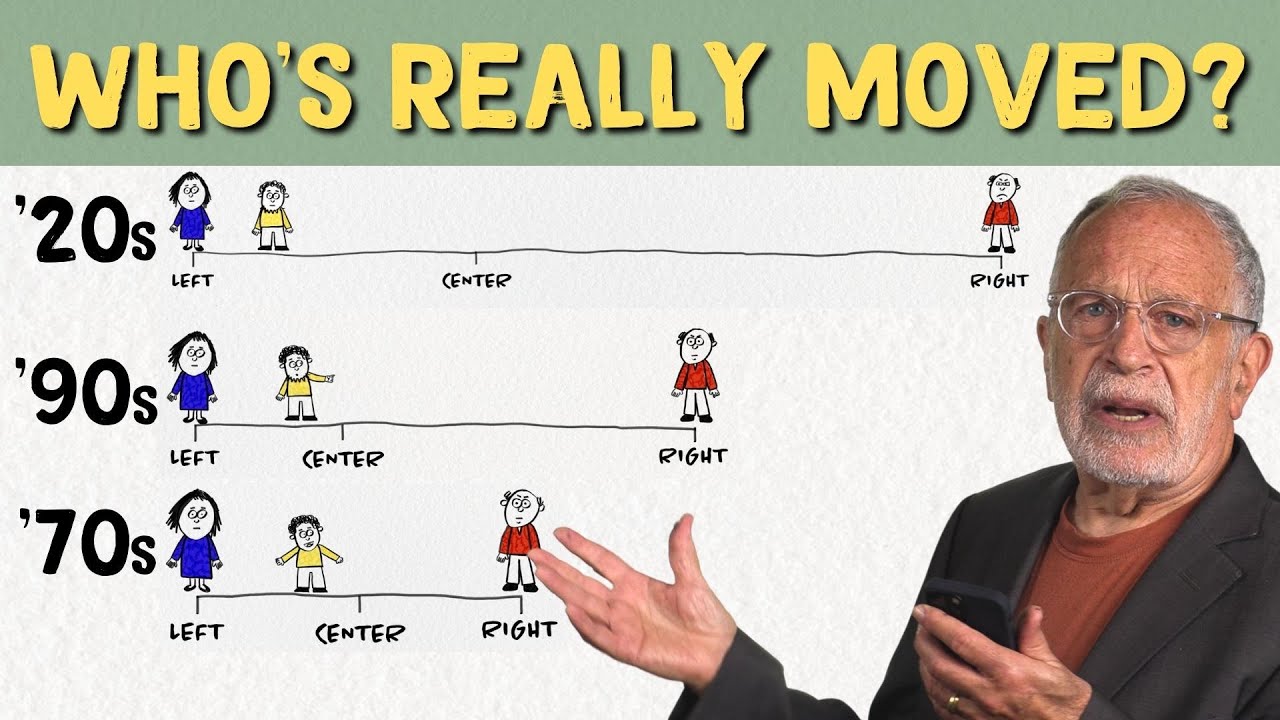
ineq expl 12 min rr primer; dynastic wealth // royal, ~ meritocracy estate and capital gains tax --> amplifying
https://www.youtube.com/watch?v=wOI8RuhW7q0
---
5 22 an
Robert Reich, who previously served as the U.S. Secretary of Labor under former President Bill Clinton, is explaining how the second U.S civil war is already underway although many Americans may not notice.
In an op-ed piece published by The Guardian, Reich is explained how the war is in play and how it differs from wars of the past. "The second American civil war is already occurring, but it is less of a war than a kind of benign separation analogous to unhappily married people who don’t want to go through the trauma of a formal divorce." Reich wrote.
He added, "One America is largely urban, racially and ethnically diverse, and young. The other is largely rural or exurban, white and older."
Reich went on to note how the great divide between political parties is also corrupting the United States. As the Republican Party reaches new levels of extremism, surveys show that American voters' political status greatly impacts relationship dynamics.
"Surveys show Americans find it increasingly important to live around people who share their political values," he wrote. "Animosity toward those in the opposing party is higher than at any time in living memory. Forty-two percent of registered voters believe Americans in the other party are 'downright evil.'"
He added, "Almost 40% would be upset at the prospect of their child marrying someone from the opposite party. Even before the 2020 election, when asked if violence would be justified if the other party won the election, 18.3% of Democrats and 13.8% of Republicans responded in the affirmative."
The drastic changes in American laws are also raising concerns among party lines. For example, far-right Republicans' assault on abortions, voter rights, and their attacks on Critical Race Theory (CRT) are currently some of the main topics of debate.
"Increasingly, each America is running under different laws," he wrote. "Red states are making it nearly impossible to get abortions but easier than ever to buy guns."
Meanwhile, on the other side of the spectrum, he noted that "Blue states are moving in the opposite direction. Several, including Colorado and Vermont, are codifying a right to abortion. Some are helping cover abortion expenses for out-of-staters."
He later added, "Blue states are also coordinating more of their policies. During the pandemic, blue states joined together on policies that red states rejected – such as purchasing agreements for personal protective equipment, strategies for reopening businesses as COVID subsided, even on travel from other states with high levels of COVID."
"Where will all this end? Not with two separate nations," Reich wrote. "What America is going through is analogous to Brexit – a lumbering, mutual decision to go separate ways on most things but remain connected on a few big things (such as national defense, monetary policy and civil and political rights)."
He concluded, "America will still be America. But it is fast becoming two versions of America. The open question is like the one faced by every couple that separates: how will the two find ways to be civil toward each other?"
---
https://www.alternet.org/2022/05/robert-reich-gop-culture-wars/
Former United States Secretary of Labor Robert Reich posted a new video on Tuesday in which he enumerated the parallels between Russian President Vladimir Putin's propaganda and the messaging emanating from the GOP and its media pundits.
"Why do Putin and the Republican Party sound so much alike? Simple," Reich began. "Their culture wars have similar agendas. Both are trying to distract attention from the economic looting by their respective oligarchies."
Reich explained that figures like ex-President Donald Trump, Fox News stooge Tucker Carlson, Florida Governor Ron DeSantis (R), and the right-wing at large have a vested interest in keeping the American population divided because their ultimate collective goal is total economic domination.
"Sowing racism, homophobia, and transphobia creates life-or-death dangers for many people in our society. For both Putin and the American right, it serves to divert attention from the economic plunder by the ultra-rich," he said "They want people to fear one another rather than unite behind higher wages, better working conditions, and a fairer economy — and against authoritarianism."
Reich then offered some advice on what can be done about it.
"To fight back, we must fight widening inequality while defending marginalized communities from these demagogues’ attacks. The real threat is not diverse identities – it’s corporate greed and political corruption," Reich concluded. "We have to see the culture wars waged by Putin and America’s right for the cynical strategies they are, and build a future in which prosperity is widely shared."
Watch below:
---
https://www.alternet.org/2022/05/safety-regulations/
Remember when lots of romaine lettuce was recalled because it was causing E.coli outbreaks? That was the Food and Drug Administration protecting us from getting sick.
Working in a warehouse? The Occupational Safety and Health Administration sets standards to ensure you don’t breathe in dangerous chemicals like asbestos.
Enjoying the fresh air on a clear, sunny day? Thank the Environmental Protection Agency for limiting the amount of pollution that can go into our air.
These agencies save lives. Since OSHA was established a half-century ago, its workplace safety regulations have saved more than 618,000 workers’ lives.
Republicans have been trying to gut these agencies for decades. Now, with the Supreme Court’s right-wing majority solidly in place, they have their best chance yet.
In January 2022, the Supreme Court blocked OSHA’s vaccine-or-testing mandate from going into effect, which was estimated to prevent a quarter-million hospitalizations.
The Court claimed that Covid isn’t an “occupational hazard” because people can become infected outside of work, and that allowing OSHA to regulate in this manner “would significantly expand” its authority without clear Congressional authorization.
This is absurd on its face. Section 2 of the Occupational Safety and Health Act of 1970 clearly spells out OSHA’s authority to enact and enforce regulations that protect workers from illness, injury, and death in the workplace. Congress doesn’t need to list every specific workplace hazard before OSHA can protect workers.
What this ruling tells us is that the Republican appointees on the Supreme Court are intent on gutting the power of agencies to issue regulations.
This term, the Court will also hear a case regarding the EPA’s authority to enforce the Clean Water Act. If the Court undermines the EPA’s authority, it will put our environment – and our health – at risk. Remember when the Cuyahoga River caught on fire because it was brimming with oil, acid, and factory chemicals? That’s what we may be returning to.
And what’s next? Will they gut the Federal Trade Commission and put us all at risk of being defrauded? Target the Securities and Exchange Commission and deregulate the financial sector, sparking another financial crisis?
Beware. If Republican appointees on the Supreme Court succeed in gutting regulatory agencies, we all lose. This agenda is anti-worker, anti-consumer, and anti-environment. The only thing it’s good for is corporate profits.[rr vid] https://www.youtube.com/watch?v=QRJmq9yCh-w&t=5s
---
---
no lnx GUK
Robert Reich explores the compelling question of why CBS News hired Trump loyalists Mick Mulvaney
Meaghan Ellis April 19, 2022
Former U.S. Secretary of Labor Robert Reich is offering insight on a controversial topic that many have questions about: Why on earth did CBS News hire former Trump White House acting chief of staff Mick Mulvaney?
In an op-ed written for The Guardian, Reich tackled the issue of Mulvaney's hiring just days after he made his first CBS appearance on “MoneyWatch."
During that segment, Mulvaney, who is now an on-air contributor for the network, was asked to break down President Joe Biden's plan to increase taxation on America's ultra-wealthy. He also noted that the anchor, Anne-Marie Green, introduced Mulvaney as a former White House Office of Management and Budget (OMB) director and that she failed to mention the chaotic presidential administration he worked for. While he did serve in that capacity, he was also a partisan Trumpist.
Then she asked him if "regular working-class Americans" should be concerned about Biden's tax initiative. Reich highlighted Mulvaney’s answer: “It’s easy to look at it and say, ‘Don’t worry, you’re not going to pay this,’but regular working Americans would have to 'prove that they don’t have to pay it,' a burden that 'could be troublesome: every single year proving that you’re not worth a hundred million dollars.'”
Mulvaney's response is what Reich suggested is most problematic and also an example of the reason for concern about his hiring.
"This is as misleading as it gets in broadcast media (except for Fox News)," he wrote. "Nothing in Biden’s proposal to tax the super-rich requires that people prove they’re not super-rich. Mulvaney’s claim was pure demagoguery."
He added, "That’s what we should expect from Mulvaney. In 2019 Mulvaney threatened to withhold U.S. aid to Ukraine to fight Russian aggression unless President Zelenskiy came up with dirt on Hunter Biden. (This was the call in which Zelenskiy’s plea 'we need more Javelins' – anti-tank missiles that have proved crucial in Ukraine’s defense against Russia’s invasion – was met with Trump’s 'I would like you to do us a favor though.'”
Reich went on to offer a number of times Mulvaney has dropped the ball for the sake of politicization. From his 2019 threats toward Ukraine demanding dirt on Hunter Biden to his conspiracy theory stance on the COVID-19 pandemic he described as a "media hoax," Reich highlighted the unfavorable moments in his career that should raise questions about his credibility.
He also criticized CBS News noting the stark difference in the network now compared to what it once was. "When I was growing up, CBS News was the home of news legends like Edward R Murrow and Walter Cronkite – pioneers who set the standards for broadcast news," he wrote. "So why is CBS News now reaching into the cesspool of Trump conspirators and enablers to hire Mulvaney?"
Reich went on to push back against the explanation for Mulvaney's hiring which was provided by CBS News' Neeraj Khemlani. When asked about Mulvaney, Khemlani claimed "when it comes to contributor hires, 'getting access to both sides of the aisle is a priority because we know the Republicans are going to take over, most likely, in the midterms.'”
For that statement, Reich raised questions. “Getting access” to what? To the big lie about the 2020 election? To lies about Covid? To bonkers economics?" he wrote.
Reich concluded by saying, "CBS News, like every news outlet, has a cardinal responsibility to protect American democracy from this growing menace," he wrote. "To fulfill this responsibility, it must report accurately what is occurring. It should not pander to the menace by hiring a person who has had a hand in it and will further obscure the truth."
---
https://www.alternet.org/2022/02/robert-reich-sobering-realities-ukraine/
---
---
https://www.alternet.org/2022/01/corporate-seditionists-are-no-better-than-the-seditionists-who-attacked-the-capitol/
Capitalism and democracy are compatible only if democracy is in the driver’s seat.
That’s why I took some comfort just after the attack on the Capitol when many big corporations solemnly pledged they’d no longer finance the campaigns of the147 lawmakers who voted to overturn election results.
**
Btw, if you’d like my daily analyses, commentary, and drawings, please subscribe to my free letter: robertreich.substack.com
**
Well, those days are over. Turns out they were over the moment the public stopped paying attention.
A report published last week by Citizens for Responsibility and Ethics in Washington shows that over the past year, 717 companies and industry groups have donated more than $18m to 143 of those seditious lawmakers. Businesses that pledged to stop or pause their donations have given nearly $2.4m directly to their campaigns or political action committees.
But there’s a deeper issue here. The whole question of whether corporations do or don’t bankroll the seditionist caucus is a distraction from a more basic problem.
The tsunami of money now flowing from corporations into the swamp of American politics is larger than ever. And this money – bankrolling almost all politicians and financing attacks on their opponents – is undermining American democracy as much as did the 147 seditionist members of Congress. Maybe more.
The Democratic senator KyrstenSinema – whose vocal opposition to any change in the filibuster is on the verge of dooming voting rights – received almost $2m in campaign donations in 2021 even though she is not up for re-election until 2024. Most of it came from corporate donors outside Arizona, some of which have a history of donating largely to Republicans.
Has the money influenced Sinema? You decide.Besides sandbagging voting rights, she voted down the $15 minimum wage increase, opposed tax increases on corporations and the wealthy and stalled on drug price reform– policies supported by a majority of Democratic senators as well as a majority of Arizonans.
Over the last four decades, corporate PAC spending on congressional elections has more than quadrupled, even adjusting for inflation.
Labor unions no longer provide a counterweight. Forty years ago, union PACs contributed about as much as corporate PACs. Now, corporations are outspending labor by more than three to one.
According to a landmark study published in 2014 by the Princeton professor Martin Gilens and Northwestern professor Benjamin Page, the preferences of the typical American have no influence at all on legislation emerging from Congress.
Gilens and Page analyzed 1,799 policy issues in detail, determining the relative influence of economic elites, business groups, mass-based interest groups and average citizens. Their conclusion: “The preferences of the average American appear to have only a minuscule, near-zero, statistically non-significant impact upon public policy.” Lawmakers mainly listen to the policy demands of big business and wealthy individuals – those with the most lobbying prowess and deepest pockets to bankroll campaigns and promote their views.
It’s probably far worse now. Gilens and Page’s data came from the period 1981 to 2002: before the supreme court opened the floodgates to big money in the Citizens United case, before Super Pacs, before “dark money” and before the Wall Street bailout.
The corporate return on this mountain of money has been significant. Over the last 40 years, corporate tax rates have plunged. Regulatory protections for consumers, workers and the environment have been defanged. Antitrust has become so ineffectual that many big corporations face little or no competition.
Corporations have fought off safety nets and public investments that are common in other advanced nations (most recently, Build Back Better). They’ve attacked labor laws, reducing the portion of private-sector workers belonging to a union from a third 40 years ago to just over 6% now.
They’ve collected hundreds of billions in federal subsidies, bailouts, loan guarantees and sole-source contracts. Corporate welfare for big pharma, big oil, big tech, big ag, the largest military contractors and biggest banks now dwarfs the amount of welfare for people.
The profits of big corporations just reached a 70-year high, even during a pandemic. The ratio of CEO pay in large companies to average workers has ballooned from 20-to-1 in the 1960s, to 320-to-1 now.
Meanwhile, most Americans are going nowhere. The typical worker’s wage is only a bit higher today than it was 40 years ago, when adjusted for inflation.
But the biggest casualty is public trust in democracy.
In 1964, just 29% of voters believed government was “run by a few big interests looking out for themselves”. By 2013, 79% of Americans believed it.
Corporate donations to seditious lawmakers are nothing compared with this 40-year record of corporate sedition.
A large portion of the American public has become so frustrated and cynical about democracy they are willing to believe blatant lies of a self-described strongman, and willing to support a political party that no longer believes in democracy.
As I said at the outset, capitalism is compatible with democracy only if democracy is in the driver’s seat. But the absence of democracy doesn’t strengthen capitalism. It fuels despotism.
Despotism is bad for capitalism. Despots don’t respect property rights. They don’t honor the rule of law. They are arbitrary and unpredictable. All of this harms the owners of capital. Despotism also invites civil strife and conflict, which destabilize a society and an economy.
My message to every CEO in America: you need democracy, but you’re actively undermining it.
It’s time for you to join the pro-democracy movement. Get solidly behind voting rights. Actively lobby for the Freedom to Vote Act and the John Lewis Voting Rights Advancement Act.
Use your lopsidedly large power in American democracy to protect American democracy – and do it soon. Otherwise, we may lose what’s left of it.
***
Btw, if you’d like my daily analyses, commentary, and drawings, please subscribe to my free letter: robertreich.substack.com
Robert B. Reich is Chancellor's Professor of Public Policy at the University of California at Berkeley, Senior Fellow at the Blum Center for Developing Economies, and writes at robertreich.substack.com. Reich served as Secretary of Labor in the Clinton administration, for which Time Magazine named him one of the ten most effective cabinet secretaries of the twentieth century. He has written fifteen books, including the best sellers "Aftershock", "The Work of Nations," and "Beyond Outrage," and, his most recent, "The Common Good," which is available in bookstores now. He is also a founding editor of the American Prospect magazine, chairman of Common Cause, a member of the American Academy of Arts and Sciences, and co-creator of the award-winning documentary, "Inequality For All." He's co-creator of the Netflix original documentary "Saving Capitalism," which is streaming now.
---
an 11 21
official Washington will be quiet this week, but the fallout from the Kyle Rittenhouse verdict will continue to divide America along the Trumpian fault lines of fear, violence, and racism.
Closing arguments are scheduled today in the trial of three men charged with the killing of Ahmaud Arbery in Georgia. Though they chased him, they are claiming self-defense because, they say, Arbery tried to get control of a shotgun one of them was carrying. As with the Rittenhouse case, the trial raises questions of how self-defense laws will hold up as guns proliferate. Regardless of how it come out, the case also illustrates America's deepening split.
Congress's continuing investigation into the January 6 insurrection reveals the same rift, as will the Supreme Court's expected decision on executive privilege in that investigation, and its likely move to strike down New York State's law requiring people seeking licenses to carry handguns in public to show a "proper cause," as violating the Second Amendment.
The fault line has now extended into almost every facet of American lawmaking. When the "Build Back Better" bill passed the House late Friday night, 220 out of 221 Democrats voted for it. But all of the House's 213 Republicans voted against it. Why? The measures in the bill are hugely popular, according to polls. The bill includes the largest expansion of federal child-care assistance in history; free, universal prekindergarten for all American children ages 3 and 4; Medicare benefits covering hearing services; government for the first time being allowed to negotiate some prescription drug prices, aiming to lower the costs that seniors pay for lifesaving medicines such as insulin; and more than $550 billion to combat climate change — promoting greener energy and providing new perks for Americans who buy electric vehicles.
But policy popularity may be no match for fear, violence, and racism — whichRepublicans and the moneyed interests are now diligently exploiting to kill the bill in the Senate.So-called "moderate" Democrats (Senators Joe Manchin and Kyrsten Sinema) have expressed skepticism about its cost and scope. It would be one thing if Manchin's and Sinema's reservations were in good faith, but how can they be? Manchin frets about the bill's effects on inflation even though the bill lowers prices for most Americans of major expenses like childcare, drugs, and healthcare. Sinema says she prefers "legislation that is crafted in a bipartisan way," but who is she kidding? Mitch McConnell has made clear he won't allow a single Republican senator to vote for the bill.
The votes of every Senate Democrat are needed if the bill is to pass, but Manchin and Sinema are allowing rightwing tropes — and the big money behind them — to divide Democrats. As the New York Times reported yesterday, cash has poured into Manchin's and Sinema's political coffers from political action committees and donors linked to Wall Street, Big Pharma, and Big Energy, which have opposed proposals in the bill that Manchin and Sinema helped scale back.
The question that keeps haunting me is this: Is an America so deeply divided, and awash in political money that exploits that divide, any longer capable of doing bold things that are broadly popular?The only big thing we continue to do is feed the ravenous military-industrial complex— itself founded on fear, violence, and racism. (Efforts to whip up a new cold war with China conjure up old fears of a "yellow peril.") Congress is on the verge of giving the Pentagon even more money than the Pentagon and the Biden administration are seeking. The nation's military tab over the next ten years will be upwards of $8 trillion and is not paid for with expected revenue, in sharp contrast with the $2 trillion cost of the House's "Build Back America" plan, which would be paid for with tax increases on the wealthy and big corporations.
That America is becoming two separate nations is threatening everything we value. The most obvious beneficiaries (besides top executives of big corporations and Wall Street) are Donald Trump, Vladimir Putin, and Rupert Murdoch, who appear to be doing whatever they can to divide us even further.
---
https://www.alternet.org/2021/11/how-wealth-inequality-spiraled-out-of-control/
no lnx vid
How wealth inequality spiraled out of control
Robert Reich and Robert Reich's Blog November 04, 2021
Elon Musk's wealth has surpassed $200 billion. It would take the median U.S. worker over 4 million years to make that much.
Wealth inequality is eating this country alive. We're now in America's second Gilded Age, just like the late 19th century when a handful of robber barons monopolized the economy, kept wages down, and bribed lawmakers.
While today's robber barons take joy rides into space, the distance between their gargantuan wealth and the financial struggles of working Americans has never been clearer. During the first 19 months of the pandemic, U.S. billionaires added $2.1 trillion dollars to their collective wealth and that number continues to rise.
:{:{}:
}:
And the rich have enough political power to cut their taxes to almost nothing — sometimes literally nothing. In fact, Jeff Bezos paid no federal income taxes in 2007 or in 2011. By 2018, the 400 richest Americans paid a lower overall tax rate than almost anyone else.
But we can not solve this problem unless we know how it was created in the first place.
Let's start with the basics.
I. The Basics
Wealth inequality in America is far larger than income inequality.
Income is what you earn each week or month or year. Wealth refers to the sum total of your assets — your car, your stocks and bonds, your home, art — anything else you own that's valuable.Valuable not only because there's a market for it — a price other people are willing to pay to buy it — but because wealth itself grows.
As the population expands and the nation becomes more productive, the overall economy continues to expand. This expansion pushes up the values of stocks, bonds, rental property, homes, and most other assets. Of course recessions and occasional depressions can reduce the value of such assets. But over the long haul, the value of almost all wealth increases.
Lesson: Wealth compounds over time.
Next: personal wealth comes from two sources.The first source is the income you earn but don't spend. That's your savings. When you invest those savings in stocks, bonds, or real property or other assets, you create your personal wealth — which, as we've seen, grows over time.
The second source of personal wealth is whatever is handed down to you from your parents, grandparents, and maybe even generations before them — in other words, what you inherit.
Lesson: Personal wealth comes from your savings and/or your inheritance.
II. Why the wealth gap is exploding
:{:{}:
}:
The wealth gap between the richest Americans and everyone else is staggering.
In the 1970s, the wealthiest 1 percent owned about 20 percent of the nation's total household wealth. Now, they own over 35 percent.
:{:{}:
}:
Much of their gains over the last 40 years have come from a dramatic increase in the value of shares of stock.
For example, if someone invested $1,000 in 1978 in a broad index of stocks — say, the S&P 500 — they would have $31,823 today, adjusted for inflation.
Who has benefited from this surge? The richest 1 percent, who now own half of the entire stock market. But the typical worker's wages have barely grown.
Most Americans haven't earned enough to save anything. Before the pandemic, when the economy appeared to be doing well, almost 80 percent were living paycheck to paycheck.
Lesson: Most Americans don't make enough to save money and build wealth.
So as income inequality has widened, the amount that the few high-earning households save — their wealth — has continued to grow. Their growing wealth has allowed them to pass on more and more wealth to their heirs.
Take, for example, the Waltons — the family behind the Walmart empire — which has seven heirs on the Forbes billionaires list. Their children, and other rich millennials, will soon consolidate even more of the nation's wealth. America is now on the cusp of the largest intergenerational transfer of wealth in history. As wealthy boomers pass on, somewhere between $30 to $70 trillion will go to their children over the next three decades.
These children will be able to live off of this wealth, and then leave the bulk of it — which will continue growing — to their own children … tax-free. After a few generations of this, almost all of America's wealth could be in the hands of a few thousand families.
Lesson: Dynastic wealth continues to grow.
III. Why wealth concentration is a problem
Concentrated wealth is already endangering our democracy. Wealth doesn't just beget more wealth — it begets more power.
Dynastic wealth concentrates power into the hands of fewer and fewer people, who can choose what nonprofits and charities to support and which politicians to bankroll. This gives an unelected elite enormous sway over both our economy and our democracy.
If this keeps up, we'll come to resemble the kind of dynasties common to European aristocracies in the seventeenth, eighteenth, and nineteenth centuries.
Dynastic wealth makes a mockery of the idea that America is a meritocracy, where anyone can make it on the basis of their own efforts. It also runs counter to the basic economic ideas that people earn what they're worth in the market, and that economic gains should go to those who deserve them.
Finally, wealth concentration magnifies gender and race disparities because women and people of color tend to make less, save less, and inherit less.
The typical single woman owns only 32 cents of wealth for every dollar of wealth owned by a man. The pandemic likely increased this gap.
The racial wealth gap is even starker. The typical Black household owns just 13 cents of wealth for every dollar of wealth owned by the typical white household. The pandemic likely increased this gap, too.
In all these ways, dynastic wealth creates a self-perpetuating aristocracy that runs counter to the ideals we claim to live by.
Lesson: Dynastic wealth creates a self-perpetuating aristocracy.
IV. How America dealt with wealth inequality during the First Gilded Age
The last time America faced anything comparable to the concentration of wealth we face today was at the turn of the 20th century. That was when President Teddy Roosevelt warned that "a small class of enormously wealthy and economically powerful men, whose chief object is to hold and increase their power" could destroy American democracy.
Roosevelt's answer was to tax wealth. Congress enacted two kinds of wealth taxes. The first, in 1916, was the estate tax — a tax on the wealth someone has accumulated during their lifetime, paid by the heirs who inherit that wealth.
The second tax on wealth, enacted in 1922, was a capital gains tax — a tax on the increased value of assets, paid when those assets are sold.
Lesson: The estate tax and the capital gains tax were created to curb wealth concentration.
But both of these wealth taxes have shrunk since then, or become so riddled with loopholes that they haven't been able to prevent a new American aristocracy from emerging.
The Trump Republican tax cut enabled individuals to exclude $11.18 million from their estate taxes. That means one couple can pass on more than $22 million to their kids tax-free.Not to mention the very rich often find ways around this tax entirely. As Trump's former White House National Economic Council director Gary Cohn put it, "only morons pay the estate tax."
:{:{}:
}:
What about capital gains on the soaring values of wealthy people's stocks, bonds, mansions, and works of art? Here, the biggest loophole is something called the "stepped-up basis." If the wealthy hold on to these assets until they die, their heirs inherit them without paying any capital gains taxes whatsoever. All the increased value of those assets is simply erased, for tax purposes. This loophole saves heirs an estimated $40 billion a year.
This means that huge accumulations of wealth in the hands of a relatively few households can be passed from generation to generation untaxed — growing along the way — generating comfortable incomes for rich descendants who will never have to work a day of their lives. That's the dynastic class we're creating right now.
Lesson: The estate tax and the capital gains tax have been gutted.
Why have these two wealth taxes eroded? Because, as America's wealth has concentrated in fewer and fewer hands, the wealthy have more capacity to donate to political campaigns and public relations — and they've used that political power to reduce their taxes. It's exactly what Teddy Roosevelt feared so many years ago.
V. How to reduce the wealth gap
So what do we do? Follow the wisdom of Teddy Roosevelt and tax great accumulations of wealth.
The ultra-rich have benefited from the American system — from laws that protect their wealth, and our economy that enabled them to build their fortunes in the first place. They should pay their fair share.
The majority of Americans, both Democrats and Republicans, believe the ultra rich should pay higher taxes. There are many ways to make them do so: closing the stepped up basis loophole, raising the capital gains tax, and fully funding the Internal Revenue Service so it can properly audit the wealthiest taxpayers, for starters.
Beyond those fixes, we need a new wealth tax: a tax of just 2 percent a year on wealth in excess of $1 million. That's hardly a drop in the bucket for centi-billionaires like Jeff Bezos and Elon Musk, but would generate plenty of revenue to invest in healthcare and education so that millions of Americans have a fair shot at making it.
One of the most important things you as an individual can do is take the time to understand the realities of wealth inequality in America and how the system has become rigged in favor of those at the top — and demand your political representatives take action to unrig it.
Wealth inequality is worse than it has been in a century – and it has contributed to a vicious political-economic cycle in which taxes are cut on the top, resulting in even more concentration of wealth there – while everyone else lives under the cruelest form of capitalism in the world.
We must stop this vicious cycle — and demand an economy that works for the many, not one that concentrates more and more wealth in the hands of a privileged few.
---
https://www.youtube.com/watch?v=t4LJA-W4mQY
:{Former Secretary of Labor Robert Reich sits down with Anand Giridharadas, author of Winners Take All, to discuss how the GOP’s hypocrisy on the Supreme Court underscores the dangers of minority rule. They dig into how those with power, from politicians to billionaires, leverage it to gain more — at the people's expense.} :{ Welcome!}
 :{ How America as a whole killed Breonna Taylor}
 :{ The role of corporate power as an underlying all other systems of injustice}
 :{ The shift in media to expose the truth}
 :{ Corporate blackface}
 :{ The Supreme Court takeover and Corporate responsibility, this is not a partisan issue}
 :{ Are Dems willing to change the game to own the White House instead of playing the Republican party’s game?}:
---
an 621
Something I've just learned about Amazon – one of America's most profitable and fastest-growing corporations, headed by the richest man in the world:
According to the Labor Department's Occupational Safety and Health Administration, Amazon warehouse workers sustained nearly double the rate of serious injury incidents last year as did workers in non-Amazon warehouses.
In addition, largely because Amazon failed to provide its workers adequate protective equipment during the pandemic, the corporation admits that nearly 20,000 employees were presumed positive for the coronavirus.
Workers who spoke out about these unsafe workplace conditions were fired.
Amazon boasts of paying its workers at least $15 an hour. But that comes to about $30,000 a year, hardly enough for a family to get by on.
The explosive growth of Amazon's army of poorly-paid and ill-treated hourly workers is emblematic of the long-term decline of America's middle class and levels of economic inequality America hasn't seen since the late nineteenth century's Gilded Age.
This has strained the social fabric of the nation – fueling anger and frustration, a rising tide of drug overdoses and deaths of despair, even tempting some working-class people to embrace Trumpism and white nationalism.
The success of Amazon's "shock and awe" campaign against workers who dared try to bring a union to their Bessemer, Alabama warehouse exemplifies the immense political power the architects of this growing inequality now wield.
It's an alarming omen of the future.
In Amazon warehouses like Bessemer, workers are treated like robots. Algorithms relentlessly impose dangerous production quotas. They get two 30-minute breaks each ten-hour day. Every movement is monitored.
Amazon delivery drivers report being instructed to turn off their safety apps so they can meet their quotas.
Others report having to urinate into bottles because of delivery timing pressures.
Even though public support for unions is as high as it's been in 50 years – 60 million American workers would join a union today if they could – Bessemer workers were outgunned by a behemoth whose market capitalization exceeds Australia's GDP.
The National Labor Relations Act makes it illegal for employers to fire workers for trying to organize a union. But the penalties employees for violating the Act are so laughably small (rehiring the worker and providing back pay) that employers like Amazon routinely do it anyway.
Amazon may be the future of the American economy, but if that future is to have room for the kind of prosperous working families that fifty years ago defined American capitalism, unions are critical.
In March, the House of Representatives passed legislation designed to level the field. It's called the Protect the Right to Organize Act (PRO Act). The Senate version has 47 Democratic co-sponsors. It needs three more to give the PRO Act a fighting chance of getting to Joe Biden's desk.
The PRO Act would end many of the practices Amazon used to defeat the union effort in Bessemer. Real penalties would be imposed on companies and corporate officers who retaliate against union advocates or otherwise violate the National Labor Relations Act.
The PRO Act would make it easier for workers to form a union, with the aim of protecting them from unfair working conditions.
The PRO Act alone won't end economic inequality or return prosperity and opportunity to America's working families. But passage of the PRO Act would help.
It would also send a clear signal that ours is truly a government "of the people" – such as the million people who work for Amazon today, not the one multi-billionaire at the top, and of the vast majority of Americans who are working harder than ever today and getting nowhere, in America's Second Gilded Age.
From Your Site Articles
- How employers punish workers for forming unions - Alternet.org ›
- Here's how Biden can prove he truly is a 'union guy' - Alternet.org ›
- The American left needs to use hardball tactics to win worker ... ›
Related Articles Around the Web
- Pro*Act ›
- PRO Act, Labor's Biggest Goal, Passes House: What's In It : NPR ›
- H.R.842 - Protecting the Right to Organize Act of 2021 ›
---
521
At the risk of being the skunk at the picnic, I feel compelled to warn you that if we forget and move on from the tragedies of this past year, we're setting ourselves on a dangerous path. Of course I understand the desire to forget all the unpleasantness and start a new chapter. But if we do, we're inviting greater tragedies in the future.
Let me remind you: Donald Trump lied about the results of the last election. And then – you remember, don't you? – he tried to overturn the results.
Trump twisted the arms of state election officials. He held a rally to stop Congress from certifying the election, followed by the violent attack on the Capitol. Five people died. Senators and representatives could have been slaughtered.
Several Republican members of Congress encouraged the attempted coup by joining him in the big lie and refusing to certify the election — even after the mob desecrated the halls of our democracy.
This was in January of this year, yet we seem to be doing everything we can to blot it out of our memory. Meanwhile, those responsible for instigating the attack haven't been held accountable in any respect — including by the media.
The Washington Post hosted a live video chat with Missouri Republican senator Josh Hawley, a ringleader in the attempt to overturn the results of the election. Hawley had even made a fist-pump gesture toward the mob at the Capitol before the attack.
But the Post billed the interview as being about Hawley's new book on big tech. It even posted a biography of Hawley that made no mention of Hawley's sedition, referring instead to his supposed reputation "for taking on the big and the powerful to protect Missouri workers" and as "a fierce defender of the Constitution."
CBS This Morning interviewed Florida Republican Rick Scott, another senator who tried to overturn the election by not certifying the results. But there was no mention of his sedition, either. The CBS interviewer confined his questions to Biden's spending plans, which Scott unsurprisingly opposed.
Senators Ted Cruz and Ron Johnson and House Minority Leader Kevin McCarthy also repeatedly appear on major news programs without being questioned about their attempts to undo the results of the election, or their continued promotion of Trump's lies.
The media is supposed to serve as a crucial check on those in power. But in its breathless desire to cover the "news" it is failing to remind us of our recent past.
The consequences of this failure are dire.
Trump's big lie that the 2020 election was stolen, and that President Biden is not legitimate, is not disappearing. A majority of Republican voters believe him.
That big lie is being used by Republican state legislatures to justify an all-out assault on the right to vote.
Hours after Florida enacted new voting restrictions, Texas's Republican-led legislature pushed ahead with its own bill that would make it one of the hardest states in which to cast a ballot.
The Republican-controlled Arizona Senate launched a private recount of the 2020 presidential election results in Maricopa County – farming out 2.1 million ballots to GOP partisans with no experience in ballot counting or election monitoring. At least one person involved in the recount participated in the Capitol attack.
The Republican Party even purged one of its leaders, Wyoming representative Liz Cheney, for telling the truth about the election.
Meanwhile, Republican state legislatures are muscling their way into election administration, as they attempt to dislodge or bully local election officials who have always run our voting systems.
Trump's big lie will continue to flourish unless the lawmakers who went along with it and have failed to renounce it face real consequences.
That means no book promotions, no cushy interviews, no guest op-eds in the Sunday paper.
What possible excuse is there for booking them if they have not publicly retracted their election lies? If they must appear, they should be asked if they continue to deny the election results and precisely why.
It also means a thorough independent 9-11 type inquiry into what happened, whether members of Congress were involved, how Donald Trump and others were involved.
Republican leaders must not duck this. History is watching.
They must be held accountable to the truth. Otherwise the trauma of 2020 will return — perhaps in even more terrifying form.
FROM YOUR SITE ARTICLES
The decades of deceit behind the 'Big Lie' - Alternet.org ›
A new GOP 'big lie' plot is in the works - Alternet.org ›
Trump's 'big lie' about voter fraud still lingers weeks after his ... ›
RELATED ARTICLES AROUND THE WEB
Cheney calls out Trump's latest attempt to promote 'BIG LIE' amid ... ›
Trump's Big Lie and Hitler's: Is this how America's slide into ... ›
Trump's 'Big Lie' imperils Republicans who don't embrace it ›
---
How do we prevent America from becoming an aristocracy, while also funding the programs that Americans desperately need?
One way is to get rid of a tax loophole you've probably never heard of. It's known as the "stepped-up basis" rule.
Here's how the stepped-up-basis loophole now works. Take a man named Jeff. At his death, Jeff owns $30 million-worth of stocks he originally bought for a total of $10 million. Under existing law, neither Jeff nor his heirs would owe federal tax on the $20 million of gains because they're automatically "stepped up" to their value when he dies — $30 million.
Under Biden's proposal, Jeff's $20 million of gains would be taxed. And don't worry: Biden's proposal doesn't touch tax-favored retirement accounts, such as 401-Ks, and it only applies to the very richest Americans.
As it is now, the stepped-up basis loophole enables the super-rich, like Jeff, to avoid paying more than $40 billion in taxes each year. It has allowed them to skip taxes on the increased values of mansions and artworks as well as shares of stock.
In fact, it's one of the chief means by which dynastic wealth has grown and been passed from generation to generation, enabling subsequent generations to live off that growing wealth and never pay a dime of taxes on it.
Unless the stepped-up basis loophole is closed, we will soon have a large class of hugely rich people who have never worked a day in their lives.
Over the next decades, rich baby boomers will pass on an estimated $58 trillion of wealth to their millennial children — the largest intergenerational transfer of wealth in history.
Closing this giant tax loophole for the super-rich is how Biden intends to fund part of his American Families Plan, which would provide every child with 2 years of pre-school and every student with 2 years of free community college, as well as provide paid family and medical leave to every worker.
Close this stepped-up basis loophole, and we help finance the programs the vast majority of Americans desperately need and deserve. We also end the explosion of dynastic wealth. It should be a no-brainer.
FROM YOUR SITE ARTICLES
Think About It: The U.S. Is the Richest Country as Well as the Most ... ›
Joe Biden's plans would target the ultra-wealthy for more tax dollars ... ›
What would happen if we actually taxed the rich? - Alternet.org ›
RELATED ARTICLES AROUND THE WEB
Substantial Income of Wealthy Households Escapes Annual ... ›
10 Accounting Tricks the 1% Use to Dodge the Taxman - The ... ›
Here are 5 ways the super-rich manage to pay lower taxes ›
---
his org Inequality media coyote?
The New Corporation (2020) (How good corporations are bad for democracy)
https://www.youtube.com/watch?v=4q3VV_IYMxI 2/21 ca commwlth club Our panel—Joel Bakan, Jennifer Abbot, Elizabeth Davis and Kevin McGarry
[aug 2020 R reich https://www.youtube.com/watch?v=npp2G3EzNR4
---
an 221 robt r
...1. In presidential elections, they'll continue to try to win enough swing states to dominate the Electoral College and win the presidency.
The answer is to make the Electoral College irrelevant by having states join the growing movement to pass laws giving all their electoral votes to the winner of the national popular vote.
- In the Senate, they'll continue to try to win enough seats in mostly white, sparsely populated rural states to outvote highly populated urban states.
The answer here is for Congress to grant statehood to Washington D.C., and to work with Puerto Rico, which recently voted in favor of statehood, on a concrete path to self-determination.
- They also aim to use the Senate filibuster to block the majority. The answer is to eliminate the filibuster, which Senate Democrats can do without a single Republican vote.
- Finally, the GOP will use its control over state governments to gerrymander congressional districts and gain disproportionate power in the House. And they will pass even more laws making it harder for Democrats to vote.
The answer is to prevent gerrymandering and voter suppression by passing the John Lewis Voting Rights Advancement Act – which Democrats can do with a simple majority of 51 votes once they eliminate the filibuster. The values of the Republican Party do not reflect the values of most Americans. It should not be allowed to silence the voices of the majority.
FROM YOUR SITE ARTICLES
'Shameful power grab': Pennsylvania GOP state senators slammed ... ›
Republicans' naked power grab will unwind the legal framework of ... ›
Gov. Brian Kemp cancels Georgia Supreme Court election in a ... ›
RELATED ARTICLES AROUND THE WEB
Goodman: Republicans' power grab won't end well ›
GOP in power grab to rein in Dem governors on virus response ›
The Wisconsin power grab is part of a bigger Republican attack on ... ›
---
https://www.alternet.org/2021/01/mark-zuckerberg/
The sudden lurch from Trump to Biden is generating vertigo all over Washington, including the so-called fourth branch of government – CEOs and their army of lobbyists.
Notwithstanding Biden's ambitious agenda, dozens of giant corporations have said they will not donate to the 147 members of Congress who objected to the certification of Biden electors on the basis of Trump's lies about widespread fraud, which rules out most Republicans on the Hill.
After locking down Trump's account, social media giants like Twitter and Facebook are policing against instigators of violence and hate, which hobbles Republican lawmakers trying to appeal to Trump voters.
As a result of moves like these, CEOs are being hailed – and hailing themselves – as guardians of democracy. The New York Times praises business leaders for seeking "stability and national unity." Ed Bastian, CEO of Delta Airlines, says "our voice is seen as more important than ever." A recent study by Edelman finds the public now trusts business more than nonprofit organizations, the government or the media.
Give me a break. For years, big corporations have been assaulting democracy with big money, drowning out the voices and needs of ordinary Americans and fueling much of the anger and cynicism that opened the door to Trump in the first place.
Their assault hasn't been as dramatic as the Trump thugs who stormed the Capitol, and it's entirely legal – although more damaging over the long term.
A study published a few years ago by two of America's most respected political scientists, Princeton professor Martin Gilens and Northwestern's Benjamin Page, concluded that the preferences of the average American "have only a minuscule, near-zero, statistically nonsignificant impact upon public policy." Instead, lawmakers respond almost exclusively to the moneyed interests – those with the most lobbying prowess and deepest pockets to bankroll campaigns.
The capture of government by big business over the last several decades has infuriated average Americans whose paychecks have gone nowhere even as the stock market has soared.
The populist movements that fueled both Bernie Sanders and Trump began in the 2008 financial crisis when Wall Street got bailed out and no major bank executive went to jail, although millions of ordinary people lost their jobs, savings and homes.
So now, in wake of Trump's calamitous exit and Biden's ascension, we're to believe CEOs care about democracy?
"No one thought they were giving money to people who supported sedition," explained Jamie Dimon, CEO of JPMorgan Chase and chairman of the Business Roundtable, referring to the disgraced Republicans.
Yet Dimon has been a leader of the more insidious form of sedition. He piloted the corporate lobbying campaign for the Trump tax cut, deploying a vast war chest of corporate donations.
For more than a decade Dimon has driven Wall Street's charge against stricter bank regulation, opening bipartisan doors in the Capitol with generous gifts from the Street. (Dimon calls himself a Democrat.)
When Facebook's Mark Zuckerberg shut Trump's Facebook account, he declared "you just can't have a functioning democracy without a peaceful transition of power."
Where was Zuckerberg's concern for a "functioning democracy" when he amplified Trump's lies for four years?
After taking down Trump's Twitter account, CEO Jack Dorsey expressed discomfort about "the power an individual or corporation has over a part of the global public conversation."
Spare me. Dorsey has fought off all attempts to limit Twitter's power over the "global conversation." He shuttered Trump only after Democrats secured the presidency and control of the Senate.
Look, I'm glad CEOs are penalizing the 147 Republican seditionists and that Big Tech is starting to police social media content.
But don't confuse the avowed concerns of these CEOs about democracy with democracy itself. They aren't answerable to democracy. At most, they're accountable to big shareholders and institutional investors who don't give a fig as long as profits keep rolling in.
If they were committed to democracy, CEOs of big corporations would permanently cease corporate donations to all candidates, close their PACs, stop giving to secretive "dark money" groups, and discourage donations by their executives.
They'd stop placing ads in media that have weaponized disinformation – including Fox News, Infowars, Newsmax and websites affiliated with right-wing pundits. Social media giants would start acting like publishers and take responsibility for what they promulgate.
If corporate America were serious about democracy it would throw its weight behind the "For the People Act," the first bills of the new Congress, offering public financing of elections among other reforms.
Don't hold your breath.
Joe Biden intends to raise corporate taxes, increase the minimum wage, break up Big Tech, and strengthen labor unions.
The fourth branch is already amassing a war chest for the fight.
FROM YOUR SITE ARTICLES
What Mark Zuckerberg Said Years Ago About Facebook Could ... ›
GOP Rep. Matt Gaetz files a criminal referral against Facebook's ... ›
Is Mark Zuckerberg Running for President? (Sure Looks Like It ... ›
RELATED ARTICLES AROUND THE WEB
Mark Zuckerberg ›
Mark Zuckerberg | Facebook ›
Mark Zuckerberg - Wikipedia ›
---
121 an
I've been in or around politics for over a half century now, and I never imagined how low and looney the Republican Party would become. Eleven Republican senators and senators-elect said today they will vote to reject President-elect Joseph R. Biden Jr.'s victory next Wednesday when Congress meets to formally certify it.
They are joining a growing movement in the GOP to defy the unambiguous results of the 2020 presidential election and support Trump's bizarre attempt to remain in power with false claims of voting fraud.
Remember: Every state has now certified the election results after verifying their accuracy. Several underwent post-election audits or hand counts. At the same time, judges across America, including Supreme Court justices, have rejected nearly 60 attempts by Trump and his allies to challenge the results.
None of the twelve Republican senators who say they will vote to invalidate the results of the election has made any specific allegations of fraud. At most, they offer vague statements that some wrongdoing may have occurred.
Their most specific grounds for contesting the certification is that many of their supporters believe Trump's claims of fraud – which is circular reasoning, since Trump and many of these same senators have been arguing since the election that fraud occurred without offering any evidence.
The sedition of these twelve United States senators – and I use that term advisedly – will not alter the outcome of the election. It is purely for show, as have been so much of Trump's and his enablers' actions. But the show itself will be a brawl that will only serve to validate in the minds of many of Trump's supporters his baseless claims – dividing America even more.
The one consolation, if it can be called that, is that their cynical ploy will also force other Republican members of Congress to openly choose between doing their constitutional duty and accepting the results of the election, or displaying brazen loyalty to a fading demagogue who has sought to turn the GOP into a personal cult. In short, it will smoke them out: They must openly choose democracy or fascism.
The rest of us can only watch and take careful note. Rarely in American history has a symbolic act carried such significance for the future of the country.
FROM YOUR SITE ARTICLES
Robert Reich explains Joe Biden's biggest challenge - Alternet.org ›
Robert Reich: Here are 40 of Trump's biggest broken promises ... ›
RELATED ARTICLES AROUND THE WEB
Robert Reich: 'This Is A Human Tragedy That Is Unfolding' | The Last ... ›
Economist Robert Reich Plays 'Not My Job' On 'Wait Wait... Don't Tell ... ›
---
an 1220
---
robt r 1220 an
Most of the 74,222,957 Americans who voted to reelect Donald Trump – 46.8 percent of the votes cast in the 2020 presidential election – don't hold Trump accountable for what he's done to America.
Their acceptance of Trump's behavior will be his vilest legacy.
Nearly forty years ago, political scientist James Q. Wilson and criminologist George Kelling observed that a broken window left unattended in a community signals that no one cares if windows are broken there. The broken window is thereby an invitation to throw more stones and break more windows. The message: Do whatever you want here because others have done it and got away with it.
The broken window theory has led to picayune and arbitrary law enforcement in poor communities. But America's most privileged and powerful have been breaking big windows with impunity.
In 2008, Wall Street nearly destroyed the economy. The Street got bailed out while millions of Americans lost their jobs, savings, and homes. Yet no major Wall Street executive ever went to jail.
In more recent years, top executives of Purdue Pharmaceuticals, along with the members of the Sackler family who own it, knew the dangers of OxyContin but did nothing. Executives at Wells Fargo Bank pushed bank employees to defraud customers. Executives at Boeing hid the results of tests showing its 737 Max Jetliner was unsafe. Police chiefs across America looked the other way as police under their command repeatedly killed innocent Black Americans.
Here, too, they've got away with it. These windows remain broken.
Trump has brought impunity to the highest office in the land, wielding a wrecking ball to the most precious windowpane of all – American democracy.
The message? A president can obstruct special counsels' investigations of his wrongdoing, push foreign officials to dig up dirt on political rivals, fire inspectors general who find corruption, order the entire executive branch to refuse congressional subpoenas, flood the Internet with fake information about his opponents, refuse to release his tax returns, accuse the press of being "fake media" and "enemies of the people," and make money off his presidency.
And he can get away with it. Almost half of the electorate will even vote for his reelection.
A president can also lie about the results of an election without a shred of evidence – and yet, according to polls, be believed by the vast majority of those who voted for him.
Trump's recent pardons have broken double-paned windows.
Not only has he shattered the norm for presidential pardons – usually granted because of a petitioner's good conduct after conviction and service of sentence – but he's pardoned people who themselves shattered windows. By pardoning them, he has rendered them unaccountable for their acts.
They include aides convicted of lying to the FBI and threatening potential witnesses in order to protect him; his son-in-law's father, who pleaded guilty to tax evasion, witness tampering, illegal campaign contributions, and lying to the Federal Election Commission; Blackwater security guards convicted of murdering Iraqi civilians, including women and children; Border Patrol agents convicted of assaulting or shooting unarmed suspects; and Republican lawmakers and their aides found guilty of fraud, obstruction of justice and campaign finance violations.
It's not simply the size of the broken window that undermines standards, according to Wilson and Kelling. It's the willingness of society to look the other way. If no one is held accountable, norms collapse.
Trump may face a barrage of lawsuits when he leaves office, possibly including criminal charges. But it's unlikely he'll go to jail. Presidential immunity or a self-pardon will protect him. Prosecutorial discretion would almost certainly argue against indictment, in any event. No former president has ever been convicted of a crime. The mere possibility of a criminal trial for Trump would ignite a partisan brawl across the nation.
Congress may try to limit the power of future presidents – strengthening congressional oversight, fortifying the independence of inspectors general, demanding more financial disclosure, increasing penalties on presidential aides who break laws, restricting the pardon process, and so on.
But Congress – a co-equal branch of government under the Constitution – cannot rein in rogue presidents. And the courts don't want to weigh in on political questions.
The appalling reality is that Trump may get away with it. And in getting away with it he will have changed and degraded the norms governing American presidents. The giant windows he's broken are invitations to a future president to break even more.
Nothing will correct this unless or until an overwhelming majority of Americans recognize and condemn what has occurred.
---
---
1220
in the past 24 hours, eight of the top ten most popular posts on Facebook were created by far-right extremists—including Donald Trump, Ben Shapiro, and Franklin Graham.1
Every single day, these far-right figures are spreading radical right-wing conspiracy theories to tens of millions of Americans and are poisoning our news feeds with dangerous misinformation that is eroding our democracy.
Which is why Inequality Media—the progressive nonprofit I founded that counters the right wing's lies with clear, factual, and engaging viral videos and other content—has never been more important.
Inequality Media is one of the only progressive groups with a large enough following to match the biggest right-wing propagandists. Just look at our numbers: Our videos and posts are shared seven times more than Sean Hannity's, our Facebook page receives 15 times more engagement per post than Ben Shapiro, and our videos have been viewed more than 440 million times....
---
an 1120
Joe Biden has decisively won the presidency. There is no way for Trump to overturn the results of the election, and his campaign's post-election lawsuits have gotten dismissed left and right.
That hasn't stopped him from launching an "Official Election Defense Fund" and bombarding his supporters with fundraising appeals to supposedly finance the campaign's ongoing litigation.
But the fine print tells a very different story.
60 percent of a donation to Trump's "Official Election Defense Fund" goes to Save America, Trump's new leadership Political Action Committee that he set up less than a week after the election. The other 40 percent goes to the Republican National Committee.
So if someone donates $500, Trump's PAC gets $300, the RNC gets the other $200, and not a cent actually goes to the election defense fund.
Donations only start going to that fund once Trump's PAC reaches the legal contribution limit of $5,000 – and the RNC gets $3,000.
This means a supporter would have to donate over $8,000 before any money goes to the fund they think they're supporting.
Apparently enriching himself on the taxpayer dime for the past four years wasn't enough for Trump. Now he's lining his pockets by attacking our elections and undermining our democracy – and swindling his supporters every step of the way.
Is this just a final grift before Trump leaves office? Or is there more at stake?
Trump certainly wants to keep the money flowing, and a leadership PAC is an easy way to do it. Trump's PAC can be used to fund a lavish post-presidency lifestyle, as leadership PACs can use donors' funds for personal expenses, like personal travel and events at Trump properties, while campaign committees cannot.
But there's more at stake than just Trump's personal greed. Creating a PAC solidifies Trump's grip on the GOP, as he can distribute the funds to GOP candidates. It helps keep his base whipped up ahead of the Georgia runoffs. And the PAC allows him to start preparing for a potential 2024 run, an idea he's already floated to his inner circle.
In the grand scheme of things, Trump's PAC also fuels the GOP's cynical strategy to maintain power. The GOP has a permanent stake in stoking a cold civil war.
A deeply divided nation serves the party's biggest patrons, giving them unfettered access to the economy's gains while the bottom 90% of Americans fight each other for crumbs. That division will persist even with Trump out of the White House, thanks to his bonkers claim of a stolen election, and a base more riled up from racist appeals than ever.
We may have defeated Trump, but we haven't defeated Trumpism. We must work to push the Biden administration to tackle the systemic conditions that allowed Trump to seize power in the first place.
---
vid ok pack scotus, scrap elec college
https://www.alternet.org/2020/10/robert-reich-we-can-save-democracy-from-gop-sabotage/
==
https://www.alternet.org/2020/09/robert-reich-the-coming-civil-war-caused-by-trumps-megalomaniacal-ego
What is America really fighting over in the upcoming election? No particular issue. Not even Democrats versus Republicans.
The central fight is over Donald J Trump.
Before Trump, most Americans weren't especially passionate about politics. But Trump's MO has been to force people to become passionate about him – to take fierce sides for or against. And he considers himself president only of the former – whom he calls "my people."
Trump came to office with no agenda except to feed his monstrous ego. He has never fueled his base. His base has fueled him. Its adoration sustains him.
So does the antipathy of his detractors. Presidents usually try to appease their critics. Trump has gone out of his way to offend them. "I do bring rage out," Trump unapologetically told journalist Bob Woodward in 2016.
In this way, he has turned America into a gargantuan projection of his own pathological narcissism.
His entire re-election platform is found in his use of the pronouns "we" and "them." "We" are people who love him, Trump Nation. "They" hate him.
In late August, near the end of his somnolent address on the South Front of the White House accepting the Republican nomination, Trump extemporized: "The fact is, we're here – and they're not." It drew a standing ovation.
At a recent White House news conference, a CNN correspondent asked if he condemned the behavior of his supporters in Portland, Oregon. In response, Trump charged: "Your supporters, and they are your supporters indeed, shot a young gentleman."
In Trump's eyes, CNN exists in a different country: Anti-Trump Nation.
So do the putative rioters and looters of "Biden's America." So do the inhabitants of blue states whose state and local tax deductions Trump eliminated in his tax overhaul. So do those who live in the "Democrat cities," as he calls them, whose funding he's trying to cut.
California is a big part of Anti-Trump Nation. He wanted to reject its request for aid battling wildfires "because he was so rageful that people in the state of California didn't support him," said former Department of Homeland Security chief of staff Miles Taylor.
New York is the capital of Anti-Trump Nation, which probably contributed to Trump "playing down" the threat of Covid-19 last March, when its virulence seemed largely confined to that metropolis. Even now, Trump claims the US rate of Covid-19 deaths would be low "if you take the blue states out." That's untrue, but it's not the point. For Trump, blue states don't count because they're part of Anti-Trump Nation.
To Trump and his core enablers and supporters, the laws of Trump Nation authorize him to do whatever he wants. Anti-Trump Nation's laws constrain him, but they're illegitimate because they are made and enforced by the people who reject him.
So Trump's call to the president of Ukraine seeking help with the election was "perfect." It was fine for Russia to side with him in 2016, and it's fine for it to do so again. And of course the Justice Department, Postal Service, and Centers for Disease Control should help him win reelection. They're all aiding Trump Nation.
By a similar twisted logic, Anti-Trump Nation is dangerous. Hence, says Trump, the armed teenager who killed two in Kenosha, Wisconsin acted in "self-defense," yet the suspected killer of a right-winger in Portland deserved the "retribution" he got when federal marshals gunned him down.
It follows that if he loses the election, Trump will not accept the result because it would be the product of Anti-Trump Nation, and Trump isn't the president of people who would vote against him. As he recently claimed, "the only way we're going to lose this election is if the election is rigged."
In the warped minds of Trump and his acolytes, this could lead to civil war. Just last week he refused to commit to a peaceful transition of power. His consigliere Roger Stone urges him to declare "martial law" if he loses. Michael Caputo, assistant secretary of public affairs at the Department of Health and Human Services, warns "the shooting will begin" when Trump refuses to stand down.
Civil war is unlikely, but the weeks and perhaps months after Election Day will surely be fraught. Even if Trump is ultimately forced to relinquish power, his core adherents will continue to view him as their leader. If he retains power, many if not most Americans will consider his presidency illegitimate.
So whatever happens, Trump's megalomaniacal ego will prevail: America will have come apart over him, and Trump Nation will have seceded from Anti-Trump Nation
---
https://www.alternet.org/2020/09/heres-the-real-problem-with-elon-musk-a-modern-day-robber-baron/
robt r
the problem isn’t only that Elon Musk has a net worth of about $100 billion when tens of millions of Americans are barely getting by. It’s that he’s made this money while treating his workers so badly. His wealth quadrupled during the 4 months Tesla forced all workers to take a 10 percent pay cut.
Musk initially dismissed worries about the coronavirus as “dumb” and speculated there would be “probably close to zero new cases” in the United States by the end of April. He was obviously wrong. But even in April, Musk was still at it, tweeting “FREE AMERICA NOW” in response to stay-at-home orders. The next day, on the company’s earnings call, he called quarantine measures “fascist” and demanded that officials return people’s “freedom.”
In May, Musk reopened the company’s factory in Fremont, California – which employs about 12,000 people – in direct defiance of county orders. His defiance won the support of President Trump. Workers on the production line piled into cars they were building, standing and sitting next to each other as they installed components. Employees say equipment was not wiped down between shifts.
Just days later, the first Tesla workers tested positive for Covid-19.
musk did tell workers that if they had reservations about working during a pandemic, they could remain home and take unpaid leave. But after county officials finally agreed to allow Tesla to officially reopen, Tesla fired workers who continued to take unpaid leave – even as Covid-19 cases continued to rise.
For years, Tesla workers have complained about high injury rates as a result of the company making them work long hours on machinery that isn’t safe. They’ve also complained about low wages: Tesla employees are paid less than other employees in the auto industry. Not incidentally, Tesla is the only large US automaker without a unionized workforce.
Last year, a California judge ruled that Musk and other company executives were illegally sabotaging employee efforts to form a union – harassing workers passing out union pamphlets in the parking lot, banning employees from wearing pro-union T-shirts and buttons, repeatedly interrogating union organizers and eventually firing one of them, and distributing anti-union messages in tweets from Musk himself.
These are all unfair labor practices but there’s no financial penalty for them. Tesla merely had to agree to stop it, hire back the fired employee, and pay lost wages. In other words, a slap on the wrist.
Musk makes a big deal about giving workers shares of stock in the firm. What he doesn’t say is he’s threatened to take away the stock if workers exercise their legal right to form a union – which is itself an unfair labor practice.
At least forty other workers’ rights cases are pending against Musk and Tesla. Two former Tesla security employees have filed whistleblower complaints charging, among other things, that Tesla spied on workers. Another former employee alleges the company ignored black employees’ reports of rampant racism. And on and on.
We’re back to the excesses of the Gilded Age, and Elon Musk is a modern-day robber baron.
---
==
https://www.alternet.org/2020/09/robert-reich-heres-how-big-money-corrupts-our-politics-and-how-to-fix-it/
corporate money is dominating our democracy.
It’s difficult to do anything—increase the minimum wage, reverse climate change, get Medicare for All, end police killings, fight systemic racism, shrink our bloated military—when big money controls our politics and dictates what policies are and aren’t enacted.
The pandemic has made that clearer than ever. The CARES Act, passed in late March as our pandemic response began, quietly provided huge benefits to wealthy Americans and big corporations. One provision doled out $135 billion in tax relief to people making at least half a million dollars, the richest 1% of American taxpayers.
This $135 billion is three times more than the measly $42 billion allocated in the CARES Act for safety-net programs like food and housing aid. It’s just shy of the $150 billion going to struggling state governments, and vastly more than the $100 billion being spent on overwhelmed hospitals and other crucial public health services.
as Americans are still suffering massive unemployment and the ravages of the pandemic, lobbyists are crawling all over Capitol Hill and the White House is seeking continued subsidies for the rich and for corporations—while demanding an end to supplemental assistance for average working people, the poor, and the unemployed.
It’s corruption in action, friends. And it’s undermining our democracy at every turn.
Ask yourself how, during a global pandemic, the total net worth of U.S. billionaires has climbed from $2.9 trillion to $3.5 trillion, when more than 45.5 million Americans filed for unemployment benefits.
Is it their skill? Their luck? Their insight? No. It’s their monopolies, enabled by their stranglehold on American democracy… monopolies like Amazon, Google, and Facebook, which have grown even larger during the pandemic.
It’s also their access to insider information so they can do well in the stock market, like Senator Richard Burr, chairman of the Senate intelligence committee, and Senator Kelly Loeffler, whose husband happens to be chairman of the New York Stock Exchange. Both were fully briefed on the likely effects of the coronavirus last February and promptly unloaded their shares of stock in companies that would be hit hardest.
And it’s the tax cuts and subsidies they’ve squeezed out of government.
You are paying for all of this—not just as taxpayers but as consumers.
When you follow the money, you can see clearly how every aspect of American life has been corrupted.
Take prescription drugs. We spend tens of billions of dollars on prescriptions every year, far more per person than citizens in any other developed country. Now that millions of Americans are unemployed and without insurance, they need affordable prescription drugs more than ever.
Yet even the prices of drugs needed by coronavirus patients are skyrocketing.
Big Pharma giant Gilead is charging a whopping $3,120 for its COVID drug, Remdesivir, even though the drug was developed with a $70,000,000 grant from the federal government paid for by American taxpayers.
Once again, Big Pharma is set to profit on the people’s dime. And they get away with it because our lawmakers depend on their campaign donations to remain in power.
As you watch this, Mitch McConnell is actively blocking a bill drafted by Senate Republicans to reduce drug prices—after taking more than $280,000 from pharmaceutical companies so far this election season.
Big Pharma is just one example. This vicious cycle is found in virtually every sector, and it’s why we continue to be met with politicians who don’t have our best interests at heart.
So how do we get big money out of our democracy?
A good starting point can be found in the sweeping reform package known as H.R. 1—the For the People Act. The bill closes loopholes that favor big corporations and the wealthy, makes it easier for all of us to vote, and strengthens the power of small donors through public financing of elections—a system which matches $6 of public funds for every $1 of small donations.
The For the People Act would also bar congresspeople from serving on corporate boards, require presidents to publicly disclose their tax returns, and make executive appointees recuse themselves in cases where there is a conflict of interest.
These are just a few examples of tangible solutions that already exist to rein in unprecedented corruption and stop America’s slide toward oligarchy—but there’s much more we can and should do.
The important thing to remember is that the big money takeover of our democracy prevents us from advancing all of the policies we need to overhaul our racist, oppressive system and create a society that works for the many, not the few
==
https://www.alternet.org/2020/07/robert-reich-the-real-choice-is-social-control-or-social-investment/
Some societies center on social control, others on social investment.
Social-control societies put substantial resources into police, prisons, surveillance, immigration enforcement, and the military. Their purpose is to utilize fear, punishment, and violence to divide people and keep the status quo in place — perpetuating the systemic oppression of Black and brown people, and benefiting no one but wealthy elites.
Social-investment societies put more resources into healthcare, education, affordable housing, jobless benefits, and children. Their purpose is to free people from the risks and anxieties of daily life and give everyone a fair shot at making it.
Donald Trump epitomizes the former. He calls himself the “law and order” president. He even wants to sic the military on Americans protesting horrific police killings.
He has created an unaccountable army of federal agents who go into cities like Portland, Oregon – without showing their identities – and assault innocent Americans.
Trump is the culmination of forty years of increasing social control in the United States and decreasing social investment – a trend which, given the deep-seated history of racism in the United States, falls disproportionately on Black people, indigeneous people, and people of color.
Spending on policing in the United States has almost tripled, from $42.3 billion in 1977 to $114.5 billion in 2017.
America now locks away 2.2 million people in prisons and jails. That’s a 500 percent increase from 40 years ago. The nation now has the largest incarcerated population in the world.
Immigration and Customs Enforcement has exploded. More people are now in ICE detention than ever in its history.
Total military spending in the U.S. has soared from $437 billion in 2003 to $935.8 billion this fiscal year.
The more societies spend on social controls, the less they have left for social investment. More police means fewer social services. American taxpayers spend $107.5 billion more on police than on public housing.
More prisons means fewer dollars for education. In fact, America is now spending more money on prisons than on public schools. Fifteen states now spend $27,000 more per person in prison than they do per student.
As spending on controls has increased, spending on public assistance has shrunk. Fewer people are receiving food stamps. Outlays for public health have declined.
America can’t even seem to find money to extend unemployment benefits during this pandemic.
Societies that skimp on social investment end up spending more on social controls that perpetuate violence and oppression. This trend is a deep-seated part of our history.
The United States began as a control society. Slavery – America’s original sin – depended on the harshest conceivable controls. Jim Crow and redlining continued that legacy.
But in the decades following World War II, the nation began inching toward social investment – the Civil Rights Act, the Voting Rights Act, the Fair Housing Act, and substantial investments in health and education.
Then America swung backward to social control.
Since Richard Nixon declared a “war on drugs,” four times as many people have been arrested for possessing drugs as for selling them.
Of those arrested for possession, half have been charged with possessing cannabis for their own use. Nixon’s strategy had a devastating effect on Black people that is still felt today: a Black person is nearly 4 times more likely to be arrested for cannabis possession than a white person, even though they use it at similar rates.
Bill Clinton put 88,000 additional police on the streets and got Congress to mandate life sentences for people convicted of a felony after two or more prior convictions, including drug offenses.
This so-called “three strikes you’re out” law was replicated by many states, and, yet again, disproportionately impacted Black Americans. In California, for instance, Black people were 12 times more likely than white people to be incarcerated under three-strikes laws, until the state reformed the law in 2012. Clinton also “reformed” welfare into a restrictive program that does little for families in poverty today.
Why did America swing back to social control?
Part of the answer has to do with widening inequality. As the middle class collapsed and the ranks of the poor grew, those in power viewed social controls as cheaper than social investment, which would require additional taxes and a massive redistribution of both wealth and power.
Meanwhile, politicians whose power depends on maintaining the status quo, used racism – from Nixon’s “law and order” and Reagan’s “welfare queens” to Trump’s blatantly racist rhetoric – to deflect the anxieties of an increasingly overwhelmed white working class. It’s the same old strategy. So long as racial animosity exists, the poor and working class won’t join together to topple the system that keeps so many Americans in poverty, and Black Americans oppressed.
The last weeks of protests and demonstrations have exposed what’s always been true: social controls are both deadly and unsustainable. They require more and more oppressive means of terrorizing communities and they drain resources that would ensure Black people not only survive, but thrive.
This moment calls on us to relinquish social control and ramp up our commitment to social investment.
It’s time we invest in affordable housing and education, not tear gas, batons, and state-sanctioned murder. It’s time we invest in keeping children fed and out of poverty, not putting their parents behind bars. It’s time to defund the police, and invest in communities. We have no time to waste.
---
Robt R
https://www.alternet.org/2020/06/the-deadly-formula-behind-the-fox-news-trump-syndicate
as the coronavirus crisis rages on, Fox News is contributing almost as much to the deaths and disease as is Trump’s White House.
Trump spouts a shocking amount of misinformation during his daily press briefings, but it’s Fox News’ equally misleading coverage of the crisis that closes the lethal circuit of lies.
It’s easy to feel outraged and defeated by Fox News. (“I can’t believe they’re saying that! How are they getting away with this?”) But it’s important to understand its formula for misleading Americans, particularly in the crisis we’re in.
The formula goes like this:
First, deny there’s a problem. Lay the groundwork for later conspiracy theories by calling it “a hoax.” Blame political opponents for “using” the issue to make Trump look bad. Mock anyone taking it seriously, and downplay the consequences.
Then, when deaths mount and the coronavirus can no longer be denied, promote the same dangerous miracle cures Trump promotes.
Third, attack the experts. Question what public-health experts recommend, such as social distancing. Question whether the death toll from Covid-19 is even true, and broadcast misleading graphics. Attack the experts themselves, and parade around alternative “experts” to promote an array of conspiracy theories.
Fourth, deflect attention from Trump’s botched response by blaming others. Blame China! As the virus hits black and brown communities especially hard, trot out the white supremacists.
If nothing else works, revise history.
Finally, make reopening the economy about “freedom,” and attack Democratic governors who are trying to keep people safe.
That’s Fox News’s tried-and-true formula, folks: Deny, promote quack remedies, attack the experts, blame others, and change the subject to “freedom.”
It works for Fox. It keeps Fox viewers. It helps protect Trump.
But it is making a deadly calamity even more deadly.
Polls show that a majority of Republicans think it’s perfectly safe to go to establishments like nail salons and dine-in restaurants, and a new study found that Sean Hannity’s viewers were less likely to adhere to social distancing guidelines.
Meanwhile, a conspiracy theory peddled by Tucker Carlson made it all the way to the White House, where it fell on Trump’s receptive ears and led him to yank a multimillion-dollar grant to an organization on the frontlines of coronavirus research.
In theory, the FCC prohibits broadcasting false information about a catastrophe if the broadcaster knows the information is false and will cause substantial “public harm” if aired. But Trump’s FCC won’t do a thing, and Fox News has no broadcast ethics. It has no journalistic integrity.
If this formula of deceit shows us anything, it’s that they know what they’re doing, and they don’t care who they hurt.
So, what can you do?
First, make a ruckus. Speak out. Write letters to your local paper, and local Fox News outlets. That’s precisely what forced Fox to cut ties with Trish Regan, and with 5G Conspiracy peddlers Diamond and Silk.
Second, boycott Fox’s major advertisers. That helped get Bill O’Reilly off the air.
Third: leverage your power. Correct Fox’s lies when you see them. Share this video with Fox News viewers you care about.
You might just save a life.
Watch:
---
==
https://www.alternet.org/2020/05/robert-reich-breaks-down-the-sham-of-corporate-social-responsibility
last August, the Business Roundtable – an association of CEOs of America’s biggest corporations – announced with great fanfare a “fundamental commitment to all of our stakeholders” and not just their shareholders.
They said “investing in employees, delivering value to customers, and supporting outside communities“ is now at the forefront of their business goals — not maximizing profits.
Baloney. Corporate social responsibility is a sham.
One Business Roundtable director is Mary Barra, CEO of General Motors. Just weeks after making the Roundtable commitment, and despite GM’s hefty profits and large tax breaks, Barra rejected workers’ demands that GM raise their wages and stop outsourcing their jobs. Earlier in the year GM shut its giant assembly plant in Lordstown, Ohio.
Nearly 50,000 GM workers then staged the longest auto strike in 50 years. They won a few wage gains but didn’t save any jobs. Barra was paid $22 million last year. How’s that for corporate social responsibility?
Another prominent CEO who made the phony Business Roundtable commitment was AT&T’s Randall Stephenson, who promised to use the billions in savings from the Trump tax cut to invest in the company’s broadband network and create at least 7,000 new jobs.
Instead, even before the coronavirus pandemic, AT&T cut more than 23,000 jobs and demanded that employees train lower-wage foreign workers to replace them.
Let’s not forget Jeff Bezos, CEO of Amazon and its Whole Foods subsidiary. Just weeks after Bezos made the Business Roundtable commitment, Whole Foods announced it would be cutting medical benefits for its entire part-time workforce.
The annual saving to Amazon from this cost-cutting move is roughly what Bezos – whose net worth is $117 billion – makes in a few hours. Bezos’ wealth grows so quickly, this number has gone up since you started watching this video.
GE’s CEO Larry Culp is also a member of the Business Roundtable. Two months after he made the commitment to all his stakeholders, General Electric froze the pensions of 20,000 workers in order to cut costs. So much for investing in employees.
Dennis Muilenburg, the former CEO of Boeing, also committed to the phony Business Roundtable pledge. Shortly after making the commitment to “deliver value to customers,” Muilenburg was fired for failing to act to address the safety problems that caused the 737 Max crashes that killed 346 people. After the crashes, he didn’t issue a meaningful apology or even express remorse to the victims’ families and downplayed the severity of the fallout to investors, regulators, airlines, and the public. He was rewarded with a $62 million farewell gift from Boeing on his way out.
Oh, and the chairman of the Business Roundtable is Jamie Dimon, CEO of Wall Street’s largest bank, JPMorgan Chase. Dimon lobbied Congress personally and intensively for the biggest corporate tax cut in history, and got the Business Roundtable to join him. JPMorgan raked in $3.7 billion from the tax cut. Dimon alone made $31 million in 2018.
That tax cut increased the federal debt by almost $2 trillion. This was before Congress spent almost $3 trillion fighting the pandemic – and delivering a hefty portion as bailouts to the biggest corporations, many of whom signed the Business Roundtable pledge.
As usual, almost nothing has trickled down to America’s working class and poor.
The truth is, American corporations are sacrificing workers and communities as never before in order to further boost runaway profits and unprecedented CEO pay. And not even a tragic pandemic is changing that.
Americans know this. A record 76 percent of U.S. adults believe major corporations have too much power.
The only way to make corporations socially responsible is through laws requiring them to be – for example, giving workers a bigger voice in corporate decision making, requiring that corporations pay severance to communities they abandon, raising corporate taxes, busting up monopolies, and preventing dangerous products (including faulty airplanes) from ever reaching the light of day.
If the CEOs of the Business Roundtable and other corporations were truly socially responsible, they’d support such laws, not make phony promises they clearly have no intention of keeping. Don’t hold your breath.
The only way to get such laws enacted is by reducing corporate power and getting big money out of our politics.
The first step is to see corporate social responsibility for the sham it is. The next step is to emerge from this pandemic and economic crisis more resolved than ever to rein in corporate power, and make the economy work for all.
==
https://www.alternet.org/2020/04/here-are-4-appalling-features-of-the-coronavirus-taxpayer-funded-bailouts-that-prove-corporate-welfare-is-alive-and-well-robert-reich
no lnx
Here are 4 appalling features of the taxpayer-funded coronavirus bailout that prove corporate welfare is alive and well: Robert Reich
Written by Robert Reich / Robert Reich's Blog April 22, 2020
With the coronavirus pandemic wreaking havoc on the global economy, here’s how massive corporations are shafting the rest of us in order to secure billions of dollars of taxpayer-funded bailouts.
The airline industry demanded a massive bailout of nearly $60 billion in taxpayer dollars, and ended up securing $50 billion – half in loans, half in direct grants that don’t need to be paid back.
Airlines don’t deserve a cent. The five biggest U.S. airlines spent 96 percent of their free cash flow over the last decade buying back shares of their own stock to boost executive bonuses and please wealthy investors.
United was so determined to get its windfall of taxpayer money that it threatened to fire workers if it didn’t get its way. Before the Senate bill passed, CEO Oscar Munoz wrote that “if Congress doesn’t act on sufficient government support by the end of March, our company will begin to…reduce our payroll….”
Airlines could have renegotiated their debts with their lenders outside court, or file for Chapter 11 bankruptcy protection. They’ve reorganized under bankruptcy many times before. Either way, they’d keep flying.
The hotel industry says it needs $150 billion. The industry says as many as 4 million workers could lose their jobs in the coming weeks if they don’t receive a bailout. Everyone from general managers to housekeepers will be affected. But don’t worry – the layoffs won’t reach the corporate level.
Hotel chains don’t need a bailout. For years, they’ve been making record profits while underpaying their workers. Marriott, the largest hotel chain in the world, repurchased $2.3 billion of its own stock last year, while raking in nearly $4 billion in profits.
Thankfully, Trump’s hotels and businesses, as well as any of his family members’ businesses, are barred from receiving anything from the $500 billion corporate bailout money. But the bill is full of loopholes that Trump can exploit to benefit himself and his hotels.
Cruise ships also want to be bailed out, and Trump called them a “prime candidate” to receive a government handout. But they don’t deserve it either. The three cruise ship corporations controlling 75 percent of the entire global market are incorporated outside of the United States to avoid paying taxes.
They’re floating tax shelters, paying an average U.S. tax rate of just 0.8 percent. Democrats secured key provisions stipulating that companies are only eligible for bailout money if they are incorporated in the United States and have a majority of U.S. employees, so the cruise ship industry likely won’t see a dime of relief funding. However, Trump has made it clear he still wants to help them.
The justification I’ve heard about why all these corporations need to be bailed out is they’ll keep workers on their payrolls. But why should we believe big corporations will protect their workers right now?
The $500 billion slush fund included in the Senate’s emergency relief package doesn’t require corporations to keep paying their workers and has dismally weak restrictions on stock buybacks and executive pay.
Even if the bill did provide worker protections, what’s going to happen to these corporations’ subcontractors and gig workers? What about worker benefits, pensions and health care? How much of this bailout is going to end up in the pockets of executives and big investors?
The record of Big Business isn’t comforting. Amazon, one of the richest corporations in the world, which paid almost no taxes last year, is only offering unpaid time off for workers who are sick and just two weeks paid leave for workers who test positive for the virus. Meanwhile, it demands its employees put in mandatory overtime.
Oh, and these corporations made sure they and other companies with more than 500 employees were exempt from the requirement in the first House coronavirus bill that employers provide paid sick leave.
And now, less than a month into statewide shelter-in-place orders and social distancing restrictions, Wall Streeters and corporate America’s chief executives are calling for supposedly “low-risk” groups to be sent back to work to restart the economy.
They’re so concerned about protecting their bottom line that they’re willing to let people die to preserve their stock portfolios, all while they continue working from the safety and security of their own homes. It’s the most repugnant class warfare you can imagine.
Here’s the bottom line: no mega-corporation deserves a cent of bailout money. For decades these companies and their billionaire executives have been dodging taxes, getting tax cuts, shafting workers, and bending the rules to enrich themselves. There’s no reason to trust them to do the right thing with billions of dollars in taxpayer money.
Every penny we have needs to go to average Americans who desperately need income support and health care, and to hospitals that need life-saving equipment. It’s outrageous that the Senate bill gave corporations nearly four times as much money as hospitals on the front lines.
Corporate welfare is bad enough in normal times. Now, in a national emergency, it’s morally repugnant. We must stop bailing out corporations. It’s time we bail out people.
---
==
https://www.alternet.org/2020/04/robert-reich-breaks-down-how-oligarchs-are-cashing-in-on-the-pandemic/
no lnx
Robert Reich breaks down how oligarchs are ‘cashing in’ on the pandemic
Written by Keith A. Spencer / Salon April 19, 2020
Robert Reich is probably the most outspoken former secretary of labor. I mean, have any others become a household name, with an outsize presence on progressive news and social media sites to match? (Okay, maybe Frances Perkins.) This is all to say that the career trajectory of Mr. Reich, who was Clinton’s labor secretary from 1993 to 1997, is more unusual than the average elder statesman. Rather than settle into a comfortable retirement, Reich has spent the past 23 years as an engaged activist, writing and speaking publicly about income inequality in the United States. That issue, Reich argues forcefully, is the singular thread that devolves all other aspects of our democracy; nearly every ill, from police violence to the rise of the far-right to the ascension of Trump, stem from the starkly unequal economic situation we find ourselves trapped in.
Yet for someone who covers bleak subject matter, Robert Reich is hopeful in interview. I asked him if history was doomed to repeat the cycle of income inequality leading to greater equality before inevitably decaying again. “A democracy is subject to virtuous and vicious cycles,” he demurred. “There’s no status quo. There’s no stable state. Either the middle class is growing, the franchise is expanding, there is more generosity in the system because people feel more secure about their position — or the opposite occurs.” Echoing what his peers like Paul Krugman believe, Reich added that the way to move forward rather than regress was to recognize the fiction of free market fundamentalism — “knowing that many of these social mythologies, like meritocracy, [are] a convenient kind of cloak to disguise the continuous power grabs that are going on.”
In Robert Reich’s new book, “The System: Who Rigged it, How We Fix It“, the former Secretary of Labor gives an accessible and eminently readable walkthrough of thirty years of neoliberal fiscal policy, corporate malfeasance, and lobbying wickedness. The reader is left with a crystal-clear understanding of how democracy decays and the specific forces that have bled the middle-class dry, leaving us with an oligarchy in which the average citizen has virtually no power. The book takes an epistolary form — several chapters are written in the form of a letter to Jamie Dimon, the CEO of JPMorgan Chase, who takes the role of antagonist.
I spoke to Mr. Reich on the phone to talk about his new book and how the pandemic is affecting the bigger economic situation. As always, this interview has been condensed and edited for print.
Obviously the political circumstances have changed a lot in the past few weeks given the pandemic. A lot of your book is about oligarchs behaving badly. What do you think the nations’ oligarchs are doing in reaction to the economic crisis precipitated by the pandemic?
Well, they’re cashing in on it. The big $2.2 trillion Coronavirus bill [the CARES Act] that passed Congress was signed a law by President Trump gave a lot of that away to the biggest corporations, banks and the wealthy — both through a gigantic bailout fund, and also numerous tax credits and deductions. Also the biggest companies got themselves exempted from the requirement in the second Coronavirus bill, the smaller bill, from the requirement to provide workers with paid sick leave.
And undoubtedly some big companies are making a lot of money off of the bidding war among the states and FEMA for equipment and supplies. Meanwhile, as I show in the book, average Americans come out with the short end of the stick. $1,200 per adult won’t take anybody very far given that the typical American spends about $1,000 a week on food, rent, mortgage, et cetera. It’s become very clear that the super-rich have managed to escape to The Hamptons or yachts or wherever and still get concierge healthcare, including, apparently, tests for the virus when they wish. Everybody else is either in limbo or in danger.
To that end do you see a potential for some type of larger political or structural change emerge from the pandemic? I’m seeing a lot of labor action happening, which is part of why I’m curious what you think.
Well first of all, the pandemic reveals the class structure in America more vividly than anything we’ve seen since… probably including the Great Recession, the explosion of Wall Street in 2008. Back then, with the Wall Street bailouts, [consider] the fact that homeowners didn’t get bailed out and the enormous cost imposed on average people in terms of jobs lost, savings lost and for many homes lost.
But this is much larger and it’s much more vivid. It’s clear that the most people who are so-called essential workers are not college educated. They are being put into harm’s way, often without adequate equipment or protection. Twice as many Blacks and Latinos are dying in New York than whites. And that may be the pattern in the rest of the country. We don’t know yet. Native Americans are and other vulnerable populations are being especially hard hit.
And so with all this becoming so transparent and so obvious in terms of the gaping gap in privilege and wealth and power, we might see more awakening among particularly the working class, which has in recent years left the Democratic Party and embraced Trumpism. Maybe now some of them will come back, if the Democrats offer them a real alternative. That’s a big if.
What are your thoughts are on the current state of the 2020 election, the Democrats lining up around Biden?
Well, the first goal quite obviously, for the good of the country and the world is to ensure that the pathological narcissist is no longer in the Oval Office.
But having said that, I think clearly Biden needs progressives and young people. He’s not going to be able to win just by attracting some suburban women who have been Trump supporters and who are wavering in their support right now.
Right.
I think the easiest way for Biden to do that is to announce that his former position against Medicare For All was wrong. And he sees it because of the millions of people who’ve lost their employer-provided health care in this crisis.
It’s a clear exit ramp for him from his previous position. And most Americans agree.
I don’t know that he will take it. I also would hope that he would select Elizabeth Warren for his vice president and that would be another very clear signal.
To go back to your book, I wanted to ask about one of the things I thought you did an excellent job discussing, specifically the stuff about power as distinct from wealth or income. As I was reading those parts, I thought, “it seems like power is something that we don’t talk about as much and as explicitly” — it’s harder to measure discretely or quantitatively, like you might wealth or income. I think when I’m talking to friends who are more centrist or conservative, it’s something that’s very hard to articulate to them. Is there a good way to talk about power, or conceive of the idea of power as it pertains to social and economic justice?
The best way is to show people what’s happened over the past 40 years as I’ve tried to do. There’s no better way of describing this centrality of power and revealing how close it is to wealth.
And most people who call themselves conservatives, even Republicans, are appalled at the amount of big money in American politics. In fact, the Tea Partiers decried what they call crony capitalism, and they are strongly opposed to corporate welfare. There’s a great deal of overlap between their position and the position of progressives who care deeply about democracy. I think that power is and the abuse of power is at the center of our predicament, our national dilemma.
I’m old enough to remember when politics was very different. Most Americans thought that the government acted in the public’s best interest, most of the time. That was what polls showed in the 1960s and early 1970s, and there’s been a steady decline in that degree of trust since then. And public policies have increasingly sided with the wealthy in terms of tax cuts, all sorts of regulatory rollbacks and special benefits, decline of anti-trust enforcement. An assault on unionization. Globalization that reduces the bargaining power of average people, average workers, and so on.
When I was Secretary of Labor I saw this happening. It’s happened under Democratic as well as Republican administrations. Political scientists don’t talk much about power because it’s hard, as you said, to measure. Economists don’t talk about it at all because it doesn’t fit into any microeconomic or macroeconomic models.
It’s like the big black hole in the universe. You can see it by seeing how all the stars and planets are moving toward its gravitational pull. It is the single most important explanation and factor in our system as it’s presently constituted. There is no counter-veiling power. Unions have shriveled from 35% of the private sector workforce to 6.4%.
There are no political parties that are rooted in grassroots mobilization. Both parties have become giant funding machines. The mythologies that go with this huge simplification of economic and political power at the top are broadly accepted, but I think after the pandemic they may be questioned. One obvious one is the mythology of meritocracy.
Right.
The notion that everybody is where they are because they deserve to be in the pecking order. Well that’s obviously not true. The free market is a product of political decisions as to how it’s going to be organized, and those decisions are very much dependent upon who has most influence in politics. Another mythology is corporate social responsibility. The notion that companies will be charitable and responsible.
The most obvious example is the Business Roundtable’s statement in August, last August, saying that they are responsible for all their constituents and all their stakeholders. Well the pandemic has revealed that to be a complete joke. They continue to pay dividends and support exorbitant execute pay even as they’re laying off millions of workers.
Another mythology might be called market fundamentalism, the [idea] that the market can do no wrong. That every attempt to provide safety nets or to reduce the harshness of market outcomes for average people is a quote-unquote “intrusion” into the market, that is presumably, or there’s a rebuttable presumption that it is a bad thing. There’s no workforce in the world among the advanced countries, the so-called advanced countries, that is as badly treated as the workforce in the United States. Almost no sick leave or no sick leave. No paid family medical leave. No paid sick leave. Very stagnant wages. Very few benefits. No health benefits to speak of. No healthcare.
I mean, we could go through a long list. It’s staggering, the extent to which the — I call it the oligarchy — has managed to use a variety of mythologies to blind people to what’s going on. The final technique is divide and conquer. Using racism and ethnocentrism and xenophobia and a variety of other methods to get most people to suspect or dislike or in some cases hate other people.
That kind of divisiveness of course serves the interests of the oligarchy because it means that nobody is looking upward at where all the wealth and power have gone. Everybody is fighting each other over the crumbs.
You have this line in the book, you say that the way to overcome oligarchy is to build a coalition of working class, poor and middle-class Americans to fight against this kind of concentrated power and privilege. I’m paraphrasing, but I guess my point is the type of thing you described reminds me a lot of what Bernie Sanders was doing — and sort of still is doing, even though he’s out of the race. I guess I’m wondering, do you see his exit from the primary as a blow to building what you describe?
Well it’s not clear. I think Bernie did an extraordinary service in 2016 and also in this election cycle of legitimizing some ideas that were on the fringe until he made them far more acceptable. Medicare for All being one. Obviously free public higher education. Then, along with Elizabeth Warner, a wealth tax. And a number of other initiatives. He never adequately connected with African Americans, and he only touched the surface of the working class in America.
His support was largely college-educated and that’s fine, but the real coalition to get the change we need has got to embrace people of color and the working class. [Editor’s note: Polls showed that in Nevada, New Hampshire and Iowa primaries, Bernie Sanders actually did better with non-college educated voters than college educated voters.]
Now much of the working class is comprised of people of color obviously, but you have a white working class as well. It’s there that the work needs to be done. The Democratic party did not just abandon the white working class over the last 30 or 40 years. It abandoned the working class. It became, under Clinton and Obama, a party of the upper-middle class suburbs. That is a terrible shame given where we now find ourselves.
In your book you talk about lobbying quite a bit — how lobbying is used to manipulate candidates and politicians, and used by businesses to get their way. Do you see the larger political system in America as systematically repressing candidates like Sanders — more progressive candidates, or those with a plan to redistribute wealth — from getting as far as he did, say? Do people like Alexandra Ocasio-Cortez and Bernie Sanders face an uphill battle as they have to fight against the ways that oligarchy tries to keep them from getting as far as they do?
Well, undoubtedly, the mainstream media did a job on Bernie. First, everybody piled on Elizabeth Warren in October because there was an angry criticism that her numbers didn’t add up with regard to her Medicare for All plan. Well, that was just absurd. You don’t expect a candidate to have every dot and every T crossed. This is not a piece of legislation. But she fell into the trap and she tried to provide more and more detail — and of course the more detail you provide, the more demands are made from the establishment. I think that she really did cause a lot of anxiety among oligarchs when she provided her wealth tax. [A wealth tax] is necessary. It’s important. It must be enacted eventually, but I think she wasn’t prepared for the blowback she got from the wealthy in America.
Bernie’s situation was slightly different. Everybody knew Bernie already from 2016, but when Elizabeth went downward Bernie became for a while the leading candidate, and that scared the hell out of the establishment. They just pounded. When I talk about the pounding, I’m not talking about just the wealthy and people I call the oligarchs. I mean everybody who uses them as a frame of reference. Many of the pundits and op-ed writers for the New York Times, they came down with extraordinary brutal negative force on Bernie. Even MSNBC. He never got beyond his 30%.
Right.
Of course added to that was his own inability to connect with, as I said, with African Americans and also with the working class, but all of this made it terribly difficult for him to survive really beyond South Carolina. It was actually Super Tuesday — Joe Biden emerges as the last person standing, but also everybody’s second choice. I don’t know of anybody who’s terribly enthusiastic about him. Most people say, “Well if he is the way to get rid of Trump, great. Then more power to him.”
I worry that Biden’s repeated phrasing of, “We’ll go back to normalcy,” is a dangerous way of summarizing his candidacy. Because 40 years of normalcy brought us Trump. 40 years of normalcy meant stagnant wages for most Americans. The emergence of the oligarchy, of wealth and power at the top. The engulfing of American politics and big money and the corruption that went with that. Widening inequality. Donald Trump was the culmination, the consequence of all of this, but he wasn’t the cause by any stretch of the imagination. It was already there.
Right, he was a symptom.
Well he was a symptom and he also exploited it. He exploited the angers and frustrations of working class America. He continues to do so to this day.
If I may step back and ask you one larger question. Historically, when income inequality gets out of whack — or inequality generally — eventually things become untenable and people demand reforms and organize, and we get something like the New Deal or the Civil Rights Act. Then, over the next few decades, these progressive reforms are chipped away at — but it happens slowly like a frog in a boiling pot, so that you don’t notice it — and then eventually we just become an oligarchy again, and the process starts anew. I’m curious if you think this is inevitable — are we doomed to repeat this cycle again and again?
Oh no, I don’t think there’s any way out. You say doomed, I think it’s inevitable that the fight continues and will always continue. A democracy is subject to virtuous and vicious cycles. There’s no status quo. There’s no stable state. Either the middle class is growing, the franchise is expanding, there is more generosity in the system because people feel more secure about their position, or the opposite occurs. The economy begins working for a smaller and smaller number. People in the middle and below become more anxious and desperate about their situation. That fuels distrust and divisiveness and creates the conditions for somebody like Donald Trump, kind of an authoritarian with fascist tendencies.
We go through this. One of the ways of conducting a more successful fight for a longer and more durable virtuous circle is by knowing the truth, and separating the truth from mythology. Knowing how important power is. Knowing that the free market is a fiction. Knowing that many of these social mythologies like meritocracy [are] a convenient kind of cloak to disguise the continuous power grabs that are going on. I’m a great believer that, as the old saying goes, “the truth will make us free.”
Robert Reich’s new book, “The System: Who Rigged It, How We Fix It,” is currently on sale from Knopf Publishing Group.
==
https://www.alternet.org/2020/04/robert-reich-heres-how-ceos-are-ruining-america/
no lnx
Robert Reich: Here’s how CEOs are ruining America
Written by Robert Reich / Robert Reich's Blog April 13, 2020
Today, America’s wealthiest business moguls – like Jamie Dimon, head of JPMorgan Chase – claim that they are “patriots before CEOs” because they employ large numbers of workers or engage in corporate philanthropy.
Rubbish.
CEOs are in business to make a profit and maximize their share prices, not to serve America. And yet these CEOs dominate American politics and essentially run the system.
Therein lies the problem: They cannot be advocates for their corporations and simultaneously national leaders responsible for the wellbeing of the country. This is the biggest contradiction at the core of our broken system.
A frequent argument made by CEOs is that so-called “American competitiveness” should not be hobbled by regulations and taxes. Jamie Dimon often warns that tight banking regulations will cause Wall Street to lose financial business to banks in nations with weaker regulations. Under Dimon’s convenient logic, JPMorgan is America.
Dimon used the same faulty logic about American competitiveness to support the Trump tax cut. “We don’t have a competitive tax system here,” he warned.
But when Dimon talks about “competitiveness” he’s really talking about the competitiveness of JPMorgan, its shareholders, and billionaire executives like himself.
The concept of “American competitiveness” is meaningless when it comes to a giant financial enterprise like JPMorgan that moves money all over the world. JPMorgan doesn’t care where it makes money. Its profits don’t directly depend on the wellbeing of Americans.
“American competitiveness” is just as meaningless when it comes to big American-based corporations that make and buy things all over the world.
Consider a mainstay of corporate America, General Electric. Two decades ago, most GE workers were American. Today the majority are non-American. In 2017, GE announced it was increasing its investments in advanced manufacturing and robotics in China, which it termed “an important and critical market for GE.” In 2018, over half of GE’s revenue came from abroad. Its once core allegiance to American workers and consumers is gone.
Google has opened an Artificial Intelligence lab in Beijing. Until its employees forced the company to stop, Google was even building China a prototype search engine designed to be compatible with China’s censors.
Apple employs 90,000 people in the United States but contracts with roughly a million workers abroad. An Apple executive told The New York Times, “We don’t have an obligation to solve America’s problems. Our only obligation is making the best product possible” – and showing profits big enough to continually increase Apple’s share price.
American corporations will do and make things wherever around the world they can boost their profits the most, and invest in research and development wherever it will deliver the largest returns.
The truth is that America’s real competitiveness doesn’t depend on profit-seeking shareholders or increasingly global corporations. The real competitiveness of the United States depends on only one thing: the productivity of Americans.
That in turn depends on our education, our health, and the infrastructure that connects us. Yet today, American workers are hobbled by deteriorating schools, unaffordable college tuition, decaying infrastructure, and soaring health-care costs.
And truth be told, big American corporations and the CEOs that head them – wielding outsized political influence – couldn’t care less. They want tax cuts and rollbacks of regulations so they can make even fatter profits. All of which is putting Americans on a glide path toward lousier jobs and lower wages. How’s that for patriotism?
The first step toward fixing this broken system is to stop buying CEOs’ lies. How can we believe that Jamie Dimon’s initiatives on corporate philanthropy are anything other than public relations? Why should we think that he or his fellow CEOs seek any goal other than making more money for themselves and their firms? We can’t and we shouldn’t. They don’t have America’s best interests at heart — they’re making millions to be CEOs, not patriots.
Big American corporations aren’t organized to promote the wellbeing of Americans, and Americans cannot thrive within a system run largely by corporations. Fundamental reform will be led only by concerned and active citizens.
==
https://www.alternet.org/2020/04/economist-robert-reich-trump-is-shamelessly-exploiting-chaos-for-personal-gain-during-the-deadly-coronavirus-crisis/
other examples of coronavirus madness in Trumpworld, Reich observes, range from White House Senior Adviser Jared Kushner “running a ‘shadow’ coronavirus task force that has been enlisting the private sector” to corporate provisions in the $2 trillion coronavirus stimulus bill Trump recently signed into law.
“Is there any doubt Trump will try to use this money, as well as his son-in-law’s secretive dealings, to improve his odds of re-election?,” Reich asserts...
==
astra taylor city talks 3/20
the only SYSTEM we pay attn to is the mkt; new bk on how sys is rigged and how to fix ~ corps
==
https://www.alternet.org/2020/03/heres-why-the-coronavirus-crisis-is-an-opportunity-to-overcome-oligarchy-robert-reich/
no lnx
Here’s why the coronavirus crisis is an opportunity to overcome oligarchy: Robert Reich
Written by Robert Reich / Robert Reich's Blog March 29, 2020
The coronavirus has starkly revealed what most of us already knew: The concentration of wealth in America has created a a health care system in which the wealthy can buy care others can’t.
It’s also created an education system in which the super-rich can buy admission to college for their children, a political system in which they can buy Congress and the presidency, and a justice system in which they can buy their way out of jail.
Almost everyone else has been hurled into a dystopia of bureaucratic arbitrariness, corporate indifference, and the legal and financial sinkholes that have become hallmarks of modern American life.
The system is rigged. But we can fix it.
Today, the great divide in American politics isn’t between right and left. The underlying contest is between a small minority who have gained power over the system, and the vast majority who have little or none.
Forget politics as you’ve come to see it — as contests between Democrats and Republicans. The real divide is between democracy and oligarchy.
The market has been organized to serve the wealthy. Since 1980, the percentage of the nation’s wealth owned by the richest four hundred Americans has quadrupled (from less than 1 percent to 3.5 percent) while the share owned by the entire bottom half of America has dropped to 1.3 percent.
The three wealthiest Americans own as much as the entire bottom half of the population. Big corporations, CEOs, and a handful of extremely rich people have vastly more influence on public policy than the average American. Wealth and power have become one and the same.
As the oligarchs tighten their hold over our system, they have lambasted efforts to rein in their greed as “socialism”, which, to them, means getting something for doing nothing.
But “getting something for doing nothing” seems to better describe the handouts being given to large corporations and their CEOs.
General Motors, for example, has received $600 million in federal contracts and $500 million in tax breaks since Donald Trump took office. Much of this “corporate welfare” has gone to executives, including CEO Mary Barra, who raked in almost $22 million in compensation in 2018 alone. GM employees, on the other hand, have faced over 14,000 layoffs and the closing of three assembly plants and two component factories.
And now, in the midst of a pandemic, big corporations are getting $500 billion from taxpayers.
Our system, it turns out, does practice one form of socialism — socialism for the rich. Everyone else is subject to harsh capitalism.
Socialism for the rich means people at the top are not held accountable. Harsh capitalism for the many, means most Americans are at risk for events over which they have no control, and have no safety nets to catch them if they fall.
Among those who are particularly complicit in rigging the system are the CEOs of America’s corporate behemoths.
Take Jamie Dimon, the CEO of JPMorgan Chase, whose net worth is $1.4 billion. He comes as close as anyone to embodying the American system as it functions today.
Dimon describes himself as “a patriot before I’m the CEO of JPMorgan.”
He brags about the corporate philanthropy of his bank, but it’s a drop in the bucket compared to his company’s net income, which in 2018 was $30.7 billion — roughly one hundred times the size of his company’s investment program for America’s poor cities.
Much of JP Morgan’s income gain in 2018 came from savings from the giant Republican tax cut enacted at the end of 2017 — a tax cut that Dimon intensively lobbied Congress for.
Dimon doesn’t acknowledge the inconsistencies between his self-image as “patriot first” and his role as CEO of America’s largest bank. He doesn’t understand how he has hijacked the system.
Perhaps he should read my new book.
To understand how the system has been hijacked, we must understand how it went from being accountable to all stakeholders — not just stockholders but also workers, consumers, and citizens in the communities where companies are headquartered and do business — to intensely shareholder-focused capitalism.
In the post-WWII era, American capitalism assumed that large corporations had responsibilities to all their stakeholders. CEOs of that era saw themselves as “corporate statesmen” responsible for the common good.
But by the 1980s, shareholder capitalism (which focuses on maximizing profits) replaced stakeholder capitalism. That was largely due to the corporate raiders — ultra-rich investors who hollowed-out once-thriving companies and left workers to fend for themselves.
Billionaire investor Carl Icahn, for example, targeted major companies like Texaco and Nabisco by acquiring enough shares of their stock to force major changes that increased their stock value — such as suppressing wages, fighting unions, laying off workers, abandoning communities for cheaper labor elsewhere, and taking on debt — and then selling his shares for a fat profit. In 1985, after winning control of Trans World Airlines, he loaded the airline with more than $500 million in debt, stripped it of its assets, and pocketed nearly $500 million in profits.
As a result of the hostile takeovers mounted by Icahn and other raiders, a wholly different understanding about the purpose of the corporation emerged.
Even the threat of hostile takeovers forced CEOs to fall in line by maximizing shareholder profits over all else. The corporate statesmen of previous decades became the corporate butchers of the 1980s and 1990s, whose nearly exclusive focus was to “cut out the fat” and make their companies “lean and mean.”
As power increased for the wealthy and large corporations at the top, it shifted in exactly the opposite direction for workers. In the mid-1950s, 35 percent of all private-sector workers in the United States were unionized. Today, 6.4 percent of them are.
The wave of hostile takeovers pushed employers to raise profits and share prices by cutting payroll costs and crushing unions, which led to a redistribution of income and wealth from workers to the richest 1 percent. Corporations have fired workers who try to organize and have mounted campaigns against union votes. All the while, corporations have been relocating to states with few labor protections and so-called “right-to-work” laws that weaken workers’ ability to join unions.
Power is a zero-sum game. People gain it only when others lose it. The connection between the economy and power is critical. As power has concentrated in the hands of a few, those few have grabbed nearly all the economic gains for themselves.
The oligarchy has triumphed because no one has paid attention to the system as a whole — to the shifts from stakeholder to shareholder capitalism, from strong unions to giant corporations with few labor protections, and from regulated to unchecked finance.
As power has shifted to large corporations, workers have been left to fend for themselves. Most Americans developed 3 key coping mechanisms to keep afloat.
The first mechanism was women entering the paid workforce. Starting in the late 1970s, women went into paid work in record numbers, in large part to prop up family incomes, as the wages of male workers stagnated or declined.
Then, by the late 1990s, even two incomes wasn’t enough to keep many families above water, causing them to turn to the next coping mechanism: working longer hours. By the mid-2000s a growing number of people took on two or three jobs, often demanding 50 hours or more per week.
Once the second coping mechanism was exhausted, workers turned to their last option: drawing down savings and borrowing to the hilt. The only way Americans could keep consuming was to go deeper into debt. By 2007, household debt had exploded, with the typical American household owing 138 percent of its after-tax income. Home mortgage debt soared as housing values continued to rise. Consumers refinanced their homes with even larger mortgages and used their homes as collateral for additional loans.
This last coping mechanism came to an abrupt end in 2008 when the debt bubbles burst, causing the financial crisis. Only then did Americans begin to realize what had happened to them, and to the system as a whole. That’s when our politics began to turn ugly.
So what do we do about it? The answer is found in politics and rooted in power.
The way to overcome oligarchy is for the rest of us to join together and form a multiracial, multiethnic coalition of working-class, poor and middle-class Americans fighting for democracy.
This agenda is neither “right” nor “left.” It is the bedrock for everything America must do.
The oligarchy understands that a “divide-and-conquer” strategy gives them more room to get what they want without opposition. Lucky for them, Trump is a pro at pitting native-born Americans against immigrants, the working class against the poor, white people against people of color. His goal is cynicism, disruption, and division. Trump and the oligarchy behind him have been able to rig the system and then whip around to complain loudly that the system is rigged.
But history shows that oligarchies cannot hold on to power forever. They are inherently unstable. When a vast majority of people come to view an oligarchy as illegitimate and an obstacle to their wellbeing, oligarchies become vulnerable.
As bad as it looks right now, the great strength of this country is our resilience. We bounce back. We have before. We will again.
In order for real change to occur — in order to reverse the vicious cycle in which we now find ourselves — the locus of power in the system will have to change.
The challenge we face is large and complex, but we are well suited for the fight ahead. Together, we will dismantle the oligarchy. Together, we will fix the system.
==
5 ways William Barr is turning America into a dictatorship: Robert Reich
Robert Reich / Robert Reich's Blog February 26, 2020
William Barr was installed as Attorney General specifically to turn the Department of Justice into an arm of the Trump Coverup.
==
an 220
Here are 5 ways Trump has deepened and enlarged the ‘swamp’ he pledged to drain
Written by Robert Reich / Robert Reich's Blog February 12, 2020
It seems like forever ago when Donald Trump promised to “Drain the Swamp” if elected president. Well, it turns out this was one of the biggest whoppers in modern American politics.
Here are five ways he’s made the swamp even swampier.
1.He has packed his administration with former lobbyists and corporate executives. He has installed a former Boeing executive to run the Defense Department; a former pharmaceutical lobbyist to run the Department of Health and Human Services; a former coal lobbyist to run the Environmental Protection Agency, and a former oil lobbyist to run the Department of the Interior. In total, more than 300 lobbyists now work in the Trump administration – many in key positions overseeing the industries they used to lobby for.
- He and his family are personally profiting from the presidency. Despite Trump’s promise he’d sever all ties with his existing businesses and place all assets in a “blind” trust to eliminate any conflicts of interest, documents show Trump remains the sole beneficiary of his trust and still retains the legal power to revoke the trust at any time. Meanwhile, foreign dignitaries have flooded Trump’s hotels, lining his pockets in clear violation of the Constitution. He even attempted to host the G-7 at his own luxury golf course until he was forced to back down.
- He is catering to billionaires and corporations at the expense of the American people. In the fall of 2017, mega-donors shelled out more than $31 million in political contributions to Trump and Republicans. And in return, they got a massive $2 trillion tax cut. Not a bad return on investment. As Trump told his wealthy friends at Mar-a-Lago just days after the tax bill became law, “You all just got a lot richer.”
- He is using taxpayer dollars to subsidize his luxurious lifestyle. Since taking office, Trump’s golf trips alone have cost taxpayers more than $110 million dollars. His children have also charged taxpayers for costs associated with business trips around the world that they’ve taken, including India and Uruguay. Taxpayers even footed the bill for Donald Trump Junior’s hunting trip to Canada.
- The Trump administration has been riddled with scandals and ethics violations. Commerce Secretary Wilbur Ross held on to investments and never divested despite pledging to avoid even the appearance of conflict of interest. Transportation Secretary Elaine Chao has tried to arrange meetings with Chinese officials for her family business. Ethics officials have found Kellyanne Conway broke laws that prohibit government workers from engaging in political activities. The list goes on, and on. This has been the most corrupt administration in American history.
Trump is exploiting everything that’s vulnerable in our political system. But in order to truly stop the corruption of our democracy, we have to fix what’s broken. We must get big money out of politics, end the flow of lobbyists in and out of government, and strengthen ethics laws.
Trump has enlarged and deepened the swamp, but the swamp was there before he got to Washington. One of the first tasks of the next president must be to drain the swamp once and for all
---
https://www.alternet.org/2020/02/the-art-of-scientific-deception-former-assistant-secretary-of-labor-explains-how-corporations-use-mercenary-science-to-whitewash-harmful-products-and-drugs/
no lnx
The art of scientific deception: Former Assistant Secretary of Labor explains how corporations use ‘mercenary science’ to whitewash harmful products
Written by Keith A. Spencer / Salon February 2, 2020
One curious difference between humans and corporations is our capacity to harm others and emerge unscathed. If you or I were to poison someone on camera in broad daylight, we would be given a trial and sent to prison in a hurry. But if you or I were a corporation, we could hire consulting firms to produce research papers that claim that the poisoning didn’t happen, and/or question the existence of the poison, or claim that said concoction actually does good rather than harm. If that failed, we could then gum up the legal and political system with lobbyists and lawyers for decades.
In public discourse about our supposed post-truth society, most op-eds fixate on the way that social media can create separate reality bubbles. Few focus on what David Michaels, Obama’s Assistant Secretary of Labor for the Occupational Safety and Health Administration (OSHA), calls “mercenary science” — science-for-hire, contracted out by chemical and pharmaceutical companies to prove that their harmful products aren’t harmful by giving them the quantitative imprimatur of STEM knowledge. The idea that science and truth could diverge is profoundly troubling for our entire civilization.
While the vast majority of scientists, both employed publicly and privately, are honest and do their work as part of a larger quest for truth, there are a few notable exceptions. Specifically, a few mercenary science consulting firms have been very effective at helping corporations continue selling harmful chemicals and drugs long after they should have stopped.
Michaels, who has a new book on the topic titled “The Triumph of Doubt: Dark Money and the Science of Deception,” has been studying this problem for years, in part by virtue of his 8-year tenure at OSHA. Now a public health professor at George Washington University, Michaels’ book pulls back the curtain on the way that dark money and for-profit science is quite literally killing Americans.
I spoke with Michaels over the phone about the problem of corporate science and his insider’s view; as usual, this interview has been condensed and edited for clarity.
Salon: To start, what is “mercenary science”? How do you define this?
David Michaels: Mercenary science means [when scientists] produce studies that aren’t designed to better understand the world, or they help make the world a better place — which is why most scientists are in the business of science – but to defend products and to defend corporations. And often to influence regulation or to slow the compensation of victims.
This is the Enron-ization of science. It’s created a fiction in order to promote an actual game, fiction around science. And it is quite mercenary. In fact, this phrase is not one that I invented, but actually is used by these consulting companies whose business model is to provide some using reports and testimonies to corporations, so they can continue to market dangerous products or activities without being hindered by regulation or by compensating the people they’ve hurt.
What would you say is the most shocking, real-life example of something like this — of mercenary science becoming embedded in mainstream discourse?
I think the most famous [example] is in the tobacco industry… who didn’t invent it, but who certainly gained the most from it — and in climate change. There’s actually some overlap between some of the same mercenary scientists in both examples.
But as I write [in my book], this is now become standard operating procedure for virtually every industry, and in many cases, it’s the same so-called scientists who are involved in doing it. Nowadays, the instinct of corporate leaders — CEOs and executives —when there’s an allegation that their product could be causing harm is to say, “How can we show that it isn’t causing harm?” Not, “how can we determine whether or not we cause harm,” and then figure out what to do about it.
Other examples [include] opioids, and essentially how a few pharmaceutical companies misrepresented the studies to make it look like these opioids were not addictive. We have a death toll of tens of thousands a year as a result of that.
So do you think the people who are actually doing this kind of mercenary science, do they —
How they sleep at night?
Yes — and, how do they find these people? My parents were scientists and I hung out around a lot of scientists, and in my experience pretty much all of them were driven by the quest for truth, not money.
I mean, go look back at the 1994 tobacco hearings with Henry Waxman. You had well-educated corporate executives put their right hands in the air, swear that they did not believe that nicotine was addictive. I opened [my book] with a quote from Upton Sinclair, “It’s difficult to get a man to understand something when his salary depends upon him not understanding it.”
It’s very clear that your financial relationship with products, with corporations influences how you think about them. The example I like to give, and this is Vioxx. You may remember Vioxx — it was a pain killer, a prescription drug invented by scientists at Merck to be used for arthritis and other sorts of pain, especially for people who couldn’t take aspirin. They, to test effectiveness they did a randomized clinical trial comparing it to Naprosyn, also known as Aleve. And they found it was effective, it was approved by the FDA, it went on the market, immediately became a very widely used, and successful and profitable drug.
Shortly after it came out, scientists independent of Merck looked at the results and found that the patients who were given Vioxx had more than twice the cardiovascular incident rate — including heart attacks — of the people who took comparable drugs like Naproxen (Aleve).
Instead of saying, “well, this is a significant problem,” scientists who were associated with Merck — and these were academic scientists at major academic medical centers — looked at these data, and they said, “No, Vioxx doesn’t increase risk of heart attack and stroke. It prevents it.”
And it’s true, you could look at it that way, but we don’t have a drug that prevents 60% percent of heart attacks — if we did, we’d put it in the water supply. We quickly learned the truth though, because at the same time, Merck started a randomized clinical trial to see if Vioxx prevented colon polyps, and we have no prevention for colon polyps — so [they did] a randomized, double-blind placebo trial, and that trial had to be stopped early because Vioxx was killing people. It more than doubled the risk of cardiovascular events.
In the few short years since Vioxx was on the market, FDA scientists estimated it cost somewhere between 88,000 and 120,000 heart attacks.
Here were very well-known cardiologists who were blinded for the truth by their financial relationship with Merck. And they were scientists who were not even in the business of product defense. So I think what happens is if your business model, if your financial relationships can influence how you look at science, it does.
What that tells me is we desperately need good science, and we desperately need accurate interpretation of scientific results, but they have to be done independently of the corporations that make these products or we won’t have honest results.
That leads to my next question for you. Are there good policy solutions for ending this type of situation?
Well, first of all, I think it’s worth saying [that] President Trump has done us a favor by his conscious destruction of our system of public health protection. We will have to rebuild it when the next administration comes, and given that, I think we can look at some of the problems that are justified — which all predate President Trump — and think about how we can do a better job.
So one example is the first thing clearly is we need a new head of science, and we need to have [rules] that the research on, say, opioids can’t be done by opioid manufacturers. E-cigarettes too — Juul, which is one-third owned by Altria, shouldn’t be overseeing the research on the health effects of e-cigarettes.
Still, we need to know what are the long-term health effects of essentially volatilizing nicotine and a number of different flavors — and perhaps some metal — and putting it deep into your lungs, and then exhaling it. Juul and the other e-cigarette companies should be paying for that research, but it has to be independent of them.
And so, the first thing is we need independent science paid for by the producers.
The other thing, though, is we have to change the presumption of regulation. Right now, for toxic chemicals, our regulatory system is based on the idea that we have to show harm before we protect people.So what you have to do is you’ve got to regulate on the best available evidence, but not wait until you definitively know that the product is harmful.
There’s a lot of discussion now about what are called sometimes “forever” chemicals. The chemicals that are used — the chlorinate chemicals that are used in Teflon, and of lining of fast-food containers [PFAs]. There are 4500 of chemicals in this class so far, I’m sure more will be invented. We have reasonably good human data on the health effects. We have reasonably good data on the health effects amongst in humans for two of those chemicals, and they are very powerful chemicals in terms of causing damage to people’s health.
Now, the Trump administration is moving very slowly, if at all, to regulate those two chemicals, but the way we ought to be addressing it is to regulate the class of chemicals in all 4500 of them, because until we know that any of them are safe, we should presume that they’re dangerous. And this relates to what we call the way that industry has successfully framed the debate around chemicals, and given them the presumption of innocence that we give human beings in the criminal justice system. We presume people are innocent until proven guilty, but chemicals harm people and they don’t deserve that presumption of innocence. If there’s reasonable evidence that they could be dangerous, until we show that they’re safe, we should treat them as dangerous. Chemicals are not worth more than people are.
How do other countries regulate these chemicals? I assume in the EU they have better regulation, right?
Well, Europe actually through it’s the REACH Program, [which stands for] Registration, Evaluation, Authorisation and Restriction of Chemicals. It is not perfect, but the basic principle there is [that] producers of these chemicals are required to provide information to the European regulator sbefore they’re allowed to sell these chemicals.
Europe also takes [the] studies on pesticides much more seriously, and they don’t allow a lot of pesticides that we use here to be sold [. . . . ] Certainly some of the chemicals that are banned in Europe, they’re very toxic to humans. We should just ban them here, there’s no reason to be using [these.
Regarding the mercenary scientists, as you call them, I’m curious if it’s possible to quantify exactly how many scientists are in this class. Is it possible to do so, or is there any data about how many scientists have been, I suppose, influenced or become mercenary in this way? Is this a large portion or a tiny portion of scientists?
You know, it’s a relatively small number. There are a few consulting firms that do this, and they obviously are very lucrative operations. When big chemical companies need to defend their products, they usually don’t go to their own scientists who are — in general —I find to be very good, honest scientists with real integrity. But they want someone to write a report that will say exactly what they want, and they want someone to go on to defend them. So they use one of these product defense consultants.
And there are a few dozen of them at these companies or …. maybe perhaps a few hundred. It’s a tiny portion of scientists. But it’s a very lucrative operation.
One thing though, I found very interesting though, is when I went onto Glassdoor — which is the website that collects information about salaries and working conditions for employers — I looked up the comments by the staff who work at some of these product defense firms, and their descriptions of their employer were very telling.
Really?
For example, one employee of a firm called, Cardno ChemRisk, wrote in his comments about working there: “This is a law consulting company, not a science consultant company. Don’t expect to be a quote-unquote, scientist.
Wow.
Or Gradient, which is another one of these big consulting firms, “Some of the principle scientists have questionable ethics (and have been called out for it). Or Exponent, which is probably the biggest of the firms: “Sometimes you will be working for evildoers and trying to make it seem like they did nothing wrong.” These are from the scientists who work at these companies.
As a journalist with a hard science background, often I struggle to communicate past this fairly conspiratorial narrative that I would say a fair number of Americans believe in. Specifically, it’s the idea that it’s almost impossible to trust anything that either the government or a corporation tells you about the safety of something. I see this a lot with discussion of cell phone radiation, and also with vaccines.
I wanted to ask you about this because it’s sort of there’s this issue in that, I guess, it’s real hard to explain to a layperson the differences between, say, a mercenary scientist hired by, say, Merck, and then explain the efficacy of vaccines, which are also made by Merck.
I have a friend who grew up with me, someone I know from childhood, and this is his perspective – he’s an anti-vaccination type, and he always says, “When has the FDA ever been on my side?” Essentially he believes that so many government agencies have been captured by the corporations they’re supposed to regulate.
It’s hard to argue with that point, because there is some truth to that. It just doesn’t apply in the case of vaccines – even though it is applicable with chemicals like PFOAs, and drugs like Vioxx. I’m curious to hear your perspective here.
I wish I more advice on that. The fact [is] that the [regulatory] agencies really have been pushed around, and they haven’t stepped up to the plate [to] provide reasonable protections.
One way you see this right now is with baby powder and other cosmetics that have talc. In fact, talc is often contaminated with asbestos-like stuff, fibers and the like. And at various points in time, government agencies have looked at this issue and considered requiring warnings, and each case they pushed around and manipulated by the industry.
So now, again, the issue has come up — and there’s a government panel which has said essentially, “We have to start treating these fibers that are in talc as asbestos,” because that’s really what they are. But they could’ve done this 30 or 40 years ago, and they could’ve been upfront, saying, “Here’s a risk, this is the way you have to address this.” To come back and do this after the fact, after there’s already been a great deal of controversy, leads to cynicism about the government.
And I think by not having stepped up to the plate earlier on many of these issues, people wonder, “well, is the government in the pocket of industry?” And I wouldn’t say the agencies are always in the pocket of industry, but unfortunately they’re often so bullied and manipulated, and outgunned by industry, that they end up not doing things that are protective, and then that leads to cynicism. I mean, even the biggest of our government agencies doesn’t have anywhere near the legal firepower of a large chemical company.
That’s astonishing.
At OSHA, we often knew we had to settle cases without going to court because we didn’t have the resources to fight the cases against these corporations, even if we thought we felt we were right.
That is shocking. Has OSHA become more neutered under Trump’s administration, in terms of funding and regulatory capability?
Well, OSHA isn’t in the crosshairs [of Trump] like the State Department is. The Trump administration has simply neglected OSHA. It’s really malignant neglect — more than half of the senior positions are empty. I haven’t been replaced.
For a number of years, there was an acting assistant secretary, but because they didn’t actually fill it with a permanent confirmed assistant secretary in that position. There can’t even be an acting assistant secretary anymore because of various laws. The Trump administration has tried to cut the budget several times, but Congress always continued the budget [and] even gave OSHA a small increase. But so many people have left the agency, and it’s become less powerful — but it certainly hasn’t been decimated the same way the EPA has.
So many good people have left and not been replaced. But OSHA is still filled with very dedicated career staff who are doing their best in a difficult situation to make sure American workers are protected.
David Michael’s new book, “The Triumph of Doubt: Dark Money and the Science of Deception,” is out from Oxford University Press on February 3, 2020.
==
https://www.alternet.org/2020/01/abuses-of-power-from-trumpworld-to-davos-robert-reich/
no lnx
Abuses of power from Trumpworld to Davos: Robert Reich
Written by Robert Reich / Robert Reich's Blog January 22, 2020
As the Senate debates Donald Trump’s future, chief executives, financiers and politicians have assembled in Davos, Switzerland, for their annual self-congratulatory defense of global capitalism.
The events are not unrelated. Trump is charged with abusing his power. Capitalism’s global elite is under assault for abusing its power as well: fueling inequality, fostering corruption and doing squat about climate change.
Chief executives of the largest global corporations are raking in more money and at a larger multiple of their workers’ pay than at any time in history. The world’s leading financiers are pocketing even more. The 26 richest people on Earth now own as much as the 3.8 billion who form the poorer half of the planet’s population.
Concentrated wealth on this scale invites corruption. Across the world, big money is buying off politicians to procure favors that further enlarge the wealth of those at the top, while siphoning off resources from everyone else.
Corruption makes it impossible to fight stagnant wages, climate change or any other problem facing the vast majority of the world’s population that would require some sacrifice by the rich.
Popular anger is boiling over against elites seen as irredeemably greedy, corrupt and indifferent to the plight of most people struggling to get by. The anger has fueled uprisings in Chile, Spain, Ecuador, Lebanon, Egypt and Bolivia; environmental protests in the UK, Germany, Austria, France and New Zealand; and xenophobic politics in the US, the UK, Brazil and Hungary.
Trump’s support comes largely from America’s working class whose wages haven’t risen in decades, whose jobs are less secure than ever and whose political voice has been drowned out by big money.
Although Trump has given corporations and Wall Street everything they’ve wanted and nothing has trickled down to his supporters, he has convinced those supporters he’s on their side by channeling their rage on to foreigners, immigrants, minorities and “deep state” bureaucrats.
It seems strangely appropriate, therefore, that the theme of this year’s Davos conclave was “stakeholder capitalism” – the idea that corporations have a responsibility to their workers, communities and the environment as well as to their shareholders.
Speeches there touted the “long-term” benefits of stakeholder capitalism to corporate bottom lines: happy workers are more productive. A growing middle class can buy more goods and services. Climate change is beginning to cost a bundle in terms of environmental calamities and insurance, so it must be stopped.
All true, but the assembled CEOs knew they’d get richer far quicker by boosting equity values in the short term by buying back their shares of stock, suppressing wages, fighting unions, resisting environmental regulations and buying off politicians for tax cuts and subsidies.
This has been their strategy for three decades, and it’s about to get worse. Three researchers – Daniel Greenwald at MIT’s Sloan School, Martin Lettau at Berkeley and Sydney Ludvigson at NYU – found that between 1952 and 1988, economic growth accounted for 92% of the rise in equity values. But since 1989 most of the increase has come from “reallocated rents to shareholders and away from labor compensation”. In other words, from workers.
What this means is that in order for the stock market to do as well in coming years, either economic growth has to accelerate markedly (won’t happen), or chief executives will have to siphon off even more of the gains from growth from workers and other stakeholders to their shareholders.
The latter will require even more downward pressure on wages, more payoffs to politicians for tax cuts and subsidies and further rollbacks of environmental regulations. All of which will worsen the prevailing discontent.
There was no mention at Davos of any of this, nor of the increasing political and economic power of these elites and the diminishing power of average workers and citizens around the world.
Nothing was achieved in the Swiss Alps because the growing global discontent has yet to affect the bottom lines of the corporations and financial institutions whose leaders are assembling to congratulate themselves on their wealth, influence and benevolence.
Trump, meanwhile, is likely to be acquitted by Senate Republicans who are so cowardly and unprincipled that they will ignore his flagrantly unconstitutional acts.
Trump spoke at Davos – an impeached president addressing world economic leaders while being tried in the Senate. He boasted about the stock market, bullied and lied, as usual.
One thing he did not say is that the whatever-it-takes abuses of economic and political power such as he and much of his audience are engaged in threaten to destroy capitalism, democracy and the planet.
---
https://www.alternet.org/2020/01/heres-how-existing-antitrust-law-could-save-our-democracy-robert-reich/
==
==
https://www.alternet.org/2020/01/here-are-4-reasons-why-millennials-dont-have-any-money-robert-reich/
no lnx vid
Here are 4 reasons why millennials don’t have any money: Robert Reich
Written by Robert Reich / Robert Reich's Blog January 12, 2020
The same forces that are driving massive inequality between the top 1 percent and the rest of us are creating a vast generational wealth gap between baby boomers — my generation — and millennials.
Millennials aren’t teenagers anymore. They’re working hard, starting families and trying to build wealth. But as a generation, they’re way behind.
They’re deeper in debt, only half as likely to own a home, and more likely to live in poverty than their parents.
If we want to address their problems, we need to understand those problems.
Number one: Stagnant wages. Median wages grew by an average of 0.3% per year between 2007 and 2017, including the Great Recession – just as millennials were beginning their careers. Before that, between the mid-1980s and mid-1990s, wages grew at three times that rate.
Second: As wages have stagnated, the costs of essentials like housing and education have been going through the roof. Millennials own fewer homes, the most common way Americans have built wealth in the past. Education costs have soared. Adjusted for inflation, the average college education in 2018 cost nearly three times what it did in 1978.
Third: As a result of all of this, Debt. That expensive college education means that the average graduate carries a whopping $28,000 in student loan debt. As a generation, millennials are more than one trillion dollars in the red. In addition, the average young adult carries nearly $5,000 in credit card debt, and this number is growing.
Fourth: Millennials are finding it harder than previous generations to save for the future. Among Fortune 500 companies, only 81 sponsored a pension plan in 2017, that’s down from 288 twenty years ago. Employers are replacing pensions with essentially “do-it-yourself” savings plans.
All of this means that fewer millennials are entering the middle class than previous generations. Most have less than $1,000 in savings. Many young people today won’t be able to retire until 75, if at all.
If we don’t start trying to reduce this generational wealth gap — through policies like debt relief, accessible health insurance, paid family leave, affordable housing, and a more equitable tax code for renters — millions of young Americans will struggle to find financial security for the rest of their lives.
==
https://www.alternet.org/2019/12/robert-reich-here-are-5-ways-to-stop-corporations-from-ruining-the-future-of-work/
no lnx
Robert Reich: Here are 5 ways to stop corporations from ruining the future of work
Written by Robert Reich / Robert Reich's Blog December 29, 2019
Artificial intelligence, robots, and other advanced technologies are already transforming the world of work – and their impact is just beginning. They’ll grow the economy and make it more efficient. But unless American workers are involved, that growth and technological change will benefit only those at the top.
The challenge of making economic growth and technological change benefit all working people and not just those at the top is the same challenge I’ve written about and talked a lot about over the years. It’s the challenge of reversing widening inequalities of income, wealth, and political power. A big part of the solution is making sure workers have a voice and a union. That way they have more bargaining leverage to get a piece of the pie that in recent years has been going almost entirely to the top.
We shouldn’t think of emerging technologies as things we have no control over – as if they just happen automatically, inevitably. We have the power to shape technological progress. We need to assert our roles as workers and members of a democratic society to ensure that new technologies benefit all of us.
Here are five ways to do so:
First, workers need a stronger voice, from the boardroom to the shop floor. Workers at all levels should participate in the design, development, and deployment of technology in the workplace – as they do in Germany.
This is not only good for workers. It’s also good for companies that otherwise waste countless dollars trying to figure out how best to use new technologies without consulting frontline workers who are closest to processes and products, and know how to get maximum use out of new technologies.
In the early 2000s, Home Depot spent over $1 billion in automation but reduced investment in their workforce. In the end, because workers were left out of the process, many of these automated systems failed and had to be scaled back.
Second, if we want corporations to invest in innovation and their workers we need to reform Wall Street. So instead of buying back their own shares of stock to manipulate stock prices and laying off employees to boost short-term profits, corporations can make the long-term investments that are necessary for their competitiveness and for the competitiveness of their workers.
Every corporation can get access to the same gadgets. What makes a corporation uniquely competitive is its people – how its workers utilize the new technologies.
Third, we need to rebuild strong collaboration between government and business in researching and developing new technologies, so they work for the benefit of all. That’s what we did in the three decades after World War II, when the Defense Department worked with the private sector to develop the Internet, telecommunications, and aerospace; when the National Institutes of Health did basic research for pharmaceuticals and medical breakthroughs; and our national laboratories pioneered research on biofuel, nuclear, wind and solar energy.
Conservatives often object that it’s not the role of government to steer technological development. Yet most of the cutting-edge technology that’s the crowning achievement of the United States’ private sector was in fact developed as a result of public innovation and public funding.
Our government is still steering technological development. The difference now is we have the capacity to steer that development in a way that generates broad-based prosperity, not just jaw-dropping incomes for a few innovators and investors.
Fourth, a more open and forward-looking industrial policy can help steer the nation’s economic growth toward combating our central challenges – climate change, poverty, our crumbling infrastructure, costly and inaccessible health care, lack of quality education.
Tackling big ambitious goals like transitioning to clean energy can encourage collaboration between different sectors of the economy. Backed by the right technologies, they can also be sources of the good jobs of the future.
Conservatives claim the government shouldn’t pick winners and losers. But that’s what we’ve done for years. We already have an industrial policy when the government bails out Wall Street banks, gives special tax breaks to oil, and hands out subsidies to Big Agriculture. But it’s a backwards industrial policy, led by powerful industry lobbyists. We need a forward-looking industrial policy that develops the industries and jobs of the future, and does so openly, in ways that benefit working people and society.
Finally, we need to assure that our workers are protected from the downsides: That new information technologies along with their increasing potential for monitoring and surveilling workers don’t undermine worker autonomy, dignity, and privacy. That the use of algorithms to manage workers doesn’t give top management unwarranted power in the workplace. And that workplace technologies don’t make work more unpredictable for millions of workers.
Workers need some control over how these technologies and the data they produce are used. And for this they need strong unions.
New technologies advancing toward our workplace shouldn’t reduce the standard of living of Americans. They should raise our standard of living. But that won’t happen automatically.
Workers need a voice. Government needs a responsible role. We deserve a forward-looking and open industrial policy. And the rules of the game need to be fair. We should all be able to steer the direction of technological change and influence how new technologies affect our lives.
---
https://www.alternet.org/2019/11/robert-reich-the-myth-of-voter-fraud-and-the-truth-about-whats-really-threatening-our-elections/
---
==
https://www.alternet.org/2019/11/robert-reich-the-real-divide-in-the-united-states-is-not-between-the-left-and-right
1119
no lnx
Robert Reich: The real divide in the United States is not between the left and right
Written by Robert Reich / Robert Reich's Blog November 4, 2019
In the conventional view of American politics, Joe Biden is a moderate while Elizabeth Warren and Bernie Sanders are on the left and Donald Trump is on the right.
This conventional view is rubbish. Today’s great divide is not between left and right. It’s between democracy and oligarchy.
There are no longer “moderates.” There’s no longer a “center.” The most powerful force in American politics today is anti-establishment fury at a rigged system.
Four decades ago, when America had a large and growing middle class, the left wanted stronger social safety nets and more public investment in schools, roads and research. The right sought greater reliance on the free market.
In those days, a general election was like a competition between two hotdog vendors on a long boardwalk extending from left to right. To maximize sales, each had to move to the middle. If one strayed too far left or right, the other would move beside him and take all sales from the rest of the boardwalk.
This older American politics is now obsolete. As wealth and power have moved to the top and the middle class has shrunk, more Americans have joined the ranks of the working class and poor.
Most Americans – regardless of whether they were once on the left or right – have become politically disempowered and economically insecure. Nowadays it’s the boardwalk versus private jets on their way to the Hamptons.
As Rahm Emmanuel, Barack Obama’s chief of staff and former mayor of Chicago, told the New York Times: “This is really the crack-up. Usually fights are Democrats versus Republicans, one end of Pennsylvania versus the other, or the left versus the right. Today’s squabbles are internal between the establishment versus the people that are storming the barricades.”
In 2016, Trump harnessed many of these frustrations, as did Sanders.
The frustrations today are larger than they were in 2016. Corporate profits are higher, as is CEO pay. Markets are more monopolized. Wealth is more concentrated at the top. Although the official unemployment rate is lower, most peoples’ incomes have gone nowhere and they have even less job security.
Meanwhile, Washington has become even swampier. Big corporations, Wall Street and billionaires have flooded it with money and lobbyists. Trump has given out all the tax cuts, regulatory rollbacks and subsidies they have ever wanted. The oligarchy is in charge.
Why hasn’t America risen up in protest? Because American democracy was dysfunctional even before Trump ran for president. The moneyed interests had already taken over much of it.
It’s hard for people to get very excited about returning to the widening inequalities and growing corruption of the decades before Trump. Which partly explains why Biden is foundering.
At the same time, Trump and his propagandists at Fox News have channeled working-class rage against the establishment into fears of imaginary threats such as immigrants, socialists and a “deep state.”
But a large majority of Americans – right and left, Republican as well as Democrat – could get excited about moving toward a real democracy and economy that worked for the many.
This is why the oligarchy is so worried about Warren’s rise to frontrunner status in some polls.
Politico reports that Democratic-leaning executives on Wall Street, in Silicon Valley and across the corporate world are watching her with an increasing panic.
“Ninety-seven per cent of the people I know in my world are really, really fearful of her,” billionaire Michael Novogratz told Bloomberg.
These Democratic oligarchs hope Biden, or perhaps Peter Buttigieg or Amy Klobuchar, can still take Warren out.
In just the third quarter, Buttigieg raised about $25,000 from executives at Wall Street firms including Goldman Sachs, Morgan Stanley, JPMorgan and hedge fund giants like Bridgewater, Renaissance Technologies and Elliott Management. And another $150,000 from donors who described their occupation as “investor”.
If Biden implodes and neither Buttigieg nor Klobuchar takes the lead from Warren, Wall Street and corporate Democrats hope former New York mayor Michael Bloomberg will ride into the primary at the last minute.
It won’t work. The stark reality is that Democrats cannot defeat Trump’s authoritarian populism with an establishment candidate who fronts for the oligarchy.
The only way Democrats win is with an agenda of fundamental democratic and economic reform, such as provided by Warren and also by Sanders.
Unless Democrats stand squarely on the side of democracy against oligarchy, the risk on election day is that too many Americans will either stand with Trump or stay home.
---
https://www.alternet.org/2019/09/robert-reich-as-bad-as-it-looks-right-now-here-are-reasons-for-optimism/
==
AN makes $ bet ~ kudlow 819
https://www.alternet.org/2019/07/robert-reich-heres-how-corporate-welfare-hurts-you/
==
new book Common Good
kpfa event 2/19
did rust belt tour anger, we must do something bold, SYSTEMIC not just right policy (trump and bernie conflated)
https://kpfa.org/episode/talkies-february-20-2019/
==
https://www.alternet.org/2019/06/robert-reich-why-we-need-to-break-up-big-tech/
no lnx
Robert Reich: Here’s why we need to break up Big Tech
ROBERT REICH / ROBERT REICH'S BLOG
25 JUN 2019 AT 13:53 ET
FlipboardFacebookTwitter
Former United States Secretary of Labor Robert Reich/Screengrab
The combined wealth of Facebook’s Mark Zuckerberg, Amazon’s Jeff Bezos, and Google’s Sergey Brin, and Larry Page is larger than the combined wealth of the bottom half of the American population.
They are the leaders of a second Gilded Age – ushered in by semiconductors, software and the internet – which has spawned a handful of hi-tech behemoths and crushed competition.
Facebook, Amazon, Google, Apple, and Microsoft now have the highest market values for all public corporations in America.
As of today, only three countries in the world have a GDP higher than these companies’ combined market value of approximately 4 trillion dollars.
America’s first Gilded Age began in the late nineteenth century with a raft of innovations – railroads, steel production, oil extraction – that culminated in mammoth trusts run by “robber barons” like J.P. Morgan, John D. Rockefeller, and William Vanderbilt.
The answer then was to break up the railroad, oil, and steel monopolies.
The answer today is the same: Break Up Big Tech.
First: They have a stranglehold on the economy.
Nearly 90 percent of all internet searches now go through Google. Facebook and Google together will account for nearly 60 percent of all digital ad spendingin 2019 (where most ad money goes these days).
They’re also the first stops for many Americans seeking news (93 percent of Americans say they receive at least some news online). Amazon is now the first stop for almost half of all American consumers seeking to buy anything online.
With such size comes the power to stifle innovation.
Google uses its search engine to promote its own productsand content over those of its competitors, like Yelp. Facebook’s purchases of WhatsApp and Instagram killed off two potential rivals. Apple stifles competition in its App Store.
Partly because of this economic concentration, the rate that new job-creating businesses have formed in the United States has almost halved since 2004, according to the Census Bureau.
Second: Such size also gives these giant corporations political power to get whatever they want, undermining our democracy.
In 2018, Google, Amazon, Facebook, Apple, and Microsoft spent 70.9 million dollars on lobbying and supporting candidates.
As a result, Amazon – the richest corporation in America– paid nothing in federal taxes last year. Meanwhile, it held a bidding war to extort billions from states and cities eager to have its second headquarters.
Not to mention, these companies have tremendous influence over how Americans receive information. And as we’ve seen, Facebook and Google have enabled the manipulation of our elections.
Report Advertisement
Third: Giant tech companies also hurt the environment.
Many are failing to reduce greenhouse emissions, as they promised, and are unwilling to commit fully to renewable energy.
Finally: Their huge wealth isn’t being shared with most of their workers.
Nine in 10 workers in Silicon Valley make less now than they did in 1997, adjusted for inflation. And many are part of the “working homeless.” That is, people who work full time and yet are still homeless.
The answer is to break them up. That way, information would be distributed through a large number of independent channels instead of a centralized platform. And more startups could flourish.
Even one of Facebook’s founders has called for the social media behemoth to be broken up.
Senator Elizabeth Warren has introduced a proposal to do just that. It would force tech giants to open up their platforms to more competition or break up into smaller companies.
Other countries are already taking on Big Tech. The European Union fined Google nearly 3 billion dollars for antitrust violations in 2017.
Let’s be clear: Monopolies aren’t good for anyone except for the monopolists, especially when they can influence our elections and control how Americans receive information.
In this new Gilded Age, we need to respond to them as forcefully as we did to the monopolies of the first Gilded Age and break them up.
---
https://www.alternet.org/2019/04/robert-reich-calls-out-jp-morgan-chase-ceo-jamie-dimon-for-dismissing-socialism-while-accepting-government-bailouts-and-championing-trumps-tax-cuts/
---
==
https://www.alternet.org/2019/03/we-need-to-stop-the-criminalization-of-poverty/
...RR: In addition to being a massive drain on the economy, these fees don’t even help cash-strapped cities. Uncollected court debt for traffic and criminal offenses totaled $12.3 billion in 2016 in California alone. A lot of the fee revenue that does come in goes to collection services, that are private and for profit. Which means very little of the money that is collected winds up going to roads, bridges, schools, and other good things we all need.
WKB: That’s why we need to stop the criminalization of poverty. Have you heard of win-win? Well, this is lose-lose, non-win. It sucks. It’s bad for EVERYBODY.
RR: Bad for poor people, bad for the social fabric, and doesn’t even help the bottom line for government.
WKB: Our home state of California is helping to lead the charge to stop the criminalization of poverty. Go to CAdebtjustice.orgfor more information. Go. Don’t just watch the video. Go.
==
The most important thing we must do to save our democracy is get big money out of politics. It’s a prerequisite to accomplishing everything else.
Today, big money continues to corrupt American politics – creating a vicious cycle that funnels more wealth and power to those at the top and eroding our democracy.
In the 2018 midterm elections, wealthy donors and Super-PACs poured millions into the campaigns of the same lawmakers who voted to pass the 2017 tax cuts, which gave them huge windfalls.
Consider conservative donors Sheldon and Miriam Adelson, whose casino business received an estimated $700 million windfall, thanks to Trump and Republicans’ tax cuts. The couple then used some of this extra cash to plow more than $113 million dollars into the 2018 election, breaking the record for political contributions by a single household.[vid]
That’s not a bad return on investment – for them. All told, almost 40 percent of total contributions in the 2018 midterms came from people who donated $10,000 or more. Yet these mega-donors comprise a tiny 0.01 percent of the U.S. population.
It’s a worsening vicious cycle: Lawmakers cut taxes and slash regulations for their wealthy campaign donors. Mega-donors and corporations funnel some of that money back into our political system to keep their lackeys in power. Politicians then propose another round of tax cuts, subsidies or bailouts to secure even more donations.
If this isn’t corruption, I don’t know what is. It also breeds cynicism in our democracy. The game seems rigged because it is. A 2015 poll found that the majority of Americans say lawmakers are corrupt, out of touch with their constituents, and beholden to special interests.
In the 2018 midterms, Americans demanded an end to the corruption. And there are signs lawmakers are finally getting message. House Democrats’ first piece of legislation aims to end the big-money takeover.
We must end this vicious cycle in order to reclaim our democracy. We must get big money out of politics. Now.
---
https://www.alternet.org/economy/privatization-myth-here-are-5-ways-conservatives-free-market-ideology-can-destroy-public
==
==
https://www.alternet.org/news-amp-politics/robert-reich-here-are-9-simple-rules-media-should-adopt-stop-getting-played-trump
media trump
9 suggestions:
- Stop treating Trump’s tweets as news. They’re not news; they’re his gut feelings at the moment.
- Don’t believe a single word that comes out of his mouth. You have a responsibility to tell the public when he’s lying.
- Don’t fall for the reality-TV spectacles he creates. (For example, his meeting with Kim Jong-un was pure theater.) They’re not news, either.
- Don’t let his churlish, thin-skinned, vindictive, narcissistic rants divert attention from what he’s really doing. Your viewers and readers may love how sensational and bizarre they are, but they’re distractions.
- Focus on what he’s really doing, and put the day’s stories into this larger context. He’s
– Undermining democratic institutions,
– Using his office for personal gain,
– Sowing division and hate,
– Cozying up to dictators while antagonizing our democratic allies around the world,
– Violating the rule of law, and
– Enriching America’s wealthy while harming the middle class and the poor.
He may also be colluding with Putin.
- Stop reporting about the Republican Party and start reporting on Fox News, which is both Trump’s propaganda tool and his focus group for how to build power by dividing America with lies and hate. There’s no Republican Party any more. Only Trump and Fox News.
- Keep track of what his Cabinet is doing – Sessions’s attacks on civil rights, civil liberties, voting rights, and immigrants; DeVos’s efforts to undermine public education, The EPA’s and Zinke’s efforts to gut the environment; all their conflicts of interest, and the industry lobbyists they’ve put in high positions.
- Don’t let Trump use your journalistic goal of “balanced” reporting against you. Giving equal time to the truth and to lies from Trump’s enablers and followers isn’t “balance”. This isn’t a contest between right and left, Republicans and Democrats. This is between democracy and demagogic authoritarianism.
- Finally, don’t let him rattle you. Maintain your dignity, confidence, and courage. Our democracy depends on you.
==
https://www.alternet.org/trumps-attack-regulations-just-another-form-trickle-down-economics-where-gains-go-top
When Trump’s not blaming foreigners for everything that ails America, he’s blaming regulations.
Last week he even blamed regulations for the wildfires now ravaging California. They’re “made so much worse,” he tweeted, “by the bad environmental laws which aren’t allowing massive amount[s] of readily available water to be properly utilized.”
I have news for Trump. California’s tough environmental laws are among America’s (and the world’s) last bulwarks against climate change. And it’s climate change – not regulation – that’s reaping havoc across California as well as much of the rest of the world. , and Californians are using water very carefully.
Yet Trump is pushing in the opposite direction. He’s now proposing to let cars pollute more and to strip California of its right to set higher air-quality rules.
It’s not just the environment. Trump is also gutting regulations that protect consumers, workers, investors, students, and children.
The Trump regime is now contemplating a loophole through which companies can apply to use asbestos – a known carcinogen banned by most developed countries – in making adhesives, roofing material, floor tile, and other products.
What’s the justification for all of this? “The Administration’s agenda of deregulation is unleashing the … true potential of American businesses,” trumpets Trump’s Council of Economic Advisors in its 2018 economic report.
Don’t get me wrong. Some regulations should be eliminated because they’re just too costly relative to the protections they provide.Translated: Cutting regulations means more corporate profits. More profits satisfies Trump’s donor class.
But many regulations protect you and me from being harmed, fleeced, shafted, injured, or sickened by corporate products and services. And they’re worth it.
Yet Trump is taking a meat axe to all regulations. In so doing he’s creating a new form of trickle-down economics – where the benefits go to corporate executives and major investors, while the costs and risks land on the rest of us.
Trump’s Education Department under Betsy DeVos intends to repeal a regulation limiting the amount of debt students attending career programs at for-profit colleges can pile up. It has already stopped investigating for-profit colleges.
After heavy lobbying by the chemical industry, Trump’s EPA is scaling back the way the government decides whether some of the most dangerous chemicals on the market pose health and safety risks.These moves will result in more profits for the for-profits. But they will leave many young people and their parents more vulnerable to fraud.
This may increase the profits of the chemical industry. But it will leave the rest of us less protected from toxins that can make their way into dry-cleaning solvents, paint strippers, shampoos and cosmetics.
Trump’s Labor Department is reducing the number of workers who are eligible for overtime pay. And it’s proposing to allow teenagers to work long hours in dangerous jobs that child labor laws used to protect them from.
Again, more profits for business. But more cost and risk for the rest of us.
Trump is weakening banking regulations put in place after the financial crisis of 2008, even rolling back the so-called Volcker Rule that prevented banks from gambling with commercial deposits.
The result: More profits for the banks, more risk on you and me.
It would be one thing if corporations were plowing all these extra profits into higher pay for average workers. Maybe that would help make up for some of the extra costs and risks borne by average Americans.
But they’re not. They’re using most of the profits to buy back their own shares of stock – thereby boosting share prices.
Which is good for the richest 1 percent of Americans who own 40 percent of the stock market, and the top 10 percent who own 80 percent. But, like trickle-down tax cuts, this does nothing for most Americans.
Trump’s gang of industry lobbyists and executives who are busy deregulating the same industries they once represented will no doubt do very well when they head back into the private sector.
The rest of us won’t do well. We may not know for years the extent we’re unprotected – until the next financial collapse, next public health crisis, next upsurge in fraud, or next floods or droughts because the EPA failed to do what it could to slow and reverse climate change.
Make no mistake. Trump’s attack on regulation is just another form of trickle-down economics – where the gains go the top, and the risks and losses trickle down.
==
https://www.alternet.org/robert-reich-pens-open-letter-reminding-four-gop-senators-they-can-stop-trump-exercise-your-power
To: Senators Jeff Flake, John McCain, Bob Corker, and Susan Collins
From: Robert Reich
Senators, I write you not as a Democrat reaching out to Republicans, or as a former cabinet member making a request of sitting senators....
---
https://www.alternet.org/news-amp-politics/robert-reich-runs-circles-around-trumps-former-economic-adviser-stephen-moore
---
bob r AN
...United States is premised on an agreement about how to deal with our disagreements. It’s called the Constitution. We trust our system of government enough that we abide by its outcomes even though we may disagree with them. Only once in our history – in 1861 – did enough of us distrust the system so much we succumbed to civil war.
But what happens if a president claims our system is no longer trustworthy?
Last week Trump accused the “deep state” of embedding a spy in his campaign for political purposes. “Spygate” soon unraveled after Republican House Oversight Chairman Trey Gowdy dismissed it, but truth has never silenced Trump for long.
Trump’s immediate goal is to discredit Robert Mueller’s investigation. But his strategy appears to go beyond that. In tweets and on Fox News, Trump’s overall mission is repeatedly described as a “war on the deep state.”
In his 2013 novel “A Delicate Truth,” John le Carré describes the “deep state” as a moneyed élite — “non-governmental insiders from banking, industry, and commerce” who rule in secret.
Instead, Gilens and Page concluded, lawmakers respond to the policy demands of wealthy individuals and moneyed business interests.America already may be close to that sort of deep state. As Princeton professor Martin Gilens and Professor Benjamin Page of Northwestern University found after analyzing 1,799 policy issues that came before Congress, “the preferences of the average American appear to have only a miniscule, near-zero, statistically non-significant impact upon public policy.”
Gilens’ and Page’s data come from the period 1981 to 2002, before the Supreme Court opened the floodgates to big money in its “Citizens United” decision. It’s likely to be far worse now.
So when Trump says the political system is “rigged,” he’s not far off the mark. Bernie Sanders said the same thing.
A Monmouth Poll released in March found that a bipartisan majority of Americans already believes that an unelected “deep state” is manipulating national policy.
In the real world, they’re supposed to be truth-tellers. In Trump’s conspiracy fantasy they’re out to get him – in cahoots with former members of the Obama administration, liberals, and Democrats.But here’s the crucial distinction. Trump’s “deep state” isn’t the moneyed interests. It’s a supposed cabal of government workers, intelligence personnel, researchers, experts, scientists, professors, and journalists – the people who make, advise about, analyze, or report on public policy.
Trump has never behaved as if he thought he was president of all Americans, anyway. He’s acted as if he’s only the president of the 63 million who voted for him – certainly not the 66 million who voted for Hillary or anyone who supported Obama.
Nor has he shown any interest in unifying the nation, or speaking to the nation as a whole. Instead, he periodically throws red meat to his overwhelmingly white, rural, and older base.
And he has repeatedly shown he couldn’t care less about the Constitution.
So what happens if Trump is about to be removed – by impeachment or even an election?
In early April, Sean Hannity predicted that if impeachment began, “there’s going to be two sides of this that are fighting and dividing this country at a level we’ve never seen” – “those that stand for truth and those that literally buy into the corrupt deep state attacks against a duly elected president.”
Last summer, Trump consigliore Roger Stone warned of “an insurrection like you’ve never seen,” and claimed any politician who voted to oust Trump “would be endangering their own life.”
A second civil war? Probably not. But the way Trump and his defenders are behaving, it’s not absurd to imagine serious social unrest. That’s how low he’s taken us.
==
==
418 AN
Why did working class voters choose a selfish, thin-skinned, petulant, lying, narcissistic, boastful, megalomaniac for president?
With the 2018 midterms around the corner, and prospective Democratic candidates already eyeing the 2020 race, the answer is important because it will influence how Democrats campaign.
One explanation focuses on economic hardship. The working class fell for Trump’s economic populism.
A competing explanation – which got a boost this week from a study published by the National Academy of Sciences – dismisses economic hardship, and blames it on whites’ fear of losing status to blacks and immigrants. They were attracted to Trump’s form of identity politics – bigotry.
If Democrats accept the bigotry explanation, they may be more inclined to foster their own identity politics of women, blacks, and Latinos. And they’ll be less inclined to come up with credible solutions to widening inequality and growing economic insecurity.
Yet the truth isn’t found in one explanation or the other. It’s in the interplay between the two.
Certainly many white working class men and women were – and still are – receptive to Trump’s bigotry.
But what made them receptive? Racism and xenophobia aren’t exactly new to American life. Fears of blacks and immigrants have been with us since the founding of the Republic.
What changed was the economy. Since the 1980s the wages and economic prospects of the typical American worker have stagnated. Two-thirds now live paycheck to paycheck, and those paychecks have grown less secure.
Good-paying jobs have disappeared from vast stretches of the land. Despite the official low unemployment rate, millions continue to work part-time who want steady jobs or they’re too discouraged to look for work.
When I was Secretary of Labor in the 1990s, I frequently visited the Rust Belt, Midwest, and South, where blue-collar workers told me they were working harder than ever but getting nowhere.
Meanwhile, all the economy’s gains have gone to the richest ten percent, mostly the top 1 percent. Wealthy individuals and big corporations have, in turn, invested some of those gains into politics.
As a result, big money now calls the shots in Washington – obtaining subsidies, tax breaks, tax loopholes (even Trump promised to close the “carried interest” loophole yet it remains), and bailouts.
The experience traumatized America. In the two years leading up to the 2016 election, I revisited many of the places I had visited when I was labor secretary. People still complained of getting nowhere, but now they also told me the system was “rigged” against them.The near meltdown of Wall Street in 2008 precipitated a recession that cost millions their jobs, homes, and savings. But the Street got bailed out and not a single Wall Street executive went to jail.
A surprising number said they planned to vote for Bernie Sanders or Donald Trump – the two anti-establishment candidates who promised to “shake up” Washington.
This whole story might have been different had Democrats done more to remedy wage stagnation and widening inequality when they had the chance.
Instead, Bill Clinton was a pro-growth “New Democrat” who opened trade with China, deregulated Wall Street, and balanced the budget. (I still have some painful scars from that time.)
Obama bailed out the banks but not homeowners. Obamacare, while important to the poor, didn’t alleviate the financial stresses on the working class, particularly in states refused to expand Medicaid.
In the 2016 election Hillary Clinton offered a plethora of small-bore policy proposals – all sensible but none big enough to make a difference.
Into this expanding void came Trump’s racism and xenophobia – focusing the cumulative economic rage on scapegoats that had nothing to do with its causes. It was hardly the first time in history a demagogue has used this playbook.
If America doesn’t respond to the calamity that’s befallen the working class, we’ll have Trumps as far as the eye can see.
A few Democrats are getting the message – pushing ambitious ideas like government-guaranteed full employment, single-payer health care, industry-wide collective bargaining, and a universal basic income.
But none has yet offered a way to finance these things, such as a progressive tax on wealth.
Nor have they offered a credible way to get big money out of politics. Even if “Citizens United” isn’t overruled, big money’s influence could be limited with generous public financing of elections, full disclosure of the source of all campaign contributions, and a clampdown on the revolving door between business and government.
Trump isn’t the cause of what’s happened to America. He’s the consequence – the product of years of stagnant wages and big money’s corruption of our democracy.
If they really want to stop Trump and prevent future Trumps, Democrats will need to address these causes of Trump’s rise.
==
big pix mess 6 min
https://www.youtube.com/watch?time_continue=8&v=gSlHVZpNxMM
inequality media channel
kornbluth
https://www.youtube.com/watch?v=AOGTLvxEKMM
==
---
seattle talk sav democ many few
https://www.youtube.com/watch?v=Jk4VCT5fo7M
==
https://www.c-span.org/video/?441169-1/the-common-good
FEBRUARY 23, 2018
The Common Good
Former Clinton administration Labor Secretary Robert Reich talks about the economic and social cycles societies experience and their effect on the common good.
---
==
vs stephen moore on tax bill
==
http://www.alternet.org/economy/robert-reich-finally-someone-had-guts-take-tech-behemoth-apple-mat-and-won
tax dodge ireland
---
http://www.alternet.org/economy/robert-reich-how-deal-your-right-wing-uncle-bob-christmas
https://www.youtube.com/watch?time_continue=221&v=ByhKM8NBK2E
seattle https://www.youtube.com/watch?v=Jk4VCT5fo7M
==
==
wiki
Robert Bernard Reich (/'ra??/;[1] born June 24, 1946) is an American political economist, professor, author, and political commentator. He served in the administrations of Presidents Gerald Ford and Jimmy Carter and was Secretary of Labor under President Bill Clinton from 1993 to 1997.
Reich is currently Chancellor's Professor of Public Policy at the Goldman School of Public Policy at the University of California, Berkeley. He was formerly a professor at Harvard University'sJohn F. Kennedy School of Government[2] and professor of social and economic policy at the Heller School for Social Policy and Management of Brandeis University. He has also been a contributing editor of The New Republic, The American Prospect (also chairman and founding editor), Harvard Business Review, The Atlantic, The New York Times, and The Wall Street Journal.
Reich is a political commentator on programs including Hardball with Chris Matthews, This Week with George Stephanopoulos, CNBC's Kudlow & Company, and APM's Marketplace. In 2008,Time magazine named him one of the Ten Best Cabinet Members of the century,[3] and The Wall Street Journal in 2008 placed him sixth on its list of the "Most Influential Business Thinkers".[4] He was appointed a member of President-elect Barack Obama's economic transition advisory board.[5]
He has published 14 books, including the best-sellers, The Work of Nations, Reason, Supercapitalism, Aftershock: The Next Economy and America's Future, and a best-selling e-book,Beyond Outrage. He is also chairman of Common Cause and writes his own blog about the political economy at Robertreich.org.[6] The Robert Reich – Jacob Kornbluth film Inequality for Allwon a U.S. Documentary Special Jury Award for Achievement in Filmmaking at the 2013 Sundance Film Festival in Utah.[7][8]
Contents
1 Early life and career
2 After the Clinton administration
2.1 Social media
3 Political and philosophical stances
4 Books
5 See also
6 References
7 External links
Early life and career
Reich was born in Scranton, Pennsylvania, the son of Mildred Dorf (née Freshman) and Edwin Saul Reich, who owned a women's clothing store.[9] As a child, Reich was bullied, and sought out the protection of older boys; one of them was Michael Schwerner, who would be murdered by the Ku Klux Klan in 1964 for registration of African-American voters. Reich cites this event as an inspiration to "fight the bullies, to protect the powerless, to make sure that the people without a voice have a voice."[10]
He attended John Jay High School in Cross River, New York. He attended Dartmouth College, graduating with an A.B. summa cum laude in 1968 and winning a Rhodes Scholarship to studyPhilosophy, Politics, and Economics at Oxford University.[11] Reich was drafted to serve in the Vietnam war, but did not pass the physical as he was under the required minimum height of five feet.[12] Reich subsequently earned a J.D. from Yale Law School, where he was an editor of the Yale Law Journal. At Yale, he was classmates with Bill Clinton, Hillary Clinton, Clarence Thomas, Michael Medved and Richard Blumenthal. He first met Bill Clinton when they both were Rhodes Scholars at Oxford.[13] Before Hillary and Bill met each other, he allegedly went on a date with Hillary Clinton.[14]
From 1973 to 1974 he served as law clerk to Judge Frank M. Coffin, Chief Judge of the U.S. Court of Appeals for the First Circuit, and from 1974 to 1976 was Assistant to the U.S. Solicitor General, Robert Bork. In 1977, President Jimmy Carter appointed him Director of the Policy Planning Staff at the Federal Trade Commission.
From 1980 until 1992, Reich taught at the John F. Kennedy School of Government at Harvard University, where he wrote a series of influential books and articles, including The Next American Frontier and The Work of Nations. In The Next American Frontier he blamed the nation's lagging economic growth on "paper entrepreneurialism"—financial and legal gamesmanship that drained the economy of resources needed for better products and services.
In The Work of Nations he argued that a nation's competitiveness depends on the education and skills of its people and on the infrastructure connecting them with one another, rather than on the profitability of companies headquartered within it. Private capital, he said, was increasingly global and footloose, while a nation's people—its human capital—constituted the one resource on which the future standard of living of a nation uniquely depended. He urged policy makers to make such public investments the cornerstone of economic policy.
Bill Clinton incorporated Reich's thinking into his 1992 campaign platform, "Putting People First," and after being elected invited Reich to head his economic transition team. Reich later joined the administration as Secretary of Labor. During his tenure, he implemented the Family and Medical Leave Act (FMLA), successfully promoted increasing the minimum wage, successfully lobbied to pass the School-to-Work Jobs Act, and launched a number of job training programs.
In addition, Reich used the office as a platform for focusing the nation's attention on the need for American workers to adapt to the new economy. He advocated that the country provide more opportunities for workers to learn more technology.
Reich was born with multiple epiphyseal dysplasia, also known as Fairbanks disease, and as a result is 4 feet 10.5 inches (148.6 cm) tall. He has at times frankly discussed this fact about himself, often with a twist of humor. He once appeared with the 6 ft 4 in (193 cm) Conan O'Brien in a sketch on Late Night with Conan O'Brien.[15][16]
In 2012, Reich divorced British-born Clare Dalton, whom he married in 1973, and with whom he has two children, Sam and Adam.[17]
After the Clinton administration
In 1996, between Clinton's re-election and second inauguration, Reich decided to leave the department to spend more time with his sons, then in their teen years. He published his experiences working for the Clinton administration in Locked in the Cabinet. After publication of the book, Reich received criticism for embellishing events with invented dialogue. The paperback release of the memoir revised or omitted the inventions.[18]
Reich became a professor at Brandeis University, teaching courses for undergraduates as well as in the Heller School for Social Policy and Management. In 2003, he was elected the Professor of the Year by the undergraduate student body.
In 2002, he ran for Governor of Massachusetts. He also published an associated campaign book, I'll Be Short. Reich was the first Democratic candidate for a major political office to support same-sex marriage. He also pledged support for abortion rights and strongly condemned capital punishment. His campaign staff was largely made up of his Brandeis students. Although his campaign had little funding, he surprised many and came in a close second out of six candidates in the Democratic primary with 25% of the vote.
In 2003, he was awarded the prestigious Václav Havel Foundation VIZE 97 Prize, by the former Czech President, for his writings in economics and politics.[19]
In 2004, he published Reason: Why Liberals Will Win the Battle for America, a book on how liberals can forcefully argue for their position in a country increasingly dominated by what he calls "radcons", or radical conservatives.
In addition to his professorial role, he is a weekly contributor to the American Public Media public radio program Marketplace, and a regular columnist for the American Prospect, which he co-founded in 1990.[20] He is also a frequent contributor to CNBC's Kudlow & Company and On the Money.
In early 2005, there was speculation that Reich would once again seek the Democratic nomination for Governor of Massachusetts. He instead endorsed the then-little-known candidacy of Deval Patrick, who had previously served asAssistant Attorney General for Civil Rights in the Clinton Administration. Patrick won the party's endorsement, a three-way primary with nearly 50% of the vote, and the general election in November 2006.
In September 2005 Reich testified against John Roberts at his confirmation hearings for Chief Justice of the United States Supreme Court.
On January 1, 2006 Reich joined the faculty of UC Berkeley's Goldman School of Policy. Since then, he has taught a popular course called Wealth and Poverty, which he developed during his tenure at Brandeis.[21] In addition to his professorship, Reich is also a Member of the Board of Trustees for the Blum Center for Developing Economies at the University of California, Berkeley.[22] The Center is focused on finding solutions to address the crisis of extreme poverty and disease in the developing world.[23]
Two years later his book Supercapitalism: The Transformation of Business, Democracy, and Everyday Life was published. In it he argued turbo-charged corporate competition, fueled by consumers and investors seeking the best possible deals from anywhere in the world, was generating severe social problems. But governments were failing to address them because big corporations and Wall Street firms were also seeking competitive advantage over one another through politics, thereby drowning out the voices of ordinary citizens. The answer was to keep corporations focused on making better products and services and keep them out of politics. "Corporate Social Responsibility" is essentially forbearance from activities that undermine democracy.
During the 2008 primaries, Reich published an article that was extremely critical of the Clintons, referring to Bill Clinton's attacks on Barack Obama as "ill-tempered and ill-founded," and accusing the Clintons of waging "a smear campaign against Obama that employs some of the worst aspects of the old politics."[24]
On April 18, 2008 Reich endorsed Barack Obama for President of the United States.[25]
On April 3, 2009, Reich commented that published U6 employment figures indicate that the United States is in a depression.[26]
In September 2010, his book Aftershock: The Next Economy and America's Future was published. In it, Reich explained how America's widening inequality had contributed to the great recession and made it difficult for the economy to recover, by undermining the purchasing power of the middle class relative to the nation's productive capacity. In April 2012, his book Beyond Outrage was published as an e-book. In Beyond Outrage Reich focused on why an increasing portion of the public felt the game was rigged in favor of those with wealth and power, why the "regressive right" was nonetheless able to persuade many that taxes should be lowered even further on corporations and the wealthy while many public services should be cut, and what average people could do to take back the economy and reclaim democracy.
Social media
Reich has been an active user of social media. He has personally maintained a presence on Tumblr, Blogspot and Facebook. In September 2011 he created an account on the internet forum reddit and opened an 'ask me anything' thread.[27]
Political and philosophical stances...
LOBBYIST$
MEDIA
FLACKS
HACKS
DIRTY TRICKS
REVOLVING DOOR
ALecKoch-alypse
OFFENSIVE
Kid Killers