city journal
bs
somali fraud see rufo manhattN
---
---
bs
Historian Quinn Slobodian Misrepresents Ludwig von Mises
Eye on the News / Arts and Culture, Education, Politics and Law
Jun 23 2026
Academic works on “neoliberalism” almost invariably share three characteristics. First, they portray neoliberalism as the dominant paradigm of the global economy since the mid-twentieth century. Second, they treat that development as harmful, attributing a long list of social ills to its rise. Third, they rarely explain what “neoliberalism” actually means. Nevertheless, the term has become one of academia’s favorite buzzwords, generating tens of thousands of books and journal articles purporting to document its corrosive effects on society.
Boston University Professor of International History Quinn Slobodian ranks among the most visible figures in this burgeoning genre of “neoliberalism studies.” His 2025 book Hayek’s Bastards: Race, Gold, IQ, and the Capitalism of the Far Right won the National Book Critics Circle Award for Criticism. He holds various elite academic honors, including a Guggenheim Fellowship, visiting stints at Harvard and Brown, and six-figure grants from a Hewlett Foundation program, which funds research opposing neoliberalism. All evince a strong adversarial stance toward the subject of his research.
Hayek’s Bastards has gained high cachet on the political Left, as it purports to uncover a “neoliberal” origin of MAGA populism, especially its far-right underbelly of race theorist and conspiracist types. As his title suggests, Slobodian portrays these elements as intellectual offspring born out-of-wedlock from the free-market-oriented Austrian School of Economics, particularly its two great twentieth-century expositors: Ludwig von Mises and Friedrich Hayek.
The central claim of Slobodian’s thesis is that, while Mises and Hayek were not racists themselves, they left a “parenthetical opening” to racial pseudoscience in their writings, which later bigots and cranks exploited. These ideological descendants, he argues, include figures associated with the “Alt-Right,” such as Curtis Yarvin and Richard Spencer, who have shaped political discourse through white identity politics and movements like the 2017 Unite the Right rally in Charlottesville, Virginia. According to Slobodian, their worldview is fundamentally an outgrowth of neoliberalism, albeit a distorted one. As Hayek’s Bastards puts it, they are “less of a backlash against global capitalism than a frontlash within it.” Slobodian casts himself as the physician providing the genealogical “X-rays” needed to expose the neoliberal project’s deeper intentions....
ggl 6 26
[### Phillip W. Magness

Google Scholar
https://scholar.google.com › citations](https://scholar.google.com/citations?user=XdyCdHoAAAAJ&hl=en)
Phillip W. Magness. The Independent Institute. Verified email at independent.org - Homepage · Economic HistorySlaveryAmerican Civil WarTrade ...Read more
[### #190 Sidebar Conversation: Phil Magness on The 1619 ...

The History of the Americans Podcast
https://thehistoryoftheamericans.com › sidebar-conversa...](https://thehistoryoftheamericans.com/sidebar-conversation-phil-magness-on-the-1619-project/)
Dr. Phillip W. Magness is an economic historian and the David J. Theroux Chair in Political Economy at the Independent Institute. Magness' research has appeared ...Read more

[### Phillip Magness

CFG Foundation
https://clubforgrowthfoundation.org › Fellow](https://clubforgrowthfoundation.org/fellow/phillip-magness/)
Dr. Phillip W. Magness is an economic historian specializing in the United States. He currently holds the David J. Theroux Chair in Political Economy at the ...Read more

[### Phillip W. Magness

AIER
https://aier.org › people › phillip-w-magness](https://aier.org/people/phillip-w-magness/)
Phillip W. Magness works at the Independent Institute. He was formerly the Senior Research Faculty and FA Hayek Chair in Economics and Economic History.Read more

[### Phillip W. Magness: books, biography, latest update

Amazon.com
https://www.amazon.com › stores › author](https://www.amazon.com/stores/author/B004IA7HBI)
Phil Magness is a political and economic historian of the "long" 19th century US (1787-1920). His work aims to foster our understanding what Tocqueville and ...Read more

[### Phillip W. Magness

Reason Magazine
https://reason.com › people › philip-magness](https://reason.com/people/philip-magness/)
Phillip W. Magness is the David J. Theroux Chair in Political Economy at the Independent Institute.Read more

[### Phillip W. Magness | C-SPAN.org

C-SPAN
https://www.c-span.org › person › phillip-w-magness](https://www.c-span.org/person/phillip-w-magness/64830/)
On the C-SPAN Networks: Phillip W. Magness is a Senior Fellow for the Independent Institute with five videos in the C-SPAN Video Library; the first appearance ...Read more
---
duck 2 26
- 
christopherrufo.com
https://christopherrufo.com › p › its-not-racist-to-notice-somali-fraud
It's Not "Racist" to Notice Somali Fraud - christopherrufo.com
Nov 28, 2025Last week, my colleague Ryan Thorpe and I broke a story about widespread fraud committed by Somalis in Minnesota. Members of the state's Somali community allegedly participated in complex schemes related to autism services, food programs, and housing, which prosecutors estimate have stolen billions of taxpayer dollars.
PAYWALL
Last week, my colleague Ryan Thorpe and I broke a story about widespread fraud committed by Somalis in Minnesota. Members of the state’s Somali community allegedly participated in complex schemes related to autism services, food programs, and housing, which prosecutors estimate have stolen billions of taxpayer dollars. Even worse, some of the cash has e…

TheBlaze
Exclusive: Bessent tells Rufo — 'When the bear trap snaps,' Minnesota ...
Jan 12, 2026Christopher Rufo's bombshell reporting on Minnesota's Somali fraud schemes ignited a massive federal crackdown — now, in this exclusive interview, he sits down with Treasury Secretary Scott Bessent for the latest on the escalating investigations.
City Journal
https://www.city-journal.org › article › fraud-minnesota-somali-feeding-our-future
Minnesota's Somali Fraud Problem - city-journal.org
Nov 26, 2025Ryan Thorpe and Christopher Rufo are to be congratulated for the attention they have drawn to the issue of fraud committed by a large cast of Minnesota Somalis. I have devoted attention to the issue over the past eight years, including in a 2018 article I wrote for City Journal headlined "Mogadishu, Minnesota," and in daily coverage of the two federal trials conducted so far in the massive ...
Minnesota’s Somali Fraud Problem
It’s about greed, not terrorism.
/ Eye on the News / Politics and Law, States and Cities
Nov 26 2025/ Share
Ryan Thorpe and Christopher Rufo are to be congratulated for the attention they have drawn to the issue of fraud committed by a large cast of Minnesota Somalis. I have devoted attention to the issue over the past eight years, including in a 2018 article I wrote for City Journal headlined “Mogadishu, Minnesota,” and in daily coverage of the two federal trials conducted so far in the massive Feeding Our Future fraud for Power Line.
The Feeding Our Future case involves some $300 million obtained by blatant, gross, and widespread fraud featuring a cast of mostly Somali perpetrators. Driven manifestly by greed, they wanted to get rich fast. The motive of greed permeates these cases.
When the second trial resulted in guilty verdicts that nailed the white ringleader of the fraud and one of her main co-conspirators, I sought to bring the Feeding Our Future case to the attention of a national audience in a Washington Free Beacon a**rticle, “From Feeding the Kids to Fleecing the Government: Inside the Country’s Largest Covid Fraud.” What I sought to do in that piece Thorpe and Rufo have done a thousand times over.
President Trump has responded by announcing termination of the Temporary Protected Status of Somali immigrants in the U.S. House Speaker Mike Johnson has expressed his disgust. Senator Cruz has devoted a podcast to the subject. Minnesota House Speaker Lisa Demuth has called on United States Attorney Daniel Rosen to investigate.
I would like to add context to the Thorpe–Rufo story based on my coverage of the Feeding Our Future case and emerging fraud cases related to it. Indictments in the Feeding Our Future case have now been brought against 78 defendants. The newest of the 78 cases was charged on November 24. The 78 indictments have resulted in seven guilty verdicts, two acquittals, 50 guilty pleas, and five fugitives, with one deceased defendant. Thirteen unresolved cases await trial.
Investigation of the cases commenced in April 2021 when a frustrated Minnesota Department of Education bureaucrat tipped the FBI to her suspicions that the federal child nutrition program was being defrauded by the Feeding Our Future nonprofit and the many “sites” it sponsored. FBI forensic accountant Pauline Roase followed up in the ensuing months by compiling relevant bank records and charting the flow of funds. FBI special agents Jared Kary and Travis Wilmer investigated in the field. On January 20, 2022, the investigation “went overt” when federal authorities raided sites around the Twin Cities in the largest such operation ever conducted in Minnesota. The following September, then-United States Attorney Andrew Luger announced the first set of indictments handed up in the case with a promise of more to come.
Joe Thompson is now the First Assistant United States Attorney in the Minnesota Office of the United States Attorney. Thompson leads a team of three other prosecutors in these cases. A Minnesota native, he formerly served as Assistant United States Attorney prosecuting public corruption cases in Chicago. With 16 years of experience, he has investigated and prosecuted hundreds of cases. Having watched him in action in the two Feeding Our Future trials, I regard him as one of the best and smartest trial attorneys I’ve ever seen.
Thompson has left no stone unturned in the prosecution of these cases. Homes have been searched. Phones and documents have been seized. Witnesses have been interviewed. The FBI forensic accountants have traced the millions of dollars stolen to the extent possible. Their reconstruction of the flow of funds has been introduced into evidence that is now public record. These records show that the defendants sent millions of dollars to Kenya and China. They also sent money to Somalia—mostly in cash.
Al-Shabaab controls large portions of Somalia and collects a mafia-style street tax on all financial transactions in areas under its control. In this way, some of the Feeding Our Future and other fraud proceeds likely ended up in the hands of Al-Shabaab. That, of course, is outrageous, though there is no evidence that the perpetrators in these cases intentionally directed money to Al-Shabaab or any other terrorist organization. The defendants were not looking to fund terrorism but to enrich themselves and fund their extravagant lifestyles.
The Feeding Our Future case has opened a window on a panoply of scams committed on Minnesota Medicaid programs (so-called “waivered” programs) that appear to have been designed to facilitate fraud: Housing Stabilization Services, Early Intensive Developmental and Behavioral Intervention autism services, and 12 other such programs that Governor Tim Walz has now temporarily suspended for review. Thompson himself has asserted repeatedly that the frauds altogether will amount to “BILLIONS” (as President Trump put it).
Somali community, religious, and political leaders have largely maintained their silence in the face of the fraud committed in vast disproportion by their community. State Senator and former mayoral candidate Omar Fateh is a good example. He formulaically condemned the fraud when he returned a campaign contribution from one of the perpetrators, but that’s it.
This is the larger point. Feeding Our Future and the follow-on cases represent a phenomenon that may be even more damaging than incidental support for a foreign terrorist organization: the element of pervasive public corruption.
All these frauds have occurred under the auspices of the administration of Governor Tim Walz. He has denied fault and deflected blame, going so far as to attribute responsibility to a local judge who handled a case brought by Feeding Our Future challenging the Department of Education’s temporary refusal to process (i.e., approve or deny) “site” applications that it had submitted. The judge issued an unusual public statement demonstrating the falsity of Walz’s attribution of blame.
Minnesota citizens want to know how and why this vast wasteland of scandal has come to be. This is how Thompson put it to the Star Tribune this past July: “This fraud crisis didn’t come out of nowhere. It’s the result of widespread failure across nearly every level of leadership in Minnesota: Politicians who turned a blind eye. Agencies that failed to act. Prosecutors and law enforcement who didn’t push hard enough. Reporters who ignored the story. Community leaders who stayed silent. And a public that wanted to believe it couldn’t happen here. This isn’t just a few criminals exploiting the system, this is a system that’s been begging to be exploited. We left the door wide open, and now our state has been ransacked. If we keep ignoring the truth, we’re going to lose something far more important than money. We’re going to lose the Minnesota we know and love.”
Doubt and cynicism are the order of the day in a state that once prided itself on good government.
*Scott W. Johnson is a retired Minneapolis attorney and contributor toPower Line.
Photo by Glen Stubbe/Star Tribune via Getty Images
---
The Daily Caller
Somalis Reportedly Scamming Minnesota Blind - The Daily Caller
Nov 20, 2025Thorpe and Rufo cite an anonymous source who alleges, "The largest funder of Al-Shabaab is the Minnesota taxpayer." City Journal cites reports that about 40% of households in Somalia receive remittances from abroad, totaling $1.7 billion in remittances in 2023.

Imprimis
https://imprimis.hillsdale.edu › learning-from-minnesotas-somali-fraud-scandal
Learning From Minnesota's Somali Fraud Scandal - Imprimis
The massive public programs fraud committed almost entirely by Somali perpetrators has recently exploded in the national news. The controversy is centered in Minnesota, where the amount of money bilked from American taxpayers could prove to be as high as $9 billion. But the scandal is spreading to other states as well. When Ryan Thorpe and Chris Rufo published an article in the November 2025 ...
[
WORLD
wng Sound journalism, grounded in facts and Biblical truth
https://wng.org › roundups › whats-the-deal-with-somali-fraud-in-minnesota-1764976022
What's up with the Somali fraud in Minnesota? | WORLD
Dec 8, 2025Somalis in Minnesota had stolen billions of dollars, the president claimed, adding that such people shouldn't even be in the United States. Earlier in November, Christopher Rufo and Ryan Thorpe at City Journal released a report with the provocative headline "The Largest Funder of Al-Shabaab Is the Minnesota Taxpayer."
what’s up with the Somali fraud in Minnesota?
National attention turns to a problem the state has reckoned with for years
The day before Thanksgiving, President Donald Trump declared that “hundreds of thousands of Somalians” were “ripping off our country.” Somalis in Minnesota had stolen billions of dollars, the president claimed, adding that such people shouldn’t even be in the United States.
Earlier in November, Christopher Rufo and Ryan Thorpe at City Journal released a report with the provocative headline “The Largest Funder of Al-Shabaab Is the Minnesota Taxpayer.” The article asserted that some of the funds that individuals of Somali ethnicity had defrauded from Minnesota’s welfare programs wound up thousands of miles away in the hands of an al-Qaeda affiliate in Somalia.
And on Nov. 29, an X account claiming to represent nearly 500 employees of Minnesota’s government issued a statement asserting that large-scale fraud had taken place in the state and that Gov. Tim Walz was responsible for letting it happen.
The remarks by Trump and others about fraud in Minnesota have brought attention to an issue locals have raised concerns about for years.
What are the fraud claims all about?
The U.S. Department of Justice last month announced that it had charged the 78th person in connection with a scheme to defraud a COVID-era Minnesota welfare program called Feeding Our Future. The DOJ alleged that the latest defendant, Abdirashid Bixi Dool, had received more than $1 million in funds from the state of Minnesota to run a food assistance program for children. But Dool and a co-conspirator spent most of that money on enriching themselves and their families, the DOJ said. Roughly $250 million was stolen from the program altogether, Minnesota’s Legislative Auditor reported in 2024.
“It’s the simplest scam you can possibly conceive of. The fraudsters were just sending invoices and based on services that were not rendered, products that were not delivered, and they were collecting money from the state, pretty much no questions asked,” said Bill Glahn, a senior fellow at Center of the American Experiment, a Minnesota-based think tank. “They were basically delivering meals to children—poor, low-income children—but when they sent the invoices, they were adding an extra zero so they would serve one meal and they would bill for 10.”
But Feeding Our Future was only one of the Minnesota programs that have seen a fraud problem in the past few years.
The Department of Justice in September alleged that, as part of a $14 million enterprise milking a Minnesota autism assistance program, fraud ringleaders paid kickbacks to Somali parents in return for permission to register their children as autistic. The leaders then received payments from the state for supposedly providing therapy services. Some of the parents left the defendant’s fraud program so they could register their children with other fraudulent autism assistance programs that offered higher kickbacks, the DOJ claimed.
And earlier this year, federal prosecutors charged eight individuals with defrauding a housing stabilization program in the state. The defendants made millions of dollars off the program, causing the program’s budget to balloon significantly.
Were Somalis mainly responsible for the fraud?
Yes. Nearly all of the defendants in the Feeding Our Future and other welfare fraud schemes were Somali, according to Kayseh Magan, a Somali-American former investigator in the Medicaid Fraud Division of the Office of the Minnesota Attorney General, and according to prosecutors.
Nearly 80,000 people of Somali descent live in Minnesota, and most of them are naturalized U.S. citizens. But Glahn cautions against painting with too broad of a brush: He points out that even if the number of Somali fraudsters in question substantially exceeds the current number of arrests, it would still represent only a tiny fraction of the state’s overall Somali American population.
“Were the majority of the people involved in these fraud scams of Somali ethnicity? Yes,” noted Glahn. “Those are fairly, I would think at this point, non-controversial facts. But people try to turn them into value judgments, you know? We have a Somali fraud problem in Minnesota. Do we have a Somali problem in Minnesota? I don’t think so.”
So why is this fraud centered on Somalis?
Magan, writing for the Minnesota Reformer, discussed how Somali culture in many ways can serve as a force multiplier for fraudsters.
Many Somalis are the sole providers for relatives back in Somalia who rely on remittances from their American-earned dollars, Magan explained. But the Minnesota bureaucracy provided an easy way to fraudulently boost how much they sent home. “The systems intended to catch fraud are mostly designed to root out recipient fraud,” Magan wrote. “It is exceedingly difficult to guard against providers who collude with recipients, which is the type of fraud most pervasive in the Somali community.”
And providers can easily collude with recipients because Somalis in Minnesota—like many immigration communities—are tight-knit and trusting.
“This creates a vast opening for fraudsters,” Magan wrote. “The conduit for fraud in publicly funded programs are the recipients, who require services. Somali recipients face language and cultural barriers. In an unfamiliar country, they lean heavily on other Somalis. Somali providers are in a position of trust, and some have taken advantage.”
Has money really gone to terrorists?
The Lowy Institute, an Australian think tank focusing on international policy, estimated earlier this year that in 2023, Somalis around the world sent back home approximately $1.7 billion.
“Probably the vast majority of what came from Minnesota was from legitimate people sending money back home that they earned,” Glahn said. But some of the money flowing from Minnesota to Somalia did come from fraud, he added.
When Somalis in Minnesota send money back to Somalia, the terror group al-Shabaab—which is the default authority in parts of the country—takes a cut.
“There’s no evidence that these fraudsters were trying to support al-Shabaab,” Glahn said. “But these folks are fairly sophisticated adults and you know they were probably aware on the front end, ‘I’m going to send money back to my relatives, and yeah, some of it’s going to get siphoned off along the way.’”
Magan, writing again for the Minnesota Reformer, argued the allegations about fraud money making its way into the war chests of terrorists are overblown.
“The story, especially in all its sensationalism, appears to be little more than an effort by the right-wing propaganda machine to whip up hatred against Somali Americans,” he wrote. “If federal prosecutors had any inkling that the ill-gotten gains were going to a terrorist organization, don’t you think they’d have brought charges?”
U.S. Treasury Secretary Scott Bessent said last week that he’d ordered an investigation into whether Minnesotans’ taxpayer dollars got into the hands of terrorists. He promised the agency would share its findings as the investigation continued.
Has the government of Minnesota turned a blind eye to this?
Minnesota’s Legislative Auditor Judy Randall published a report last year that found the Minnesota Department of Education ignored early warning signs of fraud in the Feeding Our Future program.
The program faced racial discrimination lawsuits when the department threatened to withhold funding from Somali-run programs that seemed likely to have a fraud problem. The department then chose to fund the programs rather than face the public relations fiasco that the lawsuits threatened. Randall’s report noted that the department also failed to provide proper oversight of the program.
But an X account claiming to represent the voices of former Minnesota government employees said last month that many government workers did know about the fraud, raised concerns about it, and were told to keep quiet. The social media post, which has been viewed about 40 million times, blamed Walz’s administration for shutting down reports about widespread fraud.
Walz’s office did not respond to WORLD’s request for comment about those accusations. In September, Walz issued an executive order that his office claimed ordered state government agencies to take stronger action against fraud.
How can Minnesota prevent similar instances of fraud in the future?
State agencies need to do a better job of talking to each other about when they notice fraud, Glahn said. If an individual commits fraud while serving as a provider for one state program, the government should prevent that person from serving as a provider in all other programs run by the state, he said. The state also needs to beef up its internal auditing at the state government level, he said.
State lawmakers proposed a bill during the Minnesota Legislature’s last session that would have created a state inspector general’s office to conduct enterprise-wide audits of multiple agencies to better prevent multi-agency fraud.
Minnesota senators passed it by a vote of 60-7 in May. “You almost never get anything through our evenly divided state Senate on a lopsided vote like that,” Glahn said.
But the bill didn’t make it to the floor of the House.
“Maybe it’ll come back next year with all this attention to fraud,” Glahn said.
Josh is a WORLD reporter and a graduate of the World Journalism Institute and Patrick Henry College. He resides with his wife in Washington, D.C.
---
[
manhattan.institute
https://manhattan.institute › article › somalis-in-minnesota-can-cultures-adapt
Somalis in Minnesota: Can Cultures Adapt? - manhattan.institute
Dec 4, 2025The Somali Fraud Story Busts Liberal Myths By Christopher F. Rufo | City Journal "Though this story was particular to Minnesota, disruptive mass immigration is a national phenomenon. During the four years of the Biden administration, America imported millions of foreigners, many illegally.
MSN
How has the Somali community shaped the workforce in Minnesota? - MSN
The Somali community has been a focus of a large immigration crackdown in Minnesota. WCCO spoke with an economist to analyze the group's specific contributions to the state's workforce.
Star Tribune
Trump calls Somali community 'pirates,' prompting shouts from Rep ...
TodayThe president said members of the Somali community have stolen $19 billion. Minnesota prosecutors have put estimates at half that.
CBS News
What to know about Minnesota fraud allegations, as Trump ... - CBS News
Dec 5, 2025President Trump has recently attacked Gov. Tim Walz over the fraud cases, calling Minnesota a "hub of fraudulent money laundering activity" and lashing out against the state's Somali community.
Generate answer for rufo somali minnesota
---
POST TUCKER HERITAGE SCHISM?
- Ryan Thorpe and **:{Christopher F. Rufo @ City Journal: The Freak World of Nicholas J. Fuentes}:
Beneath the spectacle, the right-wing influencer has created a heap of human wreckage.
HUH?
Whatever else may be said about him, one fact cannot be denied: Nicholas J. Fuentes, the 27-year-old racialist influencer, is on the run of his life.
That’s a remarkable shift from 2017, when Fuentes was a little-known university freshman who hosted a political talk show. Over time, he developed a fanatical, cultlike following known as the “Groypers.” His digital following soon crossed over into the real world: first, with his involvement in the 2017 Unite the Right rally; then, with his long-running feud with conservative activist Charlie Kirk; and finally, with his role in “Stop the Steal,” which culminated outside the U.S. Capitol on January 6.
Fuentes has cultivated a reputation as the most provocative and controversial figure on the Right. He has done this by embracing taboos, praising Hitler, and opposing interracial marriage. In turn, he has ridden a wave of spectacle and outrage to new heights, with an appearance on The Tucker Carlson Show, and garnering frequent coverage in outlets such as the New York Times and The Atlantic.
Attempting to undercut his growing influence, the media and Fuentes’s right-leaning critics both tend to focus on Fuentes’s record of offensive remarks. Take Fuentes’s appearance on Piers Morgan Uncensored. During the two-hour interview, Morgan played a litany of clips from Fuentes’s talk show, highlighting bigoted comments he’s made over the years.
But this line of attack merely plays into Fuentes’s hands. As one of us has previously noted, Fuentes is best understood as an actor in what postmodern theorist Jean Baudrillard called “hyperreality.” Under conditions of hyperreality, symbols of past phenomena lose their meaning and circulate as hollowed-out images through the digital landscape, where they drive discourse and spark emotional reactions.
This is the framework through which Fuentes, with his professed admiration for Hitler and Stalin, and his embrace of anti-Semitism, should be understood. Above all, he is engaged in a performative demand for attention, cynically harnessing transgression to drive clicks, sow chaos, and gain notoriety.
By contrast, this City Journal investigation—which draws on livestreams, a review of public records, and interviews with key associates—focuses not on Fuentes’s words but on his actions. (Fuentes did not return a detailed request for comment for this article.) It looks beneath the spectacle of outrage and the self-mythology he has curated and reveals a shocking heap of human wreckage that has accumulated within Fuentes’s political universe: betrayal, pedophilia, suicide, murder.
Welcome to the freak world of Nicholas J. Fuentes.
Nicholas Joseph Fuentes was born in Chicago in 1998. He grew up in the suburb of La Grange Park. In high school, he served as student council president. After graduation, he briefly attended Boston University before dropping out. Fuentes then moved back to the Chicago area, where, every weeknight, he livestreams his talk show, America First with Nicholas J. Fuentes.
With a greenscreen backdrop, Fuentes sits behind a wooden desk, typically in a suit and tie, pontificating on political and cultural events. Frequently, he launches into expletive- and slur-laced rants. Fuentes presents himself as a dissident truthteller in a world of lies; the ringmaster of a revitalized Right; and a spokesman for young, patriotic men sold out by the elites.
The reality behind the scenes, however, is quite different from this public-facing mythology. The world that has surrounded Fuentes over the past decade is one of paranoia, intrigue, drama, and betrayals. Several of his associates have broken from his movement over the years, spilling dirt on his operation in the process, with allegations and counter-allegations following in the wake of their apostasy. At the same time, Fuentes has developed a fanatical, cultlike following, with many Groypers—at his insistence—swearing a public oath to “rape, kill, and die for Nicholas J. Fuentes.”
One of these young men is Dalton Clodfelter, a 25-year-old Fuentes follower who spoke to City Journal. Clodfelter says he first encountered Fuentes through viral video clips and eventually connected with him through an online group chat. There, he says, the two “hit it off.” At the time, Clodfelter was young, religious, and serving in the U.S. Army.
“I was pretty naïve at the time,” he recalled. “I wanted to be a commentator. I started out on radio when I was 16. I wanted to be a guy that talked and [Fuentes] was more than happy to help me along.”
In the years that followed, Clodfelter pursued a career as an online commentator, attempting to follow in Fuentes’s footsteps. Clodfelter posted openly extreme, racist, and anti-Semitic rants; he often used racial slurs. As a result, Clodfelter claims, mainstream platforms banned his accounts. Seeking an alternative, he moved over to cozy.tv, which Fuentes created to host his own show after being banned from other platforms.
“I was making really great money streaming,” Clodfelter said. “[Then] all of a sudden, like, these income sources are being taken away. . . . Now, I’ve got to figure out a new way to generate this income and supplement these things, and that really did suck on top of all the social media banning. The good thing was, Nick offered me a platform.”
Clodfelter’s association with Fuentes and his own language—including a pledge to “rape, kill, and die”—pushed him further and further from the real world. As he got deeper into the Groyper cult, Clodfelter underwent a period of dramatic disintegration: he was kicked out of the military and saw income streams dried up, and his first marriage ended in divorce, he claims; his online comments grew more extreme, erratic, and disturbed.
The end result was predictable. In a livestream, Clodfelter admitted he’d become unemployable. “I’m really untouchable,” he said. “I can’t go work for a congressman, that’s not going to happen. I can’t go get a job even at, like, a McDonald’s . . . . You look me up—look my name up . . . see what you find, and let me know if you’d hire me.”
Yet Clodfelter is unrepentant about his association with Fuentes and harbors no “resentment” for the personal cost he’s paid.
“I appreciate Nick and everything he’s done and what he’s built and everything he did for me,” he says. Fuentes might have led him down the path to personal ruin, but he was the one who took the final steps. “I decided to say the N-word. I decided to say I love Hitler . . . . And now I’m here.”
In the grand scheme of things, Clodfelter might have gotten off easy. Other Groypers have ended up in prison.
On Jan. 6, 2021, Fuentes was in Washington, D.C., where he joined crowds contesting the 2020 presidential election results. Near the Capitol, Fuentes urged the crowd onward.
“Keep moving towards the Capitol!” he into a bullhorn. “It appears we are taking the Capitol back from the police right now! Keep marching and don’t relent. Never relent! Break down the barriers and disregard the police!”
Numerous Groypers entered the Capitol that day. One rioter even carried an “America First” flag into the building. But after urging his followers toward the Capitol, Fuentes himself did not go inside. He was investigated but has not been arrested or charged in association with the day’s events.
This fact has raised eyebrows within far-right circles, particularly given the video evidence of him encouraging others to disobey the police. A former FBI agent, who spoke to City Journal on the condition of anonymity, said agents were instructed to “take down every person who was at January 6.” Fuentes, through his attorney, denied having been knowingly interviewed by federal law enforcement.
While Fuentes may have escaped the long arm of the law, other Groypers present that day weren’t so lucky. In the months that followed, at least seven were charged and sentenced for entering the Capitol on January 6. In the aftermath of their arrests, Fuentes disavowed the arrested Groypers, calling them “losers” and saying he did not “wish to be associated with” them. They may have pledged to “rape, kill, and die,” but in the Groyper movement, loyalty appears only to run in one direction.
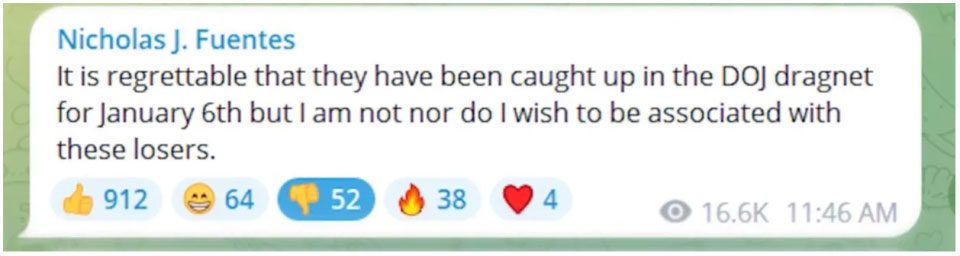
One question has dogged Fuentes for years: How does he make his money and finance his political operation? During his livestreams, fans must pay a minimum of $20 to pose questions during his Q+A sessions. He has solicited donations and hawks America First merchandise and subscriptions to his $100-a-month private Telegram channel.
Fuentes’s largest known donor to date was a French computer programmer and cryptocurrency millionaire named Laurent Bachelier. In December 2020, as right-wing factions were organizing the “Stop the Steal” protest in Washington, D.C., Bachelier transferred roughly $522,000 in Bitcoin to a network of white nationalist and neo-Nazi activists. The largest recipient, by far, was Fuentes, who received roughly $250,000. Hours after initiating the Bitcoin transfers, Bachelier committed suicide at the age of 35.
Within three months, Bachelier’s donation to Fuentes had effectively doubled in value due to a significant spike in the price of Bitcoin.
After January 6, Fuentes’s finances appear to have been briefly imperiled. The Gray Zone, an investigative outlet edited by hard-left journalist Max Blumenthal, published a purported letter that the Department of Justice sent Fuentes, stating that the DOJ had frozen accounts belonging to Fuentes on January 23, 2021. By the summer of 2021, however, the purported letter claimed DOJ had withdrawn its request to freeze the account.
In spite of this, Fuentes allegedly continued to claim publicly that his funds remained frozen. That narrative unraveled when Jaden McNeil, a former close associate and the treasurer of Fuentes’s nonprofit, said on a livestream that Fuentes had regained access to the funds, a claim corroborated by the Gray Zone’s purported records.
“He’s had that [money] back from the feds for almost a year,” McNeil said on the livestream, accusing Fuentes of using the story to raise money while, at the same time, purchasing an expensive car. “He’s a total liar.”
Over the years, Fuentes has also sought money from at least one prominent right-wing benefactor, according to sources familiar with the meeting, who spoke on the condition of anonymity. One former associate claims that in January 2022, Fuentes was scouting real estate in Tampa Bay, where he was considering moving his political operation. During the trip, the associate claims, Fuentes drove four hours to Miami to meet a then-employee of Peter Thiel, the right-wing venture capitalist who has financially backed Republican causes, including the campaigns of President Donald Trump and then-Senate candidate J. D. Vance.
Armed with a presentation, Fuentes pitched Thiel’s employee on providing funding for his show and political operation, according to multiple sources familiar with the meeting who spoke on the condition of anonymity. Thiel, one source claimed, never replied to Fuentes’s request.
Soon after, Fuentes began launching a series of public attacks not only on Thiel, whom he called “the CIA,” but also on Trump and Vance. Fuentes also now bemoans the influence of Thiel funding in right-wing circles, despite having allegedly sought out the very Thiel funding he condemns. Multiple former Fuentes associates who spoke to City Journal claim that the Thiel story is telling, as it reveals Fuentes’s true motivations: not political grievances, but personal ones.
Conversations with multiple former associates paint a picture of Fuentes’s positions as not rooted in principle, but shifting with his perceptions of personal advantage and what he perceives as threats to his ego.
“[There’s an] extraordinary gap between the way he describes himself and presents himself to his followers . . . and his real life,” said former Fuentes ally Milo Yiannopoulos. “He’s somebody who doesn’t believe in anything at all.”
Perhaps the most sordid chapter in the Fuentes story involves his relationship with Ali Alexander, a political activist and key organizer of “Stop the Steal.” In 2023, Alexander was accused of asking teenage boys for sexual photographs.
Amid the fallout from the scandal, Fuentes initially “disavowed” Alexander’s actions, while lashing out at the accusers, saying the teenaged boys were guilty of “flirting” with Alexander. “The real victim in this entire saga is me,” Fuentes said.
He had also previously downplayed the allegations on his show. “If we’re talking about rape and murder and things like that, okay, but we’re talking about flirting?” Fuentes said. “Give me a f***ing break.”
Fuentes has long been aware of Alexander’s alleged proclivities. On a livestream in 2017, Fuentes said there was “abundant evidence” that Alexander “would like to interact in a sexual way with young fashy white boys quite like myself, and like others.” In a video posted by hard-right journalist Dustin Nemos—which purportedly depicts events from November 2020, during the so-called Million MAGA March—a young-looking male, whom Nemos describes as a teenager, recounts to Fuentes a conversation in which the alleged teenager called Alexander a “pedo.” Fuentes responded: “How do people not know about it?”
Despite this history, Fuentes continued to associate with Alexander, appearing alongside him at various political events, including one Fuentes encouraged his supporters to attend. After the scandal broke, Fuentes reportedly pressured one of Alexander’s accusers to recant his allegation in exchange for securing him a job in politics. (Fuentes denied this at the time; he did not return a City Journal request for clarifying comment.) That year, Fuentes also acknowledged on a livestream that, during the Kanye West presidential campaign, he had remained in daily contact with Alexander despite the allegations. In 2024, a Colorado police department confirmed that it was working with “partner agencies” in Texas to investigate Alexander.
Alexander did not return a request for comment.
The Alexander scandal is not an aberration, but part of a broader culture within the Groyper movement. In 2022, Alejandro Richard Velasquez Gomez, a Fuentes fan who had been photographed with him at a political event, was charged with possession of child pornography and making interstate threats on a Turning Point USA event. In the aftermath of the arrest, Fuentes attempted to distance himself, saying Gomez had “nothing to do with me or America First.”
Fuentes’s own comments on sexual topics are equally disturbing. He has stated that convicted sex offender Jeffrey Epstein was “cool as f***”; has expressed skepticism about age of consent laws; and indicated he wants to marry a 16-year-old girl when he turns 30. For the Groypers, the transgression of political and sexual taboos is part of Fuentes’s appeal. The more furious the denunciations of Fuentes—racist, sexist, pedophile, Nazi—the deeper his audience digs in. “These labels don’t mean anything,” says Clodfelter, the Fuentes follower. “Those words are meaningless to us now . . . . It doesn’t affect us anymore. And Nick proves that.”
From one perspective, we might be tempted to dismiss Fuentes as a hyperreal spectacle. His Groyper movement relates to politics the same way pornography relates to sex: stripped of meaning, flattened into an image, sensationalized for personal gain.
But hyperreality does not mean unreal, and, like pornography, it can often intrude on reality in ugly and unexpected ways. Conservatives who care about the future of the movement should understand that Fuentes is corrosive. Despite his self-mythology as the most right-wing pundit in America, he is, in a real sense, a tool of the Left. Progressive activists have spent the past decade pushing the narrative that conservatives are Nazis and Donald Trump is Hitler. In Fuentes, they have finally found their man.
The spectacle moreover is not only politically corrosive, but personally corrosive to its participants. At heart, the Fuentes phenomenon is not about ideas, or ideology, or power; it is about an angry, broken young man leading other angry, broken young men down a digital trail that ends in ruin.
Fuentes might laugh about his command for his followers to “rape, kill, and die for Nicholas J. Fuentes,” explaining it away as irony or a morbid joke. But it was only a matter of time before one of his followers, lost in the cult atmosphere of the Groyper movement and unable distinguish reality from hyperreality, would take it seriously.
That is precisely what happened last January, when a black teenager named Solomon Henderson walked into Antioch High School, outside Nashville, with a 9mm pistol and fired 10 rounds into the cafeteria, killing a 16-year-old girl and injuring another student, before turning the gun on himself.
The purported manifesto Henderson left behind—a copy of which found online corresponded to contemporary news descriptions—revealed a fascination with mass shooters, including the neo-Nazi Anders Breivik, who killed dozens of children in Norway in 2011; and a pastiche of radical ideologies lifted from internet forums and imageboards. At the logical level, these ideologies, especially when set against Henderson’s racial identity, seem to make little sense. But in the freak world, populated by a rainbow of nihilists, a black teenager, drunk on the hyperreal spectacle, can murder a young girl in a school cafeteria while calling himself an “Involuntary N[*]gger” and a “Groyper Incel.”
In the manifesto, Henderson asked himself, “Is there a particular groups[sic]or people that radicalized you the most?” He weaves one answer into the subsequent list of irony-laden names—once in plain lettering, and later, in all caps: NICK FUENTES.
Ryan Thorpe](https://www.city-journal.org/person/ryan-thorpe) is an investigative reporter at the Manhattan Institute.Christopher F. Rufo is a senior fellow at the Manhattan Institute, a contributing editor ofCity Journal, and the author of*America’s Cultural Revolution
---
City Journal Subscription Department
P.O. Box 3000
Denville, NJ 07834-3000
---
wiki 7 23
city Journal is a public policy magazine and website, published by the conservative Manhattan Institute for Policy Research, that covers a range of topics on urban affairs, such as policing, education, housing, and other issues.[2]: 349 The magazine also publishes articles on arts and culture, urban architecture, family culture, and other topics.[3][4] The magazine began publishing in 1990.[1][5][6]
History
City Journal was founded in 1990 by William M. H. Hammett, who served as the head of the conservative Manhattan Institute.[2]: 349 Hammett positioned City Journal as a more moderate and more cosmopolitan alternative to established right-wing institutions.[2]: 349 The magazine initially published articles promotingprivatization, fiscal discipline, government downsizing, and educational vouchers.[2]: 349 Other New York-related topics covered in the magazine included criticisms of open admissions at CUNY, and the promotion of broken-windows policing.[2]: 349–350
2020s
During the early 2020s, City Journal has attracted widespread national attention for its role in elevating debates on critical race theory, LGBTQ+ topics in education, and similar issues in the United States.[7][8][9] Contributor Christopher Rufo, in particular, has drawn attention for writing numerous pieces in the magazine that often focus on these matters. In articles published by City Journal, Rufo has accused Seattle's Office of Civil Rights of "endorsing principles of segregationism, group-based guilt, and race essentialism",[7] highlighted Disney and Twitter workers who have been convicted of child sexual abuse,[8] suggested that there were significant levels of "'grooming' in public schools",[8] accused a California curriculum designer of wanting to make children "chant to the gods Quetzalcoatl, Huitzilopochtli, and Xipe Totek",[9] compared the diversity training conducted by the city of Seattle to "cult programming",[9] and accused an Oregon school district of promoting revolutionary Marxist ideas.[9]
Publication
The magazine is published by the conservative Manhattan Institute for Policy Research[1][10] a national free-market think tank based in New York City. It was edited by Peter Salins and then Fred Siegel in the early 1990s. Myron Magnet, its editor from 1994 to 2006, is now editor-at-large. City Journal's current editor is Brian C. Anderson, who was appointed in late 2006 after serving as senior editor for 10 years.[10]
The journal's contributors include experts such as Senior Fellow Heather Mac Donald, Edward Glaeser, Steven Malanga, Nicole Gelinas, Kay Hymowitz, John Tierney, and Joel Kotkin. Although City Journal is based in New York City, its scope is national and often international, through the contributions of writers including Theodore Dalrymple from Britain, Claire Berlinski and Guy Sorman from France, and Bruce Bawer in Norway.
The magazine was also notable as one of the first to link to blogs on its websitethat referenced it, and to engage directly with the blogosphere. City Journal has published several special issues, beginning in autumn 2009.[11] Subsequently, City Journal has put out special issues in autumn 2013,[12] summer 2016,[13] and spring 2017.[14] The 2009 and 2013 special issues were focused on policy agendas for New York State and City. In 2016, City Journal published a special issue on the state of Texas, called "Texas Rising",[13] and in 2017, City Journal considered the future of work and labor in an increasingly automated world, in an issue titled "The Shape of Work to Come".[14]
Website
All articles from the print magazine are eventually published online at City Journal's website, which also publishes original content (not from the magazine) daily, Mondays through Fridays.[citation ^needed] The first piece of new content for each week gets posted Sunday afternoon or evening.[citation ^needed] Original web pieces are generally shorter than the features in the print magazine, being typically about the length of an op-ed.[citation ^needed] They cover everything from public-policy issues and political developments to economics and popular culture.[citation ^needed]
Additionally, the website hosts City Journal's weekly podcast, 10 Blocks, which launched in February 2016.[15][16][17] 10 Blocks features discussions on urban policy and culture with host Brian C. Anderson and City Journal editors, contributors, and special guests.[15] Episodes cover topics such as: predictive policing; the Bronx renaissance; reform of the Port Authority of New York and New Jersey; homelessness in Portland, Oregon.[citation ^needed]
Reception
Much of the reception of City Journal over the years has been divided along political lines.
The magazine has received praise from the political right: the editorial board of the conservative New York Post described it as "the magazine that helped save New York City";[6] conservative commentator Jay Nordlinger, writing in National Review, called City Journal "a beacon of civilization".[5] In 2016, City Journal ranked second in The Global Grid's "Top 20 Urban Planning Websites",[15] and again made the list in 2017, ranked fourth.[16]
Alice O'Connor, a professor at the University of California, Santa Barbara, has written that City Journal is "hardly a model of ideological moderation", and that its contributors are "enmeshed in 1960s- and 1970s-era urbanology".[2]: 349 She has criticized multiple writers for City Journal for reviving a "relentlessly negative image of black cultural pathology to call for tougher measures to crack down on out-of-wedlock births", following articles praising Daniel P. Moynihan's The Negro Family: The Case For National Action.[2]: 349 Conservative author Sol Stern, a major contributor for the magazine since its inception,[2]: 349 published a piece in liberal journal Democracy in 2020, accusing City Journal of removing contributors' editorial independence, and criticized the association of magazine trustee Rebekah Mercer with the alt-right outlet Breitbart.[18]
Notable contributors
- Brian C. Anderson, editor of City Journal
- Steven Malanga, senior fellow and senior editor
- Claire Berlinski, contributor
- Coleman Hughes, contributing editor
- Theodore Dalrymple, contributing editor
- Edward Glaeser, senior fellow and contributing editor to City Journal
- Victor Davis Hanson, contributing editor
- Howard Husock, contributor
- Kay Hymowitz, senior fellow and contributing editor to City Journal
- Andrew Klavan, contributing editor
- Joel Kotkin, contributor
- John Leo, contributor
- Heather Mac Donald, senior fellow and contributing editor
- Myron Magnet, editor-at-large
- John O. McGinnis, contributor
- Judith Miller, adjunct fellow and contributing editor
- Lance Morrow, contributor
- Ian Penman, contributor
- Fred Siegel, senior fellow and contributing editor to City Journal
- Guy Sorman, contributing editor
- Harry Stein, contributing editor
- Sol Stern, adjunct fellow and contributing editor
- John Tierney, contributing editor
- Michael J. Totten, contributor
- John Stossel, video contributor
See also
---
Search
The Magazine
Podcasts
Topics
About
Subscribe
Donate
Contributors
Search by name...
Editors & Contributing Editors
Brian C. Anderson
Editor, City Journal
BrianAcity
Michael Knox Beran
Contributing Editor, City Journal
Claire Berlinski
Contributing Editor, City Journal
Paul Beston
Managing Editor, City Journal
Jonathan Clarke
Contributing Editor, City Journal
Theodore Dalrymple
Senior Fellow | Contributing Editor, City Journal
Stephen Eide
Senior Fellow | Contributing Editor, City Journal
stephendeide
Nicole Gelinas
Senior Fellow | Contributing Editor, City Journal
nicolegelinas
Edward L. Glaeser
Senior Fellow | Contributing Editor, City Journal
Judge Glock
Director, Research | Senior Fellow | Contributing Editor, City Journal
judgeglock
Victor Davis Hanson
Contributing Editor, City Journal
VDHanson
Howard Husock
Contributing Editor, City Journal
Kay S. Hymowitz
William E. Simon Fellow | Contributing Editor, City Journal
KayHymowitz
Daniel Kennelly
Associate Editor, City Journal
Andrew Klavan
Contributing Editor, City Journal
Joel Kotkin
Contributing Editor, City Journal
Theodore Kupfer
Associate Editor, City Journal
Charles Fain Lehman
Fellow | Contributing Editor, City Journal
CharlesFLehman
Glenn C. Loury
John A. Paulson Fellow
GlennLoury
Heather Mac Donald
Thomas W. Smith Fellow | Contributing Editor, City Journal
HMDatMI
Myron Magnet
Editor-at-large, City Journal
Steven Malanga
Senior Fellow | Senior Editor, City Journal
cjstevem
Rafael A. Mangual
Nick Ohnell Fellow | Contributing Editor, City Journal
Rafa_Mangual
John O. McGinnis
Contributing Editor, City Journal
Bob McManus
Contributing Editor, City Journal
James B. Meigs
Senior Fellow | Contributing Editor, City Journal
JamesBMeigs
Judith Miller
Adjunct Fellow | Contributing Editor, City Journal
JMFreeSpeech
Lance Morrow
Contributing Editor, City Journal
Aaron M. Renn
Contributing Editor, City Journal
Christopher F. Rufo
Senior Fellow | Contributing Editor, City Journal
realchrisrufo
Allison Schrager
Senior Fellow | Contributing Editor, City Journal
AllisonSchrager
Lee Siegel
Contributing Editor, City Journal
Fred Siegel
Senior Fellow | Contributing Editor, City Journal
Guy Sorman
Contributing Editor, City Journal
Harry Stein
Contributing Editor, City Journal
John Tierney
Contributing Editor, City Journal
JohnTierneyNYC
Michael J. Totten
Contributing Editor, City Journal
Adam J. White
Contributing Editor, City Journal
Contributing Writers
Cameron Abadi
Spencer Abraham
Art Acevedo
Carlos Acevedo
Ray Ackerman
Robert Adam
Eric Adams
Ian Adams
David Adler
Jason Adler
Stephen G. Adubato
Sohrab Ahmari
Shai Akabas
Beth Akers
Brian Albrecht
Alberto Alesina
J. Joel Alicea
Tanner Aliff
Brooke Allen
Charlotte Allen
Brian Allen
Elayne Allen
Gil Alterovitz
Brandon Ambrosino
Franklin Amodeo
Terry L. Anderson
John Duncan Anderson
Jeffrey H. Anderson
John Anderson
Darran Anderson
Helen Andrews
William Andrews
Adam Andrzejewski
Louis Anemone
Michael Anton
Nicholas Antongiavanni
Sarah F. Anzia
Andrew Apostolou
Josie Appleton
Claire Rydell Arcenas
Hadley Arkes
Marc Arkin
Jesse Arm
Alex Armlovich
John Armstrong
Neetu Arnold
Rav Arora
Colette Arredondo
Cliff Asness
Christopher Atamian
Michael Auslin
D. Andrew Austin
Ryan Avant
John P. Avlon
Jeremy Babener
Herman Badillo
Arvin Bahl
Rebecca Baird-Remba
Rosecrans Baldwin
Shepard Barbash
John A. Barnes
Joanna Baron
William P. Barr
Jason M. Barr
Josh Barro
Seth Barron
Corbin K. Barthold
Timothy J. Bartik
Eugénie Bastié
Suzanne Bates
Don Baton
Thierry Baudet
Fred Bauer
Mark Bauerlein
Bruce Bawer
Scott Thomas Beauchamp
Charlie Beck
Benedict Beckeld
Jillian Becker
David Beckworth
Martin Begun
Matt Beienburg
Robert J. Bellafiore
Robert Bellafiore Jr.
Judah Bellin
Bruce Bender
Robert Bendiner
Stephen Berger
Peter Berkowitz
Paul Berman
Brendan Bernhard
Michael S. Bernick
David E. Bernstein
Alain Bertaud
Jason Bertsch
Philip Bess
Amalia Betanzos
Tom Bevan
Scott Beyer
Amar Bhide
Chief Mike Biasotti (Ret.)
Robert James Bidinotto
Daniel Biederman
Leslie Bienen
Andrew G. Biggs
Aaron Biller
David Billet
Lloyd Billingsley
Carola Binder
Mathis Bitton
David Black
Ari Blaff
Charles Blain
Robert Blecker
Ethan Blevins
Marilyn Blohm
Nicholas Bloom
Peter Boettke
Peter Boghossian
Max Boot
Lea Booth
Carl Borack
George J. Borjas
Charles Bork
Donald J. Boudreaux
James Bovard
Annie Bowers
Ben Boychuk
Don Boyd
Richard Boylan
Brendan Boyle
Denis Boyles
Photographs by David Brabyn
Ben Bradlee, Jr.
Ike Brannon
William J. Bratton
Peter Braun
Jonathan Bronitsky
Harley Brooke-Hitchins
Richard Brookhiser
Arthur C. Brooks
David Brooks
Patrick T. Brown
Aaron Brown
Goldy Brown III
Larry Brownstein
Pascal Bruckner
Jacob A. Bruggeman
Charles H. Brunie
Joseph L. Bruno
Carson Bruno
Thomas Bruscino
Robert Bryce
Daniel Buck
John Buntin
Samo Burja
Guy F. Burnett
Nick Burns
Tara Isabella Burton
Jonathan Butcher
Andrew Buttaro
Bettie Cadou
Thad Calabrese
Vanessa Brown Calder
Christopher Caldwell
Brian Calle
Peter Campbell
GianCarlo Canaparo
Cara Candal
Adam Candeub
Vincent J. Cannato
Monique Canto-Sperber
Mary Cantwell
Edgar Capel
Tucker Carlson
Dick Carpenter
Matthew Carr
Thomas W. Carroll
Vincent Carroll
Colin A. Carter
Anthony T. Caso
Oren Cass
Jon Cassidy
David Castro
Dimitri Cavalli
Tim Cavanaugh
Zach Caverley
Aaron Chalfin
Edward Chancellor
Tom Chatfield
Nicole Chati
Linda Chavez
Brian Chen
Robert Cherry
Willy Chertman, M.D.
Phyllis Chesler
Charles Chieppo
Wai Wah Chin
Amy Cho
Allison Lee Pillinger Choi
Arthur Chrenkoff
Hyon S. Chu
John Chubb
Matt S. Clancy
Cullum Clark
Christopher Clausen
Matthew Clavel
Matthew Clayfield
Tim Clayton
Jeffrey Clemens
Dan Coats
Tom Coburn
John Cochrane
Peter A. Coclanis
Steve Cohen
Rory Cohen
Jules Cohn
John J. Cohrssen
Elbridge A. Colby
Ryan L. Cole
Anthony P. Coles
James Coll
Kimberly Collica-Cox
Suzanne K. Colt
Geoffrey Colvin
Tim Congdon
Roger Conner
Tim Connors
Matthew Continetti
Calvin Coolidge
Bruce Cooper
James R. Copland
Alfredo Corchado
Kevin Corinth
Mick Cornett
Richard Cornuelle
Jose Corpas
Tayfun Coskun
Edward N. Costikyan
Tom Cotton
Benita Cotton-Orr
Andrew J. Coulson
Peter Cove
Tyler Cowen
Andrew J. Cowin
Wendell Cox
Stephen G. Craig
Edward John Craig
Ryan Craig
David Crane
Edward Cranswick
Alphonse Crespo
Danny Crichton
James Cross
Stanley Crouch
L. Gordon Crovitz
Barnaby Crowcroft
Andrew Cuff
Matthew Cunningham
Graham Cunningham
Mark Cunningham
Steve Cuozzo
Mickey D. Levy
Janet Daley
Shikha Dalmia
Aswath Damodaran
Mitch Daniels
Tom Daniels
Rupert Darwall
Gene Dattel
Richard Davies
Adrienne Davis
Michael Davis
Alain de Botton
David P. Deavel
Conrad deFiebre
Kayte Deioma
Addison Del Mastro
Robert J. Delahunty
Matt DeLisi
Allan T. Demaree
Candace DeRussy
Alexandra DeSanctis
David DesRosiers
Betsy DeVos
Farrukh Dhondy
Daniel Di Martino
Joe Diamond
Paul Dicken
Charles Dickens
Noah Diekemper
C. Jarrett Dieterle
John J. DiIulio, Jr.
Daniel DiSalvo
Orphe Divounguy
Robert Doar
Matthew J. Dockery
Ray Domanico
Ben Domenech
Brian Domitrovic
Kevin Donnelly
William A. Donohue
Michael Brendan Dougherty
Eli Dourado
Rod Dreher
Michael Dresdale
Paul du Quenoy
Alex Dubin
Jordan Duecker
Charles Duelfer
Jack Dunphy
Jakob Dupuis
Ronald W. Dworkin
Kevin Dykes
John C. Eastman
R. P. Eddy
Max Eden
The Editors
Thomas B. Edsall
Regina Egea
Danyela Souza Egorov
Brian Patrick Eha
Alan Ehrenhalt
William Eimicke
Franklin Einspruch
Michael Eisenberg
June Eisland
Emily Ekins
Jonathan M. Ellen
John M. Ellis
Christopher S. Elmendorf
John Elwell
Robert Enlow
Alex Entz
Mark Epstein
Marc Epstein
Richard A. Epstein
Ethan Epstein
Gene Epstein
Edward Jay Epstein
Scott G. Erickson
Jens-Martin Eriksen
Katherine Ernst
Amitai Etzioni
Bill Evers
Milton Ezrati
Wen Fa
Graham Factor
Beth Fallon
Ryan Fazio
Flavio Felice
Gordon Feller
Gregory Ferenstein
Niall Ferguson
Jesús Fernández-Villaverde
Edward Feser
Yevgeniy Feyman
Edward Fielden
Randall K. Filer
Andrew I. Fillat
Daniel Finkelstein
Alain Finkielkraut
Ethan Finlan
William A. Fischel
Price Fishback
Zelda Fitzgerald
F. Scott Fitzgerald
Jim Fitzgerald
Adam Fleisher
John V. Fleming
Seymour Fliegel
Richard Florida
Daniel J. Flynn
Jonathan Foreman
Jennifer Formica
Tal Fortgang
Michael Javen Fortner
Michael Franck
David R. Franz
Kara Frederick
Daniel Freedman
Adam Freedman
Emma Freire
Jennifer Frey
Conor Friedersdorf
Sid Frigand
David B. Frisk
Ester R. Fuchs
Brandon Fuller
John Fund
Diana Furchtgott-Roth
Frank Furedi
James Furey
Salim Furth
James A. Gagliano
Maggie Gallagher
Scott Galloway
Nicholas Garaufis
Luis Jorge Garay-Salamanca
Gerry Garibaldi
Nicole Stelle Garnett
Richard W. Garnett
Jamie Gass
Tory Gattis
Christopher D. Geisel
David Gelernter
Colman Genn
Ginny Gentles
Robert P. George
Paul Georgia
Francesco Giavazzi
Jerry Gibbon
Michael Gibson
George Gilder
Richard Gilder
Ted Gioia
Rudolph W. Giuliani
Paul Glastris
Nathan Glazer
Jamie Glazov
Adam P. Glick
André Glucksmann
Mason Goad
Timothy Goeglein
William N. Goetzmann
Stephen Golant
Solveig Lucia Gold
Zach Goldberg
Howard Golden
Stanley Goldfarb
Samuel Goldman
Stephen Goldsmith
Eric Goldwyn
Christian Alejandro Gonzalez
Olivia Gonzalez
Mike Gonzalez
Jorge González-Gallarza
John Steele Gordon
Carolyn D. Gorman
David Gortler
Hilary Gowins
Mary Grabar
Ruth Graham
Rev. Franklin Graham
Jennifer Gratz
David Gratzer
Tom Gray
Nolan Gray
Christopher Gray
Perry Green
Dominic Green
Keith Elliot Greenberg
Allan Greenberg
Mark Lee Greenblatt
Jay P. Greene
Russ Greene
Steven Greenhut
Richard Greenwald
Tanner Greer
Samuel Gregg
William Grinker
Malka Groden
Tim Groseclose
Miriam Grossman
David M. Grossman
Eric Grover
Michael S. Gruen
Joshua Grundleger
Marie Gryphon
Allen C. Guelzo
Anthony Guglielmi
Joseph V. Gulfo
Katrina Gulliver
Craig Gundersen
Charles Gunther
Arpit Gupta
Martin Gurri
Stephanie Gutmann
Fatih Guvenen
Daniel Hadas
Tom Hafer
Jonathan Haidt
John P. Haigh
Jay Hallen
W. Dyer Halpern
Stuart Halpern
Josh Halpern
Philip Hamburger
Josh Hammer
Bill Hammond
Ralph C. Hancock
Sahil Handa
Will Hanna
Emmett Hare
Eric D. Hargan
Katie Harker
Patrick J. Harnett
Scott Harrington
Lee Harris
Connor Harris
Jeffrey E. Harris
Stephen Harrop
Oliver Hart
Jon Hartley
Michael E. Hartmann
Michael Hartney
Jonathan Haskel
Axel Haverich
Elizabeth Hawes
William Anthony Hay
Steven F. Hayward
Thomas W. Hazlett
Thomas J. Healey
Samantha Hedges
Kathleen L. Hefferon
H. Erich Heinemann
Gunnar Heinsohn
Michael A. Helfand
Peter Hellman
Anne Hendershott
David R. Henderson
Robert Henderson
Joshua Hendrickson
Kimberly Hendrickson
Michael Hendrix
Anthony Hennen
Matthew Hennessey
Joseph Henrich
Gail Heriot
Kimberly Hermann
Jennifer Hernandez
Annika Hernroth-Rothstein
Susan Hertog
Stephanie Hessler
Joe R. Hicks
César A. Hidalgo
Cameron Hilditch
Graham Hillard
Roderick M. Hills, Jr.
E. D. Hirsch, Jr.
John Hirschauer
Thomas P. Hirschfeld
Dennis Hirsh
Christopher Hitchens
Thomas Hochman
Nate Hochman
Tim Hoefer
Kurt Hofer
Thomas Hogan
Paul Hollander
Anne Hollander
Marc Holley
Douglas Holtz-Eakin
Clifton Hood
Brian Hooks
David Horowitz
Michael Horowitz
Paul Howard
Philip K. Howard
Jacob Howland
John Hrabe
Peter W. Huber
Alexandra Hudson
Cameron Tarry Hughes
Coleman Hughes
Yael Levin Hungerford
Kathleen Hunker
Carol Iannone
Peter Ireland
Erin Isikoff
Kerry Jackson
James B. Jacobs
Laura Jacobs
Joanne Jacobs
Tamar Jacoby
Jeff Jacoby
DJ Jaffe
Kevin James
Edmund Janko
Zachary Janowski
Vicki Jauron
Erik M. Jensen
Zaid Jilani
Jamil Jivani
Jason C. Johnson
Charles C. Johnson
KC Johnson
Corey Johnson
Scott W. Johnson
Daniel Johnson
Brian Jones
Garett Jones
Peter Judd
Liam Julian
Stephen Kagann
Elaine Kamarck
Stefan Kanfer
Johanna Kaplan
Joshua Kaplowitz
Philip Kasinitz
Leon R. Kass
John F. Kasson
Charlie Katebi
Joshua T. Katz
Elliot Kaufman
Eric Kaufmann
Mickey Kaus
Patricia Kean
Kristin Kearns-Jordan
Raymond Keating
Lisa Graham Keegan
John Kekes
George L. Kelling
Raymond Kelly
Thomas Kelly
Christina Kennedy
Sean Kennedy
Nora Kenney
Bernard B. Kerik
Drew Kershen
Katherine Kersten
Charles Kesler
Bruce Kesler
John Ketcham
Harrison Scott Key
Razib Khan
Aaron Kheriaty
Conrad Kiechel
Roger Kimball
J. J. Kimche
Marjorie King
Nicholas King
Ian Kingsbury
James Kirchick
Melanie Kirkpatrick
Adam Kirsch
Brian Kisida
Spencer Klavan
Amy Klein
Joe Klein
Daniel B. Klein
Adam Klein
Maury Klein
Roger D. Klein
Jonathan Klick
Mitchell G. Klingenberg
Kevin Klowden
Ivan Ko
Eric Kober
Charles Koch
Vladimir Kogan
Peter Kolchinsky
Eugene Kontorovich
Kevin R. Kosar
Moshe Krakowski
Rita Kramer
Hilton Kramer
Josh Kraushaar
Mark Krikorian
Jeffrey A. Kroessler
Samuel Kronen
Willis L. Krumholz
Lawrence Kudlow
Alicia Kurimska
Stanley Kurtz
Devon Kurtz
Malcom Kyeyune
Matthew Ladner
Arthur B. Laffer
Carol W. LaGrasse
Jacob Laksin
Eric Lane
Charles Lane
Barry Latzer
Peter Lawler
Greg R. Lawson
Jonathan Leaf
Leslie S. Lebl
Michael Ledeen
Mike Lee
Todd Lee
James Lee
Ryszard Legutko
Lewis Lehe
David A. Lehrer
Catesby Leigh
Anthony Lejeune
Mark Lennihan
John Leo
Robert I. Lerman
Jonathan A. Lesser
John Lettieri
Terrence Leveck
Matthew Levey
John-Clark Levin
Richard B. Levine
Steve LeVine
Steve Levy
Daniel S. Levy
Michael Lilley
Nick Lindblad
James Lindsay
Lawrence B. Lindsey
Daniel Lippman
Dan Lips
Karin A. Lips
Carolyn Lochhead
Albin Lohr-Jones
Arthur Lohsen
Bjørn Lomborg
Herbert London
Joe Lonsdale
Phillip Lopate
Karla López del Río
Jeremy Lott
Charles Love
David Garrard Lowe
Mario Loyola
Elli Lucas
Michael Lucci
Edward Luce
Karen Lugo
John Lukacs
Jayson Lusk
Mark Lutter
Randall Lutter
N. S. Lyons
Ari L. Maas
Bruno Maçães
Frank J. Macchiarola
John M. MacDonald
Park MacDougald
Alec MacGillis
James MacGuire
Dana Mack
Henry Mack
Sandra Mack-Valencia
Alec Magnet
Margaret Mahoney
Daniel J. Mahoney
Sahil Mahtani
Thomas Main
Carla T. Main
Christos A. Makridis
Pierre Manent
A. Benjamin Mannes
Teresa R. Manning
Bruno Manno
Harvey Mansfield
Andrew M. Manshel
Jim Manzi
Robert G. Marbut, Jr.
David Marcus
Karol Markowicz
Charles Marohn
Donald B. Marron
Damir Marusic
Jeffrey Mason
Hiroko Masuike
Joel Mathis
Micah Mattix
Paul Mauro
Eric McAfee
Kevin McCarthy
Daniel McCarthy
Andrew C. McCarthy
Jane McCarthy
Elizabeth McCaughey
Wilfred M. McClay
Patrick J. McCloskey
Neal McCluskey
Daniel J. McConville
Patti McConville
Brandon McCoy
Lewis McCrary
Franck Lohsen McCrery
James McCrery
Kerry McDonald
Charles F. McElwee
Sashi McEntee
Joseph McGettigan
Jordan McGillis
William McGowan
Ellen McKnight
E. J. McMahon
Lawrence J. McQuillan
John H. McWhorter
Lawrence Mead
Jonathan Meer
Matthew Mehan
Perry Mehrling
Kristoffer Melinder
Vanessa Mendoza
Rajan Menon
Francis Menton
Ruth Messinger
Peter Meyer
Jared Meyer
Hannah E. Meyers
Jeffrey Meyers
William Meyers
Peter Meyers
Auguste Meyrat
John Michaelson
Andrew A. Michta
Gerard Mildner
Arthur Milikh
C. M. Miller
Wade Miller
Henry I. Miller
M. Anthony Mills
Mark P. Mills
Curt Mills
Adam A. Millsap
Howard P. Milstein
Alberto Mingardi
Paulette Miniter
Brendan Miniter
Richard Miniter
Andrey Mir
Stephen Miran
Mark T. Mitchell
Joshua Mitchell
Josh Mitchell
Ali Modarres
Terry Moe
Joel Mokyr
Louis A. Molina
Lawrence J. Mone
Miguel Monjardino
Lorraine Monroe
Stephen Moore
Steven E. Moore
Dan Morenoff
Richard E. Morgan
Chris R. Morgan
Charles Morris
Will Morrisey
Josh Morrison
James Morrison
Francis Morrone
Peter Moskos
Mitchell L. Moss
Scott Mourtgos
Mark Moyar
Maura Moynihan
Daniel Patrick Moynihan
Eamon Moynihan
John C. Mozena
Russell Muirhead
Renu Mukherjee
Casey B. Mulligan
Jon Murad
Rupert Murdoch
Deroy Murdock
Peter Murphy
Philip Murphy
Robert P. Murphy
Douglas Murray
Iain Murray
Charles Murray
John M. Murtagh
Douglas Muzzio
Peter C. Myers
Christopher Nadon
Sir V.S. Naipaul
Clayton Nall
Robert Nason
Richard Nathan
Clark Neily
Diana Nelson
Philippe Nemo
Dick Netzer
Amy Neustein
Andy Ngo
Adam Nicholson
Thom Nickels
Justin Nix
Sukhayl Niyazov
Matthew Nolan
Asra Q. Nomani
Johan Norberg
Pia Nordlinger
Igor Norinsky
John O. Norquist
Rob Norton
Nicole Nosek
Jack Wade Nowlin
Thierry Noyelle
Sal Nuzzo
Connor O’Brien
Paul E. O’Connell
Dave M. O’Neill
E. M. Oblomov
Norman Oder
Stan Oklobdzija
Henry Olsen
Walter Olson
Peter Orazem
Beth Osborne
Julio M. Ottino
Adam Ozimek
Camillo Padulli
Antonio Pagan
Charles Page
Anthony Paletta
Beth Z. Palubinsky
James Panero
Pavlos Papadopoulos
Mark Pappadakis
Stephen T. Parente
Sokeel Park
Shashi Parulekar
Daphne Patai
Michael Pawel
Bill Peacock
Ian Penman
Peter Pennoyer
Lawrence Perelman
Alex Perez
Anthony Perez
Pete Peterson
Mark Peterson
Steven Philips
Melanie Phillips
James Piereson
Andrew Pincus
Nathan Pinkoski
Edward Pinto
Daniel Pipes
John J. Pitney, Jr.
Steven Pittz
Wlady Pleszczynski
Benjamin A. Plotinsky
Norman Podhoretz
Steven M. Polan
David Polansky
Mario Polèse
Michael Poliakoff
Simone Policano
Theo Mackey Pollack
Nidra Poller
Robert Pondiscio
Robert W. Poole
Chris Pope
Allen Porter
Kathleen Porter-Magee
Vinay Prasad
Stephen B. Presser
David Prowler
Mark Pulliam
Brendan Patrick Purdy
Jim Quinn
James Quintero
Alexander Raikin
Helen Raleigh
Vivek Ramaswamy
David Randall
Allen Randolph
Leif Rasmussen
Tim Raub
Joshua D. Rauh
Diane Ravitch
Tom C. Rawlings
Ray Raymond
Robert Rector
Ilana Redstone
Henry Hope Reed
Chris Reed
Shawn Regan
Ned Regan
Wilfred Reilly
Peter Reinharz
Richard M. Reinsch
Anne Lenhard Reisinger
Hon. Edward G. Rendell
John Renehan
Thomas Reppetto
Glenn Reynolds
Tim Rice
Jason Richwine
Richard Rider
Jane Ridley
Mark Riebling
Jonathan Rieder
Brian Riedl
Jason L. Riley
Naomi Schaefer Riley
Edward Ring
Allan Ripp
Alice M. Rivlin
John Robb
Matthew Robinson
Neil Rogachevsky
Dalibor Rohac
Paul Romer
Megan Rose
Joseph B. Rose
Jonathan Rose
Daniel Edward Rosen
Gary Rosen
Armin Rosen
John S. Rosenberg
Jan Rosenberg
Matt Rosenberg
Alexi Rosenfeld
Claudia Rosett
John K. Ross
Gabriel Rossman
Ian Rowe
Jeremy Rozansky
Gualberto Ruaño
Edwin Rubenstein
Noah Rudnick
Tyson Rupert
Gerald J. Russello
Sean Rust
Richard Ryan
Witold Rybczynski
Mike Sabo
Nick Saffran
Dennis Saffran
Inga Saffron
Howard Safir
Ryan Sager
Charles Upton Sahm
John D. Sailer
Reihan Salam
Eduardo Salcedo-Albarán
Peter D. Salins
Larry Salzman
Richard Sammons
Robert Samuelson
Nima Sanandaji
Ray M. Sanchez
Larry Sand
Erica Sandberg
Ross Sandler
Erika Sanzi
Paola Sapienza
Leor Sapir
Sally Satel
E. S. Savas
Jukka Savolainen
Andrew E. Scanlan
Diana Schaub
Alan Schein
Janice Meyerson Scheindlin
Martin Schell
Finnegan Schick
Arthur Schiff
Lisa Schiffren
Erin Schiller
Linda Schilling
David N. Schleicher
Stephen Schmalhofer
Daniel P. Schmidt
Christian Schneider
David Schoenbrod
Gabriel Schoenfeld
Lars Schonander
Carl J. Schramm
Peter H. Schuck
Max Schulz
Dorothy Moses Schulz
Bret Schundler
Adam Schuster
Richard Schwartz
Joel Schwartz
Stephen Schwartz
Mary Elizabeth Schwarz
David Schweikert
Oriana Schwindt
Roger Scruton
Vincent Scully
Katya Sedgwick
Lydia G. Segal
Jason Segedy
David Seidemann
John Seiler
Daniel Seligman
Will Sellers
Dave Seminara
Troy Senik
Matthew Shaffer
Hemal Shah
Wendy Shalit
Mandy Shamis
Tim Shampling
Ilya Shapiro
Saurabh Sharma
Glen Sharp
Peter Shaw
Dermot Shea
Paul Shectman
Martin Shefter
Michael Shellenberger
James Sherk
Michael Shermer
Richard J. Shinder
Amity Shlaes
Catherine Shock
Edward Short
Abigail Shrier
Lionel Shriver
Geoff Shullenberger
Haim Shweky
Aaron Sibarium
Andrew Sidamon-Eristoff
Charles Siegel
Harry Siegel
Kenneth Silber
Harris Silver
Tracy Lee Simmons
Roger L. Simon
Joseph Simonson
John Simpson
Peter Skerry
Jim Sleeper
Peter Sloterdijk
Andy Smarick
Margery Smelkinson
Shepard Smith
Van Smith
Mailee Smith
Erec Smith
Blake Smith
Bradley A. Smith
Lee Smith
Dennis Smith
Thomas Gordon Smith
Gregory Smith
Emily Esfahani Smith
Paul M. Sniderman
Timothy R. Snowball
Anne Snyder
Barbara Probst Solomon
William H. Sousa
Roy Speed
Sean Speer
Ben Speggen
Archie Spigner
Phillip Sprincin
Laurence Sprung
Justin R. St. Juliana
Samuel Stagg
Dane Stangler
Stefanie Stantcheva
Alec Stapp
Paul Starobin
Roger Starr
Shelby Steele
Eli Steele
David Steiner
Inez Feltscher Stepman
James Stergios
Sol Stern
Bezalel Stern
William J. Stern
Philip Stevens
Allan Stevo
Matthew Stewart
Brian Stewart
Mark Steyn
Jeff Stier
Frederik Stjernfelt
Alexander Stoddart
Jon Stokes
Jenna Silber Storey
Benjamin Storey
John Stossel
Thomas P. Stossel
Sandra Stotsky
Bert Stratton
Frank Straub
Barry Strauss
Matt S. Strauss
Ryan Streeter
Herbert W. Stupp
Andrew Stuttaford
Barton Swaim
Samuel Sweeney
Kathleen Sylvester
Berin Szoka
Matthew Tallmer
Angelique Talmor
John Tamny
James Taranto
Theresa Tassey
Flagg Taylor
Michelle Taylor
John B. Taylor
Terry Teachout
Anaïs Tekerian
Steven Teles
Daniel Tenreiro
Abigail Thernstrom
Paul Theroux
Adam D. Thierer
The Honorable Clarence Thomas
Derek Thompson
Luke Thompson
Bruce S. Thornton
Klas Tikkanen
Mario Timio
Ed Tinsley
Alex Titus
William H. Tobey
Emmanuel Todd
Springs Toledo
Glynn Tonsor
Marshall Toplansky
Luis B. Torres
Matthew Torres
Michael Torres
Justin Torres
E. Fuller Torrey
Justin Tosi
Elizabeth Totzke
Leo Trachtenberg
Craig Trainor
Oliver Traldi
Warren Treadgold
Alex Trembath
Ashley Trim
Frances Trollope
Tevi Troy
Manuel Trujillo
David L. Tubbs
William Tucker
Gary Tuggle
Yael Bar Tur
J. Scott Turner
Grace Twehous
Harald Uhlig
Mene Ukueberuwa
Ron K. Unz
Charles J. Urstadt
Soledad Ursúa
Bert Useem
Dennis C. Vacco
Chloé Valdary
Roger Valdez
Benjamin Van Horrick
Maribeth Vander Weele
Laura Vanderkam
Mark Vanhoenacker
Geoffrey M. Vaughan
Richard Vedder
Robert VerBruggen
Pietro Veronesi
Jacob L. Vigdor
Richard Vigilante
Susan Vigilante
Fabio Villa
Benjamin Villanti
Norah Vincent
Dr. Joseph Viteritti
Julia Vitullo-Martin
William Voegeli
Steven Volynets
Chris von Csefalvay
Tom Von Essen
Mike Wacker
Nicholas Wade
David Wagner
Robert F. Wagner Jr.
Jonathan Wai
Roger Waldinger
Gerald Walpin
Stephen J. K. Walters
Photographs by Harvey Wang
Nicholas Wapshott
Cynthia Ward
Robert Ward
Brandon Warmke
Ibn Warraq
Michael Warren
David Warren
Stone Washington
Emily Washington
David Watkin
Bill Watkins
Sam Watling
Mike Watson
Eric Wearne
Bryan Weaver
Steve Weeks
George Weigel
Jerry Weinberger
Lauren Weiner
Benjamin Weingarten
Jay Weiser
Michael Weiss
Bari Weiss
David Wells
Johan Wennström
Stian Westlake
Sam Westrop
Edith Wharton
David Whelan
Clark Whelton
Brent T. White
Barbara Dafoe Whitehead
Peter Whittle
John Widlund
Heather P. Wilford
Paul T. Wilford
George F. Will
Ryan P. Williams
Noah Williams
Terry Williams
Joanna Williams
Robin B. Williams
Jason Willick
James Q. Wilson
Franz K. Winkler
Peter Winkler
Louis Winnick
Scott Winship
Marcus A. Winters
J. Eric Wise
Oliver Wiseman
Jonathan Wolfson
Peter Wood
Adrian Wooldridge
John Paul Wright
Tom Wright
Colin Wright
Walter B. Wriston
David Wu
Ze’ev Wurman
Ilan Wurman
Rong Xiaoqing
Kenny Xu
Jianli Yang
Diane Yap
Jean M. Yarbrough
Pierre Yared
Noel Yaxley
Scott Yenor
John Yoo
Glenn Yu
Mary T. Zdanowicz
Bill Zeiser
Lee Zeldin
Jacob Zenn
Don Zhang
Fang Zheng
Fengsuo Zhou
Joel Zinberg
Luigi Zingales
Karl Zinsmeister
Salena Zito
John Zogby
Jerry Zremski
Mortimer Zuckerman
52 Vanderbilt Avenue
New York, NY 10017
(212) 599-7000
Published by
Publications
Eye on the News
From the Magazine
Podcasts
Books and Culture
Video
About City Journal
Contributors
Subscribe
Donate
Contact Us
Quick Links
Advertise
Manhattan Institute
Privacy Policy
Terms of Use
Copyright © 2023 Manhattan Institute for Policy Research, Inc. All rights reserved.
EIN #13-2912529
ggl 7 23
City Journal | Urban Affairs Magazine | Conservative ...
City Journal
https://www.city-journal.org
City Journal's 10 Blocks podcast features rich conversations on public policy and culture with host Brian C. Anderson. In the Risk Talking podcast, ...
The Magazine
Heather Mac Donald Conservative Donors: Wake Up! Right ...
About
City Journal is the nation's premier urban-policy magazine, “the ...
Search
Classical liberals have much to learn from a new book that ...
Topics
From the Magazine article ... To keep his public-safety promises ...
More results from city-journal.org »
Latest from city-journal.org
City Journal
Myth of the Starving Shoplifter
1 day ago
City Journal
Judicial Overreach on Climate Change
3 hours ago
City Journal
Government by Reason—or by Passion?
2 days ago
City Journal
Chile’s Market Victory—and Defeat
3 days ago
City Journal
Florida's General-Education Standards in Public Universities
3 days ago
City Journal
Britain's Conservatives Are Allergic to Conservatism
3 days ago
City Journal
Preserving an Open Future for Kids
3 days ago
City Journal
Misunderstanding the Establishment Clause
4 days ago
City Journal
New York's True Migrant Tradition
5 days ago
City Journal
Closing the Credentials Gap After SFFA v. Harvard
6 days ago
People also ask
Is City Journal a reliable news source?
Is City Journal peer reviewed?
Feedback
City Journal
Wikipedia
https://en.wikipedia.org › wiki › City_Journal
City Journal is a public policy magazine and website, published by the conservative Manhattan Institute for Policy Research, that covers a range of topics ...
History · Publication · Website · Reception
City Journal (@CityJournal) · Twitter
https://twitter.com/CityJournal
Opponents of Oklahoma's religious charter schools will have to reckon with one problem: there is no Separation of Church and State Clause in the U.S. Constitution. cityjourn.al/43yZ4Xd via @tal_fortgang
Twitter · 25 mins ago
At Alabama and Auburn, initiatives to boost the number of blacks have coincided with actual declines in the number of blacks. Yet no one calls such DEI efforts failures. cityjourn.al/3O919Ud via @scottyenor
Twitter · 1 hour ago
The unchecked tactics of public-health officials have become an increasing threat to Americans’ individual freedom. cityjourn.al/3pUTaBX via @CarlSchramm
Twitter · 1 hour ago
The recent decline in inflation was possible only because the Federal Reserve implemented one of the most vigorous monetary-tightening cycles in history. cityjourn.al/44Uyt7U via @SteveMiran
Twitter · 2 hours ago
A new economic history of Chile explores how intellectuals and ideas can drive real economic change. But it also illustrates that Chile’s march toward markets was more complicated than commonly realized. cityjourn.al/471jMBM
Twitter · 3 hours ago
View on Twitter
City Journal | Urban Policy Magazine
Manhattan Institute
https://manhattan.institute › city-journal
City Journal offers a stimulating mix of hard-headed practicality and cutting-edge theory, with articles on everything from school financing, policing and ...
City Journal
https://www.facebook.com › ... › City Journal
City Journal. 99210 likes · 434 talking about this. A magazine of urban affairs, published by the Manhattan Institute, edited by Brian C. Anderson.