sir david king
---
science jrnl bigger risk than terror as bush trying to bail from kyoto
---
see royal society:
led to Exxon having to dump CEI 2006?
desmog uk tag: https://www.desmog.co.uk/directory/vocabulary/765
---
API wm o'keefe tried to get ward fired?!
---
see below
...The Royal Society of the United Kingdom, for centuries a renowned arbiter of science,harshly criticized Exxon in 2006 for publishing "very misleading" statements about the IPCC's Third Assessment Report. The IPCC found that most of the observed warming of the planet in the late 20th century was probably caused by humans.[CEI ebell ctr-slap?]
The Society's communications manager Bob Ward reminded Exxon pointedly that one of its own scientists had contributed to the IPCC chapter in question.
The Royal Society said it had no problem with Exxon funding scientific research, but "we do have concerns aboutExxonMobil's funding of lobby groups that seek to misrepresent the scientific evidence relating to climate change."
Ward said Exxon was funding at least 39 organizations "featuring information on their websites that misrepresented the science on climate change, by outright denial of the evidence that greenhouse gases are driving climate change, or by overstating the amount and significance of uncertainty in knowledge."
...
---
cei ebell attack sir david king major sci advisor, PO'd parliament
https://www.vanityfair.com/news/**2007/05/**skeptic200705
:{... nearly every week brings a new alarm about global warming, Ebell stays proudly resolute—rather like George W. Bush rationalizing each new setback in Iraq. Only, with global warming, even the Bush administration is now embracing the latest I.P.C.C. report, in principle at least, and trying to make a case that Bush is now a convert to the reality of the threat. With warming, as with Iraq, alarm is growing among U.S. lawmakers:{. Recently, West Virginia Democratic senator John D. Rockefeller IV,who has championed the coal industry in his state for 30 years, teamed up with Maine Republicansenator Olympia Snoweto write a quietly impassioned letter to ExxonMobil's new chairman and C.E.O., Rex W. Tillerson. The senators asked Tillerson to have ExxonMobil cease and desist from its global-warming-denial campaign}:.
They are, they wrote, "persuaded that the climate change denial strategy carried out by and for ExxonMobil has helped foster the perception that the United States is insensitive to a matter of great urgency for all of mankind, and has thus damaged the stature of our nation internationally." In particular, they wrote, "We fervently hope that reports that ExxonMobil intends to end its funding of the climate change denial campaign of the Competitive Enterprise Institute are true."...Myron Ebell is shocked—shocked—and, of course, delighted. To be singled out among the three dozen ExxonMobil front groups is quite an honor. "Obviously it helps us with our media and general visibility," he acknowledges. In fact, ExxonMobil stopped funding C.E.I. last year.
The company has also indicated to the Royal Society, Britain's prestigious academy of science, that it is reviewing the funding of all outside groups, but insists this is an annual process.}:
The scope of that edict may not be clear until early 2008, when the company publishes its 2007 Worldwide Giving Report. Already, though, Ebell is portraying C.E.I. as "a little flyspeck" up against the awesome clout of the competition. "The major environmental groups in this country have budgets of collectively over $1 billion a year," he says. "Our budget is $3.7 million a year, of which only about a quarter goes to global warming. Add up the other [global-warming denier] groups and maybe you can get to $10 million."....
==
https://www.independent.co.uk/news/people/profiles/sir-david-king-chernobyl-created-a-negative-view-of-nuclear-technology-i-don-t-think-it-s-the-right-view-15358.html}:
indep uk
when Professor Sir David King became the Government's chief scientific adviser in October 2000 he did not have to wait long for his baptism of fire. Just four months into the job, he found himself embroiled in the political turmoil caused by Britain's worst outbreak of foot- and-mouth disease.
For a man used to the relative quiet of academia - he is professor of chemistry at Cambridge University - Sir David had to contend with the glare of publicity as well as the heavy burden of providing the scientific advice on which the Government, and the Prime Minister, would be judged.
After convening a panel of experts, Sir David provided the scientific rationale for the ruthless culling of livestock on affected farms and ones with common boundaries. It was, and still is, a deeply unpopular decision, especially when some commentators were calling for vaccination rather than slaughter. Even today there are those who say the Government should have used vaccines rather than culling, a strategy vehemently defended by Sir David who insists many people still do not understand why Britain had no choice but to kill and burn or bury thousands of animals.
"The option to vaccinate but not to subsequently kill the animals was actually not with us," Sir David says. "The Dutch government used vaccination and we did not; as a result the Dutch government had to slaughter vaccinated animals subsequently before they could begin exporting again."
The issue typifies the problems faced by science advisers having to grapple with the complexities of such an issue with major political ramifications. Vaccines against foot-and-mouth exist, but under international rules outside the Government's control, a country that uses vaccines cannot claim to be free of foot-and-mouth, which incurs heavy financial penalties in terms of exports.
The reason for not going down the vaccine route is that there is as yet no validated test to distinguish between a healthy but vaccinated animal with antibodies to the virus and an animal that is infected but shows no obvious clinical symptoms. Such facts are often overlooked, generating further misconceptions. "We need a validated test," Sir David says. "My worry is that if there were an epidemic tomorrow, the British public might be expecting vaccination to be used."
Another misconception was that vastly more cattle and sheep were killed during the epidemic than in normal years, he says. "In the year of the epidemic something like 17 million animals were culled or slaughtered. The average slaughtered in a given year was between 19 and 20 million. So we actually culled or slaughtered fewer animals than we would have slaughtered in a normal year.
"Why was that? Well something like five or six million were probably slaughtered in connection with the epidemic. That means fewer animals were going to abattoirs for food production and we were importing meat at that time.
"It's not really an issue of saving animals, it's saving hardship for farmers that we really should be focusing on. Very few people were predicting that we would emerge with a foot-and-mouth free international status in less than a few years. On 20 January 2002, we regained our FMD-free status. It was extremely rapid for the world's biggest epidemic. I think actually it was a major victory for science."
As head of the Office of Science and Technology, housed in the Department of Trade and Industry, Sir David oils the machinery of public science funding and co-ordinates the efforts of all the chief scientists within government departments. One responsibility is to oversee the Government's Foresight initiative which scans the horizon for future problems, such as the risk of severe flooding in the coming century.
But it is his interest and deep concern over climate change and global warming that has given Sir David his highest profile. Last year, in an article for the American journal Science, which was evidently directed at the Bush administration, Sir David said climate change was a bigger threat than international terrorism. He based his argument on the exceptional summer heatwave of 2003, widely attributed to climate change, when thousands of Europeans died. This was far more than in any one terrorist atrocity.
It was not the sort of message the White House wanted to hear after declaring a global war on terror and at the same time abandoning the Kyoto treaty on limiting man-made emissions of greenhouse gases such as carbon dioxide. Since then, Sir David has been targeted by American lobbyists wanting to cast doubt on his claims and even his scientific credentials.
Last November, for instance, Myron Ebell, from a Washington think-tank called the Competitive Enterprise Institute, launched a personal attack on Sir David in an interview with Radio 4's Today programme. "We have people who know nothing about climate science, like Sir David King, who are alarmist and continually promote this ridiculous claim," said Mr Ebell, who was introduced as a former adviser to the White House. "Sir David has no expertise in climate science."
Sir David, visibly irritated at the mention of Mr Ebell, says: "Do you know who he is and who pays for him? He works for this right-wing, so-called think-tank [but] I don't think there is much thinking going on. He's a lobbyist; he's never been an adviser to the White House. The White House has issued a statement denying he was ever an adviser. I believe Radio 4 fell for it when Myron Ebell said that he was an adviser to the President. There is no truth in that statement."
He is equally dismissive of Michael Crichton, the science fiction author whose latest novel suggests concerns over global warming amount to alarmist misinformation. "The man is a fiction writer and this is another example of fiction at work," Sir David says. "There is no veracity in that book whatsoever."
The criticisms of Bjorn Lomborg, the Danish economist and global warming sceptic, are a different matter. Lomborg says climate change may be happening but there is nothing we can do about it so we should concentrate on trying to minimise its impacts, especially in the developing world.
Sir David says this is an understandable view of economists who do not look beyond the next 30 years. "The impacts of climate change over the next 30 years are virtually independent of what we do about carbon dioxide emissions and the reason for this is that Earth's system is very slow to respond, there is a very large inertia in this enormous mass, so it takes time.
"Over the next 30 years if we stop carbon dioxide levels at exactly where they are now you will not get a different forward run over the next 30 years. But if you look forward, as we did with flood and coastal defences, to 2080 then you see the impacts are critically dependent on what action we take now.
"The economists are right if we are concerned only about ourselves and possibly our children, but when you start talking about grandchildren then it all goes pear-shaped."
The issue is even more pressing for developing countries which will bear the brunt of the environmental changes caused by global warming, and this is on top of their other serious problems of poverty and overpopulation. "It's been said to me that spending money on climate change is less productive than spending money on developing countries. We have to do both," Sir David says. Many scientists, including James Lovelock, the intellectual guru of the environmental movement, believe governments should build nuclear power stations because present renewable energy technology cannot replace the energy generated by burning fossil fuel. Britain's White Paper on energy has not ruled out building nuclear power stations. Last year, Sir David said we have to make a decision on whether to replace existing nuclear power stations - all but one of which will be shut by 2020 - within the next five years.
"It would be foolhardy to say we will never have the need for nuclear new build and a decision will have to be made by looking at how we are progressing on energy-efficiency gains and also the transport sector. We're going to have to re-evaluate the situation and that will be the subject if needed of a further White Paper," he says.
When pressed about whether we need to make a decision now rather than, say, after a general election, Sir David says: "If you were an alien arriving from Mars and you saw we had global warming you'd say these people are going to burn up their planet. Then they'd say, 'It's all right. They've discovered nuclear fission technology, they can cut down their CO2 production'.
"The problem with that is twofold. One is, what do we do with nuclear waste? And second, where does public acceptability stand? Chernobyl has created in the minds of many a very negative view of nuclear technology. I don't think it's the right view; the number of deaths from coal production vastly exceeds the number from all accidents in nuclear power production.
"I think responsible government has to see whether we can manage to work without nuclear power, and that's precisely what we are doing."
THE CV
Born 1939, in South Africa
Education Chemistry degree and PhD at Witwatersrand University; ScD at East Anglia University; ScD at Cambridge
Career 1963 Shell scholar, Imperial College
1966 Lecturer in chemical physics, East Anglia
1974 Brunner professor of chemistry, Liverpool
1988 Professor of physical chemistry, Cambridge
1993 Head of chemistry department, Cambridge
1995Master of Downing College, Cambridge
2000 Chief scientific adviser
2003 Knighted zzz
---
C.E.I. has become the best known of these global-warming skeptics not just because Ebell is as quotable as he is. Like the hero of Thank You for Smoking, he courts notoriety. He first made the news a few years ago when a Bush White House senior official named Phil Cooney was caught watering down language on global warming in a U.S. government report issued by the Environmental Protection Agency. Ebell, as an e-mail later showed, advised the once and future oil-industry flack on how to spin the embarrassment.
Not long after, Ebell stirred the wrath of the British Parliament by declaring in a BBC radio interview that the U.K.'s chief scientific adviser, Sir David King, had made a "ridiculous claim" on global warming despite knowing "nothing about climate science." The House of Commons proposed a motion to censure Ebell. (The motion never passed, Ebell says wistfully.) Last year, C.E.I. ran a public-service commercial on television about carbon dioxide so cheeky it verged on parody. "They call it pollution," ran the tagline about CO2. "We call it life." Ebell was delighted at the howls it provoked.
==
According to the government's chief scientist, Sir David King, while the evidence continues to grow, what we really need to see is action to avoid the worst impacts of climate change.
"Action is affordable, inaction is certainly not," said Sir David at the Greenpeace Business lecture on global warming in London.
As scientists around the world study the changes in our climate going back almost a million years, they confirm what many of us know, climate change is already here.
===
The Foreign Secretary appointed Sir David King as his new permanent Special Representative for Climate Change in September 2013. Sir David was previously the Government’s Chief Scientific Advisor from 2000 – 2007, during which time he raised awareness of the need for governments to act on climate change and was instrumental in creating the Energy Technologies Institute. He also served as the Founding Director of the Smith School of Enterprise and Environment at Oxford; was Head of the Department of Chemistry at Cambridge University 1993-2000 and Master of Downing College at Cambridge 1995 -2000.
Sir David has published over 500 papers on science and policy, for which he has received numerous awards, and holds 22 Honorary Degrees from universities around the world. Elected a Fellow of the Royal Society in 1991, a Foreign Fellow of the American Academy of Arts and Sciences in 2002 and knighted in 2003, Sir David was also made an Officier of the French Legion d’Honneur’ in 2009, for work which has contributed to responding to the climate and energy challenge.
Special Representative for Climate Change
Special representatives use their expertise to develop a greater coherent effort in making sure that the FCO works closely and effectively with foreign powers.
==
Professor Sir David King was appointed as the UK Foreign Secretary’s Special Representative for Climate Change (full-time) in September 2013. Sir David was previously the Government’s Chief Scientific Advisor from 2000 – 2007, working with Prime Ministers Blair and Brown [labor] , during which time he raised awareness of the need for governments to act on climate change and was instrumental in creating the Energy Technologies Institute. He also served as the Founding Director of the Smith School of Enterprise and Environment at Oxford, 2008 – 2012. Some of his other appointments include the Chair of Future Cities Catapult, Chancellor of the University of Liverpool, Senior Scientific Advisor to UBS, and Adviser to President Kagame of Rwanda.
He was born in Durban, South Africa, educated at St John’s College Johannesburg and at Witwatersrand University, and graduated with an Honours degree in Chemistry, 1960, and a PhD, 1963.
He is a physical chemist working in surface science and catalysis. He was the Brunner Professor of Physical Chemistry, University of Liverpool, 1974 – 1987, and subsequently the 1920 Professor of Physical Chemistry at Cambridge University, 1987 – 2000, Head of the Department of Chemistry, 1993-2000, and Master of Downing College at Cambridge, 1995 -2000. He has published over 500 papers on surface science and heterogeneous catalysis, and on science and policy, for which he has received many awards, medals etc. including: the Rumford Medal of The Royal Society, 2002; the Linnaeus Medal, Sweden, 2007; the Jawaharlal Nehru Birth Centenary Medal, Indian National Science Academy, 2007; the Arthur W. Adamson Award, the ACS, 2009; and the Symons Medal, Association of Commonwealth Universities, 2013. He has received 23 Honorary Degrees from universities around the world.
Elected Fellow of the Royal Society in 1991; Foreign Fellow of the American Academy of Arts and Sciences in 2002; knighted in 2003; and made “Officier dans l’ordre national de la Légion d’Honeur” in 2009.
==
https://en.wikipedia.org/wiki/Gordon_Brown
PM Labour
---
---
kert WSJ inside exxon strat many docs in discovey finder 1988 frank sprow
https://www.wsj.com/business/energy-oil/exxon-climate-change-documents-e2e9e6af}:
"Inside Exxon’s Strategy to Downplay Climate Change" | SEJ
no lnx
WSJ NEWS EXCLUSIVE
Inside Exxon’s Strategy to Downplay Climate Change
Internal documents show what the oil giant said publicly was very different from how it approached the issue privately in the Tillerson era
By Christopher M. Matthews
and Collin Eaton
Sept. 14, 2023
2487 RESPONSES
Exxon Mobil issued its first public statement that burning fossil fuels contributes to climate change in 2006, following years of denial. In public forums, the company argued that the risk of serious impact on the environment justified global action.
Yet behind closed doors, Exxon took a very different tack: Its executives strategized over how to diminish concerns about warming temperatures, and they sought to muddle scientific findings that might hurt its oil-and-gas business, according to internal Exxon documents reviewed by The Wall Street Journal and interviews with former executives.
Exxon’s public acceptance in 2006 of the risks posed by climate change was an early act of Rex Tillerson, an Exxon lifer who became CEO that year. Some viewed him as a moderating force who brought Exxon in line with the scientific consensus.
The documents reviewed by the Journal, which haven’t been previously reported, cast Tillerson’s decadelong tenure in a different light. They show that Tillerson, as well as some of Exxon’s board directors and other top executives, sought to cast doubt on the severity of climate change’s impacts. Exxon scientists supported research that questioned the findings of mainstream climate science, even after the company said it would stop funding think tanks and others that promoted climate-change denial.
Exxon is now a defendant in dozens of lawsuits around the U.S. that accuse it and other oil companies of deception over climate change and that aim to collect billions of dollars in damages. Prosecutors and attorneys involved in some of the cases are seeking some of the documents reviewed by the Journal, which were part of a previous investigation by New York’s attorney general but never made public.
One of the lawsuits is from Hawaii’s Maui County, where wildfires killed more than 100 people in August. The lawsuit, filed in 2020, alleged the island faced increased climate-related risks, including more dangerous wildfires, caused by fossil-fuel companies. Some of the lawsuits may go to trial as soon as next year.
:{“I know how this information looks—when taken out of context, it seems bad,” Exxon CEO Darren Woods said in response to the Journal’s inquiry about the documents. “But having worked with some of these colleagues earlier in my career, I have the benefit of knowing they are people of good intent. None of these old emails and notes matter though. All that does is that we’re building an entire business dedicated to reducing emissions—both our own and others—and spending billions of dollars on solutions that have a real, sustainable impact.”}:
Under Woods, who became CEO in 2017, Exxon has committed to spend $17 billion over five years on emissions-reducing technologies. Exxon didn’t address detailed questions sent by the Journal.
WHAT’S NEWS
Exclusive: Exxon’s Strategy to Downplay Climate Change
Tillerson declined to comment through a representative.
Exxon turned millions of pages of documents over to the New York attorney general during that office’s yearslong investigation, announced in 2015, into whether the company misled investors about the impact of climate regulation on its business. The Journal reviewed summaries of the documents that Exxon’s lawyers had determined were the most significant. After the attorney general narrowed the focus of the case, the documents weren’t made public.
The documents summarize emails between top executives, board meetings and Tillerson’s edits of speeches, among other things.
After a nearly three-week trial in 2019, Justice Barry Ostrager of the New York State Supreme Court ruled the New York attorney general failed to prove its case.
“Nothing in this opinion is intended to absolve Exxon Mobil from responsibility for contributing to climate change,” Ostrager wrote.
Throughout Tillerson’s tenure between 2006 and 2016, Exxon executives in their internal communications attempted to push back against the notion that humans needed to curtail oil and gas use to help the planet—despite the company’s public statements that action was needed.
In 2012, after the pre-eminent scientific authority on climate change warned of global calamity if carbon emissions continued unabated, Tillerson disagreed and directed Exxon researchers to “influence” the group.
As pressure mounted to stop drilling in the Arctic due to rapid glacial melting and other environmental impacts, Exxon fretted about a key project in Russia’s far north and worked to “de-couple climate change and the Arctic.”
July 2013
Exxon’s deal to explore the Arctic with Russia’s Rosneft came amid
growing public concern about melting polar ice caps. In an email discussion
with other executives about how to protect the project, a corporate issues
adviser wrote:
“
As this shapes up, part of the moral argument for leaving the Arctic alone
will be based on this notion that it is fundamentally unjust for the people
who prompted the ice melt to then profit from development. It’s one reason
I think we will need to push back hard- albeit in a nuanced way- against this
notion that the whole area is ‘pristine’ and untouched by the hand of man.”
“The general perception is that Tillerson was softer and stopped funding the bad guys” that were espousing climate change denial, said Lee Wasserman, the director of the Rockefeller Family Fund, a charity that partly focuses on environmental issues. “This is the first X-ray into Tillerson’s head and shows he wanted to throw climate mitigation off the rails. It’s obituary-changing.”
The fund has issued grants financing litigation and other support for around two dozen cases against Exxon, whose predecessor, Standard Oil, was founded by family patriarch John D. Rockefeller. The fund has invested millions of dollars in a broader campaign against big oil companies.
Seminal warning
A study published earlier this year in the journal Science determined Exxon’s climate modelers had predicted warming temperatures with precision since the 1970s, in line with the scientific consensus. The study was funded, in part, by a grant from the Rockefeller Family Fund.
In the summer of 1988, NASA scientist James Hansen issued what’s now seen as a seminal warning on climate change when he testified before Congress that Earth was warming dangerously and humans were causing it.
Frank Sprow, then Exxon’s head of corporate research, sent a memo to colleagues a few months later articulating what would become a central pillar of Exxon’s strategy.
“If a worldwide consensus emerges that action is needed to mitigate against Greenhouse gas effects, substantial negative impacts on Exxon could occur,” wrote Sprow. “Any additional R&D efforts within Corporate Research on Greenhouse should have two primary purposes: 1. Protect the value of our resources (oil, gas, coal). 2. Preserve Exxon’s business options.”
Sprow’s memo was adopted by Exxon as policy, he said in a recent interview.
Exxon stopped most internal climate research, instead funding it through university and research organizations, Sprow said. Exxon’s corporate research division was redirected from broader scientific study to focus on “science to support our business.”
Sprow said he and former Exxon CEO Lee Raymond acknowledged the climate was changing but questioned to what extent human activity was causing it and how serious and rapid the impacts would be. The January study in Science said that Exxon’s climate modelers mostly attributed the changes to humans.
Martin Hoffert, who worked as a consultant to Exxon on climate science in the 1980s, said Sprow’s memo sent another message: “It’s an oblique way of saying we’re in the oil business and we’re not going to get out of the oil business, and we’ll do everything we can to make money on the oil business.”
By the time Tillerson became CEO in 2006, Exxon’s positions on climate change had become a public-relations nightmare, according to Sprow, who retired from the company in 2005.
Public shift
Exxon’s public shift on climate change came after the Royal Society, a British scientific academy, criticized the company for spreading “inaccurate and misleading” views on climate science in 2006. Exxon responded in a letter that it recognized “the accumulation of greenhouse gases in the Earth’s atmosphere poses risks that may prove significant for society and ecosystems.”
An Eagle Scout and a civil engineer by training, Tillerson spent his entire career at Exxon before becoming CEO in 2006. He left in 2017 to become then-President Trump’s Secretary of State.
His views on climate change were influenced by the previous generation of Exxon executives, said former company executives who worked with him. During his tenure, Tillerson took little action to curb the company’s emissions and instead believed the onus was on governments to push companies to address climate change, they said.
In 2011, scientists working for the Intergovernmental Panel on Climate Change, convened by the United Nations, warned of global calamity if carbon emissions caused temperatures to rise more than 4 degrees Celsius above preindustrial levels by 2100, its worst-case scenario.
Tillerson told a top Exxon climate researcher the scenario was “not credible,” the documents show. Tillerson was “dissatisfied with media coverage,” the researcher, Haroon Kheshgi, told colleagues in a 2012 email about the findings. Further, Tillerson wanted to engage with IPCC “to influence [the group], in addition to gathering info.”
Chris Field was the co-chair of an IPCC working group during Tillerson’s tenure at Exxon. He rejected Tillerson’s criticism that the worst-case scenario laid out by the group wasn’t credible. Though emissions reductions are preventing the worst case, Field said, the science has held up over time.
“I’m honestly flattered that he thought IPCC was consequential enough to want to influence it,” said Field, who is now director of the Stanford Woods Institute for the Environment. He added that the IPCC process is structured to prevent undue influence from individual businesses or other entities and that the Exxon scientists he’d dealt with were professional.
While Tillerson and others played down the risks posed by climate change, Exxon’s scientists were themselves modeling alarming increases in carbon emissions without dramatic reductions in fossil-fuel consumption.
“It’s almost reluctantly that we address C02 emissions,” Scott Nauman, a corporate planning manager, wrote in a January 2009 email as the company was preparing its annual energy outlook. “It is not a positive story. Global emissions continue to rise throughout the outlook timeframe – that’s clearly a cause for concern.”
Exxon routinely pushed back against the idea that dramatic curtailment of fossil-fuel consumption was necessary. Instead, it suggested that technological solutions, including making cars and other machines more efficient, were the most effective measure to halt global warming. Fossil fuels are responsible for more than 75% of the world’s greenhouse gas emissions, according to the IPCC.
Before giving a speech at an event hosted by Stanford University’s Global Climate & Energy Project in February 2009, Tillerson appeared to make edits to avoid embracing positions that would hurt Exxon’s business.
In one part of the draft speech he crossed out “oil, natural gas and coal will not meet all of the world’s needs to the year 2030.” Later, he added, “the most cost effective steps we can take to address this energy and environmental challenge is to extend our energy efficiency gains.”
Weeks earlier, Nauman had concluded in his January email that emissions would increase through 2030 despite such gains.
“We would like them to be lower, but given the state of technology, given the need for energy, given the practical choices for energy, emissions rise despite aggressive efficiency gains,” Nauman wrote.
‘Skeptic arguments’
In 2008, Exxon announced it would stop funding think tanks and other groups that questioned climate science, saying their positions “could divert attention from the important discussion on how the world will secure the energy required for economic growth in an environmentally responsible manner.”
Exxon researchers continued to support scientific research that cast doubt on climate science and its impacts, documents show.
Later in 2008, Gene Tunison, a manager of global regulatory affairs and research planning, said Exxon should direct a scientist to help the American Petroleum Institute, the industry’s influential lobbying group, write a paper about climate science uncertainty.
“I support [Exxon] co-authoring a paper on uncertainty in measuring GHGs,” Tunison wrote in an email.
May 2012
Exxon researchers met regularly about developments in climate science
but continued to discuss doubts about the scientific consensus. Ahead of
a meeting dubbed ‘Friday climate overview’ among Exxon’s top climate
scientists, one researcher said:
“Under ‘some skeptic arguments disproven’ - my question is, are there any
‘skeptic’ arguments that we consider to be not yet disproven, or credible
and worthy of further investigation?”
Tillerson also pushed back against some of the dire consequences of rising temperatures predicted by climate scientists. After a 2011 meeting, Tillerson’s chief of staff, William Colton, emailed colleagues about the CEO’s feedback on a draft disclosure about carbon emissions. Tillerson wanted the words “weather extremes and storms” deleted.
“His view was that even mentioning a possible connection between climate change and weather was possibly giving the notion more credibility than he would like,” Colton wrote.
During a 2012 board meeting about “Developments in Climate Science and Policy,” Exxon board member Peter Brabeck-Letmathe said there was “still uncertainty in predicting future climate changes and impacts.”
“Money and effort spent on climate change is misplaced,” said Brabeck-Letmathe, the former CEO of Nestlé.
In December 2015, Exxon publicly stated its support of the just-signed Paris climate agreement, a nonbinding United Nations treaty that commits countries to work to limit global warming to well below 2 degrees Celsius. Climate scientists have warned that if Earth warms more than 2 degrees it could cross irreversible climate tipping points. During his Senate confirmation hearing to become Secretary of State in 2017, Tillerson said he supported staying in the agreement.
Months before the treaty was signed, Tillerson had expressed skepticism about its aims.
Following a presentation on climate science to Exxon’s board of directors in April 2015, Tillerson called the 2 degrees target “something magical,” according to a summary of the meeting.
“Who is to say 2.5 is not good enough,” said Tillerson, noting that it was “very expensive” to cut the emissions needed to meet such a target.
June 2015
Tillerson received regular updates on climate science from Exxon’s chief
researchers and in some instances asked about uncertainty in
climate-change modeling. An Exxon executive wrote Kheshgi:
“Rex called this afternoon with a couple of pretty detailed questions on
climate science: [1] Do climate scientists understand and are they able to
quantify the radiative forcing/GHG/climate impacts of events like
volcanos and forest fires. If so, how and how well? Is there differentiation
between major events like Mt Pinatubo and other much smaller events?
[2] Does the climate modeling community include these events and
effects in their climate models and projections of future temperatures and
impacts? If so, how and how well? Are these types of events/impacts a
major or minor source of uncertainty?”
“When people like Tillerson argue that 2 degrees is magical, it’s in the context of how you try,” said Field, the former IPCC co-chair. “Two degrees can be affordable with the right costs and benefits globally, even if it is not the right costs and benefits for Exxon.”
Last week, the United Nations warned countries are far from meeting the Paris agreement’s goals. Exxon said in August that the world isn’t currently on track to reach the targets of the agreement, which it continues to support publicly.
Shortly after replacing Tillerson in 2017, Darren Woods spread the word that he was in search of transformative new ideas. A plan to invest in offshore wind projects made its way to the most senior levels of the company, according to people familiar with the proposal. Karen Hughes, a former top official in the George W. Bush administration and an adviser to Exxon, said she counseled that investing in renewable energy would be good for the environment and improve the company’s reputation.
To date, Woods hasn’t invested in renewable energy, arguing it’s a low-return business outside Exxon’s skill set. Instead the company has vowed to spend about $3.4 billion a year on average through 2027 curbing its emissions and helping other companies do the same, and investing in areas including carbon capture, biofuels and lithium mining. It also recently struck a deal to buy Denbury, which operates a large network of pipelines that move carbon dioxide, for about $5 billion.
Exxon currently plans to spend as much as $25 billion a year in capital expenditures through 2027, mostly on oil and gas.
Write to Christopher M. Matthews at christopher.matthews@wsj.com and Collin Eaton at collin.eaton@wsj.com
: 87990cbe856818d5eddac44c7b1cdeb8}:
Appeared in the September 15, 2023, print edition as 'Inside Exxon’s Climate Two-Step'.
---
wiki 2 25
Sir David Anthony King (born 12 August 1939)[1] is a South African-born British chemist, academic, and head of the Climate Crisis Advisory Group (CCAG).
King first taught at Imperial College, London, the University of East Anglia, and was then Brunner Professor of Physical Chemistry (1974–1988) at the University of Liverpool. He held the 1920 Chair of Physical Chemistry at the University of Cambridge from 1988 to 2006, and was Master of Downing College, Cambridge, from 1995 to 2000: he is now emeritus professor. While at Cambridge, he was successively a fellow of St John's College, Downing College, and Queens' College. Moving to the University of Oxford, he was Director of the Smith School of Enterprise and the Environment from 2008 to 2012, and a Fellow of University College, Oxford, from 2009 to 2012. He was additionally President of Collegio Carlo Alberto in Turin, Italy (2008–2011), and Chancellor of the University of Liverpool (2010–2013).
Outside of academia, King was Chief Scientific Adviser to the UK Government and Head of the Government Office for Science from 2000 to 2007. He was then senior scientific adviser to UBS, a Swiss investment bank and financial services company, from 2008 to 2013. From 2013 to 2017, he returned to working with the UK Government as Special Representative for Climate Change to the Foreign Secretary. He was also Chairman of the government's Future Cities Catapult from 2013 to 2016.
Early life and education
King was born on 12 August 1939 in South Africa, son of Arnold Tom Wallis King, of Johannesburg, director of a paint company, and Patricia Mary Bede, née Vardy.[2][3][4] His elder brother, Michael Wallis King (born 1937), was director of the FirstRand bank and vice-chair of the multinational mining company Anglo American plc.[5] King was educated at St John's College, an all-boys private school in Johannesburg. He studied at University of the Witwatersrand, graduating with a Bachelor of Science (BSc) degree and then a Doctor of Philosophy (PhD) degree in 1963.[6]
Academic career
After his PhD, King moved to the United Kingdom where he was a Shell Scholar at Imperial College, London, from 1963 to 1966.[6] He was then a lecturer in the School of Chemical Sciences of the University of East Anglia from 1966 to 1974.[6][7] He was appointed Brunner Professor of Physical Chemistry at the University of Liverpool in 1974. He was a member of the National Executive of the Association of University Teachers from 1970 until 1978, and served as its president for the 1976/77 academic year.[6]
In 1988, King was appointed 1920 Professor of Physical Chemistry at the University of Cambridge. He subsequently served as Head of the University's Department of Chemistry from 1993 to 2000, and was its director of research from 2005 to 2011. When he first moved to Cambridge in 1988, he was elected a Fellow of St John's College, Cambridge. He moved from St John's when he was elected Master of Downing College, Cambridge, in 1995. He stepped down as Master in 2000, and was then a Fellow of Queens' College, Cambridge, from 2001 to 2008.[6]
From 2008 to 2012, King was Director of the Smith School of Enterprise and the Environment at the University of Oxford.[1] He was also a Fellow of University College, Oxford, from 2009 to 2012.[6] He was President of Collegio Carlo Alberto in Turin, Italy, from 2008 to 2011,[6][8] and was Chancellor of the University of Liverpool from 2010 to 2013.[6][9]
Research
King has published over 500 papers on his research in chemical physics and on science and policy.[1][10]
During his time at Cambridge, King had, together with Gabor Somorjai and Gerhard Ertl, shaped the discipline of surface science and helped to explain the underlying principles of heterogeneous catalysis. However, the 2007 Nobel Prize in Chemistry was awarded to Ertl alone.[11]
Career outside academia
King was the Chief Scientific Adviser to the UK Government and Head of the Government Office for Science from October 2000 to 31 December 2007, under prime ministers Tony Blair and Gordon Brown.[12] In that time, he raised the profile of the need for governments to act on climate change and was instrumental in creating the £1 billion Energy Technologies Institute. In 2008 he co-authored The Hot Topic on this subject.[13]
During his tenure as Chief Scientific Adviser, he raised public awareness for climate change and initiated several foresight studies. As director of the government's Foresight Programme, he created an in-depth horizon scanning process which advised government on a wide range of long-term issues, from flooding to obesity.[14][15] He also chaired the government's Global Science and Innovation Forum from its inception. King advised the government on issues including: the foot-and-mouth disease epidemic 2001; post 9/11 risks to the UK; GM foods; energy provision; and innovation and wealth creation. He was heavily involved in the government's Science and Innovation Strategy 2004–2014. He suggested that scientists should honour a Hippocratic Oath for Scientists.[citation needed]
In April 2008, King joined UBS, a Swiss investment bank, as senior science advisor.[6][16] He left UBS to return to the UK government when he was appointed the Foreign Secretary's Special Representative for Climate Change in September 2013.[10][17]
From 2013 to 2016, King was the first chairman of the Future Cities Catapult, a government-funded body conducting research into smart cities.[18][19]
In May 2020, in response to the COVID-19 pandemic, King formed and led Independent SAGE, a committee of unpaid experts which acts as a "shadow" of the UK government's SAGE group to address concerns of lack of transparency and political influence on that body.[20]
Views
Climate change
In his role as scientific advisor to the UK government King was outspoken on the subject of climate change, saying "I see climate change as the greatest challenges facing Britain and the World in the 21st century" [21] and "climate change is the most severe problem we are facing today – more serious even than the threat of terrorism*".[22][23]
He strongly supports the work of the IPCC, saying in 2004 that the 2001 synthesis report "*is the best current statement on the state of play of the science of climate change, and that really does represent 1,000 scientists".[24]
King criticised the Bush administration for what he saw as its failures in climate change policy, saying it is "failing to take up the challenge of global warming".[25]
In 2004, King gave evidence to a House of Commons select committee confirming his view that "on a global and geological scale that climate change is the most serious problem we are faced with this century", and illustrated it with a statement that "Fifty-five million years ago was a time when there was no ice on the earth; the Antarctic was the most habitable place for mammals".[26][27]
The Independent on Sunday reported that King had at a later event compared current and projected carbon dioxide levels with the record over the past 60 million years, and in an indirect quote suggested King implied that Antarctica was likely to be the world's "only" habitable continent by the end of this century if global warming remains unchecked.[28]
At the end of the 2007 programme "The Great Global Warming Swindle", broadcast on Channel 4, Fred Singer ridiculed the reported view of the "chief scientist"; King's complaint to Ofcom that the programme was unfair and had not given a chance to clarify was upheld, despite Channel 4's arguments that King was not named and had not challenged earlier reporting. [29]
King became head of the Climate Crisis Advisory Group in 2021, basing public meetings on a similar format to Independent SAGE, and publishing reports advising emission cuts and carbon dioxide removal.[30] He promotes the CCAG's 4R planet pathway: Reducing emissions; Removing the excess greenhouse gases (GHGs) already in the atmosphere; Repairing ecosystems; strengthening local and global Resilience against inevitable climate impacts.[31][32]
Food production
King told The Independent newspaper in February 2007 "he agreed that organic food was no safer than chemically-treated food" and openly supported a study by the Manchester Business School that implicated organic farming practices in unfavourable CO2 comparisons with conventional chemical farming.
In an article published in The Guardian in February 2009, King is quoted as saying that "future historians might look back on our particular recent past and see the Iraq war as the first of the conflicts of this kind – the first of the resource wars" and that this was "certainly the view" (that the invasion was motivated by a desire to secure energy supplies) he held at the time of the invasion, along with "quite a few people in government".[33]
Energy
King is a strong supporter of nuclear electricity generation,[34] arguing that it is a safe, technically feasible solution that can help to reduce emissions from the utilities sector now, while the development of alternative low-carbon solutions is incentivised.[35] In the transport sector, King has warned governments that conventional oil resources are more scarce than they believe and that peak oil might approach sooner than expected.[36] Moreover, he has criticised first generation biofuels due to the effect on food prices and subsequent effect on the developing world. He strongly supports second generation biofuels, however, which are manufactured from inedible biomass such as corn stover, wood chips or straw. These biofuels are not made from food sources[37] (see food vs fuel).
King is a member of the Global Apollo Programme and headed its public launch in 2015. The programme calls for multinational research into reducing the cost of low-carbon electricity generation.
Humanism
King is a Distinguished Supporter of Humanists UK.[38]
Covid response
In July 2020 King advocated for school closures in the UK until covid cases were reduced to 1 in a million.[39]
Honours and awards
King was knighted in the 2003 New Year honours.[40] In 2009, he was made a Chevalier of the Légion d'Honneur by the French government.[10]
In 1991 he received the BVC Medal and Prize, awarded by the British Vacuum Council.[citation needed] He was elected a Fellow of the Royal Society (FRS) in 1991,[41] a Foreign Fellow of the American Academy of Arts and Sciences in 2002,[10] and an Honorary Fellow of the Royal Academy of Engineering (HonFREng) in 2006.[42]
In media
King appears in the film The Age of Stupid, released in February 2009, talking about Hurricane Katrina. He was portrayed by David Calder in the 2021 BBC television film The Trick.[43]
===
grist 2006?
British Prime Minister Tony Blair has earned a rep as a global leader in the fight against climate change, and, at least in part, he has Sir David King to thank for it.
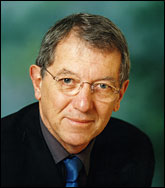
Sir David King.
King, the U.K. government’s chief scientific adviser and an outspoken advocate of aggressive action to forestall global warming, has pushed the climate crisis up the PM’s priority list. He was instrumental in making the U.K. the first nation to commit to greenhouse-gas reductions that go beyond Kyoto, and in positioning climate as one of two top issues at last year’s G8 summit, hosted by Blair.
King’s headline-grabbing rhetoric has put climate change in the spotlight, and King himself in the hot seat. He’s become a target of the American right and been publicly heckled by U.S. climate skeptics during lectures. He has also raised the ire of some in the environmental community for arguing that nuclear power, gasified coal, and carbon sequestration are necessary weapons in the battle against global warming.
---
Your comment that climate change poses a bigger threat to humanity than terrorism turned a lot of heads internationally. How did you come to this conclusion?
That sentence originated from an article I wrote in Science. I pointed out that, for example, the 30,000 deaths in Europe from the hot summer of 2003 — which have been closely correlated to global warming — indicate the kind of security problems we are faced with.
Let me be clear: I in no way diminish the threat of terrorism to our society and way of life, quite the reverse. It is a very serious threat. But I don’t think it is even comparable to the threat to our civilization that global warming represents.
How did you help bring climate change to the prime minister’s attention?
I engineered an invitation to give a lecture on the current state of climate-change science in 2002, the Zuckerman Lecture [PDF], that went around to all the cabinet and many influential people in British government. The most important turning point was the decision the prime minister made very quickly after that — he is, by the way, a very decisive sort of person — to look at the U.K.’s energy policy in light of global-warming science. That led to further research and eventually a white paper in 2003 that committed the government to reducing carbon dioxide 60 percent by 2050. It was the first time a government had come forward and said, “We are going to go beyond Kyoto.”
Was it intended as a challenge to other heads of state to follow suit?
In part. We put ourselves on that path so as to provide Britain with a strong position in negotiating with other countries. The prime minister has followed this up with clear advice to his cabinet ministers to raise the profile of climate change worldwide. I became his unofficial ambassador on the matter, and in the past 18 months, I’ve delivered over 140 lectures on climate science around the world at his behest.
What was the 60 percent CO2 reduction figure based on?
It was consistent with figures from the Intergovernmental Panel on Climate Change. Without reductions of 60 percent by mid-century, I believe the melting of the Greenland ice sheet would be irreversible, and sea levels would rise by seven meters from that alone. Knowing that the world’s great cities are on coastlines and would therefore be underwater, we felt that was something to be avoided.
What would the global-warming impacts be on the U.K.?
We did the most detailed analysis yet conducted of the impact of climate change on any one country, examining the flood and coastal defense risks for the U.K. over the next 80 years. It demonstrates that if we globally continue burning fossil fuels at the current rate, by 2080 it will be extremely difficult to protect British homes and cities from coastal flooding, fluvial flooding, and flooding from rainfall in our cities.
Are you already seeing impacts?
Rainfall patterns are already changing across cities. Just in the last decade, we’ve been seeing flash floods from tropical storms that bring a lot more water to our cities than we’ve previously experienced. Our drainage and sewage systems are not able to cope, so we get massive flooding.
Many of the politicians and oil-industry executives of the U.K., such as Lord John Browne of BP, are seen as global leaders on the climate issue. Why, would you say, are your leaders ahead of the game on this matter?
It’s a nontrivial fact that the U.K. has always been very interested in the weather. Remember that Britain developed its leadership position through trade and war. In order to be one ahead of the opposition, you need to predict weather better than they do. So our meteorological office is placed within the military, which means it has always been exceptionally well funded. That’s why the Hadley Center, which is in the Ministry of Defense, is a world leader on modeling climate change. It is widely respected in the U.K., both by our leaders and our citizens. A recent opinion poll revealed that about 90 percent of the British public believes that global warming is a real threat.
You’ve been heckled at your lectures by U.S. climate skeptics who argue that climate science is “in its infancy” — an opinion that has also been voiced by members of the Bush administration.
I’ve been chased around by several people funded by the Competitive Enterprise Institute who make these kind of statements that simply fly in the face of all the evidence. To say that climate science is in its infancy is quite simply puerile. The greenhouse effect was established by [Joseph] Fourier back in 1827. By 1896, [Svante] Arrhenius had calculated that we would see global warming by five degrees centigrade if the amount of CO2 in the atmosphere doubled. That’s pretty close to what current scientists are saying. So the state of knowledge is 100 years old plus.
What’s your opinion of the Bush administration’s approach to climate change, in particular its argument that both Kyoto and domestic regulations could pose a threat to the U.S. economy?
What I’m not going to be able to do is criticize any other government. I can say that in Britain our economy since 1990 has grown by about 40 percent, and our emissions have decreased by 14 percent. So to argue that you destroy your economy by reducing emissions is blatantly incorrect.
Furthermore, we feel we have a competitive advantage in getting into the Kyoto CO2-trading program early; we believe it is an incredibly important new commodity exercise that will spur crucial technology development and soon begin to pay dividends for our country.
You were quoted in a recent BBC article as saying that the U.K.’s targets of reducing carbon dioxide emissions 20 percent below 1990 levels by 2010 are “a bit optimistic.” Why?
Meeting the 2010 target will be challenging, despite the significant program of action under our 2003 white paper. The key problem is the rapid decline in the contribution of nuclear power to the U.K.’s energy mix that will be seen over the next decade as existing plants reach the end of their lives. Ministers are currently considering what further steps can be taken to get back on track, but it will be a tough call.
So do you worry that your mid-century targets are not achievable?
I will not deny that significant further policy and technology innovation will be needed over time for this to happen. I do think that we have the framework right and will see emissions continue to decline significantly to 2020 and beyond. The targets do not need to be adjusted; they are achievable.
To what extent will nuclear play a role in achieving these targets?
Deploying a range of technologies to radically decarbonize our energy systems over just a few decades is a challenge that should not be underestimated. We need every tool in the bag to address it. Even taking the most optimistic projections, dramatic investments in energy efficiency and renewables will not be enough. I believe the government is right to revisit now the question of new nuclear. The question of nuclear waste is of course an important one. It is worth noting that the next generation of nuclear plants would add only around 10 percent to the U.K.’s nuclear waste pile over a 40-year period, given the greater efficiency of more modern reactors.
What about coal generation and carbon sequestration?
It also seems certain that fossil fuels — coal and gas — will continue to contribute significantly to meeting U.K. and global energy needs for at least the majority of this century. This is a political and practical reality that it is important to acknowledge. Carbon capture and storage technologies offer the possibility to address this.
What have you personally and the British government in general done to improve your energy efficiency?
I drive around in a Toyota Prius. The government car service in London is shifting over to hybrid-engine vehicles as fast as we can get them. We are also deploying energy-efficiency measures on government buildings and bolstering public transport systems.
The bigger point, however, is that there’s a tremendous effort within our government to get more people into science and technology. We are doubling our funding in this area and now producing more science, engineering, and technology graduates as a proportion of 22-year-olds than almost any other country in the world.
How much progress do you think was made at the recent Montreal climate negotiations in the effort to forge a foundation for a post-Kyoto international agreement?
Excellent progress was made in Montreal on a number of important fronts, including strengthening of the practical mechanisms for reducing greenhouse-gas emissions under the Kyoto Protocol and the agreement to launch a process for targets beyond 2012. Perhaps the most encouraging aspect for me was the very constructive approach to the discussions adopted by developing nations such as China and India.
But it is of obvious importance that any future framework be inclusive, bringing in the U.S. and involving fully key developing nations. There is no question that the international community has a long way to go if it is to minimize the risk of the most dangerous climate-change impacts occurring.
===
[### Sir David King: world should abandon Kyoto protocol on ...

The Guardian
https://www.theguardian.com › environment › jul › dav...](https://www.theguardian.com/environment/2011/jul/15/david-king-abandon-kyoto-protocol)
Jul 15, 2011 — UK's former chief scientist calls instead for a system where each nation is awarded a carbon emissions quota based on population.
[### Japan's climate policy 'failed to build on the legacy of Kyoto'

The Guardian
https://www.theguardian.com › environment › dec › ja...](https://www.theguardian.com/environment/2022/dec/10/japan-climate-policy-failed-to-build-on-the-legacy-of-kyoto)
Dec 10, 2022 — “The Kyoto protocol is regarded as an important milestone in climate action, as it was the first opportunity for countries to work together to ...
[### The Kyoto Protocol: A Post-Mortem

The New Atlantis
https://www.thenewatlantis.com › publications › the-ky...](https://www.thenewatlantis.com/publications/the-kyoto-protocol-a-post-mortem)
The Kyoto Protocol is a treaty intended to ration the use of energy in order to address the concerns of those who believe that we face a global warming ...
[### SIR-DAVID-KING - C&EN

Chemical & Engineering News
https://cen.acs.org › articles › SIR-DAVID-KING](https://cen.acs.org/articles/82/i49/SIR-DAVID-KING.html)
King is notably vocal, and often controversially so, on global warming and climate change. ... "In Britain, we've already got beyond our Kyoto commitments.
[### An interview with Sir David King, Britain's top scientist and ...

Grist.org
https://grist.org › article › griscom-little](https://grist.org/article/griscom-little/)
Feb 18, 2006 — He was instrumental in making the U.K. the first nation to commit to greenhouse-gas reductions that go beyond Kyoto, and in positioning climate ...
---