Graham Platner
---
GGL
7 26
AI Overview
The query likely refers to the Maine U.S. Senate race where Democrat Graham Platner faced heavy scrutiny and ultimate exit from the race following sexual assault and abuse allegations. Platner and the Democratic campaign dismissed several accusers as GOP operatives, specifically identifying former girlfriend and political activist Lyndsey Fifield. [1, 2, 3, 4]
The Identity of the Platner Accuser
The individual described by Platner's campaign as a "lifelong GOP operative" is Lyndsey Fifield. [1]
- Background: Fifield is a conservative political activist and registered Republican who has worked for the Heritage Foundation and briefly on Nikki Haley's 2024 presidential campaign. [1]
- Platner's Defense: In response to initial reports detailing allegations of abuse and volatile relationships, Platner's campaign asserted that Fifield had a "well-documented political agenda" to protect Republican interests. [1, 2]
- The Response: Fifield has publicly denied that her political affiliation motivated her decision to speak out, stating that she would have come forward regardless of Platner's party. [1]
Political Aftermath & Scandal
- Accusations: Fifield alleged that Platner exhibited violent behavior and removed condoms without consent during their relationship. Another ex-girlfriend similarly accused Platner of sexual assault, allegations he has continually denied. [1, 2, 3, 4]
- Platner's Departure: Due to the stacked controversies and the loss of support from major national and state Democrats, Platner officially suspended his campaign. [1]
- GOP Strategy: The Maine Senate seat is a key target for Democrats, but with Platner's exit, Republicans are seizing the opportunity to launch an $8 million ad campaign against the eventual Democratic replacement. [1]
Human Voices on the Platner Situation
Political figures have weighed in on how to navigate the allegations, and accusers have shared their frustrations with the way the media and the campaigns have handled their stories. [1, 2, 3]
Ex-Girlfriend Lyndsey Fifield on Media & Politics
An ex-girlfriend of Senate candidate Graham Platner expressed frustration that her accounts were framed by politics.  , 2]
“Fifield alleged the NY Times played up her story and political views to boost the Platner campaign.”
 New York Post
Representative Ro Khanna on the Accusations
Democratic leadership faced divided decisions on how to respond to the controversies. [1, 2]
“Obviously, if there was any evidence that comes out that there is actual domestic violence or assault, I have zero tolerance for that.”
 The Guardian
---
an 7 26 signor
There are many instructive lessons to be learned about the rise and fall of now-former Maine Democratic Senate candidate Graham Platner, who dropped out of the race last week lastunder enormous pressure after a credible rape allegation was made against him. One I want to focus on is how he was chosen, shaped and pruned by political operatives who bear a large portion of the responsibility for what happened here.
One of them at least, Dan Moraff, probably should not work in politics again. This guy allegedly actually tried a few years ago to get a journalist to delete quotes made by a candidate in an already published article because they were too critical of Donald Trump—more on that further down—as Moraff went about his usual behavior of molding candidates into something he thought would sell better to the electorate.
Let me be clear that I’m all for bringing in new and fresh candidates, and we surely need progressive fighters. That is not the issue here. The problem is that the progressive out-of-state consultants who encouraged Platner to run are just as bad as the people in the Democratic establishment who groom candidates with poll-tested talking points and political posturing. Policies and problem-solving for the people take a back seat to winning at any cost.
Last month, after so much had come out about Platner, Moraff told the Wall Street Journal in a video short accompanying a larger piece about him in the paper that he wasn’t worried about Platner’s Nazi tattoo or the vile Reddit posts that had come out at that time. (The meager vetting missed the tattoo but had some of the Reddit posts.)
“Part of our thesis here is that people do not want their candidates grown in vats,” Moraff told the WSJ reporter, alluding to the Democratic establishment, which is risk averse and has been dismally choosing middle-of-the-road, unexciting candidates who are not right for our times. “They want people who are real human beings, and they want people who do not look and sound like the vat-grown people who’ve been leading this country off a cliff for the last century, and that was Graham.”
On the criticism of the Democratic establishment, we certainly agree. And at about the same time as the interview, I defended Platner from the ludicrous attacks coming from Republicans vilifying him as “immoral” while they embrace the rapist in chief, Donald Trump.
But Moraff is just as guilty of creating candidates “in a vat” as the people he’s criticized.
As The New York Times last week described Platner’s rise, “Last July, in a small town in coastal Maine, a couple of progressive, self-styled recruiters of economic populists showed up at the blue-shingled house of Graham Platner, a little-known oyster farmer and Marine veteran who lived largely off government benefits.”
They had been looking around for a candidate who could take on Republican Susan Collins and were studying quite a few people, according to various reports. They apparently heard about Platner via local activists and had seen a video of him discussing oyster farming. They were taken by the working-class vibe (though Platner is from a wealthy family), the fact that he was a war veteran, his left-leaning politics, and his gruff demeanor. They’d decided they’d found their guy and made the case to Platner, who clearly was enthralled.
The initial headhunters, Dan Moraff and Leanne Fan, and then a third out-of-state operative they called up to Maine — Morris Katz — told Mr. Platner he was “the one,” a “hero of the movement,” “a historical figure” who could be “leading a revolution,” according to half a dozen people with knowledge of their conversations.
But a clutch of people who cared about Mr. Platner were telling him something else. They worried about his mental health, amid his ongoing efforts to heal from post-traumatic stress disorder after tours in Iraq and Afghanistan. They feared this trio of out-of-state operatives was a dangerous combination of inexperienced and overconfident. The worst-case scenario, they thought, wasn’t running for Senate and losing — it was destroying the life he worked hard to build.
Read the boldface text there. I don’t mean to make Platner into the victim here—he’s not, having credibly been accused of raping a woman and having hidden it from his advisers, Democratic leaders, and voters—but it’s clear that he was a very troubled individual who was sold something by a group of people who chose him right out of central casting, getting him all ginned up on the idea of winning a Senate race.
Moraff and his team didn’t do a full vetting, which would take weeks and cost $20,000 per month on retainer, opting for an expedited review that took a few days. They clearly missed a lot.
But this was something Moraff had done before, having come off a string of failures as a strategist. And it needs more attention. After working as a “super volunteer” on Bernie Sanders’ campaign in 2016, and then having an early victory in recruiting progressive activist Summer Lee to run for a state legislative seat in 2018 in Pennsylvania—she won, and then was successful in getting elected as a U.S. House member in 2022—Moraff ran into problems. Per the Wall Street Journal:
Moraff’s backers call him a brilliant disrupter with a fresh perspective who doesn’t mind rubbing people the wrong way to win. But his work for Platner fits a pattern of management of previous campaigns, according to more than a dozen people who have worked with him over the last decade. In particular, candidate vetting has been a frequent source of tension.
In Pittsburgh, the WSJ reports, Moraff “was involved in Turahn Jenkins’s 2018 campaign to take on the county’s district attorney, Stephen Zappala Jr. Less than a week into his campaign, progressive groups backed away from Jenkins when it emerged that he belonged to a church that held antigay views.”
Also in Pennsylvania, Moraff told local journalist Mike Elk that he was recruiting Bryan Pietzrak, a General Electric locomotive factory worker, to run for Congress in Erie in 2022. According to Elkin a piece he wrote this week, Moraff called him while he was out of the country working on a story in Brazil and urged him to remove anti-Trump quotes attributed to Pietzrak from a 2020 piece Elk had written.
Moraff explained at length that Pietzrak’s quote against Trump could hurt his chances of appealing to Trump voters in Erie. I told him deleting a quote as a political favor would violate journalistic ethics. He insisted I do it even after I said no.
Cajoling me, Moraff told me that, “No one would know that I deleted the quote.” I told him that wasn’t the issue, and that it was unethical, so I refused. He told me to forget the conversation and never mention it to anyone. It’s important to know Moraff asked me to lie for a candidate he was recruiting.
In New York, as reported by the WSJ, “Moraff worked as campaign manager for state Senate candidate Debbie Medina. Her 2016 admission that she beat her son as a child with a belt derailed her campaign. The revelation came after older testimony from the sentencing of her son in a murder trial surfaced.”Clearly, another bad vetting issue.
Moraff recruited a candidate in Iowa this year to run for the Senate, Nathan Sage, a veteran and former executive director of the Knoxville Chamber of Commerce. Again, he didn’t do a full vetting, just an expedited one. In this case it appears Sage, who wasn’t getting traction, dropped out in part because Moraff seems to have abandoned him, turning his sights to Maine and Platner, a shiny new object. According to the WSJ:
Sage said Moraff, who showed up at his workplace unexpectedly and convinced him to run, shifted his attention almost entirely from Iowa to Maine once he found Platner. He would sporadically make calls and join meetings only to criticize the campaign’s strategy or offer ideas that didn’t align with Sage’s views and the electorate in Iowa.
Moraff apparently doesn’t delve into policy much, except to tell his candidates “to back Medicare for All and characterize the Israel-Hamas conflict as a genocide,” the WSJ reports, “but beyond that, doesn’t believe voters care about detailed proposals.” For Platner, he apparently crowdsourced policy proposals from activists on Discord, basically just seeing what would play to the crowd.
There’s no question that Chuck Schumer and Democrats in the DC establishment share the blame here, as they refused to draw upon the dynamic candidates in Maine who are now being looked at as Platner’s replacement. They went instead with Gov. Janet Mills, who just didn’t have the fight and wouldn’t bring in younger voters. Few elected officials in Maine then probably wanted to take on the sitting governor the establishment had coalesced around.
This encouraged the very situation we have, in which progressives from out of state came in, did a search, chose Platner, and built support around him. So yes, the Democratic establishment by far isn’t unscathed. But that doesn’t absolve Moraff and his team for the sloppy vetting and for what we would later learn was a disorganized campaign with little money on hand,as Susan Collins had bankrolled ten times more. That is all on them.
And it also shows that they were doing the same thing they accused the establishment of doing: molding a hand-picked candidate, feeding him policy mantras and stage-crafting a campaign.
---
graham-platner-sexual-assault-allegation-00987737
By Jessica Piper and Adam Wren
07/06/2026 03:18 PM EDT
A woman who dated Maine U.S. Senate candidate Graham Platner says he forced her to have sex with him nearly five years ago despite her repeated objections, an allegation Platner denies.
The woman, a 41-year-old Maine resident named Jenny Racicot, detailed the alleged incident to POLITICO in three interviews over the past two weeks. POLITICO also spoke with a man Racicot dated and confided in the years after the alleged incident, and reviewed documents, including emails between Racicot and her therapist and messages between Racicot and an acquaintance whom she warned against getting involved with Platner years before he ran for office.
Racicot said she had an on-and-off relationship with Platner, who is now the Democratic Senate nominee in Maine, for more than two years before he entered her rural Maine home uninvited one night in late 2021, deeply intoxicated, and forced himself on her while she repeatedly told him to stop. She said she cut off contact with him after telling him the encounter was not consensual.
“I remember him grabbing my pelvis and being really forceful of me,” she said. “I remember the specific moment where I thought to myself, like, ‘This is no longer my choice.’”
Platner denied the allegations.
“These allegations are troubling, serious, and false. Any accusation of non-consensual behavior is categorically untrue,” he said in a statement.
Racicot previously described “reckless” and “unsettling” behavior by Platner to The New York Times, but says she didn’t go public with the specific assault claim because she didn’t want to be known as a rape victim.
Racicot said she later felt compelled to go public about her experience because the reaction to the Times story was dominated by controversy about another woman, Lyndsey Fifield, who alleged Platner mistreated her and faced attacks because of her ties to the Republican Party. (Contacted by POLITICO, Fifield stood by the allegations she made to the Times and declined to comment further.)
...
DM LOL?! SCOOP?
---
BS
:{:{NO ONE COULD POSSIBLY HAVE PREDICTED THISFROM NICKY}:
7 26
I I what I think is interesting about this and and I do think we can say it's problematic um
is here you have this individual who you know when I sat down with him in October I I asked him you know what why are you
wearing the scarlet D around your neck why would you do that and he said well the only reason I'm doing it is to get access to act blue so I can raise money
so here you have this individual that doesn't want to be a Democrat I actually don't think you know, has openly said, he's not going to vote for the
Democratic leadership, is an acolyte of Bernie Sanders, who also doesn't want to call himself a Democrat. And what are these individuals able to do? They're
:
able to take over a the Democratic party. Um, and to me, this is a this echoes the same and it is of the same
:
type of problem that we saw in 2016. an individual who never really wanted to be a Republican, was a Democrat for most of his personal life, bursts out on the
scene and ends up taking over the Republican party. So, the the deeper problem, the the longer uh term problem
is the the just hollowess of our organized party life. And I get that there's very few defenders of our
two-party system. that our our politics, our political system, our constitution only works with two healthy robust
political parties. And when they can be hijacked um by by outsiders, um parties are not
1:29
1 minute, 29 seconds
able to do the work of selecting candidates, of building consensus, uh you know, of of of doing the the work of democratic persuasion.
 Nicholas Jacobs Goldfarb Family Distinguished Chair in American Government, Colby College; Institute for Humane Studies
IT wasn’t a surprise, but it was a bombshell.
*On July 6, 2026, Politico published the detailed account of a Maine woman who said she had been sexually assaulted by Maine Democratic Senate nominee Graham Platner almost five years ago. Platner called the allegation “categorically untrue,” then said he was “taking the time to reflect on the best path forward.”
Platner had gained the fervent support of progressives in Maine and outside. But he had been dogged by accusations of, variously, racist, misogynist and dishonest behavior – he claimed not to have known the meaning of an SS tattoo on his chest. But his supporters remained behind him.*
Soon after the assault allegations appeared, the Platner campaign was in trouble. His early political champion, Sen. Bernie Sanders, took a day to echo what party officials and once-supportive social media stars had almost immediately demanded: that Platner drop out of the campaign. By the evening of July 8, Platner had suspended his campaign.*
*Politics and legal affairs editor Naomi Schalit spoke with political scientist Nicholas Jacobs, who has followed the campaign and talked with Platner directly in 2025.
An NPR host yesterday opened an interview with a Maine reporter by observing, “A lot going on in your little state.” Maine has two senators, just like other states. Why is this such a high-profile race?
I thought when I moved to Maine in 2019 from Virginia, I was going to the quiet countryside. Politics has been anything but since then. Maine was destined to be in the national spotlight this year because Republican Sen. Susan Collins is up for reelection, running for her sixth consecutive term in office. Every time she is up for reelection, she is viewed as a vulnerable incumbent, if not the most vulnerable incumbent, in the Republican Party. So we were destined to get lots of outside money and outside attention before the whole Platner story even began.

Colby College political scientist Nicholas Jacobs explains why he believes Platner’s rise points to a bigger issue: the growing ability of outsider candidates to take over America’s political parties.
In the past, candidates generally emerged from a pipeline – electoral experience, vetting by the party. They did not emerge out of candidate recruitment by outsiders or party critics. But nationally we’re seeing that kind of insurgent recruitment, including with Platner. Is this a new kind of politics?
Political scientists have been thinking about that question for quite a long time. As far back as the early 1970s they started thinking about how changes to the structure of these party organizations, in particular the rules governing the nomination process, began to produce a different type of candidate. Those changes sat side by side with different types of technologies that I think also increased the likelihood of a candidate-centered campaign.
Now, you could say we’re living in an anti-establishment era, which might mean that voters on the right and the left are more disposed or more likely to favor candidates who are running against the establishment.
As unusual as Graham Platner is, this style of politics is increasingly more common. In 2010, scholars were becoming attuned to something known as the “invisible primary.” That’s where a lot of endorsements among party elites and interest group activists, well before voters had any say in the primary process, meant these insiders had come to some sort of consensus on who the candidate should be.
There’s a flip side of that, which is mirrored in Donald Trump in 2016 and in some of these progressive insurgencies of the past couple of years. Would-be candidates themselves and activist organizations are able to put forward potential contenders for nomination outside of that traditional system where you work your way up through legislative office. That’s clearly what happened with Platner.
In 2025, individuals associated with the Bernie Sanders presidential campaign – now sort of the Bernie Sanders machine – came up to Maine looking for candidates. They found a guy who did an ad against some Norwegian salmon commercial fisheries, realized he was cut straight from central casting, and that’s how we got Graham Platner.
Don’t let yourself be misled. Understand issues with help from experts
Is there a connection between Platner’s populism and why his deeply engaged supporters weren’t able to look past his obvious problems?
Donald Trump, as a populist candidate, has been able to let scandal after scandal just roll off his shoulders. The left was very critical of Trump supporters forgiving him, to the extent that even Trump himself famously says he can stand in the middle of Fifth Avenue, shoot someone and people will still support him.
There’s an equivalency with Platner, and some of it has to do with a populist style of politics. Platner and Trump really excel, as all populists do, in defining who they’re against, at identifying the enemy, whether it’s immigrants, the deep state, the swamp, the oligarchy or the establishment.
Both Platner and Trump have viewed the national media as an enemy. Every scandal, every attack, every criticism that’s levied at the leader of a populist movement seems to vindicate their idea that there’s some larger force out there trying to take them down. The sexting scandal that broke about a month ago, it was the Platner campaign itself that said this was a hit job, a smear from The New York Times.
There is a sizable mass of individuals in the state, including some elected Democrats, who view this latest set of allegations of sexual assault that Politico reported as a fabricated hit job from the Democratic establishment.
Graham Platner and Sen. Bernie Sanders, left, join hands at an event in Orono, Maine, on May 24, 2026. AP Photo/Robert F. Bukaty
If the critics are the enemy, then Maine’s Democratic Party has a serious problem in terms of who gets to be the next candidate.
Not every Democrat in Maine is ride or die with Platner, nor were they when he did a very impressive job in getting the most votes ever in the Democratic primary last month, after Gov. Janet Mills had suspended her campaign.
The Mills campaign really never mobilized. By early spring here in Maine, when Mills tried to fight back, she ran one set of ads calling out some post that Platner had written diminishing sexual assault, particularly in the military. The left in the state attacked her pretty strongly, saying, “You’re going to weaken our candidate. This isn’t right.”
The fact that a lot of the women who were featured in the ad were Democratic Party stalwarts kind of played into this idea that it was the establishment taking on the insurgency. Several months later, it seems they might have had a point.
Are there lessons from what happened with Platner?
The simple, shallow lesson is this was just bad campaign strategy.
People came in and recruited Platner and just didn’t do enough opposition research. So the next time that they come in and pull somebody out of central casting, they just would want to hire better lawyers to dig up dirt on their own candidate.
But what’s problematic about this is something else.
I sat down with Platner in October 2025. I asked him, “Well, why are you wearing the Scarlet D – for Democrat – around your neck? Why would you do that?
And he said, "The only reason I’m doing it is to get access to Act Blue, so I can raise money.” Act Blue is the Democratic Party’s main fundraising platform.
*Editor’s note: The Conversation has reached out to the Platner campaign for a comment and will update this story if it receives one.
So you have this individual who doesn’t want to be a Democrat. He’s openly said he’s not going to vote for the Democratic leadership. He’s an acolyte of Bernie Sanders, who also doesn’t want to call himself a Democrat. What are such individuals able to do? They’re able to take over the Democratic Party.
This is the same type of problem that we saw in 2016: An individual who never really wanted to be a Republican, who was a Democrat for much of his life, bursts out on the scene and ends up taking over the Republican Party.
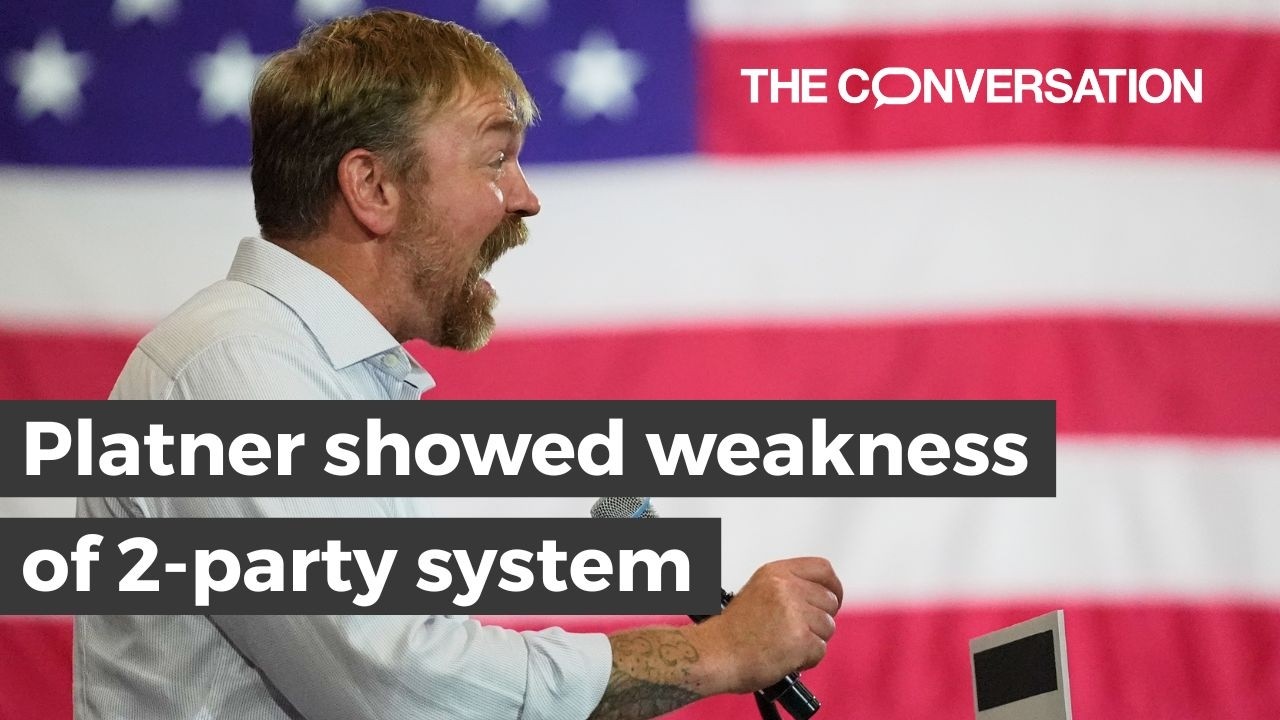
So the deeper, longer-term problem is the hollowness of America’s organized political party life. I get that there are very few defenders of our two-party system, but our politics, our political system, our Constitution only work with two healthy, robust political parties.
When they can be hijacked by outsiders, parties are not able to do the work of selecting candidates, of building consensus, of doing the work of democratic persuasion. You might say it becomes an entirely different political game altogether.
{This story has been updated to reflect Platner’s withdrawal from the Senate race.*}:
---
REF WSJ
The ‘Mad Scientist’ Behind Graham Platner’s Scandal-Plagued Rise
Dan Moraff rushed vetting of the Maine Senate candidate. He says he’s trying to blow up the way Democrats run campaigns.
By
and
June 21, 2026
Rushing to launch Graham Platner’s Senate bid, Dan Moraff, a progressive up-and-comer and Platner’s top strategist, asked a Democratic research firm to vet the political novice.
A thorough background check of a Senate candidate, which has become standard practice in key races, can take several weeks and cost roughly $20,000 or a monthly retainer. Moraff asked for an expedited, cheaper review to be done within days, according to people familiar with the matter.
Election 2026
The Red Flag That Led to Graham Platner’s Implosion Was Hiding in Plain Sight
July 9, 2026

-
---
Election 2026
The Chaotic Sweepstakes to Replace Graham Platner Has Begun
20 hours ago
-
---
Election 2026
Graham Platner Ends Maine Senate Campaign After Sexual-Assault Allegation
July 8, 2026
-
---
Politics Newsletter
Yes, Platner Is Out. But There Is Plenty of Other Midterm Drama.
7 hours ago
-
---
Politics and Policy
The Democratic Influencer Who Helped Bring Down Graham Platner
July 9, 2026
Cheyenne Hunt says problem of sexual misconduct by powerful men goes ‘beyond partisan lines.’
-
---
Election 2026
Bernie Sanders Urges Graham Platner to Exit Senate Race
July 7, 2026

-
---
Disclosure statement
Nicholas Jacobs does not work for, consult, own shares in or receive funding from any company or organization that would benefit from this article, and has disclosed no relevant affiliations beyond their academic appointment.
Partners

Institute for Humane Studies provides funding as a member of The Conversation US.
---
UPDATE MAINE MON
NO ONE COULD POSSIBLY HAVE PREDICTED THIS
7 26
I I what I think is interesting about this and and I do think we can say it's problematic um
is here you have this individual who you know when I sat down with him in October I I asked him you know what why are you
wearing the scarlet D around your neck why would you do that and he said well the only reason I'm doing it is to get access to act blue so I can raise money
so here you have this individual that doesn't want to be a Democrat I actually don't think you know, has openly said, he's not going to vote for the
Democratic leadership, is an acolyte of Bernie Sanders, who also doesn't want to call himself a Democrat. And what are these individuals able to do? They're
:
able to take over a the Democratic party. Um, and to me, this is a this echoes the same and it is of the same
:
type of problem that we saw in 2016. an individual who never really wanted to be a Republican, was a Democrat for most of his personal life, bursts out on the
scene and ends up taking over the Republican party. So, the the deeper problem, the the longer uh term problem
is the the just hollowess of our organized party life. And I get that there's very few defenders of our
two-party system. that our our politics, our political system, our constitution only works with two healthy robust
political parties. And when they can be hijacked um by by outsiders, um parties are not
1:29
1 minute, 29 seconds
able to do the work of selecting candidates, of building consensus, uh you know, of of of doing the the work of democratic persuasion.
 Nicholas Jacobs Goldfarb Family Distinguished Chair in American Government, Colby College; Institute for Humane Studies
IT wasn’t a surprise, but it was a bombshell.
*On July 6, 2026, Politico published the detailed account of a Maine woman who said she had been sexually assaulted by Maine Democratic Senate nominee Graham Platner almost five years ago. Platner called the allegation “categorically untrue,” then said he was “taking the time to reflect on the best path forward.”
Platner had gained the fervent support of progressives in Maine and outside. But he had been dogged by accusations of, variously, racist, misogynist and dishonest behavior – he claimed not to have known the meaning of an SS tattoo on his chest. But his supporters remained behind him.*
Soon after the assault allegations appeared, the Platner campaign was in trouble. His early political champion, Sen. Bernie Sanders, took a day to echo what party officials and once-supportive social media stars had almost immediately demanded: that Platner drop out of the campaign. By the evening of July 8, Platner had suspended his campaign.*
*Politics and legal affairs editor Naomi Schalit spoke with political scientist Nicholas Jacobs, who has followed the campaign and talked with Platner directly in 2025.
See Naomi Schalit’s activity on LinkedIn BERZERK MURKY MAINE WBUR
An NPR host yesterday opened an interview with a Maine reporter by observing, “A lot going on in your little state.” Maine has two senators, just like other states. Why is this such a high-profile race?
I thought when I moved to Maine in 2019 from Virginia, I was going to the quiet countryside. Politics has been anything but since then. Maine was destined to be in the national spotlight this year because Republican Sen. Susan Collins is up for reelection, running for her sixth consecutive term in office. Every time she is up for reelection, she is viewed as a vulnerable incumbent, if not the most vulnerable incumbent, in the Republican Party. So we were destined to get lots of outside money and outside attention before the whole Platner story even began.
Colby College political scientist Nicholas Jacobs explains why he believes Platner’s rise points to a bigger issue: the growing ability of outsider candidates to take over America’s political parties.
In the past, candidates generally emerged from a pipeline – electoral experience, vetting by the party. They did not emerge out of candidate recruitment by outsiders or party critics. But nationally we’re seeing that kind of insurgent recruitment, including with Platner. Is this a new kind of politics?
:{:{Political scientists have been thinking about that question for quite a long time.}:
STANFORD EDU
As far back as the early 1970s they started thinking about how changes to the structure of these party organizations, in particular the rules governing the nomination process, began to produce a different type of candidate. Those changes sat side by side with different types of technologies that I think also increased the likelihood of a candidate-centered campaign.}:
Now, you could say we’re living in an anti-establishment era, which might mean that voters on the right and the left are more disposed or more likely to favor candidates who are running against the establishment.
As unusual as Graham Platner is, this style of politics is increasingly more common. In 2010, scholars were becoming attuned to something known as the “invisible primary.” That’s where a lot of endorsements among party elites and interest group activists, well before voters had any say in the primary process, meant these insiders had come to some sort of consensus on who the candidate should be.
There’s a flip side of that, which is mirrored in Donald Trump in 2016 and in some of these progressive insurgencies of the past couple of years. Would-be candidates themselves and activist organizations are able to put forward potential contenders for nomination outside of that traditional system where you work your way up through legislative office. That’s clearly what happened with Platner.
In 2025, individuals associated with the Bernie Sanders presidential campaign – now sort of the Bernie Sanders machine – came up to Maine looking for candidates. They found a guy who did an ad against some Norwegian salmon commercial fisheries, realized he was cut straight from central casting, and that’s how we got Graham Platner.
Don’t let yourself be misled. Understand issues with help from experts
Is there a connection between Platner’s populism and why his deeply engaged supporters weren’t able to look past his obvious problems?
Donald Trump, as a populist candidate, has been able to let scandal after scandal just roll off his shoulders. The left was very critical of Trump supporters forgiving him, to the extent that even Trump himself famously says he can stand in the middle of Fifth Avenue, shoot someone and people will still support him.
There’s an equivalency with Platner, and some of it has to do with a populist style of politics. Platner and Trump really excel, as all populists do, in defining who they’re against, at identifying the enemy, whether it’s immigrants, the deep state, the swamp, the oligarchy or the establishment.
ENEMY JUL 9 X Graham Platner for Senate on X: "My name might be on the ballot right now, but that ballot line belongs to the people of Maine. https://t.co/RKVyLU76tm" / X
Both Platner and Trump have viewed the national media as an enemy. Every scandal, every attack, every criticism that’s levied at the leader of a populist movement seems to vindicate their idea that there’s some larger force out there trying to take them down. The sexting scandal that broke about a month ago, it was the Platner campaign itself that said this was a hit job, a smear from The New York Times.
MAINE MON
This story was produced as part of apartnership with NOTUS and the nonprofit, nonpartisan Allbritton Journalism Institute.*
Some Democrats are worried Graham Platner’s sext messages could ruin their chances of retaking the Senate majority, with rumors swirling about potentially even more shoes to drop about the Democratic candidate seeking to oust Maine Sen. Susan Collins in November.
“He has questions he’s got to answer,” Vermont Sen. Peter Welch told NOTUS, adding that a steady “drip drip drip” of negative information about a candidate is “never good.”
“It’s not good, but it’s up to the voters of Maine to decide,” California Sen. Alex Padilla said.
Platner met with Senate Minority Leader Chuck Schumer and other Democratic senators in Washington on Tuesday. The meetings were scheduled before last week, but they came as anxiety grows in the party that the candidate might not be able to unseat Collins, a vulnerable Republican who has faced criticism for not doing enough to stand up to President Donald Trump amid a worsening economy and another costly war in the Middle East.
Asked about his meeting with Platner at a news conference on Tuesday, Schumer responded by giving the same terse statement five different times.
“I met with Graham Platner today,” Schumer said. “We’re going to beat Susan Collins and take back the Senate.”
Platner did not respond to questions from NOTUS after a separate meeting with a group of Democratic senators at the offices of the Democratic Senatorial Campaign Committee on Tuesday. New York Sen. Kirsten Gillibrand, the chair of the committee, was similarly tight-lipped.
“I’m very optimistic we’re going to win Maine,” Gillibrand said.
Platner’s campaign confirmed to NOTUS that he had exchanged sexually explicit texts with multiple women who were not his wife in the first year of his marriage, as reported by The New York Timesand The Wall Street Journal. Amy Gertner, Platner’s wife, said she disclosed the texts to a campaign staffer last August during an internal opposition research review, before Platner launched his candidacy. Gertner said the couple had gone through marriage counseling since then and moved on, criticizing the staffer for leaking the existence of the texts to the press.
NOTE NICKY FALSE EQUIV VS ENEMY OF THE PPL FAKE NEWS
Platner has struck a defiant tone, blaming “establishment media outlets” for focusing on “gossip” rather than policy issues like health care and income inequality. He also accused his former aide and the news outlets of reporting on her claims about his text message of “journalistic malpractice.”
It’s been hard to pin down Platner over the past few days. His campaign had agreed before the news broke to make the candidate available for an interview with NOTUS on Sunday. That interview never happened. The campaign cited changes to Platner’s schedule.
Republicans have sought to make Platner’s character an issue in the race, spending millions of dollars on ads highlighting offensive social media posts he made years ago and the tattoo of Nazi symbol he got as a Marine serving abroad — one he covered up after he became a candidate. Now they’ve got even more material to work with, allowing them to poke holes in Platner’s explanation that his misdeeds occurred when he was young.
“No one wants Susan Collins to lose more than me. I am for whoever can beat her and I am angry that feels less likely than it was yesterday,” lamented Neera Tanden, a former aide to President Joe Biden, after the new reporting about Platner’s personal life.
Meanwhile, Platner’s most prominent backers in the Senate are standing by him.
“I think it’s important for us to focus on the issues facing working families a little bit more than Graham Platner’s marriage,” Independent Sen. Bernie Sanders of Vermont told NOTUS. “My understanding is that his wife… is standing by her husband, and I wish their marriage the very best.”
 Graham Platner, Democratic candidate for U.S. Senate, and Sen. Bernie Sanders, left, join hands at a May 24 event in Orono. Photo by Robert F. Bukaty of the Associated Press.
It would be difficult for Democrats to nominate someone else with the June 9 primary only days away. Either Platner would have to drop out or Democrats would have to coalesce around David Costello, a little-known candidate who’s polling far behind Platner. And the election is already underway: Early voting started two weeks ago.
Platner’s insurgent, working-class platform has energized voters, pushing establishment-backed Maine Gov. Janet Mills out of the race in April to the dismay of top Democrats in Washington who felt the popular two-term governor was a safer bet. Mills and her allies ran the same playbook against Platner — attacking him over his online history — to no avail. Mills noted in an interview on Monday that she suspended her campaign and didn’t drop out, saying “I am still on the ballot.” However, a source close to Mills told NOTUS they haven’t received any indication that the governor is ramping up her campaign.
Platner, an oyster farmer and combat veteran, has promised to take on corporate elites in both parties in Washington. He’s vowed not to support Schumer as Democratic leader in the Senate, and argued his party must mount a more aggressive congressional opposition to Trump, including denying votes to fund the government and blocking any of the president’s future nominations to the Supreme Court if Democrats win a majority next year.
Appearing at a town hall last week on the southern coast of Maine — the 71st of his campaign — Platner said his grassroots-led approach would not only help flip control of the Senate next year, but help usher in a political revolution across the country that would make it easier to pass progressive proposals like Medicare-for-All.
“We are looking at possibly not just flipping red to blue, we’re looking at flipping red to fighting Democrats. That’s a huge shift,” Platner said in Phippsburg, a small town of about 2,000 people located on the mouth of the Kennebec River.
More than 400 attendees packed into a sweltering elementary school gym to hear from Platner, according to his campaign. A few days earlier, he drew thousands more to a pair of rallies that featured Sanders. Instead of campaign pins, volunteers handed out oyster shells with “Graham for Senate” written on them.
Dressed in a gray work shirt, cap, and denim jeans, Platner told jokes about overcharging tourists for oysters at his oyster farm and talked up New Deal-style programs that would help revitalize the working class. In response to one woman’s question about preventing domestic violence, Platner lamented what he called “a very toxic version of masculinity” that makes men lonely and aggressive, one he said he struggled with before finding help through therapy. The crowd hung on his every word.
“I’m never looking for a political candidate that says, ‘I’ve done no wrong ever,’ because what would that make me? I’m not that either,” Kyle Drew, 52, a tattooed diving instructor from Woolwich, Maine, told NOTUS before the new reporting on Platner’s sexual text exchanges. “I think there’s a lot of us who have been where he’s been in certain places.”
RELATED STORY: Read our full archive of Graham Platner’s deleted Reddit comments
An 18-year-old recent high school graduate introduced Platner at the town hall with a dismissive comment about the candidate’s many inflammatory posts on Reddit — posts that Platner said he made while suffering from PTSD after returning home from serving in the Middle East.
“I couldn’t care less about social media comments made over 15 years ago,” she told the audience, eliciting a round of applause. “If someone is willing to openly acknowledge a mistake, apologize, and move forward in a different direction, that seems pretty damn good to me.”
Shirley Helms, a 69-year old retiree from Woolwich, who talked to NOTUS before the news of the sexting came out, said Platner’s issues paled in comparison to those of Trump.
“I don’t think anybody’s perfect,” Helms told NOTUS. “And when you look at the person who’s president and all the very negative things about him, I think Platner’s problems are minuscule compared to Trump.”
Maine is one of the Democrats’ best Senate pickup opportunities; Kamala Harris carried the state by seven points in the 2024 presidential election. Platner has edged Collins in recent polls, but those surveys were conducted prior to his latest controversy. Polls have also missed the state’s preferences before, particularly in 2020, when former Maine Speaker of the House Sara Gideon failed to oust Collins after leading in nearly every survey of the race, a costly failure that haunts Democrats to this day.
Collins, 73, is seeking her sixth term. The senator argues that ability to secure federal dollars for Maine as chair of the powerful Senate Appropriations Committee are reasons why voters should stick with her. The post has given her campaign a boost, allowing her to attend countless ribbon-cutting and ground-breaking ceremonies alongside stakeholders in the state, which wouldn’t be possible without the funds she steered home.
“I’ve been able to secure, in the last five years, $1.5 billion for 674 projects,” Collins said last week after helping law enforcement in the town of Auburn, Maine, break ground on a new joint Police and Fire Department building. “With my opponent, that would go away. He would not have the seniority, the experience, the knowledge, or the respect in order to secure that funding. It makes a huge difference to the state of Maine.”
 Sen. Susan Collins speaks with reporters during the Maine Republican State Convention in April. Photo by Matt Junker.
Platner says Collins is trying to “buy off” votes with earmarks. He says the money Collins brings home to Maine hasn’t been distributed equitably, noting that people continue to pay high costs for health care and goods and services. And he alleges Collins’ opposition to Trump is performative and that she does little to block his agenda in Washington.
In an interview with NOTUS in Maine last week, Collins questioned Trump’s strategy in Iran and called the high cost of fuel “a major issue” in her state, particularly for those in rural areas dealing with heating and travel costs.
“People have to drive long distances to get to work to access services, and it makes a big difference when gas prices are so high in where I live, in Bangor,” the senator said.
Of her relationship with Trump, Collins said people in Maine have “distinguished between my record and the record of the president,” adding, “I support the president when I agree with him. I don’t, when I do not.”
Collins and Platner also clashed over Platner’s military service and comments he made about a wounded U.S. soldier. Collins called out one of his deleted social media posts in which he criticized a wounded U.S. soldier in Afghanistan “appalling” and “disgraceful.” She also disputed the notion that she was directly responsible for sending Platner to war in Iraq, as Platner had said in a New York Times interview last month.
“The fact is, that was Platner’s decision to serve,” Collins told reporters. “He was not drafted.”
Platner told reporters her remarks were “callous” and “disgusting.” The Army and Marines veteran, who has said he suffered from PTSD after serving a total of four tours in the Middle East, said Collins voted to keep the war in Iraq going and accused her of laying blame on “all of us who — in our late teens and early twenties — signed up to serve our country.”
The back-and-forth over Platner’s military service was largely overshadowed, however, by the news that Platner had sent explicit messages to other women while married to his wife. Democrats fear more damaging revelations could emerge, but at least for the moment, they’re sticking by Platner, recognizing the huge stakes if their party fails to oust Collins in November.
“I’ve heard some of my colleagues’ concerns about what we’ve read in the papers,” Nevada Sen. Catherine Cortez Masto, who backed Mills, said Monday. “But at the end of the day, we’ve got to win.”
“We all know that he’s lived a very, you know, real experience,” said Sen. Ruben Gallego of Arizona. “The voters of Maine are going to decide what they’re going to do, but we know that at this point this man can still win the race, and as long as he continues, I think we’ll all be there.” ENDIT ME MON
There is a sizable mass of individuals in the state, including some elected Democrats, who view this latest set of allegations of sexual assault that Politico reported
?
as a fabricated hit job from the Democratic establishment
PANEL JUL 7
---
---