ECON TERROR 2 BAK
ECOTERROR2
SEE MAIN
AGE OF TRUMP
SEE TERROR BS 3 925
merri ok
SEE CRITICAL INFRASTRUCTURE FOR MORE RECENT
see domestic ctr-terror
SEE CRIMINALIZATION
SEE ACTIVIST SUPPRESSION
NARCO-TERROR EXTRA-JUDICIAL KILLING VENEZ 9 25 2ND STRIKE
SEE DEFUND LEFT SOROS PAID PROTEST TERRORIST KIRK 9 25
SEE DEMONIZATION POLARIZ HYPE
see cop city
see fusion ctr
NO BAK
GUK 9 25
Trump (https://www.theguardian.com/us-news/donaldtrump) issued a presidential memorandum on Thursday aimed at reining in what he has called a radical leftwing domestic “terror network” but which seemed likely to meet fierce legal pushback from critics depicting it as a licence for a broad crackdown on his political opponents.
Prompted by journalists, Trump suggested that George Soros, the billionaire Hungarian-born philanthropist who funds the Open Society Foundations, could be in his sights. He also identified Reid Hoffman, a billionaire venture capitalist, adding: “I hear about him. Maybe it could be him. It could be a lot of people.”
Earlier, the Open Society Foundations had hit back (https://www.theguardian.com/business/2025/sep/25/george-soros-foundation-investigation-doj-trump) at reports that the justice department was planning to target the group and criticized the Trump administration for “politically motivated attacks on civil society”.
Hina Shamsi of the American Civil Liberties Union (ACLU) said in a statement: “After one of the most harrowing weeks for our first amendment rights, the president is invoking political violence, which we all condemn, as an excuse to target non-profits and activists with the false and stigmatizing label of ‘domestic terrorism’. This is a shameful and dangerous move.”
At a signing ceremony in the Oval Office, the memorandum was presented as aimed at “establishing a comprehensive strategy to investigate, disrupt and dismantle all stages of organized political violence and domestic terrorism”.
It was said to be part of an administration-wide response that would include the FBI’s joint terrorism taskforces, the Department of Justice and the Department of Treasury.
The ACLU said in a statement that joint terrorism task forces “already have a long history of investigations that wrongly target protestors, communities of color, and those engaged in dissent”.
Surrounded by members of his cabinet, Trump said the goal was to target “the funders of a lot of these groups”, some of whom he claimed to know. But he was vague when asked which groups he meant or who the funders were.
“These are anarchists and agitators, professional anarchists and agitators, and they get hired by wealthy people, some of whom I know, I guess, probably know,” he said. “You wouldn’t know at dinner with them. Everything’s nice, and then you find out that they funded millions of dollars to these lunatics.”
Daniel Richman, a professor at Columbia Law School and former federal prosecutor, said the memorandum itself probably doesn’t carry much legal weight. “You can’t by executive order create new crimes. This does not create new crimes. This says you will use the Terrorism Task Force to go after things they would usually go after,” Richman said.
But, he added: “The concern is that this administration has made clear it is only interested in pursuing politically oriented terrorism that disagrees with its political agenda.”
The Trump administration does not need to create new crimes in order to do this, he said. Laws already on the books “have and continue to provide the ability to go after ideological opponents”.
Though the memorandum may not hold up in court, “I fear how far they are going to take this,” said Jason Charter, a former activist who faced charges during Trump’s first term in connection with efforts to tear down the Andrew Jackson statue in front of the White House. “Antifa is antifascism, and antifascism is a very widely shared thing, and being against fascism should not be illegal.”
“It’s trying to slap terrorism charges on people doing protected activities under the Bill of Rights,” Charter said.
The memorandum comes amid a rightwing clamor for retribution in the wake of the 10 September murder of the far-right pundit Charlie Kirk (https://www.theguardian.com/us-news/charlie-kirk-shooting), which Trump and his supporters have blamed on an organized leftwing network, despite early indications that the suspect acted alone.
It also followed Wednesday’s deadly attack (https://www.theguardian.com/us-news/2025/sep/24/dallas-texas-ice-facility-shooting) on a US Immigration and Customs Enforcement (Ice) facility in Dallas that killed one detainee and injured two others. One of the bullets used in the attack was inscribed with the message “anti-Ice”.
The memorandum (https://www.whitehouse.gov/presidential-actions/2025/09/enforcing-the-death-penalty-laws-in-the-district-of-columbia-to-deter-and-punish-the-most-heinous-crimes/) lumps together a series of apparently unrelated episodes, including a foiled 2022 assassination attempt on the supreme court justice Brett Kavanaugh (https://www.theguardian.com/us-news/brett-kavanaugh), the murder of the CEO of United Healthcare (https://www.theguardian.com/us-news/brian-thompson-shooting) in Manhattan last December, last year’s two failed attempts on Trump’s life, and unrest on the streets of Los Angeles and Portland, Oregon.
Stephen Miller, the influential White House deputy chief of staff – who has been vocal in the administration’s previous calls for a crackdown – called the initiative “historical and significant”.
“This is the first time in American history that there is an all-of-government effort to dismantle leftwing terrorism, to dismantle antifa, to dismantle the organizations that have been carrying out these acts of political violence and terrorism,” Miller said. The joint terrorism taskforce, a unit inside the FBI, would be “the hub” of the effort, he added.
He said “an entire system of feeder organisations” were funding “harassment, doxing, intimidation and, ultimately, attempted assassinations” of public officials.
“It is all carefully planned, executed and thought through,” said Miller. “It is terrorism on our soil. We are going to use the entire force of the federal government to uproot these organizations, root and branch.”
Trump and his allies have portrayed political violence as a phenomenon primarily associated with the left, overlooking recent incidents in which Democrats have been targeted by people who are believed to be rightwing extremists or incidents in which the perpetrator’s motives are unclear.
Posting (https://truthsocial.com/@realDonaldTrump/posts/115261106680507707)on his Truth Social network on Wednesday, Trump clearly tied the Ice facility attack to the Democrats and their criticism of his immigration crackdown in a manner resembling his response to Kirk’s killing.
“This violence is the result of the radical left Democrats constantly demonizing law enforcement, calling for ICE to be demolished, and comparing ICE Officers to “Nazis,” he wrote. “The continuing violence from Radical Left Terrorists, in the aftermath of Charlie Kirk’s assassination, must be stopped. ICE Officers, and other Brave Members of Law Enforcement, are under grave threat.”
But authorities on Thursday said (https://www.theguardian.com/us-news/2025/sep/25/dallas-texas-ice-shooting-suspect) that they did not find evidence that the suspect was a member of “any specific group or entity, nor did he mention any specific government agency other than Ice”.
In the wake of Kirk’s killing, Trump issued an executive order (https://www.whitehouse.gov/presidential-actions/2025/09/designating-antifa-as-a-domestic-terrorist-organization/) designating antifa, a loose network of groups that has been involved in confrontations with the far right, as a “domestic terrorist organization”.
The new memorandum states: “This political violence is not a series of isolated incidents and does not emerge organically. Instead, it is a culmination of sophisticated, organized campaigns of targeted intimidation, radicalization, threats, and violence designed to silence opposing speech, limit political activity, change or direct policy outcomes, and prevent the functioning of a democratic society.
“A new law enforcement strategy that investigates all participants in these criminal and terroristic conspiracies – including the organized structures, networks, entities, organizations, funding sources, and predicate actions behind them – is required.”
“Intimidation tactics against those standing up for human rights and civil liberties are sadly not new in the history of this country,” Shamsi, the director of the ACLU’s national security project, said. “In an earlier era, civil rights movement leaders were also labeled security threats and investigated, monitored, threatened, and even arrested.”
*Lauren Gambino contributed reporting
AN 9 25 BADASH
Trump (https://www.alternet.org/2020/11/trump), explaining his controversial decision to attempt to label Antifa a terrorist organization, said burning the American flag is an “incitement to riot,” as are organized protests — which he claimed lead to “death.”
“They have signs and they’re all professionally made,” Trump told Fox News’ Martha MacCallum on Thursday, apparently referring to those suspected of celebrating the murder of Charlie Kirk, NBC News (https://www.nbcnews.com/politics/trump-administration/live-blog/trump-administration-british-pm-uk-trip-live-updates-rcna230621/rcrd88941?canonicalCard=true) reported. “Real protesters make them in their basement.”
After suggesting without offering any evidence that philanthropist George Soros might be behind organized protests, Trump declared, “it’s incitement to riot. That’s a criminal act. And people are dying because of it. So it’s really, you know, it’s death.”
IFrame Content (https://platform.twitter.com/embed/Tweet.html?dnt=false&embedId=twitter-widget-0&features=e30%3D&frame=false&hideCard=false&hideThread=false&id=1968762560053682434&lang=en&origin=https%3A%2F%2Fwww.alternet.org%2Ftrump-protests-riot%2F&partner=rebelmouse&sessionId=6224d8359fd9d3385aad8646ff3b0fac2c9b856b&theme=light&widgetsVersion=2615f7e52b7e0%3A1702314776716&width=550px)
Speaking about his executive order to designate Antifa — which is not an organized group that does not have leaders — a terrorist group, Trump said, “They are.”
IFrame Content (https://imasdk.googleapis.com/js/core/bridge3.721.0_en.html#fid=goog_1583735813)
IFrame Content (https://imasdk.googleapis.com/js/core/bridge3.721.0_en.html#fid=goog_1583735814)
IFrame Content (https://imasdk.googleapis.com/js/core/bridge3.721.0_en.html#fid=goog_1583735815)
IFrame Content (https://imasdk.googleapis.com/js/core/bridge3.721.0_en.html#fid=goog_1583735816)
READ MORE: ‘All They Do Is Hit Trump’: President Says Networks ‘Not Allowed to Do That’ (https://www.thenewcivilrightsmovement.com/2025/09/all-they-do-is-hit-trump-president-says-networks-not-allowed-to-do-that/)
Asked, “do you believe that there is a vast terrorist movement in the United States that people need to be aware of, and is it responsible for Charlie Kirk’s killing, for the attempts on your life, for these CEOs that we saw in New York City?” Trump replied, “You never know, and we’ll find out, maybe.”
“But in the meantime, we’re gonna do a big thing with respect to Antifa. It’s a sick group, a very, very sick group.”
“They love burning the American flag. I think it’s terrible that they burn the American flag. And we’re saying it incites riots, and therefore, you go to jail for one year, if you burn the American flag.”
The U.S. Supreme Court has ruled that it is not illegal to burn the American flag, it is a protected form of free speech (https://constitutioncenter.org/blog/when-the-supreme-court-ruled-to-allow-american-flag-burning).
:{---
AN BADASH 9 25
In a fiery declaration, President Donald Trump (https://www.alternet.org/2020/11/trump) announced he is designating "antifa" a terrorist organization. Some experts say he lacks the authority to do so and will struggle to enforce such a move — while others warn it could give him sweeping license to target groups or individuals he disfavors.
“I am pleased to inform our many U.S.A. Patriots that I am designating ANTIFA, A SICK, DANGEROUS, RADICAL LEFT DISASTER, AS A MAJOR TERRORIST ORGANIZATION,” Trump wrote (https://truthsocial.com/@realDonaldTrump/posts/115222459539841970) on social media on Wednesday evening. “I will also be strongly recommending that those funding ANTIFA be thoroughly investigated in accordance with the highest legal standards and practices. Thank you for your attention to this matter!”
As many have noted, antifa is not an organized group. It simply means “anti-fascist,” or “anti-fascism.”
But Trump has taken the step anyway. Here’s what some experts say.
READ MORE: ‘Depraved’: Vance Scorched for ‘Reprehensible’ Joke About Military’s Deadly Boat Strikes (https://www.thenewcivilrightsmovement.com/2025/09/depraved-vance-scorched-for-reprehensible-joke-about-militarys-deadly-boat-strikes/)
IFrame Content (https://imasdk.googleapis.com/js/core/bridge3.721.0_en.html#fid=goog_297676375)
IFrame Content (https://imasdk.googleapis.com/js/core/bridge3.721.0_en.html#fid=goog_297676376)
IFrame Content (https://imasdk.googleapis.com/js/core/bridge3.721.0_en.html#fid=goog_297676377)
IFrame Content (https://imasdk.googleapis.com/js/core/bridge3.721.0_en.html#fid=goog_297676378)
BBC News (https://www.bbc.com/news/live/cvgje507pn2t?post=asset%3A830a794b-16ff-462b-bb4f-72627767426a#post) reports that some legal experts have called into question Trump’s legal authority to declare antifa a terrorist organization.
“The existing rules do allow the government, specifically the State Department, to make a list of ‘foreign terrorist organizations’ which makes it a crime to give funds or other ‘material support’ to those groups.”
“But the key word here is ‘foreign,'” BBC notes, “and those experts we have spoken to pointed out that free speech rights under the US constitution’s first amendment would limit Trump’s ability to ban – or restrict funding for – domestic movements like antifa.”
Rumen Cholakov, an expert in US constitutional law at King’s College London, “told us that if the government were to use its powers against them in the US their actions would be ‘potentially susceptible to constitutional challenges’ in court for violating these rights.”
Professor David Schanzer, director of the Triangle Center on Terrorism and Homeland Security at Duke University, told BBC Verify, “Under the First Amendment, no one can be punished for joining a group or giving money to a group.”
Meanwhile, other experts have also weighed in.
READ MORE: ‘We’re Literally Sitting in the Building’: House Democrat Shreds GOP’s Spin on Violence (https://www.thenewcivilrightsmovement.com/2025/09/were-literally-sitting-in-the-building-house-democrat-shreds-gops-spin-on-violence/)
Attorney and MeidasTouch editor-in-chief Ron Filipkowski observed (https://x.com/RonFilipkowski/status/1968476711894343956), “Since antifa is now designed as a terrorist organization it will be interesting to see how they determine who is a member and how they prove it is an organization.”
Politico senior legal affairs correspondent Kyle Cheney noted (https://x.com/kyledcheney/status/1968472237922472337), “Trump says he’s designating ‘antifa’ a terrorist group and launching a probe into finding of antifa activities. The FBI has long said antifa doesn’t really have a centralized structure or leadership.”
U.S. Rep. Daniel Goldman (D-NY), an attorney, told (https://x.com/BlueATLGeorgia/status/1968479190501474714) CNN Wednesday night that “there is no antifa organization.”
He added, “the point” is that Trump is “using the Charlie Kirk murder as a pretext to go after people that he disagrees with. He, on the very night of Kirk’s murder, you will remember, accused the left of committing the murder — when the murderer had not even been caught or identified. This is all a pretext, and it’s a shame, I think … that Charlie Kirk actually stood for free speech. And instead, they’re using his memory to attack free speech.”
Political scholar Dr. Michael Mackey issued this warning (https://x.com/mhmck/status/1968498669306380463): “‘Antifa’ is an artifact of Russian information warfare and the Kremlin-sponsored MAGA cult. No such entity exists in American civil society. Trump is owned by Putin.”
Intelligence and foreign policy analyst Malcolm Nance, a terrorism expert, said (https://x.com/MalcolmNance/status/1968495483266986067), “You cannot designate an idea as a terrorist group.There is no organization called ANTIFA. There is no leadership or funding path. There is no membership.”
“What he is doing is setting the stage to designate ANY American as a terrorist,” Nance alleged. “That’s Fascism.”
CBS News national security coordinating producer Jim LaPorta, an award-winning journalist, wrote (https://x.com/JimLaPorta/status/1968685771667214797): “It’s unclear how Pres. Trump could designate a group inside the U.S. as a domestic terrorist group. The U.S. does not have a federal crime of domestic terrorism. Additionally, it’s been understood that the Govt. would run into 1st and 4th Amendment issues.”
But those hurdles aside, experts are still issuing warnings.
Olga Lautman, a Senior Fellow at the Center for European Policy Analysis (CEPA), an expert on Russia, and creator and co-host of the Kremlin File podcast series, expressed concern.
“So Trump is designating antifa as a terrorist organization,” she wrote (https://x.com/OlgaNYC1211/status/1968479333879591213). “Problem is he thinks all Democrats are this so called antifa. He is following Russia’s playbook step by step to crush opposition. Hope everyone wakes up.”
On Substack (https://olgalautman.substack.com/p/from-russias-playbook-to-trumps-america), Lautman expanded her warning.
She pointed to White House Deputy Chief of Staff Stephen Miller’s remarks on Monday, after the assassination of Charlie Kirk.
Calling the “radical left” a “vast domestic terror movement,” Miller said (https://www.nbcnews.com/politics/white-house/trump-administration-says-will-target-far-left-groups-kirks-assassinat-rcna231605): “With God as my witness, we are going to use every resource we have at the Department of Justice, Homeland Security and throughout this government to identify, disrupt, dismantle and destroy these networks and make America safe again for the American people.”
“It will happen, and we will do it in Charlie’s name,” he vowed.
“Where have I heard this before?” Lautman said of Miller’s statement. “In Russia, where the Kremlin seizes upon every terrorist attack, bombing, protest, or act of violence (some of which they carry out in false flag operations) to justify new crackdowns, laws, and the systematic destruction of any semblance of independent opposition.”
Lautman continued her stark warning, writing, “what makes the current moment in America so perilous is how closely it now echoes this Soviet/Russian script, with the killing of Charlie Kirk already being transformed from an individual crime into the cornerstone of a supposed vast conspiracy of leftist violence — again, without evidence — a pretext for sweeping crackdowns that will not stop at violent actors but extend to protesters, grassroots organizers, and the infrastructure that sustains them.”
“Groups like Indivisible and MoveOn, platforms like ActBlue, that fund Democratic candidates,” she predicted, “will all be recast as pipelines of extremism, stripped of their democratic role.”
---}:
BONDI HARMEET D INVEST EMPLOYEE REFUSE PRINT KIRK FLYER
AN 9 25
A takedown of Deputy Attorney General Todd Blanche by a U.S. lawmaker and former federal prosecutor received acclaim by critics of the Trump (https://www.alternet.org/2020/11/trump) administration on Wednesday.
U.S. Rep. Daniel Goldman (D-N.Y.) slammed Blanche for suggesting that the loud protest of President Donald Trump at a D.C. restaurant qualifies for racketeering charges and prosecution.
“RICO (Racketeer Influenced and Corrupt Organizations Act) is available to all kinds of organizations committing crimes and wrongful acts, not just organized crimes,” Blanche told CNN anchor Kaitlan Collins. “So … is it sheer happenstance that individuals show up at a restaurant where the president is trying to enjoy dinner and accost him with vile words and vile anger? … [I]s it completely random that they show up? Maybe. But to the extent that it’s an organized effort to inflict harm and terror and damage to the United States there’s potential investigation there.”
Trump spoke about being confronted by protesters at a Washington D.C. restaurant last week during a Monday press gaggle in the Oval Office (https://www.alternet.org/trump-threatens-protesters/).
READ MORE: Morning Joe predicts Trump’s rhetoric will lead to 'massive Democratic victories next year' (https://www.alternet.org/scarborough-trump-kirk/)
IFrame Content (https://imasdk.googleapis.com/js/core/bridge3.721.0_en.html#fid=goog_190493036)
IFrame Content (https://imasdk.googleapis.com/js/core/bridge3.721.0_en.html#fid=goog_190493037)
IFrame Content (https://imasdk.googleapis.com/js/core/bridge3.721.0_en.html#fid=goog_190493038)
IFrame Content (https://imasdk.googleapis.com/js/core/bridge3.721.0_en.html#fid=goog_190493039)
“… [T]hey should be put in jail. What they're doing to this country is really subversive," Trump said of protestors railing against his federalization of law enforcement in the capital city and calling for an end to hostilities in Gaza.
Collins pushed back on Blanche’s claim during his interview. “Were they inflicting harm or terror and damage to the United States ... by shouting in his vicinity?”
“That cannot be a serious question, said Blanche, who was Trump’s personal attorney defending him against multiple criminal indictments (https://www.npr.org/2025/06/11/nx-s1-5428246/trump-continues-to-appeal-historic-criminal-case-hush-money-stormy-daniels), including a case in which Trump was found guilty of using campaign money to bribe a woman (https://www.reuters.com/world/us/trump-lawyer-todd-blanche-draws-judges-ire-historic-trial-gets-underway-2024-04-24/) for her silence over an alleged sexual escapade.
“People can protest the president,” Collins told Blanche, and Goldman agreed.
“I charged RICO cases. Yelling at the President is not a racketeering act and cannot be the basis for a criminal charge,” Goldman posted (https://x.com/danielsgoldman/status/1968274456637485360) on X. “Blanche knows better. He is corrupting the DOJ with ridiculous comments like this.”
READ MORE: 'This is insane': Conservatives demand Trump official’s removal over 'hate speech' blunder (https://www.alternet.org/pam-bondi-free-speech/) BONDI
Social media backed up Goldman’s claim, with one commenter saying (https://x.com/heyyolanda50/status/1968288018537881895) on X: “Wondering when it dawns on these guys that Trump will soon be gone and I mean in the permanent sense and what will they do with their careers? Who could possibly take them seriously?”
“To suggest that \Blanche] knows better is naïve, commented another X user (https://x.com/dgreenbaum225/status/1968291041209139203), while a [third said (https://x.com/1drcole/status/1968301239114018920): “This echoes Trump's 2024 campaign vows to jail opponents, blurring protest with organized crime and chilling dissent.”
Another commenter questioned Blanche’s scope of knowledge (https://x.com/ThinkngMansGame/status/1968297266542006782): “Maybe he doesn’t know better … His ineffectual defense of Trump at trial certainly suggests either a corrupt or inaccurate understanding of the law.”
trump manta post kirk shoot
AN 9 25 CLAIM NO SUPPORT
White House Deputy Chief of Staff Stephen Miller was Vice President JD Vance’s guest on Monday’s edition of “The Charlie Kirk Show,” just days after the right-wing political commentator was assassinated. The suspected gunman’s motives and political beliefs remain unclear, but the vice president pinned the blame for Kirk’s murder on “left-wing extremism.”
“While our side of the aisle certainly has its crazies,” Vance declared (https://x.com/BulwarkOnline/status/1967652690114343274), “it is a statistical fact that most of the lunatics in American politics today are proud members of the far-left.”
IFrame Content (https://googleads.g.doubleclick.net/pagead/ads?client=ca-pub-5155643920455169&output=html&h=280&slotname=1486667796&adk=3466119729&adf=3781990557&pi=t.maas.1486667796&w=728&fwrn=4&fwrnh=100&lmt=1757964372&rafmt=1&format=728x280&url=https%3A%2F%2Fwww.thenewcivilrightsmovement.com%2F2025%2F09%2Fvance-hosts-stephen-miller-on-kirks-show-to-preach-real-unity-while-blaming-the-left%2F&fwr=0&fwrattr=true&rpe=1&resp_fmts=3&wgl=1&aieuf=1&uach=WyJtYWNPUyIsIjE1LjYuMSIsImFybSIsIiIsIjE0MC4wLjczMzkuMTMzIixudWxsLDAsbnVsbCwiNjQiLFtbIkNocm9taXVtIiwiMTQwLjAuNzMzOS4xMzMiXSxbIk5vdD1BP0JyYW5kIiwiMjQuMC4wLjAiXSxbIkdvb2dsZSBDaHJvbWUiLCIxNDAuMC43MzM5LjEzMyJdXSwwXQ..&abgtt=11&dt=1757964371852&bpp=1&bdt=360&idt=179&shv=r20250911&mjsv=m202509110101&ptt=9&saldr=aa&abxe=1&cookie=ID%3Dd6b7aabd9f24c7d0%3AT%3D1751312727%3ART%3D1757713886%3AS%3DALNI_MaSMy_CEd4P2hDyXSNExPzhnJgkWg&gpic=UID%3D000011283246fbac%3AT%3D1751312727%3ART%3D1757713886%3AS%3DALNI_MZvM1J-zb8VYEwYZdyMXj3bRDGRRg&eo_id_str=ID%3Dfeb9cfa65f129c0e%3AT%3D1751312727%3ART%3D1757713886%3AS%3DAA-AfjYO88A_o139NymRz09BC-rt&prev_fmts=0x0%2C1200x280&nras=1&correlator=5119673569457&frm=20&pv=1&u_tz=-240&u_his=1&u_h=900&u_w=1440&u_ah=807&u_aw=1440&u_cd=30&u_sd=2&dmc=8&adx=206&ady=1476&biw=1440&bih=686&scr_x=0&scr_y=0&eid=31094369%2C31094533%2C31094652%2C95370519%2C95370627%2C95370775%2C31094674%2C95371477%2C95368428%2C95371230&oid=2&pvsid=7999630381114816&tmod=1296390593&uas=0&nvt=1&fc=1920&brdim=0%2C25%2C0%2C25%2C1440%2C25%2C1440%2C807%2C1440%2C686&vis=1&rsz=%7C%7CoeEbr%7C&abl=CS&pfx=0&fu=128&bc=31&bz=1&td=1&tdf=2&psd=W251bGwsbnVsbCxudWxsLDFd&nt=1&pgls=CAEQAxoGMS4wLjgx&ifi=3&uci=a!3&btvi=1&fsb=1&dtd=183)
The vice president did not define “lunatics,” but statistics from the Cato Institute (https://www.cato.org/blog/politically-motivated-violence-rare-united-states) show that the vast majority of political violence comes from the far-right.
Guest-hosting for the late organizer and activist, Vice President Vance viewers, “I wanted to zoom out and talk with Stephen [Miller] a little bit, and talk about all of the ways that we’re trying to figure out how to prevent this festering violence that you see on the far-left from becoming even more and more mainstream.”
IFrame Content (https://imasdk.googleapis.com/js/core/bridge3.720.0_en.html#fid=goog_1635577744)
IFrame Content (https://imasdk.googleapis.com/js/core/bridge3.720.0_en.html#fid=goog_1635577745)
IFrame Content (https://imasdk.googleapis.com/js/core/bridge3.720.0_en.html#fid=goog_1635577746)
IFrame Content (https://imasdk.googleapis.com/js/core/bridge3.720.0_en.html#fid=goog_1635577747)
READ MORE: Homeschooling, Religion and Politics Trump Science in Parents’ Vaccine Resistance (https://www.thenewcivilrightsmovement.com/2025/09/homeschooling-religion-and-politics-trump-science-in-parents-vaccine-resistance/)
IFrame Content (https://googleads.g.doubleclick.net/pagead/ads?client=ca-pub-5155643920455169&output=html&h=280&slotname=4673045042&adk=4067496009&adf=3026799915&pi=t.maas.4673045042&w=728&fwrn=4&fwrnh=100&lmt=1757964372&rafmt=1&format=728x280&url=https%3A%2F%2Fwww.thenewcivilrightsmovement.com%2F2025%2F09%2Fvance-hosts-stephen-miller-on-kirks-show-to-preach-real-unity-while-blaming-the-left%2F&fwr=0&fwrattr=true&rpe=1&resp_fmts=3&wgl=1&aieuf=1&uach=WyJtYWNPUyIsIjE1LjYuMSIsImFybSIsIiIsIjE0MC4wLjczMzkuMTMzIixudWxsLDAsbnVsbCwiNjQiLFtbIkNocm9taXVtIiwiMTQwLjAuNzMzOS4xMzMiXSxbIk5vdD1BP0JyYW5kIiwiMjQuMC4wLjAiXSxbIkdvb2dsZSBDaHJvbWUiLCIxNDAuMC43MzM5LjEzMyJdXSwwXQ..&abgtt=11&dt=1757964371852&bpp=1&bdt=360&idt=210&shv=r20250911&mjsv=m202509110101&ptt=9&saldr=aa&abxe=1&cookie=ID%3Dd6b7aabd9f24c7d0%3AT%3D1751312727%3ART%3D1757713886%3AS%3DALNI_MaSMy_CEd4P2hDyXSNExPzhnJgkWg&gpic=UID%3D000011283246fbac%3AT%3D1751312727%3ART%3D1757713886%3AS%3DALNI_MZvM1J-zb8VYEwYZdyMXj3bRDGRRg&eo_id_str=ID%3Dfeb9cfa65f129c0e%3AT%3D1751312727%3ART%3D1757713886%3AS%3DAA-AfjYO88A_o139NymRz09BC-rt&prev_fmts=0x0%2C1200x280%2C728x280&nras=1&correlator=5119673569457&frm=20&pv=1&u_tz=-240&u_his=1&u_h=900&u_w=1440&u_ah=807&u_aw=1440&u_cd=30&u_sd=2&dmc=8&adx=206&ady=2089&biw=1440&bih=686&scr_x=0&scr_y=0&eid=31094369%2C31094533%2C31094652%2C95370519%2C95370627%2C95370775%2C31094674%2C95371477%2C95368428%2C95371230&oid=2&pvsid=7999630381114816&tmod=1296390593&uas=0&nvt=1&fc=1920&brdim=0%2C25%2C0%2C25%2C1440%2C25%2C1440%2C807%2C1440%2C686&vis=1&rsz=%7C%7CoeEbr%7C&abl=CS&pfx=0&fu=128&bc=31&bz=1&td=1&tdf=2&psd=W251bGwsbnVsbCxudWxsLDFd&nt=1&pgls=CAEQAxoGMS4wLjgx&ifi=4&uci=a!4&btvi=2&fsb=1&dtd=213)
The vice president—who placed blame at least in part on the left for Kirk’s death—said (https://x.com/Ronxyz00/status/1967625658282156510), “we have to talk about this incredibly destructive movement of left-wing extremism that has grown up over the last few years, and I believe is part of the reason why Charlie was killed by an assassin’s bullet.”
“We’re gonna talk about how to dismantle that,” he continued, “and how to bring real unity, real unity that can only come when we tell the truth and everybody knows that they can speak their mind about the issues of the day without being cut down by a murderer’s gun.”
Miller, who is considered by many—including some highly respected conservatives (https://x.com/greggnunziata/status/1939093162816839936)—a skilled propagandist, on Friday spoke out against what he called left-wing violent extremism.
IFrame Content (https://googleads.g.doubleclick.net/pagead/ads?client=ca-pub-5155643920455169&output=html&h=280&slotname=4673045042&adk=4067496009&adf=2885311927&pi=t.maas.4673045042&w=728&fwrn=4&fwrnh=100&lmt=1757964374&rafmt=1&format=728x280&url=https%3A%2F%2Fwww.thenewcivilrightsmovement.com%2F2025%2F09%2Fvance-hosts-stephen-miller-on-kirks-show-to-preach-real-unity-while-blaming-the-left%2F&fwr=0&fwrattr=true&rpe=1&resp_fmts=3&wgl=1&aieuf=1&uach=WyJtYWNPUyIsIjE1LjYuMSIsImFybSIsIiIsIjE0MC4wLjczMzkuMTMzIixudWxsLDAsbnVsbCwiNjQiLFtbIkNocm9taXVtIiwiMTQwLjAuNzMzOS4xMzMiXSxbIk5vdD1BP0JyYW5kIiwiMjQuMC4wLjAiXSxbIkdvb2dsZSBDaHJvbWUiLCIxNDAuMC43MzM5LjEzMyJdXSwwXQ..&abgtt=11&dt=1757964371853&bpp=1&bdt=362&idt=274&shv=r20250911&mjsv=m202509110101&ptt=9&saldr=aa&abxe=1&cookie=ID%3Dd6b7aabd9f24c7d0%3AT%3D1751312727%3ART%3D1757964372%3AS%3DALNI_MaSMy_CEd4P2hDyXSNExPzhnJgkWg&gpic=UID%3D000011283246fbac%3AT%3D1751312727%3ART%3D1757964372%3AS%3DALNI_MZvM1J-zb8VYEwYZdyMXj3bRDGRRg&eo_id_str=ID%3Dfeb9cfa65f129c0e%3AT%3D1751312727%3ART%3D1757964372%3AS%3DAA-AfjYO88A_o139NymRz09BC-rt&prev_fmts=0x0%2C1200x280%2C728x280%2C728x280%2C320x250%2C320x250%2C1005x124&nras=2&correlator=5119673569457&frm=20&pv=1&u_tz=-240&u_his=1&u_h=900&u_w=1440&u_ah=807&u_aw=1440&u_cd=30&u_sd=2&dmc=8&adx=206&ady=2206&biw=1440&bih=686&scr_x=0&scr_y=0&eid=31094369%2C31094533%2C31094652%2C95370519%2C95370627%2C95370775%2C31094674%2C95371477%2C95368428%2C95371230&oid=2&psts=AOrYGsny3nM6bNM5nrhYCpp6N69WCl_vjVP-E_P3wvi_5wsUKc3co0QqSSFsUZ5370JlrMERCCE1FHjagtA2jf2CRIeYJdxF6aeCUpVk8-xbiumt&pvsid=7999630381114816&tmod=1296390593&uas=0&nvt=1&fc=1920&brdim=0%2C25%2C0%2C25%2C1440%2C25%2C1440%2C807%2C1440%2C686&vis=1&rsz=%7C%7CoeEbr%7C&abl=CS&pfx=0&fu=128&bc=31&bz=1&td=1&tdf=2&psd=W251bGwsbnVsbCxudWxsLDFd&nt=1&pgls=CAEQAxoGMS4wLjgx&ifi=5&uci=a!5&btvi=6&fsb=1&dtd=2856)
“I’ve not shared with anybody, but the last message that Charlie Kirk gave to me before he joined his Creator in heaven was, he said that we have to dismantle and take on the radical left organizations in this country that are fomenting violence.”
“That was the last message that he sent me before that assassin stole him from all of us.”
READ MORE: Trump Teases Threat to Defund NYC After Governor’s Endorsement for Mayor (https://www.thenewcivilrightsmovement.com/2025/09/trump-teases-threat-to-defund-nyc-after-governors-endorsement-for-mayor/)
“And we are gonna do that,” Miller vowed. “Under President Trump’s leadership, I don’t care how—it could be a RICO charge, a conspiracy charge, conspiracy against the United States, insurrection—but we are going to do what it takes to dismantle the organizations and the entities that are fomenting riots, that are doxing, that are trying to inspire terrorism, and that are committing acts of wanton violence.”
IFrame Content (https://googleads.g.doubleclick.net/pagead/ads?client=ca-pub-5155643920455169&output=html&h=280&slotname=4673045042&adk=4067496009&adf=989754194&pi=t.maas.4673045042&w=728&fwrn=4&fwrnh=100&lmt=1757964375&rafmt=1&format=728x280&url=https%3A%2F%2Fwww.thenewcivilrightsmovement.com%2F2025%2F09%2Fvance-hosts-stephen-miller-on-kirks-show-to-preach-real-unity-while-blaming-the-left%2F&fwr=0&fwrattr=true&rpe=1&resp_fmts=3&wgl=1&aieuf=1&uach=WyJtYWNPUyIsIjE1LjYuMSIsImFybSIsIiIsIjE0MC4wLjczMzkuMTMzIixudWxsLDAsbnVsbCwiNjQiLFtbIkNocm9taXVtIiwiMTQwLjAuNzMzOS4xMzMiXSxbIk5vdD1BP0JyYW5kIiwiMjQuMC4wLjAiXSxbIkdvb2dsZSBDaHJvbWUiLCIxNDAuMC43MzM5LjEzMyJdXSwwXQ..&abgtt=11&dt=1757964371853&bpp=1&bdt=361&idt=282&shv=r20250911&mjsv=m202509110101&ptt=9&saldr=aa&abxe=1&cookie=ID%3Dd6b7aabd9f24c7d0%3AT%3D1751312727%3ART%3D1757964372%3AS%3DALNI_MaSMy_CEd4P2hDyXSNExPzhnJgkWg&gpic=UID%3D000011283246fbac%3AT%3D1751312727%3ART%3D1757964372%3AS%3DALNI_MZvM1J-zb8VYEwYZdyMXj3bRDGRRg&eo_id_str=ID%3Dfeb9cfa65f129c0e%3AT%3D1751312727%3ART%3D1757964372%3AS%3DAA-AfjYO88A_o139NymRz09BC-rt&prev_fmts=0x0%2C1200x280%2C728x280%2C728x280%2C320x250%2C320x250%2C1005x124%2C728x280&nras=2&correlator=5119673569457&frm=20&pv=1&u_tz=-240&u_his=1&u_h=900&u_w=1440&u_ah=807&u_aw=1440&u_cd=30&u_sd=2&dmc=8&adx=206&ady=2655&biw=1440&bih=686&scr_x=0&scr_y=0&eid=31094369%2C31094533%2C31094652%2C95370519%2C95370627%2C95370775%2C31094674%2C95371477%2C95368428%2C95371230&oid=2&psts=AOrYGsny3nM6bNM5nrhYCpp6N69WCl_vjVP-E_P3wvi_5wsUKc3co0QqSSFsUZ5370JlrMERCCE1FHjagtA2jf2CRIeYJdxF6aeCUpVk8-xbiumt%2CAOrYGskY-axVFTzU9ogXgyPP8vhWbPhjqoVvelxuwdgMflZrF-rkTCm7vx_ryV2gEPXS4gFpt4ba-5GDMnP3qHkN51QD9SORxHdCnRQzuytaWRhsN4d2lurH2MszOfznqaPevB0&pvsid=7999630381114816&tmod=1296390593&uas=0&nvt=1&fc=1920&brdim=0%2C25%2C0%2C25%2C1440%2C25%2C1440%2C807%2C1440%2C686&vis=1&rsz=%7C%7CoeEbr%7C&abl=CS&pfx=0&fu=128&bc=31&bz=1&td=1&tdf=2&psd=W251bGwsbnVsbCxudWxsLDFd&nt=1&pgls=CAEQAxoGMS4wLjgx&ifi=6&uci=a!6&btvi=7&fsb=1&dtd=3458)
“It has to stop,” he declared, “and my message is to all of the domestic terrorists in this country spreading this evil hate? You want us to live in fear? We will not live in fear, but you will live in exile. Because the power of law enforcement under President Trump’s leadership will be used to find you, will be used to take away your money, take away your power, and if you’ve broken the law, to take away your freedom.”
---}:
DEFUND LEFT SOROS PAID PROTESTERS
mma
On the killing of Charlie Kirk, political violence, and the right’s response
Written by Matt Gertz (https://www.mediamatters.org/author/matt-gertz)
Published 09/12/25
Charlie Kirk, a powerful right-wing activist, popular podcaster, and close friend and ally to President Donald Trump, was shot and killed while speaking at a college in Utah on Wednesday. Politicians of both parties (https://www.cbsnews.com/news/charlie-kirk-killing-politicians-united-in-condemning/) and commentators across the spectrum, including myself (https://www.mediamatters.org/media/4033060), have responded with condemnations of the act as both the tragic murder of a young husband and father and an act of political violence that must be anathema if we hope to preserve our country as a liberal democracy.
Rational people on all sides of the political spectrum abhor political violence and want to ratchet down the temperature, but this requires an honest assessment of what is happening: There have been far too many cases of political violence in recent years, and the targets are not limited by party, ideology, or creed.
Yet within the right-wing media bubble, long before there was even a suspect in custody, commentators cited Kirk’s killing as proof the left is at war with them. Sen. Thom Tillis (R-NC) on Thursday called out (https://x.com/Vu_Reports/status/1966164297563672695) right-wing pundits who took Kirk’s death “as an opportunity to say we're at war so that they could get some of our conservative followers lathered up over this.” He added: “It seems like a cheap, disgusting, awful way to pretend like you're a leader of a conservative movement.”
Tillis cited two commentators in particular, but such rhetoric has been a staple throughout the right-wing media ecosystem since news broke that Kirk had been shot. It is what right-wing audiences are hearing right now — and what they have been hearing, to one extent (https://www.mediamatters.org/january-6-insurrection/mitt-romney-and-rights-terrorist-veto) or another (https://www.mediamatters.org/tucker-carlson/fox-news-support-violent-right-wing-vigilantism-horrifying-it-was-inevitable), for quite some time (https://www.mediamatters.org/fox-news/foxs-midterm-engagement-strategy-telling-its-viewers-democrats-are-coming-kill-them).
“They are at war with us!” Fox News star Jesse Watters said (https://www.mediaite.com/media/tv/they-are-at-war-with-us-fox-news-jesse-watters-denounces-all-these-rats-after-charlie-kirk-assassination/) on The Five, his network’s most-watched show (https://www.tvinsider.com/1200354/most-watched-shows-on-cable-news-fox-cnn-msnbc/), shortly after Kirk’s passing was announced.
“Whether we want to accept it or not, they are at war with us,” he continued. “And what are we gonna do about it? How much political violence are we going to tolerate? And that’s the question we’re just gonna have to ask ourselves.”
“THIS IS WAR,” posted (https://x.com/libsoftiktok/status/1965867161374871758) Libs of TikTok. “Civil war,” was (https://x.com/Cobratate/status/1965866748512780686) Andrew Tate’s take. “This is war,” commented (https://x.com/stillgray/status/1965851020761919991) Ian Miles Cheong. “This is a war, this is a war, this is a war,” Alex Jones said (https://www.wired.com/story/far-right-reactions-charlie-kirk-shooting-civil-war/) on his livestream. According to Steve Bannon (https://www.theguardian.com/us-news/2025/sep/11/charlie-kirk-shooting-death-trump-reaction), “We are at war in this country.” “We’re not supposed to say this,” posted (https://x.com/shaunmmaguire/status/1965856014408003684) Shaun Maguire. “But the truth is we’re at War.”
Many on the right were Kirk’s friends and are mourning his death. Some of them may fear for their own safety. But the narrative they have constructed relies on ignoring the recent spate of attacks targeting Democrats, the gruesome contemporaneous response to those attacks from some of the most influential voices on the right, and the chorus of Democratic officials who have condemned Kirk’s assassination.
There is no war, no righteous, violent struggle between a “left” and a “right.” A man was killed. His killer deserves to be brought to justice. Turning that into a “war” can only make the situation worse.
Terrorists have targeted political leaders of both parties
It is not true, as Eric Trump (https://www.mediamatters.org/media/4033063) and (https://youtu.be/kj8uwfgghNM?si=yK9GH9EYt9g7Bt8O&t=1861) both claimed in right-wing media interviews since Kirk’s slaying, that violence is “only going one way,” or, as right-wing radio host Dana Loesch put it (https://www.mediamatters.org/media/4033062) on Watters’ prime-time show, that “it's not the right killing the left, it's the left killing the right.”
It seems both pointless and morally inappropriate to try to weigh attacks against one another to determine who has it “worse,” but it’s impossible to have a conversation if we can’t agree that political violence goes both ways.
The ideology of people who attack political figures doesn’t always map neatly onto a political party, in no small part because the assailant typically suffers from some form of mental illness. But Democrats have certainly been the targets of political violence in recent memory: In October 2022, a man broke into (https://www.npr.org/2024/10/29/nx-s1-5171029/man-who-attacked-nancy-pelosis-husband-gets-life-in-prison) the home of former House Speaker Nancy Pelosi seeking to kidnap her, and brutally assaulted her husband, Paul. In June, an assassin allegedly murdered (https://www.justice.gov/opa/pr/after-two-day-manhunt-suspect-charged-shooting-two-minnesota-lawmakers-and-their-spouses) a Democratic state legislator and her husband and wounded a second and his wife in Minnesota. Last month’s lethal attack (https://www.pbs.org/newshour/nation/shooter-attacked-cdc-headquarters-to-protest-covid-19-vaccines-authorities-say)on the Centers for Disease Control and Prevention by someone who authorities say “wanted to send a message against COVID-19 vaccines” should also be placed in this category.
It’s worth revisiting how right-wing media covered those domestic terror attacks, as it speaks to how its audience likely interprets them in an increasingly fragmented media landscape in which people can pick and choose news sources that confirm their biases.
After a man broke into the Pelosi residence and attacked Paul Pelosi with a hammer, MAGA influencers claimed (https://www.mediamatters.org/fake-news/right-wing-ecosystem-created-paul-pelosi-conspiracy-theory) based on effectively no evidence that the attacker, who turned out to be a deranged individual steeped in right-wing fever swamp conspiracy theories, had actually been let into the speaker’s house by her husband for the purposes of sex and subsequently attacked him as part of a lovers’ quarrel.
Donald Trump Jr. posted (https://www.yahoo.com/news/donald-trump-jr-mocks-paul-114116350.html) a photo of a pair of briefs and a hammer on a bed with the caption: “Got my Paul Pelosi Halloween costume ready.”
For months afterwards, Fox hosts including Watters alluded (https://www.mediamatters.org/fox-news/how-fox-news-supporting-rights-paul-pelosi-conspiracy-theory) to such wild claims on their nationally broadcast programs, undeterred by body camera footage (https://www.mediamatters.org/fox-news/even-body-camera-footage-paul-pelosis-assault-didnt-stop-rights-conspiracy-theorists) from the scene of the attack or basic human dignity.
Prominent MAGA social media influencers likewise responded (https://www.mediamatters.org/infowars/right-wing-disinformation-machine-spins-false-profile-minnesota-shooting-suspect) to the Minnesota shootings by spinning up a false profile of the killer — in reality a Trump supporter who railed against abortion and the LGBTQ community — as a far-left supporter of Gov. Tim Walz. Laura Loomer (https://www.mediamatters.org/laura-loomer/after-killing-leading-minnesota-politician-laura-loomer-pushed-baseless-claims) and Mike Cernovich even suggested Walz might have orchestrated the attacks as political hits.
Fox’s right-wing propagandists, meanwhile, all but buried that story. There were no soul-searching reflections about political violence targeting the left on the programs of Watters, Sean Hannity, Laura Ingraham, or Greg Gutfeld — instead, discussion on those shows the week after the attacks was limited to correspondent reports and headline reads. The week after the CDC shooting, those programs didn’t cover it at all.
Looking further back, the leading lights (https://www.mediamatters.org/fox-news/how-fox-news-and-right-wing-media-made-jan-6-revisionism-great-again) of the right-wing media aggressively sought to minimize and sanitize the Trump mob’s assault on the U.S. Capitol in 2021, and they alternatively blamed (https://www.mediamatters.org/donald-trump/right-wing-media-rush-blame-incivility-democrats-and-media-bombs-targeting-trump) “incivility” from the left for a Trumpist sending mail bombs to a host of left-wing and Democratic targets and suggested (https://www.mediamatters.org/false-flag-conspiracy-theory/far-right-media-declare-explosive-devices-sent-obama-and-clinton-false) those attacks were a “false flag.” And that’s to say nothing of other attacks apparently fueled by right-wing extremism that targeted Jewish, Latino, and Black Americans in Charleston, South Carolina (https://www.bbc.com/news/world-us-canada-33198061); Pittsburgh, Pennsylvania (https://www.nytimes.com/2018/10/27/us/active-shooter-pittsburgh-synagogue-shooting.html); Buffalo, New York (https://abcnews.go.com/US/2-years-after-racially-motivated-buffalo-mass-shooting/story?id=109800747); and El Paso, Texas (https://www.thetrace.org/2025/03/el-paso-mass-shooter-trump-immigration/).
If you downplay right-wing violence against left-wing targets, it’s much easier to convince your viewers that the violence is all going in the other direction.
MAGA wants “the Left” to be “crushed with the power of the state”
While the repeated declarations that they are at “war” with a murderous left are obviously corrosive, there have not been widespread direct calls for retaliatory violence from prominent right-wing media figures. But many are urging President Donald Trump, his administration, and congressional Republicans to respond with widespread political repression of the left and the Democratic Party.
“We can honor him \Kirk] and honor his memory and make it a living thing that we use this to take down the apparatus that's well-funded that is at the core of this anti-Americanism,” Steve Bannon [said (https://www.mediamatters.org/media/4033065) on his streaming show Friday. “It has to be a all-of-government approach. ... Let's go kick down some doors and perp walk some folks today.”
Laura Loomer, a conspiracy theorist and streamer (https://www.mediamatters.org/laura-loomer/trumps-decision-upend-his-national-security-team-behest-conspiracy-theorist-laura) who has Trump’s ear and regularly gets federal officials fired for insufficient demonstrated fealty to the president, declared (https://x.com/LauraLoomer/status/1965863201691844681) Wednesday, “It’s time for the Trump administration to shut down, defund, & prosecute every single Leftist organization.” She later added (https://x.com/lauraloomer/status/1965889667812753794): “All of the Leftist groups that pay for these radical protests need to be prosecuted. … More people will be murdered if the Left isn’t crushed with the power of the state.”
MAGA influencer Mike Cernovich demanded (https://x.com/Cernovich/status/1965853742169047115) “congressional hearings now” on Wednesday, which he said should include “every billionaire funding far left wing extremism,” naming George Soros, Bill Gates, and Reid Hoffman. He also called for “massive RICO investigations now” to scrutinize “every dollar” and tagged Attorney General Pam Bondi and FBI Director Kash Patel.
Former GOP Senate candidate Blake Masters echoed (https://bsky.app/profile/zackbeauchamp.bsky.social/post/3lyj4idb55c2o) Cernovich, adding, “Either we destroy the NGO/donor patronage network that enables and foments” violence, “or it will destroy us.”
Sean Davis, co-founder of The Federalist, posted (https://x.com/gelliottmorris/status/1965879000708055380) Wednesday that “the Democrat party is a domestic terrorist organization” and “terrorist Democrats will not stop. … And until they are stopped—until every single nutjob inciting this madness and cheering it on is held accountable and removed from civil society—it will not stop.” His outlet published (https://x.com/MattGertz/status/1966123247038026033) a piece which declared that Democrats “need to be treated like the domestic terrorists they are.”
“The last time the radical Left orchestrated a wave of violence and terror, J. Edgar Hoover shut it all down within a few years,” Manhattan Institute senior fellow Christopher Rufo said (https://x.com/realchrisrufo/status/1965866248341987579). “It is time, within the confines of the law, to infiltrate, disrupt, arrest, and incarcerate all of those who are responsible for this chaos.”
YouTuber Benny Johnson claimed (https://www.youtube.com/live/Y4IDxwq7Ud0?si=7o9HHyyyTzWpofoS&t=1432) that “the modern Democrat party is a terrorist organization” and that the left-wing movement must be “ripped root and stem from our American republic and thrown into the fire where it belongs.”
Some are even suggesting that because the threat to the right is so clear, if Republican leaders don’t respond with such steps, the result will be some on the right taking matters into their own hands.
Davis posted (https://x.com/seanmdav/status/1966229069760184764) on Thursday that if congressional Republicans don’t take “proper action” to protect “a population being hunted for sport,” then the result would be “improper reaction,” which he described as “a response that cannot be contained once it is out.”
Likewise, Cernovich wrote (https://x.com/Cernovich/status/1966193814735081929): “I’m choosing my words mindfully, don’t twist them. This is a prediction, not a preference. If Congressional GOP and Trump don’t act swiftly and ferociously, there will be retaliatory actions due to lawful means not being used. This is always what happens. RICO these fucks now!”
Trump appears to be responding to these demands for political retribution.
The elephant in the room
It is impossible to have a rational conversation about topics like lowering the political temperature and pushing back against the spread of political violence when the president of the United States is interested in those issues only as a cudgel against his political opponents.
On Wednesday evening, the editorial board of The Wall Street Journal urged (https://www.wsj.com/opinion/charlie-kirk-murder-utah-turning-point-usa-ed29b982?) Trump, himself the victim of two assassination attempts, to take advantage of “an opportunity for leadership” by seeking to lower the tenor of political rhetoric.
Any other president would not need to hear such advice — but Trump’s previous responses to attacks on Democratic targets demonstrate his lack of interest in bringing the country together. He mocked (https://www.politico.com/news/2023/09/29/trump-mocks-pelosi-family-as-he-rallies-conservative-support-in-california-00119243) the brutal assault against Pelosi, said (https://abcnews.go.com/Politics/trump-call-walz-after-minnesota-shootings-calls-grossly/story?id=122870353) following the Minnesota shooting that it would be a “waste of time” to call Gov. Tim Walz because he is “so whacked out,” and completely ignored (https://www.washingtonpost.com/politics/2025/08/15/trump-cdc-police-officer-silence/) the CDC attack.
In an Oval Office address (https://www.whitehouse.gov/videos/president-trump-delivers-remarks-on-charlie-kirk/) a few hours after Kirk was killed, Trump characteristically ignored the Journal’s counsel. He offered a testament to Kirk’s life and promised that the shooter, who at that point had not been publicly identified or taken into custody, would be brought to justice.
But he also attributed blame far beyond the person who took Kirk’s life, saying that the “rhetoric” of “the radical left” was “directly responsible for the terrorism that we’re seeing in our country today.” He went on to promise that his administration would go after the individuals and organizations he said “contributed to this atrocity and to other political violence,” adding that “radical-left political violence has hurt too many innocent people and taken too many lives.”
Trump did not name the targets of the action he promised to carry out. But a “straightforward reading of his rhetoric,” as The Atlantic’s Jonathan Chait noted (https://www.theatlantic.com/politics/archive/2025/09/kirk-assassination-trump-response/684175/), is that “the president of the United States is treating the political opposition as accessories to murder and threatening to use the full power of the government to attack it.”
On Friday, Fox & Friends co-host Ainsley Earhardt pointed (https://bsky.app/profile/atrupar.com/post/3lynbjh63l426) to “radicals” on both the right and left and asked the president, “How do we fix this country? How do we come back together?”
Trump’s response made clear that he is uninterested in doing so. He excused “radicals on the right” as people who “don’t want to see crime,” saying, “They don't want these people coming in, we don't want you burning our shopping centers, we don’t want you shooting our people in the middle of the street.”
“The radicals on the left are the problem, and they are vicious and they are horrible and they are politically savvy,” he added, before running through a litany of grievances with his critics.
That message is echoing across MAGA media, a powerful information apparatus with a rare and unmediated grasp on its audience. It will fuel more vitriol, making it harder, not easier, to have honest conversations and reduce the threat of political violence in this country.
11 PPL ON BD SO LIKELY HUMAN SMUGGLING?
MMA
September 5, 2025, edition of Fox News' The Faulkner Focus
HARRIS FAULKNER (ANCHOR): We begin with this Fox News alert. The Trump administration ramping up its mission to stop narco-terrorists who are bringing in deadly drugs to the United States. Now he has slowed things down to a crawl at the border. So that has helped. But we have a tremendous amount of things coming into the country in other ways. I mean, you know, they are being pushed from China, we know that. That's where the original sourcing is. The Pentagon is reportedly deploying ten advanced fighter jets to Puerto Rico now to join the fight against the drug cartels. Those jets will join a growing military build-up into the Caribbean. So I want to get into how this is still getting into the country. We will. I'm Harris Faulkner. You are in the Faulkner focus.
This week the U.S. Military took out a vessel the administration says was carrying Venezuelan gang members and drugs. It's hard to believe that that wouldn't be a good thing for everybody — because it is. Somebody's not really telling the truth on this. Under a Trump administration, the people on the left and the legacy media say this is a bad thing. Why?
...
FAULKNER: I love that part about: It feels to me. That's not exactly how any of this works. So are they just fooling around on the left or do they realize what they actually sound like? Are they working against America and for the drug cartels with their support? These are questions they need to answer.
ymail 6 24
exxonknews
:{:{big Oil wants to increase federal criminal penalties for pipeline protests}:
https://substack.com/app-link/post?publication_id=20607&post_id=145728083&utm_source=post-email-title&utm_campaign=email-post-title&isFreemail=true&r=7ymjw&token=eyJ1c2VyX2lkIjoxMzM3Mjg0NCwicG9zdF9pZCI6MTQ1NzI4MDgzLCJpYXQiOjE3MTg2NDM3MDksImV4cCI6MTcyMTIzNTcwOSwiaXNzIjoicHViLTIwNjA3Iiwic3ViIjoicG9zdC1yZWFjdGlvbiJ9.C6F6cpGna7T-ycibrfO161934vAmtCaOa22mHk4zGDo)
Fossil fuel companies and trade groups are using essential pipeline safety legislation to further criminalize pipeline protests.
Emily Sanders is senior reporter for ExxonKnews.
*This story is being co-published with The Lever. (https://substack.com/redirect/52166817-9ddd-4d9e-ae22-54a407105b03?j=eyJ1IjoiN3ltancifQ.i0HJl3aVWG8sHp566T-pebMssFGKcgvxVOFLuZyEDpw)
At the urging of their fossil fuel donors, lawmakers are quietly working to massively expand criminal penalties against people who protest pipelines as part of negotiations over essential new federal pipeline safety regulations.
Congress is negotiating the pipeline safety legislation, a reauthorization of the Pipeline Hazardous Materials and Safety Administration program, in the wake of disastrous carbon dioxide pipeline leaks that have endangered nearby communities, stumped emergency responders, and left residents with health issues for years to come (https://substack.com/redirect/5193d6e3-439c-422b-b8ff-f1c871a5b84e?j=eyJ1IjoiN3ltancifQ.i0HJl3aVWG8sHp566T-pebMssFGKcgvxVOFLuZyEDpw). In total, 124 new oil, gas, hydrogen, and carbon dioxide pipelines have been announced or are in the preconstruction or construction phase in the U.S., according to data (https://substack.com/redirect/bca956ad-d1dd-4465-90f7-c06f171c9587?j=eyJ1IjoiN3ltancifQ.i0HJl3aVWG8sHp566T-pebMssFGKcgvxVOFLuZyEDpw) from fossil fuel infrastructure tracker Oil and Gas Watch.
The federal penalty (https://substack.com/redirect/d1025648-ae09-4ba6-850f-a64833dc9e71?j=eyJ1IjoiN3ltancifQ.i0HJl3aVWG8sHp566T-pebMssFGKcgvxVOFLuZyEDpw) for damaging or destroying interstate pipelines is already a felony charge mandating up to 20 years in prison. But the industry’s proposed additions, described in executives’ congressional testimony and policy briefs posted online, would widen the definition of and punishment for “attacks” on pipelines using vague language that could implicate a far broader set of activities used to protest fossil fuel infrastructure. Such language has already begun to make its way into the legislative effort to reauthorize the pipeline safety administration as Congress decides the agency’s funding and legislative mandates for the next few years.
According to a policy brief (https://substack.com/redirect/67d17389-ee26-44dd-b373-2600196e650e?j=eyJ1IjoiN3ltancifQ.i0HJl3aVWG8sHp566T-pebMssFGKcgvxVOFLuZyEDpw) on “2023 Pipeline Safety Reauthorization Legislative Priorities” published last year by the American Petroleum Institute — a major trade group representing oil and gas companies — new pipeline safety legislation should “fill gaps in current law” with “additional measures covering disruption of service and attacks on construction sites.”
The House Energy and Commerce Committee’s draft reauthorization bill (https://substack.com/redirect/4b789e36-3a58-4cb9-9a1d-8aea707033cc?j=eyJ1IjoiN3ltancifQ.i0HJl3aVWG8sHp566T-pebMssFGKcgvxVOFLuZyEDpw), approved in March, would add “impairing the operation of” interstate pipelines, “damaging or destroying such a facility under construction,” and even “attempting or conspiring” to do so as felony activities punishable by up to 20 years in prison.
It’s unclear what “impairing the operation of” a pipeline could entail. If interpreted broadly, climate advocates say such provisions could send activists to prison for exercising their free speech rights.
The Energy and Commerce Committee’s chair, Rep. Cathy McMorris Rodgers (R-Wash..), has received nearly $289,000 from the oil and gas industry (https://substack.com/redirect/eb22941b-29d6-427e-92ca-54da589e807e?j=eyJ1IjoiN3ltancifQ.i0HJl3aVWG8sHp566T-pebMssFGKcgvxVOFLuZyEDpw) for the 2024 election cycle and is currently number 12 on a list (https://substack.com/redirect/da7c5728-0625-4071-bf1e-f0fa7327e124?j=eyJ1IjoiN3ltancifQ.i0HJl3aVWG8sHp566T-pebMssFGKcgvxVOFLuZyEDpw) of the top 20 recipients from the industry this year. Rep. August Pfluger (R-Texas), who is also on the committee, is the top recipient on that list, having received more than $579,000 (https://substack.com/redirect/0ee4fb2b-7c63-40c7-8071-29863fe73afc?j=eyJ1IjoiN3ltancifQ.i0HJl3aVWG8sHp566T-pebMssFGKcgvxVOFLuZyEDpw).
The expanded criminal-penalty language in the pipeline safety agency’s reauthorization bill comes on the heels of another committee’s version of the legislation (https://substack.com/redirect/f4e90766-6209-481d-ba97-665c90fe254c?j=eyJ1IjoiN3ltancifQ.i0HJl3aVWG8sHp566T-pebMssFGKcgvxVOFLuZyEDpw), which would also increase penalties for pipeline disruptions.
The pipeline safety agency’s reauthorization accompanies new safety rules now being considered as a long-awaited federal agency response to a devastating carbon dioxide pipeline rupture (https://substack.com/redirect/b2816a90-f0ea-4d80-9e0f-7c4faf45210c?j=eyJ1IjoiN3ltancifQ.i0HJl3aVWG8sHp566T-pebMssFGKcgvxVOFLuZyEDpw) in the village of Satartia, Mississippi, which sent nearly 50 people to the hospital with “zombie-like” conditions in 2020. That disaster, along with a leak at an Exxon-owned carbon dioxide pipeline in Sulphur, Louisiana, this April, has rekindled concerns over the risks that pipelines can pose to public health and safety.
As The Lever and ExxonKnews reported (https://substack.com/redirect/0c13338d-73d6-4fe4-8884-3515a89e4e35?j=eyJ1IjoiN3ltancifQ.i0HJl3aVWG8sHp566T-pebMssFGKcgvxVOFLuZyEDpw) in April, Big Oil is lobbying to limit the scope of those rules in order to expedite the construction of carbon capture and storage infrastructure, since it stands to benefit from the work thanks to incentives passed under the Biden administration.
Now, advocates fear, the industry is trying to capitalize on the effort to increase pipeline safety protections in order to criminalize the actions of those who speak out against its plans to build more pipeline infrastructure.
“What rights do these corporations have to come through our communities and wreak havoc and not be held accountable for anything they do?” said Anne White Hat, a member of the Sicangu Lakota tribe who helped lead Indigenous resistance to the Bayou Bridge oil pipeline in Louisiana. By criminalizing protest, she said, “they are able to work with impunity.”
In written testimony (https://substack.com/redirect/d54333bb-c536-4124-982e-7537724ea6c2?j=eyJ1IjoiN3ltancifQ.i0HJl3aVWG8sHp566T-pebMssFGKcgvxVOFLuZyEDpw) from a January hearing by the committee overseeing the pipeline safety program reauthorization, American Petroleum Institute lobbyists commended the reauthorization bill for “strengthen[ing] protections for pipeline infrastructure by criminalizing activities that impair the operation or construction of facilities, or cause damage that could result in harm to people, the environment and the pipeline itself.”
The American Petroleum Institute donated $7,500 to Rodgers (https://substack.com/redirect/e2275486-55b1-4235-9176-c8e9a0dfd5fe?j=eyJ1IjoiN3ltancifQ.i0HJl3aVWG8sHp566T-pebMssFGKcgvxVOFLuZyEDpw), and thousands more to other Energy and Commerce Committee members including Reps Pfluger, Jeff Duncan (R-S.C.), Marc Veasey (D-Texas), and Richard Hudson (R-N.C.), this year. The lawmakers' offices and the American Petroleum Institute did not respond to requests for comment.
Tim Donaghy, senior research specialist at the environmental activist group Greenpeace, said his organization is concerned that “vague and flawed language that increases criminal penalties could be abused to crack down on peaceful, constitutionally-protected protest,” which has “long been instrumental to climate, environmental justice, and civil rights victories in the United States and globally.”
Pipeline protests can look like sit-ins, banner drops, marches, a Willie Nelson concert (https://substack.com/redirect/85ef1462-4cb0-41a5-8421-fafb37bbff69?j=eyJ1IjoiN3ltancifQ.i0HJl3aVWG8sHp566T-pebMssFGKcgvxVOFLuZyEDpw), or planting sacred corn (https://substack.com/redirect/a19308ee-edb7-4886-b99e-b3c8bac86599?j=eyJ1IjoiN3ltancifQ.i0HJl3aVWG8sHp566T-pebMssFGKcgvxVOFLuZyEDpw) in the path of construction.
“Are they talking about people in a region where they don’t want the pipeline coming through their property doing a sit-in or something like that?” Donaghy asked. “Would that be considered an attack on a construction site by a prosecutor who wanted to stretch the definition a little bit?”
“A Game Of Safety Theater”
Advocates say the move is meant to cut off any remaining avenues for dissent. In recent years, fossil fuel companies have pushed for bills to criminalize pipeline protests at the state level; worked with police, private security firms, and the FBI (https://substack.com/redirect/bbde551b-30f1-4162-be72-ee2594aed32c?j=eyJ1IjoiN3ltancifQ.i0HJl3aVWG8sHp566T-pebMssFGKcgvxVOFLuZyEDpw) to surveil and crack down on activists; and even filed multimillion-dollar lawsuits (https://substack.com/redirect/aba8d0ae-45be-4709-a8c7-b31e16787442?j=eyJ1IjoiN3ltancifQ.i0HJl3aVWG8sHp566T-pebMssFGKcgvxVOFLuZyEDpw) against protesters accusing them of defamation and conspiracy.
Mark Hefflinger, communications and digital director at Bold Nebraska, an advocacy group that works with Tribal Nations, farmers, and ranchers to protect land and water rights, said the industry’s response to public outcry about the real safety concerns caused by fossil fuel infrastructure has been to play “a game of safety theater.” That means using “fear tactics” to paint protesters as dangerous criminals, making it easier for them to rush their projects through construction without community consent.
“I think these companies are looking to stack the deck as much as they can,” he said. “Having seen these projects first hand, it’s very distressing and alarming.”
It’s not the first time the fossil fuel industry has tried to pass anti-protest policies through Pipeline Hazardous Materials and Safety Administration reauthorization bills. In 2019, the Association of Oil Pipelines — a lobbying group now known as the Liquid Energy Pipeline Association — provided similar proposed language (https://substack.com/redirect/4bc9560e-32e9-4cae-8d6c-dd83bde8c6c1?j=eyJ1IjoiN3ltancifQ.i0HJl3aVWG8sHp566T-pebMssFGKcgvxVOFLuZyEDpw) to legislators that was reportedly considered by members of the House Transportation and Infrastructure Committee.
Those provisions didn’t pass, but the effort has reemerged. Since 2020, oil, gas, and utility trade associations and companies, including the American Gas Association (https://substack.com/redirect/1a865dde-77b1-4cce-af58-418f8d203e95?j=eyJ1IjoiN3ltancifQ.i0HJl3aVWG8sHp566T-pebMssFGKcgvxVOFLuZyEDpw), Black Hills (https://substack.com/redirect/8844842d-78c5-4a40-aeac-6662d0d337e2?j=eyJ1IjoiN3ltancifQ.i0HJl3aVWG8sHp566T-pebMssFGKcgvxVOFLuZyEDpw), CMS Energy (https://substack.com/redirect/cd9c44fb-6110-446e-8ef2-fc1e686a9eb2?j=eyJ1IjoiN3ltancifQ.i0HJl3aVWG8sHp566T-pebMssFGKcgvxVOFLuZyEDpw), and Puget Sound Energy (https://substack.com/redirect/55c08b08-83ca-4c22-9d76-3b7b6f405ab5?j=eyJ1IjoiN3ltancifQ.i0HJl3aVWG8sHp566T-pebMssFGKcgvxVOFLuZyEDpw), have disclosed lobbying on both “Attacks and Physical Threats to Pipeline Infrastructure” and the Pipeline Hazardous Materials and Safety Administration reauthorization bills.
In a March 2023 hearing of the Transportation and Infrastructure Committee, the CEO of the Liquid Energy Pipeline Association, Andrew Black, testified (https://substack.com/redirect/bcd9ddcf-f95e-4317-a021-fc60bd1e6c3d?j=eyJ1IjoiN3ltancifQ.i0HJl3aVWG8sHp566T-pebMssFGKcgvxVOFLuZyEDpw) that “Congress should close \the] loophole in criminal penalties for pipeline attacks that are dangerous but do not result in damage.” The group [gave (https://substack.com/redirect/2ac47db4-95a3-4fda-9180-f9b658b3a5f3?j=eyJ1IjoiN3ltancifQ.i0HJl3aVWG8sHp566T-pebMssFGKcgvxVOFLuZyEDpw) $2,500 to the committee’s chairman, Rep. Sam Graves (R-Mo.), this year. Graves’ office did not respond to a request for comment.
That committee’s draft bill, approved in December (https://substack.com/redirect/9b7e5b49-fcfc-44f7-9a8c-b2fc7523a7ed?j=eyJ1IjoiN3ltancifQ.i0HJl3aVWG8sHp566T-pebMssFGKcgvxVOFLuZyEDpw), would add a prison sentence of up to 10 years for “causing a defect in or disrupting operation of pipeline infrastructure” by manipulating valves (https://substack.com/redirect/0650eece-d07c-4b27-923f-f8e2c2b4dad1?j=eyJ1IjoiN3ltancifQ.i0HJl3aVWG8sHp566T-pebMssFGKcgvxVOFLuZyEDpw) or otherwise physically damaging the pipeline. The bill would also add “carbon dioxide facilit[ies]” to infrastructure whose damage or destruction could result in a 20-year prison sentence.
“Current federal pipeline safety law does not penalize violent attacks on pipeline construction sites or dangerous but not damaging tampering with operating pipeline equipment, such as valve turning,” said John Stoody, vice president of government and public relations at the Liquid Energy Pipeline Association, in an email. “LEPA supports 1st amendment rights to protest, but opposes dangerous or violent activities that can harm protesters and the surrounding public.”
The House is now working to reconcile reauthorization bills from the two committees before passing draft legislation to the Senate.
“It’s a little frustrating to see the industry focus on this particular issue as a cause of failures when nearly all failures on pipelines are preventable failures under the operators’ control,” said Bill Caram, executive director of advocacy group Pipeline Safety Trust. While he emphasized that his organization does not support any activity that could compromise the integrity of a pipeline and endanger communities, including valve turning, Caram noted that “damaging equipment is already illegal, so I’m not sure what the need is.”
A Larger Strategy To Silence Critics
The industry has backed a legislative push to punish and silence its critics since major resistance to the Keystone XL (https://substack.com/redirect/f4a877ab-08d8-45ae-8f18-ea2ae926a97f?j=eyJ1IjoiN3ltancifQ.i0HJl3aVWG8sHp566T-pebMssFGKcgvxVOFLuZyEDpw) pipeline from 2011 through 2014 and to the Dakota Access pipeline in 2016 and 2017 united (https://substack.com/redirect/065c333f-4800-4379-bf75-b9c4acfcbcef?j=eyJ1IjoiN3ltancifQ.i0HJl3aVWG8sHp566T-pebMssFGKcgvxVOFLuZyEDpw) communities across political and cultural divides and spurred an indigenous-led movement (https://substack.com/redirect/304ea853-b19a-4c84-b0fc-4f641c6065f2?j=eyJ1IjoiN3ltancifQ.i0HJl3aVWG8sHp566T-pebMssFGKcgvxVOFLuZyEDpw) of water protectors (https://substack.com/redirect/fb41ff6f-5249-4a60-99ef-fe6e173ba341?j=eyJ1IjoiN3ltancifQ.i0HJl3aVWG8sHp566T-pebMssFGKcgvxVOFLuZyEDpw).
“They moved to pass these bills to basically prevent it from happening again,” Donaghy said.
Since 2017, oil and gas companies including ExxonMobil, Marathon Petroleum Corporation, Koch Industries, and Enbridge have spent millions of dollars on lobbying and campaign donations to state legislators to push laws criminalizing protest of fossil fuel infrastructure. Those laws now apply to about 60 percent of all U.S. oil and gas operations, a report from Greenpeace found (https://substack.com/redirect/1bc5ec16-77af-4b07-b5b8-5aaa5099b95a?j=eyJ1IjoiN3ltancifQ.i0HJl3aVWG8sHp566T-pebMssFGKcgvxVOFLuZyEDpw). Much of the legislation, primarily based on a model bill crafted by the oil- and gas-funded American Legislative Exchange Council, made it a felony to trespass on the industry’s so-called “critical infrastructure.”
Anne White Hat found herself facing up to 10 years in prison after she was arrested for two counts of felony trespassing in September 2018 under one such law (https://substack.com/redirect/43af6698-4386-43f3-bd02-3d3d6351064a?j=eyJ1IjoiN3ltancifQ.i0HJl3aVWG8sHp566T-pebMssFGKcgvxVOFLuZyEDpw), which had just taken effect in Louisiana following pressure from oil and gas lobbyists (https://substack.com/redirect/224cccce-7a1e-4a60-b942-e7a433d37e1a?j=eyJ1IjoiN3ltancifQ.i0HJl3aVWG8sHp566T-pebMssFGKcgvxVOFLuZyEDpw).
She was one of four Native women who founded a resistance camp called L’eau Est La Vie, which was organizing nonviolent direct actions in protest of the Bayou Bridge Pipeline — a now-operating 163-mile pipeline owned by Energy Transfer that transports crude oil throughout the state. The protests ranged from a rendition of “Crawfish the Musical (https://substack.com/redirect/c1eecdd1-5388-4833-b7d6-0894d4427a47?j=eyJ1IjoiN3ltancifQ.i0HJl3aVWG8sHp566T-pebMssFGKcgvxVOFLuZyEDpw)” on the construction site to protesters locking themselves to pipeline equipment to tree sits (https://substack.com/redirect/e24a0353-6eae-4625-9063-87abaef05225?j=eyJ1IjoiN3ltancifQ.i0HJl3aVWG8sHp566T-pebMssFGKcgvxVOFLuZyEDpw) in the centuries-old cypresses the company planned to tear down.
The Bayou Bridge pipeline is the tail end of the Dakota Access route — White Hat had already joined her relatives to participate in the resistance camp at Standing Rock in North Dakota. “I felt like it was a righteous cause, not to let them comfortably continue to threaten the waters of Indigenous First Nations,” she said. “I was inspired from the work up North and just couldn’t let them continue down here unanswered and unchecked.”
White Hat had just finished leading a prayer ceremony when she was arrested at a boat ramp miles from the pipeline construction site. She was hauled into a sheriff deputy’s car with two other women and driven through tall sugar cane fields on the way to jail.
“It was terrifying,” said White Hat. “We’re way out in the middle of nowhere. I was like, ‘Is this the point where I actually disappear?’”
Investigative journalist Karen Savage was arrested that day, too — her second arrest under felony trespass charges as she reported on the Bayou Bridge protests. She was one of the only reporters to travel to the Atchafalaya Basin swamp, where the pipeline was being constructed.
By the time the water protectors got to the swamp, Savage said, they “had done everything — they went to public meetings, they had petitions, they wrote letters, they tried to meet with the governor — they did everything they tell you in school, to participate and use your civil obligation in your community.” Despite their best efforts in one of the most oil- and gas-friendly states in the country, said Savage, “nobody was listening.”
As Savage’s reporting revealed (https://substack.com/redirect/91e089c0-e50a-4b3e-a905-78448dc9ac5f?j=eyJ1IjoiN3ltancifQ.i0HJl3aVWG8sHp566T-pebMssFGKcgvxVOFLuZyEDpw), the off-duty Louisiana law enforcement who began violently (https://substack.com/redirect/59489406-24a0-4a7c-8ad1-398a18742ffb?j=eyJ1IjoiN3ltancifQ.i0HJl3aVWG8sHp566T-pebMssFGKcgvxVOFLuZyEDpw) arresting protesters after the new law was enforced were working side jobs for the pipeline company.
“I would’ve similarly documented whatever the sheriff’s deputies and Energy Transfer had planned that day — had I not been handcuffed in the back of a deputy’s squad car,” Savage wrote about her arrest (https://substack.com/redirect/fc65caac-df78-4a2e-a4d9-7d3cf0f64f94?j=eyJ1IjoiN3ltancifQ.i0HJl3aVWG8sHp566T-pebMssFGKcgvxVOFLuZyEDpw).
While Energy Transfer paid local officials to arrest protesters, it was quietly breaking the law itself. Energy Transfer was later found guilty of trespassing (https://substack.com/redirect/4545f6cf-c308-4596-8429-1a81c70b61c6?j=eyJ1IjoiN3ltancifQ.i0HJl3aVWG8sHp566T-pebMssFGKcgvxVOFLuZyEDpw) on private property by working on land it didn’t have permission to build on, but it was allowed to continue construction with only a $450 fine (https://substack.com/redirect/224cccce-7a1e-4a60-b942-e7a433d37e1a?j=eyJ1IjoiN3ltancifQ.i0HJl3aVWG8sHp566T-pebMssFGKcgvxVOFLuZyEDpw). The sixteen water protectors who were arrested and charged (https://substack.com/redirect/a74ea640-808d-418d-baae-fd70ae2e03fc?j=eyJ1IjoiN3ltancifQ.i0HJl3aVWG8sHp566T-pebMssFGKcgvxVOFLuZyEDpw) with felonies under the state’s new law had permission from some landowners to protest — and were even asked to help them defend their land.
In 2021, a local district attorney dropped the water protectors’ charges, along with Savage’s.
Like the proposed measures oil companies are now pushing at the federal level, Louisiana’s state law was “so vaguely written that [officials] have no idea when they should arrest somebody or when someone is trespassing,” Savage said. “With everything so loosely open to individual interpretation, it just really really opens people up to abuses of their First Amendment rights.”
In 2019, Savage, White Hat, other water protectors, and two advocacy groups filed a lawsuit (https://substack.com/redirect/4d95450c-8eb8-407d-be14-8efdce3d0fe4?j=eyJ1IjoiN3ltancifQ.i0HJl3aVWG8sHp566T-pebMssFGKcgvxVOFLuZyEDpw) against the sheriff, district attorney, and state attorney general, arguing Louisiana’s critical infrastructure law violates their First Amendment rights. That lawsuit was dismissed by a U.S. district judge in March; litigants who were directly affected by the law, including Savage and White Hat, have appealed the district court’s decision.
White Hat said she never intended to get arrested, and essentially stopped protesting after it happened.
“I have children to take care of,” she said. “I couldn’t risk it.”
“The Writing On the Wall”
According to the International Center for Not-For-Profit Law, more than 300 anti-protest (https://substack.com/redirect/25f5f79b-86df-4234-9fc0-9562bc13c8d6?j=eyJ1IjoiN3ltancifQ.i0HJl3aVWG8sHp566T-pebMssFGKcgvxVOFLuZyEDpw) bills have been introduced in 45 states since 2017, and 21 states have passed such bills into law.
Since then, pipeline protests have seen massive waves of arrests; during the construction of Enbridge’s Line 3 pipeline between December 2020 and September 2021, more than a thousand people (https://substack.com/redirect/ecc048b4-bdfa-4eeb-8ad9-66b6f23713ac?j=eyJ1IjoiN3ltancifQ.i0HJl3aVWG8sHp566T-pebMssFGKcgvxVOFLuZyEDpw) in Minnesota were arrested for protest. Some were charged with felonies — like a 54-year-old protesterwho blockaded an Enbridge pump station (https://substack.com/redirect/facbee06-eb2b-4cad-aa7a-d1f76e54e92c?j=eyJ1IjoiN3ltancifQ.i0HJl3aVWG8sHp566T-pebMssFGKcgvxVOFLuZyEDpw) and was convicted with felony obstruction in 2023. Like Energy Transfer, Enbridge paid Minnesota police millions of dollars (https://substack.com/redirect/be280e23-d950-49e5-b641-46db531d4ba6?j=eyJ1IjoiN3ltancifQ.i0HJl3aVWG8sHp566T-pebMssFGKcgvxVOFLuZyEDpw) to respond to the protests.
The resistance to pipeline infrastructure continues nonetheless. Just last week, Indigenous campaigners led a rally (https://substack.com/redirect/79e228c5-481b-447b-9670-9c618e4fa467?j=eyJ1IjoiN3ltancifQ.i0HJl3aVWG8sHp566T-pebMssFGKcgvxVOFLuZyEDpw) outside the White House calling on the President and Army Corps of Engineers to shut down the Dakota Access pipeline, which carries 600,000 barrels of oil per day and still lacks a permit to cross land beneath Lake Oahe, where the Standing Rock Sioux Tribe gets its drinking water.
Protestors are also still fighting construction of the Mountain Valley Pipeline, (https://substack.com/redirect/55823273-ad73-46b3-9245-cf816ff3bf00?j=eyJ1IjoiN3ltancifQ.i0HJl3aVWG8sHp566T-pebMssFGKcgvxVOFLuZyEDpw) which is being built from northwest West Virginia to southern Virginia and was greenlit through the passage of Biden’s Inflation Reduction Act. But one of the states it runs through, West Virginia — home base of coal baron Sen. Joe Manchin (D-W.Va.), who has long championed (https://substack.com/redirect/2e802efd-17e8-474b-95b2-ea63d8869b9e?j=eyJ1IjoiN3ltancifQ.i0HJl3aVWG8sHp566T-pebMssFGKcgvxVOFLuZyEDpw) the pipeline — is considering a bill (https://substack.com/redirect/4cc2341f-50da-47bb-8fb1-c110983fab50?j=eyJ1IjoiN3ltancifQ.i0HJl3aVWG8sHp566T-pebMssFGKcgvxVOFLuZyEDpw) that would classify trespassing on fossil fuel infrastructure as an act of terrorism.
“Over the last several years, a historic level of protest and demonstration has taken place across the country, including protests against pipeline construction,” said Vera Eidelman, Staff Attorney with the ACLU’s Speech, Privacy, and Technology Project, in an email. “Rather than add tools to the government’s tool kit for silencing dissent” that would “only make it harder, costlier, and more dangerous to protest,” she wrote, “legislators should be making an effort to listen to protester’s voices, even if, and perhaps especially when, they disagree with them.”
Now, as the oil and gas industry plans a new influx of carbon dioxide pipelines for carbon capture and storage, a controversial experiment that would allow it to continue burning fossil fuels under the guise of climate solutions, advocates could be silenced when the stakes are at their highest.
“We are scraping together pennies to be able to hold a public meeting, get people to the legislature, or get people into the offices of our elected Congress people,” said Jane Patton, a Louisiana-based campaign manager at nonprofit advocacy group the Center for International Environmental Law who is fighting carbon capture plans in the state. “Yet these industries that have a ton of money are able to get this access and have their questions answered and their request fulfilled.”
Hefflinger, of Bold Nebraska, said the industry is “doing their best to try and make the standards as low as possible for operation and safety — and because of regulatory capture, it becomes a foregone conclusion.”
“You start to lose opportunities to make your voice heard in the ‘proper’ channels,” he said.
In April, the Supreme Court effectively abolished the right to organize a mass protest in Louisiana, Texas, and Mississippi — three states facing a massive influx of new oil and gas infrastructure (https://substack.com/redirect/da9ca57d-37cc-4bf6-b47b-ccf4450bf48d?j=eyJ1IjoiN3ltancifQ.i0HJl3aVWG8sHp566T-pebMssFGKcgvxVOFLuZyEDpw), including carbon dioxide pipelines. More than 900 miles (https://substack.com/redirect/0647d239-56af-403e-a466-9cec1db89473?j=eyJ1IjoiN3ltancifQ.i0HJl3aVWG8sHp566T-pebMssFGKcgvxVOFLuZyEDpw) of Exxon’s newly acquired network of Denbury carbon dioxide pipelines runs through those three states.
Still, the industry will have a steep road to climb as the projects face major resistance in states nationwide — even before construction begins. In October, Texas-based Navigator CO2 Ventures canceled (https://substack.com/redirect/1a67c579-4e14-4d66-a2e3-997da36382d0?j=eyJ1IjoiN3ltancifQ.i0HJl3aVWG8sHp566T-pebMssFGKcgvxVOFLuZyEDpw) its plans for a 1,300-mile carbon dioxide pipeline that would have run across five midwestern states after coordinated opposition from landowners and environmentalists. The cancellation, said Hefflinger, was a “gigantic wake-up call” for the industry.
Now, said Hefflinger, they’re doubling down to silence dissent because “they’re seeing the writing on the wall.”
https://truthout.org/video/atlantas-cop-city-moves-forward-as-19-people-face-domestic-terrorism-charges/
mma 2 23
Right-wing media are vilifying a group of environmental activists known as Defend the Atlanta Forest, particularly Manuel Terán, a member who was shot and killed (https://www.theguardian.com/us-news/2023/jan/21/protester-killed-georgia-cop-city-police-shooting) by Atlanta police on January 18, falsely portraying the group as having a strictly anti-police objective.
The commentary is no surprise coming from media figures who have repeatedly derided young climate activists both in Europe and in the United States who were engaging in nonviolent protest.
Twenty-six-year-old Terán, whose pronouns were they/them and was known as “Tortuguita” by family and friends, was killed while occupying an urban forest south-east of Atlanta. The area occupied by activists is set to be destroyed to make way for a movie studio and a $90 million police training facility known by many as “Cop City.” (https://www.nbcnews.com/news/nbcblk/what-is-cop-city-atlanta-police-protests-rcna67291) The Georgia Bureau of Investigation said that Tortuguita shot a Georgia State Patrol officer before being killed; Defend the Atlanta Forest disputes (https://atlantapresscollective.com/2023/01/18/press-release-police-murder-protestor-in-atlanta-forest/) this claim, and no body camera footage has been released. Following Tortuguita’s death, opponents of Cop City took to the streets and damaged property, including an empty police car, in protest.
Right-wing media deliberately mischaracterized the goals of Defend the Forest
Defend the Atlanta Forest describes itself (https://defendtheatlantaforest.org/) as an “autonomous movement” aiming to preserve land with ties to the Muscogee Nation (https://www.atlantamagazine.com/great-reads/the-birds-stopped-singing-inside-the-battle-for-atlantas-south-river-forest/) — land which represents a long history of injustice. Right-wing media insisted that those occupying the forest were motivated by anti-police sentiment, trying to justify the killing.
On January 24 (https://www.mediamatters.org/media/3999895), John Roberts, co-anchor of Fox News’ America Reports, asked whether protesters were “more … about being anti-police than being pro-environment” and parroted far-right commentator Andy Ngo, who called them “spoiled children of privilege trying to burn Atlanta down” in the New York Post (https://nypost.com/2023/01/23/spoiled-children-of-privilege-trying-to-burn-atlanta-down/). On Newsmax, on January 23 (https://www.mediamatters.org/media/3999999), journalist Carolyn Ryan also echoed the idea that the activists only “claim” to want to protect the old-growth forest. Speaking with Roberts on January 24, Juan Williams, who for years served as a “liberal” co-host on Fox News’ The Five, said that “no question these people are from out of city, out of state” and that he hopes the protesters are “put down.”
The brutal murder (https://www.nytimes.com/2023/01/29/us/tyre-nichols-video-assault-cops.html#::text=Visual%20Investigations-,71%20Commands%20in%2013%20Minutes%3A%20Officers%20Gave%20Tyre%20Nichols%20Impossible,was%20severe%20%E2%80%94%20and%20eventually%20fatal.&text=As%20a%20subscriber%2C%20you%20have,articles%20to%20give%20each%20month.) of Tyre Nichols (https://twitter.com/abughazalehkat/status/1619374291107315712) at the hands of police in neighboring Tennessee showed us, once again, that police use excessive and deadly force under questionable circumstances. Yet without footage, right-wing media have unquestioningly accepted the Atlanta police’s narrative.
On January 23 (https://www.mediamatters.org/media/3999906), OAN host Dan Ball called the protesters “environmental whackos” and “defund-the-police Nazis” and insisted, despite conflicting information from Defend the Forest, on characterizing police’s behavior toward the group as peaceful. He also claimed that “police and witnesses” saw Tortuguita shoot first, not mentioning that the only witnesses were the police.
“They had no right to be in that forest,” said Fox News host Jenine Pirro, referring to the protesters on the January 24 (https://www.mediamatters.org/media/3999903) segment of Hannity. “Someone from there shoots a cop and that’s what started the whole thing. … They turned it into police violence.”
Attacks fit a pattern of vitriol toward climate activists around the world
Right-wing media have similarly smeared grassroots groups that are loudly demanding climate justice. Just Stop Oil (https://juststopoil.org/), Last Generation (https://www.dazeddigital.com/life-culture/article/57292/1/who-are-last-generation-climate-activists-who-threw-mash-monet-les-meules), and Extinction Rebellion (https://rebellion.global/), which participated in protests throughout 2022 and in 2023 (https://www.washingtonpost.com/world/climate-activists-block-main-road-into-the-hague/2023/01/28/67fbaf82-9f04-11ed-93e0-38551e88239c_story.html), where theyblocked roads (https://www.bbc.com/news/uk-england-london-63539967) and threw food on well-known works of art (https://www.nytimes.com/2022/10/23/arts/claude-monet-mashed-potatoes-climate-activists.html#::text=Two%20climate%20activists%20threw%20mashed,draw%20attention%20to%20climate%20change.), have drawn outrage from the right, with some influencers suggesting they should be physically punished for their radical, yet peaceful, tactics.
The Daily Wire’s Matt Walsh (https://www.mediamatters.org/media/3997002) and former Daily Caller writer Greg Price (https://twitter.com/greg_price11/status/1580949848106278913?s=20&t=THzwXa8usx67JeIXEBr7pQ) have suggested that these activists be dismembered, “beaten with a bullwhip, or forced into “labor camps where they spend all day drilling for oil.” Frequent Fox News guest and climate change denier Steve Milloy (https://twitter.com/JunkScience/status/1551915192656838656?s=20&t=eVBfRY1p7fAop_zfFXFlzQ) called climate activists “enemies of humanity.” The Washington Free Beacon put forth the absurd notion that Democrats would soon storm the Capitol (https://www.mediamatters.org/%E2%80%9Dhttps%3A//freebeacon.com/democrats/climate-change-insurrection/%22) over climate change policy. And in an October 14 (https://www.mediamatters.org/media/4000005) segment of Tucker Carlson Tonight, Carlson suggested that they should be monitored by the FBI.
Fox News Digital writer Thomas Catenacci (https://www.mediamatters.org/fox-friends/former-daily-caller-writer-helping-ramp-fox-news-attacks-climate-activists)often writes about activists embracing extreme (https://www.foxnews.com/politics/environmental-groups-pushing-extreme-measures-global-energy-crisis) tactics (https://www.foxnews.com/politics/climate-activists-embrace-extreme-tactics-violence-deadline-save-planet-draws-near). In July, Catenacci falsely claimed (https://www.foxnews.com/politics/climate-activists-embrace-extreme-tactics-violence-deadline-save-planet-draws-near?intcmp=tw_fnc) that climate activists had embraced “violence” as the “deadline to 'save the planet' draws near.” It’s not uncommon for Fox News journalists to vilify activists who support causes (https://www.mediamatters.org/black-lives-matter/fox-news-has-attacked-black-lives-matter-over-400-times-6-month-period) they oppose while defending (https://www.mediamatters.org/pete-hegseth/fox-news-host-defends-jan-6-insurrectionists-they-love-freedom) or downplaying extreme and violent actions of activists whose causes they support (https://www.mediamatters.org/coronavirus-covid-19/fox-news-goes-all-promoting-anti-vaccine-mandate-canadian-truckers).
Antifa, the right’s favorite scapegoat, has become part of the conversation as well, with media figures referring to the movement and forest defenders interchangeably to fearmonger about the protests.
Neo-nazi collaborator (https://www.splcenter.org/fighting-hate/extremist-files/individual/jack-posobiec) Jack Posobiec portrayed Defend the Atlanta Forest as antifa, which right-wing figures have blamed (https://www.mediamatters.org/january-6-insurrection/oans-campaign-defend-january-6-insurrectionists) for the January 6 insurrection, as well as other violent incidents (https://www.mediamatters.org/greg-kelly/newsmax-host-claims-highland-park-shooter-looks-little-antifa-ish).
Fox host Jesse Watters alleged on December 16 (https://www.mediamatters.org/media/3999890), without evidence and before the shooting even took place, that Defend the Atlanta Forest was “plotting to kill cops” and that the protesters were “all card-carrying members of antifa.”
Over the past few years, antifa has been used to detract attention from the climate crisis and its impacts. In September 2020, podcaster Joe Rogan (https://www.washingtonpost.com/nation/2020/09/18/joe-rogan-antifa-oregon-fires/) and other misinformers blamed antifa (https://www.nytimes.com/2020/09/10/us/antifa-wildfires.html) for wildfires on the West Coast,and climate activists were similarly blamed (https://twitter.com/PeterDClack/status/1549672099731886080) for wildfires (https://twitter.com/EvaVlaar/status/1549423076164739073?s=20&t=cDVsBTjgsdz73nB-t0vTLQ) during Europe’s extreme heat wave this past summer. The right wants people to think climate activists are dangerous, and it seems they’re willing to say anything to support that.
Some right-wing figures have targeted climate activists with vile personal attacks
Tortuguita’s gender identity has been a subject of scrutiny for right-wing media since their death, seemingly for no reason other than to further antagonize networks’ prejudiced audiences. On the January 25 (https://www.mediamatters.org/media/3999910) episode of Newsmax’s Tipping Point, guest and right-wing journalist Pedro Gonzalez was upset that some media outlets called Totuguita by their nickname and used their preferred pronouns: “It’s kind of ridiculous, but PBS did all their coverage by referring to him using his they/it pronouns and his preferred nickname.”
On January 23 (https://www.mediamatters.org/media/3999913), Newsmax host Jenn Pellegrino acknowledged Tortuguita’s pronouns but continued to misgender them, seemingly on purpose, as did most of the right-wing shows covering the story. Newsmax host Rob Schmitt on January 23 (https://www.mediamatters.org/media/3999912) said that “cutting down trees to train more cops is almost as offensive as intentionally misgendering somebody,” adding that antifa “descended on Atlanta to defend trees from fascism.”
Right-wing media have also found other ways to insult young protesters and connect climate change to culture war issues like gender, beauty standards, and mental illness. In a nauseating November 22 (https://www.mediamatters.org/media/3999915) segment of Gutfeld!, host Greg Gutfeld compared activists to Charles Manson and lamented that “it’s not just gender that’s no longer binary; it’s sanity. … In the old days, they’d be carted off, placed in comfy cells with padded walls.”
The foulness continued as conservative “comedian” Jamie Lissow said of the group Last Generation, “No one is banging these girls.” “You know what kills me about them? They could be attractive,” said Gutfeld. “But they hate all, like, patriarchal standards of beauty,” he concluded.
Almost no one is a better example of this than 19-year-old Greta Thunberg, whom right-wing media influencers have mocked (https://www.mediamatters.org/fox-nation/vile-personal-attack-fox-guest-claims-greta-thunberg-only-talks-about-climate-change) for her autism diagnosis, calling her psychotic (https://www.mediamatters.org/fox-news/foxs-greg-gutfeld-calls-greta-thunberg-one-shrieking-psycho-brats-have-poisoned-dialogue) and mentally ill, (https://www.mediamatters.org/fox-news/fox-news-guest-calls-climate-activist-greta-thunberg-mentally-ill-child) and even advocating violence (https://twitter.com/redsteeze/status/1172575866938777600?ref_src=twsrc%5Etfw%7Ctwcamp%5Etweetembed%7Ctwterm%5E1172575866938777600%7Ctwgr%5Ed85a52949e6fd2e764144338e8ea67580e027019%7Ctwcon%5Es1_&ref_url=https%3A%2F%2Fwww.mediamatters.org%2Fdinesh-dsouza%2Fright-wing-media-launch-unhinged-attacks-greta-thunberg) against her.
The right is coming for your right to assemble
By framing protesters as violent, aggressive, and mentally ill, right-wing media figures are making excuses for state efforts to criminalize civil disobedience in response to climate change protests and public outrage over violent and racist policing.
Cop City is funded by the Atlanta Police Foundation, which has a slew of corporate donors and has helped make Atlanta the most surveilled (https://www.atlantamagazine.com/news-culture-articles/atlantas-surveillance-network-keeps-growing-and-growing-and/) city in the U.S. In 2020, a report (https://news.littlesis.org/2021/10/21/new-report-from-color-of-change-littlesis-maps-widespread-corporate-backing-of-police-foundations-in-major-cities/) found that fossil fuel companies including Chevron and Shell and the banks that fund them are donors for police foundations across the country.
As journalist Dharna Noor noted in Atmos (https://atmos.earth/atlanta-cop-city-activist-killed-police-violence/), “Police exist primarily to protect existing structures and institutions. They are deployed to defend the exploitation of the land’s resources—like what is happening in Atlanta.”
And Republican state lawmakers are actively trying to hinder lawful opposition. Since 2020 (https://www.icnl.org/usprotestlawtracker/?location=&status=enacted&issue=&date=&type=legislative#), eight states have enacted laws that increase penalties (https://www.huffpost.com/entry/pipeline-protest-laws-coronavirus_n_5e7e7570c5b6256a7a2aab41) and charges for either interfering with oil and gas activity or disturbing meetings (https://www.icnl.org/usprotestlawtracker/?location=49&status=&issue=&date=&type=) of government officials. Iowa, Oklahoma, and Florida (https://slate.com/business/2021/04/drivers-hit-protesters-laws-florida-oklahoma-republicans.html) have all passed laws (https://www.nytimes.com/2021/04/21/us/politics/republican-anti-protest-laws.html) protecting motorists who hit protesters.
Nineteen forest defenders have been charged with domestic terrorism. But according to Grist, (https://grist.org/protest/atlanta-cop-city-terrorism/) nine are “alleged to have committed no specific crime beyond misdemeanor trespassing,” or tree-sitting.They’re facing five to 35 years in prison.
Right-wing media and politicians are sending a clear message: If they had their way, exercising your right to protest could be a death sentence, if the thing you’re protesting doesn’t kill you first.
note now used ~ indig protectors 1219
pivot from eco to econ to nat'l security "critical infrastructure" // BS on tariffs?
300 pp bk mention koch network
“Since We Are Greatly Outnumbered”: Why and How the Koch Network Uses Disinformation to Thwart Democracy Nancy MacLean
...The program offers a case study in corporate propaganda. In its bid to convince listeners that the American way of life depends on the free market – and that any move toward social democracy presents a threat – the show dramatizes argumentative and rhetorical procedures that continue to shape American political culture.
Chapter 5 by Nancy MacLean examines an important source of the strategic disinformation now rife in American public life: the Koch network of extreme right donors, allied organizations, and academic grantees. She argues that these architects of the radical transformation of our institutions and legal system have adopted the tactic of disinformation in the knowledge that the hard-core libertarian agenda was extremely unpopular, and therefore required stealth to succeed.
The chapter tells the story of how Charles Koch and his inner circle, having determined in the 1970s that changes significant enough to enable a “constitutional revolution” (in the words of the political economist James McGill Buchanan) would be needed to protect capitalism from democracy, then went about experimenting to make this a reality. In the 1980s, they first incubated ideas for misleading the public to move their agenda forward, as shown by the strategy for Social Security privatization that Buchanan recommended to Koch’s Cato Institute, and by the operations of Citizens for a Sound Economy, the network’s first astroturf – or fake grassroots – organizing effort.
Subsequent practices of active disinformation by this network, for a project that could not succeed by persuasion and organizing alone, become more comprehensible when understood as driven by a mix of messianic dogma and self-interest. Later cases include tobacco “scholarship” for hire by Buchanan’s colleagues at George Mason University to deter the public health campaign against smoking; climate science denial to stop action on global warming; promotion of the myth of mass voter fraud to leverage racism to restrict the electorate; assurances of the benefits of an Article V Constitutional Convention, restricted to a few pre-announced changes; and the use of concocted memes of violent mobs requiring restraint, in order to win passage of new legislation to criminalize protest, particularly against the fossil fuel industry.
https://www.cambridge.org/core/services/aop-cambridge-core/content/view/1F4751119C7C4693E514C249E0F0F997/9781108843058AR.pdf/The_Disinformation_Age.pdf?event-type=FTLA (https://www.cambridge.org/core/services/aop-cambridge-core/content/view/1F4751119C7C4693E514C249E0F0F997/9781108843058AR.pdf/The_Disinformation_Age.pdf?event-type=FTLA)
aha recall that someone desmog? said plastic is the next big revenue stream for frack/fossil fuels, so must be defended and blk ppl get cancer collateral damage?
U.S. Senate voted along party lines Thursday night to make Tracy Stone-Manning the first confirmed director of the Bureau of Land Management since the Obama administration.
The vote, 50-45, ended a contentious confirmation process for Stone-Manning, a senior adviser for conservation policy at the National Wildlife Federation who served as chief of staff to former Montana Gov. Steve Bullock, a Democrat.
It also represented a victory for her biggest supporter, U.S. Sen. Jon Tester, a Montana Democrat for whom Stone-Manning once worked as an aide. Senate Republicans fiercely opposed her nomination, most vocally because of her ties to a 1989 plot to drive spikes into hundreds of trees.
Republicans maintained their resistance up until the last moments before the vote Thursday evening, with a parade of Western senators coming to the floor to register their opposition.
In a tense exchange, Senate Energy and Natural Resources Committee ranking Republican John Barrasso of Wyoming called her “completely unfit for the job.”
“Ms. Stone-Manning lied to the Senate Energy and Natural Resources Committee about her involvement as an eco-terrorist and in the eco-terrorism,” Barrasso said, adding that Senate Democrats would be “held personally responsible” for voting to confirm her.
Tester told Barrasso he accepted that challenge.
“You’re damn right. Hold me accountable for Tracy Stone-Manning,” he said. “I’ve worked with her. I know what she does. I know she can get the job done. She can bring people together.”
Tester also seemed to lay blame for the Republican campaign against Stone-Manning on his state’s other senator,Republican Steve Daines, saying it was retribution for Stone-Manning’s support of Bullock’s unsuccessful run for Daines’ Senate seat last year.
“I’m going to point out one thing that Tracy Stone-Manning did that was wrong: She actually agreed to be Gov. Bullock’s chief of staff,” Tester said.
“If somebody wants to go in and do an investigation and find out what’s happened over the last three years, with the governor running against a sitting senator in this body and she being the governor’s chief of staff, you will find out why people stand up and make stuff up about Tracy Stone-Manning.”
In a statement after the vote, Stone-Manning said: “I am grateful for the Senate’s vote of confidence today and look forward to bringing decades of experience — working on the ground and across the aisle— to carry out the critical mission of the Bureau of Land Management. Our public lands are one of America’s finest ideas, and I am ready to get to work alongside a remarkable team to ensure future generations benefit from them like we have.”
Rebuilding the BLM
Stone-Manning will be tasked with rebuilding an agency at the center of President Joe Biden’s climate and energy agenda. The BLM oversees nearly 250 million acres of public lands, including roughly 50 million acres in Nevada, and manages the federal oil and gas leasing program.
Biden temporarily paused that program and ordered a review of federal policy when he took office. A federal judge this summer ordered the program be renewed. The Interior Department, of which the BLM is a part, has said it is working to restart leases.
Stone-Manning will oversee the agency’s move back to Washington from Grand Junction (https://www.nevadacurrent.com/blog/blm-hq-moving-back-to-dc/), Colo. The move reverses a controversial decision during former President Donald Trump’s administration to relocate the agency to the West, where nearly all BLM lands are.
Opponents said the decision hollowed out the agency influence in the nation’s capital and drove out experienced workers. Interior Secretary Deb Haaland announced this month the headquarters would be relocated back to Washington.
The agency has lacked a Senate-confirmed leader since Neil Kornze stepped down at the end of President Barack Obama’s term in January 2017. Under Trump, anti-public lands attorney William Perry Pendley ran day-to-day operations as the deputy director for policy and programs, but was never confirmed as the director.
The lack of a Senate-confirmed director led to uncertainty in the agency, including a Montana federal judge invalidating some decisions the BLM made during Pendley’s time in office.
Tree-spiking incident
Days after Stone-Manning’sconfirmation hearing (https://dailymontanan.com/2021/06/08/public-lands-pick-stone-manning-fends-off-objections-from-senate-republicans/) earlier this year at the Senate Energy and Natural Resources Committee, where Republicans were already skeptical of her political work and opposition to fossil fuel development, the conservative site Daily Callerpublished a report detailing Stone-Manning’s involvement with a 1989 tree-spiking plot while she was a graduate student at the University of Montana.
Though the episode was already public, it was not well known in Washington and the article intensified Republican opposition.
Court records and Stone-Manning’s own account show she mailed a letter in 1989 to the U.S. Forest Service threatening that loggers who attempted to cut down a portion of Clearwater National Forest could be hurt by spikes driven into them in an attempt to sabotage a sale—a federal crime.
She has said, including at her confirmation hearing for a state post in 2013, that the scheme’s organizers approached her and asked her to mail the letter. She said the ringleaders intimidated her and that she wished to warn loggers who may have been in harm’s way. She later testified against two men who were convicted for the tree-spiking.
Other accounts, including froma Forest Service investigator (https://dailymontanan.com/2021/07/16/conflicting-stories-emerge-as-tracy-stone-mannings-nomination-hangs-in-the-balance/), said she was more involved in planning than she’d indicated. Republican senators also took issue with her response on a pre-hearing questionnaire that she had never been the target of a criminal investigation.
On the Senate floor on Thursday night,Idaho Republican Jim Risch accused Stone-Manning of perjury in a Senate floor speech and said she would have no credibility when she appears before the Senate Energy & Natural Resources Committee, which oversees the BLM, as director.
But it was Tester who had the last word before the vote.
“Now, we’re going to take a good woman, a good woman who the state of Montana knows well, who, in fact, was vetted in the state of Montana and they said all these accusations have no merit,” he said. “And we’re going to run her through the ringer here. Character assassination like I’ve never seen before.”
The aggressive Republican campaign against Stone-Manning belied the reputation she’d built as a consensus builder on conservation issues. She won bipartisan backing from the Republican-led Montana Senate in a 2013 vote to become the state’s director of environmental quality.
https://theintercept.com/2019/03/23/ecoterrorism-fbi-animal-rights/
2x?
no lnx long
The Threat WithinThe Threat Within
Who the Justice Department decides to prosecute as a domestic terrorist has little to do with the harm they’ve inflicted or the threat they pose to human life.
JOE DIBEE’S 12 YEARS on the lam came to an end last August, when Cuban authorities detained the 50-year-old environmental activist during a layover in Havana and turned him over to the United States.
More than a decade earlier, police and FBI agents had arrested a dozen of Dibee’s associates in the Animal Liberation Front and Earth Liberation Front within the span of a few months. They were charged with conspiring to burn down factories that slaughtered animals for meat, timber mills that disrupted sensitive ecosystems, government facilities that penned wild horses, and a ski resort perched on a pristine mountaintop. Dibee, a former Microsoft software tester known for his ingenuity, had slipped away in the midst of it all.
While the arsons, which never hurt or killed anyone, largely took place in the late 1990s, the wave of arrests known as the “Green Scare” came in the post-9/11 era, when terrorism was the FBI’s prevailing obsession. The fur and biomedical industries had spent years lobbying the Justice Department and lawmakers to go after eco-activists, who had damaged their property, held audacious demonstrations decrying their business activities, and cost them millions of dollars. When the planes hit the twin towers, industry groups seized on the opportunity to push legislation, and federal law enforcement ramped up pursuit of radical activists in the name of counterterrorism.
[FBI-Officials-at-Domestic-Extremism-Press-Conference-1553118338Michael B. Ward of the FBI’s counterterrorism division speaks at a press conference on Nov. 19, 2008, about a reward for the capture of four Operation Backfire fugitives. With Ward is Portland Assistant Special Agent in Charge Daniel Nielsen. Photo: FBI]
So-called eco-terrorism became the Justice Department’s No. 1 domestic terror concern — “over the likes of white supremacists, militias, and anti-abortion groups,” as one senator pointed out at the time. Operation Backfire, which sent Dibee running, was the climax of the crackdown. “There was money, there was administrative support, there was management support,” said Jane Quimby, a retired FBI agent who worked on Backfire. The results were “an affirmation that given the resources that you need, and the support that you need, you can really make these things work.”
In 2009, when a Department of Homeland Security intelligence report raised alarms about the rising threat of right-wing extremist violence, it provoked a very different response. After outcry from conservative groups, DHS backtracked on the report and later disbanded the domestic terrorism unit that produced it.
Daryl Johnson, a former domestic terrorism analyst at DHS, says there’s a reason law enforcement took a less aggressive approach to right-wing white supremacists and anti-government attackers. In the case of the eco-extremists, the government had a powerful ally: industry. “You don’t have a bunch of companies coming forward saying I wish you’d do something about these right-wing extremists,” said Johnson, who left his position in 2010, after his warnings about right-wing violence were dismissed. “If enough people lobbied congresspeople about white nationalists and how it’s affecting their business activity, then I’m sure you’ll get legislation.”
Now, in the wake of the 2017 “Unite the Right” rally in Charlottesville, Virginia, and the murder of counterprotester Heather Heyer by white supremacist James Alex Fields, past and current Justice Department officials have argued that a new domestic terrorism statute is necessary to better respond to far-right violence.
But law enforcement and federal prosecutors already have powerful counterterrorism authorities at their disposal, and their history of using them to go after radical activists who committed property crimes suggests that any new crackdown is likely to sweep up far more than domestic extremists who pose a lethal threat.
No new law was required to treat eco-saboteurs as terrorists in the wake of 9/11. Of 70 federal prosecutions of radical environmentalists and animal rights activists identified by The Intercept, 52 did not result in charges under anti-terrorism laws. Yet the defendants were repeatedly called terrorists by the Justice Department in public statements and internal communications. The designation opened up additional resources and gave the government powerful leverage in the form of terrorism sentencing enhancements, which prosecutors sought in more than 20 cases.
Meanwhile, in the remaining 18 cases, prosecutors applied an anti-terrorism law written with the help of industry that was designed exclusively to target animal rights activists. Six cases involved activists releasing mink and vandalizing fur facilities, and six involved individuals accused of encouraging radical acts like sabotage but not participating in any themselves. Four of the cases involved activists protesting outside researchers’ homes and were dismissed because the allegations were too vague.
The story of how years of corporate lobbying ended with Dibee in cuffs contains lessons for those considering how to handle the surge in right-wing violence, as well as for a new generation of environmental activists again facing accusations of eco-terrorism.....
am fir med progress BS corp front]
In 1987, an animal diagnostics laboratory under construction at the University of California, Davis was burned to the ground — the first U.S. arson claimed by ALF. It was meant “to retaliate in the name of thousands of animals tortured each year in campus labs,” a communique from the saboteurs said.
A month after the arson, a Justice Department public information officer sent a letter to the Fur Retailers Information Council, whose members had also been targeted by the Animal Liberation Front. “I encourage you to send to me any evidence you have indicating criminal activity committed by animal rights activists,” the official wrote. “I am happy to be of assistance to the Fur Retailers Information Council.”
In response, the industry group worked with the Justice Department to create “a directory of some 200 animal rights and animal welfare organizations operating in North America which provides office addresses, names of officers and spokespersons, and a diary of incidents,” according to an October 1988 letter from the council.
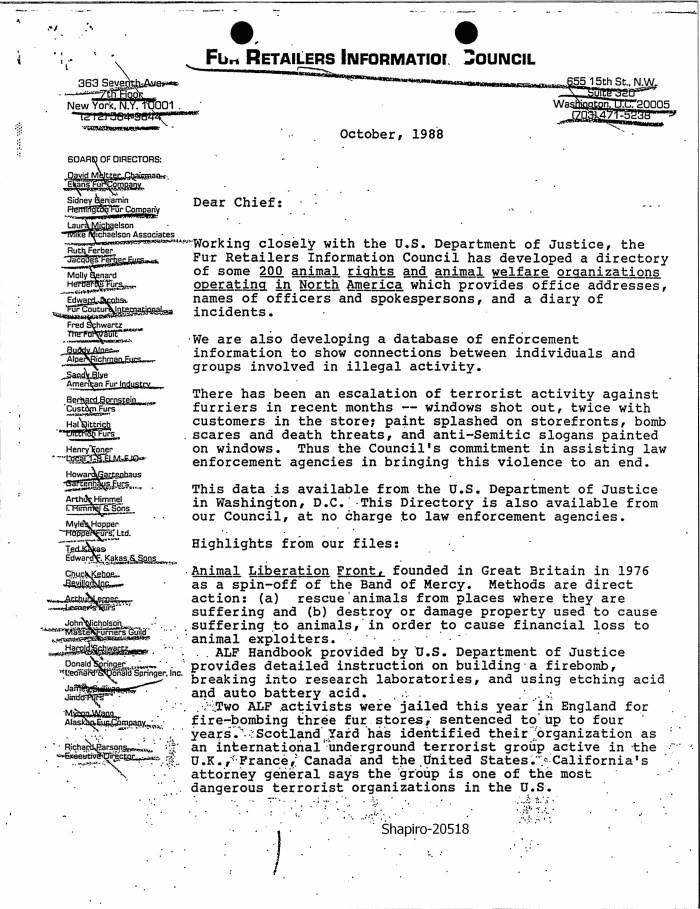 (https://beta.documentcloud.org/documents/5778882-DOJ-and-FRIC-1987-1988)
How a Movement That Never Killed Anyone Became the FBI’s No. 1 Domestic Terrorism Threat3 pages
The Fur Retailers Information Council worked with the Justice Department to create a directory of 200 animal rights and animal welfare organizations, according to a 1988 letter from the organization.
“We would occasionally contact the [FBI] to ensure they were aware of a threat or action involving animal extremism. We also sent FBI officials occasional alerts about animal rights actions or threats that might be considered illegal,” said Jim Newman, a spokesperson for Americans for Medical Progress, a nonprofit funded by the biomedical industry to foster support for animal research. “There was no concerted effort in place.” The other groups did not respond to requests for comment, and a spokesperson for the FBI declined to comment.
In some cases, corporations went beyond intelligence sharing to actively ferreting out activists they viewed as threats. One of the strangest efforts involved Leon Hirsch, a manufacturer of surgical staples whose sales demonstrations involved cutting open live beagles and stapling them back together. His company, United States Surgical Corporation, paid a security firm called Perceptions International to infiltrate the animal rights movement.
Mary Lou Sapone, the firm’s undercover agent, befriended a troubled activist named Fran Trutt, who was subsequently accused of planting a pipe bomb at the headquarters of the surgical corporation in an attempt to murder Hirsch. But Trutt was on the phone with Sapone throughout the day before the alleged murder attempt, and another undercover operative working for the company actually drove her to the crime scene and gave her money for the pipe bomb. Trutt pleaded no contest to attempted murder charges. Despite industry’s role in manufacturing the incident, it would later be presented in a key report (https://www.documentcloud.org/documents/5778880-AEPA-Report-to-Congress-August-1993.html) to Congress as the only “confirmed case” of an animal rights activist using an incendiary device “with intent of harming an individual.”
Industry groups also lobbied for federal legislation that would heighten penalties for activist tactics. “The DOJ has advised that there is significant special interest pressure on Congress to pass legislation which would protect animal and health research property, facilities and personnel from attacks,” according to a 1990 FBI memo (https://www.documentcloud.org/documents/5778887-FBI-Special-Interest-Legislation-February-1990.html).
Two years later, Congress enacted the Animal Enterprise Protection Act (http://www.greenisthenewred.com/blog/wp-content/Images/aepa2002.pdf), which created a new crime of “animal enterprise terrorism.” The law was aimed at anyone who physically disrupted or conspired to disrupt an animal enterprise by intentionally damaging or causing the loss of its property. It created a legal pathway to imprison a broad range of saboteurs and their allies.
But the AEPA didn’t lead to the kind of crackdown the biomedical and fur lobbyists sought. The law was used only once before the turn of the century, in the prosecution of two activists who released mink from Wisconsin fur farms. And although the FBI charged a few individuals for eco-arsons throughout the 1990s, it would be the next generation of saboteurs — Dibee’s generation — that would bear the brunt of the government’s crackdown on eco-radicals.
Radical Tactics Reach Their Peak
By the late 1990s, Dibee was known within activist circles, regularly participating in spectacular demonstrations designed to draw attention to moneymaking activity built on animal and ecological suffering.
At the Warner Creek occupation in 1995, activists blockaded a logging road to prevent a timber company from accessing Oregon’s Willamette National Forest. The occupation lasted for nearly a year, thanks in part to 28-year-old Dibee, who designed a “bipod” structure, a precariously rigged platform between two tall poles where activists perched, complicating police efforts to remove them. The federal government, which managed the national forest land, put the company’s timber harvest on hold, as well as 150 other timber sales.
In the summer of 1997, Dibee was involved in another dramatic action, this time to protest the overfishing (http://old.seattletimes.com/html/businesstechnology/2021090866_sundaybuzz02xml.html) of pollock in the Bering Sea and the harm it was causing the endangered Steller sea lion. Seven Greenpeace activists planned to dangle from ropes off Seattle’s Aurora Bridge, more than 200 feet above Lake Union, in an effort to block four giant American Seafoods trawlers from entering Puget Sound. A skilled climber, Dibee was to position himself underneath the bridge, maneuvering along its metal support structure to assist the other climbers as needed....
cop training
https://www.alternet.org/2020/12/blm-terrorist/
==
GG
https://theintercept.com/2020/10/10/new-documents-reveal-how-the-animal-agriculture-industry-surveils-and-punishes-critics/
ANIMAL AGRICULTURE INDUSTRY GROUPS defending factory farms engage incampaigns of surveillance, reputation destruction, and other forms of retaliation against industry critics and animal rights activists, documents obtained through aFOIA request from the U.S. Department of Agriculture reveal. That the USDA possesses these emails and other documents demonstrates the federal government’s knowledge of, if not participation in, these industry campaigns.
These documents detail ongoing monitoring of the social media of news outlets, including The Intercept,which report critically on factory farms. They reveal private surveillance activities aimed at animal rights groups and their members. They include discussions of how to create a climate of intimidation for activists who work against industry abuses, including by photographing the activists and publishing the photos online. And they describe a coordinated ostracization campaign that specifically targets veterinarians who criticize industry practices, out of concern that veterinarians are uniquely well-positioned to persuasively and powerfully denounce industry abuses.
One of the industry groups central to these activities is the Animal Agriculture Alliance (https://animalagalliance.org/initiatives/monitoring-activism/), which represents factory farms and other animal agriculture companies — or, as they playfully put it, they work for corporations “involved in getting food from the farm to our forks!” The groupboasts (https://animalagalliance.org/initiatives/monitoring-activism/) that one of its prime functions is “Monitoring Activism,” by which they mean: “We identify emerging threats and provide insightful resources on animal rights and other activist groups by attending their events, monitoring traditional and social media and engaging our national network."
[ Agriculture Alliance website]
- Indeed, the Alliance frequently monitors and infiltrates conferences of industry critics and activists, then provides reports to their corporate members (https://animalagalliance.org/resource/insights-gained-from-an-animal-rights-conference/) on what was discussed. As The Intercept previously noted when reporting onfelony charges (https://theintercept.com/2018/06/07/animal-rights-activists-face-multiple-felony-charges-brought-by-prosecutors-with-ties-to-smithfield-foods/)brought against animal rights activists with Direct Action Everywhere, or DxE, for peaceful filming and symbolic animal rescues inside one Utah farm that supplies Whole Foods and another owned by Smithfield — an action that showed how wildly at odds with reality is the bucolic branding of those farms — the Animal Agriculture Alliance issued a statement (https://www.thefencepost.com/news/animal-agriculture-alliance-concerned-about-animal-rights-activists-extreme-activity/) denouncing the activists for (ironically) harming their animals and urging law enforcement and “policymakers” to intervene on behalf of the industry against the activists.
In the emails obtained by the FOIA request, the Alliance and its allies frequently encourage their members to alert the FBI and Department of Homeland Security regarding actions by activists. In response to a project by DxE to create a map tracking factory farms, Lyle Orwig (https://www.bloomberg.com/profile/person/21338903) — chair of the agricultural company Charleston/Orwig, Inc. and a member of the Alliance board — proposed the retaliatory step of “taking photos of every DXE [sic] member” and posting them to the internet while accusing them of being “opposed to feeding the hungry.”...
[pigs suffocate covid surplus, she objected]
What alarmed Dr. Heath most was the emergence online of anonymous flyers which contained a “BEWARE” warning at the top, along with her photo and a string of accusations, some of which were false, that claimedshe harbors “an agenda that doesn’t include anything positive for our profession” and “expresses fondness” for “domestic terrorist organizations.” It warned that even allowing her access to the social media pages of veterinarians could be dangerous, and thus urged that she be blocked from all online forums, personal profiles, and social media groups....
==
big intercept:
...Who exactly are these eco-extremists? Under a section titled “environmental rights extremism,” a November 2019reference guide (https://www.documentcloud.org/documents/7040972-Colorado-Information-Analysis-Center-Reference.html) to “violent extremism” published by the Colorado Information Analysis Center, a fusion center, and other state security agencies, which was released as part of BlueLeaks, lists a range of groups. Among others, they listed the animal liberation group Direct Action Everywhere (https://theintercept.com/2020/01/09/factory-farms-california-animal-rights-criminalization/), which has removed animals from factory farms (https://theintercept.com/2018/12/23/dxe-animal-rights-factory-farms/) in rescue actions, and the Earth Liberation Front, which had its heyday committing arsons in the ’90s. Also listed were East Boulder County United, a grassroots organization that promotes community consultation on oil and gas development; and 350 Colorado, the local chapter of a well-known national climate organization. Both groups have participated in and promoted nonviolent civil disobedience as a tactic to force public officials to appropriately address the climate crisis...
==
https://yyy.theguardian.com/environment/2019/nov/25/keystone-xl-protests-pipeline-activism-environment
no lnx pix
Keystone XL: police discussed stopping anti-pipeline activists 'by any means'
This article is more than 7 months old
Revealed: records show law enforcement has called demonstrators possible ‘domestic terrorism’ threats
Demonstrators against the Keystone XL pipeline walking to a federal courthouse in in Rapid City, South Dakota, in June.
Demonstrators against the Keystone XL pipeline walking to a federal courthouse in in Rapid City, South Dakota, in June. Photograph: Adam Fondren/AP
Sam Levin and Will Parrish
Published onMon 25 Nov 2019 06.00 EST
US law enforcement officials preparing for fresh Keystone XL pipeline protests have privately discussed tactics to stop activists “by any means” and have labeled demonstrators potential “domestic terrorism” threats, records reveal.
Internal government documents seen by the Guardian show that police and local authorities in Montana and the surrounding region have been preparing a coordinated response in the event of a new wave of protests opposing the controversial Keystone XL tar sands pipeline, which would carry crude oil from Canada to Montana, South Dakota and Nebraska.
Civil rights organizations say the documents raise concerns that law enforcement is preparing to launch an even more brutal and aggressive response than the police tactics utilized during the 2016 Standing Rock movement, which drew thousands of indigenous and environmental activists opposed to the construction of the Dakota Access pipeline (DAPL) to North Dakota.
At Standing Rock, law enforcement organized repeated rounds of mass arrests and filed a wide array of serious charges in local and federal courts against activists. Police also deployed water cannons, teargas grenades, bean bag rounds and other weapons, causing serious injuries to protesters.
The documents are mostly emails from 2017 and 2018 between local and federal authorities discussing possible Keystone protests. They show that police officials are anticipating construction will spark a sustained resistance campaign akin to the one at Standing Rock and that police are considering closing public lands near the pipeline project.
The new records have come to light as the Keystone pipeline project has overcome numerous legal hurdles with help from the Trump administration, and as the project’s owner, TC Energy (formerly TransCanada), is moving forward with initial construction efforts.
Among the major revelations in the documents:
Officials at a 2017 law enforcement briefing on potential Keystone XL protests said one key tactic would be to “initially deny access to the property by protestors and keep them as far away [from] the contested locations as possible by any means”, according to an email summary from a US army corps of engineers security manager in Nebraska in July 2017.
Officials with the Bureau of Land Management (BLM) said in 2017 that the bureau had 10 armed officers in Montana and was prepared to “work with local [law enforcement] to deny access to federal property”. In 2018, army corps officials were also in discussions with the Montana disaster and emergency services department to discuss ways to “close access” to lands near the pipeline route, including areas typically open for hunting and other activities.
A “joint terrorism task force” involving the US attorney’s office and other agencies, along with federal “counterterrorism” officials, said it was prepared to assist in the response to protests and a “critical incident response team” would be available for “domestic terrorism or threats to critical infrastructure”.Authorities have also pre-emptively discussed specific potential felony charges that protesters could face, noting that a “civil disorder” statute was used to prosecute activists at Standing Rock.
Authorities have been preparing for possible protests in the Fort Peck area, home to a Native American reservation and indigenous people opposing the project.
“There is a lot of muscle behind this effort to make sure that Keystone is constructed,” said Alex Rate, legal director of the American Civil Liberties Union of Montana, which obtained the documents through records act requests and shared them with the Guardian. “There are historically marginalized communities, primarily indigenous folks, who have grave concerns about the impact of this pipeline on their sovereignty, their resources, their religion and culture. They have a first amendment right to assemble and make their viewpoints heard.”
Revealed: how the FBI targeted environmental activists in domestic terror investigations
Read more]
Remi Bald Eagle, intergovernmental affairs coordinator of the Cheyenne River Sioux tribe, which is located along the pipeline route, said the police buildup was part of a long history of armed subjugation of native people in the region.
“This is an experience of the tide of Manifest Destiny still coming at us,” Bald Eagle said, referring to the 19th-century belief that US settlers had the right to expand across the continent.
The files follow repeated revelations that the FBI and other law enforcement agencies have investigated environmental groups and leftwing activists as possible “terrorists”.
Opponents of the Keystone XL oil pipeline are seen demonstrating in sub-freezing temperatures last month in Billings, Montana.
Opponents of the Keystone XL oil pipeline are seen demonstrating in sub-freezing temperatures last month in Billings, Montana. Photograph: Matthew Brown/AP]
Keystone XL was rejected by the Obama administration and then revived by Donald Trump shortly after his inauguration in 2017. The $8bn project has been subject to multiple legal challenges, including over the environmental review process, but pre-construction efforts are now under way.
Opponents of Keystone XL have warned about the environmental and cultural impact of the project for a decade – concerns that came into sharper focus last month after the existing Keystone pipeline, which follows a similar route, leaked 383,000 gallons of tar sands into a swath of North Dakota wetlands.
The new Keystone records, which come from a number of government agencies and were released after a protracted legal battle, also show that officials have specifically met with police involved in the Standing Rock response to discuss “lessons learned”. North Dakota police officials told law enforcement prepping for Keystone that one of their biggest mistakes was their failure to keep activists far away and shut down access to nearby lands.
In one 2018 BLM document, labeled “KEYSTONE XL PIPELINE PUBLIC SAFETY ISSUES”, officials discussed the “available resources” to respond to protests in Montana.
“The FBI will have primary investigative authority for all national security investigations, including but not limited to international terrorism, domestic terrorism, and weapons of mass destruction,” BLM wrote.
US border patrol would also be available to assist law enforcement around the border and has access to “drone assets”, the document continued. Border patrol also provided a surveillance drone that police used to track Standing Rock protesters.
BLM also discussed purchasing “riot batons”, helmets and gas masks in advance of possible protests.
Mike Glasch, an army corps spokesman, said that the “by any means” comment came from the agency’s security chief, who was “relaying talking points” from police officials in Mandan and Morton County in North Dakota, adding: “Any method that we would employ to protect the safety of our employees and the public, as well as property and equipment, would be within the limits of the law and be the least invasive possible, while still protecting the public’s first amendment rights.”
A spokesperson for the Morton county sheriff, Kyle Kirchmeier, said he advises law enforcement that “may be involved with potential pipeline protests to make it their goal to keep protesters off of private property and any areas that may be considered a public hazard, such as ditches or highways”, adding that he “is supportive of people’s right to protest, but they need to do so in a lawful manner”. Kirchmeier said he did not recall the 2017 briefing.
A Mandan police spokesperson declined to comment.
Glasch said the army corps had not closed access to its land around the project, but added: “Since a construction site comes with inherent hazards, options are being analyzed for methods to keep any non-essential personnel away from potential construction sites, while at the same time considering constitutional rights.” He said it was too early to speculate about specific potential closure plans.
A spokesperson for the US attorney’s office did not respond to questions about the “terrorism” references but said the office’s “goal is to provide coordinated assistance to local, tribal and state law enforcement to protect public safety and civil rights, and to protect federal lands, while enforcing federal law”.
The FBI declined to comment.
A border patrol spokesperson said the agency would “assist, upon request, with any law enforcement activities within the border area near the pipeline”.
Spokespeople for BLM and TC Energy did not respond to questions.
“Law enforcement are getting ready. They’ve been having meetings behind closed doors,” said Angeline Cheek, an indigenous organizer from the Fort Peck reservation. “We know that they’re preparing … We’ve been preparing for the last three years.”
Rate, from the ACLU, said there was no legal justification for the government to pre-emptively shut down lands in an effort to stop protests.He said it was also troubling for law enforcement to prepare a “militarized” response and suggest that activists could pose terrorist or criminal threats before any actions had even begun.
“They are thinking of them as potential ‘domestic terrorists’. There is simply no support for adopting that paradigm,” said Rate. “The public justifiably thinks of BLM as a land management agency and not necessarily in the business of arming themselves and going out and squelching protesters.”
Candi Brings Plenty, an Oglala Lakota Sioux activist working with the ACLU of Montana, said they were not surprised to learn that law enforcement was talking about stopping indigenous activists “by any means”.
“That is the type of language that has been spoken to us our whole lives,” they said, adding: “We live these injustices on a daily basis. This is finally being unveiled for what it is.”
Brings Plenty, who led a two-spirit camp at Standing Rock, said they would not be intimidated by law enforcement and hoped people would still support the fight against Keystone – instead of just accepting the pipeline.
“It’s almost become the norm for folks to look the other way, feeling like there isn’t something they can do, that it’s beyond their grasp,” they said. “I want folks to see these pipelines the way they do the glaciers in the arctic. This is happening right here in their own front yard.”
==
==
https://theintercept.com/2020/06/25/environmental-activists-charged-terrorizing-louisiana-formosa/
TWO LEADERS OF the long-running fight for environmental justice in Louisiana turned themselves in to police in Baton Rouge Thursday morning. The activists, who work in a part of the state known as “Cancer Alley,” faced charges of “terrorizing” related to a nonviolent protest action. Civil liberties attorneys are calling the charges a dramatic escalation of a yearslong effort by the fossil fuel and petrochemical industries to criminalize efforts (https://theintercept.com/2019/09/27/pipeline-safety-legislation/) to halt the expansion of polluting facilities in the state — part of a nationwide trend of cracking down (https://theintercept.com/2020/06/07/pipeline-petrochemical-lobbying-group-anti-protest-law/) on dissent around climate change issues.
:{:{}:
}:
The accusations against the activists, Anne Rolfes and Kate McIntosh, stem from a seemingly innocuous activist stunt carried out in December, the day after a festival designed to draw attention to the environmental misdeeds of Formosa Plastics. The Taiwanese petrochemical company plans to build a massive plastics manufacturing complex in a largely Black Louisiana community that has already suffered health problems linked to local industry. In October, Formosa agreed to a $50 million settlement for dumping pollutants, including the small pellets that form the building blocks for plastic products known as nurdles, into Texas’s Lavaca Bay — the largest (https://coast.noaa.gov/states/stories/historic-pollution-settlement-to-nurdle-patrol.html#::text=Formosa%20Plastics%20Corporation%20USA%20has,the%20federal%20Clean%20Water%20Act.) settlement of a Clean Water Act lawsuit filed by private citizens.
with a key environmental permit still pending for Formosa in Louisiana, the action — dubbed “Nurdlefest” — was meant to pressure the state’s Department of Environmental Quality to scrutinize the company’s record. Boxes of the plastic pellets, used as evidence in the Texas case, were carted to the front of the agency, where around 75 people gathered in the rain.
What apparently terrorized community members, however, was a container of the pellets that appeared on the porch of an oil and gas lobbyist, with a detailed note attached, explaining what they were and their Texas origin. “We have delivered this package of nurdles as a reminder – Louisiana does not need anymore pollution, plastics or otherwise,” the letter said. “We demand that LDEQ DENY Formosa’s air emissions permit application.”
[ltr doc Letter Included in "Nurdles" Package Sent by Louisiana Activists] (https://www.documentcloud.org/documents/6956444-Letter-Included-in-Nurdles-Package-Sent.html)
:{:{}:
}:
The letter was signed by Concerned Citizens of Louisiana and included the phone number of Bill Quigley, the activists’ pro bono attorney.
The Baton Rouge Police Department apparently agreed that the plastic particles were threatening. “A note was observed on the top of the package indicating not to open the container as the contents could be hazardous. Police requested Hazmat to be contacted,” spokesperson Don Coppola told The Intercept. Although the note discouraged against removing the nurdles or leaving them around children or pets, it did not describe them as “hazardous.” It included a Formosa phone number for safely recycling the material.
Rolfes and McIntosh, who are respectively the director of and a program assistant at the Louisiana Bucket Brigade, which provides support to groups of community members living near polluting facilities, face a maximum of 15 years in prison and $15,000 in fines for so-called terrorizing — defined as “the intentional communication of information that the commission of a crime of violence is imminent or in progress or that a circumstance dangerous to human life exists or is about to exist” — with the intention of causing members of the public to fear for their safety.
“This is an unwarranted escalation because they are using the term ‘terrorizing,’” said Pam Spees, senior attorney with the Center for Constitutional Rights, who is representing McIntosh and Rolfes. “It is imposing unfairly and inappropriately a label on people that have been peacefully working for years to raise awareness of the impact of industry on frontline communities. To use that word in a context like this is potentially damaging and chilling to others.”
THE CHARGES AGAINST Rolfes and McIntosh come on the heels of a series of incidents where environmental activists have been dealt hefty charges for actions challenging the petrochemical, oil, and gas industries in Louisiana.
In August 2018, Louisiana legislators passed a law establishing a new felony charge (https://theintercept.com/2018/08/22/recent-arrests-under-new-anti-protest-law-spotlight-risks-that-off-duty-cops-pose-to-pipeline-opponents/) for anyone who trespasses on critical infrastructure facilities, including chemical manufacturing facilities and oil and gas pipeline construction sites. Over the following couple months, police used the new law to charge 14 people protesting the oil company Energy Transfer’s Bayou Bridge pipeline, as well as a journalist. Local prosecutors have not yet acted on the charges.
[pix Taiwanese petrochemical company Formosa agreed to a $50 million settlement for dumping small pellets that make up the building blocks for plastic products, known as “nurdles,” into Texas’s Lavaca Bay.
Photo: Courtesy of the Louisiana Bucket Brigade
Last October, police charged Gregory Manning, the legally blind pastor of Broadmoor Community Church and a member of the Coalition Against Death Alley, with a felony for allegedly inciting a riot. Authorities said Manning failed to immediately leave a hallway outside the office of the Louisiana Association of Business and Industry during a protest against the association’s influence over state politics. A prosecutor later dropped (https://www.nola.com/news/courts/article_e12df864-00b6-11ea-ae2d-1b817afd4a1e.html) all charges.
This spring, legislators passed an enhanced version of the critical infrastructure law, which would have ramped up charges for trespass during a state of emergency. Louisiana Gov. John Bel Edwards vetoed (https://insideclimatenews.org/news/12062020/louisiana-governor-veto-protest-activism-pipeline-infrastructure) the bill.
To Rolfes and McIntosh’s attorneys, the timing of the latest charges is particularly suspect. At 9:30 a.m. on Juneteenth, the June 19 holiday celebrating the emancipation of slaves in the U.S., Quigley — Rolfes and McIntosh’s pro bono lawyer, who is also a professor at Loyola University New Orleans — received a phone call from a Baton Rouge Police Department detective, notifying him that a warrant was out for the pair’s arrest. (Formosa and the Baton Rouge Police Department did not immediately respond to requests for comment.)
:{:{}:
“It seems more than a little suspicious that this long dormant warrant was activated 12 hours after Formosa lost in court. It seems like it’s clearly retaliation.”
}:
Both the activists were en route to a ceremony at a burial site for enslaved people, located in a field where Formosa plans to build one of its facilities (https://theintercept.com/2019/12/18/formosa-plastics-louisiana-slave-burial-ground/). The right to carry out the ceremony had been hard-won: Formosa had fought in court for the past week to prevent community members from holding the gathering. A judge denied the company’s final appeal only the night before.
The detective told Quigley that the charges had been filed in April, but they’d held off on issuing the warrant because of risks associated with the coronavirus pandemic. “It seems more than a little suspicious that this long dormant warrant was activated 12 hours after Formosa lost in court,” said Quigley. “It seems like it’s clearly retaliation.”
Spees, the Center for Constitutional Rights attorney, said, “If there’s such a danger, why wait seven months and pick the day of a community celebration of its liberation from slavery to send that message?”
In response to the latest charges, local organizers are launching the Alliance to Defend Democracy to push back on the increasing criminalization.
“Five years ago — maybe three years ago — this kind of charge against an activist would have had an isolating effect. The movements are stronger now,” said Spees. “It’s an overreach, and it’s going to backfire.”
==
https://www.alternet.org/2020/06/fox-news-removes-unethical-digitally-altered-images-of-police-brutality-protests-in-seattle
ok he was there, but a week before?
no lnx pix twt
fox News removes ‘unethical’ digitally altered images of police brutality protests in Seattle
Royalty-free stock photo ID: 1288386304 Tallinn, Estonia - 01/18/2019: Fox News website homepage. Fox News channel logo visible through a magnifying glass.
Written by Roger Sollenberger / Salon June 16, 2020
Fox News over the weekend removed misleading images from stories about protests against police brutality in Seattle from its website after it was revealed they had been digitally altered in a manner which made the scene appear dangerous.
The Seattle Times published a report Friday calling out multiple images from Fox News coverage of the police-free “Capitol Hill Autonomous Zone” (CHAZ) in the city.
One photo illustration appearing on the Fox News homepage showed a masked man with an assault rifle and tactical vest standing in front of a sign reading, “You are now entering Free Cap Hill.” The outlet did not originally disclose that the photo of the scene and the photo of the armed man had been spliced together using two different photos, which were taken more than a week apart.
The original photo, from Getty Images, shows the armed man in front of a car.
He was digitally placed in front of the entrance sign.
The same image of the man appeared in at least one other image on Fox News’ website, in front of a smashed retail storefront. According to The Times, it was also a combination of multiple images.
“It is definitely Photoshopped,” freelance photographer David Ryder, who took the original photo and published it through Getty images, told the outlet. “To use a photo out of context in a journalistic setting like that seems unethical.”
Conservatives, including President Donald Trump, have attempted to sculpt the CHAZ storyline into a political flashpoint. Protesters converted the area into a street festival after police, who teargassed demonstrators, left the precinct in an effort to de-escalate tensions.
Trump tweeted Thursday that “Radical Left Governor [J]ay Inslee and the Mayor of Seattle are being taunted and played at a level that our great Country has never seen before. Take back your city NOW. If you don’t do it, I will. This is not a game. These ugly Anarchists must be stooped [sic] IMMEDIATELY. MOVE FAST!”
The mayor told the president, “Make us all safe. Go back to your bunker.”
Fox News on Friday used a photo of a man running through an urban inferno as a banner image for a group of stories about Seattle under the headline, “CRAZY TOWN || Seattle helpless as armed guards patrol anarchists’ autonomous zone, shake down businesses: cops.”
:{:{}:
}:
The photo was unaltered, but it was an AP photo taken May 30 in St. Paul, Minn. Fox News later removed it.
The articles did not notify readers that the photos were altered, and it remains unclear who was responsible for the decision to do so. A Fox News spokesperson did not immediately respond to Salon’s request for comment.
In an emailed statement, a Fox News spokeswoman told The Times: “We have replaced our photo illustration with the clearly delineated images of a gunman and a shattered storefront, both of which were taken this week in Seattle’s autonomous zone.”
However, that statement itself was inaccurate. While the gunman was photographed that week — June 10 — the smashed storefront images were first published by Getty on May 30.
Fox News fully apologized Saturday in an editor’s note accompanying its CHAZ coverage, acknowledging that it “did not clearly delineate” the photo illustrations, which it labeled a “collage.” The site also apologized for falsely attributing the shot of the Minneapolis fire. “Fox News regrets these errors,” the note said.
Talent at the conservative network have attempted to use the Seattle protests as a political wedge issue. For example, primetime host Tucker Carlson accused the people in the zone of advocating segregation.
:{:{}:
}:
The network also reported an anecdotal claim from Seattle Assistant Chief of Police Deanna Nollette.
:{:{}:
}:
“We’ve heard, anecdotally, reports of citizens and businesses being asked to pay a fee to operate within this area,” Nollette said. “This is the crime of extortion.”
:{:{}:
}:
Police Chief Carmen Best later corrected that statement.
:{:{}:
}:
“We haven’t had any formal reports of this occurring,” she said, indicating the reports had come from rumors spread on social media.
Though the Seattle protests have at times been home to contentious scenes of unrest — including a cop filmed forcibly removing his partner’s knee from someone’s neck and a man filmed driving into a crowd of protesters and shooting a black man — the CHAZ street scene has been almost entirely peaceful, featuring musical and visual artists, free street food, concerts and movies.
Best said she did not think the officers should have abandoned the precinct, a move which she claims has led to longer 911 response times.
Trump called demonstrators “domestic terrorists” over the weekend and threatened federal action unless local officials “take back” the area. He also falsely claimed that antifa forces had taken over the city.
Donald J. Trump
@realDonaldTrump
Interesting how ANTIFA and other Far Left militant groups can take over a city without barely a wimpier from soft Do Nothing Democrat leadership, yet these same weak leaders become RADICAL when it comes to shutting down a state or city and its hard working, tax paying citizens!
256K
1:47 PM - Jun 14, 2020
Twitter Ads info and privacy
121K people are talking about this
“City officials have not interacted with ‘armed antifa militants’ at this site,” a city spokesperson told CNN.
https://www.alternet.org/2020/06/propaganda-fox-news-photoshops-gunman-into-stories-about-seattles-autonomous-zone
no pix url
Propaganda’: Fox News photoshops gunman into stories about Seattle’s autonomous zone
Image via Screengrab.
Written by The New Civil Rights Movement June 14, 2020
Legal journalist Mark Joseph Stern noticed that Fox News added a man carrying a military-assault rifle into images of Seattle’s Capitol Hill Autonomous Zone (CHAZ) on Friday. The CHAZ is a police-free area currently occupied by protesters police violence.
Fox News featured the images on their website without any mention that they had been altered. They placed the exact same gunman in two different photos. In one, the gunman’s left arm had been weirdly cut off in a straight line from the shoulder to the elbow.
Fox claimed that the image of a shattered window in the CHAZ was taken this week, but it seems it was actually taken on May 30.
Mark Joseph Stern
@mjs_DC
Fox News, a totally normal and respectable media outlet, digitally manipulated photos of Seattle’s “autonomous zone” by photoshopping in a gunman. https://www.seattletimes.com/seattle-news/politics/fox-news-runs-digitally-altered-images-in-coverage-of-seattles-protests-capitol-hill-autonomous-zone/ …
View image on TwitterView image on TwitterView image on TwitterView image on Twitter
“Given how vigorously Fox News personalities have argued that men toting assault weapons in public are not inherently threatening,” Stern wrote, “it’s curious the outlet digitally inserted a man toting a gun to make the autonomous zone seem more threatening and scary.”
Fox News eventually issued the following editor’s note:
A FoxNews.com home page photo collage which originally accompanied this story included multiple scenes from Seattle’s ‘Capitol Hill Autonomous Zone’ and of wreckage following recent riots. The collage did not clearly delineate between these images, and has since been replaced. In addition, a recent slideshow depicting scenes from Seattle mistakenly included a picture from St. Paul, Minnesota. Fox News regrets these errors.
Here
==
https://www.ecowatch.com/climate-activists-valve-turners-extremists-2644830392.html
Internal documents from the Department of Homeland Security reveal that non-violent demonstrators targeting the oil industry were classified as "extremists," with some organization members listed alongside known white supremacists, as The Guardian yyy reported.
Five members of Climate Direct Action — Michael Foster, Ken Ward, Emily Johnston, Annette Klapstein, and Leonard Higgins — have been dubbed the Valve Turnersafter a coordinated effort on Oct. 11, 2016 tocut through fencing and turn off valves on a pipeline in four states. The pipeline carried crude oil from Canada's tar sands to refineries.
The activists alerted the oil companies of their actions, filmed it and waited patiently for authorities to arrive and arrest them, as The Guardian reported. For a few hours, the oil stopped flowing. Those pipelines (https://www.ecowatch.com/tag/pipelines) carried 15 percent of the daily U.S. oil consumption in 2016.
Chargers for three of them were dropped, but Michael Foster, who turned a valve in North Dakota, spent six months in jail and is now on probation. During his trial, prosecutors compared him to the 9/11 terrorists and the Unabomber, according to Common Dreams (https://www.commondreams.org/news/2020/01/13/us-government-lists-non-violent-valve-turner-climate-activists-threat-par-murderous).
pix Michael Foster pictured with his partner and fellow activist Sue Lenander shortly after being released from a six month prison sentence. [Shut it Down - Climate Direct Action (https://www.facebook.com/ClimateDirectAction/)
More recently, the Department of Homeland Security described the Valve Turners as "suspected environmental rights extremists." The Guardian reported that the document, which evaluated domestic terrorism threats from 2018 to 2020, also categorized the group alongside Dylan Roof, the white supremacists who murdered nine people in a church in Charleston, South Carolina and James Fields, who plowed his car into a group of people protesting a white supremacist rally in Charlottesville, Virginia. Fields killed Heather Heyer and injured 19 others.
"Equating mass murder by white supremacists with what Michael and I did is totally obscene," said Sam Jessup, one of the activists named in the documents, in an email to The Guardian (https://www.theguardian.com/environment/2020/jan/13/us-listed-climate-activist-group-extremists). "This whole infrastructure of so-called security has done little more than secure the future of the fossil fuel industry by terrorizing people into silence."
Jessup, 34, was the driver and videographer live-streaming the action in North Dakota while Michael Foster, a former family therapist who lives in Seattle, turned the valve. Foster is the defendant who spent six months in jail.
Mike German, a former FBI agent and a fellow at the Brennan Center for Justice, wrote an email to The Guardian stating that Homeland Security's framing was "highly misleading because white supremacists are responsible for the bulk of this violence and almost all of the fatalities that result. There is little that environmentalists have engaged in the types of deadly violence that would meet the statutory definition of domestic terrorism, as codified by Congress."
[pix]
The labeling of environmental groups with extremists is mirrored in Britain as well where the activist group Extinction Rebellion was labeled in a document by Counter Terrorism Policing South East alongside banned far-right organizations like National Action and Islamic terrorist organizations, according to the Telegraph (https://www.independent.co.uk/news/uk/home-news/extinction-rebellion-police-counter-terror-extremism-climate-change-a9279131.html).
Extinction Rebellion, which uses non-violent disruptions to business as usual to call attention to the urgency of the climate crisis had a similar reaction as the Valve Turners. They were shocked and appalled.
"How dare they," said climate change group Extinction Rebellion, as the BBC (https://www.bbc.com/news/uk-51071959) reported.
A spokesperson for Extinction Rebellion said, "Teachers, grandparents, nurses have been trying their best with loving non-violence to get politicians and big business to do something about the dire state of our planet. And this is how the establishment responds," according to the BBC (https://www.bbc.com/news/uk-51071959).
Speaking about the Homeland Security document, Carl Williams, executive director of the Water Protector Legal Collective, which has defended Dakota Access Pipeline protestors said to The Guardian, "I think there is a strategy that rightwing forces are using to criminalize dissent. This bulletin shows that dirty hand."
:{:{}:
Climate Activists Outraged as Siemens Backs Adani Coal Mining ... › (https://www.ecowatch.com/siemens-coal-mine-australia-2644703080.html)
A Climate Action for Every Type of Activist - EcoWatch › (https://www.ecowatch.com/climate-action-for-every-type-of-activist-2639221391.html)
'I'm Just More Afraid of Climate Change Than I Am of Prison' - The ... › (https://www.nytimes.com/2018/02/13/magazine/afraid-climate-change-prison-valve-turners-global-warming.html)
19 youth climate activists you should be following on social media ... › (https://www.earthday.org/19-youth-climate-activists-you-should-follow-on-social-media/)
Counter-terrorism police list Extinction Rebellion as extremist group ... › (https://www.independent.co.uk/news/uk/home-news/extinction-rebellion-police-counter-terror-extremism-climate-change-a9279131.html)
tar sands (https://www.ecowatch.com/tag/tar-sands) pipelines (https://www.ecowatch.com/tag/pipelines) activism (https://www.ecowatch.com/tag/activism) activists (https://www.ecowatch.com/tag/activists) climate action (https://www.ecowatch.com/tag/climate-action) valve turners (https://www.ecowatch.com/tag/valve-turners) oil (https://www.ecowatch.com/tag/oil)
https://theintercept.com/2019/03/23/ecoterrorism-fbi-animal-rights/
many lnx pix docs
GREEN SCARE
How a Movement That Never Killed Anyone Became the FBI’s No. 1 Domestic Terrorism Threat
Photo illustration: Soohee Cho/The Intercept, FBI
Alleen Brown
March 23 2019, 5:32 a.m.
[The Threat WithinThe Threat Within
Behind the scenes, corporate lobbying laid the groundwork for the Justice Department’s aggressive pursuit of so-called eco-terrorists.]
JOE DIBEE’S 12 YEARS on the lam came to an end last August, when Cuban authorities detained the 50-year-old environmental activist during a layover in Havana and turned him over to the United States.
More than a decade earlier, police and FBI agents had arrested a dozen of Dibee’s associates in the Animal Liberation Front and Earth Liberation Front within the span of a few months. They were charged with conspiring to burn down factories that slaughtered animals for meat, timber mills that disrupted sensitive ecosystems, government facilities that penned wild horses, and a ski resort perched on a pristine mountaintop. Dibee, a former Microsoft software tester known for his ingenuity, had slipped away in the midst of it all.
While the arsons, which never hurt or killed anyone, largely took place in the late 1990s, the wave of arrests known as the “Green Scare” came in the post-9/11 era, when terrorism was the FBI’s prevailing obsession. The fur and biomedical industries had spent years lobbying the Justice Department and lawmakers to go after eco-activists, who had damaged their property, held audacious demonstrations decrying their business activities, and cost them millions of dollars. When the planes hit the twin towers, industry groups seized on the opportunity to push legislation, and federal law enforcement ramped up pursuit of radical activists in the name of counterterrorism.
[FBI-Officials-at-Domestic-Extremism-Press-Conference-1553118338
Michael B. Ward of the FBI’s counterterrorism division speaks at a press conference on Nov. 19, 2008, about a reward for the capture of four Operation Backfire fugitives. With Ward is Portland Assistant Special Agent in Charge Daniel Nielsen. Photo: FBI]
So-called eco-terrorism became the Justice Department’s No. 1 domestic terror concern — “over the likes of white supremacists, militias, and anti-abortion groups,” as one senator pointed out at the time. Operation Backfire, which sent Dibee running, was the climax of the crackdown. “There was money, there was administrative support, there was management support,” said Jane Quimby, a retired FBI agent who worked on Backfire. The results were “an affirmation that given the resources that you need, and the support that you need, you can really make these things work.”
In 2009, when a Department of Homeland Security intelligence report raised alarms about the rising threat of right-wing extremist violence, it provoked a very different response. After outcry from conservative groups, DHS backtracked on the report and later disbanded the domestic terrorism unit that produced it.
Daryl Johnson, a former domestic terrorism analyst at DHS, says there’s a reason law enforcement took a less aggressive approach to right-wing white supremacists and anti-government attackers. In the case of the eco-extremists, the government had a powerful ally: industry. “You don’t have a bunch of companies coming forward saying I wish you’d do something about these right-wing extremists,” said Johnson, who left his position in 2010, after his warnings about right-wing violence were dismissed. “If enough people lobbied congresspeople about white nationalists and how it’s affecting their business activity, then I’m sure you’ll get legislation.”
Now, in the wake of the 2017 “Unite the Right” rally in Charlottesville, Virginia, and the murder of counterprotester Heather Heyer by white supremacist James Alex Fields, past and current Justice Department officials have argued that a new domestic terrorism statute is necessary to better respond to far-right violence.
But law enforcement and federal prosecutors already have powerful counterterrorism authorities at their disposal, and their history of using them to go after radical activists who committed property crimes suggests that any new crackdown is likely to sweep up far more than domestic extremists who pose a lethal threat.
No new law was required to treat eco-saboteurs as terrorists in the wake of 9/11. Of 70 federal prosecutions of radical environmentalists and animal rights activists identified by The Intercept, 52 did not result in charges under anti-terrorism laws. Yet the defendants were repeatedly called terrorists by the Justice Department in public statements and internal communications. The designation opened up additional resources and gave the government powerful leverage in the form of terrorism sentencing enhancements, which prosecutors sought in more than 20 cases.
Meanwhile, in the remaining 18 cases, prosecutors applied an anti-terrorism law written with the help of industry that was designed exclusively to target animal rights activists. Six cases involved activists releasing mink and vandalizing fur facilities, and six involved individuals accused of encouraging radical acts like sabotage but not participating in any themselves. Four of the cases involved activists protesting outside researchers’ homes and were dismissed because the allegations were too vague.
The story of how years of corporate lobbying ended with Dibee in cuffs contains lessons for those considering how to handle the surge in right-wing violence, as well as for a new generation of environmental activists again facing accusations of eco-terrorism.
[dibee-poster-1553116689The “wanted” poster for Joseph Mahmoud Dibee, displayed during a press conference in Washington, D.C., on Nov. 19, 2008. Photo: FBI
Industry Intelligence-Gathering]
Joe Dibee grew up camping in the spectacular forests, mountains, and coastal regions of the Pacific Northwest. His parents, members of Syria’s Catholic minority, had immigrated to the U.S. before he was born, settling into Seattle’s middle class. His mother worked at the public library and his father was a finance professor at Seattle University, where Dibee would eventually study civil engineering and general science. Dibee came of age just as law enforcement in the U.S. was beginning to take notice of the budding animal rights movement.
In 1977, when he was 9 years old, a group called the Undersea Railroad released two dolphins from a University of Hawaii marine laboratory — the first known animal liberation in U.S. history. A countermovement was rapidly launched, led by organizations like the National Association for Biomedical Research, which lobbies for the use of live animals in scientific research.
NABR and other industry groups were way ahead of law enforcement in gathering intelligence on the animal rights movement, and federal agents were happy to make use of the information. In March 1987, for example, FBI agents met with NABR about four chimpanzees that had been abducted from a research laboratory. The group “maintains a large intelligence file on the activities of most of the significant animal rights groups in the world,” an agent noted after the meeting, and “furnished the FBI with many documents which deal with these groups as well as outline their significant activities dating back to 1976.”
The FBI’s account of the meeting is included in documents obtained via public records requests by Ryan Shapiro, executive director of the transparency organization Property of the People. The documents show that throughout the 1990s, the FBI and Justice Department collaborated with a range of industry groups including Americans for Medical Progress, the Fur Commission, the National Board of Fur Farm Organizations, the Foundation for Biomedical Research, and the American Feed Industry Association.
FBI-NABR 1987
3 pages]
In 1987, the National Association for Biomedical Research supplied the FBI with documents about the activities of animal rights groups going back more than a decade, according to an FBI memo provided to The Intercept by Property of the People. The transparency organization redacted the names of activists who did not grant permission to be identified, to protect their privacy.
In 1987, an animal diagnostics laboratory under construction at the University of California, Davis was burned to the ground — the first U.S. arson claimed by ALF. It was meant “to retaliate in the name of thousands of animals tortured each year in campus labs,” a communique from the saboteurs said.
A month after the arson, a Justice Department public information officer sent a letter to the Fur Retailers Information Council, whose members had also been targeted by the Animal Liberation Front. “I encourage you to send to me any evidence you have indicating criminal activity committed by animal rights activists,” the official wrote. “I am happy to be of assistance to the Fur Retailers Information Council.”
In response, the industry group worked with the Justice Department to create “a directory of some 200 animal rights and animal welfare organizations operating in North America which provides office addresses, names of officers and spokespersons, and a diary of incidents,” according to an October 1988 letter from the council.
DOJ-FRIC 1987-1988
3 pages]
The Fur Retailers Information Council worked with the Justice Department to create a directory of 200 animal rights and animal welfare organizations, according to a 1988 letter from the organization.
“We would occasionally contact the [FBI] to ensure they were aware of a threat or action involving animal extremism. We also sent FBI officials occasional alerts about animal rights actions or threats that might be considered illegal,” said Jim Newman, a spokesperson for Americans for Medical Progress, a nonprofit funded by the biomedical industry to foster support for animal research. “There was no concerted effort in place.” The other groups did not respond to requests for comment, and a spokesperson for the FBI declined to comment.
In some cases, corporations went beyond intelligence sharing to actively ferreting out activists they viewed as threats. One of the strangest efforts involved Leon Hirsch, a manufacturer of surgical staples whose sales demonstrations involved cutting open live beagles and stapling them back together. His company, United States Surgical Corporation, paid a security firm called Perceptions International to infiltrate the animal rights movement.
Mary Lou Sapone, the firm’s undercover agent, befriended a troubled activist named Fran Trutt, who was subsequently accused of planting a pipe bomb at the headquarters of the surgical corporation in an attempt to murder Hirsch. But Trutt was on the phone with Sapone throughout the day before the alleged murder attempt, and another undercover operative working for the company actually drove her to the crime scene and gave her money for the pipe bomb. Trutt pleaded no contest to attempted murder charges. Despite industry’s role in manufacturing the incident, it would later be presented in a key report to Congress as the only “confirmed case” of an animal rights activist using an incendiary device “with intent of harming an individual.”
Industry groups also lobbied for federal legislation that would heighten penalties for activist tactics. “The DOJ has advised that there is significant special interest pressure on Congress to pass legislation which would protect animal and health research property, facilities and personnel from attacks,” according to a 1990 FBI memo.
Two years later, Congress enacted the Animal Enterprise Protection Act, which created a new crime of “animal enterprise terrorism.” The law was aimed at anyone who physically disrupted or conspired to disrupt an animal enterprise by intentionally damaging or causing the loss of its property. It created a legal pathway to imprison a broad range of saboteurs and their allies.
But the AEPA didn’t lead to the kind of crackdown the biomedical and fur lobbyists sought. The law was used only once before the turn of the century, in the prosecution of two activists who released mink from Wisconsin fur farms. And although the FBI charged a few individuals for eco-arsons throughout the 1990s, it would be the next generation of saboteurs — Dibee’s generation — that would bear the brunt of the government’s crackdown on eco-radicals.
Radical Tactics Reach Their Peak
By the late 1990s, Dibee was known within activist circles, regularly participating in spectacular demonstrations designed to draw attention to moneymaking activity built on animal and ecological suffering.
At the Warner Creek occupation in 1995, activists blockaded a logging road to prevent a timber company from accessing Oregon’s Willamette National Forest. The occupation lasted for nearly a year, thanks in part to 28-year-old Dibee, who designed a “bipod” structure, a precariously rigged platform between two tall poles where activists perched, complicating police efforts to remove them. The federal government, which managed the national forest land, put the company’s timber harvest on hold, as well as 150 other timber sales.
In the summer of 1997, Dibee was involved in another dramatic action, this time to protest the overfishing of pollock in the Bering Sea and the harm it was causing the endangered Steller sea lion. Seven Greenpeace activists planned to dangle from ropes off Seattle’s Aurora Bridge, more than 200 feet above Lake Union, in an effort to block four giant American Seafoods trawlers from entering Puget Sound. A skilled climber, Dibee was to position himself underneath the bridge, maneuvering along its metal support structure to assist the other climbers as needed.
Seven Greenpeace demonstrators slowly make their way up ropes Monday, Aug. 18, 1997, toward the deck of Seattle's Aurora Bridge after being suspended for two days to protest factory trawler fishing. The seven, plus another who had been under the bridge deck monitoring the lines, were placed under arrest on charges of reckless endangerment. The five women and two men rappelled over the side of the bridge Saturday morning and strung ropes in an attempt to block two trawlers attempting to depart Lake Union on their way to pollock fishing grounds in the Bering Sea. (AP Photo/Elaine Thompson)Seven Greenpeace demonstrators make their way up ropes toward the deck of Seattle’s Aurora Bridge on Aug. 18, 1997, after being suspended for two days to protest factory fishing. Photo: Elaine Thompson/AP
As the action kicked off, police confiscated critical gear, leaving the activists with nothing to protect the nylon webbing keeping them aloft from abrading and tearing against the sharp edges of the bridge beams. Determined that the action should move forward, Dibee stripped off his clothing to use as buffer material. He would spend nearly two days half-naked above the windy channel, fighting hypothermia.
“There was a lot of this macho ‘me big eco-warrior’ thing, where the guys just wanted to be rock stars,” said Helga Kahr, an activist and friend of Dibee’s. But despite his willingness to take risks, she added, “Joe was not like that.” He sewed specialized backpacks for fellow activists, trained friends in computer encryption, and donated money to whatever corner of the movement needed it.
Few of his comrades were aware, however, that Dibee was also involved in the controversial eco-radical underground. In July 1997, the Associated Press published an investigation revealing that 90 percent of the horses rounded up by the Bureau of Land Management’s Wild Horse and Burro Program ended up in slaughterhouses. Among the buyers named in the article was the Cavel West slaughterhouse. According to court filings, Dibee and four other animal rights activists came up with a plot to strike back.
The activists surrounded the Cavel West facility in Redmond, Oregon, and planted incendiary devices fueled by so-called vegan jello — a mixture of soap and petroleum. They timed them to go off at an hour when they believed the facility would be empty, then fled, stopping to dump their clothing in a hole, which they covered with acid and filled with dirt. An anonymous communique attributed the action to the Animal Liberation Front and the Equine and Zebra Liberation Front. The facility burned to the ground and did not reopen.
The fur and biomedical industries “dramatically increased their efforts to convince the FBI and the DOJ to treat animal rights and environmental protesters as terrorists.”
During the same period, other activists burned down a Forest Service ranger station, set SUVs on fire, and toppled an 80-foot high-voltage transmission tower. The attacks and demonstrations were costly. In response, the fur and biomedical industries “dramatically increased their efforts to convince the FBI and the DOJ to treat animal rights and environmental protesters as terrorists,” said Shapiro of Property of the People. “This was the true genesis of the Green Scare.”
It wasn’t just about arson. Patti Strand, a Dalmatian breeder and co-founder of the National Animal Interest Alliance, which works to “promote responsible animal ownership and use, and to oppose animal rights extremism,” said that after she published her 1998 book on animal extremism she was targeted by radical activists. They put dead animals and garter snakes in her mailbox. “I received letters that included information about my son, who was 11 at the time — what path he was taking to school and that they liked his new green jacket,” she said. When others who had been targeted reached out to Strand with their stories — “If their fences were cut, if there were lawsuits that were going on, if they had started to receive death threats or things that were intimidating” — she would pass along the details to the FBI.
By April 1998, the anti-environmental lobbying campaign was again bearing fruit. The Justice Department held a conference on animal rights terrorism and invited the executive director of the Fur Commission “to address the attendees with her perception of the animal rights terrorism trends, and recommended investigative aids,” according to an FBI summary of the event. Along with federal prosecutors, the attendees included officials from the FBI, the Justice Department’s terrorism and violent crime section, and the Bureau of Alcohol, Tobacco, and Firearms.
DOJ-Fur Commission Terror Conference April 1998
7 pages]
The Justice Department held a conference on animal rights terrorism in 1998, inviting the director of the Fur Commission to speak, according to an FBI memo.
Later that year, the House Judiciary Committee held a hearing on “Acts of Ecoterrorism by Radical Environmental Organizations.” U.S. Rep. Frank Riggs, who had accepted thousands of dollars in campaign contributions from the forestry industry, described an activist stunt in which a large tree stump was dumped in the middle of his Northern California office. “My office was quite literally assaulted by a group of environmental terrorists,” he said. “Upon responding to the horrific sound, my two female staff members were greeted by the visage of several Earth First! terrorists, one wearing a black ski mask, and another wearing dark goggles and a hood.”
FILE The remains of Vail Mountain's Two Elks restaurant were still smoldering in this Oct. 20,1998 file photo, after a morning fire destroyed the mountain-top facility. A radical environmental group called Earth Liberation Front claimed responsibility for fires that caused $12 million in damages to the facilities at the nation's busiest ski resort. The remnants of the organization's members were sentenced for their crimes by a federal judge in Oregon in 2007. (AP Photo/Jack Affleck)The remains of Vail Mountain’s Two Elks restaurant on Oct. 20, 1998, after a fire destroyed the mountain-top facility. Photo: Jack Affleck/AP
In October 1998, in the midst of renewed focus on their activities, Earth Liberation Front activists raised the stakes. In the name of protecting lynx habitat, they burned down several buildings at a new ski resort near Vail, Colorado, causing $12 million worth of damage. “The environmental groups who have not just claimed credit, but in some cases have been proved to have committed criminal acts, are a very, very serious part of our domestic terrorism focus,” then-FBI Director Louis Freeh told Congress a few months later.
The Fur Commission celebrated. “Over the last year, the people of the fur trade have been key players with other animal and resource-based industries in a concerted effort to push eco and animal rights terrorism up the government’s priority pole,” according to a March 1999 newsletter. “These efforts have resulted in a strong statement of commitment from the FBI.”
Detective Greg Harvey joined the Eugene Police Department’s special investigations unit in June of that year. For the better part of the next decade, solving the string of ALF and ELF arsons would become his primary task.
Harvey’s work on the team coincided with an intense national tug of war over the meaning of terrorism. Indeed, Harvey had his own taxonomy. Blocking a road and trespassing? Not terrorism. The ALF and ELF arsonists? Not in the same category as international terrorists who kill people, but terrorists just the same. “Their whole intent is to change the way things are done,” Harvey told The Intercept. “They’re trying to close down businesses. Well, that’s terrorism. When the families or the workers are afraid to do something, that’s what I consider terrorism.”
“One of the things we were really trying to focus on was breaking the movement,” he said. Harvey and other law enforcement officials went after the group’s omerta — its staunch refusal to cooperate with authorities. “That was one of the things that we broke.”
But it would take a disaster even bigger than the Vail arson to give industry and law enforcement the political capital needed to cripple the movement. “They called us eco-terrorists before 9/11,” said John Sellers, former director of the Ruckus Society, which trains environmental justice organizers in direct action. “But no one really believed them.”
Protesters, some proclaiming to be supporters of the group Earth Liberation Front, march in Portland, Ore., Tuesday, Feb. 12, 2002. In remarks prepared for a hearing in Washington, a chairman of a House subcommittee said Tuesday that eco-terrorists are hardened criminals--that they are dangerous well-funded, savvy sophisticated and stealthy. The ELF and its sister organization the Animal Liberation Front, have claimed responsibility for 137 illegal direct actions in 2001. (AP Photo/Don Ryan)Protesters, some proclaiming to be supporters of the Earth Liberation Front, march in Portland, Ore., on Feb. 12, 2002. Photo: Don Ryan/AP]
From 9/11 to the Green Scare
Rescue workers were only beginning to survey the damage when Alaska Republican Rep. Don Young picked up a call from an Anchorage Daily News reporter on September 11, 2001. Few details had emerged about who was behind the attacks, but Young was unfazed. “War has been declared as far as terrorists go,” he told the newspaper. “I’m not sure they’re that dedicated, but eco-terrorists — which are really based in Seattle — there’s a strong possibility that could be one of the groups” behind the assault.
Young’s remarks were prescient: Eco-saboteurs would become one of the U.S. government’s lesser-known war on terror adversaries. September 11 was a crisis perfectly suited to the groundwork industry groups had laid in the 1990s, and corporate actors stood ready to exploit it. It didn’t hurt that the saboteurs aligned themselves against capitalism, which was being defended as critical to America’s suddenly imperiled way of life. With political careers freshly dependent on hammering terrorism, eco-sabotage became an easy target.
The attacks “did not set off the Green Scare,” Shapiro said. Instead, “9/11 was exploited by Green Scare warriors to turn up the volume on their surveillance and suppression of the animal rights and eco movements.”
The Patriot Act’s broad new definition of domestic terrorism, signed into law in October 2001, was another step toward institutionalizing the notion that eco-saboteurs were terrorists. The law targets those who commit criminal acts “dangerous to human life” that “appear to be intended to intimidate or coerce a civilian population” or influence government policy. It also made it easier for the FBI to wiretap and surveil U.S. citizens. Even though a core tenet of ALF and ELF was to avoid harming living things, the Justice Department considered the movement’s acts of arson and vandalism dangerous enough to count.
Craig Rosebraugh, spokesman for the Earth Liberation Front, talks about being a spokesman for the radical enviromental group during a photo session Thursday, May 24, 2001, in Portland, Ore. (AP Photo/Jack Smith)Craig Rosebraugh, a spokesperson for the Earth Liberation Front, on May 24, 2001, in Portland, Ore. Photo: Jack Smith/AP
Less than a week after the law’s passage, Craig Rosebraugh, a spokesperson for ELF and ALF, received a subpoena to testify before members of Congress at a hearing on eco-terrorism. Rosebraugh had been profiled in news articles as the face of the movement, even though his role was to publish anonymous communiques rather than conduct acts of sabotage.
At the hearing, representatives from both parties offered anti-ALF and ELF soliloquies. “On the morning of December 28, the employees of U.S. Forest Industries arrived at work to find their offices smoldering. The scene is reminiscent of what we saw of the damaged part of the Pentagon after September 11,” said Oregon Republican Rep. Greg Walden. “It didn’t take a jetliner to destroy this office. An ELF firebomb did the job. And while fortunately there was no loss of life, the destruction was just as severe.”
The domestic terrorism section chief of the FBI, James Jarboe, announced that ALF and ELF were “the No. 1 priority in the domestic terrorism program.”
Rosebraugh tried to turn the tables on his accusers. “If the U.S. government is truly concerned with eradicating terrorism in the world, then that effort must begin with abolishing U.S. imperialism,” he wrote in prepared remarks. “Members of this governing body, both in the House and Senate as well as those who hold positions in the executive branch, constitute the largest group of terrorists and terrorist representatives currently threatening life on this planet.”
Lawmakers at the hearing proposed various legislative fixes, including an Agroterrorism Prevention Act, which would have made activists eligible for the death penalty if someone were to die in one of the arsons. That bill was never passed, but another proposal — an expansion of the Animal Enterprise Protection Act — did become law, with help from industry.
In tandem with politicians’ maneuvers, Quimby and the other law enforcement officers assigned to the arsons were doubling down on capturing the saboteurs. In the summer of 2001, they had met to discuss how they could crack open what had become stubbornly cold cases. “We decided we were going to be much more overt, and we were going to go start knocking on doors,” Quimby said.
Armed with a list of 30 to 40 targets, the lead agent on the case began popping up in coffee shops and neighborhoods where he knew activists would recognize him. “You start to induce a little bit of paranoia,” Quimby explained. The idea was that the activists would start thinking, “Are they on to us? Are they watching me? Are they on my phone? Are they monitoring my email account?” she told The Intercept. “It sewed some seeds of doubt.”
“They called us eco-terrorists before 9/11, but no one really believed them.”
Eugene detective Harvey’s job was to remain unseen. “I lived in the shadows. I basically sat in my car, watching people, buildings,” he said. At one point, he said, he spent hours sitting outside the Castle Superstore where one of the activists worked, in the hopes that Dibee would show up to visit.
The operation zeroed in on Jake Ferguson, who was suspected of being one of the most prolific arsonists. “We were following around Jake Ferguson for months and months,” said Harvey. “You’re looking at a heroin user, which makes him unbelievably paranoid.” Agents from multiple states moved into a shared office in Eugene, where the walls were papered with charts, photos, and timelines.
Quimby doesn’t fully credit 9/11 for the intensified investigation. But “there’s no question that funding that became available as a result of 9/11 may not have been there” if not for the attacks, she said. The ALF and ELF cases “became a priority and a very visible priority.”
By the end of 2001, however, Dibee and fellow activists had begun to move away from radical protest tactics like arson, according to Lauren Regan, a lawyer who would later represent one of the Backfire defendants. “It was causing division, because there was no way to control who was doing what,” she said. “They felt as if, sooner or later, some wildcard would potentially screw something up and kill themselves or kill someone else.” An October 2001 arson, of a hay barn at a Bureau of Land Management holding facility for wild horses, would be the last fire prosecutors attributed to Dibee and other Backfire defendants.
Dibee also had a falling out with one of his closest collaborators in the movement, Jonathan Paul. Paul had participated in the Cavel West arson, and he and Dibee had co-founded an organization called Sea Defense Alliance, which sought to physically disrupt the Makah people’s whale hunt (an action that is hard to imagine in today’s environmental movement, which seeks to follow the lead of Indigenous people).
The two activists sued each other over ownership of the organization’s boat, and at one point, Dibee drove toward Paul’s home with a gun, allegedly planning to confront him, according to law enforcement accounts included in federal court filings. But Dibee got lost and was pulled over by police, and the meeting was averted.
For a time, Dibee appeared to move on with his life, maintaining his adrenaline high by racing cars and flying planes. But the Backfire case was about to break. In 2003, Ferguson, who had a young child to consider, agreed to wear a wire and travel around the U.S., visiting his activist friends and convincing them to talk about the old days.
ADVANCE FOR MONDAY, FEB. 6, 2006Huntington Life Sciences in East Millstone, N.J., can be seen Friday, Feb. 3, 2006. Seven members of the Philadelphia-based group, Stop Huntingdon Animal Cruelty, which goes by the acronym SHAC, were arrested in May 2004 and charged with animal enterprise terrorism, conspiracy and interstate stalking, part of a plan to drive Huntingdon Life Sciences out of business. Charges against one of the defendants were dropped; the other six are to stand trial in Superior Court, where jury selection begins on Monday. (AP Photo/Mel Evans)Huntingdon Life Sciences in East Millstone, N.J., on Feb. 3, 2006. Photo: Mel Evans/AP
Breaking the Movement
Among the earliest casualties of the Green Scare was a group known as the SHAC 7. After reporters and undercover activists obtained disturbing footage from inside the laboratories of the research company Huntingdon Life Sciences, a campaign called Stop Huntingdon Animal Cruelty emerged to shut it down. The nerve center of the campaign was a website where administrators posted communiques describing protest actions that targeted not just Huntingdon, but any company or individual that supported it — from clients to investment firms to the club where the CEO played golf. In response to persistent disruptions, dozens of companies severed ties with Huntingdon.
In January 2004, the American Legislative Exchange Council, a powerful organization whose members include legislators and corporate lobbyists, released draft legislation meant to strengthen the Animal Enterprise Protection Act to make it even easier to crack down on activist groups like SHAC. Under ALEC’s model, titled the “Animal and Ecological Terrorism Act,” filming an animal facility without the owners’ consent could be prosecuted as terrorism. ALEC’s version would also have created a “terrorist registry” of anyone convicted under the law.
But prosecutors didn’t need ALEC’s draft legislation to go after SHAC. A few months after the proposal was finalized, seven SHAC organizers were arrested and six were later sentenced to prison terms under the original version of AEPA. They were accused of encouraging and publicizing radical tactics, but not participating in acts of sabotage themselves.
Nor did authorities need a new anti-terrorism law to go after the ALF and ELF arsonists. In December 2005, FBI agents carried out simultaneous arrests in five states. Over the next year, 18 alleged ALF and ELF saboteurs would be accused of participating in a domestic terrorism conspiracy. The feds interviewed Dibee. Then he disappeared.
The pressure on the eco-radicals to inform on their friends in exchange for reduced prison time was immense. Hanging over their heads were terrorism sentencing enhancements developed in the wake of the 1995 Oklahoma City bombing, which could increase prison time for a specific list of crimes if they were “calculated to influence or affect the conduct of government by intimidation or coercion, or to retaliate against government conduct.” Among the charges that fit the enhancement were arsons of buildings involved in interstate commerce or belonging to the U.S. government.
Given the prison time at stake, with some facing possible life sentences, nearly every activist shared information. “Some named every name they could,” Harvey said, while others “listed involvement without naming names.”
Prosecutors declined to negotiate with the handful of defendants who refused to cooperate, according to Regan. But that changed overnight, she said, after defense lawyers issued an extensive motion demanding the government reveal whether the National Security Agency or FBI had used warrantless wiretapping or Patriot Act-authorized surveillance against the activists. When the judge supported the motion, and prosecutors changed their tune. “They said, ‘OK, we’ll do a noncooperating plea deal if you’ll drop this motion,’” Regan recalled.
“If I had to choose who was the greater threat, I would obviously go with the ones who were killing people.”
A narrower version of ALEC’s law, introduced by Republican Sen. James Inhofe and Democratic Sen. Dianne Feinstein, passed the following November. The Animal Enterprise Terrorism Act, or AETA, left out much of ALEC’s wish list, limiting the law to animal enterprises rather than actions targeting mining, timber harvesting, and fossil fuel extraction. However, it succeeded in criminalizing “interference” in the activities of any entity with a connection to an animal enterprise, a lower bar than AEPA’s “physical disruption.” It also increased the maximum penalty for causing economic damage, from three years in prison to 20, and allowed for up to five years in prison if an action simply caused someone a “reasonable fear of serious bodily injury or death.”
The section that would have criminalized filming at animal facilities was picked up by state lawmakers across the U.S. — “ag gag” bills became law in nine states, though they’ve been overturned as unconstitutional in three, and legal battles continue.
Twelve of the Backfire defendants received terrorism enhancements. They were sentenced to between one and 12 years in prison. One defendant’s status as a “terrorist” was later used to justify his transfer to a communications management unit, where his contact with friends, family, and the public was severely limited.
But it wasn’t prison time that most deeply undermined the movement. “The level of betrayal that took place during the Green Scare and the number of hardcore activists that basically crumbled under minor pressure by the state to become snitches or informants really shook the foundations of the radical movement,” Regan said. “It was very, very difficult for a lot of people to organize and trust each other in the aftermath of that shakeup.”
As for Dibee, the FBI suspected that he sheltered with relatives in Syria. Friends thought he might have died in the violent civil war there. One by one, the other Backfire fugitives were picked up. After 30-year-old New Jersey native Justin Solondz was arrested on drug charges in 2009 in the backpacker community of Dali, China, he pleaded guilty in the U.S. to firebombing the University of Washington’s Center for Urban Horticulture. Thirty-nine-year-old Rebecca Rubin, who had been hiding in her home nation of Canada, turned herself in in 2012, exhausted by years when “she was forced to live in what is, in some ways, a prison without walls,” as her lawyer told a Maclean’s reporter. She pleaded guilty to freeing wild horses and helping with the Vail arson.
While Dibee was on the lam, Obama’s election drove much of the environmental movement’s energy toward legislative change and away from direct action. The Intercept identified only 13 eco-activist cases prosecuted federally after 2008 — all but two charged under AETA. Six of the cases involved activists freeing mink from fur farms — actions that could hardly be considered terrorism even under the Patriot Act’s broad definition. Four more of the cases were dismissed. “The primary purpose of these laws is to try and brand activists as terrorists in order to turn public opinion against their advocacy and their campaigns,” Regan said.
Meanwhile, Democratic leadership failed to deliver any meaningful response to the deepening climate crisis and resulting biodiversity loss. Rising ocean temperatures caused the Great Barrier Reef in Australia, which Dibee had visited as a kid, to bleach and die. Wildfires burned with more intensity through the desiccated Pacific Northwest forests that he’d fought to protect from the timber industry. Orca whale populations shrunk to perilous levels off the coast of Washington state. And Donald Trump was elected president, paving the way to reverse even the minor steps the Obama administration had taken to challenge corporate polluters.
Daryl Johnson, a former analyst at a branch of the Department of Homeland Security that studied the threat posed by anti-government militia groups, near Rockville, Md., Jan. 7, 2016. Johnson says that too little is being done to combat a rising domestic terrorism threat from right-wing extremists. (T.J. Kirkpatrick/The New York Times)Daryl Johnson, a former domestic terrorism analyst at the Department of Homeland Security, near Rockville, Md., on Jan. 7, 2016. Photo: T.J. Kirkpatrick/The New York Times via Redux]
A Rising Threat Dismissed
Daryl Johnson started at the Department of Homeland Security as a domestic terrorism analyst when eco-terrorism was still one of its major priorities. He didn’t have a problem with that. “I still believe they’re terroristic threats, because it’s ideologically motivated violence against property,” he said. “But if I had to choose who was the greater threat, I would obviously go with the ones who were killing people.”
By 2009, Johnson had come to see right-wing extremism as a severe, rising threat. That April, he became the lead author on an intelligence assessment that found that right-wing movements were using Obama’s election as a recruiting tool. That same month, three police officers in Pittsburgh were ambushed and killed by a man who regularly posted on the white supremacist website Stormfront. “Lone wolves and small terrorist cells embracing violent right-wing extremist ideology are the most dangerous domestic terrorism threat in the United States,” the report concluded.
The report was leaked, and the backlash was swift. Conservative groups were particularly offended by its suggestion that veterans might be vulnerable to recruitment by far-right groups. Everyone from Republican House Minority Leader John Boehner to the American Legion released statements deriding it.
At first, DHS Secretary Janet Napolitano defended Johnson’s work. “We must protect the country from terrorism whether foreign or homegrown, and regardless of the ideology that motivates its violence,” she said in a statement a week after the report was published. But after 20 conservative groups put out ads calling for her to resign, she backtracked, claiming there had been a breakdown in internal review processes and promising to replace the report.
“Their whole intent is to change the way things are done. … Well, that’s terrorism.
In contrast to the crackdown on eco-radicals, DHS stepped back from focusing on domestic terrorism altogether. Johnson’s unit was gutted, and he left the agency along with many of his peers.
“It sent a chilling effect in the law enforcement and intelligence community. They saw what happened to me and how my unit was politicized,” he told The Intercept. As a result, “you have 10 years of attacks almost,” said Johnson, who now works as a consultant on domestic extremism. “Lots of people have died. The threat [of far-right groups] is still very active right now, and so it’s thriving.”
According to the Anti-Defamation League, between 2002 and 2018, 80 percent of extremist-related murders in the U.S. were carried out by people linked to right-wing movements. Only 3 percent were linked to left-wing ideologies, and 17 percent to Islamic movements. Every single extremist killing in 2018 — 50 in all — had a link to a right-wing movement.
Journalist and civil liberties advocate Will Potter, whose book “Green Is the New Red” exposed industry influence over Green Scare-style prosecutions, argues that the federal focus on animal rights activists over right-wing extremists was driven by more than corporate lobbying. “Beliefs that motivate [animal rights] activists were presented as this ideological threat to core concepts that underpin what some people think it means to be an American — defense of capitalism, a religiously aligned state, defense of industry, the belief that humans are exceptional.”
In contrast, many of America’s foundational values — Christianity, individualism, gun rights, and white supremacy — align with those of right-wing extremists. As Johnson put it, right-wing groups “operate under some of the same values that [I], an FBI agent, might believe.”
Shapiro went even further: “No shit the FBI doesn’t like to go after right-wing groups. They’re on the same team.”
Activist Jessica Reznicek, talks with Lee County Sheriff's Deputy Steve Sproul while conducting a personal occupation and protesting the Bakken pipeline, Tuesday Aug. 30, 2016 at a pipeline construction site, along the Mississippi River Road near Keokuk, Iowa. Reznicek, a Des Moines Catholic Workers group member, was later taken into custody at about noon Tuesday by the Lee County Sheriff's Department. (John Lovretta/The Hawk Eye via AP)Activist Jessica Reznicek, left, talks with Lee County Sheriff’s Deputy Steve Sproul while protesting the Dakota Access pipeline on Aug. 30, 2016, at a construction site near Keokuk, Iowa. Photo: John Lovretta/The Hawk Eye via AP]
A New Generation
In October 2016, as thousands of opponents of the Dakota Access pipeline gathered in protest camps in North Dakota, activists simultaneously turned above-ground valves on five tar sands oil pipelines across the U.S., shutting off the oil’s flow in solidarity with the Standing Rock tribe. They livestreamed the actions and stayed on site, awaiting arrest.
Less than a year later, holes burned using welding tools began appearing on valves along the Dakota Access pipeline. Two pipeline activists, Ruby Montoya and Jessica Reznicek, called a press conference to claim responsibility for the sabotage.
In response to the resurgence of direct action tactics, 84 members of Congress, including four Democrats, sent a letter to Attorney General Jeff Sessions in October 2017 asking whether “the attacks against this nation’s energy infrastructure, which pose a threat to human life, and appear to be intended to intimidate and coerce policy changes,” fell within the Justice Department’s understanding of domestic terrorism.
“Just because time passes doesn’t mean the FBI forgets.”
The American Petroleum Institute praised the letter and told the industry publication Natural Gas Intelligence that the group was working with the Trump administration on the issue, including the Justice Department and the FBI. “A key component of securing our nation’s energy infrastructure is ensuring that law enforcement has the tools needed to prosecute those who attack it,” an institute spokesperson said.
As if on cue, ALEC entered the fray. By December 2017, it had introduced a model Critical Infrastructure Protection Act, which would increase penalties for trespassing on or inhibiting the operations of oil and gas pipelines. Under the model, “conspirator” organizations, such as activist groups, would face a fine several times that of the trespasser. Eight states are considering versions of the law, and industry groups and oil and gas companies, including Dakota Access parent company Energy Transfer Partners, have been lobbying on its behalf.
“It’s the corporate state bringing out the same old tired playbook and repeating the same plays again and again,” said Regan.
While legislators’ efforts haven’t yet translated into Green Scare-style prosecutions, their enthusiasm reveals that the anti-eco-terror framework built in the 1990s and strengthened in the wake of 9/11 could easily be deployed again.
On August 10, the FBI held a press conference to announce it had captured Dibee. “Just because time passes doesn’t mean the FBI forgets,” FBI agent Tim Suttles, who worked the Operation Backfire case for 14 years, said in a statement. “We are very gratified to have Dibee in custody.”
Dibee’s lawyer declined to comment. But if his case turns out like those of his co-defendants, he’ll probably negotiate a guilty plea. The judge is likely to consider a terrorism enhancement, and Dibee will be sentenced to years in prison.
Harvey, the Oregon detective who spent years trying to catch Dibee, learned of the arrest from a friend who’s still working on the case. “I was extremely happy,” he told The Intercept.
Quimby, the former FBI agent, was similarly gratified. “When Joe was picked up, it was sort of cool, like one more down, one to go.”
But she knows it’s not over. One Backfire defendant, Josephine Overaker, remains missing. “She speaks fluent Spanish and may seek employment as a firefighter, midwife, sheep tender, or masseuse,” the FBI said in its press release announcing Dibee’s capture.
“With Overaker still out there the case isn’t closed,” Quimby said. “It won’t be until she comes into custody.”
Source documents used in this reporting were obtained by Property of the People and shared exclusively with The Intercept. You can learn more about Property of the People’s work litigating Freedom of Information Act requests here.
https://insideclimatenews.org/news/16092019/oil-port-protesters-charged-texas-fossil-fuel-infrastructure-law-pipelines-greenpeace-houston
A group of activists who shut down one of the nation's largest oil ports by hanging off a bridge over the Houston Ship Channel have been charged under a new Texas law that imposes harsh penalties for disrupting the operations of fossil fuel infrastructure.
The charges could present the first test for a wave of similar state laws (https://insideclimatenews.org/news/22082018/pipeline-protest-laws-felony-free-speech-arrests-first-amendment-oklahoma-iowa-louisiana) that have been enacted around the country over the past three years in response to high-profile protests against pipelines (http://insideclimatenews.org/tags/dakota-access-pipeline) and other energy projects.
More than two-dozen Greenpeace activists were arrested in Harris County after a number of them dangled from a bridge on Sept. 12 holding banners with the aim of blocking oil and gas tankers from passing through a busy shipping channel below.
The Texas law (https://capitol.texas.gov/tlodocs/86R/billtext/pdf/HB03557F.pdf#navpanes=0%20https://capitol.texas.gov/BillLookup/Text.aspx?LegSess=86R&Bill=HB3557) they were charged under was based on a model bill (https://www.alec.org/model-policy/critical-infrastructure-protection-act/) promoted by the American Legislative Exchange Council, an industry-backed group.
Lawmakers in at least 16states (http://www.icnl.org/usprotestlawtracker/?location=&status=&issue=6&date=&type=) have introduced versions of the bill over the past three years. Seven states have enacted them as law, according to the International Center for Not for Profit Law, and Iowa and South Dakota (https://insideclimatenews.org/news/28032019/pipeline-protest-crackdown-state-law-legislation-south-dakota-conspirators-riot-boosting) have enacted different bills with similar aims. The U.S. Department of Transportation earlier this year also proposed that Congress enact (https://www.phmsa.dot.gov/news/protecting-our-infrastructure-pipelines-and-enhancing-safety-act-2019-section-section-analysis) similar language into federal law.
The bills create harsh criminal penalties for people who trespass on pipelines or other "critical infrastructure" facilities, and several of them allow for steep fines of up to $1 million for organizations that support people who violate the laws.
The South Dakota law, passed in anticipation of protests against the Keystone XL pipeline, had a different twist. It created a way for the state or companies to seek damages from anyone who advises or encourages a person who engages in a "riot," defined as use of force or violence by three or more people acting together. Environmental groups sued, and on Sept. 18, a federal judge temporarily blocked (https://www.aclu.org/legal-document/dakota-rural-action-v-noem-order-granting-motion-preliminary-injunction) the state from enforcing that part of the law (https://insideclimatenews.org/news/28032019/pipeline-protest-crackdown-state-law-legislation-south-dakota-conspirators-riot-boosting). The judge wrote that the plaintiffs are likely to prevail on at least some of their claims.
Oil and gas industry groups have lobbied in favor of the bills (https://insideclimatenews.org/news/22082018/pipeline-protest-laws-felony-free-speech-arrests-first-amendment-oklahoma-iowa-louisiana), part of an effort to ratchet up pressure on protesters.
[map]
Environmental and civil liberties advocates have argued that the bills are an effort to stifle free speech and legitimate protest, noting that people who trespass can already be charged under existing laws.
"This is a bullying tactic that serves the interests of corporations at the expense of people exercising their right to free speech," said Tom Wetterer, general counsel of Greenpeace USA, in a statement.
In Texas, 26 people who were charged under the new law in connection with the bridge protest could face two years in prison and fines of up to $10,000, according to Travis Nichols, a Greenpeace spokesman. The organization itself could face a fine of up to $500,000 under the new state law, though Nichols said it has not been charged. Many of the protesters also face federal charges.
The Harris County District Attorney's Office did not immediately respond to questions for this article. Sean Teare, a Harris County prosecutor, told Reuters (https://www.reuters.com/article/us-houstonshipchannel-closure/greenpeace-members-face-federal-state-charges-in-houston-protest-idUSKCN1VY1EX), "This action cost our community many, many millions of dollars in lost commerce."
[pix By hanging from a bridge over the Houston Ship Channel, Greenpeace protesters shut down traffic to the oil port ahead of a Democratic presidential primary debate in Houston on Sept. 12. Credit: Greenpeace
The charges appear to be the first under any of the new laws targeting fossil fuel infrastructure protesters.
The first "critical infrastructure" bill wasenacted in Oklahoma (https://insideclimatenews.org/news/22082018/pipeline-protest-laws-felony-free-speech-arrests-first-amendment-oklahoma-iowa-louisiana) in 2017 as activists there were gearing up to fight plans for an oil pipeline. While more than a dozen people have been arrested (https://insideclimatenews.org/news/24082018/pipeline-protests-new-louisiana-law-activist-arrests-oil-bayou-bridge-energy-transfer-partners) under the law in Louisiana, as part of protests against an oil pipeline there, none has been charged yet. Several of the people arrested there have joined a constitutional challenge (https://ccrjustice.org/sites/default/files/attach/2019/05/White%20Hat%20v%20Landry%20Complaint.pdf) to Louisiana's law, which is pending in federal court, said Bill Quigley, a lawyer representing some of the activists.
The Texas protest was timed with the Democratic presidential debate in Houston. But it also came less than two weeks after the new law, signed by Gov. Greg Abbott in June, went into effect.
Nicole Debord, Greenpeace's legal counsel, said in an email that the group was waiting to see what evidence prosecutors provide, but that the law is "ripe for challenge."
PUBLISHED UNDER:
ACTIVISM (https://insideclimatenews.org/topics/activism)
OIL SPILLS/PIPELINES (https://insideclimatenews.org/topics/oil-spillspipelines)
LITIGATION (https://insideclimatenews.org/tags/climate-litigation)
DAKOTA ACCESS PIPELINE (https://insideclimatenews.org/tags/dakota-access-pipeline)
==
https://www.washingtonexaminer.com/warnings-of-eco-terrorism-mass-casualties-at-new-okla-tenn-oil-pipeline
OPINION: WASHINGTON SECRETS
Warnings of eco-terrorism, 'mass casualties' at new Okla-Tenn oil pipeline
by Paul Bedard
| April 18, 2017 02:13 PM
[odd pix, scary? Dakota Access pipeline opponents burn structures in their main protest camp in southern North Dakota near Cannon Ball, N.D., on Wednesday, Feb. 22, 2017, as authorities prepare to shut down the camp in advance of spring flooding season. (AP Photo/James MacPherson)
Just months removed from the violence and attacks on police by environmental extremists fighting the Dakota Access Pipeline, state and federal officials are warning of similar, potentially catastrophic, attacks against another new pipeline between Oklahoma and Tennessee that enters service in the fall.
A report from the Department of Homeland Security, and Arkansas, Tennessee, and Oklahoma, warns of attacks from eco-terrorists to anti-government militia on the Diamond Pipeline project.
"Law enforcement are assessing what environmental extremists did to disrupt Dakota Access Pipeline – Molotov cocktails, rocks, arson, roadblocks, chaining themselves to equipment, improvised explosive devices, etc – and seeing many of the same activities potentially happening around Diamond pipeline," according to a police representative.
[map pipe route]
The 11-page "field analysis report," stamped "Unclassfied//For Official Use Only," said that there are no pending threats to the $900 million, 440-mile pipeline under construction, but that the potential is very real.
"While the Diamond Pipeline project has not seen the same level of disruption as the Dakota Access Pipeline (DAPL), we are concerned that negative perceptions about enforcement efforts against DAPL opponents could inspire like-minded individuals to seek out reprisal violence against similar targets, including the Diamond Pipeline," said the report, provided to Secrets.
Some peaceful protests have already occurred.
The report revealed that five oil pipelines crossing the U.S.-Canada border were shutdown in October, and it provided photographic evidence of the arson and sabotage of the Dakota Access Pipeline.
Police are keen consumers of the report because it was sheriffs and local cops that felt the brunt of the pressure at Dakota, sometimes getting in violent clashes with protesters.
According to the report, "Pipeline construction projects frequently arouse concerns about environmental and land-use issues. While most opposition activity related to pipeline construction remains nonviolent and lawful protest activity, some violent extremists may take advantage of lawful gatherings to attempt to threaten, incite, or commit violent acts against public safety officers or facility staff."
The biggest concerns cited in the report:
— "DHS and the authoring fusion centers assess the most likely potential domestic terrorist threat to the Diamond Pipeline construction project or associated entities is fromenvironmental rights extremists motivated by resentment over perceived environmental destruction."
— "We assess that the second most likely potential domestic terrorist threat to the Diamond Pipeline or associated entities—including law enforcement and private contract security guards—is from militia extremists opposed to government enforcement of eminent domain policies."
— "We assess that potential attacks against the Diamond Pipeline or related entities would most likely be simple and designed to damage physical infrastructure or equipment by sabotage or arson. Previous attacks against pipelines or related targets have included assaults on law enforcement, private contract security guards, or construction personnel."[where? Fallin gun?]
— "We assess the primary potential threat of violence against the Diamond Pipeline and related entities is from lone offenders who adhere to environmental rights extremist beliefs and believe violence is justified against such projects due to their perceived harm to the environment. Previous incidents involving lone offenders committing violent acts against targets associated with similar energy projects suggest that the pipeline and associated entities could be attractive targets for an attack by lone environmental rights extremists."
— "Militia extremists have engaged in armed standoffs, threats, and disrupted IED plots targeting law enforcement entities perceived to be enforcers of oppressive government land-use policies, according to media reporting. Although their capabilities vary, some militia extremists have well-rehearsed paramilitary skills, as well as access to and proficiency using firearms and explosives. As a result, successful violent attacks have the potential to cause mass casualties."
Paul Bedard, the Washington Examiner's "Washington Secrets" columnist, can be contacted at pbedard@washingtonexaminer.com
==
==
https://www.alternet.org/2019/08/leaked-audio-shows-oil-lobbyist-bragging-about-success-in-criminalizing-pipeline-protests/
no lnx
Leaked audio shows oil lobbyist bragging about success in criminalizing pipeline protests
Written by Jake Johnson / Common Dreams August 20, 2019
As a growing number of states move to pass laws that would criminalize pipeline protests and hit demonstrators with years in prison, an audio recording obtained by The Intercept showed a representative of a powerful oil and gas lobbying group bragging about the industry’s success in crafting anti-protest legislation behind closed doors.
Speaking during a conference in Washington, D.C. in June, Derrick Morgan, senior vice president for federal and regulatory affairs at the American Fuel & Petrochemical Manufacturers (AFPM), touted “model legislation” that states across the nation have passed in recent months.
AFPM represents a number of major fossil fuel giants, including Chevron, Koch Industries, and ExxonMobil.
“We’ve seen a lot of success at the state level, particularly starting with Oklahoma in 2017,” said Morgan, citing Dakota Access Pipeline protests as the motivation behind the aggressive lobbying effort. “We’re up to nine states that have passed laws that are substantially close to the model policy that you have in your packet.”
Friends of the Earth
Big Oil is now using its political power to try and criminalize protests of oil & gas infrastructure.
"This legislation has potential to punish public participation and mischaracterize advocacy protected by the First Amendment."https://theintercept.com/2019/08/19/oil-lobby-pipeline-protests/ …
Oil Lobbyist Touts Success in Effort to Criminalize Pipeline Protests, Leaked Recording Shows
In leaked audio obtained by The Intercept, AFPM conceded its behind-the-scenes role in crafting state laws to criminalize oil and gas pipeline protests.
theintercept.com
The audio recording comes just months after Texas Gov. Greg Abbott signed into law legislation that would punish anti-pipeline demonstrators with up to 10 years in prison,a move environmentalists condemned as a flagrant attack on free expression.
“Big Oil is hijacking our legislative system,” Dallas Goldtooth of the Indigenous Environmental Network said after the Texas Senate passed the bill in May.
As The Intercept‘s Lee Fang reported Monday, the model legislation Morgan cited in his remarks “has been introduced in various forms in 22 states and passed in… Texas, Louisiana, Oklahoma, Tennessee, Missouri, Indiana, Iowa, South Dakota, and North Dakota.”
“The AFPM lobbyist also boasted that the template legislation has enjoyedbipartisan support,” according to Fang. “In Louisiana, Democratic Gov. John Bel Edwards signed the version of the bill there, which is being challenged by the Center for Constitutional Rights. Even in Illinois, Morgan noted, ‘We almost got that across the finish line in a very Democratic-dominated legislature.’ The bill did not pass as it got pushed aside over time constraints at the end of the legislative session.”
2x?
'Protesters as terrorists': growing number of states turn anti-pipeline activism into a crime
Conservative lawmakers have put forward laws criminalizing protests in at least 18 states since 2017 that civil liberties advocates say are unconstitutional
https://yyy.theguardian.com/environment/2019/jul/08/wave-of-new-laws-aim-to-stifle-anti-pipeline-protests-activists-say
==
note drop eco econ and go straight up terror (// iran republican guard):
https://www.alternet.org/2019/07/dangerous-republican-resolution-suggests-that-all-forms-of-political-dissent-could-soon-be-considered-terrorism/
no lnx
Dangerous Republican resolution suggests that all forms of political dissent could soon be considered terrorism
Written by Urie Dvorozniak / Salon July 23, 2019
Last week, Republican Sens. Bill Cassidy of Louisiana and Ted Cruz of Texas introduced a resolution to designate “antifa,” which the Anti-Defamation League defines as “a loose collection of groups, networks, and individuals who believe in active, aggressive opposition to far right-wing movements,” as a “domestic terrorist organization.”
In fact, antifa is a constellation of many different activist groupings, with no official leader or clear hierarchy. As the New York Times has noted, its membership count is “impossible to know.” That didn’t stop the two Republican senators from claiming that “Antifa are terrorists, violent masked bullies who ‘fight fascism’ with actual fascism, protected by Liberal privilege.”
Senator Ted Cruz
?
@SenTedCruz
Antifa is a terrorist organization composed of hateful, intolerant radicals who pursue their extreme agenda through aggressive violence. Time and time again their actions have demonstrated that their central purpose is to inflict harm on those who oppose their views.
26.2K
1:02 PM - Jul 18, 2019
Twitter Ads info and privacy
23.5K people are talking about this
Antifa, short for “anti-fascist,” traces its ideological roots to 1920s and 1930s Germany and supposes that if people had opposed the Nazi Party more aggressively, Adolf Hitler might never have come to power. The ADL reports that many people who act within antifa are anarchist or very left-wing, but that “since Trump’s election, some people with more mainstream political backgrounds have also joined their ranks.”
:{:{}:
}:
In their resolution, Cruz and Cassidy reference the “violent demonstrations” on June 29 in Portland, Oregon, where writer right-wing Alex Ngo was assaulted while covering an antifa protest against the “far-right nationalist” group known as the Proud Boys.
:{:{}:
}:
After the incident, Cruz called for a federal criminal investigation of Portland Mayor Ted Wheeler, a Democrat who is also the police commissioner of the city.
Ted Cruz
?
@tedcruz
To federal law enforcement: investigate & bring legal action against a Mayor who has, for political reasons, ordered his police officers to let citizens be attacked by domestic terrorists. https://tinyurl.com/y2udrv5d https://twitter.com/tedcruz/status/1145212511966441473 …
Portland Mayor Ted Wheeler Under Fire for Not Stopping Antifa Protests
Wheeler's hands-off policy when it comes to Antifa came under scrutiny on Saturday after journalist Ngo was assaulted by masked assailants.
breitbart.com
Ted Cruz
?
@tedcruz
To law enforcement: find & prosecute these violent felons. https://twitter.com/tedcruz/status/1145212299914952704 …
39.4K
11:10 PM - Jun 29, 2019
Twitter Ads info and privacy
19K people are talking about this
Cruz and Cassidy also point to antifa activists occupying the areas outside of Immigration and Customs Enforcement offices, as well as posting the personal information of ICE officials online.
But the Republican senators’ resolution is little more than a political stunt.
Cruz and Cassidy’s resolution, which is entirely non-binding, won’t actually change U.S. law — because there is no existing law to change. The Patriot Act defines domestic terrorism as criminal activity that appears intended to “intimidate or coerce” civilians or influence government policy using violent methods. But, domestic terrorism is not a specific crime under U.S. law. Labeling a group as domestic terrorists give federal law enforcement broader powers to conduct investigations of other crimes, but does not itself define any criminal activities. criminal make. Furthermore, since antifa isn’t a singular group, as mentioned above, its definition under this resolution is unclear.
The designation of what “groups” are called terrorist, domestic terrorist or hate groups is extremely loose. For instance, the Pulse Nightclub shooter was charged with terrorism, while the Ku Klux Klan is legally considered a “hate group,” not a domestic terror organization. And while the federal government keeps a list of foreign terrorist groups, there is no public list of domestic terrorist groups.
Some outlets have thought it worthy to equate the confrontational tactics of antifa to political violence on the far-right. But as the ADL has pointed out, “To date, there have been no Antifa related murders,” yet “right-wing extremists” have “ murdered hundreds of people in this country over the last ten years alone.”
Just last week, James Alex Fields Jr., an avowed neo-Nazi, was sentenced to life in prison plus 419 years for the violent assault he committed during the 2017 Unite the Right rally in Charlottesville, Virginia. Fields deliberately drove his car into a crowd of counter-protesters, killing Heather Heyerand injuring several others.
Free speech activists have expressed concerns that the Cruz-Cassidy resolution could set a precedent for more groups to be labeled domestic terrorist organizations. As National Observer reporter Caroline Orr noted, Cruz’s resolution uses the terms “antifa” and “left-wing activists” interchangeably. Most dangerously, it suggests that all manner of dissent could be considered terrorism.
Cruz’s move looks to be a transparent attempt to saddle congressional Democrats with a divisive political debate, declaring themselves either against antifa or in support of it, invariably alienating some of the party’s supporters ahead of a critical presidential election.
==
guk no lnx
https://yyy.theguardian.com/environment/2019/jul/08/wave-of-new-laws-aim-to-stifle-anti-pipeline-protests-activists-say
nice 3 color map
'Protesters as terrorists': growing number of states turn anti-pipeline activism into a crime
Conservative lawmakers have put forward laws criminalizing protests in at least 18 states since 2017 that civil liberties advocates say are unconstitutional
Susie Cagle in San Francisco
Mon 8 Jul 2019 11.00 BST Last modified on Mon 8 Jul 2019 11.01 BST
Seven US states have passed laws that ratchet up the penalties for activists protesting.
Seven US states have passed laws that ratchet up the penalties for activists protesting. Photograph: Susie Cagle/The Guardian
From the Standing Rock camps in North Dakota to tree-sits in Texas, activists have attempted to stop pipeline construction with massive shows of civil disobedience. Now they could be forced to change those tactics, or face heavy penalties under a wave of new anti-protest laws that civil liberties advocates say violate the first amendment.
Conservative lawmakers have put forward laws criminalizing protests that disrupt the construction and operation of pipelines in at least 18 states since 2017.
Seven states have passed laws that ratchet up the penalties for activists protesting or even planning protests of oil and gas pipelines and other “critical infrastructure”
At least six more states are considering such laws
In each case, misdemeanors are elevated to felonies, and criminal and civil punishments are escalated drastically
The ACLU and the Center for Constitutional Rights have mounted challenges against such laws in Louisiana and South Dakota.
“This is a trend that shows no sign of slowing, let alone stopping,” said Elly Page, who has been tracking anti-protest legislation for more than two years as a legal adviser for the International Center for Non-Profit Law.
The laws purport to only criminalize violence and property damage in service of pipeline safety, but critics say their greater intent appears to be to deter nonviolent civil disobedience by framing it as potentially violent in itself.
The bills have mostly found fertile legislative ground in places where gas and oil companies already wield significant political and economic power and where anti-fossil fuel protests have been especially successful. But watchdogs say there’s every reason to believe more of these types of laws will be passed, and that they will chill activism otherwise protected by the first amendment.
“This is a miscasting of protesters as economic terrorists and saboteurs when in fact they’re going out and having their voices heard about why these pipelines are problematic for their communities and the environment,” said Vera Eidelman, a staff attorney with the American Civil Liberties Union. “Even if folks haven’t been charged, the fact that these laws are on the books can seriously chill people and make them fearful of getting their voices out,” she added.
Native Americans and activists gathered outside Cannon Ball, North Dakota, to try to halt the construction of the Dakota Access Pipeline in 2016.
Native Americans and activists gathered outside Cannon Ball, North Dakota, to try to halt the construction of the Dakota Access Pipeline in 2016. Photograph: Helen H. Richardson/Denver Post via Getty Images
A wave picking up speed
Oklahoma was the first to pass pipeline-protecting legislation in 2017, with a pair of bills that ostensibly protected critical infrastructure from trespass and damage. By the end of the year, the American Legislative Exchange Council, a non-profit coalition of conservative politicians and industry representatives, had developed model Critical Infrastructure Protection legislation based on Oklahoma’s laws. Energy industry groups immediately sent a letter to legislators urging them to adopt the bill in their states.
That effort has proven fruitful.
Louisiana passed a version into law in 2018, and the legislative wave picked up speed in 2019. Laws that would increase criminal and civil penalties for protesting against gas and oil pipelines specifically and “critical infrastructure” more broadly have passed this year in Tennessee, Indiana, North Dakota, South Dakota and Texas, and are currently pending in Idaho, Minnesota, Missouri, Illinois, Ohio and Kentucky. In each case, the laws provide for more extreme criminal charges and civil penalties for trespass and vandalism against pipelines.
Industry representatives insist these harsh penalties are necessary for pipeline security. “The intent of the critical infrastructure bill signed into law last year is to protect the safety of Louisiana’s people, environment and infrastructure,” the Louisiana Mid-Continent Oil and Gas Association president and general counsel, Tyler Gray, said in a statement in May. “It is straightforward in its scope and application and does not infringe on an individual’s constitutional rights.”
When the Texas law goes into effect on 1 September, it will make “impairing or interrupting” pipeline construction a felony, punishable by up to two years in jail and a $10,000 fine. If an activist is alleged to have “intent to damage or destroy” a pipeline facility, they could face a third-degree felony on par with attempted murder, and up to 10 years in prison. And any organization found to be similarly culpable could face a $500,000 fine.
“It’ll be more difficult to give underrepresented communities a voice now because of this,” said Frankie Orona, executive director of Society of Native Nations, which vigorously opposed the bill.
Similar measures seem to have support at the federal level. The Trump administration, stacked with former fossil fuel industry lobbyists, attorneys and executives, has come out with its own proposals to protect fossil fuel infrastructure.
A June proposal of the Department of Transportation for “Protecting our Infrastructure of Pipelines and Enhancing Safety Act” included a provision to expressly strengthen criminal penalties for “impeding, disrupting, or inhibiting the operation of a pipeline facility”. The head of the Department of Transportation’s Pipeline and Hazardous Materials Safety Administration was formerly a vice-president of one of the country’s largest coal transporters.
The department’s proposal used “some of the same language and ideas in terms of covering peaceful protest activity”, said Elly Page.
Shutting down activist resources
Although the anti-protest laws are highly specific in explicitly or implicitly targeting oil and gas infrastructure, they’re highly vague when it comes to defining what behaviour is prohibited. The laws define “critical infrastructure” as a range of private and public energy facilities, including those that are under construction, but what constitutes imposition, disruption, inhibition or conspiracy is left up to a court’s interpretation, as is what constitutes “intent” to damage property.
Yet if preserving infrastructure safety and fossil fuel company profits are the goal, there are already a variety of legal tools available to law enforcement. Trespassing and damaging private property are already crimes in every state. “States already criminalize most if not all of the conduct that’s covered by these laws,” said Page. “It seems to be part of a larger effort to stifle certain political speech and environmental groups.”
The laws appear designed not just to deter individuals from protesting, but also to cut off material support from organizations by levying steep fines on organizations alleged to conspire with activists. South Dakota’s governor, Kristi Noem, admitted as much about the law in her state in March and said that the law was intended in part to “shut down” activist resources – she named George Soros as the top “national offender”.
By a particularly cruel twist in South Dakota’s law, which flew through the state legislature in just one week, those fines could actually be used toward the construction of the pipelines activists protest against.
‘An industry-created issue’
When off-duty police working as private pipeline security pulled Cindy Spoon off her canoe in southern Louisiana last August and handcuffed her, she didn’t yet know she would be one of the first activists in the country charged with a felony under this new spate of legislation.
Spoon was working with the L’eau Est La Vie camp protesting against the construction of the 163-mile Bayou Bridge pipeline, which carries crude oil through the vast wetlands of the Atchafalaya Basin. She was boating in navigable, public waters – the equivalent of being in the public road. But she was charged with felony trespassing, a little over a week after Louisiana’s protest law went into effect.
If the district attorney pursues her case, Spoon could face up to five years in prison. Sixteen activists are currently facing felony charges under the Louisiana law for peaceful protest either in public waterways or on private land where they had the owner’s permission to be.
Spoon remains determined to continue her work. “The risk involved to me personally is far outweighed by inaction,” she said.
Spoon’s pro bono attorney Bill Quigley and the Center for Constitutional Rights have filed a federal suit challenging the law in Louisiana.
“This is not a problem that any private citizen has ever filed a complaint about. This is a total industry-created issue,” said Quigley, a law attorney at Loyola University New Orleans. “They are essentially passing these laws to give themselves enhanced protection.” When he attended the state senate comment session for the Louisiana law in 2018, Quigley said, he was joined by nearly two dozen fossil fuel industry representatives. “There were no private citizens.”
In South Dakota, the ACLU has filed a suit challenging the law in South Dakota.
Dallas Goldtooth, who is Dakota and Diné, is a named plaintiff in that lawsuit. Goldtooth, a campaign organizer with the Indigenous Environmental Network, has been protesting pipelines since 2013, and using his substantial social media following to boost activist efforts – speech that could now be considered “riot-boosting” in South Dakota.
Goldtooth is ready to take that chance. But he worries that even if communities on the frontlines whose lands are being carved up by pipeline construction are willing to take on the increased risk of protest, others won’t. “The fear is that our allies are going to be intimidated and too afraid to come out and stand in solidarity,” said Goldtooth. And in sparsely populated rural America, numbers are everything.
While some communities may successfully push pipeline construction to the next, less-fortunate community over, these projects are rarely if ever shelved. There are few places in America that remain untouched by an oil or gas route. Pipelines touch every state in the US except Hawaii.
“They’re just picking the low-hanging fruit right now, the places where oil and gas have outsized influence. But oil and gas pipelines are everywhere. It’s not just Louisiana and Oklahoma and South Dakota,” said Quigley.
“I guarantee a law like this is coming to your state.”
==
https://www.cnn.com/2019/05/23/politics/fbi-white-supremacist-domestic-terror/index.html
CNN)
The FBI has seen a significant rise in the number of white supremacist domestic terrorism cases in recent months, a senior FBI counterterrorism official said Thursday.
The official said the FBI has been grappling with the rise of domestic threats while international terror threats have remained constant with the fall of the ISIS caliphate in Syria.
The domestic terror cases generally include suspects involved in violence related to anti-government views, racial or religious bias,environmental extremism and abortion-related views.
The FBI wouldn't provide specific numbers to quantify the increase of in the number of white supremacist domestic terrorism cases. Unlike international terrorism investigations, domestic terrorism cases pose thornier issues for the FBI because of First Amendment protections. The US doesn't have a domestic terrorism law and no government agency designates domestic groups as being terrorist organizations. That means many cases the FBI calls domestic terror-related end up with a variety of charges for violations of laws related to guns or even other state charges.
In 2017, there were about 150 arrests on charges the FBI classifies as domestic terror, and about 120 in 2018. The official said the FBI is on course to match or exceed those numbers this fiscal year.
Overall, the FBI has about 5,000 terrorism-related investigations open, including 850 related to domestic terrorism, according to the official. About 1,000 are related to ISIS or other affiliated groups, and another 1,000 are for homegrown violent extremism.
Reflecting law enforcement concern over the issue, earlier today at a hearing Acting DHS Secretary Kevin McAleenan called "white supremacist extremist violence" a "huge issue" and called it an "an evolving and increasingly concerning threat."
==
==
https://theintercept.com/2019/06/08/white-supremacist-domestic-terrorism-fbi-justice/
harder to track nomenclature cats
TUESDAY, during a House subcommittee hearing, Rep. Rashida Tlaib, D-Mich., described (https://edition.cnn.com/2019/06/04/politics/rashida-tlaib-congressman-describes-threats-against-her/index.html) a death threat she and fellow Muslim Rep. Ilhan Omar had received in the mail. “A good Muslim is a dead one,” the letter had read. The hearing, called “Confronting White Supremacy: Adequacy of the Federal Response,” featured the FBI’s Assistant Director for Counterterrorism Michael McGarrity. Tlaib wondered why threats like the one against her and Omar don’t qualify as domestic terrorism. “We get so many of them, and I keep asking, ‘What happens? What happens to these individuals?’” She asked McGarrity, “How is that not enough to fall under domestic terrorism?”
In the U.S., there is no criminal charge specifically for “domestic terrorism.” For example, white supremacist James Fields Jr., who killed Heather Heyer with his Dodge Challenger at the “Unite The Right” rally in Charlottesville, Virginia, was described as a domestic terrorist; even racist then-Attorney General Jeff Sessions said (https://abcnews.go.com/GMA/video/jeff-sessions-speaks-doj-investigation-charlottesville-attack-49201717) the attack met the definition of “domestic terrorism.” Yet he was convicted for hate crimes, not on terror charges.
Instead of being a legal category, “domestic terrorism” is used by federal law enforcement as a framework to organize and describe cases and investigations. But thanks to a recent shift in how the FBI classifies its domestic terror categories, the answer to Tlaib’s urgent question, “what happens” to white supremacist threats, writ large, is all the harder to discover.
Over the last decade, the FBI classified domestic terrorism cases using 11 categories, including a specific grouping for white supremacists. At the end of April, the FBI and Justice Department revealed to Senate Judiciary Committee staffers that a new classification system was now in place, employing only four categories: racially motivated violent extremism; anti-government and anti-authority extremism; animal rights and environmental extremism; and abortionextremism.
The “racially motivated” category is the most problematic one. Under an administration that has made a point of drawing false equivalences (https://theintercept.com/2018/10/31/pittsburgh-shooting-anti-semitism-media-bias/) between deadly white supremacist violence and anti-racist dissent, the FBI’s category collapse is as unsurprising as it is disconcerting.
The new nomenclature reflects the Trump administration’s ideological commitment to enabling white supremacists.
According (https://www.adl.org/news/press-releases/right-wing-extremism-linked-to-every-2018-extremist-murder-in-the-us-adl-finds) to the Anti-Defamation League, between 2009 and 2018, white supremacist and far-right extremists were responsible for 73 percent of extremist murders in the U.S. Yet the distinct and deadly threat of white supremacist violence is now unnamed and merely folded into the too-broad “racially motivated extremism” category. That category folds in “black identity extremism (https://theintercept.com/2019/03/23/black-identity-extremist-fbi-domestic-terrorism/)” — an FBI category conjured in 2017 to make the unsubstantiated claim that black organizers fighting against racist police executions were a national security threat.
The new nomenclature reflects the Trump administration’s ideological commitment to enabling (https://www.apnews.com/a36d40133acf40b5a0ddda2fa130736e) white supremacists. But the new classifications are more than semantic: They render it impossible for the public, or even elected officials, to know whether the FBI is dedicating resources to investigating the very real (https://theintercept.com/2018/02/14/alt-right-campus-free-speech-adl-splc/) threat of white supremacist terror or if those resources are going toward the harassment (https://theintercept.com/2019/03/23/black-identity-extremist-fbi-domestic-terrorism/) of Black Lives Matter and civil rights activists. Only the former use of government time and money would be justified, but both cases would fall under “racially motivated extremism.”
EARLIER THIS MONTH, the FBI’s inability to distinguish white supremacist, far-right terror cases in its data was made clear during a House Homeland Security Committee hearing. During his testimony, McGarrity, the same FBI official questioned this week by Tlaib, was asked by House members how many current domestic investigations were targeting white supremacists. He couldn’t answer with any specificity, save to say that 50 percent of current investigations related to the “racially motivated” category and that the “majority” of these involved white supremacists. Another 40 percent of investigations, he said, related to “anti-government” extremism, without delineating whether targets were right- or left-wing groups. So, while we can know that 90 percent of current domestic FBI investigations involve supposedly “racially motivated” or “anti-government” cases, we can’t know to what extent the agency is abusing these “terror” categories to persecute anti-racist activism and civil rights struggle — as federal law enforcement has historically done.
...
==
==
Indigenous land and water protectors in Austin, Texas, briefly disrupted the state legislature on Tuesday when they unfurled two banners in the Texas State House of Representatives and shouted, “Kill the bill! Save the land!” The action was intended to stop the passage of House Bill 3557, which would increase the seriousness of violations that interfere with “critical infrastructure,” such as pipelines, by elevating them from misdemeanors to felonies.
:{:{}:
}:
==
https://insideclimatenews.org/news/28032019/pipeline-protest-crackdown-state-law-legislation-south-dakota-conspirators-riot-boosting
This story was updated with a lawsuit filed March 28 over the South Dakota law.
Bills to clamp down on pipeline protests have spread to at least nine new states this year, part of an industry-backed push that began two years ago to heighten penalties for activists who try to block fossil fuel infrastructure projects.
Several of the bills also allow prosecutors to go after people or organizations as "conspirators" or "riot boosters" for merely supporting or coordinating with others who violate the law.
Civil liberties advocates argue that these vague and far-reaching provisions risk violating free speech protections under the First Amendment, and they have already started launching legal challenges.
The latest government move came on Wednesday in South Dakota—one of the states the planned Keystone XL pipeline is slated to cross—whenRepublican Gov. Kristi Noem signed a law that enables state and local governments, as well as "third parties," to seek civil damages from people or organizations that engage in "riot boosting."
Lawmakers in North Dakota, a hub of oil and gas development, also passed a bill (https://www.usnews.com/news/best-states/north-dakota/articles/2019-03-25/north-dakota-legislature-bumps-pipeline-tampering-penalties) this week that stiffens penalties for anyone who interferes with the construction or operation of pipelines and other "critical infrastructure." Once the Senate approves some minor changes, it heads to Republican Gov. Doug Burgum, who has not said whether he will sign it.
The North Dakota bill was based on a law that was enacted in Oklahoma in 2017 (https://insideclimatenews.org/news/22082018/pipeline-protest-laws-felony-free-speech-arrests-first-amendment-oklahoma-iowa-louisiana) and then circulated by the industry-backed American Legislative Exchange Council (ALEC). Versions of that legislation have now been introduced (http://www.icnl.org/usprotestlawtracker/) in at least 15 states, three of which have enacted it: Oklahoma, Louisiana and Iowa. A version of the bill passed the Indiana legislature this week, too, though the Senate there must also approve some amendments before sending it to the governor.
While the details vary from state to state, the bills generally increase penalties for trespassing on or tampering with a range of facilities, including pipelines, oil storage tanks, railroads and utility infrastructure. Several of them, including North Dakota's, also include language assigning higher penalties—up to $1 million in some cases—for any group found to be a conspirator in violating the law.
The South Dakota law is different. Rather than imposing new penalties for interfering in pipeline construction, the bill enables state or local governments—or a third party working with government—to seek compensation from anyone who engages in "riot boosting," which includes encouraging or directing someone to engage in a riot, defined by the state as the use of force or violence by three or more people acting together.
Someone can qualify as a "riot booster" even if they reside out of state and act indirectly "through any employee, agent or subsidiary." Anyone found liable would be responsible for three times the ordinary penalty.
The bill was introduced at the end of the legislative session and approved over the course of four days (https://www.argusleader.com/story/news/politics/2019/03/07/keystone-xl-pipeline-protest-bills-pass-south-dakota-senate-house/3090014002/), with only one hearing.
Environmental and civil liberties advocates, as well as many Native American tribes, say the bills are an attempt to stifle legitimate protest by creating harsh penalties for minor infractions and by trying to scare off advocacy groups. An organization that holds a nonviolence training, for example, might be targeted under the law if attendees are later part of a protest that ends in a clash with private security forces or police.
"'Riot boosting' is an unusual and new term. You might be asking yourself what that means, and I think protesters will too," said Vera Eidelman, an attorney with the American Civil Liberties Unionwho has tracked the bills. "I think it poses a unique threat to speech and appears to be targeted at protests. It uses words like 'encouraging' and 'advising' that are very broad and refer to a category of protected speech."
On Thursday, the ACLU sued South Dakota officials (https://www.aclusd.org/sites/default/files/field_documents/complaint_0.pdf) in federal court on behalf of indigenous and environmental groups, arguing that the new law and two related statutes violate the Constitution by suppressing free speech and failing to describe what actions could qualify as violations. In a statement, the group said "such vague and broad language invites arbitrary enforcement, will chill protected speech, and will result in indiscriminate targeting of peaceful organizers."
Industry-Backed Group's 'Model Legislation'
The legislation is part of a wave of state bills introduced across the country since President Donald Trump (https://insideclimatenews.org/tags/donald-trump)'s election in response to high-profile protests like those against the Dakota Access Pipeline on the Standing Rock Reservation in North Dakota in 2016 and 2017.
Oklahoma state Rep. Scott Biggs said he was responding to those protests when he introduced a bill (https://insideclimatenews.org/news/22082018/pipeline-protest-laws-felony-free-speech-arrests-first-amendment-oklahoma-iowa-louisiana) in 2017 to impose harsh penalties on people or groups who interfere with "critical infrastructure." After ALEC adopted the bill as model legislation, versions quickly spread across several states with active pipeline projects.
The bills' supporters have said they make it easier for prosecutors to go after protesters or vandals who violate the law, and that they do not target free speech.
Advocates have pointed out that the actions in question—trespassing, vandalism—are already covered by existing laws. Instead, they say, the aim of the bills is to intimidate protesters who draw attention to their concerns through civil disobedience, including minor infractions like blocking the gates of construction sites. Advocates say these protests are part of a long tradition of American civil disobedience dating back to the Boston Tea Party.
"Even where these bills are simply introduced, even if they do not move, even if they do not become law, they have potential to chill free speech and curtail activism," said Maggie Ellinger-Locke, a staff attorney with Greenpeace. "We're hearing from people on the frontlines of activism in these states that these bills frighten them."
Pipeline Companies Register Their Support
Energy companies and associations have supported the bills and have continued to push the legislation this year, according to documents compiled by Greenpeace.
TransCanada, the Canadian company behind the Keystone XL pipeline, registered its support (https://www.documentcloud.org/documents/5755007-Missouri-SB-293-Witness-Slips-From-Senate.html) for the bill this year in Missouri along with the American Fuel and Petrochemical Manufacturers and other industry groups. In Illinois (http://www.ilga.gov/legislation/Witnessslip.asp?LegDocId=147293&DocNum=1633&DocTypeID=HB&LegID=116175&GAID=15&SessionID=108&GA=101&WSType=PROP), TransCanada was joined by Enbridge and Energy Transfer, two other leading pipeline developers, as well as the American Petroleum Institute.
Sen. Janne Myrdal, who sponsored the North Dakota bill this year and is a member of ALEC's energy task force,did not respond to requests for comment. But she told the Associated Press (https://www.usnews.com/news/best-states/north-dakota/articles/2019-03-25/north-dakota-legislature-bumps-pipeline-tampering-penalties) that she introduced the bill in response to a protester who in 2016 broke into a control site for the existing Keystone pipeline that cuts through the state and manually closed one of the valves.
"There was frustration from law enforcement and residents that there wasn't enough teeth in current law to go after these people and the organizations that support them," she said.[pix]
The protester, Michael Foster, was convicted and sentenced to three years in prison, though two of those years were suspended. He ended up serving about half a year.
In South Dakota, Gov. Noem's office did not answer emailed questions about TransCanada's role in drafting the bill, but Noem said in February (https://www.kotatv.com/content/news/Noem-meets-with-TransCanada-officials-505732281.html) that she had met with representatives of the company to discuss her legislative package, which also includes a bill that requires pipeline developers to contribute to a fund that would help pay for government costs associated with construction.
"I fully support the freedoms of speech and assembly, but we must also have clear expectations and the rule of law," Noem said in a statement issued Wednesday. "My pipeline bills make clear that we will not letrioters control our economic development."
Terry Cunha, a spokesman for TransCanada, said in an email that "we appreciate the efforts of Governor Noem and her administration to help advance Keystone XL construction and other pipelines," adding that "any legislation that deters unlawful activities and encourages the advancement of critical infrastructure projects is a positive step."
Is It Stifling Dissent?
Some activists say the bills are part of a wider effort by the oil and gas industry and its allies in government—through lawsuits (https://insideclimatenews.org/news/22012019/greenpeace-racketeering-lawsuit-rico-claims-dismissed-federal-court-resolute-forest), public relations campaigns and legislation—to paint protesters as criminals and even terrorists.
"All of these things I think incorrectly mischaracterize protesters and respond to a powerful pushback against pipelines and other protests, not by trying to engage on the issues but by trying to stifle dissent," Eidelman said. "I think this is really part of a broader trend."
Last year, the ACLU sued the federal government (https://insideclimatenews.org/news/07092018/protester-surveillance-anti-terrorism-training-keystone-xl-pipeline-aclu-lawsuit-federal-law-enforcement), accusing several agencies of withholding documents detailing preparations for the potential construction of the Keystone XL pipeline. The group had submitted records requests seeking information about the preparations, and the documents that did emerge, mostly from state agencies, showed that law enforcement agencies were conducting trainings for potential protests. The ACLU said the activities risked treating activists as criminals even before protests broke out. State officials have said they are simply doing their jobs.
In January, The Intercept reported on similar concerns (https://theintercept.com/2019/01/30/enbridge-line-3-pipeline-minnesota/) in Minnesota, where police had been preparing for a year and a half for protests against Enbridge's proposed Line 3 pipeline expansion project by identifying groups opposed to construction and monitoring some activists.
The ACLU and other civil liberties groups said they are continuing to evaluate the state bills and considering whether they may challenge them as unconstitutional. So far,Louisiana is the only state where protesters have been arrested under the new laws (https://insideclimatenews.org/news/24082018/pipeline-protests-new-louisiana-law-activist-arrests-oil-bayou-bridge-energy-transfer-partners). Bill Quigley, a lawyer who is representing several of the activists, said prosecutors have two years to press charges and have yet to do so.
PUBLISHED UNDER:
ACTIVISM (https://insideclimatenews.org/topics/activism)
OIL SPILLS/PIPELINES (https://insideclimatenews.org/topics/oil-spillspipelines)
REGULATION (https://insideclimatenews.org/topics/regulation)
==
==
intercept series
https://theintercept.com/series/the-threat-within/
green scare
https://theintercept.com/2019/03/23/ecoterrorism-fbi-animal-rights/
Behind the scenes, corporate lobbying laid the groundwork for the Justice Department’s aggressive pursuit of so-called eco-terrorists.
:{:{joe}:
OE DIBEE’S 12 YEARS on the lam came to an end last August, when Cuban authorities detained the 50-year-old environmental activist during a layover in Havana and turned him over to the United States.}:
More than a decade earlier, police and FBI agents had arrested a dozen of Dibee’s associates in the Animal Liberation Front and Earth Liberation Front within the span of a few months. They were charged with conspiring to burn down factories that slaughtered animals for meat, timber mills that disrupted sensitive ecosystems, government facilities that penned wild horses, and a ski resort perched on a pristine mountaintop. Dibee, a former Microsoft software tester known for his ingenuity, had slipped away in the midst of it all.
While the arsons, which never hurt or killed anyone, largely took place in the late 1990s, the wave of arrests known as the “Green Scare” came in the post-9/11 era, when terrorism was the FBI’s prevailing obsession. The fur and biomedical industries had spent years lobbying the Justice Department and lawmakers to go after eco-activists, who had damaged their property, held audacious demonstrations decrying their business activities, and cost them millions of dollars. When the planes hit the twin towers, industry groups seized on the opportunity to push legislation, and federal law enforcement ramped up pursuit of radical activists in the name of counterterrorism.
So-called eco-terrorism became the Justice Department’s No. 1 domestic terror concern — “over the likes of white supremacists, militias, and anti-abortion groups,” as one senator pointed out (https://www.govinfo.gov/content/pkg/CHRG-109shrg32209/html/CHRG-109shrg32209.htm) at the time. Operation Backfire, which sent Dibee running, was the climax of the crackdown. “There was money, there was administrative support, there was management support,” said Jane Quimby, a retired FBI agent who worked on Backfire. The results were “an affirmation that given the resources that you need, and the support that you need, you can really make these things work.”
In 2009, when a Department of Homeland Security intelligence report raised alarms about the rising threat of right-wing extremist violence, it provoked a very different response. After outcry from conservative groups, DHS backtracked on the report and later disbanded the domestic terrorism unit that produced it.
Daryl Johnson, a former domestic terrorism analyst at DHS, says there’s a reason law enforcement took a less aggressive approach to right-wing white supremacists and anti-government attackers. In the case of the eco-extremists, the government had a powerful ally: industry. “You don’t have a bunch of companies coming forward saying I wish you’d do something about these right-wing extremists,” said Johnson, who left his position in 2010, after his warnings about right-wing violence were dismissed. “If enough people lobbied congresspeople about white nationalists and how it’s affecting their business activity, then I’m sure you’ll get legislation.”
Now, in the wake of the 2017 “Unite the Right” rally in Charlottesville, Virginia, and the murder of counterprotester Heather Heyer by white supremacist James Alex Fields, past (https://www.lawfareblog.com/criminal-law-should-treat-domestic-terrorism-moral-equivalent-international-terrorism) and current (https://thehill.com/blogs/congress-blog/judicial/350569-it-is-time-to-make-domestic-terrorism-a-federal-crime) Justice Department officials have argued that a new domestic terrorism statute is necessary to better respond to far-right violence.
But law enforcement and federal prosecutors already have powerful counterterrorism authorities at their disposal, and their history of using them to go after radical activists who committed property crimes suggests that any new crackdown is likely to sweep up far more than domestic extremists who pose a lethal threat.
No new law was required to treat eco-saboteurs as terrorists in the wake of 9/11. Of 70 federal prosecutions of radical environmentalists and animal rights activists identified by The Intercept (https://github.com/firstlookmedia/the-threat-within-data), 52 did not result in charges under anti-terrorism laws. Yet the defendants were repeatedly called terrorists by the Justice Department in public statements and internal communications. The designation opened up additional resources and gave the government powerful leverage in the form of terrorism sentencing enhancements, which prosecutors sought in more than 20 cases.
Meanwhile, in the remaining 18 cases, prosecutors applied an anti-terrorism law written with the help of industry that was designed exclusively to target animal rights activists. Six cases involved activists releasing mink and vandalizing fur facilities, and six involved individuals accused of encouraging radical acts like sabotage but not participating in any themselves. Four of the cases involved activists protesting outside researchers’ homes and were dismissed because the allegations were too vague.
The story of how years of corporate lobbying ended with Dibee in cuffs contains lessons for those considering how to handle the surge in right-wing violence, as well as for a new generation of environmental activists again facing accusations of eco-terrorism....
Industry Intelligence-Gathering
Joe Dibee grew up camping in the spectacular forests, mountains, and coastal regions of the Pacific Northwest. His parents, members of Syria’s Catholic minority, had immigrated to the U.S. before he was born, settling into Seattle’s middle class. His mother worked at the public library and his father was a finance professor at Seattle University, where Dibee would eventually study civil engineering and general science. Dibee came of age just as law enforcement in the U.S. was beginning to take notice of the budding animal rights movement.
In 1977, when he was 9 years old, a group called the Undersea Railroad released two dolphins from a University of Hawaii marine laboratory — the first known animal liberation in U.S. history.A countermovement was rapidly launched, led by organizations like the National Association for Biomedical Research, which lobbies for the use of live animals in scientific research.
NABR and other industry groups were way ahead of law enforcement in gathering intelligence on the animal rights movement, and federal agents were happy to make use of the information. In March 1987, for example, FBI agents met with NABR about four chimpanzees that had been abducted from a research laboratory. The group “maintains a large intelligence file on the activities of most of the significant animal rights groups in the world,” an agent noted after the meeting, and “furnished the FBI with many documents which deal with these groups as well as outline their significant activities dating back to 1976.”
The FBI’s account of the meeting is included in documents obtained via public records requests by Ryan Shapiro, executive director of the transparency organization Property of the People. The documents show that throughout the 1990s, the FBI and Justice Department collaborated with a range of industry groups including Americans for Medical Progress (https://www.documentcloud.org/documents/5778881-AMP-July-2001.html), the Fur Commission, the National Board of Fur Farm Organizations (https://www.documentcloud.org/documents/5778883-DOJ-and-NBFFO-June-1991.html), the Foundation for Biomedical Research (https://www.documentcloud.org/documents/5778888-FBR-and-AFIA-September-1989.html), and the American Feed Industry Association.
[doc]
The Justice Department held a conference on animal rights terrorism in 1998, inviting the director of the Fur Commission to speak, according to an FBI memo.]
Later that year, the House Judiciary Committee held a hearing on “Acts of Ecoterrorism by Radical Environmental Organizations.” U.S. Rep. Frank Riggs, who had (https://www.documentcloud.org/documents/5778884-DOJ-Fur-Commission-Terror-Conference-April-1998.html#document/p1)accepted thousands of dollars in campaign contributions from the forestry industry, described an activist stunt in which a large tree stump was dumped in the middle of his Northern California office. “My office was quite literally assaulted by a group of environmental terrorists,” he said. “Upon responding to the horrific sound, my two female staff members were greeted by the visage of several Earth First! terrorists, one wearing a black ski mask, and another wearing dark goggles and a hood.”
October 1998, in the midst of renewed focus on their activities, Earth Liberation Front activists raised the stakes. In the name of protecting lynx habitat, they burned down several buildings at a new ski resort near Vail, Colorado, causing $12 million worth of damage. “The environmental groups who have not just claimed credit, but in some cases have been proved to have committed criminal acts, are a very, very serious part of our domestic terrorism focus,” then-FBI Director Louis Freeh told Congress (https://www.c-span.org/video/?119923-1/countering-terrorist-threats-us) a few months later.
The Fur Commission celebrated. “Over the last year, the people of the fur trade have been key players with other animal and resource-based industries in a concerted effort to push eco and animal rights terrorism up the government’s priority pole,” according to a March 1999 newsletter (https://www.huffingtonpost.com/leighton-woodhouse/animal-liberation_b_2012426.html). “These efforts have resulted in a strong statement of commitment from the FBI.”
Detective Greg Harvey joined the Eugene Police Department’s special investigations unit in June of that year. For the better part of the next decade, solving the string of ALF and ELF arsons would become his primary task.
Harvey’s work on the team coincided with an intense national tug of war over the meaning of terrorism. Indeed, Harvey had his own taxonomy. Blocking a road and trespassing? Not terrorism. The ALF and ELF arsonists? Not in the same category as international terrorists who kill people, but terrorists just the same. “Their whole intent is to change the way things are done,” Harvey told The Intercept. “They’re trying to close down businesses. Well, that’s terrorism. When the families or the workers are afraid to do something, that’s what I consider terrorism.”
“One of the things we were really trying to focus on was breaking the movement,” he said. Harvey and other law enforcement officials went after the group’s omerta — its staunch refusal to cooperate with authorities. “That was one of the things that we broke.”
But it would take a disaster even bigger than the Vail arson to give industry and law enforcement the political capital needed to cripple the movement. “They called us eco-terrorists before 9/11,” said John Sellers, former director of the Ruckus Society, which trains environmental justice organizers in direct action. “But no one really believed them.”
:{:{}:
Protesters, some proclaiming to be supporters of the Earth Liberation Front, march in Portland, Ore., on Feb. 12, 2002.
}:
From 9/11 to the Green Scare
Rescue workers were only beginning to survey the damage when Alaska Republican Rep. Don Young picked up a call from an Anchorage Daily News reporter on September 11, 2001. Few details had emerged about who was behind the attacks, but Young was unfazed. “War has been declared as far as terrorists go,” he told the newspaper. “I’m not sure they’re that dedicated, but eco-terrorists — which are really based in Seattle — there’s a strong possibility that could be one of the groups” behind the assault.
Young’s remarks were prescient: Eco-saboteurs would become one of the U.S. government’s lesser-known war on terror adversaries. September 11 was a crisis perfectly suited to the groundwork industry groups had laid in the 1990s, and corporate actors stood ready to exploit it. It didn’t hurt that the saboteurs aligned themselves against capitalism, which was being defended as critical to America’s suddenly imperiled way of life. With political careers freshly dependent on hammering terrorism, eco-sabotage became an easy target.
The attacks “did not set off the Green Scare,” Shapiro said. Instead, “9/11 was exploited by Green Scare warriors to turn up the volume on their surveillance and suppression of the animal rights and eco movements.”
The Patriot Act’s broad new definition of domestic terrorism, signed into law in October 2001, was another step toward institutionalizing the notion that eco-saboteurs were terrorists. The law targets those who commit criminal acts “dangerous to human life” that “appear to be intended to intimidate or coerce a civilian population” or influence government policy. It also made it easier (https://www.aclu.org/other/surveillance-under-usapatriot-act) for the FBI to wiretap and surveil U.S. citizens. Even though a core tenet of ALF and ELF was to avoid harming living things, the Justice Department considered the movement’s acts of arson and vandalism dangerous enough to count.
:{:{}:
At the hearing, representatives from both parties offered anti-ALF and ELF soliloquies. “On the morning of December 28, the employees of U.S. Forest Industries arrived at work to find their offices smoldering. The scene is reminiscent of what we saw of the damaged part of the Pentagon after September 11,” said Oregon Republican Rep. Greg Walden. “It didn’t take a jetliner to destroy this office. An ELF firebomb did the job. And while fortunately there was no loss of life, the destruction was just as severe.”Less than a week after the law’s passage, Craig Rosebraugh, a spokesperson for ELF and ALF, received a subpoena to testify before members of Congress at a hearing on eco-terrorism. Rosebraugh had been profiled in news articles as the face of the movement (https://www.nytimes.com/1998/12/20/magazine/the-face-of-eco-terrorism.html), even though his role was to publish anonymous communiques rather than conduct acts of sabotage.}:
The domestic terrorism section chief of the FBI, James Jarboe, announced that ALF and ELF were “the No. 1 priority in the domestic terrorism program.”
Rosebraugh tried to turn the tables on his accusers. “If the U.S. government is truly concerned with eradicating terrorism in the world, then that effort must begin with abolishing U.S. imperialism,” he wrote in prepared remarks. “Members of this governing body, both in the House and Senate as well as those who hold positions in the executive branch, constitute the largest group of terrorists and terrorist representatives currently threatening life on this planet.”
Lawmakers at the hearing proposed various legislative fixes, including an Agroterrorism Prevention Act, which would have made activists eligible for the death penalty if someone were to die in one of the arsons. That bill was never passed, but another proposal — an expansion of the Animal Enterprise Protection Act — did become law, with help from industry.
In tandem with politicians’ maneuvers, Quimby and the other law enforcement officers assigned to the arsons were doubling down on capturing the saboteurs. In the summer of 2001, they had met to discuss how they could crack open what had become stubbornly cold cases. “We decided we were going to be much more overt, and we were going to go start knocking on doors,” Quimby said.
Armed with a list of 30 to 40 targets, the lead agent on the case began popping up in coffee shops and neighborhoods where he knew activists would recognize him. “You start to induce a little bit of paranoia,” Quimby explained. The idea was that the activists would start thinking, “Are they on to us? Are they watching me? Are they on my phone? Are they monitoring my email account?” she told The Intercept. “It sewed some seeds of doubt.”
“They called us eco-terrorists before 9/11, but no one really believed them.”
Eugene detective Harvey’s job was to remain unseen. “I lived in the shadows. I basically sat in my car, watching people, buildings,” he said. At one point, he said, he spent hours sitting outside the Castle Superstore where one of the activists worked, in the hopes that Dibee would show up to visit.
The operation zeroed in onJake Ferguson, who was suspected of being one of the most prolific arsonists. “We were following around Jake Ferguson for months and months,” said Harvey. “You’re looking at a heroin user, which makes him unbelievably paranoid.” Agents from multiple states moved into a shared office in Eugene, where the walls were papered with charts, photos, and timelines.
Quimby doesn’t fully credit 9/11 for the intensified investigation. But “there’s no question that funding that became available as a result of 9/11 may not have been there” if not for the attacks, she said. The ALF and ELF cases “became a priority and a very visible priority.”
By the end of 2001, however, Dibee and fellow activists had begun to move away from radical protest tactics like arson, according to Lauren Regan, a lawyer who would later represent one of the Backfire defendants. “It was causing division, because there was no way to control who was doing what,” she said. “They felt as if, sooner or later, some wildcard would potentially screw something up and kill themselves or kill someone else.” An October 2001 arson, of a hay barn at a Bureau of Land Management holding facility for wild horses, would be the last fire prosecutors attributed to Dibee and other Backfire defendants.
Dibee also had a falling out with one of his closest collaborators in the movement, Jonathan Paul. Paul had participated in the Cavel West arson, and he and Dibee had co-founded an organization called Sea Defense Alliance, which sought to physically disrupt the Makah people’s whale hunt (an action that is hard to imagine in today’s environmental movement, which seeks to follow the lead of Indigenous people).
The two activists sued each other over ownership of the organization’s boat, and at one point, Dibee drove toward Paul’s home with a gun, allegedly planning to confront him, according to law enforcement accounts included in federal court filings. But Dibee got lost and was pulled over by police, and the meeting was averted.
For a time, Dibee appeared to move on with his life, maintaining his adrenaline high by racing cars and flying planes. But the Backfire case was about to break. In 2003, Ferguson, who had a young child to consider, agreed to wear a wire and travel around the U.S., visiting his activist friends and convincing them to talk about the old days.
Breaking the Movement
Among the earliest casualties of the Green Scare was a group known as the SHAC 7. After reporters and undercover activists obtained disturbing footage (http://arzone.ning.com/video/it-s-a-dog-s-life-undercover-footage-at-huntington-life-sciences) from inside the laboratories (https://www.nytimes.com/1998/03/24/science/tough-tactics-in-one-battle-over-animals-in-the-lab.html) of the research company Huntingdon Life Sciences, a campaign called Stop Huntingdon Animal Cruelty emerged to shut it down. The nerve center of the campaign was a website where administrators posted communiques describing protest actions that targeted not just Huntingdon, but any company or individual that supported it — from clients to investment firms to the club where the CEO played golf. In response to persistent disruptions, dozens of companies severed ties with Huntingdon.
In January 2004, the American Legislative Exchange Council, a powerful organization whose members include legislators and corporate lobbyists, released draft legislation (https://www.alec.org/model-policy/the-animal-and-ecological-terrorism-act-aeta/) meant to strengthen the Animal Enterprise Protection Act to make it even easier to crack down on activist groups like SHAC. Under ALEC’s model, titled the “Animal and Ecological Terrorism Act,” filming an animal facility without the owners’ consent could be prosecuted as terrorism. ALEC’s version would also have created a “terrorist registry” of anyone convicted under the law.
But prosecutors didn’t need ALEC’s draft legislation to go after SHAC. A few months after the proposal was finalized, seven SHAC organizers were arrested and six were later sentenced to prison terms under the original version of AEPA. They were accused of encouraging and publicizing radical tactics, but not participating in acts of sabotage themselves.
Nor did authorities need a new anti-terrorism law to go after the ALF and ELF arsonists. In December 2005, FBI agents carried out simultaneous (https://www.nytimes.com/2005/12/09/us/6-arrested-years-after-ecoterrorist-acts.html)arrests in five states. Over the next year, 18 alleged ALF and ELF saboteurs would be accused of participating in a domestic terrorism conspiracy. The feds interviewed Dibee. Then he disappeared.
The pressure on the eco-radicals to inform on their friends in exchange for reduced prison time was immense. Hanging over their heads were terrorism sentencing enhancements developed in the wake of the 1995 Oklahoma City bombing, which could increase (https://www.ussc.gov/guidelines/2015-guidelines-manual/2015-chapter-3) prison time for a specific list (https://www.law.cornell.edu/uscode/text/18/2332b) of crimes if they were “calculated to influence or affect the conduct of government by intimidation or coercion, or to retaliate against government conduct.” Among the charges that fit the enhancement were arsons of buildings involved in interstate commerce or belonging to the U.S. government.
Given the prison time at stake, with some facing possible life sentences, nearly every activist shared information. “Some named every name they could,” Harvey said, while others “listed involvement without naming names.”
Prosecutors declined to negotiate with the handful of defendants who refused to cooperate, according to Regan. But that changed overnight, she said, after defense lawyers issued an extensive motion demanding the government reveal whether the National Security Agency or FBI had used warrantless wiretapping or Patriot Act-authorized surveillance against the activists. When the judge supported the motion, and prosecutors changed their tune. “They said, ‘OK, we’ll do a noncooperating plea deal if you’ll drop this motion,’” Regan recalled.
A narrower version of ALEC’s law, introduced by Republican Sen. James Inhofe and Democratic Sen. Dianne Feinstein, passed the following November. The Animal Enterprise Terrorism Act, or AETA, left out much of ALEC’s wish list, limiting the law to animal enterprises rather than actions targeting mining, timber harvesting, and fossil fuel extraction. However, it succeeded (http://www.greenisthenewred.com/blog/aeta-analysis-109th/) in criminalizing “interference” in the activities of any entity with a connection to an animal enterprise, a lower bar than AEPA’s “physical disruption.” It also increased the maximum penalty for causing economic damage, from three years in prison to 20, and allowed for up to five years in prison if an action simply caused someone a “reasonable fear of serious bodily injury or death.”
The section that would have criminalized filming at animal facilities was picked up by state lawmakers across the U.S. — “ag gag” bills became law in nine states, though they’ve been overturned (https://aldf.org/issue/ag-gag/) as unconstitutional in three, and legal battles continue.
Twelve of the Backfire defendants received terrorism enhancements. They were sentenced to between one and 12 years in prison. One defendant’s status as a “terrorist” was later used to justify his transfer to a communications management unit, where his contact with friends, family, and the public was severely limited.
But it wasn’t prison time that most deeply undermined the movement. “The level of betrayal that took place during the Green Scare and the number of hardcore activists that basically crumbled under minor pressure by the state to become snitches or informants really shook the foundations of the radical movement,” Regan said. “It was very, very difficult for a lot of people to organize and trust each other in the aftermath of that shakeup.”
As for Dibee, the FBI suspected that he sheltered with relatives in Syria. Friends thought he might have died in the violent civil war there. One by one, the other Backfire fugitives were picked up. After 30-year-old New Jersey native Justin Solondz was arrested on drug charges in 2009 in the backpacker community of Dali, China, he pleaded guilty (https://fredericacade.wordpress.com/2012/03/20/press-release-justin-solondz-last-defendant-arrested-in-uw-horticulture-center-arson-sentenced-to-prison-student-who-built-fire-bomb-drove-getaway-car-sentenced-to-seven-years-in-prison/) in the U.S. to firebombing the University of Washington’s Center for Urban Horticulture. Thirty-nine-year-old Rebecca Rubin, who had been hiding in her home nation of Canada, turned herself in in 2012, exhausted by years when “she was forced to live in what is, in some ways, a prison without walls,” as her lawyer told a Maclean’s reporter. She pleaded guilty (https://www.oregonlive.com/portland/2013/10/eco-saboteur_rebecca_rubin_ple.html) to freeing wild horses and helping with the Vail arson.
While Dibee was on the lam, Obama’s election drove much of the environmental movement’s energy toward legislative change and away from direct action. The Intercept identified only 13 eco-activist cases prosecuted federally after 2008 — all but two charged under AETA. Six of the cases involved activists freeing mink from fur farms — actions that could hardly be considered terrorism even under the Patriot Act’s broad definition. Four more of the cases were dismissed. “The primary purpose of these laws is to try and brand activists as terrorists in order to turn public opinion against their advocacy and their campaigns,” Regan said.
Meanwhile, Democratic leadership failed to deliver any meaningful response to the deepening climate crisis and resulting biodiversity loss. Rising ocean temperatures caused the Great Barrier Reef in Australia, which Dibee had visited as a kid, to bleach and die. Wildfires burned with more intensity through the desiccated Pacific Northwest forests that he’d fought to protect from the timber industry. Orca whale populations shrunk to perilous levels off the coast of Washington state. And Donald Trump was elected president, paving the way to reverse even the minor steps the Obama administration had taken to challenge corporate polluters.
Rising Threat Dismissed
Daryl Johnson started at the Department of Homeland Security as a domestic terrorism analyst when eco-terrorism was still one of its major priorities. He didn’t have a problem with that.“I still believe they’re terroristic threats, because it’s ideologically motivated violence against property,” he said. “But if I had to choose who was the greater threat, I would obviously go with the ones who were killing people.”
By 2009, Johnson had come to see right-wing extremism as a severe, rising threat. That April, he became the lead author on an intelligence assessment that found that right-wing movements were using Obama’s election as a recruiting tool. That same month, three police officers in Pittsburgh were ambushed and killed by a man who regularly posted on the white supremacist website Stormfront. “Lone wolves and small terrorist cells embracing violent right-wing extremist ideology are the most dangerous domestic terrorism threat in the United States,” the report concluded.
The report was leaked, and the backlash was swift. Conservative groups were particularly offended by its suggestion that veterans might be vulnerable to recruitment by far-right groups. Everyone from Republican House Minority Leader John Boehner to the American Legion released statements deriding it.
At first, DHS Secretary Janet Napolitano defended Johnson’s work. “We must protect the country from terrorism whether foreign or homegrown, and regardless of the ideology that motivates its violence,” she said in a statement (http://voices.washingtonpost.com/federal-eye/2009/04/napolitano_comments_on_right_w.html) a week after the report was published. But after 20 conservative groups put out ads calling for her to resign, she backtracked, claiming (https://www.rollcall.com/news/-34696-1.html)there had been a breakdown in internal review processes and promising (https://www.splcenter.org/fighting-hate/intelligence-report/2011/inside-dhs-former-top-analyst-says-agency-bowed-political-pressure)to replace the report.
In contrast to the crackdown on eco-radicals, DHS stepped back from focusing on domestic terrorism altogether. Johnson’s unit was gutted (https://www.washingtonpost.com/politics/homeland-security-department-curtails-home-grown-terror-analysis/2011/06/02/AGQEaDLH_story.html?utm_term=.0f6b73776d8f), and he left the agency along (https://www.splcenter.org/fighting-hate/intelligence-report/2011/inside-dhs-former-top-analyst-says-agency-bowed-political-pressure) with many of his peers.
“It sent a chilling effect in the law enforcement and intelligence community. They saw what happened to me and how my unit was politicized,” he told The Intercept. As a result, “you have 10 years of attacks almost,” said Johnson, who now works as a consultant on domestic extremism. “Lots of people have died. The threat [of far-right groups] is still very active right now, and so it’s thriving.”
According to the Anti-Defamation League, between 2002 and 2018, 80 percent of extremist-related murders in the U.S. were carried out by people linked to right-wing movements. Only 3 percent were linked to left-wing ideologies, and 17 percent to Islamic movements.Every single extremist killing in 2018 — 50 in all — had a link to a right-wing movement.
Journalist and civil liberties advocate Will Potter, whose book “Green Is the New Red (https://www.amazon.com/Green-New-Red-Insiders-Movement/dp/087286538X)” exposed industry influence over Green Scare-style prosecutions, argues that the federal focus on animal rights activists over right-wing extremists was driven by more than corporate lobbying. “Beliefs that motivate [animal rights] activists were presented as thisideological threat to core concepts that underpin what some people think it means to be an American — defense of capitalism,a religiously aligned state, defense of industry, the belief that humans are exceptional.”
In contrast, many of America’s foundational values — Christianity, individualism, gun rights, and white supremacy — align with those of right-wing extremists. As Johnson put it, right-wing groups “operate under some of the same values that [I], an FBI agent, might believe.”
Shapiro went even further: “No shit the FBI doesn’t like to go after right-wing groups. They’re on the same team.”
A New Generation
In October 2016, as thousands of opponents of the Dakota Access pipeline gathered in protest camps in North Dakota, activists simultaneously turned above-ground valves on five tar sands oil pipelines across the U.S., shutting off the oil’s flow in solidarity with the Standing Rock tribe. They livestreamed the actions and stayed on site, awaiting arrest.
Less than a year later, holes burned using welding tools began appearing on valves along the Dakota Access pipeline. Two pipeline activists, Ruby Montoya and Jessica Reznicek, called a press conference to claim responsibility for the sabotage.
In response to the resurgence of direct action tactics, 84 members of Congress, including four Democrats, sent a letter to Attorney General Jeff Sessions in October 2017 asking whether “the attacks against this nation’s energy infrastructure, which pose a threat to human life, and appear to be intended to intimidate and coerce policy changes,” fell within the Justice Department’s understanding of domestic terrorism.
The American Petroleum Institute praised the letter and told the industry publication Natural Gas Intelligence (https://www.naturalgasintel.com/articles/112211-group-of-lawmakers-suggests-calling-pipeline-sabotage-domestic-terrorism) that the group was working with the Trump administration on the issue, including the Justice Department and the FBI. “A key component of securing our nation’s energy infrastructure is ensuring that law enforcement has the tools needed to prosecute those who attack it,” an institute spokesperson said.
As if on cue, ALEC entered the fray. By December 2017, it had introduced a model Critical Infrastructure Protection Act, which would increase penalties for trespassing on or inhibiting the operations of oil and gas pipelines. Under the model, “conspirator” organizations, such as activist groups, would face a fine several times that of the trespasser. Eight states are considering (https://therealnews.com/columns/bills-criminalizing-pipeline-protest-arise-in-statehouses-nationwide) versions of the law, and industry groups (https://www.huffingtonpost.com/entry/pipeline-environmentalist-terrorism_us_5a85c2ede4b0058d55672250) and oil and gas companies, including Dakota Access parent company Energy Transfer Partners (https://theintercept.com/2018/02/02/ohio-iowa-pipeline-protest-critical-infrastructure-bills/), have been lobbying on its behalf.
“It’s the corporate state bringing out the same old tired playbook and repeating the same plays again and again,” said Regan.While legislators’ efforts haven’t yet translated into Green Scare-style prosecutions, their enthusiasm reveals that the anti-eco-terror framework built in the 1990s and strengthened in the wake of 9/11 could easily be deployed again.
On August 10, the FBI held a press conference to announce it had captured Dibee. “Just because time passes doesn’t mean the FBI forgets,” FBI agent Tim Suttles, who worked the Operation Backfire case for 14 years, said in a statement. “We are very gratified to have Dibee in custody.”
Dibee’s lawyer declined to comment. But if his case turns out like those of his co-defendants, he’ll probably negotiate a guilty plea. The judge is likely to consider a terrorism enhancement, and Dibee will be sentenced to years in prison.
Harvey, the Oregon detective who spent years trying to catch Dibee, learned of the arrest from a friend who’s still working on the case. “I was extremely happy,” he told The Intercept.
Quimby, the former FBI agent, was similarly gratified. “When Joe was picked up, it was sort of cool, like one more down, one to go.”
But she knows it’s not over. One Backfire defendant, Josephine Overaker, remains missing. “She speaks fluent Spanish and may seek employment as a firefighter, midwife, sheep tender, or masseuse,” the FBI said in its press release announcing Dibee’s capture.
“With Overaker still out there the case isn’t closed,” Quimby said. “It won’t be until she comes into custody.”
Source documents used in this reporting were obtained by Property of the People and shared exclusively with The Intercept. You can learn more about Property of the People’s work litigating Freedom of Information Act requests here (https://propertyofthepeople.org/).
==
ref AMP opp res intel by?
https://www.documentcloud.org/documents/5778881-AMP-July-2001.html
==
https://YYY.theguardian.com/environment/2018/sep/20/keystone-pipeline-protest-activism-crackdown-standing-rock
will parrish and sam---
no lnx
"Treating protest as terrorism': US plans crackdown on Keystone XL activists
Documents suggest an aggressive response to possible protests against the oil pipeline amid fears of another Standing Rock
Will Parrish and Sam Levin
Thu 20 Sep 2018 04.00 EDT Last modified on Thu 20 Sep 2018 11.39 EDT
Protests at Standing Rock during the resistance to the Dakota Access pipeline. Photograph: Rex/Shutterstock]
Angeline Cheek is preparing for disaster. The indigenous organizer from the Fort Peck reservation in Montana fears that the proposed Keystone XL pipeline could break and spill, destroy her tribe’s water, and desecrate sacred Native American sites.
But environmental catastrophe is not the most immediate threat.
The government has characterized pipeline opponents like her as “extremists” and violent criminals and warned of potential “terrorism”, according to recently released records.
[Life on the Keystone XL route: where opponents fear the ‘black snake’
Read more]
The documents suggested that police were organizing to launch an aggressive response to possible Keystone protests, echoing the actions against the Standing Rock movement in North Dakota. There, officers engaged in intense surveillance and faced widespread accusations of excessive force and brutality.
“We have to stay one step ahead at all times,” said Cheek, a Hunkpapa and Oglala Lakota activist and teacher. “History is repeating itself.”
The proposed TransCanada project would carry a daily load of 830,000 barrels of oil over 1,204 miles – from Alberta, Canada to Montana, South Dakota and Nebraska, linking to the existing Keystone pipeline and Texas refineries.The path of the project, which was revived by Donald Trump last year, would cross dozens of rivers and streams and run near a number of Native American reservations, sparking legal challenges and a judge’s recent order for a full environmental review.
If the pipeline gets final approvals and construction advances in the coming months, some are anticipating massive demonstrations similar to the fight against the Dakota Access pipeline (Dapl). That conflict galvanized a global movement, but also led to FBI monitoring and the prolonged prosecution of hundreds of activists.
Documents obtained by the ACLU of Montana and reviewed by the Guardian have renewed concerns from civil rights advocates about the government’s treatment of indigenous activists known as water protectors.
Treating protest as terrorism is highly problematic
Mike German, former FBI agent
Notably, one record revealed thatauthorities hosted a recent “anti-terrorism” training session in Montana. The Department of Homeland Security (DHS) and theFederal Emergency Management Agency also organized a “field force operations” training to teach “mass-arrest procedures”, “riot-control formations” and other “crowd-control methods”.
A US justice department intelligence specialist told the Guardian the terrorism training was an annual presentation not specific to Keystone. But the ACLU noted that its records request was specifically about the pipeline protests, suggesting that authorities considered the session relevant to Keystone preparation.
The repeated mass arrests at Standing Rock led to a litany of charges, but hundreds were eventually dismissed due to lack of evidence. Police deployed water cannons, teargas grenades, bean bag rounds and a wide array of weapons in North Dakota.
“Many of our residents were in Standing Rock, and they saw the level of violence that could be visited on us,” said Remi Bald Eagle, the intergovernmental affairs coordinator of the Cheyenne River Sioux tribe, which is located along the Keystone route. “There’s a level of anxiety and fear because we don’t know what’s going to happen.”
A depot used to store pipes for the planned Keystone XL oil pipeline in North Dakota.
Facebook Twitter Pinterest A depot used to store pipes for the planned Keystone XL oil pipeline in North Dakota. Photograph: Andrew Cullen/Reuters
The Resistance Now: Sign up for weekly news updates about the movement
Read more]
The ACLU of Montana, which filed a lawsuit this month against the government seeking Keystone records, earlier obtained a DHS report that said pipeline protesters were engaged in “criminal disruptions and violent incidents”. The report included two past cases of alleged “environmental rights extremists” committing violence.
But the events in question – a 2012 bombing and a 2015 shootout with police – had no clear links to any environmental protests, said Mike German, a former FBI agent and fellow with the Brennan Center for Justice.
“Treating protest as terrorism is highly problematic,” said German, noting that the US government has long labeled activism as “terrorism”, once claiming that filing public records requests was an “extremist” tactic. “It’s an effective way of suppressing protest activity and creating an enormous burden for people who want to go out and express their concerns.”
The “terrorist” and “extremist” labels can be used to justify brutality and a militarized operation, said Andrea Carter, an attorney with the Water Protector Legal Collective, a group that has represented Standing Rock defendants.
They are instant experts on quashing the indigenous insurgency. It’s very, very concerning
Rachel Lederman, civil rights lawyer
“It’s a really egregious tactic,” she said, noting that the labels also lay the groundwork for prosecutors to turn low-level misdemeanor cases into federal felony trials. “A lot of it has to do with public relations.”
The Montana documents have also shone a light on the coordination between governments across state lines, raising questions about how extensively law enforcement was devoting resources to Keystone protests before they had materialized. An email from the Montana fish, wildlife and parks department from earlier this year said state officials had conducted “extensive conversations with North Dakota to learn what worked and what didn’t work” when responding to Dapl demonstrations.
Montana authorities have done further training sessions on harnessing social media and have begun monitoring posts of anti-pipeline activists, a sheriff said at one meeting, according to a local news report.
The records also highlighted the existing relationships between law enforcement and TransCanada. A county sheriff included a TransCanada executive on communications about one law enforcement training. In August 2017, the Montana Petroleum Association, a trade group, also hosted a panel on “environmental activism” in the state, featuring three law enforcement officers alongside TransCanada’s senior security adviser. = FASCISM
Rachel Lederman, a civil rights lawyer representing Standing Rock activists in a civil case, said it was alarming to see that law enforcement from North Dakota was giving advice about future pipeline protests: “They are instant experts on quashing the indigenous insurgency. It’s very, very concerning, because what happened at Standing Rock was just a wholesale violation of civil rights.”
John Barnes, a Montana justice department spokesman, defended the preparation efforts, saying in an email to the Guardian that authorities were committed to protecting “the first amendment rights of everyone while also protecting private property and public safety”. He added: “In North Dakota, bad actors associated with the Dakota Access pipeline protests maliciously targeted public officials and law-enforcement personnel online, and so it is important that people be prepared here.”
A protests against the Keystone XL pipeline in Washington.
Facebook Twitter Pinterest A protests against the Keystone XL pipeline in Washington. Photograph: Gary Cameron/Reuters
Some activists said the law enforcement tactics would not deter them from Keystone opposition efforts – whether in court or on the ground.
“We’ve got a lot against us. We’re the underdog,” said Lance Four Star, the Fort Peck Assiniboine council chairman, who recounted a recent incident of harassment and heckling by a pro-pipeline, pro-Trump group while the tribe was doing a ceremony. “I may never see the results of my efforts in my lifetime, but hopefully our grandchildren will. What we’re protecting now is this water we inherited.”
Peck said she was also concerned about a potential increase in violence against indigenous women, stemming from the “man camps” where oil workers live.But the Montana wildlife department appeared to minimize this concern in one of the records, saying, “Although man-camps bring a certain degree of law enforcement challenges, the primary enforcement focus is protest activity.”
Organizers have discussed a “variety of strategies” to oppose construction, including “prayer camps” similar to Standing Rock, said Cheyenne River Sioux tribal member Joye Braun, who organized against Dapl and has been involved in Keystone efforts.
“Clearly, they’re scared of the power of our movement,” she said, adding that she accepted the reality that she may be under surveillance when she travels the pipeline route to meet activists. “We haven’t gone anywhere, and we’re just building momentum.”
Native Americans know the risks are immense. But the “terrorism” label would not intimidate them, said Leoyla Cowboy, the wife of Little Feather, who was recently sentenced to three years in federal prison for “civil disorder” at Standing Rock.
“As indigenous people, it’s embedded in our DNA. It’s our obligation to stand up.”
no pix
==
https://www.motherjones.com/environment/2018/08/zinke-blamed-environmental-terrorists-for-wildfires-heres-the-crazy-backstory-that-led-to-that/
grist
From California to British Columbia, the West is burning up. While fire experts are clear that climate change is a major factor (https://www.washingtonpost.com/business/2018/08/14/wildfires-have-gotten-bigger-recent-years-trend-is-likely-continue/?utm_term=.c2949290e611) in making wildfires more frequent and more intense, Interior Secretary Ryan Zinke can’t seem to make up his mind (https://twitter.com/weijia/status/1030108898940919809) about its role. Instead, he has blamed an unusual boogeyman for the fires: environmental terrorists.
“We have been held hostage by these environmental terrorist groups that have not allowed public access—that refuse to allow \the] harvest of timber,” he told Breitbart (https://www.breitbart.com/big-government/2018/08/13/exclusive-zinke-environmental-terrorist-groups-western-us-wildfires/) earlier this month. The underlying cause of catastrophic blazes, he said, is the “fuel load” of dead and dying timber in our forests. [Whoa there, Zinke (https://www.npr.org/2017/03/02/518152247/new-interior-secretary-rides-a-horse-to-first-day-on-the-job)!
Fire experts do say that there’s more fuel in Western forests (https://www.npr.org/2017/10/17/558390511/how-fire-suppression-techniques-can-change-as-wildfires-get-bigger) than there used to be, thanks to decades of aggressive fire suppression—and, well, because the warmer weather has been drying everything up.
Understanding Zinke’s bizarre claim about environmental terrorists requires a short history lesson. The concept came from one of the environmental movement’s biggest foes: libertarian activist Ron Arnold (https://www.desmogblog.com/ron-arnold), who once told theNew York Times (https://www.nytimes.com/1991/12/19/us/fund-raisers-tap-anti-environmentalism.html?pagewanted=2) that he wanted to “destroy environmentalists.”
Arnold coined the term “ecoterrorism” in 1983 article and later published the book Eco-terror: The Violent Agenda to Save Nature, which attempted to link the environmental movement with theUnabomber. Arnold used “ecoterrorism” to refer to groups like Earth Liberation Front, Animal Liberation Front, and Earth First! that sometimes engaged in property crimes, like vandalism and tree spiking (https://www.washingtonpost.com/archive/local/1990/03/05/tree-spiking-an-eco-terrorist-tactic/a400944c-a3a0-4c03-ab99-afada6f44e7a/?utm_term=.e74ac6d411b7), to combat environmental degradation and animal rights abuses.
Experts who have studied the phenomenon say “ecoterrorism” is not an appropriate term.
“In my research, I found that 90 to 95 percent of all direct actions, or crimes if you will, perpetrated by these groups do not fall anywhere close to the term ‘terrorism,'” says Donald Liddick (https://fayette.psu.edu/person/donald-liddick), author of Eco-Terrorism: Radical Environmental and Animal Liberation Movements (https://www.amazon.com/Eco-Terrorism-Radical-Environmental-Liberation-Movements/dp/0275985350/gristmagazine).
A 2013 study (https://www.researchgate.net/publication/275083075/download) that surveyed the acceptance of “ecoterrorism” found that “there is no documented evidence of harm coming to humans as a result of actions by radical environmentalists.” The authors suggest that terms like “obstruction,” “vandalism,” and “sabotage” more accurately described actions labeled as “ecoterrorism.”
Tree spiking, the widely feared practice of boobytrapping trees with metal rods, resulted in only one serious injury (http://articles.latimes.com/1987-05-16/news/mn-9417_1_tree-spiking). Tree-spiking groups gave ample warning of their actions—they didn’t want the trees to be cut down, after all.
Liddick points out that Arnold had political motivations when he coined the phrase. Arnold is a policy advisor to the climate-denying think tank The Heartland Institute and the executive vice president of the Center for the Defense of Free Enterprise, which has received hundreds of thousands of dollars in funding from ExxonMobil (http://conservativetransparency.org/recipient/center-for-the-defense-of-free-enterprise/) and the ultra-conservative Mercer Family Foundation (https://www.newsweek.com/meet-anti-government-recluse-who-bankrolls-trump-507338).
The term “ecoterrorism” picked up steam through the ’80s and ’90s, and began to appear in the prosecution of environmental and animal activists. Things took a turn for the weird in 2004: The FBI’s top official in charge of domestic terrorism, John Lewis, named ecoterrorism and the animal rights movement “the No. 1 domestic terrorism threat,” over far-right extremism, the KKK, and anti-abortion groups. (Arnold, it turns out, had asked the FBI (https://web.archive.org/web/20170728202314/http://www.truth-out.org/archive/component/k2/item/48551:terrorist-tree-huggers) to take a closer look at “ecoterrorists” in 2002.) At the time of the FBI’s declaration, no one had been killed in any attacks by these groups, according to CNN (http://www.cnn.com/2005/US/08/24/schuster.column/).
While accusations of “ecoterrorism” have fallen in recent years (https://psmag.com/environment/whatever-happened-to-eco-terrorism), the label has been used against activists at Standing Rock (https://grist.org/article/according-to-this-lawsuit-if-you-opposed-dapl-youre-a-terrorist/), the valve turners (https://www.huffingtonpost.com/entry/pipeline-environmentalist-terrorism_us_5a85c2ede4b0058d55672250), and other pipeline opponents (https://www.huffingtonpost.com/entry/pipeline-environmentalist-terrorism_us_5a85c2ede4b0058d55672250). Zinke’s use of the term didn’t surprise Seymour.“To call something terrorism when it doesn’t actually entail a loss of human life is problematic, to say the least,” says Nicole Seymour (http://english.fullerton.edu/faculty/profile/n_seymour.aspx), assistant professor of English at California State University, Fullerton.
“It’s kind of those boogeymen that the Trump administration and similar folks have been trying to implant in our imagination—these concepts made up to create public panic,” Seymour says.
Seymour sees Zinke’s use of “environmental terrorism” as a sound bite that casts blame off of climate change and onto environmentalists.
Liddick has a different perspective. “Knowing politics as I know politics, I think it’s about lumbering the Sierra,” he says. “Some of the corporate interests want to get the Sierra Nevada softwood and hardwood.”
On Thursday, the day after I spoke with Liddick, the Trump administration announced plans (https://www.bloomberg.com/news/articles/2018-08-16/zinke-blames-climate-change-lax-forest-management-for-wildfires) to fight wildfires with more logging and controlled burns on federal land. The timber industry has long used fire prevention as an excuse to clear forests (http://www.latimes.com/local/california/la-me-logging-wildfire-risk-20180807-story.html).
So Zinke’s comments didn’t come out of nowhere. But how is all this connected to ecoterrorists? It all goes back to our old libertarian pal Ron Arnold. In addition to coining “ecoterrorism,” he was also the leading force behind the “Wise Use” movement—an anti-environmentalist approach to managing federal lands that emphasizes extraction. Its agenda, spelled out by Arnold in 1988 (https://www.documentcloud.org/documents/1349160-cdfearnold00089.html), includes drilling for oil in the Arctic National Wildlife Refuge, opening all public lands to mining and oil exploration, and clear-cutting old growth in national forests — partly for wildfire prevention, of course. In other words, this tenuous link between ecoterrorism and logging is 20 years old.
==
https://www.desmogblog.com/2018/04/06/bayou-bridge-protesters-arrested-louisiana-advances-bill-toughening-penalties-pipeline-protests
no linx many
Bayou Bridge Protesters Arrested as Louisiana Advances Bill Toughening Penalties for Pipeline Protests
By Julie Dermansky • Friday, April 6, 2018 - 16:29
Protester chained to a barrel in the road
On Thursday, April 5, opponents of the Bayou Bridge pipeline attempted to shut down its construction by blocking an industrial supply company’s facility in Iowa, Louisiana, just outside of Lake Charles on the same day a bill spelling out harsher penalties for pipeline protesters was advanced to committee during the Louisiana legislative session.
For about two hours starting at 6:30 a.m., roughly 20 protesters blocked the entrance to Yak Mat, an industrial yard that supplies access mats used to create temporary roadways at pipeline construction sites and enable trucks to pass through muddy areas. The site is close to the starting point of the Bayou Bridge pipeline, which spans south Louisiana from Lake Charles, near the Texas border, to St. James, along the Mississippi River. The pipeline is the tail end of Energy Transfer Partners’ Dakota Access pipeline network, which begins in North Dakota.
Renate Heurich, locked to a barrel, being rolled out of the entrance to the Yat Mat lot in Iowa, Louisiana, during a protest against the Bayou Bridge pipeline.
Louisiana joins several states, including Wyoming, Iowa, Pennsylvania, and Ohio, in introducing a bill specifically making the types of protests increasingly common at oil and gas pipeline construction sites criminal acts with harsher penalties.This latest proposed legislation parallels an anti-protest law that passed in Oklahoma in May 2017. Protests against the Dakota Access pipeline were cited as the inspiration for these “critical infrastructure” bills, which liken the actions of pipeline protesters to “terrorist activities.”
Shortly after police arrived on Thursday, the protesters dispersed, except two New Orleans residents, both educators. Renate Heurich and Susan Prevost chained themselves into barrels fastened to the ground at the entrance to the mat supply yard. Both women started the day in crawfish costumes to emphasis the oil pipeline’s threat to the wild crawfish habitat in the Atchafalaya Basin, a National Heritage Area which the pipeline is being built through, despite an ongoing legal challenge.
Law enforcement at the anti-pipeline protest
Law enforcement officers waiting to move in on the protesters in Iowa, Louisiana. There were more members of law enforcement at the protest than protesters.
Protester dressed as a crawfish
One of the Bayou Bridge pipeline protesters, dressed as an iconic Louisiana crawfish, in Iowa, Louisiana.
Prevost stressed the importance of protecting Louisiana’s heritage. She worries that an oil spill in the basin will mean that future generations of local Louisianans won’t know the joys of traditional crawfish boils. A spill in the basin could decimate the wild crawfish population. “Can Louisiana really afford the Bayou Bridge pipeline from the company that has the worst record on pipeline accidents?” Prevost asked me the night before the protest.
Heurich, a founding member of 350 New Orleans, believes it is imperative to take a stand against climate change. She believes direct actions against the pipeline are necessary because tremendous public outcry against the permitting of new fossil fuel projects and ongoing legal challenges against the pipeline have not succeeded in stopping its construction.
“Six Democratic New Orleans city council members recently voted in favor of a new gas plant and Democratic governor John Bel Edwards still won’t acknowledge man’s role in climate change,” she said, “but they all know humans are responsible for climate change. I don’t believe they’re dumb. It is absolutely about the money.”
Anti-pipeline protester Renate Heurich
Renate Heurich, a retired teacher and member of 350 New Orleans, protesting against the Bayou Bridge pipeline in Iowa, Louisiana.
A large group of law enforcement officers and protesters at the site of the demonstration
Protesters move back when police move in and tell them to disperse. All but the two who remained in the barrels complied.
Heurich also wants to protect Louisianans from the pollution oil and gas industry sites produce which sicken many people in fenceline communities, like St. James, a small town where the Bayou Bridge pipeline will end. She told me that people she knows are already dying of illnesses associated with toxic emissions from industrial sites in the area, including Keith Hunter, a retired carpenter, whom she met at an anti-pipeline meeting in St. James. Others she met a year ago in St. James have been diagnosed with cancer.
After sheriff’s deputies managed to move Heurich’s barrel out of the way, operations were able to resume. The deputies offered Heurich and Prevost a deal: If they unlocked themselves on their own, they would be charged withfelony trespass, but avoid being taken to jail.Heurich unlocked herself, while Prevost remained in her barrel until noon, deciding to unlock herself after two trucks passed dangerously close to her.
Truck loaded with mats passes next to protester chained to a barrel in the road
Truck loaded with mats returning to the yard passing dangerously close to Susan Prevost who was locked into a barrel fastened into the ground.
Susan Prevost removes herself from the barrel she chained herself to
After conferring with a lawyer, Susan Prevost removes herself from a barrel she attached herself to in order to block work on the Bayou Bridge pipeline.
Susan Prevost is led away by two police officers
Susan Prevost being led away by police after her arrest during a protest against the Bayou Bridge pipeline.
Cherri Foytlin, one of the founders of the anti-pipeline L’eau Est La Vie Camp (Water Is Life), was also arrested after live-streaming the demonstration for over an hour at the end of the driveway, which she thought was a public road. “I complied with what the officers told me,” she wrote in an email. When the police came after her, others from the camp pleaded with the officers to let her go, explaining she hadn’t heard them tell her to get off the driveway.
Another activist who took part in the protest was accused of stealing a car. All were released later the same afternoon but face charges.
Cherri Foytlin in the back of a police car
Cherri Foytlin, in the back of a police car being taken to jail for trespassing during a protest against the Bayou Bridge pipeline.
Protester escorted by two officers
Protester being taken away.
Heurich found it ironic that their direct action took place hours before the state legislature advanced to committee the bill HB 727, which would strengthen punishments against pipeline protesters. She said the attorney for the Louisiana Mid-Continent Oil and Gas Association, who reportedly helped draft the bill, sat next to its lead sponsor during the session. “The oil and gas industry writes a law to protect its interest, in order to keep Louisiana a sacrifice zone while at the same time taking away our First Amendment right to protest its actions,” she said in dismay, “and our legislators support it.”
Louisiana law already prohibits trespassing at sites known as “critical infrastructure,” including power plants, oil refineries, chemical plants, water treatment facilities, and natural gas terminals. House Bill 727 adds pipelines and their construction areas to the list of critical infrastructure sites, a move in reaction to growing pipeline protests nationwide.
HB 727 is based on a model bill produced by the conservative, corporate-funded American Legislative Exchange Council (ALEC). “But it is ALEC-plus” Pam Spees, a lawyer for the Center for Constitutional Rights, which is representing a coalition of groups against the Bayou Bridge pipeline in a variety of legal challenges, said. “People not involved in an action, who don’t protest, damage, or injure anything or anybody, can still be held accountable for being associated with activists.”
The bill increases the penalties for any damage to or interference with pipeline and other critical infrastructure sites. Sentences range from one to 15 years in prison with a $10,000 fine or six to 20 years plus a $25,000 fine if the damage could threaten human life or disrupt site operations. In addition, this state bill criminalizes “conspiracy to commit trespass.” Anyone involved with organizing a protest like the one on April 5 could face a year in prison. And anyone connected to an action that involves damaging the infrastructure couldend up with a prison sentence of 20 years and fines of up to $250,000 if a judge rules that they are part of a conspiracy that threatens life or the operation of critical infrastructure.
“The language concerning conspiracy is worrisome,” Spees told me during the protest in Iowa. “The conspiracy provision makes it possible for law enforcement to arrest people before they have actually done anything wrong, even if they are just planning a nonviolent protest.” After Thursday’s protest, Spees traveled to the jail to help make sure everyone arrested during the demonstration was released.
Along with a handful of others, Meg Louge, a member of 350 New Orleans, spoke out against HB 727 at the state capitol in Baton Rouge. Many of them objected to the proposed law because existing trespass laws are already in place. Some argued during Thursday’s legislative session that the new law is meant to quash dissent against oil and gas pipelines. “The representatives who spoke in favor of the bill cited the protests in North Dakota a couple of times and how they don’t want Louisiana to ever have a ‘Standing Rock’ type situation,” Louge said.
Though Louge was not pleased the bill was moved to committee, she said that she was glad that Rep. Valarie Hodges, one of the bill’s sponsors, agreed to amend the conspiracy language during the session, before the bill is voted on in committee.
While Thursday’s pipeline protest didn’t go as planned, Heurich was not discouraged. “Today’s action was a success,” she said during a call. “One of our goals is to get the word out that climate change is a huge issue and that there is real opposition in Louisiana.”
==
==
https://theintercept.com/2018/03/21/pipeline-protest-necessity-defense-tar-sands/
AN ACTIVIST IN Montana was sentenced on Tuesday in a case that has become both a touchstone for industry-friendly legislators pushing to increase penalties for pipeline protest and a measure of the U.S. legal system’s ability to recognize the emergency presented by climate change.
On October 11, 2016, while the Dakota Access pipeline protests were in full force, climate activists approached above-ground valve sites on five tar sands pipelines in Minnesota, Montana, North Dakota, and Washington state. After calling the pipeline companies to give warning, they turned the valve wheels in a coordinated attempt to stop the flow of tar sands oil.
Tuesday’s sentencing hearing tested a Montana court’s willingness to apply the severe penalties already available for use against pipeline protesters. For halting the flow of oil through Enbridge’s Express pipeline for several hours,Leonard Higgins, a 66-year-old retired information technology manager for the state of Oregon, faced a maximum sentence of 10 years in prison and a $50,000 fine for charges of misdemeanor trespass and felony criminal mischief. Higgins was sentenced to three years’ probation and $3,755 in restitution to the pipeline company.
“I’m relieved and actually a bit bewildered. It’s unexpected to me. I came very much prepared and expecting to do some jail time at least,” Higgins told The Intercept. “This is a case where both in terms of the severity of the charges and the large amount of claimed damages, I think they were using it to chill the possibility that others might do similar protest.”
Enbridge had initially claimed more than $200,000 in losses, a figure later reduced to $25,630, including $16,000 worth of replacement chains to secure valves along the pipeline against future tampering.
“The courts and the juries are not hammering individuals in the way these corporations would like to see, so they attempt to use the restitution process to grossly inflate their damage numbers with hope that threatening the citizen with $200,000 might chill others from committing similar acts,” said Lauren Regan, Higgins’s attorney.
“Enbridge respects the court’s decision,” said company spokesperson Michael Barnes. “It is our intention to donate any court-ordered payment in this case to local area first responders. … We believe it’s important to support the people who every day focus on the safety and wellbeing of the community and the environment.”
Although the sentence is lenient in light of the possible penalties Higgins faced, it does not represent a full win for the activists. Higgins’s legal team had hoped Judge Daniel Boucher would allow them to argue that, given the severity of the climate threat, he had no choice but to act — a strategy known as anecessity defense. But Boucher said (https://www.greatfallstribune.com/story/news/2017/11/22/portland-man-found-guilty-damaging-montana-oil-pipeline/889732001/) that since Higgins appeared to fear harm to his children and grandchildren, rather than an imminent threat to his own life, the defense could not apply. In his denial, Boucher wrote, “The energy policy of the United States is not on trial, nor will this court allow Higgins to attempt to put it on trial.”
Since a goal of the valve action was to set legal precedent for future climate protesters, Higgins’s legal team plans to appeal the denial, demanding a retrial. The move would not open the door to a more severe sentence. Judges assigned to valve turner cases in North Dakota and Washington also rejected the necessity defense, and the activists’ legal teams are also appealing.
The valve turners’ best chance lies in Minnesota, where a judge has made the unusual decision to allow the necessity defense to be used at trial. Emily Johnston and Annette Klapstein are facing felonies in the state for shutting down Enbridge Lines 4 and 67. Steve Liptay, who filmed their actions, and Ben Joldersma, who provided additional support, also face charges. The four activists have to prove (https://insideclimatenews.org/news/16102017/climate-change-activists-arrest-pipeline-shutdown-necessity-defense) that “the harm that would have resulted from obeying the law would have significantly exceeded the harm actually caused by breaking the law, there was no legal alternative to breaking the law, the defendant was in danger of imminent physical harm, and there was a direct causal connection between breaking the law and preventing the harm.” Enbridge is appealing the judge’s decision.
Higgins said that if he had any regret about his effort to disrupt the Montana pipeline, it would be that he failed to anticipate that those filming would face charges alongside those turning the valves. Reed Ingalls, a 23-year-old student at Evergreen College, who livestreamed Higgins’s action, still faces trespassing and criminal mischief charges. “I wish we had not been so naïve as to think the journalists and folks doing the livestreaming would be protected by the First Amendment and would not be arrested,” Higgins said. Sam Jessup, a 32-year-old carpenter from Vermont, recently received a suspended two-year sentence, to be served as probation, for livestreaming the valve action on the Keystone pipeline in North Dakota.
“The act itself was out of a sense of desperation that we don’t have time for incremental change,” Higgins told The Intercept. “It’s possible we already squandered the chance we had. We’re walking right along the edge of the cliff.”
WHILE THE VALVE turners have asked the justice system to recognize their actions as a rational response to a climate emergency, legislators, law enforcement, and oil and gas industry operatives have used the shutdowns as justification to frame environmental activists as terrorists.
The valve turners were recently mentioned in a letter sent by legislators toJeff Sessions, asking if pipeline activists could be charged under terrorism laws.Meanwhile, theAmerican Legislative Exchange Council cited the valve turners in urging states to pass the “Criminal Infrastructure Protection Act,” a new model bill that would create harsher penalties for attempts, even if unsuccessful, to inhibit the operation of infrastructure like pipelines. Laws similar to the model have been introduced in Oklahoma, Pennsylvania, Iowa, Ohio, and Wyoming.
It’s a theme that surfaced in another valve turner’s case in North Dakota. Michael Foster, a 53-year-old mental health counselor and father of two from Seattle, was sentenced to one year imprisonment and two years of probation, for halting the flow of oil through the Keystone pipeline for eight hours. He had faced a maximum sentence of more than 26 years.
In his closing statement, prosecutor Jonathan Byers compared Foster to Ted Kaczynski, the Unabomber,who justified murdering three people and injuring 24 with a rambling 35,000-word manifesto. “He thought that the industrialization of the U.S. and of modern society was going to create a disaster, so, because of his belief in his cause, he decided to do some of these things. It actually resulted in people’s death,” Byers said.
Byers then moved into a bizarre reflection on Sharia, or Islamic law.“Will we allow people who have a belief in Sharia law to allow people to commit honor killings because they believe that it will save them — is that what our society is going to be that we’re going to redraw the line to allow killing of even your own children?” he asked. Sharia says nothing about honor killings and does not endorse murder. In the U.S., it’s commonly invoked to stoke fears of immigrants and Muslims.
==