Rios Montt
==
80 yr sent tossed, retrial 10/16/17 DN
eliot abrams on bookTV
---
Evangelical Christianity Is Literally a PSYOP

576,460 views Jan 31, 2026
US intelligence agencies have conducted a long-term psychological operation promoting Evangelical Protestantism.
Go to https://ground.news/skeptic to get all sides of every story. Subscribe through my link to save 40% off unlimited access.
Liberation Theology is absolutely based. My interview with Colten: [ • Our Evangelical Christian Universities Wer...](https://www.youtube.com/watch?v=-2KI50nB7cs)
...
1:41
1 minute, 41 seconds
theology responds to such criticism with just one question. What part have you played in the effective and integral liberation of the oppressed? In El
1:50
1 minute, 50 seconds
Salvador, thinkers like John Sabrino and Ignasio Aakuria related the suffering of the poor to the passion of Christ directly and the sin of oppressors to
1:59
1 minute, 59 seconds
the sins for which he was crucified. The crucified people, that is the poor, are the historical continuation of Yahweh's
2:06
2 minutes, 6 seconds
servant whom the sin of the world continues to deprive of his human face.
2:11
2 minutes, 11 seconds
The powerful of this world continue to strip them of everything to snatch everything from them even their lives
2:18
2 minutes, 18 seconds
especially their lives. Jesus takes a very different approach to each group.
2:22
2 minutes, 22 seconds
He offers salvation to all and makes demands of all but in a very different way. He directly demands a radical conversion of the oppressor, an act of
2:30
2 minutes, 30 seconds
cessation from oppressing. For these the coming of the kingdom is above all a radical need to stop being oppressors.
2:39
2 minutes, 39 seconds
These theologians did not invent liberation theology from above. They put into words what Christian-based communities were discovering for
2:47
2 minutes, 47 seconds
themselves as they studied scripture in the shadow of military dictatorships, land monopolies, and US-backed elites.
2:54
2 minutes, 54 seconds
These communities did not just pray together. They examined the conditions of their lives. They asked why their societies were structured to benefit a
3:02
3 minutes, 2 seconds
small ruling class and what it meant that Jesus identified with the poor.
3:08
3 minutes, 8 seconds
Liberation theology took those questions seriously and treated them as a call to collective action, offering ordinary
3:16
3 minutes, 16 seconds
people tools to interpret their own oppression and to organize for land reform, workers rights, literacy, and
3:23
3 minutes, 23 seconds
democracy. You might see the problem with this. for the wealthy, the greedy,
3:27
3 minutes, 27 seconds
the powerful, aka the US empire. This movement encouraged those who suffered most under the existing political order
3:35
3 minutes, 35 seconds
to demand they be treated with basic respect. By the late 1960s, US intelligence assessments characterized
3:43
3 minutes, 43 seconds
progressive Catholic clergy as an increasingly disruptive force whose work threatened established political order
3:49
3 minutes, 49 seconds
in Latin America. A 1969 CIA memorandum warned that liberationoriented priests,
3:55
3 minutes, 55 seconds
sermons, and writings have already aroused the concern of conservative church officials and military leaders and predicted some clergy may be driven
4:04
4 minutes, 4 seconds
into alignment with leftist political groups. By 1971, President Nixon identified the deterioration of the
4:11
4 minutes, 11 seconds
attitude of the Catholic Church as the single most important event in Latin America over the previous decade,
4:18
4 minutes, 18 seconds
worrying that priests were now standing with the peasants and workers against the oligarchs and the armies. Yes, he
4:27
4 minutes, 27 seconds
actually said that the 1980 Santa Fe document prepared for the incoming Reagan administration declared that liberation theology represented Marxist
4:36
4 minutes, 36 seconds
Leninist forces using the church as a political weapon against private property and productive capitalism and
4:43
4 minutes, 43 seconds
called for US foreign policy to mount a counterattack on and not merely react against liberation theology. The US did
4:53
4 minutes, 53 seconds
use direct violence to manage its problem, and we'll talk about that. But with liberation theologies proponents having some protection from the Vatican,
5:02
5 minutes, 2 seconds
the US couldn't just take out everyone it disliked, at least. So, it chose an
5:10
5 minutes, 10 seconds
additional approach to liberation theology. It would dilute, replace, and counterprogram it. How might it do this?
5:18
5 minutes, 18 seconds
As a 1969 report by Republican politician and eventual vice president Nelson Rockefeller said, since the
5:25
5 minutes, 25 seconds
Catholic Church in Latin America raises the consciousness of the people, the US should give support to fundamentalist Christian groups. As I'm filming this,
...
14:22
14 minutes, 22 seconds
and which of these things I'm saying are are my actual words. All right, you've been warned. If SIL linguists were zealous, as they often were, the
14:29
14 minutes, 29 seconds
teachers imposed an evangelical order as a condition for the schooling and other material advantages they introduced.
14:35
14 minutes, 35 seconds
Where necessary, the teacher pastors concentrated dispersed populations around the schools, which tended to produce ecological and social
14:44
14 minutes, 44 seconds
instability. For decades, SEL told the Peruvian government that it would reconcile jungle Indians to colonization, that is to the loss of
14:52
14 minutes, 52 seconds
most of their land. According to Yaandrand, Sil has helped the Aguana face a new highway and colonization by one, anchoring them around the bilingual
15:02
15 minutes, 2 seconds
schools so that they not abandon choice land and flee into the hills as the elders initially advised. Two,
15:08
15 minutes, 8 seconds
convincing the teachers of the highways benefits through new trade opportunities. And three, by giving the Agorana a feeling for progress in the
15:15
15 minutes, 15 seconds
accumulation of material goods. As that last quote indicated, missionaries also introduced foreign trade goods, clothes,
15:22
15 minutes, 22 seconds
medicines, vehicles, building materials,
15:25
15 minutes, 25 seconds
and along with them a capitalist market economy and materialist consumerrist culture to indigenous people. This meant
15:33
15 minutes, 33 seconds
to break indigenous traditions of reciprocity as well as their community's self-reliance. Since control over trade
15:40
15 minutes, 40 seconds
goods, medicine, and schooling is so basic to missionary work, it is tempting to dismiss it as a coercive economic transaction, one which simply alienates
15:49
15 minutes, 49 seconds
native people from their culture and induces them to accept exploitation in the image of the suffering Jesus. In the
15:56
15 minutes, 56 seconds
marginal situation, Sil therefore enslaves native people to the trade good. Considerable economic power is
16:03
16 minutes, 3 seconds
concentrated in the teacher who becomes the agent of trade good dependency and is placed under pressure to break with
16:10
16 minutes, 10 seconds
the tradition of reciprocity. The population is more likely to require concentration around the school and the evangelical order becomes a condition
16:19
16 minutes, 19 seconds
attached to the trade good. SIL's own aviation service, Jungle Aviation and Radio Service, or JARS, also
16:26
16 minutes, 26 seconds
occasionally transported state officials in regions where leftist guerilla movements operated. JARS pilots were not
16:34
16 minutes, 34 seconds
CIA assets, per se, but they did operate in regions otherwise inaccessible to government forces, and their cooperation was certainly mutually beneficial.
16:45
16 minutes, 45 seconds
Finally, as if all that's not enough,
16:47
16 minutes, 47 seconds
SIL missionaries actively helped oil companies and the USbacked Ecuadorian government force indigenous people in
16:55
16 minutes, 55 seconds
Ecuador into reservations. The evangelicals under the strategic leadership of the more politically sophisticated SIL supported the oil
17:03
17 minutes, 3 seconds
companies and an ethnocidal Ecuadorian government policy of encouraging highland homesteaders that's referring to the missionaries to stake out parcels of land along oil company access roads.
17:15
17 minutes, 15 seconds
After consultation with the Ecuadorian military, Aka converts flying above the remaining band of uncontacted kin in SIL
17:22
17 minutes, 22 seconds
helicopters operating on Texico fuel were urged to put down their arms and join their evangelized kin at Rachel
17:30
17 minutes, 30 seconds
Saints Reserva Village. In similar frontier conditions, the American missionaries grandfathers had pacified the American West and placed the Indians
17:39
17 minutes, 39 seconds
on reservations. Now their grandchildren in the service of the same 19th century god proposed reservos for the shiwara
17:48
17 minutes, 48 seconds
and the aas. Imagine Ecuadorian native reservos a legal entity administered in
17:54
17 minutes, 54 seconds
effect by sil missionaries evangelical protestants and dictatorships under USbacked military dictatorships across
18:03
18 minutes, 3 seconds
Latin America. Progressive Catholics faced serious persecution alongside the people with which they organized. In
18:10
18 minutes, 10 seconds
1975, not long after Nixon's ruminations about Catholicism, Bolivia's Hugo Banzer, with advice from his Nazi
18:17
18 minutes, 17 seconds
security chief, Klaus Barbie urged his interior ministry to draw up a plan against liberation theology. Para worked
18:25
18 minutes, 25 seconds
closely with the CIA to draw up what would be known as the Banzer plan, which was a direct attack on liberation
18:32
18 minutes, 32 seconds
theology. Bolivian intelligence joined by the CIA and by the intelligence services of 10 other Latin American countries began to compile dossas on
18:41
18 minutes, 41 seconds
liberation theologists to plant communist literature in churches to shut down any progressive church publication and to arrest and expel foreign priests
18:50
18 minutes, 50 seconds
and nuns who believed in liberation theology. Things are about to get even heavier somehow in this video. So,
18:58
18 minutes, 58 seconds
content warning for a discussion of genocide and torture, like even a little bit more explicitly than we've already
19:04
19 minutes, 4 seconds
discussed. Uh, Eric, let's find a time stamp where people can skip to um after
19:13
19 minutes, 13 seconds
that specific discussion is over. Under Brazil's military dictatorship, which the US financially supported at an
19:20
19 minutes, 20 seconds
unprecedented rate at that time, the state sought to assimilate and eliminate the indigenous people in order to
19:26
19 minutes, 26 seconds
develop the Amazon. Some Catholic clergy advocated for the rights of indigenous people. So, Brazil's generals also
19:34
19 minutes, 34 seconds
railed against the church, even kidnapping and torturing church representatives. The regime killed at least 8,350
19:44
19 minutes, 44 seconds
indigenous people during the dictatorship. According to Brazil's National Truth Commission, in 1980s El Salvador, where 2026 USbacked
19:53
19 minutes, 53 seconds
concentration camps are currently located, groups of US-trained army and national guardsmen sexually abused and
20:00
20 minutes
murdered Catholic nuns and priests. In Chile and across Latin America, dictator Austo Pinish's government and its allies, all backed by the USA at the
20:09
20 minutes, 9 seconds
time, carried out Operation Condor, a project which killed an estimated 50,000 civilians, disappeared 30,000 who were
20:19
20 minutes, 19 seconds
all presumed dead, and imprisoned 400,000 for being suspected communist
20:25
20 minutes, 25 seconds
sympathizers. Many thousands of these civilians were likely tortured. The United States provided the funding and
20:34
20 minutes, 34 seconds
inspiration for this project and the CIA specifically instructed Latin American security forces in methods of torture
20:43
20 minutes, 43 seconds
and bomb construction. While all of this was happening, evangelical Protestant leaders supported these dictatorships and they received some love in return.
20:54
20 minutes, 54 seconds
In December 1974, Chilean General Pinocha personally attended the dedication of the Hotbee Pentecostal Methodist Church Cathedral in Santiago,
21:02
21 minutes, 2 seconds
marking the first time a Chilean head of state had ever attended a Protestant service. 2 days earlier, approximately
21:10
21 minutes, 10 seconds
2500 evangelicals had gathered to publicly pledge their support for the Huta and denounce Chile's international
21:18
21 minutes, 18 seconds
critics. By September 1975, the Methodist Pentecostal Church had assumed the Catholic Church's traditional role
21:26
21 minutes, 26 seconds
of hosting the annual Tedum service, a patriotic ceremony attended by Pinocha and other government leaders. Billy
21:33
21 minutes, 33 seconds
Graham, who we were all raised to rever in evangelical churches, coordinated directly with Latin American military dictatorships. Between 1962 and 1974,
21:44
21 minutes, 44 seconds
Graham personally met with Brazil's dictator Ernesto Geel and other authoritarian rulers. He praised Chile's
21:51
21 minutes, 51 seconds
Augusto Pinochet as a great Christian leader. And then there is Ephraim Rios
21:58
21 minutes, 58 seconds
Mont. Eric, can you please record yourself saying this dude's name with the utmost disrespect?
22:06
22 minutes, 6 seconds
Yeah, Spanish names can be difficult sometimes. Um, I can help. Uh, here is how you pronounce that.
22:22
22 minutes, 22 seconds
Hope that helps. Thank you. If there was a single moment when evangelical Christianity and US counterinsurgency
22:30
22 minutes, 30 seconds
fully merged, it was this period in Guatemalan history. Rios Mont was a general who took power in a 1982
22:37
22 minutes, 37 seconds
military coup. He was a born-again Pentecostal and a member of an American affiliated charismatic church. His
22:44
22 minutes, 44 seconds
weekly national TV addresses sounded like sermons mixing Bible verses with calls for obedience to God and the
22:52
22 minutes, 52 seconds
state. His government carried out one of the worst genocides in modern Latin American history against the Maya and
23:00
23 minutes
the US financially and spiritually supported him. Good old Ronald Reagan praised Mont as a man of great integrity.
23:09
23 minutes, 9 seconds
I know that President Rios Mont is a man of great personal integrity and commitment.
23:14
23 minutes, 14 seconds
Jerry Fwell openly supported him. Pat Robertson interviewed the dictator on his TV show, The 700 Club. Ephraim Rios Mont who was uh the president there.
23:26
23 minutes, 26 seconds
He's a terrific guy. He was with the Elver Verbo Church and um they had a a a marvelous government. Christian
23:33
23 minutes, 33 seconds
evangelist Luis Pau told Christianity Today in 1983, "It's great to have a Christian president as a model. The hand of God appears to be upon him."
23:44
23 minutes, 44 seconds
Meanwhile, remember Catholic priests who supported indigenous rights were being assassinated, disappeared, and tortured along with countless other civilians.
23:54
23 minutes, 54 seconds
Rios Mont's rule was the logical end of a decadesl long project. Replace politically engaged Catholicism with a
24:03
24 minutes, 3 seconds
politically compliant Protestantism so that the structures of inequality remained untouched.
24:10
24 minutes, 10 seconds
Even today, evangelical Protestants in Latin America overwhelmingly support the same kinds of politicians which evangelical Protestants in the US support, authoritarian right-wingers.
...
---
https://www.thenation.com/article/archive/upside-genocide/
no lnx
under the direction of Gen. Efraín Ríos Montt, Guatemala’s then-dictator, the country’s military forces engaged in crimes against humanity—including genocide—against the indigenous peoplein the Ixil region of the department of Quiché, according to the findings of a three-judge panel. (A constitutional court later vacated the sentence on technical grounds but did not challenge the findings [see Kate Doyle, “Guatemala’s Genocide on Trial,” June 10/17].) Largely ignored during the trial, as a thoughtful piece by The New York Times’s Elisabeth Malkin observed, was the role of top Reagan administration officials—including Ronald Reagan himself—in helping to empower and then cover up the Guatemalan military’s crimes.
When Ríos Montt executed his coup in March 1982, US Ambassador Frederic Chapin—perhaps naïvely, perhaps cynically—welcomed the event with the words “The Guatemalan government has come out of the darkness and into the light.” Even after the killings increased in intensity, this remained the official US line. Assistant Secretary of State for Human Rights Elliott Abrams credited Ríos Montt with having “brought considerable progress” on human rights issues and insisted that “the amount of killing of innocent civilians is being reduced step by step.” As if living in an Orwell novel, Abrams demanded that Congress provide the regime with advanced arms because its alleged “progress need[ed] to be rewarded and encouraged.”
This attitude remained consistent up the chain of command. Secretary of State George Shultz believed that the Ríos Montt regime “help[ed] prevent an extremist takeover.” Most enthusiastic of all, perhaps, was President Reagan: he judged Ríos Montt to be “totally dedicated to democracy” and “a man of great personal integrity and commitment.” Were they simply ignorant of the abuses? If they were, it may have been due to willful ignorance. Assistant Secretary of State for Inter-American Affairs Thomas Enders wrote to Amnesty International disputing its reporting on the killings in Guatemala and insisted that the government was making “significant progress” on human rights while the genocide was taking place.What’s more, declassified documents reveal that just ten days before Reagan sang the dictator’s praises upon meeting him, the State Department had received reports of a “well-founded allegation of a large-scale killing of Indian men, women and children in a remote area by the [Guatemalan] army.”
Genocide or no, Guatemala was considered an important ally in the Reagan administration’s anticommunist crusade in Central America, which was focused on, but not limited to, Nicaragua and El Salvador. These officials were hoping to convince Congress to lift the arms embargo against Guatemala that had been put in place under the Carter presidency.Reagan wanted to equip the new regime with advanced helicopter parts to improve its ability to strafe and kill its opponents. Congress never agreed to this, but it did grant additional economic aid, while the Guatemalan military got its advanced weaponry from Israel and Taiwan. Moreover, as Allan Nairn reported in The Progressive in 1986, though the helicopter deal did not go through, “in late 1982, [the Reagan administration] quietly approved a pair of transactions worth $40 million to supply the Guatemalan air force with two transport jets and eight T-37 trainers.”
To be fair to the genocidal dictator, as Walter LaFeber notes in his history of US policy in the region, Inevitable Revolutions, what came after his regime was hardly an improvement. Following a 1983 coup in which Ríos Montt was deposed—and which the US may have encouraged—the military continued its genocidal rampage. As LaFeber writes, “In one village, the army herded the entire population into the courthouse, raped the women, beheaded the men, and took the children outside to smash them to death against rocks.”
In 1999, a UN investigative body known as the Historical Clarification Commission reported that Guatemala’s military and paramilitary forces were responsible for 93 percent of the 42,275 cases of people who, in the words of human rights activist Aryeh Neier, were “murdered, disappeared, raped, or tortured”—and that number covered little more than 20 percent of the estimated victims. President Clinton traveled there and apologized for the US role in these crimes. But what I find interesting is how little the act of helping to engender—and then justify—the genocide has mattered to the reputations of the former US officials who helped it along.
Thomas Enders was rewarded with an ambassadorship to Spain. Elliott Abrams was raked over the coals a bit during Iran-Contra for lying to Congress, but not for his role in helping to ensure that the Guatemalan military’s mass murder continued unimpeded. Following a high-level Middle East policy job in the second Bush administration, Abrams was welcomed by the Council on Foreign Relations and frequently gives paid speeches to synagogues and Jewish groups. George Shultz, meanwhile, is as respected a former statesman as anyone alive, and Ronald Reagan, of course, has been turned into an American icon.
Franklin Roosevelt’s reputation has suffered grievously for his relative inaction during the Nazi Holocaust. Henry Kissinger is considered a “war criminal” even in some polite company for his tangential role in the Cambodian genocide of the 1970s (as well as his role in the 1973 Chilean coup). And yet, for some reason, those who encouraged and apologized for the genocidal rampages of the Guatemalan regime have gotten off scot-free. This is itself a kind of crime. How about the next time that, say, Elliott Abrams speaks at a local synagogue, worshipers inquire as to which genocidal murders he condemns and which he not only supports, but actually helps to make possible?
Frank Smyth wrote about the Ríos Montt trial earlier this year, and asked if other Guatemalan military officers would ever face justice for their role in that country's genocide.
Eric Alterman Longtime Nation media columnist Eric Alterman is a CUNY distinguished professor of English at Brooklyn College and the author of 11 books.
---
https://nacla.org/news/2019/04/15/call-conscience-committee-takes-aim-elliott-abrams
March 21, a cold, rainy day in Washington, DC, María Luisa Rosal stood under an umbrella before a small crowd outside of the U.S. Holocaust Memorial Museum, telling the story of her father’s disappearance by the Guatemalan military in 1983. When it happened, she was nine months old, and her mother was three months pregnant with her younger brother. María Luisa had been born, in Guatemala, under the dictatorship of General Efraín Ríos Montt, who was convicted in 2013 of genocide and crimes against humanity by the Supreme Court of Guatemala, for his role in directing the genocide of Mayan peoples in the country between 1982 and 1983. Elliott Abrams, then-Assistant Secretary of State for Human Rights and Humanitarian Affairs under the Reagan administration, “fully supported” Ríos Montt, Rosal noted in her speech. According to information obtained via FOIA request, Abrams also personally inveighed against the application by María Luisa and her mother for asylum in the United States.
In addition to serving as the Trump administration’s special envoy for Venezuela, Abrams today sits on the Committee on Conscience of the Holocaust Museum’s Center for the Prevention of Genocide, whose stated mandate is “to alert the national conscience, influence policy makers, and stimulate worldwide action to confront and work to halt acts of genocide or related crimes against humanity.” María Luisa, along with others affected by the brutal Abrams-Reagan policies in Central America in the 1980s, a rabbi, members of Jewish organizations like the anti-Israeli occupation group IfNotNow, academics, and allies were out on that dismal, rainy day to hold a press conference organized by the Call to Conscience Committee, which is demanding the Holocaust Museum drop Elliott Abrams from its Committee on Conscience (with #DropElliottAbrams as the campaign’s social media hashtag).
Prior to the press conference, Call to Conscience sent the United States Holocaust Memorial Council (USHMC) and Center for the Prevention of Genocide a letter from family members of victims both of the Nazi Holocaust and of the Guatemalan genocide and other atrocities in Central America in the 1980s. And the campaign intends to continue until Abrams is dropped from the Committee on Conscience. Abrams, an ongoing figure in U.S. foreign policy, has a staggering legacy of infamy when it comes to his policies in Latin America.
A Litany of Atrocities
elliott Abrams started his career working for hawkish Democratic senators Henry “Scoop” Jackson and Daniel Moynihan. But he left the Democratic party after Jimmy Carter proved to Abrams to be an insufficient Cold Warrior for his liking in comparison with then-ascendant Ronald Reagan. After joining Reagan’s administration near its outset, he began the series of positions he’d hold at the State Department as Assistant Secretary for Human Rights and Humanitarian Affairs. Shortly after the horrifying December 11, 1981 massacre of between 800 and 1,200 civilians (including children and infants) in the village of El Mozote, El Salvador by the U.S. Army School of the Americas-created and trained Atlacatl Battalion, Abrams quickly got to work downplaying or dismissing this U.S.-abetted war crime. In a February 1982 Senate Foreign Relations Committee aid certification hearing, he described this slaughter as “an incident which is at least being significantly misused, at the very best, by the guerrillas.” When, in 1993, a UN-sponsored Truth Commission issued a report detailing atrocities committed by the U.S.-backed forces during the Salvadoran civil war—including the El Mozote massacre—Abrams told the Washington Post that the administration’s record in El Salvador was a “fabulous achievement.”
In 1983, in the wake of the most intense stage of the Guatemalan genocide perpetrated by Gen. Ríos Montt, the "bloodiest period in Guatemala’s history,” Abrams went on news programs to promote ending the embargo on arms sales to the Ríos Montt dictatorship. “The amount of killing of innocent civilians is being reduced step by step,” he said. “We think that kind of progress needs to be rewarded and encouraged.” Abrams emphasized that the person making this “progress” was Ríos Montt, under whom Abrams said “policies really changed” regarding the mass slaughter of Indigenous and small farmer Guatemalans. Among a broad body of evidence, the Guatemalan Supreme Court’s genocide and crimes against humanity verdict against Ríos Montt demonstrated that the opposite was true.
A few years later, as Assistant Secretary of State for Inter-American Affairs (1985-1989), Abrams played a central role within the Reagan administration in illegally funding the Nicaraguan Contra rebels, who committed widespread human rights atrocities and used CIA-proscribed terrorist tactics. In 1991, Abrams, though he remains seemingly unrepentantabout his defense of the Contras, pled guilty to two counts of withholding information from Congress about the scheme to illegally sell arms to Iran and divert the profits to the Contras. He was later pardoned by George H. W. Bush.
After having stated in 1986 that Panamanian military strongman, drug trafficker, and CIA asset Manuel Noriega had been “very helpful” to the U.S., Abrams helped push the 1989 invasion of Panama, saying the country "should not be run by a general.” Evidently for Abrams, genocidal General Ríos Montt being in charge in Guatemala had constituted “progress,” but in the context of Cold War détente, Noriega could not remain. And, as in many such regime change operations, civilians paid a considerable price in life and livelihood. An independent commission and other observers reported that some 3,000 or more civilians were killed during the invasion. Additionally, as historian Greg Grandin has noted, it paved the way for future U.S. regime change wars justified by its preemptive unilateralism and arguments of “democracy” and “freedom.”
Abrams also defended U.S. support for brutal regimes and would-be coup leaders in the Western Hemisphere outside these more often-cited cases. He called the highly repressive Uruguayan military junta a “friendly government,” and said that “evidence we have seen” didn’t support the well-documented historical fact that a hallmark of the dictatorship was its denial of civil and human rights. Abrams also supported former Gen. Oliver North in calling for leniency for then-exiled former Honduran Gen. José Bueso Rosa—an accomplice to U.S. support for the Contras—after the FBI infiltrated Bueso’s 1984 plot, which was to be funded by a $10 million cocaine deal, to assassinate then-President of Honduras Roberto Suazo.
A decade after his pardon by the elder President Bush, George W. Bush appointed Abrams as Special Assistant to the President and Senior Director for Democracy, Human Rights, and International Operations at the National Security Council, where he had advance knowledge of, and "gave a nod to the attempted Venezuelan coup”against President Hugo Chávez in 2002.
Pushing Back Against Abrams
there’s something of an establishment bipartisan consensus that looks favorably on Abrams’ career, but many lawmakers—even some conservatives—were furious when the Trump administration floated the idea of nominating Abrams as Assistant Secretary of State. The administration also faced pushback for its appointment of Abrams to lead Venezuela policy for Trump. Abrams and his history of supporting injustices in Latin America were thrust back into the spotlight in February when Rep. Ilhan Omar (MN), questioning Abrams in a House Foreign Affairs Committee hearing that went viral,interrogated his capacityto not abet war crimes in Venezuela, given his track record regarding Central America. The congressperson referenced the El Mozote Massacre in particular, bringing back into the public consciousness an atrocity that left twice as many victims as the infamous My Lai Massacre during the Vietnam War.
Rep. Omar’s pointed line of questioning for Elliott Abrams hadn’t occurred in such an official forum for quite some time. But throughout the decades since his misdeeds in Central America, Abrams has been admonished and condemned from a number of angles. In 1997, the DC Court of Appeals Bar publicly sanctioned Abrams over his false testimony regarding the Iran-Contra affair, stopping just short of disbarring him, which several of the court’s judges recommended, due to questions about his presidential pardon. Faith-based groups, including prominent Catholic publications, decried Abrams’ appointments by the younger President Bush. Grassroots antiwar groupCODEPINK, which was conspicuous in the —including its disruption—of Abrams’ February appearance before the House Foreign Affairs Committee, has been railing against Abrams for many years, calling for him to be tried in the International Criminal Court.And apart from his dogged pursuit by CODEPINK and others since the early 2000s, there have been
 at various conferences and other events.
However, up to the point of the Call to Conscience Committee’s formation, it seems there hasn’t been a concerted campaign to lay bare Elliott Abrams’ bloody and criminal record by appealing to one of his affiliated entities—which include the Council on Foreign Relations, the U.S. Commission on International Religious Freedom, the Ethics and Public Policy Center, and Georgetown University—elite institutions that have abetted in the whitewashing of his image.
In the case of Abrams’ irreconcilable seat on the Holocaust Museum’s Committee on Conscience, the museum is a U.S. government entity with a specific mandate of confronting and preventing genocide, reverberating far beyond any one educational institution or think tank. As a campaign with broader implications—albeit focused on accountability in one specific, yet egregiously contradictory affiliation—organizations and companies including CREDO Mobile, Presente.org, and the Center for International Policy’s Win Without War network have joined and promoted the#DropElliottAbramscampaign, mobilizing grassroots support for Call to Conscience’s letter to the museum. And over 100 academics from around the world, including Noam Chomsky and Greg Grandin, have sent a letter to the USHMC, supporting Call to Conscience’s exhortation for Abrams’ removal.
Building a Movement
There’s a great deal of potential for campaigns like Call to Conscience’s to build on the successes of other grassroots efforts to drop support for political leaders with harmful legacies. For example, in 2010 and 2011, Georgetown students (including myself), alongside other activists, successfully pressured Georgetown’s administration to end the visiting professorship offormer Colombian president and current Senator Álvaro Uribe, whose single-minded military pursuit of leftist guerrillas as president resulted in massive human rights atrocities and strengthening of paramilitary armies.Georgetown also quietly ended the contract of right-wing former Spanish Prime Minister José María Aznar, who had been key to bringing Uribe to GU. And afterward, Uribe was unable to even start as visiting professor at the National School of Engineering in Metz, France,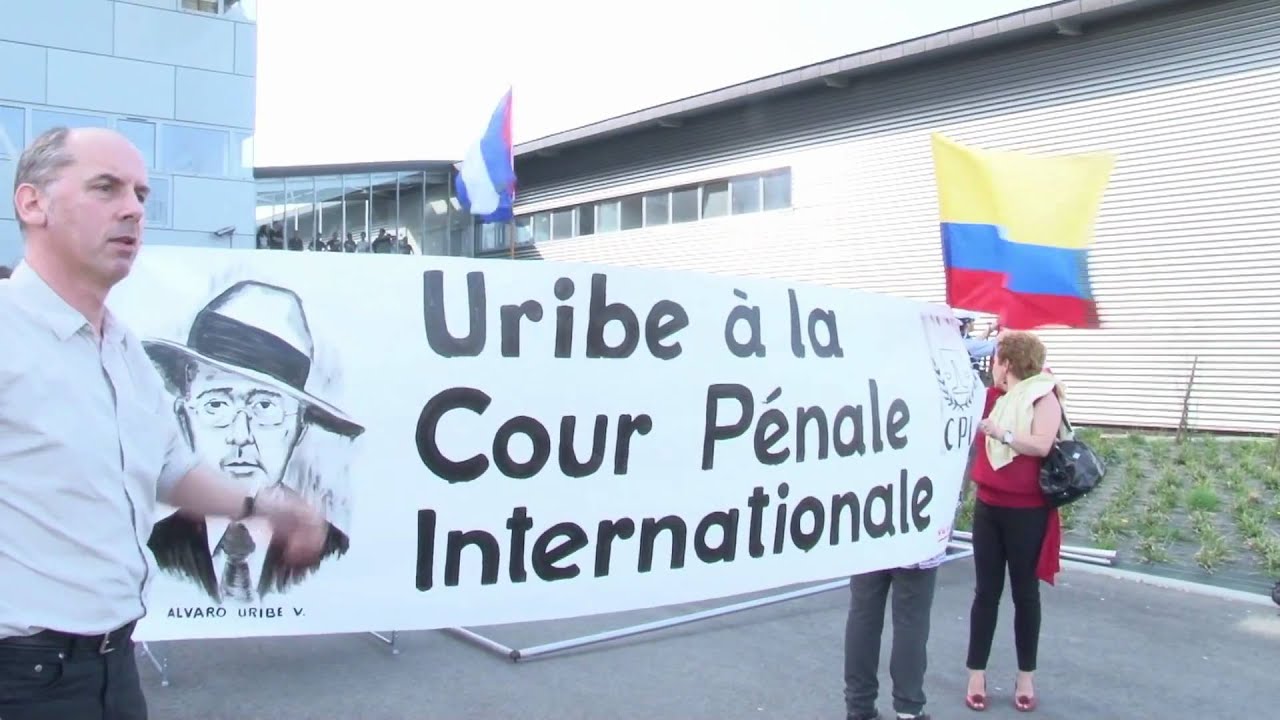 Georgetown’s ¡Adios, Uribe!campaign. However, the scope of these successes have been somewhat limited to individual protests against specific figures. Indeed, Georgetown subsequently brought on Abrams to its faculty, as well as other questionable figures.
But efforts like that of the Call to Conscience will benefit from internationalism and tireless truth-telling about Elliott Abrams’ well-established record—which he couldn’t refute before the Foreign Affairs Committee,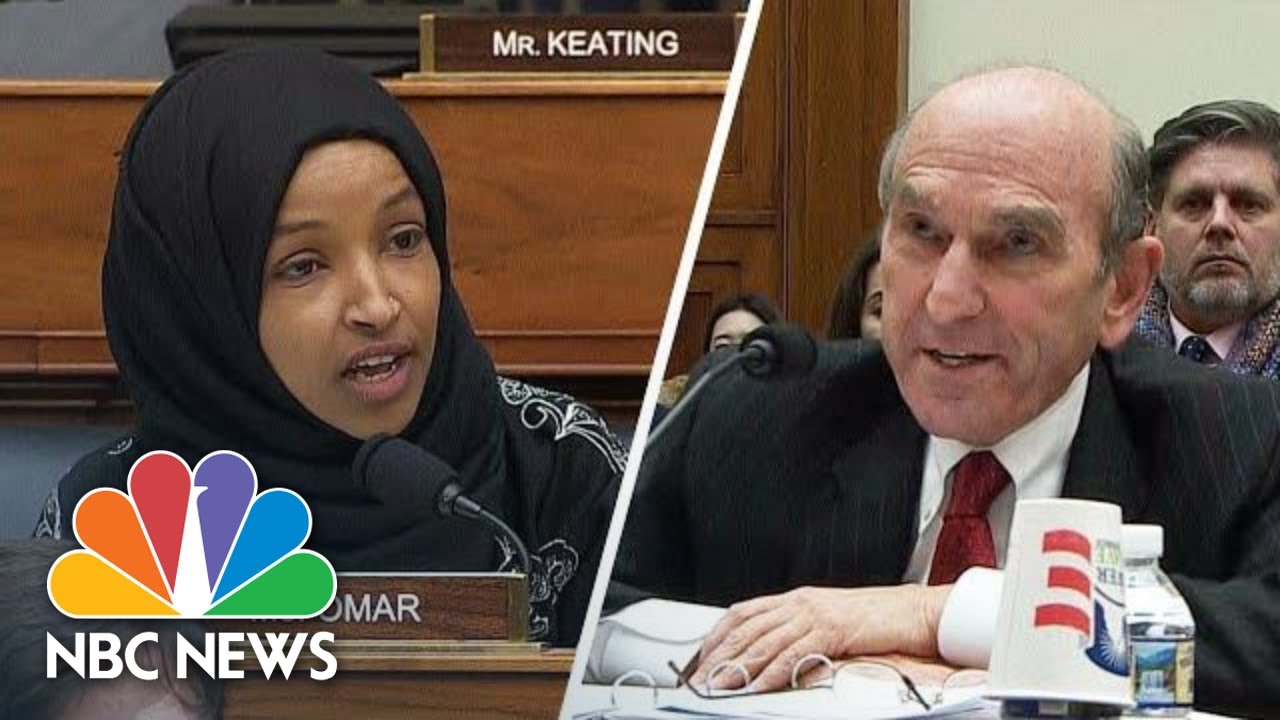 , putting on display a broader indictment of institutional U.S. foreign policy toward Latin America.
With avenues like the International Criminal Court being antagonized by fellow neoconservative John Bolton within the Trump administration, holding criminals like Abrams accountable may necessarily come through shining a light on the non-governmental institutions that are sanitizing their ignominious records. Key to this is remaining grounded in the human toll of his policies that stands in sharp contrast to the titles and prestige that have continued to whitewash figures like Abrams.
Abrams’ vast misdeeds, especially during the Reagan administration, may seem like “old news” to some. But especially with the renewed attention that came with Rep. Omar boldly confronting him in Congress, this is a moment to be seized, to undo the poisonous and bafflingly backward mythology of Elliott Abrams as a defender of “democracy” and “human rights.” If we’re serious about preventing potential future atrocities, we’ll step up, starting with the Holocaust Museum.
---
Walker Grooms is an activist and worker living in Washington, DC, currently with mission-driven communications firm Movement Media. He’s the former DC Program Manager at Witness for Peace, and a founding member of and advisor to the Witness for Peace Solidarity Collective. As a graduate student at Georgetown, he was part of the ¡Adios, Uribe! Coalition.
Tags:
==
https://nacla.org/news/2018/04/24/roundtable-r%C3%ADos-montt-dead
guatemala’s most notorious dictator, retired army general José Efraín Ríos Montt, died of a heart attack on April 1, 2018 at the age of 91. In 2013, after years evading justice, his victims proved in a court of law that he was guilty of genocide. The judgment was later erased by the action of the Constitutional Court at the bidding of powerful business and military elites who feared they’d be next on the docket. But the genocide trial and the testimonial, documentary, and other evidence it produced are helping rewrite the history of the Guatemalan civil war and to empower other victims of state terrorism to pursue justice.
In the following reflections, NACLA contributors reflect on Montt’s life and the legacy of genocide he leaves behind in Guatemala.
- Jo-Marie Burt and Paulo Estrada: A Genocide and the Pursuit of Justice
- Sebastián Escalon: Fading Memories of a Dictator
- Rachel Nolan: Ríos Montt, the Evangelist
- Pamela Yates: At the Genocide Trial: We Meet Again
-Jo-Marie Burt and Paulo Estrada
https://nacla.org/news/2018/04/24/fading-memories-dictator
---
Jo-Marie Burt is Associate Professor at the Schar School of Policy and Government at George Mason University. She is also a senior fellow at the Washington Office on Latin America (WOLA), a research and advocacy organization advancing human rights in Latin America. She specializes in state violence, human rights and transitional justice, with a focus on Peru and Guatemala. She writes about war crimes prosecutions in Guatemala for International Justice Monitor.
Paulo Estrada is a human rights activist and an archaeology student at the University of San Carlos in Guatemala. He was a civil party in a case involving forced disappearances by the Guatemalan state, heard by the Inter-American Court of Human Rights in 2012.
Tags:
----https://nacla.org/news/2018/04/25/genocide-and-pursuit-justice
guatemala’s most notorious dictator, retired army general José Efraín Ríos Montt, died of a heart attack on April 1, 2018 at the age of 91. In 2013, after years evading justice, his victims proved in a court of law that he was guilty of genocide. The judgment was later erased by the action of the Constitutional Court at the bidding of powerful business and military elites who feared they’d be next on the docket. But the genocide trial and the testimonial, documentary, and other evidence it produced are helping rewrite the history of the Guatemalan civil war and to empower other victims of state terrorism to pursue justice.
Though he was in power for only 17 months, between March 23, 1982 and August 7, 1983, Ríos Montt’s government was the most brutal of Guatemala’s 36-year civil war. During the first three months of his regime alone, the military killed an estimated 10,000 people. Between March and December 1982, the country endured an average of 19 massacres per month. Montt’s counter-insurgency policies, originally designed and implemented by his predecessor, Romeo Lucas García (1978-1982), sought to destroy insurgent groups, but were also used to systematically clamp down on Guatemalan social movements that were advocating for change or challenging the military government. And in its zeal to “annihilate” the “internal enemy,” the government’s scorched-earth policies led to the destruction of more than 400 Mayan indigenous communities.
By the time Guatemala signed a peace agreement in 1996, the conflict had left an estimated 200,000 dead, 45,000 forcibly disappeared, countless victims of torture and sexual violence, and tens of thousands forcibly displaced or exiled. According to the United Nations truth commission, 83% of the victims of the conflict were Indigenous. Based on this and other indicators, the commission determined that the Guatemalan state committed “acts of genocide” against the indigenous population in five regions of the country.
The 2013 trial against Ríos Montt and his former military chief, Mauricio Rodríguez Sánchez, was the first time that a former head of state was prosecuted for genocide in a national court, setting a key precedent for international justice. Over 100 survivors and relatives of victims testified in the trial, recounting publicly for the first time the horrors they endured, including massacres, torture, mass rape, and forced displacement. Those who fled into the mountains told harrowing stories of trying to survive amidst relentless military persecution. Many died of starvation, while others said that because of their desperate conditions, they ultimately turned themselves in and were forcibly resettled in villages set up by the army to control the rural population. On May 10, 2013, Ríos Montt was found guilty of crimes against humanity and genocide against the Maya Ixil people and was sentenced to 80 years in prison. His military chief, Rodríguez Sánchez, was acquitted.
Just ten days later, and under intense pressure from business and military elites, Guatemala’s Constitutional Court partially invalidated the proceedings on a technicality and ordered a partial retrial, effectively nullifying the verdict. Ríos Montt was released from military prison and returned to house arrest, while Rodríguez Sánchez was again placed under house arrest. For national and international human rights organizations, the Constitutional Court ruling was illegal and had to be overturned.
Indeed, Ríos Montt and Rodríguez Sánchez could not evade justice. The shadow of the genocide charges continued to haunt Ríos Montt until the day he died. Though the retrial was delayed, it did restart again in late 2017, but Ríos Montt was not obligated to be present in the proceedings because of his dementia diagnosis. Undaunted, the survivors of his genocidal policies testified again, demonstrating their resolve to see justice done. With his death, the case against Ríos Montt has been dismissed, but the proceedings against Rodríguez Sánchez continue.
The delays that characterized the genocide trial illustrate the backroom influence that Guatemalan military elites continue to wield over the country’s judicial and political institutions. Guatemala has been trying to dismantle these kinds of parallel power structures via organisms like the International Commission against Impunity in Guatemala (CICIG), a UN-backed body that works closely with the Attorney General’s Office in investigating high-level corruption cases. Still, given the power that shadowy special interest groups made up of ex-military and intelligence officers continue to wield in Guatemala, the fact that Ríos Montt was put on trial at all was an incredible accomplishment.
For the survivors, who were able to testify publicly about the atrocities they suffered and to confront for the first time their tormentor in a court of law, the trial had meaning far beyond the legal realm. “We approach the struggle for justice on many levels,” Edwin Canil, president of the Association for Justice and Reconciliation, which unites survivors of state-sponsored violence from five Indigenous regions of the country, and himself a genocide survivor, told us after the news of Ríos Montt’s death broke. “The pursuit of justice is just one aspect of our struggle. We are also working to rewrite the history of Guatemala and to make visible the historic violence that has been exercised against Indigenous people.”
“Ríos Montt is dead,” said Canil, “but there are many others who bear responsibility for what happened. We hope that the Attorney General’s Office will move forward on criminal trials against those individuals.”
Ríos Montt will be remembered as one of the 20th century’s most ruthless dictators. Even though the 2013 sentence that convicted him of genocide was technically invalidated, the case showed that it is possible to use witness testimony, documental evidence, forensic evidence, and expert reports, to bring perpetrators of genocide to justice. Ríos Montt will be remembered not as a great political leader or military strategist, but as a perpetrator of genocide who hid behind legions of lawyers to delay, obstruct, and avoid justice, and who ultimately died not a free man, but under house arrest and on trial for the second time for crimes against humanity.
=https://nacla.org/news/2018/04/24/r%C3%ADos-montt-evangelist
Like many other Latin American dictators, Efraín Ríos Montt counted on the training and support of the United States. In 1951, he attended the School of the Americas in Fort Benning, Georgia. (In 2001,the school changed its name to try to escape its reputation as finishing school for dictators and death squad leaders.) But Ríos Montt’s most profound connection to the United States was through evangelical Christianity.
After a destructive earthquake struck Guatemala in 1976, two-dozen missionaries from a Eureka, California-based Pentecostal group traveled to Guatemala to spread the gospel and build houses. They converted a prominent general named Ríos Montt, who seemed to have won the presidency in 1974 only to have it stolen through electoral manipulation by his rival. Ríos Montt converted from Catholicism to become a preacher for the U.S.-based church and dropped out of politics for several years. He preached the gospel.
In 1982, Ríos Montt’s staged a political comeback and seized power in a coup. Jim Durkin, the leader of the Pentecostal church, traveled to Guatemala and said the dictator’s ascension was a “miracle” aided by God. As Virginia Garrard-Burnett chronicled in her book, Terror in the Land of the Holy Spirit, during his dictatorship Ríos Montt appeared on television each Sunday to give “Sunday sermons” on morality, even as he directed scorched earth campaigns in the highlands. In just one year, at least 10,000 people were murdered, most of them indigenous. More than 400 towns were wiped off the map. In 2013, a trial against Ríos Montt for genocide and crimes against humanity revealed he had ordered the massacres.
Here are just a few selections from the thousands of testimonies given to those who put together the U.N. Truth Commission report from the period when Ríos Montt was dictator. I include them to give a sense of the terror and destruction of entire families and communities that Ríos Montt unleashed, the abuses to which his evangelical allies were willfully blind:
An unnamed survivor from Aguacatán, Huehuetenango: “The military came to burn whole families out, to burn their houses and not just their houses but the people themselves. They burned men, women, and children who died in flames, incinerated. It caused us terror, it caused us a lot of fear.”
Any unnamed survivor from Rabinal, Baja Verapaz:“The military officials raped the girls who were 12 and 13 years old. The girls couldn’t do anything because there were so many soldiers lining up to take their turn. First they raped them and then they killed them.”
Another unnamed survivor from Rabinal, Baja Verapaz: “The children were kicked to death. The children shouted and shouted, and then they were silent.”
Even as word of the genocide leaked out, Ríos Montt maintained friendships with prominent U.S. evangelical Christians Jerry Falwell and Pat Robertson. Ronald Reagan had won the presidency in 1980 by flipping the evangelical vote away from the Democrats, who had helped elect Carter four years before. In 1982, Reagan traveled to Guatemala during the genocide and dismissed reports of abuses, saying that Ríos Montt was “totally dedicated to democracy in Guatemala.” Reagan said “frankly I’m inclined to believe” Ríos Montt has been “getting a bum rap.”
Ríos Montt died on April 1 of this year, while under house arrest pending re-trial, just a day after Pope Francis caused controversy by seeming to indicate that hell doesn’t exist. A meme went around among Guatemalans on social media: the Pope said there was no hell, and Ríos Montt finally figured he could finally take the risk of dying. Then the Pope took his comments back.
---
Rachel Nolan is a journalist and a doctoral candidate in Latin American and Caribbean History at New York University.
===
---
http://www.democracynow.org/2013/4/19/genocide_trial_of_former_dictator_ros
A historic trial against former U.S.-backed Guatemalan dictator Efraín Ríos Montt on charges of genocide and crimes against humanity came to an abrupt end Thursday when an appeals court suspended the trial before a criminal court was scheduled to reach a verdict. Ríos Montt on was charged in connection with the slaughter of more than 1,700 people in Guatemala’s Ixil region after he seized power in 1982. His 17-month rule is seen as one of the bloodiest chapters in Guatemala’s decades-long campaign against Maya indigenous people, which resulted in the deaths of hundreds of thousands. Thursday’s decision is seen as a major blow to indigenous victims. Investigative journalist Allan Nairn reported last night Guatemalan army associates had threatened the lives of case judges and prosecutors and that the case had been annulled after intervention by Guatemala’s president, General Otto Pérez Molina. Ríos Montt was the first head of state in the Americas to stand trial for genocide. Nairn flew to Guatemala last week after he was called to testify in Ríos Montt's trial. He was listed by the court as a "qualified witness" and was tentatively scheduled to testify on Monday. But at the last minute, Nairn was kept off the stand "in order," he was told, "to avoid a confrontation" with the president, General Pérez Molina, and for fear that if he took the stand, military elements might respond with violence. In the 1980s, Nairn extensively documented broad army responsibility for the massacres and was prepared to present evidence that personally implicated Pérez Molina, who was field commander during the very Mayan Ixil region massacres for which the ex-dictator, Ríos Montt, had been charged with genocide. [includes rush transcript]
Transcript
This is a rush transcript. Copy may not be in its final form.
JUAN GONZÁLEZ: An historic trial against former U.S.-backed Guatemalan dictator Efraín Ríos Montt on charges of genocide and crimes against humanity came to an abrupt end Thursday when an appeals court suspended the trial before a criminal court was scheduled to reach a verdict. Investigative journalist Allan Nairn reported last night Guatemalan army associates had threatened the lives of case judges and prosecutors and that the case had been annulled after intervention by Guatemala’s president, General Otto Pérez Molina.
Ríos Montt was the first head of state in the Americas to stand trial for genocide.
He was charged in connection with the slaughter of more than 1,700 people in Guatemala’s Ixil region after he seized power in 1982. His 17-month rule is seen as one of the bloodiest chapters in Guatemala’s decades-long campaign against Maya indigenous people, which resulted in the deaths of hundreds of thousands.
http://www.democracynow.org/2013/4/19/exclusive_allan_nairn_exposes_role_of
ALLAN NAIRN: Well, the U.S. was the sponsor of the Guatemalan army, as it had been for many decades, as the U.S. has and continues to sponsor dozens and dozens of repressive armies all over the world. In the case of Guatemala, if you go into the military academy and you see the pictures of the past presidents of military academy, some of them are actually Americans. They’re actual American officers there who were openly running the Guatemalan military training. By the ’80s, when the Ríos Montt massacres were being carried out, the U.S. Congress was under the impression that they had successfully stopped U.S. military aid to Guatemala. But in fact it was continuing. The CIA had an extensive program of backing the G-2, the G-2, the military intelligence service, which selected the targets for assassination and disappearance. They even—they even built a headquarters for—a secret headquarters for the G-2 near the Guatemala City airport. They had American advisers working inside the headquarters. Out in the field, Guatemalan troops were receiving from the U.S. ammunition, weapons.
And most importantly, the U.S., beginning under the Carter administration but continuing under Reagan and after, asked the Israelis to come in and fill the gap that was caused by congressional restrictions. So Israel was doing massive shipments of Galil automatic rifles and other weapons. And Pérez Molina, as you saw in the video, actually had one of his subordinates come over and show me an Israeli-made mortar. That mortar and the helicopters he was asking for from the U.S., those were the kind of weapons they would use to bomb villages and attack people as they were fleeing in the mountains. In listening to the testimony in the trial up to this moment, I was struck by the fact that almost every witness mentioned that they had been attacked from the air, that either their village had been bombed or strafed or that they were bombed or strafed as they were fleeing in the mountains. This testimony suggests that the use of this U.S. and Israeli aircraft and U.S. munitions against the civilians in the Ixil highlands was actually much more extensive than we understood at the time.
Beyond that, beyond the material U.S. support, there’s the question of doctrine. Yesterday in the trial, the Ríos Montt defense called forward a general, a former commander of the G-2, as an expert witness on the defense side. And at the end of his testimony, the prosecution read to this general an excerpt from a Guatemalan military training document. And the document said it is often difficult for soldiers to accept the fact that they may be required to execute repressive actions against civilian women, children and sick people, but with proper training, they can be made to do so. So, the prosecutor asked the Ríos Montt general, "Well, General, what is your response to this document?" And the general responded by saying, "Well, that training document which we use is an almost literal translation of a U.S. training document." So this doctrine of killing civilians, even down to women, children and sick people, was, as the general testified, adopted from the U.S. Indeed, years before, the U.S. military attaché in Guatemala, Colonel John Webber, had said to Time magazine that the Guatemalan army was licensed to kill guerrillas and potential guerrillas. And, of course, the category of potential guerrillas can include anyone, including children.
...
Then, Bosworth went on to say that the U.S. was not giving any military assistance to Guatemala, but I guess it was a couple weeks after that interview when we went down to Guatemala, I met a U.S. Green Beret, Captain Jesse Garcia, who was training the Guatemalan military in combat techniques, including what he called how—in his words, "how to destroy towns." This was apart from the weapons and U.S. munitions that I mentioned before, apart from the CIA trainers who were working in the CIA-built headquarters of the G-2, the military intelligence service that was doing the assassinations and disappearances.
AMY GOODMAN: The G-2 being the Guatemalan G-2. Now, today Stephen Bosworth is the dean of the Fletcher School at Tufts University. But before that, in 2009, well, he played a key role in the Obama administration.
ALLAN NAIRN: Yes, rather than being—you know, in what you might consider to be a normally functioning political system, if a high government official lied like that about matters of such grave, life-and-death importance and was involved in the supply of arms to terrorists, in this case the Guatemalan military, you would expect him at the minimum to be fired and disgraced, or maybe brought up on charges. But Bosworth was actually promoted. And under the Obama administration, Hillary Clinton chose him as the special envoy to North Korea. He’s been in the news a great deal in recent times because of his very prominent role there.
AMY GOODMAN: In 1995, Allan Nairn was interviewed on Charlie Rose about his piece in The Nation called "CIA Death Squad," in which he described how Americans were directly involved in killings by the Guatemalan army. He was interviewed alongside Elliott Abrams, who challenged what he was saying. Abrams had served as assistant secretary of state for human rights and humanitarian affairs under President Reagan from 1981 to 1985. This clip begins with Elliott Abrams.
ELLIOTT ABRAMS: Wait a minute. We’re not here to refight the Cold War. We’re here to talk about, I thought, a specific case in which an allegation is being made that—of the husband of an American and, another case, an American citizen were killed, and there was a CIA connection with—allegedly with the person allegedly involved in it. Now, I’m happy to talk about that kind of thing. If Mr. Nairn thinks we should have been on the other side in Guatemala—that is, we should have been in favor of a guerrilla victory—I disagree with him.
ALLAN NAIRN: So you’re then admitting that you were on the side of the Guatemalan military.
ELLIOTT ABRAMS: I am admitting that it was the policy of the United States, under Democrats and Republicans, approved by Congress repeatedly, to oppose a communist guerrilla victory anywhere in Central America, including in Guatemala.
CHARLIE ROSE: Alright, well, I—
ALLAN NAIRN: A communist guerrilla victory.
CHARLIE ROSE: Yeah, I—
ALLAN NAIRN: Ninety-five percent of these victims are civilians—peasant organizers, human rights leaders—
CHARLIE ROSE: I am happy to invite both of you—
ALLAN NAIRN: —priests—assassinated by the U.S.-backed Guatemalan army. Let’s look at reality here. In reality, we’re not talking about two murders, one colonel. We’re talking about more than 100,000 murders, an entire army, many of its top officers employees of the U.S. government. We’re talking about crimes, and we’re also talking about criminals, not just people like the Guatemalan colonels, but also the U.S. agents who have been working with them and the higher-level U.S. officials. I mean, I think you have to be—you have to apply uniform standards. President Bushonce talked about putting Saddam Hussein on trial for crimes against humanity, Nuremberg-style tribunal. I think that’s a good idea. But if you’re serious, you have to be even-handed. If we look at a case like this, I think we have to talk—start talking about putting Guatemalan and U.S. officials on trial. I think someone like Mr. Abrams would be a fit—a subject for such a Nuremberg-style inquiry. But I agree with Mr. Abrams that Democrats would have to be in the dock with him. The Congress has been in on this. The Congress approved the sale of 16,000 M-16s to Guatemala. In ’87 and ’88—
http://www.democracynow.org/topics/guatemala
---
http://www.propublica.org/article/immigration-charges-for-accused-commando-in-dos-erres-massacre
A former Guatemalan Army lieutenant was extradited Friday from Canada to stand trial in Southern California on federal charges related to the massacre of 250 people in a Guatemalan village in 1982, a case that has resulted in landmark human rights prosecutions in Guatemala and the United States.
U.S. federal officers took custody of Jorge Vinicio Sosa Orantes in Calgary Friday morning and were en route to Los Angeles, U.S. officials said. Sosa, 54, is the highest-ranking officer to have been arrested on charges alleging direct involvement in the massacre by a 20-man unit of elite commandos in the northern Guatemalan farming hamlet of Dos Erres.
In May, ProPublica reported the story of Oscar Alfredo Ramírez Castañeda, who learned only last year that he was a Dos Erres survivor. He had been abducted by a commander of the unit and raised by his family.
Sosa, a karate instructor who holds both U.S. and Canadian citizenship, fled his home in the Los Angeles area in mid-2010 as agents of Immigration and Customs Enforcement (ICE) closed in on him. He went to Mexico and then to Lethbridge in western Canada, where he has family, and was arrested in January of last year, according to U.S. and Canadian court documents. Last month, a Canadian appeals court ended his legal fight to avoid extradition to the United States.
Because U.S. courts do not have jurisdiction for the massacre, federal prosecutors indicted Sosa on charges of lying on immigration forms. He allegedly concealed his military service and involvement in Dos Erres on the forms when he obtained citizenship in 2008 and residency 10 years earlier, according to an indictment filed in 2010. The trial could start in about two months in federal court in Riverside, Calif.
In Dos Erres, Sosa allegedly oversaw the slaughter of men, women and children who were dumped in a well during a day-long frenzy of torture, rape and pillage, according to U.S. and Guatemalan court documents. He allegedly fired his rifle and threw a grenade into a pile of living and dead victims in the well, according to the testimony in Guatemalan courts of two former soldiers who are now protected witnesses.
Sosa was a sub-lieutenant at the time, junior in rank only to three lieutenants in the squad of highly-trained commando instructors. Sosa denied guilt during a recent telephone interview with ProPublica from jail in Calgary. He said he was in another village doing a military public works project on the day of the massacre in December 1982. He described the charges against him as the product of a conspiracy.
The Dos Erres case was one of the worst of hundreds of massacres during Guatemala's 30-year civil war, which ended in 1996 and resulted in more than 200,000 deaths. In "Finding Oscar: Massacre, Memory and Justice in Guatemala," ProPublica told the story through the odyssey of Oscar Ramírez Castañeda, now a 33-year-old father of four living in Boston. After a dogged investigation by Guatemalan prosecutors, Oscar learned last year that his life until that point had been based on a lie.
DNA tests proved that when Oscar was age 3 and living in the village, a commando lieutenant spared his life and abducted him after the unit killed the boy's mother and eight brothers and sisters. The lieutenant died in an accident months later, but his family raised Oscar as if he were one of their own. Oscar, an illegal immigrant who came to the United States in 1998, is now a father of four and works two full-time jobs.
---
===omg
Rios Montt prosecution was less about justice and more about using the courts to wage political propaganda campaigns to settle old scores. Rios Montt’s real crime was not genocide, according to prevailing logic, but his political beliefs. His polar opposite contemporaries in Central America will never be prosecuted because they were fighting for “progressive ideals.”
For the same reason, the United States does not bear responsibility for any excesses in the Guatemalan civil war.
Few had clean hands in the battle over Central America in the 1980s. Why say only one side was villainous?
Let’s take away the political labels and look objectively at the crimes. If Rios Montt is to be found guilty in 2013, for murders committed in the 1980s, then the current Nicaraguan president, Daniel Ortega, who led the dictatorial Sandinista junta during the bloody Nicaraguan civil war, and a contemporary of Rios Montt, should be tried on similar charges.
And if the United States is considered complicit in any crimes in Central America, that same justice should extend to the former Cuban dictator Fidel Castro and his brother and successor, Raul, who for decades ran the Cuban military. It was the Castro brothers, after all, who provided training and weapons for Ortega’s murderous rule, and helped spread the leftist insurgency throughout Central America, which Rios Montt used to legitimize his actions.
Likewise, shouldn’t former insurgents who committed war crimes in the 1980s also face justice?
Guerrilla leaders in El Salvador ordered assassination and urban terrorism in the 1980s, but now participate in its government. Should they not be tried for war crimes, too?
Ideally, yes. But what purpose would that serve, a generation after the fact? The success of El Salvador as a market economy and multiparty democracy rests on the very uncomfortable fact that, in exchange for peace and national reconciliation, a lot of bad guys had to go free.
As imperfect as the U.S.-backed amnesty-for-peace deals in Nicaragua and El Salvador were, they worked. As rewarding as it would be to see Ortega or Sanchez Ceren or Fidel Castro or U.S. officials, share the fate of Rios Montt, it would not be in the interests of justice.
==
==
==
after ppl's uprising, 18 arrested:
In a stunning development, Guatemalan police have arrested 18 ex-military leaders on charges of committing crimes against humanity during the decades-long, U.S.-backed dirty war against Guatemala’s indigenous communities. The ex-military leaders face charges of ordering massacres and forced disappearances during the conflict, which led to perhaps a quarter-million deaths. Many of the arrested former military leaders were backed by the United States, including Manuel Benedicto Lucas García, who had worked closely with U.S. military officials to develop a system of attacking the highlands where Guatemala’s indigenous Mayan communities reside. The system involved decapitating and crucifying people. We speak to investigative journalist and activist Allan Nairn.
---
TRANSCRIPT
This is a rush transcript. Copy may not be in its final form.
AMY GOODMAN: We turn to stunning developments in Guatemala, where this week police have arrested 18 ex-military leaders on charges of committing crimes against humanity during the decades-long, U.S.-backed dirty war against Guatemala’s indigenous communities. The ex-military leaders face charges of ordering massacres and forced disappearances, which led to perhaps a quarter of a million deaths. Many of the arrested former military leaders were backed by the United States, including Manuel Benedicto Lucas García, who had worked closely with U.S. military officials to develop a system of attacking the highlands where Guatemala’s indigenous Mayan communities reside. The system involved decapitating and crucifying people. Lucas is a former army chief of staff and the brother of the ex-dictator, General Fernando Romeo Lucas García. Speaking Wednesday, he defended himself against the charges.
MANUEL BENEDICTO LUCAS GARCÍA: [translated] Because I have done well for humanity, I have saved lives. As I always said in each opportunity, if I killed, I killed during a battle in front of my troops, and not as a coward or anything like that.
...These officers arrested the other day include a former army chief of staff, a group of intelligence chiefs,a former member of the Ríos Montt junta,a former minister of the interior. These are people at the heart of the power structure in Guatemala. They’re the partners of the oligarchy. They were the partners of the U.S. military. If you go back and read the cables that have so far been declassified from within the Defense Intelligence Agency and other U.S. agencies, you see them praising these officers, the very ones who were—have now been arrested for these atrocities. And these men arrested are also—also form part of the core of the group that’s the government of—the incoming government, Jimmy Morales, just elected. His right-hand man was Ovalle Maldonado, who is one of those charged with crimes at the Cobán base, which I was just describing, where they—the pits are just stacked with skeletons. So, this has big implications.
And it could have even bigger implications for the U.S. I spoke to, during the years when this was happening, three of the four CIA station chiefs who served there. I named their names in an article which appeared in The Nation in 1995. The prosecutors can go look at that article, see who they are. The U.S. personnel who were there, and who are still alive, can be subpoenaed. The U.S. should be subpoenaed to release all NSA, State Department and Pentagon documents regarding payments they made to these officers, training and advice they gave to them. The Guatemalan authorities, in theory, would have the right to extradite surviving U.S. officials.
---
update: http://www.democracynow.org/2013/5/10/despite_evidence_of_massacres_former_guatemalan
http://www.democracynow.org/2013/4/19/genocide_trial_of_former_dictator_ros
A historic trial against former U.S.-backed Guatemalan dictator Efraín Ríos Montt on charges of genocide and crimes against humanity came to an abrupt end Thursday when an appeals court suspended the trial before a criminal court was scheduled to reach a verdict. Ríos Montt on was charged in connection with the slaughter of more than 1,700 people in Guatemala’s Ixil region after he seized power in 1982. His 17-month rule is seen as one of the bloodiest chapters in Guatemala’s decades-long campaign against Maya indigenous people, which resulted in the deaths of hundreds of thousands. Thursday’s decision is seen as a major blow to indigenous victims. Investigative journalist Allan Nairn reported last night Guatemalan army associates had threatened the lives of case judges and prosecutors and that the case had been annulled after intervention by Guatemala’s president, General Otto Pérez Molina. Ríos Montt was the first head of state in the Americas to stand trial for genocide. Nairn flew to Guatemala last week after he was called to testify in Ríos Montt’s trial. He was listed by the court as a "qualified witness" and was tentatively scheduled to testify on Monday. But at the last minute, Nairn was kept off the stand "in order," he was told, "to avoid a confrontation" with the president, General Pérez Molina, and for fear that if he took the stand, military elements might respond with violence. In the 1980s, Nairn extensively documented broad army responsibility for the massacres and was prepared to present evidence that personally implicated Pérez Molina, who was field commander during the very Mayan Ixil region massacres for which the ex-dictator, Ríos Montt, had been charged with genocide. [includes rush transcript]
Transcript
This is a rush transcript. Copy may not be in its final form.
JUAN GONZÁLEZ: An historic trial against former U.S.-backed Guatemalan dictator Efraín Ríos Montt on charges of genocide and crimes against humanity came to an abrupt end Thursday when an appeals court suspended the trial before a criminal court was scheduled to reach a verdict. Investigative journalist Allan Nairn reported last night Guatemalan army associates had threatened the lives of case judges and prosecutors and that the case had been annulled after intervention by Guatemala’s president, General Otto Pérez Molina.
Ríos Montt was the first head of state in the Americas to stand trial for genocide.
He was charged in connection with the slaughter of more than 1,700 people in Guatemala’s Ixil region after he seized power in 1982. His 17-month rule is seen as one of the bloodiest chapters in Guatemala’s decades-long campaign against Maya indigenous people, which resulted in the deaths of hundreds of thousands.
http://www.democracynow.org/2013/4/19/exclusive_allan_nairn_exposes_role_of
http://www.democracynow.org/topics/guatemala
---
https://www.nytimes.com/2018/04/01/obituaries/efrain-rios-montt-guatemala-dead.html
no lnx
Efraín Ríos Montt, Guatemalan Dictator Convicted of Genocide, Dies at 91
By Stephen Kinzer
April 1, 2018
Gen. Efraín Ríos Montt, who as dictator of Guatemala in the 1980s ordered fierce tactics to suppress a guerrilla insurgency and was later convicted of genocide and crimes against humanity, died on Sunday in Guatemala City. He was 91.
The cause was a heart attack, according to his lawyers, Jaime Hernández and Luis Rosales. The general had dementia and had suffered lung and heart problems in recent years.
In the panoply of commanders who turned much of Central America into a killing field in the 1980s, General Ríos Montt was one of the most murderous. He was convicted in 2013 of trying to exterminate the Ixil ethnic group, a Mayan Indian community whose villages were wiped out by his forces.
A Guatemalan judge found that the general had known about the systematic massacres, in the hillside hamlets of the El Quiché department, and had done nothing to stop them or the aerial bombardment of refugees who had fled to the mountains.
The conviction, seen as a landmark in human rights law, was overturned shortly afterward. At his death he was being retried in absentia.
But the general was also a paradox. He began his political career as a reformer and became an evangelical preacher and teetotaler. Though reviled by many, he was a hero to others who believed his “beans and bullets” policy had helped keep Guatemala from falling under the power of Marxist-led guerrillas.
President Ronald Reagan was General Ríos Montt’s most prominent admirer. After meeting him in 1982, Mr. Reagan said the general was “getting a bum rap on human rights.”
“I know that President Ríos Montt is a man of great personal integrity and commitment,” he said. “I know he wants to improve the quality of life for all Guatemalans and to promote social justice. My administration will do all it can to support his progressive efforts.”
[ImageGen. Rios Montt, center, announcing the formation of a junta after the overthrow of Gen. Romeo Lucas García’s right wing government.
José Efraín Ríos Montt was born on June 16, 1926, in the highland town of Huehuetenango. He joined the army as a young man and was trained at the United States Army School of the Americas in the Panama Canal Zone.
Guatemala has long been under the shadow of American influence. The leftist president Jacobo Arbenz was overthrown in a C.I.A.-backed coup in 1954, an event in which General Ríos Montt, then a young junior military officer, played a minor role.
In 1970, he became army chief of staff, but lost his post as a result of political rivalries and was sent to Washington to join the faculty of the Inter-American Defense College.
General Ríos Montt returned to Guatemala in 1973. The next year he ran for president as the candidate of a coalition supported by the center-left Christian Democrats. He lost after what was widely seen as fraud directed by military commanders. He was then sent out of the country as military attaché in Spain.
In the late 1970s, after returning to Guatemala, General Ríos Montt reinvented himself. He took a Dale Carnegie course in human relations, abandoned Roman Catholicism, became a preacher in the California-based Church of the Word, and struck up friendships with American evangelists, including Jerry Falwell and Pat Robertson.
With his slicked-back hair, bushy mustache, charismatic speaking style and reputation for personal rectitude, General Ríos Montt built an enthusiastic following. On March 23, 1982, he and a handful of other officers staged a successful coup. He became head of a three-man junta.
By that time, leftist guerrillas had seized power in Nicaragua and were mounting strong campaigns in El Salvador and Guatemala. Determined to crush the Guatemalan insurgency, General Ríos Montt intensified the scorched-earth campaign that had been waged by his predecessor, Gen. Romeo Lucas García. In his first five months in power, according to Amnesty International, soldiers killed more than 10,000 peasants.
Thousands more disappeared. Hundreds of thousands fled their homes, many seeking refuge across the border in Mexico. Nearly all victims were indigenous people of Mayan extraction.
General Ríos Montt liked to say that a true Christian carried the Bible in one hand and a rifle in the other.
[Image Efraín Ríos Montt at his trial in 2013. He was convicted of genocide and crimes against humanity and sentenced to 80 years in prison.Credit...Moises Castillo/Associated Press
“If you are with us, we will feed you,” he told Guatemalan peasants. “If not, we will kill you.”
Rival officers deposed General Ríos Montt in a coup on Aug. 8, 1983, after he had effectively ruled as dictator for 17 months. He remained a public figure, however, running for president in 1990 and 2003. Supporters portrayed him as incorruptible, and said he had brought a measure of peace to a country that was careening toward anarchy.
General Ríos Montt served several terms in Congress, which gave him immunity from prosecution. When his last term expired in 2012, he lost that immunity.
By then, advances toward civilian democracy in Guatemala had made it feasible to indict him. An exhaustive “truth commission” investigation provided much evidence. More came from the excavation of mass graves.
General Ríos Montt’s trial opened in January 2013. He and his former chief of intelligence were charged with responsibility for massacres in 15 Ixil Maya villages in which 1,771 unarmed men, women, and children were killed.
The general, who was then 86, protested his innocence.
“I never did it,” he testified at his trial. “Of everything that has been said here, there has never been any evidence of my participation.”
In pronouncing her verdict after a two-month trial, Judge Yasmín Barrios said she was “completely convinced” of General Ríos Montt’s guilt. She sentenced him to 80 years in prison.
Relatives of victims who packed the courtroom, many wearing colorful Maya clothing, erupted in cheers of “Justice!” and “Yes, it was genocide!” The general’s co-defendant was acquitted.
“For Guatemala it broke ground that these people are no longer untouchable,” Jo-Marie Burt, a Latin America expert at the Schar School of Policy and Government at George Mason University, said of the trial. “The Ríos Montt trial was another example of Latin America leading the way in showing that it is possible to bring war criminals to trial and to bring some measure of reparation to the victims, and to rewrite the historical record so that it’s a more accurate reflection of what happened and who was responsible.”
General Ríos Montt is survived by his wife, María Teresa; a son, Enrique, who served as army chief of staff but resigned after being charged with embezzlement; and a daughter, Zury, a former member of Congress who is married to a Republican former member of the United States Congress, Gerald C. Weller. Another son, Homero, a military doctor, was killed in a helicopter crash in 1984.
“Consider the thousands of unarmed men, women and children killed by the army while he sermonized about morality, and he is a monster,” wrote David Stoll, a professor of anthropology at Middlebury College in Vermont. “Consider the hopes invested in him by many Guatemalans, including poverty-stricken Catholic peasants, and he becomes a hero of mythic proportions.”
==
Apr 1, 2018 - General Ríos Montt began his political career as a reformer but was later ... and was trained at the United States Army School of the Americas in ...
Missing: abrams ?| Must include: abrams
Efraín Ríos Montt - Wikipediaen.wikipedia.org › wiki › Efraín_Ríos_Montt
Ríos Montt enrolled in the Military Academy of Guatemala in 1946. He attended the School of the Americas in 1951. In 1954, the young officer played a minor ...
Missing: abrams ?| Must include: abrams
Elliott Abrams - Wikipediaen.wikipedia.org › wiki › Elliott_Abrams
Elliott Abrams (born January 24, 1948) is an American diplomat and lawyer, who has served in ... Abrams attended the Little Red School House in New York City, a private high school whose students at the ... Ríos Montt came to power via a coup in 1982, overcoming the forces of General Fernando Romeo Lucas García.
'Someone is not being honest': Elliott Abrams, Trump's ...www.washingtonpost.com › nation › 2019/02/14 › som...
Feb 14, 2019 - A demonstrator sits behind Elliott Abrams, the U.S. special representative ... In college, he led Harvard's chapter of Americans for Democratic Action, ... Efraín Ríos Montt, as the Reagan administration moved to lift an embargo ...
The Upside of Genocide | The Nationwww.thenation.com › article › archive › upside-genocide
Jun 19, 2013 - Efraín Ríos Montt, Guatemala's then-dictator, the country's military forces ... Rights Elliott Abrams credited Ríos Montt with having “brought considerable ... Assistant Secretary of State for Inter-American Affairs Thomas Enders wrote to ... professor of English at Brooklyn College and the author of 11 books.
An Actual American War Criminal May Become Our Second ...www.thenation.com › article › archive › an-actual-amer...
Feb 2, 2017 - Elliott Abrams spent the Reagan years abetting genocide—now, he has been floated as Trump's deputy secretary of state.
Efrain Rios Montt, Former Guatemalan Dictator, Dies At 91 : NPRwww.npr.org › 2018/04/03 › efrain-rios-montt-former-gu...
Apr 3, 2018 - Not only did the U.S. government know what was happening under Rios Montt's watch, Rios Montt is a product of the U.S. school of the Americas.
Elliott Abrams' Dark History in Latin America and the Struggle ...pulsemedia.org › 2012/02/05 › elliott-abrams-dark-hist...
Feb 5, 2012 - In Guatemala, Efraín Ríos Montt is standing trial for genocide and crimes ... who received training at the infamous “School of the Americas”.
Elliott Abrams Isn't Going to Bring “Democracy” to Venezuelatheintercept.com › 2019/01/30 › elliott-abrams-venezue...
Jan 30, 2019 - Abrams, a graduate of both Harvard College and Harvard Law School, joined ... During Ríos Montt's administration, Abrams called for the lifting of an ... While it's been forgotten now, before America invaded Panama to oust ...
Genocide Survivors Demand Elliott Abrams Leave Holocaust ...www.telesurenglish.net › news › Genocide-Survivors-S...
Feb 26, 2019 - ... two generals trained by the US military at the School of the Americas (and) a survivor of torture under Rios Montt dictatorship,” are circulating ...
---