17th amend elect sen
-=-=
SUDDEN TARGET 1126?
mma 11 26
Tim Pool: "Repeal the Seventeenth Amendment outright"
-=-=
11/04/2026
In the wake of an election that saw Republicans across the country swept out of office by a massive blue wave, former Trump attorney and religious-right commentator Jenna Ellis is calling for the Constitution to be amended because the voters are too "stupid" to be trusted to elect their own senators.
Outraged by Michigan voters' decision to elect Abdul El-Sayed to the U.S. Senate, Ellis said on her radio program today Republicans must focus on making "generational" changes to our electoral process via a Convention of States that will propose constitutional amendments to alter our system of government as it currently stands.
Originally under the Constitution, senators were chosen by their respective state legislatures, but that was changed by the passage of the 17th Amendment in 1913 which gave voters the power to elect their senators.
This was a mistake, Ellis said, because "the people can be stupid," as demonstrated by the election of El-Sayed.
"The whole Trump era has basically been a dam and a wall against this entire deluge of the worst from the left," Ellis said. "There are cracks now that we've seen over the last couple of years in that wall and I think that the dam broke last night."
"Every election can't just be a reprieve," she continued. "We have to holistically look at some changes for the country that are more generational. And this is why for a long time I have been an advocate of the Convention of States Project, because one of the things that our founders provided for us in the original Constitution was a republic, not just a democracy that every election and every office went directly to the voters."
"There's kind of been this perception, even among conservatives, that more access to the franchise of voting, the more things that go on the ballot for the people's engagement, the better," Ellis declared. "Well, the people can be duped. When you look at people who are voting for socialist candidates; the fact that we have El-Sayed now in Congress, the people can be stupid."
"This is why when Amendment 17 changed the U.S. Senate, instead of having the state legislatures appoint U.S. senators to represent the states, it went to a popular vote, this is why now we may not have a good Senate until 2032," Ellis griped. "So we have to take stock of maybe some of those generational losses that it's not just at the ballot box, but that we can cure some of these systemic process problems moving forward and take a really hard look. ... If not now, when? How long are you going to wait, and how much does America have to lose before we say, 'Okay, now we're finally going to shatter the glass and say it is time'?"
-=-=
https://scholars.law.unlv.edu/cgi/viewcontent.cgi?article=1365&context=facpub
1997
Ulysses at the Mast: Democr Ulysses at the Mast: Democracy, Federalism, and the Sir alism, and the Sirens' Song ens' Song
of the Seventeenth Amendment
Jay S. Bybee
University of Nevada, Las Vegas -- William S. Boyd School of Law
Richard Spaight of North Carolina proposed that the second branch be chosen by state legislatures, and his proposal was moved again by John Dickinson.60 While the convention ultimately approved this proposal, the delegates offered very different reasons for supporting it. Several delegates argued that a senate elected by state legislatures, instead of selected by the people, would be more likely to produce "fit men."'61
Elbridge Gerry, taking a page from the experience of the colonial councils, argued that "commercial & monied interest [would] be more secure in the hands of the State Legislatures, than of the people at large." 62 The former, he argued, "have more sense of character, and will be restrained by that from injustice. 63 Since most states had two branches, "one of which is somewhat aristocratic," there would be a "better chance of refinement in the choice" of senators. 64 He repeated that "the great mercantile interest and of stockholders" would be better represented "if the state legislatures choose the second branch. '65 Madison added that the "Senate ought to come from, & represent, the Wealth of the nation. 66
start 1826
https://www.senate.gov/artandhistory/history/common/briefing/Direct_Election_Senators.htm
Direct Election of Senators
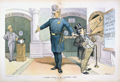
Voters have elected their senators in the privacy of the voting booth since 1913. The framers of the Constitution, however, did not intend senators to be elected in this way, and included in Article I, section 3, "The Senate of the United States shall be composed of two Senators from each state, chosen by the legislature thereof for six Years; and each Senator shall have one Vote." The election of delegates to the Constitutional Convention established the precedent for state selection. The framers believed that in electing senators, state legislatures would cement their tie with the national government, which would increase the chances for ratifying the Constitution. They also expected that senators elected by state legislatures would be able to concentrate on the business at hand without pressure from the populace.
This process seemed to work well until the mid-1850s. At that time, growing hostilities in various states resulted in vacant Senate seats. In Indiana, for example, the conflict between Democrats in the southern half of the state and the emerging Republican party in the northern half prevented the election of any candidate, thereby leaving the Senate seat vacant for two years. This marked the beginning of many contentious battles in state legislatures, as the struggle to elect senators reflected the increasing tensions over slavery and states' rights which led to the Civil War.
After the Civil War, problems in senatorial elections by the state legislatures multiplied.In one case in the late 1860s, the election of Senator John Stockton of New Jersey was contested on the grounds that he had been elected by a plurality rather than a majority in the state legislature. Stockton based his defense on the observation that not all states elected their senators in the same way, and presented a report that illustrated the inconsistency in state elections of senators. In response, Congress passed a law in 1866 regulating how and when senators were elected in each state. This was the first change in the process of senatorial elections created by the Founders. The law helped but did not entirely solve the problem, and deadlocks in some legislatures continued to cause long vacancies in some Senate seats.
Intimidation and bribery marked some of the states' selection of senators. Nine bribery cases were brought before the Senate between 1866 and 1906. In addition, forty-five deadlocks occurred in twenty states between 1891 and 1905, resulting in numerous delays in seating senators. In 1899, problems in electing a senator in Delaware were so acute that the state legislature did not send a senator to Washington for four years.
The impetus for reform began as early as 1826 , when direct election of senators was first proposed. In the 1870s, voters sent a petition to the House of Representatives for a popular election. From 1893 to 1902, momentum increased considerably. Each year during that period, a constitutional amendment to elect senators by popular vote was proposed in Congress, but the Senate fiercely resisted change,despite the frequent vacancies and disputed election results. In the mid-1890s, the Populist party incorporated the direct election of senators into its party platform, although neither the Democrats nor the Republicans paid much notice at the time. In the early 1900s, one state initiated changes on its own.Oregon pioneered direct election and experimented with different measures over several years until it succeeded in 1907. Soon after, Nebraska [populist?]followed suit and laid the foundation for other states to adopt measures reflecting the people's will. Senators who resisted reform had difficulty ignoring the growing support for direct election of senators.
After the turn of the century, momentum for reform grew rapidly. William Randolph Hearst expanded his publishing empire with Cosmopolitan, and championed the cause of direct election with muckraking articles and strong advocacy of reform. Hearst hired a veteran reporter, David Graham Phillips, who wrote scathing pieces on senators, portraying them as pawns of industrialists and financiers. The pieces became a series titled "The Treason of the Senate," which appeared in several monthly issues of the magazine in 1906. These articles galvanized the public into maintaining pressure on the Senate for reform.
Increasingly, senators were elected based on state referenda, similar to the means developed by Oregon. By 1912, as many as twenty-nine states elected senators either as nominees of their party's primary or in a general election. As representatives of a direct election process, the new senators supported measures that argued for federal legislation, but in order to achieve reform, a constitutional amendment was required. In 1911, Senator Joseph Bristow from Kansas offered a resolution, proposing a constitutional amendment. The idea also enjoyed strong support fromSenator William Borah of Idaho, himself a product of direct election. Eight southern senators and all Republican senators from New England, New York, and Pennsylvania opposed Senator Bristow's resolution. The Senate approved the resolution largely because of the senators who had been elected by state-initiated reforms, many of whom were serving their first term, and therefore may have been more willing to support direct election. After the Senate passed the amendment, which represented the culmination of decades of debate about the issue, the measure moved to the House of Representatives.
The House initially fared no better than the Senate in its early discussions of the proposed amendment. Much wrangling characterized the debates, but in the summer of 1912 [populist/progressive? WJB?] the House finally passed the amendment and sent it to the states for ratification. The campaign for public support was aided by senators such as Borah and political scientist George H. Haynes, whose scholarly work on the Senate contributed greatly to passage of the amendment.
Connecticut's approval gave the Seventeenth Amendment the required three-fourths majority, and it was added to the Constitution in 1913. The following year marked the first time all senatorial elections were held by popular vote.
The Seventeenth Amendment restates the first paragraph of Article I, section 3 of the Constitution and provides for the election of senators by replacing the phrase "chosen by the Legislature thereof" with "elected by the people thereof." In addition, it allows the governor or executive authority of each state, if authorized by that state's legislature, to appoint a senator in the event of a vacancy, until a general election occurs.
The Seventeenth Amendment to the U.S. Constitution:
https://en.wikipedia.org/wiki/Seventeenth_Amendment_to_the_United_States_Constitution
Seventeenth Amendment (Amendment XVII) to the United States Constitution established the popular election of United States Senators by the people of the states. The amendment supersedes Article I, §3, Clauses 1 and 2 of the Constitution, under which senators were elected by state legislatures. It also alters the procedure for filling vacancies in the Senate, allowing for state legislatures to permit their governors to make temporary appointments until a special election can be held.
The amendment was proposed by the 62nd Congress in 1912 and became part of the Constitution in 1913 on ratification by three-fourths (36) of the state legislatures. Sitting Senators were not affected by the Amendment's provisions until their existing terms expired, so the Amendment took six years to fully implement. The transition began with two special elections in 1913 and 1914 - the first in Maryland and the second in Alabama. The transition then began in earnest with the November 1914 election, and was complete on 4 March 1919 when the Senators chosen at the November 1918 election took office.
- :{:{Text:(style="display:table-cell"):}::(style="display:table-cell;padding-left:0px;padding-right:0.5em"):}:
- :{2:(style="display:table-cell;padding-left:0px;padding-right:0.5em"):}::{Background:(style="display:table-cell"):}:
- :{2.1:(style="display:table-cell;padding-left:0px;padding-right:0.5em"):}::{Original composition:(style="display:table-cell"):}:
- :{2.2:(style="display:table-cell;padding-left:0px;padding-right:0.5em"):}::{Issues:(style="display:table-cell"):}:
- :{2.3:(style="display:table-cell;padding-left:0px;padding-right:0.5em"):}::{Calls for reform:(style="display:table-cell"):}:
- :{3:(style="display:table-cell;padding-left:0px;padding-right:0.5em"):}::{Proposal and ratification:(style="display:table-cell"):}:
- :{4:(style="display:table-cell;padding-left:0px;padding-right:0.5em"):}::{Effect:(style="display:table-cell"):}:
- :{4.1:(style="display:table-cell;padding-left:0px;padding-right:0.5em"):}::{Filling vacancies:(style="display:table-cell"):}:
- :{4.2:(style="display:table-cell;padding-left:0px;padding-right:0.5em"):}::{First direct elections to the Senate:(style="display:table-cell"):}:
- :{4.3:(style="display:table-cell;padding-left:0px;padding-right:0.5em"):}::{Interpretation and advocacy for reform or repeal:(style="display:table-cell"):}:
- :{5:(style="display:table-cell;padding-left:0px;padding-right:0.5em"):}::{References:(style="display:table-cell"):}:
- :{6:(style="display:table-cell;padding-left:0px;padding-right:0.5em"):}::{Bibliography:(style="display:table-cell"):}:
- :{7:(style="display:table-cell;padding-left:0px;padding-right:0.5em"):}::{External links:(style="display:table-cell"):}:
Text
...
Calls for a constitutional amendment regarding Senate elections started in the early 19th century, with Henry R. Storrs in 1826 proposing an amendment to provide for popular election.[21] Similar amendments were introduced in 1829 and 1855, with the "most prominent" proponent being Andrew Johnson, who raised the issue in 1868 and considered the idea's merits "so palpable" that no additional explanation was necessary.[22] In the 1860s, there was a major Congressional dispute over the issue, with the House and Senate voting to veto the appointment of John P. Stockton to the Senate due to his approval by a plurality of the New Jersey Legislature rather than a majority. In reaction, the Congress passed a bill in July 1866 that required state legislatures to elect senators by an absolute majority.[22]
By the 1890s, support for the introduction of direct election for the Senate had substantially increased, and reformers worked on two fronts. On the first front, the Populist Party incorporated the direct election of senators into its Omaha Platform, adopted in 1892.[23] In 1908, Oregon passed the first law that based the selection of U.S. senators on a popular vote. Oregon was soon followed by Nebraska.[24] Proponents for popular election noted that ten states already had non-binding primaries for Senate candidates,[25] in which the candidates would be voted on by the public, effectively serving as advisory referenda instructing state legislatures how to vote;[25] reformers campaigned for more states to introduce a similar method.
William Randolph Hearst opened a nationwide popular readership for direct election of U.S. Senators in a 1906 series of articles using flamboyant language attacking "The Treason of the Senate" in his Cosmopolitan Magazine. David Graham Philips, one of the "yellow journalists" whom President Teddy Roosevelt called "muckrakers", described Nelson Aldrich of Rhode Island as the principal "traitor" among the "scurvy lot" in control of the Senate by theft, perjury, and bribes corrupting the state legislatures to gain election to the Senate. A few state legislatures began to petition the Congress for direct election of senators. By 1893, the House had the two-thirds vote for just such an amendment. However, when the joint resolution reached the Senate, it failed from neglect, as it did again in 1900, 1904 and 1908; each time the House approved the appropriate resolution, and each time it died in the Senate.[26]
On the second national legislative front, reformers worked toward a constitutional amendment, which was strongly supported in the House of Representatives but initially opposed by the Senate. Bybee notes that the state legislatures, which would lose power if the reforms went through, were supportive of the campaign. By 1910, 31 state legislatures had passed resolutions calling for a constitutional amendment allowing direct election, and in the same year ten Republican senators who were opposed to reform were forced out of their seats, acting as a "wake-up call to the Senate".[25] ^[//^ ^EPA laws]
Reformers included William Jennings Bryan, while opponents counted respected figures such as Elihu Root and George Frisbie Hoar among their number; Root cared so strongly about the issue that after the passage of the Seventeenth Amendment, he refused to stand for re‑election to the Senate.[11] Bryan and the reformers argued for popular election through highlighting perceived flaws with the existing system, specifically corruption and electoral deadlocks, and through arousing populist sentiment. Most important was the populist argument; that there was a need to "Awaken, in the senators...a more acute sense of responsibility to the people", which it was felt they lacked; election through state legislatures was seen as an anachronism that was out of step with the wishes of the American people, and one that had led to the Senate becoming "a sort of aristocratic body – too far removed from the people, beyond their reach, and with no special interest in their welfare".[27] The settlement of the West and continuing absorption of hundreds of thousands of immigrants expanded the sense of "the people."...
==
https://www.scielo.br/j/rinc/a/YRm6q3C3DPhvwMHGZTNBWfm/?lang=en
The progressive era of constitutional amendment*
A era progressiva das emendas constitucionais
Richard Albert
- INTRODUCTION
- THE DIFFICULTY OF CONSTITUTIONAL AMENDMENT IN THE UNITED STATES
- CONSTITUTIONAL AMENDMENT IN THE PROGRESSIVE ERA
- THE SEVENTEENTH AMENDMENT
- CONCLUSION
- REFERENCES
Publication Dates
History
Abstract
In this Essay I explore the impetus for the Seventeenth Amendment, which was in large measure driven by an effort to curb corruption in senatorial elections. I begin by exploring the difficulty of formal amendment in the United States. I explain the rules of formal amendment and I review briefly the empirical literature suggesting that the United States Constitution is one of the world’s most difficult to amend, if not the most difficult. Then, I discuss the Progressive Era, a period of time during which formal amendment seemed much easier than it is today. I review the movement and its purposes, and I situate the four Progressive Era amendments. Finally, I focus on one of these four amendments, the Seventeenth, and consider the motivations driving its adoption as well as current critiques about its effectiveness. I conclude by questioning whether repealing the Seventeenth Amendment would necessarily reinstate indirect senatorial elections as a matter of practice, whatever it would mean as a matter of formal law.
INTRODUCTION
As hard as it is today to formally amend the United States Constitution-and empirical studies confirm that it is one of the hardest, if not the hardest, to amend in the democratic world1-the United States Constitution was once thought too easy to amend. During the Progressive Era, a period of significant social activism and institutional reform from the 1890s through the 1920s, political actors in the United States adopted four constitutional amendments in a short span of roughly 10 years: the Sixteenth Amendment, authorizing a direct income tax2; the Seventeenth Amendment, establishing direct elections to the United States Senate3; the Eighteenth Amendment, imposing prohibition4; and the Nineteenth Amendment, constitutionalizing women’s suffrage.5
In this Essay prepared for a conference on corruption and institutional design in comparative perspective, I explore the impetus for the Seventeenth Amendment, which was in large measure driven by an effort to curb corruption in senatorial elections. The Amendment altered the way political candidates are selected for the United States Senate, moving from indirect to direct elections. Under the original terms of the Constitution, senatorial appointments were made by state legislative vote,6 but in 1913 the Seventeenth Amendment required that the people of each state elect their senators by popular vote.7 It took less than one year to ratify the Amendment, no small feat given that formally amending the United States Constitution requires the approval of two-thirds of the Congress to propose an amendment and three-quarters of the states to ratify it.8
I begin, in Part 2, by exploring the difficulty of formal amendment in the United States. I explain the rules of formal amendment and I review briefly the empirical literature suggesting that the United States Constitution is one of the world’s most difficult to amend, if not the most difficult. In Part 3, I discuss the Progressive Era, a period of time during which formal amendment seemed much easier than it is today. I review the movement and its purposes, and I situate the four Progressive Era amendments. In Part 4, I focus on one of these four amendments, the Seventeenth, and consider the motivations driving its adoption as well as current critiques about its effectiveness. Today, one hundred years since its entrenchment, the Seventeenth Amendment has attracted some dissidents proposing to repeal it, calling for a return to the pre-Amendment senatorial amendment rule of indirect election. The challenge for these opponents, however, is that it is much harder today to amend the Constitution than it was when it was first adopted. I conclude by questioning whether repealing the Seventeenth Amendment would necessarily reinstate indirect senatorial elections as a matter of practice, whatever it would mean as a matter of formal law. This Essay is part of a larger scholarly project aimed at understanding the evolving perception and reality of formal amendment difficulty in the United States. It is an exploratory set of reflections not intended to present definitive answers but rather to trace lines of future inquiry.
2. THE DIFFICULTY OF CONSTITUTIONAL AMENDMENT IN THE UNITED STATES
Studies of amendment difficulty confirm what scholars have long suspected: the United States Constitution is one of the world’s most difficult, if not the most difficult, to formally amend.9 The rigidity of the Constitution today derives both from the design of formal amendment rules entrenched in the constitutional text and from sources external to the text, including the geographic expansion of the Union since the adoption of the Constitution and the polarization of political parties. Amending the United States Constitution today is so hard that it might well be impossible.
1.1. Amending the United States Constitution
There are two steps to formally amend the Constitution: proposal by a two-thirds supermajority and ratification by a three-quarters supermajority.10 Article V assigns each of these two tasks to different institutions-the Congress, the states, and state or national constitutional conventions-and pairs these two tasks in various ways to create four separate methods of formal amendment. First, two-thirds of Congress may propose an amendment and three-quarters of the states may then ratify it by constitutional conventions. Second, two-thirds of Congress may propose an amendment and three-quarters of the states may ratify it by state legislative vote. Third, two-thirds of the states may petition Congress to call a constitutional convention to propose an amendment and three-quarters of the states may then ratify it by constitutional conventions. Fourth, two-thirds of the states may petition Congress to call a constitutional convention to propose an amendment and three-quarters of the states may ratify it by state legislative vote. In all cases, Congress chooses the method of ratification, whether by state legislative vote or state convention.
Congresspersons have introduced thousands of amendments but only thirty-three have satisfied the two-thirds congressional supermajority requirement to officially propose an amendment to the states.11 Of those, only twenty-seven have met the three-quarters ratification threshold to entrench the proposed amendment into the text of Constitution. The most recent formal amendment was ratified in 1992, having been first proposed by Congress and transmitted to the states two hundred years earlier in 1789. The Twenty-Seventh Amendment prohibits Congress from giving itself a salary raise until an intervening election has been held.12 Given this long delay between the proposal and ratification, some scholars have raised doubts as to the validity of the amendment,13 all to no avail.14 The Twenty-Sixth Amendment, the next-most recent amendment ratified twenty years earlier in 1971, fixes the voting age in federal and state elections at 18 years old, the same age at which the military draft applies.15 Prior to 1970, formal amendment appears to have been more frequent: the first fifteen amendments were ratified from 1789 to 1870; from 1871 to 1933, there were six; and from 1934 to 1970, there were four.
The extraordinarily onerous formal amendment rules and the infrequency of modern formal amendment have prompted scholars to suggest that Article V is virtually impossible to use. Bruce Ackerman, for example, has referred to Article V as an ‘obsolescent obstacle course’.16 Sanford Levinson argues that Article V ‘mak[es] it functionally impossible to amend the Constitution with regard to anything controversial’.17 Richard Primus sees the possibility of formal amendment as ‘generally remote’.18 Joel Colón-Ríos and Allan Hutchinson call Article V ‘one of the most demanding constitutional amendment processes in the world’.19 And Jeffrey Goldsworthy has argued that ‘the supermajoritarian requirements of Article V are so onerous as to be arguably undemocratic, by making it much too easy for minorities to veto constitutional amendments’.20
What makes Article V so difficult to successfully use is more than just its design requiring supermajorities at both the proposal and ratification stages. It is also that the geographic expansion of the Union has exacerbated amendment difficulty by increasing the denominator for Article V amendments from thirteen in 1789 to fifty since 1967. Nearly quadrupling the denominator for the three-quarters requirement for state ratification has made it much harder to formally amend the Constitution, as Rosalind Dixon explains: ‘On one calculation, if one were to try to adjust for this change in the denominator for Article V, the functional equivalent to the 75% super-majority requirement adopted by the framers would in fact now be as low as 62%’.21 In addition, the deepening political polarization in American society in general and specifically between the two dominant political parties has raised barriers to political agreement on fundamental changes.22 This political polarization has increased amendment difficulty, making it harder to gather the supermajorities required both to propose and ratify an amendment.
As hard as it is to formally amend the United States Constitution, it is not as rigid as it could be. The Constitution does not entrench a formally unamendable constitutional provision, as do many of the world’s democratic constitutions.23 The United States Constitution entrenches two provisions that once were temporarily unamendable, until the year 1808, but this unamendability has since expired and no longer constrains constitutional amendment.24 The Constitution does, however, entrench a form of unamendability that I have called ‘constructive unamendability’, a reference to a non-textual form of unamendability that derives not from an outright prohibition on amendment but rather from a political climate that makes it practically impossible to assemble the supermajorities needed to propose and ratify a constitutional amendment.25 The paradigmatic case of a constructively unamendable provision in the United States is the Equal Suffrage Clause, which guarantees that ‘no State, without its Consent, shall be deprived of its equal Suffrage in the Senate’.26 It is unlikely that a state would ever agree to diminish its representation in the United States Senate. Hence the clause’s unamendability. It is important to stress, however, that constructive unamendability is not permanent; a constitutional provision may flow into and out of constructive unamendability over time in light of the prevailing political climate.
1.2. Empirical studies of amendment difficulty
Scholars have undertaken empirical studies to measure the difficulty of formal amendment. The leading study at the moment, by Donald Lutz, measures amendment difficulty in thirty-two democratic constitutions.27 Lutz begins by quantifying the difficulty of each discrete step formal amendment procedures-Lutz identifies 68 possible steps from initiation through final assent-and then assigns a total value for a constitution’s amendment difficulty by aggregating the sum of each step.28 Lutz concludes that the United States Constitution is the world’s most difficult to amend, ranked first with a total score of 5.10, well above the next-most difficult constitutions to amend, the Swiss and Venezuelan Constitutions, each tied with a score of 4.75.29 There are some limitations to the Lutz study, but it nonetheless seems to support what scholars have long believed: that the United States Constitution is among the world’s most rigid constitutions.30
...
...3. CONSTITUTIONAL AMENDMENT IN THE PROGRESSIVE ERA
But the United States Constitution was not always thought difficult to amend. In the 1910s, political actors proposed and ratified a series of four constitutional amendments in rapid succession. This burst of amendment activity prompted William Marbury, writing at the end of the decade, to suggest that the Constitution had become too easy to amend, a departure from the prevailing belief at the time, not unlike what it is today, that the Constitution was very difficult to amend: ‘Until lately, it appears never to have occurred to any one in this country that there need be any fear that the Constitution could be too readily amended’, observed Marbury, referencing the outdated view that ‘on the contrary, the prevailing impression was that it was almost impossible to amend that great instrument, except by something in the nature of a revolution’.37 But the four amendments disrupted the conventional view of the difficulty of formal amendment in the United States. The ease of formal amendment then and its difficulty today suggest that amendment difficulty is variable across time, driven by the particularities of the moment, by the consolidation and disintegration of political forces, and also by the evolution of norms. The impetus behind the amendability of the Constitution in the 1910s was the progressive movement.
1.3. The movement and its purposes
Although scholars refer to the group engaged in promoting social change in American society from the 1890s to the 1920s as the “progressive movement,” the truth is that the objectives pursued and the advancements achieved during this period were driven by a complex aggregation of agents and forces that defy such simple shorthand. It is nonetheless possible to identify the three objectives, broadly stated, that define what came to be known as the progressive movement: improving the exercise and tools of democracy, using government to help those in need, and curbing the influence of privileged interests. A leading analysis of the time sums it up as follows:
In this widespread political agitation that at first sight seems so incoherent and chaotic, there may be distinguished upon examination and analysis three tendencies. The first of these tendencies is found in the insistence by the best men in all political parties that special, minority, and corrupt influence in government-national, state, and city-be removed; the second tendency is found in the demand that the structure or machinery of government, which has hitherto been admirably adapted to control by the few, be so changed and modified that it will be more difficult for the few, and easier for the many, to control; and, finally, the third tendency is found in the rapidly growing conviction that the functions of government at present are too restricted and that they must be increased and extended to relieve social and economic distress. These three tendencies with varying emphasis are seen to-day in the platform and program of every political party; they are manifested in the political changes and reforms that are advocated and made in the nation, the states, and the cities; and, because of their universality and definiteness, they may be said to constitute the real progressive movement.38
The movement declined in the 1920s and ultimately lost its momentum. One of the movement’s amendments, the Eighteenth, was repealed in 1933, fourteen years after it had been adopted in 1919.39 The movement had never found the right political vehicle to formalize its program, nor could progressives even agree on a common program, perhaps as a result of the tensions among progressives themselves and the lack of a national leader or an organized structure of leadership.40
But the movement has left a legacy that continues to shape American politics today. Concern about special interest control of public institutions led the movement to promote direct democracy in its many forms, including the ballot initiative, the popular referendum and the recall power.41 Reformers wanted to reduce the power of elites in the electoral process.42 The common denominator in these three devices, as Nathaniel Persily writes, was ‘the delegation of political decisions to the ordinary voter’.43 South Dakota was the first state to adopt the initiative and the referendum in 1898.44 Roughly 20 other states followed suit from 1900 through 1918 as direct democracy grew in popularity and as progressives won an important victory on the constitutionality of direct democracy in the United States Supreme Court.45 The Court held that federal constitutional challenges to state constitutional provisions authorizing the initiative or referendum are non-justiciable political questions over which the Court has no jurisdiction.46
1.4. The progressive amendments
Part of the legacy of the Progressive Era also includes constitutional amendments. In a span of roughly ten years, political actors entrenched four constitutional amendments. In 1909, Congress passed the Sixteenth Amendment, authorizing an income tax, and the states ratified it four years later in 1913; in 1912, Congress passed the Seventeenth Amendment, establishing direct elections to the United States Senate, and the states ratified it the next year in 1913;in 1917, Congress passed the Eighteenth Amendment, which imposed prohibition,and the states ratified it two years later in 1919; and in 1919, Congress passed the Nineteenth Amendment, prohibiting gender discrimination in the right to vote, and the states ratified it just over one year later in 1920.47
David Strauss has argued that these four amendments simply formalized changes that had already become political facts. He may be right but these amendments still show how important a period of social change the Progressive Era was for the country, which Strauss himself recognizes.48 Akhil Amar situates these progressive amendments along a ‘democratizing trendline’49 that ‘call[s] dramatic attention to the arc of history,’50 as Americans amended the Constitution to authorize progressive income taxation and the direct election of Senators, and to enfranchise women.51 Not all progressives supported prohibition but ‘the various strands of progressivism were united, however, at the level of basic assumptions’.52 James Timberlake has connected the Eighteenth Amendment to the larger effort to limit the corrupting influence of the liquor industry.53 Alan Grimes refers to these four as ‘the western amendments’ because they arose from what he sees as a ‘struggle [that] pitted the West, for the most part the last eighteen of the forty-eight states in the Union, against the states that had grown out of the initial thirteen colonies’.54 He situates these amendments in the conflict between ‘urban and rural constituencies’, ‘industrial and agrarian interests’, and ‘boss-oriented politics and chautauqua-style politics’.55
Today, perhaps the most controversial of these progressive amendments is the Seventeenth. Scholars have called for its repeal,56 as have political actors,57 most notably current Supreme Court Justice Antonin Scalia, who, when asked what he would change about the United States Constitution answered that ‘there’s very little that I would change’ although the Seventeenth Amendment is one of the few items he would change if he could, as he explained in a public forum:[wonder where, Koch?]
I would change [the Constitution] back to what they wrote, in some respects. The Seventeenth Amendment has changed things enormously. … We changed that in a burst of progressivism in 1913, andyou can trace the decline of so-called states’ rights throughout the rest of the 20th century. So, don’t mess with the Constitution.58
Justice Scalia’s criticism of the Seventeenth Amendment is anchored in federalism. The critique has its strongest voice in Ralph Rossum, who had earlier suggested that the Amendment effectively repealed federalism by removing an important state check on the national government. Rossum argued that federalism, at least as it was understood by the authors of the Constitution, ‘effectively died as a result of the social and political forces that resulted in the adoption and ratification of the Seventeenth Amendment’.59 In the next Part, I focus not on this aspect of the Amendment but rather on a narrower inquiry into its corruption-fighting origins. I will then explore the bases for the calls today to repeal the Seventeenth Amendment.
- THE SEVENTEENTH AMENDMENT
The Seventeenth Amendment changed how political candidates are selected for the United States Senate. The senatorial selection process was once indirect but it is now direct: no longer are senators chosen by state legislatures; senators are now elected directly by voters in each state. Under the original design of the Constitution, the senatorial appointments rule required that ‘The Senate of the United States shall be composed of two Senators from each State, chosen by the Legislature thereof, for six Years; and each Senator shall have one Vote’.60 But, in 1913, the Seventeenth Amendment changed the appointments rule, and since then it requires that ‘The Senate of the United States shall be composed of two Senators from each State, elected by the people thereof, for six years; and each Senator shall have one vote. The electors in each State shall have the qualifications requisite for electors of the most numerous branch of the State legislatures’.61 The amendment did not take long to ratify. Congress approved it on May 13, 1912, and three-quarters of the states had ratified it less than a year later by April 8, 1913.62
...