scalia law school GMU
oddly? blank 821
primary 5 24 on junket orientation
see Global Antitrust Institute GAI
see GMU LEC kochademia LIAR , RAGA? RAO? CANNON AILEEN
ORIENTATION JUNKET
cb gray inst
MILLER AM 1ST LEGAL
klukowski
DENIAL API CHEVRON EXXON CONOCO
yass bibi BDS
===
---
an 5 24
in recent years, Supreme Court Associate Justice Clarence Thomas has been in hot water over his failure to disclose luxury junkets paid for by far-right billionaire donors. But a new report shows that federal judges across the country are effectively doing the same thing, with little to no accountability.
A Wednesday report by National Public Radio (NPR) found that dozens of federal district and circuit court judges — appointed by both Democratic and Republican presidents — are routinely failing to file timely financial disclosure reports as required by law. Ethics experts say that the timely filing of financial disclosure reports is important for plaintiffs and civil defendants, who may want to request a judge recuse themselves if they see that judge attended an event paid for by a special interest group with a case before the court. Those disclosure forms are then posted to every federal court's website.
"It also matters to the public, even if someone never shows up in a courtroom, to believe in the integrity of our judiciary and to trust in the decisions that are issued by judges," University of Houston Law Center professor Renee Knake Jefferson told NPR. "Having disclosures of judicial financial interests goes directly to the public having confidence in the outcomes of the decisions — that they are free of any bias or influence."
"The public has a right to know whether or not its top legal officials have any potential conflicts going into hearing cases," said Gabe Roth of the nonprofit group Fix the Court. "Sometimes they're small bore, but a lot of the times they have major national impact."
NPR's Tom Dreisbach and Carrie Johnson reported that despite judges being expected to file a public report disclosing any events they attended in which their costs of participation were covered by an outside entity, many jurists have failed to do so for months or even years.
"That information loses most of its value if it's a year and a half later," said Kedric Payne, who is the senior director of ethics at the anti-corruption watchdog group Campaign Legal Center. "It's just too distant from the potential conflict of interest."
One of the more notable members of the federal judiciary who failed to file timely disclosure reports is U.S. District Judge Aileen Cannon of the Southern District of Florida, whom former President Donald Trump appointed to the bench in 2020. Cannon — who is overseeing Department of Justice special counsel Jack Smith's prosecution of Trump in the Mar-a-Lago classified documents case — attended several seminars at a luxury resort in Montana, but didn't post her disclosure forms online until NPR's inquiry. Clerk Angela Noble attributed the late disclosure to "technical issues."
READ MORE:**Experts: Judge Cannon 'running out the clock' for Trump after denying Jack Smith motion**
"Any omissions to the website are completely inadvertent," Noble said.
Many of the seminars judges attend are funded by well-heeled far-right groups with extreme ideological agendas. NPR reported that "dozens" of federal judges attended a 2022 event at George Mason University's Antonin Scalia Law School — named for the Ronald Reagan-appointed Supreme Court justice — featuring a speech by European Parliament member Gunnar Beck. Beck is with the anti-immigrant Alternative für Deutschland (Alternative for Germany, or AfD) party, which has called for the mass deportation of migrants and refugees.
Millions of Germans have been protesting AfD for months, criticizing the party as a rebirth of the Nazi movement. NPR noted that Beck posted photos of Black families in a social media post he has since deleted, condemning the "Afrikanisierung" ("Africanization") of Germany. He also lamented that Germany's welcoming of immigrants means the country "has no future as an industrial and cultural nation, but it does have a future as a welfare office."
Click here to read NPR's full report.
Many judges fail to fully disclose free luxury trips, NPR finds : NPR
Dozens of federal judges failed to fully disclose free luxury travel to judicial conferences around the world, as required byinternal judiciary rules and federal ethics law, an NPR investigation has found. As a result, the public remained in the dark about potential conflicts of interest for some of the United States' top legal officials.
Federal judges — occasionally with family members or even their dog in tow — traveled to luxury resorts in locations as far-flung as London; Palm Beach, Fla.; Bar Harbor, Maine; and the outskirts of Yellowstone National Park for weeklong seminars. The judges received free rooms, free meals and free money toward travel expenses, together worth a few thousand dollars.
Victims of harassment by federal judges often find the judiciary is above the law
At one event, a far-right German politician with a history of racially inflammatory and anti-immigrant statements made a presentation to dozens of judges. At others, judges heard from an advocacy group that uses lawsuits in federal court to change environmental policy, as well as from corporate CEOs in the oil and pharmaceutical industries.
For almost two decades, the federal judiciary has recognized that the combination of apparent luxury and ideological content can present the appearance of undue influence on the courts. In response, the judiciary has required more transparency in the form of public disclosure.
An NPR investigation found that the disclosure systems often fail to give the public timely information about the outside benefits that judges receive and from whom.
As a result, judicial ethics experts say, people with cases before these judges lack important information about a judge's potential biases. That information, if received in time, could be used to request that a judge recuse from a particular case.
"It also matters to the public, even if someone never shows up in a courtroom, to believe in the integrity of our judiciary and to trust in the decisions that are issued by judges," said Renee Knake Jefferson, a professor at the University of Houston Law Center. "Having disclosures of judicial financial interests goes directly to the public having confidence in the outcomes of the decisions — that they are free of any bias or influence."
Many judges defend these events as helpful forums to discuss important issues, and they reject criticism that a stay at a fancy hotel could influence their decisions. Critics call them "junkets" and glorified vacations that reward ideological allies.
Both sides agree that disclosure is needed.
There are two primary ways the public can view information about judicial education events and see which judges attended: One disclosure is filed soon after the event, and the other is submitted much later.
First, within 30 days of an event, judges are required to file a form that details the host of the event and the entities that provided funding, as well as the speakers and topics of discussion. This form, called a "Privately Funded Seminar Disclosure Report," is posted on every federal court's website.
Second, federal law requires that judges report the reimbursements they received for the events on an annual financial disclosure report. That report also includes information like alternate sources of income (such as a book deal or teaching job) and what stocks a judge might own. Those reports are eventually posted on a centralized online database maintained by the Administrative Office of the U.S. Courts.
By closely examining the portion of these events subject to public records laws, NPR identified problems with both systems.
In nearly 40 instances, judges attended events at luxury resorts but failed to properly file a report within 30 days. In fact, the forms were uploaded months or even years late and only after NPR began asking questions.
In 13 cases, NPR found that judges failed to declare the benefits they received on their annual financial disclosure forms.
NPR contacted all those judges for comment.
And in another dozen cases, judges' financial disclosures for 2021 or 2022 were simply unavailable to the public. By all accounts, judges are filing those annual disclosure reports on time. The Administrative Office of the U.S. Courts bears responsibility for posting those reports online and has acknowledged delays in getting the system up to date.
There is no indication that the judges intentionally withheld information in order to deceive the public. And the office that administers the annual financial disclosure website told NPR that it struggles to work through a backlog of reports, as well as requests for redactions to protect judges' safety, but is making progress.
Ethics experts said delays and omissions in these reports undermine the entire purpose of the transparency rules.
"That information loses most of its value if it's a year and a half later," said Kedric Payne, the senior director of ethics at the nonprofit watchdog Campaign Legal Center. "It's just too distant from the potential conflict of interest."
Regardless of intention, the result is that the public is kept in the dark. And NPR's findings likely represent an undercount of the larger problem.
Events with ideological presentations and a side of luxury
Nonprofits, legal organizations and private universities all host judicial education events around the world. But those groups are generally not subject to public records laws. As a result, their full attendee lists are shielded from public scrutiny.
When it comes to the hosts of these events, George Mason University in Fairfax, Va., is exceptional in two ways.
George Mason University's campus in Fairfax, Va., in 2018.
Education Images/Universal Images Group via Getty Images
For one, GMU — particularly the university's conservative-leaning Law & Economics Center — has long stood out as one of the most prolific hosts of judicial education events. Collectively, hundreds of judges have attended the university's events at luxury resorts over the years. GMU is quick to point out that the events are paid for by private donors. The Law & Economics Center's website lists donors that include major corporations like Amazon, Pfizer, Google and Facebook, as well as the business lobby group the U.S. Chamber of Commerce. According to the New York Times, conservative activist Leonard Leo helped gather $30 million in donations to rename the law school after late Supreme Court Justice Antonin Scalia.
GMU is a public university in Virginia, which means it is subject to the state's Freedom of Information Act. NPR requested attendee lists for eight of its judicial education events from 2021 to 2023. By comparing attendee lists with the publicly available records, NPR was able to identify dozens of missing disclosures.
That missing information may be relevant to both the public at large and people with cases in front of these judges.
For example, dozens of judges took part in a 2022 event that featured a speaker from the far-right Alternative für Deutschland (Alternative for Germany) political party. Germany has been rocked by massive protests in recent months over revelations about AfD's ties to right-wing extremism. A regional AfD leader is facing charges in Germany for allegedly using Nazi slogans, which he denies.
Gunnar Beck, a member of the European Parliament and an AfD member, spoke to the group of American federal judges about "European Jurisprudence." Beck has a history of anti-immigrant and racially inflammatory statements.
In 2021 — the year before his presentation to the judges — Beck took multiple photos of Black families, including young children in strollers, and posted them on social media. In one of the posts, he used the photo to criticize what he called the Afrikanisierung(Africanization) of Germany. (This post was deleted after NPR contacted Beck.) In another, Beck wrote that due to immigration, "Germany has no future as an industrial and cultural nation, but it does have a future as a welfare office."
Beck told NPR in an email that "each country and its people have a right to control their border with a view to safeguarding their maintenance of their national culture and identity" and that "I do not think these views are either fascist or racist."
The GMU events have also featured presentations from a nonprofit that says it uses lawsuits to promote a pro-market, as opposed to pro-regulation, approach to environmental policy; the CEO of a U.K.-based pharmaceutical company; and the CEO of an energy company that is currently suing the federal government over financial regulations.
One recent event included a reading assignment on the "worst decisions ever handed down by the Supreme Court" as defined by conservative and libertarian legal scholars.Roe v. Wade, which established a constitutional right to abortion, was No. 2. Landmark cases establishing rights to same-sex marriage and the use of birth control also appeared among the top 10 "worst" decisions.
Given the power of judges to affect Americans' lives on issues from guns to abortion, the environment and crime, transparency about these events is critical, said Gabe Roth of the nonprofit watchdog group Fix the Court.
"The public has a right to know whether or not its top legal officials have any potential conflicts going into hearing cases," said Roth. "Sometimes they're small bore, but a lot of the times they have major national impact."
The agendas for the GMU events showed that the event programming often ended around noon, followed by a five- or six-hour "study break." In some instances, the agendas leave days completely free.
It's unclear exactly how judges spent that time. But attendees had the opportunity to enjoy the Ritz-Carlton's clay tennis courts, the Alyeska Resort's Nordic Spa or the short walk to Buckingham Palace from the May Fair Hotel in London. The agenda for GMU's 2022 Bar Harbor Colloquium in Maine reserved 90 minutes for a wine tasting.
The Alyeska Resort in Girdwood, Alaska, in 2009.
John Greim/LightRocket via Getty Images
A spokesperson for GMU did not respond to NPR's specific questions for this story.
"Topics are selected based on foundational concepts in the economic analysis of law relevant to judges and other areas of interest to the judiciary," wrote Ken Turchi, associate dean of GMU's Antonin Scalia Law School, in an email. "Every judge who attends has the option to complete and submit a disclosure form detailing expenses incurred and reimbursed."
Which judges have disclosure problems?
Problems plagued the paperwork for judges appointed by presidents of both major parties going back decades, including Presidents Ronald Reagan, George H.W. Bush, Bill Clinton, George W. Bush, Barack Obama and Donald Trump.
And the judges who failed to fully comply with the disclosure requirements include some notable names.
In this screenshot, Aileen Cannon speaks during a Senate Judiciary Committee nomination hearing to be a U.S. district judge for the Southern District of Florida on July 29, 2020. She was appointed to the position later that year.
U.S. Senate via AP
Judge Aileen Cannon of the Southern District of Florida is presiding over former President Donald Trump's criminal trial for allegedly mishandling classified documents. Cannon, herself a Trump appointee, attended two seminars at a luxury resort in Montana, but the privately funded seminar disclosures for both events were not posted online until NPR began making inquiries. Clerk of court Angela Noble told NPR in an email that the absence of the disclosures was due to technical issues and that "Any omissions to the website are completely inadvertent."
Judge Robert Conrad is the director of the Administrative Office of the U.S. Courts.
U.S. Courts
Judge Robert Conrad is the current director of the Administrative Office of the U.S. Courts, which implements the policies of the federal judiciary. Conrad, who was appointed by George W. Bush to the Western District of North Carolina, attended three privately funded seminars from 2021 to 2023. He later included the events on his annual financial disclosure but did not file a publicly available disclosure for any of those events within the required 30-day time limit. "He inadvertently did not make the additional disclosure in the separate system for private seminar attendance," said Peter Kaplan, a spokesperson for the Administrative Office. "Judge Conrad appreciates your bringing this oversight to his attention."
Judge Leslie Gardner of the Middle District of Georgia, who is the sister of prominent Georgia Democrat Stacey Abrams, also failed to file a privately funded seminar disclosure on time. Additionally, NPR found that Gardner omitted the reimbursements she received for lodging, meals and travel on her annual financial disclosure. In a phone call to NPR, clerk of court David Bunt said that Gardner, an Obama appointee, was updating her annual financial disclosure and privately funded seminar disclosure, which were incomplete due to an "oversight."
"I don't have really an excuse for it, and I'm going to correct it"
Judges contacted by NPR largely described the issues with their disclosures as the result of an "inadvertent oversight" or an "accident." In a handful of cases, court clerks blamed technical issues with the online system for uploading paperwork. One judge appeared to be unaware of the requirement to file a disclosure report within 30 days. Several judges thanked NPR for contacting them and prompting them to update their disclosure reports.
"It looks like we blew it," said Judge Philip Gutierrez of the Central District of California in a phone call to NPR. Gutierrez failed to file a disclosure within 30 days of attending a judicial seminar at The Breakers, a resort in Palm Beach, Fla., in 2021. "I apologize. It's important. I'm embarrassed."
Gutierrez immediately uploaded the missing disclosure.
Judge Gary Fenner of the Western District of Missouri attended the same GMU 2021 seminar in Palm Beach but failed to file a privately funded seminar disclosure and omitted the event from his annual financial disclosure that year.
"I am really surprised that I did not report that," said Fenner, an appointee of Bill Clinton, in a phone message to NPR. "I'm going to rectify it. I'm embarrassed about the fact that somehow that was overlooked by me. But I don't have really an excuse for it, and I'm going to correct it."
Judge Keith Starrett of the Southern District of Mississippi, a George W. Bush appointee, said he had thought he marked his attendance at GMU's seminar at the Park Hyatt Beaver Creek Resort and Spa in Colorado in 2021 on his annual financial disclosure. He acknowledged that it was missing from the forms due to an "oversight."
"I'm going to do whatever I need to do to get it right," he said by phone.
In the District Court for the Southern District of Texas, NPR found three judges — Jeffrey Brown, Andrew Edison and Charles Eskridge — who had not filed the required privately funded seminar disclosure forms. After NPR contacted the court, the judges uploaded the forms, and clerk of court Nathan Ochsner said in an email, "At the direction of Chief Judge Randy Crane, my office will routinely remind all [Southern District of Texas] judges of this reporting requirement."
Meanwhile, the delays in getting access to annual financial disclosure reports appear to be the result of the time limits built into the transparency laws, as well as a combination of long processing times for redactions requested by judges and, in some cases, security concerns.
The law requires that judges file their annual financial disclosure reports for the previous year on May 15. Many judges request and receive a 90-day extension, pushing that deadline to mid-August. Judges can then request that the judiciary redact "personal or sensitive information that could directly or indirectly endanger" the judge or the judge's family, but then a committee has to review the request.
"So if you're a judge that asked for a 90-day extension and then, on top of that, you're asking for redactions," said Roth, of Fix the Court, the public release of the annual disclosure is "already well into the following year."
Former federal Judge Jeremy Fogel, who is now the executive director of the Berkeley Judicial Institute, evaluated some of these redaction requests when he served on the judiciary's Committee on Financial Disclosure.
"I don't think that the problem you described is one where the judiciary doesn't want to share the information," said Fogel. "I think the problem is that they have not been able to put the resources in place to get the information online and available to the public in a timely manner."
The Thurgood Marshall Federal Judiciary Building in Washington, D.C., houses the Administrative Office of the U.S. Courts.
Andrew Harnik/AP
NPR sent a list of judges to the Administrative Office of the U.S. Courts and asked why their annual financial disclosures for 2021 or 2022 were still unavailable. Kaplan, the Administrative Office spokesperson, said he "could not comment on specific judges' filings." In general, Kaplan blamed missing disclosures on backlogs in the system and reviews of filings for possible security issues.
"Currently, nearly all filings from 2021 and more than 80% of the filings from 2022 are available on the database," said Kaplan. "We are continuing to cut into the backlog of reports."
An ongoing debate over judges and luxury trips
Even if judges universally filed their disclosure reports on time and if the federal judiciary sped up the release of information, it would likely not end the ongoing debate over judges getting thousands of dollars in free perks, especially at ideologically slanted conferences.
Fogel said that in his time as a judge, he tended to avoid events that might be perceived as ideological.
"I wouldn't go so far as to say that it's unethical," said Fogel. "But I think it's better — it's a best practice — for judges to avoid programs that have a particular philosophical or ideological viewpoint."
Judge Starrett, of the Southern District of Mississippi, has attended five GMU legal events in the last three years and even brought his German shepherd to one of them.
He rejected the idea that his views could be swayed by a certain speaker's agenda or free perks.
"I've been called a liberal judge. I've been called a conservative judge. I've been called a son of a bitch. That comes with the territory," said Starrett. "I pay close attention to speakers that are politically biased one way or another. I listen to them, and I challenge some of them. I ask pointed questions."
Judge Gutierrez, of the Central District of California, has attended three GMU events in the last three years.
"Certainly, I think people have a slant. But for the most part, I found them to be interesting and educational," he said. He added that a group of federal judges will always tend to ask tough questions and get into spirited debates — whether in court or in a legal seminar.
"We want our judges out in the world learning and teaching. And we want our judges to have friendships. We want our judges to be able to travel," said Jefferson, the legal ethics expert at the University of Houston Law Center. "It's the disclosure that matters."
Nick McMillan and Hilary Fung contributed reporting and visuals, with graphic editing by Alyson Hurt.* *This story was edited by Barrie Hardymon with research by Barbara Van Woerkom.
READ MORE:[Expert: Clarence Thomas could face 'criminal prosecution' by not paying taxes on gifts
ref
Billionaires Are Bankrolling Judges’ Luxury Travel
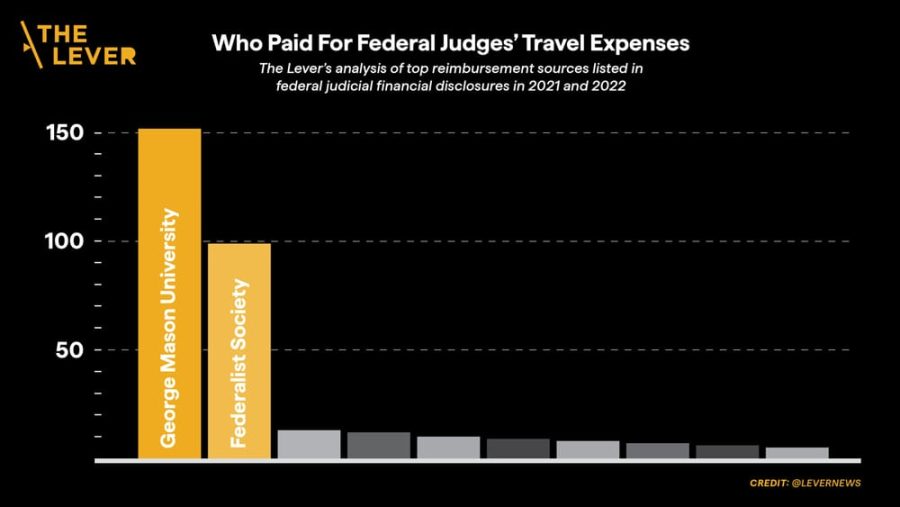
In 2021 and 2022, two conservative, billionaire-funded legal interests sent more than 100 federal judges on 251 trips to conferences and seminars in cushy locations around the country and overseas, according to a Lever review of hundreds of federal financial disclosure forms.
billionaire-Backed Conservative Legal Groups Are Paying for Judges’ Luxury Vacations
Right-wing legal interests funded by the megawealthy are routinely feting lower-court judges and treating them to all-expenses-paid trips, which effectively function as a reward system for judges who espouse and maintain hard-line conservative legal views.
Guests in the audience during the Federalist Society Executive Branch Review Conference at the Mayflower Hotel, April 25, 2023 in Washington, DC. (Drew Angerer / Getty Images)
In 2021 and 2022, two conservative, billionaire-funded legal interests sent more than one hundred federal judges on 251 trips to conferences and seminars in cushy locations around the country and overseas, according to a Lever review of hundreds of federal financial disclosure forms.
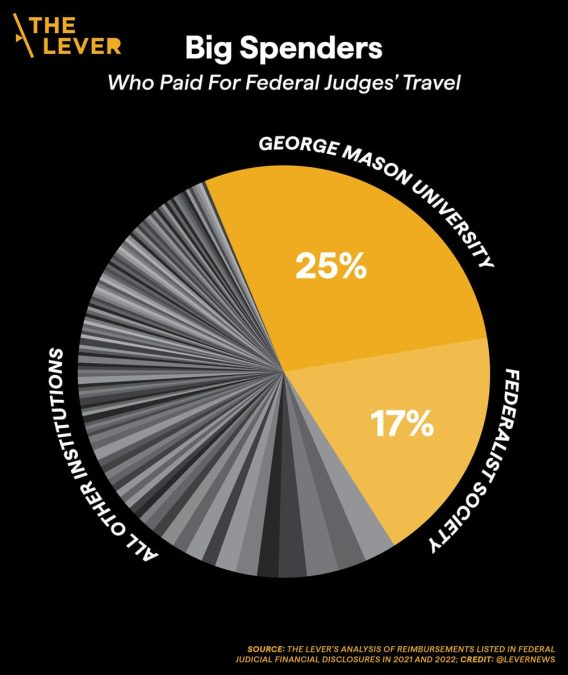
In all, George Mason University (GMU) and the Federalist Society, a conservative lawyers network, funded more than 40 percent of travel-related payments reported by federal judges in those years, far more than any other group.
The staggering number of junkets indicate that, as conservative Supreme Court justices face scrutiny for failing to disclose private luxury travel supplied by billionaire donors, right-wing legal interests funded by the megawealthy are routinely feting lower-court judges and treating them to all-expenses-paid trips to far-flung locales. As with the gifts to Supreme Court justices, the trips effectively function as a reward system for judges who espouse and maintain hard-line conservative legal views.
GMU — a Virginia-based public research university that’s home to the conservative Antonin Scalia Law School and its pro-business, anti-regulation Law and Economics program — paid for federal judges’ transportation, meals, or lodging at least 152 times from 2021–22. The Washington-based Federalist Society covered travel or food-related expenses on at least ninety-nine occasions during the same time period. The judges are not required to disclose how much the excursions cost.
The Federalist Society and GMU are both closely tied to the conservative legal movement and billionaire donors who have a financial interest in how the federal judiciary interprets laws. Both institutions also accept corporate donations.
“The data is really compelling,” said Caroline Fredrickson, a distinguished visiting professor from practice at Georgetown Law. “It confirms what we all knew intuitively: The Federalist Society and George Mason have a deep reach into the federal judiciary, and are using it to ensure that a very particular point of view about legal analysis is conveyed to judges and is done in luxury accommodations, so that judges are much more likely to attend.”
TheLever reviewed electronically available financial disclosure forms filed by more than 1,300 federal judges in 2021 and 2022, and identified at least 595 instances of judges disclosing reimbursements for travel-related expenses.
GMU and the Federalist Society were far and away the top sources of such payments, together accounting for 42 percent of all reimbursements listed by the federal judges. No other organizations came anywhere close to matching their generosity: The third-most common sources on the list — Notre Dame, Georgetown, and George Washington University — accounted for thirteen reimbursements apiece.
The Federalist Society is cochaired by former Donald Trump judicial adviser Leonard Leo, best known as the architect of the Supreme Court’s conservative supermajority, and the organization receives significant funding from his dark money network. Last year, the Supreme Court that Leo helped build overturned decades of precedent and eliminated federal protections for abortion rights.
Leo, the beneficiary of a historic $1.6 billion dark money donation in 2021, previously brokered a $20 million anonymous gift to rename GMU’s law school after the late Supreme Court justice Antonin Scalia in 2016. As theLever and ProPublica have reported, that gift to GMU was apparently made by Barre Seid, a little-known Chicago industrialist who converted his electrical surge protector empire into funding for Leo’s unprecedented dark money operation.
GMU has separately received tens of millions in donations from foundations affiliated with the billionaire oil and gas titan Charles Koch, a libertarian activist and longtime opponent of environmental regulations. That included a $10 million contribution in support of renaming the law school. Koch’s foundations have also supported the Federalist Society.
“Right-wing efforts to legislate through our courts — led and bankrolled by conservative kingpin Leonard Leo — have seeped into all levels of the federal judiciary,” said Caroline Ciccone, president of the progressive watchdog group Accountable.US. “It’s no surprise that Leo’s Federalist Society and Scalia Law School are now key hubs for conservative judges to score free luxury trips and unusual perks, undermining judicial integrity and contributing to plummeting public trust in our courts.”
Spokespeople for Leo, Koch’s charitable foundation, GMU’s Antonin Scalia Law School, and the Federalist Society did not respond to theLever’s requests for comment.
“Study Time”
The forty-nine-year-old Law and Economics Center, which promotes a pro-business, anti-regulatory legal perspective, has been housed at GMU since 1986. As the center noted in an event agenda last year, its purpose is to pull together “timely, relevant, and unassailable research on public policy issues” and share it with “those who are directly shaping our country’s public policy discussions.”
“With research divisions devoted to top-quality legal policy analysis and educational outreach to judges, attorneys general, and other policymakers, the [Law and Economics Center] is uniquely equipped to positively affect national policy outcomes,” the center wrote.
A 2022 review of rulings by judges who participated in an early version of this Law and Economics program decades ago by researchers at Columbia University, ETH Zurich, and the Toulouse School of Economics suggests that the core mission of the project has been highly successful.
“Economics-trained judges significantly shift legal outcomes in U.S. courts,” wrote the researchers. “They use economic analysis in their written opinions, render conservative votes and verdicts, rule against regulation, are somewhat more permissive on antitrust, and mete out harsher criminal sentences. When ideas move from economics into law, there are important policy consequences.”
The Law and Economics Center’s judicial educational programs tend to take place at uber-ritzy junkets. Between 2021 and 2022, GMU brought federal judges to destinations including the university’s homebase of Arlington, Virginia; the beaches of Naples and Destin, Florida, and Maui, Hawaii; the mountains of Colorado and Montana; and the United Kingdom and Italy. The program also hosted an event in Leo’s adopted home of Bar Harbor, Maine, right around the time that the Supreme Court overturned its landmark Roe v. Wade abortion rights decision.
“Mostly these George Mason things are not held in, you know, Arlington, Virginia,” said Fredrickson, the Georgetown law professor. “They’re held in the Rockies or at Florida resorts, or in some other place where the judge doesn’t have to pay their own way, and it’s pretty nice to get a free ride like that.”
She continued, “If you look at their agendas, they work for an hour or two a day, and then they have ‘study time,’ where in the afternoon, they get to go and ‘study’ — while they also, no doubt, are hitting golf balls. . . . It ends up being a very slanted educational program, it’s the only one that’s going, and it’s awfully nice to hang out on the beach and think about antitrust law.”
Indeed, the agenda for an upcoming, weeklong “Economics Institute for Federal Judges & State Supreme Court Justices,” scheduled to be held in March next year at the Henderson Beach and Spa Resort in Destin, Florida, features ample “study time,” “afternoon breaks,” and free time. Educational programming effectively concludes at 12:15 p.m. each day.
“There’s nobody else who does this,” Fredrickson said of GMU’s Law and Economics program. “They are the ones who got in the business of offering these judicial educational seminars early on, and there’s been nobody with deep pockets who has stepped up to do the same. . . . The major donations that have come in from Barre Seid and from the Koch Brothers into George Mason have enabled them to put on these programs.”
The Federalist Society’s judicial reimbursements don’t sound quite as posh — or so conspicuously like vacations. Generally, the judges are there to give lectures or speak to local lawyers or law students.
Still, the group is constantly shipping judges all over the country. In 2021–22, the Federalist Society reimbursed judges’ travel to Arizona, California, Florida, Illinois, Indiana, Iowa, Kansas, Kentucky, Massachusetts, Michigan, Nevada, New York, North Carolina, Pennsylvania, Tennessee, Texas, Utah, Virginia, Washington state, and Washington, DC.
“The whole thing is really troubling,” said Fredrickson, who previously served as the president of the American Constitution Society (ACS), the much smaller, liberal counterweight to the Federalist Society.
While Fredrickson noted that ACS doesn’t have the budgetary resources for similar events, she said, “I don’t think that organizations like the Federalist Society — or maybe even like ACS, which is definitely less hard-edged than the Federalist Society — [should] be offering these kinds of junkets to judges. It’s not appropriate for the role that they are supposed to play in our judicial system.”
“When Do They Have Time to Be Judges?”
The federal judicial reimbursement data reviewed by theLever shows more than one hundred federal judges accepted paid travel-related expenses from GMU or the Federalist Society between 2021 and 2022.
Some judges stand out for the frequency with which they are traveling on those institutions’ dime — specifically, judges on the United States Court of Appeals for the Sixth Circuit. These judges disclosed receiving at least fifty-four reimbursements provided by the Federalist Society or GMU.
Chief Judge Jeffrey Sutton, appointed by George W. Bush, listed forty-two reimbursements in 2021 and 2022, more than any other federal judge whose financial disclosure forms were available online. GMU and the Federalist Society accounted for twenty of Sutton’s reimbursements.
Last year, the records show, the National Security Institute at GMU’s Antonin Scalia Law School sent Sutton to Padua, Italy, to teach and meet with students, according to his annual disclosure. The Federalist Society sent Sutton to Alabama, Arizona, California, Illinois, Kansas, Michigan, Utah, Virginia, and Washington, DC, to present lectures and participate in conference panels.
Judge Chad Readler, who was appointed by Trump in 2019, listed twenty-four reimbursements, twenty of which were provided by GMU and the Federalist Society.
Judge Amul Thapar, appointed by Trump in 2017, listed 14 reimbursements in 2021. Eight of those travel-related expenses were paid by the Federalist Society. Thapar and Sutton are both known as top “feeder judges”; many of their law clerks go on to work for Supreme Court justices.
Asked about the judges’ travel, Fredrickson joked: “Sounds pretty nice. When do they have time to be judges?”
The Sixth Circuit did not respond to an emailed request for comment.
Earlier this year, Sutton issued an opinion striking down a buffer zone law designed to prohibit antiabortion activists from harassing patients and blocking the sidewalk in front of an abortion clinic in Louisville, Kentucky.
This fall, Sutton and Thapar issued a decision allowing Tennessee and Kentucky to enforce laws banning gender-affirming care for minors, meaning that doctors must stop using puberty blockers, hormones, and surgeries to treat transgender youths. The ruling acceded to the demands from Tennessee’s Republican attorney general and twenty-one other GOP state attorneys general who filed an amicus brief in the case.
Leo’s dark money network has long been the top financier of the Republican Attorneys General Association, which elects GOP law enforcement chiefs and helps coordinate their efforts to influence policy and shape judicial decisions. The Leo network donated $1 million to the association earlier this year and $6.5 million in the 2022 election cycle, according to data from Political MoneyLine.
The Sixth Circuit case on gender-affirming care could soon come before the Supreme Court and its conservative supermajority, as the families and physician involved in the case have petitioned justices to review the lower court’s decision.
You can subscribe to David Sirota’s investigative journalism project, theLever, here.
----
===
think tank
bibi ct BS
https://theintercept.com/2023/02/16/israel-jeff-yass-kohelet/
SOLE DONOR to a political action committee created to bolster the Democratic Party’s establishment flank is also funding a conservative Israeli think tank at the helm of the country’s rightward lurch.
Pennsylvania billionaire and Republican megadonor Jeffrey Yass is a key benefactor behind both the Moderate PAC, which fights progressive primary challengers in the United States, and the Kohelet Policy Forum, which is working to reshape the political system in Israel.
Prime Minister Benjamin Netanyahu’s new administration has taken unprecedented steps to undermine democratic checks and balances, weaken the country’s Supreme Court, and further entrench the power of far-right politicians, all while ramping up violence against Palestinians. Those moves have been guided in part by Kohelet — at least one of whose members is also trying to influence congressional activity in the U.S.
Kohelet’s stated aims are to “secure Israel’s future as the nation-state of the Jewish people” and “broaden individual liberty and free-market principles in Israel.” Pulling from the playbook of the American Legislative Exchange Council — a Koch-backed group that writes model legislation for conservative lawmakers across the U.S. — Kohelet’s founder helped draft the law that became Israel’s Basic Law on the Nation-State in 2018. The controversial policy established Jewish people as having the sole right to self-determination, downgraded Arabic from its status as an official language, and declared the development of Jewish settlement a “national value.” Kohelet also drafted a new law that gives Israel’s Parliament the power to override Supreme Court decisions, grants the government complete control over judicial appointments, and abolishes the courts’reasonableness doctrine, which was most recently used to disqualify a thrice-convicted criminal and Netanyahu ally from serving as health and interior minister.
“A couple of conservative American billionaires are devoting bottomless resources to undermine democracy,”wrote Debra Shushan, director of policy at J Street, in a recent brief on Kohelet’s work to reconfigure the Israeli judiciary.
But Kohelet’s aims are not restricted to Israel’s domestic politics. Lara Friedman, president of the Foundation for Middle East Peace, noted that the group’s director of international policy has supported U.S. legislation that would make boycotts against Israel illegal and has worked “to effectively change U.S. laws so that we no longer view boycotts of Israel or settlements as a legitimate form of protest.”
Eugene Kontorovich, head of Kohelet’s international law department and director of the Center for the Middle East and International Law at George Mason University’s Antonin Scalia Law School, has been involved in efforts to pass domestic legislation opposing protests of Israel. Kontorovich has helped provide policy drafts and counsel for state and federal legislation opposing the boycott, divestment, and sanctions movement against Israel. He has testified in at least eight congressional hearings on issues including antisemiticdomestic terrorism, the relocation of the U.S. embassy in Israel to Jerusalem, Israel’s control over theGolan Heights, and Palestinian attempts to join the International Criminal Court.
Kontorovich isactive in conservative political circles in the U.S. and overseas, appearing on stage at the Conservative Political Action Conference in Budapest, Hungary, last year. According to Friedman, he has been instrumental in Kohelet’s push to reframe all criticism of Israel in the U.S. as antisemitic.
“My involvement in anti-BDS legislation issues is not in my capacity at Kohelet, but rather part of the participation in American public life that is common among law professors,” Kontorovich said in a statement to The Intercept. Kontorovich also said he had assisted in drafting amicus briefs as part of his work at George Mason. He did not respond to a question about why his work with Kohelet is not mentioned in his university bio.
WHILE ISRAEL’S NEW GOVERNMENT works with Kohelet to push the country further to the right, the group’s benefactor is undertaking similar aims in the U.S. It’s not a coincidence, Friedman said, that one of Kohelet’s sponsors is now funding a new PAC targeting progressive candidates.
[ Related
Centrist Democratic PAC’s Sole Funder Is a Republican Megadonor
https://theintercept.com/2023/01/25/jeff-yass-megadonor-moderate-pac/)
Yass, a libertarian and one of the country’s biggest GOP donors, is the only contributor to the Moderate PAC. The group is led by operatives with no political experience who are little known in Washington: Ty Strong, a former financial and business analyst, serves as president alongside his mother, the chief financial officer. With President Joe Biden’s former campaign manager as its sole consultant, the PAC pledged last month to raise $20 million to defeat progressive primary challengers this cycle and “scare off” progressive groups like Justice Democrats. Yass did not respond to a request for comment.
The billionaire’s support for radicalizing conservative politics in Israel is well known, but his domestic political ventures have only recently involved tamping down on progressives in Congress, who have consistently been the only elected officials willing to criticize U.S. support of Israel. His bankrolling of the Moderate PAC comes as international good governance groups are increasingly recognizing Israel as an apartheid state, and officials in Congress are censuring members who speak out against Israeli violence. The House of Representativesvoted earlier this month to remove Rep. Ilhan Omar, D-Minn., one of the body’s most vocal critics of Israel’s human rights abuses in Palestine, from the House Foreign Affairs Committee.
Kohelet and the Moderate PAC are both part of a broader project to silence criticism of Israel in Congress and bolster institutional support for the Netanyahu regime, Friedman said. Kohelet has been behind many of Israel’s illiberal policies, she noted, adding that Congress has stifled critiques of the same policies, which have been condemned by Human Rights Watch and Amnesty International. “Now the common refrain in Congress is, ‘Oh, this is antisemitic,’ which is then used to shut down critics of Israel like Ilhan Omar. There’s something rather elegant about this.”
“It suggests that on this issue, we all stand together arm in arm on what it means to be pro-Israel today,” Friedman said. “This is why they’re so worried about progressive candidates coming up in the ranks. You’ve gotta nip this in the bud.”
===
===
no lnx
https://yyy.theguardian.com/world**/2000/dec/13/**uselections2000.usa
florida's legislature last night began the process of trying to force the presidential selection in favour of the Republicans by approving a list of 25 electors pledged to select George W Bush.
The resolution was designed to hand all the state's votes in the electoral college to the Texas governor and assure him of victory whether or not a recount was approved by the US Supreme Court. It was fiercely opposed by Democrats who accused the Bush camp of trying to hijack the election and creating a dangerous constitutional precedent.
The vote took place in the lower house and the resolution will pass to the state senate - with an inbuilt Republican majority of 25-15 - today. It is not clear whether the senate will wait for a US supreme court verdict on whether Florida recounts can continue before it ratifies the pro-Bush list.
if the court finds in favour of Mr Gore but the legislature goes for Mr Bush, then the US could find itself in the midst of a constitutional crisis.
Yesterday it was revealed that the wife of one of the nine US supreme court justices whose decision could hand the White House to Mr Bush is helping to recruit political staff to a Bush administration.
Ginni Thomas, whose husband Clarence Thomas is one of the conservative group of judges that has supported Mr Bush in two actions in the past month, is working at a prominent conservative think-tank in Washington where she is coordinating rightwing recruitment for the Republican leader.
Mrs Thomas works for the Heritage Foundation and is actively approaching Republicans to come and work for Mr Bush if he becomes president. Earlier this month, she sent an email to Republican political staff members on Capitol Hill inviting them to submit their CVs "for transition purposes".
Justice Thomas has played a low-key role in the Bush v Gore case in which the supreme court heard oral arguments in Washington on Monday.
Alone among the nine justices, Justice Thomas did not ask a single question on Monday. But Judge Gilbert Merritt, a federal judge in Tennessee with personal ties to the Gore family, said in an interview yesterday that Justice Thomas faced a conflict of interest due to his wife's involvement and should stand down from the case.
If he were to step down, the court could be split 4-4 on the Bush v Gore case. In the event of a tie, the original ruling by the Florida supreme court allowing counts of Florida's "undervotes" would stand.
"The spouse has obviously got a substantial interest that could be affected by the outcome," Judge Merritt said. "You should disqualify yourself. I think he'd be subject to some kind of investigation in the Senate."
Judge Merritt cited section 455 of Title 28 of the United States Code in support of his call. The provision requires court officers to excuse themselves from a case if their spouse has "an interest that could be substantially affected by the outcome of the proceeding".
"There is no conflict here," Mrs Thomas told the New York Times yesterday. She said she rarely discusses court matters with her husband.
Kathy Arberg, a spokeswoman for the supreme court, said she had no comment on the claims. She also refused to comment on a separate revelation that Eugene Scalia, the son of a second conservative member of the court, Justice Antonin Scalia, is a law partner of Ted Olson, who acted for Mr Bush in the two cases he brought to the court in the past two weeks.
As the Thomas row flared yesterday, America had no option but to submit itself to a nerve-wracking national ordeal by tension.
But the country could be waiting for some time for a ruling. Lawyers pointed out that the supreme court's record fastest time for handing down a judgment following oral argument is three days after the hearing.
The two men at the centre of the storm continued to watch and wait along with everyone else. Mr Gore, whose mood was described by his aides as "determined and resolute", spent another day at his official residence in Washington.
Meanwhile, Mr Bush planned another business-as-usual day in Austin, saying that after talking to his lawyers he was "cautiously optimistic" about the outcome of the court's decision.
===
SLUDGE
Former law professor Neomi Rao is facing headwinds in her judicial nomination, so Charles Koch’s Americans for Prosperity is stepping in.
Billionaire manufacturing magnate Charles Koch has for decades used his enormous wealth and political power to install elected officials, government administrators, and regulators who will keep the business interests of Koch Industries and other giant, heavily polluting companies in mind.
But Koch is also dipping into the judicial arena. One of his protegés has been nominated by President Trump and is poised to join the second-most powerful court in the United States, and Koch’s premier political spending group wants to make sure it happens.
In 2016, the Charles Koch Foundation (CKF) and a mystery donor combined to give $30 million to the George Mason University (GMU) law school, renaming it after the late, conservative Supreme Court Justice Antonin Scalia. Koch’s foundation put in $10 million, and the remaining $20 million, it was later discovered, was administered by Federalist Society officials through a 501(c)(4) nonprofit, BH Fund.
The grant established 12 new law professorships—nearly all the hires had ties to the conservative Federalist Society—and founded two ideological law school centers, the Center for Liberty and Law and the Center for the Study of the Administrative State. The founder and director of the latter center was Neomi Rao, who had been a law professor at GMU since 2012. She previously clerked for the most conservative Supreme Court justice, Clarence Thomas, and was associate counsel and special advisor to President George W. Bush. She has never been a judge.
Rao took a leave of absence from George Mason in 2017 when President Donald Trump appointed her as director of the White House Office of Information and Regulatory Affairs (OIRA), Trump’s “regulation czar.”
The dean of the GMU law school told another donor to her center, corporate lobbyist and longtime Koch ally C. Boyden Gray, that he hoped to lure her back to GMU with a $1.5-million professorship, funded by Gray, according to an email unearthed by GMU alumna Allison Pienta. “This chair would help me to entice Neomi to return home to Scalia Law after she dismantles the administrative state while serving at OIRA,” he wrote in a May 2017 letter to Gray. Gray gave another $3 million to the center, and it was renamed in his honor.
Dismantling the administrative state (p. 2)
View entire document on DocumentCloud
But instead of returning to the law school, Rao may be headed to the powerful D.C. Circuit Court of Appeals to fill the seat vacated by the newest Trump-appointed Supreme Court justice, Brett Kavanaugh. Rao’s GMU center hosted a conference in 2016 that featured Kavanaugh, a fellow Federalist Society member, as keynote speaker.
Rao’s judgeship nomination is perhaps the crowning achievement of the Antonin Scalia Law School’s initiative to reshape the federal judiciary. In 2017, the law school’s Law and Economics Center, which CKF had been funding for years, drew up a funding proposal for the center’s “Federal Judges and Attorneys General Initiatives.”
‘Reshaping’ the Federal Bench
“The election of Donald Trump presents a historic opportunity for a new president to reshape the federal judiciary, reform the regulatory state, promote economic growth, and restore constitutional federalism,” reads the proposal.
The program educates newly appointed judges on economics and other issues so they will “be more likely to make sound decisions that support the rule of law and the free enterprise system.” The new Federal Judges Initiative will “cover topics expected to be highly relevant to the current presidential administration’s policy agenda, such as the economics of health care and health financing, financial services regulation, environmental and energy regulation, health and safety regulation, privacy, labor and employment law, and telecommunications regulation.”
As of 2017, over 5,000 judges and 700 state attorneys general had participated in at least one Law and Economics Center program. In the 2018 fiscal year, the Law and Economic Center requested over $1.7 million for its Judicial Education Budget.
“Rao’s transition from the Koch-funded Antonin Scalia School of Law to her nomination to the second-highest court in the country is exemplary of Koch’s successful strategy of leveraging George Mason University to exert influence on the judicial branch for decades to come,” Samantha Parsons, a GMU graduate and director of campaigns at the activist group UnKoch My Campus, told Sludge. “Her nomination should serve as a warning of the anti-democratic agenda we can expect throughout our nation’s judicial system should George Mason University succeed in its goals to facilitate the education and placement of hundreds of new federal judges under Trump’s presidency.”
In December, when Trump nominated Rao, Koch’s most prominent political advocacy organization, Americans for Prosperity, endorsed her for the judgeship. But Rao has since encountered some bumps in the road. Republican Missouri Sen. Josh Hawley said he has “deep concerns,” telling Axios that she may not be sufficiently anti-abortion.
At a recent Senate committee hearing, Iowa Republican Sen. Joni Ernst expressed concerns over Rao’s 1994 essay on date rape, which alleged that women who are raped while drunk are partially to blame for being raped. Rao’s OIRA has stalled issuing an employer guidance on sexual harassment for 15 months, a process that normally takes no longer than 90 days, as David Dayen reported for The Intercept.
Americans for Prosperity will fund digital advertising and grassroots efforts in an attempt to sway public opinion in favor of Rao this week, according to Axios. On Tuesday morning, the Facebook ad archive listed six AFP ads in favor of Rao, which began running on Monday. Each ad targets one Republican senator, including Ernst and Hawley, urgin Facebook users to tell their senator to vote for Rao’s D.C. Circuit Court nomination. Additional targeted senators are Ted Cruz (Texas), Marsha Blackburn (Tenn.), James Lankford (Okla.), and Ben Sasse (Neb.). The Google ad archive did not list any recent AFP purchases.
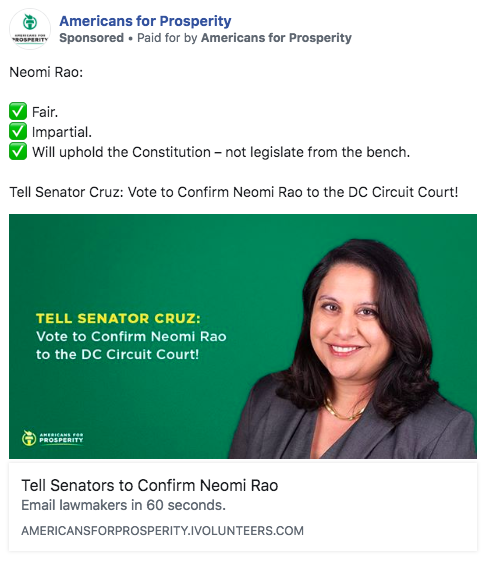 One of Americans for Prosperity’s Facebook ads supporting Neomi RaoFacebook Ad Archive
Americans for Prosperity did not reply to Sludge’s request for comment.
‘Regulatory Obstruction’
The American Constitution Society says OIRA, which is part of the Office of Management and Budget, “has embraced politicized regulatory obstruction as its raison dêtre” under Rao. In OIRA’s 2018 report, entitled “Cutting the Red Tape,” Rao writes, “we are working to push back the expansion of the administrative state, which has placed undue burdens on the public and impeded economic growth.”
Under Rao’s leadership, OIRA, has approved sweeping environmental deregulation by the EPA. Koch Industries, which Charles Koch runs, is a giant manufacturing conglomerate with subsidiaries that refine and transport oil, create paper products, and produce chemicals. The company is among the country’s biggest air and water polluters and has paid hundreds of millions of dollars for environmental violations. Koch and his brother David are lifelong libertarians who have fought taxes and regulations for decades.
“Rao has never seen a regulation she didn’t hate, and as a judge would dismantle 40 years of environmental and social progress,” Brett Hartl, government affairs director at the Center for Biological Diversity, said in a statement to Buzzfeed News. “Her confirmation would be the most damaging and regressive yet by Trump after Kavanaugh and Gorsuch.”
GMU is by far the biggest recipient of grants from the Charles Koch Foundation (CKF), which gives tens of millions of dollars each year to free-market higher education programs. Since 2005, CKF and the Charles Koch Institute have donated nearly $129 million to GMU, including over $34 million for the free-market Mercatus Center, according to Sludge’s analysis. Another free-market-focused GMU center, the Institute for Human Studies, has received $8.7 million.
The university has come under fire for allowing the CKF to impact hiring decisions. In the case of Florida State University, CKF was even allowed to control economics curricula.
AFP isn’t the only Koch-linked group to spend money to influence the judiciary. The Center for Media and Democracy reports that Donors Trust, a donor-advised fund that wealthy conservatives including Koch use to score tax deductions and potentially anonymize their donations to nonprofits, has bankrolled right-wing groups such as the Judicial Crisis Network and its sister organization, the Judicial Education Project, which spent millions of dollars on ads supporting the Supreme Court confirmation of Neil Gorsuch. Donors Trust also funds the Federalist Society and, as Sludge recently reported, several Southern Poverty Law Center-designated hate groups.
Related:
Charles Koch Is Funding Rightwing, Pro-Trump Media, New Disclosure Reveals
Koch Brothers Continue to Influence Tax Policy After Huge Cuts Last Year
Koch-Backed SEC Commissioner Claims Corporate Law is in the Public Interest
Author profile](https://readsludge.com/author/alex/)
Alex Kotch
Alex is a reporter at Sludge and a contributor to The Young Turks. He was previously part of the award-winning investigative team at International Business Times, and his other work has appeared in T
==
Notorious “dark money” conduit Wellspring Committeegave $14.8 million to the primary spender on Supreme Court Justice Brett Kavanaugh’s confirmation and paid $919,900 to the mysterious LLC that made a $1 million donation to President Donald Trump’s inaugural committee, according to a new tax return obtained Nov. 27 by the Center for Responsive Politics.
Wellspring has acted as a conduit for large contributions from secretive donors since it was set up, effectively laundering multi-million dollar donations with no substantive disclosure or accountability.
Despite operating behind the scenes with a name unknown to most of the American public, Wellspring is at the crux of Ann and Neil Corkery’s network of politically active dark money groups, funneling millions from anonymous financiers to political causes they don’t want their names attached to — and doing ostensibly little else.
Wellspring has continued to be the chief financier of the Judicial Crisis Network (JCN), with a $14,814,998 contribution last year.
JCN is another nondisclosing politically active nonprofit linked to the Corkerys’ network of conservative dark money groups. It has become the predominant dark money spender in Supreme Court confirmation fights as a vehicle for deep-pocketed donors to funnel millions of dollars behind or against judicial nominees.
Since 2010, Wellspring has funneled more than $54.2 million to JCN, according to tax returns obtained by CRP.
The bulk of Wellspring’s funds that came from three multi-million dollar secret donors in 2017, a shift from prior years in which the biggest amount the group received from a single mystery donor increased with each passing year. The largest donor accounted for $8.9 million, another gave $5.5 million and a third secret donor provided $2 million — but all of their identities remain hidden from the public.
The biggest anonymous contribution to Wellspring in 2016 was nearly $28.5 million, a jump from $8.5 million in 2015 and $6.96 million in 2014. That one secret donor accounted for around 90 percent of Wellspring’s funding in 2016, a year it gave $23 million to JCN.
As a 501(c)(4) social welfare organization, JCN is not required to report its donors to the IRS — and chooses not to disclose its funders’ identities to the public — so its only discoverable donors are other entities like Wellspring that act as conduits for the anonymous money directed at JCN.
JCN was back in the limelight this year as the biggest spender in support of Trump’s second Supreme Court nominee, Brett Kavanaugh. Following its tried and true playbook, JCN launched its first ad about Kavanaugh before Trump even finished announcing his nomination and soon after announced plans to spend $10 million on his confirmation. JCN pledged $10 million to support the successful confirmation of Trump’s first Supreme Court nominee, Neil Gorsuch, the prior year and reported spending $7 million to block the confirmation of Merrick Garland before President Barack Obama left office.
JCN has also spent substantial sums on lobbyists, including Jon Kyl, who lobbied to help JCN marshall in Gorsuch’s nomination before becoming the official White House “sherpa” guiding Kavanaugh through that same process. He was later appointed to fill the late Sen. John McCain’s seat — ultimately enabling him to vote for the confirmation he was once tasked with helping Kavanaugh secure.
JCN spent $483,246 in total on Facebook ads and just $1,900 on Google platforms around the fight to confirm Kavanaugh with an estimated reach of potentially millions of Facebook users.
TV advertising made up the bulk of JCN’s reported spending on Kavanaugh with around $3.9 million going TV ads, according to Kantar Media/CMAG estimates — leaving millions of dollars JCN had pledged to spend unaccounted for.
The puzzle of Trump’s mysterious inaugural gift
The only contractor paid by Wellspring last year was BH Group, the mysterious LLC created four months to the day before it made a $1 million donation to the Trump inaugural committee on Dec. 22, 2016.
The newly discovered payment for “public relations” follows a $750,000 payment to the newly minted BH Group the prior year as well as $947,000 from JCN to the BH Group around when the LLC made its inaugural donation.
While it initially appeared that BH Group was merely a shell company created solely for the purpose of laundering money into the Trump inaugural committee, more information about the LLC has only added to its mystery.
New tax returns reviewed by CRP reveal that Judicial Education Project, JCN’s sister 501(c)(3) nonprofit organization, also paid an additional $1.3 million to BH Group LLC last year. Judicial Education Fund keeps its donors anonymous but CRP tracked the bulk of the group’s recent funding to DonorsTrust, which accounted for more than 99 percent of its money last year. Like JCN, Judicial Education Fund has also been funded by Wellspring in prior years.
One name that CRP has tied to the mysterious LLC is Leonard Leo, the executive vice president at the Federalist Society, an influential conservative and libertarian legal organization, who listed “BH Group” as his employer in a campaign finance filing reported to the Federal Election Commission.
Leo’s more widely known affiliation with the Federalist Society has gained attention after reports that it played a substantial role guiding the hand of Trump’s White House in its judicial nomination process, including in the selection of Supreme Court justices.
Ann Corkery, the Wellspring Committee’s former president and wife of current president Neil Corkery, has reportedly worked closely with him in this process and Leo has been “directly involved” in raising much of the anonymous money the Wellspring Committee brings in every year.
A public records request revealed that Leo and another Federalist Society vice president have also been involved in a nonprofit called the BH Fund,which was set up to enforce a donor agreement between an anonymous $20 million donor and the Antonin Scalia Law School at George Mason University, whose president came under fire for allowing donors to dictate conditions in return for financial gifts.
Incorporation records list BH Group’s address as avirtual office in Arlington, Va. and the only identified point of contact is Donna Smith, whose name matches that of a longtime paralegal at Holtzman Vogel Josefiak Torchinsky, the law firm that shared a Warrenton, Va. office with the address the Trump inaugural committee on its tax return.:{
}:
Continuing the money churn
Staying the course from prior years, Wellspring also gave $400,000 to the Catholic Association, $48,000 to the Annual Fund and $350,000 to the Foundation for Government Accountability’s 501(c)(4) arm, FGA Action.
Another appendage of the Corkerys’ dark money web is theFoundation for Accountability and Civic Trust (FACT), a nonprofit run by acting Attorney General Matthew Whitaker before he became Jeff Sessions’ chief of staff, as CRP first reported in 2016. Like Wellspring, JCN and the Judicial Education Project, Neil Corkery is also the treasurer of FACT. Nearly 100 percent of FACT’s funding came from a single anonymous donor each year since the group was created in 2014, which CRP discovered came entirely from a donor-advised fund called DonorsTrust.
In addition to longstanding dark money stalwarts that have realigned their priorities for the Trump era, new groups spending heavily in support of Trump’s agenda also weighed in on Kavanaugh’s Supreme Court confirmation battle but are not entirely isolated from the Washington swamp Trump pledged to drain.
Wellspring was one of the early donors of 45Committee, another 501(c)(4) social welfare nonprofit that primarily exists to support Trump’s agenda which spent on ads supporting Supreme Court Justice Brett Kavanaugh’s confirmation this year.:{
}:
Another spender was America First Policies, the 501(c)(4) nonprofit organization staffed by former Trump campaign and White House personnel that has become the main dark money group supporting Trump’s agenda.
Although America First Policies itself does not reveal donors’ identities, CRP traced over a quarter of its funding to major corporate players, including Reynolds American and Pharmaceutical Research and Manufacturers of America (PhRMA), a trade group representing the drug company industry’s lobbying interests.
New tax documents filed by another pro-Trump nonprofit, Great America Alliance, show it raised and spent around $3.4 million during that period. Unlike America First Policies, which reported millions more in previously undisclosed political spending it its new tax return, Great America Alliance claimed that it “educated voters through direct and indirect political advocacy messaging nationwide within the scope of applicable laws and regulations.”
This highlights one of the many legal grey areas emerging in the wake of Trump’s unprecedented move to register as a candidate for the 2020 presidential election on his first day in office — leaving the vast majority of financiers behind the growing network of dark money groups spending on his agenda a mystery.
===
ref
https://www.opensecrets.org/news/**2018/03**/secret-contributions-to-trump-inauguration/
rob mcg
the committee that ran President Trump’s inaugural celebrations and surrounding events in January 2017 recently filed its annual tax return with the IRS, giving the public its first glimpse at how it spent the record $107 million it raised in the months after the 2016 election.
But rather than clearing up the questions that swirl around the committee — about charitable contributions, secret donors and massive vendors paydays — the filing only adds to the mystery. So OpenSecrets teamed up with the “Trump Inc” podcast, a partnership between WNYC and ProPublica, to explore some of these questions.
We looked into suspiciously high vendor costs, which included a more than $50 million payday for two firms, and we trekked out to a small Virginia town to try to get to the bottom of what appears to be an anonymous shell corporation that gave $1 million to the inaugural committee.
The Dark Money Inauguration
Trump’s inauguration was not only a bonanza for special interests and high-dollar event planners, it was also a chance for wealthy donors and government contractors to show support for the new administration — and to do so in secret, if they choose.
Since inaugural committees were first required to report their donors to the Federal Election Commission in 2002, no inauguration has reported any significant contributions from secretive dark money groups or shell corporations.
That is, until Trump’s inauguration, which took $2 million from two entities whose sources of funding are mostly or entirely untraceable.
The first came on December 20, 2016, in the form of a $1 million check from a 501(c)(4) social welfare organization closely tied to Paul Ryan and the Republican establishment in the House. The group, called American Action Network, spent more than $5.5 million in 2016 to help House Republicans keep their majority.
Groups likeAmerican Action Network (AAN)can spend heavily in elections without disclosing their donors, which is why they are often referred to as “dark money” groups.
Such groups aren’t just conduits for wealthy individual donors to spend on elections without any fingerprints, they are also attractive to corporations that don’t want their name publicly tied to political attack ads. The beauty is that while the public may not know who provided the money, politicians and party officials almost certainly know who’s bankrolling the groups.
As OpenSecrets has previously reported, tax documents from other organizations show that AAN has received significant funding from trade associations like PhRMA and theAmerican Petroleum Institute that represent major corporations. In one instance, the health insurer Aetna accidentally disclosed a contribution to the group.
But AAN is downright transparent compared to a limited liability company called BH Group that, two days later, on December 22, gave another $1 million to the inaugural committee. Whereas AAN is an organization with a website, an agenda and employees, BH Group is largely a black hole.

BH Group appears to be little more than an anonymous shell corporation used to shield the original donor (or donors) who provided $1 million to President Trump’s inauguration
Very little is known about the company. Virginia incorporation records show that it was formed four months to the day before it handed its seven-figure check to the inaugural committee. And tax filings obtained by OpenSecrets last year show that sometime between its formation and the end of the year, the BH Group received $750,000 from another dark money group, the Wellspring Committee, as OpenSecrets first reported last November. The Wellspring Committee payment was for “Public Relations,” which is interesting given that the Wellspring Committee appears to have no public-facing operation.

BH Group was paid $750,000 for “Public Relations” by the Wellspring Committee, a dark money group that appears to have no public operations
We went to the address listed on BH Group’s incorporation records only to find that it’s a “virtual office” run by a company called Regus, which rents temporary and virtual office space and provides clients with “call answering services and mail handling.”
A Regus representative would not provide any names or contact information for BH Group, so we left empty-handed.
From there we headed out to Warrenton, Virginia, home to one of the most prominent conservative law firms in the country,Holtzman Vogel Josefiak Torchinsky (HVJT)— which is connected to both the inaugural committee and, potentially, BH Group.
The primary address the inaugural committee listed on its tax return was HVJT’s office. And BH Group’s incorporation records were signed by someone named Donna Smith, which happens to be the name of a longtime paralegal at the firm.
When we arrived at their offices on a Tuesday afternoon, we were not met with the bustle one might expect from one of the most prestigious law firms in the Washington area, but with silence. Many of the offices were dark, and no one was sitting at the reception desk. We rang the bell twice and, finally, someone strolled out to meet us.
We presented BH Group’s incorporation papers and asked if we could speak with Donna Smith about the company. The receptionist called Smith on the phone and proceeded to repeat the words “BH Group” over and over to an apparently stupefied Smith.
Moments later we were met, not by Donna Smith, but by HVJTpartner Michael Bayes, who greeted us, but only provided a very lawyerly “we don’t have any comment on client matters” in response to our questions about Smith and BH Group.
We left their offices with little more than a first hand illustration of why wealthy donors and high-powered political operatives pay top dollar to retain the services of a firm like HVJT: discretion and protection.
It’s an axiom of political dark money that if you have enough money to spend millions on politics, you have enough money to hire the best lawyers in the country to cover your tracks. But one thing to keep in mind is that while the public doesn’t know who’s funding these groups, the people the groups support — in this case, Trump and his administration — almost certainly know, including the source of BH Group’s $1 million.
In other words, they know whose interests to keep in mind when deciding on a matter of policy, and they know whose call to answer when the phone rings.
Vendor Bonanza
On the spending side, the Trump inaugural simply doesn’t make sense. It’s just basic math.
President Obama’s first inauguration in 2009 spent a little under $51 million on five packed days of events and celebrations. Eight years later, the committee responsible for Trump’s inaugural festivities spent nearly double that, more than $97 million, on hardly 48 hours of events, with the rest going to charity.
Roughly speaking, that works out to about $8,600 per minute for Obama’s inauguration — from the morning of January 17, 2009, when he began his whistle-stop tour in Philadelphia, to the end of the National Prayer Service in Washington, D.C. on January 21.
Meanwhile, Trump’s inaugural committee spent about $37,000 per minute from the moment he laid a wreath at the Tomb of the Unknowns on the afternoon of January 19, to the end of the National Prayer Service on January 21.
Not only was Trump’s inauguration schedule shorter than President Obama’s, the inauguration’s less-than-historic turnout should have helped contain the costs that come with managing crowds at events and festivities outside of the swearing-in itself.
So the question is, how could an inauguration that Trump officials were selling as a “workmanlike” affair, and “not a coronation,” manage to spend nearly twice as much as an historic inauguration that was both longer, busier and better attended?
The new tax documents show that one way is to pay vendors an unprecedented amount of money for their services.
For example, the 2009 and 2017 inaugural committees made payments to a Maryland company called Hargrove Inc. for “event production services.” However, the 2009 inauguration paid just over $5 million, whereas the 2017 inaugural paid five times that.

(Bush 2005 numbers do not include contractor payments because such information was not required to be reported before 2008)
Hargrove did not respond to repeated calls and emails from OpenSecrets seeking explanation for what the Trump inauguration got for five times the cost.
But Hargrove was only one of two contractors who received an eight-figure payout from the inaugural committee. The other, first reported by The New York Times last month, was a more than $25.8 million payment to a firm formed just weeks before the inauguration.

California incorporation records show that WIS Media Partners was formed December 6, 2016, just weeks before the inauguration
The firm, Wis Media Partners, was founded by Stephanie Winston Wolkoff, a longtime friend of Melania Trump.
The payouts seem outrageous, and they are unprecedented, at least in recent memory. Organizers of Trump’s inaugural have blamed everything from inexperience to broadcasting costs for the explosion in spending.
“I couldn’t tell you how we possibly could have spent $25 million on a concert,” Steve Kerrigan, head of Obama’s 2013 inaugural committee, told the Associated Press about the cost of Trump’s “Make America Great Again! Welcome Celebration” the night before the inauguration.
OpenSecrets contacted a number of event planning firms that have put on large events, including past inaugurations, to get a sense of just how extraordinary the costs were. None wanted to speak on the record.
Absent expert input, we looked for information on major music festivals. There’s surprisingly little info here, too, so we turned to our IRS data.
We looked at nearly a decade’s worth of IRS data for similarly large payments to firms that do event planning. That review, of more than 70,000 vendor payments reported to the IRS on annual tax returns filed by thousands of nonprofits, showed not a single event payment of $25 million or more.
Only three payments were in the eight-figure range, with the closest being the Mobile World Congress in 2015, which was put on by a trade association called GSMA Limited.
The four-day conference is the world’s largest exhibition for the mobile industry, bringing over 90,000 visitors from 200 countries, with exhibits from 2,000 tech companies — and in 2015, , according to GSMA’s website. A company called Fira Barcelona was paid $22.2 million — less than half of what Trump’s inaugural committee paid its top two contractors — to plan the four-day international conference.
One reason these payments matter is that they could be a way to repay friends and allies by letting vendors charge above-market rates and keep the difference. For example, there is no information in the filing about what subcontractors were paid by Hargrove and Wis Media Partners.
The New York Times reported, for example, that Stephanie Winston Wolkoff, Melania Trump’s friend, only kept about $1.6 million of the $25.8 million her firm was paid. The rest, The Times reports, was spent to “help pay other inaugural workers who reported to” Winston Wolkoff. We will likely never know precisely where the remaining $24 million went, or whether it involved payments to friends or family of the President.
Tom Barrack, a close friend of Trump who served as chairman of the inaugural committee, told the Associated Press last September that “a full and clean external audit has been conducted and completed.”
OpenSecrets sought a copy of the audit from Barrack’s representatives, but none was provided.
===
GMU LEC boatloads of pharma cash b/c
Founded in 2012, the Center for the Protection of Intellectual Property (CPIP) is a catalyst for research on a “property rights” approach to intellectual property through a national network of scholars and the hosting of numerous programs and conferences. CPIP’s Executive Director is Professor Sean O’Connor who recently joined Scalia Law from the University of Washington School of Law where he was theBoeing International Professor of Law. Professor O'Connor comes to Scalia Law with a strong background in tech transfer and the business community.
==
===
...
Based in George Mason’s Antonin Scalia Law School, the Law & Economics Center espouses a free-market approach to policy. A 2013 investigation by the Center for Public Integrity found that the libertarian think tank hosted more judicial conferences than any other university program in the nation, fueled by conservative and big-business donors. Over the past two years, roughly $4.5 million of $18.6 million in contributions to the Law & Economics Center came from oil and gas interests, including Koch Industries, ConocoPhillips,ExxonMobil and API, which represents more than 650 corporations.
The center claims to have trained more than 5,000 state and federal judges, including three sitting Supreme Court justices. Almost 1,000 state attorneys general and their staff attorneys have attended its programs. Its advisory board includes three judges on the U.S. Court of Appeals for the District of Columbia Circuit, widely considered the nation’s second-most powerful court and, often, the final arbiter for federal administrative law cases.
In a White House riven by discord and staff departures, judicial appointments have been a bright spot. Senate Republicans have embraced the chance to fill a glut of vacancies, helping Trump install more conservative judgesand potentially transform the legal landscape for decades to come. Once confirmed, a federal judge can serve for life, presiding over an average of 500 to 600 cases a year.
A Washington trade group with 300-plus employees, APIhas spent more than $40 million to lobby Congress since 2013. But the courts have also been a focal point for API, which has spent the better part of a century helping the oil and gas industry pivot from being a prime antitrust target to being a proactive litigation force. The institute, along with other free-market trade groups, has routinely injected itself into cases in an attempt to shape policy or stall government initiatives. API officials did not grant interview requests from the Center for Public Integrity.
“Time is on industry’s side.”
....
d ginsburg 2x
Global Antitrust Institute - George Mason University
Search domain gai.gmu.eduhttps://gai.gmu.edu
The Global Antitrust Institute (GAI) invites you to the VIRTUAL George Mason Law Review 25th Annual Antitrust Symposium, celebrating "25 Years of Antitrust", held from Monday, February 21 through Friday, February 25. View the schedule here! Video Now Available: The George Mason Law Review 24th Annual Antitrust Symposium
About the GAI
To help guide its work, the Global Antitrust Institute has established...
Economics Institutes
GAI Antitrust Economics Institute for Federal Judges. Past Events. GAI...
Competition Advocacy
Comment on the Federative Republic of Brazil, Before the...
Events
The Global Antitrust Institute Hosts: A Conversation with Associate...
Educational Materials
One of the key missions of the Global Antitrust Institute (GAI) is to...
Visitors
The GAI hosts foreign antitrust experts via the Distinguished Guest...
Support the GAI - Global Antitrust Institute
Search domain gai.gmu.eduhttps://gai.gmu.edu › disclosures
Contributions on behalf of the Global Antitrust Institute may be made online or by check to the George Mason University Foundation, Inc., a 501(c)(3) corporation established to support the activities of George Mason University. Online contributions may be made via the law school's website.
Global Antitrust Institute Invitational - Moot Court Board
Search domain sls.gmu.eduhttps://sls.gmu.edu › mootcourt › competitions › global-antitrust-competition
The Global Antitrust Institute Invitational is the only moot court competition in the United States devoted exclusively to antitrust law and offers a unique opportunity for invited law schools. This competition will be hosted at the United States Courthouse for the District of Columbia. February 26, 2022: Preliminary Rounds
Global Antitrust Institute at George Mason Law School
Search domain ftc.govhttps://www.ftc.gov › system › files › documents › public_comments › 2016 › 09 › 00003-128906.pdf
1 TheGlobal Antitrust Institute (GAI), a division of the Antonin Scalia Law School at George Mason University, is a leading international platform for economic education and research that focuses upon the legal and economic analysis of key antitrust issues confronting competition agencies and courts around the world.
Global Antitrust Institute Antonin Scalia Law School ...
Search domain docs.house.govhttps://docs.house.gov › meetings › JU › JU05 › 20210225 › 111247 › HHRG-117-JU05-20210225-SD011.pdf
On behalf of the Global Antitrust Institute, we truly appreciate your contribution. Thank you. Sincerely, Joshua D. Wright, J.D., Ph.D. Executive Director Global Antitrust Institute Antonin Scalia Law School, George Mason University 703.993.8301 jwrightg@gmu.edu Global Antitrust Institute Antonin Scalia Law School, George Mason University
Comment of The Global Antitrust Institute, Antonin Scalia ...
Search domain sls.gmu.eduhttps://sls.gmu.edu › gai › wp-content › uploads › sites › 27 › 2016 › 07 › GAI-AUCL-Comment_3-19_17_FINAL.pdf
1 The Global Antitrust Institute (GAI), a division of the Antonin Scalia Law School at George Mason University (Scalia Law), is a leading international platform for economic education and research that focuses upon the legal and economic analysis of key antitrust issues confronting competition agencies and courts around the world. University ...
Comment of The Global Antitrust Institute George Mason ...
Search domain law.gmu.eduhttps://www.law.gmu.edu › assets › files › publications › working_papers › 1604.pdf
1995 Antitrust Guidelines for the Licensing of Intellectual Property to illustrate how the AML agencies will apply the basic principles.2 1 The Global Antitrust Institute (GAI) at George Mason University is a leading international platform for research and education that focuses on the legal and economic analysis of key antitrust issues confronting
Big Tech Funds a Think Tank Pushing ... - The New York Times
Search domain nytimes.comhttps://www.nytimes.com › 2020 › 07 › 24 › technology › global-antitrust-institute-google-amazon-qualcomm.html
Jul 24, 2020The Global Antitrust Institute, which was established in 2014 as part of George Mason University's Law and Economics Center, has taken a page from the success of the federal judges program and...
Comment of the Global Antitrust Institute, Antonin Scalia ...
Search domain papers.ssrn.comhttps://papers.ssrn.com › sol3 › papers.cfm?abstract_id=4027061
Comment of the Global Antitrust Institute, Antonin Scalia Law School, George Mason University, on the U.S. Department of Justice, U.S. Patent and Trademark Office, and National Institute of Standards Draft Policy Statement on Licensing Negotiations and Remedies for Standards-Essential Patents Subject to Voluntary F/RAND Commitments
Comment of the Global Antitrust Institute, Antonin Scalia ...
Search domain papers.ssrn.comhttps://papers.ssrn.com › sol3 › papers.cfm?abstract_id=2964476
This comment is submitted by the Global Antitrust Institute (GAI) at Scalia Law School at George Mason University to the Vietnam Competition Authority on the proposed amendments to the Competition Law of the Socialist Republic of Vietnam.
===
omfg
no lnx
lAW SCHOOLS
Law School Student Famous For Saying ‘I HATE BLACK PEOPLE’ Now Has Prestigious Federal Clerkship
Hate doesn't seem to be slowing down her career prospects.
By KATHRYN RUBINO
onOctober 5, 2021
https://abovethelaw.com/2021/10/law-school-student-famous-for-saying-i-hate-black-people-now-has-prestigious-federal-clerkship/
I’d say Crystal Clanton just keeps failing upwards, but given that outrage is currency in right-wing circles, it is more accurate to say that her career is progressing on schedule. Do you remember why Clanton first became a news story? It’s been a minute, so I’ll cover the deets.
In December of 2017, the New Yorker reported that Clanton, who at the time worked at the conservative student group Turning Point USA, texted co-workers with this hateful message:
I HATE BLACK PEOPLE. Like fuck them all .?.?. I hate blacks. End of story.
From ABOVE THE LAW
Awful, right? And this was far from a one-off incident, as reported by Mediaite:
Numerous sources who worked with Clanton detailed how she would exchange racist remarks regularly with other TPUSA staffers — including Alana Mastrangelo, who currently works for the group, and Timox Prax, who was allegedly forced out of TPUSA this year over “bigoted” remarks — using Snapchat.
One such message reviewed by Mediaite features a photo of a man who appears to be Arab and a caption written by Clanton that reads, “Just thinking about ways to do another 9/11.” (The source who provided Mediaite with the image requested it not be published to protect their anonymity.)
Well, even though Clanton was forced out of the right-wing nonprofit, her career prospects were far from damaged. Shortly after she left Turning Point USA, Ginni Thomas — yes, Supreme Court Justice Clarence Thomas’s wife — hired Clanton to assist with her media ventures. And Clanton lapped up her connection to the powerful jurist.
But that wasn’t the end of Clanton’s ambitions. She was admitted to ASSLaw — that’s George Mason University’s Antonin Scalia Law School, for the uninitiated — and is scheduled to graduate this spring. And now we know that her post-graduation plans include an incredibly prestigious clerkship with Eleventh Circuit Judge William Pryor for 2023-24.
===
Today, perhaps the most controversial of these progressive amendments is the Seventeenth. Scholars have called for its repeal,56 as have political actors,57 most notably current Supreme Court Justice Antonin Scalia, who, when asked what he would change about the United States Constitution answered that ‘there’s very little that I would change’ although the Seventeenth Amendment is one of the few items he would change if he could, as he explained in a public forum:[wonder where, Koch?]
I would change [the Constitution] back to what they wrote, in some respects. The Seventeenth Amendment has changed things enormously. … We changed that in a burst of progressivism in 1913, andyou can trace the decline of so-called states’ rights throughout the rest of the 20th century. So, don’t mess with the Constitution.58
Justice Scalia’s criticism of the Seventeenth Amendment is anchored in federalism. The critique has its strongest voice in Ralph Rossum, who had earlier suggested that the Amendment effectively repealed federalism by removing an important state check on the national government. Rossum argued that federalism, at least as it was understood by the authors of the Constitution, ‘effectively died as a result of the social and political forces that resulted in the adoption and ratification of the Seventeenth Amendment’.59 In the next Part, I focus not on this aspect of the Amendment but rather on a narrower inquiry into its corruption-fighting origins. I will then explore the bases for the calls today to repeal the Seventeenth Amendment.
===
https://www.alternet.org/2021/08/antonin-scalia/
ah
During his eight years as president, Ronald Reagan appointed three justices to the U.S. Supreme Court: Sandra Day O'Connor in 1981, libertarian Anthony Kennedy in 1987 and far-right social conservative Antonin Scalia in 1986. Scalia was by far the most extreme of the three, and law professor Eric Segall examines the late jurist's influence in a scathing article published this week by the Dorf on Law blog.
Segall doesn't mince words in his article. The law professor, who teaches at Georgia State University, slams Scalia (who died in 2016) as an extremist and a reactionary who was hostile to "women, people of color, LGBTQ folks, and non-Christians." What he finds so disturbing, though, is that many public figures continue to honor Scalia and venerate him as an upstanding example of a justice.
"Justice Scalia's opinions and heated rhetoric in civil rights cases should disturb people of even moderate sensibilities," Segall explains. "It must be remembered, of course, that Supreme Court justices should be judged according to the values of the times in which they lived. There are numerous Supreme Court Justices, maybe most justices prior to 1954, who we still honor and who undoubtedly held racist, sexist, and anti-LGBTQ views. But Justice Scalia made all of the statements…. in the last 35 years."
Segall goes on to cite specific examples.
"In 1996," the law professor notes, "he was the only dissenter in a case requiring the Virginia Military Institute, an elite state-funded military college, to accept women after it refused to do so for over a century. Scalia argued that courts should defer to all but the most irrational of laws that discriminate against women. Even Chief Justice William Rehnquist, an opponent of civil rights progress for decades, disagreed with Scalia in the VMI case."
Segall notes that Scalia "voted to strike down every affirmative action law he ever faced," and his "dissents and rhetoric about gays and lesbians bordered on the medieval." One of those dissents was in 2003's Lawrence v. Texas, a landmark ruling that struck down a sodomy law in the Lone Star State as unconstitutional.
"In another case," Segall observes, "Scalia compared homosexual conduct to murder and bestiality.When he was later asked about these statements by a gay Princeton student, he responded, 'If we cannot have moral feelings against homosexuality, can we have it against murder? Can we have it against other things? I don't apologize for the things I raise.'"
And despite the fact that Scalia is held up as a principled advocate of "originalist" interpretation of the Constitution, Segall contends that his methodology was highly selective. Scalia only appealed to originalist ideas when they suited his purpose, and he was often happy to overlook historical arguments about what the framers thought when he wanted to achieve an ideological objective, according to Segall.
In light of all this, Segall is highly critical of law schools that have decided to honor Scalia.
"The Republican Party still views Scalia as their hero, but that is what we would expect from a political party either hostile to or indifferent towards the issues facing people of color, women, religious minorities, and the LGBTQ community," Segall writes. "But law schools and great universities should know better…. The myth that Antonin Scalia was a principled, great jurist is one of the most dangerous misconceptions in American politics. He thought nothing of disparaging people unlike him as well as insulting even his fellow justices. Far from being a role model for our law students, he should be an example of how judges should not act."
FROM YOUR SITE ARTICLES
- Clarence Thomas pens scathing attack suggesting Supreme Court ... ›
- Here's the case for impeaching Clarence Thomas — the most ... ›
- Here Are 5 of Clarence Thomas' Worst Decisions - And Proof Judge ... ›
RELATED ARTICLES AROUND THE WEB
- Antonin Scalia, Justice on the Supreme Court, Dies at 79 - The New ... ›
- Supreme Court Justice Antonin Scalia, Known For Biting Dissents ... ›
- In Conversation With Antonin Scalia -- New York Magazine - Nymag ›
===
BAK
scalia821
===
text lost? no txt file 1/16
format broke see bak
html armbands
see originalist
===
https://www.alternet.org/2021/08/antonin-scalia/
ah
During his eight years as president, Ronald Reagan appointed three justices to the U.S. Supreme Court: Sandra Day O'Connor in 1981, libertarian Anthony Kennedy in 1987 and far-right social conservative Antonin Scalia in 1986. Scalia was by far the most extreme of the three, and law professor Eric Segall examines the late jurist's influence in a scathing article published this week by the Dorf on Law blog.
Segall doesn't mince words in his article. The law professor, who teaches at Georgia State University, slams Scalia (who died in 2016) as an extremist and a reactionary who was hostile to "women, people of color, LGBTQ folks, and non-Christians." What he finds so disturbing, though, is that many public figures continue to honor Scalia and venerate him as an upstanding example of a justice.
"Justice Scalia's opinions and heated rhetoric in civil rights cases should disturb people of even moderate sensibilities," Segall explains. "It must be remembered, of course, that Supreme Court justices should be judged according to the values of the times in which they lived. There are numerous Supreme Court Justices, maybe most justices prior to 1954, who we still honor and who undoubtedly held racist, sexist, and anti-LGBTQ views. But Justice Scalia made all of the statements…. in the last 35 years."
Segall goes on to cite specific examples.
"In 1996," the law professor notes, "he was the only dissenter in a case requiring the Virginia Military Institute, an elite state-funded military college, to accept women after it refused to do so for over a century. Scalia argued that courts should defer to all but the most irrational of laws that discriminate against women. Even Chief Justice William Rehnquist, an opponent of civil rights progress for decades, disagreed with Scalia in the VMI case."
Segall notes that Scalia "voted to strike down every affirmative action law he ever faced," and his "dissents and rhetoric about gays and lesbians bordered on the medieval." One of those dissents was in 2003's Lawrence v. Texas, a landmark ruling that struck down a sodomy law in the Lone Star State as unconstitutional.
"In another case," Segall observes, "Scalia compared homosexual conduct to murder and bestiality. When he was later asked about these statements by a gay Princeton student, he responded, 'If we cannot have moral feelings against homosexuality, can we have it against murder? Can we have it against other things? I don't apologize for the things I raise.'"
And despite the fact that Scalia is held up as a principled advocate of "originalist" interpretation of the Constitution, Segall contends that his methodology was highly selective. Scalia only appealed to originalist ideas when they suited his purpose, and he was often happy to overlook historical arguments about what the framers thought when he wanted to achieve an ideological objective, according to Segall.
In light of all this, Segall is highly critical of law schools that have decided to honor Scalia.
"The Republican Party still views Scalia as their hero, but that is what we would expect from a political party either hostile to or indifferent towards the issues facing people of color, women, religious minorities, and the LGBTQ community," Segall writes. "But law schools and great universities should know better…. The myth that Antonin Scalia was a principled, great jurist is one of the most dangerous misconceptions in American politics. He thought nothing of disparaging people unlike him as well as insulting even his fellow justices. Far from being a role model for our law students, he should be an example of how judges should not act."
FROM YOUR SITE ARTICLES
Clarence Thomas pens scathing attack suggesting Supreme Court ... ›
Here's the case for impeaching Clarence Thomas — the most ... ›
Here Are 5 of Clarence Thomas' Worst Decisions - And Proof Judge ... ›
RELATED ARTICLES AROUND THE WEB
Antonin Scalia, Justice on the Supreme Court, Dies at 79 - The New ... ›
Supreme Court Justice Antonin Scalia, Known For Biting Dissents ... ›
In Conversation With Antonin Scalia -- New York Magazine - Nymag ›
===
===
hnn 1020
Why Heller is Such Bad History
by Noah Shusterman
Antonin Scalia's opinion in District of Columbia v. Heller ignored the actual history of the early American militia in order to invent an individual right to gun ownership.
===
pro corp like brett? tort? class action?
https://www.scotusblog.com/2017/03/closer-look-judge-neil-gorsuch-class-actions/
A closer look at Judge Neil Gorsuch and class actions
When Justice Antonin Scalia died on February 13, 2016, one of the petitions for review awaiting the Supreme Court’s consideration was an appeal by Dow Chemical Co., which had asked the court to review the billion-dollar judgment against the company in a price-fixing case. But less than two weeks later, Dow announced that it was settling the case for $835 million. The company maintained that it “was not part of any conspiracy and the judgment was fundamentally flawed as a matter of class action law.” But, Dow explained, that the settlement was nonetheless “the right decision for the company and its shareholders” in light of uncertainty stemming from “recent events within the Supreme Court and increased likelihood for unfavorable outcomes for business involved in class action suits.”
Dow pointed to two important class-action decisions, both authored by Scalia and decided by a vote of 5-4, on which it had relied. In Wal-Mart v. Dukes, the court struck down a lower-court ruling that approved the certification of a class of roughly 1.5 million Wal-Mart female employees, who had argued that the leeway over pay and promotions that the store gives to its local supervisors discriminates against women. The court ruled that the women lacked the kind of common legal claim that would allow them to bring a lawsuit collectively, because they were suing “about literally millions of employment decisions at once.” And in Comcast v. Behrend, the justices held that the lower courts were wrong to certify a class of cable-television subscribers in an antitrust lawsuit against the cable company because the subscribers could not show that their damages could be measured on a classwide basis. Although Dow emphasized that, in its view, the judgment against it violated both of those decisions, it opted to settle the case rather than take its chances with a Scalia-less court.
Covering the Wal-Mart decision for this blog, Lyle Denniston described Scalia as the court’s “most dedicated skeptic about the class-action approach to litigation.” Whether Gorsuch, if confirmed, would follow in Scalia’s footsteps remains to be seen. During his decade on the bench, Gorsuch has participated in relatively few class action cases. In the cases involving class action issues in which he has participated, he has generally, but not always, ruled for the defense. Notably, both in cases in which he has ruled for the defense and those in which he has ruled for the plaintiffs, Gorsuch has emphasized the need for courts to stay in their lane, so to speak – that is, not to exceed their authority, particularly when it comes to decisions that are in his view best left to Congress.
Gorsuch adhered to this principle just a few months ago in ruling for the defense in Hammond v. Stamps.com, a case in which the on-demand postage company had wanted to remove a proposed class action against it, in which the plaintiffs alleged that the company’s monthly subscription costs were misleading, from a New Mexico state court to federal court. The district court ruled that the company could not remove the case because the Class Action Fairness Act’s “amount in controversy” requirement – more than $5 million – had not been met: The company could not show how many of its customers who cancelled their accounts had actually been misled, rather than cancelling for other reasons.
In an opinion by Gorsuch, the U.S. Court of Appeals for the 10th Circuit reversed, emphasizing that the district court’s conclusion that the “amount in controversy” requirement had not been met “rests on a legal error about the meaning of a key statutory term” – “in controversy.” In other contexts, the court explained, the phrase “has never required a party seeking to invoke federal jurisdiction to show that damages ‘are greater’ or will likely prove greater ‘than the requisite amount’ specified by statute.” Instead, it has “required a party seeking federal jurisdiction to show only and much more modestly that ‘a fact finder might legally conclude’ that the damages exceed the statutory amount.” With no reason to believe that Congress intended the term to have another meaning in the CAFA, Gorsuch concluded, “[o]ur job is to abide Congress’s policy directions, not replace them with others of our own hand.”
Gorsuch thus agreed with the district court “that it is unlikely all 312,000 persons who cancelled service” will actually be entitled to damages, and he acknowledged that the district court had articulated “the correct legal test for jurisdiction (focusing on what’s legally possible, not what’s likely).” But the district court failed to actually apply the correct test to the facts of the case, instead “mistakenly focusing not on the legally possible but the factually probable. And that is an error of law we are not free to disregard.”
In McClendon v. City of Albuquerque, Gorsuch once again relied on the idea of the court’s limited authority, but this time to rule in favor of the plaintiffs in what he described as a “long-running” class action challenging the conditions in city’s jails. The question before the court was whether an order withdrawing approval of a class action settlement was a “final decision” that would allow the defendants – city and prison officials – to appeal....
===
rww 820
Eastman’s support for the Supreme Court’s infamous 1905 Lochner decision—which ushered in an era in which the court rejected economic and labor regulations—puts him in opposition to the late Antonin Scalia, who opposed the Lochner ruling.
Eastman ?has also take?n a fringe position—one taken by Supreme Court Justice Clarence Thomas, for whom Eastman clerked—that the First Amendment’s ban on the establishment of religion does not apply to the states, and has argued that a state taxing people to support an official church, as some states did early in the nation’s history, was not all that coercive.
Harris and Eastman do have something in common. Both were candidates in the 2010 election for attorney general in California. Harris won, while Eastman was defeated in the Republican primary.
===
https://www.alternet.org/2020/04/conservative-supreme-court-justices-tortured-reasoning-in-the-disastrous-wisconsin-case-is-a-thin-excuse-for-their-true-purpose/
==
https://www.alternet.org/2020/04/the-supreme-court-is-poised-to-extend-gun-rights-at-the-worst-possible-time/
no lnx
The Supreme Court is poised to extend gun rights at the worst possible time
Supreme Court of the United States
Written by Bill Blum / Independent Media Institute April 8, 2020
“A well regulated Militia, being necessary to the security of a free State, the right of the people to keep and bear Arms, shall not be infringed.” —Second Amendment to the United States Constitution
As the deadly COVID-19 contagion sweeps across the country, gun sales are surging, spurred in many regions by panic buying and purchases by first-time firearm owners. Fearful and insecure Americans are taking advantage of weak and ineffective gun-control laws and stocking up, as President Trump might say, “like never before.”
Meanwhile, the Supreme Court is poised to issue its first major Second Amendment opinion in more than a decade in a case that originated, fittingly, in New York City, now the epicenter of the COVID-19 outbreak in the United States. The case—New York State Rifle & Pistol Association Inc. v. City of New York—has the potential to vastly extend the rights of gun owners, and not just in New York, but throughout the entire nation.
At issue is a New York City “rule” (the term the city uses for its local ordinances) that was adopted in 2001 to prohibit residents from transporting licensed handguns beyond municipal limits. The rule was challenged in a federal lawsuit filed in 2013 by the NRA’s New York affiliate and three individuals. A district court judge ruled in the city’s favor in 2015, as did the Second Circuit Court of Appeals in 2018. The Supreme Court, however, agreed to review the case at the NRA’s request in January 2019, and heard oral arguments in December.
The plaintiffs contend that the city’s handgun transportation ban should be declared unconstitutional because it conflicts with the Supreme Court’s landmark 2008 decision on the Second Amendment, District of Columbia v. Heller.
In Heller, the Supreme Court struck down a ban on handgun possession in the nation’s capital, ruling for the first time that the Second Amendment protects an individual right to gun ownership. Deeply controversial and hotly contested, Heller split the Supreme Court along strict ideological lines, and was resolved on the basis of a 5-4 vote of the justices. The late Justice Antonin Scalia’s majority opinion stood the prior judicial consensus on the Second Amendment on its head, rejecting the great weight of prior scholarship and earlier court opinions, including the Supreme Court’s 1939 decision in United States v. Miller, that had construed the amendment as protecting gun ownership only in connection with service in long-antiquated state militias.
Scalia’s opinion was met by a blistering dissent written by Justice John Paul Stevens, who retired from the bench in 2010 and passed away last year. Drawing on a wide array of historical sources, Stevens chided Scalia for ignoring the actual debates that took place during the founding era on the ratification of the Constitution and the drafting of the Second Amendment. Those debates, in Stevens’ view, demonstrated the amendment’s purpose was not to safeguard individual gun rights, but to guarantee the survival of the militias as a “collective right” of the citizenry as an alternative to the creation of a large federal standing army.
Stevens lost the battle of persuasion in Heller, and in 2010, in another 5-4 decision that also featured a Stevens dissent—McDonald v. Chicago—the Supreme Court extended Heller, holding that the individual right to keep and bear arms was incorporated by the 14th Amendment’s due process clause and hence was applicable to the states and local governments. The Second Amendment, as interpreted by Scalia, thus became the law of the land.
Although Scalia and Stevens are no longer with us, the ideological divisions they represented remain on the Supreme Court today. Indeed, when it comes to gun rights, the current court is even more conservative than it was in 2008. Justices Neil Gorsuch and Brett Kavanaugh, both appointed by Trump, are outspoken proponents of Scalia’s vision of the Second Amendment. And the tribunal’s remaining conservatives—Chief Justice John Roberts and Justices Clarence Thomas and Samuel Alito—participated in Heller and joined Scalia’s majority opinion.
Still, Heller by no means precluded all measures of gun control. As the Second Circuit noted in its evaluation of the New York handgun transportation ban that is now before the court, Heller was technically limited to possession of guns in the home, and established no clear limits on legislation aimed at regulating gun rights outside of the home.
“Like most rights,” Scalia wrote in Heller, “the right secured by the Second Amendment is not unlimited… [N]othing in our opinion should be taken to cast doubt on longstanding prohibitions on the possession of firearms by felons and the mentally ill, or laws forbidding the carrying of firearms in sensitive places such as schools and government buildings, or laws imposing conditions and qualifications on the commercial sale of arms.”
And in an enigmatic footnote to the above paragraph, Scalia added: “We identify these presumptively lawful regulatory measures only as examples; our list does not purport to be exhaustive.”
Adhering to Scalia’s reasoning, in the years following Heller, lower courts have upheld a broad range of state and local gun-control regulations, a dynamic that has prompted the NRA and other gun-lobby groups to urge the Supreme Court to take up another Second Amendment appeal to reaffirm the amendment’s importance and place stricter limits on gun control. They may have found the perfect test case in the New York transportation ban. Like Heller, the New York ban concerns an outright prohibition, which will be hard, if not impossible, to justify before the court’s conservative majority.
Realizing it would likely lose the case, New York City amended its transportation rule in June to permit residents to take their handguns to second homes, businesses or shooting ranges outside city limits. And in July, the city filed a formal motion with the Supreme Court, requesting that the case be dismissed as moot. The court denied the motion in October, setting the stage for another Second Amendment showdown.
In December’s oral arguments, the city again asked the court to moot the case. The city made no attempt to defend the transportation ban.
Unfortunately, given the city’s capitulation and the Supreme Court’s right-wing orientation, the only real remaining question is the scope of the NRA’s inevitable victory. Even if the court reconsiders the city’s request and enters a dismissal order, the NRA will walk away with a significant win, having forced the city to rescind one of the most stringent gun-control laws in the country. On the other hand, a decision on the merits on constitutional grounds in the NRA’s favor would reward the organization with an even bigger triumph, endangering gun-control laws everywhere.
A nation awash in firearms in the grip of the COVID-19 pandemic awaits the court’s decision, which is expected by the end of June.
Bill Blum is a retired judge and a lawyer in Los Angeles. He is a lecturer at the University of Southern California Annenberg School for Communication. He writes regularly on law and politics and is the author of three widely acclaimed legal thrillers: Prejudicial Error, The Last Appeal, and The Face of Justice.
This article was produced by the Independent Media Institute.
==
==
https://www.alternet.org/2019/10/republicans-fantasy-constitution-trumps-attack-on-the-constitution-is-nothing-new-for-the-right-which-has-long-tried-to-write-its-own-version/
no lnx
Republicans’ fantasy Constitution: Trump’s attack on the Constitution is nothing new for the right — which has long tried to write its own version
Written by Paul Rosenberg / Salon October 28, 2019
Donald Trump’s recent criticism of the “phony emoluments clause,” used in defense of his since-abandoned G7 scam, was striking for its bluntness. But it’s part of a long history of conservatives flagrantly ignoring the actual Constitution and substituting an imaginary version in its place. At Vox, Ian Millhiser thoroughly debunked the notion that Trump wasn’t violating the Constitution by seeking to hold a summit meeting at his own hotel, including reference to work by Georgetown’s John Mikhail, whose examination of 40 different dictionaries made mincemeat of any “public meaning” argument to try to defend Trump.
Of course Trump doesn’t care about such arguments, and doesn’t rely on typical conservative legal arguments either. But he does rely on the underlying conservative impulse and assumption that the Constitution means whatever he wants it to mean, and that anyone who disagrees with him is subversive.
This view can be found in the so-called “constitutional sheriff’s” movement, which believes that county sheriffs get to pick and chose which laws to enforce and can keep federal law enforcement agents out of their counties. Tellingly, the word “sheriff” — like the word “God” — doesn’t even appear in the Constitution. Trump’s favorite convict sheriff, Joe Arpaio of Arizona, is a member of this movement. The far-right “Oathkeepers” movement has a similar fantasy-based view of the special constitutional status of anyone who’s sworn an oath to serve the government — and who then decides they’ve got a secret identity as a Supreme Court justice.
But don’t be fooled into thinking this is just a fringe conservative view. Dangerous and troubling as these views and that organization may be, it’s the conservative constitutional fantasies from the actual Supreme Court that have done far more damage to our democracy. Take, for example, the Dred Scott decision of 1857, written by Chief Justice Roger Taney, which held that black people had no constitutional rights because when it was adopted, they were regarded as “so far inferior that they had no rights which the white man was bound to respect.” What’s more, Taney claimed, “This opinion was at that time fixed and universal in the civilized portion of the white race.”
That was a lie, as I explained here, based on a fantasy past. In the real past, slavery was abolished in the Vermont Republic in 1777, well before the Constitution was drafted, and Quock Walker sued for and won his freedom under the Massachusetts Constitution in 1781 — again, before the Constitution was drafted.
Walker’s case deserves closer inspection to show specifically how wrong Taney was. Walker had been promised his freedom, but his master died before the promised date, and his widow married a man who not only refused to free Walker, but beat him as well. Walker won not one, but two civil jury trials, both of which affirmed his freedom and awarded monetary damages, after which the man who had abused him was convicted in criminal trial.
In his charge to the jury, Chief Justice William Cushing stated that, “slavery is … as effectively abolished as it can be by the granting of rights and privileges wholly incompatible and repugnant to its existence.” That unambiguous recognition of “the granting of rights and privileges” directly contradict Taney’s false premise in Dred Scott. The “fixed and universal” opinion he wrote about was a racist fantasy.
There was also a future fantasy involved in the Dred Scott decision — the fantasy that the decision would put an end to abolitionism,, and secure the institution of slavery once and for all. Instead, it only fueled the dynamic which eventually brought the Civil War, which was initiated by the South, based on yet another fantasy — the one about absolute states’ rights (except, of course, when it came to forcing Northern states to return escaped slaves.)
The fantasy of corporate personhood
After that terrible struggle, we passed the Civil War amendments to firmly establish the full citizenship rights of black Americans, which in turn would become the subject of multiple conservative fantasies, primarily involving the 14th Amendment. First was the fantasy — still haunting us today — that the 14th Amendment established “corporate personhood” and was actually intended to protect corporations as much as freed slaves and their descendants. This fantasy, too, came to us from the Supreme Court, though in a remarkably muddled way, as UCLA law professor Adam Winkler describes here.
In Santa Clara County v. Southern Pacific Railroad Company, the court reporter (a former railroad president) inserted a headnote saying that justices agreed that corporations were people under the meaning of the 14th Amendment, even though the decision itself said nothing at all on the subject. To this day, that case is mistakenly cited as precedent establishing corporate personhood, despite its silence. One of the justices hearing the case, Stephen J. Field, got the ball rolling, as Winkler explains:
A few years later, in an opinion in an unrelated case, Field wrote that “corporations are persons within the meaning” of the Fourteenth Amendment. “It was so held in Santa Clara County v. Southern Pacific Railroad,” explained Field, who knew very well that the Court had done no such thing.
That’s only one facet of how muddled the story is, as Winkler explains. The idea was first advanced in 1882 by Roscoe Conkling, a lawyer for Southern Pacific who was the last living member of the drafting committee responsible for writing the 14th Amendment. Conkling told the Court that the drafters had altered the wording, replacing “citizens” with “persons” specifically to cover corporations as well. There’s no other evidence supporting this claim, and substantial reason to doubt it. An unpublished journal of the committee’s deliberations that Conklin offered in support was later found to completely contradict his claim: The language had never been changed. “So far as anyone can tell, the rights of corporations were not raised in the public debates over the ratification of the Fourteenth Amendment or in any of the states’ ratifying conventions,” Winkler notes, nor had anyone else on the committee ever made such a claim.
Even at the time, Conkling’s account was suspect, according to Winkler. He made the argument in a case that languished for three years before Southern Pacific suddenly settled it, after which the railroad brought a nearly identical case to the Supreme Court, with the same legal team — except for Conklin. “Tellingly, Southern Pacific’s lawyers omitted any mention of Conkling’s drafting history or his journal,” Winkler notes. “Had those lawyers believed Conkling, it would have been malpractice to leave out his story.”
So everything else was premised on Conklin’s lie, which even his own colleagues didn’t believe. But there were so many other bad actors involved, it was like a Trump Cabinet meeting. In fact, Field sounded just like one of them, as Winkler describes:
Taxing the property of railroads differently, he said, was like allowing deductions for property “owned by white men or by old men, and not deducted if owned by black men or young men.”
In short, this was a collective fraud perpetrated by a whole collective of scoundrels, creating a fantasy version of the 14th Amendment that’s become deeply and profoundly embedded in American law. It was famously used, Winkler notes, to strike down numerous economic regulations, including federal child labor laws, zoning laws, and wage-and-hour laws,” at the same time that Plessy v. Ferguson (the next case on our list) refused to apply the 14th Amendment to protect the rights of African Americans:
Between 1868, when the amendment was ratified, and 1912, the Supreme Court would rule on 28 cases involving the rights of African Americans and an astonishing 312 cases on the rights of corporations.
More white supremacist fantasies
As we’ll see below, another strange wrinkle emerged in the modern era: for the Supreme Court’s hardcore conservatives, the 14th Amendment’s Equal Protection clause exists almost solely to strike down affirmative action. But first, we need to turn to Plessy v. Ferguson, in which the Court ruled that segregated facilities (supposedly “separate but equal”) did not deprive blacks of equal protection under law. It’s a much more ornate and convoluted lie than the one in Dred Scott, as I explained here, but to boil things down into basic fantasies, we need consider only three. First was the fantasy that the problem was all in black people’s heads:
We consider the underlying fallacy of the plaintiff’s argument to consist in the assumption that the enforced separation of the two races stamps the colored race with a badge of inferiority. If this be so, it is not by reason of anything found in the act, but solely because the colored race chooses to put that construction upon it.
Second came the exact opposite fantasy, that black inferiority was an immutable fact that human laws could do nothing to alter:
Legislation is powerless to eradicate racial instincts or to abolish distinctions based upon physical differences, and the attempt to do so can only result in accentuating the difficulties of the present situation.
Third was the fantasy that either nothing needed to be done, or that nothing could be done:
If the civil and political rights of both races be equal, one cannot be inferior to the other civilly or politically. If one race be inferior to the other socially, the Constitution of the United States cannot put them upon the same plane.
Of course, this last was pure sophistry. The civil and political rights were obviously not equal, which was why the case had been brought in the first place. And that inequality perpetuated social inequality — specifically via segregation — as indeed was the whole point. It took decades of racist terror to get to the point where such an absurd concoction of fantasies could be propounded with such seriousness. The court pretended that black civil and political rights would still be protected, even after three decades of white racist violence proved otherwise, and that they could be neatly severed from “social rights” such as riding in an integrated railroad car — that being the issue at hand in Plessy.
The fantastical nature of the Plessy decision is thrown into sharp contrast by the bracing realism of John Marshall Harlan’s dissent. “The arbitrary separation of citizens on the basis of race while they are on a public highway is a badge of servitude wholly inconsistent with the civil freedom and the equality before the law established by the Constitution,” Harlan wrote. “It cannot be justified upon any legal grounds.” The phrase “badge of servitude” comes directly from the 13th Amendment, underscoring the broader context that gave meaning to the 14th Amendment’s Equal Protection Clause.
Next, fast forward a century to Bush v. Gore, the case that settled the 2000 presidential election. In that instance, conservative justices who had never applied the Equal Protection Clause to defend black voting rights suddenly discovered its overwhelming importance in protecting the rights of ballots to be counted equally — by paradoxically ensuring that no ballots were counted at all! There was never any thought of who the voters casting the ballots might be, much less whether they could possibly constitute a class, as Equal Protection jurisdiction normally requires. It was not just a fantasy, but a farce.
Rather than dig into the details of the case, I’ll merely draw on a big-picture observation made by Geoffrey R. Stone, an editor of the Supreme Court Review, whom I quoted from here in July. Stone noted that the three hardcore conservatives on the court at that time — William Rehnquist, Antonin Scalia and Clarence Thomas—had cast 65 votes in non-unanimous decisions interpreting the Equal Protection Clause in the previous decade, 19 of which involved affirmative action. Collectively, they’d cast exactly two votes finding Equal Protection Clause violations in those cases — one less vote in an entire decade than they cast in the Bush v. Gore decision. Summing up, Stone wrote:
What does this tell us? It tells us that Justices Rehnquist, Scalia and Thomas have a rather distinctive view of the United States Constitution. Apparently, the Equal Protection Clause, which was enacted after the Civil War primarily to protect the rights of newly freed slaves, is to be used for two and only two purposes — to invalidate affirmative action and to invalidate the recount process in the 2000 presidential election.
Put simply, the Equal Protection Clause those justices recognized does not exist. It was a bad-faith fantasy of their own invention.
Fantasies of guns and God
Race is clearly a major driver of conservative constitutional fantasies. But it’s not the only one, as shown by the Court’s Heller decision, the first ever recognize an individual right to gun ownership in the Second Amendment — a position that former Chief Justice Warren Burger (a Republican appointee) once called “a fraud on the American public.” The decision by Antonin Scalia was so roundly criticized that Scalia co-authored a book in its defense, “Reading Law: The Interpretation of Legal Texts,” which was ripped to shreds by then-appeals court judge Richard Posner, in a devastating review titled “The Incoherence of Antonin Scalia.” To be clear, both Burger and Posner were highly respected conservative jurists. But they were not fantasists when it came to the Second Amendment.
Posner has a great deal to say about Scalia more generally, but my point is simple: Scalia claimed to be a textualist, but he completely ignored the following italicized text of the Second Amendment: “A well regulated Militia, being necessary to the security of a free State, the right of the people to keep and bear Arms, shall not be infringed.”
That text clearly articulates a collective need, thereby justifying a collective right. This is how the Second Amendment had always been understood, until, as Michael Waldman explained, the National Rifle Association embarked on a multi-decade propaganda campaign to brainwash the American public. Brainwashing can effectively spread a fantasy. But it is powerless to transform it into truth.
Just as the NRA waged a decades-long propaganda war to push their constitutional fantasy through the Supreme Court, many on the religious right are organizing to do the same with the First Amendment now. They’d like to use their fantasy version of “religious freedom” as a license to discriminate, and ultimately create a two-tiered society, just like the one enshrined long ago by Plessy. They’ve at least gotten their foot in the door with decisions like Hobby Lobby and Masterpiece Cakeshop.
Progressive activists, both secular and religious, have been fighting back in recent years, particularly focused on reclaiming the true meaning of Religious Freedom Day, as I’ve written about here in 2016, 2017, 2018 and 2019. I’ve also written repeatedly about Project Blitz (here, here, here and here), a state-level campaign employing this “religious freedom” fantasy to advance a three-stage, state-level theocratic agenda, first uncovered by researcher Frederick Clarkson last year. All this is embodied in a more sweeping fantasy of America as a Christian nation, a fantasy thoroughly debunked by Andrew Seidel in “The Founding Myth: Why Christian Nationalism is Un-American” (Salon interview here), and challenged on the ground by a new initiative, Christians Against Christian Nationalism (Salon story here). Directly confronting the constitutional fantasy aspect, the third part of Seidel’s book is entitled “The Ten Commandments versus the Constitution,” and it shows how each has elements opposed to principles of the Constitution. The Supreme Court has yet to write this fantasy into law, but shown by the examples above, it would hardly be out of character for them to do so.
Beyond the examples cited — and others like them — there’s another way in which conservative constitutional fantasies lead us astray, not at the level of individual decisions, but at the level of judicial philosophy. I already mentioned Posner’s refutation of Scalia’s version of textual originalism, but that’s only one version of the broader originalist approach, which Georgia State law professor Eric Segall dismantled in his 2018 book “Originalism as Faith,” which I wrote about here. In Segall’s view, originalism meets a lot of psychological needs, not just for judges, but for the broader public as well:
When the justices connect us to our past by supporting their decisions with persuasive evidence of prior agreements, they cultivate and maintain a distinctively American approach to hard public policy questions.
In addition, judicial appeals to original meaning might suggest that the justices are following the decisions of the founders, not imposing their own personal values. The justices want the American people to have faith that their decisions are grounded in prior law, not personal predilection, and references to originalist sources make that goal easier.
It’s a soothing “just-so story,” in other words. But it utterly fails in practice, as Segall told me in our interview:
Virtually every constitutional law case [decided by the Supreme Court] involves text that is imprecise, unclear, vague — equal protection, due process, establishment, unreasonable search and seizure, whatever. And as applied to the facts of any modern case, the history behind that is going to be extremely contested, even if we assume its relevance, which I don’t necessarily assume.
Thus, originalism is worthless at best. At worst, it’s a smokescreen for bad decisions:
The main argument in my book is that originalism doesn’t do anything. It’s never done anything. Forget about it. We should stop pretending text, history and precedent dictate Supreme Court decisions, and we should make [the justices] explain exactly why they’re doing what they’re doing — for transparency purposes.
But transparency is the last thing that the conservative peddlers of constitutional fantasies want. They didn’t want it in Dred Scott, nor in Plessy, Santa Clara, Heller or Bush v. Gore. At bottom, President Trump’s “phony emoluments clause” was nothing new for conservatives. In fact, it was part of a very long tradition. You might even say it was evidence that he’s a true conservative after all!
Paul Rosenberg is a California-based writer/activist, senior editor for Random Lengths News, and a columnist for Al Jazeera English. Follow him on Twitter at @PaulHRosenberg.
==
==
OMG bush v gore
On election night in Florida, Bush led Gore by 1,784 votes. Because of the closeness of the election, an automatic recount began two days later in every county. Hundreds of lawyers flocked to Florida. Ben Ginsberg, national counsel for the Bush campaign, called it “Woodstock for constitutional lawyers.”
Ted Cruz, a 29-year-old domestic-policy adviser on the Bush campaign at the time and a former law clerk for Chief Justice William Rehnquist, put together Bush’s legal team. One of his first calls was to John Roberts, whom Cruz knew from the close-knit network of former Rehnquist clerks,nicknamed the Cabal.
“We started to assemble a team of the best lawyers and in particular the best Supreme Court lawyers in the country, and John’s name naturally came near the top of the list,” Cruz told The New York Times in 2005. Roberts, who had clerked for Rehnquist in 1980 and was now in private practice, caught the next flight to Tallahassee.
Ted Cruz, then 29, put together George W. Bush’s legal team in the 2000 election fight.
Roberts had a long history of opposition to voting rights. As a young lawyer in Ronald Reagan’s Justice Department, Roberts led the charge against the 1982 reauthorization of the VRA, writing more than two dozen memos criticizing the landmark civil-rights law. Voting-rights violations “should not be made too easy to prove,” he wrote, and would lead to “a quota system in electoral politics.” Now he was helping the Bush team prevent eligible votes from being counted.
Roberts edited legal briefs, including the Bush campaign’s 50-page submission to the Supreme Court, and prepared Theodore Olson, a former assistant attorney general under Reagan, for oral arguments. He also advised Florida’s governor, Jeb Bush, on how the state legislature could assign its presidential electors to George W. Bush before the recount was finished. “I really appreciate your input on my role in this unique and historic situation,” Bush wrote to Roberts.
Roberts’s name appeared on no briefs, but his influence was unmistakable. “He is one of the finest legal writers of his generation,” Cruz said. “His editing pen was invaluable.”
The Bush campaign, which led by 327 votes after the automatic recount, wanted as few disputed ballots accepted as possible. When the Florida Supreme Court ordered a statewide manual recount, which favored Gore, Bush appealed to the Supreme Court. The Supreme Court halted Florida’s recount four days later, on December 12, thereby declaring Bush the winner of the election. No justice put his name on the unsigned 5–4 opinion.
The Court asserted that the recount violated the equal-protection clause of the 14th Amendment— established in 1868 to secure the rights of African-Americans—because there was no uniform statewide standard for counting disputed ballots in each county. In a draft of her dissent, Justice Ruth Bader Ginsburg observed in a footnote that if there was any equal- protection violation in Florida, it was because black voters encountered a disproportionate number of problems voting. Justice Antonin Scalia, her closest friend on the Court, objected to Ginsburg’s “Al Sharpton” footnote, according to The New Yorker’s Jeffrey Toobin, and she took it out. When one read the Bush v. Gore decision, it was as if the disenfranchisement of black voters had never occurred.
==
JR
https://www.nytimes.com/2019/07/18/us/politics/eugene-scalia-labor-secretary.html
Maggie Haberman, Noam Scheiber and Michael Crowley
July 18, 2019
President Trump said Thursday that he would name Eugene Scalia as his next secretary of labor, tapping the longtime labor lawyer and son of the former Supreme Court justice Antonin Scalia for a position with vast responsibility over the American work force.
The appointment is likely to be contested by Democrats and labor unions because Mr. Scalia has a long record of representing Walmart and other companies that pushed back against unions and tougher labor laws. He was a top lawyer for the Labor Department in the George W. Bush administration and is currently a partner in the Washington office of Gibson, Dunn & Crutcher, a prominent corporate law firm.
In a post on Twitter, Mr. Trump said Mr. Scalia “has led a life of great success in the legal and labor field and is highly respected.”
If confirmed, Mr. Scalia will replace Alexander Acosta, who was distrusted by anti-labor conservatives during his two and a half years in the job. He said last week that he would resign amid scrutiny of his handling of a sex crimes case involving the financier and onetime Trump friend Jeffrey Epstein when Mr. Acosta was a federal prosecutor in Florida.
Mr. Acosta’s deputy, Patrick Pizzella, is to serve as acting secretary when Mr. Acosta’s resignation becomes effective on Friday. Mr. Pizzella is viewed as a more natural ally of free-market conservatives than Mr. Acosta was.
Mr. Scalia, like his father, who died in 2016, is a member of the Federalist Society, a conservative legal organization that has attained enormous influence within the Trump administration. The group has suggested numerous Trump judicial appointees and played a key role in their confirmations, including those of Mr. Trump’s two Supreme Court nominees, Brett Kavanaugh and Neil Gorsuch. Many Democrats view the Federalist Society as a “corporate, right-wing” organization bent on undermining the federal bureaucracy, as Senator Sheldon Whitehouse of Rhode Island put it in May.
Two people familiar with his appointment said several conservatives had suggested Mr. Scalia to the president in recent days.
Among them was Senator Tom Cotton, Republican of Arkansas, who waited to suggest it until Mr. Acosta had agreed to step down, according to one person familiar with the discussions. After discussing the idea with several senior Trump officials, Mr. Cotton spoke to the president and then joined a meeting Thursday afternoon during which the president offered Mr. Scalia the job.
Senator Chuck Schumer, Democrat of New York and the minority leader, said Thursday night that the selection of Mr. Scalia was a missed opportunity.
“President Trump has again chosen someone who has proven to put corporate interests over those of worker rights,” Mr. Schumer said. “Workers and union members who believed candidate Trump when he campaigned as pro-worker should feel betrayed.”
Mr. Scalia, 55, was nominated by Mr. Bush in 2001 to serve as solicitor of the Labor Department, but was never confirmed by the Senate, which was controlled by Democrats. Much of the fear about Mr. Scalia’s nomination was based on his opposition to a Clinton administration regulation that would have protected workers from repetitive stress injuries, which became known as the ergonomics rule. Mr. Scalia had weighed in frequently against the rule, deriding the rationale for it as “unreliable science.”
Mr. Bush eventually used a recess appointment to install Mr. Scalia in the position, effectively bypassing the Senate. He left the department in 2003 and returned to private practice.
A former subordinate of Mr. Scalia’s in the solicitor’s office, Ann Rosenthal, said she was appalled when he was nominated to the position after observing his opposition to the ergonomics rule. But she was pleasantly surprised to find him reasonable and relatively committed to protecting workers.
Ms. Rosenthal, who has since retired, recalled telling Mr. Scalia that he had far exceeded her expectations. “I have a different client now,” he responded.
Mr. Scalia represented a variety of corporate clients at Gibson, Dunn & Crutcher. In 2006, he helped Walmart triumph in a prominent fight against a Maryland law that would have required companies with more than 10,000 workers to either spend at least 8 percent of their payroll costs on health care, or pay into a state Medicaid fund.
He argued that allowing individual states to establish health care mandates would create chaos and that the federal government should address the issue of rising health care costs.
Mr. Scalia also defended Boeing in a politically charged case. A union representing the company’s workers in Washington State argued that Boeing had violated labor law by threatening to open another assembly plant in South Carolina unless the union agreed to a no-strike clause in its contract.
The general counsel of the National Labor Relations Board under President Barack Obama brought a case against the company, which the union ultimately abandoned when it reached a deal to raise wages and expand its presence in Washington. But the case set off an intense backlash against the labor board among Republicans in Congress. The company and its Republican defenders derided the case as frivolous.
But it was through his campaign against the ergonomics rule that Mr. Scalia earned his reputation as a free-market conservative and union antagonist.
He frequently dismissed the link between repetitive motion and physical ailments suffered by workers, writing in a Cato Institute publication that disorders such as carpal tunnel syndrome are “purportedly” caused by typing and asserting that “ergonomists cannot establish in any given case whether an ailment was caused by work or by genetic factors or other activities, such as sports.”
He saw in the rule evidence of crass political calculation by labor unions, writing in a Wall Street Journal opinion article “that ergonomic regulation will force companies to give more rest periods, slow the pace of work and then hire more workers (read: dues-paying members) to maintain current levels of production
===
pro p 719
We have obtained a list of 95 new Trump administration appointees made over the past six months. Following a pattern we’ve detailed before, many of the hires previously worked on President Donald Trump’s campaign or at conservative think tanks such as the Heritage Foundation. In other cases, appointees seem to have little work experience at all.
We compiled the information from Freedom of Information Act requests and have added the appointees to our Trump Town app, which lets you search the disclosures of nearly 3,000 of them.
Here are a few of the recent appointments:
Lynn DeKleva, who worked for decades at chemical giant DuPont, was appointed to a job as an environmental engineer in the Environmental Protection Agency’s chemical safety and pollution prevention office in October. Typically, environmental engineering positions are not political appointments. DeKleva did not respond to ProPublica’s requests for comments. The EPA said in a statement that DeKleva “brings considerable product stewardship experience and knowledge with her to assist” the agency.
Ileana Garcia, a co-founder of the campaign’s Latinas for Trump, was appointed in October as deputy press secretary in the Department of Homeland Security.
Todd Thurman, a Heritage Foundation staffer who used to write for the Daily Signal and Breitbart, was appointed as the Department of Housing and Urban Development’s digital strategy specialist in September.
Antonin Scalia, the namesake grandson of the late Supreme Court justice, was appointed in September as a temporary assistant in the State Department. Scalia graduated from college last year. Scalia and the State Department did not respond to ProPublica’s requests for comments.
==
==
https://www.sourcewatch.org/index.php/Portal:Corporate_Rights
In a January 2011 interview, Justice Antonin Scalia told California Lawyer Magazine that the 14th Amendment's equal protection provisions do not apply to women (or homosexuals), arguing that gender discrimination is constitutional and can only be outlawed by the legislature. Under Scalia's strict "originalist" interpretation of the constitution, he refuses to infer that women be included in the constitution's 14th Amendment protections, as the drafters of the amendment only intended that it apply to African-Americans (despite the Court in 1971 finding that the 14th Amendment did indeed apply to women, in Reed v. Reed, 404 U.S. 71). Because Scalia found that constitutional protections applied to corporations in Citizens United, though, many commentators have expressed outrageover this apparent anomaly. Others have written in support of Scalia's originalist position.
Scalia's originalist interpretation of the 14th Amendment to exclude women but protect corporations may be unjust, but if one looks exclusively at the intent of the drafters, it is consistent. There are indications that Congress intended the 14th Amendment to also apply to corporations. In San Mateo County v. Southern Pac. R.R., 116 U.S. 138 (1885), a member of the Joint Congressional Committee that drafted the 14th amendment argued that Congress intended the word "person" to include "legal" persons (corporations) as well as "natural" persons, and the Court accepted his argument. However, while Congress in 1868 did not mention women when drafting the 14th Amendment, they also did not mention Latinos, Jews, or Asians; under Scalia's strict originalism, then, these groups would not be afforded the constitutional right of equal protection under the law. While many have expressed anger over Scalia's comments, their dismay may be better directed at originalist interpretations of constitutional rights.
===
scotus 5
whew
https://www.washingtonpost.com/local/public-safety/five-face-sentencing-monday-for-supreme-court-disruption/2017/07/23/54f9a392-6e38-11e7-9c15-177740635e83_story.html
...Immediately after the protests, a court audio recording captured Chief Justice John G. Roberts Jr. saying, “Oh, please,” and Associate Justice Antonin Scalia grumbling, “Give them stiff, stiff sentences.”
[Protest at the Supreme Court. Only problem? Few reporters were there to see it.]
Defendants, who pleaded guilty May 4, had asked to be sentenced to the 30 hours of jail time they had served after their arrest, and after Monday’s sentencing voiced sentiments ranging from relief to irritation at the government resources spent on the case against them....
==
==
hope?
...
look at Scalia’s legacy reveals why his absence in the coming months could be a pivotal factor on environmental issues.
With few exceptions, such as his opinion in Whitman vs. American Trucking upholding the Environmental Protection Agency’s (EPA) authority to set health-based air quality standards without regard to cost and his opinion in City of Chicago v. Environmental Defense Fund rejecting industry arguments that coal ash isn’t a hazardous waste, Justice Scalia’s environmental legacy is decidedly negative.
Interpreting “Standing” and “Harm”
He consistently voted in favor of property rights over protection of endangered species, wetlands and other natural resources. He dissented in the court’s landmark ruling in Massachusetts vs. EPA that the Clean Air Act authorizes the agency to regulate the carbon pollution causing global warming and ocean acidification.
He wrote the majority opinion in a case limiting EPA’s authority to require pre-construction permits for new power plants that only emit greenhouse gases. He wrote the opinion overturning the mercury rule on a technicality—namely, that EPA should have considered cost as a threshold matter before even embarking on the rule-making instead of at the stage when the regulations were actually being applied to specific facilities.
He argued that the Clean Water Act should be narrowly construed to apply only to “relatively permanent bodies of water” rather than, as the lower courts had consistently ruled for more than 30 years, to the entire tributary systems of the nation’s major waterways.
And he is the author of several decisions severely limiting the ability of environmental plaintiffs to challenge unlawful government actions. This includes Lujan vs. Defenders of Wildlife, which the late Justice Blackmun in his dissent characterized as a “slash and burn expedition through the law of environmental standing.”
To establish standing, a plaintiff must show how it is injured by the action being challenged. Scalia applied a more liberal test of injury for industry plaintiffs than for environmental plaintiffs. Standing was presumed whenever industry alleged that a government action might cause undue economic harm but not when an environmental organization alleged that the same action would cause undue environmental harm.
Whither the Clean Power Plan?
Though President Obama has said he intends to nominate a successor “in due course,” Senate Republicans have vowed to stall the confirmation process in the hope that they will win the White House and have the opportunity to nominate someone more to their liking.
Suddenly the Supreme Court has become a huge prize in the 2016 elections and, given the stakes involved, it is likely that the vacancy will remain well into 2017 and the court will be forced to make a number of difficult decisions with an evenly divided bench.
A split court has important implications in a number of key environmental cases.
Top of the list is the president’s Clean Power Plan (CPP), a rule that requires states to develop plans to lower carbon dioxide emissions from power plants. Only days before Scalia’s death, the court in a 5-4 party line vote blocked the rule’s implementation pending a decision by the DC Circuit, which has scheduled oral argument for June 2. The stay order provides that it will remain in effect until the Supreme Court either denies review (unlikely) or issues a final decision.
Most observers believe the government, arguing that the Clean Power Plan is legal, drew a favorable panel on the DC Circuit court, which includes Judge Sri Srinivasan, who is rumored to be on Obama’s short list of nominees.
http://ecowatch.com/2016/02/19/scalia-death-climate-issues/
==
http://www.alternet.org/news-amp-politics/why-scalias-death-huge-blow-right-wing-agenda-washington
ustice Antonin Scalia is dead, and his passing is nothing less than a legal and political earthquake. It will have a huge impact, not only on the court's present term but on the course of constitutional law.
Beginning with his appointment to the high court in 1986, Scalia was the intellectual leader of what I and many other legal commentators have termed a conservative "judicial counterrevolution," aimed at wresting control of the nation's most powerful legal body from the legacy of the liberal jurists who rose to power in the 1950s and '60s under the leadership of then-Chief Justice Earl Warren.
Scalia was a key architect of the jurisprudential theories of original intent andtextualism, and the author of numerous landmark opinions. Among his most important rulings was the 5-4 decision in District of Columbia v. Heller, which held for the first time that the Second Amendment protected an individual's right to bear arms.
But Scalia was also an unvarnished, intemperate and intolerant ideologue, railing against same-sex marriage, voting rights, Obamacare, affirmative action and other progressive causes. In recent years, often finding himself in dissent, he became unhinged at times, ridiculing his more moderate colleagues for engaging in what he called analytical "argle-bargle" and "interpretive jiggery pokery," and for doling out legal benefits to allegedly undeserving litigants that he called "pure applesauce."
The impact of Scalia's death will be felt immediately in a number of pending high-profile cases, transforming anticipated 5-4 conservative rulings into 4-4 stalemates. Under the court's rules, 4-4 decisions carry no precedential weight and leave intact the lower-court rulings under review.
This means that proponents of affirmative action (Fisher v. Texas), as well as public-employee unions (Friedrichs v. California Teachers Association), can expect constitutional reprieves, because the circuit court rulings issued in their favor will be allowed to stand. It also means that supporters of abortion rights (Whole Woman's Health v. Hellerstedt) and immigration rights (United States v. Texas) will have an easier path toward overturning adverse lower-court decisions.
Scalia's passing will also alter the prospects for overturning some of the court's most conservative recent rulings -- not only on the Second Amendment but on campaign finance, environmental regulation and the constitutionality of the death penalty, among others.
Politically, Scalia's passing will unleash a pitched battle on two fronts: first, in the fight to name his successor, and second, as an issue in the upcoming presidential elections.
In the coming weeks and months, we can expect to hear a rising and increasingly hysterical chorus of Republicans demanding that President Obama refrain from nominating Scalia's successor. Indeed, if initial press reports are any indication, the trench warfare has already begun.
But with roughly 11 months remaining in his term, Obama undoubtedly will move forward. Anyone he names will surely be more liberal than Scalia, and anyone he names will tip the balance of the court. Those who remember the televised hearings on the nominations of Justice Clarence Thomas and former Solicitor General Robert Bork can expect clashes in the Senate Judiciary Committee (which conducts hearings on Supreme Court nominations) that will make those bygone proceedings seem genteel.
At the same time, the future of the Supreme Court -- always an issue in presidential campaigns -- will move front and center. Assuming that GOP senators will filibuster any Obama nomination -- as I think probable -- voters will be asked to contemplate what the future of America will look like with a court molded by a President Trump or Cruz, or a President Sanders or Clinton. The choice facing voters will be stark.
I take no joy in the death of Antonin Scalia. But speaking as a progressive and as a staunch defender of human rights and as one who believes our Constitution is a living document that must be read expansively over time, I can't say I will mourn his absence from the bench.
We have an opportunity to repair some of the damage Scalia and his right-wing brethren have done. Our task now is to take advantage of the opening.
==
http://www.motherjones.com/politics/2015/12/justice-scalia-suggests-blacks-belong-slower-colleges-fisher-university-texas
During oral arguments in a pivotal affirmative action case on Wednesday morning, Supreme Court Justice Antonin Scalia raised the suggestion that African American students might belong at less rigorous schools than their white peers, and that perhaps the University of Texas should have fewer black students in its ranks.
Scalia's comments came during arguments in Fisher v. University of Texas, a case over whether the university's use of race in a sliver of its admissions decisions is constitutional. The University of Texas-Austin is being challenged over its use of race in admissions decisions for about 25 percent of its freshman class. About 75 percent of the students at UT-Austin are admitted through what's known as the Top Ten Percent program, in which any student graduating within the top 10 percent of his or her class is guaranteed admission, regardless of race. The other 25 percent are admitted via a "holistic" process that takes race, and other factors, into account. It's the "holistic" program that Abigail Fisher—who was denied admission for the university in 2008—is challenging.<...The University of Texas has determined that if it excluded race as a factor, that remaining 25 percent would be almost entirely white. During the oral arguments, former US Solicitor General Greg Garre, who is representing the university, was explaining this to the justices. At that point, Scalia jumped in, questioning whether increasing the number of African Americans at the flagship university in Austin was in the black students' best interests. He said...There are those who contend that it does not benefit African Americans to get them into the University of Texas, where they do not do well, as opposed to having them go to a less-advanced school, a slower-track school where they do well. One of the briefs pointed out that most of the black scientists in this country don't come from schools like the University of Texas. They come from lesser schools where they do not feel that they're being pushed ahead in classes that are too fast for them.
After a comment like this, Court watchers will really be looking forward to his opinion in the case.
==
Why the Latest Supreme Court Term Was the Worst In Decades for Conservative Justices
But next term may see conservative backlash.
By Kenneth Jost / Supreme Court Yearbook/Jost on Justice July 13, 2015
Chief Justice John G. Roberts had just finished reading his biting dissent in the same-sex marriage case when he took up the more mundane duty of announcing that Justice Antonin Scalia had the opinion in the next case: Johnson v. United States. “Don’t go away,” Scalia quipped.
Scalia’s opinion would have gotten a fair share of attention that day [June 26] but for the marriage decision. With the votes of six justices, the court struck down a provision of federal law that imposed an additional 15-year to life prison term on a federal offender with at least three prior convictions for “violent” felonies.
The Armed Career Criminal Act, enacted in 1984, applies to some specific priors and in the so-called “residual clause” also includes crimes with “conduct that presents a serious potential risk of physical injury to another.” Scalia had twice written dissents, in 2007 and 2011, urging that the clause be struck down as unconstitutionally vague.
Scalia appeared to be as cheerful as a canary-eating-cat as he announced the decision that vindicated his dissents of still recent memory. By contrast, the 79-year-old justice was at his sarcastic worst the day before when he dissented from the decision written by Roberts that saved the Affordable Care Act.
In fact, it was a bad term overall for Scalia: apparently his worst ever. He dissented in 23 cases, the highest number at least since the 1992-93 term when I began counting dissenting votes for my annual series Supreme Court Yearbook.
Scalia was not alone. The court’s three other reliable conservatives also had personal-worst years. Justice Clarence Thomas dissented in 29 cases: not only his highest number, but also the highest figure for any justice since OT 1992. Justice John Paul Stevens held the previous record: 28 dissents in two separate terms, 1999-2000 and 2008-09.
The Supreme Court Yearbook compilation does not reach back to Scalia’s first six terms or Thomas’s first. But the court’s conservatives generally held sway during those years, so their dissenting numbers were unlikely to have been on the high side.
Roberts and Justice Samuel A. Alito Jr. also recorded personal highs for dissenting votes during OT 2014. Roberts cast 16 dissenting votes, surpassing his previous high of 14 dissents in OT 2008. Alito cast 21 dissenting votes; he had previously dissented in 16 cases in the 2012-2013 term.
Meanwhile, three of the court’s liberal justices recorded personal bests. Ruth Bader Ginsburg cast 10 dissenting votes, the lowest number in her 23 terms. With six dissents, Stephen G. Breyer had the lowest number in his 22 terms; he was also the lowest of any of the justices for the term — the second time he has had that distinction. With eight dissents, Sonia Sotomayor had the lowest number for her six terms; Kagan, with 11 dissents, had the second lowest number for her five terms.
The historical comparisons fortify the general characterization of the court as having tilted quite unusually to the left in OT 2014. The liberal justices, often bolstered by votes from the bloc-shifting Anthony M. Kennedy, prevailed not only in the marriage and Obamacare cases but also in most of the other important, divided decisions.
Scalia’s late-term victory in Johnson, however, shows the conservatives may be down but not out. Indeed, the conservatives won two of the three decisions on the term’s final day, and they appeared to be the moving force the next day in a bit of aggressive agenda-setting for the coming term.
The justices accepted for next term a significant challenge to public employee unions brought by dissident California teachers, Friedrichs v. California Teachers Association. This will be the court’s third case in five years challenging so-called agency shop rules that require public employees to pay fees to unions for the costs of collective bargaining even if they are not members. The plaintiffs claim the fees violate their freedom of speech and association; the unions say eliminating the fees would allow the dissidents to be free-riders — getting union-provided representation and benefits without paying for them.
The court struck down an agency shop provision in a decision last year affecting Illinois home health care workers, Harris v. Quinn (2014). In his majority opinion, Alito criticized but stopped short of overruling the precedent that allows agency shop provisions: Abood v. Detroit Board of Education (1977). The new case is viewed by public employee unions as the shoe set to fall.
The court had already set up a new test of racial preferences in university admissions by agreeing to hear Fisher v. University of Texas. This is the sequel to its earlier ruling in the same case in 2013 instructing the federal appeals court to take a second look at UT’s policies.
The conservative justices were also the likely votes for hearing a politically significant redistricting case, Evenwel v. Abbott, also from Texas. The plaintiffs want to read the one-person, one-vote rule to count the voting population instead of total population in equalizing legislative districts. A ruling to that effect could shift political power away from areas with significant non-citizen populations or low voter registration.
With those and other cases already teed up, conservatives are hoping for the best and liberals bracing for the worst. “Next term is going to be at least as important as this term, if not more,” remarked Steven Vladeck, a professor at American University’s Washington College of Law.
Kenneth Jost is author of Supreme Court Yearbook and Supreme Court From A to Z (both CQ Press) and Trending Toward #Justice. He graduated from Harvard College and Georgetown University Law Center, where he is an adjunct professor
http://www.alternet.org/civil-liberties/why-latest-supreme-court-term-was-worst-decades-conservative-justices
==
==
6/30 spoke 4th rant on wandered into gay marriage;
In his dissenting rant against Thursday’s Burwell decision, Justice Scalia called the whole thing ‘jiggery-pokery.’ Here’s what that particularly colorful turn-of-phrase actually means.
In his written dissent to the Supreme Court's majority decision to let Obamacare live, Justice Antonin Scalia made a number of odd claims, like the court's ruling meant that "words no longer have meaning." But it was his decision to employ a little-used British phrase that elevated the legal document to self-parody.
"The Court's next bit of interpretive jiggery-pokery involves other parts of the Act that purportedly presuppose the availability of tax credits on both federal and state exchanges," Scalia wrote.
Jiggery-pokery.
It means a manipulative or slyly dishonest act – synonyms include “trickery” or “hocus-pocus”. According to Merriam-Webster, the word is thought to stem from the Scottish phrase joukery-pawkery, jock being "cheat" or "dodge" and pawk being to "trick."
Jiggery-pokery as Scalia used it had previously been thought to date back to the 1890
epa mercury: no sense to spend billions to save millions on health and envir. UpR 6/30 dar jamel: tho AGW will cost trillions (but later vs biz 1/4)
http://www.nytimes.com/2015/06/30/us/supreme-court-blocks-obamas-limits-on-power-plants.html?_r=0
5-4 w/ kennedy
The Supreme Court on Monday blocked one of the Obama administration’s most ambitious environmental initiatives, an Environmental Protection Agencyregulation meant to limit emissions of mercury and other toxic pollutants from coal-fired power plants.
Industry groups and about 20 states had challenged the E.P.A.’s decision to regulate the emissions, saying the agency had failed to take into account the punishing costs its rule would impose.
The Clean Air Act required the regulation to be “appropriate and necessary.” The challengers said the agency had run afoul of that law by deciding to regulate the emissions without first undertaking a cost-benefit analysis.
Writing for the majority, in the 5-to-4 decision, Justice Antonin Scalia wrote: “It is not rational, never mind ‘appropriate,’ to impose billions of dollars in economic costs in return for a few dollars in health or environmental benefits. Statutory context supports this reading.”
The E.P.A. had argued that it was not required to take costs into account when it made the initial determination to regulate. But the agency added that it had done so later in setting emissions standards and that, in any event, the benefits far outweighed the costs.
The two sides had very different understandings of the costs and benefits involved. Industry groups said the government had imposed annual costs of $9.6 billion to achieve about $6 million in benefits. The agency said the costs yielded tens of billions of dollars in benefits.
In dissent, Justice Elena Kagan wrote: “The agency acted well within its authority in declining to consider costs at the opening bell of the regulatory process given that it would do so in every round thereafter — and given that the emissions limits finally issued would depend crucially on those accountings.”
The decision, Michigan v. Environmental Protection Agency, No. 14-46, does not strike down the rule, but it means the E.P.A. will have to review and rewrite it, taking costs into consideration.
vs
http://thinkprogress.org/climate/2015/06/29/3675111/scotus-epa-kagan-dissent/
In a 5-4 ruling Monday, the Supreme Court found fault with the EPA’s regulation of toxic heavy metal pollution from coal and oil-fired plants, claiming that the agency failed to prove the regulations “appropriate and necessary” because they did not initially take costs into consideration.
To Justice Elena Kagan, who wrote the Court’s dissent, that reasoning failed to acknowledge all the other times the EPA took cost into consideration throughout the regulatory process.
As Kagan wrote:
That is a peculiarly blinkered way for a court to assess the lawfulness of an agency’s rulemaking. I agree with the majority — let there be no doubt about this — that EPA’s power plant regulation would be unreasonable if ‘[t]he Agency gave cost no thought at all.’ … But that is just not what happened here. Over more than a decade, EPA took costs into account at multiple stages and through multiple means as it set emissions limits for power plants. And when making its initial ‘appropriate and necessary’ finding, EPA knew it would do exactly that — knew it would thoroughly consider the cost-effectiveness of emissions standards later on. That context matters.
When first deciding to regulate mercury pollution from power plants, Kagan noted that the EPA made its decision based on the fact “that power plants’ emissions pose a serious health problem, that solutions to the problem are available, and that the problem will remain unless action is taken.”
Kagan said the EPA didn’t consider costs in the first stage of the regulatory process because it knew that it would have a chance to consider costs later on.
“[T]he Agency, when making its ‘appropriate and necessary’ finding, did not decline to consider costs as part of the regulatory process,” she wrote. “Rather, it declined to consider costs at a single stage of that process, knowing that they would come in later on.”
Later in the dissent, Kagan argued that it would be impossible for an agency to anticipate all the consequences of a particular regulation during the regulation’s very first stages:
Suppose you were in charge of designing a regulatory process. The subject matter — an industry’s emissions of hazardous material — was highly complex, involving multivarious factors demanding years of study. Would you necessarily try to do everything at once? Or might you try to break down this lengthy and complicated process into discrete stages? And might you consider different factors, in different ways, at each of those junctures? I think you might.
Moreover, Kagan argued, the EPA made a decision to regulate mercury emissions from power plants before it designed those emission standards, making it impossible to calculate potential costs associated with standards that hadn’t even been created yet.
“Simply put,” Kagan wrote, “calculating costs before starting to write a regulation would put the cart before the horse.”
In the majority opinion, Scalia compared the EPA to a potential car owner looking to purchase a Ferrari without thinking about the costs of the car. It was a metaphor that Kagan didn’t love:
The comparison is witty but wholly inapt. To begin with, emissions limits are not a luxury good: They are a safety measure, designed to curtail the significant health and environmental harms caused by power plants spewing hazardous pollutants. And more: EPA knows from past experience and expertise alike that it will have the opportunity to purchase that good in a cost effective way. A better analogy might be to a car owner who decides without first checking prices that it is “appropriate and necessary” to replace her worn-out brake-pads, aware from prior experience that she has ample time to comparison shop and bring that purchase within her budget.
When deciding to regulate mercury pollution from power plants, Kagan contined, the EPA did not ignore the question of cost. Instead, it chose to wait until it had a better idea of what the emission regulations would be to consider the cost that those regulations would incur.
“The majority arrives at a different conclusion only by disregarding most of EPA’s regulatory process,” Kagan wrote. “It insists that EPA must consider costs — when EPA did just that, over and over and over again.”
The majority’s decision, Kagan concluded, ignored the latitude given to the EPA by Congress about how to best account for costs and benefits when designing emissions regulations.
“And the result,” she wrote, “is a decision that deprives the American public of the pollution control measures that the responsible Agency, acting well within its delegated authority, found would save many, many lives.”
TAGS Air Pollution EPA U.S. Supreme Court
==
- Antonin Scalia brings up the devil in case about prayer.
It’s almost as if there’s a little red guy with horns and a tail sitting on the shoulder of the Supreme Court’s most verbose right-winger, making him say really off-the-wall things. Justice Antonin Scalia just keeps seeing the devil and his worshippers everywhere, bringing them up during oral arguments in a case about the constitutionality of legislative prayer. This, just weeks after a somewhat embarrassing interview in New York magazine in which he gleefully affirmed his belief in the Antichrist. And what’s wrong with that?
During this week’s case, fellow conservative jurist Samuel Alito was asking questions about whether any kind of prayer would be permissible before a legislative session, one that would not offend Christians, Jews, Muslims, or Hindus.
"What about devil worshippers?" Scalia interjected. Laughter ensued. He’s such a card.
His larger point was that not letting people pray before legislative meetings deprives them of their religious freedom, and that it is impossible to design a prayer that satisfies all faiths—not to mention lack thereof.
"What is the equivalent of prayer for someone who is not religious?" Scalia asked. "There are many people who do not believe in God. ... If you had an atheist [town] board, you would not have any prayer. I guarantee you."
==
Justice Antonin Scalia: “The 14th Amendment protects all races, not only the blacks.”
No friend of affirmative action, voting rights protections, or anything he deems “racial entitlements,” the high court's least inhibited conservative was at it again this week during oral arguments in a case in which advocates for minorities are challenging Michigan’s voter-approved ban on affirmative action in college admissions. The case reached the Supreme Court after a federal appeals court held the ban violates the 14th Amendment’s equal protection guarantee, in that it prevents minorities from lobbying for racial preferences, when other groups can lobby for their favored programs, Huffpo explained.
A lawyer challenging the ban argued that the original goal of the 14th Amendment was to protect minority rights against a white majority.
Scalia begged to differ. “My goodness,” he said. “I thought we’ve held that the 14th Amendment protects all races. I mean, that was the argument in the early years, that it protected only—only the blacks. But I thought we rejected that. You say now that we have to proceed as though its purpose is not to protect whites, only to protect minorities?”
A little history: the 14th Amendment was approved three years after the end of the Civil War, and it was definitely about protecting the rights of former slaves. Scalia has not made any secret of his view that the country is all done with that racism stuff. If anything, the pendulum has swung too far the other way, he seems to think.
In February, Scalia said Section 5 of the Voting Rights Act was a “perpetuation of racial entitlement.” He later joined the majority in voting to strike down the provision, which quickly led to several states enacting voter ID laws that are blatantly discriminatory.
Wonder how he’ll vote this time.
===
7 Outrageous and Downright Horrific Statements From the Right-Wing Fringe Just This Week
August 24, 2013 |
- Justice Scalia wonders aloud if citizens should have rocket launchers.
How do you solve a problem like Scalia? The Supreme Court’s most shoot-from-the-hip, right-wing, Tea Partying, really un-judge-like judge mused this week in a speech in Montana about what sort of arms are protected under the Second Amendment. Might “shoulder-fired rocket launchers” be protected? Perhaps, he concluded. Scalia reminded the crowd that the framers of the Constitution put that amendment in there, after all, to preserve the right of the people to revolt against a tyrannical leader.
OK, that’s kind of extreme. Even the gun nuts aren’t making that argument, usually defending their right to bear all kinds of arms for some sort of self-defense against real or imagined criminals.
So it’s a tad off for a Supreme Court justice to be suggesting armed insurrection, no? And, of course, these days, that would probably require significantly more powerful weaponry than the muskets that helped win the Revolutionary War.
As if the gun nuts need any more encouragement to up their firepower.
==
AUGUST 19, 2013 4:04 PM • BY MIKE DENNISON GAZETTE STATE BUREAU
BOZEMAN – U.S. Supreme Court Justice Antonin Scalia told a Montana audience Monday that American courts too often decide what rights we “ought to have,” when that decision instead should lie with the people, through their elected officials.
Scalia, speaking to more than 300 people at a Bozeman luncheon sponsored by the conservative Federalist Society, said this “inventing” of rights goes directly against his crusade to uphold the U.S. Constitution’s “original meaning” – a cause he said is losing ground.
“We’re now in an age when the high court’s opinions speak of an evolving Constitution,” he said. “It means what it ought to mean. And who decides what it ought to mean?
“Nine lawyers. Actually five lawyers. What, are you crazy? Who would ever set up a system like that?”
Scalia, considered an intellectual leader of the Supreme Court’s conservative wing, said the court’s justices are no better suited to decide what rights ought to exist than is “Joe Sixpack.”
“These aren’t questions for lawyers,” he said. “These are the kind of questions that society debates and decides.”
Scalia, 77, has been on the Supreme Court since 1986, appointed by then-President Ronald Reagan.
The Federalist Society, a lawyers’ group that emphasizes many of the conservative principles espoused by Scalia, arranged Scalia’s visit here to help like-minded lawyers establish a Montana chapter of the group.
Organizers sold 320 tickets at $30 apiece for the luncheon, selling out the event a couple of weeks after it was advertised in July, said one of its organizers, state Senate Majority Leader Art Wittich, R-Bozeman.
A dozen Republican Montana officeholders attended the event, including Attorney General Tim Fox, who introduced Scalia, and U.S. Rep. Steve Daines.
Scalia delivered prepared remarks for barely 20 minutes, but then addressed questions from the audience for another 40 minutes, talking about everything from Congress to abortion to states’rights.
Many of his comments centered on his cause of interpreting the “original meaning” of the U.S. Constitution and its amendments, which he said spell out clearly defined rights that should not be embellished by the courts.
“I’m just pointing out what happens when you don’t stick to the original meaning of the Constitution,” he said. “The court makes an amazing amount of decisions that ought to be made by the people.”
Scalia referred directly to the right of abortion as defined by the current court, which says states cannot place an “undue burden” on that right.
Five justices now must decide whether certain state laws create that undue burden, he said, and “if you think that’s law, you’re nuts.”
“I do not mean to demean the importance of the question,” he said. “Yes, it’s a hard question, and it has to be decided by somebody. But it is precisely the type of question that should be decided by a Legislature.”
When judges go beyond the original meaning to create rights that aren’t in the Constitution, confirmation hearings for new justices become a forum on which rights the nominee may vote to create, uphold or get rid of, he said.
“The most important question when there is a nomination is not, Is this person a good lawyer,’” Scalia said. “It’s, Will this person put in the new rights that I like, and take out the ones I dislike.’ It’s like having a mini-constitutional convention every time you nominate a new justice.”
Scalia also was asked which were the toughest and most wrenching cases he had decided.
“The toughest was some one or another damn patent case,” he said, to much laughter. “Those are really, really hard. There is absolutely no correlation between the importance of a case and its difficulty.”
On most wrenching, Scalia thought for a moment: “Wrenching? Well … Is Obamacare too recent?”
The conservative crowd roared its approval of Scalia’s dissent against upholding the health reform law.
==
vice: scalia and dc went duck hunting just before scotus ruled in sierra club req in secret task 109
Levi intel reforms, dc wanted to go after NYT hersch, look for papers in his apt etc//b2 warrantlss wiretaps and bank transactions 35. 1975 ATT and WUnion; scalia 38 yo asst atty gen ~ foia congress oversight 36 Carter signed FISA 37
===
strat ingor: expand 5th amend on taking longtime goal: scalia 1992 argued that developer shd be compensated b/c limited from build in sensitve areas
for 1st x, GAO sued for info, recently appt judge denied, no appeal , but Sierra C and Jud watch won. scotus delayed till after election; scalia had gone to oil co duck hunt junket refused to recuse, tho many demands 100 docs heavy redacted, and nothing from CD DC? mtgs 100
==
Right-wing Justice Antonin Scalia shocked the courtroom when he dismissed the Voting Rights Act as a “perpetuation of racial entitlement,” suggesting that the right of blacks to vote was some kind of government handout.
===
The majority put aside the dissenting opinion’s repeated mentions of the special favors that the corporate form gets, treating those as a completely inadequate foundation for treating corporations differently as political citizens. And Justice Antonin Scalia, in a separate opinion buttressing the majority ruling, went to considerable lengths to enhance the constitutional pedigree of corporations’ rights and to denounce the dissenters’ suggestion that the Founders did not think highly of corporations.
===
- Supreme Court Partisanship
In the Gilded Age, the Supreme Court interpreted laws not as to the intent of the lawmakers, but to promote business interests. It refused to enforce the 14th Amendment to stop segregation, but it did create the idea that a corporation was a person with rights. The Sherman Anti-Trust Act of 1890 was intended to moderate monopolies; the Supreme Court only enforced it against unions since organized labor “unfairly restrained trade.”
Today’s Supreme Court has resorted to this aggressively partisan stance. The Court is fine with the open flouting of the 4th Amendment, allowing strip searches of middle-school girls if they’re suspected to be carrying drugs, but creates a grotesque expansion of the 14th Amendment in the Citizens United decision. Meanwhile, Antonin Scalia just took the opportunity in a Supreme Court dissent to lambast his colleagues for striking down much of the Arizona anti-immigration law by approvingly citing 19th-century laws in the South that limited the movement of African Americans.
===
tom the dancing bug toon
http://www.boingboing.net/2011/06/29/tom-the-dancing-bug-55.html
---
Eugene Scalia - An anti-labor lawyer with Gibson, Dunn & Crutcher LLP who became Solicitor of Labor in January 2002 through a George W. Bush recess appointment after the Senate refused to confirm the nomination. He resigned in January 2003, shortly after the appointment expired, in order to avoid what would have been a bruising Senate confirmation hearing.
---
http://en.wikipedia.org/wiki/Antonin_G._Scalia
merch of doubt: made a mistake in the sci, then said that's why he does not want to deal w/ gw p2
Antonin Gregory Scalia (pronounced /sk?'li??/ ( listen); born March 11, 1936) is an American jurist who serves as an Associate Justice of the Supreme Court of the United States. As the longest-serving justice on the Court, Scalia is the Senior Associate Justice. Appointed to the Court by President Ronald Reagan in 1986, Scalia has been described as the intellectual anchor of the Court's conservative wing.
Scalia was born in Trenton, New Jersey, and attended public grade school and Catholic high school in New York City, where his family had moved. He attended Georgetown University as an undergraduate, and obtained his Bachelor of Laws degree from Harvard Law School. After spending six years in a Cleveland law firm, he became a law school professor. In the early 1970s, he served in the Nixon and Ford administrations, first at minor administrative agencies, and then as an assistant attorney general. He spent most of the Carter years teaching at the University of Chicago, where he became one of the first faculty advisers of the fledgling Federalist Society. In 1982, he was appointed as a judge of the United States Court of Appeals for the District of Columbia Circuit by President Ronald Reagan.
In 1986, Scalia was appointed by Reagan to the Supreme Court to fill the associate justice seat vacated when Justice William Rehnquist was elevated to Chief Justice. Whereas Rehnquist's confirmation was contentious, Scalia was asked few difficult questions by the Senate Judiciary Committee, and faced no opposition. Scalia was unanimously confirmed by the Senate, and took his seat on September 26, 1986.
In his near quarter-century on the Court, Scalia has staked out a conservative ideology in his opinions, advocating textualism in statutory interpretation and originalism in constitutional interpretation. He is a strong defender of the powers of the executive branch, believing presidential power should be paramount in many areas. He opposes affirmative action and other policies that treat minorities as groups. He files separate opinions in large numbers of cases, and, in his minority opinions, often castigates the Court's majority in scathing language.
Contents
[hide]
1 Early life
2 Legal career
3 Judge and nominee
4 Legal philosophy and approach
4.1 Judicial performance
4.2 Statutory and constitutional interpretation
5 Jurisprudence in practice
5.1 Governmental structure and powers
5.1.1 Separation of powers
5.1.2 Detainee cases
5.1.3 Federalism
5.2 Individual rights
5.2.1 Abortion
5.2.2 Race, gender, and sexual orientation
5.2.3 Criminal law
5.3 Other cases
6 Public attention
6.1 Requests for recusals
6.2 Religion
7 Assessment
8 Notes
9 References
10 External links
...
Legal career
Scalia began his legal career at Jones, Day, Cockley and Reavis in Cleveland, Ohio, where he worked from 1961 to 1967.[7] He was highly regarded at Jones Day and would most likely have made partner, but later stated he had long intended to teach.[11] He became a Professor of Law at the University of Virginia in 1967, moving his family to Charlottesville, Virginia.[11]
After four years in Charlottesville, in 1971, Scalia entered public service. President Richard Nixon appointed him as the general counsel for the Office of Telecommunications Policy, where one of his principal assignments was to formulate federal policy for the growth of cable television.[8] From 1972 to 1974, he was the chairman of the Administrative Conference of the United States, a small independent agency that sought to improve the functioning of the federal bureaucracy.[8] In mid-1974, Nixon nominated him as Assistant Attorney General for the Office of Legal Counsel.[8] After Nixon's resignation, the nomination was continued by President Gerald Ford, and Scalia was confirmed by the Senate on August 22, 1974.[12]
In the aftermath of Watergate, the Ford administration was engaged in a number of conflicts with Congress. Scalia repeatedly testified before congressional committees, defending Ford administration assertions of executive privilege in refusing to turn over documents.[13] Within the administration, Scalia advocated a presidential veto for a bill to amend the Freedom of Information Act, greatly increasing its scope. Scalia's position prevailed and Ford vetoed the bill, but Congress overrode it.[14] In early 1976, Scalia argued his only case before the Supreme Court, Alfred Dunhill of London, Inc. v. Republic of Cuba. Scalia, on behalf of the U.S. government, argued in support of Dunhill, and that position prevailed.[15]
Following Ford's defeat by President Jimmy Carter, Scalia worked for several months at the American Enterprise Institute.[16] He then returned to academia, taking up residence at the University of Chicago Law School from 1977 to 1982,[17] though he spent one year as a visiting professor at Stanford Law School.[18] In 1981, he became the first faculty adviser for the University of Chicago's chapter of the newly founded Federalist Society.[17]
...
Requests for recusals
Scalia recused himself in Elk Grove Unified School District v. Newdow, a claim brought by atheist Michael Newdow alleging the recitation of the Pledge of Allegiance (including the words "under God") in school classrooms, violated the rights of his daughter, who he said was also an atheist. Shortly after the United States Court of Appeals for the Ninth Circuit ruled in Newdow's favor, Scalia, speaking at a Knights of Columbus event in Fredericksburg, Virginia, stated that the Ninth Circuit decision was an example of how the courts were trying to excise God from public life. The school district requested that the Supreme Court review the case, and Newdow asked that Scalia recuse himself, which he did without comment.[101]
Scalia refused to recuse himself in Cheney v. United States District Court for the District of Columbia (2005), a case concerning whether Vice President Dick Cheney could keep secret the membership of an advisory task force on energy policy. Scalia was asked to recuse himself because he had gone on a hunting trip with various persons including Cheney, during which he traveled one way on Air Force Two. Scalia refused to recuse himself, stating that though Cheney was a longtime friend, he was merely being sued in his official capacity, and that were justices to step aside in the cases of officials who are parties because of official capacity, the Supreme Court would cease to function. Scalia indicated that it was far from unusual for justices to socialize with other government officials, recalling that the late Chief Justice Fred M. Vinson played poker with President Harry Truman and that Justice Byron White went skiing with Attorney General Robert F. Kennedy. Scalia stated that he was never alone with Cheney during the trip, the two had not discussed the case, and the justice had saved no money since he had bought round-trip tickets, the cheapest available.[102] Scalia was part of the 7–2 majority once the case was heard which generally upheld Cheney's position.[103]
[edit] Religion
Scalia resides in McLean, Virginia,[104] and is a devout traditional Catholic. Uncomfortable with the changes brought about following Vatican II, Scalia regularly attends the Tridentine Latin Mass in both Chicago and Washington, and has driven long distances to parishes that he felt were more in accord with his beliefs.[105]
In 2006, Scalia, approached by a reporter upon leaving church, was asked if being a traditional Catholic had caused problems for him. He responded by asking, "You know what I say to those people?", and with a gesture, cupping his hand under his chin and flicking his fingers out. The gesture, which was captured by a photographer, was initially reported by the Boston Herald as obscene. Scalia responded to the reports with a letter to the editor accusing the news staff of watching too many episodes of The Sopranos and stating that the gesture was a strong brush-off. Roger Axtell, an expert on body language, described the gesture as possibly meaning "I've had enough, go away" and noted, "It's a fairly strong gesture."[106]
[edit] Assessment
After nearly a quarter century on the Court, and now past the age of seventy, Scalia characterizes his victories as "[d]amn few".[107] His biographer, Joan Biskupic, speculates that Scalia, given good health, may remain on the Court for another decade.[107]
Writing in The Forward, J.J. Goldberg described Scalia as "the intellectual anchor of the court's conservative majority".[108] Scalia travels to the nation's law schools, giving talks on law and democracy.[35] His appearances on college campuses are often standing room only.[109] Ginsburg indicates that Scalia "is very much in tune with the current generation of law students ... Students now put 'Federalist Society' on their resumes."[110] John Paul Stevens, who served throughout Scalia's tenure until his 2010 retirement; says of Scalia's influence, "He's made a huge difference. Some of it constructive, some of it unfortunate."[110] Of the nine sitting justices, Scalia is most often the subject of law review articles.[109]
Whereas Scalia is widely admired among conservatives, many liberals dislike his views. In March 2009, openly gay Congressman Barney Frank described Scalia as a "homophobe".[111] Maureen Dowd described Scalia in a 2003 column,
He's so Old School, he's Old Testament, misty over the era when military institutes did not have to accept women, when elite schools did not have to make special efforts with blacks, when a gay couple in their own bedroom could be clapped in irons, when women were packed off to Our Lady of Perpetual Abstinence Home for Unwed Mothers ... Antonin Scalia is Archie Bunker in a high-backed chair.[112]
Rossum, writing in 2006, before George W. Bush appointees Roberts and Alito had time to make an impact, said that Scalia had failed to win converts among his conservative colleagues for his use of originalism.[113] Roberts and Alito, however, are younger men who take an originalist approach and who greatly admire Scalia and how he battles for what he believes in.[114]
Scalia's dislike of legislative history may be a reason why other justices have become more cautious in its use.[115] Gregory Maggs wrote in the Public Interest Law Review in 1995 that by the early 1990s, legislative history was being cited in only about forty percent of Supreme Court cases involving the interpretation of statutes, and no case of that era used legislative history as an essential reason for the outcome. Maggs suggested,
With Justice Scalia breathing down the necks of anyone who peeks into the Congressional Record or Senate reports, the other members of the Court may have concluded that the benefit of citing legislative history does not outweigh its costs. It is likely for this reason that the percentage of cases citing it has decreased dramatically. No one likes an unnecessary fight, especially not one with as formidable an opponent as Justice Scalia.[115]
---
SON:
Eugene Scalia
From SourceWatch
Eugene Scalia, son of Supreme Court Justice Antonin Scalia, is a partner in the Washington D.C. office of Gibson, Dunn & Crutcher LLP. He co-chairs the firm's Labor and Employment Practice Group and is a member of the Appellate and Constitutional Law Practice Group. [1]
Dubbed the "godfather of the anti-ergonomics movement" by Molly Ivins and Lou Dubose in their book Bushwhacked: Life in George W. Bush's America, Scalia is best known for his opposition to OSHA's ergonomics standard. He has gone to great lengths to "prove" that repetitive motion injury, a well documented and often highly debilitating form of injury, is a myth invented by doctors. He is described as "tireless in his efforts to debunk the science of such injuries." [2] His National Coalition on Ergonomics, entirely supported by industry, tries to cast doubt on existing science and important safety regulations by posing such questions as "should businesses become laboratories for costly, unscientific government regulations?" [3] The OSHA repetitive motion injury standard, which had been ten years in the making, was scrapped shortly after George W. Bush took office due in part to Scalia's efforts. [4]
Scalia's anti-worker efforts extend far beyond ergonomics to all forms of worker protection. Called by Jim Gilliam, political author and producer, a "lobbyist with credentials," i.e., a lawyer representing business interests, he opposed an "OSHA standard to require that employers pay for required health and safety personal protective equipment such as respirators and gloves."[5][6] He co-authored a brief for the United Parcel Service denouncing the proposal saying:
"The administration provides no proof or credible argument that the proposed rule will improve health and safety, and in fact, the rule will cause significant economic harm, will not promote health and safety, and may reduce personal protective equipment by reducing collectively bargained cooperation between union and management in the implementation of personal protective equipment requirements. The proposed rule is far beyond OSHA's mandate and should be withdrawn."[7]
Frank Mirer, in the AP article "Bush Nominee", noted of Scalia's policies that "this is especially poignant now, as the whole country watched the heroic rescue teams and construction workers at the World Trade Center site, most working without the appropriate protective clothing." [8]
In January 2002, Scalia was appointed Solicitor of Labor in the U.S. Department of Labor in one of George W. Bush's controversial recess appointments following a Senate refusal to approve the nomination.[9]
The Solicitor, according to the DOL website, "is the principal legal officer of the Department of Labor, with responsibility for overseeing litigation conducted by the Department and for providing legal advice to the Secretary and other senior officials in connection with the laws the Department administers, including the Fair Labor Standards Act, the Davis-Bacon Act, the Labor-Management Reporting and Disclosure Act, the Occupational Safety and Health Act, the Federal Mine Safety and Health Act, and ERISA." [10].
In a scathing condemnation of Scalia's appointment Paul Wellstone said it was part of the Bush administration's direct assault on American workers. He said "the Solicitor of Labor is responsible for enforcing the most fundamental worker protection measures on the books." He went on to say "Mr. Scalia's professional record of antipathy toward the laws and principles that it would be his job to carry out make this a mismatch. He has been opposed throughout his career to what I see as the very mission of the Solicitor of Labor, who is not just the Department of Labor's lawyer, but is really the lawyer for workers throughout the entire country." [11] Wellstone's denunciation was widely echoed by labor rights supporters from Senator Edward M. Kennedy to the AFL-CIO. One writer noted: "The fact that Scalia is now the Labor Department's chief lawyer--the man who, in principle, represents worker interests in court--is the kind of thing a satirist would never dare invent." [12]
In opposing Scalia's nomination Senator Kennedy, noting "serious concerns" about Scalia's anti-labor record, said Scalia:
has never filed comments in support of a pro-worker regulation.
has said that employers should not be strictly liable in sexual harassment cases unless they expressly endorse the conduct of the harasser, despite the fact that the Supreme Court has held that employers are in fact liable for supervisor harassment in many cases.
has encouraged employers to challenge so-called "liberal" EEOC interpretations of the Americans with Disabilities Act when they are inconsistent with "sensible business practice." (Kennedy noted that, as Solicitor, Mr. Scalia would refer cases to the EEOC and have a role in defining "sensible business practice.")
has said that employees should pay for their own safety equipment, when the equipment is required by law.
has argued that union workplaces should be exempted from certain workplace laws, such as regular OSHA inspections and the overtime requirements of the Fair Labor Standards Act. ("But," Kennedy noted, "if we follow this logic, union workers would not be protected by the same minimum standard of rights provided to non-union workers -- thereby undermining the basic function of labor laws to provide a floor of rights for all workers." [13]
In the 2002 lockout of longshoremen in port facilities on the West coast, George W. Bush invoked the Taft-Hartley Act to force the workers to go back to work. As Solicitor, Scalia was the head lawyer on the government's negotiations between the Pacific Maritime Association and the longshoreman's union, the ILWU. But before he became Solicitor, one of his legal clients was the Pacific Maritime Association, creating a conflict of interest from which he refused to recuse himself (seemingly a family trait). In his October 10, 2002, Talking Points Memo on the topic, Joshua Micah Marshall reports: "The AFL-CIO's Lane Windham told TPM today that Scalia 'can't try to be impartial when he's represented one of the parties.' And we find it sorta hard to disagree with her." [14]
When Scalia's recess appointment expired in November 2002, Bush appointed him Acting Solicitor of Labor. Rather than face what would have been a bruising Senate confirmation hearing, Scalia resigned January 17, 2003.[15] He was succeeded by Deputy Solicitor Howard Radzely.
Scalia also became a source of controversy when his law firm represented George W. Bush in the 2000 Supreme Court case that halted the Florida presidential ballot recount and resulted in Bush becoming president of the US. While Eugene Scalia was not directly involved in the case, the federal statute on recusal requires that a justice recuse himself from any case in which their spouse or child is "known by the judge to have an interest that could be substantially affected by the outcome of the proceeding." [16] As a partner in the law firm, Eugene Scalia profited directly from the case both financially and professionally, yet his father Antonin Scalia refused to recuse himself from the case, casting a vote that helped determine who would become the next president of the United States.
Lawyers for Bush-Cheney
"In late 2000, Gibson, Dunn & Crutcher spent a long moment in the spotlight, when partner Theodore Olson took on the role of national co-chair of Lawyers for Bush/Cheney. Olson, who brought with him a record of eight wins and four losses in front of the nation's highest court, argued Bush's case in front of the Supreme Court in two out of the three proceedings. The star litigator has been credited as being instrumental in bringing about the final decision in favor of Bush. The firm did have one potential conflict of interest in taking the case: partner Eugene Scalia is the son of Supreme Court Justice Antonin Scalia. Gibson [W. Bush] made it known that the younger Scalia would have no involvement with the case, and Justice Scalia did not recuse himself from the case. (This proved crucial in the Supreme Court's 5-4 decision.)" [17]
Related Resources
Molly Ivins and Lou Dubose, Bushwhacked: Life in George W. Bush's America (contains a chapter, "Blues in Belize," devoted to the ergonomics legislation, the National Coalition on Ergonomics and the impact on worker health).
=
Bush's Pick for Nation's Chief Labor Law Enforcer Is Drawing Fire From Unions (Jul. 13, 2001)
By David Ratner
The AFL-CIO and other labor advocates are getting ready for a showdown in the U.S. Senate over the confirmation of Bush's choice for the nation's top labor lawyer.
Paying tribute to those who put him in office, Bush in May asked Eugene Scalia — son of conservative Supreme Court Justice Antonin Scalia — to fill the post of solicitor for the Department of Labor.
If confirmed, Eugene Scalia, a partner in the corporate law firm of Gibson, Dunn and Crutcher, will be the Labor Department's top lawyer, in charge of enforcing the nation's labor policies, prosecuting lawbreaking companies, and defending the various agencies within the department, including the Occupational Safety and Health Administration (OSHA) and the Mine Safety and Health Administration (MSHA).
According to John Hiatt, the AFL-CIO's General Counsel, "Scalia has distinguished himself through the extreme views he has espoused in opposition to federal and state ergonomics regulation, where he has contended [...] that workers reporting ergonomic injuries are simply unhappy or malingerers."
"We are continuing to look into Scalia's record to learn more about his positions and activities on issues of importance to working families, but we are very troubled by this nomination," he added.
Massachusetts Senator Ted Kennedy has already raised objections and will demand a thorough investigation into Scalia's ability to serve as an objective enforcer of the nation's labor laws.
The debate over Eugene Scalia is reminiscent of the heated opposition to Bush's choice for Attorney General, John Ashcroft, whose ultraconservative views raised concerns about his ability to enforce the nation's civil rights and abortion laws. Similarly, many in opposition to Scalia's appointment are worried that he will not vigorously and effectively enforce laws regulating overtime, wages and other workplace rights.
Given his conservative pedigree and his experience representing business interests, Gene Scalia will obviously not be running any extra miles for the nation's working people as Solicitor of Labor. In fact, he has shown an eagerness to oppose labor regulations without regard for the actual needs of workers.
In an article penned for the Wall Street Journal, Scalia dismissed research on repetitive-strain injuries conducted by the National Institute for Occupational Safety and Health (NIOSH), flippantly calling it "junk science." The NIOSH research was part of an effort by OSHA to develop ergonomics regulations.
In opposing the OSHA regulations, Scalia did not even consider the possibility that work-related repetitive motions could cause injuries. Nor did he offer an alternative for reducing work-related ergonomics injuries. Instead, Scalia's primary concern was that the regulations would cause unnecessary economic burdens on businesses.
Bush's nomination of Eugene Scalia fits the Republican administration's pattern of anti-labor policy, from intervening in airline union negotiations to repealing OSHA ergonomics rules. And along with calling for an end to paid overtime, Bush has also ordered the Labor Department to consider overturning rules implemented under the Clinton administration that allow states to use unemployment insurance funds to provide paid family leave for parents taking care of a newborn or adopted child.
If unions are able to derail Scalia's appointment, it will be a sign of strength in the face of the Bush administration's extreme hostility towards the rights and interests of America's working people.
David Ratner, a current LRA intern, is studying labor relations at the Cornell University School of Industrial and Labor Relations.
===
AlterNet [1] / By Steven Rosenfeld [2]
comments_image
Is Antonin Scalia the Vilest Person in Washington?
March 4, 2013 |
A day after Justice Antonin Scalia caused gasps [3] in the Supreme Court gallery by saying the 1965 Voting Rights Act had become a “racial entitlement” no congressperson could vote against, Rachel Maddow told [4] The Daily Show she was in the courtroom and Scalia clearly enjoyed tormenting people. “I think he does know how that sounds,” she said. “He’s a troll. He’s saying this for effect. He knows it’s offensive.”
There’s no shortage of badly behaving Republicans in Washington. There’s the take-or-leave-it congressional leadership, who constantly show they value rightwing ideology more than its impact on people. There are intransigent obstructionists, like the NRA’s Wayne LaPierre, who believes the answer to gun violence is more guns. But Scalia isn’t simply another Republican bully; he may be the most venal and fascist Republican of all.
It’s one thing to be a political bully and enjoy it, as Scalia does. But it’s another to say that the other branches of government are broken because they’re not doing things he agrees with; and then abuse the power of his office to overthrow that governance and perpetuate his legacy. That’s close to how European despots acted before World War II.
Let’s unpack what Scalia said about the 1965 Voting Rights Act with an eye to seeing his method, not just his madness. It is the same backstory to his mocking outbursts over the years, whether telling [5] law school students asking about Bush v. Goreto “get over it,” or arrogantly [6] answering questions put by other justices to lawyers—such as 2008'sHeller case where he coached libertarian lawyers and then wrote the opinion that for the first time in U.S. history said the Second Amendment included a personal right to a handgun at home.
Scalia has long had a visceral hatred of the democratic process. In 2000’s Bush v. Gore, which awarded the presidency to George W. Bush, he could barely contain himself in telling us there was no federal constitutional right to vote for president. He’s said the direct election of U.S. senators (the 17th Amendment) violated state sovereignty. After the Brady Bill created a national system of background checks for gun buyers, he wrote a majority opinion saying states didn’t have to participate in that system.
In all of this, Scalia boasts that he is a constitutional originalist, meaning he wants to see the law interpreted as he believes the founders intended. However, that boast falls apart when one sees that he is by far the most activist and radical of all the Court’s justices. His 2008 opinion expanding [6] Second Amendment rights is a prime example of such revisionism.
The Voting Right Act
Republicans have been targeting the federal Voting Rights Act [7] for years, because in the 16 states where it is law they cannot rig voting rules to give their party an advantage. In 2006, when Congress last reauthorized the law, not one senator voted against it. The House vote was 390-33. In 2012, there were numerous lawsuits involving the VRA, where the Justice Department intervened and won on behalf of minority voters.
The case that came before the Supreme Court last week focused on whether the law’s strongest tool—a section allowing the Justice Department or a Washington appeals court to reject changes in state voting laws—should stand. Republicans had argued that the U.S. had moved into a post-racial period in elections and Section 5 was not needed. Scalia surprised everyone by deepening that argument and essentially contending that Congress did not have the guts to vote against a law that had outgrow its usefulness.
“And this last enactment, not a single vote in the Senate against it. And the House is pretty much the same... I think it is attributable, very likely attributable, to a phenomenon that is called perpetuation of racial entitlement. It’s been written about. Whenever a society adopts racial entitlements, it is very difficult to get out of them through the normal political processes.”
Scalia’s mention of “racial entitlements” caused the stir in the gallery. He continued:
“I don’t think there is anything to be gained by any Senator to vote against continuation of this act. And I am fairly confident it will be reenacted in perpetuity unless—unless a court can say it does not comport with the Constitution... [T]his is not the kind of a question you can leave to Congress... Even the name of it is wonderful: The Voting Rights Act. Who is going to vote against that in the future?”
Scalia’s statements are outrageous—and dangerous—in so many ways. First, it presumes that only he, and not the Congress, knows what’s best for American democracy. Second, it substitutes his prejudices for facts. Judges are supposed to apply the law to facts and defer to legislative history and intent, not trample it. His arrogance goes beyond mere bullying. It is the temperamant of a dictator.
“That speech, even without the bile—even had it been couched in, ‘What is a judge to do?’ terms—is unimaginably injudicious,” wrote a lawyer in an e-mail to AlterNet who did not want to be named because he appears in federal court.
“Never mind that the 15th Amendment gives Congress unfettered enforcement power with no reference to equal protection—which Scalia didn't even invoke—let alone majority protection. Never mind that those parts of the country that are subject to [the Voting Right Act’s] Section 5 have kept Section 5 enforcement a thriving industry. Forget the racism. Let’s assume Scalia uses the same bathroom as [Justice Clarence] Thomas. Forget that the case fits into the Republican strategy of keeping power under a fake democracy whose elements deny it even a semblance popular support and which wants to move on. Beyond all that it’s jurisprudential evil.”
Scalia seems to be tapping the legal theory that a judge could strike down a law that’s not used and force its re-enactment—if Congress felt it were needed. In this case, however, the provisions under attack in this GOP-led suit against the VRA are very much used. If anything, one could argue that the law should apply to all 50 states. “But notice the difference,” the anonymous lawyer told AlterNet. “Section 5 is a law that is reaffirmed periodically, by increasing majorities, and it is actively and frequently enforced. So the bastard Scalia bastardizes, standing the principle on its head.”
Then, he does it again—twisting more legal reasoning to fit his prejudices. There are famous rulings where the Supreme Court has said that tougher standards should come into play if a court might invalidate a law focused on a “discrete and insular minority.” Here, Scalia said that the congressional majorities that re-enacted the VRA in 2006 was too accomodating of racial minorities. “Here, too, the bastard bastardizes… declaring that when a majority is too solicitous of such a minority—in effect is caught up in the poltical correctness—it’s time for judges to step in and be politically incorrect, and undo the mealy-mouthed politicians.”
This is dangerous stuff. This is not at the same level as the GOP’s politics of obstruction surrounding the federal debt that is now centerstage in Congress. Scalia has the power to rewrite the rules for who participates in American democracy and those decisions could last for decades—until Congress or another Supreme Court majority reverses them.
His past tirades have been extremely damaging. Scalia helped give the White House to George W. Bush by stopping Florida’s 2000 recount. He was the lead voice saying the Second Amendment gives people a right to own a handgun at home, which is where most gun violence occurs. In Citizens United,he said that corporations have the same speech rights as people in certain types of political operations. And now, he wants to unravel voting rights, based on rightwing articles he's read instead of a vast congressional record.
“Put it in the context of all the rest [that] Scalia and men like him have done,” AlterNet’s legal analyst said. “They should just drop the pretense and put on armbands.”
See more stories tagged with:
republican party [8],
justice antonin scalia [9]
Source URL: http://www.alternet.org/civil-liberties/antonin-scalia-vilest-person-washington
Links:
[1] http://www.alternet.org
[2] http://www.alternet.org/authors/steven-rosenfeld
[3] http://www.economist.com/blogs/democracyinamerica/2013/02/voting-rights-act/print
[4] http://electionlawblog.org/?p=47908
[5] http://thinkprogress.org/justice/2012/03/09/441313/scalia-rewrites-history-claims-5-4-bush-v-gore-decision-wasnt-even-close/
[6] http://www.alternet.org/civil-liberties/overview-americas-gun-and-violence-crisis-and-how-2nd-amendment-got-hijacked-nra-and?page=0%2C1
[7] http://en.wikipedia.org/wiki/Voting_Rights_Act
[8] http://www.alternet.org/tags/republican-party
[9] http://www.alternet.org/tags/justice-antonin-scalia
[10] http://www.alternet.org/%2Bnew_src%2B