Noordwijk climate Conf 1989
===
11 25 netflix the wh effect
sununu out, but bad effects k?
overpromise in campaign, underpromise in office/ policy. meaning?
b41 pushed to rio JEJ promo in theatres; paraiah at rio
reporter asked about US pressure, our guy says we never do --> ha
bromley
https://time.com/6169294/climate-change-politicized-in-1990s/ eugene linden
Because the markets are where the money is, politicians followed. Nothing illustrates this more vividly than the dizzying evolution of George H.W. Bush starting in 1988. Aware of the upsurge in interest in environment during that year, Bush vowed to be the environmental president. On Aug. 31, 1988 in a campaign speech, he said, “Those who think we are powerless to do anything about the ‘greenhouse effect’ are forgetting about the ‘White House effect’. In my first year in office, I will convene a global conference on the environment at the White House. It will include the Soviets, the Chinese… The agenda will be clear. We will talk about global warming.”
Bush actually did convene a conference once president, but sometime between his campaign speech and the conference in April, the “lobbyist effect” came into play. The Chinese were not invited, and the briefing papers for cabinet members warned them not to use the phrases “global warming” or “greenhouse effect.”This is akin to convening a conference on pandemics and forbidding your aides from mentioning COVID-19.
The battle to contain global warming was lost in the 1990s. The mixed messages coming from the U.S. on global warming undercut efforts to convince China and other emerging nations to eschew coal and “leapfrog” fossil fuels in powering their industrialization. China leapfrogged the U.S., but it was in greenhouse gas emissions and not in the adoption of renewables. A study of 2019 emissions by The Rhodium Group found that China accounted for 27% of total emissions that year, two and a half times more than the U.S., and equivalent to more than the combined emissions of the 27 nations in the European Union and the 38 nations in the OECD.
===
https://en.wikipedia.org/wiki/Noordwijk_Climate_Conference
tHE Ministerial Conference on Atmospheric Pollution and Climate Change was the first major political climate conference that took place on 6 and 7November of 1989 at the Grand Hotel Huis ter Duin in Noordwijk, The Netherlands.[1][2][3]
Attendees included ministers of 68 countries. The goal of the conference was creating a binding agreement on CO₂ emissions, which almost succeeded. The conference was organized by the Dutch environment minister Ed Nijpels and prepared by climatologist Pier Vellinga.[3]
The United States, Japan, the Soviet Union and the United Kingdom did not want to make an agreement about the reduction of emissions. Even discussions about stabilizing emissions turned out to be difficult.[3] The conference did not reach its initial goals.[4]
The United States sent the Administrator of the Environmental Protection Agency William K. Reilly and White House Chief of Staff John H. Sununu. According to Reilly, Sununu was nervous about him. Sununu made the science advisor to president George H.W. Bush, D. Allan Bromley, responsible. The science advisor was pressured by the climate sceptical Sununu to convince the other attendees to abandon the commitment to freeze emissions.[3]
In 2019, the conference attracted interest due to a publication in New York Times Magazine by Nathaniel Rich, who subsequently wrote the book Losing Earth as an extension of the article.[5] According to Rich, this conference was the closest the world has ever been to a binding international agreement regarding greenhouse gas emissions.[3]
insert bromley
wiki
cda --> In 1960, he moved to the United States to become an associate professor of physics at Yale University. He became a U.S. citizen in 1970. He was appointed a professor in 1961 and was associate director of the Heavy Ion Accelerator Lab from 1960 to 1963. He was the founder, and from 1963 to 1989, the director, of Yale's A. W. Wright Nuclear Structure Lab. From 1970 to 1977, he was chairman of the physics department. In 1972, he was appointed the Henry Ford II Professor of Physics and was in this position until 1993.
Before being appointed under the Bush Cabinet, he was a member of President Ronald Reagan's White House Science Council. While serving as Bush's science advisor from 1989 to 1993, he pushed for major increases in scientific research funding so that the United States could compete with Japan and Germany in manufacturing. He also supported the expansion of the high-speed network which eventually became the Internet. In addition he is known for having played a key role in impeding progress toward international action on climate change at the Noordwijk Climate Conference. During the final negotiation, Bromley, urged by White House Chief of Staff John Sununu, convinced the conference to abandon the commitment to freeze emissions.[3]
Following his public policy work, he returned to Yale University to serve as Sterling Professor of the Sciences and dean of the Yale Faculty of Engineering from 1994 to 2000. His tenure as dean substantially revived Yale's engineering programs and led to its re-establishment as the Yale School of Engineering & Applied Science.[4] He continued teaching at Yale until his death in 2005.
References
- ^ "Climate Change Fact Sheet 218". unfccc.int. Retrieved 21 November 2019.
- ^ Nuccitelli, Dana (6 August 2018). "The GOP and Big Oil can't escape blame for climate change | Dana Nuccitelli". The Guardian. ISSN 0261-3077. Retrieved 21 November 2019.
- ^ :{Jump up to::(style="user-select:none;top:-99999px;clip:rect(1px, 1px, 1px, 1px);overflow:hidden;position:absolute !important;padding:0px !important;border:0px !important;height:1px !important;width:1px !important"):}:^a b(https://en.wikipedia.org/wiki/Noordwijk_Climate_Conference#cite_ref-youtube-nieuwsuur_3-1) c(https://en.wikipedia.org/wiki/Noordwijk_Climate_Conference#cite_ref-youtube-nieuwsuur_3-2) d(https://en.wikipedia.org/wiki/Noordwijk_Climate_Conference#cite_ref-youtube-nieuwsuur_3-3) e(https://en.wikipedia.org/wiki/Noordwijk_Climate_Conference#cite_ref-youtube-nieuwsuur_3-4) Duintjer Tebbens, Marijn; van Hest, Renee; Vernhout, Bram (8 November 2019).
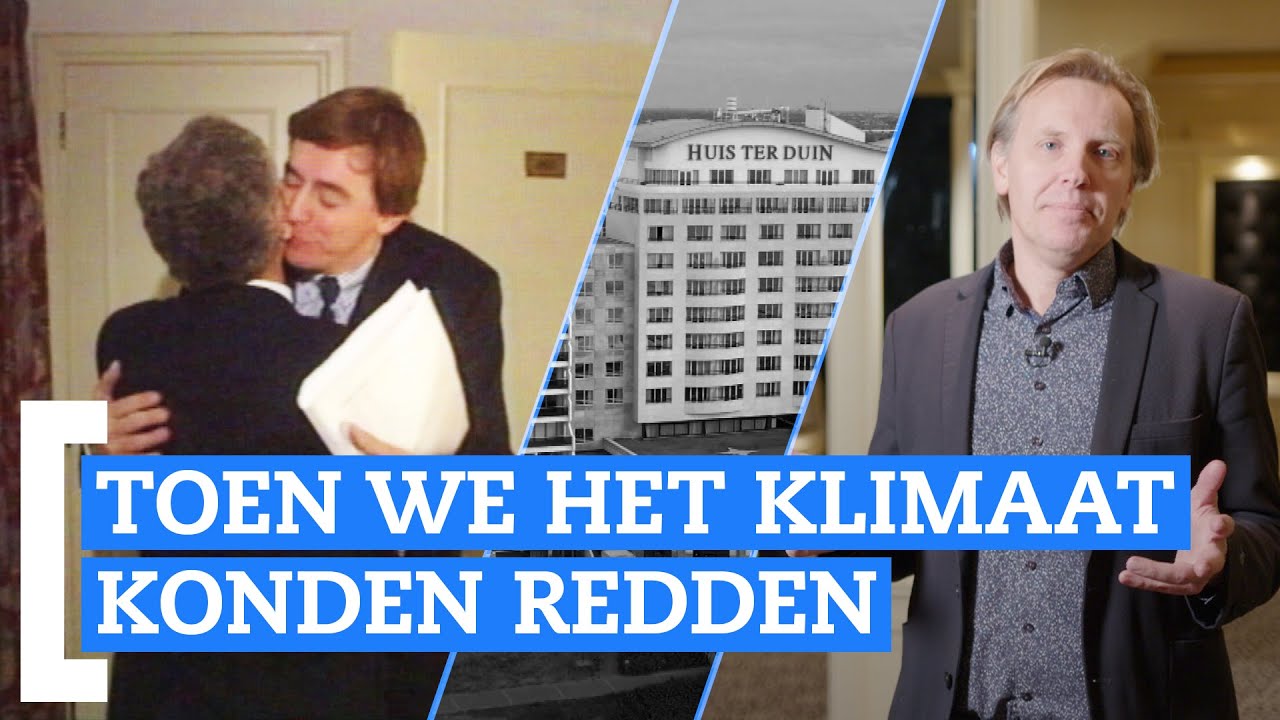 . Nieuwsuur.
- ^ "Milieutop eindigt in wazige uitspraken - Digibron.nl". www.digibron.nl (in Dutch). 8 November 1989. Retrieved 21 November 2019.
- ^ Rich, Nathaniel (5 August 2018). "Losing Earth: The Decade We Almost Stopped Climate Change". The New York Times Magazine. pp. 4–. ISSN 0028-7822. Archived from the original on 15 January 2022.
Further reading
Annie Ropeik: And in fact, when Bush came to office, the table was set for them to do something big. Less than a year after Bush’s inauguration, world leaders planned a meeting — the first-ever international talks on a binding treaty to limit greenhouse gas emissions. The talks would be held in Noordwijk, in the Netherlands. This would be the ideal place for Bush to hold true to his promises of being an environmental president - to lead the world in addressing climate change.
:{
}:
Sam Evans-Brown: But immediately it became clear that John H did not see global warming as being like acid rain. And this teed up an internal battle within the Bush administration.
Rafe Pomerance: and this became an issue inside the Bush Whitehouse and agencies... some people very enthusiastic about moving forward… others like Governor Sununu, Chief of Staff, was not.
Rafe Pomerance: And what happened was, during the crucial week when they were going to make a decision. Hansen again shows up.
Annie Ropeik: James Hansen is that NASA scientist, the one whose models of the greenhouse effect first got Congress’ attention back in the early 80s. He had continued coming before lawmakers, including now-famous bombshell testimony in 1988 when he declared that global warming was already being observed. Now, he was testifying again.
Sam Evans-Brown: But this time, John H. Sununu intervened.
Rafe Pomerance: And Hansen’s testimony was altered by the Bush administration. And later, as I have learned, Sununu claims he altered the testimony, and diminished its conclusions.
Annie Ropeik: The new text said that climate change might be attributable to “natural processes,” which Hansen did not believe. This was leaked to the press, and was splashed all over the front page of the New York Times. The Bush White House wound up with egg all over their faces.
Rafe Pomerance: The Hansen alteration had a big political impact on the deliberations inside the Bush White house.…
Sam Evans-Brown: Rafe says when you look back at newspapers of the time, you see editorial writers throwing Bush's own words back at him. The self-proclaimed environmental president had promised his administration would tackle climate change. Instead, they'd been caught doing just the opposite — secretly trying to downplay the problem.
Annie Ropeik: It put the White House on the defensive. And for a moment in the roiling internal debate within the administration, it seemed like John H. Sununu had lost. Just before the historic, first-ever climate negotiations in the Netherlands began, he wrote a telegram to State Department’s negotiators, reversing his previous position and telling them to work towards a “full international consensus.”
Sam Evans-Brown: Here again is Nathaniel Rich, the author of Losing Earth.
Nathaniel Rich: And then then the strangest detail of all is that there’s a series of talks on the eve of the trip in November, at a Tony hotel in DC in front of international — or — investors in the American Stock Exchange. Sununu — although he’s not there to speak about climate change necessarily, he’s just there in hiscapacity as powerful person within the Bush administration to talk about the economy— spends most of his talk on Noordwijk and on this idea of a treaty. And in fact comes out fairly forcefully — it’s a very strange thing to read — in favor of a global agreement. And he’s challenged at one point by an investor in the audience who says, “well isn’t this going to have some major economic costs? And he says, “yeah there’ll be some up front costs, but it’s nothing compared to the back end costs if we don’t do anything.”
Annie Ropeik: And yet, despite all of this — despite having lost face by altering Hansen’s testimony and having been pressured into supporting a global greenhouse gas treaty — somewhere between that speech to investors and the final negotiation in Noordwijk, Sununu flipped again.
Sam Evans-Brown: It meant Americans began the talks with a hard-line stance.
:{
}:
Nathaniel Rich: We won’t sign anything that's binding in terms of emissions reductions, and we won't take part in anything that won’t consider the economic implications in the short-term basically. And that’s the end of the dream of a global binding treaty essentially. That’s the closest we’ve ever come since.
Annie Ropeik: This set the template for all climate talks that followed, every subsequent attempt at a binding greenhouse gas reduction treaty has failed. Even the much lauded Paris agreement, which the US also backed out of, was completely non-binding…
Sam Evans-Brown: This is where we get this great quote, which I think is theSwedish environment minister walking out of the room, and saying “your government is fucking this up.”
Nathaniel Rich: Yeah, right. And they did.
Annie Ropeik: If that binding treaty had been signed in 1990 — and if global community had lived up to it — there could have been fifteen percent less carbon in the atmosphere when the effort to scale back emissions began. There would have been a thirty year head start on developing solutions and driving down their cost.
Sam Evans-Brown: In short, the problem would have been a lot easier to solve.