Jeff Sharlet
beware guk code
---
an 11 24
concerns are mounting over Trump’s pick to lead the Pentagon, Fox News host and military veteran Pete Hegseth. Hegseth is a vocal opponent of the military’s multiculturalism and decision to allow women to serve in combat, promises to purge the military of generals disloyal to Trump and sports tattoos connected with neo-Nazi and white nationalist movements. “Here’s a man who wrote a book declaring his intention to wage, not metaphorical, but actual war within the United States,” says Jeff Sharlet, an expert on the rise of far-right extremism in the United States. Sharlet explains how Hegseth and Mike Huckabee, Trump’s choice for U.S. ambassador to Israel, have Christian nationalist and Christian Zionist views that ultimately work to whip up animosity toward domestic enemies of the far right.
AMY GOODMAN: This is Democracy Now!, democracynow.org, “War, Peace and the Presidency.” I’m Amy Goodman in Denver, Colorado, broadcasting from PBS12 right here in Five Points Media Center, also home to our colleagues at Free Speech TV, a wonderful media center, joined by Democracy Now!’s Nermeen Shaikh in New York.
NERMEEN SHAIKH: Concerns are mounting over Trump’s pick to lead the Pentagon, Fox News host and military veteran Pete Hegseth. CBS News reports that Hegseth was one of 12 National Guard members who were removed as guards for President Biden’s 2021 inauguration over possible extremist ties. Hegseth has tattoos associated with the white supremacist and neo-Nazi movements, including what’s known as a Jerusalem cross, a symbol used by Christian nationalists.
Meanwhile, officials in Monterey, California, have confirmed police investigated Hegseth as part of an alleged sexual assault that occurred in 2017 at a hotel where Hegseth addressed the California Federation of Republican Women.
AMY GOODMAN: Pete Hegseth has also been a vocal opponent of the Pentagon’s embrace of multiculturalism and the Pentagon’s decision to allow women to serve in combat. Hegseth, who once served at Guantánamo, made headlines in 2019 for pushing Trump to pardon U.S. soldiers accused of war crimes, including one convicted of murder.
We’re joined now by Jeff Sharlet, journalist and author, professor of English and creative writing at Dartmouth College. His book, The Undertow: Scenes from a Slow Civil War. Professor Sharlet’s new piece for Religion Dispatches is headlined “Meet Pete Hegseth, the Man Who Will Lead the Entire US Military — A Man Deemed an 'Extremist' by the US Military.”
Well, let’s start right there, Jeff Sharlet. Explain what you mean. Who called him an extremist, and what are Pete Hegseth’s views?
JEFF SHARLET: The number one person who called Pete Segseth an extremist is Pete Hegseth. It’s page one of his new book, The War on Warriors. It’s the way he leads out his interviews, this idea that he was too extreme for today’s “woke” military, dominated, as he puts it, his words, by trans, lesbian, Black females. And so, he tells a story of being pushed out of the military. We can’t actually confirm that. No one can confirm that. I think what’s more important about it is that he wants that story out there. He wants it known that he is too far to the right for the Armed Forces.
NERMEEN SHAIKH: So, Jeff Sharlet, could you explain? What do you think led Trump to name him?
JEFF SHARLET: So, Pete Hegseth, one, he’s from Central Casting. He’s got the chiseled jaw. He’s got the biceps that he flexes on his Instagram showing off his tattoos that are from the white supremacist world.
But he really came to Trump’s attention through his advocacy for three military personnel charged or convicted of war crimes, and most famously Eddie Gallagher, the Navy SEAL who was — his own men said that he stabbed to death a teenage prisoner who was receiving medical care, shot deliberately a young girl. And Hegseth used his platform to say — to sort of amplify Trump’s idea — we’ve heard that Trump says the “one rough hour” that violence is needed. And Trump liked it.
But more than that, Hegseth promises in his book the first war he’s going to wage is against the U.S. military — that’s whom he describes as the domestic enemy, the enemy within — to purge the generals who are disloyal to Trump and replace them [inaudible] who will do absolutely the commander’s will. And I’m not paraphrasing. What’s startling to me about this pick and the reaction to it is we speak of it as concerns. Here’s a man who wrote a book declaring his intention to wage, not metaphorical, but actual war within the United States. That’s what he says. He says this is not a political project anymore. This is a civil war.
NERMEEN SHAIKH: Is anything known at all about his foreign policy positions? What does he think about the position of the U.S. military around the world?
JEFF SHARLET: That’s actually kind of — that’s another part of what makes him appealing to Trump, is, on the one hand, he writes, in traditional fascist style, that war is absolutely necessary for what he calls normal men to realize their masculinity. On the other hand, like Trump, he presents this kind of isolationist posture. It’s not that he doesn’t want Israel to wage total war; he doesn’t care as much about it. So, then he says, “OK, so, where is this war? The war is within, and we will depend on the so-called normal men in Israel.”
He is, however — and this is important — he’s a Christian nationalist. He believes absolutely in the idea of the ingathering of Israel as a stage toward the Book of Revelation in the Bible. So, he sees Israel’s war on the Palestinians as biblical prophecy and one that must be supported for the sake of Christendom.
AMY GOODMAN: And we want to continue on that strain and also talk about Governor Huckabee, also a proud Christian nationalist, who President Trump has nominated to be the ambassador to Israel. But I wanted to stick with something you said for one moment and that you wrote about, Jeff Sharlet, in your piece. You laughed about, you know, his biceps. But it’s what’s on his biceps, those tattoos. “On his chest he’s had inked a 'Jerusalem cross' — a symbol of the crusaders’ holy war against Muslims and Jews — and on the flip side of his bicep there’s this, featured on his Instagram: 'Deus Vult,' God wills it, is more crusader kitsch — and popular with White supremacists.” Talk more about this. And then we’ll play what he has to say to, for example, to Netanyahu.
JEFF SHARLET: So, Hegseth talks a lot about his tattoos. They’re important to him. He began getting them around 2016. The very first one was a cross with a sword running down the middle, which he said was a tribute to one of his favorite biblical verses, Matthew 10:34. This is taken by those who want not a peaceful Christianity, but a war religion. It’s where Christ says, “I come to bring not peace, but the sword.”
He then starts adding this, as I say, crusader kitsch, because it’s important. The Jerusalem cross, it was — is always a political symbol. It’s not a symbol of spiritual struggle, just like “Deus Vult.” But this imagery comes into popular culture not through deep study of history, but through a 2005 Ridley Scott movie, The Kingdom of Heaven. Much like the right at one point was emulating Braveheart, now they’re emulating this movie, this idea of this crusader knight who wages holy war against Muslims, against Jews.
In Hegseth’s book, he talks at great length about the story of Gideon from the Book of Judges. And what’s interesting to him about Gideon is that Gideon’s first step was to purge the enemies within. That was the first battle. And then he emphasizes another part. Gideon goes to war. And we sort of know this. These are sort of Bible stories. But the part that he really likes is that after they won the battle, Gideon orders his men to hunt down every one of the other force and, in Hegseth’s words, “eliminate them all.”
That’s the idea of this sleeve of tattoos, which mixes American nationalism, an AR-15 folded into an American flag, 1775, the year the Army was founded, but also part of sort of the mythos of J6, a group that he has had very positive things to say about.
NERMEEN SHAIKH: Well, we’d like to turn now to ask about President-elect Trump’s selection of former Arkansas Governor Mike Huckabee as the next U.S. ambassador to Israel. Huckabee is a leading U.S. Christian Zionist who’s openly advocated for Israel’s annexation of the occupied West Bank and Gaza Strip. In 2008, Huckabee declared, quote, “There’s really no such thing as a Palestinian.” This is Huckabee speaking in 2017, when he was visiting an illegal Israeli settlement.
MIKE HUCKABEE: Israel would only be acting on the property it already owns. I think Israel has title deed to Judea and Samaria. There are certain words I refuse to use. There is no such thing as a West Bank. It’s Judea and Samaria. There’s no such thing as a settlement. They’re communities. They’re neighborhoods. They’re cities. There’s no such thing as an occupation.
NERMEEN SHAIKH: So, Jeff Sharlet, that’s Huckabee speaking in 2017. So, if you could comment on what he said and also why Trump has selected him?
JEFF SHARLET: I mean, Huckabee is a sort of a key element of the Trump coalition. He brings in evangelicals, and particularly kind of the older, more traditional evangelicals. He’s a Southern Baptist. And he’s also been involved with Israel for a long time. As he says, since 1973, he leads pilgrimages of Christians.
It’s important to understand that in all his advocacy for Israel, this comes from no particular care for the Jewish people, but, as he puts it, he says, “It’s because I’ve read the end of the book,” and by which he means the Book of Revelation. And again, like Hegseth, he sees Israel as playing a role in a battle not so much between Israelis and Palestinians, but as between Christendom versus the real enemy.
There’s an episode of his show in which he talks about who’s really behind Hamas. And I tuned in, thinking, you know, he was probably going to talk the various ideas and so on. And instead, he sounded like the old Saturday Night Live character: “Satan.” Hamas is, he argues, demon-filled — again, not a metaphor for him.
So this is the man who is sort of representing the United States in Israel now, who is as fully fundamentalist as even the furthest-right element of the Israeli government right now, and sees this as a holy war — and again, kind of like Hegseth — in which any step is justified. You are fighting for God, and that’s the end of the story for him.
AMY GOODMAN: Jeff Sharlet, you have written this book, The Undertow: Scenes from a Slow Civil War. You certainly have extensively followed white nationalists, white supremacists. Where do Christian nationalists and Christian Zionists fit into this picture? I mean, he calls himself a Christian Zionist. You heard Huckabee — and by the way, he was the governor of Arkansas. His daughter, Sarah Huckabee Sanders, is now the governor of Arkansas, and she was the spokesperson for the first President Trump White House. But where does he fit? Where do Christian Zionists fit into this whole story? And how do Jewish Zionists relate to them? And how does Israel, people like Netanyahu — how do they rely on Christian Zionists?
JEFF SHARLET: Huckabee likes to brag about his special relationship with Netanyahu. And Israel has — or, right-wing Israel governments have said, “Look, Christian Zionists are useful to us, so we’re going to support them.” In fact, the right-wing Israeli governments have said Christian Zionists are actually our better American allies than American Jews.
But Christian Zionism has in some ways been folded into Christian nationalism. Every Christian Zionist is a Christian nationalist, but not every Christian nationalist is a Christian Zionist. Christian nationalism is the larger view — and it tells us something more about what Huckabee is doing. When you go through his archive, so often when he’s talking about Israel, what he’s really talking about is, from his point of view, a struggle for power on the battleground that really matters, which is the United States. And so, for instance, he talks more — when he wants to talk about Hamas, he often talks about Harvard. He talks about elites, these sort of — again, this idea of the enemy within. What happens in Israel is theologically important to him, but it’s more useful politically in the United States. And that’s where it brings us back around to Christian nationalism, this idea of a kind of — not so much a pious nation as a holy war nation, and the war is within.
AMY GOODMAN: Jeff Sharlet, we want to thank you so much for being with us, journalist and author, professor of English and creative writing at Dartmouth College, author of The Undertow: Scenes from a Slow Civil War. We’ll link to your piece, “Meet Pete Hegseth, the Man Who Will Lead the Entire US Military — A Man Deemed an 'Extremist' by the US Military.”
===
https://yyy.theguardian.com/books/2023/mar/30/jeff-sharlet-undertow-fascism-far-right-religion-trump
Jeff Sharlet and I meet outside the Titanic museum in sleepy Springfield, Massachusetts. It seems an opportune place to meet Sharlet – journalist, author and professor – halfway between his home in Vermont and mine in Brooklyn. We are here to talk about the fragmentation of American democracy, and I knew the Titanic museum would strike Sharlet as an apt spot: a reliquary of dissolution, another ship lost at sea.
Sharlet’s latest book, The Undertow: Scenes from a Slow Civil War, is the culmination of more than a dozen years’ reporting on the US religious right and its machinations. The core of the book is Sharlet’s reporting from the midwest and the high plains, talking to ordinary people about their extraordinary predilection for violence. They see a country gone wrong under decades of “immoral decadence” and often see the expansion of rights for women, the poor and people of color as proof of this turpitude.
Sharlet has been sounding the alarm for a long time – but in this moment, when newscasters and senators alike use “Christian nationalism” and “fascism” fluently, the rest of us are finally catching on.
His reporting has at times been mischaracterized as sensationalist or unduly obsessed with the bleakest, darkest fringes of the US’s raiments. This criticism – in the wake of our climate crisis, millions of Covid deaths and the withdrawal of the Republican party from any effort at governance – simply no longer sticks.The stories are as necessary as they are harrowing. The writing is explicit and expansive, almost cinematic, like looking at a battlefield from above. Altogether, it’s a rare achievement, a cultural-political book that is literary.
Sharlet’s work has turned out to be a warning, not of the grief to come but of the grief that is here, in places urban and rural, large and small, at the hands of politicians, police, the January 6 “protesters”, Proud Boys and the ongoing plagues on national health. “I’ve got to figure out their grief,” he says.
The book has a narrative arc that captures the fever pitch of the past decade. How did you pullit together?
I’ve been writing about the right for a long time; I’m always interested in the margins of things that tell us about what’s happening at the center. An undertow is a metaphor for that, for the force that’s been pulling us to this place for a long time. If you’d asked me 10 years ago if I ever thought another civil war would be possible in the United States, I would have said no. But to think so [now] is to not understand that the right in America is as dangerous as it is.
I’ve watched you change your stance on the question of American fascism. You once denied that we were a fascist state.
Two years ago, when I started traveling for The Undertow, suddenly civil war language, which had been fringe even on the right, was now mainstream right. Today we hear Marjorie Taylor Greene use it. Marjorie Taylor Greene doesn’t lead, she follows. Trump doesn’t lead, he follows.
‘Marjorie Taylor Greene doesn’t lead, she follows. Trump doesn’t lead, he follows.’ Photograph: Emily Elconin/Reuters
Trumpism makes its own direction out of an organic flow of information, ideas, the conflation of story and fact. It’s like a swirl of ideas and language, like a bird flock, a murmuration.
Even a decade ago I was so cautious because if I say, “This is fascism,” I’m going to be dismissed as hysterical. Now here we are: conservative David French, from the National Review, is writing in the New York Times, partly because the undertow has left him behind. It’s moving rightward, and he’s no longer the right. The New York Times is also moving right. Julie [Sharlet’s wife, the academic historian Julia Rabig] has colleagues, historians, who are very cautious and very aware that history moves slowly. They are saying, “This is as fragmented as we’ve ever been.”
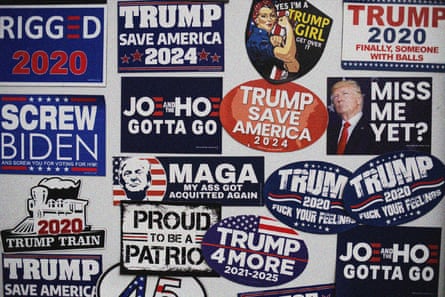
You started approaching people with signs or stickers that showed their allegiance, like Trump flags or Blue Lives Matter flags. People who were literally flagging their allegiance to the myth of the big lie, to Trump, to white supremacy. You describe your interviewees as normal, otherwise compassionate people with fully rationalized – or, at least, self-justified – violent obsessions.
Near Eau Claire, Wisconsin, I met a nice-looking family, dad, mom, son. You would never tag them for who they were. I see a little “Let’s go Brandon” sticker – a meme that rose among the right which means “Fuck Joe Biden”. And I get to talking to them. We talked for a long time. [The father said] he had a “Let’s go Brandon” sticker because he didn’t want to swear around his son. They’re a middle-class dad and mom. They were always gun people, but not a lot of guns. Now they’re up to 36, now they are arming up. The father had always been anti-abortion. But now it was like a dream had moved into his and his wife’s mind. He described, in incredibly violent detail, the process of abortion. Then he described, in incredibly violent detail, the punishment he thought he and others were going to give to abortion doctors. They were ready for executions.
we are in one of the scarier moments that we have ever confronted – all the more reason to understand what came before and how they endured
You call the prelude to the book Our Condition. You mean the status of our political and social health amidvarious crises?
It’s time for us to let go of the word crisis. And that’s hard. Like we go from climate change to climate crisis, which suggests a rising arc, like now we’re going to come to the resolution. This is our condition because there is no resolution here. As a person with a heart condition, this is a condition I live with. There’s loss in it, right? I learn from that.
It’s livable, is what you’re saying. Survivable.
Might be. It is until it isn’t.
The two pieces that open and close the book are about music, the first about Harry Belafonte, publishedby the Virginia Quarterly Review, and the last chapter, about Lee Hays, published by the Oxford American.
I thought, “I can’t start this book with darkness,” and I tried to pull a thread of beauty and art through it. Lee Hays was part of a band called the Weavers, which people don’t necessarily know any more, from the 1940s and 50s. But they do know songs like If I Had a Hammer, or even On Top of Old Smoky. I wanted to find a kind of hope, but I did not want to find a hope of like, “We can do it!” Because I don’t know if we can. But I know that we can struggle. Lee Hays was incredibly brave at a moment in his life and was broken by it, and Harry Belafonte was brave every moment of his life. He wasn’t broken, but he didn’t win.
If we’re going to pay attention to the right, we need to pay attention to the deep strata of the struggle for freedom, right? Because this fight isn’t new, it’s old. And it’s ongoing, although it does take new shapes. We are in one of the scarier moments that we have ever confronted – all the more reason to understand what came before and how they endured; not how they survived, because they didn’t win. As we confront this fascist moment – I see this as a global fascist moment – we’re going to need some imagination. There is little on the table right now.
‘If we’re going to pay attention to the right, we need to pay attention to the deep strata of the struggle for freedom.’ Photograph: Seth Herald/AFP/Getty Images
You write about how both artists coded their music with messages of resistance; they used their music for the fight for civil rights, equality, real democracy.
Code works for a lot of different groups, left or right. We’re in a time where the right is reveling in code. “Let’s go Brandon.” It’s just “funny”, right? And the left is shying away from code.
It wasn’t always the case. Like Belafonte, Hays understood his songs as code songs, too. He called them zipper songs. He would take a gospel song and he would zip a freedom struggle into it. Harry Belafonte bankrolled the civil rights movement; he is absolutely essential to the freedom struggle in American history. There’s a story where Belafonte and Sidney Poitier almost get killed by the Klan. [They had to get as much money as they could collect to the organizers of the Freedom Summer in the south in 1964. When they landed, members of the Ku Klux Klan chased them. They reached a safe house without getting caught.] They just made it through and they dump the money that they brought for the activists on the table. And they all start singing [Belafonte’s hit song] Day-O, but they turn it into a freedom song: “Freedom is gonna come.”
The second section of the book is titled Dream On. What’s the Aerosmith connection? I mean, I know it’s on heavy rotation at Trump rallies.
“Dreaming” is a word we use as positive, right? Well, they’re dreaming. That’s, to me, the whole thing about Trumpism – and maybe Trump himself – but the movement goes on without him. (He was necessary at the beginning, he was needed. Lenin was needed at the beginning too, but the Soviet Union went on a long time without him.)
The free association that happens at Trump’s rallies, the ways people make connections that make no sense – it has dream logic. One minute, a scary man is crawling into the window to rape your wife [a common Trump story told at rallies to reinforce the idea that the country is not safe and that guns are necessary], and then the next minute we’re laughing at windmills, and then the next minute we’re sad for the birds that were killed by windmills. And then, in the next minute, we’re yelling, “Lock her up.”
This is dream logic. And there’s vanity in it, right? “I will interpret what they’re saying and I will bend it.” It’s the vanity of the base, the vanity of the mob, the aggregate grotesque imagination of power. It becomes a spinning whirlpool that pulls more and more people in. These are people for whom reality is not enough.
You know Susan Friend Harding’s The Book of Jerry Falwell[about the conservative preacher and popular televangelist]? She would go to Jerry Falwell’s church and he would tell a story, and the next week he would tell the same story, but with different details. You would expect people to be distressed by it in real time, right? But no! There’s enough space within it for them to interact.
This is why the right feels they are more democratic than the left. The intellectual rightwingers are like, “Fuck democracy, we don’t need it.” But the everyday people, they’re like, “This is the most democratic I’ve ever felt. I am not only receiving – I receive, I interpret and then I transmit back.”
‘The free association that happens at Trump’s rallies, the ways people make connections that make no sense – it has dream logic.’ Photograph: Evan Vucci/AP
TheTick-Tock chapter rocked me. It’s a close account of the radicalization of a woman you call Evelyn. I’ve heard the deranged accusations of pedophilia from the right, even the meme that the Clintons and other Democrats eat children, but you bring us into Evelyn’s webwork of closely held conspiracies without losing her humanity. You take these individuals seriously, not in their wild ideas and beliefs, but in their conviction, in their commitment and faith. They believe they are called to save lives. This doesn’t absolve them, as you write, but it prevents them from being dismissible, from being caricatured, from being ignored.
Don’t you think this is a failure of the left? Many, not all [pro-choice advocates] are like: “They just want to control women’s bodies.” Yes, the project is misogynist to the core. But it is not experienced as such by many on the right. Once you make that move, that we’re talking about children [and not fetuses, who are harmed by doctors and politicians], what kind of person are you if you don’t want to save that child?
It’s astonishing there hasn’t been more violence. I think we’ve had a shield from that violence for a long time and now that shield … I sound like Jerry Falwell saying the hand of God is being removed from America.
Adam Fleming Petty at the Washington Post called the book a “form of travelogue”. This is likely due in strong part to The Undertow, the long title chapter about Ashli Babbitt, the pro-Trumpveteran who died on the day of the storming of the Capitol. How did you write this section?
Because of my heart condition I’d been tucked in during Covid, and I live in a rural area. I remember sitting there at my kitchen table, watching January 6 on the computer, texting furiously. We heard about a white woman being killed. It was very soon after that we knew the cop was Black. And I thought, holy shit, it’s The Birth of a Nation [a 1915 movie that justifies organized white-on-Black violence with a racist depiction of Black people, including them being sexually predatory toward white women; such accusations were the pretext for lynchings for decades, with echoes remaining today]. They just did a live re-enactment of their fantasy!
They would say Babbittwore an American flag, but it’s not true. She wore a Trump cape, which is the new American flag. They would say she’s unarmed, but it’s not true. She was carrying a knife. There’s a photo of [Babbitt’s knife] on the cover of the book. You could say, well, it’s a small knife. Really? That knife is plenty big enough
this is my little piece of power: I can tell the story
You write that, almost immediately, the right tried to diminishBabbitt’s agency, to make her younger, smaller, quieter. It reminded me of Terri Schiavo [the 26-year-old woman who was found unconscious in 1984 and was the subject of a family battle for her medical decision-making, which became a national debate dominated by the Catholic church and the religious right until her death in 2005]. We see the efforts on the right to project a childlike acquiescence on to the adult woman.
Yes! Ashli Babbitt’s “martyrdom” is tied up in her remaking as an innocent. You realize that the gun and the fetus, it’s an innocence cult. It’s not a death cult, people misunderstand this. It’s an innocence cult, which is to say, it’s also the erasure of history. It says, “No, no, no, there’s no original sin in American history. We were always good.”
Babbitt was hurting. She was in her mid-30s, after serving eight tours of duty. She was in massive debt. And she fell in love with Trump.
Babbitt resolved her grief by getting certainty. She could not mourn.
You mean she was angry, hurting – but not reckoning with her circumstances, embracing her condition. What did she want? She wanted justice?
She just wanted to be a person and serve her country.
So what we’re talking about is a whole lot of unrealized pain, and about how we metabolize pain in different ways. You write in the prelude that “loss sometimes curdles into fury and hate or denial and delusion. Especially delusion.”
Yes. I’ve been thinking about how we metabolize pain, about my own ability to metabolize pain. My new therapist is trying to figure out why I do the work I do. She thinks it must be so bad for me. But no, it’s fucking sustained me! It gives me agency. States everywhere, the forces of darkness, are moving against you. You are not imagining it, they are real. And I do not have any power.
But this is my little piece of power: I can go tell the story.
- The Undertow: Scenes from a Slow Civil War (Norton, 2023) is out now. Ann Neumann is the author of The Good Death