drilled bak
News - How a Top Climate Consultancy is Greenwashing Fossil Fuels | Drilled
---
actually heated 1 26 gmail
i hate conspiracy theories. I always have. As a journalist, they’re usually the thing I’m pushing back against.
And yet, for a few years now, I’ve found myself saying something slightly heretical on panels and in conversations with other reporters: we need to start engaging in more overtly conspiratorial language. Because the actual story of climate change—the one we’ve reported exhaustively—is one about coordinated power, deliberate deception, and a bought-off government that repeatedly acts to promote an industry that is poisoning humans and the environment for profit. It just so happens to be a real conspiracy.
The Trump administration’s recent invasion of Venezuela has put this conspiracy at the top of the news cycle. Trump framed the attack explicitly as an oil play, bragging about handing Venezuela’s oil infrastructure to U.S. companies. He said he privately briefed oil executives in advance of the attack, but did not inform Congress. He made clear that if U.S. companies were hesitant to enter Venezuela, U.S. taxpayers would step in to shoulder the financial risk.
These statements strip away every remaining excuse for decorum. When a president deploys military might and taxpayer dollars to expand Big Oil’s power, journalists and climate advocates shouldn’t be afraid to say why that’s really happening—or to use the kind of language that makes it finally click in people’s brains.
If there were ever a moment to embrace climate conspiratorial language, it’s now. If we don’t, we’ll miss a rare chance to show the public who the government really works for, and who pays the price.
Here’s how I’d put it, if anyone needs a hand.
A climate script for the conspiracy-minded
You may think that the biggest climate conspiracy is chemtrails. You’d be wrong.
But climate-altering chemicals are being dumped into the atmosphere at an astonishing rate. And the government is actively trying to cover up what’s happening, why it’s happening, and who it hurts.
Airplanes aren’t the ones releasing world-changing amounts of climate-altering chemicals into the sky. Fossil fuel companies are. Fossil fuel operations are notorious for emitting massive amounts of greenhouse gases into the atmosphere, mainly carbon dioxide and methane. Just look at these graphs showing how much heat-trapping gas has accumulated in the atmosphere over time.
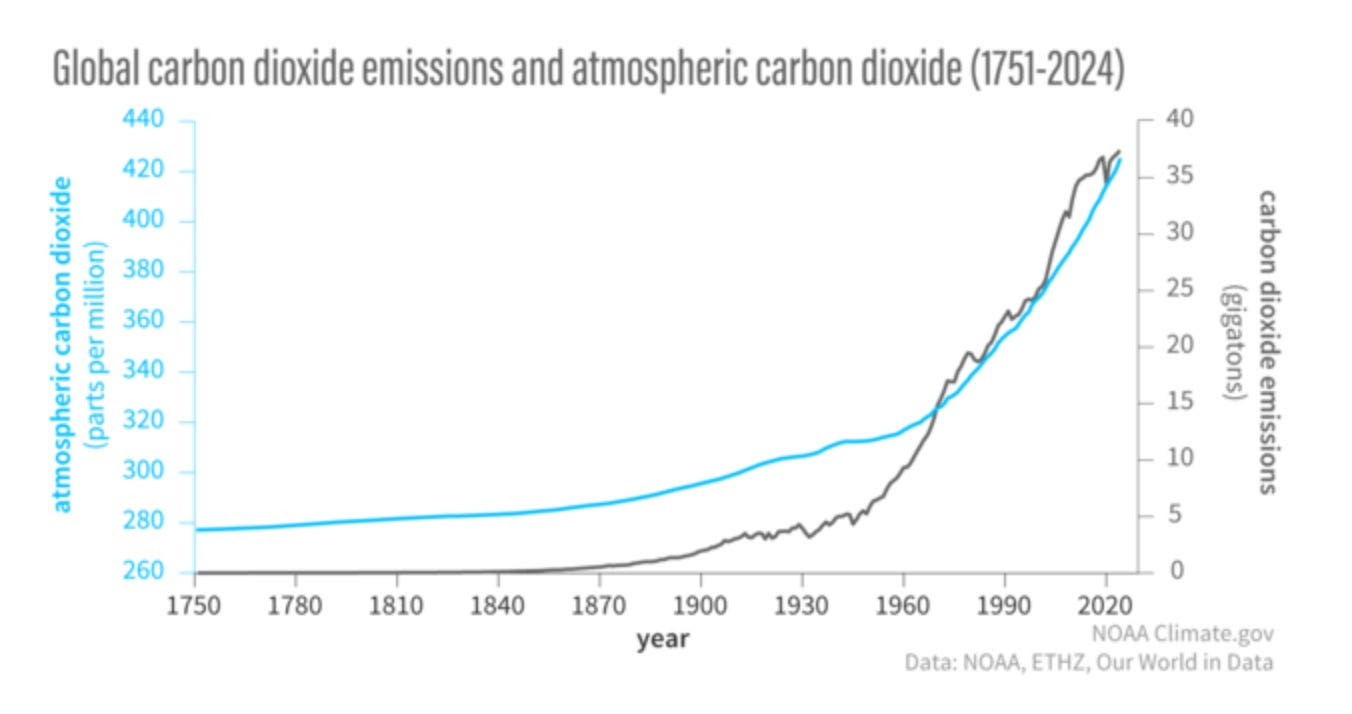
A NASA graph, since removed by the Trump administration, shows that the amount of carbon dioxide in the atmosphere (blue line) has increased along with human emissions of carbon dioxide (gray line) since the start of the Industrial Revolution.
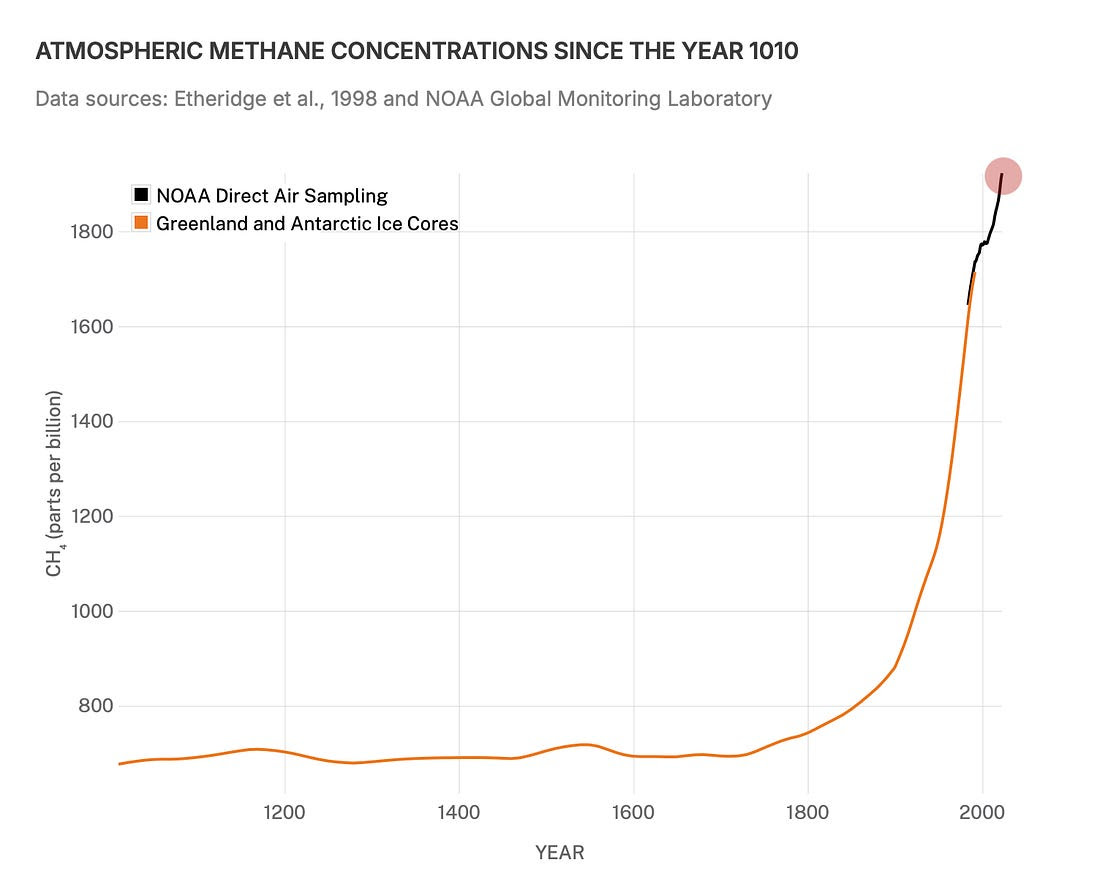 |
A NASA graph shows a rise in atmospheric methane concentrations since the year 1010.
The U.S. government is actively trying to cover up these numbers. Since taking office, Trump has proposed shutting down the country’s longest-:{running carbon dioxide monitoring station. He’s secretly directed NASA employees to draw up plans to destroy two satellites that monitor global carbon dioxide levels. And he’s moved to end the program that requires fossil fuel companies to track and report greenhouse gas emissions from more than 8,000 facilities.}:
The government has also been working overtime to cover up the massive harm this pollution causes. Trump has altered or deleted nearly every federal scientific report and web resource that’s come out in the last two decades showing that climate change is killing people, costing money, and making us less safe. He says it’s because all the studies are flawed and alarmist. Really? All of them? Every single one?
The real reason the government is doing this is simple: Because it’s bought and paid for by Big Oil, the most profitable and powerful industry in the world. Before the election, Trump promised oil executives he would give them whatever they wanted in exchange for campaign support, floating a $1 billion price tag. How much the industry actually gave is impossible to know, thanks to dark money and opaque PACs. But from what we can see, Big Oil spent $219 million to influence the 2024 election, with at least $75 million going directly to Trump’s campaign and affiliated PACs. Eighty-eight percent of oil and gas money went to Republicans.
And now, the government is deploying the U.S. military to help the industry dump even more of these climate-altering chemicals into the atmosphere.
Trump explicitly stated his intention for the U.S. to control Venezuela’s oil. He laid it out plain as day: “We’re going to have our very large United States oil companies, the biggest anywhere in the world, go in, spend billions of dollars, fix the badly broken infrastructure, the oil infrastructure, and start making money for the country.”
Trump didn’t tell Congress about the Venezuela attack before it happened. But he did claim to tell oil executives. Let that sink in. The presidentreportedly informed private oil companies about a military invasion before informing the people’s elected representatives. So who does the government work for, exactly?
The oil industry has tried to deny receiving advance notice prior to the invasion—but only through anonymous sources. To this I remind you: Oil companies are notorious liars. They spent decades lying about climate change, burying their own research showing fossil fuels were destroying the planet, and funding disinformation campaigns to confuse the public. If they really didn’t speak to Trump, why don’t they say it loudly and proudly?
Now, plenty of people have correctly pointed out that it will be difficult and expensive for U.S. oil companies to take over Venezuela’s oil. But that’s much less of a problem when the government works for you. After industry sources told CNN that oil companies “were reluctant to commit to reinvesting” in Venezuela, Trump immediately fell over himself to offer to help them—with taxpayer money, of course. Trump said oil companies rebuilding Venezuela’s infrastructure will “get reimbursed by us, or through revenue,” with the U.S. government potentially subsidizing efforts by energy companies to rebuild the country’s oil industry.
Oil companies are trying to publicly act like they don’t want Venezuela’s oil. But here’s what’s indisputable. Chevron’s stock soared as much as 10 percent after the invasion. Exxon and ConocoPhillips shares rose around 3 to 4 percent. Oil service companies like SLB, Baker Hughes, and Halliburton jumped between 4 percent and 9 percent. And U.S. refiners Marathon Petroleum, Phillips 66, PBF Energy, and Valero Energy were up between 3.4 percent and 9.3 percent.
Another thing that’s indisputable: Venezuela’s new acting president, Delcy Rodríguez, is the country’s oil minister. She’s long been the go-to contact for senior oil executives, with strong ties to Republicans in the oil industry who actively pushed for her to lead post-Maduro Venezuela. I’m sure that’s just a crazy coincidence.
Perhaps all of this could be defensible if the outcome for ordinary Americans were actually positive. Trump insists it will be—that oil expansion means jobs, security, and prosperity.
That claim is the heart of the conspiracy. It’s not that Trump and the oil industry are working together; that part is in plain sight. It’s that the public is being told this partnership exists for our benefit, when in reality it exists to preserve fossil fuel dominance in a world where that dominance is threatened by people simply understanding the truth—that oil and gas pollution is transforming the climate, making us sicker, poorer, and less safe.
That’s why Trump works to obscure emissions data, suppress climate science, and discredit anyone who explains the harm. It’s why he’s willing to spend taxpayer money, deploy military force, and rewrite foreign policy. Not because any of this serves the public interest, but because all of it serves the same goal: keeping fossil fuels flowing, even as the scientific case for transitioning away from them becomes overwhelming.
And doing that requires a public that is less informed, more economically strained, and easier to distract—too busy coping with rising costs and mounting crises to demand a transition that would reduce pollution, lower long-term costs, and make wars over energy unnecessary.
So no, you don’t need to worry about chemtrails. You need to worry about who controls energy—and what they’re willing to do to keep it that way.
ref bloomberg
Patricia Garip
Updated Tue, January 6, 2026
(Bloomberg) —
As the US threatened Nicolás Maduro’s grip on power in recent months, a cadre of executives, lawyers and investors tied to the oil industry made their case to anyone who would listen — the Trump administration, congressional aides: His familiar No. 2 Delcy Rodríguez should fill his shoes in Venezuela.
An oil minister herself, Rodríguez has long been the go-to contact for senior executives, whom she impressed by navigating Venezuela’s industry through international sanctions, economic pressures and internal mismanagement. Her loyalty to the Maduro regime notwithstanding, she’d be best positioned to shepherd through the US plan to restore Venezuela to its glory days as an oil gusher, argued executives and lobbyists.
President Donald Trump’s inner circle came to the same conclusion, though people familiar with the matter say they did so independently. Both groups believed that the vice president, long seen as a bridge between the government and private sector, could stabilize Venezuela’s oil-based economy and facilitate American business faster than leading dissident María Corina Machado could, said the people.
Administration officials were mindful of the chaos that ensued in Iraq after the fall of Saddam Hussein. Business interests aside, maintaining a semblance of business continuity will be critical to a successful transition — one that the Trump administration has yet to define. And Rodríguez fits both those bills: she oversees Venezuela’s oil apparatus and has decades of relationships among the remaining socialist stronghold in government.
The advocates for Rodríguez didn’t directly include the biggest US oil majors, who were surprised by the removal of Maduro and are still racing to figure out how to work with Washington on next steps, according to people familiar with the matter. But there’s a wider universe of US and international companies that have operated in Venezuela for years, and many have contacts in the White House and on Capitol Hill, the people said.
A spokesperson for Chevron Corp., the only major US oil company licensed to operate in Venezuela, said it “had no advance notice of the recent operation and did not engage in any discussions with administration officials regarding governance for a post-Maduro Venezuela.” It also said operations in the country were continuing uninterrupted and in full compliance with laws and regulations.
In a triumphal press conference Saturday, Trump endorsed Rodríguez to lead Venezuela for now. Machado, he said, lacked “respect” to lead the country, a stunning blow to the recent Nobel Peace Prize winner and the regime opponents at home and abroad who have pinned their hopes on her.
The White House declined to comment beyond remarks made Sunday by Secretary of State and National Security Adviser Marco Rubio, who is playing a key role in managing Venezuela. He said that the US would leverage its oil blockade and regional military presence to further its policy goals. He also said the US would watch Rodríguez’s actions more than her rhetoric.
In a Bloomberg Television appearance Monday, Greylock Capital Management Chief Executive Hans Humes, who is part of the creditor committee of Venezuela’s sovereign debt, reiterated what some global oil executives have said in private regarding Rodríguez: “If you want somebody who can operate in reasonably OK conditions, get the person who operated in the worst conditions,” he said.
He added that Trump was making a big gamble, one that if successful, could “reorder the entire energy configuration of the world.”
That conclusion dovetailed with a Central Intelligence Agency report that one person familiar with the matter said senior US officials had recently commissioned to examine near-term succession scenarios. The document drew on numerous intelligence sources including open-source and human collection, and was meant to give Trump the best information possible as he considered the operation, according to the person.
The assessment concluded that top members of the regime, including Rodriguez, would be best placed to lead the government if Maduro were no longer in power, the Wall Street Journal reported Monday.
Global Oil Interests
Oil companies with interests in Venezuela, home to some of the world’s largest hydrocarbon reserves, now want to make sure that the Trump administration swiftly eases those sanctions to ensure that Rodríguez can start delivering results. There is no time to waste, said the sources, who spoke on condition of anonymity because they are not authorized to speak publicly.
In late December, Venezuela had already started closing oil wells because it had run out of storage to hold production stranded by the blockade. More shut-ins would make it harder for Venezuela to recover its economy and jeopardize Rodríguez’s hold on power, the sources said.
So far she looks to be consolidating control on the regime’s existing foundations. On Monday, she was sworn in by the National Assembly as acting president. In a fiery speech on Saturday, she described Maduro’s capture as a “kidnapping” and called for his return, but the sources said they believe her rhetoric was meant to shield her from internal reprisals.
On Sunday, she took a more conciliatory tone, inviting the US “to work together on a cooperation agenda, aimed at shared development, within the framework of international law, and to strengthen lasting community coexistence.”
Rodríguez, 56, had been a key figure in Maduro’s tight inner circle, heading a string of key portfolios including the Foreign Ministry that enabled her to build international bridges. She was named oil minister in 2024 after Maduro’s widely contested reelection, putting her in charge of the national oil company, Petróleos de Venezuela SA, with the task of cleaning up corruption and bringing more transparency to the bloated firm’s accounts.
An accomplished table-tennis player, Rodríguez regularly fields calls from senior executives at international oil companies, from Houston to Mumbai, and has longstanding relationships in Beijing and Moscow, which she visits on her government jet.
One of the companies with the most to gain from a successful revival of Venezuela’s oil industry is Chevron. ConocoPhillips, a US peer that’s owed some $10 billion in unpaid arbitration awards from the 2007 state seizure of its Venezuelan assets, would gain as well if it decides to implement a proposal to return to the country to recoup its debt. Among non-US companies, Shell Plc has an offshore Venezuelan gas deal on ice that could be reactivated on short notice. Other incumbents in Venezuela include Spain’s Repsol SA, Italy’s Eni SpA and France’s Maurel et Prom SA.
The Revolutionary’s Daughter
Rodríguez began her political career under late former President Hugo Chávez after graduating as a lawyer from the Central University of Venezuela.
Her father, Jorge Antonio Rodríguez, was a prominent leftist in the 1960s and 1970s and a Marxist party founder. He died in 1976 after being tortured in prison by state security forces, a defining feature of Delcy’s political narrative. Her brother, Jorge Rodríguez, is another regime stalwart and was Maduro’s longtime chief negotiator with the US.
Those who have worked alongside the new acting president often remark on her long hours, with Maduro recently saying she responded to messages well into the night and early morning. She was also by Maduro’s side as he ordered the most aggressive wave of repression the country has seen to crack down on dissidents in the aftermath of his contested reelection in 2024.
In meetings with financial advisers in the weeks ahead of Maduro’s capture, Rodríguez was very focused on the status of Venezuela’s debts and relationships with US oil majors, among other international financial matters, according to one of the sources.
Such diligence, together with the absence of a US indictment that had dogged Maduro for years, made Rodríguez the favorite, not just for oil companies, but also some bondholders who are looking to restructure some $60 billion of debt.
The endorsement by the White House is “a very clear-eyed sort of realist approach,” said Kimberly Breier, assistant secretary of state for Western Hemisphere Affairs during Trump’s first term.
Rodríguez “liaises with energy companies, and they have been able to deal with her, but that doesn’t mean she is a long-term solution,” Breier added, highlighting her deep association with a regime blamed for widespread human rights violations.
In 2021 Rodríguez showed two Bloomberg News journalists the room at the Economy Ministry in downtown Caracas where she’d practice table tennis, with three of her sparring partners on hand to demonstrate. The cavernous space contained two ping-pong tables. Portraits of Maduro, Chávez and Simón Bolívar, who liberated Venezuela from Spanish rule, looked on.
—With assistance from Erik Schatzker, Maria Elena Vizcaino and Natalia Drozdiak.
---
gmail 5 25
something can be repeated over and over, a story told ten different ways, and then one particular frame or graphic or turn of phrase makes it take hold. There are plenty of people who claim to know exactly what that special sauce is. I am not one of them. Mostly I figure people just need to hear something at least 10 times before it sinks in. I'm only talking about this phenomenon because it happened in the media-climate-philanthropy world recently when Media Matters put out an analysis of the online media ecosystem that included the graphic below, showing very clearly exactly how much more attention right-wing media is capturing these days than any other sort.
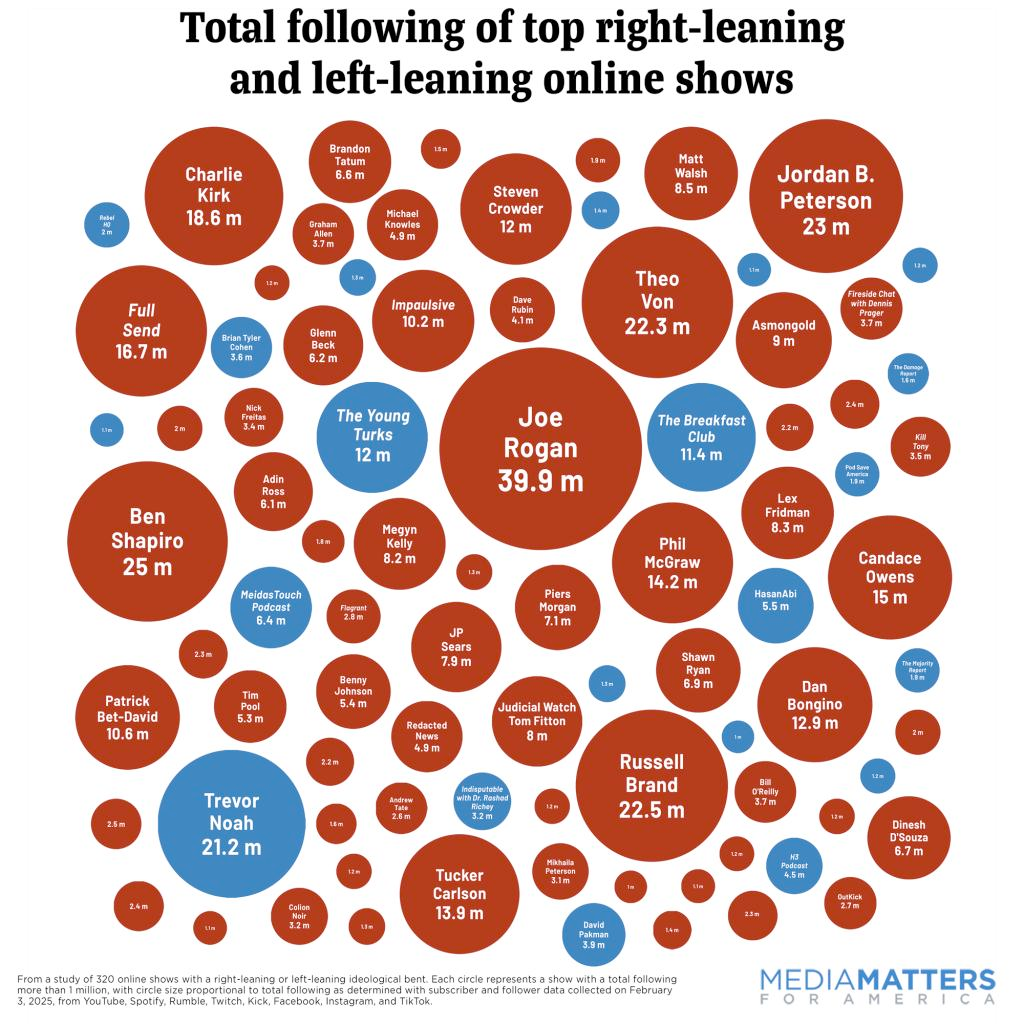
For a brief moment, I hoped it might actually help philanthropists on the left to see what they're up against and act accordingly, but then (through no fault of Media Matters!) the response turned into yet another round of the "we need a Joe Rogan for the left" discourse. Folks, the problem is not that there are no popular commentators on the left, nor is it that leftist commentators lack the "skill" to weave propaganda into a three-hour stoned bro fest. Neither is it a framing and accessibility issue, as it's often portrayed in the many "if only we could make [pick your issue and favorite set of corresponding facts] more funny, accessible, relatable" conversations. All of these responses take a glaring systemic issue and pretend it is an individual one.
For the millionth time, I wish those who worry about media, comment on it, think about funding it, are starting to (finally) understand its importance to democracy would...ASK PEOPLE WHO WORK IN MEDIA about this stuff? And no, your comms guy doesn't count, even if (especially if) he spent a year as a reporter way back when. For those of us who have worked in media for any period of time, and especially those of us who are old enough to have worked in media during the shift to digital, this chart holds some very clear truths that I just have not see pundits or philanthropists or comms experts or campaigners talking about:
Legacy media has lost an enormous amount of influence.
Listen, I can criticize legacy media with the best of them, but I can also see how the shift to independent creators has both created opportunities for journalists and commentators to be more directly responsible to the public and how that shift has eroded many of the norms that once helped to ensure information integrity in some very concerning ways. With the business model for legacy media up-ended by digital, not only have legacy outlets put money once reserved for things like fact-checking into social media and online video budgets instead, but also independent creators have started publications that never included editing or fact-checking systems in the first place.
As an independent creator, it is shocking to me the number of both independent and legacy media outlets I come across that no longer do fact-checking or, if they do, have some form of "self-fact-checking" that will never be able to compare to the real thing. The reality is that fact-checking is expensive and time-consuming and most outlets would rather pay for various other things. In the current moment, I can't think of anything more worth paying for, and yet while many foundations would agree, where is the funding for such things?}:
The question here, then, is not: who is the Joe Rogan of the left? But rather, how do we fund independent creators so that they can implement some of the good approaches of legacy media while also tapping into the benefits of independence? Or to make it pithier, who is the Rupert Murdoch of the left?
While the likes of George Soros and Pierre Omidyar have stumped up cash for short-term investments, nothing remotely close to the rightwing media funding ecosystem exists on the left (ironic, given the endless "liberal media" accusations). In addition to Murdoch, there's the Koch universe of foundations (major funders to right-wing outlets like The Daily Caller), Dick Uihlein (the conservative funder behind Metric Media, an ecosystem of more than 1200 "pink slime" newspapers that purport to be local news but are pay-for-play operations whose clients are corporations and conservative politicians), the Mercers (longtime backers of Steve Bannon and Breitbart News), the Wilks brothers (fracking billionaires who have funded Jordan Peterson, Ben Shapiro, and Prager U) the Sinclair family (which owns and operates conservative media company Sinclair Inc., which controls about 40 percent of local news broadcasts), and that's not even getting into the whole universe of religious groups gobbling up radio stations and taking over small-town movie theaters.
An additional question might be: can we save legacy media, and should we try? The public hasn't just lost faith in established news outlets because they can turn to the likes of Ben Shapiro or Joe Rogan instead. It's been a combination of factors, from the business model of media to the cost of subscriptions to the sort of elitist, horse-race type coverage so many outlets have provided over the years. Even as someone who believes fiercely in the value of news and that good journalism should be paid for, I'm butting up against my ability to be able to afford so many different paid subscriptions, never mind my desire to pay for and consume all of it. It makes me think of an interview I did with NYU media professor and critic Jay Rosen about a month before the first round of Covid-19 lockdowns in 2020, in which he told me he worried about good journalism becoming something reserved for elites.
"For many, many people, whether something happened or not...is that completely irrelevant?" he wondered. "My own view is that journalism is gonna survive as a high trust product, and the breadth or narrowness of the market for that product will depend hugely on politics and culture, not just the performance of the press. So it'll always be there for a minority, especially people who can pay a lot, they will definitely have news. And the journalists who provide it to them will definitely ask, did this really happen or was it a right-wing fantasy? And that'll be foundational to how do they do their journalism. But not only will it be a minority product in the sense that a small market pays for it, but also the high price of the good will reflect how valuable it is for an elite only to have that knowledge...and the fewer people who are informed the better."
Plenty of mainstream or legacy outlets still have some credibility amongst a large percentage of the population, although Bezos seems to be doing his damndest to erode the credibility of The Washington Post as quickly as possible (was his purchase of that paper the most expensive catch-and-kill play ever? Maybe!). What would a systemic approach to fixing media look like? To preventing it from becoming this elitist product Rosen outlined? Hint: it does not look like finding "the Joe Rogan of the left" and funneling all the dollars in his (you know it's his) direction.
I know for climate reporters, many of us opted out of working for legacy media at some point or another because we simply were not allowed to do the sort of reporting we felt was important. That is especially true for those of us with an accountability focus. It wasn't because we wanted to do sloppy work, or because we were so ragingly biased we couldn't operate within the established media system, nor do I think being accessible and humorous is mutually exclusive with being rigorous. It was because we wanted to give people the information we thought they needed most and we were tired of being asked to trade in false equivalencies.
:{:{For research on my book (coming next year!), I took a couple of trips to an archive containing decades worth of records from the Atlas Network, a global network of more than 500 "free market" think tanks. One of the many interesting things I found there was a box labeled "Potential Intellectual Entrepreneurs." It was a fascinating window into how Atlas, which helped to start Donors Fund (often described as the right's "dark money ATM") and counts many of the organizations involved in Project 2025 as members, finds, cultivates, and sustains talent. Intake forms note whether the person in question has come to Atlas seeking a grant or been found by the organization's leadership or someone in their network. }:
They note what sorts of things this person is doing, where they're located in the world, and what kind of support might make the most sense. Various other forms and reports track their progress, note connections that might be useful to them, ensure they're connected with the right funders and so forth. Several of the climate-denying reply guys I've been dealing with for more than 20 years were in there. While they were being supported throughout those decades, encouraged to keep doing and saying the same things over and over and over again, I have had to continuously prove myself, come up with new ideas and projects all the time, prove the value of journalism in general, produce projects for half the budget any other media house would and on and on. Why does "the left" require endless sacrifice while the right endlessly rewards any win? Another great question to be asking instead of "who is the Joe Rogan of the left?"}:
Instead of receiving the sort of committed, long-term backing that allows folks like Charlie Kirk or Jordan Peterson to thrive, churning out an unbelievable volume of content and leveraging technology (and relationships with tech platforms) to amplify it, independent creators are either constantly working on crowd-funding or caught in an endless cycle of grant applications and reporting, leaving us with less and less time to create content, less stability, and an increasing amount of legal and financial risk. How the fuck is anyone supposed to spend three hours a day smoking weed and engaging in "thought exercises" under those circumstances?
If you're wondering what this has to do with addressing the climate crisis, the answer is quite a bit. In its most recent report, the IPCC noted for the first time the role media plays in either driving or obstructing the political will required to act on climate. The media “shapes the public discourse about climate change and how to respond to it,” the report noted. And this “shaping” power can usefully build public support to accelerate climate mitigation – the efforts to reduce or prevent the emission of the greenhouse gases that are heating our planet – but it can also be used to do exactly the opposite, which is largely what’s been happening since the 1970s.
Lead author Max Boykoff, the researcher responsible for the IPCC’s increased understanding of the role of media in climate policy, told me the media plays a fundamental role in shaping both policymakers’ and the public’s understanding of climate issues. “People aren't picking up the IPCC report or peer-reviewed research to understand climate change,” he said. “People are reading about it in the news. That’s what shapes their understanding.”
These days they are also reading about it in newsletters, watching videos about it on YouTube or TikTok, and listening to podcasts about it, but more on that in a minute.
Technofascists have fully captured the information ecosystem.
If you have not read Cyberlibertarianism yet, I highly recommend doing so. And sorry but no, Technofeudalism—while a fine book and a decidedly shorter and easier read—is not cutting it. One was written by a tech guy turned academic who's been keyed into the technofascists and the threat they pose since the early aughts, the other by the former finance minister of Greece, for whom these dudes are a comparatively new phenomenon. (Relatedly, also highly recommend The Age of Surveillance Capitalism). A key theme *Cyberlibertarianism* raises is the regularity with which tech execs compare the advent of the Internet and social media to the arrival of the printing press, wrapping it in the same trappings of democratization as that storied machine and arguing that digital technology renders the press obsolete.
There are several handy tricks at play here, starting with the fact that digital media platforms are profit-making tools, not democracy-spreading tools. They were created by private corporations to gather intel on the public and sell it, to harness the attention garnered by digital content and monetize it, and to encourage the public to accept 24-hour surveillance. While the printing press led to an increase in propaganda simply by virtue of creating a means of production and distribution, digital platforms had fascist and propagandist goals from jump. Tech evangelists love to point to the use of Twitter by organizers of the Arab Spring protests as proof of their value as tools of democracy, and leave out the bit where it was also used to surveil and criminalize those organizers.
Today, Elon Musk fights against social media regulation as though the last remaining bulwark protecting free speech globally is the ability of tech companies to operate outside the law, with his de facto PR guy Michael Shellenberger claiming that even labeling information as "not vetted" is "censorship." The reality is if platforms like his can't operate with impunity as limitless cesspools of propaganda, they lose both financial and political value.
And then there's the simultaneous erosion of the press. It has always irked the tech gods and corporate executives alike that the only group that gets a special shout-out in the First Amendment is "the press." My longtime obsession, former Mobil VP Herb Schmertz, bitched about this constantly. He loved to threaten of "the public" rising up and stripping the press of its protections if it felt they weren't using their special privileges responsibly. Which is not to say that the press isn't or shouldn't be responsible to the public, just that Schmertz, as a key architect of corporate citizenship and the legal fight to secure rights for corporations, was primarily concerned with how the press was impacting his employer's bottom line not whether it was fulfilling its duty to voters.
So again, we have a systemic issue to tackle: what do we do about the fact that technofascists now control not only the dominant distribution mechanism for information, but also the algorithms that dictate who sees what? To place it within our Joe Rogan frame: How can the left make use of YouTube's algorithm the way the Joe Rogan Experience has? Although I'd argue that it's more important to reduce the power of the algorithm altogether, but hey you gotta start somewhere.
There are numerous ways to juice the algorithms, of course, and all of them cost money. There is a suite of necessary regulations that could help loosen the chokehold tech companies have on our information ecosystem, too, but at the moment only the European Union and Brazil are attempting to implement them.
Houston, We Have a Podcast Problem
I suppose it's surprising that I, a podcaster, am pointing out the obvious podcast problem here, but I have actually been squawking about this for quite some time. There's a reason the majority of those big red circles started their disinformation grift in podcasts (Rogan didn't start his career there, obviously, and is a bit different than the rest because he already had a large following when he started his podcast, thanks to previous careers as a failed comedian, Fear Factor host, and MMA announcer, but he did really start to lean into dis- and mis-information far more as a podcaster than he had previously.) And no, it's not just that having a podcast is like catnip for a certain type of white guy who crushed it in high school debate club. Again, there is a structural issue at play here that is being largely missed. And, to be fair, it's not justpodcasts, newsletters fit in here too. In a nutshell: the Federal Communications Commission, the FCC, hasn't gotten around to regulating these new media forms, and may never.
Relatedly, the thing Musk keeps fighting against when he moans about the Digital Services Act in the EU, for example, or Brazil's "Internet Bill of Rights," is not actually censorship so much as it is the idea that social media should be subject to the same rules every other sort of media is. For its entire existence, this form of media has had all of the benefits of the media and none of the risks or responsibilities. As currently written and interpreted, Section 230 (of the Communications Decency Act), another thing you may have heard Musk and his crew ranting about, rids tech platforms of all liability for things said and done on their sites. Yet, from their very earliest days, these platforms have competed with news publishers—who carry enormous legal liabilities and risks—for not just eyeballs but, relatedly, ad dollars.
The agency overseeing digital advertising in the U.S. is the Federal Trade Commission, or FTC. Unlike the FCC, which is proactive about regulating advertising in traditional media forms, the FTC generally won’t investigate anything unless and until a complaint is made and even then an investigation is not guaranteed. The FTC has had “green guides”meant to protect the public from false environmental claims for more than 30 years, for example, but thefirst complaintever filed against an oil company for violating those guidelines by greenwashing came in 2021 against Chevron. The complaint, jointly filed by Earthworks, Global Witness and Greenpeace USA, accused Chevron of several direct violations of the FTC’s Green Guides, including advertisements that, among other things, claimed Chevron produced “ever-cleaner” or “clean” energy, though the company was spending less than 0.2% of its capital expenditures on renewable energy sources. Ultimately the FTC declined to take any action. No wonder, then, that oil companies have rapidly increased their advertising across podcasts, newsletters, and social media over the past 5 years.
Ineffective as it is, at least there's somemechanism in place to deal with false advertising in podcasts, newsletters and social media. No such thing exists on the content side of the equation. While publishers have to carry liability insurance to cover errors and omissions, and are subject to defamation claims if they get a story egregiously wrong, Joe Rogan can get it wrong all day long with impunity. The one time Rogan was held to account for peddling falsehoods on his podcast, which he has done repeatedly over the years, was in response to an episode he ran during the Covid-19 pandemic with an anti-vax medical researcher. And there was no legal or regulatory action involved, it was just that Spotify responded to multiple podcasts and musicians leaving the service and various members of the public boycotting it, by taking down some episodes and committing to putting some kind of system in place for basic fact-checking on the show.
The most eye-popping example of this from newsletter land recently came by way of Michael Shellenberger, a long-time flak who anointed himself a "leading investigative journalist" after writing...one tweet thread as part of the Twitter Files "investigation." In his zeal to defend his new patron from the "censorship industrial complex," Shellenberger used his newsletter and large social media following to attack Musk's critics far and wide. In a post he wrote for his newsletter, Public, and later submitted to Congress as official testimony, Shellenberger and a colleague wrote an entire profile about Imran Ahmed, CEO of the Center for Countering Digital Hate, accusing Ahmed of being a spy while also confusing him for a convicted child sexual predator with a somewhat similar name (Imran Ahmad Khan). The mistake was raised to Shellenberger multiple times, including by Ahmed himself who raised it publicly shortly after the piece was published, and left unchanged on his website for more than a year (not to mention submitted to Congress as a matter of record) until Jesse Singal pointed it out in hisnewsletter late last year.
If The New York Timesdid such a thing, it would be sued for defamation and would have to prove that it took the necessary steps to avoid such a mistake and that it corrected the mistake as soon as it was raised. In other words, they would have to prove that they were not engaging in—my favorite legal term of all time—"actual malice." This is important for a few reasons. First, there's the obvious fact that being able to peddle falsehoods to millions of people with impunity is not great, nor is having zero recourse if someone blatantly defames you. Then there's the fact that the right is currently trying to make the risks even greater for traditional media at the same time that it leverages the total lack of regulation in digital media. For the past few years, rightwing think tanks have been floating the idea of chucking the "actual malice" test for libel, arguing that it lets the press off too easy. Justice Clarence Thomas echoed this call in 2023...right around the time ProPublica was pokinginto the many gifts he had inappropriately accepted while a Supreme Court Justice.
It's entirely conceivable that in the not-so-distant future the tech bros could win their war on the press, successfully stripping the press of its unique First Amendment protections while expanding the rights of corporations to lie, and the rights of right-wing "provocateurs" to defame and disinform with impunity in the digital sphere.
Joe Rogan is certainly emblematic of all of the above, but he's a symptom. Or to put it in tech speak, a bug. We need to be looking at the features, or really the whole operating system, not just a patch for that one pesky glitch.
---
Latest Climate Must-Reads (and Listens and Watches)
- [Film] 2073 - if it gives you anxiety to have all your worst fears about our current moment confirmed, skip this, but personally I was impressed by the breadth of knowledge in Asif Kapadia's sci-fi-documentary mashup, and by the creative approach overall.
- Trump Is Making Risky Bets in Pursuit of a Mining Boom, by Jael Holzman for Heatmap. One of the many big stories slipping through the cracks at the moment is the Trump administration's unhinged, no holds barred approach to mining (which seems at least in part driven by Trump's obsession with China). Thankfully Holzman is on it (as she has been for a while!)
- Heated, by Emily Atkin. Just a general shout-out to the OG of climate newsletters; I have been consistently finding Heated helpful when I'm feeling overwhelmed by the sheer volume of Trump news.
- "All Hell Breaks Loose: How Big Oil Ruined a Small Texas Town,"by Alex Ip for The Xylom. This is a fascinating story about a high-income, ocean-front, majority white, conservative town in Texas that woke up one morning to discover it had become a fenceline community and the largest oil export hub in the country. (This one is the first of a three-part series).
- [Video]"How Oil Propaganda Sneaks into TV Shows," by Climate Town. Love the folks at Climate Town in general, and this episode really ties into what we're talking about above because it traces an unhinged anti-renewables rant in the show "Landman" back to the director's appearance on...what else? Joe Rogan's podcast.
- [Podcast] Malcolm Harris on the Radical, Liberating Possibilities of Realism,by Adam Lowenstein for Drilled. I know I'm biased because we ran this in Drilled, but Adam handed it over edited already and I enjoyed the heck out of listening to this conversation. If you prefer to read, you can check it out on our website here.
---
BAK
---
see educ 2 gw bs school curriculum News - How the Oil and Gas Industry Smuggles Corporate Propaganda into Schools | Drilled (https://drilled.media/news/discovery-education)
:{:{MERRI ok}:
neglected
news nat'l https://drillednews.com/category/national/
https://drillednews.com/podcast-2/}:
Home | Drilled (https://drilled.media/)
see heated?
see educ 2 GW BS
---
investigations
Denial to DelayClimate disinformation doesn’t begin and end with science denial. As the world moves towards climate action, the fossil fuel industry has begun using familiar tactics to advocate for solutions it knows will never actually do anything but keep profits flowing. (https://drilled.media/investigations/denial-to-delay)
Updated December 09, 2024
Information PollutionThe fossil fuel industry’s favorite narratives. (https://drilled.media/investigations/information-pollution)
Updated December 09, 2024
The Real Free Speech ThreatA multimedia, cross-border investigation into the global effort to criminalize environmental and climate protest. (https://drilled.media/investigations/the-real-free-speech-threat)
UpdatedApril 12, 2024
---
Podcasts - Drilled - Genevieve Guenther on the Language of Climate Politics | Drilled (https://drilled.media/podcasts/drilled/11/S11Ep7)
In her new book, The Language of Climate Politics (https://www.amazon.com/Language-Climate-Politics-Fossil-Fuel-Propaganda/dp/0197642233),Guenther digs into six key rhetorical devices that are being used to slow or block climate action. For an academic book, it's made some folks on the Internet awfully mad. In this episode we talk about why, what went into her research, and what it tells us about the coming months.
...In an illuminating analysis, Dr. Genevieve Guenther shows that the climate debate is not, in fact, neatly polarized, with Republicans obstructing climate action and Democrats advancing climate solutions. Partisans on the right and the left often repeat the same fossil-fuel talking points, and this repetition produces a centrist consensus upholding the status quo, even as global heating accelerates.
Weaving this analysis through fascinating critical histories of the terms that dominate the language of climate politics―the words
we,
alarmist,
cost,
growth,
"India and China,"
innovation,
and resilience
―Dr. Guenther shows how this consensus is established. Fossil-fuel interests weaponize the discourses of science, economics, and activism, co-opting and twisting climate language to help greenwash their plans for ongoing extraction. But all too often climate scientists, economists, and even advocates will unwittingly echo the false and dangerous assumptions of their supposed political opponents. This apparent agreement between foes, filtered through the news media, not only influences our common-sense yet mistaken views about the climate crisis but also enables powerful decisionmakers to justify the corporate and policy actions that threaten us all. Revealing this dynamic, Guenther shows how to transform it.
---
raga primer
You may have noticed a recurring line in news stories over the past decade: 12 Republican attorney general file suit, or 19 Republican attorneys general call on so-and-so to rethink their policy on diversity or guns or birth control, or 14 Republican attorneys general sign onto an amicus brief in x or y constitutional challenge. In the vast majority of cases, any hint of coordination amongst these AGs ends there. It shouldn’t, because it doesn’t. Republican attorneys general don’t just wind up joining suits and letters and briefs en masse because they have a group chat. These efforts are coordinated by a central body, the Republican Attorneys General Association, or RAGA. Regular listeners or readers of Drilled will be all too familiar with this name, we’ve covered them multiple times over the years, but after reading the thousandth story today about 19 Republican AGs (https://www.usatoday.com/story/money/2025/01/28/costco-dei-policies-republican-attorneys-general/77986371007/) signing onto something (this time trying to pressure CostCo to drop its DEI policies), I realized we should probably pull it all together in one spot for easy reference. So herewith: a primer on RAGA.
But first, credit where it’s due: I first came across RAGA while working on a season of the podcast This Land (https://peabodyawards.com/award-profile/this-land-season-2/), about the various lawsuits taking aim at the Indian Child Welfare Act, (https://theintercept.com/2022/11/08/texas-attorney-general-ken-paxton-brackeen/) and specifically while talking to former Senate investigator and longtime oppo researcher Lisa Graves, of True North Research (https://truenorthresearch.org/lisa-graves/), who is probably the reason anyone knows about RAGA (or Leonard Leo and the Federalist Society, or the Koch universe; honestly Lisa’s research is at the root of so many groundbreaking stories over the past decade or more). That conversation with Lisa sparked an ongoing obsession and I’ve since learned everything I can about this organization and how strategically important it is to many of the big political changes we’ve seen over the past 20 years.
RAGA was organized back in the late 1990s by Republicans as a response to widespread tobacco litigation, which had been spearheaded by Democratic attorneys general. Republicans looked at that and realized (a) it was a good idea, and it had worked, (b) Democrats outnumbered Republicans in attorneys general offices, and (c) if they were going to protect other industries from legal action (like, oh I don’t know, the fossil fuel industry), they needed to tip that balance and start strategizing their own multi-state cases.
The attorneys general of Alabama (William Pryor), Texas (John Cornyn), and South Carolina (Charlie Condon) came together to start RAGA, and then set about fundraising and strategizing to get more Republican attorneys general elected. That was step one: get more Republican AGs elected. So at that point, RAGA was no different than any other party-aligned group. Within a decade, they had tipped the scales in favor of Republicans. But since about 2013 RAGA has shifted into a new phase, taking major donations from corporations and dark-money groups and then strategically signing onto suits that help those individuals or industries. Thanks to Citizens United, the 2010 Supreme Court case that gave corporations the right to donate anonymously to political campaigns, RAGA was able to create a Political Action Committee (https://www.opensecrets.org/political-action-committees-pacs/raga-action-fund/C00560904/summary/2020) to funnel dark money from industry groups and corporations straight to the attorneys general that are supposed to regulate those industries, but are now working on their behalf instead.
“Since 2013 we've seen their funding build and the Judicial Confirmation Network and the Concord Fund are by far the biggest funders of RAGA,” Graves explained to me. “Their funding dwarfs what RAGA gets from the U.S. Chamber of Commerce or Koch Industries.”
That’s important because JCN and Concord are the funding vehicles controlled by former Federalist Society president Leonard Leo, the guy who’s been picking judicial nominees for the Republican party for the past decade or so, and in more recent years has been masterminding the legal attack on abortion, LGBTQ rights, climate policy and more.
“In 2015 I started a project where we were doing FOIAs [Freedom of Information Act requests] of these AGs all over the countries, and we ended up getting RAGA's fundraising chart, which showed here's what you get for this amount and that amount. But Leo is giving them way more than the top level. You can see what Koch is buying but not what Leo's buying because it's so huge. Then Ken Paxton came in as AG elect in Texas, and one of his advisors was Leonard Leo.”
I asked Graves if Democrats had a similar operation going. But while DAGA exists, it has one fatal weakness when going up against RAGA: “They're at a huge competitive disadvantage because they're not raising money from the corporations that they're regulating,” Graves said.
"We know that it's a pay-to-play operation," Graves said of RAGA."It's had an enormously distorting effect on U.S. law. It provides a mechanism for corporations to pass money through to help attorneys general in ways that they would not be able to individually solicit for their own campaigns, given their regulatory role over those very industries."
So how does it work? Well the case that opened my eyes to RAGA is a good example: Brackeen v Haaland. It went all the way to the Supreme Court in 2023, but it started in Texas, with Paxton. The case challenged the constitutionality of the Indian Child Welfare Act (ICWA), claiming that it was race-based and therefore violated the equal protection clause of the 14th amendment. It was filed on behalf of a white couple in Forth Worth who felt they’d had to jump through too many hoops to adopt a native child. Ultimately, Paxton couldn’t get many other AGs to sign on and the suit failed, but it’s not the last we’ll see of a RAGA-backed attack on ICWA.
Graves said the Brackeen case is a perfect example of the sort of suit that has been made possible by the rise of RAGA. "Texas has hardly any tribal lands," she said. "So you have this attorney general in a state that is particularly friendly and warm to Koch, to the other oil and refinery companies, and to Leonard Leo. And it has very, very few tribal holdings in the state, but yet it's getting involved here."
The same day the Brackeen case was filed, David Hacker, an attorney in Paxton's office who has since left to work for First Liberty Institute, the legal nonprofit spearheading attacks on LGBTQ rights, wrote an email to the RAGA member list with the subject line "New Federalism Case Opportunity."
"Friends, today, Texas filed a new complaint against the federal government concerning application of the Indian Child Welfare Act," he wrote. "I write to ask if any of you want to join this effort as co-plaintiffs. … ICWA creates foster-care and adoption preferences that require state courts to choose Indian families over non-Indian families when determining placement of an Indian child. These preferences set aside state law that would look to the best interest of the child in favor of racial discrimination that violates the Fourteenth Amendment."
Compared to Paxton's anti-abortion, anti-immigration, and anti-climate policy cases, which typically entice a dozen or so co-plaintiffs, Hacker's efforts were relatively unsuccessful. Indiana and Louisiana signed on as co-plaintiffs, and Ohio wrote an amicus brief. Indiana and Louisiana eventually dropped out of the case. Despite that, the Brackeen case shows how well the Republican judicial machine works in Texas, and how critical the AG's office is to making it all work, not just in Texas but on a national level. "What you have now with the judicial selection committee in Texas [headed by Cornyn and Ted Cruz] and the very strategic composition of the 5th Circuit, and then the Supreme Court now too, is an extreme form of forum shopping, where all you need is someone willing to file the initial complaint," Graves said. "The Texas AG's office really sets the docket for the 5th Circuit. It's a really important role."
A Biden administration climate case is another example.
Back in 2016, climate policy researcher Peter Erickson published a paper (https://www.sei.org/perspectives/us-co2-impact-oil-supply/)that looked at how expanding oil production in the U.S. increased oil consumption worldwide. I’ve said it before and I’ll say it again: despite all of its claims to the contrary, the fossil fuel industry does not just supply a demand. It manufactures demand.
Erickson used the Department of Interior’s own math, which has historically been quite friendly to the fossil fuel industry, to determine that if the U.S. were to expand oil production by X barrels, global oil consumption would increase by about 0.5X barrels, because the fossil fuel industry somehow always finds a way to spur demand. He shared his findings with the Department of the Interior, andin 2022 (https://www.nytimes.com/2022/01/27/climate/federal-court-drilling-gulf.html) a D.C. federal court judge used those findings as part of his justification for canceling oil and gas leases of more than 80 million acres in the Gulf of Mexico.
You might recall that Biden canceled those leases (https://www.nytimes.com/2021/01/25/climate/biden-climate-change.html)himself in 2021 via executive order. But almost immediately a RAGA-coordinated group of 13 Republican attorneys general, led by Louisiana Attorney General Jeff Landry, sued and a federal judge in Louisiana blocked that order mandating that the Biden administration hold the lease sales that had already been scheduled.
Environmental groups sued to block them again, saying the Department of Interior had used outdated environmental information to authorize those leases in the first place, and had thus violated the National Environmental Protect Act (NEPA). That’s what federal judge Rudolph Contreras affirmed in his 2022 decision (https://int.nyt.com/data/documenttools/78-memorandum-opinion-1-27/b0903c94e57b0cb5/full.pdf), making the very obvious, but somehow also groundbreaking, conclusion that If you expand oil production, you also expand oil consumption and, therefore, greenhouse gas emissions. What’s really huge about that decision was that it actually took into account the fact that U.S. oil companies supply the rest of the world too.
This case is a perfect example of how and why the courts are so critical when it comes to climate accountability. It’s easy to see RAGA’s fingerprints all over this, but equally, it’s yet another example of them not always winning. The West Virginia v. EPA case, on the other hand, was an example of RAGA working perfectly as designed. To start, the case should never have been heard. It was accepted when Obama’s Clean Power Plan was a thing. By the time it was heard, that policy was dead in the water. So why hear a case about a policy that doesn’t even exist? To preemptively block similar policies from ever being passed.
It was unprecedented for the Supreme Court to step in on such a matter, and it effectively kept the federal agency tasked with environmental protection from following science. That fact was further underscored in Justice Kagan’s dissent, which took the case out of the weeds of the particular Clean Air Act section in question and placed it back into reality: the science is unambiguous on climate, and the impacts will be unprecedented, surely now is not the time to quibble about whether “clean air” explicitly means maintaining a livable atmosphere?
It’s also important to note that West Virginia v EPA didn’t come from some poor, cash-strapped coal producer who was worried about how the Clean Power Plan would affect their business. It was a case crafted very strategically by RAGA. At the time that the case was filed, Scott Pruitt was Attorney General of Oklahoma and led RAGA. He met with failing coal producers in early 2015, then helped coordinate and file the case in November 2015, right around the time those very same coal producers made large contributions to the RAGA coffers. Then, as Trump’s EPA head, Pruitt drafted a proposal in early 2017 to repeal the Clean Power Plan. In that proposal, he introduced the idea that the Clean Power Plan represented a “major question” that ought to be answered by Congress or the courts, not a regulatory agency. It’s the very same argument Chief Justice Roberts repeated in his defense of the court taking up the case.
So, there you have it, RAGA is a pay-for-play operation that enables industries, companies and wealthy individuals who want to shape the regulatory landscape to fund attorneys general in a way they would not be legally allowed to do directly. Those attorneys general then work together to file strategic constitutional challenges or sometimes, as in the CostCo case, just to intimidate people who aren’t playing ball. When you see a story that mentions more than two Republican AGs teaming up on something, it’s almost certainly a RAGA effort, which means you have to question whose interests it’s serving, those of the citizens an attorney general is supposed to protect or those of the wealthy donors RAGA has sworn to serve?
The largest of those donors, Leonard Leo, has been quite clear about what he’s trying to do. In a speech to the Council on National Policy a few years back he said that America stands at the precipice of what he called “the revival of the structural constitution.”
“He told the audience that no one alive in that room had seen the type of legal revolution that America was about to see based on the appointments to the Supreme Court and other courts to revive this so-called structural constitution to the law as it existed pre-New Deal,” Graves said. “And that affects a whole host of laws: civil rights laws, labor laws and labor rights, environmental regulation and more. It's an attempt, in my view, to really limit the ability of Congress to pass laws, to limit the ability of agencies, to regulate corporations and and to sort of change the whole modern structure of government. It’s an extreme, radical, reactionary agenda, to change our rights and and limit our powers in our democracy through our representatives in ways that serve a very elite agenda.”
That’s what we’re dealing with and it would be helpful if journalists made that clear.
---
How Oil Companies Manipulate Journalists | The Nation (https://www.thenation.com/article/environment/big-oil-fossil-fuel-journalism/)
drilled may 2024
“kill the story.”
That’s what Alan Jeffers, a media relations manager at ExxonMobil, told the Houston bureau chief of Reuters (https://www.dropbox.com/scl/fo/oc70n800aharoyjtpqja3/AAR3yCL7KCZlBBi3gmYUebo/Exxon/EM-HCOR3-00143706.pdf?rlkey=mj3zptkaz0sn70l699dbj4hy7&e=1&dl=0) in October 2016, about a year after InsideClimate News, the Los Angeles Times, and Columbia Journalism School began publishing reports revealing ExxonMobil’s decades-long campaign to deny climate science.
https://www.thenation.com/
The Reuters bureau chief had forwarded Jeffers a press release from the Center for Media and Democracy about a filing the group made to the IRS (https://thehill.com/policy/energy-environment/299581-liberal-groups-accuse-alec-exxon-of-tax-violations/) alleging that the American Legislative Exchange Council was abusing its nonprofit status by lobbying for Exxon’s climate-denial policies. (The Reuters journalist did not respond to requests for comment.)
“It’s inaccurate and misleading to your readers and part of the activists’ stated objective to delegitimize a company that obeys the law, provides a product we couldn’t live without and generates significant jobs and economic activity for the country and the world,” Jeffers wrote.
“Hey man, I just said somebody asked me to file on it,” the Reuters bureau chief responded. “I didn’t say a story was going to run.”
Jeffers apologized (“clearly need more coffee… sorry again for the rant”) and forwarded the exchange to Cynthia White, Exxon’s then–government affairs manager.
“This is so great,” White wrote back. She joked that all Exxon employees should change their e-mail signatures to include Jeffers’s claims about activists trying to delegitimize the oil giant.
This exchange (https://www.documentcloud.org/documents/24663071-em-hcor3-00143706) is part of a trove of 4,700 internal oil-and-gas-industry documents released by House Oversight Committee Democrats in late April in advance of its bicameral hearing (https://www.budget.senate.gov/hearings/denial-disinformation-and-doublespeak_big-oils-evolving-efforts-to-avoid-accountability-for-climate-change) with the Senate Budget Committee, “Denial, Disinformation, and Doublespeak: Big Oil’s Evolving Efforts to Avoid Accountability for Climate Change.” The documents are the second cache of materials obtained from a House Oversight investigation into the industry’s campaign to deceive the public on how its products drive the climate crisis.
As a reporter, it’s satisfying to see how the companies we cover talk about journalists in private. The documents range from company materials discussing marketing strategy to moments of internal strife as execs clash with colleagues and reporters. I have to confess to loving some of the mess, from higher-ups at Shell expressing frustrations about the company’s president (https://www.dropbox.com/scl/fo/oc70n800aharoyjtpqja3/AF9d9Z6Zsj3bbslwy-b_cz8/Shell/SOC-HCOR-407252.pdf?rlkey=mj3zptkaz0sn70l699dbj4hy7&e=1&dl=0) to Exxon CEO Darren Woods taking issue with the use of spacing in a document (https://www.dropbox.com/scl/fi/g21id0vkglw100kp8mfj1/EM-HCOR3-00075997.pdf?rlkey=wvd0oosy5ndikv2kt5t6grtes&e=1&dl=0).
Stepping back, these documents also reveal what coverage these fossil-fuel companies are pleased to receive, the kinds of reporters they try to curry favor with, and the ways they try to manipulate journalists. They also show how Big Oil could actually get a more pliant media it so desperately wants.
In September 2015, InsideClimate News and the Los Angeles Times, in collaboration with Columbia University, published their first reports on how ExxonMobil conducted its own climate-science research and yet for decades continued to fund climate denial and lobby for inaction on climate change. In an internal e-mail (https://www.dropbox.com/scl/fo/oc70n800aharoyjtpqja3/AJnQuwSWDAOM7YDjjA9RyPY/Exxon/EM-HCOR3-00073317.pdf?rlkey=mj3zptkaz0sn70l699dbj4hy7&e=2&dl=0) sent in early December of that year, Pamela Kevelson, then a corporate communications writer at Exxon, discussed how the company could continue to push back on the stories.
“We don’t actually dispute much of what these stories report…but it’s how you interpret the facts,” Kevelson wrote (emphasis in the original).
The question is why did THEY interpret the facts so negatively?
It helps to really hammer home the difference between these advocacy-funded journalists and traditional journalists. If I am an energy reporter at the New York Times…am I looking at these stories and thinking, “Wow. That’s a great scoop. Wish I got that.” Or am I thinking, “The story seems pretty thin, and it sucks that these guys are getting attention for that article.” My guess is it’s the latter.
(InsideClimate News was nominated for a Pulitzer Prize (https://www.pulitzer.org/finalists/insideclimate-news?__cf_chl_tk=SZErdbX3IaGCxyHP5uXv0iSzwBwnrkrYhYOLKkemlC4-1714669137-0.0.1.1-1642) for its reporting on Exxon.)
For nearly a century, the oil and gas industry has been obsessed with controlling its image in the media, especially in outlets that cater to elite audiences. Beginning in 1970, Mobil Oil Corporation ran advertisements promoting its product and views in the New York Times opinion section that were designed to look like columns—material that later became known as “advertorials”—and also sponsored PBS’s Masterpiece programs. The partnership, the company’s vice president for public affairs, Herb Schmertz, later said (https://drilled.media/news/fixing-media), helped establish Mobil, which merged with Exxon in the 1990s, in the public’s eye as “the thinking man’s oil company.”
But in the middle of the last decade, that carefully constructed image began to crumble. Kevelson was both correct and off the mark in her predictions of how journalistic powerhouses would react to the story that Exxon lied to the public. Though outlets like The Washington Post, The New York Times, and the television networks were slow to cover the Exxon revelations, a number of outlets began to examine what Big Oil knew about how its product was driving climate change and when the industry knew it.
A slew of legal action followed. First, investigations from attorneys general in New York, Massachusetts, and the US Virgin Islands, and then, beginning in 2017, a cascade of lawsuits from cities, states, tribes, and municipalities. There were nearly 30 ongoing cases as of the start of this year (https://climateintegrity.org/uploads/media/Legal-CaseChart-02222024.pdf), according to the Center for Climate Integrity. Meanwhile, the 2015 Paris Agreement, for the first time, got the world to promise to bring down emissions. Many major oil companies, sensing a PR opportunity, put out (https://www.nytimes.com/2015/10/17/business/energy-environment/oil-companies-climate-change-un.html) statements (https://www.bloomberg.com/news/articles/2017-05-31/exxon-conoco-back-paris-climate-deal-as-trump-weighs-pact-exit?embedded-checkout=true) in support of the accords.
The documents released by the Senate Budget Committee, which range from 2015 to early 2022, portray an industry searching for a foothold in a changing world. While publicly (https://www.nytimes.com/2015/10/17/business/energy-environment/oil-companies-climate-change-un.html) declaring (https://www.bloomberg.com/news/articles/2017-05-31/exxon-conoco-back-paris-climate-deal-as-trump-weighs-pact-exit?embedded-checkout=true) support for the Paris Agreement and touting “green” initiatives and projects, executives strategized how to spin narratives with journalists that would help protect their bottom lines and insulate them from further climate criticism.
One BP strategy document set a goal (https://www.dropbox.com/scl/fo/oc70n800aharoyjtpqja3/AFaJbWBaOjpuh4R77YgdCbI/BP?e=2&preview=BPA_HCOR_00028668.pdf&rlkey=mj3zptkaz0sn70l699dbj4hy7&dl=0) for the company to “get more stories placed,” including ones around “our climate position,” and to “focus on engaging non-traditional, specialty publications and outlets, while getting stories placed in national news outlets, ideally on the front page.”
Controlling the narrative—particularly in business publications—took top priority for executives. In early 2021, BP produced a five-page memo (https://www.dropbox.com/scl/fo/oc70n800aharoyjtpqja3/AMYscWDH2bVU6hmt1hfZGf4/BP/BPA_HCOR_00049579.pdf?rlkey=mj3zptkaz0sn70l699dbj4hy7&e=2&dl=0) for an unnamed executive to prepare for an “on-the-record, exclusive to [The Wall Street Journal] about bp’s journey to net zero and how we are reducing methane at our Permian Basin assets”—a favorite topic of oil majors eager to demonstrate good behavior in order to head off government methane regulations. That same year, a lengthy internal e-mail chain (https://www.dropbox.com/scl/fo/oc70n800aharoyjtpqja3/AN0Y39Or_cIKcCwT8hhS8qg/BP/BPA_HCOR_00066438.pdf?rlkey=mj3zptkaz0sn70l699dbj4hy7&e=3&dl=0) prepared BP executives for an upcoming Bloomberg Businessweek story on gas flaring. “We expect this to be neutral/fair coverage but could be negative,” BP’s head of corporate communications warned.
Collecting information about reporters has also been part of oil companies’ media strategies. The five-page BP memo (https://www.dropbox.com/scl/fo/oc70n800aharoyjtpqja3/AMYscWDH2bVU6hmt1hfZGf4/BP/BPA_HCOR_00049579.pdf?rlkey=mj3zptkaz0sn70l699dbj4hy7&e=2&dl=0) defines the Journal as a “highly regarded global outlet,” and says the reporter “has always been a fair and balanced reporter when working with bp.” In 2018, Shell executives compared similar notes (https://www.dropbox.com/scl/fo/oc70n800aharoyjtpqja3/AD4mRJW-pviMOu6luvkIcA8/Shell/SOC-HCOR-376287.pdf?rlkey=mj3zptkaz0sn70l699dbj4hy7&e=2&dl=0) on a Seattle Times reporter writing on a carbon price who had asked a question of the company. The reporter “is not a media activist,” one media manager wrote, but “he’s shown a personal enthusiasm for some form of a carbon tax in Washington (and California).” The e-mail notes Shell’s efforts to have an off-the-record call with the reporter “in an attempt to reason with him.”
One particularly clarifying exchange (https://www.dropbox.com/scl/fo/oc70n800aharoyjtpqja3/AMEd6vlpl6ATN0BVy_76keU/BP/BPA_HCOR_00105125.pdf?rlkey=mj3zptkaz0sn70l699dbj4hy7&e=3&dl=0) came in June 2019, as BP executives wrestled with how to respond to a question from The Guardian—a left-of-center publication in the United Kingdom, BP’s home country—regarding calls for the European Union to more ambitiously cut its emissions. (Later that year, the EU introduced a proposal to become “carbon-neutral” by 2050.).
“I think how we answer this question, to the Guardian in particular, is important, and not straightforward,” one executive wrote. “Whereas our comments on ambitious targets in the past might have been that they are costly, damaging and difficult to achieve, comments that might have been perceived as opposition, I don’t think we can make such comments any longer on targets that are intended to deliver the Paris goals.”
Sometimes, oil companies misjudged the types of reporters they were dealing with—with disastrous results. In 2019, Shell invited journalist Malcom Harris, author of a book on millennials and aNation contributor (https://www.thenation.com/authors/malcolm-harris/), to speak at an internal company workshop. Harris did what any good journalist would do: He checked to see if there was an NDA, then attended the meeting and took notes. The resulting report in New York magazine, “Shell Has a Plan to Profit From Climate Change (https://nymag.com/intelligencer/2020/03/shell-climate-change.html),” is a PR person’s nightmare: an on-the-ground account of how Shell is “hoping to leverage their incumbency, and fossil-fuel wealth, to lay claim to the world’s clean-energy future as well.”
In internal e-mails (https://www.dropbox.com/s/g3uvw3805haczec/SOC-HCOR-391063.pdf?e=1&dl=0) after Harris’s article was released, Shell PR executives were appropriately apologetic. “I am really sorry that there was nothing we could do in this instance,” a senior spokesperson wrote.
Other executives, however, were more blasé. “I don’t know this publication,” one wrote. “Does anyone read it? I hope not…”
“New York mag is a local rag,” another replied. “It’s often confused with the prestigious New Yorker magazine—but there is really no comparison.”
This year has already been one of the worst for working journalists: More than 500 jobs (https://thefineprintnyc.com/article/media-layoffs-2024-master-list/) have been slashed in 2024 alone. Award-winning outlets that made their names fearlessly challenging big businesses, like Vice and BuzzFeed News, no longer exist, while others, like The Intercept (https://www.semafor.com/article/04/14/2024/the-intercept-is-running-out-of-cash) and the Center for Public Integrity (https://www.nytimes.com/2024/02/28/business/media/center-for-public-integrity-financial-problems.html), are teetering on the edge. Even more worrying, more than half of US counties (https://thefineprintnyc.com/article/media-layoffs-2024-master-list/) are no longer covered by a local news outlet.
The very nature of how media is supported and paid for is also changing. Many outlets that have managed to survive—and even thrive—in this media hellscape have a blatantly corporate bent, relying on pricey company subscriptions: Start-ups like Punchbowl, Axios, The Information, and Politico offer premium access (https://www.nytimes.com/2024/03/12/business/media/digital-media-new-startups-business-model.html) for hundreds or thousands of dollars a year. Media reporter Max Tani wrote for Semafor last month about how outlets are increasingly shying away from tough investigative stories (https://www.semafor.com/article/03/17/2024/very-few-have-balls-how-american-news-lost-its-nerve), as a worsening legal climate and a greater emphasis on the bottom line make editors less eager to take on stories that could have costly legal fees down the line.
Big Oil, meanwhile, is supporting the business model of the remaining major US outlets. A recent investigation by Drilled and The Nation (https://www.thenation.com/article/environment/media-greenwashing-climate-change/) found that Bloomberg, Reuters, Politico, The Washington Post, and The New York Times all count major fossil fuel producers as clients for their in-house production studios, events businesses, and other branded content. The New York Times alone took in more than $20 million from fossil fuel companies over a three-year period. (Climate reporters that Drilled and The Nation spoke to for the piece on paid content (https://www.thenation.com/article/environment/cleantech-conference-climate/) panned the practice, saying running ads from oil and gas companies undermined the work they were doing to report accurately on climate.)
I can easily see how the crumbling journalism ecosystem could give Big Oil the media environment of its dreams: one that is increasingly favorable to executives who pay for subscriptions, staffed with journalists under pressure from owners to stick to corporate-friendly coverage rather than investigative work that could undercut their funding.
At the very least, these documents released by the Senate Budget Committee provide lessons for journalists dealing with oil companies—to know that they’re keeping notes on you, your outlet, your potential opinions on climate action, and whether or not you can come around to their narrative. Journalists now know that Big Oil has a playbook, and it’s our responsibility to study it and factor that into our coverage.
I hope reporters on all beats get savvier about how they cover business, especially oil and gas. But it’s tough just to keep any kind of job in journalism these days, especially when you’re sticking your neck out there. The Reuters bureau chief, for what it’s worth, after 12 years with Reuters, now works in corporate communications for Aramco Americas, a subsidiary of Saudi Aramco, the world’s largest oil-and-gas company.
---
---
---
icf noia 6 24
News - How a Top Climate Consultancy is Greenwashing Fossil Fuels | Drilled (https://drilled.media/news/ICF?ref=drilled.ghost.io)
---
---
Drilled team has been busy this week! We've put out six major stories across as many days:
Research or Lobbying? New Documents Reveal What Fossil Fuel Companies Are Really Paying for at Top Universities (https://drilled.ghost.io/r/c48d0d59?m=bf6fa0ec-1090-4b3f-b920-7e98d9adb3de) - Molly Taft's deep dive into what a new tranche of documents from the bicameral investigation into fossil fuel disinformation tells about how and why Big Oil invests in university research.
Information Pollution: A Primer (https://drilled.ghost.io/r/3b1a569d?m=bf6fa0ec-1090-4b3f-b920-7e98d9adb3de)- An explanatory piece we first published a few years back, but updated in light of this week's hearing on fossil fuel disinformation. Because of course every time fossil fuel disinfo is in the media, the idea that "Big Oil is copying Big Tobacco's playbook," gets trotted out and I get annoyed.
Senate Democrats Step Up Pressure on Big Oil (https://drilled.ghost.io/r/89a3bcfb?m=bf6fa0ec-1090-4b3f-b920-7e98d9adb3de)- The first (and hopefully not last!) Drilled piece from the great Rebecca Leber, who covered this week's hearing for us.
On LNG, the Opportunity for an “Exxon Knew” Do-Over (https://drilled.ghost.io/r/8e205e49?m=bf6fa0ec-1090-4b3f-b920-7e98d9adb3de) - A deep dive into what these new documents tell us about what oil companies know about LNG and how it contradicts what they're saying publicly and what they're lobbying for.
In Backlash to Campus Pro-Palestine Protests, Echoes of Standing Rock and the Global Crackdown on Climate Protest (https://drilled.ghost.io/r/5ee6d496?m=bf6fa0ec-1090-4b3f-b920-7e98d9adb3de) - A genius feature from Alleen Brown, connecting the dots between the global crackdown on climate protest and the violent response to campus protests across the U.S. this week, making her case with stunning new Standing Rock documents (co-published with the Center for Media and Democracy)
How the Oil and Gas Industry Smuggles Corporate Propaganda into Schools (https://drilled.ghost.io/r/54211758?m=bf6fa0ec-1090-4b3f-b920-7e98d9adb3de) - The culmination of a couple years' worth of digging into Discovery Education, one of the fossil fuel industry's favorite partners on educational curricula, a terrific Molly Taft piece co-published with Rolling Stone.
Our reporting even got a mention in the video Senate Dems and House Oversight Dems made to walk the public through the investigation, right around the 3-minute mark when they're talking about the amount of money Exxon invested in advertising its algae-based fuels program versus actually researching how to make algae biofuels a reality.
gettr video stream (https://app.thebrain.com/brain/29a0e41c-eb5f-43d4-bd1e-1bd0ec315487/dba0b7f3-662e-5097-8ef8-f39b6834b5a1)
I list it all out here not just because I'm so proud of the breadth and depth it showcases from our small but mighty team, but also because it's a great illustration of exactly what we're talking about when we talk about climate disinformation, or as we've taken to calling it "information pollution." Why information pollution? Because we're not just talking about particular misleading myths, we're talking about how the industry shapes information from jump, warping everything from data to university research, elementary school curricula to whose protest is considered a terrorist threat.
There's one document I keep thinking about, a 2017 strategy (https://drilled.ghost.io/r/70f03d7c?m=bf6fa0ec-1090-4b3f-b920-7e98d9adb3de)that the global PR firm Brunswick came up with for BP. It was actually published back in 2022 with the first round of documents from the House Oversight Dems/Senate Budget Committee investigation into fossil fuel disinformation, but removed from public as soon as Republicans took over the House. We've [preserved those documents (https://drilled.ghost.io/r/88bd9139?m=bf6fa0ec-1090-4b3f-b920-7e98d9adb3de)here, for the record.] It starts with the goal: "Advance and protect the role of gas — and BP — in the future of energy conversation."
Then it lays out a plan for, in effect, creating the facts and, beyond that, the illusion of facts, that can be used to shape the impression key stakeholders have of gas.
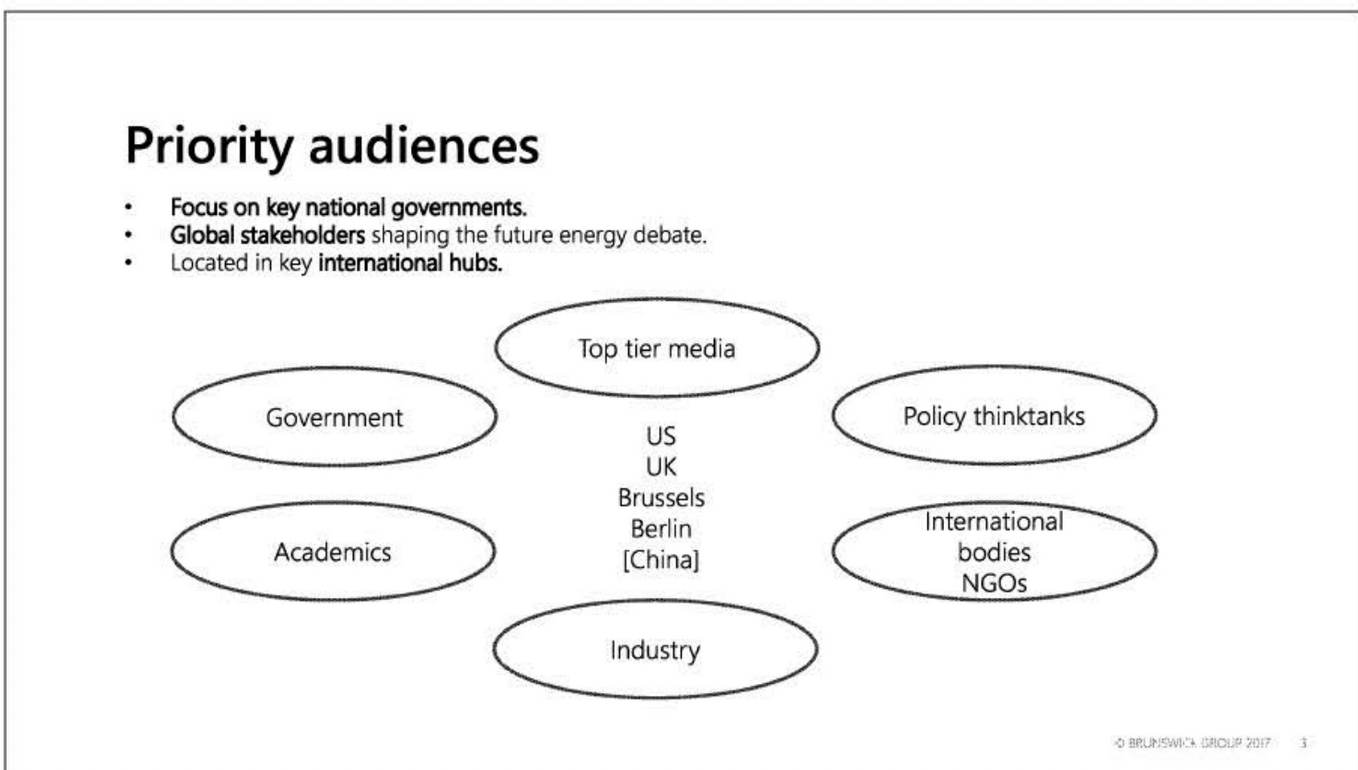
The plan notes key challenges that this campaign will have to overcome as well. And by "challenges" they mean reality. What are the actual facts of gas that they will need to change--or change the perception of--in order to accomplish their goal of securing a future for both gas and BP? First, gas generates fewer carbon emissions than coal, but Brunswick points out, it isstill a fossil fuel. Then there's the fact that renewables have dominated the conversation around energy transition. And finally, there's the methane problem. Or as Brunswick puts it, "emergence of methane as a flash point for gas." A lobbyist for BP put it more bluntly in an email around the same time, describing methane emissions as "a problem that is not going away" for gas.
Finally, Brunswick gets to the solution, its strategy for warping information and perspectives on gas in BP's favor. First, continue to emphasize the carbon benefits of gas by talking about the transition from coal to gas (never mind that, increasingly, gas is replacing...other gas, not coal). Then, position gas as a partner, not a competitor, to renewables (although from an infrastructure perspective they are almost always in competition). And finally, take a leading role on reducing methane emissions (but, crucially, do so while continuing to focus attention on carbon--because of course if methane is your problem, you want everyone focused on CO2). But how will BP accomplish these goals? Brunswick suggests the company "contribute to the debate," and key to that endeavor is the need for "new data into public domain with partner." Which partner(s), pray tell? Well, Princeton University of course, where BP has long funded the Carbon Mitigation Initiative and where, as Molly pointed out in her piece this week, the company has a "synergistic" relationship with researchers.
But contributing to the debate doesn't end with funding new university research that backs up their opinion, Brunswick suggests that BP also consider partnering up with Environmental Defense Fund or science and tech organizations on a "high tech story" focused on satellites gathering data on methane emissions and on "action on the ground" messaging about how the industry is managing methane emissions. It's hard to avoid thinking about that slide amidst discussions of the U.S. EPA's new methane rule and how satellite monitoring will or won't help to enforce it. The underlying message here is that if you can make it look like you're doing something about the problem—by studying it and monitoring it—that's generally enough to convince people that you're actually doing something about the problem, which has historically been enough to keep regulation at bay.
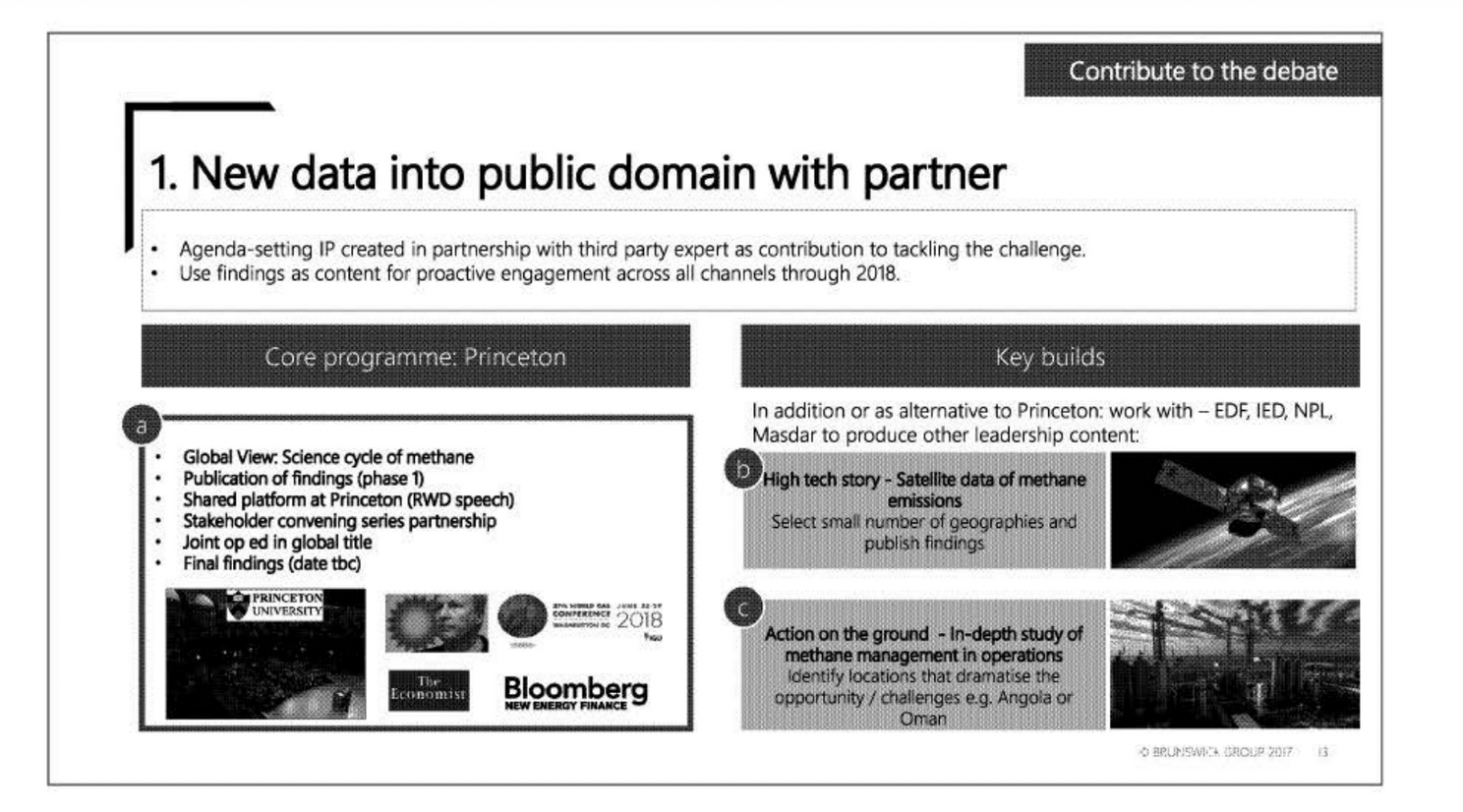
Once you've got new information to share, the next step is to get it out to the masses, and here again Brunswick suggests that BP lean on its relationship with Princeton, recommending round tables and events with Princeton alone and with Princeton alongside a preferred media partner, like the Financial Times. It also recommends a circuit of conference and speaking engagements for top executives, with corresponding top-tier media hits, for example a Washington Post op-ed, CNBC Power Lunch, and Facebook Live Q&A that all coincide with an exec speaking at a major energy conference.
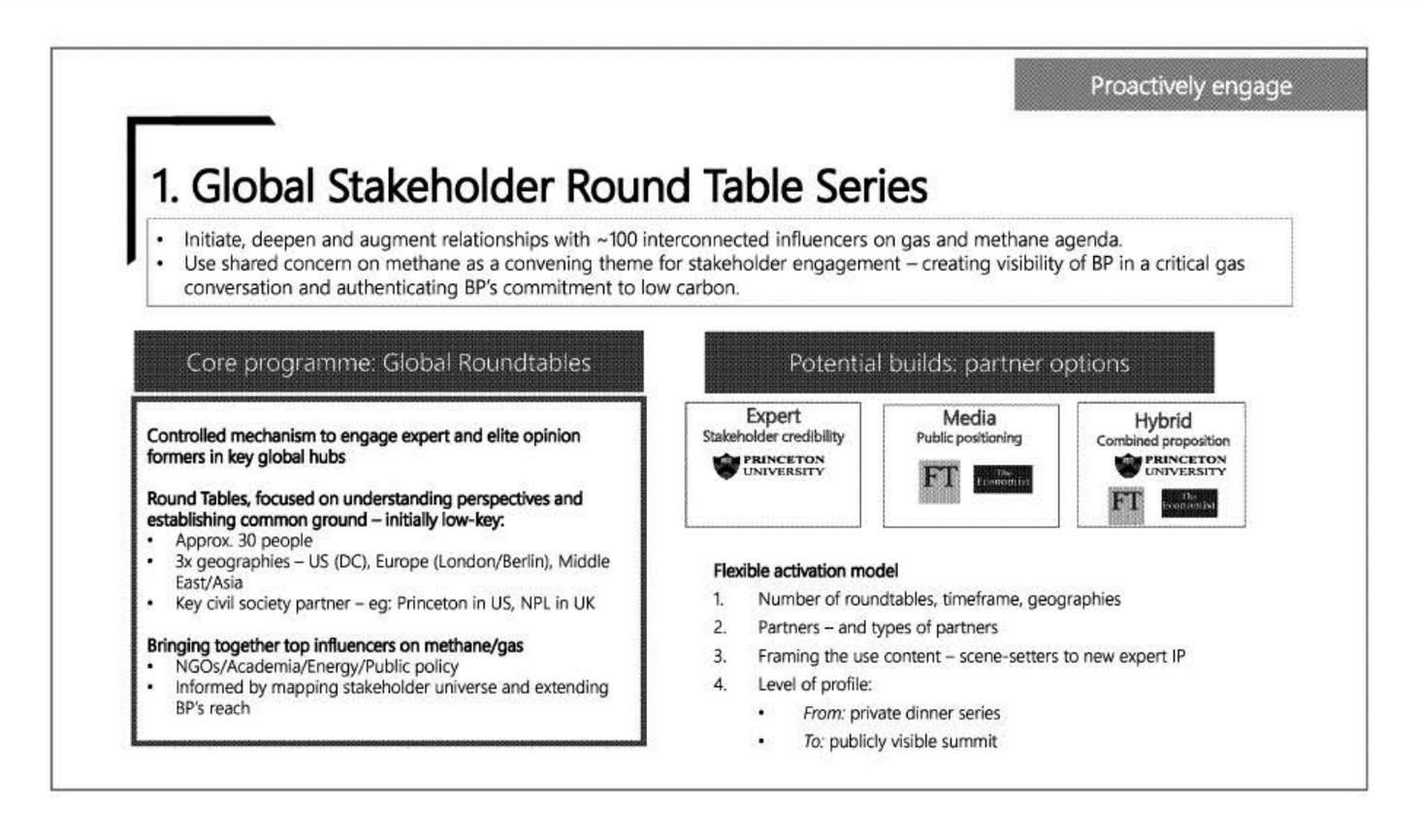
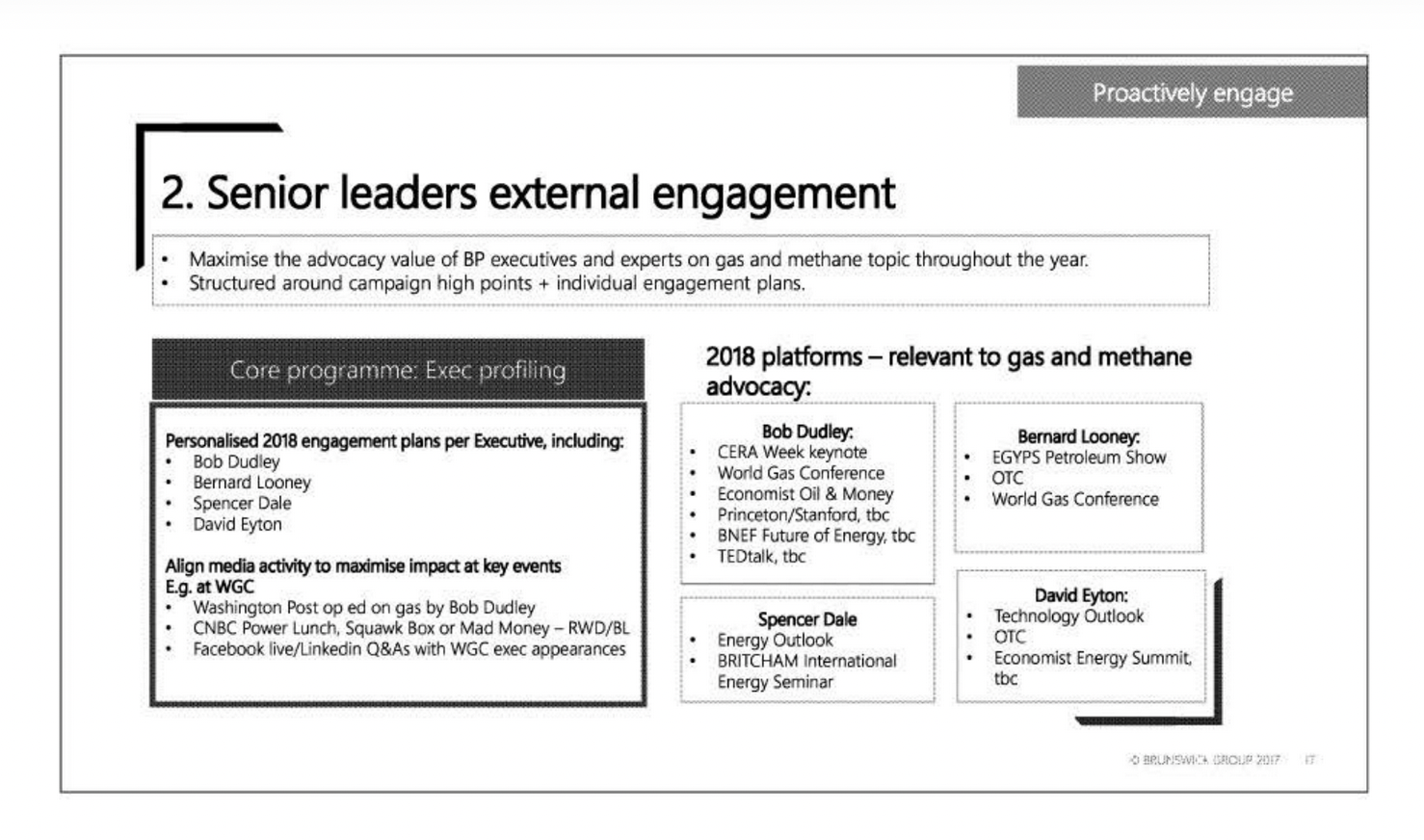
Underpinning all of this, of course, is also a robust corporate surveillance strategy that helps both the the oil company's execs and those at its PR firm keep on top of what activists, journalists, and others are saying about gas and respond instantly. We know this from the recent documents, too. In a September 2021 alert sent to the American Petroleum Institute, the largest U.S. trade group for the fossil fuel industry, a surveillance company called Command CG notes: "there is a demonstration scheduled to occur at the U.S. Capitol at 4 pm today by the group Peoples Watch in support of the Green New Deal. Both the Sunrise Movement and ShutDown DC are involved in the demonstration and have been in the area of the Capitol for most of the day."
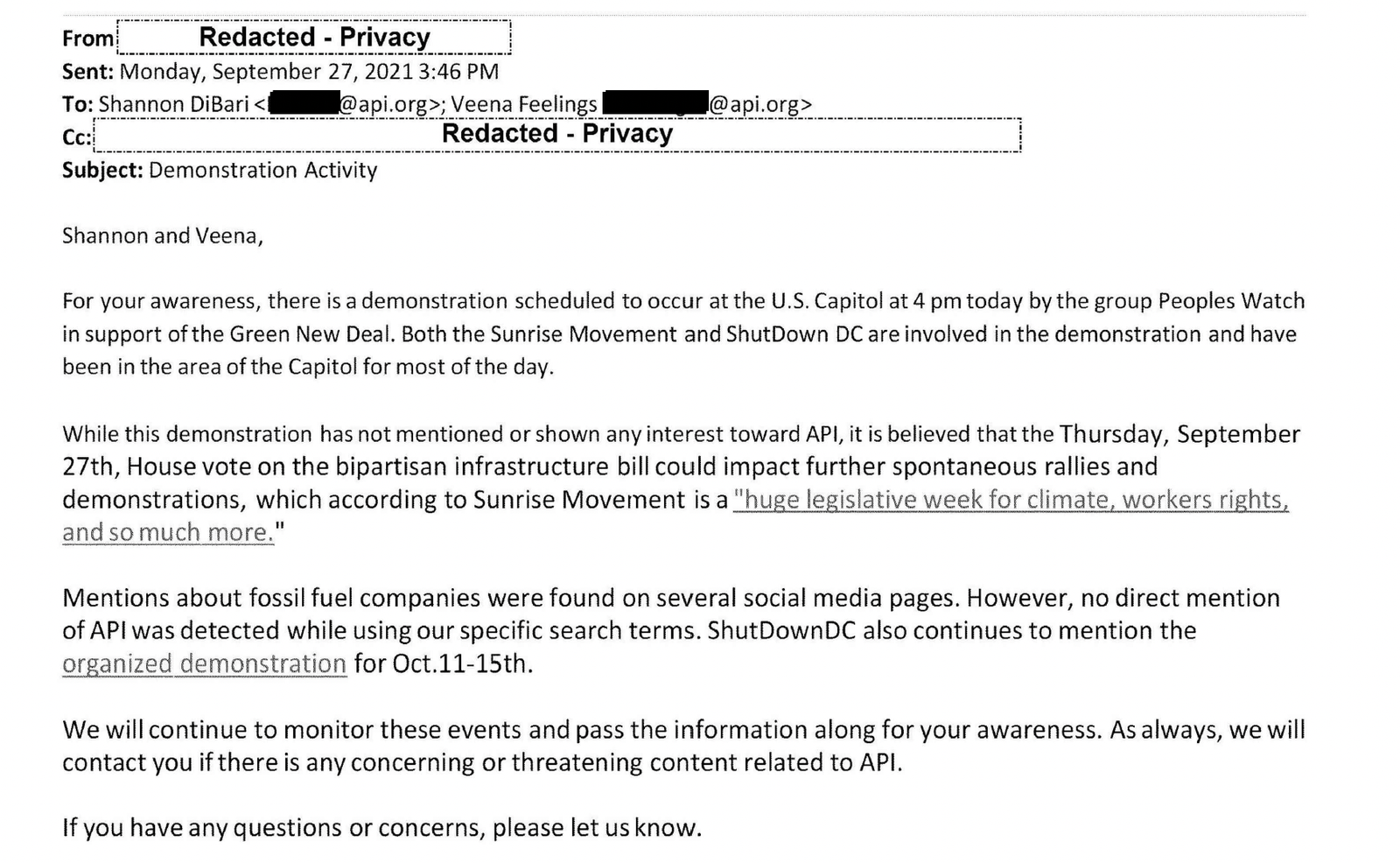
What it all shows is something we talk about a lot here at Drilled, that it's not just climate denial or science misinformation, but the wholesale hijacking of how we think of these issues, from really basic perceptions of the environment and the economy to specifics on how best to deal with methane emissions.
---
GMAIL 1 24
I posted something on LinkedIn recently (I know, look what Elon has driven us all to), about the roots of the PR industry. Specifically I said something about Edward Bernays, one of the forefathers of modern PR, and in fact the guy who named the industry back in the 1940s. It was a rebrand, to be more precise. What we now know of as PR had previously been referred to as propaganda. Bernays came up with "counsel on public relations" because, as he put it, the Germans had given propaganda a bad name.
Some guy who works for a PR trade association was quick to comment: "PR has come a long way since Bernays, just like journalism has." Nice try dude, I'm perfectly comfortable saying they've both gotten much worse. Back in Bernays' day, Ida fucking Tarbell was around! So was Ida B. Wells, Upton Sinclair, legend after journalistic legend giving industrialists and politicians hell. In fact, it's partly because the journalism back then was so good that PR had to become increasingly diabolical. And in a lot of ways, the rise of PR has materially contributed to the demise of good journalism.
What I don't think most people realize, and what that PR industry spokesperson would probably prefer they didn't, is that PR is still very much propaganda, except now it also has the sort of distribution mechanism Bernays only dreamed of, compliments of social media. To even hope to combat it, we first have to understand what exactly we're dealing with here. At its most basic, PR is the management of a company or industry's relationship with various "publics." Those publics consist of a company's customers, broader cultural influencers, politicians, journalists, teachers, thought leaders, other industries, competitors, potential hires, employees, investors, shareholders, the list goes on and on. With each of these publics, the company or industry is trying to elicit a particular behavior—they want you to buy their thing, or vote for a particular policy or, if you're a politician, maybe they want you to advocate for or against regulatory changes of some kind.
:{:{PR firms help companies do all of that. They set up photo opps for their clients to be seen amongst particular crowds of people, arrange speaking engagements at the right conferences, set up meetings with diplomats and tech leaders, and advise on philanthropic strategies.}:
So when, for example, Charles Koch began investing millions in MIT to fund research that would later underpin policies locking in support for natural gas and then carbon capture in the U.S., it's entirely possible that his foundation's PR firm, Edelman, (https://drilled.ghost.io/r/579e8ac2?m=bf6fa0ec-1090-4b3f-b920-7e98d9adb3de) was advising on that strategy. We've covered before how PR firms carefully crafted the persona of Al Jaber (https://drilled.ghost.io/r/d1d04d6b?m=bf6fa0ec-1090-4b3f-b920-7e98d9adb3de), and helped to successfully position the UAE to win its COP28 hosting bid (https://drilled.ghost.io/r/b17b44fc?m=bf6fa0ec-1090-4b3f-b920-7e98d9adb3de). This is work that goes way beyond sending out press releases or occasionally meeting with journalists, these are information warfare tactics. And for good reason. The founders of most of today's top PR firms got their training in military intelligence and psychological warfare (for real!) then put that knowledge to work on behalf of corporations looking for an end-run around democracy.}:
In their relationship with the media, too, the PR industry is far from blameless. The relentless onslaught of corporate PR over the past century or more has fundamentally warped our information ecosystem. Now everyone has to deploy PR tactics to get information out; NGOs use the same techniques (and sometimes the same firms) that oil majors do. So do government agencies. And journalists who have or take the time to do their own research, find their own stories, develop their own sources, are few and far between.
"I don't think most people realize how close the media is to strategic comms," Melissa Aronczyk, media studies professor at Rutgers University told me a long time ago. "Most of the time when we see climate change in the news it's because an organization has tried to push that story. That type of source relationship between PR and media is really under-recognized when we talk about the influence of these firms. Most people have never heard of Edelman or whoever, but they're the intermediaries between what is known scientifically and what we find out about."
By and large, PR firms are the people responsible for how information on everything from climate science to wellness trends is presented to the public.
"It's one thing to look at Exxon's dumb ads, where it's so obvious that they're speaking out both sides of their mouth, and go okay that's disinformation, that's bad," Aronczyk said. "It's much more nefarious to say the government of California has a new private relationship with a company to develop solutions to climate change, and then all the information we get about that comes through a PR firm. How climate is seen as a problem and what solutions are possible, that's all framed by PR. It's often framed as like these bad guys spread falsehoods and once that goes away we'll act. But PR is now baked into the media ecosystem we live in."
When I look at climate coverage, I mostly know which stories have been placed by a PR person, either at a company or at an NGO or government agency, and most weeks I'd say only about 10 percent haven't passed through the PR machine before they get to you, the reader.
And yet, the industry has faced very little criticism. A former Edelman staffer I spoke to recently told me he's shocked at how little scrutiny or criticism PR gets for its role in climate delay. "I don't know why it's only the Exxons of the world getting criticized for greenwashing when really we're the ones who invented it," he said.
"PR underlies the entire information ecosystem," Aronczyk said. "And they're part of the climate disinformation problem – they're creating information too, it's not just Exxon."
That "information" ranges from "research" like Edelman's Trust Barometer (https://drilled.ghost.io/r/21674dc7?m=bf6fa0ec-1090-4b3f-b920-7e98d9adb3de), which coincidentally lends credibility to the authoritarian governments the firm represents every year, to opinion pieces written by agency copywriters for various thought leaders, to surveys that generate misleading results to astroturfing and completely staged protests. If a company doesn't already have the information or the story they want a PR firm to take to the media, the firm will create that story. The most famous example (https://drilled.ghost.io/r/9a65bed7?m=bf6fa0ec-1090-4b3f-b920-7e98d9adb3de) is Bernays staging a "women's lib" march in New York with women he had hired to march up and down the street demanding the right to smoke, because his tobacco company client wanted to break down the taboo on women smoking so they could sell more cigarettes.
Industry funding of particular academics is effectively PR too, or strategic communications. It not only helps companies shape the way future politicians and business leaders view the economy, the environment, and the relationship between the two, but also locks in particular "solutions" before anyone who doesn't work for an oil company has been able to figure out which technologies might be best positioned to address the climate crisis. Industry-funded research is often the first step toward lobbying (https://drilled.ghost.io/r/f6190172?m=bf6fa0ec-1090-4b3f-b920-7e98d9adb3de), providing a credible foundation for politicians arguments that, for example, carbon capture is a great thing for the U.S. government to invest hundreds of millions of dollars in. Despite the great work of groups like Campus Climate Network (https://drilled.ghost.io/r/8f8561d5?m=bf6fa0ec-1090-4b3f-b920-7e98d9adb3de) and multiple whistleblower accounts (https://drilled.ghost.io/r/07ee14b5?m=bf6fa0ec-1090-4b3f-b920-7e98d9adb3de), that influence remains relatively obscure.
:{:{Sometimes it's the more innocuous examples that make the penny drop for folks about just how insidious and dangerous PR can be. Lately I've been talking about the viral TikTok "butter board" trend. The "recipe" was created by a popular food influencer, Justine Doiron. It's essentially a charcuterie board, but instead of meat, the board is smeared with butter, then topped with salt, herbs, spices, whatever you like, and served with warm, crusty bread. It was a massive hit, with millions of views, which then generated a whole media cycle.}:
The New York Times (https://drilled.ghost.io/r/28ff4822?m=bf6fa0ec-1090-4b3f-b920-7e98d9adb3de) covered it, the Today Show (https://drilled.ghost.io/r/9c08bf85?m=bf6fa0ec-1090-4b3f-b920-7e98d9adb3de) ran a segment on it. Every food blog posted tutorials on how to do it. None of them knew that the whole trend was entirely manufactured by Dairy Management Inc, the marketing arm of the U.S. dairy industry, and their PR firm, Edelman. Doiron was part of the "Dream Team" of influencers that Edelman, DMI's long-standing PR agency, helped pull together. In their end-of-the-year report, (https://drilled.ghost.io/r/7c74282c?m=bf6fa0ec-1090-4b3f-b920-7e98d9adb3de) DMI noted that the "Dairy Dream Team of chefs, recipe developers, foodies, gamers and lifestyle influencers delivered nearly 80 million impressions and jump-started the “butter board” craze that became a viral sensation, generating coverage from major news and entertainment outlets."}:
Big Dairy is deploying tactics like this in large part because they are losing market share to plant-based alternatives, and because they're scared (https://drilled.ghost.io/r/73074d49?m=bf6fa0ec-1090-4b3f-b920-7e98d9adb3de) about animal ag being the next big target for climate action. Lucky for them, the PR industry has already honed its craft on behalf of the fossil fuel industry.
---
This Week's Climate Must-Reads
How Wealthy Corporations Use Investment Agreements to Extract Millions From Developing Countries (https://drilled.ghost.io/r/eed7b7d3?m=bf6fa0ec-1090-4b3f-b920-7e98d9adb3de) (Nicholas Kusnetz (https://drilled.ghost.io/r/386d7f8b?m=bf6fa0ec-1090-4b3f-b920-7e98d9adb3de) and Katie Surma (https://drilled.ghost.io/r/4ea9c304?m=bf6fa0ec-1090-4b3f-b920-7e98d9adb3de) for Inside Climate News) - A terrific story on the horror that is the investor-state dispute system. We've covered the issues with ISDS a lot (if you want an explainer, here's one); here, Kusnetz and Surma show how devastating it is for people living in countries on the losing end of this system.
How Fossil Fuels Found Their Influencers (https://drilled.ghost.io/r/f96eb52f?m=bf6fa0ec-1090-4b3f-b920-7e98d9adb3de) (Adam Lowenstein for Lever News) - Lever is consistently doing great climate reporting and here they did justice to a story I myself had a hard time figuring out how to approach: what the heck the Edelman Trust Barometer is and why it's gained such influence in the world (the latest one was just released, as it is every year, at the World Economic Forum in Davos).
Here's How Much Democrats Get Paid to Shill for Fossil Fuels (https://drilled.ghost.io/r/9ea737a2?m=bf6fa0ec-1090-4b3f-b920-7e98d9adb3de) (Arielle Samuelson for Heated) - Our pals Emily and Arielle at Heated tearing it up as usual. Here, Arielle got the receipts on two former Democratic lawmakers—Senators Heidi Heitkamp (North Dakota) and Mary Landrieu (Louisiana)—who made six-figure salaries promoting methane gas as a climate solution.
‘Control the narrative’: how an Alabama utility wields influence by financing news (https://drilled.ghost.io/r/fad30b8c?m=bf6fa0ec-1090-4b3f-b920-7e98d9adb3de)(Miranda Green for Floodlight/The Guardian) - This Floodlight investigation found that Alabama Power runs a news service and its foundation bought a Black newspaper. Neither reports on high electric bills or utility-related pollution.
Davos Puts Climate on the Backburner (https://drilled.ghost.io/r/5b2ffdb6?m=bf6fa0ec-1090-4b3f-b920-7e98d9adb3de) (David Gelles for The New York Times) - This story almost made me throw up in my mouth but that's kinda the point. We need to understand how absolutely unserious the wealthy are about doing anything at all about the climate crisis.
---
exxonknewS 12 23
...“Oil and gas companies are under pressure, desperately trying to preserve their social license through recycled pledges,” said David Tong, Global Industry Campaign Manager at Oil Change International, which last year published a report finding that Exxon’s climate commitments are “grossly insufficient” to meet the goals of the Paris Agreement.
Woods and his fellow oil company representatives are also using COP to push for unproven technologies that will prolong the lifespan of climate-wrecking fossil fuels. In an interview with Bloomberg at COP, Woods said the energy transition would require an assortment of “solutions” — including hydrogen and carbon capture — and “we need big companies to help with that.”
Woods rejected the IEA’s recent assessment of carbon capture as an “illusion,” telling Reuters that “you could say that about electric vehicles, about wind, about solar.” But according to the IEA, “The key actions required to bend the emissions curve sharply downwards by 2030 are well understood, most often cost effective and are taking place at an accelerating rate. The scaling up of clean energy is the main factor behind a decline of fossil fuel demand of over 25% this decade.”
Yet unlike the billions it invests in carbon capture, Exxon is spending almost nothing on renewable sources of energy, while lobbying against the transition away from its core products.
“It’s no surprise that Exxon is pushing for the continued use of fossil fuels,” said Jessica Green, Professor of Political Science at the University of Toronto. “Exxon is in a fight for its life. Real progress on climate change isn’t about more carbon markets or net zero pledges, it’s about putting the oil and gas industry out of business.”
A larger strategy
Woods’ deflections at COP are part of a larger strategy of “corporate issues management,” said Supran, which “the fossil fuel industry has been pioneering for decades.”
“It means having your fingers in all the pies, anticipating future threats to your business and neutralizing them through decades of 360-degree public affairs strategies,” he said.
Exxon has been working to shift the narrative outside of COP, too. “On November 30, the first day of COP 28, The New York Times included a full-page greenwashing ad from ExxonMobil,” Brad Johnson documented in Hill Heat on Monday. “Reuters coverage of Al Gore’s criticism of ExxonMobil’s presence at COP 28 was smothered by greenwashing ads from ExxonMobil. The Punchbowl News political newsletter today is Presented by ExxonMobil.” Yesterday’s Power Switch newsletter from Politico was Presented by ExxonMobil, too.
While the oil giant’s greenwashing may have ramped up around COP, it’s also a years-long affair — aided in large part by many of the same media outlets interviewing Woods at the conference. A major analysis of Big Oil’s advertising between October 2020 and October 2023 found that “many of the world’s most trusted English-language news publications help fossil fuel companies mislead readers about topics like the promise of carbon capture, the potential of ‘renewable biogas,’ and how much the industry contributes to the energy transition,” according to Amy Westervelt and Matthew Green.
The analysis, published by Drilled and DeSmog this week, found that Bloomberg Media Studios last year created a video for Exxon promoting carbon capture and hydrogen; Politico organized 37 e-mail campaigns for Exxon; and Exxon sponsored more than 100 editions of Washington Post newsletters in 2022 alone, as just a few examples.:}:
Ultimately, it’s up to the media, policymakers, and other major institutions to determine whether the oil companies still responsible for fueling climate catastrophe are allowed to have a platform to stand on — or whether, like Big Tobacco, their time to influence the debate about their products’ harm is finally up.
---
https://podtail.com/en/podcast/drilled/the-anti-esg-campaign-gets-a-boost-from-raga/
no lnx
The Anti-ESG Campaign Gets a Boost from RAGA - Transcripts
June 13, 2023
Ever since the Securities and Exchange Commission announced its intention to make Environmental Social and Governance metrics actually mean something to investors, polluting industries have suddenly turned on ESG. Now that fight has a legal strategy, being carried out by the Republican Attorneys General Association.
Transcript: https://www.steno.ai/drilled/the-anti-esg-campaign-gets-a-boost-from-raga
Hello and welcome back to Drilled, I'm Amy Westervelt. We've talked before on this show about the growing backlash against taking environmental, social, and governance, or ESG, factors into consideration when it comes to investing. The watchdog group Documented first revealed last year that state treasurers were getting in on the action, kicking woke investment firms likeBlackRock out of their states. Back then I wondered when the attorneys general would show up to join the fray, and now sure enough, they are here. The Republican Attorneys General Association, RAGA, our old favorite, has come to play in the anti-ESG space. But first, a quick reminder, why all this upset about ESG all of a sudden in the first place? Good question. For a really long time, oil companies actually kind of loved ESG. It was all very loose and self-reported, and it gave them a way to unlock so-called green capital. But in 2021, the Securities and Exchange Commission, the SEC, looked around and went, huh, there are all these different SEG ratings, and some of them seem a little scammy, and no one knows what these disclosures even really mean. These are the kinds of things it's our job to clean up. So we are going to provide formal guidance on climate risk disclosure.
And that is when you start to see corporate interests, fossil fuel companies, and right-wing politicians lose their minds over ESG. Because all of a sudden, they couldn't just write whatever they wanted to in a report, they might have to actually disclose what their real climate risks are.
Speaker 5 00:02:16
Here is Jesse Coleman withDocumented. I think that a lot of this, both the legislative side, this legal strategy, the strategy of using state treasurers to pressure asset managers into attack climate disclosure, all of this is really mostly aimed at SEC scope three emissions disclosure requirements coming, you know, supposedly coming soon
Speaker 4 00:02:43
in the next couple of months, even. Wait, sorry, I'm gonna pause to define scope three. That means how your product's actually being used, not how you're making it, which is a big deal for especially heavy polluting industries
Speaker 5 00:02:58
like oil and gas companies, for example. Yeah, yeah, it's a really big deal. Whereas ESG, having a non-standardized ESG disclosure is no big deal to a major company. The SEC coming and saying, how much carbon emissions are you really responsible for? Not just, you know, what you're claiming you're responsible for, but if you're an oil company, for example, how much carbon are you actually putting in the atmosphere from everything that you've gotten from underground? What is your real impact? And that is a really big deal. It's probably one of the biggest climate policy issues in play right now. So, you know, in my opinion, a lot of this anti-ESG stuff, which doesn't make a lot of sense on its face, you know, these state bills that have passed in some states and been introduced in a ton of states, the actual thing that those bills are gonna do, they're not gonna have a really big impact. And sort of this antitrust stuff is very similar in the sense that, you know, the claims are kind of weak and it's hard to say exactly what the impact is gonna be specifically. But at the same time, it's building up all of this pressure and it's building up all of this political inertia that is all aimed at opposing, disclosing climate emissions. And that's what this SEC rule would do when it comes out, is that it would require publicly traded companies to disclose those emissions.
So, you know, in my opinion,
that's the real goal, is to keep that from happening. You may have heard Jesse mention there the words antitrust. That is where the Republican Attorney's General Association comes into the picture. Back in June, 2021, a guy named Jason Isaac, who spearheads the Texas Public Policy Foundation's work on energy, went to a meeting of the American Legislative Exchange Council, ALEC, with an idea for a legal strategy that he thought could take ESG down.
Speaker 7 00:05:04
Documented shared audio from that meeting with us. Yes, so earlier, a couple months ago,our state affairs committee voted nine to nothing. So, broad bipartisan support, every single member voted in support to give the committee subpoena authority.
Speaker 6 00:05:16
So, they have sent out a couple months ago,
Speaker 7 00:05:24
our state some paper documents to find out where this collusion is happening. We anticipate truckloads of documents being delivered. And so, we look forward to the Texas Public Policy Foundation to going through those meticulously, because we believe that there is, and we actually partner with C. Boyden Gray, Boyden Gray Associates law firm out of Washington, D.C. Corporate collusion, liability risk for the ESG agenda to charge higher fees and rig the market. We believe that there's antitrust violations. This is really kind of geared towards our attorneys general to lay the foundation for antitrust violations on this corporate collusion. Find out the connections with the Glasgow Financial Alliance for net zero, which has over, I think, $100 trillion under managed assets in there. And there are the connections with the glad zero, this Paris Accord, which is net zero. So, I hope our committee gets a ton of paper back
Speaker 1 00:06:23
from these large financial institutions.
Speaker 7 00:06:28
Hope our committee gets in the courts and our attorneys generalaround the country filed antitrust violations.
Speaker 4 00:06:34
So, yeah, cartels colluding for decarbonization.What the hell is he talking about here?We're gonna try to answer that question right after this quick break. And we're back. So, after COP26 in Glasgow, insurers and asset managers, both formed groups focused on ESG. In both cases, these firms were saying, look, all sorts of environmental and social factors can impact our bottom line, and we would like to know what those risks might be so we can factor that into our decision-making around what to ensure and what to invest in. But according to Isaac, these firms talking to each other, issuing joint statements about what kind of information they'd like to see from companies, that's colluding to rig the market. In the wake of that 2021 ALEC meeting you heard Isaac talking at before, not only did Texas continue with the investigation Isaac mentioned, but Arizona Attorney General, Mark Bernovich, opened an investigation into ESG investing. And Raga coordinated a letter to various asset managers and politicians with more than a dozen attorneys general signed on, stating their concern that ESG investing might actually be an antitrust violation.
Speaker 5 00:08:13
Here's Jesse Coleman again. We started to see some of the bright lights of the Republican Attorneys General Association file various kinds of legal attacks on ESG issues, whether that's going directly after asset managers and asking them questions about their net zero commitments, or that's going directly after ratings agencies
Speaker 4 00:08:38
and saying that you're boycotting fossil fuels. And they seem to have coalesced around this idea of painting ESG as some sort of corporate collusion, you know, building an antitrust case. Can you explain what the thinking is there,
what they're trying to prove?
The allegation is that a lot of large asset managers get together in a shadowy cabal and they plan to collude to reduce carbon emissions. The reason these groups are alleging antitrust violations is that antitrust violations are very scary to companies. If a jury finds you guilty of an antitrust violation, it's very expensive. And it's a pretty hard bar to meet. And most experts are saying that the antitrust allegations that are coming from these people that are opposing climate policy, they probably don't have a leg to stand on, but a lot like slap suits and other kinds of legal tools that are used to silence people, just defending against the antitrust allegation is very, very expensive. So, you know, you see companies really backing away from participation in these kind of global groups that are trying to address climate emissions and trying to address investment
10:08
in the fossil fuel industry by large asset managers. In 2022, Alec once again held a meeting with a session on how to handle ESG at the state level. And again, the antitrust strategy was front and center. This time, Isaac was in the room cheering on new proponents of the strategy, including Will Hild with Consumers Research, which is funded by former Federalist Society President Leonard Leo, Paul Watkins, who used to work in the Arizona Attorney General's office and now runs an outfit called Fusion Law, advising on these sorts of strategies. Andy Puzder, former CEO of the Food Conglomerate that is home to Wendy's and Hardee's, and Catherine Gonzalez with the Heritage Foundation. Puzder kicked things off by comparing ESG investors
11:03
to, not kidding here, the Nazis. I wanna tell you, ESG investing is socialism in sheep's clothing. I mean, this is the challenge of your generation. My father's generation's challenge was the Nazis, who, by the way, were, of course, very proud socialists. The challenge of my generation was the communists, who were, of course, very committed socialists. The challenge of your generation is ESG investing, and it's more insidious than communism or the Nazis. It's the thing they're doing it. So ESG, Environmental Social and Governance. Like, how bad could that be, right? It sounds so innocuous, but it's a ruse. It's a ruse to conceal the fact that it's a direct threat to our founding principles.
11:53
It's a threat to our democracy. How bad could that be, right?
Speaker 4 00:11:55
It's a threat to our democracy.
Speaker 6 00:12:02
Hild and Watkins kept it focused on the litigation strategy. They get in rooms and they talk about they're gonna set a policy across the market. Now, it's been a while since I was in law school,
but when I was there, that was antitrust 101. And that's why you see U.S. senators saying this is potentially criminal antitrust liability.
Speaker 4 00:12:22
You see AG saying that they're going to investigate. And again,I have yet to speak with a single legal expert who thinks that this strategy could actually win in court. But like we said before, that is not necessarily the point. It's already having a chilling effect on investment firms and insurance companies in these net zero groups. And now that Republicans have control of the House, it's the focus of a series of oversight committee hearings too. The first one happened back in May and featured the attorneys general of Utah and Alabama as witnesses.
Speaker 1 00:13:00
Here'sSean Reyes, attorney general of Utah. But ever since the signing of the Paris Agreement, there's been anopen conspiracy to bypass Congress using the power of horizontal agreements by key players in our financial system. Some of these groups are Climate Action 100, the Glasgow Alliance for Net Zero, which include the largest asset managers, banks and insurance companies globally. These horizontal organizations seek to use their collective market power over tens of trillions in assets
to force burdensome changes on American companies.
amy: The Democrats witnessed during this hearing, Illinois State Treasurer Michael Frerichs gave a great and completely non-climate related example
of where ESG can safeguard profits. The more data we as investors have, the better informed our decisions are when selecting investments over the long term. ESG is about looking at a wider range of risks and value opportunities that could have a material financial impact on investment performance. For example, if you're investing in apharmaceutical company, it's thinking about whether that company has exposure to massive lawsuits because of its role in the opioid epidemic. Our approach is to integrate material ESG factors into investment decisions along with many other considerations. We are not ignoring traditional financial factors like profitability and credit worthiness. We are integrating more data into our decisions
to give us a better idea of risk and growth prospects. Frerichs also pointed out that limiting the information investors can get about the companies they're investing in
is the exact opposite of a free market idea. This pushback is anti-free market and anti-investor. It is misleading and it is harmful. It harms retirement savers, pensioners, working people, businesses, and it harms America. This coordinated campaign is focused on ESG investing. Most people don't know what ESG is. ESG is data. ESG is simply additional information that investment professionals use to assess risk and return prospects. It is about value, not about values. In order to maximize returns, an investor must be able to manage and mitigate risk. The more data we as investors have, the better informed our decisions are when selecting investments over the long term. ESG is about looking at a wider range of risks and value opportunities.
It could have a material financial impact
on investment performance. Last week, the House Oversight Committee held its second hearing on this subject,
calling on none other than Jason Isaac himself to testify. I'm Jason Isaac. I'm the director of LifePowered, a national initiative of the Texas Public Policy Foundation to raise America's energy IQ. And I live a high carbon lifestyle. And I think the rest of the world should too. That's why I refer to the ESG agenda as the China ESG agenda. It does very little to help Americans. It does everything to help the Chinese Communist Party. And again, making energy expensive, scarce and government controlled. This body, the United States Congress has not ratified the Paris Treaty. It is not the law of the land here in the United States, butto force an American entrepreneur to admit that his company will comply with that
is just mind blowing to me.
Whether the committee will hold a third hearing remains to be seen. I'm not sure the anti-ESG bench of experts rolls that deep. Plus, while these ideas might get folks at an ALEC meeting riled up, they're remarkably unpopular with American voters, including the majority of Republican voters. New Mexico rep Melanie Stansberry
made that point at last week's hearing. What I find particularly strange about this conversation is that over 63% of American voters actually oppose, directly oppose, any kind of government interference in investing strategies. And the vast majority of Republicans oppose it as well. And when you look at the bigger picture, when you look at what the American people are actually asking Congress to do, asking businesses in the private sector to do, almost 70% of Americans are in support of actions to address climate change,
to transition to a clean energy economy. Whether the SEC will be swayed by the antitrust argument remains to be seen.
That's it for this week. Thanks for listening, and we'll see you next time. Drilled is an original critical frequency production. Our producer is Sarah Ventre. Sound design, mixing, and mastering are by Peter Duff, who also wrote our original score. Our first amendment attorney is James Wheatman at the First Amendment Project. And the show is reported, written, and hosted by me, Amy Westervelt.
==
intercept 1st AMEND DOCS
Fossil Fuel Industry Wants Free Speech for Corporations but Not Citizens (https://theintercept.com/2022/09/16/fossil-fuel-industry-climate-free-speech/)
fred halpern
...(212) 883-3232 Mobil news release Hoar Be Band ee REE mORE CONCENTRATED THAN OIL INDUSTRY HOUSTON, TEX., OCT. 7 -- Where ideas and viewpoints are involved, the U.S. marketplace is only partly open to private businesses, an officer of Mobil Oil Corporation charged today in a talk to the American Gas Association at its 57th annual where commercial network television is involved, the marketplace of ideas is tightly circumscribed, and it is olicopolistic if not downright monopolistic." Speaking on "Corporate Communications and the Free Market of Ideas," Mr. Schmertz said his company's print advertisements had, amonc other things, "tried to help people understand that nearly everything in life is a trade-off. To understand that they can have natural cas at artificially depressed prices, but that if they do, they can't have adequate and secure supplies of it, "To understand that they can reduce automotive air emissions severely and abruptly to meet some arbitrary timetable, but that
they can't do this and hold down costs and improve mileage at the same time. In short, we have tried to help people understand what options are open to them and what costs are involved in the various alternatives -- matters to which few politicians and few of the media ever seem to address themselves." Most of the reporting on the oil crisis beginning in late 1973, Mr. Schmertz continued, was "superficial and misleading, and much of it was simply inaccurate." This was particularly true, he said, of the commercial television networks, "which by their very nature seldom seem either able or eacer to cope with complex issues. Most television reporters and commentators knew virtually nothing about our business and seemed to have neither the time nor the motivation to learn." Because of this and because so many Americans rely heavily on television as their source of news, the oil company executive declared, Mobil attempted to buy air time for "idea" commercials that would convey "some accurate information and our own viewpoints. Our aim was . . . simply to broaden the spectrum of information -- and thus of choices -- available to the American people." Mr. Schmertz said the networks have refused to sell time to Mobil for its "idea" commercials. This means, he went on, that “the American people will see and hear on commercial television what two or three people at each of two or three networks decide the public will see and hear. I submit that this is a remarkable concentration of decision-making . . ."
---
gmail 6 23
over the past few years requests for respectful speech and factual information have been recast as attacks on free speech just as efforts funded by some of the country's largest corporate interests have begun to genuinely erode citizens' First Amendment rights.
If your book contract gets canceled because you help white supremacists break into the Capitol? That's an attack on free speech (https://www.drilled.media/r/098529af?m=bf6fa0ec-1090-4b3f-b920-7e98d9adb3de). A university decides not to host your talk after receiving thousands of complaints from students? Violation of the First Amendment! But the First Amendment never guaranteed reach, nor did it promise us that Americans can say whatever we like without risk of being embarrassed or mocked, trolled or even canceled. What it did promise was that "Congress shall make no law respecting an establishment of religion, or prohibiting the free exercise thereof; or abridging the freedom of speech, or of the press; or the right of the people peaceably to assemble, and to petition the Government for a redress of grievances."
:{It seems like a whole lot of conservatives have misplaced their pocket Constitutions, because while they talk about being "forced" (by whom?) to use a person's preferred pronouns as an infringement on free speech, Republican state governments have been rapidly criminalizing protest. While they wring their hands about the chilling of free speech on campus because this or that talk gets canceled, states are passing book bans (https://www.drilled.media/r/855ed9b8?m=bf6fa0ec-1090-4b3f-b920-7e98d9adb3de) and universities are getting rid of their entire history departments (https://www.drilled.media/r/b4f1d55e?m=bf6fa0ec-1090-4b3f-b920-7e98d9adb3de):{lest anyone utter the words "critical race theory." Harassment of those who study disinformation is way up the past year because the word has been recast as censorship.}:
This week, for example, Rep Jim Jordan was demanding emails and meetings (https://www.drilled.media/r/036b3235?m=bf6fa0ec-1090-4b3f-b920-7e98d9adb3de)with leading disinformation researchers, the latest in a flurry of records requests, subpoenas and lawsuits designed to harass academics who study disinformation. Jordan and his allies are being helped in their crusade by anti-climate-action activists like Michael Shellenberger (https://www.drilled.media/r/687641cc?m=bf6fa0ec-1090-4b3f-b920-7e98d9adb3de), who have their own reasons for wanting to muddy the water on what constitutes disinformation, especially as social media platforms fall under increasing pressure to tamp down on the spread of outright falsehoods. In his March testimony (https://www.drilled.media/r/e8033ddb?m=bf6fa0ec-1090-4b3f-b920-7e98d9adb3de) to the House Select Committee on the Weaponization of the Federal Government, Shellenberger—who has moved in his career from PR guy for big green groups to "firebrand" co-founder of ecomodernist thinktank the Breakthrough Institute to champion for nuclear energy to climate skeptic, gubernatorial candidate, solver of the homelessness problem (spoiler alert: he didn't solve it) and now, finally, "journalist" who claims to have broken the Twitter Files story—Shellenberger wrote:}:
":{:{The censorship-industrial complex pressures social media platforms to}:
censor content relating to climate change and energy. I speak from experience as someone who has been attacked by an ongoing censor-and-discredit campaign that has been waged against me since I wrote a viral article in June 2020 to announce the publication of my book, Apocalypse Never. In response to my article, multiple think tanks quickly and falsely claimed to have “debunked” its contents. Those fake debunkings became the basis for Facebook to censor my posts, even ones that don’t have to do with climate change, to this day."}:
There's a lot to unpack here. First off, it seems pretty clear that Shellenberger's move to rebrand himself as a journalist is not just about trying sit at the cool kids table—he's trying to secure what he perceives to be the greater First Amendment rights of the press. I'm sure he's probably trying to use it to get access to various public records, emails, etc for free as well (anyone can file a Freedom of Information Act request, but if you're not a journalist you might be charged; even if you are a journalist it's likely you'll pay a fee to receive records, but it's generally less). Then, let's talk about how Facebook has always censored ads and sponsored posts related to climate change, for a start, as "political." I don't recall Shellenberger ever having anything to say about that.
As for the debunking of his book. I started to make detailed, footnoted corrections of his book and stopped about halfway through because I had more than 50 pages worth of corrections, so it's hard to believe that all of the many debunkings of his work are false. But according to Shellenberger, it is censorship to call something inaccurate. Who's to say what's "information" or "disinformation" after all? The truth is in the eye of the beholder.
Except...we have long-standing systems for coming to collective understandings of truth. The peer-review process, for example, runs academic work through multiple rounds of review before it can be published in an academic journal. And one peer-reviewed study does not a truth make! That study needs to be challenged and replicated. Lots of other studies need to deliver the same or at least very similar results for something to venture into the domain of "fact."
These fragile men perceive any criticism of them as censorship, yet see nothing wrong with coordinated harassment campaigns against academics whose work they don't happen to like. But it's not just ridiculous and hypocritical, it's also dangerous. One of the key steps on the path to authoritarianism is to shake people's faith in experts, to blur the lines around fact, to make reality seem surreal.
The choose-your-own-truth direction that America has taken in recent years shares a lot in common with the beliefs of early colonialists there, who were by and large Calvinists, a particular type of Puritan that scoffed at the need for priests and bishops and embraced instead the idea that each individual should interpret the Bible for themselves.
As the manufactured "culture war" rages on, it provides cover for America's bend toward authoritarianism. Citizens are being jailed for peaceful protest. At Cop City,protestors were arrested—and even killed (https://www.drilled.media/r/2d098764?m=bf6fa0ec-1090-4b3f-b920-7e98d9adb3de)—and all 42 were charged with domestic terrorism (https://www.drilled.media/r/63197916?m=bf6fa0ec-1090-4b3f-b920-7e98d9adb3de) for sitting in trees. Organizers who arranged bail funds for the arrested protestors werearrested themselves (https://www.drilled.media/r/3f119d0d?m=bf6fa0ec-1090-4b3f-b920-7e98d9adb3de) and charged with money laundering and charity fraud. All those who have been arrested in conjunction with the protest are still waiting to see whether racketeering (RICO)charges will be leveled against them for organizing a protest. Yes, those are the laws created to deal with the mob, being applied to protest.
Meanwhile, the Altanta City Council approved the facility (https://www.drilled.media/r/0c1351e1?m=bf6fa0ec-1090-4b3f-b920-7e98d9adb3de) despite countless hours of public comment in opposition to it.
Critical infrastructure laws (https://www.drilled.media/r/58350cfd?m=bf6fa0ec-1090-4b3f-b920-7e98d9adb3de) have now been passed in 20 states, with more proposing them all the time. Domestic terrorism charges, which carry a sentencing enhancement that can land people in jail for a decade or more, have become frighteningly common for peaceful, non-violent protests. Climate protestors who put water soluble finger paint on a display case at the National Gallery were charged last week (https://www.drilled.media/r/ded101d6?m=bf6fa0ec-1090-4b3f-b920-7e98d9adb3de) with conspiring to commit an offense against the United States. It's the most straightforward and flagrant violation of "the right of the people peaceably to assemble." Anyone who's genuinely concerned about free speech as opposed to securing their own right to comfort or to expand their control of others should be very worried about it.
---
4 23 email drilled
on Monday this week the Supreme Court finally weighed in on whether it would take up the jurisdictional argument that oil companies are making in multiple climate liability suits. The companies have been arguing for the past five years that these cases, brought on behalf of municipalities and states, are asking state courts for judgements that would impact federal policy and thus belong in state court. Attorneys representing state and local arguments have argued that their cases—which claim that oil companies' delay tactics on climate increased the cost of adaptation and thus the companies are liable for a portion of those costs—were appropriately filed in state court. Every circuit court has agreed, as has the Department of Justice, and now the Supreme Court as well.
"The companies' history of climate, deception, and misinformation, coupled with their unchecked fossil fuel production promotion, and so on, it makes them liable for at least some of the costs that these communities face, so that these costs don't fall entirely on the taxpayers." — Marco Simons, EarthRights International, attorney representing Boulder and other Colorado municipalities against oil companies.
Marco Simons, EarthRights International (https://www.drilledpodcast.com/r/8ec832b3?m=bf6fa0ec-1090-4b3f-b920-7e98d9adb3de)
0:16 • Click to play audio (https://www.drilledpodcast.com/r/e6e65463?m=bf6fa0ec-1090-4b3f-b920-7e98d9adb3de)
Suncor, a Canadian company whose U.S. subsidiary is headquartered in Colorado, is a defendant in the Boulder climate case.
It's big news, but what will it mean for these cases? Some of them, including Boulder, which was the case invoked in the initial petition to the Supreme Court, will go back to arguing against other motion-to-dismiss arguments in state court. But others, starting with Hawaii, will move towards trial and that's a really big deal because it means some of these cases will get into the phase of litigation oil companies have been trying their hardest to avoid: discovery. In civil cases, the discovery phase is when companies will be asked to hand over documents and make their executives available for depositions. The evidence gathered during discovery in these cases could spell trouble for the oil company defendants in multiple other cases, including ongoing fraud suits in Massachusetts and Minnesota, a RICO, or racketeering, case filed on behalf of Puerto Rican municipalities, and even international cases given that the majority of these companies operate globally.
"At this point, we're optimistic about moving forward and securing justice for our clients, who have been facing significant harms and costs due to the climate crisis while the oil companies, of course, continue to profit from their deception and misinformation." —Marco Simons, EarthRights International
[audio]
But of course, oil majors have not put all their eggs in the jurisdictional basket. As I've been writing about for years now, one of the key arguments they're making in these cases is a First Amendment argument. In broad strokes, the argument goes like this: anything they've ever said about climate was in the interest of shaping policy, which makes it political speech (or "petitioning speech" in legalese), and therefore protected. It was clear this was going to be the driving force of these cases when the oil company defendants appointed Chevron's attorney, Ted Boutrous with Gibson Dunn, as their spokesperson across the board. Boutrous is a renowned First Amendment attorney, and Gibson Dunn is the firm that brought and won the most famous corporate free speech in the country's history: Citizens United. And now, even as the broader jurisdictional argument seems to be dead in the water, oil companies have formulated another one: the First Amendment question in these cases is foundational, and is not something that state courts should be weighing in on.
That argument has already been briefed in multiple cases, and it's only a matter of time before it makes its way to the most pro-corporate Supreme Court this country has had in decades...maybe ever. In the meantime, cases will move forward, and it's possible that so many cases moving into discovery will prompt discussion of a tobacco-style settlement. But I wouldn't go counting those chickens just yet.
---
amy 12 22
Lots going on in the climate litigation space lately! The Supreme Court is still mulling (https://www.drilledpodcast.com/r/6eb75ac5?m=bf6fa0ec-1090-4b3f-b920-7e98d9adb3de) a jurisdictional argument in the Boulder climate liability case. Meanwhile, in September, EPA rejected a petition asking it to commence rule-making for greenhouse gases as pollutants under the Toxic Substances Control Act. Earlier this month, the petitioners (including legendary NASA climate scientist James Hansen and Carbon Majors report author Richard Heede) took their request to court, seeking to compel the agency to regulate GHGs under TSCA.
The biggest climate litigation news in a while came over the Thanksgiving holiday when 16 Puerto Rican municipalities filed the first-ever climate RICO complaint.
the Racketeer Influenced and Corrupt Organizations Act was passed in the 1970s to give the government a way to deal with organized crime. The Mafia. In the 1980s, the Supreme Court upheld the use of the law in civil cases as well, which can be brought against individuals, organizations, or corporations. If you listened to our season on the Chevron-Ecuador case (https://www.drilledpodcast.com/r/29f4334b?m=bf6fa0ec-1090-4b3f-b920-7e98d9adb3de)you might remember that Chevron successfully sued U.S. attorney Steven Donziger under RICO. This time the complaint flows the other way, alleging that the global oil majors, their trade associations, and a network of dark money-funded think tanks and operatives were part of an organized conspiracy to mislead the public on climate change, resulting in a multitude of damages. Because the plaintiffs are 16 Puerto Rican towns, the damage is pegged specifically to 2017 Hurricane Maria, and the likelihood of more and worse storms battering the island for years to come.
I started following this case three years ago, and went to Puerto Rico in 2019 to meet with attorney Melissa K. Sims. Sims is senior counsel for the plaintiffs law firm, Milberg. She originally went to Puerto Rico while working on one of the opioid cases with them. "The interesting part about the opioid litigation is that really it all started in Puerto Rico," she says. "We filed a class action for the municipalities in Puerto Rico early on and we filed racketeering, one of the first cases that filed racketeering in federal court. And what we found out was, you know, Puerto Rico has been kind of the guinea pig for big pharma."
One of Sims's first trips there was about a year after Hurricane Maria and she was shocked by how much devastation there still was. Then she saw an article in the newspaper shortly after about how climate change was making hurricanes more intense, and storm surge more damaging. And how much of these outcomes had been predicted decades prior by climate scientists working for oil companies. And a lightbulb went off "If it's proven that you caused it and if it's proven that you, you know, conspired with somebody else to profit off that loss to a municipality you should have to pay for it," she says.
Last week, Sims’ firm filed a RICO case on behalf of 16 Puerto Rican municipalities, against 7 oil companies, three coal companies, and hundreds of organizations and operatives, alleging “consumer fraud, racketeering, antitrust, fraudulent misrepresentation, negligent misrepresentation, negligent fraudulent concealment, conspiracy to defraud, products liability, strict liability failure to warn, negligent failure to warn, and unjust enrichment, as a result of the devastating storms of September 2017, and the aftermath of those storms which occurred as a result of the Defendant’s acts and omissions.”
I’ll be bringing you a whole lot more on that story in the weeks and months ahead, it’s a really big deal!
---
---
gmail 11 22
over the past month or so, thanks in large part to the work of reporter Michael Thomas (https://www.drilledpodcast.com/r/be8a3d72?m=bf6fa0ec-1090-4b3f-b920-7e98d9adb3de), the Internet has rediscovered an effort (https://www.drilledpodcast.com/r/0573e445?m=bf6fa0ec-1090-4b3f-b920-7e98d9adb3de) that's been underfoot for more than a decade: the coal-funded attack on clean energy. In a few viral Twitter threads, Thomas has focused on the work of two longtime anti-renewables campaigners, John Droz (https://www.drilledpodcast.com/r/9f035b4c?m=bf6fa0ec-1090-4b3f-b920-7e98d9adb3de)and Kevon Martis, (https://www.drilledpodcast.com/r/6493612d?m=bf6fa0ec-1090-4b3f-b920-7e98d9adb3de) who have spent the past 15 years or so fighting renewable energy projects at the local level (and convincing and training others to do the same).
I first heard about Martis and Droz through Scott Peterson at Checks and Balances Project, (https://www.drilledpodcast.com/r/01434181?m=bf6fa0ec-1090-4b3f-b920-7e98d9adb3de)back in 2018 when he was digging into the sudden, successful backlash against wind energy in Ohio (https://www.drilledpodcast.com/r/1f2435b6?m=bf6fa0ec-1090-4b3f-b920-7e98d9adb3de) and Michigan (https://www.drilledpodcast.com/r/d20d0ac1?m=bf6fa0ec-1090-4b3f-b920-7e98d9adb3de). They're still going strong (Droz is now a member of the CO2 Coalition as well) (https://www.drilledpodcast.com/r/1267972f?m=bf6fa0ec-1090-4b3f-b920-7e98d9adb3de) and, according to Thomas, gaining steam (https://www.drilledpodcast.com/r/f99a45ef?m=bf6fa0ec-1090-4b3f-b920-7e98d9adb3de). I suspect we'll see a resurgence of anti-renewable activity as the fossil fuel industry looks to leverage the Inflation Reduction Act incentives for gas and dampen the benefit of the Act for renewables. So it's a good time to look at where that work fits in the broader climate countermovement.
When I look at both Droz's and Martis's presentations, what I see are the fingerprints of a guy who predates both of them in the anti-climate battle: Steve Milloy. Which is interesting because Milloy also happens to be the highest-paid staffer at the same organization where Martis is a senior fellow: Energy & Environment Legal Institute (E&E Legal) (https://www.drilledpodcast.com/r/d878cd84?m=bf6fa0ec-1090-4b3f-b920-7e98d9adb3de), previously known as the American Tradition Institute (https://www.drilledpodcast.com/r/8696fcb9?m=bf6fa0ec-1090-4b3f-b920-7e98d9adb3de)—the organization that went after climate scientists like James Hansen, Michael Mann, and Katharine Hayhoe in the early aughts, trying to discredit them, and climate science in general. E&E Legal is also affiliated or sharing counsel with the Energy & Environment Action Team, (https://www.drilledpodcast.com/r/b7471e64?m=bf6fa0ec-1090-4b3f-b920-7e98d9adb3de) the Free Market Environmental Law Clinic (https://www.drilledpodcast.com/r/2f37e26a?m=bf6fa0ec-1090-4b3f-b920-7e98d9adb3de), and the Competitive Enterprise Institute (https://www.drilledpodcast.com/r/5eb25f51?m=bf6fa0ec-1090-4b3f-b920-7e98d9adb3de). Droz, Martis, E&E, and CEI turn up on all sorts of documents and letters (https://www.drilledpodcast.com/r/c4c02a00?m=bf6fa0ec-1090-4b3f-b920-7e98d9adb3de)together, too, and Milloy (https://www.drilledpodcast.com/r/5187866c?m=bf6fa0ec-1090-4b3f-b920-7e98d9adb3de) and Droz are both frequent speakers at Heartland Institute events. (https://www.drilledpodcast.com/r/f98f1737?m=bf6fa0ec-1090-4b3f-b920-7e98d9adb3de)
According to the most recent 990 on file for E&E Legal, (https://www.drilledpodcast.com/r/e28c1eb3?m=bf6fa0ec-1090-4b3f-b920-7e98d9adb3de)Milloy is pulling in close to half a million dollars a year from his role as a board member and senior policy fellow there. Their "Videos" section (https://www.drilledpodcast.com/r/dc8bd0f4?m=bf6fa0ec-1090-4b3f-b920-7e98d9adb3de)is dominated by Milloy's regular appearances "debunking" climate science on Fox News (https://www.drilledpodcast.com/r/830af434?m=bf6fa0ec-1090-4b3f-b920-7e98d9adb3de), Newsmax (https://www.drilledpodcast.com/r/cb9286d2?m=bf6fa0ec-1090-4b3f-b920-7e98d9adb3de), and OAN (https://www.drilledpodcast.com/r/1f77d1ca?m=bf6fa0ec-1090-4b3f-b920-7e98d9adb3de). E&E Legal has received funding from A (https://www.drilledpodcast.com/r/ce7a0e09?m=bf6fa0ec-1090-4b3f-b920-7e98d9adb3de)rch Coal, (https://www.drilledpodcast.com/r/4b6e05f1?m=bf6fa0ec-1090-4b3f-b920-7e98d9adb3de) Peabody Coal, (https://www.drilledpodcast.com/r/193eb882?m=bf6fa0ec-1090-4b3f-b920-7e98d9adb3de) and the Koch brothers-funded Donors Trust (https://www.drilledpodcast.com/r/45c8fd0f?m=bf6fa0ec-1090-4b3f-b920-7e98d9adb3de).
Lately I've been thinking a lot about two things the media and much of the climate movement tends to dismiss as long past—old-school climate denial and the coal lobby. Both are not only still around, but seem to be having a bit of a renaissance. This ad that the Heartland Institute started running earlier this month, for example, looks like something you might have seen in the early 2000s:
[htlnd twt 97%]
And for at least a couple of decades, Heartland's longtime warrior (https://www.drilledpodcast.com/r/98bb4d83?m=bf6fa0ec-1090-4b3f-b920-7e98d9adb3de) Milloy has been at the intersection of the coal lobby and climate denial. Although he's often laughed off as something of a clown (he likes to call environmentalists "watermelons," green on the outside but red in the middle, and go on social media tirades against the "climate bedwetters"), Milloy is also lurking in the background of the climate denial resurgence.
Among Milloy's many claims to infamy is the fact that he is the architect of the proposed EPA "secret science" rule, something he's been pushing since the late 1990s. As Naomi Oreskes, who covered Milloy in her book Merchants of Doubt, pointed out i (https://www.drilledpodcast.com/r/d6730556?m=bf6fa0ec-1090-4b3f-b920-7e98d9adb3de)n 2018, the proposal seemed reasonable on its face but was actually intended to do something Milloy has wanted to do for decades: erode the credibility of epidemiological studies, in order to erode the credibility of science, period. For Milloy, as with everything he does, it was also in service of his longtime goal: rolling back air pollution regulations. He came very close to getting his way under Trump, and I suspect we haven't seen the last of it.
A core Milloy belief is that EPA scientists are basically biased in favor of more regulation, and therefore can't be trusted. It's an idea that comes up over and over in Martis's and Droz's presentations, too. Check out the cover of one of Droz's presentations, taking aim at a state-level environmental policy, for example:
[pix]
and compare it with the way Milloy talks about federal environmental policy in one of his many Wall Street Journal op-eds:
[pix l]
I interviewed Milloy a couple years back, when he was basking in the glory of multiple wins under President Trump, posting pictures with his pals inside the Environmental Protection Agency and bragging about "eating the greens' lunch." (https://www.drilledpodcast.com/r/5f803910?m=bf6fa0ec-1090-4b3f-b920-7e98d9adb3de)A perfect example of the bizarre place Milloy holds on the right: he says he was a member of Trump's EPA transition team, and the leader of that team, Myron Ebell, the Director of Global Warming and International Environmental Policy at the Competitive Enterprise Institute, confirmed that claim to me, but Trump's EPA would never confirm nor deny his presence on the team. According to Milloy, though, he "was the only person on the team with a background in EPA science, so I was brought on to write the science part of the transition plan."
When reporter Paul Thacker covered controversial toxicologist (and Milloy pal) Ed Calabres (https://www.drilledpodcast.com/r/67e3ec3e?m=bf6fa0ec-1090-4b3f-b920-7e98d9adb3de)e's studies being embraced by the Trump EPA, he told me he was surprised to see how much respect the rightwing climate denier universe showed Milloy. "He's like one of their warriors, that's one of the things that really struck me when I was writing about these Calabrese emails," Thacker told me at the time. "He's sort of their prince."
During the Trump administration, the prince of the climate deniers made a lot of his long-held dreams come true. There was EPA declining to tighten their air pollution standards, the rollback of mercury regulations, and then the 2018 disbanding of the EPA's Particulate Matter Review Panel, or as Milloy put it to me: "Blowing out that particulate matter sub-panel, another huge win."
"I’ve got huge wins under my belt, it's been tremendously satisfying for me,” he said.
When I asked him if he thought Republicans would take up the secret science proposal again, if and when they regained power of the government, Milloy replied, "That is on my agenda."
Also on the agenda? De-funding the EPA and handing environmental regulation over to the states. Milloy says the environment in which the EPA was created 50 years ago is not the one we're living in today. "The environment is clean," he says. "We know what's dangerous and what is not, or how to quickly determine that issue when it arises. Every state has a strong environment agency. The U.S. EPA should be dramatically reduced in size and authority, with most of its responsibilities delegated to states."
Advocates who work on environmental issues at the state level disagree. Take methane regulations: "Nobody has the staff resources to regulate methane emissions or VOCs [volatile organic compounds] from oil and gas drilling," says Sharon Wilson, who tracks methane emissions for the nonprofit Earthworks. She points to New Mexico as a recent example. "New Mexico just passed methane rules that look really good on paper. But they have five employees—five—to go out and inspect and regulate the entire state's oil and gas industry, which is expansive."
More than anything, of course, Milloy wants to win his lifelong battle against air pollution regulations. One of his earliest jobs was running The Advancement of Sound Science Center (TASSC), which was created by Philip Morris and their PR firm APCO in the 1990s to deal with the mounting evidence that linked secondhand smoke and, more broadly, indoor air pollution, to cancer. The secondhand smoke issue brought the tobacco industry together with lots of other industries that were worried about air pollution regulation—automotive, manufacturing, and, of course, fossil fuels. Which is how Milloy, working for the tobacco industry, became one of the first leaders of the climate countermovement.
And fairly early on, Milloy connected the dots on air pollution and climate change, especially around the subject of particulate matter, microscopic particles in the atmosphere that are tiny enough to be inhaled. Particulate matter and greenhouse gas emissions are mostly generated by the same activity—the combustion of fossil fuels—which is why Milloy has said “PM2.5 is more important than CO2 on climate regulations.” His fear was that while climate policy had proven easy to beat back, industry was unlikely to be so lucky with air pollution; confusing people about atmospheric carbon is one thing, convincing them to embrace dirty air is something else altogether.
That sub-panel that Milloy "blew out" went ahead and published their work in the New England Journal of Medicine (https://www.drilledpodcast.com/r/fd2be9cb?m=bf6fa0ec-1090-4b3f-b920-7e98d9adb3de) shortly after Trump left office. “We unequivocally and unanimously concluded that the current PM2.5 standards do not adequately protect public health," they wrote. Under Biden, the Clean Air Scientific Advisory Committee (CASAC) agreed, and the EPA is in the process of strengthening the standards. According to Milloy, who backed a suit against the EPA trying to force the EPA to reinstate Trump appointees to the CASAC, it's all predicated on fraudulent science. And if he were just one dude shouting on Twitter, it would be easy to dismiss,but this is a guy the Republican Party is likely to tap to restructure—or dismantle—the EPA if and when they regain power.
“What I think the right wing has done is try to saw the legs off the infrastructure that holds up environmental decision-making,” said Eric Schaeffer, a longtime EPA employee-turned-whistle blower and executive director of the nonprofit Environmental Integrity Project. “It’s hard to attack clean air and clean water, they don’t want to do that, so they suggest the science is flawed, make it about ‘secret science.’ It’s decades of that, and then you wind up in the middle of a pandemic and it’s like … we’re seeing right now the impacts of a decades-long campaign to undermine science.”
Although it was a front group for Philip Morris,TASSCalso included oil, chemical, and automotive companies, like Exxon, Dow, and GM, all working together to counteract efforts to regulate air pollution. In 1996, RJ Reynolds Tobacco Company (https://www.drilledpodcast.com/r/6656fd02?m=bf6fa0ec-1090-4b3f-b920-7e98d9adb3de) was a funder of Milloy's website, JunkScience.com, which he still runs today. Memos outlining the creation of TASCC could pass as mission statements for Milloy's enterprise today, too. "It must be part of a larger mosaic that concentrates all of the EPA's enemies against it at one time."
TASCC operated under the principle that if an economic argument can't keep regulation at bay, your next best move is to undermine the science that regulation is based on. And almost as soon as he started working on air pollution, Milloy had new science to contend with: a 1993 epidemiological study that looked at 8,000 people across six American cities and found that exposure to fine particulate matter—PM2.5, or soot—was correlated to reduced life expectancy. Not what you want to hear when the companies you work for sell the products that produce PM2.5: cigarettes, cars, coal, and oil.
Milloy started by picking apart the methodology: the subject group was too small, researchers hadn't controlled for other factors, and epidemiology's reliance on observational data makes it suspect in general. He manufactured controversy around the researchers keeping their data private. And he targeted the scientists themselves, particularly lead researcher Steven Dockery and one of the statisticians involved, C. Arden Pope, calling them fraudsters.
But it's hard to discredit scientists who are, themselves, incredulous of their findings. “In all honesty, we were not even willing to lick the stamp on the manuscript [of the Harvard Six Cities study] because the result seemed so… It wasn't that it was absurd. It's just that it was a bit bigger than we expected, and we were a bit concerned about it,” Pope told me. That led the researchers to ask the American Cancer Society to re-run the analsysis with their own, independently collected cohort of subjects.They got similar results, and so did the Health Effects Institute, (https://www.drilledpodcast.com/r/3fa38551?m=bf6fa0ec-1090-4b3f-b920-7e98d9adb3de) an organization half-funded by the EPA, and half-funded by the automotive industry. Milloy kept fighting it, but nothing worked. In 1997 the EPA passed its first regulation on particulate matter. It has tightened those regulations every eight years or so, right up until Scott Pruitt decided not to in 2018 (one of the Trump EPA moves that Milloy counts as a personal win).
Also during the 1990s, Milloy produced the paper that would become the basis for the "secret science" proposal at Trump's EPA. He was contracted by the Department of Energy to write it, but says when he submitted it to an EPA full of Clinton appointees, they wouldn't publish it, "because I said regulations were based on politics and not science. So, I decided to cut my contract and publish it on my own," he said. "It got picked up in the Wall Street Journal and that’s what sort of launched me into whatever I am today.”
25 years later, he "put it in the transition plan and talked with Pruitt about it,"Milloy said.
It wasn't new science or a new strategy that handed Milloy a win after 25 years. It wasn't new evidence that finally vindicated him, it was just…access. Being on the Trump EPA transition team enabled him to smuggle in all sorts of ideas (https://www.drilledpodcast.com/r/f0fe5e25?m=bf6fa0ec-1090-4b3f-b920-7e98d9adb3de)from his pals, including James Enstrom, a tobacco-industry funded scientist who published one of the few studies contradicting the Six Cities data. While Milloy points to Enstrom’s study as proof that Pope et al are peddlers of “junk science,” Pope points to the 25 years worth of additional studies that have consistently replicated the Six Cities result, and says Enstrom "has a six year follow-up that he published in this sort of obscure journal a year or so ago. And he just barely doesn't get statistical significance. And so reports that [PM 2.5] has no effect.”
That obscure journal that put out Enstrom's paper is published by another friend of Milloy's, that toxicologist I mentioned before, Ed Calabrese, whose (mostly industry-funded) research focuses on the idea that a little bit of pollution and radiation are actuallygood (https://www.drilledpodcast.com/r/27a529a5?m=bf6fa0ec-1090-4b3f-b920-7e98d9adb3de)for you. Calabrese's journal, Dose-Response, where he publishes his own research, published Enstrom's PM 2.5 study in 2017. When Trump EPA administrator Scott Pruitt announced in 2018 that the agency would not strengthen the regulations on particulate matter, he cited Enstrom's study as justification for the science on PM2.5 being "too uncertain" to act upon.
Almost as soon as the U.S. government began to mandate quarantine in response to the Covid-19 pandemic, Milloy took to Twitter to warn (https://www.drilledpodcast.com/r/835d3eb1?m=bf6fa0ec-1090-4b3f-b920-7e98d9adb3de)that Covid lockdown would lead to climate lockdown,and to take aim at one of his favorite scientific targets: epidemiology (https://www.drilledpodcast.com/r/38c72b73?m=bf6fa0ec-1090-4b3f-b920-7e98d9adb3de).
Aside frompolitical ideology— Milloy says that while he started out apolitical he’s now a “full blown conservative, libertarian, free market guy,”—there’s also a PM 2.5 connection with Covid. Early in the pandemic, Harvard released a study correlating PM 2.5 exposure with increased risk of death from the virus.
Milloy's wins on PM2.5 under President Trump illustrate just how much of the U.S. regulatory apparatus the administration was able to dismantle in a short amount of time, but they're an indicator of something else too: a willingness to go further than conservatives ever have in the battle against environmental regulation, to actually go ahead and attack clean air and water. Why? In a word, climate.If the Supreme Court does, as many expect it to, eventually, overturn the precedent set by Massachusetts v EPA, which granted the EPA the right to regulate greenhouse gas emissions, one of the remaining ways for the EPA to get at CO2 is to regulate particulate matter. Both are emitted via the combustion of fossil fuels. Which is a big part of the reason Milloy, a longtime lobbyist for coal, has focused on blocking PM 2.5 regulations since 1990. As he put it to me recently: "PM2.5 is the most important backdoor science scheme for regulating fossil fuel emissions."
I don't recall seeing a lot of anti-renewables rhetoric from Milloy over the years, but since his arrival at E&E in 2016, it's become a mainstay of his public presence. Just this week, in fact, he described proposed onshore wind farms in the UK with a list of Kevon Martis's greatest hits, (https://www.drilledpodcast.com/r/671440dd?m=bf6fa0ec-1090-4b3f-b920-7e98d9adb3de) warning that it would "junk up beautiful countryside with ugly, expensive, climatically pointless and bird-killing wind turbines."
Another sign of what's next: Milloy, Droz, E&E Legal and the Competitive Enterprise Instiute have joined the fight against Environmental, Sustainability, and Governance (ESG) guidelines in the finance industry as well. Milloy says it's a "leftist scam." (https://www.drilledpodcast.com/r/ed3770b5?m=bf6fa0ec-1090-4b3f-b920-7e98d9adb3de)And E&E Legal, Droz, Heartland and CEI teamed up on a letter to the SEC (https://www.drilledpodcast.com/r/3147f2cc?m=bf6fa0ec-1090-4b3f-b920-7e98d9adb3de)recently, arguing that: "The Commission’s current proposal [to standardize climate disclosures in finance] is similar to much previous ESG activism in that it uses the language of business and financial management in order to suggest that it seeks practical, prosperity-enhancing goals, but is actually animated by environmental theory that is hostile to hydrocarbon energy and industrial development per se for moral and ideological reasons."
Groups like CEI, E&E Legal, Heartland Institute, and various others in the free-market, libertarian universe sprung into action against ESG in 2020 after mostly ignoring it for years. It was the SEC's move to standardize climate risk disclosure and ESG guidance, to make it auditable and enforceable, to, in effect, finally make ESG real that was the problem. Prior to the Commission's finding in 2020 that inconsistencies and fragmentation in climate-related disclosures had led to just the sort of confusion amongst investors that the SEC was created to address,ESG was just a handy greenwashing tool for polluting companies and industries. It rarely, if ever, caught the attention of these groups.
No surprise to see Milloy and E&E Legal hopping onboard now though: like all of their other efforts, the anti-ESG push has been led and largely funded by coal. (https://www.drilledpodcast.com/r/6da28b52?m=bf6fa0ec-1090-4b3f-b920-7e98d9adb3de)Earlier this year, Documented publishedits investigation (https://www.drilledpodcast.com/r/6e30ef8f?m=bf6fa0ec-1090-4b3f-b920-7e98d9adb3de)into how state treasurers in coal states became the frontline warriors in this fight. Attorneys general in those states have gotten involved now, too (https://www.drilledpodcast.com/r/26145d7b?m=bf6fa0ec-1090-4b3f-b920-7e98d9adb3de).
There's a small group of lone wolf climate denier dudes whose work I follow because it's a pretty decent bellwether of where the climate countermovement is headed next. Milloy is one of them,and his talking points in recent years have cycled through the following themes: climate change is a hoax, Covid (and related mitigation measures) is a hoax, ESG and renewables are a scam, and Americans should be concerned about election integrity. By connecting all of these to conservative identity, operatives like Milloy, and the various groups they work with and for, have managed to breathe new life into ideas thought to be buried in the past, from the notion that CO2 is actually goodfor the planet to the idea that wind turbines are dangerous for birds to plain old garden variety climate denial.
---
gmail 11 22
After years of lagging behind other countries, the United States is on the cusp of developing a real offshore wind industry (https://substack.com/redirect/e1c5f83b-d5dd-4380-9faa-aa5f9fb35284?r=1n6e6). This is good news for the climate, as offshore wind is critical (https://substack.com/redirect/43a0ba49-b3ee-47ac-a1bc-ed3f6d76aad0?r=1n6e6) to effectively tackling dangerous warming.
What’s good for the climate, however, is usually bad for fossil fuels. So it’s no surprise that a fossil fuel industry-funded group is leading a combined legal and public relations effort to stop offshore wind development in its tracks.
More surprising may be the argument the group is using. In a lawsuit (https://substack.com/redirect/475498d9-ef5d-4a02-9028-86a7aec929bb?r=1n6e6) seeking to stop all ongoing U.S. offshore wind development, The Texas Public Policy Foundation (TPPF)–which has long advocated against climate and environmental policy–says the renewable energy projects should be stopped because they harm the environment.
TPPF has also launched a public relations effort to promote the lawsuit’s claims, including a dramatic three and a half minute “mini-documentary” on “the environmental impact of offshore wind
[vid]
there are, of course, legitimate ongoing conversations about the environmental impacts of offshore wind (https://substack.com/redirect/78e72cf3-b899-488a-a0bb-608e2d840db9?r=1n6e6) and how to mitigate them (https://substack.com/redirect/affd3296-0241-498f-8fb4-a074e11398e5?r=1n6e6). But these aren’t the conversations TPPF is promoting.
With this effort, TPPF is attempting to trick environmentally-conscious voters into supporting a pro-fossil fuel agenda by co-opting the language of the progressive climate movement. The effort disguises anti-climate extremism as pro-environmentalism, using a common climate disinformation tactic called “woke-washing,” which experts say is on the rise.
TPPF’s long anti-environment history
tPPF is part of the State Policy Network (SPN), a group of conservative nonprofits that fight climate policies across the country. Its primary goal in the climate space is shifting public opinion to reject mainstream climate science (https://substack.com/redirect/4d670f63-96c9-4c47-8735-21fc2c92f4aa?r=1n6e6) and be more supportive of fossil fuels.
Fossil fuels, in turn, give TPPF a lot of support. Like many SPN affiliates, TPPF’s largest known donor (https://substack.com/redirect/80b7c704-7eaa-4daa-8d82-10fda7279bf2?r=1n6e6) is Charles Koch. The fossil fuel billionaire has given at least $7.6 million to TPPF, including a $1.3 million donation (https://substack.com/redirect/eae14dc0-9d84-4be5-b843-14c34d0b0194?r=1n6e6) in 2020 and a $1.5 million donation (https://substack.com/redirect/c15ef959-bc4a-4875-b4e6-51650e34751f?r=1n6e6) in 2019. TPPF has also received money (https://substack.com/redirect/38e34b82-0617-425a-9a55-38340e48a761?r=1n6e6) from ExxonMobil, Chevron, ConocoPhillips, Luminant, and other smaller fossil fuel companies.
These donors likely only scratch the surface of TPPF’s fossil fuel funding. In 2021, researchers at Brown University published a paper (https://substack.com/redirect/071d4fdd-9481-4fdc-8c07-98871e9ec89d?r=1n6e6) showing that between 2003 and 2018, 75 percent of donations to anti-climate nonprofits like TPPF came from undisclosed grants. “We literally know nothing about where that money came from. It's completely dark,” said Galen Hall, one of the authors of the paper.
Still, the group’s long history of extreme anti-climate rhetoric speaks for itself. TPPF has called the fight against climate change “deluded and illegitimate (https://substack.com/redirect/0dbf4077-a4c0-4e77-975e-3710d80c7e41?r=1n6e6);” has decried climate science as “alarmism, (https://substack.com/redirect/8e5cf2a1-9d58-419a-a25c-08a4d3456802?r=1n6e6)” and likened decarbonization to a “crusade. (https://substack.com/redirect/0dbf4077-a4c0-4e77-975e-3710d80c7e41?r=1n6e6)” Last year, the group released an op-ed titled “Why Nobody’s Kids Need to be Scared of Climate Change (https://substack.com/redirect/72628a46-eb2a-4a49-a10a-5afed0478d6e?r=1n6e6),” which dismissed the dangers of warming while also arguing that nothing can be done to stop it. Many of former President Trump’s environmental appointees came from TPPF; according to E&E News (https://substack.com/redirect/4d670f63-96c9-4c47-8735-21fc2c92f4aa?r=1n6e6), those officials “overwhelmingly reject climate science, promote more fossil fuel consumption and have run campaigns downplaying the value of renewable energy subsidies.”
TPPF has also long been critical of environmental laws, including the Endangered Species Act. In 2018, TPPF attacked "far-left environmental groups" over efforts to protect the Dunes Sagebrush Lizard in the Permian basin. "That this humble lizard could jeopardize what may be the greatest energy enrichment in human history is absurdly chilling,” TPPF’s Kathleen Hartnett White wrote. (https://substack.com/redirect/df6db28e-0482-4d81-bbd6-4df6d9da68cc?r=1n6e6)
In 2017, TPPF attorney Robert Henneke wrote an op-ed (https://substack.com/redirect/92a97cb1-7e53-452b-808e-f870fda96aff?r=1n6e6) for The Hill titled, "The Endangered Species Act is an ineffective regulatory burden." In that article, he quoted a biologist who said, "'We don’t need to save endangered species' because'extinction is part of evolution.'”
Now, however, that same lawyer is using the Endangered Species Act to argue that all U.S. offshore wind development should be killed.
A disingenuous “pro-environment” lawsuit
Filed in December of last year, TPPF’s lawsuit targets the Vineyard Wind project, an 800-megawatt wind farm currently under construction off the coast of southern New England, which could cut 1.6 million tons (https://substack.com/redirect/dbb7c85e-621e-452f-b1ff-a84530c111a9?r=1n6e6) of carbon dioxide emissions per year. It uses allegations against that project to call for pausing all wind farm construction currently happening under the federal “Smart From The Start” program–which is essentially all ongoing wind development in the U.S. (https://substack.com/redirect/3e4e7874-2ed2-404d-bcfc-52dd3515804e?r=1n6e6).
Though it was filed on behalf of commercial fishing groups who argue the project would harm their businesses, TPPF’s lawsuit largely focuses on claims of environmental harm and inadequate environmental review. It asserts violations of the Endangered Species Act, the Clean Water Act, the Marine Mammal Protection Act, and the National Environmental Policy Act.
TPPF’s lawsuit says the Vineyard Wind project would “likely kill, displace, or disturb local species,” would “likely result in massive devastation of the marine environment,” In particular, TPPF’s lawyers seem concerned about one endangered species: the North Atlantic right whale.
On the surface, these are legitimate concerns. According to the World Wildlife Foundation Fund (WWF), right whales are “one of the most endangered of all large whales,” largely due to commercial whaling operations that pushed them to the brink of extinction in the 19th century. Today, the remaining 350 North Atlantic right whales are mostly threatened by rope entanglements and vessel strikes, which could increase during offshore wind construction and operation.
Environmental groups like the NRDC (https://substack.com/redirect/1bebd094-bf43-403d-a9b1-49155d65cf46?r=1n6e6) and the Conservation Law Foundation (https://substack.com/redirect/cdc02a60-ca6b-406b-a334-10024ff4e20f?r=1n6e6) warn that offshore wind energy, if not developed carefully (https://substack.com/redirect/affd3296-0241-498f-8fb4-a074e11398e5?r=1n6e6), could harm or kill the few remaining right whales. But unlike TPPF, they believe it’s possible to build offshore wind turbines and protect endangered species at the same time.
In June 2022, National Wildlife Federation, the Natural Resources Defense Council and the Conservation Law Foundation signed a deal (https://substack.com/redirect/5627f947-9ab6-4edd-b498-923cc0a6efc2?r=1n6e6) to support an offshore wind project off the coast of New York, so long as the developers engage in protective measures for the whales. The groups did this because climate change threatens whales and other endangered marine species, too.
“Development of renewable energy resources is vitally important to the health of the planet, and it's vitally important to addressing climate change,” said the Conservation Law Center’s Priscilla Brooks, who signed the agreement. “We can do this and we can do it responsibly in the ocean.”
TPPF’s real goal: turning public opinion against clean energy
TPPF doesn’t actually care about protecting endangered species. It cares about protecting the oil and gas industry–which is also a massive threat to many species (https://substack.com/redirect/456be25f-7ba4-43a4-a470-411637e634af?r=1n6e6), including humans (https://substack.com/redirect/8f85ad78-243f-44b0-8cd3-9abd981e72de?r=1n6e6).
By disguising their motive as pro-environment, the group is engaging in a form of disinformation called “woke-washing,” said Jennie King, a climate disinformation tracker at the Institute for Strategic Dialogue.
Woke-washing occurs when individuals or organizations use progressive or “woke” language to trick people into supporting fundamentally conservative outcomes. To do this, conservative woke-washers weaponize legitimate progressive concerns to discredit progressive solutions.
“The co-option of progressive language by those who oppose climate action is a big problem for the climate sector,” said King, who is part of a global coalition tracking climate disinformation online (https://substack.com/redirect/19c37534-8d11-4d04-ae9e-066f6588c8cd?r=1n6e6). That group recently found that woke-washing is on the rise–particularly from pro-fossil fuel groups trying to discredit clean energy solutions as anti-environment.
“We had case studies where we saw that posts from progressive green groups looked almost identical to dedicated anti-climate groups,” she said. “The only difference would be at the end, where the progressive group’s would say ‘And this is why we need to hold the sector to higher account,’ and the anti-climate group’s would say, ‘And this is why it’s a joke to pretend we can use anything but fossil fuels.’”
Woke-washing may not be a winning legal strategy, at least in TPPF’s case. “Winning any National Environmental Policy Act lawsuit is difficult,”said Michael Burger, the executive director of Columbia Law School’s Sabin Center. “I don't think that this is a strong lawsuit.”
But winning the lawsuit against offshore wind may not be TPPF’s ultimate goal.
“It's possible that a lawsuit that doesn't have a high likelihood of success on the merits might be brought in order to have indirect effects,'' Burger said. “If a think tank or an organization has as part of its mission to support the continued development of fossil fuels, then simply throwing monkey wrenches into the works of a large scale renewable energy project is a worthwhile project.”
---
https://theintercept.com/**2022/09/**16/fossil-fuel-industry-climate-free-speech/
rEPS. JAMIE RASKIN, D-Md., and Katie Porter, D-Calif., probably didn’t plan for their committee hearings to run at the exact same time this week, but the hearings sure were talking to each other.
In her Committee on Natural Resources hearing, Porter highlighted the role PR firms play in blocking climate policy. Rep. Blake Moore, R-Utah, and his selected witness, Amy Cooke, CEO of the conservative John Locke Foundation, expressed concern that preventing companies and their hired PR firms from spreading misinformation about climate change would have a chilling effect on free speech.
Meanwhile, the House Oversight Subcommittee on Civil Rights and Civil Liberties, chaired by Raskin, focused on free speech attacks against environmentalists, digging into the fossil fuel industry’s attempts to curb citizens’ speech rights via strategic litigation and laws that criminalize protest. Taken together, the two are a perfect illustration of the industry’s First Amendment strategy: expand free speech for corporations, curb it for citizens.
raskin’s free speech hearing focused on two key tactics: the increased filing of strategic lawsuits against public participation, or SLAPPs— defamation suits aimed at penalizing citizens or citizen groups for exercising their First Amendment rights — and theproliferation of so-called critical infrastructure bills, which pile on fines and criminal sentences for those caught trespassing or vandalizing near pipelines, power plants, railroads, or other infrastructure. These anti-protest bills were a direct (https://theintercept.com/2019/08/19/oil-lobby-pipeline-protests/) industry backlash to the Standing Rock protests in 2016 and 2017. Starting with a law passed in Oklahoma in 2017 (https://theintercept.com/2017/05/06/oklahoma-governor-signs-anti-protest-law-imposing-huge-fines-on-conspirator-organizations/), they proliferated with the help of the industry group American Fuel and Petrochemical Manufacturers and the American Legislative Exchange Council (https://www.scribd.com/document/371677094/ALEC-letter), which drafts and disseminates pro-corporate model legislation for adoption by state governments. Seventeen states now have critical infrastructure laws on the books, with several more considering proposals.
####
“SLAPPs and anti-protest bills are really two sides of the same coin,” said Deepa Padmanabha, deputy general counsel for Greenpeace and a witness at Raskin’s hearing. “They’re tactics used by the same corporate actors to quash dissent. They’re pushing legislation to silence us, to criminalize our critiques through anti-protest bills. And they’re also filing SLAPP suits to silence dissent.”
Greenpeace has dealt with both. Greenpeace USA activists were arrested in 2019 under Texas’s felony critical infrastructure law for unfurling banners on a bridge, which temporarily blocked shipping. The goal of the action was to highlight the connection between the oil industry and climate change.
Greenpeace is engaged in active litigation in a couple of SLAPP suits too. In one, Energy Transfer, the company behind the Dakota Access Pipeline, sued the organization for its role in the Standing Rock protests. The suit was initially filed in federal court and invoked the Racketeer Influenced and Corrupt Organizations Act, orRICO, a law designed to prosecute organized crime. “Energy Transfer was alleging that our advocacy work to uplift Indigenous voices at Standing Rock constituted organized crime,” Padmanabha said.
Because RICO allows for damages to be tripled if a defendant is found guilty, Greenpeace faced a $1 billion fine. Losing that suit would have had a truly chilling effect on free speech. A federal judge threw out the case, but Energy Transfer filed again in North Dakota (minus the RICO charge), a state that doesn’t have an anti-SLAPP law on the books.
“SLAPPs and anti-protest bills are really two sides of the same coin.”
}:
Anti-SLAPP laws allow defendants a quick way to get SLAPP suits dismissed, minimizing the time and money spent on meritless cases. Currently, 31 states and the District of Columbia have adopted anti-SLAPP statutes, which makes it fairly easy for corporate entities to go venue shopping for a court in a state without such a law. To address that gap, Raskin proposed new legislation this week to create federal anti-SLAPP protection. While some players in the fossil fuel industry may oppose Raskin’s bill, others have actually sought to avail themselves of anti-SLAPP protections. Exxon Mobil, for example, in its final attempt to thwart the fraud case against it in Massachusetts, argued that the suit was a SLAPP.
The oil company’s attorney Justin Anderson maintained that Massachusetts Attorney General Maura Healey’s fraud complaint against Exxon was not valid because the company’s public statements on climate policy should be considered political opinion (“petitioning activity,” in legal parlance), not misleading advertising — even when Exxon falsely claimed that climate change wasn’t real and overstated the company’s investments in low-carbon technology.
When one judge asked why Exxon would file an anti-SLAPP complaint rather than make a First Amendment argument in court, Anderson made clear that the point was to avoid discovery, when the corporation would be asked to hand over files and make its executives available for depositions. “The anti-SLAPP statute provides a mechanism to have a case that is brought against someone for petitioning activity dismissed at the outset before burdensome discovery is imposed on the party,” he argued.
The “petitioning activity” argument is one that the industry and its allies have trotted out repeatedly, both in court and in congressional hearings like those held this week. It’s a broad interpretation of free speech rights for corporations, the very sort of protection these same companies are opposed to extending to individuals. In his testimony before Raskin’s subcommittee, Daren Bakst, a senior research fellow on environmental policy and regulation for the Heritage Foundation, said, “The chilling effects are states bringing lawsuits against people for their speech.” It’s hard to tell because he said “people,” but he meant oil companies. Which he made clear by immediately referencing “what municipalities are doing, the government is doing against these fossil fuel companies. And I also see that Massachusetts is doing.”
This view of an oil company as a person who is being silenced for simply sharing their views on climate policy is the basic argument oil companies are making in dozens of cases across the country. These cases, brought by both municipalities and states, hinge either on fraud or nuisance claims and effectively ask that fossil fuel companies pay up for delaying action on climate, which increased both the impacts of the climate crisis and the price of adapting to a warming world. In all of them, the corporate defendants make some version of a free speech argument. They maintain that their public speech about global warming differed from their internal knowledge because their public statements were “petitioning speech,” related to their political views and desires and thus, protected. The industry has been building the foundation for such an argument for about as long as it has known about climate change — since the late 1960s.
“They will try to defend their misinformation efforts as political speech covered by the First Amendment and not subject to false advertising laws.”
The argument arose out of a situation not unlike the one playing out today, with war driving up prices at the pump and oil companies desperate to control public perception.
According to documents from Mobil’s corporate archive at the University of Texas at Austin, the company’s longtime PR whiz Herbert Schmertz and then-CEO, Rawleigh Warner, came up with an idea to help wrestle back control of the narrative. Using Mobil’s PR and advertising budget, they would create “idea advertising” to push the company’s take on key issues of the day and create the sense of Mobil as a citizen with a distinct personality.
They ran weekly advertorials (https://iopscience.iop.org/article/10.1088/1748-9326/aa815f) in the New York Times as well as regular placements in a wide range of other publications, from the Los Angeles Times (https://www.documentcloud.org/documents/22417702-mobil-la-times-thought-leader-mailing) and the Wall Street Journal (https://www.documentcloud.org/documents/22417706-wsj-advertorials-booklet-1975) to Time and Fortune (https://www.documentcloud.org/documents/22417701-ddb-needham-approach). Then Schmertz proposed TV and radio too. Why not?
In the early 1970s, Mobil took their TV and radio advertorials to all the big broadcast stations and only one, NBC, agreed to run them. CBS (https://www.documentcloud.org/documents/22417700-cbs-warner-letters-1973) and ABC (https://www.documentcloud.org/documents/22417705-warner-edison-electric-institute-cbs-1974) said they preferred to have their journalists cover energy issues. For Schmertz and Warner, it was a battle they had to win. What if the newspapers, or PBS, started to rethink playing nice with Mobil? In a media blitz, the two blasted CBS and ABC from every angle, in their NYT spot, on radio and TV programs, at events (https://www.documentcloud.org/documents/22417704-press-release-tv-monopolies-1975). Warner went to various business clubs (https://www.documentcloud.org/documents/22417699-advocacy-advertising-defense-1977) to talk about the importance of protecting corporate free speech. Schmertz testified before Congress (https://www.documentcloud.org/documents/22417703-nyt-corporate-free-speech-1978) in 1978, urging First Amendment protection for Mobil’s ads and arguing that there was no difference between Mobil advertorials and New York Times editorials, because after all the Times was a business too.
Mobil helped rally support and funding for the first big Supreme Court case on the matter, First National Bank of Boston v. Bellotti (https://www.oyez.org/cases/1977/76-1172), the precursor to Citizens United. The court ruled that corporations could spend whatever money they wanted to influence politics, overruling a Massachusetts statute that said otherwise. “If the restricted view of corporate speech taken by the Massachusetts court were accepted,” Justice Lewis A. Powell wrote, “government would have the power to deprive society of the views of corporations.”
Related
How the Media Launders Fossil Fuel Industry Propaganda Through Branded Content
“I don’t think people really appreciate how big of a deal that was in shifting the rules of speech in the public space,” environmental sociologist Robert Brulle said. “Now, suddenly, corporations could use their budgets — which are enormous, you know, much larger than individuals — to advocate their position in the public space. … It allowed for a systematic distortion of the public space that gives corporations basically a loudspeaker to amplify their voice above everybody else’s.”
The 2010 Citizens United ruling, of course, intensified that dynamic. Whereas Bellotti allowed corporations to publicly campaign for particular ballot initiatives or candidates, Citizens United allowed political speech of any sort without disclosure of who was paying, who was actually speaking. Oil companies have been working to broaden corporate free speech rights even more in recent years, as their arguments in climate litigation and before Congress show.
“They will try to defend their misinformation efforts as political speech covered by the First Amendment and not subject to false advertising laws,” said Brulle, who has co-authored briefs in some of these cases.
Robert Kerr, who’s researched Mobil’s role in the corporate free speech movement for years, said to side with the oil companies’ arguments in these cases, the Supreme Court would have to turn its back on about a century’s worth of legal precedent. “It’s really deeply established even by some of the members of the current Supreme Court that the First Amendment will never protect expression that is fraud,” he said. “The worry now is that with this court there seems to be a majority that wants to say yes to almost any question the corporate interests raise.”
It makes sense then, that the industry and its allies would be working hard to rebrand climate denialism as simply a difference of opinion, to put some distance between greenwashing and fraud, to collectively gasp about the “chilling effect” (a phrase that came up so often in minority witness testimony this week that it’s hard to believe someone somewhere wasn’t disseminating talking points) that tackling misinformation might have on free speech. The fact that those efforts are happening alongside coordinated attempts to criminalize protest is more of the same: corporations drowning out the public.
---
REF DOC LNX
insert lnx doc
fred halpern
...(212) 883-3232 Mobil news release Hoar Be Band ee REE mORE CONCENTRATED THAN OIL INDUSTRY HOUSTON, TEX., OCT. 7 -- Where ideas and viewpoints are involved, the U.S. marketplace is only partly open to private businesses, an officer of Mobil Oil Corporation charged today in a talk to the American Gas Association at its 57th annual where commercial network television is involved, the marketplace of ideas is tightly circumscribed, and it is oliGopolistic if not downright monopolistic."
Speaking on "Corporate Communications and the Free Market of Ideas," Mr. Schmertz said his company's print advertisements had, amonG other things, "tried to help people understand that nearly everything in life is a trade-off. To understand that they can have natural cas at artificially depressed prices, but that if they do, they can't have adequate and secure supplies of it, "To understand that they can reduce automotive air emissions severely and abruptly to meet some arbitrary timetable, but that they can't do this and hold down costs and improve mileage at the same time. In short, we have tried to help people understand what options are open to them and what costs are involved in the various alternatives -- matters to which few politicians and few of the media ever seem to address themselves."
Most of the reporting on the oil crisis beginning in late 1973, Mr. Schmertz continued, was "superficial and misleading, and much of it was simply inaccurate." This was particularly true, he said, of the commercial television networks, "which by their very nature seldom seem either able or eacer to cope with complex issues. Most television reporters and commentators knew virtually nothing about our business and seemed to have neither the time nor the motivation to learn." Because of this and because so many Americans rely heavily on television as their source of news, the oil company executive declared, Mobil attempted to buy air time for "idea" commercials that would convey "some accurate information and our own viewpoints. Our aim was . . . simply to broaden the spectrum of information -- and thus of choices -- available to the American people."
Mr. Schmertz said the networks have refused to sell time to Mobil for its "idea" commercials. This means, he went on, that “the American people will see and hear on commercial television what two or three people at each of two or three networks decide the public will see and hear. I submit that this is a remarkable concentration of decision-making . . ."
Schmertz testified before Congress (https://www.documentcloud.org/documents/22417703-nyt-corporate-free-speech-1978) in 1978, urging First Amendment protection for Mobil’s ads and arguing that there was no difference between Mobil advertorials and New York Times editorials, because after all the Times was a business too.}:
testimony: DocumentCloud (https://www.documentcloud.org/documents/22417703-nyt-corporate-free-speech-1978) nyt may 25 comm looks at grassroots lobbying[ 3rd party? astroturf?] herb says nyt has lumber etc, tv; wapo op ed on eg pentgon papers herb says = exxon
---
https://www.drilledpodcast.com/this-is-not-the-first-time-climate-has-been-part-of-the-culture-war/
a new report (https://www.isdglobal.org/isd-publications/deny-deceive-delay-documenting-and-responding-to-climate-disinformation-at-cop26-and-beyond-full/)out last week from the Institute for Strategic Dialogue provides an updated look at the narrative frameworks, strategies, and key messengers of climate obstructionism. As with last month's InfluenceMap report (https://theintercept.com/2022/05/25/fossil-fuels-disaster-capitalism-russia-ukraine/), researchers found that "culture war" messaging is emerging as a dominant trend in climate disinformation, particularly the idea that climate policy is the realm of liberal elites, not "real" Americans, and the tendency to lump climate concerns under the umbrella of "identity politics."
There are those in the climate space—many of them climate scientists—who have argued for years that muddying the waters of climate with social justice is a losing strategy. They might imagine themselves vindicated by this report. They are not.
For a start, this messaging is not new. Corporations and others who benefit from the status quo have always dismissed environmental concerns as elitist, from Rachel Carson's "silly" concerns about the birds to the climate alarmism of coastal intellectuals. And it was the environmental movement's, and then the climate movement's, refusal to connect ecosystem destruction to the unjust power structures that catalyzed and continue to allow it, to see their issue as directly connected to other issues of inequity, that opened up the floodgates to "identity" messaging. Ignoring issues of race, class, and gender, allowing the climate movement to remain for so long a place for wealthy white people to avoid grappling with these issues, denying how they directly intersect with the climate crisis, was a weakness, not a strength. A weakness that was easily exploited, first by oil companies "wokewashing" and now by obstructionists painting climate with the "cancel culture" brush.
Here's the thing: those who oppose climate action have always,alwayscombined that work with voter suppression, segregation, misogyny, anti-LGBTQ and anti-worker efforts together under one roof and in one message. As Nancy MacLean documented meticulously in her book Democracy in Chains (https://www.penguinrandomhouse.com/books/533763/democracy-in-chains-by-nancy-maclean/),the Kochs were initially galvanized by the Brown v Board decision—they were segrationist, vote-suppressing, white supremacists who started the charter school movement as a backlash to school desegregation long before they become the kings of climate denial, and the brothers Koch and their many minions have continued to combine all the many threads of hate and control with climate obstructionism since the issue appeared on their radar.
In other words, they have always seen climate as another front in the culture war. Their cohorts have similar histories. The Bradley Foundation? Anti-union, anti-school integration first, then "pro-family" (anti-women's rights) and finally anti-climate policy. Searle, Olin, Scaife...it's been suppression and oppression as an anti-regulation strategy all along, always fighting against equality and climate policy at the same time.
None of which is to say that this recent pivot of the anti-climate crowd, from greenwashing to "fuck green," isn't worth noting and tracking, just that it needn't prompt a knee-jerk reaction, a retreat away from an intersectional lens on climate.
"It's absolutely not about saying, 'oh, we need to disentangle climate from other contentious issues because they're holding climate back and we want to be as far removed from these other major battles of our time, like sexual and reproductive health rights or migration,'" the report's lead author, ISD's Jennie King, told me for an upcoming episode of the podcast. "It's more pointing out the cynical and in many ways, disingenuous use of moral panic in other areas to drive opposition to climate action. So it's about pointing out and being really explicit in saying, yeah, these actors are using racist rhetoric around Black Lives Matter, or, the enormous moral panic that we're seeing in society around the trans community as a point of entry to mobilize outrage and grievance in relation to climate change. And that is a deliberate tactic and it's part of their playbook and it needs to be consciously challenged."
Personally, I think those who would challenge this framework must first understand how old it is, how long their opponents have seen climate policy as just another regulatory control they don't want. And realize that what we're seeing now is fear. Fear that all the movements they've been fighting against might slowly be figuring out that we're fighting for the same thing and that we're stronger together.
Keep an eye out for my full interview with Jennie, coming next week. If you're already a paid subscriber, thank you! Your support is helping to fund ongoing reporting, bonus episodes, and a new season of Drilled coming soon.
---
https://www.isdglobal.org/isd-publications/deny-deceive-delay-documenting-and-responding-to-climate-disinformation-at-cop26-and-beyond-full/
Report authors: Jennie King, Lukasz Janulewicz, Francesca Arcostanzo
Contributing partners: CASM Technology, Conscious Advertising Network, Climate Nexus, Eco.Bot-Net, Friends of the Earth, Purpose, Reset Australia and Stop Funding Heat.
Special acknowledgments to Paula Matlach, Kata Balint, Cecile Simmons, Sara Bundzten and Melanie Smith for their efforts in ISD’s climate “War Room”, monitoring climate mis- and disinformation during COP26.
Published: 9 June 2022
In February 2022, the Intergovernmental Panel on Climate Change (IPCC) took an unprecedented step, citing mis- and disinformation and the “politicization of science” as key barriers to action. For the first time, a document accepted by all Member Governments stated that rhetoric from “vested economic and political interests… undermines climate science” and in turn has driven “public misperception of climate risks and polarised public support for climate actions”. The diagnosis was explicit, and built on a growing body of evidence produced across the environmental and research sectors in recent years: to solve the climate crisis, we must also tackle the information crisis.
Drawing on research compiled over the past 18 months, and especially in the margins and aftermath of COP26, we have clear evidence of the challenge at hand: the failure to stem mis- and disinformation online has allowed junk science, climate delayism and attacks on climate figures to become mainstreamed. Our analysis has shown how a small but dedicated community of actors boast disproportionate reach and engagement across social media, reaching millions of people worldwide and bolstered by legacy print, broadcast and radio outlets. Far from helping to mitigate this issue, tech platform systems appear to be amplifying or exacerbating the spread of such content. Moreover, the taxonomy of harm relating to climate mis- and disinformation has been poorly defined to date, providing an inadequate basis for response.
This report – ‘Deny, Deceive, Delay: Documenting and Responding to Climate Disinformation at COP26 and Beyond’ – is a collective effort to quantify the problem and establish concrete responses for the months and years ahead. Produced by ISD, CASM Technology and the Climate Action Against Disinformation alliance (CAAD), it is a data-driven examination of the landscape, actors, systems and approaches that are combining to prevent action on climate.
For the executive summary, please click here (https://www.isdglobal.org/isd-publications/deny-deceive-delay-documenting-and-responding-to-climate-disinformation-at-cop26-and-beyond).
Published: 9 June 2022
In this executive summary we outline the most prominent discourses identified before, during and after COP26. These narratives show how the climate conversation has moved from outright climate denialism to delayism and distraction from acting. As these narratives infiltrate general discourse, stances on climate actions are entrenching into broader individual identity and grievance politics, emerging as a new front in the culture wars.
This report – ‘Deny, Deceive, Delay: Documenting and Responding to Climate Disinformation at COP26 and Beyond’ – is a collective effort to quantify the problem and establish concrete responses for the months and years ahead. Produced by ISD, CASM Technology and the Climate Action Against Disinformation alliance (CAAD), it is a data-driven examination of the landscape, actors, systems and approaches that are combining to prevent action on climate. Looking ahead, we have outlined recommendations for governments, multilateral bodies, tech platforms and the media in addressing this threat online.
For the full report, please click here (https://www.isdglobal.org/isd-publications/deny-deceive-delay-documenting-and-responding-to-climate-disinformation-at-cop26-and-beyond-full). https://www.isdglobal.org/wp-content/uploads/2022/06/Summative-Report-COP26.pdf
---
TABLE OF CONTENTS
• Glossary of Terms
• Part 1: Discourses of Delay
o Hypocrisy and Elitism
o Absolutionism
o Unreliability of Renewables
o Ineffective Electric Vehicles
• Part 2: Understanding the Network - A Structural Analysis of Accounts on Twitter
o Network Overview (Graphika analysis)
o Key Communities (Graphika analysis)
o Key Actors
• Part 3: A Policy Response to Climate Mis- and Disinformation
Policy Ask 1 - Implement a unified definition of climate mis- and disinformation within key institutions
(e.g. IPCC, UNFCCC) and reflect these criteria in tech company Community Standards or Terms of Service
• Definition
• Current actions by platforms
• Indicative examples of content
Policy Ask 2 - Enforce platform policies against ‘Repeat Offender’ accounts
• Repeat Offender Network (Graphika analysis)
• Case studies
o Peter Imanulesen
o John Stossel
o Michael Shellenberger
o Bjorn Lomborg
o Tony Heller
o Patrick Moore
• Key takeaways
Policy Ask 3 - Limit media exemption loopholes within legislation
• Case Study 1: Recommendation algorithms on Facebook (Global Witness analysis)
• Case Study 2: Labelling misleading content on Facebook (Media Matters analysis)
• Case Study 3: A comparison of climate sceptic actors and Facebook’s Climate Science Center
---
Policy Ask 4 - Improve transparency on climate disinformation trends and the role played by algorithmic
amplification
• Most cited media outlet
o The Daily Mail
o The Guardian
o The Telegraph
o Watts Up With That (WWUT)
o The Wall Street Journal
• In-depth case study: Sky News Australia (ISD and Purpose analysis)
Policy Ask 5 - Strengthen platform labelling on ‘missing context’ and the re-posting of old or recycled
content
• Overview of theAd Tech ecosystem (CAN analysis)
• Case study 1: ExxonMobil (Eco.Bot-Net analysis)
• Case study 2: American Petroleum Institute (Eco.Bot-Net analysis)
Policy Ask 6 - Restrict paid advertising and sponsored content from fossil fuel companies, known front
groups, and/or actors repeatedly found to spread disinformation around climate
• Case study 1: The Daily Mail during COP26
• Case study 2: PragerU opposition to EVs
Policy Ask 7 - Enable API image-based searched to support research on viral disinformation
• Case study 1: Private jets in Glasgow
• Case study 2: Attacks on Txai Surui (Avaaz analysis)
• Appendix 1: Methodology
• COP26 ‘War Room’ - Technical Set-up
o Data collection strategy
o Overview of Beam
o Climate dashboards
• Other analyses
• Network mapping
• Media Matters (Policy Ask 3, Case Study 2)
• Queries/Keyword Dictionaries
...FAR-LEFT There is no broadly agreed definition of the far-left, and the scholarship on radical or far-left actions and groups in contemporary Western societies is much less developed than that surrounding the far-right. Following Cas Mudde and political researcher Luke March, as well as established framing of the far-right (see below), we propose a distinction between left-wing radicalism and extremism. Under this frame, the latter groups would be considered anti-democratic, while the former advocate fundamental political and economic changes without being anti-democratic per se. Radical left groups, actions or networks are typically rooted in Marxist, socialist or anarchist ideologies, and pursue an anti-capitalist, anti-imperialist and radically egalitarian and anti-fascist agenda, often with an internationalist outlook.
FAR-RIGHT There are no unanimously agreed parameters or traits for the term ‘far-right’, but for the purposes of this report we refer to the well-established framing put forward by Dutch political scientist and right-wing extremist expert Cas Mudde and UK-based academic Elisabeth Carter. This understands the extreme right to be typically marked by several of the following characteristics: nationalism, racism, xenophobia, anti-democracy, and strong-state advocacy or authoritarianism. We use the generic umbrella term ‘far-right’ to cover both radical and extreme right-wing groups, actions, and ideologies. The conceptual difference between right-wing radicalism and extremism is that the former is not explicitly anti-democratic (e.g. far-right libertarian, antiMuslim groups), while the latter is characterised also by an explicit anti-democratic stance (e.g. openly fascist, neo-Nazi groups). Both share the core ideology of exclusivist nationalism, which openly advocates against the principle of egalitarianism.
LUKEWARMERS / LUKEWARMERISM The term ‘lukewarmer’ originated as a self-description by various authors and bloggers publishing on climate related topics, such as British Viscount and author Matt Ridley, before being picked up by media outlets as a wider narrative trend. Academic research has since defined this term as a basic acceptance of anthropogenic climate change combined with a belief that the threat is exaggerated, impacts will be markedly less than predicted by most climate scientists, or that global warming may even have beneficial effects. A key component of lukewarmerism is to claim that the ‘small and manageable’ effects of climate change render efforts to limit emissions ‘too difficult or expensive’, and that related calls to action are ‘alarmist’...
---
---
In recent years we have witnessed a clear evolution in rhetoric opposing the idea of climate change
and related action. While outright denial of climate change is still present and espoused by many
pundits, or found in their former outputs, it has largely been confined to the margins of public
debate. According to various large-scale polls - including a 2021 study of 1.2 million people in 50
countries by UNDP and the University of Oxford - there is a strong public mandate to address the
climate crisis. Denying the reality and impacts of climate change, or the need for corresponding
action, is therefore unlikely to hold sway as it might have done in previous decades. In its place,
narratives have trended towards discrediting any proposal for mitigation, adaptation and transition
arguments sometimes referred to as ‘discourses of delay’ (see Fig. 1).
The ‘opposition playbook’ (i.e. the tactics used by those seeking to undermine action on climate
change) has been forced to adjust to this new paradigm, including by historically polluting industries
and those with vested interests. Even with broad consensus on the issue of climate, there is a long
road ahead to achieving meaningful policy change in line with IPCC warnings and the goals of the
Paris Agreement. By focussing efforts in that gap - between recognition, buy-in and action - actors
who oppose action can maintain the status quo without resorting to the now unpalatable opinions
of the nineties and early noughties. Arguments framed as ‘pro-green’ can still advocate for inertia
or inactivism, often using the veneer of fiscal pragmatism, free market logic and concerns about
individual liberty. In this way, environmentalism has followed policy issues like migration and public
health as a new front in the culture wars, becoming ever-more enmeshed in broader identity and
grievance politics. Whether through conspiracies like ‘climate lockdown’, or by conflating climate
with divisive issues like critical race theory, LGBTQ+ rights and abortion access, the goal of much
climate change mis- and/or disinformation is now is to distract and delay. Yet, with the window to
act deemed “brief and rapidly closing”, such an approach may prove fatal.
Monitoring by Climate Action Against Disinformation (CAAD) over the course of COP26 and beyond
confirms these trends (more information about coalition partners can be found at the start of this
report). We identified four key ‘discourses of delay’ across social media, which continue to achieve
high reach and engagement or set the parameters for debate in contexts globally. These are:
PART 1: DISCOURSES OF DELAY
l ‘Hypocrisy and Elitism’
l ‘Absolutionism’
l ‘Unreliability of Renewables’
l ‘Ineffective Electric Vehicles’ ...
nice grf
1:Taxonomy for ‘Discourses of Delay’ from Lamb, W., Mattioli, G., Levi, S., Roberts, J., Capstick, S., Creutzig, F., . . . Steinberger, J. (2020). Discourses of climate delay. Global Sustainability, 3, E17. https://doi.org/10.1017/sus.2020.13
Absolutionism ‘Absolutionism’, the second major narrative we identified and analysed, seeks to absolve a given country from taking any climate action by highlighting the perceived failings of another state or multilateral group. In the United States, European Union, United Kingdom, Australia and other countries broadly categorised as ‘Western’, this line of argument tends to focus on China and, to a lesser extent, India for making insufficient progress or having weak onward targets. Russia and Saudi Arabia can also be cited, but are far less frequent targets for this line of argument. Analysis of this narrative has featured in previous ISD research across several geographies and is pivotal to delayist rhetoric, not least in the political sphere. Content generally condemns domestic policymaking on principle, claiming such efforts are: i) futile in reducing global carbon emissions (since others pollute more); ii) a form of ‘self-inflicted harm’ that punishes citizens (through loss of livelihoods, rising prices, lifestyle changes etc.); and/or iii) will cede power to geopolitical foes (who benefit from continued fossil fuel use and export)....
[pix w/ kohler box in bkgd]
hee most widely shared Facebook post came from a page called ‘Wyoming Energy Families’, garnering over 19k shares and 13k likes. The page is overtly pro-oil, gas and coal and opposed to measures like Biden’s Build Back Better bill or increased use of wind power. Numerous US accounts shared the same image of a random EV charging port with a technical device directly adjacent, which they claimed to be a diesel generator. Such content is now marked as “False Information” by Facebook, highlighting that this is not a diesel generator powering the station, but content remains live on the platform. Other examples include: ● A high-volume public group called ‘Kaitlin Bennett’ with over 100k members and upwards of 400 posts a day, often memes in support of various US conservative talking points (823 shares/2k likes) ● A page labelled as ‘satire/parody’ called ‘No Definite Purpose’ which boasts 55k followers (204 shares) ● A page labelled as ‘interest’ called ‘The Lockdown Left Lunacy’ which has 3.6k+ followers and posts memes around rightleaning talking points. It also contains large volumes of content sceptic of COVID-19, vaccines and related public health measures ..
EV
A viral Bjorn Lomborg video from 2016 was re-shared in various forms by PragerU, a right-wing digital media entity, amassing 2.6m views/1k shares on a single post during COP26. Older posts containing the video were viewed 2.4 million times with 4.8k likes (PragerU on Facebook), 7.1m times (PragerU’s own website) and 1.9m times with 32k likes (PragerU on YouTube). The video claims that EVs have an equal, if not markedly worse, carbon footprint than existing petrol-based vehicles and thus constitute a ‘green myth’...
nice cluster grfs]
major communities
the largest and most vocal cohort in this network are right-wing groups, activists and pundits from the US, UK and Canada. Graphika’s mapping showed these groups were more active in conversations immediately preceding COP26 than dedicated climate sceptic and conspiracy accounts. All clusters tied to the political right-wing combined made up 43.31% of the map, compared with 31.36% comprising those focussed on science scepticism and related conspiracies. Several top influencers at the core of the network fall into the category of sharing right-wing content: Dinesh D’Souza, Ezra Levant, Rita Panahi and PragerU. These conservative pundits and organisations have successfully built followings in their own right on Facebook, Twitter, YouTube, and alt-tech platforms. While climate issues are not part of their main content strategy, they nevertheless engage in frequent criticism of their respective governments’ environmental policies, attack or ridicule prominent climate activists, or employ narratives outlined in the previous section of this report. During COP26 in particular, they downplayed the climate emergency and amplified accusations of hypocrisy against politicians and other figures attending the Glasgow summit. The other major group in the network consists of four anti-science clusters.
As highlighted above, they coalesce around geographies, but showed interconnectedness during COP26 around content that extended beyond their local and national issues. It is noteworthy that COVID-19 and climate sceptic accounts overlap both structurally and in the content they share. The network includes several anti-vaccine clusters within the wider anti-science groups. For the purposes of this report, the terms “vaccine-sceptic, “anti-vaccine” and “anti-vaxx” cover a range of attitudes, characterised by distrust of a specific vaccine (e.g. for COVID-19) or immunisation regimes more broadly. “Vaccine sceptics” are not categorically opposed to vaccines, but have reservations to varying degrees about their safety, necessity or inclusion within health mandates. By contrast, “anti-vaxxers” are fundamentally opposed to vaccination as a matter of principle. Their reasons range from suppositions derived from conspiracy theories to the deeply held belief that vaccines constitute a harmful intervention into the body’s biochemical processes, potentially causing long-term damage. The most widely followed accounts in the UK-based Anti-Science/Conspiracy group are a mix of anti-vaccine influencers alongside prominent climate denialist.
..
stry-linked delegates
versus those representing indigenous communities and other frontline movements).
However, the vast majority of posts in this category came from accounts known
to share right-wing and far-right content, rarely engaging with the substance of
negotiations and instead focussing on COP26 as a symbol of the ‘liberal woke agenda’.
In total we identified 199,676 mentions of this narrative on Twitter (tweets and
retweets) and 4,377 posts on Facebook, which were shared 101,749 times between
10 October and 19 November 2022. Social media activity peaked during the opening
days of the summit, a trend echoed for all narratives analysed below. In the case
of ‘Hypocrisy and Elitism’, volume and engagement were largely spurred by the
arrival of delegates in Glasgow, in particular celebrities, world leaders and other
prominent public figures. Such content declined once negotiations began in earnest,
but for some outlets had already set the tone of their coverage and remained
a consistent theme.
Page 33
The most significant influencers in this category, such as Patrick Moore, Michael Shellenberger,
Bjorn Lomborg, Tony Heller or Friends of Science(see below), are characterised by their primary
focus on creating and sharing climate-related content. They most commonly come from scientific
or academic backgrounds and some were previously involved in the green movement. This allows
them to present themselves as ‘rationalist’ environmentalists and claim greater credibility for their
analysis. It also gives them significant appeal online and the potential to galvanise far broader
audiences, since they are frequently invited by conservative media outlets as ‘climate experts.’ It
should be noted, however, that there are cases where these pundits also delved into other policy
areas or culture wars-type content.
A prime example of this phenomenon is Michael Shellenberger, who contributed to a ‘Woke Religion
Taxonomy’ that presented climate action and several other causes as ‘easily debunked myths and
supernatural beliefs.’ In 2021, Shellenberger also published a book critical of policies he claims
contribute to homelessness in San Francisco, with the subtitle ‘Why Progressives ruin cities’, before
announcing his candidacy as an Independent in the 2022 California Gubernatorial race (against
Democrat incumbent Gavin Newson). This branching-out is reciprocated by accounts that focus on
portraying themselves as ‘rational’ voices against ‘woke’ society.
The remaining key influencers in the ‘Anti-Science’ group fall into this contrarian set, sometimes
branded as the ‘Intellectual Dark Web.’ While their focus is on social wedge issues, climate change
also plays a role in such ‘anti-woke’ messaging. Jordan B. Peterson, the fourth most followed account
in the overall network, falls into this category and has a track record of both climate-sceptic and
climate denialist statements (covered below and in other sections of the report). Peterson’s central
placement in the network emphasises the role such influencers play in amplifying and sustaining
a climate sceptic community. Another member of this group, Peter Boghossian, collaborated with
Shellenberger on the abovementioned ‘Woke Religion Taxonomy...
---
Description
Dr Jordan BPeterson
Facebook - 1.4m
Instagram - 2.9m
TikTok - 442k
Twitter - 2.2m
YouTube - 4.5m
Reddit: 274k
Quora: 41.9k
Now-emeritus Professor of Psychology
at the University of Toronto, Peterson
initially achieved fame on YouTube for his
polemical takes on culture and liberalism.
He has since become a ‘celebrity
intellectual’ within conservative circles,
sparking controversy on everything from
feminism and gender identity to racial
privilege and university censorship. Over
the course of 2021, Peterson became more
publicly vocal on environmental issues,
amplifying stances by other pundits like
Lomborg and Shellenberger.
In January 2022, Peterson was widely
criticised for inaccurate statements made
about climate science, environmental
modelling and other issues on the Joe
Rogan podcast. This included claims such
as “there’s no such thing as ‘climate’”
because “‘climate’ and ‘everything’ are
the same word”; that “more people die
every year from solar energy than from
nuclear”; and that US carbon emissions
have decreased over the past 20 years due
to fracking. Following pushback from the
scientific community, Peterson tweeted a
thread to his 2.2m followers encouraging
them to read ‘Hot Talk, Cold Science:
Global Warming’s Unfinished Debate’ by
the (now deceased) climate sceptic Fred S.
Singer.As documented by DeSmog, Singer
was a career climate change denialist
and a regular recipient of funds from the
Heartland Institute. In a 2018 episode of
Rogan’s podcast, Peterson joked that he
had learnt ‘how to monetize social justice
warriors’ through his own reactionary
content.
---
d’Souza is a right-wing commentator
and author, who started his career
in the Reagan administration and
mainstream conservative think tanks
the American Enterprise Institute and
the Hoover Institution. Chiefly known
for his controversial views on race, as
well as producing conspiracy-based
content on the cultural left and US
Democratic Party, D’Souza has also
garnered attention for his climate
denialism. This includes comparing
Greta Thunberg to ‘Nordic white girls
with braids’ from ‘Nazi propaganda’
campaigns, and a track record of
stoking outrage about alleged climate
hypocrisy.
Ezra Levant
Facebook - 73k
(personal), 276k
(Rebel News)
Instagram - 3.2k
(personal) / 210k
(Rebel News)
TikTok - 12.4k
(Rebel News)
Twitter - 296.6k
(personal) / 263.3k
(Rebel News)
YouTube - 1.52m
(Rebel News)
A Canadian conservative lawyer
turned media figure. He is the founder
of the right-wing media organisation
Rebel Media, notorious for its extreme
anti-Muslim views. In the past, the
outlet had far-right figures Tommy
Robinson and Gavin McInnes on its
payroll. Levant himself has a long
track record of supporting the fossil
fuel industry in his home province of
Alberta, particularly in his 2010 nonfiction book “Ethical Oil.” .
Former environmentalist turned ‘ecopragmatist’ pundit. Shellenberger co-founded the Breakthrough Institute in 2003 and has been the FounderPresident of Environmental Progress since 2015. He regularly writes about climate and energy for Forbes. His position has been described as a “lukewarmer” towards climate change: He publicly apologised on behalf of environmentalists for a ‘climate scare’ while supporting fracking and the shale gas industry, as well as highlighting the world’s improved ability to withstand natural disasters. He is also a keen supporter of nuclear power, and the 2017 annual report of the Nuclear Energy Institute, the trade association of the US nuclear industry, suggests he was engaged by the group to give media interviews and write op-eds. In 2020, Shellenberger published the debunked climate book ‘Apocalypse Never’, and in October 2021 was featured on Joe Rogan’s podcast talking about ‘Climate Change Alarmism.’ Following COP26, he attacked it as “neo-feudal” pageantry and that it “gathered all of the world’s douchebags in a single conference.”
no lnx
A former President of Greenpeace Canada, who has since been denounced by the organisation for ‘offering anti-environmental opinions on a wide range of issues’ and for being ‘a paid spokesman for a variety of polluting industries.’ Greenpeace particularly criticises how Moore uses his former ties to the group to claim legitimacy and expertise, especially his refuted claim that he co-founded Greenpeace. Moore is the author of ‘Confessions of a Greenpeace Dropout: The Making of a Sensible Environmentalist,’ Director of the C02 Coalition, and Senior Fellow at the Heartland Institute. Notably, his claims denying a climate crisis and portraying global warming as potentially beneficial were shared on Twitter by then-US President Donald Trump after Moore was featured by Fox News in 2019. He has in the past also denied anthropogenic climate change before the US Senate. He also shares his views on climate policy on social media. A twitter thread calling Congresswoman Alexandria Ocasio-Cortez a ‘pompous little twit’ and claiming her Green New Deal proposals would cause ‘mass death worse than WW2’ garnered widespread attention.
tax-exempt, non-profit media company, primarily targeting millennials and Gen-Z audiences online in the US. Their outputs span a range of conservative narratives, with the self-described aim to “promote American values…[as] an alternative to the dominant left-wing ideology in culture, media, and education”. Its founder, radio host Dennis Prager, has openly claimed that the Green New Deal “will lead to bloodshed, loss of liberty, loss of human rights” and that “climate change is God’s will”. PragerU’s online platform was launched in part through investment from fracking billionaires Dan and Farris Wilks, and regularly platforms other key players in this network such as Bjorn Lomborg, Patrick Moore, Dinesh D’Souza and Alex Epstein. According to their main website, PragerU content has garnered over 5 billion views with 4 million average views daily. It also claims that 60% of its YouTube audience are under 35 and 70% of them’ changed their mind on at least one issue’ after viewing PragerU content (further profiles available via Media Matters for America; DeSmog; New York Times).
key amplifier
A cartoonist and author, best known for the popular “Dilbert” comics, Adams has turned into an internet provocateur popular with right-wing audiences. During the 2016 Republican primaries he compared Donald Trump to Jesus and vocally supported him while in office. Despite later criticism around the 2020 Presidential Debate, Adams originally defended Trump’s controversial response to the neo-Nazi violence in Charlottesville in 2017. As part of Adams’ wider propagation of conspiracies, including predictions that Republicans would be hunted and killed if Joe Biden won the 2020 election, he also engages in climate denialism commentary.
President of the conservative advocacy group Judicial Watch, Fitton has also promoted false claims about the 2020 Iowa caucuses and vote counting during the 2020 US Presidential elections. He was identified as a major amplifier of COVID-19 disinformation by the Federation of American Scientists and linked to the Trump administration’s efforts to portray Antifa as a left-wing terrorist group. Fitton denied that Judicial Watch has a stance on climate change, despite trying to obtain the private communication of climate scientists working for the US government. However, his personal social media profile involves posts calling climate change ‘fanaticism’ and labelling it a totalitarian ideology, together with other topics like critical race theory.
Also known by his pen name Steven Goddard, Heller’s main output is the blog Real Climate Science. A debunked claim that the world is cooling and climate scientists falsify the data, which gained prominent exposure in conservative media, has been traced back by Media Matters to Heller’s blog. In 2017, Heller was invited as an expert to a hearing of the Washington state legislature. The same year, he was also a panellist on an event at that year’s CPAC conference. Beyond his climate focus, Heller has also spread other conspiracy theories about the Sandy Hook school shooting, former President Obama’s birthplace and the 2020 US Presidential election.
solutions
...In April 2022, the US-based Climate Disinformation Coalition, along with Friends of the Earth, Avaaz, and Greenpeace USA, released an analysis of social media companies’ policies. The 27-point evaluation of Facebook, Pinterest, TikTok, Twitter and YouTube found that all companies fell short on adopting definitions and policies to address the issue at scale, and continue to conceal data about the prevalence and impact of climate disinformation on their products or services. Of the five companies assessed, Pinterest and YouTube were deemed to have taken the most notable steps, including explicit mis-/disinformation policies informed by climate experts - both scored 14 out of a possible 27. Pinterest’s new policy rollout, which directly cites language from the above definition within their community standards, helped raise their score. In contrast, Facebook, TikTok and Twitter fared the worst, receiving 9, 7, and 5 points respectively due to a lack of transparency and detail on how they are holding repeat offenders accountable. The full report shows how social media leadership has largely failed to take action against climate disinformation despite promises to do so. This lack of transparency prevents climate experts, researchers and advocates from monitoring the severity of the problem and uprooting the mis-/disinformation ecosystem at a time when the window for climate action is fast closing.
ask 2 ban repeat offenders
largest technology companies claim to be tackling disinformation, climate or otherwise, through policies within their Terms of Service or Community Standards. By engaging third-party fact-checkers, the premise is that posts rated ‘false’ or ‘misleading’ will be labelled, downranked and/or removed, and some punitive action taken against the related account depending on the severity of the content and number of ‘strikes’ already recorded. It follows that such measures should be properly enforced and, above all, prevent ‘repeat offenders’ acting with impunity on their platforms. Unfortunately this is not the case, even for the types of disinformation explicitly covered by company policies (e.g. Twitter’s Covid-19 Misleading Information Policy and Civic Integrity and Election Fraud Policy; Facebook’s Covid-19 Misinformation Policy). As reported by CNN in September: “Some platforms have three-strike policies for specific violations, others use five strikes. Twitter (TWTR) doles out strikes separately for misinformation related to Covid-19 and civic integrity, which could give misinformation spreaders up to nine chances before being booted from the platform. On YouTube and Facebook (FB), expiration timelines for strikes — 90 days and a year, respectively — could provide loopholes for people looking to post misinformation spread out over time, especially when using multiple accounts, experts say. And in some cases, strikes don’t always amount to a ban.” As in other areas like public health, our research shows that a small group of accounts create the majority of anti-climate content, originate or amplify new lines of attack, and have disproportionate influence on the public debate across social media (see also CCDH’s report on the ‘Toxic Ten’). Many of these accounts have been labelled by fact-checkers as sharing false or misleading content, yet remain live even after repeated flags by our coalition directly to platforms’ internal teams. Such disinformation is often not limited to climate issues, but runs the gamut of ‘culture wars’ talking points: from anti-vaxx and COVID-19 scepticism to conspiracies like the New World Order, unsubstantiated claims of ‘voter fraud’, or Holocaust denial. In some cases, such as with Paul Joseph Watson and Alex Jones, high-visibility figures have eventually been banned, although not before they could garner millions of interactions for their content and cultivate profiles on other mainstream and ‘alt-tech’ platforms to maintain an audience. There is also limited consistency across platforms - while Watson has been suspended from Facebook, he boasts 1.1m Twitter followers, 1.9m YouTube subscribers and even maintains an Instagram account with over 40k followers. Meanwhile, articles and posts re-sharing Watson’s content, as well as public fan groups, remain active on Facebook.
...
eg
pPETER IMANUELSEN
An emerging trend appears to be ‘contrarian’ or polemical figures using climate to spread their broader worldview and recruit new followers. This includes vlogger Peter Imanuelsen - Twitter alias @PeterSweden - who featured prominently in our COP26 data collections with posts such as on page 65. Imanuelsen is a controversial figure beyond climate, previously tweeting that “the Holocaust is a lie to further the agenda of the NWO”, that Hitler “had some good points” and that “the globalists (mainly Jews) are the ones bringing in the muslims to Europe”. He has also espoused strong antiimmigrant and anti-Muslim rhetoric, as documented by Media Matters in 2018 and more recently by Hope not Hate. The repeated framing of climate action as “communism” or “global tyranny” may also prove a dog-whistle to antisemitic tropes, tying into recent conspiracies like The Great Reset which play on scapegoating of ‘Jewish elites’.
From ISD analysis, Imanuelsen’s major amplifiers span Bitcoin advocates, COVID-19 conspiracists and accounts using the anti-Biden catchphrase ‘Let’s Go Brandon’, many with their own follower counts in the tens of thousands to millions. Notable accounts retweeting his content include a UK actress (519k followers), a Mexican influencer (804k followers), a US-based OnlyFans model (505k followers), an NFT trader (260k followers) and a lifestyle coach (142k followers). On the political front, his posts have been re-tweeted by figures including Martin Daubney from the right-wing party Reform UK, Dutch right-wing politician Thierry Baudet, former US Assistant Secretary of the Treasury Monica Crowley, and Australian Senator Malcolm Roberts. Many of these accounts were most engaged with content around COVID-19, but would likely be exposed to Imanuelsen’s rhetoric on climate in parallel. Brandwatch shows 235,700 retweets or quote tweets of his posts in the period from 25 October - 14 November 2021 (immediately before and during COP26). Applying a filter to look for COVID-19 related keywords (e.g. medical; covid; QR code; mask; hospital) and climate keywords (e.g. climate; power plant; global warming; COP26), we found 85,569 retweets contained the former and 54,454 retweets contained the latter, although some will constitute an overlap.
...jOHN STOSSEL
On the other side of the spectrum is John Stossel. Starting his career as a primetime TV host on ABC’s 20/20 segment, he sparked controversy for using child interviewees to push an anti-environmental stance. Stossel transitioned to Fox Business News from 2009-2016, after which his own production company became one of the top contractors for the Charles Koch Institute. The company secured over $1.5 million in Koch contracts from 2017-2019, in addition to nearly $500,000 of Koch donations to Stossel’s non-profit. He is currently suing Facebook for defamation after a fact checker debunked one of his posts, stating it contained a video with active climate disinformation. This has resulted in a reduction of ad revenue and traffic to his page. However, on Twitter Stossel received the highest average interaction per post among the 16 key accounts monitored. His 9 posts about COP26 drew an average of 905 interactions each - three times greater than the average (though this is likely due to his sparse posting relative to others, rather than any inherent quality of his content.) [twt pix]
On 1 November, as COP26 officially began in Glasgow, Stossel posted a “Paris Climate Fraud” video that amassed over 300,000 views on Twitter. Three days later, he tweeted a video of a panel presentation he hosted in 2019, organised by the polluter-funded and frequently fact checked Heartland Institute. It featured Patrick Michaels, who once guessed that around 40% of his research funding came from fossil fuels; David Legates, whose climate denial led him to be reassigned under the Trump administration; and Willie Soon, who in 2015 was outed by the New York Times for receiving over a million dollars from the fossil fuel industry to produce climate disinformation. This lineup of climate deniers was not new, and the video itself had already been fact checked by ClimateFeedback where it was rated to have “very low” credibility and said to use “imprecise language that misleads viewers about the scientific understanding of climate change”. However, since Twitter lacks a climate disinformation policy that would recognise and action fact checks, the clip could once again gain traction online. On 1 November, Stossel also posted a video to Facebook which has garnered over 900,000 views and frames nuclear energy as “the ONLY technology” which could help mitigate climate change. The clip once again repurposed old content which had already been fact-checked, featuring individuals who create and/or propagate climate disinformation regularly...
stossel has not slowed down with his climate disinformation efforts since COP26. On 30 November 2021, he posted a YouTube video attacking Poynter, the highly esteemed journalism institution that oversees the fact checking organisations used by Facebook (including ClimateFeedback). The transcript of the video was quickly picked up by right-wing and/or polluter-funded outlets like the Daily Signal, Heartland, TownHall and PatriotPost. In it, Stossel interviews other figures known for spreading anti-science misinformation: a contributing editor at the Manhattan Institute for Policy Research, as well as Michael Shellenberger and Bjorn Lomborg who are covered in further detail below.
MICHAEL SHELLENBERGER Producing 203 climate-focused tweets during COP26, Michael Shellenberger was a key influencer during the summit, garnering over 124,000 interactions for content attacking COP26 or the premise of climate change. On 28 October, before the summit had even begun, Shellenberger shared Bjorn Lomborg’s article in the Wall Street Journal which questioned the impacts of climate change and was retweeted a thousand times. He featured continually in our dataset throughout the event, often achieving some of the highest engagement figures in a given day. On November 11, as negotiations neared their climax, he tweeted a graphic entitled “Woke Religion: A Taxonomy” which was co-authored with academic Peter Boghossian and positions climate change alongside other contentious issues such as racism, gender identity, crime and mental illness. Under the ‘Myths’ column for climate are statements such as “The Earth’s climate was safer in the past”, “We can power world with renewables” and “Human civilization is unsustainable”, while ‘Supernatural Beliefs’ (defined as beyond scientific understanding or known laws of nature) include “Humans causing sixth mass extinction”, “Prosperity doesn’t depend on high energy use” and “Study of ‘tipping points’ is scientific”. In the same diagram, ‘Taboo Facts’ and ‘Taboo Speech’ (things which are supposedly
censored from mainstream debate) encompass “Deaths from natural disasters have declined 90% since 1900”, “Renewables are dirty to produce and distribute”, “Fracking reduces carbon emissions” and “Economic development outweighs impact of climate change”. The taxonomy also implies that oil and gas companies, the Koch Brothers and “climate deniers” have been unfairly cast as villains in the climate debate, while actors like Greta Thunberg, climate scientists and UN officials are uncritically chosen to lead. Shellenberger’s taxonomy was liked over 6.5k times and retweeted over 2k times, including from a number of influential accounts across media and politics. Like others highlighted in this section, he has become central to so-called ‘anti-woke’ networks on social media, who in turn expose their audiences to such climate sceptic or actively misleading content. Posts like the one described above have been shared by figures such as journalist Glenn Greenwald (1.7m followers), former OANN correspondent and far-right activist Jack Posobiec (1.6m followers), Fox News host Bret Baier (1.3m followers) and contributor Brit Hume (1.2m followers), Republican Congressman Dan Crenshaw (1.1m followers), conspiracy theorist and ‘alt-right’ agitator Mike Cernovich (847k followers), Spanish People’s Party politician Toni Cantó (425k followers), right-wing content mill PragerU (617k followers), and Sky News Australia host Rita Panahi (284k followers). The breadth and cumulative reach of these accounts is notable, as is their potential to influence public opinion at a transnational level. This further reinforces how a handful of individuals can serve as engines for a wider movement, providing content or lines of attack which are easily repurposed in different geographic contexts.
...BJORN LOMBORG Lomborg has cultivated a strong presence in both legacy and social media, most notably via his regular column in the Wall Street Journal (WSJ) and frequent platform in outlets across the globe including Fox News, The Daily Mail, the New York Post, Sky News Australia, talkRADIO and Forbes. One of Lomborg’s first columns for WSJ was fact checked by PolitiFact, but this did not prevent their editorial page editor Paul Gigot from interviewing him on Fox News, a clip which Lomborg then posted to his Facebook page. During COP26, an old video of Lomborg was repurposed by right-wing propaganda hub PragerU to attack electric vehicles, garnering millions of interactions on Facebook - this case study is documented fully in Policy Ask 6. He also appeared in The Washington Post thanks to a column by Marc Thessein (itself fact checked), who is affiliated with a group funded partially by polluters and tobacco companies and has a history of platforming climate disinformation. While the fact-checks may have slowed Lomborg’s spread on Facebook, he still garnered over a thousand interactions for one post alone. Meanwhile on Twitter, where there were no parallel measures to curb reach, Lomborg neared 20,000 interactions for his 60 climate posts over the COP period. The Daily Mail also appeared as a top performing domain in our overall dataset, within which Lomborg’s COP26 op-ed was the second most shared link. Across the monitored timeframe, key amplifiers of Lomborg’s content included Fox News contributor Brit Hume (1.2m followers), talkRADIO host Julia Hartley-Brewer (367k followers), conservative Canadian YouTuber Lauren Chen (325k followers), Sky News Australia host Rita Panahi (284k followers), British MP and member of the Net Zero Scrutiny Group Steve Baker (152k followers), and prominent Polish climate denier Łukasz Warzecha (130k followers).
TONY HELLER A retired computer engineer turned video producer, Heller posted nearly 300 tweets to his nowsuspended account and garnered almost 30,000 interactions during COP26. Heller is commonly known by the pseudonym ‘Steven Goddard’ and formerly contributed to climate denial blog WattsUpWithThat - he has previously described global warming as “the biggest scientific fraud in history”. In addition to content on COVID-19 conspiracy theories, which led to his suspension from Twitter in mid-December 2021, Heller also pushed the debunked conspiracy that temperature records are being manipulated to justify climate action. He has been repeatedly fact-checked for such claims, including by ClimateFeedback and Politifact, but remained a key influencer online during the Glasgow summit. While Heller’s content has earned him temporary suspensions from YouTube and Twitter, previous bans were lifted and do not seem to have affected his general rhetoric - the most recent suspension from Twitter appears to be permanent, but came after he had amassed hundreds of thousands of interactions on topics including COVID-19 and climate change.
PATRICK MOORE Canadian activist Patrick Moore is another individual whose online reach has not been curbed by repeated fact-checks. He presents himself as a Greenpeace “Co-Founder”, although the organisation has strongly distanced itself from any former affiliation and Moore’s more recent stances on climate. He now oversees the CO2 Coalition. Moore self-describes as a ‘sensible environmentalist’, and achieves continually high engagement on Twitter in particular. A week before COP26 began he achieved nearly 45k likes and 16k retweets for one post, sharing a Sky News Australia segment in which the host condemned youth climate activists as “selfish, badly educated virtue-signalling little turds”. His most popular content tends to push back against ‘woke media’ who dismiss those sceptical of the climate crisis/emergency as ‘eco-traitors’. Similar to Shellenberger and Lomborg, Moore’s success is partially dependent on branding himself a pro-climate ‘liberal’, although his content is frequently debunked or rated false by entities like ClimateFeedback, The Tyee and PolitiFact. Despite such comprehensive fact-checks, Moore’s social media presence remains unfettered and high-traction. For example, over 6000 users liked his erroneous claim that COP26 was running on diesel fuel, with nearly 3000 retweets. An official fact-check by the COP Presidency team (commented under Moore’s post) received only 70 likes and less than 20 retweets - a stark reminder of the attention disinformation can gain in the face of verified sources. During COP26 alone, key amplifiers of Lomborg’s content included Jordan B. Peterson (2.4m followers), Rebel News journalist Ezra Levant (353k followers), and conservative Canadian politician Maxime Bernier (186k followers)
...these case studies are by no means exhaustive, but highlight a few key features of the ‘repeat offender’ cohort:
1) The network is mutually reinforcing, with many actors cross-referencing, sharing or making appearances in each other’s content. This creates an impression of consensus and ‘critical mass’ on social media, and confers false legitimacy on individuals in the wider media landscape.
2) Accounts are repeatedly fact-checked without any meaningful response from platforms. Many of the largest tech companies tout their partnership with ‘independent, third-party’ fact-checkers, certified via bodies like the International Fact Checking Network (IFCN), to identify, review and take action on questionable content. As Facebook highlights on its website, this model is intended to combat viral misinformation, with a focus on false claims that are ‘timely or trending and important to the average person’. The company also states that ‘pages, groups, accounts and websites that repeatedly share misinformation will face some restrictions, including having their distribution reduced’, among other punitive actions. Our analysts found some instances where fact-checking labels had been applied to content, or where users were directed to more reliable content hubs and sources. However, beyond this lowest-tier measure there is little evidence of any enforcement against known disinformers, even during critical moments like a global climate summit or extreme weather event.
3) Repeat offenders have often spread mis- or disinformation on multiple topics. This is most clearly observed in the number of high-traction accounts sharing misleading claims on climate and COVID-19, but encompasses a wider range of issues - from anti-vaxx sentiment and genocide denial to conspiracies such as QAnon, the Great Reset and electoral fraud. This should provide an even greater incentive for platforms to act, since an effective response against such accounts could have a ‘force multiplier’ effect and mitigate harm in multiple areas
POLICY ASK 3: IMPROVE TRANSPARENCY AND DATA ACCESS FOR VETTED RESEARCHERS AND REGULATORS ON CLIMATE MISINFORMATION TRENDS, AS WELL AS THE ROLE PLAYED BY ALGORITHMIC AMPLIFICATION...
---
https://theintercept.com/2022/05/25/fossil-fuels-disaster-capitalism-russia-ukraine/
BACK IN LATE 2021, as Russian President Vladimir Putin began mobilizing troops at the Ukraine border, the fossil fuel industry got its foot soldiers ready too. With the threat of Russian aggression and subsequent sanctions looming, gas prices were on the rise, and the fossil fuel industry wanted the public to know that there was only one culprit: climate policy.
“There are a lot of factors at play as to why energy prices are surging,” Mike Sommers, president of the American Petroleum Institute, or API, told CNBC (https://www.cnbc.com/video/2022/03/08/api-ceo-mike-sommers-we-cannot-let-the-united-states-follow-the-same-path-as-europe.html) at the time. “But certainly one of the key factors is that the Biden administration has made an effort to reduce production in the United States. One of their first acts, for example, was cutting off the Keystone XL pipeline. One of their second acts was cutting up leasing and permitting on federal lands, and then they cut off access to ANWR,” referring to the Arctic National Wildlife Refuge in Alaska.
He gave roughly the same interview every week for months. On March 7, two weeks after the invasion of Ukraine, he repeated it again, telling (https://www.cbsnews.com/video/how-russia-ukraine-fight-is-affecting-gas-prices/#x) a CBS reporter, “You know, first they cut off the Keystone XL pipeline. Then they put a moratorium on leasing and permitting on federal lands and on offshore waters. And then they cut off supply from the Alaska natural national wildlife refuge.”
[no lnx]
that’s some consistent messaging! For the record, about 25 percent of fossil fuel drilling happens on public lands; the rest is entirely controlled by private companies. The fossil fuel industry is sitting on at least a decade’s worth of unused leases, so it’s unlikely that a lack of new leases has impacted current production or supply.
:{:{}:
}:
The Keystone XL pipeline was intended to transport tar sands oil from Canada to export terminals in the Gulf of Mexico, where two-thirds of it was earmarked for non-U.S. customers. It was nowhere near functional when it was canceled: About 8 percent of the pipeline had been built, and TC Energy, the company behind the project, still needed to find $6.9 billion of the $8 billion construction cost to finish it.
As for the Arctic National Wildlife Refuge, the holy grail for U.S. oil companies, it has been off-limits to oil drilling since 1977. For a brief moment in 2017, the Trump administration reversed that, but no major oil companies — no API members — even bid on leases.These are the only pieces of climate policy Sommers continuously referred to because they’re the only ones the Biden administration has actually managed to pass, but none of them have had any impact on the current supply of domestic oil and gas in the United States or the price at the pump.
But the facts don’t matter if you’re the first one to frame a story and you repeat it often enough.A new report out this week shows that consistent messaging, coordinated messengers, and a massive advertising blitz combined to deliver major policy wins to the fossil fuel industry as early as two weeks from the start of Russia’s invasion of Ukraine.
“On February 24, within hours of Putin’s invasion, I was just watching these serious patterns emerge,” said Christina Arena, a public relations and climate disinformation expert. Arena worked for the PR firm Edelman when it handled the API account, so she knows a campaign when she sees one. “API and other trade associations were echoing similar talking points immediately, anti-Biden talking points, anti-renewable energy talking points.” That kind of consistency and media training takes months, not days, to prep, she said.
That prompted Arena to reach out to InfluenceMap, a think tank that tracks the influence of corporate lobbying on climate policy. InfluenceMap teamed up with Media Matters for America and Triplecheck to look into what various fossil fuel interests were saying about Russia-Ukraine and how those messages were being amplified. The organizations’ resulting report pinpoints the top messages and messengers, and how they map to big policy wins.
Some of the findings are to be expected. API went big, as did Chevron, ConocoPhillips, and the U.S. Chamber of Commerce. The usual suspects amplified the industry’s messaging: Breitbart News, Fox News, conservative commentator Ben Shapiro, Texas Sen. Ted Cruz, Texas Gov. Greg Abbott, and Tennessee Sen. Marsha Blackburn. All told, API placed 651 Facebook ads from the end of January to April 1, reaching more than 19 million people.On February 24, the day of the invasion, API and its network got busy. “There’s a huge peak where we get to 100 fossil fuel misinformation posts that yielded over 5 million likes, comments, and shares,” Arena noted.
[“I think you could call it a disinformation-driven heist of public policy.”
But there are some less expected findings too. After battling gas bans for two years, the gas side of the industry seems to have fully embraced the fact that the climate movement doesn’t see it as its friend anymore. Gas entities that joined the party include the American Gas Association (a trade group for gas utilities), Hess Corp., and Sempra Infrastructure.
The types of messages were also a surprise. After a decade or so of greenwashing, the fossil fuel industry is going full culture war. The report finds three key messages across hundreds of social media posts and media appearances: American fossil fuel production ensures freedom and national security; high gas prices are caused by climate policy, and the solution is more drilling; and climate change is something only liberal “woke” elites care about.
There’s also a push to convince people that some kind of Green New Deal-adjacent policy is in place and that is what’s driving up gas prices. “I think you could call it a disinformation-driven heist of public policy,” Arena said.
And there’s the timeline, and the dividends this campaign has paid to the industry. By mid-March, the Energy Department was starting to grant permits to increase the volume at some liquid natural gas export terminals. “So that’s two weeks maybe from the start of the crisis,” said Faye Holder, the lead author of the InfluenceMap report. “We’ve seen a heavy, heavy use of social media, both in advertising and organic content. And then they’re feeding off of media too. A lot of the things that are retweeted by API, for instance, are Mike Sommers on Fox News.”
By March 25, Biden was announcing a U.S.-European Union liquefied natural gas deal that the Trump administration had tried and failed to get done: 15 billion cubic meters in 2022, with a standing order for 50 billion cubic meters a year until 2030. “That’s just a little over four weeks. That’s a very short interval,” Arena said. “And I feel that interval should alarm lawmakers. It should alarm people in the climate community. That’s disaster capitalism.”
---
some lnx
...but there are some less expected findings too. After battling gas bans for two years, the gas side of the industry seems to have fully embraced the fact that the climate movement doesn’t see it as its friend anymore. Gas entities that joined the party include the American Gas Association (a trade group for gas utilities), Hess Corp., and Sempra Infrastructure.
The types of messages were also a surprise. After a decade or so of greenwashing, the fossil fuel industry is going full culture war. The report finds three key messages across hundreds of social media posts and media appearances: American fossil fuel production ensures freedom and national security; high gas prices are caused by climate policy, and the solution is more drilling; and climate change is something only liberal “woke” elites care about.
There’s also a push to convince people that some kind of Green New Deal-adjacent policy is in place and that is what’s driving up gas prices. “I think you could call it a disinformation-driven heist of public policy,” Arena said.
And there’s the timeline, and the dividends this campaign has paid to the industry. By mid-March, the Energy Department was starting to grant permits to increase the volume at some liquid natural gas export terminals. “So that’s two weeks maybe from the start of the crisis,” said Faye Holder, the lead author of the InfluenceMap report. “We’ve seen a heavy, heavy use of social media, both in advertising and organic content. And then they’re feeding off of media too. A lot of the things that are retweeted by API, for instance, are Mike Sommers on Fox News.”
By March 25, Biden was announcing a U.S.-European Union liquefied natural gas deal (https://www.whitehouse.gov/briefing-room/statements-releases/2022/03/25/fact-sheet-united-states-and-european-commission-announce-task-force-to-reduce-europes-dependence-on-russian-fossil-fuels/) that the Trump administration had tried and failed to get done: 15 billion cubic meters in 2022, with a standing order for 50 billion cubic meters a year until 2030. “That’s just a little over four weeks. That’s a very short interval,” Arena said. “And I feel that interval should alarm lawmakers. It should alarm people in the climate community. That’s disaster capitalism.”
---
ref
https://influencemap.org/report/US-Oil-and-Gas-and-the-War-in-Ukraine-19009
How the US oil/gas sector is using the war in Ukraine to undermine Paris-aligned climate policy
See coverage in Agence France-Presse (https://www.barrons.com/news/oil-gas-firms-use-ukraine-war-to-resist-climate-efforts-report-01653451507?tesla=y), Forbes Middle East (https://www.forbesmiddleeast.com/industry/energy/us-oil-and-gas-industry-capitalizing-on-ukraine-war-to-resist-clean-energy-transition-efforts), DeSmog (https://www.desmog.com/2022/05/24/oil-gas-industry-ukraine-climate-policy-influencemap/), and The Intercept (https://theintercept.com/2022/05/25/fossil-fuels-disaster-capitalism-russia-ukraine/)
This research details an active effort from the US oil and gas industry use the war in Ukraine to advocate for long-standing policy asks relating to the continued expansion of oil and gas. The research looks at the month following the invasion of Ukraine on the 24th February 2022. This has happened across social media, traditional media, public presentations, investor calls, and direct interactions with America’s policymakers. This lobbying behavior mirrors that seen from the oil and gas industry following the COVID-19 crisis.
The industry appears to be using a number of key narratives to push its pro-fossil fuel agenda, many of which appear to include misleading claims or misinformation. These narratives include blaming the Biden Administration's climate policies for the increase in gas prices, calling for the development of more US oil and gas to lower gas prices and increase energy security, promoting LNG as a clean solution to the US's 'allies'.
These narratives are being used to push for a long-term role for oil and fossil gas in the energy mix and appear to be targeted towards specific policy demands. These include advocating for policies which encourage new and/or increased oil and gas production, and rolling back previous climate policy decisions that limited the production of oil and gas or required climate considerations in new projects.
While calling for policies to increase the production of oil and gas, the oil and gas industry continues to actively oppose a number of state level policies designed to reduce the need for fossil fuels. These include opposing fossil gas bans in new buildings and electric vehicle mandates.
---
report
executive Summary :
This research details an active effort from the US oil and gas industry to use the war in Ukraine to advocate for long-standing policy asks relating to the continued expansion of oil and gas. This has happened across social media, traditional media, public presentations, investor calls, and direct interactions with America’s policymakers. This research focuses on the month following the invasion of Ukraine on February 24th, 2022.
The main actors identified in this briefing are the American Petroleum Institute, American Gas Association, National Association of Manufacturers, US Chamber of Commerce, and Consumer Energy Alliance. The lobbying evidence collected covers letters to policymakers, large social media advertising campaigns, and public statements by CEOs. The latter of which also includes speeches and media comments from company CEOs and presidents such as Mike Wirth from Chevron and Ryan Lance from ConocoPhillips.
The research identifies several key narratives used by the industry to push a pro-fossil fuel agenda during this period. Some of these narratives, particularly those about the causes of the current crises appear to include misleading claims or elements of misinformation. These narratives include: o That the Biden Administration's climate policies have caused a decrease in the supply of oil and gas, leading to high gas prices. A similar narrative used is that the Biden Administration's policies have undermined US energy independence, making America reliant on foreign oil. Both narratives have been found to be misleading by AFP fact-checker.
o That the way to fix gas prices and increase energy security/independence is to increase the supply of US oil and gas, which can be achieved through favorable government policies.
o That LNG is a clean, low-carbon source of energy that can help transition the energy mix and achieve emissions reduction goals. This claim has previously been regulated against by advertising authorities in the UK for containing misleading claims. Moreover, increasing the production of oil and gas is at odds with the advice of the Intergovernmental Panel on Climate Change in its latest report "Mitigation of Climate Change".
InfluenceMap has seen these narratives used by CEOs of major oil and gas companies in the US, particularly during CERAWeek, a major energy conference. For example, Ryan Lance, CEO...
conocoPhillips, stated that “poor energy policy, poor regulatory policy […] rapid push to renewable
energy and a maligning of the of fossil fuel industry" has led to the increase in gas prices.
These narratives have also been heavily pushed on social media. For example, between February
4th and March 31st, 2022, theAmerican Petroleum Institute created and ran an ad campaign
through its astroturf group, Energy Citizens, which consisted of 233 individual ads that were seen
roughly 19.6 million times, equivalent to around 10% of all US users of Facebook (Q1 2022). All of
these ads promoted 'American-made energy' or 'energy independence'.
These narratives are being used to push for a long-term role for oil and fossil gas in the energy mix.
The companies and industry associations identified in the research appear to have targeted the
following policy issues:
o Introducing measures that encourage new and/or increased oil and gas production.
o Rolling back previous policy decisions that limit the production of oil and gas or introduce
considerations for climate change in approval processes for oil and gas production.
o Opposing current state-level policies that would reduce the need for oil and gas and
alleviate pressures stemming from demand for oil and gas.
Recent wins for the US oil and gas industry resulting from this lobbying include the rollback of the
FERC's proposal to consider climate change when permitting new gas projects on March 24th
2022, and the approval of two new LNG export terminals on March 16th 2022.
---
---
https://theintercept.com/2022/04/12/ipcc-report-global-climate-coalition/
OF THE PRIMARY reports that the Intergovernmental Panel on Climate Change publishes every four to six years, the mitigation report, focused on what can be done and what’s holding climate action back, only gets more important with every cycle. While the latest mitigation (https://www.ipcc.ch/report/sixth-assessment-report-working-group-3/)report (https://www.ipcc.ch/report/sixth-assessment-report-working-group-3/) states clearly that politics and corporate power are the only real impediments to action — not a lack of scientific evidence, technological or policy options, or even money — IPCC authors declined to engage (https://www.theguardian.com/environment/2022/apr/05/ipcc-report-scientists-climate-crisis-fossil-fuels) with this problem both in the press conference for the report and in the report’s summary for policymakers (https://report.ipcc.ch/ar6wg3/pdf/IPCC_AR6_WGIII_SummaryForPolicymakers.pdf). Now, a week after the report’s release, here comes a paper revealing that the IPCC itself has been the target of U.S. vested interests since its inception.
:{:{}:
}:
In 1988, climate scientist James Hansen gave a stark warning (https://www.nytimes.com/1988/06/24/us/global-warming-has-begun-expert-tells-senate.html) to the U.S. Senate, testifying, “It is time to stop waffling so much and say that the evidence is pretty strong that the greenhouse effect is here.” Later that year, the IPCC was formed to bring the world’s climate scientists together to help inform governments, the media, and the public about climate change. Just one year before all this action on the “greenhouse effect,” global leaders had effectively joined forces to address the hole in the ozone layer, adopting the Montreal Protocol (https://www.unep.org/ozonaction/who-we-are/about-montreal-protocol) and agreeing to a mandatory phaseout of the chemicals associated with ozone depletion. Greenhouse gas-emitting industries were very concerned that they would be targeted next. Almost immediately, what environmental sociologists call the “climate countermovement” began to form in response.
one key entity in that movement was the Global Climate Coalition,which emerged in 1989 as a project of the National Association of Manufacturers, with founding members from the coal, electric utility, oil and gas, automotive, and rail sectors. Many scholars have noted the influential role the GCC played in obstructing climate policy in the 1990s, but the first peer-reviewed paper (https://doi.org/10.1080/09644016.2022.2058815) on the group, published this week, reveals that the original and lasting intention of the GCC was to push for voluntary efforts only and torpedo international momentum toward setting mandatory limits on greenhouse gas emissions.
Casting doubt on the science was part of that strategy from the beginning — the paper points to a 1994 communications strategy, for example, that suggested industry spokespeople downplay IPCC findings with following talking point: “The IPCC reports no evidence that directly links manmade GHG emissions to changes in global average temperatures.” Also common, though, were the delay tactics we still see today, particularly the economic argument against acting on the climate crisis and the jingoistic argument that America shouldn’t allow the rest of the world to tell it what to do.
“People have been very stuck on this idea that the industry strategy went from climate denial to delay,” said the paper’s author, Brown University environmental sociologist Robert Brulle. “That’s historically inaccurate. It was always about delay, and the PR guys viewed casting doubt on climate science as one of their key talking points, but not the only one and not the central one.”
Leaning on economic and cultural arguments came naturally for the public relations teams working on climate. Those arguments were first developed (https://rigged.ghost.io/start/) to help companies like Standard Oil (https://rigged.ghost.io/ivy-lee-the-godfather/) and American Tobacco (https://rigged.ghost.io/edward-bernays-the-freudian-slip/) stave off regulation at the turn of the 20th century and have been deployed consistently, and effectively, ever since.
Brulle points to the GCC’s involvement in the passage of the United Nations Framework Convention on Climate Change, or UNFCCC — the framework underpinning the annual Conference of the Parties meetings of global leaders to discuss international climate commitments — as a prime example of how industries have suggested voluntary action as a way to preempt government regulation. “They supported that because it was toothless. It was all about the need to further study the problem and for corporations and governments to take voluntary action.”
Melissa Aronczyk, a media studies scholar at Rutgers University, also documented the influence that the GCC and its primary PR person, E. Bruce Harrison,had on the UNFCCC process in “A Strategic Nature: Public Relations and the Politics of American Environmentalism (https://global.oup.com/academic/product/a-strategic-nature-9780190055356?cc=us&lang=en&),” a new book written with Maria Espinoza. “Harrison was invited as communications counsel to the CEOs who were participating at that Earth Summit in Rio [de Janeiro] in 1992,” Aronczyk explained. That was the summit at which global leaders drafted and adopted the UNFCCC. Notably, the U.N.-appointed organizer of that conference was Maurice Strong, a former oilman who believed that no effective climate treaty could be passed without buy-in from corporate interests....Because business communities had been invited to the conference and because they knew that their buy-in was so important, they planned extensively in the lead-up to the conference to be able to present what they call their own sustainable development charter. It was a nonbinding, nonlegal document that proposed a voluntary, self-regulating approach,” Aronczyk said. “And as you can imagine, this charter did not contain anything that would have really transformed how companies did business. … But it paid a lot of lip service to the idea of going green, and because they got out in front of the actual conference, they were really able to put that document forward and stave off other kinds of more binding legislation.”
The GCC worked to steer the Conference of the Parties and the IPCC in this direction as well. Many of the source documents Brulle cites in his paper, including Harrison’s 1994-1995 communications plan for the GCC, show this strategy explicitly. “The economic consequences of future actions by the COP are likely to attract more attention than statements about scientific uncertainties,” Harrison’s plan reads. “Especially if the economic stakes can be made apparent to ‘people on Main Street.’” It goes on to lay out specific messages that GCC members should emphasize to the press, politicians, and the public, including: “Voluntary programs for reducing [greenhouse gas] emissions are allowing industry to balance economics and environmental performance without impairing competitiveness.”
What’s also painfully obvious in these documents is just how close the international process came to forcing action on climate in the 1990s — the decade in which it would have had the most impact. The 1994-95 GCC communications plan shows that the group and the industries it represented were losing the fight and that momentum was building for a binding international treaty that would mandate emissions reductions. “Dozens of U.N. agencies, international organizations and special interest groups are driving events — regardless of economic costs and remaining scientific uncertainties — toward a conclusion inimical to the interests of the GCC and the U.S. economy,” the plan reads.
A few pages later it notes, “The window for influencing U.S. decisions on future U.N. actions is relatively narrow. During the next 18-24 months there will be a number of critical decision points as the Parties to the FCCC advance toward the COP’s 1997 deadline for elaborating new policies and measures.”
The 1997 Conference of the Parties was, of course, when the Kyoto Protocol (https://unfccc.int/kyoto_protocol) was introduced; the international agreement mandated emissions reductions for certain countries, something the Clinton administration had already indicated it supported. It was a make-or-break moment for industries concerned about the impact that mandatory emissions reductions would have on their bottom line, and the GCC redoubled its efforts.
First it targeted key U.S. politicians. Working with Sens. Chuck Hagel and Robert Byrd, Brulle writes, the group rounded up support for an amendment to set strict criteria for any international climate accord. “This effort contributed to the passage of the Byrd-Hagel Amendment in July 1997,” Brulle writes. “This amendment required that any climate accord would have to include [emissions] reductions by developing countries and could not result in serious harm to the U.S. economy. These provisions damaged the credibility of the U.S. because it showed a lack of consensus among the different branches of government about an international climate accord.”
That argument stands in stark contrast to the fossil fuel industry’s narrative today, which holds that out-of-touch climate elitists are trying to force emissions reductions on countries that deserve to use fossil fuels to develop. Passage of the Byrd-Hagel amendment was the GCC’s first big victory after its success in shaping the UNFCCC. In the wake of that victory, GCC members poured $13 million into a PR campaign centered on the argument that the international accord would raise gasoline prices and harm the economy. The tag line of the anti-Kyoto campaign was  (https://youtu.be/9kxk_c3BcE8)”
“They get a map of the globe and they start cutting out the countries that don’t have to comply,” Brulle said. “And then they hold up this map with all of these holes in it, and they said, ‘This is unfair. It won’t work and it’s not fair.’ And that’s what they ran on. And guess what? It works! It was very effective. And you still hear that today when folks argue against climate policy by saying, ‘What about China? What about India?’”
The group also commissioned third-party economists and policy analysts to bolster its argument that mandatory emissions cuts would spell death for the American economy. “It was very much, play up the economic impact, play up the threat to the ‘American way of life,’” Brulle said. “When you can attack the science, do that, but always, always play up the economics.”
That’s particularly interesting in the context of recent research in which some of the same economists the GCC hired have admitted that their models were deeply flawed. The paper “Weaponizing Economics (https://www.tandfonline.com/doi/full/10.1080/09644016.2021.1947636),” published last year by Stanford University researcher Ben Franta, shows that the economists working for the GCC and other anti-climate policy groups in the 1990s were using models that inflated the cost of climate policy while ignoring entirely the economic benefit of avoiding climate impacts.
Franta found that the same small group of economists was being routinely commissioned not only by the GCC but also the American Petroleum Institute (a founding GCC member) and various conservative think tanks; every time a policy was proposed that would limit carbon dioxide or other greenhouse gas emissions, this same model would get trotted out, and industry spokespeople and politicians would warn that acting on climate change would put companies out of business and cost the average American family thousands of dollars.
“Eventually their analyses became conventional wisdom,” Franta said. “The scientific merchants of doubt ultimately failed; their power waned. But this, the economics part, their power did not really wane in the same way. And you know, the implications are larger. I mean, it’s a fraudulent economic product. And now we have economists who worked on those models saying, by their own admission, that this analysis that showed it would be too expensive to act on climate is not true. And this has been going on for decades. So now the question is, what do we do about this?”
Brulle’s recent findings make it that much more concerning that the IPCC allowed mentions of obstructionism and vested interests to be scrubbed from its summary for policymakers. “That document was like Star Wars without Darth Vader,” he said. “This research gives us a history of what actually happened. It puts Darth Vader back in the story.”
---
CIC’s Trade Associations PR Investigation in the Media
Climate Investigations Center on April 8, 2019
cic pr trade association report summarization photo
In early March 2019, the Climate Investigations Center (CIC) launched its Trade Associations and the Public Relations Industry report, which revealed the almost $1.4 billion energy and business trade associations spent over the past decade on advertising, communications, and advocacy via contracts with public relations (PR) companies.
Since the publication of the report, CIC’s Kert Davies has been interviewed by online media outlets and podcasts discussing which PR firms were contracted, the various campaigns spawned from these connections, and the impacts these campaigns have on the public and lawmakers.
HuffPost
In a HuffPost article titled Big Business Spent $1.4 Billion On PR, Advertising Over The Last Decade, Chris D’Angelo wrote about CIC’s findings on trade associations and their public relations contracts. Additionally, D’Angelo interviewed Robert Brulle, an environmental sociologist at Brown University who has tracked corporate spending and climate change denial groups. Regarding trade association PR contracts, Brulle says, “I don’t think you can understand the opposition to climate action unless you take this massive amount of activity into account.” Brulle called these PR campaigns the “sinews of the political operations and the cultural operations surrounding climate politics.”
Drilled Podcast
“In a lot of ways, PR firms have been sort of the linchpin of the fossil fuel industry’s plan for a long, long time.”
The true crime podcast, Drilled, hosted Davies on an episode titled, Big Oil Is Ramping Up PR Spending and Oil Production, which focused on the relationship between the fossil fuel industry and public relations firms. The episode covered both CIC’s trade association PR investigation as well as a report published by Influence Map.
Host Amy Westervelt described PR firms as being “the linchpin of the fossil fuel industry’s plan for a long, long time,” highlighting their extensive use by trade associations that represent the corporate interests of their membership. These trade associations allow member companies to push their political and anti-environmental agendas without a direct connection to their brand which might tarnish their reputation.
Westervelt highlighted trade associations such as the American Petroleum Institute (API), the National Association of Manufacturers (NAM), and the US Chamber of Commerce as some of the biggest offenders.During the interview, Davies explained that the visible PR campaigns are part of larger goals and targets that have been “agreed upon by the members of that trade association” and are a “window into their political game.” He notes that this tactic includes “very little overt climate denial” and instead is about “laying the groundwork for the campaigns that are against policies on climate change.” For instance, by “making fracking look good” people may begin to “question these policies like the Green New Deal,” Davies says.
Example of trade association advertising, this is API’s Vote4Energy campaign: “We can produce the energy America needs and protect the environment – it doesn’t have to be either/or. There’s already been a lot of progress.” Member companies of API include ExxonMobil, BP, and Shell.
The Real News Network...
---
https://www.drilledpodcast.com/s7-the-abcs-of-big-oil/
no lnx
S7: The ABCs of Big Oil
Big Oil infiltrated schools across the country. Earther and Drilled take you inside the campaign to miseducate American students.
Ep 1: The First Day of School
Fossil fuel companies didn't start infiltrating schools when climate change appeared on the scene, they were there shaping the minds of future citizens for decades before then. The industry has been laying the groundwork for inaction on climate since long before this crisis reared its ugly head, limiting how Americans are allowed to think about the environment and the economy. In this first episode of our new miniseries we look at how Big Oil first got into the education game, and why it worked so well. Transcript
Ep 2: Elementary School
Since the 1920s, oil companies have been creating music, activities, coloring books, comic books, movies and more to shape how American kids think about society, the economy, and the environment. Today, we look at their efforts in elementary school. Transcript
Ep 3: High School
In the third episode of our mini-series with Earther, we head to high school, where the fossil fuel industry's efforts to shape Americans' thinking on economics and policy really ramps up. Transcript
Ep 4: We're Going Streaking
We're wrapping up our series with Earther this week, with a look at how fossil fuel companies influence curricula and research at the university level. Transcript
Ep 5: Ben Franta on Big Oil on Campus
Bringing you our entire interview with Stanford researcher Ben Franta on fossil fuel influence at universities because it was just too good not to share. Transcript
Ep 6: So...What Do We Do about This?
Over the last five episodes we've tracked how long the fossil fuel industry has been investing in schools, why, and what impact it's had. In this episode, we look at what can be done, and who's trying to do it. Transcript
Ep 7: Katie Worth on the State of Climate Education in the U.S.
Reporter Katie Worth has been researching climate education in the U.S. for years and that research forms the basis of her new book Miseducation. In this interview we delve into what she found. Transcript
Background Materials
We drew on a whole bunch of primary source documents for this season. Several of them are collected here:
Standard School Broadcast
This is the oldest educational program in America. It was a weekly educational show created by Standard Oil of California, which later became Chevron. Ostensibly about music appreciation and American history, the Standard School Broadcast first went on air in 1928 and was initially heard in 72 schools via the NBC Pacific Network. Thanks to various syndication deals it was eventually heard in thousands of schools across the western United States. It stayed on air until the late 1970s. We've digitized and transcribed a few examples for you:
...
---
season on PR
https://www.desmog.com/drilled-climate-podcast-episodes/
US/Drilled S3Ep9: Jay Rosen and Nick Johnson on What the Media Can Do About Disinformation
By Gueston Apr 28, 2020 @ 13:05 PDT
Hosted and reported by climate journalist Amy Westervelt, DrilledNews. Featuring: Nicholas Johnson, an FCC commissioner from 1966 to 1973; Brian McInerney, National Weather Service hydrologist;...
US/Drilled S3Ep8: Meet the Harrisons
ByGuestonApr 28, 2020 @ 05:24 PDT
Hosted and reported by climate journalist Amy Westervelt, DrilledNews. Featuring: Bob Brulle, environmental sociology researcher at Brown University; Kert Davies, founder and director of Climat...
US/Drilled S3Ep7: John Hill and the Tobacco-Oil-Plastic Triangle
ByGuestonApr 28, 2020
Hosted and reported by climate journalist Amy Westervelt, DrilledNews. Featuring: Carroll Muffett, president and CEO of the Center for International Environmental Law. Carroll Muffett: When yo...
US/Drilled S3Ep6: Manipulating the Masses and Predicting the Future—Edward Bernays and W. Howard Chase
ByGuestonApr 27, 2020 @ 05:43 PDT
Hosted and reported by climate journalist Amy Westervelt, DrilledNews. Featuring: clips of PR and propaganda pioneers Ed Bernays and Howard Chase; Ed's daughter Anne Bernays; and political acti...
US/Drilled S3 Bonus: New Research, plus Emily Atkin and Guardian CEO Anna Bateson on Fossil Fuel Ads
ByGuestonApr 27, 2020 @ 05:17 PDT
This is a special episode of Drilled featuring climate journalist and author of the Heated newsletter, Emily Atkin, and Guardian CEO Anna Bateson. Emily Atkin: I think the first thing I would lo...
US/Drilled S3Ep5: Oil Slick, Part 2—False Equivalence and Free Speech
ByGuestonApr 27, 2020 @ 04:39 PDT
Hosted and reported by climate journalist Amy Westervelt, DrilledNews. Featuring: Bob Brulle, environmental sociology researcher at Brown University; and clips from Herb Schmertz, head of P.R. ...
US/Drilled S3Ep4: Oil Slick, Part 1—The Rise of the Corporate Persona
ByGuestonApr 26, 2020 @ 15:02 PDT
Hosted and reported by climate journalist Amy Westervelt, DrilledNews. Featuring: Bob Brulle, environmental sociology researcher at Brown University; Kert Davies, founder and director of Climat...
US/Drilled S3Ep3: Psychological Warfare, Astroturfing, and Another Tobacco-Oil Connection
ByGuestonApr 26, 2020 @ 12:45 PDT
Hosted and reported by climate journalist Amy Westervelt, DrilledNews. Featuring: Bob Brulle, environmental sociology researcher at Brown University; Christine Arena, former Edelman PR executiv...
US/Drilled S3Ep2: The Oil-Nazi-Propaganda Triangle
ByGuestonApr 26, 2020 @ 12:12 PDT
Hosted and reported by climate journalist Amy Westervelt, DrilledNews. Featuring: Bob Brulle, environmental sociology researcher at Brown University, and Naomi Oreskes, science historian at Har...
US/Drilled S3Ep1: The Father of Public Relations
ByGuestonApr 26, 2020 @ 10:55 PDT
Hosted and reported by climate journalist Amy Westervelt, DrilledNews. Featuring: Bob Brulle, environmental sociology researcher at Brown University; and clips from Naomi Oreskes, science histo...
US/Drilled S2Ep6: Facing Extinction
ByGuestonApr 26, 2020 @ 09:28 PDT
Hosted and reported by climate journalist Amy Westervelt, DrilledNews. Featuring: Ben Platt, a fisherman from Crescent City, California; Lori French, a fisherwoman from Morro Bay, California; N...
US/Drilled S2Ep5: David vs. Goliath
ByGuestonApr 26, 2020 @ 09:08 PDT
Hosted and reported by climate journalist Amy Westervelt, DrilledNews. Featuring: Ben Platt, a fisherman from Crescent City, California; Lori French, a fisherwoman from Morro Bay, California; N...
US/Drilled S2Ep4: Taking Big Oil to Court
ByGuestonApr 26, 2020 @ 08:27 PDT
Hosted and reported by climate journalist Amy Westervelt, DrilledNews. Featuring: Ben Platt, a fisherman from Crescent City, California; Lori French, a fisherwoman from Morro Bay, California; E...
US/Drilled S2Ep3: Two Lawsuits at Once, Both Driven by Climate Change
ByGuestonApr 26, 2020 @ 07:49 PDT
Hosted and reported by climate journalist Amy Westervelt, DrilledNews. Featuring: Noah Oppenheim, executive director for Pacific Coast Federation of Fisherman's Associations; Chuck Bonham, Cali...
US/Drilled S2Ep2: A Late Season and a Shaky Future
ByGuestonApr 23, 2020 @ 05:49 PDT
Hosted and reported by climate journalist Amy Westervelt, DrilledNews. Featuring: Ken Caldeira, atmospheric scientist at Carnegie Institution for Science's Department of Global Ecology
US/Drilled S2Ep1: A Crisis, a Cover-up, and a Community on the Front Lines of Climate Change
ByGuestonApr 23, 2020 @ 05:19 PDT
Hosted and reported by climate journalist Amy Westervelt, DrilledNews. Featuring: Ben Platt, a fisherman from Crescent City, California; and Lori French, a fisherwoman from Morro Bay, Californi...
US/Drilled S1Ep8: Winning the War
ByGuestonApr 14, 2020 @ 14:59 PDT
Hosted and reported by climate journalist Amy Westervelt, DrilledNews. Featuring: Naomi Oreskes, science historian at Harvard University; Marty Hoffert, a former Exxon consultant; Richard Werth...
US/Drilled S1Ep7: Campaigns So Successful They've Landed in Court
ByGuestonApr 14, 2020 @ 05:41 PDT
Hosted and reported by climate journalist Amy Westervelt, DrilledNews. Featuring: Marco Simons, environmental lawyer at Earth Rights International; Ed Garvey, a former Exxon scientist; Sharon E...
US/Drilled S1Ep6: The First Step to Influencing Policy—Setting Research Agendas
ByGuestonApr 14, 2020 @ 05:22 PDT
Hosted and reported by climate journalist Amy Westervelt, DrilledNews. Featuring: Bob Brulle, environmental sociology researcher at Brown University; Scott Peterson, executive director of the i...
US/Drilled S1Ep5: Aggressive Think Tanks, Shouty Pundits, and a New Religious Argument
ByGuestonApr 13, 2020 @ 14:19 PDT
Hosted and reported by climate journalist Amy Westervelt, DrilledNews. Featuring: Bob Brulle, environmental sociology researcher at Brown University; Kert Davies, founder and director of Climat...
US/Drilled S1Ep4: Exploiting Scientists' Kryptonite—Certainty
ByGuestonApr 13, 2020 @ 05:59 PDT
Hosted and reported by climate journalist Amy Westervelt, DrilledNews. Featuring: Kert Davies, founder and director of Climate Investigations Center; Katharine Hayhoe, climate scientist at Texa...
US/Drilled S1Ep3: Weaponizing False Equivalence
ByGuestonApr 13, 2020 @ 05:50 PDT
Hosted and reported by climate journalist Amy Westervelt, DrilledNews. Featuring: Kert Davies, founder and director of Climate Investigations Center; Naomi Oreskes, science historian at Harvard...
US/Drilled S1Ep2: The Turn
ByGuestonApr 13, 2020 @ 05:27 PDT
Hosted and reported by climate journalist Amy Westervelt, DrilledNews. Featuring: Bob Brulle, environmental sociology researcher at Brown University; Kert Davies, founder and director of Climat...
US/Drilled S1Ep1: The Bell Labs of Energy
ByGuestonApr 13, 2020 @ 05:05 PDT
Hosted and reported by climate journalist Amy Westervelt, DrilledNews. Featuring: Bob Brulle, environmental sociology researcher at Brown University; Kert Davies, founder and director of Climat...
---
rigged?
---
many docs: all https://www.documentcloud.org/app?q=%2Buser%3Aamy-westervelt-100048%20%2Baccess%3Apublic%20
https://rigged.ghost.io/documents/
john hill
https://www.documentcloud.org/app?q=%2Bproject%3Arigged---john-hill-204492%20
eg HERB SCHMERTZ ON HIS ROLE BUILDING MASTERPIECE THEATRE
For decades, PBS maintained that Mobil Oil simply underwrote the costs of Masterpiece Theatre and their involvement ended there. But the long-buried transcript of an interview with Schmertz that we found at the University of Maryland, he tells a very different story. Schmertz also delves into his relationship with The New York Times in this interview, and why he approached marketing Mobil "like a political campaign."
shatner tv series
RICK BERMAN'S FUNDING PROPOSALS
Berman is notoriously tight-lipped about who funds his various campaigns, but one of the conservative family foundations that regularly funds his endeavors was hacked back in 2016 and a few of Berman's proposals were in that pile of documents. One thing that really jumped out at us was how consistently Berman claims his nickname "Dr. Evil" as a badge of honor and as evidence of his efficacy.
---
E. BRUCE HARRISON AND THE KYOTO PROTOCOL
E. Bruce Harrison was particularly adept at creating cross-industry groups that could accomplish more lobbying together against certain types of environmental regulation than they could ever accomplish on their own. The first client of the firm he started with wife Patricia de Stacy Harrison was a coalition the two had pulled together of industries that had a bone to pick with the Clean Air Act and Clean Water Act, it was called the National Environmental Development Association, described as "a partnership of labor, agriculture and industry working for better environmental solutions together." As concern about global warming began to increase in the 1980s, Harrison pulled another group together, this time of fossil fuel, automotive, rail, manufacturing companies—anyone whose bottom line might suffer if emissions were regulated—into a group he called the Global Climate Coalition. Harrison also started an international group called EnviroCom, which pulled together international PR firms interested in licensing his particular approach to environmental communications. Using these two groups, he was able to ensure business a seat at the table during the crafting of the UN Framework on Climate Change (UNFCC), the framework every report from the Intergovernmental Panel on Climate Change has been based on since the very first one in 1992. The first document shown here is Harrison's own case study for the Global Climate Coalition, given to researcher Melissa Aronczyk as she was working on her book, A Strategic Nature. In it, he writes that the two-pronged focus of the group was to communicate:
"First, that scientific evidence for global warming is not strong enough to warrant drastic actions; and second, that regardless of science, actions must be evaluated in terms of the potential economic costs."
This thinking permeated the approach on climate policy from jump.
..
---
streaking ep 4 college
// frank? abrams st oil NJ
1944 plan ~ collectivism not CoC or Nam b/c all know shills?!
---
http://redgreenandblue.org/2021/01/14/american-petroleum-institute-denying-climate-science-since-1980/
while many in the Trump administration are concerned about their next job — “member of a violently seditious racist’s government” doesn’t look great on a resume, after all — apparently the American Petroleum Institute has no qualms with hiring terrorist-adjacent staff, and has hired (https://www.eenews.net/energywire/2021/01/08/stories/1063722081?utm_campaign=edition&utm_medium=email&utm_source=eenews%3Aenergywire) Energy Dept press secretary Jessica Szymanski. Despite a tweet from an API executive condemning the violence (less than even other pro-polluter groups (https://www.opensecrets.org/news/2021/01/washington-violence-and-lawmakers-condemned-by-gop-donors/) who issued full statements) given that API bankrolls Republicans (including insurrectionists (https://earther.gizmodo.com/the-big-oil-money-behind-the-members-of-congress-who-fu-1846020442)) it’s not exactly a surprise to see they’ve rescued Szymanski from unemployment.
By Climate Denier Roundup
Because as a new study shows, API has been embracing denial for decades now. Dr. Ben Franta’s latest, {in }Environmental Politics (https://www.tandfonline.com/doi/full/10.1080/09644016.2020.1863703) examines an archival report published by API in 1980 that shows how “commercial fossil fuel interests played a more obstructive role in climate change discourse and policy throughout the 1980s than previously understood.”
In a twitter thread (https://twitter.com/BenFranta/status/1347283598521430017) last week, Dr. Franta explained how the “Two Energy Futures” policy report lays bare three key aspects of the oil industry’s long-term denial campaign. It ignored conclusions of its own internal reports showing an impending climate crisis, and instead deliberately downplayed the climate science’s certainty of negative impacts by invoking a false balance claiming that “scientists were more or less split” on the CO2-climate change link and misrepresenting Carl Sagan’s views on the issue.
Further, the API report portrayed a World Coal Study (funded, of course, by the fossil fuel industry) as credible and consistent with other expert assessments, and an independent validation that more coal would be a good thing, in part because of the coal-to-gas process API envisioned would be prevalent.
This combination of pretending not to know what its own scientists have found, misrepresenting what others say, and setting up your own front groups to launder self-serving opinions as expertise, Dr. Franta tweeted (https://twitter.com/BenFranta/status/1347283608998879232), “shows that by 1980 the fossil industry was not only paying attention to climate science but also actively intervening to prevent climate from becoming a public policy issue.”
Far from the perceived notion (https://twitter.com/BenFranta/status/1347283611251208192) of an industry’s once-constructive research being buried and then turned into disinformation, Dr. Franta’s analysis shows (https://twitter.com/BenFranta/status/1347283614271082496) that “from the inception of public awareness of global warming, the petroleum industry sought to pollute public understanding, manipulate science, and delay policy action.”
So please keep in mind the fact that the industry has lied about their responsibility for climate change for decades before treating them like good-faith actors in the policy arena.
Top Climate and Clean Energy Stories:
‘Star Wars without Darth Vader’ – why the UN climate science story names no villains (https://www.climatechangenews.com/2021/01/12/star-wars-without-darth-vader-un-climate-science-story-names-no-villains/)
They’re climate scientists. They’re mothers. Now they’re joining the battle to get Americans to act (https://www.latimes.com/environment/story/2021-01-12/mothers-are-increasingly-worried-about-climate-change-a-new-ad-campaign-has-female-scientists-speaking-directly-to-them?utm_campaign=Hot%20News&utm_medium=email&hsmi=106392231&hsenc=p2ANqtz-8VRR6KC5egcFeWE4848yciV9xvCTcFdIazvIfuKkQJcnK4mi7DMIBvApme1OSAFh1AgTONbBx4Kx2ZZbxQlbmZqFEdEA&utm_content=106392231&utm_source=hs_email)
EPA rule exempts many polluting industries from future air regulations (https://thehill.com/policy/energy-environment/533828-epa-rule-exempts-many-polluting-industries-from-future-air?utm_campaign=Hot%20News&utm_medium=email&hsmi=106392231&hsenc=p2ANqtz-8rgdEzLTG5dfTPi3KXE-ouEnFN8TOftvccNgBpmDtahIezhzNI7x3fvKrlNee9k4--EqOanDeSjjjSoJuLyMVcEWvlDA&utm_content=106392231&utm_source=hs_email)
Officials ousted from White House after papers casting doubt on climate science (https://thehill.com/policy/energy-environment/533913-officials-ousted-from-white-house-after-papers-casting-doubt-on?utm_campaign=Carbon%20Brief%20Daily%20Briefing&utm_content=20210113&utm_medium=email&utm_source=Revue%20Daily)
(Originally appeared at DailyKos (https://m.dailykos.com/stories/2021/1/13/2008809/-API-s-Energy-Futures-Report-Shows-Big-Oil-s-Denial-Propaganda-in-1980))
---
https://drillednews.com/category/international/
DONZIGER SENTENCED TO SIX MONTHS FOR CONTEMPT RELATED TO CHEVRON-ECUADOR CASE
Human rights attorney Steven Donziger sentenced to 6 months in prison on criminal contempt charge stemming from Chevron-Ecuador case.
Karen Savage / October 3, 2021
DONZIGER FOUND GUILTY ON CONTEMPT CHARGES RELATED TO CHEVRON-ECUADOR CASE
Karen Savage / July 26, 2021
WE’VE HAD CORPORATE PERSONHOOD FOR A DECADE…WHAT ABOUT ECOSYSTEM PERSONHOOD?
Oil and gas companies are getting nervous about an increased push worldwide for laws governing the rights of nature.
Amy Westervelt / April 10, 2021
---
https://heated.world/p/one-year-of-heated
==
---
you know you've made it when they do am infographic on ya:
https://eidclimate.org/activists-admit-climate-litigation-is-about-silencing-dissent-not-justice/
ACTIVISTS ADMIT CLIMATE LITIGATION IS ABOUT SILENCING DISSENT, NOT JUSTICE
DECEMBER 6, 2018 | SPENCER WALRATH
The #ExxonKnew campaign is about shutting down debate and clearing the way for fringe activists’ preferred climate policies, according to a new podcast produced and promoted by the flailing campaign.
The podcast, entitled Drilled,is the latest content inRichard Wiles’ web of climate groups rehashing the same story that’s been debunked again (https://www.energyindepth.org/after-terrible-year-for-exxonknew-rockefeller-funded-website-tries-spinning-a-defense/), and again (https://eidclimate.org/bombshell-new-york-times-debunks-exxonknew-climate-campaign/), and again (https://eidclimate.org/something-tells-us-this-attempt-by-activists-to-make-apiknew-a-thing-is-going-to-fail-again/): that Exxon Mobil somehow hid information about climate change in order to continue profiting from petroleum.
But it was what podcast host Amy Westervelt admitted in the eighth episode that was the most revealing:
“Holding the industry accountable for manufacturing climate denial isn’t about finding a bad guy or even strictly about justice, although of course we love a good bad guy … it’s about putting climate denial to rest once and for all and removing key obstacles for action.” (emphasis added)
Westervelt’s admissions comes at a time when climate litigation is being thrown out by federal courts, partially because it is being driven more by politics than any sound legal theory. Westervelt’s comments could be used in the court room to get other lawsuits tossed, by suggesting the cases were brought in bad faith.
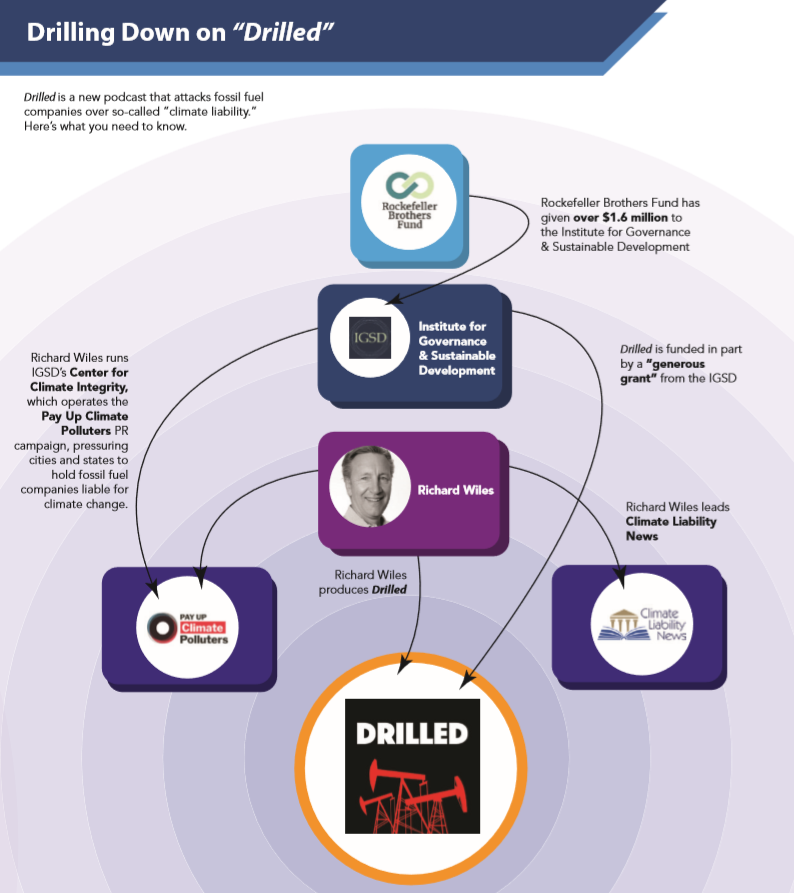 (https://eidclimate.org/wp-content/uploads/2018/12/EID_Drilled_infographic_FINAL.pdf)
Follow the money behind Drilled
Propaganda Campaign
Westervelt calls Drilled a “true-crime” podcast, saying it’s about “one, long-running well-orchestrated campaign that spanned industries. It manipulated not only the media, but various institutions and the general public … I’m talking about patient zero in the U.S. propaganda war: the creation of climate denial.”
Westervelt should know all about propaganda campaigns, given that she’s in the middle of one. Drilleditself is more comedy than serious, investigative reporting, relying on sinister music and a one-sided cast of experts to repeat the same baseless accusations about the energy industry. At no point in her “reporting” does Westervelt note an attempt to reach out to any of the companies that are the subjects of her reporting.
In a rare move for climate activists, however, Westervelt does disclose funding for Drilled—it’s supported, in part, by the Institute for Governance and Sustainable Development. She also discloses that the executive producer is Richard Wiles (https://eidclimate.org/obscure-activist-emerges-as-key-player-in-climate-litigation-campaign/), the publisher of Climate Liability News (CLN), an activist website designed to promote climate litigation. However, Westervelt never mentions that she writes (https://www.climateliabilitynews.org/?s=westervelt) for Climate Liability News nor does she disclose Richard Wiles’ and the IGSD’s relationship to the Center for Climate Integrity, which supports litigation against the energy industry through the Pay Up Climate Polluters (http://www.payupclimatepolluters.org/about/) PR campaign.
When All Else Fails, Blame the Russians
One of the most egregious moments in the series is when Katharine Hayhoe, an atmospheric scientist and professor of political science at Texas Tech University, claims that energy companies worked with Russian hackers to obtain scientists’ emails. The fallout—“climate gate”—she asserts, was created to stymie the Copenhagen Summit. Here she is in episode five:
“So, starting in 1988 they had already mobilized—the fossil fuel industry, the Koch brothers, to ask, you know, all of those think tanks and the dark money-funded organizations—they had already mobilized to the extent that once Kyoto came along they knew what to do. And it was dead in the water before it came home. But then with Copenhagen they had Obama, so they were like ‘uh-oh, you know, this guy could actually make something happen. We don’t have a Republican president.’ So, they had to really pull out the stops. And when I say they, it was not just the U.S. I mean, the emails that were hacked from the scientists? You know, that whole kind of ‘Climategate’ thing? That was directly in preparation for Copenhagen and it likely came from the Russians. I mean there’s no definitive answer yet but it’s more than likely, if you had to pick a country, it’d be the Russians.” (emphasis added)
To recap, Dr. Hayhoe made an incendiary and highly charged accusation – that energy companies worked with Russian hackers – andprovided literally no evidence for the claim.
Conflict of Interest for Thee, but Not for Me
Ben Franta (https://eidclimate.org/something-tells-us-this-attempt-by-activists-to-make-apiknew-a-thing-is-going-to-fail-again/), a Stanford Ph.D. student, also makes an appearance in the podcast, joining Westervelt to criticize university research funded by the energy industry:
“When you can successfully fund researchers of your choosing, then you get a whole host of benefits in return. It’s a very kind of multi-dimensional kickback process. So, I mean, for one, you shape the scientific discourse because it might be true that that researcher you’re funding would have done that research anyway, but they probably wouldn’t have done as much of it, because they wouldn’t have had the same resources. Their voice wouldn’t be as prominent because with that funding they gain prominence.”
Franta’s criticism hinges not on whether these researchers are doing bad or illegitimate work, but that they’re able to do more work because they received grants from companies. Franta’s work, meanwhile, is supported by IGSD (https://eidclimate.org/something-tells-us-this-attempt-by-activists-to-make-apiknew-a-thing-is-going-to-fail-again/), a relationship he doesn’t disclose, which makes his research vulnerable to the same criticism he levies against other researchers.
:{The same goes for Geoffrey Supran, whom Franta describes elsewhere as “} (https://youtu.be/LhUbQ41ZKj8?t=1924):{.” Supran, the co-author of an }:op-ed (https://www.theguardian.com/environment/climate-consensus-97-per-cent/2017/mar/13/the-fossil-fuel-industrys-invisible-colonization-of-academia):{ with Franta, also appears in }:Drilled:{to discuss his research. }::{Supran’s research (which was strongly criticized (https://eidclimate.org/expert-finds-no-scientific-support-study-claiming-exxon-misled-public-climate-change/) by an expert in the field) was funded (https://eidclimate.org/exposed-harvard-study-omitted-evidence-to-allege-exxonmobil-misled-public-on-climate/) by the anti-ExxonMobil Rockefeller Family Fund—a fact that also wasn’t disclosed in the podcast}::{.}:
Coded Language Disguises Prejudice
While the entire premise of Drilledis that energy companies are inherently evil and must be silenced, the podcast and its host would also have you believe that those who oppose fossil fuels have a monopoly on intelligence and rational thought. Here’s the coded language she uses to describe the difference between think tanks who disagree on certain policy matters:
“New conservative think tanks, many of them funded by fossil fuel interests, including Exxon, Koch Industries and Peabody Coal, emerged in the early 1980s and they behaved very differently than the mainstream think tanks, most of which were started by progressives in the early twentieth century.
“In the same way that the new conservative media was bloated and angry where its predecessors had been straightforward and calm, this new breed of think tank was aggressive and opinionated, where the established think tanks had tended to be more scholarly and measured.”
Elsewhere, Westervelt and her guests were more straightforward with their bias. In the podcast’s second episode, #ExxonKnew activist Kert Davies (https://eidclimate.org/wait-till-you-see-these-secret-memos-laying-out-activists-plans-to-target-exxon/) reads from a survey that suggests “older, less educated males from larger households who are not typically active information seekers and are not likely to be ‘green’ consumers” are more receptive to messages that, as Davies puts it, reposition global warming as theory instead of fact. Of course, that line was actuallydescribing (https://research.greenpeaceusa.org/?a=download&d=2950) an audience receptive to “the statement that some members of the media scare the public about global warming to increase their audience and their influence.” But we digress.
Westervelt interjects: “Hmm, older men who are ‘not active information seekers.’ If you were living in America during the 2016 presidential campaign, that demographic might sound familiar.”
Just Another Prong in Activist Campaign
The timing of Drilled further suggests that this content is driven by its close ties to the PR campaign supporting the climate lawsuits. The podcast launched on November 14, 2018, the same day law firm Sher Edling filed suit in San Francisco on behalf of the Pacific Coast Federation of Fishermen’s Associations (PCFFA). The eight-episode series ends with an in-depth discussion (released on November 18) on how litigation against the energy industry is necessary and righteous for ensuring that climate activists are successful. The final episode features an interview with Noah Oppenheim, the PCFFA’s executive director who has his own ties to climate activist litigation (https://eidclimate.org/latest-sher-edling-climate-lawsuit-further-exposes-anti-energy-activist-network/).
It would surprise few if Sher Edling is working hand-in-hand with Wiles’ PR campaign and not disclosing it. Sher Edling has contracted (https://eidclimate.org/santa-cruz-joins-controversial-climate-liability-campaign/) with Resource Media, a non-profit PR firm funded (https://www.rbf.org/grantees/resource-media-nonprofit-corporation) by the Rockefellers, to promote its climate lawsuits. Wiles’ Pay Up Climate Polluters is getting media assistance (http://www.payupclimatepolluters.org/press/03062018-miami-climate-alliance-launches-pucp-campaign/) from M+R, the same PR firm that was hired (http://westernwire.net/wp-content/uploads/2018/12/Boulder-CORA-response-June-2018-MR.pdf) to promote Boulder’s (https://eidclimate.org/two-months-later-boulder-amends-and-refiles-climate-lawsuit-alleging-conspiracy/) climate lawsuit.
But take it from the host herself: climate activists aren’t using the court system for justice. They’re abusing it so they can shut down debate and enact their preferred policies. This podcast, like so much else with the climate litigation campaign, is simply another component in a broader PR stunt.
---
ref "expert"
https://eidclimate.org/expert-finds-no-scientific-support-study-claiming-exxon-misled-public-climate-change/ (https://eidclimate.org/expert-finds-no-scientific-support-study-claiming-exxon-misled-public-climate-change/)
EXPERT FINDS ‘NO SCIENTIFIC SUPPORT’ FOR STUDY CLAIMING EXXON MISLED THE PUBLIC ON CLIMATE CHANGE
MARCH 1, 2018 | SPENCER WALRATH
A widely-covered study that claimed ExxonMobil misled the public on climate change is fatally flawed, according to a bombshell rebuttal (http://eidclimate.org/wp-content/uploads/2018/03/1_Petitioners-Objs-and-Response-to-Respondents-Special-Appearances.pdf#page=41) published today by one of the foremost experts in content analysis. The original study, authored by Harvard University’s Geoffrey Supran and Naomi Oreskes, relies on data analysis that is “unreliable, invalid, biased, not generalizable, and not replicable,” according to the expert, whose methods were cited by Supran and Oreskes.
The academic rebuttal is the biggest blow yet to the activists-turned-researchers, and follows similar critiques by Energy (https://energyindepth.org/national/five-things-to-know-about-the-latest-exxonknew-stunt/) In (http://eidclimate.org/attacking-free-speech/) Depth (http://eidclimate.org/exposed-harvard-study-omitted-evidence-to-allege-exxonmobil-misled-public-on-climate/) and others (http://www.washingtontimes.com/news/2017/aug/31/the-exxonmobil-shakedown/).
The Supran/Oreskes study (http://iopscience.iop.org/article/10.1088/1748-9326/aa815f) alleged that ExxonMobil had obscured the facts on climate change by producing internal research that conflicted with the company’s advertisements. But as Energy In Depth (http://eidclimate.org/exposed-harvard-study-omitted-evidence-to-allege-exxonmobil-misled-public-on-climate/) revealed at the time, Supran and Oreskes relied on an incomplete collection of “advertorials” compiled by Greenpeace; mischaracterized documents that acknowledged climate change as being an example of climate denial; and compared the research of Exxon with the “advertorials” of Mobil before the companies merged.
The latest rebuttal (http://eidclimate.org/wp-content/uploads/2018/03/1_Petitioners-Objs-and-Response-to-Respondents-Special-Appearances.pdf#page=41) was written by Kimberly A. Neuendorf, Ph.D., a Cleveland State University professor with over 40 years’ experience in the field and who literally wrote the book (http://facultyprofile.csuohio.edu/csufacultyprofile/detail.cfm?FacultyID=K_NEUENDORF) on content analysis. Neuendorf’s textbook was actually cited by Supran and Oreskes as the source for their information on content analysis. ExxonMobil asked Neuendorf to review the Supran/Oreskes paper based on the authors’ reliance on Neuendorf’s methodology, although the company had no editorial control over Neuendorf’s conclusions.
...
==
https://www.drillednews.com/post/alleging-consumer-fraud-minnesota-sues-exxon-koch-and-api-for-climate-change-deception
june 24
:{:{}:
}:
Minnesota on Wednesday joined the growing number of states and municipalities seeking damages from the fossil fuel industry for knowingly deceiving consumers about climate change and its impacts. But Attorney General Keith Ellison is charting a different and potentially groundbreaking legal course from those lawsuits, by suing ExxonMobil, Koch Industries, and the American Petroleum Institute under state laws that prohibit lying to consumers. (https://payupclimatepolluters.org/uploads/media/MN-OAG-Complaint-v-Exxon-Koch-API-June2020.pdf)
To date the majority of this generation of climate suits are nuisance cases. They allege that fossil fuel companies’ efforts to misinform the public on climate change successfully delayed for decades any regulations and other actions to slow or stop it, creating the need for billions of dollars in mitigation costs that municipal and state governments could otherwise have avoided. In those cases, which include among others suits filed by the cities of Oakland and San Francisco, Calif., and Boulder, Colo.,, the plaintiffs are seeking damages: They want fossil fuel companies to pay their fair share of the cost of climate adaptation.
The Minnesota case is different in a few key ways:
First, there are two of the defendants, Koch Industries and the American Petroleum Institute, or API, the largest fossil fuel industry trade group. The nuisance suits have concentrated on companies with refineries and pipelines, such as Exxon. This suit, however, focuses on knowingly and actively deceiving the public— it is targeting the refiners and distributors not just of fossil fuel products, but of climate change denial, an arena where both API and Koch have been major players.
In 1998, API convened a group of industry stakeholders to draft the blueprint of the industry’s climate disinformation strategy (http://www.climatefiles.com/trade-group/american-petroleum-institute/1998-global-climate-science-communications-team-action-plan/) in an effort to keep the U.S. from committing to binding emissions reductions targets under the first international climate agreement, the Kyoto Protocol. Ten years later, ahead of the pivotal 2008 climate conference in Copenhagen where nations hoped to agree on a strong successor to the Kyoto pact, API spent at least $75 million with one PR firm alone, Edelman, to work against climate action. And that was{ just one contract in one year.} (https://link.springer.com/article/10.1007/s10584-019-02582-8)
Koch Industries, along with co-owners and brothers Charles and the late David Koch themselves, have for decades funneled hundreds of millions of dollars into think tanks and front groups that spread climate disinformation. The long list of examples ranges from the work of Patrick Michaels, (http://www.climatefiles.com/deniers/patrick-michaels-collection/2010-michaels-cnn-interview-oil-funding/)the Cato Institute’s director of the Center for the Study of Science to the “documentary” Green Tyranny (http://www.climatefiles.com/deniers/patrick-michaels-collection/2017-green-tyranny-with-john-stossel/) (which originally aired on Fox News), as well as one of the earliest convenings of climate deniers, (https://www.newyorker.com/news/daily-comment/kochland-examines-how-the-koch-brothers-made-their-fortune-and-the-influence-it-bought) “Global Environmental Crises: Science or Politics?” which the Cato Institute hosted (http://www.climatefiles.com/deniers/patrick-michaels-collection/1991-cato-climate-denial-conference-flyer-schedule/) in 1991.
Which brings us to the second key difference: The claim itself. It’s not a nuisance claim, but a consumer protection suit that combines Minnesota statutory and common laws centered on false advertising, deceptive trade practices, and consumer fraud. In that way, it’s closer to the Massachusetts fraud case (https://www.drillednews.com/post/federal-judge-massachusetts-climate-claims-against-exxon-belong-in-state-court)against ExxonMobil, than to the dozen or so climate liability cases making their way through the country’s state and federal district courts.
“This complaint does not seek to hold these companies accountable for climate change. It seeks to hold them accountable for violating Minnesota’s consumer protections,” said Leigh Currie, Minnesota’s assistant attorney general at a press conference announcing the suit. This is significant because, the complaint’s reliance on state consumer protection laws may help it avoid some of the jurisdictional issues that the nuisance cases have faced. (https://www.drillednews.com/post/climate-liability-cases-score-a-win-with-ninth-circuit-decision-to-keep-them-in-state-court)
And then there’s the injunctive relief part, which makes this case unique, and a really interesting one to watch moving forward. Injunctive relief is legalese for a court order that forces some person or entity to stop doing something. In this case, Ellison has asked for injunctive relief to stop deception, a corrective public education campaign in Minnesota on climate change, and full disclosure of all internal research the three defendants have conducted on the issue of climate change.
“This was a 30-year effort to defraud consumers in Minnesota about climate change and the role of fossil fuel products in it,” Ellison said at the press conference, illustrating his point with a series of images of internal industry documents revealing what they knew and when.
Several other speakers at the press event connected the fossil fuel industry’s climate denial efforts to the tobacco industry’s deception of the public about the harms of smoking, including Doug Blanke, a former state prosecutor who now directs the Public Health Law Center (https://www.publichealthlawcenter.org/) at Mitchell Hammond School of Law. When he worked in the Attorney General’s office, Blanke spent much of his time onlawsuits holding Big Tobacco accountable. “We were combatting the lies of the tobacco industry — lies that echo through every page of today's lawsuit,” he said. “These strategies are ripped straight from the pages of tobacco’s playbook.”
Minnesota’s suit is also seeking restitution and disgorgement of profits, essentially a handing over of ill-gotten gains. The complaint does not request a specific amount, but it compares the billions of dollars in profits earned by oil companies from the 1980s to the early 2000s, with the billions of dollars of climate-related costs borne by Minnesota residents, stating, “If Defendants had not misled the public to pad their own pockets, Minnesota would not have already incurred such large costs because of climate change and would not be facing such dramatic future costs.”
Flooding has increased dramatically in Minnesota over the past decade. According to the Environmental Protection Agency (https://19january2017snapshot.epa.gov/sites/production/files/2016-09/documents/climate-change-mn.pdf), over the last half century, average annual precipitation in most of the Midwest increasing by 5 to 10% with rainfall during the four wettest days of the year has increased about 35%. The Minnesota Pollution Control Agency notes (https://www.pca.state.mn.us/air/effects-climate-change-minnesota) that temperatures have increased by 1 to 3 degrees Fahrenheit statewide, and that more frequent heavy rains have been causing low areas to flood, resulting in crop, home, and business damages.
Minnesotans are also grappling with immediate impacts of the oil and gas industry on public health and the environment, including air pollution and pipeline-related water pollution. Environmental activist and authorWinona LaDuke, a member of the Chippewa White Earth Nationin north-central Minnesota, spoke about the Enbridge pipeline (https://www.enbridge.com/projects-and-infrastructure/public-awareness/minnesota-projects/line-3-replacement-project). “I never expected to be spending years fighting Enbridge, but this pipeline company brings more than 70% of the tar sands oil into this country,” she said.
Sam Grant, director of the climate action group Minnesota 350, connected the lawsuit to the nationwide Black Lives Matter protests spurred by the police killing of George Floyd in Minneapolis. “We have a choice between freedom to profit or freedom to breathe,” he said. “It ought to be a no brainer that freedom to breathe comes first, because we have to be alive for anything else to happen.”
Grant described low-income Black and Brown neighborhoods in northern Minneapolis where air pollution from fossil fuel facilities has shortened lifespans by at least 11 years compared to the national average. And in a first for climate lawsuits, the complaint itself highlights climate justice, too, right up top on the first page, where it notes, "Warming will continue with devastating economic and public-health consequences across the state and, in particular, disproportionately impact people living in poverty and people of color."
While oil companies don’t like to lose money, especially now when the oil and gas market is turned upside down (https://www.drillednews.com/post/as-trump-steps-into-saudi-russia-oil-price-war-exxon-and-chevron-block-shale-bailouts), it’s possible the “disclosure of all internal research” piece of the Minnesota suit is the thing they’ll fight hardest. A full disclosure of the Koch, API, and ExxonMobil files on climate change could hurt its chances of winning all the other climate cases, and send the industry hurtling down the Big Tobacco pathway towards a multi-hundreds of billions of dollars settlement with states.
Juwaria Jama, co-leader of the Minnesota Youth Climate Strike, spoke about the fossil fuel industry “infringing on Indigenous and low-income communities to build pipelines and refineries that harm those communities.”
“Because of the deception of these companies, as teenagers we are spending our time fighting for a future that could be stolen,” said Jama, “a last-minute battle to preserve a livable world for myself and subsequent generations. And the most heartbreaking thing is that it could have been prevented.
“These corporations knew the impacts of climate change long before now, and they could have sounded the alarm. Instead they covered up the damage,” she said. “These corporations have gone far too long without being held accountable for our globe and our future.”
==
“Educating” kids about fossil fuels is just one of many tactics the industry has used to get the public on its side. As Mother Jones reported this month, gas companies are now paying Instagram influencers (https://www.motherjones.com/environment/2020/06/gas-industry-influencers-stoves/) to post photos of them looking stylish next to their gas stoves with the hashtag #cookingwithgas. The “now you’re cooking with gas (https://www.wytv.com/news/daybreak/nugget-of-knowledge-cooking-with-gas/)” campaign has been going on since the 1930s, when the gas industry was trying to knock out its competition, wood and electric stoves.
Now the industry is under threat again, this time by the rise of renewable energy and the growing public concerns about climate change and the role fossil fuels play in causing it. In California, 30 cities have banned gas (https://grist.org/beacon/gas-stoves-a-relic-of-the-past/) in new building construction in a growing movement to “electrify everything (https://www.pbs.org/newshour/science/to-cut-carbon-emissions-a-movement-grows-to-electrify-everything),” threatening to make gas stoves obsolete.
The fossil fuel industry has learned a lot of PR tricks in the past century: making up fake news (https://grist.org/climate/how-the-oil-industry-pumped-americans-full-of-fake-news/), creating bogus studies (https://blog.ucsusa.org/jeremy-richardson/department-of-energy-releases-bogus-coal-study), and bullying journalists into overcorrecting their articles (https://www.drillednews.com/post/the-mobil-oil-flack-who-brought-us-false-equivalence-advertorials-and-corporate-free-speech). The practice of fabricating grassroots groups (https://grist.org/article/how-the-fossil-fuel-industry-drums-up-grassroots-support/) to create the illusion of community support for a cause has become so common it has a name, “astroturfing.”
Children are particularly susceptible to advertising, as any parent finds out when they reach the cereal aisle, and it seems like the fossil fuel industry is trying to hook them young. But as evidenced by the rise of the youth climate strikes sparked by Greta Thunberg, the 17-year-old Swedish activist, the industry’s attempts to persuade them aren’t working as well as it hoped.
==
https://grist.org/climate/how-the-oil-industry-pumped-americans-full-of-fake-news/
2/20
The world has known about the dangers of climate change for decades — so why are oil and gas companies still drilling for crude as if there’s no tomorrow? There’s no simple answer. But any explanation would have to give some credit to the wizards of public relations. For more than a century, these spinmasters downplayed misdeeds, twisted facts, and cajoled the media into mimicking their talking points.
“A lot of what we have as PR today, in general, was built in service of the fossil fuel industry,” said Amy Westervelt, the host of Drilled (https://www.drillednews.com/podcasts), billed as “a true-crime podcast about climate change.” The first season of Drilled investigated the history of climate denial, and the second looked at the West Coast crabbers suing Big Oil for contributing to warmer oceans and throwing the marine food web out of whack. In the latest season launched last month, Westervelt introduces the “Mad Men of Climate Denial” — the publicists who coached the fossil fuel industry how to shape public opinion over the past century.
Creating a cloud of confusion around established science is one of their well-known tactics. Exxon and the coal industry (https://grist.org/energy/exxon-knew-and-so-did-coal/) knew about global warming as early as the 1960s; instead of telling the public, they spread doubt about the science behind it. That’s just one facet of the fossil fuel industry’s propaganda machine. (“Propaganda” might seem too strong of a word, but Westervelt says it’s the very definition: “a one-sided message with the aim of shifting public opinion or policy.”) Digging through archives, presidential libraries, and old PR books, Westervelt found the pushy executives, manipulative schmoozers, and “inventive” storytellers who made it work.
“People are largely unaware that there’s a massive system running underneath everything,” Westervelt said in an interview with Grist. “A lot of the ideas they have about the fossil fuel industry and even the language they use has been crafted very carefully by the industry itself.”
She takes us on a wild journey from a turn-of-the-century massacre in Colorado coal country to the messaging strategy of, yes, Nazi Germany, telling the stories of the people who worked to boost oil’s image and how their experiences taught them to influence the media, politicians, and the courts. Here are just a handful of the wild strategies they came up with, all still in use.
Fake news: “Fake news” proliferates on the internet today, a plague of modern life with a long pedigree. You can trace it back to Ivy Ledbetter Lee, often called the father of modern public relations. In the early 1900s, Lee was tasked with rehabilitating the public image of the tycoon John D. Rockefeller. His company, Standard Oil, had brutally stamped out a workers strike at a Colorado coal mine in 1913, setting tents on fire and spraying their camp with machine guns. Lee crafted a story to smooth things over, claiming that the strikers were actually plants hired by a labor union, and that the whole thing had been orchestrated by Mother Jones, a famous labor organizer (he also made up that she ran a nearby brothel). “What are facts anyway but my interpretation of what happened?” Lee said later on.
Corporate philanthropy: Lee’s coverup went so well that Rockefeller kept him on board for the rest of his life. In addition to inventing the press release (imagine, the newspaper prints your version of the story word for word!), Lee prodded Rockefeller to donate to charitable causes, like museums, to burnish his reputation. The approach gained traction as other robber barons realized that they, too, could be remembered as kindly philanthropists. The arts are now soaked (https://grist.org/climate/can-art-museums-survive-without-oil-money/) with oil money — and with their names emblazoned on art museum walls and festivals signs, corporations get a similar reputational boost.
[pix
Herb Schmertz and Sheila O’Malley Fuchs attend a party at the Parrish Art Museum in 2007. Patrick McMullan via Getty Images]
Astroturfing: What better way to counter grassroots activists than to fake your own grassroots group? This practice, called “astroturfing (https://grist.org/article/how-anti-clean-energy-campaigns-create-a-mirage-of-public-support/),” was the brainchild of Daniel Edelman, a PR whiz who advised Mobil Oil, Big Tobacco, and many other companies in the mid-20th century. There are now hundreds of fake front groups backed by oil-funded lobbying groups like the Western States Petroleum Association, said Christine Arena, former vice president of the firm Edelman (yes, named after Daniel), in the podcast. They go by friendly names like (https://www.ucsusa.org/resources/how-fossil-fuel-lobbyists-used-astroturf-front-groups-confuse-public) “California Drivers Alliance” or “Washington Consumers for Sound Fuel Policy.”
False equivalence: Herb Schmertz, who advised Mobil starting in the 1960s, took an aggressive stance toward the press. He’d attack any journalist or outlet critical of his company, arguing that they weren’t hearing Mobil’s side of the story, and then watch them overcorrect in the next edition. The approach eventually expanded to demanding airtime (https://www.washingtonpost.com/outlook/2019/01/10/how-fossil-fuel-industry-got-media-think-climate-change-was-debatable/) for climate deniers. One study (https://www.eci.ox.ac.uk/publications/downloads/boykoff04-gec.pdf) looking at climate change articles in major U.S. outlets between 1988 and 2002 found that more than half of them presented climate science and fringe, Big Oil-friendly theories as equivalent. “It took a while for newspapers to realize that this was not a great way to go,” Westervelt said.
It seems like many in the media have decided to stop playing along. And there are other signs that the tide is turning against (https://www.cnn.com/2020/02/05/business/exxonmobil-oil-stock/index.html) the oil industry. Once the world’s most valuable company, Exxon’s stock has dropped by a third (https://www.bloomberg.com/quote/XOM:US)over the last five years, wiping away nearly $200 billion in market value. Jim Cramer, the loudmouth host of CNBC’s Mad Money, recently said that it’s time to ditch oil stocks (https://grist.org/energy/jim-cramer-mad-money-host-declares-fossil-fuels-dead/). Even public relations companies are now taking their services elsewhere.
“As soon as an industry starts to get an irretrievably bad image, the PR folks start dropping off, and the industry has to find somebody else to do this stuff,” Westervelt said. She said she has seen oil companies turn to more obscure consulting groups, like FGI Consulting and the DCI group, to do their PR work.
The fossil fuel industry is starting to move away from publicly denying the facts about climate change (which isn’t working as well these days) and back toward pro-oil, all-American messaging, like the new ads (https://grist.org/energy/gas-and-oil-will-save-us-all-say-oil-and-gas-companies/) from the American Petroleum Institute that tout oil and natural gas as “energy progress.” If only Big Oil was as good at cutting greenhouse gas emissions as it was at marketing.
---
naomi drilled interview 6/20: kids see intersectionality vs older/boomer do you have to make this hard? about capitalism? car work is low carbon; started in climate at latrina NO dis cap'l ism research, git that floods were out future; red bait mccarthy stick used to beat up system thinking (commies want to overthrow our way of life/cap'l SYSTEM vs update the operating sysyem; puncuated transition anoshabe woman cda?0 BP rebrand docs on drilled]
GND attacked on fox but not really defended opon cnn and msnbc: rt story = loss; // Keystone XL beg for 2 min, then followed by FF greenwash ad that was LONGER?! Brazil 10 yrs ago Anjelica Navarro we need a Marshall Plan for climate;
---
---
5/20/20
https://www.alternet.org/2020/05/trump-executive-order-directs-all-agencies-to-gut-business-regulations-amid-covid-19-the-corruption-is-on-full-display/
no lnx
trump executive order directs all agencies to gut business regulations amid COVID-19: ‘The corruption is on full display’
President Donald J. Trump arrives in the House chamber and is greeted by members of Congress prior to delivering his State of the Union address Tuesday, Feb. 4, at the U.S. Capitol in Washington, D.C. (Official White House Photo by Shealah Craighead)
Written by Jake Johnson / Common Dreams May 20, 2020
In a move watchdog groups decried as an effort to reward big corporations at the expense of public health and safety, President Donald Trump on Tuesday signed an executive order directing the heads of every federal agency to “waive, suspend, and eliminate” all regulations that they consider unnecessary obstacles to economic recovery from the coronavirus crisis.
“And we want to leave it that way,” Trump said during a press briefing, indicating he would like to make the sweeping deregulation permanent. The president’s order could have enormous implications for workplace safety rules, environmental and labor policy, consumer protections, food and drug regulations, and more.
Robert Weissman, president Public Citizen, said the executive order shows that “instead of real, direct help for the tens of millions of Americans struggling financially due to the pandemic, or a real plan to reopen the economy safely based on the best public health expertise, Trump wants to keep giving handouts to corporate interests.”
“Trump’s corporate-friendly executive order aimed at rolling back even more regulations that protect the public isjust the latest sign that his solution to the pandemic is the opposite of what the public needs,” said Weissman. “The corruption of this administration is on full display as it uses this crisis as an excuse to further its corporate agenda while distracting the public from its utter failure to fight the virus.”
Public Citizen
@Public_Citizen
Trump is using this crisis as an excuse to further his corporate agenda while distracting the public from his utter failure to fight the virus.
The corruption is on full display. https://twitter.com/cbsnews/status/1262828680943939586 …
CBS News
@CBSNews
President Trump says he will sign an executive order directing all federal agencies "to use any and all authority to waive, suspend, and eliminate unnecessary regulations that impede economic recovery"
"And we want to leave it that way," he adds http://www.cbsnews.com/live
Embedded video
Trump’s deregulatory push amid the Covid-19 pandemic is a continuation of his administration’s policy of hacking away at as many restrictions on big business as possible prior to the crisis.
As Common Dreams reported, Trump’s Environmental Protection Agency has already used the coronavirus pandemic to suspend reporting rules and other requirements for the fossil fuel industry, which green groups warned gives oil companies “a green light” to pollute the nation’s air and water with impunity.
The president’s executive order instructs agency heads to “determine which, if any, [deregulatory actions] would promote economic recovery if made permanent,” giving the EPA and other agencies the go-ahead to indefinitely lift regulations on big polluters and other corporations.
“Remember when the EPA got all ‘how dare you’ about anyone saying their rollbacks were permanent? Well, now there’s an executive order that makes them so,” tweeted climate journalist Amy Westervelt. “There will be many, many more. Oil and gas royalties? Bye. Restrictions on offshore drilling? Buh-bye. This is unbelievably bad, reckless, and a complete fuck-you to democracy.”
While Trump presented his administration’s sweeping assault on regulations as an attempt to accelerate economic recovery from the coronavirus emergency, economists have disputed the longstanding right-wing notion that deregulation necessarily boosts activity and growth.
“This sounds exactly like the type of opportunistic political move that absolutely should not be attempted right now,” Jared Bernstein, a senior fellow at the Center on Budget and Policy Priorities, told the Washington Post last month. “Correlations between regulations and economic activity are far shakier than they assume, and I don’t believe this idea will help at all.”
---
==
https://www.drillednews.com/post/the-climate-covid-19-policy-tracker
. Last week we launched our Climate-COVID-19 Policy Tracker (http://email.mg2.substack.com/c/eJxNUMmOhCAQ_Rq5aVjcOHCYy_yGQai2SSMYKNv27wftyySVVPJqeYvRCEtMp9piRrJnSJOzig89lZISq1rLxm4kLk-PBLBq5xWmHci2z94ZjS6G60D0kjLyVNC2IPthHqwYWQ-GSug7Ic3YGabHhyAXzaR36yAYUPCGdMYAxKsn4pYr8VPx31LHcTQ2Oe_BBjhyY-Ja0Ou4NHxCbbxbi_TaxLezNZP1Foues8akzQsScYpTTmnLGGWUi65hzQEpfLIePnquWrouvMn7nLHsX-9JUpvG1byYKNPlcnrDxehU-roHh-cEQc9F0zcD_IZ2W8JzA3VJ9YBY-G_wDqaVjJPCZGP5GdQ_V39idoNi)to keep tabs on industry moves to push through permitting, deregulation and bailout money while the world is distracted by … trying to stay alive. We started with just under 20, and that number has doubled in one week. It will be more next week.
:{:{}:
}:
amy w
from the Tracker: Don’t Sleep on the EPA’s “Secret Science” Proposal (http://email.mg2.substack.com/c/eJwtkE2ShCAMhU_T7LSCv7hgMZu5hoUQbaoVLAhte_tBe6ooAi_khXxaES4-nHL3kViKGEZrZNV3MAzAjGwMF61gNo5zQNyUXSWFhGxP02q1IuvdVVB3A3D2lKA09HUnhl4IDqITDc5tO0Nbz9APumVXm1ElY9FplPjGcHqHbJVPoj0-6p9H9ZvXcRzljAaDWgMuNhKGcvHvnDFepw0dxXyuoIIcoM4bF_9CAS3wKl8iBXQLPdFZtxQUlIu7ypI-C-uKbJtWRXn0Iur7N8zKqx4azoFDVbclLw8M7hNV_1HTo4FtqcqYpkhKv0rtNxbkrmjTL17n7HLRueUMZ8xxS87SOaJT04rmy42-oG8MdO4oHR5xRcoDfsUbZjPwiuVOxmdPJ02wa3a4nv4Bjm-Skg)
The EPA has forged ahead with finalizing new rules that will upend how the agency uses science to inform important anti-pollution regulations. Since first announced in 2018, scientists, public health groups, and environmentalists have steadily denounced this Trump administration effort as a ruse to sever environmental regulations from key scientific findings, notably 1993's landmark "Six Cities" study proving that tiny particle pollution (PM2.5) severely harms human health; it's created primarily by burning fossil fuels, The rule changes will also give regulated industries unprecedented power in shaping the agency’s use of science by “allow[ing] stakeholders to reanalyze the data and models and explore the sensitivity of the conclusions to alternative assumptions.” Public comment period closes May 18, 2020.
---
420 random grab
fossil Fuel Companies Try Again to Shake Baltimore’s Climate Liability Suit (http://email.mg2.substack.com/c/eJwtUMuOgzAM_JrmiJIApRxyWFXa30BOYmjUPFBi2vL3G-hKlmyN7bFnDBAuKe9qTYXYVjBPzio5XPk4cmZVZ8WtvzFXpjkjBnBeUd6QrZv2zgC5FI-F9jpywR5KzAim67jsNYdhlkbqgRujb72xXPQjO85MsFmH0aDCF-Y9RWRePYjWcml_LvK3hod3o8GTCymjcbQ3S3pVvDjCUrPFGTZPtZqdP5G7d6Fquche8vsD4vJfprB6cJGa1c7MKckl550QXHDZ9o1o3pjjp8DwAX3peFhkUzZdCMyzMSmwrFagYJ6ird3l0H_CVf5Uc9hi_W3CCNqj_TpDXytPobSvqCK-i0cizF_wtKsbhWT1kk2VMyqbna8Mx-gfZJ2KEQ)
ExxonMobil, Chevron, Shell, and BP, along with nearly two dozen other fossil fuel defendants named in a climate liability suit by the city of Baltimore, have asked a state court to dismiss the case, in part because they maintain it is a violation of their First Amendment right to free speech. Story coming soon!
---
---
Climate Accountability News Roundup
Harvard Study (http://email.mg2.substack.com/c/eJwlUMuOwyAM_JpyW8QjTcOBw172NyIebss2ARZM2vz9klayZGnGnvHYGYRbKrvOqSJpFcocvBaXkSnFiNeD59N5IqHO1wKwmrBoLA1IbnYJzmBI8ViQo2Kc3DUMV-W5lQNI65UYr5OZrJpGeWHO8DMnh81smg8QHWjYoOwpAln0HTHXk_w-iZ9euaRfcFhp-KN3UzZTPAXfOuPSFvxXXknQggnGBs4ZZ0KeKadPKPFVzeVl7Glg603Q2mxF4x7UpZUUnQ2u7sFlZ29Hljfco8y9ry0G3GeIxi7gPynx85b30bhn0BGedQFEKB_wHX1QXJDu5FPXjNqXsHSFY_QfjqR4mQ)shows a connection between even minimal exposure to a particular type of air pollution—pm2.5, the particulate matter found in car exhaust or coal and natural gas power plant emissions—and risk of COVID-19 death.
Related: In Cancer Alley (http://email.mg2.substack.com/c/eJwlkEuOhCAQQE_T7DCA2rYLFrOZa5gSSiWtYKBox9sP2kkl9f89A4RziKfeQyKWE8bBWa26p-h7waxurHy1L-bSMEXEDdyqKWZkex5XZ4Bc8FdD_eyFZIuG3sqxla9pFF3z6uqpn2qo5bNW0ijT9uxaM0C2Dr1BjR-MZ_DIVr0Q7elR_zzUb5HjOKqPM1iZsBUX_ZBT0RDJmRWLtb-xb3wxDJRBkcO64skXSDyFDXmYOC3IFzcvmIibEIOHj4s5cYtAC4_l78Sdv8tMyJ7iyZxWQgnRSCmkUHVbyerA6P8SdH8wPhqxzapKeUwE5n2dxqLegTbzlnXJzheeO1zoDEVv2Ts6B_Qwrmi_4OhL-uZA547a45FWJML4Dd40m14qVjbZUGZ6baMr_9mr9B9NzpZT)—predominantly Black neighborhoods along the Mississippi from New Orleans to Baton Rouge, surrounded by refineries, power plants and petrochemical plants—the COVID-19 death rate is sky high. (Vice News)
Reuters reports (http://email.mg2.substack.com/c/eJxdkc2u2yAQhZ8m7LAAOz9esLiqVOneSl206toa8MRBwWAxcB336YuTqotKSAyHc2bQh4WMU0ybXiJlVgjT4EatzifR94KNuhvl5XhhjoZrQpzBeZ1TQbYU452F7GLYA-2pF5LddKeU6K9GdtaKIxqj8ATd-XxVINQFriPbxwxQRofBosZPTFsMyLy-5bzQoX07qK91revaJCwZEzU2zlWBlJ31WKtCvBBwA-FOHAOmaeNAhLmeHtYXcp-77V9d3X_NS8IFEvIcOaH7jf-lgTjdwCM3Mc58ilhzhTJ346-f3758V_JH-_HOnFZCCdFJKaRQ7bGRzYopPAjODzCHTsyTaqgYymDv--NZ0gvk2d5lW2-nneFTrgiHus8luLwNGMB4HF908-s7nrDytqAOuJLHXHm8xCfyrpeK1UljrD2DHpPztcNu_QNFFaT3)that banks holding a large amount of the shale gas industry’s debt will take over and operate some companies’ assets.
In an unprecedented move the G20 and OPEC meet (http://email.mg2.substack.com/c/eJwlUMuuhCAM_RrZaQARZcHibu5vGB51hoyCgXod__7iTNKk7Wl7Tk6dQXikfOk9FSRHgTwHr_koqVKUeC08m4aJhDIvGWAzYdWYDyD7YdfgDIYU74NeKsrIU5tRqAmEEnKg3hhurZLSyn7gHEYGktwyszl8gOhAwx_kK0Ugq34i7qXpfxr-W-M8z27BzqWtNi5FhIi1YtI4xfzUCm6XVjBF22ny0C69n5TltpeLIEFzyikVjFFGeT90rDshx3cx49vYRtDtwbty2ILGvW4JkvVucHMv1tfp4zb5gavHuebtiAGvGaKxK_ivffz-6-MGrx10hLOsgAj5C35-IhTjpCr5VDmj9jmsleFe_Qdw9n0a)to agree on production cuts to shore up the global oil market. (Financial Times)
Part of the OPEC agreement was a quid pro quo on shale. Politico reports that The Trump administration rejected a Saudi request that U.S. oil companies be barred from receiving business loans under the third coronavirus relief package, H.R. 748 (116) (http://email.mg2.substack.com/c/eJw1kMuKwzAMRb-mXgY_4tfCi4GhvxFkW25NkzjjONPm7ydpGRAIdCXdywnQ8Fbq7payNrKtWIccHdeKWktJdH1kRhqS1yFVxAny6FrdkCybH3OAlst8HghlKSN3h9wwyYW1ygcbdZ-MMEqmAFIFmiiQ02aALWacAzr8xbqXGcno7q0tF_F14dejbqVbyphbDuXt2YUynYq4_qwX8c16Eylyb1FbHZgSCQAElQaiFF6ZGLlPSgkfOcckjVcscSvYEUZLrTU_RZoMs0H1AFLSQ2NaCqVUiDGQ7DjllPaMUUa5kB3rnljn1wr6Bf7S0-nGu3Xza4PwOMOR6hZoU3gwcai3_8wnpuHo0zbntg84gx8xfgi2D_I3kLYv6GZ8riO2hvUzfGPtLePkcIrl-Dm7WPN4fDhX_wBo349Q). But, the administration instead agreed it would not waive royalty payments to U.S. companies from oil and gas they produced on U.S. federal lands — something both congressional (http://email.mg2.substack.com/c/eJw1kNFuwyAMRb-mPEY2hBAeeJg09TciA06HloSMkLX9-yWtJlmy5Gv7Xp1AlW-5PN2atyr2jcuQopOmA2tBRNdG7HUv0jaMhXmmNLladhbr7qcUqKa8nAeqs4Diy2lFyD54iF4ptGwJjFeSwY49QwjitBloj4mXwI5_uTzzwmJyX7WuF_VxkdejbrlZ85RqCvnl2YQ8n4q6_mwX9YltH4Glt2ysCdgZb1Ar460erdFoQcXRUsA-xq7HQONIFMYYpQna9230nQ6IGlhpzWwIJLVjr0lqDq2KUSQnQQK0iIAglW6wuXNZHhuZB_lLC_NNNtvut0rh-wwnilupzuEb1aHe_jOfmIajz_uS6nPghfzE8U2wvpG_gNTnym7h-zZxrVzewxfW1qIUh1PMx8_FxZKm48O5-gdwLpGV)Republicans (http://email.mg2.substack.com/c/eJw1kN2KhDAMhZ_GXkr_7M9FLxaWeQ1p0-iUUevWujO-_eoMC4FATnJO-MBXHHM53Jq3SvYNS5-i41pRaymJTkZmOkPS1g8FcfZpcrXsSNY9TAl8TXm5DoSylJG7YzpQo41iMVqpYhiYGKDTHLhBETpKrpje7zHhAujwF8uRFySTu9e6NuKr4bezxtyueUo1QX5ntpDnSxG3n60R30yaSJEHi9pqYCpoJUAAs4qDGAIgp7QzzBjwHjtGpfEBgtFolI5yUIPspDaS22CMB22EP4-jlABRaB48SY7T00MyRhnlomtZ-8SyvDavXz40ks4jb7c9bNXD43qOFLf6OsODiVMd_3--MPVnn_cl1aPHxYcJ44dg_SB_A6nHim7B5zZhrVg-wzdWaRknZ1LMp-fiYknT6XCt_gH11ZAs) and industry groups have pushed in recent days. "The president said no to royalty relief on offshore and onshore federal land," one industry official briefed on the matter said. "The president had a quid pro quo promise to the Saudis. Saudi implicitly wants the shale guys to die on the vine of natural causes."Wow, saying the quiet stuff out loud, all week long. (Politico)
Gulf of Mexico offshore drillers (http://email.mg2.substack.com/c/eJwlkNGOgyAQRb-mvGkAbasPPPRlf8MgMypbBAPDWv9-sSYkQ-7M3AvHaMI5xENtIRHLCeNgQcnng_c9Z6BaEN29YzYNU0RctXWKYka25dFZo8kGfy40j54LtqhWGoEAeoTHk995y4sMUiN0sum4adkZM-gMFr1BhX8Yj-CRObUQbenWvG7yp5x93-sl5FVTAH3UJqxF9LinUiSX_HQuVxeMdlWwrrIecqJ4VHMMeat-g_Wpmuy8UDWFWE0IGMtoRGdxYlZdJkJwwWVzr0W9Y_SfpJ8fPd5avs6yTnlMpM37TGdRbZpW8xZN6c4nh69cMAylrtlbOgb0enQIFyG6kH4_TMeG6ny-QyKMl_jF1vZCspIEoXh6BdG64nCO_gO08Y1V)are still holding out hope that the nix on royalty relief won’t apply to them.
==
heated 320
it took Maine Governor Janet Mills 12 days since the first case of novel coronavirus hit to implement the type of restrictive social distancing policies (http://email.mg2.substack.com/c/eJwlUctuwyAQ_JpwI-LhpPGBQy_9DWuBtU2KwYJ1Wvfrix0JwWi0y8zOOiCcctnNmiuxrWIZgjfq4y76XjBvOi8ftwcLdRgL4gIhGiobsnWzMTigkNPZ0H1oNpu-H5Xoeu20c-CdvMHdjtZ7tKAsOMkOlQE2HzA5NPjCsueE7AUlQCJjgdzMopmJ1nrRnxf11Y6F1Cz6pr0n_KlXl5fGKqFEe4Q-cNeuNcdAwdUGn5CQ-BJirLx1Yqk8NZ1aMVGAyNscCbndajjJyilzF3PFA4xhmom7XHKCVyjb8SErZgVa3LfUl05MRw6HDRbMYUNodZdKKvG4yqv8ez778TnJ_dVKl0ld62Yrgfs-O_B3xRKWZsSccfJzZl7D3xnq0GqWLQXaB0xgI_p33vRe0Jkf7SuaI4mIRFjeZFuC1vL2UKzJ-XxMaGZs2_X_iWapVQ) scientists overwhelmingly recommend to halt disease spread, including the closure of nonessential businesses.
It took her only five days, however, to delay the state’s ban on single-use plastic bags (http://email.mg2.substack.com/c/eJwtkVGOgyAQhk8jbxoBtfrAQ6PtAXYPYBCnSqtIYGzXPf2ibgLM5M9Mhvl-JRGGxW3CLh7J6sG1uhfsUqRVlZJeZD0t85Jo3z4cwCz1JNCtQOzaTVpJ1Is5GrILJ6PgXVl1vAfZPbJHyYpK0rLgWc7KS14VFSf7lFauvQajQMAb3LYYIG_ptDQoOolqJJMYEa2P-DVi93A-n09iJ-lRK2_g4xO1zEHe0xDCnwzEo5zQx_9VcSeHcE1spcNdNPGsUQ9h11gtbjHyrd3qY28dyD7i9_r7uuL4Bd5GvKERy_fR4eEVzbP8TOmps-wIflUKvD_yps7Kmt6a-6UIsamv9a1uaJXf8oJyygvihJU4qxflUZYOO8R9BaIFS1maclZQRllaJjShv89n9XgOdHuH0nlgiV87j1K9jg74seD0DAHV4UV8AIu9_j0caUPNvBqNWwtGdhP0p1l4unvAx82C2NFNgAjuFIODnNO8ZCSM65cdqRgh4Or_ANpotJo), using a scientifically questionable theory that reusable bags pose an outsized risk of spreading COVID-19.
Since Mills’ March 17 order, reusable grocery bags in Maine have become taboo. City officials are now discouraging shopping from bringing them to the store, claiming they will threaten grocery story workers. “According to current research and understanding, COVID-19 can survive on various surfaces for hours and in some cases days,” Portland City Manager Jon Jennings said in a news release last week.
And though Mills was the first state governor in America to give credence to this theory, she hasn’t been the last. Over the weekend, New Hampshire Governor Chris Sununu outright prohibited shoppers (http://email.mg2.substack.com/c/eJwlkU2OwyAMhU9TdhPxFxoWLEYjzRxgDhARcBPahETgpJOefkgqWGDLfn7-cBahn9NuljkjWTOkNnjDr4pqTYk30rOmbkjI7S0BTDaMBtMKZFm7MTiLYY5ng7wKMhjvhNONrjUo0Uglm1pzITXj6uqYAkGOKa1dfYDowMAGaZ8jkM2mYCOazqIbyGgGxCVfxOeFf5eLz4AIqXLzVKKfefsaUsi_ayynJDJaXHN5MC6ZVErRmtWK1Vo2miSzWJzcg4mLpP3h_5AhwXDKKRVcMc44bSpWsdf9rm_3nu1bKZ16XuW1K9rucXbA3wIpTFBcnhg-Tq8fObxOGG2pmdYYcG8h2m4E_-aEb7Dn3rgvYCI88wjHPu9kgScEqxtOyjg_F-loBii_4v8B91uKxQ) from bringing reusable bags to stores. Massachusetts Governor Charlie Baker did the same on Wednesday (http://email.mg2.substack.com/c/eJwlUcuOhCAQ_JrhpuHhaw4c9rK_YXi0yoyCgXZc5-sXNSE0aaq6qMIohDHEQ64hIdkSxN5ZyduGPp-UWFlZ1tUdcakfIsCi3CwxbkDWTc_OKHTBX4SqFWSSQ220VYwOxrCWqqZq2o42wgBv9ACUk1OlV5t14A1I-EA8ggfyUdEpj1IrNBOZ5YS4pof4efDfvPZ9L3UmBj_OQUNpwpK7nHKaCxXnuc7bAhhDrje0mN2ARYSE0ZnzmalYZ5XQmUKrMRUZky8znES5KlzMm4lHRcfT4qlAnDwVqOAN44zTrmQl-75ez-E1suOTocvIy7TphMq8Lwb8rRDdAtnIlVRx2SmS-1559RmzbN7h0YNXegZ7R4l39lc0eKwgPexpBkSIdzPnKwSrO06ynA15tJcT5I-z_8jYmf8). “From now on, reusable bags are prohibited and all regulations on plastic bag bans are lifted,” he said.
This, however, is likely just the beginning of the plastic industry’s war on reusable bags. Because as the pandemic has picked up steam in America, so too has the industry’s push for policy and culture shifts to encourage single-use plastics, and ban reusable alternatives. Their allies in the news media (http://email.mg2.substack.com/c/eJwlUcGuhCAM_JrlphFwFQ8c3uX9hkGoiqtooOpzv_513aRNStOZTgdrEIY1XnpbE7I9QWy906KuiqYpmNOl4-qpmE9tHwEW42eNcQe27d3srUG_hhtQ1pKNujNKNqovFZdKupJbCcCrXnDuurqqFftsac3uPAQLGg6I1xqAHSZ6E5DwaEc26xFxSw_58xC_FOd55meacrsu9DIRvZ0hUYkjZNtsEjWyzgyUgdK-eh8hZZw_VSmbpqoqFvVmcLEvLh9lMXzO-LAxr0UhikKKigsuCpXznL-nqemngV8HjS6DyNPeJSTWGwF_G0S_AIm93chuyVny79uTlmaWPXi8Wgimm8F97cKvv_f5eG2gA5xpBkSI3yZ5KCUJFozWuZWogx6BPsf9A6SGjyM), oil and gas industry (http://email.mg2.substack.com/c/eJwlkEtuhDAQRE8z3oH8AQYWXmSTayBjN-AJ_shuIMzp4zBSr1pV1V1PK4QlpEvGkJHsGdJojeTPjg4DJUY2hvVtT2we5wTglN0kph1I3KfNaoU2-NvQPAVZZdu2xgxdN1PWzOypDRfNPA8UwExcs2IrV0a1Gwteg4QD0hU8kEMlqzzKSaFeySZXxJgf4uvBv8uc51mDh7Rc1huIuNYhLWWvw2FNxYbKgAs-YypdcmVdDAlVya_ipjJanYuWJBkVOv3DxKOhy3-RWgdHrOSUUyp4xzjjtK9Zzd6v1zC_FnYdReoWXud9yqj0z-2A3wjJOijv3jyq--kq2_dNZSwat3uL1wheTRuYDzD8EL4B4BVBejjzBoiQPstCUQjW9pyUcyaUaC9XKJXMH8nnkzA), and conservative think tank world (http://email.mg2.substack.com/c/eJwlkUGy4yAMRE8TdrgAJyZZsJjNXMMlg2yTbwMFIhn_0w9xqrRSt6TqJwuES8yHSbEQqwXz6J1RehCPh2DOXJ283-7Ml3HOiDv4zVCuyFKdNm-BfAznwFX3bDWodd87bZWehJqHYdbTPEw4KymEvmnLPldGqM5jsGjwhfmIAdkLsodAZgKyK9vMSpTKpf9zUX9bvd_vboewAhEE7kMhT5Wwi3lpai0-LJwiIZ9gKaeO4HicedqgeS23sW6Or7glXlL-iLRi6-YY4OVzLSybBLTbH9lfrmL5xOxs3Jk3SighejVIJZW4d7KTv8_nY34u8ng1676ortSpENifcwL_Jcx-xxbmpMXPSLz435PZ2Dx7DZ6OEQNMG7ovTvryP_HQkdAEfJcNiTB_m41x38vbXbF2zsW2OpgV2_Pcf2U1ntk) are all quickly lining up behind them—and together, they’re putting pressure on the public and the federal government get on board.
Last week, the Plastics Industry Association asked the Department of Health and Human Services (http://email.mg2.substack.com/c/eJwlkN2OhCAMhZ9G7jT86KAXXGyymdcwSKvDjIIBHNd5-kWHQNKUtuf0Mzrh5MOhVh8T2SKG3oLi8ka7jhJQNbC2aYmN_RgQF21nlcKGZN2G2RqdrHdXQy0FeSjT8k7XHZUMOiY0FfmNrGEAILRpGnKq9HoDi86gwjeGwzskbx2sdkkNOpkHmdUjpTUW4qfg93z3fa9WP9tkja-MX3Iqpuw75mA8S8TdQiF-6XmYZCWFVpbAJS21lKK8jTAaU8P5TYJadVrMi4miptO50DmSWMUpp1TwG-OM07ZiFfs8n934nNjxzqXLxKu4DVnYvK4O_Fsx2AWz7YtLeZkvo_1cdPpcs2zOpqNHp4cZ4QsufUlfINKxonK4xxlTwvBNZppCsKblJMuBz6OdemBeF_4BJ7OO7g) to make a national pronouncement supporting single-use plastics and advocating against reusable grocery bags, claiming they will worsen the pandemic. “Study (http://email.mg2.substack.com/c/eJytUstupDAQ_Bp8MwLDEDj4kKcUKack2isydgM9MTaym9klXx8Po73vYSVLbdnVqqqu1opg8mGXq4_EtgihRyPFXVN0XcGMrE3ZnlqGsR8DwKLQSgobsHUbLGpF6N3RUN9VbJadaLuhbpQ2ugNzalsQXVkPg4FTUzVmZFeWXm0GwWmQcIGwewfsogIqR3JQpGdm5Uy0xqy6z8RLOtZuc-7DlK4RCWKqC5jEbrkGRxBy6xdl0Rk1g7L0FzyiPcDG62t5e_31zF8_-Qc6bRUGfh8ItQX-GHyM_NE7Ugu6wxN_hy2qIX1-zH5d0U38QU0xX82YVS8h-i1oyKqnf9Lxn0SzIFdFi_4qq6wupmsWufYLQykKURSVaEpRiqLNy7z8Pp-78TyV-yVBl0nkcRsiKf11dMCfFQIuSYY8IuXH3HnE7yPYPmGWzSHtPbjrEMwtc7otyZEh7StIB7-jBUpmbo9pEaqqPLWCJTqT7KGTyRyB-QEf69gS) after study (http://email.mg2.substack.com/c/eJwtkUuOgzAMhk_T7Iry4NVFFrOZC8wBUEgMuIWAElOGnn7SdKTIsn759-OLNQTjGk69rZHYHiF06LRsan67ceZ06URbtQxjNwSAxeCsKezAtr2f0RrC1WdD2Sg26RpaVTrgsrR9MwxWSDU0bpCqBsudVew9pTO7Q_AWNDwhnKsH9jQBjSfdG7ITm_VEtMWL-rrI7_SO4yiizRaHASwVdl2S_q-lzARCO-esjyluiCn-8FtVN0JVolW8LkXLgt4MLfYh1KXk4_uadyuGWnLJuZK1kELythCFeN3vt-E-ivOZSpdRFnHvIxn7yA743SDgAmnnDOWaN79GfGU0XapZdo90duBNP4P7UKMP5kyBzg20hyPOQAThIyaUSomqlSyNc2tq7fUE6Y_cH5O0kPE) after study (http://email.mg2.substack.com/c/eJwlkM2ygyAMhZ-m7HAE6t-Cxd3c13AiRKVVcCC21z79RTuTRZJJcnI-A4RTiIfeQiK2J4y9s1o2ddl1JbP6bkVbtcylfoyIK7hFU9yRbfuwOAPkgr8W7o1is7bjUDa2HdvBIMLY5qhVZaBrKlAjSnaq9LBbh96gxhfGI3hkL4gOPOkByMxs0TPRlm7q5yZ_c7zf78IPxuM7FSasuTMjLDTnb3wuIu4JhgX5FIPJB_kAEzcQo0PLPSQ6uA8xvFzcE08mS5NLlFM4eFOLrlUs6g1oNU-hbvdyOl2eQsxpWcqyVLIWUsiyLUQhPo9HNz4mcbzy6DrJIu1DIjDPawP_NoxuzRL6gsUvRzy5z4WszzPr7h0dPfrzZ_ulSV_8Fx06NtSn1wWJMH6bGbFSomoly3I2nM51hkBo_wFahp5g) have shown that reusable bags can carry viruses and bacteria, spread them throughout a grocery store, and live on surfaces for up to three days,” they claimed.
But those three studies don’t actually say what the industry claims. Taken together, they do not provide sufficient evidence that reusable grocery bags pose a greater threat to consumers during the COVID-19 pandemic than single-use plastic grocery bags.
Let’s go through them one by one.
1) The 10-year-old American Chemistry Council-funded study that looked at 84 reusable bags in two states and found no disease-causing bacteria
The first piece of research that the plastic industry says strongly suggests a correlation between reusable grocery bags and coronavirus spread was this 2010 study funded by the American Chemistry Council (http://email.mg2.substack.com/c/eJwlUMuugyAQ_Zqy0whUqwsWd3N_w_CYKq2CgaG99uvvaMkkJCdn5jysRphi2tUWM7KSIY3eKXHrmmFomFNXx_u2Zz6P9wSwar8oTAXYVszirUYfw7lwvUk2K0NPyMG4QQrd3WxrwIi276GzTjbQskNl1MV5CBYUvCDtMQB76eR1QGU02pktakbc8kX-XMQvTdEB3rkmzicGXYMrBGYk1_QnKFmbBaopRUvnKqOnXNkYUK8-UDpXvT3OFRC2-CriDIk4FoEkWVKbxtU-ubxcm-mIV9u4Mq9EI5pGio4LLpq-5jX_PB7D_THx_UXUdRJ1Liajts9zA_42OrgChThbqs4oVfafs6uROGsJHvcRwmHXfWvEb-9nLbhvoI6kCyC5-4LUrZS87QUjORfpdFAzHLH-AY9sm8s), an industry group which represents plastics interests. Conducted by researchers at the University of Arizona, it was published (http://email.mg2.substack.com/c/eJytUstupDAQ_Bp8MwLDEDj4kKcUKack2isydgM9MTaym9klXx8Po73vYSVLbdnVqqqu1opg8mGXq4_EtgihRyPFXVN0XcGMrE3ZnlqGsR8DwKLQSgobsHUbLGpF6N3RUN9VbJadaLuhbpQ2ugNzalsQXVkPg4FTUzVmZFeWXm0GwWmQcIGwewfsogIqR3JQpGdm5Uy0xqy6z8RLOtZuc-7DlK4RCWKqC5jEbrkGRxBy6xdl0Rk1g7L0FzyiPcDG62t5e_31zF8_-Qc6bRUGfh8ItQX-GHyM_NE7Ugu6wxN_hy2qIX1-zH5d0U38QU0xX82YVS8h-i1oyKqnf9Lxn0SzIFdFi_4qq6wupmsWufYLQykKURSVaEpRiqLNy7z8Pp-78TyV-yVBl0nkcRsiKf11dMCfFQIuSYY8IuXH3HnE7yPYPmGWzSHtPbjrEMwtc7otyZEh7StIB7-jBUpmbo9pEaqqPLWCJTqT7KGTyRyB-QEf69gS) in the journal Food Protection Trends in 2011.
Analyzing just 84 reusable bags collected in California and Arizona, the studies authors concluded that “Large numbers of bacteria were found in almost all bags and coliform bacteria in half.” They did not, however, find any pathogenic bacteria or strains of E. Colithat actually make you sick. As Consumer Reports noted at the time, “They only found bacteria that don’t normally cause disease, but do cause disease in people with weakened immune systems.”
“A person eating an average bag of salad greens gets more exposure to these bacteria than if they had licked the insides of the dirtiest bag from this study,” Michael Hansen, a senior staff scientist at Consumers Union, said in the article. “These bacteria can be found lots of places, so no need to go overboard.”
The reason there was bacteria on the bags was because people didn’t wash them. If people washed the bags, the study said, 99.9 percent of all bacteria was destroyed.
2) The study that looked at 30 reusable bags and said essentially the same thing
The second study, published in the international journal (http://email.mg2.substack.com/c/eJwtkUuOgzAMhk_T7Iry4NVFFrOZC8wBUEgMuIWAElOGnn7SdKTIsn759-OLNQTjGk69rZHYHiF06LRsan67ceZ06URbtQxjNwSAxeCsKezAtr2f0RrC1WdD2Sg26RpaVTrgsrR9MwxWSDU0bpCqBsudVew9pTO7Q_AWNDwhnKsH9jQBjSfdG7ITm_VEtMWL-rrI7_SO4yiizRaHASwVdl2S_q-lzARCO-esjyluiCn-8FtVN0JVolW8LkXLgt4MLfYh1KXk4_uadyuGWnLJuZK1kELythCFeN3vt-E-ivOZSpdRFnHvIxn7yA743SDgAmnnDOWaN79GfGU0XapZdo90duBNP4P7UKMP5kyBzg20hyPOQAThIyaUSomqlSyNc2tq7fUE6Y_cH5O0kPE)Food Control (http://email.mg2.substack.com/c/eJwtkUuOgzAMhk_T7Iry4NVFFrOZC8wBUEgMuIWAElOGnn7SdKTIsn759-OLNQTjGk69rZHYHiF06LRsan67ceZ06URbtQxjNwSAxeCsKezAtr2f0RrC1WdD2Sg26RpaVTrgsrR9MwxWSDU0bpCqBsudVew9pTO7Q_AWNDwhnKsH9jQBjSfdG7ITm_VEtMWL-rrI7_SO4yiizRaHASwVdl2S_q-lzARCO-esjyluiCn-8FtVN0JVolW8LkXLgt4MLfYh1KXk4_uadyuGWnLJuZK1kELythCFeN3vt-E-ivOZSpdRFnHvIxn7yA743SDgAmnnDOWaN79GfGU0XapZdo90duBNP4P7UKMP5kyBzg20hyPOQAThIyaUSomqlSyNc2tq7fUE6Y_cH5O0kPE)in 2019 (http://email.mg2.substack.com/c/eJwtkUuOgzAMhk_T7Iry4NVFFrOZC8wBUEgMuIWAElOGnn7SdKTIsn759-OLNQTjGk69rZHYHiF06LRsan67ceZ06URbtQxjNwSAxeCsKezAtr2f0RrC1WdD2Sg26RpaVTrgsrR9MwxWSDU0bpCqBsudVew9pTO7Q_AWNDwhnKsH9jQBjSfdG7ITm_VEtMWL-rrI7_SO4yiizRaHASwVdl2S_q-lzARCO-esjyluiCn-8FtVN0JVolW8LkXLgt4MLfYh1KXk4_uadyuGWnLJuZK1kELythCFeN3vt-E-ivOZSpdRFnHvIxn7yA743SDgAmnnDOWaN79GfGU0XapZdo90duBNP4P7UKMP5kyBzg20hyPOQAThIyaUSomqlSyNc2tq7fUE6Y_cH5O0kPE), found microbes capable of causing food-borne illness (http://email.mg2.substack.com/c/eJxNkUGSgyAQRU8TdrEQjNEFi9nMbs5AtdAqiYIFbRxz-iG6mSpY0PC7_38YIBxC3NUSErE1YdTOKnGvedtyZlVly-bWMJd0HxFncJOiuCJb1m5yBsgFfwiqu2SjMn0NLTcVttgZtAbAoLxh0wlRNw327DNFw2odeoMKXxj34JG9IDrwpDogM7JJjURLusivi_jOa9u2ImJCiGYcst_CI-XyPwv5JCXnopV3oX-ciaFzYQpDvp60CZ5gdv40G3odcU3QTaiXCRI5ozsYcr4Q8w5WUwSflhDpELCoFqDZPEt5qfjwIVCYMDOnBBecS1GXohS8KcqifD8ebf8Yyv2Vn86DKNLaJQLzPBT4u2B0M-acB8jrkfaa3PvAmX3O8-od7Rr9x549SdP5NQc52hdUHrc0IRHGs5jxS1neGsHyOBtya69GzJzsHwzzqqg) on the bags. This time, half the bags tested had coliform bacteria on them and some even had E. coli (http://email.mg2.substack.com/c/eJwlkcuygyAMhp-m7Opw87ZgcTbnNRyEqLQCDsR67NMfamdYhJ-E5P9iNMIc06m2mJHsGdLgrOJtQ_ueEqukZV3dEZeHKQF47VaFaQey7ePqjEYXw1UgW0EW1UozWTpq2teTlJPojW0aWU-WSaC1ZuTTZdC7dRAMKHhBOmMA8tLJ6YBq1GgWsqoFccs38XPjv-Ucx1F5fUazuuBMFdNcROsy6Az5bmKw7jNHLiqU6-pKkE-_YfTlWRdT-VLMnVPRclr8JLVp9ObJxE3S-WOrMtETpzjllAreMM447SpWsffj0U-PmZ2vkupnXuV9zKjN86qAvw2S81CGv-jcLwv37N4Xo6Hk-D04PAcIelzBfvHhl_eFA88NVIAjr4AI6SsWpkKwuuOktLOxfB3UAmVZ9h96ZZZL).
This makes sense, again, because the bags had a bunch of food in them, and were not washed or sanitized. As Johns Hopkins University infectious disease specialist told Bustle at the time, “Reusable shopping bags, like anything, can accumulate micoorganisms from the environment. Unless the bag is visibly soiled, most of the risk is not worth worrying about.”
Of course, this means coronavirus could be on your bag, because coronavirus can live on plastic surfaces for up to 3 days. But neither of these studies indicate that it has any greater risk of being on your reusable bag than, say, your money, your phone, or your hands, which also get a lot of use at the grocery story. Nor do they indicate that reusable bags made of plastic have a greater risk of holding the virus than single-use plastic bags, which could be infected with pathogens during transportation, manufacturing, or handling.
Cameron Wolfe, an associate professor of medicine in the division of infectious diseases at Duke University, told the Wall Street Journal (http://email.mg2.substack.com/c/eJwlkEmSgzAMRU8T70x5SoCFF73pa1DCKOAEbMoWocnp2yFV2mj8-s8B4RjTYdeYiW0ZU-cHq-qbaFvBBmsG2Vwb5nN3T4gL-NlS2pCtWz97B-RjOBdMrdlkjcAWewNaOyGHO9Y3aWonjGtUa_r6zj4qHWyDx-DQ4gvTEQOyFyQPgWwP5CY224lozRf9c1G_JfZ9r_b8qFxcSgaJvJsxfxqQeAx8nSGXGid4YubAe3BPnhGI-8BdTDHAy6ctc5d89plLeW3MTRlpBEt2BVrcU-qLEePH30eGeauEEkKrm1RSiaaSlXw_Hu39McrjVUaXUVV56zMVrXMD_1ZMfsHi4sTETy88-_cJqyszyxY8HR0G6GccvhzpC_7kQseKNuCeZyTC9C0WuFqXhxUrckMsp4Odijcc_gE_35j5) something similar, when talking about how companies like Starbucks and Dunkin’ Donuts have stopped filling customers’ reusable cups out of fear of coronavirus. “It’s drawing a pretty long bow to believe this will be meaningfully impactful,” he said. “It’s an incredibly low likelihood that the cup would be the primary vehicle for transmission to occur.”
The article added: “Coronavirus can survive for a period outside the body and is transmitted through droplets like those generated by a cough or a sneeze. If a cup is infected, its owner probably is too, said Mr. Wolfe, making handing over cash and touching door handles potentially just as risky.
“You’d have a better impact if you told customers with active coughs not to come in, or to use hand sanitizer before approaching the coffee stand,” he said.”
3) The study that looked at one reusable bag that someone had literally vomited next to in a bathroom and then gave to a group of children.
Yeah, honestly, like I can’t even go there with this one. You can read about that study here (http://email.mg2.substack.com/c/eJwlkd2OhCAMhZ9muMPwo6NecLE3-xoGoSozCgTqzDpPv-gkpLSkJ6f9MBphDulQMWQke4Y0OKtEe2d9z4hVteVd0xGXhykBbNqtCtMOJO7j6oxGF_wlqFtJFlX3TTtO0DM5Wt0bsKa-d91oTcustbUkp8ugd-vAG1DwgnQED-Slk9Me1ajRLGRVC2LMN_lzE7_lvN_vysdUhTSXKoM5XXNJF9ArLjQvAc9SMC7KxZoz9CXwRkjRdb08ZUuI0fmZjnrO1GhP9ZpDSVI6aMawabPQad3py6U9k6Sixs08ubzVbD73rkzYiFOCCcakuHPBBesqXvHP49FPj5kfr9K6zaLK-5hRm-elgL8IyW1Qtrvw0WtHmt3ngjiUnm33Do8BvB5XsF---P2QixceEZSHd14BEdL3sUCXkjedIMXOlvGdV4UHgv0HlTmf_A).
Also, coronavirus is not a norovirus. It is literally not the same thing.
---
No evidence, no problem
There is certainly a chance that coronavirus could live on our reusable grocery bags if those bags come in contact with an infected person—particularly if those bags are made of plastic. A study published recently in the New England Journal of Medicine found that the novel coronavirus is (http://email.mg2.substack.com/c/eJwlUUtugzAQPU28C_IHElh40UW7qNReARl7ICZgI3sIJafvhEjWyLbezPuMNQhDTLteYka2Zkitd1peL7xpOHO6dKKuauZz2yeA2fhJY1qBLWs3eWvQx3A0lFfFbppLW9qqVF0vL4JXvYLG9hZEXXd9bfqKvVhaszoPwYKGB6Q9BmAPk7wJqDuD9sYmfUNc8kl9nOQXnW3bigDjXMQ00NNFT1XwghgudPv9_P6xkvOyIQ1JLwZnexfqVPLhpbewcWZeS04QRbKkkLwuRCGe49j04yD2B0HnQRZ57TIaez864G-B5GcgVYft86HtnP3zMN8SZl6Dx72FYLoJ3DsXfAd5-MR9AR1gyxMgQnp_UlhKiaqWjOhcpNFB34C24P4BINGFqw)most (http://email.mg2.substack.com/c/eJwlUUtugzAQPU28C_IHElh40UW7qNReARl7ICZgI3sIJafvhEjWyLbezPuMNQhDTLteYka2Zkitd1peL7xpOHO6dKKuauZz2yeA2fhJY1qBLWs3eWvQx3A0lFfFbppLW9qqVF0vL4JXvYLG9hZEXXd9bfqKvVhaszoPwYKGB6Q9BmAPk7wJqDuD9sYmfUNc8kl9nOQXnW3bigDjXMQ00NNFT1XwghgudPv9_P6xkvOyIQ1JLwZnexfqVPLhpbewcWZeS04QRbKkkLwuRCGe49j04yD2B0HnQRZ57TIaez864G-B5GcgVYft86HtnP3zMN8SZl6Dx72FYLoJ3DsXfAd5-MR9AR1gyxMgQnp_UlhKiaqWjOhcpNFB34C24P4BINGFqw)stable on plastic surfaces (http://email.mg2.substack.com/c/eJwlUUtugzAQPU28C_IHElh40UW7qNReARl7ICZgI3sIJafvhEjWyLbezPuMNQhDTLteYka2Zkitd1peL7xpOHO6dKKuauZz2yeA2fhJY1qBLWs3eWvQx3A0lFfFbppLW9qqVF0vL4JXvYLG9hZEXXd9bfqKvVhaszoPwYKGB6Q9BmAPk7wJqDuD9sYmfUNc8kl9nOQXnW3bigDjXMQ00NNFT1XwghgudPv9_P6xkvOyIQ1JLwZnexfqVPLhpbewcWZeS04QRbKkkLwuRCGe49j04yD2B0HnQRZ57TIaez864G-B5GcgVYft86HtnP3zMN8SZl6Dx72FYLoJ3DsXfAd5-MR9AR1gyxMgQnp_UlhKiaqWjOhcpNFB34C24P4BINGFqw).
But that also includes single-use plastic surfaces, said Aaron Bernstein (http://email.mg2.substack.com/c/eJwlkdGOgyAQRb-mvGkAbasPPOzL_oYZYBBaRQNjXfv1S21CArm5M3M5Y4BwXNKh1iUT2zKmIVgl7zfe95xZ1VrRXTsW8uAS4gxhUpQ2ZOump2CAwhLPgvbeMK80b921by3nRrfOWdn29t5wKQ044TrBPlMG2GzAaFDhC9OxRGQvSAEiKQ1kPJuUJ1rzpfm5yN9y9n2vfV597SEVp63RbkU2lfEQRyxPQpjLBZCWWGlMMROGWBSW1Ao0m6doLi0fP_lrs8wsKMkl5428CSkk72pRi_fj0bvHKI5Xsc6jrPOmM4F5nhX4t2IKM5aUJ4bqzFrl8D5hDMUzbzHQMWAEPaH9cqIv2PPfdKyoIu55QiJMX7HAaxpx7SQr4-xSWkflsWzF_gMas444), the director of Harvard T.H. Chan School of Public Health’s Center for Climate, Health and the Global Environment. “This suggests that relying on plastic bags may be the best way to ensure the virus persists in the environment and facilitates spread of the disease.”
Clearly, there is still a debate to be had over the efficacy of plastic bag policies for coronavirus—especially since plastic bag bans in themselves are attempts to address climate change and ocean pollution, two other pressing global crises. It would be foolish to prematurely stop an attempt to address two global crises without a baseline sort of consensus that it would even remotely help the other.
The right and its allies, however, appear to have made up their minds. Energy in Depth, a pro-oil-and-gas drilling industry front group (http://email.mg2.substack.com/c/eJwlkU2OgzAMhU9DdoPyAxQWWYw06jVQSFxIC0mUOKX09JNSySv72X7-rBXC7OMhg09IcoI4WiP5paPDQImRjWF92xObxlsE2JRdJcYMJORptVqh9e5saC6CLBKaVoibutBG3AahGyU6TinteKP6oWct-WwZVTYWnAYJT4iHd0CeKlrlUE4K9UJWuSCGVInfil9L7PteJ5-jhv1Tr32cS9Y6A686LKESV7S4QiX-rtE7HOfocyBRBoWbfjBRNXT-OK-134iVnBZPgneMM077mtXsfb8Pt_vMjmeRbjOvU54SKv04O-AVINoNir8TwM_p8ifZ94lhLJotO4vHCE5NK5gvIfwiPS_GI4B0sKcVECF-kwWbEKztOSnrjC-jnVyg_MP8A04VjAg) formed by the American Petroleum Institute (http://email.mg2.substack.com/c/eJwlkcuugyAQhp9GdjUCXuqCRZOTJmd33sAgTJVWwMBQa5-UJvMam7_P98oiTD5sIvVRyQpQhiMFqxrq76viBa1pufmTEwcbgHASrMIDAnImsbFKInGu2Og7jiZBR9VXXMFHedNS6lmrBsp0LZvaF_VoyIflUEmbcApEPCEsHsH5CmDkQ7FKFHNZBEz4hoLfinYNce2bWX0KSjYPvXShylnjdPwKtd5LfgVDS5Q8J-LhZBdueEPMPgFkh1-XczVhECCWCVa9aC8qKvpc0qpvCVGsIpVFWctZZRV55KW9H2_97f7RPdnbrUTK2MaI0r1OCbgtWYZC9nwQeR02D5F8z64DLnHJmdwH8DJcQH9RYZfxgcC3FcQDra4ACKEbzJz5Jw2Z0aynPZ5tRMz5Afpf9uVkzE), wrote an article claiming coronavirus will spread without more single-use plastic bags. The New York Post (http://email.mg2.substack.com/c/eJwlUUGShCAMfM1wwwLUUQ8c9rLfsBCiMqtAQXDXef2iU0VChUqn6Y5WCIuPpww-IckJ4miNFN2TDQMjRjaG921PbBrnCLAru0mMGUjI02a1QuvdDWi6mqySqcmIrlOge8a6hrGetTOvYRAwdZo9ycUyqmwsOA0SDoind0AOFa1yKCeFeiWbXBFDetRfD_FdjjsvWKX9XgrBBCsXq6_UloSeznZZkWofvVOHjTnRxR9UZ797mlafN0NTTgGcoe5M1MEvDZtKaDWd1FLClTkkyqBw1z-8fjRsuaRelMTKi5LV4skFF6yveMXfr9cwvxZ-HqV1X0SV8pRQ6Z8bAX8Bot2hCLodo7csmuz79m0sPXt2Fs8RnJo2MB9L8bOD2yI8A8jyz7QBIsTPY_G5rnnbC1LojC-jnVyhLND8A7eHnDc) and the Wall Street Journal (http://email.mg2.substack.com/c/eJwlUcGuhCAM_JrlphFwFQ8c3uX9hkGoiqtooOpzv_513aRNStOZTgdrEIY1XnpbE7I9QWy906KuiqYpmNOl4-qpmE9tHwEW42eNcQe27d3srUG_hhtQ1pKNujNKNqovFZdKupJbCcCrXnDuurqqFftsac3uPAQLGg6I1xqAHSZ6E5DwaEc26xFxSw_58xC_FOd55meacrsu9DIRvZ0hUYkjZNtsEjWyzgyUgdK-eh8hZZw_VSmbpqoqFvVmcLEvLh9lMXzO-LAxr0UhikKKigsuCpXznL-nqemngV8HjS6DyNPeJSTWGwF_G0S_AIm93chuyVny79uTlmaWPXi8Wgimm8F97cKvv_f5eG2gA5xpBkSI3yZ5KCUJFozWuZWogx6BPsf9A6SGjyM)have written editorials in support of reversing bag bans. Independent Women’s Forum, a conservative anti-climate group (http://email.mg2.substack.com/c/eJwlUcuOgzAM_JrmBsqDFjjksJf9DZSHgbQkQYmBpV-KZUsHyzPjGdsFMIU0ynXmJFsGdLgrOTtg_Y9JVY2lnX3jrg8jAnAK7dITBuQddOLMwpdDBegaQWZpenvWgjDhda846NpGkX5w1rRcsNp25GPyqA26yAYkLBDOmMAsqvkVECpFZqZLHJGXPNN_Nz4b6njOGoL2cdJL3GqTfRl6IKFFUoLWB3RQ6hyNca0eZLkqtCbFxO3hk6fkz8Q4iSnnFLBH4wzTrua1ez9fPbjc2LnXlb9xOu86YzKvC4E_K2QXKFGeTmvrvOq7N6X_6Hs-C04PAcISi9gv9HgN8vLKp4ryABHXgAR0ndY8hKC3TtOipyNhTrIGcoj7D-SI4qL), is taking out ads on Facebook claiming that plastic bag bans help spread the coronavirus infectio.
[graf twt]
it makes sense why so many right-leaning interest groups would come together on this issue. Before coronavirus, single-use plastic products were falling out of favor (http://email.mg2.substack.com/c/eJwlkU2OhCAQhU_T7DCA9mgvWMxmrmFKKJUeBAOlPfbpB-2EBOqPl_eVAcIppkOvMRPbMqbeWa3aL_F4CGZ1Y2V375jL_ZgQF3BeU9qQrdvgnQFyMVwDTVuzWXfCyhagG9v2ATA2amxs0zTQSDso7BQ7VXrYrMNgUOOO6YgB2Q7JQSA9AJmZeT0TrflWf9_UTzmv16safIzLgGmqTFxKLuArlwsSOePxfCqhBBc1l_cSrB5yqWQ-g-UDYuAjeO_CxONGPI4l3GPiNJeKgQW5iSkG2F3aMkt6BVrMr6xvjZhOz6coc_qUELX6kkoq0VWyku_n8zE-J3nspXWZVJW3IROY32sC_1ZMbsHi7ELHL388u_cFsC89yxYcHT0GGDzaD1v6LONiRceK-jTrkQjTJ1mA17W8F55FzsbyddAzlk3af4bCoHA), as studies showed they were exacerbating climate change (http://email.mg2.substack.com/c/eJwlkcGyqyAMhp-m7HAAba0LFndzX8OJkCo9ig6EeuzTn9TOMAEySX6-HweE45oOu62ZRMmY-uCtaW-q65TwtvH6fr2LkPtHQlwgzJZSQbGVYQ4OKKzxbGjaWky2e7T-Bl7jzSvTGtU1zWBA86HtGjUo8VHpofiA0aHFF6ZjjShekAJEsgOQm8RsJ6ItX-p_F_Of177vFU04Fkieyyq3LpzF-AppjQtG4ptRuuNtgYOjvnLIIY4zSkaS2wyZgssSJAOGtWTp5rAwunQTxBHlBG8eLjMVf8gdUswi2Q1ocT-6vjRq_JB_hEWwRhmlanPThsHula70-_nsHs9RHy8uXUZT5TJkAvdzduDvxqKfd9rTQHlSyhzep4091ywlBjp6jDDM6L8O0_dLTsfo2NBG3POMRJi-Sba9rvX1bgTL-ZVHRzshQ_k_JhGiuQ) and destroying the ocean (http://email.mg2.substack.com/c/eJwlkU2OwyAMhU9Tdon4SdtkwWI2c42IgJvSEkDgNJOeftxUQoCsZ97zhzUIcyq7zqkiWyuU0Tstrxc-DJw53TnRn3vm63grAIvxQWNZgeV1Ct4a9CkeDd1VsbtWZ3tRygzXznZwdv2FC3VzVqipv0rjqI1cRrM6D9GChheUPUVgL1O8iagng_bOgr4j5npSPyf5S2vbtnYx5QmYg7HQpjJTVXIx0MG7z13SVn2cAzQ0Q0O6it42OYWwfjI2uaQpwEIyVnQ2uNinUKeOz5-RWpsW5rXkknMlL0IKyftWtOL9eAy3xyz2F0mXWbZ1nSoa-zw64C9D8QtQ8INMc8Rvqn8ffEbSLGv0uI8QDbm7Lzr8sj5Q4J5BR9hqAEQo3yLxVEqce8nIziV6Ouo70Ee5f6CZk7M). Now, the industry is hoping COVID-19 will make everyone forget all that.
“As the coronavirus spreads across the country, single-use plastics will only become more vital,” Plastics Industry Association President Tony Radoszewski said in a statement last week (http://email.mg2.substack.com/c/eJw1kc2SgyAMx5-m3HAEbdUDh73sazgpRKVFcCC0a59-qZ3O5JBJ_vn6RQPhHOKutpCI5YRxtEbJ7lIPQ82Mao3ozz2zaZwi4grWKYoZ2ZavzmogG_xR0HYNW1R_weGsWzlNEhF0Ax207WC6GqATcjDsPWWEbCx6jQofGPfgkT0gWvCkrkB6YU4tRFs6NT8n-Vvs-XxWm4NEVifrTU4U9yrEuaQglqDD4n0F_KvgmBJ6suD4ZGMi7qxHbnBCn5BvMZisKZXcvBDXIQYPDxtzYlFtQKu-i-bU1vP75EqHlVkla1nXjbwIKWTdV6ISr9ttmG6z2B9Fus6ySvmaCPT9qMC_DaNdyxLqIMeP83iyr4PfWDRr9pb2ET1cHZoPWvr84kBF-4bK4zM5JML4CRbeTSPOvWRlnAmltVcLlkeaf4YlpKQ). “We live longer, healthier, and better because of single-use plastics.”
Bernstein, however, is hoping that we remember something else. “In a crisis, we need science to guide us,” he said. “And that means science done by credible investigators who are supported by organizations without a vested financial interest in a specific outcome of their research.”
==
john hill, bridge?
Big Oil invented the cigarette filter, and more crazy stories about the tobacco-oil-plastic triangle
:{:{}:
}:
oil corps could test smoke for tobacco reserach
https://mail.google.com/mail/u/1/#inbox/FMfcgxwHMGHzLlQCzGmkXtZQDvQfsdWS?projector=1
---
Big Oil's other favorite PR strategy: feminism and diversity
Amy Westervelt delves into the long history behind Big Oil's use of feminism and diversity to buy social license.
---
https://www.criticalfrequency.org/drilled
==
see Brulle
==
https://www.drillednews.com/post/the-mobil-oil-flack-who-brought-us-false-equivalence-advertorials-and-corporate-free-speech
ep 4 and 5
In episodes four and five of Drilled, we tell the story of Herb Schmertz, former VP of Public Affairs for Mobil Oil. Schmertz brought many new PR tactics to the oil industry; he invented the advertorial, bullied journalists into false equivalence (what he called "creative confrontation"), and pushed for the first big corporate personhood case—long before Citizens United—back in the 1970s. He also coined the term "affinity of purpose" marketing to describe Mobil's longtime funding of Masterpiece Theatre and various other PBS programming, which helped to establish Mobil as "the thinking man's oil company."
Collected below are examples of the advertorials Schmertz distributed (in numerous interviews he refers to them as "pamphlets" and to The New York Timesas an excellent distribution system for the company's pamphlets), as well as some of the documents we referred to in the episode (speeches Schmertz gave, transcripts of interviews with him, and a Mobil doc explaining its advertorial strategy and the success of it). You can also listen to the episodes wherever you get your podcasts, or via the embedded players below.
Documents:
1978 briefing for the American Management Association, "Corporations and the First Amendment" (https://www.dropbox.com/s/t98nfoexa2fglji/SchmertzAMBspeech.jpeg?dl=0)
1982 internal Mobil progress report on its advertorial program (http://www.climatefiles.com/exxonmobil/mobil-collection/1982-evolution-of-mobil-public-affairs-program/), uncovered by the Climate Investigations Center
1984 article by Schmertz in the journal Communications and Law, entitled "The Press and The Public" (https://www.dropbox.com/s/ee8tmtdwm8c6fmd/%286Comm.%26L.3%281984%29%29ThePressandthePublic%281984%29.pdf?dl=0)
1987 Herb Schmertz speech "Patronage, Creativity, and American Culture: Patronage that Pays" (https://www.dropbox.com/s/57zrzo4wj2y0glh/1987-Herbert-Schmertz-Speech.pdf?dl=0)given at Fairfield University in Fairfield, CT
1991 transcript of interview (https://www.dropbox.com/s/lthr85uq8p6pm44/Jarvik%20interview.pdf?dl=0)with Laurence Jarvik for the book Masterpiece Theatre and the Politics of Quality
Advertorials
==
paywall
https://heated.world/p/the-law-protects-big-oils-right-to
---
https://heated.world/p/big-oils-first-publicist-advised
Lee’s real legacy: The American Petroleum Institute
Lee’s most controversial legacy may be the advice he gave to the Nazis in the 1930s. But his most lasting legacy is his creation of the oil and gas industry’s first trade group—the American Petroleum Institute—over a decade before, in 1919.
“After the war ended, there was an interest in sort of coordinating an industry position for the petroleum industry to represent their interests to the public,” environmental sociologist Robert Brulle tells Westervelt in Season 3, episode 2 of the podcast. “Ivy Lee draws on his experience in the war propaganda board effort to start developing larger institutional public relations efforts. And he works with the head of Standard Oil of New Jersey, which we now know as ExxonMobil, to form the American Petroleum Institute in 1919.”
Today, the American Petroleum Institute remains a powerful PR force for fossil fuels in an era of climate emergency. Representing more than 600 corporations, it is the largest U.S. trade group for the oil and gas industry—and its members spend a cumulative billions of dollars a year trying to convincing the public that oil is good, and American, and necessary for progress.
In fact, earlier this month, Ivy Lee’s brainchild API announced a new “seven figure” PR campaign and advertising push (https://www.theguardian.com/business/2020/jan/08/oil-companies-climate-crisis-pr-spending) to convince the public that the oil and gas industry is a good-faith partner in the fight against climate change. The group’s campaign comes after decades of funding climate science denial and climate policy delay.
The API has deemed the push “Energy for Progress.” According to the group’s president (https://www.eenews.net/greenwire/stories/1062019231), Mike Sommers, "What it really is all about is going on offense to tell the story of this industry.”
Sounds familiar, doesn’t it.
If you see something, say something
Today, the American Petroleum Institute’s ads run in nearly every respected media outlet. The New York Times; the Washington Post; on Vox and Politico and MSNBC. They also run on buildings; on billboards; on public transit and elsewhere.
HEATED is tracking these ads on an Instagram account called @fossilfuelads, to visually demonstrate how the industry’s deceptive messaging infiltrates our daily lives.
If you see any fossil fuel ads in your daily life, please send them to fossilfuelads@heated.world....
==
---
https://www.dropbox.com/sh/fi4n4g13nqt2f7m/AAASMPInph5ejQX378X3sjHma?dl=0&preview=CompleteSeason.pdf
---
API est 1919 Ivy Lee post Creel (tarbell, bernays) Brulle
1960's API school curric
SuperBowl ads oil = progress = USA (edelman)
drillednews.com
hot tAke podcast
Type investigations
---
ivy lee docs: https://www.drillednews.com/post/the-world-s-first-publicist-worked-for-big-oil
in Season 3 of the Drilled podcast (http://fanlink.to/drilled)we look at Big Oil's big propaganda machine, the specific spin masters who built it, and why it's still so effective today. First up, in episodes 1 and 2, is Ivy Ledbetter Lee, widely considered the father of modern public relations (yes, yes Edward Bernays, Sigmund Freud's nephew, also sometimes claims that prize, but he started his firm 25 years after Lee).
Lee worked for coal companies and railroads and then in 1914 went to work for the Rockefellers. In response to an ongoing strike at a Colorado mine owned by the family, John D. Rockefeller, Jr. had sent in armed guards, who teamed up with the Colorado national guard to bust up the protest. The men invaded a camp of some 1200 miners and their families, and began setting tents on fire, and then shooting at protestors. Ultimately 22 protestors were killed, including 11 children and two women, who were suffocated by smoke when they got trapped in a pit, trying to hide from the gunfire. The incident came to be known as the Ludlow Massacre. The Rockefellers were just a few years out from the break-up of the Standard Oil Trust, and the Ludlow strike quickly made the son as unpopular as his father. They were in great need of a new image, and Ivy Lee was just the man to give it to them.
Lee went on to work for Standard Oil and the Rockefellers for the rest of his life. After WWI he helped them bring oil companies together into the first industry PR group, the American Petroleum Institute, back in 1919. In 1929, when Standard Oil signed a partnership deal with German chemical manufacturer I.G. Farben, creating Standard-IG Farben, a joint venture that aimed to develop petrochemicals and synthetic fuels, Lee picked up IG Farben as a client too. And when Adolf Hitler began consolidating power in Germany, Farben asked Lee to come to Germany. The $4,000 a year they were paying him was increased to $25,000 a year, and they offered his son a full-time job in Germany, too, for $33,000 a year, big money at the time. Lee met with minister of propaganda Josef Goebbels, and with Hitler himself, along with various other Third Reich leaders, and advised them on relations with the press and with America in general. When the Nazis were planning to kick out the foreign press, Lee advised them against that idea, and suggested they build relationships with the foreign press instead.
Lee also advised them that Americans would never go for the Third Reich's stance on Jews, but it's unlikely that he realized at the time how far that thinking went or what it would lead to in a few short years. Lee was brought before the House Un-American Activities Committee to testify about his involvement on "Nazi propaganda" in 1934. The transcript of that testimony is here, (https://play.google.com/books/reader?id=shUWAAAAIAAJ&printsec=frontcover&pg=GBS.RA1-PA193) but we've pulled out a few choice bits below, along with some examples of historical documents from an archive of Lee's papers at Princeton University, which our senior editor Emily Gertz combed through for these episodes. You can listen (http://fanlilnk.to/drilled)to episodes one and two anywhere you get your podcasts, or right here (http://drillednews.com/podcasts) on our Podcasts page.
---
terror valve turner mike german Brennan center
wolverine?
coord action 4 states, gave headsup, shut safety valve manuaL automatically triggers automated shut down? waited paitently fotr cops to show up? necessity defense;
crit infra, sabotage, burglary?
Ken Ward Wa state
dylann roof? thought he would be sprung after civil war?
---
JAN 21, 2020 S3, Ep 2: The Oil-Nazi-Propaganda Triangle
S3, Ep 2: The Oil-Nazi-Propaganda Triangle
Ivy Lee worked with Standard Oil and the Rockefellers for the rest of his life, helping to establish the American Petroleum Institute in 1919, and working for the company's various joint ventures as well, including a petrochemicals partnership with German chemical giant IG Farben. That job, later in his life, took Lee to Germany, to meet with Goebbels and Hitler and give them advice on dealing with the American press. He was under investigation by Congress for his role in Nazi propaganda at the time of his death. Lee's work creating and building the API was one of his most important contributions to fossil fuel propaganda, it's the foundation on which the next 100 years was built.
Read more: https://www.drillednews.com/
Follow us: https://twitter.com/WeAreDrilled
Extra tidbits in the Heated newsletter, subscribe here: https://heated.world/
PLAY
23 min
JAN 21, 2020S3, Ep 1: The Father of Public Relations
S3, Ep 1: The Father of Public Relations
In this season we're tackling Big Oil's big propaganda machine—its origins, the spin masters who created it, and why it's been so effective. It all began more than 100 years ago with Standard Oil, John D. Rockefeller and his son, a bloody miners' strike, and the very first P.R. guy, who swooped in to clean it all up.
Read more: https://www.drillednews.com/
Extra tidbits in the Heated newsletter: https://heated.world/
Follow us: https://twitter.com/WeAreDrilled
Learn more about your ad choices. Visit megaphone.fm/adchoices
PLAY
16 min
DEC 4, 2019S3: The Mad Men of Climate Denial
S3: The Mad Men of Climate Denial
Big Oil gave Hitler propaganda tips decades ago and their PR machine has only grown from there. This season we dig into the history of fossil fuel propaganda and the few "Mad Men of climate denial" who shaped it. Coming January 2020.
Learn more about your ad choices. Visit megaphone.fm/adchoices
PLAY
2 min
NOV 28, 2019Youth Climate Suits and Inter-generational Injustice
Youth Climate Suits and Inter-generational Injustice
In the Juliana vs. The United States case, a group of young people sued the government for incentivizing increased fossil fuel dependence, thereby robbing the next generation of the pursuit for life, liberty and the pursuit of happiness. The suit has been active for years now, and a handful of other youth suits have joined it. This year a group of young people, including Greta Thunberg, filed a complaint with the United Nations that top fossil fuel-producing countries were violating the UN Convention on the Rights of the Child. As both move forward, they we take a look at how these suits differ from climate liability cases, what makes them so compelling, and where they might head next.
Learn more about your ad choices. Visit megaphone.fm/adchoices
PLAY
28 min
NOV 7, 2019Recap: ExxonMobil's New York Fraud Trial
Recap: ExxonMobil's New York Fraud Trial
New York's fraud trial against ExxonMobil closed November 7th. Reporter Emily Gertz and Union of Concerned Scientist's Kathy Mulvey watched it closely and bring us their takes on this trial and Exxon's next fraud trial, in Massachusetts.
https://podcasts.apple.com/us/podcast/drilled/id1439735906
- - JAN 21, 2020
S3, Ep 2: The Oil-Nazi-Propaganda Triangle (https://podcasts.apple.com/us/podcast/s3-ep-2-the-oil-nazi-propaganda-triangle/id1439735906?i=1000463255795)
:{:{}:
S3, Ep 2: The Oil-Nazi-Propaganda Triangle
}:
Ivy Lee worked with Standard Oil and the Rockefellers for the rest of his life, helping to establish the American Petroleum Institute in 1919, and working for the company's various joint ventures as well, including a petrochemicals partnership with German chemical giant IG Farben. That job, later in his life, took Lee to Germany, to meet with Goebbels and Hitler and give them advice on dealing with the American press. He was under investigation by Congress for his role in Nazi propaganda at the time of his death. Lee's work creating and building the API was one of his most important contributions to fossil fuel propaganda, it's the foundation on which the next 100 years was built.
Read more: https://www.drillednews.com/
Follow us: https://twitter.com/WeAreDrilled
Extra tidbits in the Heated newsletter, subscribe here: https://heated.world/
Learn more about your ad choices. Visit megaphone.fm/adchoices
PLAY
23 min
- - JAN 21, 2020
S3, Ep 1: The Father of Public Relations (https://podcasts.apple.com/us/podcast/s3-ep-1-the-father-of-public-relations/id1439735906?i=1000463255796)
:{:{}:
S3, Ep 1: The Father of Public Relations
}:
In this season we're tackling Big Oil's big propaganda machine—its origins, the spin masters who created it, and why it's been so effective. It all began more than 100 years ago with Standard Oil, John D. Rockefeller and his son, a bloody miners' strike, and the very first P.R. guy, who swooped in to clean it all up.
Read more: https://www.drillednews.com/
Extra tidbits in the Heated newsletter: https://heated.world/
Follow us: https://twitter.com/WeAreDrilled
Learn more about your ad choices. Visit megaphone.fm/adchoices
PLAY
16 min
- - DEC 4, 2019
S3: The Mad Men of Climate Denial (https://podcasts.apple.com/us/podcast/s3-the-mad-men-of-climate-denial/id1439735906?i=1000458727231)
:{:{}:
S3: The Mad Men of Climate Denial
}:
Big Oil gave Hitler propaganda tips decades ago and their PR machine has only grown from there. This season we dig into the history of fossil fuel propaganda and the few "Mad Men of climate denial" who shaped it. Coming January 2020.
Learn more about your ad choices. Visit megaphone.fm/adchoices
PLAY
2 min
- - NOV 28, 2019
Youth Climate Suits and Inter-generational Injustice (https://podcasts.apple.com/us/podcast/youth-climate-suits-and-inter-generational-injustice/id1439735906?i=1000459050428)
:{:{}:
Youth Climate Suits and Inter-generational Injustice
}:
In the Juliana vs. The United States case, a group of young people sued the government for incentivizing increased fossil fuel dependence, thereby robbing the next generation of the pursuit for life, liberty and the pursuit of happiness. The suit has been active for years now, and a handful of other youth suits have joined it. This year a group of young people, including Greta Thunberg, filed a complaint with the United Nations that top fossil fuel-producing countries were violating the UN Convention on the Rights of the Child. As both move forward, they we take a look at how these suits differ from climate liability cases, what makes them so compelling, and where they might head next.
Learn more about your ad choices. Visit megaphone.fm/adchoices
PLAY
28 min
- - NOV 7, 2019
Recap: ExxonMobil's New York Fraud Trial (https://podcasts.apple.com/us/podcast/recap-exxonmobils-new-york-fraud-trial/id1439735906?i=1000456223024)
:{:{}:
Recap: ExxonMobil's New York Fraud Trial
}:
New York's fraud trial against ExxonMobil closed November 7th. Reporter Emily Gertz and Union of Concerned Scientist's Kathy Mulvey watched it closely and bring us their takes on this trial and Exxon's next fraud trial, in Massachusetts.
Learn more about your ad choices. Visit megaphone.fm/adchoices
PLAY
21 min
==
my s1 trans
https://docs.google.com/document/d/1C_ZddskMG0AqIhwI1pZfGp-KNDD0kcjwn4am4KVJ_HY/edit?usp=sharing (https://docs.google.com/document/d/1C_ZddskMG0AqIhwI1pZfGp-KNDD0kcjwn4am4KVJ_HY/edit?usp=sharing)
==
drilled season 2 all legal: Hot Water
s2e3 crabs, demoic acid, season delayed (shorter?), whale entanglement
s2 e4 Taking Big Oil top Ct:
exxon knew came out in press, Columbia Jrnl school; shifted from sci to doubt,
great acceleration, half of all FF burned in history since Exxon knew? if mfg know a risk, have to disclose, and the worse the danger, the more loud/freq you need to be; Exxon Valdez multi-billion lawsuit precendent. crabbers want money for lost seasons and freshwater tanks to get rid of demoic acid; crabbers not allowed to unionize.
s2 ep 5 david v goliath
1st amend
Ted Boutrous: suit is counter-productive and legally flawed (it's a global problem)
FF sued by another industry, so can't write off as lawyers or gov't, or hippies.
conserv judge might not want to screw working class ppl (end an industry) in order to boost sharholder profit.
Exxon has rt 1st amend to say whatever it wants
John Entin: cts say thay corps are legal persons, but false speech is not protected.
Pt 6 crabbers
==
Drilled_Ep07.mp3[00:00:01]Previously on Drilled.Ben Franta:[00:00:04]Among that set of dedicated research centers that are really influential intechnology research and training you know future people working in climate, also influencing theIPCC, a majority I would say a majority of funding in those centers comes from fossil fuels.[00:00:23]Most of what we know about oil companies' social influence campaigns has been dug upover the past five years by journalists. Particularly Neela Bannerjee and David Hassemeyer atInside Climate News; and Suzanne Rust, who led the investigation at Columbia School ofJournalism that was printed in the Los Angeles Times and The Guardian. Independent investigatorslike Kert Davies and Scott Peterson have also contributed to that knowledge. New Yorker reporterJane Mayer's incredible investigative work into the Koch brothers, published in the book DarkMoney, has provided key insights, too. But long before any of these investigations kicked off,lawyers weredigging up this stuff too.Marco Simons:[00:01:04]They did such a good job that the public is more skeptical of climatechange now than the oil companies are.Ed Garvey:[00:01:11]As a means to change the public's perspective on things, I think theymaybe very effective. That's my opinion, just like get the public to say yeah you know what? Therereally was a lot of damage done. And yeah yeah we're part of it but we weren't in the position tomake these educated decisions the way that people at Exxon or people at other oil companies were,they were fully aware.Sharon Eubanks:[00:01:30]Not unlike Big Tobacco, the oil companies here, their internaldocuments make the case for their knowledge and their coverup.Ted Boutrous:[00:01:38]We recognize that global warming is a serious issue. But this kind oflawsuit is counterproductive. And it's just legally flawed.[00:01:47]More than a decade ago an environmental lawyer named Matt Pawa brought the first suitthat tried to hold a company responsible for inaction on climate change. He represented a group ofstates against a group of utilities in a case known as Connecticut vs. AEP.[00:02:04]He went on to represent some of the country's first climate refugees, people displacedfrom the village of Kivalina in Alaska by melting ice caps and rising seas. You can get a sense ofPawa's passion for using the law to do something about climate from this speech he gave at theCenter for the Study of Responsive Law back in 2016.Matt Pawa:[00:02:24]In2007, the Intergovernmental Panel on Climate Change said that climatechange was already killing 150,000 people per year. Nonprofit organizations have put the figurehigher at more like 400,000 per year and said that by 2030 it could be killing 700,000 people peryear.[00:02:45]Pawa has been litigating against Exxon in particular for well over a decade. Here's why:.Matt Pawa:[00:02:52]Exxon scientists researched global warming in detail in the late 1970s andearly 1980s. The scientists found that the level of CO2—carbon dioxide, the main greenhouse gas—was increasing in the atmosphere. And they said that the overwhelming—their word,overwhelming—opinion of scientists was that the source of this problem is the burning of foss
fuels, their main product. They declared, the in-house scientists in 1982, that "a clear scientificconsensus has emerged that a doubling of the carbon dioxide from pre-industrial levels would resultin an average global temperature increase of about three degrees Celsius whichwould be anunprecedented and rapid increase in a mere hundred years." They said that there was "unanimousagreement in the scientific community that a temperature increase of this magnitude would bringabout significant changes in the Earth's climate."[00:03:47]Those early cases failed but they did uncover some documentation of what oilcompanies knew and when, and they enabled lawyers like Pawa to see what worked and whatdidn't. In the years since, not only have journalists and activists uncovered documentation of whatoil companies knew and when, and what they did to suppress that information, but also science hasevolved.[00:04:09]Scientist Richard Heede conducted a comprehensive study of emissions from theindustrial revolution to now and wasable to connect a majority of CO2 emissions to just 100companies, which he termed the carbon majors. Other scientists have published new studies too,connecting particular damages to climate change as part of an emerging field known as attributionscience.[00:04:32]Bob Kopp at Rutgers has shown the percentage of sea level rise that can be attributed toclimate change. From there, then, scientists at Climate Central were able to pinpoint precisely howmuch of the damage inflicted by Superstorm Sandywas attributable to climate change: $2 billionout of the $12 billion in damages. Peter Frumhoff, at the Union of Concerned Scientists, has alsoconducted research in this realm. He's looked at the correlation between climate change and humanmortality related to extreme heatwaves. Ironically, the success of the oil companies' social influencecampaigns are a real strength to these cases.[00:05:12]Marco Simons with Earth Rights International is representing a group of cities andcounties in Colorado that are suing oil companies to cover the costs of fighting increasingly intensewildfires and other impacts of climate change.Marco Simons:[00:05:23]They did such a good job that the public is more skeptical of climatechange now than the oil companiesare.[00:05:31]That's true. Chevron attorney Ted Boutrous has been presenting on behalf of all the oilcompanies in these suits. It's a solid pick because there are no documents floating around out thereabout any climate science Chevron conducted way back when. He regularly cites the industry'salignment with the Intergovernmental Panel on Climate Change (the IPCC) and instead ofcontrarian theories he often says things like this:Ted Boutrous:[00:05:55]We recognize that global warming is a seriousissue. But this kind oflawsuit is counterproductive. It's just legally flawed.[00:06:04]Simon says that's too little too late.Marco Simons:[00:06:09]The oil companies wrapped themselves in the mantle of the IPCC. Theyare, you know at least publicly, fully on board with sort of established climate science at this point.But their disinformation campaign in years past was so successful that you know, still an alarminglylow percentage of the American public even, you know, agrees that human-causedclimate changeis happening and that fossil fuels are the cause of that. Let alone with the urgency that we need toaddress it. So yeah their campaign was unfortunatey incredibly successful. In misleading the publicand in delaying by decades the action necessary to avert and respond to catastrophic climate chang
0:07:26]Simons and Pawa and others have brought this second wave of climate liability lawsuitsrepresenting cities, counties, and states against the oil companies. Their strategy has shifted. They'refocused more locally. They make use of attribution science and they hammer home the point thatinformation was kept from the public and regulations were actively stopped. In filing these suits instate court rather than federal court, and attempting to hold companies accountable for the financialcost of adapting to climate change—costs currently shouldered by local taxpayers—these suits seemmore winnable. Here's climate law expert Anne Carlson from UCLA explaining.Ann Carlson:[00:08:07]Particularly for those cases filed in California and states like New York,the doctrine of nuisance is very plaintiff favorable and in particular the information that defendantsknew that kind of change was occurring and then engaged in concealment efforts andcampaignefforts to try to dissuade the public is relevant to the question of whether they are liable fornuisance, so the doctrine is very favorable. You also don't get into some of the constitutionalquestions or at least constitutional concerns that some courts raised in the last rounds. None of thosekind of withstood challenge. But you don't get into, for example, a question of whether there's aseparation of powers problem with the courts trying to tell the executive branch what to do, which isone of the arguments the defendants are trying to make.[00:08:59]These cases are proving to be an effective tool for educating the public, politicians, andthe courts.[00:09:06]In the case San Francisco and Oakland brought against the top five oil companies—Exxon, Shell, BP, Conoco Phillips, and Chevron—Judge William Alsup ordered a climate sciencetutorial. He wanted to get an understanding of who knew what and when. There was an overflowroom to hold the large crowd of spectators and journalists and the tutorial was covered in everymajor newspaper. Ultimately Alsup wound up repeating one of the industry's favorite tales thatwithout fossil fuels we wouldn't have had the industrial revolution and that the danger caused byemissions is a necessary tradeoff for progress. But there will be other judges. There are a dozen orso active cases right now and more seem to be filed every month. Former Exxon scientist EdGarvey got choked up talking about watching the country embrace climate denial. He thinks thesesuits could help change that.Ed Garvey:[00:09:59]As a means to change the public's perspective on things, I think it may bevery valuable. To get the public to say yeah, you know what? There really was a lot of damage doneand yeah okay we're partor part of it but we weren't in a position to make these educated decisionsthe way that people at Exxon and people at other oil companies were. They were fully aware thattheir scientists said this is not a good thing and you need to think about what you're doing here.Getting it in court and getting it into the news cycle that yeah we're no longer discussing thescience. Now we're discussing who's responsible for the damage done. It's like Okay yeah thisreally was done to the public, and it was done to the world at large, that the science was disputedwhen in fact the issues were, to a large degree, resolved.[00:10:43]In addition to the liability suits other types of climate suits are also being filed. Theattorneys general of Massachusetts and New York launched fraud probes against Exxon in 2016,which opened up more documentation about the company's decades-long deception campaigns.Here's MassachusettsA.G. Maura Healy explaining the impetus for the probes.Maura Healey:[00:11:04]We sent subpoenas to Exxon to ask them a simple question, tell us whatyou knew when about climate change and the impact that burning fossil fuels is gonna have on theenvironment, because based on widely reported publicly available information we had concern thatExxon may not have told the truth to the public, to consumers, to its shareholders about what
knew. We sent those subpoenas. They turned around they sued us to try to stop us frominvestigating this.[00:11:33]The New York fraud probe turned into a fullfledged suit in 2018 when interim NewYork Attorney General Barbara Underwood filed suit against Exxon Mobil for "defraudinginvestors regarding financial risk the company faces from climate change regulations." In a pressrelease about the suit, AG Underwood said "Investors put their money and their trust in Exxon,which assured them of the long term value of their shares as the company claimed to be factoringthe risk of increasing climate change regulations into its business decisions. Yet, as ourinvestigation found, Exxon often did no such thing. Instead Exxon built a facade to deceiveinvestors into believing that the company was managing the risks of climate change regulation to itsbusiness when in fact it was intentionally and systematically underestimating or ignoring themcontrary to its public representations."[00:12:31]In Oregon, attorney Julia Olsen and the nonprofit Our Children's Trust is representing agroup of young people suing the government for incentivizing dependence on fossil fuelsratherthan acting on climate. In Minnesota, two women who turned off the valves on a natural gaspipeline used a "climate necessity" defense, arguing that they have to do whatever they can to stopclimate change. The case never wound up going to trial because the government dropped it. Somehave even suggested that a RICO case similar to what brought down big tobacco ought to be filedagainst oil companies. Sharon Eubanks, the attorney who led that case against the tobaccocompanies, has been advising onclimate litigation recently and sees several parallels.Sharon Eubanks:[00:13:12]Not unlike Big Tobacco, the oil companies here, their internaldocuments make the case of their knowledge and their cover up. Big Oil knew about the dangers ofits products. Just as Big Tobacco knew, Big Oil knew going back to the 1960s. Notably beginningin 1988 when the United States and the world started moving toward policies that might rein infossil fuel, the industry stance shifted from one of support of mainstream views toward a veryaggressive campaign designed to manufacture uncertainty and doubt in the science, that reallywasn't there. Oil and gas, like cigarettes, are products. Like any other products, the companies thatproduce, market, and sell them are liablefor the damages that they cause. There's nothing uniqueabout that, especially under the circumstances here where they have misled the public about theproduct's dangers.[00:14:16]These cases continue to make their way through the courts. Attorneys are digging upmore and more documentation and testing a variety of strategies.[00:14:26]The information brought forth in these cases is beginning to sink into the collectiveunconscious a bit. Where climate change is concerned, the world appears to be waking up again.[00:14:37]Next time on Drilled.Walter Munk:[00:14:39]I hope we can all work effectively together to do something about it. It'sa job about as difficult or maybe more difficult. Than the one we faced beginning in 1941
---
---