short attention span
619
inspired by balancing norms --> sound bite, then realized social media memes or ppl just fwding based on pix or headline w/o actually reading the article --> amplifying BS sensationalist shit --> polarization
https://www.heartland.org/news-opinion/news/heartland-weekly-leadership-changes-at-the-heartland-institute
we love the low information voter
https://www.snopes.com/fact-check/trump-love-poorly-educated/
correct attribution
In February 2016, when Donald Trump was merely one of several contenders for the Republican U.S. presidential nomination (and still considered something of a longshot), he surprised many pundits by winning the preponderance of delegates in three straight contests: the New Hampshire primary, the South Carolina primary, and the Nevada caucus.
Contemporaneous reporting of the latter contest noted that Trump did particularly well among “less educated voters”:
Trump did well across the board in Nevada, garnering 45.9% of the vote, but he did even better among voters with a high school education or less. Fifty-seven percent of those voters supported him, according to entrance polls.
The next closest candidate among high-school-or-less voters was Ted Cruz, who had 20%.
That’s a sizable gap of 37 percentage points.
Trump didn’t just win with less educated voters … he crushed it.
Afterwards, in a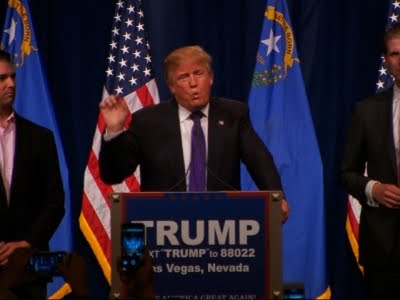 , Trump touted how many different demographic groups he won in Nevada, declaring that “We won the evangelicals. We won with young. We won with old. We won with highly educated. We won with poorly educated,” before exclaiming “I love the poorly educated!”:...
aha tweets are more infotainment than info?
walter benjamin on nazi art
https://www.alternet.org/2020/12/trumpism
icn 320 heartland
new website, called Climate at a Glance, includes brief explanations of key climate science and policy issues, many of which are either misleading or inaccurate.
==
corp coup d-etat: chris hedges : you have to be able to read a book like john ralston saul to know what's going on (understand systems, but [young ppl?] won't
==
Lakely is the Interim President and Director of Communications of The Heartland Institute.
Reporters, editors, producers, and hosts can reach Jim to book a Heartland interview at jlakely@heartland.org or via text/call to his mobile: 312-731-9364.
Heartland has an in-house TV studio from which we can connect to any outlet in the world on a moment's notice. [RED TEXT]
===
https://www.mediamatters.org/blog/2019/05/30/how-disinformation-works-news-outlets-are-filtering-muellers-statement-through-trumps-lies/223837
no lnx pix twit
How disinformation works: News outlets are filtering Mueller's statement through Trump's lies
Blog ››› May 30, 2019 2:27 PM EDT ››› MATT GERTZ
Special counsel Robert Mueller’s Wednesday statement served as an indictment of the press for its failure to effectively convey the damning conclusions of his investigation into Russian interference in the 2016 presidential election to the public and its willingness to accept the dishonest spin of President Donald Trump and the members of his administration. But the behavior of many major news outlets since Mueller stepped down from the Justice Department’s lectern suggests that few lessons have been learned, and journalists continue their business-as-usual practice of filtering their coverage through the lens of Trump’s deceptive critiques.
New York Times reporter Peter Baker’s analysis is a key example of journalists reporting on Mueller’s statement as a good faith disagreement between Democrats and the president. The story appeared online on Wednesday under the headline “Mueller Delivered a Message. Washington Couldn’t Agree on What It Was,” and it was splashed across the paper’s front page the next day. “At long last, the sphinx of Washington spoke on Wednesday,” Baker wrote, “and here is what President Trump heard: ‘Case closed.’ Here is what the president’s adversaries heard: ‘Time to impeach.’”
These are statements that can be assessed for their accuracy, with the reporter concluding that one party’s interpretation is correct. Instead, Baker chose to examine the remarks from both sides and then all but throw up his hands in dismay, framing his story as a case of Washington partisans simply failing to agree on the facts. But the Times scribe’s own reporting in the piece showed that Trump is not credible when he discusses Mueller’s probe. As Baker noted, Mueller’s statement “effectively refuted Mr. Trump’s no-collusion, no-obstruction mantra,” demonstrating the president’s mendacity. He also wrote that the special counsel “implied that Congress could pursue impeachment without directly recommending it,” thus supporting the opinion he ascribed to “the president’s adversaries.”
Baker’s piece rewarded what Washington Post opinion writer Greg Sargent has called the Trump administration’s “full-saturation propaganda casting the investigation itself as the real crime — disinformation designed to blot out shared agreement on the most basic facts about what just happened before all of our very eyes.”
Jay Rosen
?
@jayrosen_nyu
This is why journalists can't simply stand in the middle between warring parties — Barr vs. the House — and report what they say. Stakes are too big. For without 'shared agreement on the most basic facts,' journalism itself becomes impossible or pointless. https://www.washingtonpost.com/opinions/2019/05/29/comeys-new-attack-trump-highlights-big-danger-democrats/ …
This style of political journalism -- setting out the claims of both the Trump administration and its critics and leaving it to the reader to decide which interpretation is correct -- simply doesn’t work in the face of Trump’s systemic disinformation.
Trump and his allies know that they can take advantage of this media vulnerability by offering arguments in bad faith on every last detail. This pushes reporters to cover stories with an “on the one hand, but on the other hand” frame, leaving the public confused about basic facts.
:{
}:
This vulnerability is particularly acute when it comes to headlines -- the only part of a story that most people actually read. Since journalists tend to treat a politician’s statements as intrinsically newsworthy, Trump’s comments are often quoted without context in headlines. That pattern held true yesterday, as several major news outlets produced headlines quoting Trump’s “case is closed” reaction to Mueller’s statement without any context:
This pattern of amplifying the president’s claimscontinued the next day. Speaking to reporters on Thursday morning, Trump laid into Mueller with a fact-free screed, calling him a “true never-Trumper” who “should have never been chosen” as special counsel because he is “totally conflicted.” While the president’s allies have been pushing Mueller’s purported conflicts for years as a way of delegitimizing his investigation, those claims have long been debunked. But that didn’t stop a flurry of tweets from major media outlets promoting his claims in tweets:
@CBSEveningNews
Pres. Trump slams special counsel Robert Mueller Thursday, saying he "should have never been chosen" to lead the investigation into Russian meddling in the 2016 election, a day after the longtime DOJ official made his first public statement on Russia probe https://cbsn.ws/2JLqnJl
ABC News
?
@ABC
Pres. Trump on special counsel Robert Mueller: "I think he is a total conflicted person. I think Mueller is a true never-Trumper. He's somebody that dislikes Donald Trump." https://abcn.ws/2EKwUQi
CNN Politics
?
@CNNPolitics
President Trump calls special counsel Robert Mueller a “true Never Trumper”
The Hill
?
@thehill
President Trump: "There's no obstruction, there's no collusion, there's no nothing. It's nothing but a witch hunt. A witch hunt by the media and the Democrats, they're partners."
And their on-air chyrons:
View image on TwitterView image on TwitterView image on Twitter
Lis Power
@LisPower1
Replying to @LisPower1
Houston, we have a chyron problem
(and it's not just Fox ... though, they're the worst)
Meanwhile, the president’s right-wing media allies continued hammering the message of Mueller’s malfeasance to their huge audiences, depicting the special counsel as a “sleazy and dishonest” “Trump-hating partisan” who participated in a Democratic plot to “steal” the 2018 midterm elections.
The propaganda machine marches on, and credible news outlets aren’t doing nearly enough to hold back its disinformation.
==
==
In the 2016 election, Trump deployed nicknames against every threat. Remember “Low Energy Jeb Bush” and “Liddle Marco” Rubio? Then there was “Crooked Hillary,” the label that drove the Clinton camp crazy.
When it came to “Lyin’ Ted” Cruz, Trump made a point of adding, “You have to spell it right––L-Y-I-N-apostrophe.” Twisting the knife, he went on: “The bible held high, then he puts it down and he lies.”
You could almost hear Uncle Earl holler out that punchline, he lies!
Trump has unsheathed new names for 2020. There is “Sleepy, Creepy” Joe Biden and “Crazy Bernie” Sanders. “Pocahontas,” the sobriquet Trump slapped on Elizabeth Warren, was so troublesome that she got a DNA test to prove Native American heritage.
Trump has gone after others, as well. The Democratic Senate leader is “Cryin’ Chuck” Schumer. The Meet the Press moderator is “Seepy Eyes” Chuck Todd. The former FBI director is “Leakin’ James Comey.” Perhaps funniest––but surely most dangerous––is “Rocket Man,” North Korea’s Kim Jong-un.
Writing for the Columbia Journalism Review, Jon Allsop has called Trump’s capacity to wipe out critics with pejorative nicknames a “dangerous linguistic power.” He also complains that an otherwise “hyper-vigilant” press oddly views this Trumpian tactic an “amusing distraction.”
Nonetheless, Trump’s enemies have tried to beat him at his own game. Only recently, one Democrat tagged him “Con Don.” Over the last few years, we’ve heard “Cheatin’ Don,” “Traitor Trump,” “Agent Orange,” “Captain Chaos,” “Dangerous Donald,” “Hair Hitler,” “King Leer” and “Benedict Donald.” So far, none of these nicknames have stuck.
Today’s distended crop of Democratic presidential candidates will keep trying to stamp Trump with a lethal nickname that will stick. But, can any of them do it? Should they even try? After all, there’s not an Earl Long in the bunch.
==
related to BRANDING? a logo is a meme? a trademark is a meme? logo combines image and word sometimes, or sometime the image aspect stands in for word/name of co /product, which itself stands in or evokes a gestalt of emotions/associations? not unlike a metaphor triggers a spontaneous cognitive/ affective unpacking
images bypass rational thought? (by bypassing language?)
==