Am Pain Society
-=-=
-=-=
AI Overview
Purdue Pharma and the Sackler family strategically funded and utilized front groups like the American Pain Foundation and the Pain Care Forum to downplay opioid risks, promote heavy painkiller usage, and lobby against prescription limits, helping fuel the U.S. opioid epidemic. [1, 2, 3]
The Role of Purdue Pharma and the Sacklers
- The "Pain Movement": Beginning around 2000, former Purdue Pharma president Richard Sackler and company executives helped architect an organized "pain movement". [1, 2]
- Influencing Guidelines: They worked through third-party organizations to issue clinical guidelines that minimized the risk of addiction. [1]
American Pain Foundation (APF)
- Heavy Industry Funding: APF positioned itself as a patient advocacy voice, but internal documents revealed that up to 90% of its multi-million dollar budget came from pharmaceutical firms, with substantial funding funneled directly by Purdue. [1, 2]
- Lobbying and Collapse: The group served to amplify pro-opioid messaging before abruptly shutting down in 2012 amidst congressional investigations into drugmaker ties. [1, 2, 3]
Pain Care Forum (PCF)
- An Industry Coalition: Organized largely by Purdue lobbyists, PCF acted as an unpublicized monthly assembly of opioid manufacturers, distributors, and allied non-profits. [1, 2]
- Policy Shaping: The coalition spent hundreds of millions lobbying statehouses and Washington to block restrictive painkiller regulations and push pro-opioid policies. [1]
If you would like, I can provide more details on:
- The legal settlements involving Purdue Pharma and the Sackler family
- How other pharmaceutical companies funded similar advocacy networks
-=-=
mojo lurie
for years, Purdue Pharma has maintained that it can’t be blamed for the overdose crisis that unfolded after its introduction of OxyContin—but a trove of new evidence suggests that the company was instrumental in laying the groundwork for the opioid epidemic.
As early as 2000, Purdue collaborated with pain patient advocacy groups and professional pain management organizations to create what former president Richard Sackler called a “pain movement.” The company also allegedly worked with competitor and opioid maker Johnson & Johnson, which was recently found liable for contributing to the opioid crisis in Oklahoma, in an effort to create a “pain management franchise.” In addition, company executives appear to have met with the Robert Wood Johnson Foundation to discuss possible collaborations.
These revelations come from new exhibits in the federal litigation bundling roughly 2,000 cases against opioid makers and distributors that is set to go to trial in October. The plaintiffs allege that the pharmaceutical companies worked together in a conspiracy to sell more opioids, an allegation that the defendants vigorously deny. Under the terms of a recently-leaked settlement proposal, Purdue and its owners, the Sackler family, may soon settle all the claims brought against the company by thousands of state and federal lawsuits.
Here are some highlights from the recently unsealed exhibits:
“They are going to have to learn to live with ‘industry’ reps on their board”
In order to promote opioids, pharmaceutical companies funded a number of professional and patient advocacy organizations to serve as “front groups,” according to the plaintiffs, including the now defunct American Pain Foundation and the American Pain Society. Some of the groups went on to issue guidelines minimizing the risks of opioid addiction, lobby to change laws aimed at curbing opioid abuse, and protect doctors sued for overprescribing painkillers, according to an investigation by former Missouri Sen. Claire McCaskill (D).
The new exhibits suggest Purdue’s motives in collaborating with these organizations. In a 2001 email conversation with colleagues about meeting with patient advocacy groups, Purdue president Richard Sackler wrote, “Our goal is to bind these organizations more closely to us than heretofore, but also to align them with our expanded mission and to see that the fate of our product(s) are inextricably bound up with the trajectory of the pain movement.”
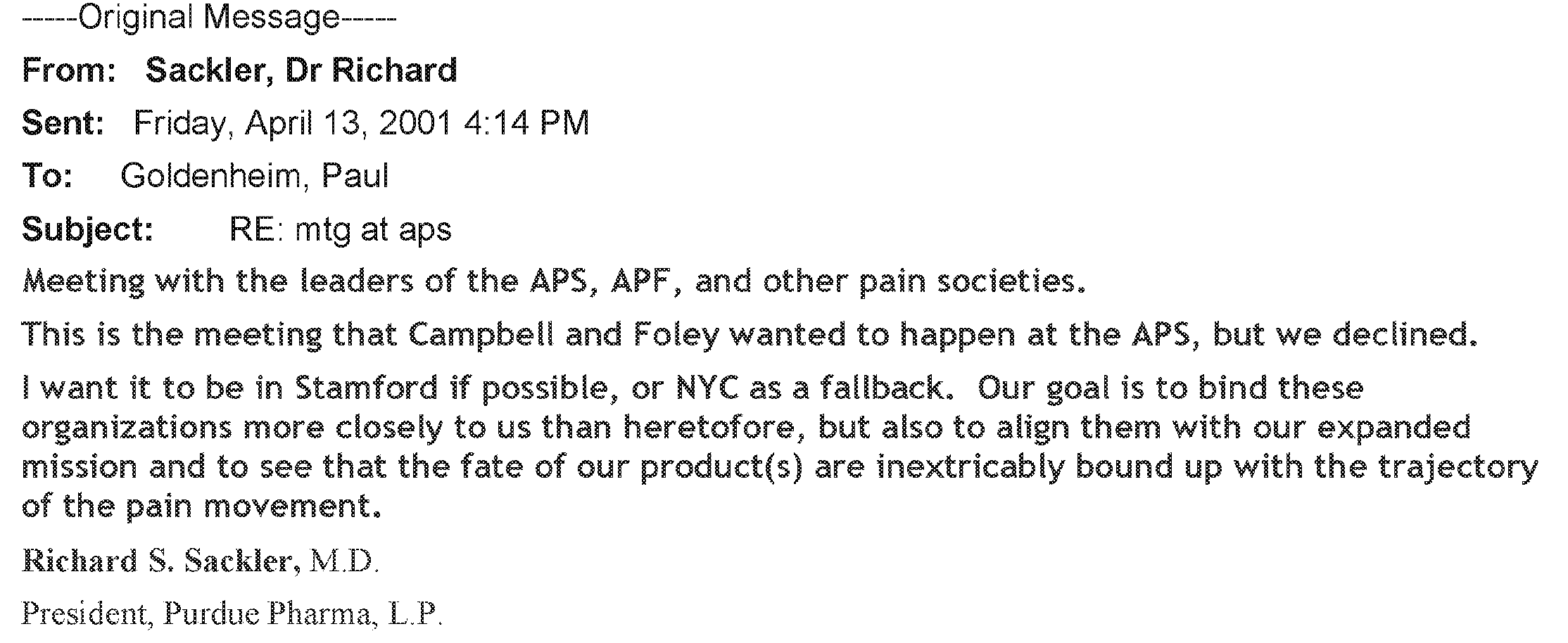 A screenshot of email correspondence published in the multi-district opioid litigation.
Purdue executive Robin Hogen allegedly stated in a 2000 memo that if the American Pain Society “want our bucks (and they honestly cannot survive without industry support) they are going to have to learn to live with ‘industry’ reps on their board. I don’t think they can expect huge grants without some say in governance.” (Hogen said that the memo showed “some naiveté on my part and a little bravado…from a new employee.” He added that Purdue did not heed his advice, and, in an email to Mother Jones, Purdue denied controlling the organizations it sponsored. The American Pain Society filed for bankruptcy in July.)
Collaborating with Johnson & Johnson to create a “Pain Management Franchise”
According to the court documents, as early as 2000, Purdue began working with Johnson & Johnson, whose pharmaceutical subsidiaries sold opioids Duragesic and Ultram, on a “co-promotion agreement” in which sales representatives would promote both companies’ opioid products. The ultimate goal, according to a J&J presentation, was to “Build a partnership between Purdue Pharma LP and J&J that leverages each partner’s assets and capabilities to create a Pain Management Franchise that is significantly larger and more profitable than that which the partners could build on their own.”
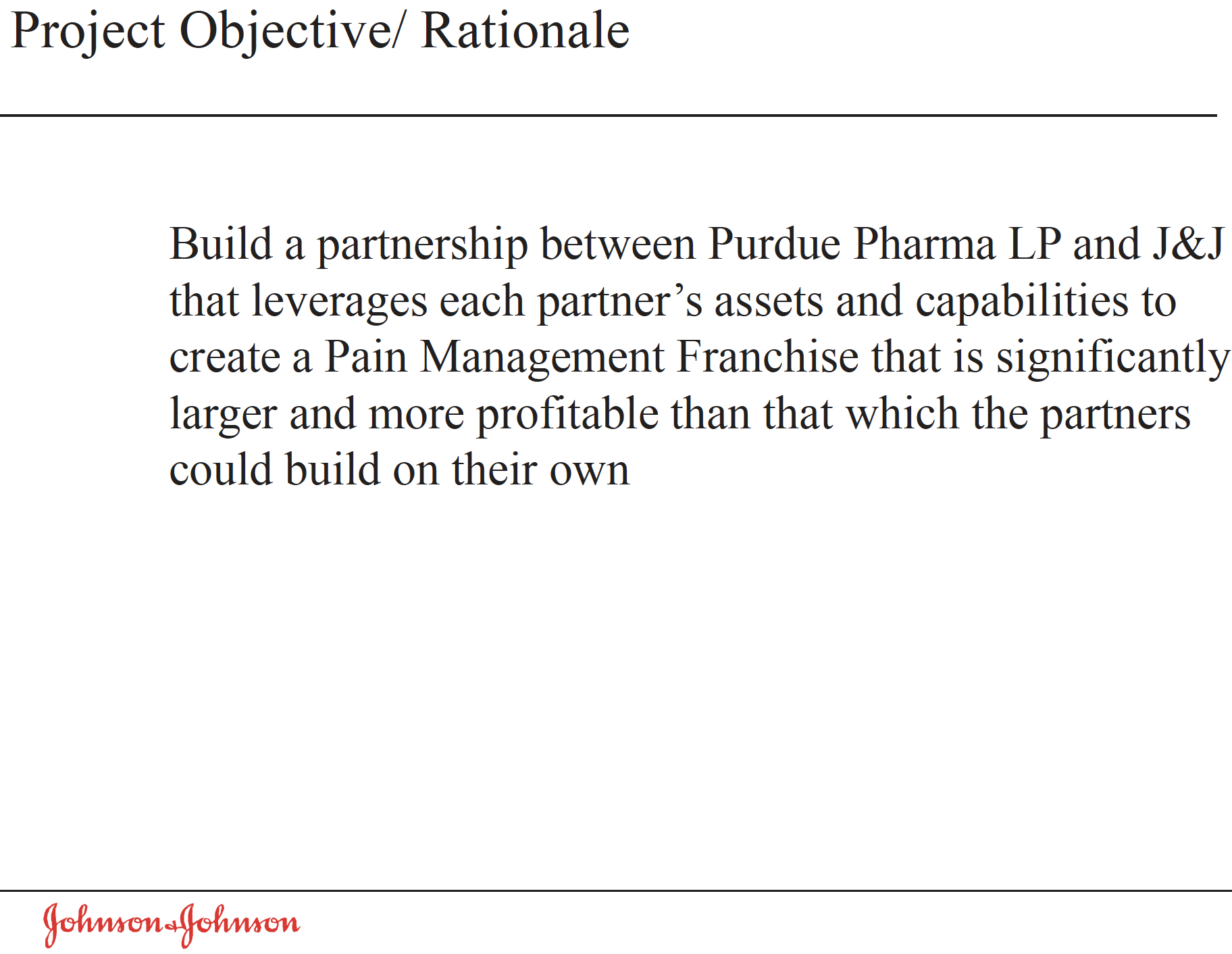 A screenshot of a J&J presentation regarding a possible collaboration with Purdue
The co-promotion agreement never came to fruition, but evidence suggests that the companies instructed their sales representatives not to attack the others’ brands. In 2001, after an executive from J&J subsidiary Janssen complained that Purdue’s sales representatives were telling doctors about the abuse of Janssen’s opioid, Duragesic, a Purdue executive instructed Purdue’s sales force not to discuss abuse and diversion of OxyContin or Duragesic. If they did, the letter stated, there would be consequences: “Janssen Pharmaceuticals and Purdue have agreed that should either company have representatives who promote product out of label or out of policy, the name of the representative will be provided to the other company for investigation and disciplinary action if needed.”
A J&J spokesman told Mother Jones, “Janssen and Purdue were and remained competitors.”
“It would be much better if the advocacy came from outside of the drug company”
In 2001, shortly after the first media reports of widespread abuse of OxyContin, Dr. Kathleen Foley, a neurologist at Memorial Sloan Kettering Cancer Center in New York and a former paid speaker for Purdue, emailed Richard Sackler urging the company to collaborate with other pharmaceutical companies. “I’m thinking of an alternative strategy of bringing together all of the members of the pharmaceutical industry, who have analgesic drugs out there and try to come together as a sort of cohesive voice recognizing that your particular drug has been recently identified in the newspapers as a drug issue,” she wrote. “I think that there is a tightrope that you need to walk, because you are a drug company and it would be much better if the advocacy came from outside of the drug company and even better without much in the way of support from you.”
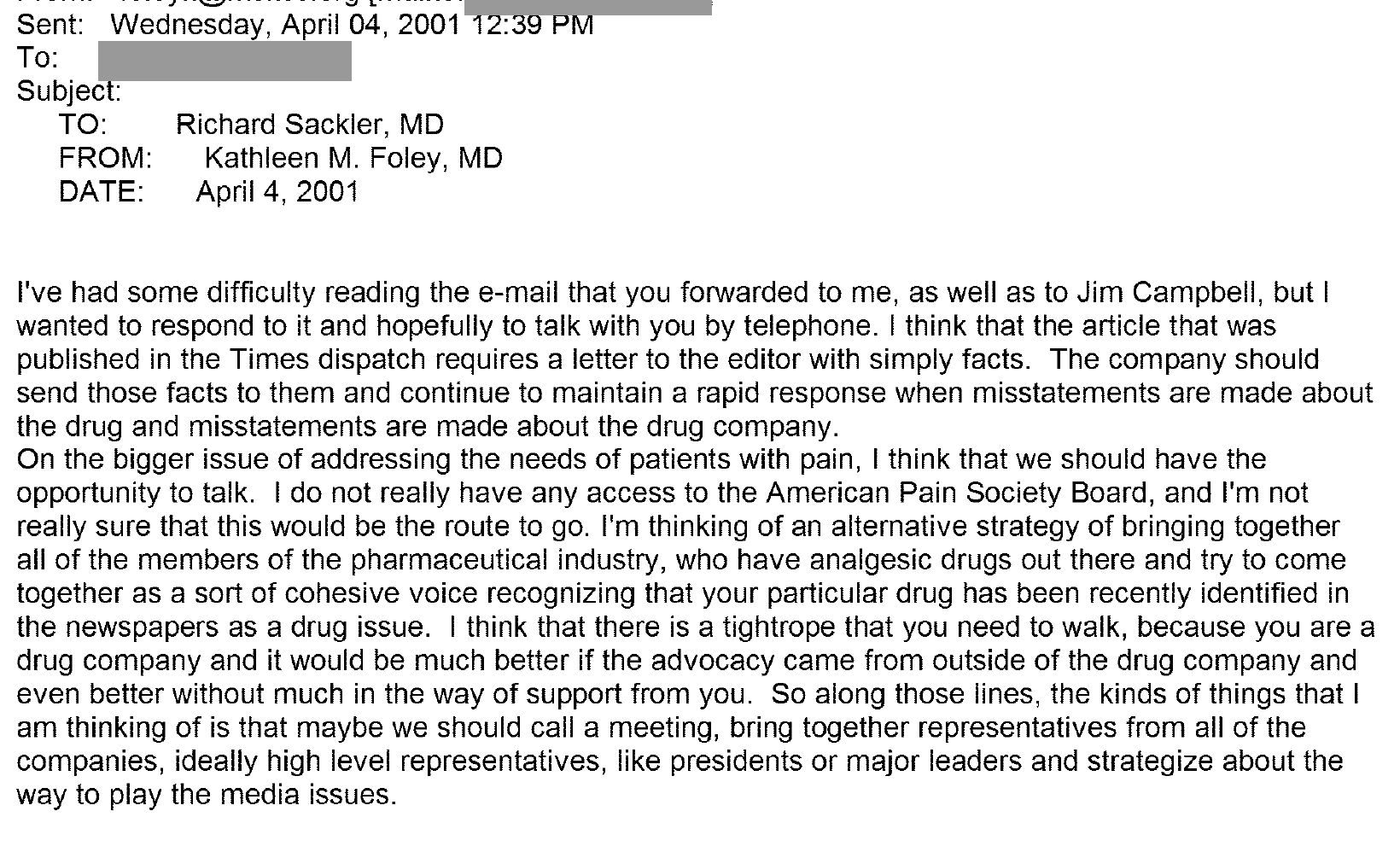 A portion of Foley’s email to Sackler
In 2005, Purdue lobbyist Burt Rosen allegedly organized the Pain Care Forum. Purdue, J&J, and the American Pain Foundation were among the group’s early participants, but, according to court documents, the forum soon included virtually every major opioid maker and distributor. “I think this could fill the vacuum of leadership in the community at large, and provide for some unified direction on issues of importance to the pain community,” Rosen allegedly said. The forum—which has no public website, meeting notes, or member list—served as a platform for industry to discuss issues related to opioid supply and coordinate media and policy campaigns.
When the CDC proposed guidelines urging doctors to limit opioid prescribing, the group mounted a coordinated, seemingly-grassroots effort to criticize the guidelines using “media efforts and recruiting patients and provider experts,” according to court documents. Though Rosen denied that the forum itself hires lobbyists, the forum’s members allegedly spent nearly $900 million to influence government between 2006 and 2015.
Purdue’s Work with the Robert Wood Johnson Foundation
Among the unsealed exhibits is a memo submitted by Purdue’s Robin Hogen describing a July 2000 meeting between Purdue executives and Robert Wood Johnson Foundation president Dr. Steve Schroeder. The foundation, started by and named after J&J’s former leader, is the nation’s largest philanthropic organization focused solely on public health. At the time, about 60 percent of the foundation’s holdings were in J&J stock.
Hogen wrote,
They were impressed with the scope of our programs and invited Purdue to join the national coalition they are forming to improve care and caring at the end of life (called the Last Acts Partnership). We would be the only for-profit company in that category. Dr. Steve Schroeder, President of the RWJ Foundation, indicated that they rarely sit down with pharmaceutical companies to discuss areas of mutual interest. He was impressed when we described the unbranded, non-promotional aspect of our speakers bureaus and symposia and seemed quite interested in keeping the lines of communications open for possible future partnerships.”
The memo notes that “areas of possible future collaboration” include setting up “Purdue Faculty Fellowships,” “help in identifying pain management advocates,” and “sponsorship of a session on pain management” at an annual foundation meeting. The memo ended, “I believe this is a relationship that could yield many happy returns to both Purdue and RWJ.”
Hogen, who later worked in communications for Yale and the RWJ Foundation, told Mother Jones that the meeting was part of a company effort to reach out to organizations “who shared our interest in treating chronic pain patients humanely.”
None of the collaborations mentioned in the memo came to be; the foundation “subsequently declined opportunities to collaborate with Purdue on programs related to pain assessment and pain management,” according to RWJ spokesman Jordan Reese. “We are working alongside others—and across disciplines—to address the many factors that lead to addiction, as well as to advance policies and practices that will prevent another such crisis from occurring,” he said. Today, about 15 percent of the foundation’s holdings are in J&J stock.
“Make the whole pie bigger, not only for us but for our competition as well”
In 2000, Purdue held a sales meeting in Palm Beach, at which an executive named Mark gave a speech welcoming the sales representatives. Below is part of Mark’s script, included in the unsealed exhibits:
(MARK SHOULD ENTER WEARING SUNGLASSES)
… You know, it’s always hot here in Palm Springs. That’s why it’s a perfect place to have our meeting … because we’re hot … we’re burning up the competition with our sales of OxyContin! Do you know it’s now the number one prescribed opioid brand in the U.S.?
“Now, you’re probably wondering what else can be done to sell even more OxyContin,” Mark went on. “There are also some things we’re cooking up for the coming year to help you and OxyContin and the whole pain market as well.” These initiatives allegedly included collaborating with the American Pain Society to develop materials that would “be distributed to hospitals across the country” and “weekly feature stories about pain and its management in newspapers.” The goal, said Mark, is to “raise awareness of undertreated pain” and to “Make the whole pie bigger, not only for us but for our competition as well.”
Mark concluded,
I hope you enjoy your stay here in Palm Springs, I know I will. Enjoy the weather … because let me tell you, OxyContin’s continuing success, is going to make every part of this country from Seattle to Detroit to New Orleans as hot as it is here in Palm Springs this winter for every one of you. You are the force for the future … let’s make it happen! (PLAY SONG HOT, HOT, HOT)
-=-=
AI Overview

The National Pain Care Policy Act was federal legislation introduced in the late 2000s to improve chronic pain management and research. Its key provisions were ultimately incorporated into and passed as part of the Patient Protection and Affordable Care Act in 2010, establishing structured research and education programs for pain care. [1, 2]
Key Goals and Components
- Research Expansion: Required the National Institutes of Health (NIH) to establish a Pain Consortium to set a national research agenda for the causes and treatment of pain. [1]
- Advisory Committees: Mandated the creation of the National Pain Care Research Advisory Committee to evaluate federal pain research. [1]
- Data Collection: Directed the Agency for Healthcare Research and Quality (AHRQ) to collect and distribute evidence-based pain care practices. [1]
- Education and Awareness: Authorized funding for training health care professionals in pain management and launched a national public awareness campaign. [1]

- Center for Public Integrity
- Pro-painkiller echo chamber shaped policy amid drug epidemic
- Sep 19, 2016 — From 2006 through 2015, participants in the Pain Care Forum spent over $740 million lobbying in the nation's capital and in all 50...


- NBC News
- Here's How Drugmakers Fought State Opioid Limits - NBC News
- Sep 19, 2016 — A FOCUS ON PAIN TREATMENT ... For instance, they show that pharmaceutical companies and their allies ramped up their lobbying and ...


- Drugwatch.com
- Prescription Addiction: Big Pharma and the Opioid Epidemic
- Dec 15, 2017 — Pain Legislation Pushed The forum pushed for legislation requiring the Institute of Medicine to develop a comprehensive report on ...
Lessons from Corporate Influence in the Opioid Epidemic - PMC

National Institutes of Health (NIH) | (.gov)
https://pmc.ncbi.nlm.nih.gov › articles › PMC7357445
by JH Marks · 2020 · Cited by 123 — The American Pain Society received almost $1 million from opioid companies, and it also dissolved in 2019 after facing lawsuits for its role in ...Read more
Inside Purdue Pharma's Media Playbook: How It Planted ...

https://www.propublica.org › Archive
Nov 19, 2019 — It also funded groups, like the American Pain Foundation, that described themselves as advocates for pain patients. Several of those groups ...Read more
Missing: e | Show results with: e
Sacklers Gave Millions to Institution That Advises on Opioid ...

https://www.nytimes.com › 2023/04/23 › health › sackl...
May 1, 2023 — Donations from Dame Jillian Sackler, whose husband, Arthur, died years before OxyContin arrived on the market, began in 2000 in amounts that by ...Read more
Missing: e | Show results with: e
Museums Aren't the Only Institutions Benefiting from ...

https://progressive.org › The Latest
Dec 14, 2017 — Sacklers have donated to scientific organizations that have helped influence how painkillers like OxyContin have been prescribed and regulated.
Missing: Care | Show results with: Care
Sackler family

https://en.wikipedia.org › wiki › Sackler_family
The Sackler family is an American family who owned the pharmaceutical company Purdue Pharma and later founded Mundipharma. Purdue Pharma, and some members ...Read more
Unsealed Documents Show How Purdue Pharma Created ...

https://www.motherjones.com › 2019/08 › unsealed-do...
Aug 29, 2019 — In 2005, Purdue lobbyist Burt Rosen allegedly organized the Pain Care Forum. Purdue, J&J, and the American Pain Foundation were among the group ...
Missing: e | Show results with: e
The Family That Built an Empire of Pain

https://www.newyorker.com › Magazine › Purdue Pharma
Oct 23, 2017 — The Brooklyn-born brothers Arthur, Mortimer, and Raymond Sackler, all physicians, donated lavishly during their lifetimes to an astounding range ...Read more
-=-=
Michigan Democratic Party
Mike Rogers' Disastrous Opioid Record on Display as Purdue ...
Apr 28, 2026 — Mike Rogers championed pro-opioid legislation while pocketing hundreds of thousands of dollars from his Big Pharma campaign donors...
NEW: “Mike Rogers Distorts Opioid Record to Boost Senate Bid” - Michigan Democratic Party
LANSING — New reporting from American Journal News reveals multi-millionaire Florida resident Mike Rogers has started “misrepresent[ing] his record” of advocating to boost access to opioids while he was in Congress.
According to the report, Rogers falsely claimed in a recent op-ed that the legislation he supported in Congress included safeguards to prevent overprescription and addiction, when in fact it “did not include any penalties for doctors who overprescribe” and “didn’t set prescribing limits or expand law enforcement’s ability to police opioids.”
Mike Rogers was “blasted” over his opioid record during his failed 2024 campaign. Bridge Michigan first reported that Rogers was a “leading advocate” in Congress to “boost opioid prescriptions”—and that he did so while receiving “hundreds of thousands of dollars in campaign contributions” from the same drug companies that now are paying “billions of dollars in national opioid settlements for their roles in causing the epidemic.”
Read more:
American Journal News: Mike Rogers distorts opioid record to boost Senate bid
- Mike Rogers, a Republican candidate for U.S. Senate in Michigan, misrepresented his record on fighting the opioid epidemic in a recent editorial for Deadline Detroit.
- Rogers has been criticized for championing the National Pain Care Policy Act when he served in Congress from 2001 to 2015, a law that some say encouraged doctors to treat chronic pain with pharmaceuticals like OxyContin.
- “In Congress, I voted to allow Americans who are suffering from debilitating pain to have access to the treatment they need to live comfortably,” Rogers wrote. He added that the legislation had safeguards to prevent overprescription and addiction.
- But this isn’t true. The National Pain Care Policy Act did not include any penalties for doctors who overprescribe. It also didn’t set prescribing limits or expand law enforcement’s ability to police opioids.
- In 2003, Rogers held a press conference touting the National Pain Care Policy Act with the American Pain Society, a nonprofit group that raised awareness about chronic pain and backed pharmaceuticals to treat it. The group disbanded in 2019 over allegations that it colluded with pharmaceutical companies to promote opioids.
- Rogers has also been criticized for accepting large donations from the pharmaceutical industry. Since 1999, he has received more than $1 million in contributions from Big Pharma and other health care-related entities.
- Data from the Michigan Department of Health and Human Services show a clear correlation between the rate of opioid prescriptions and overdoses in the state, particularly between 2001 and 2010. In 2010, the FDA cracked down on opioid prescriptions and reformulated OxyContin so it was harder to crush or dissolve for illicit use. In subsequent years, the rate of heroin and fentanyl overdoses has skyrocketed.
-=-=