Andrew Boutrous a G
estb 10 236
-=-=
11 26 ~ kat a
dn
The former head of the FBI’s Chicago field office sued the Justice department on Monday, alleging the Trump administration pushed him to open politically driven investigations and blamed him when a high-profile prosecution of anti-ICE protesters known as the Broadview 6 collapsed. Douglas DePodesta previously led the FBI’s Chicago office until he was forced to resign in July. His complaint focuses on Andrew Boutros, the U.S. attorney in Chicago. DePodesta says Boutros targeted protesters during last year’s immigration crackdown in Chicago known as Operation Midway Blitz under pressure from the Trump administration, with a particular focus on Kat Abughazaleh, who was a congressional candidate at the time.
-=-=
dck 11 26
WBEZ
https://www.wbez.org › politics › 2026 › 11 › 02 › broadview-six-depodesta-boutros-kat-abughazaleh
Former FBI boss' lawsuit undermines Boutros' denial of Washington's ...
1 day agoDouglas DePodesta's lawsuit notes that "persons close to the Trump administration called for criminal prosecution of the protesters, particularly Kat Abughazaleh, who was running for the ...
Democracy Now!
https://www.democracynow.org › 2026 › 11 › 3 › headlines › former_head_of_chicago_fbi_sues_doj_alleging_politically_driven_prosecutions
Former Head of Chicago FBI Sues DOJ, Alleging Politically Driven ...
TodayThe former head of the FBI's Chicago field office sued the Justice department on Monday, alleging the Trump administration pushed him to open politically driven investigations and blamed him ...
YouTube
https://www.youtube.com › watch?v=QXCm2GsqYKw
DOJ Spent 7 Months Calling YouTuber Kat Abu a Terrorist — Then Tried to ...
DOJ Spent 7 Months Calling YouTuber Kat Abu a Terrorist — Then Tried to ...
1:08
Jun 8, 2026DOJ Spent 7 Months Calling YouTuber Kat Abu a Terrorist — Then Tried to Hide What They Did LegalEagle 3.95M subscribers 28K
Created by:LegalEagle
719K views
Advocate.com
https://www.advocate.com › news › crime › kat-abughazaleh-charges-dropped
Judge dismisses charges against Illinois ICE protesters | Advocate.com
May 22, 2026Judge stunned by DOJ conduct in Illinois anti-ICE protest prosecution dismisses 'Broadview Six' charges A federal judge sharply rebuked prosecutors after explosive grand jury transcripts ...
Total News
https://totalnews.com › charges-dropped-against-illinois-anti-ice-activists-including-former-congressional-candidate-kat-abughazaleh-due-to-claims-of-grand-jury-misconduct
Charges dropped against Illinois anti-ICE activists, including former ...
May 22, 2026The U.S. attorney in Chicago unexpectedly dropped a criminal case involving four activists opposed to ICE on Thursday, among them former Democratic Representative Kat Abu-Ghazaleh. This decision followed a federal judge's criticism, accusing the prosecution of manipulating the grand jury process to secure indictments. U.S. Attorney Andrew Boutros stated that…
Washington Examiner
https://www.washingtonexaminer.com › news › justice › 4579162 › prosecutors-drop-charges-kat-abughazaleh-ice-facility-protestors
Prosecutors drop charges against Chicago ICE protestors
May 22, 2026Federal prosecutors revealed Thursday that the government is dropping charges against several Illinois protestors who demonstrated against Immigration and Customs Enforcement last year.
-=-=
10 26 no talk
Andrew S. Boutros is an American lawyer, law professor, and former federal prosecutor,[1]^ who has served as the United States Attorney for the Northern District of Illinois since April 2025. He has prosecuted corporate fraud and cybercrime cases,[2]^ including Chicago-based Silk Road cases.[3][4]^ He was elected to the American Law Institute in 2015.[5]^ He was the Regional Chair of Dechert LLP's White Collar practice, based in the firm's Chicago and Washington, D.C., offices.[6]^
In May 2026, Boutros dismissed all charges in the "Broadview Six" immigration protest case after his staff's grand jury misconduct was revealed. He received judicial criticism for continuing to defend the prosecution's underlying merits, after what the trial judge described as the worst prosecutorial misconduct she had ever seen during the case's grand jury phase, all of which occurred on Boutros's watch.[7][8]^
Education and early career
Boutros is a first-generation American whose parents emigrated from Egypt.[4]^ He earned his undergraduate degree from Virginia Tech, graduating summa cum laude.[2]^ He then atttended the University of Virginia School of Law where he received his J.D. in 2001.[4]^ Jeffrey O'Connell, one of Boutros's academic mentors in law school, co-authored with him an article on tort reform that appeared in the Notre Dame Law Review.[5]^ After law school, Boutros clerked for the Judge Eugene E. Siler Jr. of the United States Court of Appeals for the Sixth Circuit.[2][5]^ He then worked as a defense attorney in the Washington, D.C., office of an international law firm, where he helped launch and run the firm's Foreign Corrupt Practices Act (FCPA) group.[4]^
Legal Career
Assistant U.S. Attorney
In 2007, U.S. Attorney Patrick Fitzgerald hired Boutros as an Assistant U.S. Attorney for the Northern District of Illinois.[4]^ He moved to Chicago and began working on January 7, 2008.[1]^ He was a member of the Financial Crimes and Special Prosecutions unit at the office.[3]^ Over nearly eight years, Boutros prosecuted cases involving white-collar crimes, fraud, money-laundering, drug trafficking and cybercrime.[4][9][10][11][12]^
His work included prosecuting individuals connected to the Silk Road online black market. He assisted in the prosecution Ross Ulbricht, the founder of Silk Road, who received a life sentence after conviction[3][11]^ before being fully and unconditionally pardoned by Donald Trump.[13]^ He also led the prosecution of Cornelis Jan "SuperTrips" Slomp, described by the government as the Silk Road's "most prolific online drug dealer,[14]^ who received a ten-year prison sentence in May 2015.[11][14]^
Boutros also served as the prosecutor in what was called the "largest food fraud in U.S. history" or "Honeygate". The first phase of the operation targeted individuals and companies involved in illegally importing cheap, and occasionally contaminated, honey from China. That phase resulted in $80 million in losses.[9][10]^ The second phase focused on those illegally buying and shipping the illegally imported Chinese honey amounted to $180 million in losses.[4][9][10]^ The total fraud in "Project Honeygate" was estimated at $260 million.[9]^
Among Boutros' early cases was a healthcare prosecution.[4]^ In 2008, he charged Peter G. Rogan, owner of Chicago's Edgewater Medical Center,with perjury and obstruction of justice. Rogan owed $188 million in civil judgments, largely for Medicare fraud.[3][12]^ Rogan evaded capture in Canada for seven years. In 2015, as one of his final acts as a federal prosecutor, Boutros represented the government in the case against Rogan, who was sentenced to 21 months in prison.[1]^
Private practice and teaching
In October 2015, Boutros joined Chicago-based law firm Seyfarth Shaw as National Co-Chair of its White Collar, Internal Investigations and False Claims practice, ending his nearly eight-year career with the U.S. Attorney's Office in Chicago.[4][15][16]^ In September 2019, he joined Dechert LLP as Regional Chair of the U.S. white-collar practice.[17]^ He worked in both the Chicago and Washington, D.C. offices of Dechert. Since 2011, Boutros has been a lecturer in law at the University of Chicago Law School,[1]^ where he teaches an advanced course on corporate criminal prosecutions and investigations.[2]^
U.S. Attorney for the Northern District of Illinois
On April 7, 2025, Boutros took the oath of office as United States Attorney for the Northern District of Illinois under 120-day appointment by Attorney General Pamela Bondi.[18][19]^ On July 24, 2025, the U.S. District Court in Chicago entered an order approving the appointment, effective August 5, 2025.[20]^
In May 2026, Boutros made a rare personal courtroom appearance to dismiss all remaining charges against the "Broadview Six," a group of political figures and activists indicted in October 2025 for protesting outside of an Immigration and Customs Enforcement (ICE) facility. The dismissal followed disclosures of extensive prosecutorial misconduct by the assistant U.S. Attorneys handling the grand jury proceedings, which included improper "prosecutorial vouching" and the dismissal of grand jurors who openly disagreed with the government's case.[7][21]^ While Boutros stated he was entirely unaware of the specific grand jury infractions until late April 2026 and took official responsibility for his office's failures, he heavily criticized the defendants' behavior during the dismissal hearing, calling it "unacceptable in a civilized society."
This drew a sharp rebuke from U.S. District Judge April Perry, who admonished Boutros for "significantly undercutting" his apology by continuing to publicly vilify the defendants.[8][22]^ In the aftermath of the "Broadview Six" case, over one hundred former United States District Court for the Northern District of Illinois prosecutors signed a public letter stating that Boutros "tarnished [thoe office's] reputation" due to a "failure of leadership" and because "once-forbidden political considerations are infecting prosecutorial decisions".[23]^
In May 2026, The New York Times reported that Boutros had opened an investigation into whether E. Jean Carroll, a former magazine writer whom President Trump sexually assaulted and defamed, committed perjury in her civil lawsuits against Trump.[24]^ The investigation focuses on whether she was truthful about the funding of her legal bills by a nonprofit founded by billionaire Reid Hoffman, a prominent critic of Trump's.[25]^
While Boutros has presided over the federal prosecutor's office in Chicago, grand juries have rejected several of the office's attempts to bring charges, a setback that The New York Times called "a once-rare rebuke," and so many high-level staffers have left that Boutros had to send out a letter inviting recent retirees to come back to work.[26]
In August 2026, The New York Times reported that in August 2025 Boutros had subpoenaed a Democratic fund-raising firm whose vice president was Judge Juan Merchan's daughter Loren until late 2024 for internal communications with clients that included former vice president Kamala Harris, former president Joe Biden, Governor Kathy Hochul of New York, Representative Hakeem Jeffries of New York, and the Democratic National Committee.
Prosecutors later limited the subpoena to a $468 payment from Harris's 2024 presidential campaign and emails between Merchan and his daughter. According to The New York Times, the "language in the subpoena is virtually identical to claims made" by a House committee that Trump's conviction in the New York hush-money trial was "potentially politically motivated".[27]
Recognition and awards
Boutros is a member of the American Law Institute and the American Bar Foundation.[5]^ He is the national co-founder and co-chair of the American Bar Association's (ABA) Criminal Justice Section's Global Anti-Corruption Committee and is a voting member of the ABA Criminal Justice Section Council.[2]^ The Federal Law Enforcement Officers Association gave him the National Prosecutorial Award in 2015,[28]^ and the ABA gave him the Norm Maleng Minister of Justice Award in 2014.[29]^
Publications
- "Treating Medical Malpractice Claims under a Variant of the Business Judgment Rule", with Jeffrey O'Connell, 77 Notre Dame Law Rev. 373 (2002)[30]^
- "Deferred Prosecution Agreements: A View from the Trenches and a Proposal for Reform", with F. Joseph Warin, 93 Va. L. Rev. Brief 121 (2007–2008)[31]^
- "Carbon Copy Prosecutions: A Growing Anticorruption Phenomenon in a Shrinking World", with T. Markus Funk, 2012 U. Chi. Legal F. 259 (2012)[32]^
- "Another Bite at the Apple: Transnational Crimes Face Repeat Punishment", 39 Litig. 43 (2013)
- The ABA Compliance Officer's Deskbook, with James T. O'Reilly, T. Markus Funk (2018)
References
-=-=
an 10 26
New York Times Justice Department and F.B.I. reporter Devlin Barrett says it takes more than a vengeance-driven president to prosecute his personal grievances against people he thinks have crossed him. It also takes enablers with law degrees who are willing to soak those degrees to pursue Trump’s agenda.
Barrett is ready to name-check the worst of them.
“At least eight current U.S. +attorneys have played prominent roles in pushing Mr. Trump’s grievances, often citing thin evidence that has subsequently led many of their cases to collapse,’ reports Barrett. “Three of those are running their offices without Senate confirmation.”
Minnesota AG Daniel Rosen is first up on Barrett’s hit list, being a man who has “aggressively pursued cases” against people in Minneapolis who protested the administration’s immigration policies and helped oversee investigations into Rep. Ilhan Omar, a Minnesota Democrat whom Trump has vowed to deport.
Rosen, said Barrett, is a commercial litigator who had never been a prosecutor, but who jumped to Trump’s marching orders when the president outright told him to “prosecute Ilhan Omar,” according to people familiar with the exchange. Federal agents, as part of an investigation overseen by Rosen’s office, conducted a recent search at Omar’s home in Washington.
John A. Sarcone III is grievance agent No. 2, according to Barrett, for leading “efforts to investigate New York’s attorney general, Letitia James, on the theory that she violated the civil rights of Mr. Trump.”
A federal judge blocked Sarcone in January from overseeing the investigation since he isn’t lawfully serving as acting U.S. attorney, but Barrett says that hasn’t stopped him from sending federal prosecutors to try to wring evidence against James from her hairdresser.
Down in North Carolina, meanwhile, Dan Bishop — again, who has never been a prosecutor — has been tasked to pursue election integrity cases across the country as part of Trump’s hunt for “evidence of mass voter fraud in the 2020 election.” Barrett says he’s seized hundreds of boxes of ballots in Georgia to buttress Trump’s debunked claim of election fraud there.
In Los Angelas, Barrett says Bill Essayli “has pushed to charge cases against anti-Trump protesters, many of which fell apart in court.”
When Trump said “they are trying to steal that election” in California primary, Barrett said Essayli dutifully followed Trump’s orders and began a search, despite never being confirmed for his role. And according to people familiar with the matter, Essayli insisted on charging a man who had provided face shields to anti-ICE protesters, despite objections from some members of his staff, said Barrett. Essayli’s charges got thrown from court.
And then there’s Jason A. Reding Quiñones in Miami, who has overseen “a centerpiece of Mr. Trump’s retribution campaign,” according to Barrett, a “grand conspiracy” by officials in the Biden and Obama administrations to pursue Trump. While Trump’s crusade has brought few indictments, Barrett said the crusade itself has “end[ed] the prosecutorial careers of many of the lawyers assigned to it.”
“The first two U.S. attorneys were forced out, having displeased senior Trump administration officials by concluding criminal charges were not warranted,” said Barrett.
District of Columbia AG Jeanine Pirro has pursued her own indictments of the president’s critics and “others invoking his ire, even when some of her prosecutors say the evidence does not support charges,” said Barrett.
Her list of failures are racking up, he added, including the indictment of David Hearn, a former Olympic athlete, for felony destruction of the Reflecting Pool.
“In dropping the case, Ms. Pirro’s office claimed that Department of Interior officials withheld key details that would have changed prosecutors’ view of the evidence,” said Barrett. “However, she and her investigators knew even before they went into the grand jury that there was at least one significant evidentiary flaw in their case and barreled ahead anyway, according to court filings by Mr. Hearn’s lawyers.”
And a federal judge also trampled her efforts to subpoena former Federal Reserve Chairman Jerome H. Powell, saying Ms. Pirro’s office had offered “no evidence whatsoever” that he had “committed any crime other than displeasing the president.”
North Carolina’s W. Ellis Boyle is another Trump agent who brought criminal charges against former F.B.I. director James Comey — for posting a photo of seashells.
“Of all the retribution-tinged indictments and investigations that have marked the second Trump term, none has more alarmed or angered longtime Justice Department officials than the one over the seashells photo,” said Barrett. “Senior Trump administration officials tried and failed in mid-2025 to find a prosecutor willing to charge Mr. Comey with threatening the president” with beach photos.
Finally, there’s Chicago AG Andrew Boutros, who Barrett says has managed to flub two dozen of more than 30 criminal cases filed against people for crimes like assaulting a federal agent or resisting a federal agent during the operation.
“I thought it was a crock,” one grand juror told prosecutors. “And I still think it is.”
And even when Boutros nabbed an indictment, a federal judge found the office had mishandled the case and dismissed the charges.
Boutros has yet to be confirmed as AG by the Senate.
ref 1
After nearly 20 years working for the U.S. Justice Department Sheri Mecklenburg said that she's been forced to take a retirement and she's telling all in a letter to Chicago U.S. Attorney Andrew Boutros.
Chicago Sun-Times reporter Jon Seidel obtained Mecklenburg’s letter alleging that it was President Donald Trump's appointed U.S. attorney who instructed her to file felony charges against the group of officials and activists known as the "Broadview Six." Instead, she explained, the case would be “better suited to misdemeanor charges.”
The group of six immigration rights activists and local political figures known as "The Broadview Six" have already called on the judge to appoint a special counsel to investigate the Justice Department for criminal contempt.
The six were targeted as part of the arrests around the immigration raids in Chicago known as "Operation Midway Blitz." Judge Perry discovered apparent prosecutorial misconduct after the defense attorney suggested she review the unredacted transcripts of the grand jury.
Prosecutors browbeat the grand jury, lied and manipulated them to get the indictment they wanted. One grand juror called the case a "crock of s——" and the prosecutors dismissed them. Another who questioned the facts presented by the prosecutors was asked to leave. The case was tried three times, despite the grand jury shooting down the prosecution, the local NBC affiliate described in June.
Mecklenburg's three-page letter made it clear that she was retiring “under protest.” She believes that she has become “a convenient target to be scapegoated and publicly vilified.”
“You have forced me to choose between remaining silent while my professional reputation is destroyed and prematurely surrendering my cherished career,” Mecklenburg told Boturos. “I choose the latter.”
She alleged that Boutros had laid “responsibility at my feet for a felony prosecution that you personally directed over my objection that the case was better suited to misdemeanor charges.”
Retirement allows her to keep her healthcare benefits, she said, which were "earned over decades of service." She also threatened, "If you carry through on your threat to terminate me, I will lose those benefits. If I do not retire now, I cannot defend myself."
The scathing letter continues, "The Office's tardy acknowledgment in its response brief that I did nothing to warrant sanctions was incomplete and does not erase the incredible damage caused by your prior statements.
Beyond omitting the key Grand Jury Manual provision, the Office's brief withheld the fact that I repeatedly sought guidance from, kept informed, and followed the directions of the Front Office — including you — at every consequential stage. It is telling that neither you nor anyone preparing the Office's response consulted with me or my attorneys about the relevant facts and defenses before filing it. The Office did not fully present the facts supporting my conduct. It now seeks to prevent me from presenting those facts myself."
She further alleged that he intentionally kept her attorneys "in the dark" and that he was responsible for redacting her comments from the grand jury transcript that was ultimately submitted to the judge. When the judge and defense learned that the grand jury information had been edited by the U.S. Attorney's Office, it didn't go over well.
She said that he then "declined to notify me about the May 21, 2016, court hearing, which I had the indignity of learning about after-the-fact from the media. I would have expected the leadership of the Office to ensure that a career prosecutor whose conduct and reputation were about to be publicly condemned received notice and an opportunity to be heard. Had I been afforded that basic fairness at the outset, I believe matters would not have reached this point," the letter continues.
Mecklenburg closed by saying in part, "You repeatedly described me as a 'by-the-book' prosecutor, including in an email dated December 21, 2025. That is what I have always tried to be. I do not contend that every word I used or everything I did before the grand jury was done perfectly, and I remain prepared to address legitimate scrutiny of my actions. But legitimate scrutiny is not the same as scapegoating, and accountability does not require silence in the face of demonstrably false accusations."
Seidel reported that the defense attorneys for the former “Broadview Six” members will address the claim, as it continues to be litigated before U.S. District Judge April Perry.
On Thursday, the judge will hear a hearing over "potential consequences of the tainted prosecution of the six.."
Federal appeals panel considers who can fire top federal prosecutors named by judges
broadview 6
Federal appeals panel considers who can fire top federal prosecutors named by judges
The West Coast panel’s ruling won’t be binding in Illinois. But the question has new relevance here, given that Chicago U.S. Attorney Andrew Boutros was installed by judges and he remains at the center of the “Broadview Six” scandal that exploded at the Dirksen Federal Courthouse.
By Jon Seidel
Oct 26, 2026,
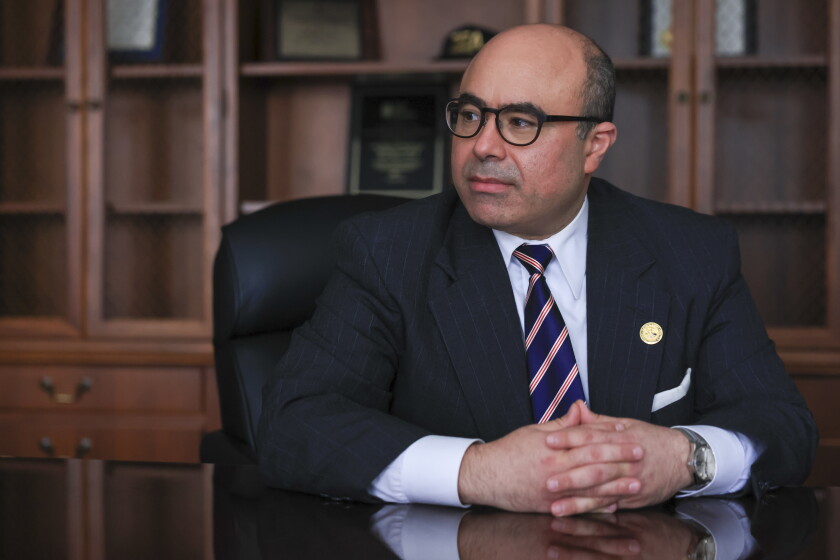
U.S. Attorney Andrew Boutros was appointed to that post in Chicago by federal judge, not confirmed by the U.S. Senate.
Anthony Vazquez
Chicago’s top federal prosecutor said he serves at the pleasure of the president.
But Andrew Boutros didn’t take the traditional route to office. Nor did many of his peers. Rather, when President Donald Trump returned to the White House, he employed a law that eventually let federal judges appoint U.S. attorneys across the country — including Boutros.
That raises a critical question: Who gets to fire a judge-appointed U.S. attorney?
Related
A West Coast legal fight might soon provide an answer. A 9th U.S. Circuit Court of Appeals panel in San Francisco spent nearly 90 minutes Friday considering whether to overrule a lower-court judge who concluded this month that “the president cannot unilaterally fire” such a prosecutor.
That judge got it wrong, Justice Department attorney Mark Freeman argued Friday. He said, “the power of a prosecutor is awesome. It brings the full power of the state against a citizen.
“That is why it is essential that the president be the one who can be blamed for it.”
But a U.S. attorney’s office is “supposed to be run by somebody who is confirmed by the Senate,” lawyer Donald Verrilli Jr. argued. That’s the judgment of Congress, he said, “and it is being evaded.”
The panel’s ruling will not be binding in Illinois. But it might offer guidance on a question that took on new relevance this summer. Local elected Democrats called on Boutros to resign after his office was accused of misconduct in a high-profile case tied to Operation Midway Blitz.
A judge is now considering whether to name a special prosecutor to investigate Boutros and others for criminal contempt. The controversy revolves around a now-defunct conspiracy case Boutros’ office brought against a group of Midway Blitz protesters known as “the Broadview Six.”
Then-Acting U.S. Attorney General Todd Blanche reacts to questioning during a House Committee on Appropriations hearing on June 2, when he told members the Trump Administration is abandoning plans for a $1.8 billion compensation fund intended to reward allies of the president.
Attorney General Todd Blanche has said the Justice Department “fully supports U.S. Attorney Boutros.” Blanche made that comment before he was confirmed to his job on a permanent basis.
U.S. District Chief Judge Virginia Kendall has declined to comment on the controversy, citing the judicial code of conduct.
The West Coast case was heard Friday by Judges Richard Paez, appointed by President Bill Clinton; Jay Bybee, appointed by President George W. Bush; and Jennifer Sung, appointed by President Joe Biden.
It’s unclear how they’ll rule, or when.
Related
Trump’s acting attorney general backs Boutros amid fallout from botched ‘Broadview 6’ case
Traditionally, U.S. attorneys are nominated by the president and confirmed by the Senate. That hasn’t happened in Chicago since 2017, when the Senate confirmed Trump nominee John Lausch.
Instead, then-Attorney General Pam Bondi appointed Boutros to the job on a temporary basis in April 2025. Then, when that appointment expired four months later, Chicago’s federal judges chose Boutros to continue on a more permanent basis, using the same law at issue out west.
The controversy has caught the attention of former top feds from across the country, including ex-Chicago U.S. Attorney Scott Lassar. He and others filed a brief opposing the Trump administration’s interpretation of the law.
Lawful appointments matter, they wrote, because a prosecutor’s decisions carry “life-changing consequences.”
A swift dismissal
It took Trump less than an hour to fire Roger Rogoff, named July 15 by judges in Seattle to be the top federal prosecutor there.
Shortly after he was sworn in, Rogoff learned by email that he’d been removed from the job — at the direction of the president.
Trump later sent the Senate a nominee for U.S. attorney, who has yet to be confirmed. The president also directed a former immigration judge to run the U.S. attorney’s office in the meantime.
Rogoff sued, arguing his dismissal by the president violated the law. On Oct. 1, U.S. District Judge Stanly Bastian agreed. In his preliminary injunction ruling, the judge posed the very question at issue: “Can the president fire a court-appointed U.S. attorney?”
Then, he answered it: “No.”
Bastian said that would “upend the framework created by the Constitution,” which balances the president’s right to appoint a prosecutor and the Senate’s right to confirm one.
“Allowing the president to fire a court-appointed U.S. attorney also eliminates the incentive to nominate a candidate that can be conferred by the Senate — in other words, bypassing the requirement that the executive and legislative branches work together to nominate and confirm the U.S. attorney,” Bastian wrote.
What does the law say?
The law used to appoint Rogoff, Boutros and others allows the attorney general to name a U.S. attorney for 120 days. Then, if that appointment expires, it says the district court “may” appoint someone to that role.
Crucially, it says the court can appoint that person “to serve until the vacancy is filled.” That’s generally been taken as a reference to Senate confirmation of a presidential nominee.
“It does not say until that person is fired by the president,” Bastian pointed out in his order.
The Rogoff case is not the first to raise questions about the law.
Former FBI director James Comey speaks during a Senate Intelligence Committee hearing on Capitol Hill in Washington.
The Justice Department’s initial attempt to prosecute former FBI Director James Comey fell apart when a judge ruled that Lindsey Halligan had not properly been appointed U.S. attorney in Virginia under the law.
But the question in the Comey case revolved around who gets to choose the U.S. attorney once the attorney general’s initial 120-day appointment expires. The Rogoff case turns on who can fire a judge-appointed U.S. attorney.
The Justice Department’s Freeman said a separate, but related, statute makes things clear.
It says, “each United States attorney is subject to removal by the president.”
‘The president makes a choice’
Freeman argued in court filings that Bastian’s ruling was “indefensible.”
It means a top federal prosecutor “may wield the core executive power of criminal law enforcement however he pleases — without accountability to anyone, without risk of removal for any cause, and without regard to whether he is insubordinate, corrupt, incompetent, or malfeasant — for the foreseeable future, unless the Senate agrees to confirm a replacement,” Freeman and his colleagues argued.
Verrilli reminded the appeals panel that no one forced the president to use the law.
“The president makes a choice,” Verrilli said. “A voluntary choice to gain the benefit of [the law] and the fact that he can basically put anybody he wants in the office for that interim period. But it comes with a constraint. The president opts into the constraint.”
Related
After rocky first year, Chicago’s top federal prosecutor says he isn’t taking orders from Washington
The judges asked Freeman and Verrilli about prior court rulings and the practical implications of their arguments, including whether judges may remove the prosecutors they appoint.
Along the way, Verrilli acknowledged for Judge Bybee that a judge-appointed prosecutor has the same power as one confirmed by the Senate.
“Your contention is that he just can’t be removed under [the law] even though he is identical in authority, power and title?” Bybee asked.
That’s correct, Verrilli argued. Otherwise, the framework of the law has “basically unraveled,” he said.
“Congress made a judgment,” he told the panel, “that this is an office that should be subjected to the advice and consent power.”
Chicago Sun-TimesFederal courts reporter/assistant editor
-=-=