JUDGE2 BAK
ESTB 9 25
---
includes noms
see judicial tag
see also scotus, legal
see ct judic capt takeover
JUDGE JUNKETS, FREE then KOCH GMU
SEE TARGET 4
SEE RULE OF LAW CONCEPT, HABEAS COURTS 4 checks 2
SEE TRUMP JUDGE
NO BAK?
===
5 25
trump judge in texas? rules alien act war BS
---
AN 9 25
In an article for The Hill published Sunday, Kellye Y. Testy, executive director of the Association of American Law Schools, and Austen Parrish, dean of the University of California, Irvine School of Law, argued that the U.S. judiciary faces a growing crisis of legitimacy, driven by increasingly intense threats, political attacks, and efforts to delegitimize judges.
They warned that these pressures aren’t just parties complaining about decisions, but rather a deeper assault on the independence of the courts — something essential to democracy.
"American judges are under attack. Approximately one-third of the federal judiciary have received threats over the last year, and the U.S. Marshals Service reports more than 500 threats were made against federal judges over the past 11 months, with a noticeable spike in recent months. The sheer number of threats, including to judges’ families, are unprecedented," they wrote.
READ MORE:How Christianity’s 'kook' fringe went mainstream in Trump's MAGA world
Testy and Parrish argued that many of the attacks come from high‐ranking executive branch officials when courts rule against administration policy, and from Democrats and Republicans alike when they believe justices have acted beyond their preferred political lines. These attacks, they insisted, are not just garden‐variety political heat, but part of a darker escalation in rhetoric, public delegitimization, and disregard for constitutional limits.
They further argued that the implications go far beyond the most visible federal or Supreme Court cases. They pointed out that tens of millions of cases are handled each year in state courts and family courts, contract and property disputes, criminal law, wills, insurance, traffic violations — matters that touch almost every American’s life.
The authors noted that when the judiciary is seen as politicized, under attack, or as lacking legitimacy, trust erodes even in those local and everyday contexts, with ripple effects for individuals, businesses, governments, and for social order more broadly.
To counter this trend, Testy and Parrish urged not just condemnation, but active defense of judicial independence. They called on lawyers, legal educators, bar associations, law firms, and legal organizations to more forcefully correct misinformation, reject ad hominem attacks and violent threats, emphasize competence and integrity rather than ideology in judicial appointments, and help law students and the public understand the importance of courts operating impartially under the rule of law.
READ MORE:'Deciding his own fate': Trump and the GOP want to banish this one Republican
The legal experts argued that ongoing attacks discourage qualified people from seeking the bench, worsening vacancies and undermining fairness of outcomes.
"Make no mistake: what’s occurring in high-profile cases risks having ripple effects in other federal, state and local courts. Our legal system depends on judicial independence and integrity, and it doesn’t function if judges are targets of crass political opportunism. Attempts to intimidate and undermine judges threatens a crisis of legitimacy even on issues that have nothing to do with national politics, jeopardizing well-functioning courts serving families, local governments, organizations and businesses of all sizes," they wrote.
---
MMA
The Gateway Pundit's Joe Hoft calls for the National Guard to remove judges and “throw them behind bars”
Hoft: “You cannot have the rulings that these judges have and and be of a sound mind. And you're a criminal. And same with Jerome Powell.”
Written by Media Matters Staff
Published 09/05/25
Jim Hoft's website, The Gateway Pundit,“is one of the worst purveyors of false information on the internet.” The website — to which Hoft's brother, Joe, is a contributor — reportedly became “a favorite news source” of President Donald Trump after it “pushed false claims of a stolen election“ for years following the presidential election of 2020.
During Trump's second term, the website has enjoyed access to the administration. In August, Jim Hoft interviewed Vice President JD Vance, during which Vance said the far-right website was “so important,” and a Media Matters review found that White House press secretary Karoline Leavitt called on The Gateway Pundit 5 times at press briefings during the first three months of Trump's second term, more than The Washington Post (4) or The Associated Press (3).
On September 3, Joe Hoft appeared on For the Love of Freedom with Danielle Walker and said that judges, who he alleges are “sabotaging our legal system,” and Federal Reserve Chair Jerome Powell are “criminal” and need to be held accountable.
Video
Share
Citation
From the September 3, 2025, edition of For the Love of Freedom with Danielle Walker, streamed on Rumble
JOE HOFT (THE GATEWAY PUNDIT): We have to deal with our judges. We have to get rid of these corrupt judges. We have to remove them from office. If it means, in my opinion, and I don't care what people say, if it means we need to send the National Guard in to remove these people from their office and throw them behind bars, then we have to. These people are not working for the country. They are sabotaging our legal system, destroying it by making these judgments that are grabbed out of nowhere because the judge just is a radical, radical, nonethical, disgusting human being. I think the same thing with Jerome Powell.
...
The judges need to be removed from office, and I think it charged. They need to be, we need to hold them accountable. You cannot have the rulings that these judges have and and be of a sound mind. And you're a criminal. And same with Jerome Powell. He's costing this country a trillion dollars a year by not lowering these rates.
Trillion dollars to every, you know, split amongst all Americans. Trillion dollars because he won't lower those rates, which should be lowered significantly to the point that we'd save a trillion. And that would really help the economy. It helped the housing industry and all this. I don't know why real estate agents aren't screaming for this guy to lower the rates.
And he won't because he's a vile, disgusting human being. He did the same thing with Trump his first term, raised the rates, kept raising them, and just crashed the, almost crashed the economy himself. And so these kind of people, we just cannot allow them to continue. They're too damaging and the damage is too severe.
20-Plus Times Jim Hoft And The Gateway Pundit Were Absurdly Wrong
01/25/17
01/03/24 12:58 PM EST
04/25/25
---
---
SEATTLE (AP) — Inside a Virginia courthouse, three immigration agents in plainclothes — one masked — detained a man who had just had misdemeanor assault charges dismissed. They declined to show identification or a warrant to the man, and one threatened to prosecute horrified witnesses who tried to intervene, cellphone video shows.
In North Carolina, U.S. Immigration and Customs Enforcement confirmed it arrested four people at a county courthouse, according to local media reports, prompting the sheriff to express concerns about a lack of communication from the agency as well as about disruption to court proceedings.
Inside a courthouse in New Hampshire, a pair of agents tackled a Venezuelan man outside an elevator, flattening an older man with a cane in the process. And in Boston, an ICE agent detained a man who was on trial. A municipal court judge held the agent in contempt over the arrest, but the order was later overturned by a federal judge.
The flurry of immigration enforcement at courthouses around the country in the past month — already heavily criticized by judicial officials and lawyers — has renewed a legal battle from President Donald Trump’s first term as advocates fear people might avoid coming to court.
It’s drawing further attention with last Friday’s arrest of Judge Hannah Dugan in Wisconsin. The FBI arrested Dugan on charges that she tried to help a defendant evade waiting federal agents by letting him leave her courtroom through a jury door.
ASSOCIATED PRESS
“Some of these judges think they are beyond and above the law and they are not, and we’re sending a very strong message today,” Attorney General Pam Bondi said during an appearance on Fox News after the arrest.
History of ICE’s arrest practices
Lena Graber, senior staff attorney with the Immigrant Legal Resource Center, told The Associated Press that she’s aware of at least a dozen recent immigration arrests at courthouses around the country.
“The historical context is really important,” Graber said. “This is something that was not part of ICE’s practice until the first Trump administration, and people were shocked.”
ICE long had a general practice of not arresting people at certain locations, including schools, hospitals, courthouses and churches. But during the first Trump administration, the agency adopted a policy explicitly allowing courthouse arrests of “specific, targeted aliens,” arguing that it was especially important in “sanctuary” jurisdictions where officials do not notify the agency before releasing immigrants facing deportation cases.
Courthouse immigration arrests jumped, drawing condemnation from judicial officials and legal organizations, as well as lawsuits from some states and the adoption of bills seeking to block the practice.
Dugan’s case is similar to one brought during the first Trump administration against a Massachusetts judge who was accused of helping a man sneak out a back door of a courthouse to evade a waiting immigration officer. A judge in Oregon faced similar allegations — though not an arrest or criminal charges — in 2017.
The chief justices of some states, including California and Washington, asked ICE to stop, saying fear of arrest would keep crime victims and witnesses from showing up in court. In one well-publicized case, agents in Texas arrested a woman while she was obtaining a protection order against an alleged abuser.
The Biden administration imposed restrictions on courthouse immigration arrests, but they were quickly undone when Trump returned to office this year.
Under guidance issued Jan. 21, ICE officials are allowed to carry out immigration enforcement in or near courthouses if they believe someone they’re trying to find will be there. Whenever possible, the agents are supposed to make arrests in nonpublic areas, to coordinate with courthouse security and to avoid disrupting court operations.
Virginia prosecutor promises to investigate court arrest
Teodoro Dominguez Rodriguez, identified by ICE as a Honduran national, was confronted and arrested by immigration enforcement officers after he left a Charlottesville courtroom April 22. It was the second immigration arrest at the court that day.
The first wasn’t recorded, but as word spread, Nick Reppucci, who heads the public defender’s office there, scrambled staff to the courthouse. They captured Dominguez Rodriguez’s arrest on camera.
The three agents, one in a balaclava-style ski mask, ignored demands from observers to show badges or a warrant, the video shows. One agent threatened to have the U.S. attorney’s office prosecute two women who tried to place themselves between the agents and Dominguez Rodriguez.
Sherriff Chan Bryant confirmed that the agents had shown badges and paperwork to a bailiff beforehand. But Albemarle County Commonwealth’s Attorney Jim Hingeley criticized the officers for failing to identify themselves while making the arrest.
“Bystanders, or the person being arrested, might have violently resisted what on its face appeared to be an unlawful assault and abduction,” Hingeley said in an emailed statement.
Reppucci decried the “normalization happening here, where federal law enforcement are at this point grabbing people without being required to show that person any form of identification.”
In a written statement, ICE stood behind the actions of the officers, “who are trained to assess and prosecute apprehensions in a manner that best ensures operational success and public safety.”
The Associated Press was unable to locate relatives who might speak on Dominguez Rodriguez’s behalf, and it was not clear if he had an attorney representing him.
Repucci stressed the impact arrests like Dominguez Rodriguez’s could have on people coming to court, a place he said is supposed to be where “disputes are resolved in an orderly, peaceful manner.”
“People in divorce proceedings, people with civil disputes, custody hearings, potential witnesses, all are going to be less likely to come to court,” he said.
Claire Rush in Portland, Oregon, and Rebecca Santana in Washington contributed to this report. Hollingsworth reported from Mission, Kansas.
Copyright 2025 The Associated Press.
---
off bs
press Release
Justice Department Announces Two Cases Involving Judicial Misconduct and Obstruction of Law Enforcement
Friday, April 25, 2025
For Immediate Release
Office of Public Affairs
Ex-Judge of Dona Ana County Charged with Evidence Tampering and Milwaukee County Circuit Court Judge Charged with Unlawful Obstruction and Concealment
The Justice Department today announced federal criminal charges in two separate cases involving the alleged obstruction of federal law enforcement operations and unlawful concealment of individuals residing illegally in the United States.
“The allegations against Judge Dugan and Judge Cano are serious: no one, least of all a judge, should obstruct law enforcement operations," said Attorney General Pamela Bondi. "Doing so imperils the safety of our law enforcement officers and undermines the rule of law. The Department of Justice will continue to follow the facts — no one is above the law.”
“Sanctuary jurisdictions that shield criminal aliens endanger American communities,” said Deputy Attorney General Todd Blanche. “This Justice Department will not stand by as local officials put politics over public safety. Reckless sanctuary city policies create a sanctuary for one class—criminals. Those days are over.”
*United States v. Jose Luis Cano; United States v. Nancy Ann Cano, District of New Mexico
Nancy Ann Cano, 68, and Jose Luis Cano, 67, were arrested yesterday for evidence tampering offenses related to the federal investigation and prosecution against Cristhian Ortega-Lopez, a Venezuelan national residing unlawfully within the United States and with alleged ties to transnational criminal organization Tren de Aragua, a U.S.-designated Foreign Terrorist Organization (FTO).
“Judges are responsible for upholding our country’s laws. It is beyond egregious for a former judge and his wife to engage in evidence tampering on behalf of a suspected Tren de Aragua gang member accused of illegally possessing firearms,” said U.S. Attorney Ryan Ellison for the District of New Mexico. “The U.S. Attorney’s Office is committed to dismantling this foreign terrorist organization by disrupting its criminal operations in New Mexico. That starts by prosecuting those who support gang members — including judges.”
According to court documents, Homeland Security Investigations (HSI) initiated the investigation into Ortega-Lopez after receiving an anonymous tip that the individual was unlawfully present in the United States and in possession of firearms. Subsequent investigation confirmed that the defendant illegally entered the country on Dec. 15, 2023, near Eagle Pass, Texas, and was released shortly thereafter due to overcrowding at the Border Patrol facility.
Evidence uncovered by federal agents revealed the defendant had posted multiple photos and videos on social media showing him and other illegal aliens handling firearms at a shooting range in Las Cruces, New Mexico. Among the weapons allegedly pictured were a Sig Sauer P365 handgun, an AR-15 rifle equipped with a suppressor, and other high-powered firearms and ammunition. Distinctive tattoos confirmed Ortega-Lopez’s identity in the photos and videos. Further review of his social media activity revealed content suggesting affiliation with Tren de Aragua, including gang-related tattoos, hand gestures, and clothing.
According to court documents, in January 2025, HSI received a tip that Ortega-Lopez was unlawfully residing with other illegal aliens at a property in Las Cruces owned by Nancy and Jose Cano. Prior to his resignation in March 2025, Jose Cano served as a judge of the Dona Ana County Magistrate Court.
On Feb. 28, 2025, HSI executed two federal search warrants in connection with the investigation, resulting in the arrest of the Ortega-Lopez and multiple associates, and the seizure of four firearms.
Ortega-Lopez was arrested for illegal possession of firearms and ammunition. Four firearms believed to be in Ortega-Lopez’s possession, along with three of his cell phones, were seized during the operation. During the search, Ortega-Lopez was permitted to make a phone call before being taken to the Doña Ana County Detention Center (DACDC). He informed agents that a particular phone he wished to use was not among the devices recovered. Video calls from DACDC later showed Nancy Cano holding a black iPhone believed to be Ortega’s fourth phone.
In a March 7 call with Ortega-Lopez, Nancy Cano used the device to contact a person named “Michelle” via WhatsApp, then facilitated a FaceTime conversation between Michelle and Ortega-Lopez using her personal phone. Additionally, in an April 20 call, Nancy Cano and Ortega-Lopez discussed deleting his Facebook account – a platform where he had previously shared incriminating content, including gang affiliations and images with firearms.
On April 24, HSI agents executed a subsequent search warrant at the Cano residence to locate the missing cellphone. During questioning, Jose Cano admitted to destroying Ortega’s cellphone by smashing it with a hammer approximately five weeks prior, believing it contained incriminating photos and videos of Ortega with firearms.
Forensic analysis of the recovered phones revealed messages linked to Ortega’s criminal activities, including affiliations with the Tren de Aragua gang and images of Ortega with firearms.
Jose Cano is charged with one count of tampering with evidence and Nancy Cano is charged with one count of conspiracy to tamper with evidence. If convicted, the defendants face a maximum penalty of 20 years in prison, three years of supervised released, and up to a $250,000 fine. A federal district court judge will determine any sentence after considering the U.S. Sentencing Guidelines and other statutory factors.
Ortega-Lopez is charged with being an unlawful alien in possession of firearms and ammunition, which carries a maximum penalty of 15 years in prison. Despite strong evidence and pre-trial services’ assessment that the defendant poses a serious risk of flight and danger to the community, a U.S. Magistrate Judge ordered the defendant released on conditions. The government has since filed a notice of appeal challenging that decision, citing the defendant’s unlawful status, gang affiliations, disregard for previous release conditions, and risk to public safety.
HSI is investigating the cases, with valuable assistance from the FBI, Bureau of Alcohol, Tobacco, Firearms and Explosives (ATF) and U.S. Customs and Border Protection (CBP).
Assistant U.S. Attorneys Maria Armijo, Randy Castellano, and Elizabeth Tonkin for the District of New Mexico are prosecuting both cases.
*United States v. Hannah C. Dugan, Eastern District of Wisconsin
The Justice Department today announced the filing of a federal criminal complaint against Milwaukee County Circuit Court Judge Hannah C. Dugan, 65, for her alleged interference with a federal law enforcement operation and unlawful concealment of an individual subject to arrest.
According to court documents, the charges stem from events occurring on April 18, when members of the Milwaukee office of U.S. Immigration and Customs Enforcement, Enforcement and Removal Operations (ICE ERO), along with federal partners from the FBI, DEA, and U.S. Customs and Border Protection, attempted to execute a lawful arrest warrant for Eduardo Flores-Ruiz, a Mexican national previously removed from the United States and recently charged in Milwaukee County with multiple counts of domestic abuse-related battery.
According to court documents, federal agents arrived at the Milwaukee County Courthouse intending to arrest Flores-Ruiz in a public hallway following his court appearance before Judge Dugan. Upon learning of the agents’ presence in the hallway, Judge Dugan allegedly confronted and ordered federal agents to leave the courthouse. After being made aware of a valid immigration arrest warrant, Judge Dugan told agents that they needed a judicial warrant and demanded that they go to the Chief Judge’s office. Once the agents were no longer in the vicinity of her courtroom, Judge Dugan allegedly elected not to conduct a hearing on Flores-Ruiz’s criminal case, despite the fact that victims of his offense were present, and instead personally escorted Flores-Ruiz and his attorney through a restricted “jury door” exit not typically used by defendants or attorneys. This doorway led to a non-public hallway through which Flores-Ruiz and his attorney exited her courtroom. According to the affidavit, Judge Dugan’s actions directly resulted in Flores-Ruiz temporarily avoiding federal custody. He was ultimately arrested outside the courthouse, following a brief foot pursuit. ELEVATOR RIDE?
Dugan is charged with obstruction of proceedings before a department or agency of the United States, which carries a maximum penalty of five years in prison and concealing a person to prevent arrest, which carries a maximum penalty of one year in prison.
Flores-Ruiz was previously deported in 2013 and had reentered the United States unlawfully. He was subject to arrest based on an administrative warrant issued by ICE for immigration violations following his recent criminal charges in Milwaukee County.
*A criminal complaint is merely an allegation. All defendants are presumed innocent until proven guilty beyond a reasonable doubt in a court of law.
Updated April 30, 2025
---
OMFG
On Friday, April 25, far-right FBI Director Kash Patel announced that Milwaukee County Circuit Judge Hannah Dugan has been arrested on federal obstruction charges for allegedly helping an undocumented immigrant "evade arrest."
On X, formerly Twitter, Patel posted, "We believe Judge Dugan intentionally misdirected federal agents away from the subject to be arrested in her courthouse, Eduardo Flores Ruiz, allowing the subject — an illegal alien — to evade arrest…. Thankfully our agents chased down the perp on foot and he’s been in custody since, but the Judge’s obstruction created increased danger to the public."
A law enforcement official told ABC News that Dugan was arrested at the courthouse.
READ MORE:'Afraid' Trump 'will lose': Lawyers blast firms capitulating to Trump in scathing letter
According to MSNBC, Patel's tweet on Dugan was removed from X.
During an MSNBC appearance, attorney Temidayo Aganga-Williams told host José Díaz-Balart that the arrest of a judge was "unusual" but added, "I think it's going to be a pattern going forward…. I think it's only going to pick up."
Dugan's arrest is receiving plenty of reactions on X, formerly Twitter.
Some MAGA Republicans are applauding the arrest.
READ MORE:How to prepare for the uprising
John Fabbricatore, a former field officer for U.S. Immigration and Customs Enforcement (ICE), tweeted, "Judge Hannah Dugan arrested by FBI for allegedly helping illegal alien 'evade arrest' by ICE. 'Lawfare' by these judges has to stop. This is a good start!"
Far-right MAGA radio host Benny Johnson posted, "Another rogue judge down. FAFO."
But others see Dugan's arrest as MAGA ramping up its authoritarian disdain for the rule of law.
Journalist Kristian Ramos tweeted, "I see we are now at 'arresting judges' on our path to autocracy.
"On Democracy" host Fred Wellman noted, "Marshalls appear to be confirming she was arrested and other news outlets are picking it up now."
X user Iron Goodman wrote, "This is a chilling escalation of federal overreach and raises serious questions about the scope of executive power versus judicial independence."
Another X user, Laura Okazaki, posted, "We must not look away while the feds take us another step into authoritarianism."
X user Hannah Martinez tweeted, "This is a deeply unsettling development with huge implications for the rule of law and potential abuses of power. The optics are disastrous."
READ MORE: 'Obama 2028' trends after official Trump store starts selling $50 'Trump 2028' hat
---
---
thehill
Trump administration Friday demanded a federal judge step aside from overseeing Perkins Coie’s challenge to President Trump’s executive order targeting the law firm.
The new filing claims U.S. District Judge Beryl Howellhas repeatedly demonstrated “partiality” against and “animus” toward Trump, taking aim at both her decisions in the lawsuit and previous major cases she oversaw.
“Reasonable observers may view this Court as incapable of fairly adjudicating these claims against the Commander-In-Chief,” Deputy Associate Attorney General Richard Lawson wrote in the motion.
It marks the second time the Justice Department has called for a judge’s removal from a pending lawsuit against the administration, which comes as Trump himself steps up his chastising of judges who rule against him. Earlier this week, the administration called for the removal of the judge overseeing a high-profile deportation flight case.
Howell was randomly assigned to oversee Perkins Coie’s lawsuit challenging Trump’s executive order restricting firm attorneys’ security clearances and access to federal facilities. Trump has long clashed with the firm over its work advising Hillary Clintonduring her 2016 presidential campaign and connections to the discredited Steele dossier that contained unflattering allegations about Trump and his connections to Russia.
The case remains in early stages, but the judge has already temporarily blocked part of Trump’s order.
Nominated to the federal bench by then-President Obamain 2010, Howell longhasdrawn Republicans’ ire.
She previously served as chief judge of Washington’s federal district court and oversaw several sealed disputes concerning the criminal investigations into Trump. Howell’s decisions included invoking the “crime-fraud” exception to provide special counsel Jack Smith with documents from one of Trump’s attorneys and holding X, then known as Twitter, in contempt for not handing over Trump’s private messages.
“This Court’s pattern of hostility toward President Trump is not limited to his supporters. It also utilized the judicial power against President Trump himself,” Lawson wrote.
The Justice Department’s new motion also takes aim at a gala speech Howell gave in 2023 while accepting an award, when the judge did not name Trump but indicated she agreed that the country was “at a crossroads teetering on the brink of authoritarianism.”
“We are having a very surprising and downright troubling moment in this country when the very importance of facts is dismissed or ignored,” Howell said.
---
---
rww
03/21/2025
by
As the Trump administration's efforts to dismantle the federal government and undermine the Constitutions are being thwarted by judges throughout the nation, President Donald Trump and his lackeys in Congress have unleashed a coordinated attack against the judiciary.
Appearing on an Intercessors for America podcast on Thursday, right-wing activist Phillip Jauregui of the Judicial Action Group offered some suggestions about what the MAGA movement can do to strike back at the "activist judges" who have been ruling against the Trump administration.
Jauregui suggested that Congress should begin by cutting the judicial branch's budget and then announce that they were appointing "Elon Musk and DOGE to come look at judicial expenditures."
"Hello," Jauregui said. "You think that would spook Chief Justice Roberts and cause him to be concerned?"
During the podcast, Jauregui also twice issued prayers that God will stop judges from engaging in "this wicked lawfare."
"You hold the Supreme Court justices' hearts in your hand, and even these trial court judges that we disagree with so vehemently, you hold their hearts in your hand," Jauregui prayed. "We pray that you'd intervene, Father. Speak to the courts. Speak to the justices and even Chief Justice Roberts, Justice Barrett, who've been key votes on these issues. We pray that they would see the necessity to stop this injustice, to stop this wicked lawfare. That's what it is. It's wicked, Father. It's unconstitutional and it's wicked."
Later, Jauregui prayed specifically for the justices on the Supreme Court, asking God to bring them "into alignment with your will to preserve the proper powers of the presidency."
"Father, we love every one of these Supreme Court justices," he said. "We don't agree with all of them all of the time, but we do love them because we know you love them. And we pray that you give us your heart for them, like the heart of the father for the prodigal son who had done so much wrong and dishonored his family. The father wanted him home. Lord, give us your heart for these justices to have them home, back in your house, back doing the proper job of judges and renewing our national relationship with you."
"Father, we pray that you'd visit them in their dreams, at their home," Jauregui continued. "Send believers who love you around them to give them good counsel, to pray for them and give them good godly fellowship, Lord. We pray that you bless them. Bring all of them individually back to your house, and we pray that you bring the majority of the Supreme Court, Father, into alignment with your will to preserve the proper powers of the presidency right now. We pray these things in the name of Jesus."
Video URL
Jauregui is a longtime right-wing activist who, in 2018, was so convinced that God had anointed Amy Coney Barrett to the Supreme Court that when Trump instead chose Brett Kavanaugh as his second nominee, Jauregui denounced Kavanaugh as a “usurper” and warned that God would destroy him if he did not withdraw.
More recently, Jaurequi partnered with the American Family Association to launch a Center for Judicial Renewal that seeks to pressure Trump to only nominate judges who share their right-wing "biblical worldview," thereby ensuring that the Supreme Court and all lower courts will be filled with evangelicals who meet their Christian nationalist standards.
:{---
becoming target, 4 threat to impeach; son shot in door?! pizza swat dox
an 3 25
Trump, much to the frustration of Democrats, returned to Washington on January 20 with GOP majorities in both branches of the Congress. But they're small majorities.
In the U.S. Senate, Republicans have a 53-47 majority — which is large enough to get Trump's most controversial nominees confirmed, but not enough to overcome the 60-vote demand of the filibuster. Nor is it enough to get a "guilty" vote in an impeachment.
Trump and some of his allies, including billionaire Tesla/SpaceX/X.com leader Elon Musk, are calling for the impeachment of federal judges who are blocking, at least temporarily, some of the president's executive orders. But if federal judges were to be indicted on articles on impeachment in the U.S. House of Representatives, Republicans wouldn't have enough votes for a "guilty" verdict in the U.S. Senate.
READ MORE:'Clear and present danger': Experts alarmed at 'insanity' of Musk getting secret war plans
According to Politico reporters Meredith Lee Hill, Hailey Fuchs and Jordain Carney, however, GOP lawmakers are thinking about ways to attack federal judges other than impeachment.
"Top Republicans are likely to put at least one bill, California Rep. Darrell Issa’s 'No Rogue Rulings Act,' on the floor in early April, according to two people granted anonymity to discuss scheduling plans," the journalists explain in an article published on March 21. "The legislation would crack down on the ability of lower-court judges to issue far-reaching injunctions. That is seen by Speaker Mike Johnson and other House Republican leaders as a viable outlet as they sort out the way forward on the judicial impeachments that have been endorsed by Trump and his billionaire ally Elon Musk. A spokesperson for Johnson said the speaker and the Judiciary Committee are reviewing 'all available options.… to address this urgent matter.'"
Hill, Fuchs and Carney continued, "House Republicans have filed impeachment resolutions targeting four district judges, including one this week targeting the jurist who sought to block Trump's effort to deport alleged gang members to El Salvador.… But there is widespread recognition inside the House GOP that impeachments — besides being costly in time and political capital — do not have the votes to succeed given Republicans' narrow majority. That has prompted GOP hardliners to back-channel with Trump allies on alternatives they could push across the House floor."
House Republicans, according to the Politico journalists, "are also discussing one-off resolutions condemning recent judicial rulings against Trump."
READ MORE:Sabotaging Social Security: Behind the leaked memo to cut agency staff and critical services
"House Judiciary Committee Chair Jim Jordan's team has privately advised that members' offices are free to share their opinions on legislative strategy around the courts but that Jordan himself intends to stick to a more vague approach, saying everything is on the table, according to one Republican Hill aide," Hill, Fuchs and Carney explain. "There is, however, a particular interest in restricting the authority of federal district judges to hand down nationwide injunctions, according to four Republicans familiar with the matter."
READ MORE:'Clear and present danger': Experts alarmed at 'insanity' of Musk getting secret war plans
*Read the full Politico article at this link.
===
AN 2 25
Far-right House Republicans are pushing to impeach federal judges, alleging “high crimes and misdemeanors” in response to rulings that opposed actions by Elon Musk’s Department of Government Efficiency (DOGE). One congressman denounced a judge as a “predator” and a “radical anti-LGBTQ activist,” while another argued that blocking DOGE reflected bias against Trump voters. A third asserted that Congress has the “authority to impeach judges to defend the will of the people.”
Courthouse News reporter Benjamin S. Weiss notes that three federal judges have been targeted for impeachment by multiple members of Congress.
Senior U.S. District Judge John Bates
On Monday, U.S. Rep. Andy Ogles (R-TN) made unsubstantiated accusations against Senior Judge John Bates, a Bush appointee serving on the U.S. District Court for the District of Columbia. Judge Bates was also appointed by Chief Justice John Roberts to serve on the FISA Court and to serve as the Director of the Administrative Office of the United States Courts.
READ MORE: ‘Axis of Evil’: U.S. Slammed for Voting with Russia, North Korea Against Ukraine at UN
“I just formally introduced articles of impeachment against RADICAL LGBTQ ACTIVIST U.S. District Judge John Bates. His attempt to block President Trump’s order to remove webpages containing resources for ‘gender-affirming care’ from government sites is appalling,” Congressman Ogles declared.
“At no point in American history has the judiciary considered the surgical or chemical castration of healthy children to be a compelling or even legitimate health concern and it shouldn’t start now,” he alleged, wrongly framing the judge’s actions. “We must protect our children from predators like Judge Bates.”
According to an extensive report in The Washington Post, however, Judge Bates had “ordered the nation’s premier health agencies to restore online access to several websites that monitor HIV, health risks for youths and assisted reproductive technologies, which were abruptly taken offline to ensure they complied with President Donald Trump’s recent executive order on gender.”
Judge Bates wrote in his opinion: “By removing long relied upon medical resources without explanation, it is likely that … each agency failed to ‘examine the relevant data and articulate a satisfactory explanation for its action.’”
The Post adds that Bates found “that the health agencies probably violated federal law in taking down the scientific data. He ordered the agencies to restore access to the websites.”
In a video posted to social media (below), however, Rep. Ogles insisted the webpages Bates ordered restored were about “transgender surgeries.” In a press release attacking Judge Bates, Ogles went even further in wrongly characterizing the judge’s actions.
“The continued socialization of this grave moral evil necessitates immediate Congressional action against those promoting it. America’s founders gave Congress the authority to impeach judges to defend the will of the people,” Congressman Ogles falsely claimed. The founders did not give Congress authority to impeach judges to defend the will of the people. “My articles will do just that. It is unacceptable for rogue judges to implicate taxpayers in woke LGBTQ propaganda and the irreversible destruction of children’s bodies.”
U.S. District Chief Judge John “Jack” McConnell Jr.
U.S. Rep. Andrew Clyde (R-GA) has “threatened to file articles of impeachment” against U.S. District Chief Judge John “Jack” McConnell Jr. who, Fox News reports, “filed a motion ordering the Trump administration to comply with a previous restraining order. The order temporarily blocked the administration’s efforts to pause federal grants and loans.”
READ MORE: Trump Mass Firings May Be ‘Contrary’ to Law, Watchdog Rules
According to Fox News, “McConnell has since come under fire from Trump supporters and conservatives who have accused him of being a liberal activist after a 2021 video of him saying courts must ‘stand and enforce the rule of law, that is, against arbitrary and capricious actions by what could be a tyrant or could be whatnot’ resurfaced online.”
WPRI reports that Musk wrote on X: “Impeach this activist posing as a judge! Such a person does great discredit to the American justice system,” and later, “Impeach this pseudo-jurist!!”
U.S. District Judge Paul Engelmayer
Last week, U.S. Rep. Derrick Van Orden (R-WI) filed articles of impeachment alleging U.S. District Judge Paul Engelmayer “engaged in judicial misconduct when he halted President Donald J. Trump’s Executive order establishing and implementing the President’s Department of Government Efficiency on purely political grounds, demonstrating clear bias and prejudice against the President and the 74,000,000 Americans who voted for him.”
Congressman Van Orden also charged the judge with “improper handling” of that case.
Reporting on the articles of impeachment, Bloomberg Law noted that U.S. Rep. Eli Crane (R-AZ) is also filing to impeach Judge Engelmayer.
In a press release, Congressman Crane says Judge Engelmayer “responded to an overtly political emergency request by 19 Democratic attorneys general aiming to prevent Trump administration officials from accessing a payment system within the Treasury Department.”
Bloomberg reported that the “acts against Engelmayer come after Musk called for judicial impeachments, in response to judges issuing court orders that blocked many Trump administration actions.”
During Musk’s Oval Office press conference, President Trump, Axios reported, had said, “Maybe we have to look at the judges because I think that’s a very serious violation.”
But it was Vice President JD Vance who perhaps made the most waves when he wrongly claimed that federal judges “aren’t allowed to control the executive’s legitimate power.”
Watch Congressman Ogles’ video below or at this link.
===
===
mma
02/13/25
02/13/25
---
2 25 DOGE COUP
HYPE HOPE msnbc atty? judges are rebuking BS trump atTempts, they don’t like to get hit repeatedly to act on emergency basis, if oRder to destroy data dogebags have is ignored, contempt can be substantial , but...
===
Fox News lashes out at judge who ruled that the Trump administration lawlessly disregarded his order
Written by Helena Hind & Alicia Sadowski
:{Published 02/11/25
On February 10, U.S. District Judge John J. McConnell Jr. ruled that the Trump administration failed to comply with his previous order temporarily blocking a federal funding freeze and ordering the administration to release billions of dollars in federal grants.
McConnell’s ruling is the latest in a string of legal setbacks for Trump’s executive actions. Fox News has reacted to the rulings by attacking individual judges and claiming that the judicial branch is subverting the will of voters.
- ### Federal judge says that the Trump administration had not complied with his order unfreezing billions of dollars in federal grants
Federal judge John McConnell rules that the Trump administration is disobeying his order:
A federal judge said on Monday that the White House had defied his order to release billions of dollars in federal grants, marking the first time a judge has expressly declared that the Trump administration is disobeying a judicial mandate.
The ruling by Judge John J. McConnell Jr. in Rhode Island federal court ordered administration officials to comply with what the judge called “the plain text” of a ruling he issued on Jan. 29.
That order, he wrote, was “clear and unambiguous, and there are no impediments to the Defendants’ compliance." The NY Times, [2/10/25]
- ### Fox News criticized Judge McConnell and his ruling
- Guest and former George W. Bush administration official John Yoo characterized McConnell’s ruling as “another example of the courts trying to get into the middle of a fight between the president and the Congress.” Yoo described Trump’s actions as those of an “energetic executive,” claiming, “There is nothing wrong with the president saying, ‘I want to freeze spending now that I’ve come into office and see what's going on.’” Fox News, *America Reports*, [2/10/25]
- Laura Ingraham complained that McConnell, “an unelected Obama judge in Rhode Island,” ordered Trump to unfreeze federal spending “and stop a duly elected president from doing what the voters elected him to do. It is a scandal.” Ingraham said McConnell’s background is “as bad as you would imagine. McConnell once served as treasurer of the Rhode Island Democratic state committee and he donated more than $100k to liberal Democrats.” Later in the segment, Sen. Mike Lee (R-UT) suggested Trump “seek an extraordinary writ of mandamus” to stop “abusive action by a district judge midstream.” He urged Attorney General Pam Bondi to “consider all of these options because these judges are out of line. They don’t have the authority to go in and commandeer the presidency and undo the election of November 2024.” Fox News, *The Ingraham Angle*, [2/10/25]
- ### Fox News personalities launched attacks on other judges who have ruled on Trump’s executive actions
- Kayleigh McEnany claimed that the “Obama judge” who restricted access to Treasury Department data made the decision without precedent. She continued that the legal challenges prove Democrats “depend on bureaucracy” which is a “cash cow” for the party. Fox News, *Outnumbered*, [2/10/25]
- Fox News anchor Harris Faulkner asked if the challenges to Trump’s executive orders represented the “new lawfare.” Guest Phil Holloway claimed the rulings are an “anti-constitutional effort by the courts, in many of these cases, to simply substitute the judgment of an unelected judge for that of the duly elected president of the United States.” Fox News, *The Faulkner Focus*, [2/10/15]
- In response to host Will Cain’s question about the “legal challenges,” The Federalist’s Sean Davis attacked the “backwater judge in some blue enclave somewhere” arguing against presidential powers. Fox News, *The Will Cain Show*, [2/10/24]
//
- ### Matt Walsh: “The Trump administration should just ignore these judges and do what they're gonna do”
02/11/25 mma
Dan Bongino argues that Trump “should ignore” court order blocking federal funding freeze 02/11/25
===
10 24 an
A far-right group is not just content with identifying politicians to vote out of office: It's now aiming its sights on career federal employees.
The American Accountability Foundation (AAF) — which is one of the 100 partner organizations in the Heritage Foundation's controversial Project 2025 initiative — has recently launched a website called the "DHS Watchlist," in which it posted the names, headshots and biographical information of 10 government employees working in the Department of Homeland Security in President Joe Biden's administration. Its "Top 10 Targets" list includes senior-level employees in U.S. Citizenship and Immigration Services along with associate counsels and policy analysts in the department. Two immigration judges are also listed as "targets."
"The DHS Bureaucrat Watch List is dedicated to exposing the career staff who have outsized influence on efforts to secure the southern border," AAF states on its DHS Watchlist website. "While everyone knows who Alejandro Mayorkas and Merrick Garland are, few Americans know who the career bureaucrats are that implement their orders."
READ MORE:'Nearly all' voters know about Project 2025 and majority have negative view of it: report
In its write-up of Texas-based immigration judge Noelle Sharp, the AAF said she "made her bones keeping criminal aliens out of jail and away from deportation, and that she "brags on her website that she worked to keep criminal aliens from being deported."
"Our firm specializes in Immigration Law, and we have the flexibility, experience, and technology to work with clients around the world. Whether you wish to visit Disney Land for a week, obtain your permanent residency, or become a United States citizen, we will will help your personal 'American Dream' come true," Sharp's website reads (AAF linked to an archived version of her firm's website on its hit list). "We bring extensive experience and professionalism to every case and customize our support to your individual needs and concerns."
AAF also singled out immigration judge Elizabeth Young as a "target" on its "DHS Watchlist" site. The group accused her of "leading a charge to come up with creative legal maneuvers to keep illegal aliens from being deported" while she led an immigration law clinic at the University of Arkansas.
"The men and women who end up in front of an immigration judge are often some of the worst cases of immigration fraud," the group wrote without a source to back up its claim. "Unfortunately, Judge Young has been dangerously generous handing asylum status at alarming rates."
READ MORE:Undercover video details Project 2025's secretive 'second phase' — and exposes Trump's connection
There are no explicit instructions for readers, though users on the social media platform Bluesky were concerned that the lengthy descriptions of its "targets" could lead to political violence. Journalist Don Moynihan wrote that Tom Jones, who leads AAF, is a Republican-aligned opposition researcher with a history of making spurious claims about Democrats.
"I looked at the site which posts the civil servants name, title & salary. But the actual accusations are weak tea," he wrote. "One praised Fauci in a tweet! Another won an award for excellent performance in her job, which means she can't be trusted. One spoke on a diversity panel! No real scandals there."
Political violence has become especially prevalent in the 2024 cycle. Reuters recently reported that there have been at least 300 instances of politically motivated attacks from both sides since the January 6, 2021 insurrection. Some of the more high-profile examples include the two attempted assassinations of former President Donald Trump, and a Democratic campaign office in Arizona being targeted in three different shootings in as many weeks. That office has since been closed.
READ MORE:'He is on on our side': Org behind Project 2025 boasts repeatedly about close ties to Trump
*Click here to view the DHS Watchlist website.
===
==
https://www.thenation.com/article/activism/steven-donziger-chevron/
no lnx
More than a quarter-century ago, Steven Donziger, a young American human rights lawyer, joined the legal effort to force Texaco to clean up the Ecuadoran headwaters of the Amazon rain forest. Between 1972 and 1992, the company dumped toxic waste and spilled billions of gallons of oil-exposed water across 1,700 square miles, an area larger than Rhode Island. In response, a coalition of rural Ecuadorans in the Lago Agrio region sued the US oil giant, and Donziger signed on to help and soon became the lead attorney on the case.
In 2013, after a legal campaign that stretched across two continents, the 30,000 indigenous people and small farmers whom Donziger represented in a class-action lawsuit won a $9.5 billion judgment in Ecuadoran courts against Chevron, which acquired Texaco in 2001. It was one of the largest financial judgments ever against an oil company. It looked like a historic warning to polluters across the Global South. Paul Paz y Miño, the associate director of the environmental group Amazon Watch, described it as “the most important corporate accountability case in history.”
Fast-forward to today, and Donziger is under house arrest in New York City, forced to wear an ankle monitor. The lawyer, now 59, is fighting contempt charges.Meanwhile, his clients in Ecuador have received nothing from Chevron. Without that funding, they have no way to cleanse the poisoned soil or treat what they say is an elevated number of cancer cases.
The mainstream press has largely ignored the legal attacks against Donziger, but Chevron’s counteroffensive could endanger human rights and environmental work around the world. Donziger’s fate, Paz y Miño said, will set a precedent: “Whether it’s Chevron or BP or Shell or any other oil company, if you cannot hold them to account and the lawyer advocating for that case is personally attacked, who else is going to fight those kinds of cases?”
Chevron’s legal onslaught succeeded largely because of a single federal judge in New York named Lewis A. Kaplan. In 2014, Kaplan found Donziger and his Ecuadoran allies guilty of bribery and fraud, which makes it extremely difficult for the plaintiffs to collect their damages in the United States. Then Kaplan asked federal prosecutors in the Southern District of New York to bring criminal contempt charges against Donziger for refusing to turn over his electronic devices, which contain communications with his clients.When the prosecutors declined, Kaplan appointed private attorneys to prosecute Donziger—a nearly unprecedented step by a federal judge.
Judge Lewis Kaplan took the nearly unprecedented step of appointing private attorneys to prosecute Donziger. (Courtesy of Richard Baker / University of Rochester)
Kaplan’s hostility toward Donziger has been on ample display in his 21st-floor wood-paneled courtroom in downtown New York for nearly a decade. At times, he has said the pollution case in Ecuador was “not a bona fide litigation” and dismissed the Lago Agrio residents as “so-called plaintiffs.”
Martin Garbus, the legendary human rights lawyer who is part of Donziger’s legal team, is 86 years old and has appeared at hundreds of trials, including in the Deep South during the segregation era. He told me that Kaplan’s treatment of Donziger is the worst he has ever witnessed. “In the courtroom, Kaplan displayed a rage, a fury, that he channeled against Steve,” Garbus said. “He tried to humiliate him. You wouldn’t have to be an expert on the law to recognize it. It was brutal. I’ve never seen a guy eviscerated the way Kaplan tried to eviscerate Steve.”
For his part, Donziger said he hopes the Ecuadorans and their lawyers will hold Chevron accountable. He is a tall man—6 feet, 4 inches—and has been pacing restlessly around his Upper West Side apartment, reading law briefs or talking with his contacts in Ecuador by phone. These days, the coronavirus has driven almost everyone into their homes, but Donziger has already spent months “detained in a small apartment not because we did anything wrong,” he said, “but because we were successful and did a lot of things right. Facing the loss of one’s liberty not because one committed a crime but because of something dark and unaccountable in the system is terrifying. It calls into question most everything I believe about our country and my role in it.”
In an open letter to his supporters last August, Donziger wrote, “I never knew when I started working on this case in 1993 that I would face jail for standing up for the rights of my clients, who have been victimized by what is probably the world’s worst oil pollution…. Quite simply, Judge Kaplan and Chevron are working in lockstep to try and destroy me and my clients.”
Alberto Guerra, a former Ecuadoran judge who admitted to lying about his interactions with Donziger, became the target of outrage after he testified in support of Chevron.
The saga began in the 1980s, when Ecuadorans in the rain forest started to protest Texaco’s contamination. The company left Ecuador in 1992, after having dumped crude oil, drilling muds, and an oily, watery mixture known as formation water into unlined waste pits—a procedure that has been outlawed in Texas since 1969. Texaco also released billions of gallons of oil-laced water into the rain forest’s streams and lakes, even though the standard procedure in the United States has long been to inject the potentially toxic compounds safely deep underground.
Five peer-reviewed scientific studies have shown an increased incidence of cancer and other health risks in the area. (Chevron funded its own peer-reviewed study, which claimed to find no such cancer risk.)
About 20 grassroots organizations formed the Amazon Defense Coalition in the mid-1990s, and Donziger, a recent graduate of Harvard Law School, started representing the group in 1993.The Ecuadorans originally sued Texaco in the United States, but after years of delay, a federal judge in New York sent the case to Ecuador in 2001. More than a decade later, Chevron lost. Three levels of Ecuadoran courts up to the Supreme Court ratified the verdict and awarded the plaintiffs $9.5 billion. (Though even if Chevron honored the decision, none of the rain forest residents would receive a check. Instead, the Amazon Defense Coalition would use the money to scour the soil of toxins and build treatment centers for cancer patients.)
RELATED ARTICLE
The Nation
ECUADOR’S BATTLE FOR ENVIRONMENTAL JUSTICE AGAINST CHEVRON
James North
Chevron defended itself at every stage of the proceedings in Ecuador, and for years it never challenged the legitimacy of the process. But in 2010 it changed strategies. Chevron launched a countersuit in a New York federal court, alleging that Donziger and his allies had committed bribery and fraud in Ecuador to win the case. The company invoked the Racketeer Influenced and Corrupt Organizations Act, originally designed to prosecute the Mafia, and in 2011, Kaplan presided over a new trial. Donziger and the Ecuadoran codefendants expected that such serious charges would be tried before a jury, but at the last minute, Chevron dropped its demand for monetary damages.Under RICO law, this meant Donziger and the others lost their right to appear before a jury and Kaplan alone would decide the facts of the case. Charles Nesson, a Harvard law professor, wrote recently in the Harvard Law Record that “Chevron amended its demands to cheat Donziger out of a jury.”
From the beginning of the RICO trial, Kaplan made his pro-business outlook clear. He lauded Chevron as “a company of considerable importance to our economy that employs thousands all over the world, that supplies a group of commodities—gasoline, heating oil, other fuels, and lubricants—on which every one of us depends every single day. I don’t think there is anybody in this courtroom who wants to pull his car into a gas station to fill up and finds that there isn’t any gas there.”
During the case, Chevron claimed that Donziger and his clients had bribed the original trial judge in Ecuador. Chevron’s star witness was Alberto Guerra, a former judge who lost his position on the Ecuadoran bench because of corruption accusations and later, in testimony before an international trade tribunal, admitted to lying about his interactions with Donziger. The oil giant acknowledged paying Guerra and moving him and his family to a secret location in the United States. In all, Donziger estimated that Chevron has spent $2 million on the ex-judge.
Catastrophe: Cofan women stand near a pool of oil. Texaco spilled billions of gallons of contaminated water in Ecuador’s Amazon region. (Dolores Ochoa / AP)
Chevron’s lawyers rehearsed Guerra’s testimony with him 53 times and then put him on the stand in front of Kaplan. In his testimony, the disgraced ex-judge asserted that Donziger and an Ecuadoran lawyer, Pablo Fajardo, had offered him a $500,000 bribe and that Donziger and Fajardo had ghostwritten the final judgment against Chevron. Nicolás Zambrano, the judge who had rendered the decision in Ecuador, denied Guerra’s testimony, but Kaplan accepted Guerra’s account, dismissed Zambrano, and found Donziger and his Ecuadoran colleagues guilty in 2014.
Chevron’s legal offensive is an example of a Strategic Lawsuit Against Public Participation, or SLAPP, suit. Over the past few decades, corporations have brought an increasing number of SLAPP suits against environmental and human rights groups. The idea is to spend so much money that your underfunded opponents are forced to give up.The oil giant presumably also has a related aim: to prevent the plaintiffs from ever collecting their cleanup money. Kaplan’s verdict in the RICO case means Chevron can refuse to pay them in the United States. Chevron has long since sold its remaining holdings in Ecuador, so now Donziger and the Amazon Defense Front have to chase the corporation to other countries where it still does business. Chevron’s lawyers are already trying to use the New York RICO judgment to discredit legal efforts against the company in Canada and elsewhere.
Kaplan’s persecution of Donziger did not stop after the RICO verdict. Donziger faces criminal contempt charges because he has so far refused to turn over his personal computer and cell phone to Chevron, as Kaplan ordered him to do last March. Donziger said in a press release that he is defending his clients, because his electronic communications would give Chevron’s lawyers “backdoor access to spy on everything we are planning, thinking, and doing.” He said he wants to wait until the US Court of Appeals hears his defense, after which he will promptly hand over his computer and phone if the higher court confirms Kaplan’s directive.
Sean Comey, Chevron’s senior adviser on corporate issues, litigation, and financial communications, declined to comment for this article. As a result, I was unable to ask him a series of questions, including: Is your company still paying Guerra for his cooperation? How much is it continuing to spend on the legal case? Why do attorneys representing Chevron appear at every hearing against Donziger, even ones that don’t involve the oil company? And what is Chevron’s role, if any, in the multiple legal attacks against Donziger?
Show of hands: Protesters in New York City, some with symbolically oil-stained hands, demonstrate against Chevron in 2013. (Spencer Platt / Getty Images)
Meanwhile, residents in the Amazon rain forest live and work on poisoned land. Donziger cautions that their plight must remain the center of the case. He works closely with Luis Yanza, the elected leader of the Amazon Defense Coalition and a lifelong defender of the environment; in 2008, Yanza won the prestigious Goldman Environmental Prize, an award for frontline activists. Donziger and Yanza have talked and e-mailed regularly for more than 25 years, and Donziger, who is fluent in Spanish, estimated that he has visited Ecuador 250 times to consult with his clients.
Yanza told me that cancer continues to afflict people in the rain forest. “I visited several of our communities just last weekend, and each one had two or three cases of cancer, including a girl,” he said. And there is no adequate treatment facility in the Lago Agrio area, he added. “The closest cancer treatment center is in Quito, which is seven to 12 hours by bus, depending on where you live.”
Luis Yanza, the elected leader of the Amazon Defense Coalition, speaks at a protest against Chevron in 2008. (AP Photo / Paul Sakuma)
He is indignant about the attacks on Donziger. “Steven is totally the opposite of how Chevron portrays him,” Yanza said. “He’s dedicated his life—a great part of his life—to defending people in our poor communities.” Yanza also dismissed the insinuations of critics that Donziger is manipulating the unsophisticated rain forest inhabitants. “This is the mentality of imperialism, saying that we don’t have the capacity to think and to act, to make decisions about our own lives. Steven and others in the United States do provide technical and legal help, but the fundamental decisions are made by us here.”
Donziger’s critics say that he is mainly after his percentage of the judgment, that he’s an ambulance-chasing attorney who found his way to the rain forest. But if that were true, wouldn’t Donziger have given up by now? Surely he would have cut his losses, dusted off his Harvard Law diploma, and found another potential money-making scheme. Instead, he has remained under house arrest for nearly eight months.
Donziger is also fighting to get his law license reinstated. (It was suspended in 2018 without a hearing, based on Kaplan’s findings in the contempt case.) In September and October, he appeared several times at a New York Bar Association hearing in lower Manhattan, before a polite referee named John Horan. The cramped, low-ceilinged hearing room was filled with human rights lawyers and environmentalists who support Donziger—as well as a few conservatively dressed attorneys representing Chevron. A parade of witnesses testified to Donziger’s honesty and integrity, including Rex Weyler, a founder of Greenpeace; Roger Waters of the rock band Pink Floyd; and Simon Taylor, one of the directors of Global Witness, the influential international anti-corruption organization. On February 24, Horan found in Donziger’s favor and recommended that his law license be restored. Horan, a former prosecutor, sharply criticized Chevron’s vendetta, writing, “The extent of [Donziger’s] pursuit by Chevron is so extravagant, and at this point so unnecessary and punitive, [that] while not a factor in my recommendation, [it] is nonetheless background to it.” Horan’s decision must now be reviewed by a New York state court.
Steven Donziger addresses a press conference in Ecuador in 2014. Today he’s under house arrest. (Rodrigo Buendia / AFP via Getty Images)
On November 25, Donziger appeared before Senior US District Judge Loretta Preska, who will preside over his criminal contempt trial, to ask that his confinement be ended and replaced by an $800,000 bail bond, guaranteed by a number of his supporters. His attorney, Andrew Frisch, reminded the court that Donziger has a family and is not likely to abandon it to flee the United States. What’s more, Frisch pointed out, doing so would mean abandoning his clients in Ecuador. “For 25 years,” he noted, “Mr. Donziger has had his skin, his heart, and his soul in this cause, which is bigger than him.”
In the end, Preska turned down the request. “Mr. Donziger has ties to Ecuador, we know, indeed, to high-ranking government officials,” she said. “We know he has traveled to Ecuador on numerous, numerous occasions…. I find that he remains a flight risk, and accordingly, the request to eliminate monitoring and home confinement is denied.”
Donziger’s trial isn’t scheduled to begin until June 15. He is again challenging his home detention, but he could remain confined to his apartment until then. If this effort fails, he will have spent more than 300 days under house arrest.
Donziger described what it’s like to live under these circumstances. “Sleep is difficult because my ankle bracelet actually blinks and talks,” he said. “A voice reminds me to recharge the battery, which allows the state to monitor my every movement.” The bracelet is “like a giant black claw that clings to your lower leg. It’s designed to be a constant reminder of your banishment, to disorient you psychologically. Of course,” he added, “Chevron and Judge Kaplan want me to be consumed with my survival—rather than helping the indigenous people of Ecuador collect their judgment.”
James North has reported from Africa, Latin America, and Asia for four decades. He lives in New York City.
==
==
an 220
this
judge refused to toss Rick Perry’s indictment. Now Perry is backing his opponent in Court of Criminal Appeals race
The Texas Tribune February 26, 2020
A PAC with close ties to Perry is backing Gina Parker’s campaign to oust incumbent Judge Bert Richardson in the GOP primary.
==
==
didn't they have like 2k signatures? mostly retired?!
https://www.alternet.org/2020/02/federal-judges-postpone-emergency-meeting-on-barrs-political-interference-after-trump-tweets-at-them/
no lnx
Federal judges postpone emergency meeting on Barr’s political interference after Trump tweets at them
Written by David Edwards / Raw Story February 20, 2020
A group of judges have reportedly cancelled an emergency meeting on possible political corruption at the Justice Department after President Donald Trump tweeted about the event.
The Federal Judges Association was set to discuss political interference by Trump and Attorney General William Barr. According to CNN, a decision was made on Wednesday afternoon to postpone the meeting.
A spokesperson for the group did not offer an immediate explanation and did not say if a new meeting had been scheduled.
The cancellation came after the president addressed the meeting on Twitter.
I hope the Federal Judges Association will discuss the tremendous FISA Court abuse that has taken place with respect to the Mueller Investigation Scam, including the forging of documents and knowingly using the fake and totally discredited Dossier before the Court. Thank you!
— Donald J. Trump (@realDonaldTrump) February 18, 2020
==
June 8, 2019 9:46 am
President Donald Trump is facing a rare setback in his attempts to reshape the judiciary, as Republicans vocally oppose one of his nominees.
According to Politico, Sens. Josh Hawley (R-MO), Ted Cruz (R-TX) and Thom Tillis (R-NC) along with some conservative advocacy groups feel that federal district court nominee Michael Bogren is weak on religious freedom after he once signed a brief siding with a city against a Catholic couple that refused to host a same-sex marriage on their farm.
If Bogren fails confirmation, or Trump is forced to withdraw his name, it would be an unusual setback for the President, who has been remarkably successful in pushing through his nominees.
In this case though, Bogren may get through with Democratic support.
“This is somebody with a 30-year legal career who was strongly recommended by a bipartisan committee in Michigan and he’s a Republican nominee,” Sen. Debbie Stabenow (D-MI) said. “I’m surprised that there would be this kind of reaction to him.”
...tpm
==
In Utah, Judge Michael Kwan has made it clear that…
==
McConnell is trampling the rules of the Senate to keep Trumpism alive — no matter what voters say in 2020
Tom Boggioni / Raw StoryMay 20, 2019
Political insiders claim that Senate Majority leader Mitch McConnell is trampling all the rules of the Senate to get as many of Donald Trump’s court nominees approved as quickly as he can.
https://www.alternet.org/2019/05/us-senate-poised-to-confirm-3-trump-judicial-nominees-who-wont-say-if-they-support-landmark-scotus-civil-rights-case/
The Republican-majority Senate this week is poised to confirm three Trump judicial nominees who refuse to say they support a landmark U.S. Supreme Court case on which critical modern-day civil rights are based.
The case: 1954’s Brown v. Board of Education, which essentially codified that “separate but equal” is not equal. Brown strengthened the 14th Amendment, allowing it to become a key tool for civil rights advocates.
Brown v. Board of Education led to the end of legal segregation, or, as the NAACP’s Sherrilyn Ifill in The Washington Post writes, “legal apartheid in this country.”
(Meanwhile, on Friday, Vox reported: “65 years after Brown v. Board of Education, school segregation is getting worse.)
Another landmark Supreme Court ruling, 2015’s Obergefell v. Hodges, which found that same-sex couples have the same rights and responsibilities to marriage as different-sex couples, is based in part of the 14th Amendment, strengthened by Brown v Board of Education.
==
ref wapo no lnx
Opinions
If judicial nominees don’t support ‘Brown v. Board,’ they don’t support the rule of law
Neomi Rao appears before the Senate Judiciary Committee in February. (J. Scott Applewhite/AP)
By Sherrilyn Ifill May 12 at 4:21 PM
Sherrilyn Ifill is president and director-counsel of the NAACP Legal Defense and Educational Fund.
Since April 2018, more than two dozen executive and judicial nominees have declined to endorse the Supreme Court’s unanimous decision in Brown v. Board of Education. This week — one that marks the 65th anniversary of the landmark ruling that struck down legal apartheid in this country — the Senate is poised to confirm three of those judicial nominees to lifetime seats on the federal bench.
That is simply unacceptable.
Few of us — no matter our race, color or creed — would recognize our democracy or legal system without the changes touched off by this momentous civil rights case. For nearly 65 years, the legal consensus around Brown was unequivocal. With its transformational opinion eviscerating segregation and codifying the modern contours of equal justice, Brown remained above partisanship, ideology and everything else.
Even the most conservative judges affirmed its centrality to our nation’s democratic character. At his 2005 confirmation hearing, Chief Justice John G. Roberts Jr. repeatedly affirmed his agreement with Brown. That same year, Justice Samuel A. Alito Jr. explained that Brown “vindicated what the equal protection clause of the 14th Amendment was supposed to mean, which was to guarantee equal rights to people of all races.” Just last year, Justice Brett M. Kavanaugh described Brown as the “single greatest moment in Supreme Court history.”
But in April 2018, Trump judicial nominee Wendy Vitterbucked more than a half-century of unanimity by failing to offer support for the Brown decision. In response to Sen. Richard Blumenthal’s (D-Conn.) request for her position, Vitter said, “I don’t mean to be coy, but I think I get into a difficult area when I start commenting on Supreme Court decisions, which are correctly decided and which I may disagree with.”Judicial nominees such as Andrew Oldham, Neomi Rao and Michael Park followed Vitter’s lead.
This response simply doesn’t pass muster. The reluctance to speak about Brown cannot be explained by the rationale frequently offered by nominees who refuse to answer questions about Citizens United, for instance, namely that the case is one that might come back before the court. But no serious legal analyst thinks the issue of segregation will be relitigated ever again. In 2005, Roberts deemed Brown as unlikely to come back before the court as Marbury v. Madison, the 1803 case that established the principle of Supreme Court judicial review.
..
==
AN marcotte, a
..To understand why Republicans are continuing to embarrass themselves this way, it helps to look at what was happening in the Senate the very same afternoon that Trump was reading his fake walk-back of his deep Putin love. While most of the press was, understandably, watching Trump do a bad job of feigning disapproval of Russia's action, the Senate decided to move forward with the confirmationof a far-right radical named Andrew Oldham to sit on the 5th Circuit Court of Appeals. On Wednesday afternoon, by a 50-49 vote, he was confirmed.
The move means that Trump will set the record, at 23, for the largest numberof appeals court judges seated by a president in his first two years of office. It's this project, turning the federal judiciary into a bastion of right-wing radicalism, that is causing Republicans to not only accept but actively cover for Trump's apparent betrayal of the country.
“Mitch McConnell kept hundreds of vacant judicial seats open under President Barack Obama so the Senate Republicans could fill those seats," Kristine Lucius of Alliance for Justice told Salon. "Under McConnell and Judiciary Committee chairman Chuck Grassley, the record-breaking pace of hearings, committee votes and floor votes, and utter disregard for Senate norms and traditions on nominees, has been shameful."
If they can capture the judiciary, Republicans realize, it won't much matter if the voters turn against them. Not only will they be able to enact their agenda through the courts, they will also be able to depend on those judges to support gerrymandering and other vote-suppression efforts that may well prevent the voters from kicking them out in the first place.
McConnell, the Senate majority leader, is not about to let Trump's scandals slow down the pace at which he's packing the courts, He has made it clear that he intends to seat Brett Kavanaugh on the Supreme Court by Oct. 1. While McConnell claims the rush is about the court schedule, it's just as likely that it's about the election calendar. He wants to secure Kavanaugh to a lifetime appointment before Democrats perhaps gain power in Congress this November and begin throwing up obstacles between a president who is openly betraying his country and his ability to appoint judges.
"Trump is trying to take over the federal courts by nominating young extremists who are unfit to serve impartially," Lucius said. Oldham is one of the judges Alliance for Justice has so identified, and for good reason.As the Oldham vote Tuesday shows, McConnell has plenty to sweat about. Both votes ended up along strict party lines, 50-49, with all Democrats (and both Senate independents) voting no and Sen. John McCain, who is battling brain cancer, abstaining. While the Senate electoral map does not look good for Democrats this year, that close call also shows that it will take very little to tip the balance of power.
As Salon reported in May, Oldham has a long history of views that fall well outside the judicial mainstream, particularly around the legitimacy of the entire bureaucracy of the federal government. In particular, Oldham has arguedthat "the entire existence of this edifice of administrative law is constitutionally suspect," and that agencies like the IRS, the EPA and the entire Department of Labor are illegal and illegitimate organizations.
But even though Oldham has argued against the government having power to regulate pollution or tax incomes, he is very enthusiastic about one kind of business regulation: Medically unnecessary regulations meant to shut down safe, legal abortion clinics. As deputy solicitor general of Texas, Oldham vigorously defended a seriesof regulations, eventually overturned by the Supreme Court, that were clearly meant not to improve the quality of abortion services but to prevent women from accessing safe abortion altogether.
"Oldham’s track records proves time and time again that he will be a foot soldier for the anti-choice movement’s agenda, which includes overturning and gutting Roe v. Wade and criminalizing abortion," Adrienne Kimmell of NARAL said in an emailed statement.
The unanimity of Republicans behind both voting for a radical right-wing judge and refusing to hold Trump accountable are deeply intertwined. Republicans appear to be trying to buy time, by deflecting efforts to hold Trump accountable, so they can cram as many far-right conservatives onto the federal bench as possible. And then whatever happens to Trump or their own electoral futures, they can rest assured that it really doesn't matter, as the courts will be there to gut Democratic efforts to pass progressive legislation.
"These judges hold in their hands the future of equal justice in this country," Todd Cox of the NAACP Legal Defense and Educational Fund said in a statement, arguing that the "Senate must slow down the confirmation process." It won't, of course. This power to dismantle social progress and short-circuit equal rights is exactly why Republicans are willing to overlook anything Trump does, no matter how vile.
==
https://www.alternet.org/news-amp-politics/trump-judicial-nominee-was-so-racist-even-republicans-couldnt-support-him
enate Majority Leader Mitch McConnell just withdrew the nomination of Ryan Bounds to the U.S. Court of Appeals for the Ninth Circuit, which covers Alaska, Arizona, California, Hawaii, Idaho, Montana, Nevada, Oregon, and Washington, as well as Guam. Only one other Trump appellate nominee has withdrawn, the ignominious Brett Talley, now relegated to vetting others for judicial nominations.
His undergraduate contributions to a Stanford student paper leave little room for doubt as to his views. Among other snippets cited by *The Oregonian*, his homestate paper, these seem to betray a particular hostility to identities other than his own.
The existence of ethnic organizations is no inevitable prerequisite to maintaining a diverse community – white students, after all, seem to be doing all right without an Aryan Student Union." There are a few more gemsalong those lines, and I’d hate for you to miss them.
Whenever a group of white males happens to be at the same place at the same time, you can be sure that the foul stench of oppression and exploitation lingers in the air. In contrast,ethnic centers, whose sole purpose is to bring together exclusive cliques of students to revel in racial purity, are so righteous that the mere mention of cutting their budgets incites turmoil on the grandest scale.
Ah, white male victimhood! That’s pretty much the motto of this administration—now they call it “economic anxiety”—so, had Bounds not published a veritable forest of racist thoughts, that probably only would have counted for him.
Then there’s this claim, which is too many levels of ignorant to engage.
If a black person is an individualist and a thoroughgoing capitalist who eschews victimhood status and its concomitantentitlements, race-thinkers are quick to brand him “oreo,” “Uncle Tom,” or “sell-out.” This is a beloved tool for consensus-building at Stanford, land of multicultural toleration.
Next up? His complaint that when he announced his opposition to a separate black student orientation weekend—with a snide, more-than-a-little-racist comment reducing the experience of that weekend for black students to having their own, obviously different (don’t ask him why) barbecue.
of less import to Republicans but of great import to decent people, Bounds was also ahead-of-his-time legally homophobic.
I wanted to attend a publicly announced meeting of students, organized by bigwigs at the Black Student Union among others, who were concerned (don’t ask me why) about the loss of university support for a separate orientation weekend for prospective black students. Perhaps their barbecues are more scintillating than the run-of-the-mill barbecues in which the rest of the prospective freshmen are invited. Maybe the special black recruitment program ensures an opportunity to start early in the institution of race-think… Anyway, I was promptly booted from the meeting because my fair complexion cued these race-think champions to view me as the opponent, unable and unwilling to understand their perspective. They ensured, of course, that I never will. But then, I am the opponent.
Another instance of Sensitivity working its divisive magic: a group of pathetically intoxicated athletes vandalize a statue celebrating “gay pride.” … We hear of sensations of personal violation and outrage and of suspicions that male athletes and fraternity members are bigots where socialization patterns induce this sort of terrorism. Perhaps all of this is true, but the castigation of athletes and frat boys for flagrantly anti-homosexual prejudices is predicated on a motivation for this vandalism that has not been articulated. Results? The vandals might face hate-crime charges, fraternity members – regardless of their individually demonstrated prejudices (or, for that matter, sexual orientation) – face mandatory Sensitivity training, the Lesbian, Gay, and Bisexual Community Center receives $10,000 from funds the university ostensibly does not have, and Sensitivity insinuates itself a little further into the fissures of our community.
Bounds was also happy to trumpet his concern for men who’ve raped women over survivors’ rights—and over the duty of the justice system to penalize sexual assault.
Expelling students "is probably not going to contribute a great deal toward a rape victim's recovery; there is no more imperative to risk egregious error in doing so.''
Relevant to all of the above, he’s also reported to have used “derogatory language” to refer to those who disagreed or who were implicated in his views of how society should be organized. I’ll let you read between the lines.
Bounds tried to sweep his rhetoric under the carpet as “the ill-considered, tone-deaf, and mortifyingly insensitive pronouncements of one's youth.” But, folks, this is the stuff that is readily available. People who publish racist rhetoric like these in public with an eye toward persuading others are moderating their language and their views.
For every conservative in his home state willing to endorse Bounds’s bid to replace the judge he clerked for, Diarmuid O'Scannlain, there’s someone else available to point out that his actions were, indeed, egregious, and his apology was painfully lacking for someone who professes to have seen the light.
Barbara J. Diamond, a veteran Portland lawyer who provides legal diversity and inclusion training and was recently appointed to the Multnomah Bar Association's equity committee, doesn't accept Bounds' apology. She said she was not satisfied that Bounds described his college writings as "tone deaf'' and "embarrassing.''
"I view his op-eds as racist and homophobic. Failure to use these words to me says that Bounds has not really learned his lesson and is not accountable,'' Diamond said.
It’s telling that it takes a record of racism, sexism, and homophobia this evident to disqualify a Republican judicial nominee. Keep in mind, too, that all but one Republican seemed willing to accept that.
It took Sen. Tim Scott (R-SC), the only African-American Republican senator, saying he couldn’t vote for Bounds for another Republican to indicate they’d follow suit. McConnell didn’t withdraw Bounds until Scott and Sen. Marco Rubio (R-FL) objected. Even then, it appears that McConnell was loathe to withdraw Bounds and that the threat of more senators willing to join the pair affected his course of action.
no lnxgraphic/info
https://www.motherjones.com/politics/2014/10/judicial-elections-citizens-united-karl-rove/
Is Your Judge for Sale?
Thanks to Karl Rove and Citizens United, judicial elections have been overtaken by secretive interest groups, nasty ads, and the constant hustle for campaign cash.
:{
}:
ANDY KROLLNOVEMBER/DECEMBER 2014 ISSUE
The 30-second TV spot is stark and brutal. First it shows the bespectacled face of candidate Louis Butler, then a grainy mug shot of an ex-con. “Louis Butler worked to put criminals on the street,” the narrator warns, “like Reuben Lee Mitchell, who raped an 11-year-old girl with learning disabilities.” After Mitchell’s release from prison, the narrator continues, he raped again. “Can Wisconsin families feel safe with Louis Butler?”
This attack ad wasn’t from a bitterly fought congressional race. It was from a 2008 campaign for state Supreme Court justice—a position that until recently was considered above the fray of partisan politics. Butler, the first African American Supreme Court justice in Wisconsin history,was defending his seat against a trial court judge whose campaign tactic recalled the GOP’s infamous Willie Horton hit job on Michael Dukakis during the 1988 presidential campaign. Long before ascending to his state’s highest court, Butler had been assigned as Reuben Lee Mitchell’s public defender—he wasn’t the judge in the case, as the nasty ad implied.
Butler’s opponent, Michael Gableman, had been showered with campaign donations from business leaders, who were keenly aware of Butler’s role in two decisions. One was a 4-3 ruling to strike down a $350,000 limit on so-called pain-and-suffering damages in malpractice suits. The other held that if an individual harmed by lead paint exposure couldn’t identify the producer, then multiple paint companies could be held liable under a legal theory known as “risk contribution.”
Read our graphical explainer on how dark money is taking over judicial elections.
While Butler’s and Gableman’s campaigns spent a combined total of $1.2 million on the race, outside groups aligned with the US Chamber of Commerce and the state’s labor unions spent $3.6 million, funding 89 percent of all the TV ads. Butler was the first sitting justice to get booted from the court in 40 years.
By 2011, with Wisconsin reeling from political battles over Gov. Scott Walker’s union-busting agenda, the next Supreme Court race was equally ugly. This time it was conservative Justice David Prosserdefending his seat; a misleading ad from a partisan group backing his opponent claimed that Prosser, as a district attorney in 1978, had helped cover up sexual abuse of two young boys at the hands of a Catholic priest. (The abuse had only emerged years later; the victims called the ad “offensive, inaccurate, and out of context.”)
Although Prosser successfully defended his seat, he says that the election—which saw nearly$5 million in total campaign spending—poisoned relationships on the court. The tension boiled over weeks later, when Prosser and Ann Walsh Bradley, a liberal justice, engaged in an argument that got physical as four of their fellow justices looked on. Bradley claimed Prosser choked her, while Prosser said he raised his hands in self-defense as Bradley charged at him. In police interviews, two conservative justices sided with Prosser, and two liberal justices with Bradley. Investigations by the county sheriff, the local DA, and a special independent prosecutor all cleared Prosser of any wrongdoing, but the controversy still festers. When I spoke with Prosser in September, written in chalk on the sidewalk outside the state Capitol was an invitation to visit him for “free chokes.”
“They wanted to make sure we were punished for our decision and that other judges witnessed that,” says former Iowa Supreme Court Justice Marsha Ternus.
Bitter, costly judicial elections are by no means unique to Wisconsin. These days, as more candidates for the bench face rough contests—buffeted increasingly by outside money, thanks to the US Supreme Court’s 2010 decision in Citizens United—state judges around the country often raise six- and seven-figure sums, mount statewide campaigns, and fend off attack ads from groups that don’t disclose their donors. This trend has escalated over the last decade and a half as partisan groups realize that donating to judges can get them more influence, for less money, than bankrolling legislative campaigns.After all, the donors often end up with business before the very judges they are helping elect.
These are also the judges that most citizens who interact with the system have to face. Can Americans still trust in getting their fair day in court?
Court cases that make big news are usually in the federal system, where most judges are appointed by the president and confirmed by the Senate. Yet the vast majority of justice is done at the state level, where more than 100 million cases are filed annually (versus about 400,000 in federal courts). The nation’s approximately 30,000 state court judges vastly outnumber their federal counterparts, and 85 percent of them will stand in at least one election during their career.
No two states pick their judges exactly the same way. Some hold partisan judicial elections, others have nonpartisan elections, and still others use merit selection—that’s when legal experts select a short list of qualified candidates, the governor appoints one to the bench, and that judge later stands in a retention election.
The system has its roots in the Panic of 1837, a mini-depression fueled by rampant cronyism and massive overspending by corrupt governors and legislatures. Partisan elections replaced the tradition of elected officials appointing their friends to the bench, but for decades connections and loyalty still mattered most, with party bosses determining who won. Eventually states embraced nonpartisan elections and merit selection, and for most of the 20th century, judicial elections were a little-noticed corner of American politics.
Still, on occasion a contentious race attracted national attention. In 1977, Rose Birdbecame the first woman appointed to the California Supreme Court and its first female chief justice. An avowed foe of capital punishment, she voted to vacate all 61 death penalty verdicts that came before her, prompting Republican Gov. George Deukmejian to label her a “soft-on-crime liberal.” With Bird up for retention in 1986, oil and agribusiness companies, which generally saw Bird’s liberal views as a threat to their interests, poured more than $5.6 million into a campaign that would unseat her. It was an early glimpse of a reliable strategy for big business: Using the soft-on-crime theme to oust judges considered unfriendly to corporations.
Around that time, a political consultant by the name of Karl Rove was plotting his own assault on the Texas Supreme Court. Rove had helped launch the “tort wars” in response to what some Republicans saw as a court system too cozy with trial lawyers and too eager to slam corporations with hefty judgments that Rove had dubbed “junk lawsuits.”
Running on the slogan “Clean Slate ’88,” conservative candidates backed by Rove’s operation won five of the six open seats on the Texas Supreme Court. Not long after, Rove teamed up with the Business Council of Alabama to engineer a similar Republican takeover in that state.
Direct spending on supreme court races, 2000-14
Two years later, the US Chamber of Commerce, under the leadership of an aggressive new president named Tom Donohue, picked up on Rove’s strategy.Pledging to “play hardball” against “frivolous” lawsuits, the Chamber spent $10 million on judicial races in 2000 alone. It pumped $4.4 million into Ohio’s Supreme Court election—the largest expenditure from a single source on a court race in US history. In the following years, the Chamber injected tens of millions into races in Illinois, Michigan, Mississippi, and Wisconsin. Corporate America had grasped the potential to install friendly judges who could crack down on costly class actions and neutralize the efforts of consumer advocates. “We’re clearly engaged in hand-to-hand combat,” as Donohue put it, “and we’ve got to step it up if we’re going to survive.”
Unions spent millions on these races as well—particularly across the Upper Midwest, as labor leaders recognized they could get a great return on investment by backing justices sympathetic to workers’ rights. As an official with the Ohio AFL-CIO once said: “We figured out a long time ago that it’s easier to elect seven judges than to elect 132 legislators.”
A major showdown came in 2004, in West Virginia’s Supreme Court election.Don Blankenship, the former CEO of Massey Energy, donated $3 million to Republican candidate Brent Benjamin. Meanwhile, a nonprofit funded primarily by Massey Energy ran TV ads accusing incumbent Justice Warren McGraw of getting a child rapist out of prison and into a job at a high school. After Benjamin won, the investment paid off big time: He later cast the deciding vote to overturn a lower court’s $50 million verdict against Massey Energy. Two years later, the US Supreme Court ruled that Benjamin should have recused himself. It overturned the decision and sent the case back to West Virginia. (Massey Energy ultimately prevailed in state court.)
Corporate interests also reaped a huge return on investment in the 2004 Supreme Court election in Illinois. Five years earlier, a jury had handed down a $1.19 billion penalty to the insurance company State Farm for requiring millions of claimants to accept subpar replacement auto parts. State Farm and its employees—working through the US Chamber, the Illinois Republican Party, and an Illinois-based tort reform group—steered $4 million to elect a sympathetic judge named Lloyd Karmeier to the Supreme Court, which was considering State Farm’s appeal of the auto parts verdict. Karmeier, his opponent, and various outside groups spent a record $9.3 million on the race. Karmeier, who would later acknowledge that the sum was “obscene,” won easily. And the millions State Farm spent were a pittance compared with what it gained: The next year, Karmeier cast the deciding vote to overturn the more than $1 billion verdict against State Farm.
Up to this point, the big spenders were mostly targeting contested judicial elections—ones in which a candidate challenged a sitting justice. Then came the Iowa Supreme Court’s 2009 decision in Varnum v. Brien, in which the seven justices unanimously ruled that the state’s ban on same-sex marriage violated the state constitution. Social-conservative groups leapt into action, targeting three of the seven justices who were up for retention election—ones where voters only check “yes” or “no.” The National Organization for Marriage and its allies spent nearly $1 million and defeated all three. “They wanted to make sure we were punished for our decision and that other judges witnessed that so they wouldn’t do it either,” former Justice Marsha Ternus told me.
The strategy of turning sleepy retention elections into political showdowns has been spreading. In Florida’s 2012 retention elections, theKoch-backed Americans for Prosperityand the Republican Party of Florida spent hundreds of thousands of dollars to unseat three sitting justices. A group called Defend Justice From Politics spent $3.1 million on the justices’ behalf, helping them prevail. In Michigan in 2012, two anonymously funded nonprofits, the Judicial Crisis Network and Americans for Job Security, poured $2.1 million into attack ads against five judges on Michigan’s 6th Circuit Court, though the judges won out. And earlier this year,Tennessee’s lieutenant governor, Ron Ramsey, took it upon himself to spearhead an effort to unseat three sitting state Supreme Court justices—and, along with them, the attorney general, who is appointed by the court. Ramsey’s PAC pumped $425,000 into a group running negative ads that blasted the three justices as “liberal on crime”and for “helping advance Obamacare.”Funds were also contributed by Americans for Prosperity and the GOP’s State Government Leadership Foundation, which said it planned to spend an additional $5 million in 2014 on judicial races in North Carolina, Tennessee, and elsewhere.
Though the three Tennessee justices prevailed in the end, one of them, Connie Clark, told me she’s concerned about the precedent set by the fight. “As long as there are no limits on outside money,” she says, “then this will become the new normal.”
The transformation of judicial campaigns has alarmed another veteran of the court system. “Judicial elections pose a serious threat,” former US Supreme Court Justice Sandra Day O’Connor told Mother Jones. “If judicial decisions are in fact not fair and impartial—or even if they are perceived as being biased—the basis of support for our courts crumbles.”
Initially, the 2011-12 election season—the first full cycle since Citizens United—saw a modest dip in overall reported spending on state judicial races, compared to four years earlier. But that is likely because much of the new spending does not have to be disclosed or tracked. This year, for example, Americans for Prosperity-Tennesseeannounced a “major new effort” to educate the public about the “liberal records” of the three justices—and not a penny of that spending was reported to the state. The outside spending on judicial races that we do know about rose to a record-high $24.9 million—a nearly sevenfold increase since 2000, and now accounting for 40 percent of the total spending on these campaigns.
Direct vs. outside judicial spending (in 2014 dollars)
Recent research suggests this flood of political money could be influencing judges’ decisions. Emory University analyzed 2,345 state supreme court decisions from all 50 states between 2010 and 2012 and concluded that the more campaign money justices received from business interests, the more likely they were to vote in favor of businesses appearing before them. (Interestingly, the study found a stronger tie between business donations and Democratic justices’ decisions. Republican justices, it speculated, were already more favorably inclined toward business interests, so the campaign money didn’t make as much of a difference.) Another analysis, by the left-leaning think tank Center for American Progress, suggested that as more money was spent on soft-on-crime attack ads in campaigns, justices were increasingly siding with the prosecution.
The public may be starting to catch on: A 2013 poll by Justice at Stake, a nonprofit group focused on reforming the system, found that 87 percent of Americans believe that campaign donations could influence court rulings. “You can’t expect judges to act like Huey Long on the campaign trail and expect them to be Solomon in the courtroom,” says Bert Brandenburg, the group’s executive director.
A case pending before the US Supreme Court could inject even more politics into judicial races. In Lanell Williams-Yulee v. the Florida Bar, a county-level judge wants the nation’s high court to strike down laws in 30 states blocking judges from personally asking donors for campaign cash. In those states, treasurers and fundraising consultants typically make the ask on behalf of a judicial candidate. Only nine states currently allow judges to solicit donations directly for their campaigns, but in those states, “the road to victory begins with the solicitation of money,” Wallace Jefferson, the former chief justice of the Texas Supreme Court, has written. “The ‘ask’ is undignified, and the ‘give’ is fairly compelled.” For those fighting to insulate judges from electoral politics, the elimination of the fundraising ban would be yet another step in the wrong direction.
Some researchers dispute the notion that rough-and-tumble judicial elections are a problem. One recent Michigan State University study of supreme court races concluded that attack ads did not hurt incumbents in partisan elections. Other studies found that nonpartisan elections are less likely to draw a challenger, are less competitive even when there is a challenger, and attract fewer voters than partisan elections do.
The debate boils down to a fundamental notion: whether the judicial branch of government is unique from the other two and should be insulated from politics. With court integrity hanging in the balance, should judges be chosen the same way we pick presidents and members of Congress?
Randy Shepard, who served as the chief justice of the Indiana Supreme Court for 25 years, retired from the court in 2012 as the longest-serving state chief justice in American history. A lifelong Republican in a red state, Shepard has gone through the merit selection process and run in multiple elections. “What’s at stake in these big-money elections is the promise of due process and an impartial court,” he told me. “Do I as a citizen walk into that courtroom standing on a relatively level playing field?”
He offered up a hypothetical from a law review article he wrote that, he proudly noted, was cited by Justices Ruth Bader Ginsburg and Anthony Kennedy in the Massey Energy case—the one where the high court ruled that a judge who’d received massive campaign contributions connected to a company had to recuse himself from a case involving that company. “Say you’re going before a trial judge making a decision about the custody of your grandchildren, and your evil son-in-law or daughter-in-law had made a very large contribution to the judge. How would you feel about that? You wouldn’t feel very optimistic, would you?”
==
judge elections:
https://freespeechforpeople.org/williams-yulee-three-years-later/
President Trump’s 2017 inauguration isn’t the only event with an anniversary coming on January 20. On January 20, 2015, the Supreme Court heard oral argument inWilliams-Yulee v. The Florida Bar, an important case on judicial fundraising and preserving public confidence in the integrity of the judiciary. And unlike Citizens United, which will have its seven-year anniversary on January 21, it was a rare Roberts Court victory for a campaign finance law.
BACKGROUND
In most states, at least some judges are elected, and those elections cost money. That can present problems, because candidates for judicial office tend to raise money from people and companies they will see in court: lawyers and frequent litigants. For this reason,Florida, like many other states, prohibits judicial candidates from personallysoliciting campaign funds. This hardly solves the problem, but at least it prevents the most sordid types of judicial fundraising.
In Williams-Yulee, a judicial candidate claimed that it violated her First Amendment right to freedom of speech. Free Speech For People submitted an amicus brief, along with retired Montana Supreme Court Justice James Nelson (a member of our Legal Advisory Committee), arguing that states have a compelling interest in protecting the dignity of the judiciary. From smooth functioning of everyday courtroom matters, to literal life-and-death decisions, to public acceptance of controversial legal judgments, our legal system depends on respect for judges and courts, and states already discipline judges and judicial candidates for failure to “maintain the dignity appropriate to judicial office” in many contexts. We argued that Florida could properly determine that it is undignified for sitting or aspiring judges to personally solicit donations, and that the spectacle of them doing so could lead to a loss of respect for the judiciary. The personal solicitation prohibition is a carefully crafted solution that enables judicial candidates to raise sufficient campaign funds through their campaign committees, without soiling the dignity of judicial office in the process.
The January 20 argument (which you can listen to here) was spirited. Thelate Justice Scalia took note of our argument, and it even seemed for a bit that he might agree with us. (Such was not to be.) But ultimately, the Supreme Court ruled 5-4 to uphold that limit, in an opinion by Chief Justice Roberts, who wrote about the state’s compelling interest in “preserving public confidence in the integrity of its judiciary.”
AFTER WILLIAMS-YULEE
So what’s happened since then? According to a study by the Brennan Center for Justice, the costs of judicial elections have increased even further. But as we wrote in U.S. News and World Report one year after the decision, there are new opportunities to protect the courts from the influence and agendas of campaign donors to judicial elections. One critical tool will be ending super PACs, which Free Speech For People is pursuing through groundbreaking federal litigation and innovative local government reforms.
Yet “preserving public confidence in the integrity of the judiciary” is not just about judicial elections spending. It also means that presidents should not describe a federal judge as a “so-called judge,” nor nominate as federal judges candidates with zero court experience, like Federal Election Commissioner Matthew Petersen–whose nomination we opposed, and who later withdrew his nomination after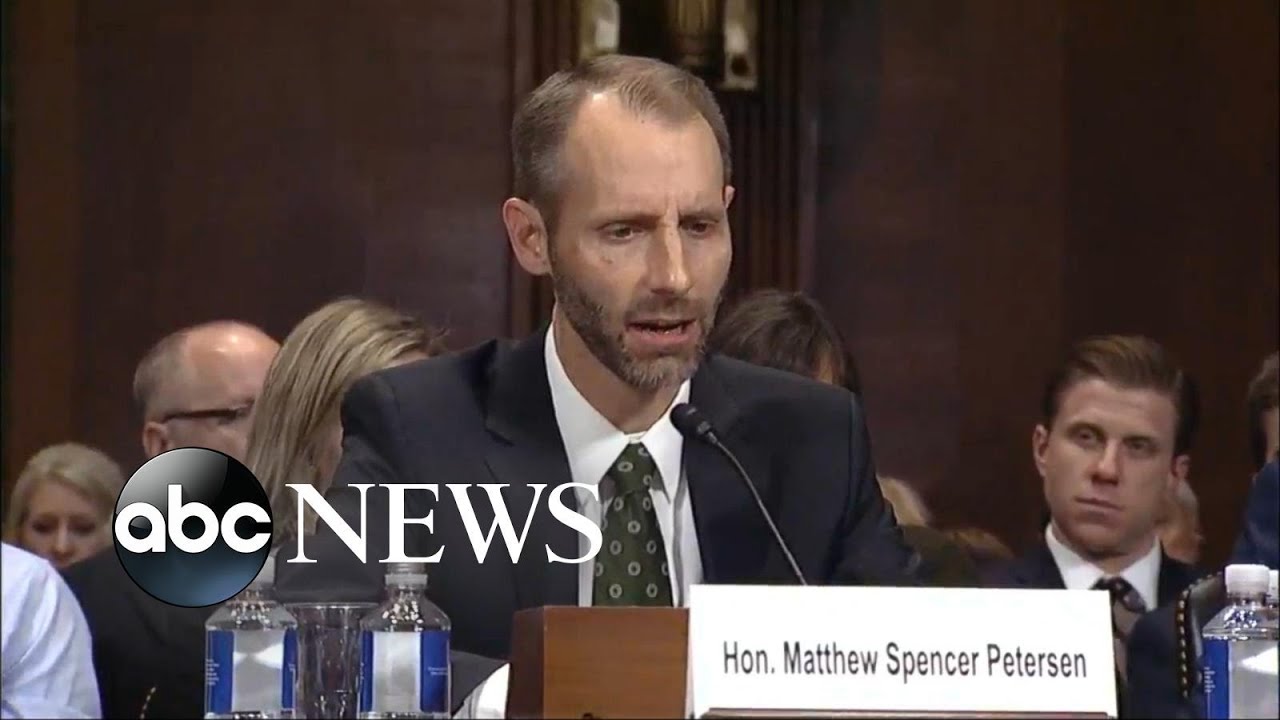 to answer basic questions. It also means that Supreme Court Justices should not be giving speeches at hotels owned by a sitting president, and it’s why we’ve asked Chief Justice Roberts to investigate whether Justice Gorsuch committed an ethics violation by giving a speech at President Trump’s hotel in Washington, D.C. In our letter to Chief Justice Roberts, we quoted what he wrote in Williams-Yuleeabout the importance of preserving public confidence in the integrity of the judiciary.
So much has changed since January 2015. But the role of the courts, and the importance of preserving public confidence in the integrity of the judiciary, is more important than ever.
rove engineered the state court takeover?
==
Outside Groups Dominate Spending in Judicial Elections, New Report Shows
October 26, 2011
:{
:{
}:
}:
https://www.brennancenter.org/press-release/outside-groups-dominate-spending-judicial-elections-new-report-shows
==
Kathy A. Surratt-States took the oath of office of the U.S. Bankruptcy Court for the Eastern District of Missouri in 2003. Surratt-States is the third member of the firm of Ziercher & Hocker -- which merged with Husch & Eppenberger in 1998 -- to assume the bench.
At her swearing-in, Surratt-States remarked: "This ceremony is the physical manifestation of a dream that literally began when I first studied business law in high school. While many years have passed since I made my first visit to the courtroom, my dream continues," she said. Surratt-States thanked family and friends for support in the form of food and visits. To professional associates she said, "Thanks for every tough assignment, every tip of the trade, every discussion and every `Kathy, keep your chin up' talk." Surratt-States continued, "Each interaction with family, friends and professional peers [has] occurred for a reason. Make no mistake: Nothing in life is coincidental. Your decisions to provide support and guidance weren't coincidental and neither were my decisions to pursue my dream. . . . You've all invested in me, and you will not be disappointed," she vowed.
Surratt-States is a member of the Bar Association of Metropolitan St. Louis, the Mound City Bar Association and The Missouri Bar. She earned her law degree from Washington University School of Law in 1991 and has served as a bankruptcy panel trustee for the Eastern District of Missouri since 1997.
Surratt-States replaces Bankruptcy Judge David P. McDonald, who retired on Jan. 10, 2003. She is the first African-American to be appointed to the bankruptcy bench in the 8th Circuit.
Judge OKs slashing of union coal miners' health benefits as part of bankruptcy solution
Brian Roewe | May. 30, 2013
A St. Louis judge has ruled that Patriot Coal Corp. can rework its union contract as well as slash health benefits to retired union workers as part of its path out of bankruptcy.
U.S. Bankruptcy Court Chief Judge Kathy A. Surratt-States of Missouri's Eastern District ruled Wednesday afternoon that Patriot can reject its past collective bargaining agreements, which includes "cradle to grave" benefits for nearly 23,000 miners and their dependents.
See "[W.Va. prayer rally calls for justice for coal miners in health care limbo" for NCR's previous coverage of the Patriot Coal bankruptcy case.]
The decision comes as a blow to members of the United Mine Workers of America, who alleged Patriot's formation was an attempt to escape full payment of the benefits -- $1.6 billion in long-term health and retirement obligations -- by the two companies previously responsible for coverage, Peabody Energy and Arch Coal.
In a press release, UMWA president Cecil Roberts said the decision is "wrong, unfair and fails to fully recognize the coming wave of human suffering that will be experienced by thousands of people throughout the coalfields."...
==
==
LOOTING pensions
pope:
I know, Republican politicians, other than Donald Trump, offer as an article of faith that they stand up against bailouts. In fact, the Club of Growth in its first attack on Trump, made a core issue of the idea that Trump has supported the Wall Street Bailout.
Except bailout opposition, it seems, falters when it comes to fossil fuels. Republicans took vicious exception to the Obama Administration’s willingness to use federal loan guarantees to help renewable energy companies – most spectacularly Solyndra—even though these loan guarantees, overall, came in under budget, and cumulatively created a powerful clean energy sector, but still, as you have heard thousands of times, taxpayers lost $535 million dollars when Solyndra failed.
So you would expect an enormous conservative outcry if major multinational corporations exploited loopholes in federal law to stick the taxpayers not with hundreds of millions, but with bills for billions for their business mistakes? Right?
Well, maybe not. Because the nation’s coal mining companies have been doing exactly that, with the active cooperation not of liberal Democrats but of judges
http://www.wsj.com/articles/SB10001424127887324412604578513572460160236?alg=y
Bankruptcy Judge Allows Patriot Coal to Scrap Union Contracts
By
Kris Maher and
Jacqueline Palank
Updated May 29, 2013 6:25 p.m. ET
Patriot Coal Corp. won approval from a bankruptcy-court judge Wednesday to slash the pay and benefits of thousands of miners, retirees and dependents...
and regulators in conservative Republican states like Missouri, Wyoming and West Virginia.Coal companies hold in trust the funds that pay their workers’ pensions and health care. But over the past few years companies like Peabody Coal divided themselves into bits and pieces. Certain bits kept the parts of the coal business Peabody thought were money makers. Other bits (with sexy names like Patriot Coal) got assigned mines that were no longer profitable, along with bundled liabilities like retiree pensions and health care. When Patriot Coal, predictably, filed for bankruptcy it stuck the taxpayers and the workers with the obligations.
In one elegantly vicious move, 208 retired coal miners who had no connection to Patriot Coal, had never worked for it, and whose pensions were fiduciarily sound, saw their retirement siphoned off to pay for legal fees and other bankruptcy costs. In essence, Alcoa, which is not going bankrupt, paid Patriot, which was, to assume pension obligations for these 208 miners. Alcoa gave Patriot reasonable money. But instead of using the funds to pay for pensions, Patriot is using it to pay lawyers, which, in a bankruptcy, it thought it could get away with. Eventually, it had to back down. But 12,000 other mine workers, with more direct relationships with Peabody, face the loss of their hard earned pension and health care benefits.
Coal companies are also required to post bonds to pay for reclaiming strip mined land. But those with creatively puffed up balance sheets were allowed by states to “self bond” and guarantee their own obligations. Arch Coal, for example, was allowed to qualify for “self-bonding” only four months before it went bankrupt. Alpha Resources has obligations of almost a half billion dollars. But over the past three years even “strong” coal companies like Peabody have plummeted towards bankruptcy, making it impossible for them to actually pay their accumulated reclamation costs. Yet state regulator‘s took no effective action to make them put up bonds for the reclamation costs everyone knew were coming. More than 75 percent of Wyoming’s massive clean up bill is “self-bonded” by companies most of which no longer exist or will shortly no longer exist.
...
http://ecowatch.com/2016/03/31/big-coal-bailout-2016/
==
==
http://www.motherjones.com/politics/2014/10/judicial-elections-dark-money
Best Little Courthouse in Texas
Historically, judicial elections involved little in the way of campaign spending, but in Texas in the 1980s, Karl Rove recognized the potential of backing judges favoring a conservative agenda. The strategy soon spread, with donations to state supreme court candidates nationwide totaling $83 million in the 1990s and more than $206 million in the 2000s.
Direct spending on state judicial campaigns
Generic placeholder image
Direct spending on supreme court races, 2000-14
Generic placeholder image
The GOP's Sweet Home, Alabama
Rove went on to work with business power brokers in Alabama; donations to that state's Supreme Court candidates since 2000 (including "Ten Commandments Judge" Roy Moore) have been higher than in any other state, totaling more than $48 million.
The Rising Tide of Special-Interest Money
But direct spending by judicial campaigns was just the beginning. Over the last decade, outside spending by special-interest and partisan groups has soared. And Citizens United is accelerating that trend: In the 2011-12 cycle, spending from outside groups came in at a record $24.9 million—a nearly sevenfold increase since 2000.
This year, partisan groups have continued to spend millions in states like North Carolina and Tennessee, aiming to unseat supreme court justices. Judges in these scenarios "have had to become professional fundraisers," says Bert Brandenberg, executive director of the judicial-reform group Justice at Stake, "often soliciting money from parties who will appear before them in court."
Direct vs. outside spending (in 2014 dollars)
State Secrets
No one knows exactly how much money is spent on judicial races, in part because state disclosure laws are weak. An analysis by the National Institute on Money in State Politics gave 26 states a failing grade on monitoring such spending.
Where Are the Roughest Campaigns?
Fewer than two dozen big players were behind nearly $72 million in campaign spending on supreme court races nationwide between 2000 and 2012. They included business heavyweights such as the US Chamber of Commerce and partisan groups focused on specific races in states like Michigan (where an estimated $13-$18 million was spent in 2011-12), Florida (at least $4.8 million in 2011-12), and North Carolina (at least $4.5 million in 2011-12).
The outside money, which has more than tripled over the last decade, primarily funds TV attack ads. In 2012, an ad backing a Republican judicial candidate in Ohio said his Democratic opponent "expressed sympathy for rapists." In the North Carolina Supreme Court primary this year, an ad blasted a candidate who "sides with child predators." The local bar association condemned that ad, as did six former state justices, calling it "disgusting" and "false."
Spending on TV ads
Generic placeholder image
State Lower-court contribution
Texas $18,124,729
Illinois $8,987,496
Florida $7,874,947
Michigan $4,531,056
California $4,436,461
New York $3,933,427
Pennsylvania $2,438,094
Washington $2,430,281
Wisconsin $1,883,062
Oregon $425,199
The Hidden Spending on Lower Courts
Campaign funding in races for lower courts is even more obscure—despite the fact that these races produce the vast majority of judges, and those most citizens will face. The first ever set of data on these races, compiled for 10 states, shows that more than $55 million was raised during the 2011-12 election cycle alone.
The Best Ruling Money Can Buy
The total cost of judicial elections ($288 million since 2000) is still nowhere near that of congressional races ($17 billion since 2000). Donors potentially buy a lot more influence, with less money, when they back judges: In West Virginia in 2004, the CEO of Massey Energy spent $3 million on his preferred Supreme Court candidate; that justice later cast the deciding vote to overturn a $50 million verdict against the company—a nearly 1,600 percent return on investment.
Is Your Judge for Sale?
Read our story on how judicial elections have been overtaken by secretive interest groups, nasty ads, and the constant hustle for campaign cash.
7 Sleazy Campaign Ads
Terrorist sympathizer? Friend to criminals? Pedophile supporter? These videos reveal the increasingly nasty world of judicial elections.
Judicial Races to Watch
From North Carolina to Michigan to Texas, here are the states where the big-money slugfests are playing out in 2014.
===
1973 book bad acts
http://www.tulanelink.com/tulanelink/finestjudges_03a.htm
==
NC Supreme Court a 'virtual sinkhole' for environmental law, and it could get worse
The North Carolina Supreme Court has racked up an "extraordinary record of hostility" to the environment in major cases it's considered over the past 15 years -- and with the seven-member court's three Democrats facing tough re-election challenges this year, it could soon get even more inhospitable to environmental concerns.
So concludes a study released this month by John Echeverria, a professor at Vermont Law School and a former attorney for the National Audubon Society and American Rivers.He looked at the judicial electoral process in North Carolina, Wisconsin, Montana and Washington -- states that use either a partisan or nominally non-partisan method for selecting judges for their high courts -- in order to identify changes in the ideological direction of the courts' decisions.
In North Carolina, where high court elections are nominally nonpartisan, Echeverria considered a total of seven environmental law cases during that period. They pertained to the state law designed to limit sediment pollution in waterways, open burning rules, water quality standards, and hog farm regulations.
"Over the last fifteen years, in every instance in which the Court has reviewed a major environmental law issue, the Court has sided with the anti-environmental protection side of the dispute," Echeverria writes.
He notes that the probability of the court ruling against the environment in all seven cases is 1 in 128 -- "long odds indeed." North Carolina's high court, he says, "has become a virtual sinkhole for environmental law."
Echeverria explores the connection between the court's hostility to environmental claims and financing of state judicial elections. In 2004, North Carolina implemented a public financing program that was used by 80 percent of judicial candidates and curbed special-interest spending in campaigns. That program was repealed in 2013, a move that has increased the flow of corporate special-interest dollars into judicial elections.
At the same time, independent groups have increased their spending on North Carolina judicial races. In 2012, super PACs and other outside groups spent nearly $3 million on just one N.C. Supreme Court race, with about 90 percent of the money benefiting conservative justice Paul Newby. In this year's primary, outside groups spent almost $1.3 million to unseat Associate Justice Robin Hudson -- a registered Democrat who was elected in 2006 and who Echeverria found has been the sole dissenter from the court's pattern of weakening environmental protections.
Hudson faced a heated primary challenge from conservative trial judge Eric Levinson and Jeanette Doran, chair of the N.C. Division of Employment Security Board of Review. Doran is also a former staff member of the N.C. Institute for Constitutional Law, a limited-government advocacy group founded and funded by influential conservative money man Art Pope, who as former state budget director played a key role in killing the judicial public financing program.
The primary race featured a controversial ad attacking Justice Hudson for being "soft on child molesters," leading one political observer to call it "perhaps the most despicable advertisement ever aired in the state." That ad was sponsored by Justice for All NC, an outside spending group funded by the Republican State Leadership Committee, which in turn has received major contributions from corporations with a financial stake in cases that may come before the N.C. Supreme Court. They include Koch Industries, the Kansas-based oil and chemical conglomerate that has operations in North Carolina, and North Carolina-based Duke Energy, which currently has a case related to groundwater contamination from its coal ash ponds before the high court after the justices exercised their discretion to take the case away from the N.C. Court of Appeals.
At the same time Justice for All NC was running the controversial ad attacking Hudson, the NC Chamber IE, the independent expenditure arm of the NC Chamber, was running positive ads supporting Doran and Levinson. Koch Industries was also among the companies that contributed to the NC Chamber IE.
Echeverria observes:
An undisclosed subtext of the attacks on Justice Hudson is that she is the single justice on the present Court who has distinguished herself by voting in favor of environmental protections in the cases that have come before her.
In the end, Hudson survived the primary. She is now facing off against Levinson in the general election -- a contest that’s shaping up to be North Carolina's most expensive state court racethis year.
Echeverria found that the last time the N.C. Supreme Court handed the environmental side a win was 1998, when a majority of justices rejected a legal challenge to the revocation of an aerial pesticide applicator's license for violating state regulations.
Four years earlier, the court handed down another major environmental ruling in Empire Power Co. v. N.C. Department of Environment, upholding the right of citizens to go to court to protect themselves from air polluters. Reversing the N.C. Court of Appeals, the high court held that the owner of land next to a proposed power plant was entitled under state law to challenge the department's issuance of an air pollution control permit to Duke Power.
But that precedent is now threatened by a similar case involving property owners and environmental groups challenging state's air quality permit for a new cement manufacturing facility in New Hanover County.
Last year an administrative law judge, siding with the state Division of Air Quality, arrived at what Echeverria calls "the novel conclusion" that in order for a person to challenge an air emissions permit he must show how much additional pollution would be produced and what specific injuries would result. The N.C. Environmental Management Commission upheld the judge's ruling, and the plaintiffs filed an appeal in Superior Court. That case could eventually make its way to the N.C. Supreme Court, which would have the chance to reverse its Empire Power ruling.
While Hudson's re-election would be no guarantee that wouldn't happen, her loss would make it even more likely that it would.
"Given the current and likely future makeup of the Court, Justice Hudson would be unlikely to sway the Court in many environmental cases," Echeverria concludes, "but at least she can -- if reelected -- serve as a counterweight to the other justices on the Court who appear to have less sympathy for environmental protections."
Sue Sturgis on Thu, 10/23/2014 - 14:
==
Federal Judge Who Halted Walker Dark Money Criminal Probe Attended Koch-Backed Judicial Junkets
The federal judge who ordered a halt to Wisconsin's "John Doe" criminal investigation into spending during the 2011 and 2012 recall elections has regularly attended all-expenses paid "judicial junkets" funded by the Charles G. Koch Charitable Foundation, the Lynde and Harry Bradley Foundation, and other ideological and corporate interests.
On May 6, federal District Court Judge Rudolph Randablocked an ongoing John Doe criminal probe into allegedly illegal coordination between nonprofit groups like Wisconsin Club for Growth, which spent $9.1 million on electoral ads during Wisconsin's recall elections, and the recall campaigns of Governor Scott Walker and state senators. John Doe investigations are similar to grand jury investigations, and Wisconsin Club for Growth -- and its director, Eric O'Keefe, a longtime compatriot of the Koch brothers -- asked the federal court to stop the probe, alleging it violated their "free speech" rights.
Judge Randa sided with O'Keefe, and also ordered prosecutors to destroy all evidence gathered in the investigation, an extraordinary edict in a criminal case made even more astounding by the fact that it came in the context of a preliminary injunction. The Seventh Circuit has blocked this part of his ruling; an appeal of the remainder of his decision is pending.
An analysis by the Center for Media and Democracy shows that Judge Randa attended privately-funded, all-expenses-paid judicial seminars put on by George Mason University in 2006, 2008, 2010 and 2012, according to publicly-available financial disclosure forms. (The 2013 disclosure form has been requested but has not yet been publicly posted).
The George Mason University seminars are bankrolled by a long list of right-wing foundations, like Koch, Bradley, and the Searle Freedom Trust, as well as the U.S. Chamber of Commerce and corporations like BP, Exxon Mobil, and Dow Chemical. Many of these interests have long opposed limits on money in politics, although it is not known whether campaign finance reform was a topic at the seminars Randa attended.
The seminars amount to a privately-funded all-expenses paid trip for judges, with conference sponsors picking up the costs of a judge's flights, hotel rooms, and meals. One seminar Judge Randa attended was in La Jolla, California, a swanky San Diego suburb that is home to both great golfing and Mitt Romney; the location of other seminars Randa attended is unknown. The content of the seminars has a decidedly pro-corporate bent, and the expensive gifts raise concerns about improper influence when corporate sponsors have a stake in a case before a judge. (Some reports have directly connected the trips to judge's decisions).
No other federal district judges in Wisconsin attended the privately-funded George Mason seminars, according to the Center for Media and Democracy's review of publicly available financial disclosure documents.
Koch and Bradley Bankrolled Junkets Randa Attended
The Judicial Conference of the United States -- which oversees the conduct of federal judges -- has notedthat judges may be "influenced inappropriately" at the privately-funded events, and since 2007 has required that seminar organizers disclose the names of funders.
The disclosures do not specify how much each funder contributed towards the judge's expenses and seminar costs, but for the years that Judge Randa attended the seminars, some donations can be ascertained by foundation tax filings.
According to the Charles G. Koch Charitable Foundation's tax filings, in 2012 it gave $5.45 million to the George Mason University Foundation, and $51,000 to its "Law and Economics Center." The Charles G. Koch Foundation gave $4.7 million to George Mason in 2010 for "general operating support and education programs," $2.78 million in 2008 for "general operating support," and $350,000 in 2006 for "educational and research programs."
The Koch network also funded Wisconsin Club for Growth, which filed the case before Judge Randa. A full list of the Club's funders is not known, but tax filings show that the Koch-connected Center to Protect Patient Rights (CPPR) funneled $225,000 to Wisconsin Club for Growth in 2011. CPPR also entirely bankrolled the Coalition for American Values, which spent $400,080 on pro-Walker ads in the final weeks of the recall elections. (In California, CPPR was hit with an unprecedented $1 million fine for its involvement in a campaign finance shell game to evade the state's donor disclosure laws.) Other Koch groups, like Americans for Prosperity, have reportedly been subpoenaed in Wisconsin's John Doe investigation.
In 2010, the Bradley Foundation gave George Mason $40,000 "to support educational programs for judges conducted by the Law and Economics Center." It also gave George Mason $40,000 in 2008 "to support the judicial education program," and $35,000 in 2006 "to support education programs."
The Bradley Foundation's President and CEO, Michael Grebe, chaired Scott Walker's 2010 and 2012 gubernatorial campaigns. Walker's 2012 campaign is under investigation in the John Doe for allegedly illegal coordination.
Both Bradley and Koch have long demonstrated antipathy for limits on money in politics, and for years have bankrolled organizations that fight against campaign finance reform, like the Center for Competitive Politics.
Judicial Seminars Reflect Principles in Powell Memo
Some have drawn a direct line between these corporate-funded judicial seminars and the 1971 Powell Memo, a call-to-arms for corporate America to aggressively push back against the "attack on the free enterprise system" -- represented by the likes of Ralph Nader -- by developing a set of institutions to reshape politics and law.
The Powell Memo reportedly sparked the development of a right-wing infrastructure and the formation of groups like the American Legislative Exchange Council (better known as ALEC), the Cato Institute, the Federalist Society (with which Judge Randa is affiliated), and others. As the New York Times recently reported, Charles Koch specifically referenced the Powell Memo in a 1974 speech previewing what has become the "Koch network," calling for a "well-financed cadre of of sound proponents of the free-enterprise philosophy" and for business to "undertake radical new efforts to overcome the prevalent anti-capitalist mentality."
Some of the memo's most aggressive language was reserved for the judiciary, which its author, then-tobacco lawyer and future U.S. Supreme Court Justice Lewis Powell, called “the most important instrument for social, economic and political change.”
As a Supreme Court Justice, Powell would play a key role in decisions like First National Bank v. Bellotti andBuckley v. Valeo, which declared that "money equals speech" and reshaped the First Amendment into a tool to protect the ability of corporations and wealthy individuals to spend on elections.
Privately-Funded Seminar Disclosure Still Spotty
Although the Judicial Conference requires that judges publicly disclose their attendance at privately-funded seminars, and that those who conduct the events publish details about their funders, tracking the reports can be difficult, as the Center for Public Integrity has noted.
The Eastern District of Wisconsin website has a page that is supposed to list all seminars attended by federal judges in that court over the past three years, yet claims that there is "no attendance reported" for any Eastern District judges since 2011. This is contradicted by a review of Judge Randa's 2012 financial disclosure form.
Requesting an individual judge's financial disclosure form can take weeks, although Judicial Watch has postedmany forms online.
Judge Randa reported no travel reimbursement on his 2010 financial disclosure form, but the Center for Public Integrity reports that he attended a 2010 seminar at George Mason titled "The Rule of Law."
George Mason also has apparently tried to dodge the limited donor disclosure rules that do exist. Prior to 2012, it disclosed its list of corporate and foundation seminar funders -- which consistently included Koch and Bradley and corporations like Exxon Mobil -- but in 2012 listed the only funder as "xyz corp," and listed itself as the only donor. In 2013 it returned to providing a full list of donors.
-- Lisa Graves contributed to this article --
==
corkeries buy judges:
==
Other recipients, such as American Action Network, Americans for Job Security (AJS) and Americans for Prosperity, are notably active in the political ad wars. AJS, for example, which received a combined total of nearly $3 million from Wellspring in 2008 and 2010, spent at least $8.3 million on ads mentioning federal candidates in 2010, and nearly $16 million in 2012. AJS was also involved in a scheme last year that funneled $11 million into efforts to curb the political power of labor unions and prevent a tax increase. California’s campaign finance agency called it political "money laundering" and last month levied $1 million in fines in the case.
And still other Wellspring recipients train their sights on the judicial branch. The Judicial Crisis Network (JCN) -- originally called Judicial Confirmation Network -- was started in 2004 to help build support for former President George W. Bush's federal court nominees. Now it works against Obama's judicial picks -- and Obama himself. According to Federal Election Commission records, JCN spent $571,000 in 2008 opposing Obama's election. JCN also runs ads benefiting conservative state court candidates. According to the Michigan Campaign Finance Network, the group spent more than $1 million airing ads against a Democratic state supreme court candidate in Michigan last year; its target, Bridget Mary McCormack, won despite that. It also spent $1 million on a lower court race – believed to be the first time dark money has been used in a trial court contest.
As it happens, Neil Corkery is treasurer of JCN. Wellspring, run by his wife, gave the group and its affiliate, the Judicial Education Project, a total of more than $700,000 over a two-year period encompassing 2010 and 2011. ...?
In 2010 Wellspring gave $125,000 each to the Michigan-based American Justice Partnership (AJP) and the Michigan Chamber of Commerce, which shares AJP's goal of putting more conservatives on the bench.
That year, AJP gave more than $1 million to the Michigan Republican Party. And the Michigan Chamber gave $5.4 million to the Republican Governors Association -- about the same amount that the RGA subsequently routed to the Michigan GOP. The state GOP spent about $4.8 million on in Michigan's supreme court race that year, according to the independent Michigan Campaign Finance Network, which did a detailed review of public records.
Got that? Not if the groups involved can help it. The upshot, though, is that two of Wellspring's recipients invested in the contest -- which ultimately restored a conservative majority to the highest court in the state.
In addition, over the course of three years, Wellspring has given nearly $1 million to Missourians for Better Courts. That group has fought to change Missouri's judicial selection process, which it argues is overly influenced by liberal trial lawyers.
Putting, or keeping, conservatives on the nation’s courts was the focus of several other Wellspring grantees, including the Alabama Civil Justice Reform Committee, Alabama Voters Against Lawsuit Abuse, Wisconsin Manufacturers & Commerce and the Illinois Manufacturers Association.
Cash in, cash out
On the other side of the ledger sheet, though, the sources of Wellspring's millions are mostly a cipher. Like all 501(c)(4) organizations, it doesn't have to reveal them. CRP and NPR have been able to learn of only three donors, all of which are also (c)(4)s: The American Democracy Alliance gave Wellspring $150,000 in 2008, the year the Corkery group launched. A second, Founding Principles PAC gave it $1,026, also in 2008. And Rosebush Corp. gave Wellspring $100,000 in 2011.
That's a little more than $251,000 -- roughly 1 percent of the $24 million Wellspring has reported as income from 2008 through 2011. None of the three donor groups returned calls from NPR and CRP seeking comment.
The American Democracy Alliance, like Wellspring, has taken an interest in judicial elections: In 2010, it gave $100,000 to ShowMe Better Courts, a Missouri group; and $500,000 to the Adam Smith Foundation -- which, in turn sent money to Missourians for Better Courts, the same group that received nearly $1 million from Wellspring.
Rosebush Corp., headed by a Pennsylvanian named Brian Sullivan, also gave $750,000 in 2011 to Americans for Limited Government, a group headed by wealthy libertarian Howard Rich that has spent millions running ads against Democrats and giving to other conservative organizations. The next year, Rosebush gave to Club for Growth Action, which has helped fuel the rise of some tea party Republicans, and to the pro-Mitt Romney super PAC, Restore Our Future.
http://www.buzzfeed.com/johnw122/what-you-need-to-know-about-the-smear-campaign-aga-f2ke
Judicial nominee Cornelia “Nina” Pillard is up for a vote in the Senate on Thursday. Here’s what you need to know about the conservative smear campaign against her
==
funded the Davis hit: Though the ATA resisted Gray Davis' lawsuit to avoid disclosing its funders in 2001, the group revealed its major 2002 contributors' names (most likely mistakenly) in the 2002 tax form it provided Public Citizen. Its top contributor that year was the U.S. Chamber of Commerce, which gave $2.6 million. The ATA received about $2.3 million of that donation in the month before Election Day.11^ The Chamber reportedly employed a strategy of funding outside groups to influence judicial elections in 2002, making its role more discrete than in 2000 when it broadcast ads under its own name.12
| American Taxpayers Alliance 990 form, 2002. |
|---|
| Robert Lenzner and Matthew Miller, "Buying Justice; For Years Trial Lawyers Owned State Courts. Now Big Business Is Striking Back," Forbes, July 21, 2003. |
==
Can a Judge Really Block the SEC’s Settlement With Steven Cohen?
http://www.propublica.org/article/can-a-judge-really-block-the-s.e.c.s-settlement-with-steve-cohen#
Pro-business organizations sponsor expense-paid seminars for federal judges
By Chris Young, Reity O'Brien and Andrea Fuller, Center for Public Integrity March 28, 2013 2:33pm
Conservative foundations, multinational oil companies and a prescription drug maker were the most frequent sponsors of more than100 expense-paid educational seminars attended by federal judges over a 4 1/2-year period,according to a Center for Public Integrity investigation.
Among the seminar titles were “The Moral Foundations of Capitalism,” “Corporations and the Limits of Criminal Law” and “Terrorism, Climate & Central Planning: Challenges to Liberty & the Rule of Law.”
Leading the list of sponsors of the 109 seminars identified by the Center were the conservative Charles G. Koch Charitable Foundation, The Searle Freedom Trust, also a supporter of conservative causes, ExxonMobil Corp., Shell Oil Co., pharmaceutical giant Pfizer Inc. and State Farm Insurance Cos. Each were sponsors of 54 seminars.
Other top sponsors included the conservative Lynde and Harry Bradley Foundation (51), Dow Chemical Co. (47), AT&T Inc. (45) and the U.S. Chamber of Commerce (46), according to the Center’s analysis.
Critics complain that many of the privately funded conferences serve state and federal judges a steady dose of free-market, anti-regulation lectures that could influence judges’ rulings from the bench.
Sponsors pick up the cost of judges’ expenses, which often include air fare, hotel stays and meals. The seminars in the Center’s investigation took place from July 2008 through 2012.
The Center identified 185 federal district and appeals court judges who reported attending one or more of the seminars over the period, according to disclosure forms, or about 11 percent of the more than 1,700 federal judges in the United States.
Among the participants: U.S. District Judge Carl J. Barbier of the Eastern District of Louisiana. One of the two seminars he attended in 2009, “Criminalization of Corporate Conduct,” was sponsored by the American Petroleum Institute and other business interests. Barbier is now presiding over the BP oil spill trial.
U.S. Bankruptcy Judge Jerry A. Brown, who serves in the Eastern District of Louisiana, also attended two seminars: “Economics Institute for Judges” in 2009 and “Antitrust Law and Economics Institute for Judges” in 2012.
Two schools — George Mason University, located in Virginia just outside Washington, D.C., and Northwestern University based in Evanston, Ill., — hosted more than two-thirds of the seminars.
Roughly three-fourths of the more than 800 sponsors listed in documents were individuals, including a number of judges who took trips, raising the possibility that they may have offset the cost of the sponsorships with their donations. Most of the remaining underwriters were companies and foundations.
Determining exactly how much was paid by which sponsor is difficult to determine — amounts are not required to be reported under the disclosure rules.
Judicial conferences are billed as educational retreats intended to improve judges’ understanding of the law and economics. Judges and seminar hosts say the conferences, which feature lectures and panel discussions, provide helpful information that refines their legal expertise.
But they’ve long drawn scrutiny for how they are funded and organized.
Since the 1990s, critics have complained that many of the privately funded conferences serve state and federal judges a steady dose of free-market, anti-regulation lectures that could influence judges’ rulings from the bench.
Those concerns quieted in 2007, when the Judicial Conference of the United States, a group of senior circuit judges who oversee the U.S. Courts, implemented a policy requiring judges and seminar hosts to disclose information about the conferences.
Well-traveled jurists
The most-traveled judges, according to reports filed online by the judges, were U.S. District Judge Charles R. Wolle of the Southern District of Iowa and Chief Judge Thomas B. Bennett of the Northern District of Alabama Bankruptcy Court. Each reported attending nine seminars.
Wolle is a “senior status” judge, meaning he is semi-retired. He did not respond to requests for comment.
The next-most-traveled judges were:
- U.S. District Judge Manuel L. Real of the Central District of California and Judge Diarmuid F. O’Scannlain of the U.S. Court of Appeals 9th Circuit, covering the Western states, who each took eight trips;
- E. Grady Jolly, a federal appeals court judge for the 5th Circuit which includes Texas, Louisiana and Mississippi, and U.S. Bankruptcy Judge Michael B. Kaplan of the District of New Jersey, who each took six trips;
- U.S. District Judge Kenneth M. Hoyt of the Southern District of Texas, Chief Magistrate Judge Thomas J. Shields of the Southern District of Iowa and senior-status U.S. District Judge Frederic Block of the Eastern District of New York, each of whom took five trips.
O’Scannlain declined to comment for this story. In an email, Kaplan wrote that the “seminars offer a valuable opportunity for new judicial appointees to enhance their knowledge and skills in complex areas of the law,” including economics.
Wolle, Real and O’Scannlain are all listed as seminar sponsors, though records do not indicate how much they contributed.
The Center identified instances where judges who attended seminars underwritten by certain firms and trade groups later issued rulings in the funders’ favor.
EPA loses case
In April 2009, for example, Jolly traveled to Northwestern University to attend the “Criminalization of Corporate Conduct” seminar sponsored by the American Petroleum Institute, the U.S. Chamber of Commerce and 13 other funders.
Last August, Jolly wrote the majority 2-1 opinion declaring that the Environmental Protection Agency broke the law when it rejected a Texas emissions cap generally supported by the fossil fuels industry.
“It looks as if [corporations] are buying influence, even if it’s not true.” — Charles Geyh, an Indiana University law professor
Jolly, who did not respond to requests for comment, sided with two of the petitioners in the suit — the American Petroleum Institute and the U.S. Chamber.
Charles Geyh, an Indiana University law professor who specializes in judicial ethics, is skeptical that rulings are directly influenced by corporate sponsors of seminars, but noted, “in a cynic’s view that would smack of corruption.”
“Even if it has no effect in terms of the decisions judges make, the perception of influence matters a great deal,” he says. “It looks as if [corporations] are buying influence, even if it’s not true.”
Another attendee of the 2009 “Criminalization of Corporate Conduct” seminar was Barbier, the Eastern District of Louisiana jurist presiding over a high-profile BP civil trial, which is being held without a jury in New Orleans.
Barbier is in charge of considering whether BP owes billions of dollars in fines for gross negligence leading to the 2010 Deepwater Horizon oil platform explosion and spill. The disaster killed 11 people and contaminated a large swath of the Gulf Coast.
In 2011, Barbier dismissed a wrongful-death claim in a suit brought against ExxonMobil and Chevron USA by the widow of a worker who was exposed to radioactive materials found on the companies’ equipment.
Barbier’s ruling in favor of the oil companies came two years after he attended the corporate conduct seminar, funded in part by ExxonMobil and the American Petroleum Institute, according to documents. The judge did not respond to requests for comment.
Politics investigations in your inbox: Sign up for The Center for Public Integrity’s Watchdog email
Related: Key Findings
Related story: Judicial seminar backed by ex-president of Bolivia
Related: Free ‘Consider the Source’ e-book
Corporate U?
George Mason University’s Law & Economics Center hosted 45 seminars while Northwestern University’s Judicial Education Program hosted 29. A total of 136 federal judges reported attending conferences conducted by the schools during the 4 1/2-year period analyzed by the Center for Public Integrity.
The remaining top five conference hosts, including The Sedona Conference and the Foundation for Research on Economics and the Environment (FREE), collectively organized 28 conferences.
The Koch Foundation and The Searle Freedom Trust supported most of the conferences organized by George Mason and Northwestern. The energy industry was a sponsor in roughly three-fourths of the conferences hosted by Northwestern.
Billionaire brothers Charles and David Koch, major supporters of conservative causes, and their foundations have given millions to George Mason University. As the Center recently reported, the George Mason University Foundation received $4.4 million in 2011 from the Charles Koch Foundation, making up 15 percent of its revenue that year.
The school is the top recipient of Koch foundation money since 1985. George Mason also houses several free market and libertarian research centers, including the Institute for Humane Studies, which received $3.7 million from the Koch foundations, and the Mercatus Center, whose board of directors includes Charles Koch.
Officials from the Charles G. Koch Charitable Foundation did not return phone calls seeking comment for this report.
The Judicial Conference disclosure policy doesn’t require seminar hosts to reveal how much donors contribute to conferences. But corporate-giving reports and nonprofit tax records shed some light on the costs.
Oil industry support
In 2011, for example, ExxonMobil reported giving $20,000 to George Mason specifically for its judicial training program. The oil company gave an additional $30,000 to the university’s Law & Economics Center, which hosts the conferences. Between 2003 and 2007, the ExxonMobil Foundation gave the think tank $150,000.
ExxonMobil officials did not respond to requests for comment.
“It’s the funders that create the problem … The money comes from interests that have matters before the courts, and they’d like to have those matters settled in their favor.” — Stephen Gillers, a New York University law professor who specializes in legal ethics
Another seminar funder, Donors Trust, gave George Mason’s Law & Economics Center nearly $450,000 in general support in 2010. As the Center reported, Donors Trust helps conservative foundations and individuals give money anonymously to nonprofits that may take controversial positions.
A representative of Donors Trust declined to comment for this story.
The :{Searle :(style="background-color:#ffff66ff"):}:Freedom Trust, a foundation advocating “economic liberty” that regularly donates to conservative groups like the Cato Institute and the American Enterprise Institute, contributed a combined $400,000 to George Mason’s judicial education programs in 2010 and 2011.
The school conducted conferences on antitrust law as well as “Corporations and the Limits of Criminal Law,” both funded by AT&T, BB&T, BP America, Cigna, Coca-Cola, Dow Chemical, FedEx Corp. and others.
“The Moral Foundations of Capitalism” was funded by the same group, and was the most popular George Mason conference, drawing at least 10 federal judges.
BP spokesman Scott Dean says the company has no record of ever directly contributing to the seminars but he did say BP gave the law school and the Law & Economics Center more than $37,000 between 2001 and 2008.
Seminars at Northwestern are hosted by the school’s Searle Center on Law, Regulation, and Economic Growth. The think tank, according to its website, was founded in 2006 thanks to a “generous grant” from Daniel C. Searle, the late pharmaceutical industry executive.
In 2009, the foundation gave $200,000 to Northwestern’s Searle Center for its judicial education program.
Another Northwestern seminar funder, The Lynde and Harry Bradley Foundation — a major supporter of conservative organizations, including the Heritage Foundation — gave $210,000 to the Searle Center between 2008 and 2010.
Records show corporate sponsorship at Northwestern was highest from 2008 through 2010, when a man named Henry Butler — now in charge of George Mason University’s Law & Economics Center — ran the Searle Center.
Daniel Rodriguez, dean of Northwestern University’s School of Law, says corporate sponsorships at the school “ended the moment Butler left.” Rodriguez, who became the dean of Northwestern’s law school last year, says the school recently decided to terminate the programs. He says he’s against corporate sponsorship of judicial seminars.
“These programs should be free from any real or perceived conflict of interest,” he says.
Related: Find a judge
Related story: Judges often ignore trip disclosure rules
Related: Methodology
Some history
In the late 1990s and early 2000s, advocacy groups and raised concerns about judges attending privately funded conferences conducted in vacation destinations like Arizona, Montana and Florida.
Critics claimed that the undisclosed trips created conflicts of interest and cast doubt on the ability of judges to decide cases without bias.
Seminars hosted by the Foundation for Research on Economics and the Environment (FREE) attracted the most attention.
FREE, a Montana-based think tank championing “free-market environmentalism,” drew criticism for its ideologically conservative seminars. In 2011, for example, FREE hosted “Terrorism, Climate & Central Planning: Challenges to Liberty & the Rule of Law.”
Critics complained that judges spent their free time golfing, fishing and horseback riding at the conference’s Montana resort location. They worried that judges were being wined, dined and entertained by FREE’s funders, which included Koch Industries and Texaco Inc. (now part of Chevron Corp.).
Media scrutiny prompted members of Congress in 2000 to introduce legislation that would prohibit judges from accepting “anything of value in connection with a seminar.” The bill, which died in committee, was opposed by the Judicial Conference, which claimed it restricted judges’ free speech rights.
Similar legislation failed again in 2003.
In 2007, the Judicial Conference implemented a policy designed to provide “greater transparency” by setting up disclosure requirements for both judges and seminar hosts.
“Instead of banning anything,” says Geyh, the policy “was a way to mollify those who recognized the perception problem without causing the ones who treat [the conferences] as a First Amendment issue to go ballistic.”
Buying influence?
Even with the new policy, the seminars still have critics.
“These seminars are taking place because large corporate interests are hoping to influence the outcome of cases involving themselves or likeminded entities,” says Nan Aron, president of the Alliance for Justice, a liberal organization that first raised concerns about judicial education conferences in a 1993 report titled “Justice for Sale.”
Russell Wheeler, former deputy director of the Federal Judicial Center, an education and research agency for the federal courts, says it’s possible that funders could be truly dedicated to improving judges’ understanding of the law.
But, he says, “You’ve got to be pretty naïve to believe that.”
“It’s the funders that create the problem,” says Stephen Gillers, a New York University law professor who specializes in legal ethics. “The money comes from interests that have matters before the courts, and they’d like to have those matters settled in their favor.”
“I’m not going to be snowed by anybody’s presentation.” — Chief Judge Thomas B. Bennett of the Northern District of Alabama Bankruptcy Court
Many of the seminars are conservative in nature, especially those hosted by George Mason. But there are a few exceptions. A June 2010 conference sponsored by the Open Society Institute, a foundation founded by liberal investor George Soros, focused mainly on human rights law. (The Center for Public Integrity and The Lens have received funding from Soros’ Open Society Foundations.)
Events hosted by the Sedona Conference, a nonprofit whose seminars address legal issues like antitrust law and intellectual property, have been funded primarily by law firms.
Speaking from the right
According to The Center for Public Integrity’s analysis, the person who spoke at more judicial conferences than any other was Butler, a professor and prominent conservative formerly of Northwestern and now executive director of George Mason’s Law & Economics Center.
He has taught judicial seminar courses with titles like “Economic Thinking” and “Economics of Insurance.” A former Republican candidate for Congress — he lost a 1992 bid — Butler was a “Koch Distinguished Professor of Law and Economics” at the University of Kansas.
Butler’s resume cites his “professional affiliations” with the conservative Federalist Society and the Mont Pelerin Society, which decries society’s loss of freedoms “fostered by a decline of belief in private property and the competitive market.”
Butler declined to be interviewed for this story. In response to emailed questions about George Mason’s judicial seminars, he wrote, “You seem to have a well-established theme to your story, accordingly we don’t see any advantage in collaborating with you.”
Daniel Polsby, dean of the George Mason University School of Law, also declined to answer questions for this story other than to say via email: “We’re very proud of the activities and programs of the Law & Economics Center.”
Another frequent seminar instructor is Terry L. Anderson, president of the Property and Environment Research Center, a conservative think tank “dedicated to improving environmental quality through property rights and markets.”
Anderson, a senior fellow at the conservative Hoover Institution, has regularly led “Free Market Environmentalism” lectures at conferences hosted by both George Mason and Northwestern.
Green energy’s ‘false promise’
In January 2011, Anderson was one of four lecturers who spoke at George Mason’s “Advanced Institute on Environmental Economics” conference, which was funded in part by ExxonMobil, BP America and Shell Oil.
The other three speakers were Andrew Morriss, co-author of the book “The False Promise of Green Energy”; Robert K. Fleck, an economics professor who has received thousands of dollars in research grants from the Charles G. Koch Charitable Foundation; and Jason Johnston, a former fellow with the Koch-funded, Anderson-led Property and Environment Research Center and a critic of efforts to reduce greenhouse gas emissions.
“I don’t express views” during lectures, says Anderson. He says his talks are based strictly on economic analysis. “None of my lectures are aimed at changing any judge’s opinion” about a case before them in court.
George Mason law professor Todd J. Zywicki, another regular judicial program speaker, has taught judges about issues like mortgage markets and consumer credit.
He is a senior scholar at the school’s conservative Mercatus Center, and has ties to the Goldwater Institute, a libertarian think tank, and the Competitive Enterprise Institute, which is “dedicated to advancing the principles of limited government, free enterprise, and individual liberty.” Zywicki did not respond to a request for comment.
George Mason “is known to stage conferences that have a conservative economic perspective,” says Gillers, the NYU law professor.
One frequent attendee of George Mason’s judicial seminars, Judge Bennett of Alabama bankruptcy court, told the Center “I’m not going to be snowed by anybody’s presentation.” He said he finds the seminars “infinitely invaluable.”
“You can accumulate information much more quickly than if you sit in your office and read stuff,” he says.
Bennett dismisses criticism of George Mason’s judicial conferences — even though he acknowledges that they often feature conservative voices.
“I believe they put on a fairly balanced program,” he says, noting that he doesn’t pay attention to who funds the conferences. “I’ve been to George Mason seminars where they’ve had people who are not conservative. It’s all in the eye of the beholder.”
Stacked panels?
Northwestern’s 2009 seminar titled “Criminalization of Corporate Conduct” included a speaker panel that was very corporate-friendly — something George Mason’s Henry Butler openly acknowledged during his presentation summing up the day’s events.
Butler noted “a question can be raised” about the panels’ balance and “do we have enough people here that are representing the prosecutor’s perspective.” (His remarks are posted on
“On the other hand,” he continued, “I have to explain to you that we’ve had difficulty in the past getting the U.S. attorneys to participate in these programs.”
The December 2010 “Climate Change Litigation” session hosted by George Mason’s Law & Economics Center was sponsored in part by BP America, ExxonMobil and Shell Oil, and featured four speakers.
Two were attorneys who have represented corporate clients like Koch Industries and ExxonMobil. A third speaker, Johnston, the former Property and Environment Research Center fellow, spent part of his presentation criticizing the American civil courts system for making American companies less competitive on the international stage.
Butler, who moderated the panel, acknowledged the imbalance as he introduced a last-minute replacement for the fourth panelist.
“Eric Mayer is going to be pro-public nuisance, climate-change litigation cases, and the other three are basically going to express some skepticism,” Butler said in his introduction, identifying Mayer, a lawyer who has represented plaintiffs as well as corporate defendants.
The announcement drew laughs from panelists and audience members.
“This may seem unbalanced,” Butler continued, “but Eric is not daunted by this challenge at all.”
Donor names disappear
The “transparency” policy regarding judicial trips may be weak, but the names of the corporations, foundations and individuals that pay for the conferences at least are available to the public.
Now, even that bit of sunshine is clouding over.
In 2012, George Mason’s Law & Economics Center began listing “xyz corp.,” as a sponsor before listing itself as the only donor on official disclosure documents. However, the think tank does provide a list of donors on its website.
The 2007 Judicial Conference policy allows such reporting if the support comes from general revenues or from endowments or gifts “not raised for the particular educational program or for the purpose of educating judges.”
Geyh, the Indiana University law professor, says the policy enables conference hosts to shield their donors and make it tough for judges to identify potential conflicts before attending seminars.
“It does raise transparency issues,” he says. “It strikes me as some semantic game-playing with the rules.”
This story was originally published by The Center for Public Integrity, which is a nonprofit, nonpartisan investigative news organization in Washington, D.C. It was reported and written byChris Young, Reity O’Brien and Andrea Fuller; John Dunbar contributed.
Copyright 2013 The Center for Public Integrity
==
http://www.propublica.org/article/how-dark-money-helped-republicans-hold-the-house-and-hurt-voters
The maps were designed to "segregate African-American voters in three districts and concede those districts to the Democrats," says Bob Hall of Democracy North Carolina, a nonpartisan public interest group that joined the lawsuit against the new maps.
In 2012, Democrats won the three districts by more than 70 percent of the vote. Another effect: the surrounding districts were much more Republican.
Rucho and other Republican legislators had presented the maps as advantageous to Democrats. Indeed, registered Democrats actually outnumbered registered Republicans in seven additional districts beyond those that were clearly slated to be Democratic.
Emails show Republicans decided to make that fact a major talking point.
But the stat was misleading, as the Republicans' own data indicates. An internal analysis of one of Hofeller's later drafts (code name "Blue Horizon 3") obtained by ProPublica shows that those seven allegedly "competitive" districts would have been landslide wins for John McCain in 2008, and for Republican Senator Richard Burr in 2010.
The carefully drawn maps worked. In this year's elections, Democratic candidates for the U.S. House of Representatives in North Carolina won 50.6 percent of the total vote. But the state's House delegation now has nine Republicans and just four Democrats. One of the Democrats won by just a few hundred voters, despite the fact that his newly drawn district skewed heavily Republican and that his own home had been drawn out of it. North Carolina's delegation before the election had seven Democrats and six Republicans
In addition to his pay from national Republican groups, invoices show Hofeller billed North Carolina taxpayers $77,000 for his services.
The Republican maps are still under threat by suits filed by Democrats and the NAACP. The lawsuits are headed to the state Supreme Court. But a flood of contributions tied to the RSLC have lowered the risk of the maps' being overturned.
While judicial elections in North Carolina are nominally nonpartisan, it was common knowledge that Republicans held a 4-3 majority on the court. One of those Republican incumbents was facing a tough challenge in 2012, potentially throwing the whole redistricting result in jeopardy.
Justice Paul Newby was running for re-election against appellate judge Sam Ervin IV, grandson of the famous North Carolina senator who investigated Watergate. With a few weeks left until the November election, Newby was trailing Ervin.
But then, in the final stretch, Newby was the beneficiary of a flood of late spending that can be traced back to the Republican State Leadership Committee.
Once again the contributions were funneled through homegrown groups. With only a few weeks to go, the RSLC gave more than $1.1 million to a group called Justice for All NC. Campaign finance filings show Justice for All NC in turn gave nearly $1.5 million to a super PAC running pro-Newby ads, the NC Judicial Coalition.
Most of the money spent by the super PAC went to pay for hundreds of airings of a featuring lines like, "Paul Newby / Justice tough but fair / Paul Newby / Criminals best beware" set to infectious banjo music.
The spending didn't end there: and Pope's fingerprints were also on the race. Two dark money groups affiliated with Pope — the state-based Civitas Action and Americans for Prosperity — spent another $300,000 on radio ads and mailers supporting Newby. Pope's company also gave to the RSLC in the run-up to this fall's elections.
Pope says he gave money to Americans for Prosperity for years before the judicial race even came up, and that he was not involved in the decision to run pro-Newby ads.
"I'm Republican, I support Republican groups," Pope said. "But just because you support something doesn't mean you're responsible for all they do."
It was an unusually large amount of outside spending for a judicial race. The outside pro-Newby groups had spent more on the race than the two campaigns combined.
In the end, Newby eked out a 52-48 victory, preserving the court's Republican majority.
When the groups contesting the maps called for Newby to recuse himself from redistricting litigation, lawyers for Republican legislators argued that because the campaign ads were paid for by "independent" groups, they did not jeopardize Newby's impartiality.
On Monday, the state Supreme Court rejected the motion for Newby to recuse himself.
"I've got no control over who contributes to an ad. I have no control over who endorses me," Newby — who did not respond to a request for comment — told a local TV station on the eve of the election. "You've got to put your blinders on like lady justice."
Billionaire Koch Brothers Try to Buy Florida's Courts
By Carl Hiaasen, The Miami Herald
04 October 12
 he new stealth campaign against three Florida Supreme Court justices is being backed by those meddling right-wing billionaires from Wichita, Charles and David Koch.
They couldn't care less about Florida, but they love to throw their money around.
Last week they uncorked the first of a series of commercials from their political action committee, Americans for Prosperity. The targets are Justices R. Fred Lewis, Barbara Pariente and Peggy Quince.
They were three of the five-vote majority that in 2010 knocked down a half-baked amendment slapped together by state lawmakers seeking to nullify the federal Affordable Health Care Act.
The Florida Supreme Court upheld lower court decisions in finding that the proposed amendment contained "misleading and ambiguous language," the hallmark of practically everything produced by this Legislature. Stoned chimpanzees have a keener grasp of constitutional law.
Conservative groups have gone after local justices before. In Iowa, a place which has nothing but vowels in common with Florida, three state justices were fired by voters after being vilified for ruling against a ban on gay marriage.
On the November ballot, Lewis, Pariente and Quince are up for merit retention, meaning voters can choose to retain them or not. This simple system was put in place to keep the state's high court above the sleaze of political races.
The mission of the Kochs, hiding as always behind their super PAC, is to get the three justices dumped at the polls so that Gov. Rick Scott can appoint replacements.
This is worth repeating: If the Kochs have their way, Rick Scott - yes, that Rick Scott - gets to pack the Supreme Court with his own hand-picked crew.
Yikes is right.
The head of the Florida chapter of Americans for Prosperity is a person called Slade O' Brien, whose job is to keep a straight face while saying things like: "We're not advocating for the election or defeat of any of the justices. What we're attempting to do is call more attention to them advocating from the bench."
Meanwhile the state GOP's executive board is less coy. It voted to oppose the retention of Quince, Lewis and Pariente, branding them "too extreme."
Well, let's have a peek at these dangerous radicals.
Justice Pariente, 63, has been on the court for 15 years. She was graduated from George Washington University Law School and clerked in Fort Lauderdale under U.S. District Judge Norm Roettger, who was no softie.
Justice Lewis, 64, who was graduated cum laude from the University of Miami Law School, has been on the court almost 14 years. Both he and Pariente were appointed by Gov. Lawton Chiles, not exactly a wild-eyed liberal.
Justice Quince, also 64, is the first African-American woman on the Supreme Court. A graduate of the Columbus School of Law at Catholic University, she worked for years prosecuting death-penalty cases in the state Attorney General's office.
In 1999, she was jointly selected for the high court by Chiles and that wacky left-winger, Jeb Bush.
Twice before Floridians have voted to keep these justices, but now the Kochs from Wichita say they know better. You won't see David or Charlie in any of the campaign commercials because they don't like people to know they're prying.
Their multinational fortune comes from oil refineries, fertilizers, cattle, commodities, chemicals and paper mills. Next time you reach for Angel Soft toilet paper, think of the Koch brothers.
Both are MIT grads, philanthropists, unabashedly ultraconservative and anti-Obama. They're spending hundreds of millions of dollars trying to defeat the President and lesser officeholders all over the country who won't bend to their will. Some Florida Republicans - respected judges and lawyers - are disturbed by the sneak attack on the Supreme Court, which they view as a bald attempt to politicize the judiciary.
The two other justices who voted against the inept Obamacare amendment were similarly singled out two years ago, when they were up for merit retention. Tea Party groups bought TV time blasting justices Jorge Labarga and James Perry, and urging voters to remove them from the court. It didn't work.
Labarga was retained with about 59 percent of the vote, Perry with 61 percent. Those aren't bad margins, considering that the justices can't campaign in their own defense.
This time is different because Americans for Prosperity has a bottomless war chest to use against Lewis, Pariente and Quince. Be assured that Gov. Scott is rooting for the Kochs. He'd love to have three openings to fill on the Supreme Court.
The last thing these guys want is fair judges who know the law; they want partisan judges who'll obediently support their political agenda
It's worse than just trying to buy an election. It's trying to hijack Florida's justice system at the highest levels.
And all the Angel Soft in the world won't wipe away the stink. http://readersupportednews.org/opinion2/277-75/13792-billionaire-koch-brothers-try-to-buy-floridas-courts
==
Outside Groups Dominate Spending in Judicial Elections, New Report Shows
Press Releases
�� 10/26/11
Nearly 40 Percent of All Campaign Cash in 2009-10 Came From 10 Organizations
Contact: Charles Hall, Justice at Stake, chall@justiceatstake.org, 202-588-9454;
Jeanine Plant-Chirlin, Brennan Center, jeanine.plant-chirlin@nyu.edu, 646-292-8322;
Erik Opsal, Brennan Center, erik.opsal@nyu.edu, 646-292-8356
Non-candidate spending in state high court elections nearly doubled as a share of total costs in 2009-10, compared to the previous off-year election, a new report shows.
This spending fueled a flood of non-candidate TV advertising, making this the costliest non-presidential election cycle ever for TV spending in judicial elections.
Among the report’s key findings:
- Nearly one-third of all funds spent on state high court elections came from non-candidate groups ($11.5 million out of $38 million in 2009-10).
- Nearly 40 percent of all funds spent on state high court races came from just 10 groups, including national special interest groups and political parties.
- Though outside groups paid for only 40 percent of total ads, they were responsible for 3 in 4 attack ads.
“The New Politics of Judicial Elections 2009-10,” by the Justice at Stake Campaign, the Brennan Center for Justice at NYU School of Law, and the National Institute on Money in State Politics, is released as the presidential race is heating up -- with millions in hidden outside spending pouring in through Super PACs and other outside groups-- and shows that million-dollar judicial races are increasingly the norm across the country. The report is available at http://www.newpoliticsreport.org.
”Too many judges owe their jobs to campaign money hidden from public view,” said Bert Brandenburg, executive director of Justice at Stake. “Americans expect courts to be fair and impartial. They don’t want campaign cash to influence courtroom decisions.”
“The rise in spending by non-candidate groups means that many judicial candidates have become bystanders in their own campaigns, watching the action from the sidelines,” said report co-author Adam Skaggs. “We expect judges to be impartial and fair. Now with campaign laws weakening, citizens understandably worry that justice is for sale.”
A new poll released today underscored widespread public concern that special-interest money may be undermining the impartiality of elected courts. In a poll of 1,000 voters, 83 percent said that campaign contributions have a “great deal” or “some” influence on a judge’s decisions; 93 percent believe judges should not hear cases involving major financial supporters; and 84 percent believe that all contributions to a judicial candidate should be “quickly disclosed and posted to a web site.”
The New Politics reports have monitored soaring election spending and other threats to the impartiality of state courts since 2000, showing that spending on state high court elections has more than doubled, from $83.3 million in 1990-1999 to $206.9 million in 2000-2009.
The latest report noted that spending in retention elections for judges exploded in 2010, representing 12.7 percent of overall spending, compared to only 1 percent over the entire previous decade. In Iowa’s retention election, three state Supreme Court justices were swept out of office over the court’s same-sex marriage decision. Due to Iowa’s disclosure laws, voters could track the nearly $1 million spent to unseat the justices, but this is not the case in many states. In Wisconsin’s 2011 Supreme Court race, for example, outside groups spent a record amount on TV ads. This surge in secret spending has fundamentally transformed state Supreme Court elections.
The report also concluded that the 2010 elections were followed by dual threats to state courts. These included a “ferocious” attack in legislatures around the country against reforms designed to protect courts from special interests, and a widespread fiscal crisis in many states. The attacks included challenges to merit selection systems, assaults on public financing of judicial elections, and an unprecedented number of legislative threats to impeach state judges.
“As the second decade of the twenty-first century begins, state judiciaries are caught in a vise, squeezed on one hand by interest groups waging an unrelenting war to impose partisan political agendas on the bench and on the other by devastating fiscal pressures,” the report said.
==
Since BP's ruptured well began spewing crude into the Gulf of Mexico, more than 150 lawsuits have been filed in federal courts seeking damages for the harm that the environmental disaster has dealt to the livelihood of coastal fishermen and business owners. But finding judges to hear these spill-related lawsuits against BP, Halliburton and Transocean may be a challenge. More than half of the "64 active or senior judges in key Gulf Coast districts in Louisiana, Texas, Alabama, Mississippi and Florida" have ties to industry, according to The Associated Press.
Some judges own stocks or bonds in the companies named in the lawsuits. Some are related to plaintiffs' attorneys. Others even receive royalties from oil and gas companies. One judge, according to financial disclosure statements, is a member of Houston's Petroleum Club, an "exclusive, handsome club of, and for, men of the oil industry," reported AP.
Last week, half of the active federal judges in the New Orleans district recused themselves from hearing spill-related cases and several judges in Alabama have done the same, citing conflicts of interest. Judges must recuse themselves from presiding over lawsuits that involve a company in which they have a direct financial interest, but AP points out that the rule has its nuances:
For example, a judge does not have to step aside if the investments are part of a mutual fund over which they have no management control. Mere ties to companies or entities in the same industry, no matter how extensive, also don't require disqualification, according to legal experts.
Attorneys on both sides of the lawsuits have pushed for the cases to be consolidated before one judge. BP has recommended a Houston-based judge, Lynn Hughes, for his experience presiding over multidistrict litigation. According to McClatchy, Hughes has gone on paid trips lecturing for a petroleum geologists' association that has worked with BP and other industry players. He has also collected royalties for mineral rights from several oil companies, including ConocoPhillips and Devon Energy.
Some plaintiffs' lawyers have suggested a New York-based judge, Judge Shira Scheindlin, to be brought in because she has also handled multidistrict litigation, has no oil and gas investments, and has a background in environmental lawsuits.
A hearing next month will determine whether to the cases should be consolidated and, if so, which judge should handle the litigation.
http://www.propublica.org/blog/item/gulf-judges-oil-ties-may-present-conflicts-of-interest