Zeke Hausfather brkthru
===
crit shill
===
rated minus 1.2
https://climatefeedback.org/evaluation/article-by-michael-shellenberger-mixes-accurate-and-inaccurate-claims-in-support-of-a-misleading-and-overly-simplistic-argumentation-about-climate-change/
article by Michael Shellenberger mixes accurate and inaccurate claims in support of a misleading and overly simplistic argumentation about climate change
Analysis of "On Behalf Of Environmentalists, I Apologize For The Climate Scare"
Published in Forbes, by Michael Shellenberger on 28 June 2020
Six scientists analysed the article and estimate its overall scientific credibility to be 'low'.
A majority of reviewers tagged the article as: Cherry-picking, Misleading.
... article by Michael Shellenberger was published in full or in part in various media outlets, including Forbes, Zero Hedge, Breitbart, PJ Media, The Daily Wire, The Australian, and Quillette. The article has been shared more than 200,000 times on social media since it was published, according to Buzzsumo. Forbes unpublished the article on the same day it was published for violating editorial guidelines around self-promotion. In the article, Shellenberger, who is promoting a new book, outlines a series of claims about climate change. As the reviewers describe below, several of these claims are accurate or partially accurate. However, others are inaccurate and mislead readers by lacking context and cherry-picking data while overlooking other relevant scientific studies.
Specifically, Shellenberger claims that “climate change is notmaking natural disasters worse.” As the reviewers describe below, this claim is inaccurate and contradicts reports from the IPCC as well as numerous scientific studies linking anthropogenic climate change to temperature extremes, drought, precipitation patterns, and wildfires[1-4].
Shellenberger also claims that “Humans are notcausing a ‘sixth mass extinction’”. This categorical statement misrepresents the discussion happening in the scientific community. Scientific evidence clearly shows that human activities are driving global species extinctions, and these extinctions are expected to accelerate with continued global warming[5-12]. According to the IPBES, “degradation of the Earth’s land surface through human activities is negatively impacting the well-being of at least 3.2 billion people, pushing the planet towards a sixth mass species extinction.”[10] The IPBES 2018 report also states, “It has been proposed that we are in a sixth mass extinction of the Earth’s species, following five others in the past 540 million years[5,13,14]. There are an accumulating number of studies that almost universally support this conclusion, although often with caveats owing to the paucity of data.” As described in Ceballos et al. (2015), “conservatively almost 200 species of vertebrates have gone extinct in the last 100 years.”[5] This result contrasts with the estimated background extinction rate, which would take approximately 10,000 years for 200 vertebrate species to go extinct. So clearly, the possibility that human activities are causing a mass extinction is being actively discussed by scientists, both with regards to current conditions and future trends, including global warming that is expected to accelerate species extinction rates[10,12].
Scientists who reviewed this article also noted several misleading claims about wildfires, including “fires have declined 25% around the world since 2003,” and “The build-up of wood fuel and more houses near forests, not climate change, explain why there are more, and more dangerous, fires in Australia and California.” Although global burned area declined ~25% from 1998-2015, this is driven in part by non-climatic factors, such as clearing land for agriculture[15,16]. By conflating purposefully set fires and wildfires as well as climatic and non-climatic factors driving these fires, the claim relies on flawed reasoning to suggest that wildfires are not affected by climate change. These claims also contradict scientific studies showing that anthropogenic climate change has increased fire risk in the western U.S. and Canada[17-19].
The reviewers who analyzed this article rated its overall credibility to be low. In their comments below, the scientists evaluate many of these claims and describe how they are inaccurate or mislead readers by contradicting available evidence or using scientific data out of context.
See all the scientists’ annotations in context.
REVIEWERS’ OVERALL FEEDBACK
These comments are the overall assessment of scientists on the article, they are substantiated by their knowledge in the field and by the content of the analysis in the annotations on the article.
Zeke Hausfather, Director of Climate and Energy, The Breakthrough Institute:
Shellenberger’s article promoting his new book “Apocalypse Never” includes a mix of accurate, misleading, and patently false statements. While it is useful to push back against claims that climate change will lead to the end of the world or human extinction, to do so by inaccurately downplaying real climate risks is deeply problematic and counterproductive.
Shellenberger’s claims that climate plays no role in natural disasters and wildfires fly in the face of a large peer-reviewed scientific literature showing clear links between climate change and extreme heat events, drought, and extreme rainfall as well as links between hotter and drier conditions and wildfire areas burned in many regions of the world[1-4].
Shellenberger also falls into the trap of seeing a single technology (nuclear) as the one true solution to climate change, and mistakenly sees denigrating other clean energy technologies as the best way to promote it. The real world involves messy trade-offs and uncertainties, and decarbonization will involve a range of different technological solutions across industries and geographies rather than a single panacea.
For more details on each, see my comments below.
Stefan Doerr, Professor, Swansea University:
The article argues that society has been misled about causes and consequences of climate change, which has led to “climate alarmism.” The author advocates that we should be less concerned about climate change than many environmentalists argue. Whilst the latter is relative depending on how concerned an individual is and which specific (and perhaps extreme) view this aligns with, some of the supporting statements in the article related to wildfire are (i) inaccurate for key facts supporting argumentation, or (ii) omit important information that leads to flaws in the conclusions.
“Climate change is not making natural disasters worse”.
This is incorrect for wildfires. Several global climate trends promote fire: increased temperature, frequency, intensity and/or extent of heatwaves, droughts and extreme winds. This is very well established and summarised in the IPCC (2014) report[1,2].
“Fires have declined 25% around the world since 2003″.
It is correct that the total global area burned has OVERALL declined over the last decades, BUT this is incorrectly used to argue that climate change is not affecting wildfires. The overall decrease is largely due a substantial reduction in flammable vegetation in African grasslands arising from human land use changes. Climate change has led to an increase in area burned in regions where fires burn more intensely and have a greater impact (e.g. western USA and Canada)[18,19]. This is omitted, leading to a false perception.
“The build-up of wood fuel and more houses near forests, not climate change, explain why there are more, and more dangerous, fires in Australia and California”.
Partially correct[17], but the assertion that the climate change related factors outlined above do not also contribute to increasingly “dangerous fires” is fundamentally flawed. It is comparable to suggesting that smoking alone and not obesity is responsible for an increased risk of cardiovascular disease. Both factors are clearly important.
Daniel Swain, Researcher, UCLA, and Research Fellow, National Center for Atmospheric Research:
The article presents a mix of out-of-context facts and outright falsehoods to reach conclusions that are, collectively, fundamentally misleading. The author claims to reference specific sources, including “the IPCC, the Food and Agriculture Organization of the United Nations (FAO), [and] the International Union for the Conservation of Nature (IUCN).” However, the author’s claims are broadly unsupported by any of these authoritative bodies[1].
Gerardo Ceballos, Professor, Universidad Nacional Autonoma de Mexico:
This is not a scientific paper. It is intended, I guess, to be an article for the general public. Unfortunately, it is neither. It does not have a logical structure that allows the reader to understand what he would like to address, aside from a very general and misleading idea that environmentalists and climate scientists have been alarmist in relation to climate change. He lists a series of eclectic environmental problems like the Sixth Mass Extinction, green energy, and climate disruption. And without any data nor any proof, he discredits the idea that those are human-caused, severe environmental problems. He just mentions loose ideas about why he is right and the rest of the scientists, environmentalists, and general public are wrong. Being objective, this is a really bad article. It will cause confusion among the public—perhaps that is his idea.
He indicates, with no data, that we are not in the Sixth Mass Extinction. I will explain here why he is wrong. For a long time, we have been aware that our activities have caused the extinction of many species. The case of the dodo, the first human-caused extinction in modern times (1600 AD) is relatively well-known for the general public[5]. In the last decade, there has been a plethora of scientific studies that have carefully analyzed the current extinction rates and have compared them with the natural or background rates occurring in the last million years[6-8]. Evolution of life proceeds as a dynamic balance of the extinction and speciation processes. While some species become extinct others are generated by speciation events. Under normal times, when Earth is not suffering a global catastrophe, the normal extinction rate is called the “background extinction rate.” However, in the last 600 million years life has experienced 5 mass extinctions, where most species on Earth have disappeared. These mass extinctions were each caused by a natural catastrophe, such as a meteorite, or happened over thousands or hundreds of thousands of years, causing the extinction of 70 to 90% of all living species.
In 2015, I showed with my colleagues from the National Autonomous University of Mexico and Stanford University that we have entered the Sixth Mass Extinction (see figure below)[5].
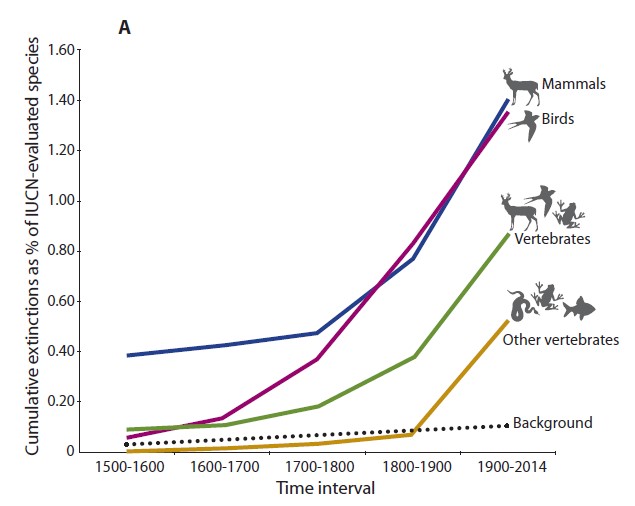
Figure—Cumulative vertebrate species that have gone extinct or extinct in the wild according to IUCN data from 2012. Dashed black line represents the background extinction rate. From Ceballos et al. (2015)[5].
The 543 species of vertebrates (mammals, birds, reptiles, amphibians, and fishes) that were lost over the last 120 years would have become extinct in 10,000 years under the background extinction rates prevailing in the last million years. In other words, in the last century we lost in one year the same number of species that would have been lost in 100 years!
We and other scientific groups have also shown that the extinction crisis is more severe because hundreds of millions of populations of animals and plants have disappeared in the last 40 years[5-9].
Those extinctions are accelerating, threatening the ecosystems that support life on Earth. If the current extinction crisis continues unchecked, we will lose entire ecosystems and the critical services they provide, including the proper combination of the gases of the atmosphere that make life on Earth possible, provision of fresh water, pollination and pest and disease control[8].
Jennifer Francis, Senior Scientist, Woods Hole Research Center:
Many statements are half-truths or based on cherry-picked information. Some are outright false. For example, it’s ludicrous to state “climate change is not making natural disasters worse.” An abundant and rapidly growing body of peer-reviewed scientific research identifies numerous ways that climate change is increasing the likelihood and intensity of various extreme weather events, exacerbating coastal flooding, and destroying ecological systems[1,2,6,18,19].
“Humans are not causing a ‘sixth mass extinction’”
An exceptionally rapid loss of species is occurring and expected to continue. Climate change is not the only factor responsible—pollution, habitat deterioration, over fishing and hunting, and invasive species are also contributing. Human fingerprints are all over these factors[5-14].
“Climate change is not making natural disasters worse”
This statement is refuted by numerous peer-reviewed scientific studies[1-4]. While disasters related to non-climate-change events (such as volcanoes, earthquakes, tsunamis) have not increased in frequency, those associated with climate change have tripled in frequency since the 1980s (see figure below).
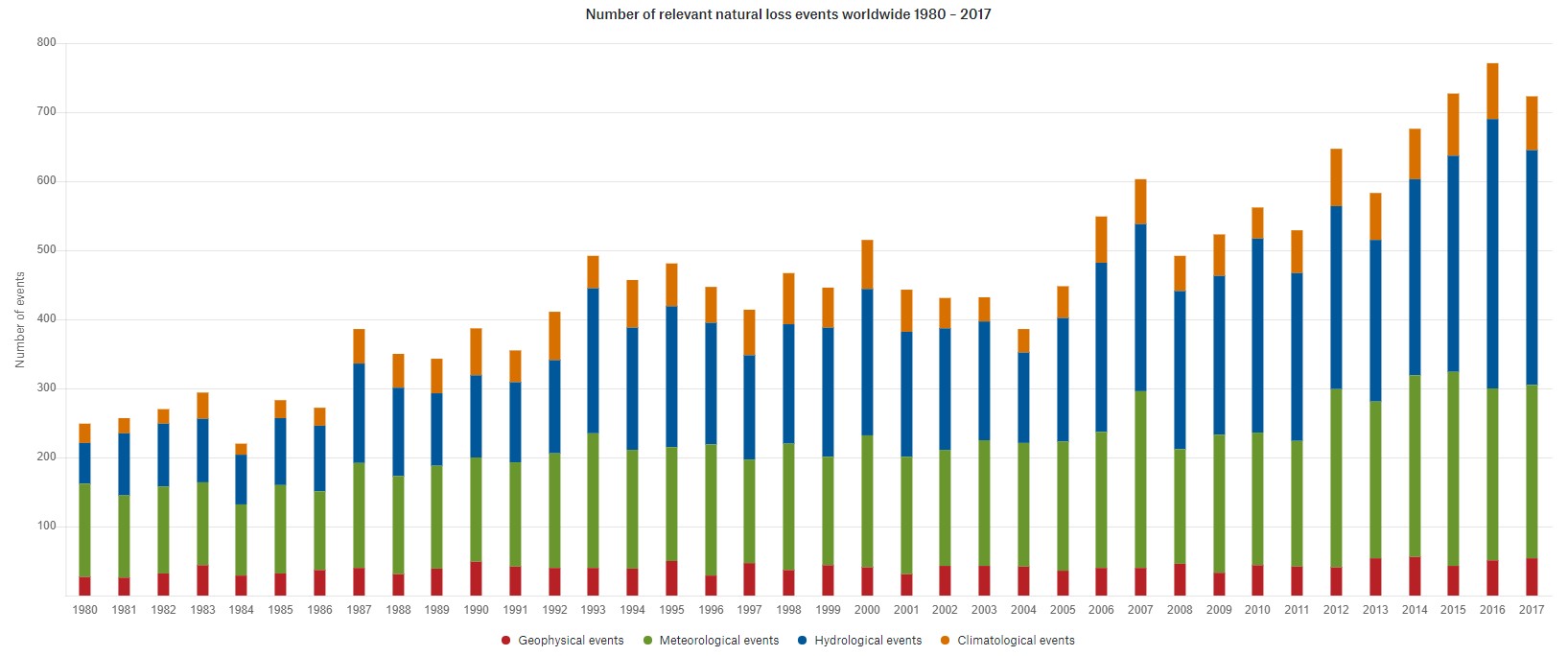
Figure—The number of geophysical, meteorological, hydrological, and climatological natural events that occurred globally from 1980-2017. From*NatCatSERVICE*.
“Fires have declined 25% around the world since 2003”
This is true in terms of a global average, mainly because forests have been cut down and replaced with agricultural land and because of fire suppression activities[15]. Some areas, however, are experiencing more frequent, larger, and more damaging fires—such as the U.S. western states, Alaska, northern Canada, and northern Eurasia[18,19]. This statement is misleading at best.
“Carbon emissions are declining in most rich nations and have been declining in Britain, Germany, and France since the mid-1970s”
This is true, but it’s in large part because high-emission industries have been moved to developing countries. Global carbon emissions are still increasing steadily (see figure below).
“The build-up of wood fuel and more houses near forests, not climate change, explain why there are more, and more dangerous, fires in Australia and California”
Both factors are contributing to increased fires[16].
Ryan Sriver, Assistant Professor, University of Illinois:
First off, it is largely an opinion piece and many of the claims are unverifiable or written in a way that is misleading, such as: “Fires have declined 25% around the world since 2003”. What exactly does this mean, the number of fires, duration, area burned, etc.?
Another such misleading claim is “Climate change is not making natural disasters worse”. Again, what natural disasters is the author referring to with this blanket statement, and what time frame, the last 5 years, 20 years, 100 years? The claim is vague and misleading in particular for climate and weather extremes. Temperature and precipitation extremes are getting worse with global warming leading to more severe and widespread heatwaves and drought[1-4]. This is well documented in the community assessments and observations, such as the 4th National Climate Assessment[20]. In addition, oceans are getting warmer and the atmosphere is wetter, which—combined with global sea-level rise—is making the flooding and precipitation damages from tropical cyclones and hurricanes more severe[1,2,21,22].
Finally, there is essentially no mention of arguably the biggest risk of climate change: sea-level rise! The only statement I see is the claim: “Adapting to life below sea level made the Netherlands rich not poor.” This statement acknowledges that sea-level rise is indeed happening and that adaptation will make nations better off economically. Statements such as these are dangerous and misleading. Sea-level rise poses a major threat to coastal communities with global socio-economic implications, and we are already seeing the negative impacts in more frequent and severe flood events in the US. These damages will only worsen as the polar ice sheets continue to melt, with potentially catastrophic effects on coastal cities and ecosystems, real estate markets, insurance industries, human migration, and national security.
Kerry Emanuel, Professor of Atmospheric Science, MIT:
In his article, Michael Shellenberger claims that “climate change is not making natural disasters worse”. This begs the question of what exactly is meant by “natural disasters”, but no matter how one defines them, this statement is patently false.
Let us assume that Shellenberger is defining natural disasters as deaths from events that could conceivably have a climate connection, such as floods, droughts, and hurricanes. In the period between 1900 and 2020, global deaths from these disasters have declined steeply. There is little question about why this has happened, and it is the immensely gratifying effects of greatly improved warnings, evacuations, and resilience. For example, in Bangladesh, where a single storm killed as many as 500,000 people in 1970, the government and non-governmental organizations have built many emergency evacuations shelters that have saved arguably millions of people in subsequent cyclones that have been meteorologically as bad or worse.
If there is a climate change signal, it would appear as a lessening of this happy trend toward decreased fatalities, but it would be very difficult if not impossible to extract such a signal. We do not know from this data whether climate change is decreasing the rate of decline of deaths from natural disasters or not.
If, on the other hand, we look at economic damage, normalized by world domestic product, the signal is equally clear but in the other direction….damages from weather-related natural disasters have been increasing greatly. One could plausibly argue that this is because of a global migration toward risky coastal regions, and so it is not unequivocal that this increase is owing to climate change.
The cleanest way to look at climate effects on natural phenomena is to look at the phenomena themselves. Here there is strong and mounting evidence that climate change is increasing precipitation extremes (floods and droughts), conditions for wildfires, and the incidence of strong hurricanes[1,2].
Whichever way one looks at it, Shellenberger’s statement is not defensible.
ANNOTATIONS
The statements quoted below are from the article; comments are from the reviewers (and are lightly edited for clarity).
as an energy expert…invited by the Intergovernmental Panel on Climate Change (IPCC) to serve as Expert Reviewer of its next Assessment Report
Zeke Hausfather, Director of Climate and Energy, The Breakthrough Institute:
This credential sounds much more impressive than it actually is. Anyone who wants to can sign up as an expert reviewer for the IPCC.
The Amazon is not “the lungs of the world”
Zeke Hausfather, Director of Climate and Energy, The Breakthrough Institute:
While this phrase was inaccurately spread in some news stories earlier this year, climate scientists – and the majority of activists – have never claimed this to be the case.
There is, however, a real danger that a combination of logging and climate change could transition much of the Amazon to a savannah-like ecosystem this century[23,24].
Climate change is not making natural disasters worse
Daniel Swain, Researcher, UCLA, and Research Fellow, National Center for Atmospheric Research:
On the whole, this claim is incorrect. While there are clearly certain types of natural disasters unaffected by climate change (earthquakes and volcanic activity, for example), and certain kinds of disasters for which there is an absence of evidence regarding a detectable influence from climate change (tornadoes, for example), there is a long and growing list of extreme event/disasters types regarding which the scientific literature strongly supports links to climate change. These include, but are not limited to: extreme heatwave intensity and frequency, drought intensity, wildfire extent and severity, and the flood hazards associated with tropical cyclones/hurricanes (both from oceanic storm surge and freshwater flooding associated with heavy precipitation).
Zeke Hausfather, Director of Climate and Energy, The Breakthrough Institute:
This is patently false. While there are some types of natural disasters with no (volcanoes, earthquakes) or very limited (tornadoes) climate links, others such as extreme heat events, droughts, and extreme rainfall have clear attribution to climate changes.
The US National Academy of Science published a report in 2016 on the role of climate change in extreme events that is quite helpful in understanding where linkages are – and are not – well understood[2]. This figure from the report shows our understanding and attribution of climate change impacts on extreme events, by event type.
[graf]
Fires have declined 25% around the world since 2003
Daniel Swain, Researcher, UCLA, and Research Fellow, National Center for Atmospheric Research:
I cannot speak to this specific statistic, but I emphasize that it is largely irrelevant in context and certainly misleading, since it conflates both climate and non-climate related factors.
There are strong links between climate change and wildfire extent and severity in many regions globally. It’s less clear whether there are links between climate change and wildfire frequency, but that’s not really the relevant metric here. Instead, climate change is clearly modulating the characteristics of wildfire in many regions—broadly increasing the dryness and flammability of vegetation, and allowing fires to become more intense and to burn more extensive areas.
Zeke Hausfather, Director of Climate and Energy, The Breakthrough Institute:
This statement is accurate but misleading. The vast majority of fires globally are purposefully set for agricultural clearing, and these have declined in recent years. Conflating all fires with forest and wildfires – as Shellenberger does – is not helpful in understanding changing drivers of fire risk.
A 2014 study in the Journal of Geophysical Research by Dr. Jia Yang at Auburn University and colleagues suggests that in the tropics climate change may have also reduced the area burned over the past 50 years, due, in part, to wetter conditions[25]. However, they find that climate change has likely increased fire risk in the high latitudes and mid-latitudes over recent decades.

Figure—Contribution of different factors in changes since 1900 in forest-fire area globally and for different regions. Effects of climate change (including changes in temperatures and precipitation) are shown by the vertical stripes. Human land management activity is shown by the diagonal stripes, while the effect of CO2 fertilization and nitrogen deposition is shown by the dots. From Yang et al. (2014)[25].
Hotter and dryer conditions have been a major factor in the increase in areas burned by wildfires in many regions – such as the western US – in recent years.
The amount of land we use for meat — humankind’s biggest use of land — has declined by an area nearly as large as Alaska
Zeke Hausfather, Director of Climate and Energy, The Breakthrough Institute:
This statement is accurate (according to FAO data) and represents an important decoupling of land use and livestock production in spite of increasing global meat consumption – though some of the reduction is offset by increased land use for agricultural crops for animal feed.
That said, there are large climate impacts of meat consumption apart from land use, and growing meat consumption is still driving deforestation in areas like the Amazon even as overall pasture use shrinks. So while peak pasture is certainly a positive thing, it does not translate into notable reductions in emissions to-date, as emissions from land use changes have remained largely unchanged. It does not – as Shellenberger seems to suggest – in any way indicate that climate change is a less serious problem than commonly thought, just that it’s possible to mitigate our impacts by changing practices and technologies.
The build-up of wood fuel and more houses near forests, not climate change, explain why there are more, and more dangerous, fires in Australia and California
Daniel Swain, Researcher, UCLA, and Research Fellow, National Center for Atmospheric Research:
This is misleading and incorrect as stated. While the legacy of 20th century forest management policies, as well as urban incursion into the wildlands, are indeed relevant in some areas, research has shown that such non-climate factors cannot account for the enormous increase in area burned by wildfire both in the broader American West and California specifically.
In fact, drying of vegetation due to climate change is responsible for about half of the observed increase in western U.S. forest fire area burned over the past several decades[18]. More specifically in California, observed warming and drying more than doubled the occurrence of extreme fire weather conditions between 1979 and 2018—a trend that is attributable to human-caused climate change[19].
Zeke Hausfather, Director of Climate and Energy, The Breakthrough Institute:
Here Shellenberger sets up a false dichotomy. All three factors – buildup of vegetation due to fire suppression, more people living in the wildland-urban interface, and hotter and dryer conditions have contributed to severe wildfires in regions like the western US in recent years.
For example, there is a strong year-to-year relationship between fuel aridity – driven by hotter and dryer conditions – and area burned in the western US.
Figure—Western US forest fire area on a logarithmic scale compared to standardised fuel aridity, with datapoints during the 1984-1999 (blue dots) and 2000-2017 (red dots) periods highlighted. Map insert shows the western US forest areas. From Abatzoglou et al. (2016)[13].
A 2016 study showed that climate change is responsible for over half the increase in fuel aridity (drier fuel load), and has doubled the cumulative forest area burned[18]. Rising average global temperatures have led to higher spring and summer temperatures, which in turn have led to earlier spring snowmelt. Further, there is evidence that climate change is causing winter rains to come later in autumn, and stop earlier in spring[26,27]. This is extending the area and time periods in which forests become combustible, and in parts of California, fire season is now 50 days longer than in 1979[28,29].
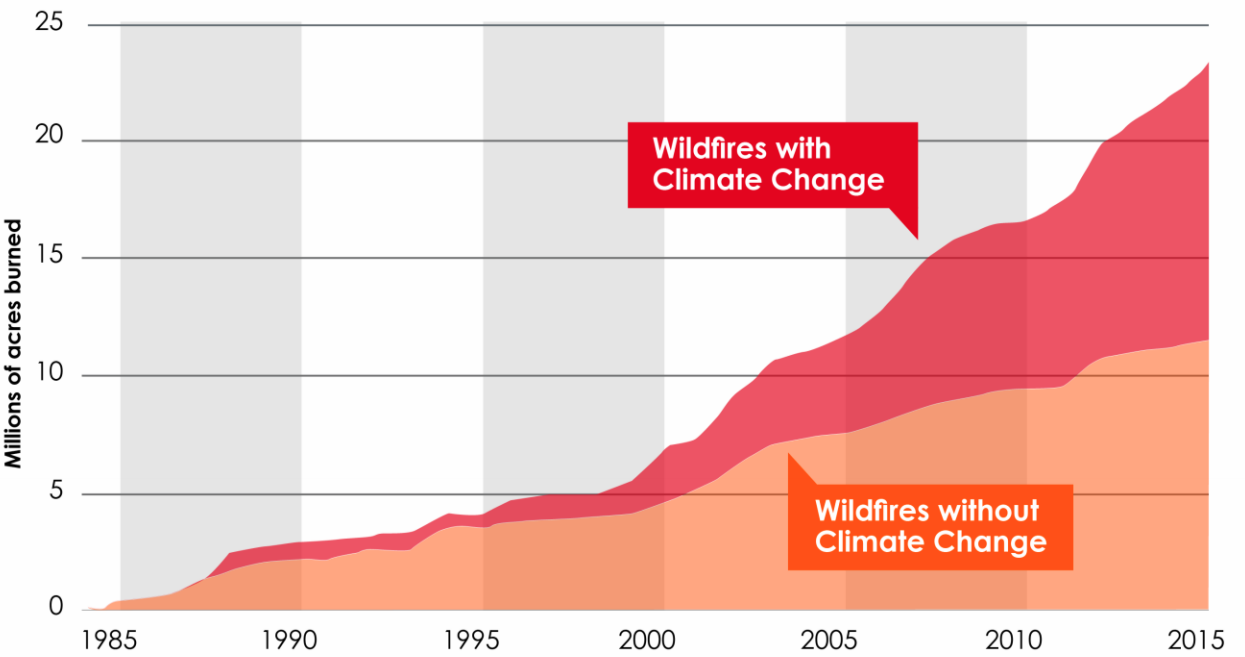
From 4th National Climate Assessment, based on data from Abatzoglou et al. (2016)[13,15].
*Carbon emissions are declining in most rich nations and have been declining in Britain, Germany, and France since the mid-1970s
Zeke Hausfather, Director of Climate and Energy, The Breakthrough Institute:
This claim substantially overstates the long-term success that rich countries have had in decarbonizing their economies. Rich nations as a whole (using OECD nations as the grouping of rich countries) emit 25% more CO:{2:(style="box-sizing:border-box;position:relative;vertical-align:baseline;bottom:-0.25em"):}: today than they did in the mid 1970s. While a number of countries (Germany, France, UK) do emit less today than in the 1970s, their experience is not generalizable to rich countries as a whole.
These calculations also do not include emissions associated with increased consumption of goods produced in places like China, which matters quite a bit in recent decades....[much more]
==
agence france fact check
...
Climatologist Zeke Hausfather, of the independent climate science non-profit Berkeley Earth (archived here), said that this paper "should really give no comfort to those skeptical of man-made climate change."
===
THE SCIENCE BEHIND IMPACTS OF THE CLIMATE CRISIS117th Congress (2021-2022)
House Committee Meeting
Committee:|House Science, Space, and Technology|
Related Items:|Data will display when it becomes available.|
Date:|03/12/2021|
Location:|Data will display when it becomes available.|
Website:|https://science.house.gov/
Opening Statements
Statement by Representative Eddie Bernice Johnson, Chairwoman,
Committee on Science, Space, and Technology, U.S. House of
Representatives................................................ 9
Written Statement............................................ 10
Statement by Representative Frank Lucas, Ranking Member,
Committee on Science, Space, and Technology, U.S. House of
Representatives................................................ 10
Written Statement............................................ 11
Witnesses:
Dr. Michael Oppenheimer, Albert G. Milbank Professor of
Geosciences and International Affairs, Princeton University
Oral Statement............................................... 13
Written Statement............................................ 16
Dr. Zeke Hausfather, Director of Climate and Energy, The
Breakthrough Institute
Oral Statement............................................... 36
Written Statement............................................ 38
Dr. Noah S. Diffenbaugh, Kara J. Foundation Professor, Department
of Earth System Science, Kimmelman Family Senior Fellow, Woods
Institute for the Environment, Stanford University
Oral Statement............................................... 76
Written Statement............................................ 78
Dr. Paula S. Bontempi, Dean, Graduate School of Oceanography,
Professor of Oceanography, University of Rhode Island
Oral Statement............................................... 88
Written Statement............................................ 91
Discussion....................................................... 101
...
TESTIMONY OF DR. ZEKE HAUSFATHER,
DIRECTOR OF CLIMATE AND ENERGY,
THE BREAKTHROUGH INSTITUTE
Dr. Hausfather. Thank you. Good morning, Chairwoman
Johnson, Ranking Member Lucas, and Members of the Committee. My
name is Zeke Hausfather. I'm a climate scientist and Director
of Climate and Energy at The Breakthrough Institute.
In many ways 2020 was the year in which both climate
change and the accelerating energy transition became impossible
to ignore. On the climate front, we saw 2020 tie with 2016 as
the warmest year since records began, with global temperatures
of around 1.3 degrees Centigrade, or 2.3 degrees Fahrenheit,
above temperatures of the late 1800's. Land areas, where we all
live, were nearly 2 degree Centigrade, or 3.6 degrees
Fahrenheit, warmer. We saw devastating wildfires in California
and Australia, extreme heat in Siberia, and the second lowest
level of Arctic sea ice ever observed, among other climate
extremes.
At the same time, the world has made substantial progress
in moving away from the worst-case outcomes of climate change
over the past decade. Rather than a 21st century dominated by
coal the energy modelers foresaw, global coal use peaked in
2013, and is now in structural decline. We have succeeded in
making clean energy cheap, with solar power and battery storage
costs falling tenfold since 2009, and the world has produced
more electricity from clean energy, solar, wind, hydro, and
nuclear, than from coal over the past 2 years. And according to
major oil companies, peak oil is soon upon us, not because we
have run out of cheap oil to produce, but because demand is
falling as consumers shift to electric vehicles (EVs).
Current policies adopted by countries today put us on
track for around 3 degrees Centigrade of warming by the end of
the century, compared to the late 1800's. Including pledges and
targets, such as those in the Paris agreement, brings us down
to 2.5 degrees Centigrade. We have seen a proliferation of
longer term decarbonization commitments in recent years, with
countries representing around half of global emissions,
including China, pledging to reach net zero by 2050 or 2060. If
these longer-term commitments are achieved, it would bring end
of century warming down close to the global target of 2 degrees
Centigrade.
Now, some caution is warranted here. Long term pledges
should be discounted until reflected in short term policy
commitments, and warming could well be notably higher or lower
than these best estimates, given scientific uncertainties
surrounding both the sensitivity of climate to our greenhouse
gas emissions and likely changes in the ability of the land and
oceans to absorb a portion of what we emit. CO2
accumulates in the atmosphere over time, and until emissions
reach net zero, the world will continue to warm. This is the
brutal math of climate change, and it means that full
decarbonization is not a matter of if, but when.
Cost declines in clean energy go a long way toward making
deep decarbonization more achievable at a lower cost than
appeared a decade ago. Low cost renewables can provide a
sizable share of our energy needs in modern grid integration
models. In the near term, however, America's cheap and abundant
supplies of natural gas will play a key role in filling in the
gaps as we buildup more wind and solar, and keep existing clean
energy sources, like nuclear, online.
In the longer term, there's a growing recognition of both
the need for complementary technologies, such as grid-scale
storage and long distance transmission, as well as clean firm
generation, like advanced nuclear, enhanced geothermal, and gas
with carbon capture and storage, to ultimately wean the system
off its dependence on natural gas. Studies have consistently
shown that low carbon power grids with a sizable portion of
clean, firm generation are a lower cost option than wind,
solar, and hydro alone. CO2 removal technologies
will also play an important role to offset the long tail of
hard to reduce emissions from sectors like aviation. The 2020's
is the decade to invest in maturing a range of technologies
that improve options for the long terms.
Debates around climate mitigation are often framed as a
choice between the technologies we have today and future
innovations. In reality, we need to do both, to deploy what is
cost-effective today, and to invest in the range of solutions
needed to tackle the hard to decarbonize parts of the economy.
The recent omnibus bill takes an important step in this
direction, authorizing billions of dollars for investments in
clean energy, vital energy R&D (research and development), and
grid modernization. It shows that there is real potential for
bipartisan energy solutions that both reduce emissions and
create jobs. If we want to ensure that the rest of the world
follows the U.S. lead in reducing CO2 emissions,
there is no better step we can take than making clean energy
technologies cheaper than fossil fuel alternatives. Making
clean energy cheap can set the U.S. up to be a leader in
developing and selling these technologies to the rest of the
world, while building new industries, and creating jobs at
home.
Climate change impacts pose a serious threat to our way of
life, but are unlikely to lead to human extinction. However,
existential risks are an unnecessarily high bar to take action.
Nearly every other challenge we have dealt with in the past,
poverty, war, hunger, disease, did not literally threaten the
survival of our species. The impetus to mitigate climate change
is less about enabling humanity to survive, and more about
enabling it to thrive, and to leave our children a natural
world that, while far from untouched, is at least largely
intact. Thank you.
[The prepared statement of Dr. Hausfather follows:]
[GRAPHICS NOT AVAILABLE IN TIFF FORMAT]
Chairwoman Johnson Thank you very much. We'll now hear
from Dr. Diffenbaugh.
...
bice
I'll start with Dr. Hausfather. Is it safe to say that
global economic development can rely on fossil fuel, at least
in the near term, but, in your opinion, when we're looking
toward the future, would it be better to give developing
countries money to combat climate change, or the technological
tools that we may be developing here in this country to reduce
greenhouse gas emissions?
Dr. Hausfather. So I think it is important to recognize
that we're not going to get rid of fossil fuels anytime in the
near future. But at the same time, there's sort of an order of
operations for fossil fuels, right? Coal is by far the most
carbon intensive, then comes oil, then comes natural gas. And
so if you look at the type of models that we developed that
look at how the globe might be carbonized, you see a transition
away from coal first, then away from oil, and then ultimately
away from natural gas.
As to your second question, you know, I think geothermal's
a really exciting area right now. You know, I think it's, in
many ways, in a similar position to where the fracking
revolution was 2 decades ago, and, you know, diamond drill
bits, which you mentioned in your opening, are actually playing
a huge role in unlocking enhanced geothermal today. And so this
is one of the type of technologies, you know, renewables are
obviously another, advanced nuclear is a third, where making
them cheap enough so that they can compete with fossil fuels on
the market is going to go a huge way to get them adopted by the
rest of the world. You know, direct support is important in
some occasions, particularly for adaptation health, but
ultimately, given the scale of the energy transition needed,
particularly in middle income countries like India and China,
it's making clean energy cheap that is the single biggest lever
we have to drive adoption and emission reductions by the rest
of the world.
Mrs. Bice. Anyone else like to comment on that?
Dr. Diffenbaugh. Yeah, I would add that--go ahead,
Professor Oppenheimer.
Dr. Oppenheimer. Quickly, I'd just like to add, you know,
I actually agree with Dr. Hausfather said, with the caveat
that--be careful with the ordering of fossil fuels. They all
have problems, and in particular, unless the leaks of natural
gas due to drilling, transmission, and distribution are
eliminated, then the benefits of using natural gas for
greenhouse gas emissions reduction are largely eroded.
...
===
===