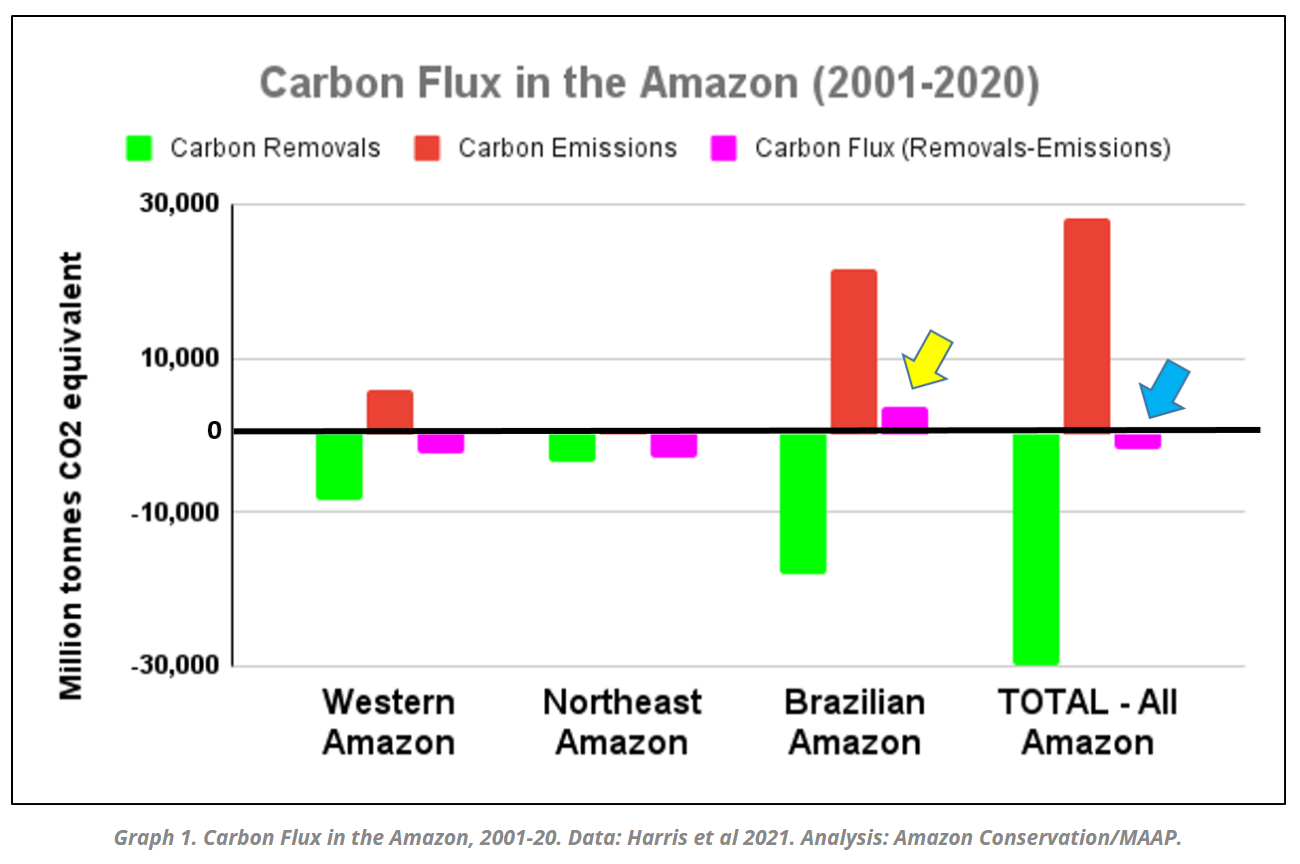
The ocean as well as boreal and tropical forests have historically served as a substantial sink for anthropogenic CO2, sequestering approximately 50% of the CO2 emitted every year, leaving just 50% to contribute to the growth in atmospheric CO2 concentrations.
There has long been a concern that forests and even the ocean might become CO2-saturated, resulting in more CO2 remaining in the atmosphere, accelerating the rate of change in terms of CO2 ppm, and accelerating climate change.
The Amazon rainforest turns out to be the first major biospheric CO2 sink to potentially tip from “sink to source.” This is often not included in lists of “tipping points,” although going from sink to source is certainly an indication that the Amazon is getting closer to tipping from rainforest to savannah, which is a classic tipping point.
People started talking about the Amazon’s being at risk of switching from sink to source more than a decade ago, but it is in the last few years that studies have started suggesting that parts of the Amazon, and even the Brazilian Amazon as a whole, has switched from sink to source, at least temporarily (since CO2 emissions from fire are key to the math, and those emissions can change dramatically year to year).
Analysis suggests that the Brazilian Amazon in particular has flipped from source to sink based on the period 2001-2020. This signal is likely to become more and more clear as climate change progresses, absent a large-scale intervention to reforest/regenerate deforested parts of the Amazon, which could slow the signal for some period of time.
Measuring the Amazonian carbon flux is in principle as simple as subtracting carbon emissions from carbon removals. In practice each of those two variables requires measuring a series of subsidiary variables, including: