INTRODUCTION AND TOC
Welcome to this course on how individuals can be most effective at tackling climate change.
I've actually grappled for years about my own effectiveness at tackling climate change, which I've spent my entire career working on. And I've been thinking about this course for a long time, so I hope you'll enjoy it. I hope you'll find it useful, and I would welcome your feedback after the course.
In this introduction to the course, I'll cover who I am and why I think you might be interested in hearing what I have to say about this topic. I'll explore what we will cover in the course, and I'll talk a little bit about how we'll cover it and the different ways in which you can benefit from the material. Let me start with this question of what's with the stripes.
You'll see these stripes on every slide of the course. I really like them. They are called “climate stripes.” The concept was developed by a professor in England a number of years ago. It's one of many ways that one can visualize changes in the global temperature record over the last 100 years or so. In reality, this graphic is a lot more colorful than it is here.
I've muted the color so it doesn't dominate the screen too much, but you can see that on the left (i.e., long ago) things were cooler. Those were the blues. On the right, things are getting warmer. Those are the pinks, and in reality, some reds. So that's what the stripes are. I'll come back to this in a later lesson.
So, who am I and what do I bring to this course? Well, I'm the father of two wonderful sons, as you can see in the picture here. And that's of course very important to me.
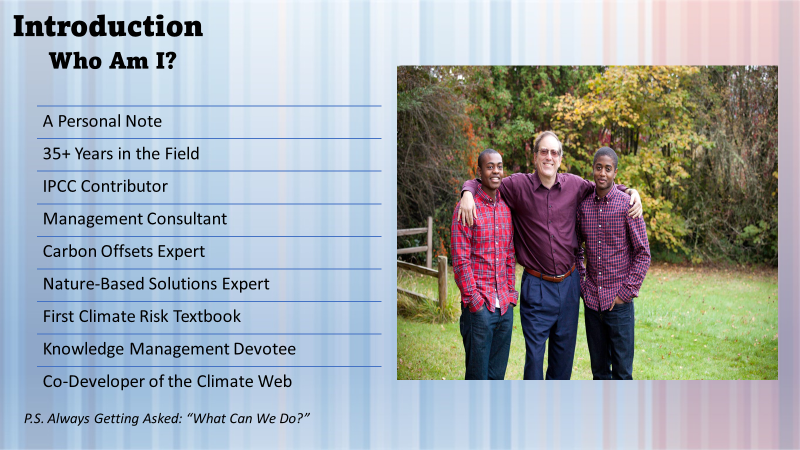
I'm also someone who has spent 35 years working in the field of climate change in a number of capacities. I've worked with the Intergovernmental Panel on Climate Change, which is the leading scientific body advising the world's governments on climate change. I've worked with companies around the world as a management consultant and worked with various US and international organizations. I’ve worked extensively in the carbon offsets space.
I've done a lot of work on nature-based solutions around climate change, a topic we will cover later in the course. I even wrote the first climate risk textbook for the London School of Economics back in 2011 for a course being taught to senior business decision makers. I'm also a real devotee of knowledge management not only in the context of this course, not only in the context of this topic, but in the context of an information society where we're all juggling too much information. I'll suggest some tools you might want to take advantage of that are some of the same tools that I use for purposes of my work and for this course. In fact, one of those things is the Climate Web, which we'll introduce later, which is built with knowledge management software. You'll see it in some of the learning modules for the lessons.
But what's really notable is that no matter what I'm talking about to people when it comes to climate change, no matter who the audience is, I always get the question, well, what is it that we can really do as individuals? What is it, that if we all did it, would make a big difference on climate change?
Turns out, that's a very hard question to answer, and that's why I've put together this course.
So let me quickly run down what we'll cover in the course. You don't have to memorize all this. You'll see this slide at the end of or at the beginning of every module in the course. I'll start with why this course -- why it's so important to be thinking about this topic of individual action on climate change.
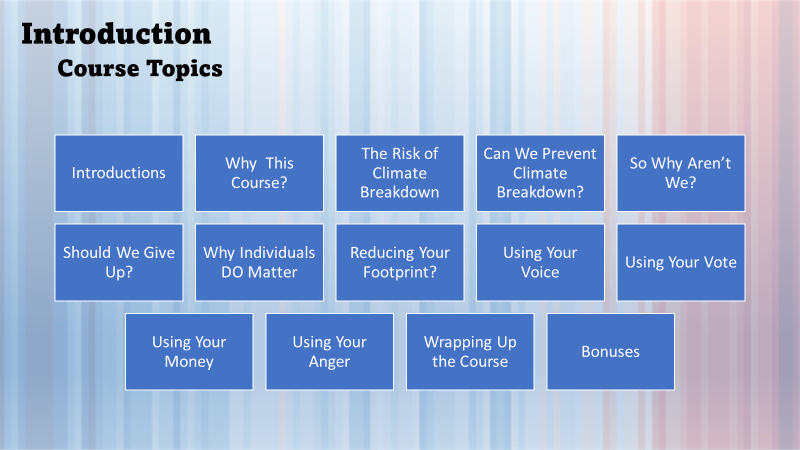
I'll be talking about why climate change and the risk of climate breakdown is such a significant problem for us, whether we can prevent it. If so, why aren't we preventing it? Is it time to give up, as some people would argue? And then I'll really get into what's the meat of the course for us, which is individuals really do matter.
Does it have to do with reducing your footprint? Does it have to do with using your voice, with using your vote, using your money, using your frustration? And anger? We will cover all of those topics in quite a bit of depth. We'll then wrap up the course, and I've got some great bonus discussions at the end for you as well that I think you'll find very useful.
So how am I going to cover the topics in the course? Well, it is a video-based course, and so certainly each module, each lesson will have its own video. But you can also treat it as an audio book because I will explain everything in such a way that even if I do have a graphic or a picture on the slide you'll know what I'm talking about just through the way I'm describing it.
So, if you're walking in the morning, if you're driving to work, whatever you're doing, you can almost listen to these lectures as an audiobook. And last, I will point you to an E-book specifically for this in the Climate Web. It will have more information, go into more depth, and have all the key graphics that I am using in the course so that you can explore them and go back to them.
We'll also have module by module resources where I'll point you to some of the best things that I found in many years of searching. One real benefit of this is that I'm pulling together for you what is really hundreds to thousands of hours of searching the internet for the topics that are relevant to what we're covering in the course.
And you can take advantage of all of that just through the links that I'll organize for you in the individual PDFs that will present module by module. A couple of quick points on terms that we use in the course. For example, Fahrenheit versus Celsius. I will deliver the temperatures in this course as Fahrenheit. One degree Celsius is about one and a half degrees Fahrenheit, plus or minus/close enough. So I am talking about Fahrenheit, whereas most of the numbers that you might hear out there are in Celsius. So, bear that in mind and I'll try and reinforce that point. Second, English versus metric -- in terms of talking about tons, frankly, there are 10% difference. It's good enough so let's not worry about it.
I've briefly introduced the Climate Web already. It’s built with TheBrain software, which is a uniquely powerful but easy to use software.The Climate Web is built with that software. The Climate Web represents tens of thousands of hours of knowledge curation. Again, for this course, what I've done is to pull the relevant information and the relevant topics together for you.
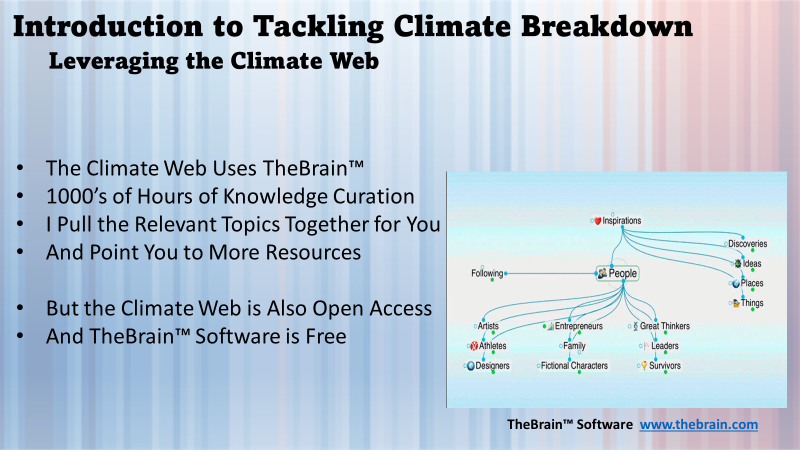
This is not an area where the problem is too little information. The problem here is overwhelming information, leaving you with no idea of what to actually do with all that information. I've tried to boil it down for you and deliver it and organize it in a way that I think will be useful. But I will point out, and we'll cover this in a bonus at the end of the course, that the Climate Web is open access.
So, if you want to dig more deeply into topics around climate change, you can do that in the Climate Web or our newest knowledge solution, Your Climate Toolbox.
To step away for one second from the main topic of this course, I thought it would be useful to put up this quote from the late famous scientist E.O. Wilson:
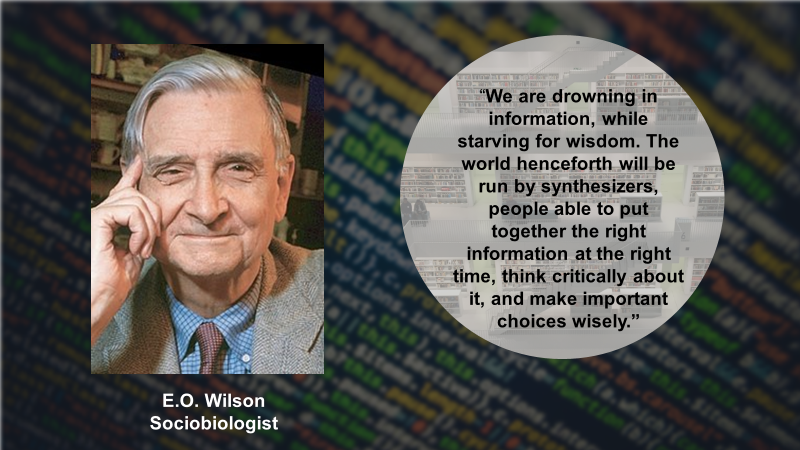
He has a great quote.
“We are drowning in information, while starving for wisdom. The world henceforth will be run by synthesizers, people able to put together the right information at the right time, think critically about it, and make important choices wisely.”
That's why I'm such a devotee of knowledge management -- because this is an information society, and I think that every high school student and college student and professional should have a knowledge management system.
You might find that you're interested in checking out TheBrain software. I have no financial interest in TheBrain software or in the company, but it's a great software that can really help people get a step up academically and professionally. So, check it out.
Let me close the introduction by giving you some contact information. I'll show this slide again at the end of the course, but I do welcome questions. I do welcome feedback on what we cover in the course.
And so now we're going to dig into the first module. Why is this course necessary to do in the first place?